3 February 2026 – Determined to put at least a bit of knowledge behind my obsession with moss, I have begun to read Gathering Moss (Robin Wall Kimmerer). as recommended by a wise and dear friend. It is a splendid recommendation: Kimmerer draws on both her academic status (botanist, university professor) and her heritage (enrolled member of the Citizen Potawatomi Nation) to present the scientific data of bryology in the larger human context.
3 February 2026 – Determined finally to put a bit of knowledge behind my obsession with moss, I have begun to read Gathering Moss (Robin Wall Kimmerer), recommended to me by a wise and dear friend.
It is a splendid recommendation. Kimmerer draws on both her academic status (botanist, professor) and her cultural heritage (enrolled member of the Citizen Potawatomi Nation) to present scientific data about bryology in the larger human context.
Just two chapters into the book, I bring myself to the Camosun Bog, on a suitably rain-tinged day, with new eyes.
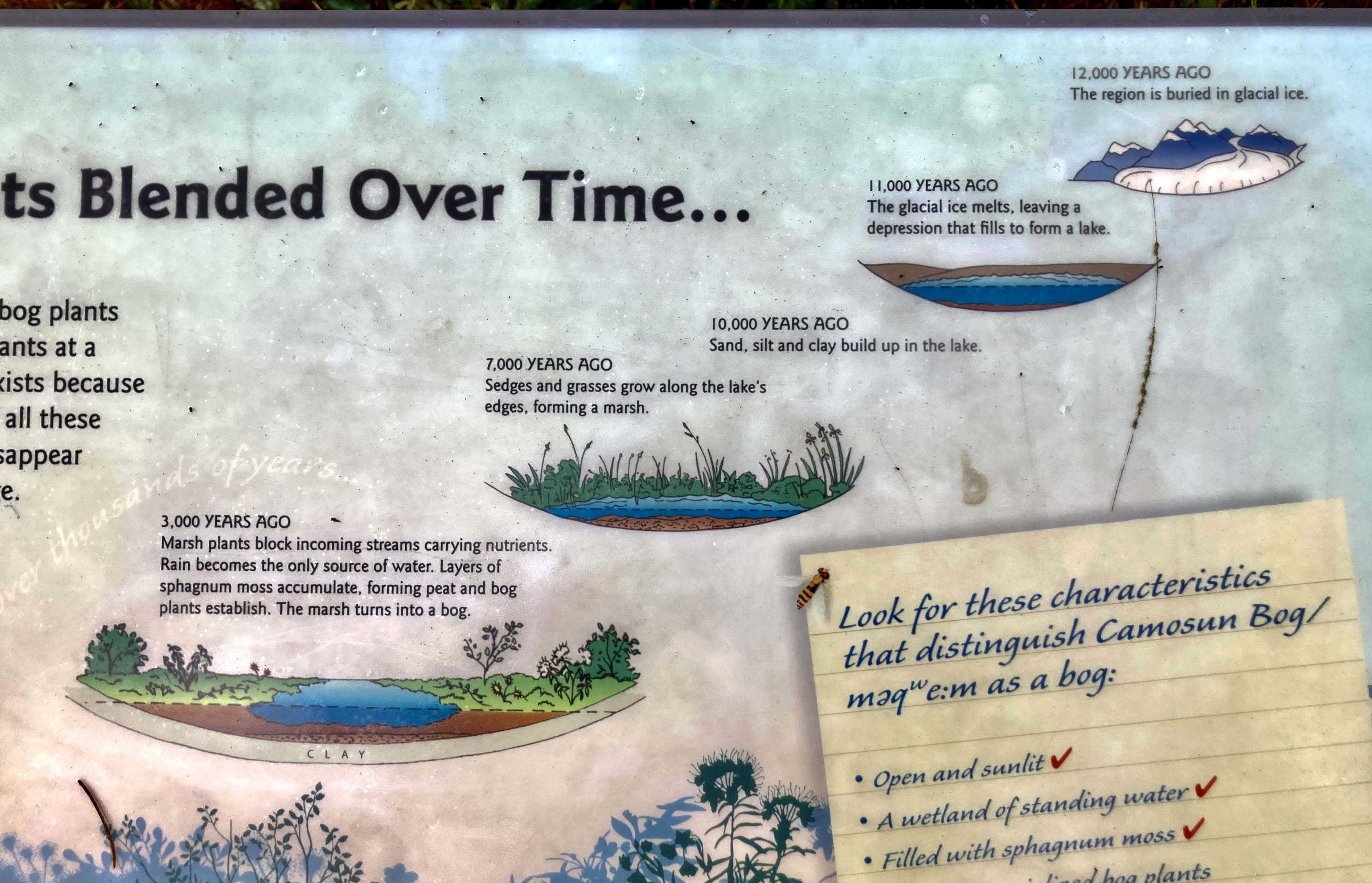
Signage welcomes me at the Camosun Street entrance, down there at the bottom right of the map…
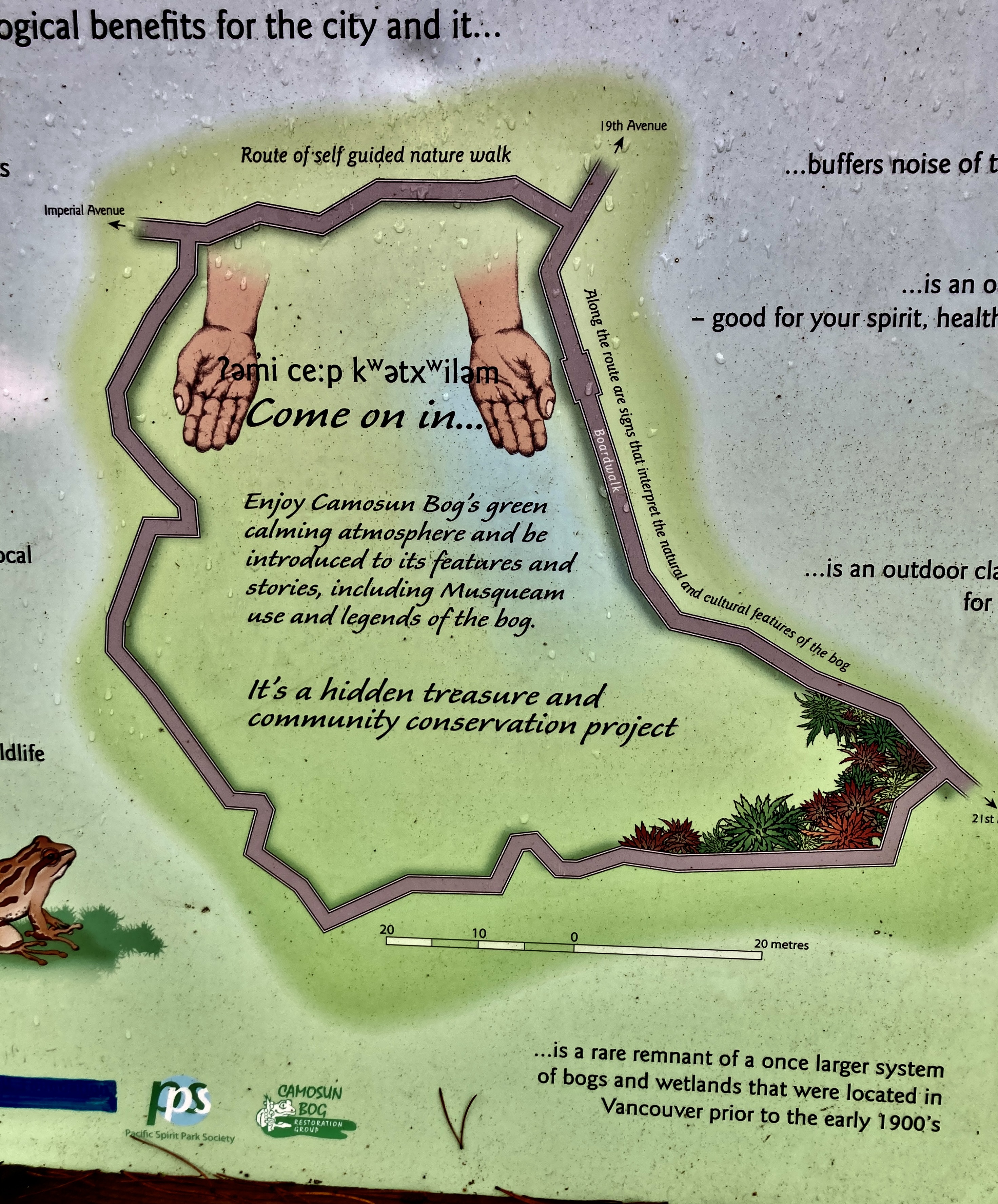
and Kimmerer’s words shimmer in my brain.
“With sophisticated technology we strive to see what is beyond us, but are often blind to the myriad sparkling facets that lie so close to hand. … Mosses and other small beings issue an invitation to dwell for a time right at the limits of ordinary perception.”
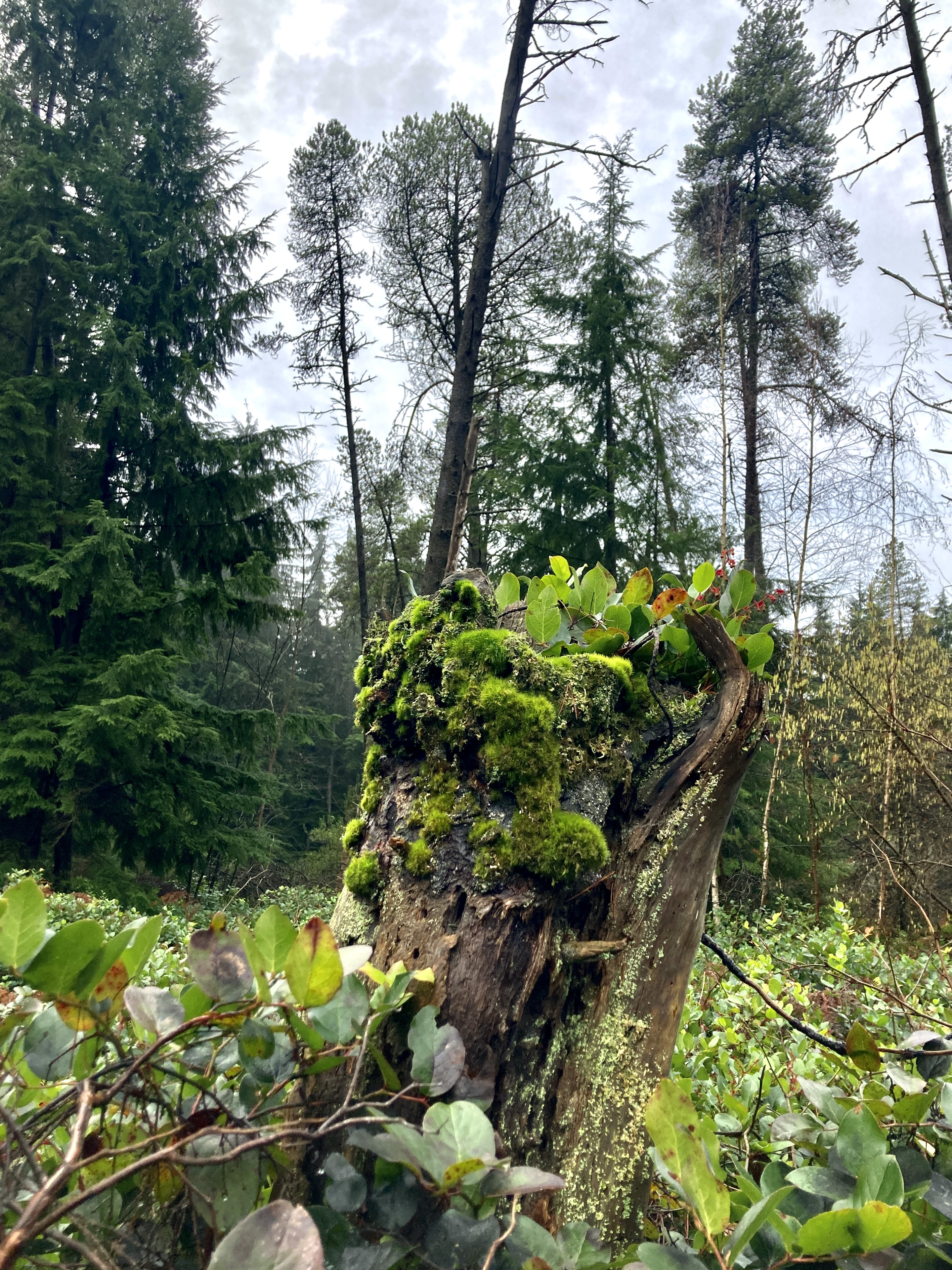
I greet what I think of as my Sentinel Log on the way in. I am still ignorant of all the mosses it bears, but more appreciative of them than ever.
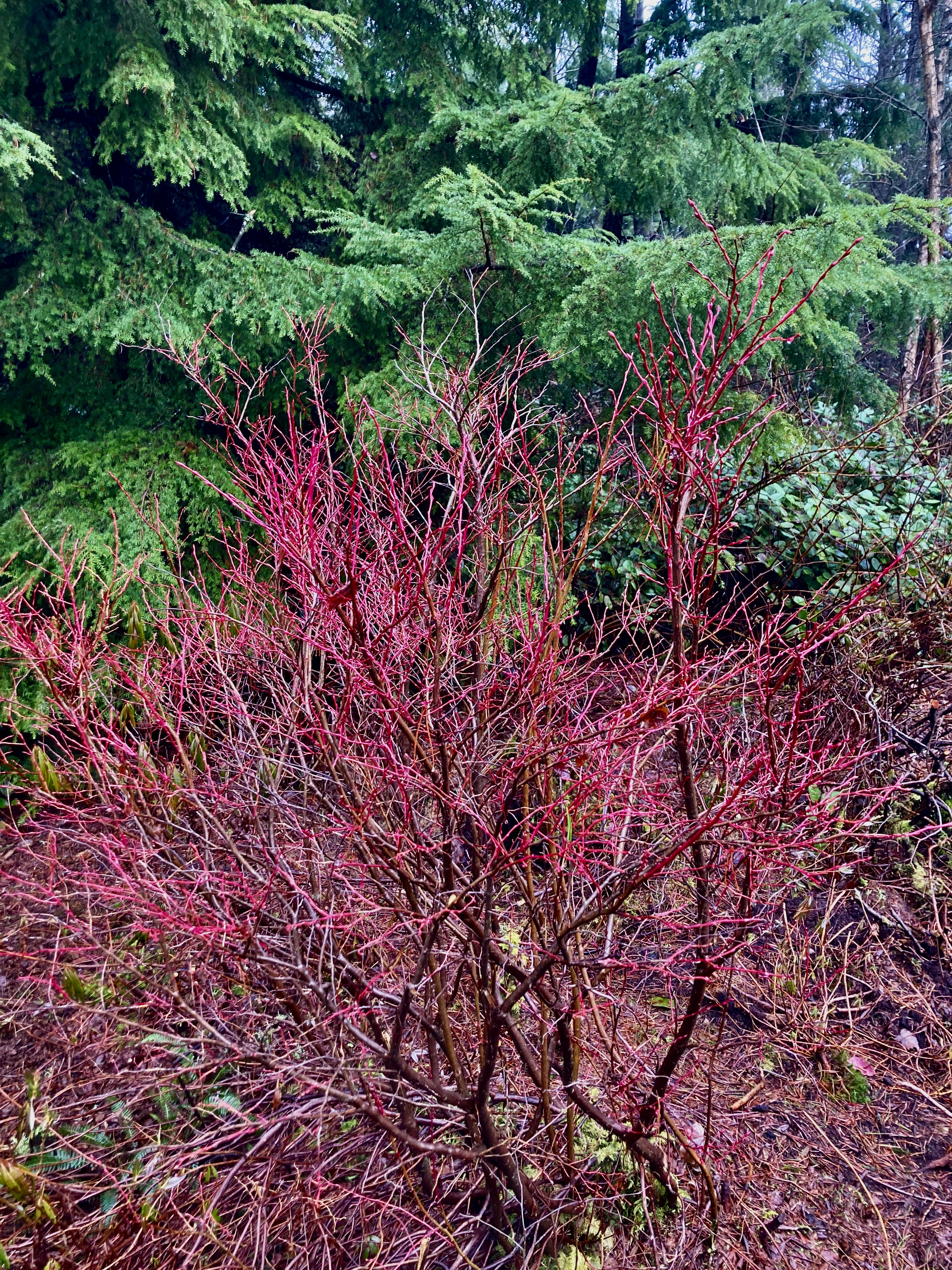
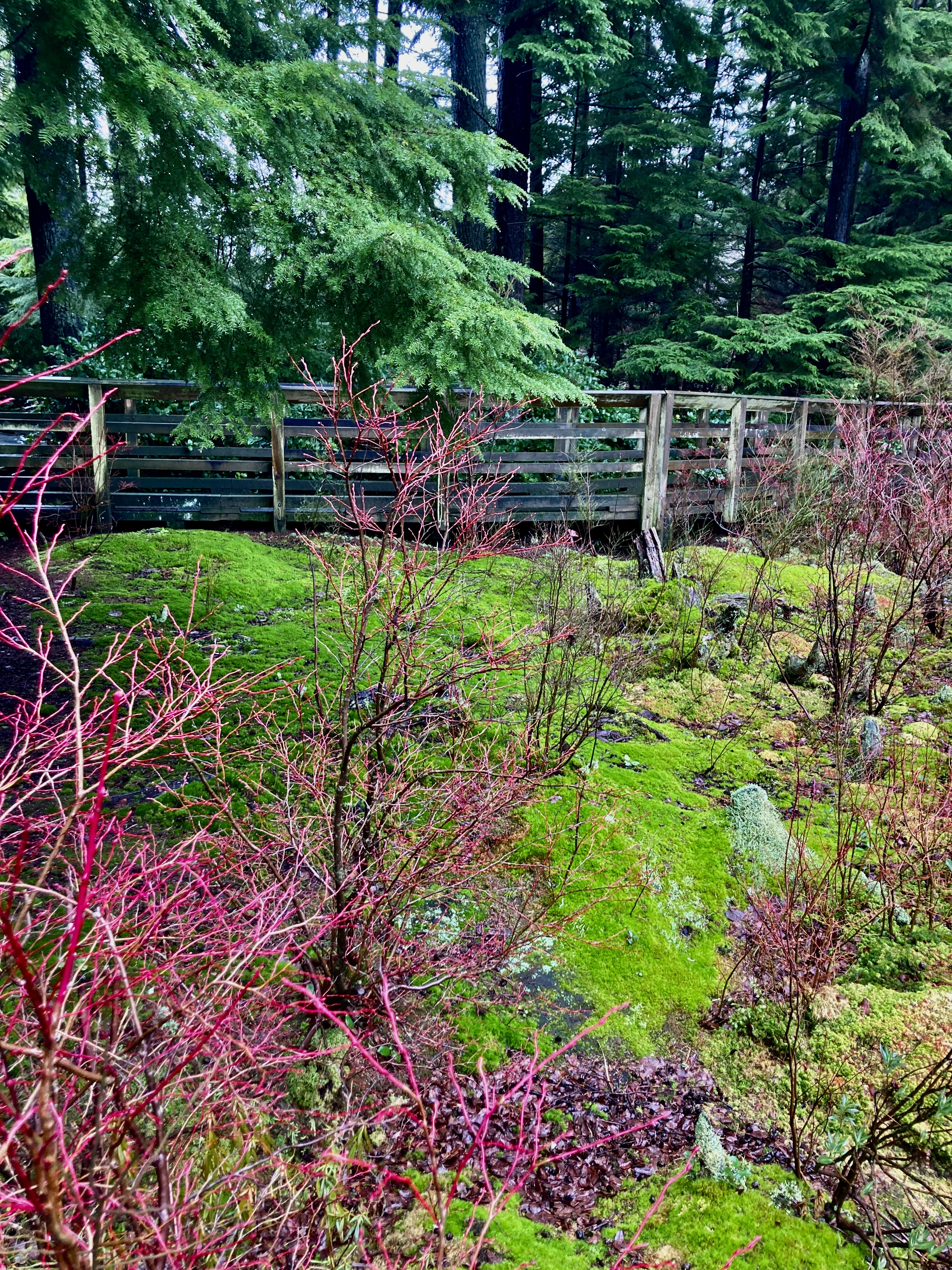
I am almost impatient with this blaze of Red osier dogwood — it’s not why I’m here!
I am here for what first appeared some 3,000 years ago, the transformation from marsh to bog.
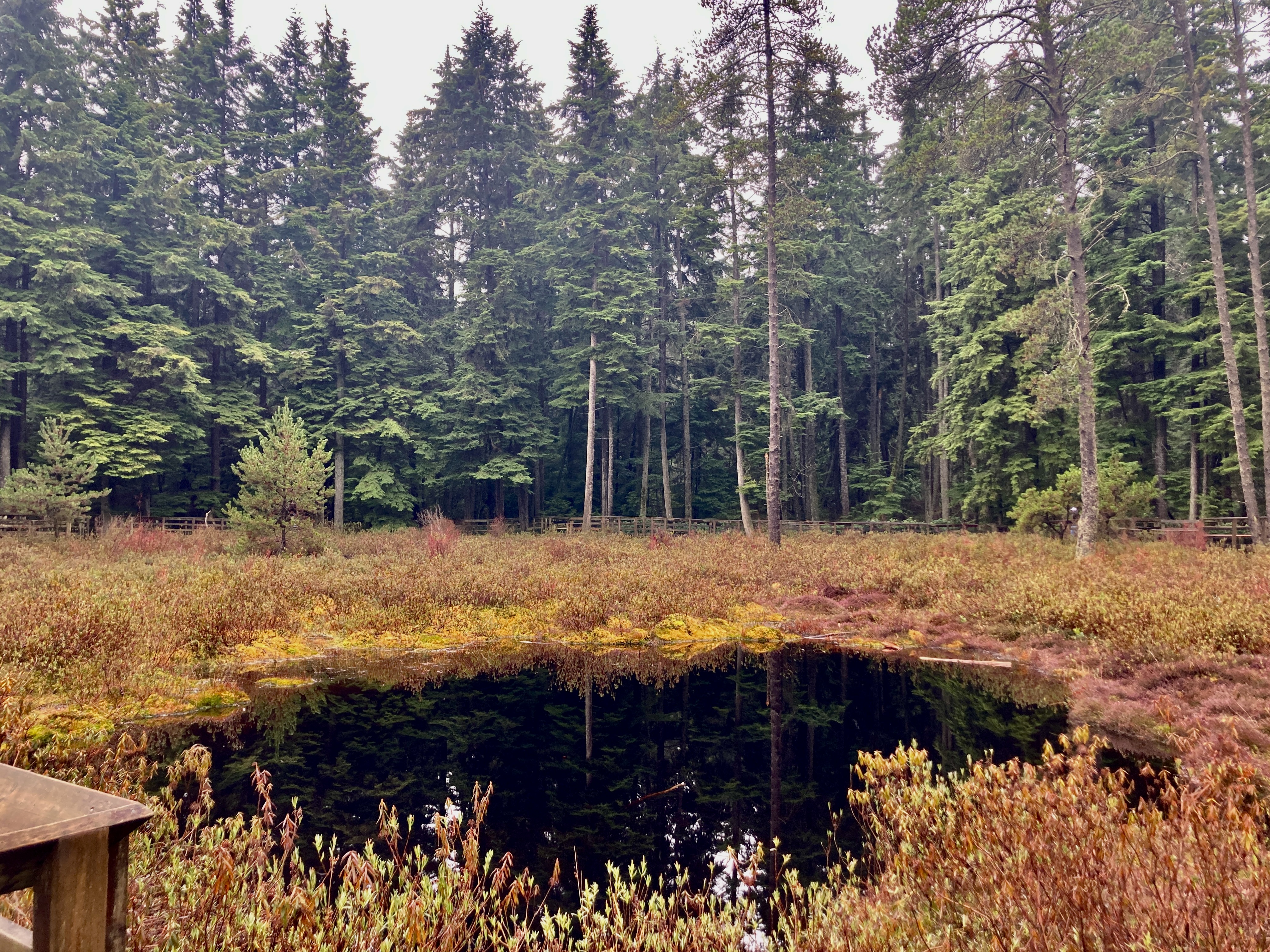
I stand at the heart of the bog, admire its waters at their full winter strength, surrounded by bog plants and mosses and, beyond that, the forest of Pacific Spirit Regional Park.
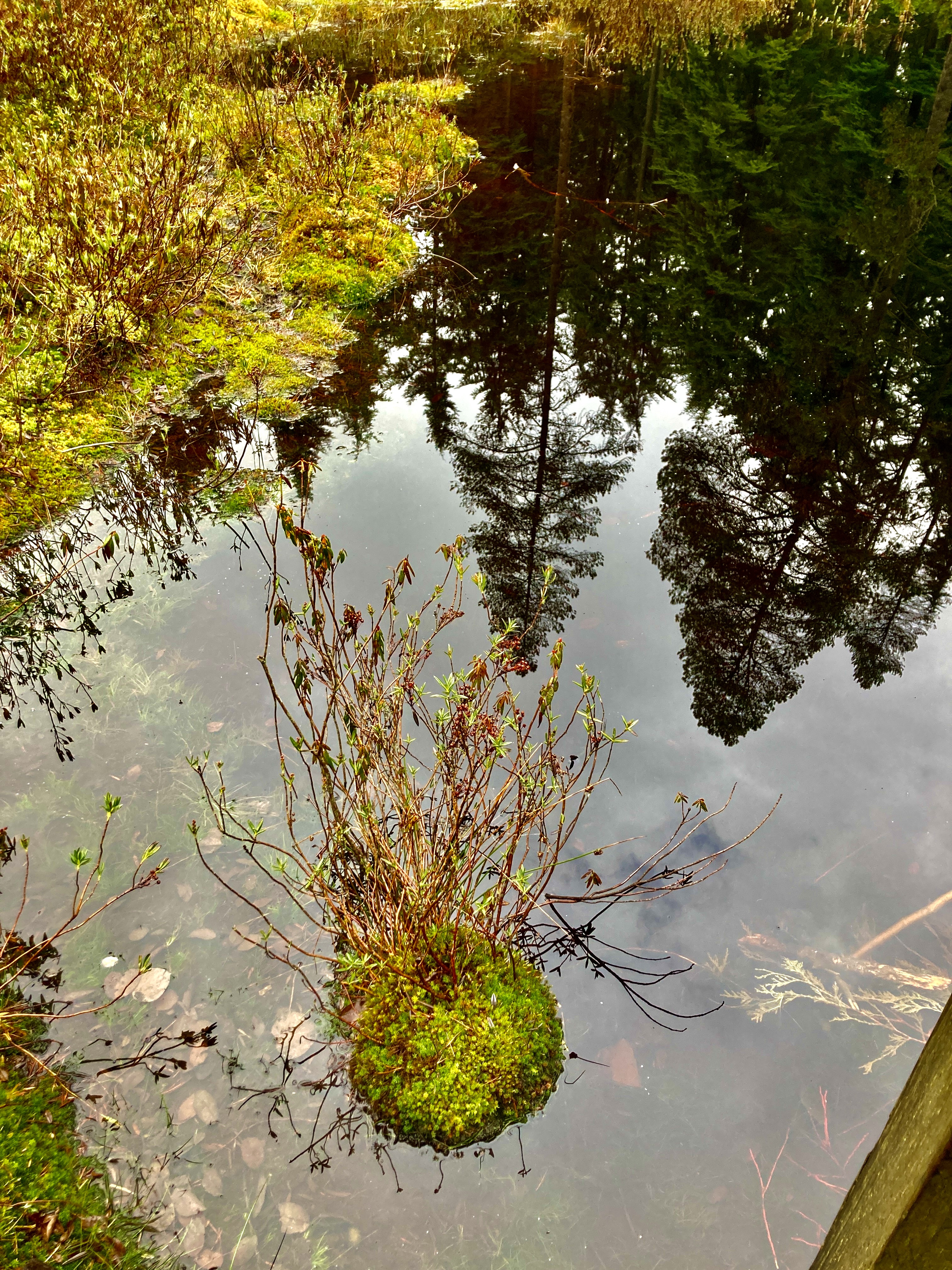
All those other plants first tug the eye, but, look, mosses on hummocks in the bog waters and all along its edges.
“Learning to see mosses is more like listening than looking,” says Kimmerer. “Mosses are not elevator music, they are the intertwined threads of a Beethoven quartet.”
I dutifully read about the Bog Laurel…
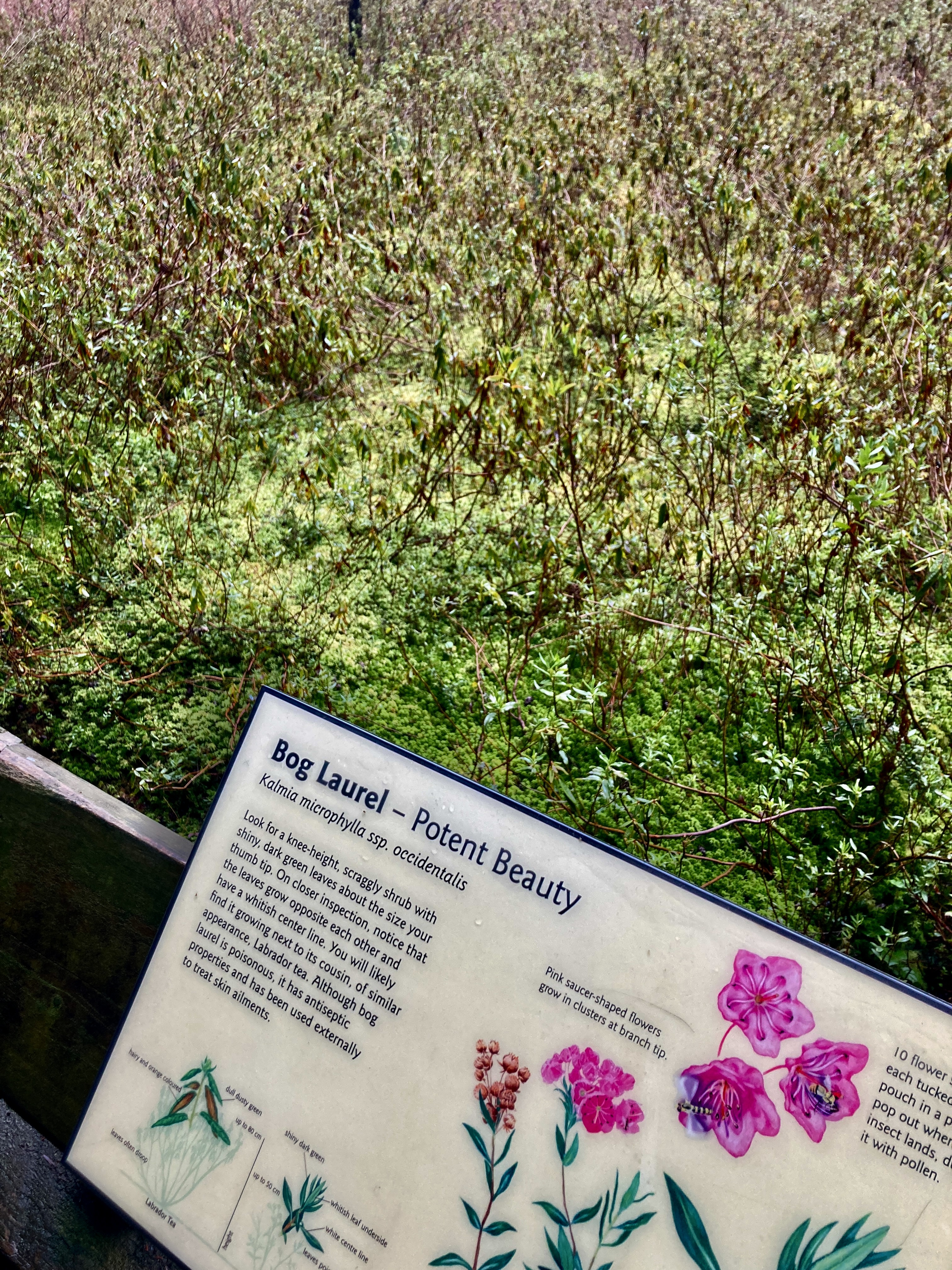
but I am looking beneath the Laurel, beneath the Labrador Tea, beneath the Bog Cranberry…
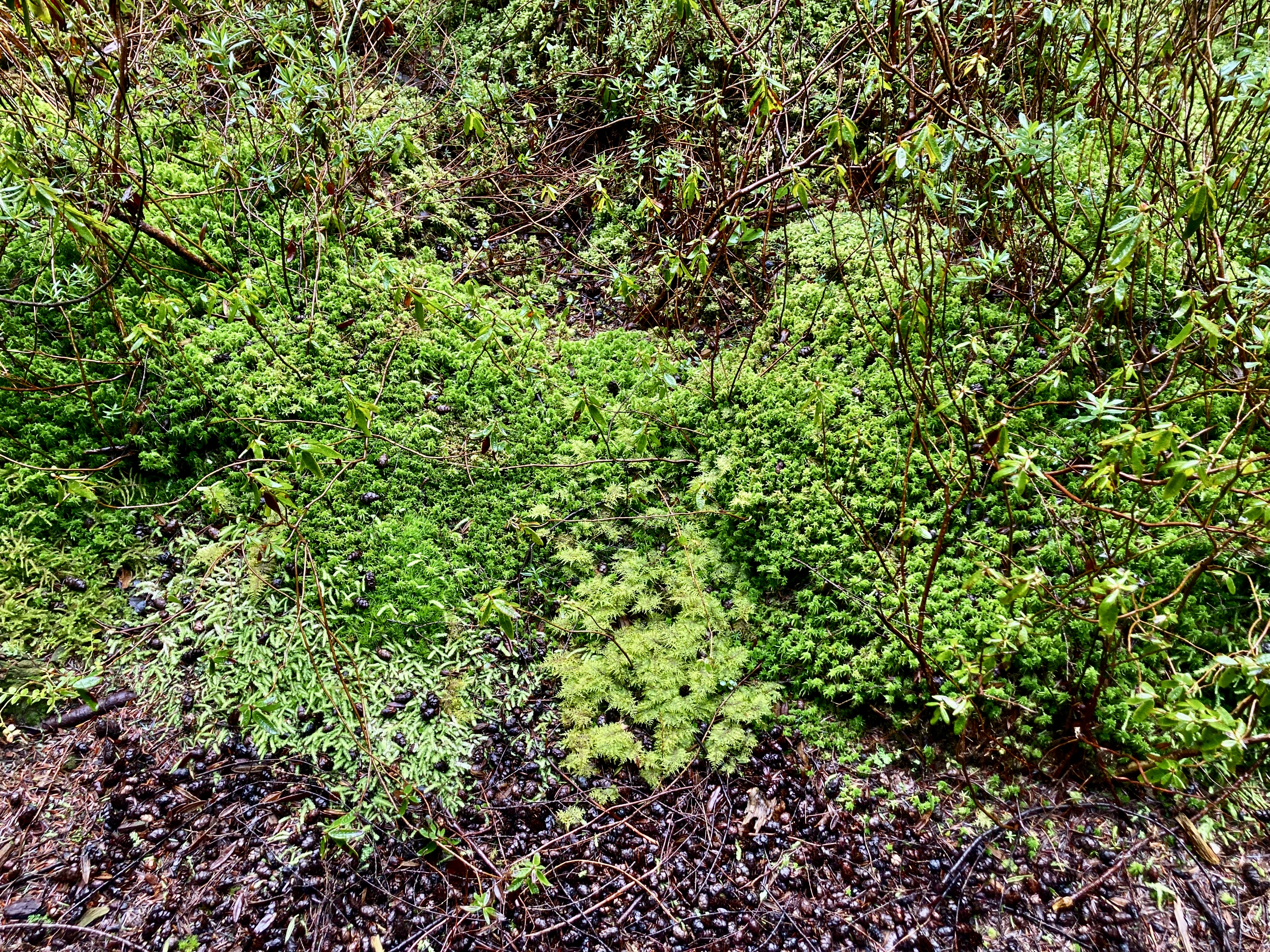
to the moss. The mosses. The bryophytes.
“A true moss or bryophyte is the most primitive of land plants,” explains Kimmerer. They lack flowers, fruits, seeds and roots; they have no vascular system. “They are the most simple of plants and in their simplicity, elegant. With just a few rudimentary components of stem and leaf, evolution has produced some 22,000 species of moss worldwide.”
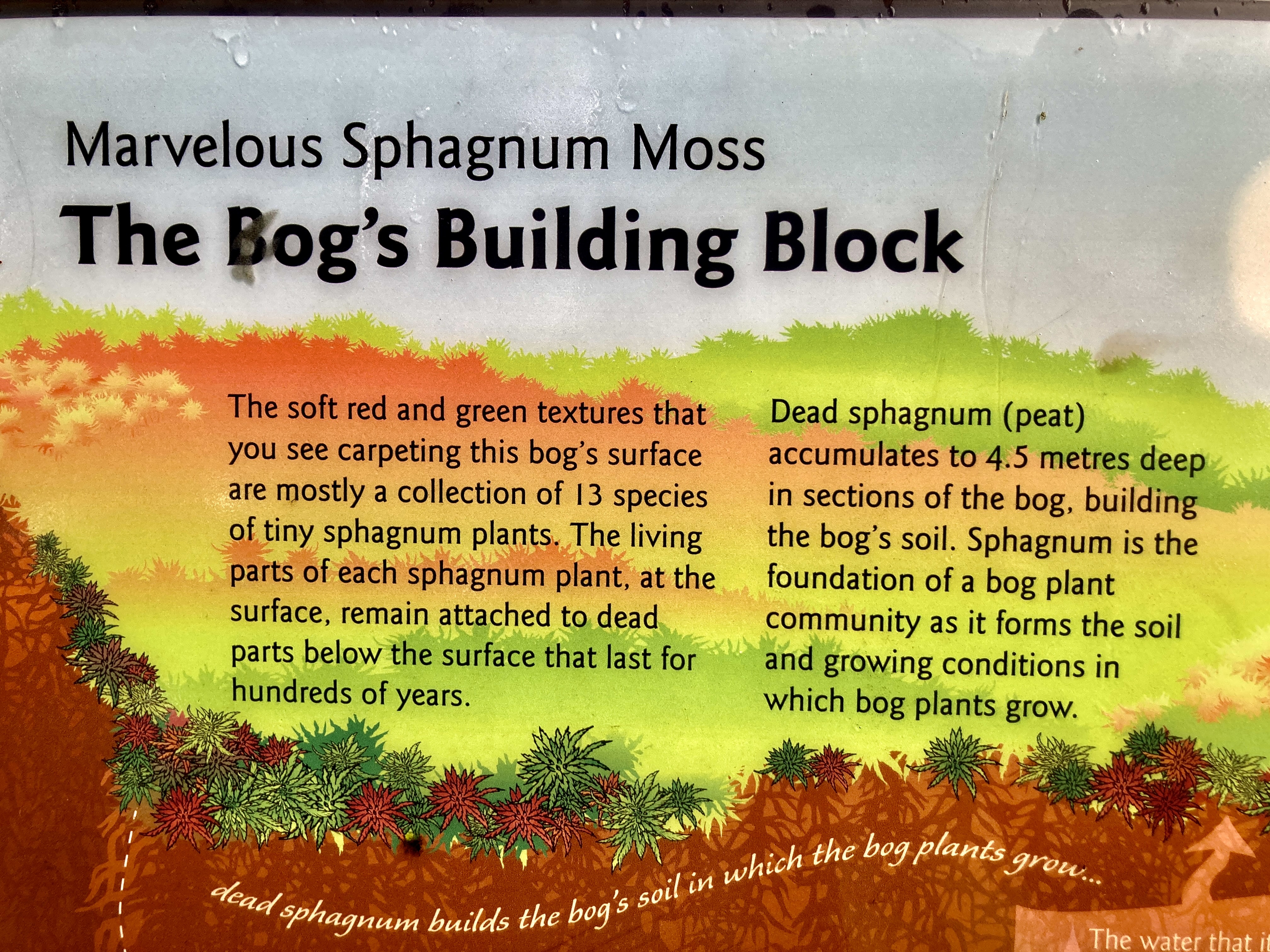
I pause for another sign. (I always read signs.) Thirteen species of sphagnum moss, here in the bog.
I walk on. I marvel.
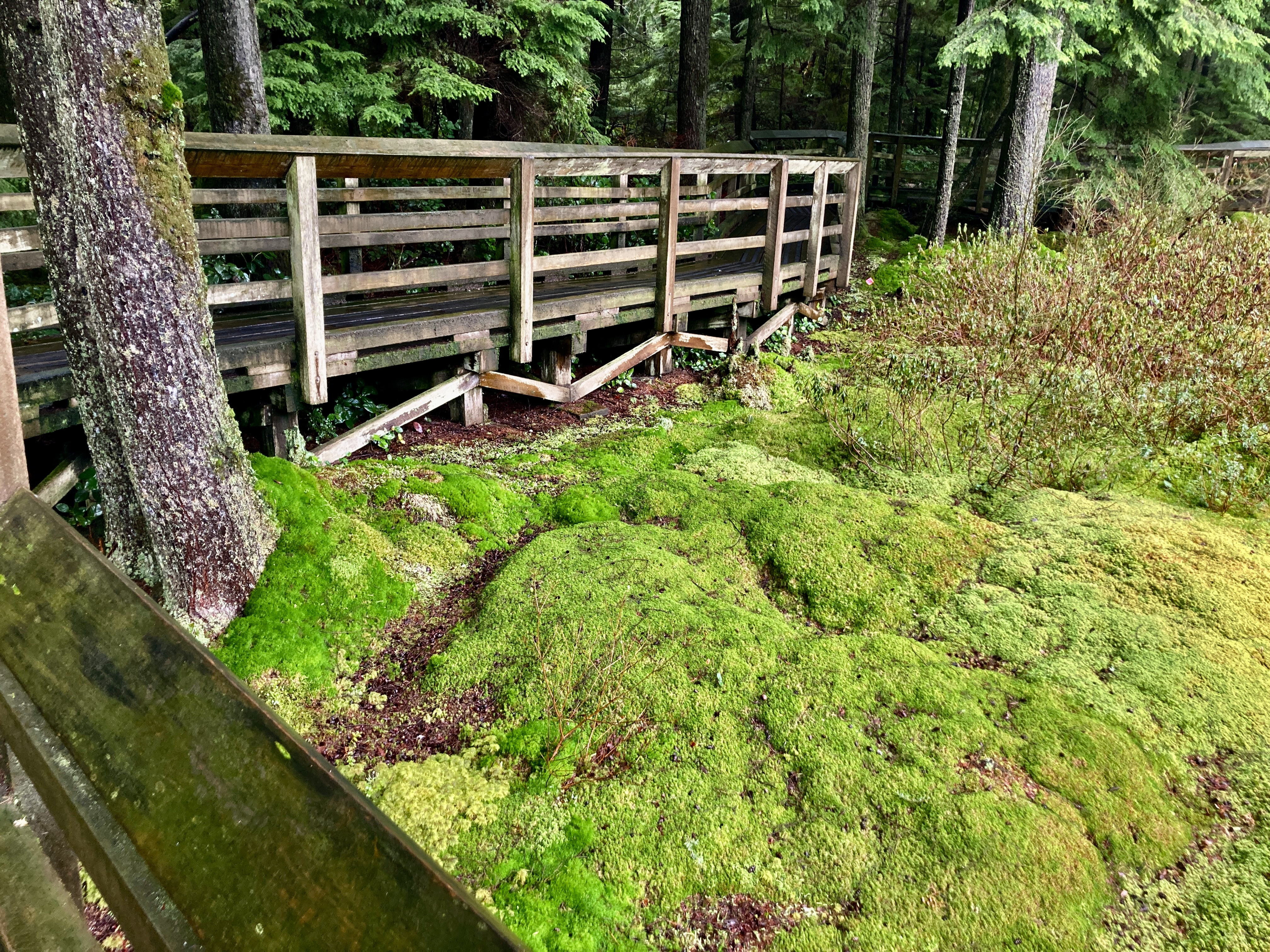
And I marvel some more.
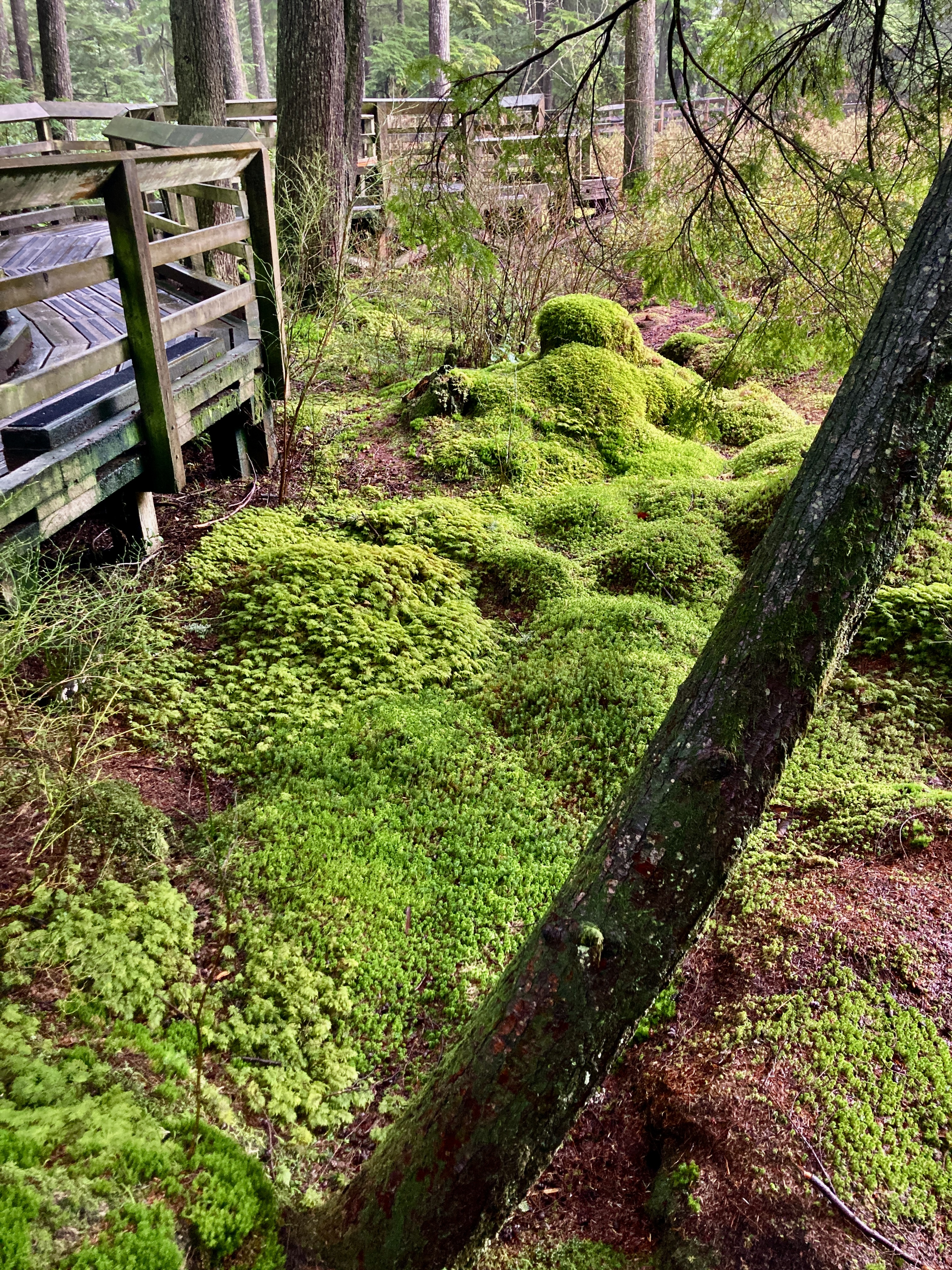
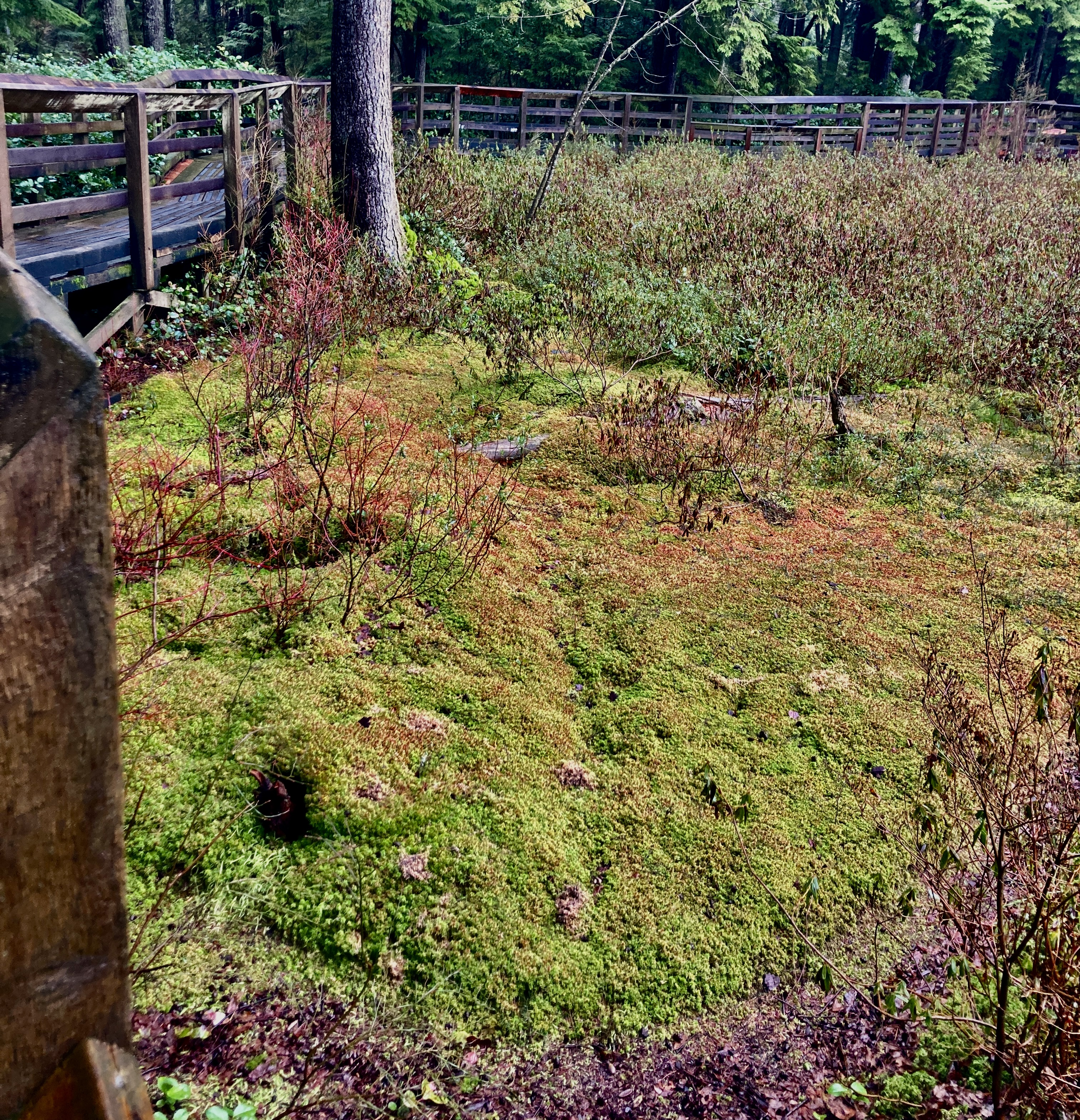
Among all the glowing greens, some of the soft reds the sphagnum moss sign has just invited us to notice.
I take a spur path away from the loop encircling the bog, off into the surrounding forest.
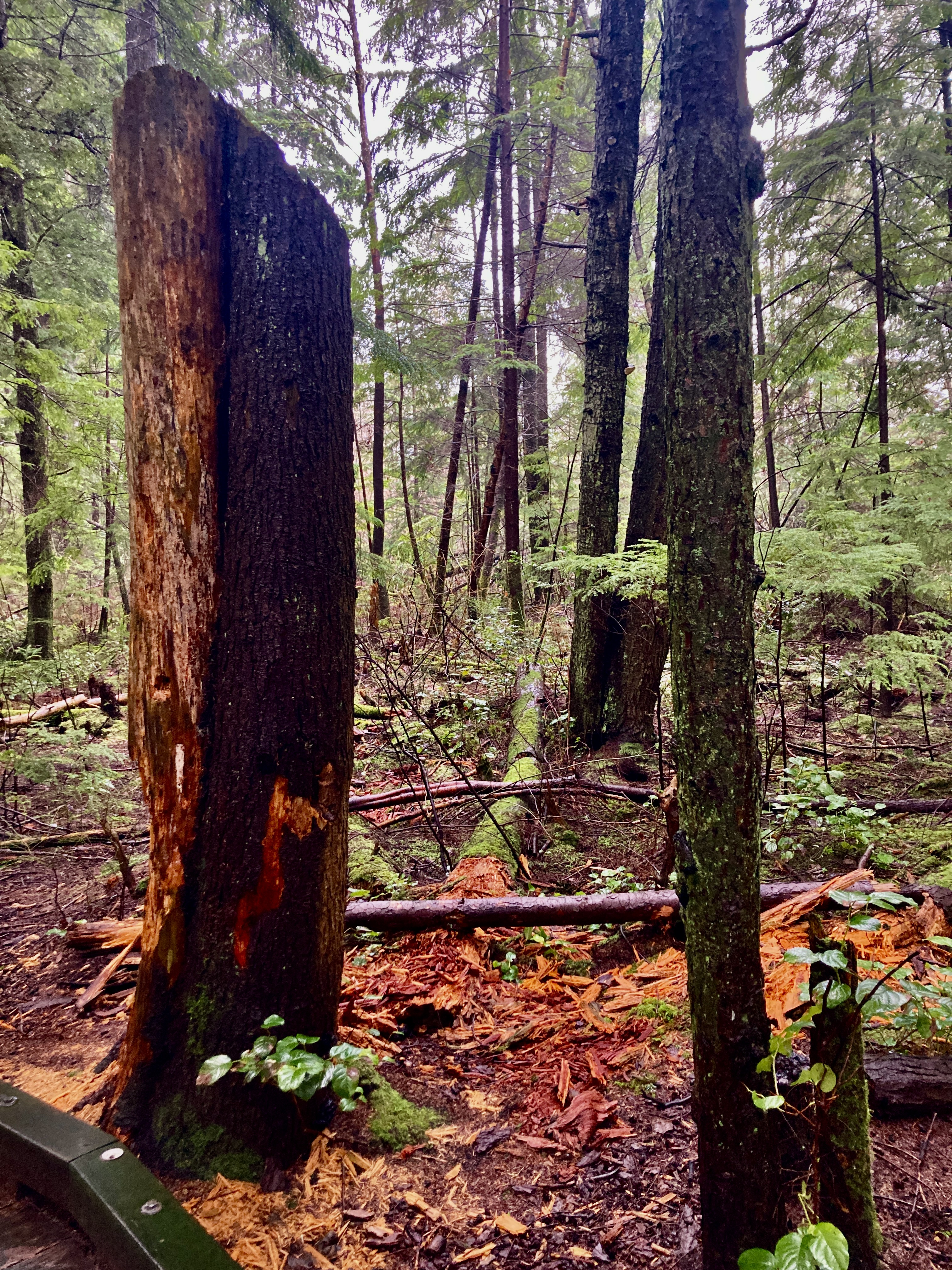
Kimmerer murmurs in my ear: “Looking at mosses adds a depth and intimacy to knowing the forest,”
Here at a curve in the path, a knot of ferns and moss. I nod at them, smile, think of the ferns and mosses on my own balcony.
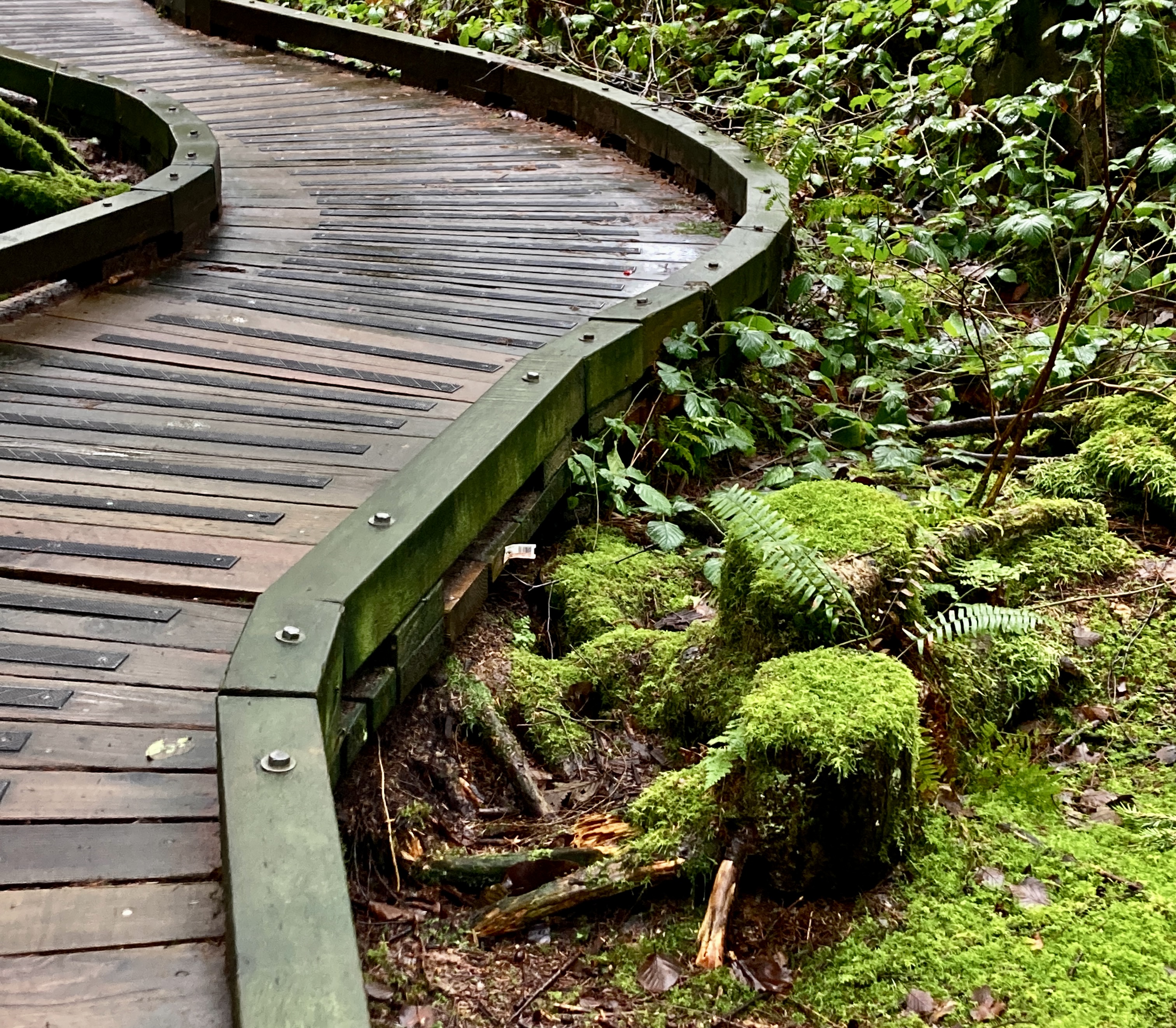
Another Sentinel Log, this one guarding the 19th Avenue entry to the bog…
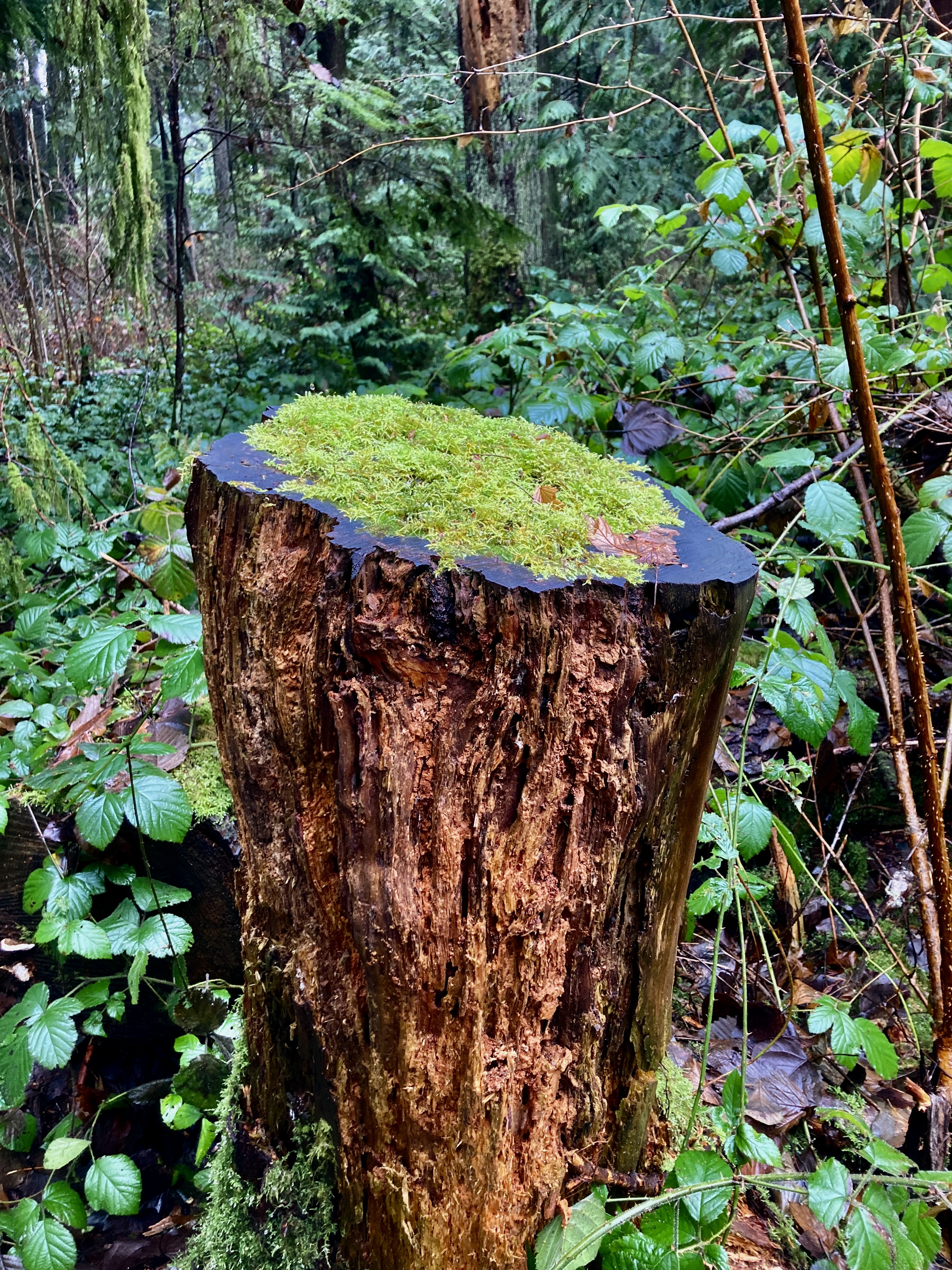
and finally, I turn back.
I nod farewell to this log’s Camosun Street colleague on the way out…
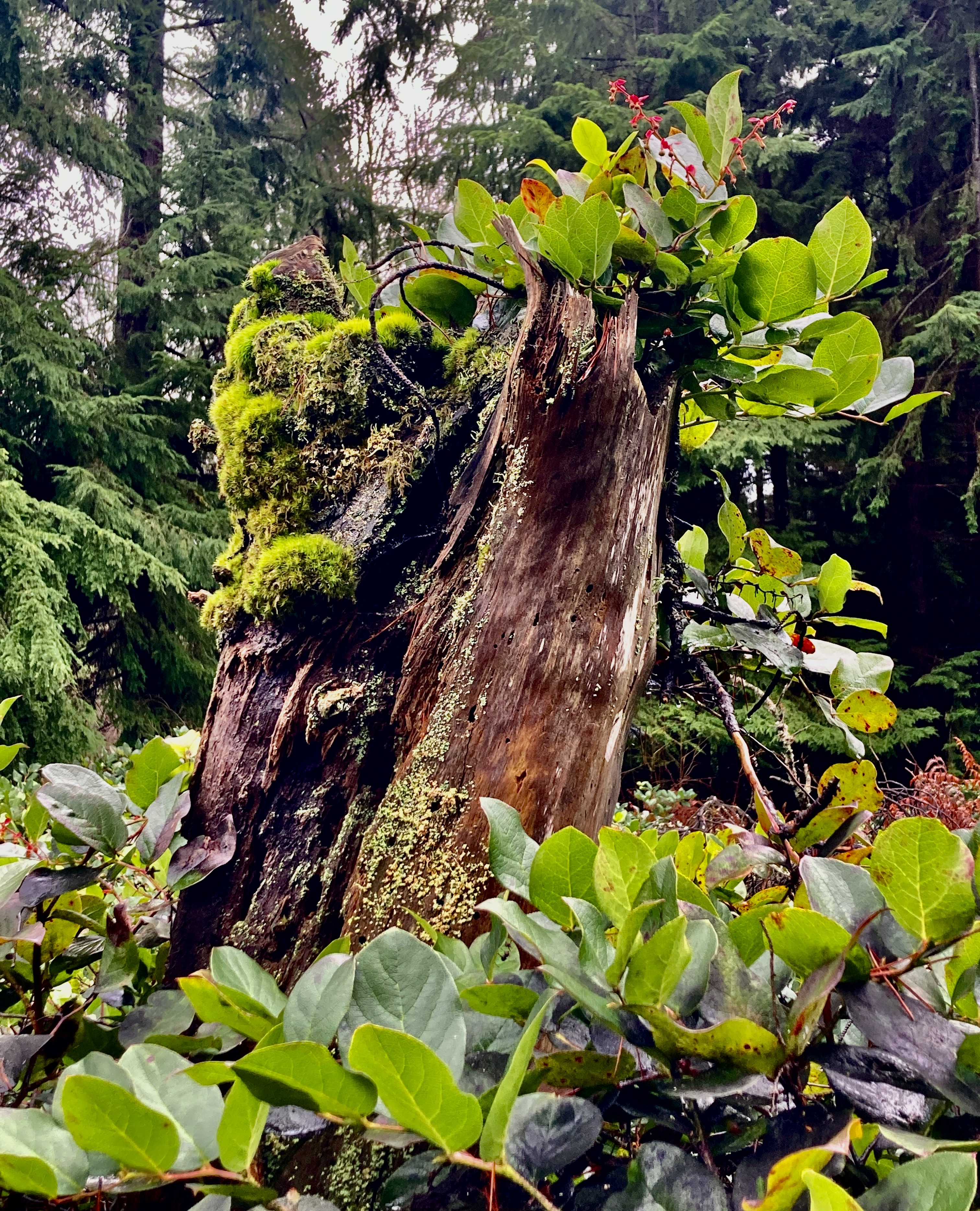
and then — of course — keep right on noticing moss, with every step.
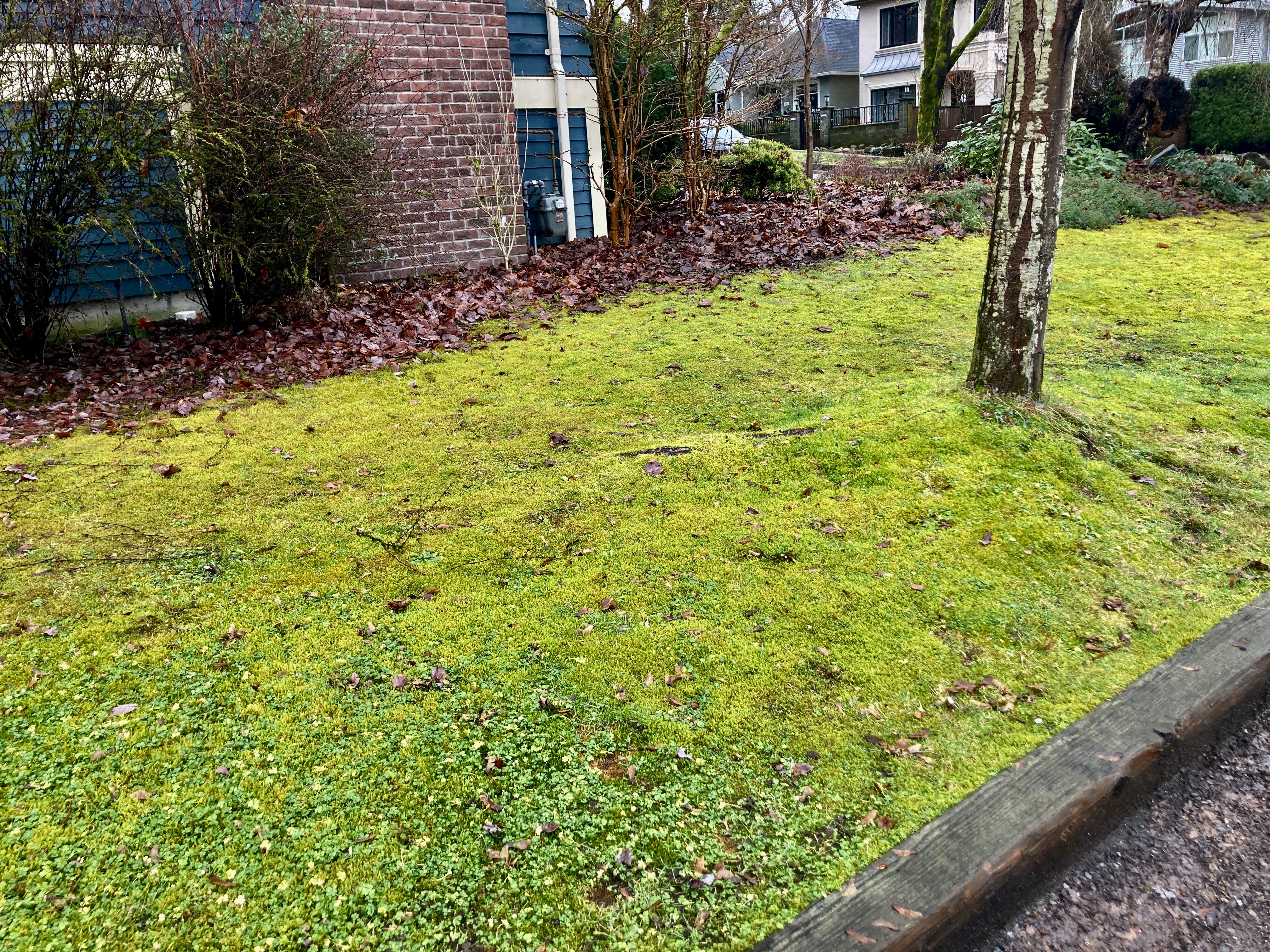
Here, a side lawn bordering Camosun Street…
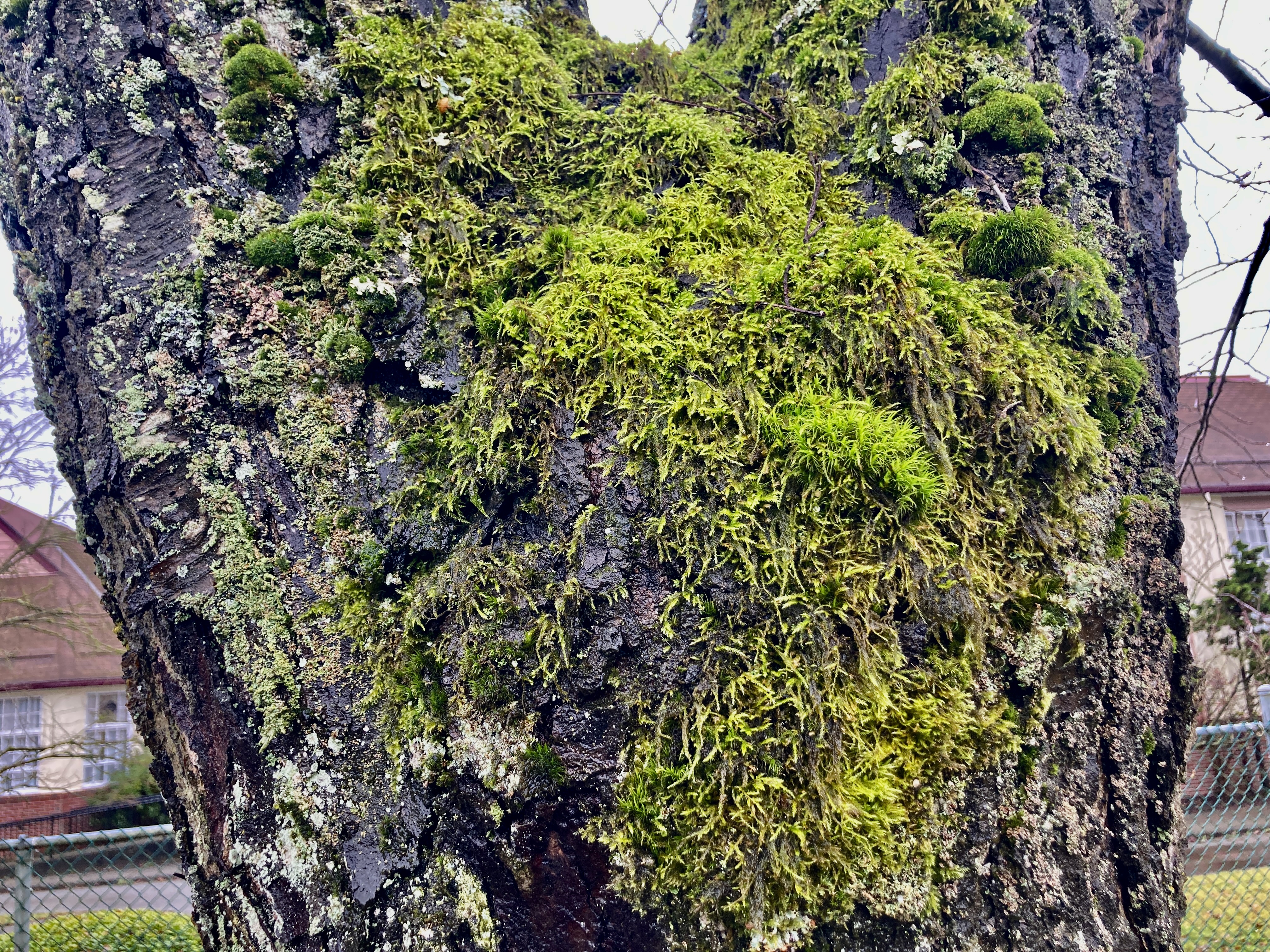
here, the crotch of the tree at the bus stop…
and finally here…
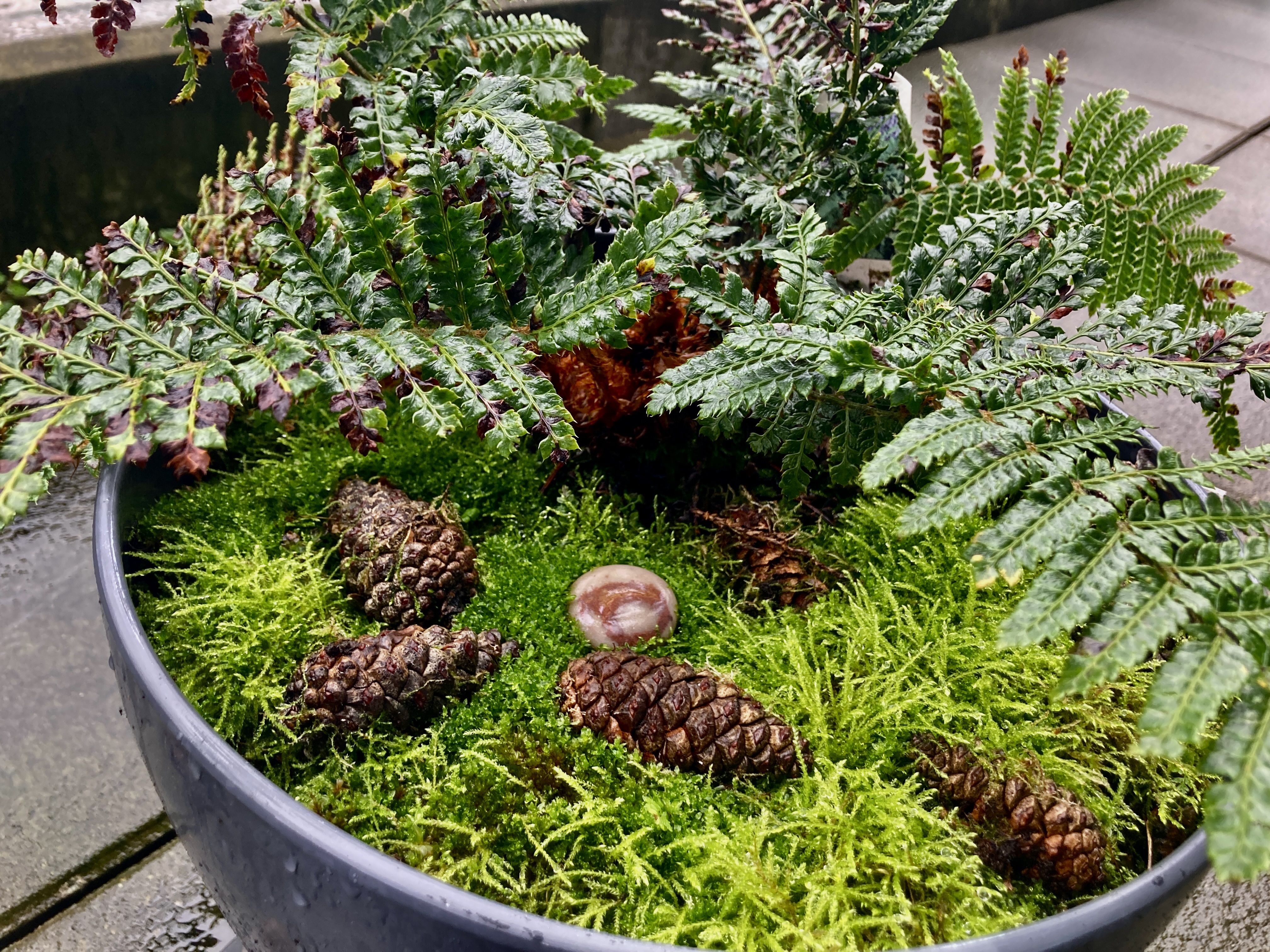
right here, on my own balcony at home.

 WALKING WOMAN
Lynette d'Arty-Cross
/ 3 February 2026A wonderful tribute to moss, Penny. I like it, too and we have lots growing here this winter, as well.
restlessjo
/ 3 February 2026I’m not at all a woodland creature, Penny, being much more drawn to open spaces and waterscapes, but there is a fascination in moss and I thoroughly enjoyed this meander with you xx
Liz
/ 4 February 2026Moss used to look all the same to me. But I have since learnt that there are different varieties of moss.
I have also learnt that certain species of moss is protected under Wildlife and Countryside Act, 1981, here in the UK.
Somewhere online last year I read where moss was being encouraged to grow as to not lose it. But I can’t remember where in the UK that was.
Moss helps to prevent soil erosion. It also a Biodiversity support.
icelandpenny
/ 5 February 2026Oh yes, moss is a fundamental building block — Camosun Bog is just one example, and indeed the restoration work there echoes the kind of care and restoration you describe in the UK. I’ve just now learned of Scotswoman Annie Worsley (also crofter, geographer) and her books, including Windswept, and her WP blog. I’m about to go looking for Windswept!
wondrous8b1edfb888
/ 7 February 2026Hello Penny,
Marjorie here, from the Churchill train family.
I just want you to know how much I am enjoying your blog. The current “moss” narrative and photos has been particularly delightful. If I lived in B.C., I would be pestering you to take me on walks with you. You consistently see the extraordinary in the ordinary.
I hope you are doing well overall.
>
icelandpenny
/ 7 February 2026Big hug to you, Marjorie! As you know, the Burnaby member of that wonderful “Churchill train family” and I now regularly go on walks together, so you are always much in my mind. I’m glad you enjoy my discoveries, some of them with your great friend. Hope to see you again, some day.
wondrous8b1edfb888
/ 11 February 2026Hi Penny,It’s marjorie again. I was just speaking with Sonja and telling her how much I enjoy your blog. She for some reas
I. J. Khanewala
/ 12 February 2026That’s wonderful. I like your book recommendation too, and I just got myself a copy
icelandpenny
/ 14 February 2026oh good! I first read it as a library book, but now have my own copy as well