27 April 2025 – A little time travel, my friends. Back to the first image in my previous (23 April) post, with its long view up the Quebec Street bioswale to Science World…
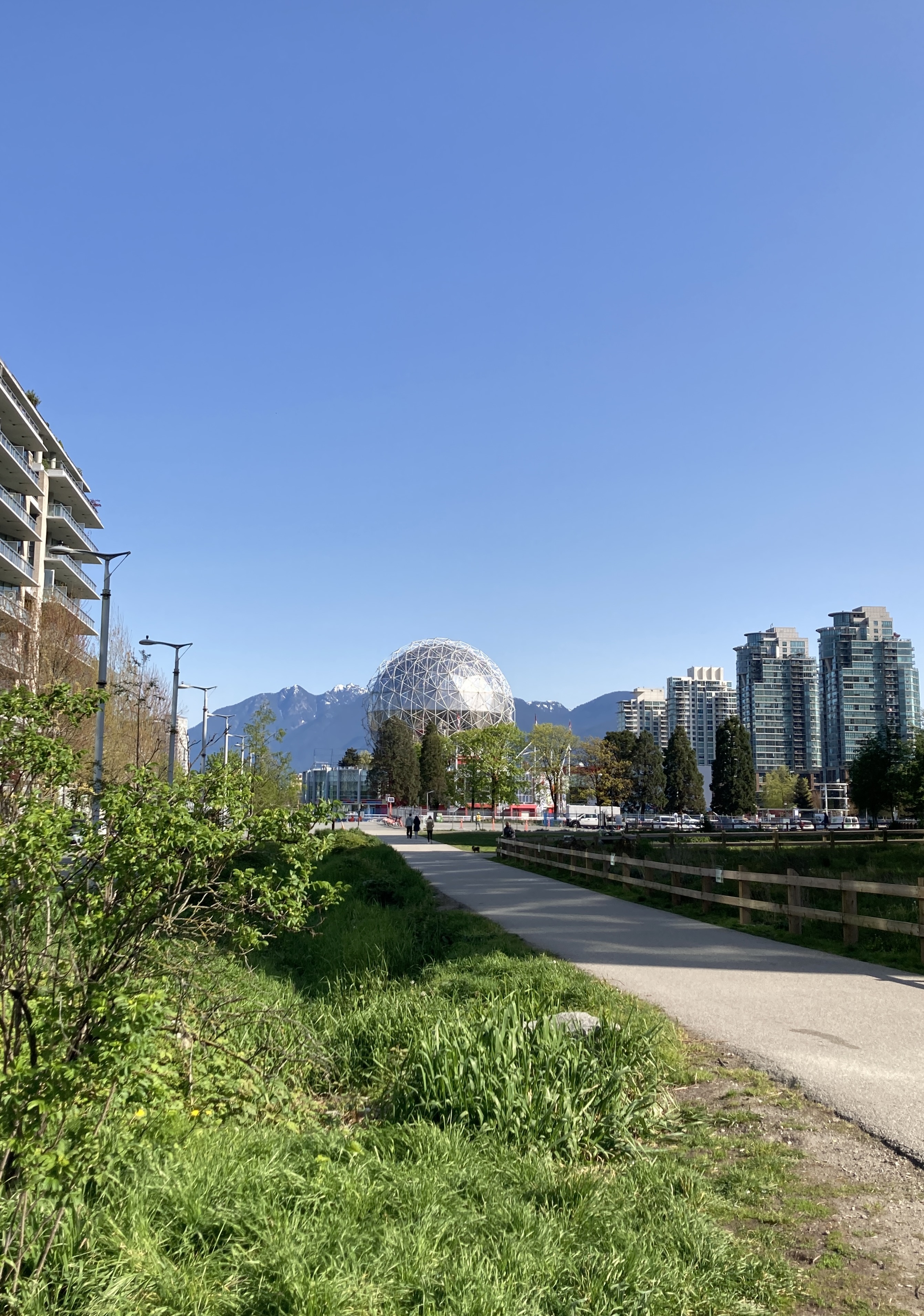
and my cryptic reference to the “mystery interview” I did there before setting off on the walk that became that post.
Here it is, the focus of my 23 April curiosity and topic for the interview: the tall, free-standing Tower of Bauble.

It encloses a whole world of action — a world that had been dismantled for a while; whose return I briefly celebrated with you in my 12 November 2024 post (Under the Threat of Rain), which moved me, in my 21 December 2024 post (The Tilt) to promise you I’d learn more, and report back.
Herewith my report.
The Tower is a 24-ft-tall audio-kinetic sculpture, designed by American painter, sculpture & origami master George Rhoads.
This tall!

A variety of balls (pool, bocce, snooker) are carried up in a variety of ways, for e.g. via this central column…

or for e.g. via this majestically slow-turning blue auger, over there in the back right.

Once up, the balls come tumbling down again in a variety of pathways, like these for e.g….

and land in a variety of receptacles, sometimes (cf. that blurred white ball, below) shooting off a path into a bare metal disc…
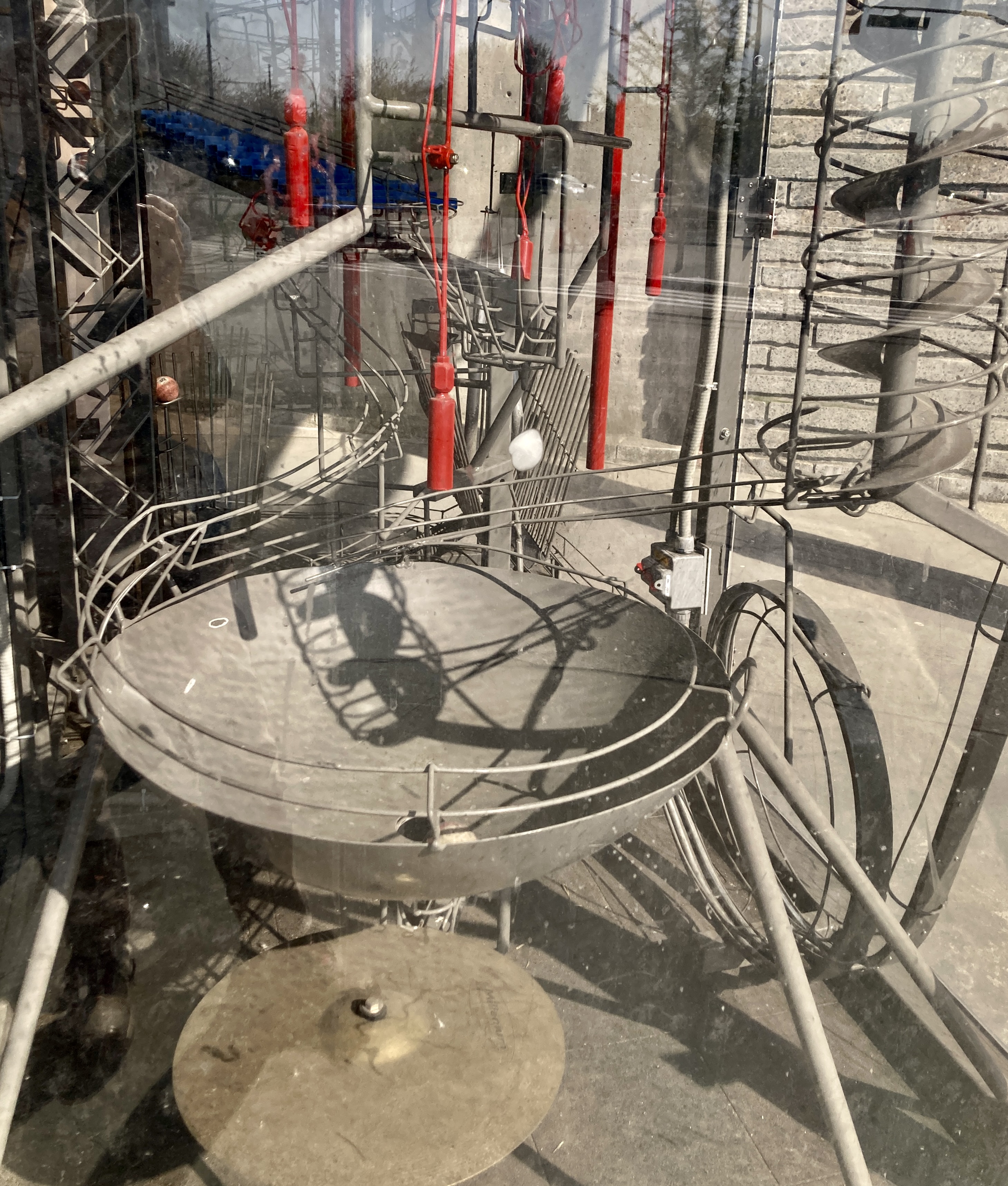
or maybe bouncing from one red disc to another.

All of which causes lots and lots of sound.
Balls go thunkkk, or smaaaack; they hit hanging tubes and other obstacles so that clangers claaanng, chimers chime and clappers clap.
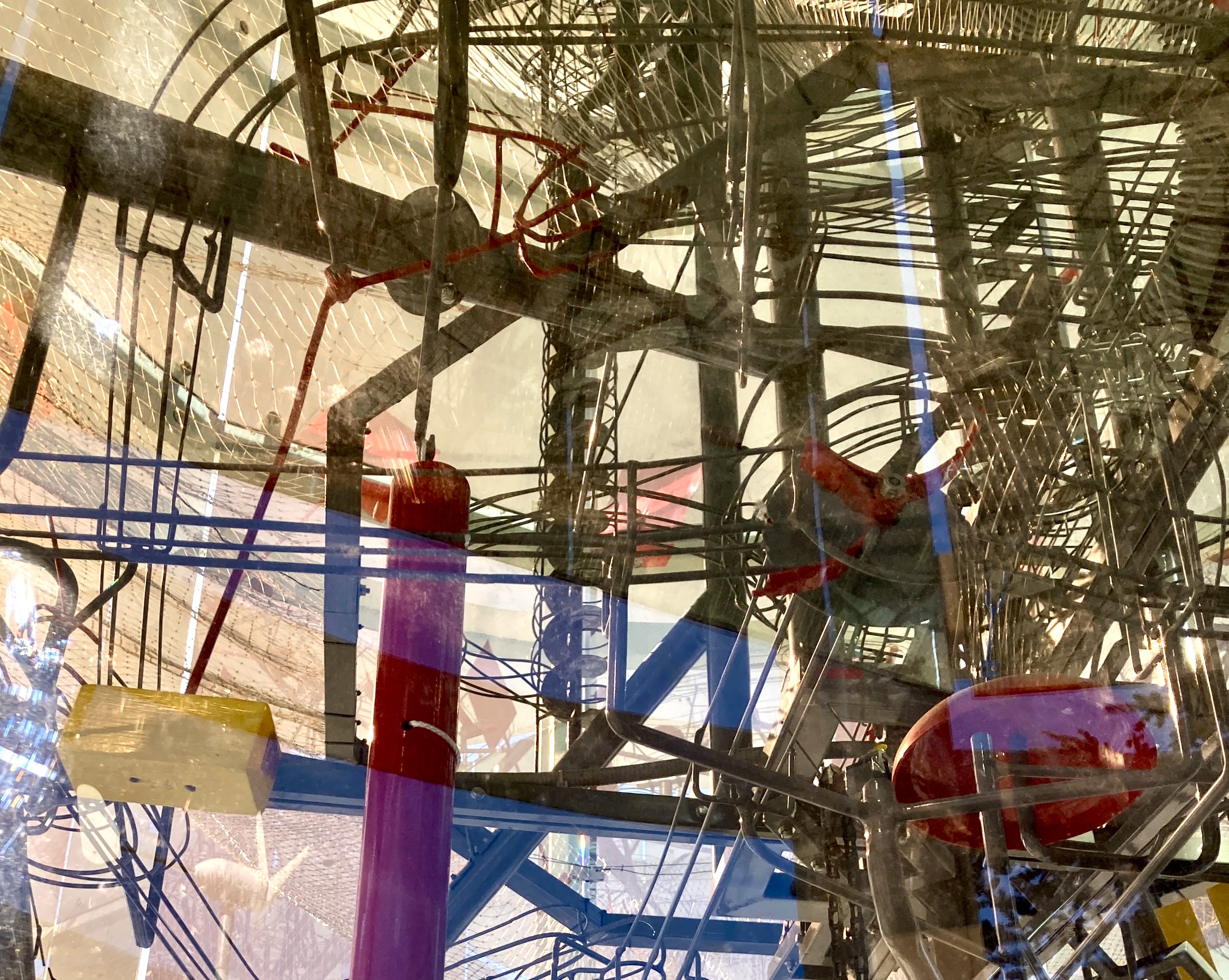
Like this yellow clapper (on the left) about to strike that red hanging tube.
That’s all there is to it.
Balls go up, balls come down, noise ensues.
And we can’t get enough of it.

Which nicely demonstrates the importance of having the right object in the right place for the right reason. Because, back in its early life, this sculpture met so much resistance it had to be mothballed.
In 1985, a US shopping mall magnate bought 30 of Rhoads’ sculptures and placed them in 30 of his malls — including this sculpture, in the food court of his Kamloops BC property. Where the incessant sound effects threatened the sanity of food court staff. (Fine for passing patrons, but in your ear all day every day?) The Tower was put away.
In 1995, Vancouverite Derek Lee and his partner acquired the property, discovered the sculpture among its effects and soon afterwards donated it to Science World. (Lee’s parents were long-time patrons of Science World, and he grew up with that tradition.) Whether in its initial position by the main entrance, or its current position next to bike paths, it has always been outdoors — where the audience would be present by choice.
I sit for a while, prior to my interview appointment. I watch how repeatedly people choose to be part of that audience. I want to know more. Why makes the Tower right for Science World, and why it is so appealing?
I ask the right person: Brian Anderson. On staff since 1991, he brought with him a background in computer science, math/physics and theatre, and he is now the organization’s Director of Performance and Fun Times.

Most of those fun times are indoor events and activities, but Brian loves the Tower as well.
“It ignites wonder,” he says, “and that’s an important part of our core mission. My favourite thing is watching people look at it for a while, and see them start figuring out how they could build something like that for themselves, back at home.”
Creator George Rhoads said the sculpture illustrated “the art of music and rhythm.” Brian points out the serious scientific principles behind all that music and rhythm: gravity, Newtonian physics (“balance, momentum, kinetic and potential energy”), probability and combinatorics (“calculating how many paths and how often balls take each path”).
Still and all, the Tower is a playful demonstration of serious science, and its various components have suitably playful names. “This,” says Brian, pointing to a red ledge overhead…
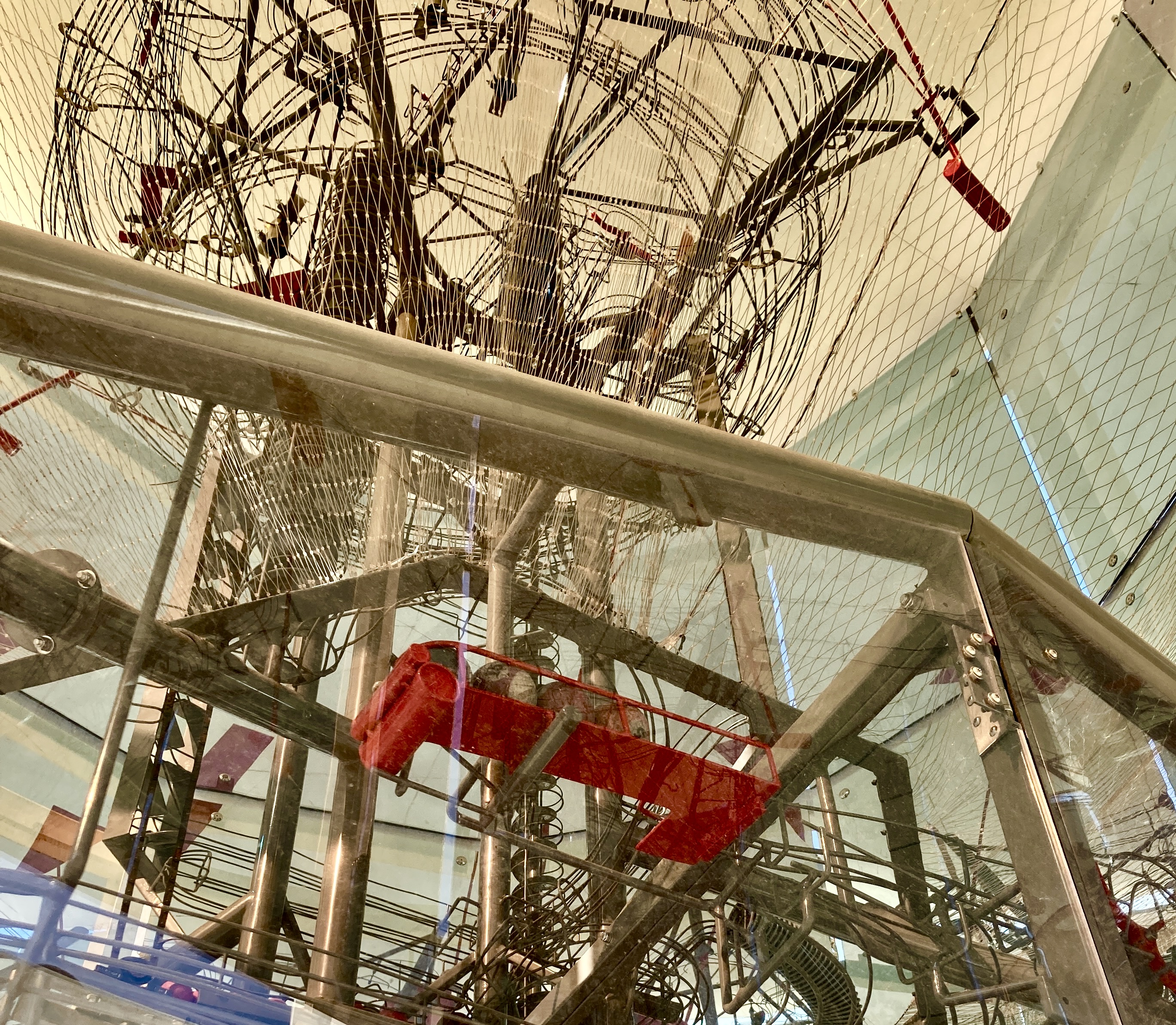
is the Clumper-Upper.” Of course it is. It clumps up six balls with perfect balance — and then a seventh comes along to send things flying, the six balls one way and itself another. Key to their travels are two Flip-Floppers, which direct balls down assorted further pathways.
Theatre buff (and parttime actor) Brian loves the cheeky titles and sheer busy fun of the sculpture; math/science Brian later sends me his chart, illustrating what goes where. (My abbreviations: L & R = left & right; FF = Flipper-Flopper; Sp. Path = Spinner Path)
| Path | % of Balls | |||
| Sp. path 1 | 12.50% | |||
| Sp. path 2 | 12.50% | |||
| Sp. path 3 | 12.50% | |||
| Sp. path 4 | 12.50% | |||
| R at 1st FF | L at 2nd FF | 6-ball clumper | Sp. path 1 | 5.36% |
| Sp. path 2 | 5.36% | |||
| Sp. path 3 | 5.36% | |||
| Sp. path 4 | 5.36% | |||
| 1-ball clumper | Trampoline | 3.57% | ||
| R at 2nd FF | Sp. path 1 | 6.25% | ||
| Sp. path 2 | 6.25% | |||
| Sp. path 3 | 6.25% | |||
| Sp. path 4 | 6.25% | |||
| Total | 100.00% |
You see? It is all beautifully calculated.
Ahhh, but there are also what Brian calls “moments of chaos.”
Partly because this sculpture was designed to be indoors, not outside where heat/cold would cause metal to expand/contract and play merry hell with the calculations. Partly because time passes and things wear down. Both these facts led to the 2023 renovations, supported by the Rob Macdonald and Lee Families and led by Vancouver kinetic artist David Dumbrell, which included further fine-tuning of formulae and calculations.
“But, acknowledges Brian, “it’s on-going.” As in, Stuff Happens.
Balls come flying off their tracks, land thunkkk on the floor. Brian twice interrupts our conversation to rescue a ball, the second time…
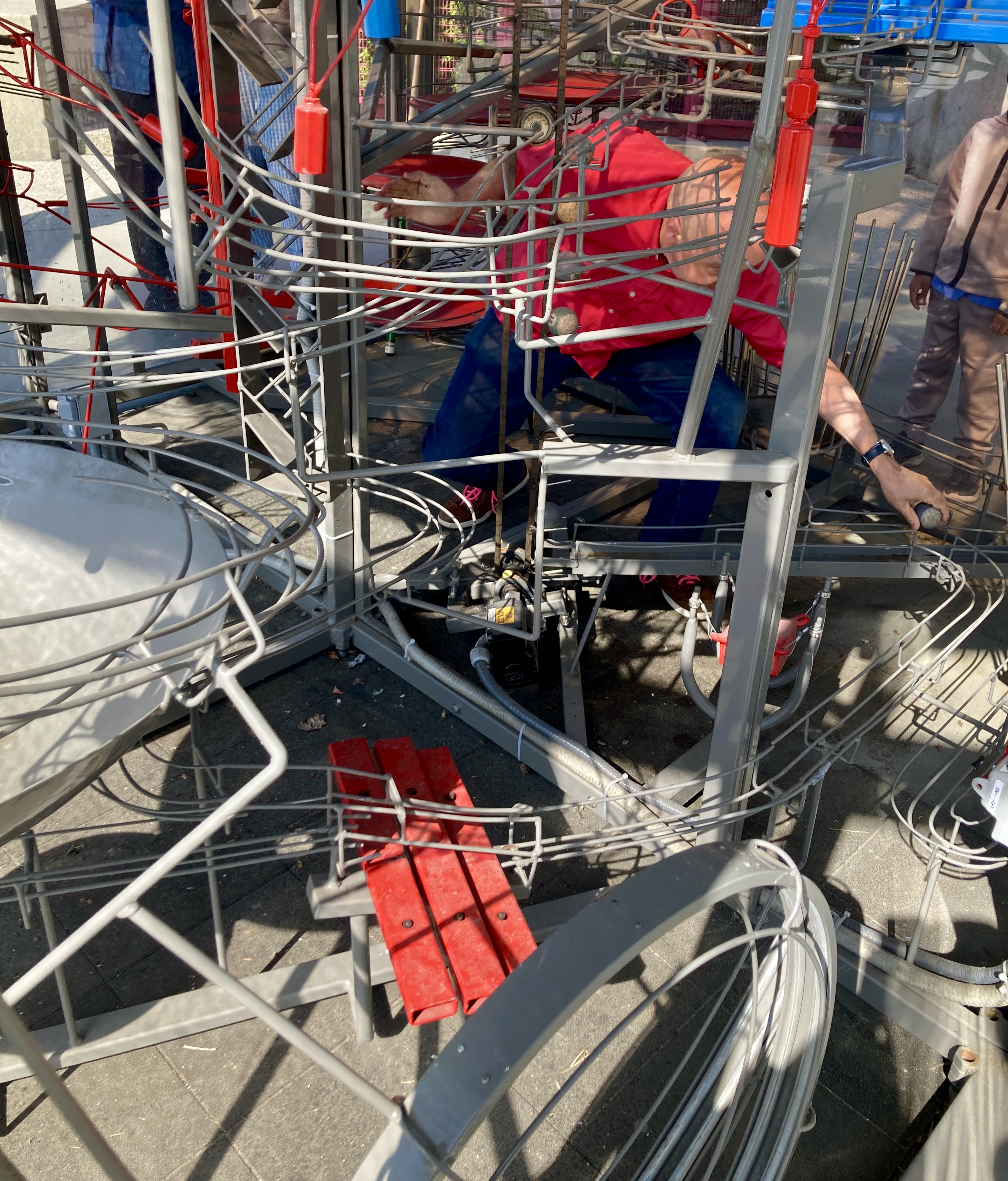
folding himself into the depths of moving parts, a momentary human addition to all those wonders.
For they are wonders, we agree, and they both illustrate and provoke wonder.
Not in spite of the imperfections, but — at least in part — because of them. I tell Brian the title of the documentary about the life and work of renowned Canadian architect Raymond Moriyama: Magical Imperfection. Brian nods.
One last look at all that magic in action, an entire school class forsaking their phones to, instead, cluster around the Tower…
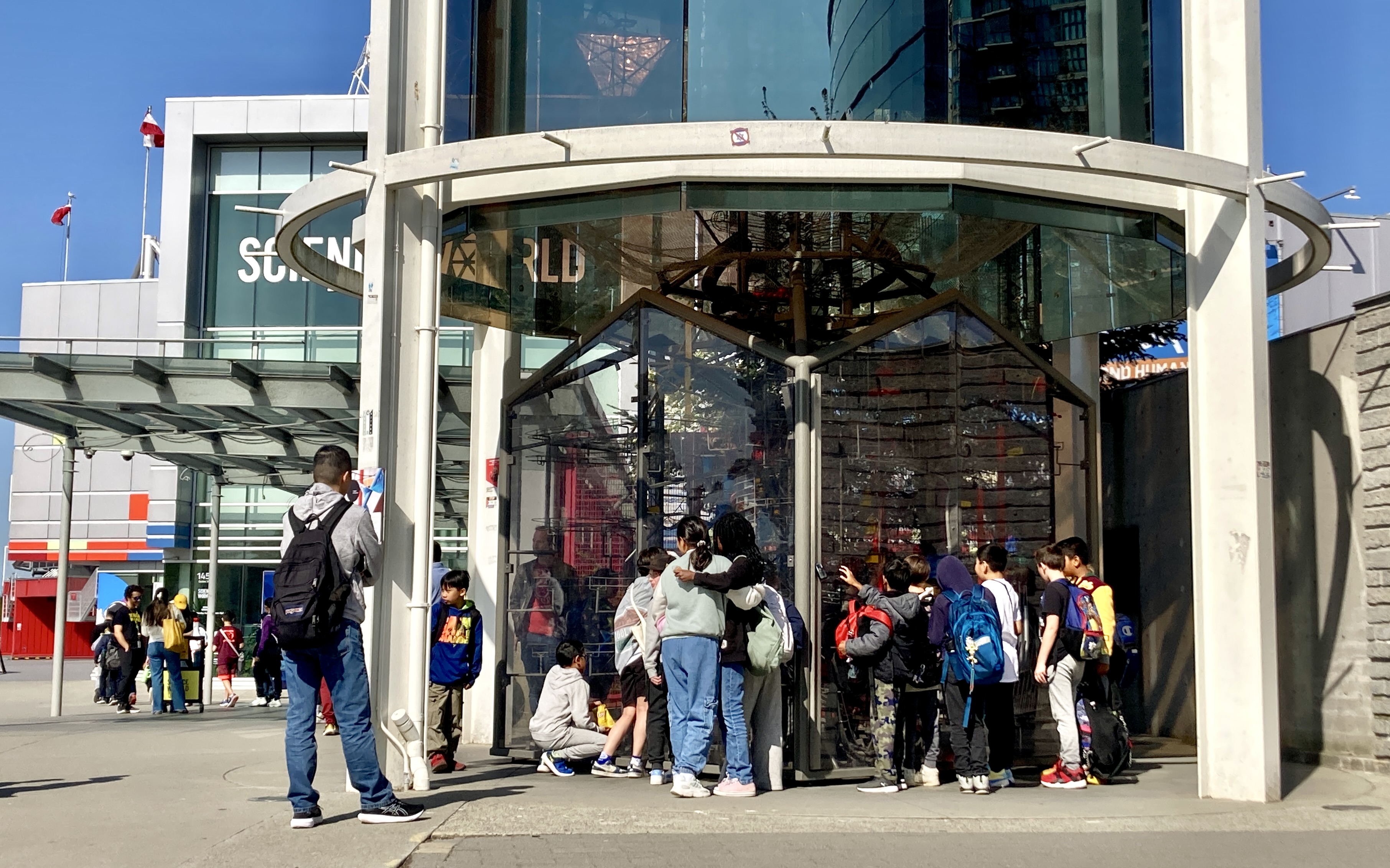
one last look at the Tower itself, over my shoulder and across Science World’s outdoor garden…
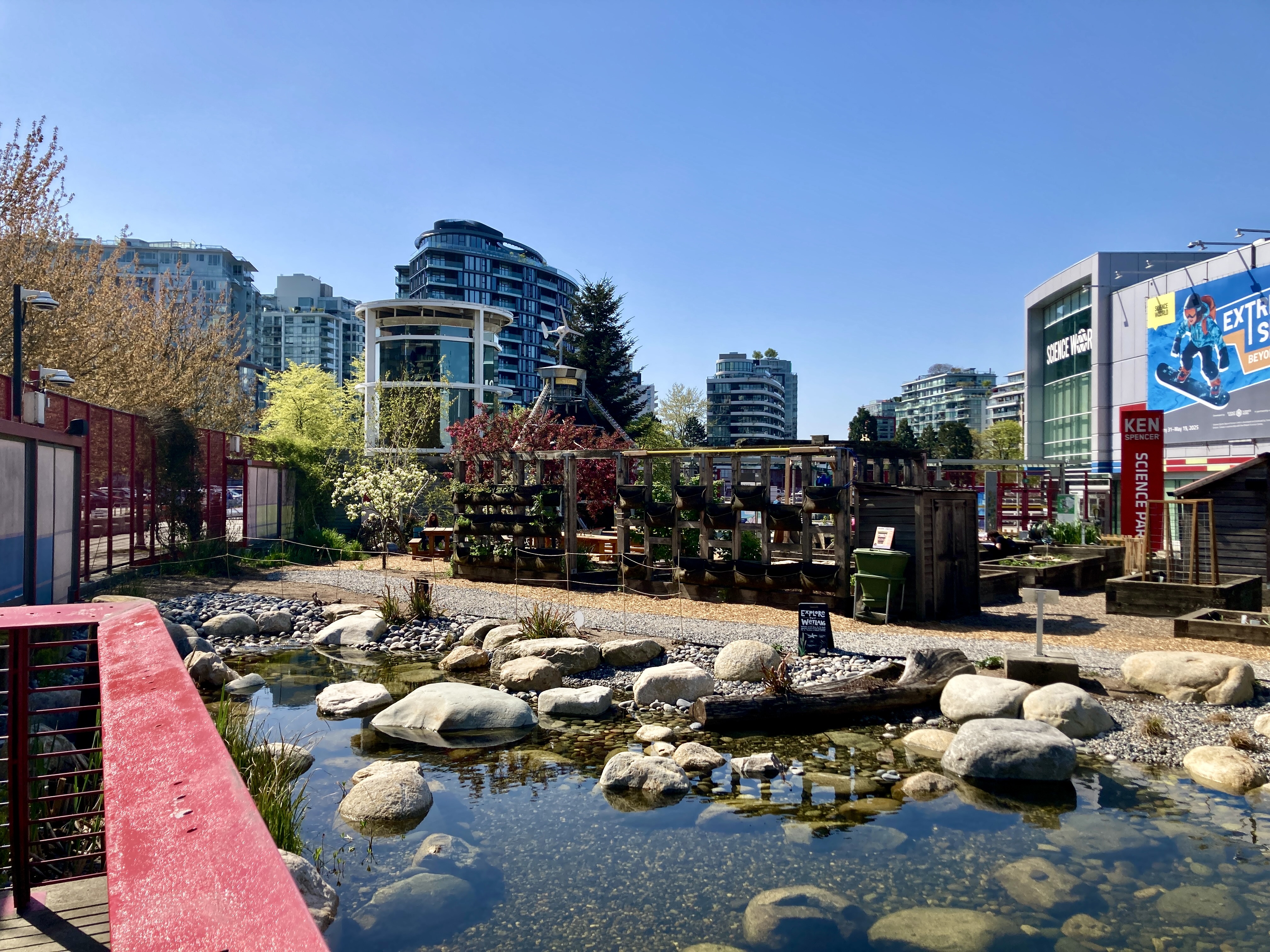
and away I go.
To have my feet ignore my mind and send me on quite a different walk than I had planned.
As I explained in my previous post.

 WALKING WOMAN
janetweightreed10
/ 28 April 2025I love the images here….but the noise would probably drive me bonkers:) x
icelandpenny
/ 30 April 2025I think you’d be OK, the sound is outdoors, floating up to the sky, and you’re passing by not immersed in it forever — I’m always turning down sound levels on devices & plug my ears when an ambulance goes by, but I enjoy the whiz-bang-chime effects with all this happy action in the Tower
janetweightreed10
/ 1 May 2025Proving that we make the best of everything……and that we do adapt.
Mary C
/ 6 May 2025There is a similar, albeit much simpler, contraption on Granville Island, outside the entrance to the cement company.
icelandpenny
/ 7 May 2025yes, I think it’s connected to the Vancouver Biennale murals all over the silos, from long ago