(Literary allusions note: from Sandburg’s 1918 fog poem yesterday to a folk-song today that is pure cat not fog — 1890s American blues-folk origins, Harry S. Miller; 1979 Canadian folkie hit with revised lyrics, Fred Penner; 1988 Oscar-nominated 7-min. animation, the NFB. Click here for 7 minutes of delightful silliness. A break from grim real-world silliness.)
17 January 2026 – It seems rude to mention sunshine, let alone mild temperatures (9C), when most of Canada is socked with snow, sleet, ice and windstorms. But… here it is. A bright, friendly day.
So we seize it.
We’re off to Burnaby Lake Regional Park. The park surrounds a large glacial lake to the east of Vancouver, and lies within its own dense municipality. Yet it is also home to wildlife (especially birds) and rich with trails for human visitors (walk, cycle, ride a horse, as you wish).
We have no particular plan beyond entering the park at the east end, off Cariboo Rd., and following the Brunette River upstream to the lake. After that? We’ll find out.
It is all magic, right from the get-go.
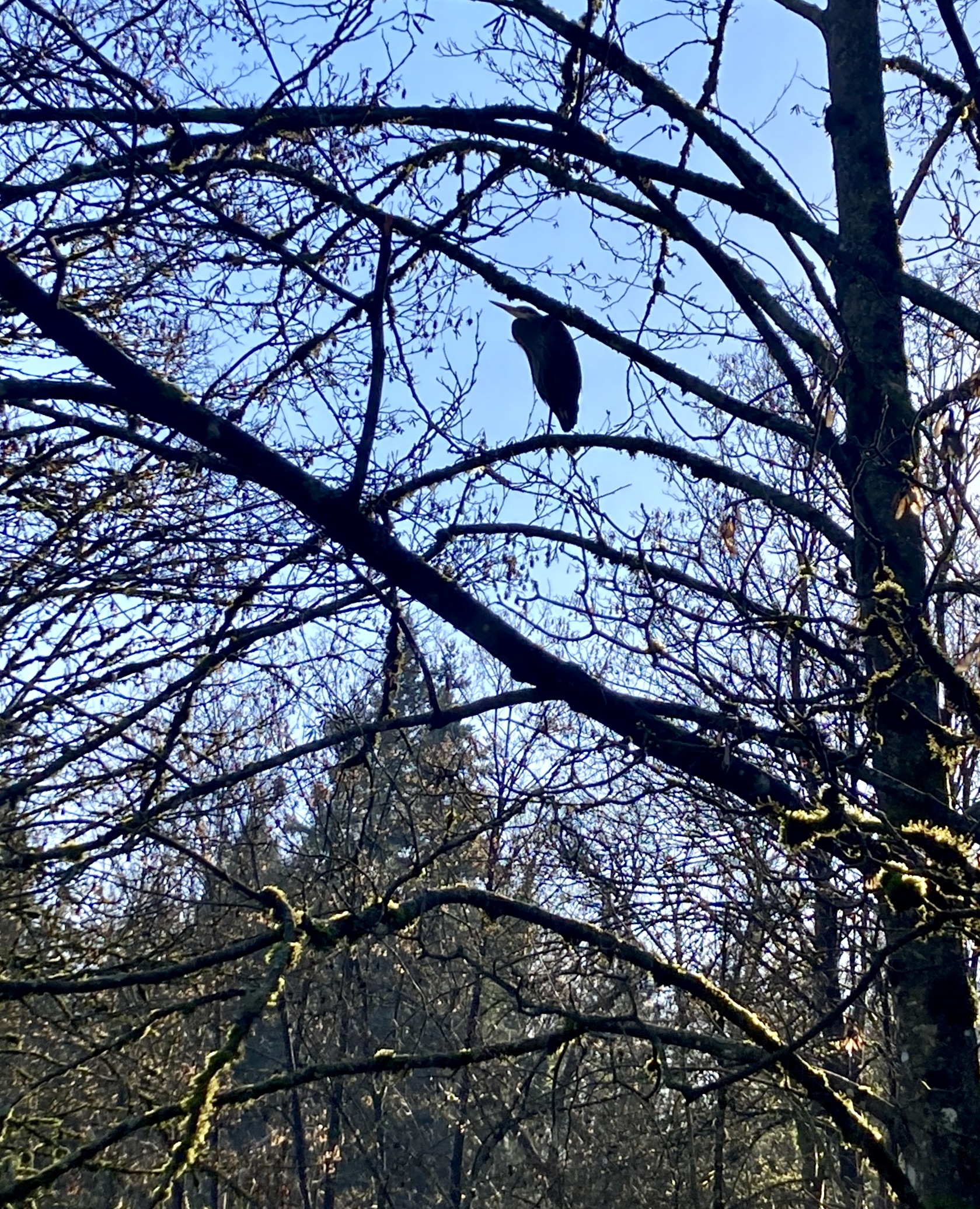
A great blue heron sits tall, still and stately in his tree beside the river…
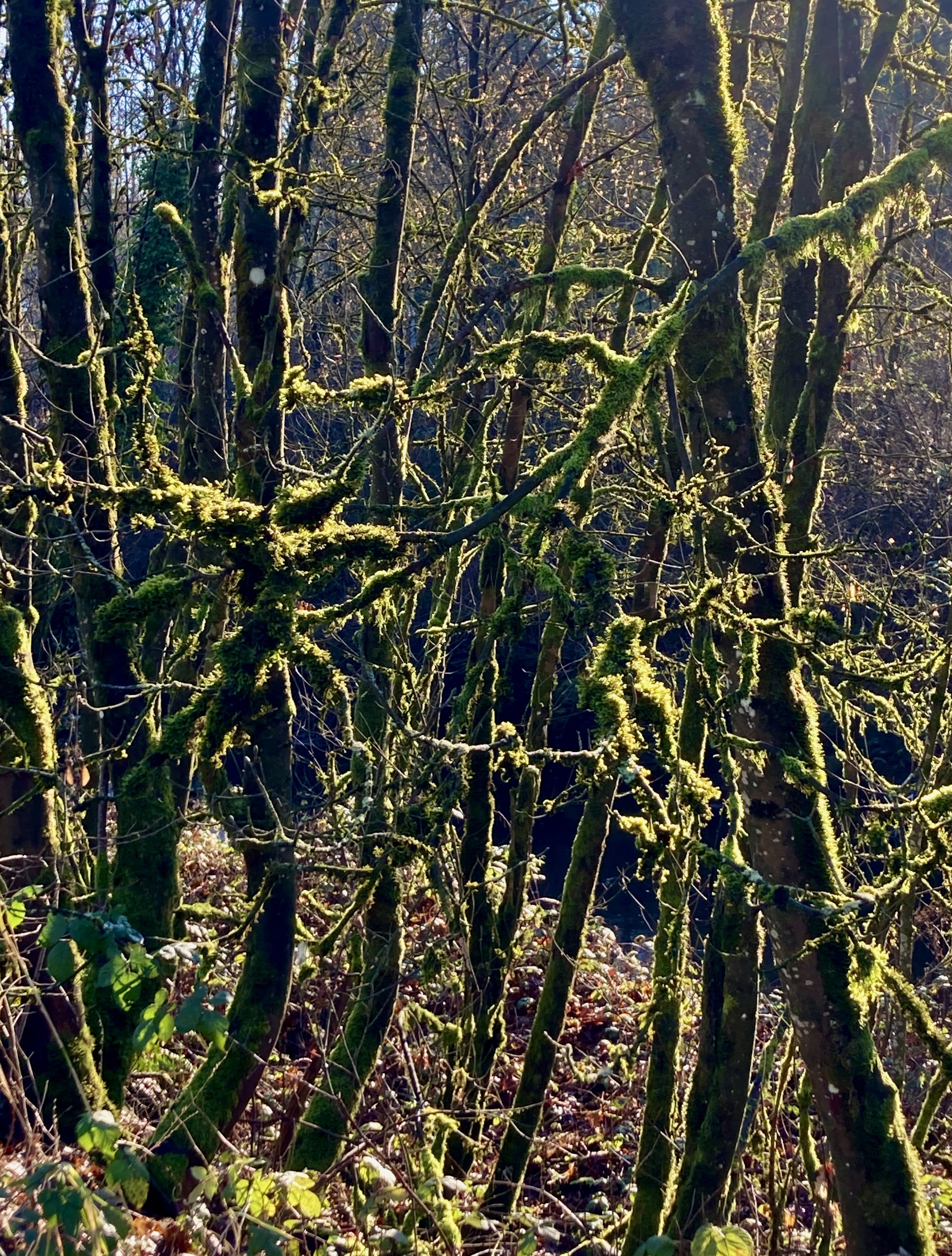
winter moss glows incandescent on trees lining the river…
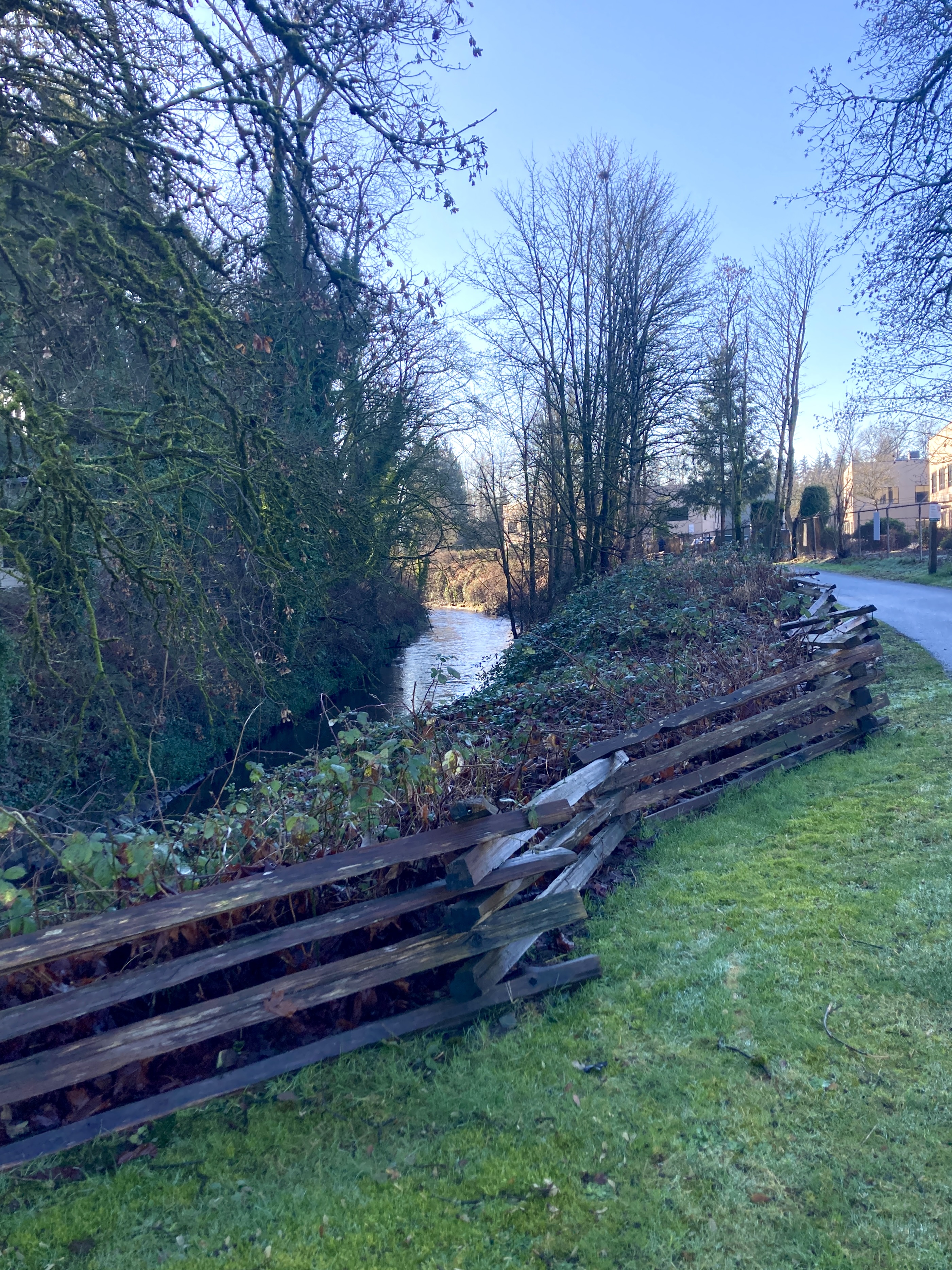
and a snake fence leads us on upstream…
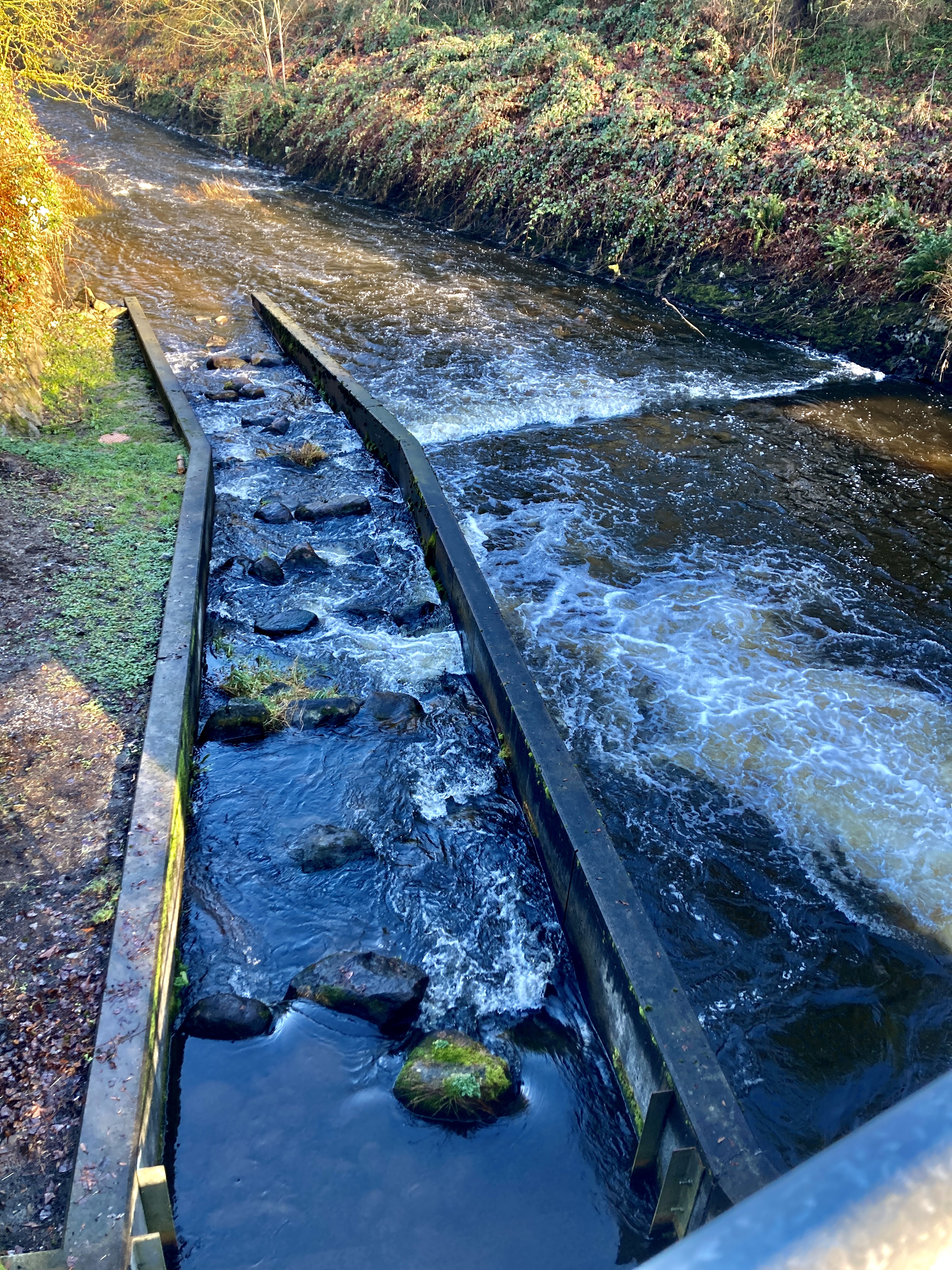
to the Cariboo Dam. Several creeks and a lake feed into Burnaby Lake, which in turn empties into the Brunette River and ultimately into the Fraser. This dam controls the outflow.
An era of sawmills on the lake caused the inevitable toxicity and devastation of salmon and other populations. We stand on the path atop the dam, and see some results of rehab efforts since then.
To the east, the Cariboo Dam Fishway provides upstream access for resurgent fish populations …
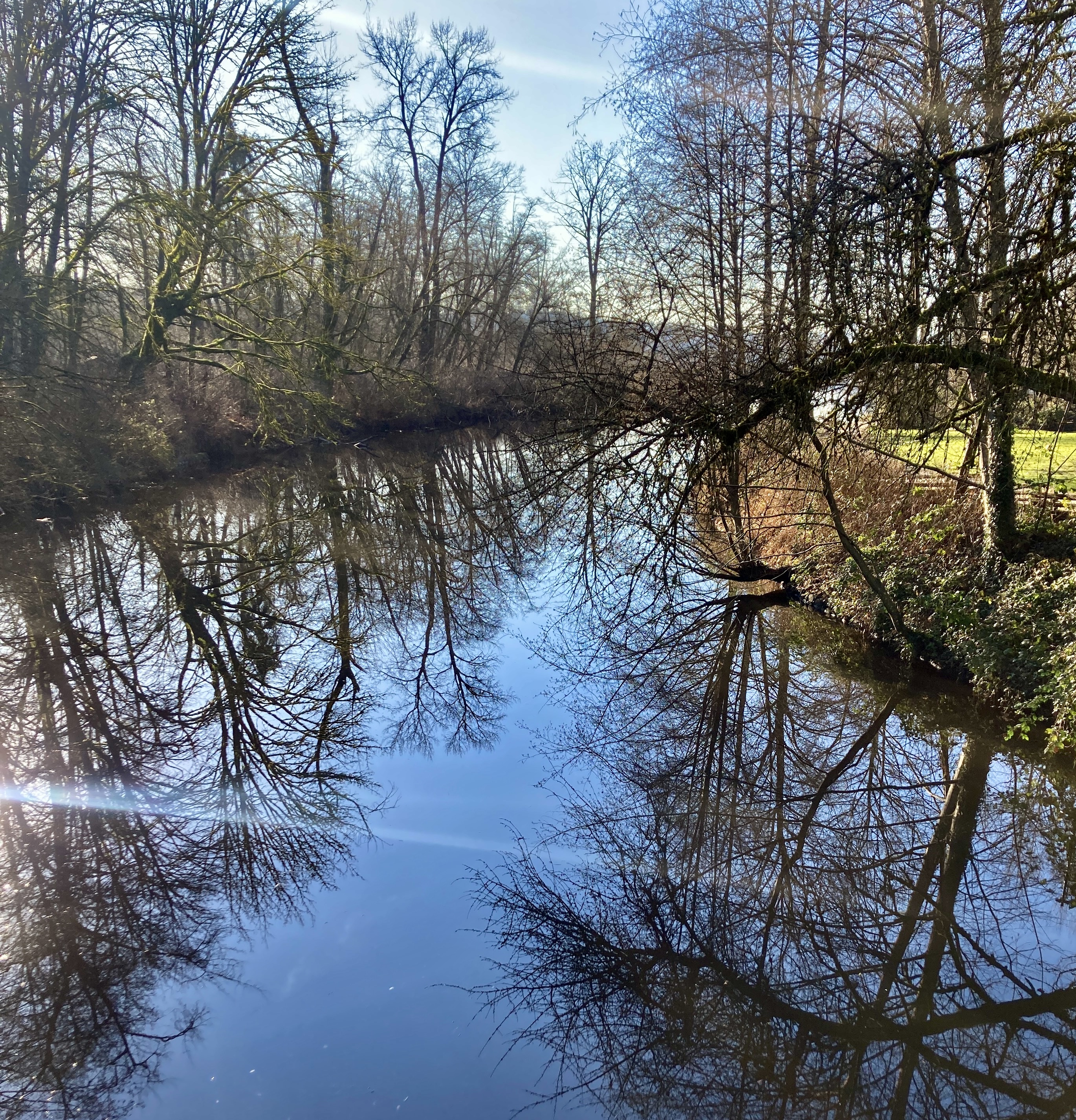
and to the west, winter trees cast their delicate embroidery on the system’s much-improved waters.
Trails circle and loop off-shoots all around the lake, but are not always in sight of water. We’re on the Brunette Headwaters Trail, entranced by nature’s response to the minimal human pruning that keeps trails safe and accessible.
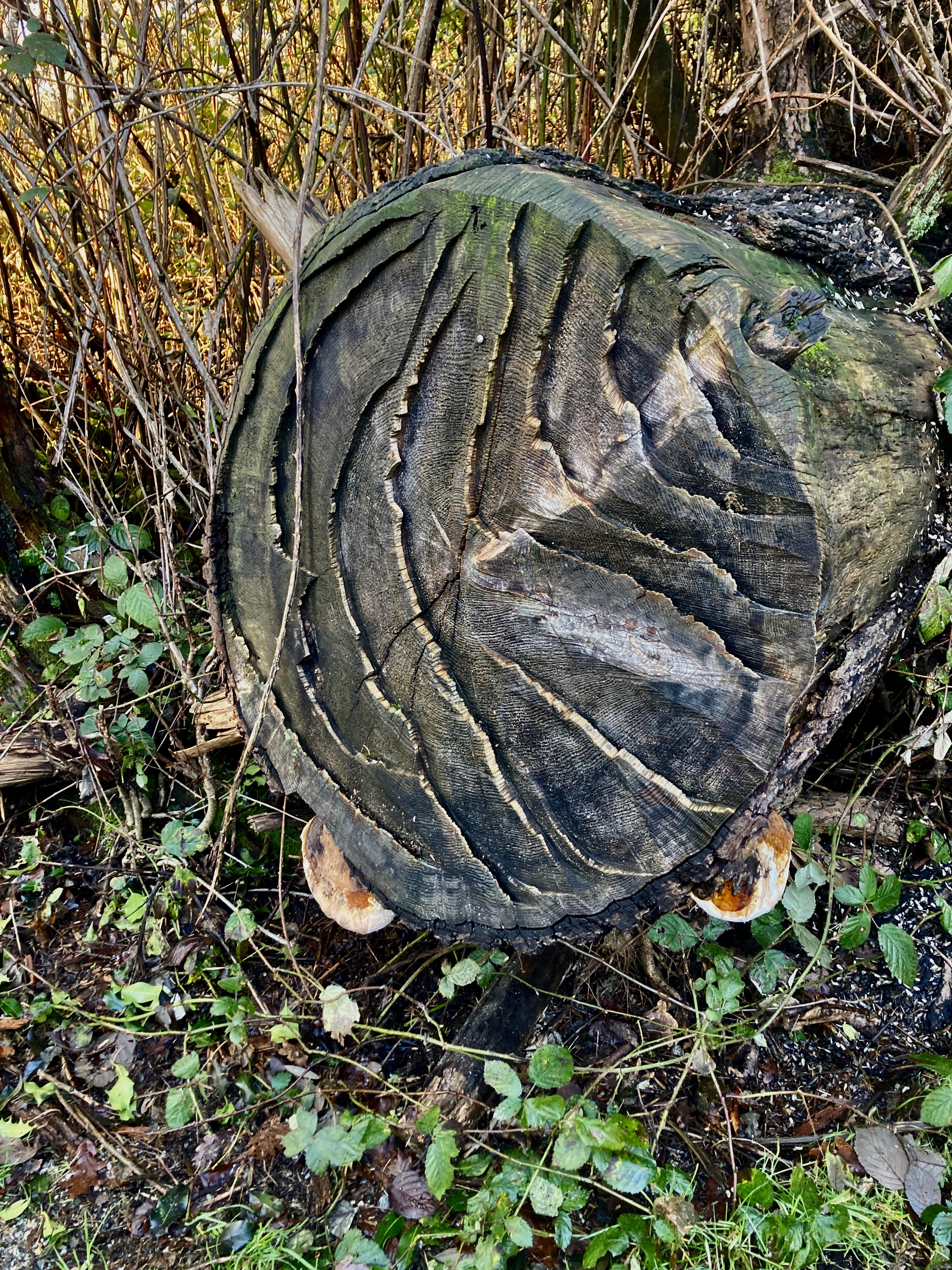
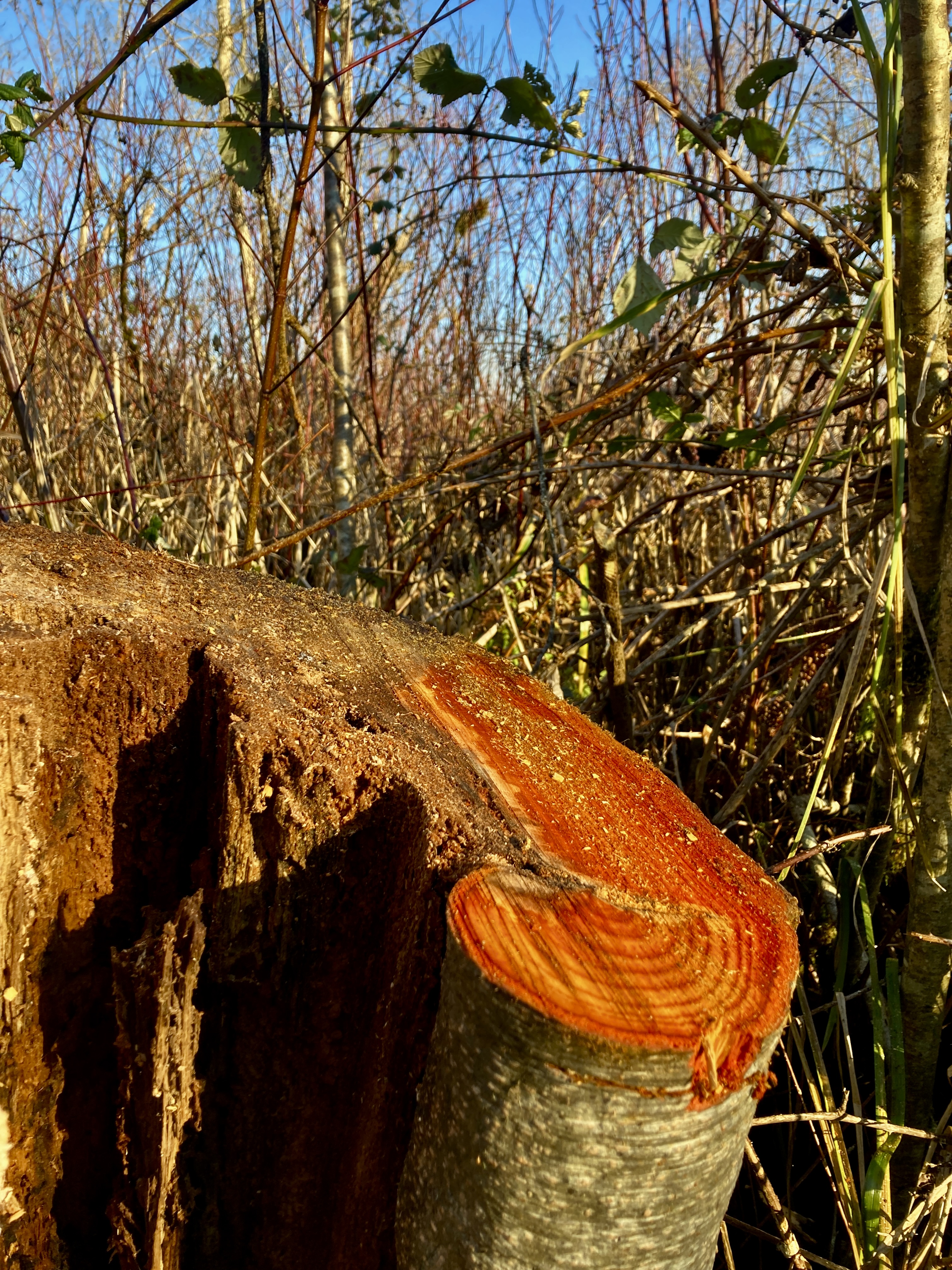
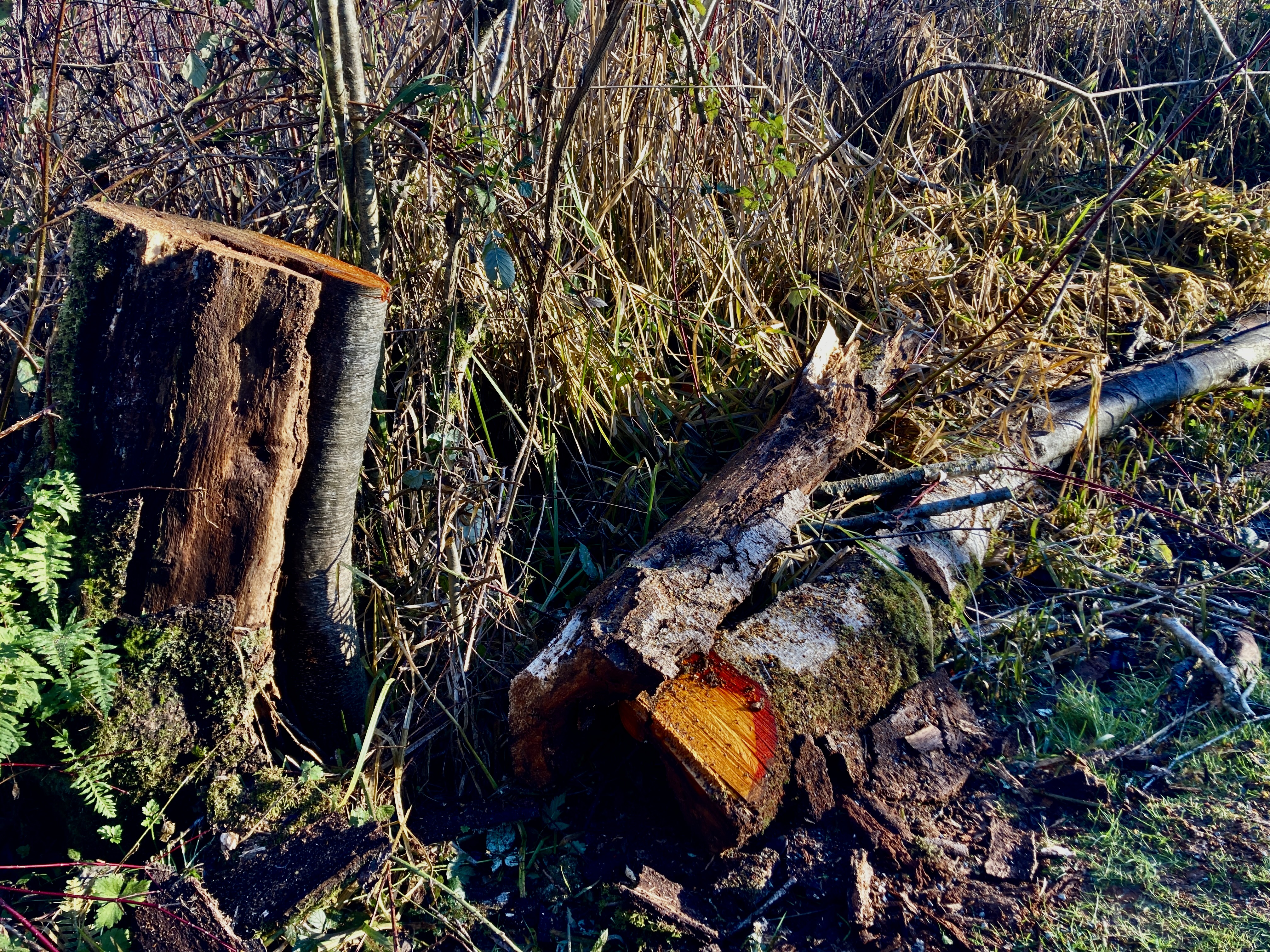
Humans cut; nature pretties up the resulting stumps and fallen logs.
Sometimes with cream/black/ochre fungi…
and sometimes with a smacking great burst of red and orange in the wood itself.
(Really! No enhancements.)
And then, as if that weren’t enough, right there in the grasses between stump and tree trunk…
I spy a vivid little slice of off-cut. Which, to my friend’s amusement, I tuck into my knapsack.
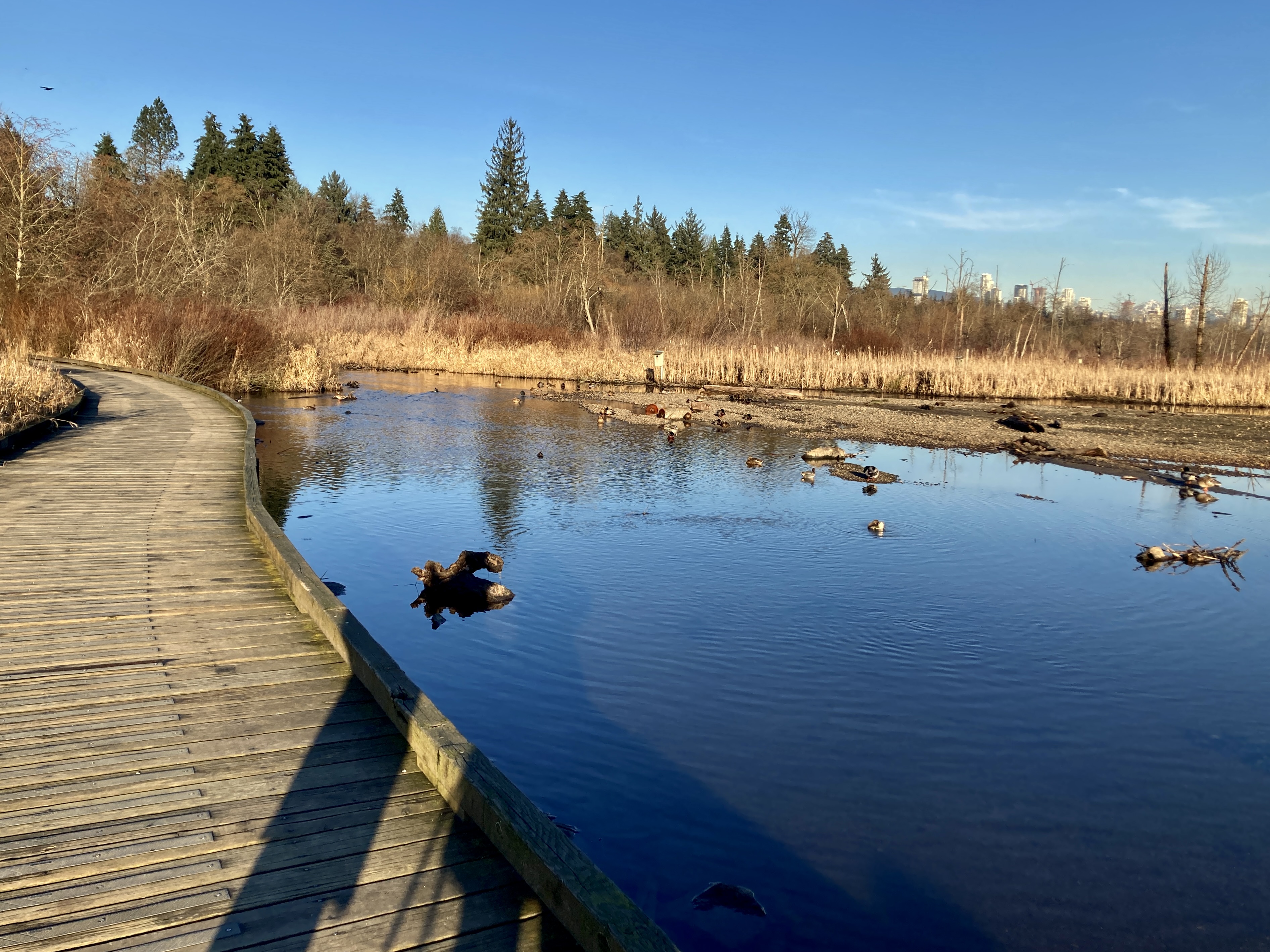
On west we go, and turn onto the path that will take us to the viewpoint at the end of Piper Spit.
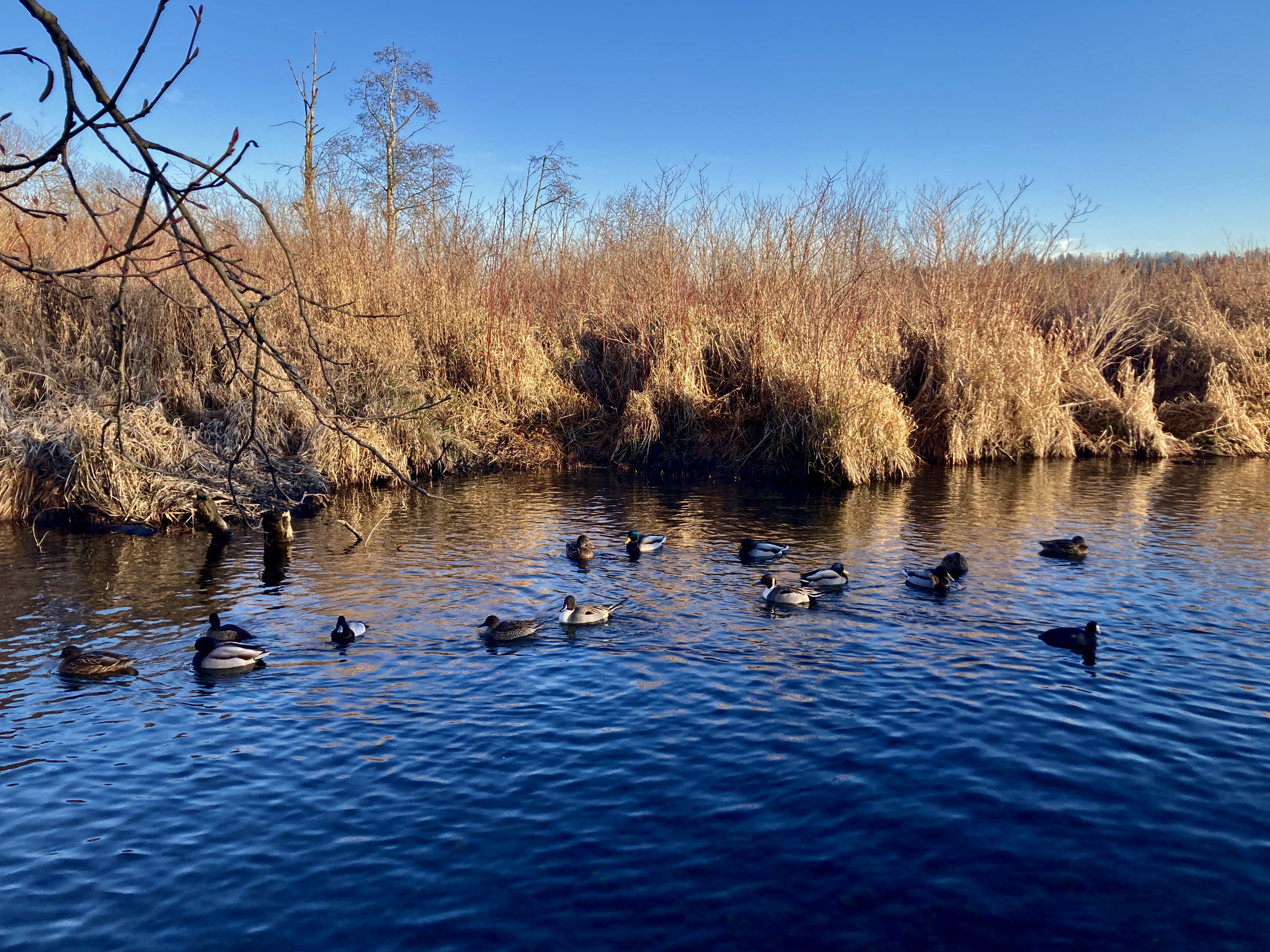
The waters along this path teem with happy ducks. Even my uneducated eye can pick out mallards, pintails, golden-eye and coots, as they mill about.
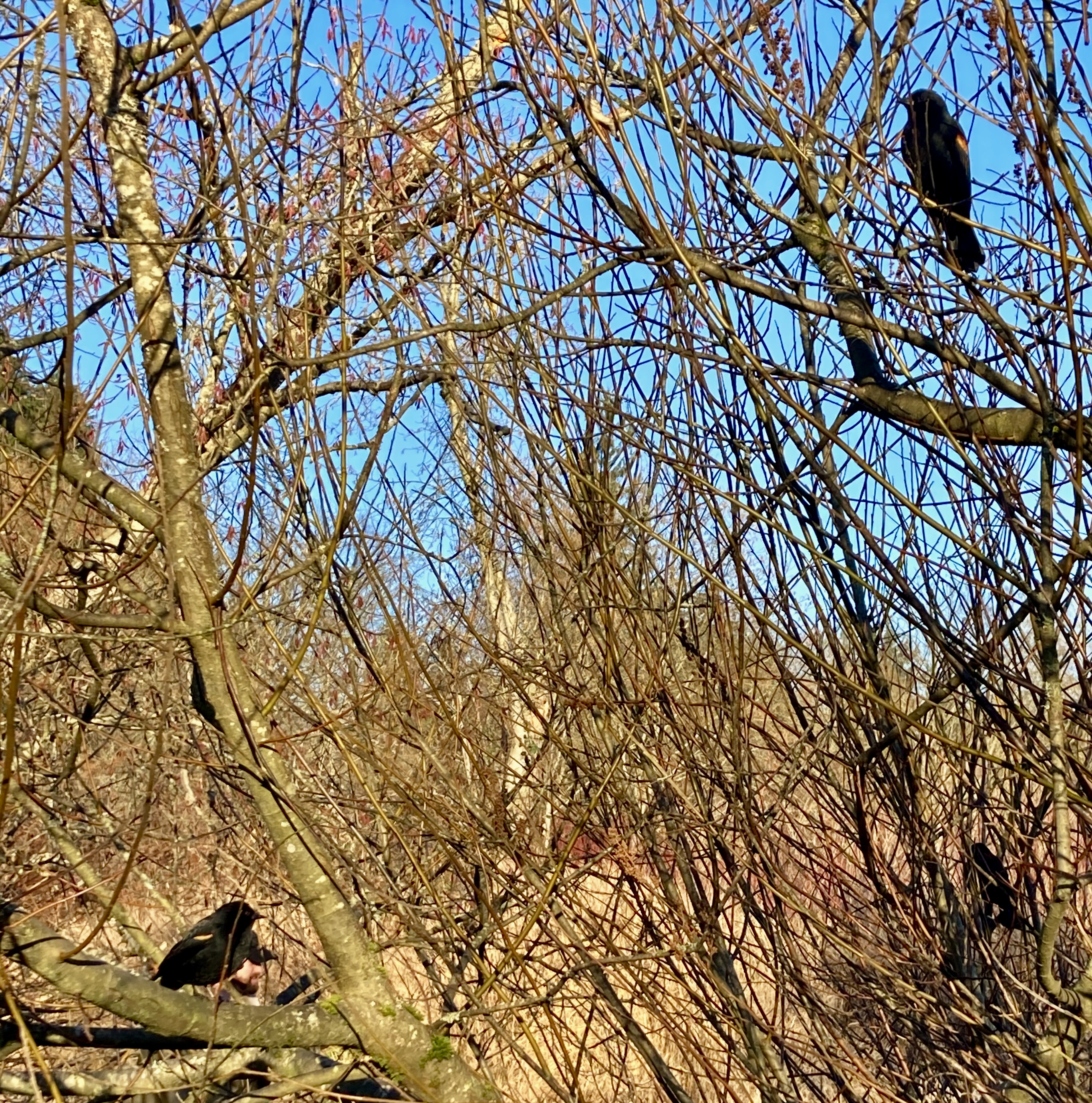
In the trees, chickadees and red-wing blackbirds.
I confess: I deny these guys are red-wingers until they flash those chevrons. “Well, they don’t sound like red-wing blackbirds,” I grumble. Then I have to consider that this lot is a long way from the lot that my ear knows best, back in Ontario, and they probably have their own distinctive accent. (Am I right? Am I silly? Somebody please tell me.)
Tip of Piper Spit, we look east at yet more ducks (and gulls, and bird boxes along the shore)…
then west across mud flats toward the shoreline viewing tower.
Back to the main trail, and up the tower…
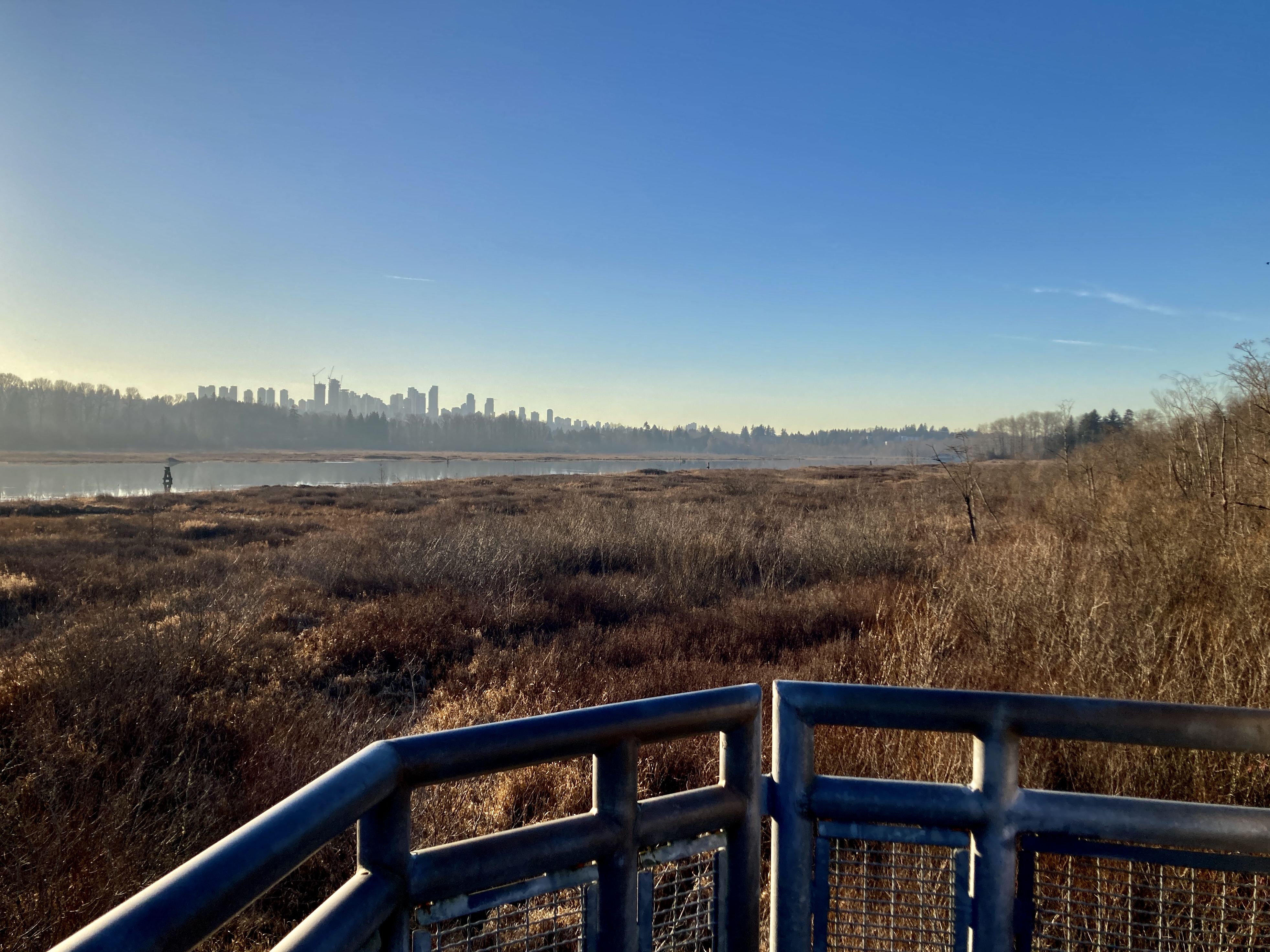
for a long view across grasses, lake and woods beyond, right to the towers of downtown Burnaby.
Beyond those towers, the Vancouver towers.
Where, once home…
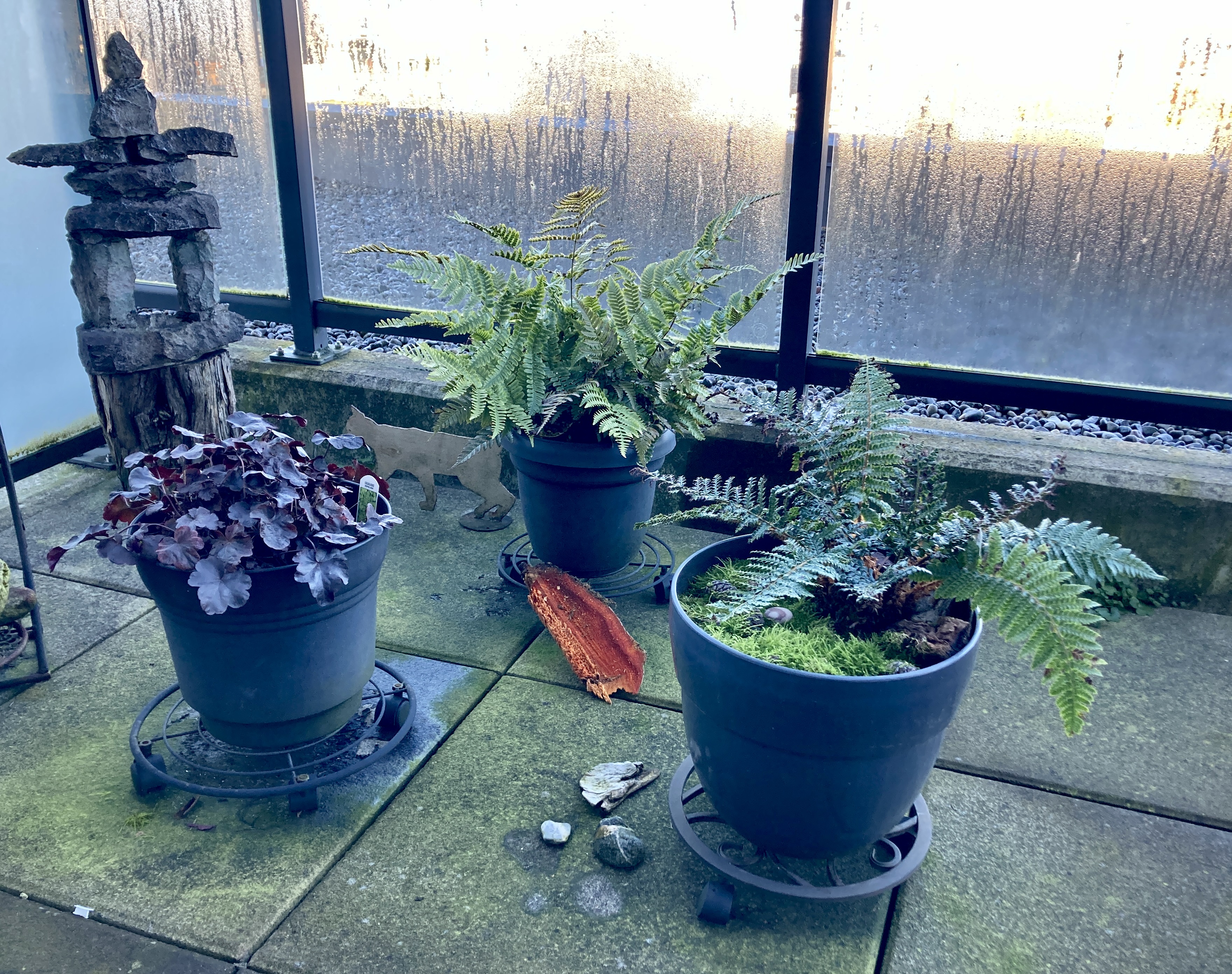
I settle my vivid little off-cut among its new companions.
10 January 2026 – I have an errand, down by Pacific Central Station, and the skies are not heaving anything at anybody. I am happy indeed as I walk north on Scotia Street.
Even happier when, near East 2nd, I get to moon over yet another growth of fresh winter moss on a curb-side tree.
Oh, I know. This is a perfectly ordinary photo of a perfectly ordinary patch of moss, and either you share my obsession and moon along with me, or you shake your head and move on.
As I also do.
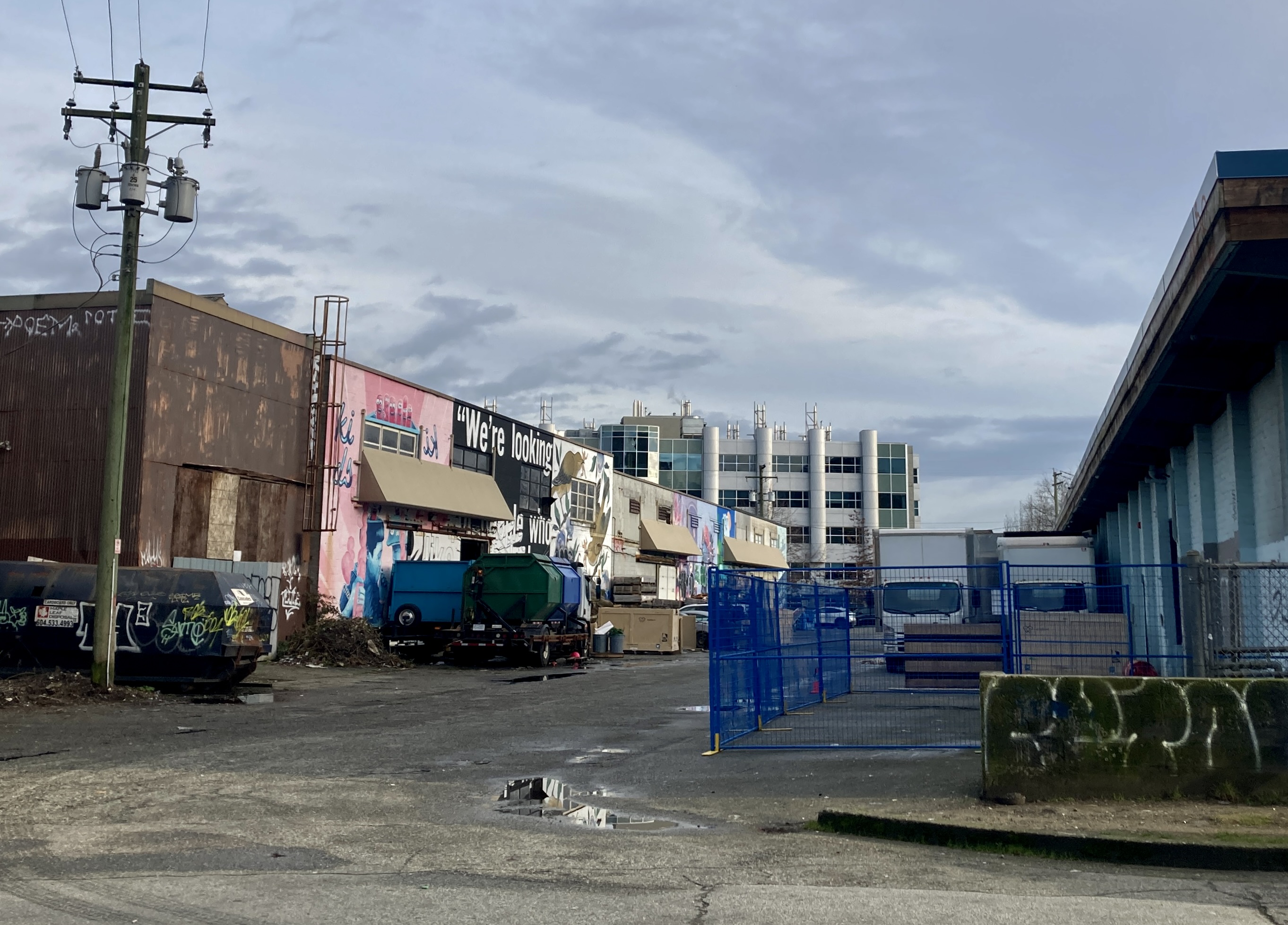
Errand accomplished, weather still surprisingly agreeable, I keep walking north. Cutting through False Creek Flats, I see that this stretch of battered old warehouses is, apparently, finally being demolished.
All the signs suggest this conclusion: windows boarded up, dumpsters out front, bright blue mesh fencing. Down there at the far end, the kind of new-build we can likely expect — structures to welcome more “knowledge industry” activities.
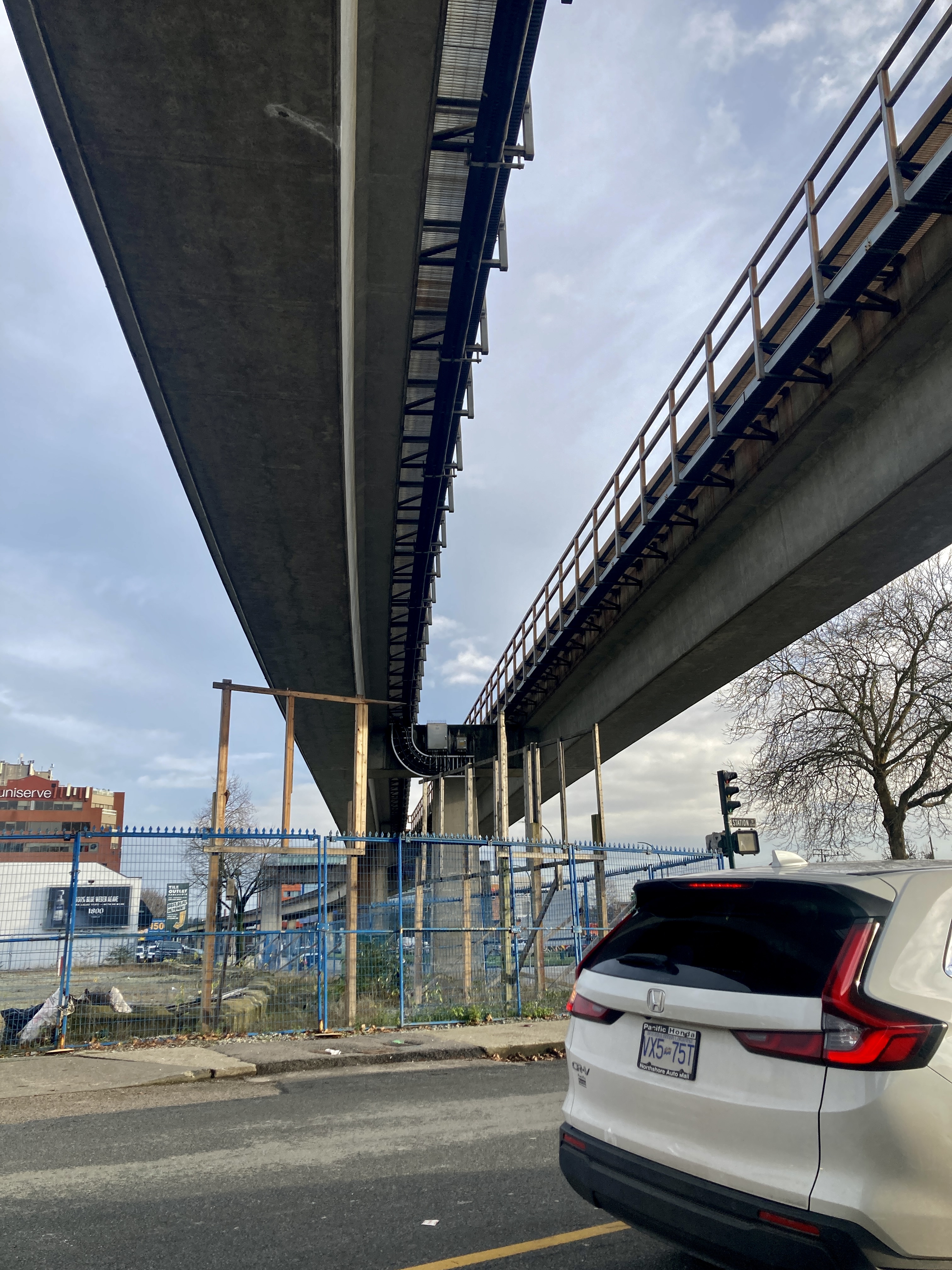
Across Terminal Ave., heading indeed toward the terminal (Pacific Central Station), I look up while waiting for a light to change. It gives me time to admire the vee of SkyTrain tracks overhead.
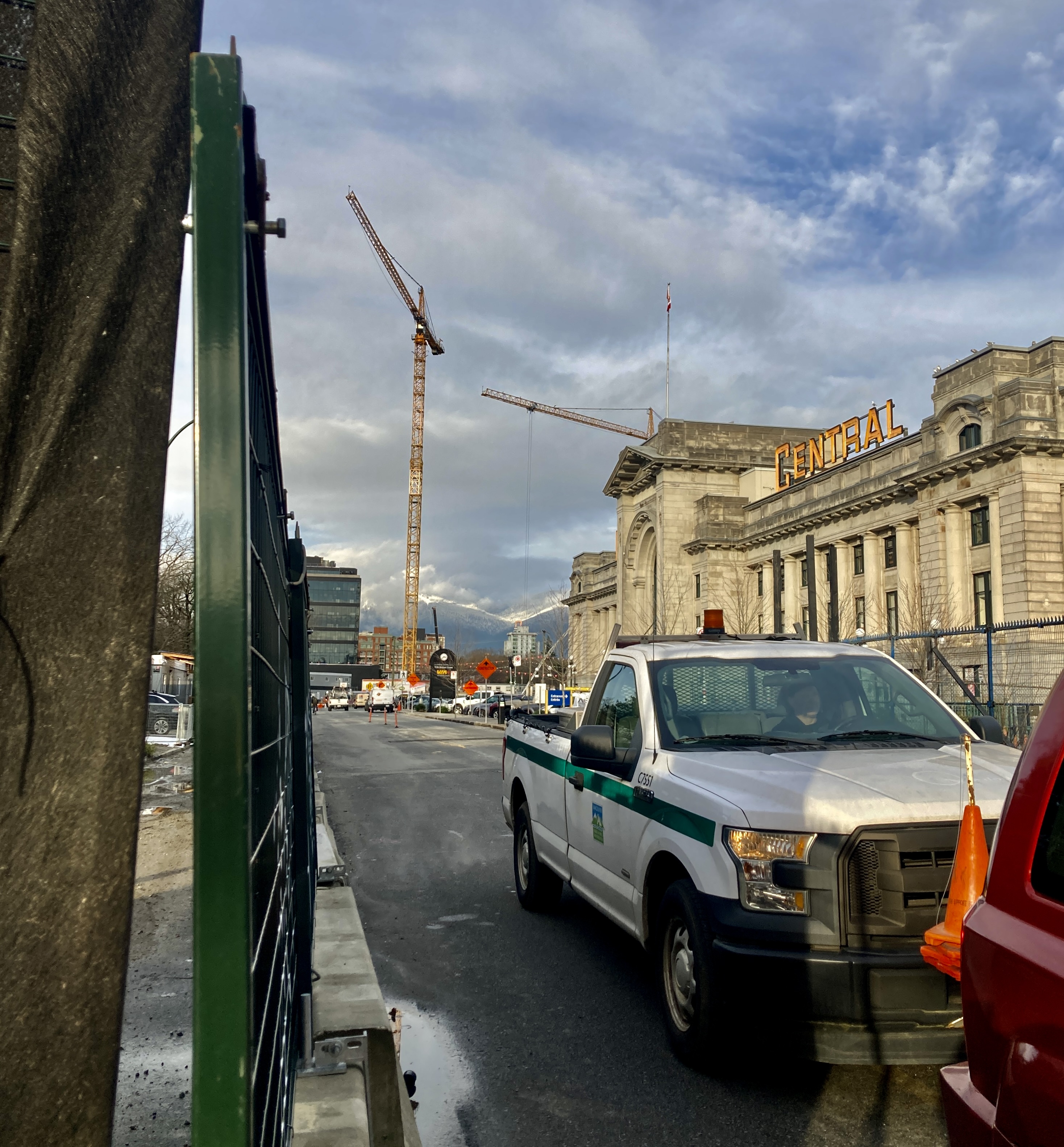
I also have time to look left, skimming my gaze along the front façade of Pac Central to rest on the cranes beyond…
which mark a New Build worthy of those capital letters: the new St.Paul’s Hospital complex.
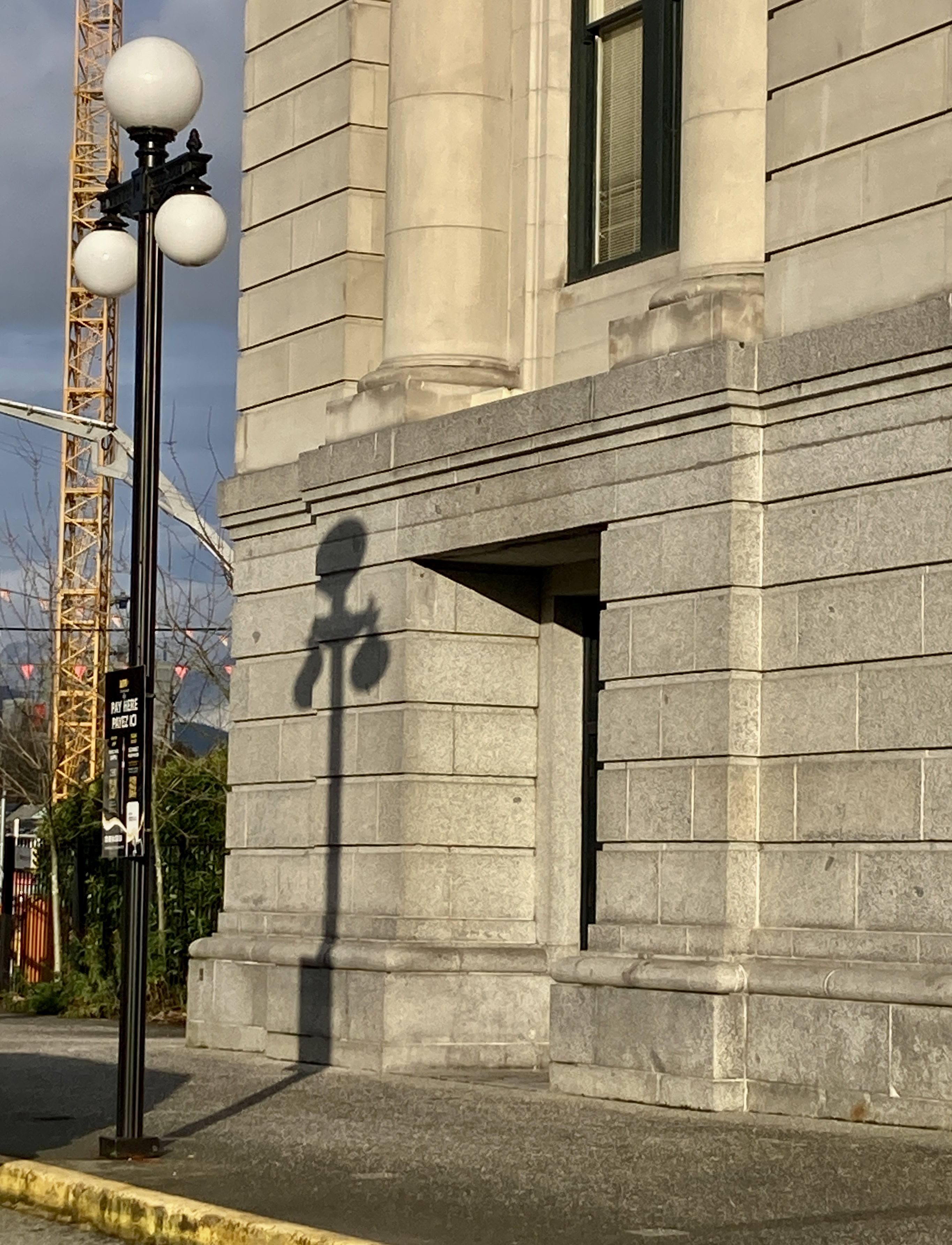
Lights change. I cross, I walk, and I pivot around this elegant lamp post shadow at the far train station corner…
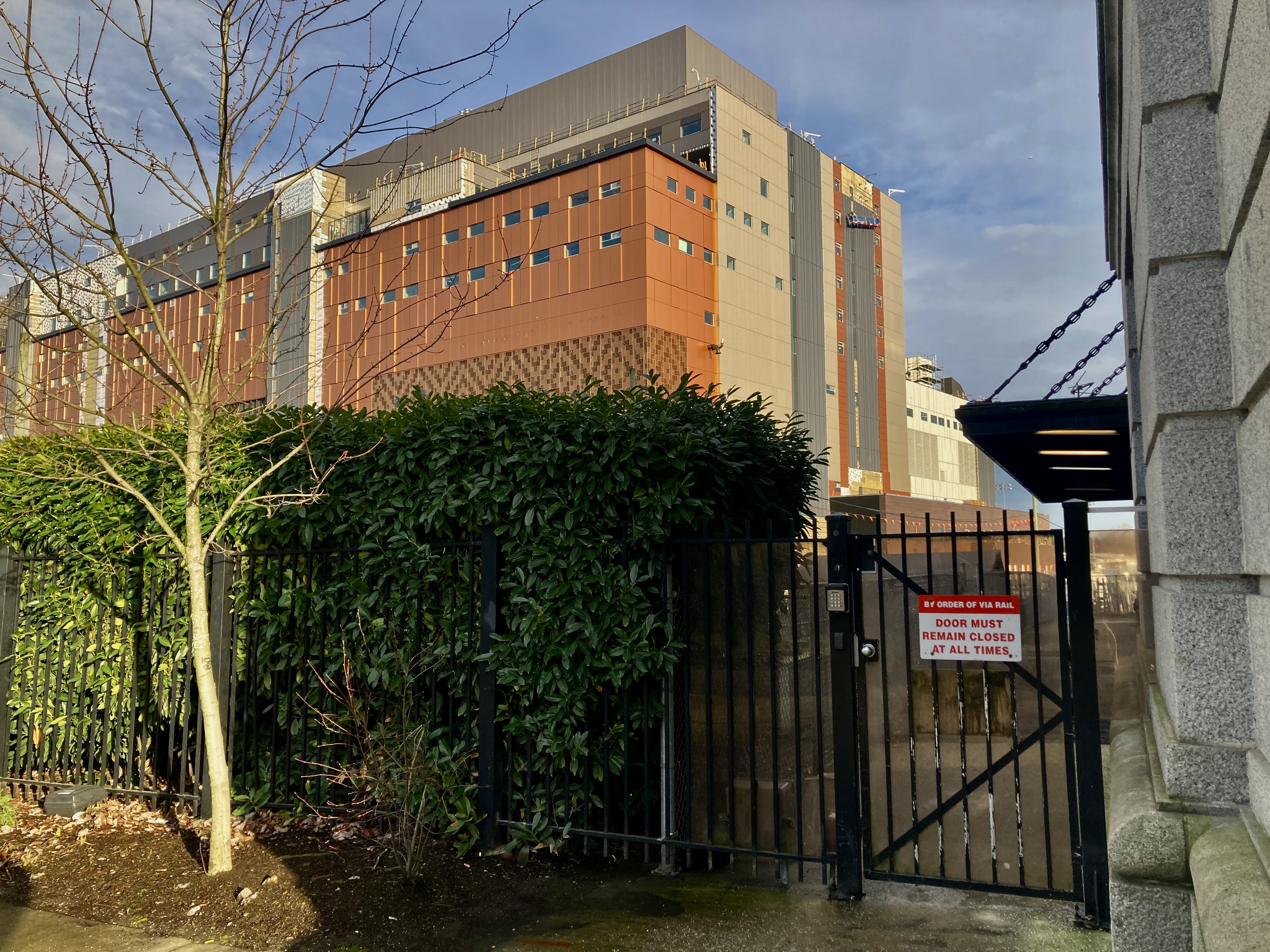
to see…
the bulk of the new hospital, now showing us its full dimensions and scale.
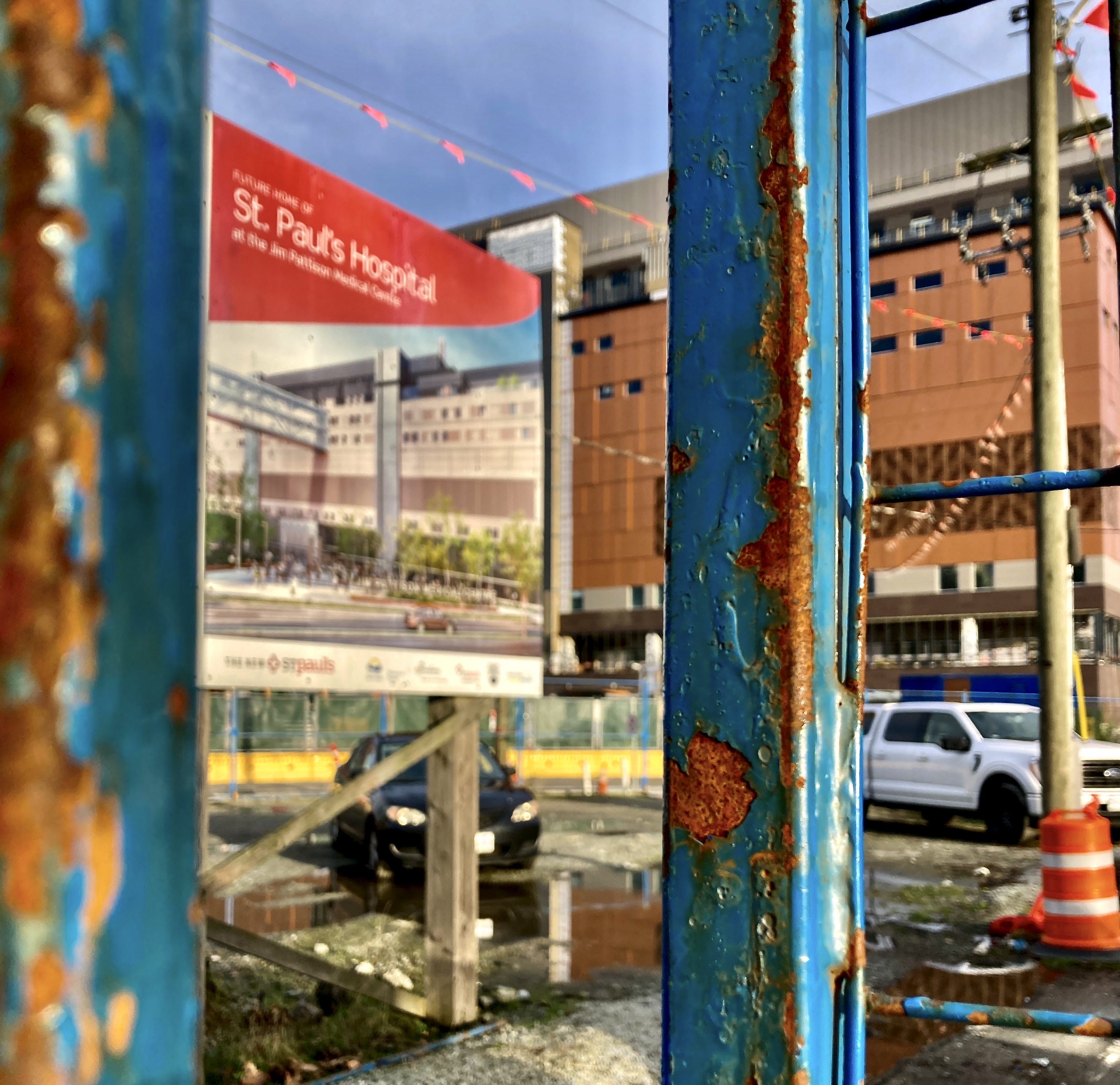
One peek at an explanatory billboard, visible through a gap in the fencing…
and I right-turn to follow a pathway to Gate 4, which runs along the far side of the complex.
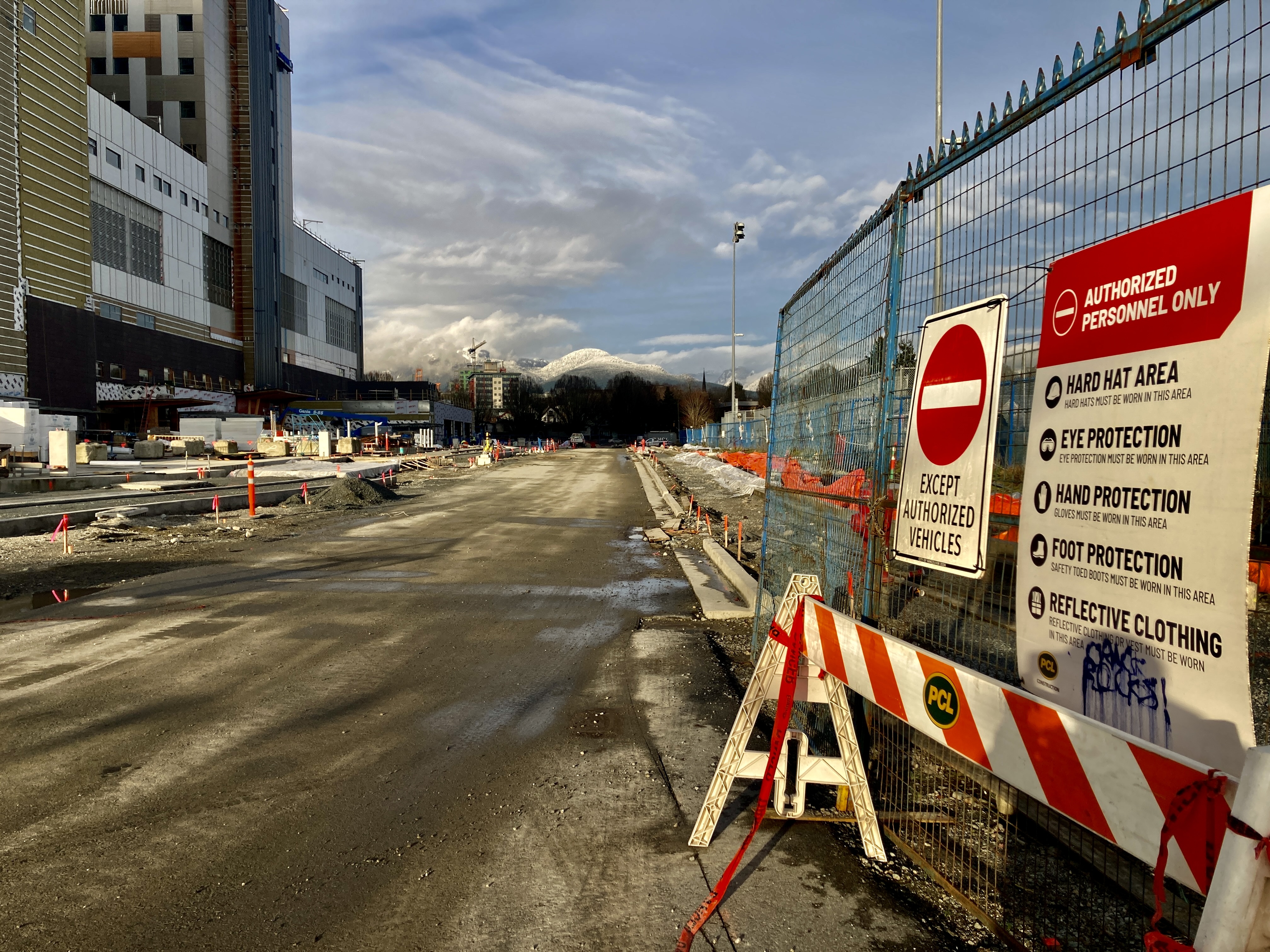
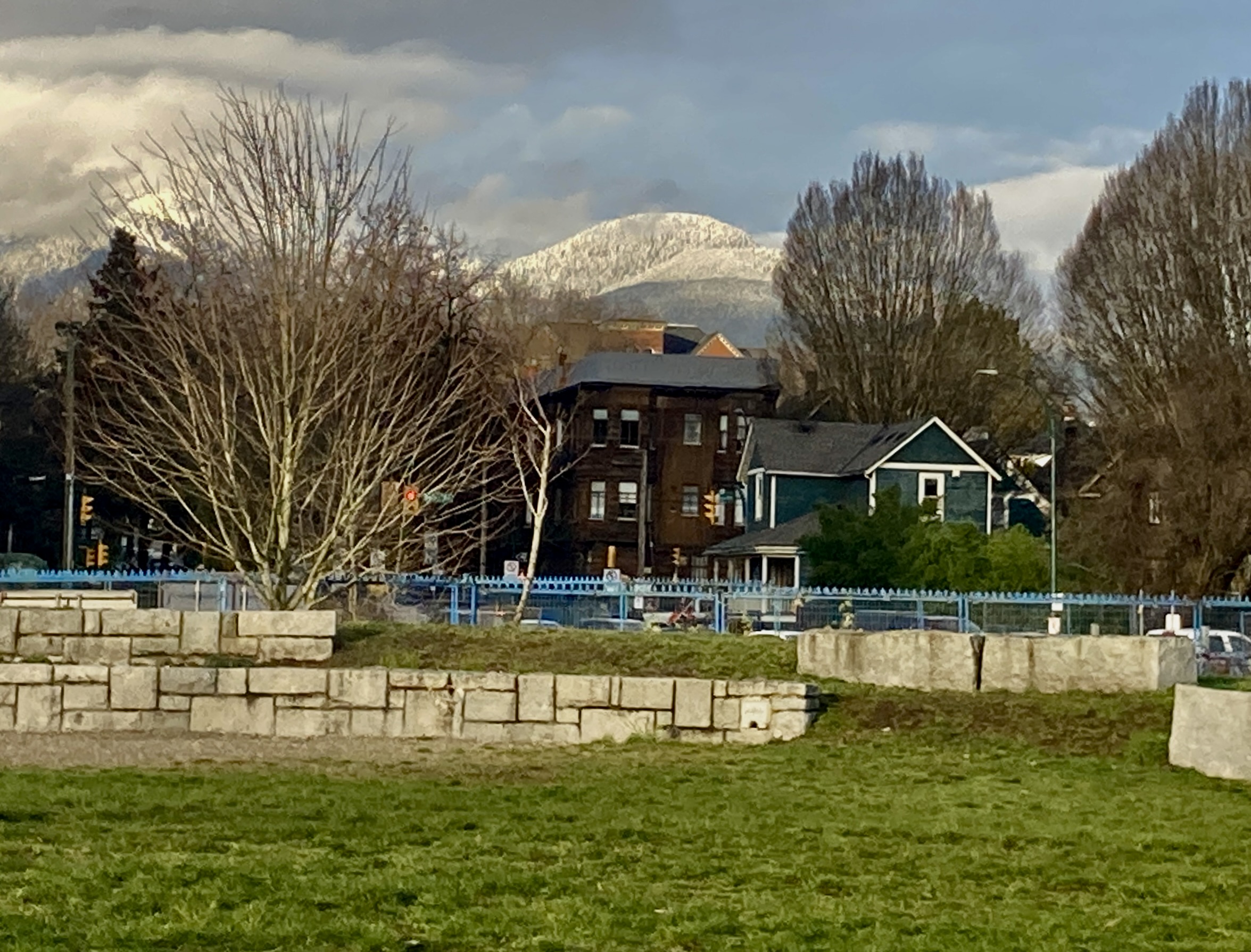
East side of the building to my left, Trillium Park to my right, and straight ahead — over there in North Van, the far side of Burrard Inlet — snow on the mountain peaks. Plus, you bet, warmly dressed skiers.
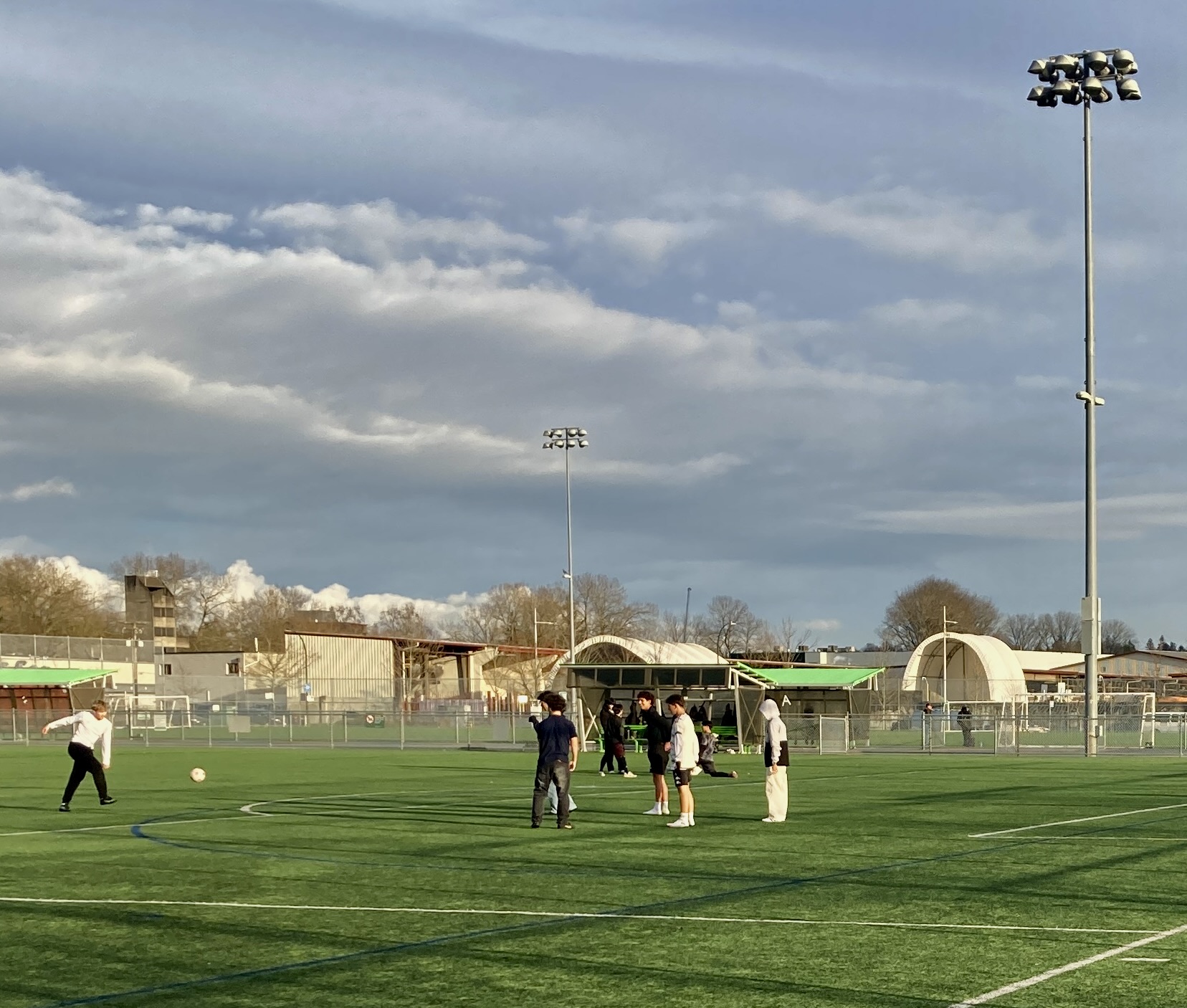
Down here at sea level, the Trillium Park soccer players are lightly dressed…
and even I have bare hands and an open jacket.
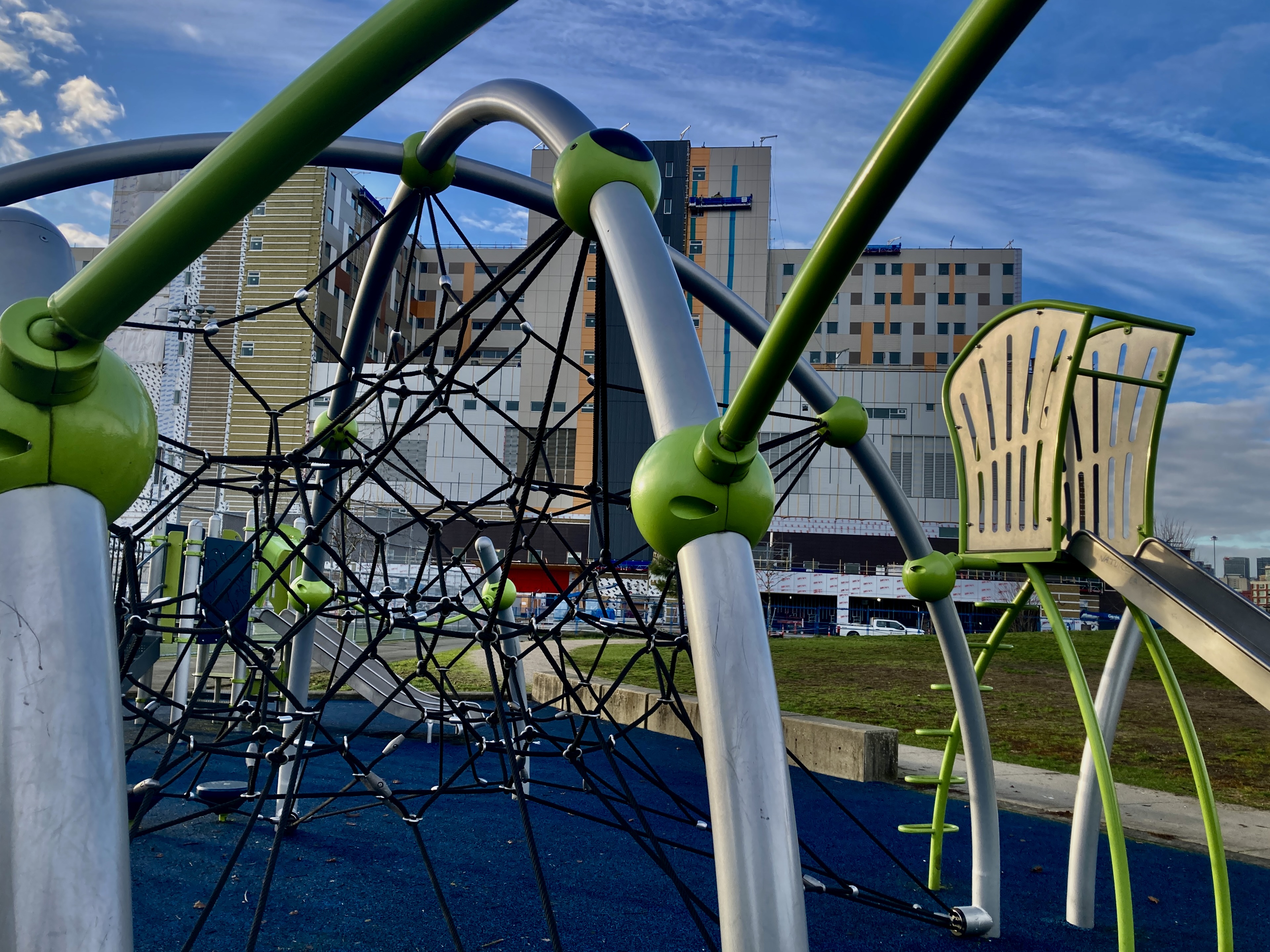
One last glance at the hospital complex through playground equipment in spiffed-up Trillium Park…
one last salute to all that high-altitude sparkling snow…
and I carry on north & west into Strathcona, heading for Main Street the other side of Chinatown.
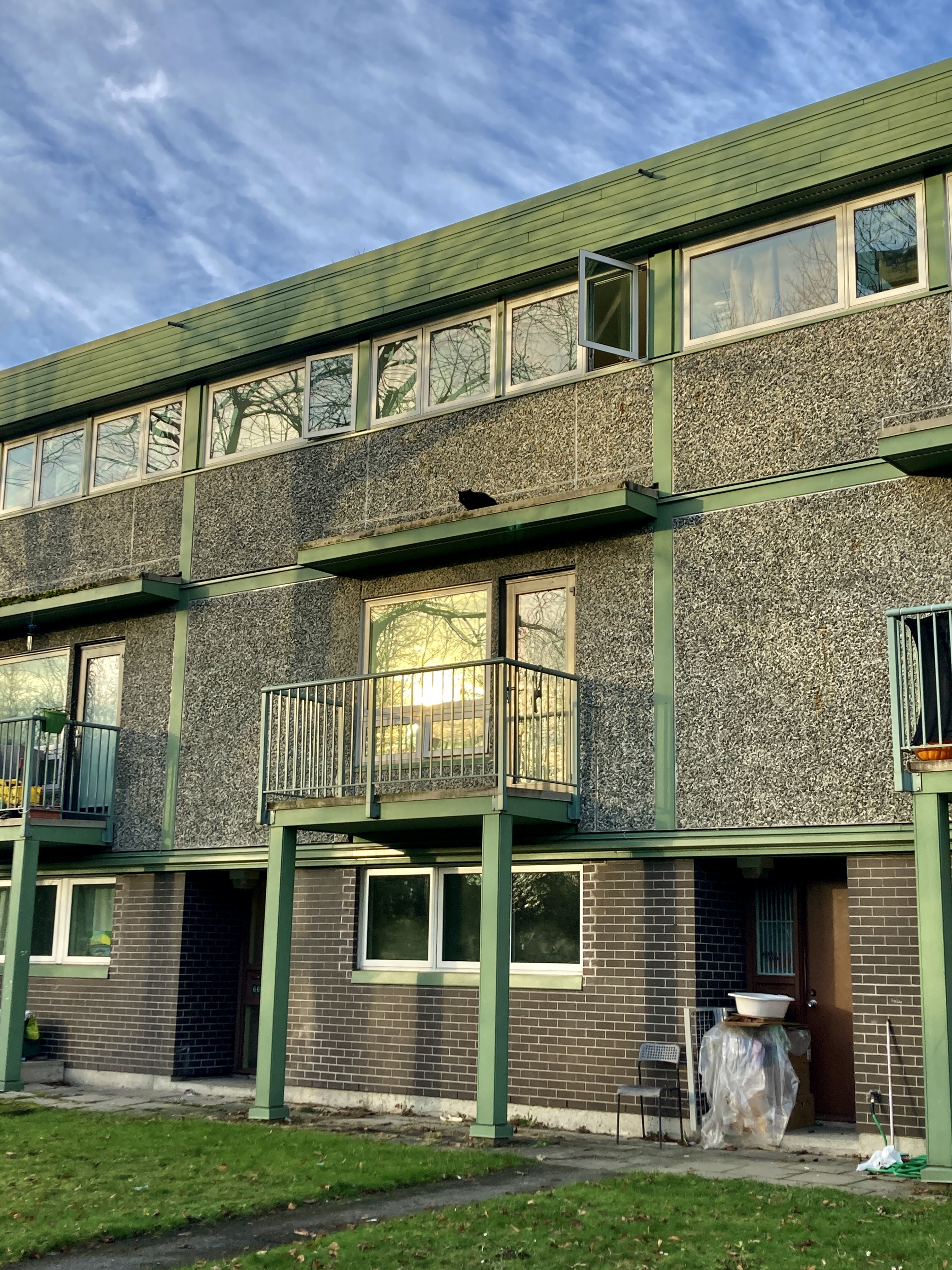
My zigzag takes me between two very modest apartment complexes. I’m thinking they’re a bit on the grim side, then slap myself for snobbery. Whatever their aesthetics, they are clean & tidy & details like paint and windows look well-maintained.
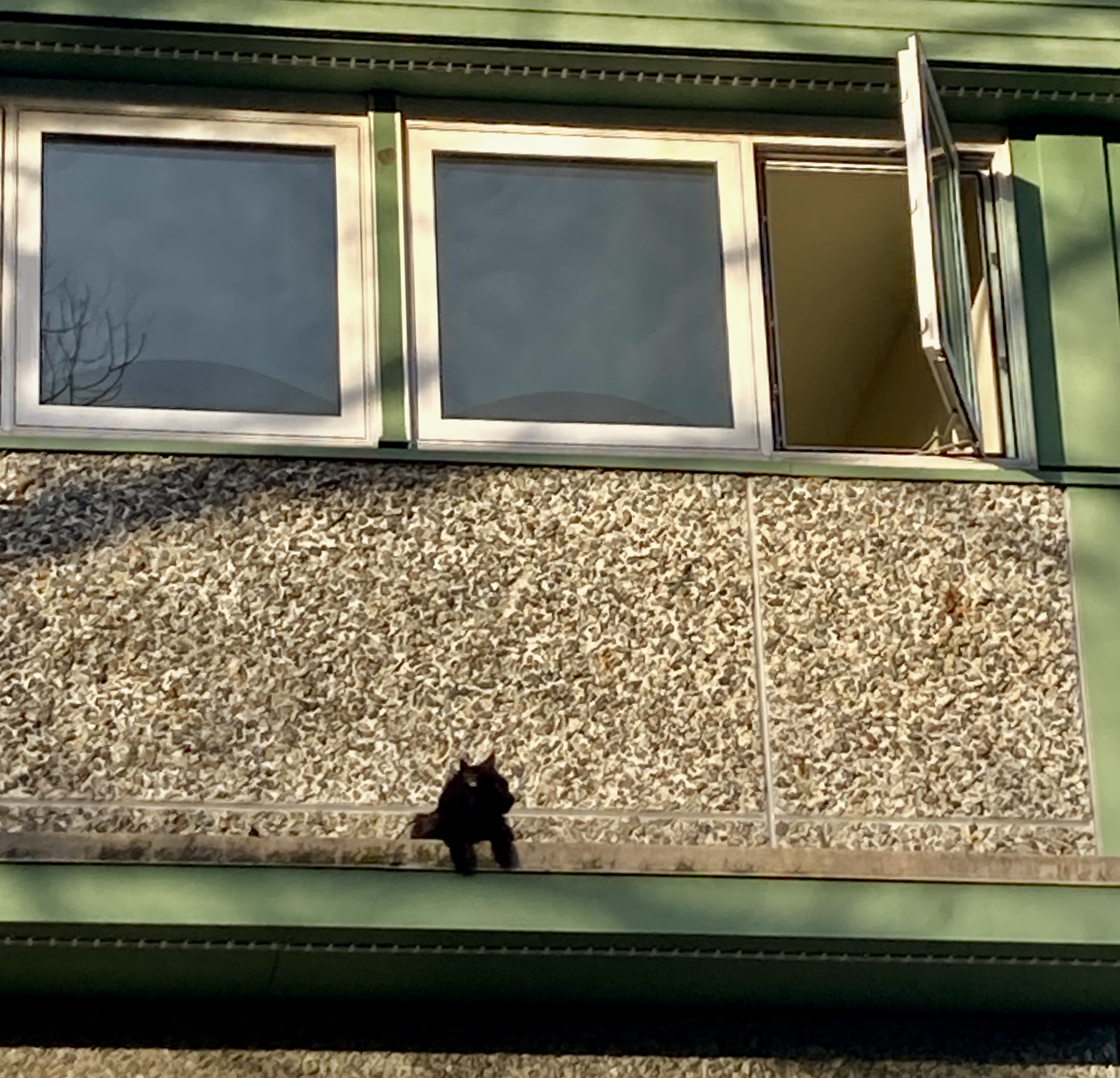
But that’s not why I’m showing you this photo. After you pass (or don’t pass) your own judgment on the aesthetics, please note the black blob on the ledge between the centre balcony and the open window.
See it?
It is not a blob.
It is a cat.
Out of the corner of my eye, I caught sight — or so I thought — of a cat tumbling out that open window, surely to his death. He does not die. He lands on the ledge. I stand there, waiting for him to start wailing for help. He does not wail. He settles down, toes curled over the front of the ledge, and does what he clearly does on a regular basis. He fills his lungs with fresh outdoors air, and watches the world go by.
1 January 2026 – Well, it is forward, isn’t it, when the reverse of your usual choice offers a new way to look at things. It’s hardly a major life breakthrough, but it does qualify as a pleasing little experiment, and worthy of the first day of a new year.
My “little experiment” is to walk the Burrard Inlet Seawall east-to-west between Waterfront Station and Stanley Park, instead of west-to-east. I know: small stuff indeed. But the fog is burning off, and it isn’t raining, and the temperature is comfortably above zero. Good reasons to drop off a bus at Waterfront Station, and get myself down to the water by Canada Place.
Tourists and locals stroll; the sights present themselves for admiration:
the fabric roof “sails” of Canada Place, the rental bicycles, a SeaBus completing its run from North Vancouver, a laden freighter and, of course, the orange cranes that tend to the freighters.
After that, my eye seems to focus more on slivers of scenes, not the whole panorama.
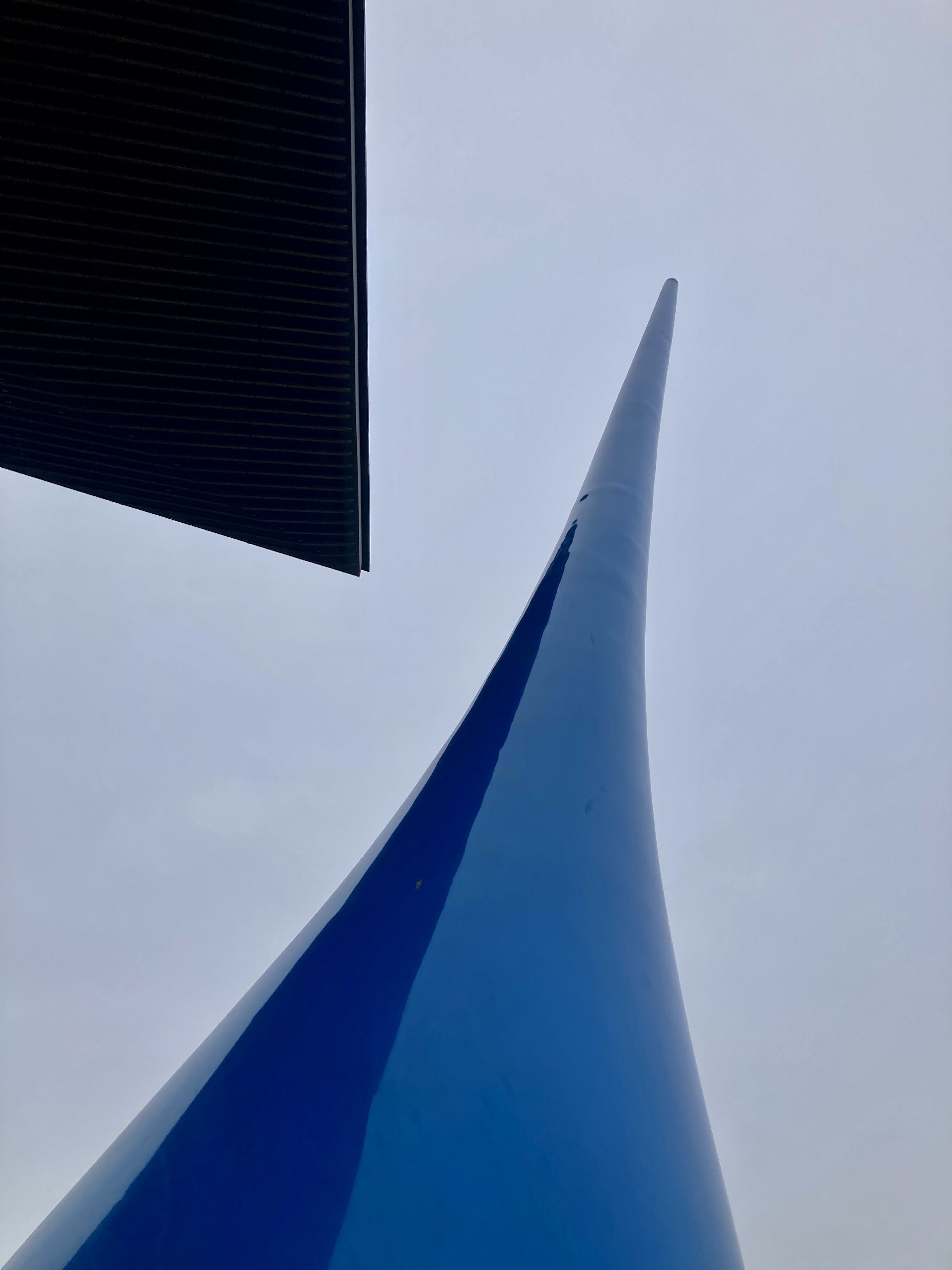
The tip of The Drop, the 2008 sculpture in Bon Voyage Plaza by the German four-artist collective Inges Idee that honours our temperate rainforest status with one elegant raindrop…
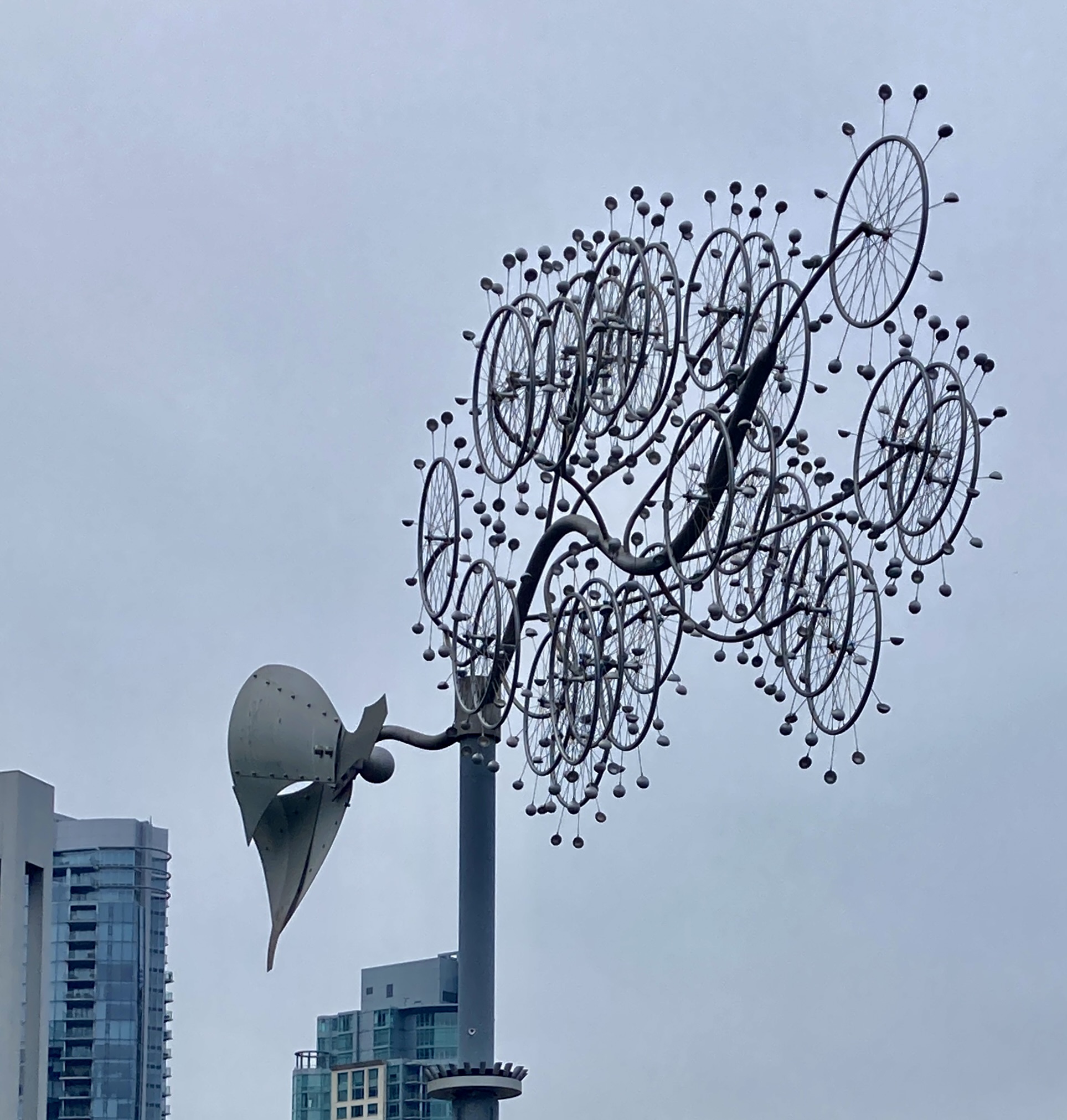
Doug Taylor’s kinetic weathervaneWind Wheel Mobile just west of the Convention Centre, which, from this angle, resembles a bobbing duck more than a weathervane…
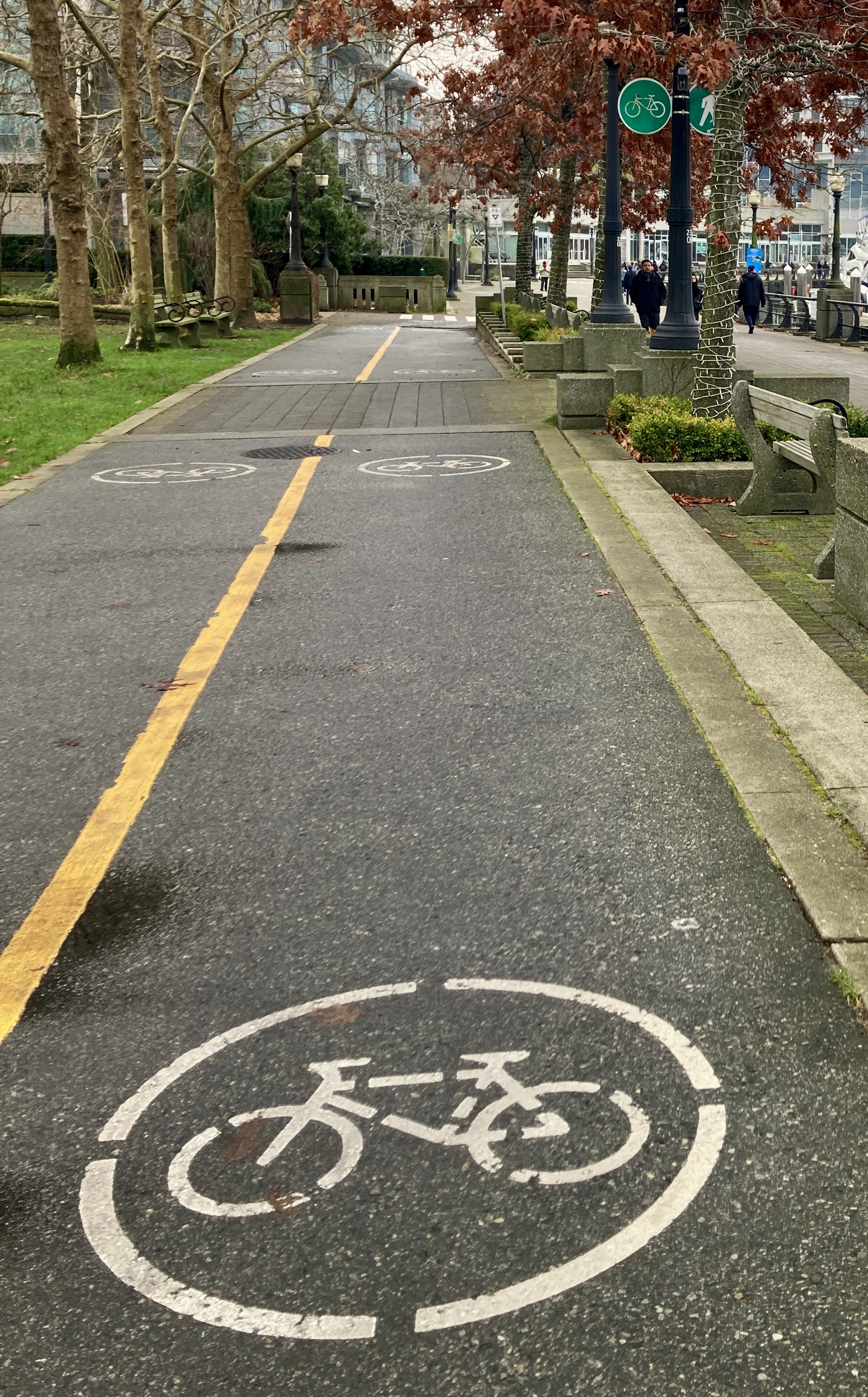
Seawall bike lanes bordering the west side of Harbour Green Park, under a russet canopy of (I think!) winter beech leaves…
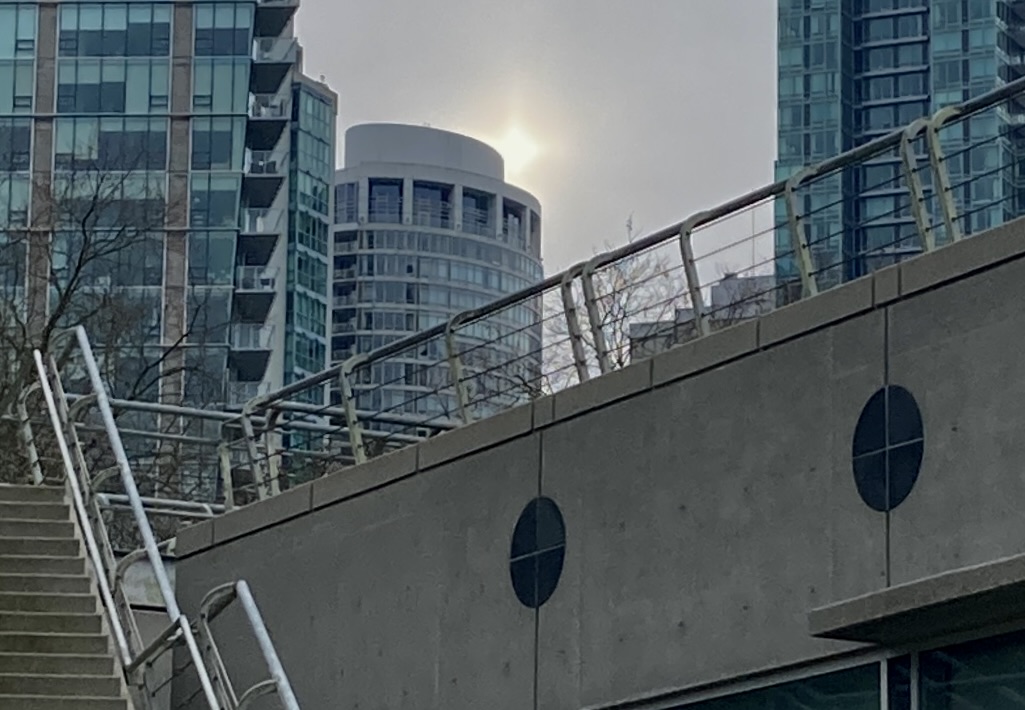
and the merest ghost of the sun, glimmering through the fog between buildings at the top of a Coal Harbour Park staircase.
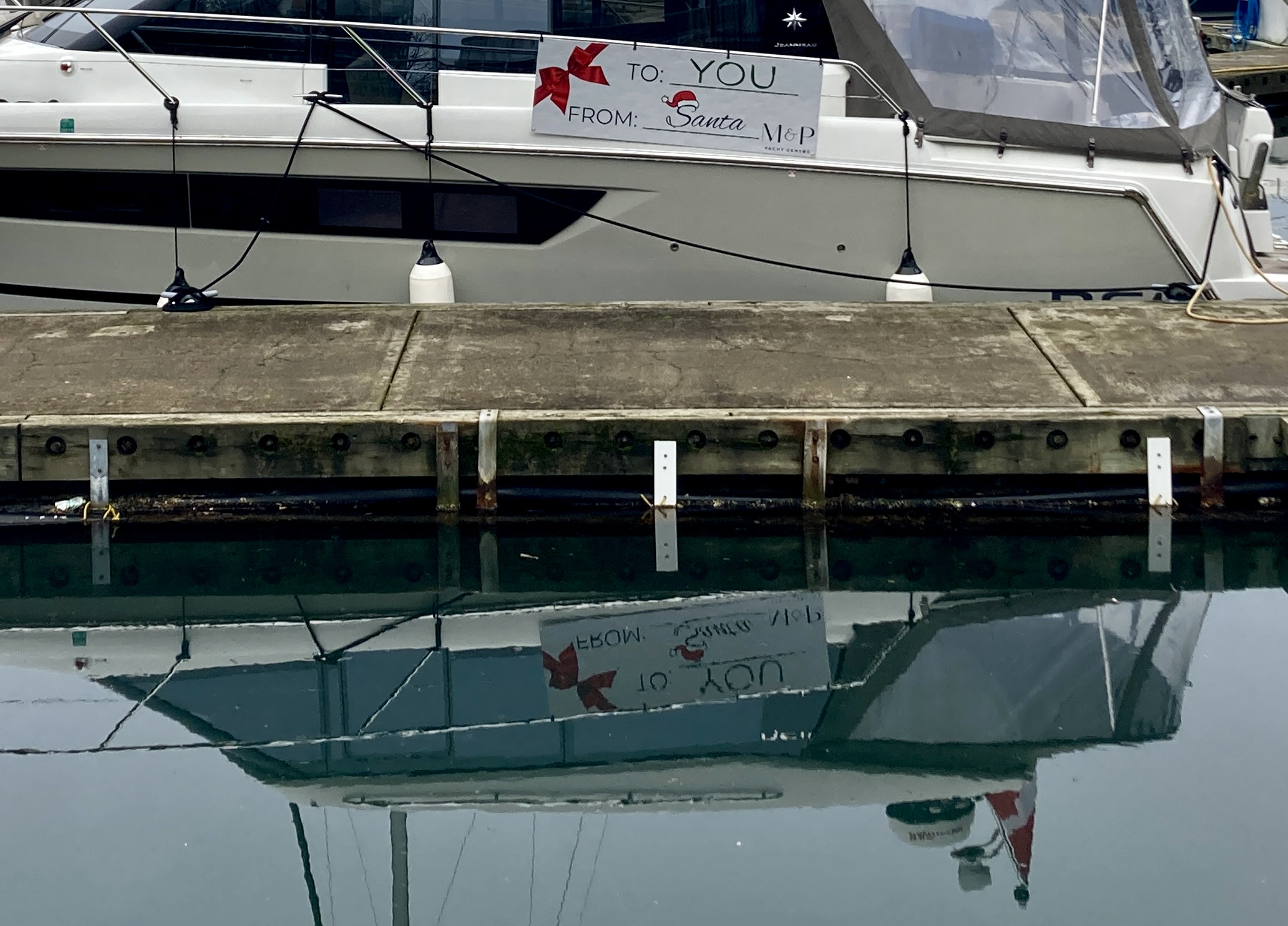
I spend a moment with Santa’s floating gift “To YOU” in the Coal Harbour marinas.
Really a lavish Christmas present? Or, wait a minute, a clever-boots For Sale sign? The suspiciously generic label bears the M&P Yacht Centre logo, after all.
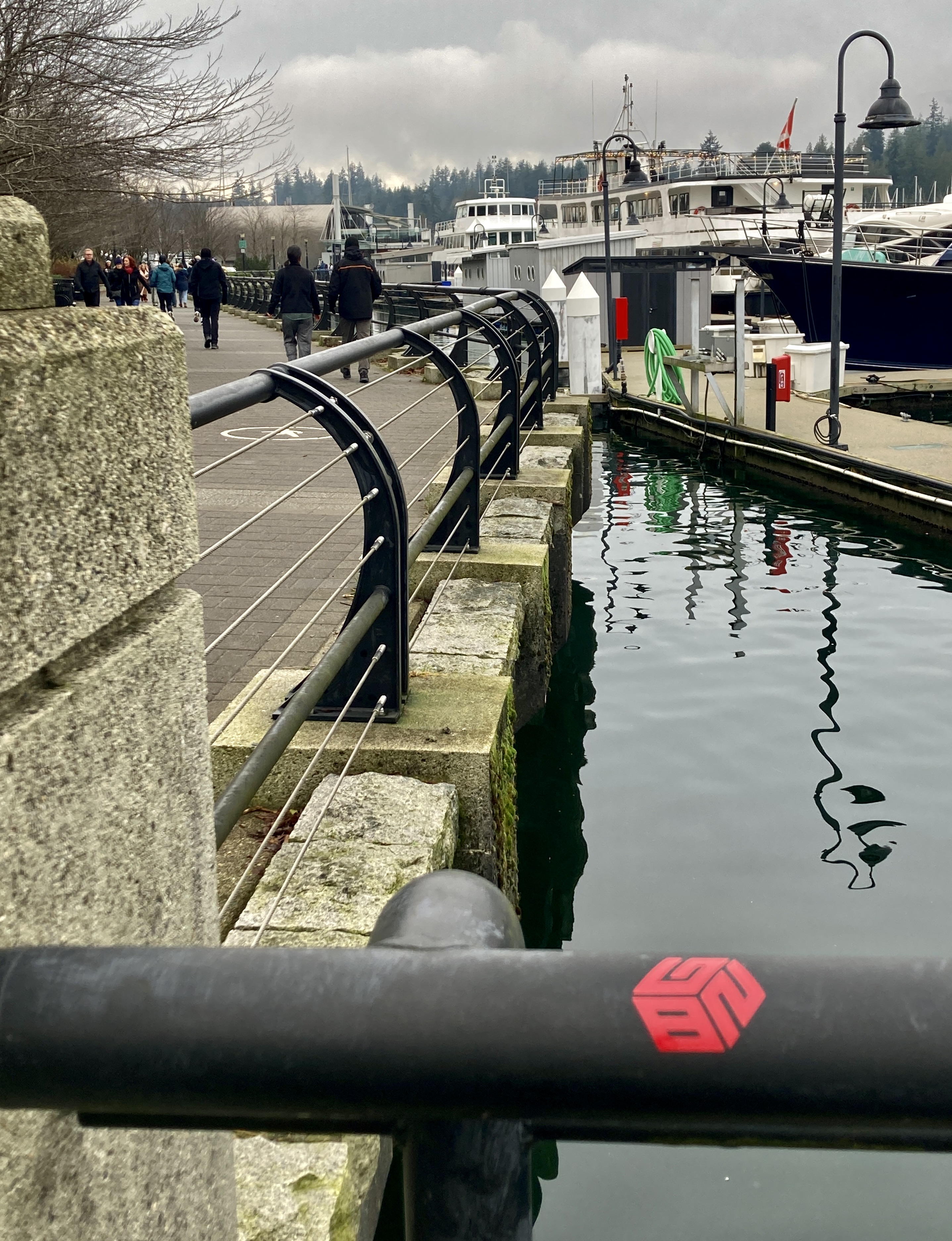
Far (west) end of the marinas, and I pause again, this time for something I feel no need to interpret.
A red cube sticker + a vee of water. I just like it.
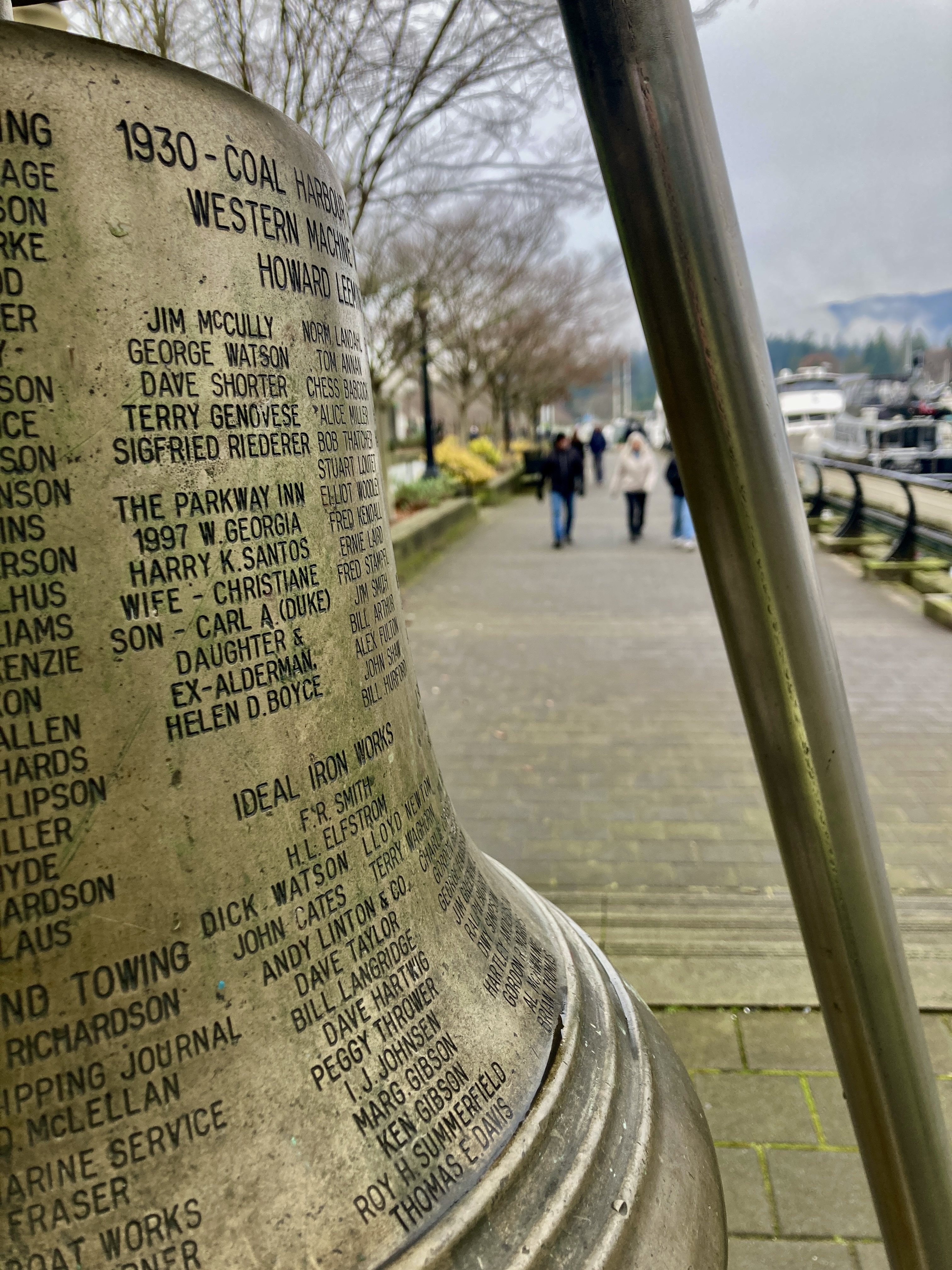
Then the brass curve of the Coal Harbour Fellowship Bell (commemorating the companies and people of the “self-contained industrial marine community” that, 1891-1979, populated this area)…
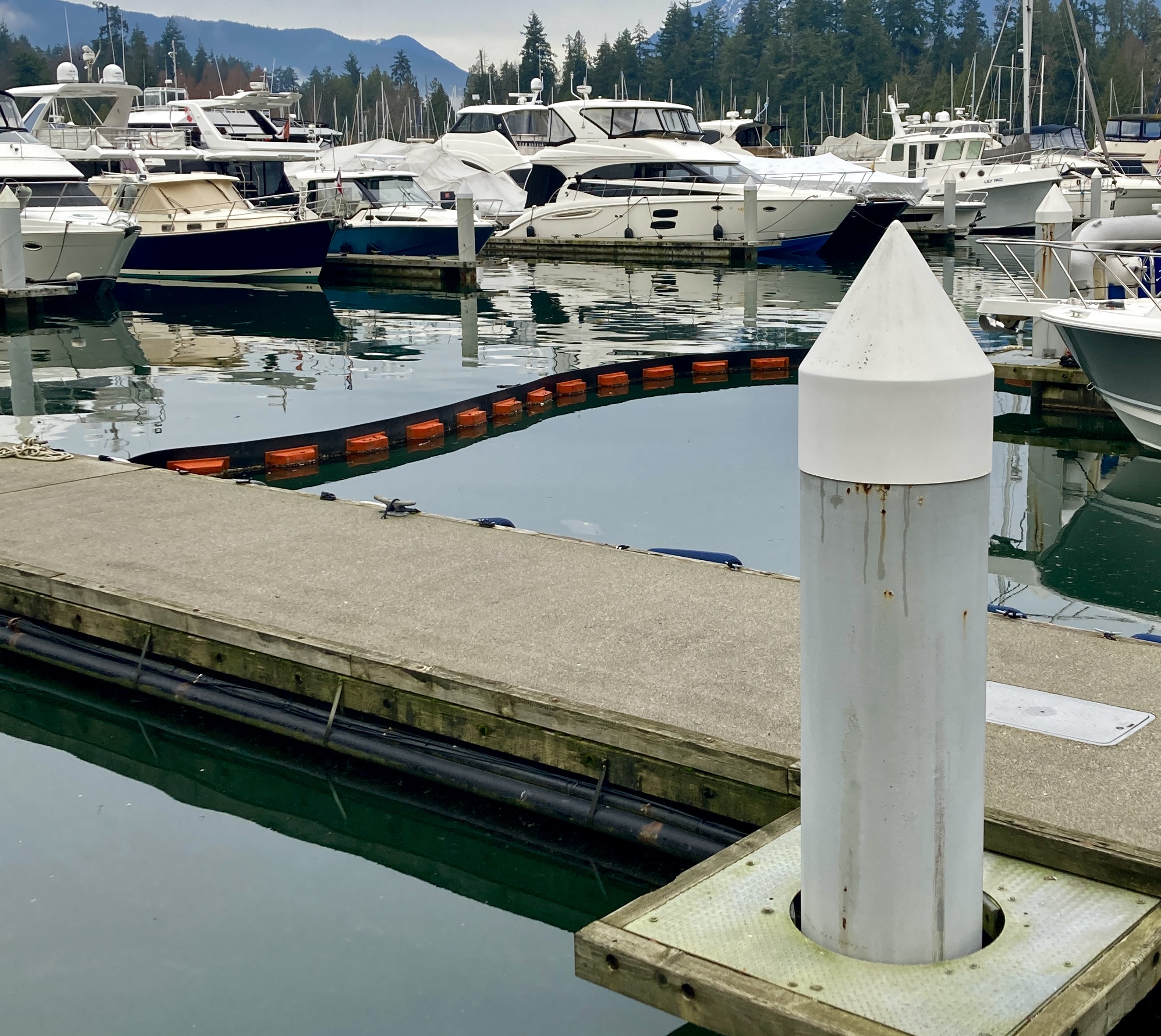
and then more red, and another curve. This time red bobbing in the water, not fixed above it, and in a sinuous horizontal arc, not vertical.
A bit more hoofing along, and, finally, I am here.
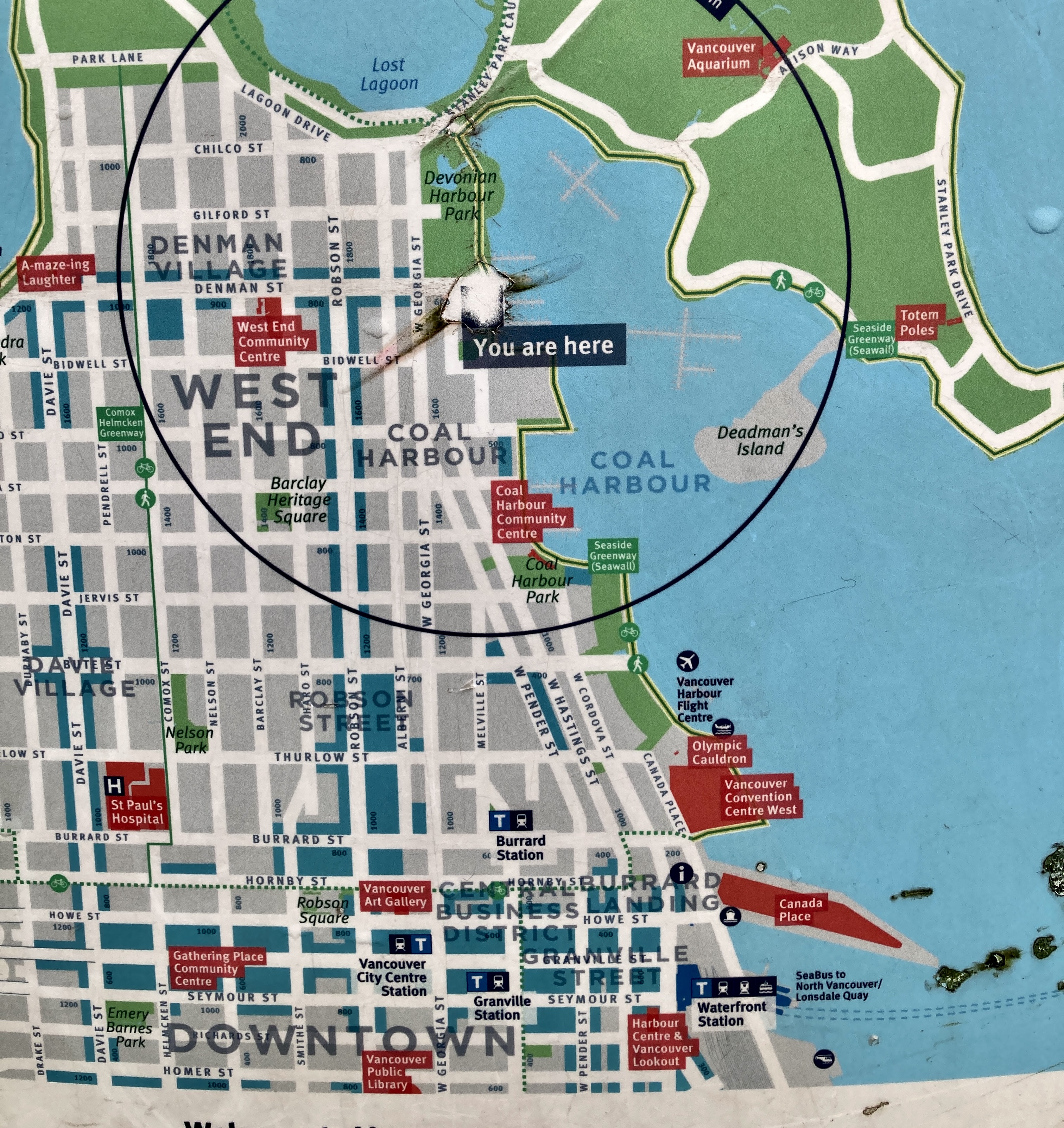
I am exactly where the map says I am: on the Seawall at the east end of Devonian Harbour Park, in turn a gateway to Stanley Park, and also the end of my route from Waterfront Station, down there in blue/white signage at the bottom of the map.
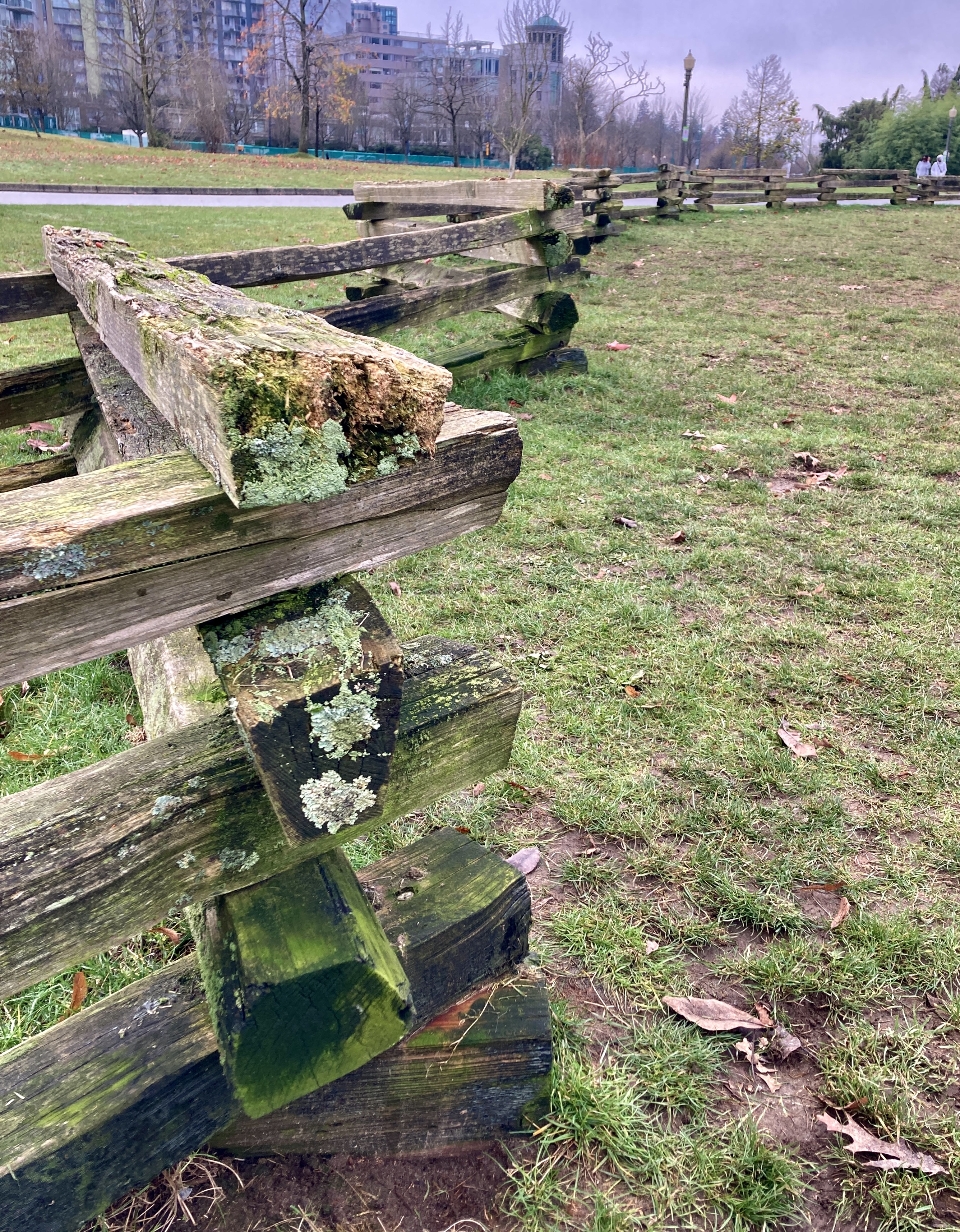
Time for me to follow the snake fence through the park…
pause to take group pictures for some happy tourists, then….
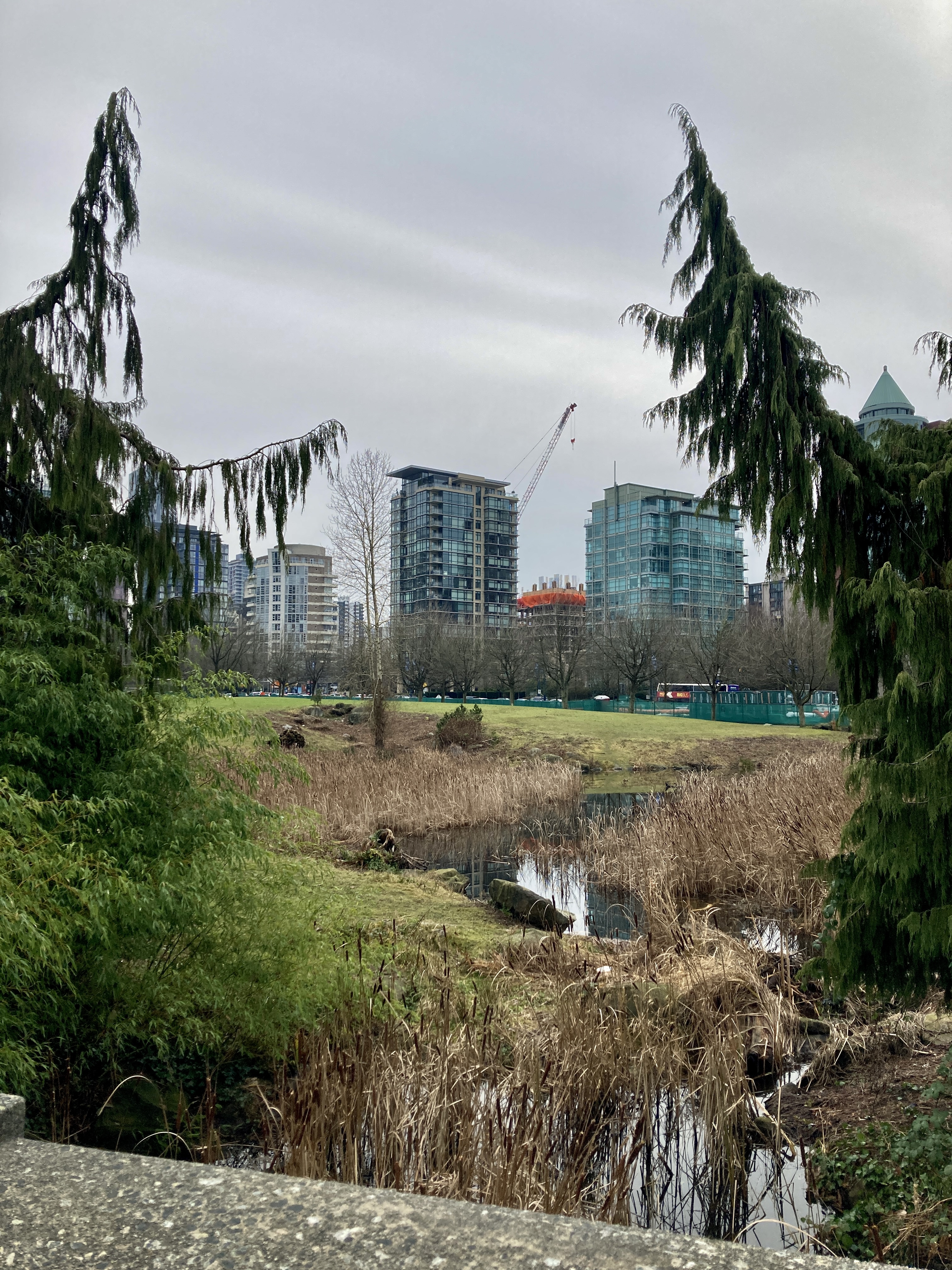
cross this little bridge, and angle up along the creek to those cranes and new-builds on West Georgia.
Where I hop on a trusty #19, and ride my way home.
(Happy New Year, everyone! I so appreciate your interest and generous good humour.)
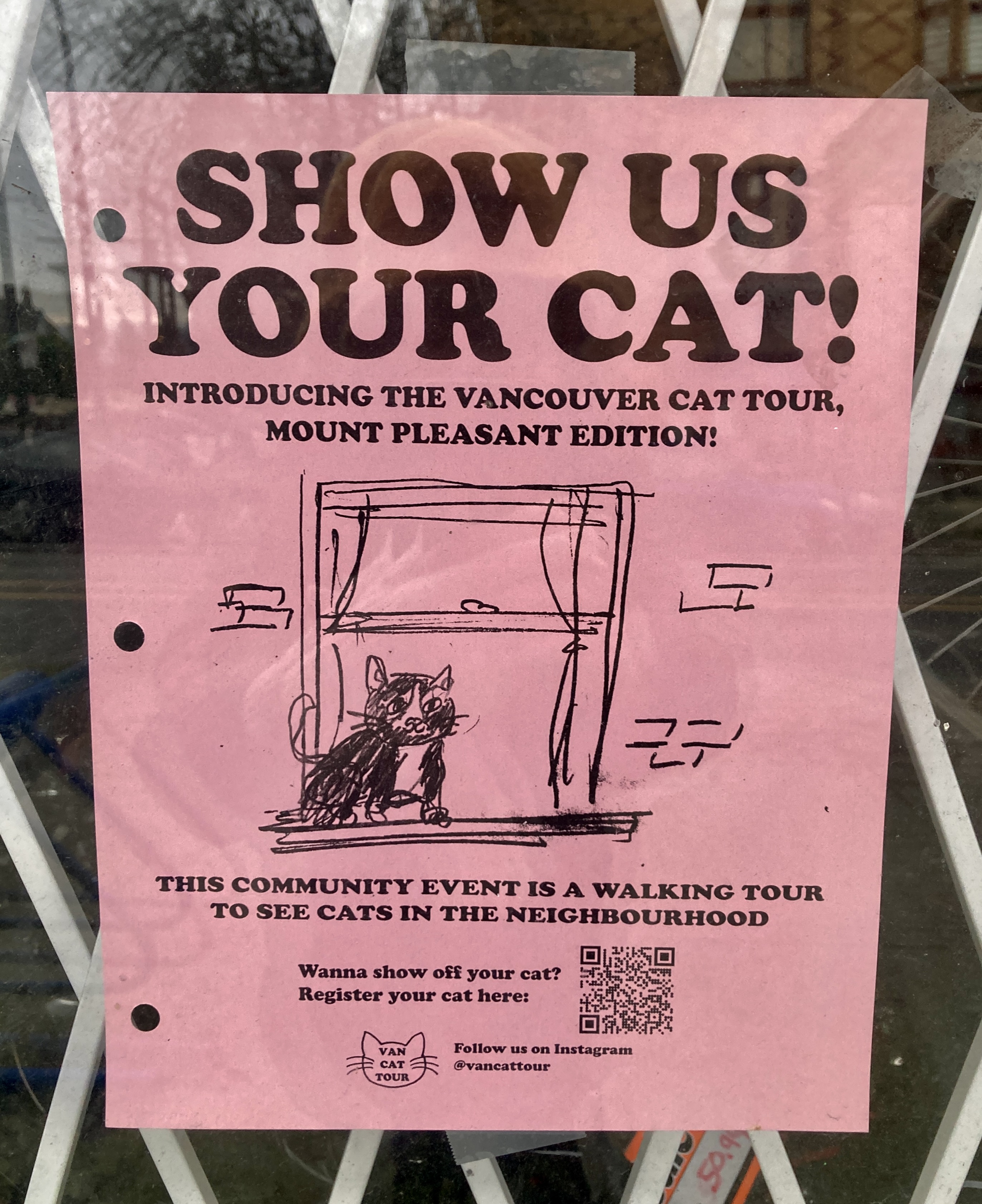
29 December 2025 – It starts with a cat, not that the feline has any connection with our reasons for being on East 6th and poised to head north on Quebec.
But who could resist? I promise myself I’ll pursue that code once I’m home.
Meanwhile, on we go. On down Quebec St. to the water. We are en route the Village dock, about to make a two-ferry trip all the way west to the Maritime Museum dock.
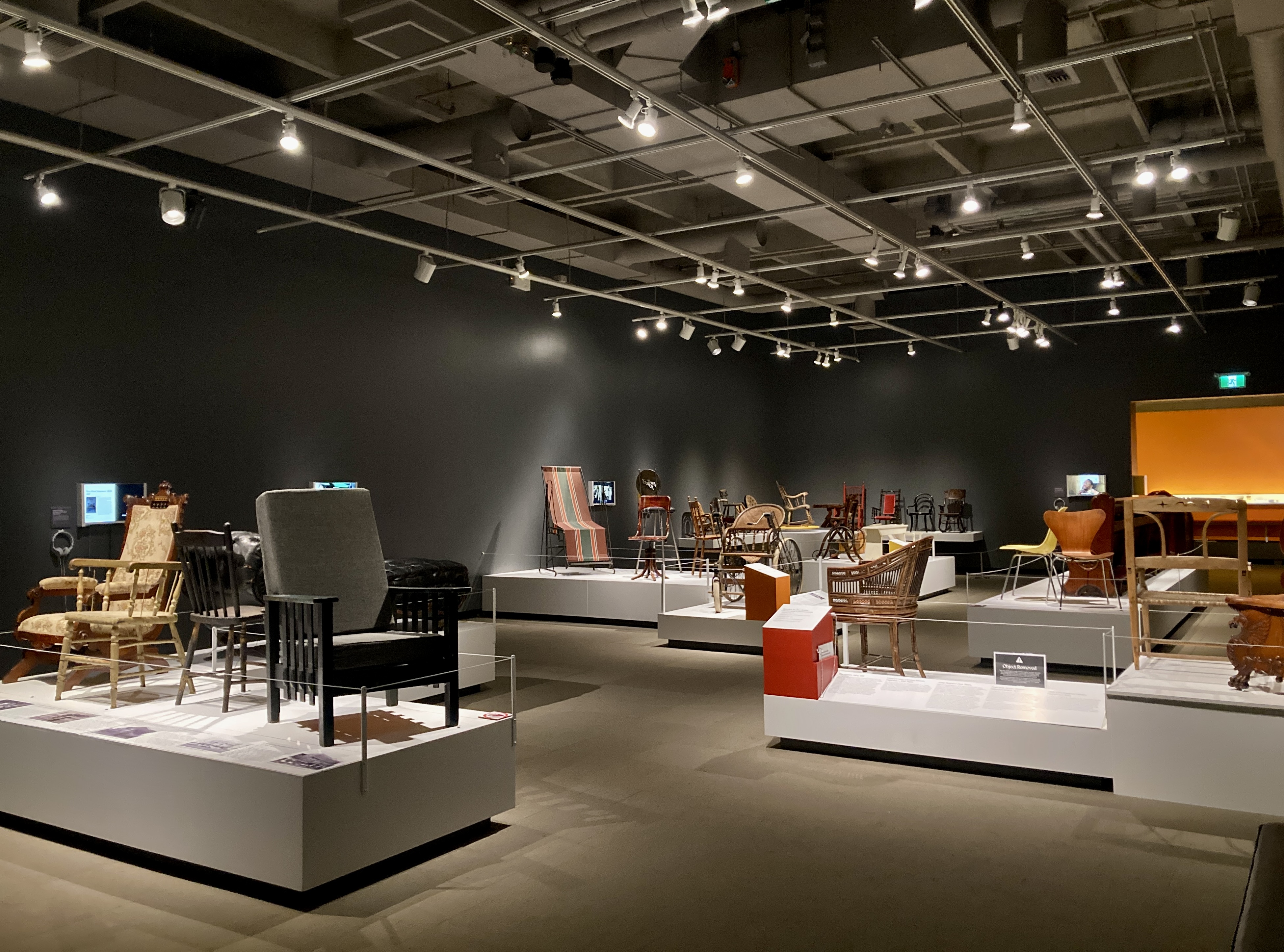
Our goal isn’t even the Maritime Museum. Ferries are just the most delightful way to get ourselves to the Museum of Vancouver, out there in Vanier Park, for their twin exhibitions about chairs: Deep-Seated Histories (old chairs in their collection) and Future Makers (new chairs by Kwantlen Polytech students).
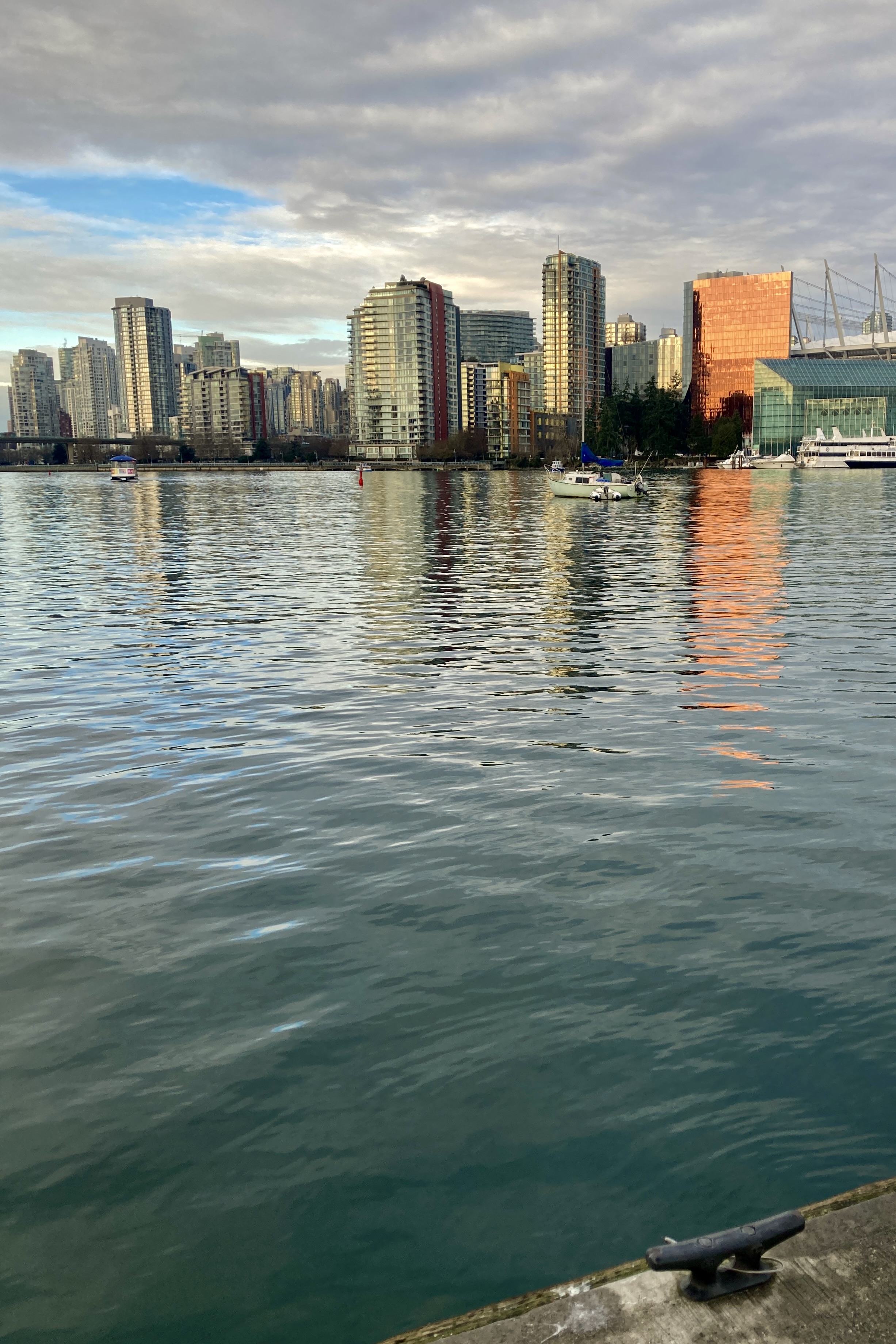
Light travel — reflections across the water — captures us before we even leave our home dock. Copper light, rippling its way south across the water.
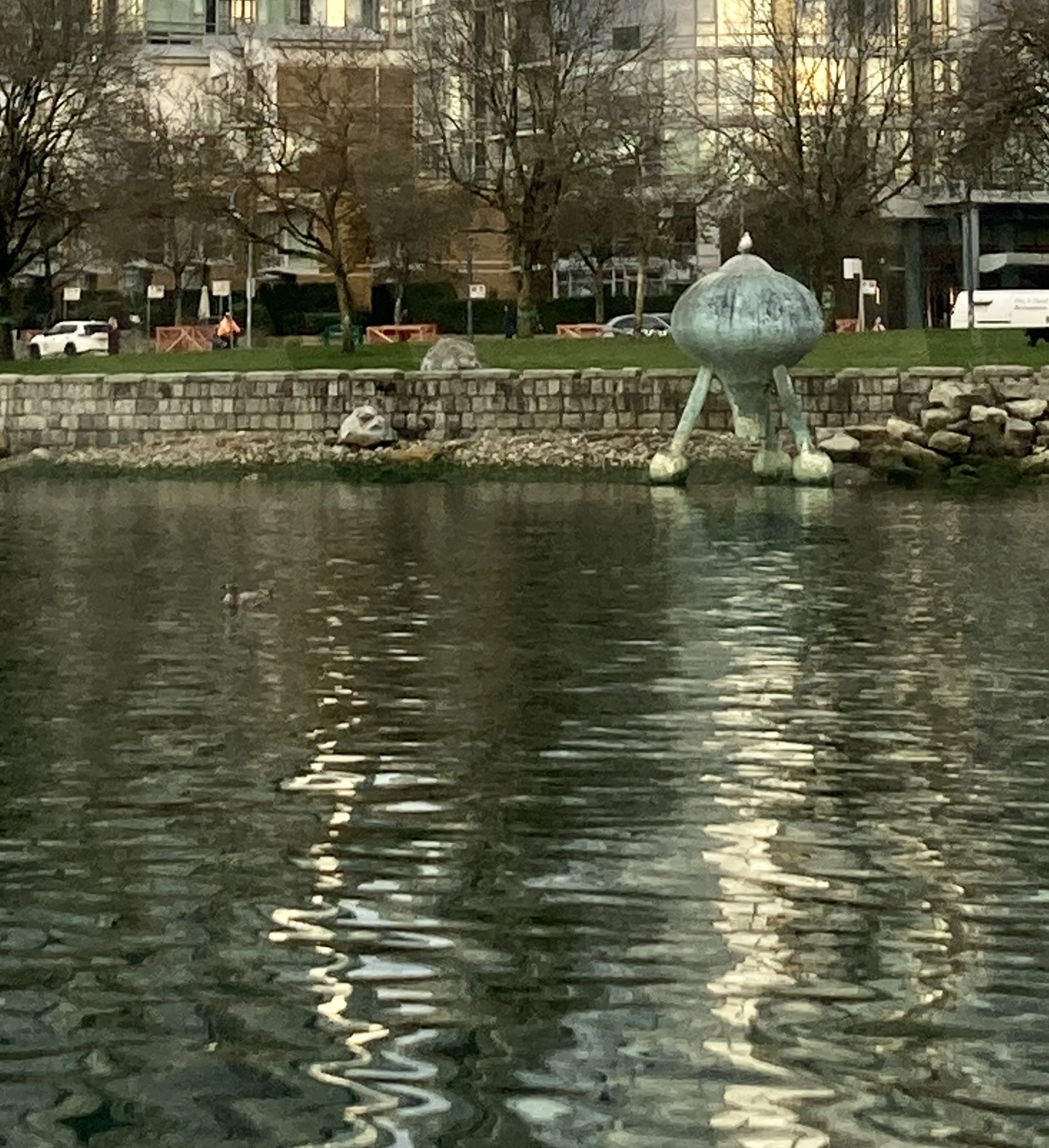
Light travel + time travel: Jerry Pethick’s Time Top sculpture sends its own ripples southward as we pass the Cambie Bridge.
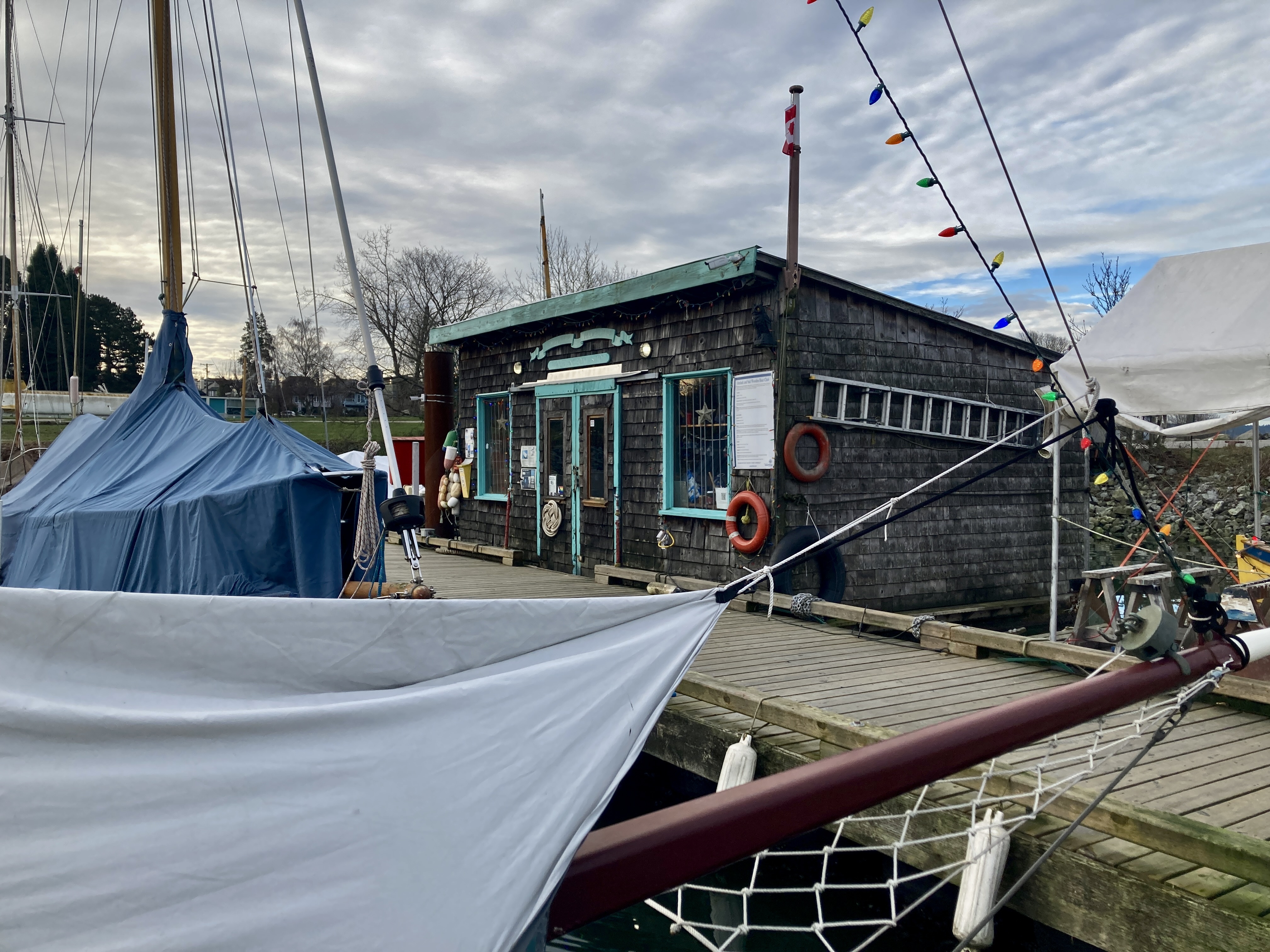
From one ferry to another at Granville Market, and soon we dock at the Maritime Museum — a free outdoor exhibit of vintage wooden vessels. And, not incidentally, home to the non-profit Oarlock & Sail Wooden Boat Club, housed in the floating Wooden Boat Shop.
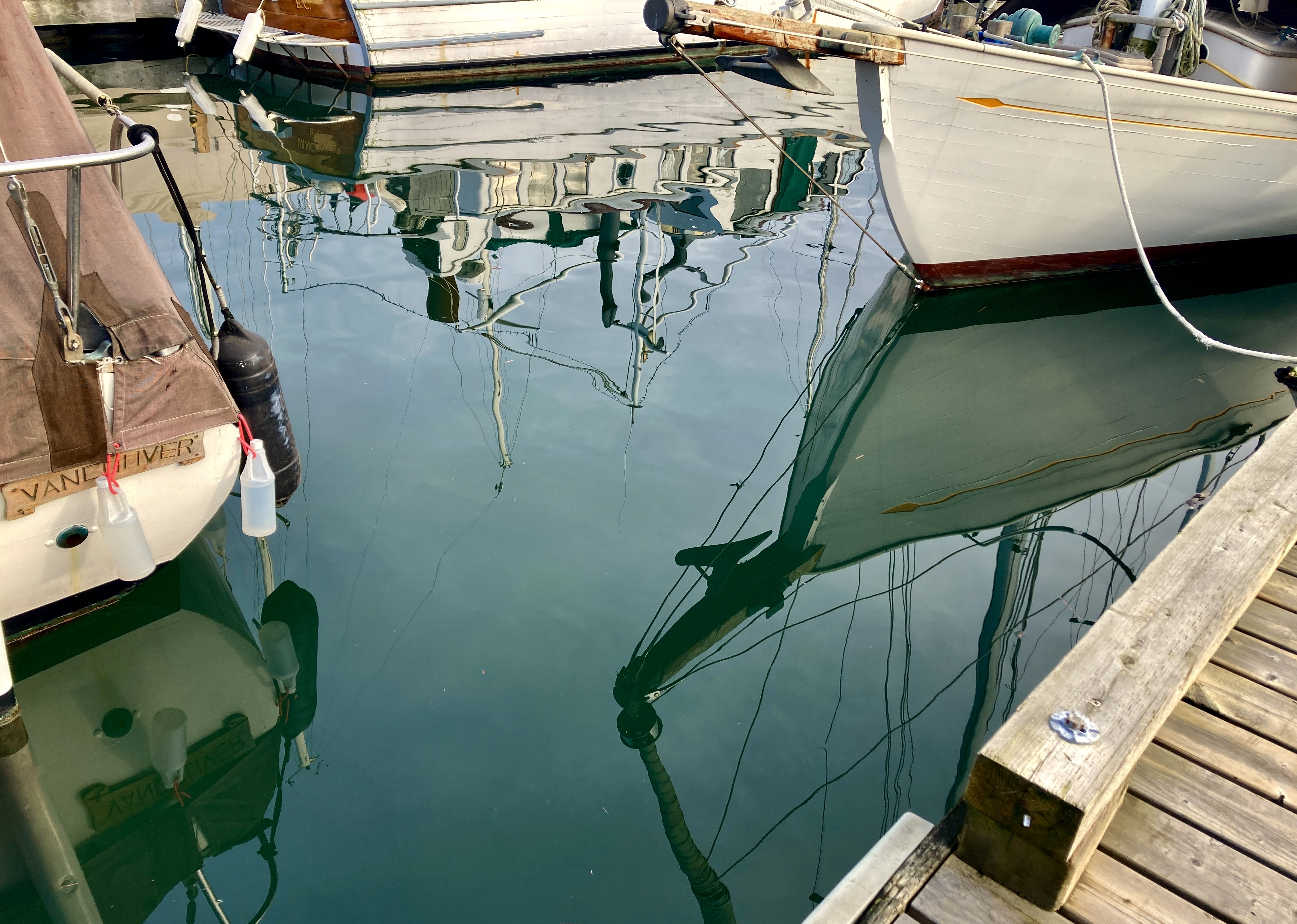
More light travel, shimmering among the aged vessels (many wrapped against winter, but alas therefore incognito as well).
From light travel, back to time travel.
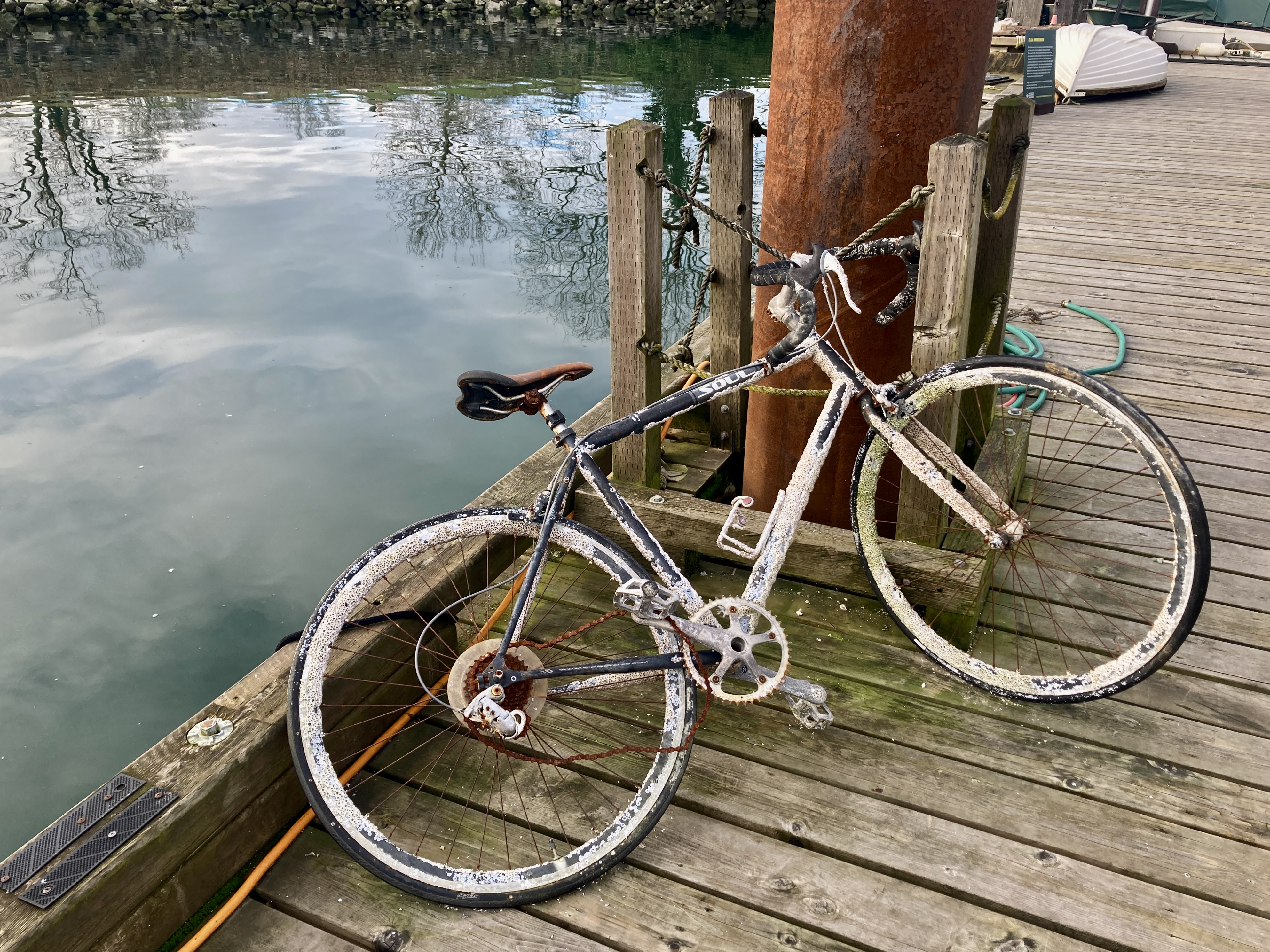
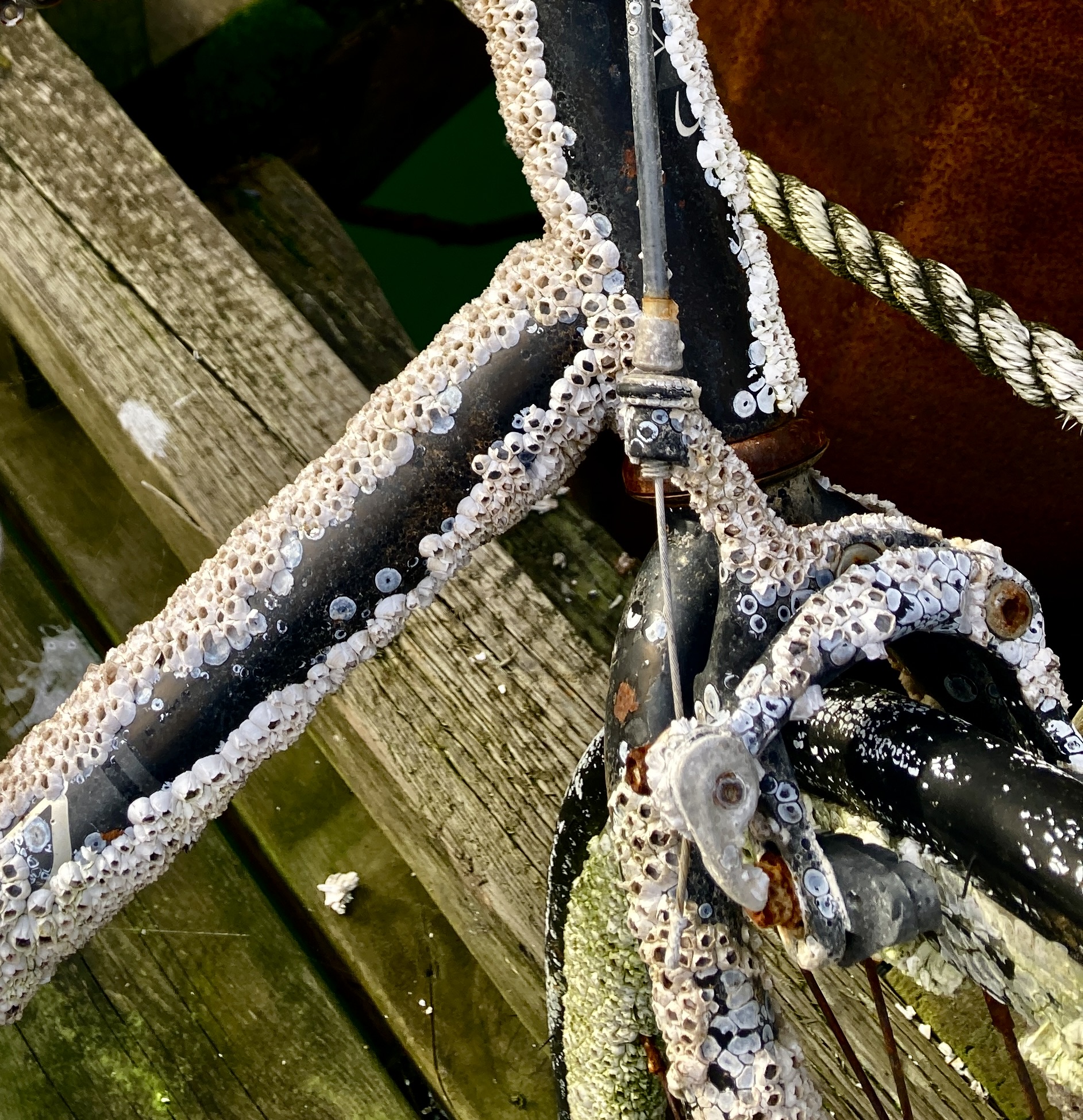
Barni-cycle!
It didn’t collect all those barnacles in just a day or two.
I add an extra layer of time travel + distance travel.
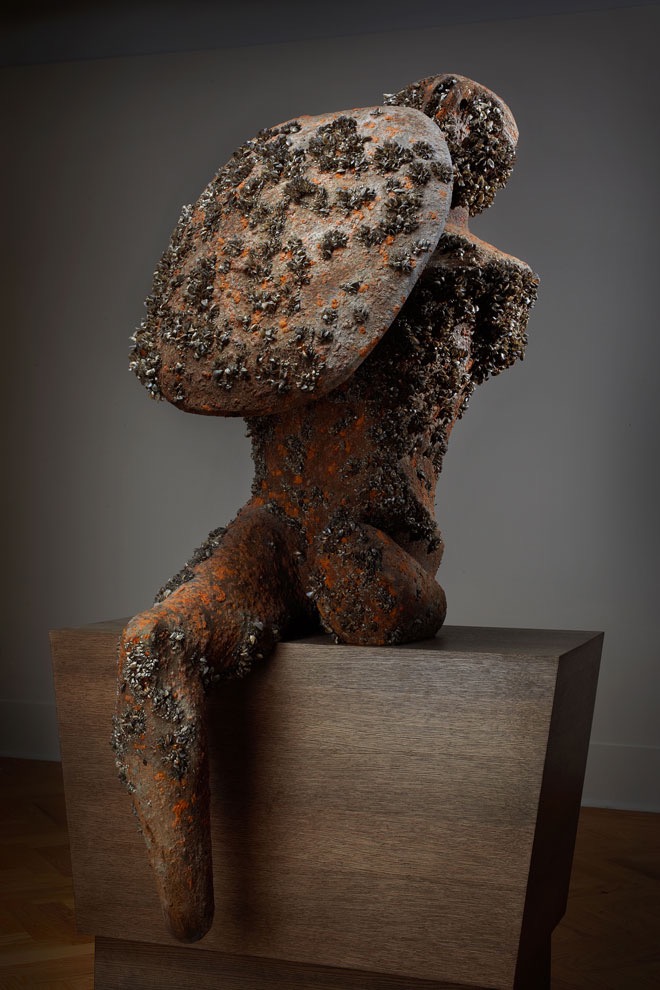
I bounce myself back years and back east to the Art Gallery of Ontario’s display of Simon Starling’s Infestation Piece (Musselled Moore). It shows what happens when first you make a faithful copy of Henry Moore’s Warrior With Shield, then you place it in Lake Ontario as an offering to zebra mussels for a few years, and finally haul it up again for display.
I shake that image out of my head, rejoin present time & place, and follow my friend to the MOV, where we meet another friend and all three of us go look at chairs.
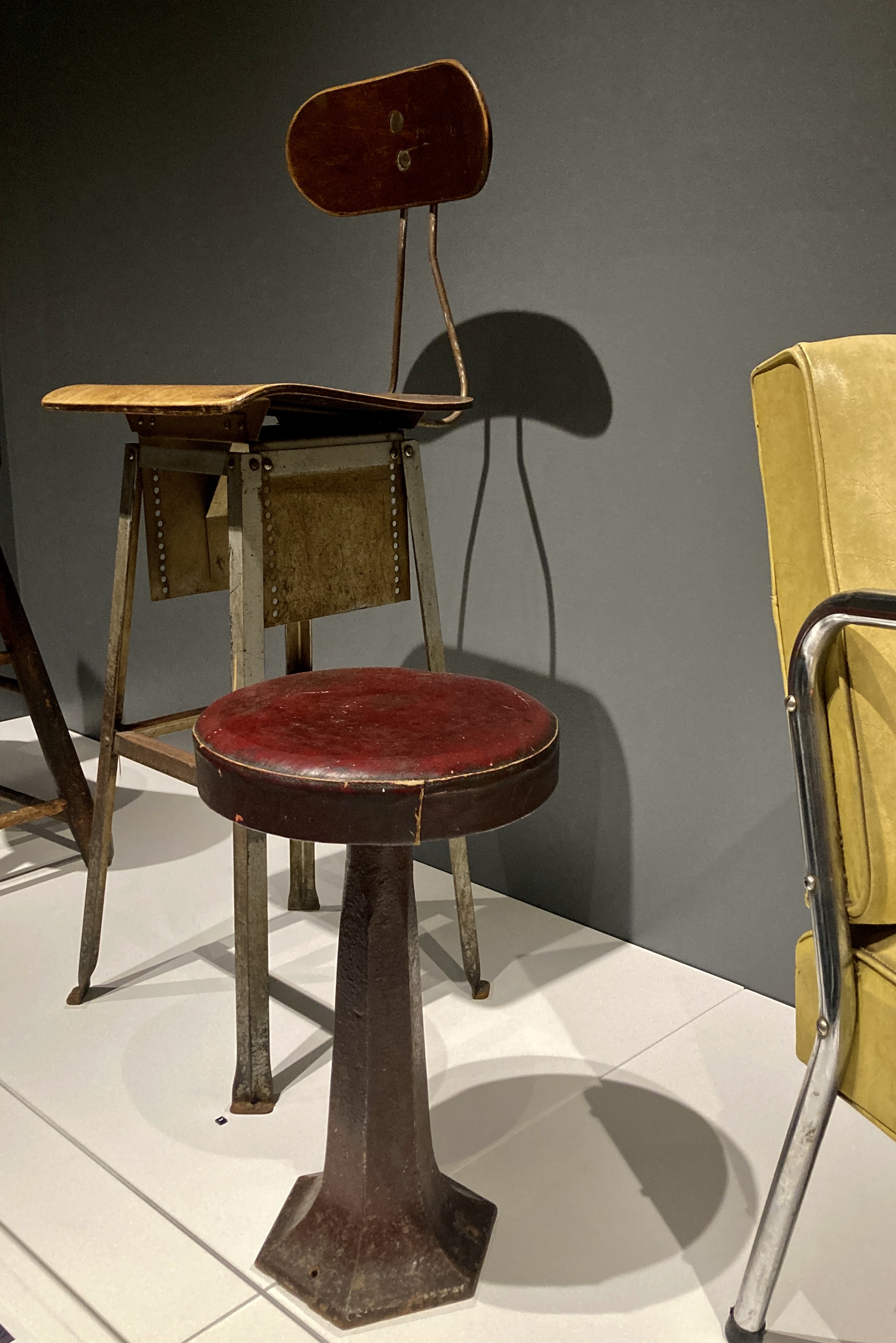
They are twinned exhibits. First, as seen above, Deep-Seated Histories of vintage chairs with local connections. But even here I’m back to light travel. No longer light crossing water to create reflections; instead, light crossing air to create shadows.
(Above) Edward’s Razor Repair Shop Metal Chair, 1930; and (below) Peter’s ice Cream Parlour Stool, c. 1930.
Later, in the Future Makers exhibit, more light travel, more shadows.
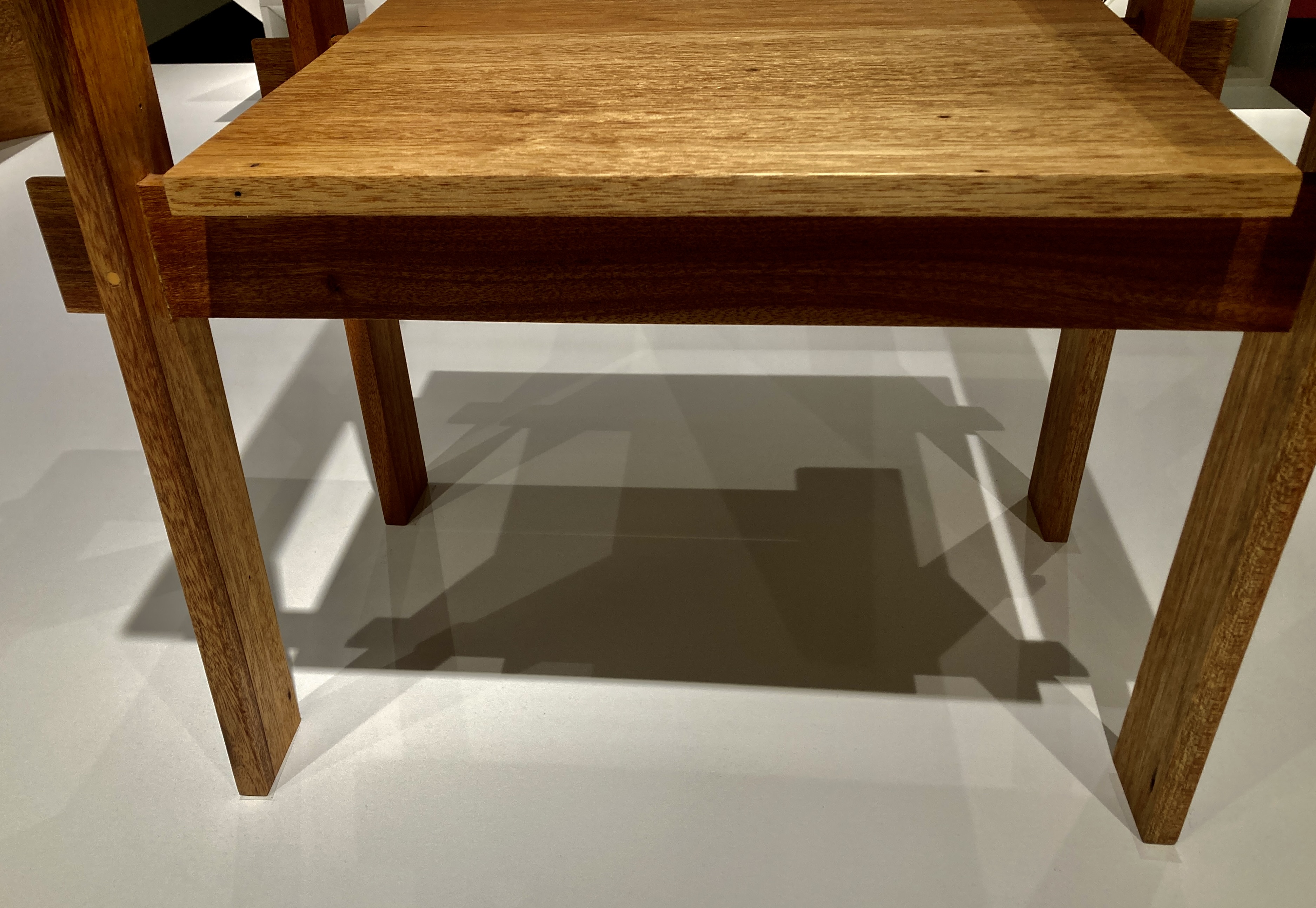
This time, beneath the Kuma Chair, in homage to Japanese architect Kengo Kuma and the outside lobby of his Alberni building here in Vancouver. The chair, its signage tells us, explores negative space. I see shadows.
And then more walk-abouts, and then lunch at the splendid Melo Pâtisserie, and then home.
Where I look up the code for that cat show. And discover it took place on 25 August 2025.
18 December 2025 – Just a description, mind you, not a complaint. Compared to weather almost everywhere else in the country, including here in BC, Vancouver’s weather is a walk in the park.
But even so, it is still very windy and very wet!
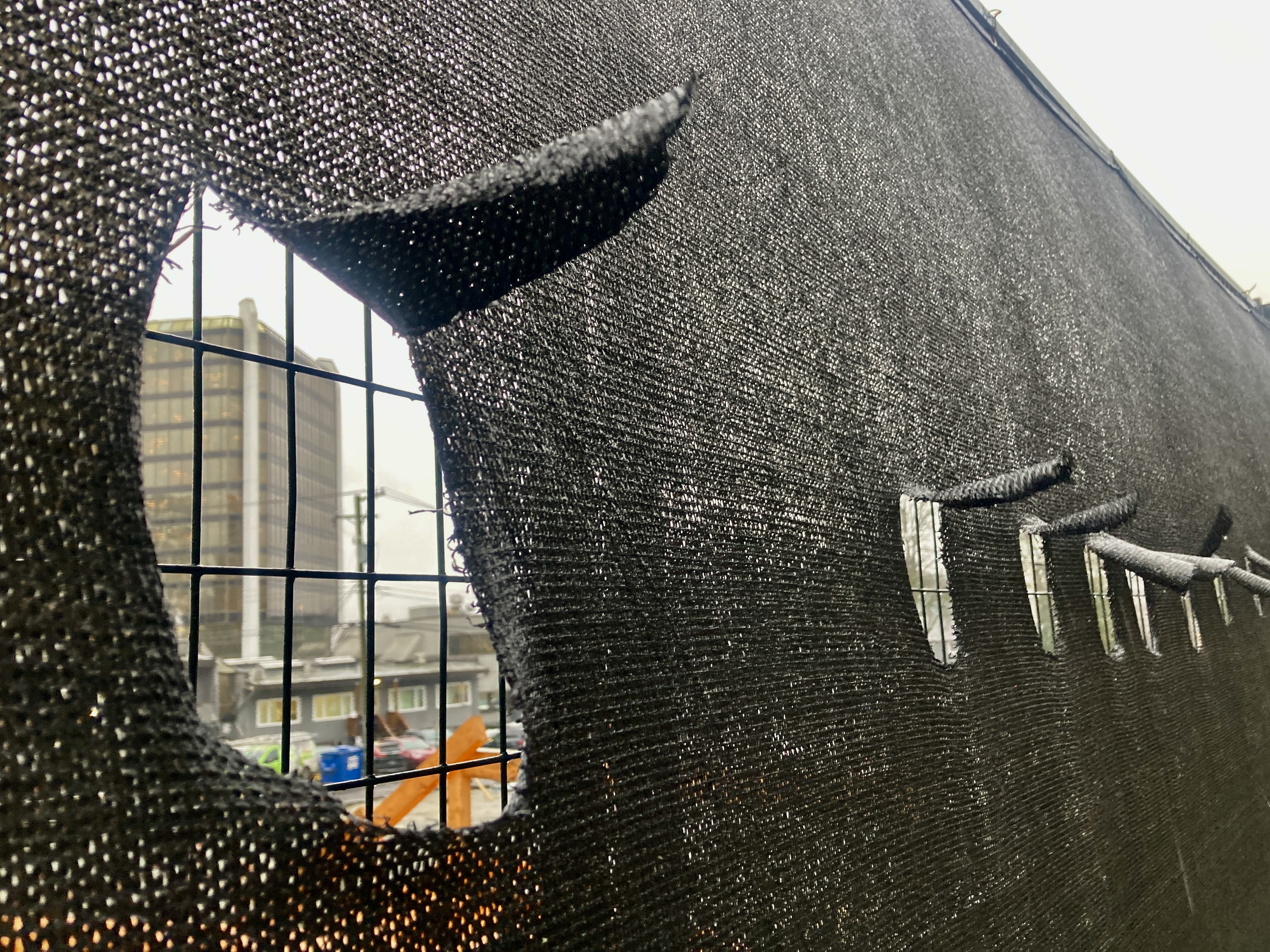
Just look at the air vents blown horizontal in the sodden construction fence fabric, as I splosh my way along West 10th this morning.
By the combined might of word + weather association, I start thinking about anapest metre.
Why? Because wet weather on 8 December caused me to rewrite a limerick to fit, and that in turn caused me to discover the anapest metre and its (quote-unquote) “galloping rhythm.”
So here I am, in yet more wet & windy weather. To distract myself, I compose a limerick. An ode to the anapest metre.
(More throat-clearing)
The anapest metre is now my best friend,
It offers me rhythm without any end,
I gallop and giggle,
I wobble and wiggle.
It distracts me from rain and that’s a great trend!
Once home… and dry… I look up “anapest metre” online. The Poetry Foundation explains it consists of two unaccented syllables followed by one accented syllable, and then helpfully gives two examples of words that — all by themselves! — are anapestic: “underfoot” and “overcome.”
Yah well, here’s the Canadian example: “Newfoundland.”
13 December 2025 – Poised for a trip on SeaBus, I am…
across Burrard Inlet from Vancouver’s Waterfront Station to Lonsdale Quay in North Vancouver.
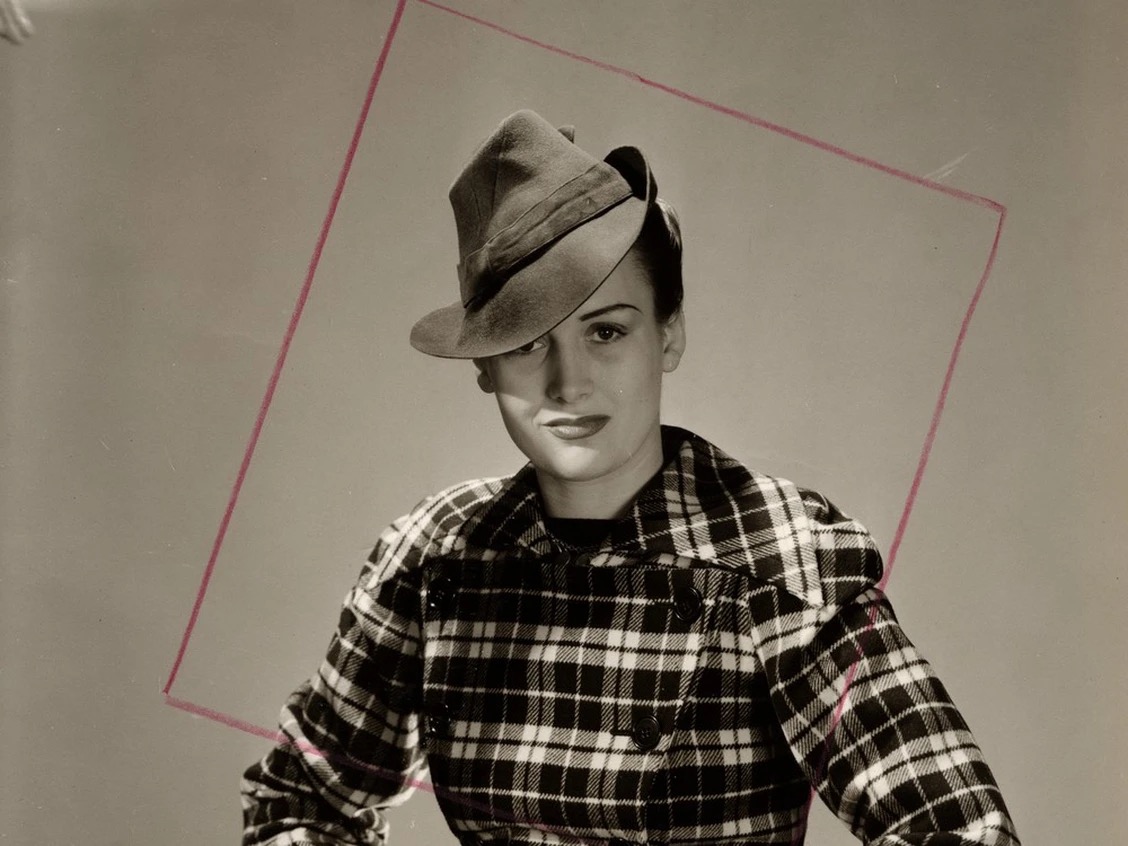
The draw is the engrossing show currently on view (to 1 February) at the Polygon Gallery — American photographer Lee Miller, whose body of work encompassed both high society and high fashion…
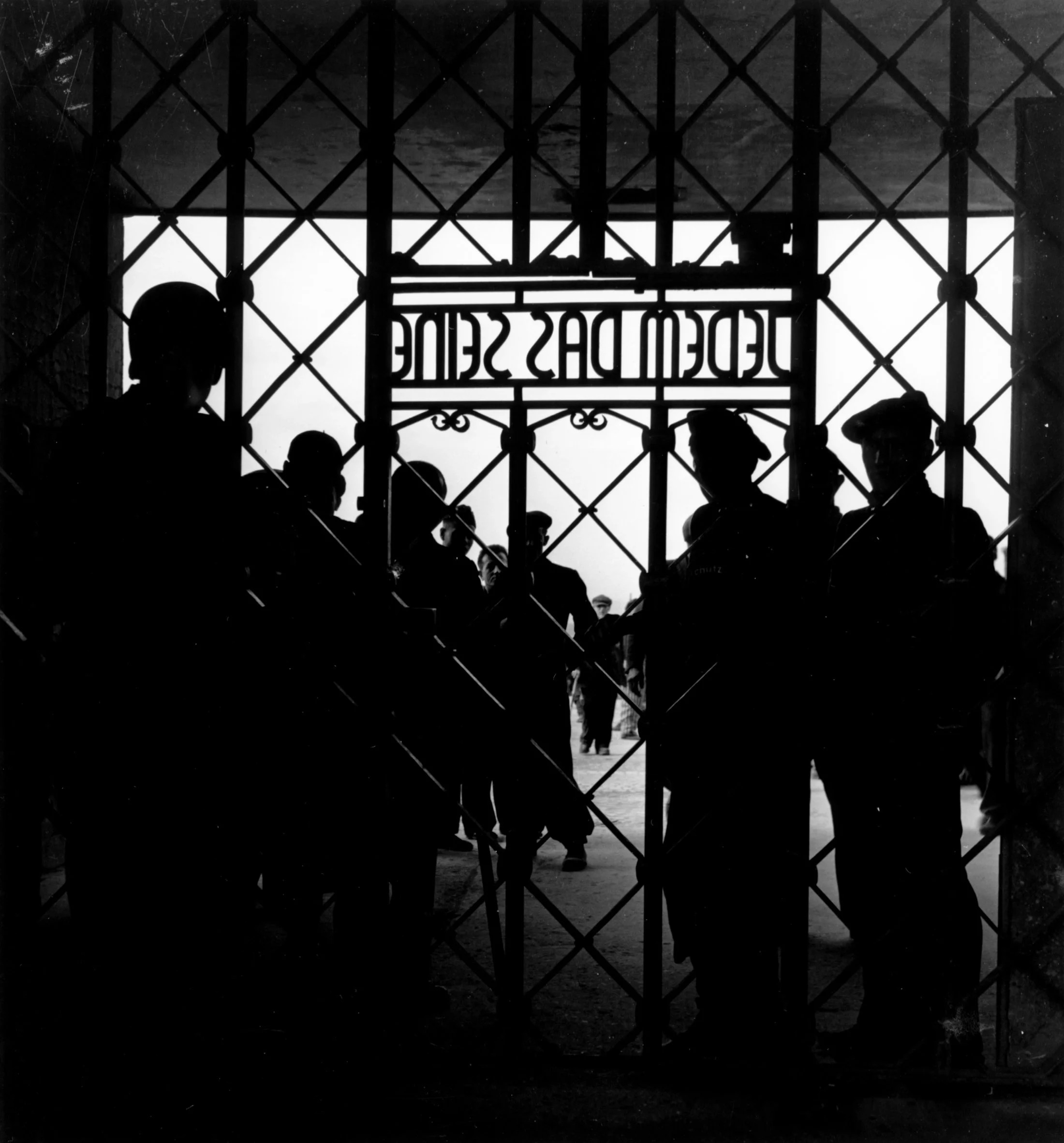
and the stark realities…
she documented as a wartime photographer.
As usual, the ferry ride to the North Shore is an uneventful 15 minutes or so.
Also as usual, we are met by a welcoming committee of cormorants at the Lonsdale dock.
The man standing next to me is waxing lyrical about their inherent grace, their ease with being exactly what they are (unlike fretful striving humans). I am less lyrical. Every time I see these birds, I hear again the cry of my outraged friend, that day in the Bruce Peninsula, who thought we were looking at loons, and discovered they were only — and I quote — “F**king cormorants!” FC’s they became, and FC’s they remain.
I leave that nice man being lyrical, and carry on, looping my way toward the Polygon via the Lonsdale Quay waterfront, with its long views back south.
Another black bird, this time a solitary crow, soars over helipad and private pier.
His backdrop is one stretch of the south shore of this busy port: a line-up of monster freighter cranes, like so many orange giraffes, with a monster freighter (COSCO Shipping, says its lettering) before their high-stretched necks and downtown buildings at their backs.
From one solitary crow, to a veritable panorama of Eternal Love.
Lock upon lock upon lock. (Upon lock.)
Different foreground, same Port of Vancouver background. L to R: the cranes; the COSCO freighter plus another, equally massive but unidentified; the white fabric “sails” that comprise the roof of Canada Place; a SeaBus placidly bustling back to the south shore. Behind all that, the city skyline. (North Shore shows us mountains; South Shore shows us towers.)
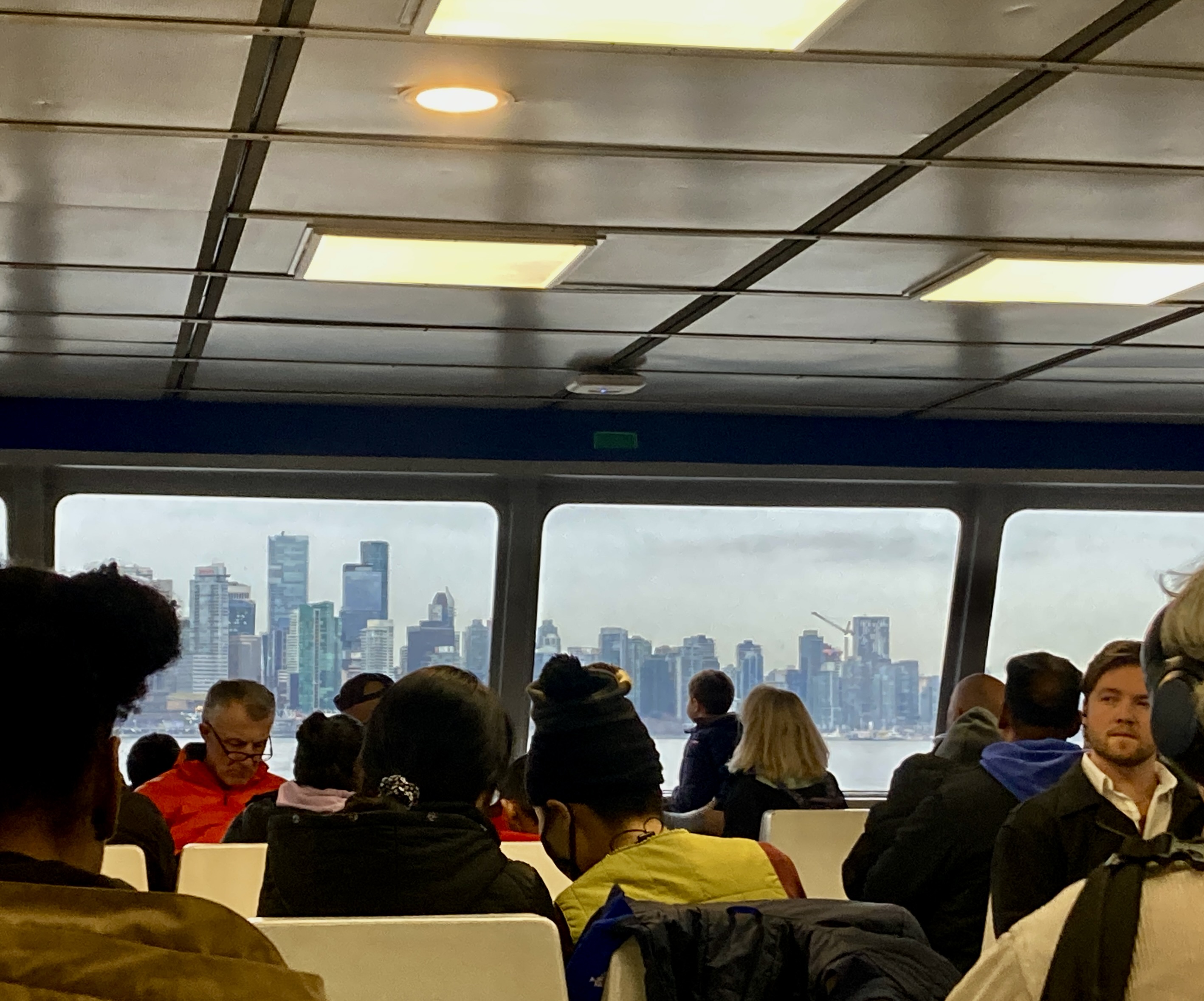
Return trip, those towers grow larger in the ferry windows…
and, approaching the terminal, we glide past a heavily laden freighter…
being nuzzled by an attentive crane.
But were you greeted by a welcoming committee of FC’s? you want to know.
* and (says a man who knows) “a propensity for the perverse.”
I am not thinking of the perverse. I am, however, thinking of a limerick that meets all the 5 lines-AABBA-anapest-meter requirements. I am thinking of the one that begins: “There was a young lady from Spain.”
Only when I look around online do I discover that this Young Lady goes on to have many different limerick adventures.
My particular Young Lady has her adventures on the train. To wit:
“There was a young lady from Spain / Who used to get sick on the train.”
I herewith offer you a timely Vancouver re-write of those first two (AA) lines. After that, it’s the same BBA outcome that the Young Lady knows well.
"Traveller, there is no path. Paths are made by walking" -- Antonio Machado (1875-1939)
"The voyage of discovery is not in seeking new landscapes, but in having new eyes" -- Marcel Proust (1871-1922)
"A city is a language, a repository of possibilities, and walking is the act of speaking that language, of selecting from those possibilities" -- Rebecca Solnit, "Wanderlust: A History of Walking"










 WALKING WOMAN