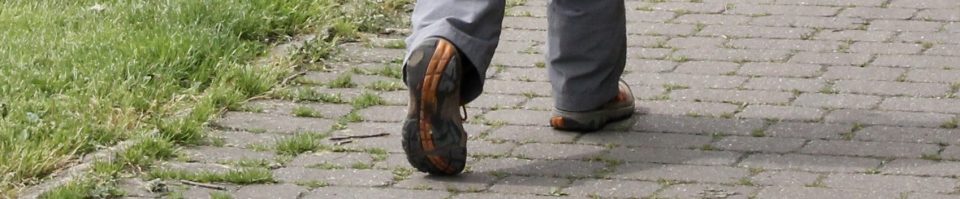
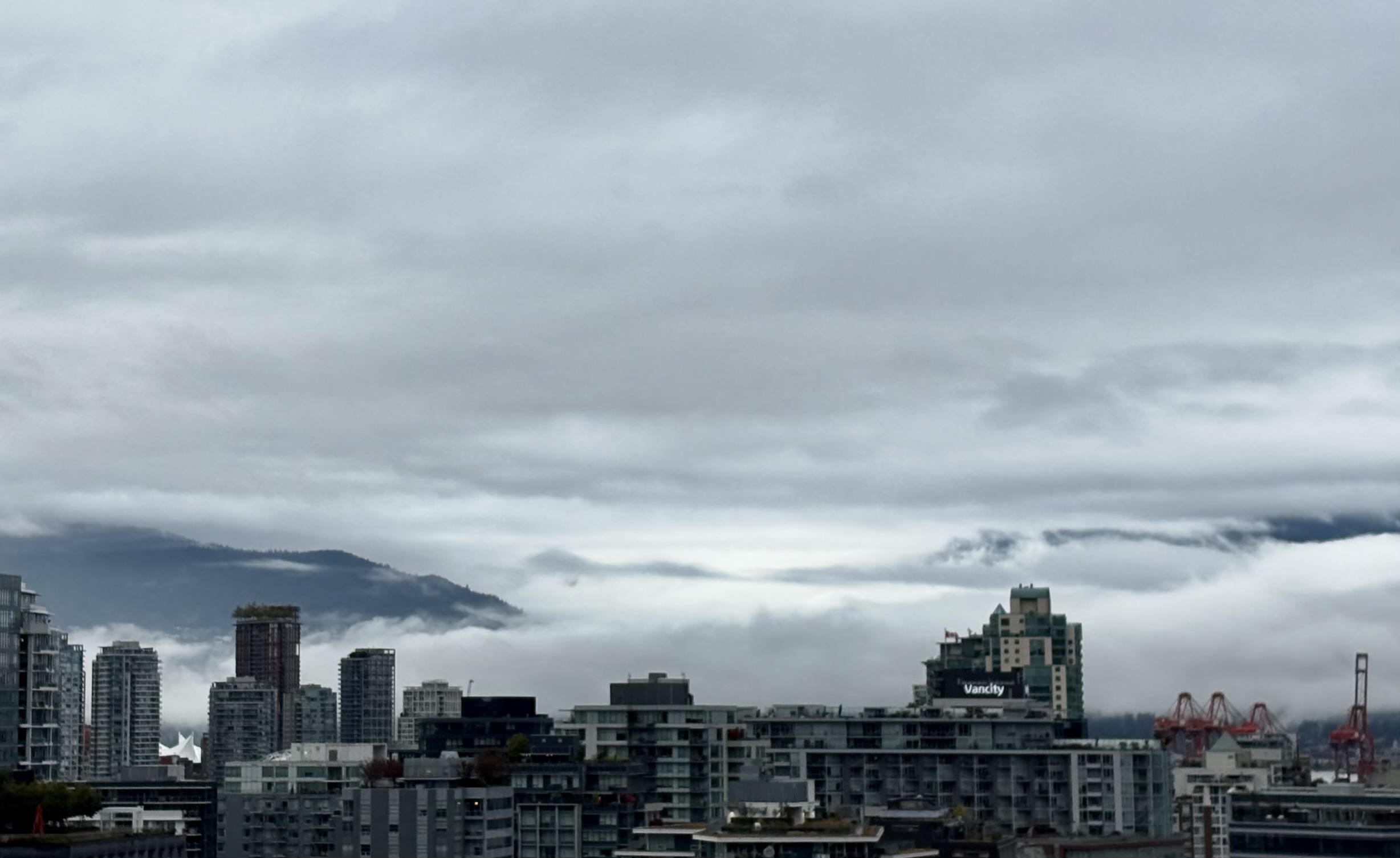
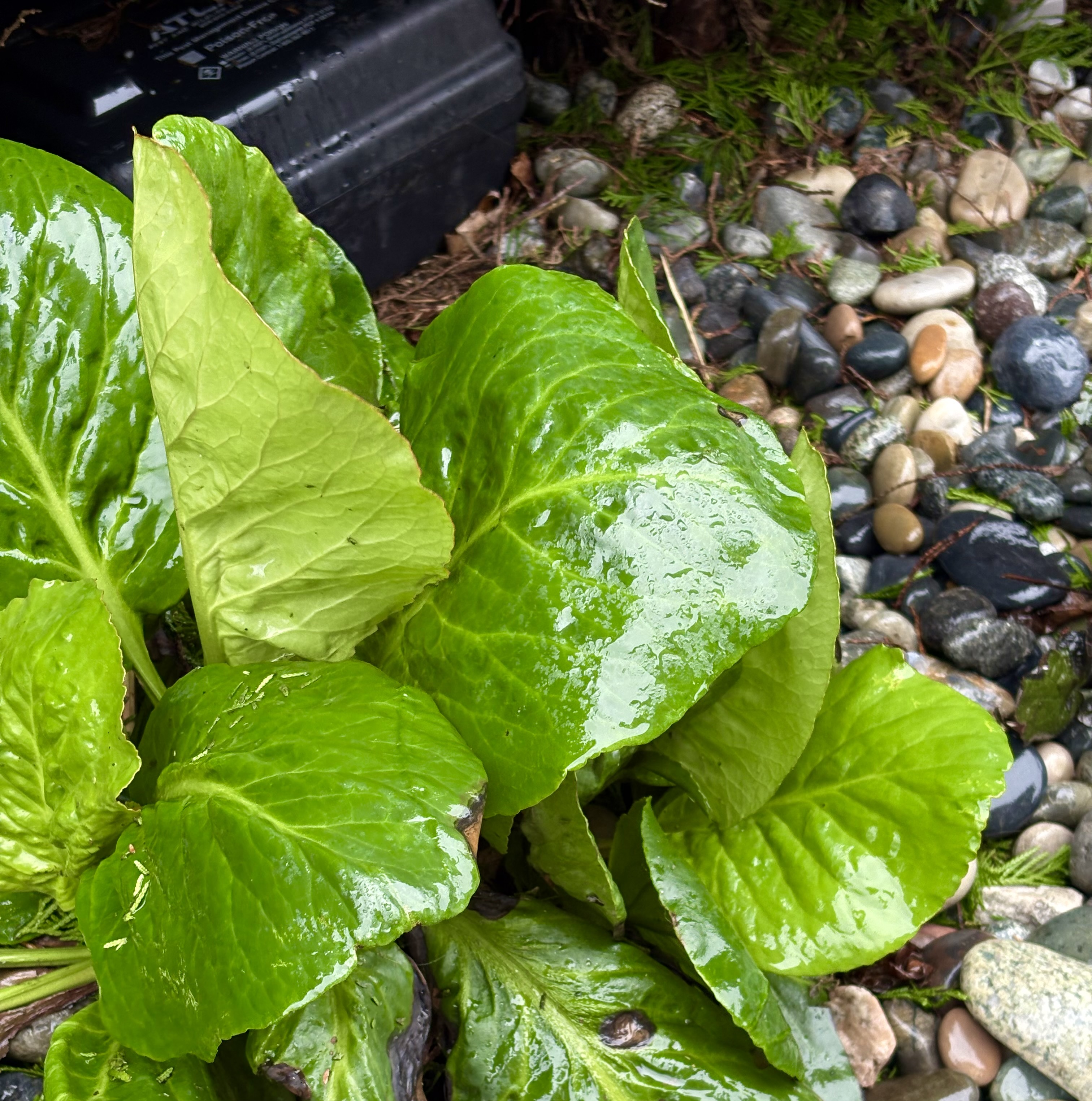
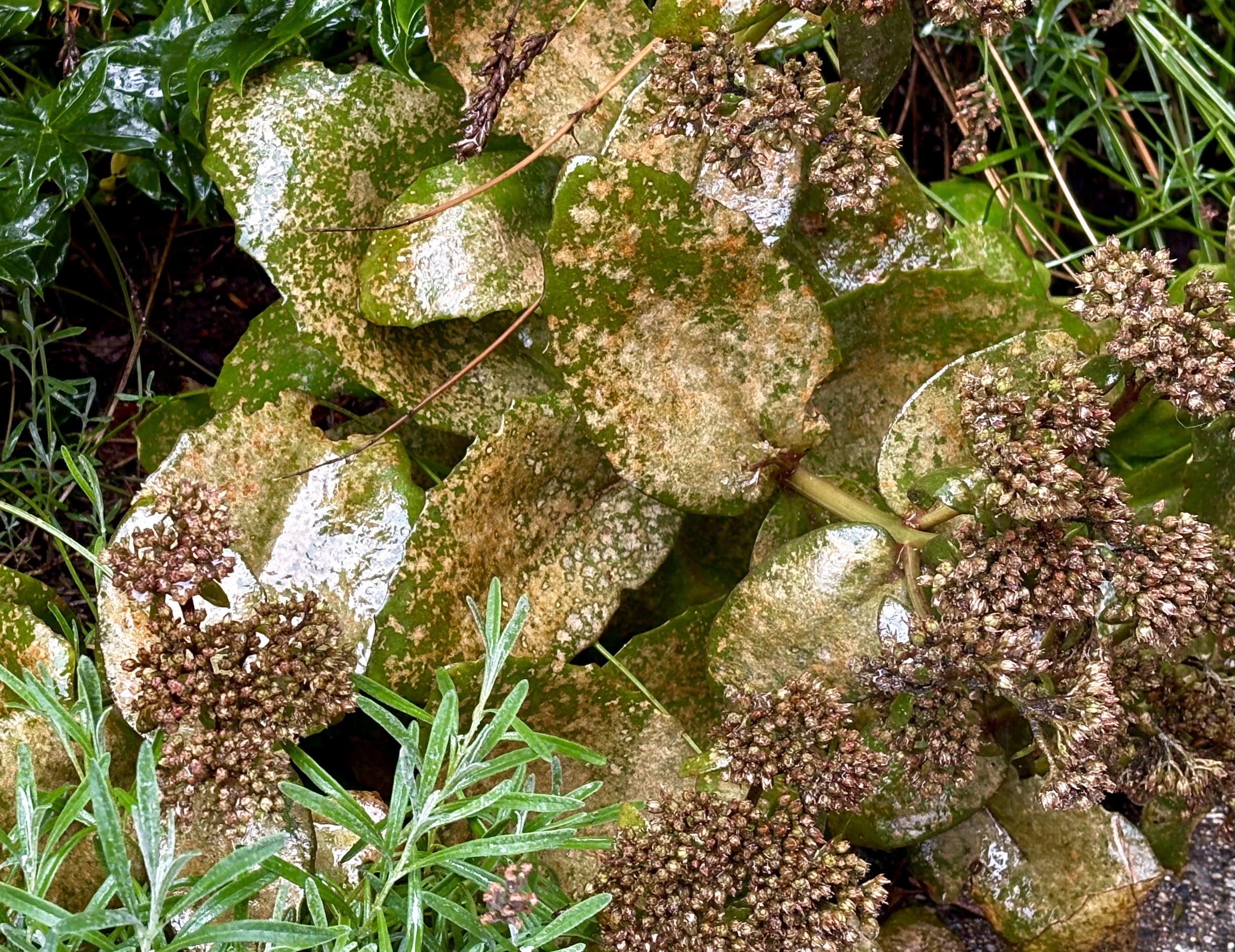
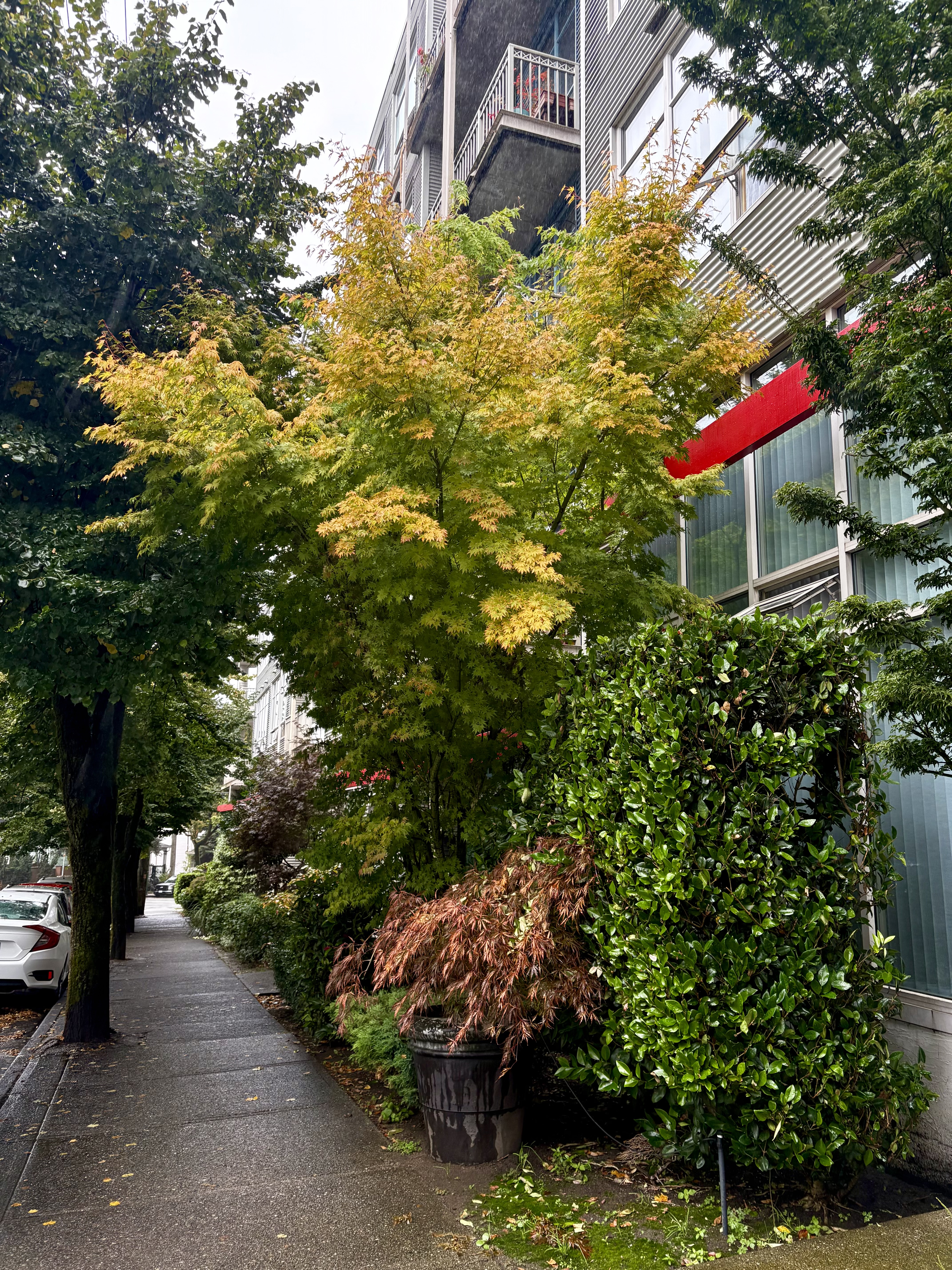
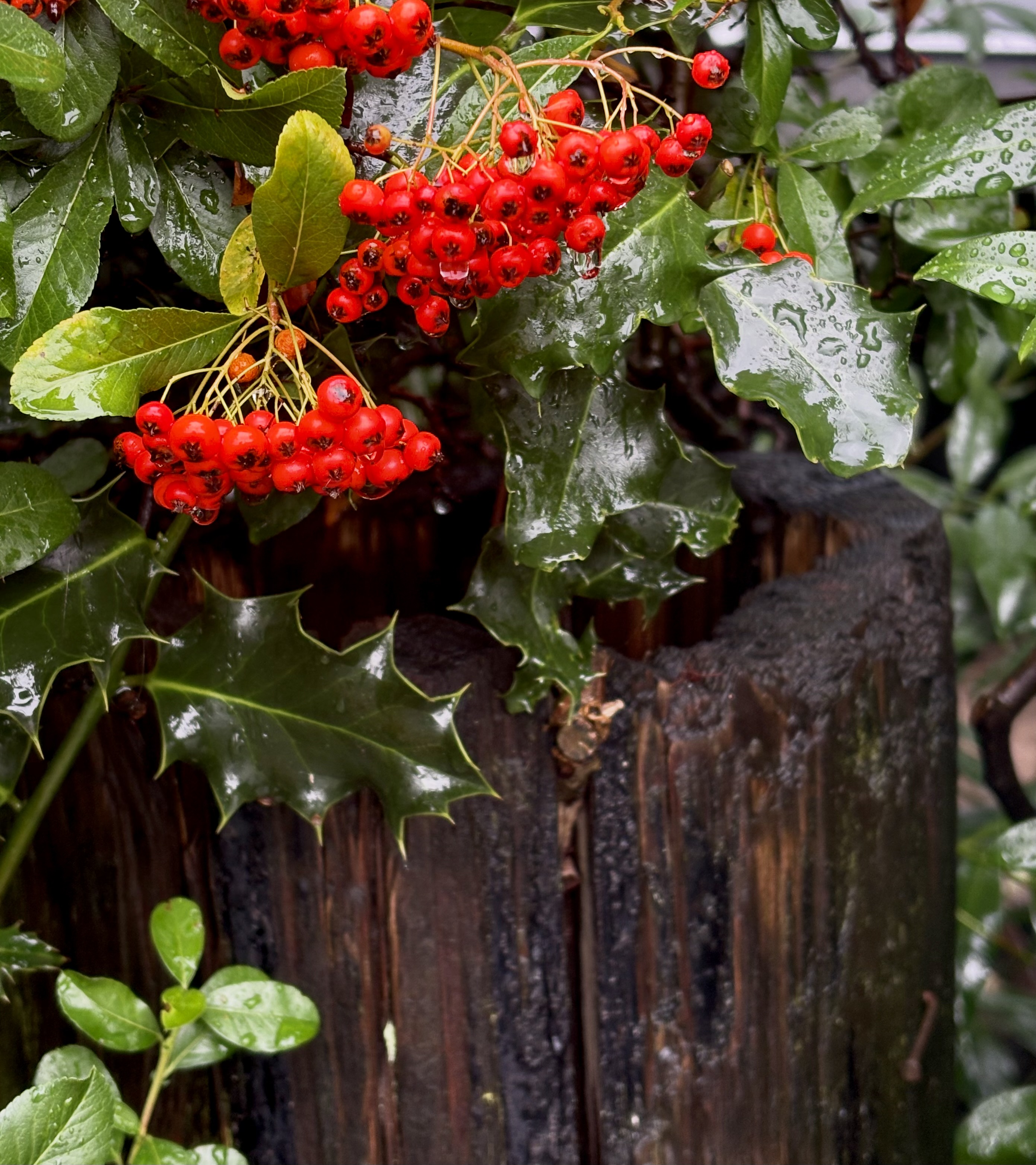
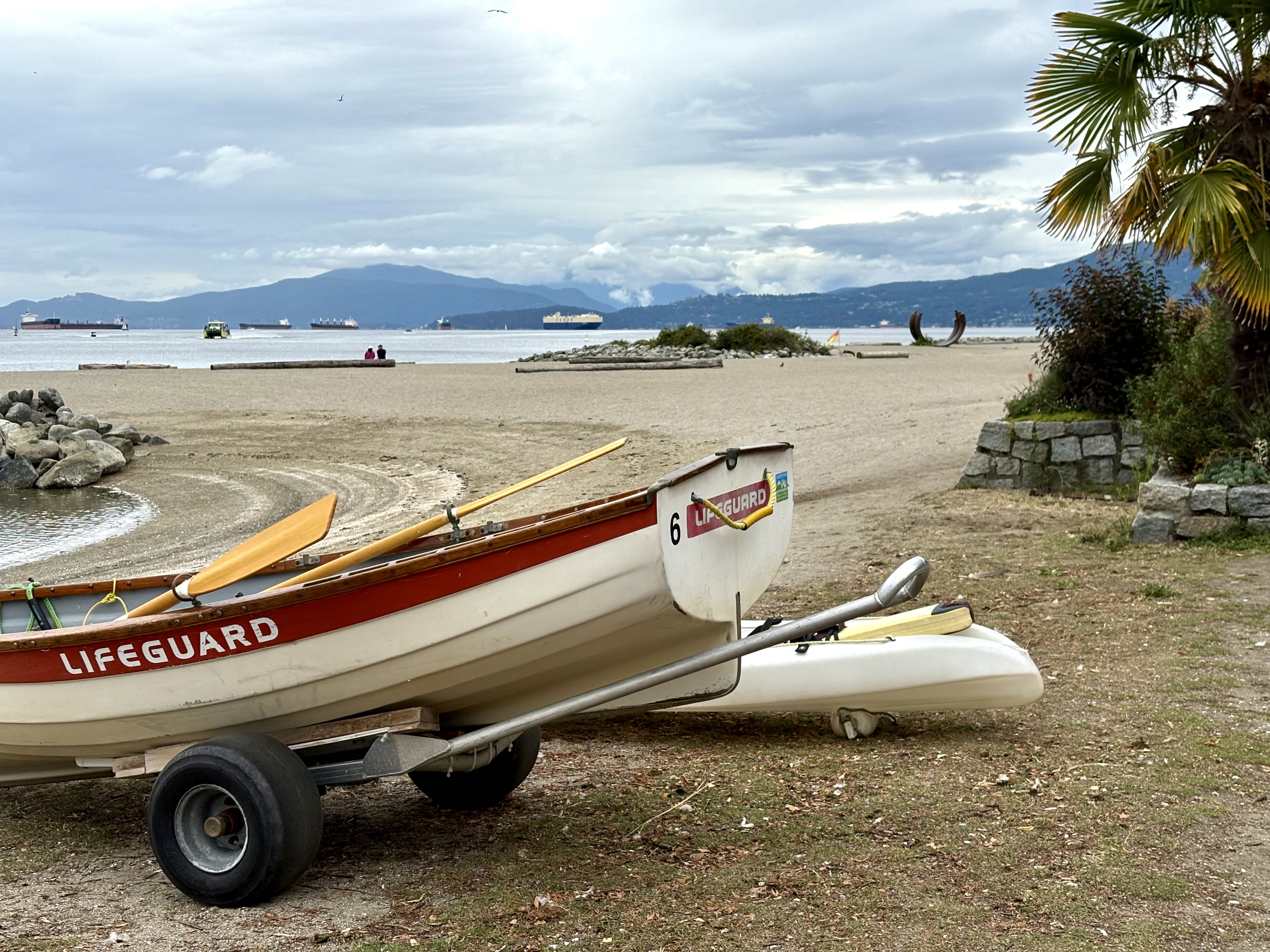
The colours of ordinary street-side plantings that much richer, with their faces fresh-washed in the rain.
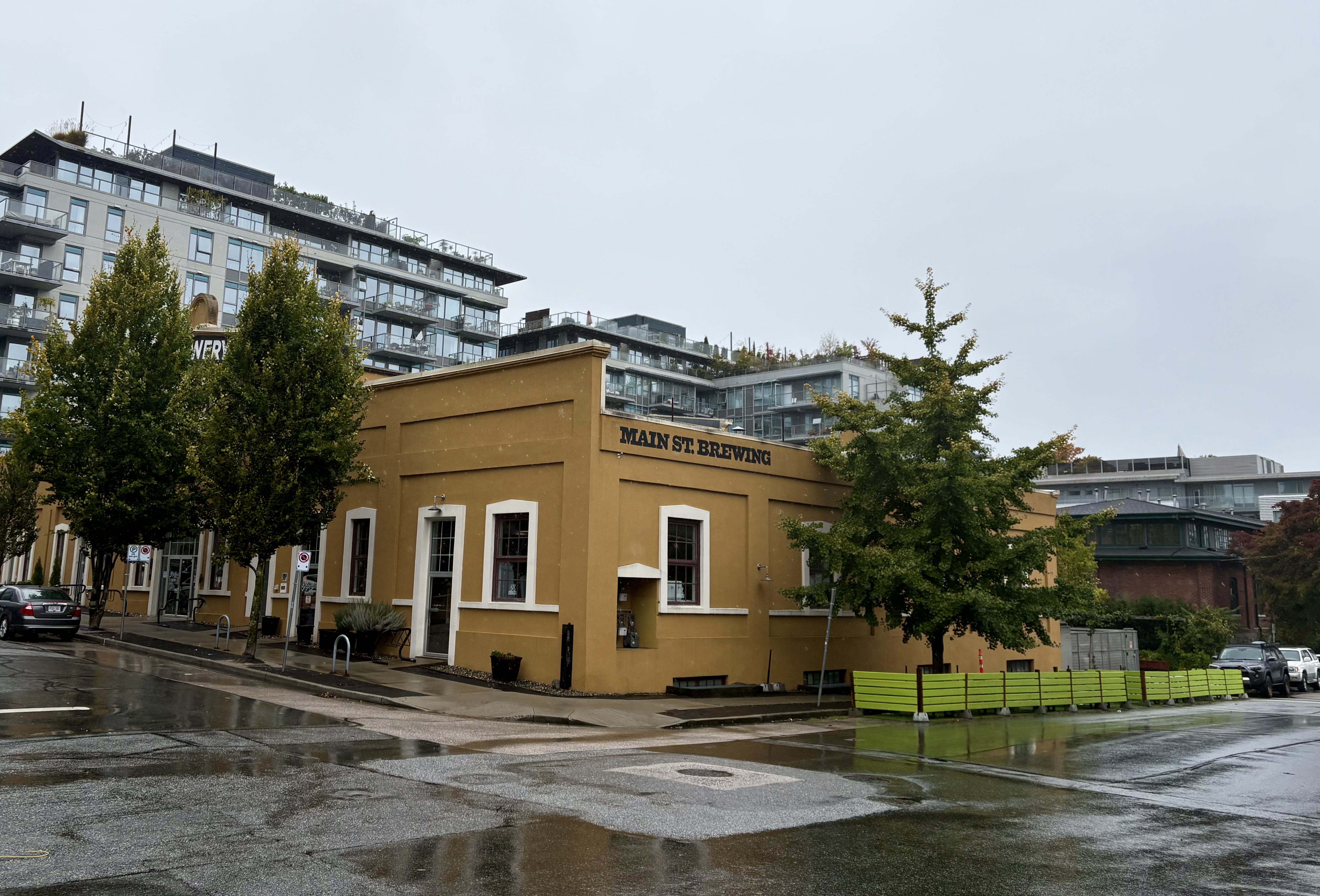
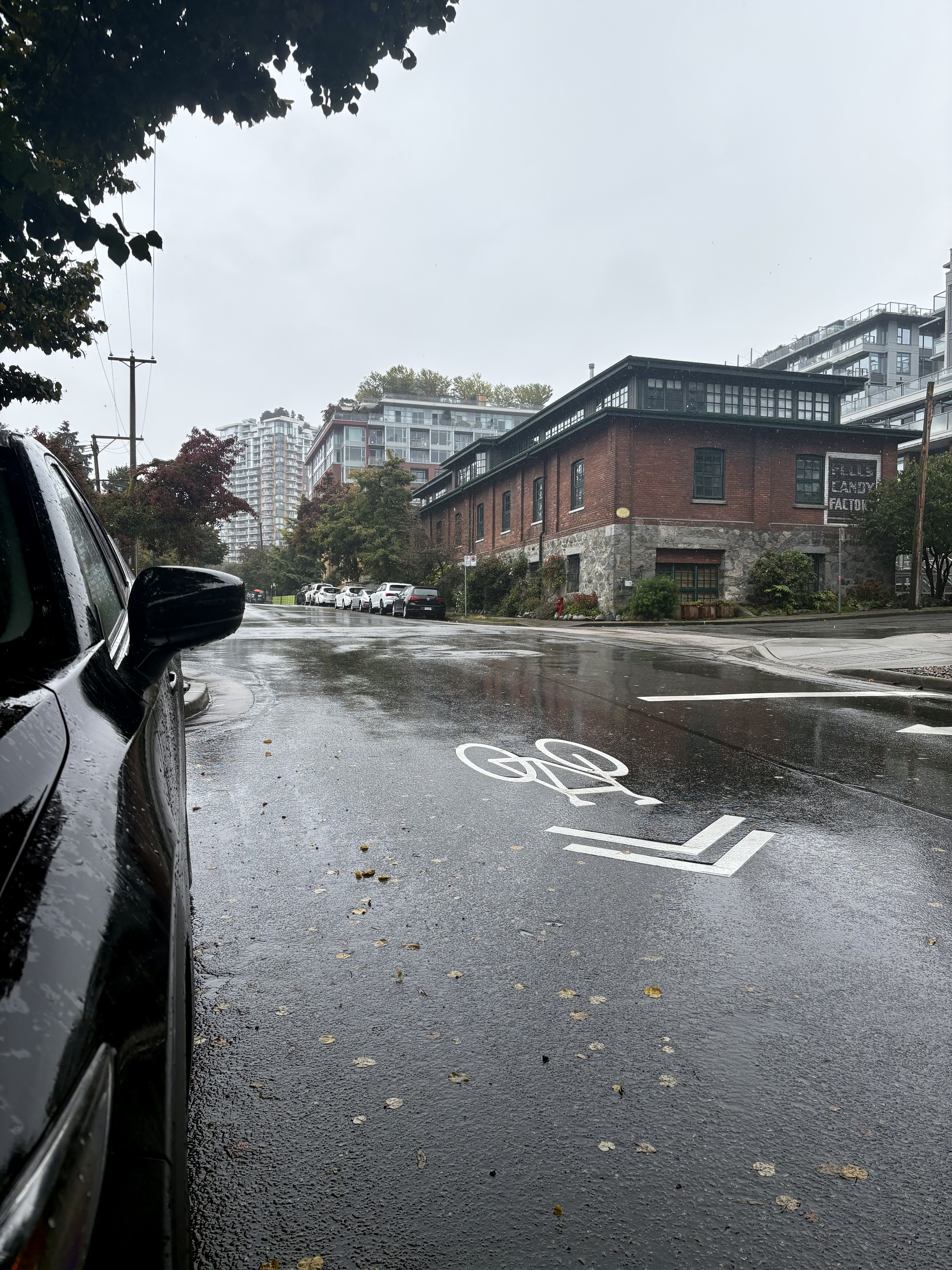
I pause on the south-east corner of East 7th and Scotia, with two of the area’s iconic buildings in eyesight — Main St. Brewing opposite and (to the right) the back of the stone-and-brick Brewery Creek Building at East 6th.
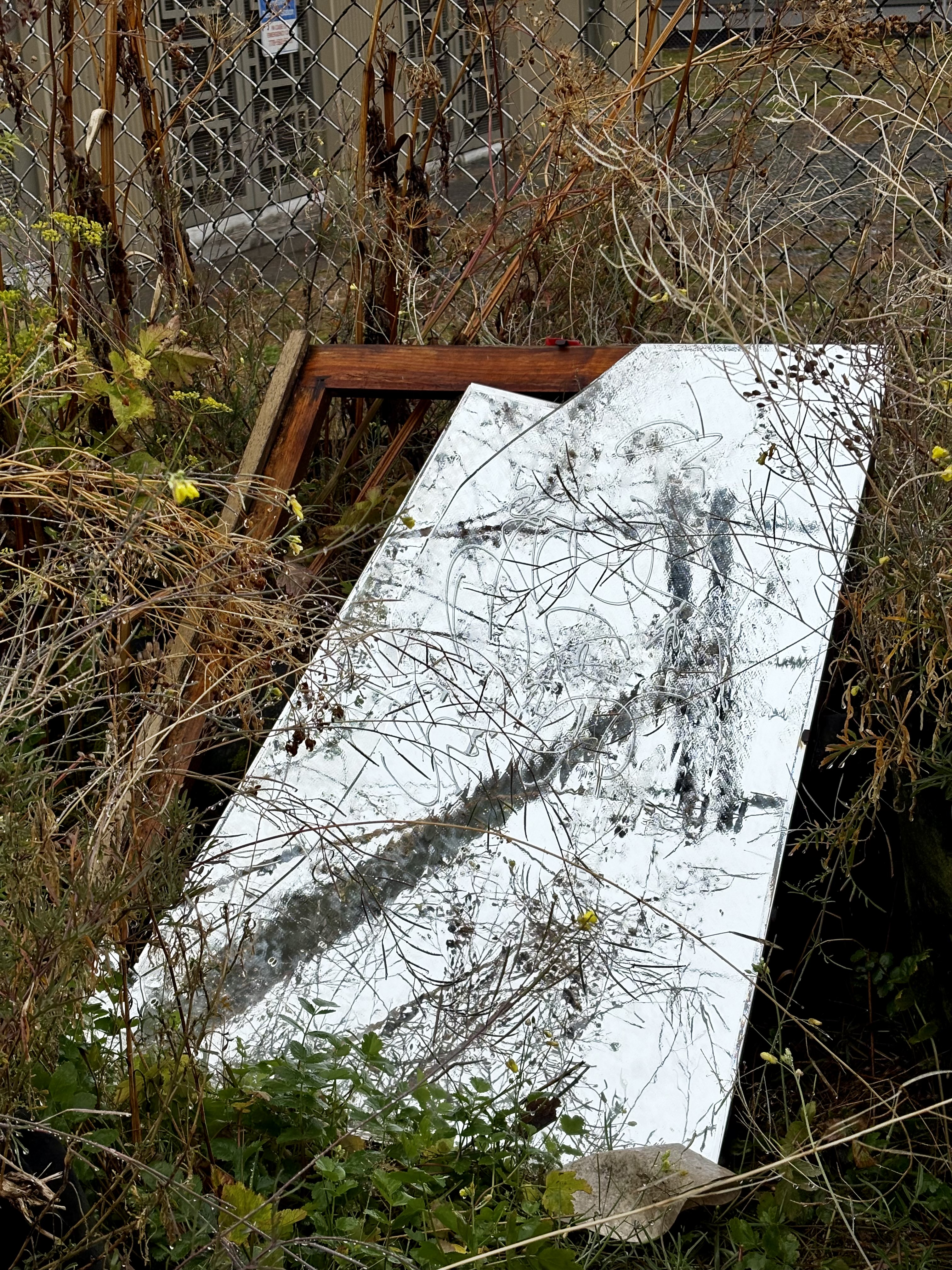
I’ll be heading that way, north on Scotia, but I’m momentarily distracted by the shine that is almost literally at my feet.
Even a discarded mirror fragment works magic, when it shimmers a hydro pole at us in blurry brilliance.
At East 6th, some magic that doesn’t depend on rain — though somehow rain makes its story all the more vivid, and all the more poignant.
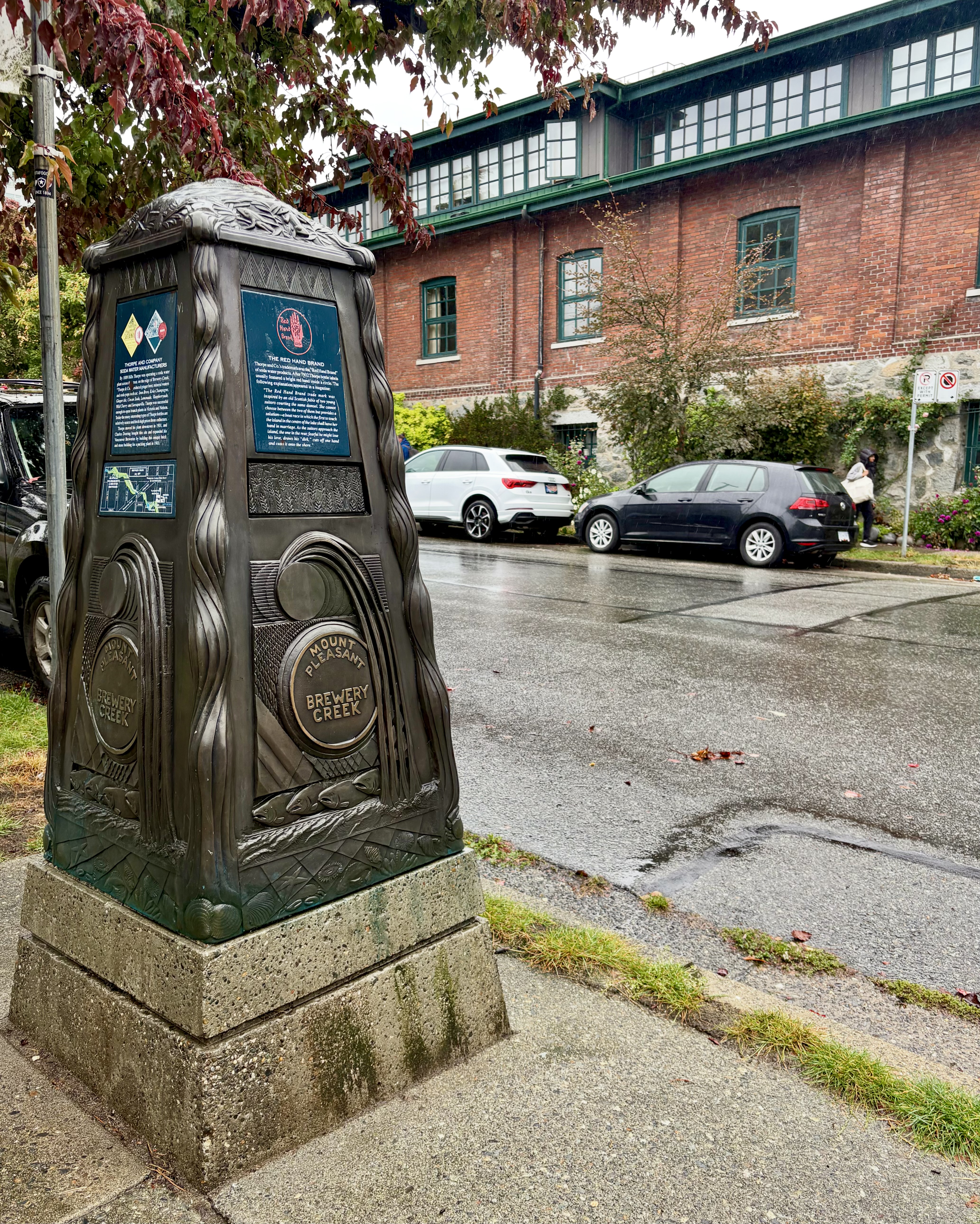
This handsome bronze cairn reminds us that although rain now courses down a steep roadway, until early last century rain simply added yet more water to a tumbling creek: Brewery Creek.
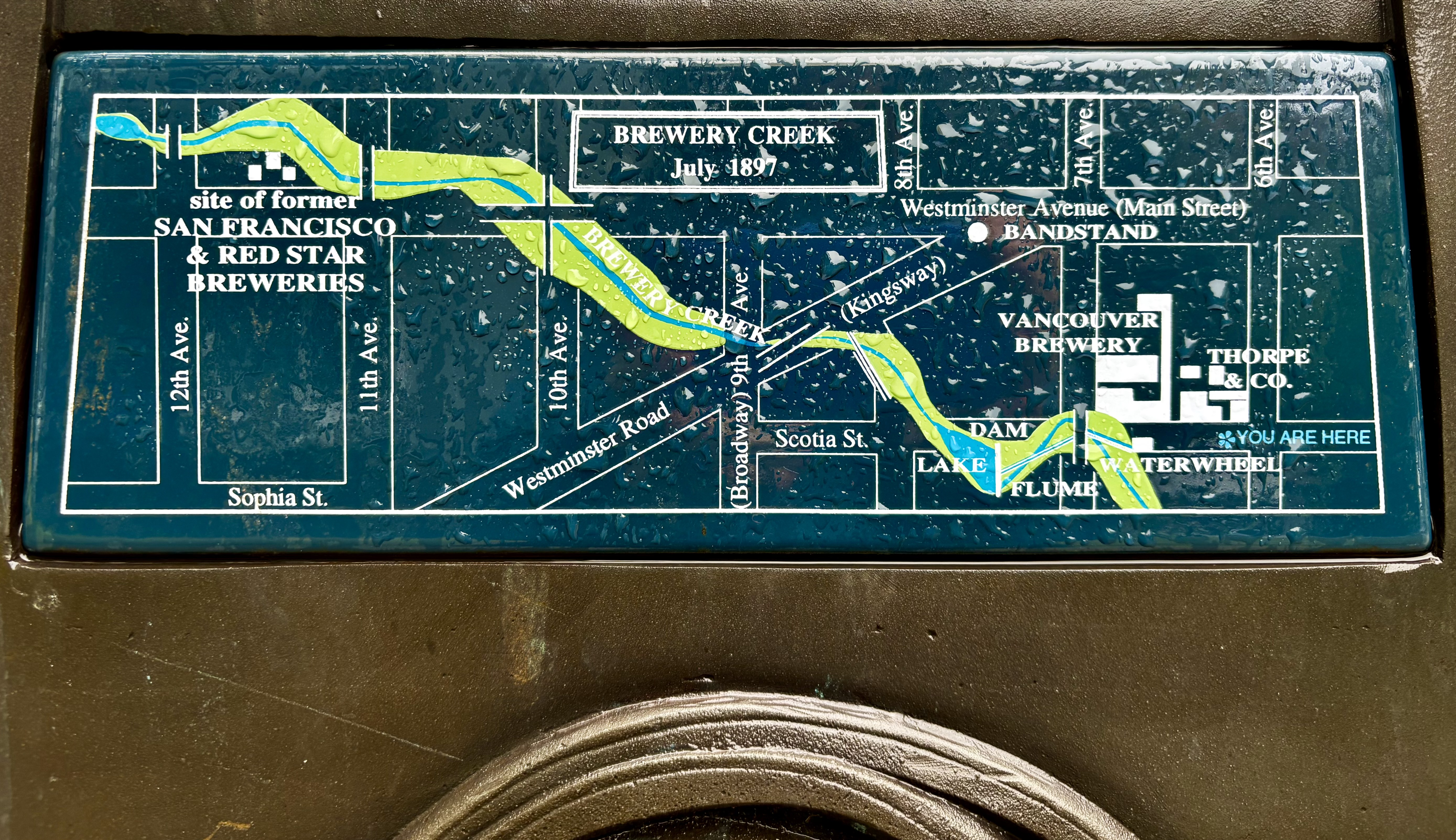
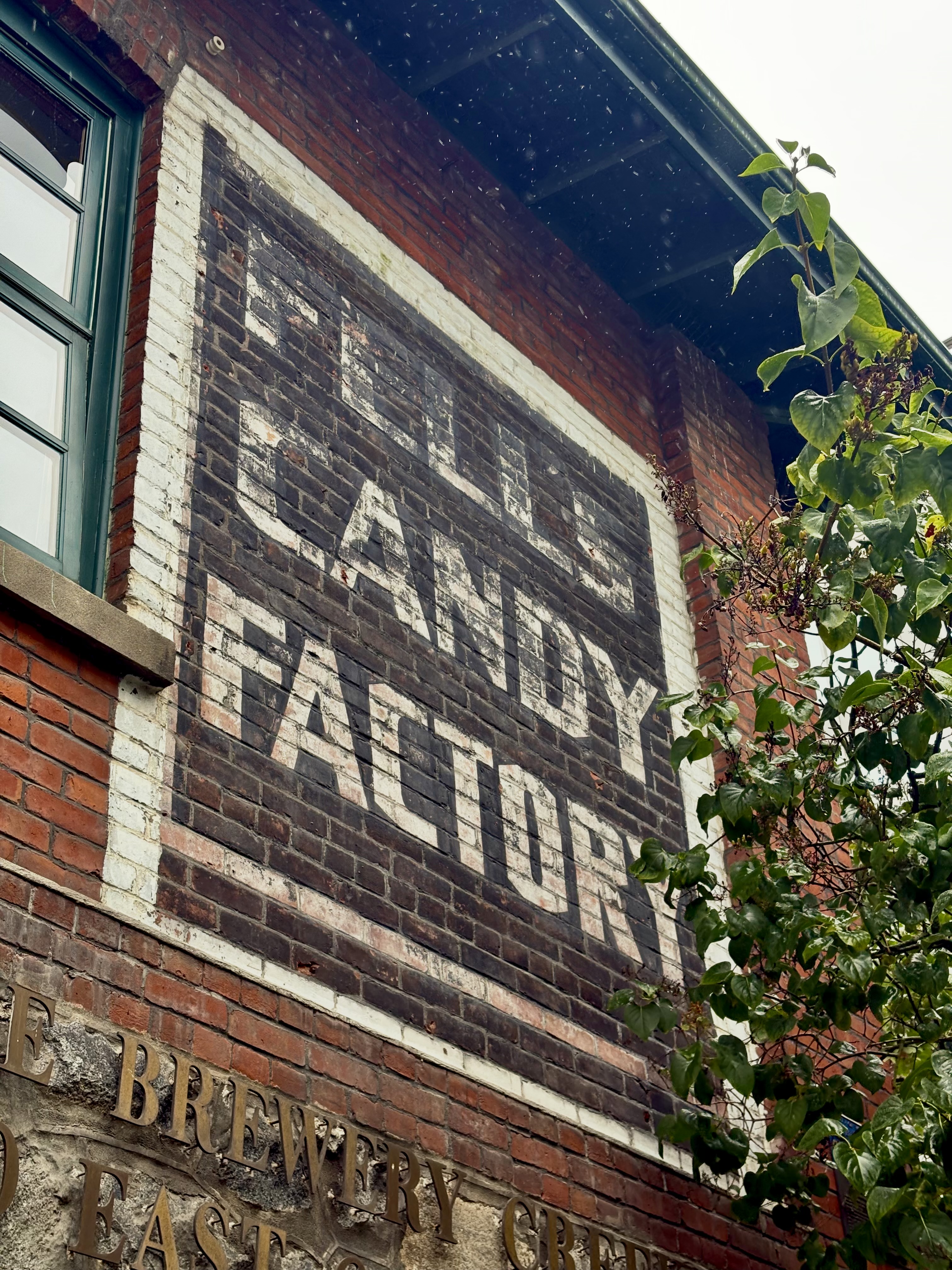
We are where the maps says we are (in turquoise letters lower right): on the banks of the old creek. In 1897, it still ran free. Now it is underground. The buildings opposite are not the ones shown on this map — Vancouver Brewing and Thorpe & Co. — but they are direct successors. Main St. Brewing, uphill, is the artisan beer company now occupying the 1920s building that was originally a garage for Vancouver Breweries (the amalgamated version of the original brewery), and the Brewery Creek Building, opposite, went up in 1903 as an expansion to the Vancouver Breweries complex. This structure later went through a succession of uses, including candy factory…
before 21st-c. restoration and expansion transformed it into live/work spaces for artists.
The “brewery” tag was, and again is, apt. Early breweries made use of the creek; a collection of new boutique breweries makes use of that history. The whole area now preens itself under the collective label of Brewery Creek.
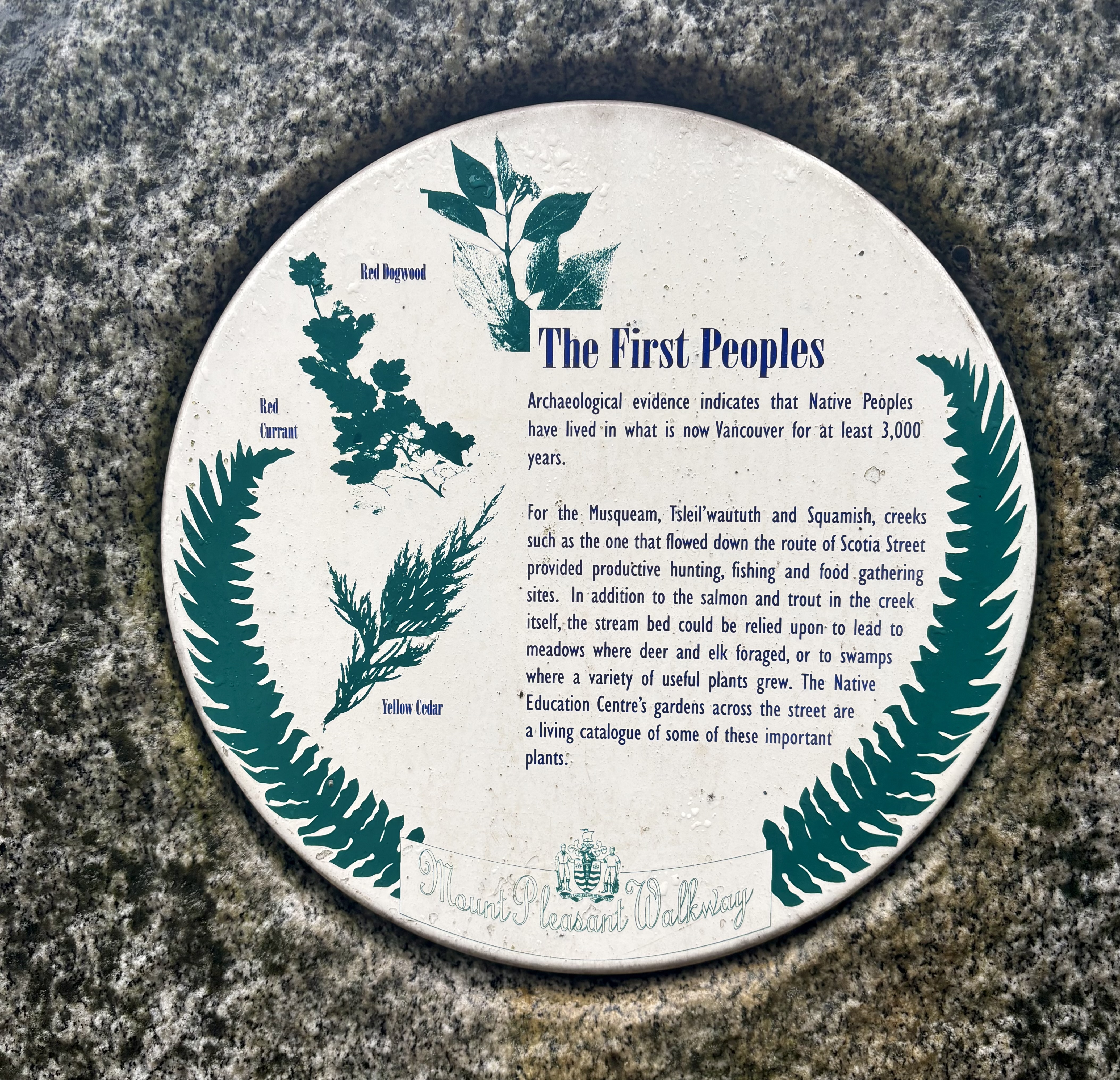
Another plaque takes us back to much earlier history — some three millennia back — and to those earlier uses of the watercourse and surrounding forests.
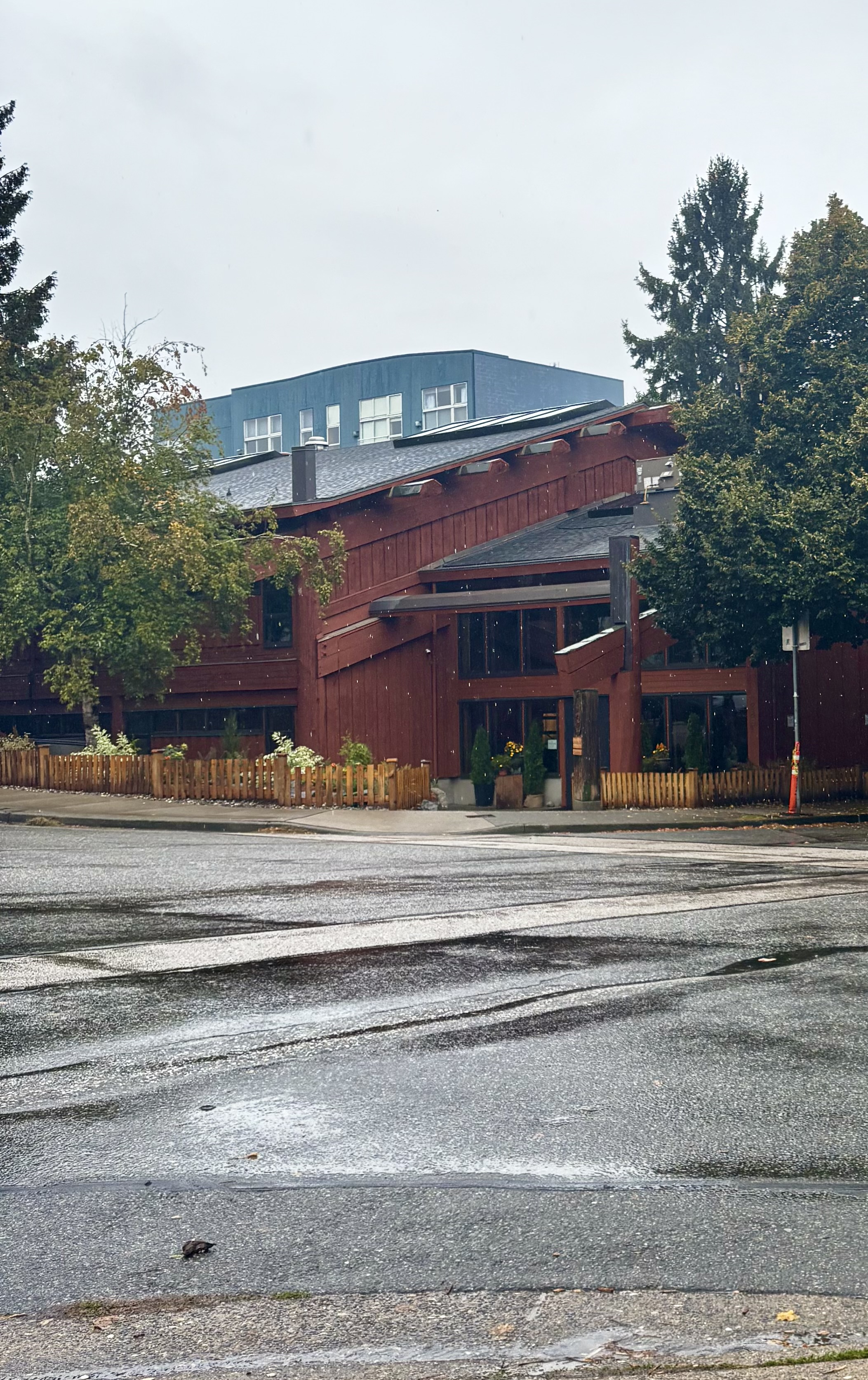
Kitty-corner to the plaque, the Native Education Centre it references, and its gardens.
My mind full of what used to be, imagining a creek to complement the rain, I walk on. Walk “downstream.” There is no visible creek, but there is real rain, and colours punched that much brighter as a result.
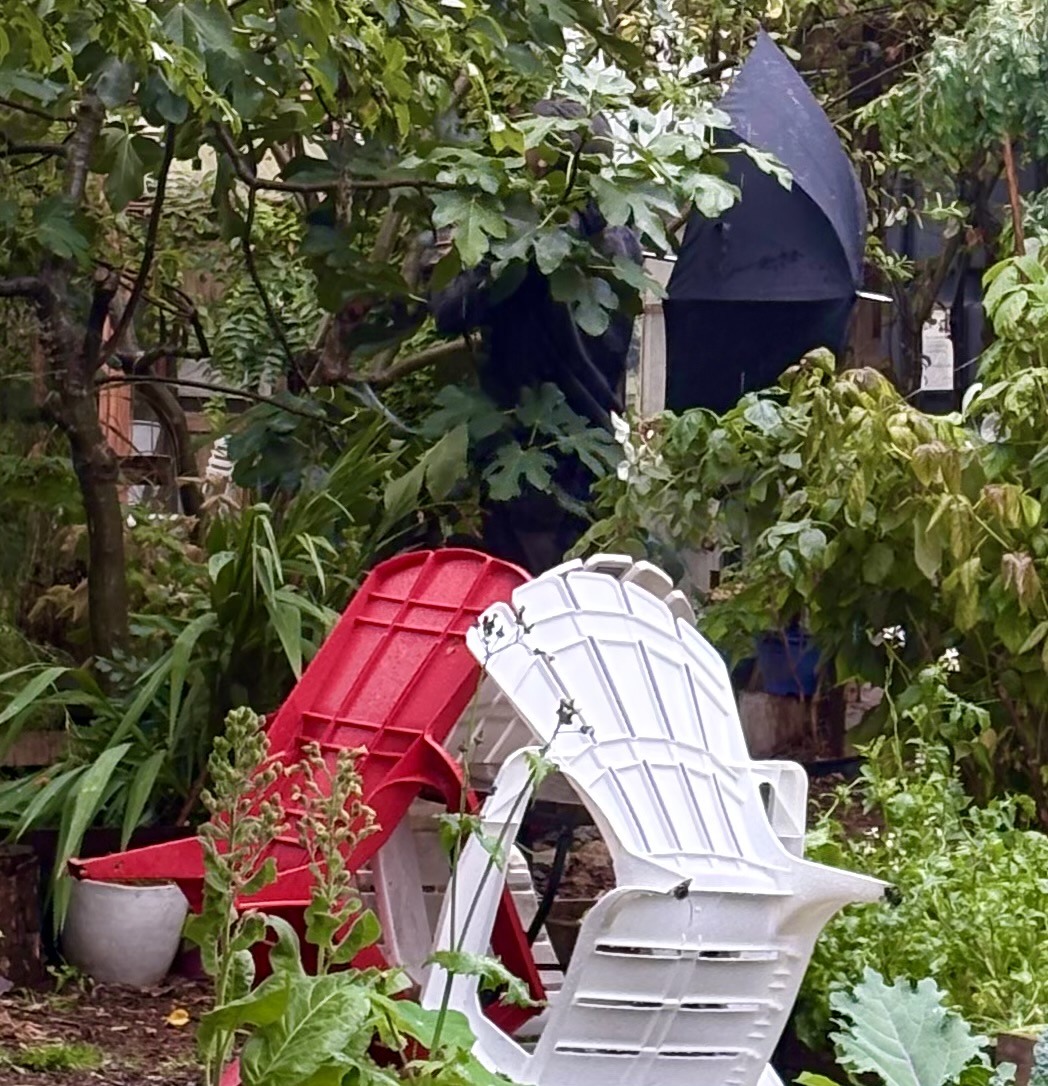
Including plastic colours, here at East 4th.
But I’m not focused on those tip-tilted chairs, I’m watching the horizontal black umbrella beyond the chairs (upper right). It belongs to a member of the coFood Garden Project that occupies this space, who is carefully shoulder-balancing it with one hand as he uses the other to wrest something out of the tree overhead. Branches interfere, I have no idea what he is doing. (Rescuing an injured bird? Snatching up some Spanish doubloons? Leaving a note for a secret lover?) There is suddenly a loud crack, he pulls his umbrella again vertical, and walks away. Mission presumably accomplished.
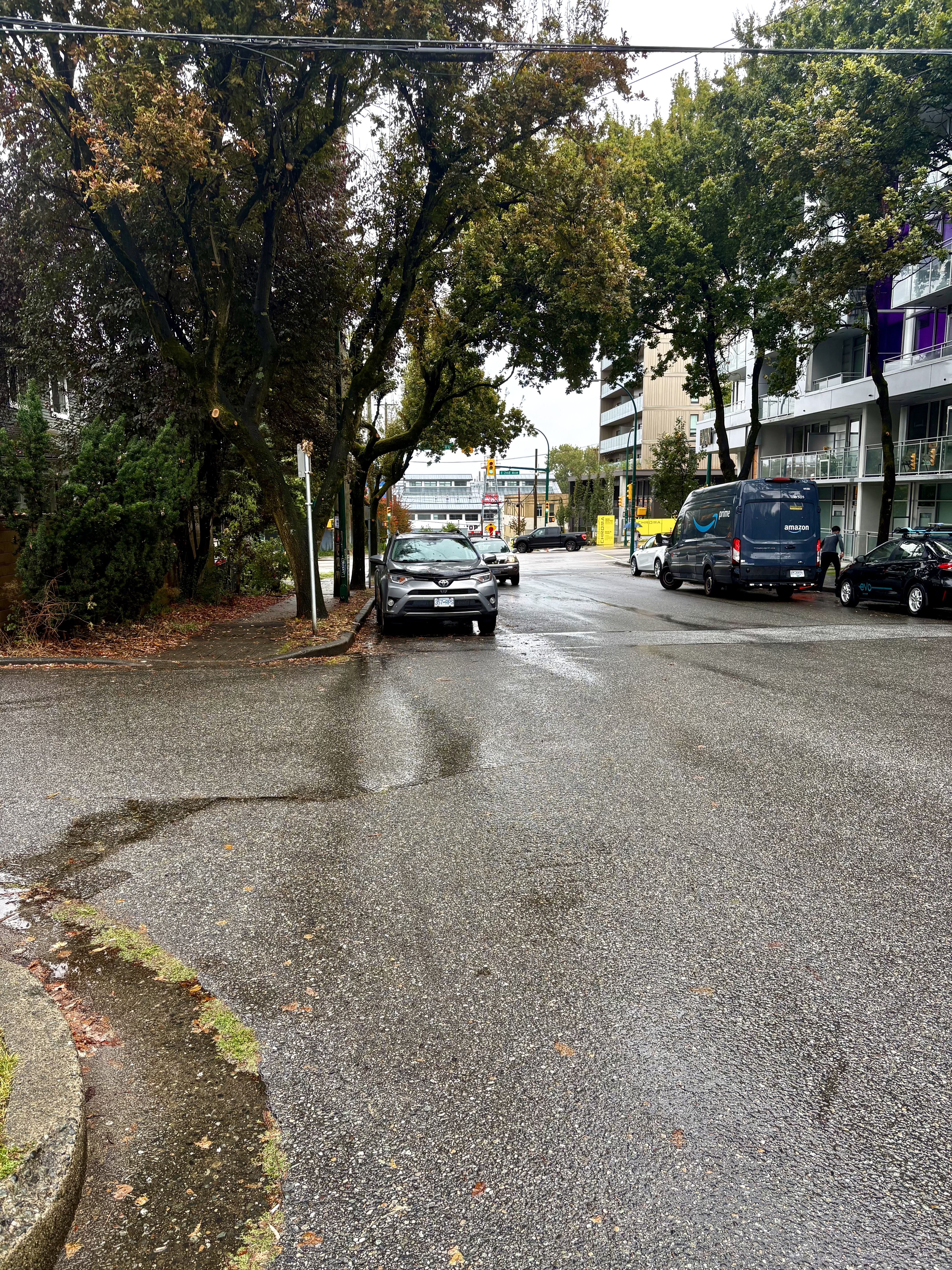
One last look north, watching water rivulets course downstream, again imagining a creek instead of pavement ..
and I turn to walk my way back upstream.
One final slight detour into a driveway, to admire one more example of shine in all this rain…
and at last I start thinking about dry indoors space and hot soup.
11 September 2026 – Time travel: you’re with me on 8 September, downtown, corner of West Georgia and Granville. I’m about to turn from the former onto the latter and notice that busy Granville is barricaded, although its sidewalks are open.
I complete the turn, expecting some kind of kerfuffle to justify the barricade — nothing major, since no sirens or emergency vehicles, but something.
I get something.
A great big metal apple, on a car-free street.
I’m surprised, but then, as I walk closer, no longer surprised. The apple fits right in.
Its reflection sparkles in Fatburger’s doorway, across the street…
and the apple itself sparkles even more, viewed from across the street.
It embraces the woman who just wants to read her book…
and it makes neighbourly conversation with skyscrapers and sky.
I walk south on this peaceful street, see some workers busy with an installation at the next corner, and ask, “Going up? Coming down?”
They give me a friendly but puzzled where-have-you-been face, and explain it’s all coming down. This stretch of Granville has been a Pedestrian Zone all summer long. As of tomorrow, the cars return.
Okay, I missed that one.
But I’m all set for Car-Free Day on Main Street, East 10th to King Edward, this very Sunday.
24 August 2026 – My only context thought, as we set out, is geographic. This sunny day, we are off for a walk in Strathcona, a very mixed but always intriguing neighbourhood in Vancouver’s east end.
We, sort of, have an objective. We want to see one of the installations in the current Vancouver Biennale edition (2025-2027), a sculpture at the corner of East Georgia Avenue & Campbell Street. Titled 241.5 Arc X 2, it is a companion piece to 217.5 Arc X 13 out on Sunset Beach, both of them works in a series by French artist Bernar Venet that explores the “beauty, balance and malleability of raw steel.”
The beach installation is a legacy of the 2009-2011 Biennale; the city installation is very new. The former is a great favourite of mine (you’ve seen it in this blog several times already); the latter, therefore, interests me a great deal. My companion is just as interested, so we are well pleased to have an appealing neighbourhood walk ahead of us, with this sculpture as the grand finale.
And it is appealing, this historic pocket of the city — shabby and exuberant, gentrified and raffish, very human, very alive. Evidence of all this life, this very mixed life, wherever you look.
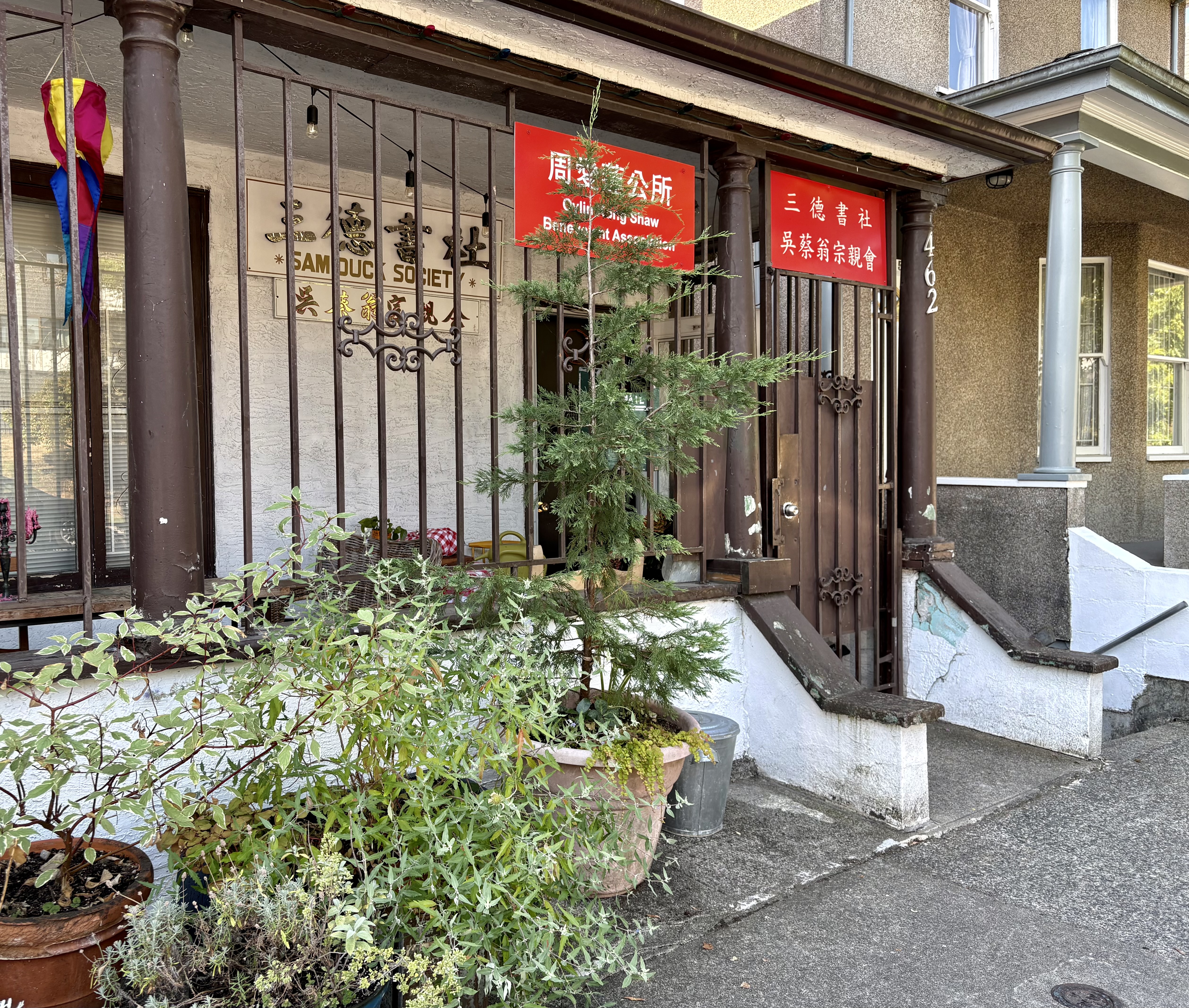
A benevolent society on Union Street near Jackson Avenue, painted & polished & scrupulously tidy, with thriving potted plants as décor (plus a barred gate, for prudence).
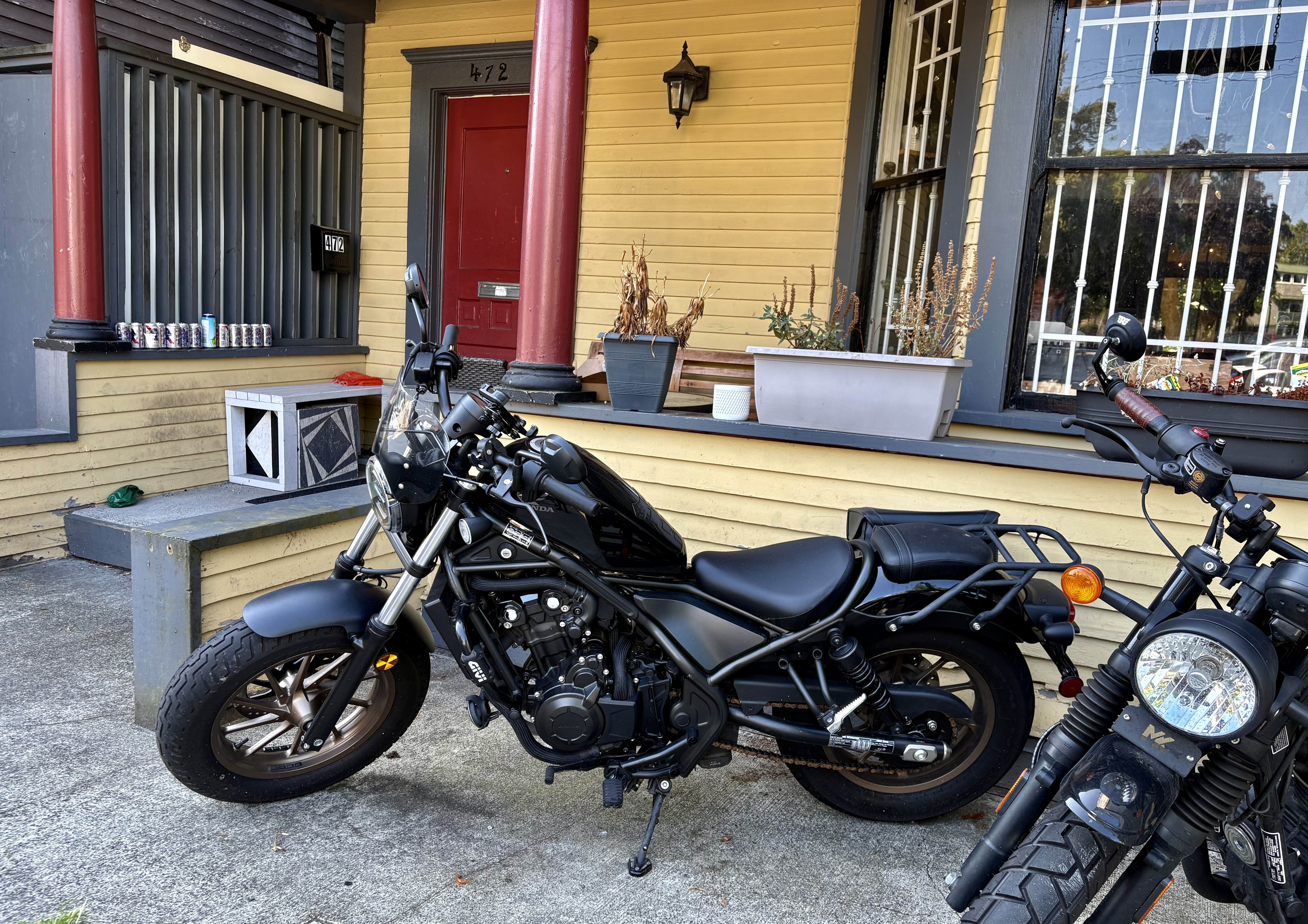
Just few doors farther east, bikes out front not bamboo, with a few dying plants and a line of beer cans as décor. But, please note, also bright with recent paint and equally tidy.
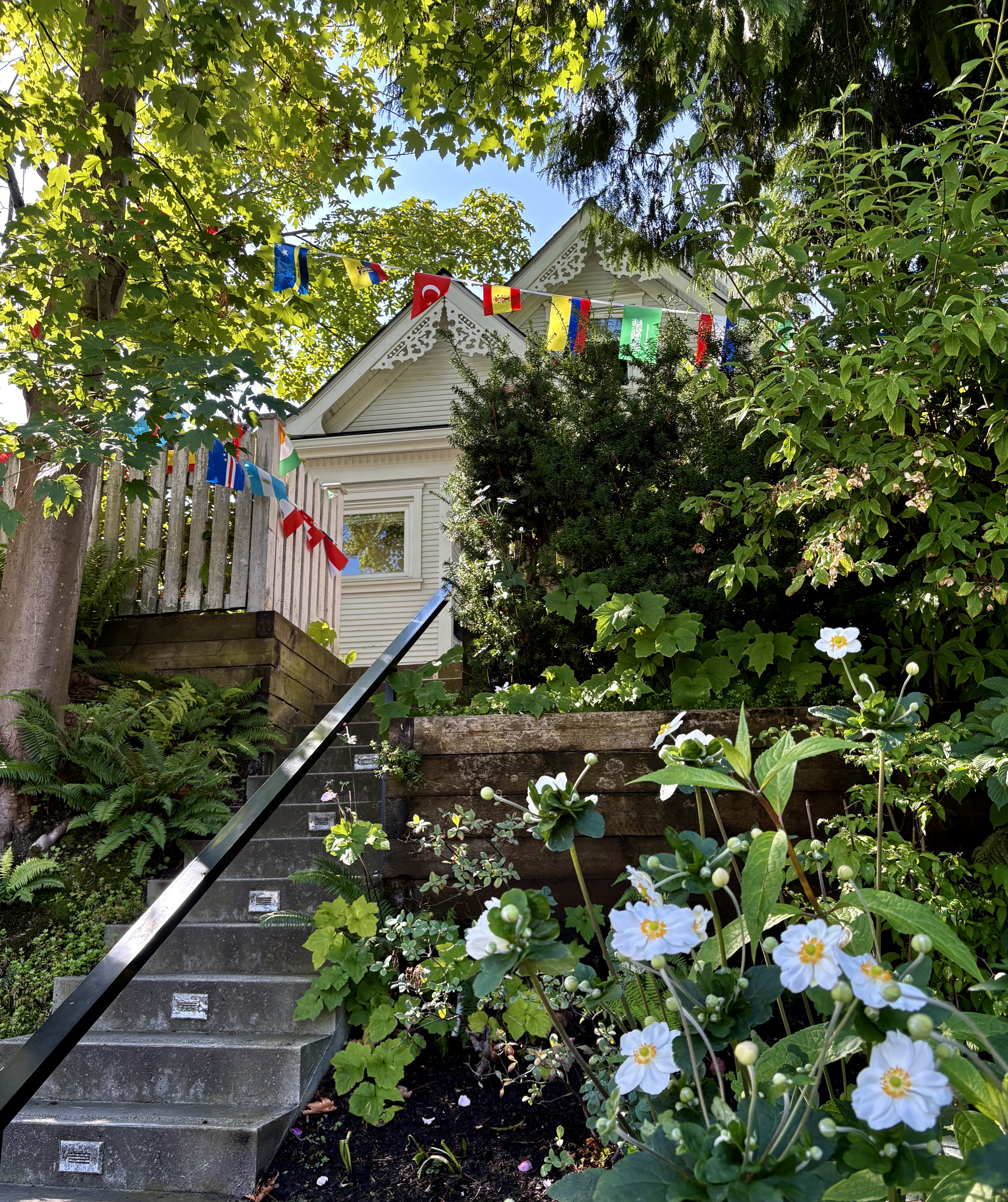
Still on Union, farther east again, shrubs and trees and sidewalk flowerbeds and wooden-frame homes, this particular one boasting not prayer flags but political flags, flags of all nations. (Or maybe FIFA-nation flags, left over from the games, and it’s fine either way).
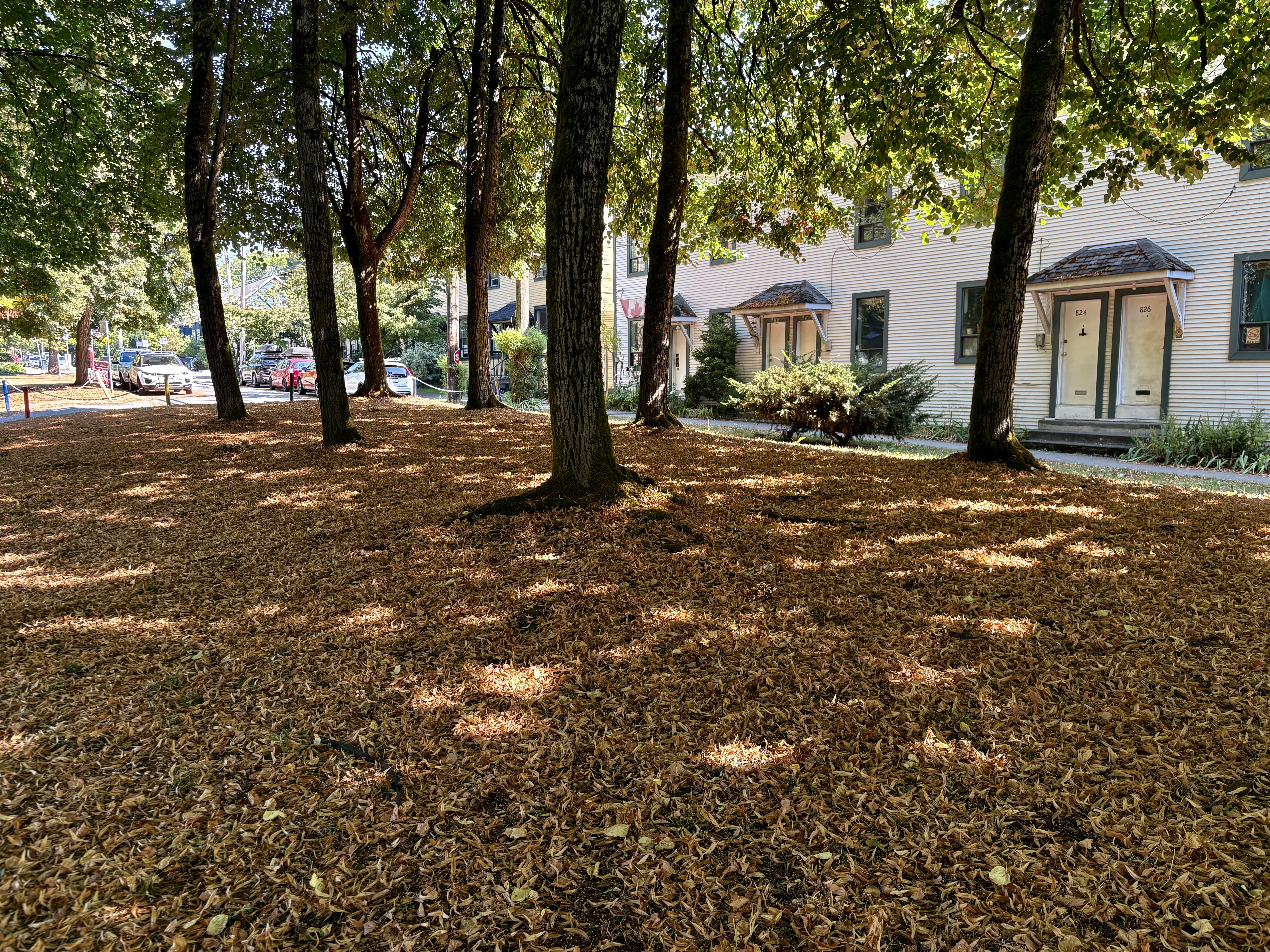
An urban glade, as we turn north on Hawks Avenue, close by Strathcona Linear Park — mulch underfoot and a peaceful stand of trees. (Last time I was here, some years back, it was all dug up for sewer-pipe renewal or some-such… now look at it.)
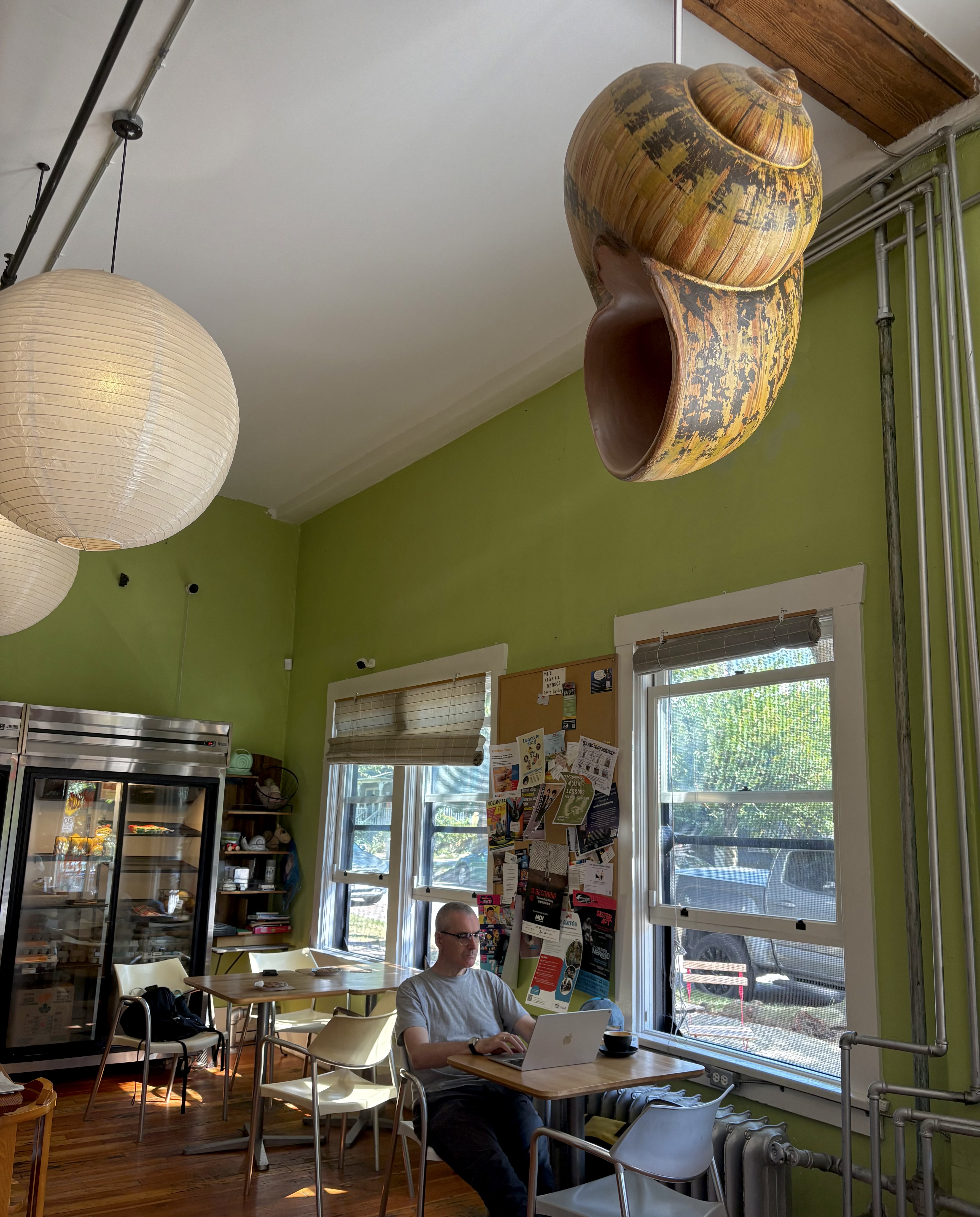
We pause in the Wilder Snail, at Hawks & Keefer, opposite MacLean Park…
which began as a neighbourhood grocery store back in the 1920s and, despite a succession of events and owners ever since, today is still a neighbourhood grocery store and now also a café.
So, you see, Strathcona is delightful, and stimulating, and entirely rewarding, even without an Arc.
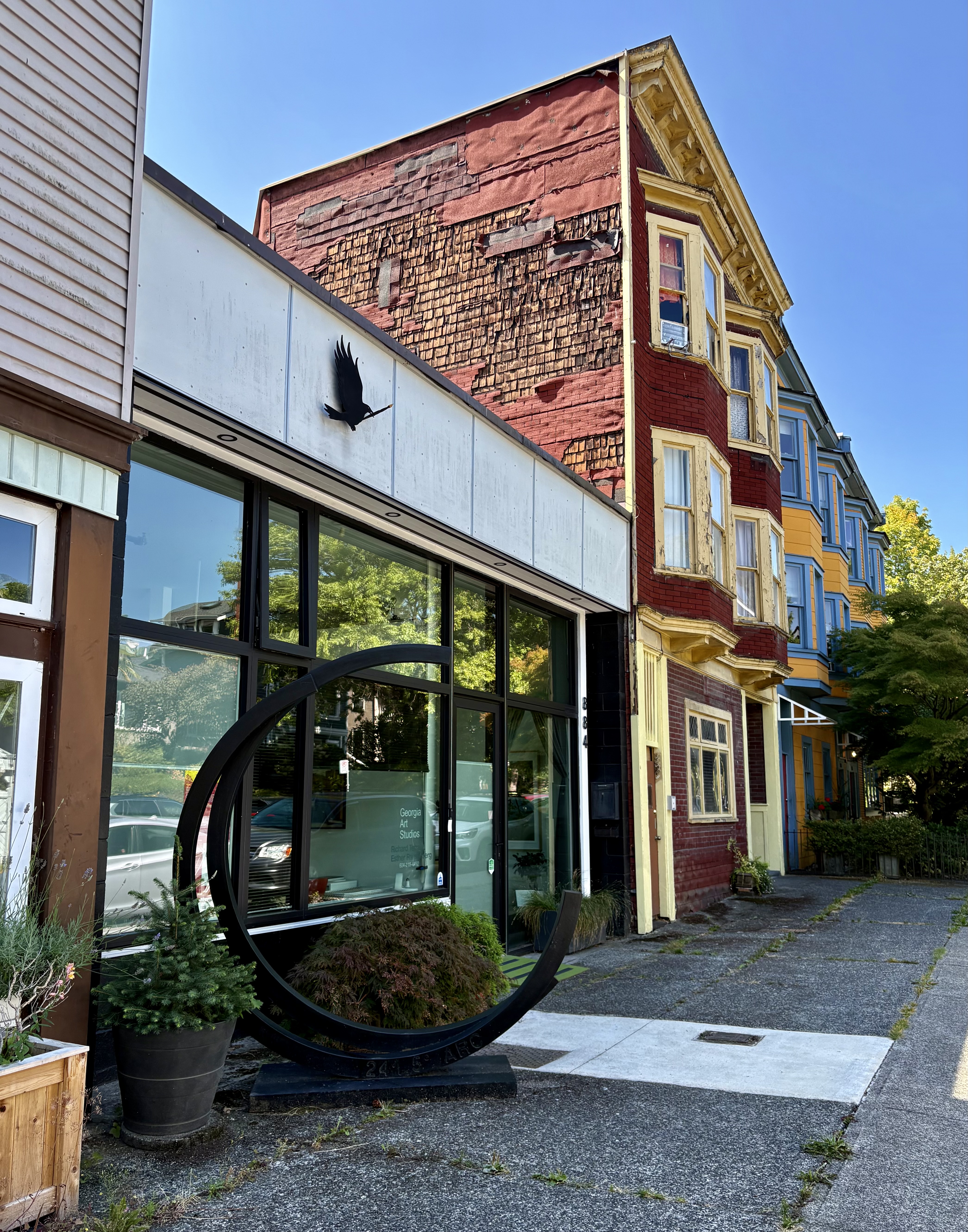
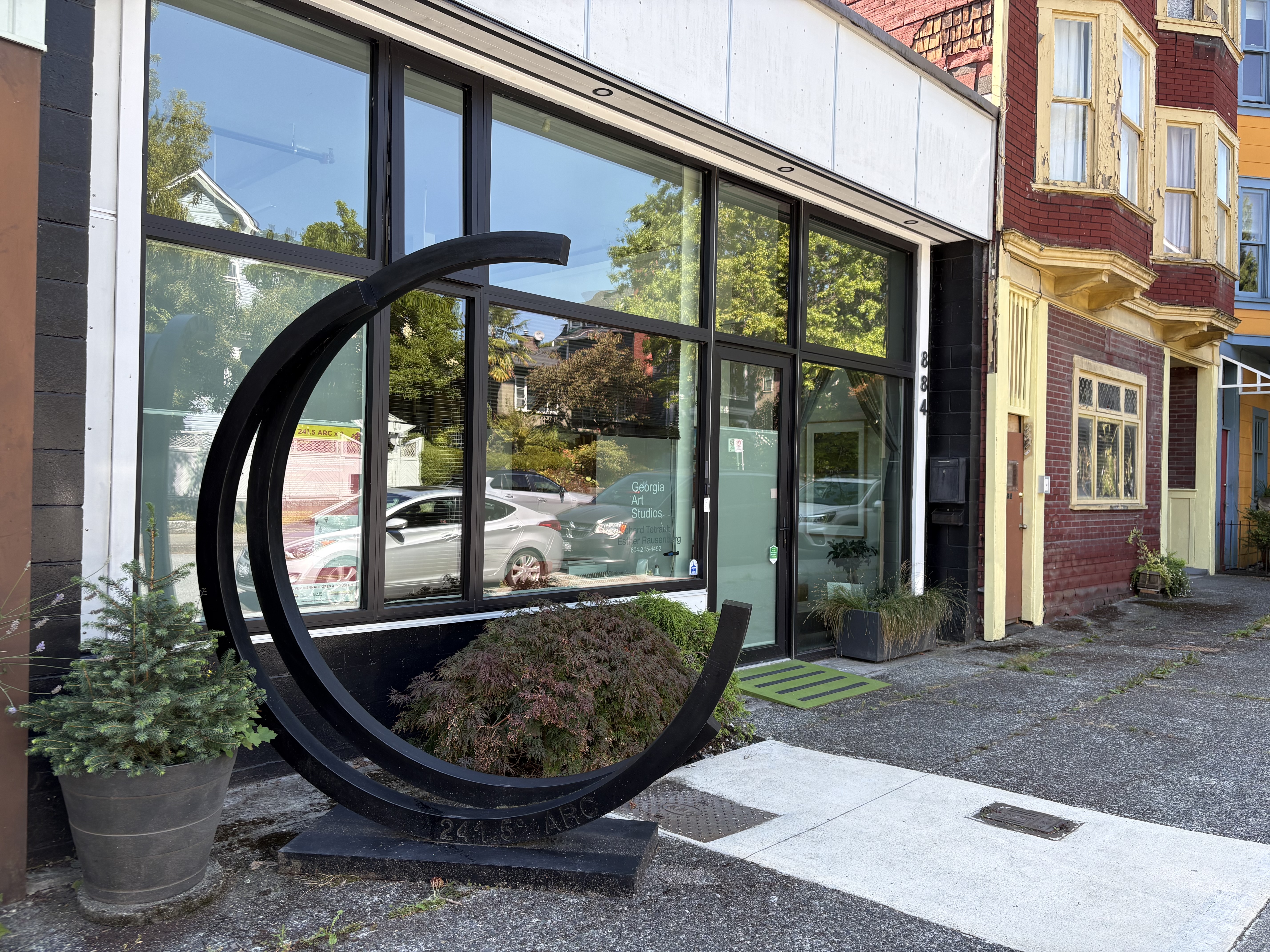
But here it is, the Biennale installation, here it is on East Georgia just west of Campbell — and so quietly in place that we almost miss it.
Track your eye from that black crow above the storefront glass, downward to the ground. There.
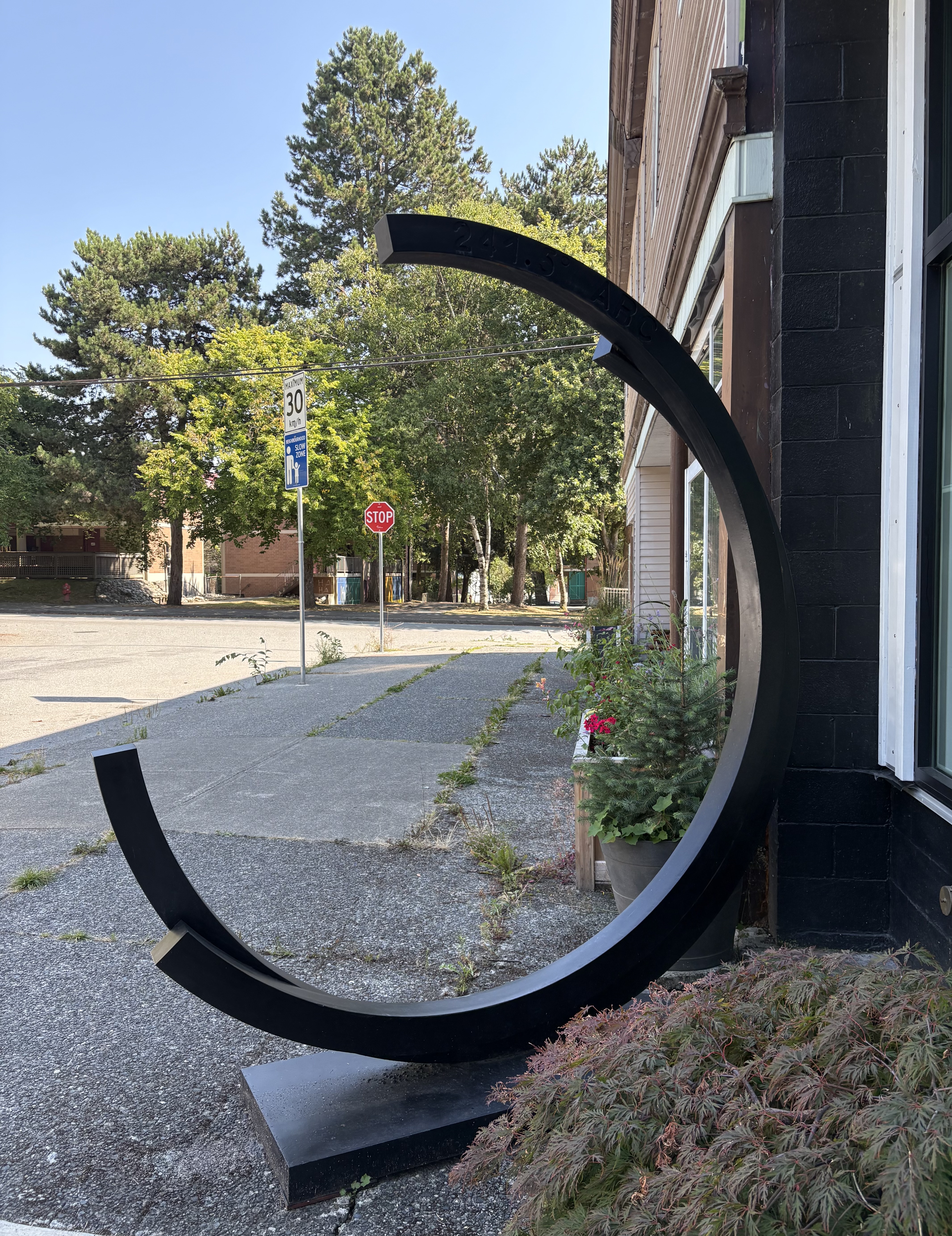
241.5 Arc X 2, meaning 2 arcs of steel bent to 241.5 degrees. We walk all around it, take some photos, make appreciative remarks to each other, but fact is, I am underwhelmed. I have its Sunset Beach sibling in mind, and I expected… something else. I expected some kind of more, the power I associate with the other one.
But this is still a good walk, there is really no such thing as a bad walk, not if you’re willing to pay attention, so it’s all fine. We walk our way on out of Strathcona, and we are in perfect good humour.
Still, that other Arc is on my mind. Once home, I look up some of my photos of Beach Arc and do myself a little compare-and-contrast.
It surprises me. It gets me thinking about context, about art-in-context. I find myself looking at both installations in a different way.
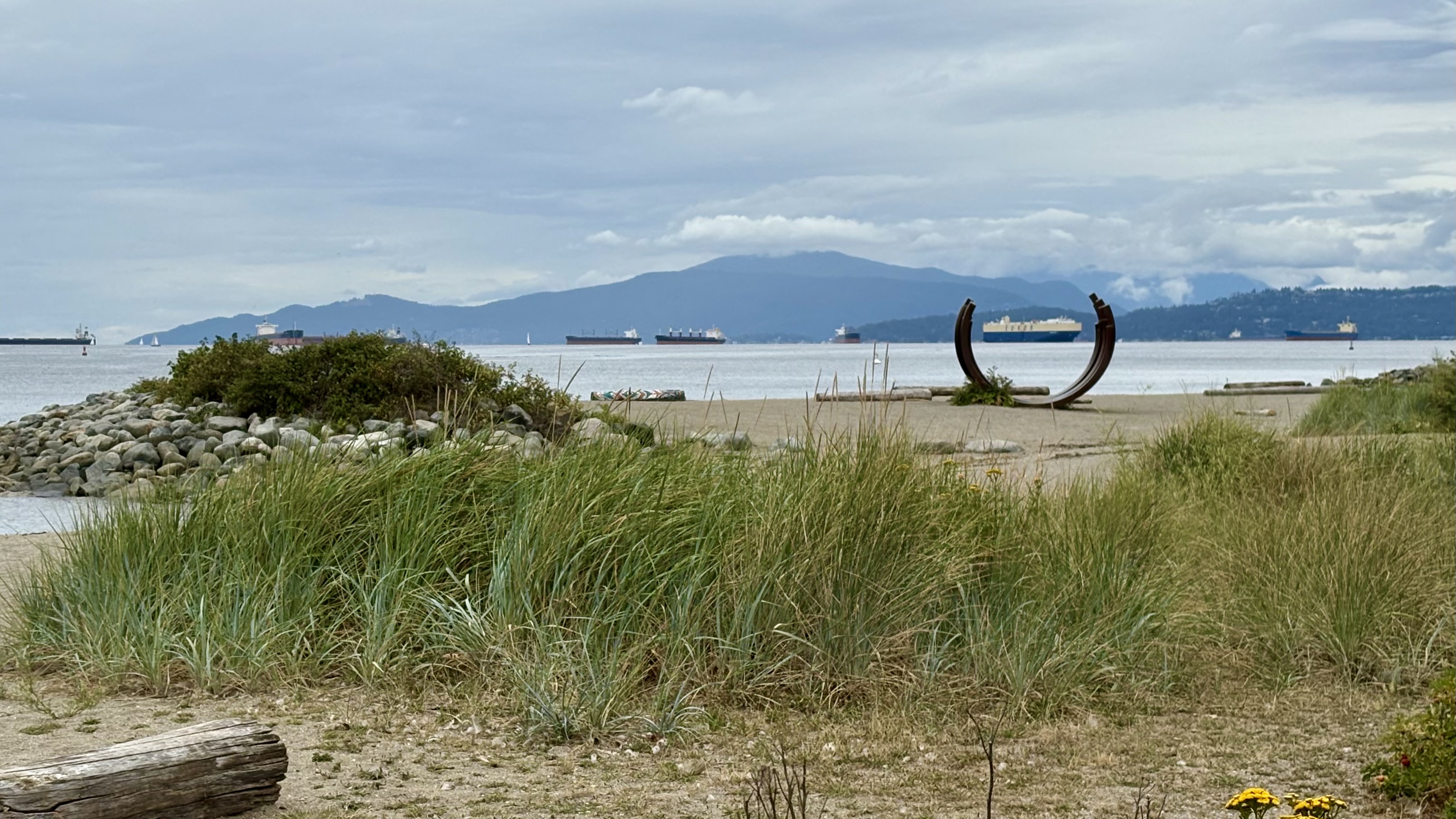
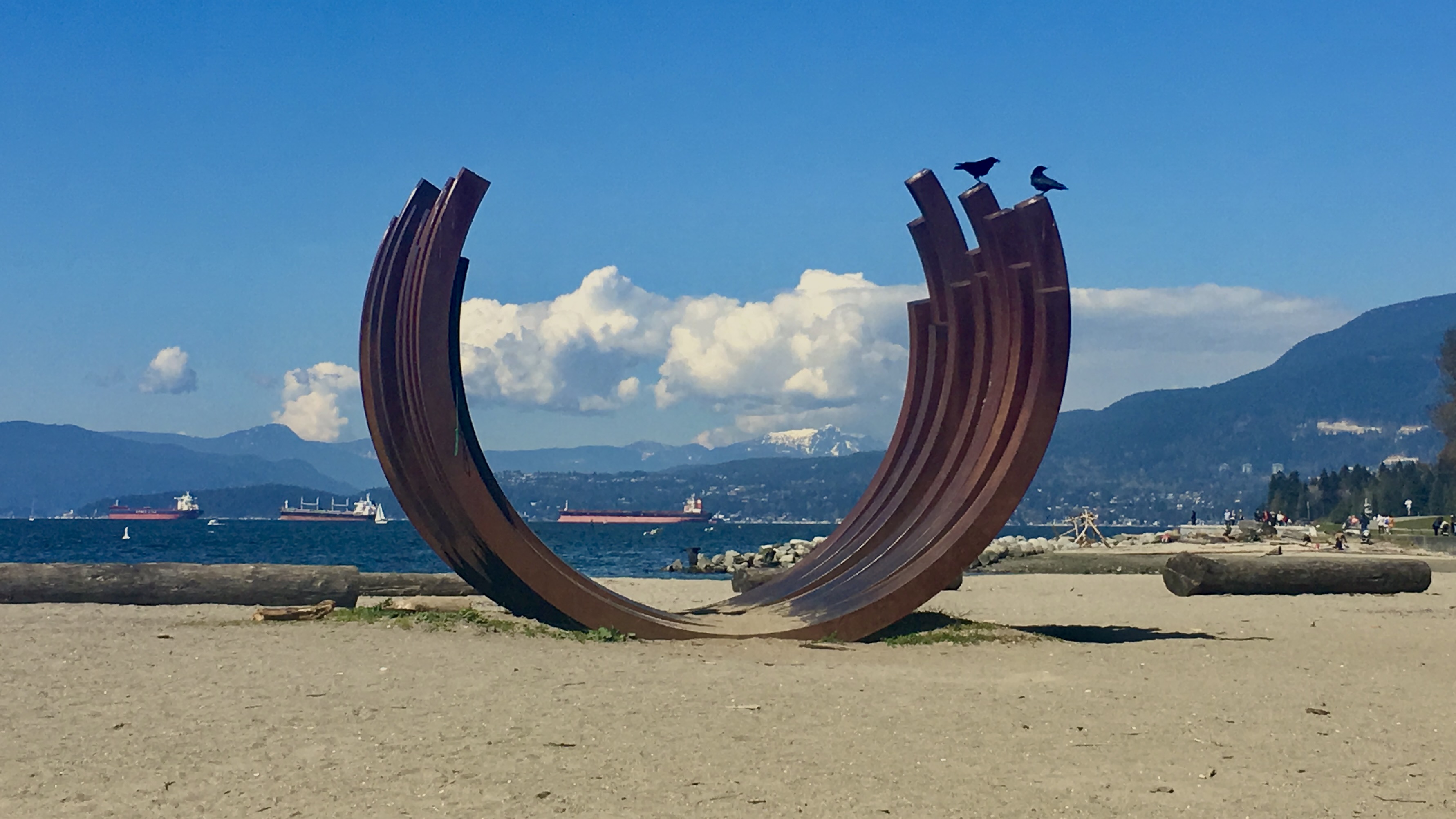
Here’s 217.5 X 13 (aka Beach Arc) in its context:
It is set in wild grasses and sand, against water and a long line of mountains. Urban Arc (scroll up), is set in pavement and potted plants, against storefront glass and a line of aged townhouses.
City Arc, so slight!
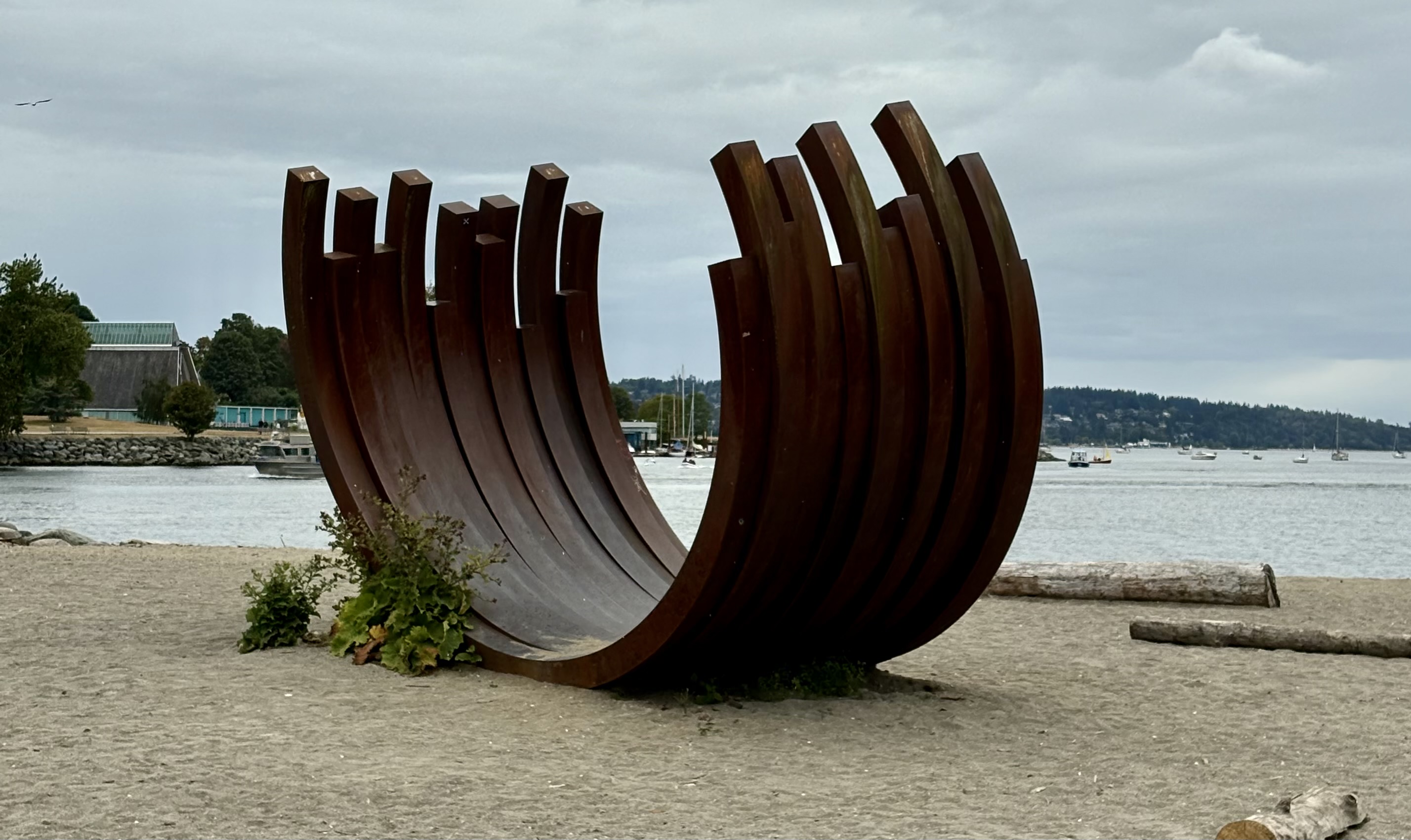
Beach Arc, so robust!
City Arc, rich in urban context..
matt black against the matt black framing for those storefront windows; a companion to that storefront and the time-battered housing next door; with reflections in the windowpane of street and signage and city traffic.
Beach Arc, rich in its very different context…
rusty metal echoing rusty metal on freighters out in English Bay; companion to beach scrub and storm-tossed logs; reflections from sun off water, and the water offering all the dynamics and traffic of that maritime world.
I look back and forth, city to beach, beach to city. I let the Arcs tumble into new places in my mind. Both are by the same artist, both express the same theme with equal skill and grace. Each, in the other location, would be out of scale and out of place. Each, in its own location, is exactly right.
21 August 2026 – I step off buzzing Main Street, still intent on my Proustian challenge: to bring “new eyes” to familiar landscapes, and in so doing reward myself with a “voyage of discovery.”
I am just one alley east of Main, here at the corner of E. 22nd, but it’s a whole new world. Even as my eyes take in that Vancouver Special on the alley-corner opposite…
my ears register the big difference. Silence! My ears hum with silence.
I am now un-buzzed, and I prowl on up the alley with renewed interest.
Small details, in this stretch of alley, on this particular day.
The awning-covered table & chairs behind a commercial building…
offering employees (so I hopefully imagine) somewhere to take a break…
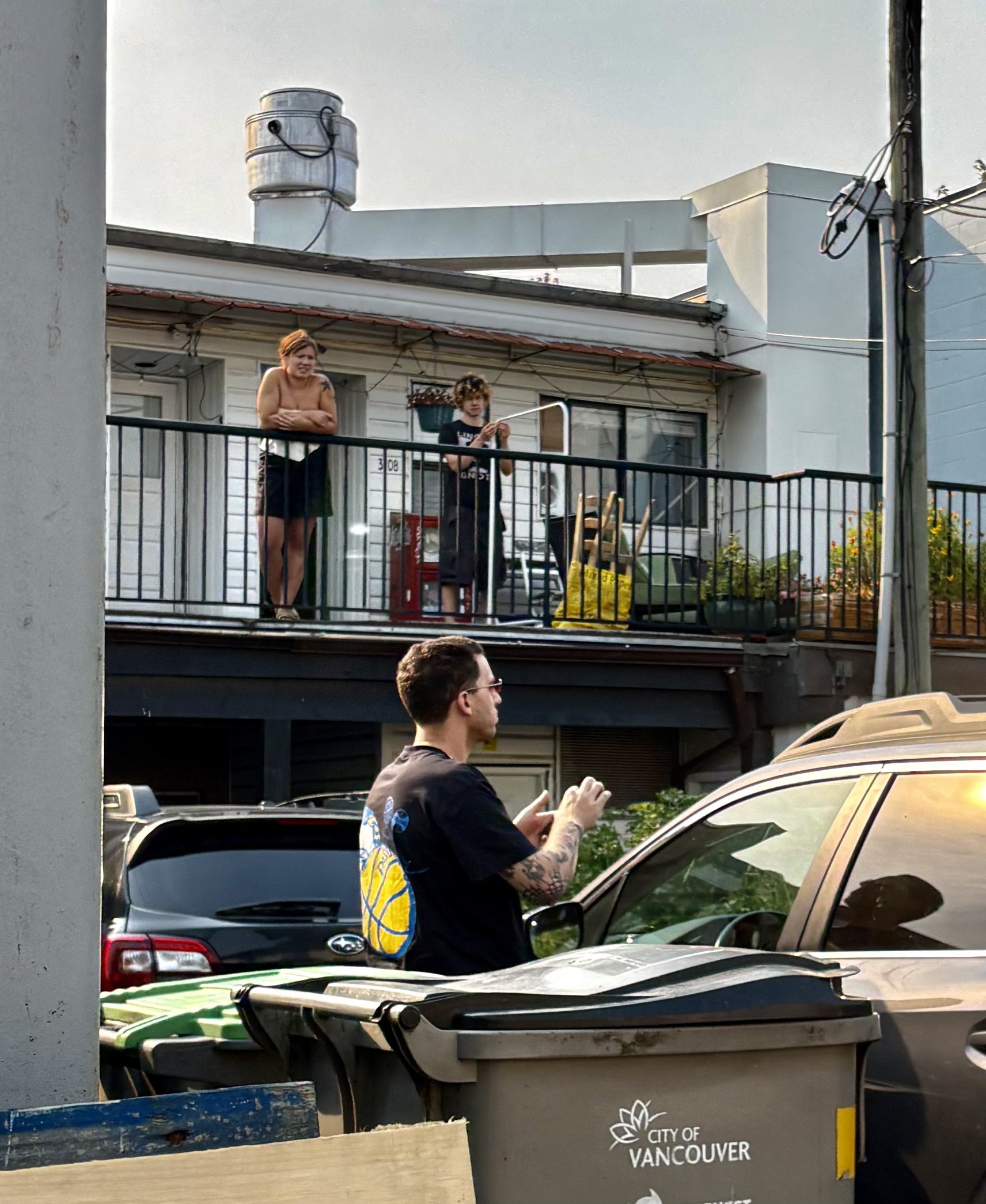
life in the alley, with two women on the balcony and the young man below all suddenly distracted by a crow’s raucous call…
and the crow himself.
I don’t see the crow…
but I do see his shadow, thrown on a building wall across the alley.
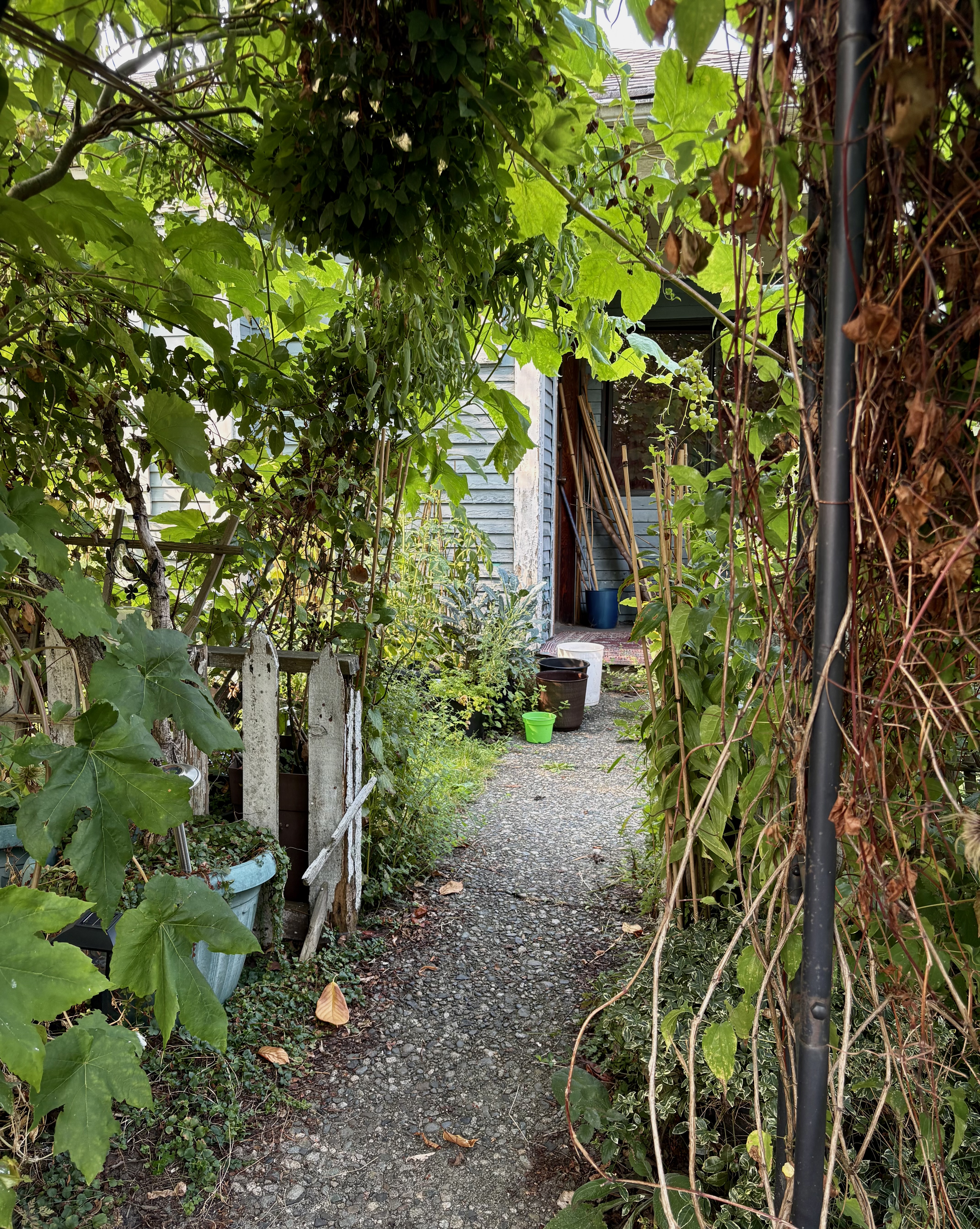
I turn east on E. 21st Avenue, and marvel at how old-fashioned, how peacefully residential, it still is — with vine-shrouded walkways that lead to wooden-frame homes behind tall hedges…
and climbing ropes coiled on the sidewalk…
an invitation to explore the tree from higher up.
I turn again, north this time on Sophia Street…
and think for a moment about Sophia, goddess of wisdom. How badly our world needs wisdom!
The street delivers, if not wisdom, at least plenty of peaceful charm. There is even a whole block with a dirt path rather than a paved sidewalk, guarded at one corner by Mountain Ash…
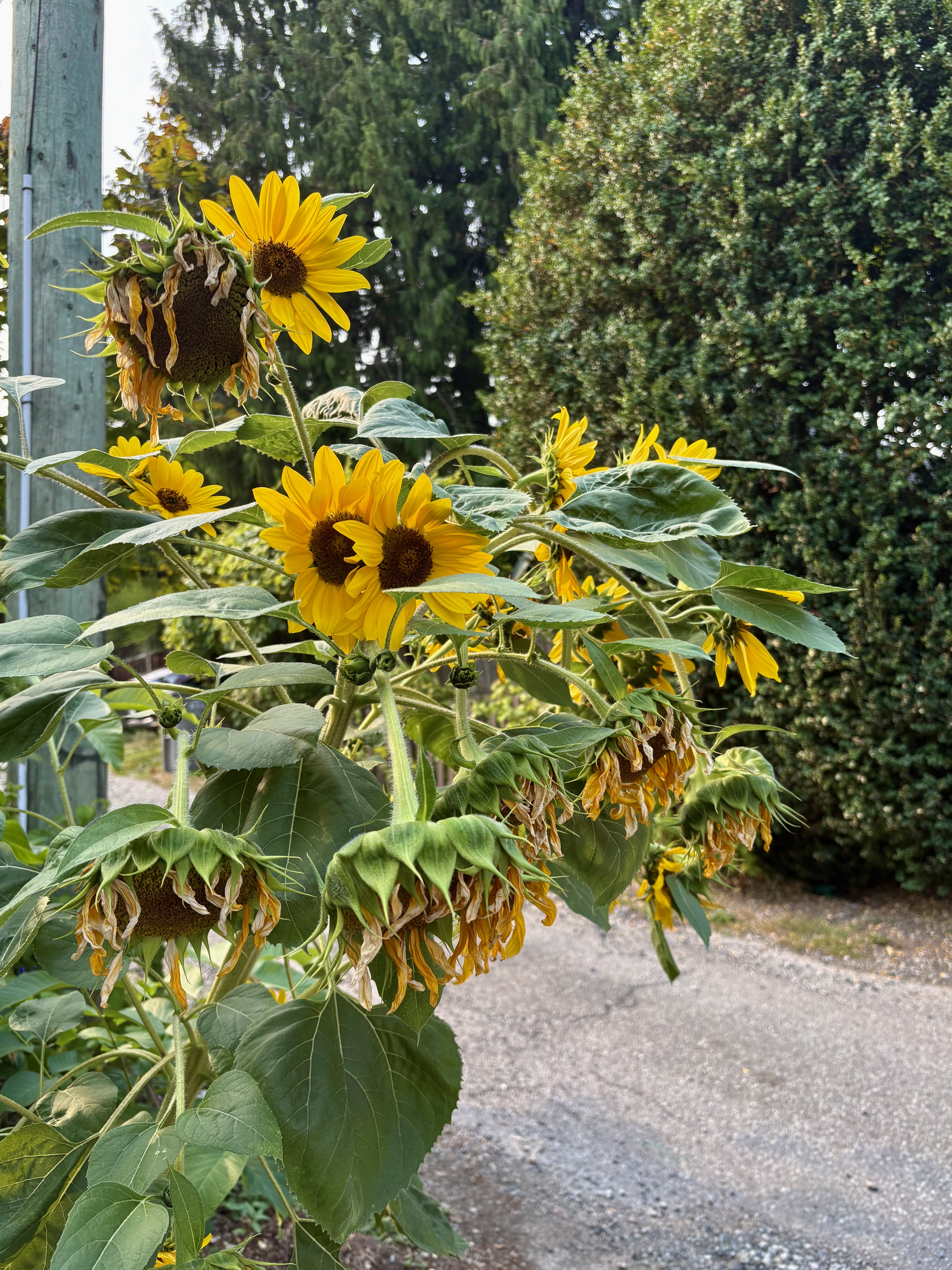
and at the other by an explosion of sunflowers.
A bit farther north, a happy (albeit wooden) child high in a tree, no climbing rope needed…
and then I’m face to face with Tea Swamp Park.
The name evokes the Labrador tea plants that used to thrive in this boggy stretch of land. Now, drained and firmed, the bog is a small park, a place for people to thrive. Two teens sit on a bench, comparing notes about their mothers (yes, I eavesdrop), while a young woman strides by, carefully balancing that flat of eggs as she walks.
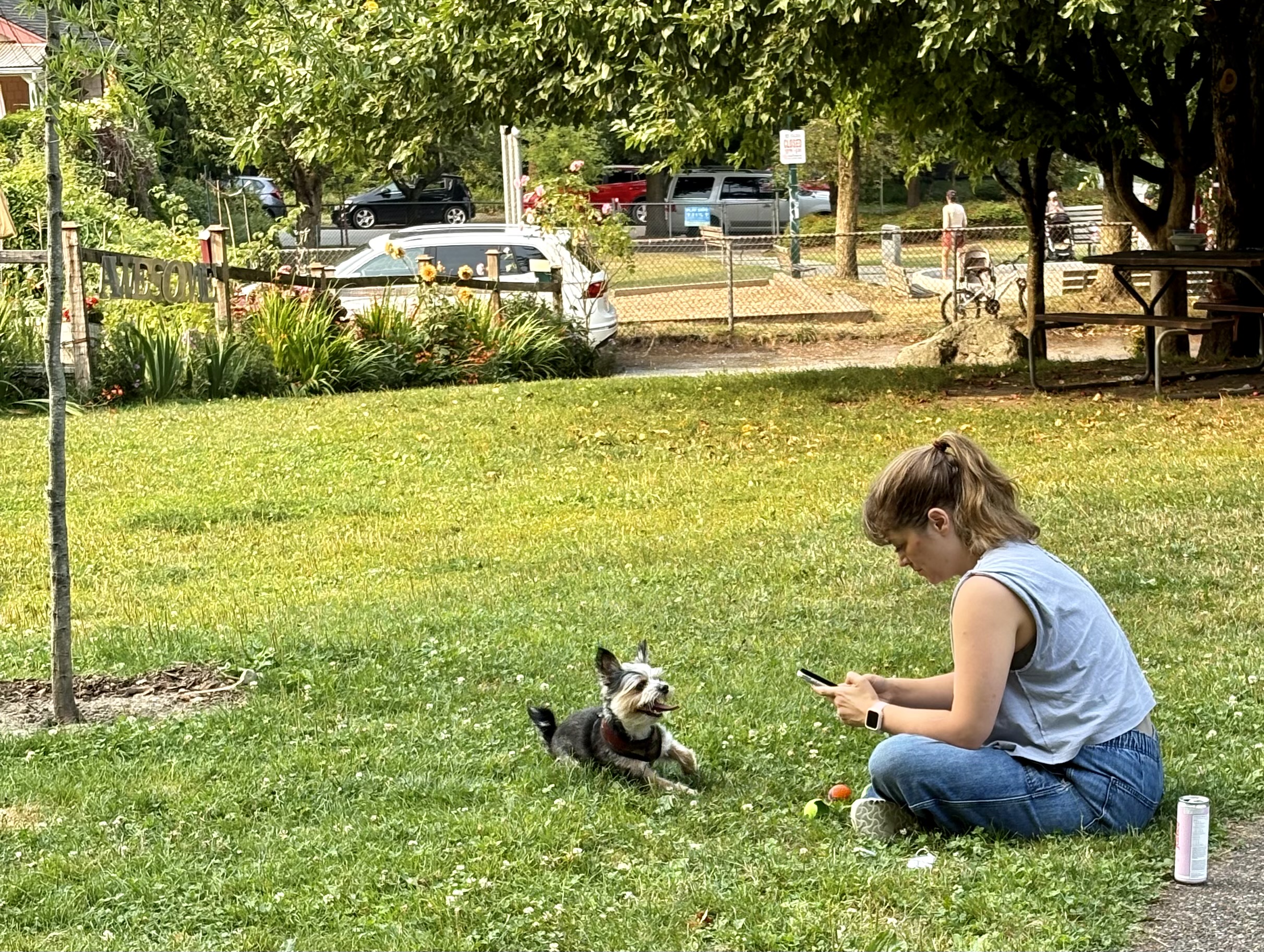
Far distance, a basic but well-used children’s playground; medium distance, the community garden with its allotments; foreground, a stretch of grass, where a mini-drama is being repeatedly played out.
The dog, again and again, fetches the orange ball, drops it in front of the woman, and then bounces & quivers to get her attention. The woman, again and again, briefly interrupts her scrolling to stretch out one hand, pick up the hurling stick, and send the ball flying. Happy woman, happy dog.
Beyond the park, some prayer flags in a doorway…
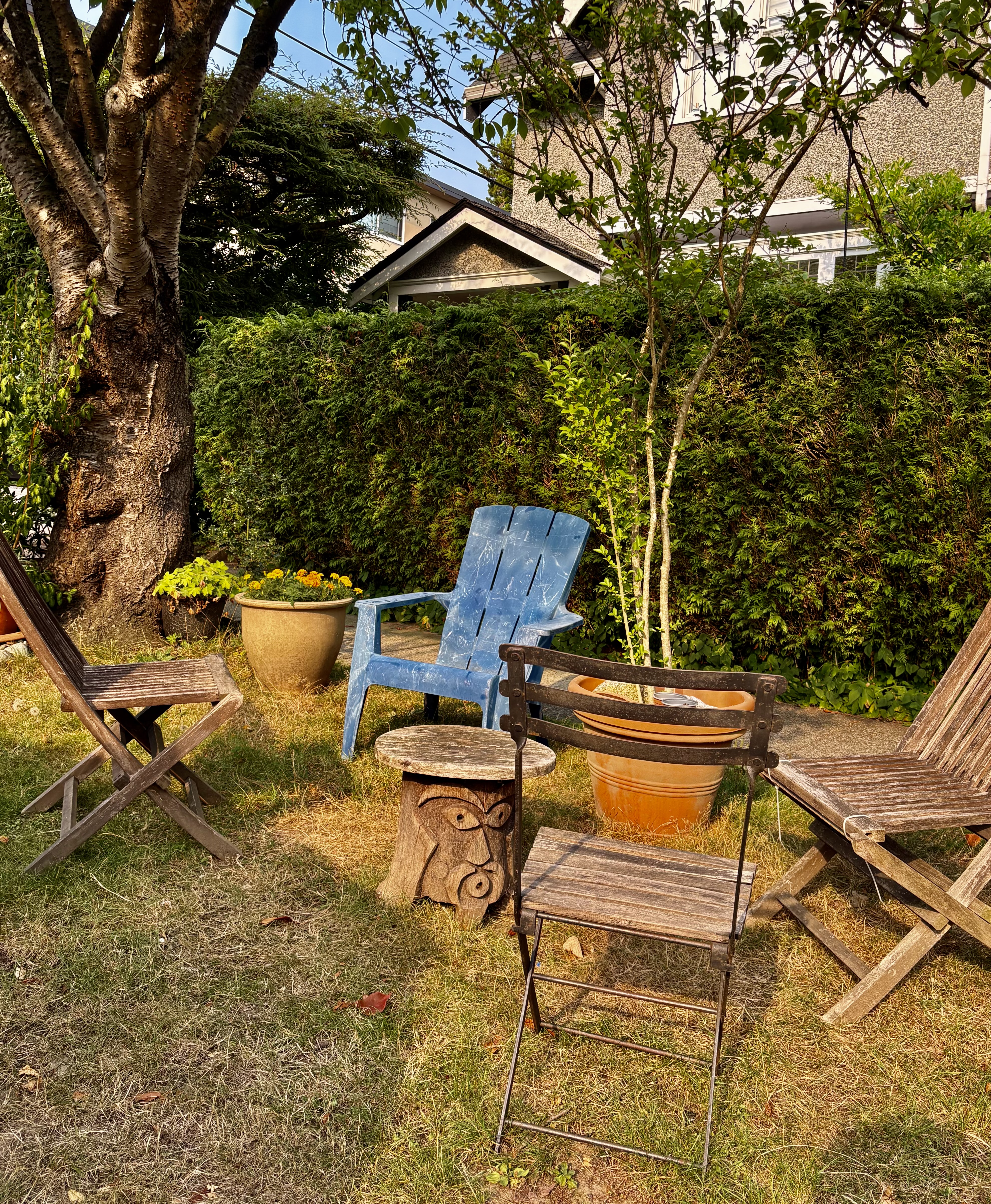
and beyond that, a time-out nook for pedestrians, complete with chairs, plants and a curious little table.
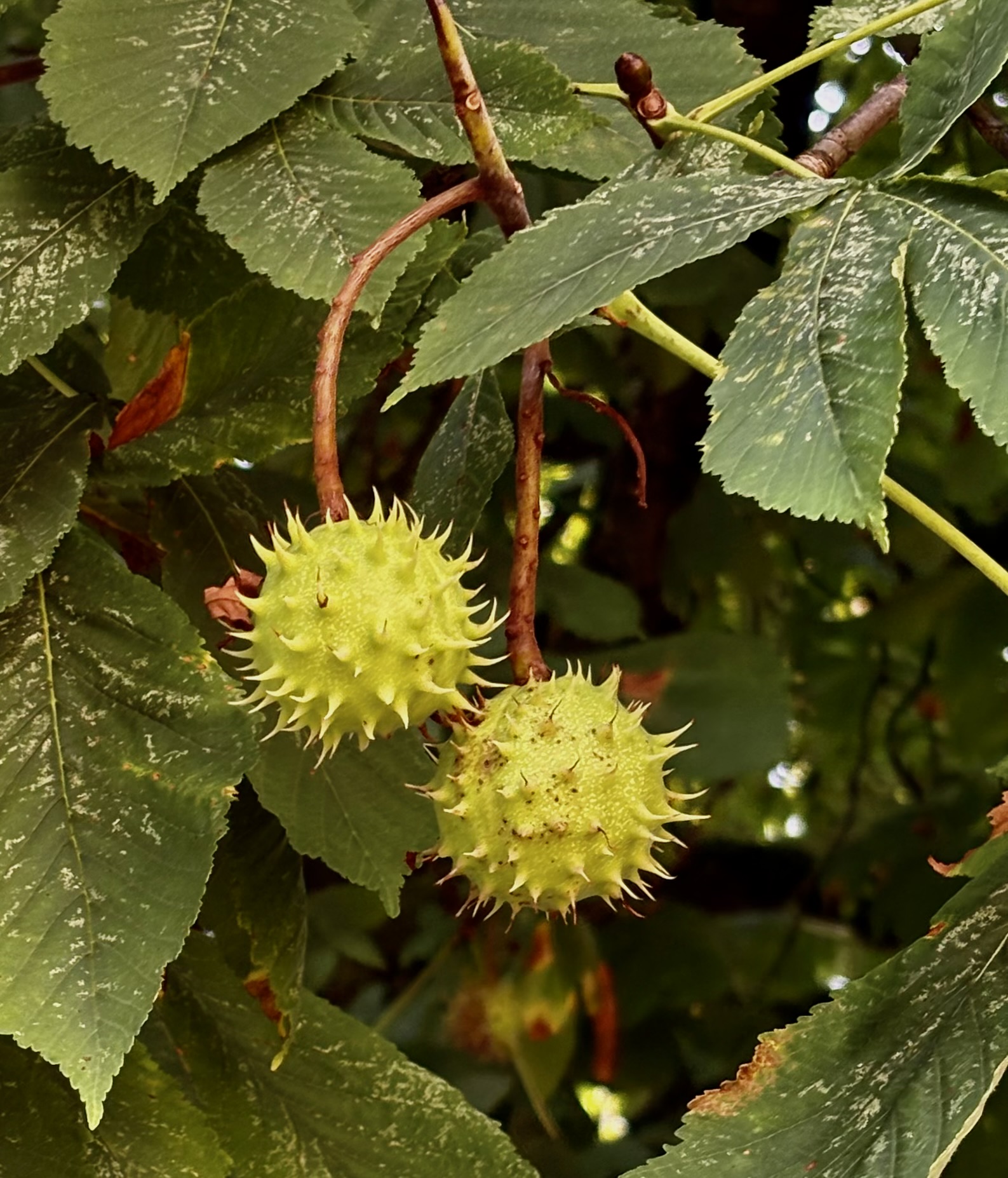
I walk under yet another towering Horse Chestnut tree.
Look!
All those spring “candles” are now turning into fall conkers.
Finally, finally, I am about to say farewell to Sophia Street.
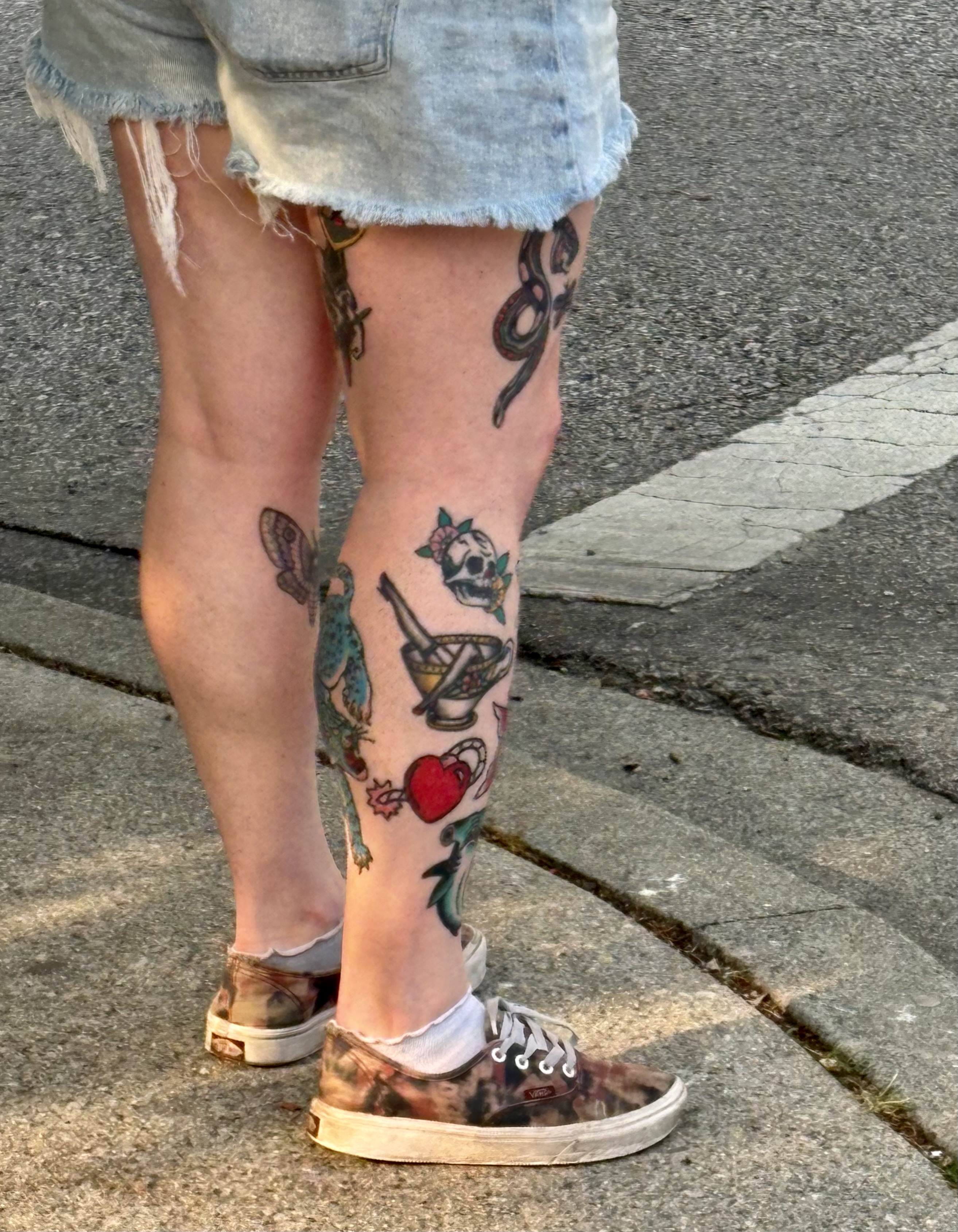
And to Tattoo Legs as well. She and I have been playing tag for blocks — she walks faster than I do, but I catch up at every red light.
My own legs tell me it’s time to go home. So I do.
13 August 2026 – An escaped balloon gets me thinking about “benign neglect.”
This is not what caused US political advisor Daniel Moynihan to coin the phrase, back in 1970. In a memo to then-President Richard Nixon, he suggested that the issue of race relations “could benefit from a period of benign neglect.” Not surprisingly, it was controversial, and is still argued today — both his own good/bad faith intentions, and the consequences over time.
My mind is not there. My mind is on this blue balloon.
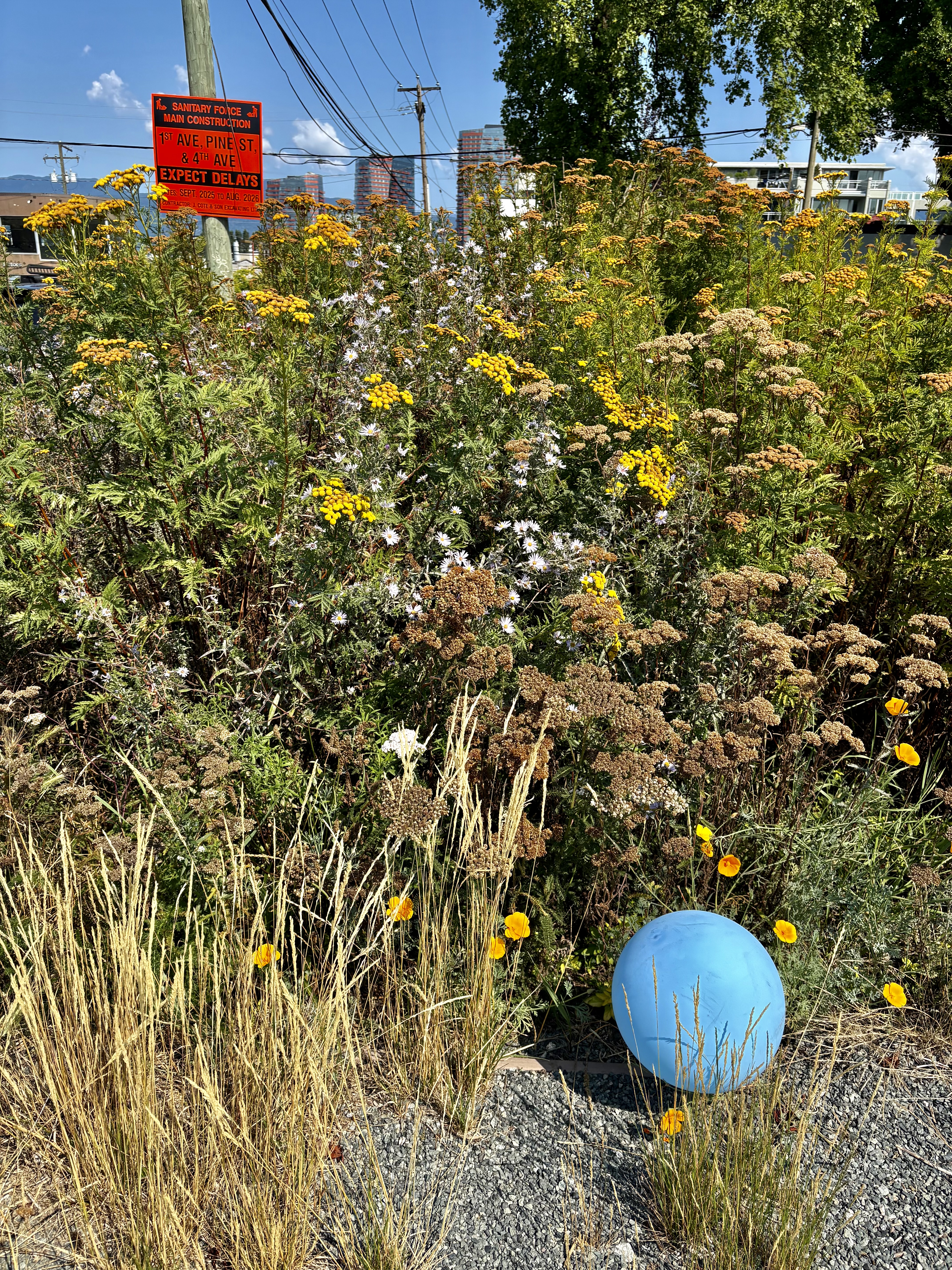
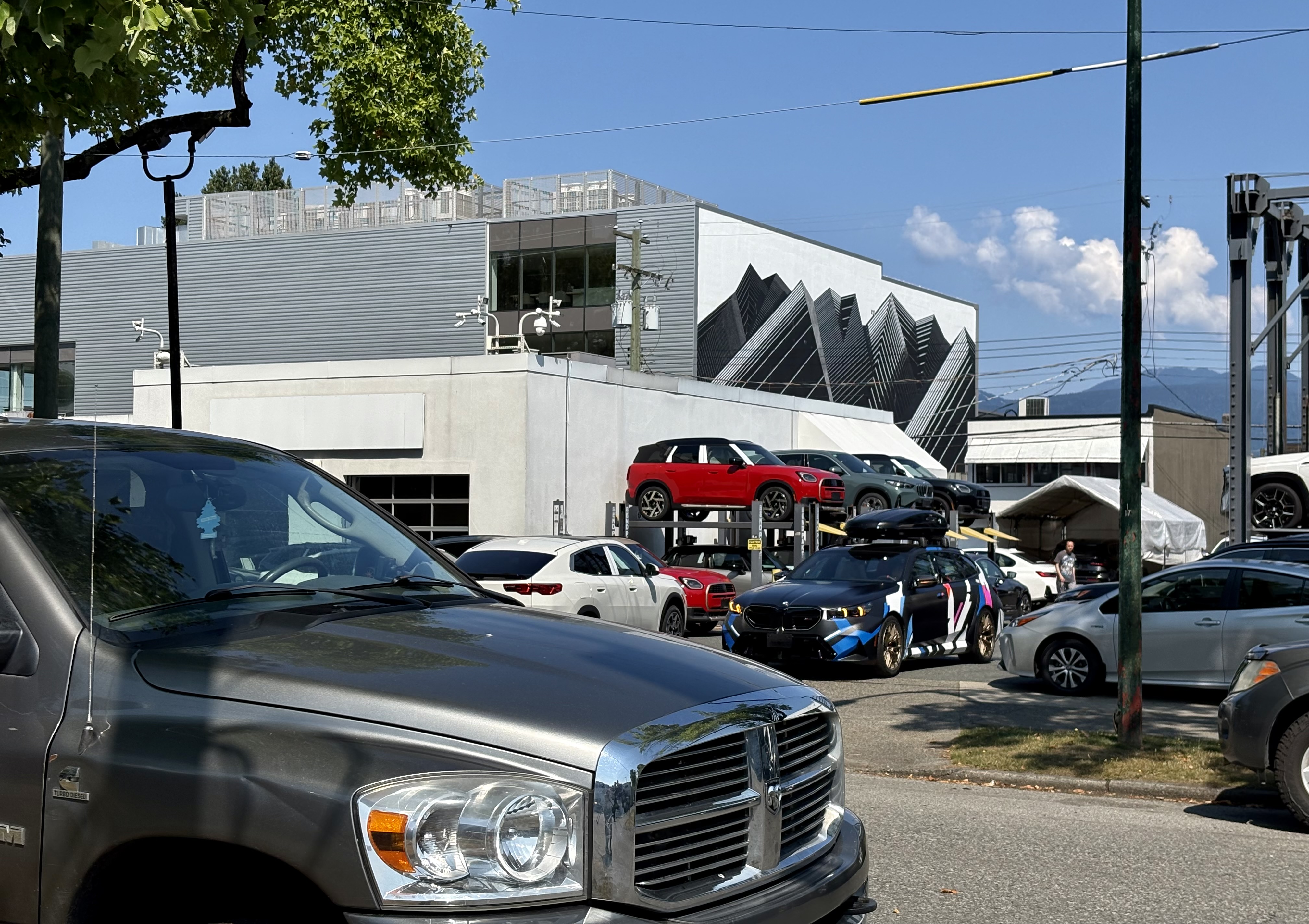
I am at the corner of Pine and West 6th, early for an appointment and therefore with time to kill. What better than a bit of a bimble into the Arbutus Greenway? That’s the plan, but then, as I’m about to cross Pine and enter the Greenway, I look north on Pine and get distracted by a blue balloon.
OK, first I am distracted by the double hit of blue: car plus balloon. Then I focus on the balloon. And then I focus on what is all around it — the happy eco-consequences, for this street corner, of human neglect.
I start to explore. I’m smiling at everything, even though I can’t identify any of it.
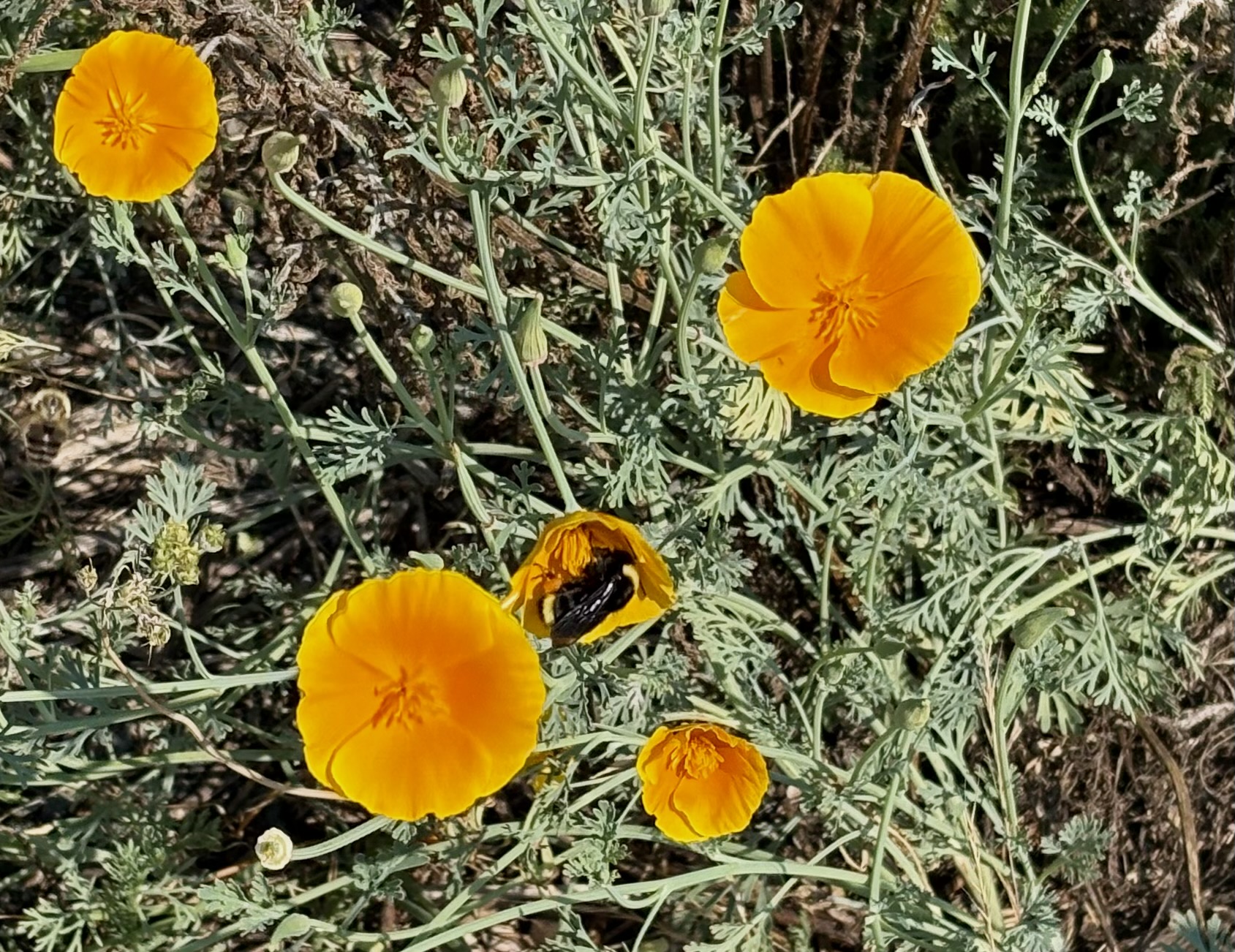
Not entirely true. I can identify a bee when I see one, and I am seeing a great many.
Like this guy, dragging down one of these bright orange flowers.
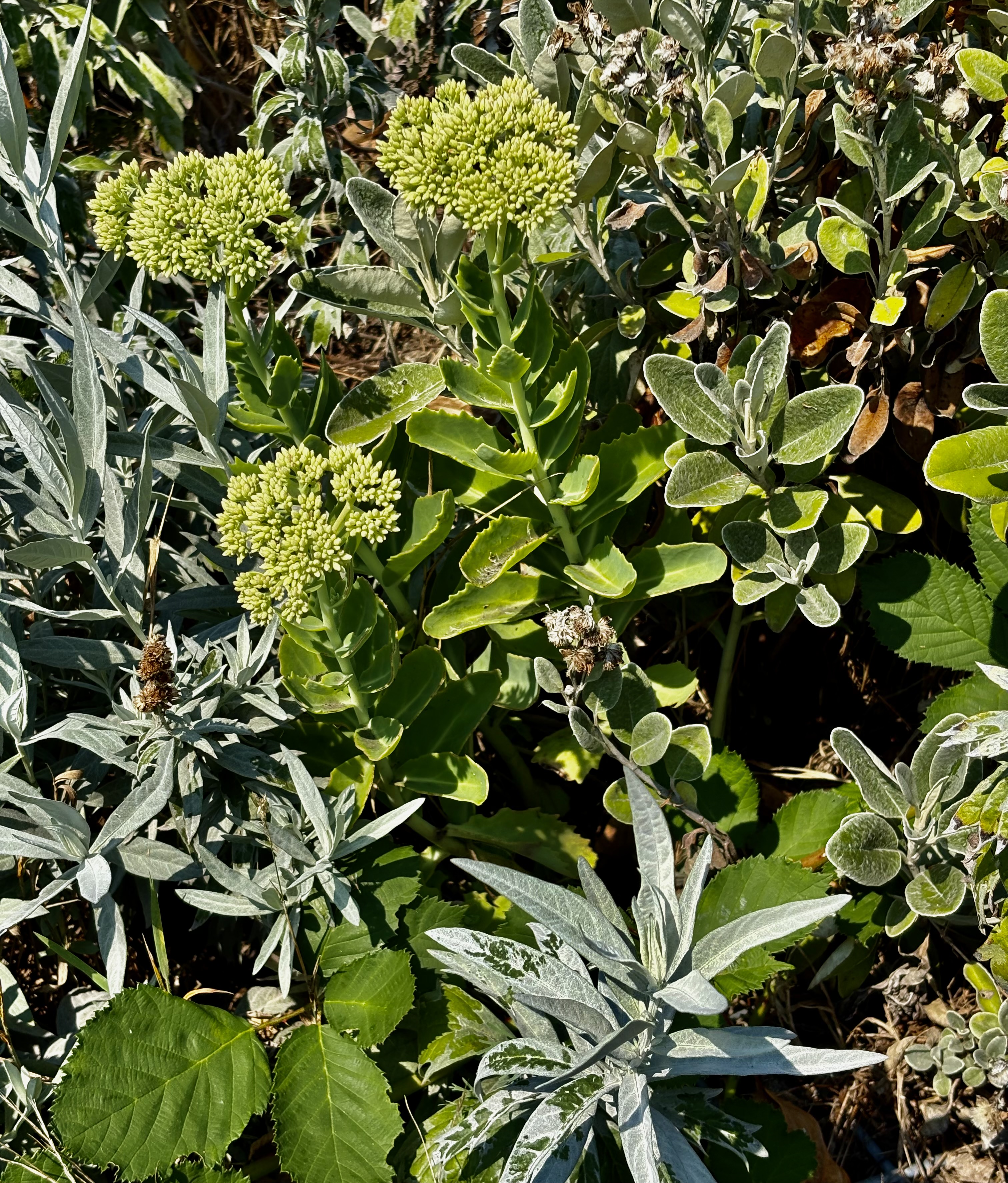
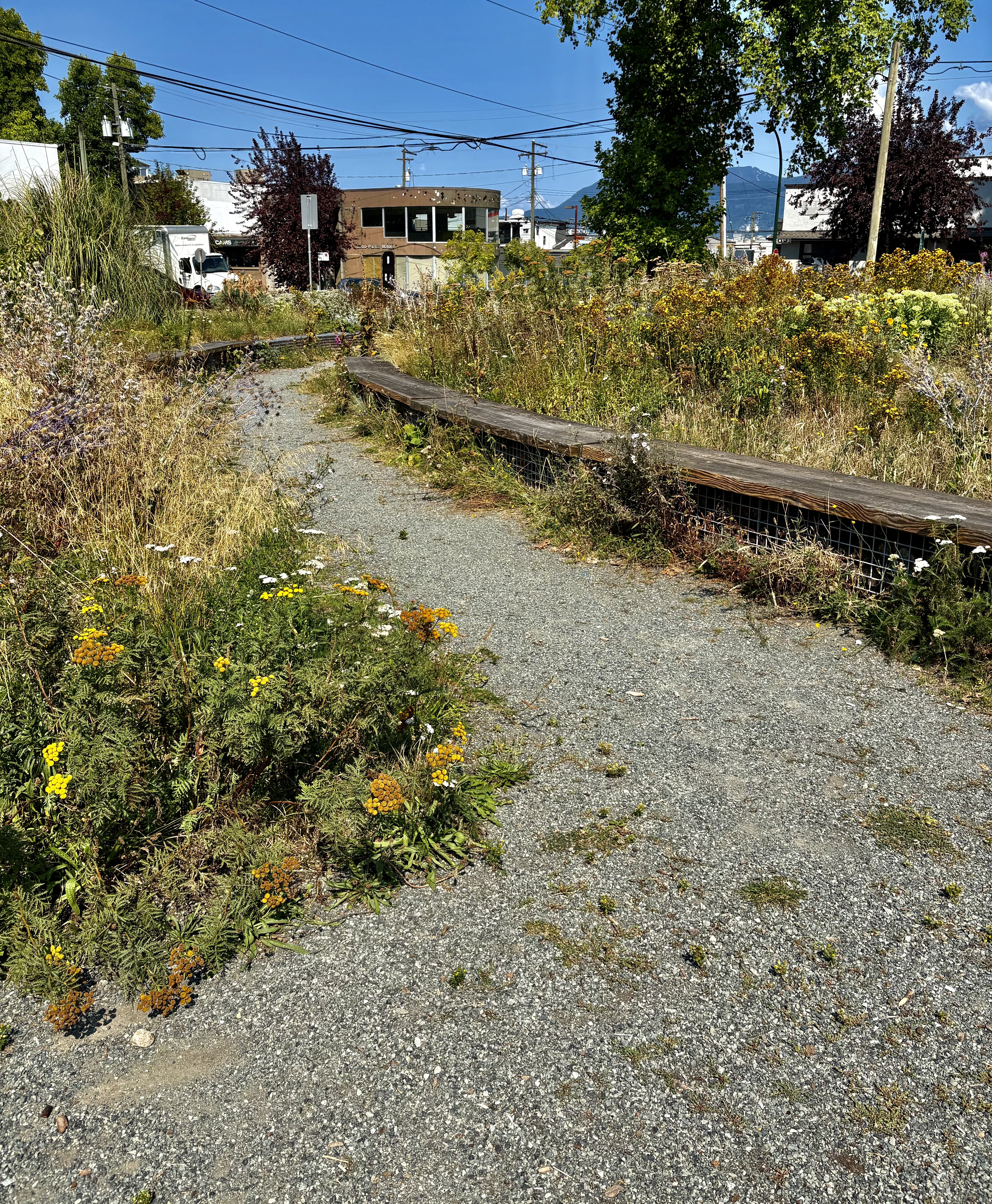
A late-summer abundance of shaggy growth. There is cool green-&-silver elegance to be had…
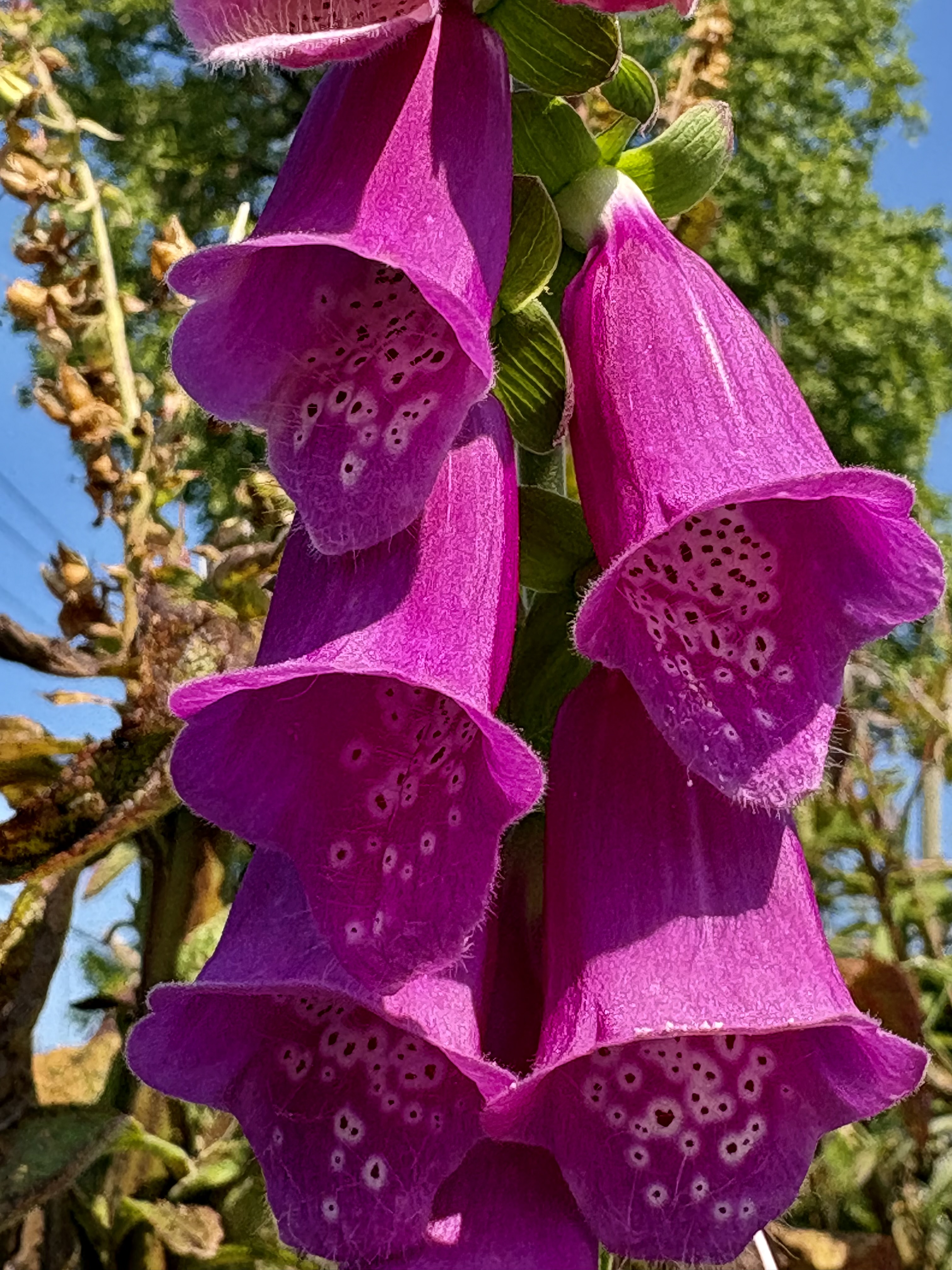
and also the hot flamboyance of magenta.
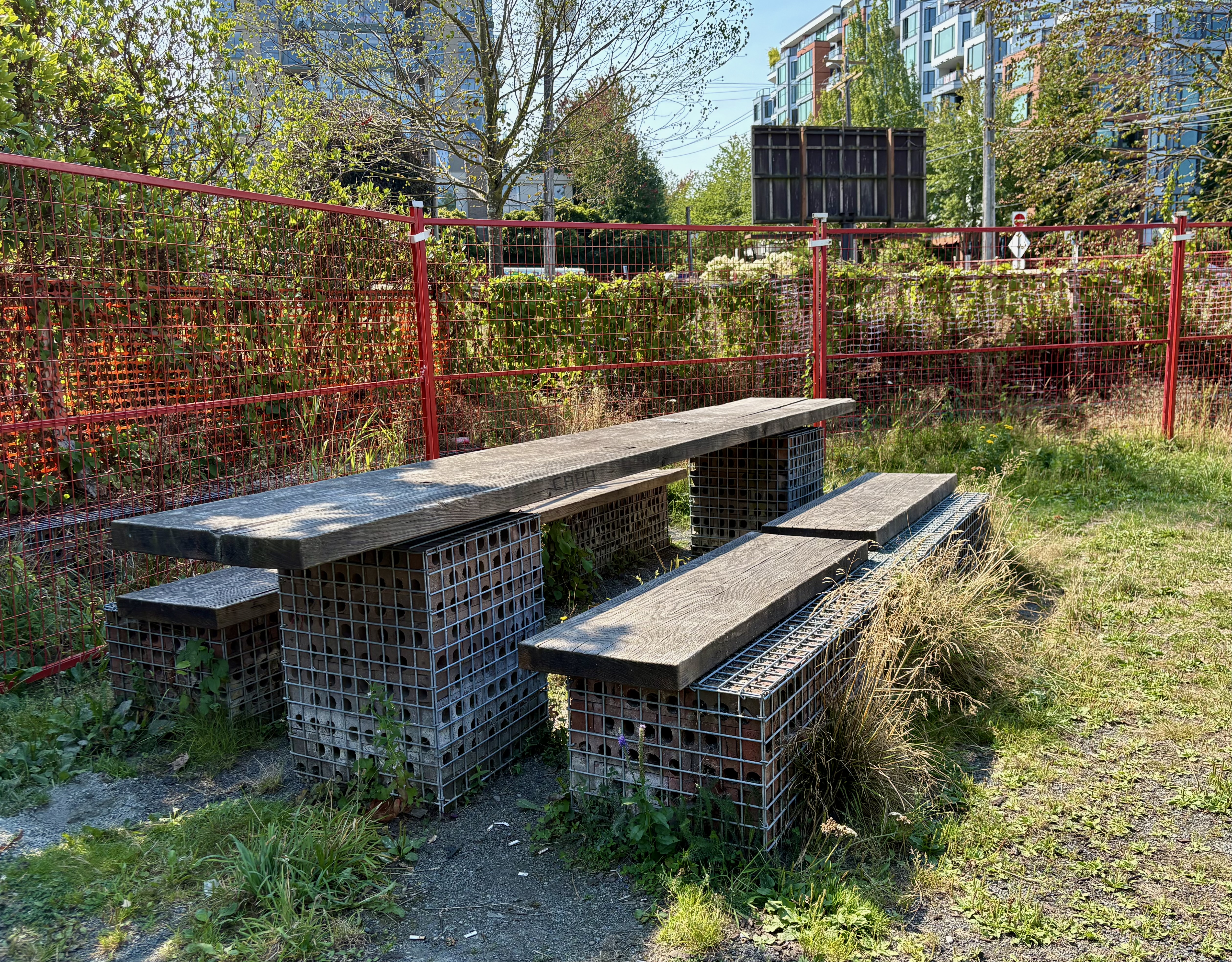
I turn my back on Ms Flamboyance, and notice that there is a degree of human intervention after all: a picnic table and benches.
Severely functional — weathered planks atop metal grids filled with rubble — but also elegant. Designed. And, look, there’s a pathway, edged with the same design signature.
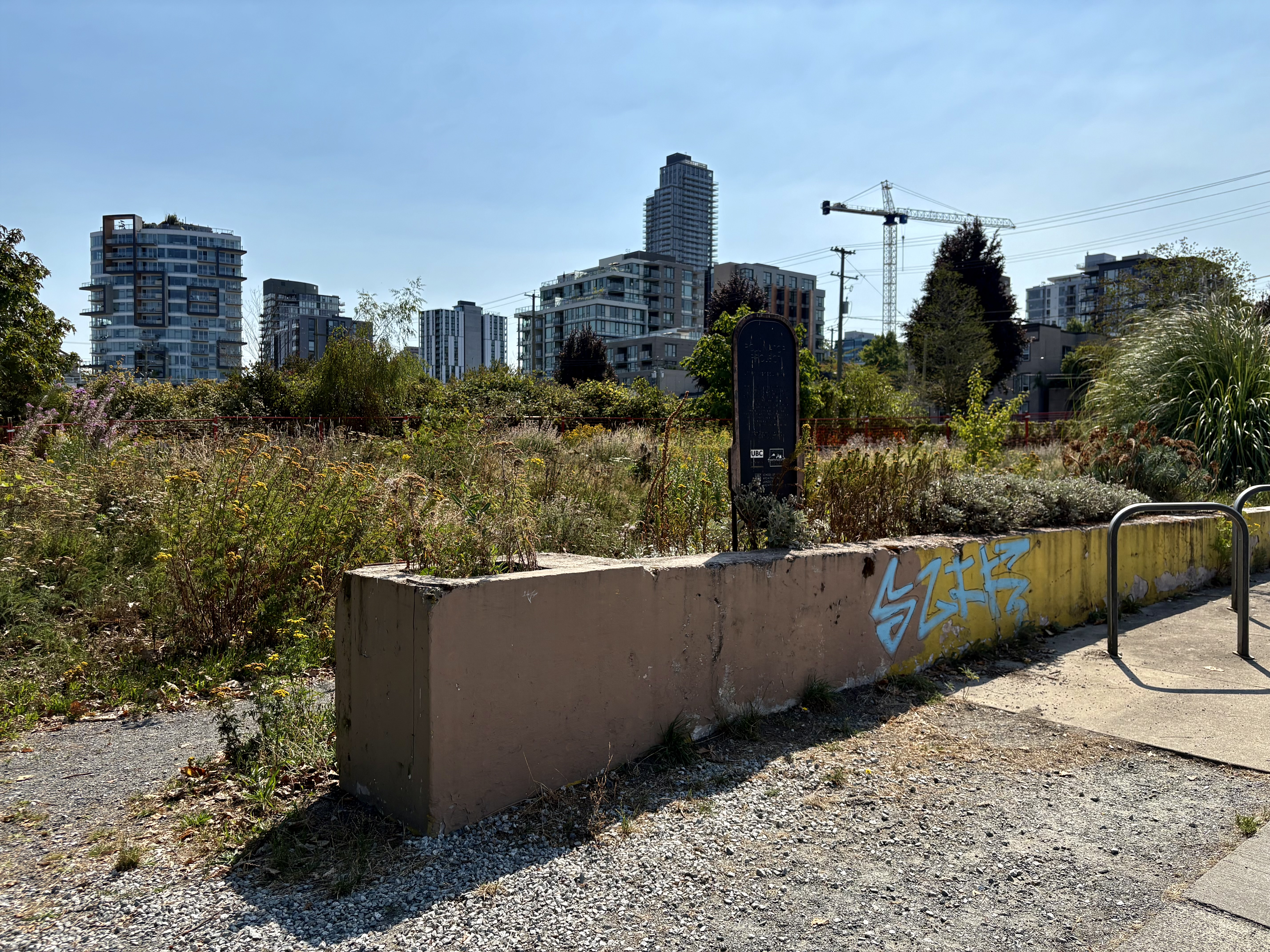
I follow the path out to the corner of Pine and West 5th where I see both a line of grubby concrete blocks and a weathered black plaque.
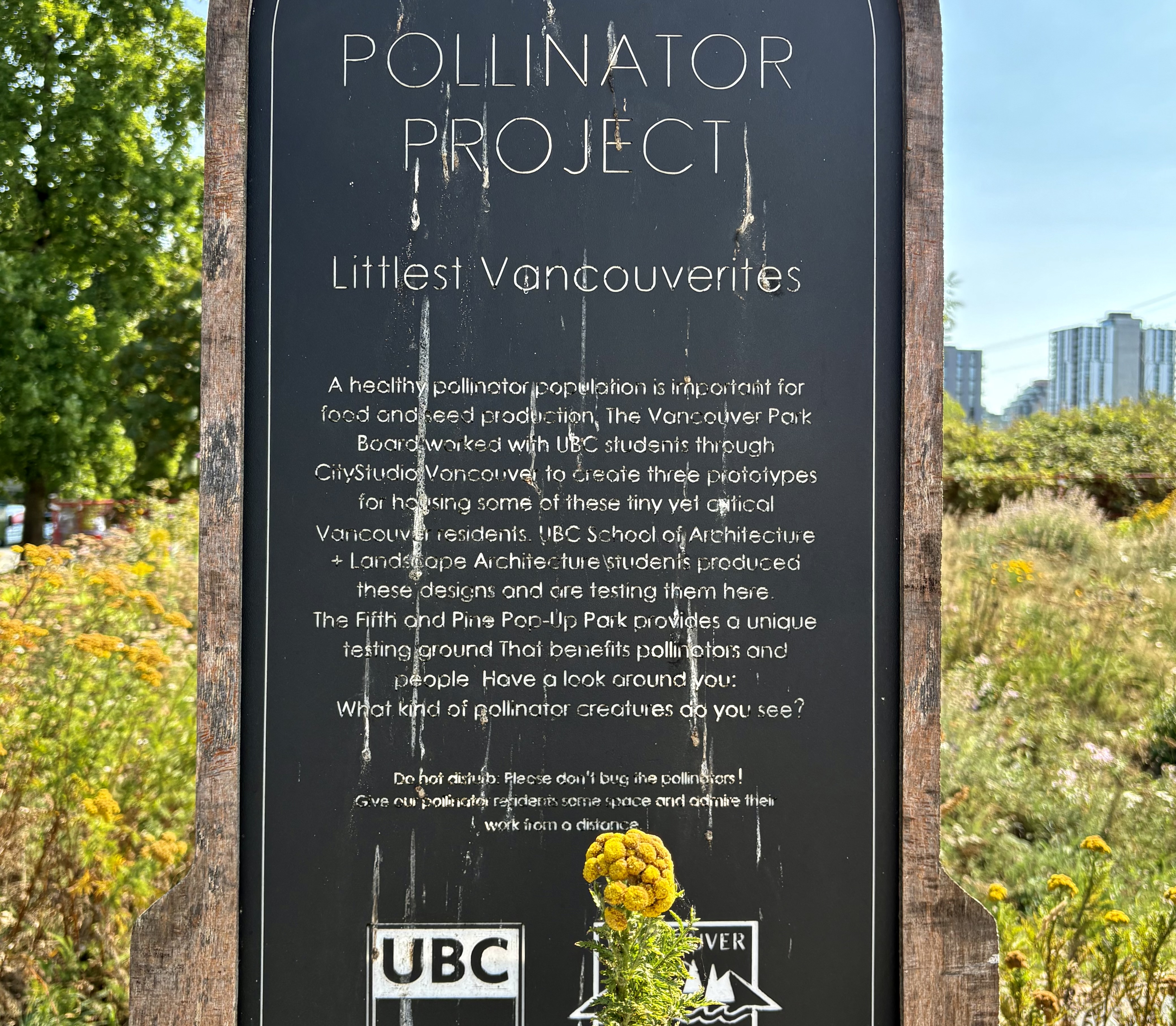
I read the plaque.
And it all makes sense. It’s a pollinator project in a pop-up park. By the look of it, the project was established some years ago, and since then has benefitted from human inaction. The benign consequences, for nature, of human neglect. Indeed, the plaque urges non-action upon us: “Do not disturb. Please don’t bug the pollinators…”
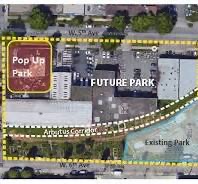
Later, at home, I read more. This street-corner project is a good decade old by now, and slated to be incorporated into a new park, Burrard Slopes. (On this 2016 Park Board map, it is still place-marked as “Future Park.”)
I am still too early for my appointment. I walk west on West 5th, back into the busyness of the city…
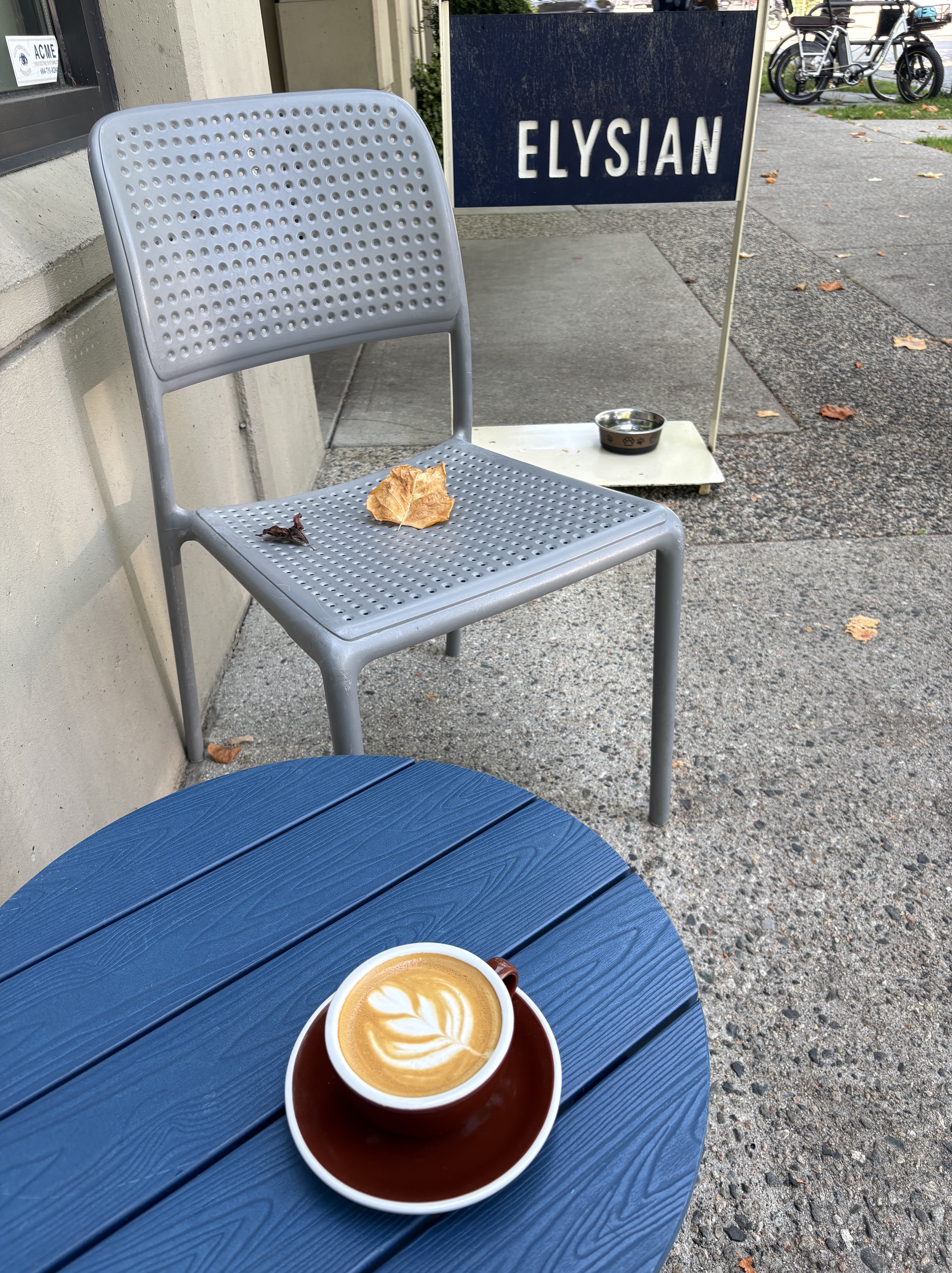
and very agreeably fill the last 15 minutes of spare time with a latte at Elysian Coffee, over on Burrard Street.
See the dog bowl, under the Elysian sign? Yrs Truly took in a near-empty bowl, waited for the barista to refill it, and returned the full bowl to the sidewalk.
Benign neglect has its place. So does benign activism.
26 July 2026 – It is no longer hot and not yet raining. I am out the door.
Out the door with only the vaguest of plans, but at least the intention to capitalize on this moment of walkable weather. False Creek north shore why not, but farther on down the creek than my casual Cambie Loop and a return by ferry. Also why not.
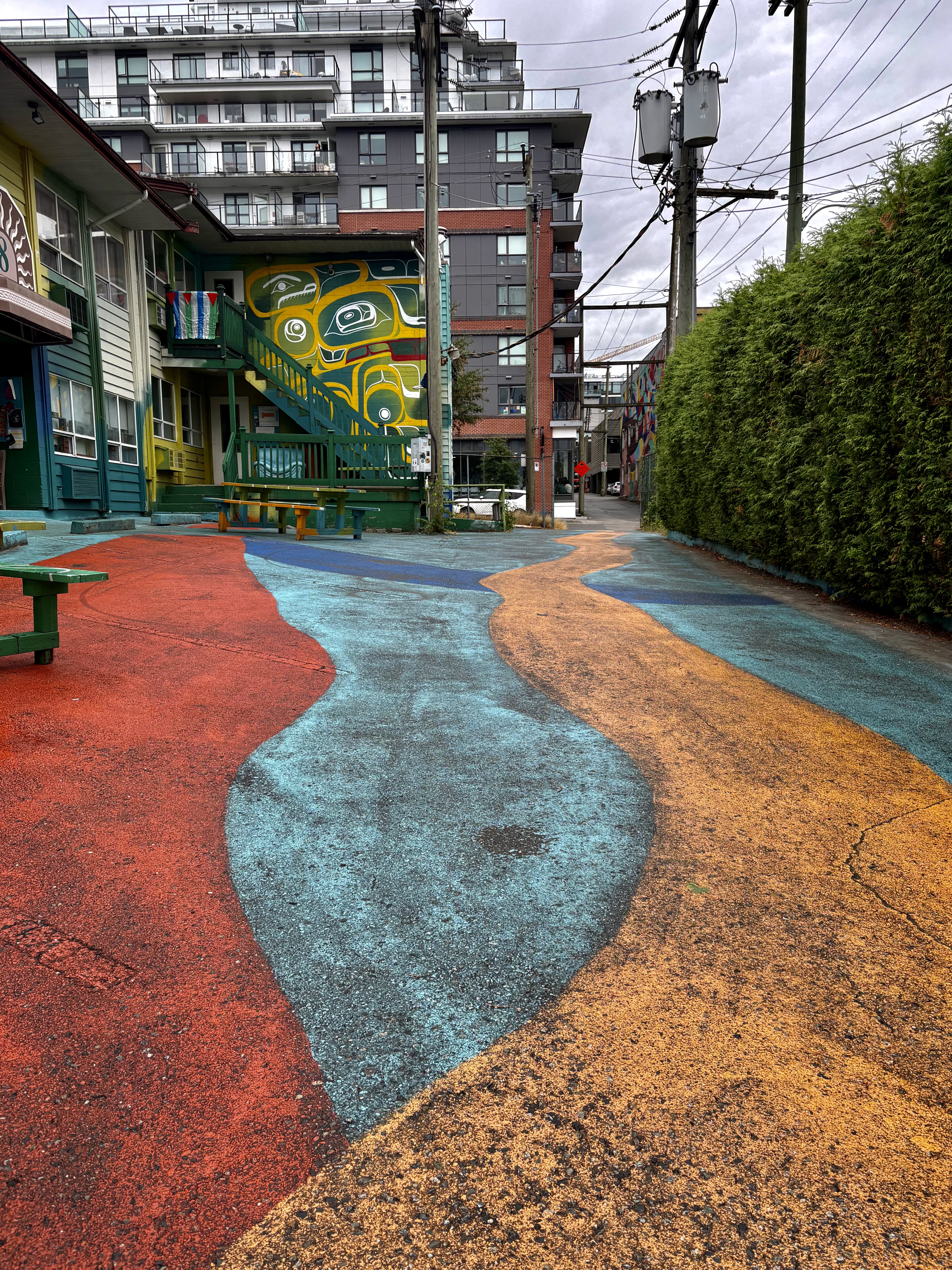
Lots of flexibility in the plan, which I promptly celebrate with an extra loop into/around City Centre Artist Lodge — long a city motel, slated for razing & redevelopment, meanwhile the entire complex is covered in murals and its 79 units are reborn as low-rent artist studios.
Rivers of colour, on the walls and on the ground.
When I get to real water, it is silver-grey.
I’m now at False Creek, the eastern end that proves it is a false creek not a real creek at all, just a whopping long inlet, and here’s the end of it. To my east Science World; at my back Creekside Park; immediately west of that, an exercise in PR:
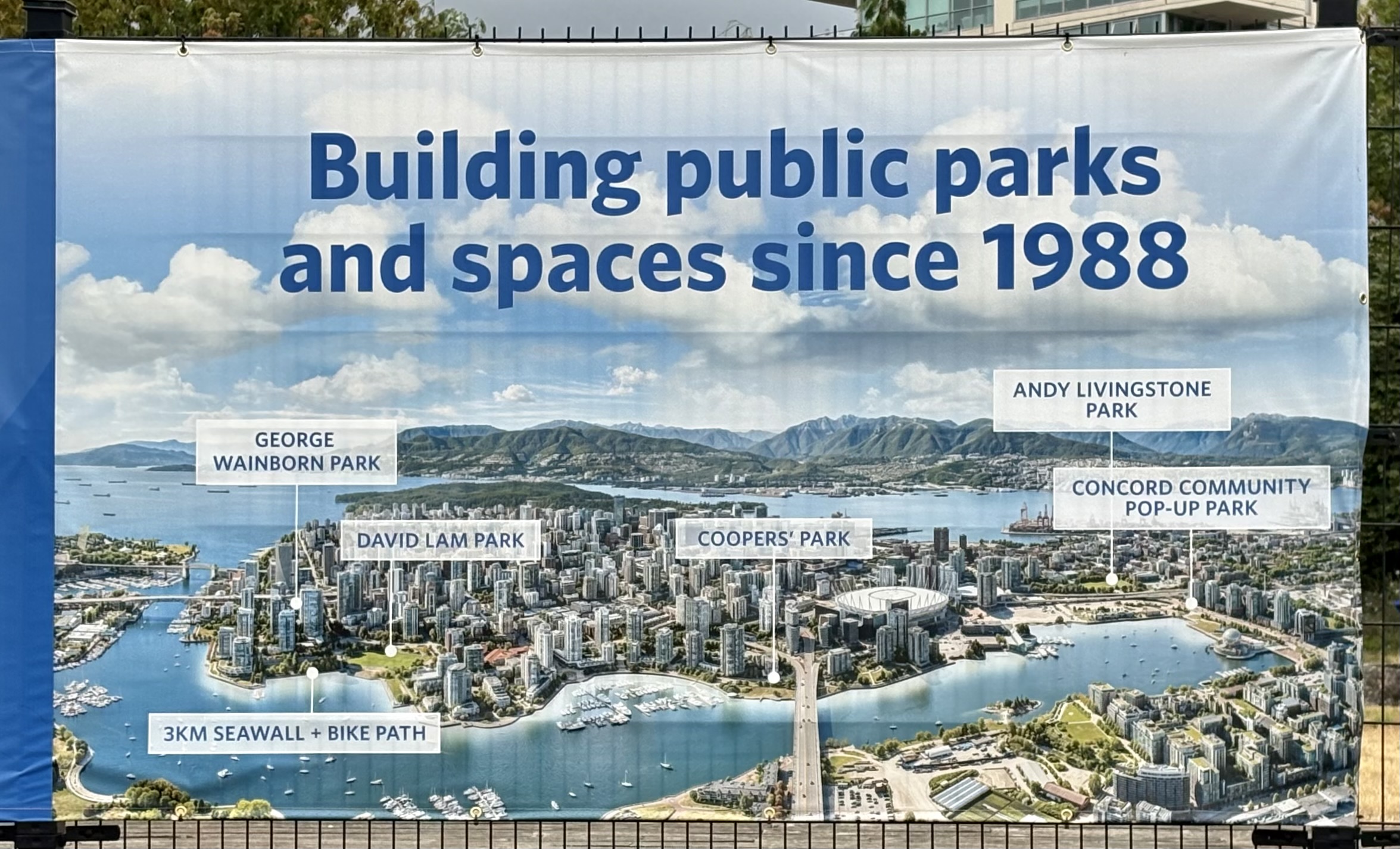
The map excludes Creekside Park since this development corporation didn’t create it, but it does feature their own “Community Pop-Up Park” right next door. I grr-grr slightly about the use of “pop-up” to describe a park that will continue to be here for some years yet — even as I recognize it’s an exercise in managing expectations. Don’t get too comfy, folks! it tells us; we will eventually be building on this land.
But not yet. So, meanwhile, I eye the map and let it inspire me. I’ll at least walk past Cambie Bridge and Coopers’ Park, at least to David Lam Park. Maybe farther?
I don’t know it yet, but the answer is yes. Farther.
I’ll carry on past George Wainborn Park, under those two distant bridges (Granville and Burrard, respectively), past this map’s named territory, all the way to Sunset Beach before doubling back to a ferry dock at the Aquatic Centre.
Probably under the joint influence of map plus planned ferry-ride home, I begin noting where I am in terms of those two sets of landmarks.
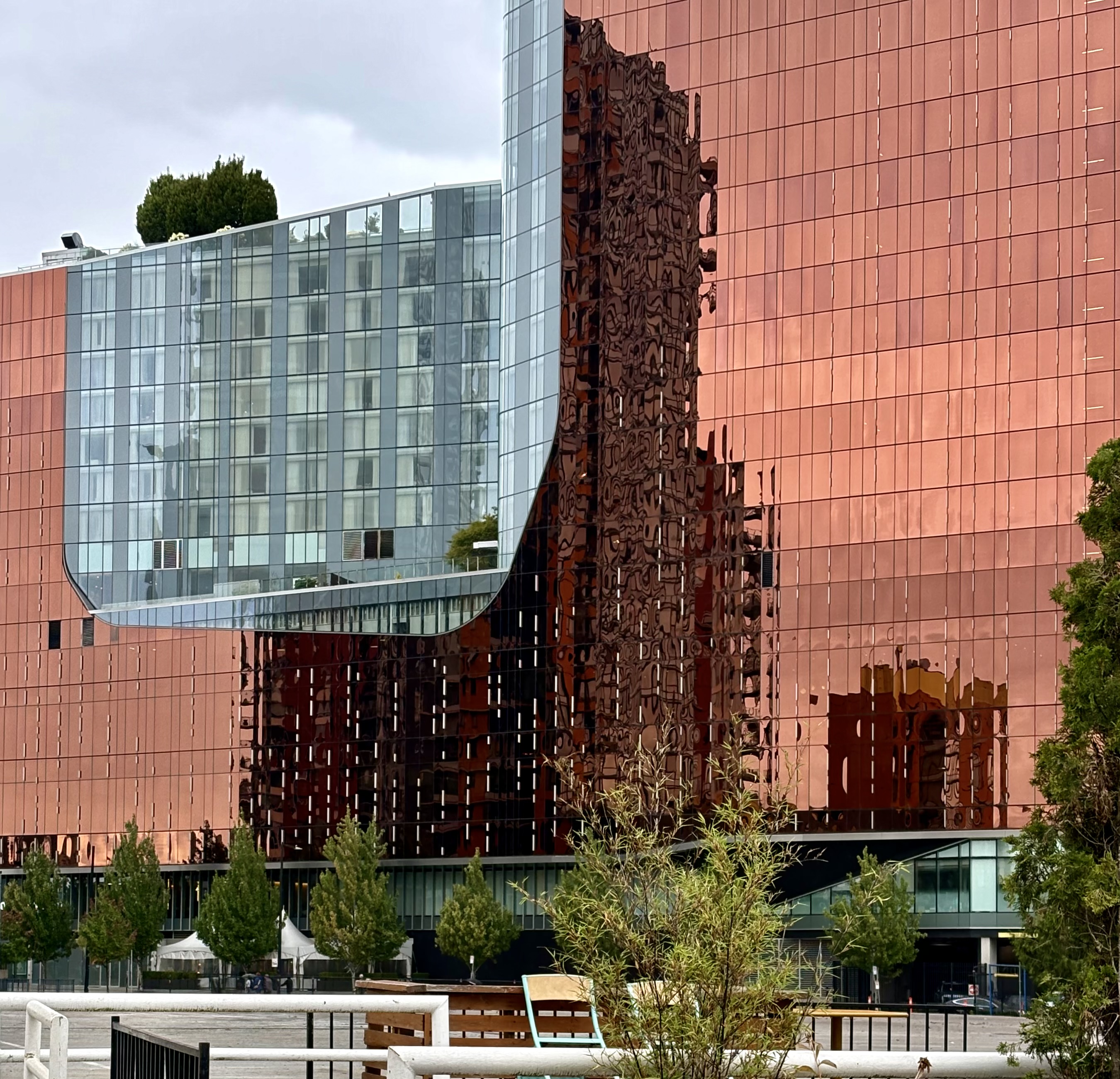
Parq Casino, for example, with its splendid reflections…
is located just behind the Plaza of Nations ferry dock, east of Coopers’ Park.
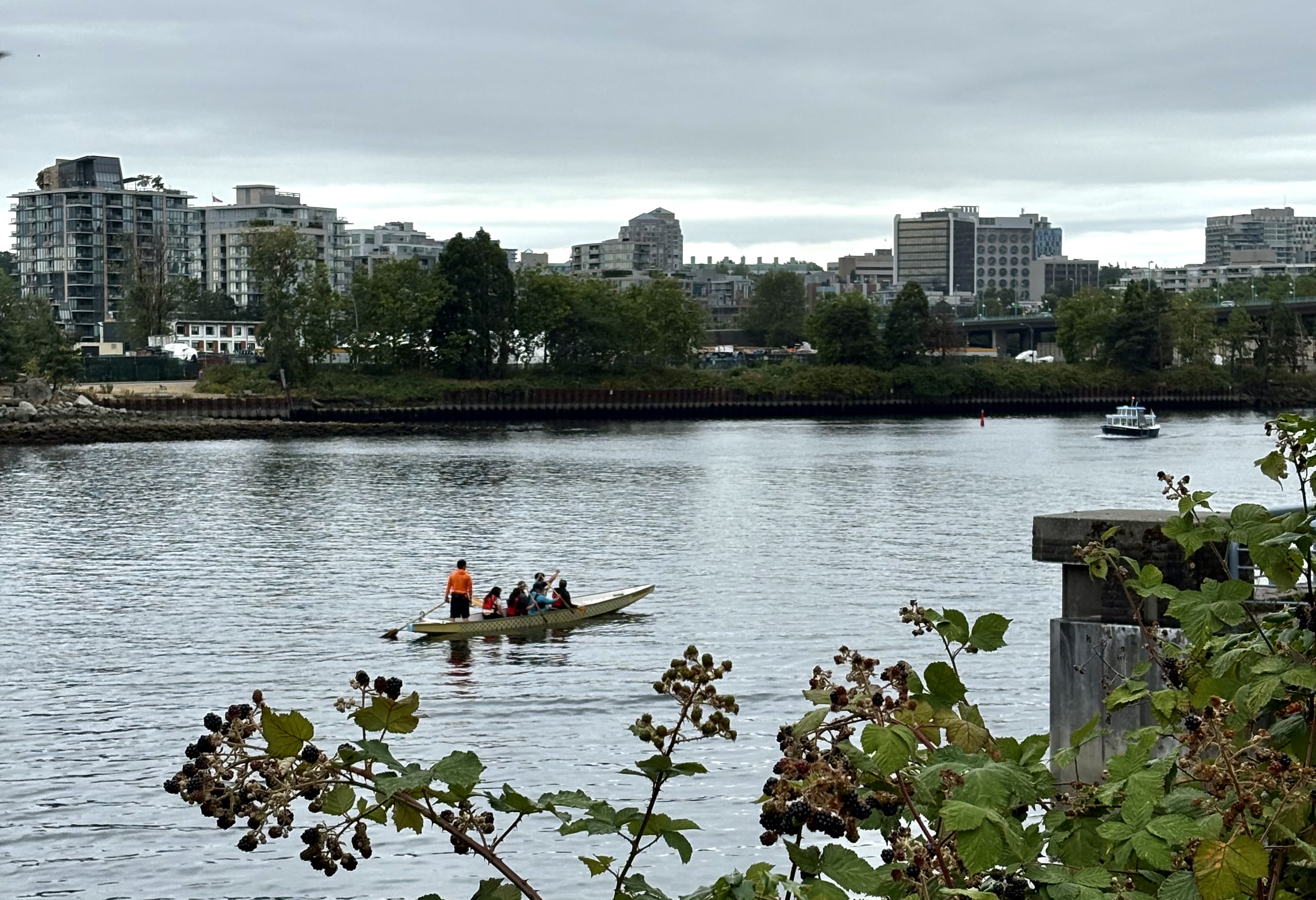
A bit farther west, mid-park, I eye this dragon boat in some amazement. It’s just sitting there! I’m used to seeing them furiously in motion.
I want motion? I get it.
Coopers’ Park (on the footprint of Sweeney Cooperage and Saw Mill, which operated here until 1981) includes a playground, right under Cambie Bridge. The playground is closed these days, for upgrade work on the bridge — but that doesn’t mean nobody is playing.
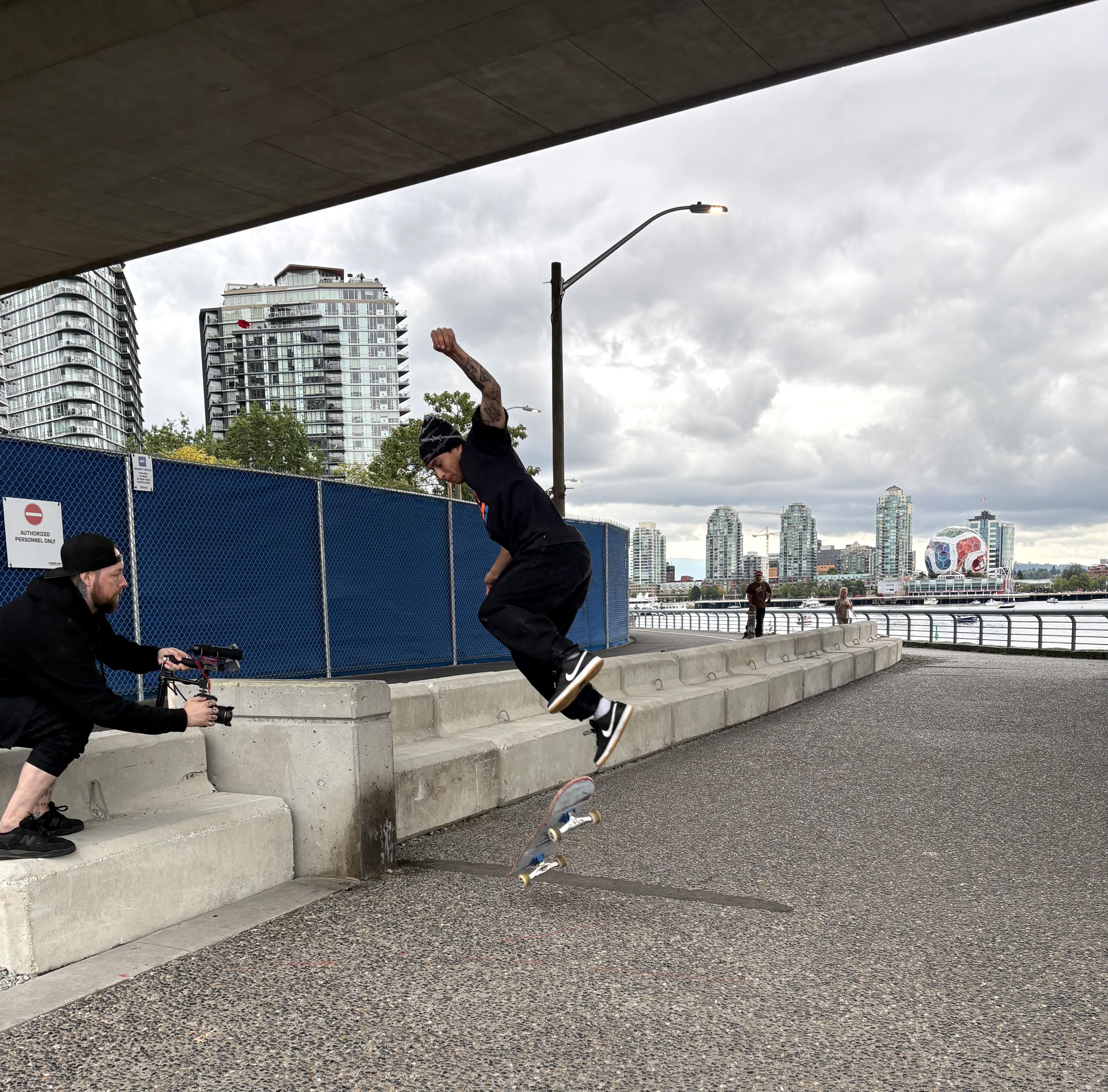
Skateboard city on the detour path! With two young skateboarders taking turns, and one photographer filming their jumps.
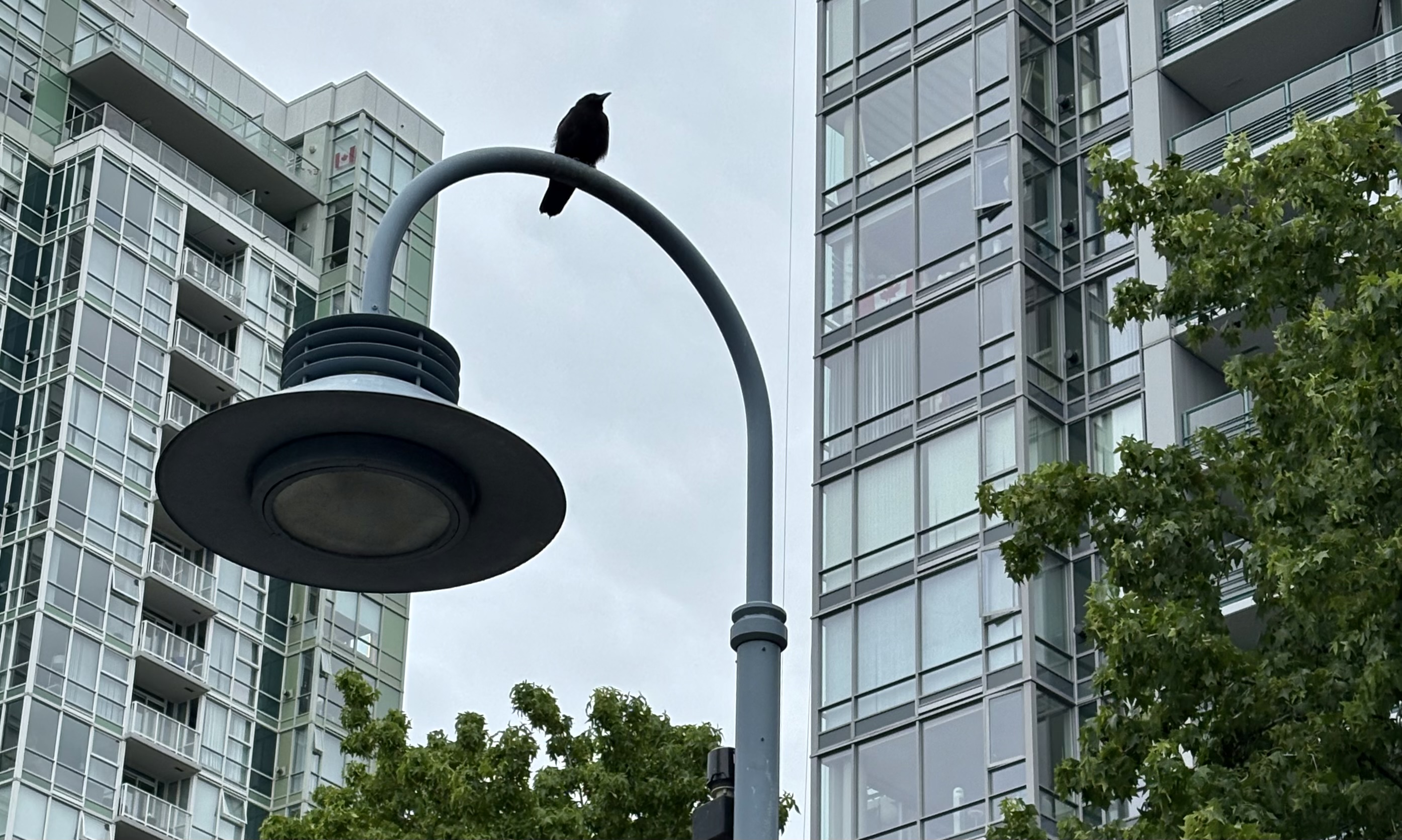
Watching Seawall action, yet another crow, on yet another lamp post.
I happen to see him as I approach the Yaletown dock, midway between Coopers’ and David Lam parks, but he could be anywhere.
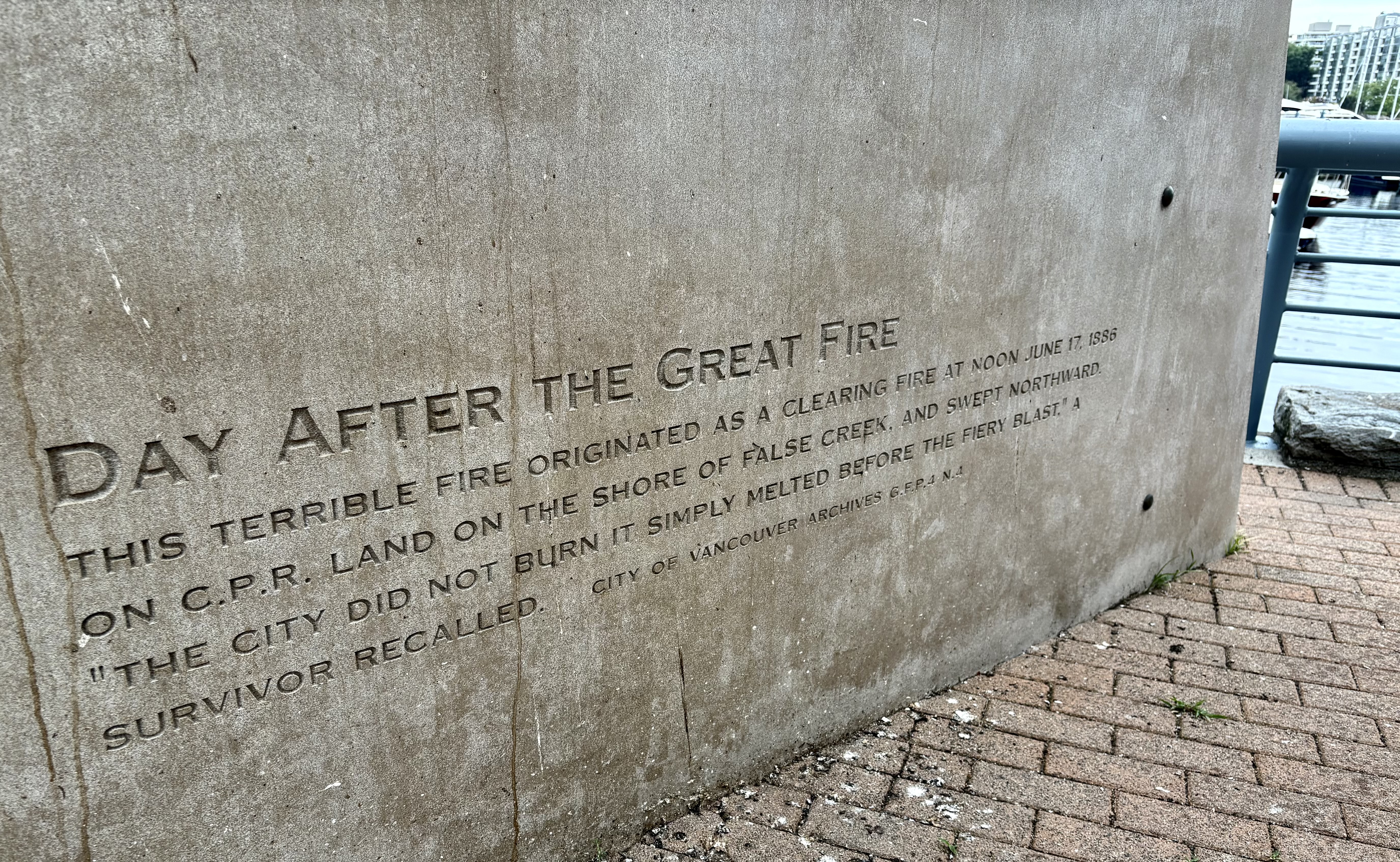
Each time I’m at the Yaletown dock, I read another of the incised historical vignettes. This one reminds us of the Great Fire of 1886, when a fire set to clear brush instead razed the entire community.
(Reader alert: I later look up further references, including the link above, and discover discrepancies in the data, even in the June date itself. )
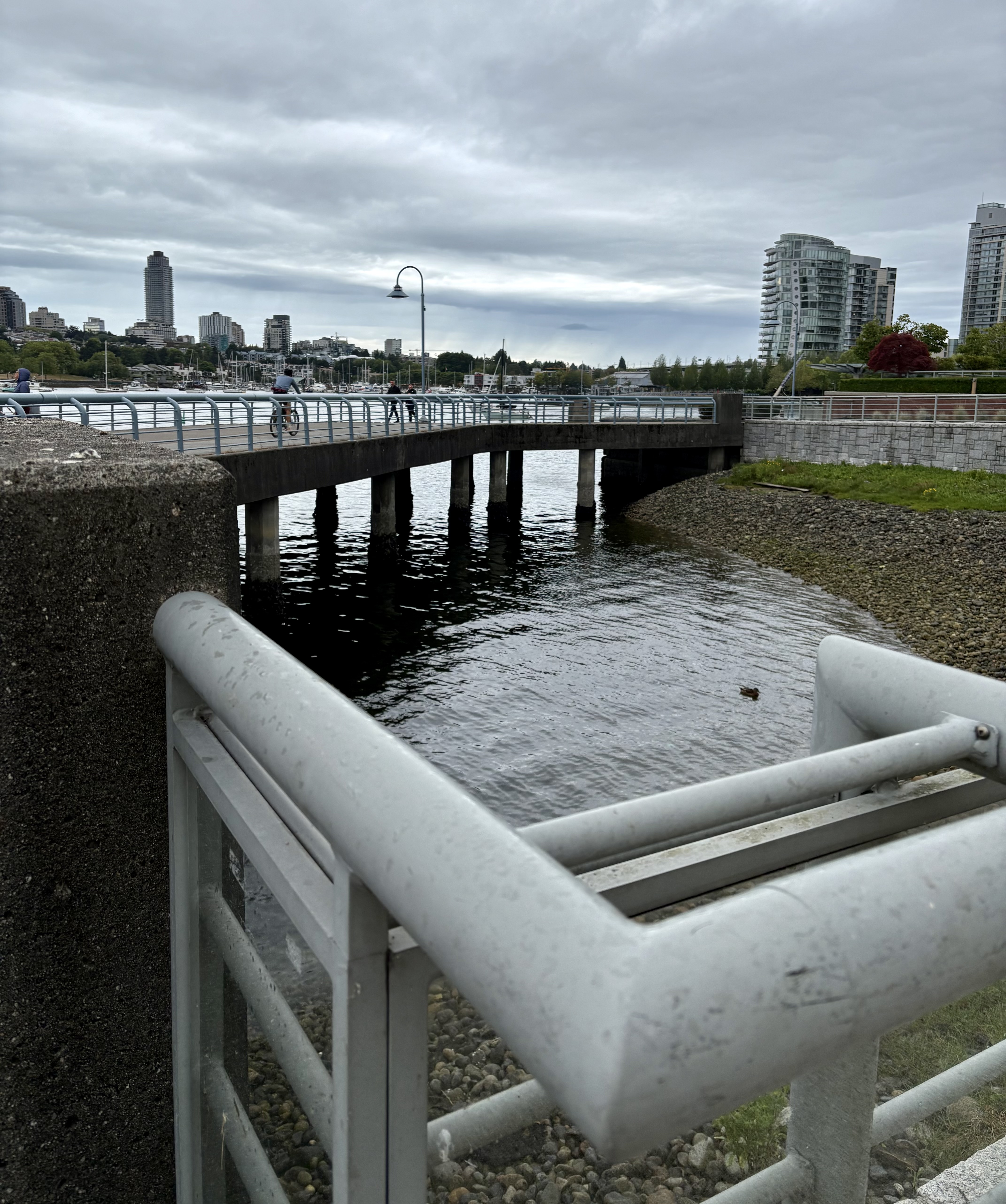
More small discoveries as I go, including this mini-causeway as I round the curve that will give me my first view of the eastern end of David Lam Park. (It’s been here all along; I’ve just never noticed it.)
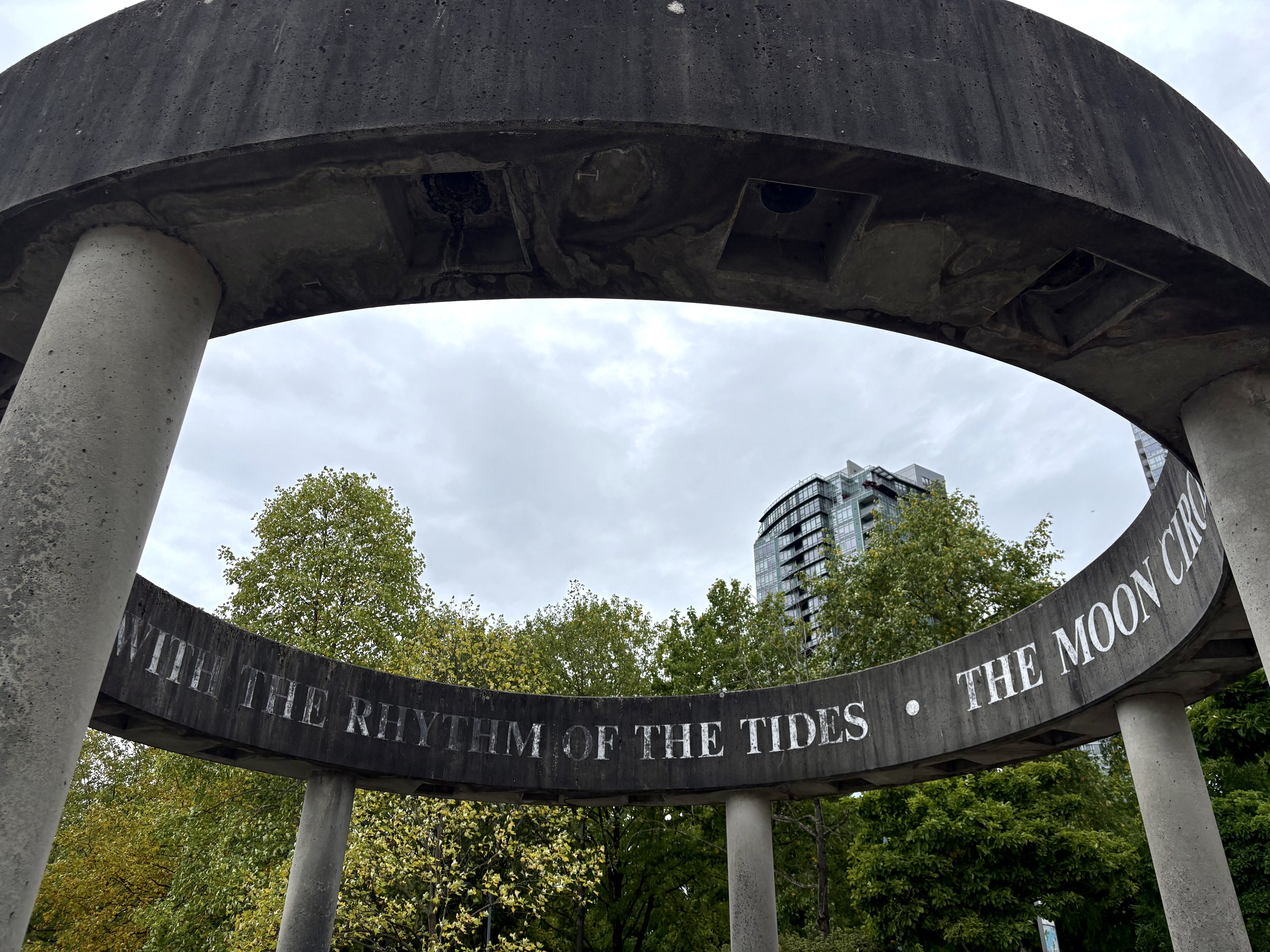
The David Lam shoreline contains two of my favourite False Creek sculptures — more precisely, the twin elements that comprise one art installation:Marking High Tide and Waiting for Low Tide, by retired landscaped architect turned sculptor Donald Vaughan.
I pause to read, as always, the words written around the High Tide concrete ring, set on tall pillars. “As the moon circles the earth the oceans respond with the rhythm of the tide.”
This time I also note, crossly, how grubby it now looks. I’m all for new installations, all for upgrades — but could we please also maintain what we already have? Even if you just give them a scrub, every now and then?
On west I go, on and on west, past George Wainborn Park and under the Granville Bridge…
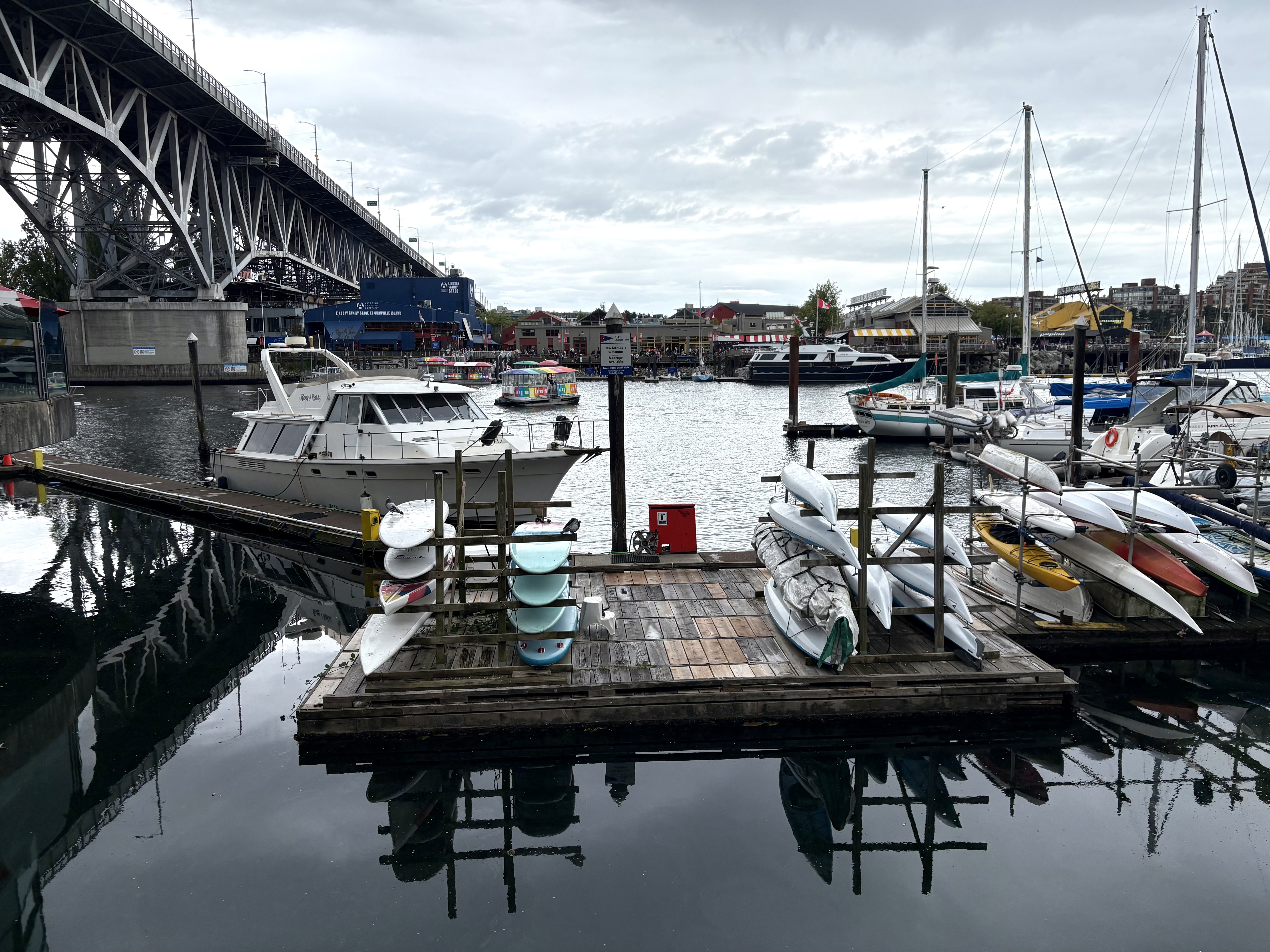
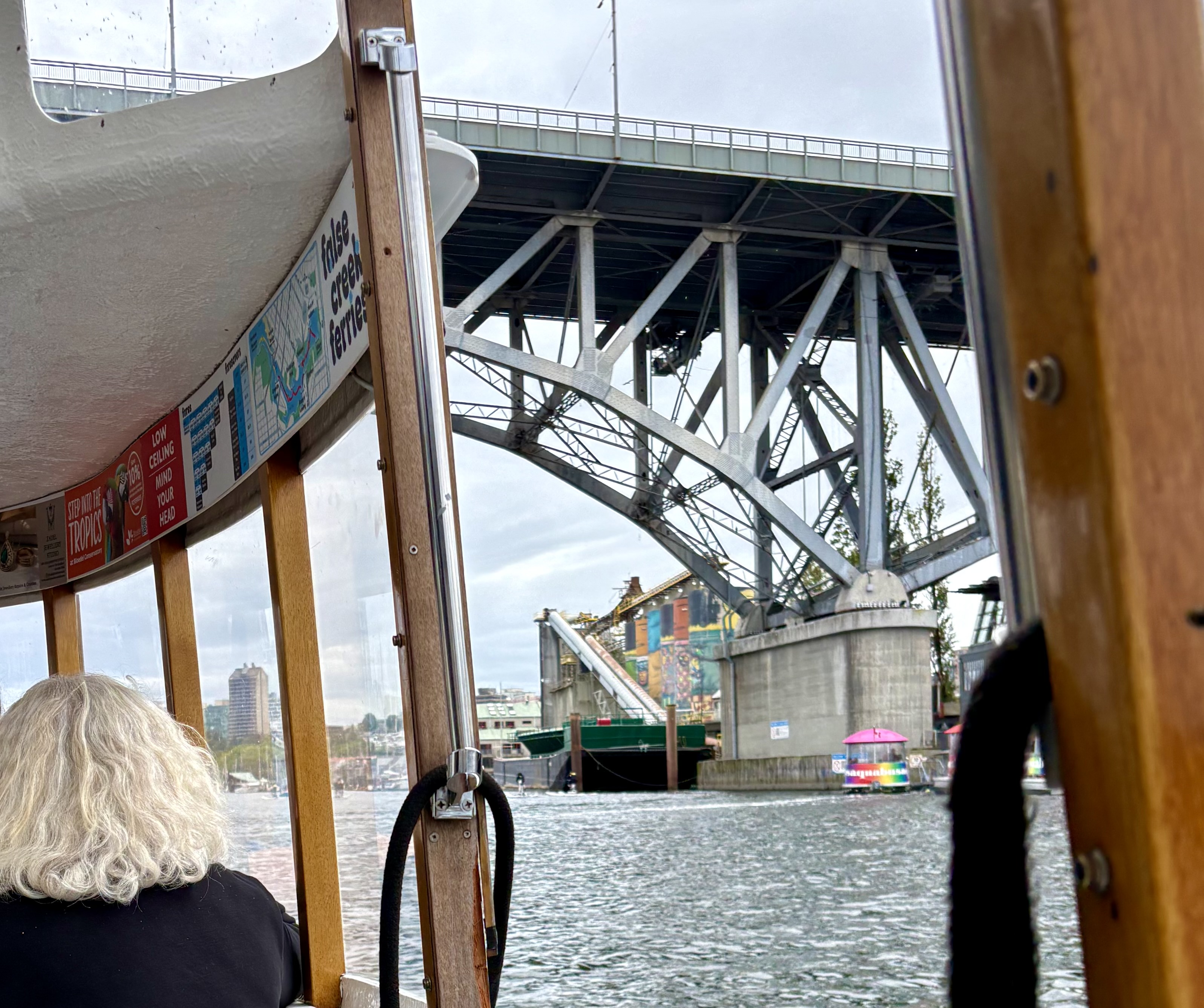
with its slam-damn view of all the activity across the water on Granville Island, in the water itself, and among the marinas and complexes here on the north side.
Things are markedly tonier than they were farther east, and private property suddenly disrupts the public Seawall. Arrows direct us around these towers; signs politely tell us that if we instead insist on walking through the grounds, we are to keep moving.
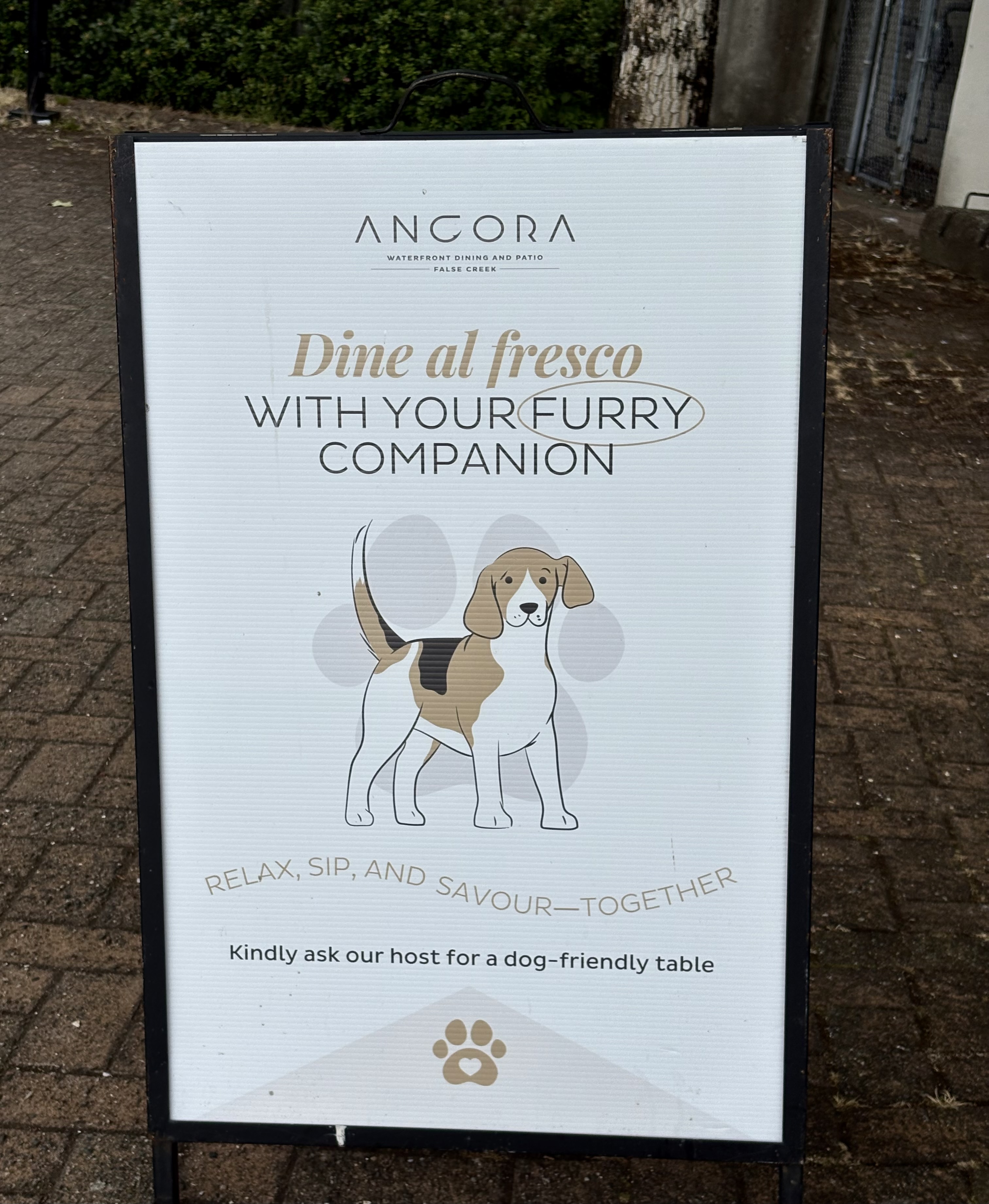
I walk through. I stop moving long enough to contemplate the sidewalk promo for Ancora, which on one side advertises its sake/oyster offerings, and on the other…
invites diners to bring their dogs.
I decide not to spend time sulking about the fact that dogs are more welcome, in this enclave, than I am.
My non-sulk policy is promptly rewarded. Back on public-access Seawall territory, at the foot of Hornby Street, I see a cheerful, handwritten invitation to walk half a block up Hornby and visit the inBtwn Café. I am charmed. I walk the half-block.
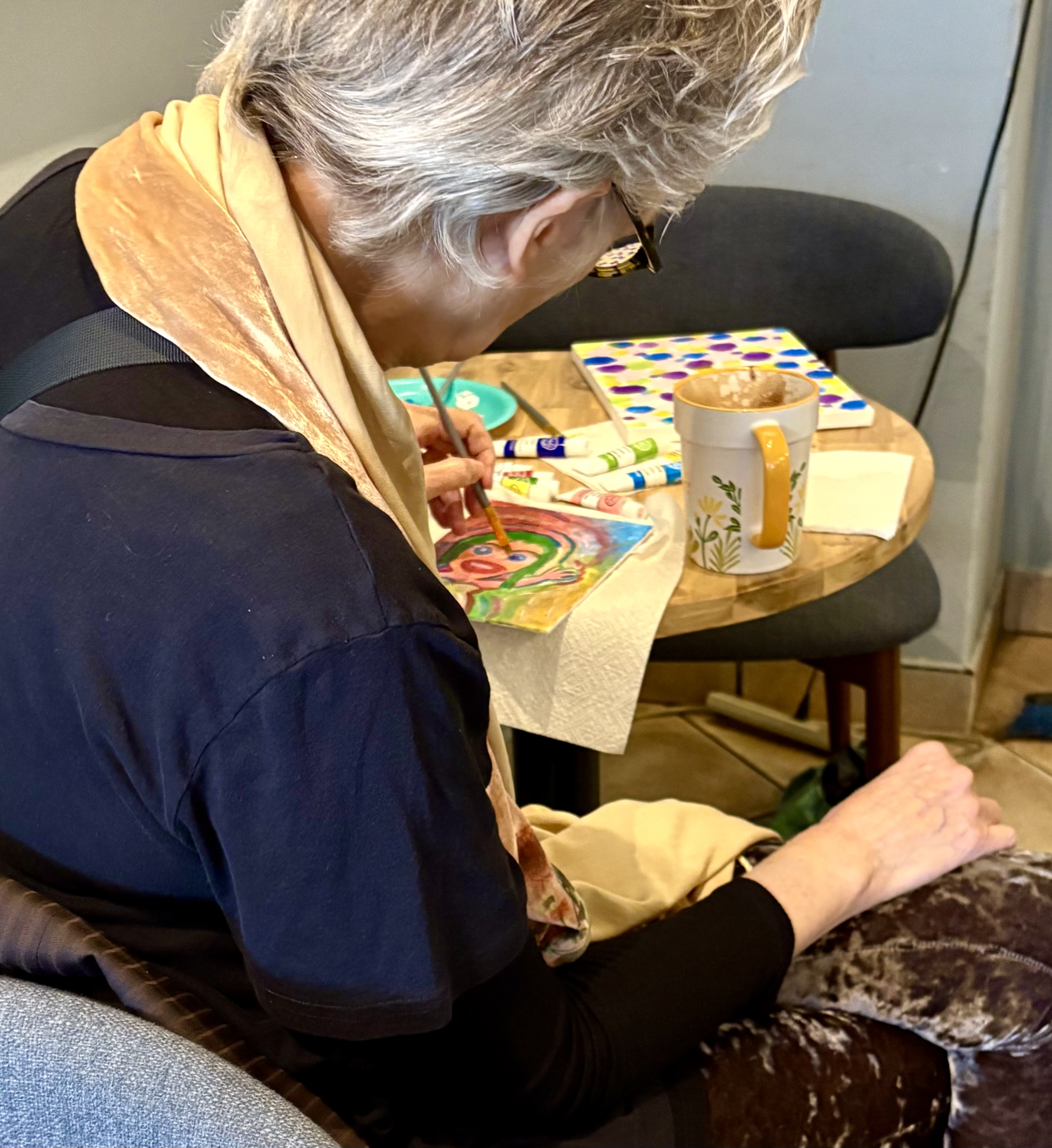
It is indeed a tiny café, clearly a local hangout, with a DIY artistic vibe. Ancora offers sake and oysters; inBtwn offers watercolour paint-pots and brushes. People use them.
I settle for a latte, not artistic expression, but I do ask co-owner Christy Evans about the backstory. She had hospitality experience, and COVID pushed her to act on what she meant by “hospitality”: bake treats to go with the coffee, create a community hub for socializing, give people resources for creative expression while they are socializing and eating treats and drinking coffee. Eventually husband and co-owner Wade Edwards quit his construction business and joined her full-time — as an artist (whose works always include a tiny red Christy-figure) and, it turned out, as master scone-maker as well.
After that break I carry on, energized by more than the caffeine.
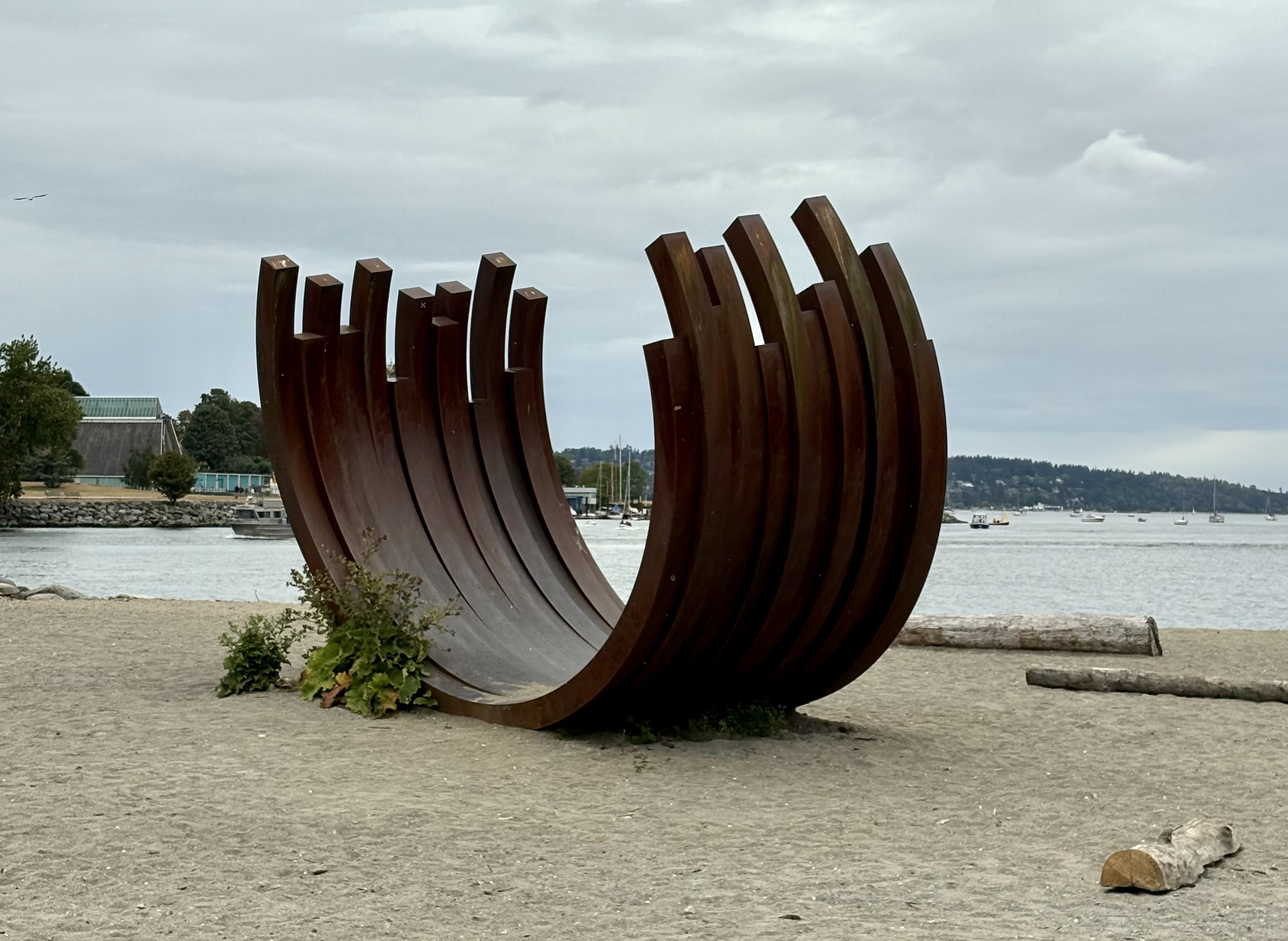
Past the Hornby dock, past Burrard Bridge, I’m right up to the Aquatic Centre dock at the eastern edge of Sunset Beach. I could just drop down for a ferry — but, no-no, I can’t do that. I have to walk on. Down there, halfway down Sunset Beach, I can see my absolute-favourite False Creek artwork.
That dark, U-shaped curve on the sand toward the right? That’s it.
I keep walking. I want to visit it close up, and then I’ll double back to the Aquatic Centre dock. (Since it’s the last dock on this north shore of False Creek, I have no choice. Not if I want to stick to my home-by-ferry idea. And I do.)
Pretty wild flowers along the way, also tangles of bushes to which I’m not paying much attention until a woman striding past me points at them and calls out, “Blackberries!” I look, and yes they are. Not yet black, but working on it.
Then, finally I’m up to the sculpture. I can never remember the title, but when I read it again, it makes literal, mathematical sense.
This is 217.5 Arc X 13 — 13 arcs of metal, each curved to 217.5°. It is the work of French artist Bernar Venet, one of his Arc series designed to celebrate “the beauty, balance and malleability of raw steel,” and a legacy installation from the 2009-2011 Vancouver Biennale. (Later, I learn the 2025-2027 Biennale has brought us 241.5 Arc X 2 by the same artist, which is already installed at 884 East Georgia Street in Strathcona. Yes, I will go visit it.)
It’s ferry-time. To get all the way back east to the Village dock, I have to transfer to another boat on Granville Island — which I do.
I chat with the couple next to me, who, it turns out, used to live right opposite where I now live. We agree it’s a terrific neighbourhood. We also agree that it’s an uphill climb from the dock. We grimace, they in memory and I in anticipation. (I do not confess that, just sometimes, I wimp out and take the bus.)
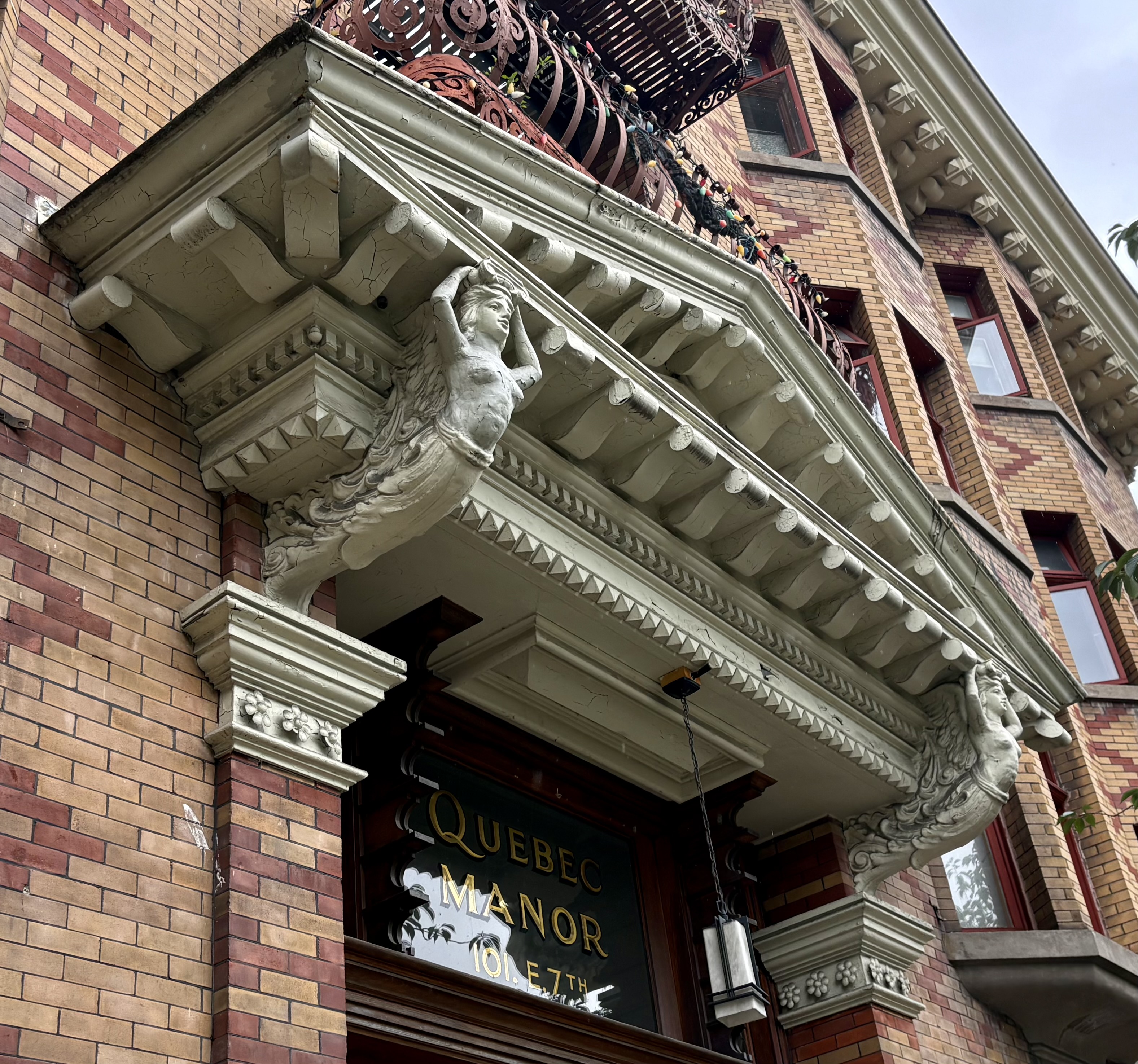
No wimping today. Uphill I walk heading south, and then more uphill as I swing to the east. I pause a moment crossing Quebec Street. Not to catch my breath! How could you suggest such a thing!
I am merely paying my respects to les belles dames. the guardian angels, of Quebec Manor.
21 July 2026 – Mist hangs in the air as our shuttle bus prepares to leave downtown Vancouver for Whistler, some 120 km to the north…
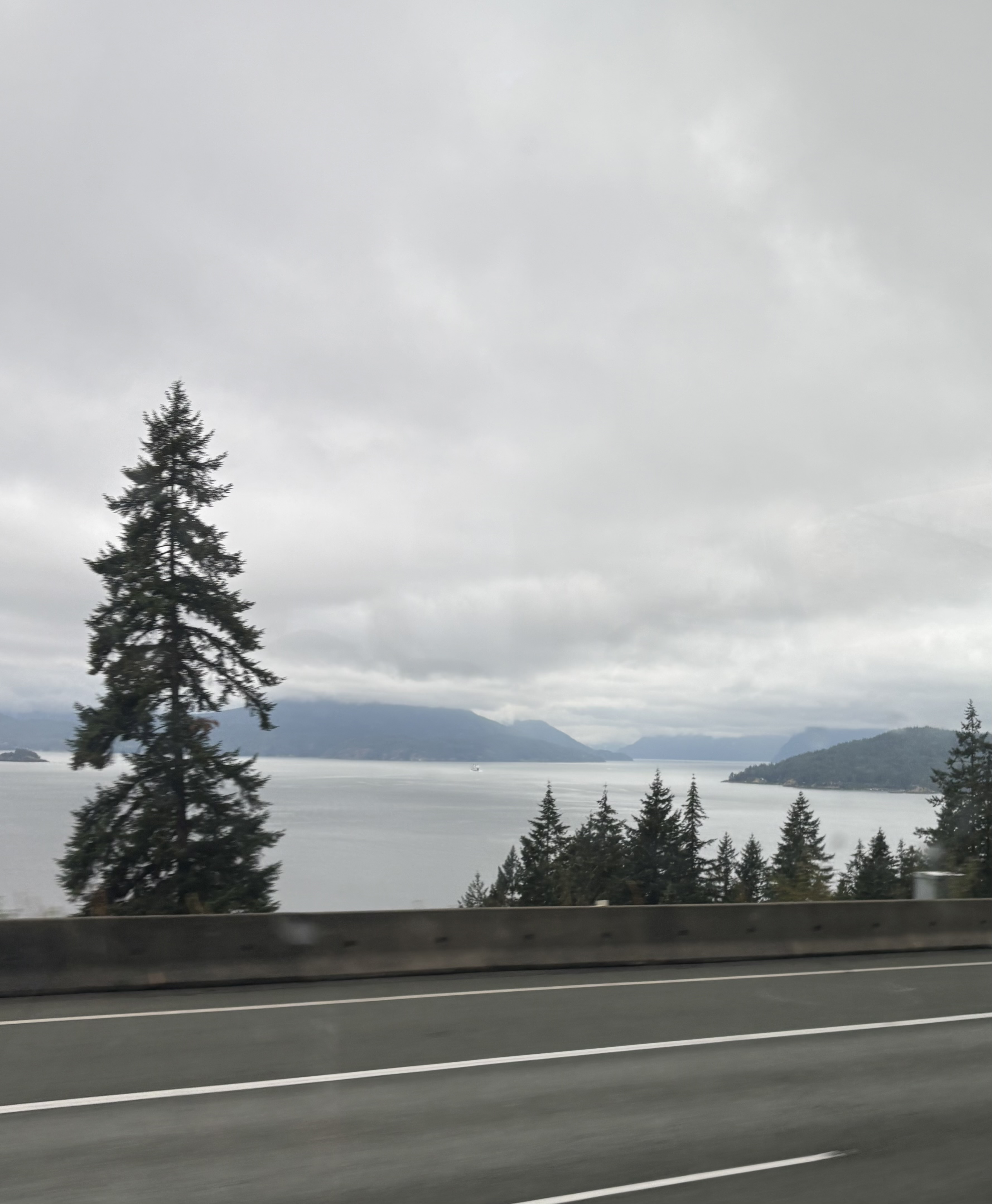
mist still with us, as we drive the aptly-named Sea to Sky section of Highway 99 that will take us there, threading its way between the Pacific Ocean and mountain ranges, beneath a great brooding arc of sky…
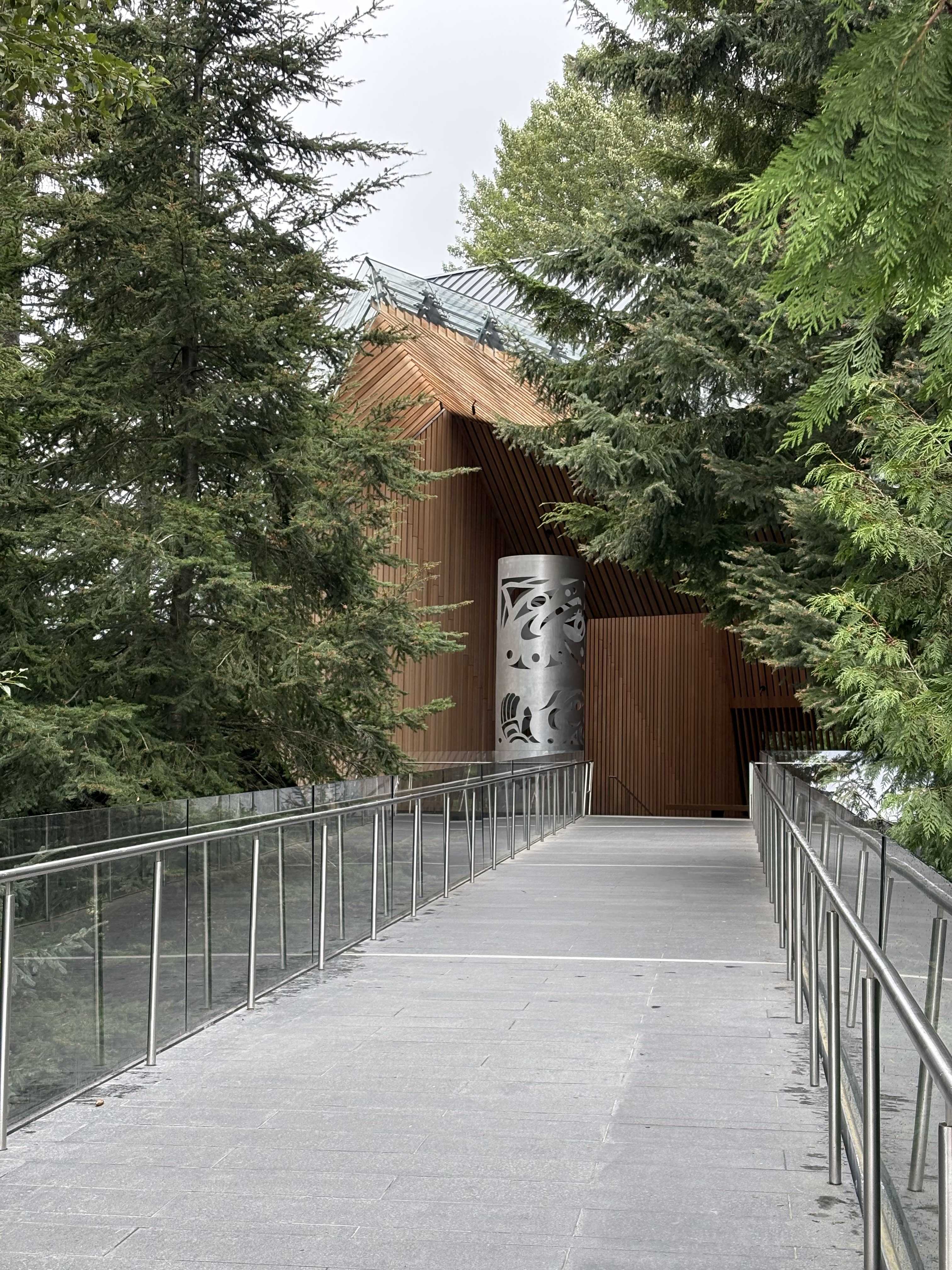
and mist still, though beginning to clear, as I approach the building that has called me here: the Audain Art Museum.
More precisely — though the building itself is a joy — it is the current exhibition that has called me here.
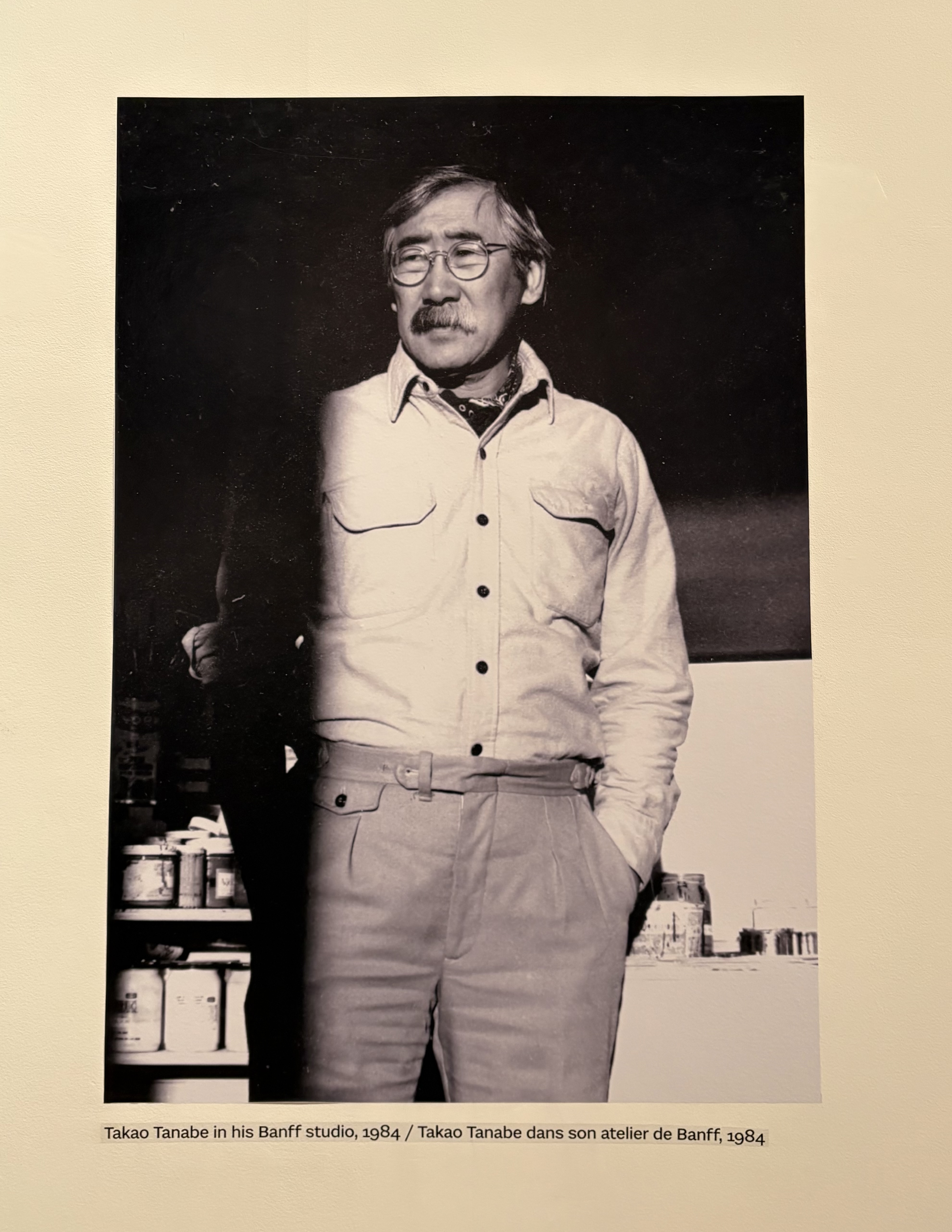
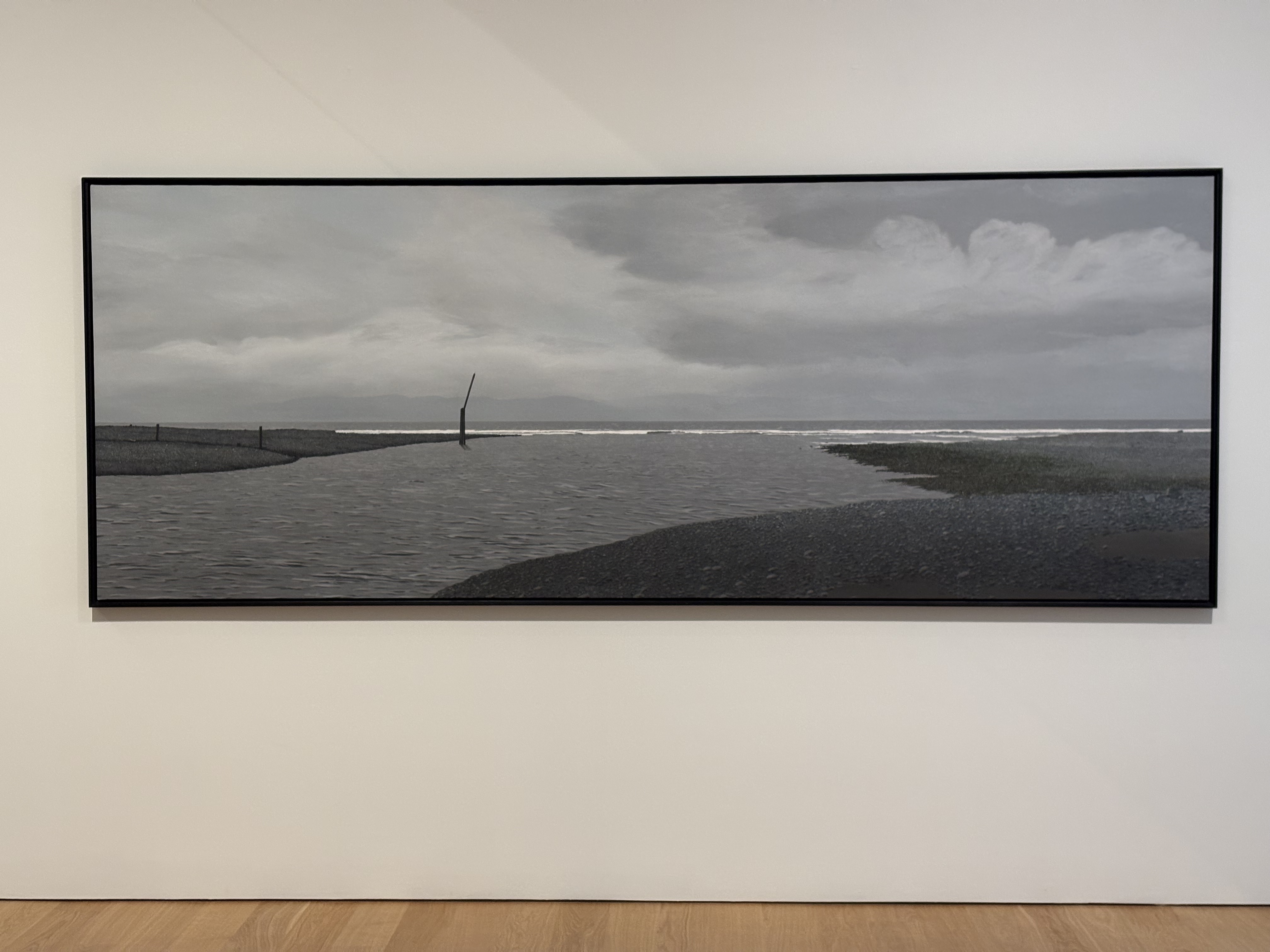
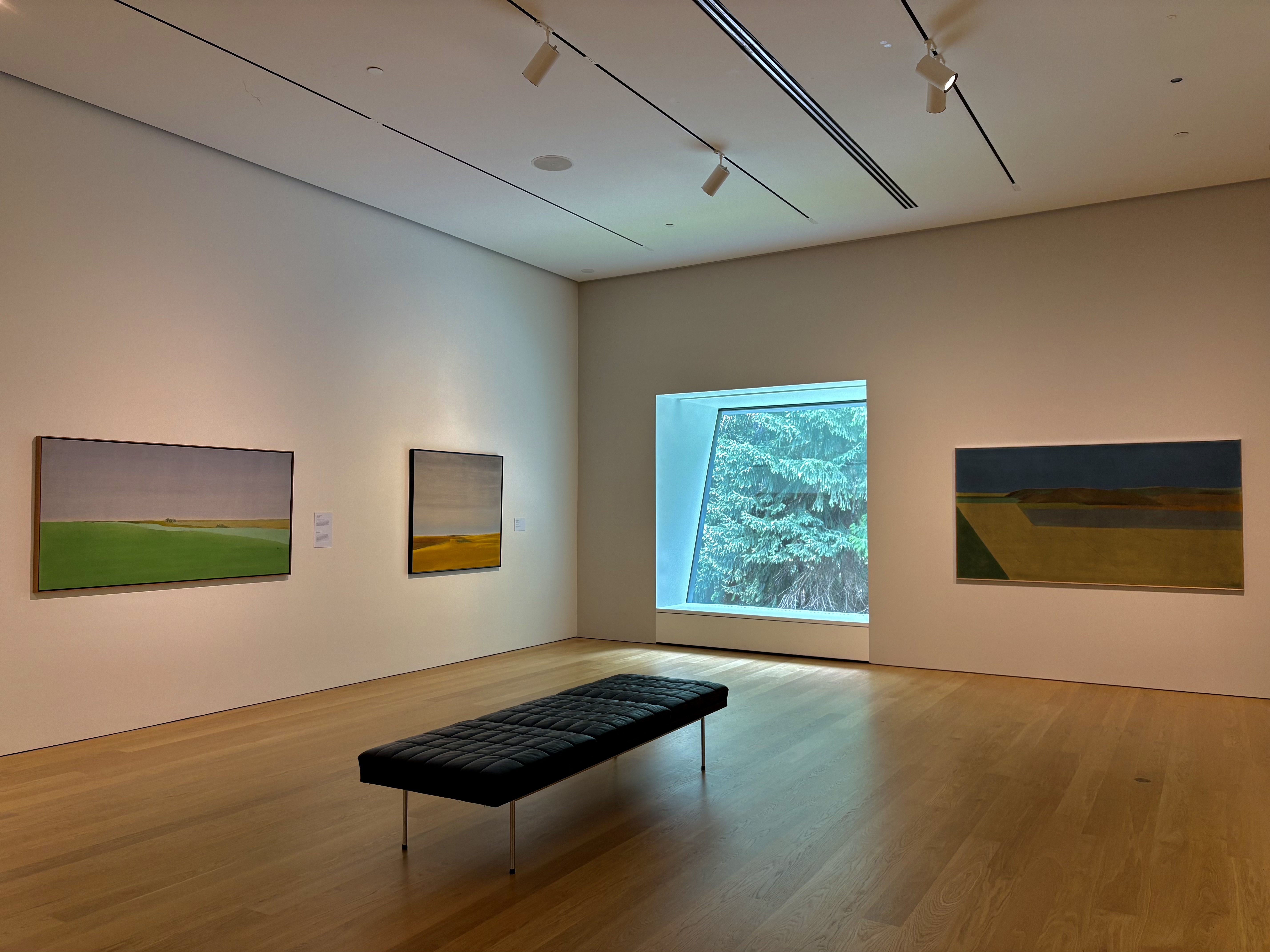
Takao Tanabe 100: Inside Passage celebrates the life and extraordinary eight-decade career of this BC artist, who will turn 100 years old on 16 September 2026. I think of Tanabe in terms of his iconic coastal scenes — for example, Rivers 1/01: Jordan River, 2001. These works breathe mist. Today’s weather is an appropriate homage.
But the exhibit teaches me that the words “Inside Passage” in the title refer to more than these coastal scenes. They also honour Tanabe’s life-long curiosity, his own internal or “inside” passages that have been reflected in his evolving artistic expression.
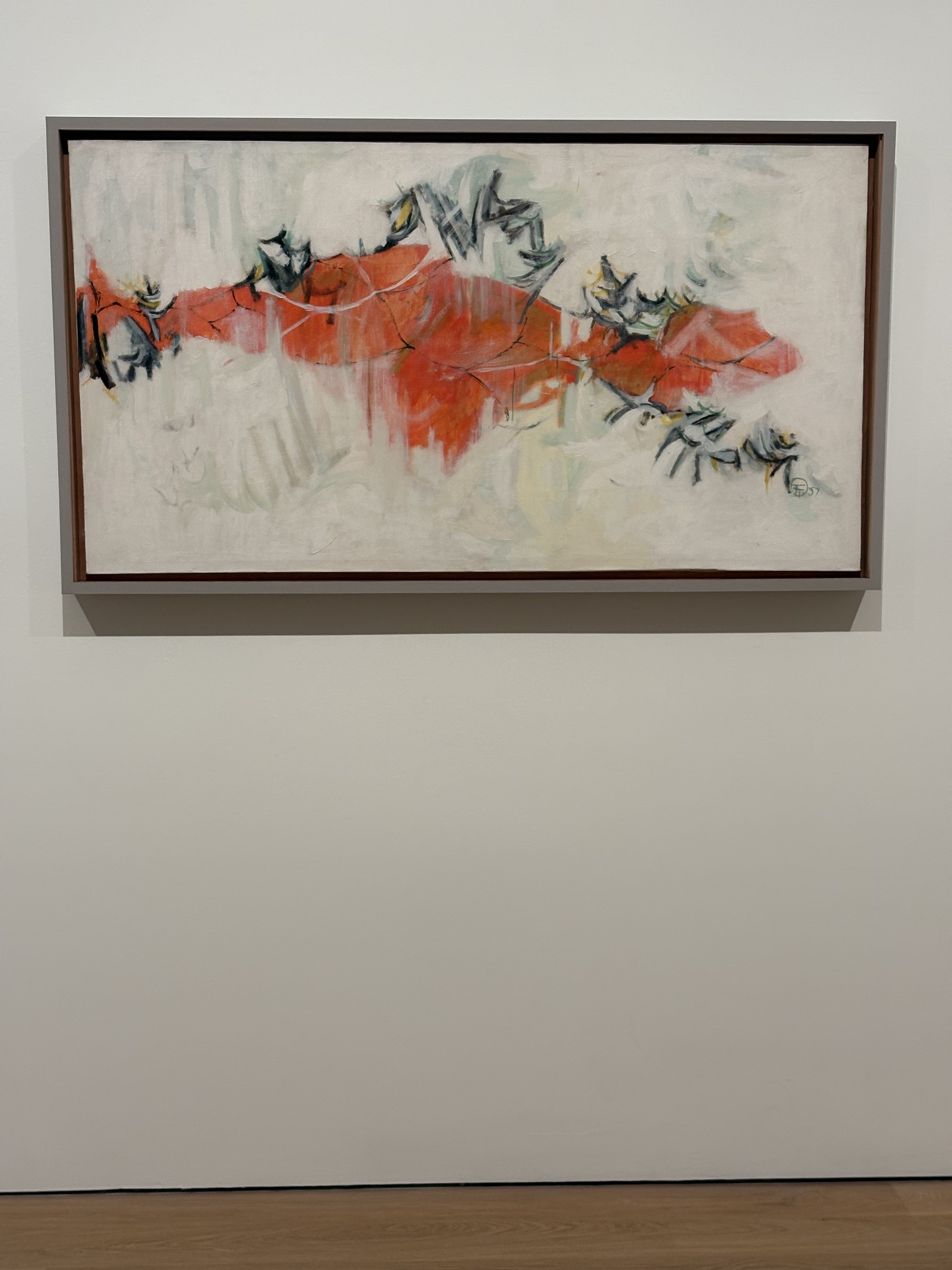
Pure abstractions early on, during a 1950s stint in New York (here, Interior Arrangement with Red Hills, 1957)…
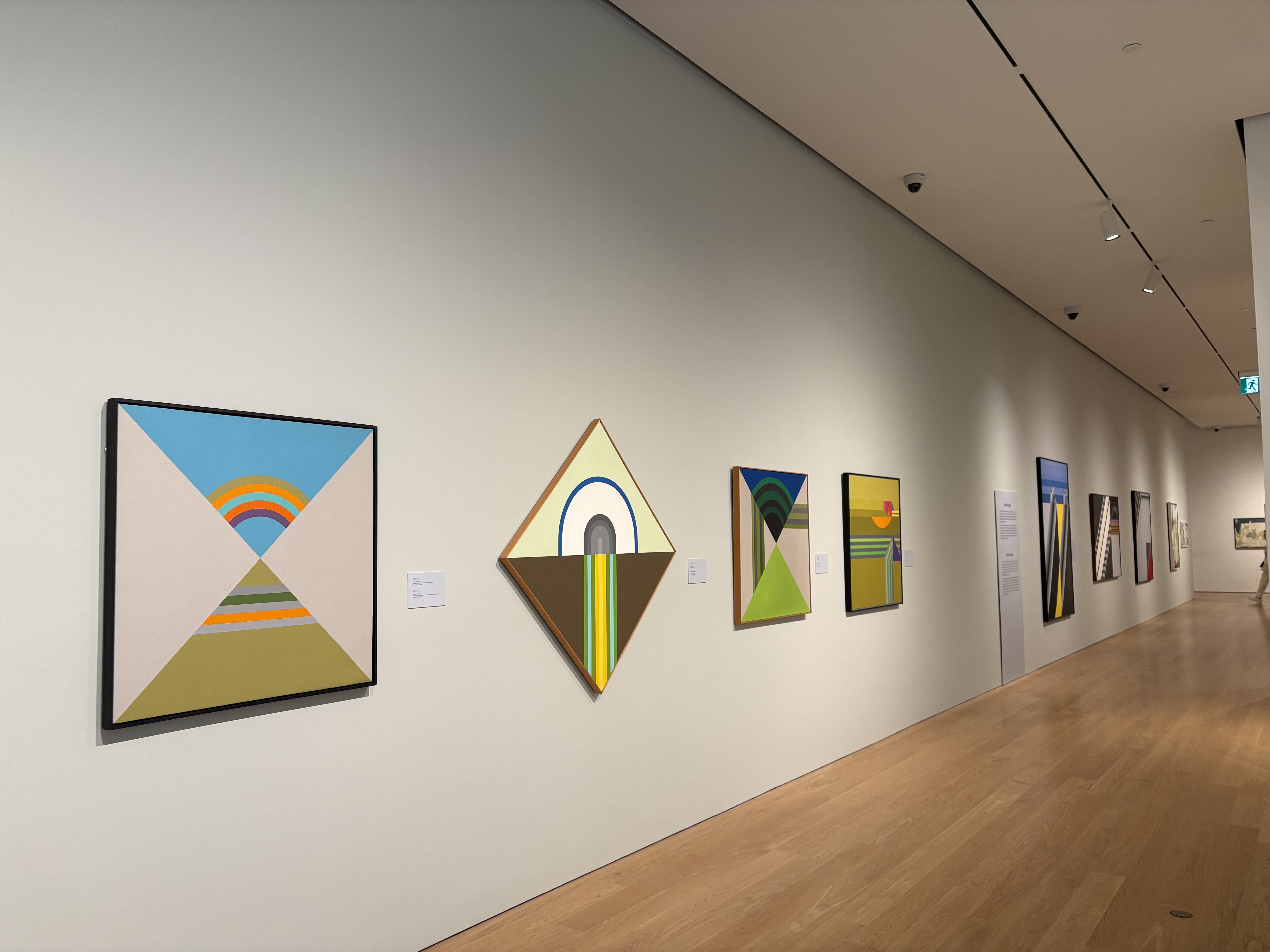
a brief period of hard-edged abstractions, in the 1960s…
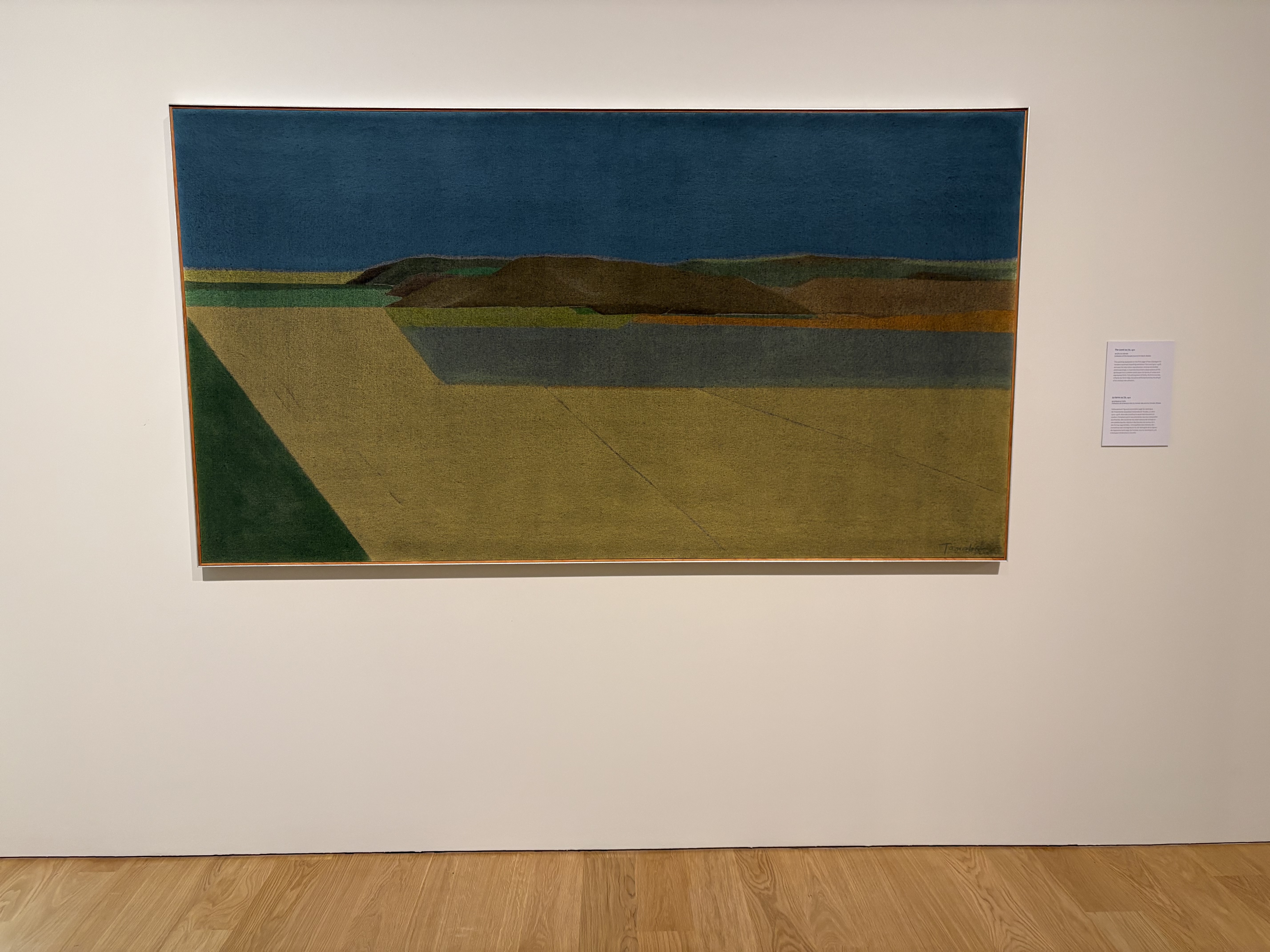
followed by a fascination with the Canadian prairie landscape, as of the early 1970s (here, The Land 10/72).
Curatorial notes refer to the “hard-edged discipline” of this 1972 work, one of the earliest of his prairie pieces, “announcing the shape of an entirely new direction.”
I look around, and admire the prairie era as a whole.
I also admire the building — the way it serves the works and frames the forest beyond. Later I visit the Patkau Architects website, the Vancouver firm that designed this building, and read their intention that its form and character be “deliberately restrained [so as] to form a quiet backdrop for the collection.” Bravo.
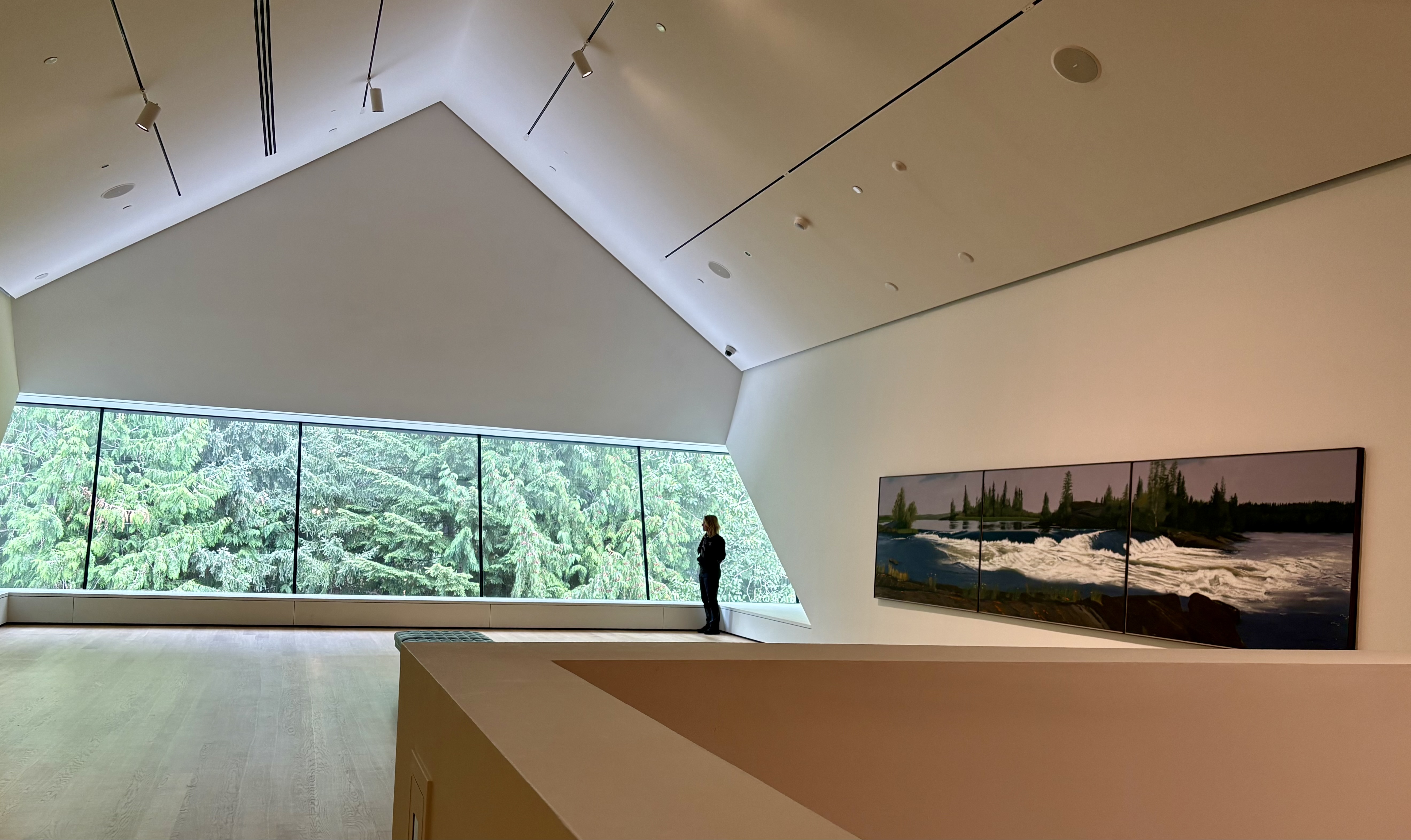
I go upstairs to visit the linked exhibit Vistas: From Takao Tanabe’s Travels, where I again think about art galleries and their architecture.
The power of this space!
Yet it does not overwhelm the art (NWT 1/97: Beaulieu River, 1997). I pulse between the art and the space, the space and the art.
I remember my volunteer years at the Art Gallery of Ontario, in the days when the Frank Gehry expansion was still very new, and the joyous reaction of visitors to the building itself — not as informed architectural connoisseurs, purely as people who liked where they were. The little boy, for example, who barrelled into the atrium, spun 360 degrees, gulped and spluttered and just had to blurt it all out to somebody. I was the somebody. “This is so cool!” he cried. “And… and, and… and I haven’t even got to the art yet!”
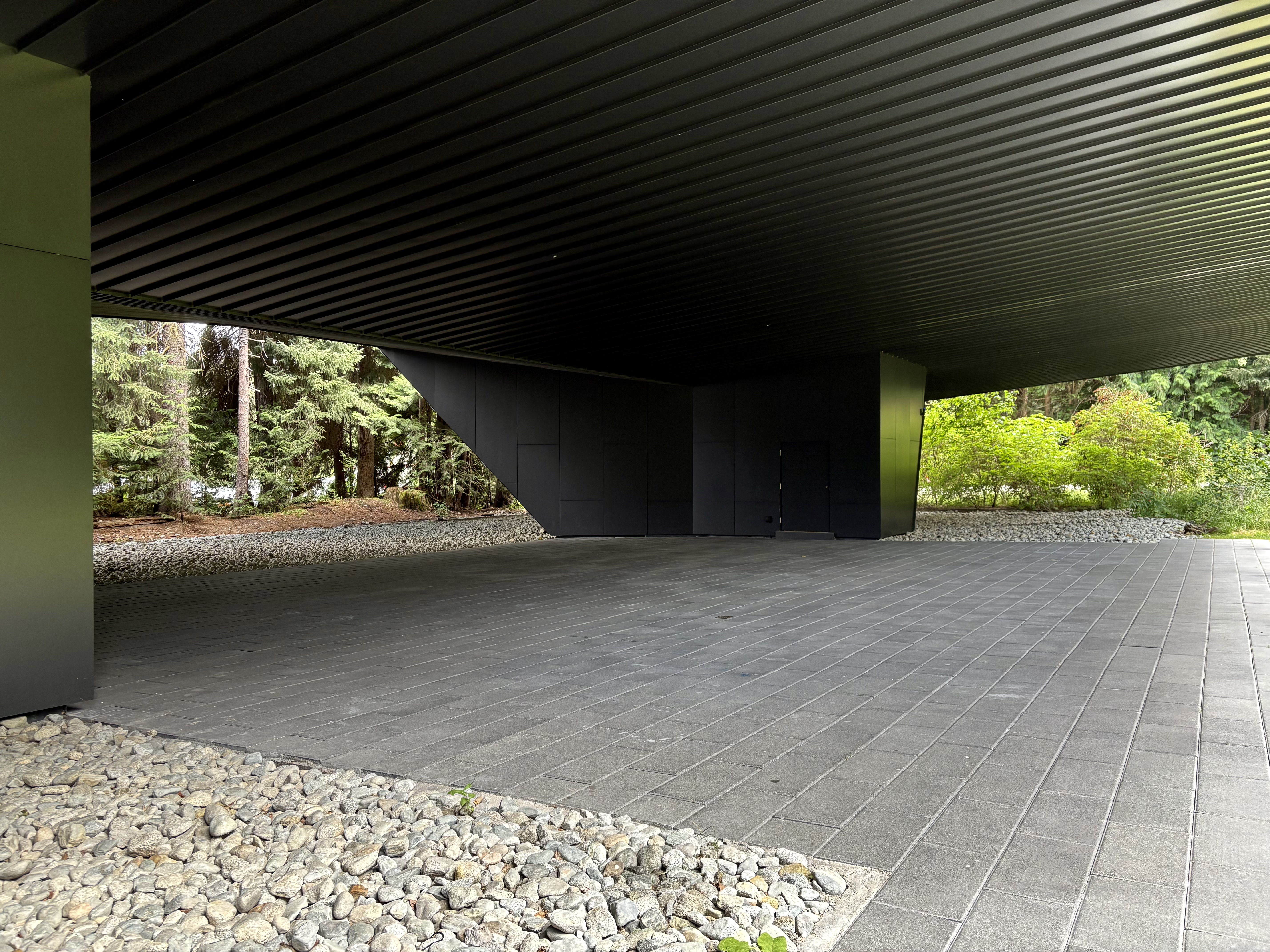
I do not spin 360, but I do spend some additional vertical time with the building itself — namely, outside and underneath.
To quote that little boy: “This is so cool!” Hard-edged, like Tanabe’s prairie paintings, but at home with the surrounding shaggy forest, just as Gehry’s AGO extension is at home with its own busy neighbourhood (where Gehry’s grandparents lived and very much part of his childhood).
Then I take myself back up to ground level, back onto sidewalks and gangways.
And a good thing, too.
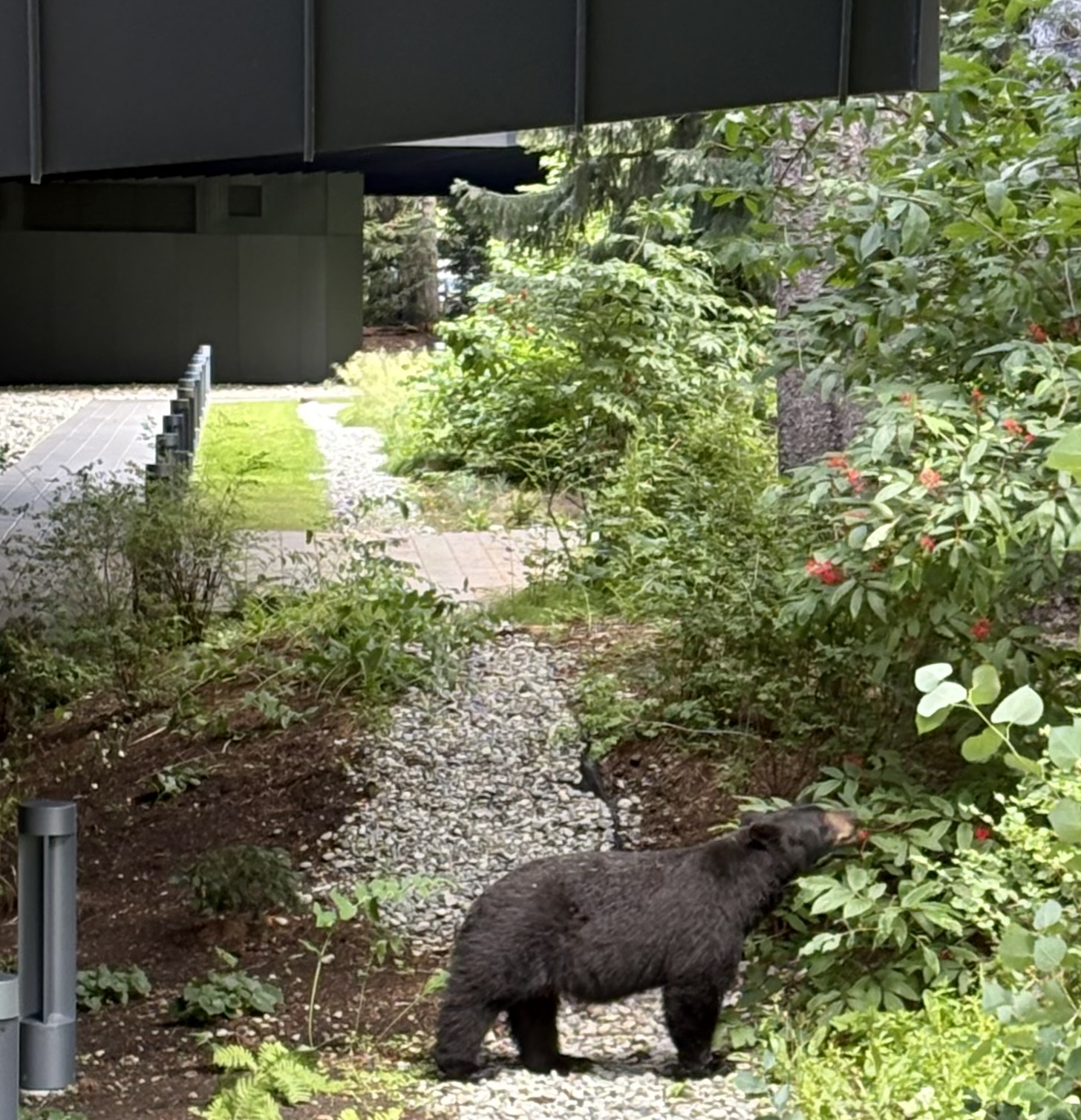
It puts me at a safe distance from which to enjoy this bit of … oh, let’s call it… street theatre.
A black bear ambles out from under the building, and begins a leisurely snuffle of the shrubbery.
I keep a watchful eye out for bears as I walk through Florence Petersen Park en route the bus depot…
but none jump out from behind these old logging stumps.
By the time we are rolling back south, the skies are bright and blue.
21 June 2026 – I could go silly with factoids in this post, so I am busy slapping myself down. Even so, I encourage you to click the links and go silly on your own time.
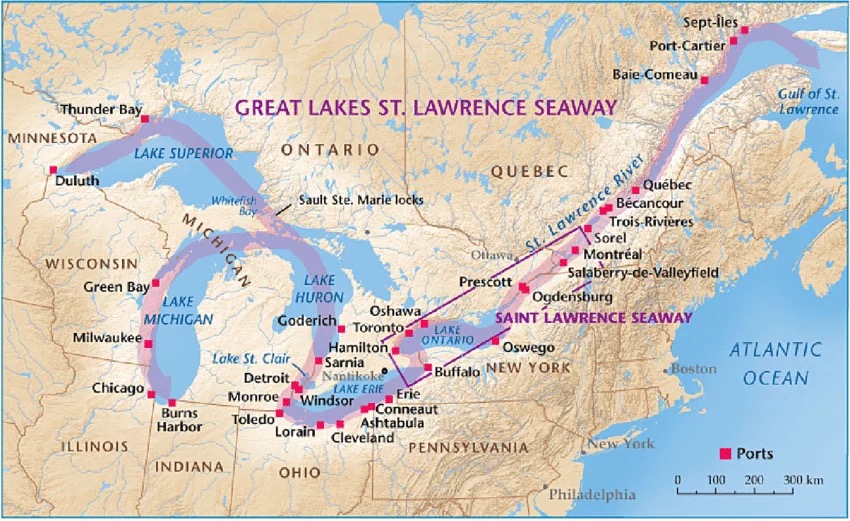
The “it” in question is the St. Lawrence Seaway in general, the Montreal-Lake Ontario stretch of it in particular, and its locks system in very particular. I am awe-struck by all of it. This Seaway still stands as one of the greatest, the most challenging, engineering feats of all time.
The feat? Four years of mid-20th c. construction that re-contoured the 306 km. stretch of the river between Montreal and Lake Ontario, adding a new lake, 7 locks and a major power dam in the process, and engaging 22,000 workers who among other things moved 210 million cubic yards of rock & gravel and poured more than 6 million cubic yards of concrete.
On top of all that, it was a bilateral (Canada/USA) project. First mooted by a US politician in the late 19th century, the Canadian government took up the idea in the 20th c., only to be met with stonewalling on the American side. Post-World War II, however, when giant American mining companies saw depleted high-grade ore reserves in the USA but large high-grade reserves in their Canadian operations, that was when — gee, what a surprise — the US government came on-side.
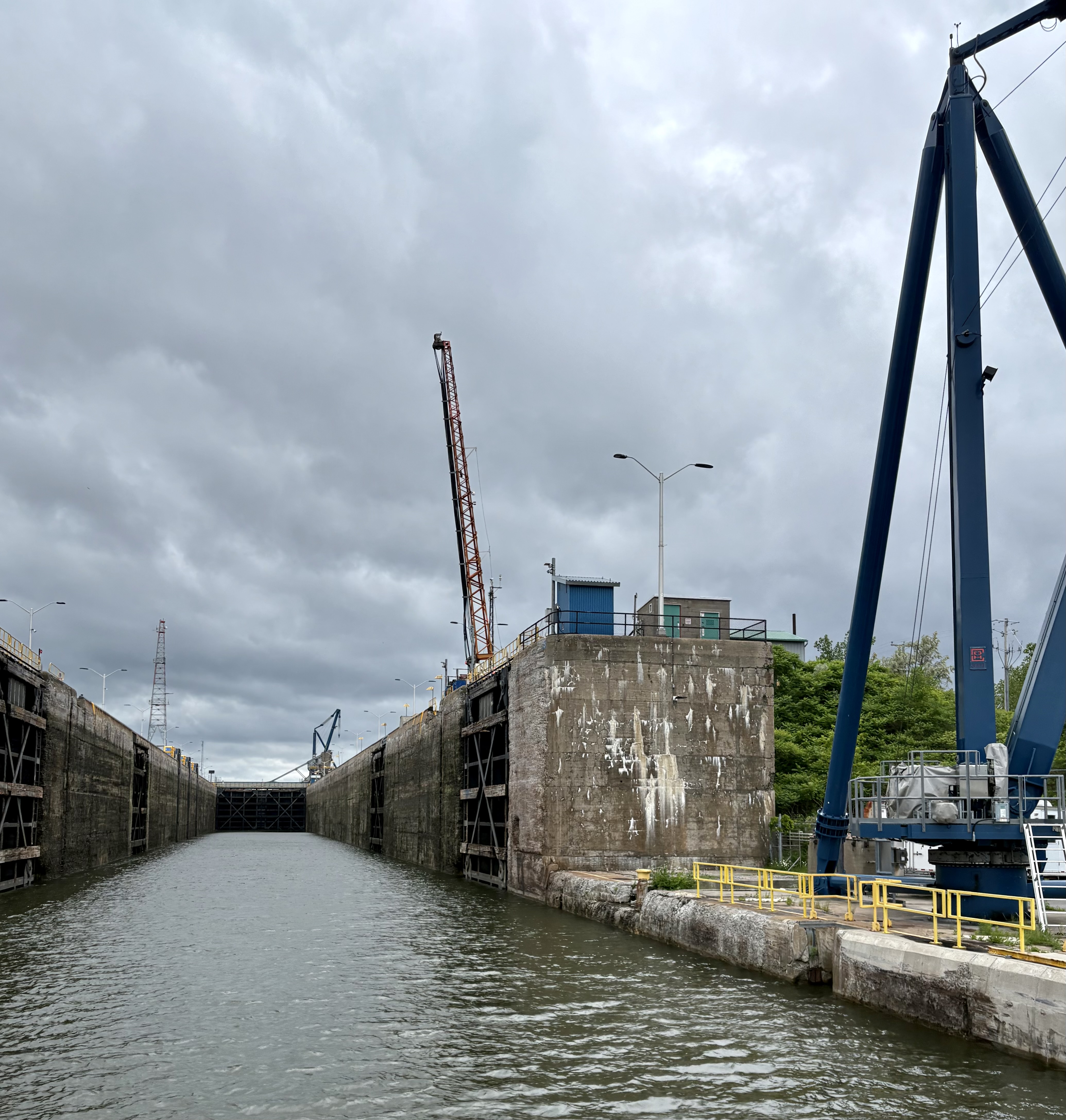
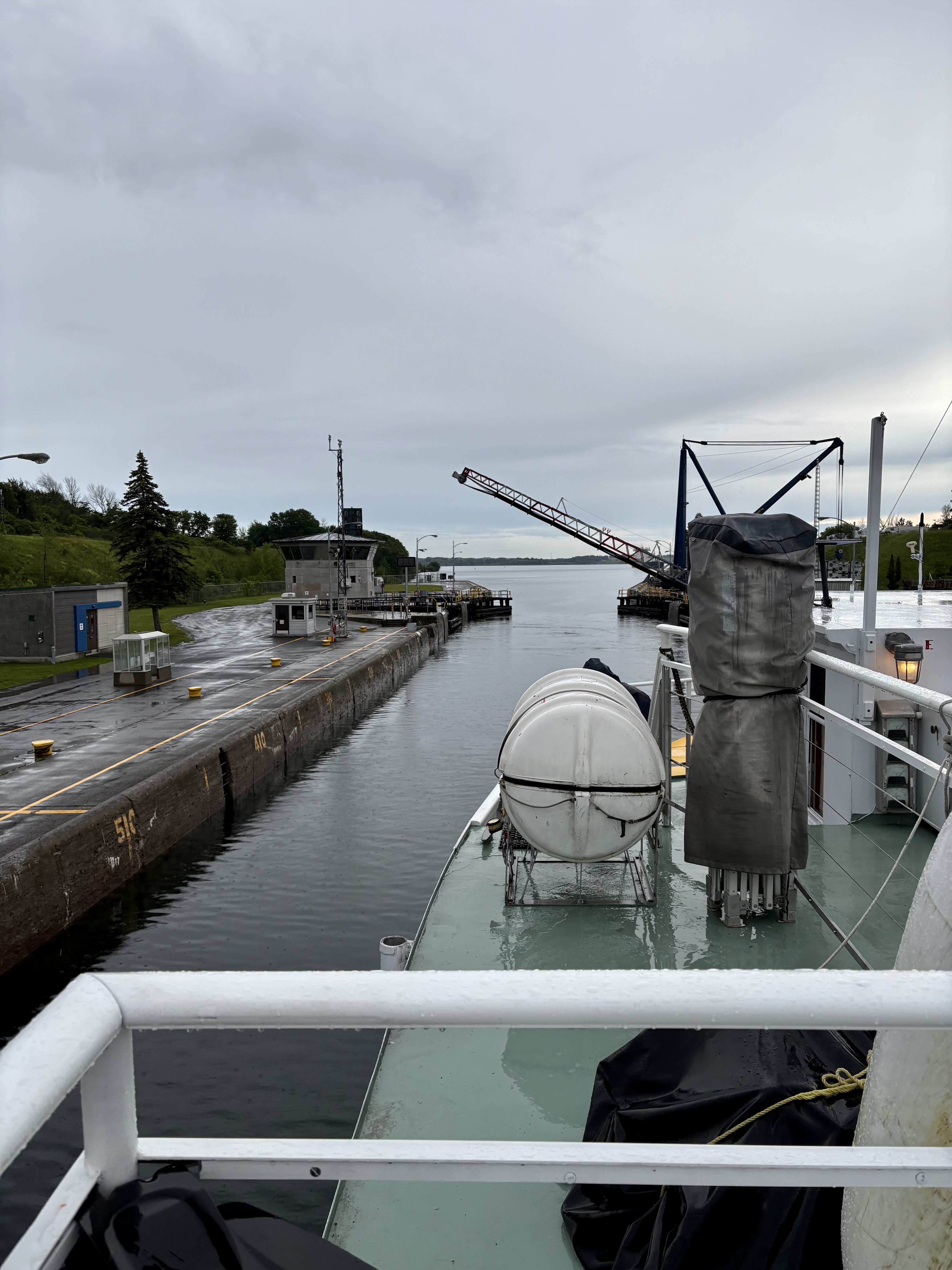
We learn some of this along the way. Mostly, I just want to gawk, in awe and respect, at the complexity of applying the basic principles that drive any lock system. You want to move a vessel from one water level to another? Basically, you put it in an elevator and send it one way or the other: seal it up nice & tight in a lock at the entry-water level; add or subtract water as necessary to reach the desired exit level; open the exit gate; and away it goes.
In a ship, in a lock big enough to accommodate freighters twice as long and half as wide as a football field (up to 225.5 m/740 ft in length and 23.8 m/78 ft at the beam)… then that simple concept gets pretty impressive.
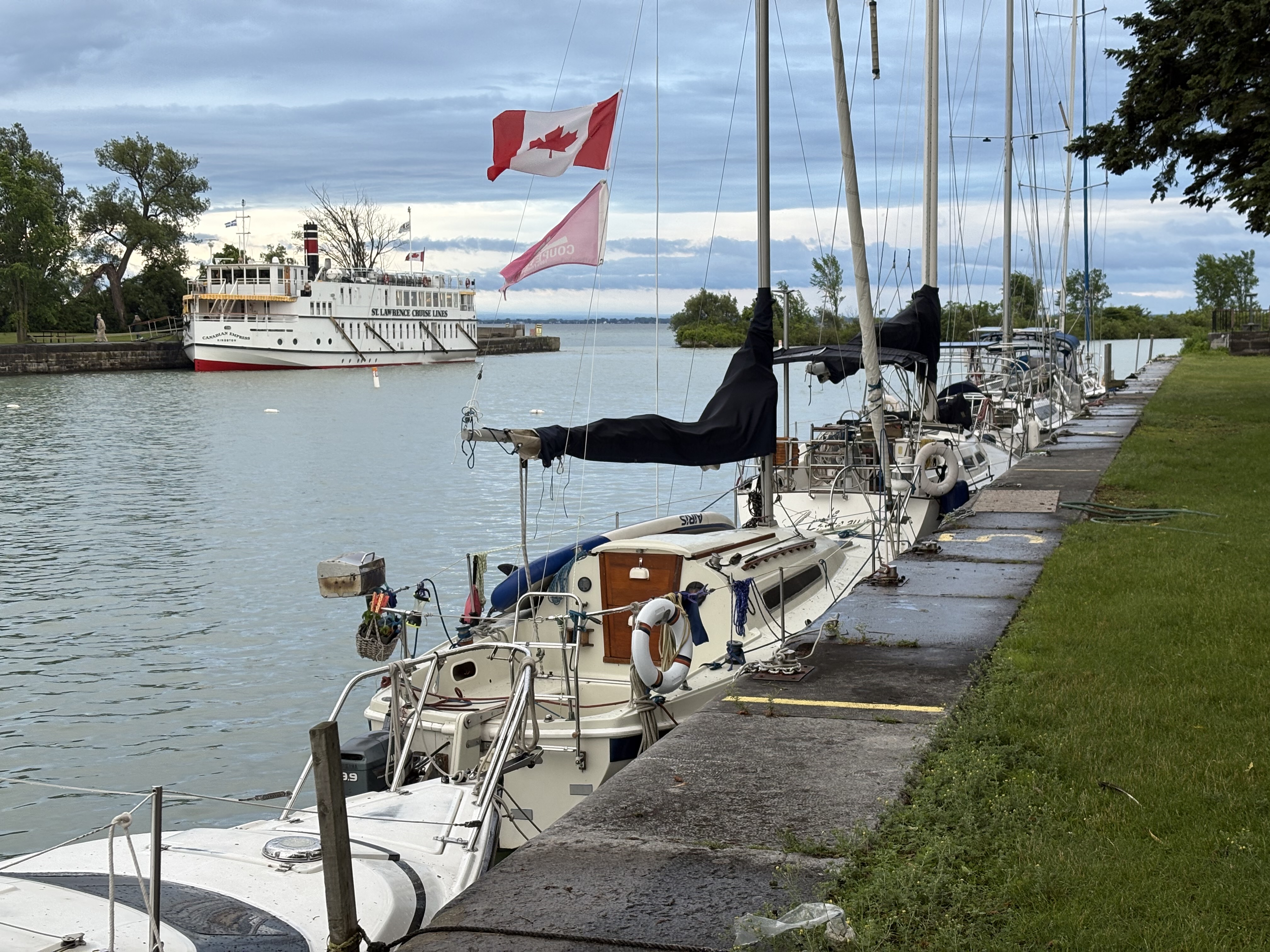
And necessary. Canadian Empress is a small ship, out there for pleasure, but these ocean-going freighters are transporting cargo to/from the heart of North America. They need fast (average 45 min./lock), dependable conveyance through a water-level difference of 75 metres (246 ft) over the 306 km (189 mile) stretch between Montreal and Lake Ontario. The total rise, from sea level on up to Lake Superior (reached by additional locks), is the equivalent of a 60-storey building.
(Aren’t you glad I haven’t gone silly with factoids?)
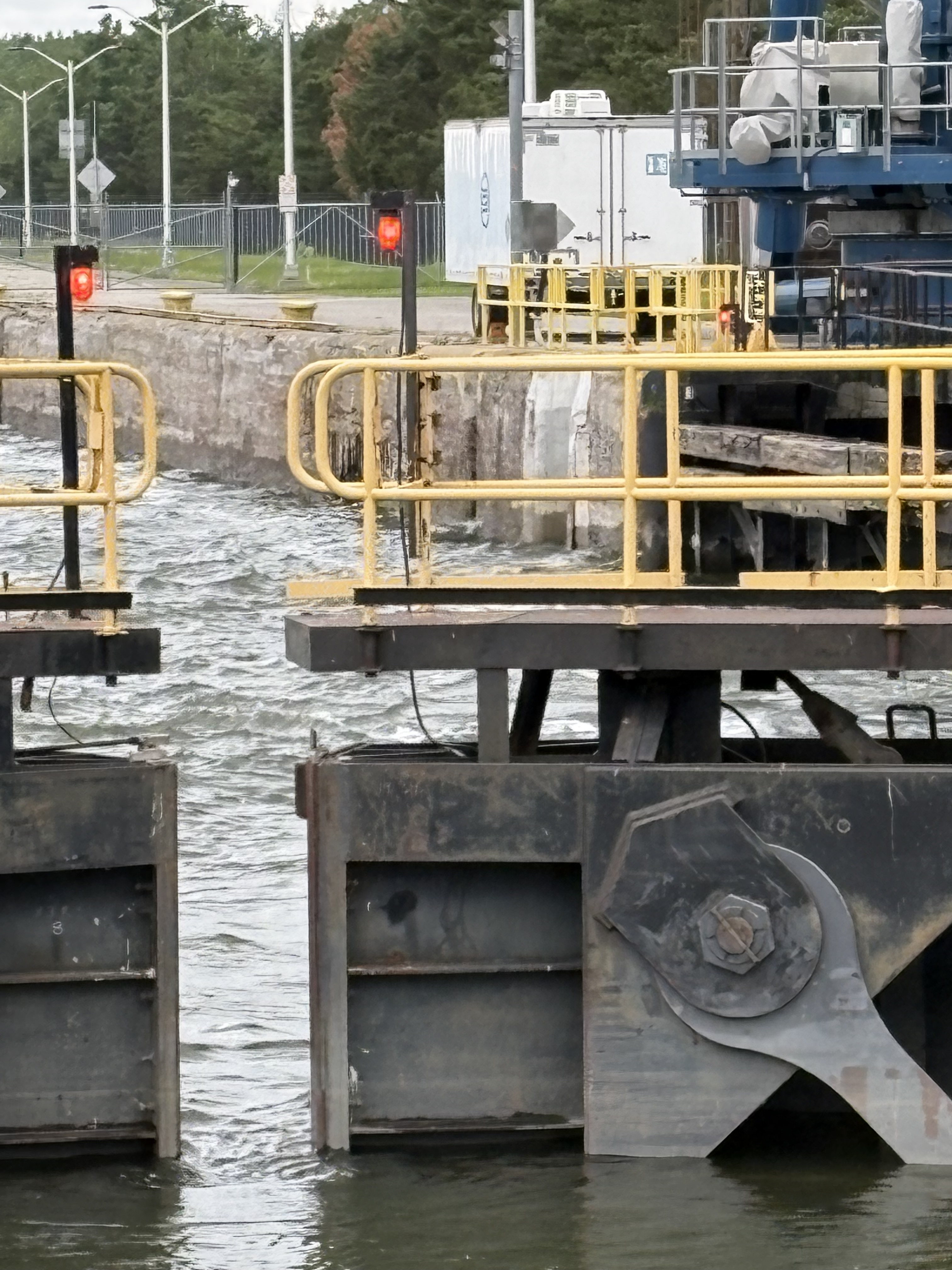
We travel all 7 locks (5 Canadian, 2 American). The second lock, Côte Sainte-Catherine, illustrates the process. We position ourselves, and await the green lights (and open entry gate) that tell us to proceed…
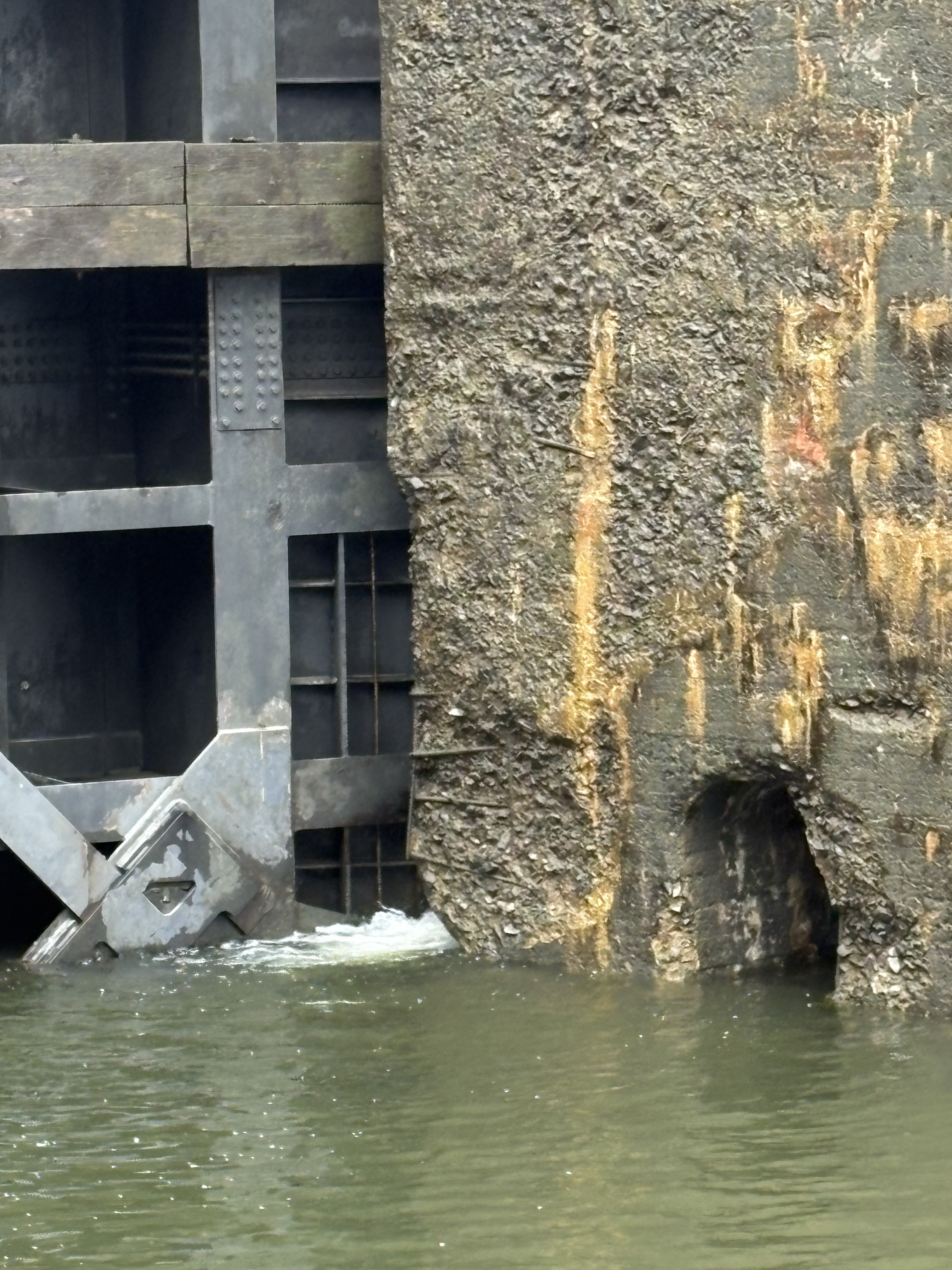
and since we are travelling west and will need to rise, lock by lock, to the Lake Ontario level, water now sluices into the lock…
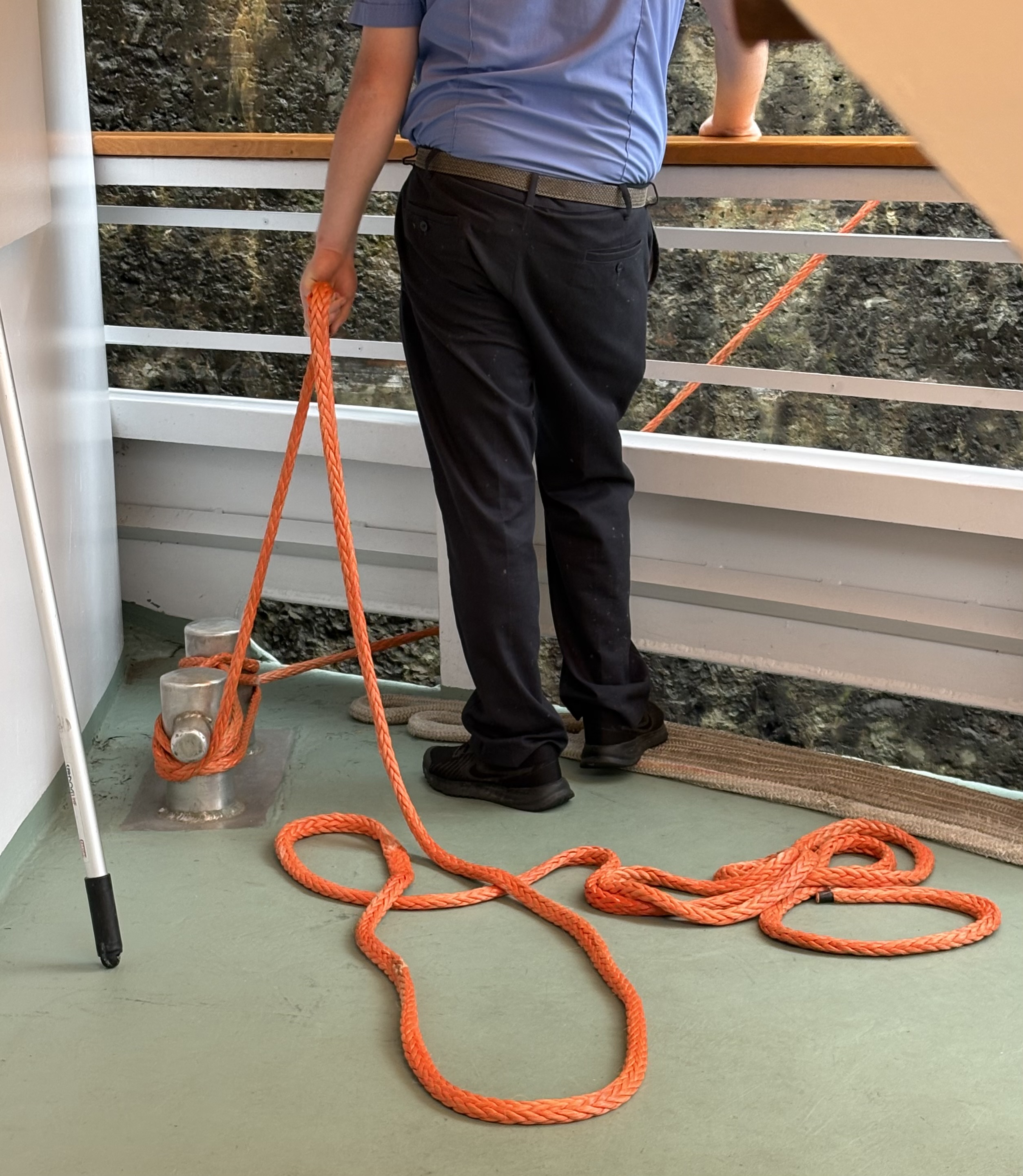
with a deckhand constantly manipulating the lines to keep the ship taut and positioned.
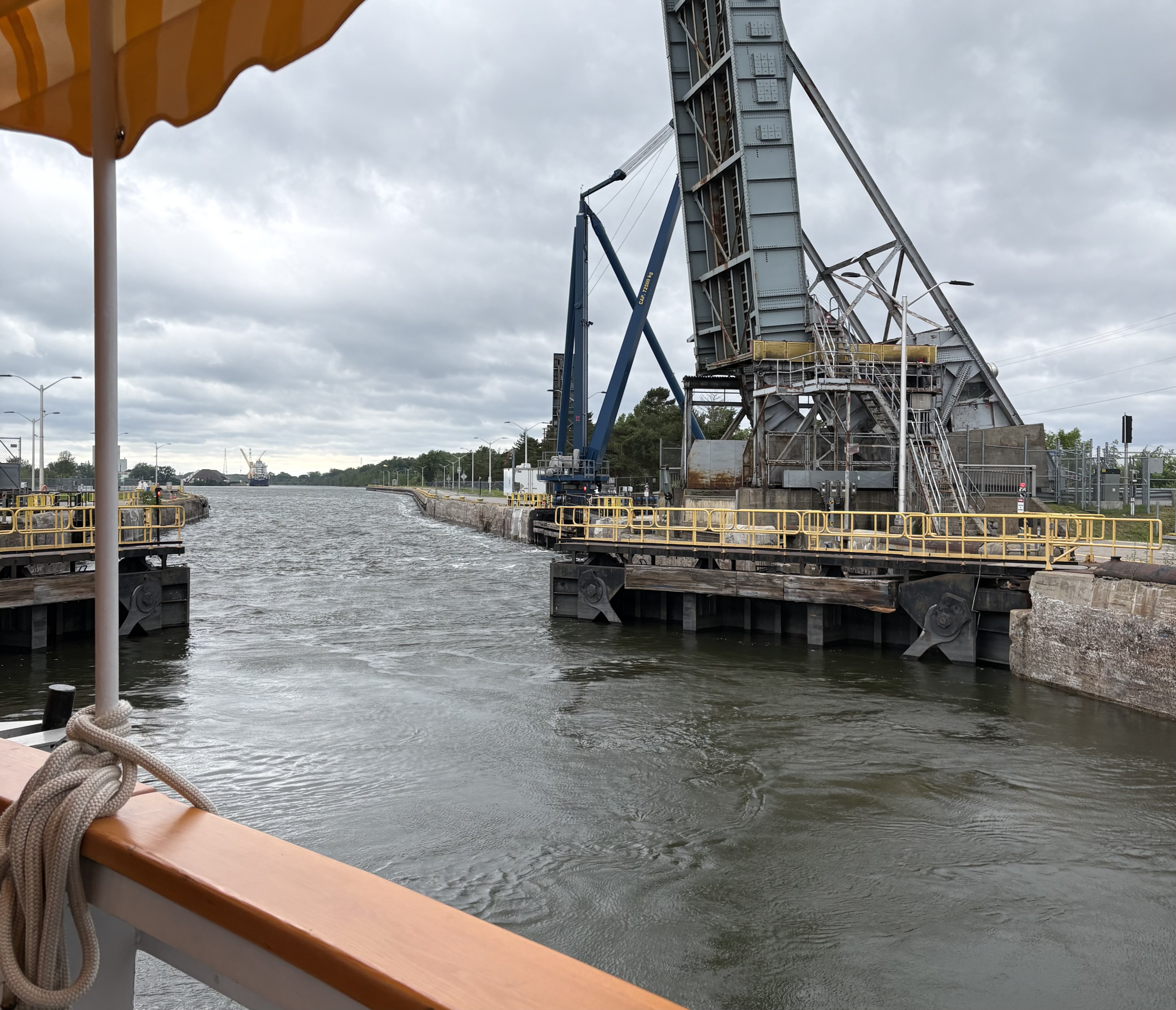
Once we’ve reached the level of the waters beyond, they open the exit gate…
and out we go.
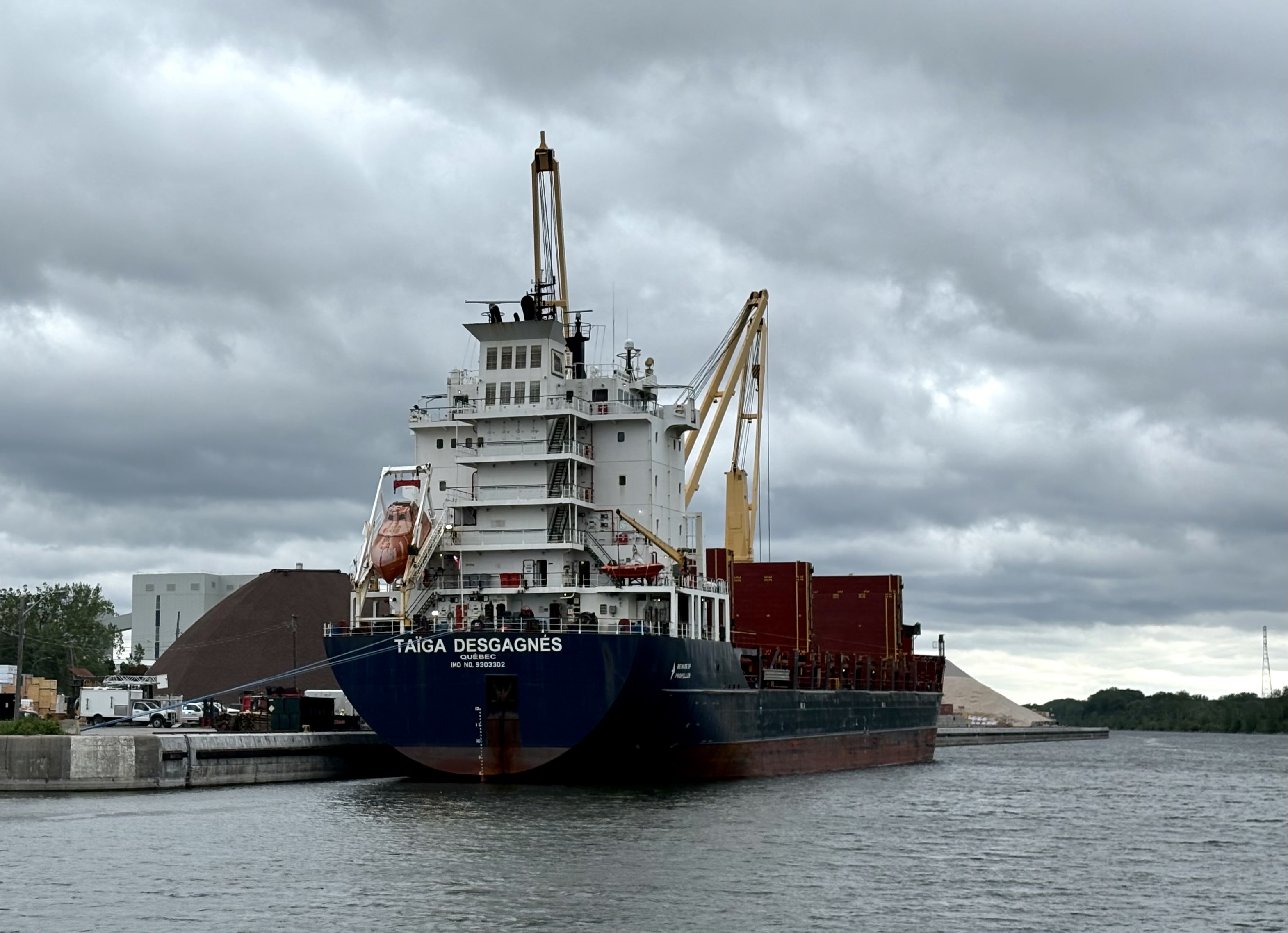
Travelling this great waterway, we meet — of course — freighters. Such as the Taiga Desgagnes…
just west of the Côte Sainte-Catherine lock, busy loading cargo. Sharp-eyed fellow passengers swear that’s a fire engine being hauled aboard, but I can’t verify the claim.
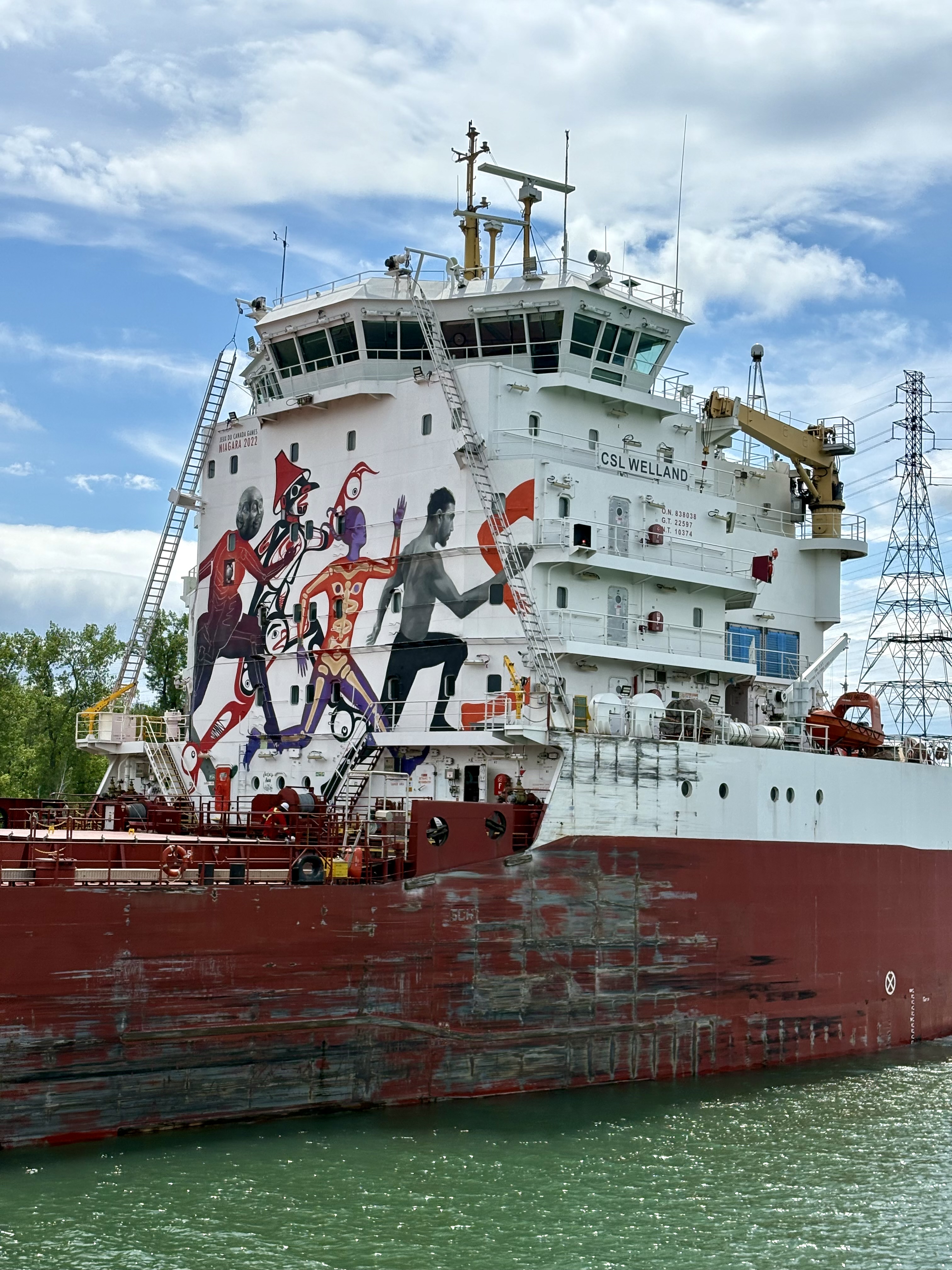
We meet other freighters, including one depressingly named Barnacle, and also the CSL Welland, surely the jauntiest of the bunch. As she awaits her turn for the Snell lock (one of the two American locks)…
we have time to admire her sporty mural.
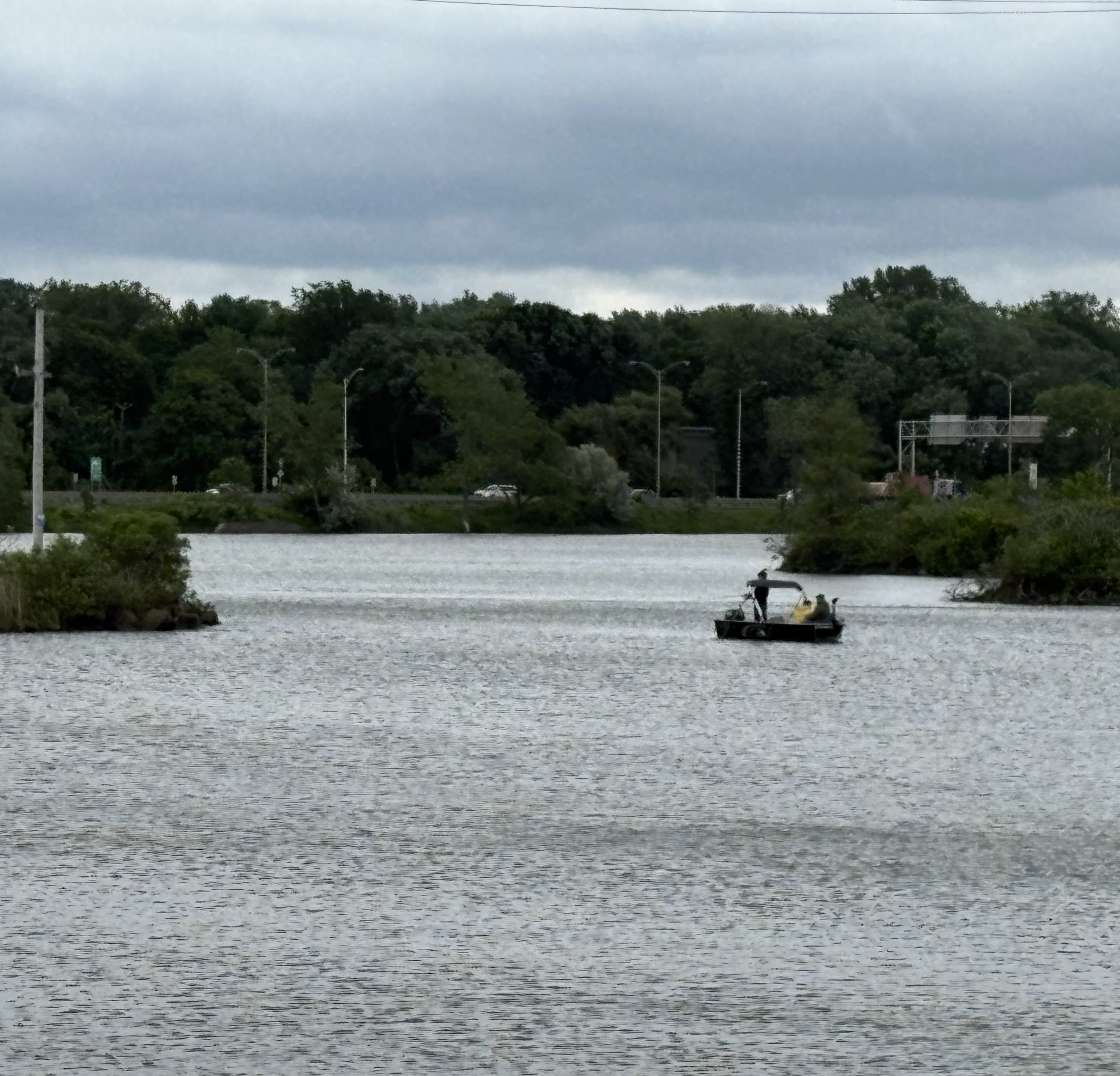
We meet other vessels as well, some very small and each with its own purpose — everything from personal small boats out for a bit of fishing (in the South Canal near Montreal)…
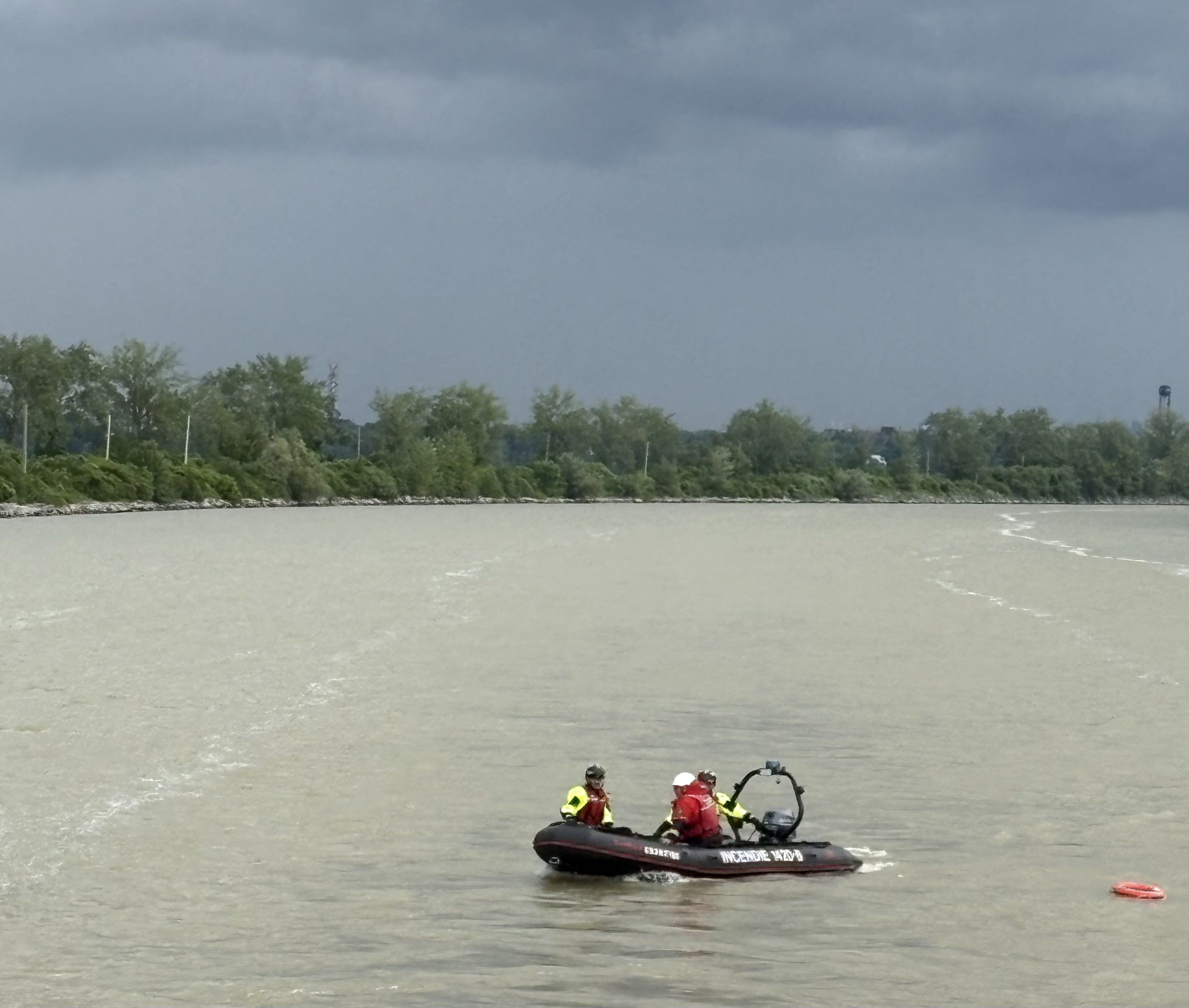
to working vessels, this one marked “Incendie”, fire patrol…
and apparently doing some kind of research involving that red ring. Perhaps studying currents?
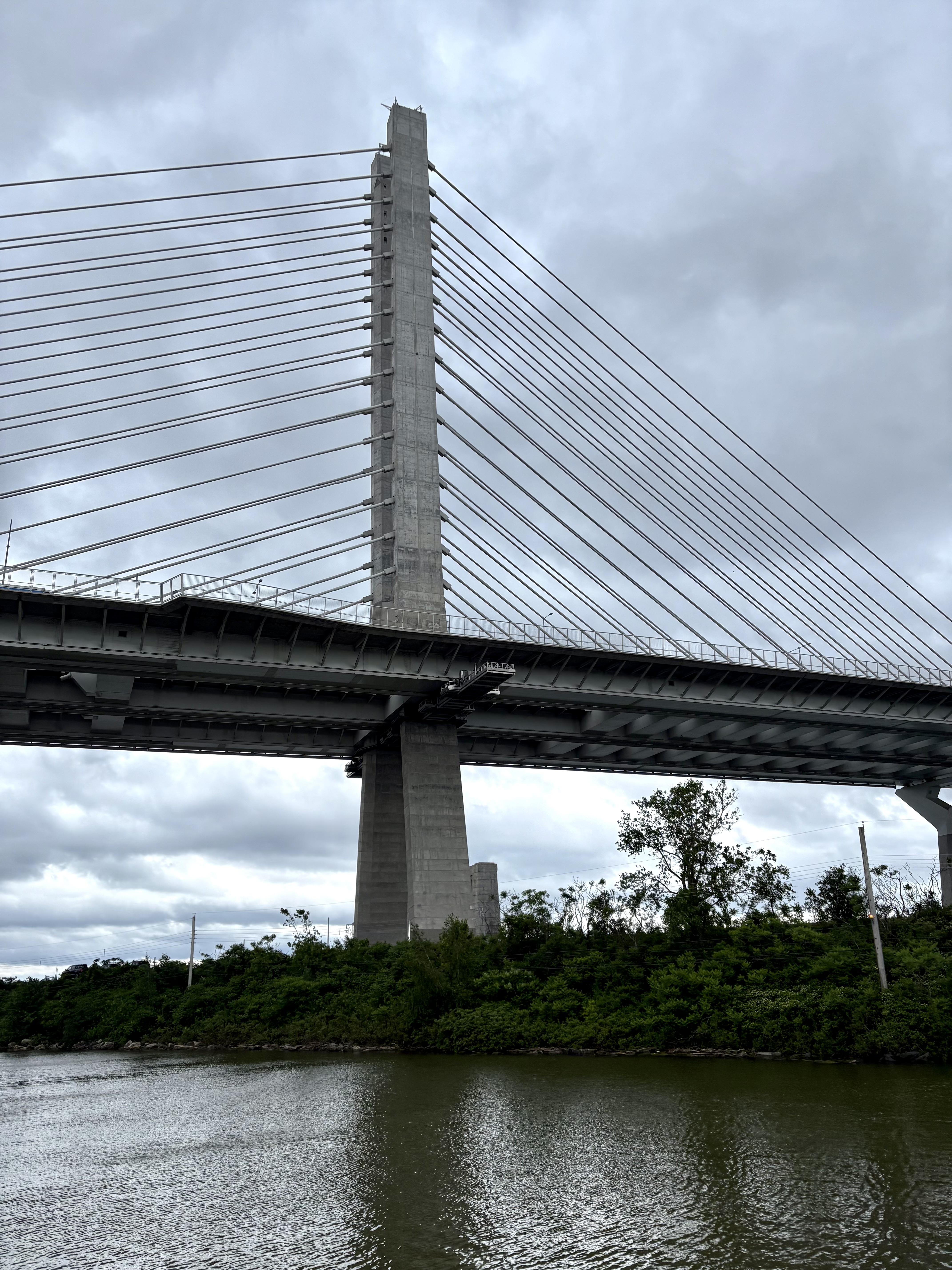
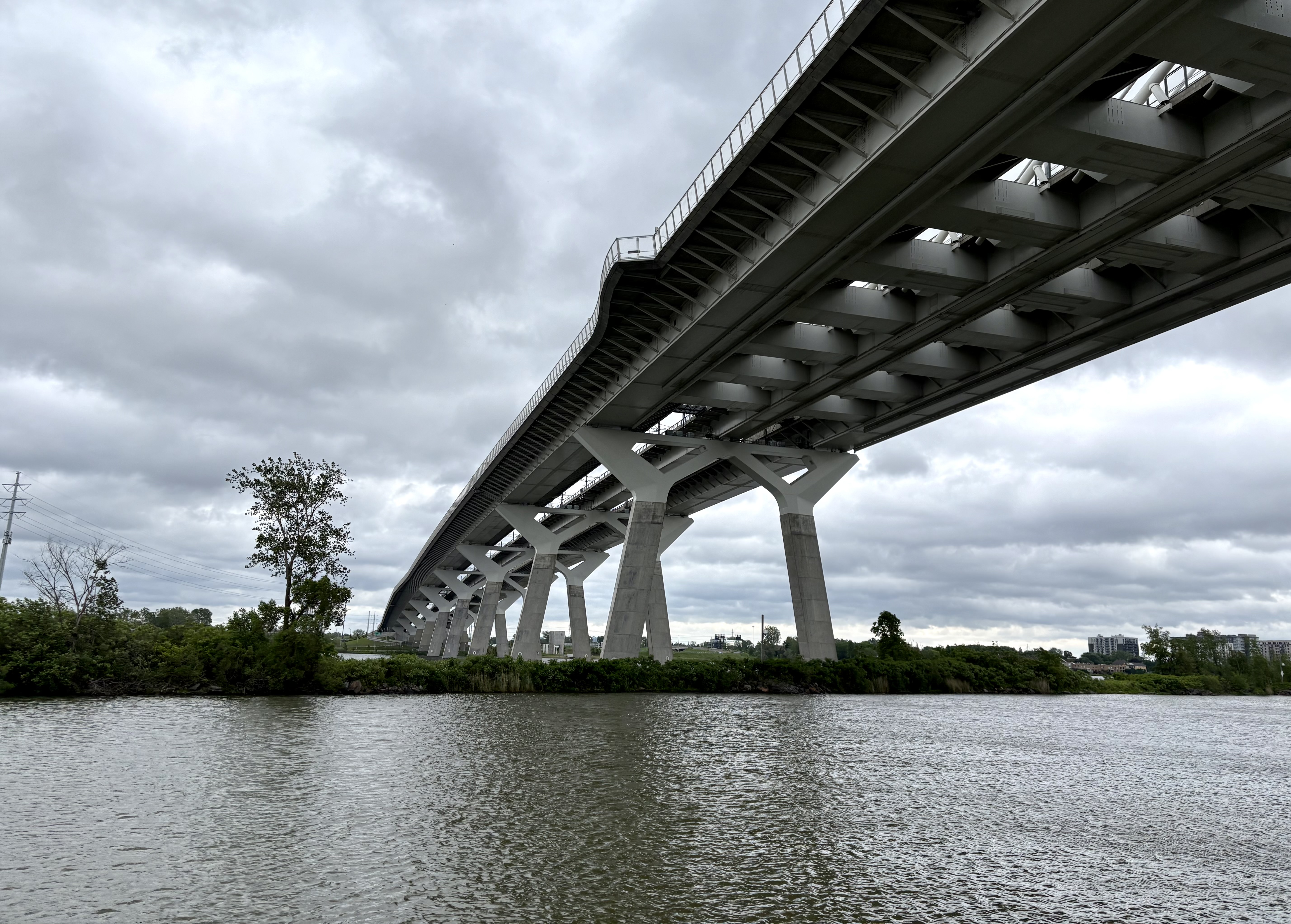
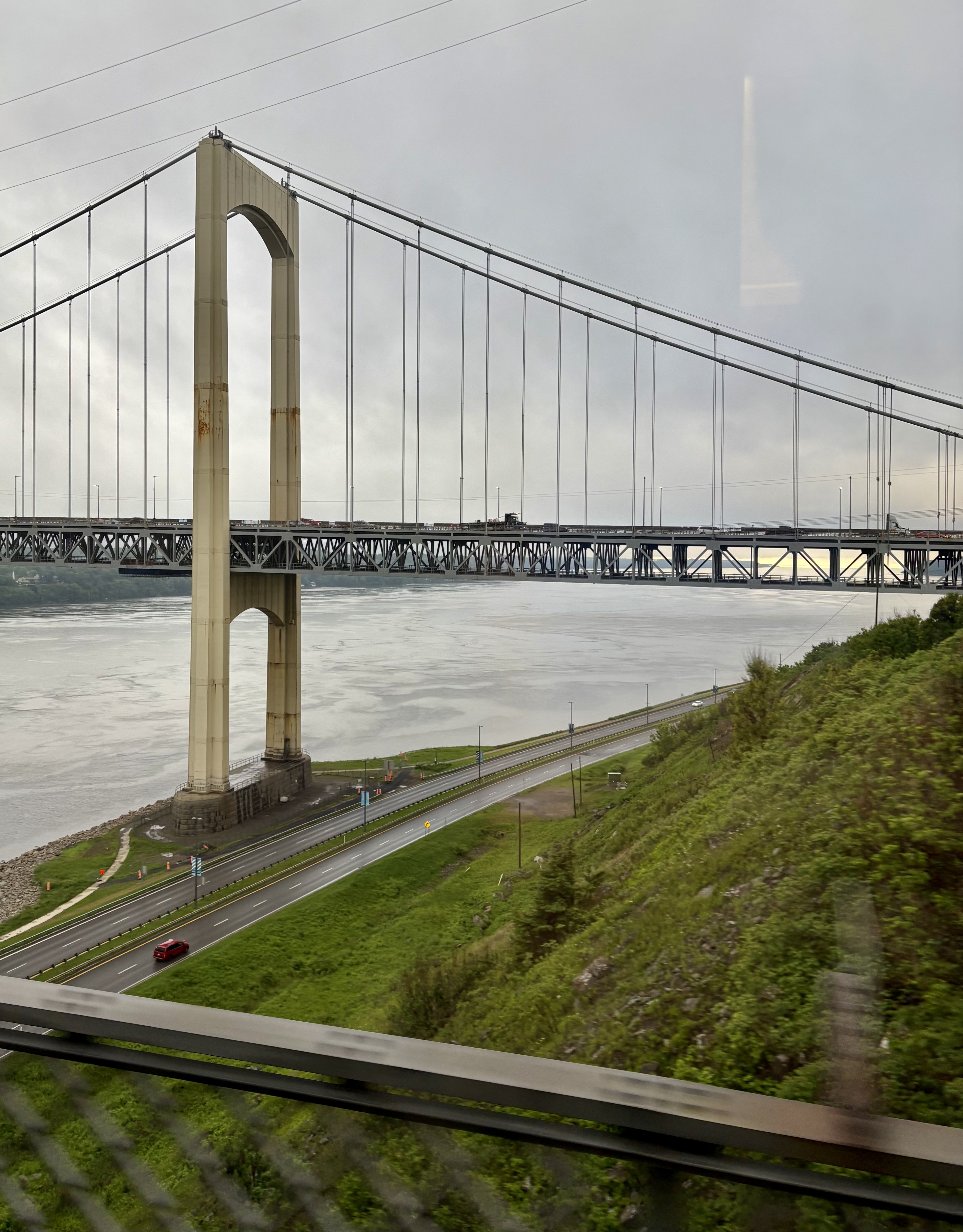
And we meet bridges. Here, the Samuel-de-Champlain Bridge, a cable-stayed structure that is as elegant above…
as underneath.
We also, in the broad placid waters of Lake St. Lawrence, meet a graveyard.
Literally, to some extent, as well as figuratively.
Lake St. Lawrence is human-made, part of the massive re-contouring of the river that involved creating a huge reservoir for the new Saunders Power Dam near Cornwall, Ontario. Underneath this lake, this reservoir, lie the Sunken Villages of the St. Lawrence — 12 Canadian communities entirely flooded (8) or partially destroyed/relocated (4) in order to create that reservoir. Yes, there was relocation assistance, but nothing financial can erase the emotional price.
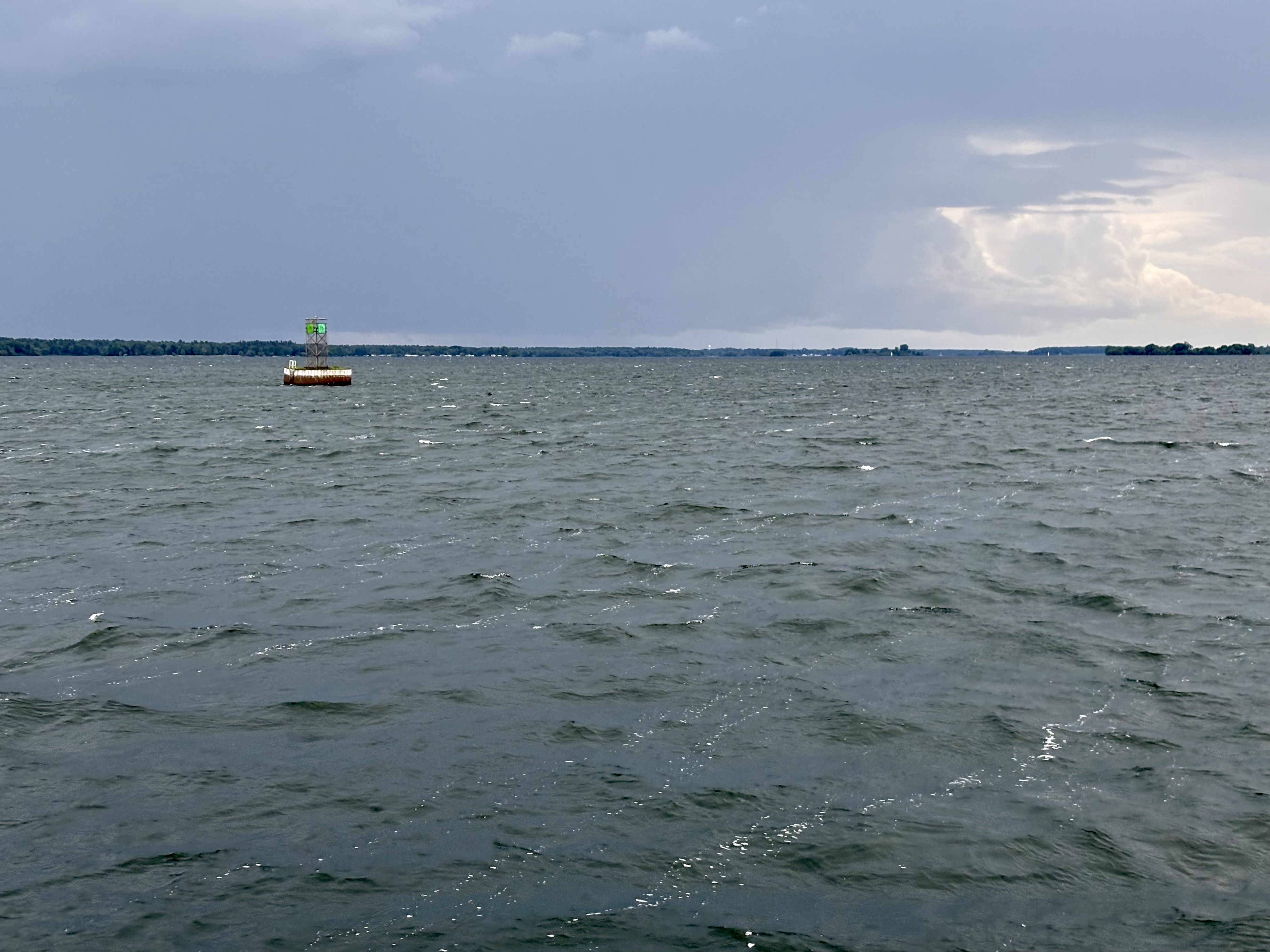
Did you notice the lowering sky, in all but one of those photos? We experience squally, blustery weather all along — even that sunshine behind CSL Welland soon disappears.
And so, when we passengers were expecting to keep sailing on upriver toward that evening’s destination, Cornwall, we are instead told we will not carry on through the anticipated storm. We will instead take shelter.
Take shelter? Just like that, find a convenient berth for a vessel our size?
Well, as a matter of fact… yes.
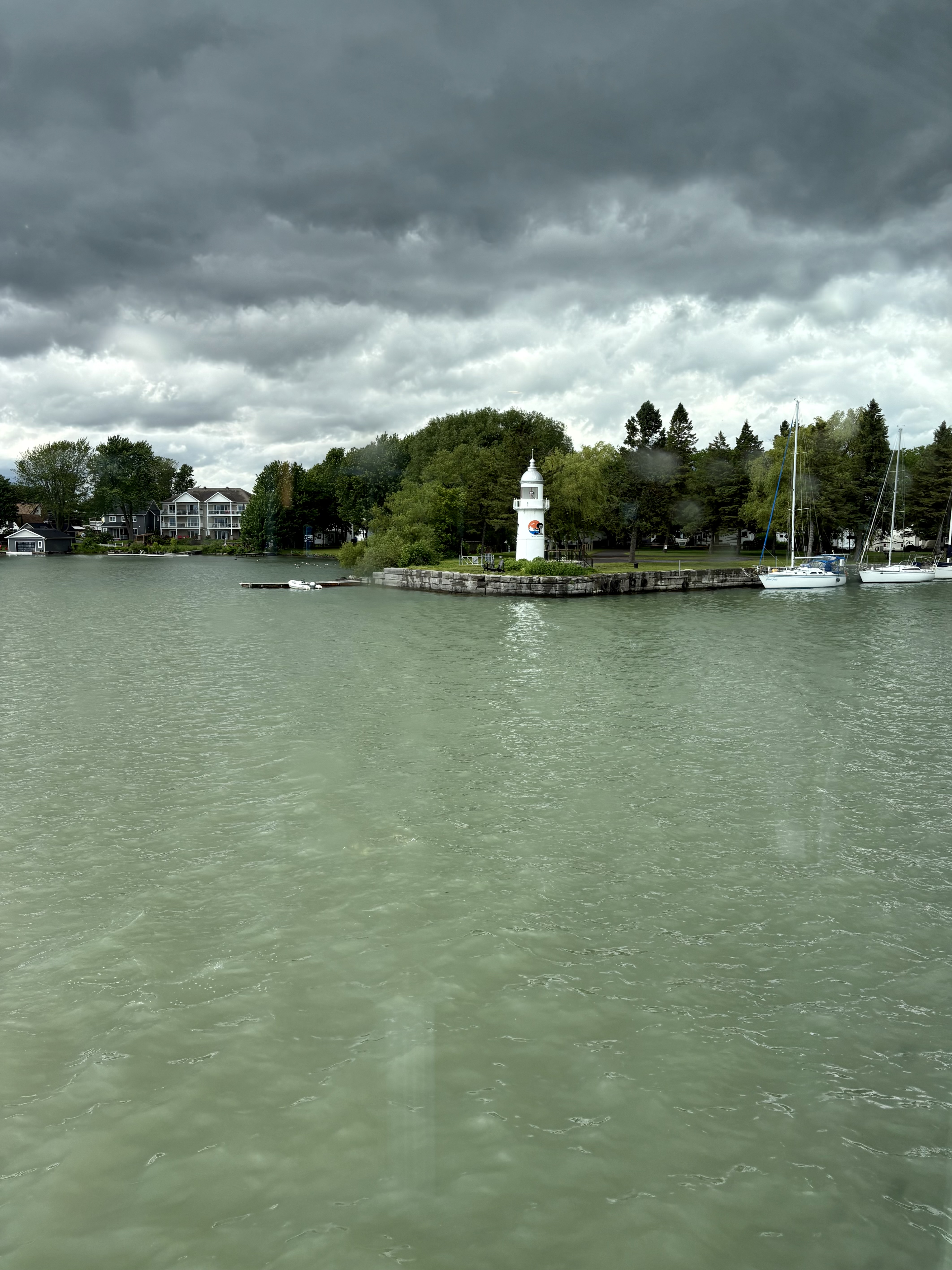
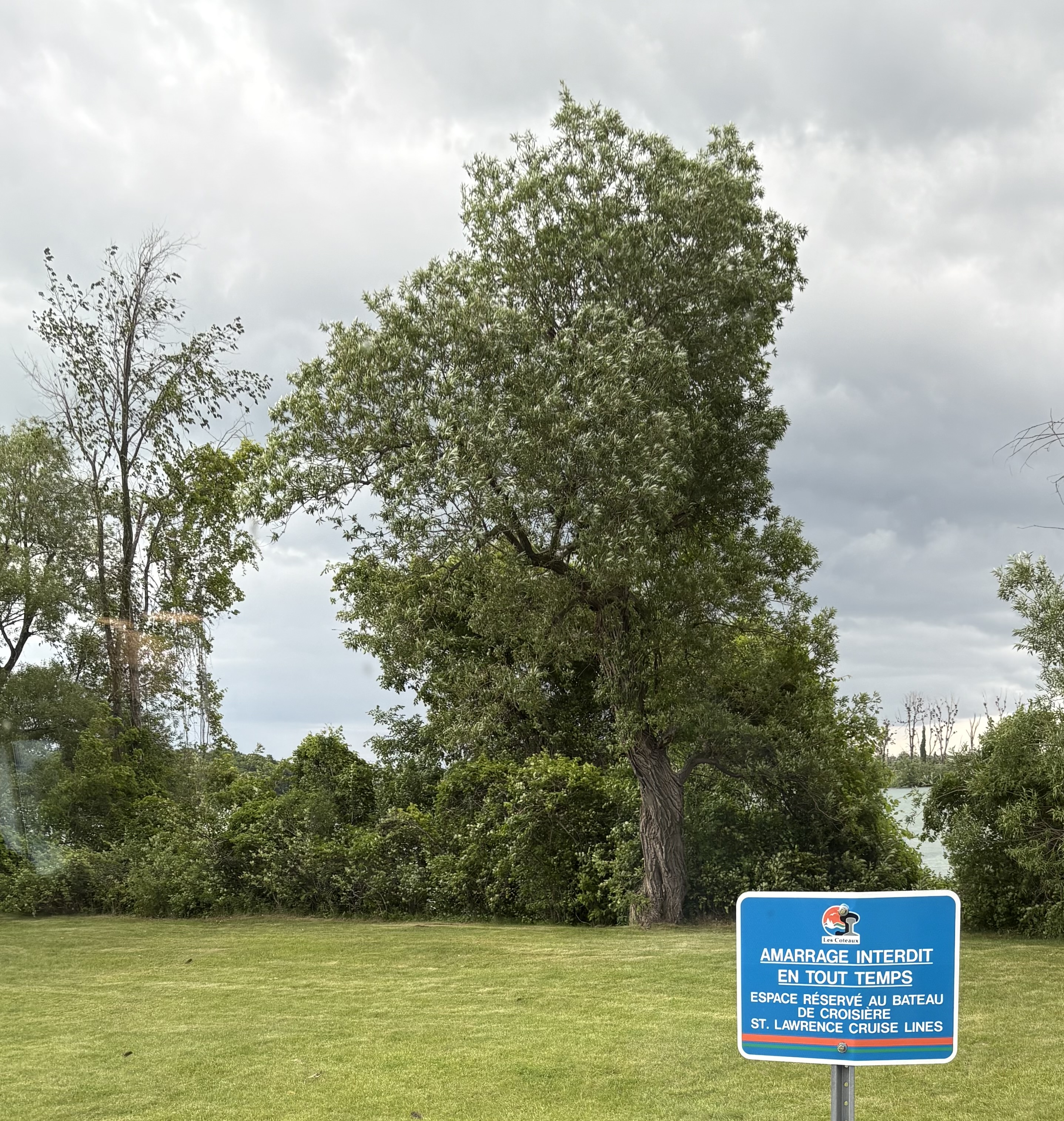
We turn into Coteau Landing (just east of St-Zotique). Where a suitable berth is permanently available.
This is just one of a number of guaranteed bolt-holes up and down the river, ready to receive the Canadian Empress whenever she happens to need one.
The threatened huge storm never did hit — though as you can see, trees are still being whipped about by the wind.
After a comfortable night of shelter (including time to stroll through the little community), we leave at 5 a.m. and get ourselves back on schedule.
Near Iroquois, we pass through the last of the 7 locks, this one as large as the others but slightly different in one respect. The difference earns it the name of a “drive-through” lock. Here, water is not sluiced in or out from points low by the gates. Instead, once the vessel is in position, the forward lock gate is very slightly opened, allowing that level of water to start infiltrating the lock and eventually bring its waters to the desired exit level.
And so, as we exit the Iroquois lock…
we have finally been delivered to the level of Lake Ontario (which lies just ahead of us, at Kingston).
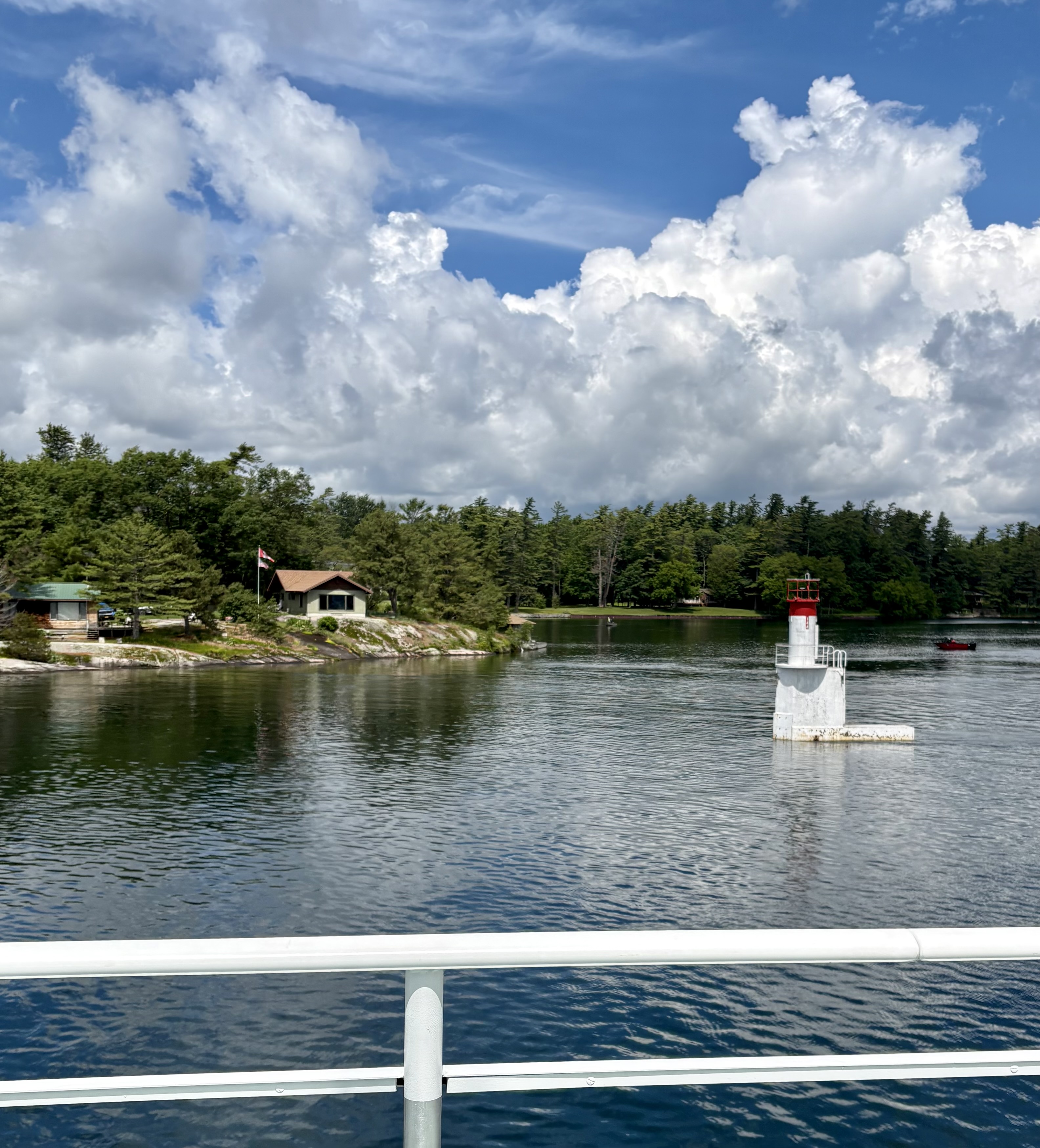
Meanwhile, we carve our way through the myriad delights of the Thousand Islands that dot these international waters between Brockville and Kingston.
For once, marketing understates the case: in fact, or so they say, there are 1,864 islands. (And who are we to argue?)
I’m now happy to lean back, as sunshine and warmth finally make their appearance, and enjoy what lies before me: the final 80 km of an extraordinary voyage.
16 June 2026 – And so, at 6:15 a.m. as promised, I’m off VIA Rail in Ste-Foy, then onto the shuttle bus, and…
across the St. Lawrence River into Quebec City.
I decide a walk will do more for my addled head than extra coffee. Out I go, up to the surviving section (4.6 km) of stone ramparts that, as of 1608, were being built to encircle and protect Nouvelle France.
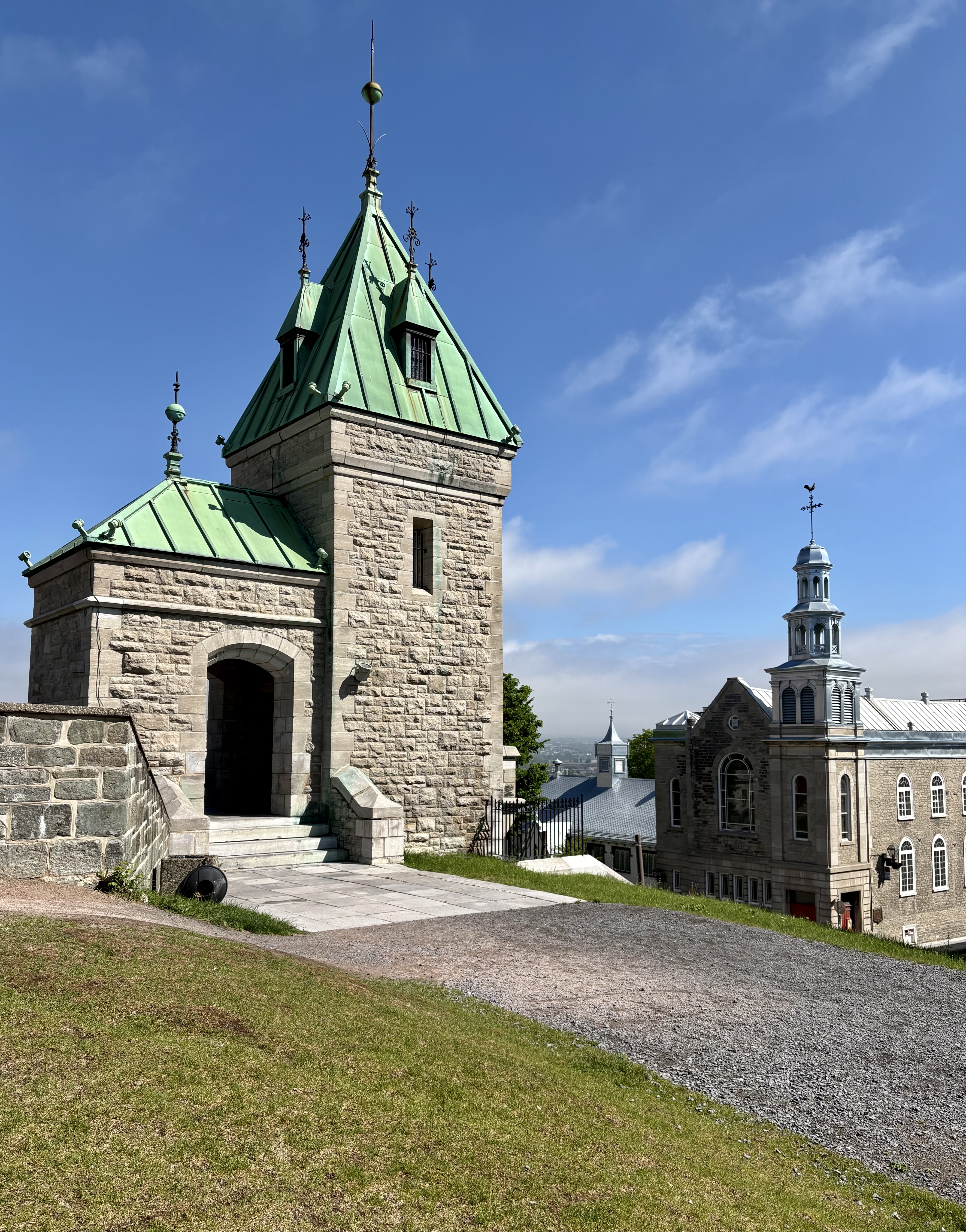
The Kent Gate is still imposing, still a witness of Then, living with us in the Now.
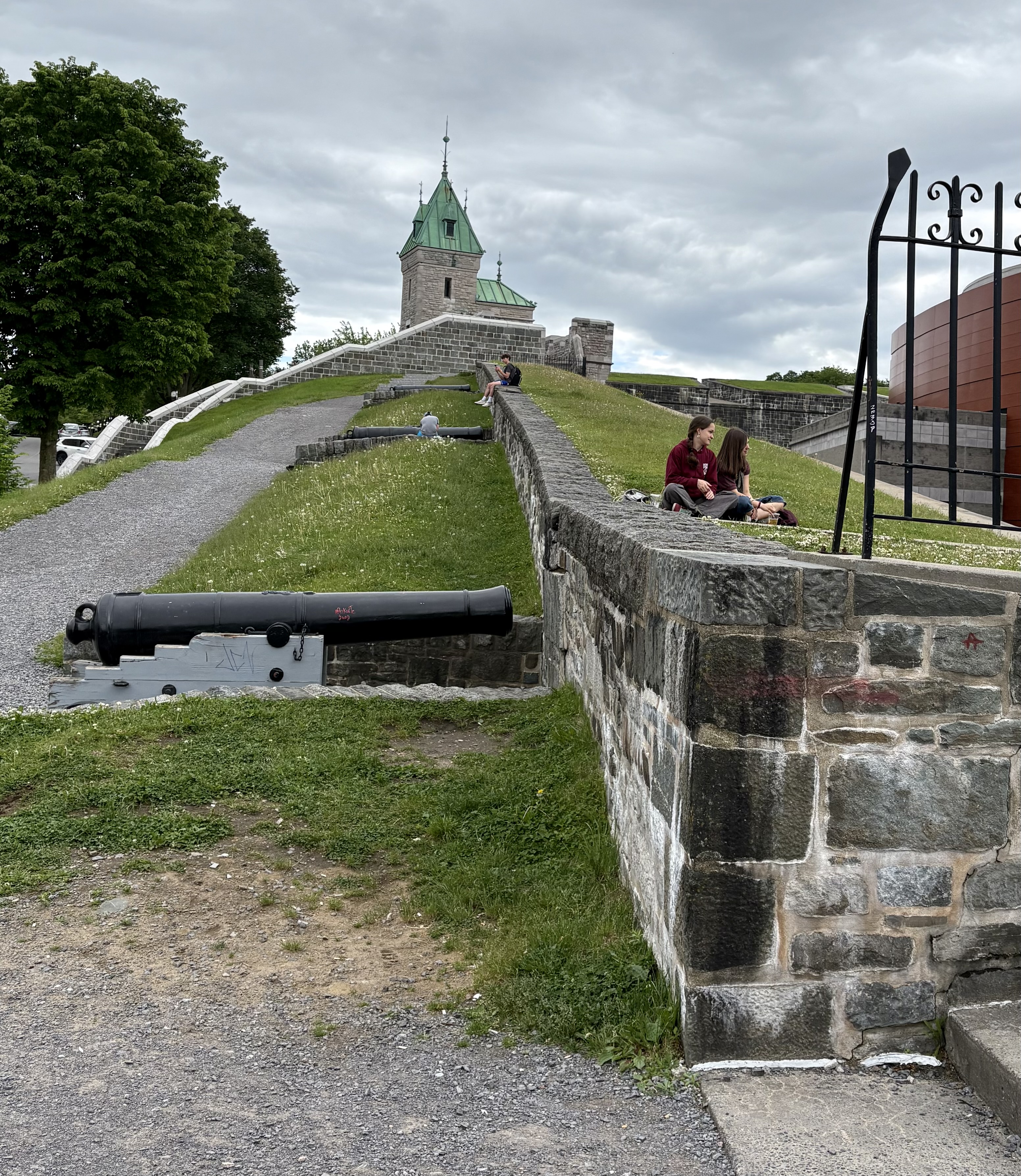
I walk on along to Porte Saint-Jean, look back at the juxtaposition of Then and Now:
young bums on ancient stones, intercut by ancient canon, their owners busy on 21st-c smart phones.
I begin to wonder a bit about the inherent balancing act for old cities. How do you honour and protect that heritage, without freezing into a museum that denies modern life?
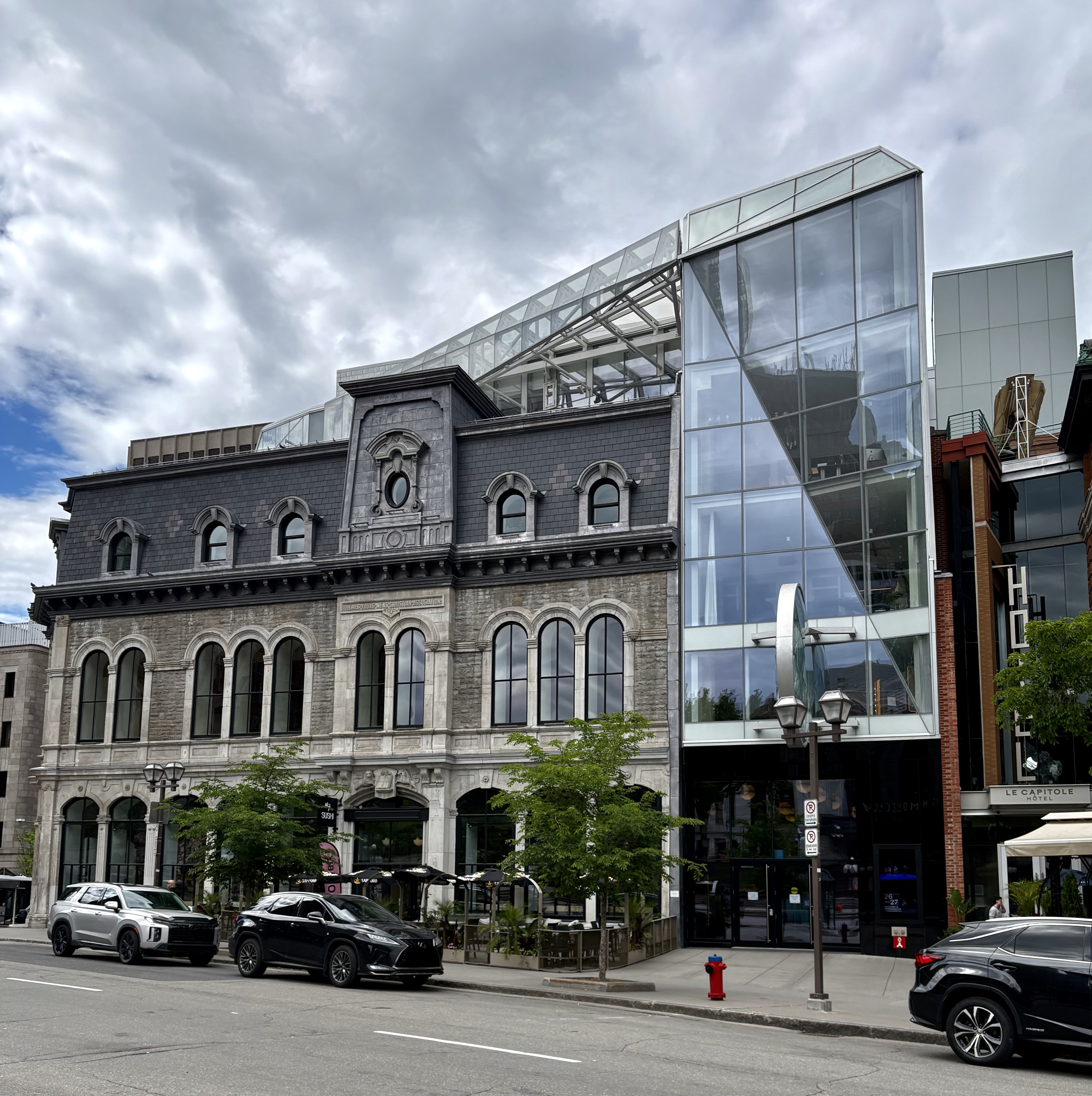
I can’t answer the question, but I do see more examples of this city’s balancing act all around me. A new building sliced in between old ones, for example, here in Place D’Youville, just outside the ramparts…
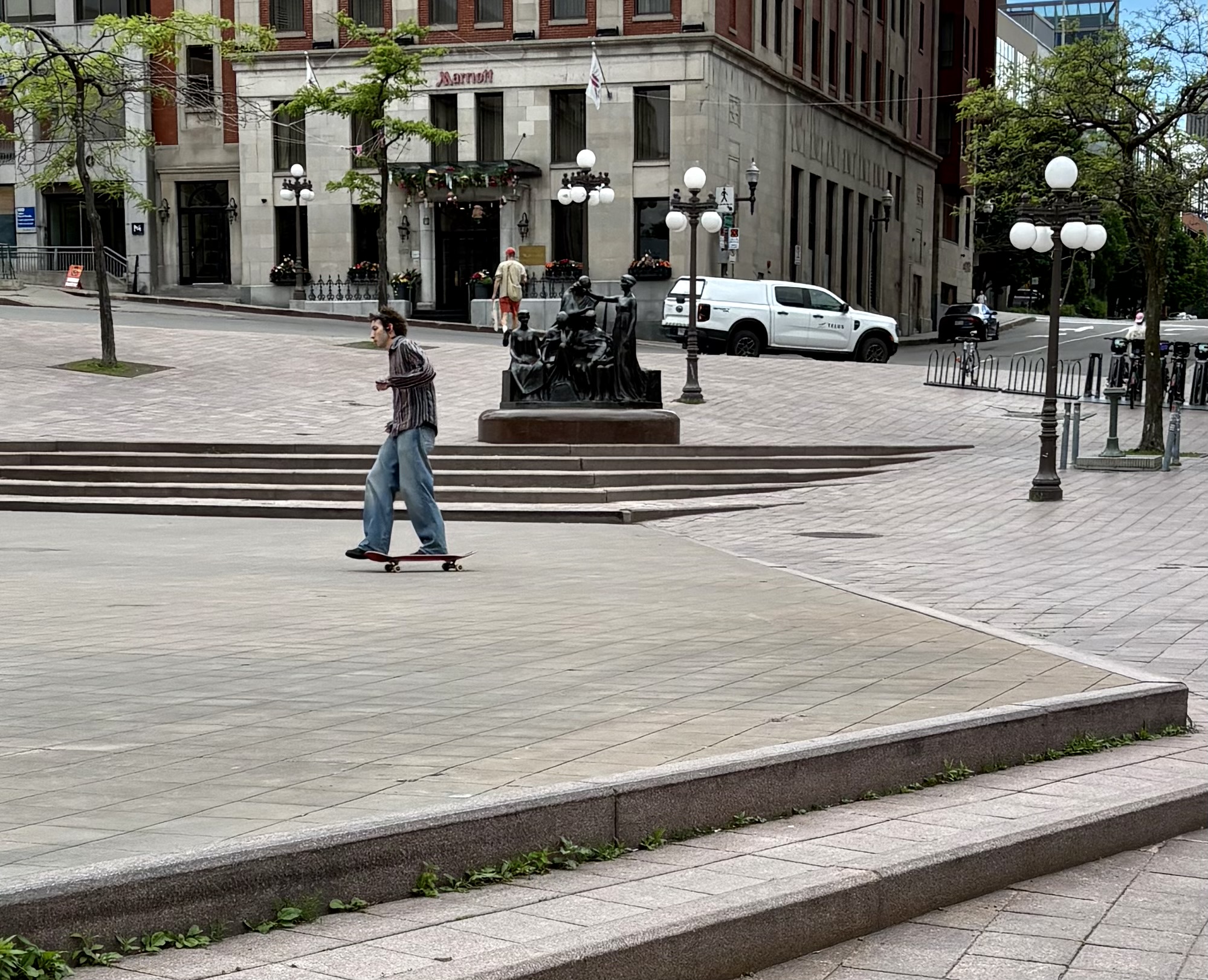
and, also in Place D’Youville, young-culture skateboarders twirling past one of the city’s abundance of old-culture statuary (here, Les Muses).
All this history, all this European ambience. Quebec City is a magnet for tourists.
Another balancing act.
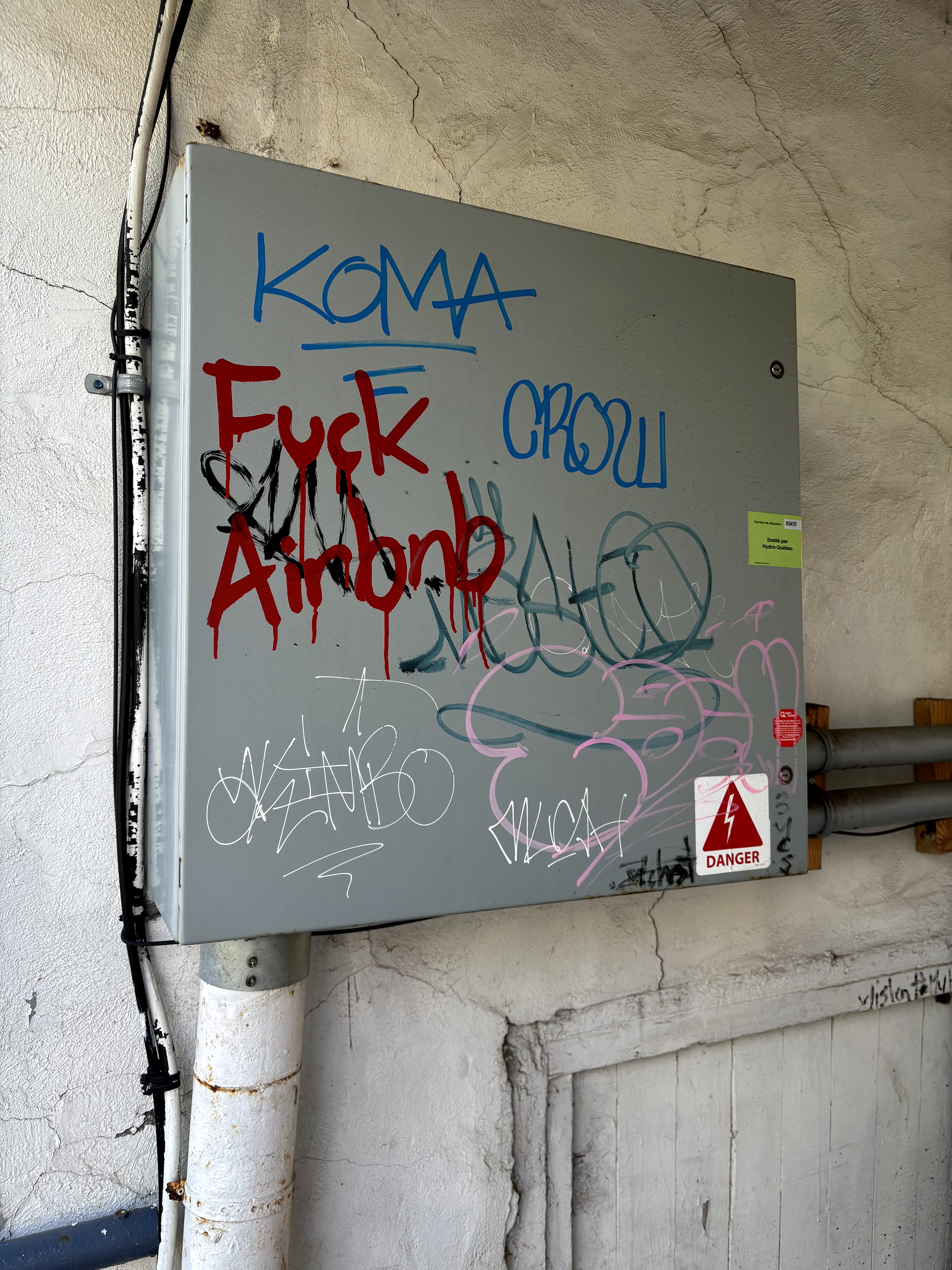
On near-by Rue Ste-Anne (where tourist me happens to be staying), I look into an alcove and see some local push-back:
Indeed. How does a tourist-magnet city welcome and please tourists, without being overrun and turned into a cartoon? I head downhill on Rue Saint-Jean — a tourist thoroughfare — and see something of the current mix. It’s eclectic and strongly patriotic, both Québécois and pan-Canadian.
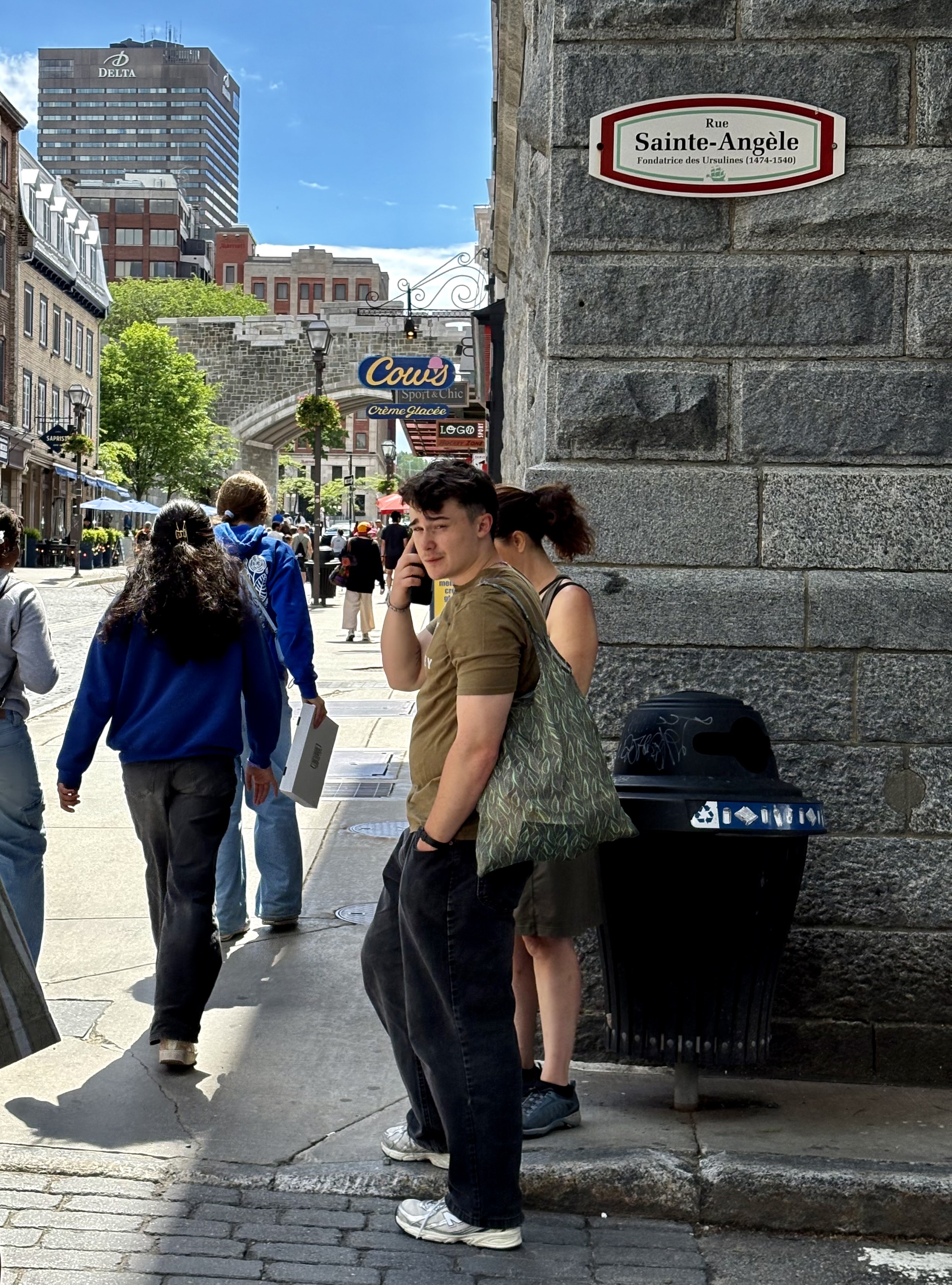
High on the wall, half-way up the block beyond the Rue Sainte-Angèle sign in the foreground, you’ll see the Cows logo…
a PEI brand, offering terrific ice-cream along with a range of whimsical cow-image clothing & accessories.
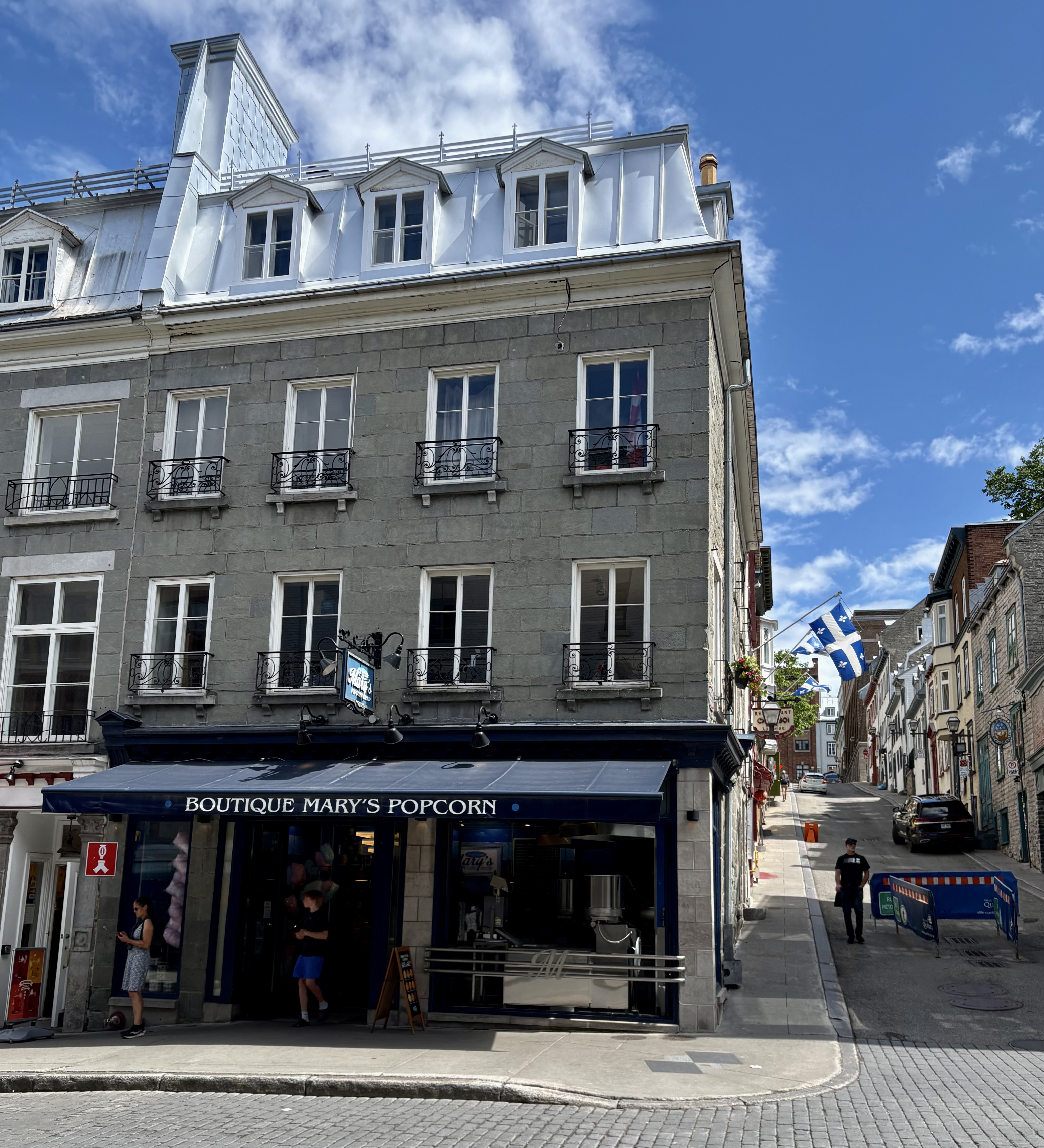
Right across the street…
less nutritious, and surely just as popular, the lure of Mary’s Popcorn.
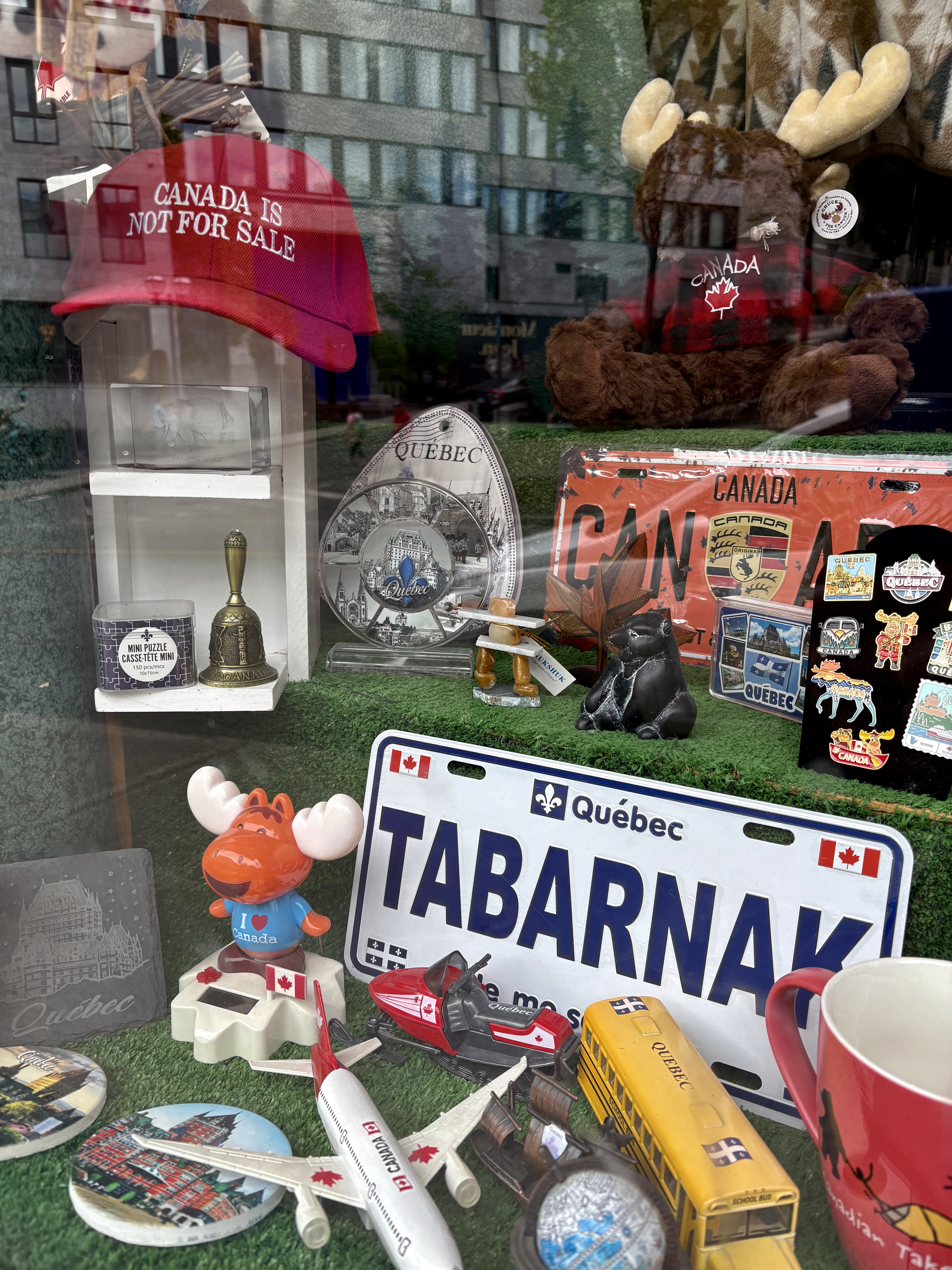
Cheerful kitsch here at my elbow, with its own patriotic statements…
from the red “not-for-sale” Canadian cap, to the mock Quebec licence plate, with its chosen example of distinctive Quebec swear words.
(Flashback: when I joined the fledgling Oxfam-Québec as Director of Projects, the rest of the team, all francophone, promptly taught me how to swear “comme une bonne Québécoise.” And I still can.)
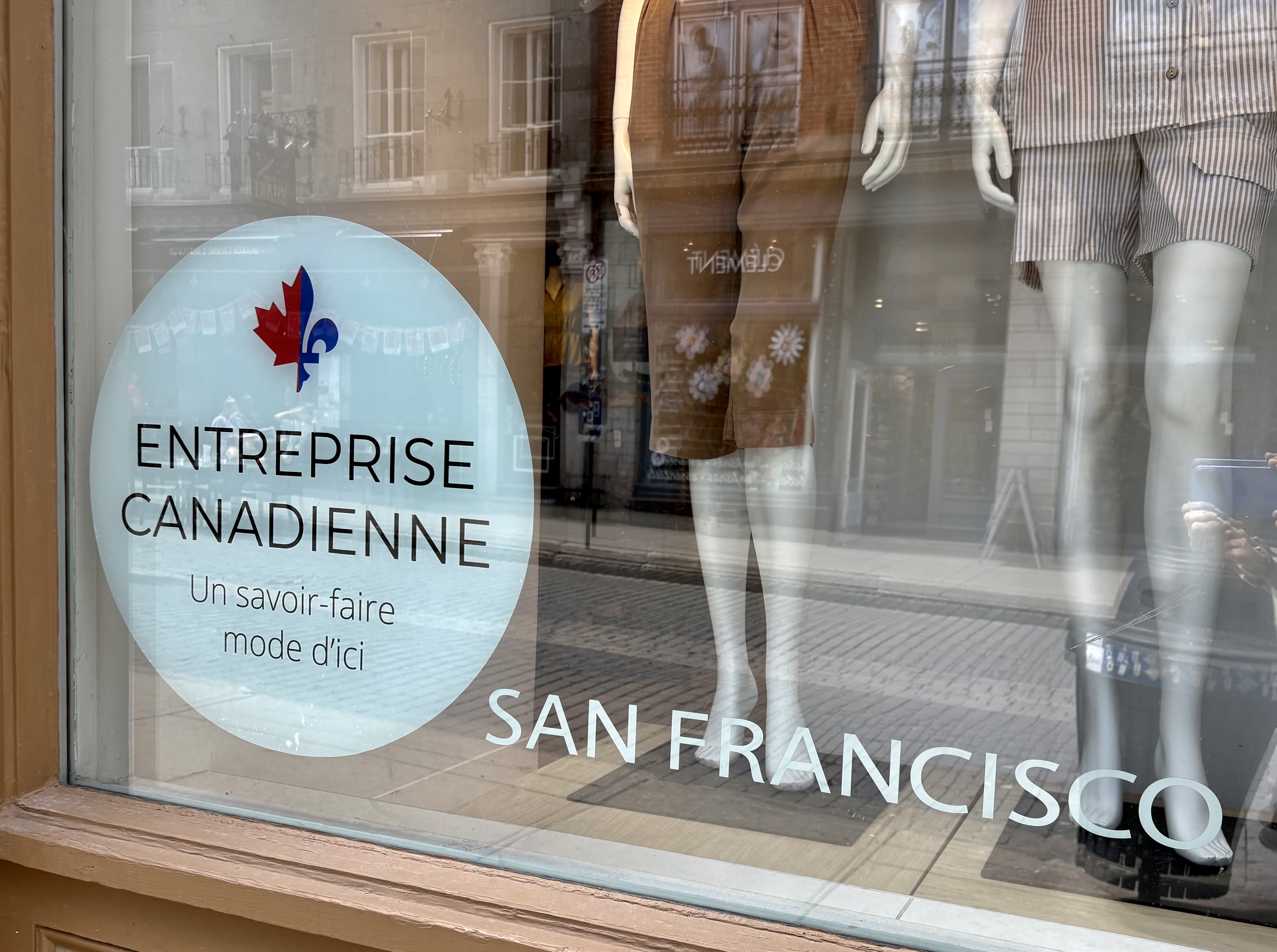
Yet more patriotism, a classy clothing shop with its proud boast in large letters on the window.
Yay for that, but it’s a bit confusing, no? A Canadian enterprise that chooses to name itself San Francisco?
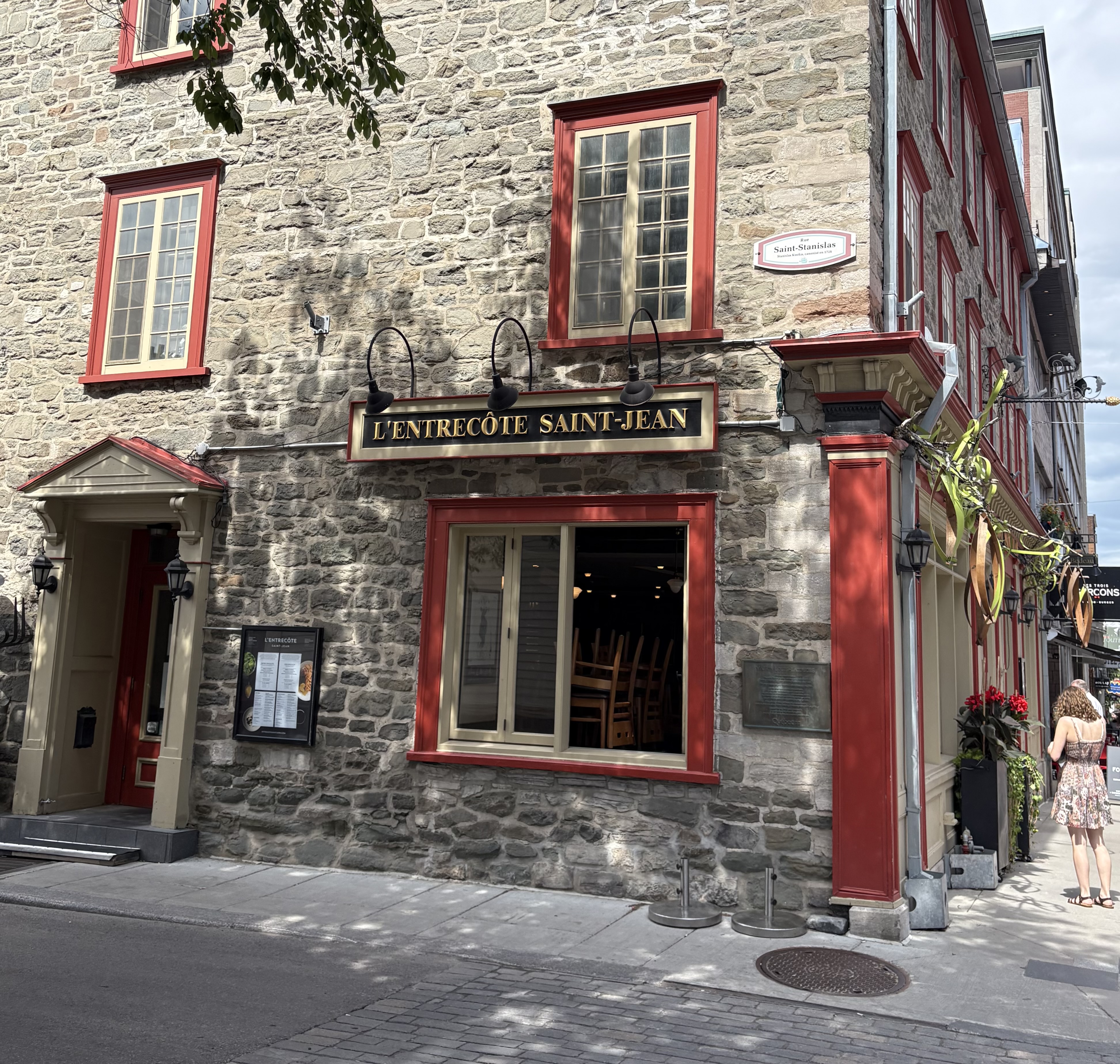
At the next intersection, an old building whose lettering and style live up to the elegance of the building itself…
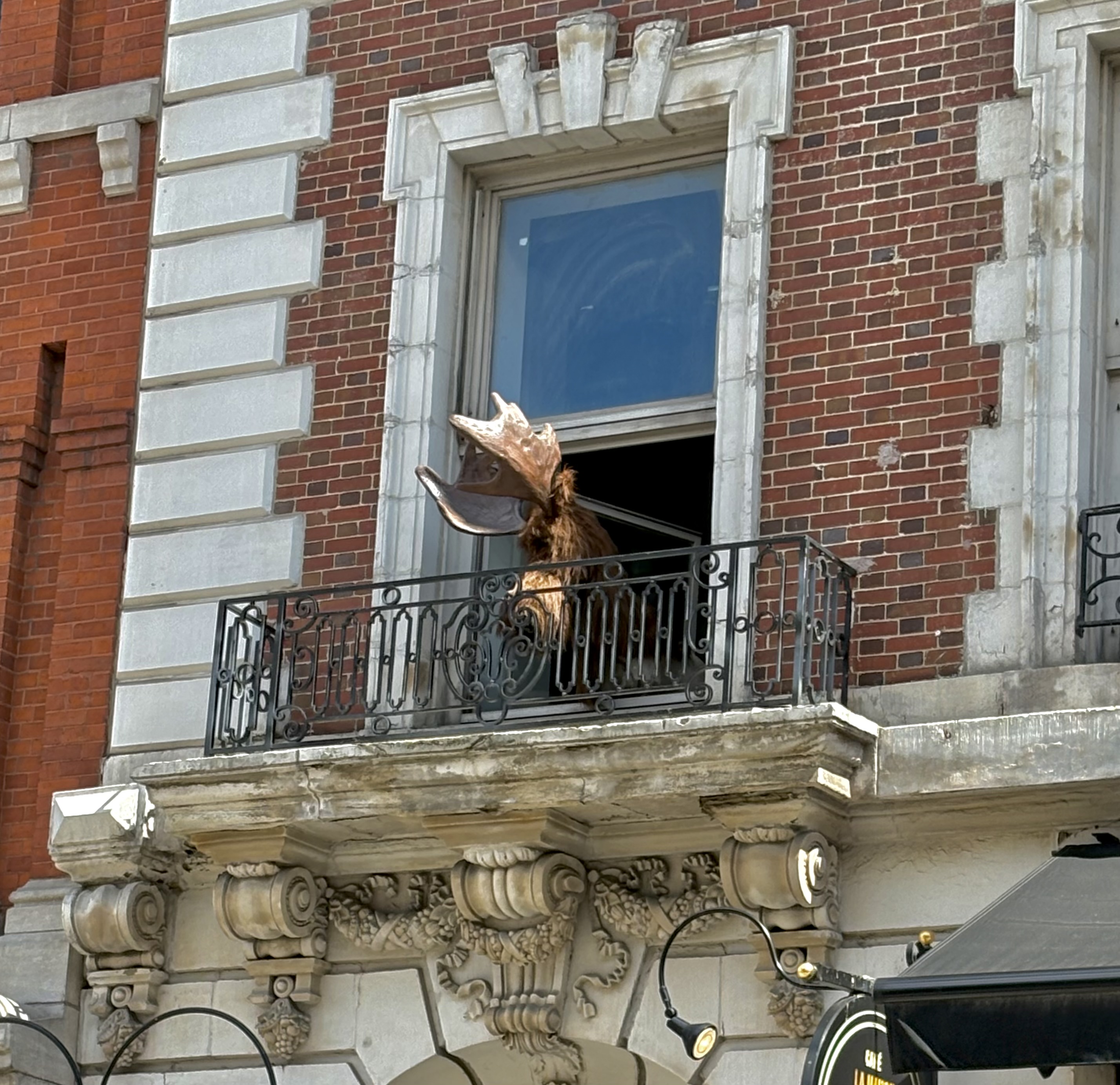
plus, across Saint-Jean in a second-storey balcony window…
a curious moose, keeping track of us all.
Enough musing. I’m hungry.
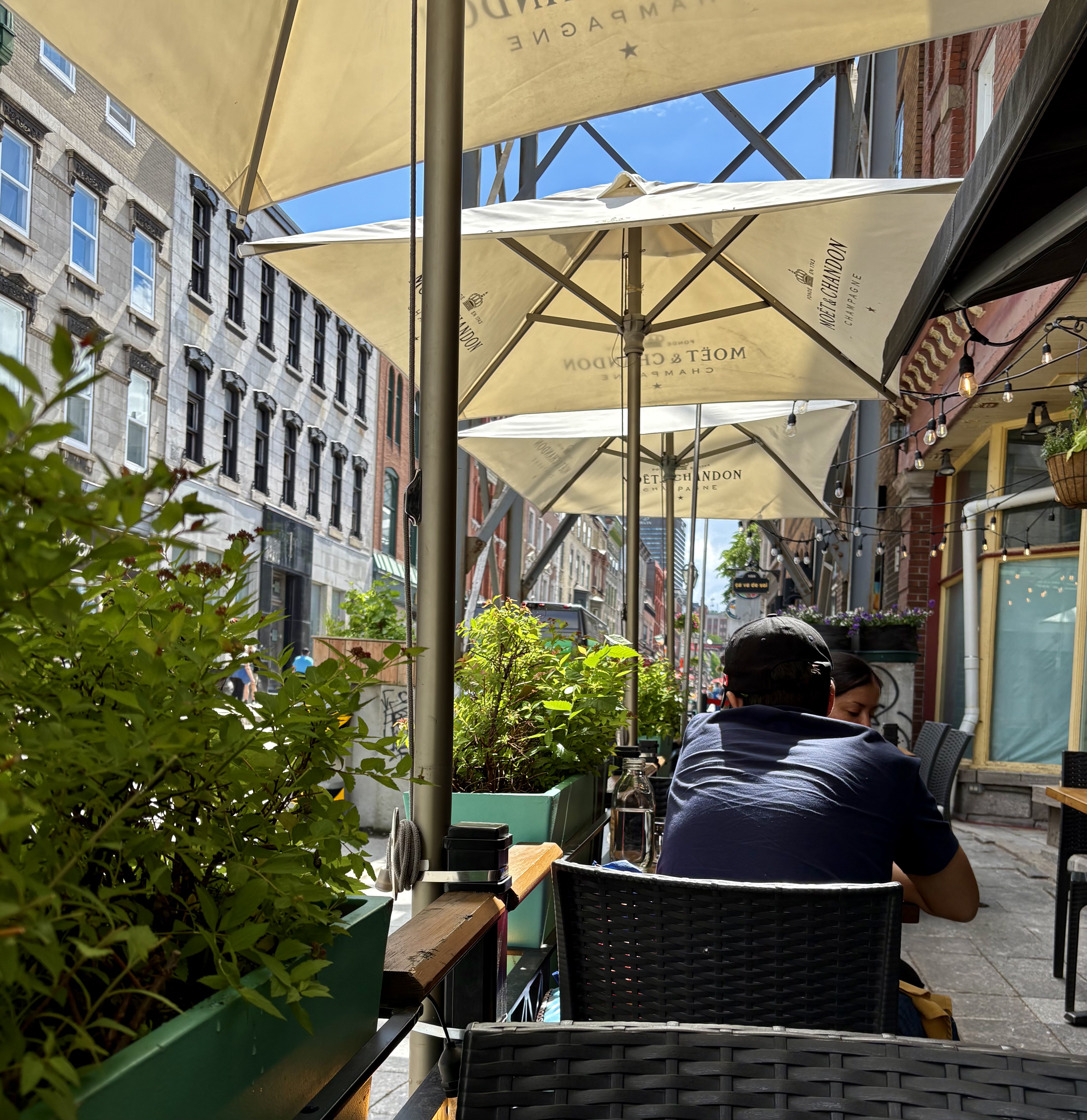
I park myself at a Bistro Hortus patio table and listen to the young, stylish (and stylishly tattoo’ed) servers switch smoothly from French to English as the occasion requires.
My choice is the “Salade biologique au chèvre des neiges” (goat cheese). I speak French with the server, and she offers me the same polished charm she offers everyone else. She does break composure, however, wrinkling her brow slightly when I ask her to bring back the menu for a moment — until I explain I want to take a picture of the salad description “comme une bonne p’tite touriste.” This causes her to burst into genuine laughter, and after that we have an amused good time together.
Fortified with salad plus café au lait, I walk on and discover Artisans Canada. Since I’m already wearing a Tilley hat with a little wooden chickadee pin on it and a MEC backpack and my Newfoundland earrings (thank you again, DJ), I fit right in. I make a few purchases, and I now suggest that — should quality Canadiana interest you — you might have a look for yourself.
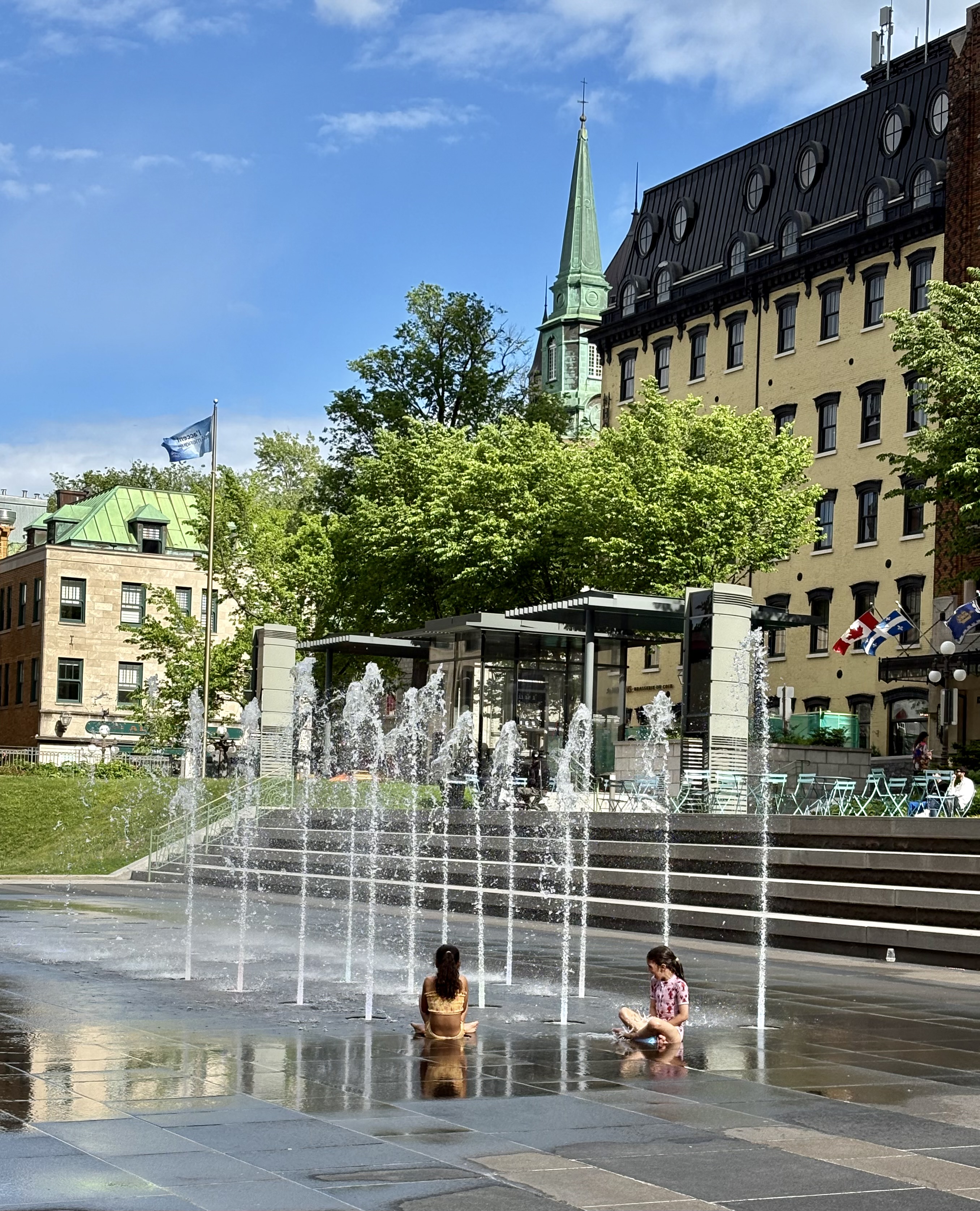
Looping ’round to head back uphill to my vielle-ville hotel, I cut through the very modern plaza skirting the slightly old City Hall (1890s), which sits on the site of the very old Jesuit college (1730s). Trees, shrubbery, spring blossoms, and seating from which to admire it all.
Plus fountains of water that shoot into the air at regular intervals…
and have these two little girls in fits of laughter.
Judging by speech patterns and body language, these are local people relaxing in a local park, even as tourist season rumbles into high gear.
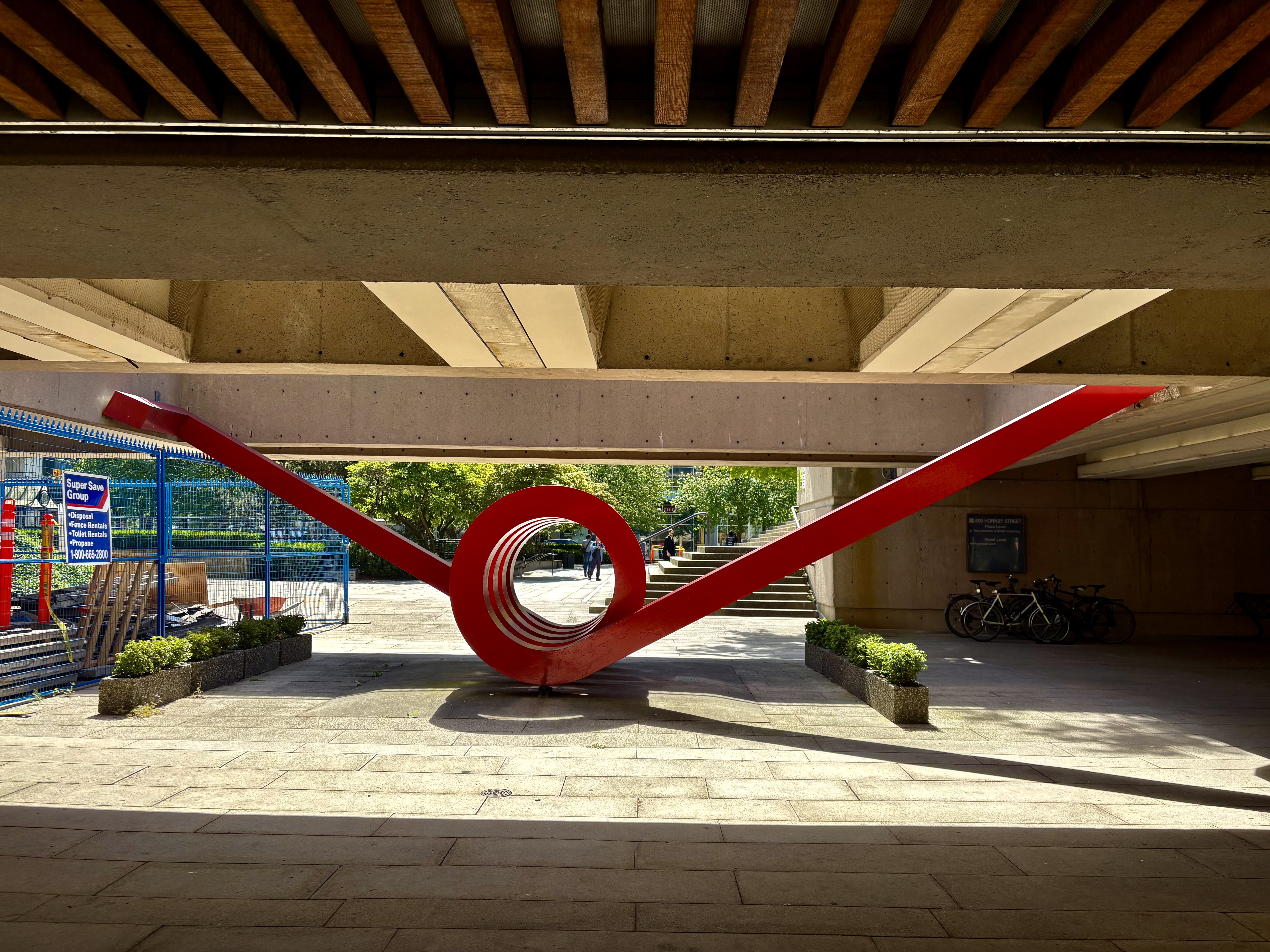
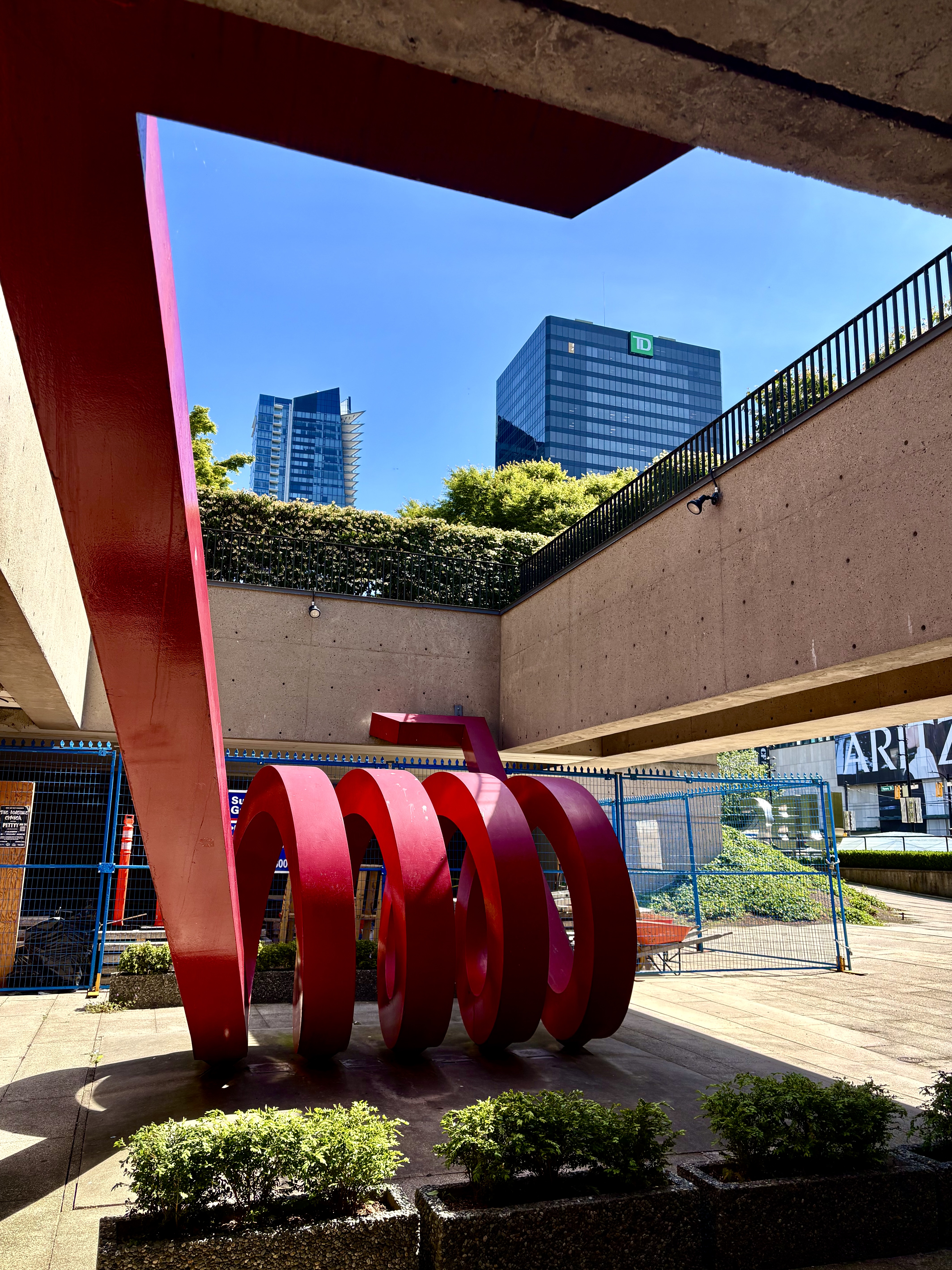
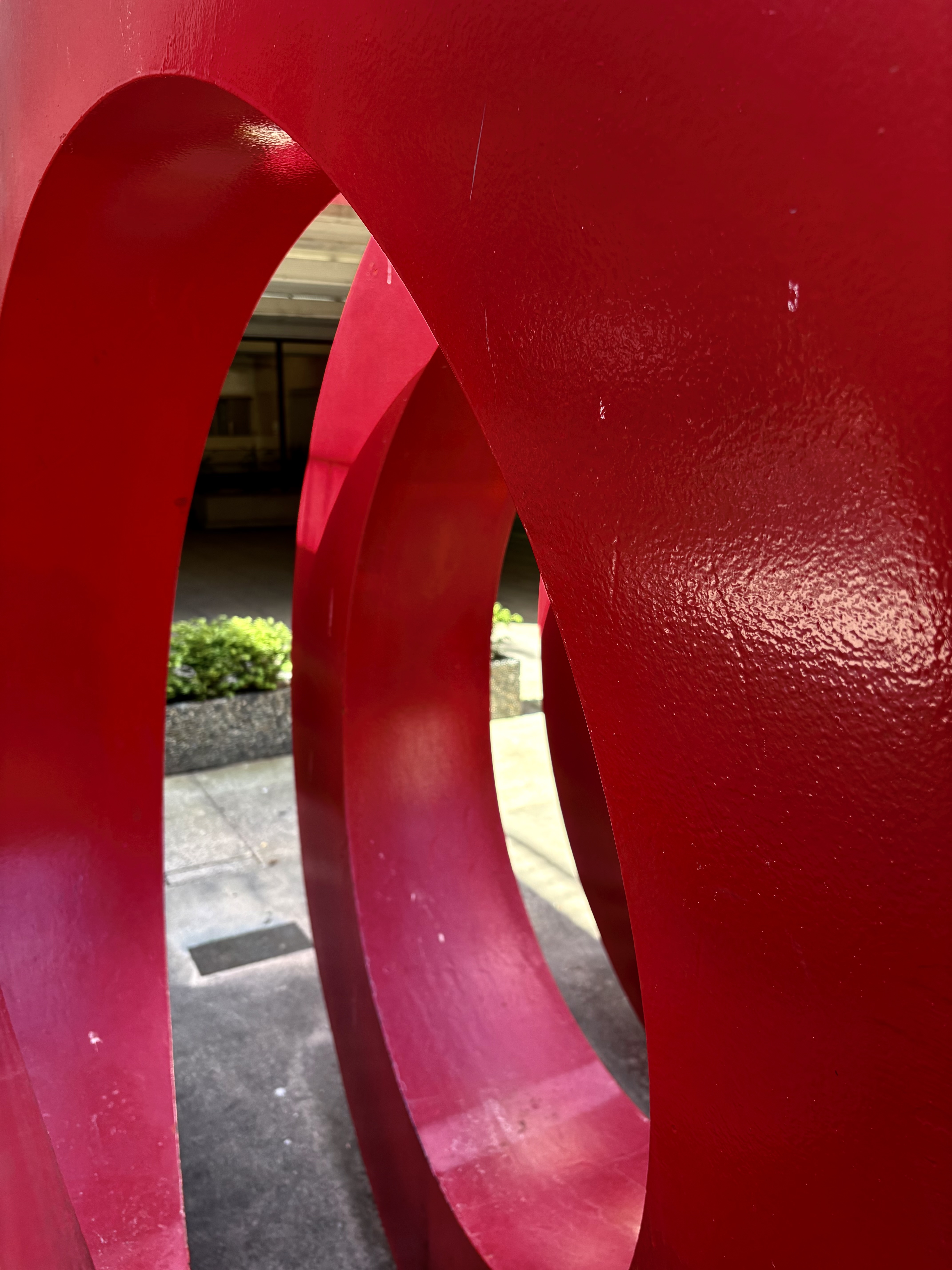
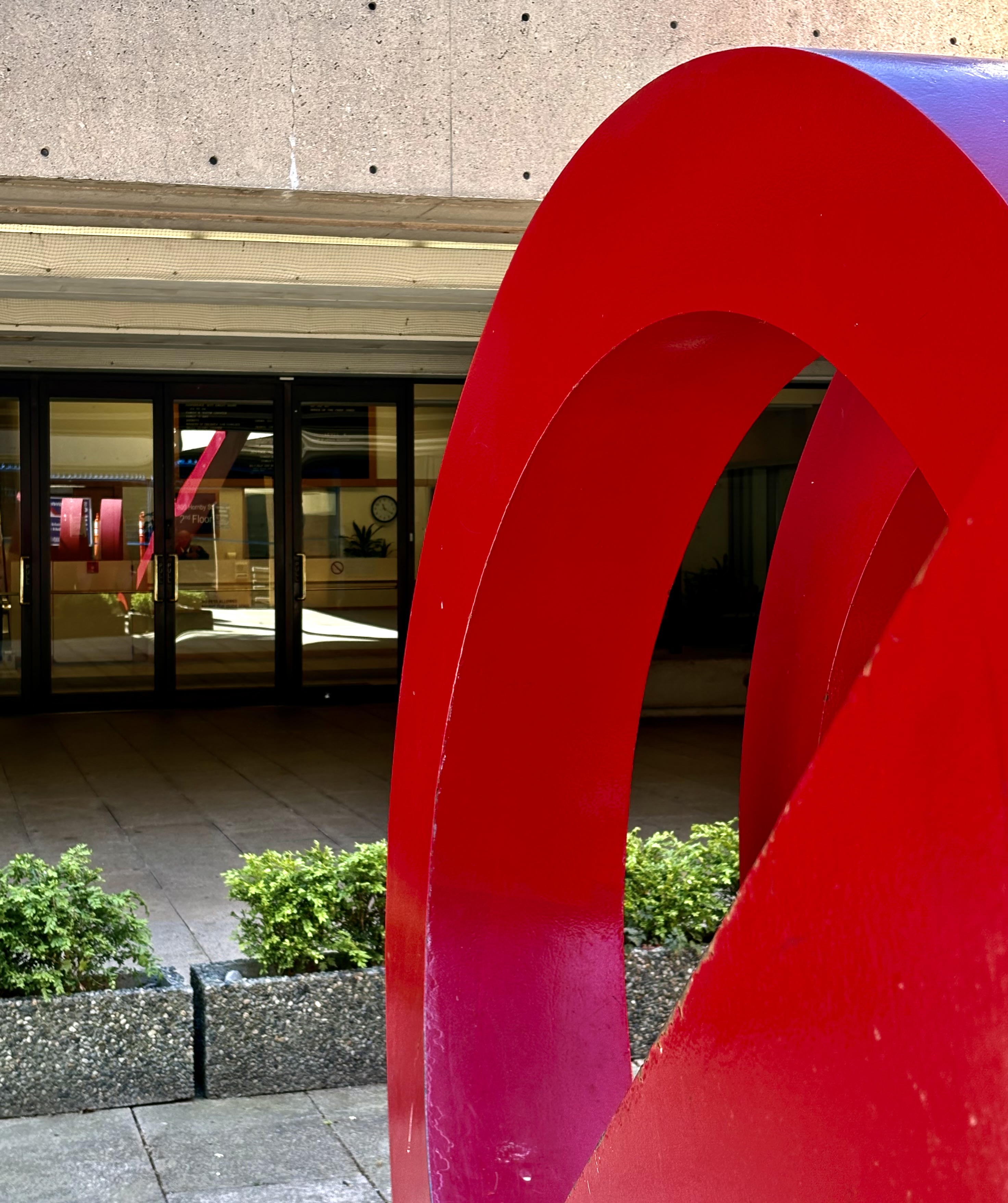
The title of this 1981 steel sculpture (Alan Chung Hung) is Spring. Of course it is! Even with that bit of temporary fencing on the left, we can see that the structure is a spring, a handsome great spring that earns its keep — or would have us believe it earns its keep, holding up the second level of Robson Square.
I play along.
See? There’s a sturdy spring end, doing its job.
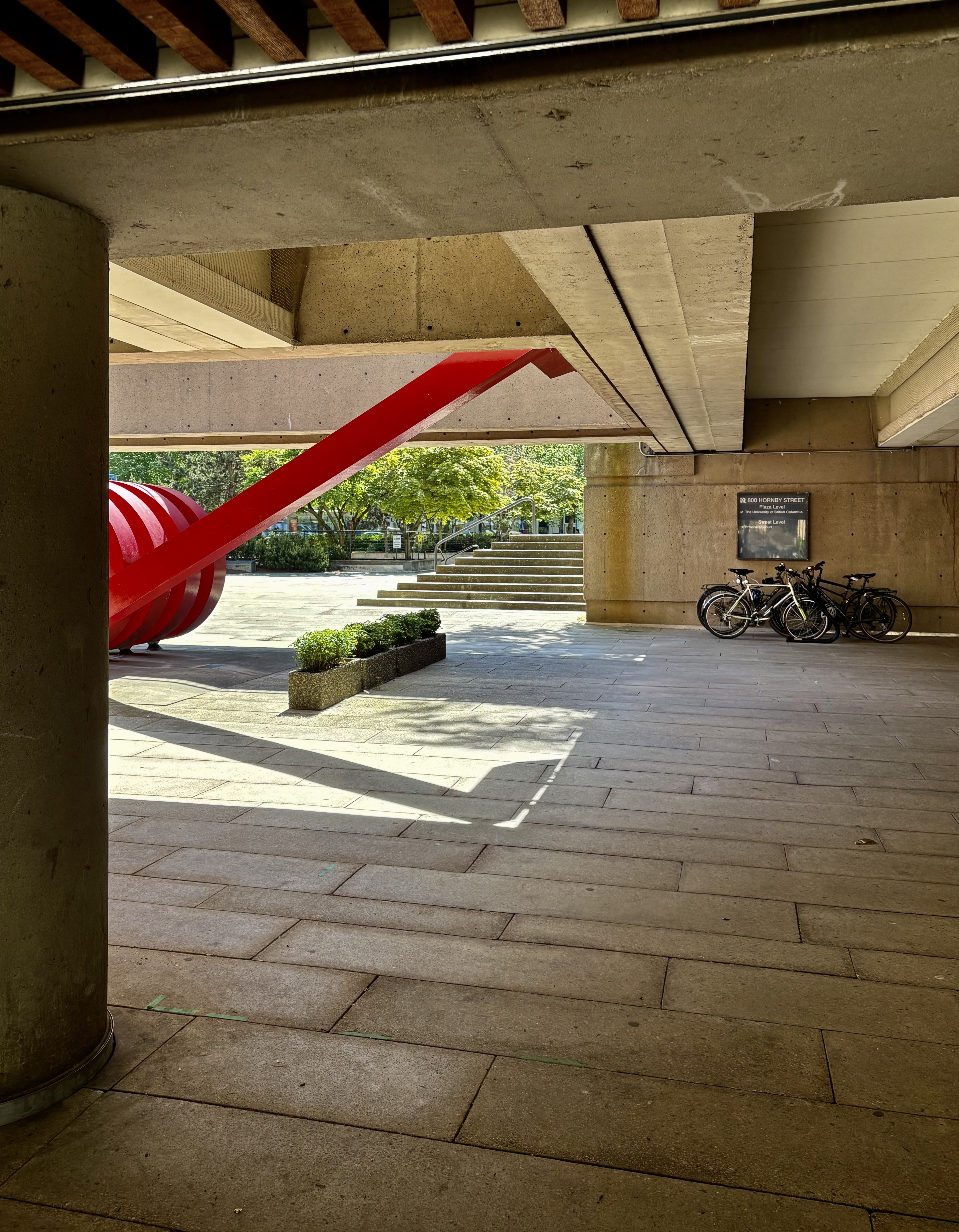
I’m used to this particular joke, so my attention moves on, enjoys the play of sculpture with context: the light, the shadows, the plaza lines of Robson Square, the hints of the BC Provincial Law Courts above, the stripe of green shrubbery, the bicycles.
I move in, start prowling, curious to see the play from different angles.
Peer low: glimpses of that upper level, one fragment of the magic on display over my head, the marriage of Arthur Erickson‘s architecture with Cornelia Hahn Oberlander’s landscape architecture to create the flowing, harmonious Law Courts whole.
Peer high: a view the other way, back toward downtown city towers.
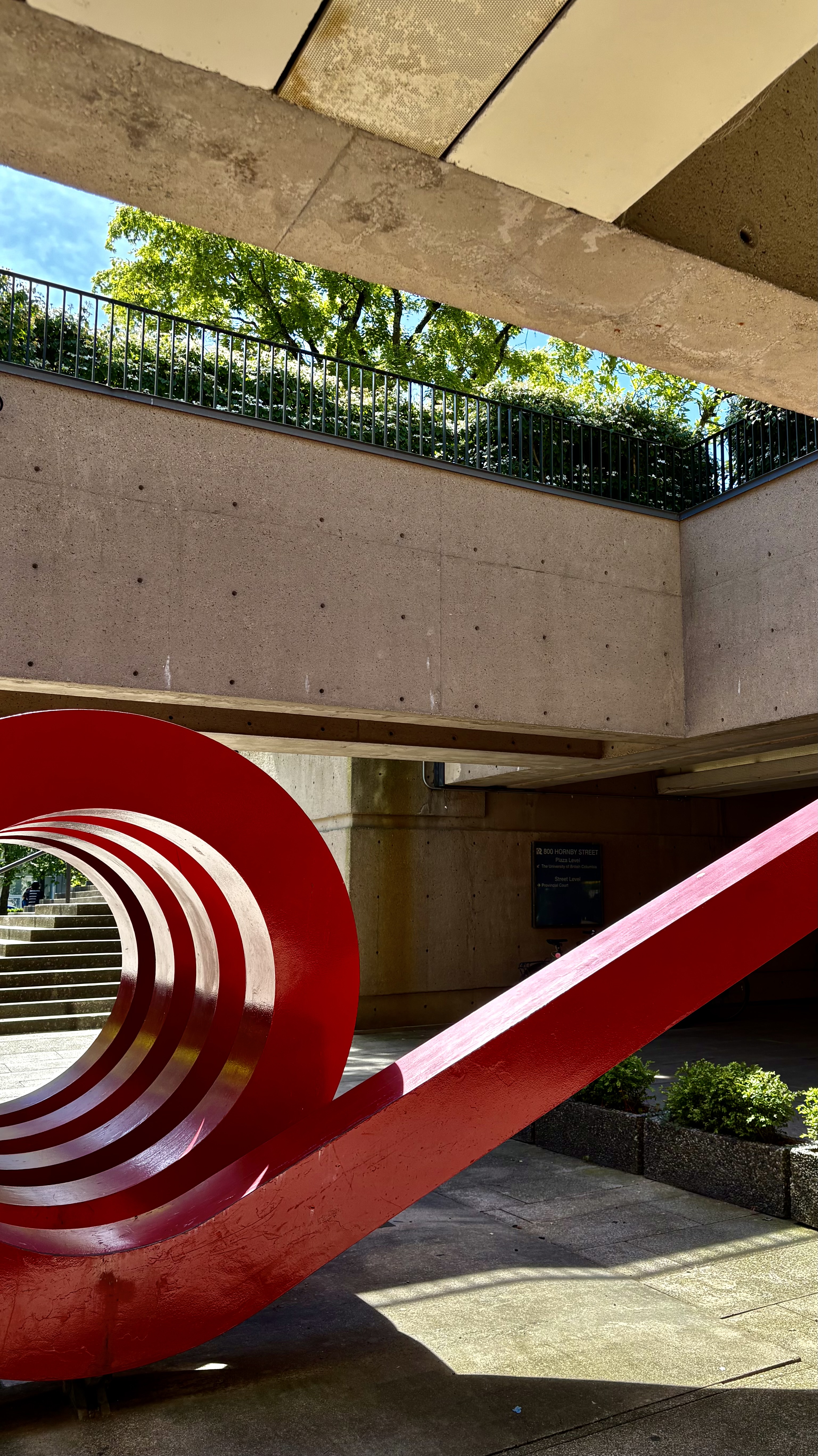
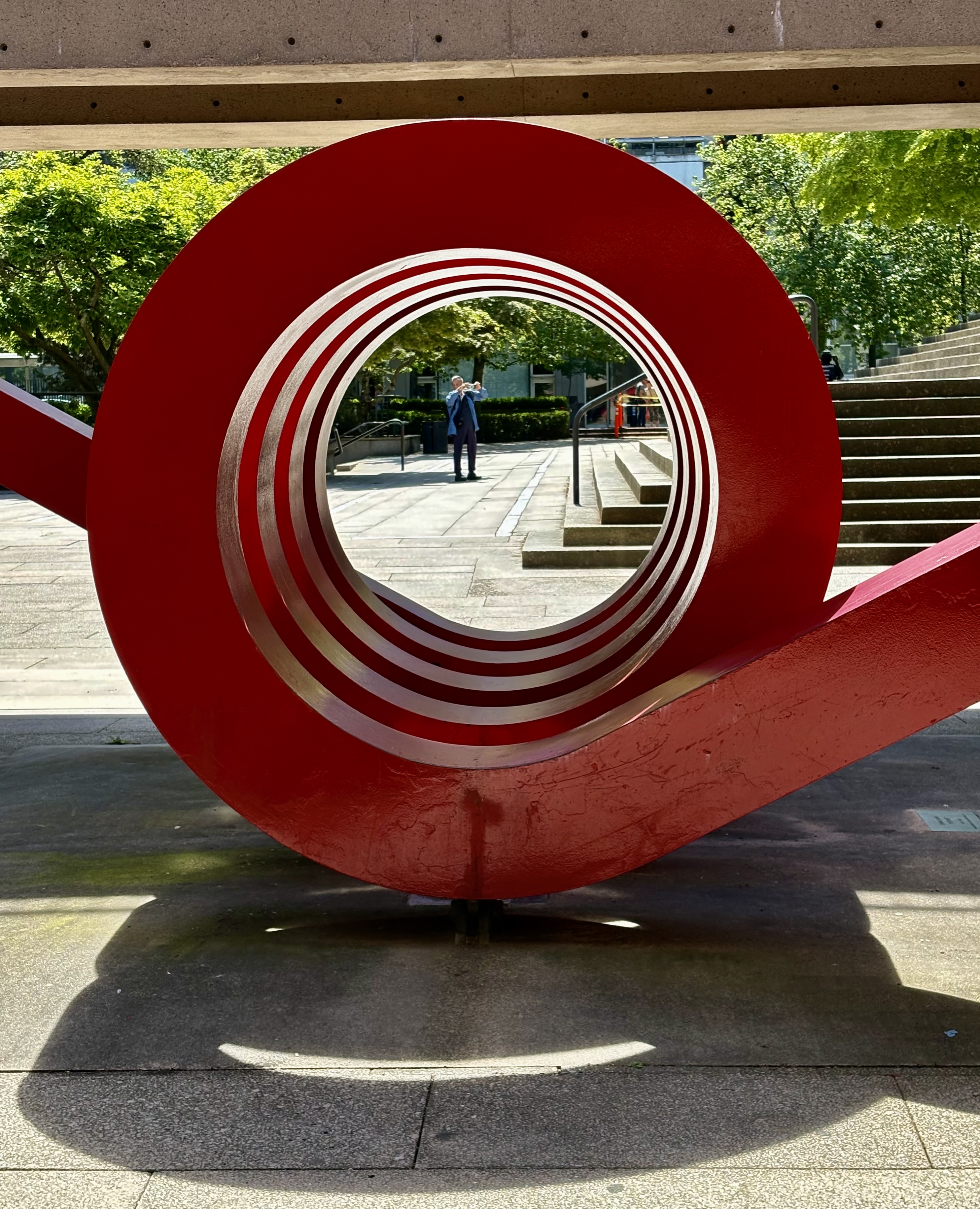
Come closer, peer through the spiral — and frame another photographer. (Photographing the architecture, please note; not himself.)
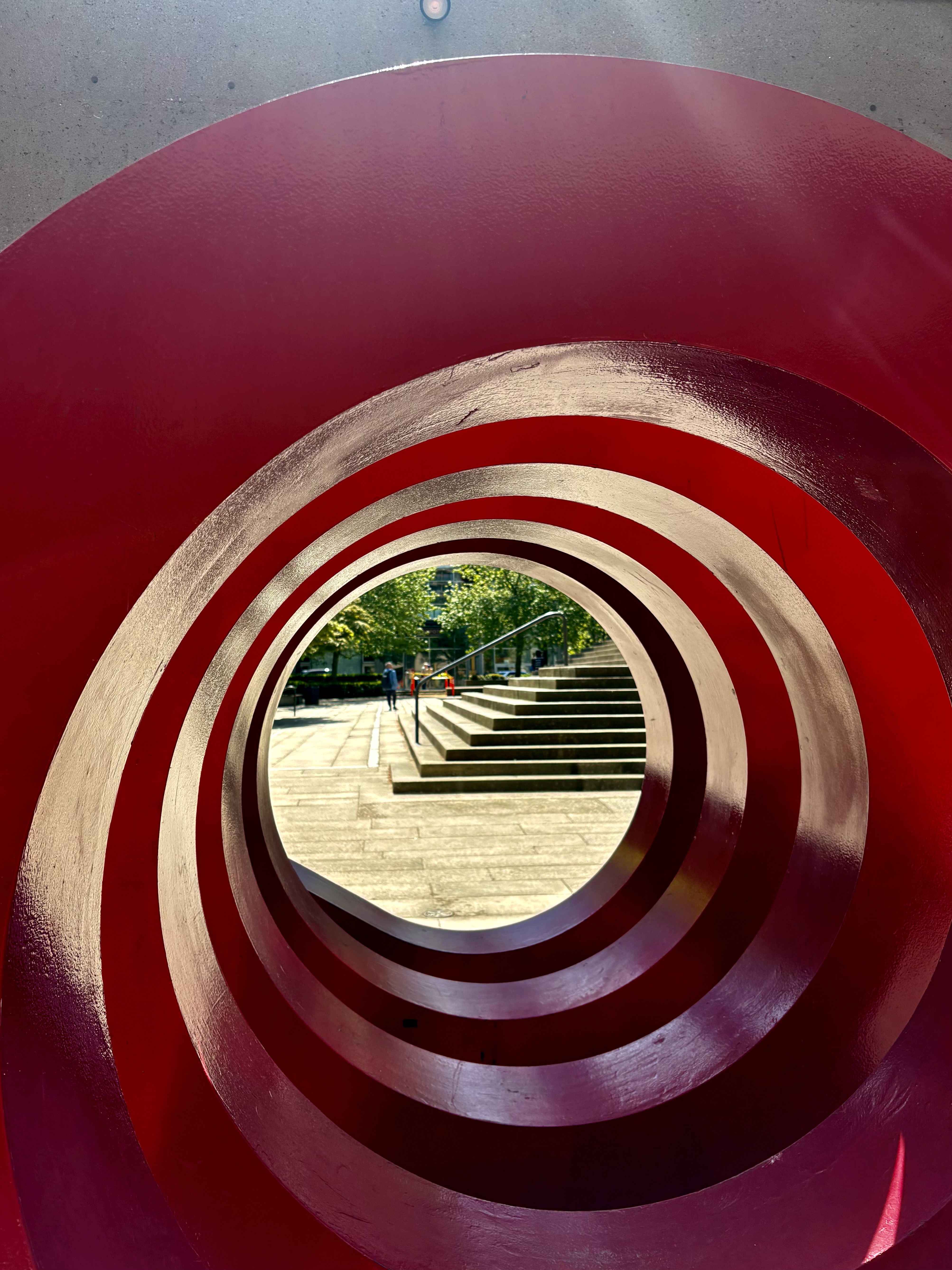
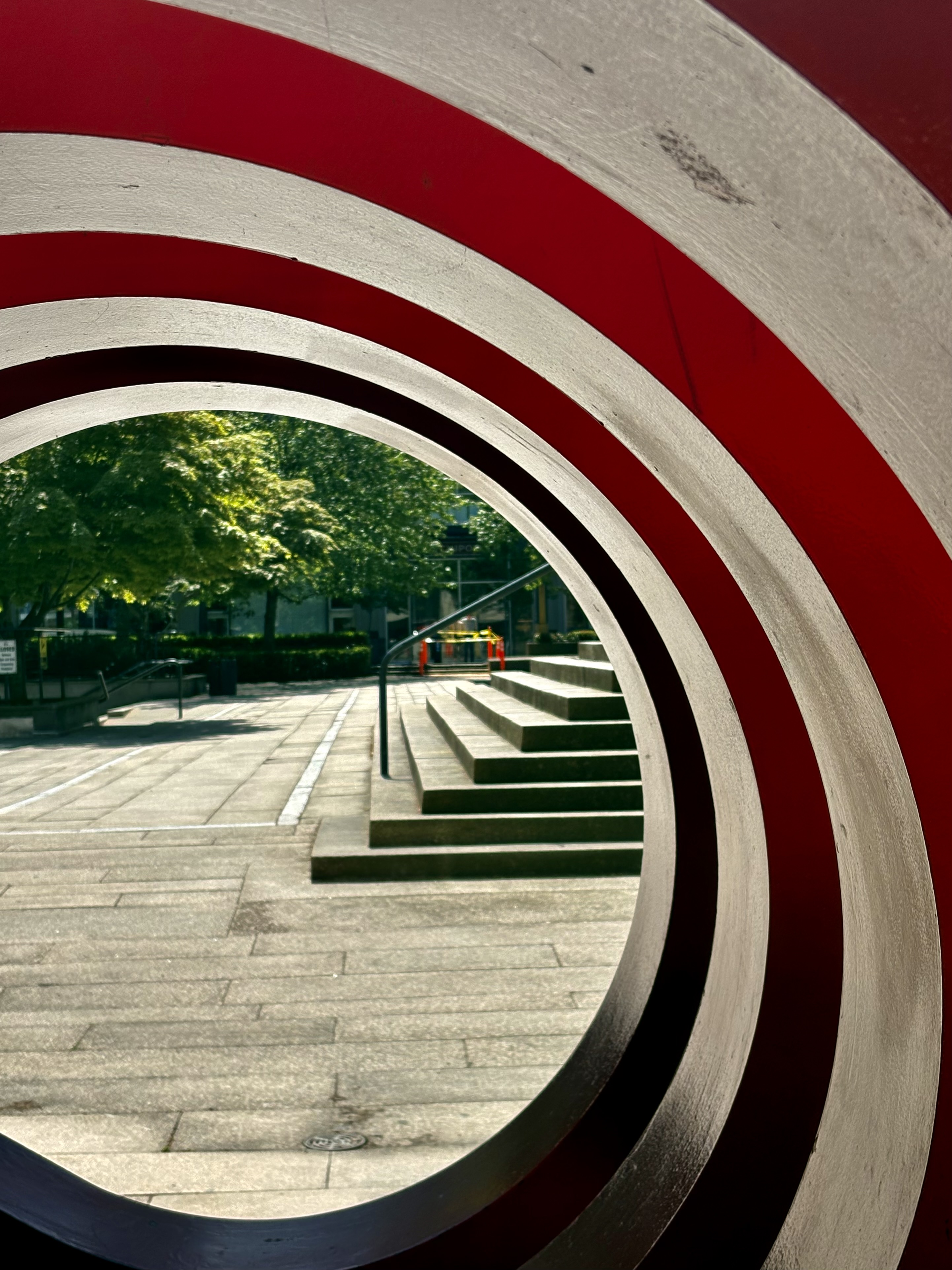
Come even closer and, in all this sunlight, the uniform gloss of the red starts to break up.
Come even closer than that, and my eye starts telling me lies. Look! it says; alternating twists of silver & red! My brain knows this isn’t true, and my eye doesn’t care. It sees what it sees. Or… “sees.”
Time to back up a little? Restore agreement between eye & brain?
Still close, but at a different angle. All the spirals are once again red. Set off by the green of that modest, meticulously placed, line of shrubs-in-tubs.
One more re-angle, and now the spirals and their reflections bounce back and forth across the line of shrubs. I imagine an invisible tennis ball of light rays, flashing across that net of visible green…
And then, I walk on.
Deliberately one street over, now southbound on Howe…
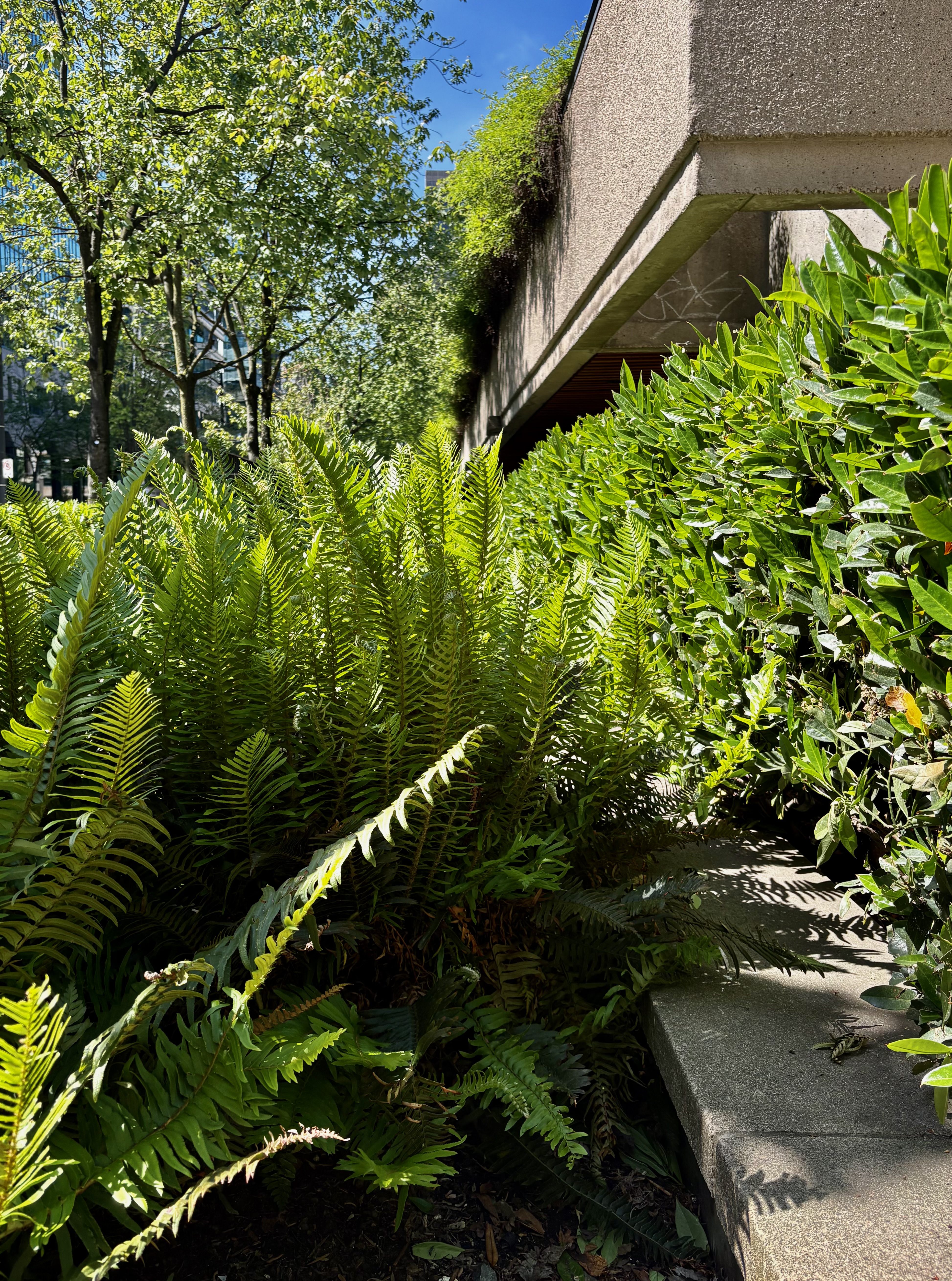
where a cascade of Oberlander greenery washes my eye clean of all that red.
"Traveller, there is no path. Paths are made by walking" -- Antonio Machado (1875-1939)
"The voyage of discovery is not in seeking new landscapes, but in having new eyes" -- Marcel Proust (1871-1922)
"A city is a language, a repository of possibilities, and walking is the act of speaking that language, of selecting from those possibilities" -- Rebecca Solnit, "Wanderlust: A History of Walking"