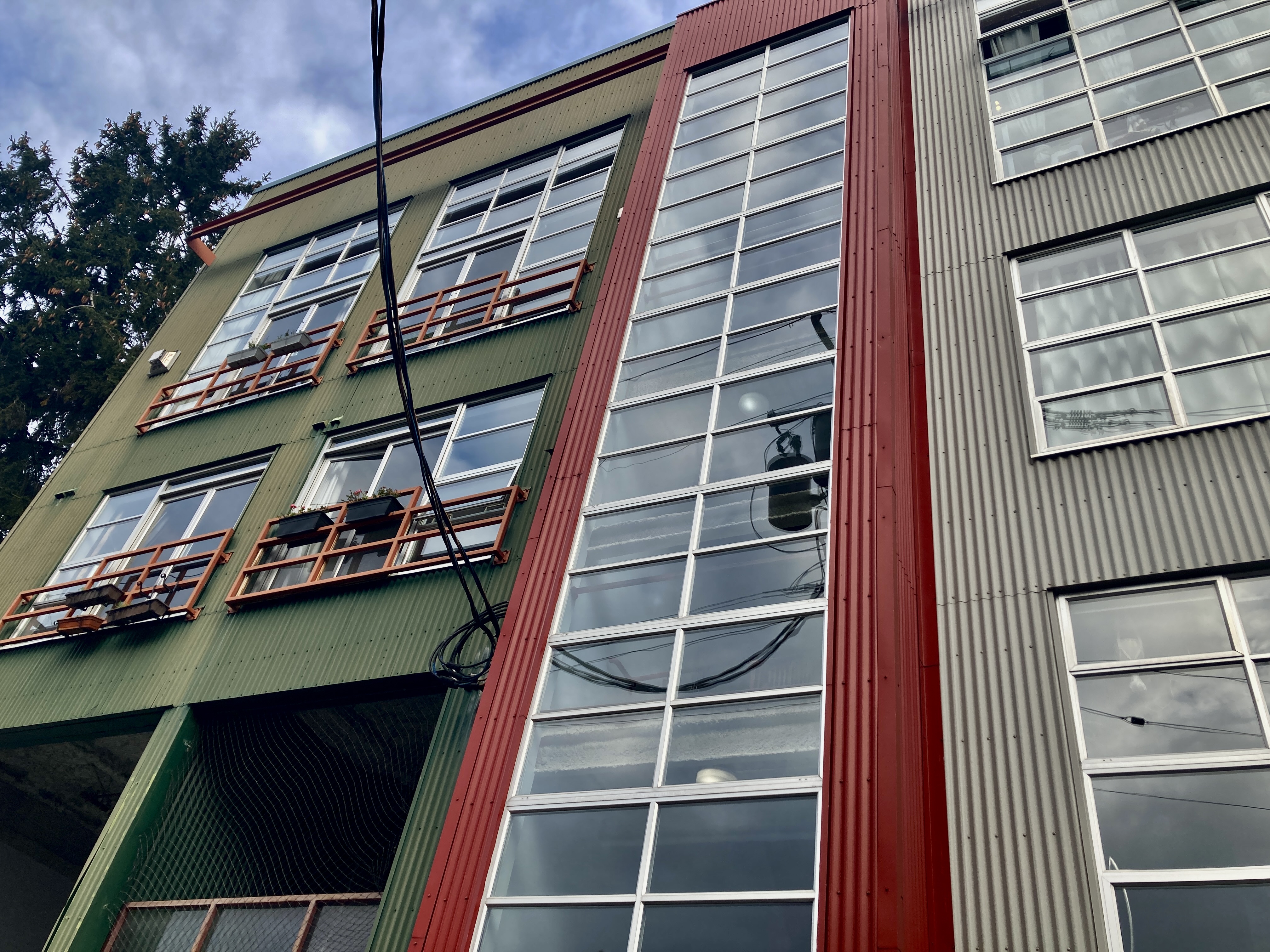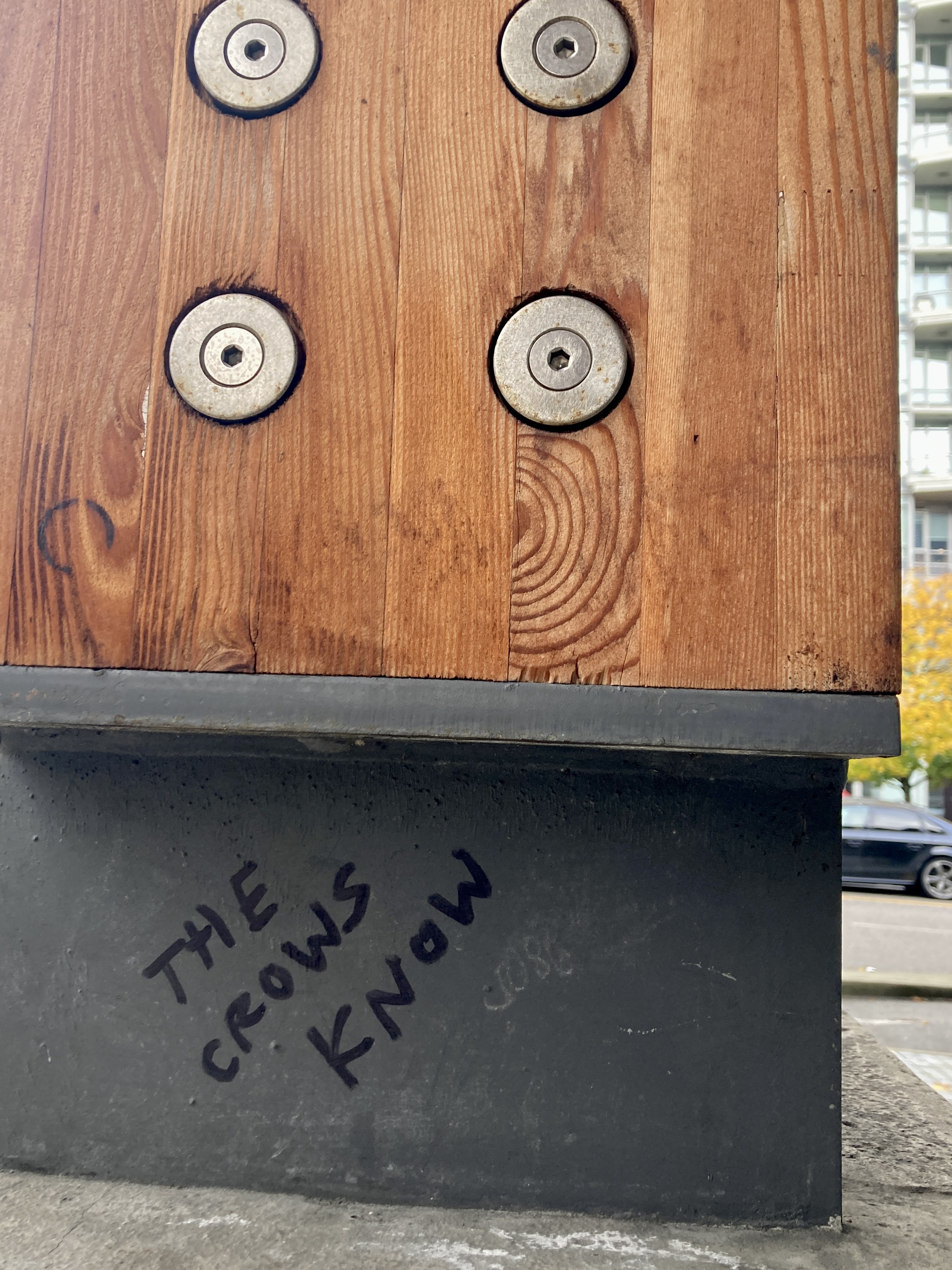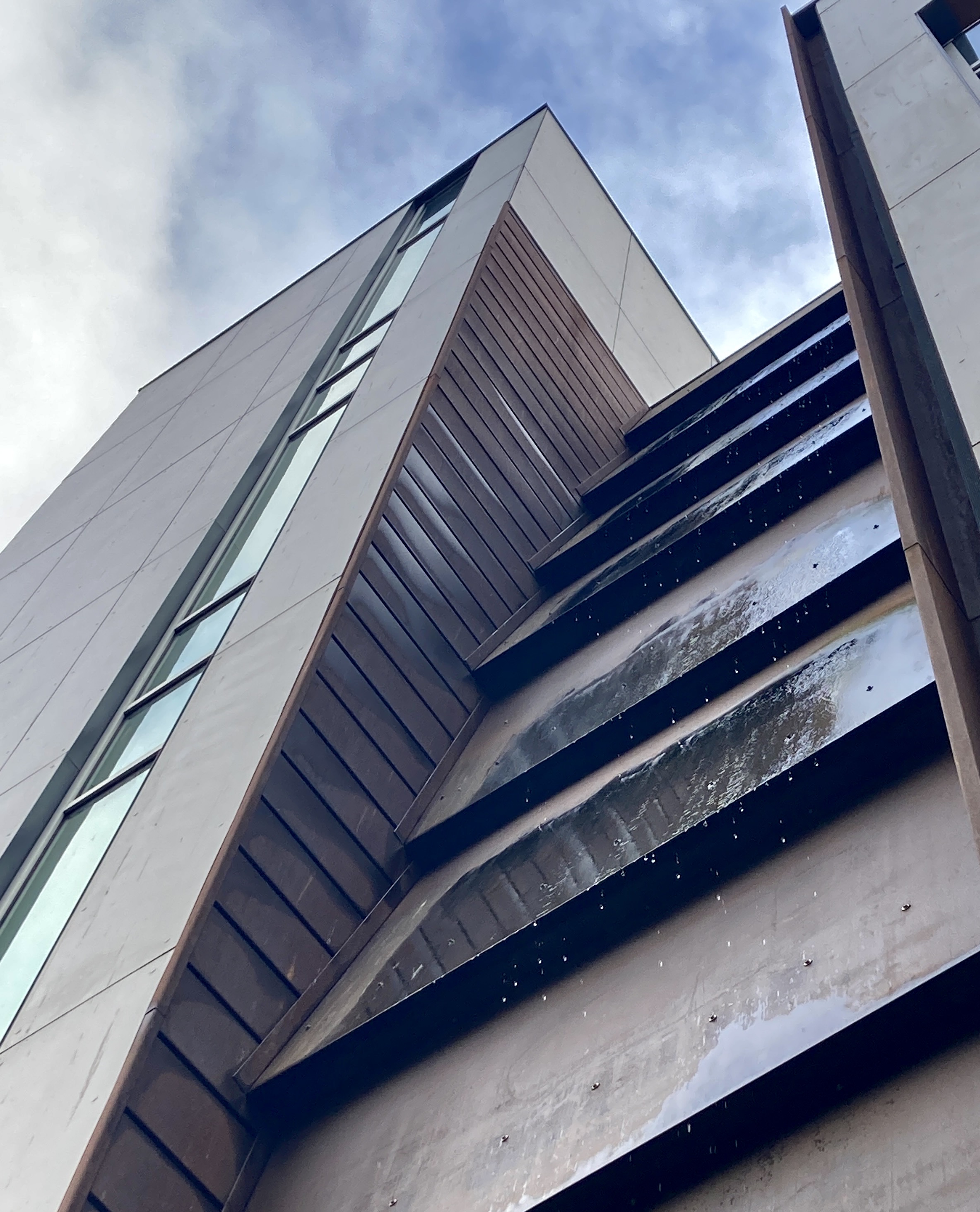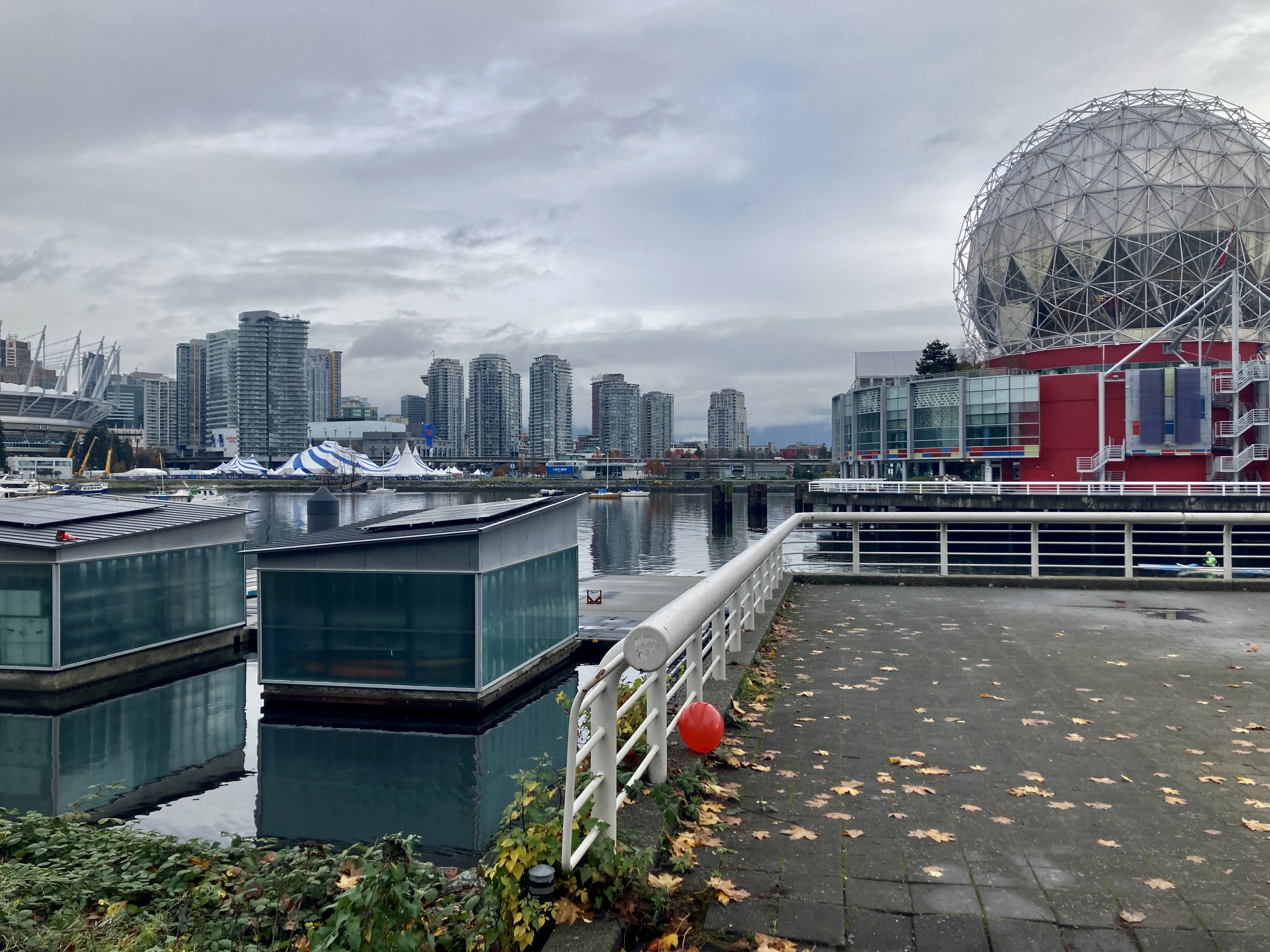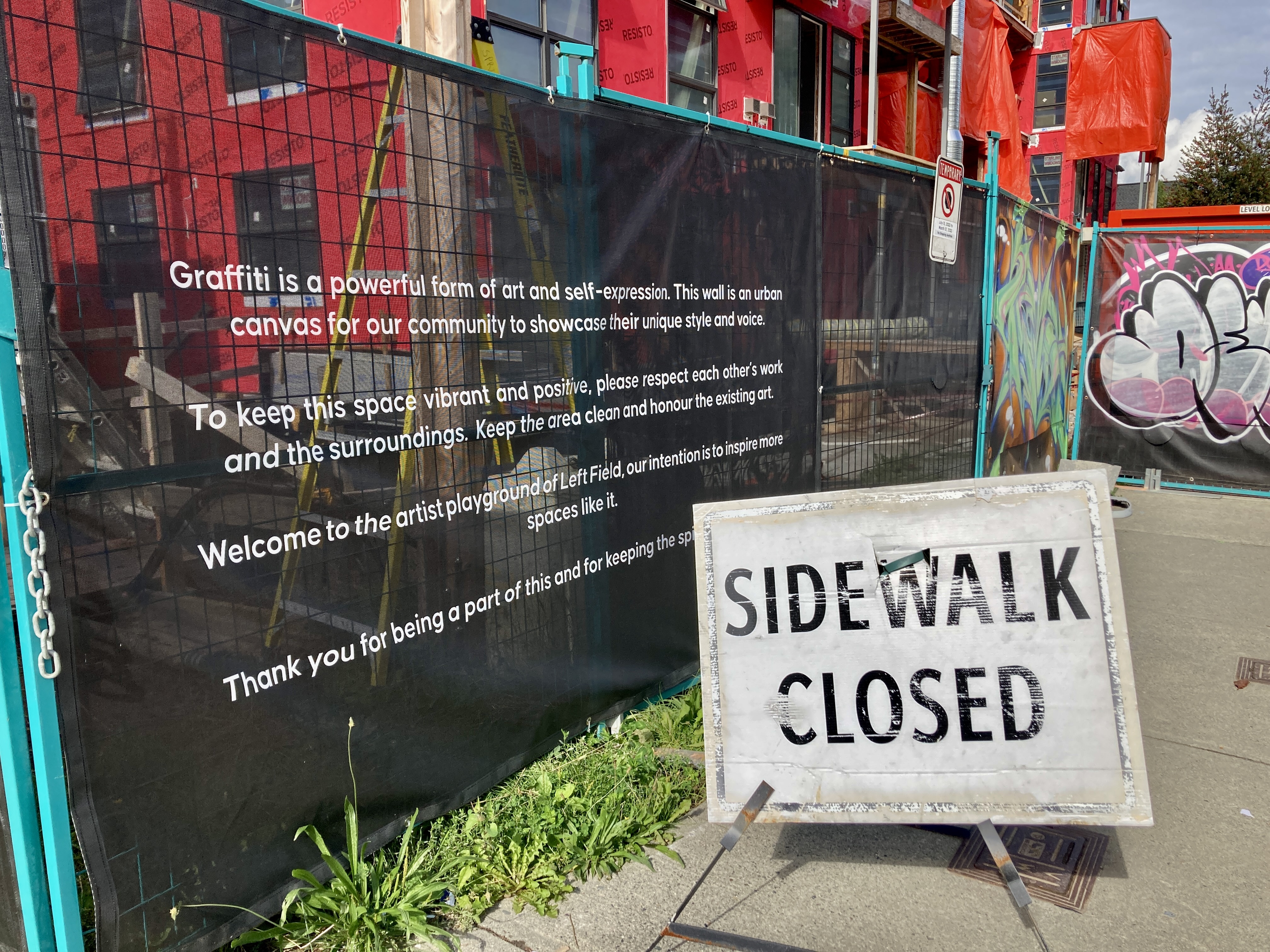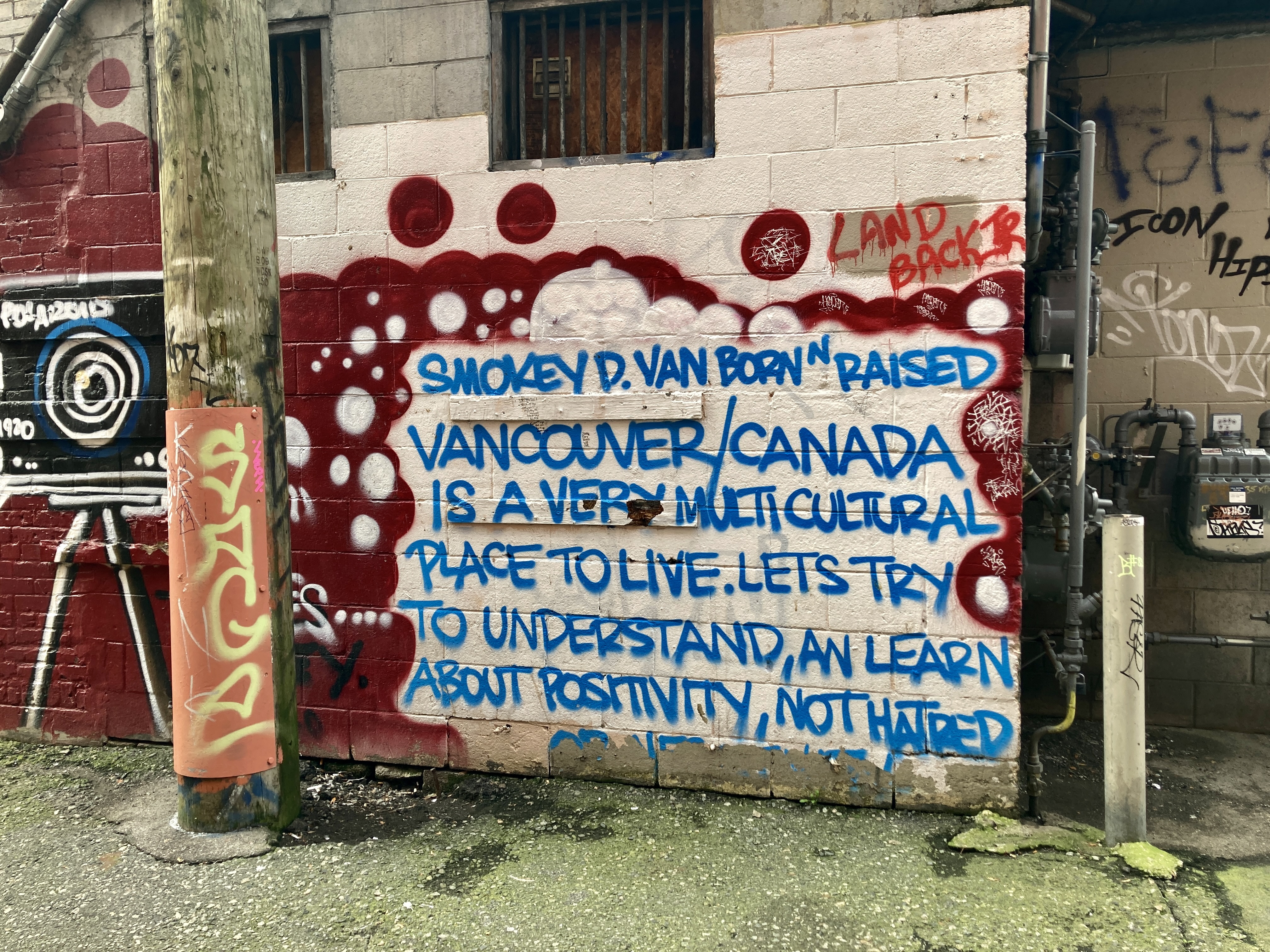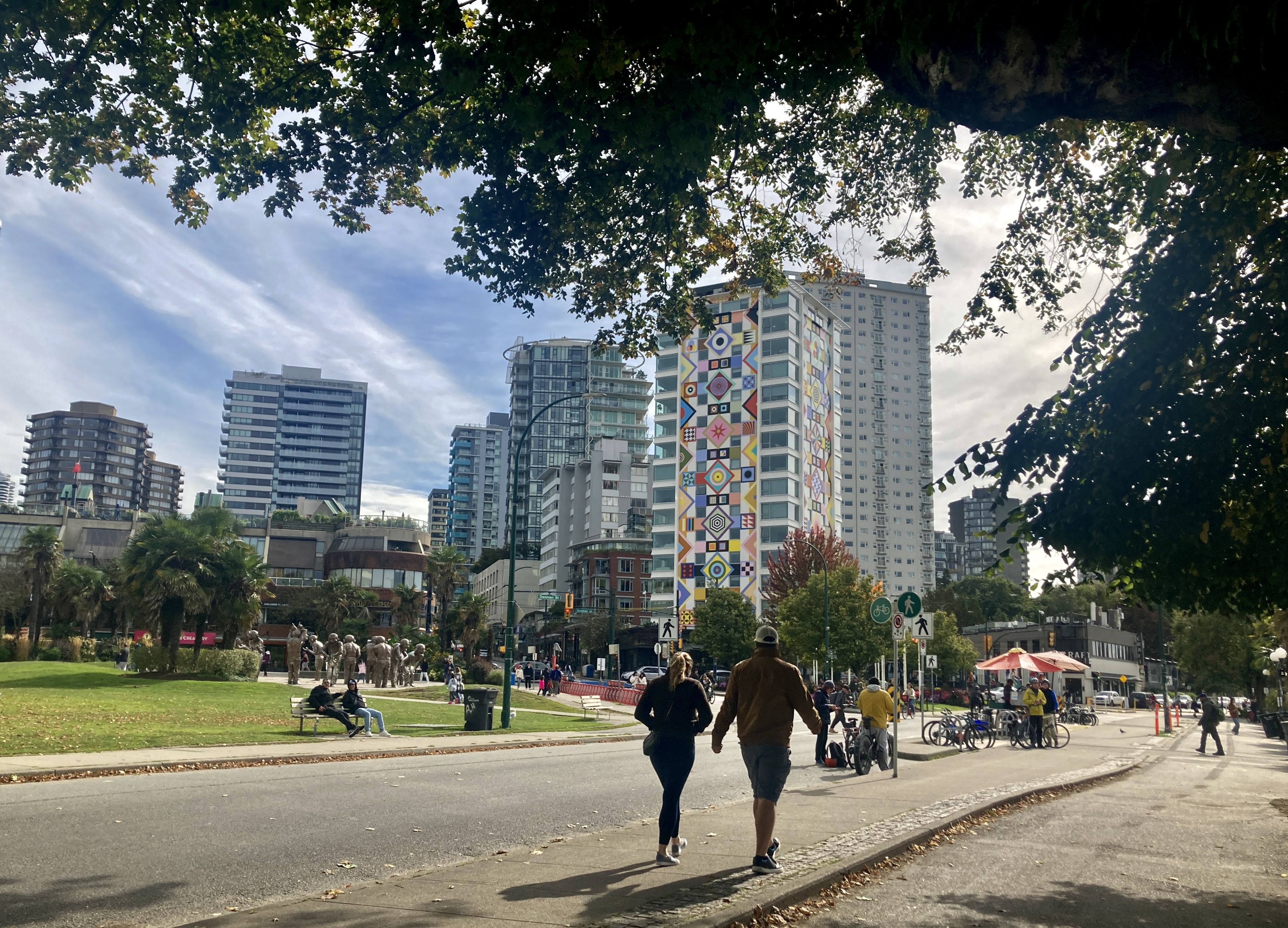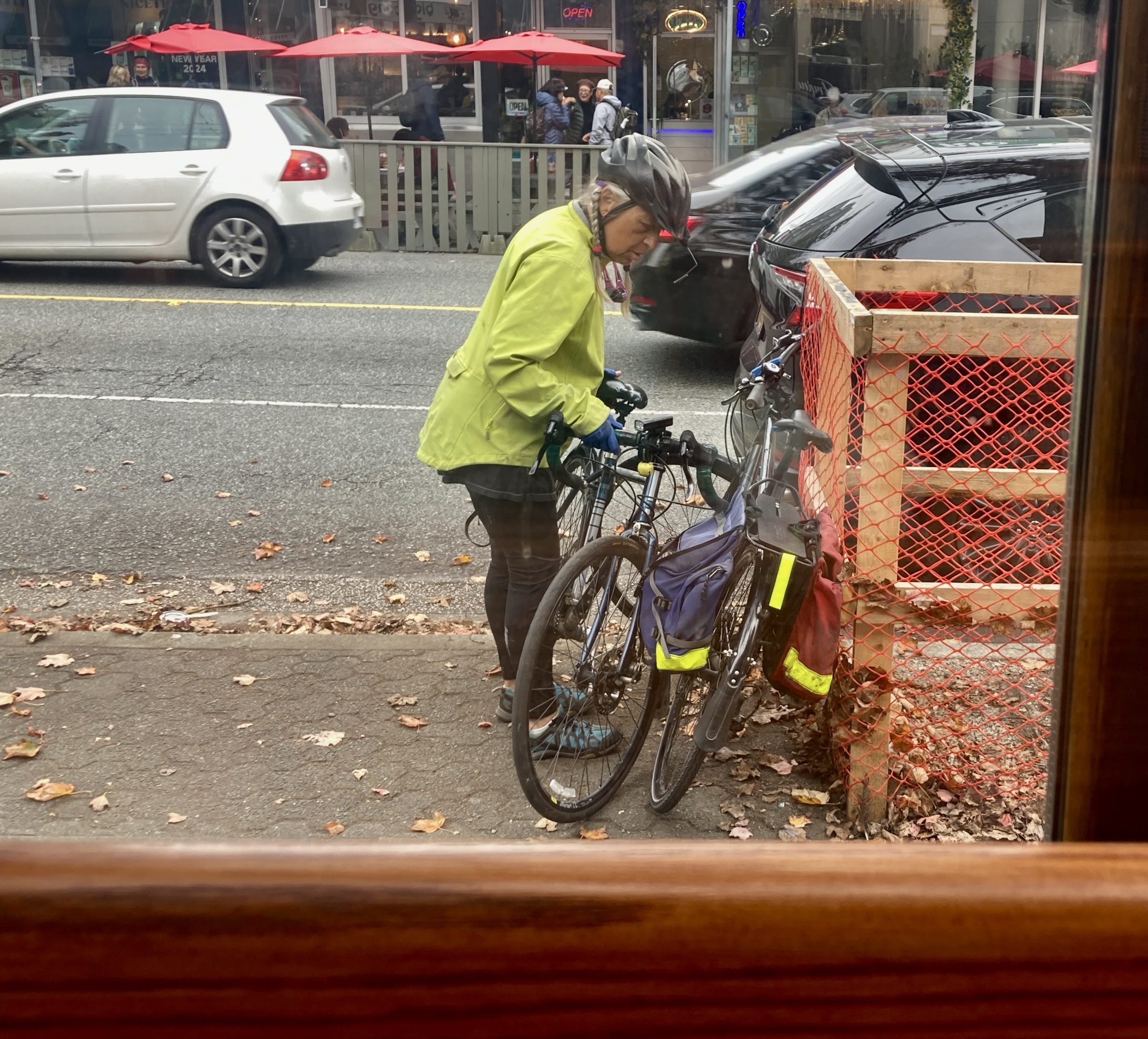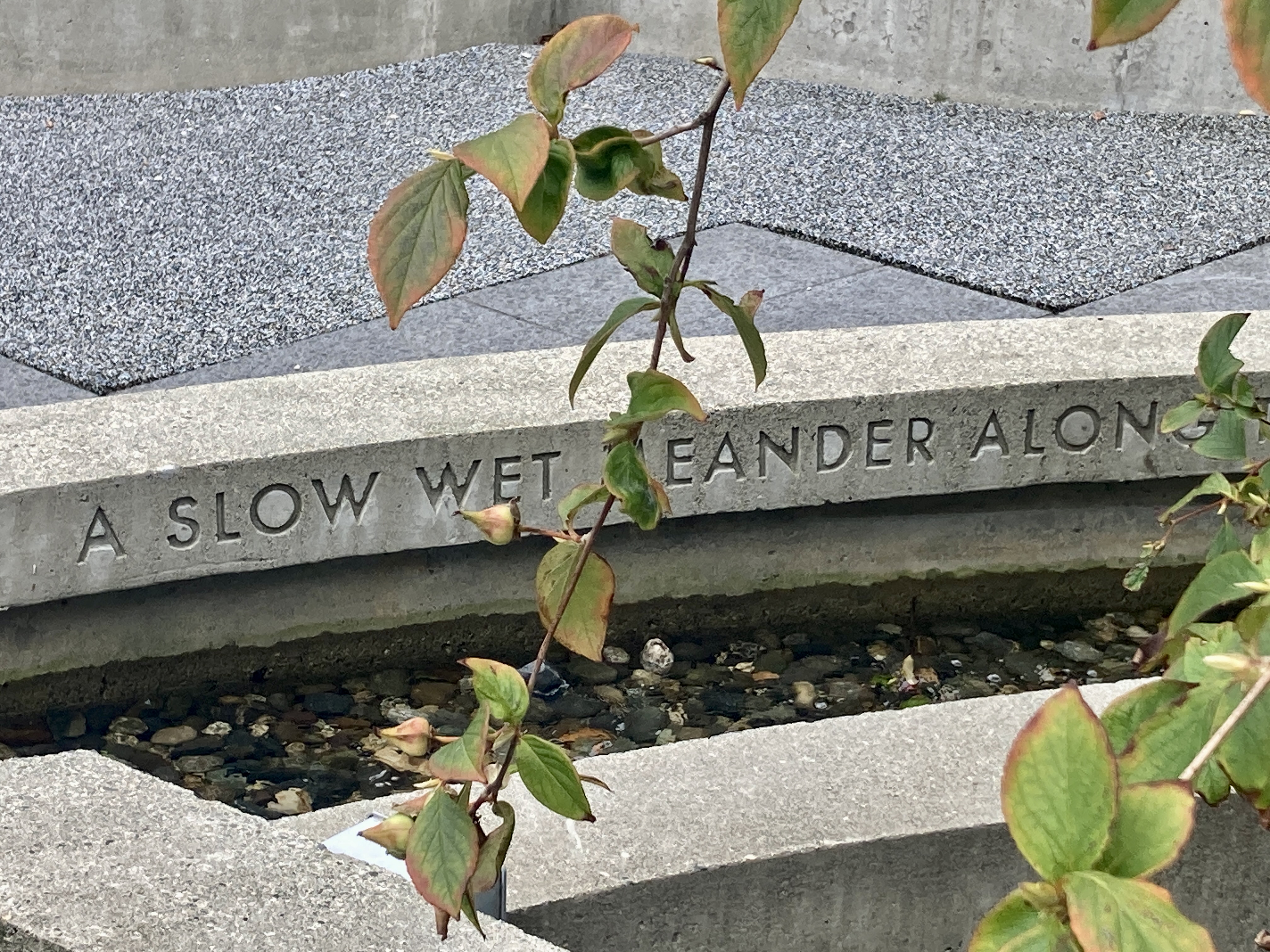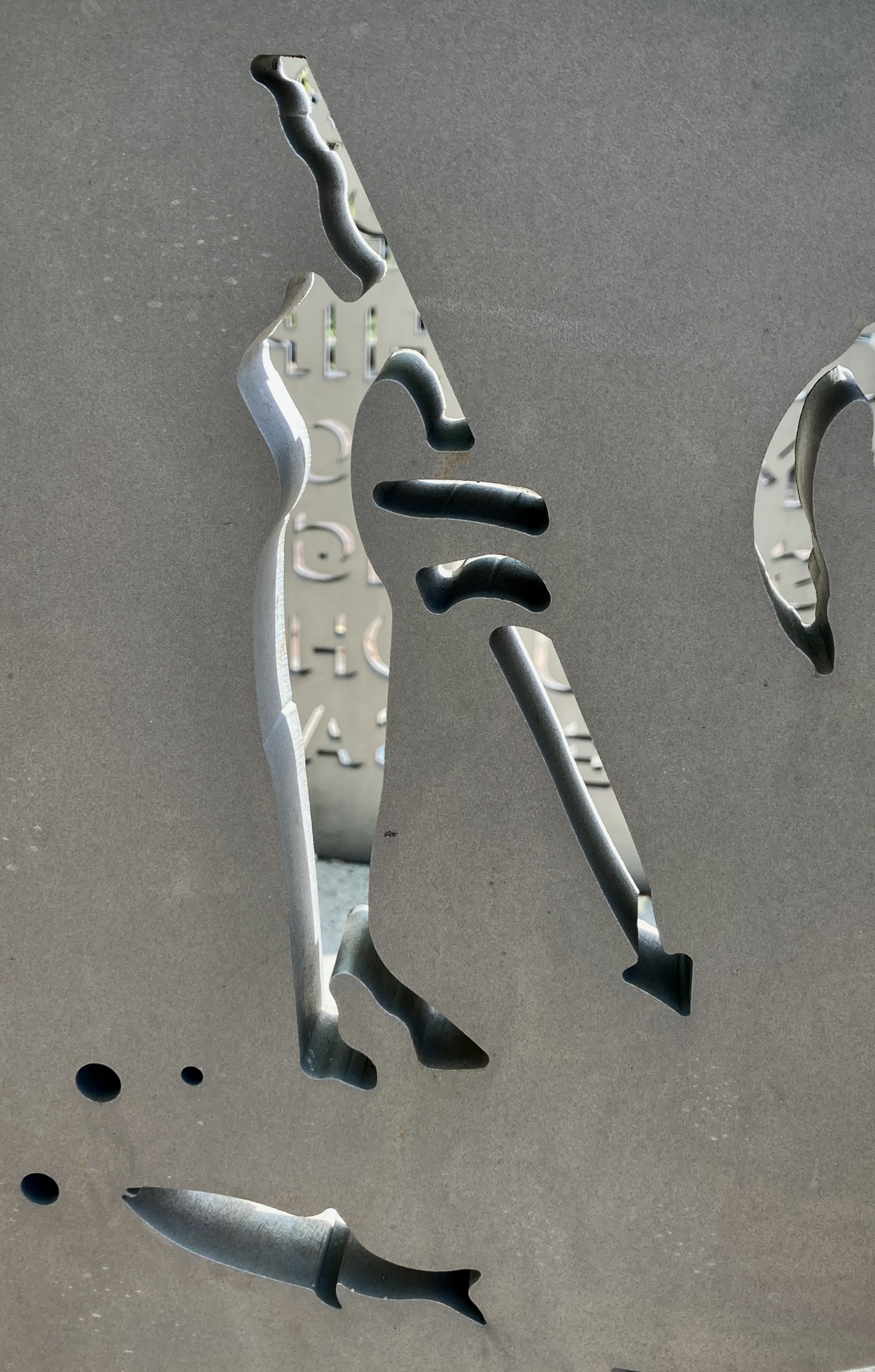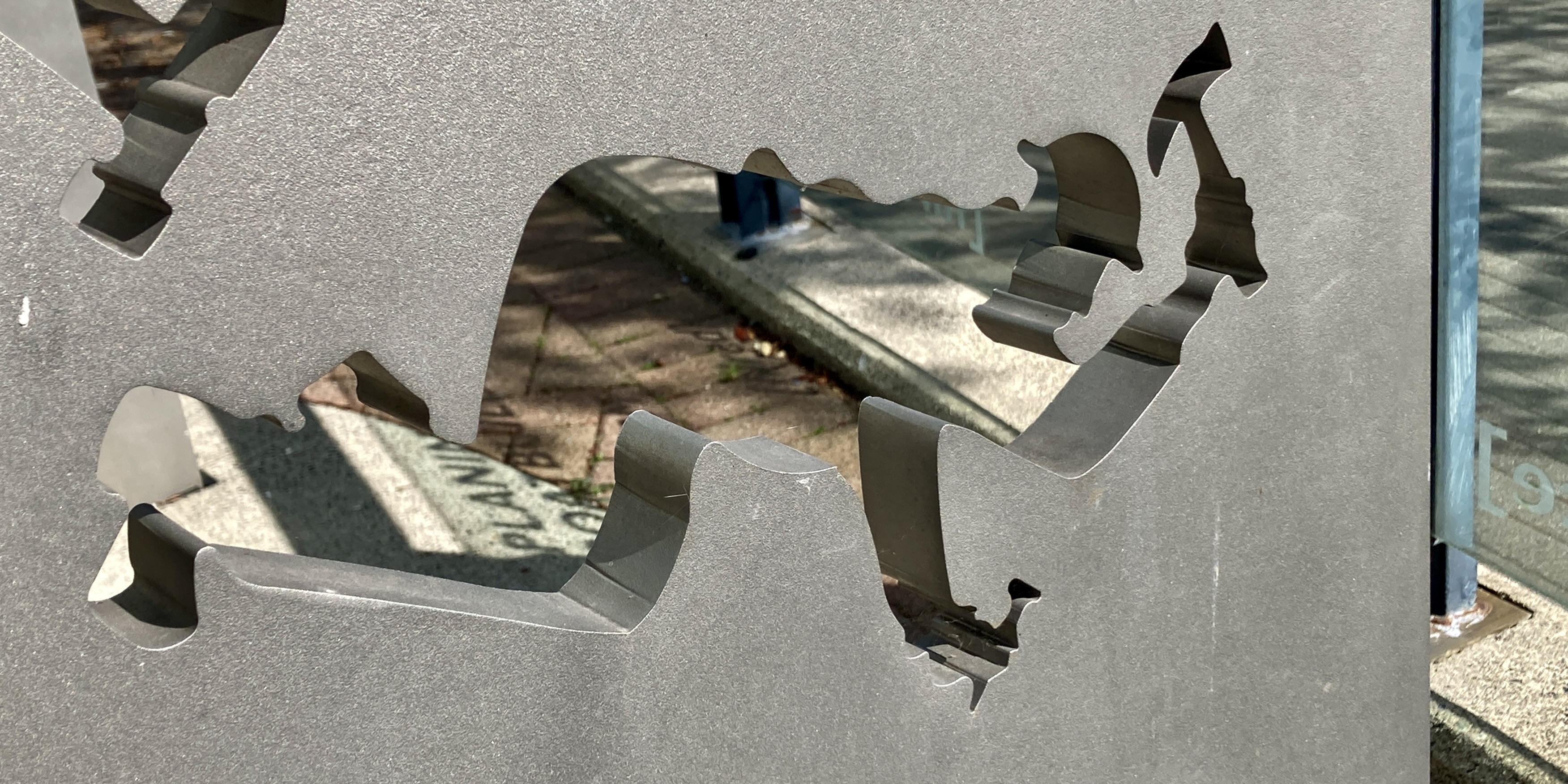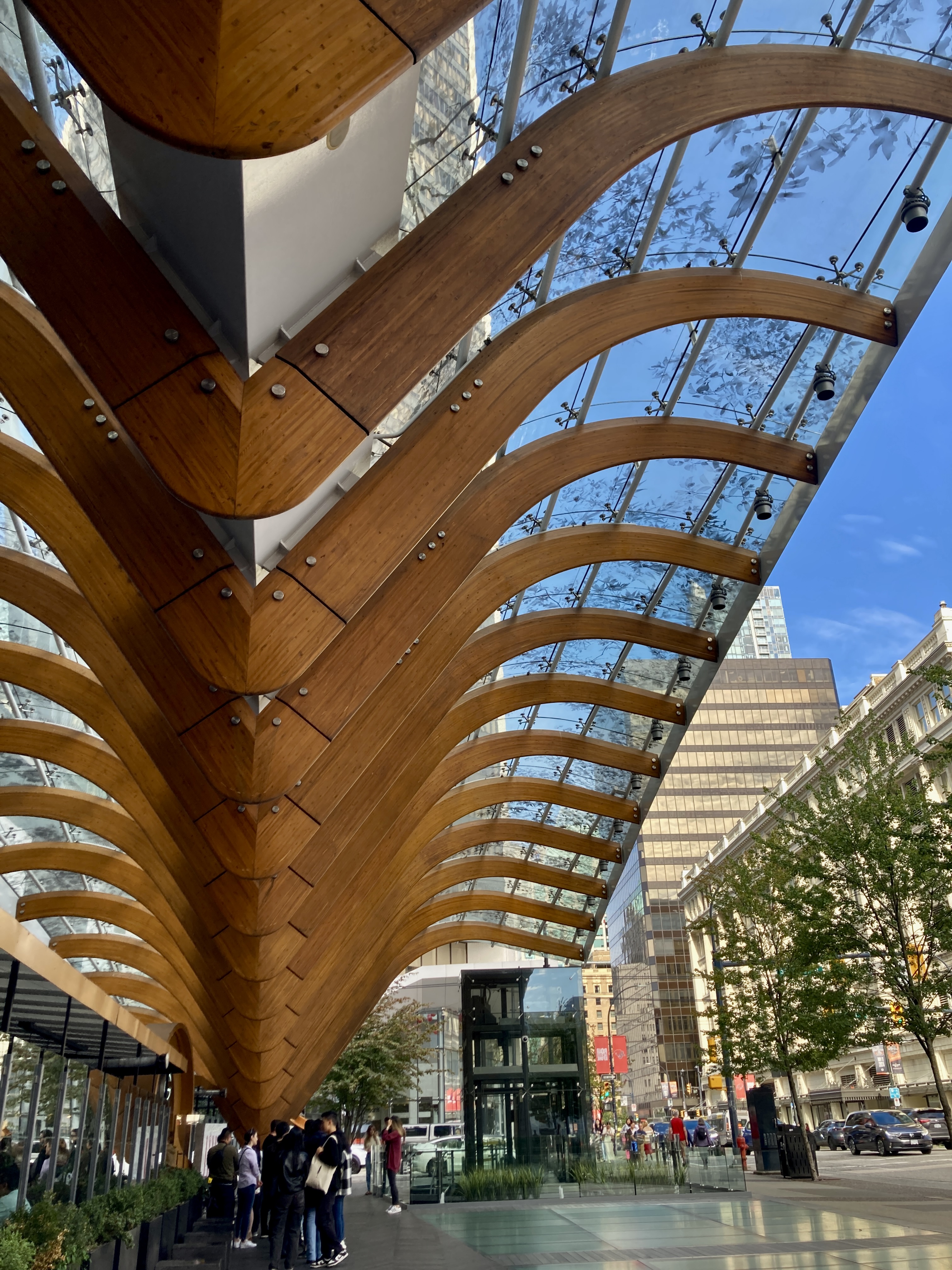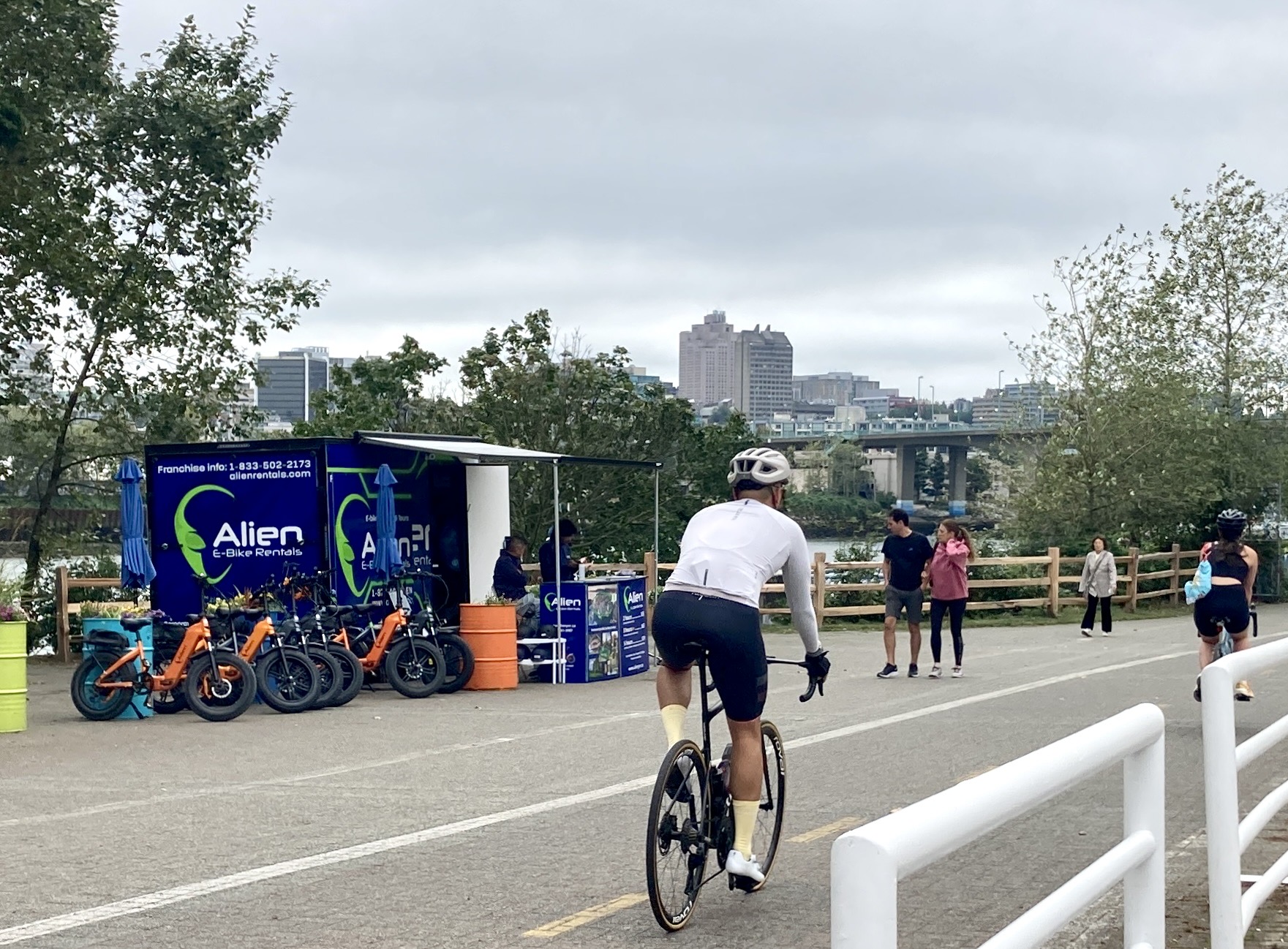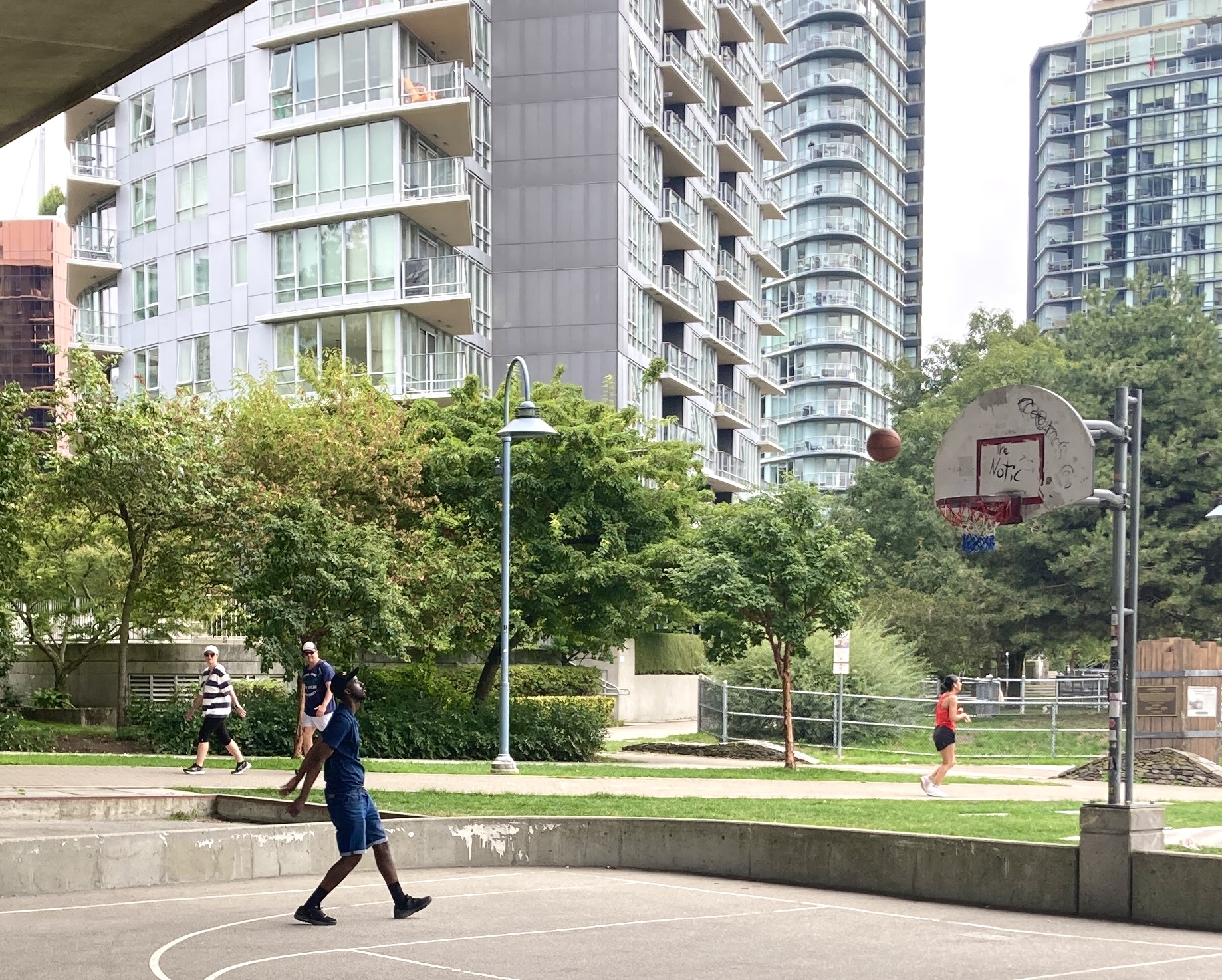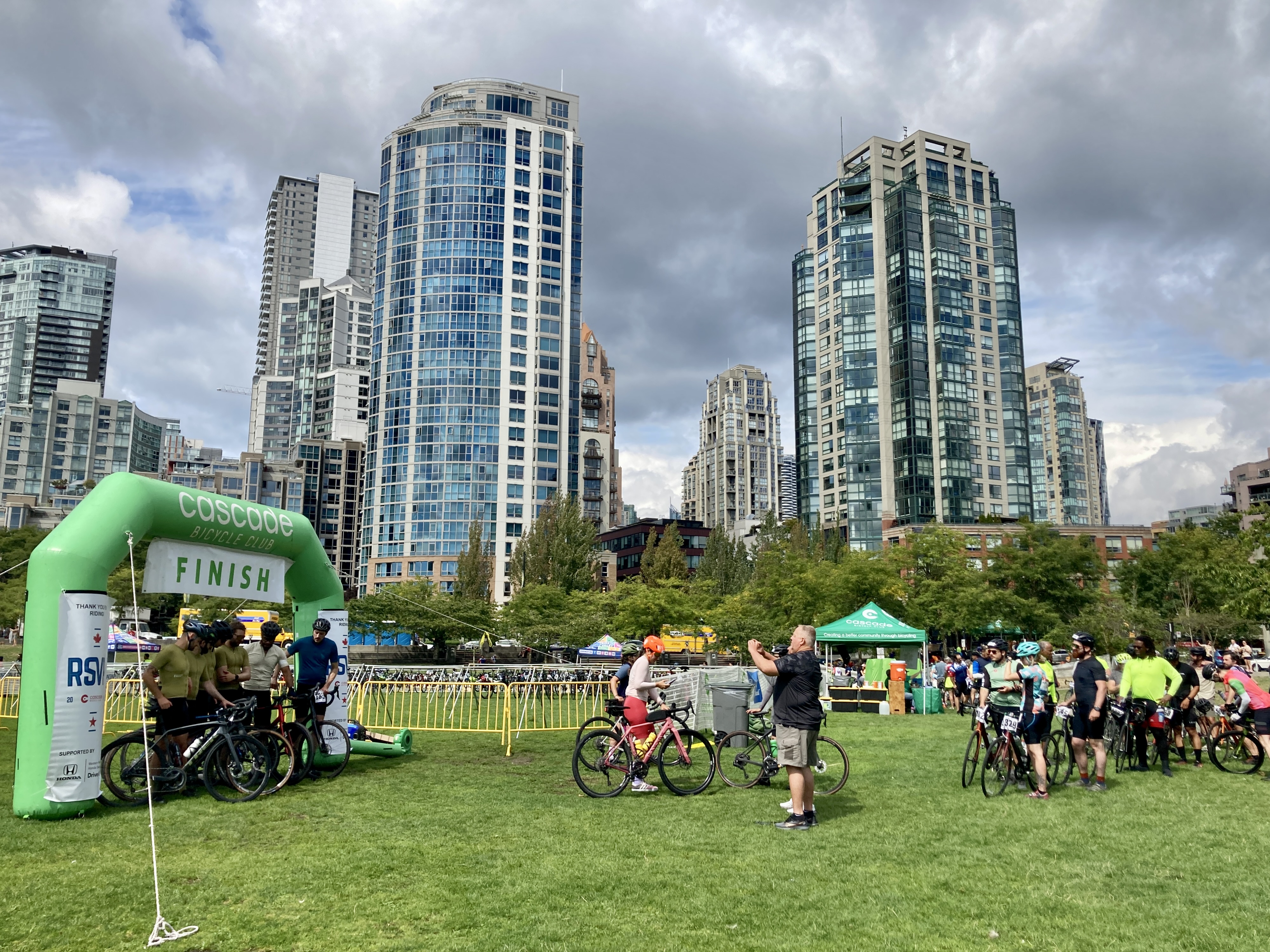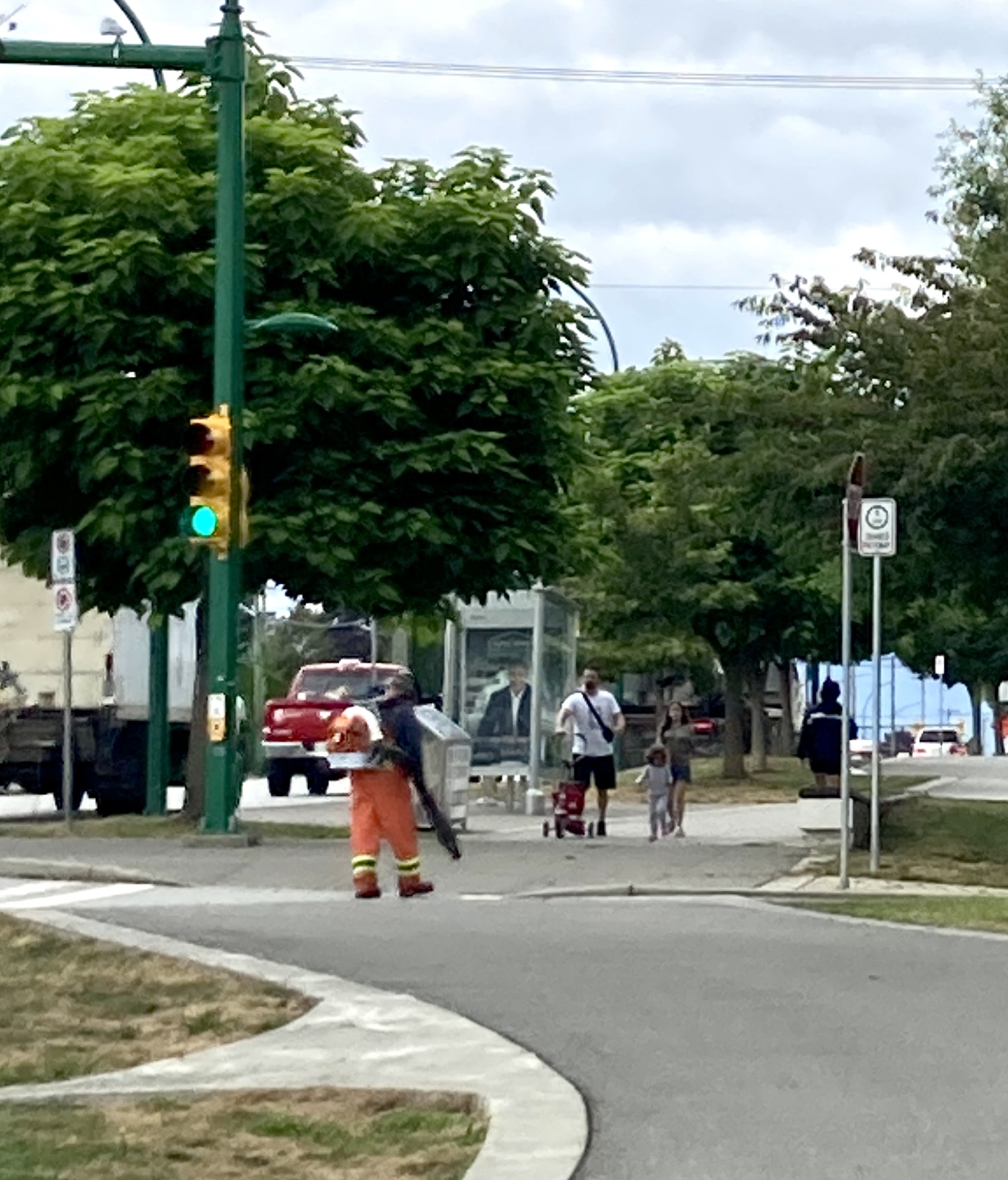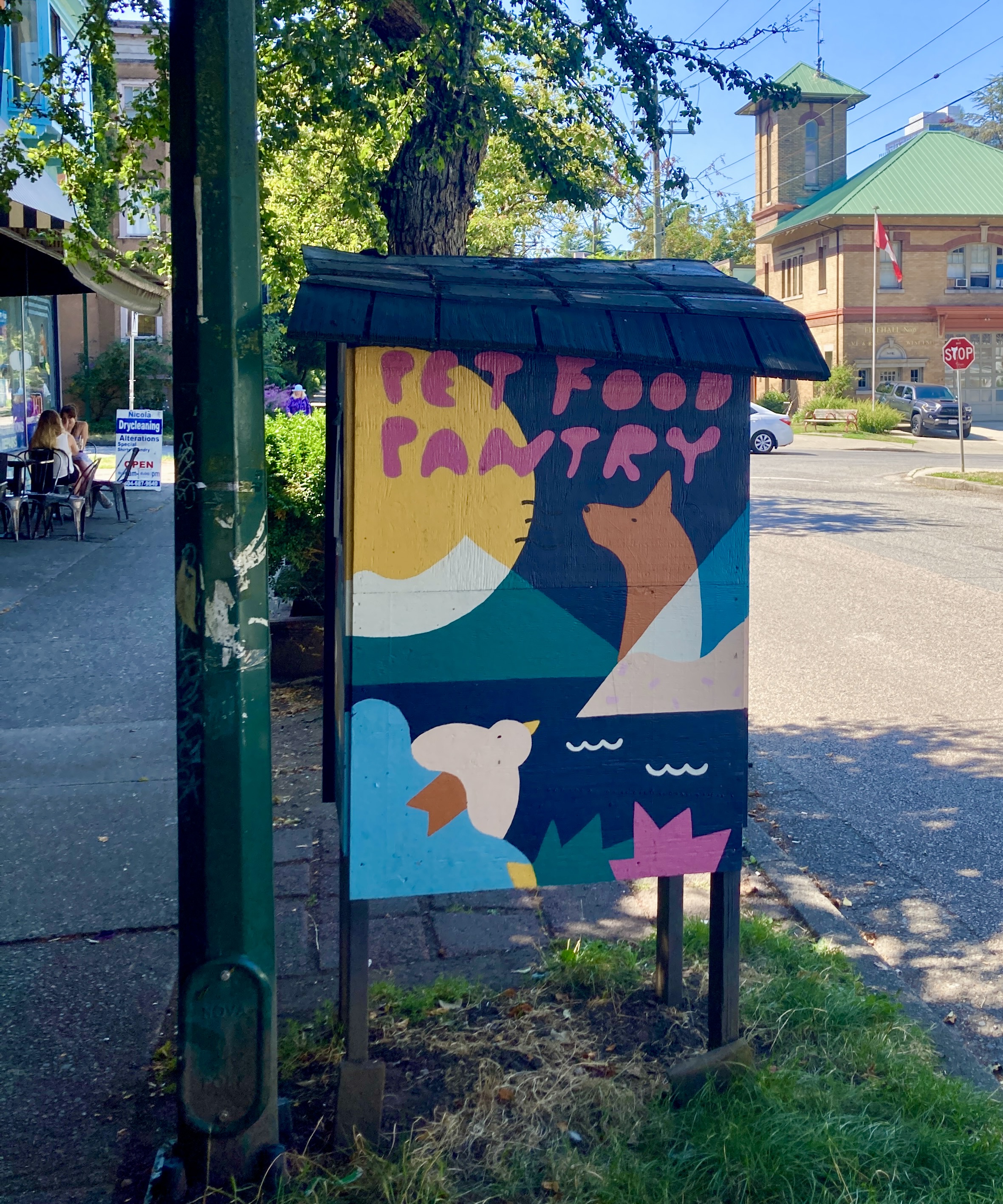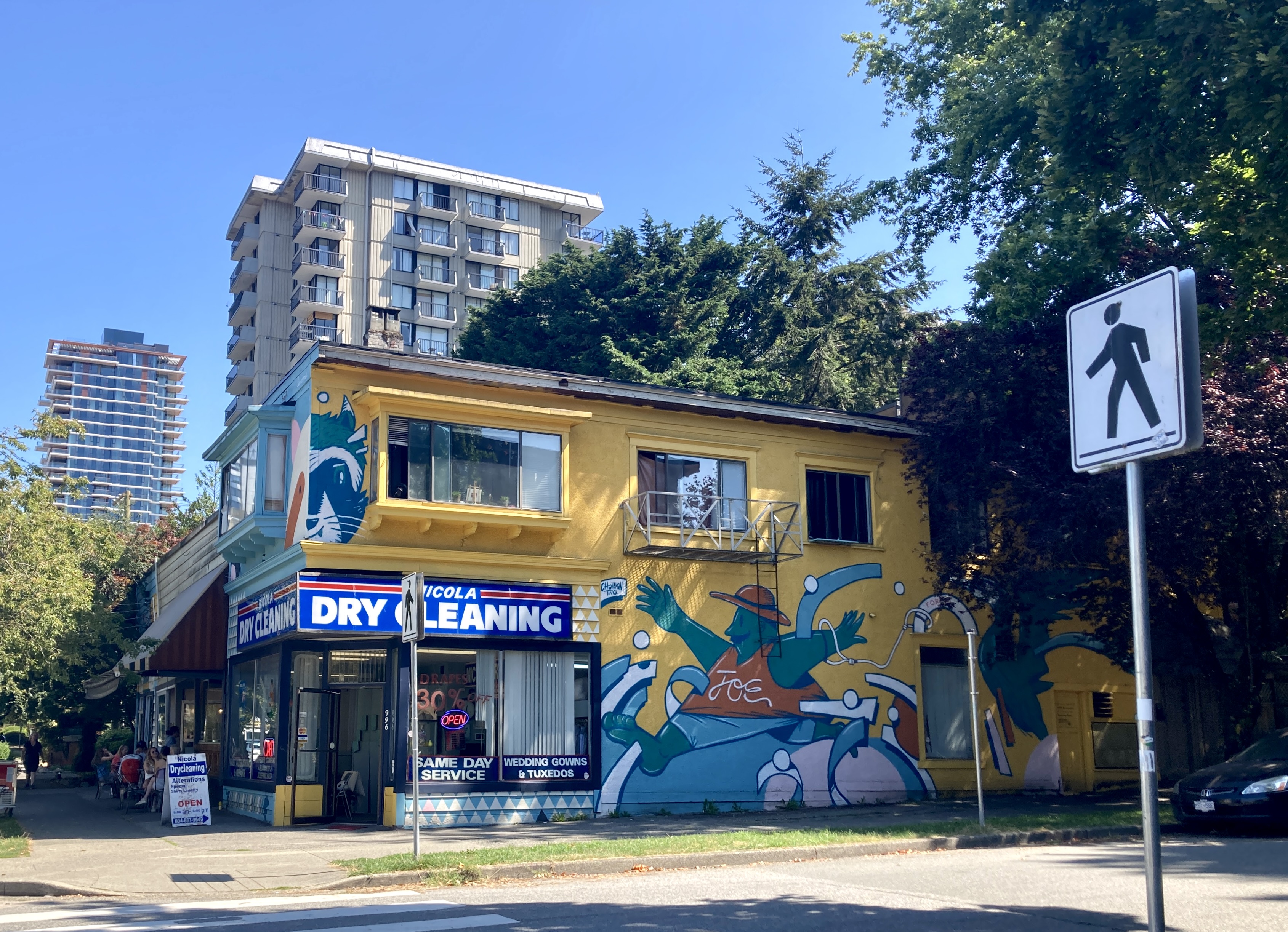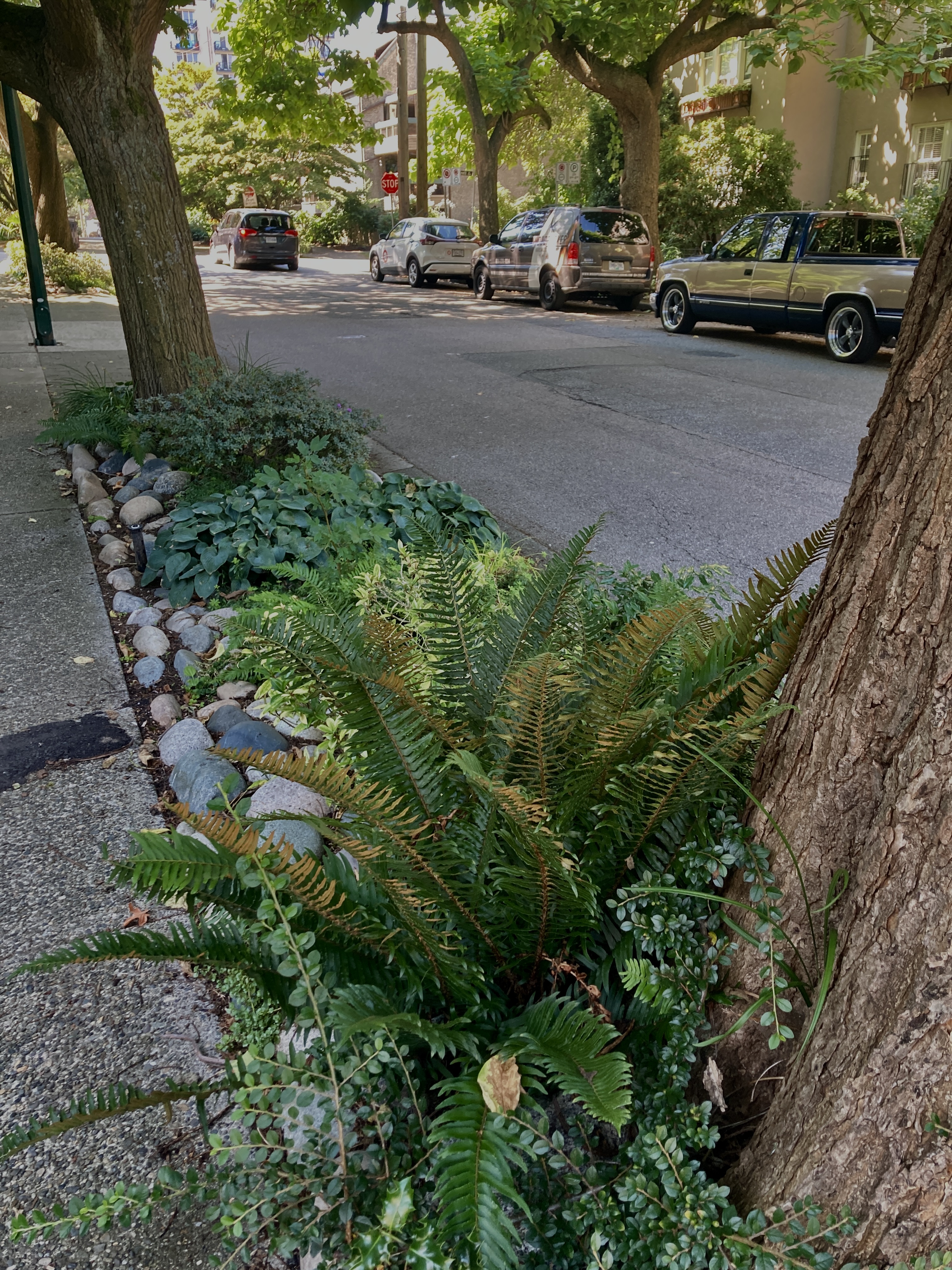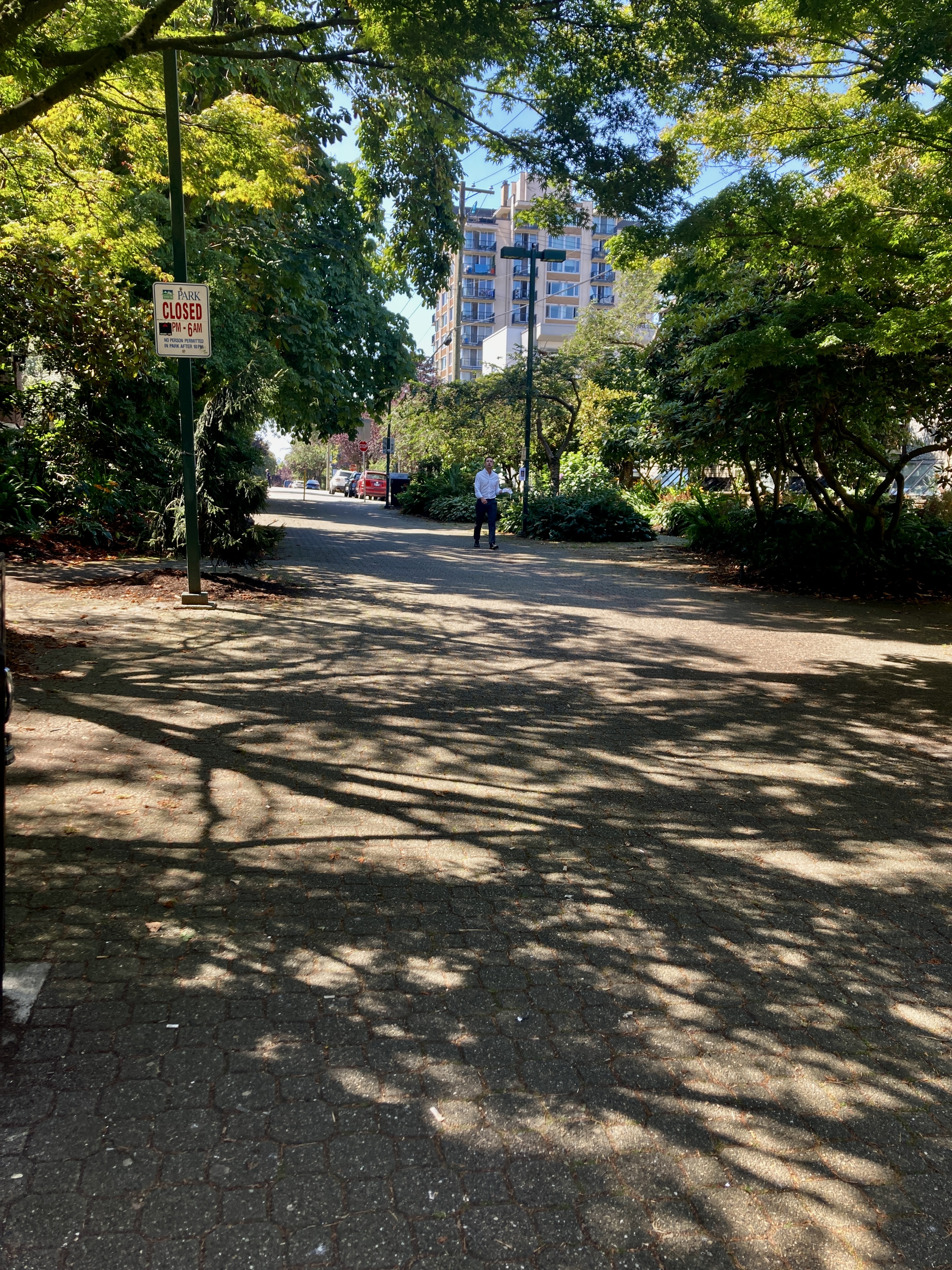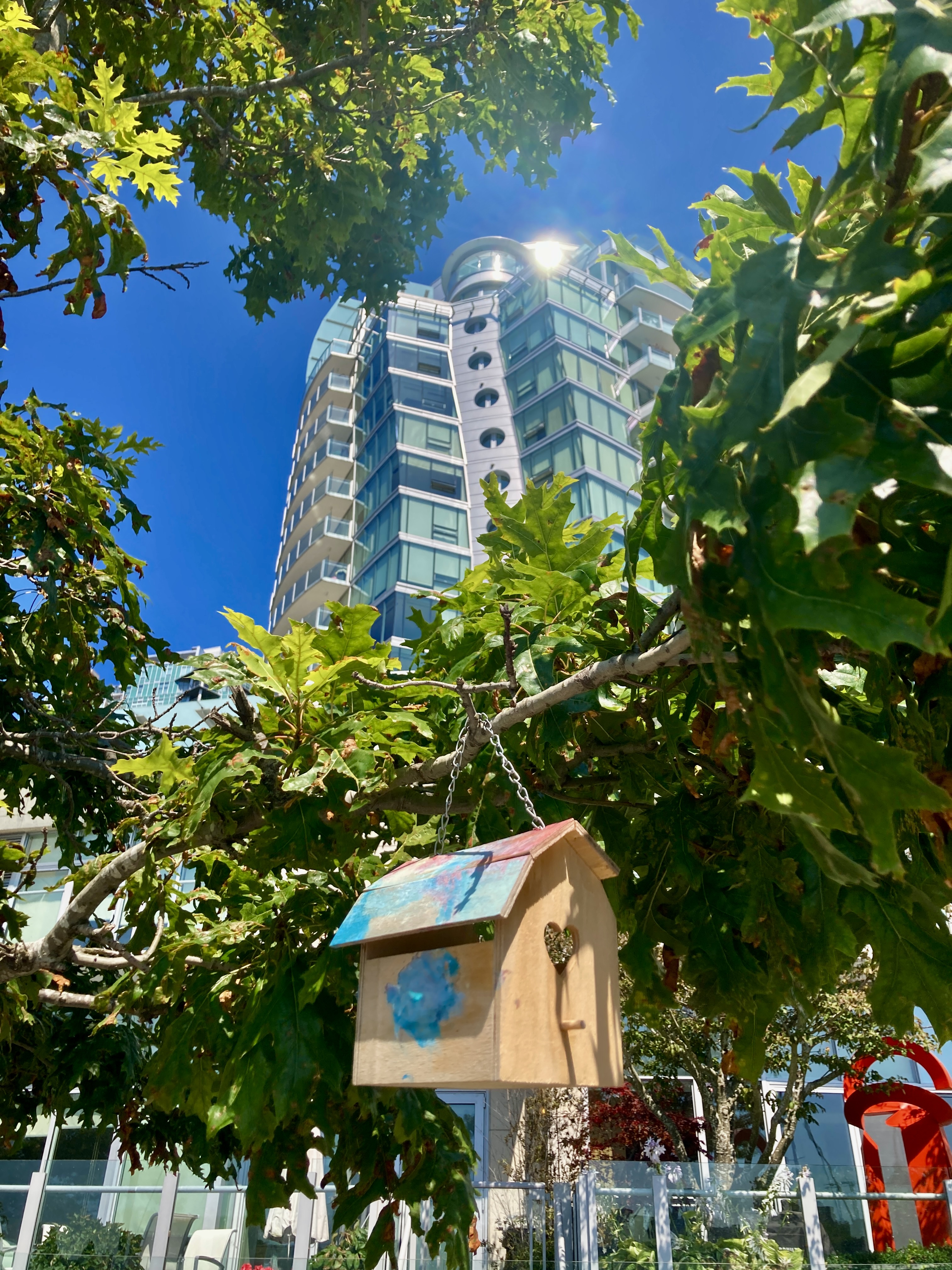
11 August 2024 – I’m in behind City Centre Artist Lodge, once again epicentre for the Vancouver Mural Festival, now in its final day.
Much to my surprise, I’m not much engaged with VMF official activities this year, but the hoop-la does have me noticing things with a sharper eye — colours, shapes, energy, juxtapositions — as i weave through the adjacent alleys.
I don’t yet know it, but I am curating my very own collection of white bunnies.
Starting with reflections + fence + signage + curb stones in the north/south alley right behind the Artist Lodge…
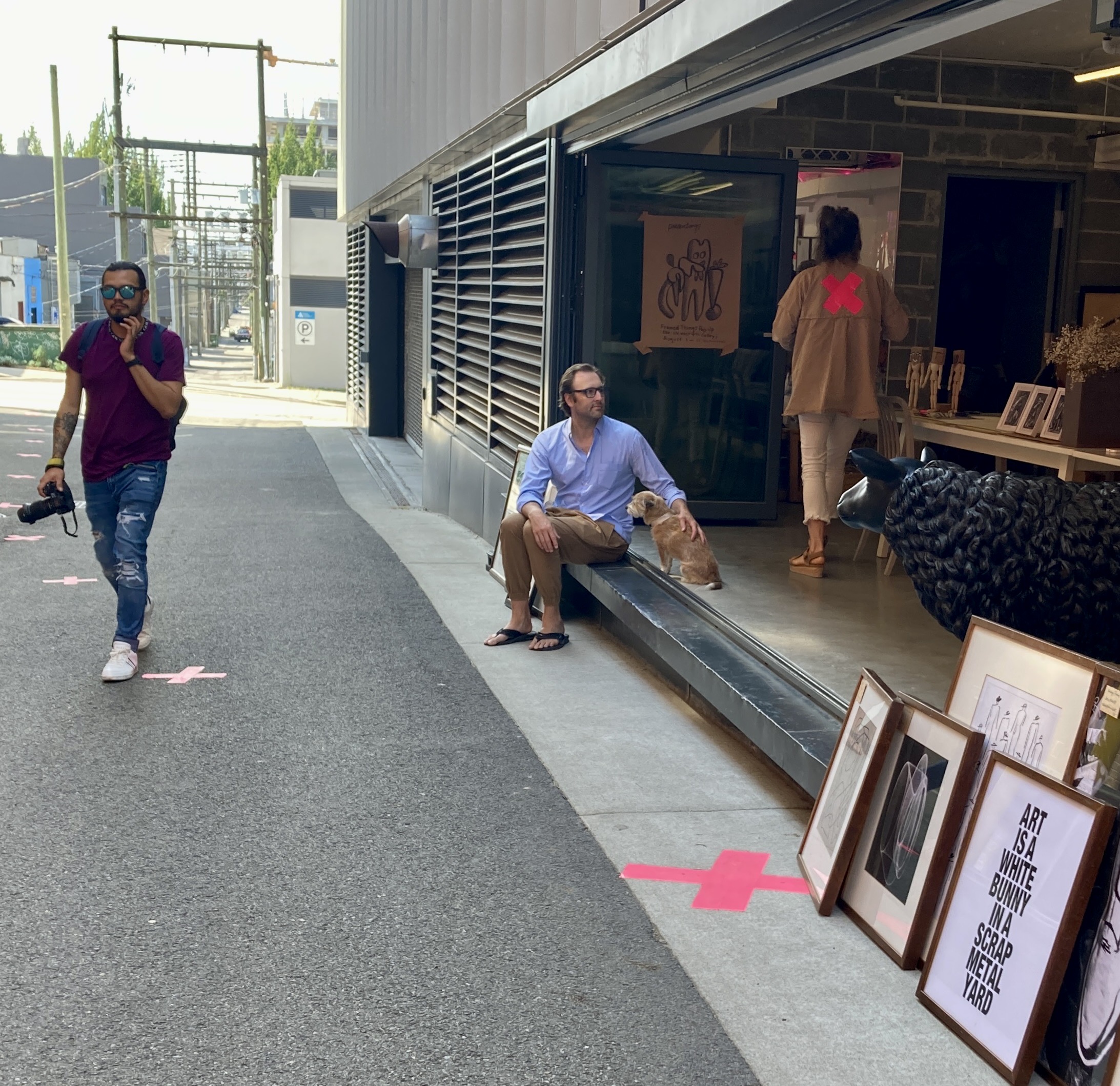
followed by resting man + dog + red-X motif + pop-up art display in the east/west alley between Main/Quebec/5th/4th…
which brings the white-bunny concept into my life.
It’s the framed quote, bottom-right in the line-up: “Art is a white bunny in a scrap metal yard.”
I like this! Deliberate bunnies, and “found” bunnies as well — whatever adds scamper & bounce to the streetscape.
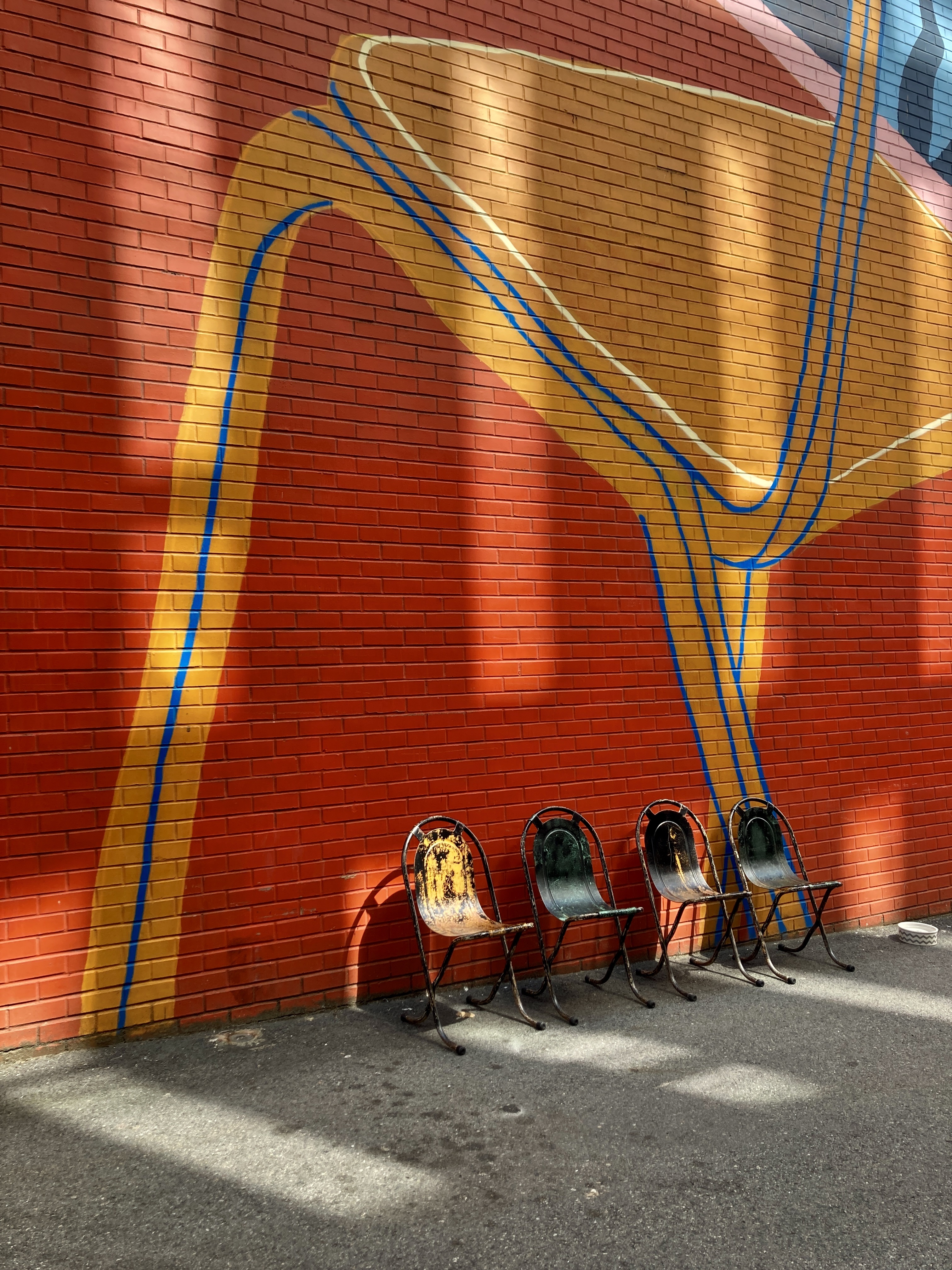
Right opposite, same alley: four chairs lined up in a deliberate and carefully positioned tribute to the looming chair in the gigantic wall mural behind them…
one detail in Andy Dixon’s 2017 VMF mural Red Studio (After Matisse), his 90-foot-high portrayal of his own Vancouver studio.
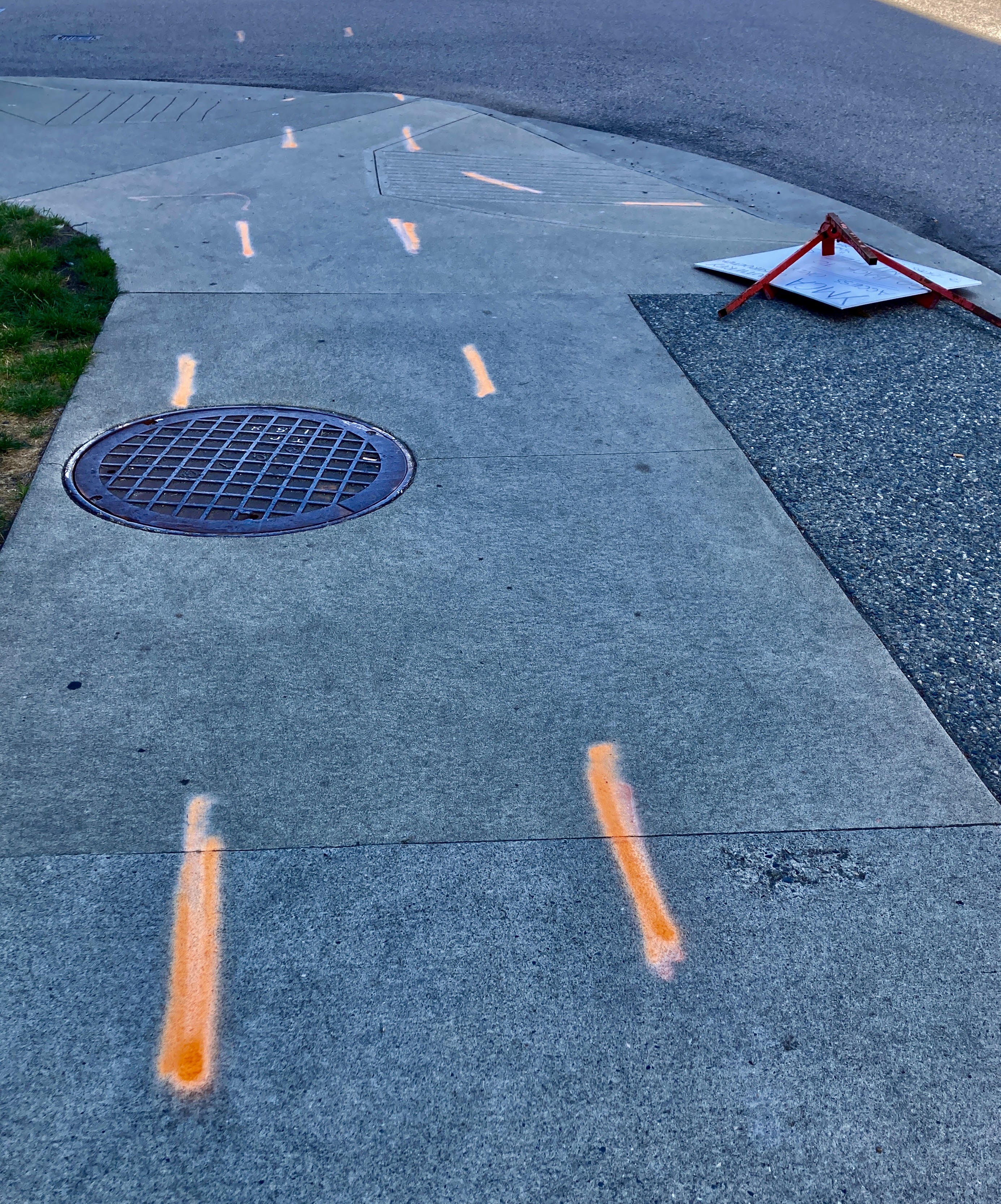
After that, my white bunnies are whatever & wherever delights me, whether day-glo construction guidelines on the sidewalk before me at Quebec & East 4th…
or white communications discs high on a roof beyond me, punctuating the tower to their left…
or an eye-level fluorescent X just south of Quebec & East 2nd. (Only later, at home, do I notice the red-X motif in the alley with the pop-up gallery, and realize there must be a connection.)
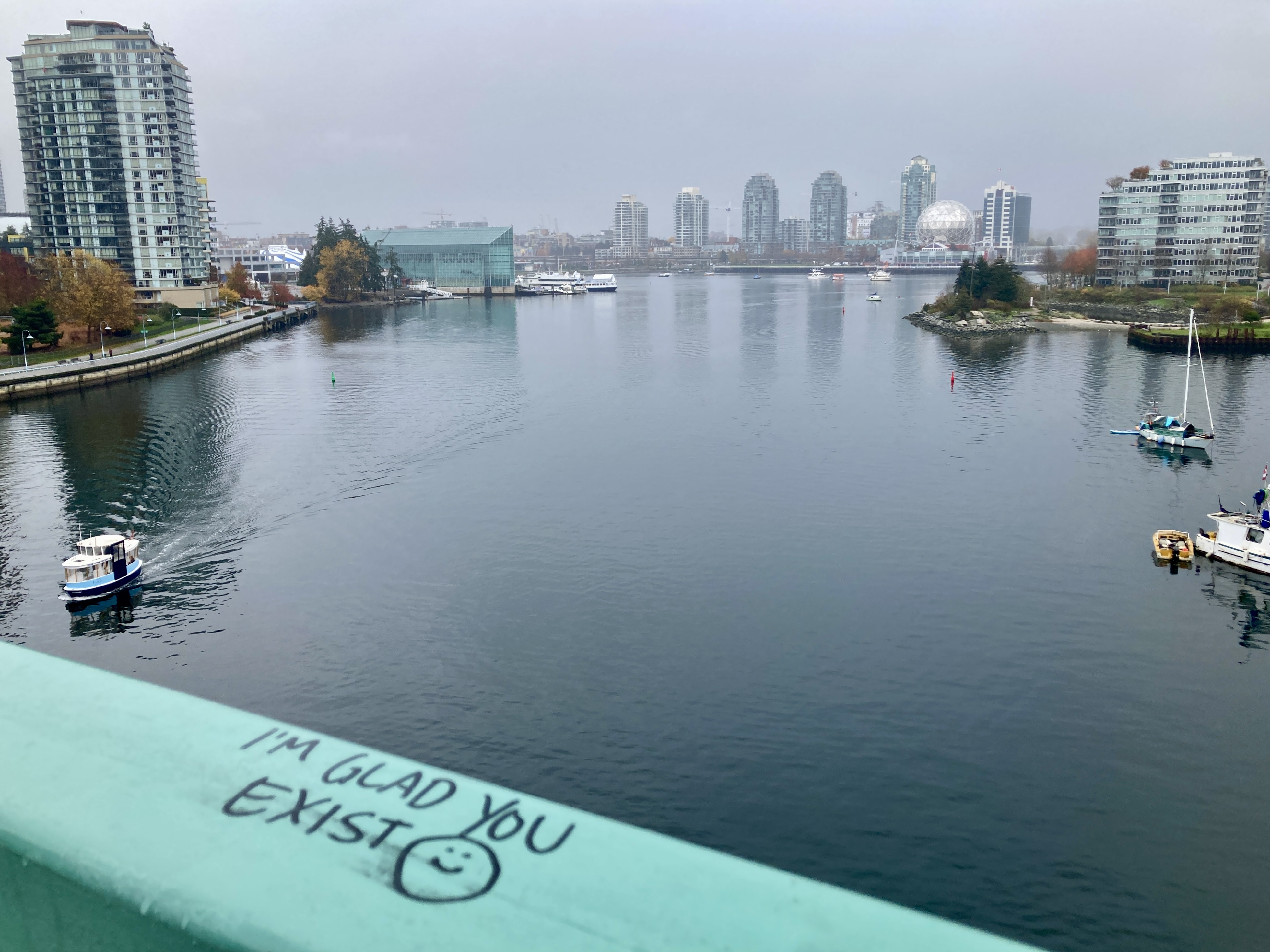
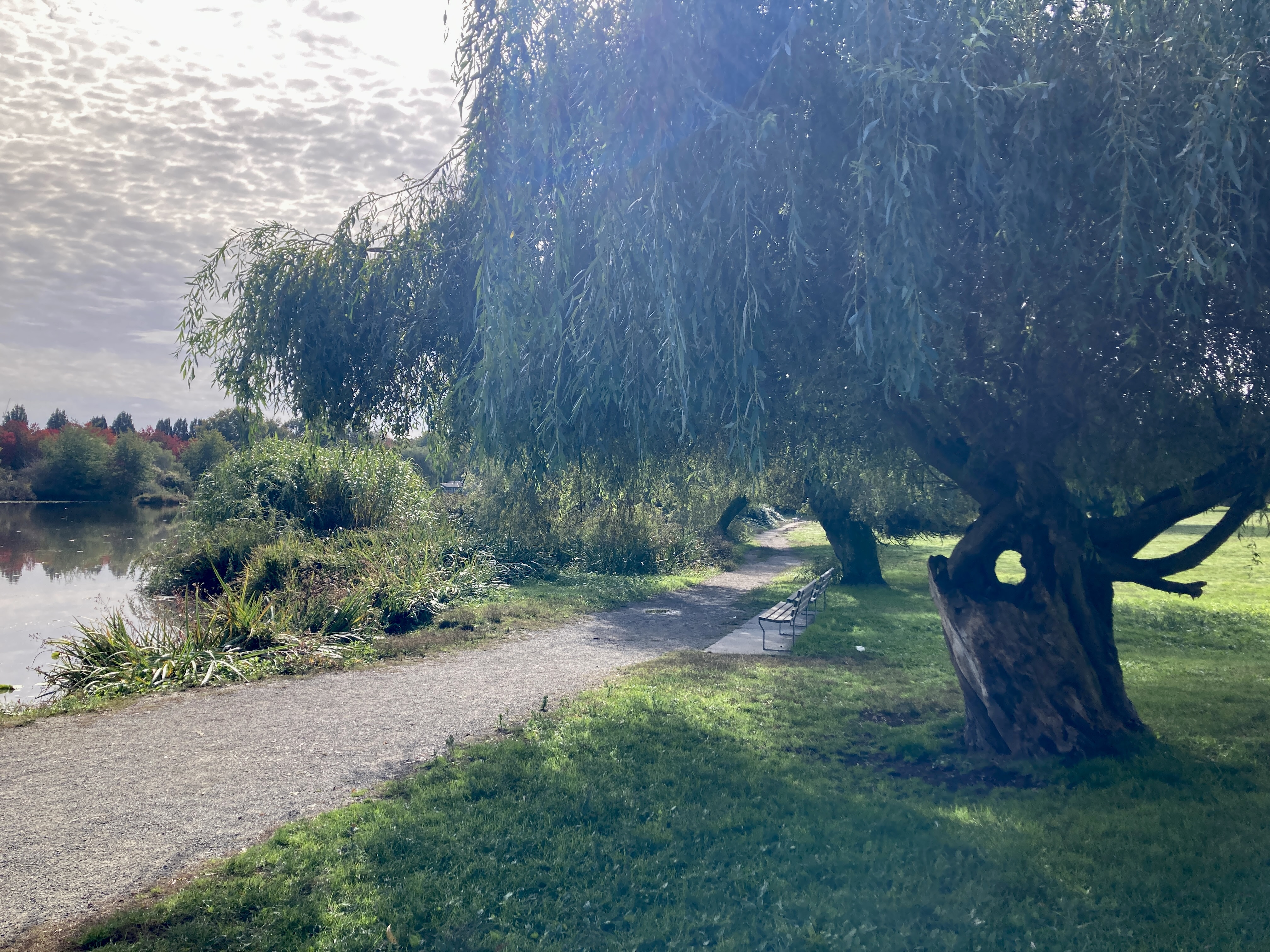
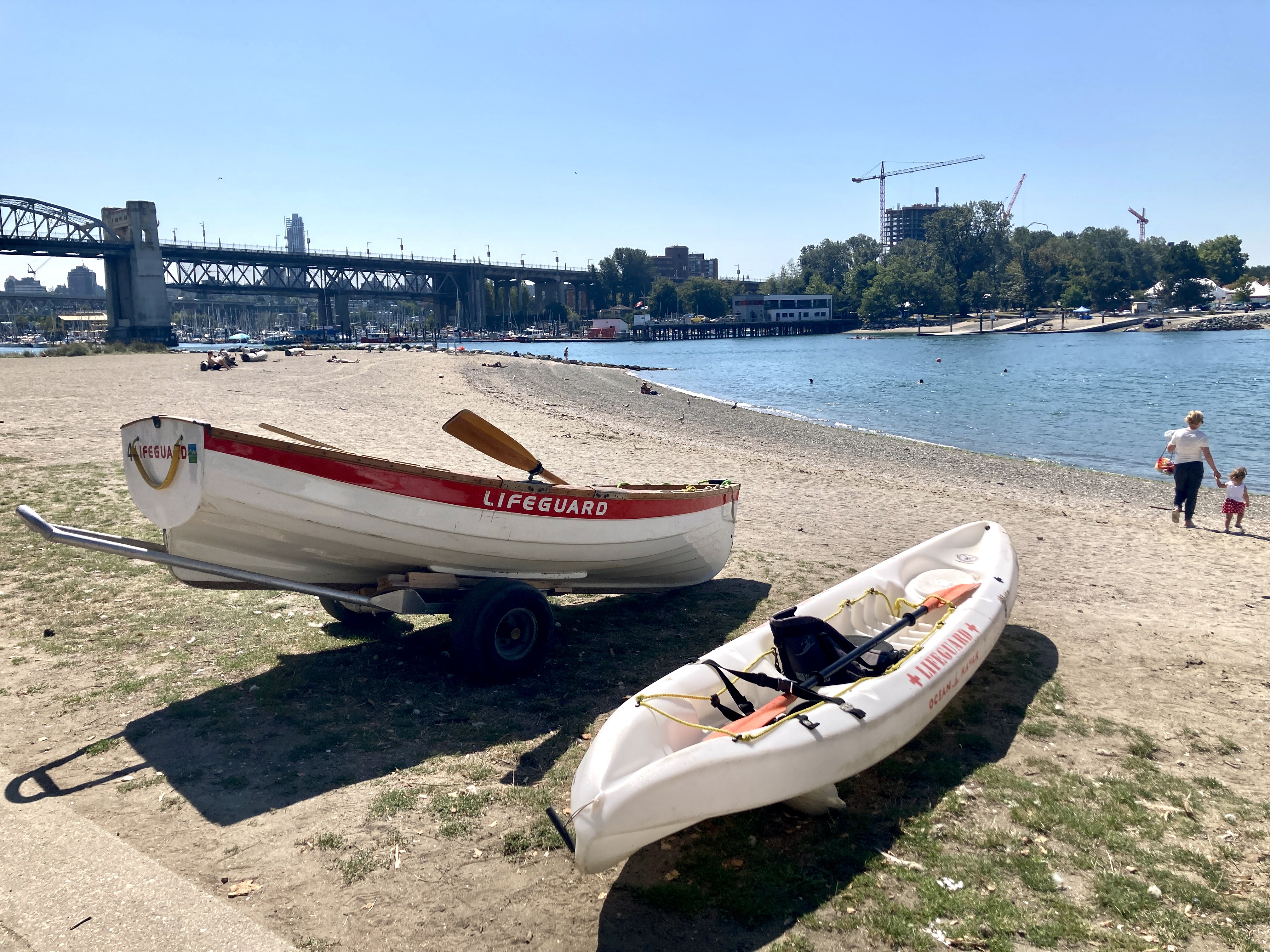
One final white bunny, down by False Creek.
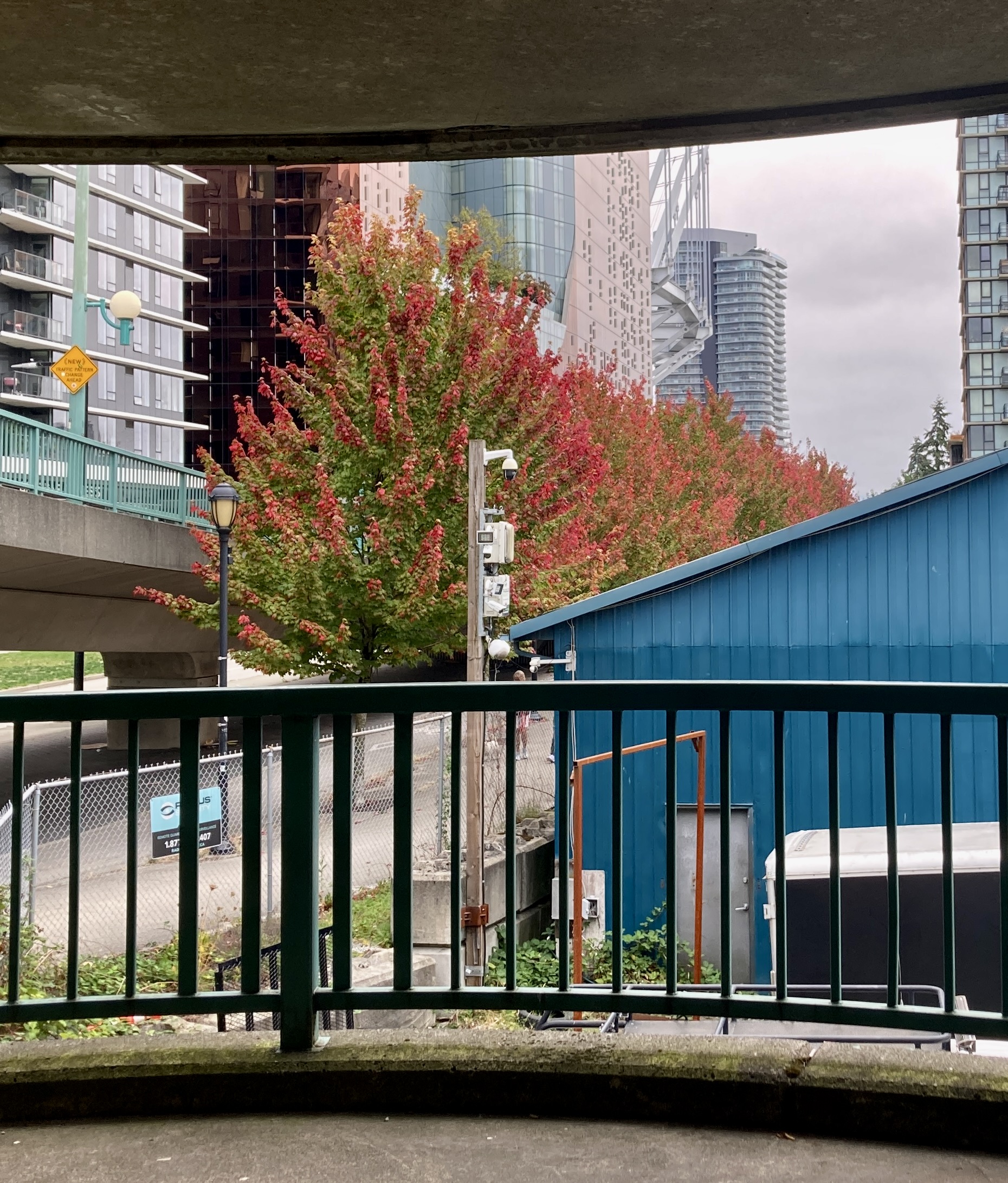
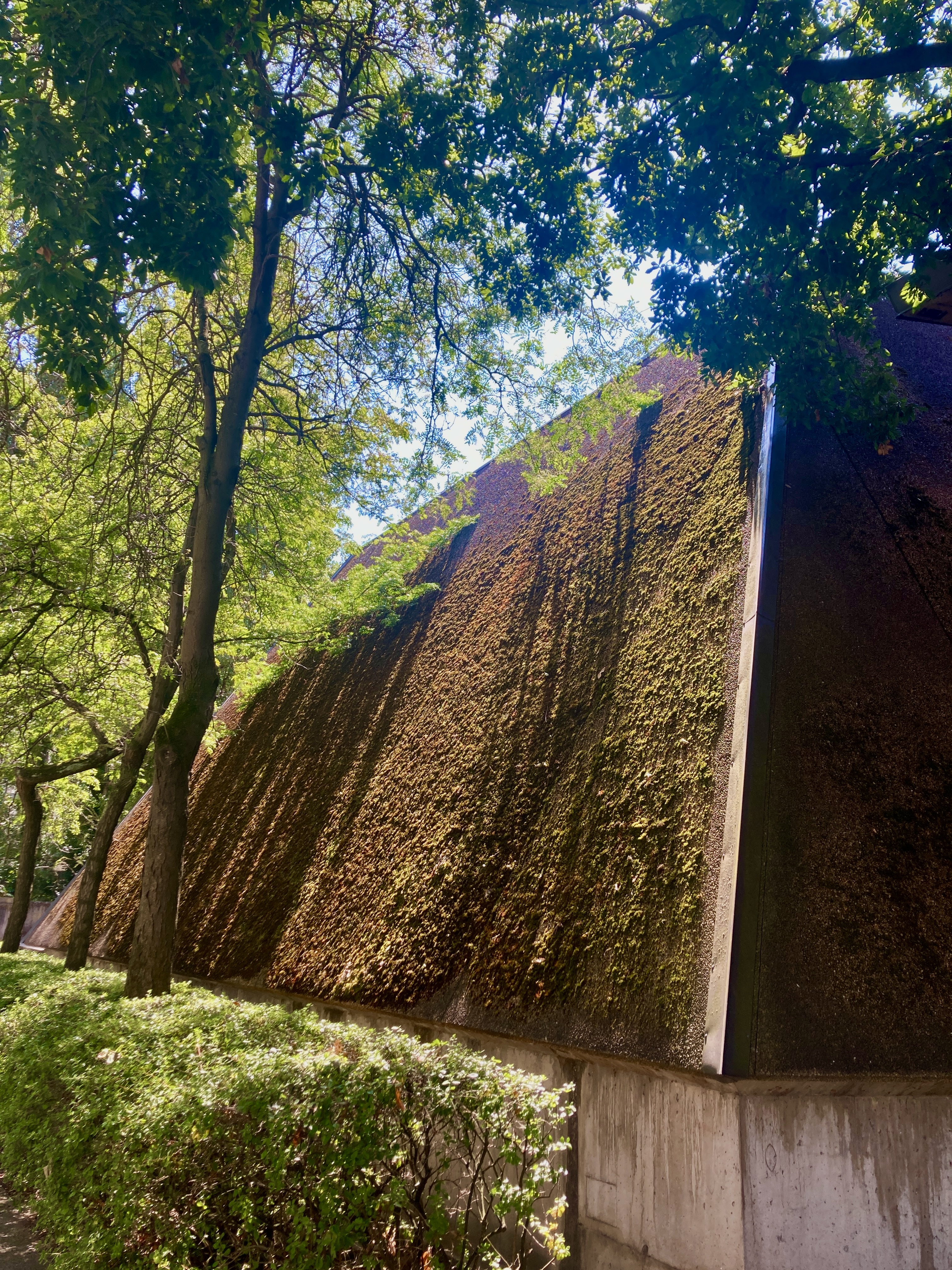
A multi-coloured white bunny, mind you — art is inclusive! — painted by Nature, and proclaiming a message that seems hard to believe, this hot mid-August day.
26 July 2024 – It’s a bright, breezy day and my target direction is Strathcona. I’ve just skimmed a newsletter reference to a week-long Eastside Arts Festival in Strathcona Park, and that’s motivation enough. Whatever the festival does or doesn’t deliver, this old residential neighbourhood is always worth another visit.
I set myself the mild challenge of getting there without walking north on Main Street. Main is a diverting parade of small shops farther south, but from here north it becomes a noisy downtown artery. My plan calls for a clever N/E zigzag — but that’s the beauty of feet! They sure can zigzag.
So down Scotia I go, with the now-sewered creek beneath my feet that once fed the now-infilled last stretch of False Creek. Left turn onto East 1st Avenue, with its contribution to new-build grit, part of the neighbourhood transformation…
and a right-turn onto Industrial Avenue.
Confession: this requires a quick ricochet off Main Street, where 1st and Industrial almost meet, but surely I can be forgiven that hairpin turn?
More grit, as I head north among the terminals and warehouses of False Creek Flats. There’s new-build activity here at well, with high-tech moving in, but that’s mostly farther east. This part, close to Main Street, is still yer actual old-fashioned rust & rolling wheels kind of grit.
But I like it, just as it is, and today it delivers me nicely from any more connection with Main Street. All I have to do is backtrack east to Station Street, then north to Terminal and across Terminal to the building that explains why Station and Terminal streets bear these names:
Pacific Central train station.
It’s more than 100 years old and still in use, with today’s power-washing just part of the regular TLC. This highly functional Old Build will soon be joined by that New Build lurking in the background — the new St. Paul’s Hospital complex, now under construction and due to open in 2027.
My avoid-Main-Street route takes me east on National Avenue, currently reduced to a narrow footpath bordering the hospital construction site. I gawk as I walk.
The area swarms with workers…
a reminder that, for all the machinery and high-tech of our age, every work site still depends on human effort and skill.
I have escaped Main Street!
I am now safely east, just in behind the construction site, where I can cut north through Trillium Park and enjoy my first fix of major greenery. There indeed is St. Paul’s, rising in the background, but here in the foreground…
we have green fields. Green fields both sides of this pathway, with kiddies on each side, busy learning the fundamentals of soccer.
This is all fine, but I keep walking because just to the north lies Prior Street, and that will take me into Strathcona neighbourhood. And then Strathcona Park! And then the arts festival!
A vintage wooden Strathcona house sits right smack on the corner at Prior and Jackson. It is much the worse for wear.
That’s also part of the story of this area — home to Coast Salish First Nations for millennia, and then, with the 1865 opening of the Hasting Lumber Mill, increasingly home to waves of working-class immigrants. The whole area prospered, declined, and is now in that tenuous urban mix of restoration, renewal, rebirth and inevitably destruction as well.
I walk east on Prior. Strathcona Park will be just ahead of me, but before I can quite fix on its location, I am diverted by the sight of an elderly couple with an exuberant grandchild emerging from a path in the woods to my right. I exchange grave nods with the couple, finger-wiggles with the child, and step onto the path they have just left.
Well. Look at this.
It’s just one tiny corner of a community garden, bursting with mid-summer proof of its gardeners’ devotion. I weave between beds, find the Garden’s tool shed and step close to read its signage. I’m admiring the trilingualism of it all…
when the door opens and I get to meet one of those gardeners. She has been a Strathcona Community Garden volunteer for ages, she says, and she’s not going to let a little thing like knee replacement surgery (points to the scar) keep her away.
Do I know about the Cottonwood Community Garden? she asks. No, I do not. Most people don’t, she says, because it’s so tucked away, but it’s amazing and you should go look at it. Where is it? I ask.
She leads me back to the edge of the Strathcona Garden and points the way: turn right here, then left there, along that line of trees, then keep looking to the right.
So I do.
As I walk, I realize I am now in one corner of Strathcona Park. Damned if I can see any sign of an arts festival. And damned if I care, because finding Cottonwood seems so much more interesting.
Right; then left; then keep looking right, into the trees. Oh yes. Signs of gardening in there.
And a sign very politely telling me to keep out. It explains this particular section is home to sacred medicinal plants, and asks anybody not involved in their care and rituals please to remain outside the fence.
An adjacent sign welcomes me in.
Even though invited to come on in, I feel shy about intruding. I stick to the external foot paths, and peer over fences as I go.
This string of garden plots lies in quite a narrow ribbon of land between Strathcona Park to the north and Malkin Avenue to the south. Looking south, I can see the tops of buildings, one of them marked Discovery Organics and, right here in front of me, the top of a mural marked Produce Row.
Framed by a gaudy arbutus tree on the right and a discreet birch tree on the left, my pathway disappears back into the woods…
and then, soon after, leads me out onto more open ground. Here the garden beds lie right next to the Strathcona Park playing fields.
I meet another gardener — this one a relative newbie, someone who comes from West Vancouver for the pleasure of digging in her very own patch of soil. She offers me a bag of lettuce. I explain I have so much fresh produce right now it would probably spoil. “Me too,” she sighs.
I wave good-bye and then stop at a park map, to get my bearings. Since I am dog-free as well as lettuce-free, the map’s primary purpose is irrelevant, but its coordinates interest me a lot.
Later online research tells me even more, makes these two gardens even more impressive — and suggests thy are under threat.
According to the Strathcona Community Gardens Society, which manages them, both Strathcona and Cottonwood gardens began through local activism: Strathcona on an unofficial dump site in 1985, winning a 25-year lease from the Park Department in 2005; and Cottonwood on an industrial waste site in 1991, still apparently without any legal status. Depending on what happens next to Malkin Avenue — perhaps expansion, to compensate for planned viaduct demolition — both Produce Row (the string of fresh food wholesalers on Malkin) and the adjacent garden might be bulldozed. (I can’t find dated, documented, recent data on this, hence my careful language.)
I don’t yet know all this, as I again walk north.
I am still kinda-sorta wondering about the arts festival, but I am easily distracted — and more distraction is soon on offer.
Who could resist Strathcona Linear Park? It leads me alongside Hawks Avenue, and splashes mid-summer foliage all over me, including this magnificent Mimosa grandiflora (thank you Pooker, for the ID).
Right under that pink splendour, some turquoise chalk on the sidewalk. “Free…” it begins, and I wonder which political cause is about to claim my attention.
Ahhh! I look around hopefully.
No cupcakes in sight. And still no arts festival, either. By now I totally don’t care.
I stick with the Linear Park, admire the False Creek mosaic as we cross the bike path at Union Street…
and walk one more block that now borders MacLean Park. It takes me right to where I next want to be: on the N/W corner of Keefer and Hawks, tucked up with some lunch…
in the Wilder Snail café, with its giant snail as a ceiling ornament.
It is finally time to head west, to start looping toward home.
Past the MacLean Park notice board at Keefer & Heatley, promoting everything from World Hepatitis Day (“free testing”) to evenings at the Dream Punk Piano Lounge, and then a quick detour across the street.
To view an entire residential community, right there on a single massive tree stump.
(Well, what would you call it?)
On west along Keefer to Princess, where I pause for another of the City’s sidewalk mosaics.
Nobody could accuse this mural of being happy-face PR! Look at that power shovel, knocking the end home to smithereens.
Happily, as I carry on west, I pass still-standing vintage homes. Including this one near Princess Avenue…
protected by its hedge of giant guardian Gunnera.
Once i cross Gore Street, I have changed worlds. I have passed from Strathcona into Chinatown.
I walk with that world for a while, then hop onto a Main Street bus, and go home.
Where, finally, I read the Eastside Arts Festival promotion more carefully.
And discover that (a) it consists of pop-up events at scattered times in scattered locations and, (b), this particular day, the only event is an evening urban-drawing workshop being hosted in a local brewery.
20 July 2024 – Not the elegant, intricate shadow play of the wayang kulit puppets that entranced me many decades ago on Lombok (Indonesia). No, instead, the very humble shadow play that entranced me yesterday, in the sun-baked heat of a deserted school yard.
Right here.
Looking east as I walk north on Main Street: strong schoolyard structures that, in the absence of any children, have only their own shadows to play with.
I veer in, I join the game.
To my left, the sprawling complex of General Brock Elementary School. It is named for Sir Isaac Brock, one of the British generals who, with British troops, Upper Canadian Militia and — crucially — Mohawk Nation chiefs & warriors, defeated American attempts to conquer British North America during the War of 1812. (Should you want to plunge down that historical rabbit-hole, you might start with this Canadian Encyclopedia entry.)
My thoughts are neither with Asian puppetry nor with General Brock. They are, as I step farther into the school grounds, entirely with the shadows.
The basketball hoop standard looms large over what seems a very timid shadow…
but I view it from another angle and up close. Then the shadow asserts its own sassy presence.
The lattice work on the prosaic fence to the right throws lacy relief onto the pavement…
and the wild morning glory blossoms, rampaging on that fence, sulk because they have no shadows to play with.
Pretty indeed, but I don’t linger.
My eyes & mind are already back on the playground, where a disc-swing and its supports dance with the wood chips below.
A ring-seat goes all circular…
and blocky cubes go all angular…
and by then I’m at a left-turn option. Pavement leads me around the back of the building…
toward the raised garden beds and more playground beyond.
The raised beds, signage tells me, comprise the General Brock School Food Garden — this school’s participation in the SPEC School Garden Program, which in turn is part of the larger SPEC mandate to promote urban sustainability.
Between those garden beds, now tidily put away for summer, run a couple of hopscotch grids. Smack-dab in the noon-day sun, they have no children to play with, and no available shadow, either.
6 June 2024 – After a very long stretch of drizzle days, we have sunshine. Given the state of both wildfire season and our water table, I react to the sunshine with mixed emotions. To draw on one of Susan Sperling’s “lost words” that deserve to live again, I am feeling “merry-go-sorry.”
(And isn’t that more fun than mere “mixed emotions”? Go find Poplollies and Bellibones if you can, Sperling’s glorious 1979 celebration of lost words. It will also, for e.g., teach you the perfect epithet for a lascivious priest. He is a “smellsmock.”
(But I digress. Back to the sunshine.)
Yes, sunshine! So I walk myself down to the Olympic Village dock, to wait for the next False Creek ferry. My vague plan is to ride it west to Granville Island, and then walk my way back east to home.
Warmth + sunshine = other people also waiting for a ferry, several with toddlers and strollers.
One child, surely age four at most, turns into Boy Busker: he reinvents the popular children’s song as “The ferry on the creek goes round and round…” and then spins off into his own sing-song about up-and-down tides and repair boats and how you have to be quick-quick when the ferry arrives.
We applaud. He tells us sternly that he hasn’t finished. Abashed, we still our hands and wait for more. But then the ferry does arrive…
and everybody (including Boy Busker, turquoise helmet) climbs on board.
Not so very quick-quick. There are strollers to off-load first, and then three strollers to on-load, plus an unwieldy skateboard, and many questions for the patient ferry operator to answer. But it all happens, and away we go.
A lone canoeist skims by, just off Coopers’ Park…
and I admire yet again the multiple and largely smooth and peaceful uses of this public waterway.
We approach the Granville Island dock, welcomed as always by the Giants mural, spray-painted across the six silos of Ocean Concrete for the 2014-16 Vancouver Biennale. They begin to show their age, but I am cheered by the little banner announcing their upcoming “renewal.”
We climb up the long zig-zag ramp used at low tide, and pass by another inevitable welcome to the island: crows!
I’m almost tempted to tour market shops, but don’t. I’m here to start a walk.
So instead I turn south-east-ish into Sutcliffe Park, which wraps this side of the island, and head for the Seawall. My route takes me past an imposing piece of industrial-heritage equipment that I cannot explain, because there is no explanatory sign to be found.
But it is indeed imposing, is it not? Complete with raised scrollings that were either intrinsic to the original industrial purpose or are recent artistic additions, and I can’t explain them either.
But then… Something that explains itself. Lots of signage.
I’m at the Granville Island pavilion, here on Alder Bay, of the Trans-Canada Trail. It is just one dot on a Trail that runs 28,000 km coast to coast to coast throughout the country, and is, if this website claim is still true, “the longest network of multi-use recreational trails in the world.”
Off I go, happy with sunshine and a trail beneath my feet. As I pass the point where Alder Bay merges with False Creek, I am also happy with an official “view corridor.”
Back in 1989, City Council voted to protect specific public views and view corridors, to ensure that despite city growth, at designated spots we would still have a clear view through to the North Shore mountains.
See them? Back there through the towers toward the right?
There are lots of closer and unofficial views as well. This clump of Common Foxglove, for example, that has established itself in handy crevices in the Creek’s riprapping.
Every part of this plant is toxic, I later read. I knew anyway: it was the favourite poisoning device of all those Golden Era murder mysteries I used to read. (It is beautiful, though!)
Signage at Spruce Harbour Marina includes old photos of the Creek in its dirty, polluting, industrial heyday, when great booms of logs (here, 1912)…
covered the waters, waiting to be milled.
Look around now, and the waters are covered with boats.
But a more interesting collection of boats than I originally thought, for this marina is home to the Greater Vancouver Floating Home Co-operative. Most of these boats are permanent homes, though the marina also welcomes visitors.
Farther east, down by Charleson Park, I stare at the pond…
and contrast all this water with the dried-up mud flats I remember horrifying me, one year when we were in the middle of a category 5 drought. Look at it, the result of all our recent rain.
The signage patiently reminds us this is a seasonal wetland, and it is supposed to dry up periodically, that’s how it works. Got it?
Yah-but, I mutter to myself, meanwhile I’m happy to see all that water.
Finally I’m back to where I set off, Olympic Village. Or, to Millennium Water Olympic Village, in the official words of the plaque by this commemorative installation.
This immediate cluster of buildings, which initially served as the athletes’ village for the 2010 Winter Olympics & Paralympics, was North America’s first LEED Platinum community, and a catalyst for the reinvention/rejuvenation of the larger area.
The reinvention continues, and features considerable development of new residential complexes.
Like all these.
But notice also all that green space.
In the rear, a Pollinator Meadow, with species introduced for that purpose, and here in the forefront, a bioswale. ??? Fortunately, a bright blue sign tells me it is not just a ditch, it is a deliberate creation that collects one-third of all the rainwater falling on public spaces in Olympic Village, thus diverting it from the sewer system and mitigating any pollutants before the water empties into False Creek. (And if that makes you want to know more about the City’s rainwater strategy, click here.)
I’m about to weave between towers and head for city streets, but stop at one more bit of stubborn wild greenery. The City may be busy with planned & managed pollinator meadows and bioswales and all — and hurray for that — but nature keeps plonking herself where she wants to go.
Even smack in front of the next planned burst of exclusive waterfront residences.
14 May 2024 – Spring is busy admiring herself, everywhere you look.
Horse chestnut candles aflame in all those towering trees…
this lot white, but many red ones as well.
I’m enjoying the day, enjoying this walk in a favourite neighbourhood just south-east of my own — so like my old Hillhurst neighbourhood in Calgary, back in the 1970s. Wooden frame homes, generous front porches, neighbourly architecture creating a comfortable, engaging, neighbourly streetscape.
I am therefore delighted but not surprised to see a tree garlanded with messages.
And the theme…? I ask myself.
The tree tells me.
I circle the tree, reading some of the replies.
Among them, an earnest statement of a basic principle…
an example of that principle in action…
and a sweeping philosophic directive that, unpacked, could fuel much further thought.
It has captured my thought, in any event.
I find myself looking for examples of generous action, right here on the street. Just ordinary… everyday… components of the streetscape that, through this lens, translate as generosity in action.
The table & chairs in this volunteer-tended Green Streets traffic circle, for example..
and the beauty of this long stretch of gardening activity, bordering the sidewalk.
Individual homeowners are doing all this, yet they’re not the ones who see it. We, the passers-by, we’re the ones to enjoy the results.
There’s a felt heart tied around a tree trunk — no reason, just because…
and yet another streetside take-one/leave-one library.
This one, says the little plaque, is Lizzie’s Library…
and I admire not just the neatly stacked books on offer, but the freshly planted marigolds as well.
Farther along, a bench (beside yet another streetside library) for anyone who might like a moment’s rest…
and then a swing, for anyone who’d rather kick up their heels.
Judging by the worn path beneath, there’s been a lot of heel-kicking!
I’m not obsessively “theme-hunting,” mind you, I’m enjoying the whole walk just as it comes.
Heading back north on Sophia, passing Tea Swamp Park (home to “awesome,” remember?), I pay proper attention to the other side of the street. To the new-build, on the corner.
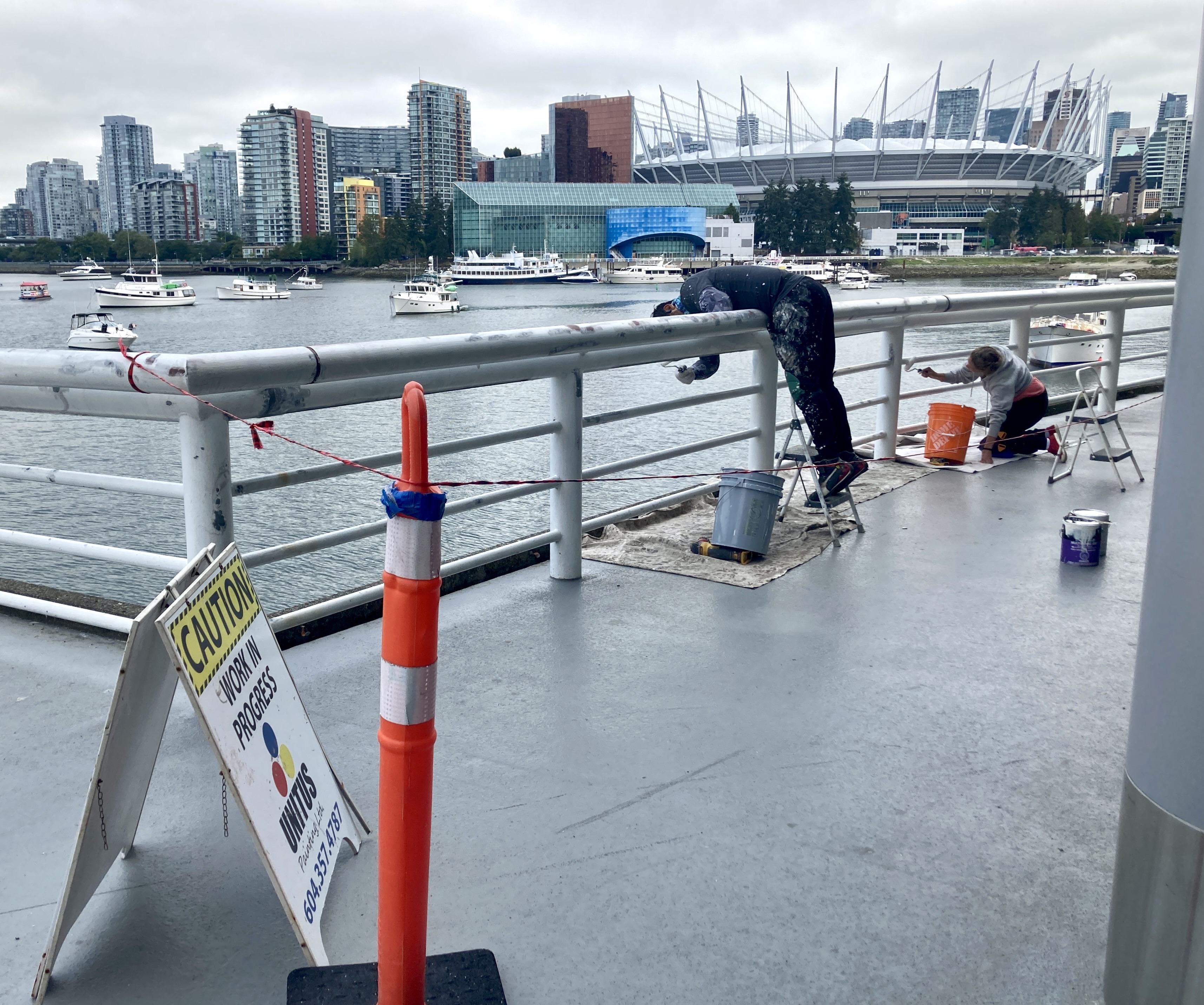
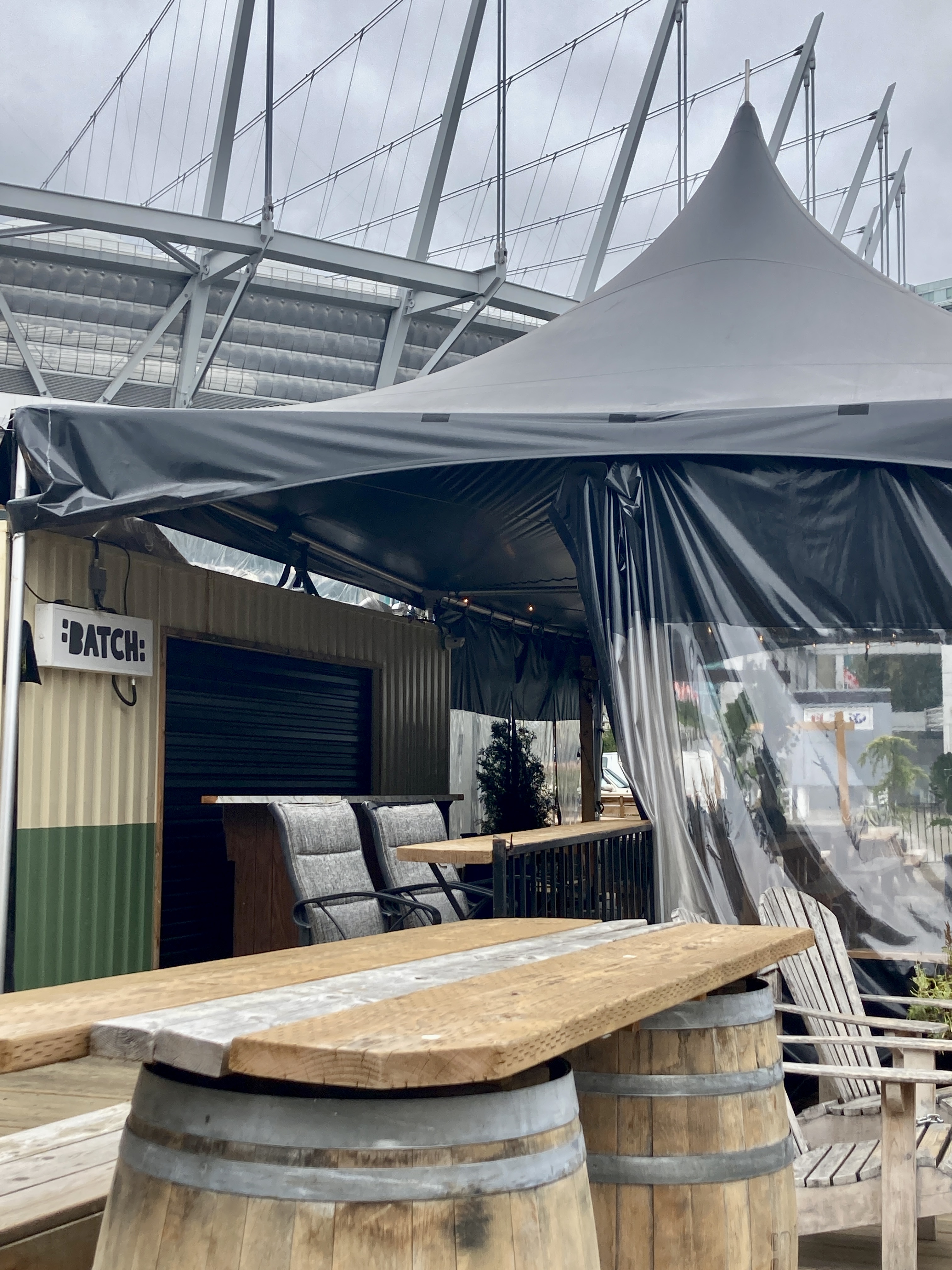
Which would be hard to ignore.
And I wonder idly if design elements like this, the prevalence now of bold graphics on new-builds, is at least in part the result of eight years of Mural Festivals. Powerful visuals now part of our street vocabulary…
Then my mind moves on, the way mind do, and i start to laugh.
Because I’ve just remembered another of the answers to the “Generosity is…” challenge.
6 May 2024 – I’m as far W on Davie Street as you can be, sharing a joke with the A-Maze-ing Laughter sculptures in Morton Park. English Bay can be glimpsed between the statues, and the glory of Stanley Park lies beyond.
I turn my back on all that.
I am heading E, not farther W — east the full length of Davie Street, right from “You are here” in this handy signpost map…
to False Creek, where the street is once again stopped by water.
Just as those waters transform as they go — from the breadth of Strait of Georgia, into English Bay and then into False Creek — so too does Davie Street reflect city transformations.
This 4-km-or-so route is a crosstown slice of Vancouver’s past & evolving future. It leads us from still-vintage West End, through Davie Village (once simply “Gay” & now a more complex family of inclusions), into Downtown with its Entertainment District, and on to Yaletown, western terminus of the railway and the repurposed former hub of railway equipment construction and repair.
Barely underway, I detour onto Bidwell long enough to admire the volunteer garden at the corner of Pantages Lane, with a vintage building opposite.
Well…
I later learn that the vintage building is just a vintage façade. It is, a realtor’s website informs me, “a beautifully restored heritage entrance” to a spiffy new residential tower, “that returns the street frontage to its original character.”
Back out to Davie, where I head eastward on up the street. I do mean “up” — both climbing away from the English Bay basin, and also tilting my head at the towers that increasingly line the street.
A past-&-future moment, here at Davie & Cardero: the district’s future already visible there on the left, and a big blue “rezoning application” notice on the fence of the modest old apartment building on the right.
I see a lot more of these notices as I go, including ones on an apartment building also marked with a “sale by court order” sign.
But there is still lots to enjoy, lots of human activity and human-scale engagement.
Also canine.
He has appropriated this bench outside a barber shop / tattoo parlour, and his confidence is likely well-placed. A bearded man has just walked through that still-open door, his leashed French bulldog by his side. Inside, they are greeted by the statue of a bulldog.
At Broughton, a wonderfully ornate vintage apartment building, its paintwork perhaps a bit scruffy but no sign of any redevelopment activity.
The shops & services around here are not glossy and latest-thing. I like them very much.
Just before Bute, I see this slivered opening between buildings, complete with mural…
and I follow it to the laneway beyond.
Where I turn left, and then left again back to Davie Street, through the Event Zone of Jim Deva Plaza.
The plaza honours the man’s lifelong courage and advocacy. Deva, one of the co-founders of Little Sisters Book and Art Emporium, challenged Canada’s censorship laws in the Supreme Court, and also — with greater success — worked with Civic authorities to promote safety and quality in Vancouver’s parks and public spaces.
I don’t know all this about him at the time. While in the plaza itself, I notice more trivial things. Such as…
Corner of Davie & Bute, and we’re well into Davie Village by now. Here, for example, with a mural tribute to jazz greats behind the intersection rainbows.
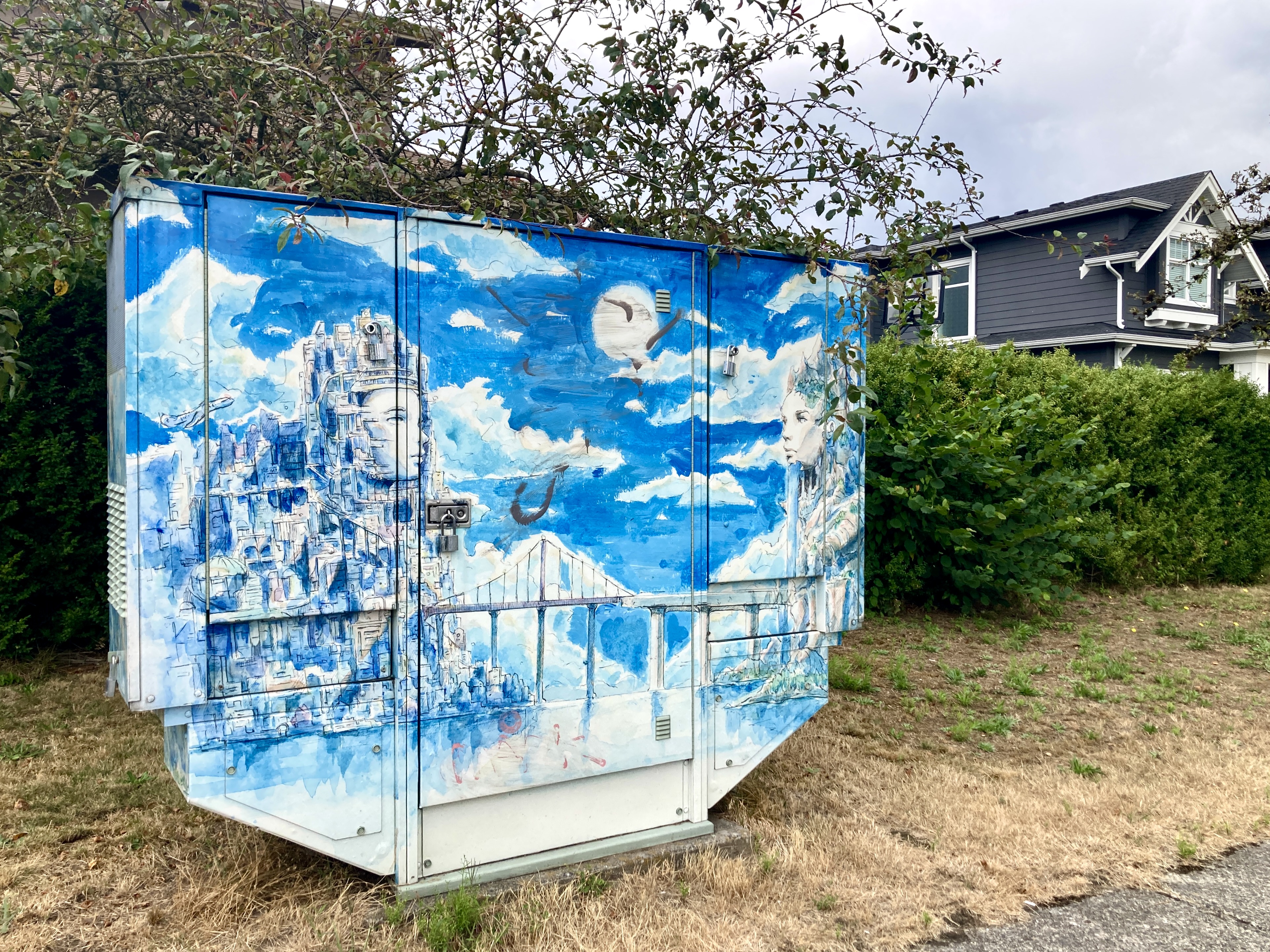
I cross, check the mural, and decide I’m personally more taken with the four-legged acrobat and the skate-boarding raccoons on the utility box.
But to each their own!
I pass a nude unimpressed by Happy Hour offerings…
and a greengrocer laying out yet more spring plants on his sidewalk shelving…
and then stop at the hot-pink bus shelter at Davie & Burrard.
The colour echoes the Village, as does the long-established Davie Village Community Garden visible through the mesh.
By now I’m used to rezoning/redevelopment notices, but I am sad to see them posted on this mesh fence as well. I’d love this Garden to continue, but…
what I see right across the street may be its future as well.
At Granville Street, I’m into the city’s Entertainment District (per its tourism maps), where I once again nod happy recognition at the neon signage for Two Parrots Bar & Grill.
Scotiabank Dance Centre is a restoration/new-build complex on the far corner, and other towers abound. So far, the Two Parrots still perch on their accustomed corner, no redevelopment notice anywhere in sight.
The lane immediately behind the building pays tribute to their longevity.
Well, sort of! (Upper left.)
More visual tribute at Seymour Street, where Jill Anholt’s 2005 sculpture, Moving Pictures, honours Vancity Theatre (home of VIFF), which stretches on down the block.
Downhill toward False Creek.
I cross Seymour, pause to again enjoy the long slice of water tumbling through Emery Barnes Park…
and here I am at Hamilton Street, in Yaletown. Once home to railway equipment construction and repair workshops, the district is now repurposed into food, drink, entertainment, & residential delights.
I sidetrack myself along Hamilton for a bit, enjoy reminders of a mid-pandemic “I ❤️ Yaletown” mural festival…
then return to Davie and cross Pacific Blvd.
Roundhouse Community Centre is right here, an architectural link to the past — and nowhere more powerfully than in its CPR Engine 374 Pavilion.
Where, after long service, that steam-era pioneer is on display.
Engine 371 beat her from eastern Canada to Port Moody but, on May 23, 1887, Engine 374 pulled the first transcontinental train into the City of Vancouver. She continued to do just that, until 1945. Restored and gleaming, she now rests and accepts our homage. (Squealing kiddies all around me, especially the ones taking turns in the driver’s seat.) A volunteer urges me to return for the May 19 Anniversary Celebration, when she’ll make her yearly trip outside and be the centre of attention on the Roundhouse Turntable.
Now for the last few steps on Davie, on to the bit of track and sculpture in the traffic circle, with Yaletown Dock to mark water’s edge and my arrival at False Creek
I loop along the waterfront for a bit, then turn left into and through Steamboat Mews…
back to Pacific Blvd., where I hop a bus for home.
22 April 2024 – But before we dive into Latin taxonomy — not that I knew I was headed there, at the time — before all that, a moment at the corner of Scotia St. & East 7th.
Where I am charmed by Buggingham Palace.
The bee’s knees, you might even call it, though the holes in those colourful pillars are meant to accommodate the entire insect.
The volunteer tending this particular Green Streets corner garden has helpfully labelled all her plantings. I not only admire floppy reddish blossoms on a coarse-leaved shrub, for example, I know I’m admiring a Flowering Red Currant.
Then I look at an adjacent lamp standard, and learn even more.
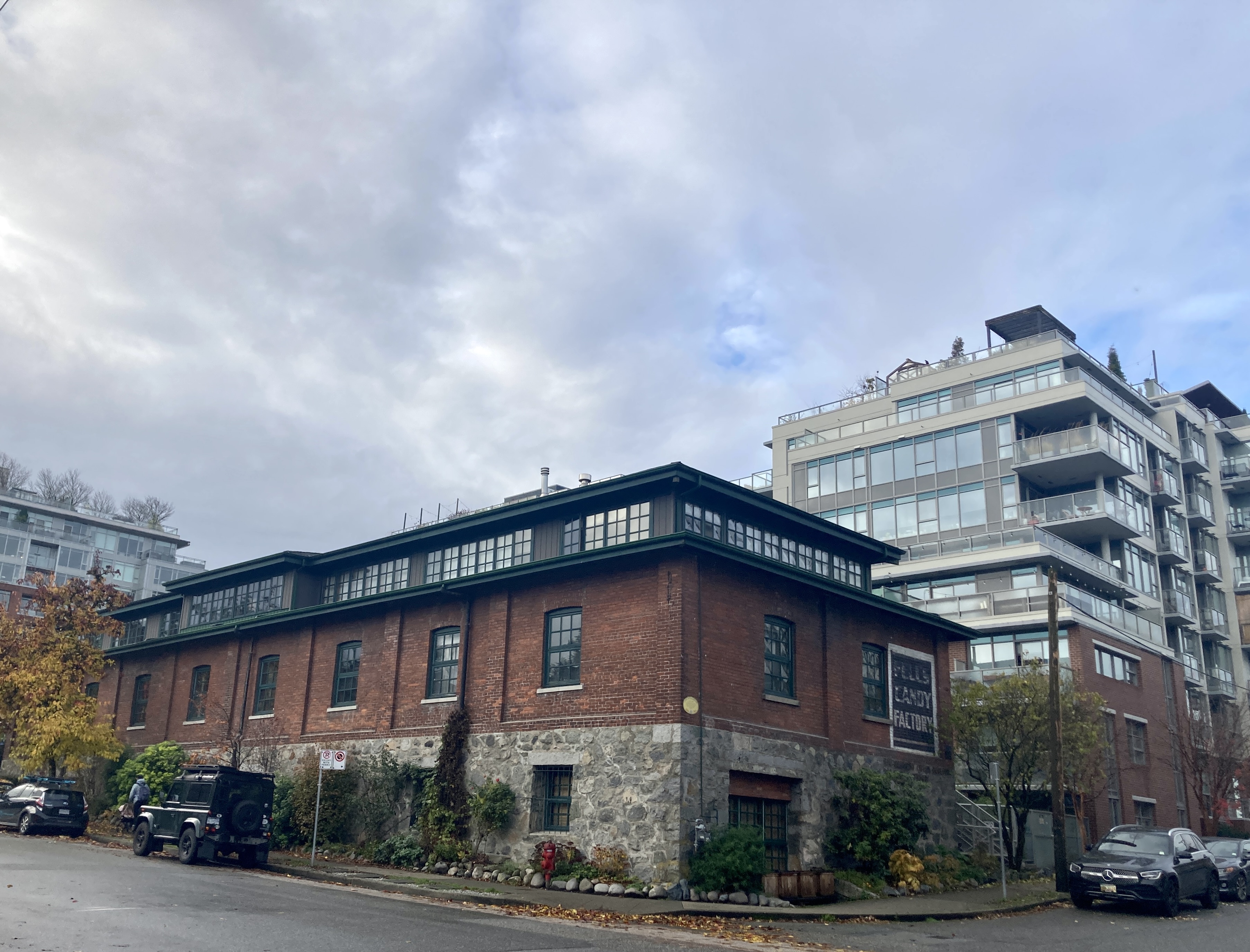
The building on the opposite corner, the one I’ve always thought of as the Candy Factory, started life in 1904 (or thereabouts) as the Brewery Creek Building, one of many brewery operations in the area. It later became Fell’s Candy Factory, then the Purity Dairy, later on a grease works and later still had other grubby-sounding lives until, in 1993…
it was refurbished and converted to these handsome artist live-work spaces.
Pleased with all this new knowledge, I go on my way. “My way” being straight on east to China Creek North Park — no particular objective, just offering myself a not-very-demanding stroll on a very pretty day.
It’s a large, open, multi-purpose park dropped into a bowl — the bowl being what’s left when you drive underground what had been Vancouver’s largest drainage basin, whose creeks all fed into False Creek. (Until you filled in that final bit of False Creek as well.)
There are steep steps down-down-down on my left at the northern edge, but over there to my right, at the south-west corner, there is the start of a lovely ox-bow path …
that winds its friendly, undemanding way from high to low.
I take the path.
Almost at the bottom — down where I can watch young men grunting through crunches on the level grass while toddlers squeal in the playground — I turn and look back uphill. The slope is dotted with solitary bodies, perhaps meditating, more likely texting, but anyway all with knees angled outward to support their admirably straight torsos.
One person is upright, afoot, moving across the terrain. One human, but six legs.
Human plus fluffy white cat on a leash. See the cat?
Now please stop looking at the cat and notice all that yellow.
Lots and lots of yellow. All over the place.
Taraxacum officinale!
The dandelion.
I have to look up the Latin later on. Standing there, I’m sufficiently occupied just thinking about the word “dandelion.” I know it’s from the French “dent-de-lion,” for the serrated lion’s-tooth edge to the leaf. I also know that the word may be French, but it’s not the word the French themselves use, when they’re getting all familiar with T. officinale. They call it “pissenlit.”
Piss-in-the-bed. Apparently — and this I also have to look up later on — because of the diuretic properties of the plant.
(A sidebar on the delights of common names for plants, in different languages. I know Chlorophytum comosum as Spider Plant. I thought this the perfect evocation of its multitude of leggy offshoots, until a Cuban friend told me its nickname in Spanish. “Mala madre,” she said. Well, of course! The plant must be a bad mother — look at all those babies, running away from home.)
Back to T. officinale. Lawn-proud gardeners hate it, the very word “dandelion” an epithet in their mouths.
Ah, but the word is sweet, in other contexts.
In literature: Ray Bradbury’s 1957 novel, Dandelion Wine.
In wine-making: choose your favourite home-brewer as the example. My uncle put up batches every spring and my aunt heartily approved. I never did ask his secret, so I’ll offer this recipe instead. (No idea how good it is, or isn’t — but who could resist a blog called Practical Self Reliance?)
And, finally, dandelions in the visual arts.
Because, whether in flower or gone to seed, they are beautiful.
This 2013 Toronto street artist caught that beauty, the beauty of the plant itself and its ephemerality.
Like that dandelion head, this alley mural will surely be long gone by now. Unfortunately, I can’t tell you the artist’s name. When I took this picture — for my very first Blurb book! — I didn’t bother with attribution. Drat.
Maybe someone among you can right this old wrong? The style is distinctive, and the artist’s work was often seen in Toronto at the time. (Mary C, author of the splendid As I Walk Toronto blog, I’m thinking especially of you! You know the city’s streets, and street art, so well.)
18 April 2024 – A bright, gusty day and, I swear, you can practically see the sun’s rays bounce around in the breeze.
So I play that game, as I walk my Cambie Loop around the east end of False Creek. I watch the bounce of the sun, as it…
ripples across this disused West 1st Ave. workshop…
triangulates Science World’s geodesic dome…
transforms a boring building (L) into a darkly magic reflection (R)…
warms the backs of a newbie dragon boat team, intent on their coach’s mid-stream lecture…
sparkles a V-trail of diverging wakes, ferry eastbound but another dragon boat now veering west toward Cambie Bridge…
rolls across the spring-tidied plots of John McBridge Community Garden, beside the bridge…
and shoots silver into the sky from the fingers atop the Neighbourhood Energy Utility, also beside the bridge (where waste heat from sewers is recycled into heat & hot water for local use).
I drop down from the bridge and nod to the Community Garden on my way by. It’s a nod of fellow-feeling: my next stop is a garden centre.
"Traveller, there is no path. Paths are made by walking" -- Antonio Machado (1875-1939)
"The voyage of discovery is not in seeking new landscapes, but in having new eyes" -- Marcel Proust (1871-1922)
"A city is a language, a repository of possibilities, and walking is the act of speaking that language, of selecting from those possibilities" -- Rebecca Solnit, "Wanderlust: A History of Walking"