14 June 2026 – How better to title a blog post being written as I roll toward the St. Lawrence River, than with words from a paddling song of early voyageurs?
And I am rolling along, on board VIA Rail. Just the latest phase of several days of travel, all on the surface, and running the gamut from ferry to bus to train.
Ferry!
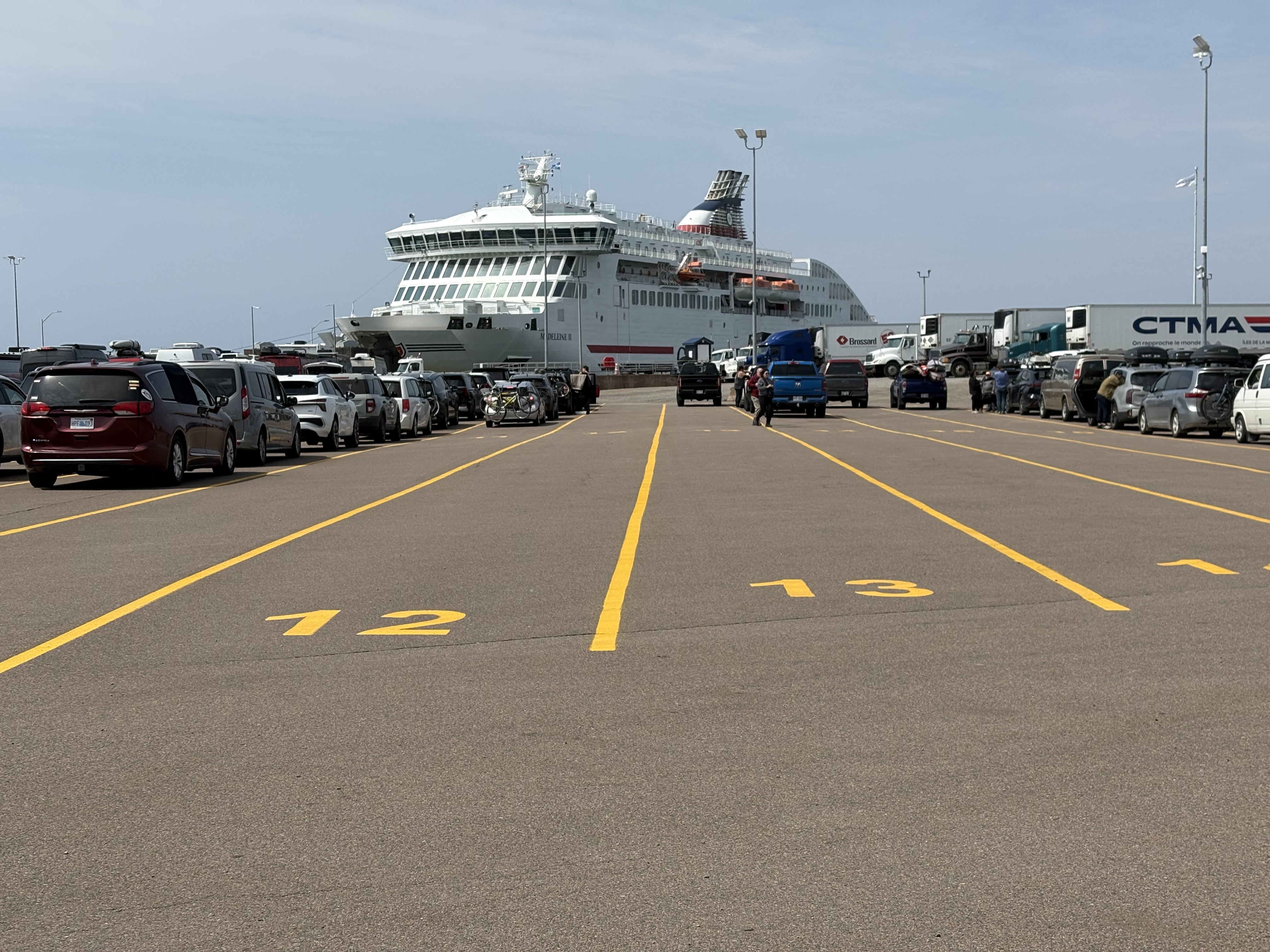
The MV Madeleine II at dock in Souris, PEI, after our morning crossing from Cap-aux-Meules, Magdalen Islands. She’s 124 m. long, 6 decks high, can carry 750 passengers and 200 vehicles per trip, which in a year totals some 100,00 people and 41,000 vehicles.
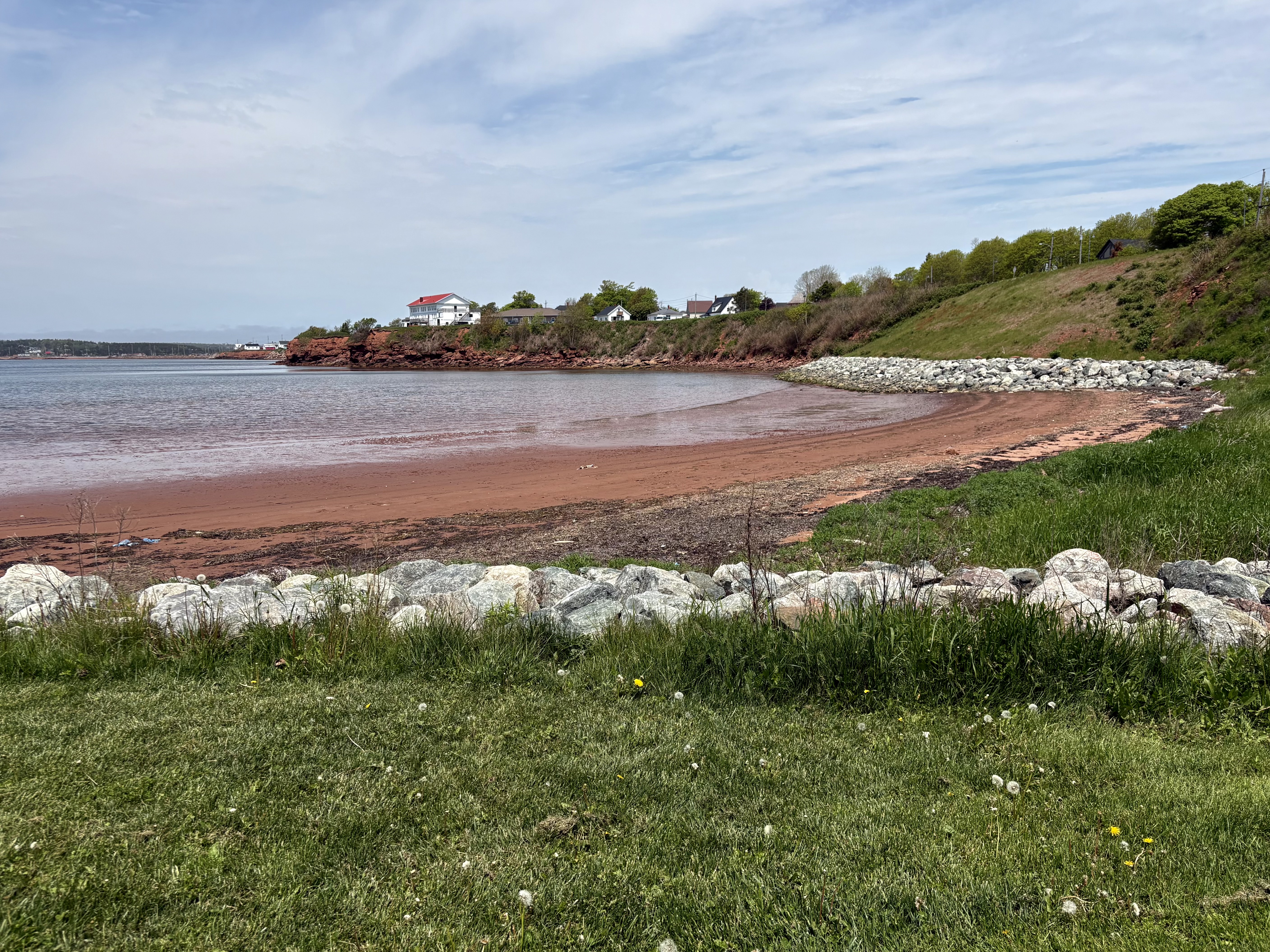
I have time to learn this, also time to admire the red beaches besides the terminal…
because I have a four-hour wait before my local-route bus ride on up to the capital of PEI, Charlottetown.
Bus!
It all goes well. It is the start of my pleasure in the continuing presence of inter-community busses here in the Maritimes, something we used to enjoy elsewhere in Canada but no longer do.
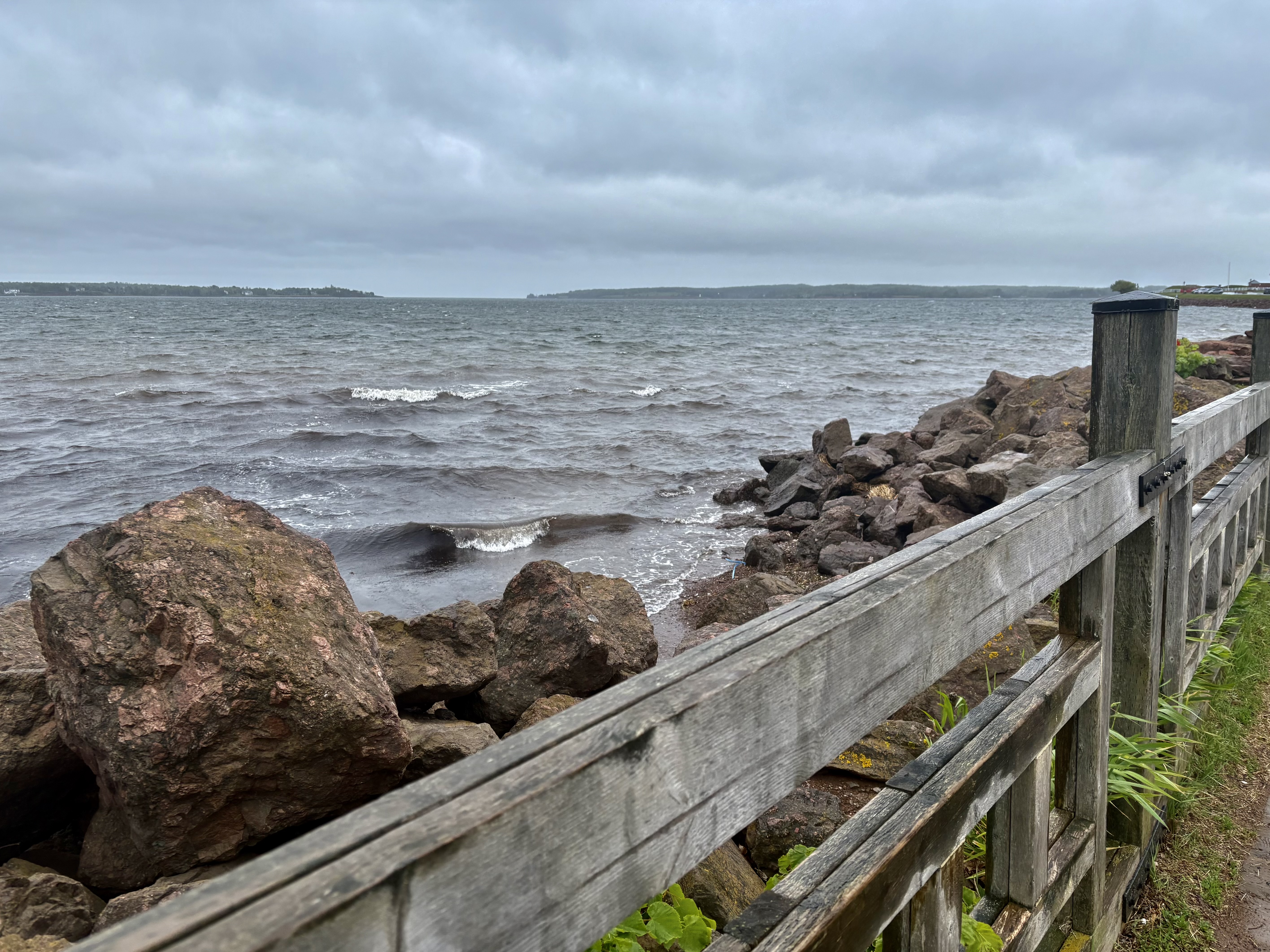
Sunshine throughout the stay on the Magdalens, and now — gusty, drizzly rain.
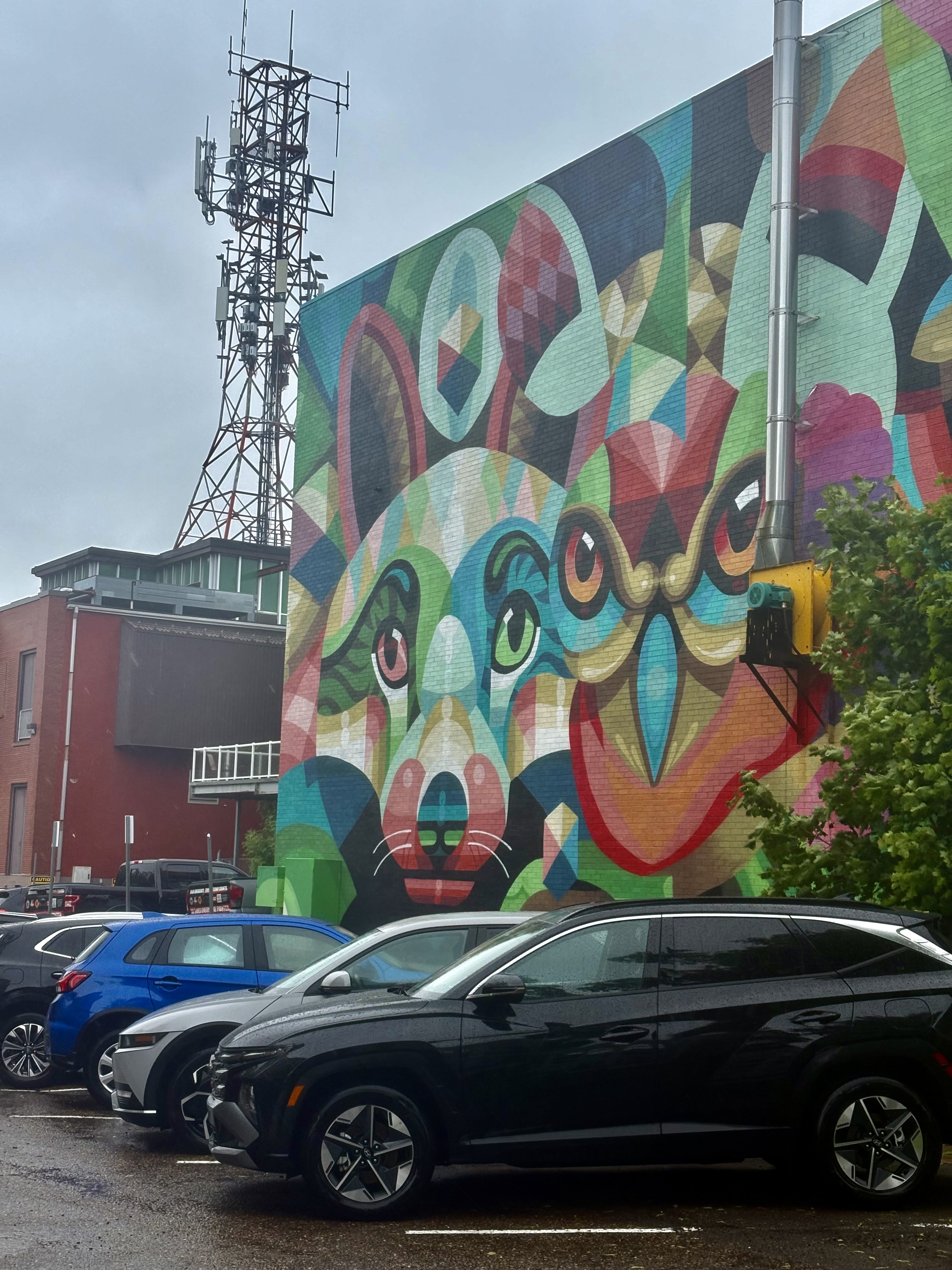
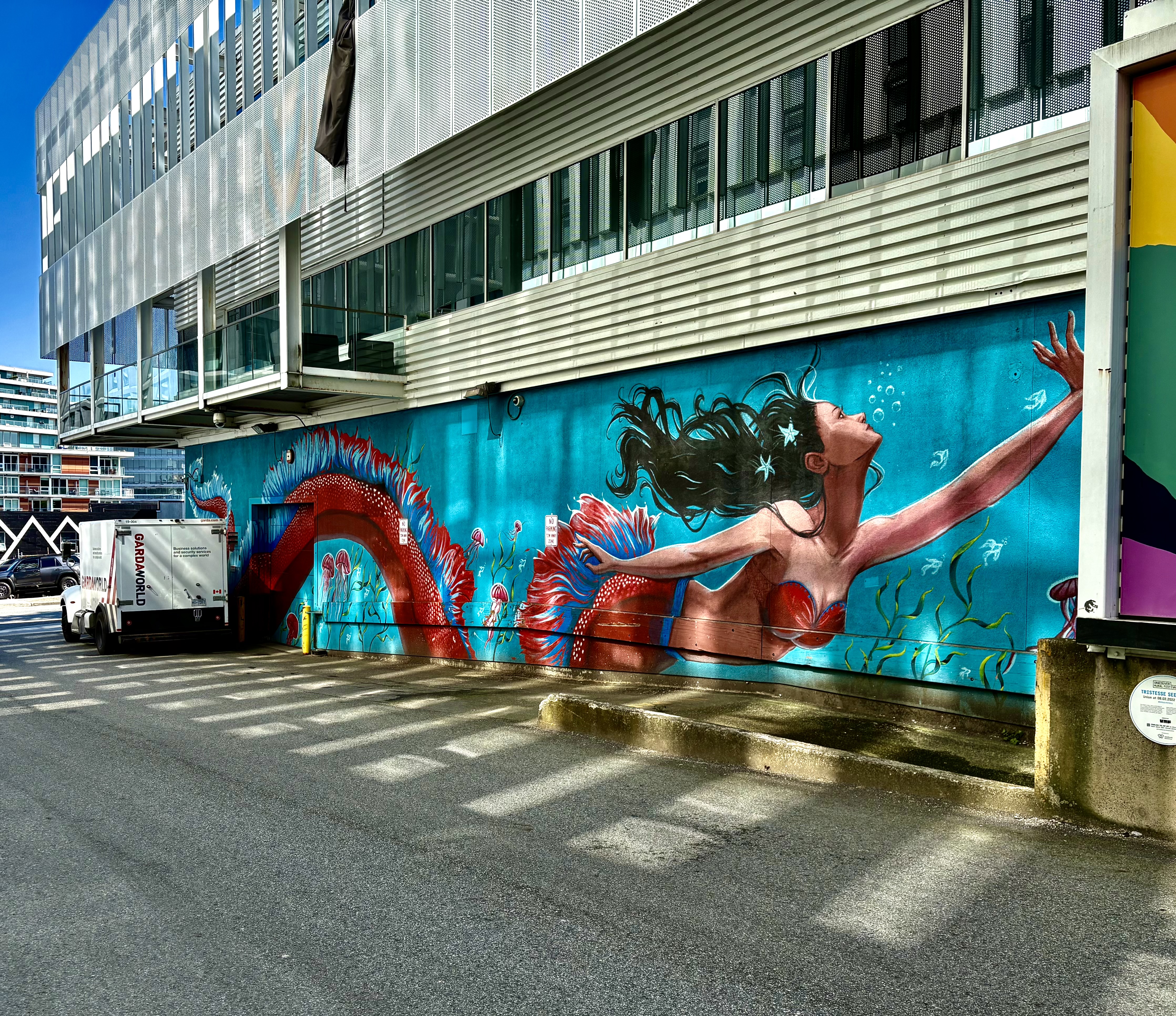
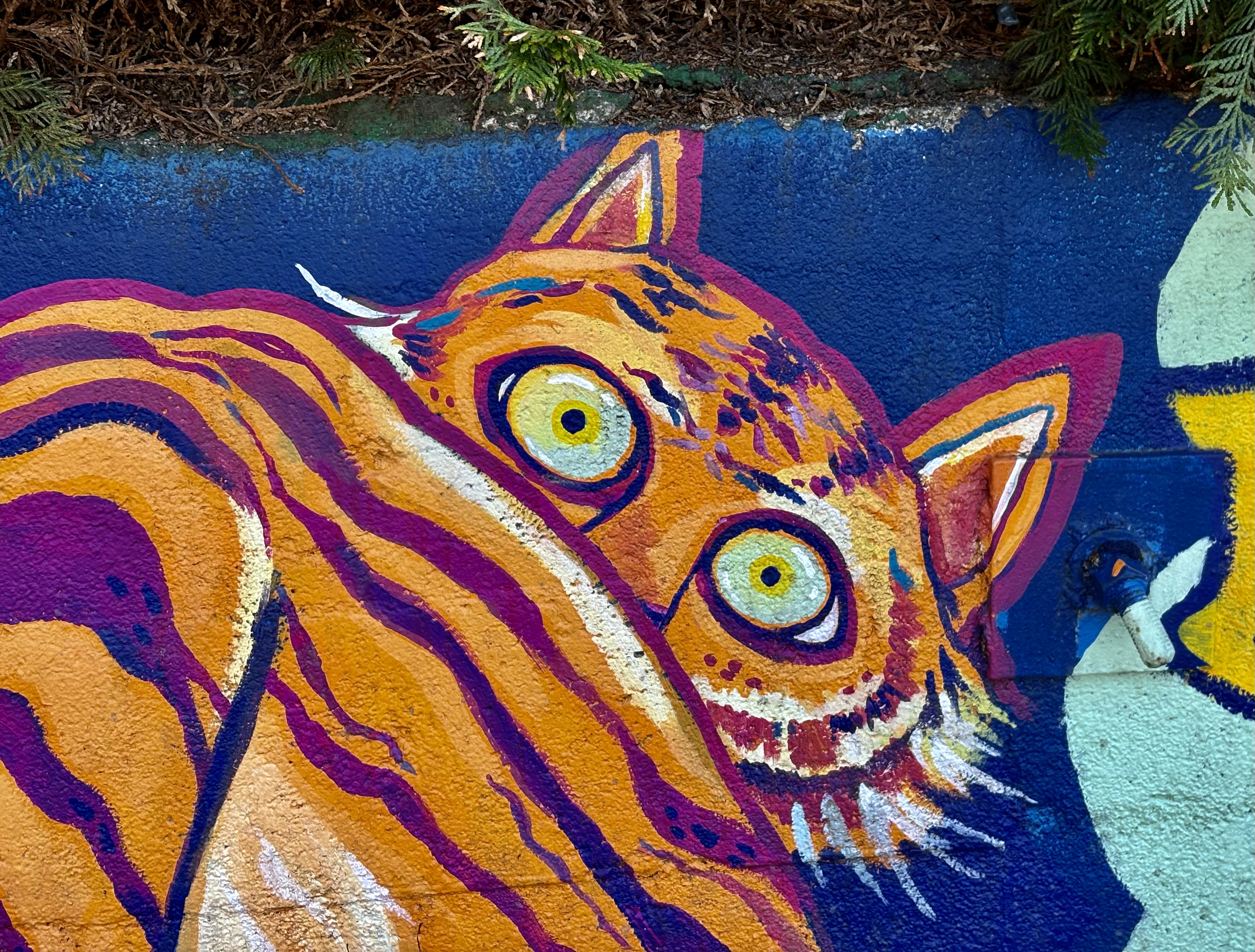
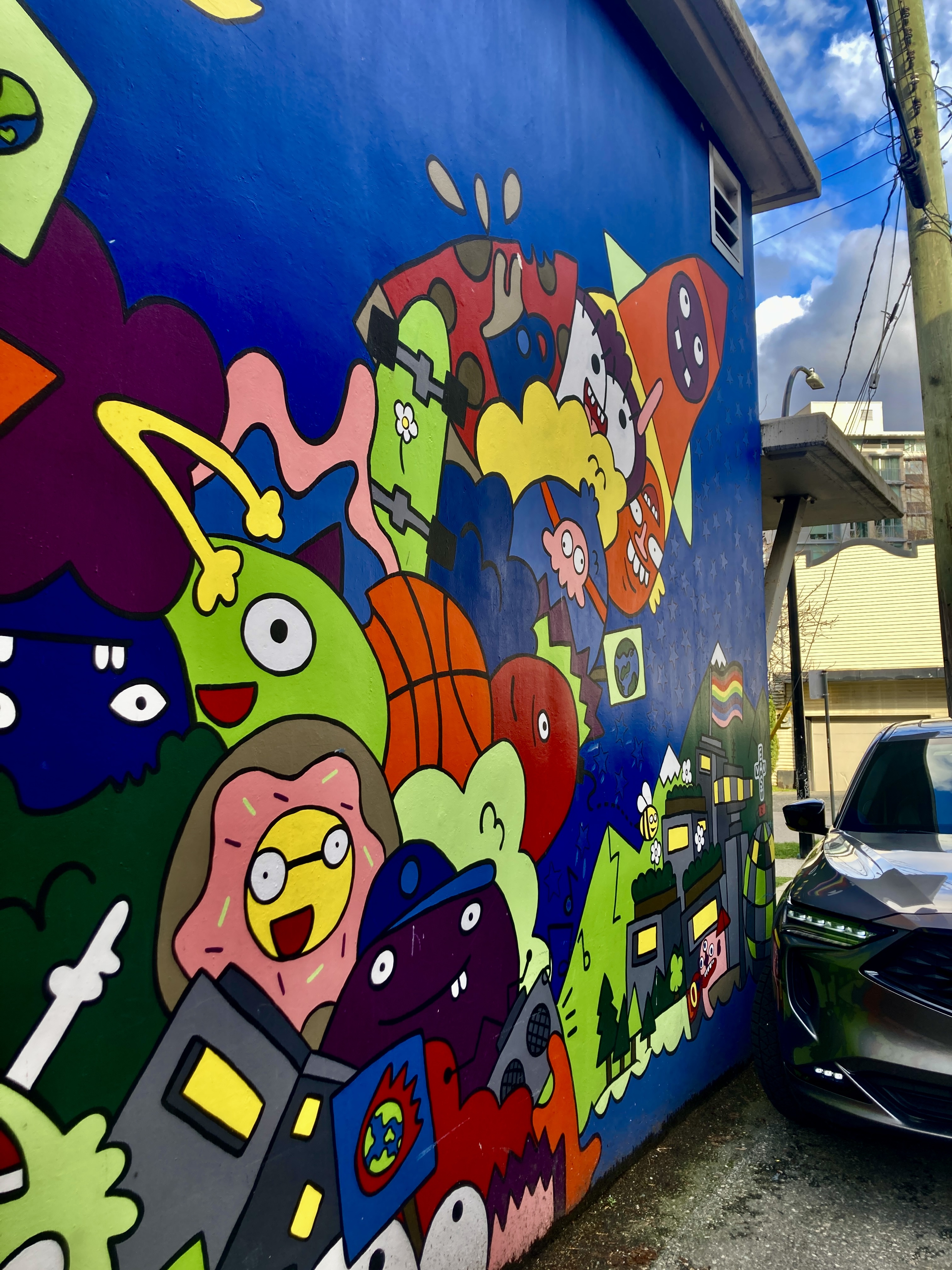
I brave it for a morning walk to Victoria Park, then — hat and hood pulled tight around my head — turn back into town. My reward is this dramatic mural en route.
At 1 pm my next bus takes off, one that (via a connection) takes me off-island to Dartmouth, Nova Scotia, with a little slice of New Brunswick thrown into the mix.
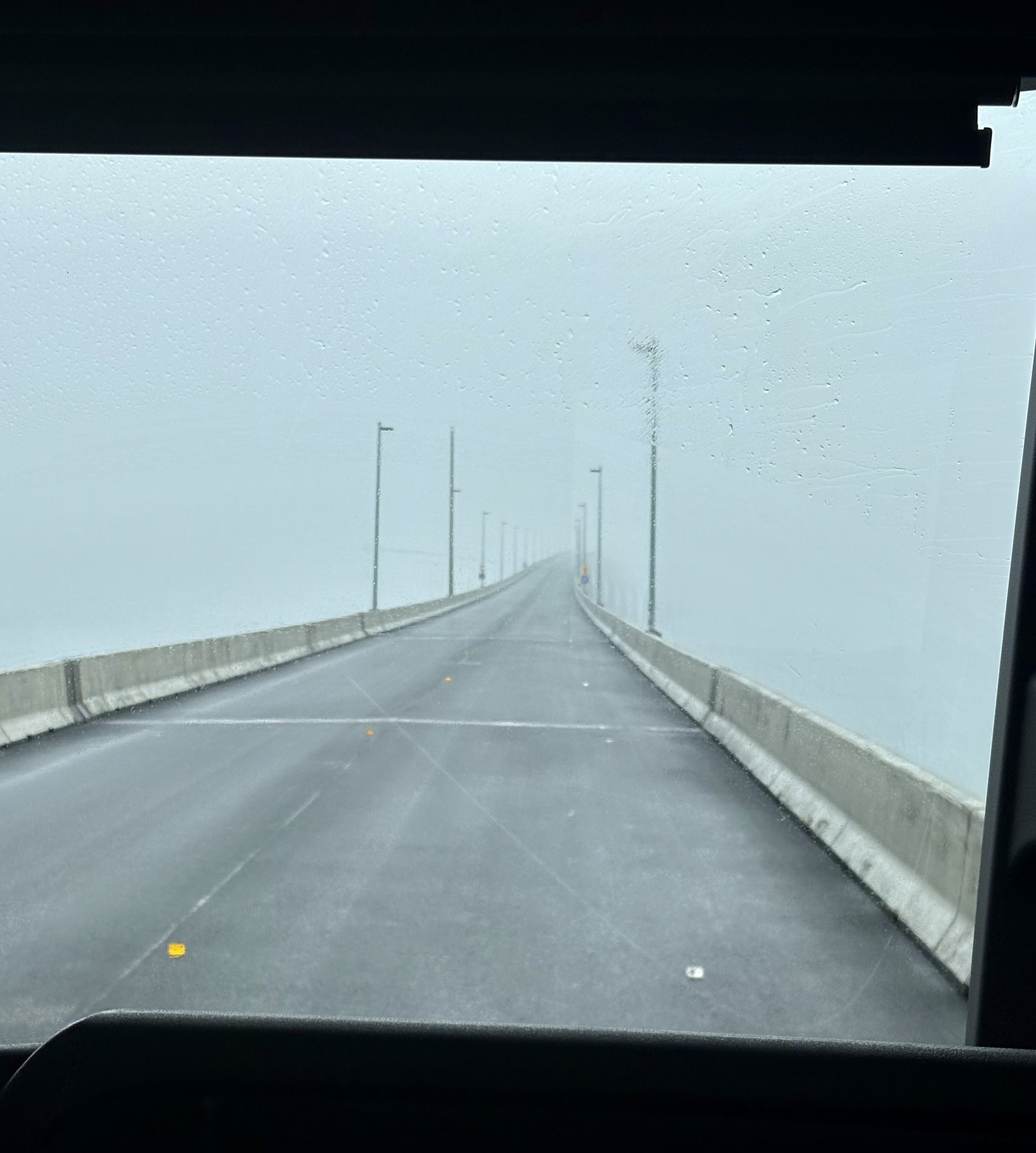
Until 1997, the only way off-island was to fly or take a ferry. That year, a new option opened up. Thanks to the new Confederation Bridge, vehicles could now drive a 12.9 km. link across the Abegweit Passage of Northumberland Strait between the island and New Brunswick.
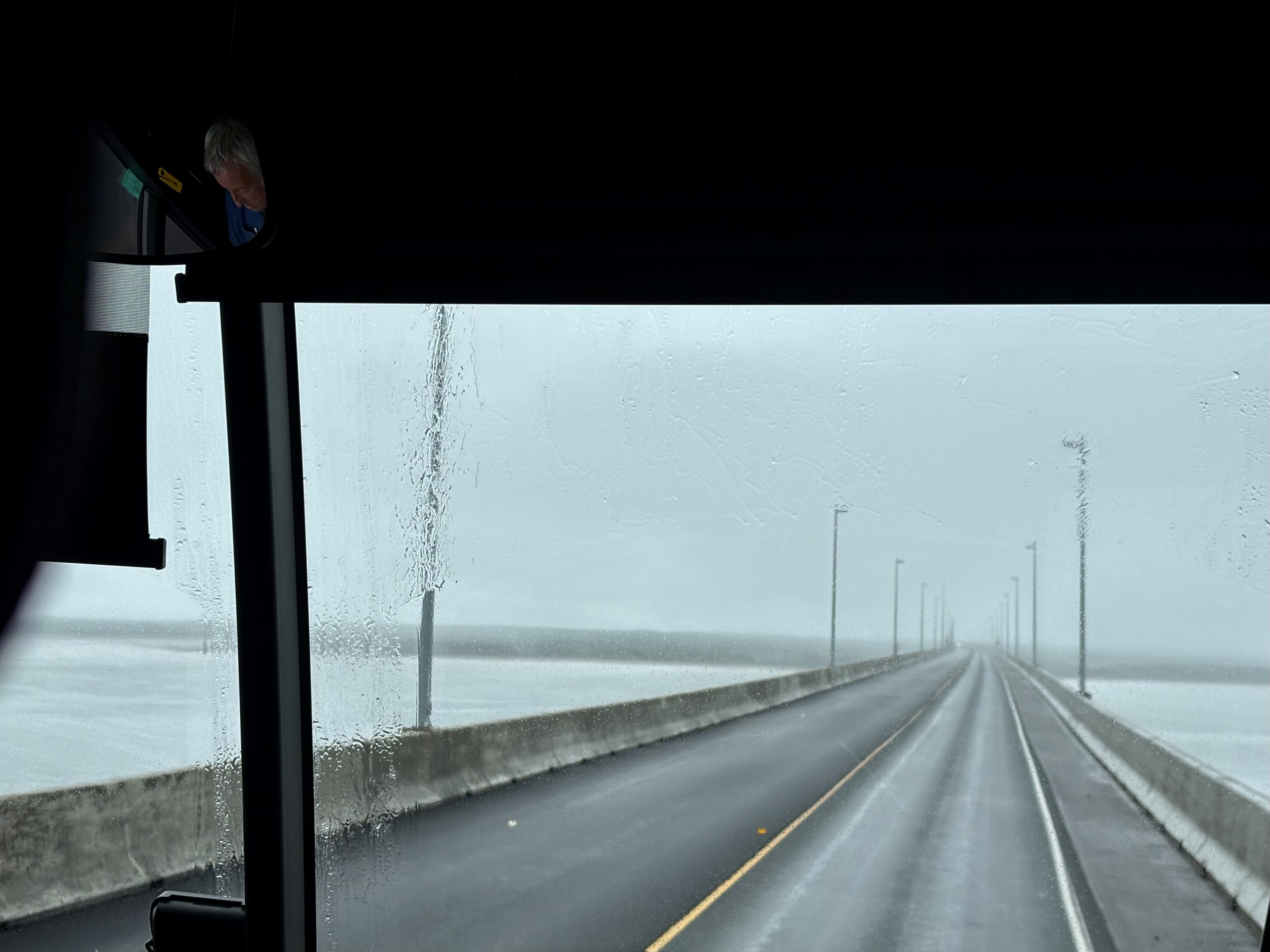
We’re on the bridge. It is very foggy.
But eventually there it is: the New Brunswick shore.
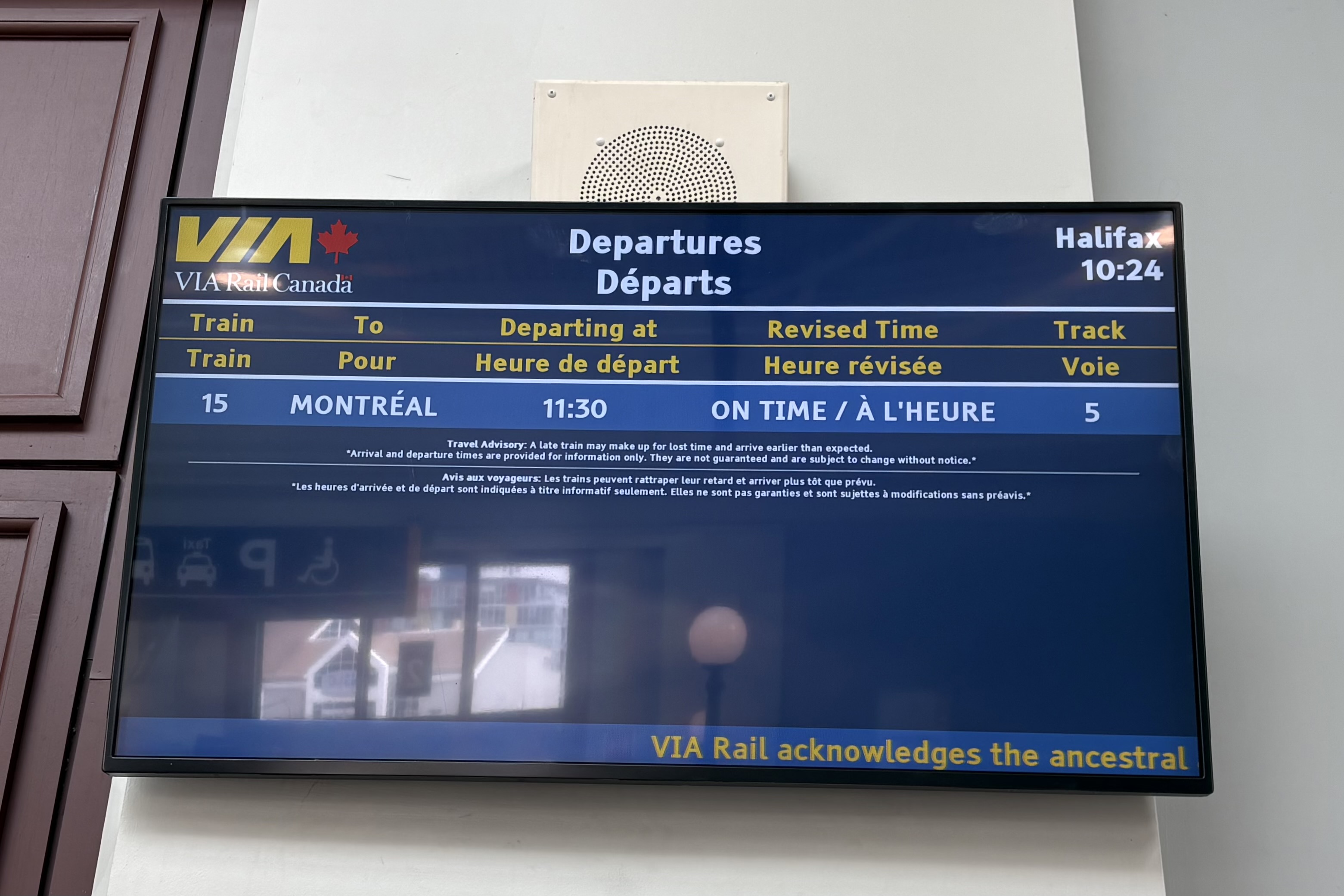
We’re soon in Nova Scotia and, late afternoon, I drop off in Dartmouth, just short of the final stop, neighbouring Halifax. Next morning, I’m in Halifax, at the waterfront train station
Rail!
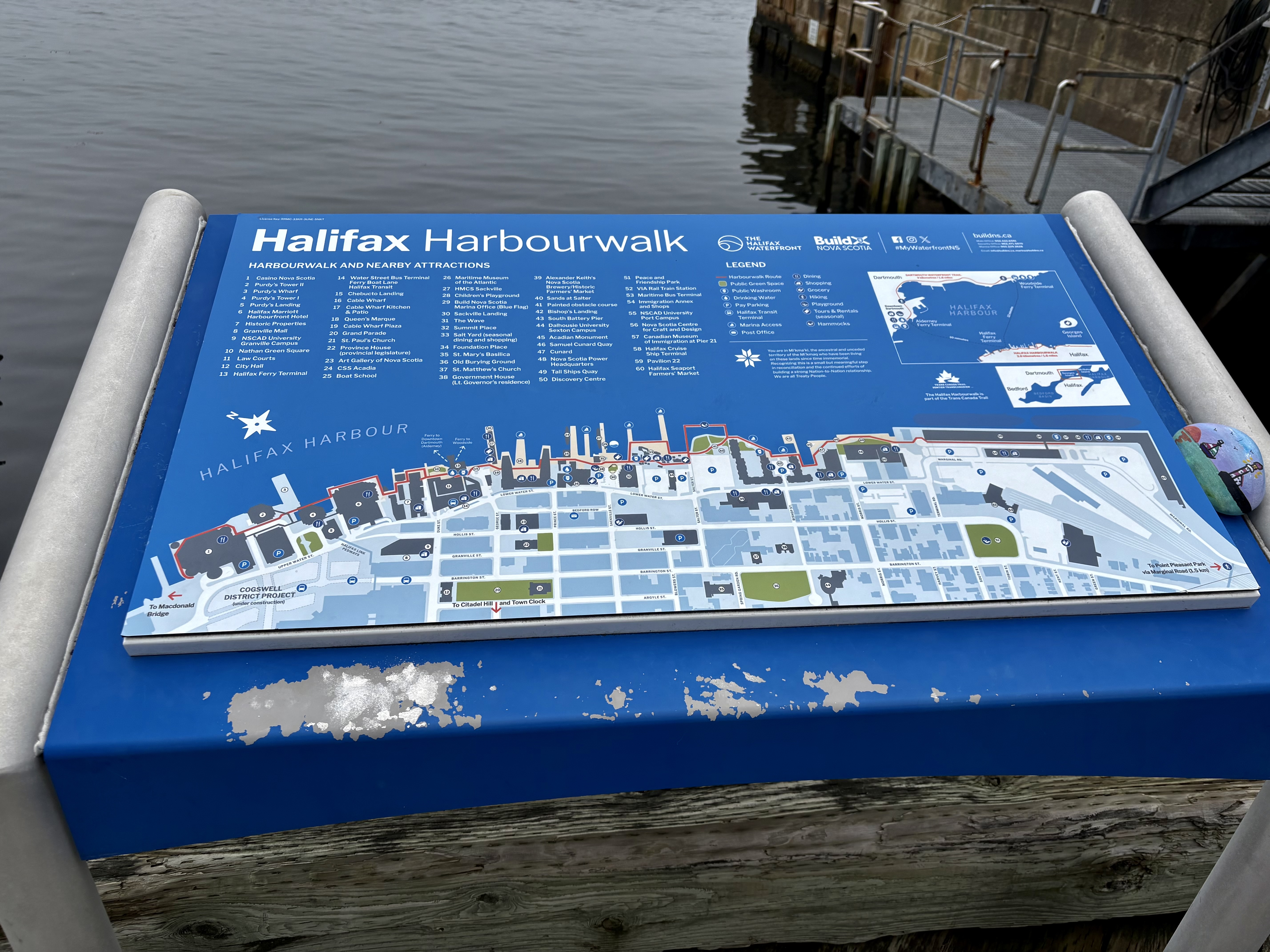
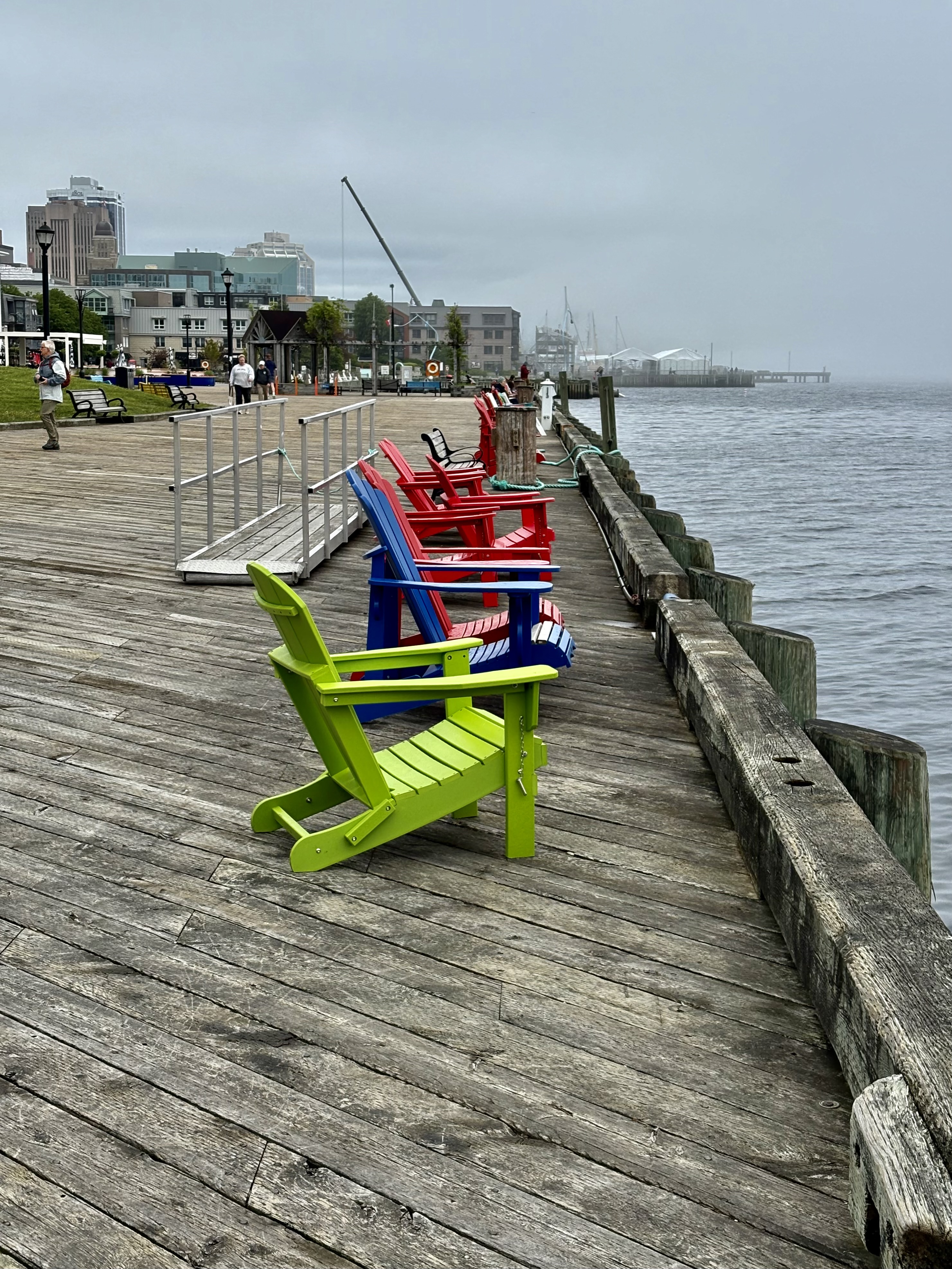
Not quite yet, I’ve 20 minutes to kill, so I walk a bit of the Halifax Harbour front.
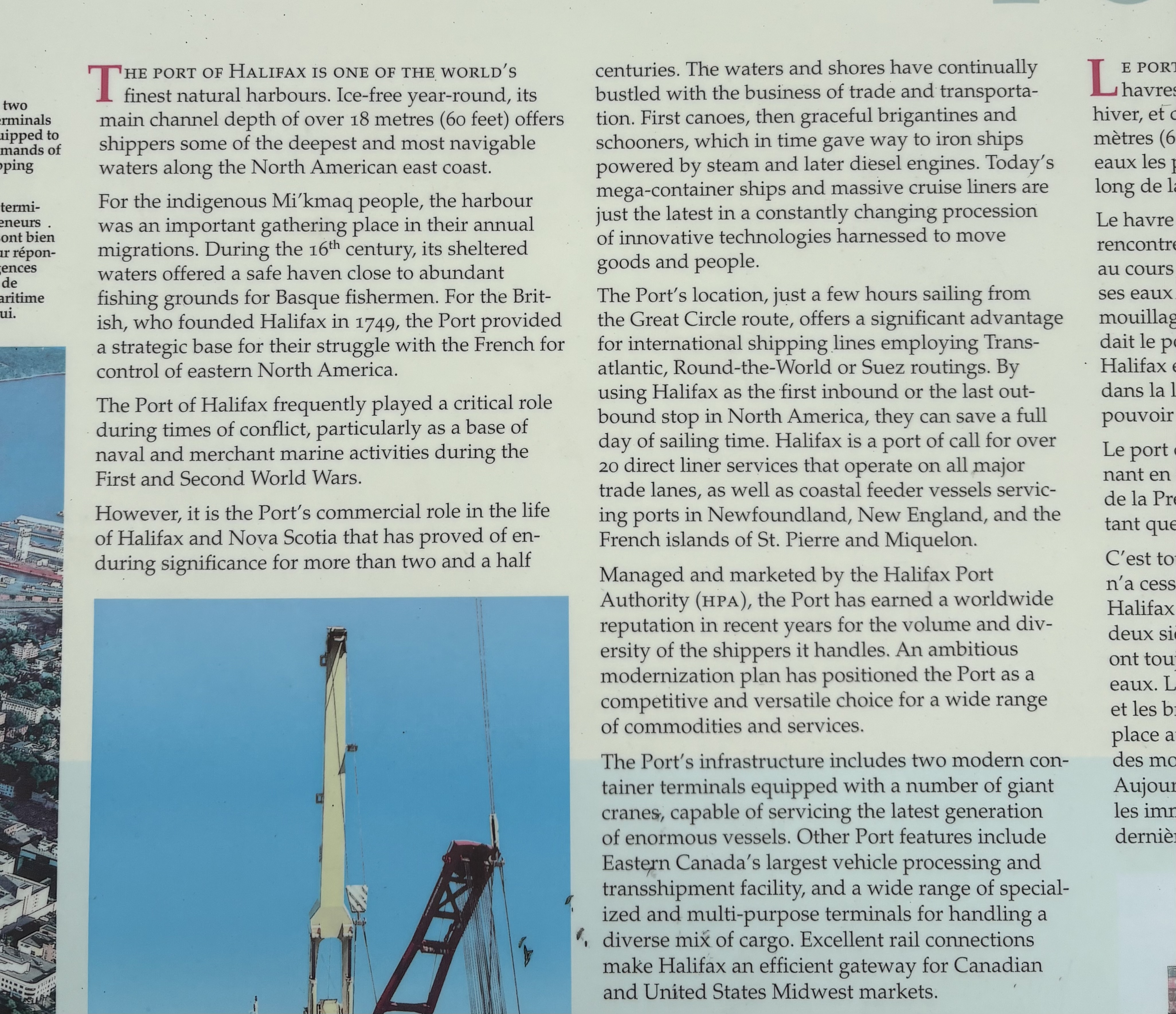
It’s an important harbour, and I’ll let the signage concisely tell you why.
(Apologies if all this data causes you to resonate with the very cross little boy slapping down a very large book on the library Returns desk and complaining: “This book tells me a great deal more about penguins than I want to know!” On the other hand, I am not looking over your shoulder, so let your eyes skitter on down the page, if you wish.)
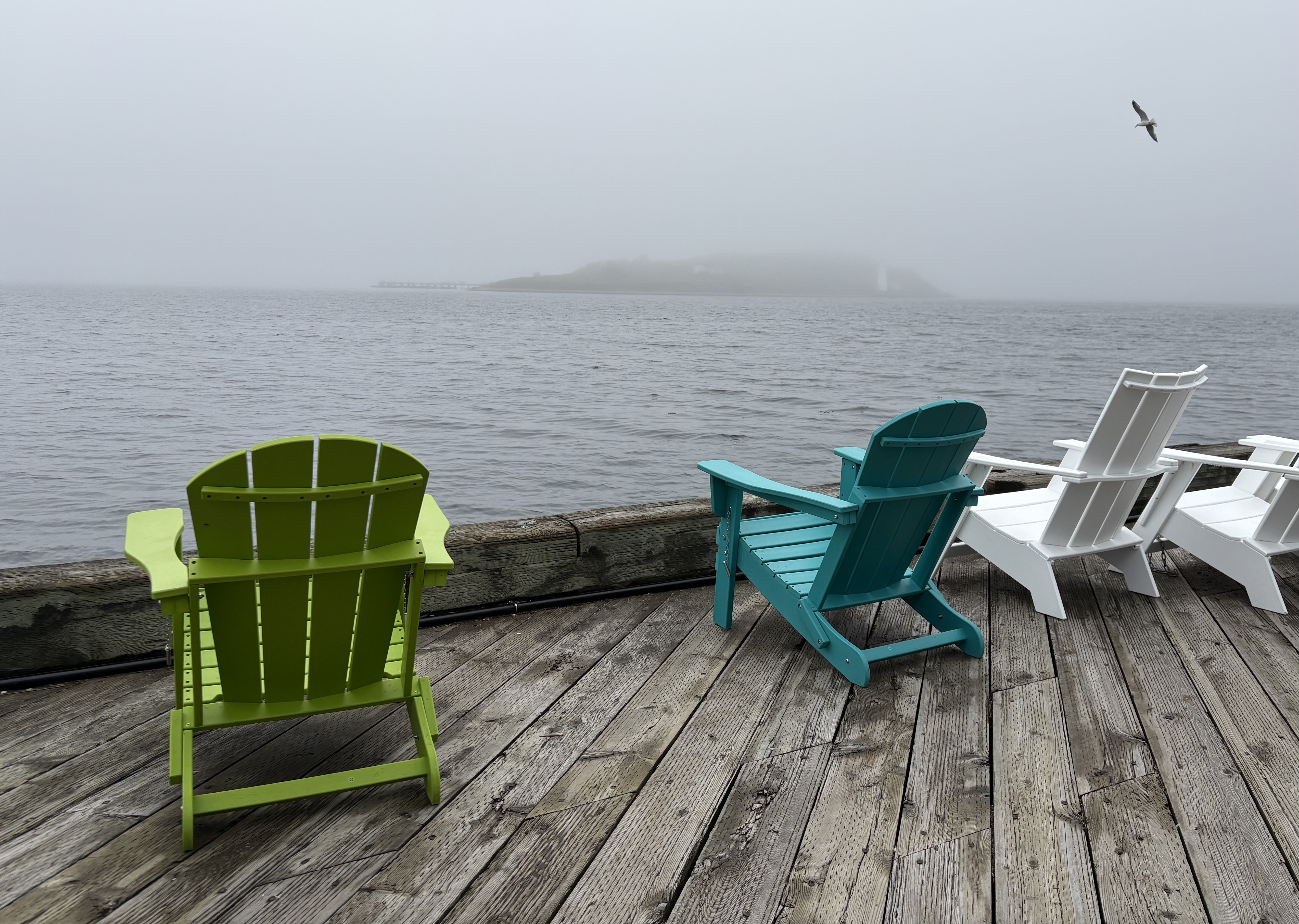
Still foggy, which somehow seems exactly the sort of weather we should be having…
… though perhaps lifting slightly. I can now, faintly, make out the lighthouse on the little island directly ahead of us.
Time to catch my train. It runs a route now named The Atlantic, but which began in 1904 as the Ocean line. That date, I later learn, makes this the longest continuous-service passenger service in North America.
I’ll be going almost all the way…
getting off in Ste-Foy for the short connecting ride to Quebec City.
Did you notice that use of the present progressive tense? (“I’ll be going…”) Yes, my friends, as promised above, I am still on board, swaying gently with the train’s motion as I type this post in the WiFi service car.
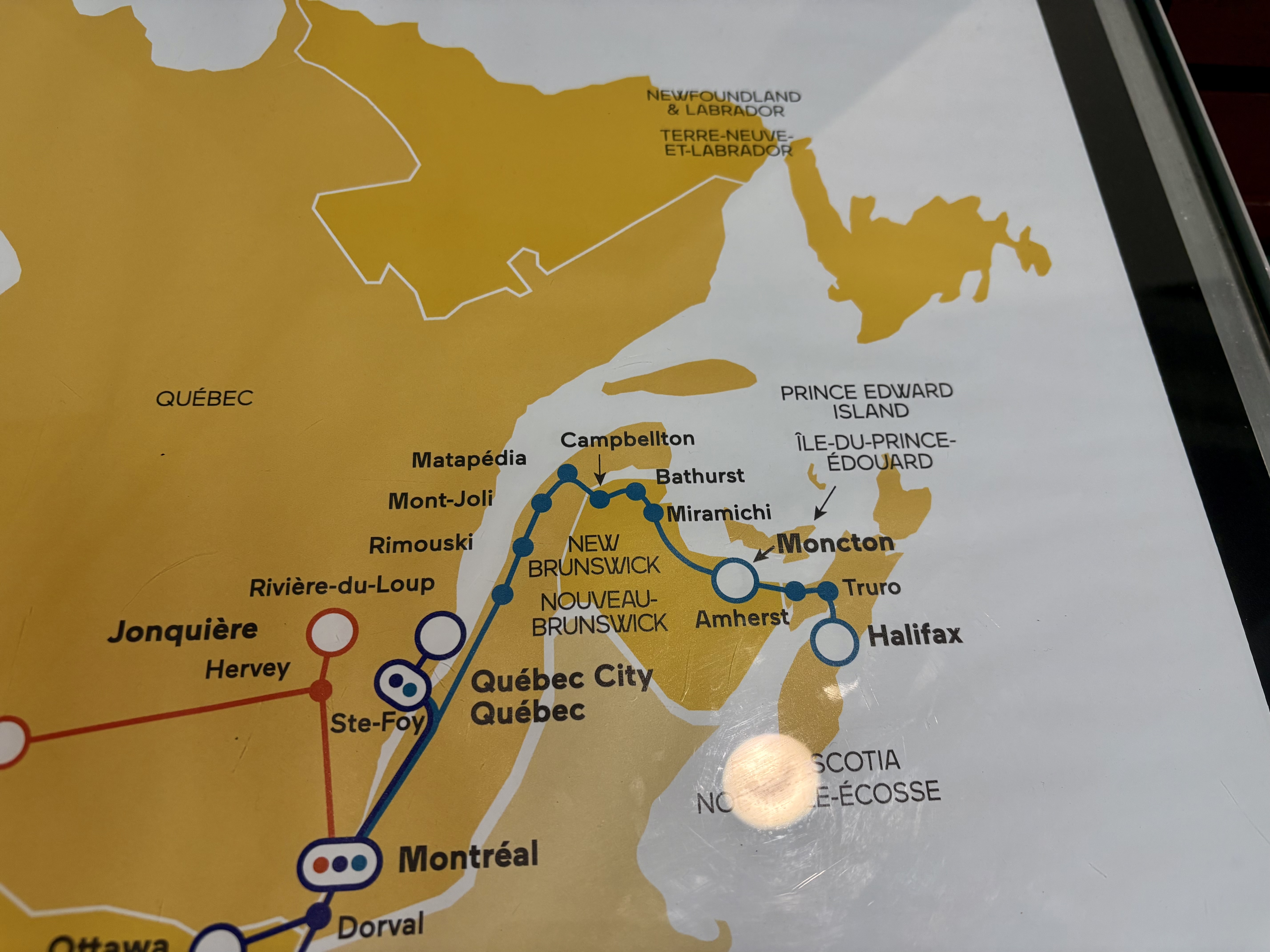
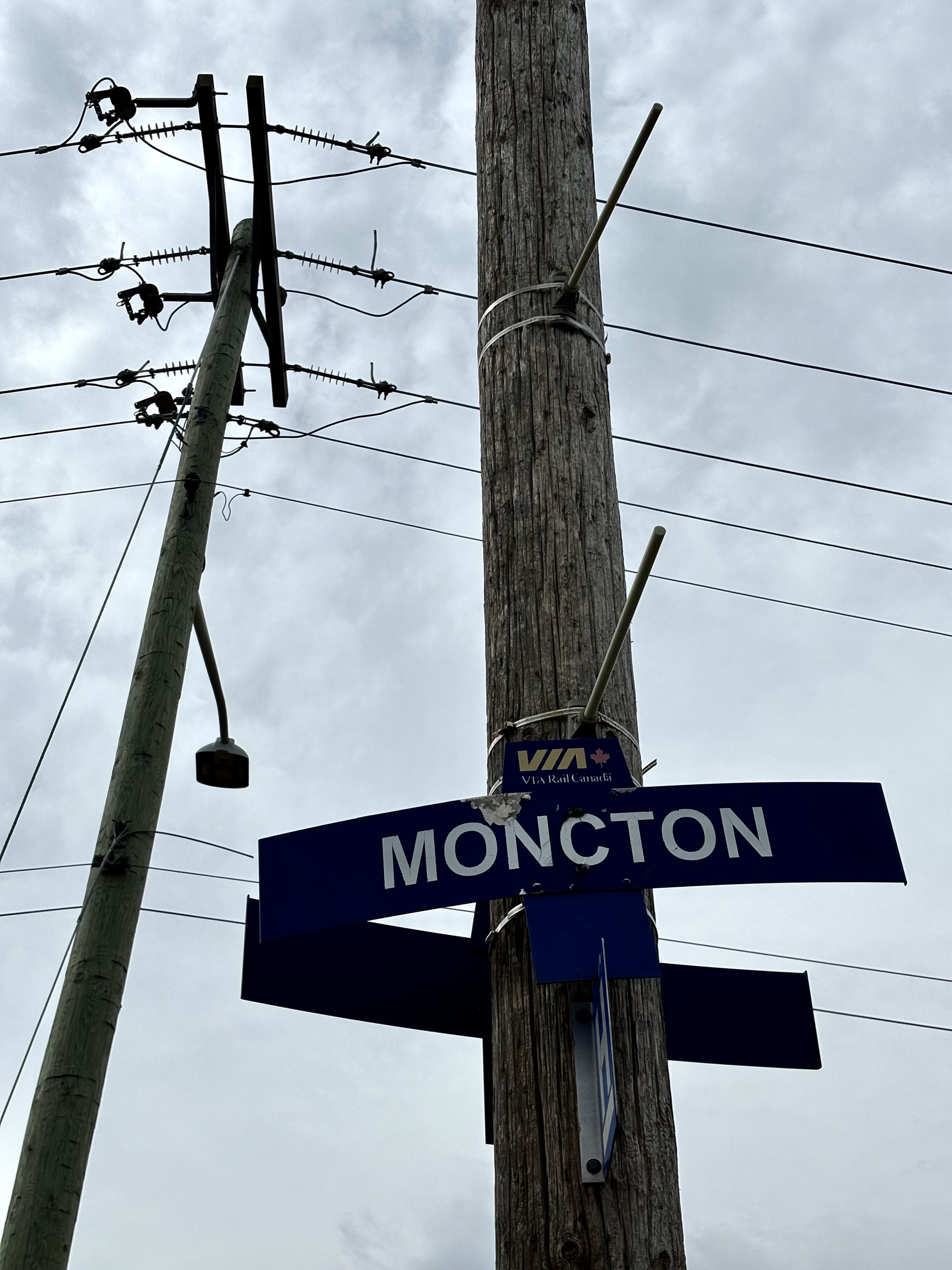
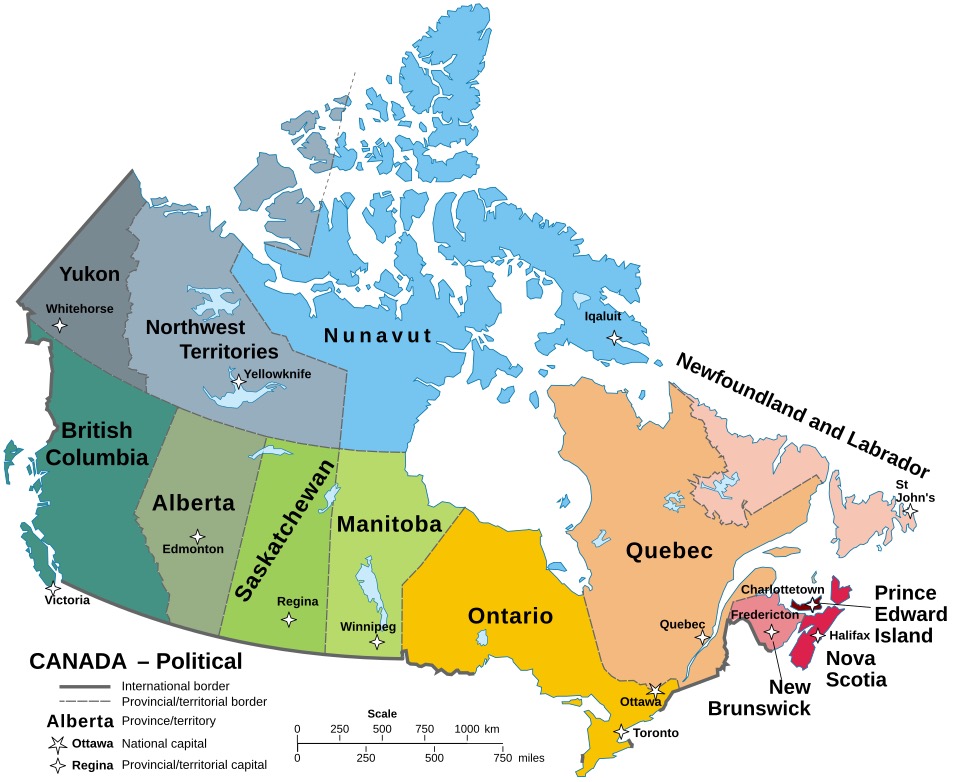
We have just pulled out of Moncton (consult your map, above)…
and I think I’ll say good-bye. I want to spend my time falling into the passing landscape.
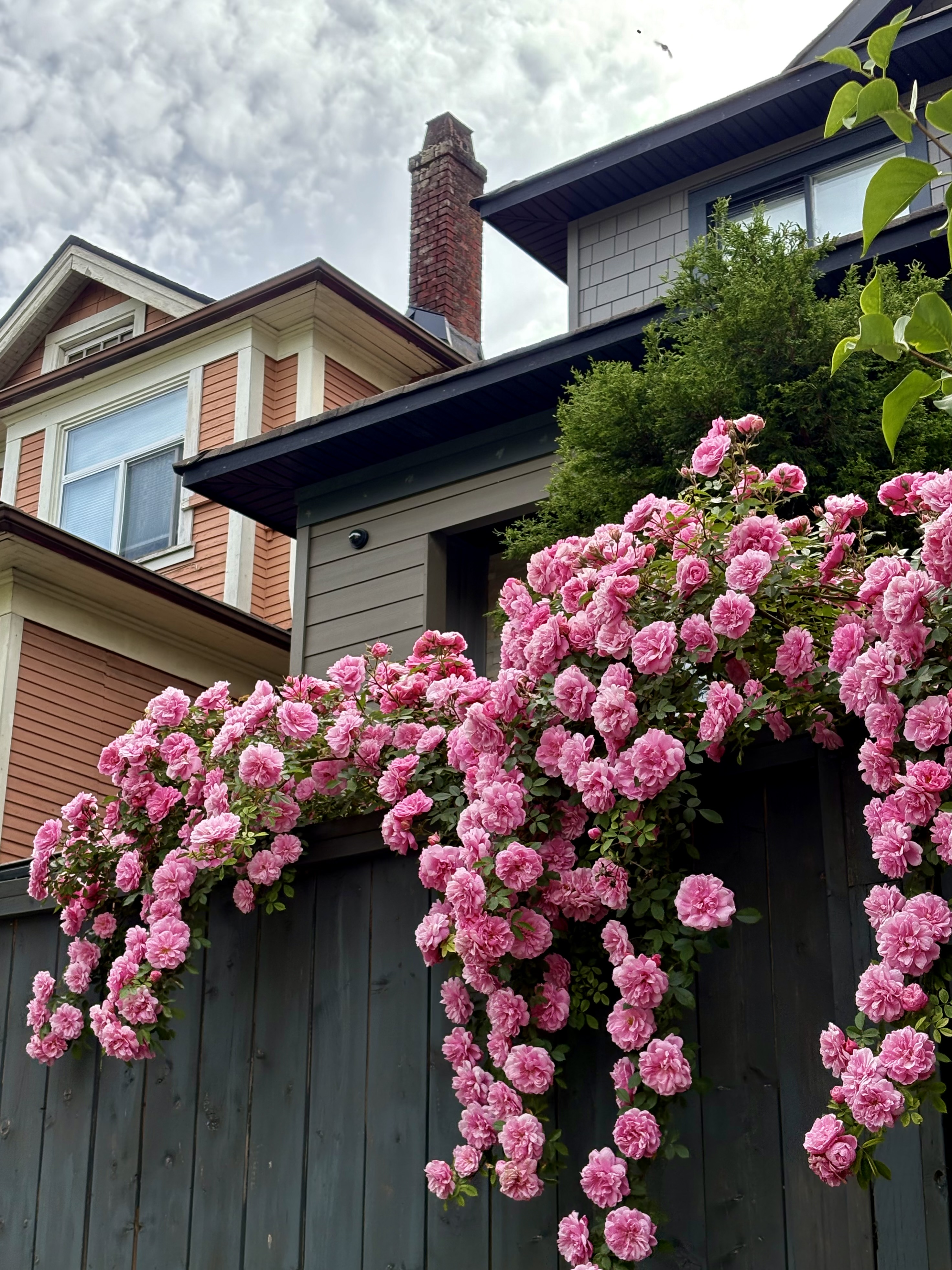
Plan was, a minimalist little post titled Tended & Wild, contrasting much-pampered Tended…
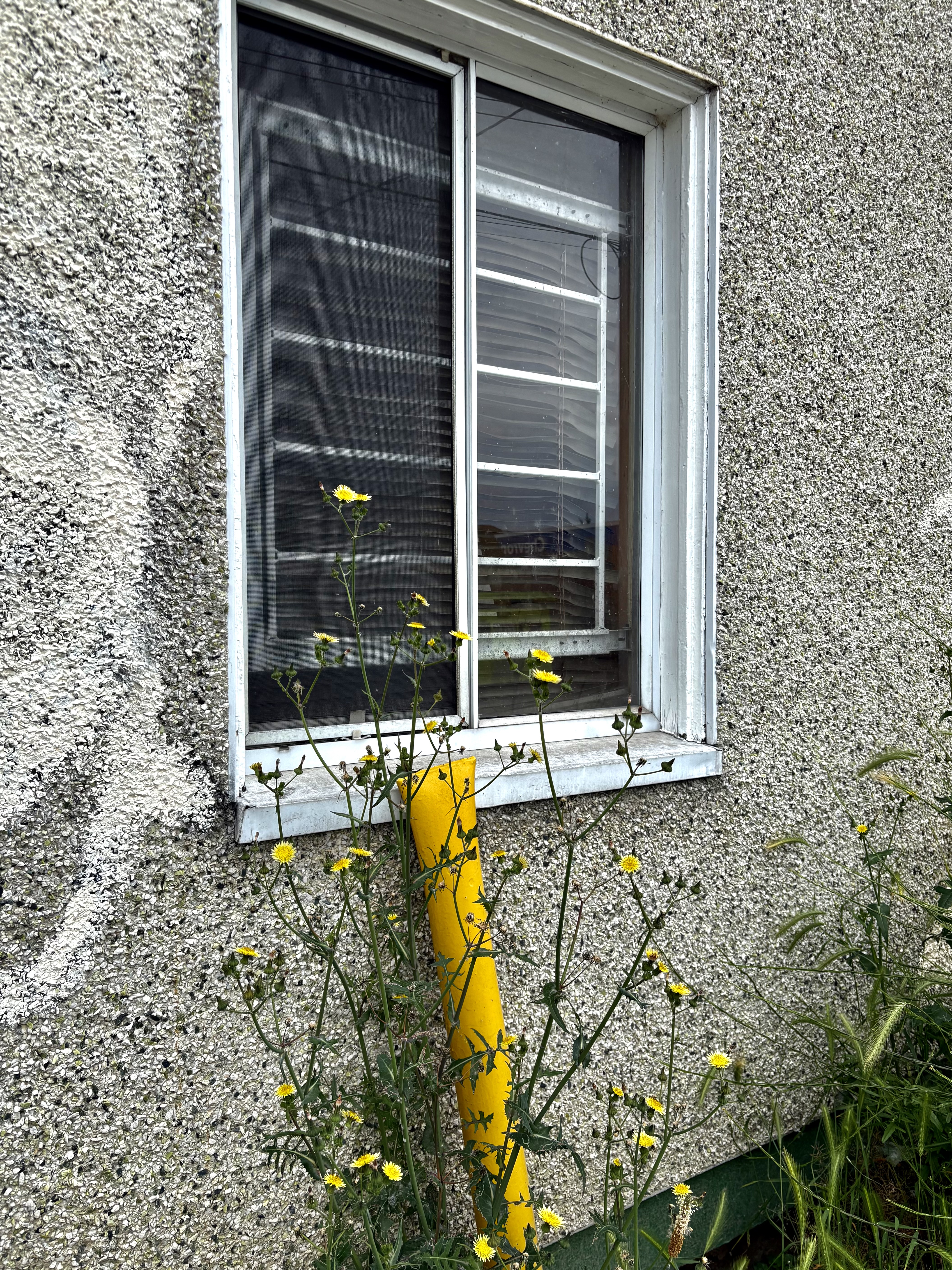
with plucky little Wild…
and noting that, much as I appreciate well-tended gardens, my heart is with the spindly alley plant smack up against a grubby window with wonky blinds.
That was the plan.
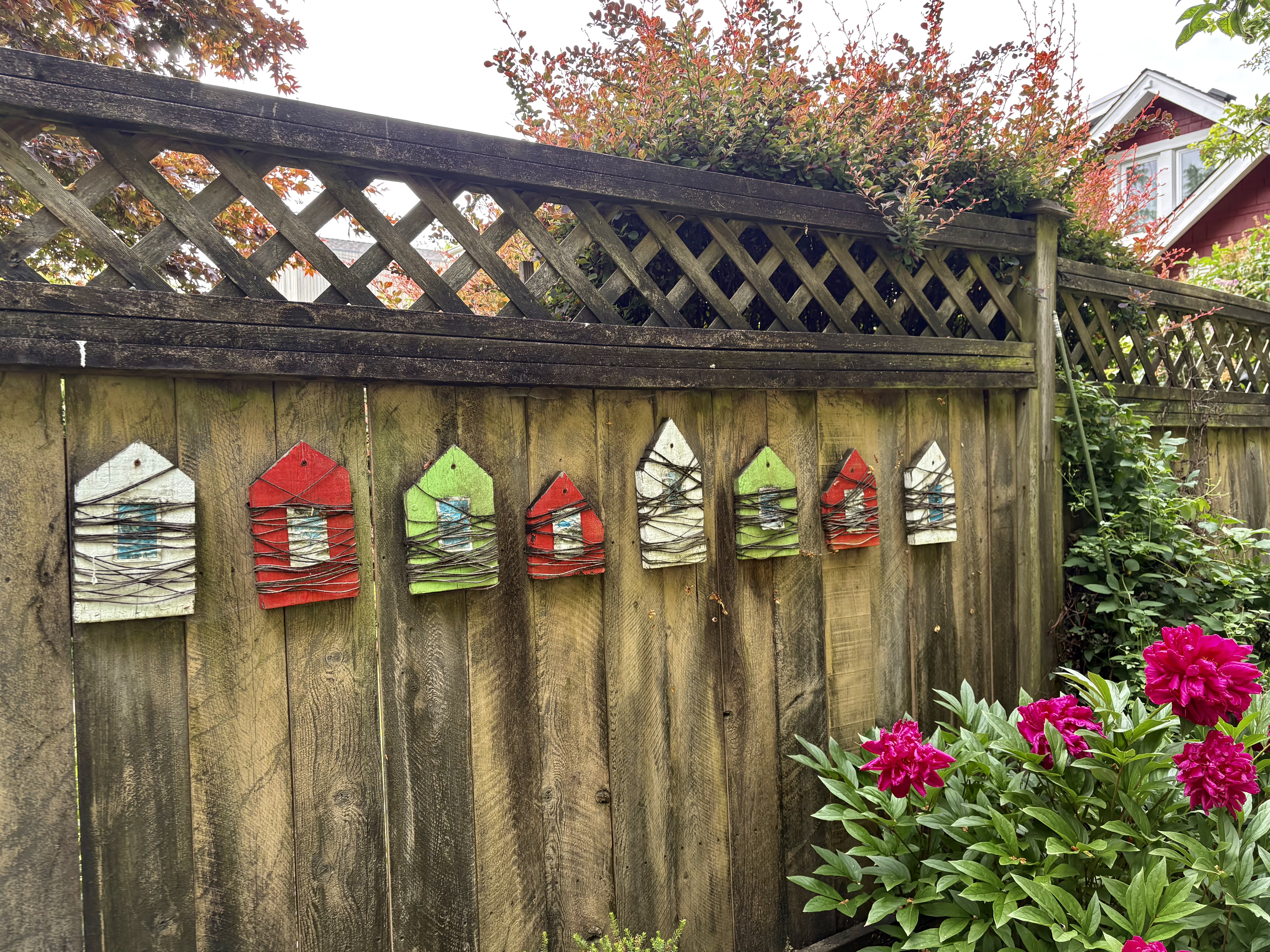
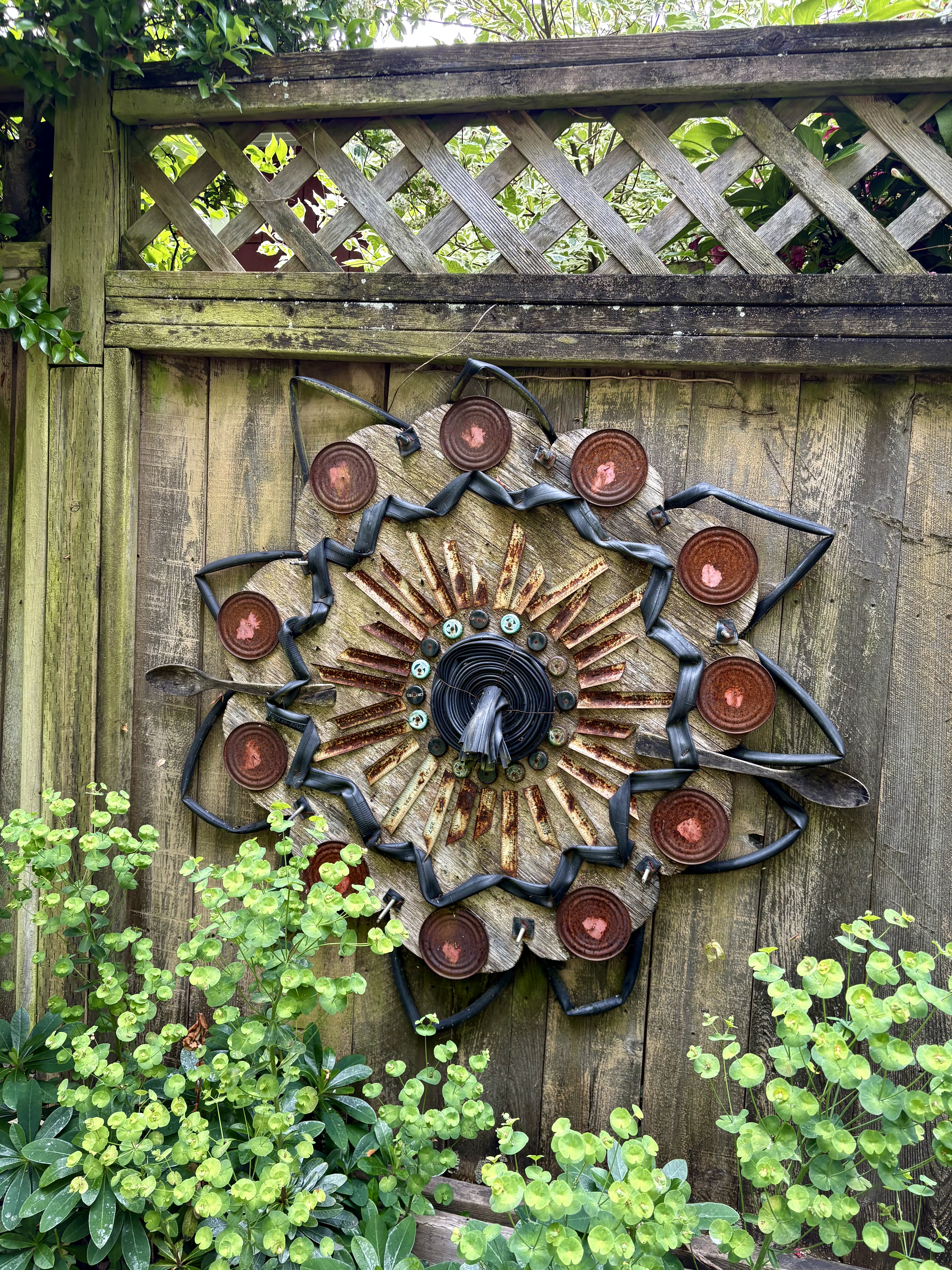
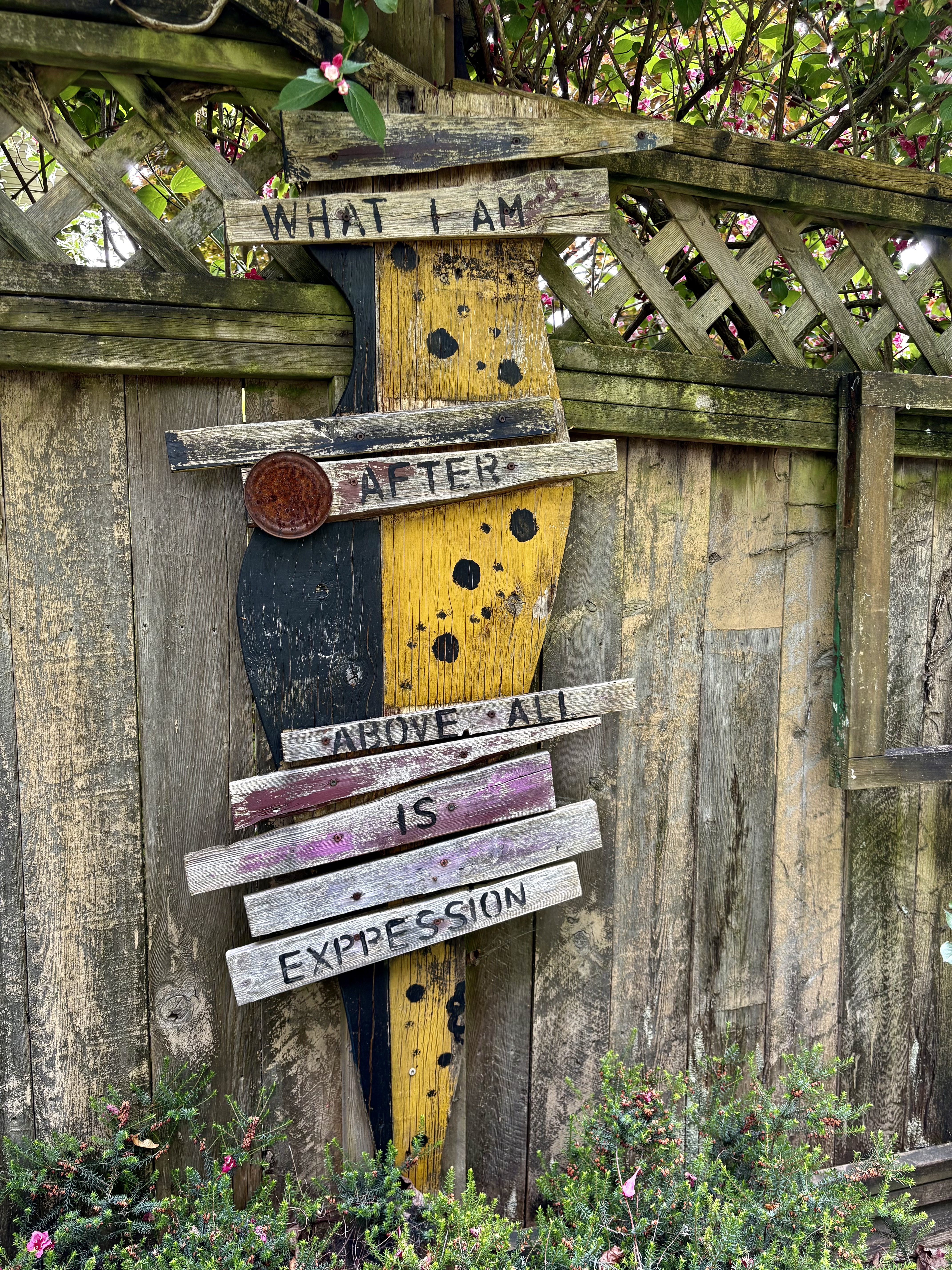
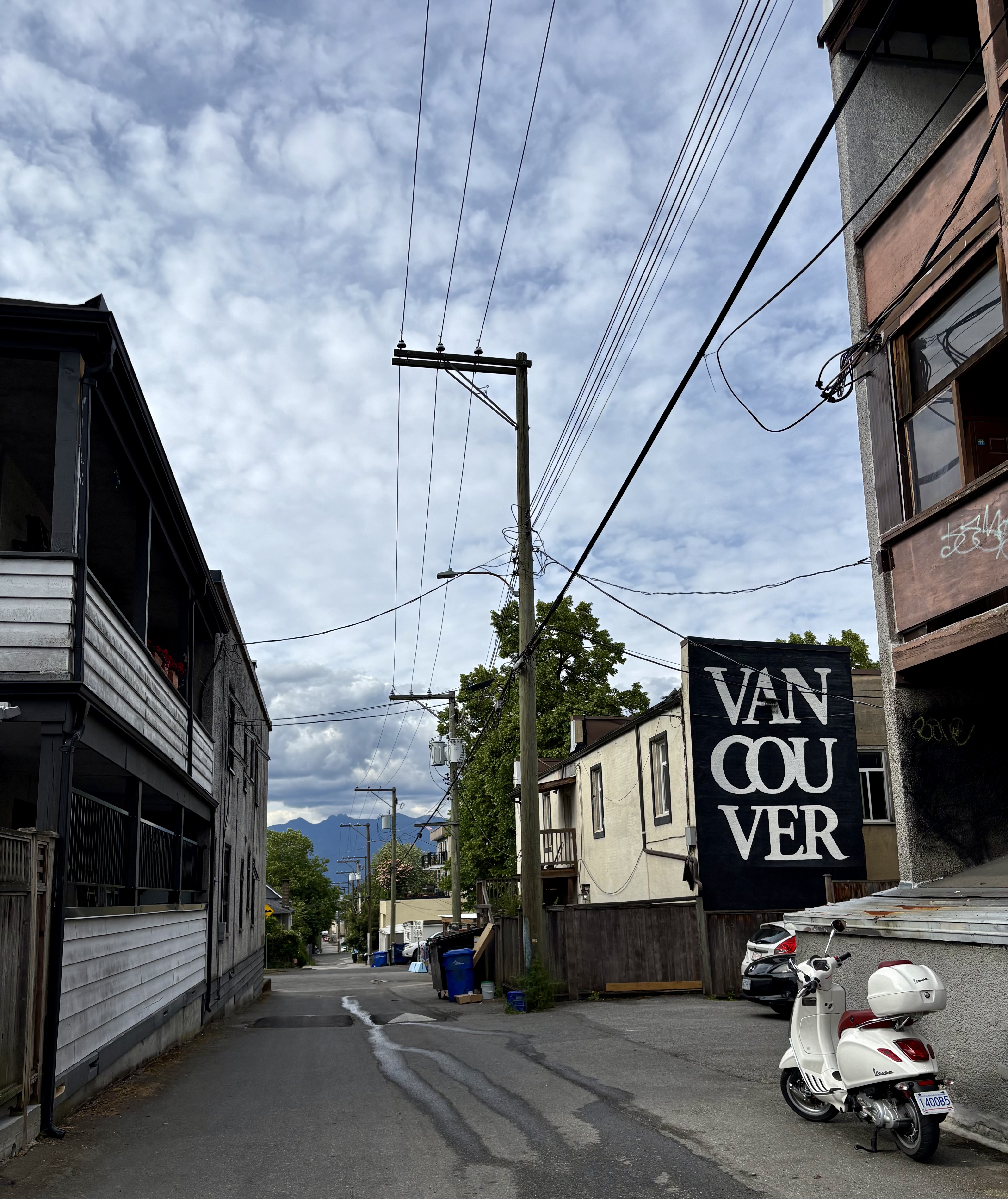
But then I zagged right, landed myself on Quebec Street, kept walking south, crossed East 19th, and came up against The Fence.
The Fence! The Fence of happy memories! The Fence I can never find on purpose! The Fence with its — admittedly now deteriorating — wildly exuberant artwork. Like this:
And this:
A block-long demonstration of this identity:
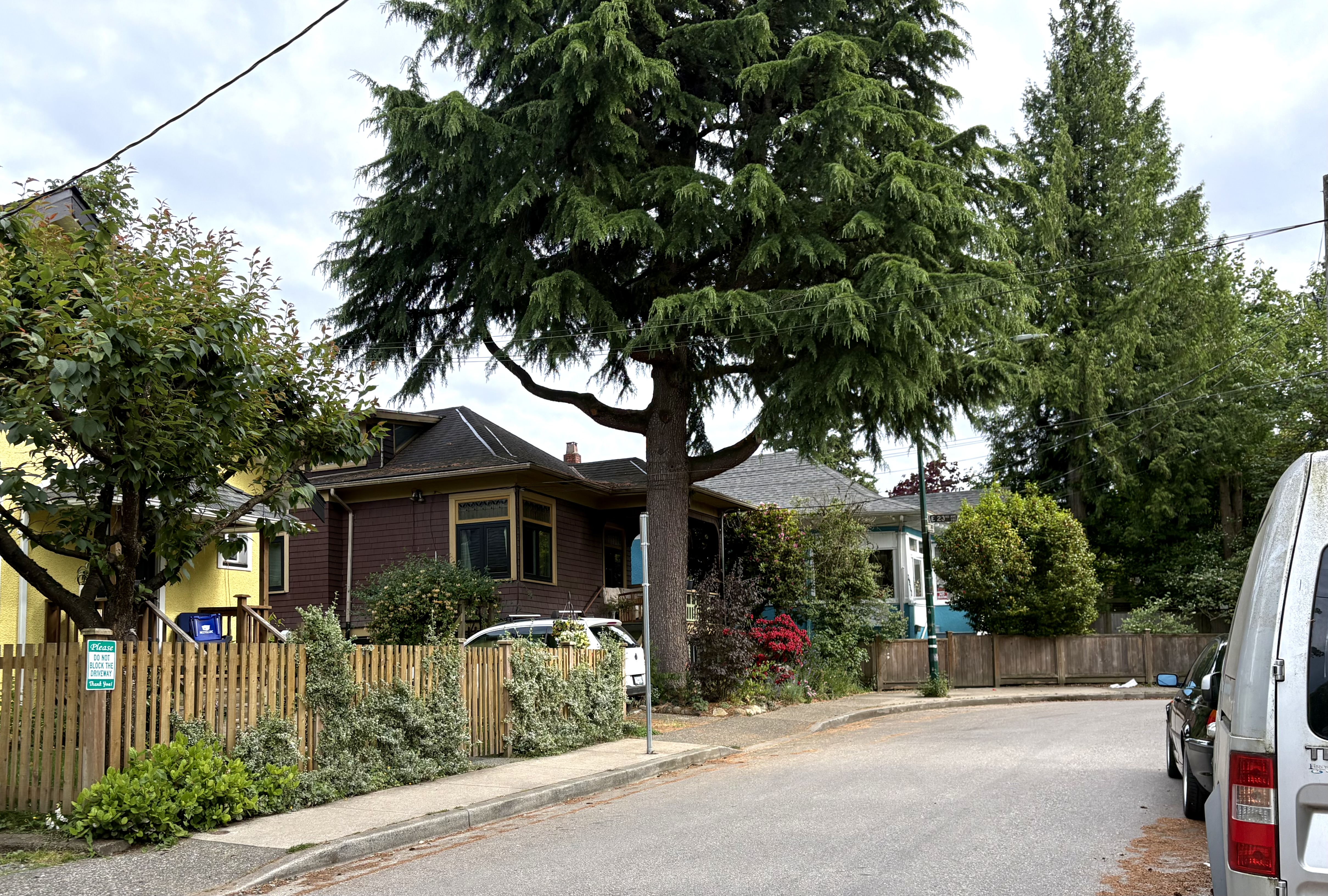
I toss Tended/Wild aside, and plan a little tribute to Quebec Street.
I keep walking Quebec (BC), right until it swerves west…
and morphs into East 24th Avenue.
When I turn back north, I decide to follow, not Quebec, but, let’s call it, Back of Quebec — the alley beyond Quebec Street.
And then I laugh. All this is the perfect tease for posts to come, next week and all month long.
Because.
Because tomorrow I will exchange Quebec (BC) for Quebec (QC)…
in a two-flight bounce from Pacific-coast Vancouver to mid-St. Lawrence Quebec City.
The next day, one more bounce will take me to the real Back of Quebec…
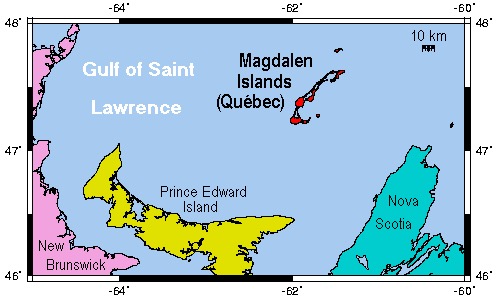
this red-tinted archipelago beyond mainland Quebec, poised in triangulation with PEI and Nova Scotia in the Atlantic Ocean — islands that, despite their location, are part of Quebec.
The Magdalen Islands.
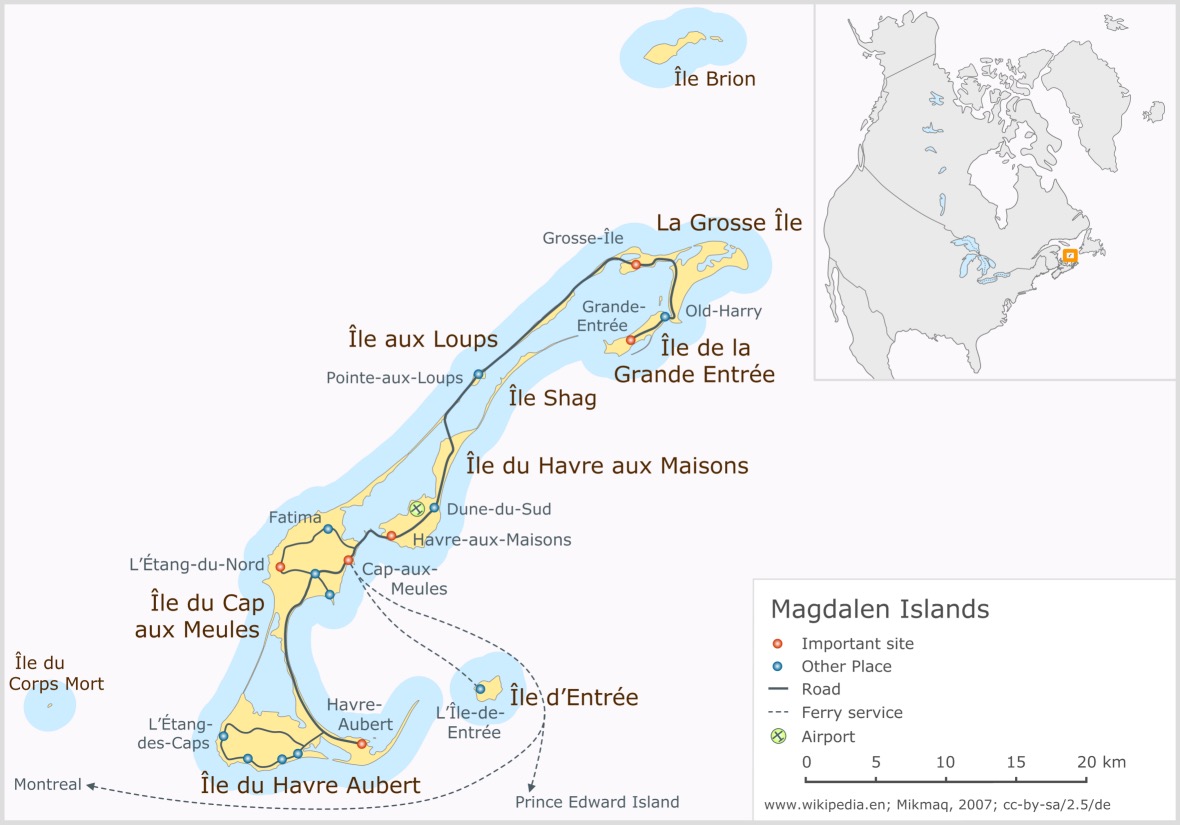
Les Îles de la Madeleine. I’ll be staying on Île de la Grande Entrée, but exploring more widely. Then, next Friday, I’ll take the ferry from Cap-aux-Meules and follow the dotted line to Souris, PEI.
After that? After that, the adventure continues. I’ll keep you posted.
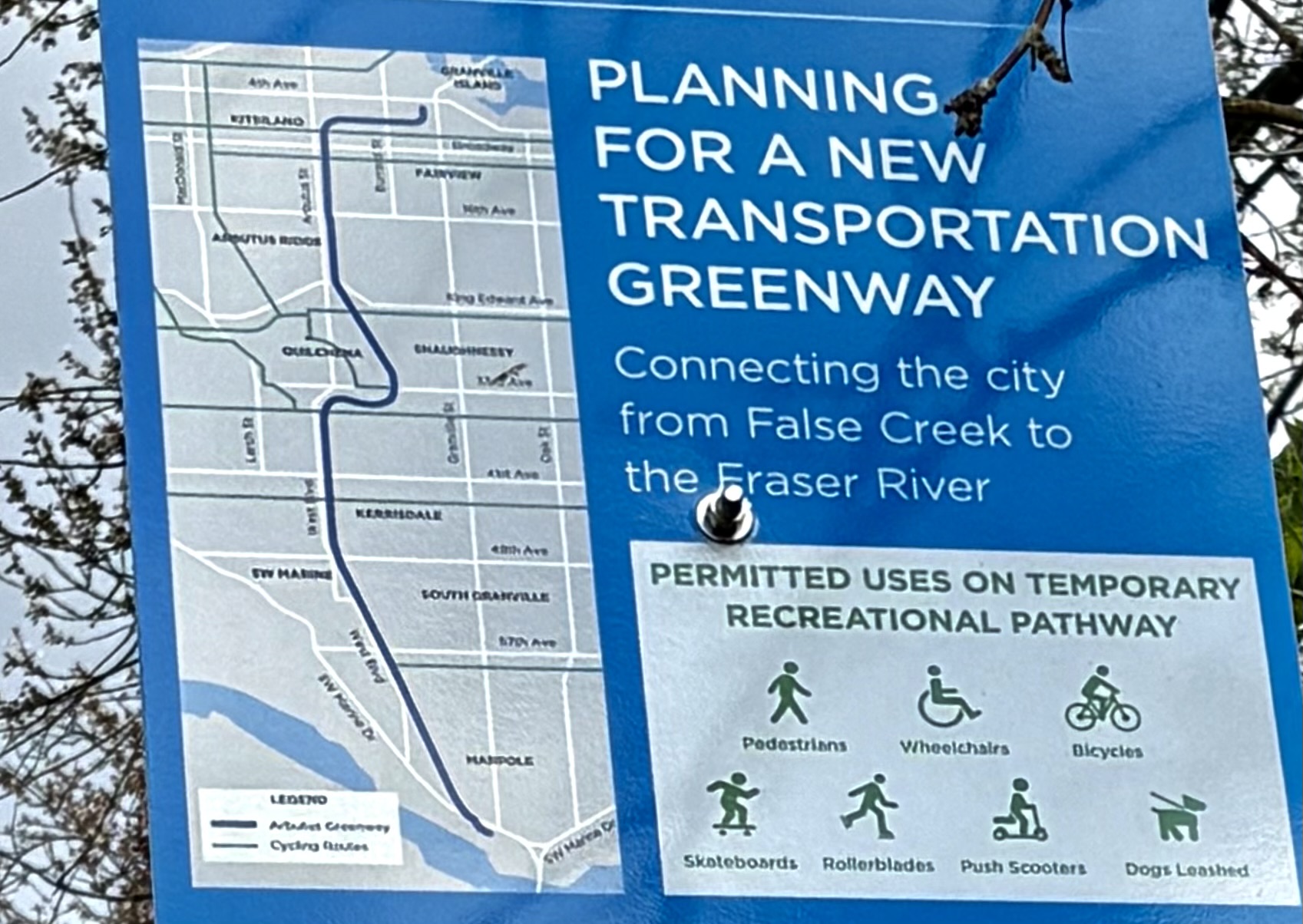
17 April 2026 – “Dogleg” is not its name. It will not answer to Dogleg. It is the Arbutus Greenway — the 9-ish km asphalt pathway that lies on old railway land between the Fraser River and False Creek, and runs alongside Arbutus Street most of the way.
I will be walking northward and I join it well north, at West 16th (just opposite the word “transportation” on that sign), so after a short straight stretch on north I’ll follow it around the curve to the east. I’ll walk the dogleg, in other words.
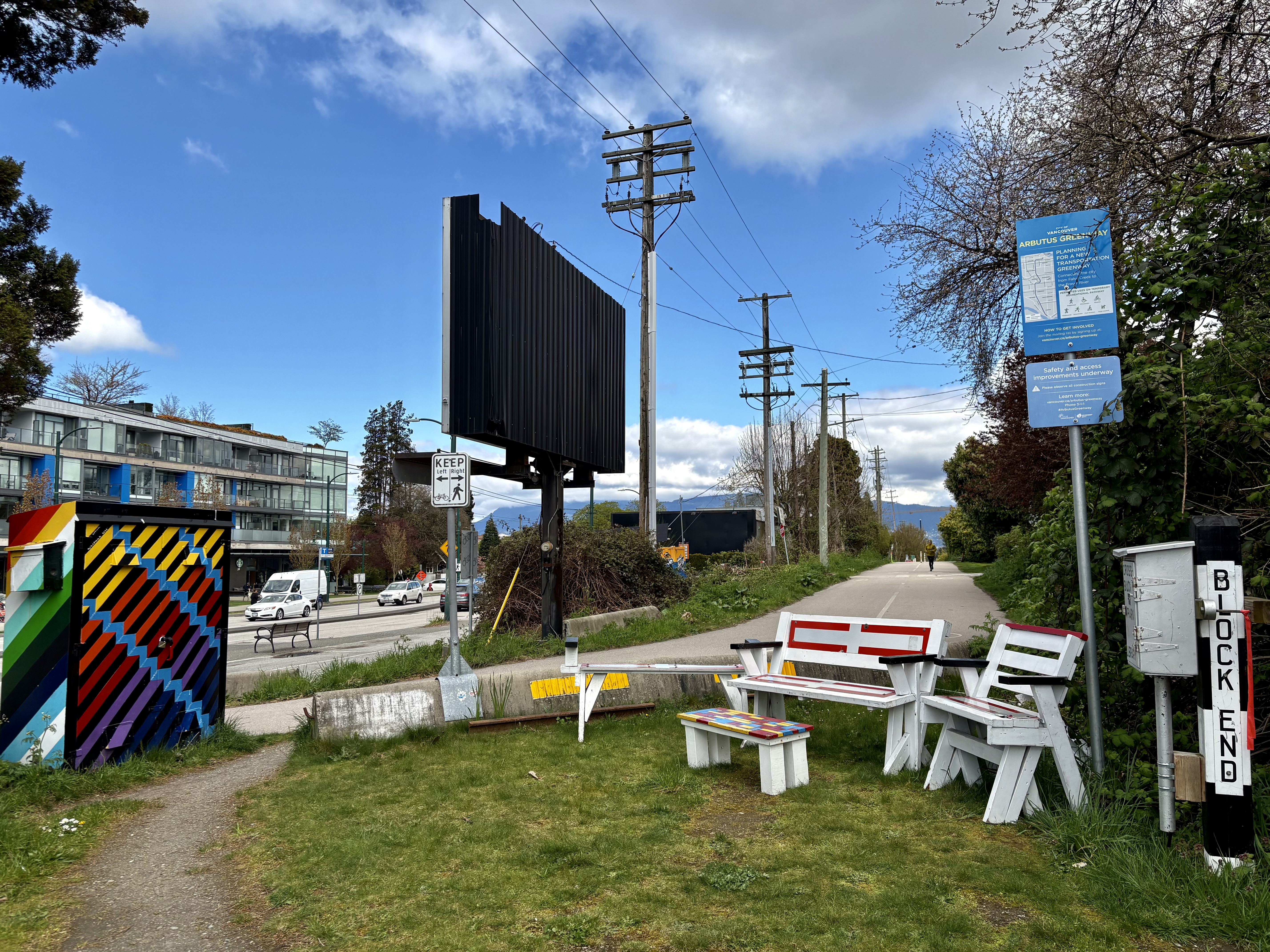
Major intersections with cross-streets are well signposted and have cheerful amenities. Here at 16th…
they include bright seating, a mural on the utility box and (on the right) a metal free-library box that, at the moment, offers both Fall On Your Knees, the 1996 classic by Ann-Marie MacDonald and The Intelligence of Dogs by Stanley Coren. Four generations of Cape Breton family drama vs canine IQ, take your pick.
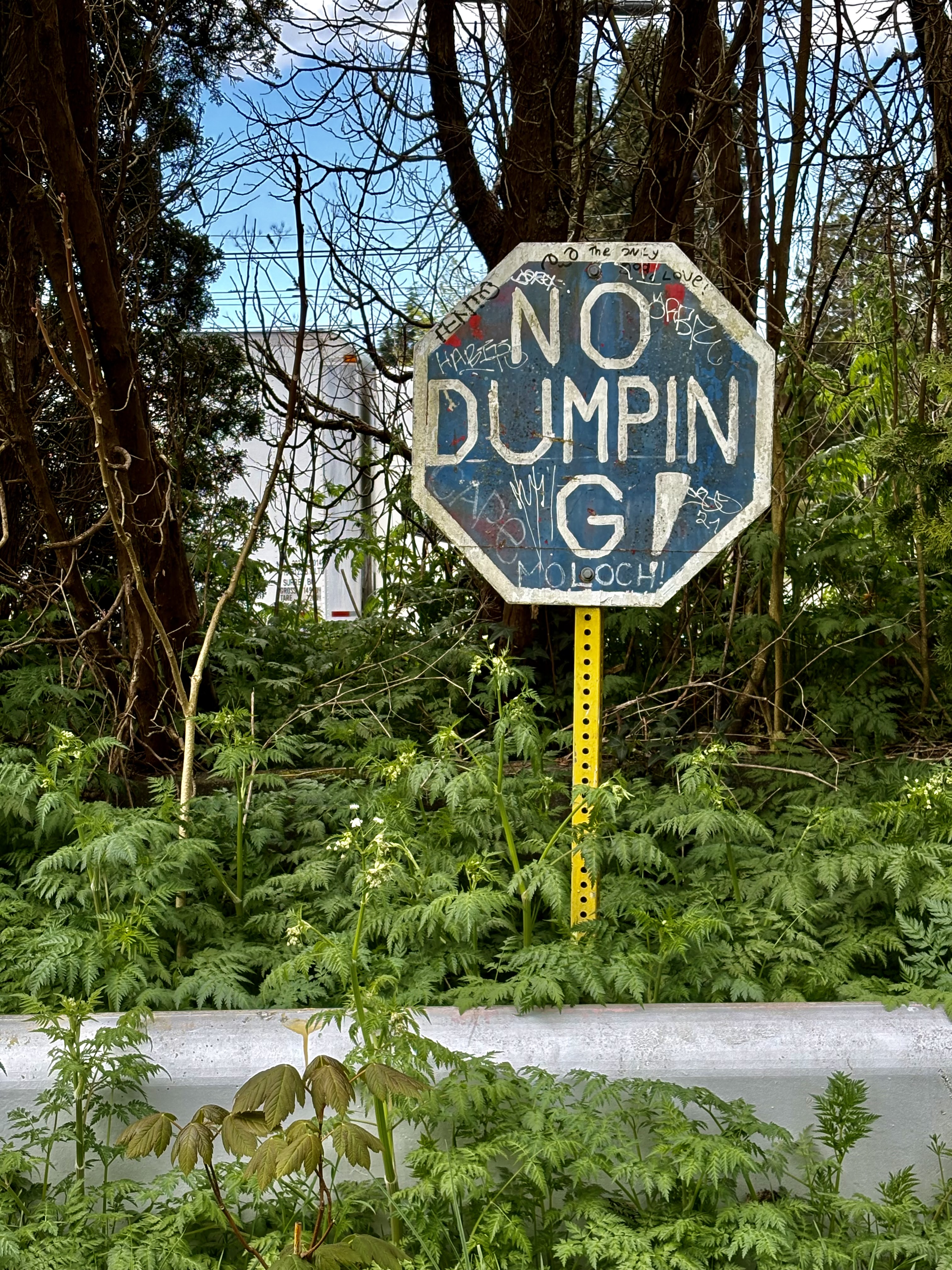
My pick is to start walking, and I do — though I stop again almost immediately, transfixed by this bold, emphatic, but not-quite-thought-through call for civic good behaviour.
Oh, that pesky “G”!
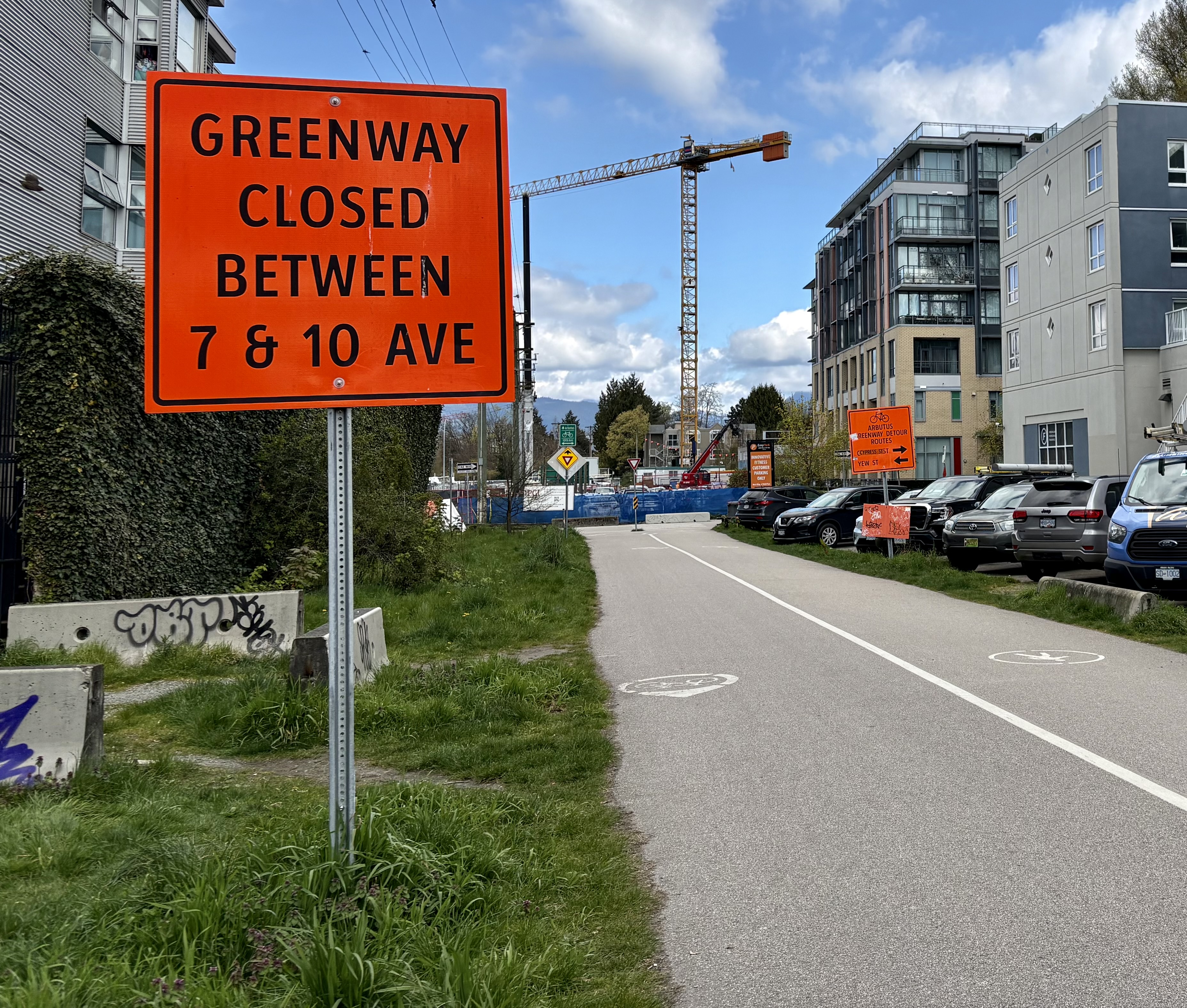
Several blocks on, I’m approaching both 11th Avenue and, beyond that, the mammoth subway construction project on Broadway (aka 9th Ave) that will end here at Arbutus.
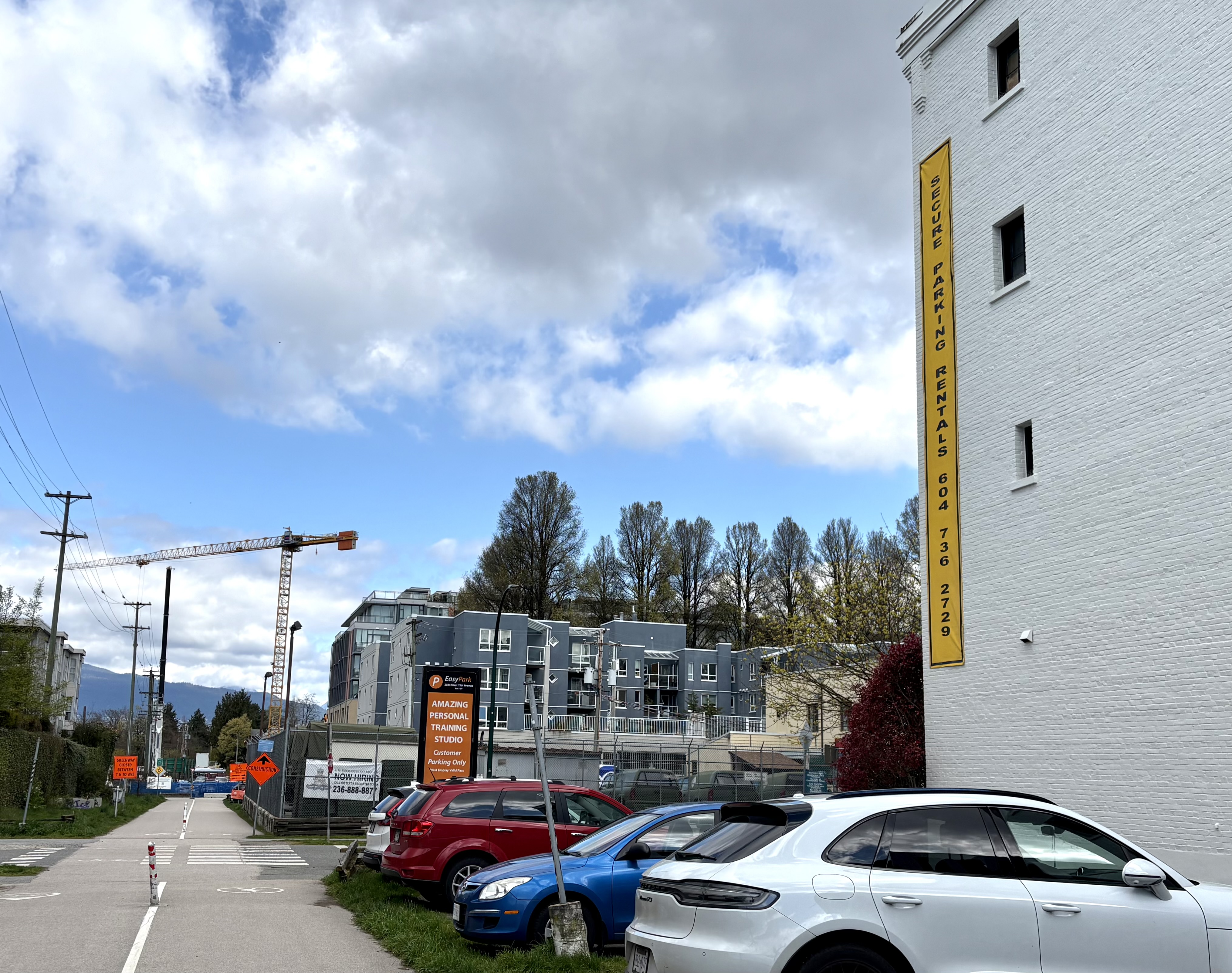
Worlds collide. Construction and, I assume, a detour lie ahead of me, but meanwhile, here on my right-hand side: that white building, offering yet more public-storage space; the orange sign, advertising a personal training studio; and, see the cream building in front of that line of grey townhouses?
I detour off-piste to check it out. Its wonderful art-deco details are testimony to its construction 1932-34, and a reminder that only government was building anything in those depression years. This is the Bessborough Armoury, home to the 15th Field Artillery Regiment. (They are recruiting, BTW. Just thought I’d point that out.)
Back on-piste, but not for long. Of course we can’t walk straight through the Broadway Subway Project!
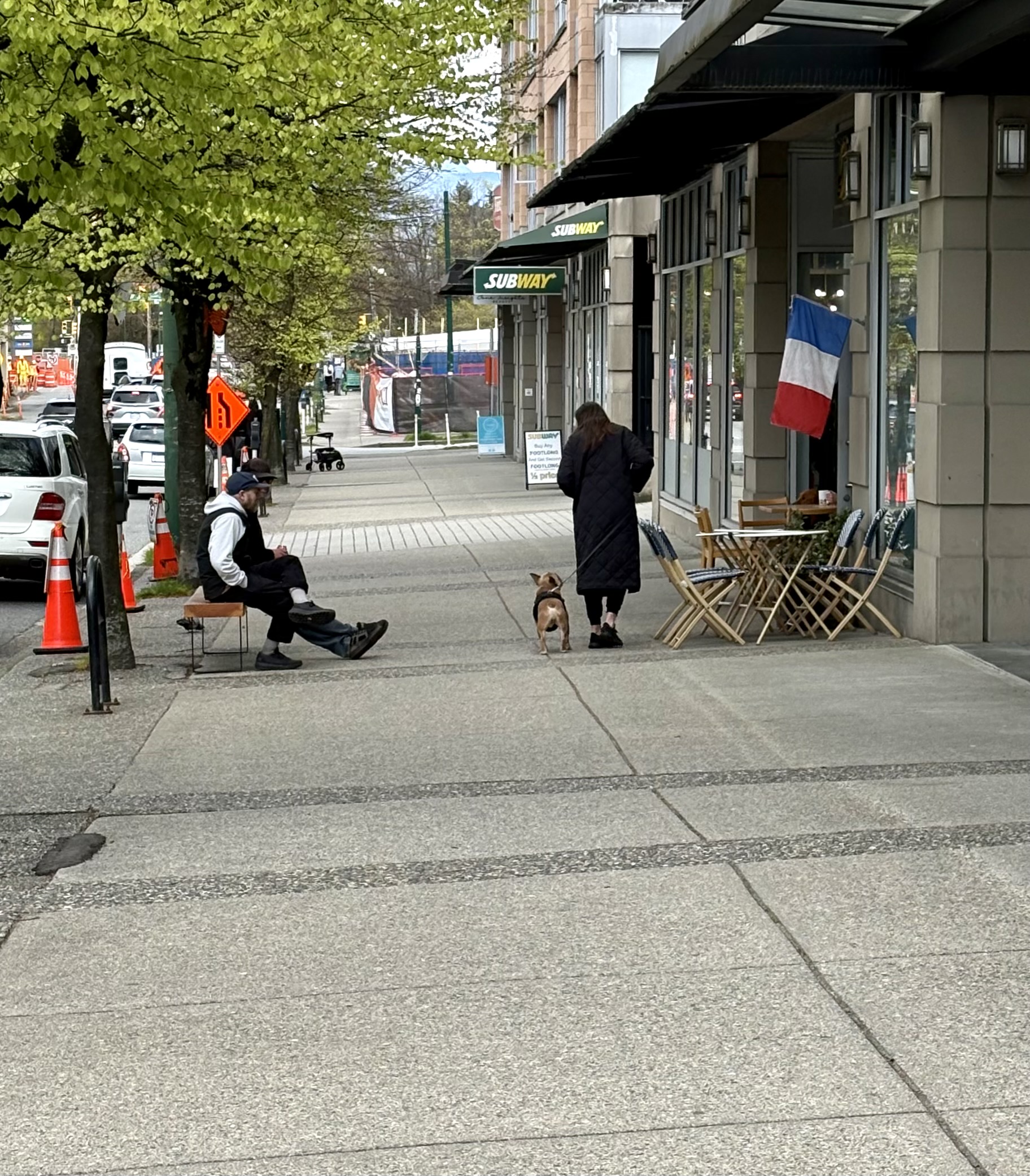
I exit one block early, and stand at the corner of 11th & Arbutus Street, pondering my next steps. At least I get to choose! See the little bulldog?
He is now being towed quite firmly north on Arbutus. A moment earlier, I overheard their street-corner contest of wills. Dog: “Whine-whine-whine-whine” [and tug-tug-tug on the leash]. Owner: “No, we are not visiting the pet store today. Come along.” [Sharp snap on the leash.] Sure enough, there is a pet store, immediately south of the intersection.
Unlike the dog, I have no need to make my case. I do not need to justify crossing Arbutus to walk one block farther west on 11th. It looks green over there, and inviting, and unknown. I follow my whim.
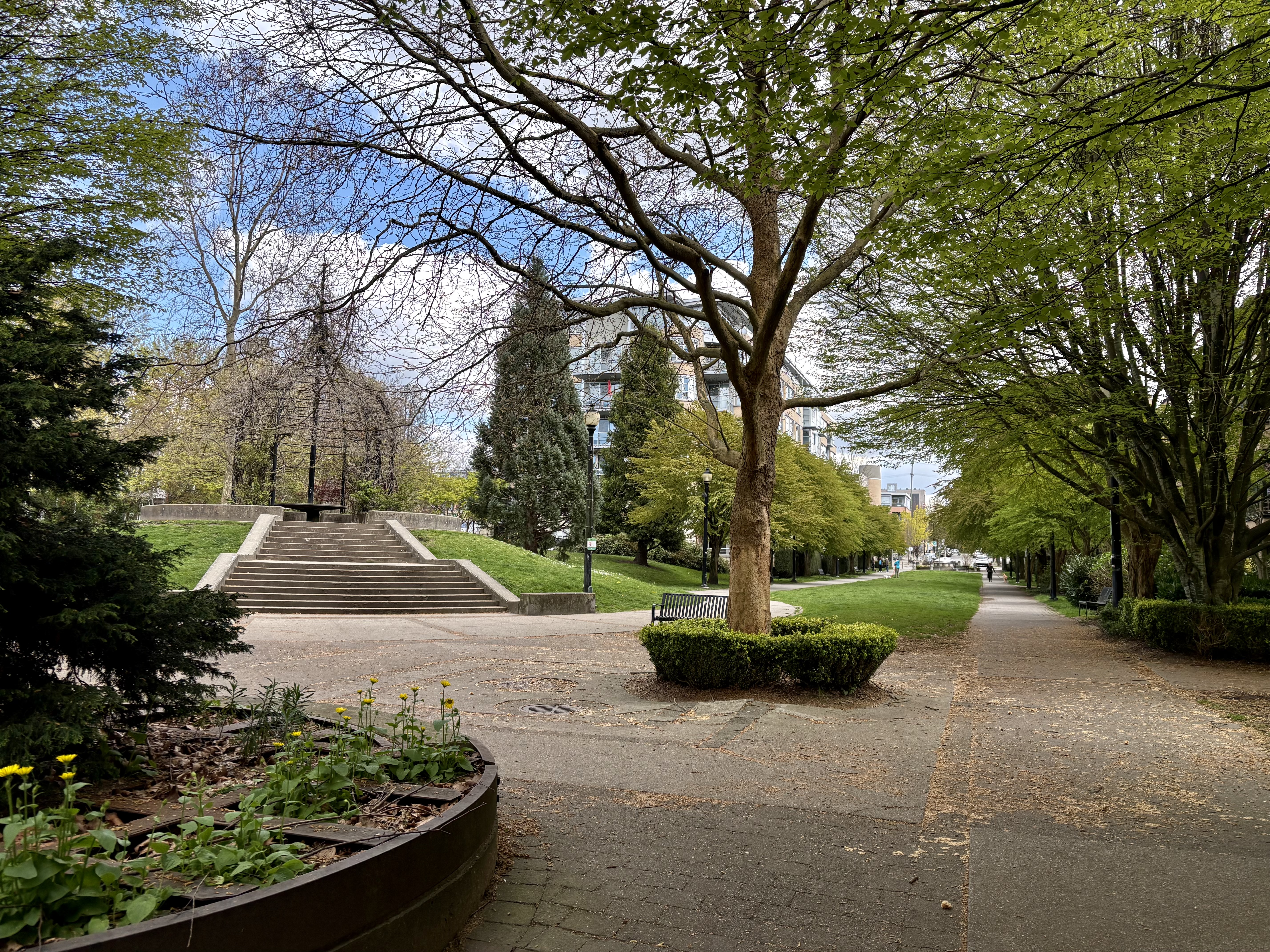
I bet you agree it was a whim worth following. Look how pretty it is, viewed from Yew, just one street over. Equally comfy with the next whim to cross my mind, I now turn north on Yew.
I walk on up to Broadway. I cross Broadway (safely beyond the construction project). And, still following Yew…
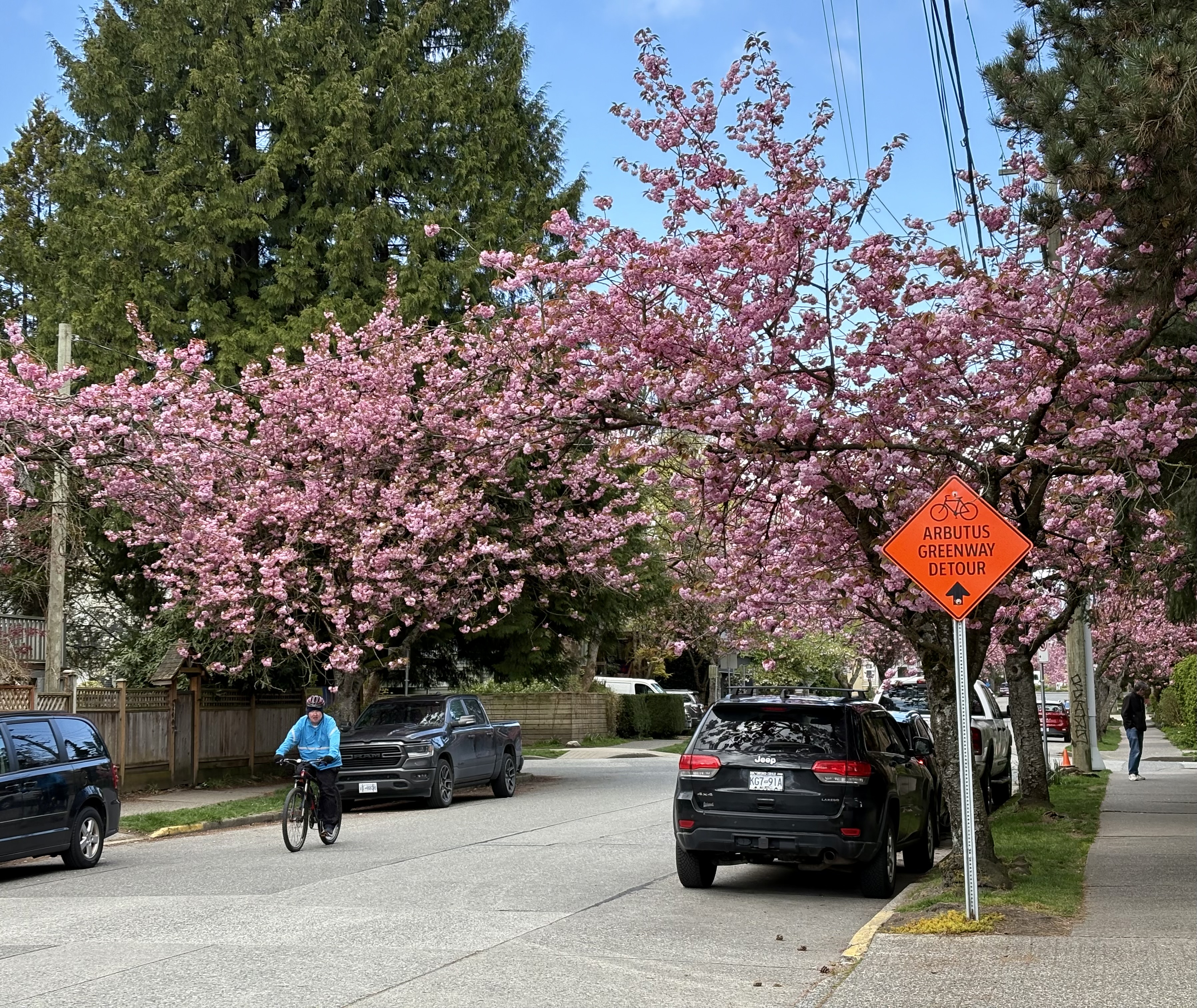
I discover I have wandered myself onto the official Greenway detour route.
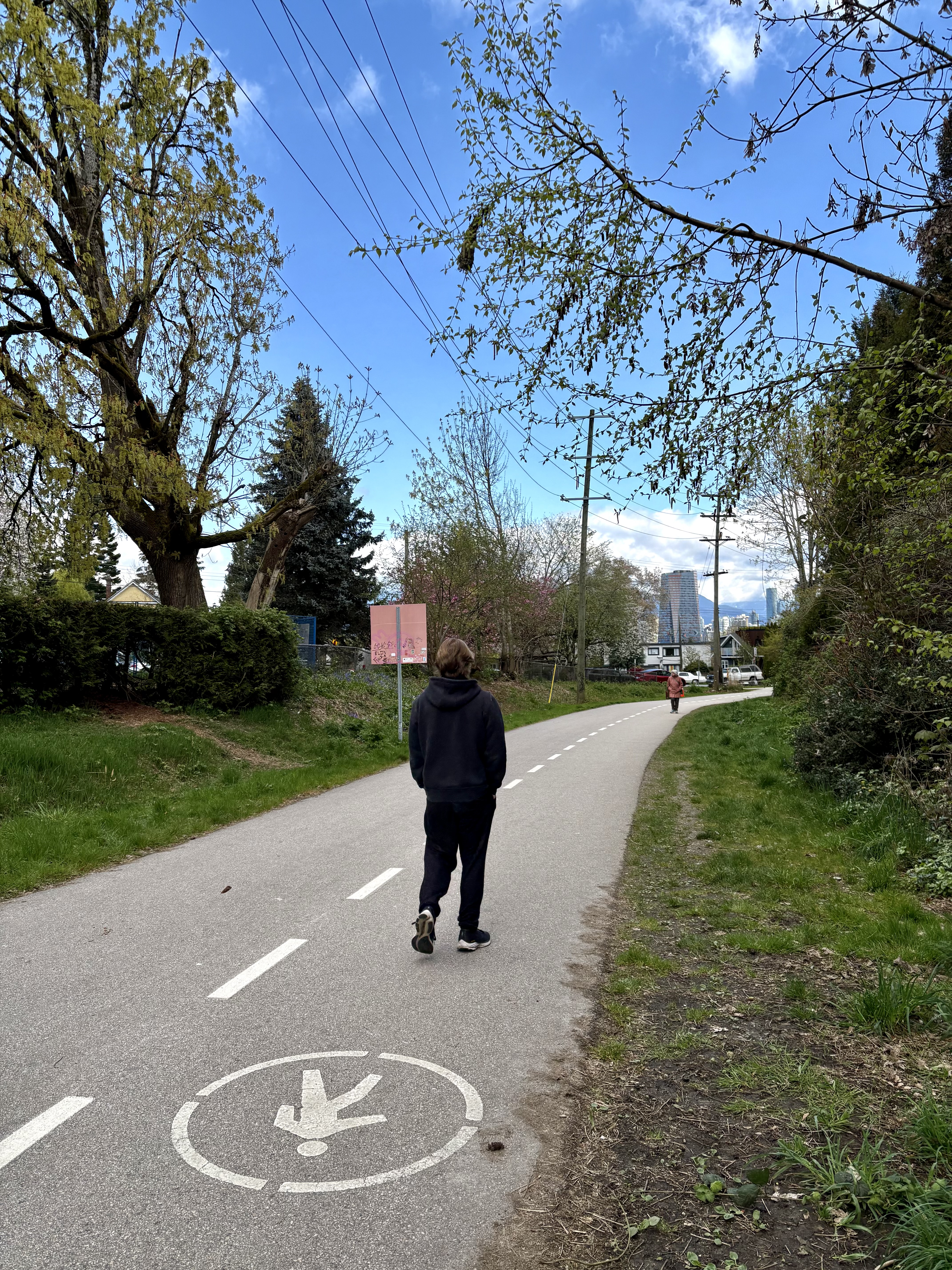
Soon the detour ends. I am back on the Greenway and, like this walker ahead of me, almost at the dogleg curve.
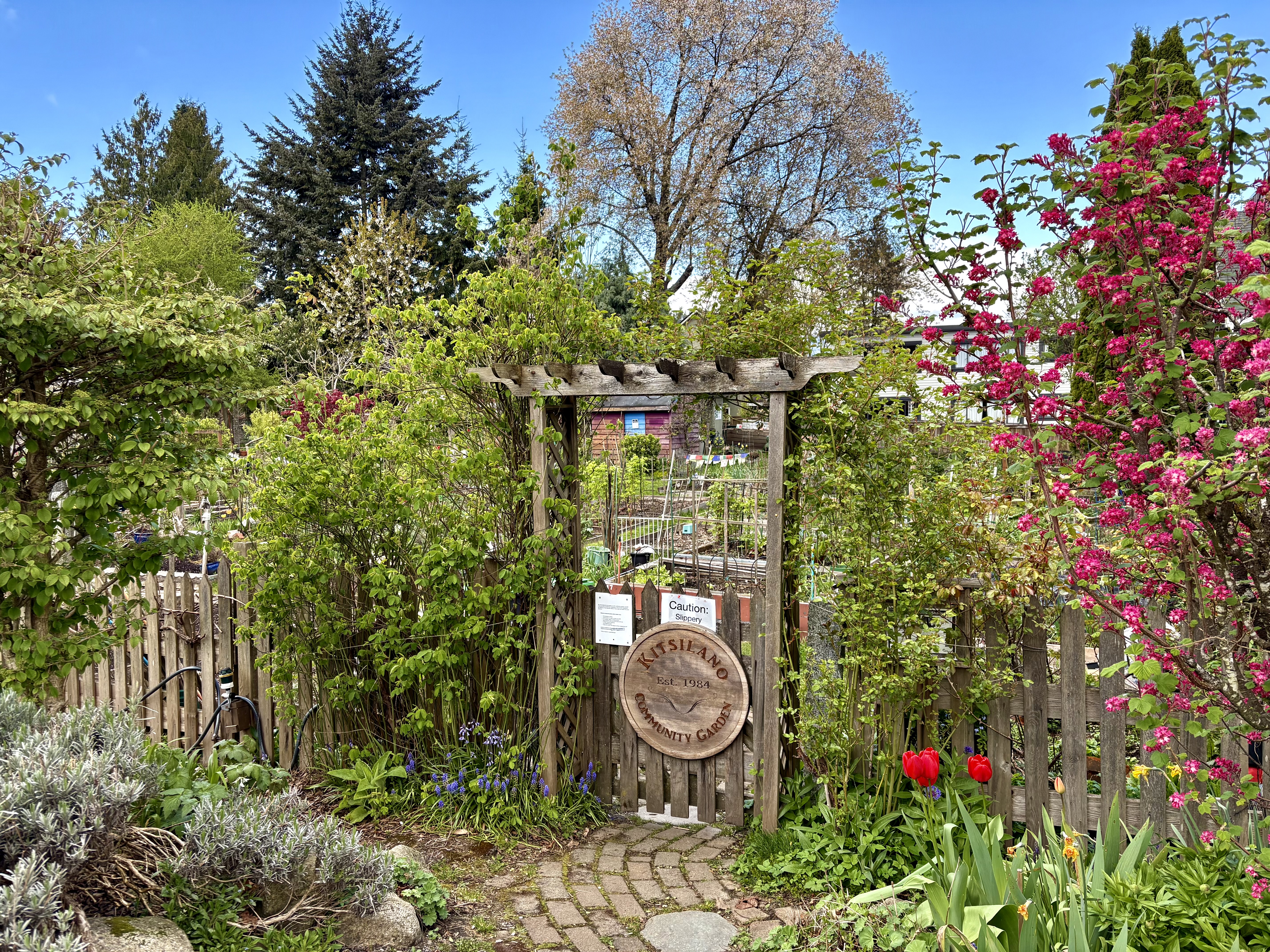
‘Round the curve, and we have gardens and greenery on all sides. Here to the north, almost at Maple Street, the Kitsilano Community Garden.
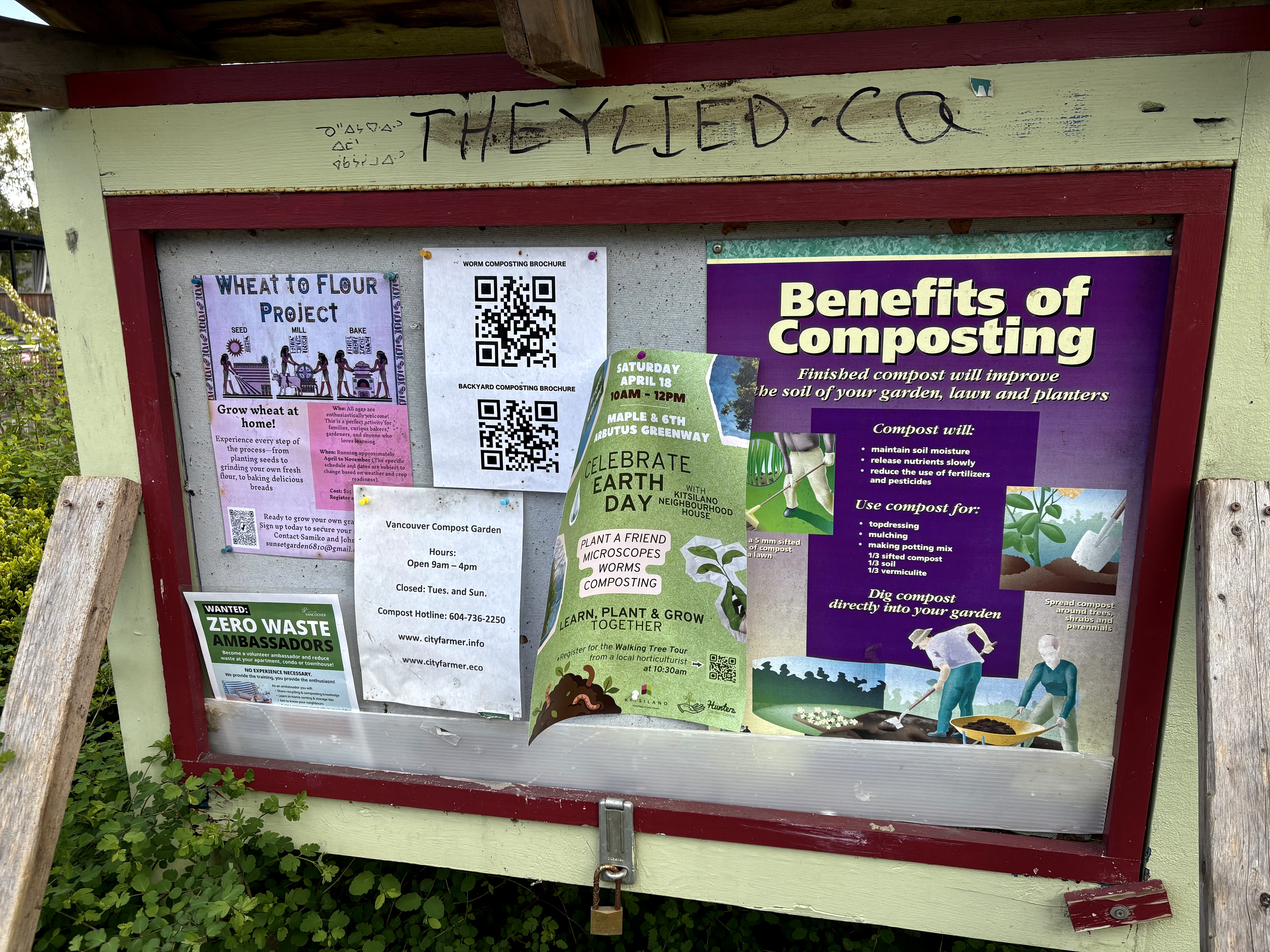
Also north side, and immediately across Maple, this bulletin board (I am most taken with the encouragement to grow my own urban wheat and mill my own flour)…
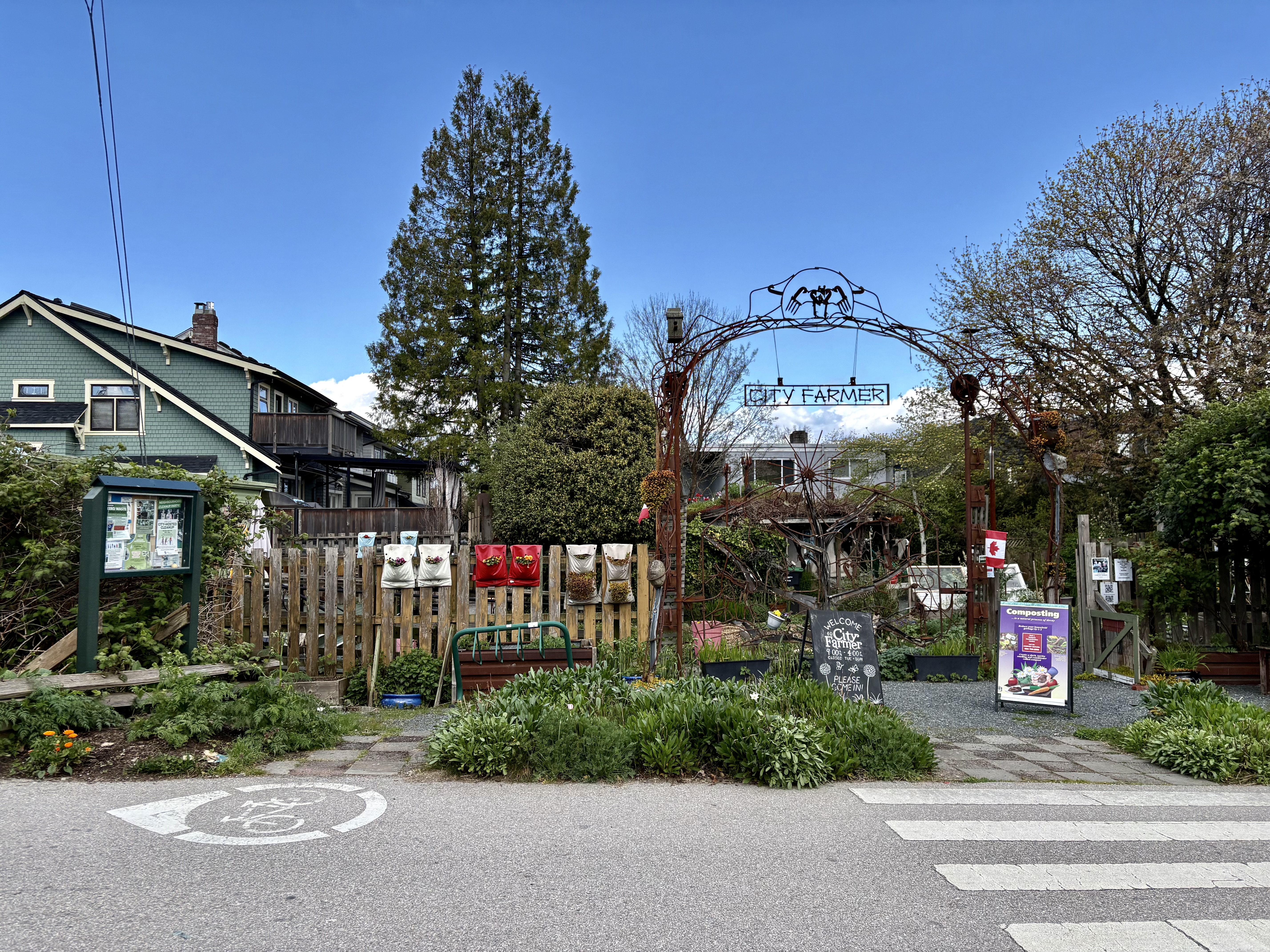
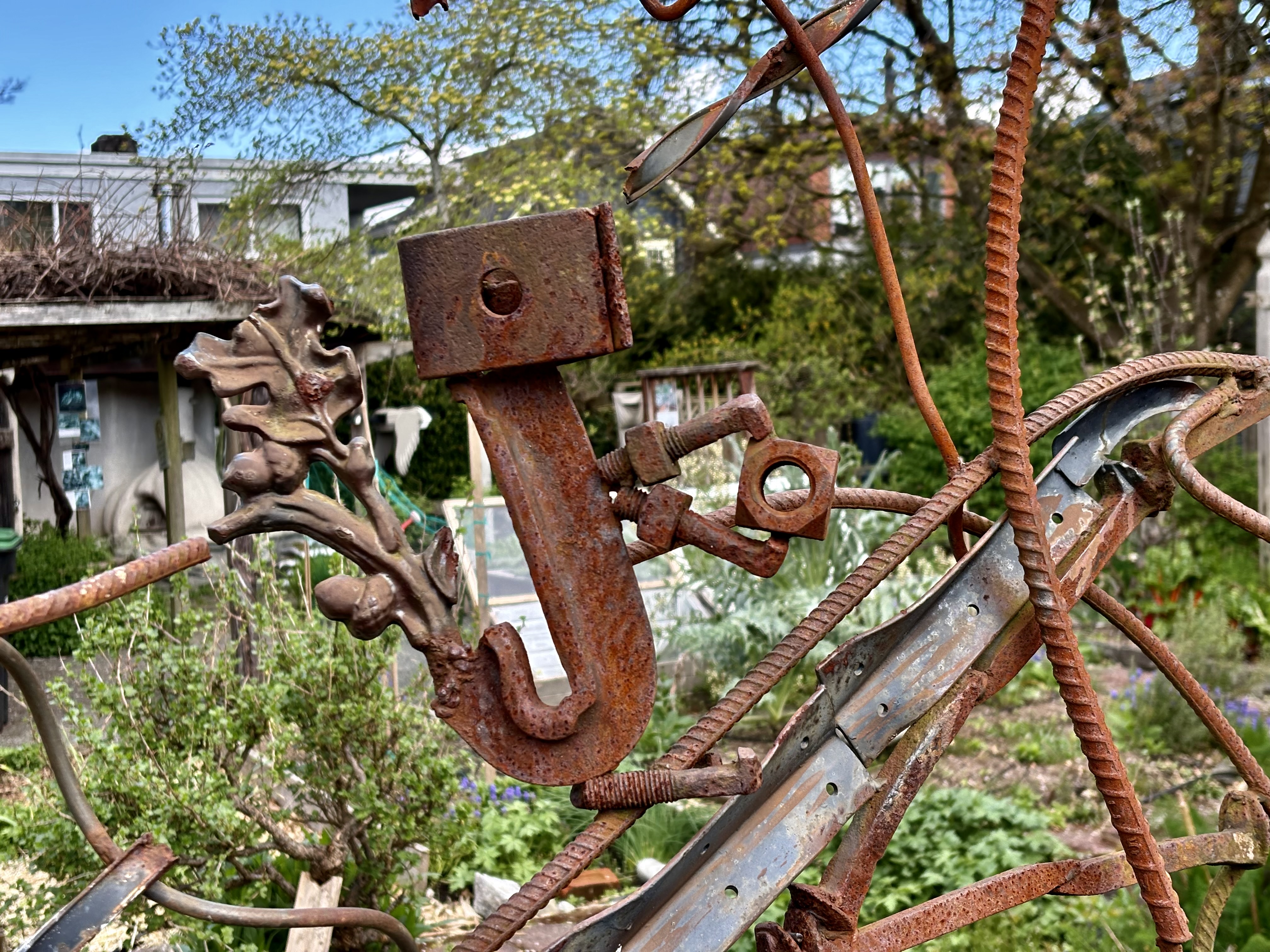
which is smack against the boundary fence for Urban Farmer, an organization that has been encouraging urbanites to grow/compost/recycle for almost fifty years. Even their garden gates are a joy, constructed from rusty old rebar and implements…
and chock-full of jokes, when you get close enough.
This squirrel, for example.
I love his ingeniously bushy tail — but, above all, I love the fact that he is clutching a nut.
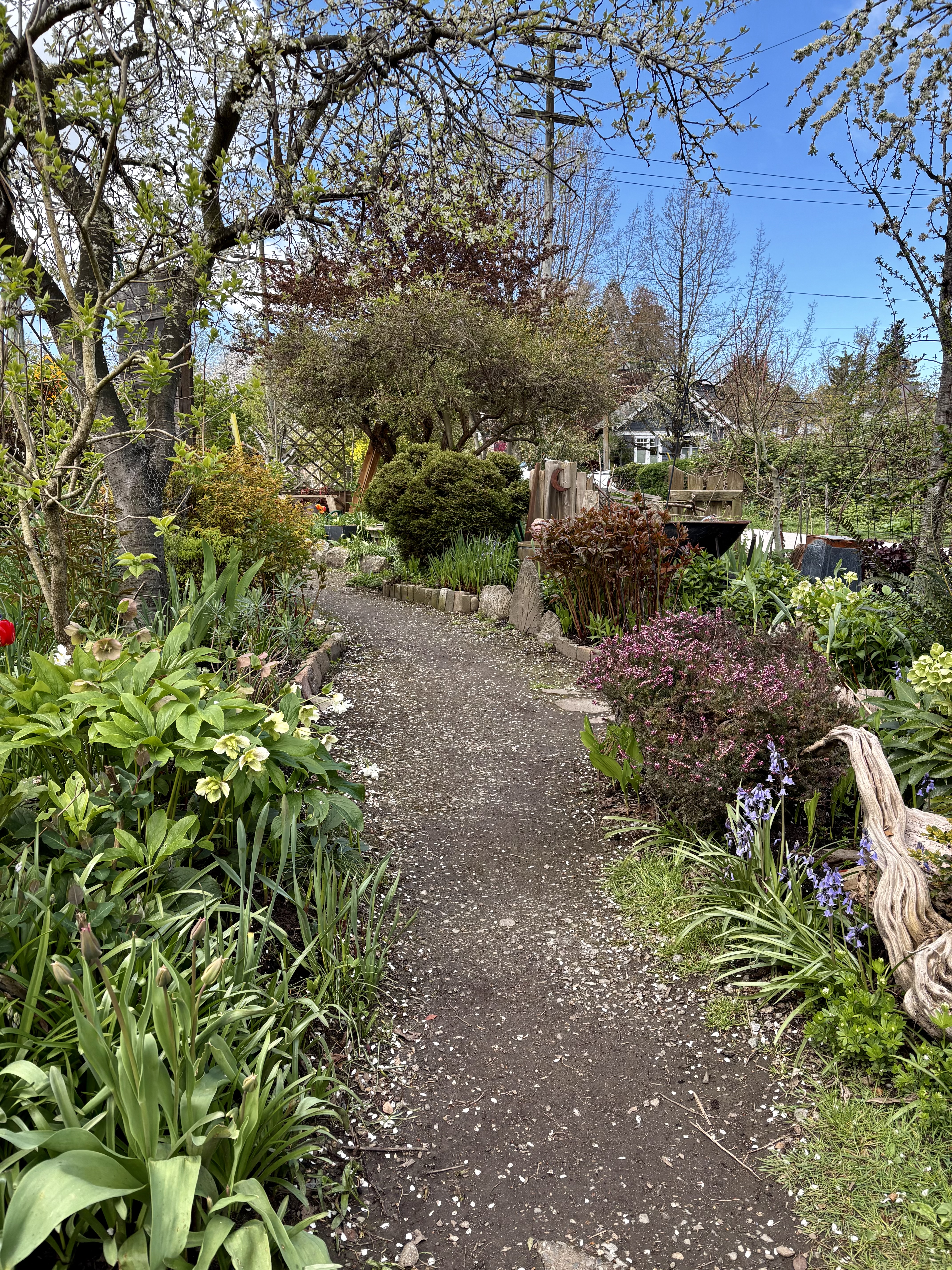
Broad asphalt pathway, bordered on the right by a verge of ragged grass and beyond that, a succession of garden allotments. Peering down the middle of all these allotments is a delight. The cityscape entirely falls away.
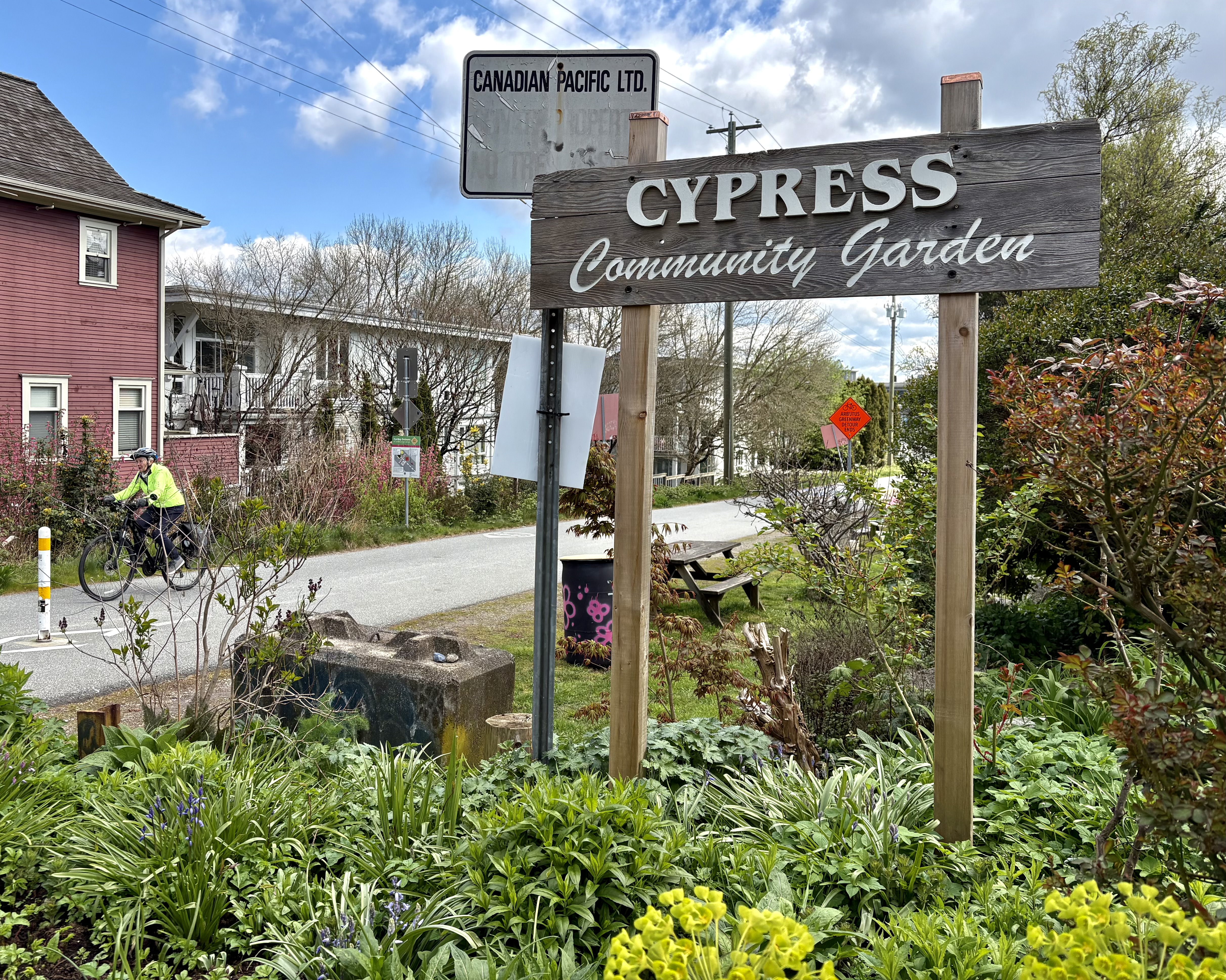
Some have no signage, some an individual name, and some — like this one — self-identify at the broader community level.
I take this photo, amused to see that the Canadian Pacific Ltd. sign behind it has been selectively painted out. Through the white paint, you can still read old black letters: private property, no trespassing.
Ohhhh, sigh. I don’t know the details, I just know they are profuse. This whole Greenway lies on old CPR railway land, purchased from CPR by the City in 2016 and subject to lengthy, tangled legal disputes both before & since. Read all about it here, in a space wonderfully titled Participedia. The analysis argues that this particular “rails to trails” project is in fact de-railed, with ambitious City plans stalled and nothing achieved but all this placeholder asphalt. Meanwhile, it claims — citing Cypress Community Garden as an example — individuals and community groups enjoy the freedom this limbo status offers them, to do their own gardening projects. Not official, not recognized, but not exactly officially unrecognized, either.
Or so I gather.
All I know for sure is that it’s messy. Still, for individuals walking/biking/rolling on through, it is also very enjoyable, albeit far from what Civic planners want to offer us.
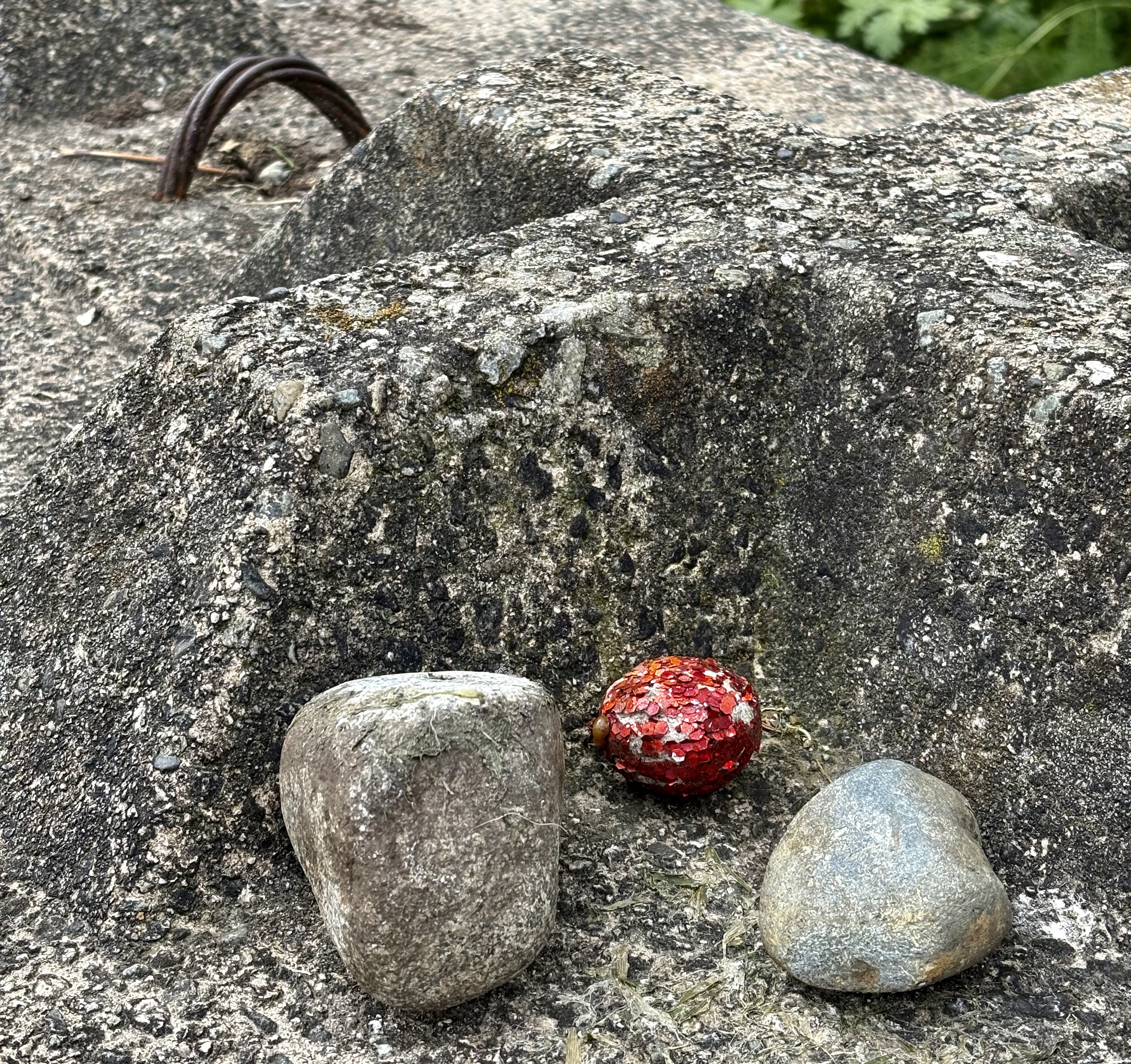
Evidence of human love, devotion and sheer joy on all sides. Three stones carefully arranged within a concrete barrier, one of them as close as red sequins can come to a Fabergé Easter egg…
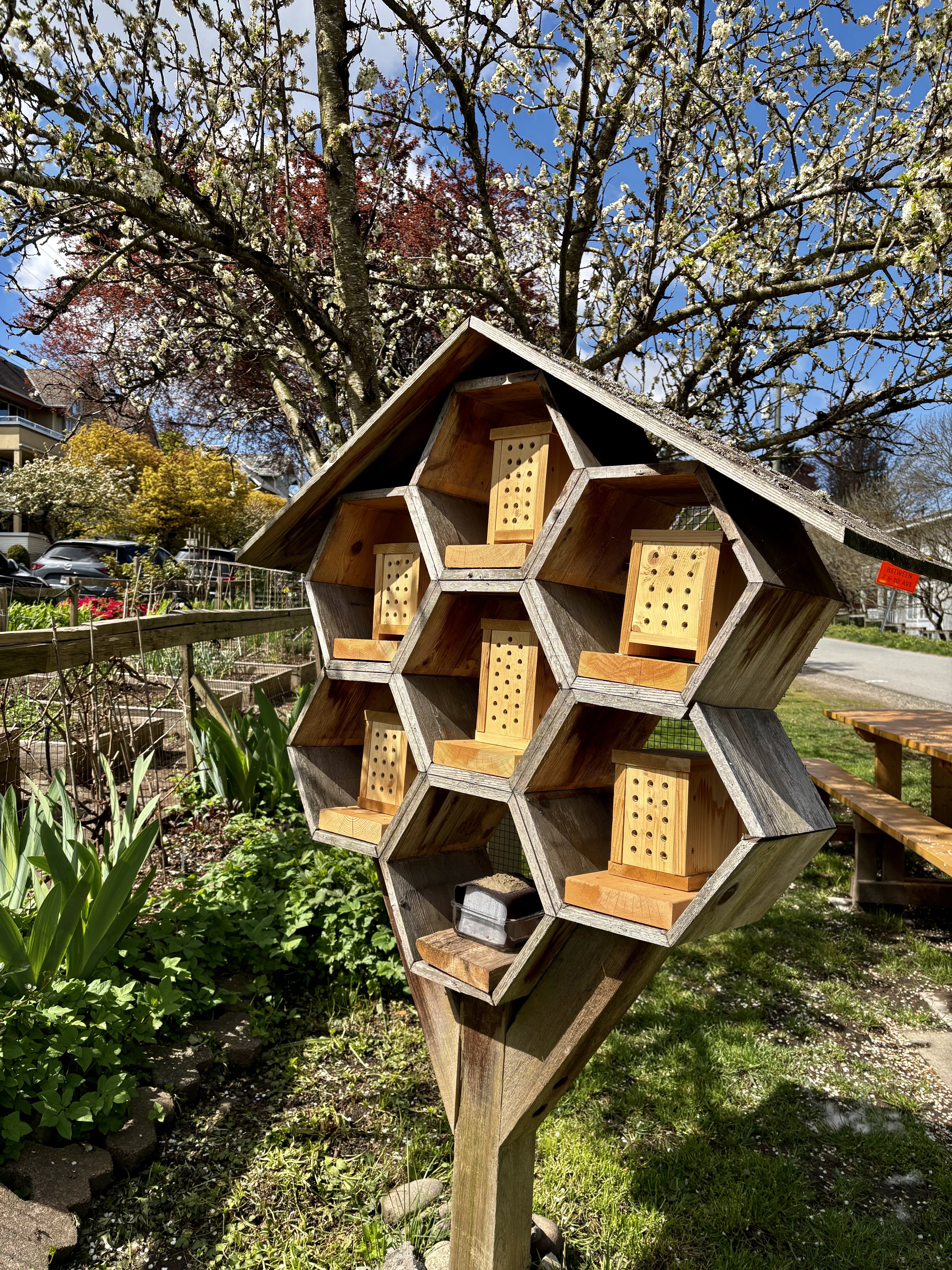
and a veritable Bee Multiplex one allotment on down. Overwinter here, please! You are safe!
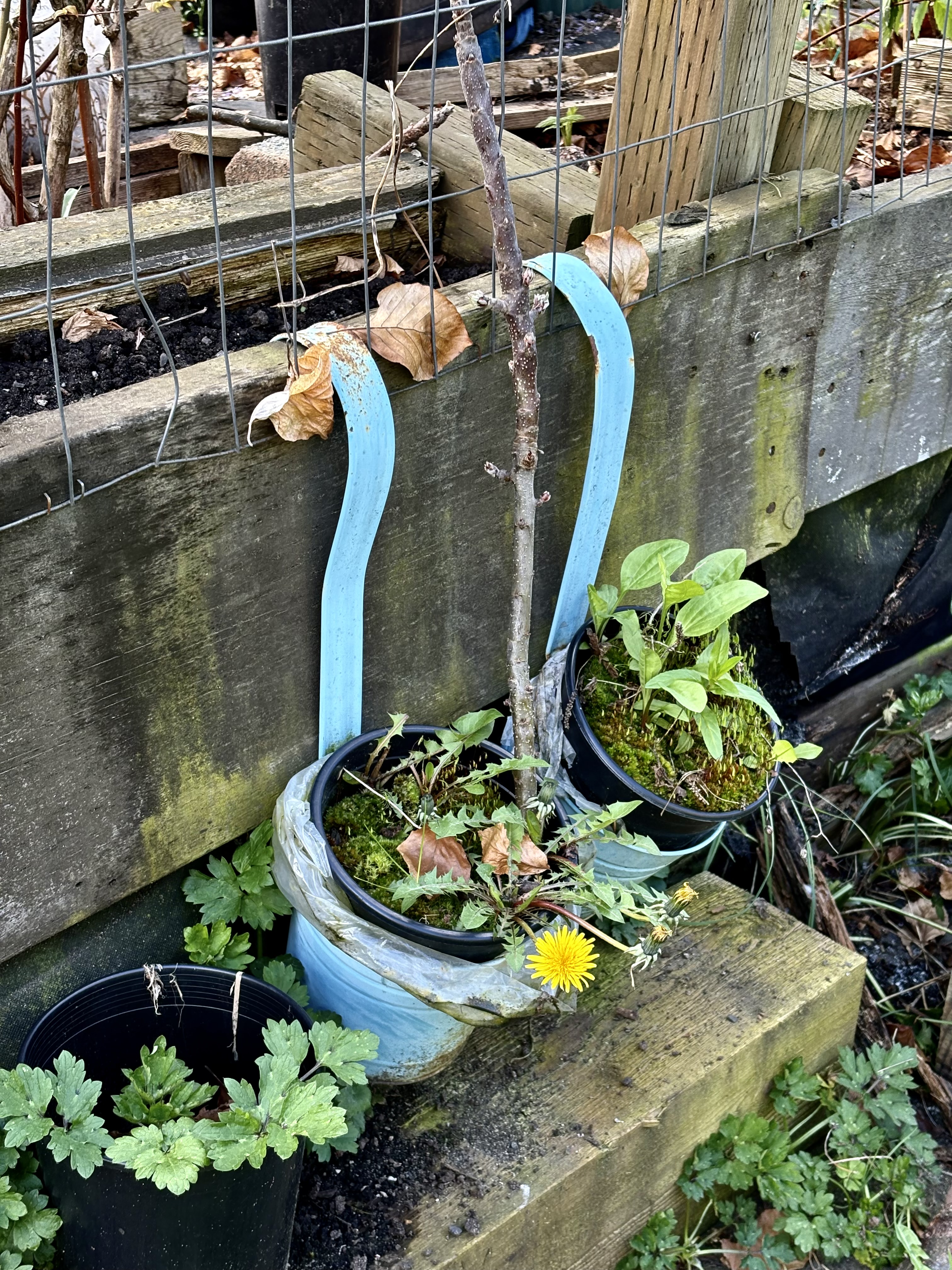
And — right next to a stump covered in glorious tiny fungi, needing no human help at all — something else that needs no human help at all.
One dandelion, who has found his own perfect spring residence.
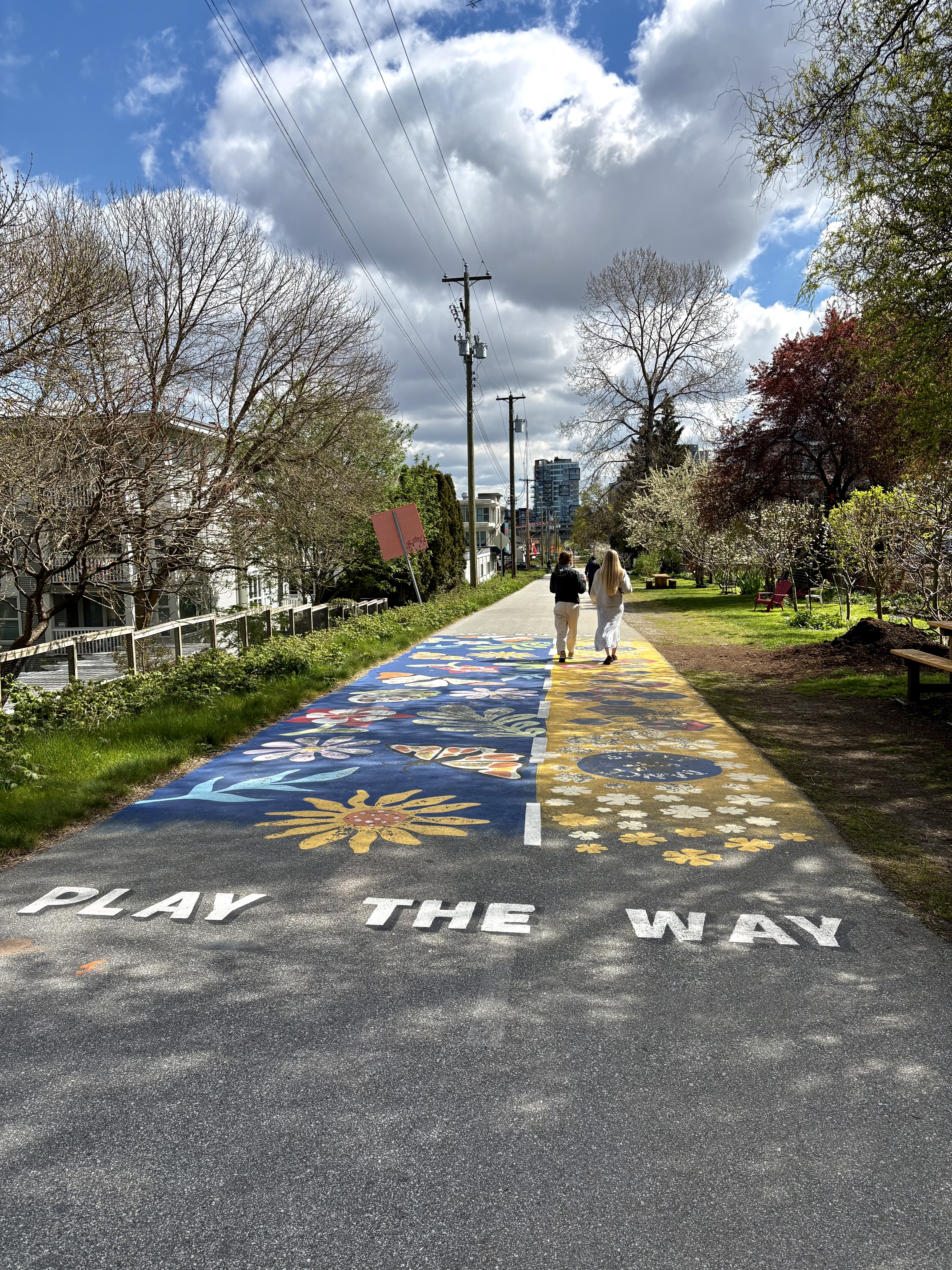
I’m well around the bend by now, almost at the end, almost at the moment when I must rejoin the city in all its grit and grime. But first, for encouragement, this message.
I don’t know the origin of this paint job, or the intended meaning of the slogan. I’m happy to take it as a reminder to enjoy wherever my feet take me.
A necessary reminder, here at 7th & Granville!
Yup, grit and grime.
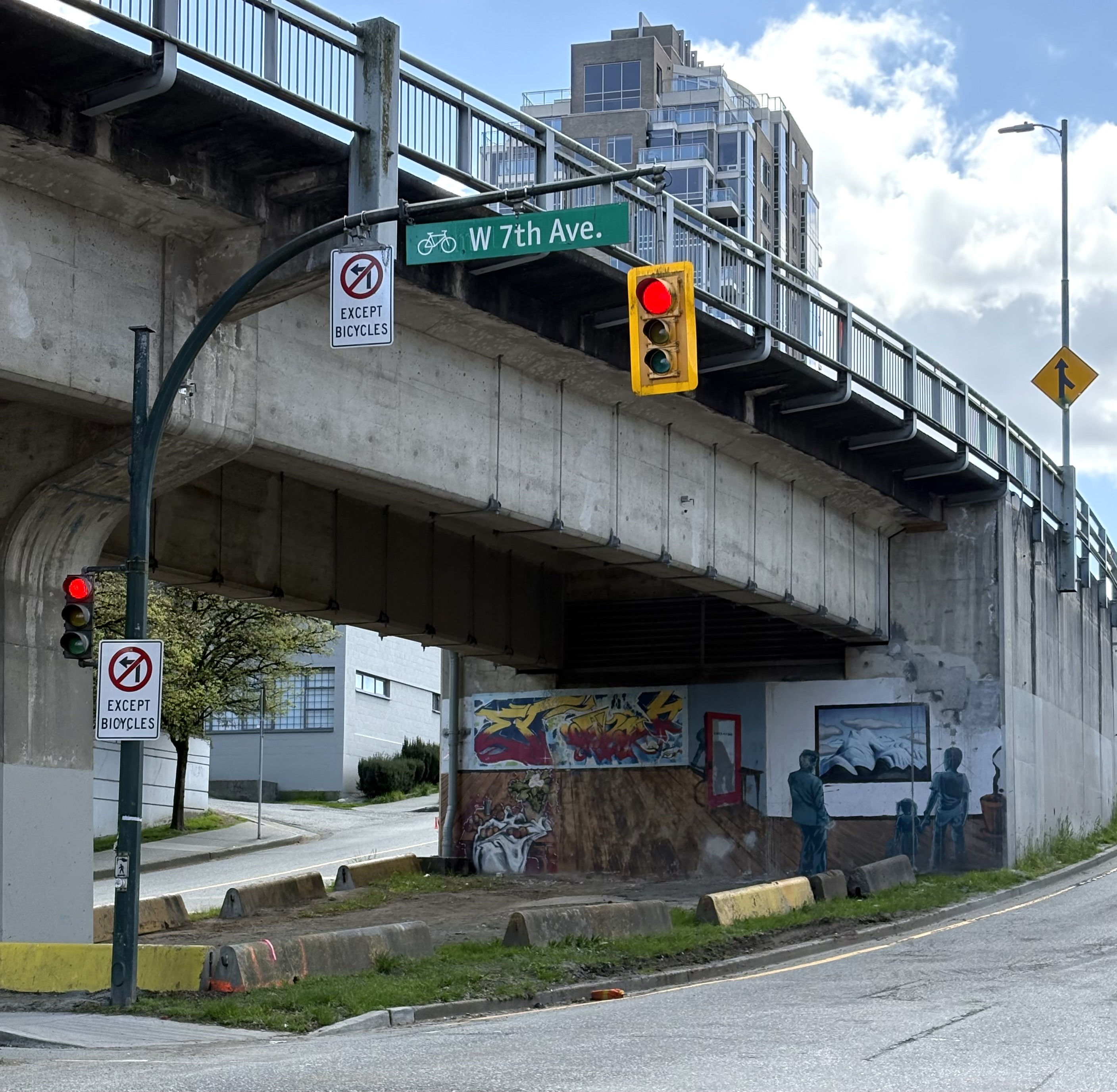
But also, look, some murals to enjoy, tucked away in the alcove beneath that bridge on-ramp.
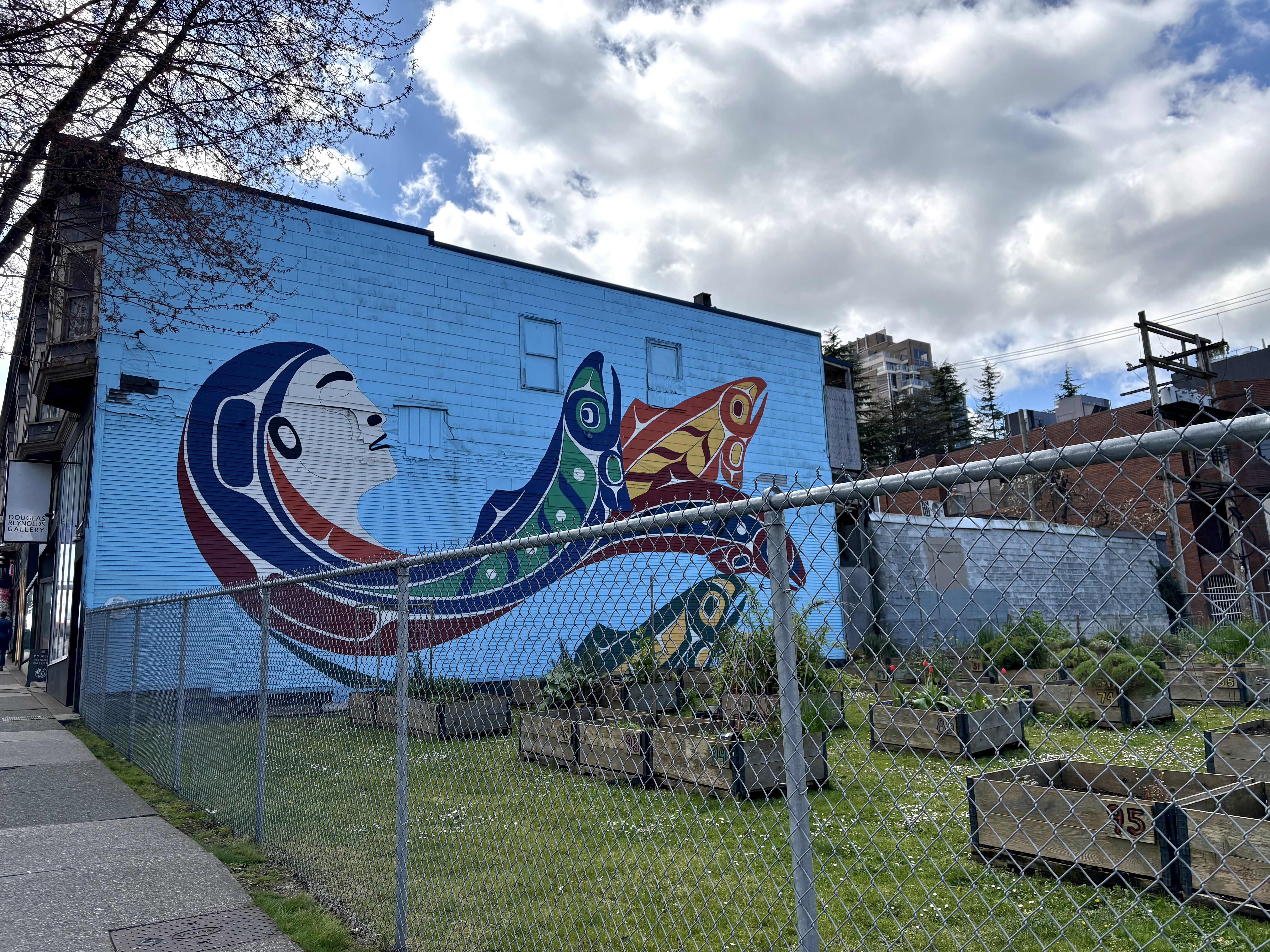
There’s more to enjoy, hoofing on up Granville: another mural, and more gardens.
The mural, Force of Nature, is by Phil Grey, part of the 2021 Vancouver Mural Festival. Since the VMF is no more, how fitting that the mural rises over a garden that, one day, will also be no more.
Signage acknowledges — proudly — that this is a temporary garden.
It is one example of such gardens throughout the city. They are organized by Community Garden Builders, a local social enterprise that works with landowners and community groups to create temporary gardens and dog parks on spaces awaiting redevelopment.
Just like all those gardens along the Arbutus Greenway!
24 February 2026 – Rays of sunshine flashing all over the place, and colours bouncing around with them.
Well, no, not literally. But it looks, it feels, like that.
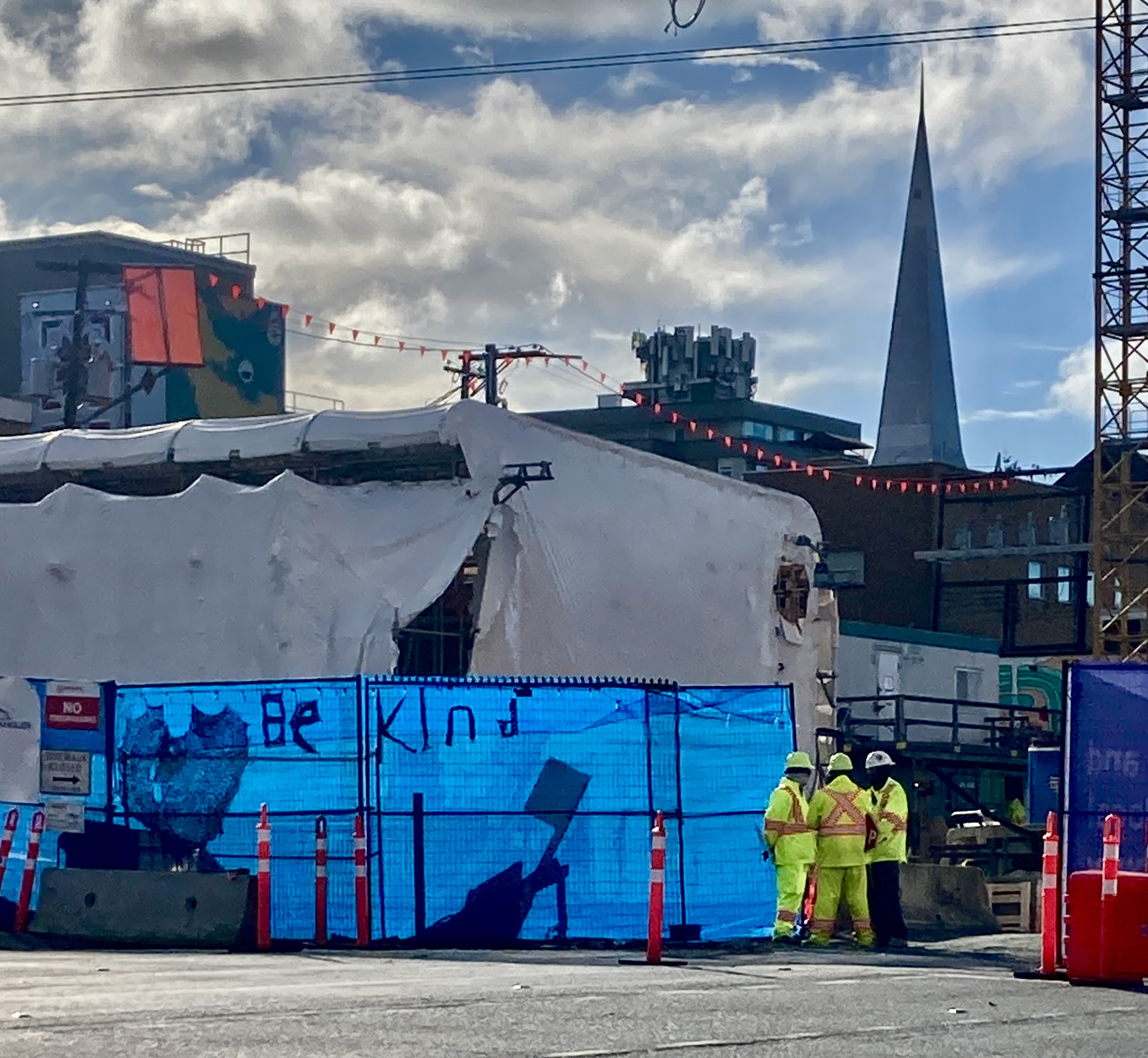
I stand at the intersection of E. Broadway & Main, deliberately missing two green lights, transfixed by the transformation of the Yarn Bomber’s “Be Kind” slogan and companion heart.
After years of exposure, the colours have faded and the wool is bedraggled. Construction screening now hides all that, and today’s sunshine throws us the words and image in dramatic, high-contrast relief.
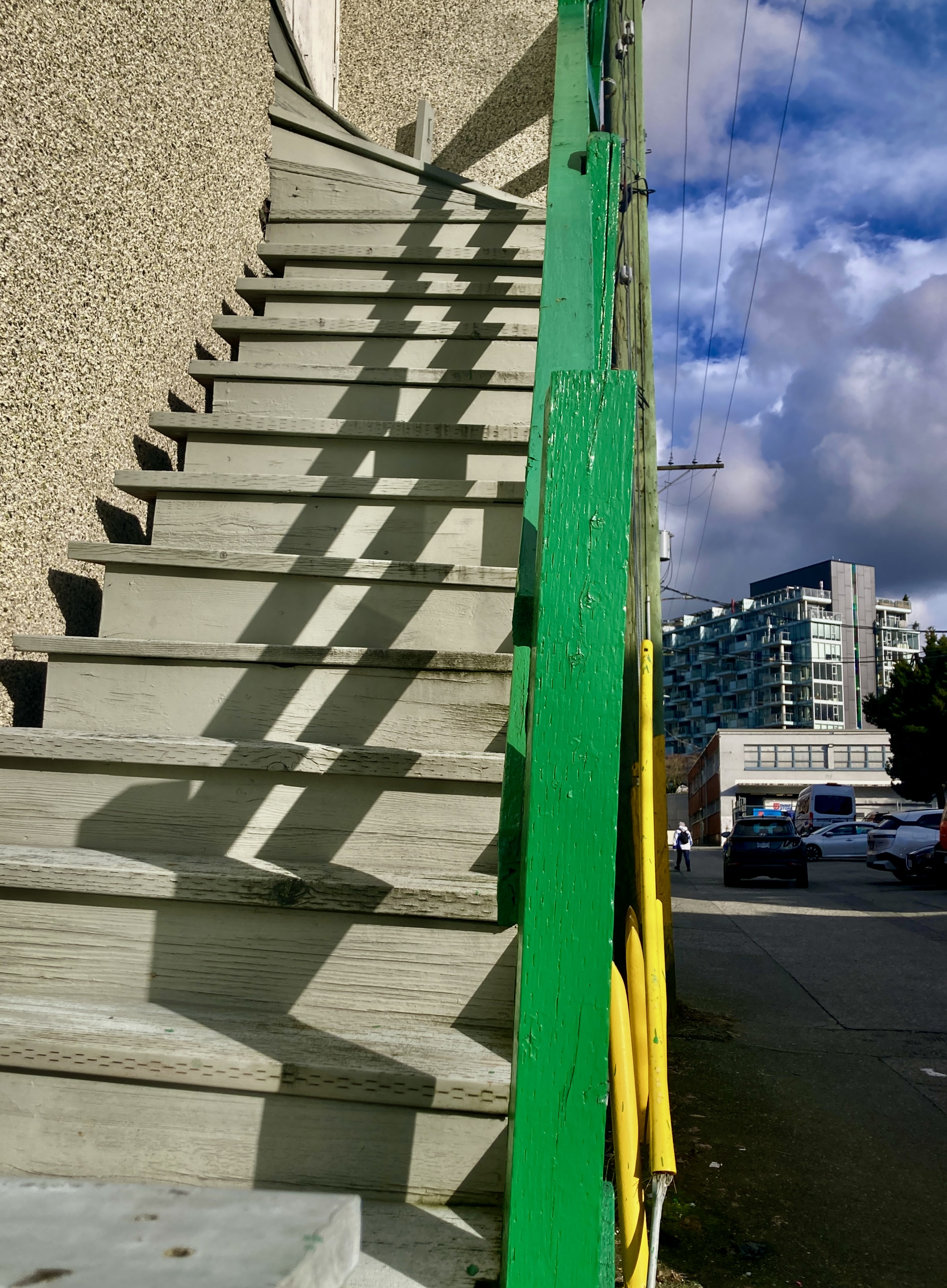
Moments later I turn into the alley that will lead me to the Salvation Army drop-off centre, my eye primed for the bounce of light, colour and shadow.
Barely into the alley, and a perfectly ordinary wooden staircase delivers all that.
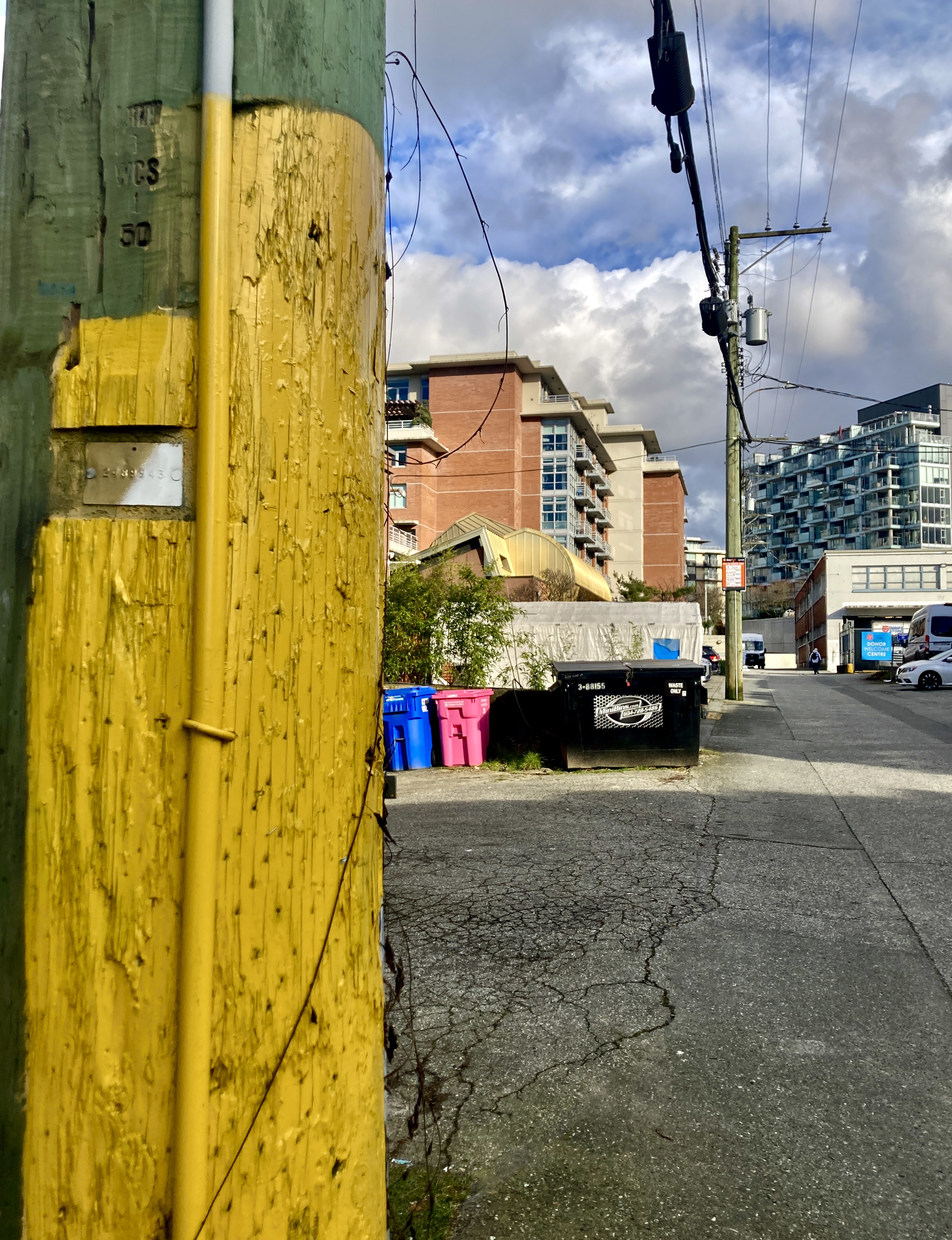
A few more steps, and look: green/yellow wooden pole, blue/pink/black garbage bins beyond, and down there in the distance, the turquoise blunt end of a Sally Ann truck. (I just have to stand in this ramshackle alley and look around. Colour smacks me in the eye.)
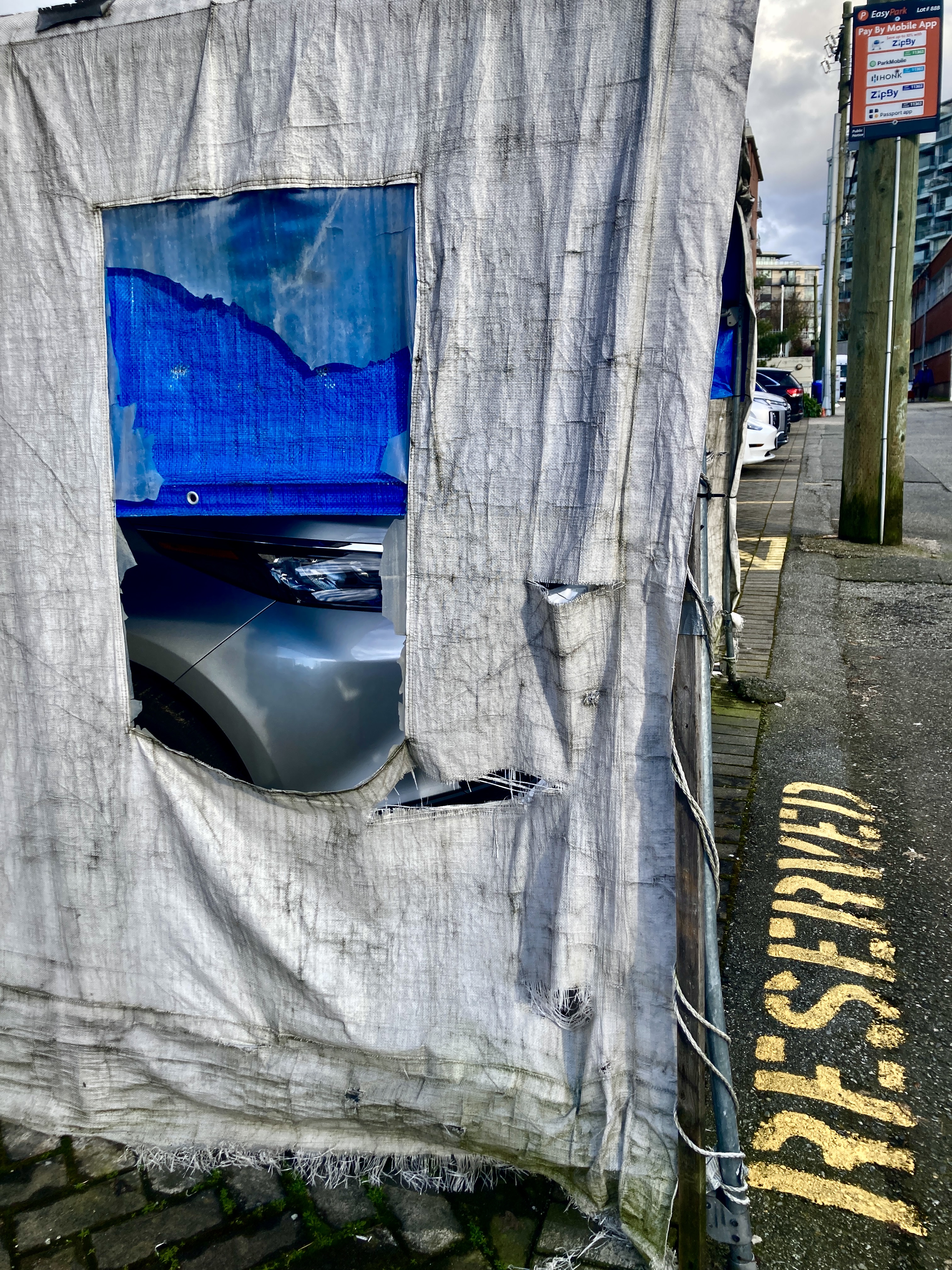
Even this tattered fabric car-shelter is on the bounce. Metallic silver, varying shades of blue in the window panel, and a vivid yellow RESERVED on the pavement for extra impact.
How fitting that right at the Scotia St. end of the alley, just where I turn into the Sally Ann compound, I find the splashiest colour bounce of all: this 2020 VMF mural, Vancouver: a People-Powered Future. (I later learn the artist, Oakland Galbraith, is only 12 years old at the time, which makes it even more wonderful.)
Next day, more sunshine, more bounce — starting with my own slight geographic bounce, down to the Devonian Harbour Park on Burrard Inlet at the edge of Stanley Park.
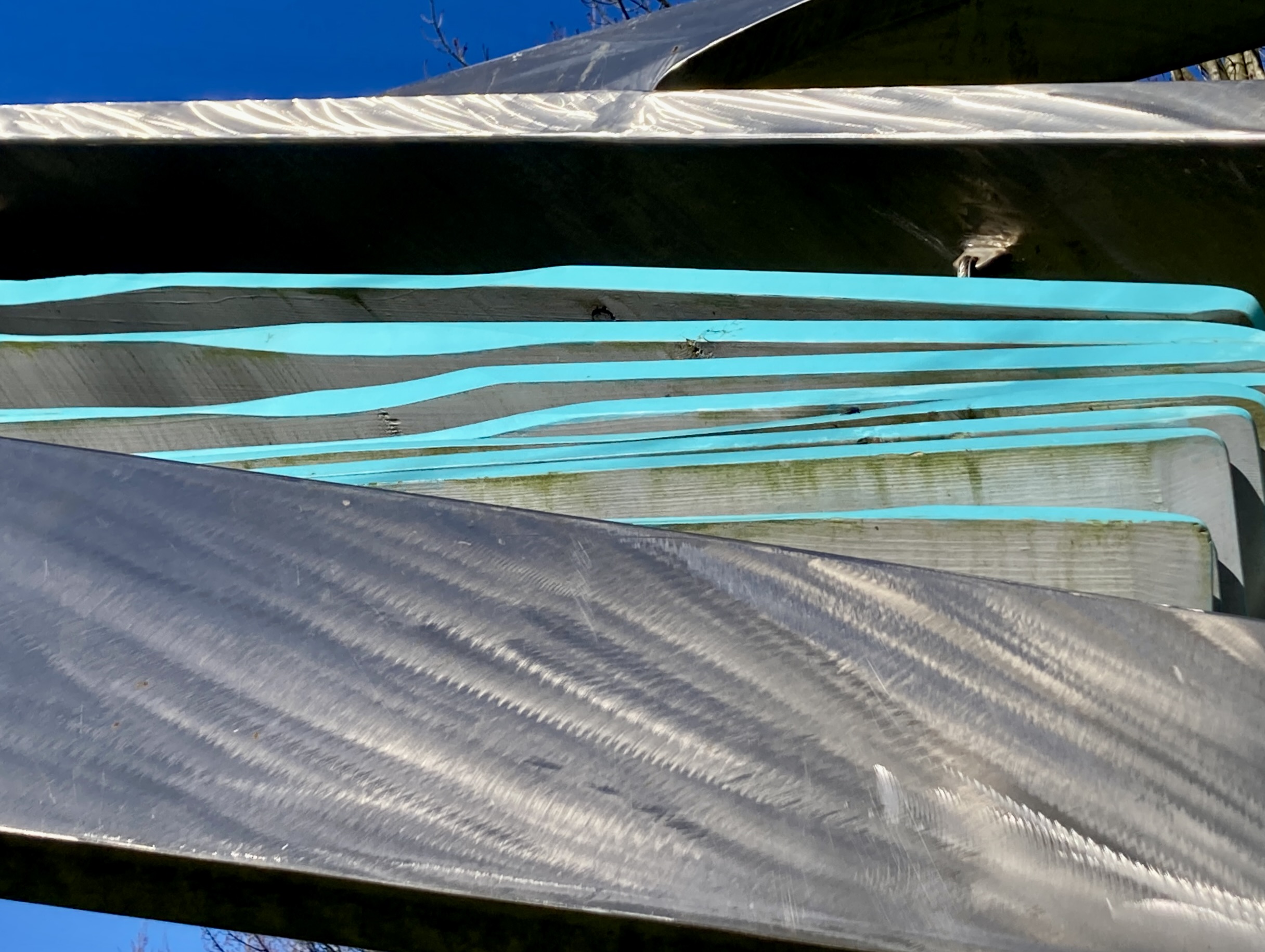
I happen to think the park’s signature sculpture installation is OK-fine, but not outstanding. Today, in all this blazing sunshine, it is outstanding. Today, there is nothing solo about Solo(Natalie McHaffie, 1986); it offers a whole conversation among its elements.
Neon-bright turquoise cedar panels play against stainless steel framework that seems to ripple in the light…
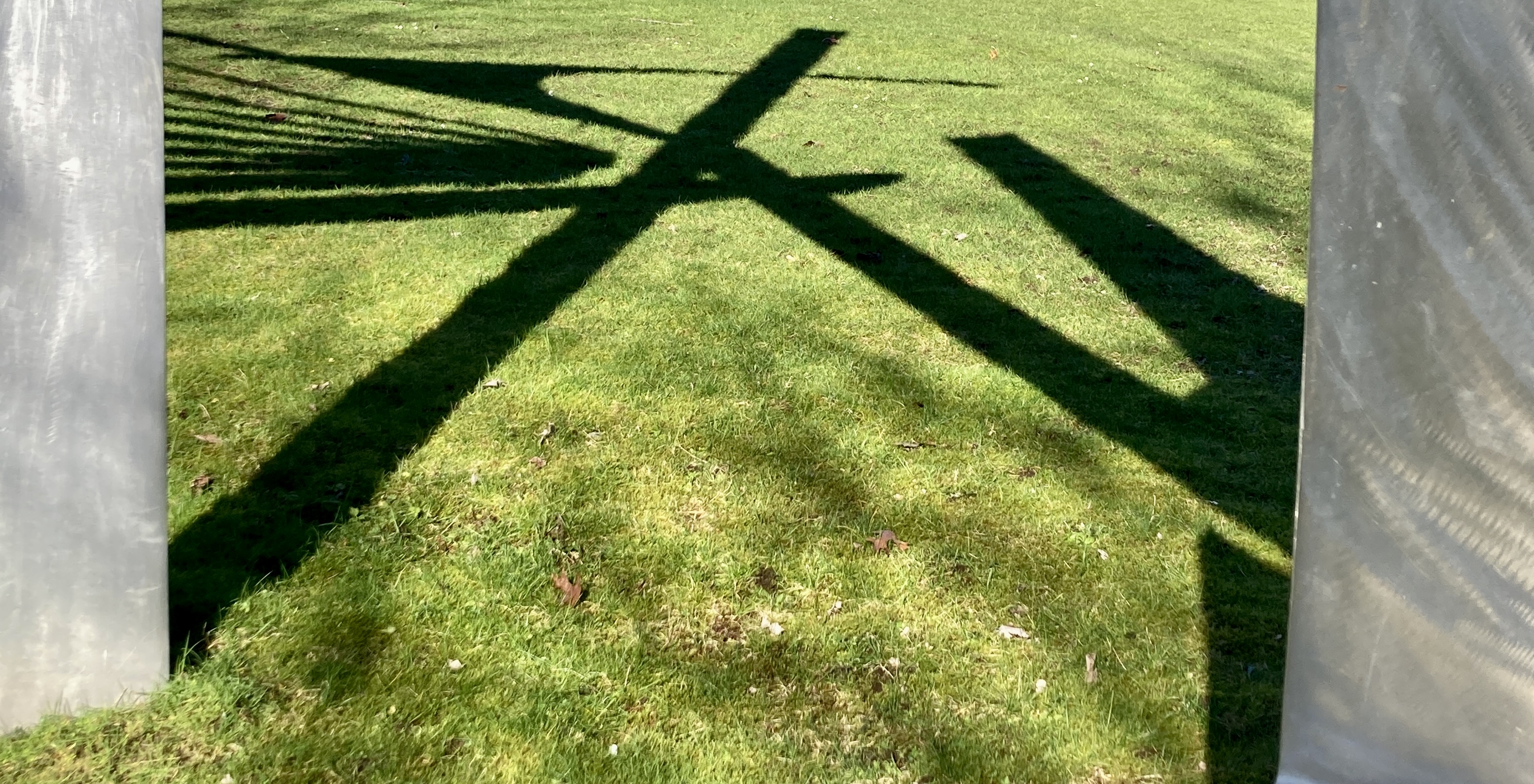
and, together, they throw sharp black outlines against the green grass.
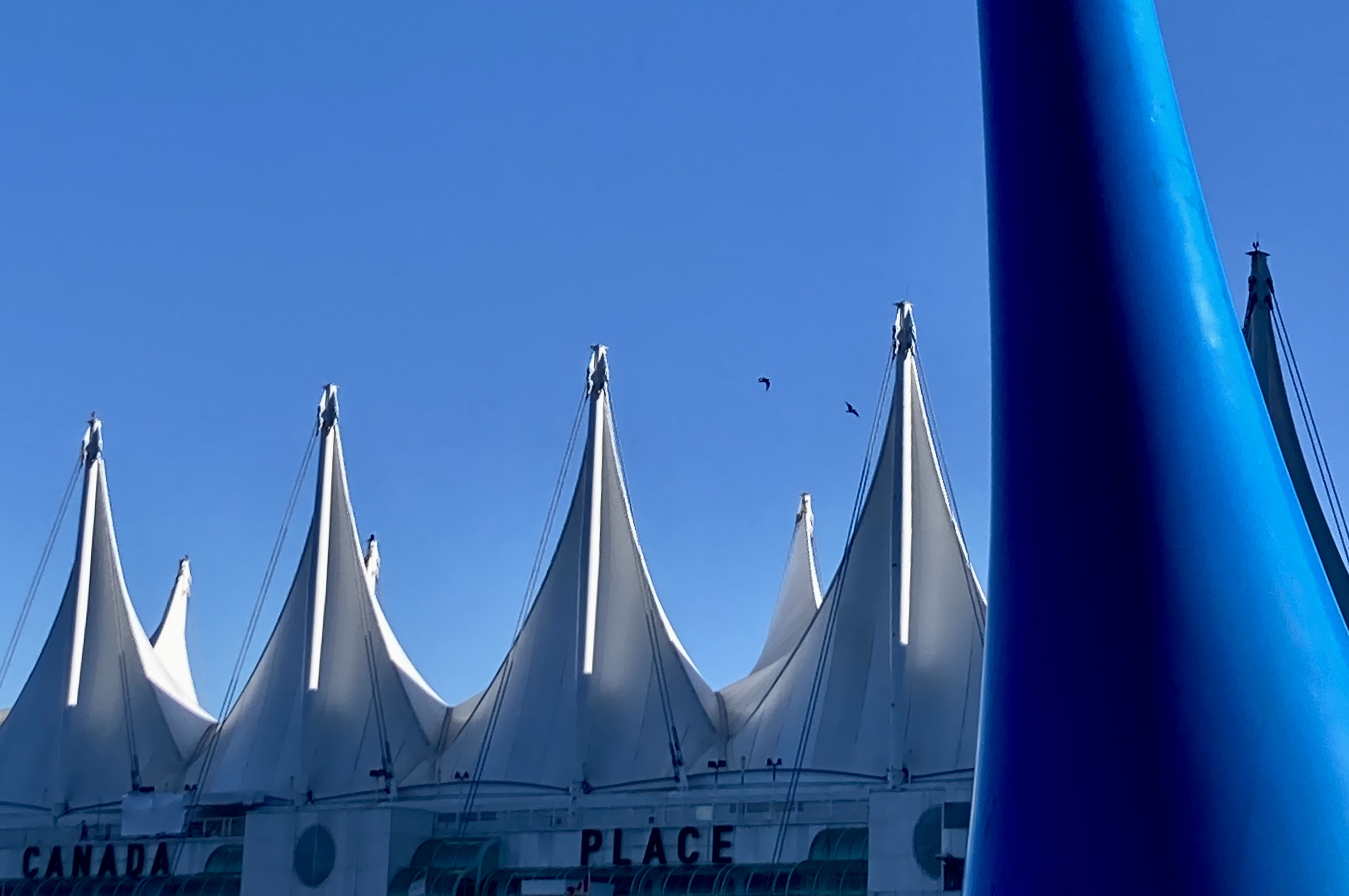
Later, at the eastern end of my walk, I eye the bright edge to each peak on the Canada Place fabric roof…
and realize the sun can throw sharp white outlines just as easily as black.
25 November 2025 – In my bit of the Northern Hemisphere, November means lots of rain…
and seasonal criteria for “awesome.”
This year-round sign on the allotment fence in Tea Swamp Park invites us to adapt our eye, and enjoy what’s currently on offer. Rusty old leaves, for example, still clothing this shrub…
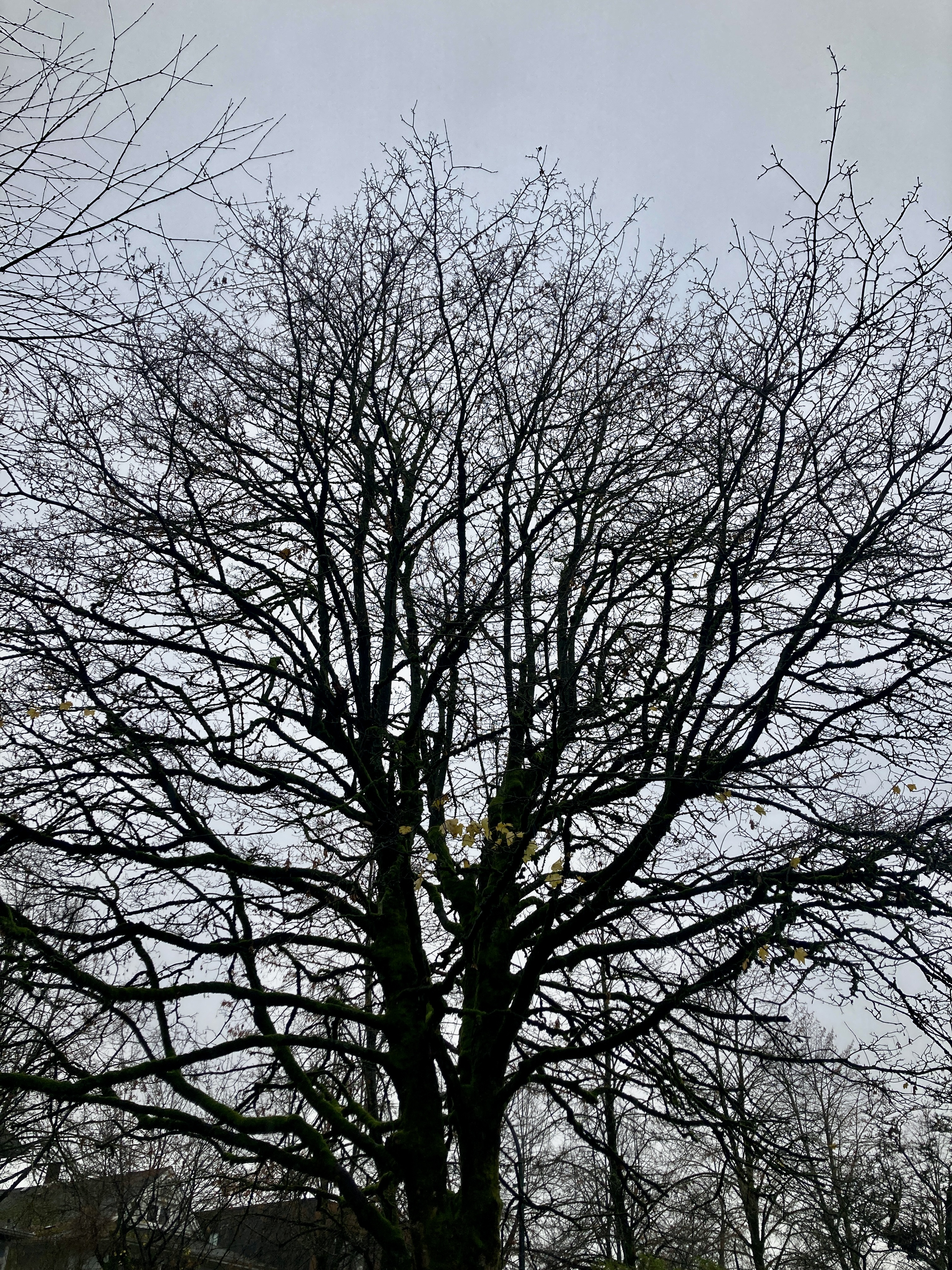
and shameless bare-naked deciduous trees…
dancing around in their bones.
Walking back north on Main, I pass a trio of parks-in-the-making.
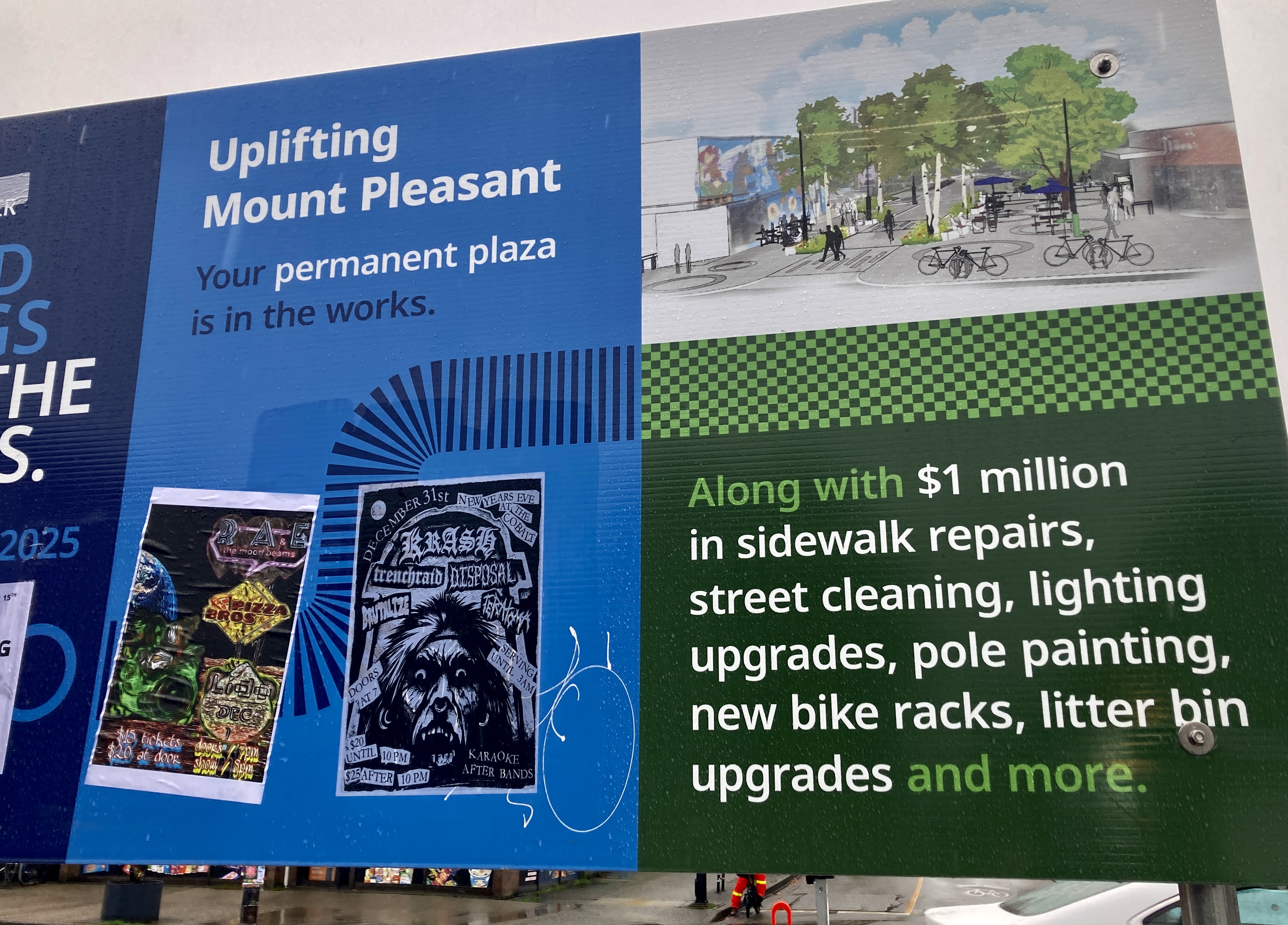
A “permanent plaza” under construction, here at Main & 12th (yes folks, your tax dollars at work)…
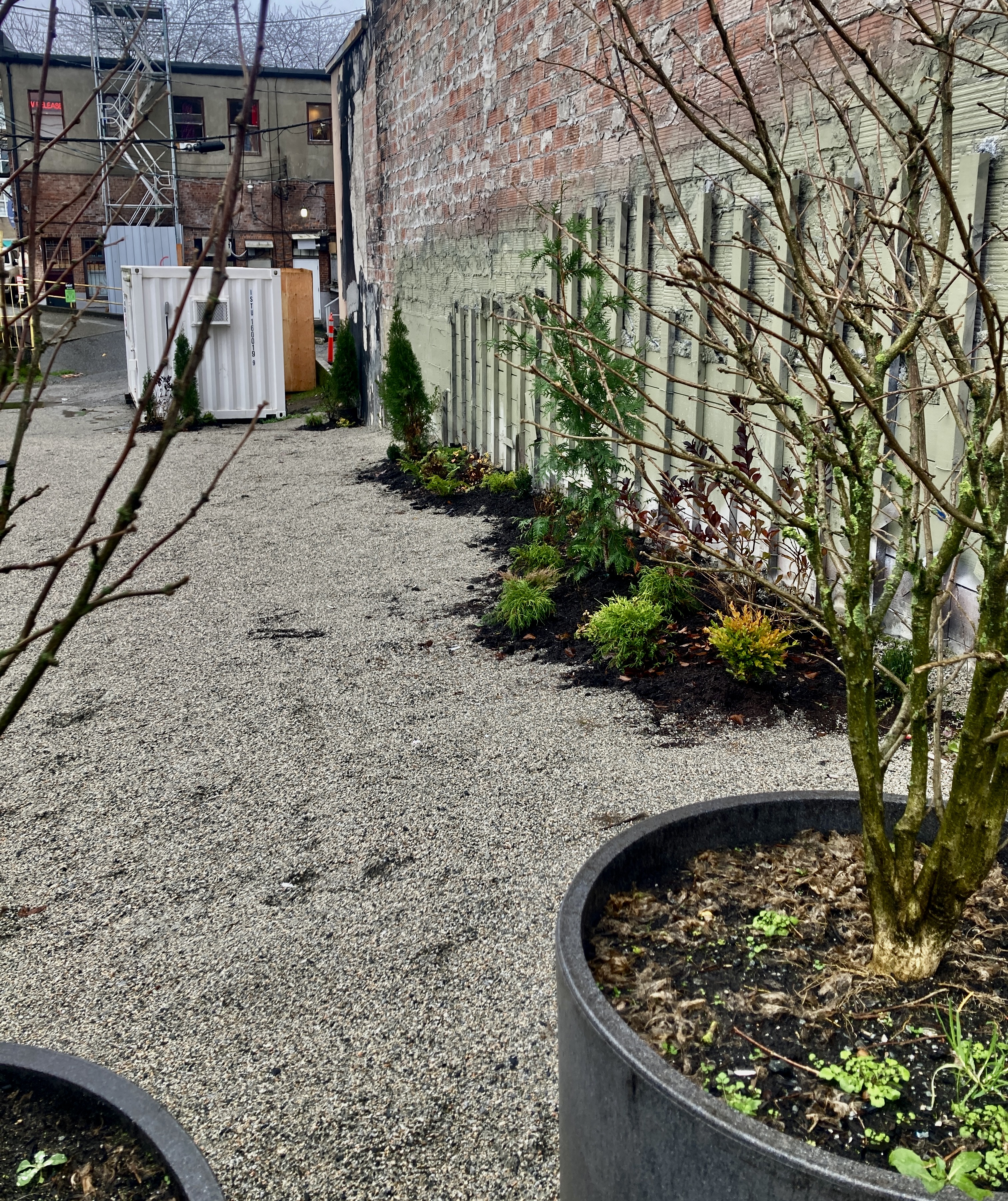
with gravel being industriously moved from Here to There.
Farther north, the site at Broadway & Main that had lain razed and desolate behind mesh fencing ever since a triple-alarm fire gutted its buildings…
is now fence-free and adorned with bright, shiny-wet picnic tables.
Plus a smidge of new landscaping, along the southern edge.
I’m still thinking about that slightly surreal tableau when — crossing 7th & Main — I see something even more surreal:
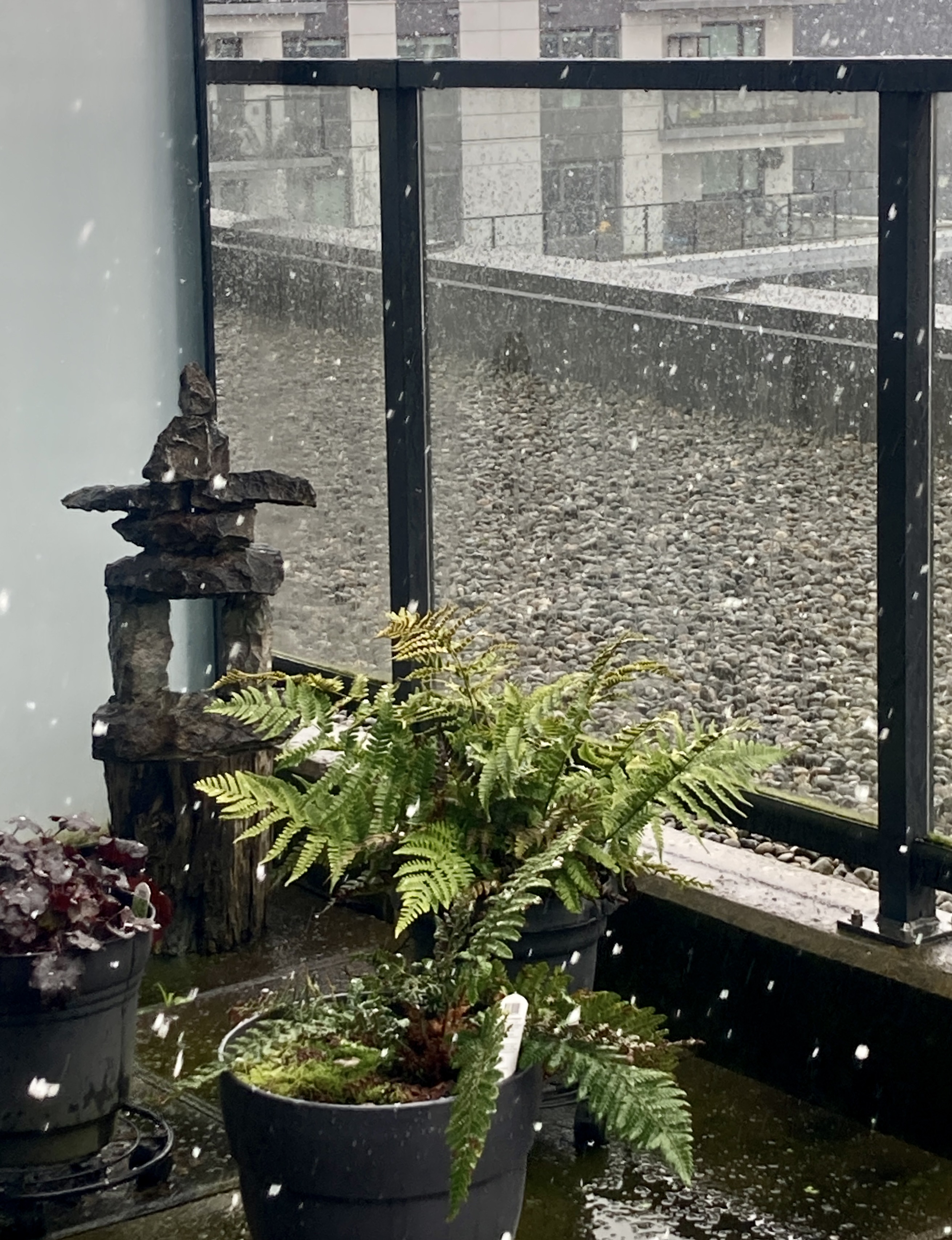
No, not the mural, not Slim’s BBQ — the snowplow! What? A bright yellow snowplow fitted to the front of the truck behind that white car. Ready to take on the snow. In the rain.
One more future-park. With more tax-dollar signage.
Like the one down the street, it’s early stage, mostly gravel and hints of Things To Come, narrowly visible through fence post gaps.
I take advantage of the building opposite, for the roof-top perspective.
The rain, here in Rain City, blurs the view but the view still rewards the trip.
16 November 2026 – I have a plan. Take the #19 bus; get off at Granville; walk south a few blocks; visit two art galleries.
But then I get on the wrong bus, and things do not go according to plan.
Two different bus routes come ’round the corner, you see, and I don’t bother reading the signage before I jump aboard. I settle back, ready to indulge in city-watching until we reach the #19’s Granville stop. Except… we don’t. The bus turns north well before Granville and ends its run at Waterfront Station.
Which is exactly what the #8 is supposed to do.
More than a little sheepish, I step down and rethink my route. I’m still within easy reach of my first target, the VAG (Vancouver Art Gallery); I’m just approaching it from a different angle — an angle that, with a couple of zig-zags, finds me heading south on Howe Street, between West Pender and Dunsmuir.
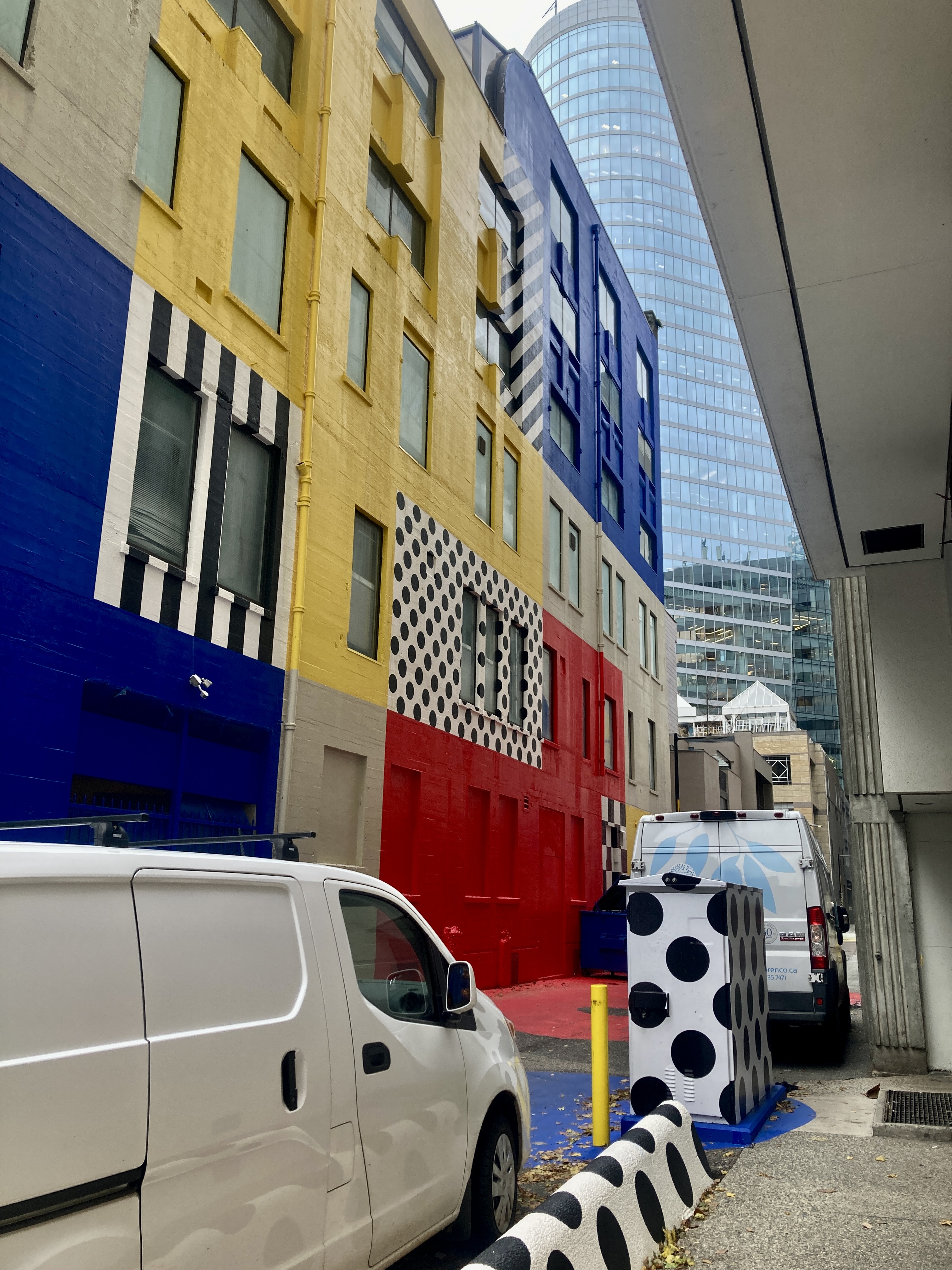
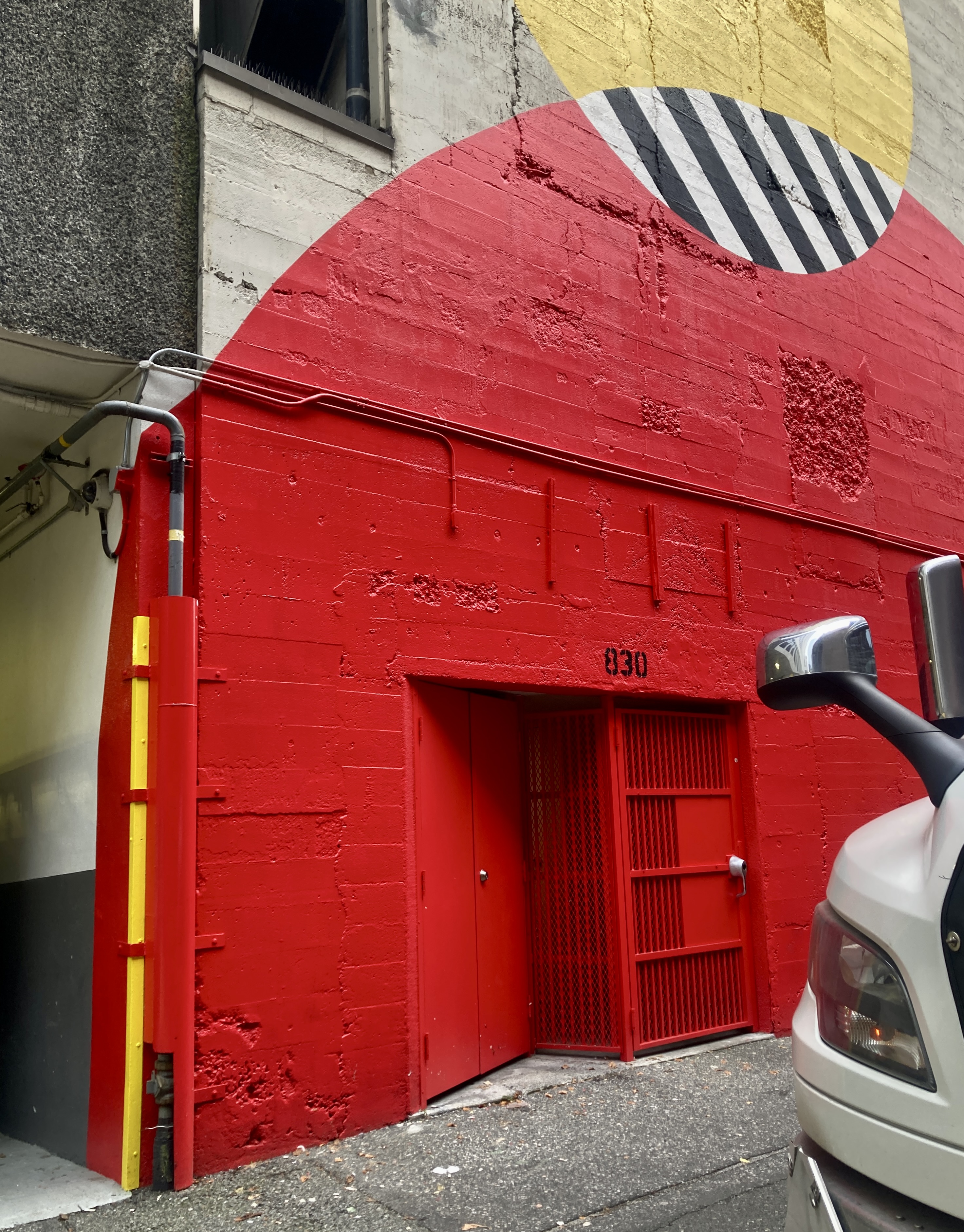
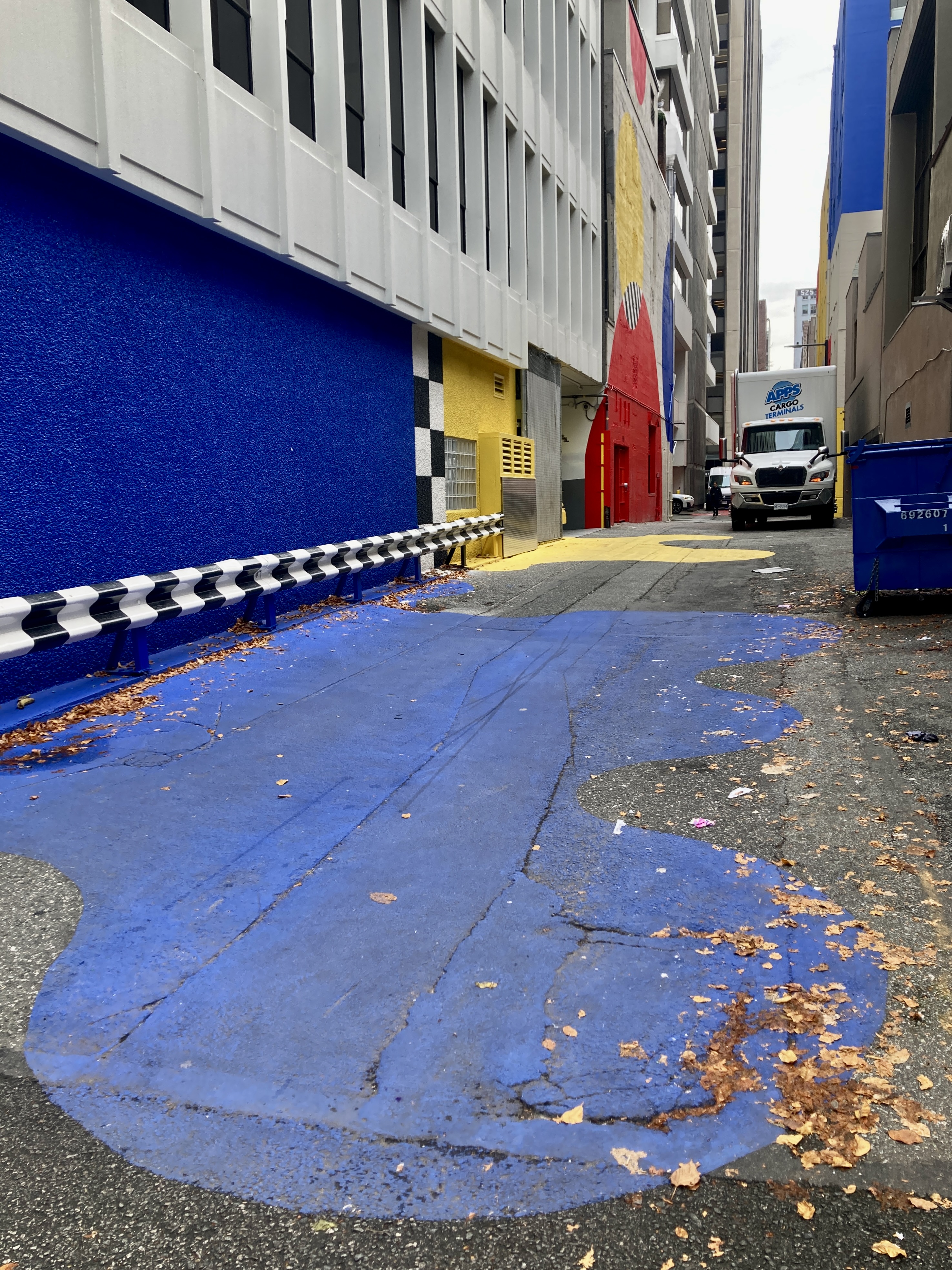
Where — eyes right — I see this alley, bouncing its colours in every direction.
Look at all those rectangles! And the polka-dots! (Which splash their reflections all over the adjacent white van.)
The alley pulls me in, how could it not? Happy rectangles to the south; happy circles to the north…
forming still-life tableaux with delivery trucks and doorway tubing.
Splatters on the pavement. Yellow…
and red…
and, here at the Hornby end of the block, bright blue. Further adorned with russet leaves.
I’m well-pleased with my wrong-bus start to the day. It fed me into this alley, handed me all this unexpected art while on my way to expected art.
There’s one more hit of the unexpected yet to come. I find it in the plaza just east of the VAG.
Lanterns.
All the forms in these lanterns, says the signage for Lux Memoriae (Tidal Reflections) by Ari Lazer, come from the tidal contours of the Fraser River.
This theme ties perfectly, and I am sure deliberately, with the VAG exhibition I have come to see: We who have known tides . Drawn from the VAG’s permanent collection of art by indigenous artists, all of the works in some way reference life interwoven with ocean and tide.
A spill of abalone shells (I am turning towards tides, winds, clouds, rainfall, by Tanya Lukin Linklater), for example, burnished and positioned on a tarp…
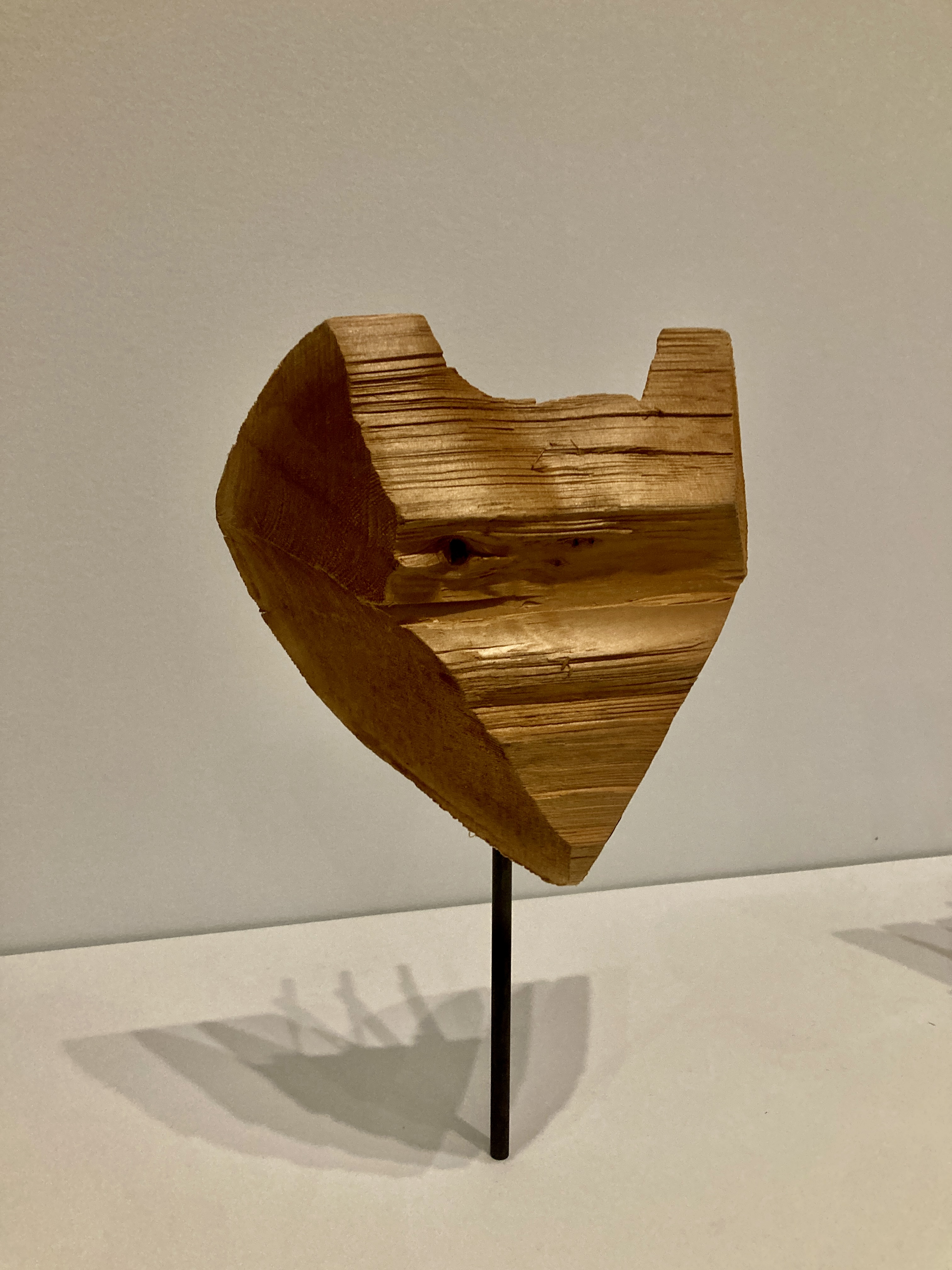
and, on the far wall, four pieces of found cedar (Longing, by Sonny Assu)…
all end cuts, and each selected for its resemblance to a mask.
I do not visit other floors, other exhibitions. I take myself a little farther south on Howe, for the Our French Connection show at Outsiders and Others.
This is a different art world entirely, in a gallery focused on contemporary work by self-taught and non-traditional artists. There is great diversity of styles, materials and objects — but every piece pulses with the outsider energy of the person who created it. I’m always engaged, when I visit this gallery, a-buzz with what surrounds me.
And, almost always, before I get to the art I have a bit of a chin-wag with Yuri Arajs, the gallery’s Artistic Director and Curator. Today I pull out my phone, show him the alley I discovered en route.
He plucks the phone from my hand, walks over to the wall, and holds this image I took of the alley in Vancouver…
next to this pen-on-paper Star Car, drawn by Dominique Lemoine in France.
We shake heads at each other and laugh. Art is all over the place! Inside, outside, in galleries, in alleys, bursting 360° through human demographics & world geography, discovered by intention or just by climbing on the wrong bus.
Pleased with that thought, I reclaim my phone and turn my attention to the show.
(Which I urge you to do as well, should you be in Vancouver this month.)
14 September – And then, from morning to afternoon, I leave Toronto and land in Vancouver. Here I am, looking through slight drizzle to the mountains, with one last love-letter I want to offer “T.O.” (Tee-Oh, Toronto.)
My T.O., that is, nobody else’s — my own mix of memory and re-discovery, blind to what others would notice, alert to all my own triggers.
Glimpses from streetcars, for example.
A rampart mural by Shalak Attack, which I remember watching her paint, many years ago…
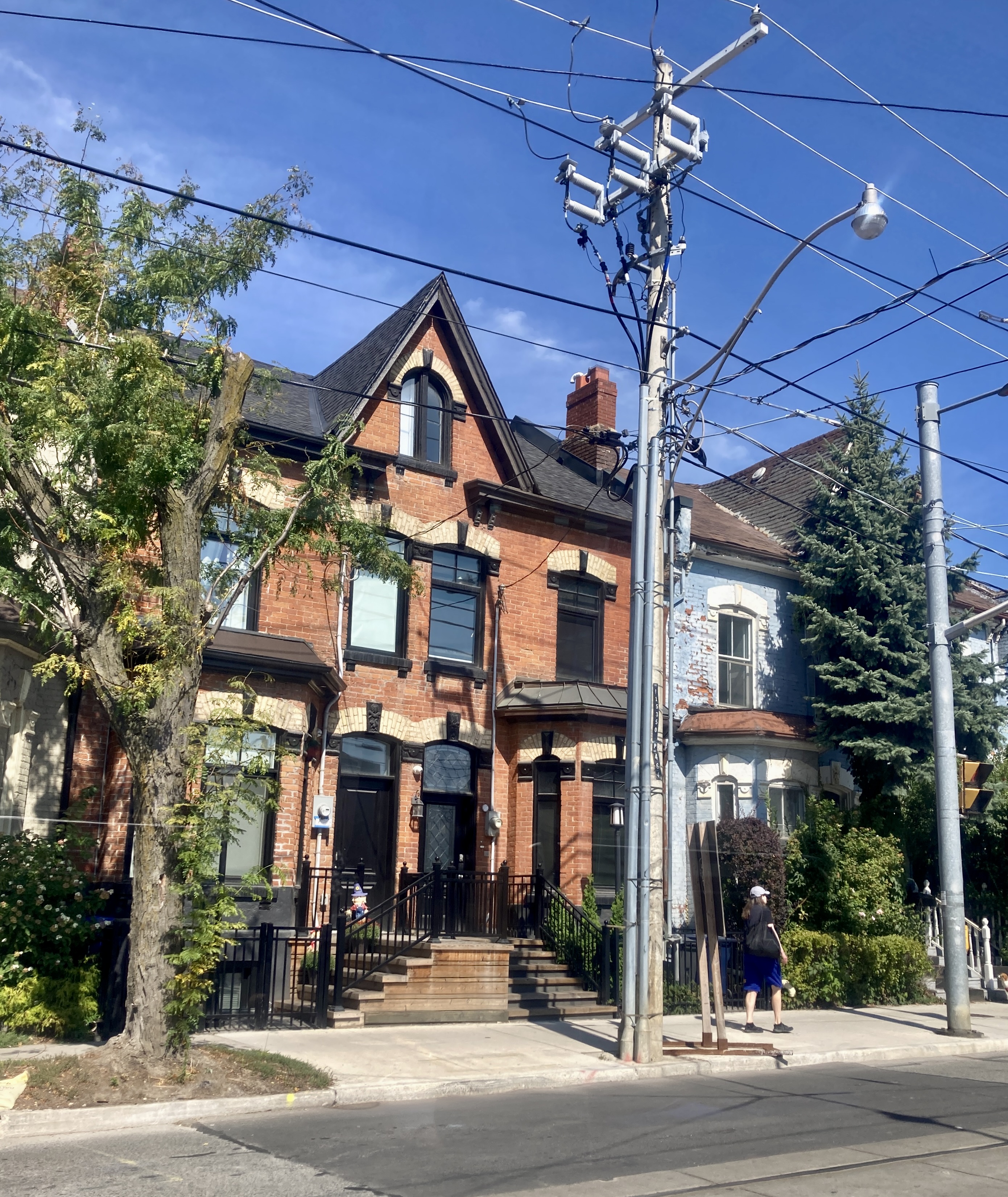
the distinctive two-tone brick and architecture I associate with my own decades in the Cabbagetown neighbourhood, but common to the city in that era…
and Streetcar Dog. Not unique to Toronto, but part of my own memory bank of riding the TTC.
Then there are my re-discoveries on foot, all around the Grange neighbourhood and the Art Gallery of Ontario, where I was for years a volunteer and therefore an area where I came and went, a very great deal.
Bronze turtle watching martial-arts in Butterfield Park, the new-since-my-time refurbishment of the land just east of Grange Park and south of OCAD (Ontario College of Art + Design) University…
Henry Moore’s Large Two Forms, looking very at home in its new home in the reinvented Grange Park, with the brilliant blue rear wall and distinctive Frank Gehry staircase as backdrop…
and, once inside, the soaring glulam arches of the AGO’s front-façade Galeria Italia.
Unchanged, these arches. Ditto, the way the Galeria invites you to look out across Dundas Street. Native son Gehry made sure his design honoured and welcomed the neighbourhood of his childhood as its own visual final wall.
I am in the AGO as much to walk old ground as to see current exhibitions, but in the end I do both.
The Joyce Wieland retrospective, Heart On, speaks not only to my memories of her bursting on the scene, but also to how current she now is, once again.
Wieland was a fierce ’60s-70s feminist and, despite (or perhaps because of) long years in New York, a fierce Canadian patriot as well. She often used the soft “feminine” skills of embroidery or quilting to express strong political convictions.
For example, with her 1970 work, I Love Canada – J’aime Canada.
Awwww. (Twist finger in cheek.) So sweet.
Now read the signage.
And read the embroidered fine print.
Wieland’s narrow definition of Canadian identity is now out-dated — but the rest of her analysis is Elbows-Up contemporary.
Some hours later, I leave the building. I still have more circling and prowling to do.
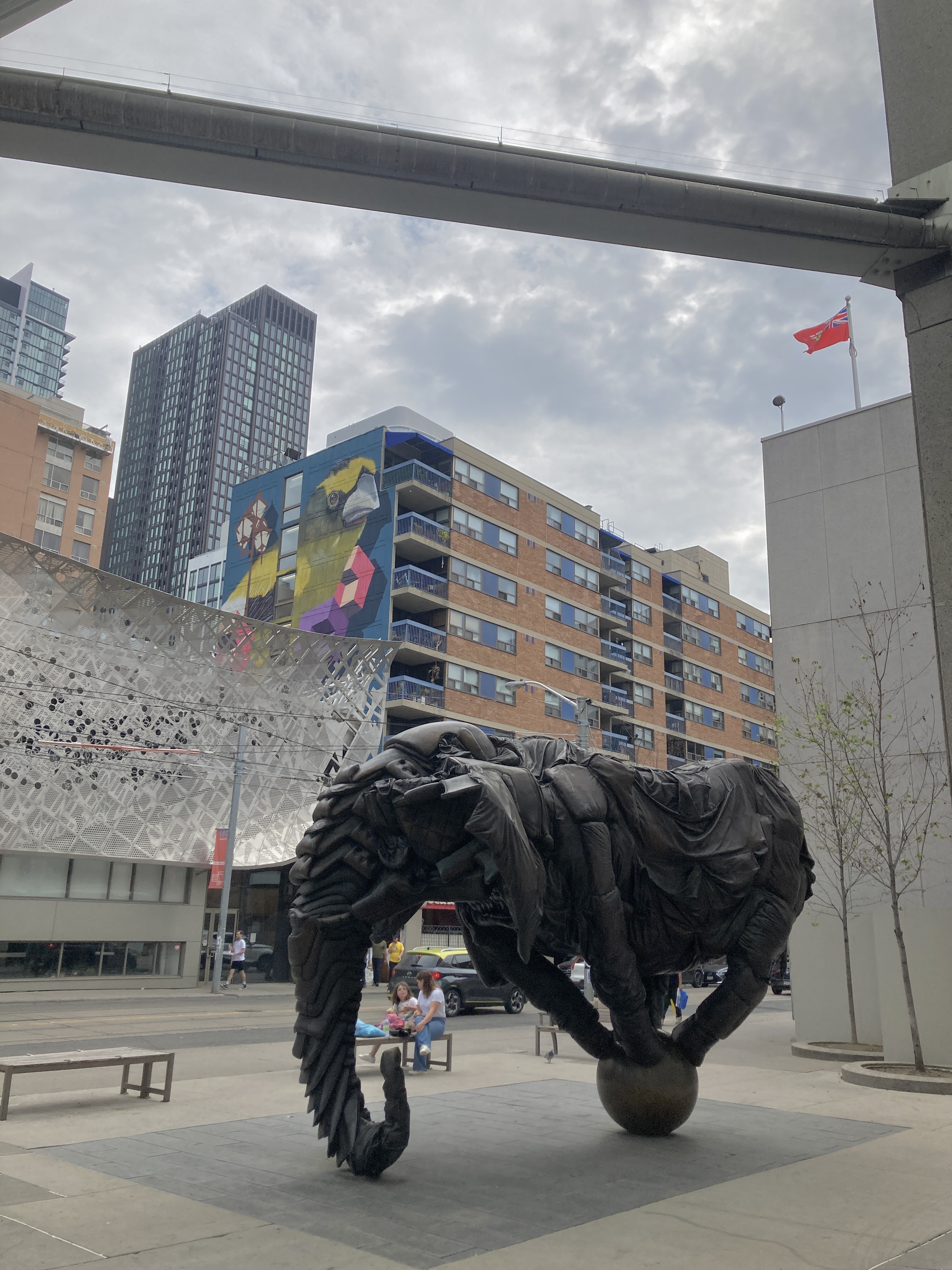
I check out the S/W corner of Dundas West & McCaul. It is also the N/E corner of the AGO footprint and, in my day, was still home to Moore’s Large Two Forms. For the first time, I see what now sits on that corner — Brian Jungen’s commissioned work, Couch Monster. (Read more, here, in a fine post by our WordPress colleague, Canadian Art Junkie.)
I circle the work, and also take in the larger view, including the top of an old mural by veteran Toronto artist Birdo, now obscured by newer construction and backed by even-newer construction.
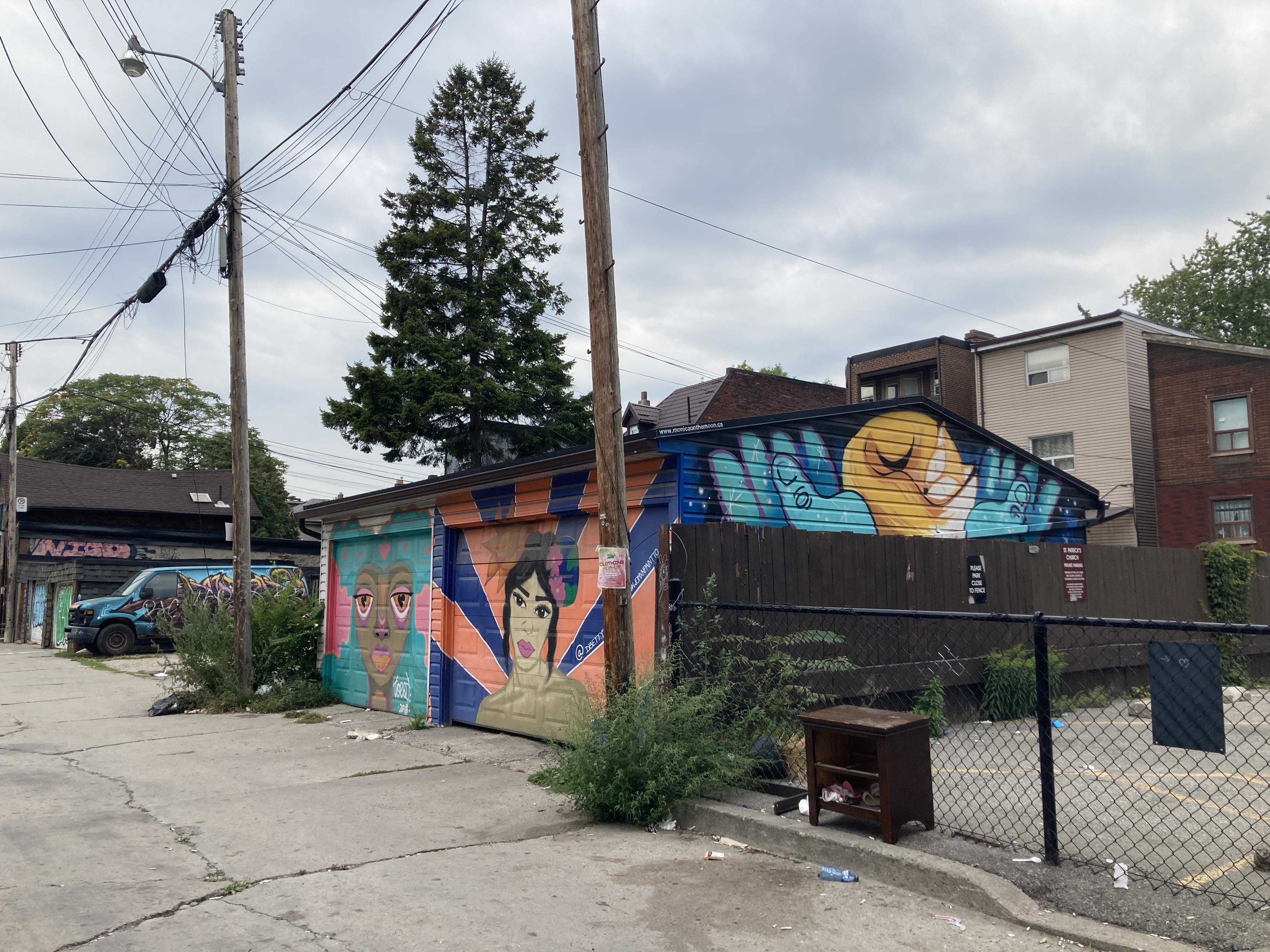
Finally, and not with terrifically high hopes, I take myself across Dundas West and into the alley between Dundas and Darcy Street to the north. I am eager but also dreading to see what it’s like, these days. My memory is of an alley bursting with street art, full of the “garage-door art” that I associate with my memories of Toronto.
And…
there it still is. On and on, to the west, beyond the frame of this image. Not exactly as it was, of course not, but alive and current and so-very-T.O.
I turn right on a second, N/S, alley, passing delicate tendrils and other art as I go…
and emerge on Darcy Street.
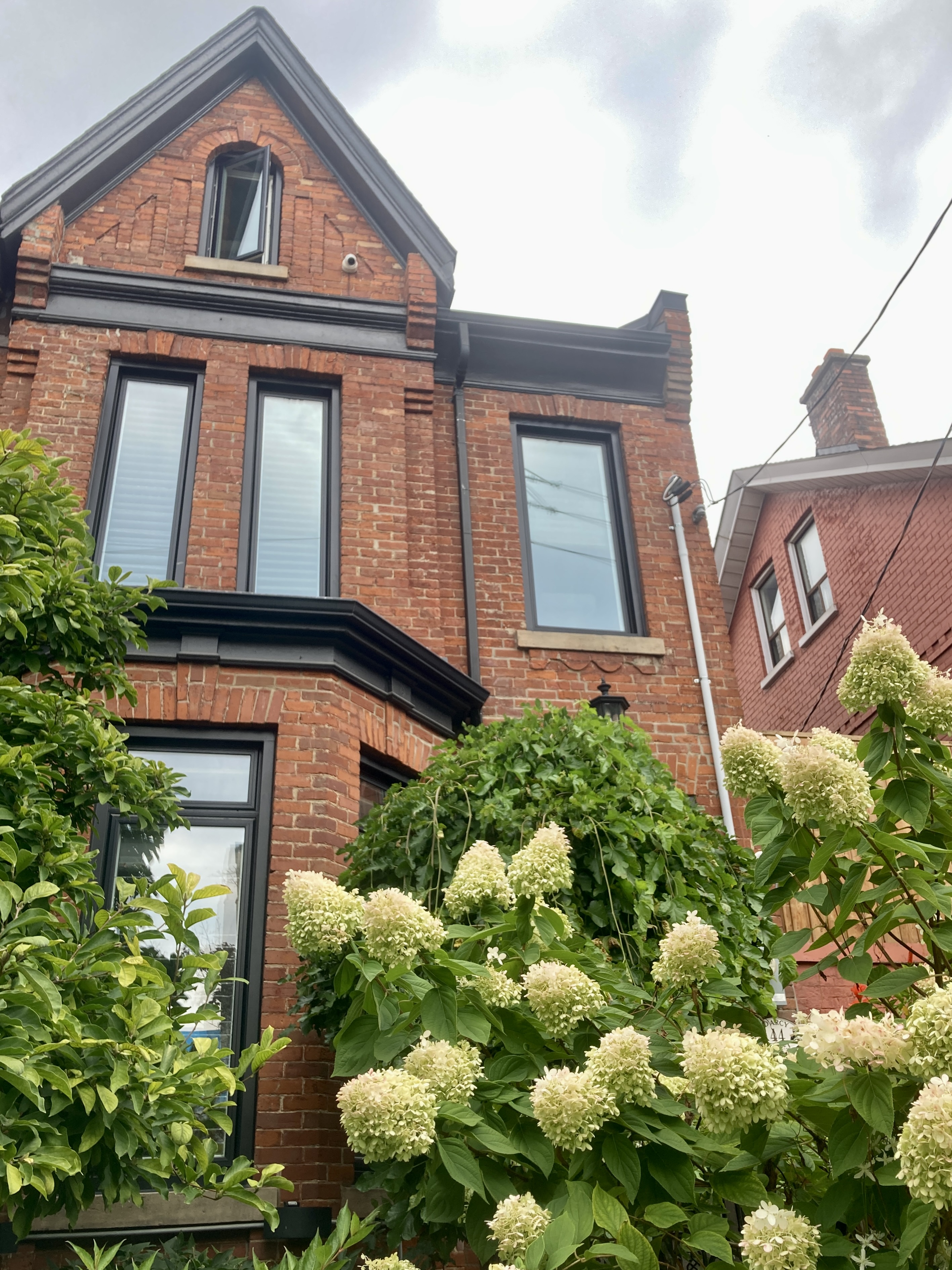
Where I drink in an enclave of old downtown residential architecture, oh look, some still survives…
and then pivot on my heel to look east down the block. Out to McCaul Street.
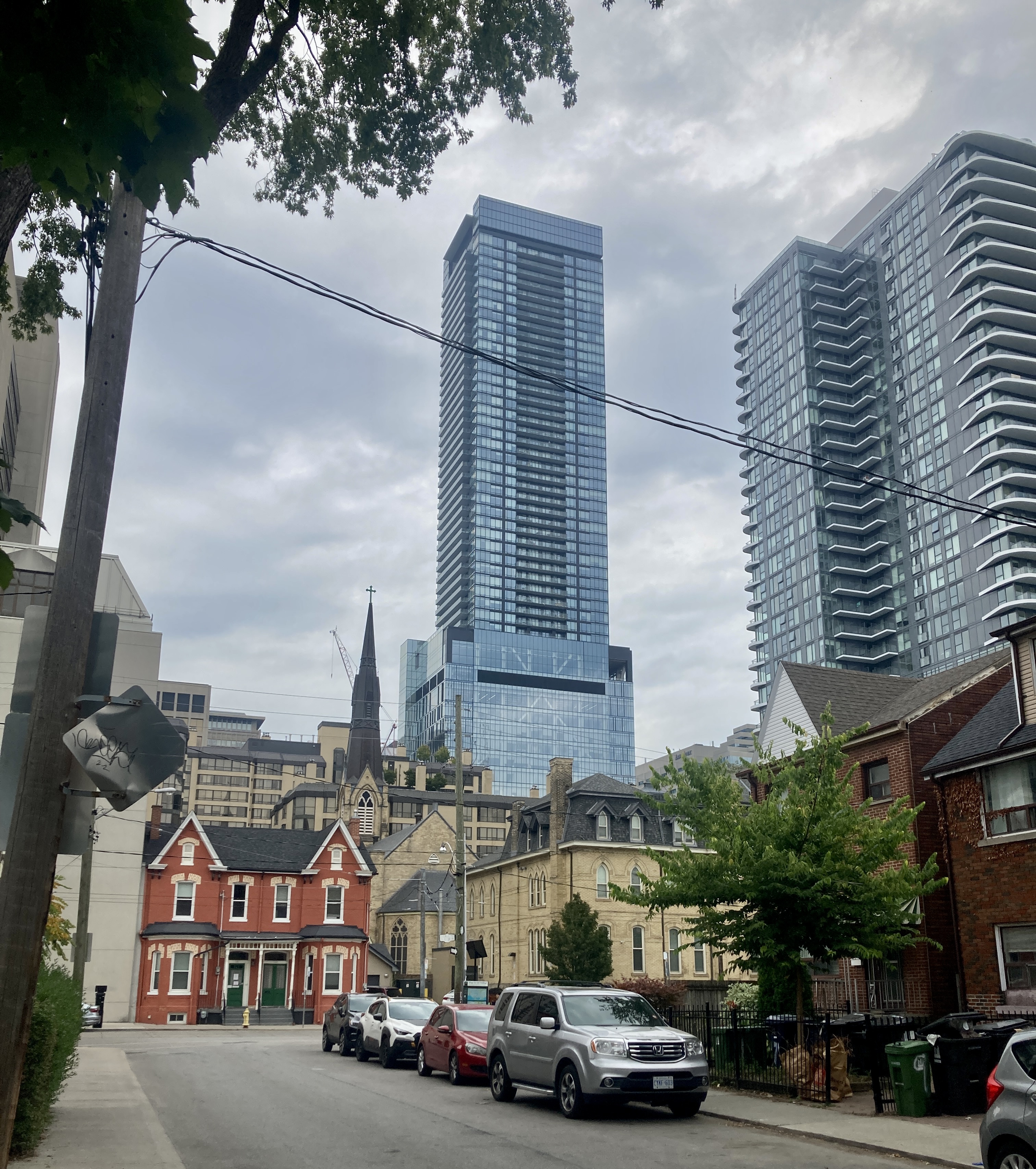
Still some old brick homes, and still the spire of St. Patrick’s Church (the 5th-oldest Roman Catholic parish in Toronto) as well — plus the immediate examples of all the new towers now exploding skyward.
There it all is.
The whole jarring/exhilarating, cacophonous/euphonious, forever-evolving symphony of the city.
"Traveller, there is no path. Paths are made by walking" -- Antonio Machado (1875-1939)
"The voyage of discovery is not in seeking new landscapes, but in having new eyes" -- Marcel Proust (1871-1922)
"A city is a language, a repository of possibilities, and walking is the act of speaking that language, of selecting from those possibilities" -- Rebecca Solnit, "Wanderlust: A History of Walking"