So T.O.

14 September – And then, from morning to afternoon, I leave Toronto and land in Vancouver. Here I am, looking through slight drizzle to the mountains, with one last love-letter I want to offer “T.O.” (Tee-Oh, Toronto.)

My T.O., that is, nobody else’s — my own mix of memory and re-discovery, blind to what others would notice, alert to all my own triggers.

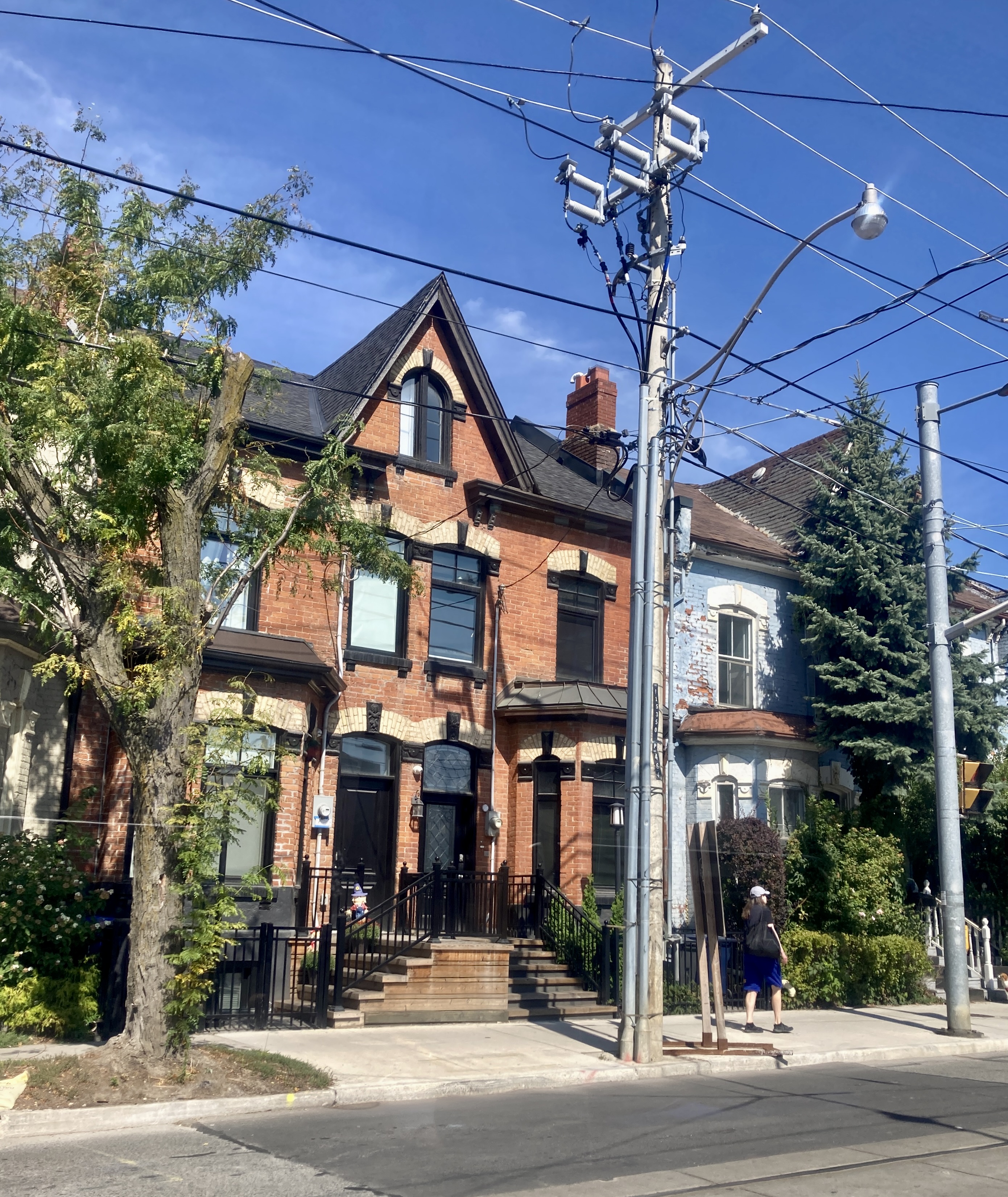
Glimpses from streetcars, for example.

A rampart mural by Shalak Attack, which I remember watching her paint, many years ago…

the distinctive two-tone brick and architecture I associate with my own decades in the Cabbagetown neighbourhood, but common to the city in that era…
and Streetcar Dog. Not unique to Toronto, but part of my own memory bank of riding the TTC.

Then there are my re-discoveries on foot, all around the Grange neighbourhood and the Art Gallery of Ontario, where I was for years a volunteer and therefore an area where I came and went, a very great deal.

Bronze turtle watching martial-arts in Butterfield Park, the new-since-my-time refurbishment of the land just east of Grange Park and south of OCAD (Ontario College of Art + Design) University…

Henry Moore’s Large Two Forms, looking very at home in its new home in the reinvented Grange Park, with the brilliant blue rear wall and distinctive Frank Gehry staircase as backdrop…

and, once inside, the soaring glulam arches of the AGO’s front-façade Galeria Italia.

Unchanged, these arches. Ditto, the way the Galeria invites you to look out across Dundas Street. Native son Gehry made sure his design honoured and welcomed the neighbourhood of his childhood as its own visual final wall.

I am in the AGO as much to walk old ground as to see current exhibitions, but in the end I do both.

The Joyce Wieland retrospective, Heart On, speaks not only to my memories of her bursting on the scene, but also to how current she now is, once again.

Wieland was a fierce ’60s-70s feminist and, despite (or perhaps because of) long years in New York, a fierce Canadian patriot as well. She often used the soft “feminine” skills of embroidery or quilting to express strong political convictions.

For example, with her 1970 work, I Love Canada – J’aime Canada.

Awwww. (Twist finger in cheek.) So sweet.

Now read the signage.

And read the embroidered fine print.

Wieland’s narrow definition of Canadian identity is now out-dated — but the rest of her analysis is Elbows-Up contemporary.

Some hours later, I leave the building. I still have more circling and prowling to do.

I check out the S/W corner of Dundas West & McCaul. It is also the N/E corner of the AGO footprint and, in my day, was still home to Moore’s Large Two Forms. For the first time, I see what now sits on that corner — Brian Jungen’s commissioned work, Couch Monster. (Read more, here, in a fine post by our WordPress colleague, Canadian Art Junkie.)
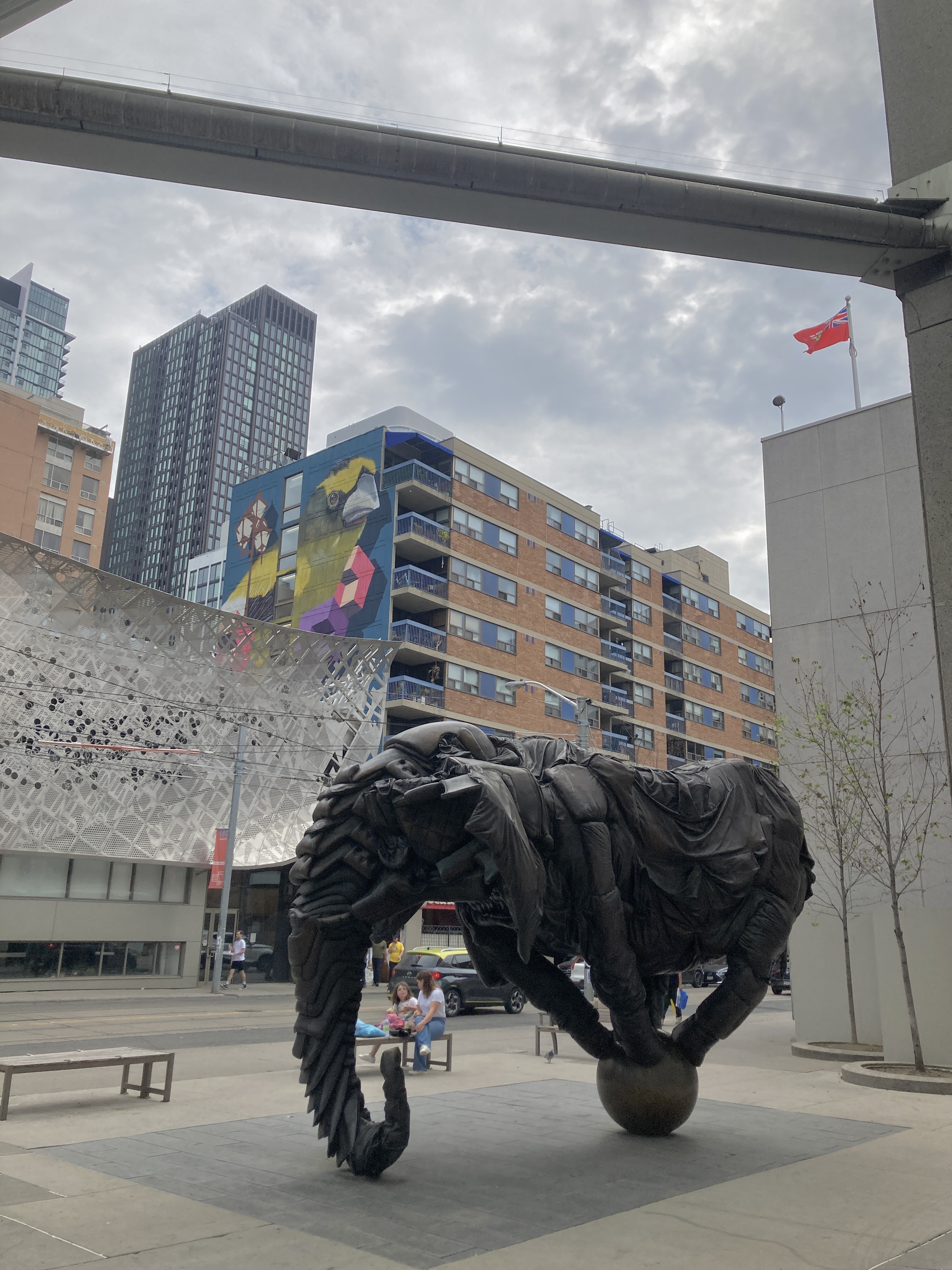
I circle the work, and also take in the larger view, including the top of an old mural by veteran Toronto artist Birdo, now obscured by newer construction and backed by even-newer construction.

Finally, and not with terrifically high hopes, I take myself across Dundas West and into the alley between Dundas and Darcy Street to the north. I am eager but also dreading to see what it’s like, these days. My memory is of an alley bursting with street art, full of the “garage-door art” that I associate with my memories of Toronto.

And…
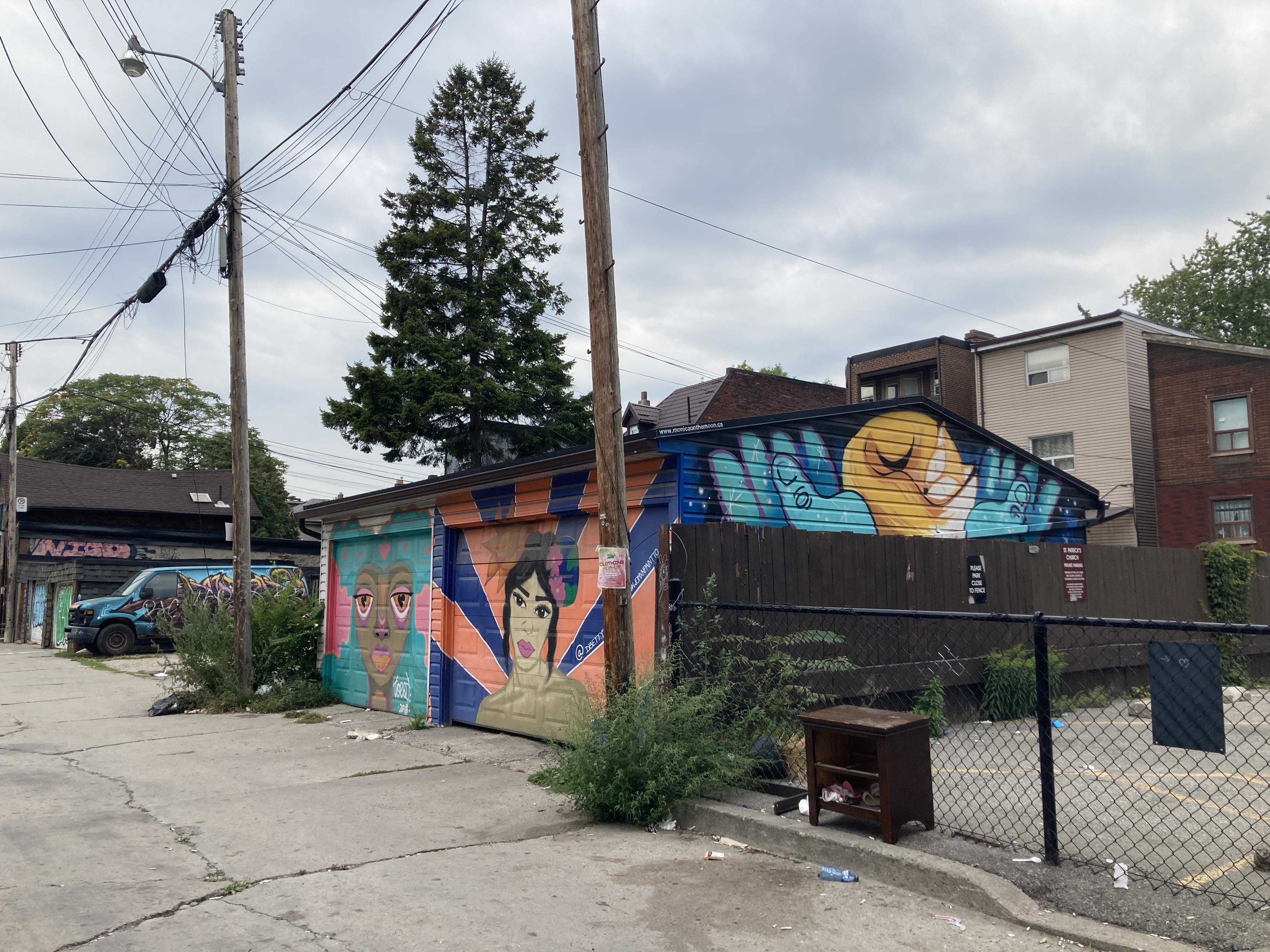
there it still is. On and on, to the west, beyond the frame of this image. Not exactly as it was, of course not, but alive and current and so-very-T.O.

I turn right on a second, N/S, alley, passing delicate tendrils and other art as I go…

and emerge on Darcy Street.

Where I drink in an enclave of old downtown residential architecture, oh look, some still survives…
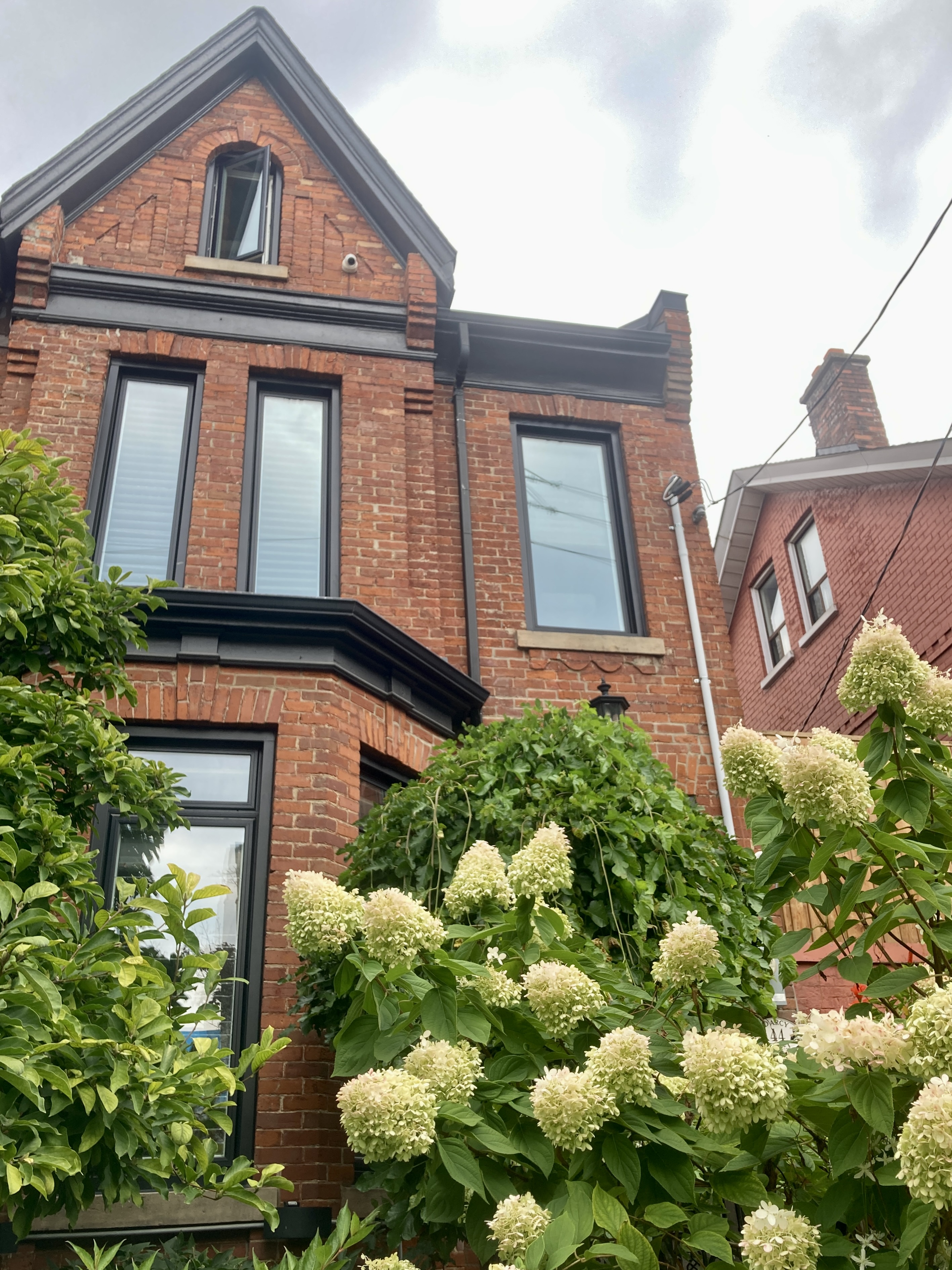
and then pivot on my heel to look east down the block. Out to McCaul Street.
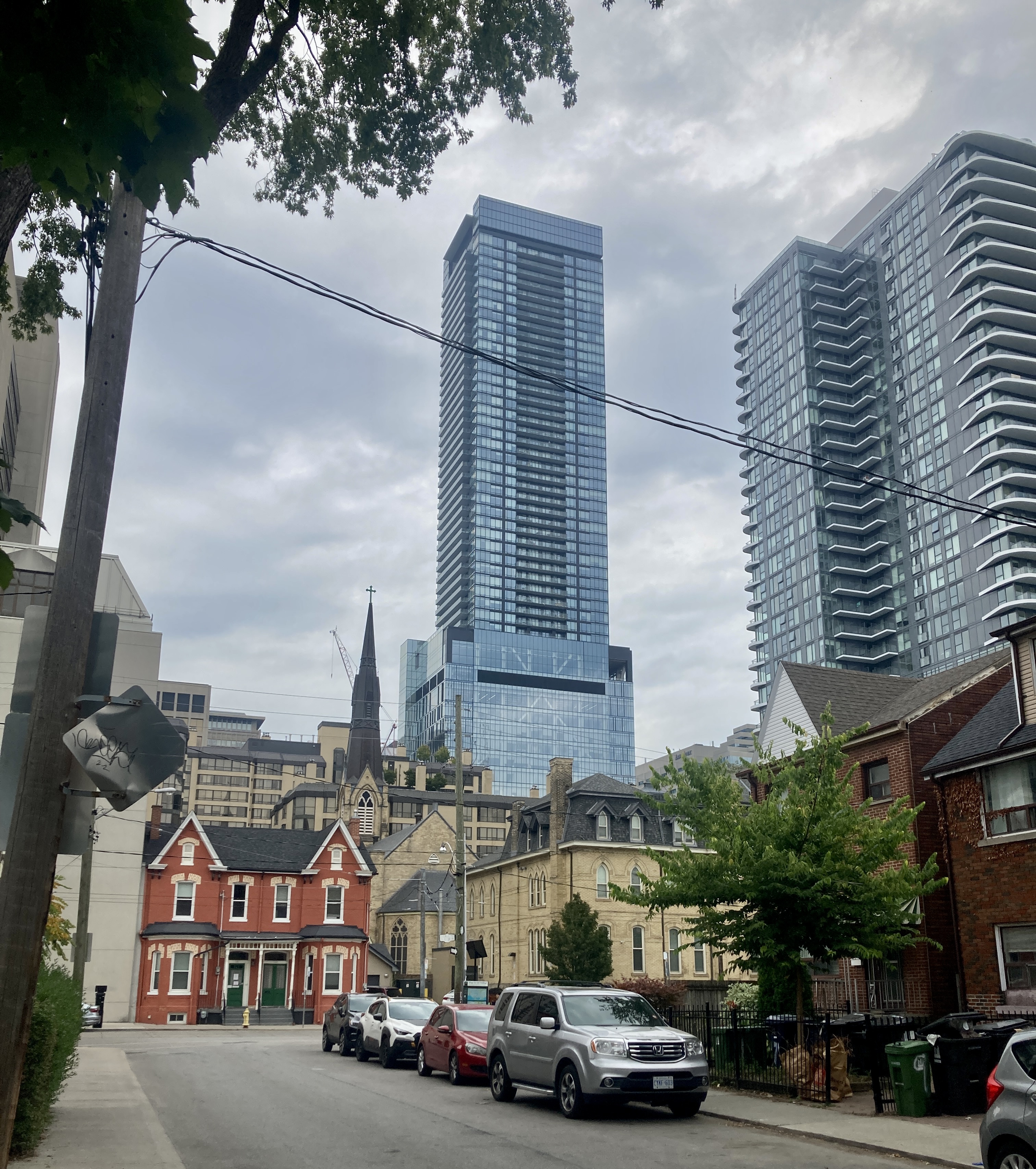
Still some old brick homes, and still the spire of St. Patrick’s Church (the 5th-oldest Roman Catholic parish in Toronto) as well — plus the immediate examples of all the new towers now exploding skyward.

There it all is.

The whole jarring/exhilarating, cacophonous/euphonious, forever-evolving symphony of the city.

So T.O.

Artspeak

8 May 2022 – “Artspeak” is the term that I (and some equally snippy friends) use to disparage gallery signage we consider unduly precious about the art they are describing.

This Japanese camellia blossom, recently dropped into this bronze hand, made me think about that term another way ’round.

Restore ‘speak’ to verb form, I say to myself: the power of art to communicate with the viewer.

More specifically, the power of some public art pieces to speak so powerfully to passers-by — everyday, you-and-me passers-by — that they become part of their community, adopted by that community, beloved.

My mind jumps a few kilometres east to my own neighbourhood park, officially Guelph Park, unofficially and pervasively Dude Chilling Park. Because of this bronze statue by Michael Dennis…

officially Reclining Figure, but unofficially The Dude who — just look at him — is chilling. We chill with him. We hang with him from our favourite park bench…

and we cuddle up to him with our picnic lunches.

The fact I enjoy seeing this kind of familiarity is… extraordinary. I respect art work! It is art, dammit, so admire with your eyes and keep your hands (and other bodily bits) safely out of range! And yet…

With the onset of the pandemic, The Dude became not only beloved, but comforting. The park was a safe place to visit, everybody carefully distanced, and, for the first time, I saw people sit on the plinth, creep into the Dude’s embrace. He is now regularly visited this way. He has never been vandalized.

Very similar story for another bronze sculpture, this one by Henry Moore: Large Two Forms, which for a very long time sat by the sidewalk at the north-east corner of the Art Gallery of Ontario, owner of the sculpture (and much more by Moore as well). Not fenced off, fully accessible, right there by a street car stop. Torontonians have a history of loving works by Henry Moore — this one more physically than the rest. Of course it featured in endless selfies! And of course people sat in its convenient curves, or boosted their children to slide through those curves, while waiting for a street car!

I took this photo in 2015, when the statue had already become seriously weathered — except for that bright patch in the middle, constantly burnished by hands and backsides.

More recently, the AGO has had the statue restored and moved into the equally refurbished (and public) Grange Park to the south of the art gallery. A recent AGO communiqué shows it sparkling bright — but, apparently, still accessible to loving hands.

Back to that camellia, dropped into a local bronze hand, right here at Main and East 24th.

The blossom caught my eye, as I walked past. How could it not?

A child offering a flower to a fire fighter… I read the plaque, later go online. This statue honours the BC Professional Fire Fighters Burn Fund, a charitable organization that does exactly what the name suggests — offers help to burn victims. My guess is that the flower is a very personal tribute, to one instance of that help and the difference it has made in someone’s life.

Statues and floral tributes. My mind jumps years and continents to land in Havana, Cuba, in 2009. I’m revisiting Habana Vieja to write a story for Outpost about the places that my habanero friends love best in their city. One example: the Plaza de San Francisco in general, and this bronze statue in particular.

This is sculptor José Villa’s representation of a much loved local street person, nicknamed El Caballero de París for his insistence (unlikely) that he came of aristocratic French origins. One friend remembered him, still a familiar figure in her childhood: “He was a love! He refused to go into an institution, so everybody fed him and looked after him.” She then sang for me a local ballad, composed in his honour, about the way he greeted his community: “… con una flor tan linda para tí / y un saludo para mí.”

The pretty flowers are now being offered to him, not by him, and on a regular basis. I just happen to pass by when the offering is an Ostrich Plume (aka Red Ginger, or Alpinia purpurata, and thank you to my generous Master Gardener friend, who identified it for me).

I remember lingering across the street, watching the community greet their Caballero. Again and again, passers-by of all ages slowed for a moment, trailed their fingers across his hand or stroked his beard.

Or even…

threw their toddler arms around his legs.

Art that speaks.

  • WALKING… & SEEING

    "Traveller, there is no path. Paths are made by walking" -- Antonio Machado (1875-1939)

    "The voyage of discovery is not in seeking new landscapes, but in having new eyes" -- Marcel Proust (1871-1922)

    "A city is a language, a repository of possibilities, and walking is the act of speaking that language, of selecting from those possibilities" -- Rebecca Solnit, "Wanderlust: A History of Walking"

  • Recent Posts

  • Walk, Talk, Rock… B.C.-style

  • Post Categories

  • Archives

  • Blog Stats

    • 128,835 hits
  • Since 14 August 2014

    Flag Counter
  • Enter your email address to follow this blog and receive notifications of new posts by email.

    Join 2,047 other subscribers