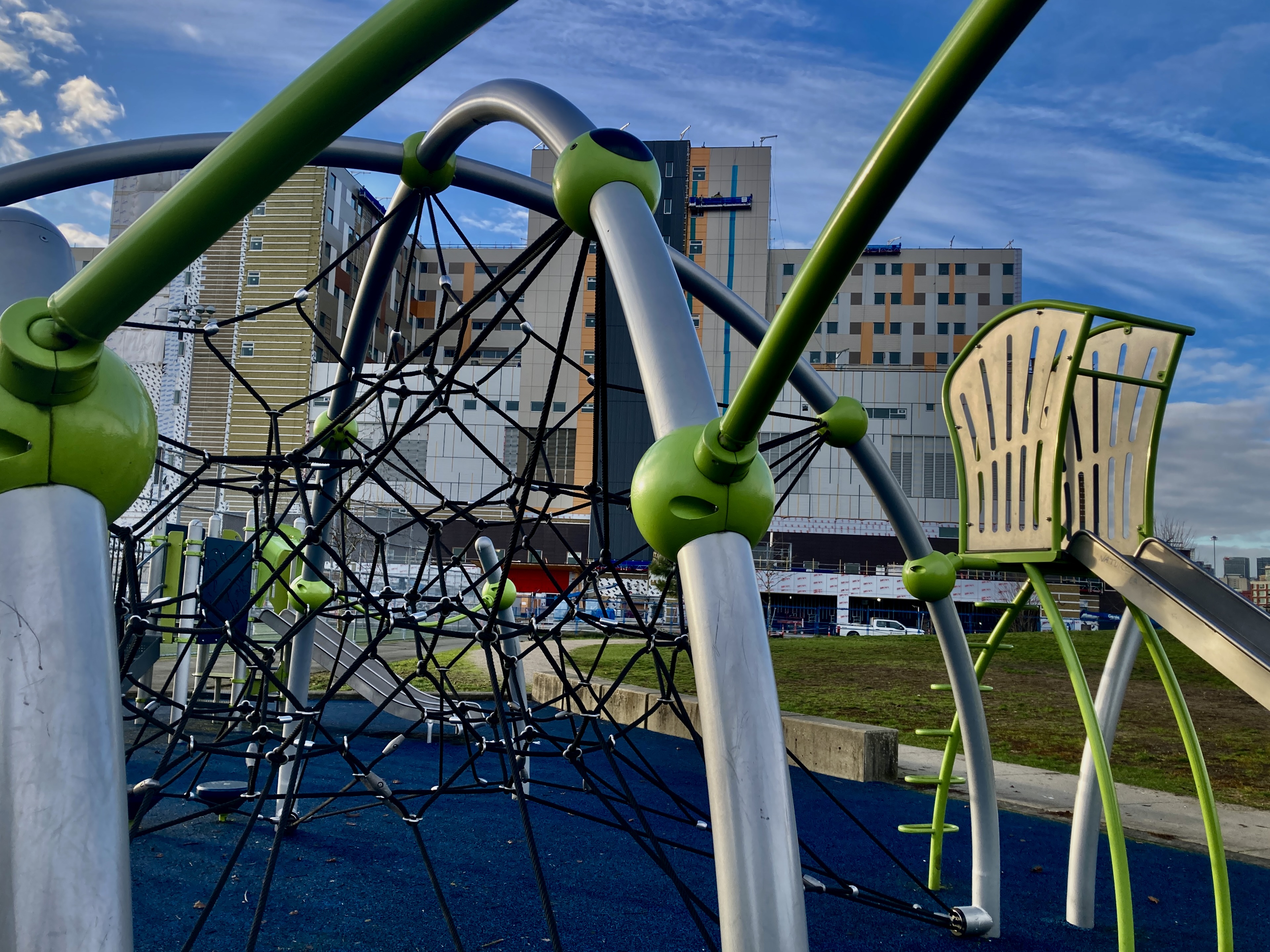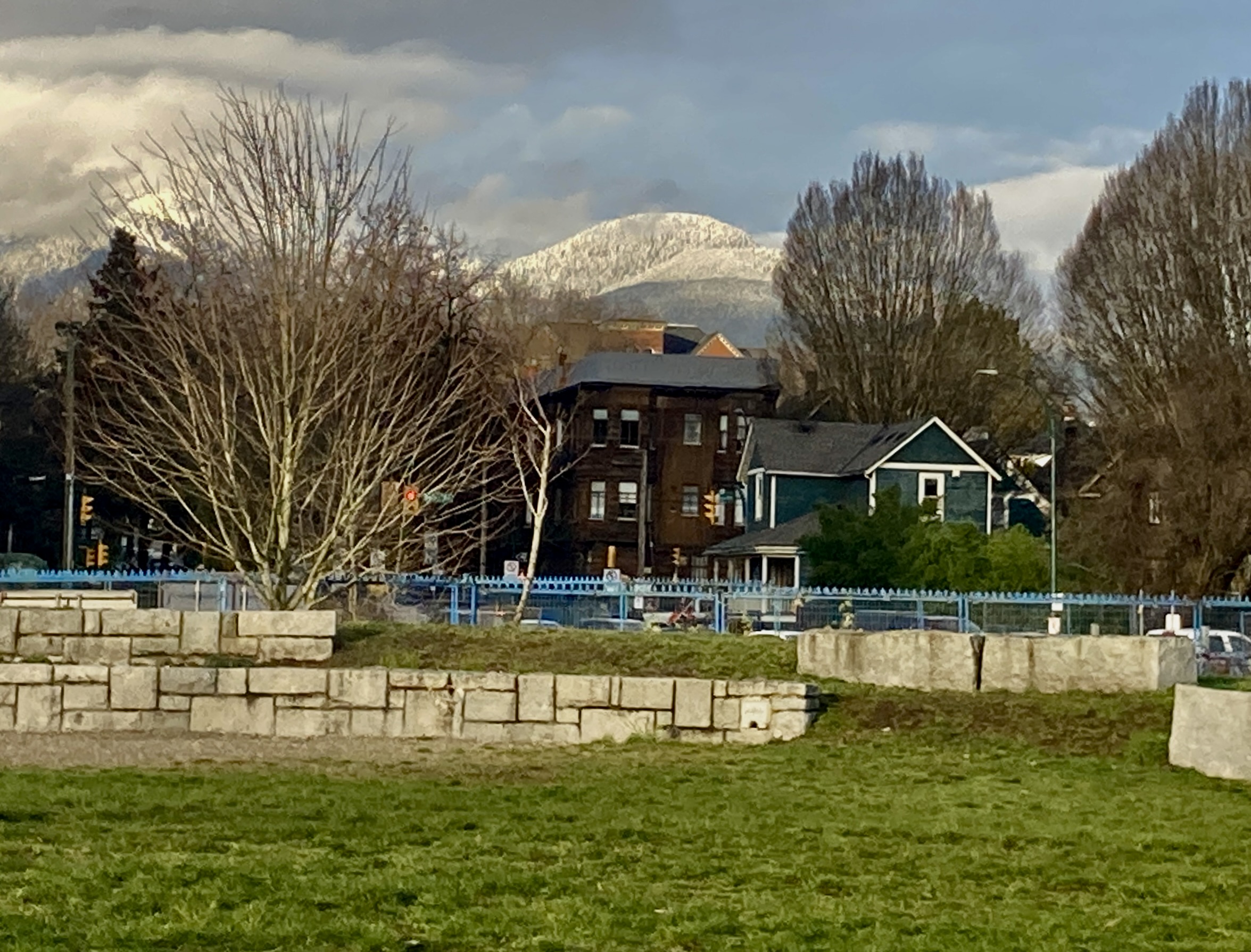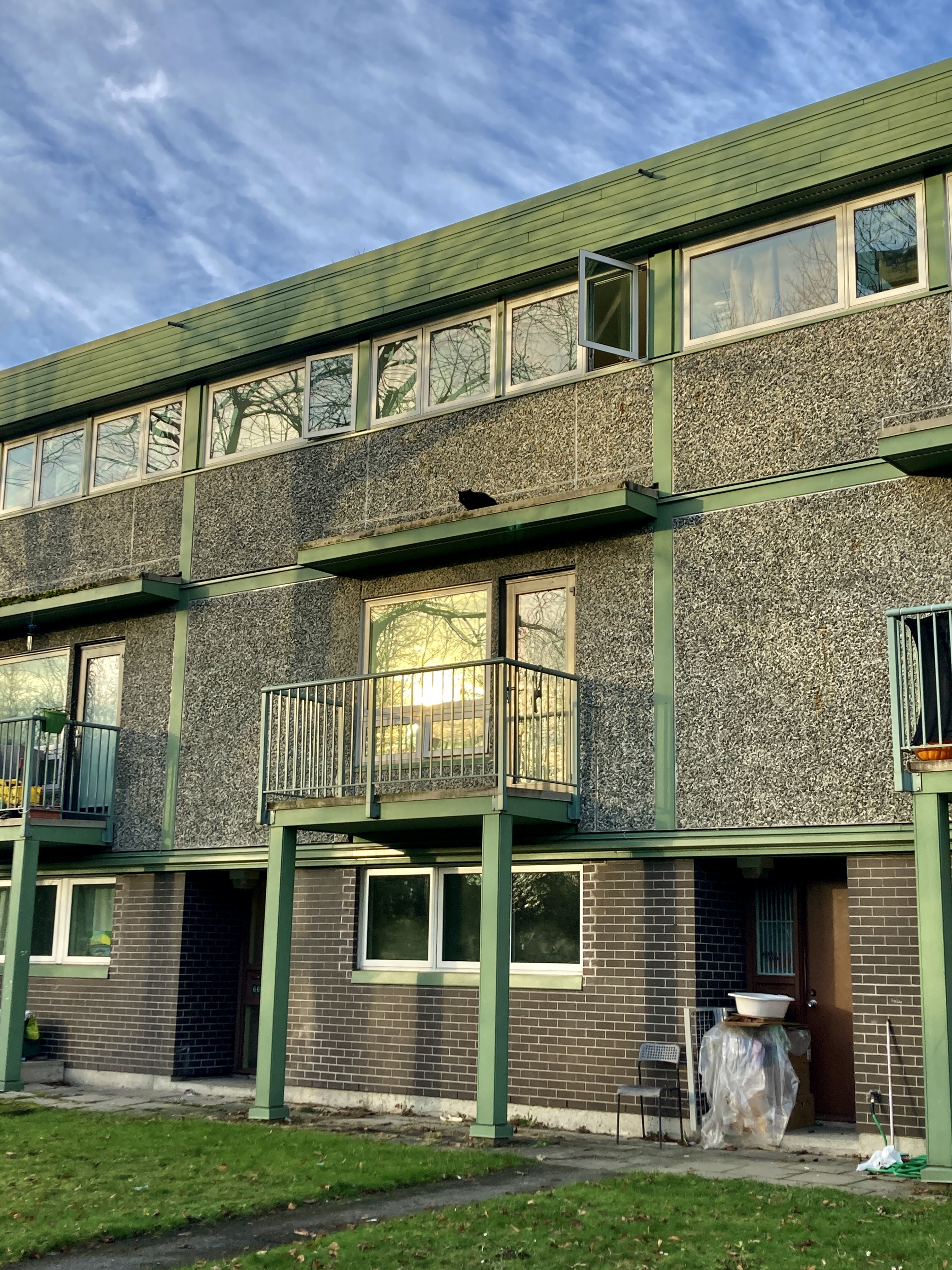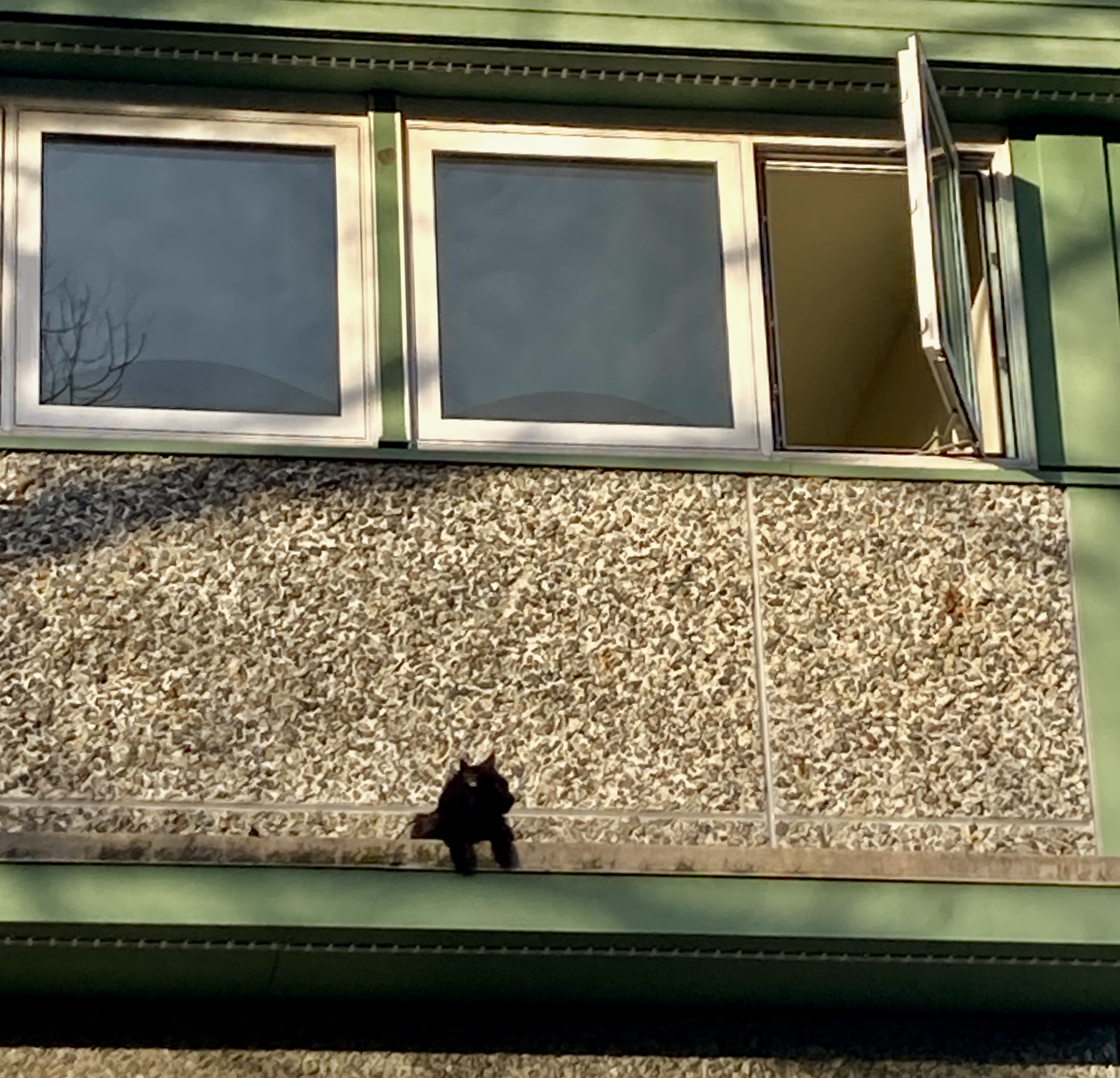
25 November 2025 – In my bit of the Northern Hemisphere, November means lots of rain…
and seasonal criteria for “awesome.”
This year-round sign on the allotment fence in Tea Swamp Park invites us to adapt our eye, and enjoy what’s currently on offer. Rusty old leaves, for example, still clothing this shrub…
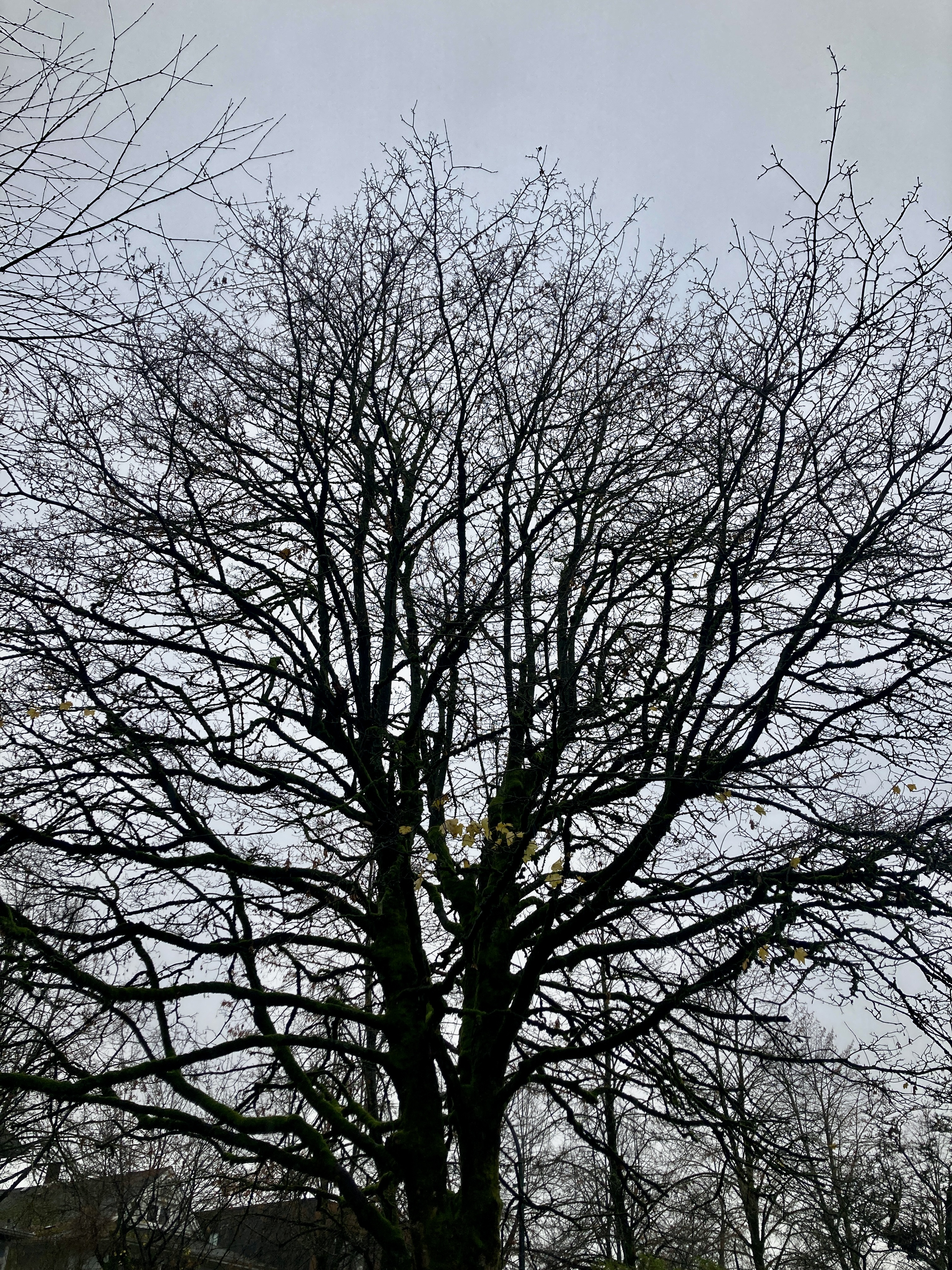
and shameless bare-naked deciduous trees…
dancing around in their bones.
Walking back north on Main, I pass a trio of parks-in-the-making.
A “permanent plaza” under construction, here at Main & 12th (yes folks, your tax dollars at work)…
with gravel being industriously moved from Here to There.
Farther north, the site at Broadway & Main that had lain razed and desolate behind mesh fencing ever since a triple-alarm fire gutted its buildings…
is now fence-free and adorned with bright, shiny-wet picnic tables.
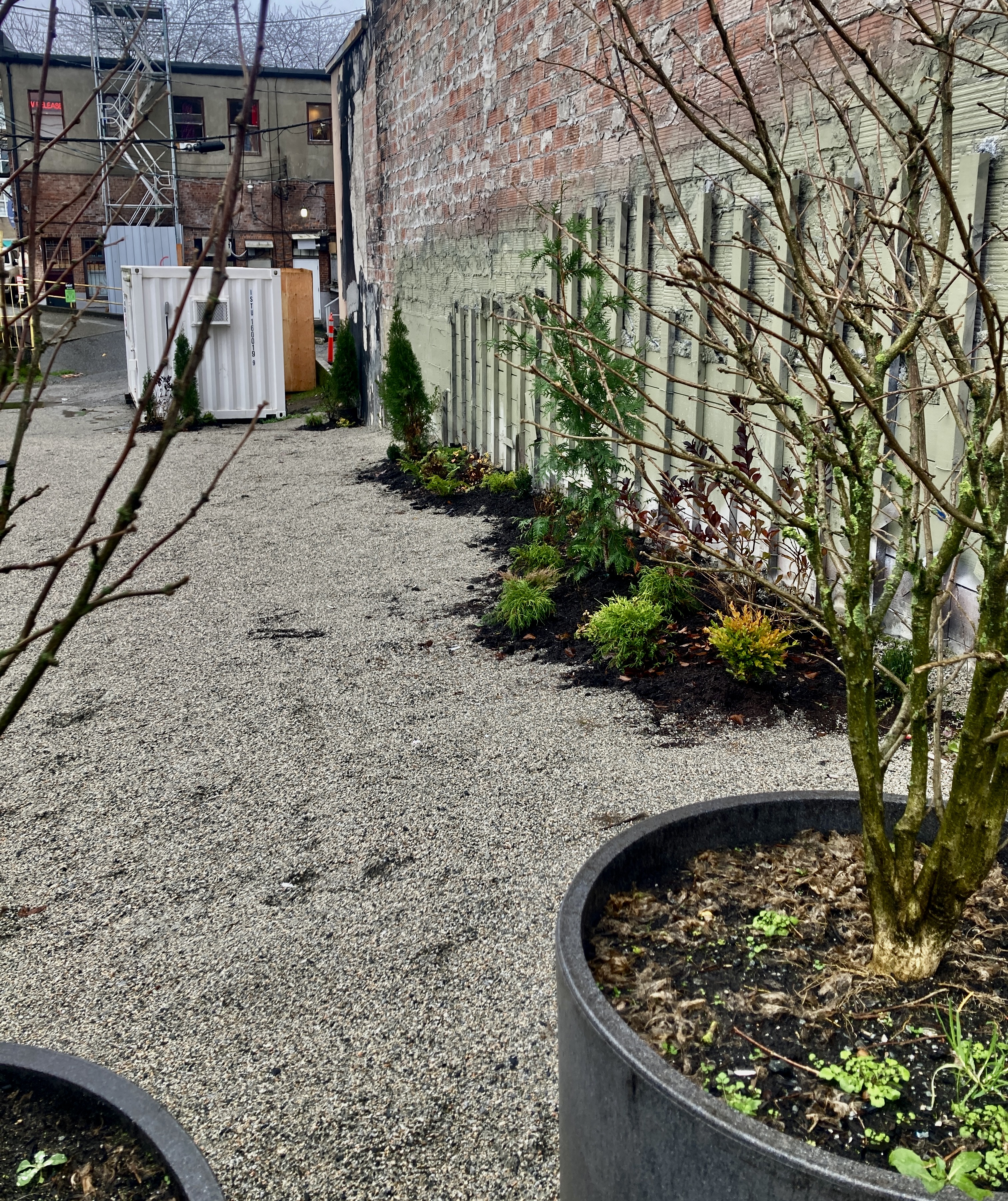
Plus a smidge of new landscaping, along the southern edge.
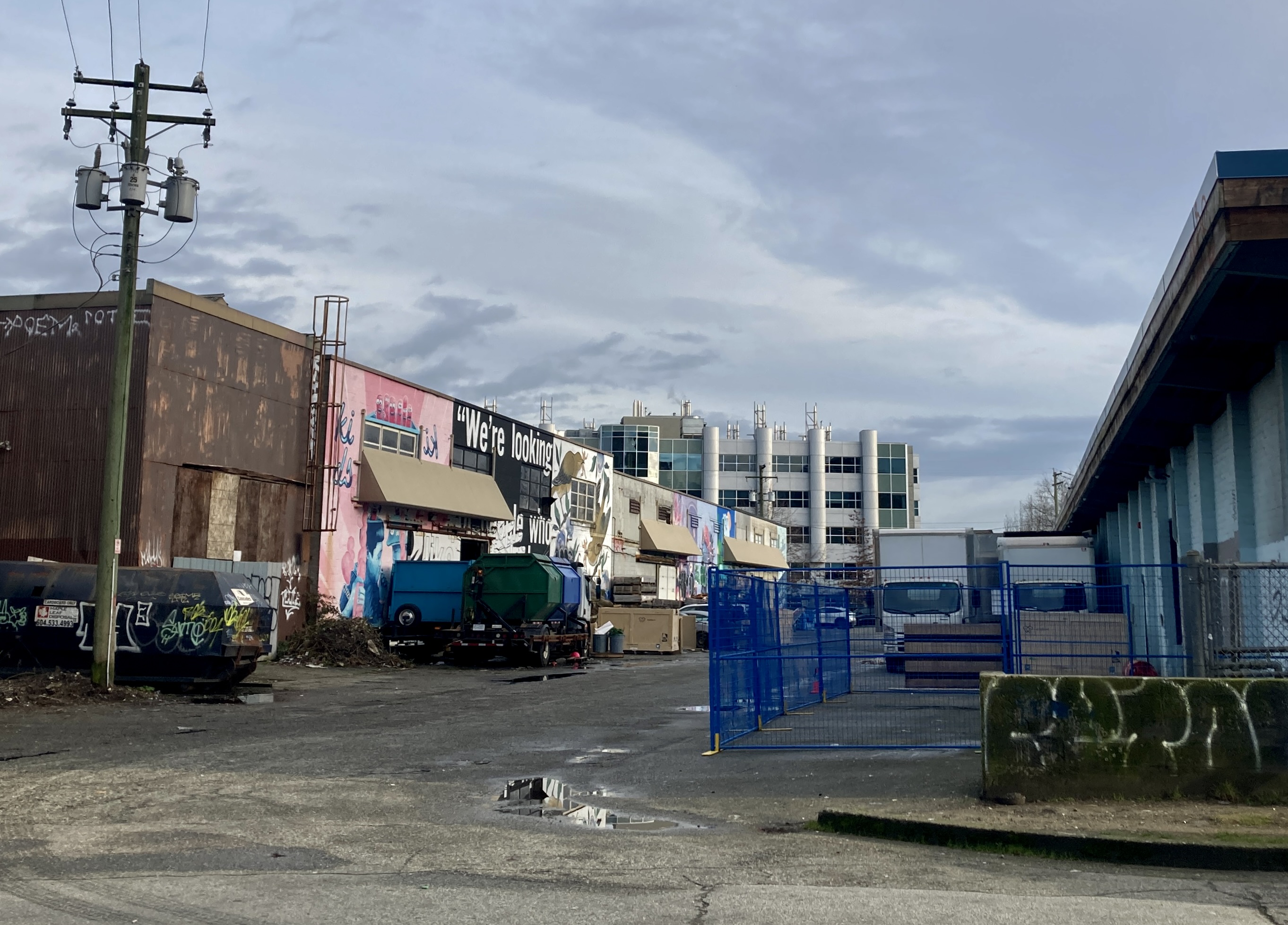
I’m still thinking about that slightly surreal tableau when — crossing 7th & Main — I see something even more surreal:
No, not the mural, not Slim’s BBQ — the snowplow! What? A bright yellow snowplow fitted to the front of the truck behind that white car. Ready to take on the snow. In the rain.
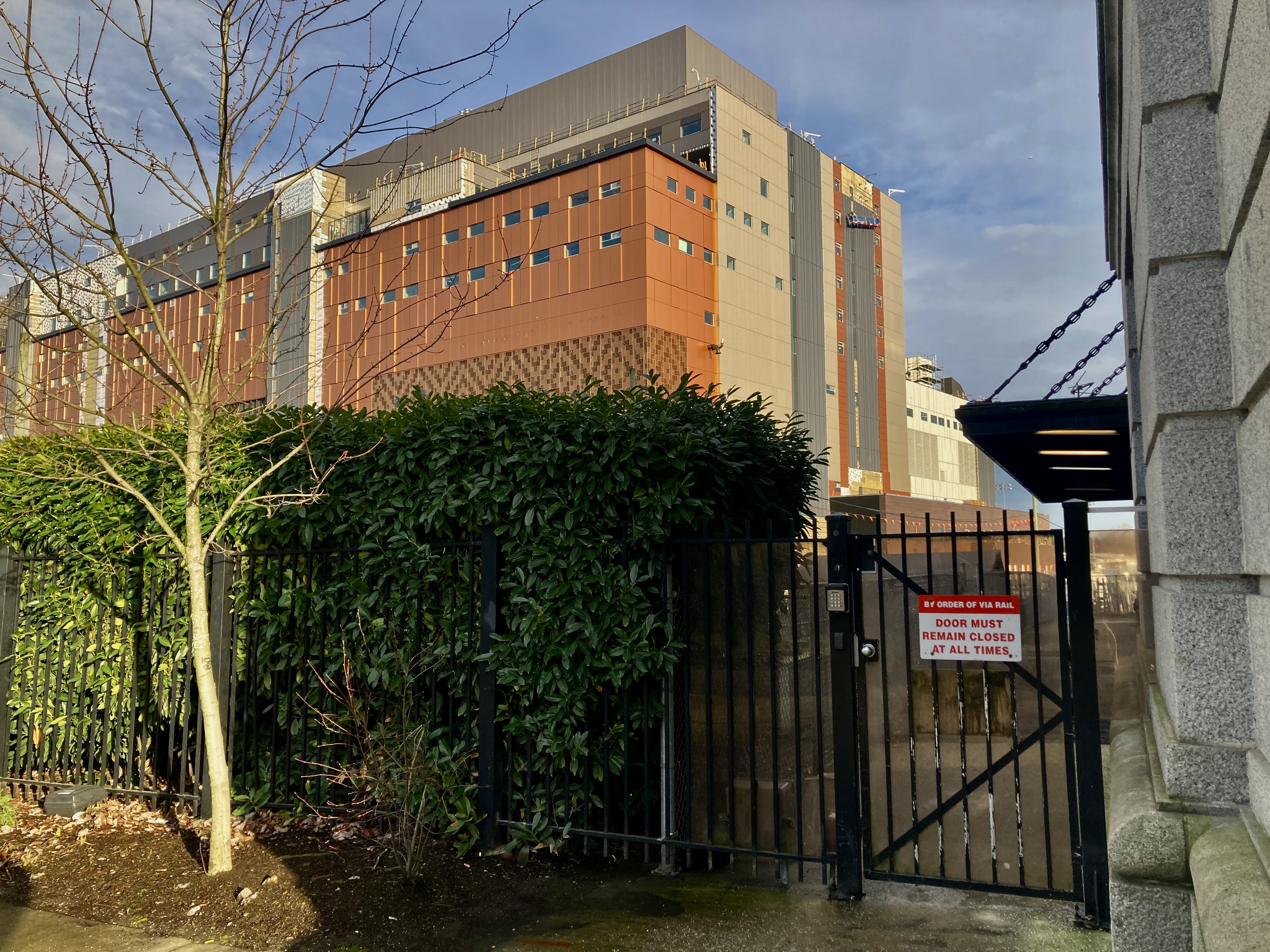
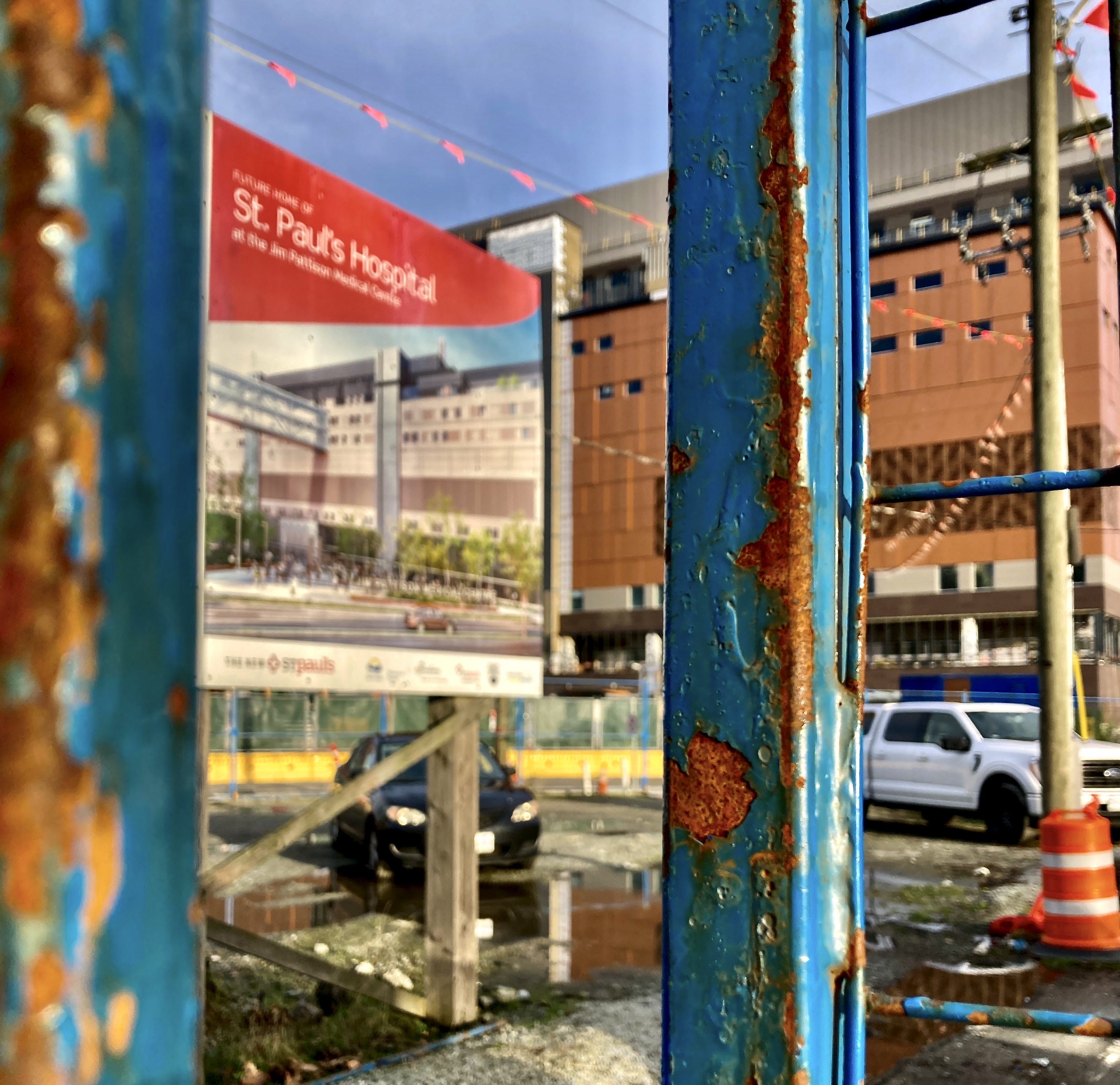
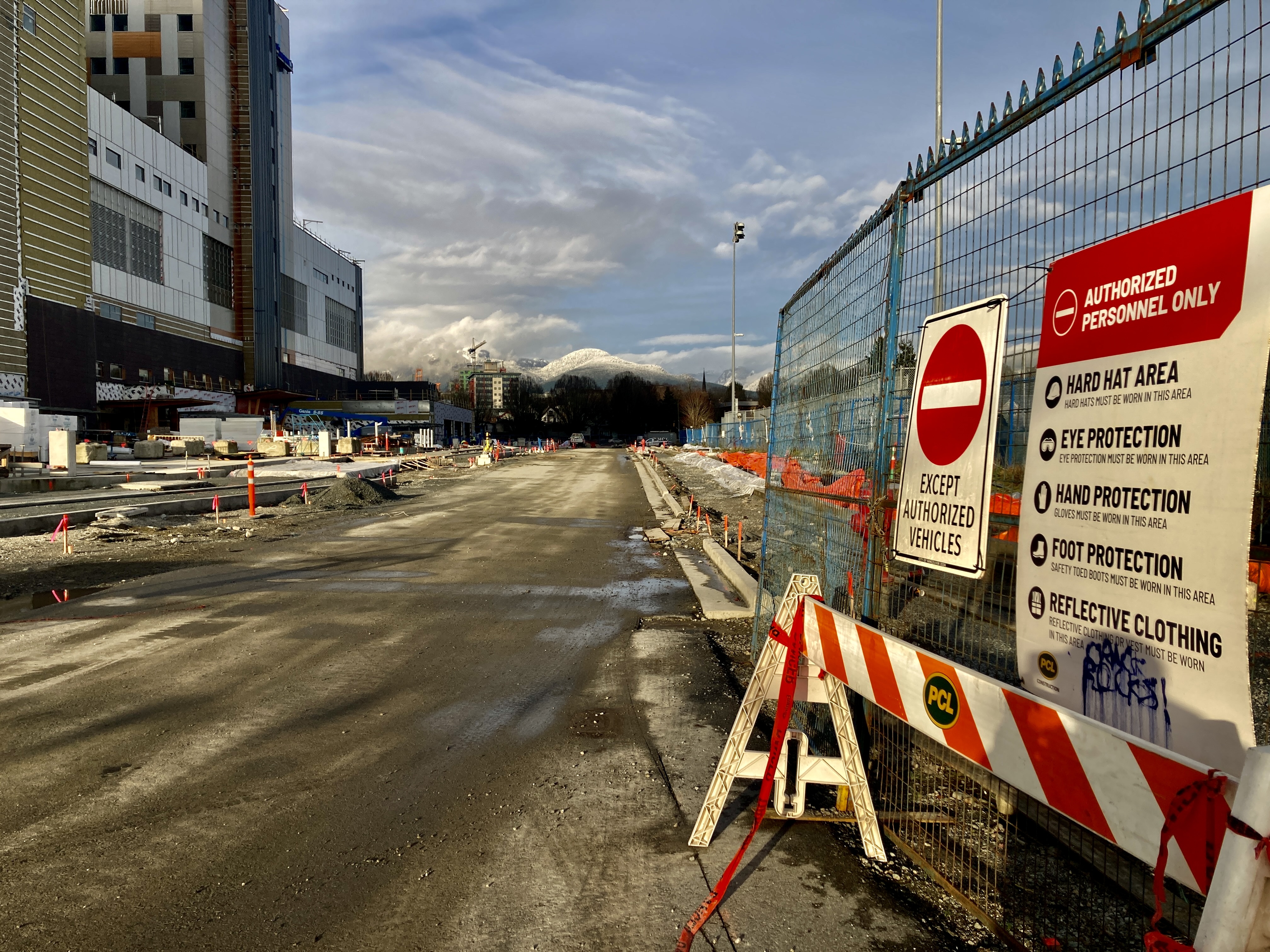
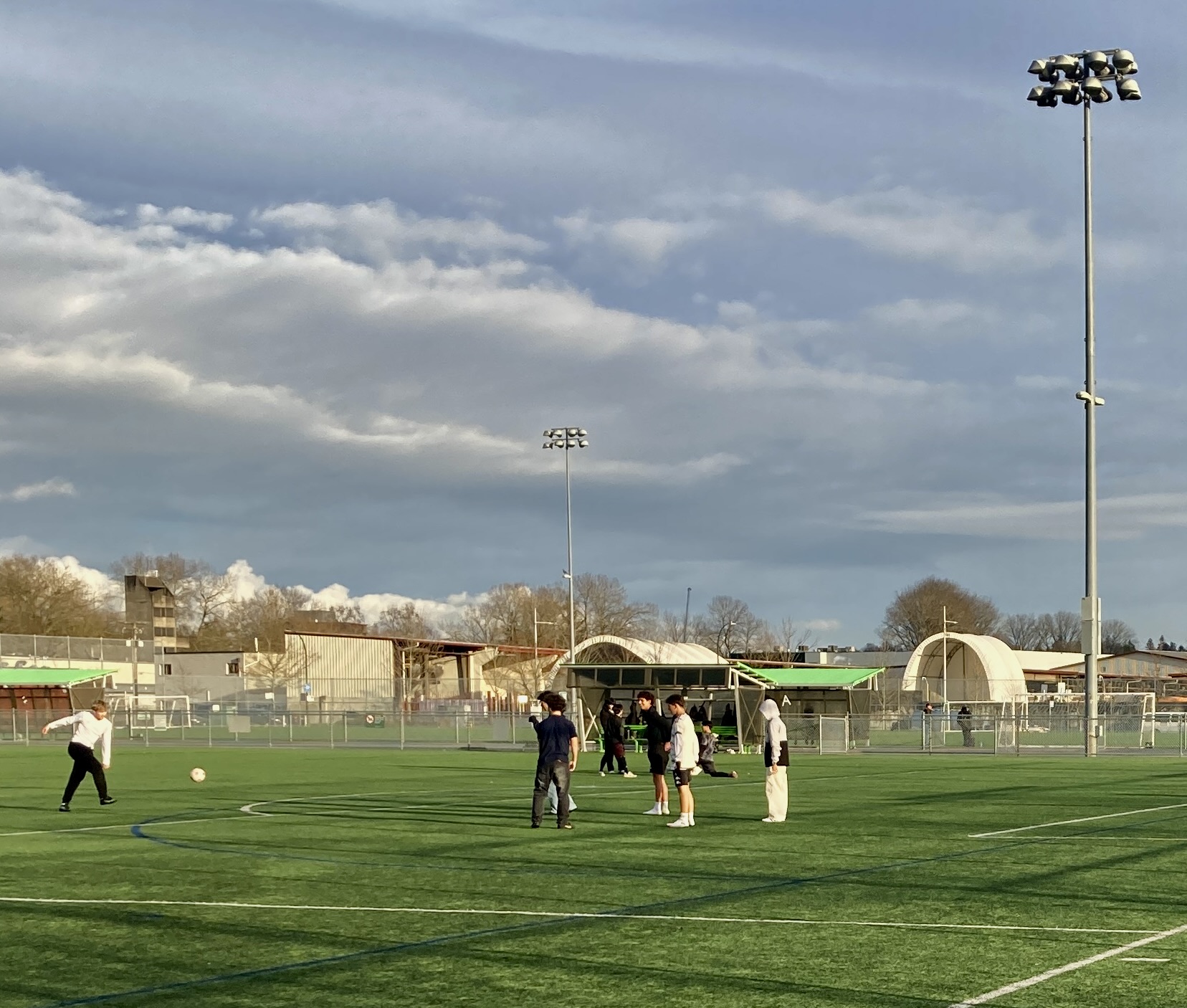
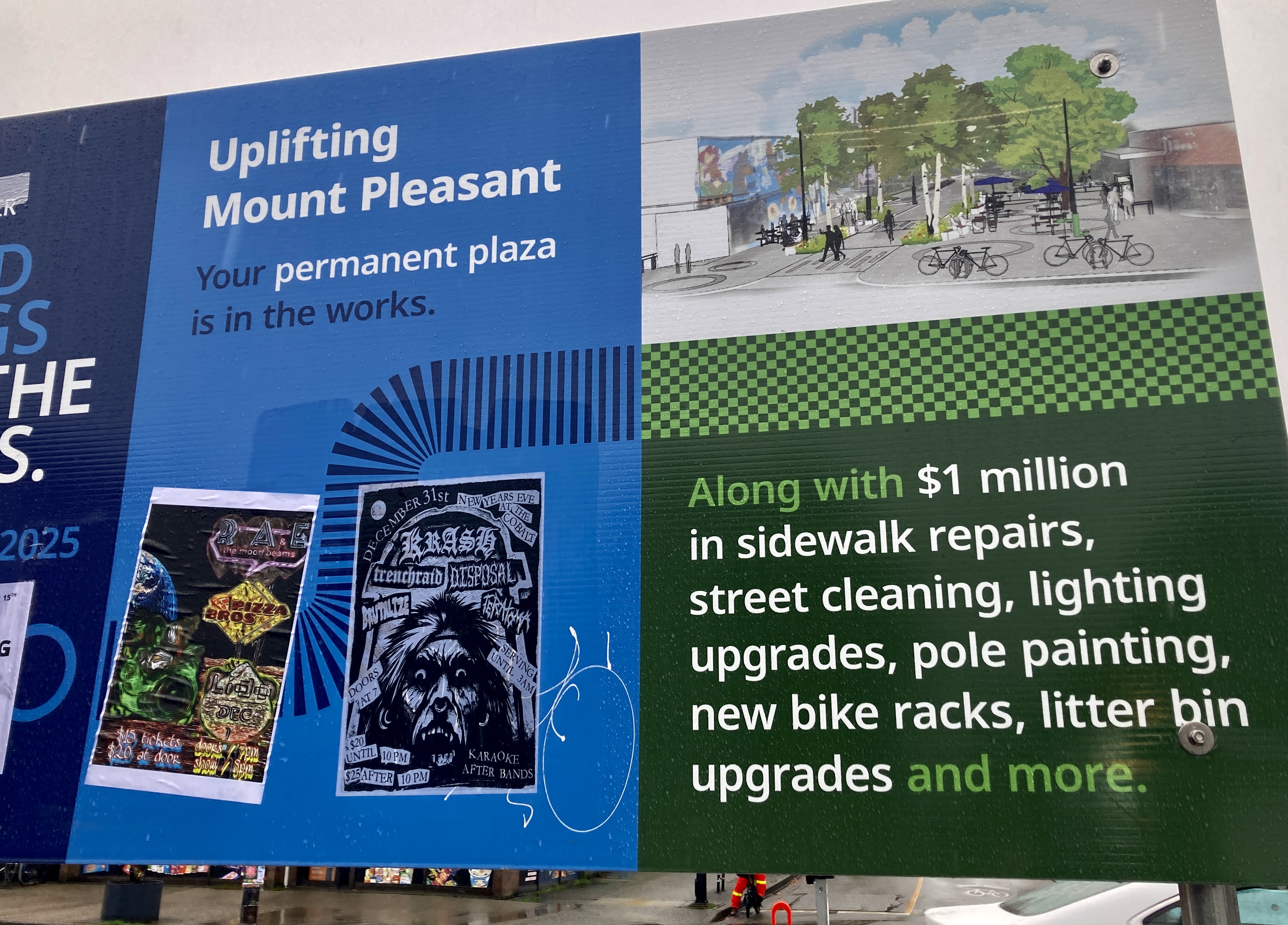
One more future-park. With more tax-dollar signage.
Like the one down the street, it’s early stage, mostly gravel and hints of Things To Come, narrowly visible through fence post gaps.
I take advantage of the building opposite, for the roof-top perspective.
The rain, here in Rain City, blurs the view but the view still rewards the trip.
16 November 2026 – I have a plan. Take the #19 bus; get off at Granville; walk south a few blocks; visit two art galleries.
But then I get on the wrong bus, and things do not go according to plan.
Two different bus routes come ’round the corner, you see, and I don’t bother reading the signage before I jump aboard. I settle back, ready to indulge in city-watching until we reach the #19’s Granville stop. Except… we don’t. The bus turns north well before Granville and ends its run at Waterfront Station.
Which is exactly what the #8 is supposed to do.
More than a little sheepish, I step down and rethink my route. I’m still within easy reach of my first target, the VAG (Vancouver Art Gallery); I’m just approaching it from a different angle — an angle that, with a couple of zig-zags, finds me heading south on Howe Street, between West Pender and Dunsmuir.
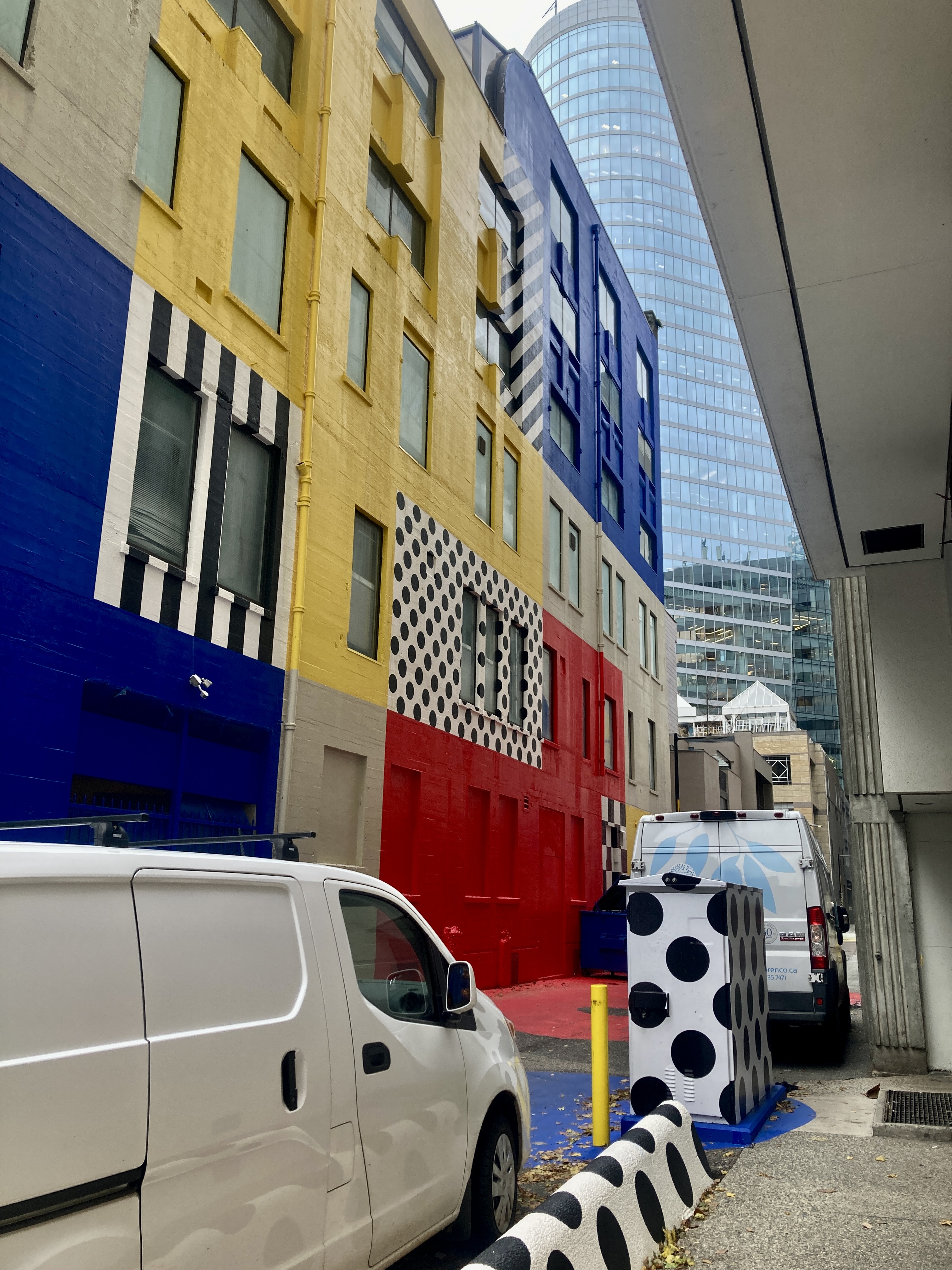
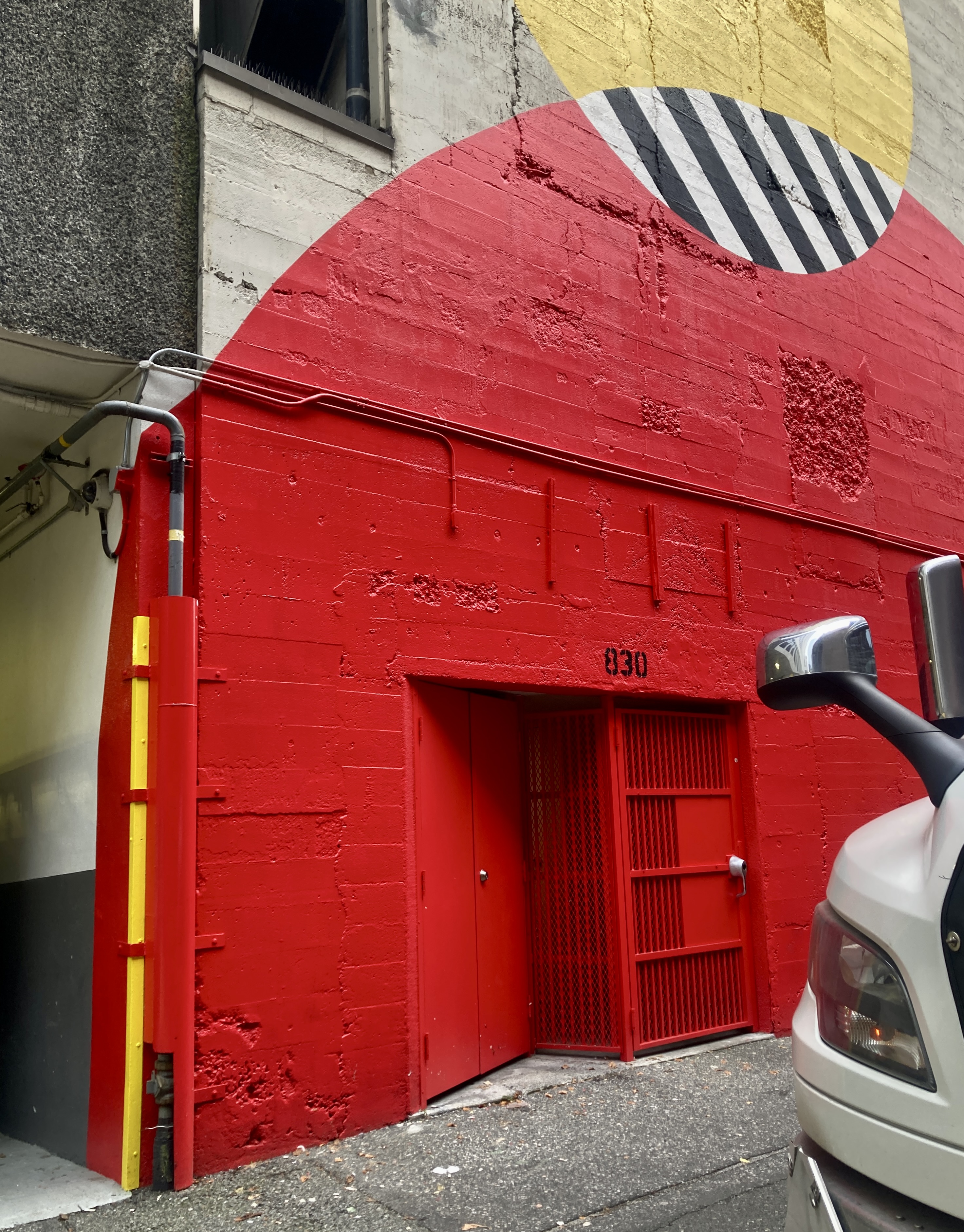
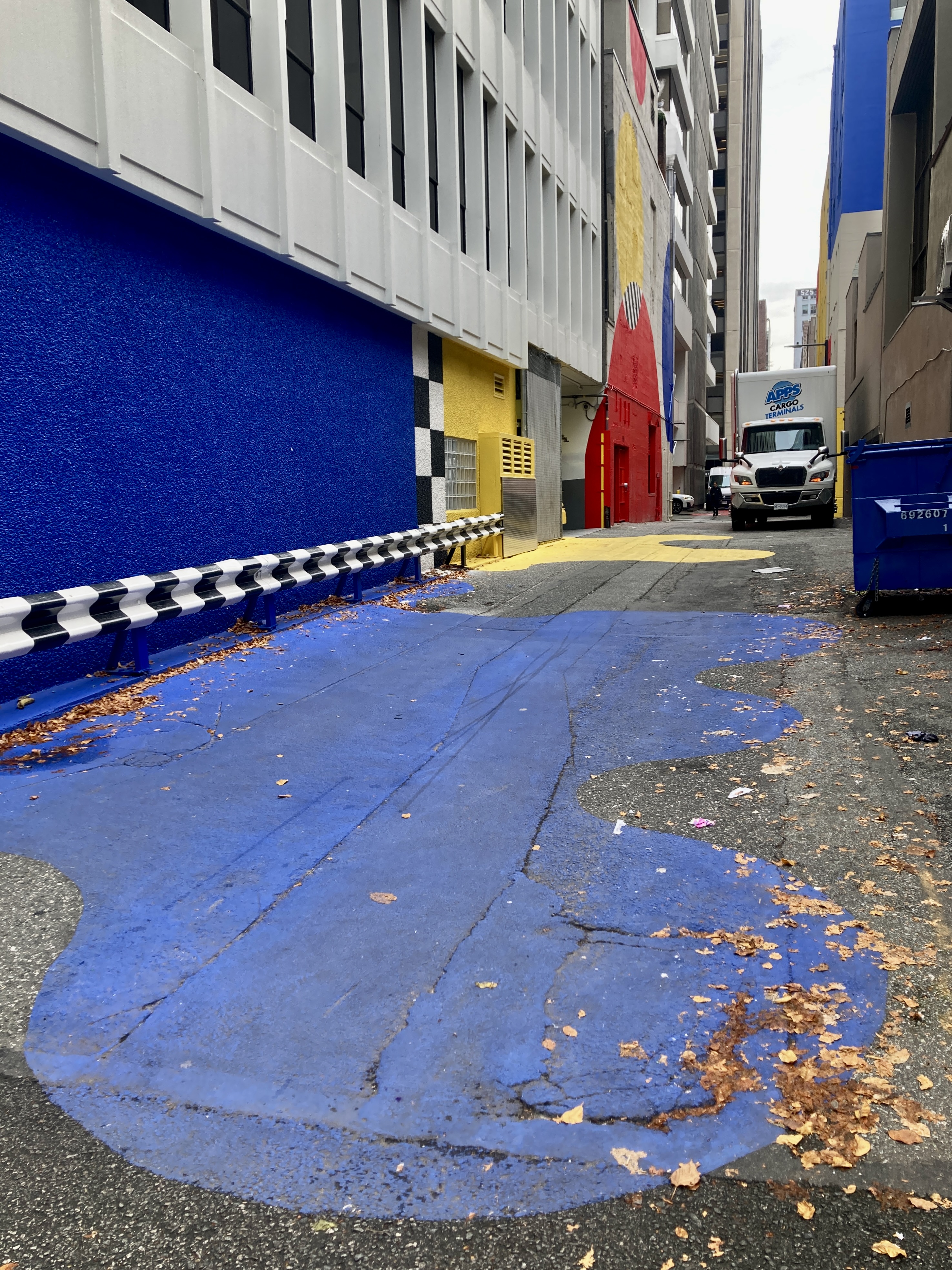
Where — eyes right — I see this alley, bouncing its colours in every direction.
Look at all those rectangles! And the polka-dots! (Which splash their reflections all over the adjacent white van.)
The alley pulls me in, how could it not? Happy rectangles to the south; happy circles to the north…
forming still-life tableaux with delivery trucks and doorway tubing.
Splatters on the pavement. Yellow…
and red…
and, here at the Hornby end of the block, bright blue. Further adorned with russet leaves.
I’m well-pleased with my wrong-bus start to the day. It fed me into this alley, handed me all this unexpected art while on my way to expected art.
There’s one more hit of the unexpected yet to come. I find it in the plaza just east of the VAG.
Lanterns.
All the forms in these lanterns, says the signage for Lux Memoriae (Tidal Reflections) by Ari Lazer, come from the tidal contours of the Fraser River.
This theme ties perfectly, and I am sure deliberately, with the VAG exhibition I have come to see: We who have known tides . Drawn from the VAG’s permanent collection of art by indigenous artists, all of the works in some way reference life interwoven with ocean and tide.
A spill of abalone shells (I am turning towards tides, winds, clouds, rainfall, by Tanya Lukin Linklater), for example, burnished and positioned on a tarp…
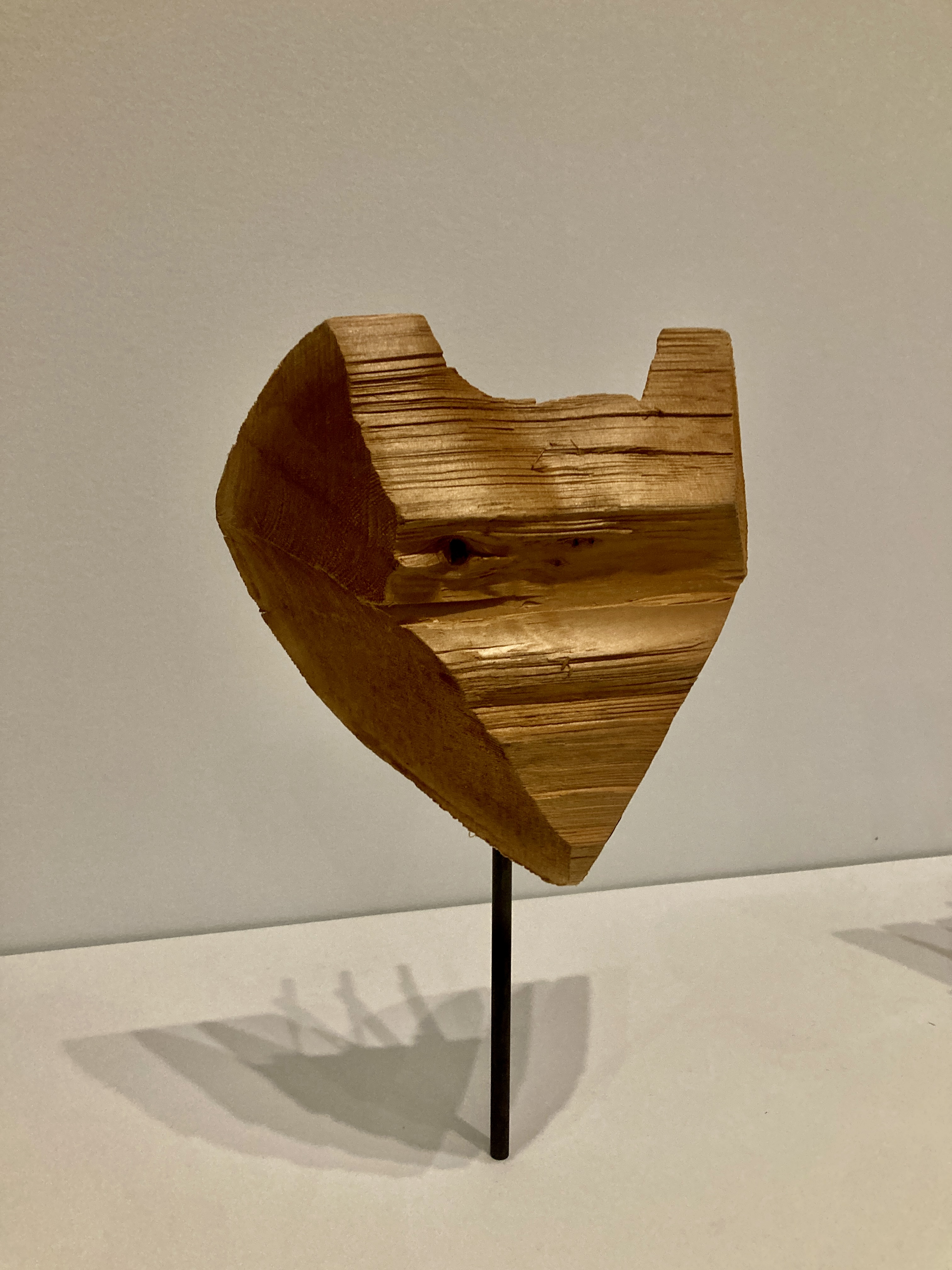
and, on the far wall, four pieces of found cedar (Longing, by Sonny Assu)…
all end cuts, and each selected for its resemblance to a mask.
I do not visit other floors, other exhibitions. I take myself a little farther south on Howe, for the Our French Connection show at Outsiders and Others.
This is a different art world entirely, in a gallery focused on contemporary work by self-taught and non-traditional artists. There is great diversity of styles, materials and objects — but every piece pulses with the outsider energy of the person who created it. I’m always engaged, when I visit this gallery, a-buzz with what surrounds me.
And, almost always, before I get to the art I have a bit of a chin-wag with Yuri Arajs, the gallery’s Artistic Director and Curator. Today I pull out my phone, show him the alley I discovered en route.
He plucks the phone from my hand, walks over to the wall, and holds this image I took of the alley in Vancouver…
next to this pen-on-paper Star Car, drawn by Dominique Lemoine in France.
We shake heads at each other and laugh. Art is all over the place! Inside, outside, in galleries, in alleys, bursting 360° through human demographics & world geography, discovered by intention or just by climbing on the wrong bus.
Pleased with that thought, I reclaim my phone and turn my attention to the show.
(Which I urge you to do as well, should you be in Vancouver this month.)
23 April 2025 – My mind has created a very clear plan for the morning.
Follow the Quebec Street bioswale — not a ditch! a rainwater gathering/purifying system! — to Science World, down there at False Creek…
do the interview; walk my usual “Cambie Loop” to and over the bridge; and then zigzag eastward back home.
I do the interview. (The Mystery Interview. Be patient, a post will follow.) I start walking west along the False Creek Seawall.
All according to plan.
Suddenly, where Carrall St. butts into the Seawall, my feet execute a sharp right-turn. They don’t even inform my mind, let alone ask permission. They just take mind (and the rest of me) hostage, and execute their own plan.
Away we go. I find myself walking north on Carrall.
I decide not to argue: this could be interesting! The route offers a tidy cross-town slice past Andy Livingstone Park, through Chinatown, on into the Downtown East Side (DTES) and Gastown, all the way to Water Street with Burrard Inlet just beyond.
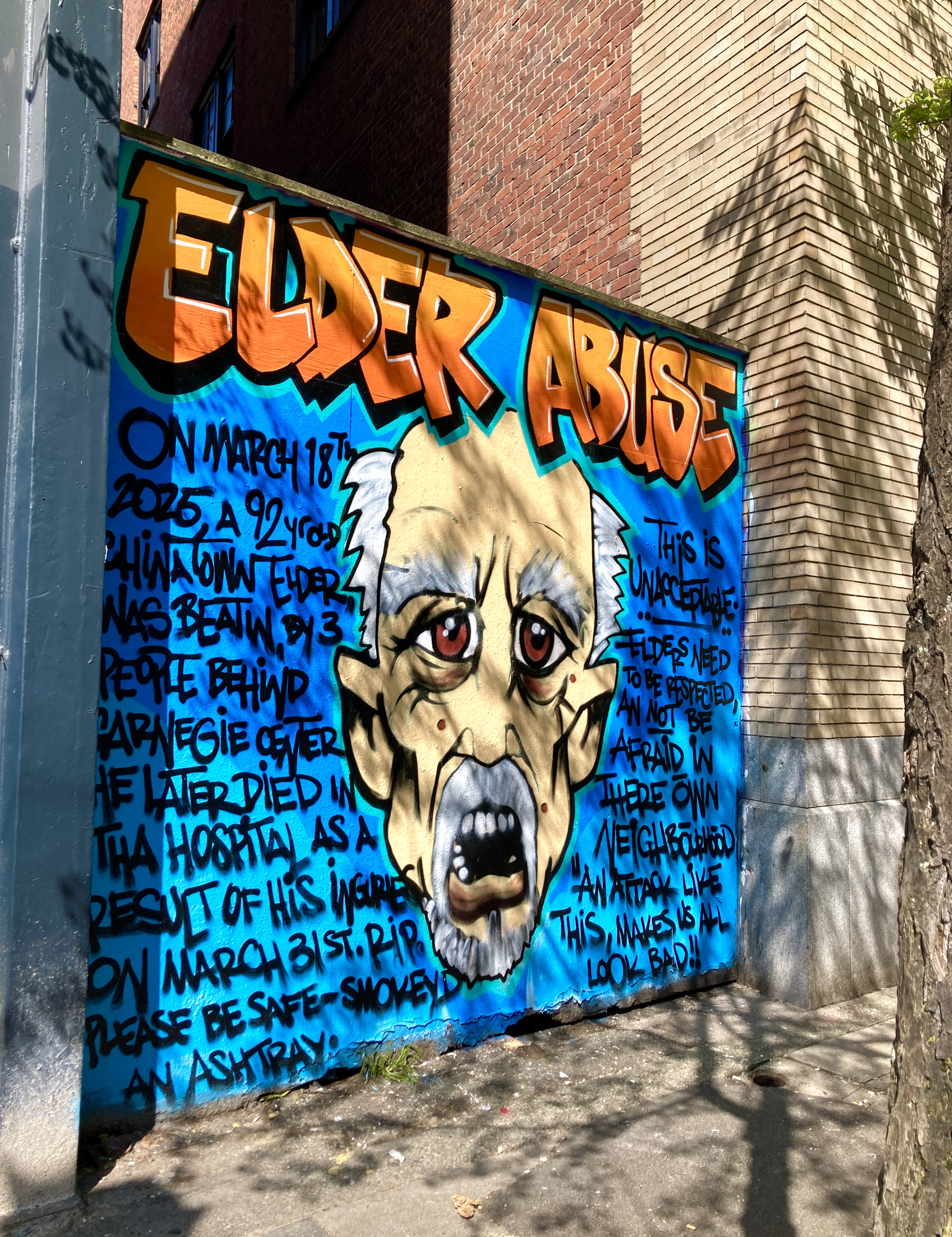
Poignant, powerful street art at West Pender, by the impressive street artist and DTES resident/advocate, Smokey D.
“It’s by Smokey D,” I hear two street kids say to each other, their voices full of respect. The City agrees. In tribute to his concern for others and use of his skills to inform and empower others, in 2023 Vancouver proclaimed March 11 — his birthday — to be Smokey D Day.
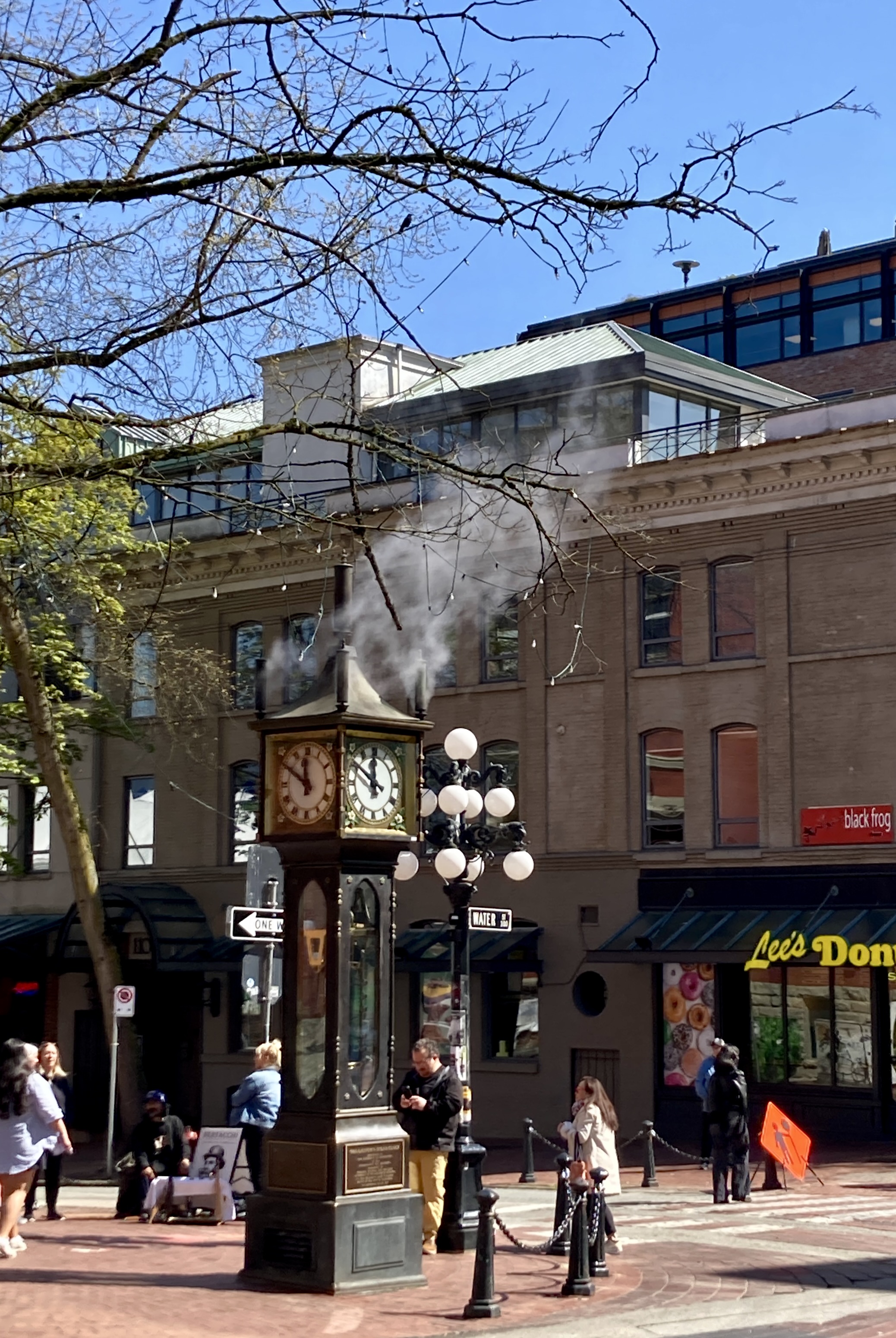
Another downtown symbol at Water and Cambie streets, this one much happier in mood: Raymond Saunders’ 1977 Steam Clock, still puffing steam and, in another 10 minutes, due to mark 12-noon with the opening bars of O Canada.
By now my mind fully supports what my feet set in motion: this is a promising route! I even manage to rediscover the Silvestre café and reacquaint myself with its Peruvian menu — another mug of Chicha Morada (purple corn drink) but this time, a Chicharron sandwich (pork belly) rather than an Alfajor dessert.
At Richards Street, my feet graciously allow my mind some say in what happens next. Continue west another block or two? Or turn south right here? Right here, says my mind, and my feet pivot accordingly.
Yet more patriotic fervour in the Macleod’s window at Richards & West Pender…
and appropriately vintage in style, as befits this rare, used and antiquarian bookstore.
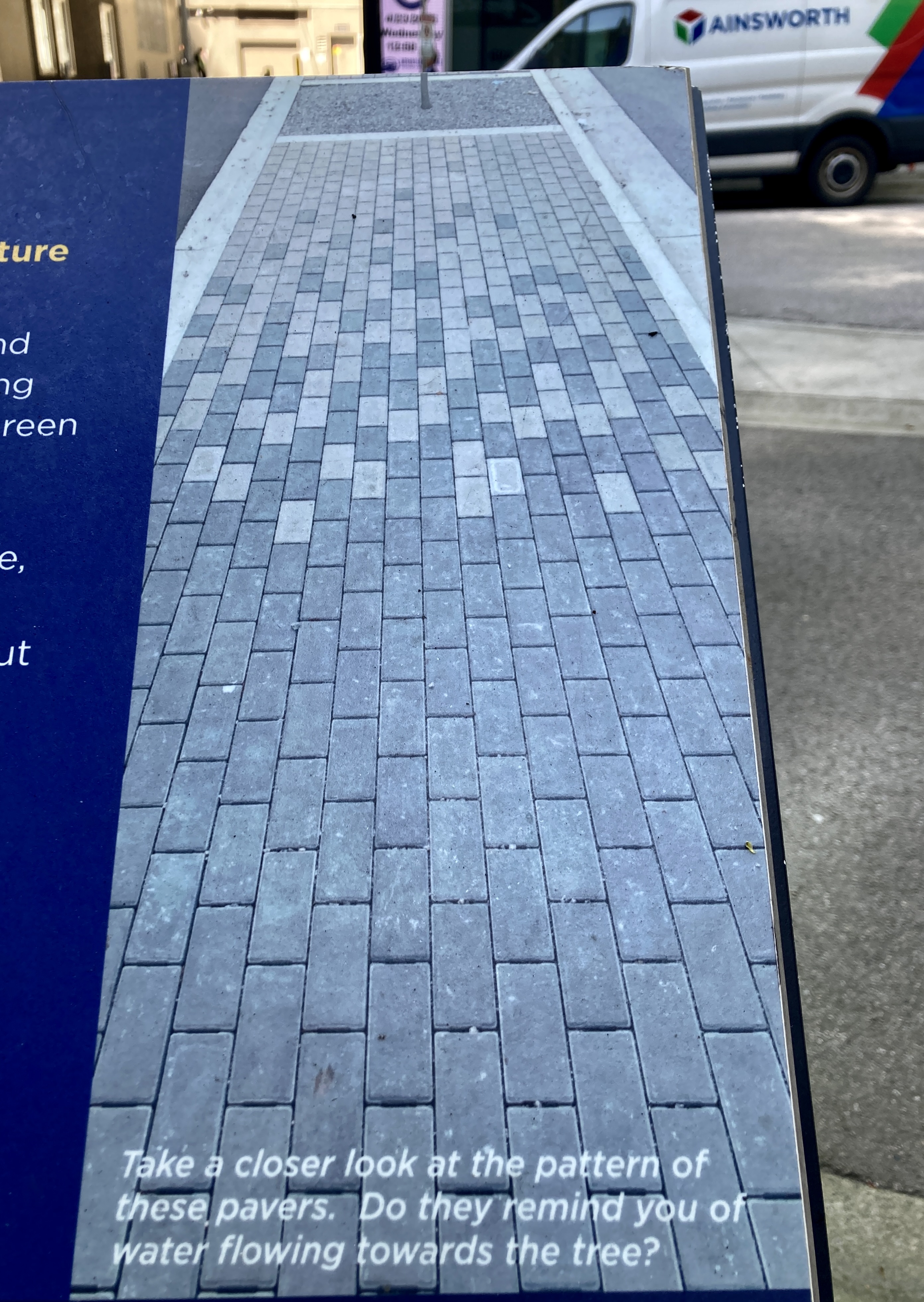
I cross Dunsmuir, where signage informs me that this next stretch of Richards is part of the City’s “blue-green rainwater system.”
The last panel of the sign is an illustration of the pavers involved in the system. The caption asks, “Do they remind you of water flowing towards the tree?”
I step out into the street, check the pavers.
Yes, they do.
Another happy rediscovery, a place I can never find on purpose. I just have to, literally, walk into it…
the joyous, multi-level Rainbow Park at Richards & Smithe.
Getting closer to False Creek with every step!
On past Emery Barnes Park at Davie, and then across Pacific Blvd., right to the tumbling fountains of George Wainborn Park, which slopes down to the Creek.
Eastward along the False Creek Seawall, past a swimming dog (and ball-tossing owner)…
and then I’m beneath the towering girders at the David Lam ferry dock. Each girder base is incised with a different story of time & place.
This one commemorates the Great Fire of 1886…
when, on June 17, an authorized clearing fire on CPR property blazed out of control and destroyed the infant city, whose wooden structures were no match for the wind and flames. In the words of one survivor: “The city did not burn, it simply melted before the fiery blast.”
And then I walk some more, on past the Cambie Bridge, on along to Coopers Mews, with its symbolic barrels on high. At this point, mind, feet and the rest of me all agree on our course of action.
We follow the Mews to Pacific Blvd., and catch a bus for home.
2 December 2024 – Fog & sun & withdrawals & advances & teases & full glory.
And a few crows.
Let’s set a benchmark. Let’s pick the view on November 28, when the weather chose to beam her sparkling charm in all directions. At 8:08 am, the rising sun bounced off east-facing towers…
and flooded downtown Vancouver, the North Shore and those Coast Mountains with light.
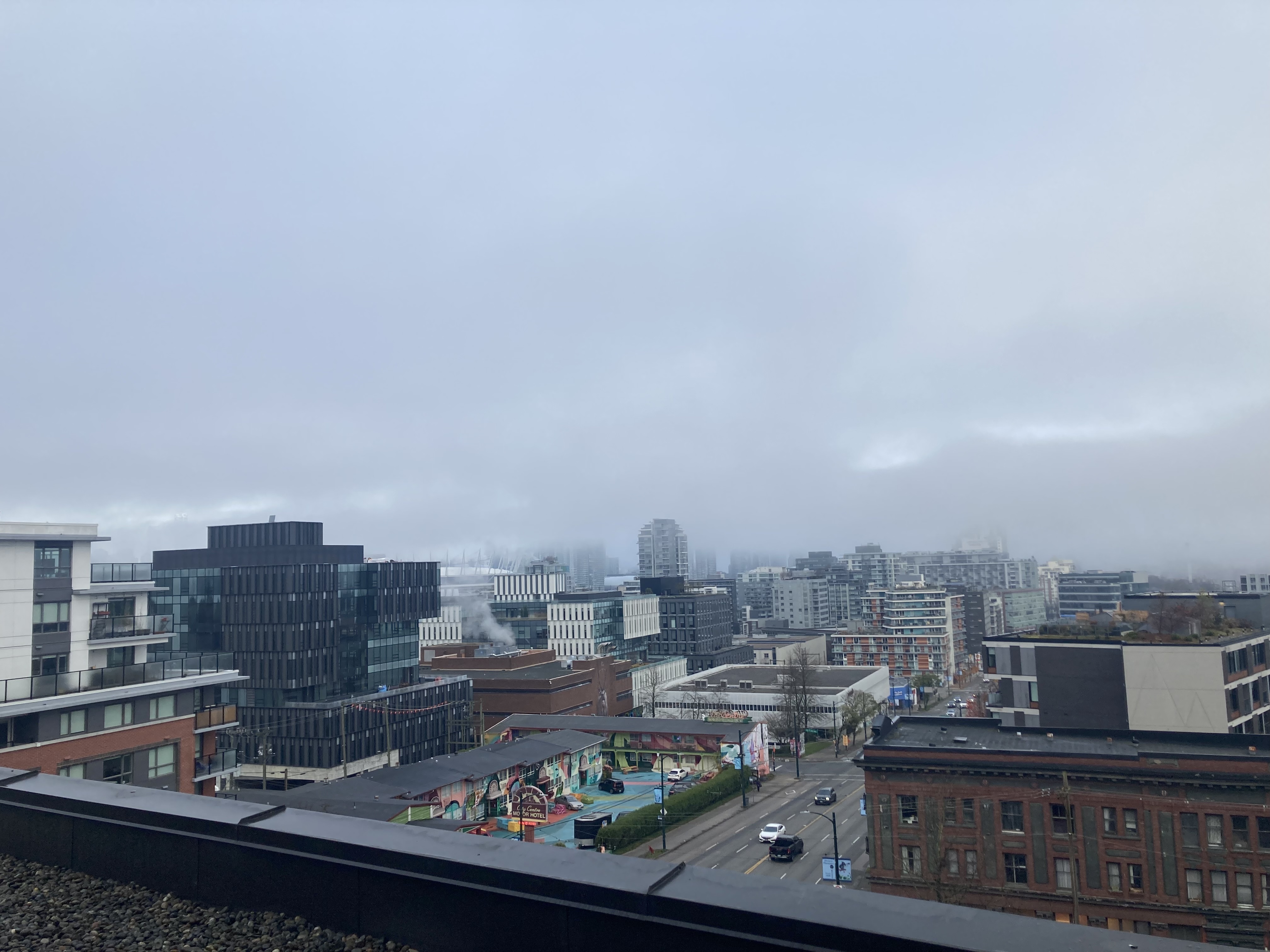
This morning — and, at 8:26, only minutes later in the day — the view is very different.
Fog. With about a block and a half of visibility. As for mountains… What mountains?
A crow waits it out.
Bit of a breakthrough, at 8:50…
largely withdrawn, by 9:41…
though a new line of light opens up at 9:48…
and tempts this crow (presumably equipped with GPS) to take flight on eastward.
His instincts are good.
By 10:37 the clouds are wispy and the haze is beating a retreat.
At 2:52 pm, it’s full sunshine, everywhere you look.
Look while you can. Sunset is barely an hour away.
30 November 2024 – Vancouverite and, more to the point, horologist Raymond Saunders died one week ago today, age 84. I want to pay my own small tribute because, multiple times most days, I walk by one of his creations. It is part of my neighbourhood, and therefore part of my life.
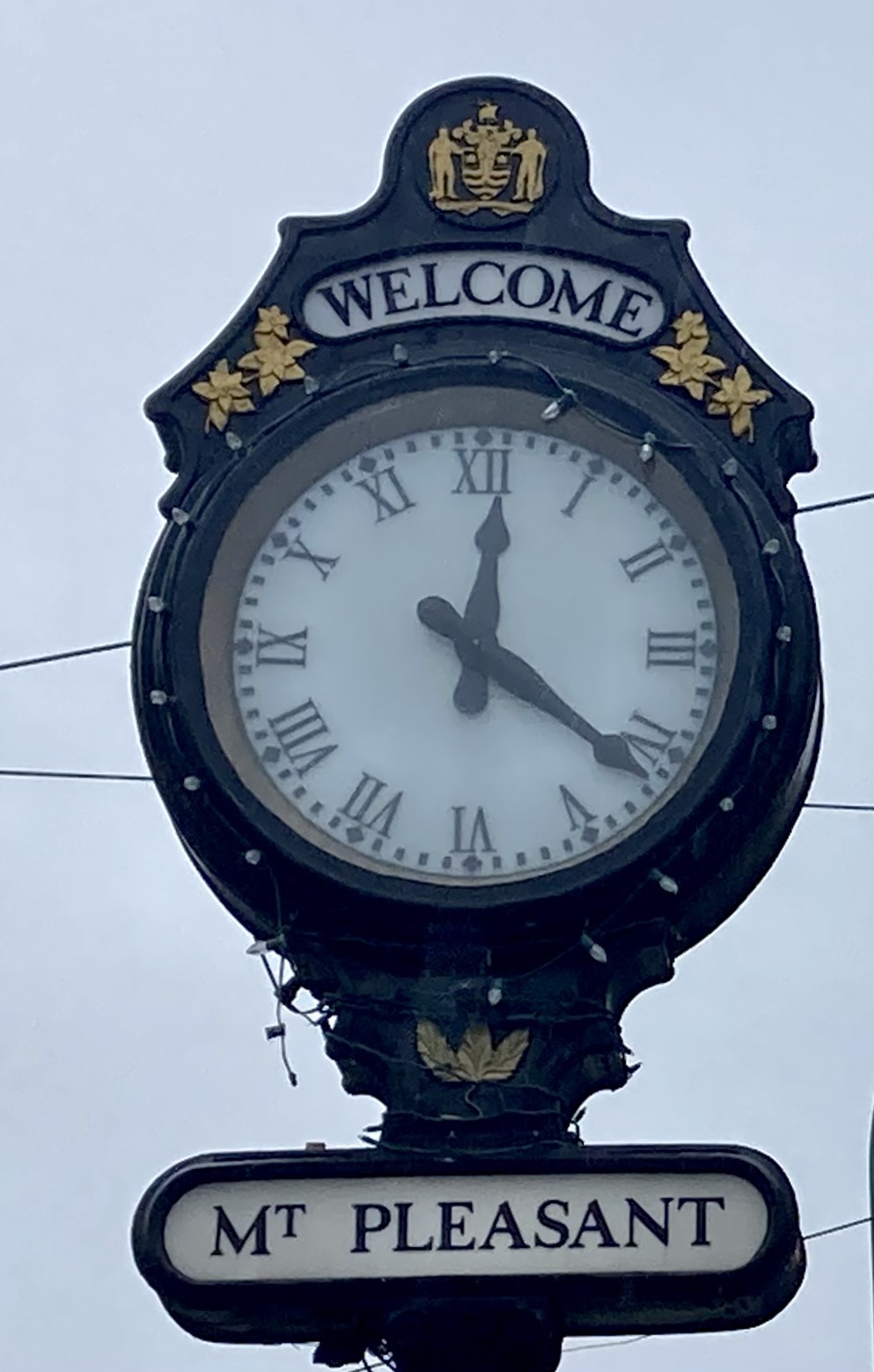
This is the Mount Pleasant Welcome clock, which he was commissioned to design and build in the late 1980s as part of the uptick then underway in the neighbourhood.
But it is not the clock for which he is best-known.
This one is.
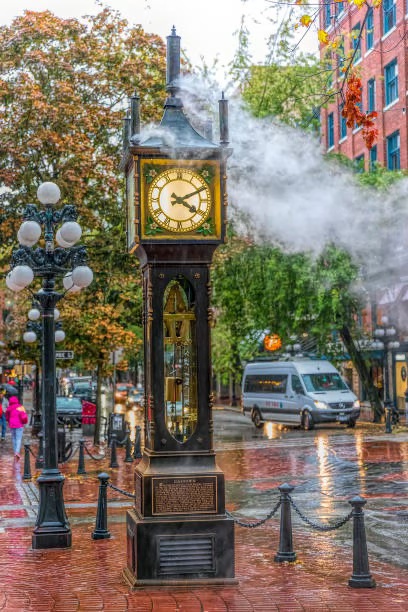
Residents and tourists alike, we know this clock: the Gastown Steam Clock. In the mid-70s, Saunders, already an experienced horologist, was asked to design and build a clock to camouflage a steam vent at the corner of Water and Cambie streets in the Gastown district of downtown Vancouver.
The result, unveiled in 1977, was 16 sculptured feet of bronze & copper designed to reflect the buildings around it. For the first ten years the clock was indeed steam-powered (perhaps, but perhaps not, the first steam-powered clock in the world). Since then it has run on electricity, though the whistle…
emulating an 1890s steam locomotive whistle, is still really-truly powered by steam.
Obituaries and other articles and videos (click here, and take your choice) tell us he designed and built more than 150 customized clocks world-wide, often in equal part art works but always functioning clocks as well. I’m charmed to know, for example, that his Scenic World Steam Clock, installed in Katoomba Australia, commemorates coal miners and their pit ponies — and, to mark the hours, plays Waltzing Matilda.
Our local clock is much less grand…
but it reflects this neighbourhood, bearing not only the Vancouver coat of arms…
but sprigs of hops as well. After all, this was, and is again, the Brewery District.
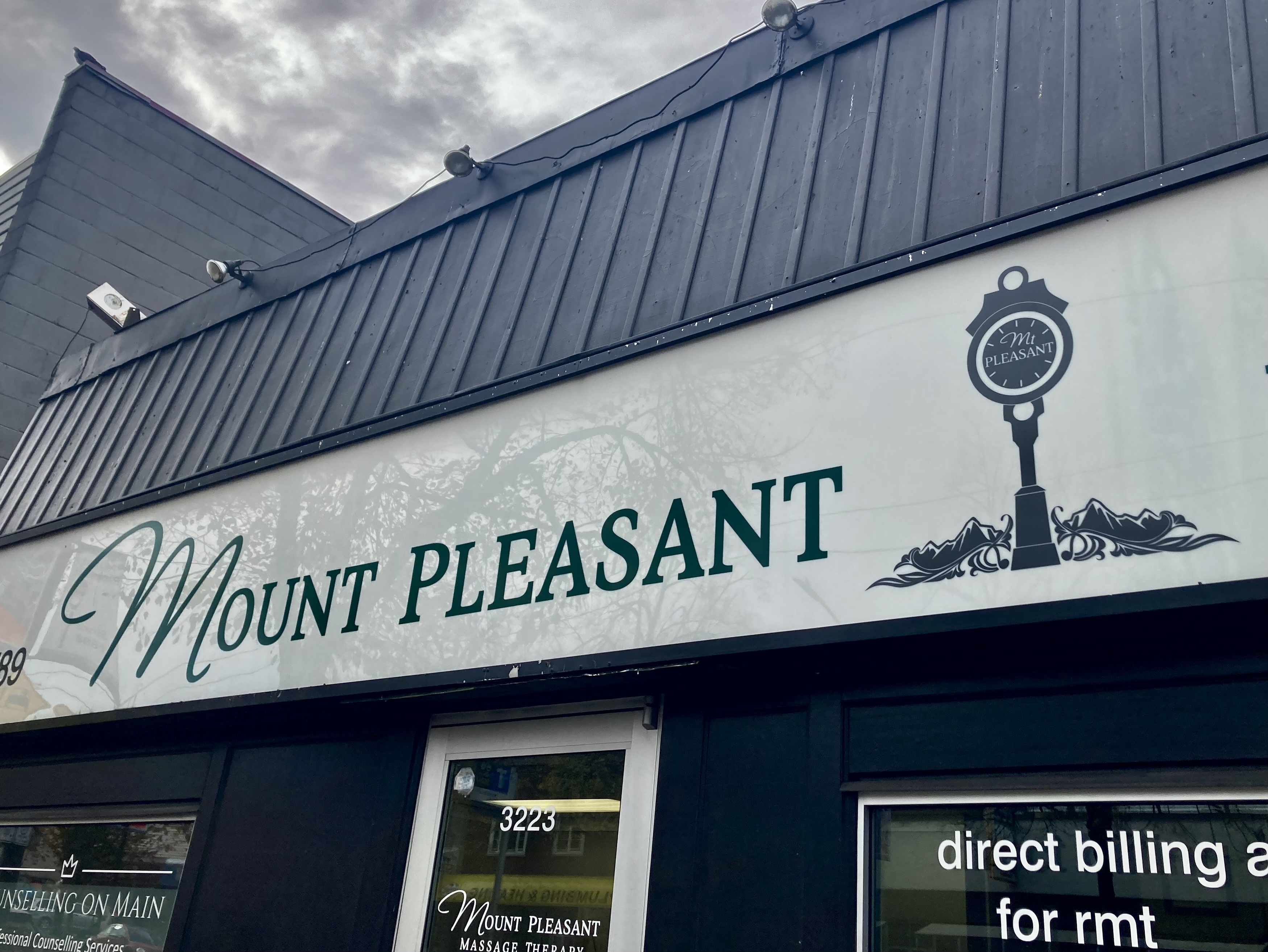
The clock’s image, like the physical clock, is part of who we are. You see it incorporated into shop signage…
and on sidewalk banners….
and in my own Winter Solstice blog post, last 21 December…
when I stood patiently in front of the clock, waiting to photograph it at exactly 7:27 pm — the exact moment of solstice, Pacific Time. While my theme was the phenomenon of the solstice, not the clock or its creator, I naturally turned to this clock to make my point.
The obits tell us that Ray Saunders was still fixing clocks and advising collectors world-wide right to the end. They also tell us he was still playing poker right to the end. His last game, with friends, took place last Saturday.
"Traveller, there is no path. Paths are made by walking" -- Antonio Machado (1875-1939)
"The voyage of discovery is not in seeking new landscapes, but in having new eyes" -- Marcel Proust (1871-1922)
"A city is a language, a repository of possibilities, and walking is the act of speaking that language, of selecting from those possibilities" -- Rebecca Solnit, "Wanderlust: A History of Walking"