7 September – Continuing my new, but very happy, Winnipeg tradition, I go walkabouts on departure morning. Once again, art comes my way as a result.
I cross the Red River to neighbouring St-Boniface and, just as I’m completing a loop through the neighbourhood, I find myself pulled into a parkette.
By this.

It is Joe Fafard‘s 2011 sculpture, Entre chien et loup — a tribute to the French saying, to this francophone quartier, and to the mystery and energy of transition zones.
By 10:30 pm I’m in the train station, ready to board, eager for our 11:30 departure and all the new sights that will come our way.

Except we don’t promptly board, and we don’t leave at 11:30 pm. Instead, we board at 3:30 am.
By then we are the walking dead. (Including the staff change coming on board with us — just as tired as we are but, unlike us, required to be up and active and even happy-faced just a few hours later.)
I don’t know when we finally leave Winnipeg. I’m asleep.
8 September – When I awake, we are somewhere just over the Ontario border. It’s about 7:30 am, and Groggy Self doesn’t understand why she is awake.

But it’s very pretty, isn’t it? And still very northern-looking.
I could show you lots more photos of boreal forest and lakes. But I won’t! By now you know what they look like. So, instead, imagine you’re with me as I enjoy those stunning views, all day long.
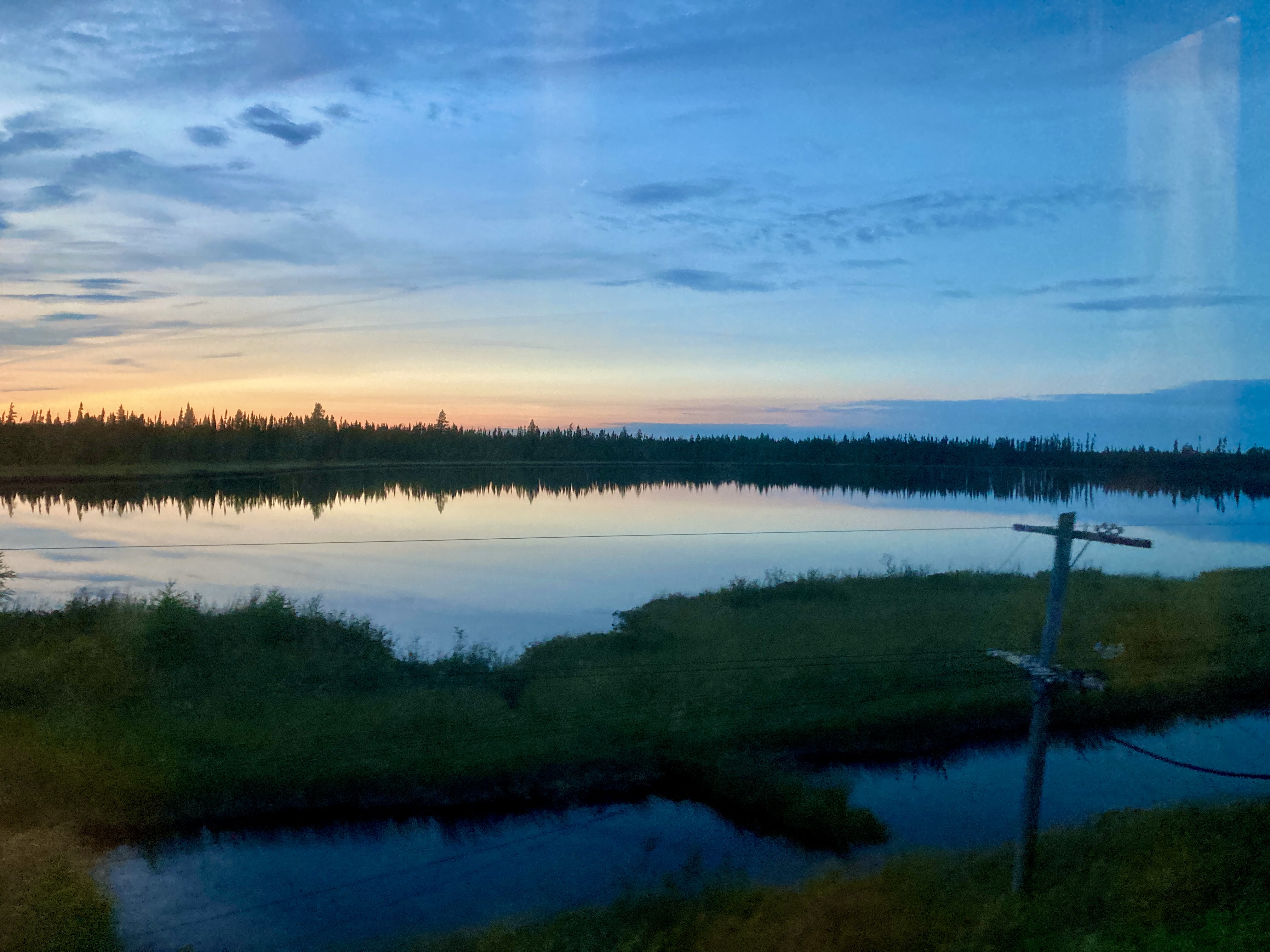
And sunset, near Hornpayne.
9 September – We’re just leaving Washago as I slide up my blind around 7 am, passing a CN work station and a cluster of workers. I’m happy to offer them this tribute: maintaining, scheduling, running trains is hard work. Thank you.

A rusty-but-sturdy little bridge, as we pass Sudbury…

first flashes of fall colour among the trees, here near MacTier…
and also near MacTier, one example of the rocky islands that stud glacial lakes throughout the region. Complete with cottages. (You can see a white one peeking out on the left-hand side of the middle island.)

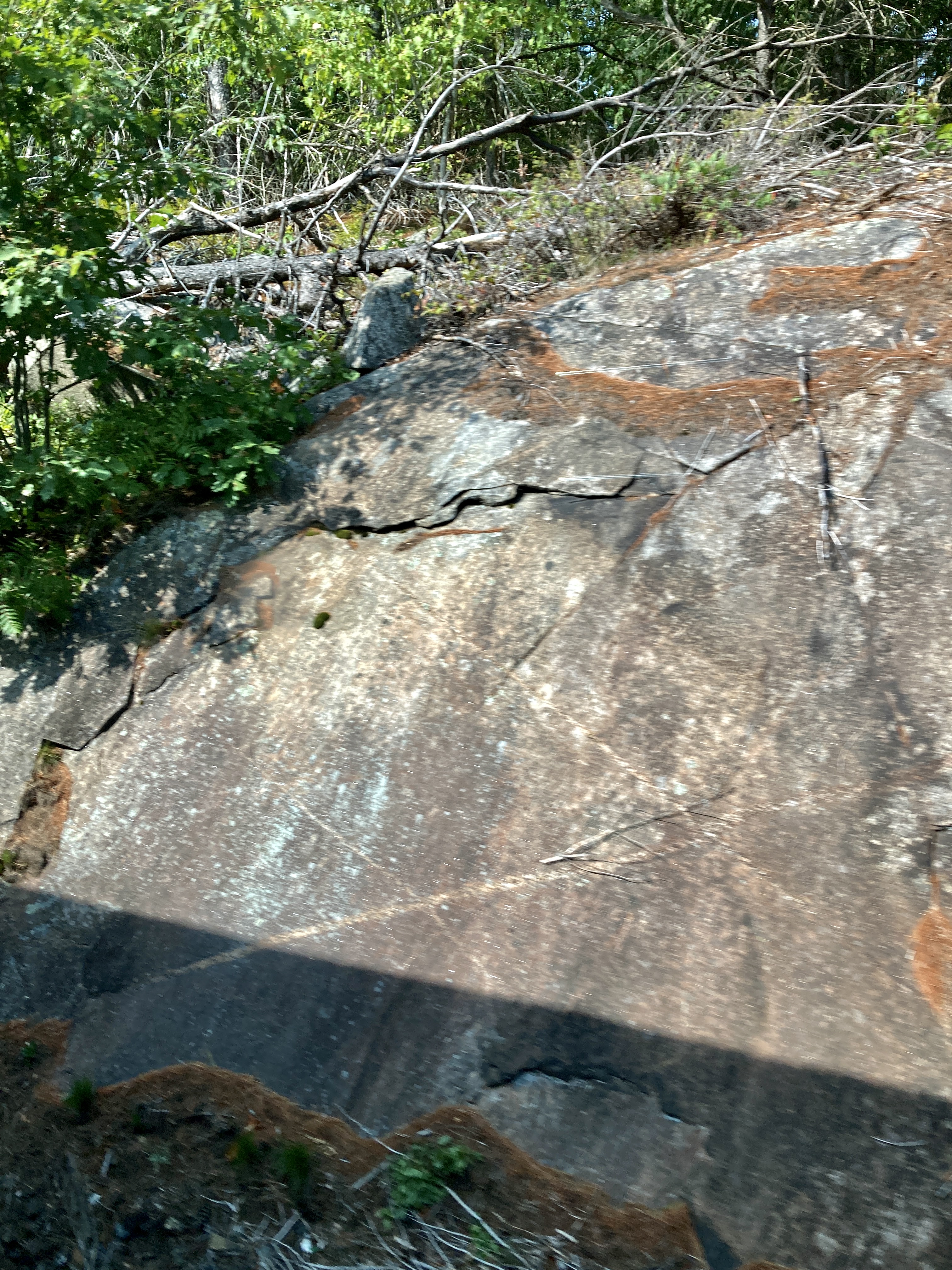
We’re on the Shield! The glorious, hard-rock Canadian Shield — more than 1 billion years old, and covering a good 50% of Canada’s land mass. Oh, I love this rock. This particular example near Torrance.
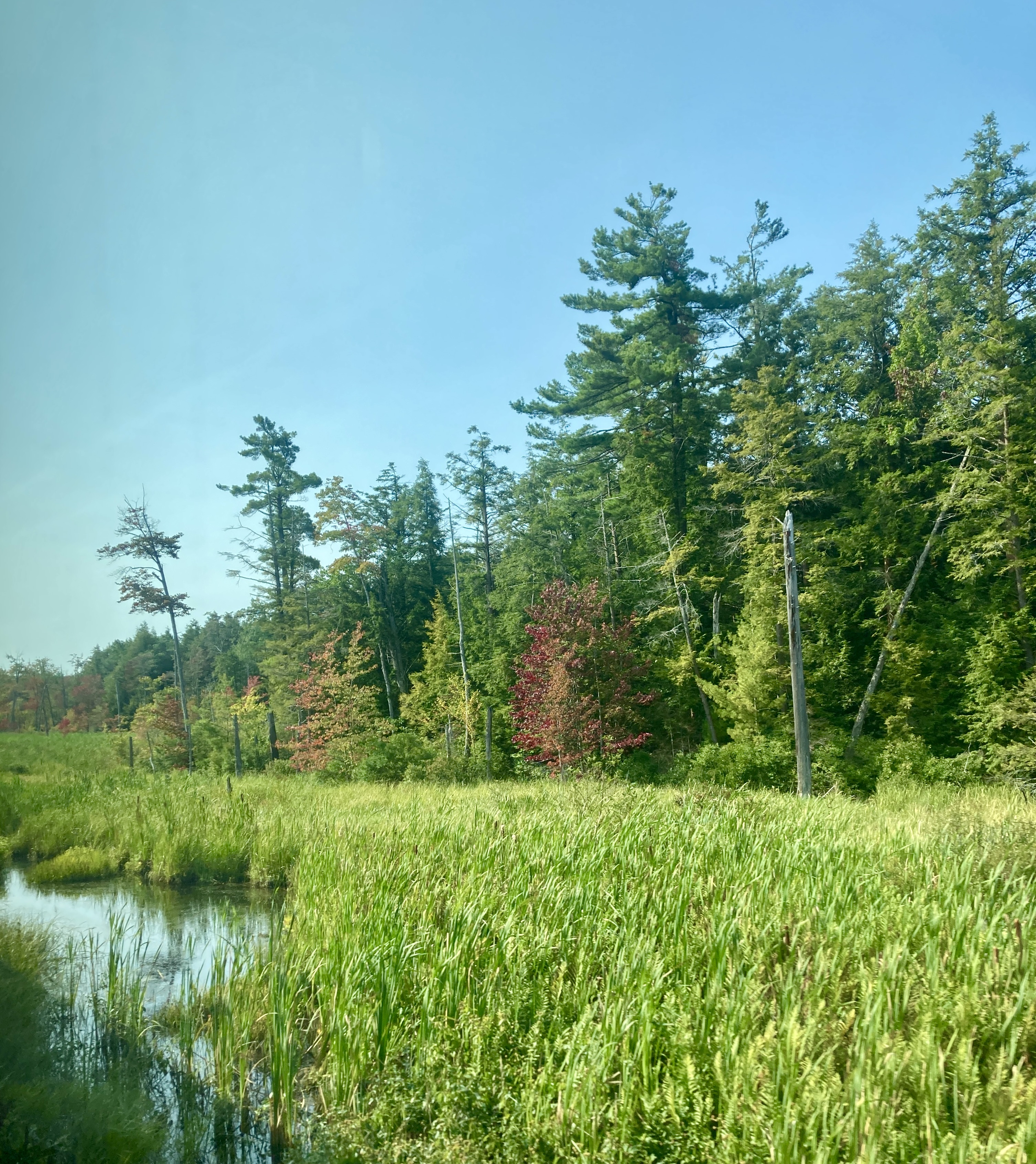
We’re now well into the transition from boreal forest to more southern, more deciduous, forest mixtures. Also in transition to gentler, but still water-rich, vistas — creeks, rivulets, rivers, marshy or rock-bordered, and flanked by forest. This particular example, near Severn Bridge.

Solar panels near Washago (northern tip of Lake Couchiching)…

and farmland. We’re back to farmland. This barn, near Brechin (east of Lake Simcoe).

I’ve loved this segment of the trip, dropping us down through Muskoka, one of Ontario’s “cottage country” regions and one where I have many happy memories.
We continue south, and as we enter Toronto, I’m into another rich cache of happy memories.

The tracks here run alongside the east branch of the Don River (just south of Eglinton Avenue East). I clap my hands like a child, in delight. I’ve walked these trails, walked that foot-bridge, stepped across these train tracks. Ohhhh, just look.
The scenery goes on being familiar, and then, as we round into Union Station, I hit old + new.
New construction, new towers — but back there, its silhouette slivered in between the two left-hand buildings, back there is the CN Tower. No longer new, but still iconic: it opened in 1976 and, at 553 metres, reigned as the world’s tallest free-standing structure until 2007.
It’s still handsome. And it still says Toronto.

Here I am.
In Toronto. Land cruise ended, magic beyond belief.
Thank you, all of you, who have crossed the country with me. I’ve enjoyed your company.
Epilogue – I want you to know: by the time we reach Toronto, we have made up all that late-time in Winnipeg. These few passenger trains have so little control over their running time! They share over-burdened train tracks with a great many freight trains — all of which claim priority. When push has to come to shove, as it often does, it’s the passenger train that sits on the siding. This explains why passenger train departure times are meant to be honoured, but arrival times are fiction. “Fiction” in the sense they are not the straight running time; they always have padding built in. Siding-waits are as much part of the trip as every station along the way.

 WALKING WOMAN