22 April 2024 – But before we dive into Latin taxonomy — not that I knew I was headed there, at the time — before all that, a moment at the corner of Scotia St. & East 7th.
Where I am charmed by Buggingham Palace.

The bee’s knees, you might even call it, though the holes in those colourful pillars are meant to accommodate the entire insect.
The volunteer tending this particular Green Streets corner garden has helpfully labelled all her plantings. I not only admire floppy reddish blossoms on a coarse-leaved shrub, for example, I know I’m admiring a Flowering Red Currant.
Then I look at an adjacent lamp standard, and learn even more.

The building on the opposite corner, the one I’ve always thought of as the Candy Factory, started life in 1904 (or thereabouts) as the Brewery Creek Building, one of many brewery operations in the area. It later became Fell’s Candy Factory, then the Purity Dairy, later on a grease works and later still had other grubby-sounding lives until, in 1993…
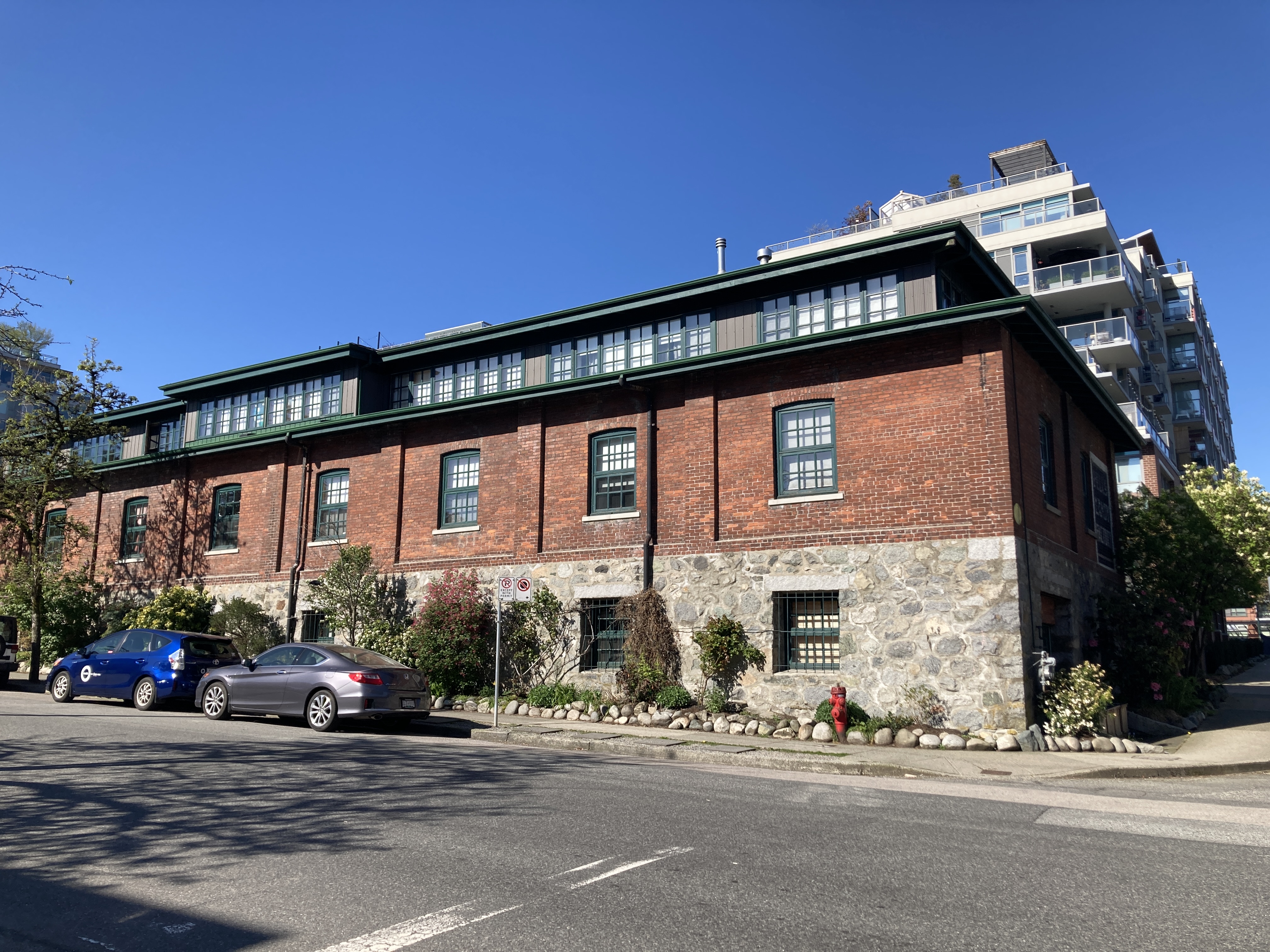
it was refurbished and converted to these handsome artist live-work spaces.
Pleased with all this new knowledge, I go on my way. “My way” being straight on east to China Creek North Park — no particular objective, just offering myself a not-very-demanding stroll on a very pretty day.
It’s a large, open, multi-purpose park dropped into a bowl — the bowl being what’s left when you drive underground what had been Vancouver’s largest drainage basin, whose creeks all fed into False Creek. (Until you filled in that final bit of False Creek as well.)

There are steep steps down-down-down on my left at the northern edge, but over there to my right, at the south-west corner, there is the start of a lovely ox-bow path …

that winds its friendly, undemanding way from high to low.
I take the path.
Almost at the bottom — down where I can watch young men grunting through crunches on the level grass while toddlers squeal in the playground — I turn and look back uphill. The slope is dotted with solitary bodies, perhaps meditating, more likely texting, but anyway all with knees angled outward to support their admirably straight torsos.
One person is upright, afoot, moving across the terrain. One human, but six legs.

Human plus fluffy white cat on a leash. See the cat?
Now please stop looking at the cat and notice all that yellow.
Lots and lots of yellow. All over the place.

Taraxacum officinale!
The dandelion.
I have to look up the Latin later on. Standing there, I’m sufficiently occupied just thinking about the word “dandelion.” I know it’s from the French “dent-de-lion,” for the serrated lion’s-tooth edge to the leaf. I also know that the word may be French, but it’s not the word the French themselves use, when they’re getting all familiar with T. officinale. They call it “pissenlit.”
Piss-in-the-bed. Apparently — and this I also have to look up later on — because of the diuretic properties of the plant.
(A sidebar on the delights of common names for plants, in different languages. I know Chlorophytum comosum as Spider Plant. I thought this the perfect evocation of its multitude of leggy offshoots, until a Cuban friend told me its nickname in Spanish. “Mala madre,” she said. Well, of course! The plant must be a bad mother — look at all those babies, running away from home.)
Back to T. officinale. Lawn-proud gardeners hate it, the very word “dandelion” an epithet in their mouths.
Ah, but the word is sweet, in other contexts.
In literature: Ray Bradbury’s 1957 novel, Dandelion Wine.
In wine-making: choose your favourite home-brewer as the example. My uncle put up batches every spring and my aunt heartily approved. I never did ask his secret, so I’ll offer this recipe instead. (No idea how good it is, or isn’t — but who could resist a blog called Practical Self Reliance?)
And, finally, dandelions in the visual arts.
Because, whether in flower or gone to seed, they are beautiful.

This 2013 Toronto street artist caught that beauty, the beauty of the plant itself and its ephemerality.

Like that dandelion head, this alley mural will surely be long gone by now. Unfortunately, I can’t tell you the artist’s name. When I took this picture — for my very first Blurb book! — I didn’t bother with attribution. Drat.
Maybe someone among you can right this old wrong? The style is distinctive, and the artist’s work was often seen in Toronto at the time. (Mary C, author of the splendid As I Walk Toronto blog, I’m thinking especially of you! You know the city’s streets, and street art, so well.)

 WALKING WOMAN