10 August 2025 – Seven moments, over the past few days, that snagged my attention. If these images snag you as well, I’m glad, and thank you. But here’s the rabbit hole: what now snags my attention is the phenomenon of attention-snagging. Of engagement. And the fact that your reason for lingering with any one of these images will be different from my own, and equally valid.
For the image is just the starting point, isn’t it? Each of us makes our own journey, after that. (And never the same journey twice.)
Saying this already has me on a journey.
- Memory of Harold Town, at a reception for a 1960s display of his art in the Glendon College Junior Common Room, being asked the meaning of one of his paintings. “I just paint it,” he shrugged. “The meaning is up to you.”
- Memory of Will Gompertz’ observation, in his 2013 book about 150 years of modern art (What Are You Looking At?), that one of the many factors comprising “art” is the engagement between the object and the viewer.
- Memories of my own frequent observation, back in the day, when addressing a J-school class or mentoring a neophyte writer, that topic and focus are two separate things. (“Banff National Park,” for example, is a topic; “wildlife corridors” is one possible focus within that topic.)
Enough! On with the images. And on with our journeys, mine and yours.
Downtown construction (Main & East Broadway)

I’m snagged by one detail: the muddy power shovel. I remember my dad, during a family 1950s drive holiday in Cape Breton, stopping the car to photograph a steam shovel (as they still were) being used to widen and stabilize the road. His company made that shovel! I was a very little girl, properly in awe both of her daddy and of that huge piece of machinery.
Urban playground (Emery Barnes Park)

When I was a kid, we had concrete underfoot. Now little feet (and my own) bounce gently on a more forgiving surface. Finally! A use for all those discarded car tires.
Evening reflections (Burrard St. south of West Pender)
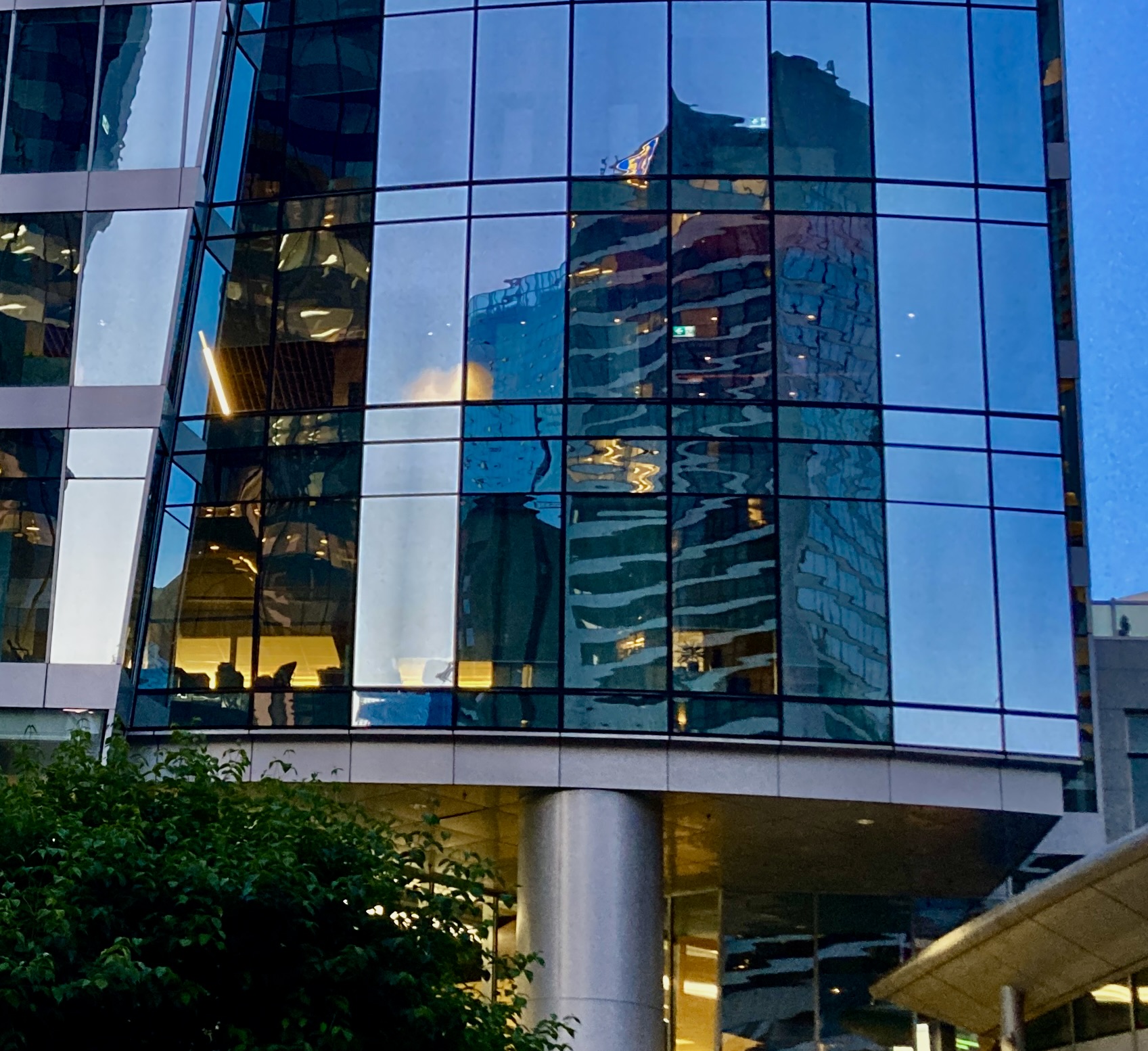
The snag is less visual than aural — the echo of baroque music. Christ Church Cathedral is just up the hill, a regular venue for Early Music Vancouver concerts. My post-concert walk is back down the hill, with this sparkling visual one more sensory delight, along with everything else I have just experienced.
Urban park contrasts (a Stanley Park pond, looking out to West Georgia)

The bull rushes flip me back to Grenadier Pond in Toronto’s High Park; the larger dance of nature and city reminds me of ravine walks in that city, with nature Down Here and urban life visible Up Above.
Waterfront (Devonian Harbour Park)

I could see heat-parched grass, or bobbing boats, or mountains beyond, or even (admittedly just out of frame) the helpful tourist-info kiosk. Instead, I fixate on the split-rail fence — “snake fence,” we called it, an everyday staple of rural Ontario-Quebec landscapes in my childhood, not the conscious design choice that it has now become.
Memorial name-walls (Komagata Maru memorial, Harbour Green Park)

The wall honours the 376 British citizens aboard this Japanese vessel, which was denied entry in a 1914 stand-off that lasted two months (the people being fed solely by private initiative) before the ship, under duress, returned to its Kolkata (“Calcutta”) starting point. The problem, you understand, was not that the people were British citizens; the problem was that they were also South Asian.
I honour the memorial, but my own engagement is elsewhere. I remember the 1982 unveiling of the Vietnam War Memorial in Washington, which arguably established the tradition of naming names as the most powerful way to acknowledge the importance of every individual. My memories include AIDS walls, Toronto & Vancouver; Ireland Park, waterfront Toronto, with its few known names of the 38,000 famine refugees who arrived during the summer of 1847 (when the city’s population was only 20,000); and the 2013 presentation at the AGO of Ai Wei Wei’s powerful memorial to the victims of the Sichuan earthquake, with members of Toronto’s Chinese community reading aloud, in groups of ten, every single name.
All those memories come later. As I stand at the Komagata Maru wall, I flash to the wall in Humber Bay Park East in Toronto. It honours the 329 people who, in 1985, boarded Air India flight 182 in Toronto but never reached Delhi. Over Ireland, a terrorist bomb hidden in the luggage blew the plane apart.
I remember standing there, some time in the early 2010s, aware of the intensity of the man standing next to me. His finger hovered mid-air as his eyes scanned the lines of names. Then his finger landed on the name that his eyes had sought. He patted the name, sighed. He turned to me. He just had to say it aloud, to someone. “We worked together. Such a great guy. He didn’t really want to go, but it was a big family wedding, you know? His wife and daughters, they were so excited…”
Windsock (Vancouver Harbour Flight Centre, Coal Harbour)

Oh my, all those years. From CUSO volunteer in the Peruvian high jungle through Oxfam & other NGO travels and then time among our own northern hamlets. All those sturdy little aircraft, all those airstrips, all that varied terrain. All those people. All that they taught me.
I tap my heart, and walk on.



 WALKING WOMAN