T. officinale (& friends)

22 April 2024 – But before we dive into Latin taxonomy — not that I knew I was headed there, at the time — before all that, a moment at the corner of Scotia St. & East 7th.

Where I am charmed by Buggingham Palace.

The bee’s knees, you might even call it, though the holes in those colourful pillars are meant to accommodate the entire insect.

The volunteer tending this particular Green Streets corner garden has helpfully labelled all her plantings. I not only admire floppy reddish blossoms on a coarse-leaved shrub, for example, I know I’m admiring a Flowering Red Currant.

Then I look at an adjacent lamp standard, and learn even more.

The building on the opposite corner, the one I’ve always thought of as the Candy Factory, started life in 1904 (or thereabouts) as the Brewery Creek Building, one of many brewery operations in the area. It later became Fell’s Candy Factory, then the Purity Dairy, later on a grease works and later still had other grubby-sounding lives until, in 1993…
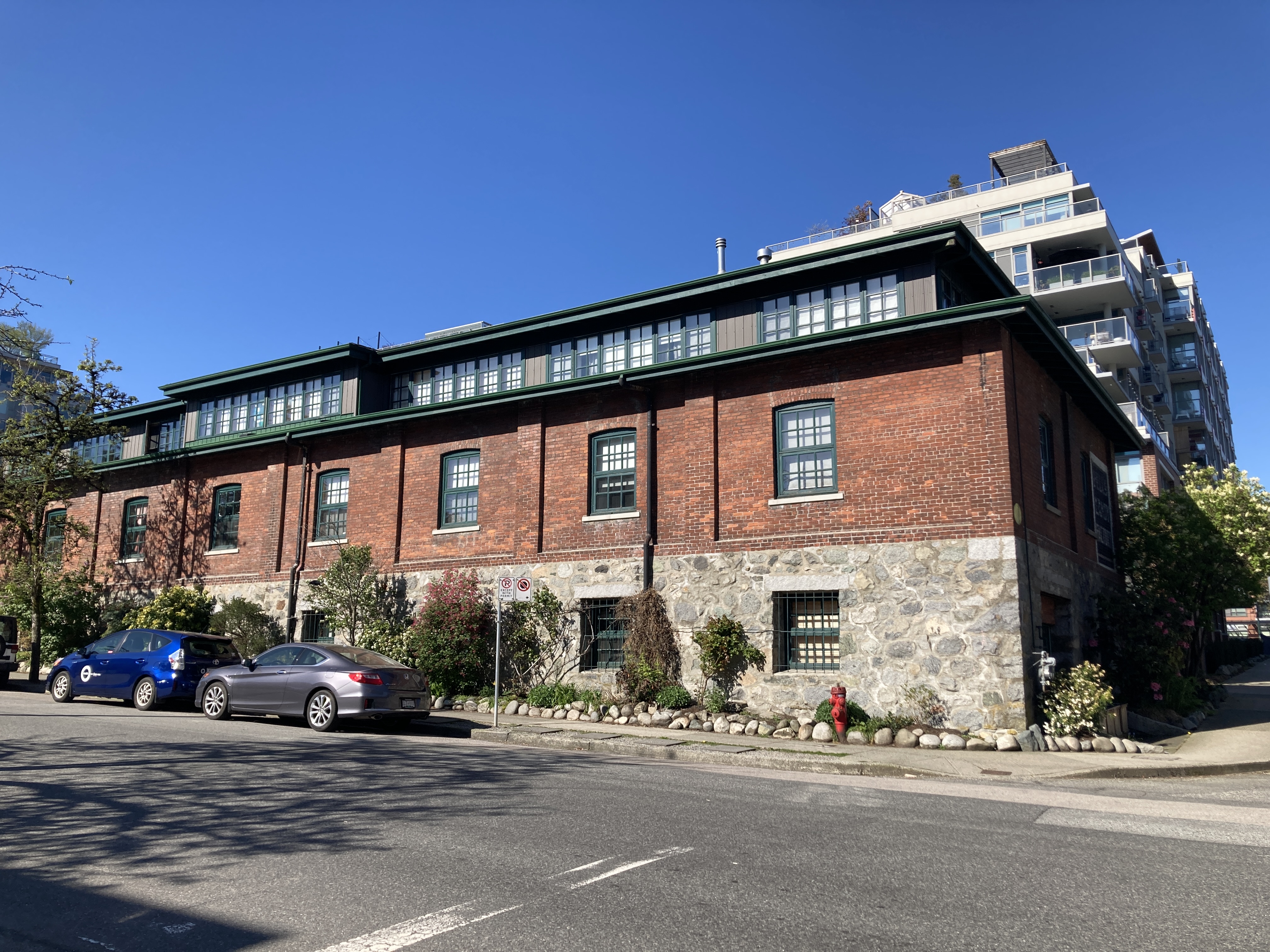
it was refurbished and converted to these handsome artist live-work spaces.

Pleased with all this new knowledge, I go on my way. “My way” being straight on east to China Creek North Park — no particular objective, just offering myself a not-very-demanding stroll on a very pretty day.

It’s a large, open, multi-purpose park dropped into a bowl — the bowl being what’s left when you drive underground what had been Vancouver’s largest drainage basin, whose creeks all fed into False Creek. (Until you filled in that final bit of False Creek as well.)

There are steep steps down-down-down on my left at the northern edge, but over there to my right, at the south-west corner, there is the start of a lovely ox-bow path …

that winds its friendly, undemanding way from high to low.

I take the path.

Almost at the bottom — down where I can watch young men grunting through crunches on the level grass while toddlers squeal in the playground — I turn and look back uphill. The slope is dotted with solitary bodies, perhaps meditating, more likely texting, but anyway all with knees angled outward to support their admirably straight torsos.

One person is upright, afoot, moving across the terrain. One human, but six legs.

Human plus fluffy white cat on a leash. See the cat?

Now please stop looking at the cat and notice all that yellow.

Lots and lots of yellow. All over the place.

Taraxacum officinale!

The dandelion.

I have to look up the Latin later on. Standing there, I’m sufficiently occupied just thinking about the word “dandelion.” I know it’s from the French “dent-de-lion,” for the serrated lion’s-tooth edge to the leaf. I also know that the word may be French, but it’s not the word the French themselves use, when they’re getting all familiar with T. officinale. They call it “pissenlit.”

Piss-in-the-bed. Apparently — and this I also have to look up later on — because of the diuretic properties of the plant.

(A sidebar on the delights of common names for plants, in different languages. I know Chlorophytum comosum as Spider Plant. I thought this the perfect evocation of its multitude of leggy offshoots, until a Cuban friend told me its nickname in Spanish. “Mala madre,” she said. Well, of course! The plant must be a bad mother — look at all those babies, running away from home.)

Back to T. officinale. Lawn-proud gardeners hate it, the very word “dandelion” an epithet in their mouths.

Ah, but the word is sweet, in other contexts.

In literature: Ray Bradbury’s 1957 novel, Dandelion Wine.

In wine-making: choose your favourite home-brewer as the example. My uncle put up batches every spring and my aunt heartily approved. I never did ask his secret, so I’ll offer this recipe instead. (No idea how good it is, or isn’t — but who could resist a blog called Practical Self Reliance?)

And, finally, dandelions in the visual arts.

Because, whether in flower or gone to seed, they are beautiful.

This 2013 Toronto street artist caught that beauty, the beauty of the plant itself and its ephemerality.

Like that dandelion head, this alley mural will surely be long gone by now. Unfortunately, I can’t tell you the artist’s name. When I took this picture — for my very first Blurb book! — I didn’t bother with attribution. Drat.

Maybe someone among you can right this old wrong? The style is distinctive, and the artist’s work was often seen in Toronto at the time. (Mary C, author of the splendid As I Walk Toronto blog, I’m thinking especially of you! You know the city’s streets, and street art, so well.)

Into The Flats

3 November 2023 – A mild but changeable day.

The morning’s rain still sparkles…

as fickle afternoon sunshine throws shadows on Main Street Brewing Company, at East 7th & Scotia.

The location is not incidental. Main Street Brewing occupies a Mission-style building that began life in 1913 as a storage warehouse for Vancouver Breweries Ltd., one of a cluster of breweries (and tanneries) in the area, all drawing their water from Brewery Creek, which crossed what is now East 7th & Scotia to run north into False Creek. The building later served as an auto body shop & repair garage before being restored in 2010 and returned full circle to life as a brewery.

I walk north on Scotia, more or less tracing the now-sewered creek’s path toward False Creek itself. I pause at East 5th, to admire these pebbles so delicately placed on a street-corner rock…

and continue north-north-north, down-down-down, to East 1st, where I turn left.

My brain expects my body will walk straight on (yet again, I grant you) to False Creek. My feet decide otherwise. Two snappy right turns — and here I am at Industrial Avenue & Western Street, on the edge of False Creek Flats.

The capital-F Flats — like Scotia Street — exist because the City decided to reshape nature. The tidal flats at the eastern end of False Creek were filled in, 1917-1925, and tributary creeks were contained & covered. False Creek Flats became a 450-acre industrial and transportation hub. It still is, in many ways, though City documents tell us its +600 businesses and 8,000 workers are now engaged in digital, health-care and creative activities as well.

I think of it as home territory for the first-ever, the 2016, Vancouver Mural Festival. Some of the murals are still in surprisingly good shape — and still relevant. The largely red one you see above, on that blue wall, by Nevercrew…

depicts a polar bear trapped in a pop bottle. If only it were not so relevant!

The area has a simple grid.

  • Two north-south streets: Western on the west & Station on the east.
  • Three east-west streets that march from Industrial Ave. north to Terminal Ave., and have geographically self-evident names: Southern, Central, and Northern.

The view northward from Station and Southern is a good capsule of Flats’ history: another 2016 mural on the corner (by Katie Maasik); a stretch of old warehouses disappearing from view to the left along Southern; Pacific Central Station (completed 1919) gleaming at the far end of Station St…

.and, right across the intersection, one of the area’s new health-care businesses.

Stemcell Technologies, founded in 1993, has locations around the world but is headquartered here in the Flats. (I confess I am distracted by the sight of the Hello Kitty decal on this car’s steering wheel.)

There’s a whole stretch of 2016 murals along Southern St. — but there’s also this pair of wonderfully rusty old buildings at the far end, over at Western Ave. They may or may not currently be a wood-working co-op, I can’t quite get a fix on that, but I don’t care, I just like all that rust.

And I tantalize you with the edge of another 2016 survivor, a mural by Peter Ricq. (For the whole 2016 VMF collection, click here.)

But 2016 wasn’t the start of street art in the Flats. Central Street is still one long gallery of earlier works, perhaps all or mostly done in 2007. That’s my guess, since that’s the only date I see on the relatively few murals that are signed.

This one makes me think of Borobudur, the 9th-c. Buddhist temple in Central Java.

Despite the obvious, and multiple, differences between the two, they do share a common theme: each illustrates, either with paint or in architecture, humanity’s spiritual ascent.

I rejoin Station Street, walk north to Northern, pass the still-busy CNR tracks…

and cross Terminal Ave. for a brief visit to Pac Central.

How could I be in the area, rich with railway history, and not say hello to the train station? So I greet the lion at the imposing doorway (there are always lions, in our colonial-reference buildings)…

and — finally!! — head for False Creek.

Because even if my feet vetoed the plan originally, they agree that — just like Pac Central — the Creek deserves a moment’s hello.

As I climb the Creekside Park berm toward the water, I see that other feet are already paying a visit. Even though they are dangling, not walking.

I skirt the bench, nod to the view…

and let my feet walk me home.

  • WALKING… & SEEING

    "Traveller, there is no path. Paths are made by walking" -- Antonio Machado (1875-1939)

    "The voyage of discovery is not in seeking new landscapes, but in having new eyes" -- Marcel Proust (1871-1922)

    "A city is a language, a repository of possibilities, and walking is the act of speaking that language, of selecting from those possibilities" -- Rebecca Solnit, "Wanderlust: A History of Walking"

  • Recent Posts

  • Walk, Talk, Rock… B.C.-style

  • Post Categories

  • Archives

  • Blog Stats

    • 128,834 hits
  • Since 14 August 2014

    Flag Counter
  • Enter your email address to follow this blog and receive notifications of new posts by email.

    Join 2,047 other subscribers