Love and the Water

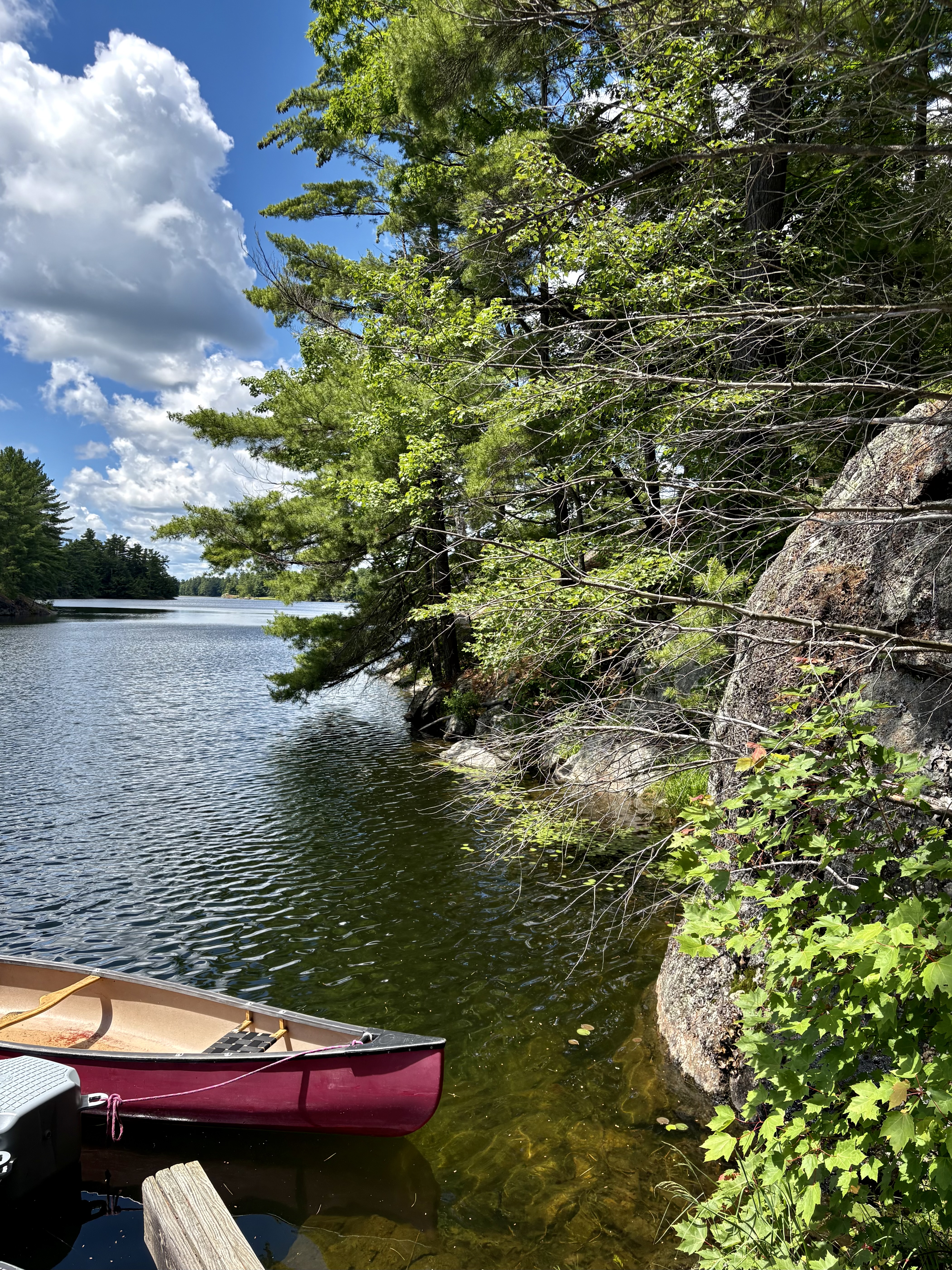
26 June 2026 – I stand on my dear friends’ dock in rural Ontario, soaking up the Ontario/Quebec landscape that has shaped me: rock, water, trees.

The granite of the Canadian Shield; the lakes carved by slow-passing glaciers; the mixed forests woven throughout.
And that canoe.
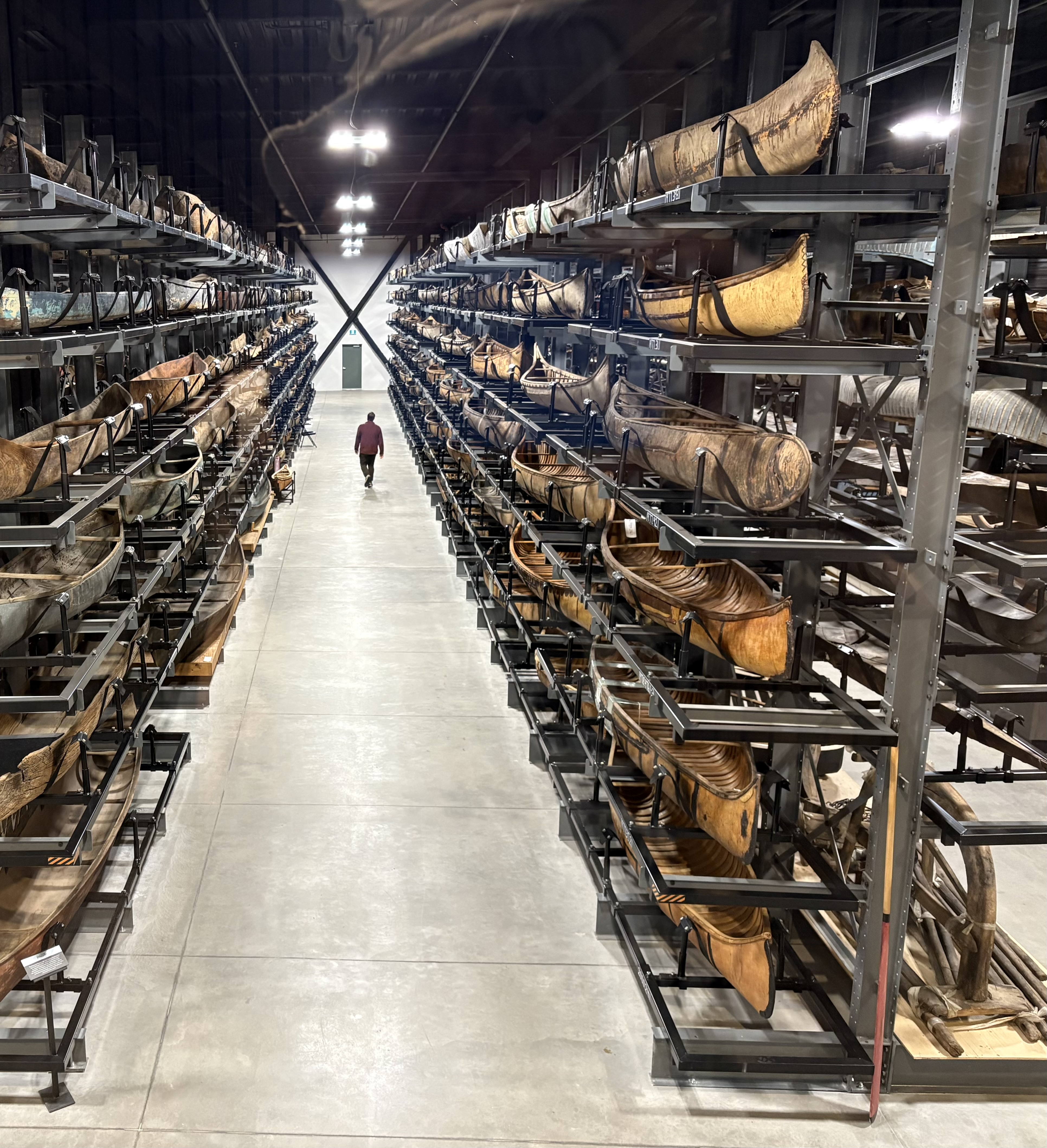
We are thinking watercraft, and love of watercraft, and especially of canoes. We are about to visit the Canadian Canoe Museum, with its plus-650 examples of canoes, kayaks and paddled watercraft — primarily from coast-to-coast-to-coast Canada, but also from all parts (and eras and cultures) of the world. It is the world’s largest, and most significant, collection of such craft, much of it donated by people who have finally found a worthy forever-home for their own collections.

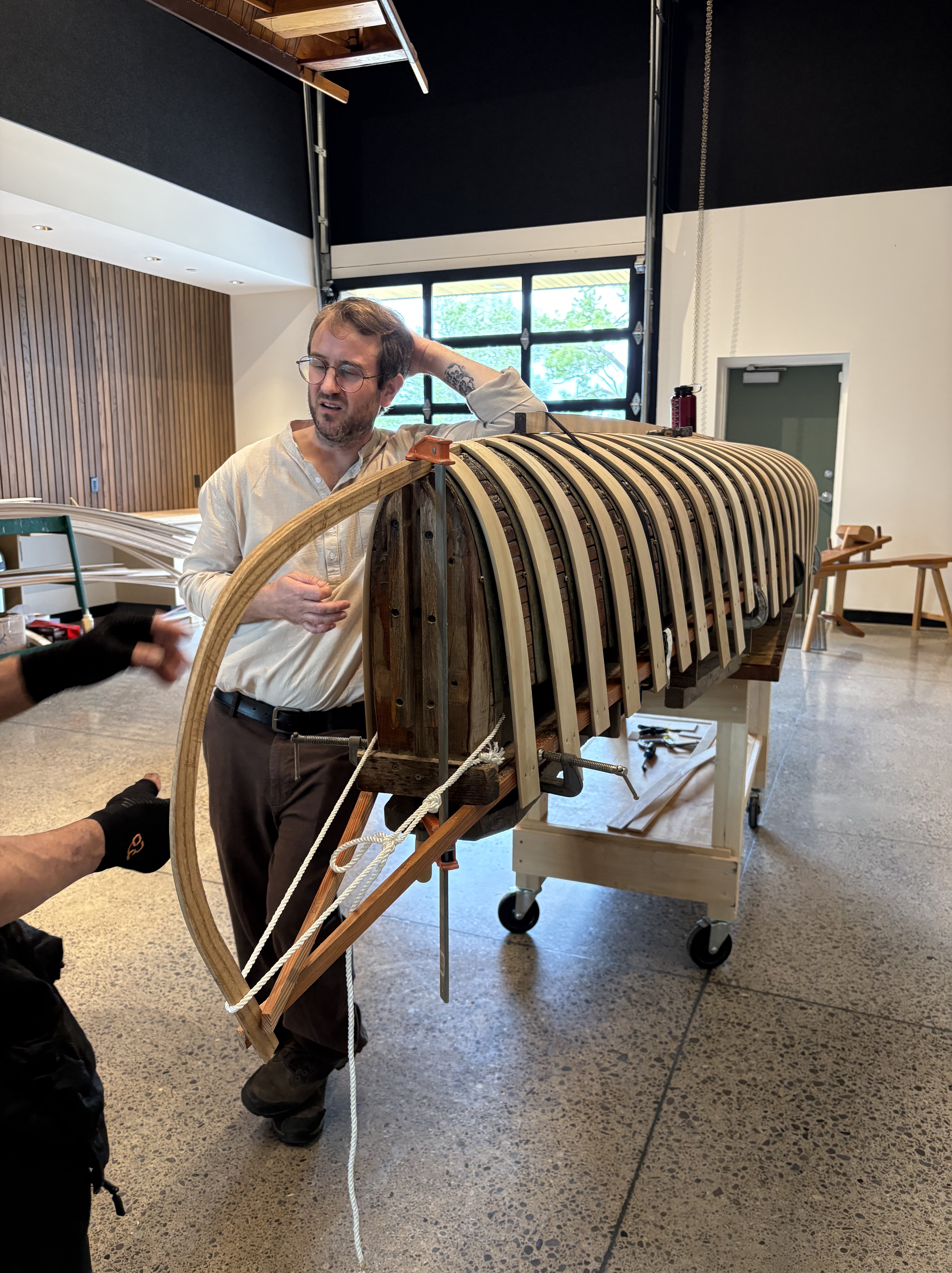
Really, though, you best understand this worldwide phenomenon through the love and skills of one human being, someone now carrying on that tradition. For example, Brian Cook, who is taking a few weeks from his Cook Craft home base in Dwight, Ontario, to serve as the June 2026 Builder in Residence at the museum.

In the workshop, he demonstrates the stages of the work involved, talking with visitors, sharing the lore with them, responding to their own knowledge and passion and interest.

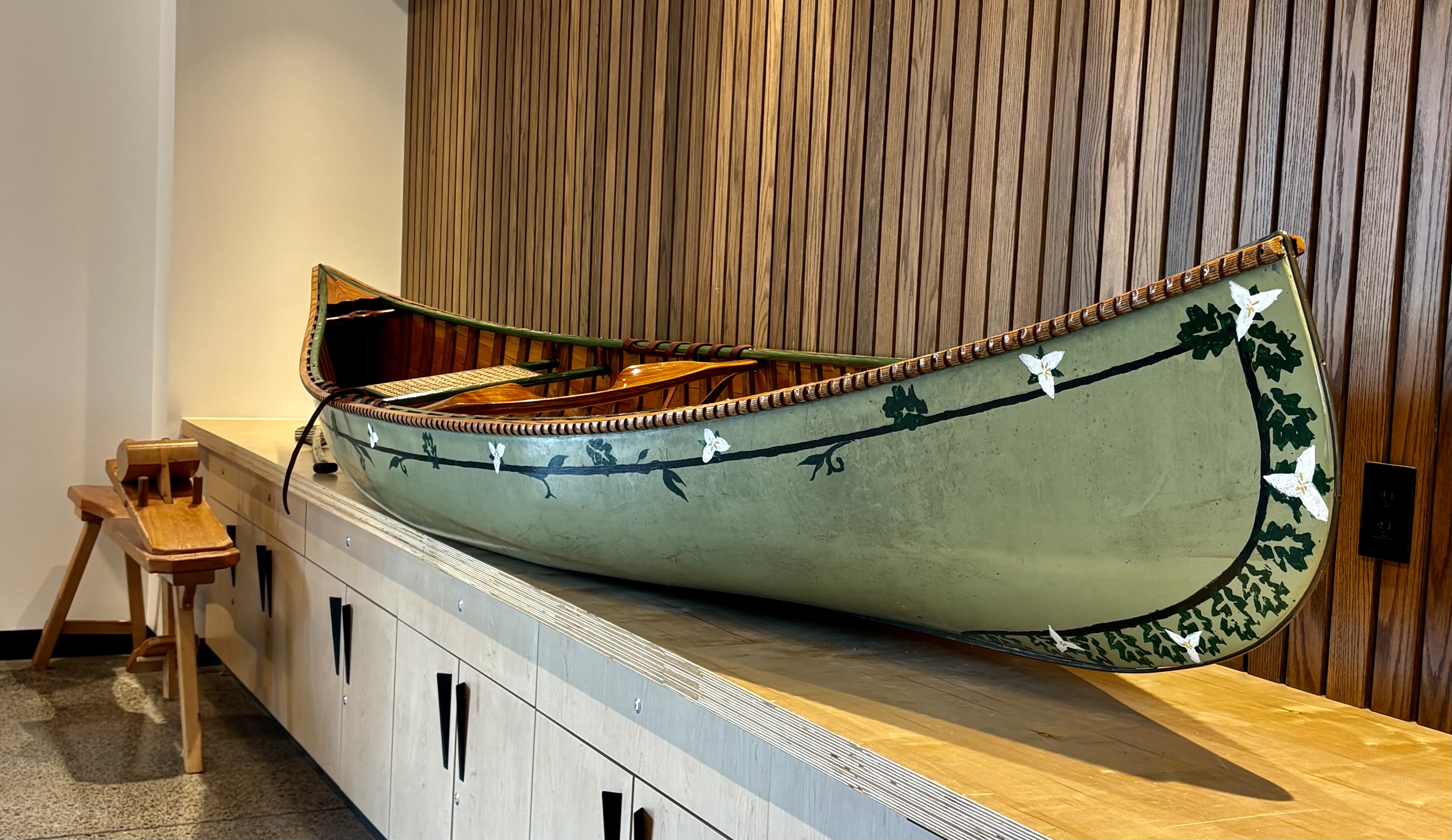
I gesture to this splendid green canoe, on display against the wall, and ask if it is part of the Museum’s collection.

He is horrified. “No! It’s mine! I built it, I use it, it is part of my life, some day they’ll bury it with me.”

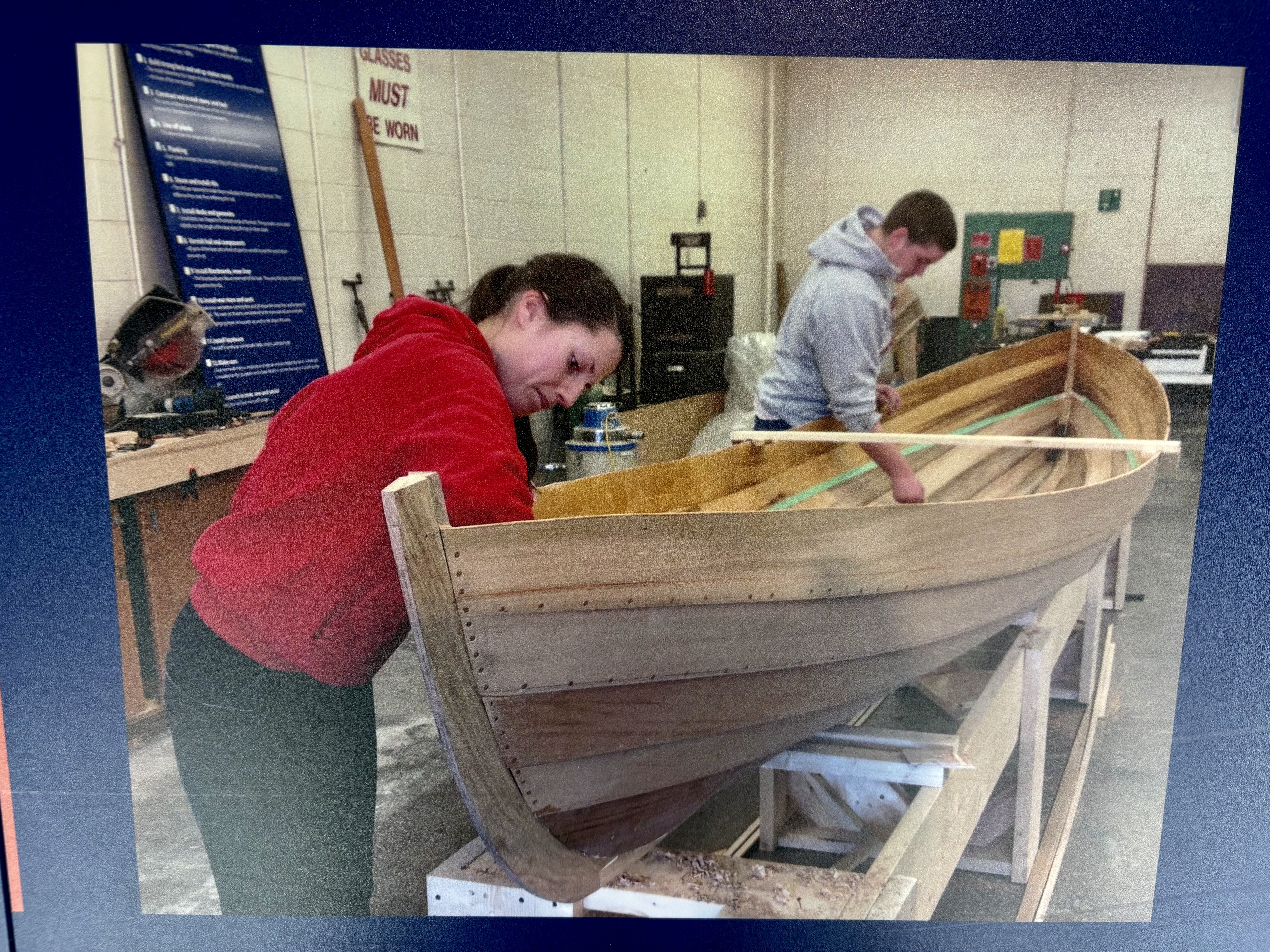
Brian was mentored in these skills by an older master of canoe-building, Jack Hurley. I tell him about the high school students in Gananoque who, with mentorship, have now built a St. Lawrence skiff. He quickens with interest, and I promise him photos.

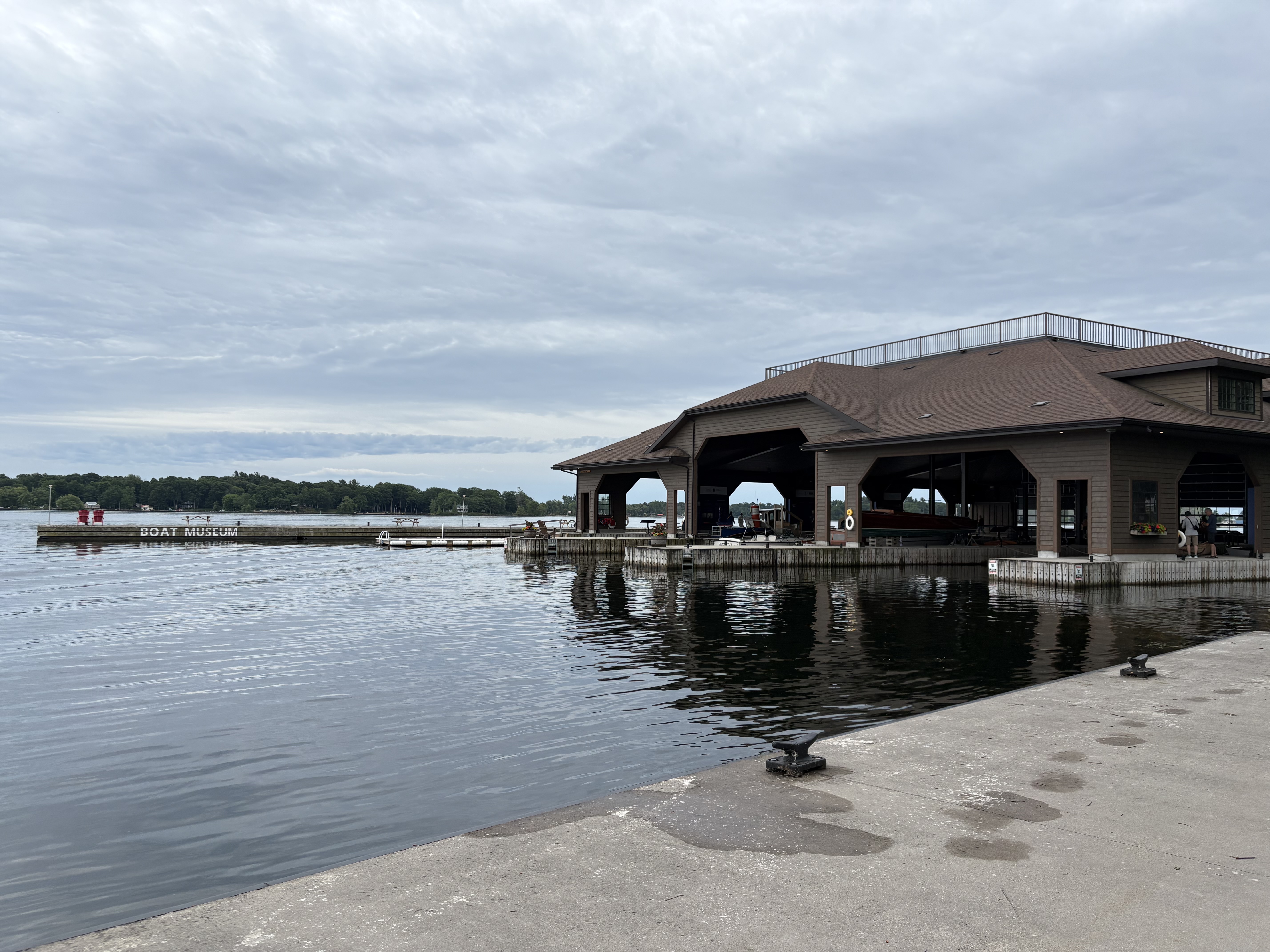
Almost at the end of our trip up the St. Lawrence River, the Canadian Empress stopped in this community, which sits at the heart of the Thousand Islands and is just east of Kingston where the waters of Lake Ontario flow into the mighty river. It is, appropriately, home to the Thousand Islands Boat Museum. Unlike the Canadian Canoe Museum, with its world-wide scope (though Canadian emphasis), this museum is devoted entirely to the watercraft of this one specific region within the St. Lawrence River.

Even before opening their doors, the museum launched its youth boat-building program, part of the museum’s focus on reconnecting local kids with their own river.

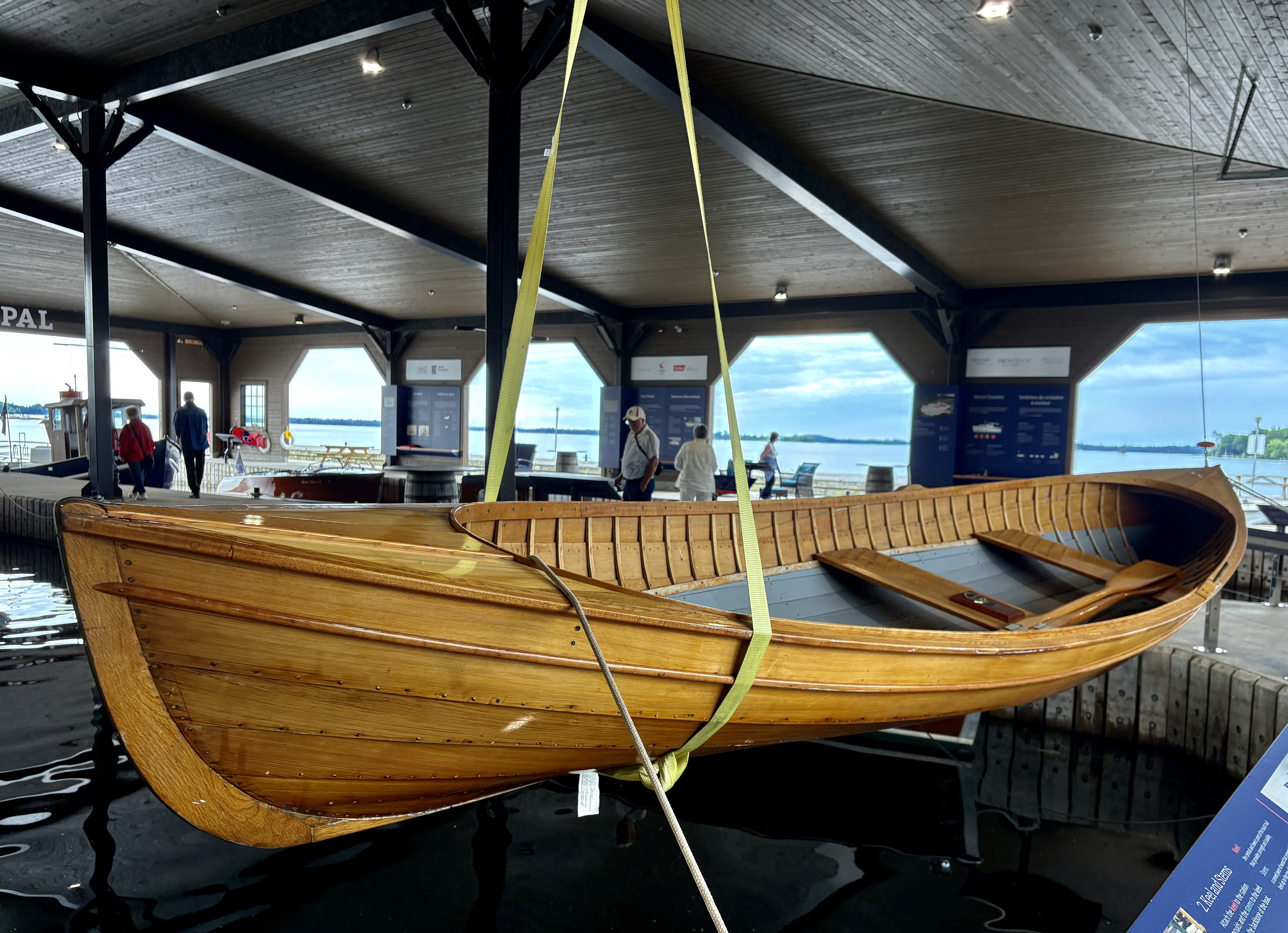
The first project? A faithful reproduction of the iconic St. Lawrence skiff — the double-ended work and pleasure boat essential to island farmers’ lives from the 19th century until power boats took over in the 1930s or so.

More than 100 high school students took part. This is what they built.

When the little museum opened its doors in 2014, Skiffy was launched, at the heart of the collection.

Obvious differences between these two museums, only 206 km. apart: One, on the shores of Little Lake just outside Peterborough, Ontario, founded in 1997 and now displaying its extensive collection both in the museum and through the glass walls of the storage area…

and one on the shores of the St. Lawrence River, which opened its doors in 2014, and houses a much more modest collection.

They are united, however, in what matters: their love for this living heritage, and their determination to preserve and enhance all that it encompasses.

Locked, Sheltered & Delivered

21 June 2026 – I could go silly with factoids in this post, so I am busy slapping myself down. Even so, I encourage you to click the links and go silly on your own time.

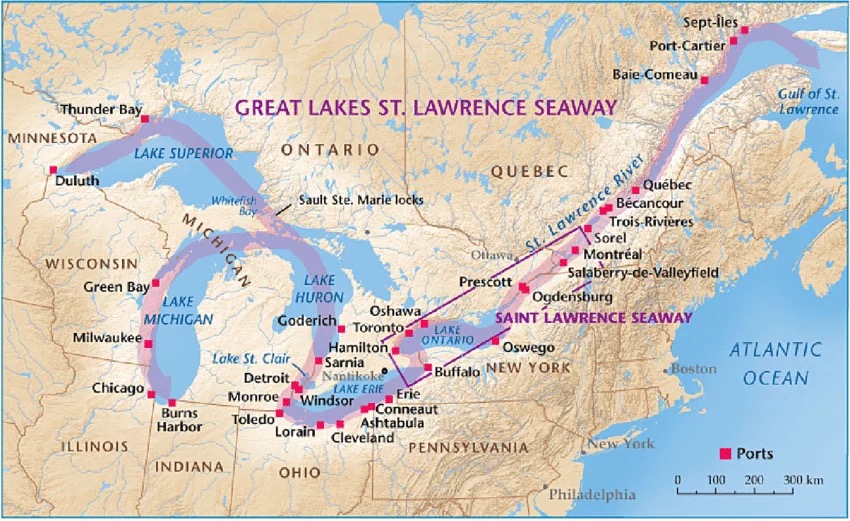
The “it” in question is the St. Lawrence Seaway in general, the Montreal-Lake Ontario stretch of it in particular, and its locks system in very particular. I am awe-struck by all of it. This Seaway still stands as one of the greatest, the most challenging, engineering feats of all time.

The feat? Four years of mid-20th c. construction that re-contoured the 306 km. stretch of the river between Montreal and Lake Ontario, adding a new lake, 7 locks and a major power dam in the process, and engaging 22,000 workers who among other things moved 210 million cubic yards of rock & gravel and poured more than 6 million cubic yards of concrete.

On top of all that, it was a bilateral (Canada/USA) project. First mooted by a US politician in the late 19th century, the Canadian government took up the idea in the 20th c., only to be met with stonewalling on the American side. Post-World War II, however, when giant American mining companies saw depleted high-grade ore reserves in the USA but large high-grade reserves in their Canadian operations, that was when — gee, what a surprise — the US government came on-side.

We learn some of this along the way. Mostly, I just want to gawk, in awe and respect, at the complexity of applying the basic principles that drive any lock system. You want to move a vessel from one water level to another? Basically, you put it in an elevator and send it one way or the other: seal it up nice & tight in a lock at the entry-water level; add or subtract water as necessary to reach the desired exit level; open the exit gate; and away it goes.

In a ship, in a lock big enough to accommodate freighters twice as long and half as wide as a football field (up to 225.5 m/740 ft in length and 23.8 m/78 ft at the beam)… then that simple concept gets pretty impressive.

And necessary. Canadian Empress is a small ship, out there for pleasure, but these ocean-going freighters are transporting cargo to/from the heart of North America. They need fast (average 45 min./lock), dependable conveyance through a water-level difference of 75 metres (246 ft) over the 306 km (189 mile) stretch between Montreal and Lake Ontario. The total rise, from sea level on up to Lake Superior (reached by additional locks), is the equivalent of a 60-storey building.

(Aren’t you glad I haven’t gone silly with factoids?)

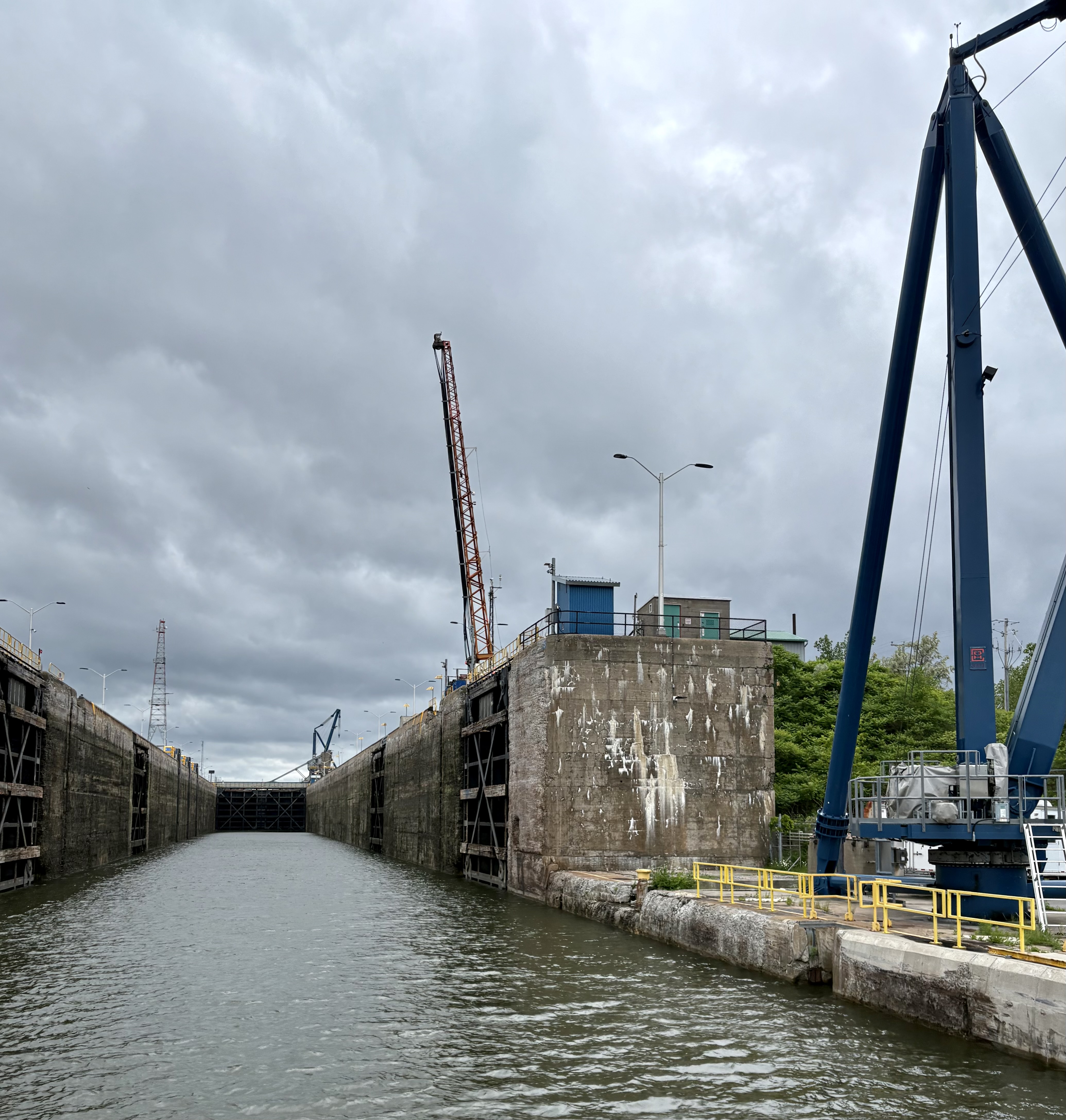
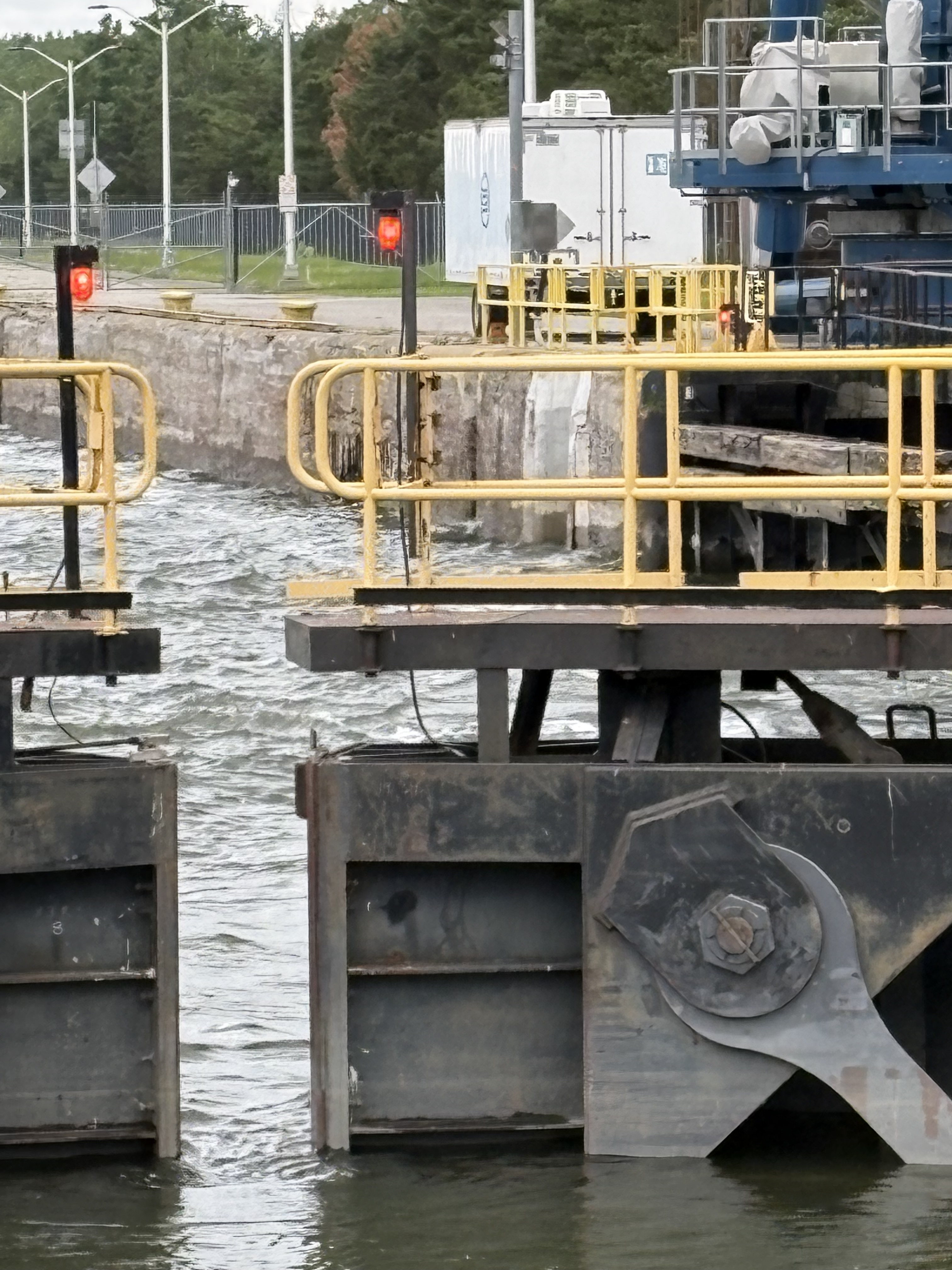
We travel all 7 locks (5 Canadian, 2 American). The second lock, Côte Sainte-Catherine, illustrates the process. We position ourselves, and await the green lights (and open entry gate) that tell us to proceed…

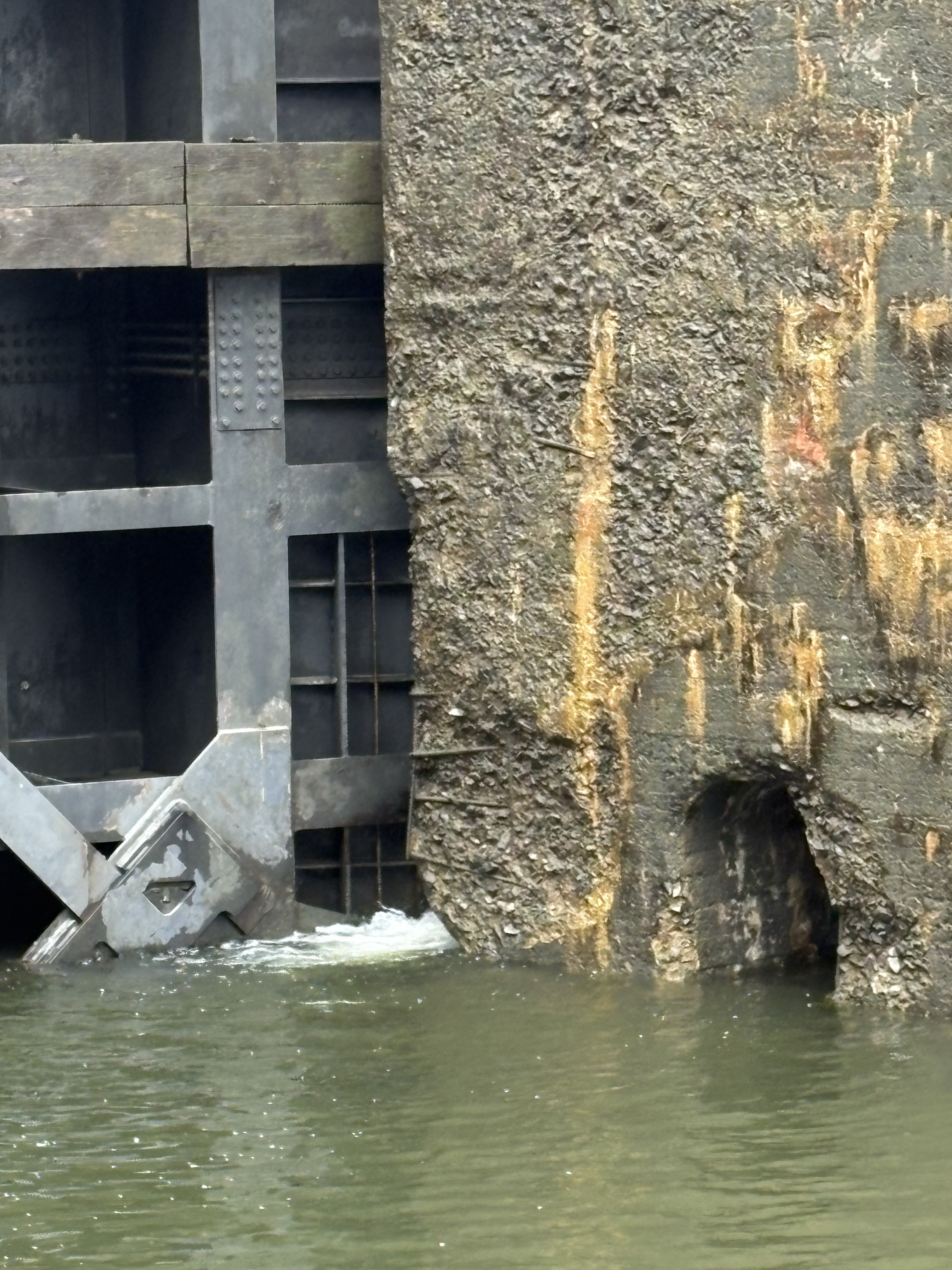
and since we are travelling west and will need to rise, lock by lock, to the Lake Ontario level, water now sluices into the lock…

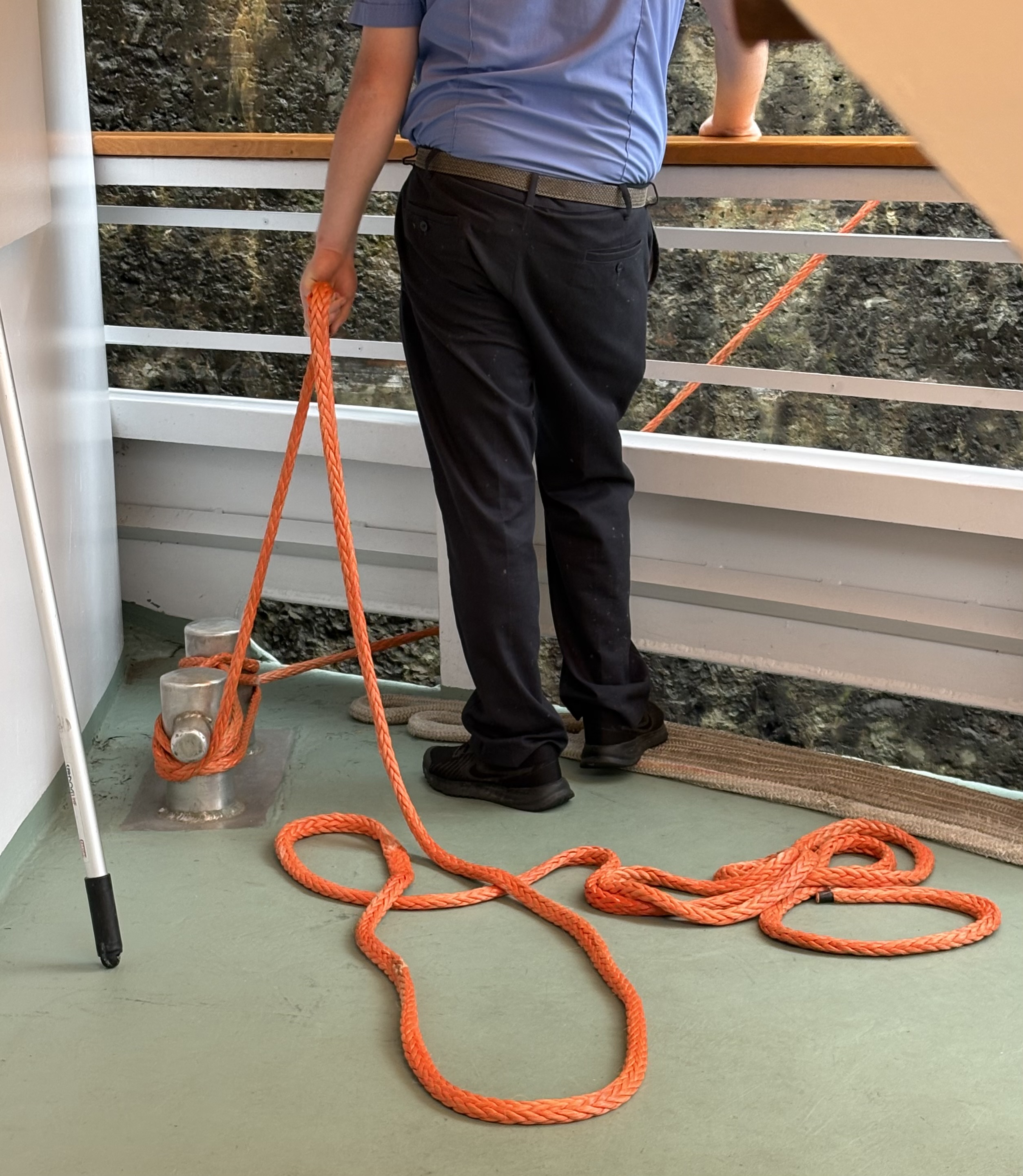
with a deckhand constantly manipulating the lines to keep the ship taut and positioned.

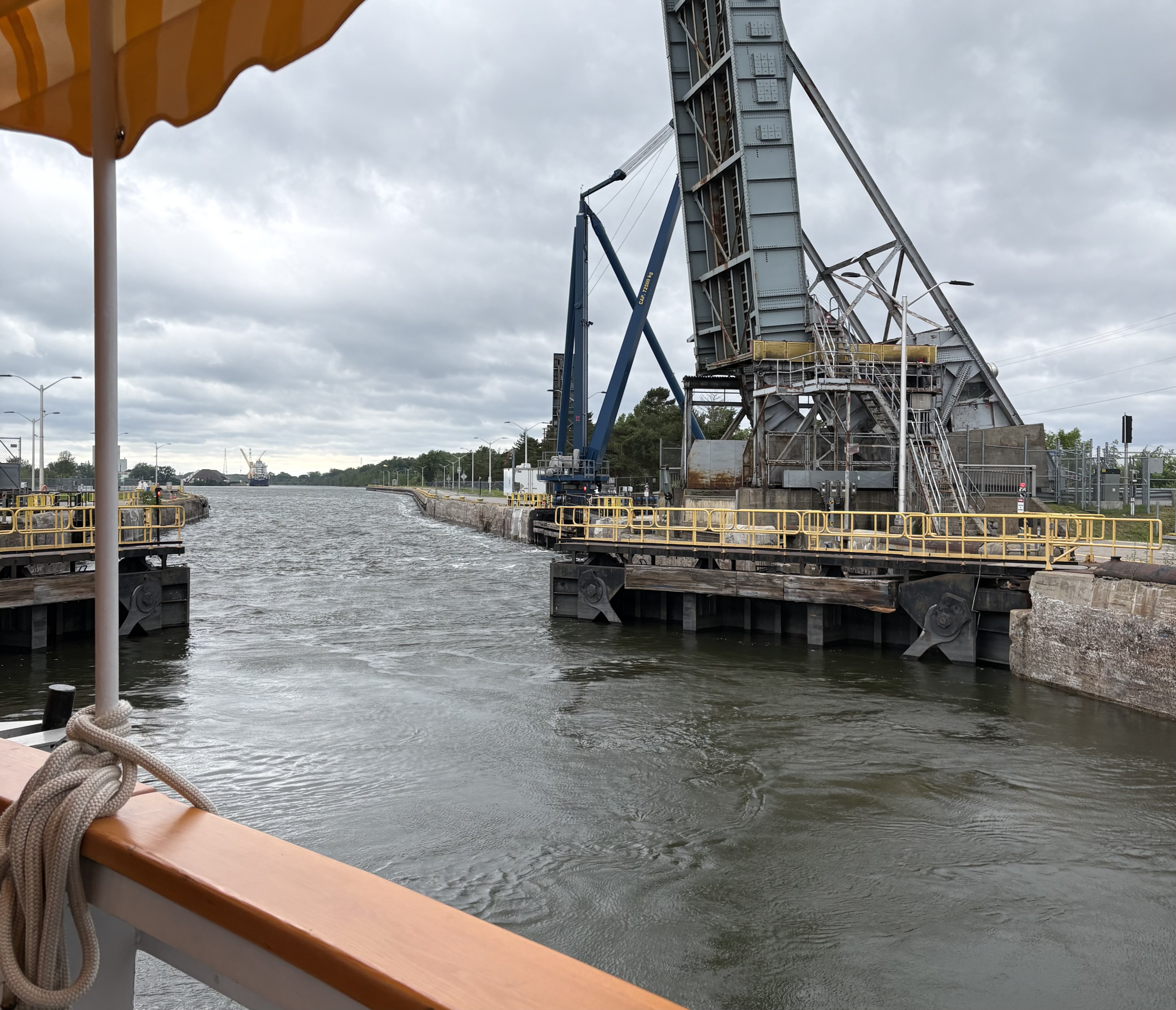
Once we’ve reached the level of the waters beyond, they open the exit gate…

and out we go.

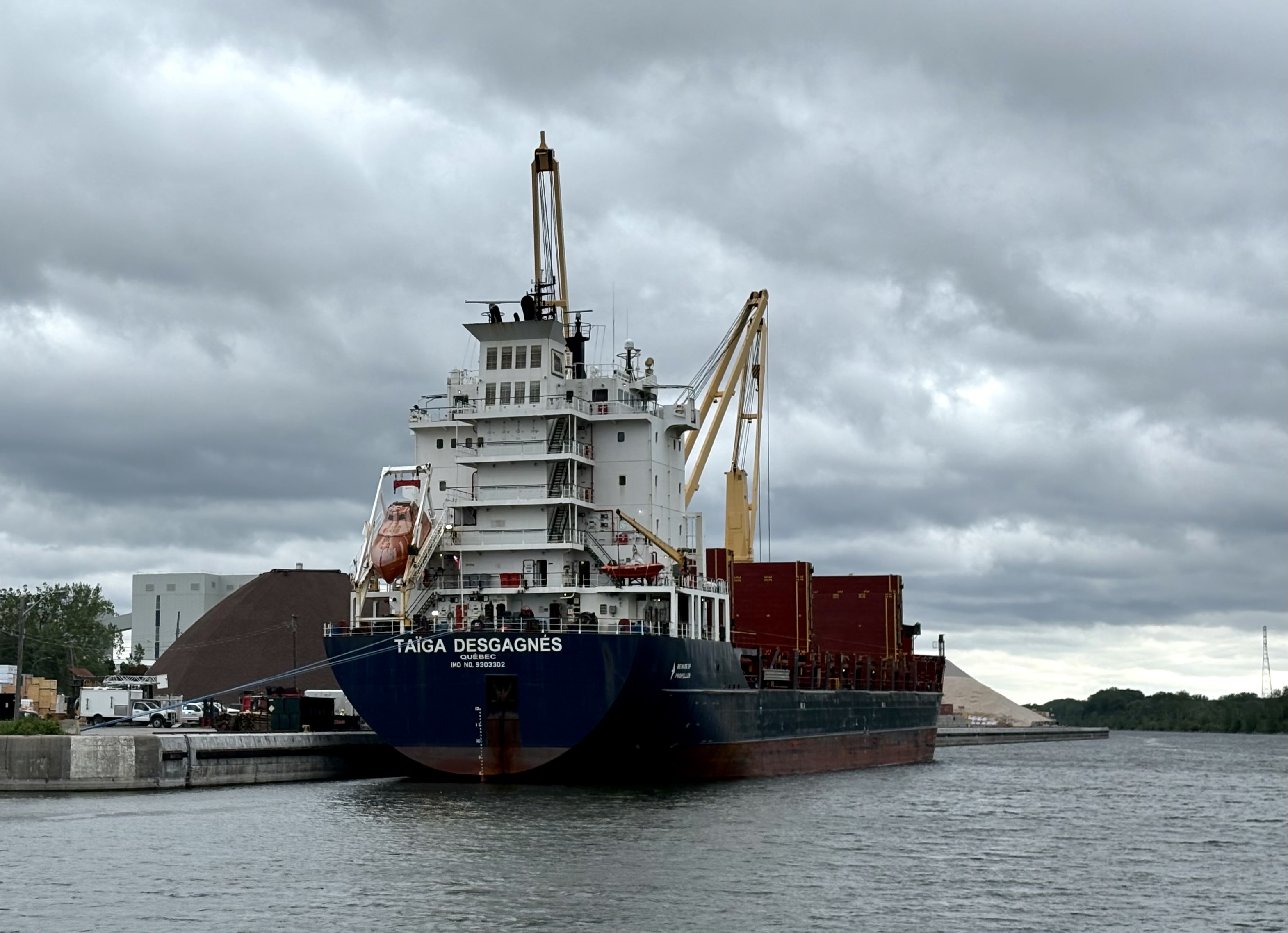
Travelling this great waterway, we meet — of course — freighters. Such as the Taiga Desgagnes

just west of the Côte Sainte-Catherine lock, busy loading cargo. Sharp-eyed fellow passengers swear that’s a fire engine being hauled aboard, but I can’t verify the claim.

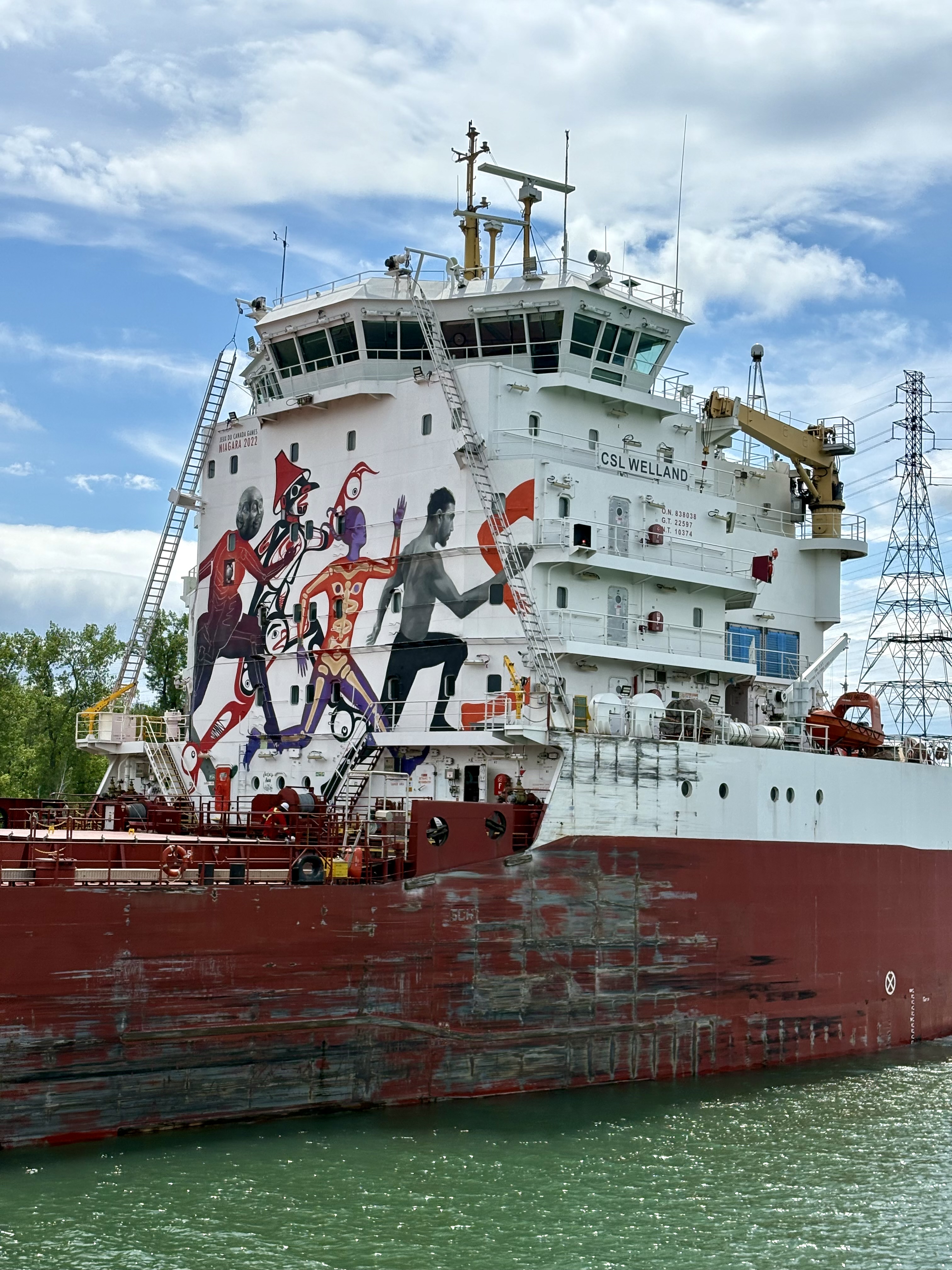
We meet other freighters, including one depressingly named Barnacle, and also the CSL Welland, surely the jauntiest of the bunch. As she awaits her turn for the Snell lock (one of the two American locks)…

we have time to admire her sporty mural.

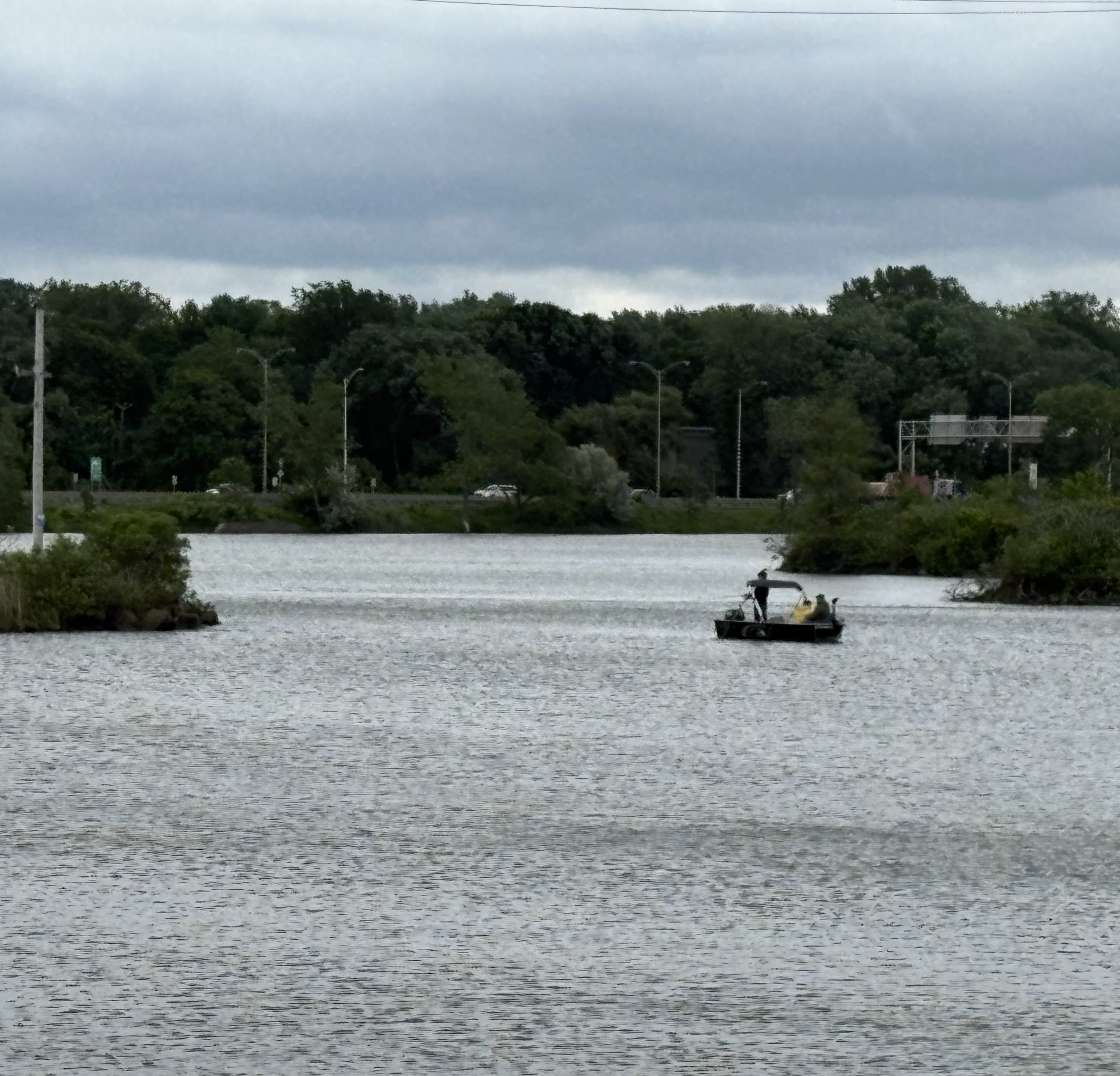
We meet other vessels as well, some very small and each with its own purpose — everything from personal small boats out for a bit of fishing (in the South Canal near Montreal)…

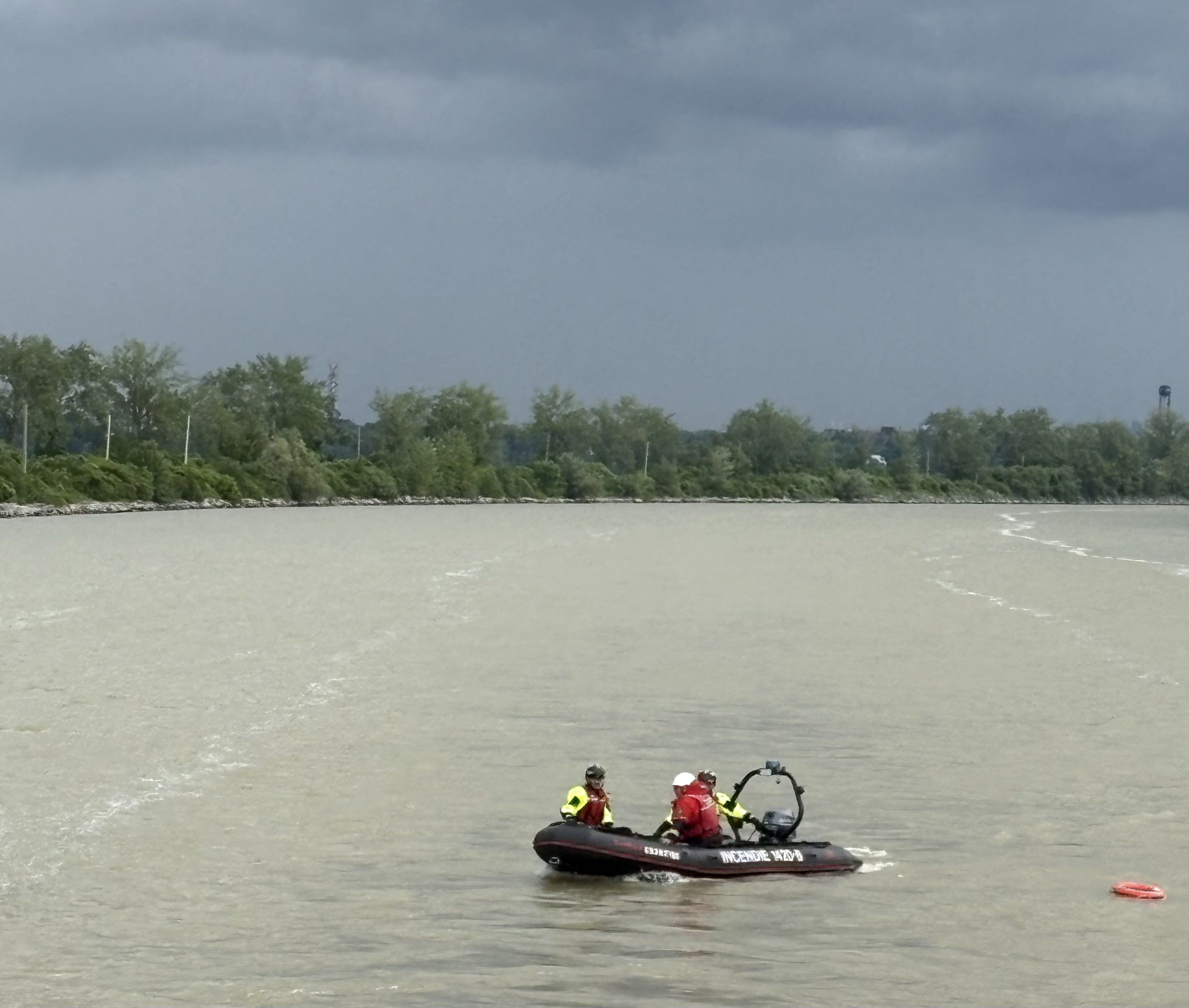
to working vessels, this one marked “Incendie”, fire patrol…

and apparently doing some kind of research involving that red ring. Perhaps studying currents?

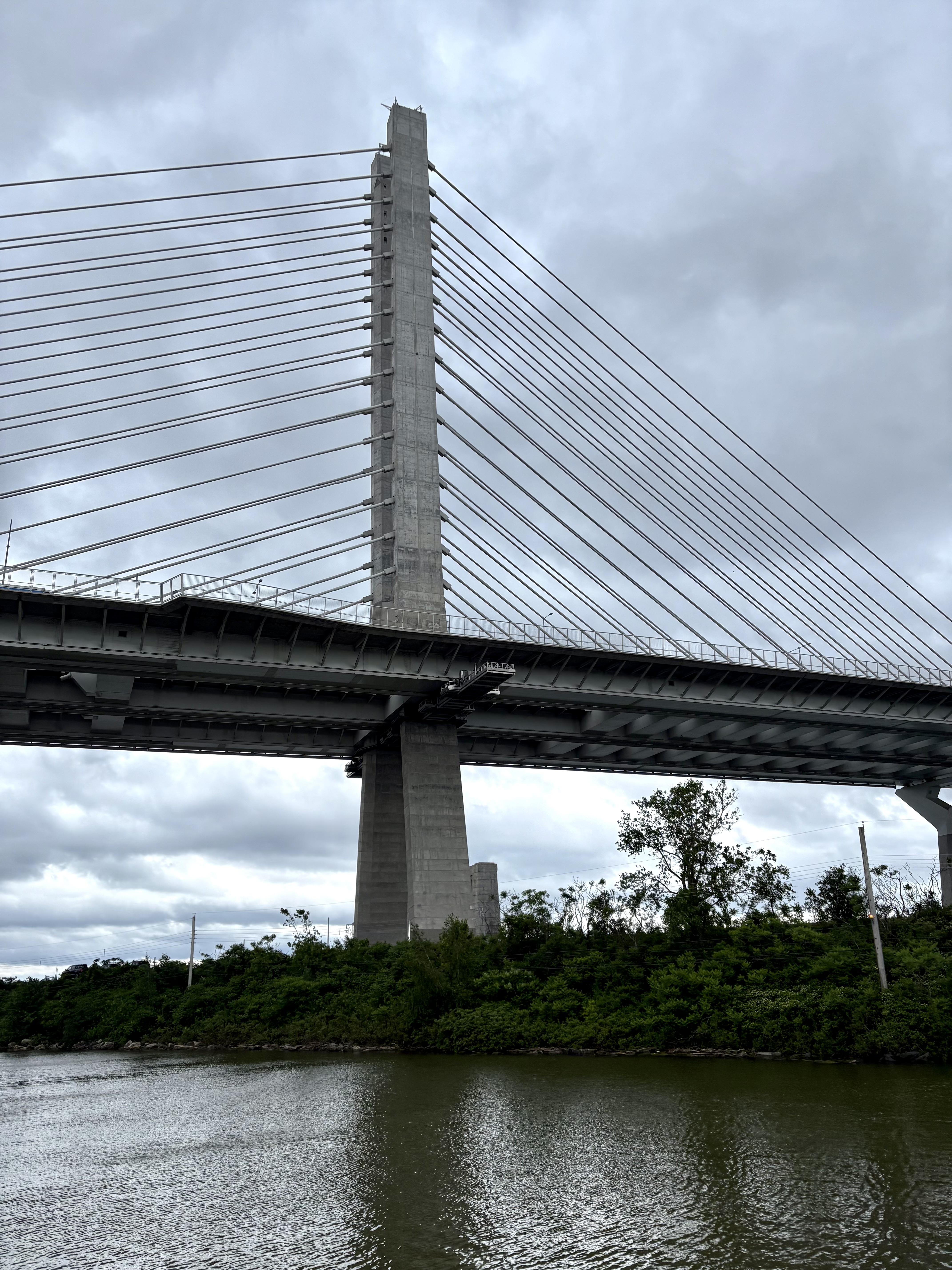
And we meet bridges. Here, the Samuel-de-Champlain Bridge, a cable-stayed structure that is as elegant above…

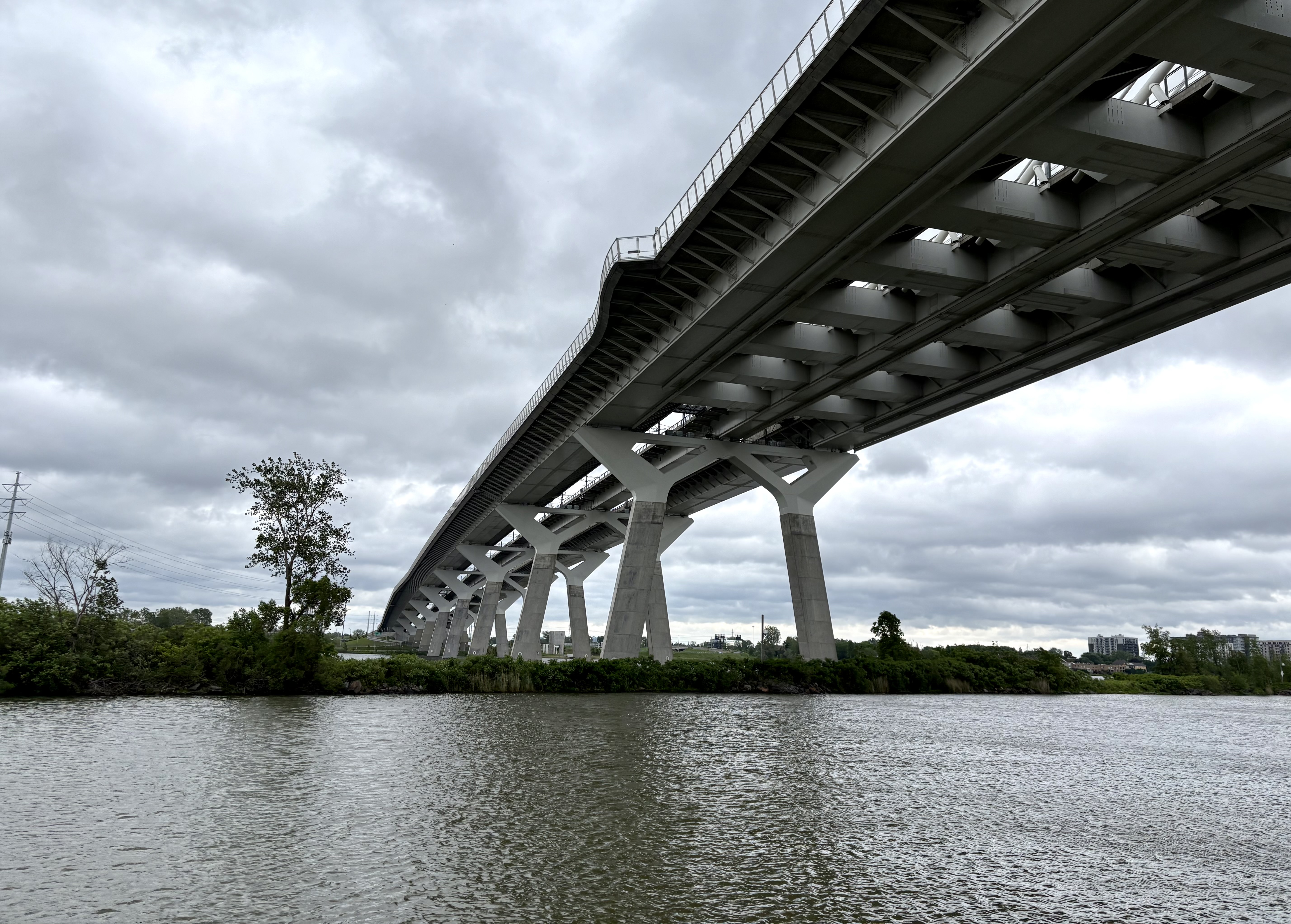
as underneath.

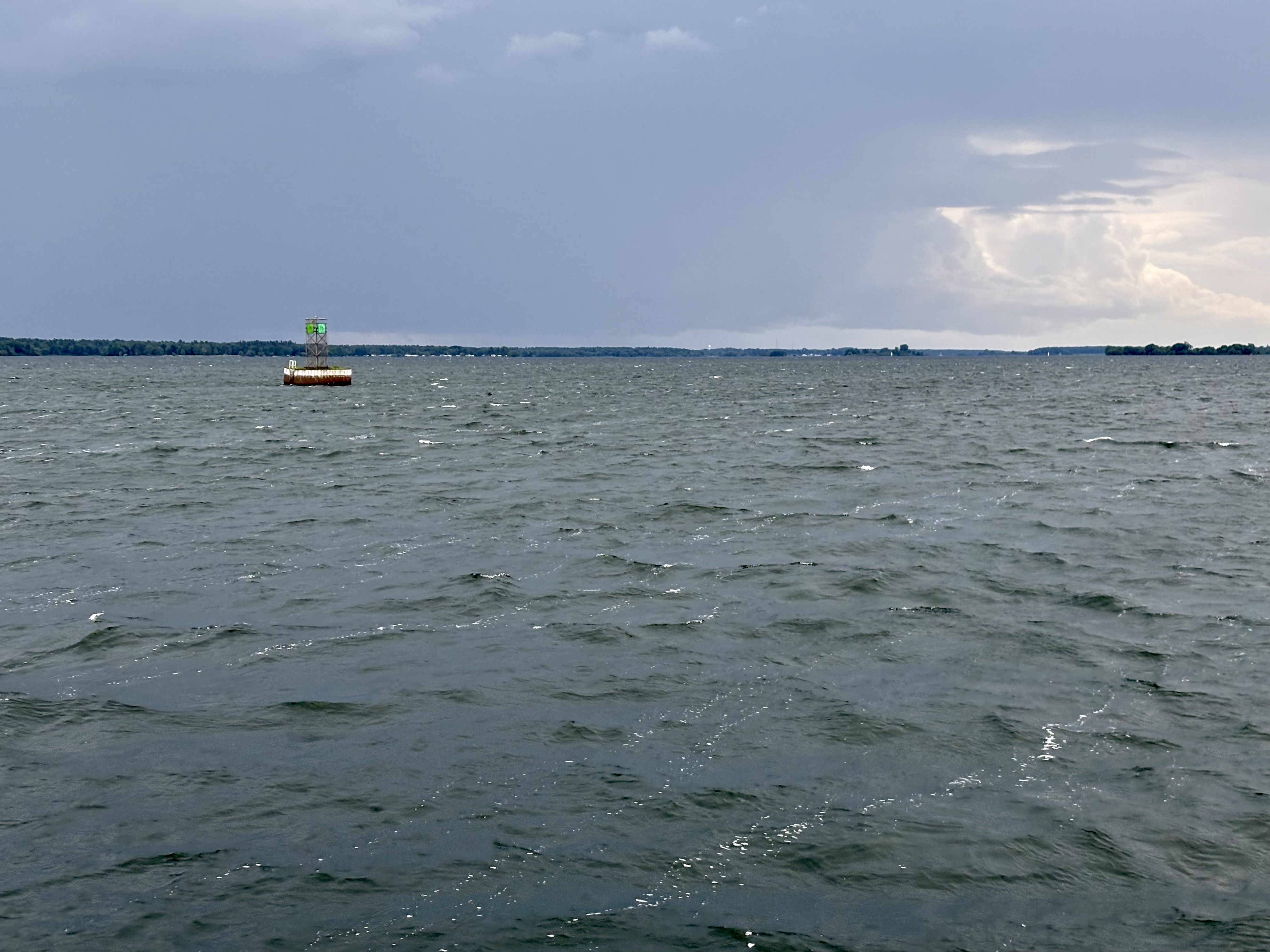
We also, in the broad placid waters of Lake St. Lawrence, meet a graveyard.

Literally, to some extent, as well as figuratively.

Lake St. Lawrence is human-made, part of the massive re-contouring of the river that involved creating a huge reservoir for the new Saunders Power Dam near Cornwall, Ontario. Underneath this lake, this reservoir, lie the Sunken Villages of the St. Lawrence — 12 Canadian communities entirely flooded (8) or partially destroyed/relocated (4) in order to create that reservoir. Yes, there was relocation assistance, but nothing financial can erase the emotional price.

Did you notice the lowering sky, in all but one of those photos? We experience squally, blustery weather all along — even that sunshine behind CSL Welland soon disappears.

And so, when we passengers were expecting to keep sailing on upriver toward that evening’s destination, Cornwall, we are instead told we will not carry on through the anticipated storm. We will instead take shelter.

Take shelter? Just like that, find a convenient berth for a vessel our size?

Well, as a matter of fact… yes.

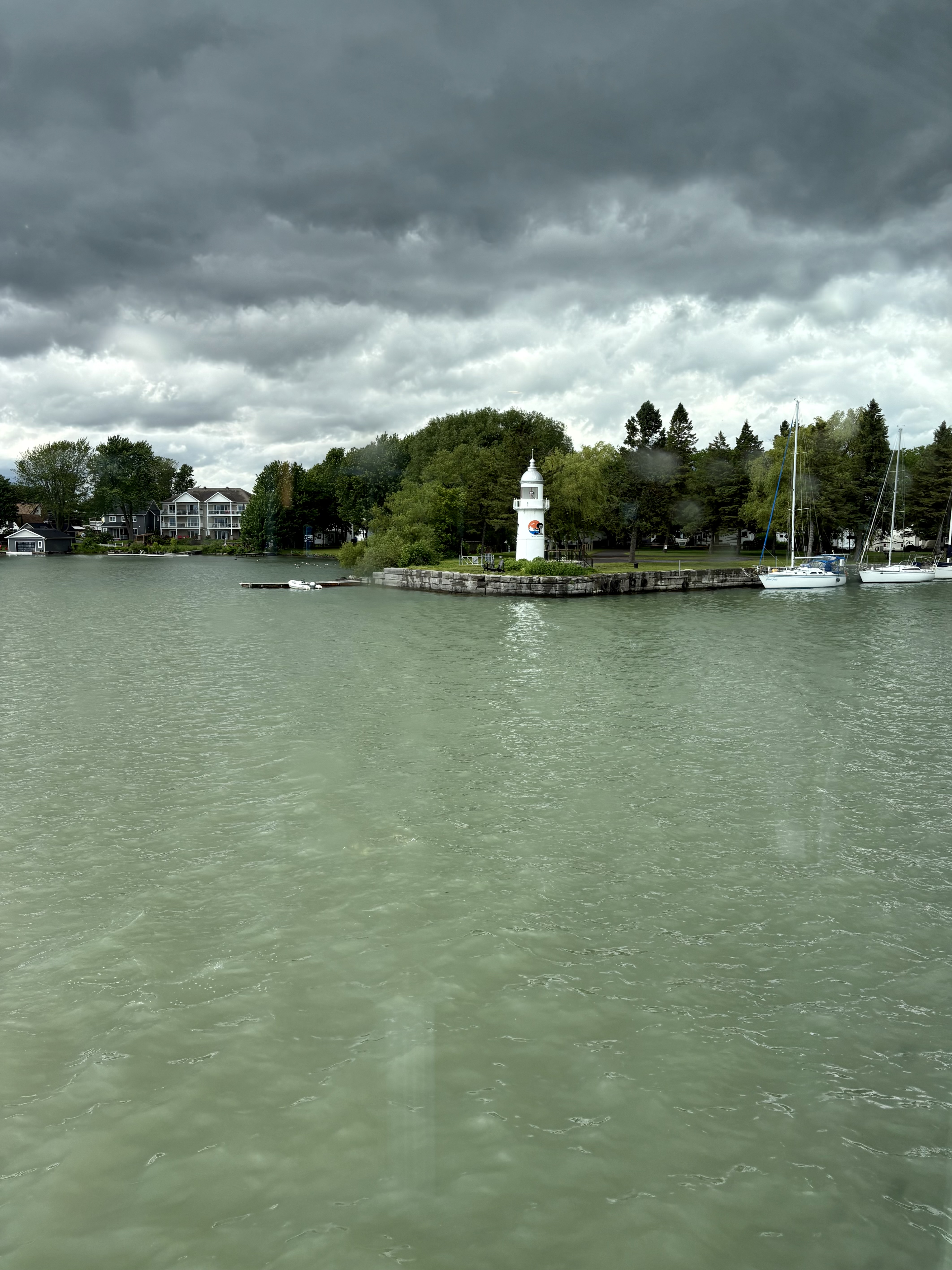
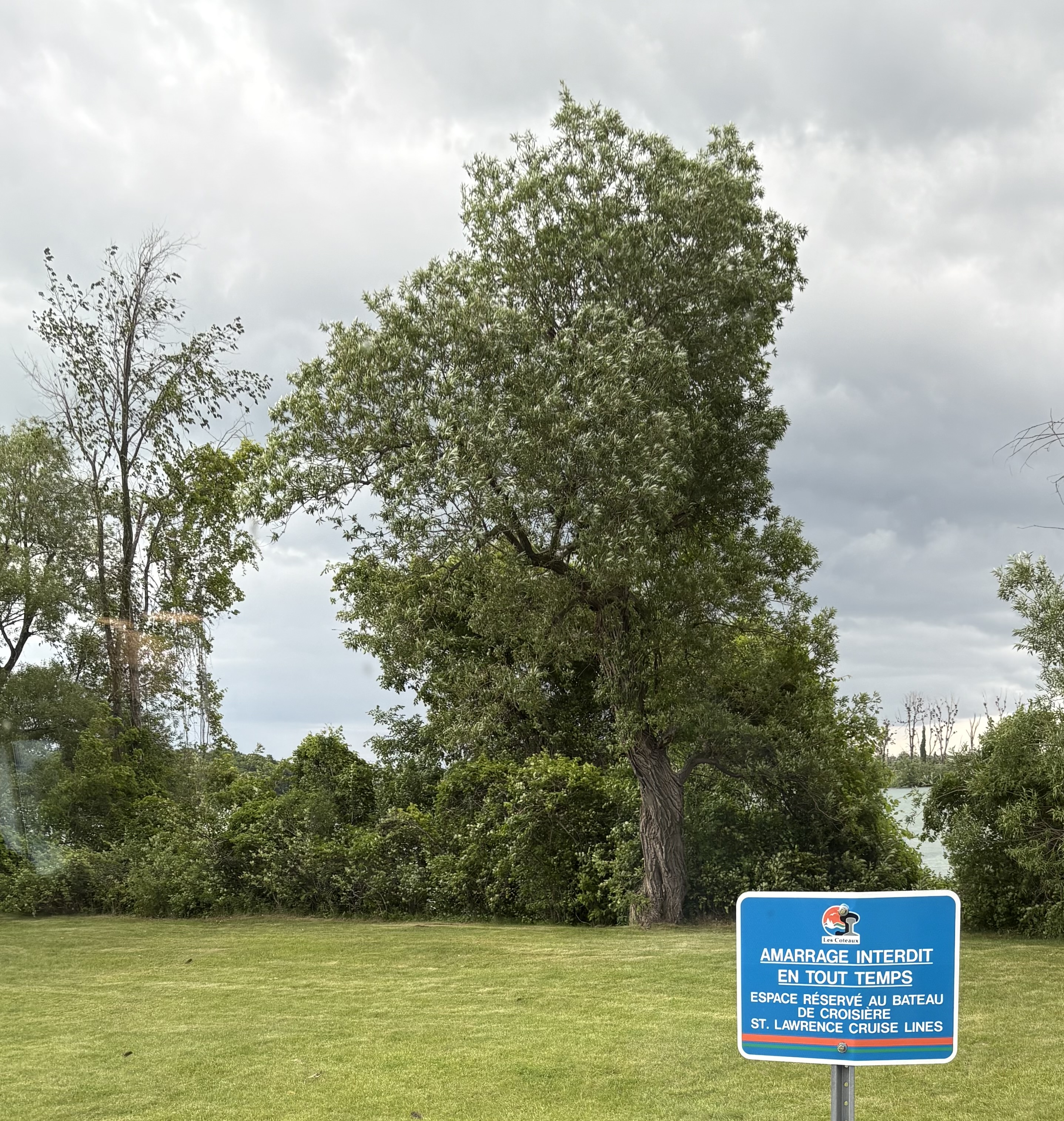
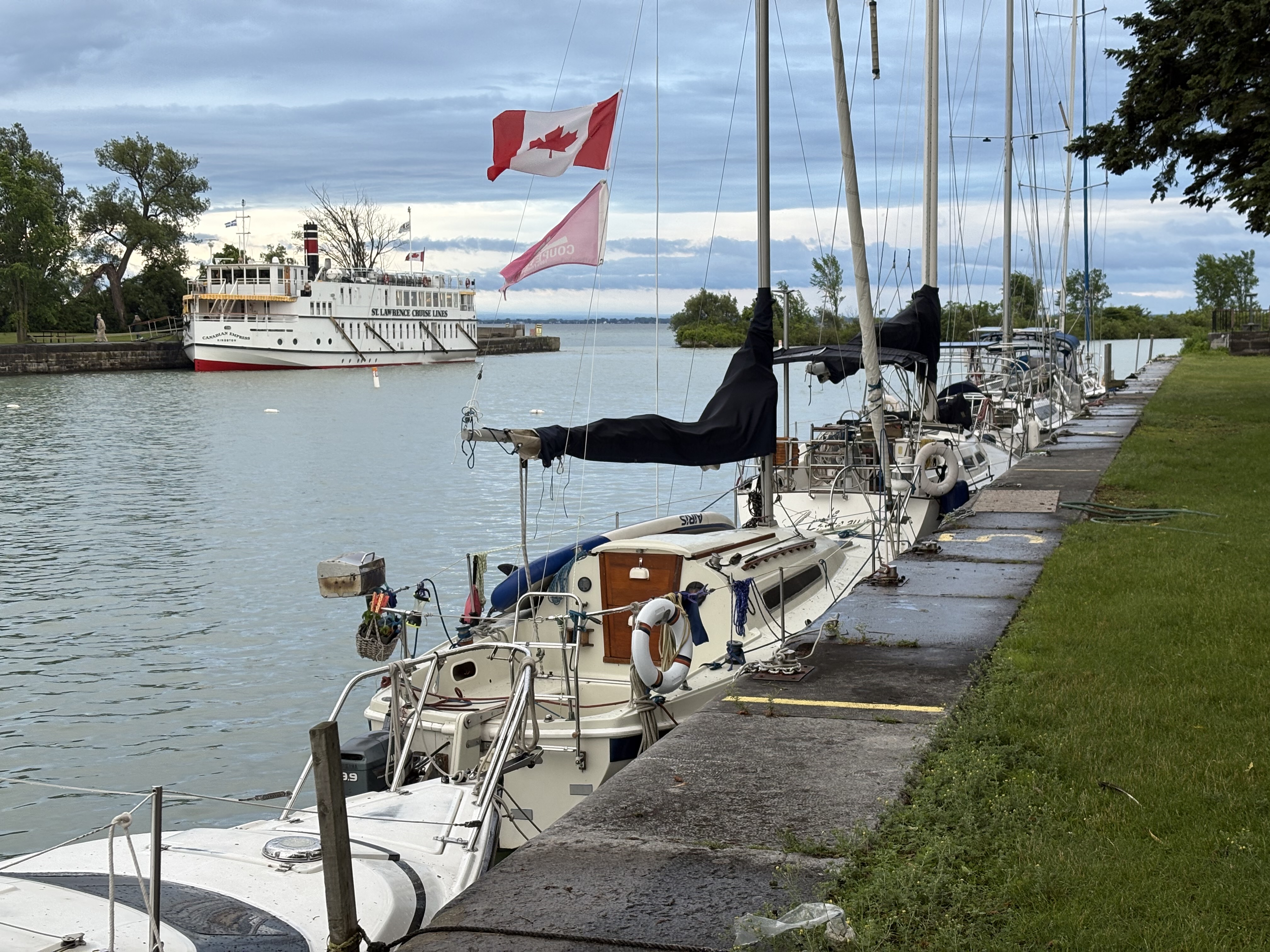
We turn into Coteau Landing (just east of St-Zotique). Where a suitable berth is permanently available.

This is just one of a number of guaranteed bolt-holes up and down the river, ready to receive the Canadian Empress whenever she happens to need one.

The threatened huge storm never did hit — though as you can see, trees are still being whipped about by the wind.

After a comfortable night of shelter (including time to stroll through the little community), we leave at 5 a.m. and get ourselves back on schedule.

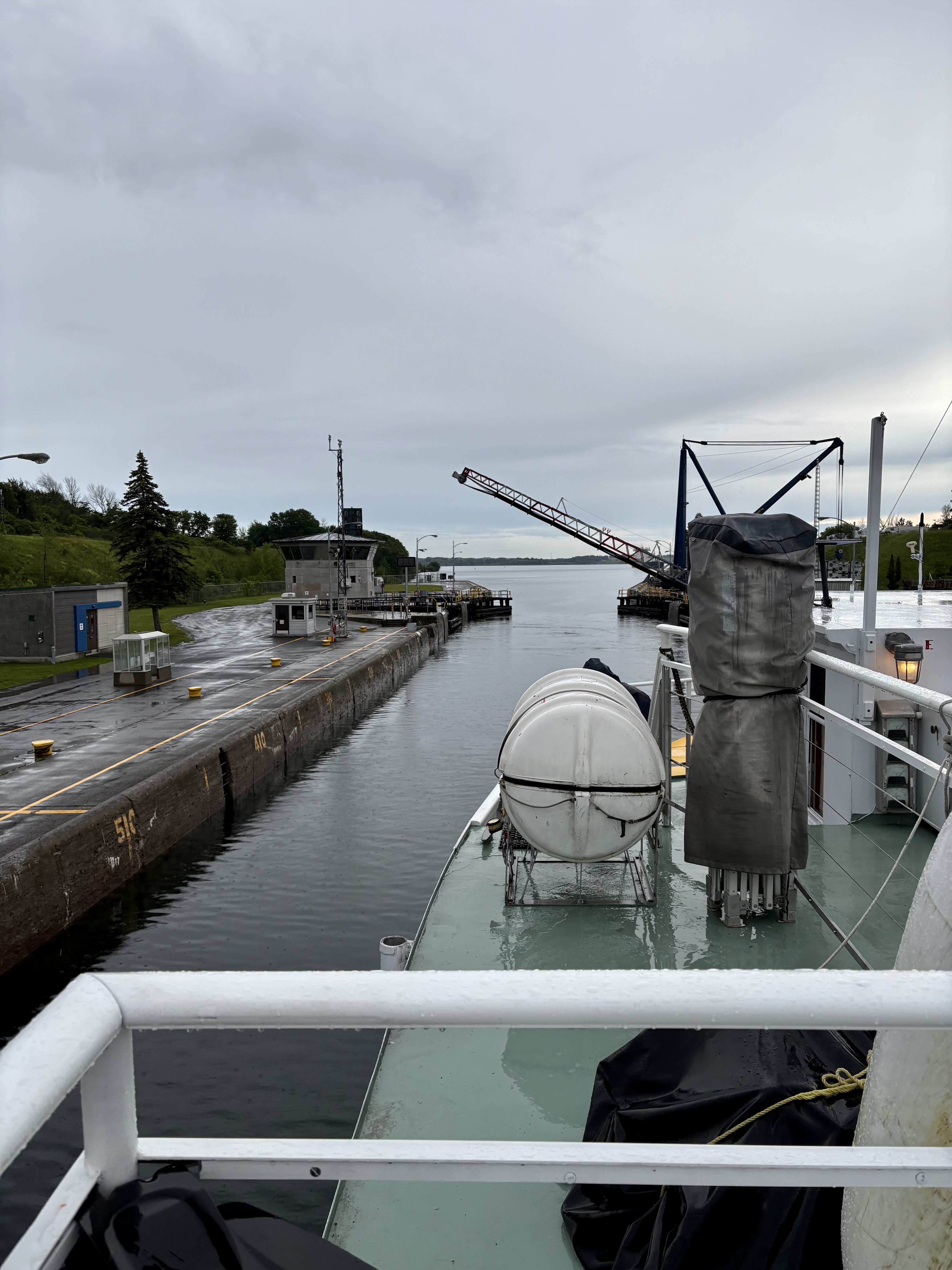
Near Iroquois, we pass through the last of the 7 locks, this one as large as the others but slightly different in one respect. The difference earns it the name of a “drive-through” lock. Here, water is not sluiced in or out from points low by the gates. Instead, once the vessel is in position, the forward lock gate is very slightly opened, allowing that level of water to start infiltrating the lock and eventually bring its waters to the desired exit level.

And so, as we exit the Iroquois lock…

we have finally been delivered to the level of Lake Ontario (which lies just ahead of us, at Kingston).

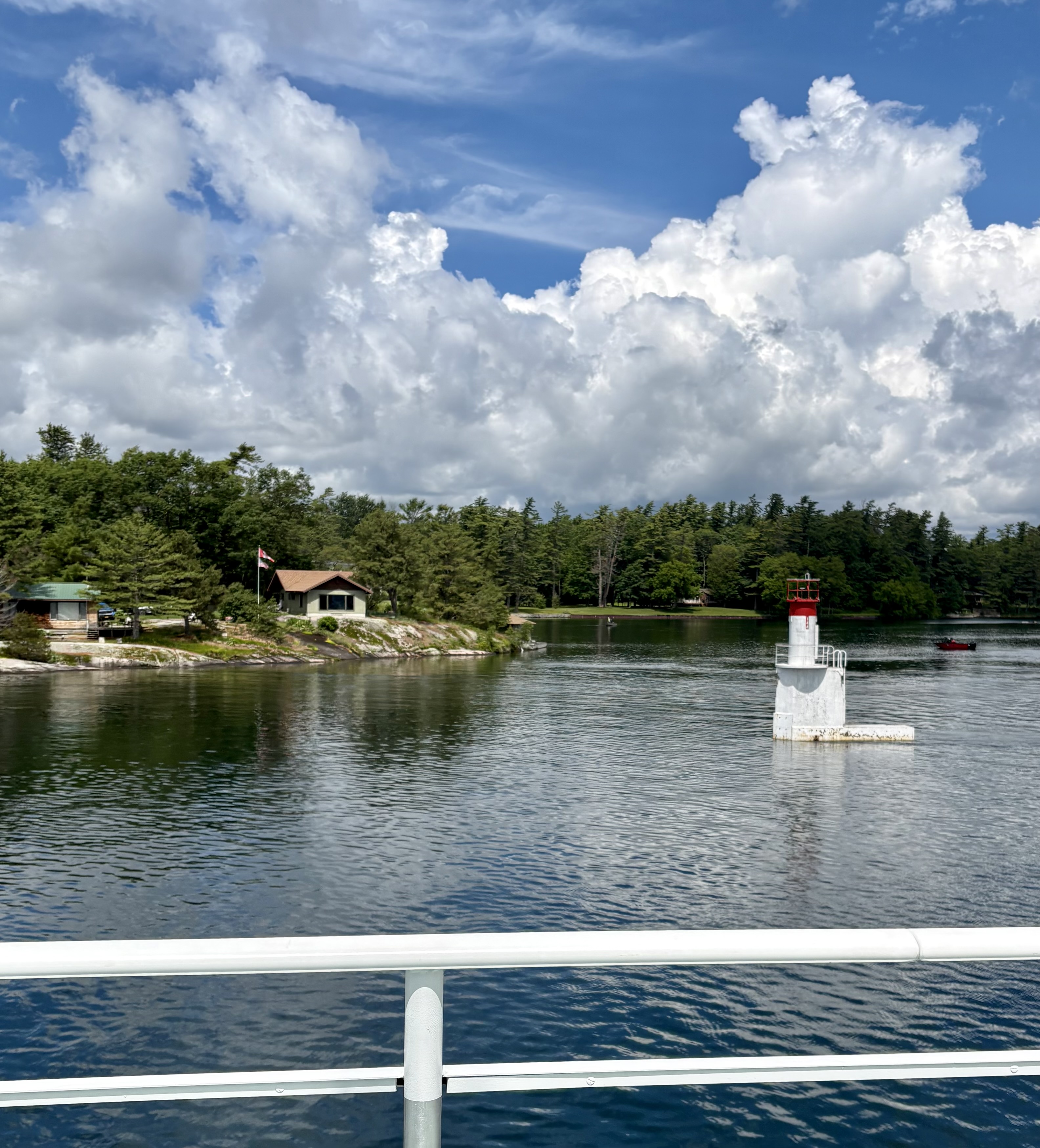
Meanwhile, we carve our way through the myriad delights of the Thousand Islands that dot these international waters between Brockville and Kingston.

For once, marketing understates the case: in fact, or so they say, there are 1,864 islands. (And who are we to argue?)

I’m now happy to lean back, as sunshine and warmth finally make their appearance, and enjoy what lies before me: the final 80 km of an extraordinary voyage.

‘Scapes

1 March 2026 — Sub-categories of landscape. Skyscape and streetscape and alleyscape and (why not) trailscape. Plus a final skyscape flourish, courtesy of a friend and moon-focused, to round it off.

A completely arbitrary grouping! Just how I happened to cluster what I’ve noticed, over the past few days.

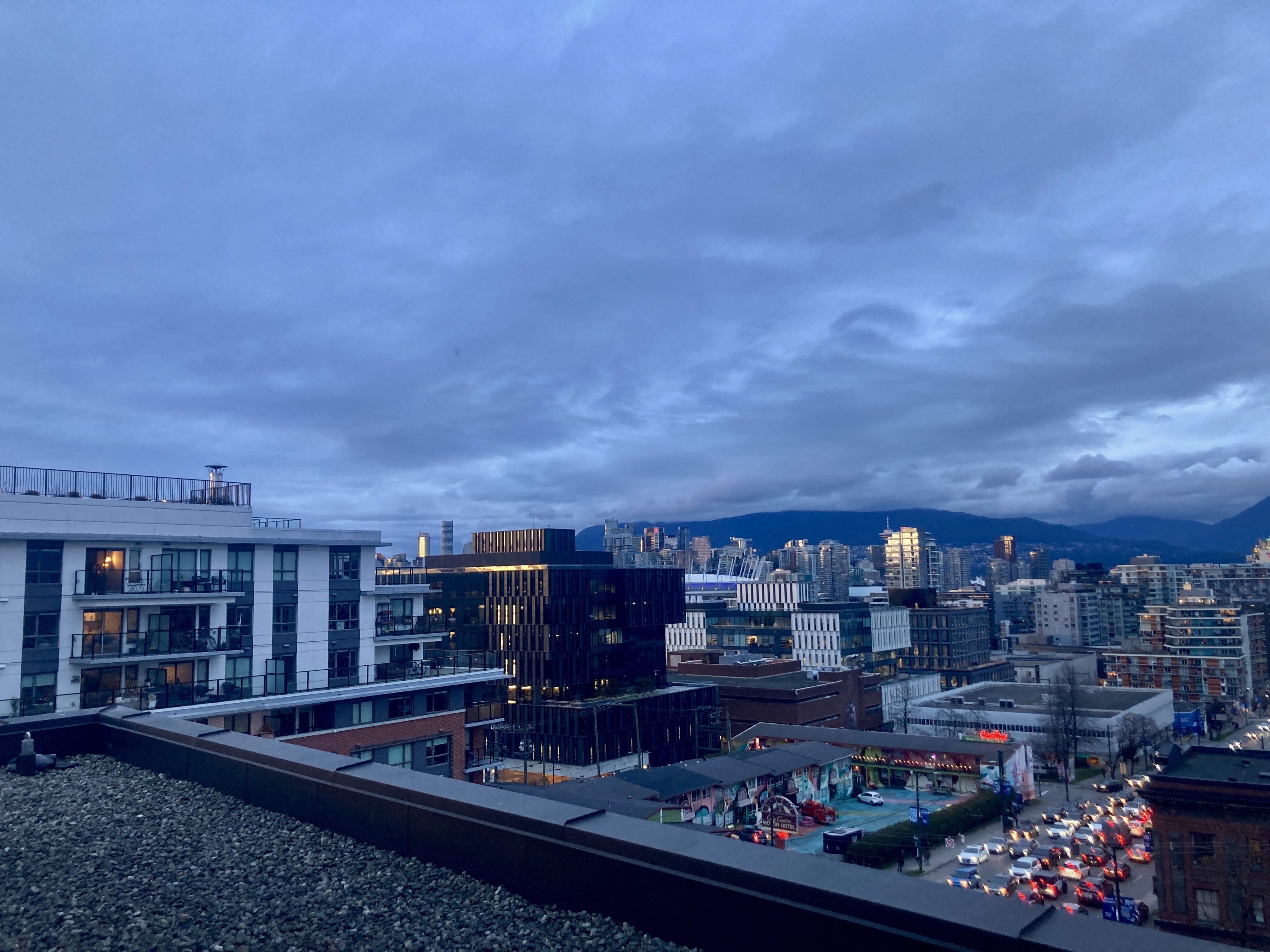
This brooding late-afternoon sky, (precisely 5:24:43 PST, said my camera), with reflected last slivers of sunlight in a few windows and early neon glowing on the streets.

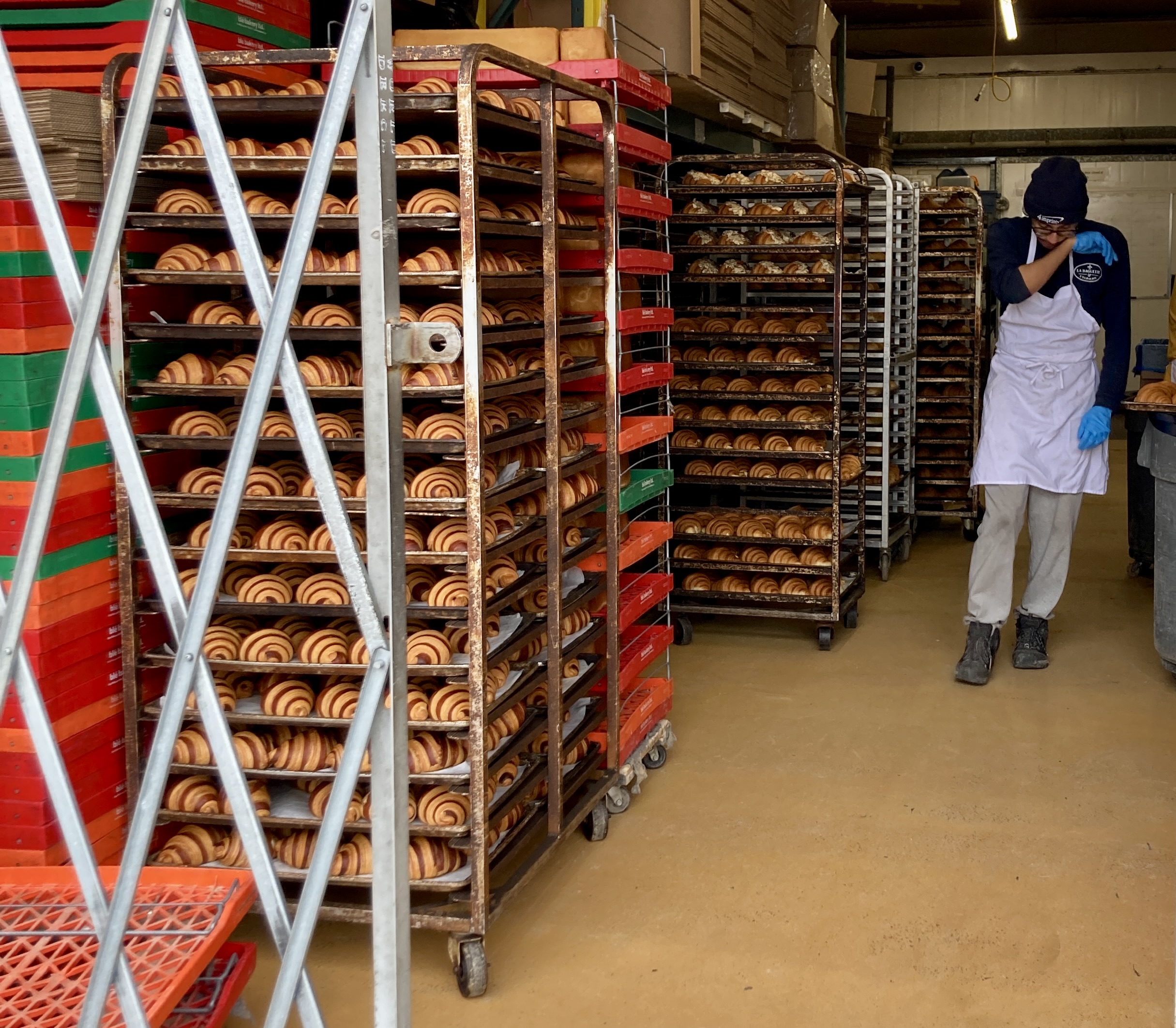
The next morning, walking to Gallery Jones on East 1st Ave, I’m hit first by a smellscape of warm cinnamon bun…

and then, peering through the open door, see the cause of the aroma: stacks of newly-baked buns in this wholesale bakery, with a worker wiping his cheek as he advances on yet another tray.

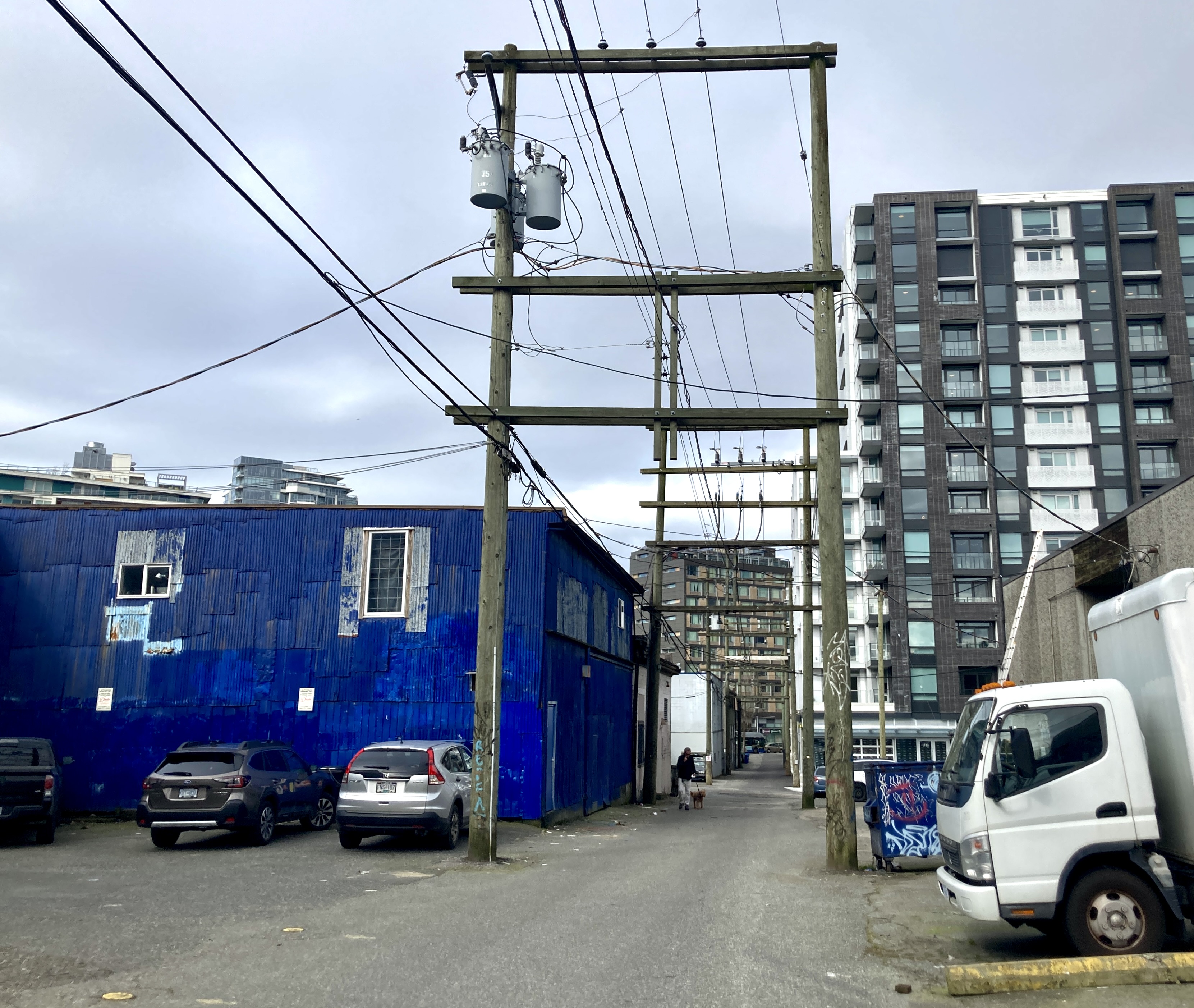
From streetscape to alleyscape, somewhere to explore until the gallery opens its doors. Never mind, who needs curated art on walls when the alley offers a Blue Period worthy of Picasso?

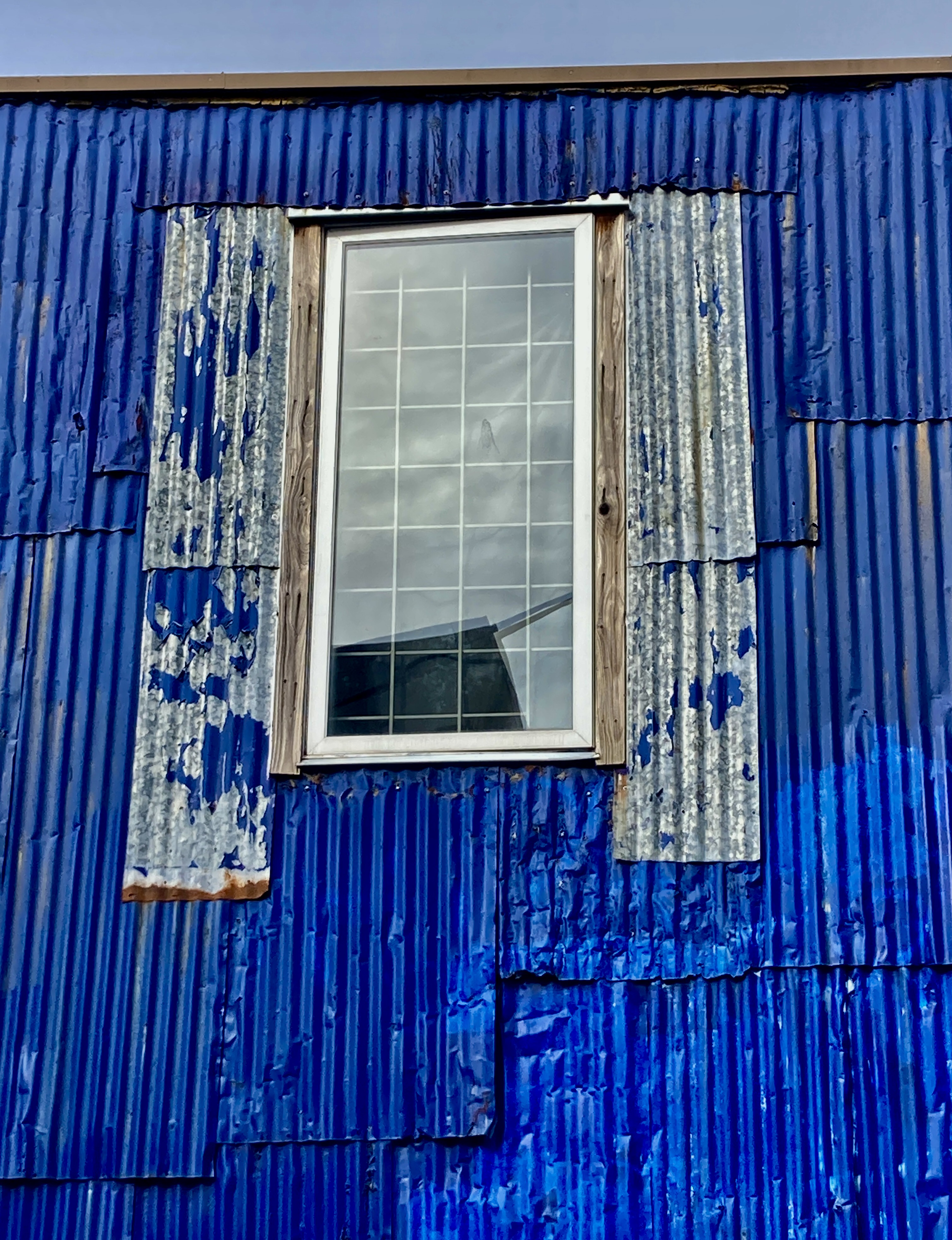
All the textures, all the varieties of blue in that wall of corrugated metal. Whether long shot, as above, or up close to the window (which in turn frames reflected skyscape).

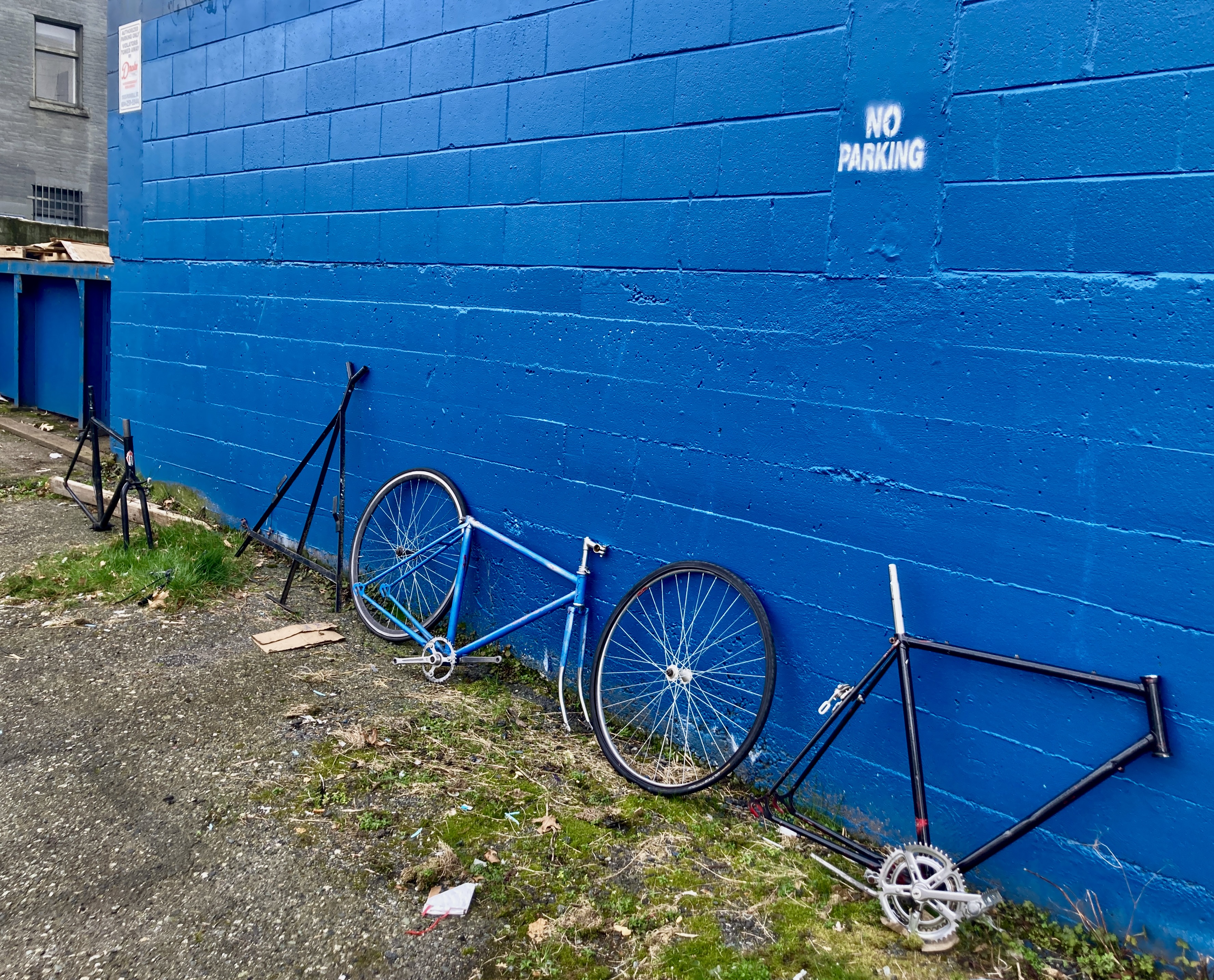
The same blue on the adjacent wall, providing a sleek, smooth No Parking backdrop…

for bicycle parts that are definitely & definitively parked.

Another cultural excursion the following day — this one for Maximilien Brisson’s glorious creation, Scorrete lagrime mie, at St. Anselm’s Church on the UBC grounds.

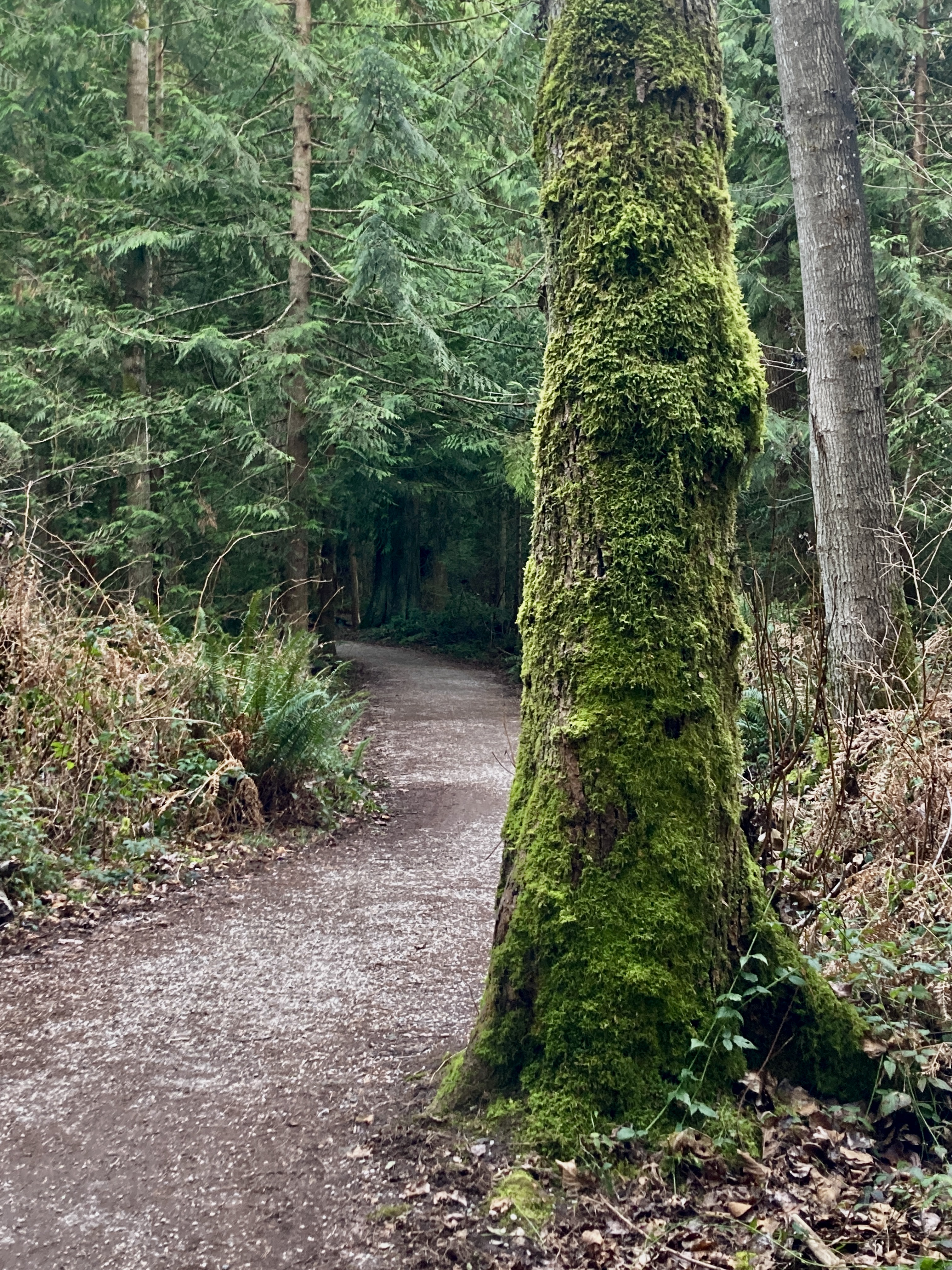
The church sits right next to various trails into Pacific Spirit Regional Park and, post-concert, I am pulled onto the Salish Trail…

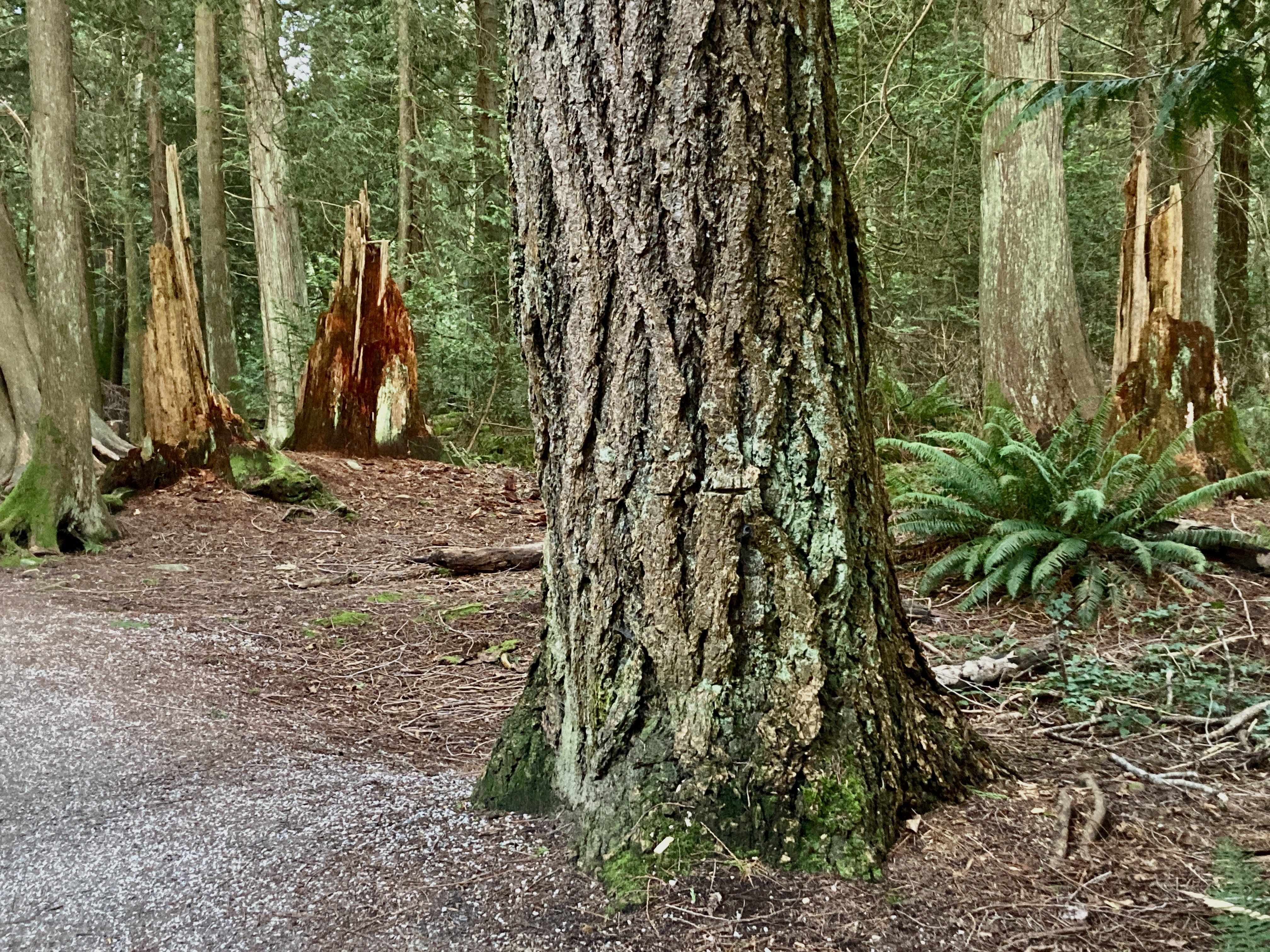
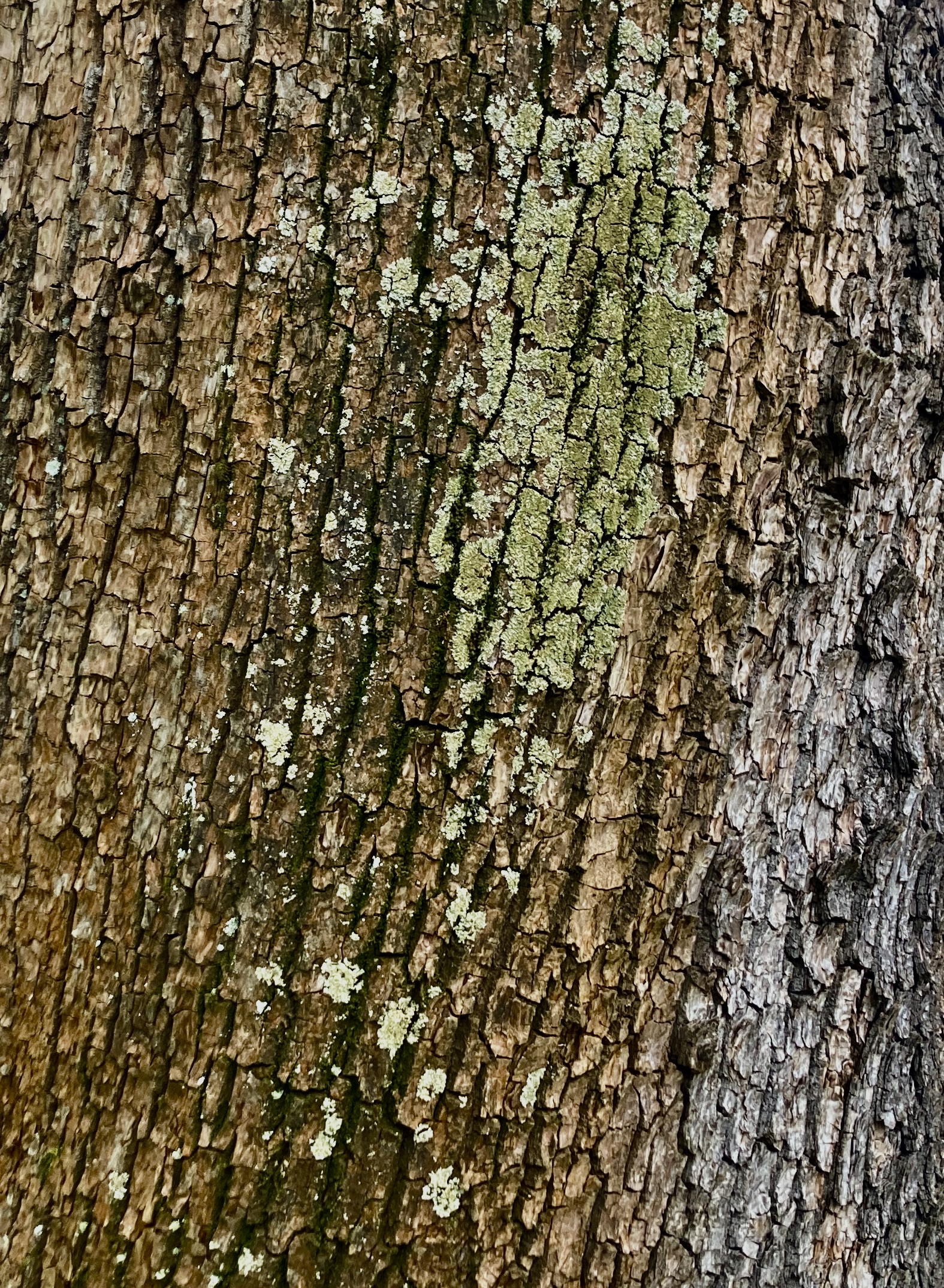
by this sentinel tree, this doorman tree, imposing in his winter greatcoat of emerald velvet.

The trailscape unfolds around me.

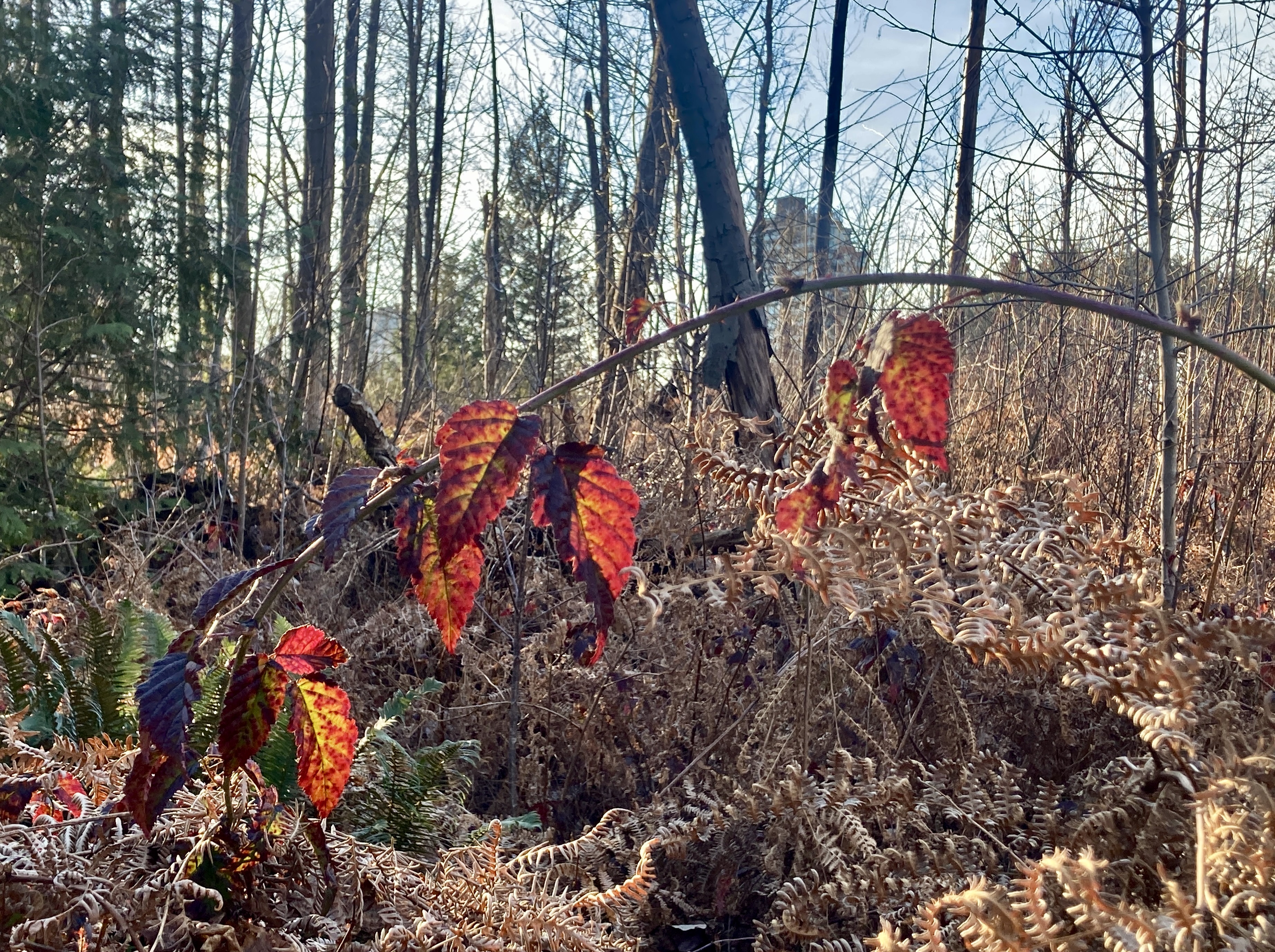
Next up, an arched branch…

proving that left-over tassels of autumn red are just as striking as winter moss green.

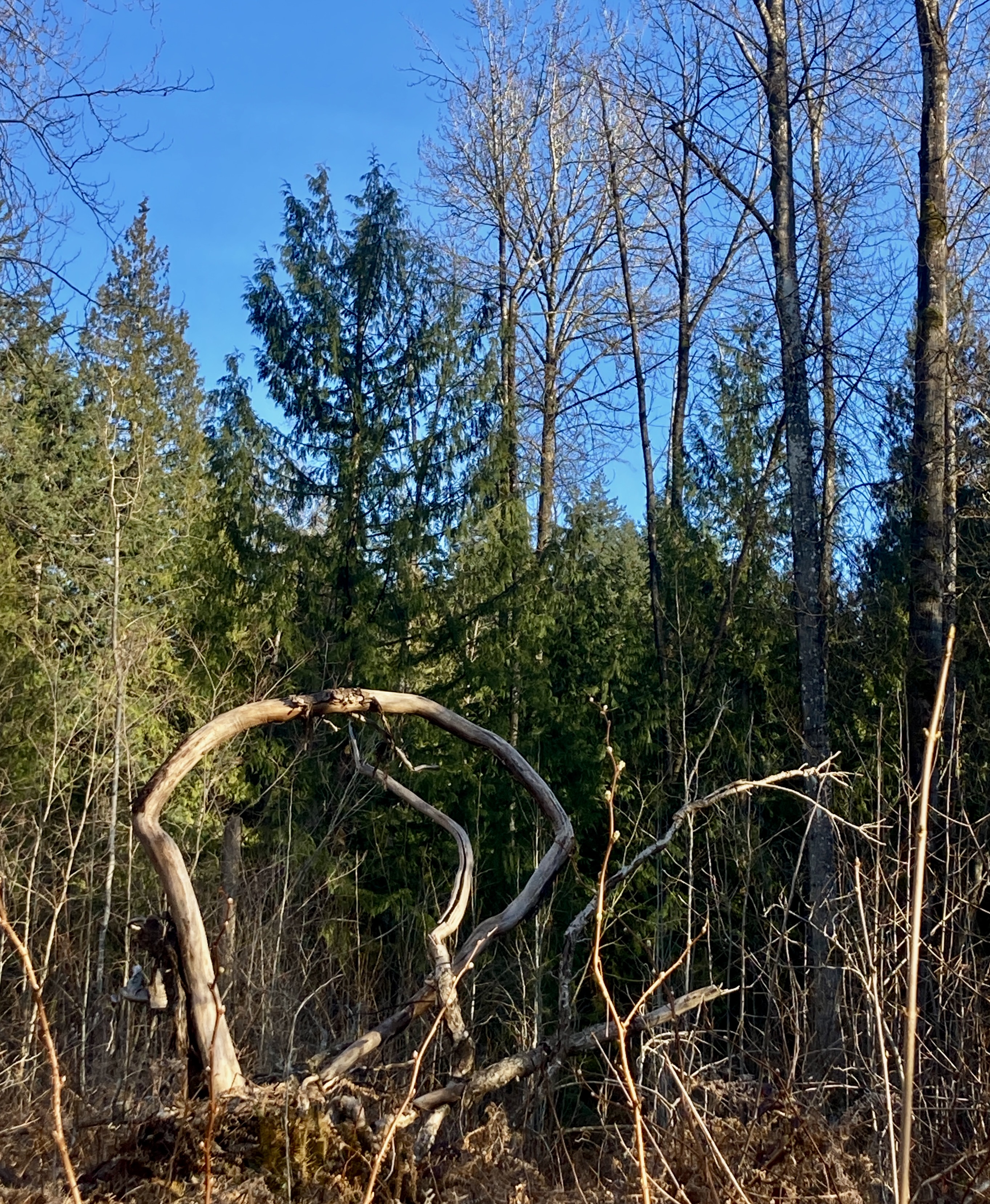
To my left, farther away, another arched branch…

proving that (nyah nyah) you can have just as much impact, stark naked.

Round another bend in the trail, where first a ragged spire of ancient tree trunk…

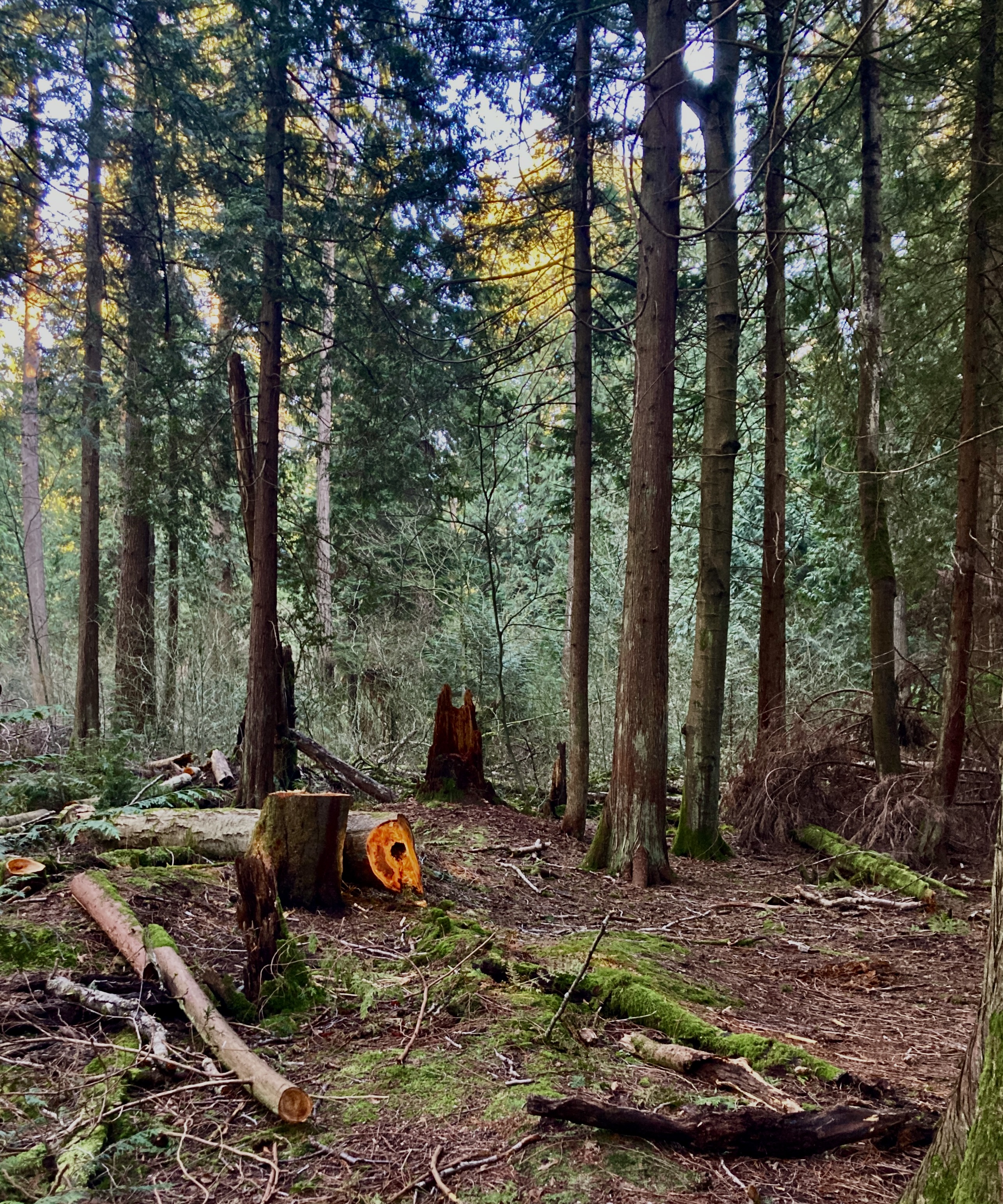
and then a fresh-cut end of tree trunk…

prove that, in the bravura sweepstakes, red cedar always wins.

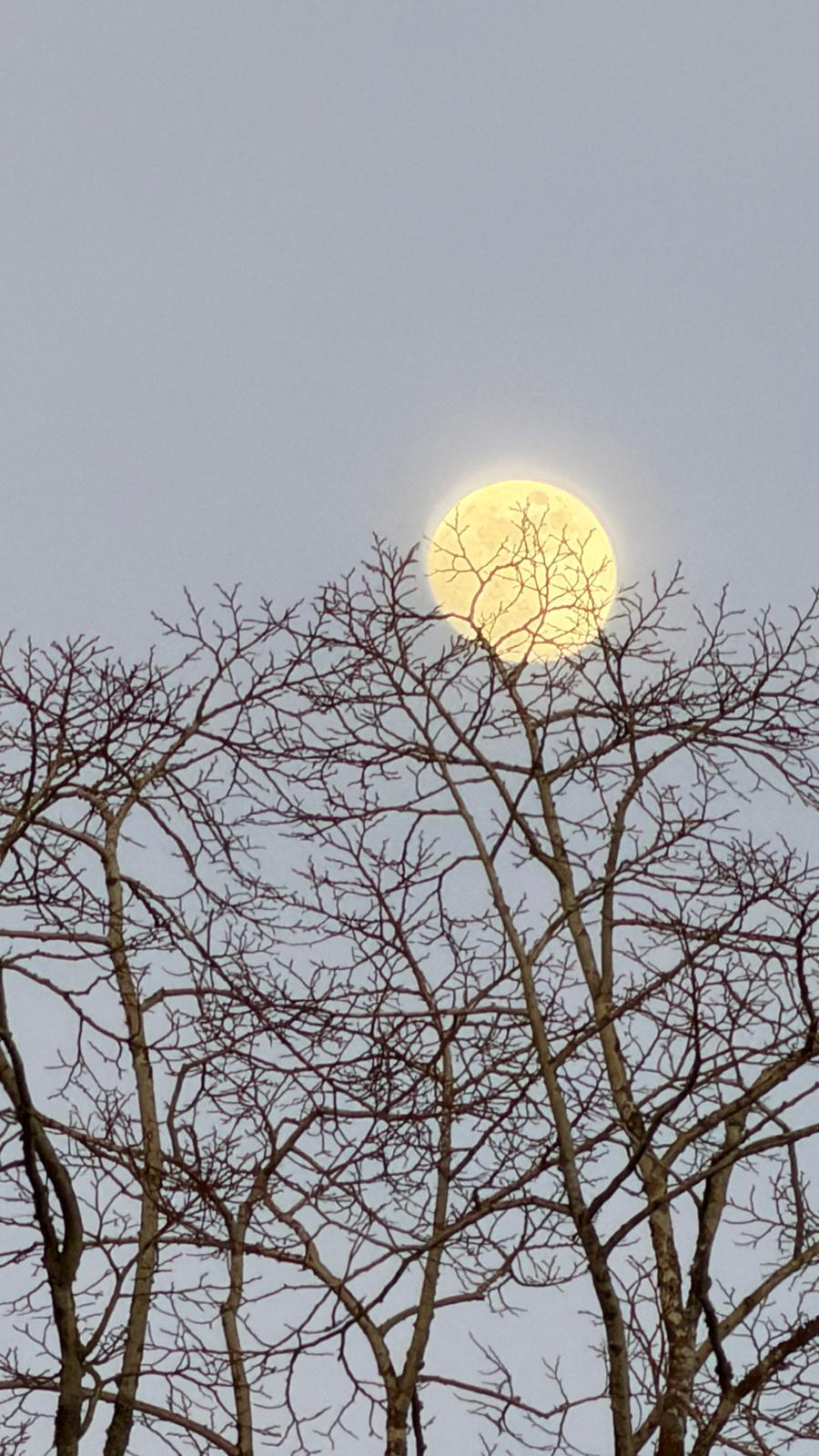
Back home, delighted with memories of both the concert and the trail, I open a text from a friend for yet another delight. It’s a skyscape photo to round off my collection…

her (7:55:07 PST) moon tribute to, as she points out, “the 12th day of the lunar new year.”

Thank you, ST.

Colour

28 January 2026 – Or, maybe: “Colour.” Or, for the old-school among us: Colour [sic].

Meaning, I have found myself playing with the concept of colour these last few days. It is all thanks to a comment by J. Walters on my previous post — her pleasure in the “gorgeous colours” in Vancouver, viewed from her farther-east landscape of “variegated white.”

(By the way, if you don’t already know her Canadian Art Junkie blog, give it a visit.)

So I walk around, and I amuse myself by seeing colour differently. Seeing it in relation to other attributes.

Colour: Brilliant

What’s more brilliant than reflected colour, bouncing off the plate glass of a downtown tower, under a blazing sky?

Colour: Muted

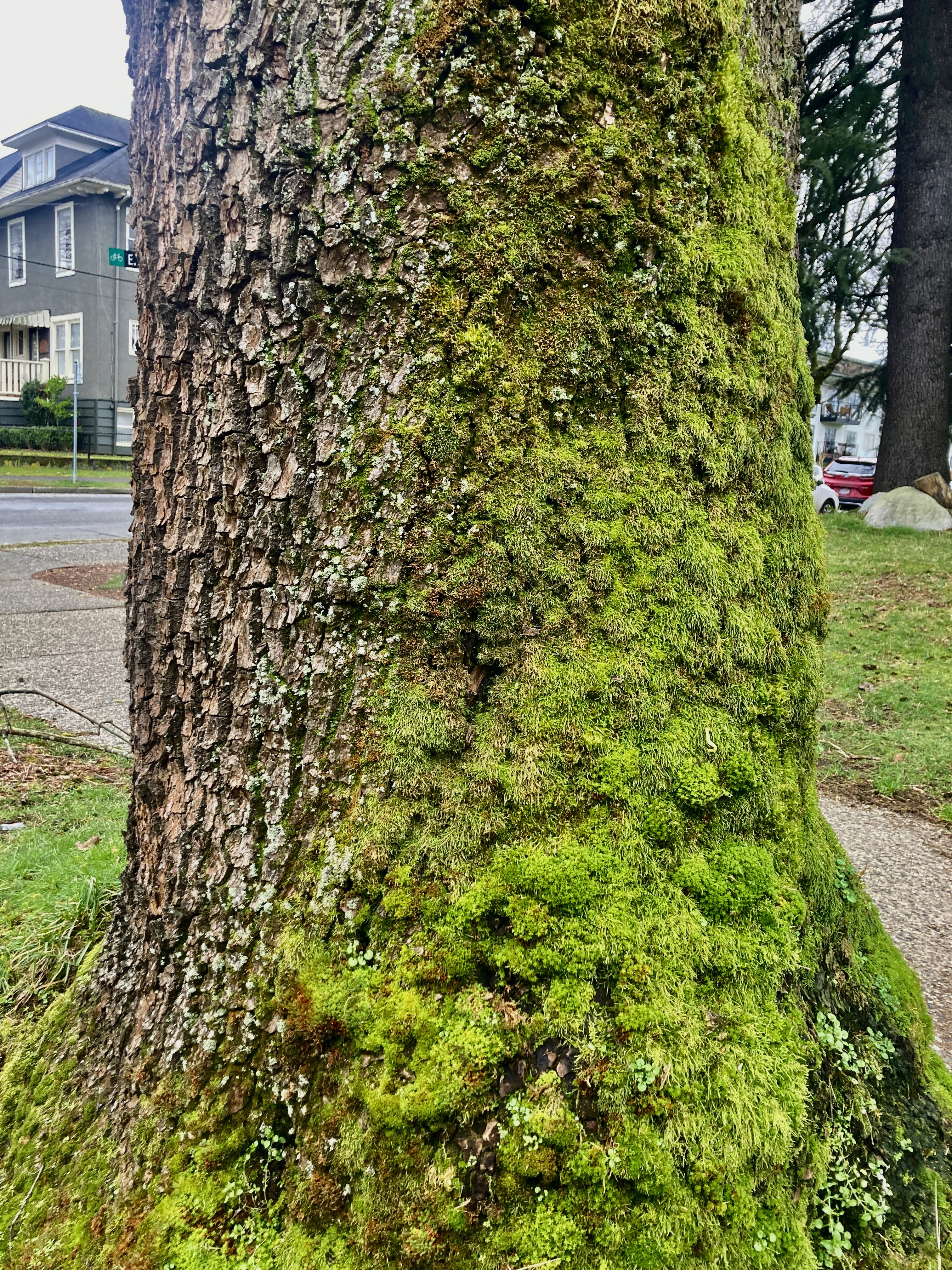
A murmur of colours, quietly living and breathing within the textures of their host, a tree trunk.

Colour: Juxtaposed

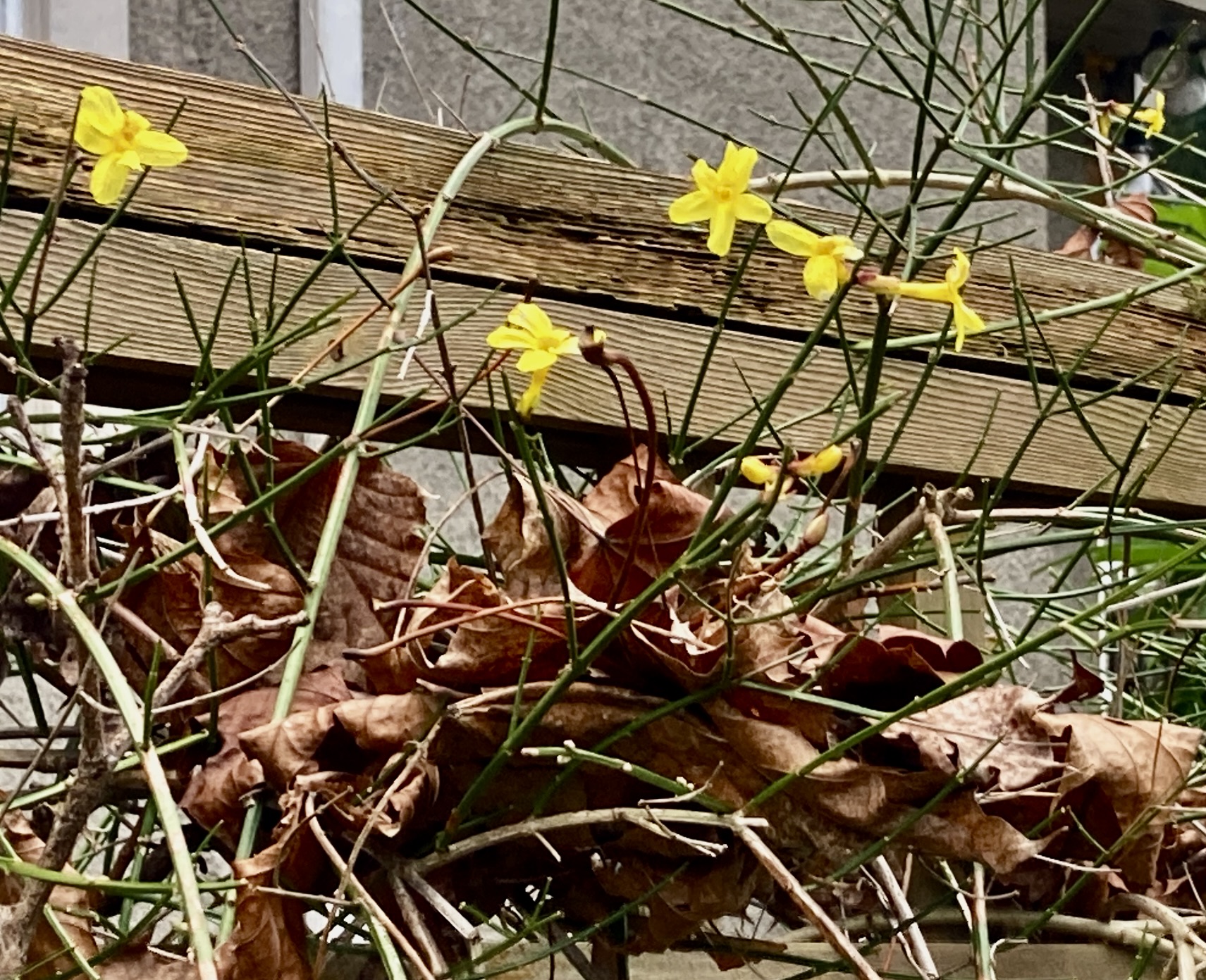
I’d not have bothered with either, on its own. Dead leaves. Pretty but unexceptional tiny blossoms. Yawn. The appeal is the contrasts of their juxtaposition. Deep rust vs sunshine yellow; battered vs fresh; last-season vs right-now.

Colour: Unexpected

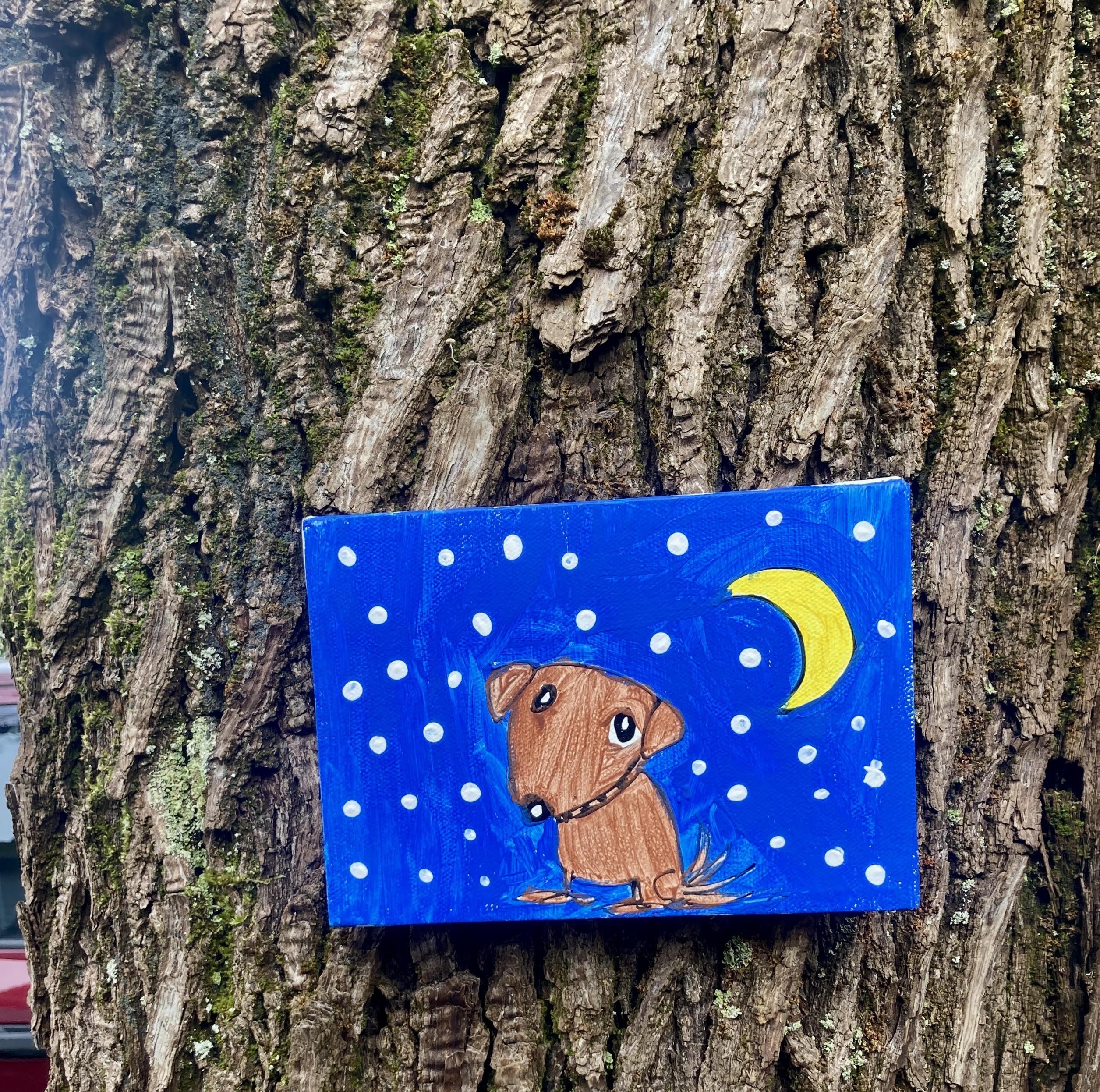
One of the Monty Python skits had a character intone: “Nobody expects the Spanish Inquisition.” Well, nobody expects a Very Colourful Dog on a tree trunk, either.

Colour: Obsessed

Namely, the colours I discover while indulging my obsessions. Two examples.

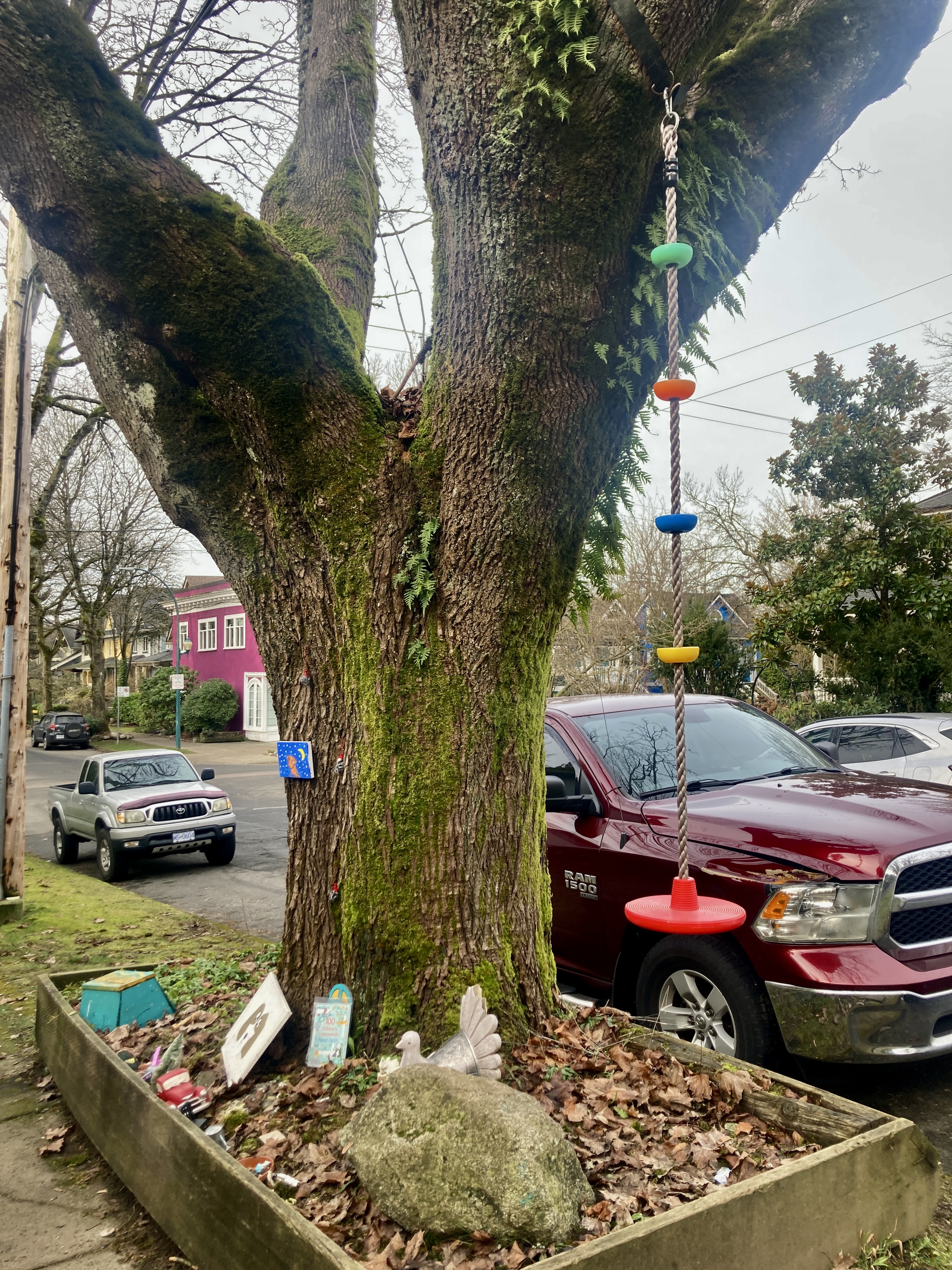
1 – My obsession with neighbourhood street-side “fairy trees,” decorated by civic-minded residents, sometimes with a swing for extra delight. Plus, in this specific example, our “Unexpected Dog.”

2 – My obsession with winter moss. In this case, right at the base of my “Colour: Muted” example above.

It’s all colour, if you want it to be. Hurray for colour.

Suddenly… sunshine!

17 January 2026 – It seems rude to mention sunshine, let alone mild temperatures (9C), when most of Canada is socked with snow, sleet, ice and windstorms. But… here it is. A bright, friendly day.

So we seize it.

We’re off to Burnaby Lake Regional Park. The park surrounds a large glacial lake to the east of Vancouver, and lies within its own dense municipality. Yet it is also home to wildlife (especially birds) and rich with trails for human visitors (walk, cycle, ride a horse, as you wish).

We have no particular plan beyond entering the park at the east end, off Cariboo Rd., and following the Brunette River upstream to the lake. After that? We’ll find out.

It is all magic, right from the get-go.

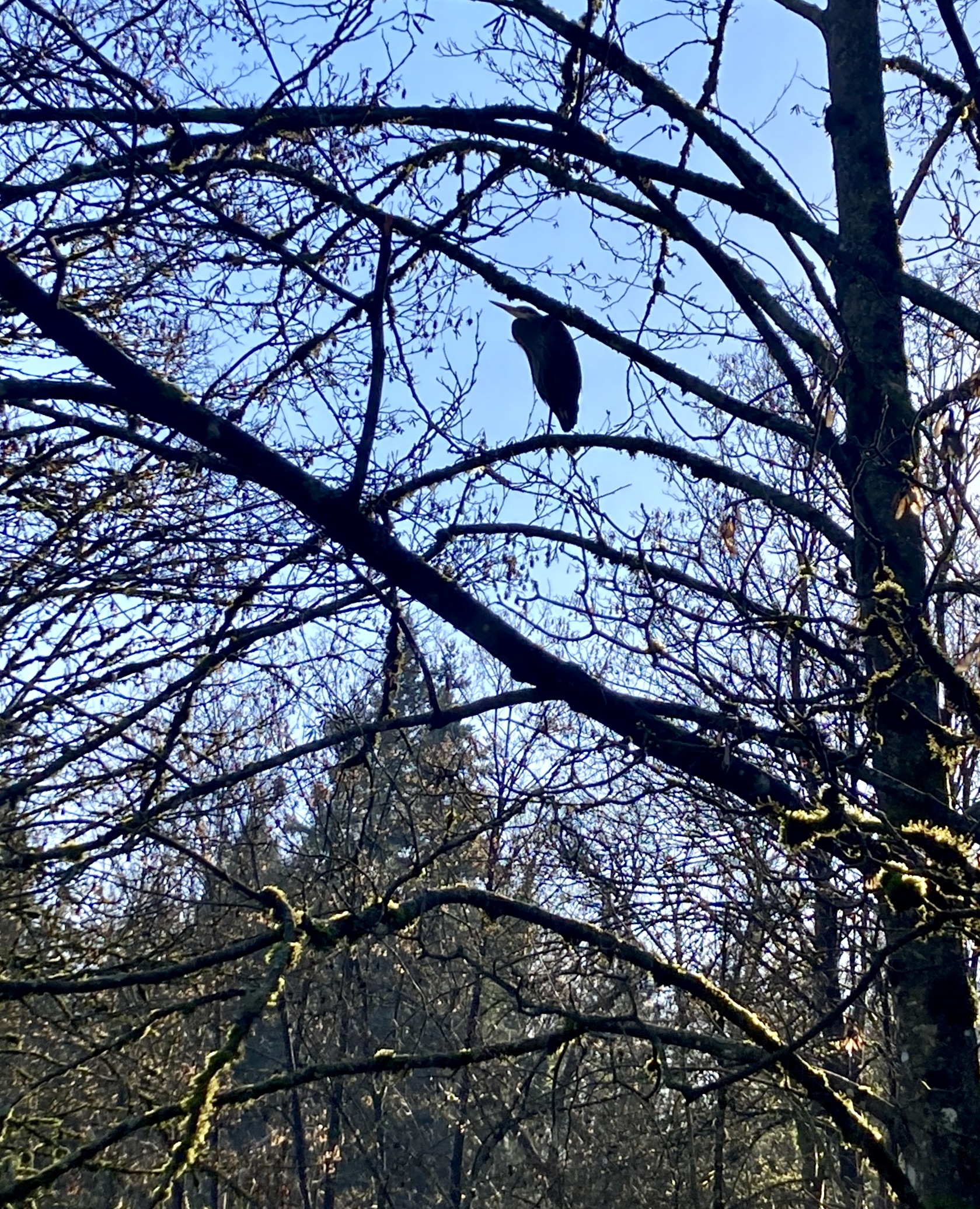
A great blue heron sits tall, still and stately in his tree beside the river…

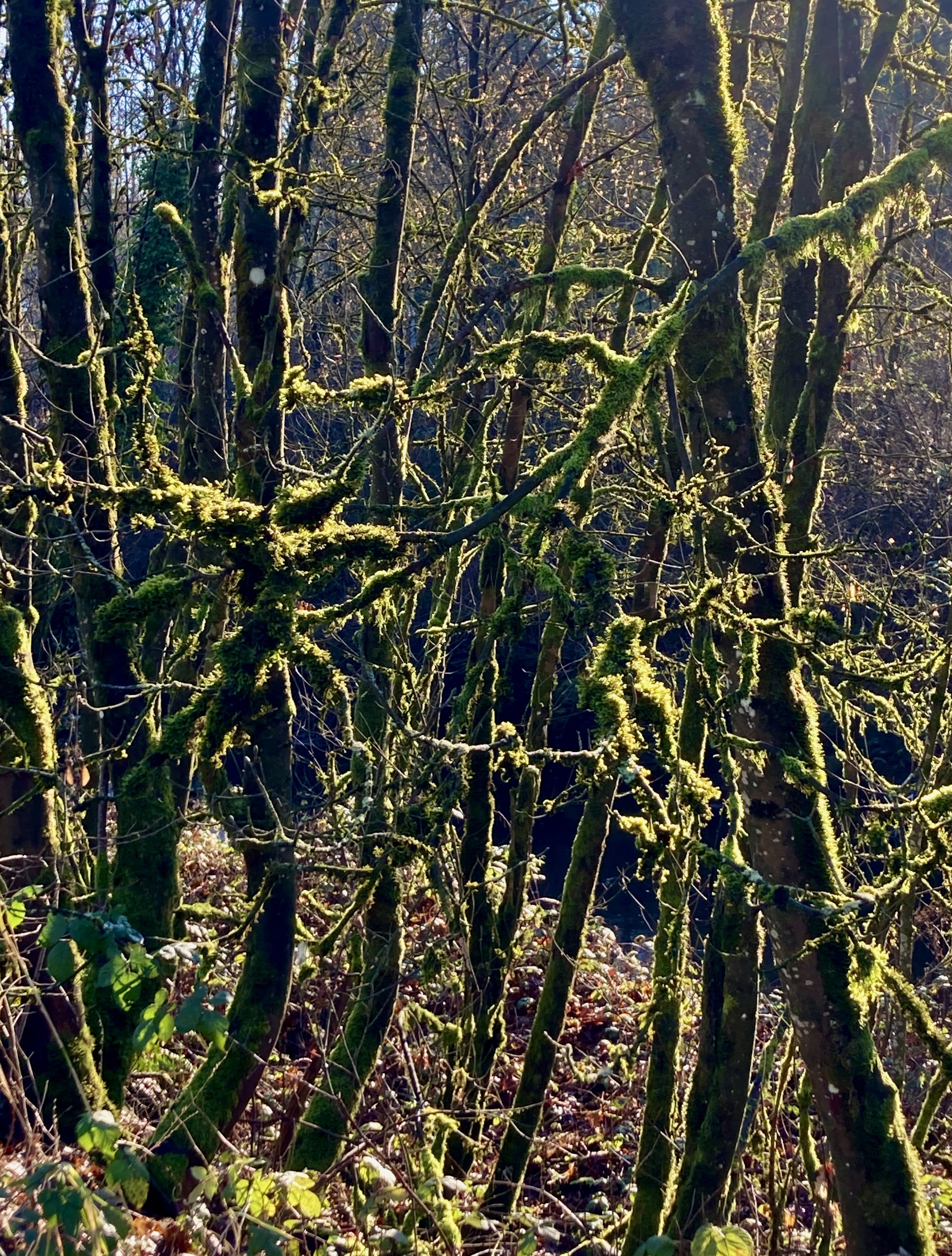
winter moss glows incandescent on trees lining the river…

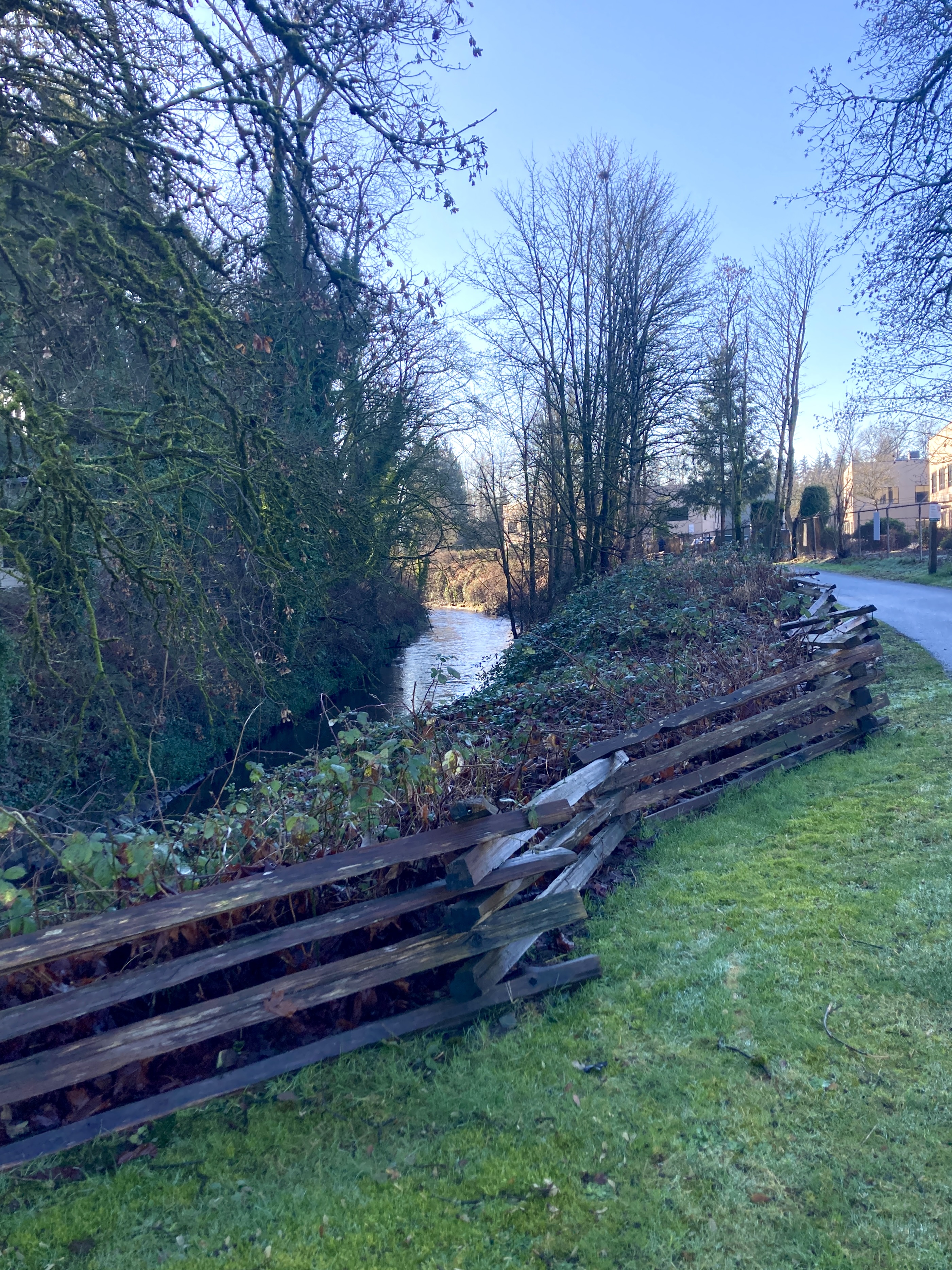
and a snake fence leads us on upstream…

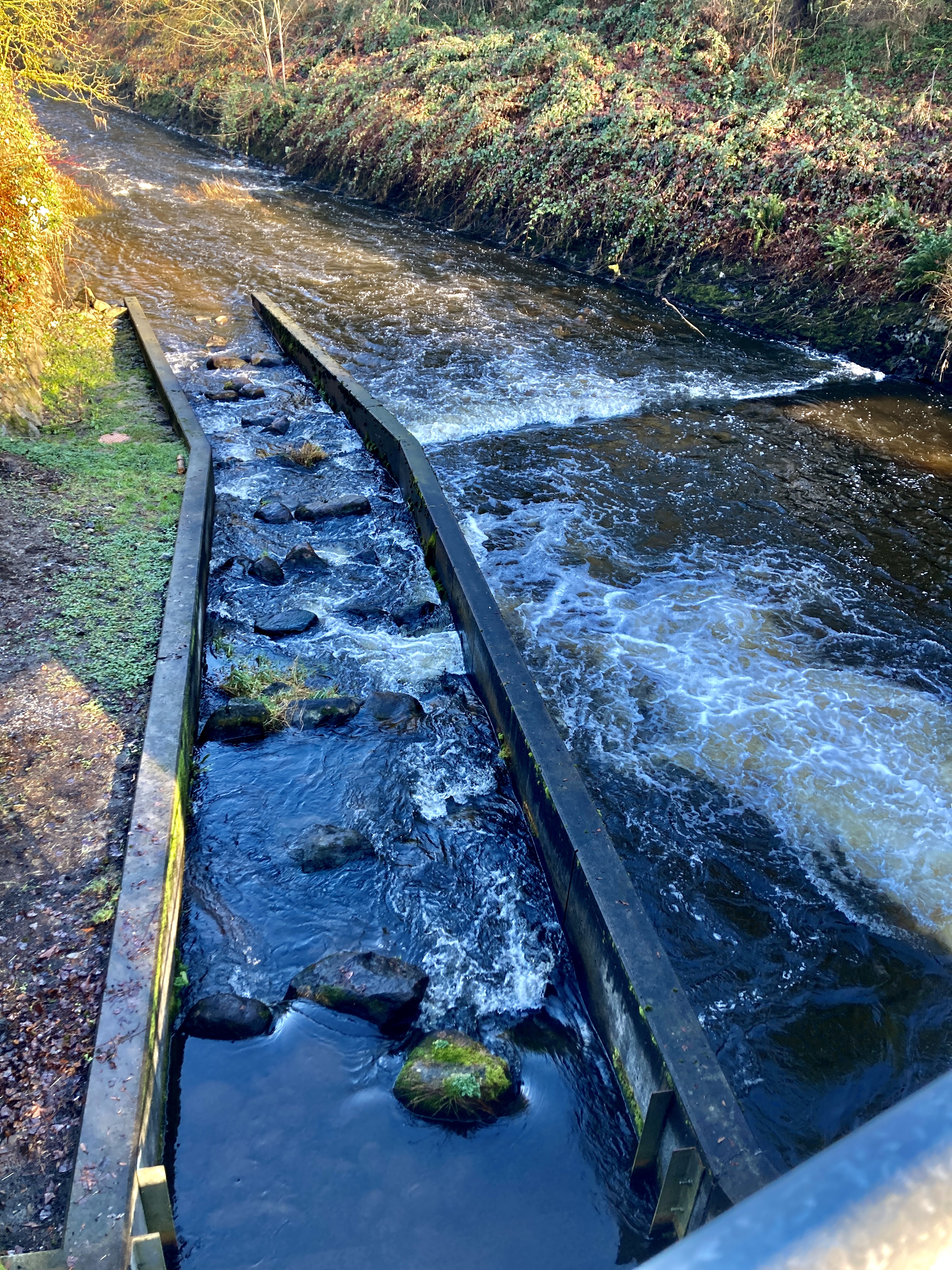
to the Cariboo Dam. Several creeks and a lake feed into Burnaby Lake, which in turn empties into the Brunette River and ultimately into the Fraser. This dam controls the outflow.

An era of sawmills on the lake caused the inevitable toxicity and devastation of salmon and other populations. We stand on the path atop the dam, and see some results of rehab efforts since then.

To the east, the Cariboo Dam Fishway provides upstream access for resurgent fish populations …

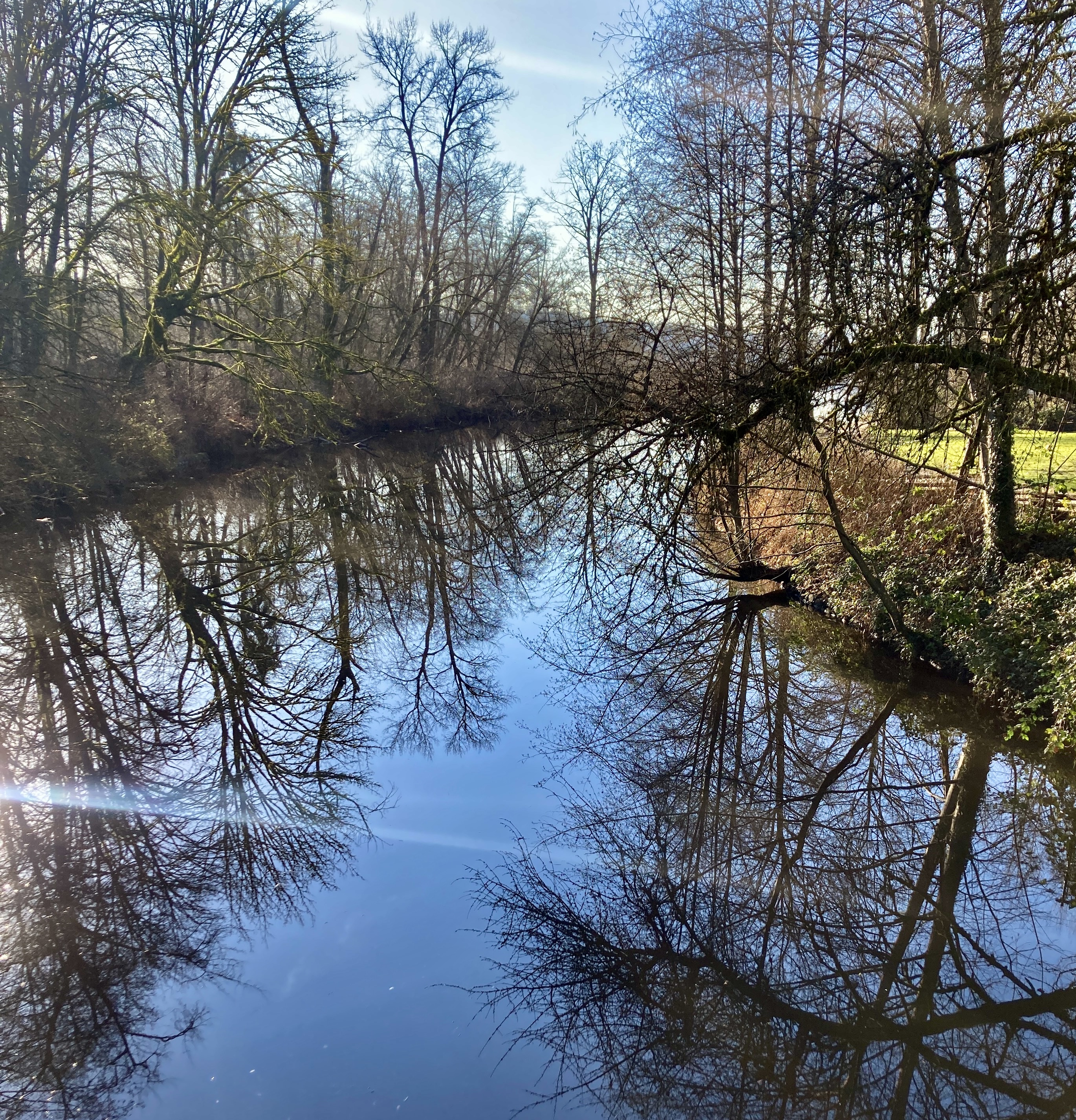
and to the west, winter trees cast their delicate embroidery on the system’s much-improved waters.

Trails circle and loop off-shoots all around the lake, but are not always in sight of water. We’re on the Brunette Headwaters Trail, entranced by nature’s response to the minimal human pruning that keeps trails safe and accessible.

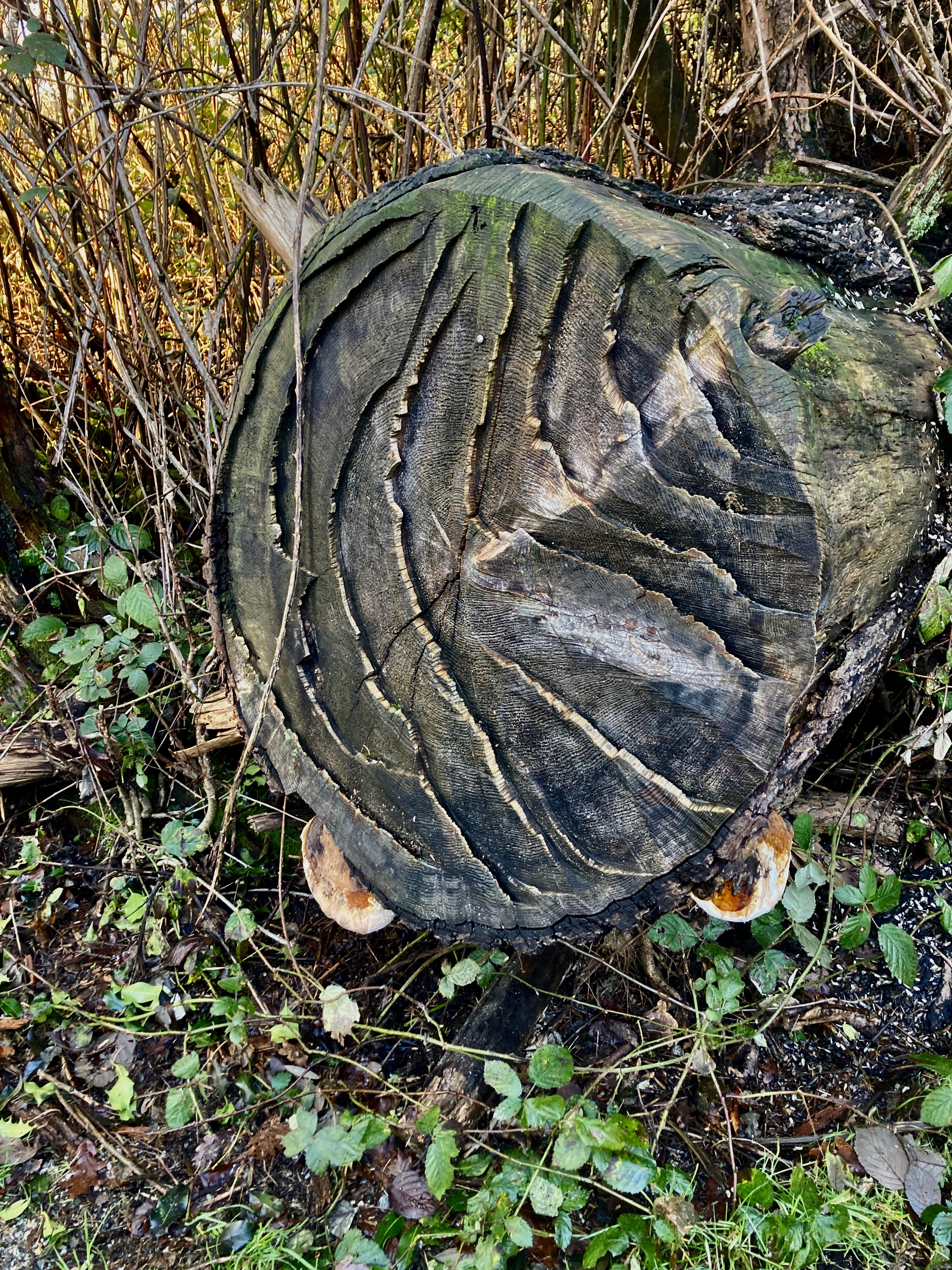
Humans cut; nature pretties up the resulting stumps and fallen logs.

Sometimes with cream/black/ochre fungi…

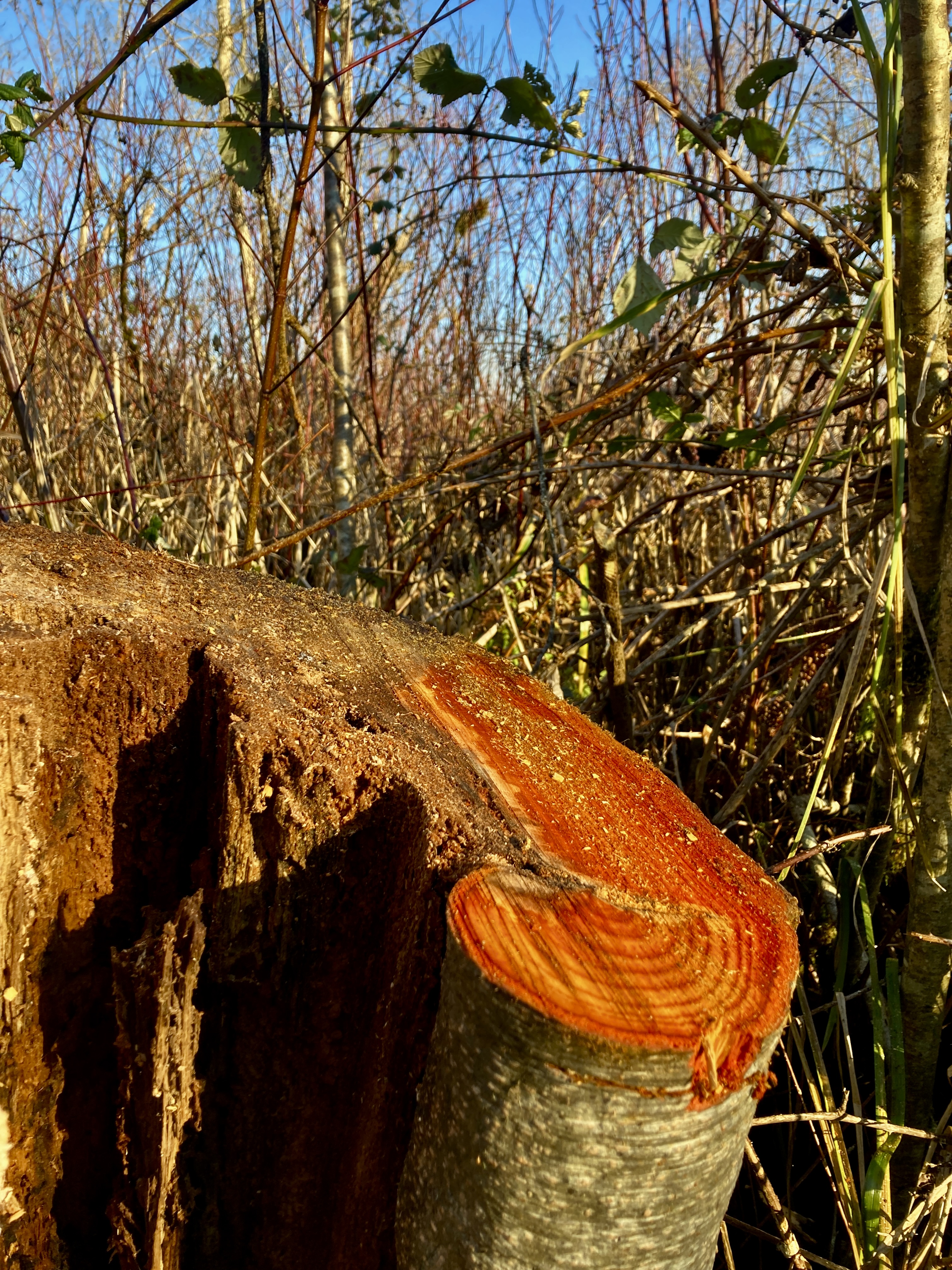
and sometimes with a smacking great burst of red and orange in the wood itself.

(Really! No enhancements.)

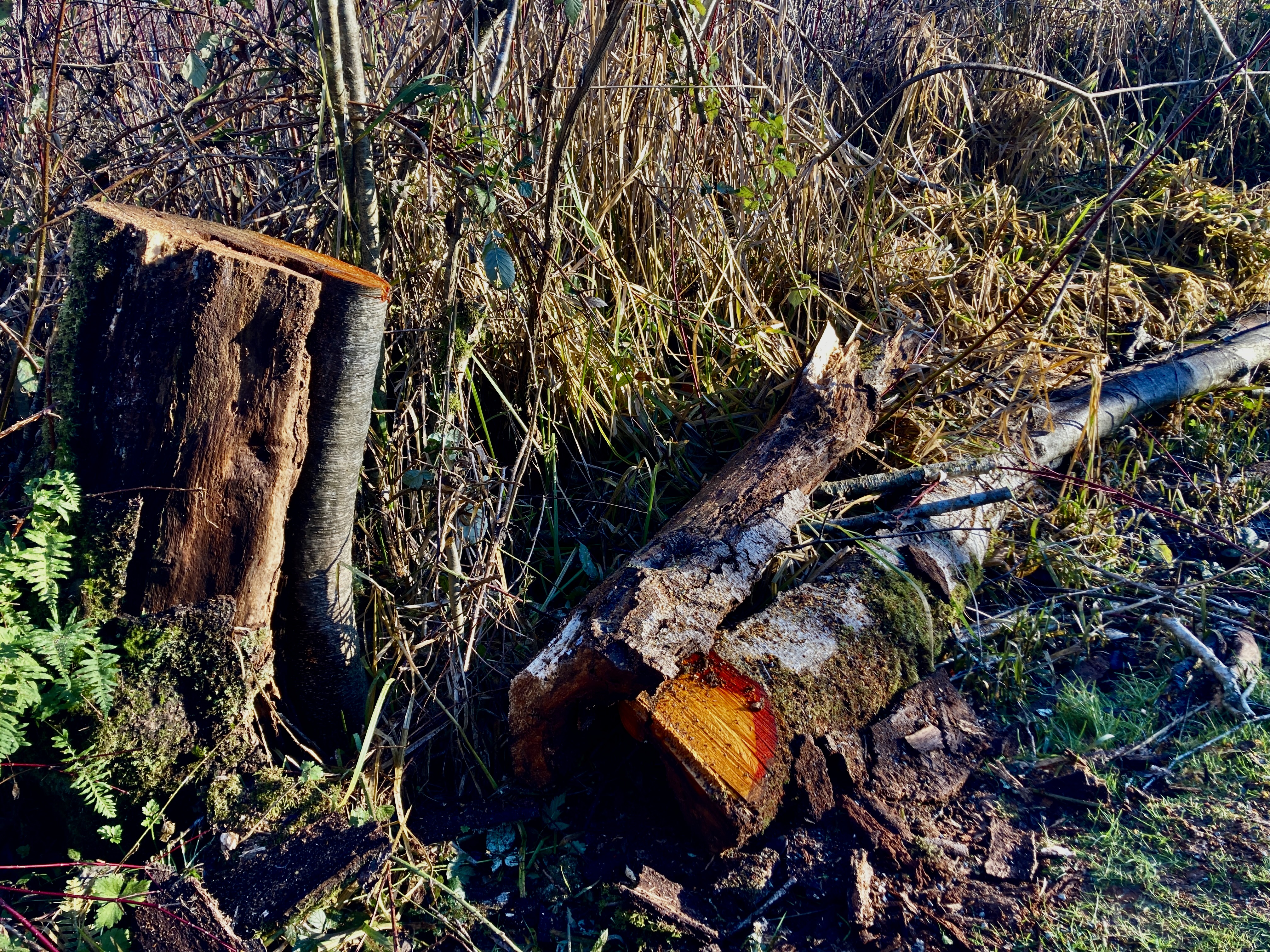
And then, as if that weren’t enough, right there in the grasses between stump and tree trunk…

I spy a vivid little slice of off-cut. Which, to my friend’s amusement, I tuck into my knapsack.

On west we go, and turn onto the path that will take us to the viewpoint at the end of Piper Spit.

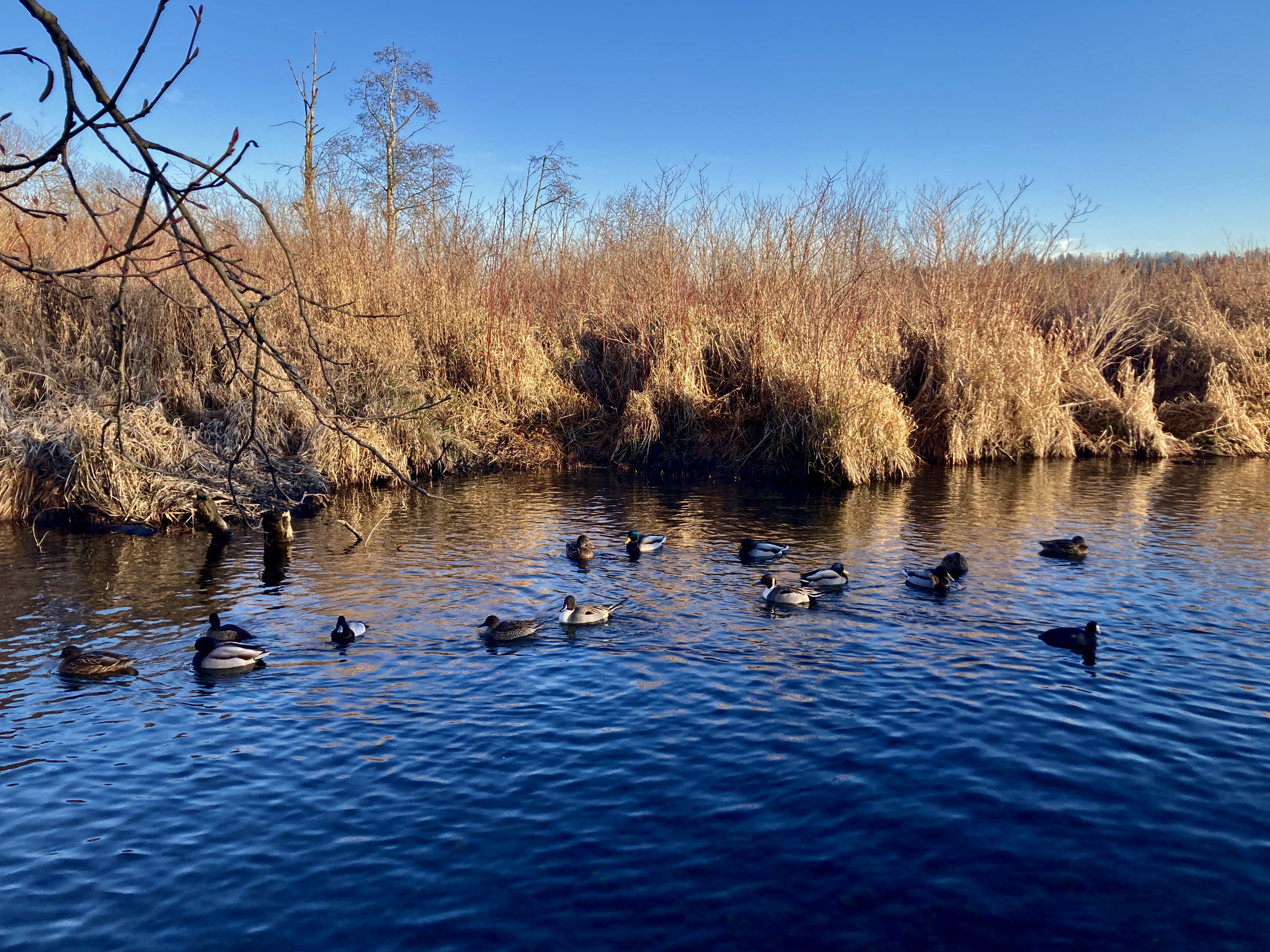
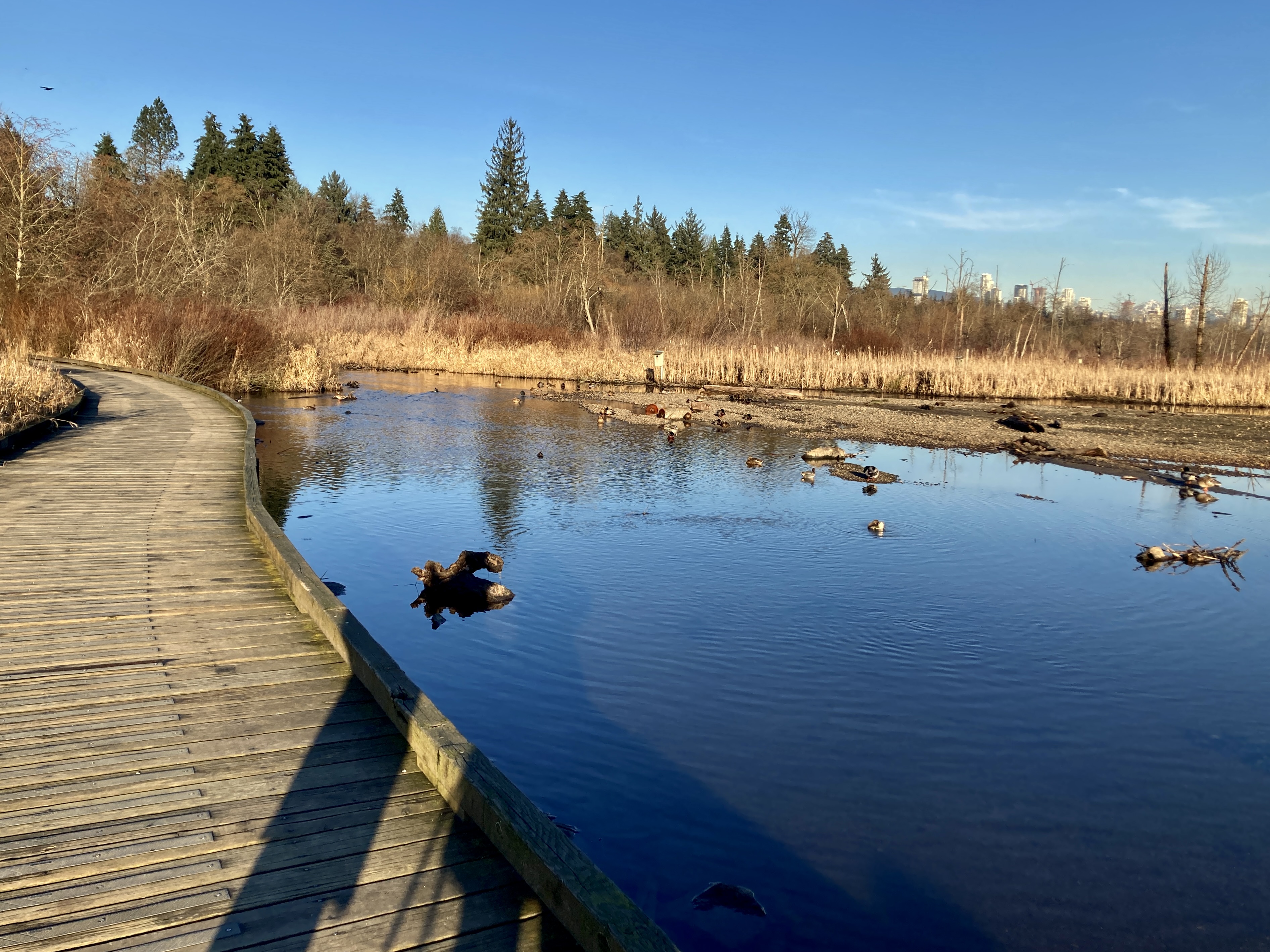
The waters along this path teem with happy ducks. Even my uneducated eye can pick out mallards, pintails, golden-eye and coots, as they mill about.

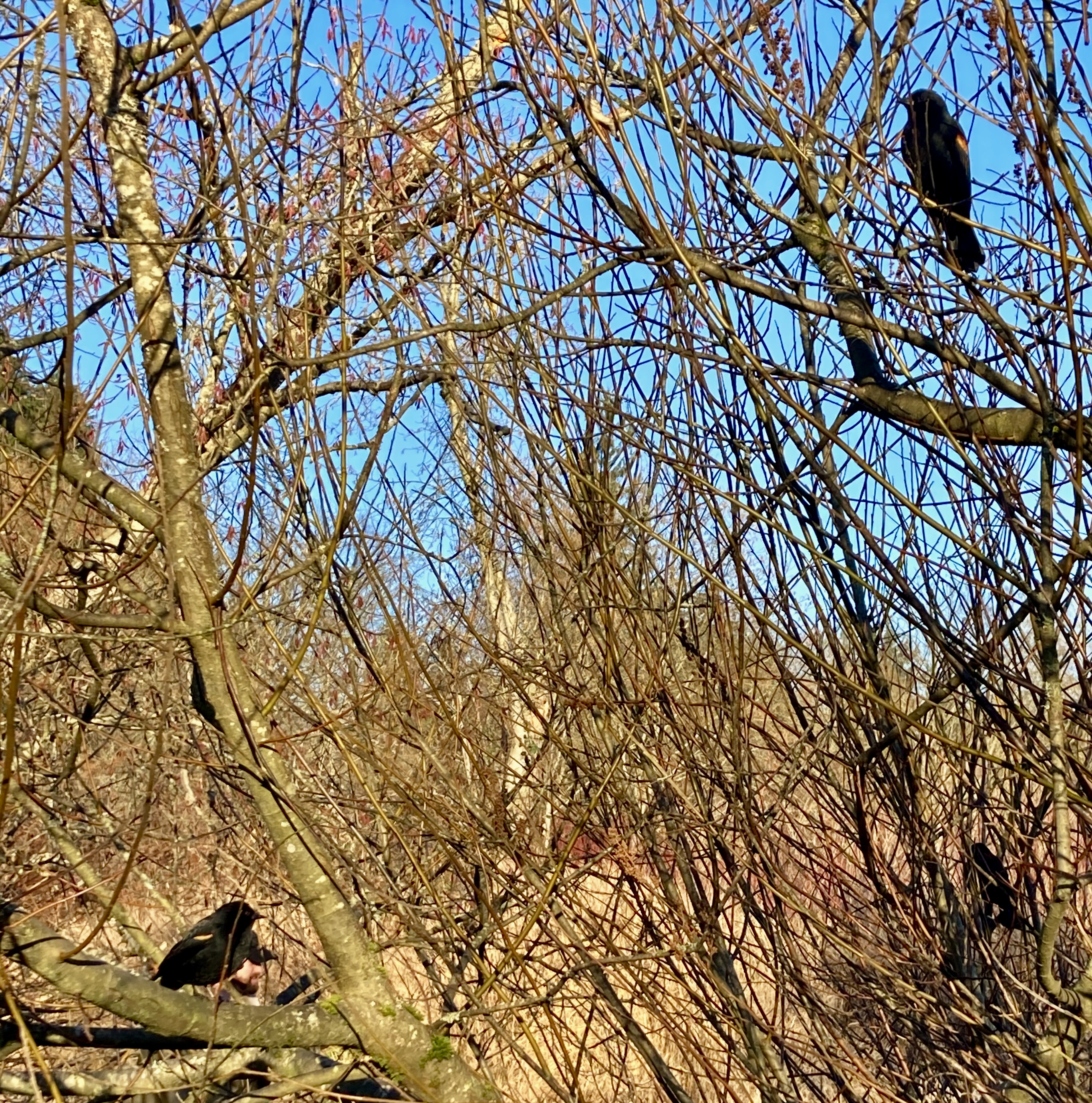
In the trees, chickadees and red-wing blackbirds.

I confess: I deny these guys are red-wingers until they flash those chevrons. “Well, they don’t sound like red-wing blackbirds,” I grumble. Then I have to consider that this lot is a long way from the lot that my ear knows best, back in Ontario, and they probably have their own distinctive accent. (Am I right? Am I silly? Somebody please tell me.)

Tip of Piper Spit, we look east at yet more ducks (and gulls, and bird boxes along the shore)…

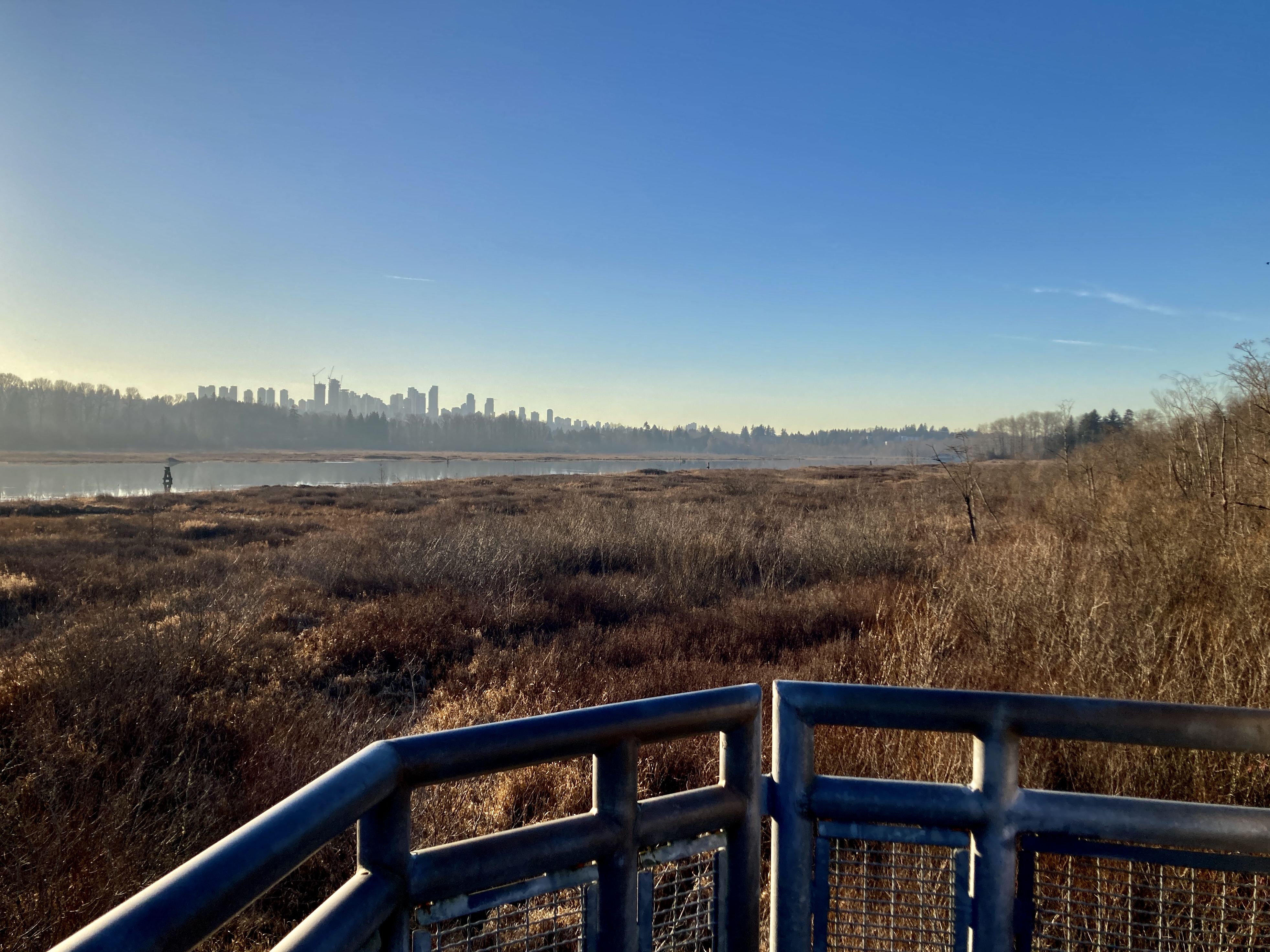
then west across mud flats toward the shoreline viewing tower.

Back to the main trail, and up the tower…

for a long view across grasses, lake and woods beyond, right to the towers of downtown Burnaby.

Beyond those towers, the Vancouver towers.

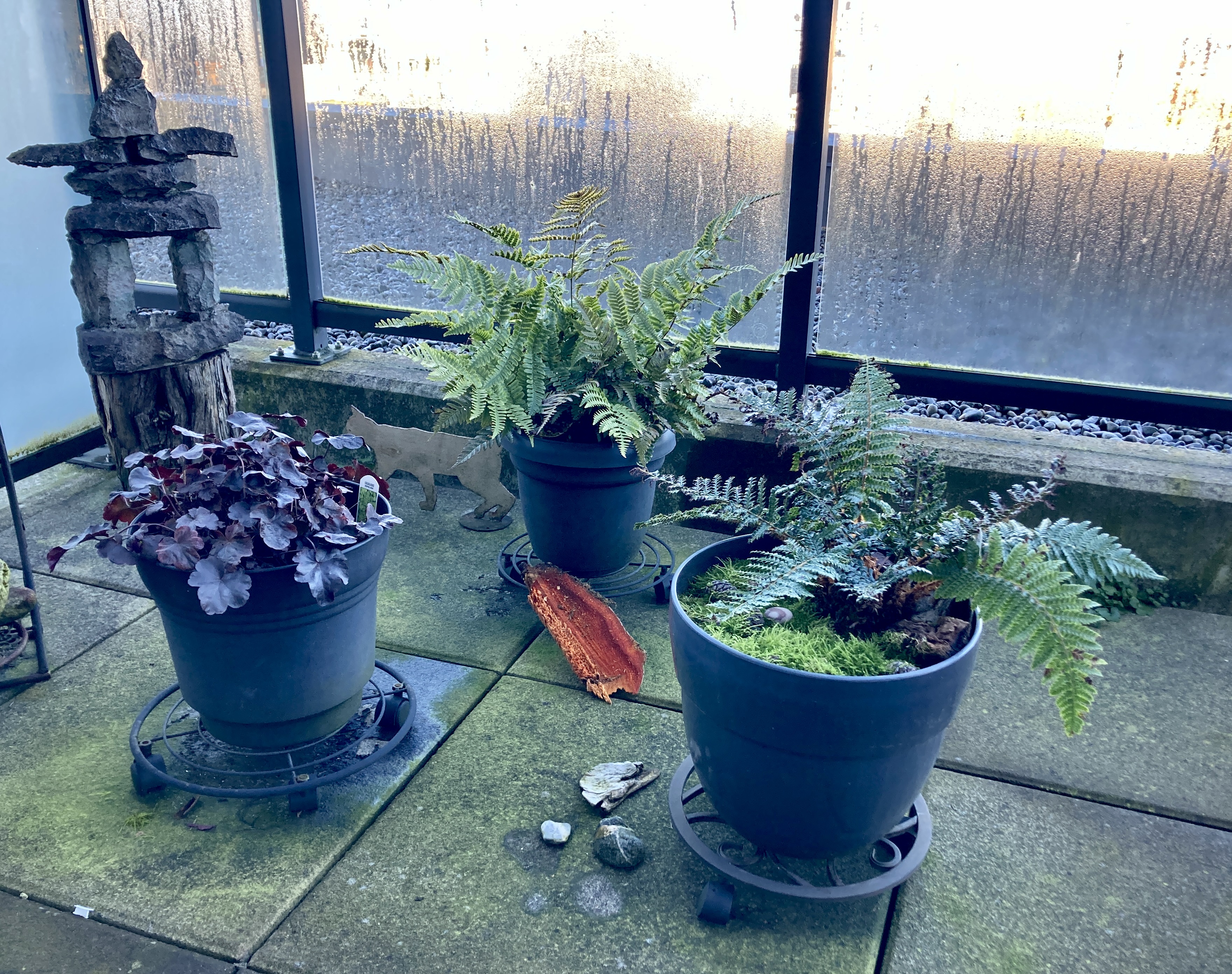
Where, once home…

I settle my vivid little off-cut among its new companions.

… And All the In-betweens

23 October 2025 – I had a much longer title in mind. To wit: “Above/Below/In Front/Behind/Then/Now/Here/There… and All the In-betweens.” Aren’t you glad I restrained myself?

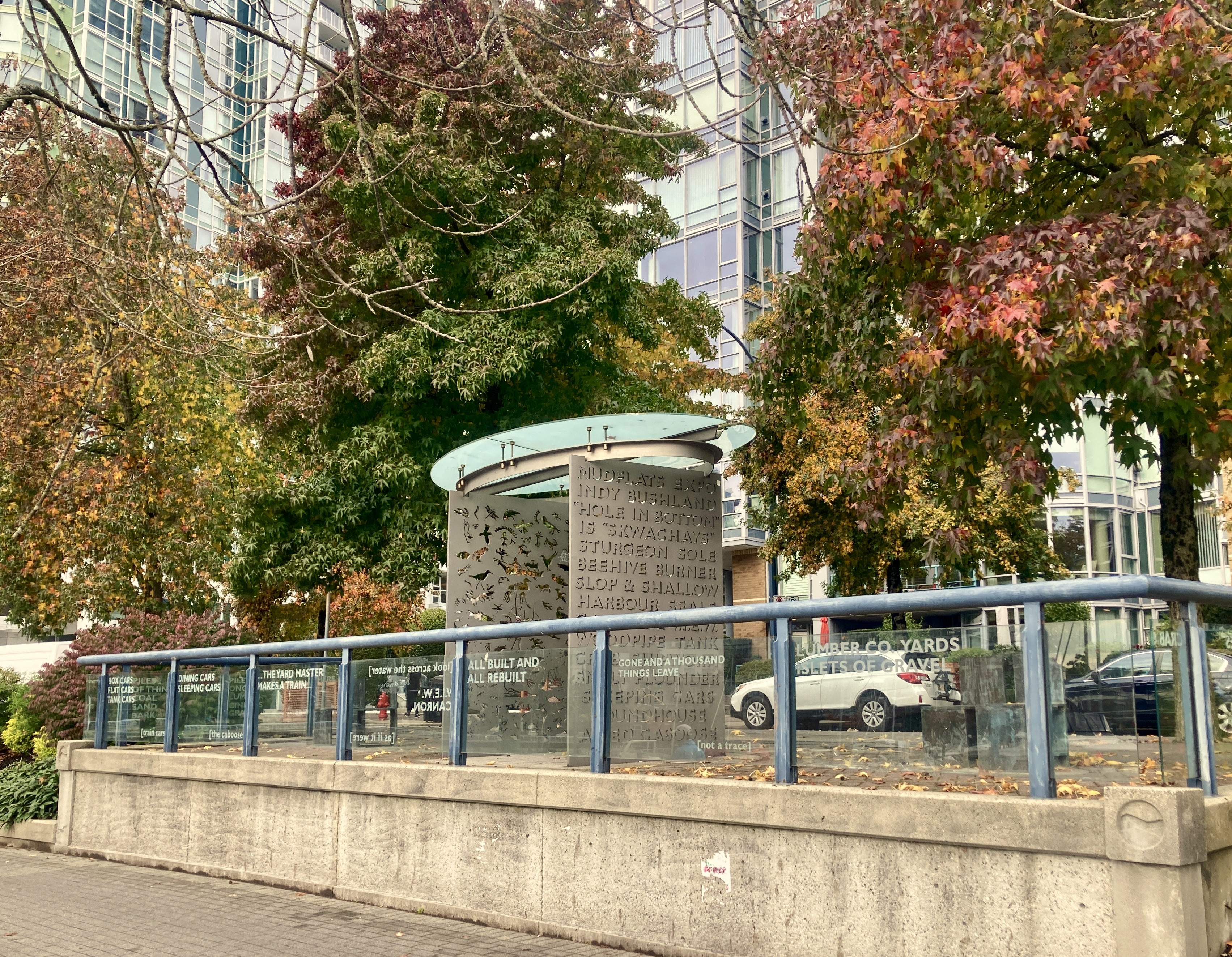
That verbal onslaught is prompted by yet another walk along the north shore of False Creek, from foot of Davie east to Main. More specifically, prompted by this:

I only now, after all these years, bother to learn that this artsy structure has a name. It is one of the two shelters + glass panels that comprise Lookout (Dikeakos + Best, 1999), which traces the natural & industrial history of the area and is an early contribution to the public art we enjoy on both sides of the water.

You can spread the image, read the keywords panel by panel — or just read this paragraph! L to R: “box cars, flat cars, tank cars” / “dining cars, sleeping cars” / “… the yard master makes a train…” / [then a panel written to be read from the other side] / “all built and all rebuilt” / “gone and a thousand things leave, not a trace” / “lumber co yards, islets of gravel.”

I climb up to the street, take a closer look at the inscribed and silhouette steel uprights, also part of the story.

Natural + industrial history indeed, from “mudflats” upper left to “red caboose” lower right.

Then I check the panel meant to be read from this, the street, side:

This one you can read for yourselves. And, given all these prompts, you can also take a stab at imagining “as if it were” all still present as it used to be.

What you will have trouble reading, even if you spread the image, is the black-lettered graffito neatly inked in just below “across the waters.” It says: “build a washroom.”

I think this is perfect. An interjection of a “now” reality in a tribute to “then.”

It is also a further prompt to do what I do every time I pass this installation, with its invitation to remember the past, superimpose it on the present, build it into my understanding of how much more is still Here-And-Now than is Right-Now visible. Every time, my mind flips back, vaguely but insistently, to Italo Calvino’s 1972 book, Invisible Cities. As one astute reviewer observed, the novel is “a travelogue to places that do not exist.” It also invites us to think more richly about how we define “exist.” (Side nod to the wise fox, who taught The Little Prince, “What is essential is invisible to the eye.”)

I am primed, in other words, to read above, below and ‘way inside the everyday sights that greet me as I walk.

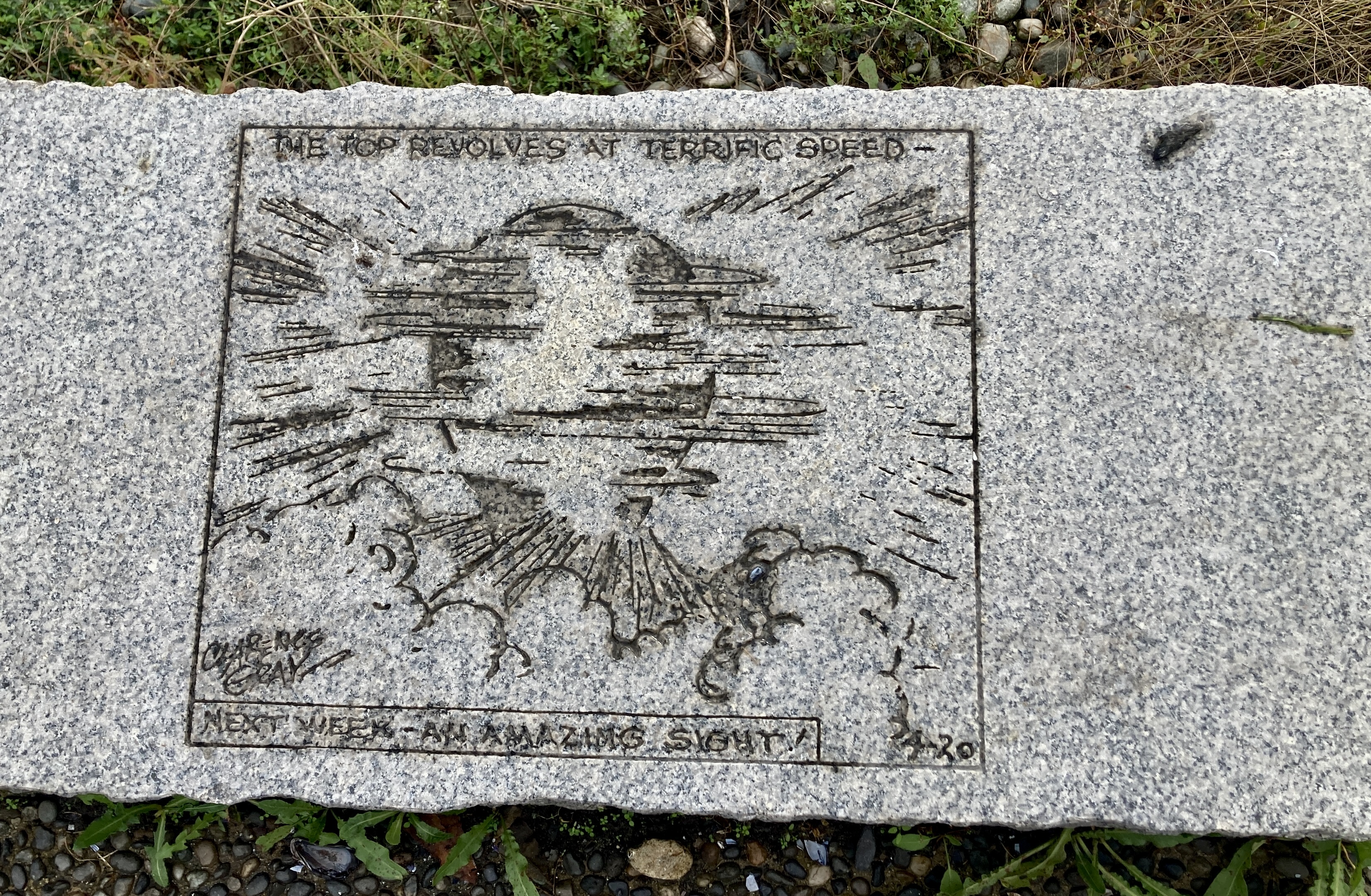
Jerry Pethick’s Time Top sculpture, for example, that invites us to imagine a time top spinning across the galaxy…

to crash-land on the shores of the Pacific Ocean, right here…

or the blue bands of A False Creek (Rhonda Weppler, Trevor Mahovsky), that invite us to imagine what all this will look like if climate change indeed causes ocean levels to rise 4-6 metres…

and, right next to it, another interjection of a “now” reality, again in the form of a polite and neatly lettered graffito. This one, beneath the No Dogs Allowed notice there on the right, yanks our attention back to the present. “Clean The Water,” it snaps.

I stop my fancy metaphysics for a moment, offer myself a simple contrast between sky-high…

and shoreline…

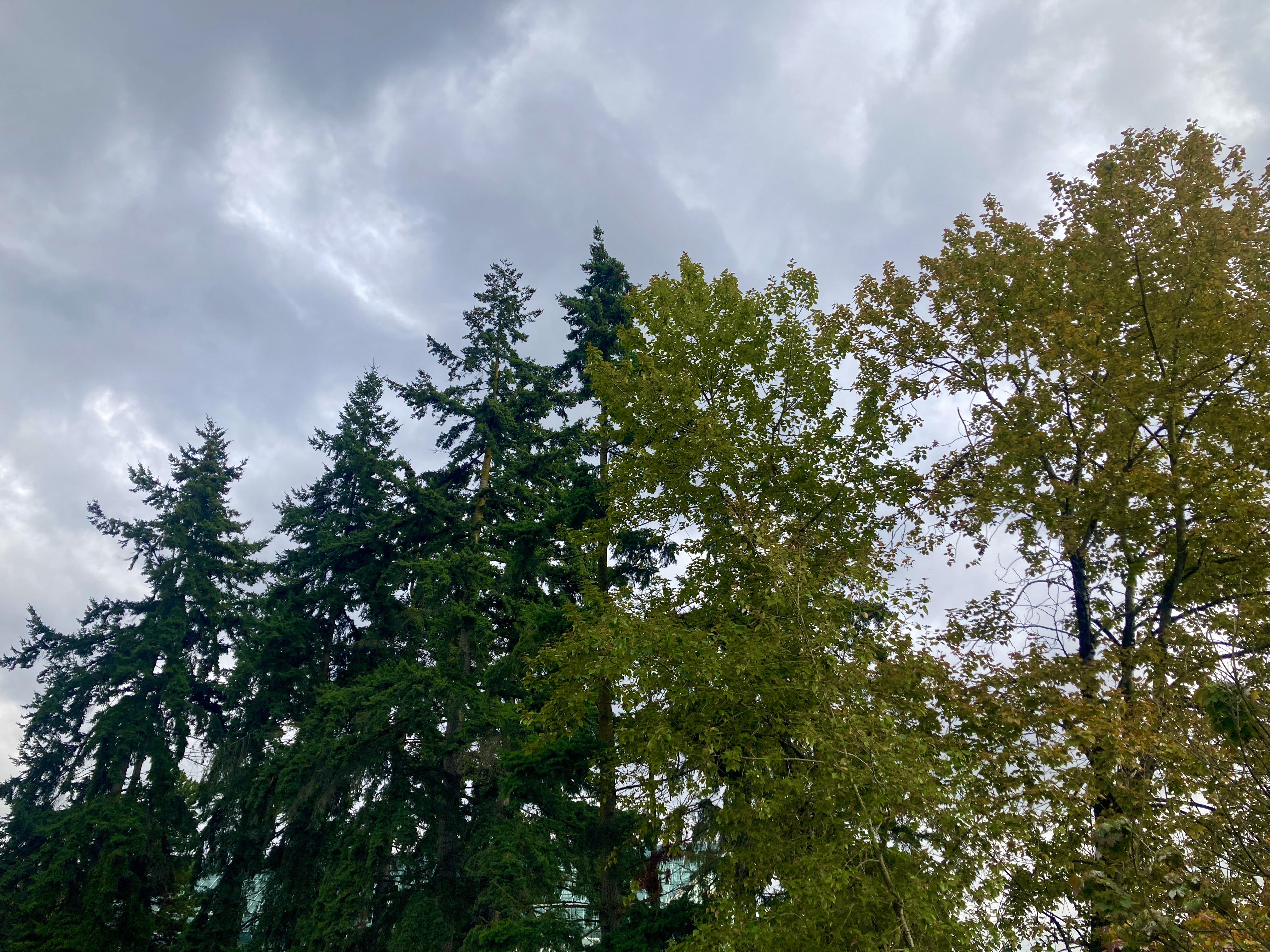
then, sideways, a panorama of nature, reminding us that it invented fall colours long before built structures began to emulate them…

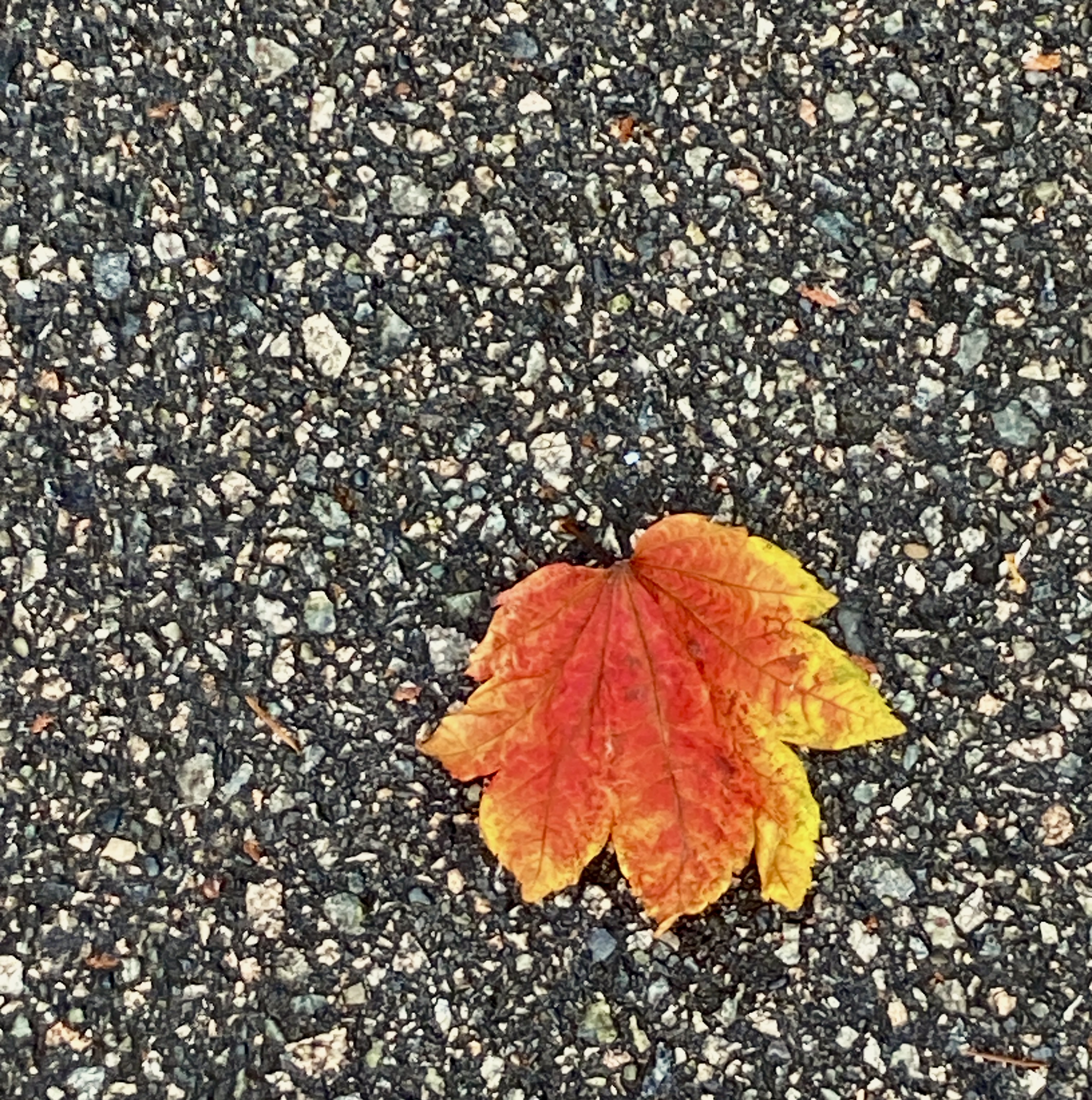
followed by, at my feet, the tight focus of a single fallen leaf…

reminding us that diversity, whether in or out of political favour, is the building-block reality of life.

However pure green this leaf long appeared to be, all these other colours were woven into it right from the start and are equally part of it. As are (side nod to Thich Nhat Hanh and the concept of interbeing) sunlight, water and soil, plus all the nutrients of those three elements as well, all of which made the existence of this leaf possible.

Quite literally, the universe in a single leaf.

Enough. I think I’m done. But, no.

There is one more juxtaposition. One more interweaving. One more dance to vibrate my own little world, as I walk on by.

Upper right: nature’s wasp nest. Lower left: street-guy’s sneakers. Both at home in the tree. A tree shedding its leaves, itself at home with the cycles of the universe.

I laugh, shed my pomposity, and take myself home.

Discoveries

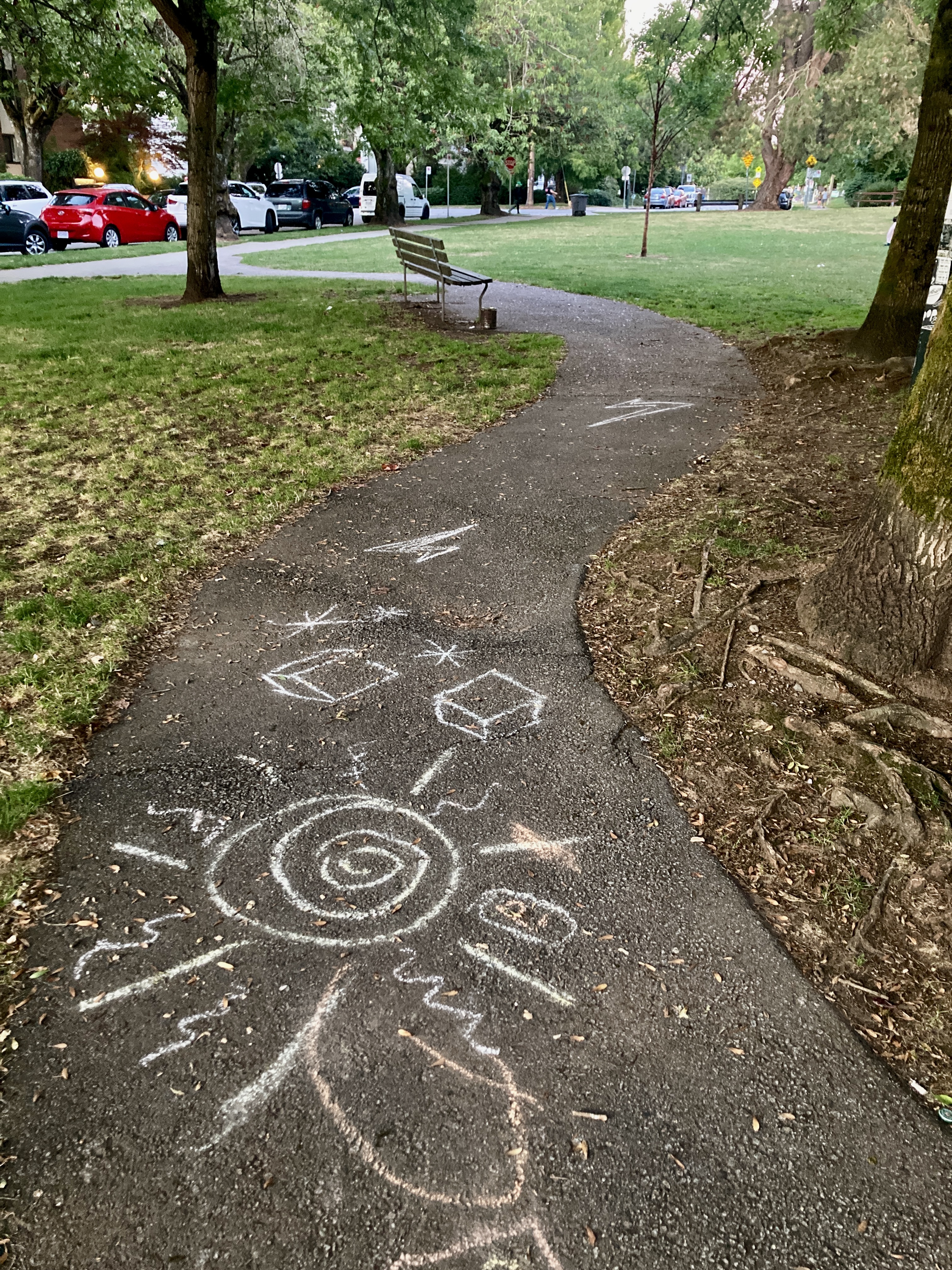
22 August 2025 – I mean to walk right through Dude Chilling Park, en route farther east. Instead, I stop to admire a brand-new hopscotch chalked into the park’s northern pathway.

Squares a bit on the mingy side, true, but lots of them. And so carefully executed. With European cross-strokes for the 1s and 7s. And the flourish of two colours, not one.

Instead of walking on, I settle myself on the bench just beyond…

curious to see if anyone yields to the temptation, and starts to hop.

First up, a very young toddler and her mum. The child is clearly new to the act of walking, let alone leaping around. She does not attempt to hop. She stops, frowns slightly at this unknown design, and then, intuitively, gets the idea.

Very slowly, very carefully, she obeys the visual clues: just one foot here, but both feet there. And then one, and then two… Until she loses patience, that is, and a laughing mother carries her off.

Next up, by complete contrast, a geezer. (Being one myself, I can say that.) He also stops, contemplates. Then, with a grin, he tucks his cane under one arm and starts to hop.

Hippity-hop! And again!

Until… whoops. A wobble corrected, a tumble averted, and his cane is prudently back in use.

He grins at me, amused. “Maybe I’m a little old for this.”

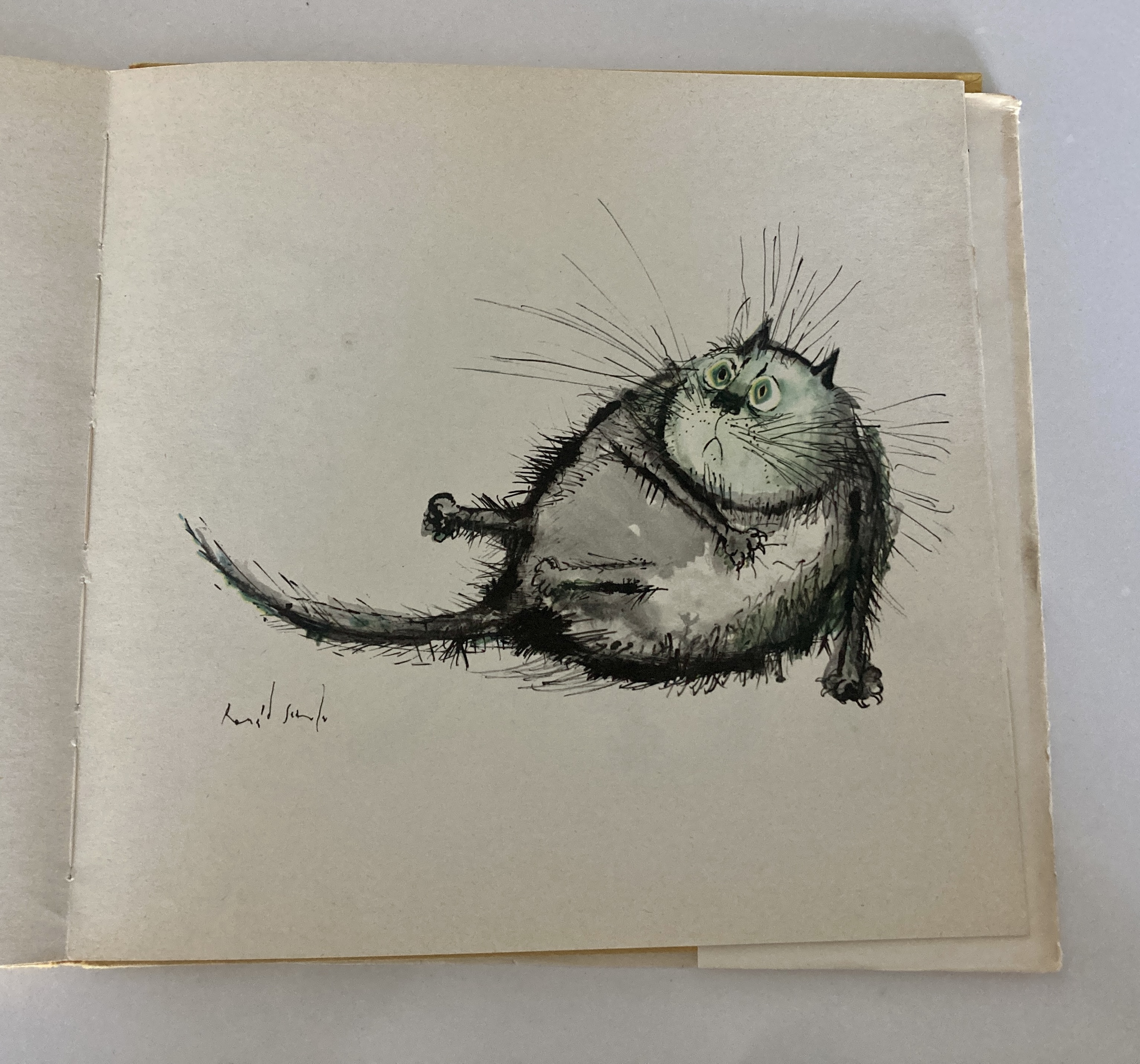
My mind flashes to a particular cartoon in Searle’s Cats (Ronald Searle, Dobson Books Ltd., 1967)…

and its caption: “Acrobatic cat discovering quite unexpectedly that it is too old for the game.”

I grin right back at him.

We are complicit, he and I — fellow adventurers in this demanding but rewarding late stage of life.

Vanity

30 June 2025 – So here’s my fantasy. (Any why not, a fantasy or two, as you walk downtown streets.)

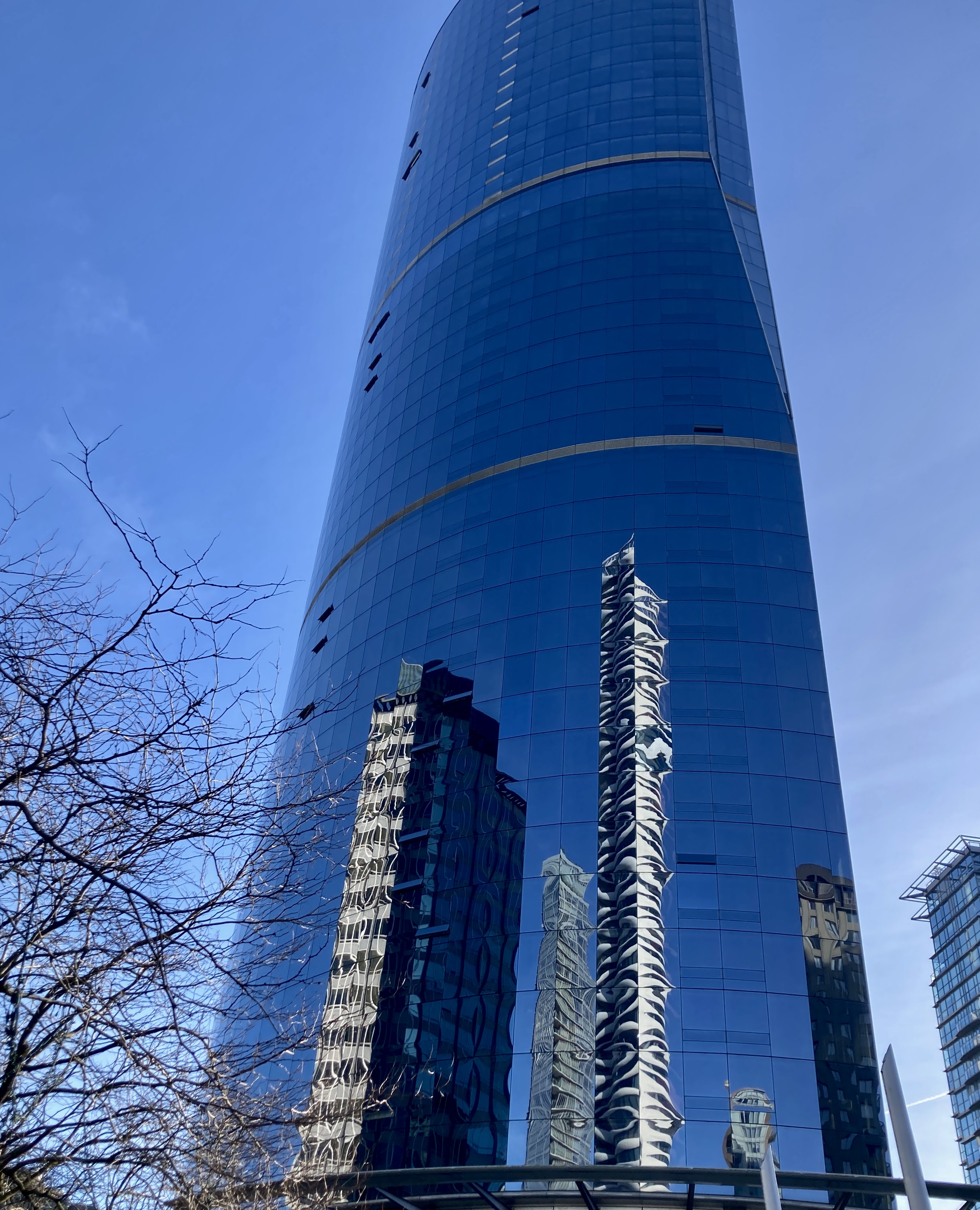
I imagine that older buildings are thrilled to bits by the mirrored towers rising up in their midst.

Why? Because then they can admire themselves in the reflection, all day long.

A trio pile in together, like squealing teenagers in the same selfie…

a patient friend (L) listens while the diva (R) goes on and on about her split personality…

a dowager admires what the tinted glass does for her ageing complexion…

and a couple of stick figures pretend, for just one giddy moment, that those bodacious curves are real.

And then — sigh — I smack myself upside the head, and walk on.

St. George & the ‘Hood

19 June 2025 – Forget the dragon. That is so 10 centuries ago! These days, St. George — or, anyway, our St. George — is all about urban/eco sustainability and livability.

I’m first bounced onto this theme by a graffito on a waste bin. One that I initially think disrespectful of the human origins of the slogan…

but then reconsider, as I look smack across the street.

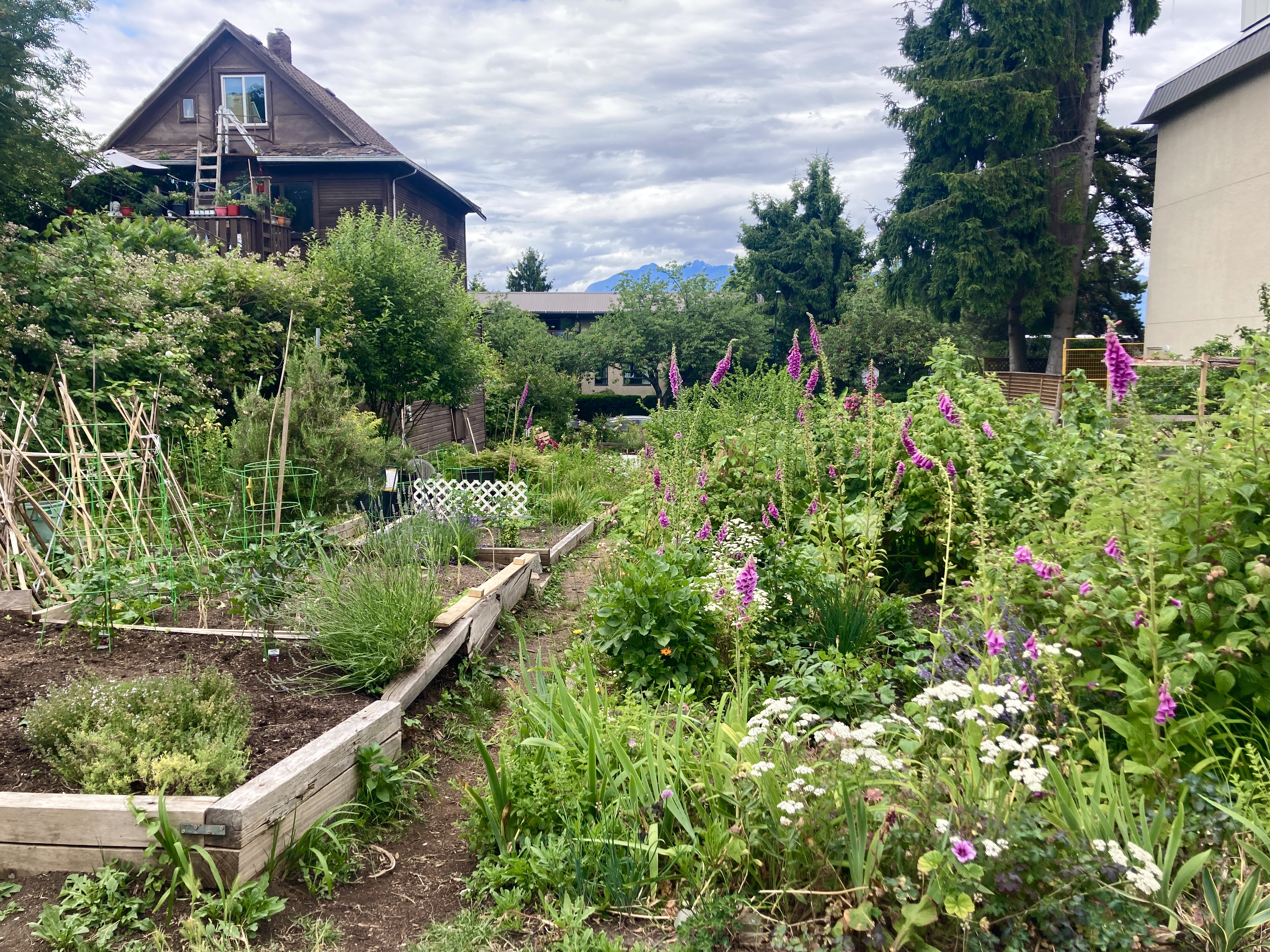
I’m on East 7th, heading farther east, and I’m staring into the busy abundance of this community garden stretching on north to East 6th. All lives matter, yes? We humans and plants are woven into the same eco-system.

This little local garden is very much of this neighbourhood, with its neighbourly values. A place with low-rise homes, many of them vintage wooden structures; a place where a kicked-off toddler’s shoe…

is carefully displayed at sidewalk’s edge by some later passer-by, in the hopes it may yet be retrieved.

I drop down to East 6th, look north as I cross Guelph, think how much I like this human scale — but have no illusions it will last much longer. Let your eye travel down the row of modest bright-painted houses…

to that equally bright-painted construction crane down below. That’s the future, and increasingly the present.

But!

St. George is at work.

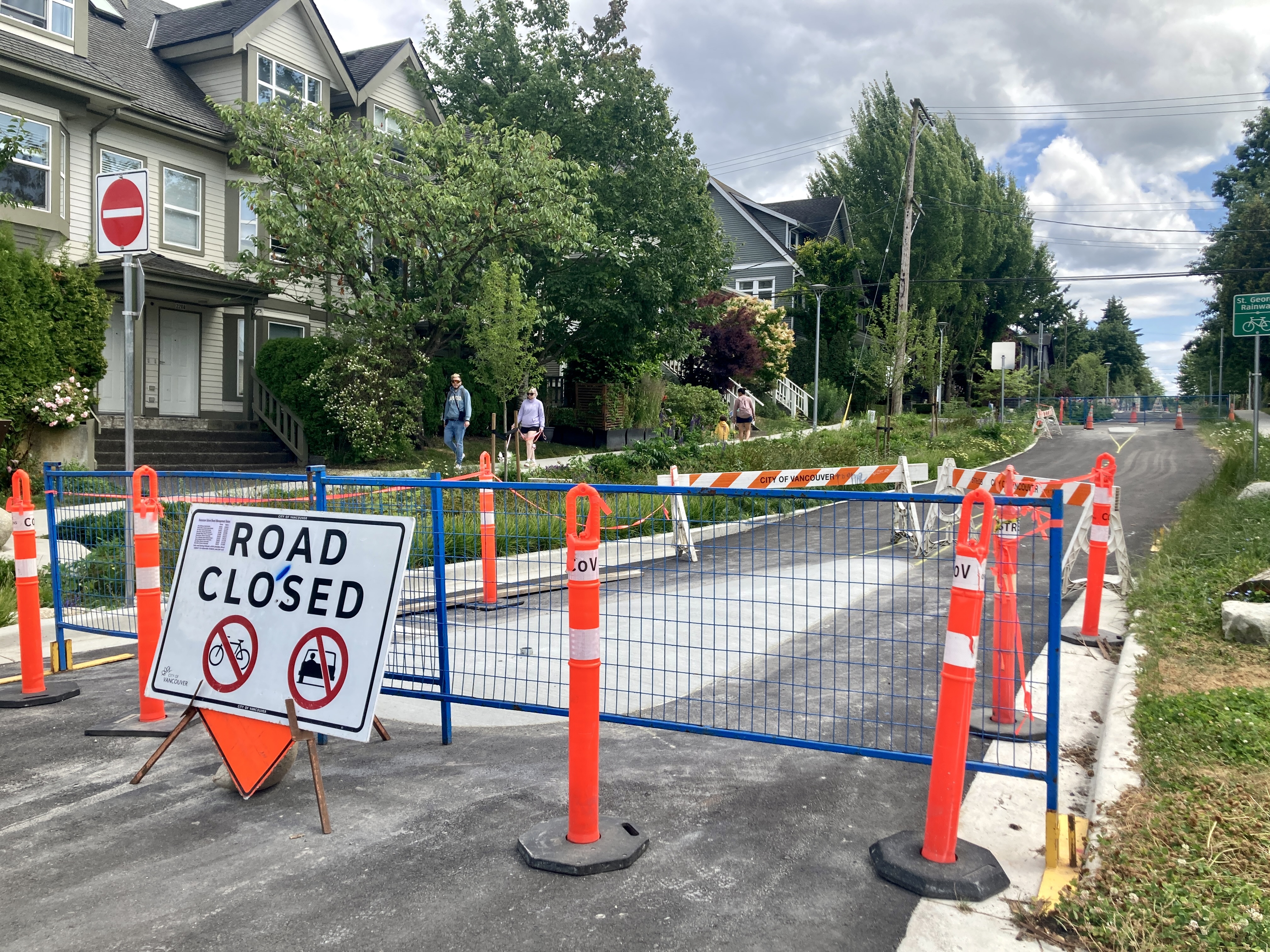
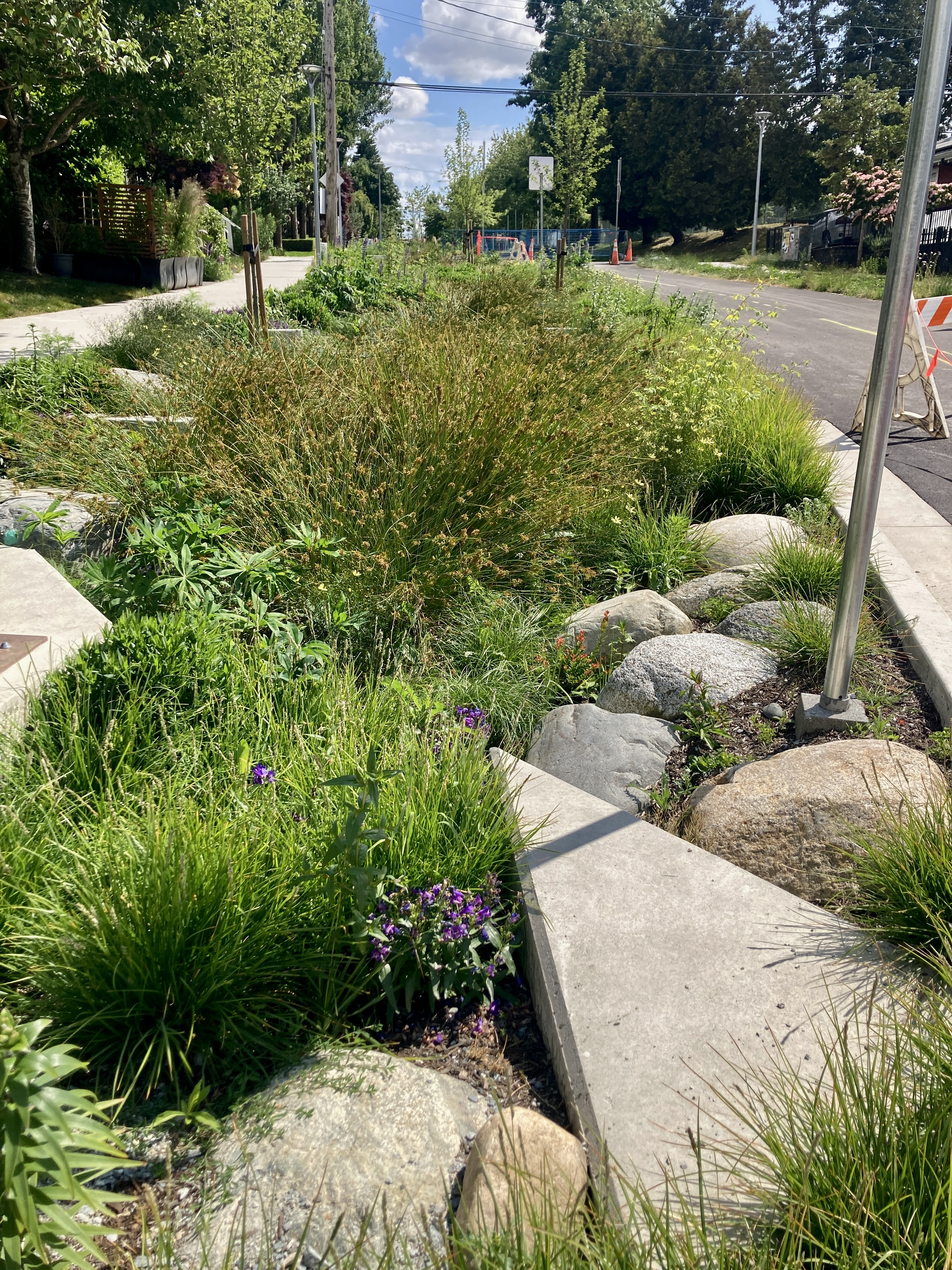
Well, the St. George Rainway. It’s been a long time coming, but now here it is, nearing completion — with its (and I quote} “green rainwater infrastructure features like rain gardens that incorporate plants, trees and soil to manage rainwater…”

I step up to the mini-plaza with its rock, its signage mounted on a plinth…

adorned with a Wood Sorrel cut-out…

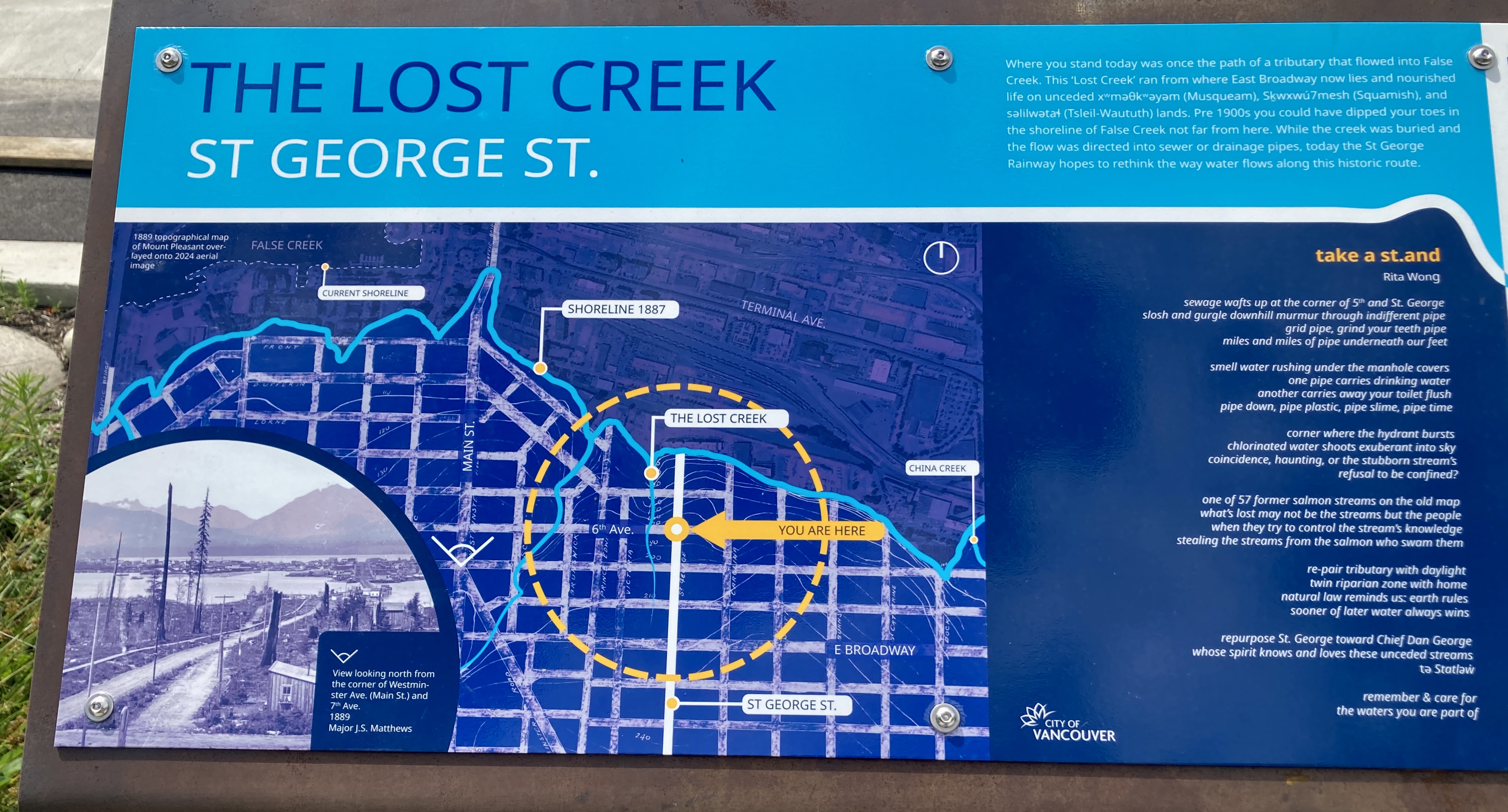
and lots of information.

Go ahead — spread the image, track its elements; I’ll wait.

Together, we learn that the Rainway along St. George celebrates a Lost Creek, a tributary to False Creek that has long since been buried underground. (For that matter, this final eastern end of False Creek, into which the lost creek ran, no longer exists either.)

While you’re exploring that handy map, please note not just the Lost Creek, left-above “You are here,” but also China Creek on the far right, and E. Broadway (East Broadway), three streets to the south.

I admire the rain garden that parallels the sidewalk immediately to the south …

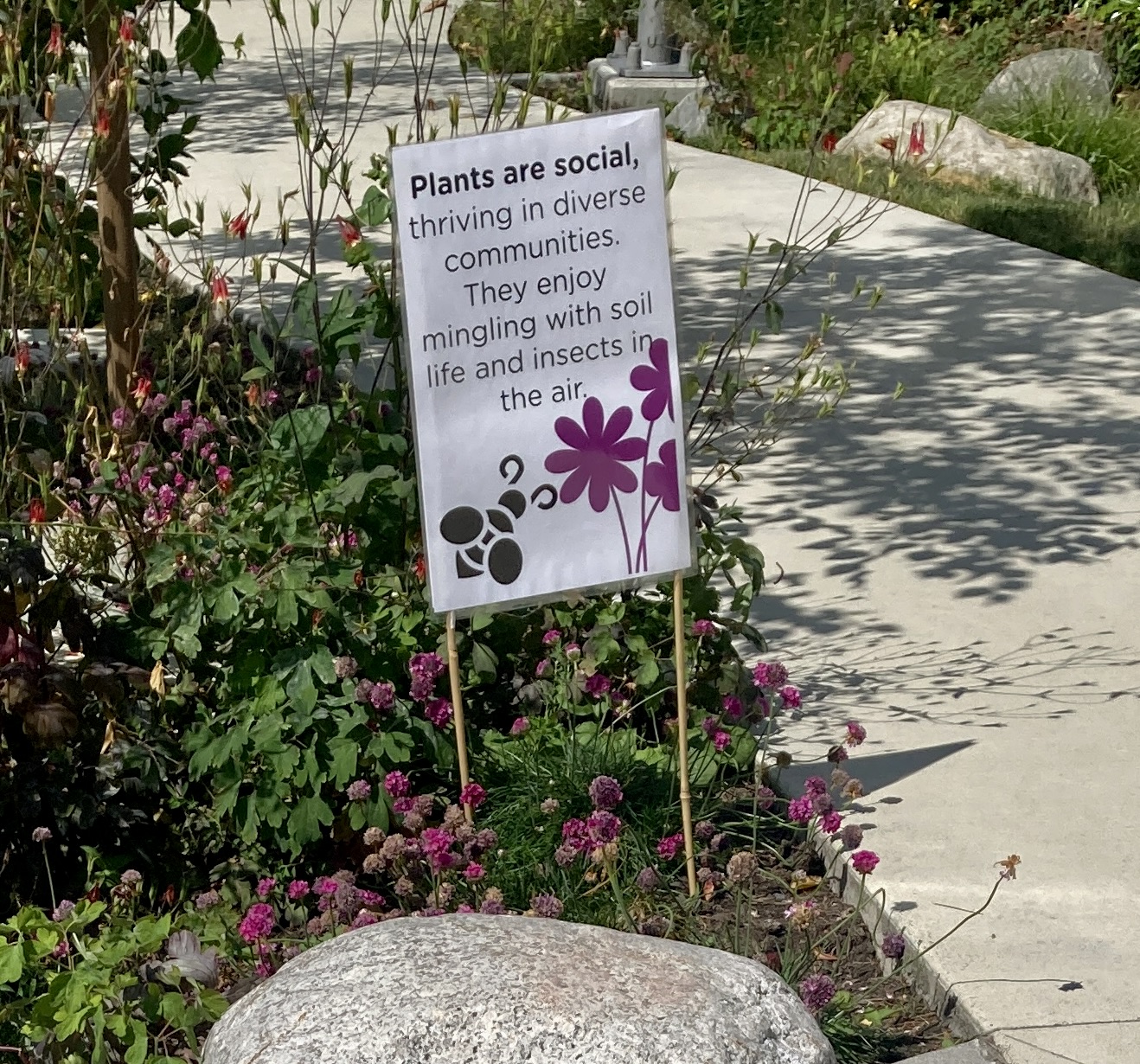
then cross East 6th to admire this sign in the rain garden running on north…

and feel more vindicated than ever in making my peace with the “Plant lives matter” graffito. “Thriving in diverse communities” sounds like the prescription for healthy life, period, whatever form of life we happen to be.

You’ll understand why, with that thought fresh in mind, I fall over laughing at the dumpster graffito I see immediately afterwards.

On I go, on to China Creek North Park. (See? That’s why I wanted you to locate it on the map.)

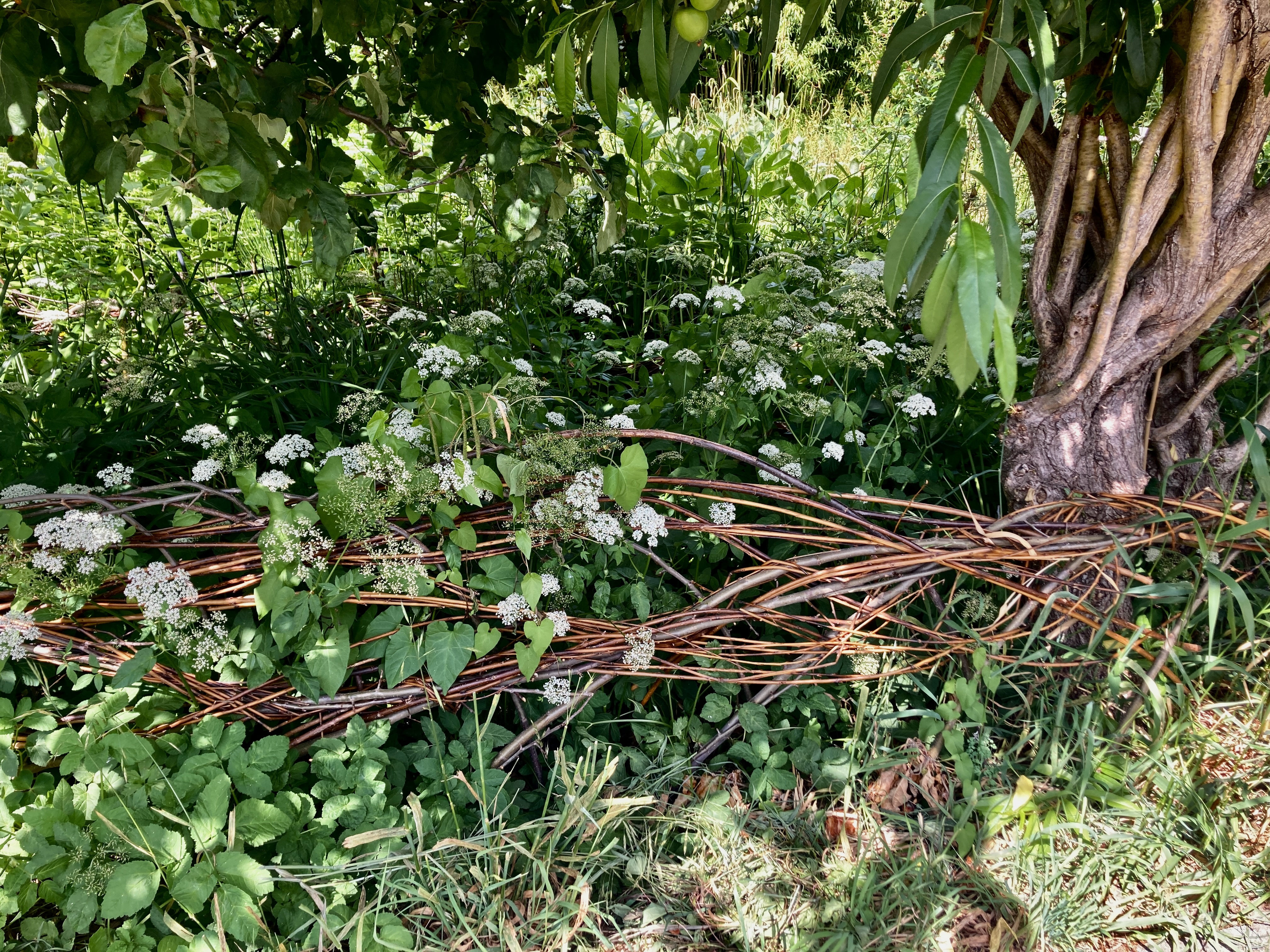
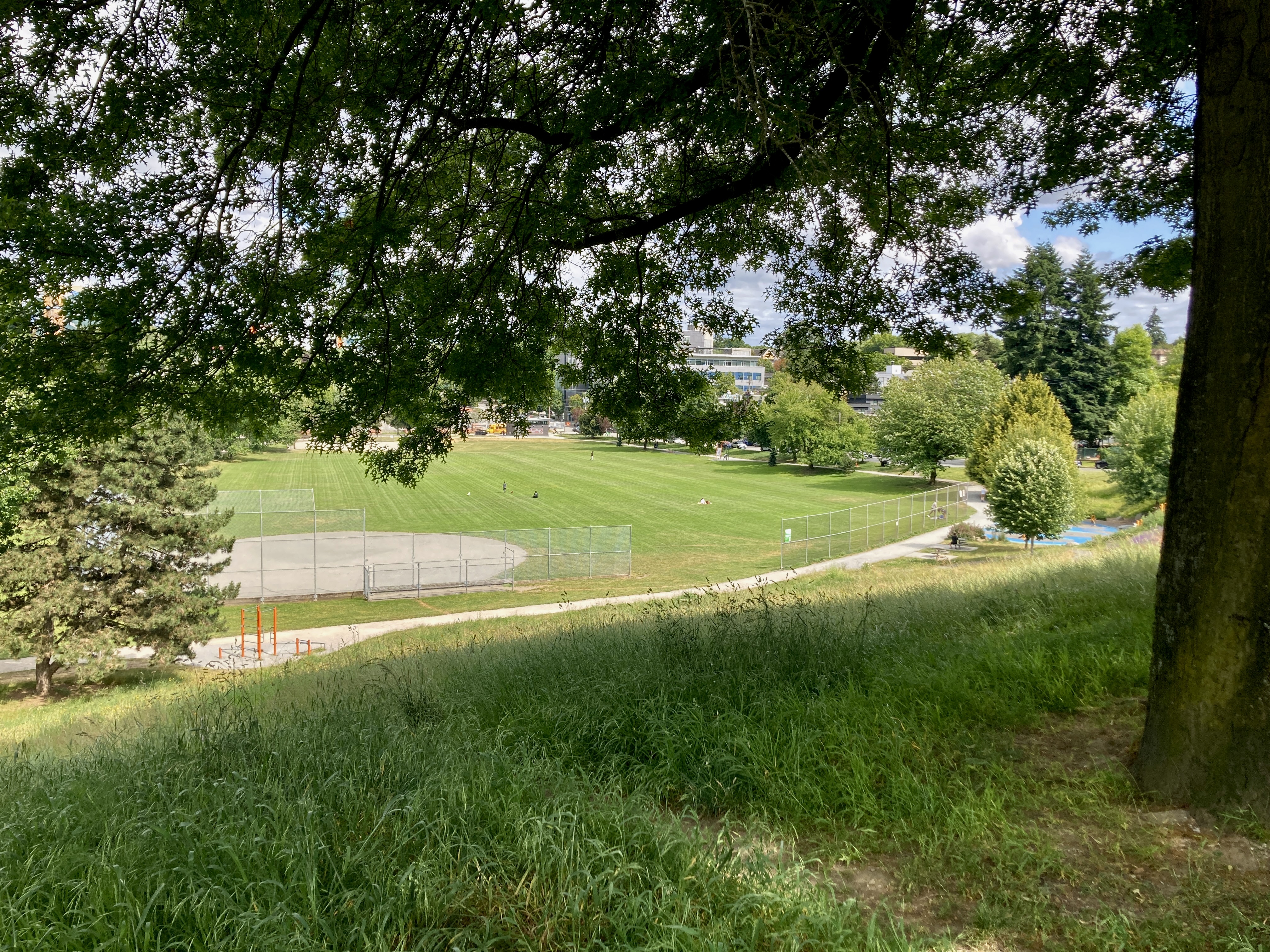
I am heartened, as I approach the edge of this large park, to see fresh new vine fencing woven into the woodlands periphery. (It had become very scruffy.)

At first, looking down the slope, the basin of the park appears generic and banal. Old fashioned, even.

All that mown grass. And baseball diamonds.

But then, as always, I reconsider. The top of the slope is lined with benches, and they are well used, in diverse ways. At the moment, for example, the bench on the left hosts Headset Guy, who in fact is reading a real, physical book…

while the bench on the right hosts Music Man, who strums his acoustic guitar so softly it is almost subliminal. A woman just out of frame is hunkered down, motionless & meditative, and the woman you can see walking past the benches is about to start down the winding path that snakes its way to the playground at the lower level.

And I am about to join her.

This park is another “Lost Creek” — or, more precisely, a Lost Watershed. Before this last bit of False Creek was filled in, a whole network of creeks tumbled through here to feed its waters. Once filled in, the area at one point became a garbage dump, but was subsequently rescued and turned into parkland.

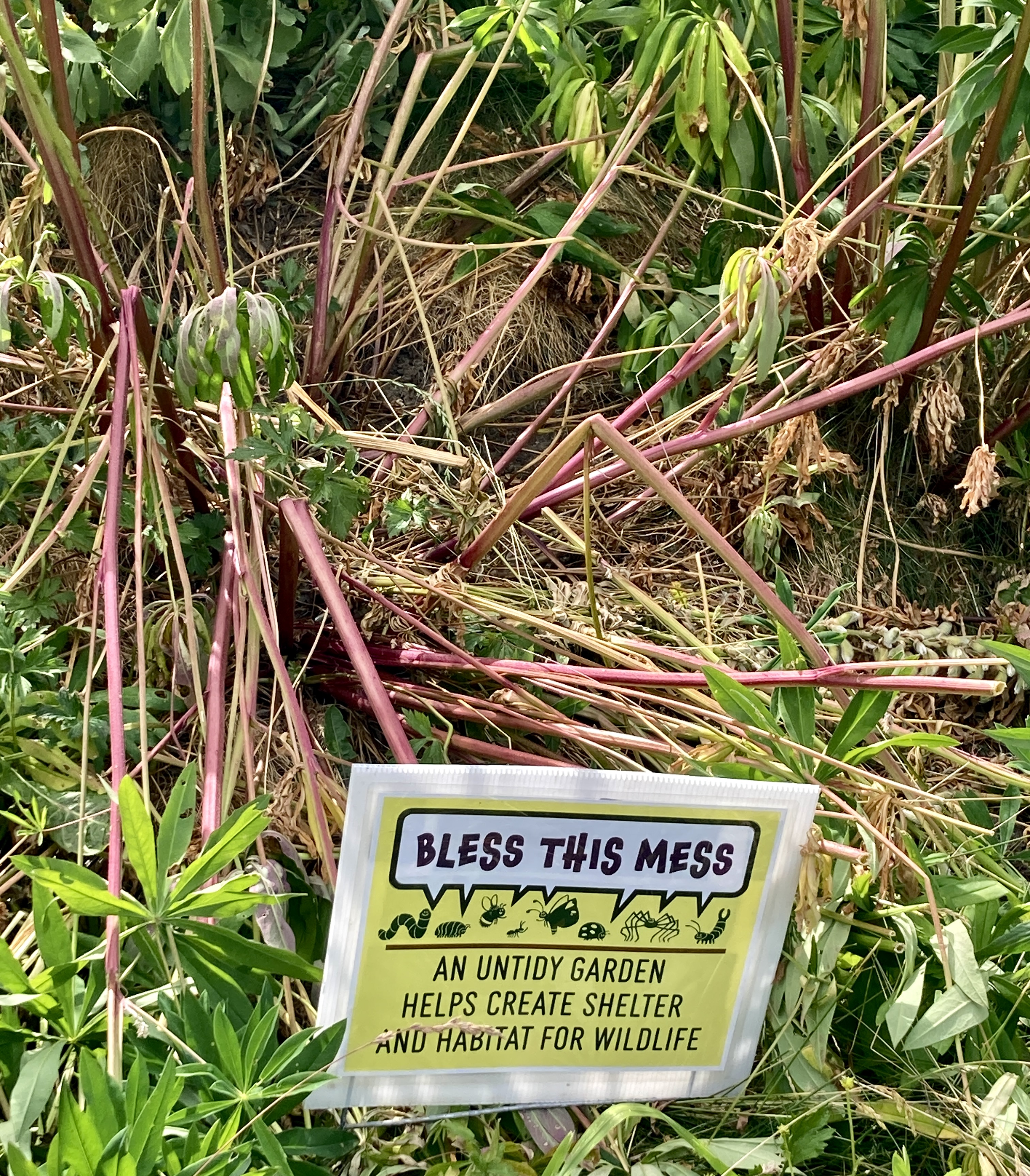
The slope is now naturalized, and it is wonderfully, exuberantly, messy.

With signage to justify the mess.

At the bottom of the path, I peer down the final bit of slope, the bit with a slide and (here) a mesh climbing ladder…

and, down there at the very bottom-bottom, swings and a pirate’s ship and other kiddy delights.

All this diversity! Social plants, social humans, thriving in diversity.

Walking homeward, more happy plant/human interaction…

in this volunteer-managed street corner garden, part of the City’s Green Streets Program.

And then… a reminder that not everything is happy-happy.

That some current trends are jarring and disruptive, and will damage both humans and nature.

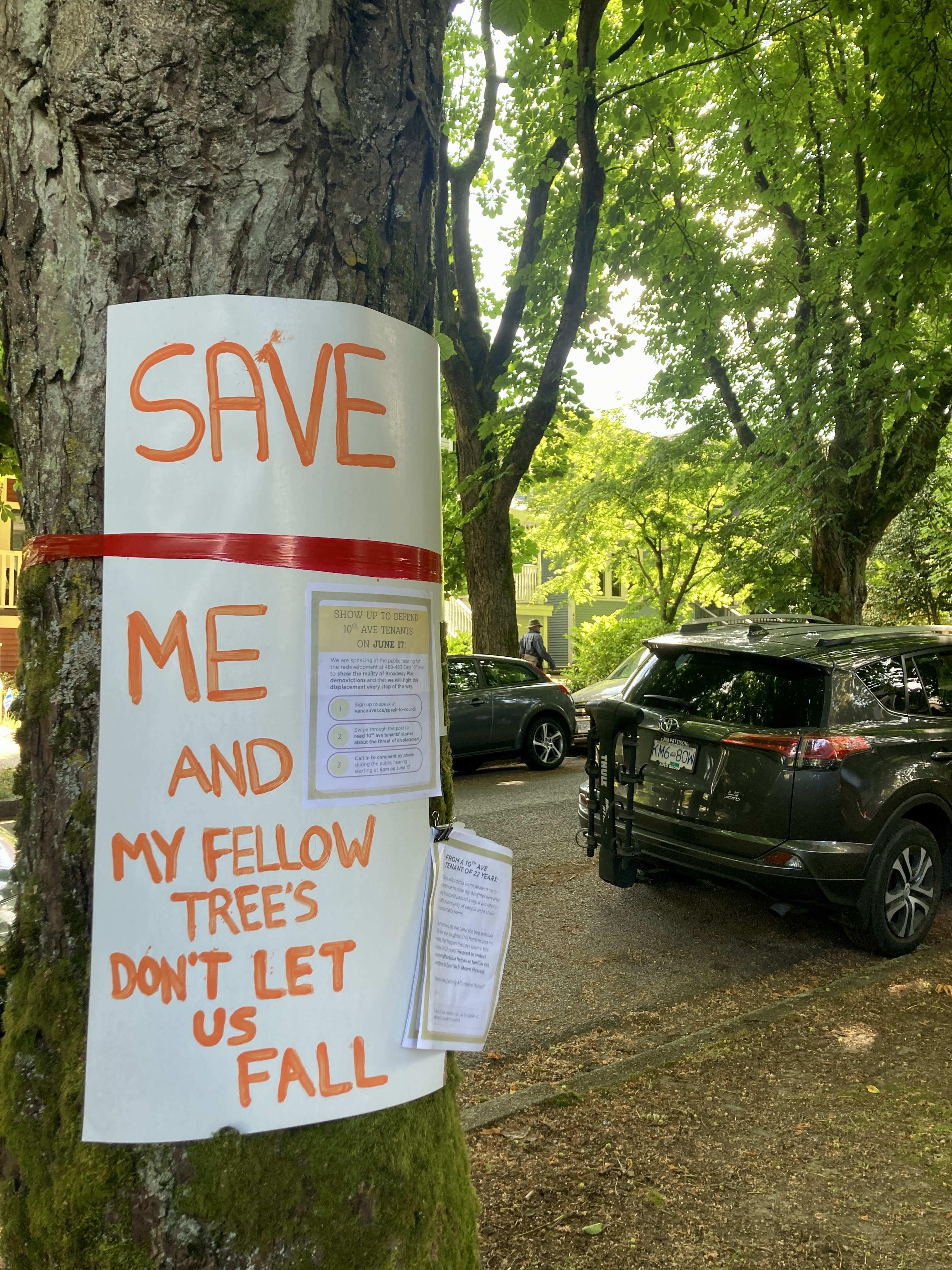
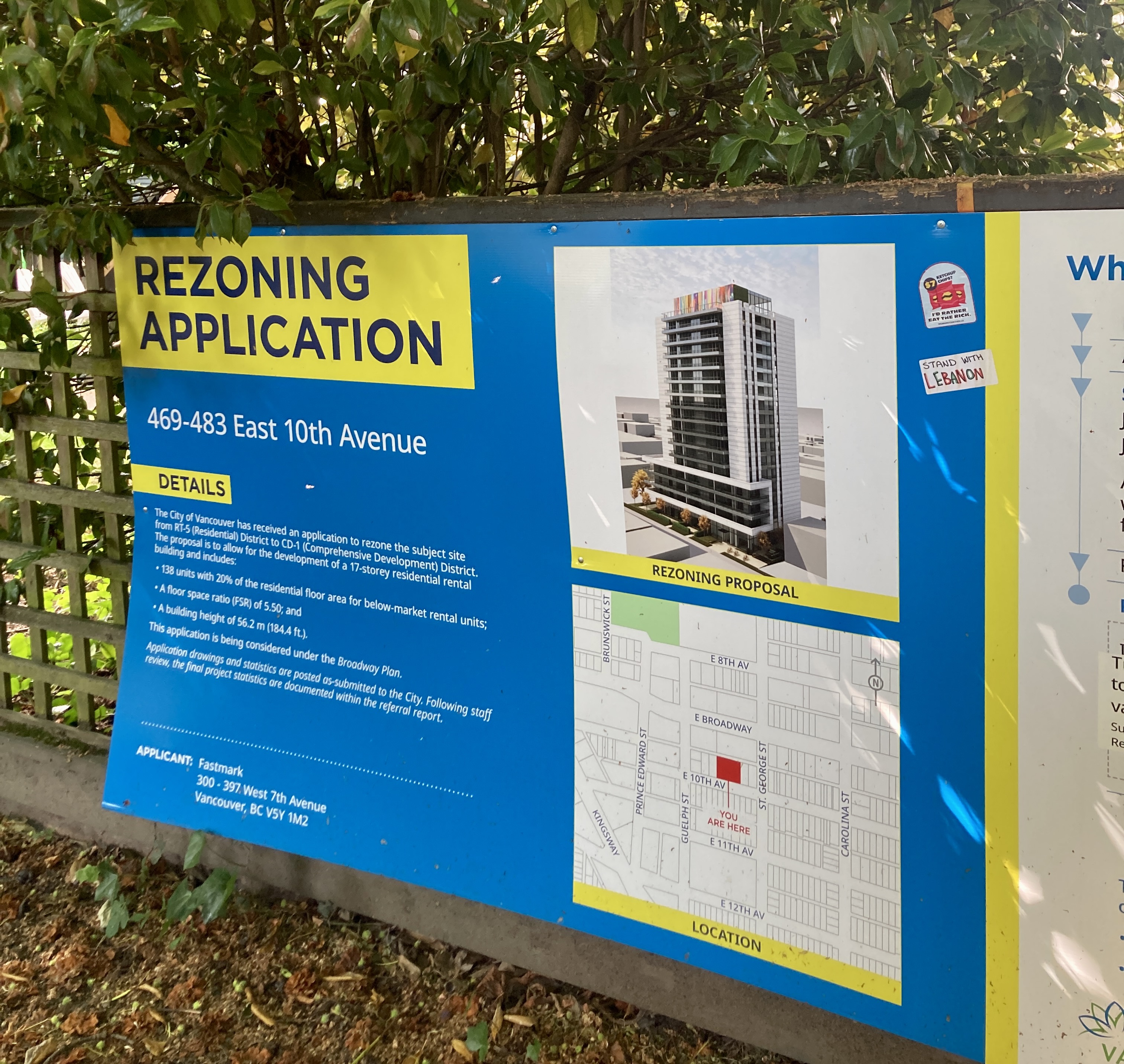
Taped to a tree on quiet, residential East 10th just west of St. George — with its fellow trees all around — a warning about the effects of the redevelopment now being pursued under the City’s Broadway Plan.

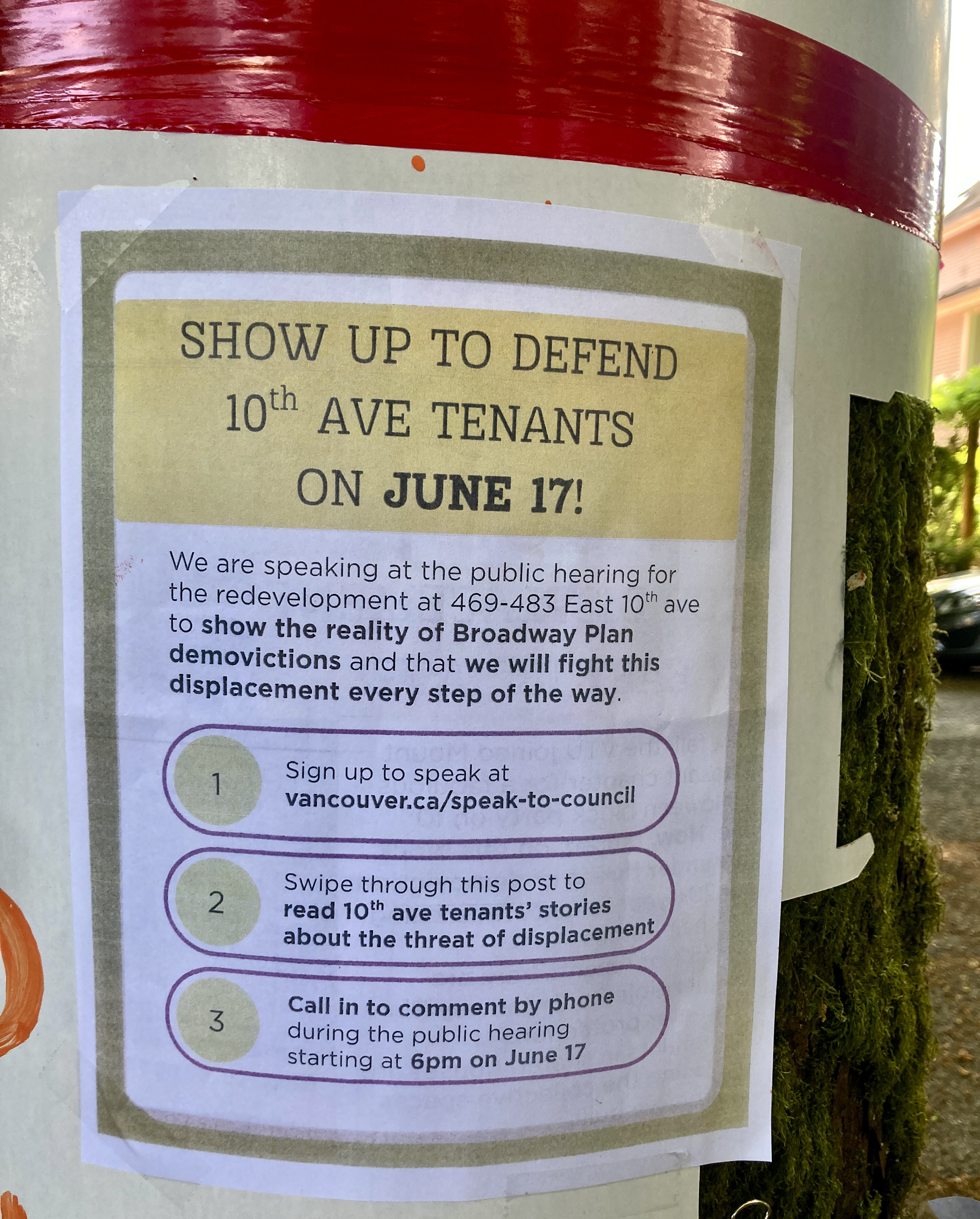
I may know more about the correct use of apostrophes (i.e., not to form noun plurals) than the author of this plea, but these tenants, in the adjoining notice…

teach me a new word. “Demoviction.” As in, the eviction of tenants from a building, so that it may be demolished, usually for redevelopment. A phenomenon integral to the Broadway Plan. And gaining pace.

I read a testimonial, also taped to the tree, the words of a woman who has been a tenant here for 22 years: “This affordable home allowed me to continue to raise my daughter here after my husband passed away. It provided a safe community and a stable, comfortable home.”

Right next door, the specific redevelopment being proposed: Rezone from Residential to Comprehensive Development category, and, on this street of two-storey homes, put up a 17-storey tower.

Hmm. Used to be, dragons breathed fire and wore scales. Now they may instead breathe rezoning, and clad themselves in 17 storeys.

May Day, May Dusk

1 May 2025 – May first. Early spring has matured into full-tilt spring.

Days are longer, weather gentler.

The election is over…

and 343 candidates have been transformed into duly elected Members of the House of Commons.

Our cherry trees are also, quite suddenly, transformed.

Leaves take over; spent blossoms now pink-carpet the sidewalks…

and adorn the burls of their once-host trees.

Dude Chilling Park hums with early-evening activity.

As frisbee enthusiasts practise skills in the park itself, Canada geese pace the crosswalk to the north…

and skateboarders mentor each other on the school boundary lane to the east.

By 8:48, the sky over Main Street is still light, but bleached of colour.

The giant crane for the Broadway Subway project is is a severe black silhouette…

while Ray Saunders’ Mount Pleasant clock, a block farther north, is already a-dazzle with its evening lights…

and the block of sidewalk tribute banners, so quiet by day…

applaud the clock with their night-time turquoise glow.

  • WALKING… & SEEING

    "Traveller, there is no path. Paths are made by walking" -- Antonio Machado (1875-1939)

    "The voyage of discovery is not in seeking new landscapes, but in having new eyes" -- Marcel Proust (1871-1922)

    "A city is a language, a repository of possibilities, and walking is the act of speaking that language, of selecting from those possibilities" -- Rebecca Solnit, "Wanderlust: A History of Walking"

  • Recent Posts

  • Walk, Talk, Rock… B.C.-style

  • Post Categories

  • Archives

  • Blog Stats

    • 135,721 hits
  • Since 14 August 2014

    Flag Counter
  • Enter your email address to follow this blog and receive notifications of new posts by email.

    Join 2,089 other subscribers