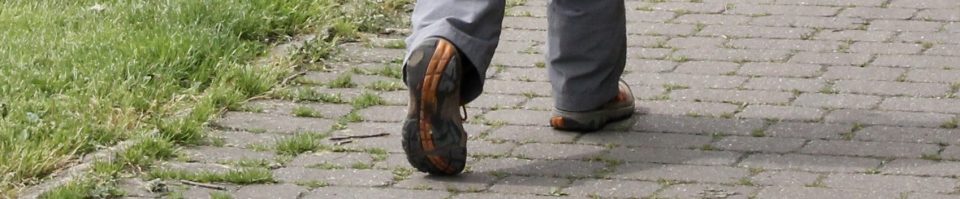
22 September 2024 – Time & place. Time & places. Places, through time.
Two recent days, that have me noticing the play of time across place.
Friday, I’m walking back along north-shore False Creek after a downtown lunch with a friend. I stop to read one of the railings that mark a stretch of informational glass & metal way-stations near Coopers Park.

“Look across the water,” it says, so I do. Eastward across the smooth, bright water alive with pleasure boats, ferry boats and a couple paddling their kayak.

This is 2024 False Creek, much transformed over the millennia.
Coast Salish people once fished here, in clean waters…
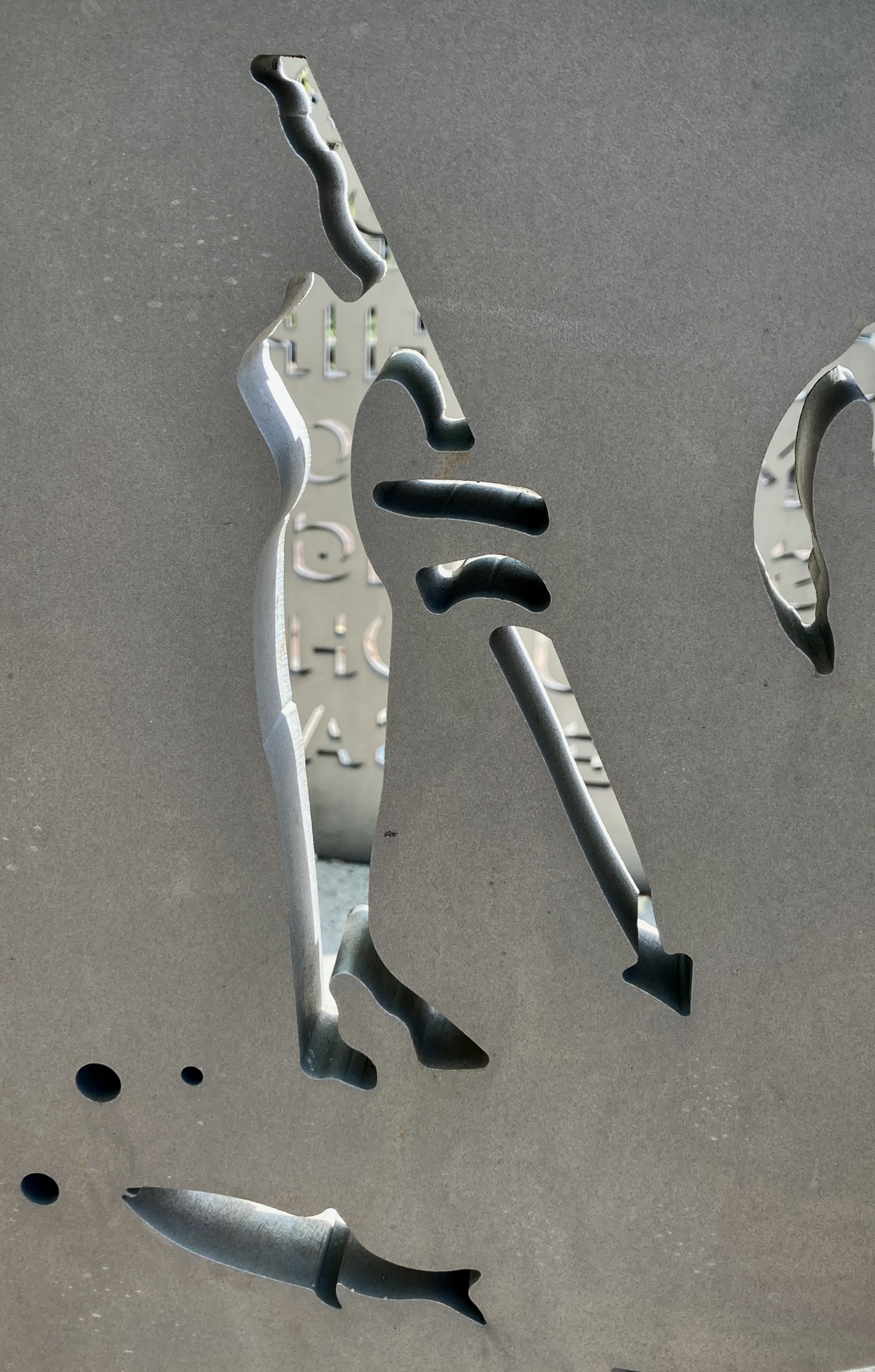
but the 19th c. brought sawmills, small port operations and, after the 1887 arrival of the Canadian Pacific Railway, a booming demand for railway-related services and support. The shoreline and waters were very busy…

with piles of materials and with hand labour…
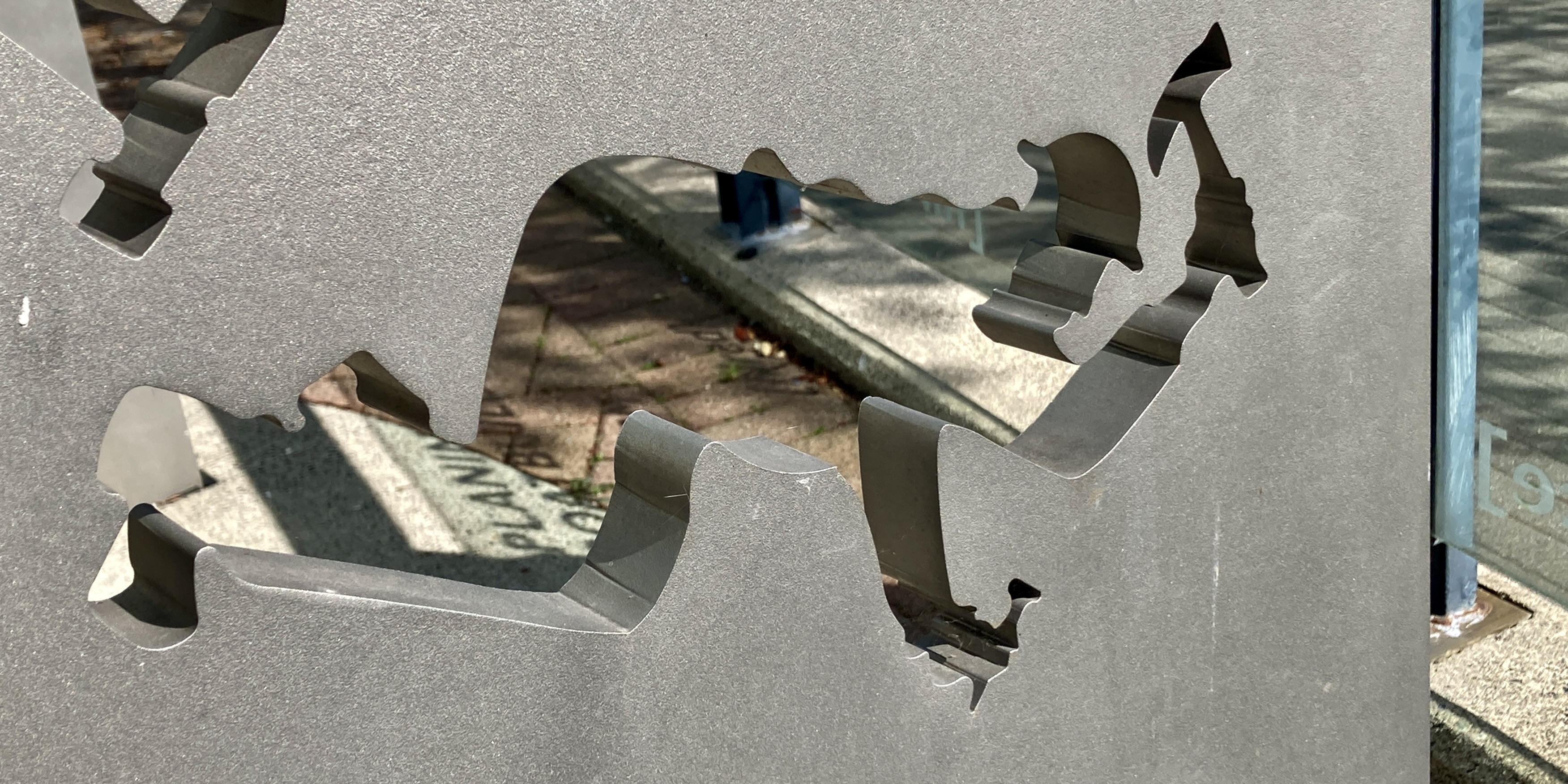
but the waters were no longer so clean.
Incised words on metal panels remind us of the range of activities, of purposes, of people, across all that time.

Next big transformation: the mid-20th c. shift in industrial patterns and the post-Expo ’86 drive to restore and repurpose False Creek. Today it is recreational, and residential, and the waters are a whole lot healthier than they used to be.

I learn more about all this the very next day. Saturday morning, I am once again on the north shore of False Creek, freshly delivered to the Yaletown Dock by ferry, to join a downtown walking tour run by the AFBC (Architecture Foundation of British Columbia).
We pass the now-repurposed CPR roundhouse and walk through adjacent Yaletown, named for the small BC community where the CPR first had its construction equipment & repair shops, before relocating work to the more convenient Vancouver location.
Spare, functional Victorian industrial architecture still lines several Mainland Street blocks. The buildings now host restaurants, condos, artisan boutiques, and design and other creative small firms — but their Victorian bones still show.

Some of these structures are rightly celebrated by their current owners/tenants — for example, by Engels & Volker, whose website honours the history of this elegant former factory and warehouse at 1152 Mainland, built in 1912.
We walk on, our group weaving its way past other examples of old made new, and also of ghosts-of-old replaced by new. Layers of time, laid upon place.
Late in the tour, we stand under the canopy of Telus Garden which, when it opened in 2015, had brought a whole downtown block into the mixed-use trend then gathering civic strength.
I look up at the glulam curves overhead…
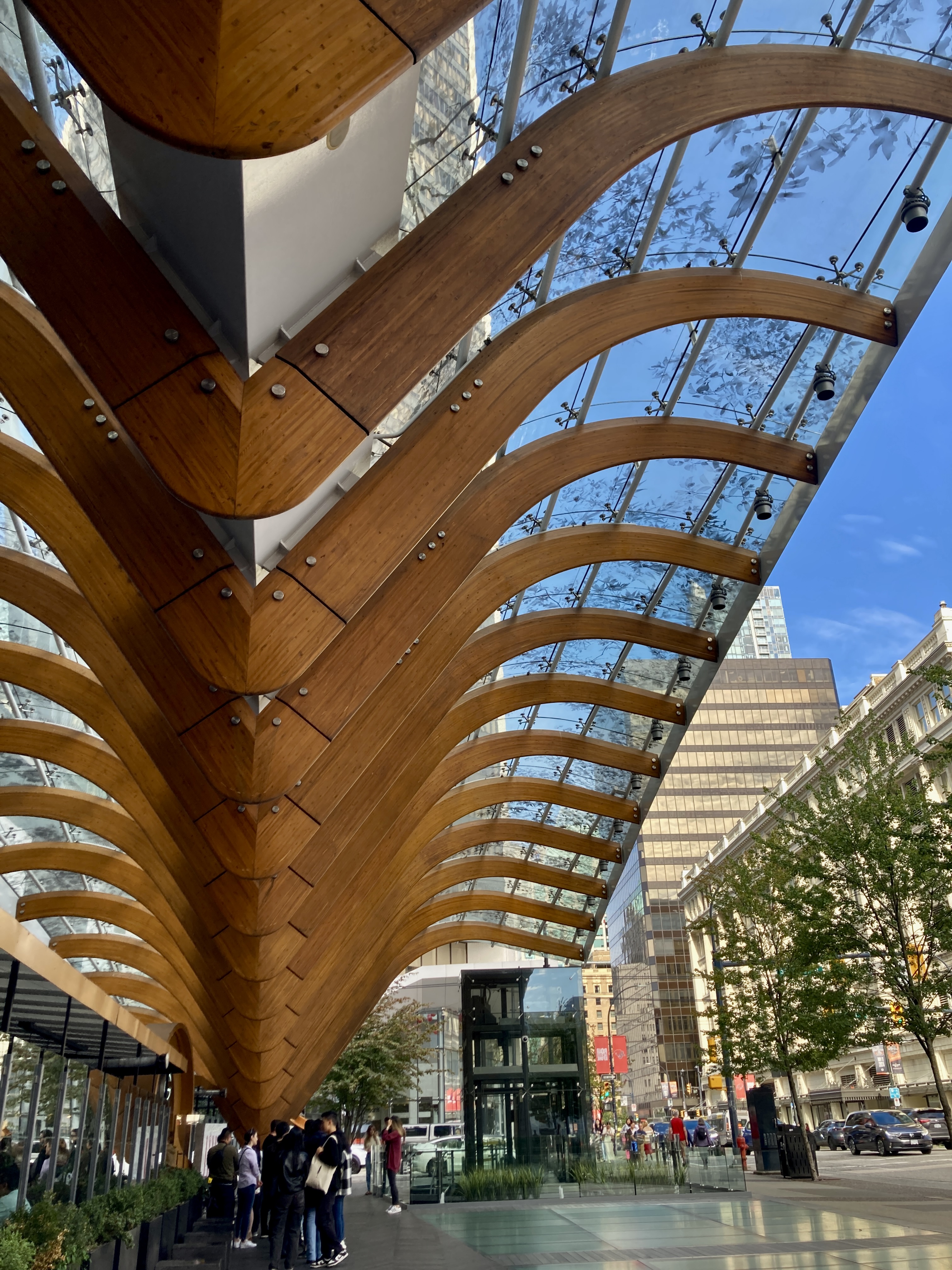
and I’m thrown to another time and place.
To Toronto, and the 2008 transformation of the Art Gallery of Ontario by architect Frank Gehry and media magnate (and art collector) Ken Thomson.
It was a project born of love as well as commerce: both men native Torontonians, and both grateful to the AGO because, modest as it was at the time, it introduced each of them to art and helped shape both their lives.
The AGO did a lot for me as well. As a volunteer I spent many hours in its rooms, soaking up the art and learning about things. Like glulam.
(You wondered where I was going with this, didn’t you!)
The soaring Galleria Italia, stretching 450 feet along Dundas Street, is a vaulted dance of glued laminated Douglas fir and glass.

I always loved doing a shift out on the Galleria Italia, seeing — and hearing — visitors’ reactions when they first stepped into the space. Adults politely gasped. Schoolchildren on tour, especially when coached by their guide, agreed it looked like an overturned canoe. (Though one little girl was having none of that. “It’s an armadillo,” she announced firmly.)
My favourite reaction? The little boy who barrelled through the doors well ahead of his mother. He screeched to a halt, swivelled his head in stunned amazement and then, just as his mother caught up with him, leapt in the air, arms flung high. “WOW!” he yelled, his fists punching the air.
Time & place. Places in time. Memory.

 WALKING WOMAN
cypher
/ 30 September 2024Hope you read this🙂. Feel free to follow the blog
icelandpenny
/ 30 September 2024I did – thanks for the interest in my thoughts, thanks for sharing yours
cypher
/ 30 September 2024🙂
bluebrightly
/ 5 October 2024Well done, Penny! I love the word shadows in the first photo. You did a nice job knitting everything together into an interesting story…and I love the ending. What fun it must have been to see that boy react to the space.
icelandpenny
/ 5 October 2024thanks… I found myself musing, and then time-hopping — that child’s reaction (& common reaction to the gallery) is testimony to the power of great, humane-great, architecture — visitors love Gehry’s transformation of the AGO & so do curators, because the architecture also very carefully serves the art — another child reaction to the AGO, early in its re-opening: I was stationed in the atrium, in from the front doors but before any galleries; a little boy looked around in wonder, was then fizzing with words the way children do, and burst out; “This is so cool! and… and… and I haven’t even got to the art yet!”
bluebrightly
/ 6 October 2024Humane-great, that says it. I’ve always liked Gehry. Oh, that little boy’s enthusiasm, that’s a wonderful quality to see.
icelandpenny
/ 6 October 2024There’s a whole master’s thesis in architecture, to compare Gehry’s transformation of the AGO and Daniel Libeskind’s transformation of the Royal Ont Museum at almost the same time — the former warm and curving, by a great architect who knew and cherished the existing bldg; the latter by a German starchitect, whose furious spiky style perfectly suited the Berlin Holocaust Museum but merely brutalized the ROM,(which he didn’t know), and ill-serves its exhibits. Also makes visitors subconsciously uneasy, though they don’t know why.
bluebrightly
/ 6 October 2024That all makes sense to me – interesting, thanks.