25 March 2025 – Politically, the world grows steadily darker. All the more reason to notice and embrace light, whenever and however it presents itself. It, too, is real, and it offers us courage and strength and joy.
I am giddy with it, this early-spring evening: temperature well into the teens, and each day longer than the one before.
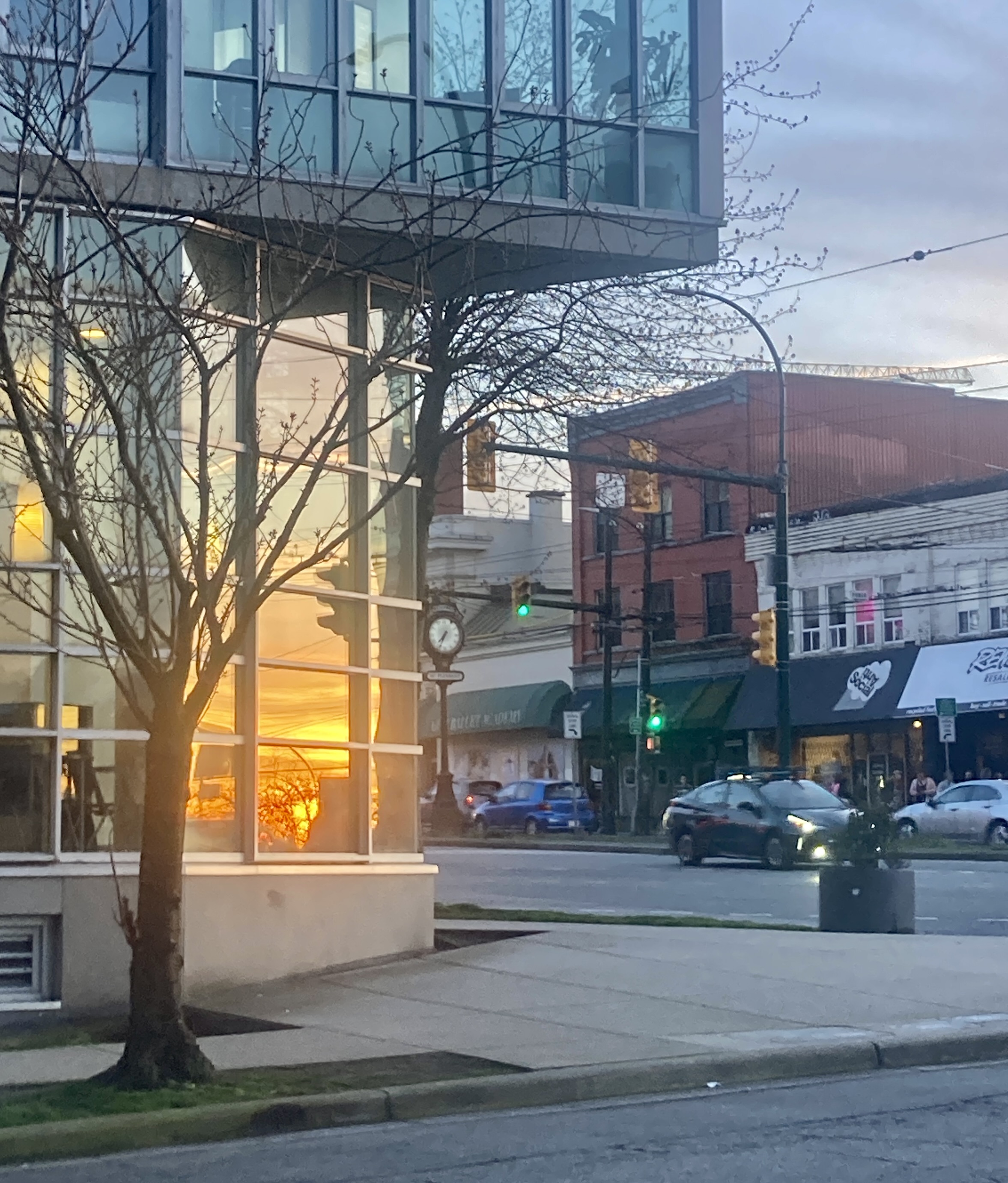
It is 7:30 in the evening, and the sky is still bright. The crows have not yet flown home to Burnaby (mid-winter, they go through by 4:30 or so), and — look — golden sunlight still bounces off the library branch window opposite my building.
Here’s the source: the sun just dipping out of sight in the western sky, the sky itself warm with rosy-gold.
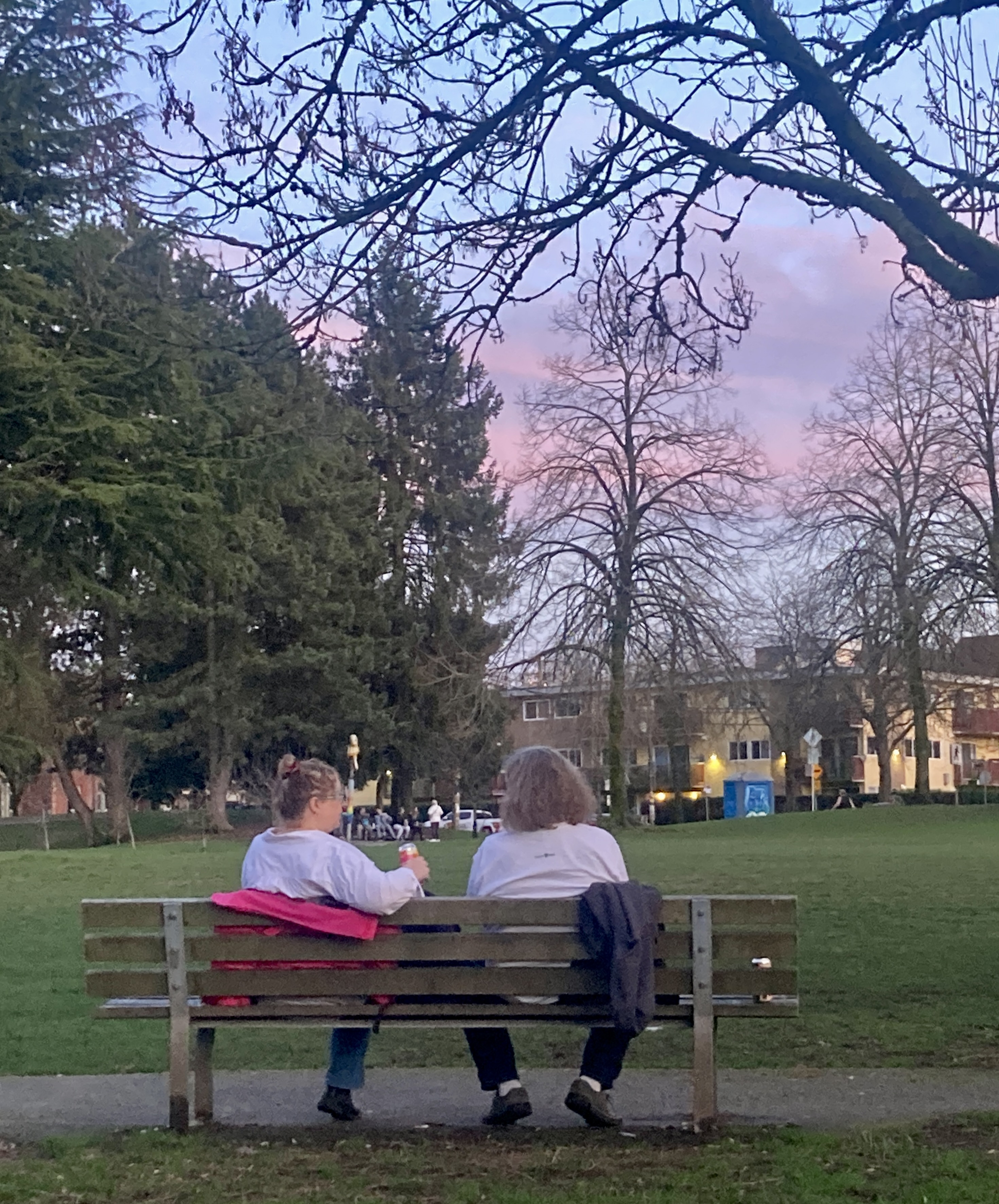
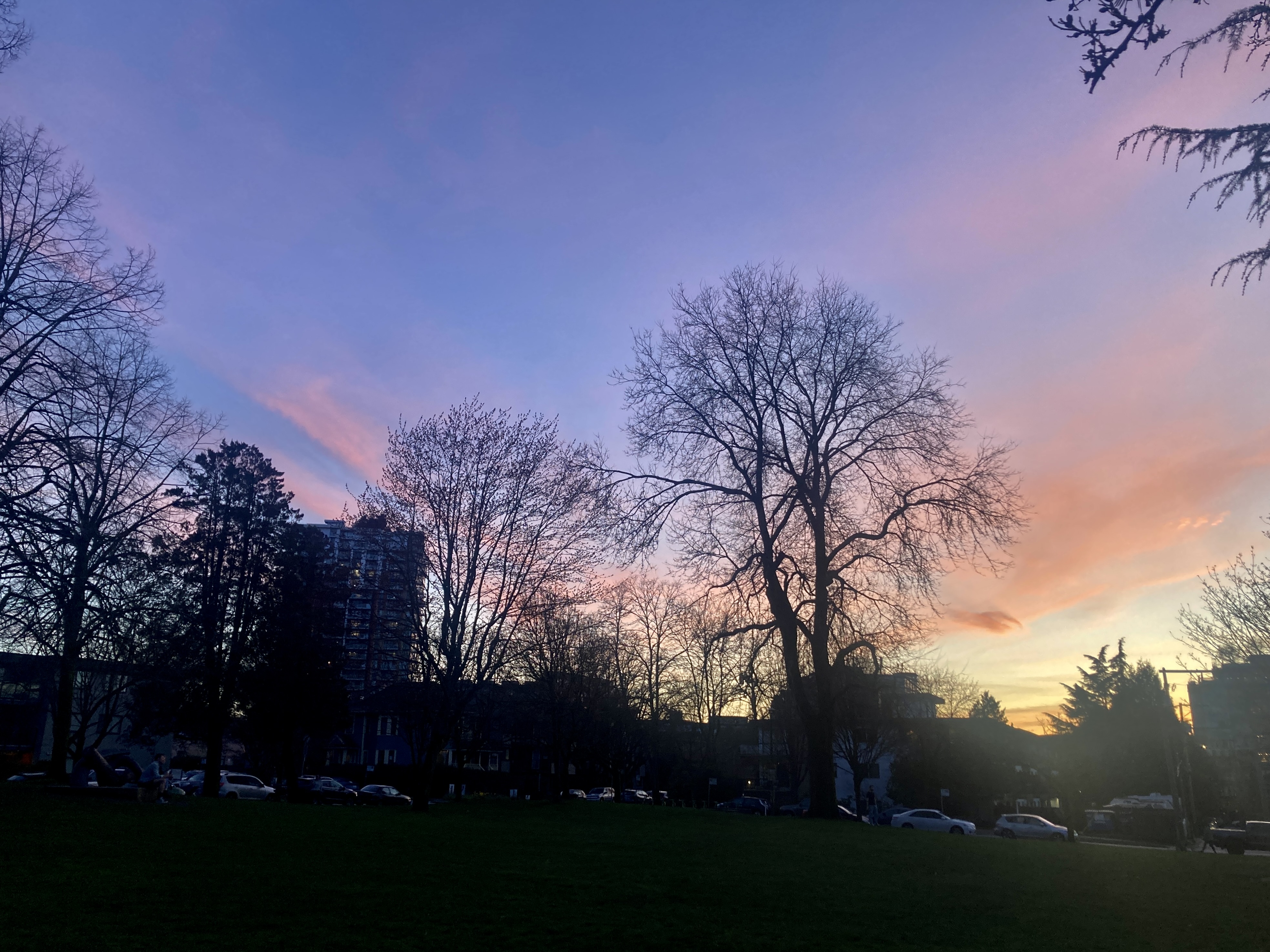
Over at Dude Chilling Park, just minutes later, women chat beneath a sky that has now lost its rosy-gold, but is still bright with pink and blue.
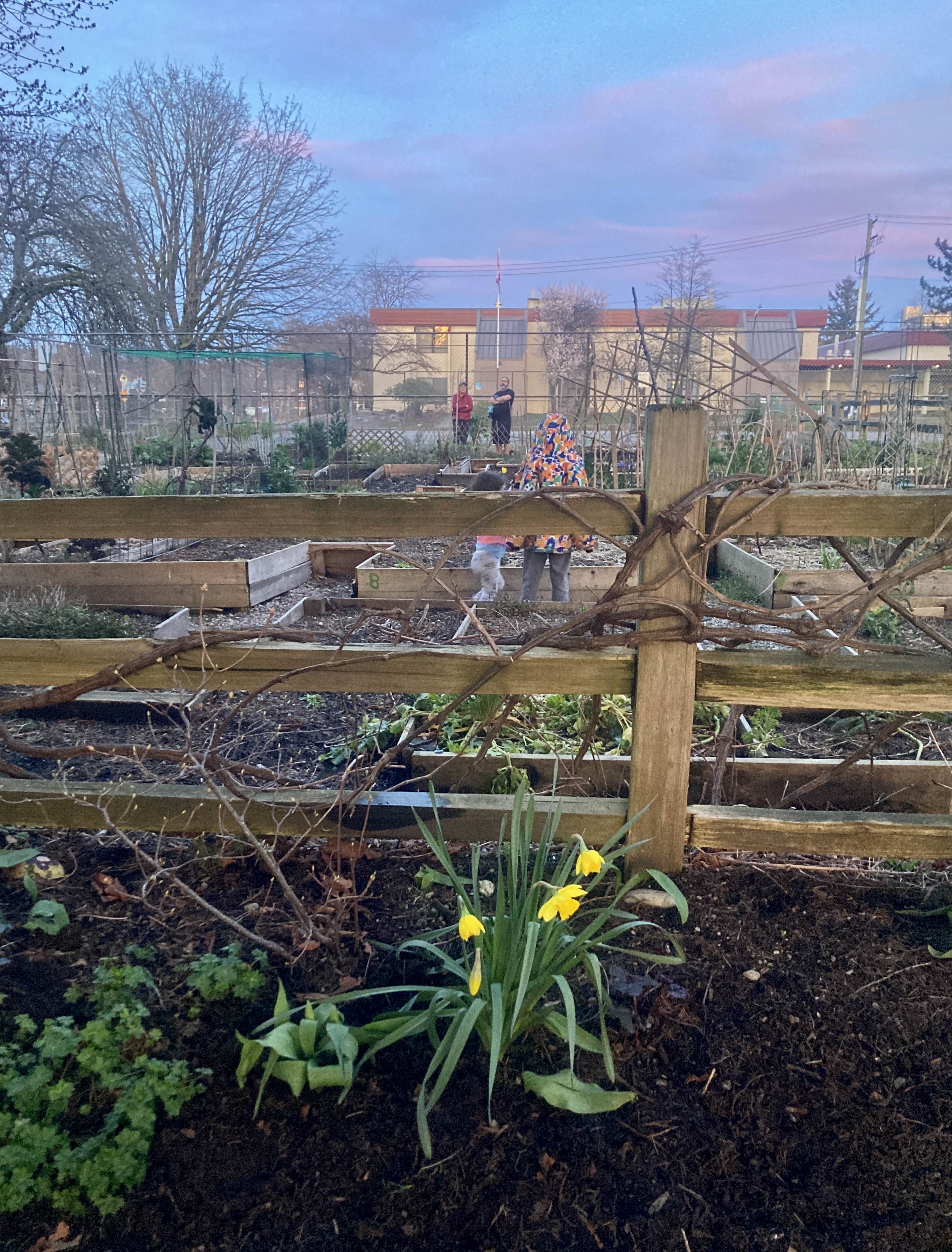
Daffodils offer their own gold to the sky, tall against the community garden fence. Warmth & light inform the scene: children romp just inside the fence, parents call encouragement from the far side of their allotment and, behind them, the west face of the school building is a-glow.
But by now, natural light is fading fast. Tree branches are black against the sky…
and it is street lights that illuminate these butterfly ornaments draped on a residential tree…
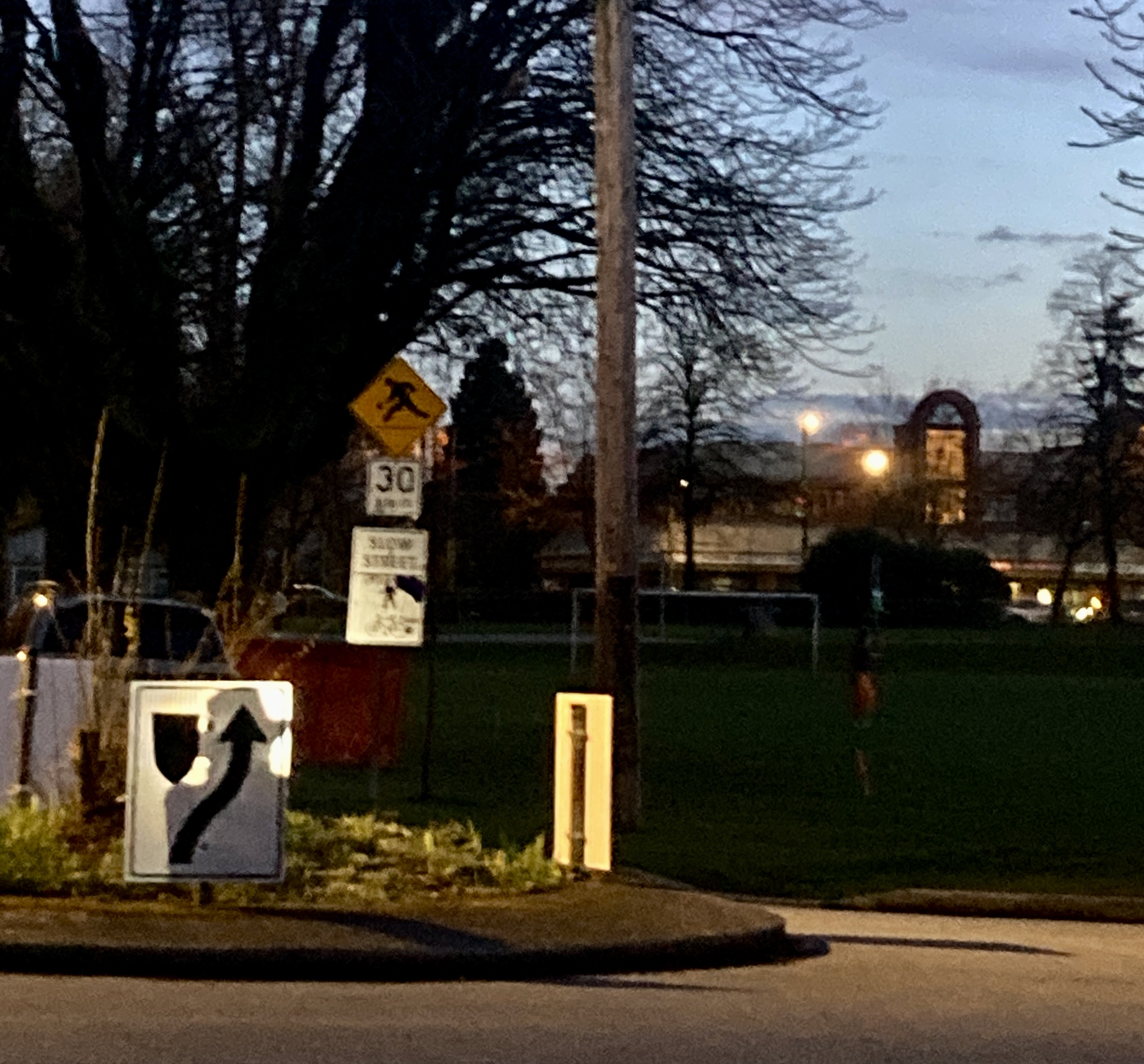
and it is the security light in someone’s yard that pops my own silhouette back at me from the directional arrow in this traffic circle.
Car lights glitter on the leaves of a street-side hedge…
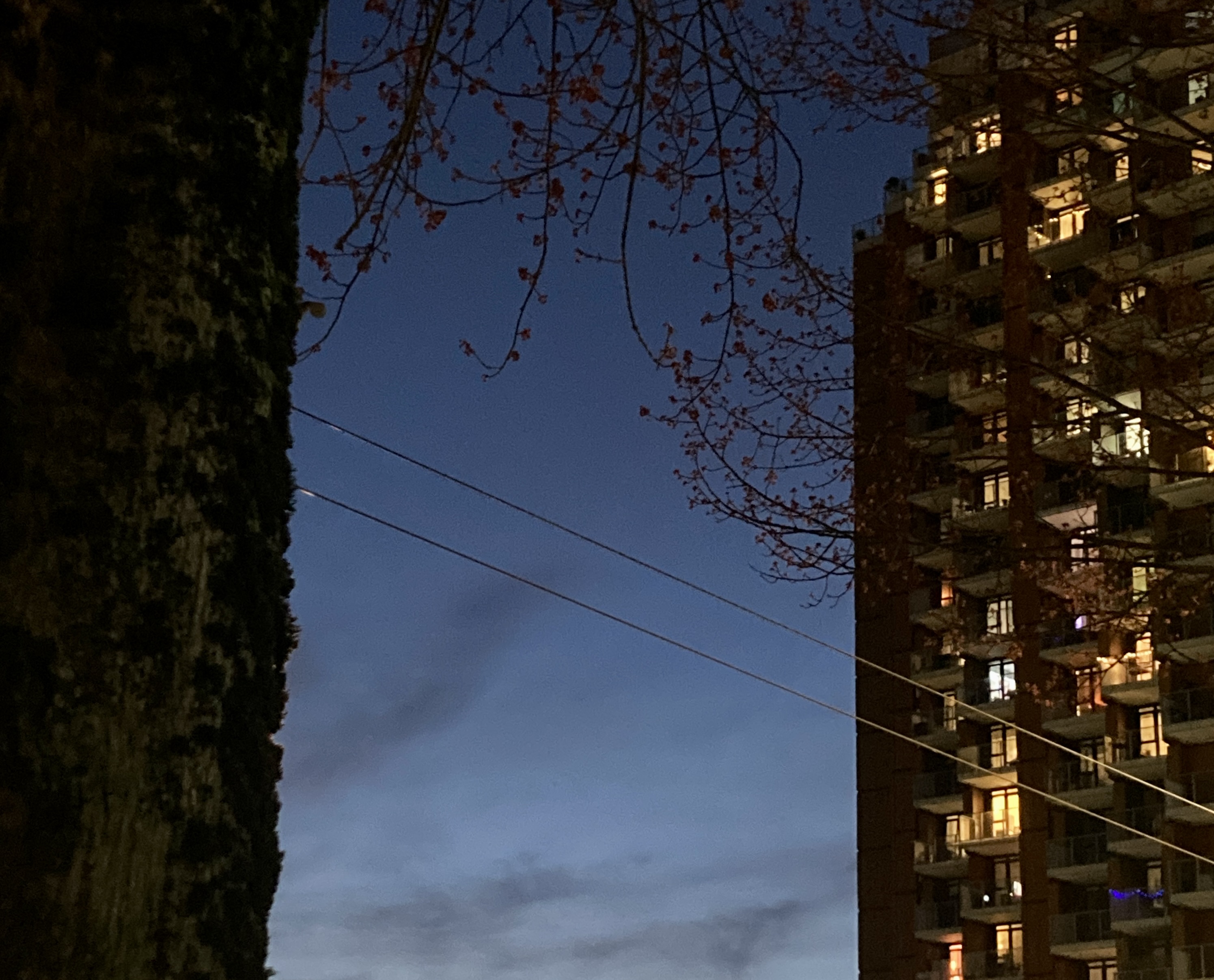
residents’ lights tumble a visual waterfall through this apartment building…
and the entrance to a neighbouring building punches its shaft of light & colour out onto the street.
Only 45 minutes since I left my door, and artificial light, city light, is now dominant. I peer down an alley, looking for a bit of sky that is still itself, still wears its own colours.
23 March 2025 – Not that T-word! I mean the other T-word, the one that — thanks to the first T-word — currently preoccupies Canada, and much of the world.
Trade war.
I apologize yet again for a political post in a non-political blog. But here’s the reality: every blogger writes in the context of their own daily life. The daily life for Canadians now is that the most powerful country in the world plans to destroy us. Unlike Ukraine, we do not have bombs physically flattening our land; like Ukraine, we are the settled target of a powerful, authoritarian, expansionist regime that does not believe we have the right to exist.
In David/Goliath terms, Canada is David. This trade-war analysis — from BMO Nesbitt Burns (the investment firm wholly owned by Bank of Montreal) — uses the analogy, and gives David reasons to cheer up.
I received it by email from a friend; I’m reprinting it in its entirety. In the sea of lies currently swirling on this topic, here is a clear, credible, point-form primer on tariffs and the trade war.
Your bonus is the Hamilton Spectator cartoon at the end.
*****
This message is sent to you by BMO Nesbitt Burns Inc. BMO Nesbitt Burns is made up of Nesbitt Burns Inc., Nesbitt Burns Securities Ltd., and Estate Insurance Advisory Services Inc.
David vs. Goliath: The U.S. Trade War on Canada And Who’s Really Winning
For years, Canada and the U.S. had a sibling rivalry. Sure, we had our disputes, but at the end of the day, we worked together.
But now? It’s less “friendly competition” and more “Goliath throwing a tantrum because David won’t just roll over.”
The U.S. is picking fights, throwing tariff punches, and blaming literally everyone but itself for its problems. And Canada? We’re just standing here, taking the hits, shrugging, and quietly preparing to win the long game. Even while threats are made daily to our own sovereignty.
For anyone who forgot: David won.
Goliath’s Temper Tantrum: The U.S. Trade War on Canada
Here’s how it’s playing out:
🔴 The U.S. economy is in shambles. $36 trillion in debt, corporate greed at an all-time high, the middle class getting squeezed out of existence. 🔴 Rather than fix its own problems, the U.S. starts blaming its allies. Suddenly, Canada is a trade villain. 🔴 Tariffs get thrown around like confetti. First, it’s dairy. Then it’s aluminum. Then it’s oil. Next, it’s probably going to be maple syrup because why not? 🔴 Canada says, “Uh, we actually don’t need most of what you sell us.” We start buying local, strengthening our economy, and cancelling travel to the U.S. Oh but now the US is stopping Canadians from entering, requiring visas from Canadians and UNLAWFULLY detaining Canadian citizens. 🔴 The U.S. starts feeling the financial pain. American businesses that depend on Canadian consumers start screaming, but the government gaslights them into thinking it’s “for their own good.”
But What’s the Reality About Tariffs?
Let’s actually break it down since the people pushing this nonsense seem to have selective amnesia or a wilful lack of awareness of facts.
1️⃣ Trump Negotiated the “Best Trade Deal Ever” So Why The Complaints Now?
First off, the trade agreement we’re operating under isn’t some “ancient” bad deal screwing over the U.S. This is Trump’s own handiwork: the USMCA agreement that was negotiated under his administration.
🔴 Trump called it the “biggest, best trade deal ever” and said it would “fix” NAFTA. 🔴 His team designed it, signed it, and sold it as a win for America. 🔴 Now, suddenly, it’s a bad deal and needs to be scrapped?
So, what is it? Was Trump lying then, or are people lying now? Pick one.
2️⃣ Dairy Tariffs: A Non-Issue That Gets Brought Up Anyway Ah yes, the “big scary dairy tariffs” that people love to scream about.
Yes, Canada has dairy tariffs. But here’s what they never tell you:
✅ The U.S. was given a quota under USMCA. American dairy producers already have a guaranteed amount they can sell to Canada without tariffs. ✅ The U.S. never maxes out its quota. The tariffs have never even been applied because American producers don’t fill the agreed-upon volume. ✅ Canadians don’t want American dairy. It’s pumped full of growth hormones, and heavily subsidized, so the supply is artificially inflated.
So no, this isn’t some great injustice. The U.S. has access to the Canadian dairy market, it just doesn’t use it.
David’s Strength: What Canada Actually Brings to the Table
Despite all the noise, Canada isn’t just some small fry in this fight. We’re integral to America’s economy:
📌 Canada is the #1 foreign supplier of oil to the U.S. (And we sell it at a discount.) 📌 Aluminum? The U.S. military relies on Canadian resources to keep producing weapons. 📌 Raw materials? The U.S. imports a massive amount of lumber, minerals, and essential components from Canada.
Without these? The U.S. economy grinds to a halt.
Meanwhile, what do we import from the U.S.?
📌 Cheap processed foods. (We can live without them.) 📌 Unnecessary consumer goods. (We’ll buy local instead.) 📌 U.S. cars (which we’re forced to buy in trade agreements and we’d actually prefer other options.)
So let’s get real: if the trade war escalates, who suffers?
The “Self-Reliant America” Fantasy vs. Reality
I keep hearing people say, “America should be self-sufficient! We don’t need Canada!”
Okay. Let’s play that out.
🚨 The problem? U.S. oil refineries CAN’T handle domestic shale oil. They are built for heavier crude which is why they rely on Canadian oil sands crude to function properly. 🚨 Switching over to refine U.S. shale would take years and hundreds of billions of dollars. 🚨 In the meantime, energy prices would skyrocket, and the U.S. would need to import even more oil from the Middle East.
So yeah, America can become “self-sufficient,” but at what cost? Unless people are willing to pay double for gas, this argument is just empty rhetoric.
Oh, and let’s not forget:
💡 If you remove oil from Canada’s exports to the U.S., the U.S. actually has a trade surplus with Canada.
Meaning? The U.S. sells us way more “stuff” than we actually need.
And the rest of the world? They’re already rejecting “Made in the USA.”
📌 Buy European, Buy Local movements are exploding. 📌 China is reducing reliance on U.S. exports. 📌 Even American allies are diversifying trade to avoid getting caught in the crossfire of bad U.S. policy.
When your own allies start treating you like an unpredictable liability, it’s time to ask who the real problem is.
Then There’s The The “America Pays for Canada’s Defense” Nonsense
Oh, this one’s my favorite.
🚨 The only country Canada has EVER had to defend itself from… is the U.S.
📌 In 1813, the U.S. burned down York (now Toronto). 📌 In 1814, we retaliated and burned down the White House.
Canada hasn’t been at risk from invasion since. Meanwhile, we’ve been dragged into every U.S. war for over a century, not because we needed defense, but because the U.S. needed allies to prop up its war machine.
And let’s not forget:
📌 U.S. military contracts depend on Canadian resources. 📌 Canada buys overpriced U.S. defense tech to “balance” trade. 📌 The U.S. defense industry benefits from these arrangements far more than Canada ever has.
So spare me the “we protect Canada” routine. The only thing we’ve been protected from is making our own foreign policy decisions without U.S. interference.
Canada Owns a Chunk of U.S. Debt – You’re Welcome.
America’s excuse for slapping tariffs on allies is that it has to fix its debt problem.
🚨 Reality check: Canada is the 6th largest foreign holder of U.S. debt.
Yeah, you read that right.
While Americans are being told that Canada is some kind of economic enemy, Canada is literally one of the reasons America hasn’t defaulted on its loans yet.
So next time someone complains that “America is getting ripped off by Canada,” maybe ask why the U.S. keeps borrowing money from us.
The Solution: 10-Point Action Plan to Actually Fix This Instead of pointing fingers, here’s what would actually work:
1️⃣ Stop the blame game. Blaming Canada, China, Mexico, or the EU doesn’t fix the U.S. economy. Accountability does.
2️⃣ Break up corporate monopolies. The real reason Americans are struggling? Billion-dollar companies run everything, control pricing, and pay workers nothing. Break them up.
3️⃣ Tax ultra-wealthy billionaires properly & stop corporate welfare. America is not broke. It’s just that the ultra-rich don’t pay their fair share and corporations are given bundles of cash like they are non-profits. Fix that, and the money is there.
4️⃣ Invest in infrastructure and energy independence – the right way. Want to stop relying on Canadian oil? Great. But it’ll take years and hundreds of billions of dollars to switch refinery capacity. Until then, be realistic.
5️⃣ Strengthen local manufacturing. Instead of tariffing allies, invest in domestic factories and fair labor to bring jobs home without price-gouging consumers.
6️⃣ Stop artificially inflating bad industries. The U.S. subsidizes failing industries (like dairy) while ignoring tech, green energy, and innovation. Prioritize the future, not the past.
7️⃣ Invest in education and skills training. A strong workforce doesn’t come from blaming immigrants or trade deals. It comes from giving people the skills they need to compete globally.
8️⃣ Get real about debt. Instead of trying to tariff its way out of debt, the U.S. should cut wasteful spending (military excess, corporate handouts) and increase revenue where it actually makes sense. Cutting out National Park funding when it’s PROFITABLE makes no sense.
9️⃣ Respect allies instead of pushing them away. If the U.S. keeps picking fights with allies, don’t be shocked when we take our business elsewhere.
🔟 Make America a place people want to support. People aren’t boycotting America because they hate it. They’re doing it because the U.S. is making it impossible to be an ally.
The Bottom Line? David Always Wins.
Goliath lost the fight not because he was weak but because he underestimated the strength of his opponent.
Right now, the U.S. is flailing. It’s punching allies, throwing tantrums, and refusing to deal with its own mess.
Meanwhile, Canada is adapting.
🔹 We’re building up local businesses. 🔹 We’re cutting our reliance on U.S. imports. 🔹 We’re doubling down on relationships with Europe and Asia.
And when the dust settles, guess who’s going to come out stronger?
It’s not the guy swinging wildly and blaming everyone else.
It’s the one who stayed focused, made smart moves, and kept their eye on the real prize.
16 March 2025 – If my 1 March post was a love-letter to urban clutter, this one might strike you as a love-letter to maritime clutter. At least, while still on the Vancouver side of Burrard Inlet.
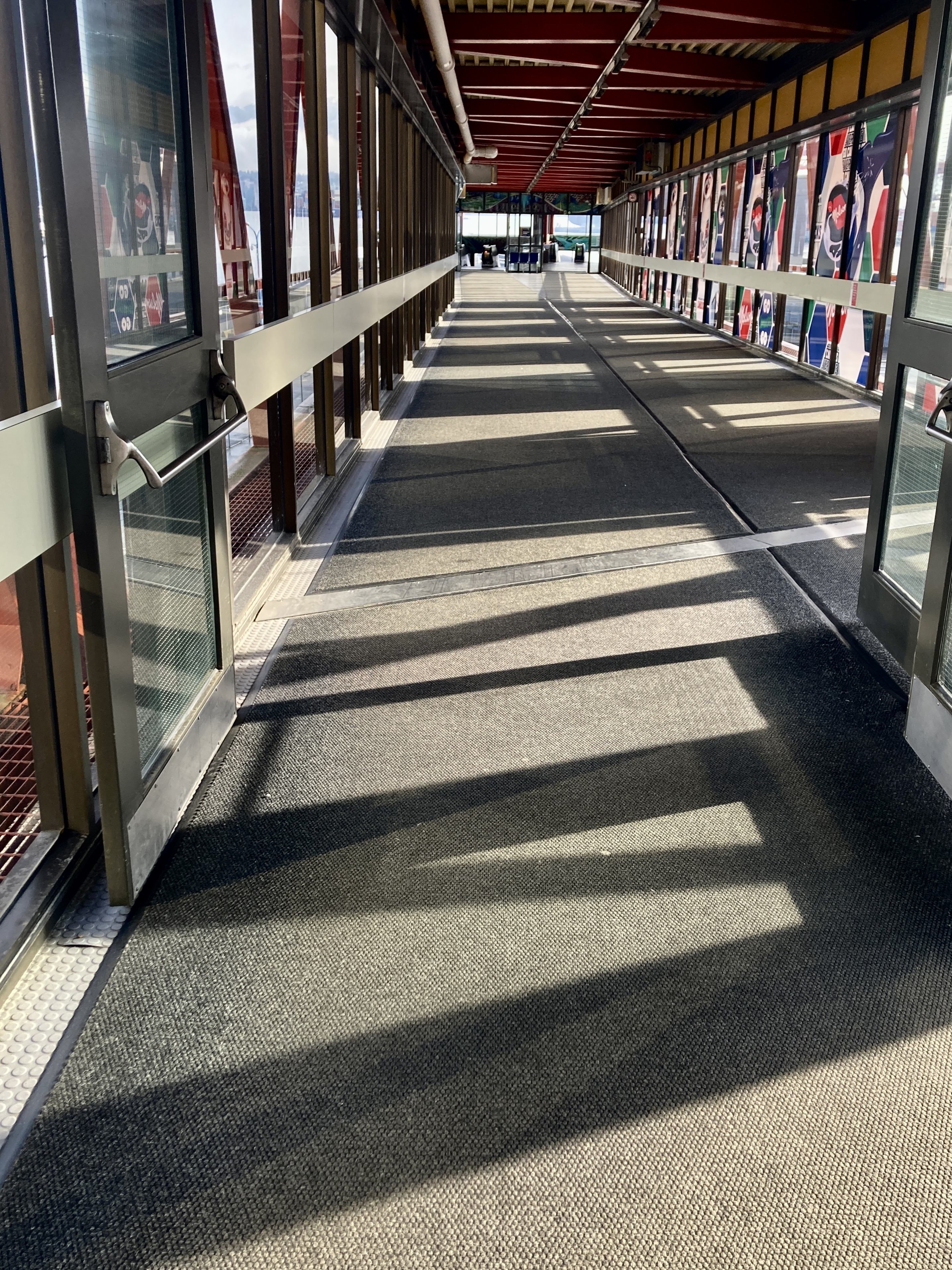
I’m in the long approach to the Waterfront SeaBus Terminal, in the connector between Waterfront Station, with all its urban transit links, and the SeaBus Terminal proper, down at water level. It’s a sunny/cloudy/rain-splattered day, with the intervals of sunshine throwing long shadows across the walkway.
But where’s the promised clutter? you ask.
It’s coming.
I slow down. The next ferry will depart in 1 min. 27 sec. time (the count-down screen is counting), and I know I won’t get to the waiting room in time. Nor does it matter — the ferry after that is the one I want to take, the ones my north-shore friends will meet.
With no need to hurry, I look around.
There’s the Vancouver Harbour Heliport, caught in the V-slashes of these window frames, with a helicopter on the pad, and maritime clutter all around — a line-up of harbour cranes, stacks of shipping containers below their voracious grasp, and two crows on the light standard so you know you’re in Vancouver. Plus reflections dancing merrily on the window pane.
Either you think the reflections spoil the picture, or — like me — you enjoy them as part of the moment, more visual information jumping into the story.
Next window pane offers rain splatters as its contribution to maritime clutter, and the view of a laden freighter, just starting to make its way back up the Inlet toward the Pacific Ocean and its next port of call.
Low-hanging clouds in that scene as well, running horizontal streaks across the mountains beyond, and snowy peaks above all that. (Nature’s own clutter.)
More clouds, more containers, more cranes — all caught in a fleeting glimpse as the escalator rolls me past another window on my ride down to sea level.
The waiting room window shows me the back end of the ferry I missed, making her stately way past the nearest cranes…
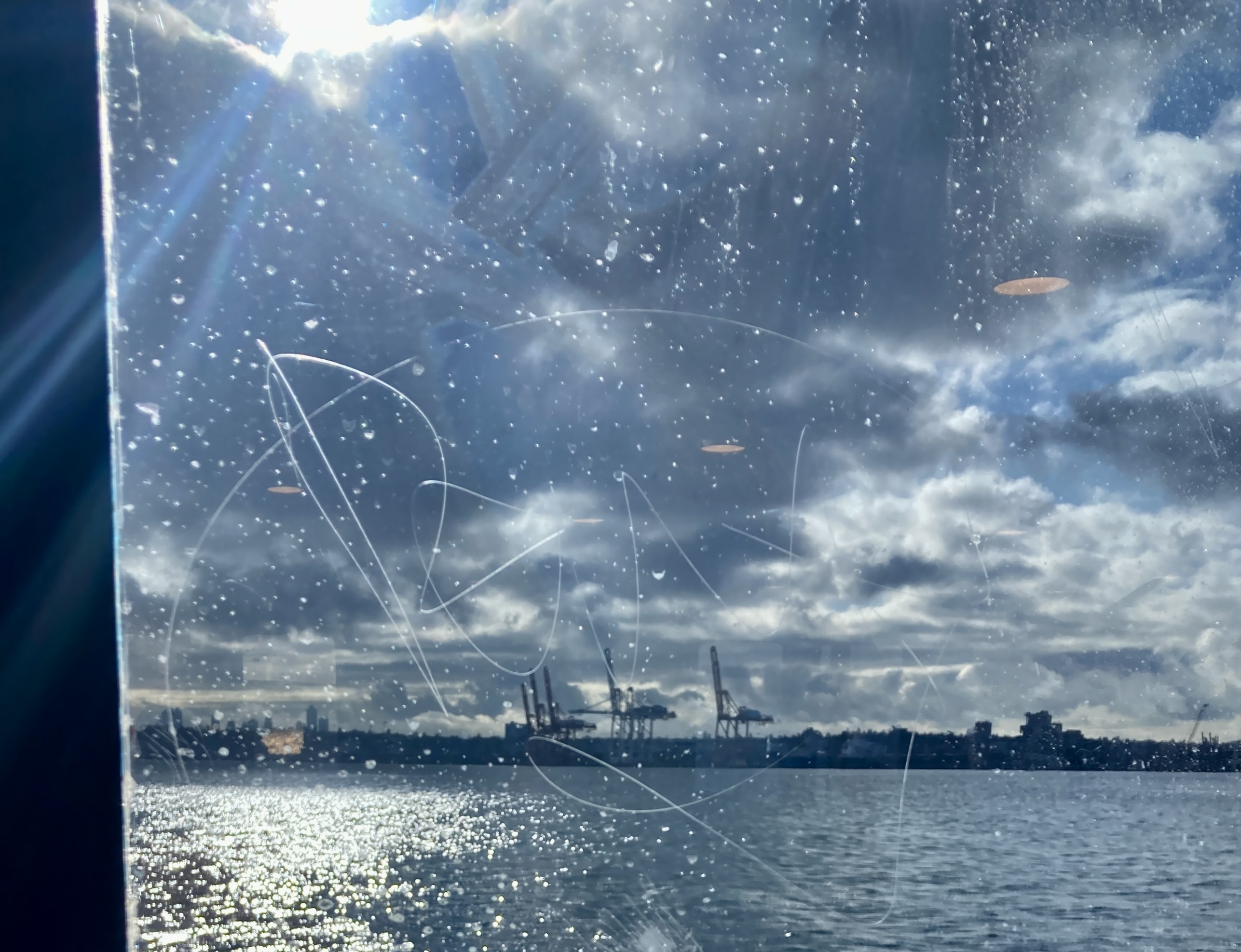
and the scratched & splattered window of the ferry I catch rewards me with sun dogs that bounce silver across the water. (Brooded over by those cranes.) (And by pale reflections of overhead lights, here inside the ferry.)
No scratches in sight, once I’m off the ferry and halfway up Mount Seymour, going walkabouts with my friends. Rain drops, yes — but as sun showers on our heads, not on a window. Reflections, also — but as rain crystals that turn the winter moss to neon.
Just look at it!
We pass endless happy dogs, whose owners laugh when we apologize to the woofs that all we have to offer is adoration, not treats.
I point out a dramatic tree trunk, beside the path. Wow, says my friend; even more shredded than a few days ago. Those Pileated Woodpeckers have been busy!
Not to be outdone by hungry woodpeckers, we return to their place and show what hungry humans can do to a post-lunch treat of dark chocolate and dark coffee.
6 March 2025 – I never meant a political blog, still would rather not. But when some other country plans to take you over, it kind of gets your attention.
It got Jeff Douglas’s attention, for example — the star of the Molson’s beer-ad rant “We are Canadian” created 25 years ago and still cherished in some aging memories.
Yeah well, Jeff is back, because Jeff, like the rest of us, is annoyed.
2 March 2025 – Long ago, I lived for a while in Peru. Only slightly less long ago, I lived for a while in Indonesia. And now, on this one afternoon here in Vancouver, I revisit each — in new physical experience, and in old memories as well.
1 – Bike to Baik
First, courtesy of the VPL (Vancouver Public Library) Staircase Sounds series of noon-hour musical events: a program of Indonesian gamelan music, performed by the Vancouver group Gamelan Bike Bike.
The name Bike Bike is a double, and bilingual, play on words.
In English, it nods to the fact that the musicians complement traditional gamelan instruments with ones they build themselves from old bicycle parts.
See? On the red table-tops: segments of old bike frames (left & far right) and bike sprockets (second from right).
Even their shirts, custom-designed and created in Indonesia, continue the theme, with bike chains and sprockets in amongst more traditional design elements.
The group of musicians is very good — and that is the second, bilingual, part of the play on words. In the Indonesian language, baik baik (virtually the same pronunciation) means exactly that: “very good!” (Literally, good-good.)
I sit for an hour, awash in the intricate beauty of the music as it pulses and swirls through this Vancouver space. Awash, also, in memories of another time and that other place.
Baik baik sekali. Saya senung sekali.
2 – to ¡Bueno!
And then, my head full of glorious music, I leave the glorious Central Library building (thank you, Moishe Safdie) and walk five blocks north to Silvestre (“gusto latino”) on Water Street in Gastown.
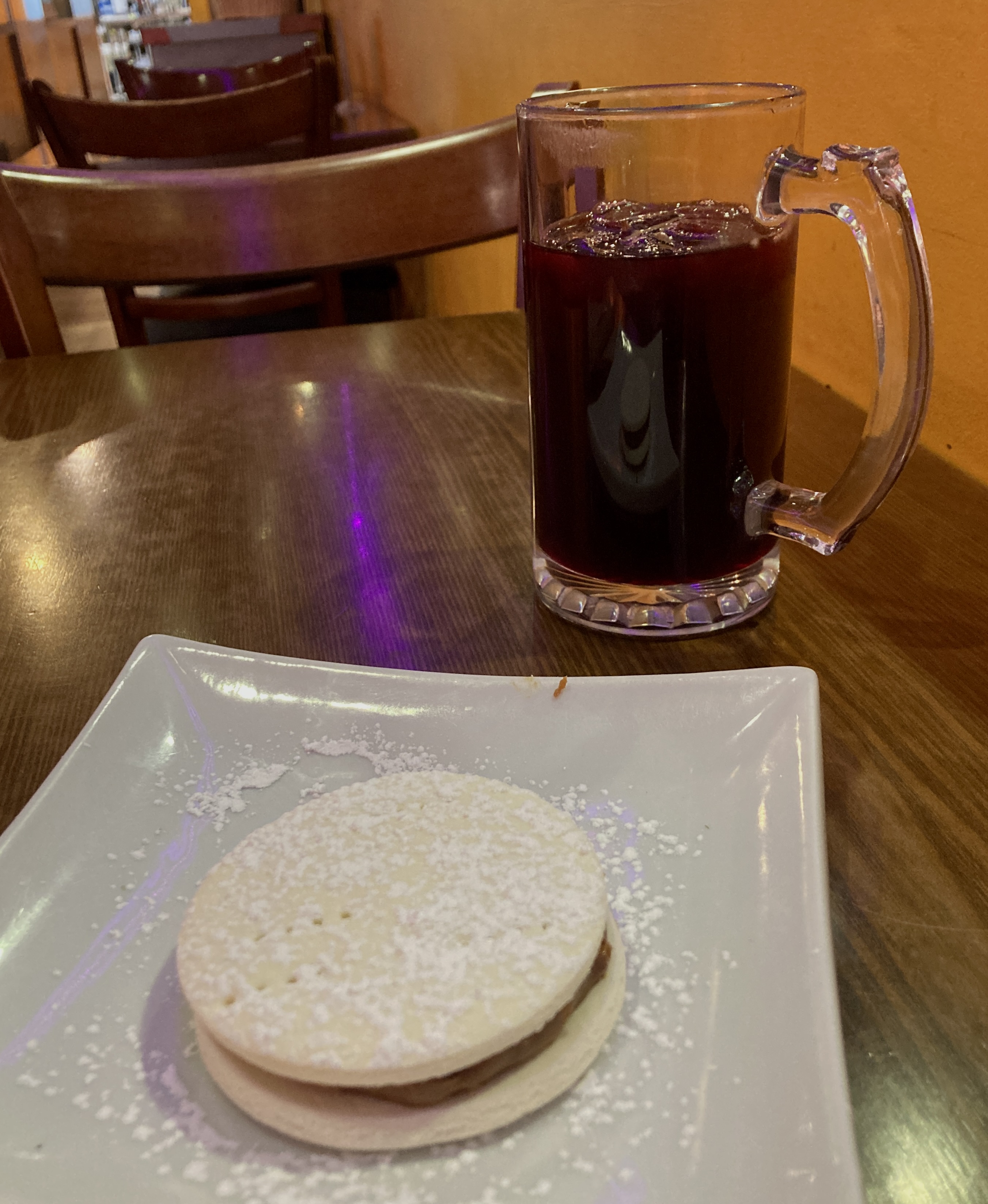
More precisely, this deli-bistro offers “gusto peruano,” for it was founded by Peruvian immigrants and is dedicated to Peruvian cuisine and ambiente. I’ve never been here before, but I’ve checked the menu online, and I know what I want: an alfajor dessert (two shortbread rounds, filled with dulce de leche and topped with icing sugar) and a mug of chicha morada (a purple corn drink, slightly tart and refreshing).
The young server treats me to widened eyes and a dimpled smile when I speak with her in Spanish. And I smile — oh, how I smile — when she delivers my order.
Odd thing, memory.
Tracking down alfajores in Vancouver had become an obsession; chicha morada was an afterthought. But now, as I sit with the physical reality again before me and in my mouth… the power is in the drink.
The alfajor is delicious, but it is not tied to any one moment or place we’d visit while in Lima. The chicha morada, however… It is absolutely tied to the one very small café in the High Selva village where we lived, and to the people with whom we conversed in that café, all those people who deepened our knowledge of the language and the place and how best for us to be there with them.
All these decades later, that taste is again fresh in my mouth — and old memories are again fresh in my mind. ¡Qué bueno!
1 March 2025 – Clutter? “Juxtapositions” is more accurate, also better PR, but I suspect there’s some kind of rule against using five-syllable words in a title.
So Urban Clutter it is. There’s a lot to be said for it, by whichever name — so many possibilities, all piled atop each other! The pile-up tells stories, and it both sparks and rewards curiosity.
At least, that’s the effect on me, as I stand at Davie & Richards, en route an Urban Treat — a noon-time performance at the Scotiabank Dance Centre. While my feet wait for the light to change, my eyes say, “Look at that!”
So I do.
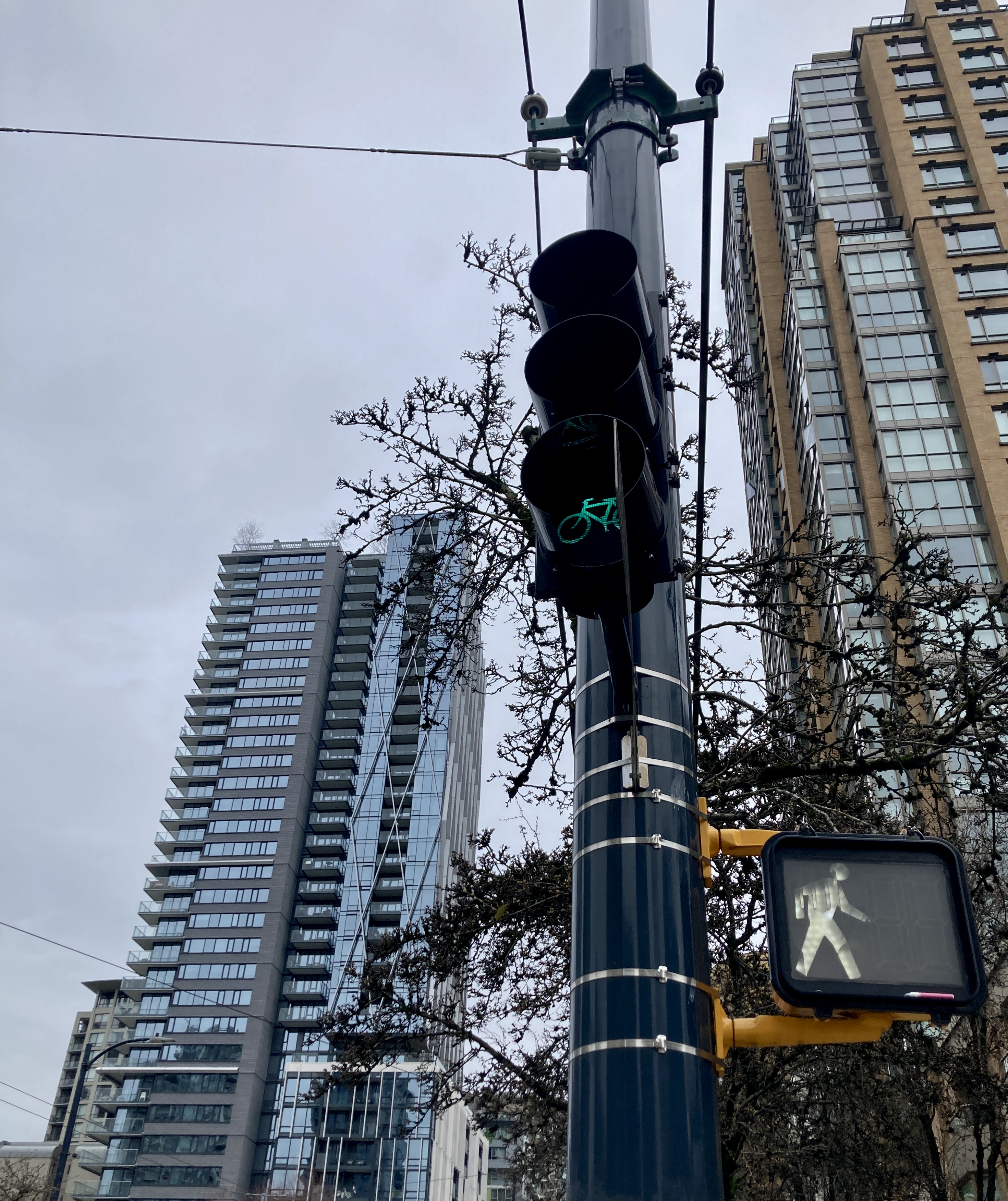
It’s nothing special, it’s just… it’s just very urban. Tram lines overhead; traffic signals to one side; and, framed by both, the residential towers that lie behind Emery Barnes Park and before Helmcken Street.
The Shiamak dance performance is wonderful. Afterwards I adapt their “Have Feet Will Dance” slogan to my own “Have Feet Will Walk,” and start north on Seymour. (North-ish, downtown streets are on a slant, but I’ll spare you the precisions.) The day is balmy, I’m happy, and I decide to walk right to West Pender, where I’ll catch a bus back home.
But then I get distracted, and my simple plan goes all fractal. Blame it on urban clutter.
Before I even reach Nelson, I’m laughing at this literal sign of our politico-cultural times.
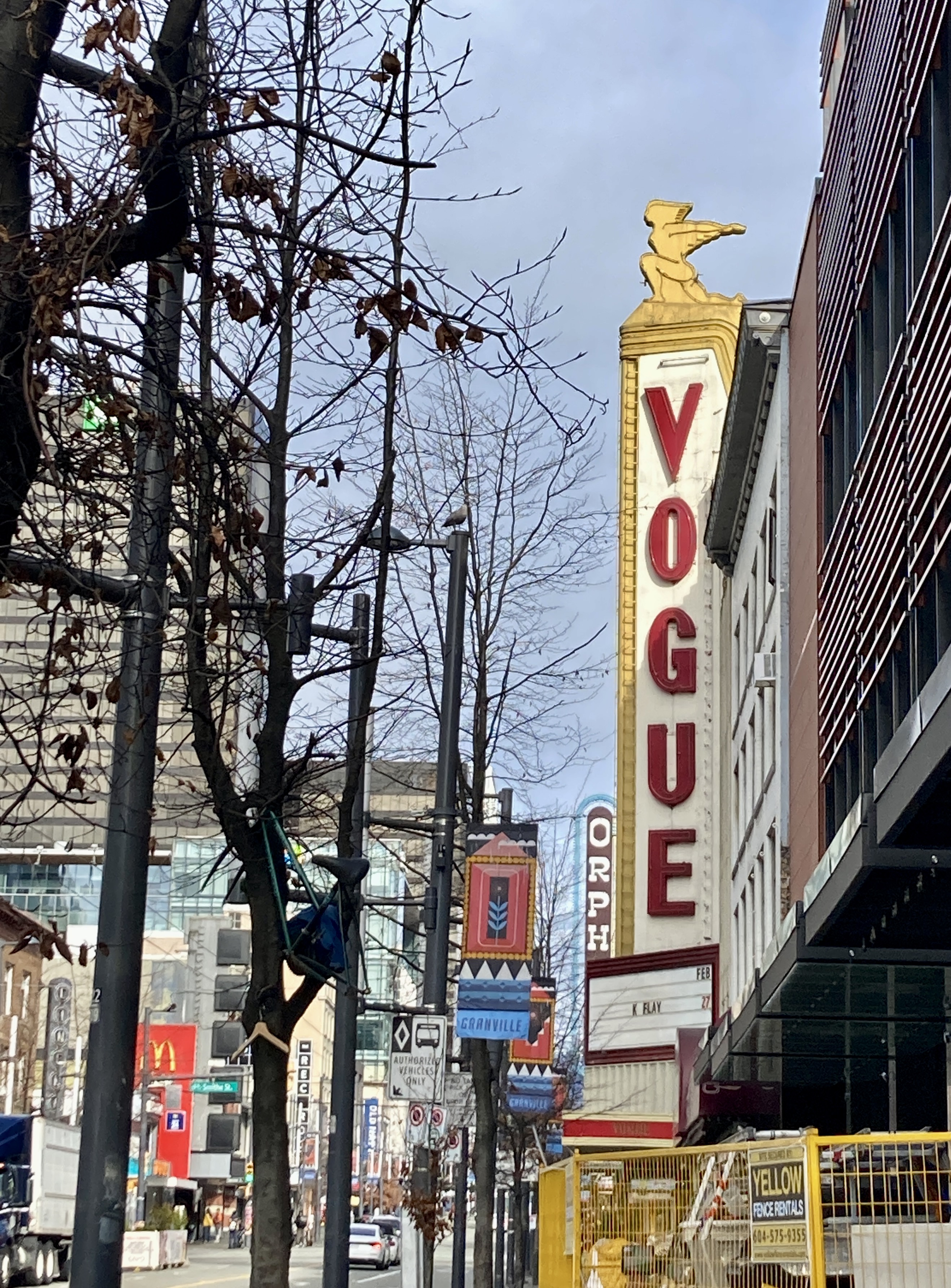
Left on Nelson, right on Granville, and I’m up against the busy construction work beneath one of the street’s stubborn theatrical survivors: the Vogue. It’s a 1941 movie theatre (now event venue), built in Art Deco/Art Moderne style. As you can see.
I veer onto Smithe just past the Vogue Theatre. No particular reason for the change of direction — but suddenly here I am, just before Seymour, at the entrance to Ackery’s Alley.
The alley backs the Orpheum Theatre on Seymour, and celebrates the venue’s long (and continuing) history of live performances. It was painted and generally spiffed up in 2018, the idea being to welcome pedestrian as well as the existing delivery-truck traffic. I had recently arrived in town, walked it then, and yes, it sparkled.
It hasn’t had much maintenance since, and it’s a lot grubbier.
But it’s still in pedestrian use and, with its strong lines and commercial functionality, it is very Downtown Right Now.
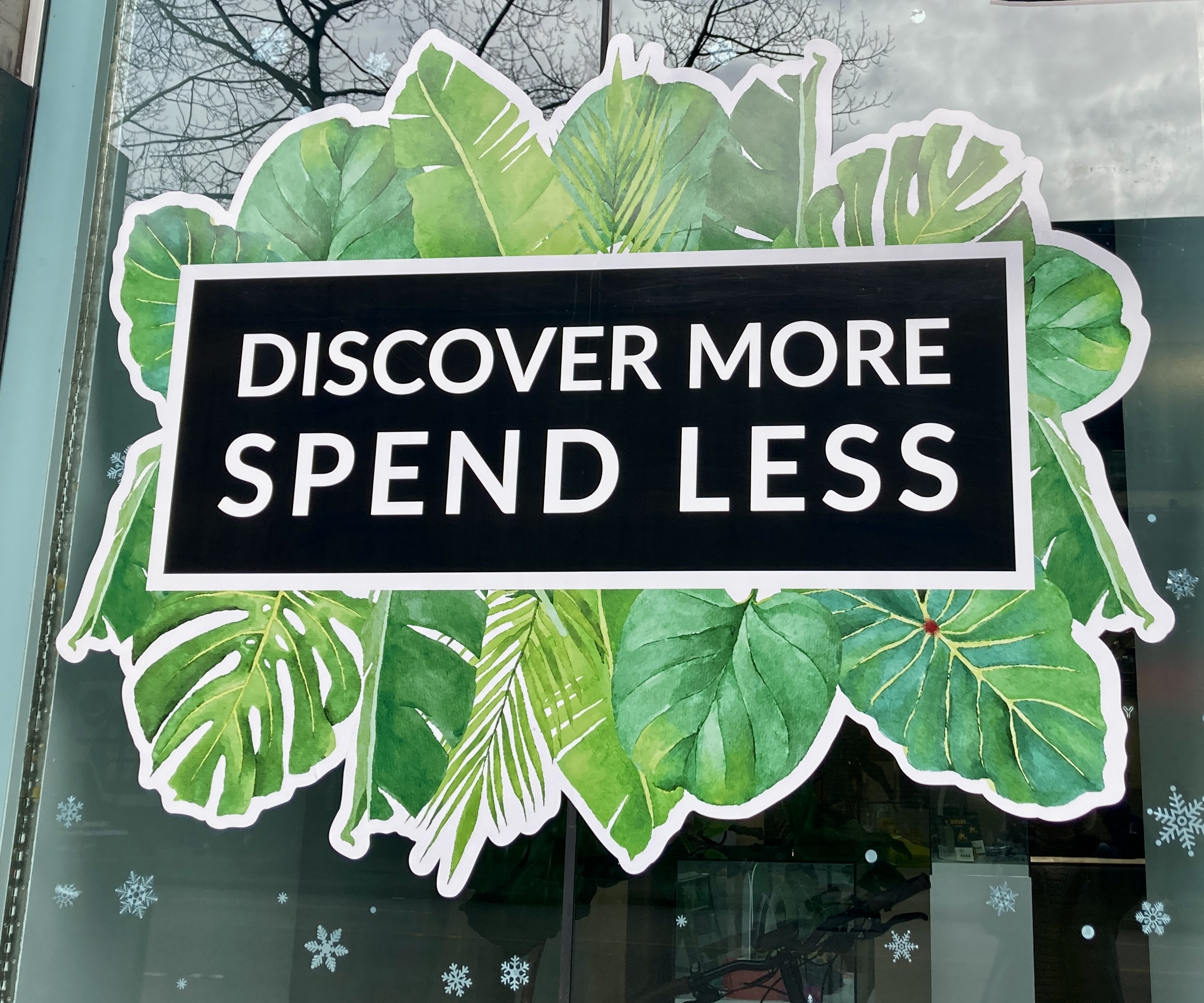
Out the other end at Robson, where a window sign apparently invites me to dial down my consumerism.
Well… not exactly. This is the window of a cannabis shop, which prides itself on bargain prices. So: keep spending money, just spend it with us! (And discover the wonders of our products.)
Since I still plan a quick ride home, I take to Granville again, heading for the bus stop at West Pender. But then, when I reach Pender, I look farther down Granville and I am again distracted — beguiled! lured! tickled! — by urban clutter.
It’s the dome. I start wondering about the dome.
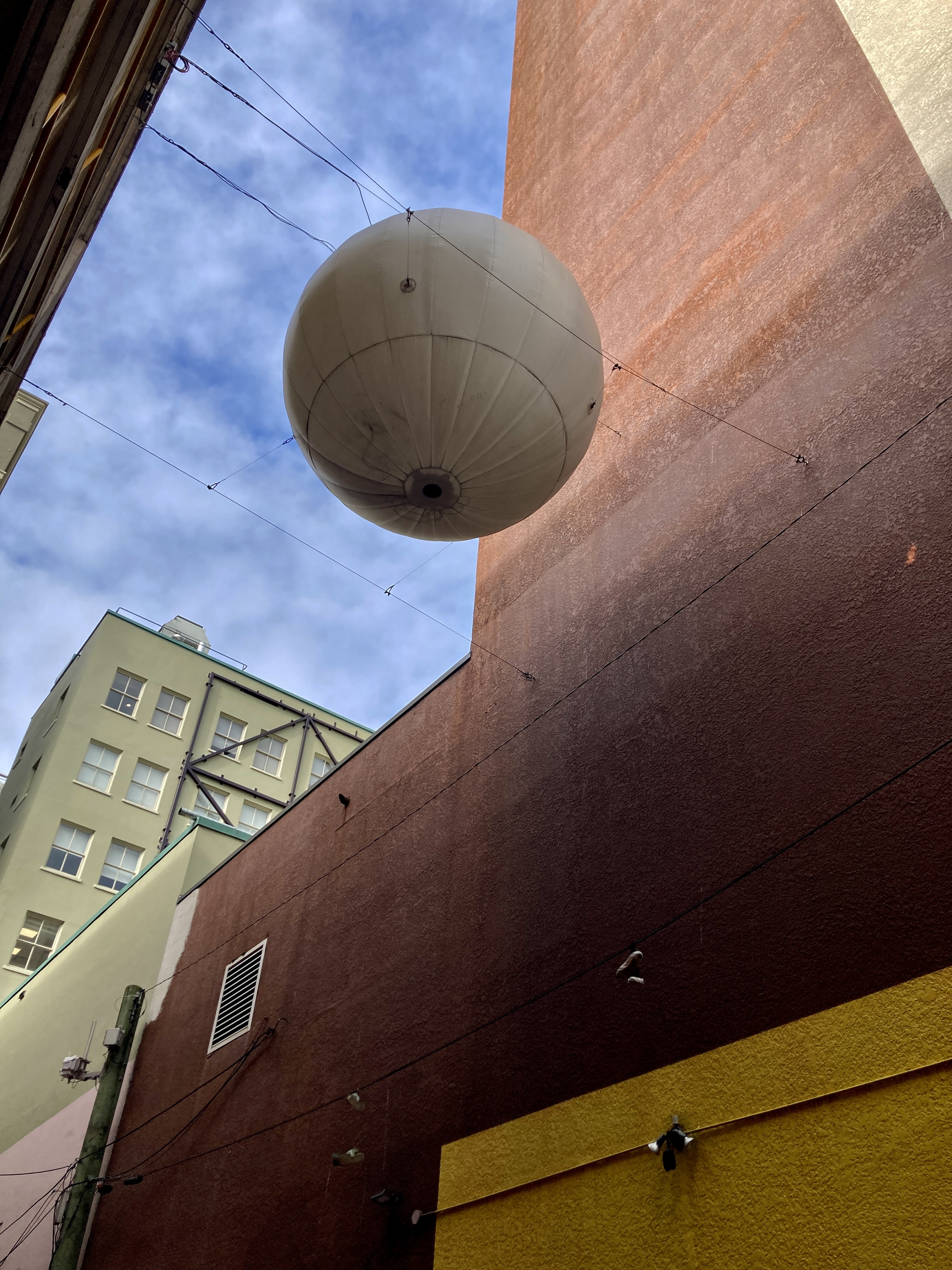
I could always walk one more block and check it out — but what fun is that? Especially when, just before I reach that next corner, I can instead dive into Alley Oop, the first of the downtown alleys to be spiffed up, back in 2016.
Also grubby by now, but it does have that hanging sphere at the far end.
Which rewards my head-tilt very nicely. Geometry at work.
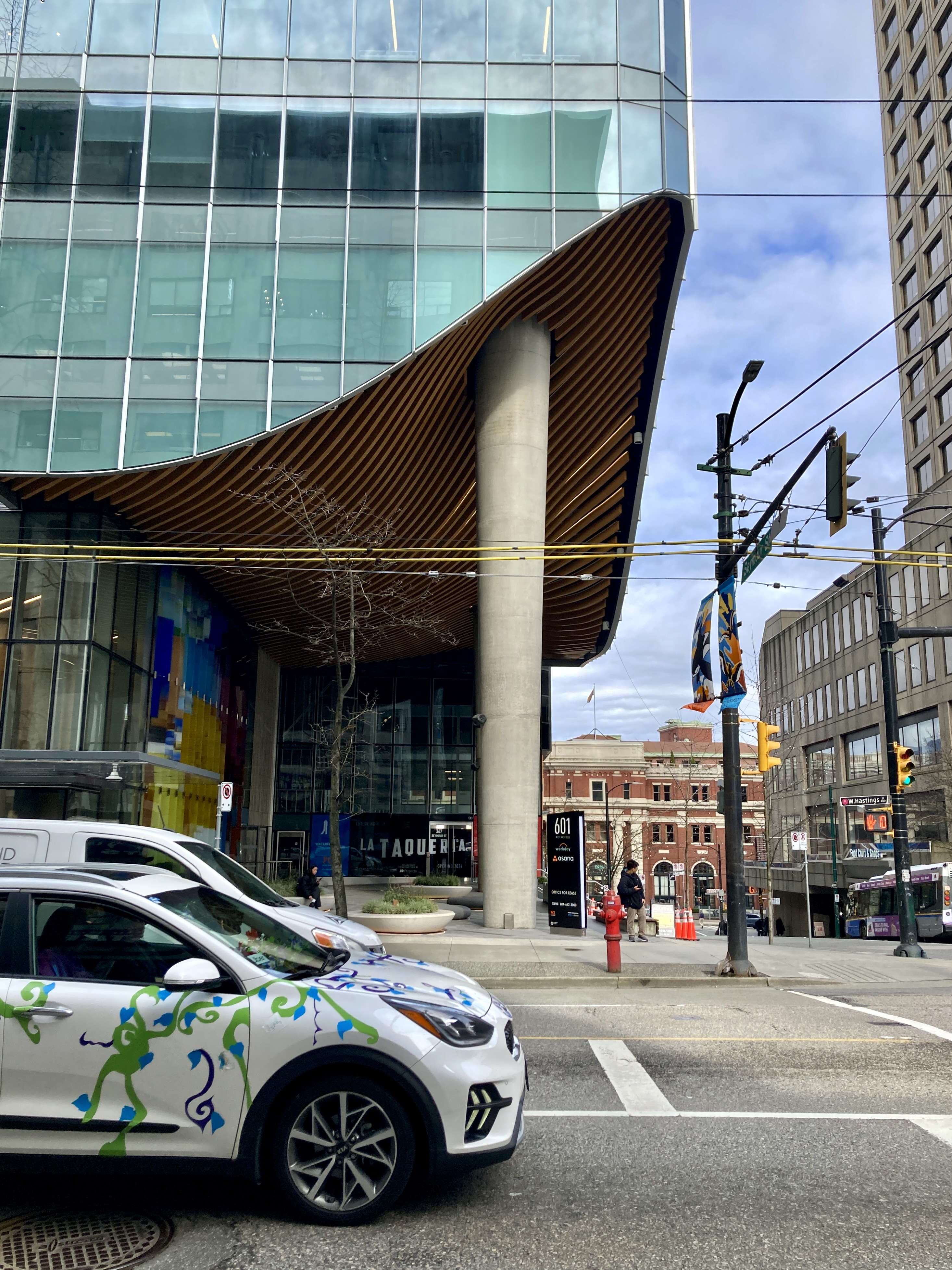
This brings me to Seymour and West Hastings, with Waterfront Station in the distance and this building opposite, whose upturned lip always makes me think of whale baleen. (That frog-splattered white car, even closer, is a gift from the Traffic Light Gods.)
By now I’m well off-track for the mystery dome. I correct course and walk west on Hastings. This time the urban clutter offers me a distant view of the Marine Building at Burrard, framed against glass towers, and a close-up of elaborate lanterns and trim on another heritage building right next to me.
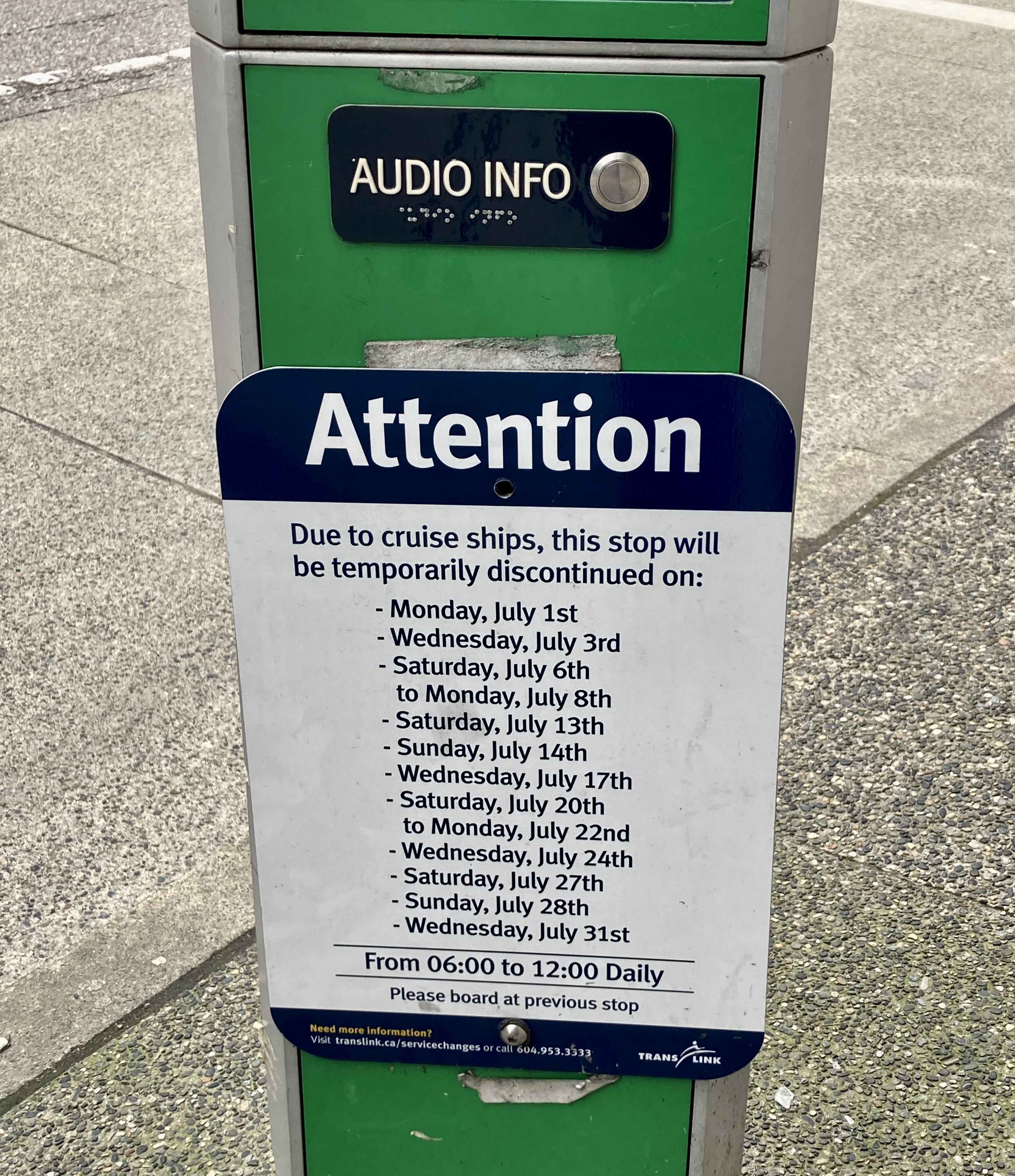
The bus stop at Granville is a reminder that the cruise ship terminal is nearby and, in season, its passenger loads wreak havoc with local traffic.
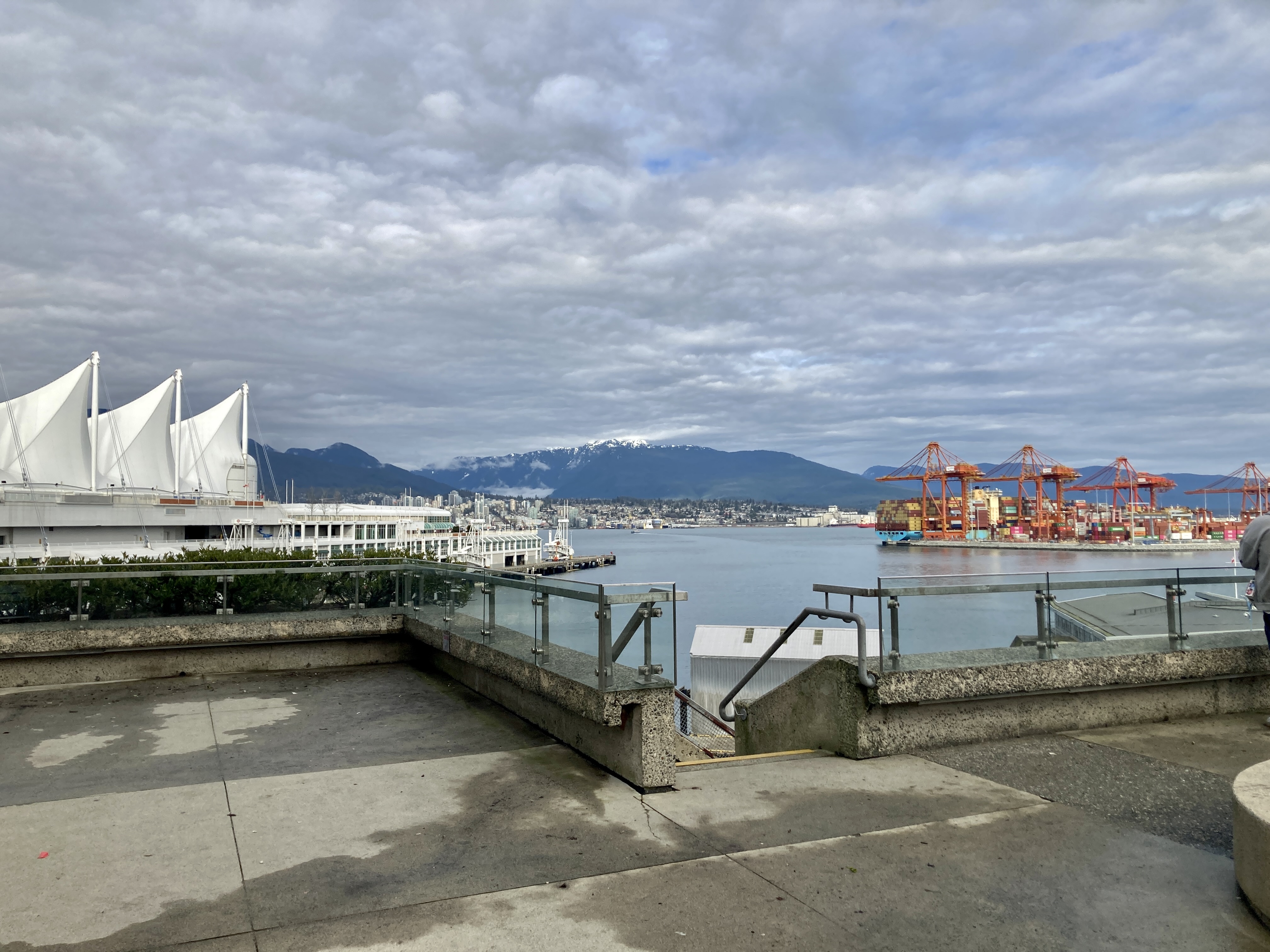
Perversely enough, I now head away from the mystery dome. Instead, I follow the raised Granville sidewalk all the way north to the lookout at Burrard Inlet.
Small but satisfying, this little plaza lies between the East Convention Centre (with its “sails”) and the cruise ship terminal on one side, and, on the other…
harbour cranes, Waterfront Station, the SeaBus terminal, train tracks and a helicopter landing pad.
About face!
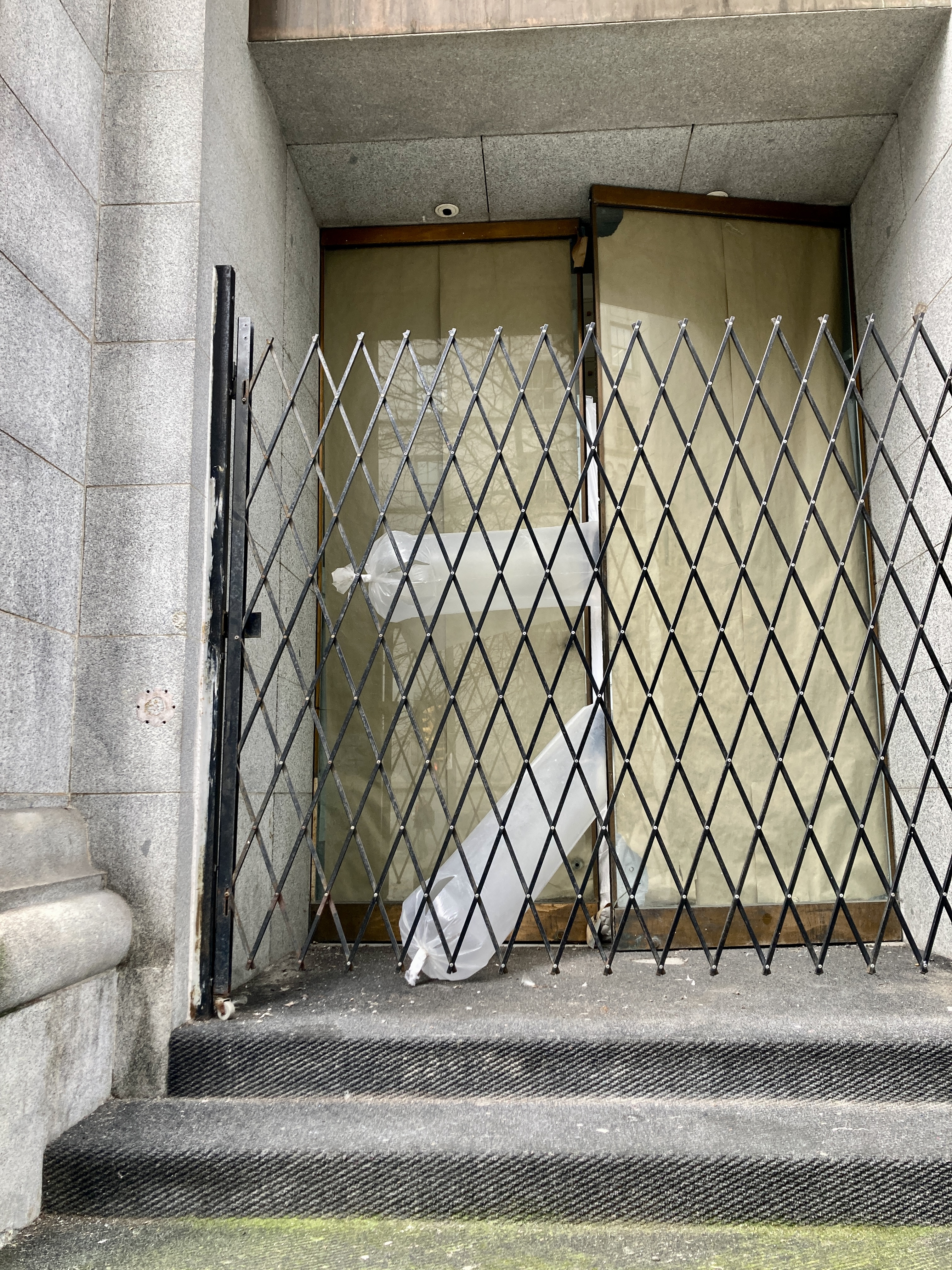
Back up the raised sidewalk I go, now aware that this entire four-building foot print — including the mystery dome — comprises the Sinclair Centre. I knew this, I really did. It just took a while to reconcile my memories of this once-busy office/service/retail complex, with the boarded-up reality of right now.
??? They look like giant condoms, ready for action. What is going on in there?
I don’t know, is the answer to my own question. The complex seems mostly closed, and I later read online that a massive redevelopment proposal has been under review. Is work now underway, or becalmed? I can’t tell.
Whichever, it is a sad sight.
Walking the West Hastings side of the complex toward Howe, I pass a medallion face looking suitably distressed. As it should. The wooden door is in good condition, but the plaque beneath the medallion has been hacked away.
Corner of Howe, I take one last look at the dome that started my long, happy loop-about through all that urban clutter.
Then, satisfied, I finally board my bus for home.
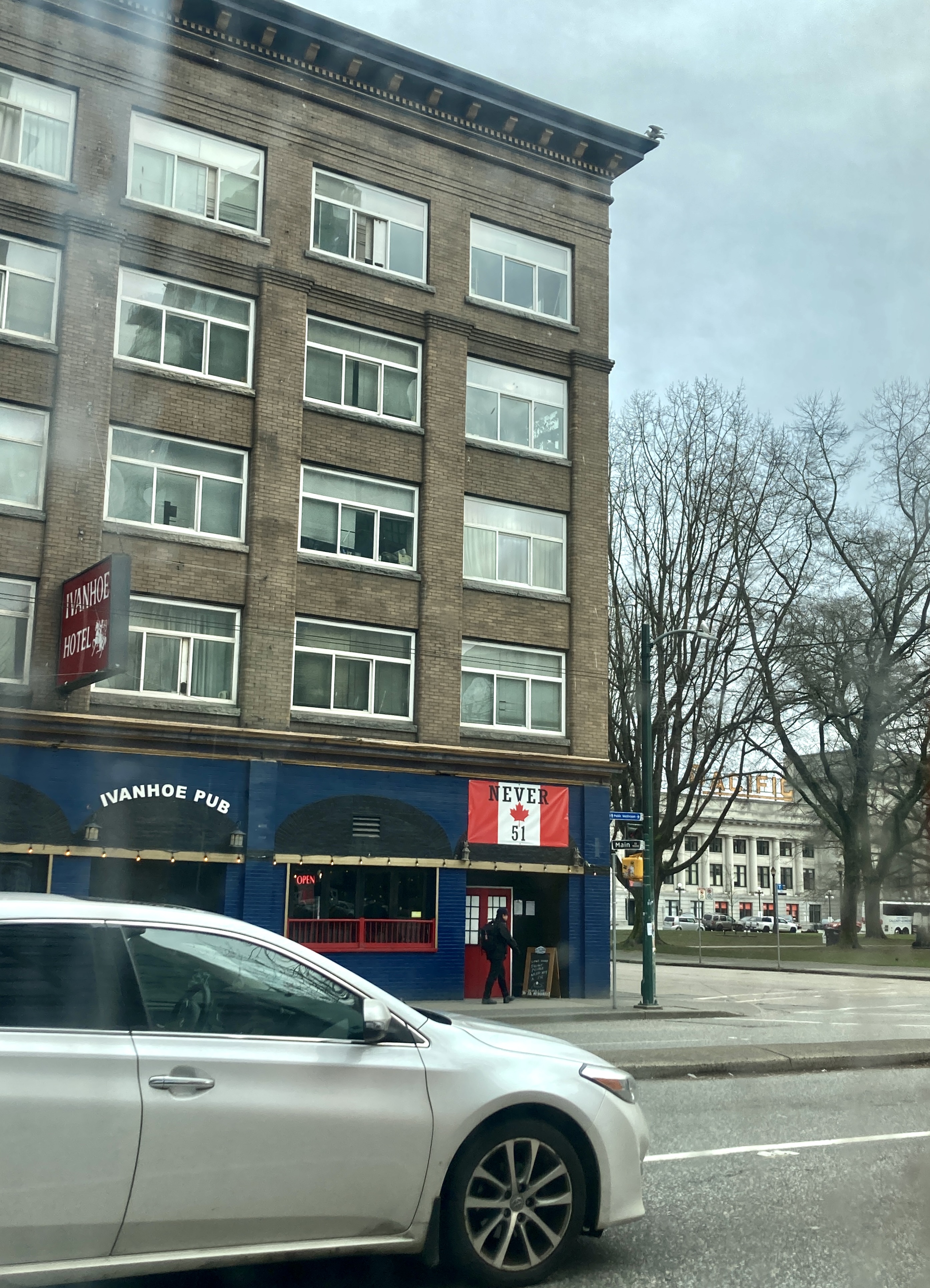
There’s one last delight, as we roll south on Main Street, and I manage to grab a shot through the bus window.
The Pacific Central train station is in the background, but who cares. I’m focused on the red & white “flag” now installed above the pub entrance, right at the cross-street. It is yet another literal sign of our politico/cultural times.
The final, perfect detail? The name of that cross-street is… National Street.
26 February 2025 – Oh, that pesky old Law of Unintended Consequences.
You know? You do X, to bring about Y… and then instead of basking in the delights of Y, you find yourself lumbered with Z,T and a raggedy bit of M.
For example:
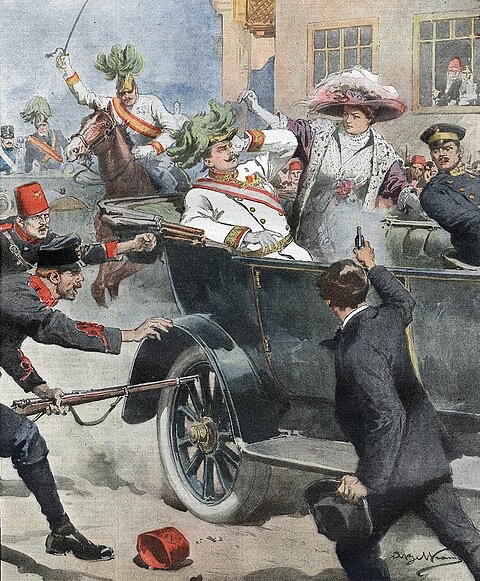
On June 28, 1914, Bosnian-Serb student Gavrilo Princip assassinated Archduke Franz Ferdinand of Austria and his wife Sophie as they were being driven through the streets of Sarajevo.
He meant to protest the annexation of Bosnia-Herzegovina by the Austria-Hungarian Empire.
He did not mean to precipitate World War I.
And for example:
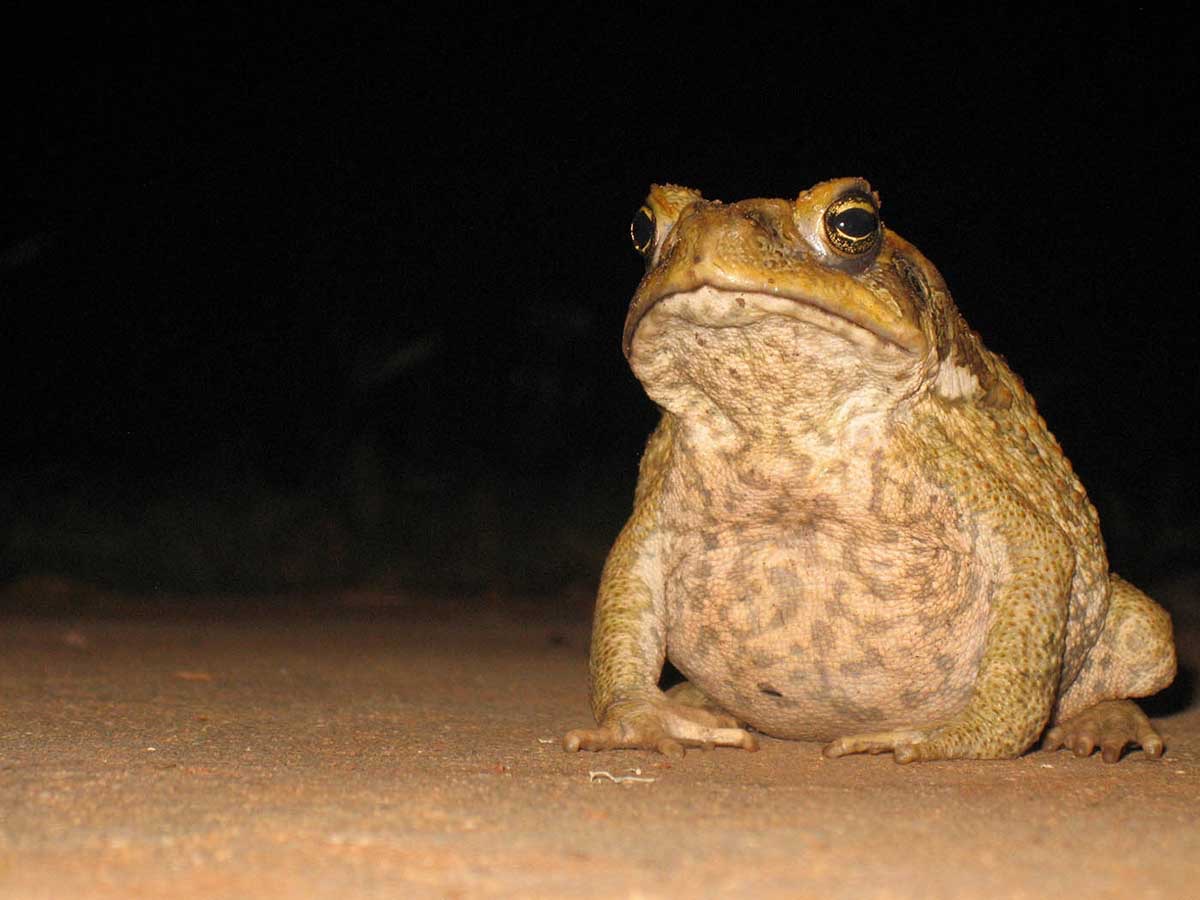
In 1938, the Australian government introduced cane toads to the country.
They meant to control pest beetles in Queensland’s sugar cane crop.
They did not mean to introduce a new pest, which has since spread all the way to northern Western Australia. “This great toad, immune from enemies, omnivorous in its habits and breeding all year round, may become as great a pest as the rabbit or cactus” — National Museum of Australia.
And also for example:
In the 1950s, the heroine of I Know an Old Lady Who Swallowed A Fly — words by Rose Bonne, music by Canadian folk writer Alan Mills, sung by Burl Ives, animated by the NFB — launched herself on a swallowing spree.
She only meant to get rid of the fly (“that wriggled and tiggled and jiggled inside her”).
But when that spree culminated in a horse? “She’s dead, of course.”
And finally for example:
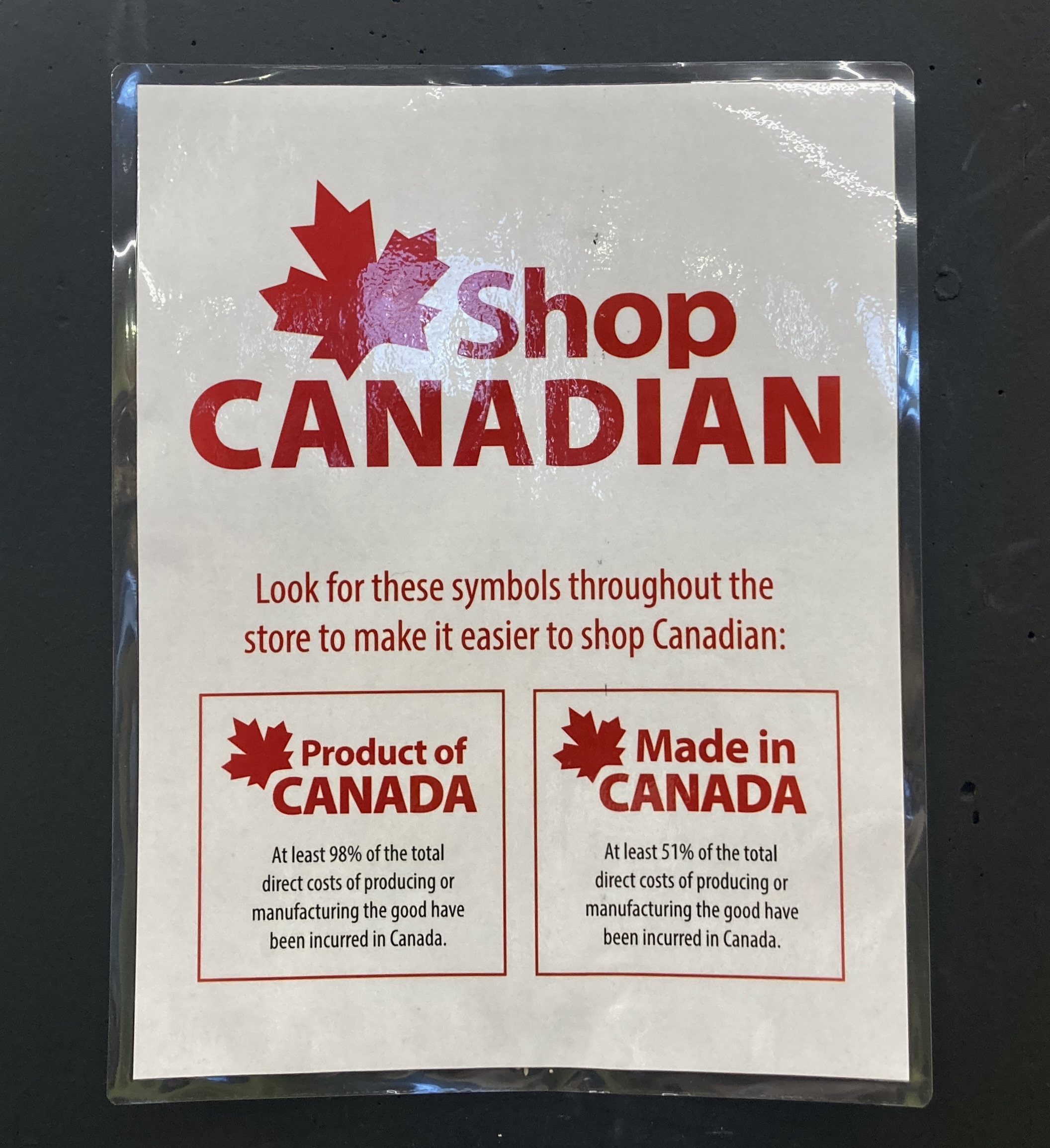
Right here and now, the Orange Thug’s tariffs are meant to destroy Canadian sovereignty.
But as this poster, now widespread in our grocery stores, suggests…
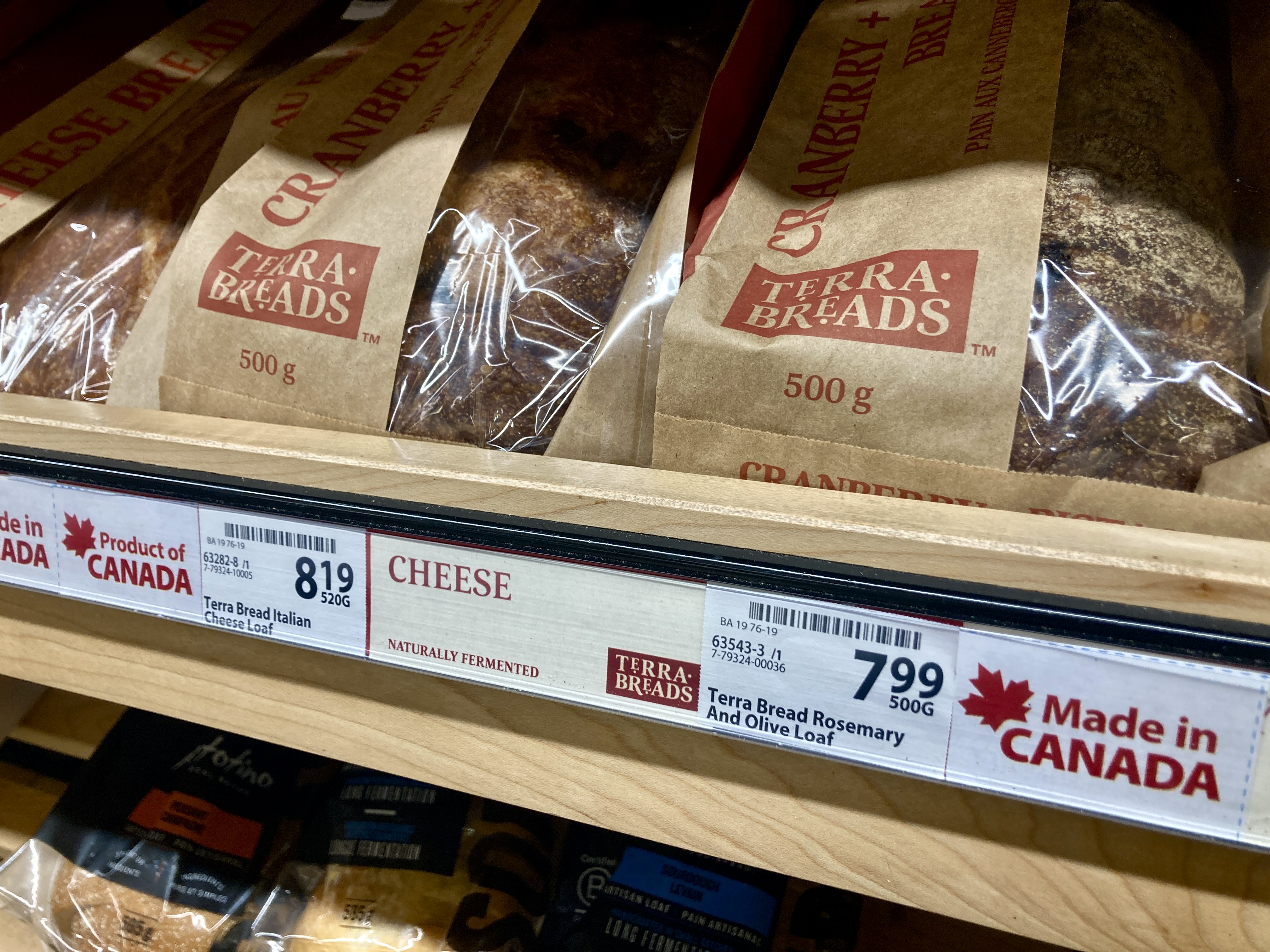
and product shelves reinforce…
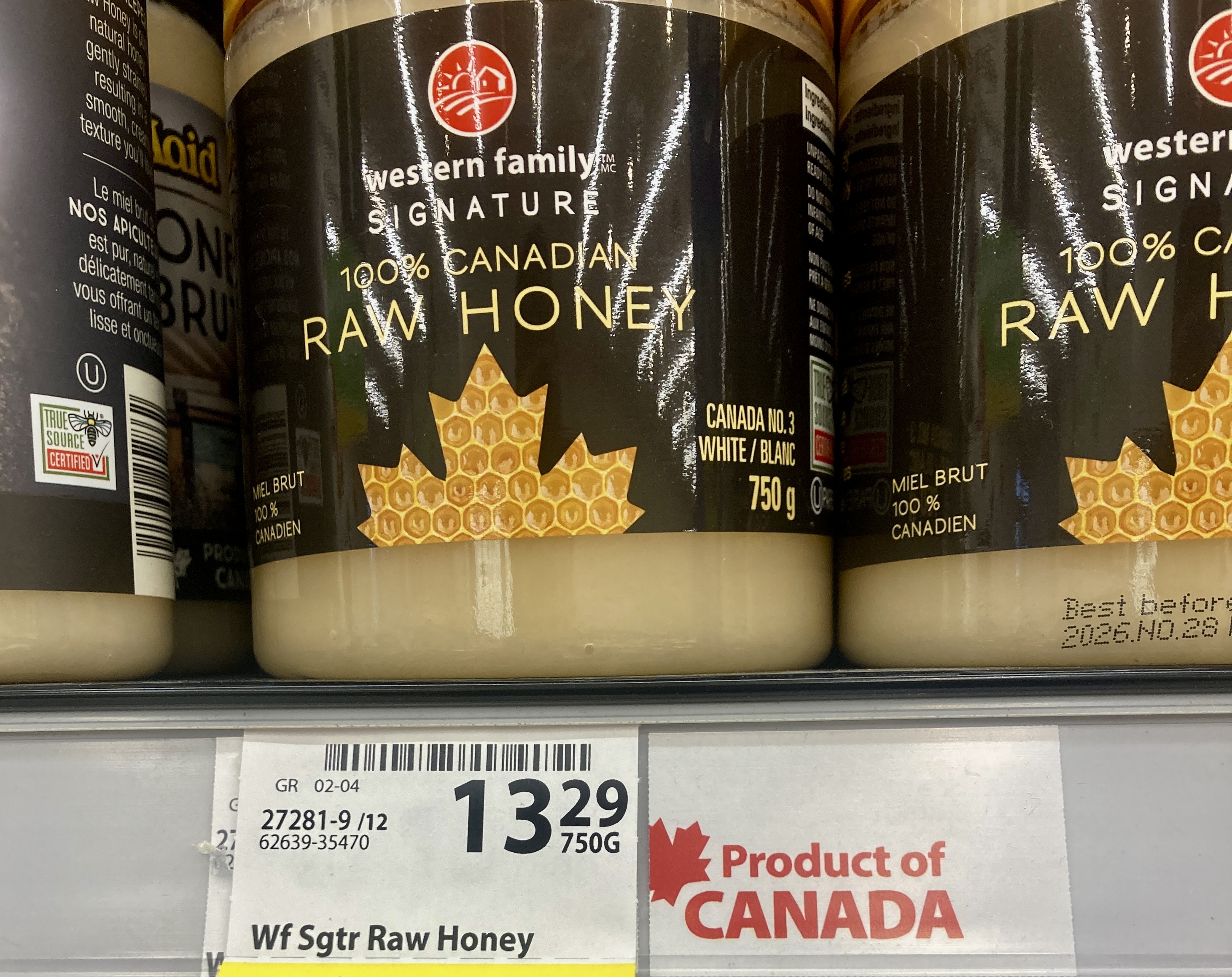
in one aisle after another…
hmmm, maybe some Unintended Consequences are already kicking in.
(Says I, who happened to need a new jar of honey, and came home with this one, you betcha.)
20 February 2025 – The month and the day pose the question:
Q: We think about tourist attractions in all their high-season dazzle — but what are they like, in off-season drizzle?
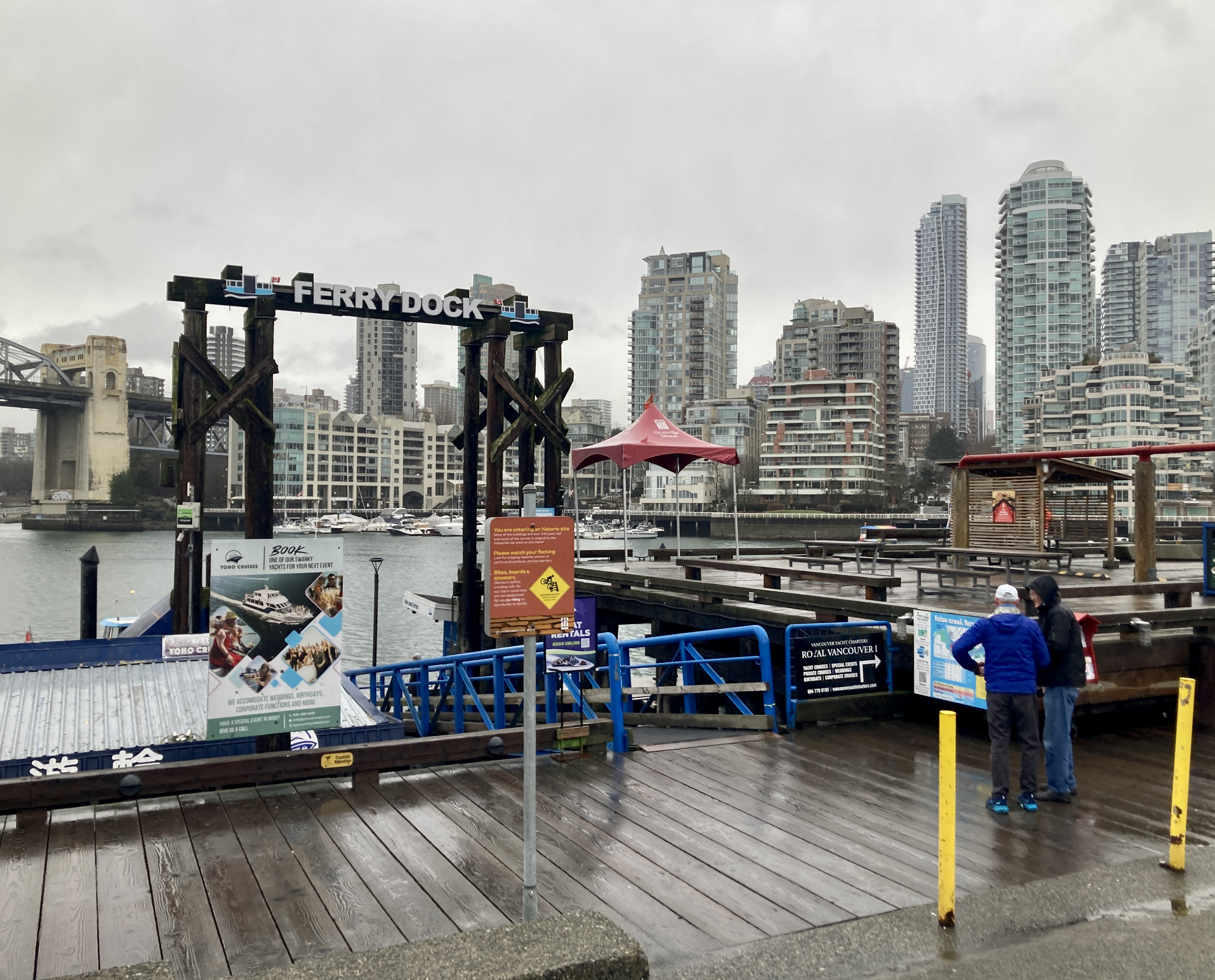
A: I head for Granville Island, magnet for tourists and locals alike. The month is off-season, the day is off-weekend, and the weather is definitely drizzle.
I leave the bus with the driver’s tourist-friendly patter still in my ears: Follow Anderson Street under Granville Bridge, it will lead you onto the island, and when you want to return to wherever you came from, the bus stop is right across the street — see? just over there.
Good patter, but not needed today. Only one possible tourist alights with me.
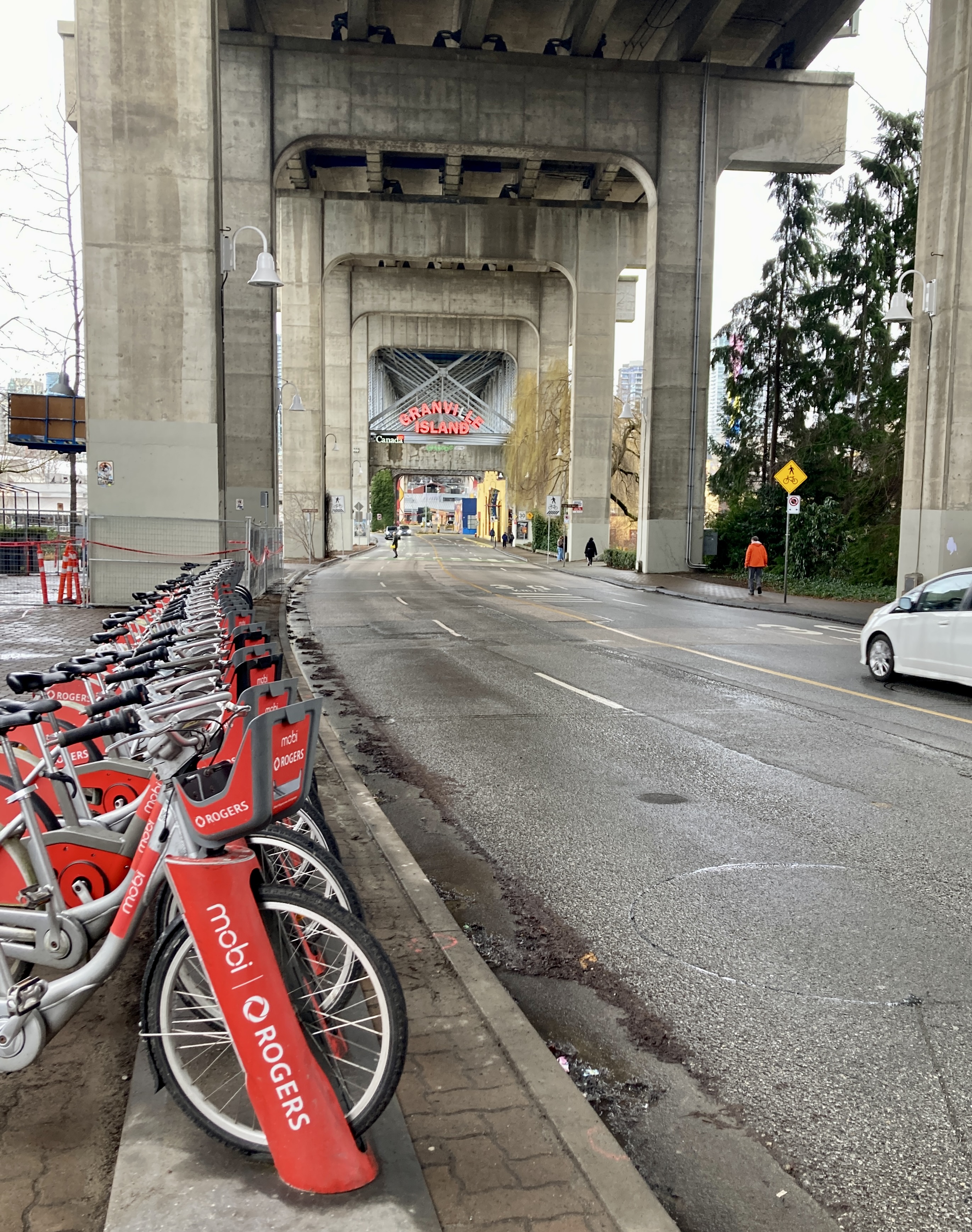
Anderson Street, its car lanes and sidewalks routinely thronged with traffic, is virtually empty.
All those rental bikes, still locked in their slots!
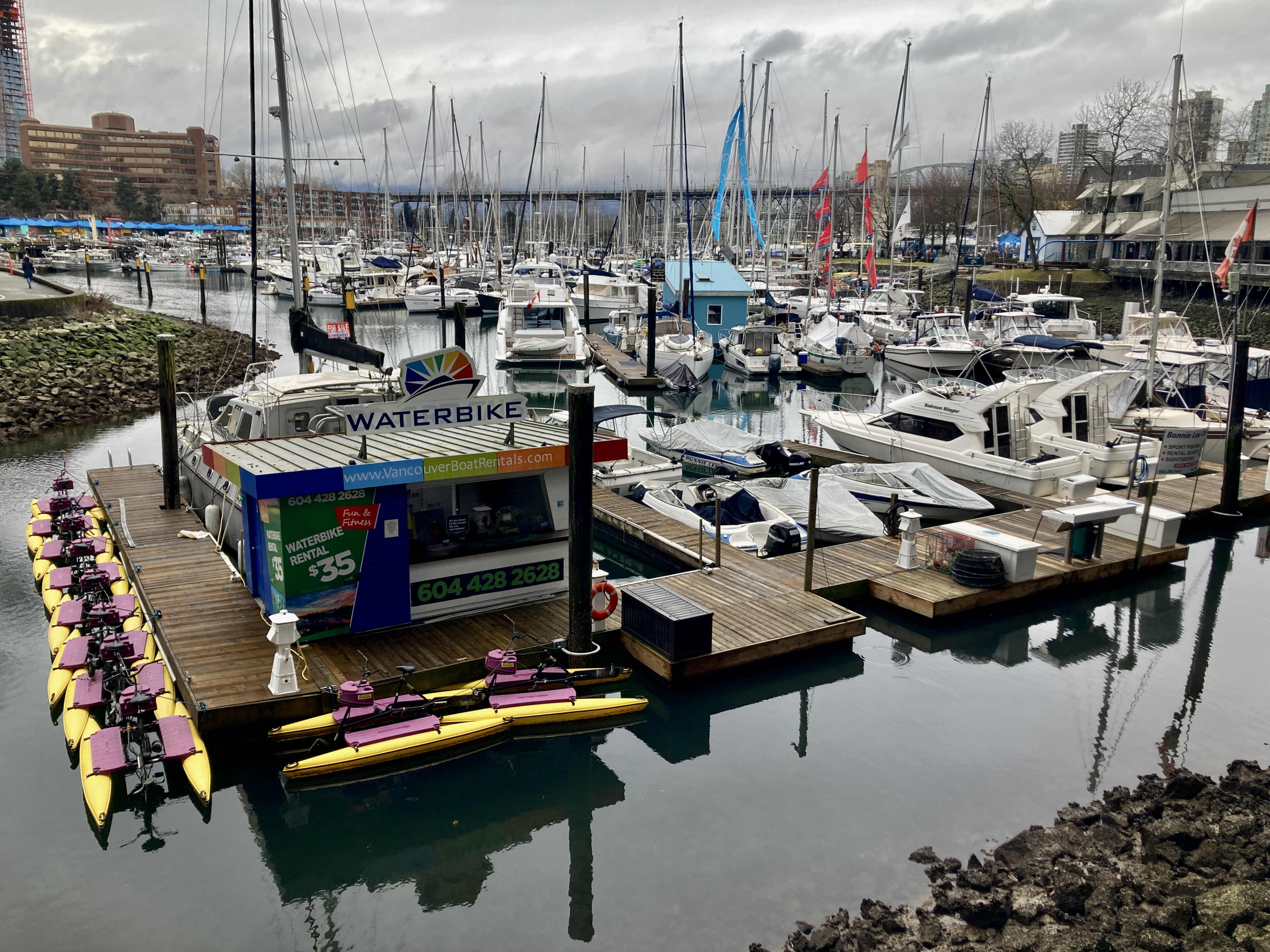
Ditto for the rental water bikes, tied up in Broker’s Bay.
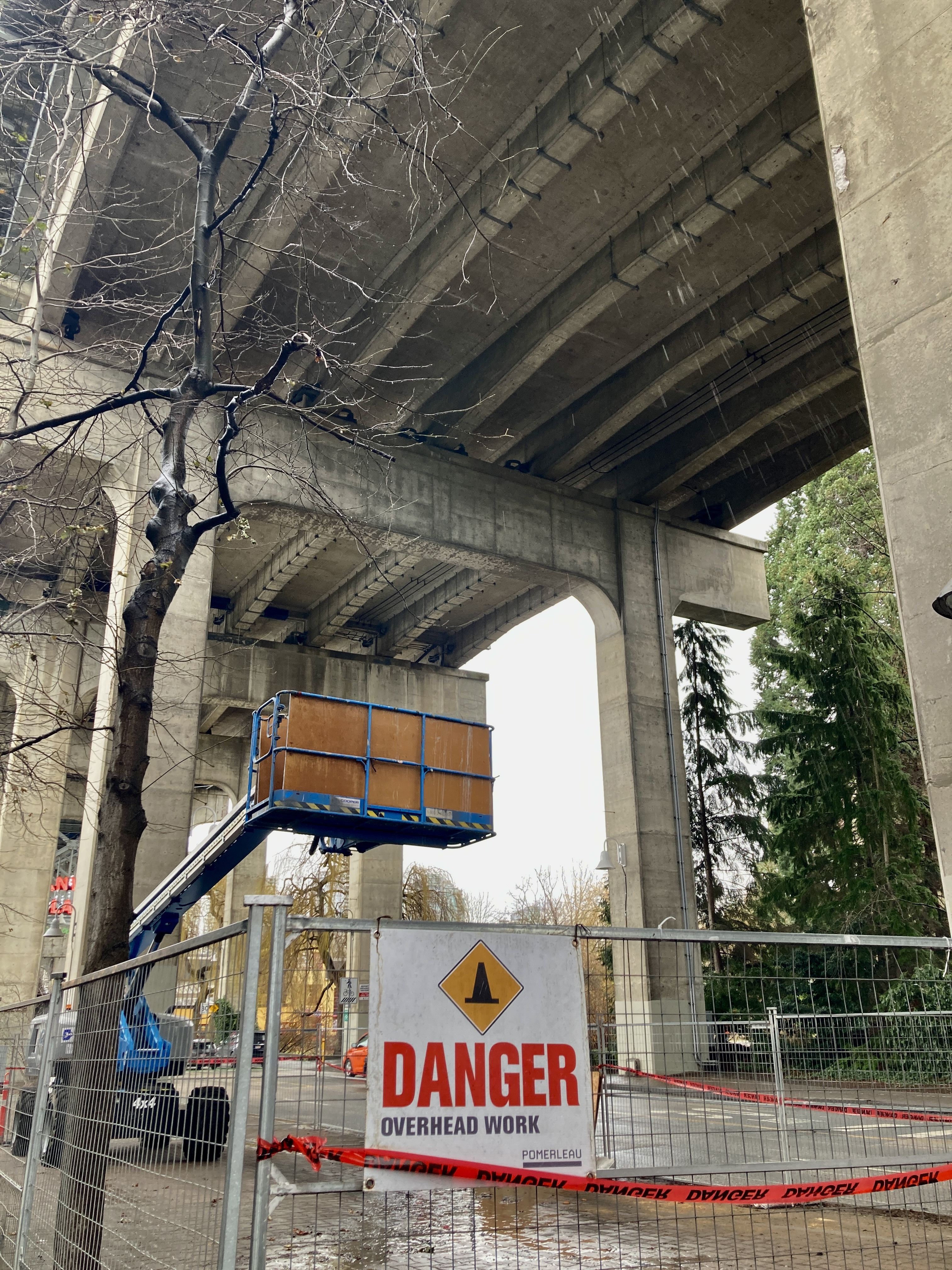
But mid-week off-season has its uses. It is a good time for maintenance, for example, whether to Granville Bridge overhead…
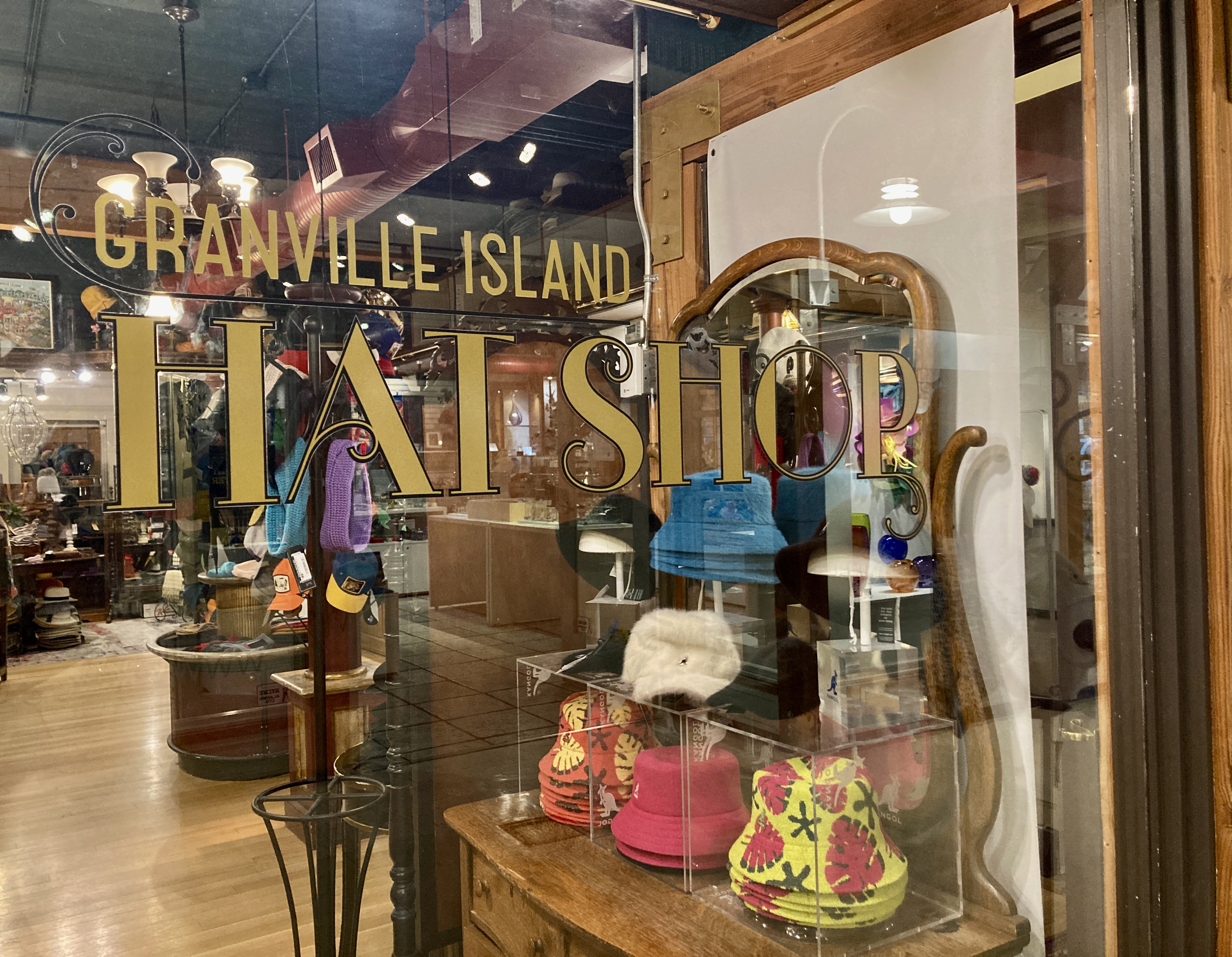
or, inside Net Loft boutiques like this hat shop…
a good time for staff to catch up on pesky chores, and have a bit of a chat.
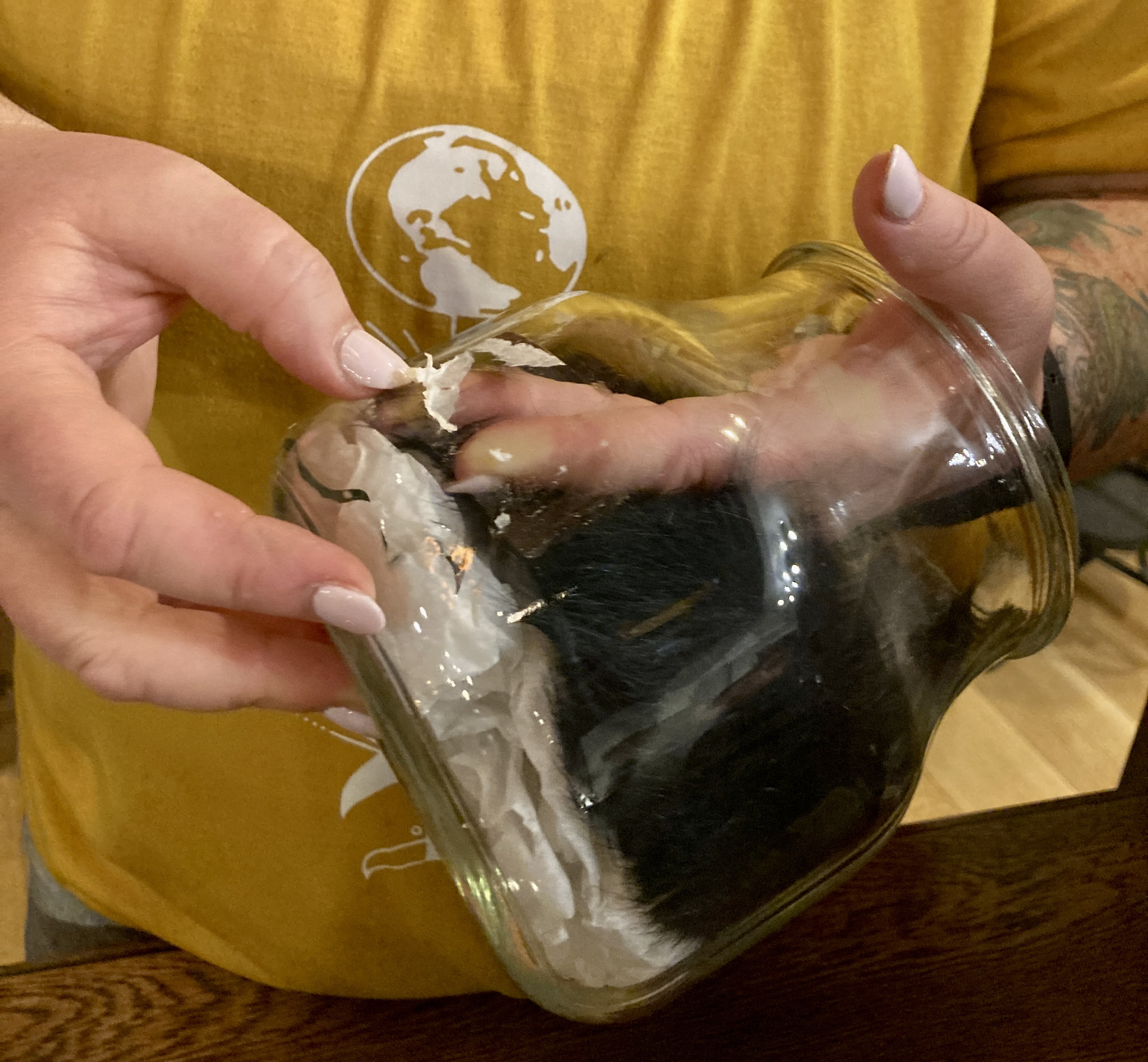
Despite some people eyeing the hats, this saleswoman agrees “it’s pretty quiet,” and she can finally spend a few moments scratching the stubborn label off a vase she wants to use for display purposes. We gossip amiably about my favourite hat brand (Tilley, that’s a plug), I resist her wheedling to try on one of the latest arrivals, and off I go.
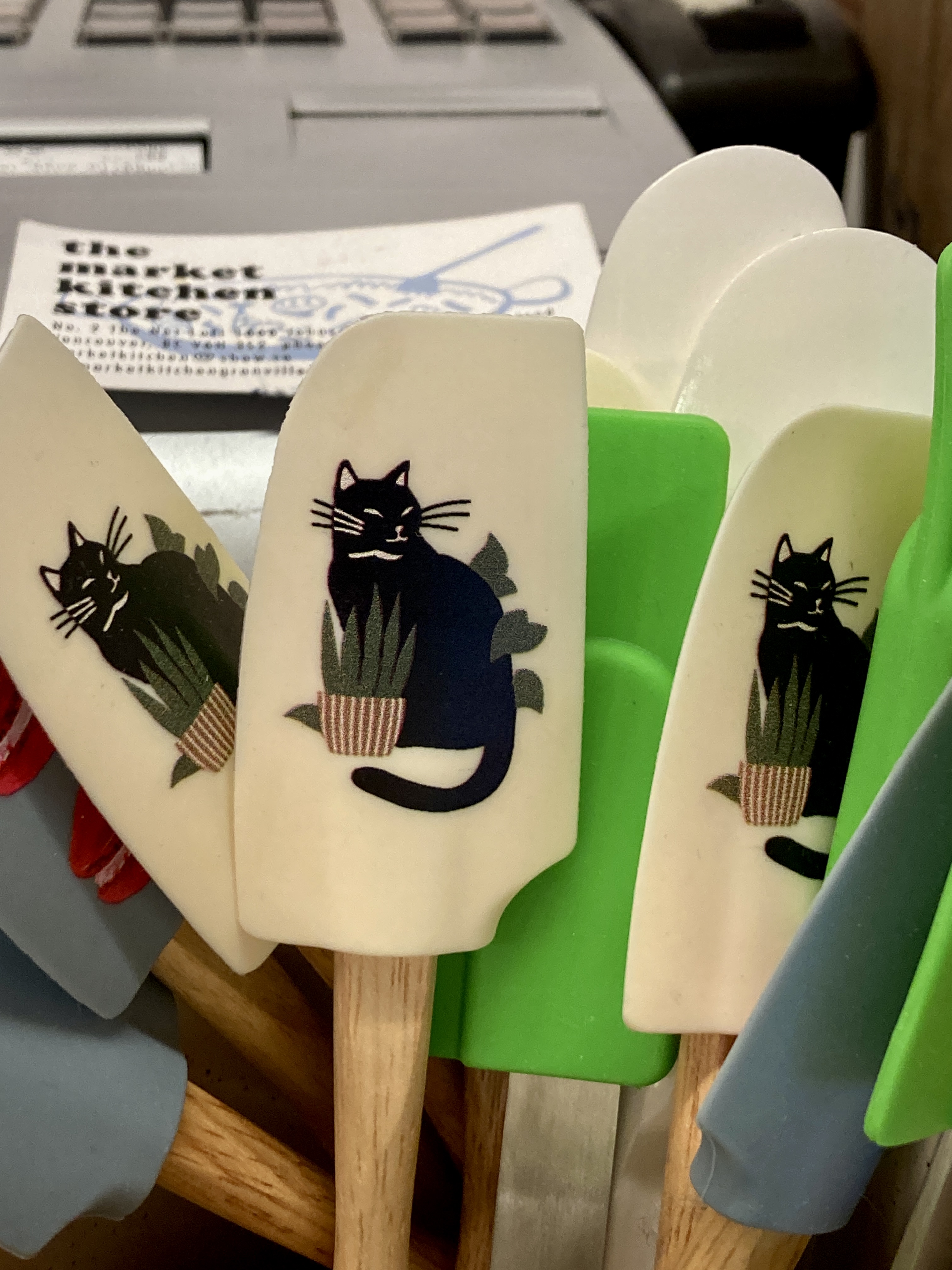
To have another bit of amiable gossip in the Market Kitchen Store.
About cats.
“What’s with cats this month?” asks the saleswoman, puzzled. “We always have these mini-spatulas, but suddenly there’s cat themes all over the place.” I concur, and tell her about the book I had just noticed on prominent display in Paper-Ya — entitled What Do Cats Want? and written (says the blurb) by “Japan’s leading cat doctor.”
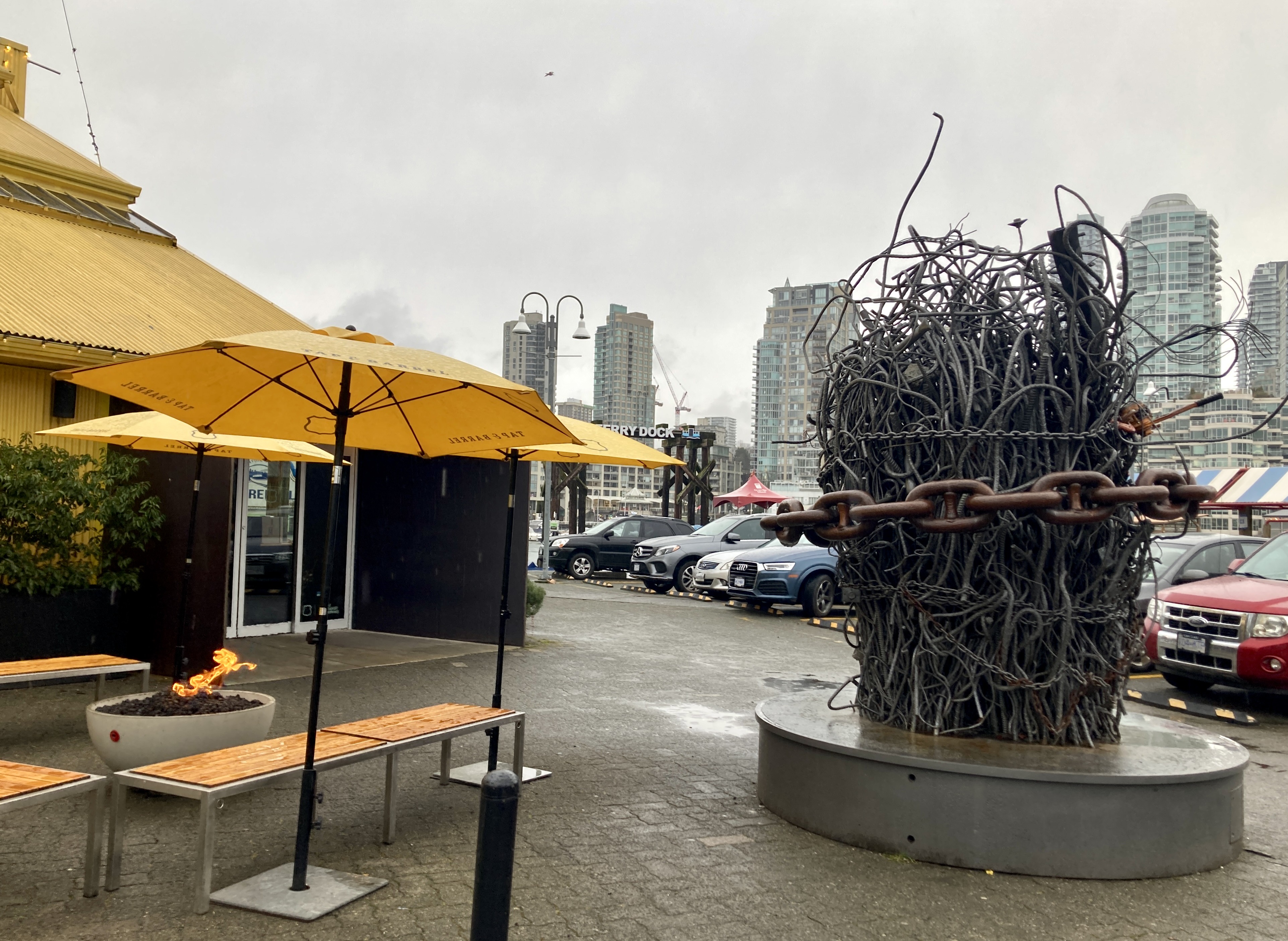
Despite respectably full parking lots, the Island’s streets and plazas are nearly empty. The fire pit blazes away outside Tap & Barrel, but any customers have parked their bottoms inside, warm & dry.
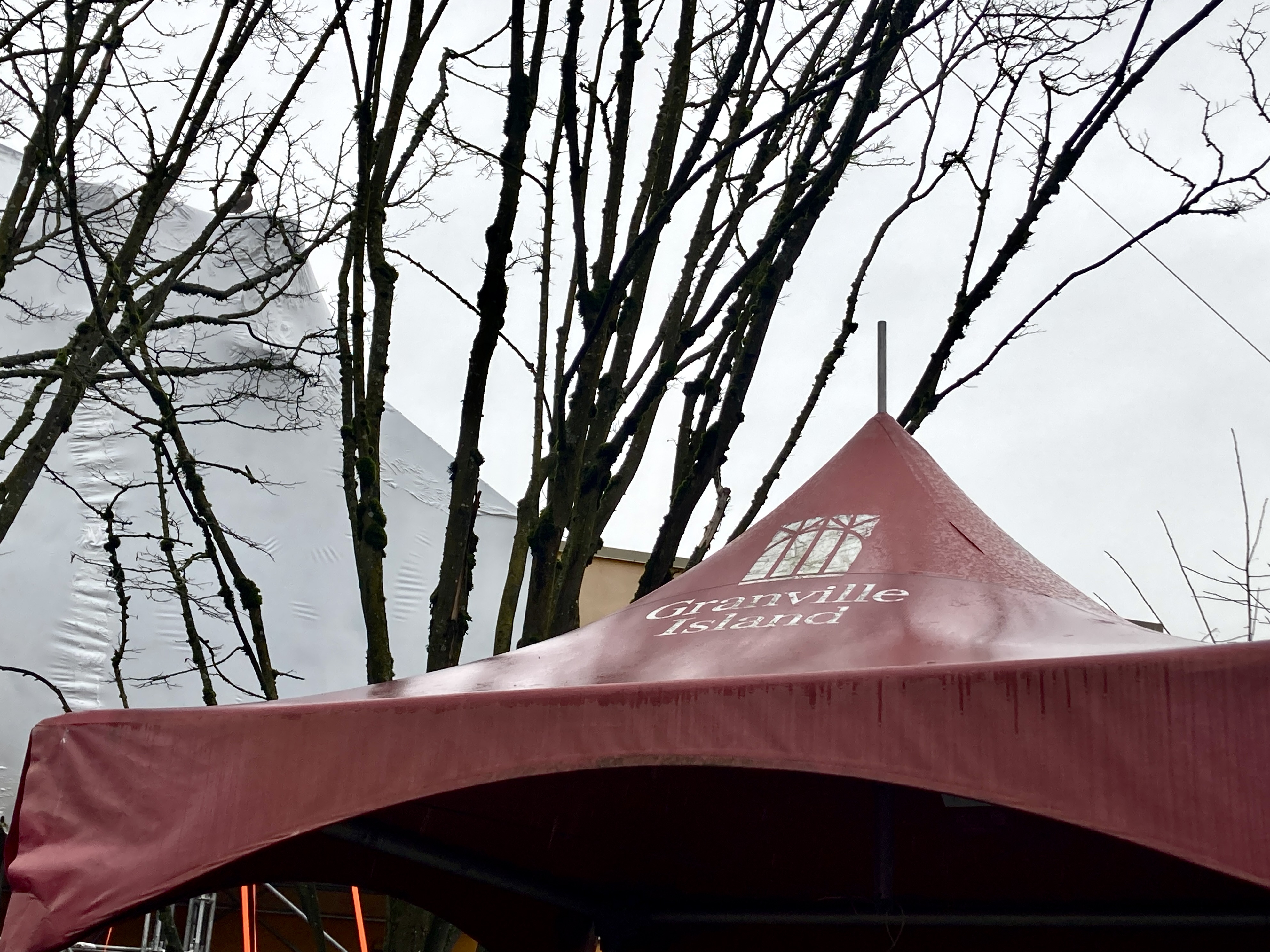
Kiosk tent-tops glisten…
a hardy duo hunch shoulders slightly as they check the ferry-dock map…
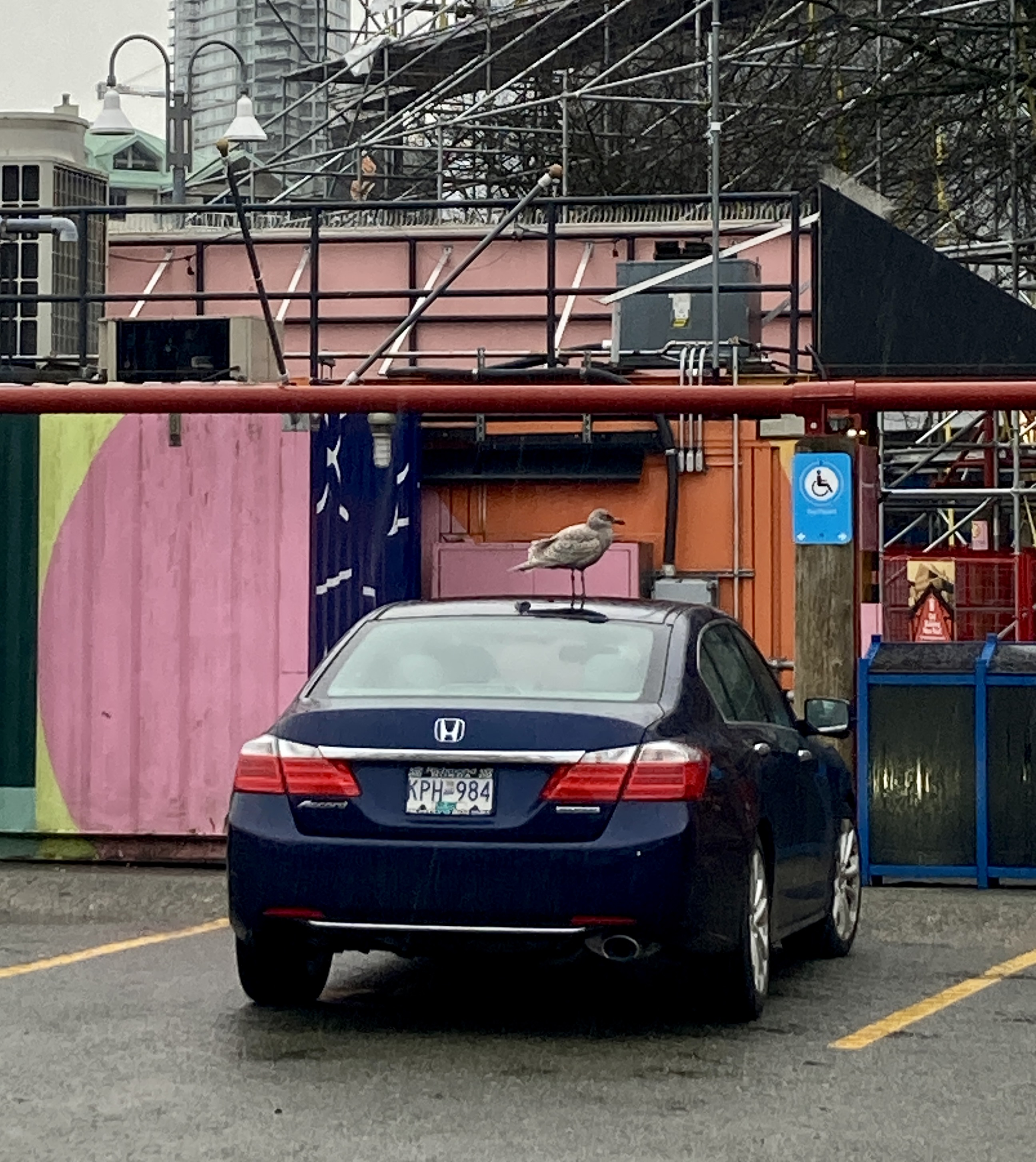
a hardy gull claims a parking lot perch…
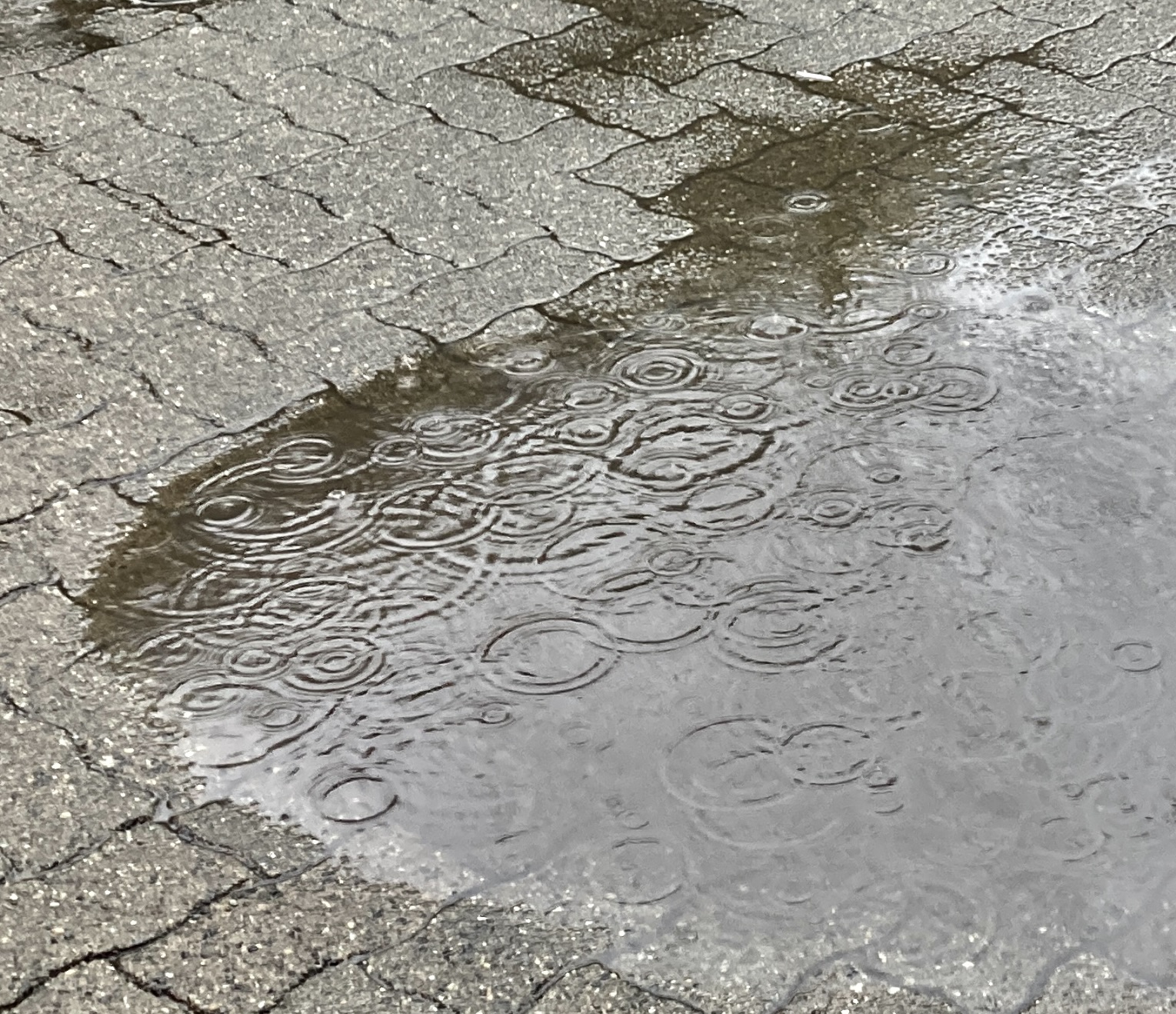
and, hardy as I may personally be, this puddle tells me the obvious:
the drizzle is on its way to downpour.
And I say, Basta.
A wet day in the off-season is a very good time to visit the shops — you can chat and look about in a more leisurely way — but, finally, wet is wet, and it’s getting wetter.
One last discovery, as I walk back south on Anderson, heading for the bus stop.
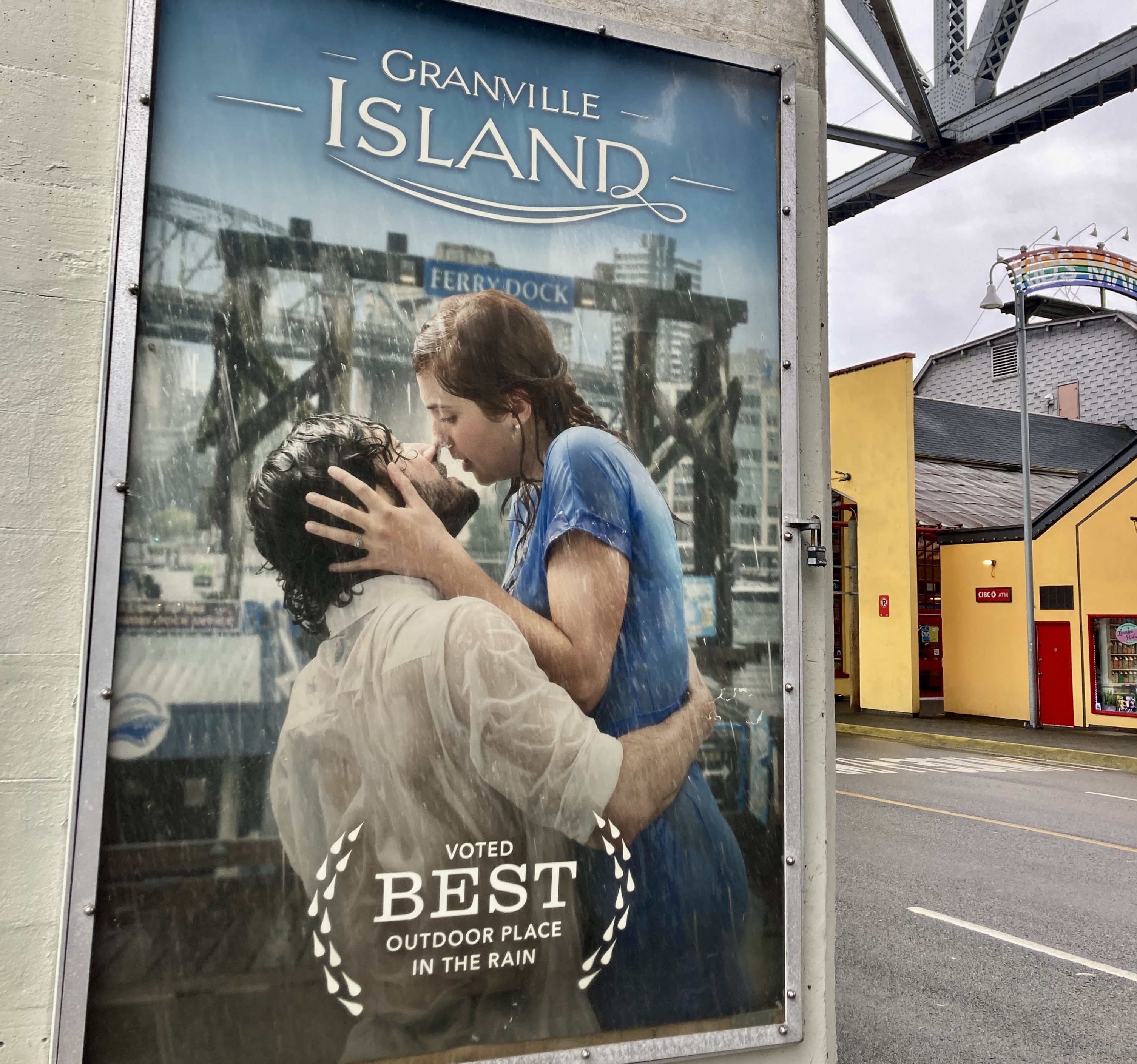
This poster.
It’s the perfect end to this little story, is it not?
(On the bus I admire a child’s unicorn raincoat, complete with twisted horn on the hood. But… no. That would launch a whole other story.)
17 February 2025 – Only a few days since my Frozen post, and the city has unfrozen itself. I’m off to meet friends at the VanDusen Botanical Garden, where we’re hoping for early-spring blossoms.
We arrive with hit lists: turns out we each lingered at the “Today in the Garden” displays on the way in, where volunteers regularly display sprigs of what’s seasonal, and cross-reference their suggestions to map locations.
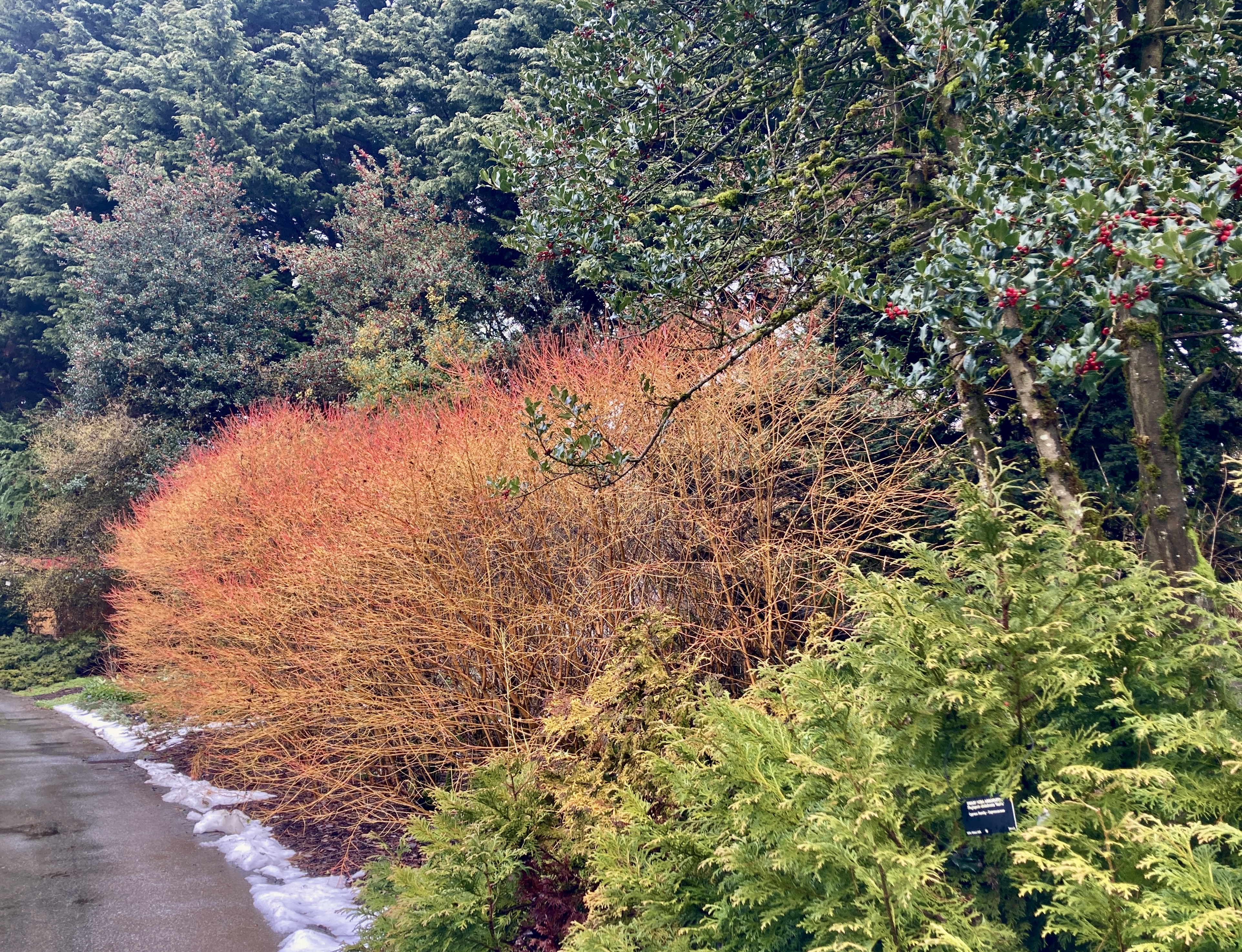
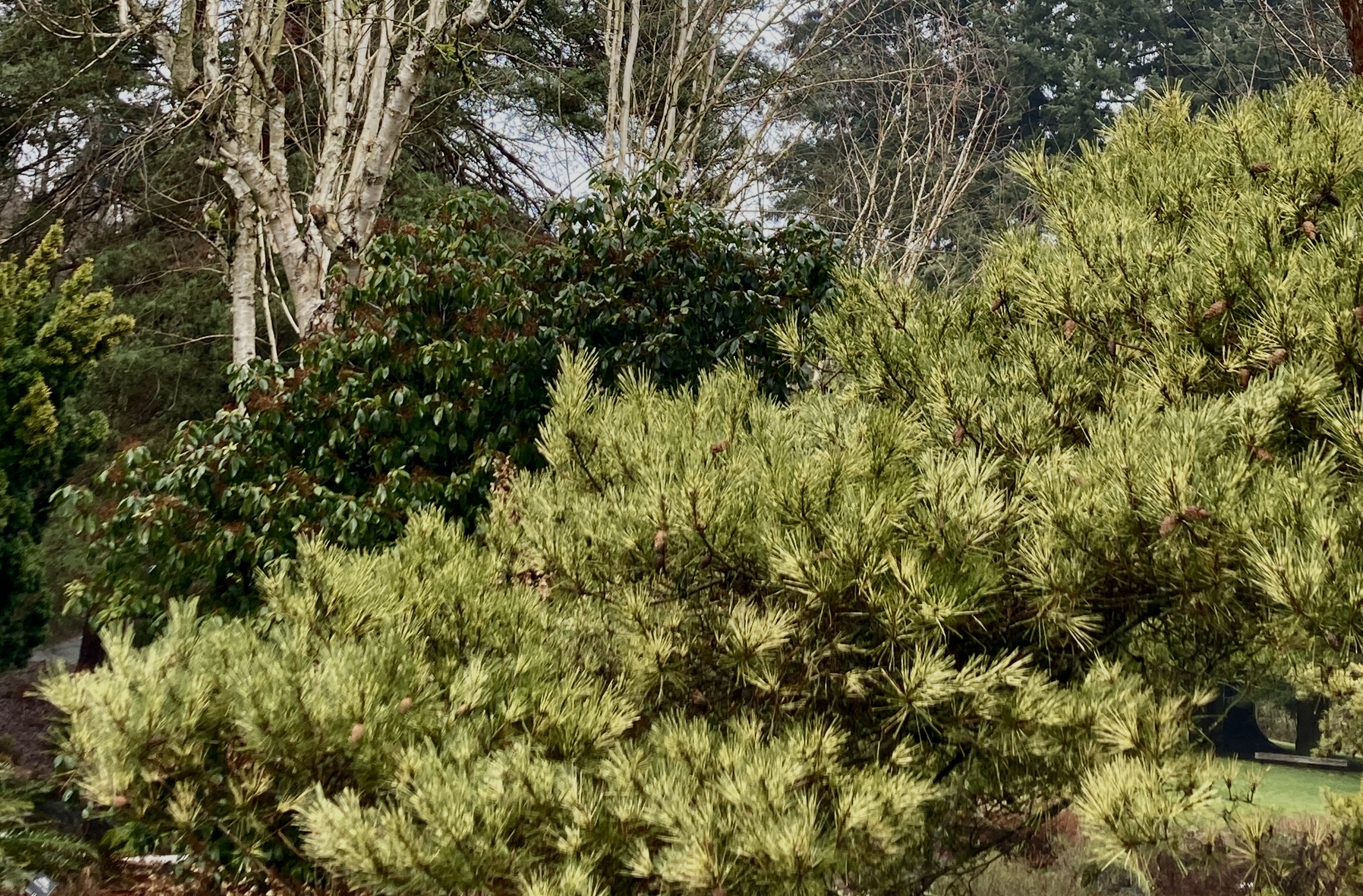
It gives us a tempting and manageable list: Witch Hazel, Dogwood, Winter Aconite, Cornelian Cherry and the wonderfully exotic-sounding Dragon-s Eye Pine — plus, of course, whatever else comes our way.
The day is mild-ish and misty, with a barely perceptible drizzle in the air. Evergreens are dark against the sky as we veer right at Livingstone Lake…
and head for our first targets, along the Garden’s Winter Walk.
And there they are. Witch Hazel…
fiery Dogwood branches…
and a discovery we didn’t know we were going to make, the Ghost Bramble.
Even pruned back for winter, it’s easy to see how it got its name. In behind, another discovery — at least for me — the American Holly (on the left), with bright yellow berries rather than red.
The buds of the Cornelian Cherry are also bright yellow, though still very small and tightly furled.
We leave the Winter Walk, cut cross-country toward Heron Lake with a further target in mind — but are reminded, en route, that you don’t always need new growth for winter interest.
Sometimes, as the American Beech points out, all you have to do is hold on to your old leaves from summer.
Two more en-route bonuses: mist droplets glistening on the Giant Sequoia needles overhead…
and pretty little Winter Aconite buds bursting through leaf litter underfoot.
Plus — because I always notice — winter moss. This lot is on a wonderfully gnarled Something.
I don’t note the tree name; I’m too besotted with the moss to bother.
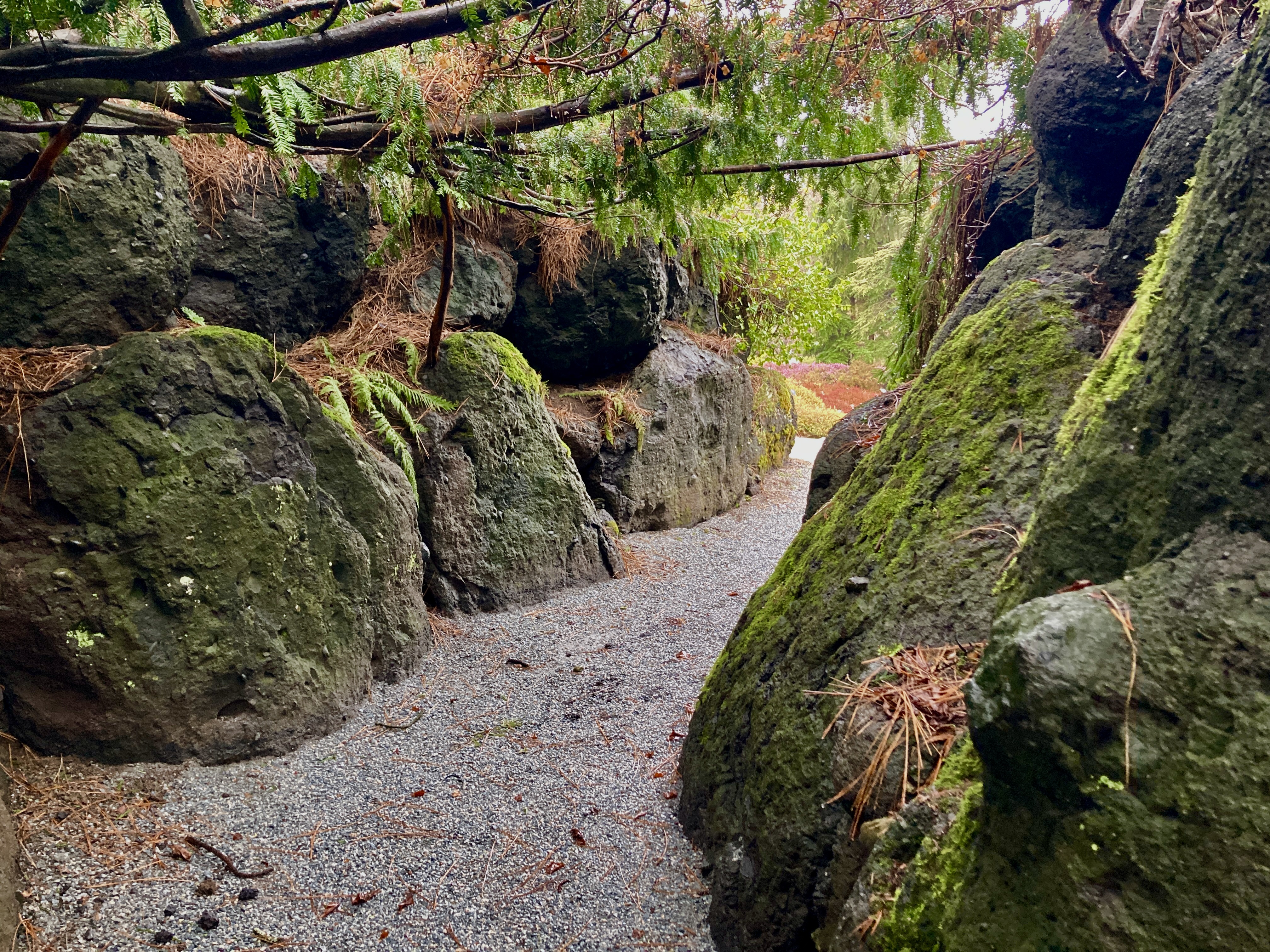
And then we’re across the zigzag footpath over Heron Lake, up the trail, and coming out the far end of the rocky tunnel that leads us to the Heath Garden.
Pretty as this garden-room is — and it is very pretty, all those heaths and heathers in all their jewel tones — it is not why we’re here. We’re hunting something at the periphery, over by the Laburnum Walk.
We want the Dragon’s Eye Pine.
And we find it!
With its bursts of green and white, it holds its own against the the birch, holly and evergreen backdrop.
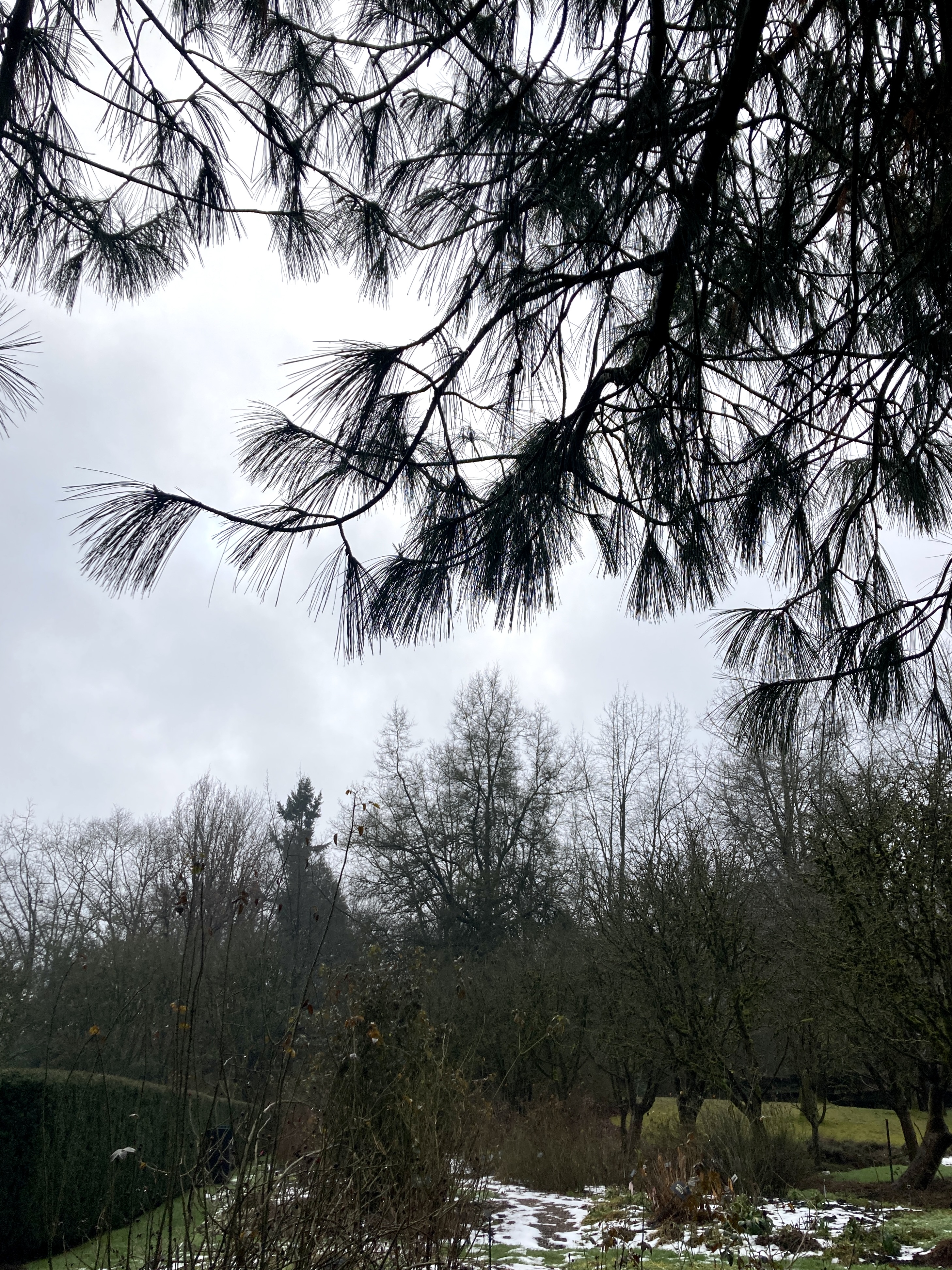
More displays of moody evergreen needles against a moody sky…
and finally we’re circling back along the edge of Livingston Lake, with lunch by now uppermost in mind.
Until, that is, we see what the gardeners have done with the winter-yellowed ornamental grasses that cover the lake-side slope. They could have just let the the weary old blades flop on the ground. Or they could have cut them down and hauled them away.
But, no!
They braided them. Clump by clump, spiral by spiral.
We are properly delighted. We forget all about food as we discover the many varieties of grass-sculpture that inventive weaving can create.
When we do finally head off to lunch, we are in very good humour indeed.
"Traveller, there is no path. Paths are made by walking" -- Antonio Machado (1875-1939)
"The voyage of discovery is not in seeking new landscapes, but in having new eyes" -- Marcel Proust (1871-1922)
"A city is a language, a repository of possibilities, and walking is the act of speaking that language, of selecting from those possibilities" -- Rebecca Solnit, "Wanderlust: A History of Walking"


























 WALKING WOMAN