25 April 2024 – I asked, and someone very dear to me answered. All the way from Oz (aka Australia).
My previous post ended with this 2013 Toronto mural detail…
plus my request for help in identifying the artist, after all this time.
I assumed any answer would come from a Torontonian, but how silly of me! In this digital age, help is not geography-based. You just give that nice Mr. Google a descriptive phrase, and — hey presto — you are on-site with award-winning contemporary artist EGRart.
The link, as sent to me and here repeated for you, is for her Murals page.
Scroll down, scroll down, and there it is …
a larger view of the dandelion mural (including the male head done by collaborator Elicser).
The photo pitches me back a decade-plus in time. I am again walking west on that street, pausing at that alley, enjoying that mural and all its elements.
And then, back here in 2024 Vancouver, I continue to scroll the Murals page. Down-down-down.
Suddenly… whump! I see this.
Oh, I do remember that garage door. Except when I saw and photographed it, it looked like this:
EGR has transported me back to the laneway behind Ossington Ave., just north of Queen St., on a very snowy day in 2014. Urban myth had it — perhaps correctly — local residents decided that, since their laneway garages were going to be graffiti’d anyway, they might as well invite good artists to come in and do it well.
So they did.
And artists like UBER…
and SPUD…
were among those who responded.
The whole laneway became an open-air art gallery.
A very cold art gallery, that particular day, and I soon skedaddled.
Enough 2014!
Here’s a right-now update, thanks to EGR’s News page. This very Saturday, April 27, she will join co-panelists in an Artist Talk at the Centre for Social Innovation on Spadina Ave. Topic: Women in Mural Art – Building Careers.
How pleasing, to dance through time & space and end, not with nostalgia, but with news of forward momentum.
22 April 2024 – But before we dive into Latin taxonomy — not that I knew I was headed there, at the time — before all that, a moment at the corner of Scotia St. & East 7th.
Where I am charmed by Buggingham Palace.
The bee’s knees, you might even call it, though the holes in those colourful pillars are meant to accommodate the entire insect.
The volunteer tending this particular Green Streets corner garden has helpfully labelled all her plantings. I not only admire floppy reddish blossoms on a coarse-leaved shrub, for example, I know I’m admiring a Flowering Red Currant.
Then I look at an adjacent lamp standard, and learn even more.
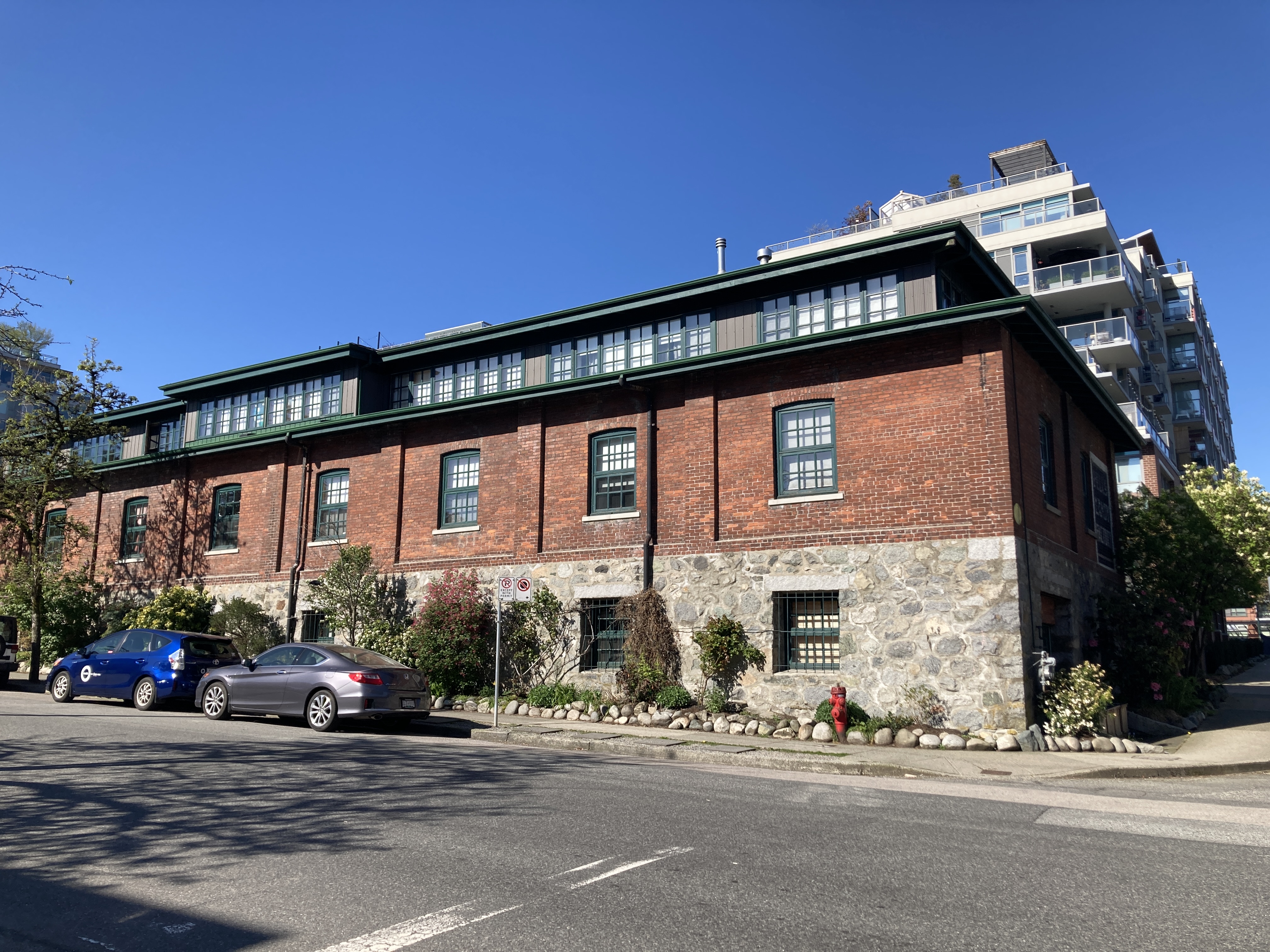
The building on the opposite corner, the one I’ve always thought of as the Candy Factory, started life in 1904 (or thereabouts) as the Brewery Creek Building, one of many brewery operations in the area. It later became Fell’s Candy Factory, then the Purity Dairy, later on a grease works and later still had other grubby-sounding lives until, in 1993…
it was refurbished and converted to these handsome artist live-work spaces.
Pleased with all this new knowledge, I go on my way. “My way” being straight on east to China Creek North Park — no particular objective, just offering myself a not-very-demanding stroll on a very pretty day.
It’s a large, open, multi-purpose park dropped into a bowl — the bowl being what’s left when you drive underground what had been Vancouver’s largest drainage basin, whose creeks all fed into False Creek. (Until you filled in that final bit of False Creek as well.)
There are steep steps down-down-down on my left at the northern edge, but over there to my right, at the south-west corner, there is the start of a lovely ox-bow path …
that winds its friendly, undemanding way from high to low.
I take the path.
Almost at the bottom — down where I can watch young men grunting through crunches on the level grass while toddlers squeal in the playground — I turn and look back uphill. The slope is dotted with solitary bodies, perhaps meditating, more likely texting, but anyway all with knees angled outward to support their admirably straight torsos.
One person is upright, afoot, moving across the terrain. One human, but six legs.
Human plus fluffy white cat on a leash. See the cat?
Now please stop looking at the cat and notice all that yellow.
Lots and lots of yellow. All over the place.
Taraxacum officinale!
The dandelion.
I have to look up the Latin later on. Standing there, I’m sufficiently occupied just thinking about the word “dandelion.” I know it’s from the French “dent-de-lion,” for the serrated lion’s-tooth edge to the leaf. I also know that the word may be French, but it’s not the word the French themselves use, when they’re getting all familiar with T. officinale. They call it “pissenlit.”
Piss-in-the-bed. Apparently — and this I also have to look up later on — because of the diuretic properties of the plant.
(A sidebar on the delights of common names for plants, in different languages. I know Chlorophytum comosum as Spider Plant. I thought this the perfect evocation of its multitude of leggy offshoots, until a Cuban friend told me its nickname in Spanish. “Mala madre,” she said. Well, of course! The plant must be a bad mother — look at all those babies, running away from home.)
Back to T. officinale. Lawn-proud gardeners hate it, the very word “dandelion” an epithet in their mouths.
Ah, but the word is sweet, in other contexts.
In literature: Ray Bradbury’s 1957 novel, Dandelion Wine.
In wine-making: choose your favourite home-brewer as the example. My uncle put up batches every spring and my aunt heartily approved. I never did ask his secret, so I’ll offer this recipe instead. (No idea how good it is, or isn’t — but who could resist a blog called Practical Self Reliance?)
And, finally, dandelions in the visual arts.
Because, whether in flower or gone to seed, they are beautiful.
This 2013 Toronto street artist caught that beauty, the beauty of the plant itself and its ephemerality.
Like that dandelion head, this alley mural will surely be long gone by now. Unfortunately, I can’t tell you the artist’s name. When I took this picture — for my very first Blurb book! — I didn’t bother with attribution. Drat.
Maybe someone among you can right this old wrong? The style is distinctive, and the artist’s work was often seen in Toronto at the time. (Mary C, author of the splendid As I Walk Toronto blog, I’m thinking especially of you! You know the city’s streets, and street art, so well.)
18 April 2024 – A bright, gusty day and, I swear, you can practically see the sun’s rays bounce around in the breeze.
So I play that game, as I walk my Cambie Loop around the east end of False Creek. I watch the bounce of the sun, as it…
ripples across this disused West 1st Ave. workshop…
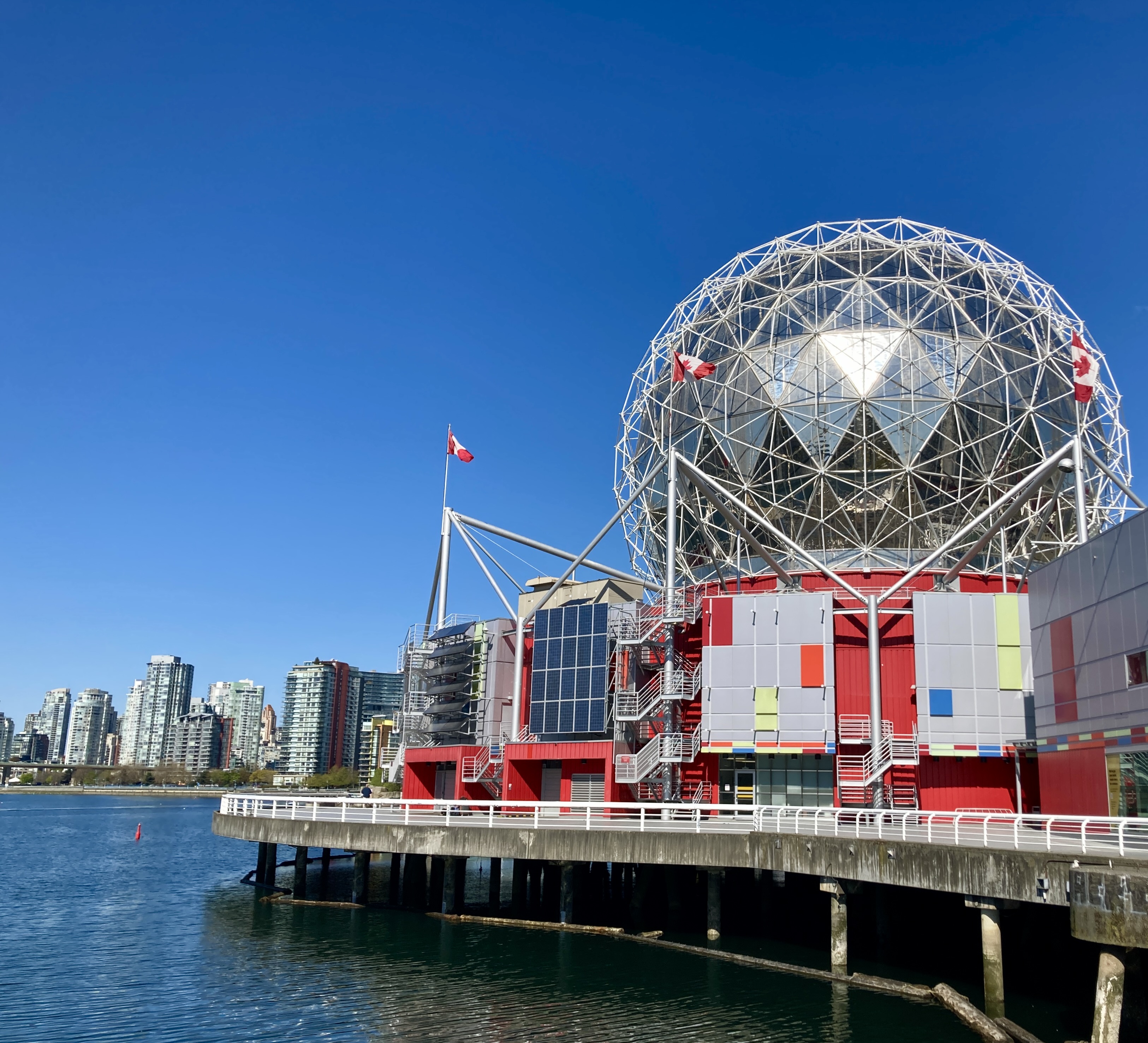
triangulates Science World’s geodesic dome…
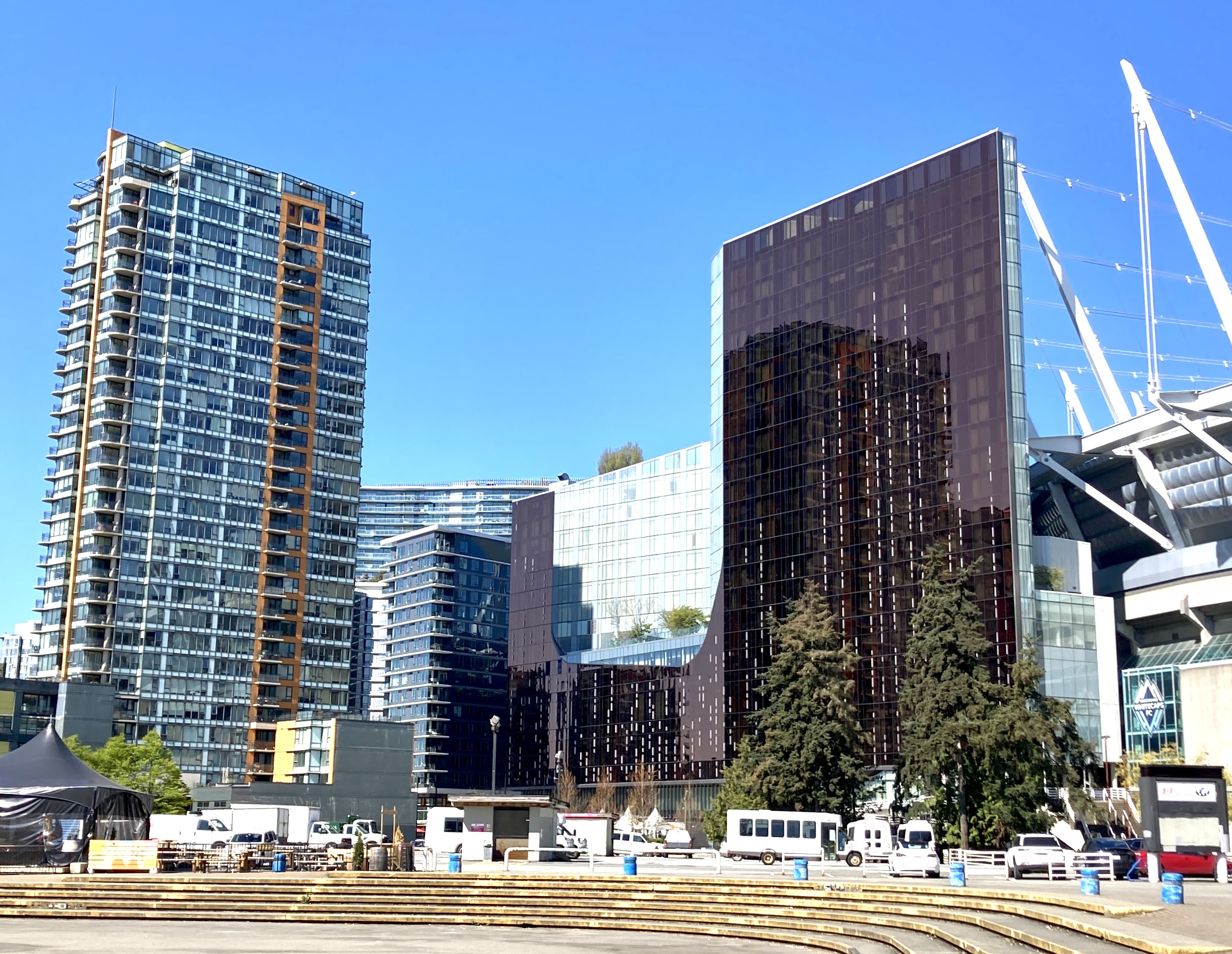
transforms a boring building (L) into a darkly magic reflection (R)…
warms the backs of a newbie dragon boat team, intent on their coach’s mid-stream lecture…
sparkles a V-trail of diverging wakes, ferry eastbound but another dragon boat now veering west toward Cambie Bridge…
rolls across the spring-tidied plots of John McBridge Community Garden, beside the bridge…
and shoots silver into the sky from the fingers atop the Neighbourhood Energy Utility, also beside the bridge (where waste heat from sewers is recycled into heat & hot water for local use).
I drop down from the bridge and nod to the Community Garden on my way by. It’s a nod of fellow-feeling: my next stop is a garden centre.
9 April 2024 – A post title borrowed from a specific sculpture (you’ll see), but broadly applicable to pretty well everything else (as you’ll also see).
First, and more precisely: Eyes on the chain link. Two days ago I’m looping south-east of home, my attention caught by the bold line of graphics visible through chain link fence on East Broadway near Fraser.
Curiosity pulls me around the corner, into the lane, and onto that big rectangle of gravel. Bright graphics all right, but otherwise? One park bench, one dog bowl, no dogs, and one crow, who promptly flies away. That’s it. Yet a neat sign on the gate has the gall to declare this the Broadway & Fraser Dog Garden.
Please! I curl my lip. Later, online, I visit the Dog Garden website, discover a group called Community Garden Builders “transform vacant properties into temporary dog parks” … and uncurl my lip. I invite you to do the same.
Tail end (!!! unintended pun, but I’m gonna leave it) of that walk, I’m passing the mesh fence that keeps Guelph Park tennis balls inside the City courts, where they belong. A player has just stooped to retrieve one, but that’s not what I notice.
See? Our local yarn bomber has branched out. Not just crochet hearts…
but tassel hearts as well.
And now, my friends, the magic of the Historical Present Tense swoops us past yesterday’s rain into today’s bright sunshine. More streets to be walked. More places for my feet to lead my eyes.
Starting in a near-by alley at East 5th, where a whole passel of City workers are clustered around that venerable H-frame hydro pole.
I am relieved to learn that (A) while it is terminally non-functioning, (B) it will be replaced by another H-frame, not by some sleek 21st-c. interloper.
I’m still gleeful with that bit of news as I turn down another alley en route False Creek, and try for a more interesting way to look at Alex Stewart’s 2023 VMF mural, Vibrance Overgrown.
It dominates the alley side of a snazzy new eco-conscious build on East 4th and, viewed straight on… ummm…. I find it boring. Well-executed and bright, but no better than decorative.
Then I stop being cranky, lean into the wall, and look straight up.
Well, that’s more fun, and I resolve to spend more time looking for odd angles.
Next opportunity arises quickly in yet another alley — more properly, in the developer-groomed pathway between condo complexes close to the south-east end of False Creek. We’re in the area’s old industrial/railway footprint, so visual/verbal references abound. For example, in the street name just before me: Pullman Porter Street.
Right here, next to the water feature signposted as private property, I once again enjoy Eyes on the Street. The plaque tells me that the two forms in this 2018 installation by Marie Khouri & Charlotte Wall “mirror themselves & their surroundings,” and inspire us to think of our neighbours, ourselves and our surroundings, and to “consider the beauty of their interconnectedness.”
I go close. The form before me does mirror its surroundings…
and I find that I do then spend a moment considering the interconnectedness of all things.
False Creek at last, where I hook around to the north side, and head west. On past my usual turning point at the Cambie Bridge. Water on my left and, up above me along Marinaside Crescent to my right, one of the three shelter + chairs installations that comprise Lookout.
Created by Christos Dikeakos & Noel Best in 1999, the works feature carved & frosted words to remind us of the Creek’s heritage. I’m not often here, but when I am, I always pause long enough to read some of the words.
Yet farther west, foot of Davie Street, with boats anchored in Quayside Marina on my left and, at water’s edge, the six bronze I-beams of Street Light, by Alex Tregebov & Noel Best. According to the City’s online public art brochure for Yaletown-False Creek, the perforated panels atop these pillars align historic events with actual dates in fancy visual ways. Alas, I’ve never been here at the right moment to see any of that wizardry.
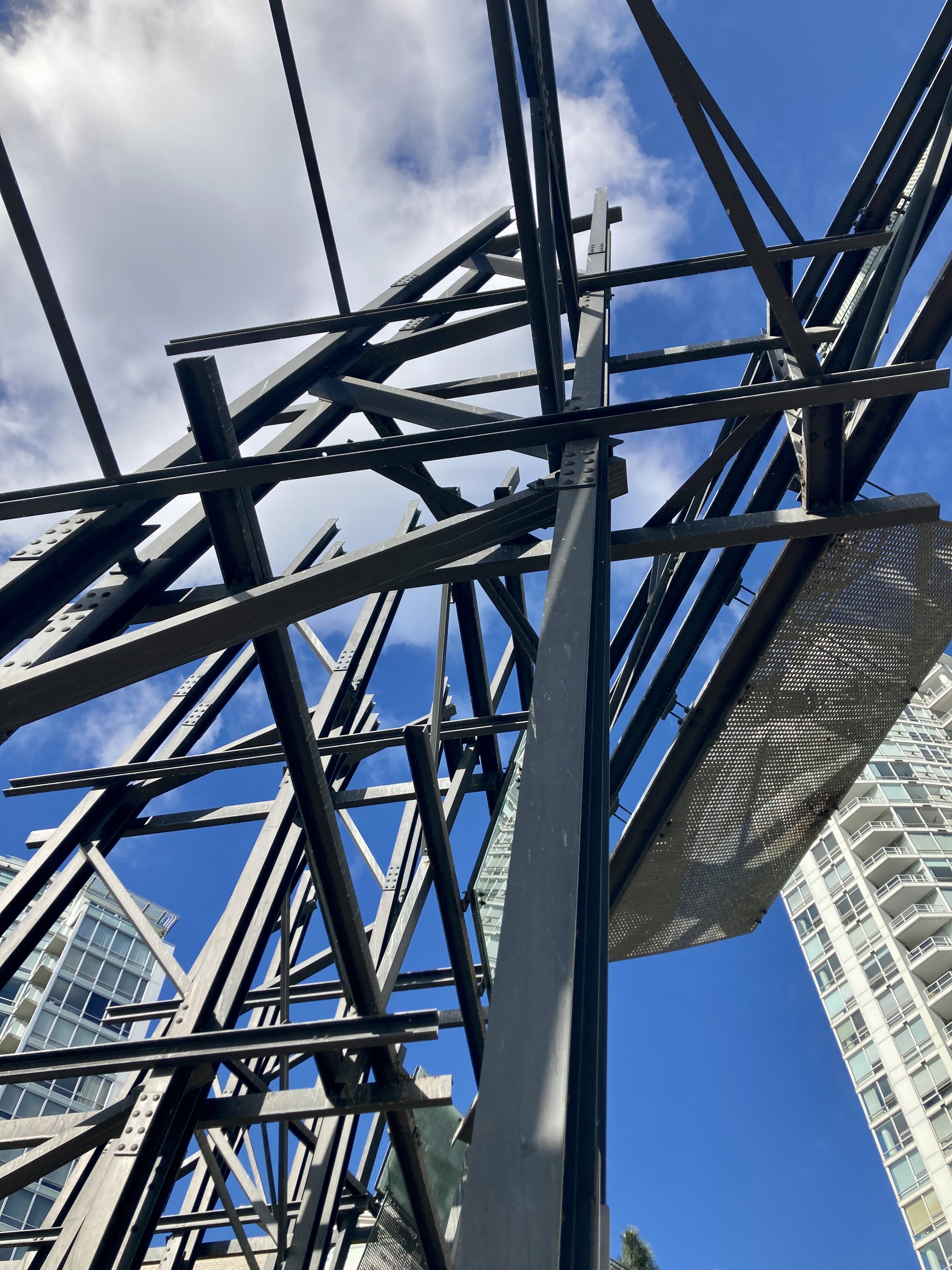
So instead, and as usual, I simply tilt my head up to enjoy some of the superstructure…
tilt my head down to read a few words on the plinth about False Creek Shacks in 1934, and…
level my head to look out across this bit of False Creek, on this very day in 2024.
Focus your eyes a bit above the railing near the cobblestones, and you’ll spot the Canada Goose enjoying the moment right along with me.
By the time i’m passing David Lam Park, my avian companion is a cormorant, not a goose.
There he is, posing atop Buster Simpson’s 1998 work, Brush With Illumination.
I have a very-much-favourite art installation in this park and — with apologies to Simpson (and the cormorant) — Brush isn’t it.
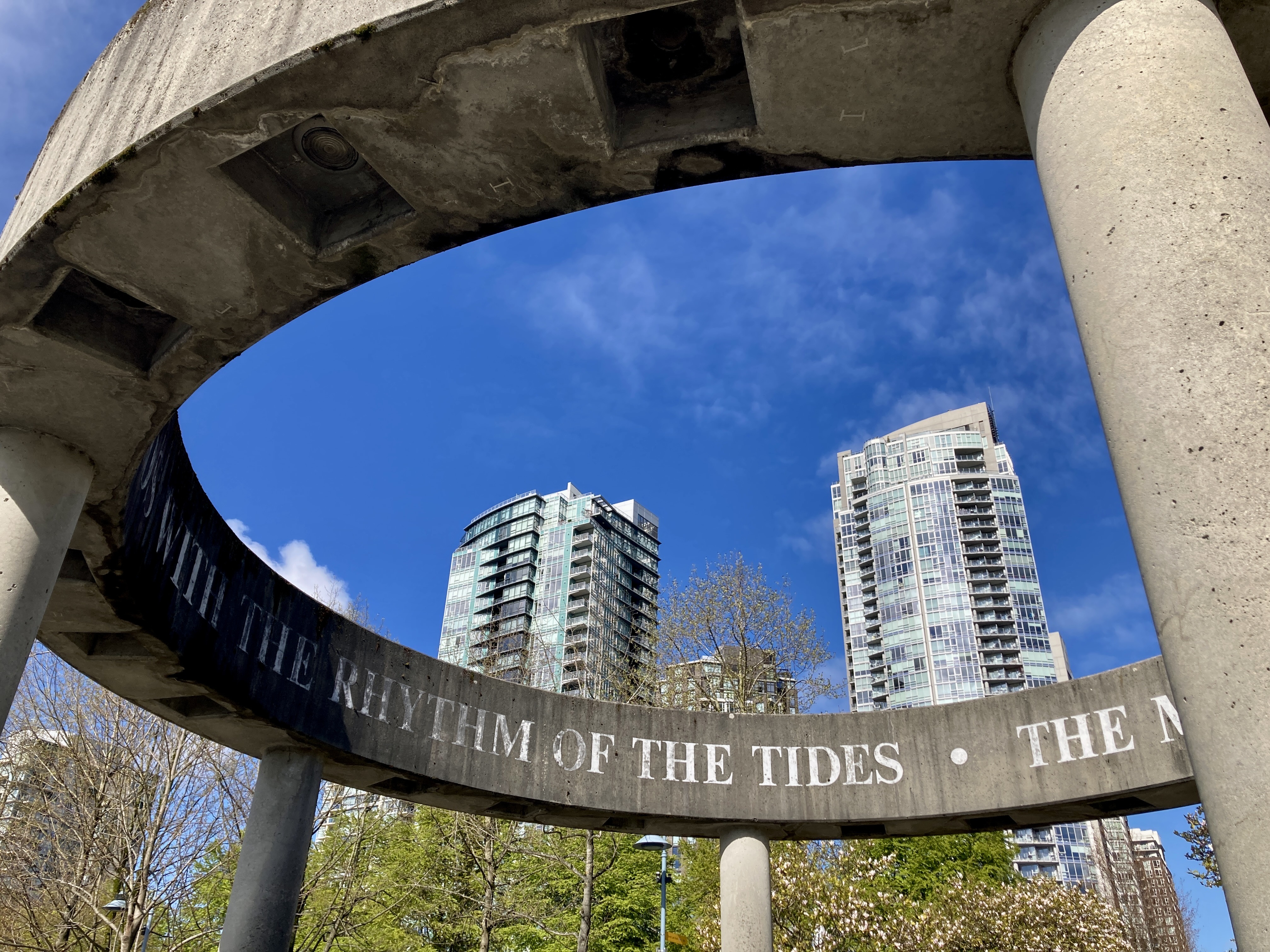
This is it.
Marking High Tide, like its companion pavillion Waiting for Low Tide, is the 1996 creation of sculptor and retired landscape architect Don Vaughan. The latter work is a contemplative circle of large stones in the Creek bed; this one honours the tides with an overhead 360° tribute of words: “As the moon circles the earth the oceans respond with the rhythm of the tides.”
Finally, I leave the water and take myself up to Pacific Blvd where, all along the block stretching east from Homer Street, my eyes are literally on the street.
Well no, make that: literally on the sidewalk.
Which, in this block, is dotted with Gwen Boyle’s 1994 selection of words to reflect the area’s long history.
Once, just once, she offers more than a word or two.
The exception is a longer excerpt from the poem I first noted in my 28 March post “The Beating Sea.”
“… the manstruck forest ..”
I stand there, stunned by the power of his imagery.
So thank you yet again, Earle Birney. You live with us still, in your words and, through the artists you inspire, on our streets.
4 April 2024 – How delightful, when an abstract noun — flung around so casually as to be meaningless — is given specific physical presence.
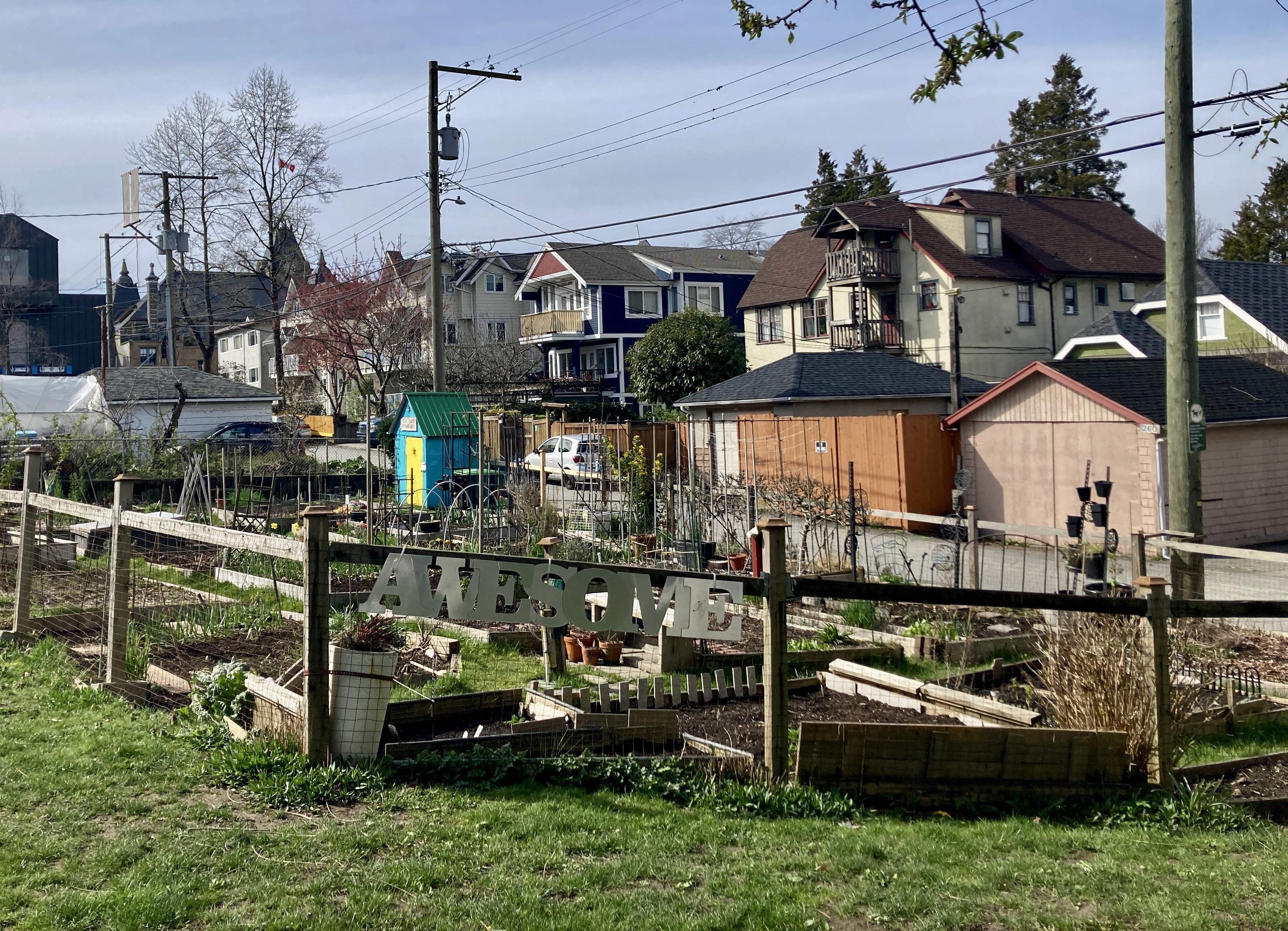
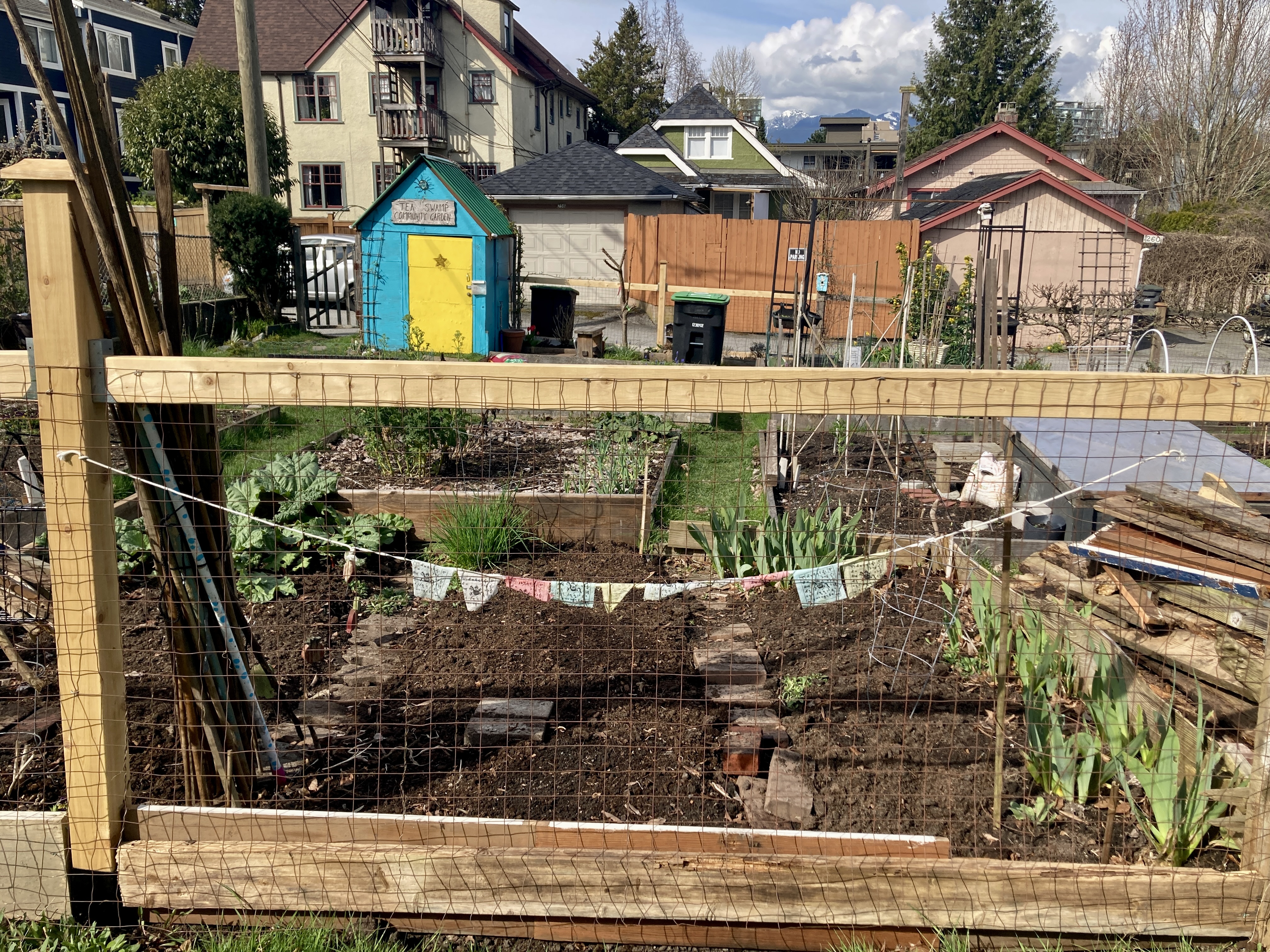
“Awesome,” it turns out, inhabits precisely 0.09 Ha of space at East 15th Av & Sophia Street, in Vancouver’s Mount Pleasant neighbourhood.
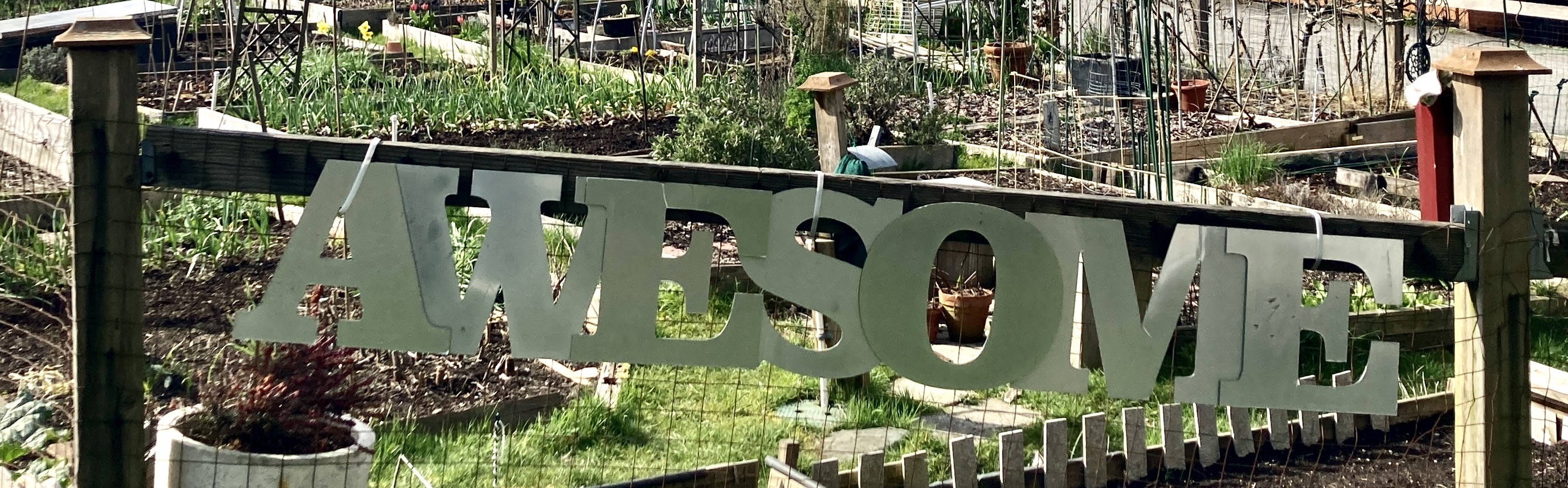
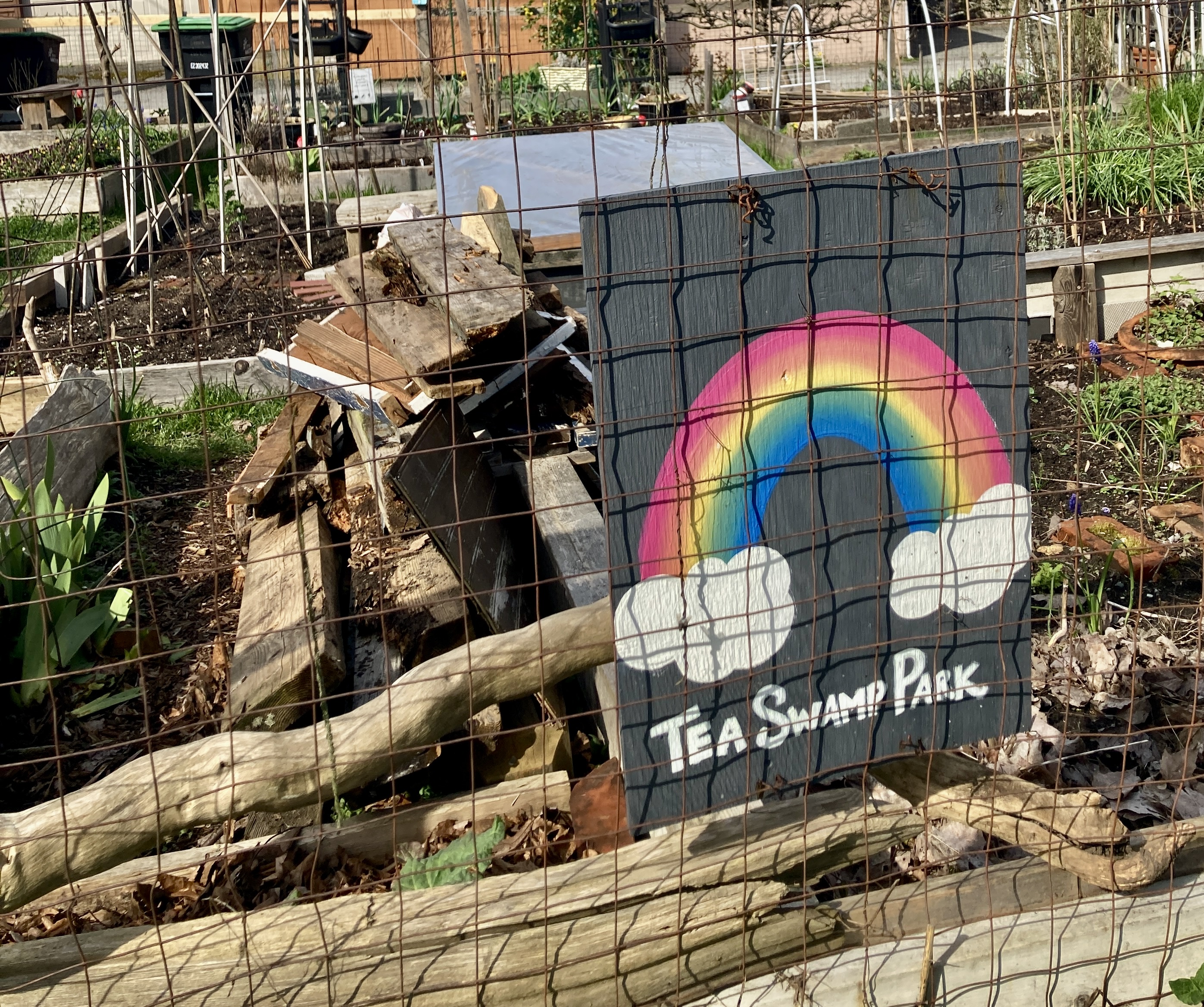
See? Spelled out on the fence that separates the 20 plots of Tea Swamp Community Garden from Tea Swamp Park itself.
And if you think I’m making up that name… I’m not.
And if you think some of the gardeners made up that name… they didn’t.
It’s official.
It commemorates the Labrador Tea plants that used to thrive in the bogs that once covered this area. It also helps explain buckled road surfaces and wonky house angles that are still a feature of the local urbanscape.
Wonky, and tiny, and pretty basic in amenities, but much-loved.
Winter-battered Buddhist prayer flags adorn the fence…
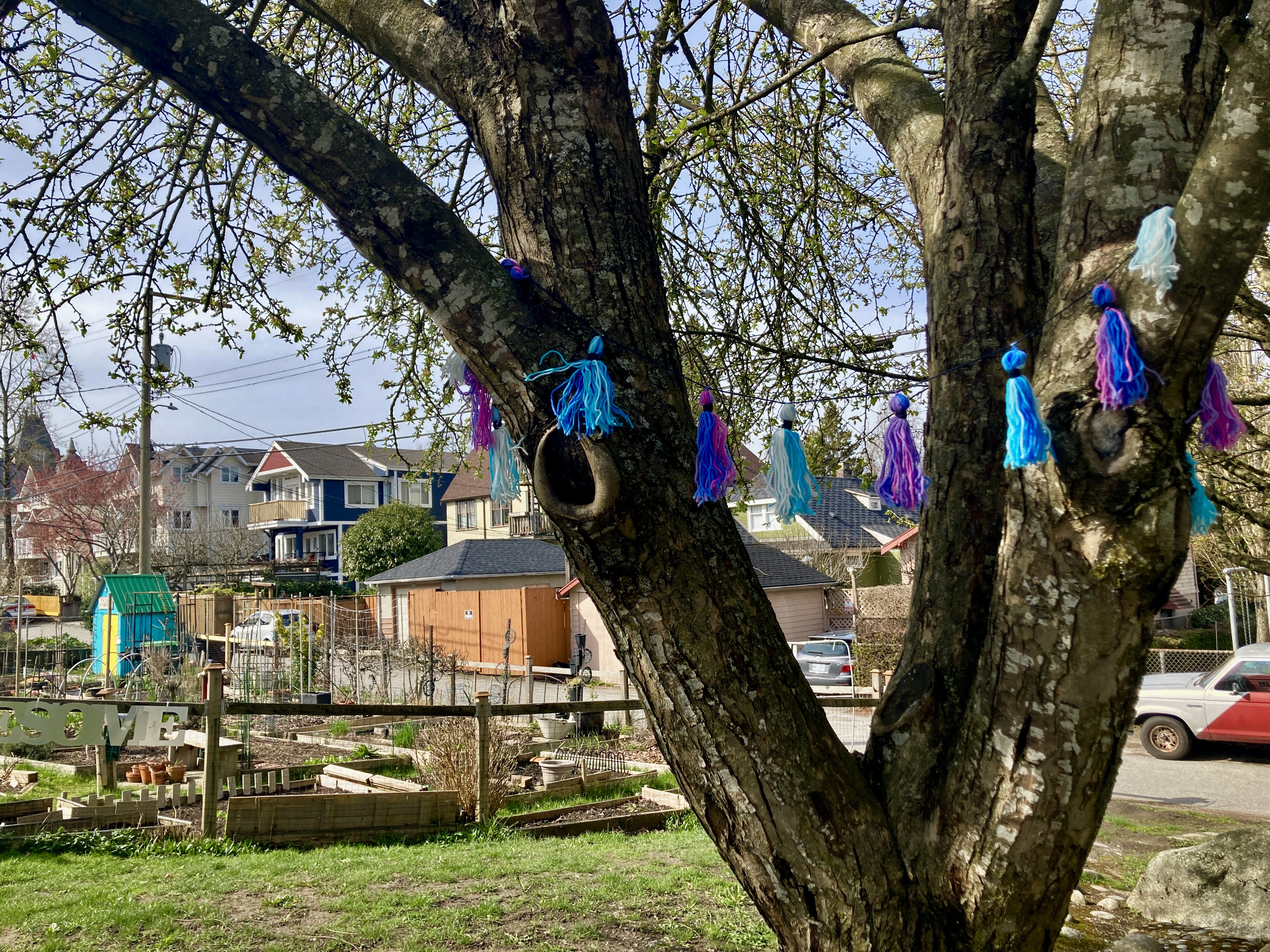
bright new tassels encircle a tree…
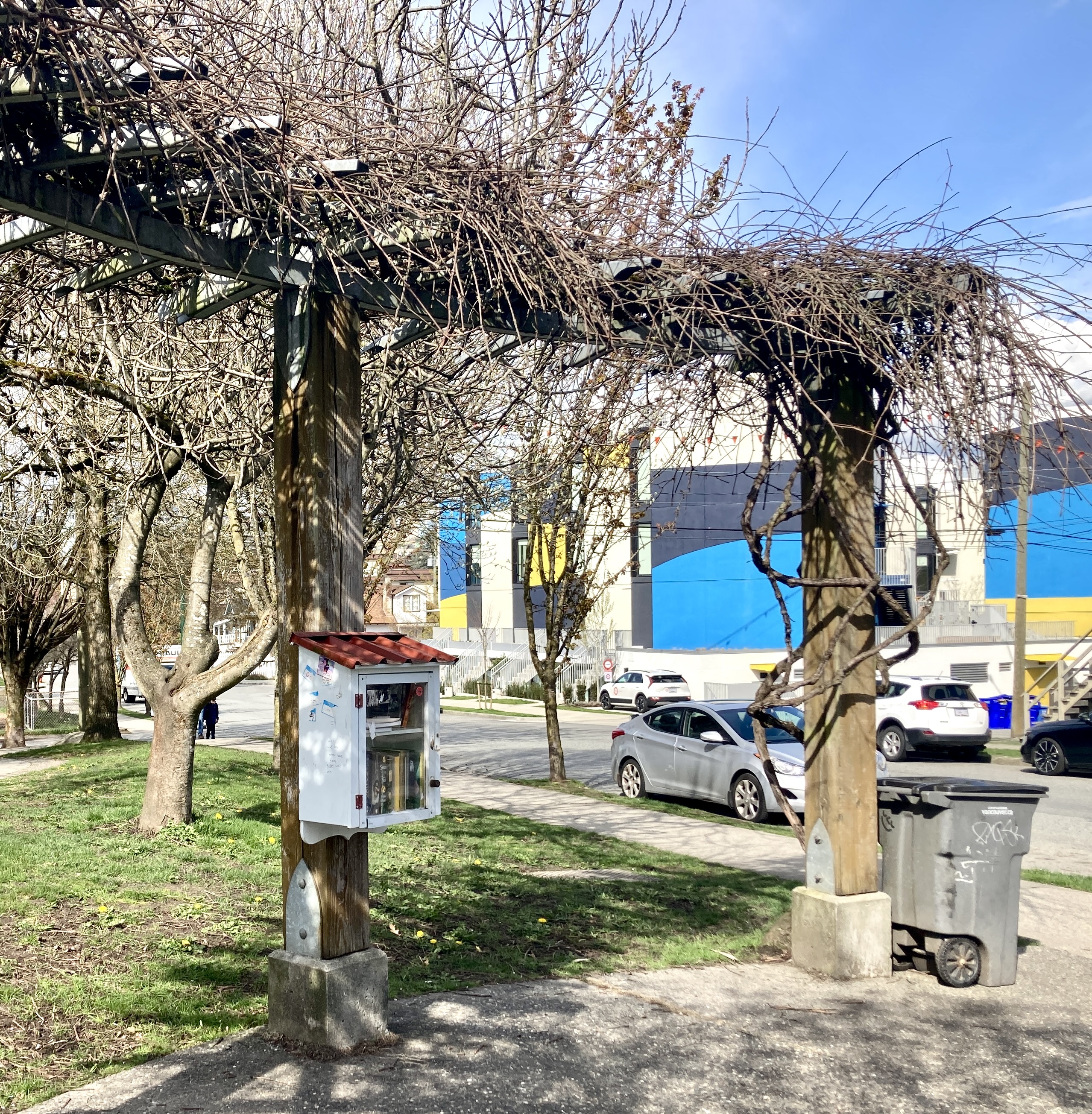
the street-corner arbour hasn’t yet leafed out, but its Little Free Library kiosk is full of books…
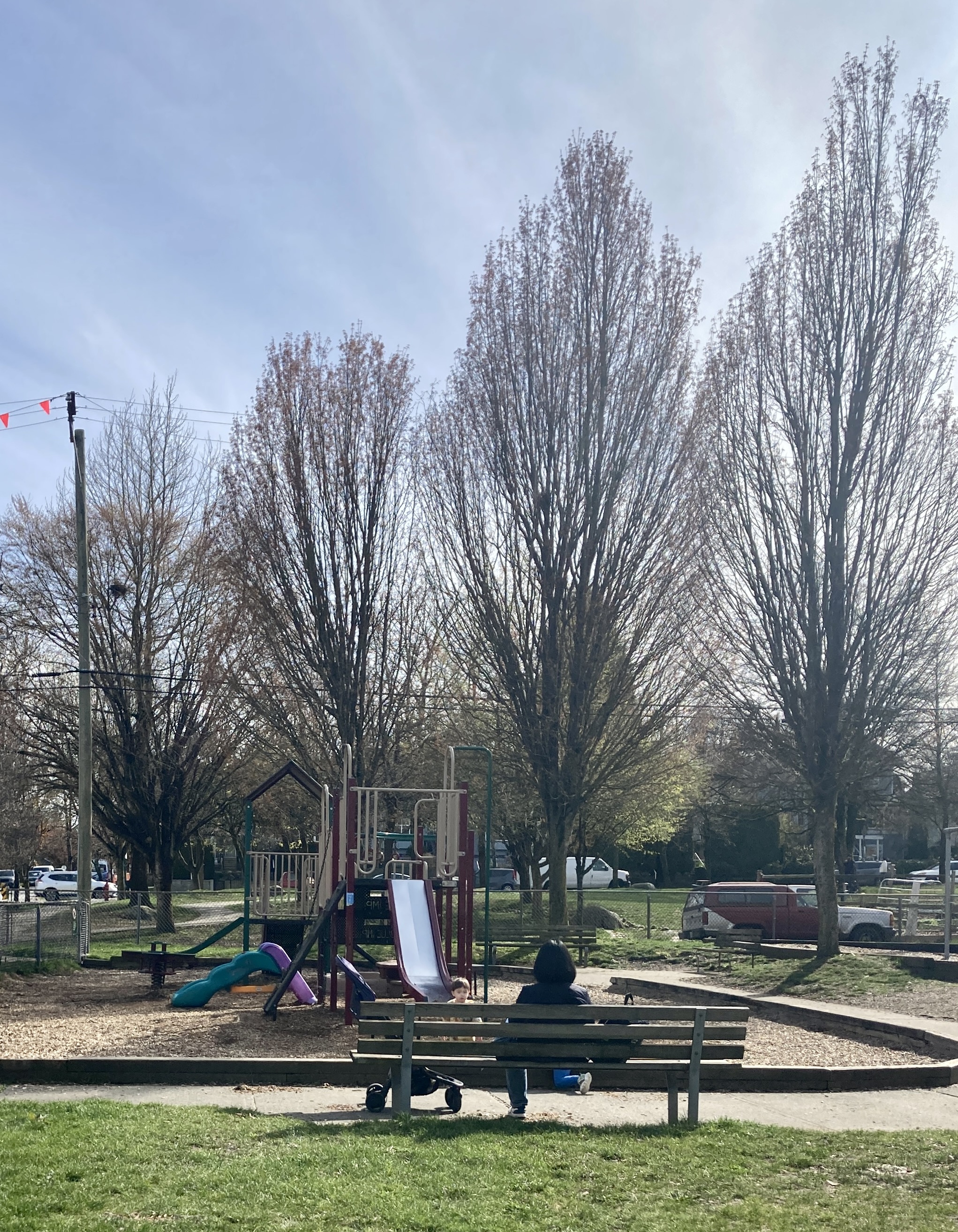
and a mum relaxes on a bench while her toddler whoops around the admittedly modest playground.
More community action next to the park, where the traffic circle is being prepped for summer by its volunteer gardener (under the City’s Green Streets Program).
15 March 2024 – It all begins at Kingsway & East Broadway, waiting for the lights to change. I look up.
Guide wires…
glide the # 8 trolley bus around the corner below, and adorn the sky above while they’re at it.
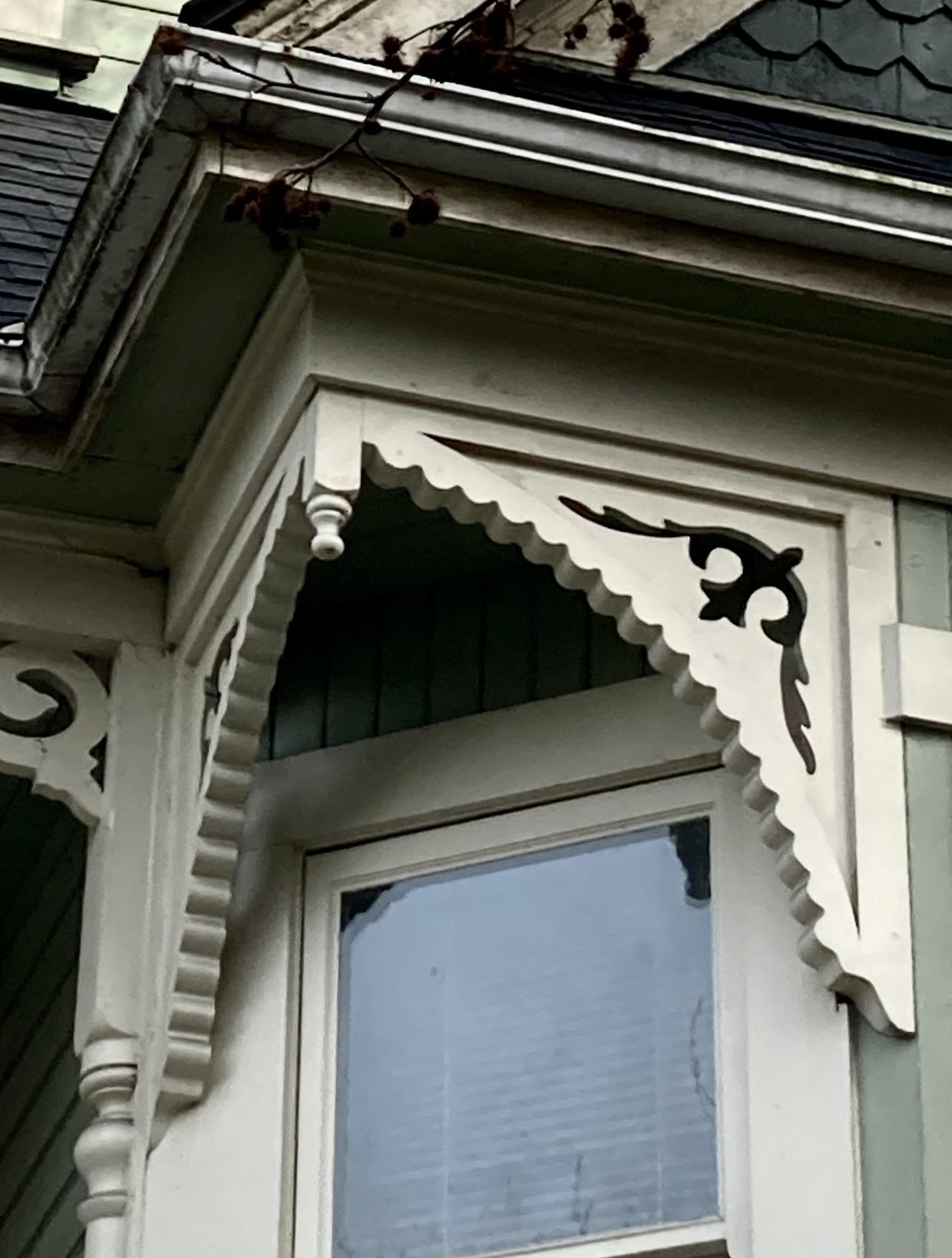
Next day, one neighbourhood to the west, gingerbread…
protects this vintage bay window, and adorns it as well.
Across the street in Major Matthews Park, rampant ferns…
will surely over time help destroy this pergola roof, but meanwhile adorn it very prettily.
Finally, this morning, an intentional rather than accidental green roof — the one atop the Visitor Centre at the VanDusen Botanical Garden. This solar chimney…
serves the planet, adorns the ceiling that it also pierces — and helps illustrate why the Centre won the 2014 World Architecture Most Sustainable Building Award.
8 March 2024 – As I walk back east along False Creek, I do not have a single Life Philosophy thought in my mind. Not a single abstract noun. I am just picking my feet up and putting them down again, enjoying the sunshine.
Then I see this neon glow in the water, just off a curve of seawall between Stamp’s Landing Dock and Spyglass Place Dock farther east.
Still no Important Thoughts in mind, just curiosity.
It’s not until I’m up close, and can identify the shape as a boat, that I think about vulnerability. There that little boat used to be, afloat and riding the currents — and there it now is, submerged and inert.
Vulnerability, consequences, responses. The dynamic is now lodged in my mind, and I see it all over the place as I walk on home.
In environmental and political vulnerabilities, for example, here at Spyglass Place Dock, where blue bands circle Cambie Bridge pilings and a quiet black tribute pillar stands at water’s edge.
The top blue tier in this 2012 art installation, A False Creek, is 5 metres above current sea levels — which is mid-way between the 4 to 6 metre rise that, it is predicted, could be triggered by climate change. The pillar honours Husain Rahim (1865-1937). He was an activist at the time of the 1914 SS Komagata Maru incident that barred a boatload of South Asian passengers from disembarking, and one of the first South Asians to challenge the disenfranchisement then taking place. While the ferry dock is still Spyglass Place, I learn that this space is now called Husain Rahim Plaza.
I’m about to walk on — and discover that I can’t.
Due to “the deteriorating condition of the structure supporting the seawall,” the path has been closed between the Cambie Bridge, right here, and Hinge Park to the east. Detour along West 1st, we are told, while authorities address this weakness.
Heading for 1st Avenue, I walk under the bridge, where I stop long enough to read this extraordinary beer-themed love letter chalked onto one of the pillars.
The message is fresh and wonderful, but street art by definition is ephemeral. Vulnerable. Just look above the top line for proof — the “Simply Jay” message has been effaced.
Eastward on West 1st Avenue now, and more vulnerability call-and-response.
The building in the foreground is one of the City’s Temporary Modular Housing facilities, created in response to what the City itself calls a crisis situation: “over 2,000 people are experiencing homelessness.” The rusty building farther along is an old, disused workshop from the area’s industrial past. It will surely fall down, or be knocked down, sometime soon.
Lying between those two buildings, and in behind the housing as well: an urban farm.
Sole Food Street Farms, founded in 2009, is now one of North America’s largest urban farms. This location trains & employs people from the Vancouver Downtown East Side, who grow the produce that is then sold & given away.
At Hinge Park, I can drop back to the waterfront. The railway tracks and buffers here at the south edge honour the past; the park itself is part of the pre-2010 Winter Olympics response to what had become a derelict and polluted wasteland.
Even my classy latte in an Olympic Village Square café reminds me of vulnerability! I have left it to sit just a little too long, and, look, the frothy design is beginning to deflate. (The taste, I promise you, is unaffected.)
Back outside, I admire TheBirds (Myfanwy MacLeod, 2010), gleaming in the sunshine.
The gleam is thanks to their fairly recent repatination; the repatination was the response to the vulnerability of their surface to all those climbing feet. Signage now politely reminds people that these sculptures are art, not a climbing wall, and asks us to keep our feet on the ground.
Heading south on Ontario Street, I detour half a block west into an alley, for a closer look at a face.
This face.
L’il Top is the signature, and if this bit of street art is vulnerable to time and the elements, so are those H-frame hydro poles. I, and countless Vancouver artists, love the look of them, but they are seriously outmoded, and systematically being replaced.
Back onto Ontario, farther south to West 6th, and my vulnerability theme now presents itself in a real-estate trio. The first thing I notice is that wavy reflection in the windows of the blocky new-build on the corner.
Then I play with the story, the trio of stories, the development dynamic of this bit of Mount Pleasant neighbourhood. Behind the new-build, a century-plus brick veteran, its status secure; in these windows, the reflection of the scruffy building across the street, wrapped in chain-link fencing, its status unclear.
Once the Teachers Centre for the Vancouver School Board (1972-1990s), it sits within the footprint of the T3 Mount Pleasant site now under construction — “T3” as in timber/transit/technology, with a planned 190,000 square feet of mass timber construction to attract environmentally responsible companies and workers. If the developer’s web page is any guide, at least part of this old building will be restored and repurposed as a heritage element in the mix.
Response to environmental threat is the theme of this part of Mount Pleasant. Along with the T3 building, it is also home to the emerging Main Alley Campus, which promises to provide “Canada’s first completely net-zero work environment for the creative economy.”
These two projects won’t save the planet, but it is heartening to see major development corporations put their weight behind new, more environmentally responsible, approaches.
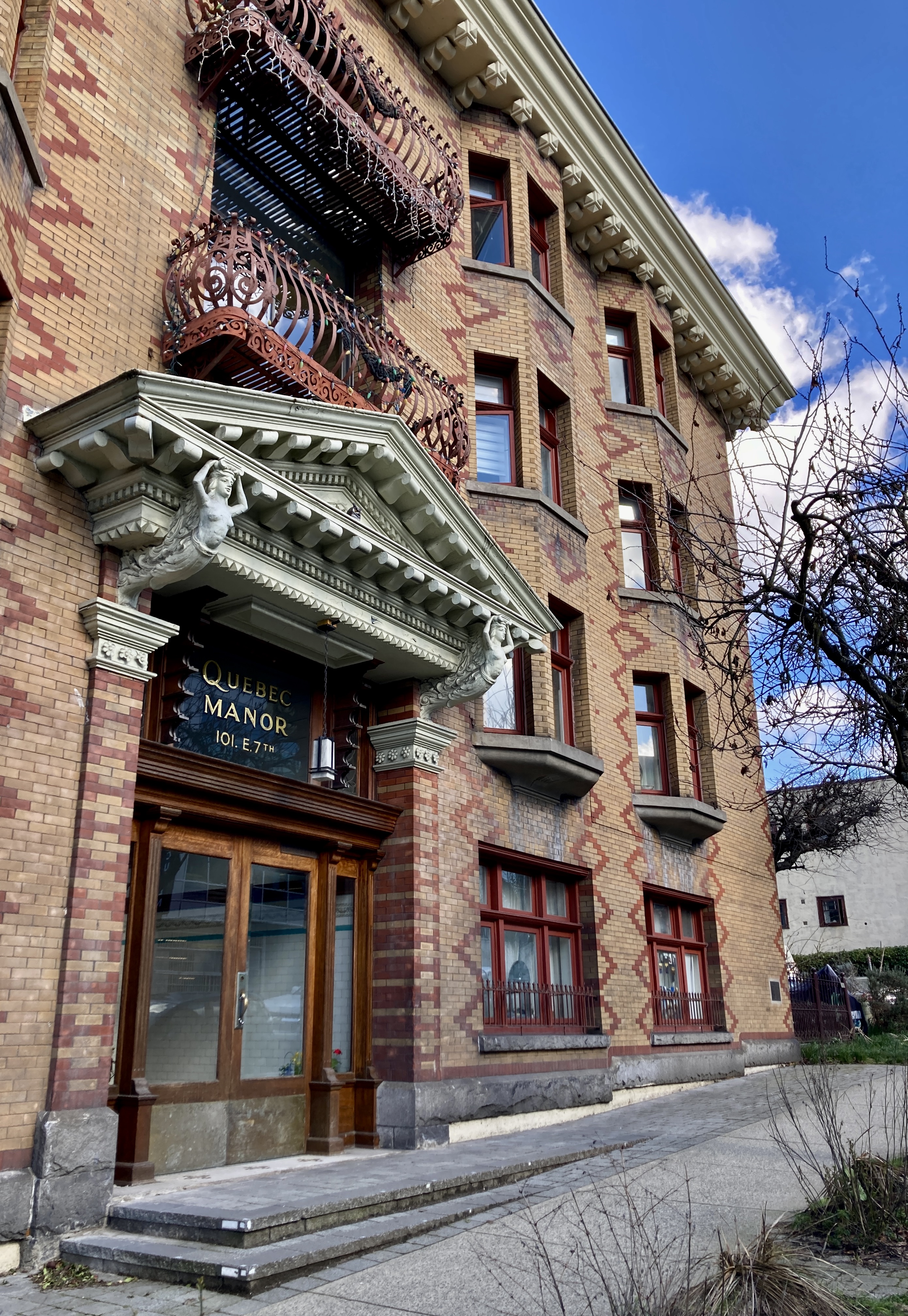
I swing onto East 7th, and salute a building that has long known how to respond to changing threats — and here it still is, 112 years later.
Behold Quebec Manor, in all its diamond-patterned, bi-coloured brick glory. (Complete with metal balconies and nude maidens to welcome you home…) Built in 1912 as a luxury apartment hotel, probably for train passengers at the near-by terminals, it became rental units in the 1920s, and in the 1980s achieved new, secure status when its tenants bought the building and turned it into a housing co-op.
So that’s my walk, and how discouraging it could have been, with such a theme. But it wasn’t. So many vulnerabilities, yes — and so many responses, as well.
"Traveller, there is no path. Paths are made by walking" -- Antonio Machado (1875-1939)
"The voyage of discovery is not in seeking new landscapes, but in having new eyes" -- Marcel Proust (1871-1922)
"A city is a language, a repository of possibilities, and walking is the act of speaking that language, of selecting from those possibilities" -- Rebecca Solnit, "Wanderlust: A History of Walking"



















 WALKING WOMAN