24 February 2026 – Rays of sunshine flashing all over the place, and colours bouncing around with them.
Well, no, not literally. But it looks, it feels, like that.
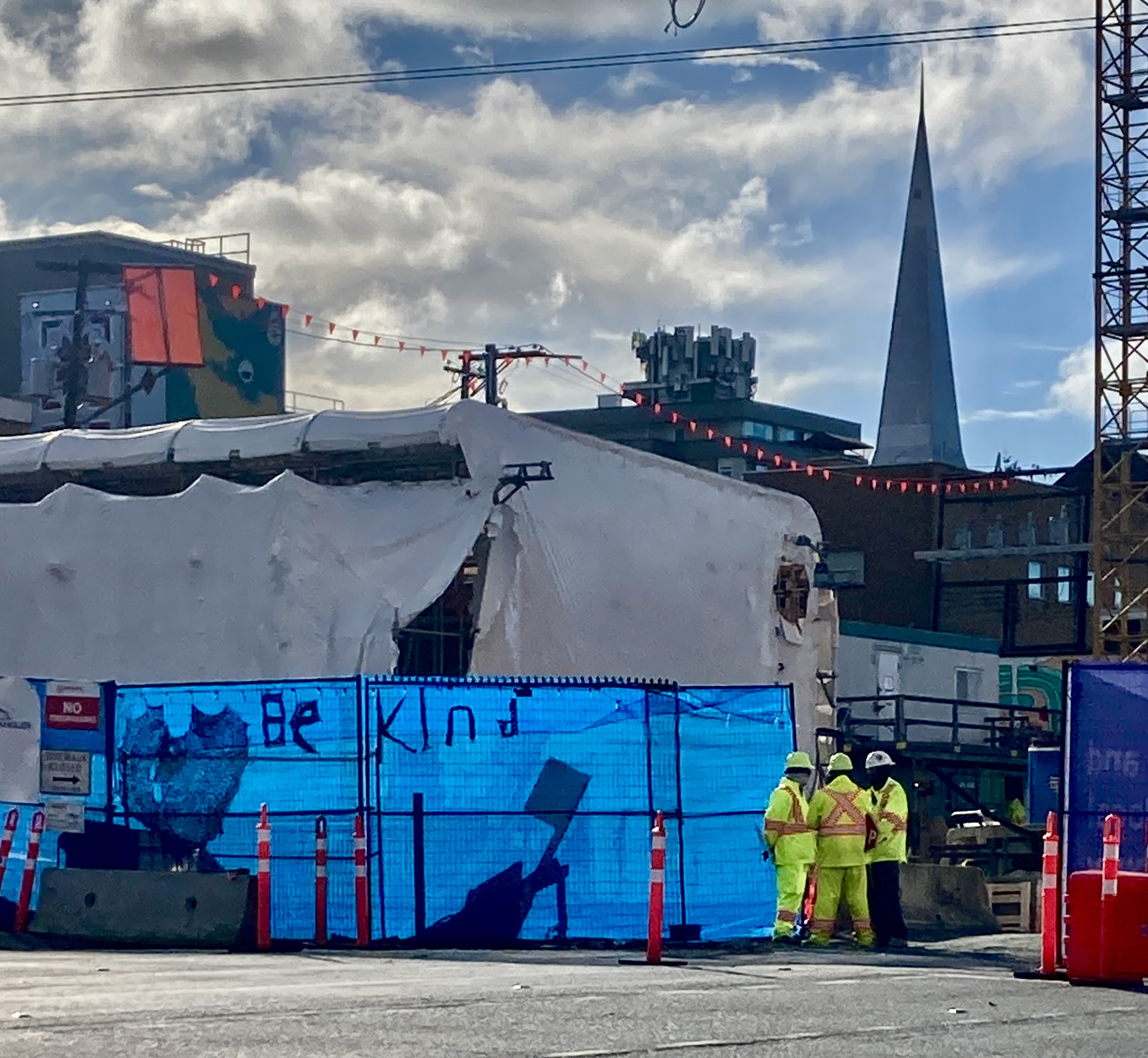
I stand at the intersection of E. Broadway & Main, deliberately missing two green lights, transfixed by the transformation of the Yarn Bomber’s “Be Kind” slogan and companion heart.
After years of exposure, the colours have faded and the wool is bedraggled. Construction screening now hides all that, and today’s sunshine throws us the words and image in dramatic, high-contrast relief.
Moments later I turn into the alley that will lead me to the Salvation Army drop-off centre, my eye primed for the bounce of light, colour and shadow.
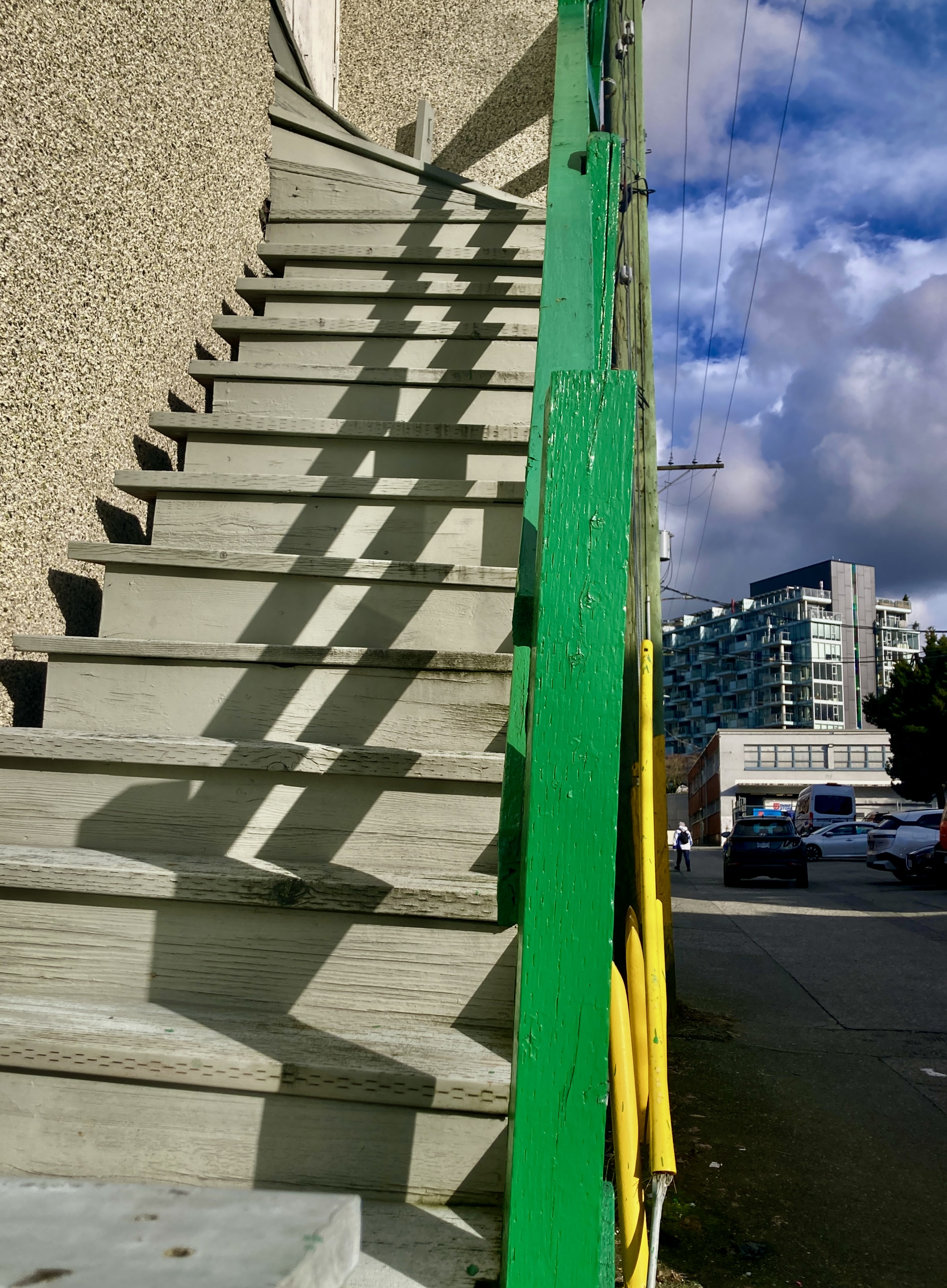
Barely into the alley, and a perfectly ordinary wooden staircase delivers all that.
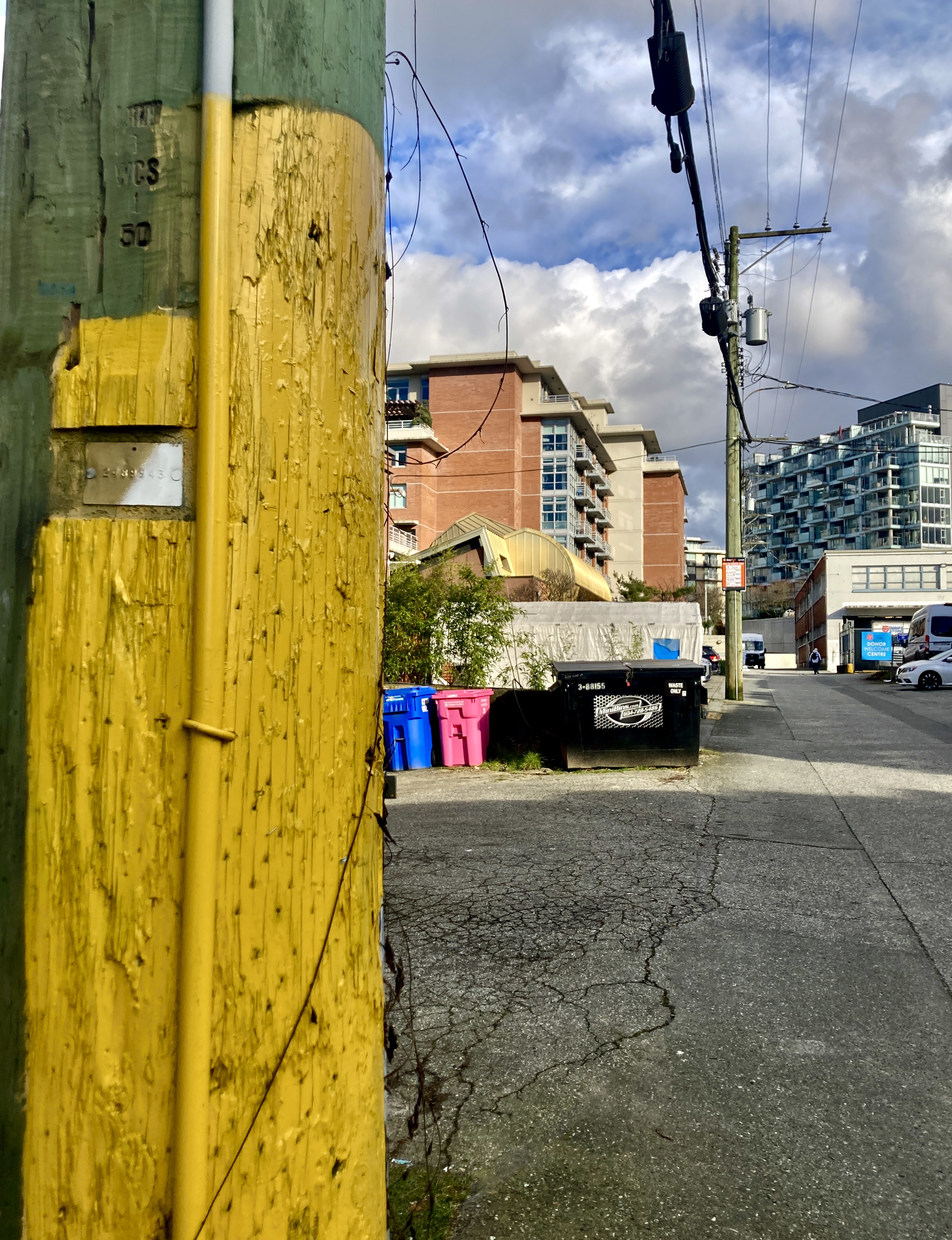
A few more steps, and look: green/yellow wooden pole, blue/pink/black garbage bins beyond, and down there in the distance, the turquoise blunt end of a Sally Ann truck. (I just have to stand in this ramshackle alley and look around. Colour smacks me in the eye.)
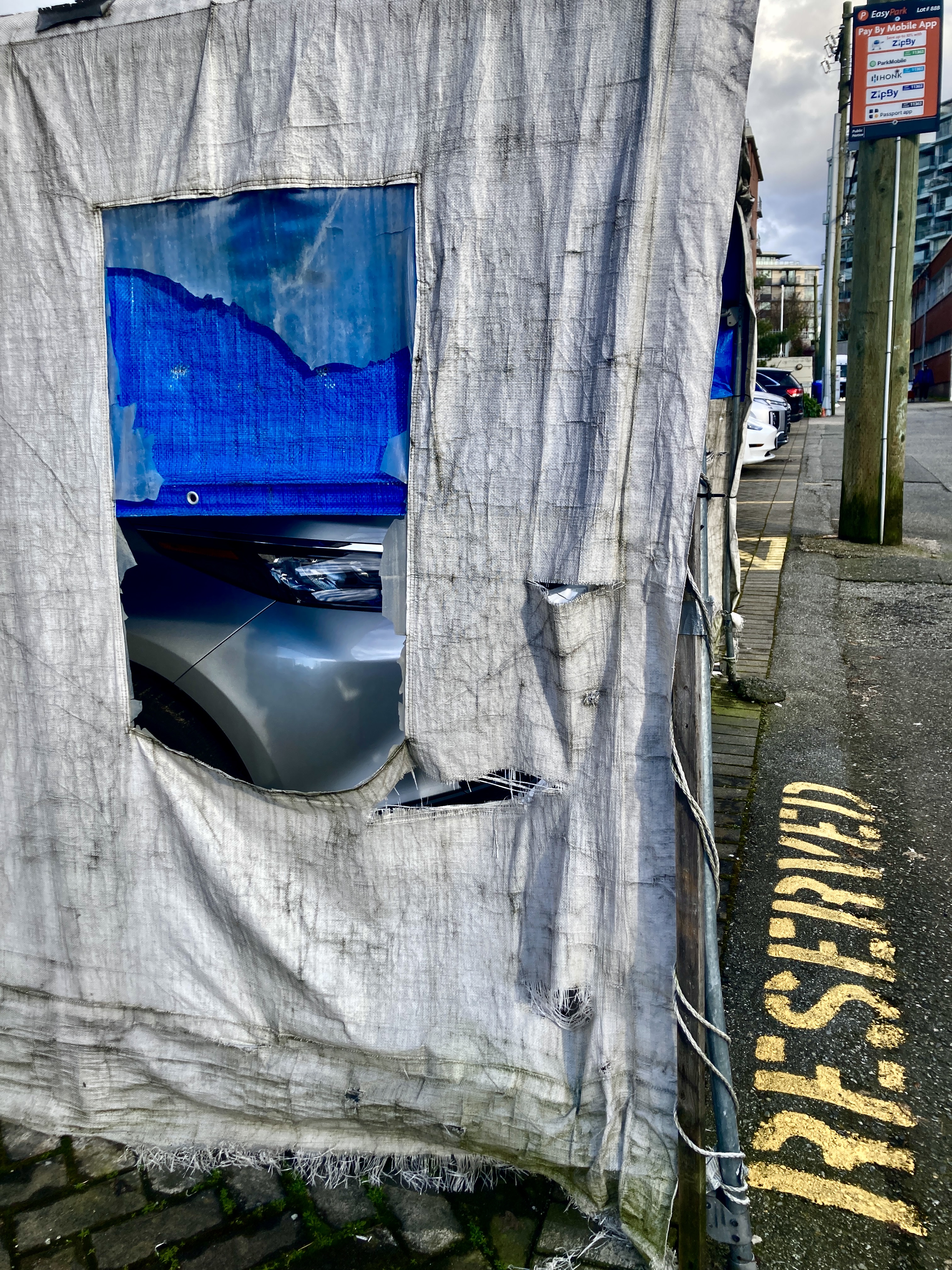
Even this tattered fabric car-shelter is on the bounce. Metallic silver, varying shades of blue in the window panel, and a vivid yellow RESERVED on the pavement for extra impact.
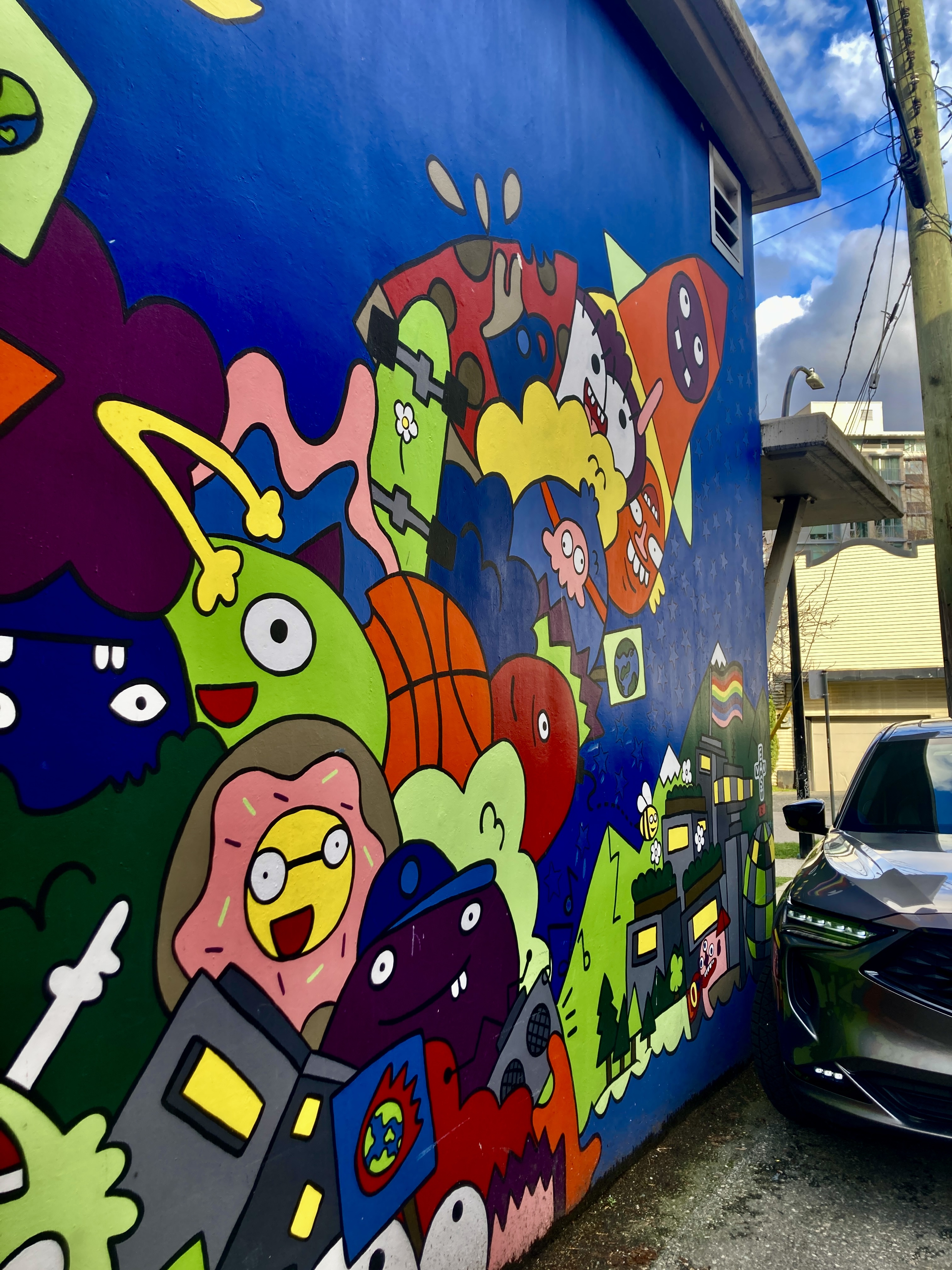
How fitting that right at the Scotia St. end of the alley, just where I turn into the Sally Ann compound, I find the splashiest colour bounce of all: this 2020 VMF mural, Vancouver: a People-Powered Future. (I later learn the artist, Oakland Galbraith, is only 12 years old at the time, which makes it even more wonderful.)
Next day, more sunshine, more bounce — starting with my own slight geographic bounce, down to the Devonian Harbour Park on Burrard Inlet at the edge of Stanley Park.
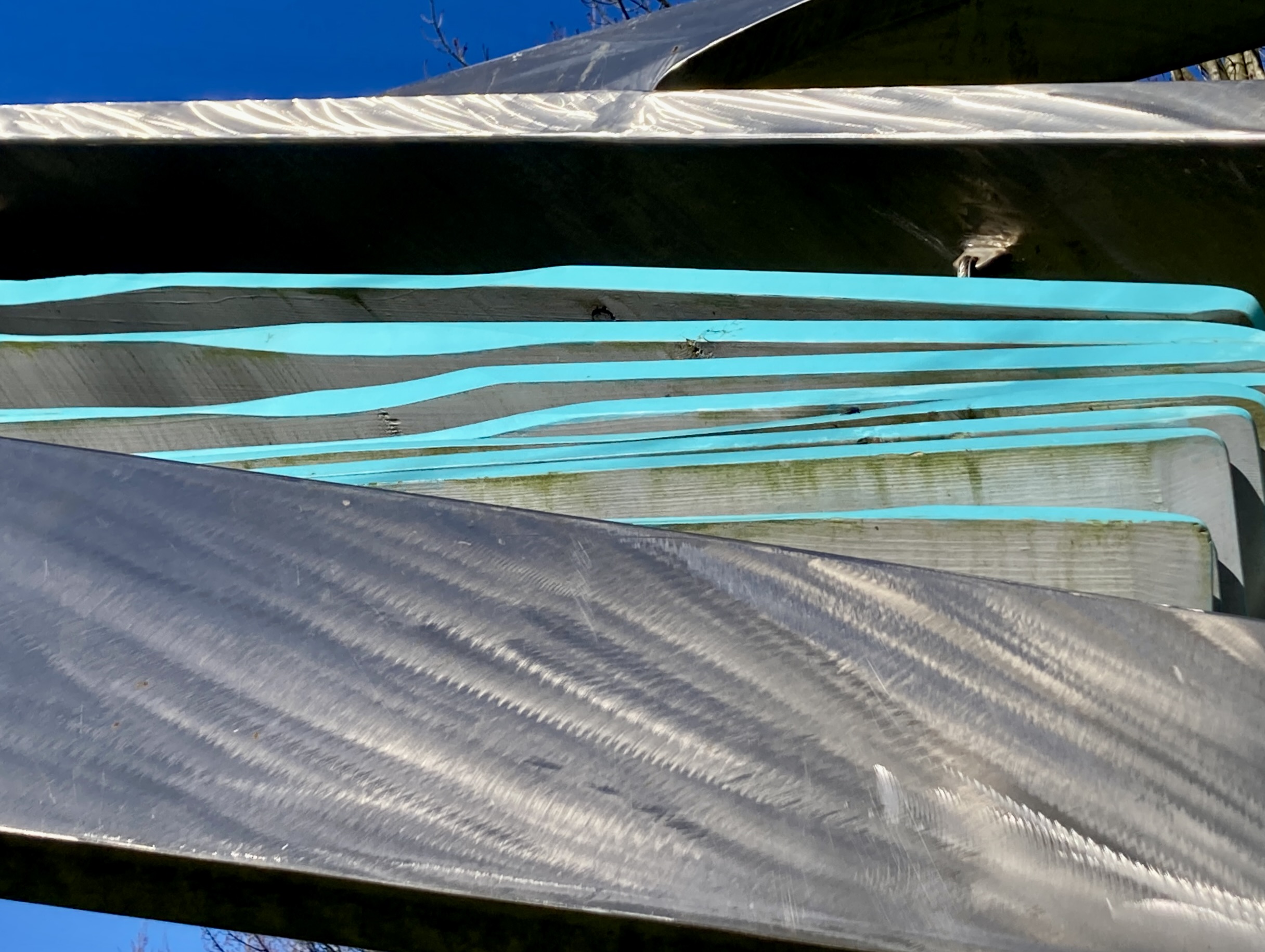
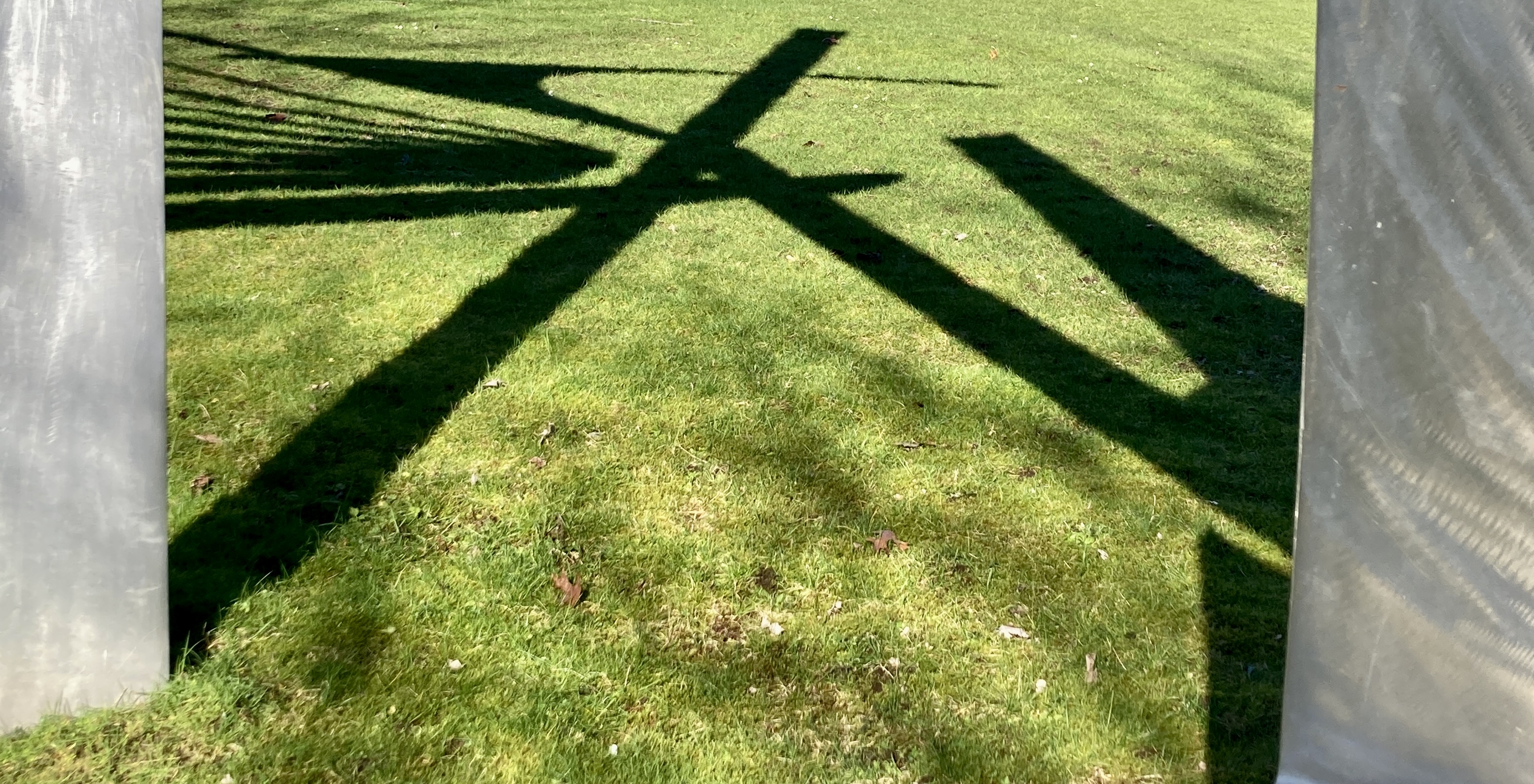
I happen to think the park’s signature sculpture installation is OK-fine, but not outstanding. Today, in all this blazing sunshine, it is outstanding. Today, there is nothing solo about Solo(Natalie McHaffie, 1986); it offers a whole conversation among its elements.
Neon-bright turquoise cedar panels play against stainless steel framework that seems to ripple in the light…
and, together, they throw sharp black outlines against the green grass.
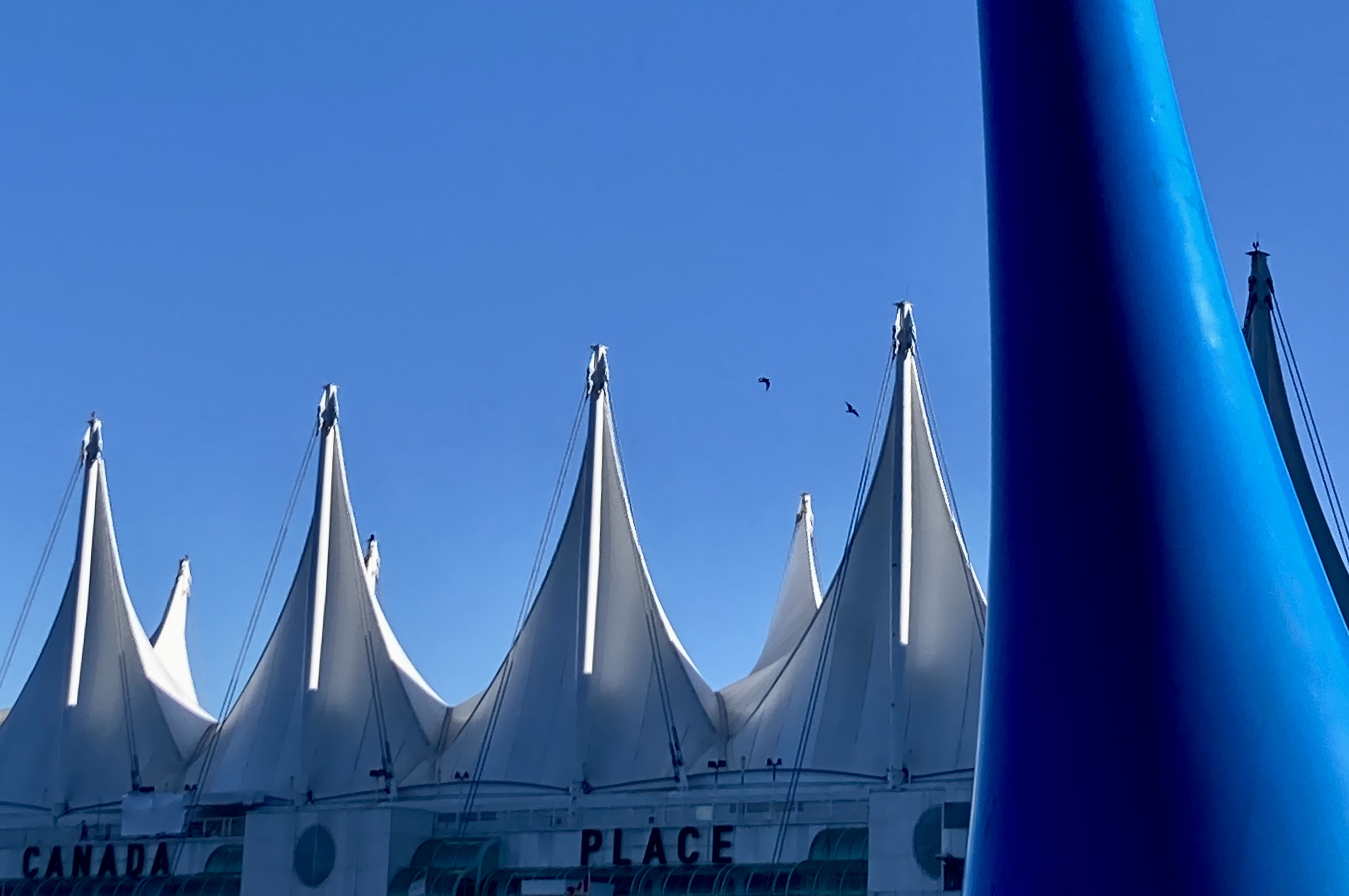
Later, at the eastern end of my walk, I eye the bright edge to each peak on the Canada Place fabric roof…
and realize the sun can throw sharp white outlines just as easily as black.
25 November 2025 – In my bit of the Northern Hemisphere, November means lots of rain…
and seasonal criteria for “awesome.”
This year-round sign on the allotment fence in Tea Swamp Park invites us to adapt our eye, and enjoy what’s currently on offer. Rusty old leaves, for example, still clothing this shrub…
and shameless bare-naked deciduous trees…
dancing around in their bones.
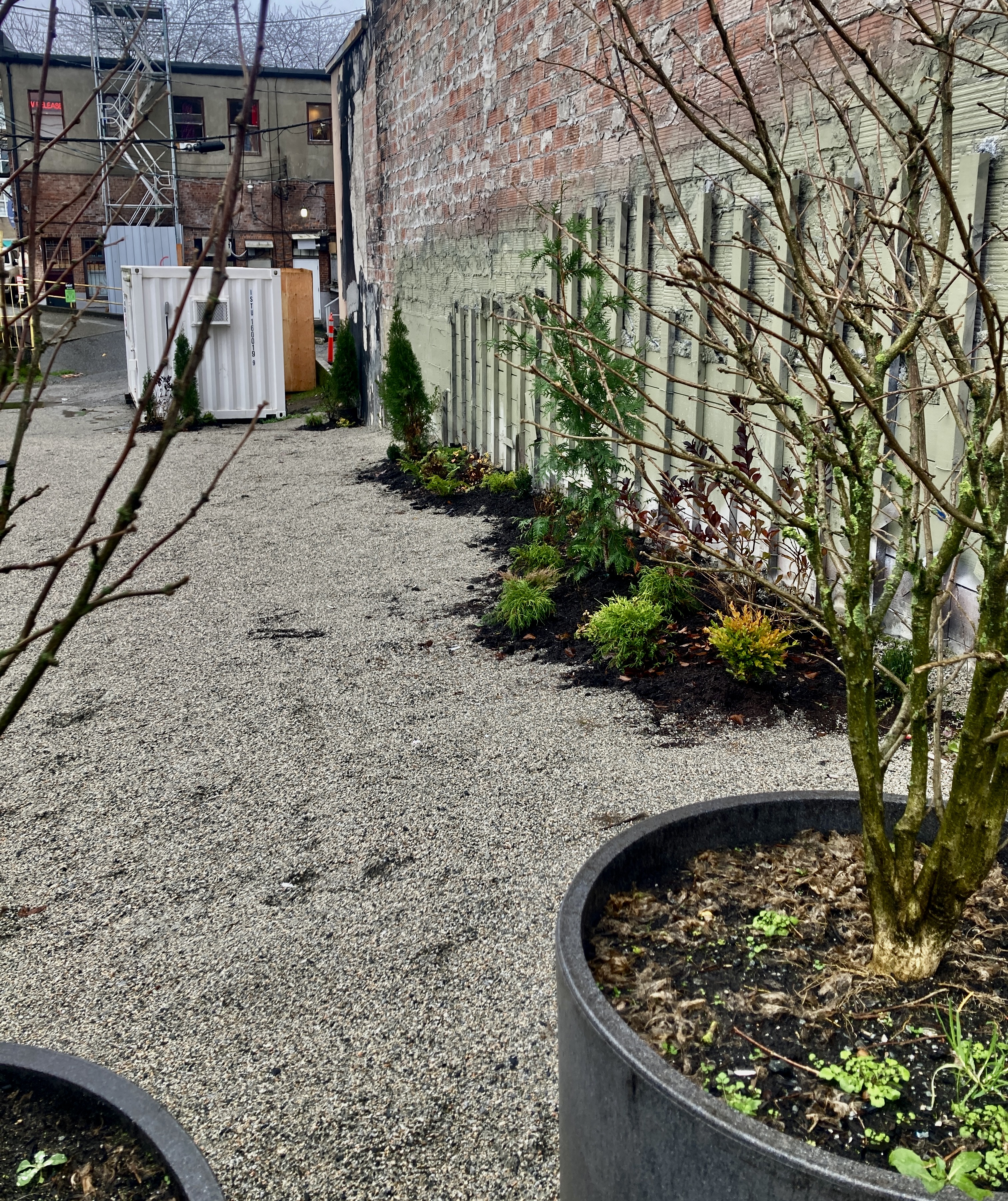
Walking back north on Main, I pass a trio of parks-in-the-making.
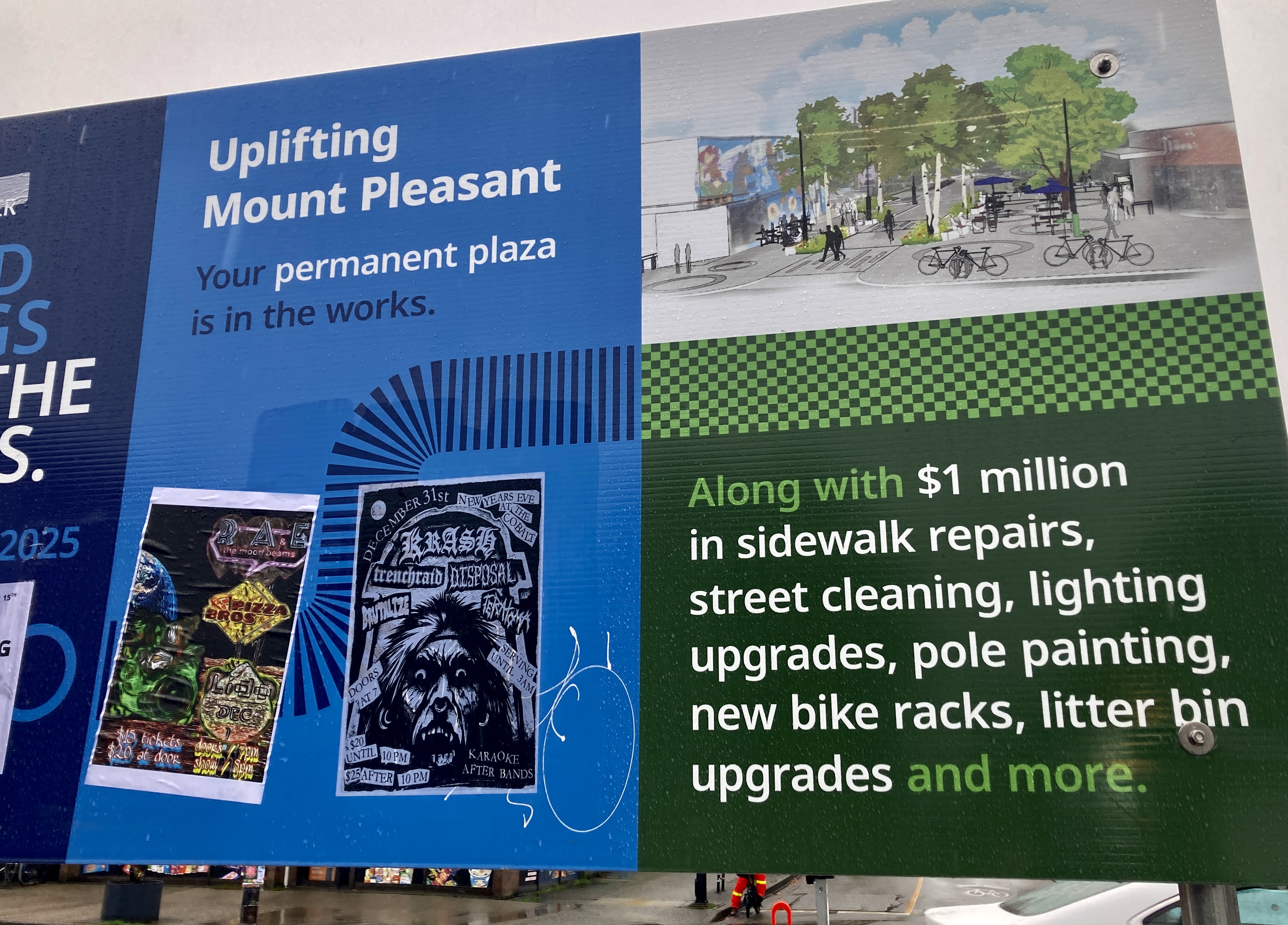
A “permanent plaza” under construction, here at Main & 12th (yes folks, your tax dollars at work)…
with gravel being industriously moved from Here to There.
Farther north, the site at Broadway & Main that had lain razed and desolate behind mesh fencing ever since a triple-alarm fire gutted its buildings…
is now fence-free and adorned with bright, shiny-wet picnic tables.
Plus a smidge of new landscaping, along the southern edge.
I’m still thinking about that slightly surreal tableau when — crossing 7th & Main — I see something even more surreal:
No, not the mural, not Slim’s BBQ — the snowplow! What? A bright yellow snowplow fitted to the front of the truck behind that white car. Ready to take on the snow. In the rain.
One more future-park. With more tax-dollar signage.
Like the one down the street, it’s early stage, mostly gravel and hints of Things To Come, narrowly visible through fence post gaps.
I take advantage of the building opposite, for the roof-top perspective.
The rain, here in Rain City, blurs the view but the view still rewards the trip.
16 November 2026 – I have a plan. Take the #19 bus; get off at Granville; walk south a few blocks; visit two art galleries.
But then I get on the wrong bus, and things do not go according to plan.
Two different bus routes come ’round the corner, you see, and I don’t bother reading the signage before I jump aboard. I settle back, ready to indulge in city-watching until we reach the #19’s Granville stop. Except… we don’t. The bus turns north well before Granville and ends its run at Waterfront Station.
Which is exactly what the #8 is supposed to do.
More than a little sheepish, I step down and rethink my route. I’m still within easy reach of my first target, the VAG (Vancouver Art Gallery); I’m just approaching it from a different angle — an angle that, with a couple of zig-zags, finds me heading south on Howe Street, between West Pender and Dunsmuir.
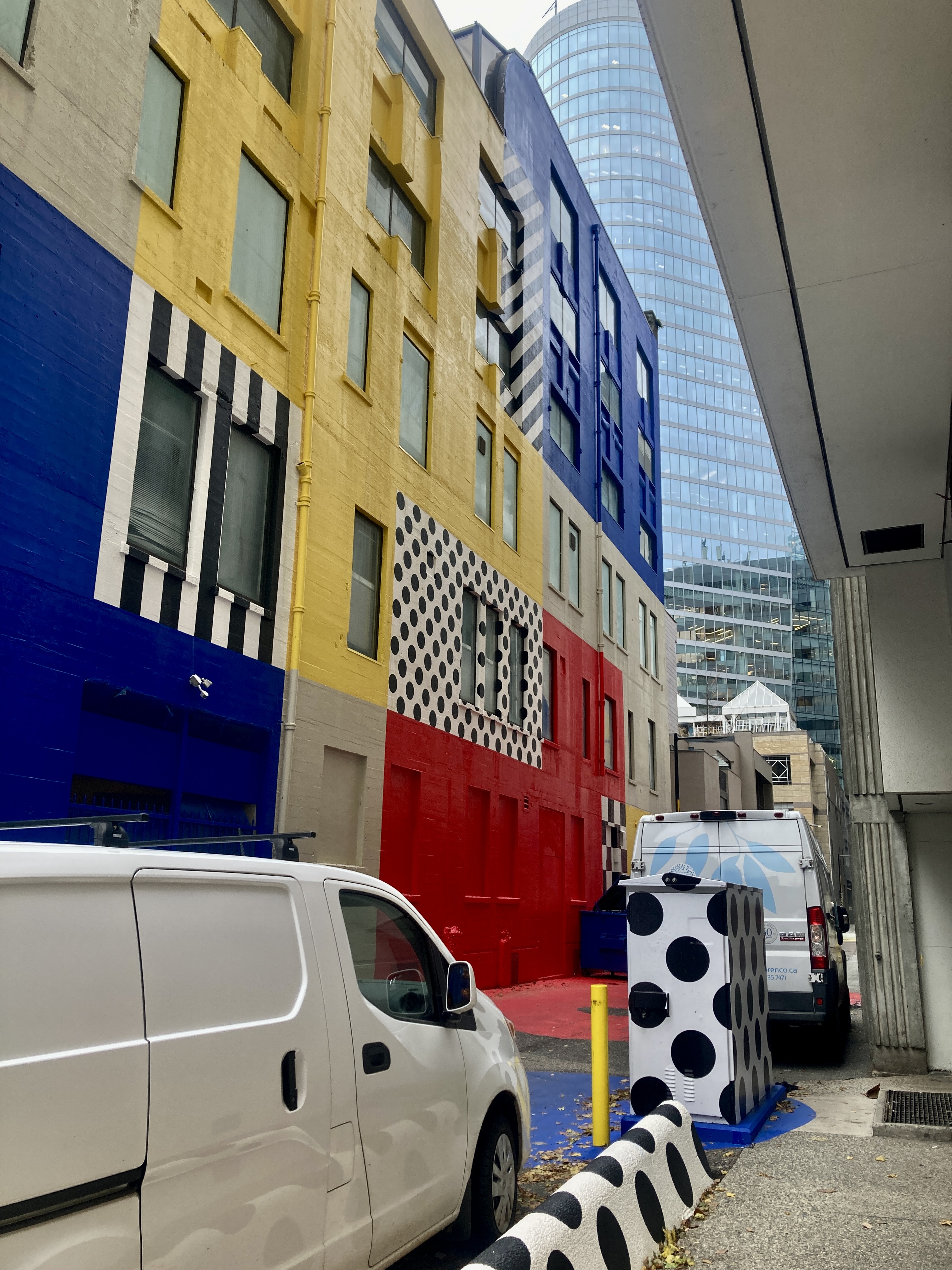
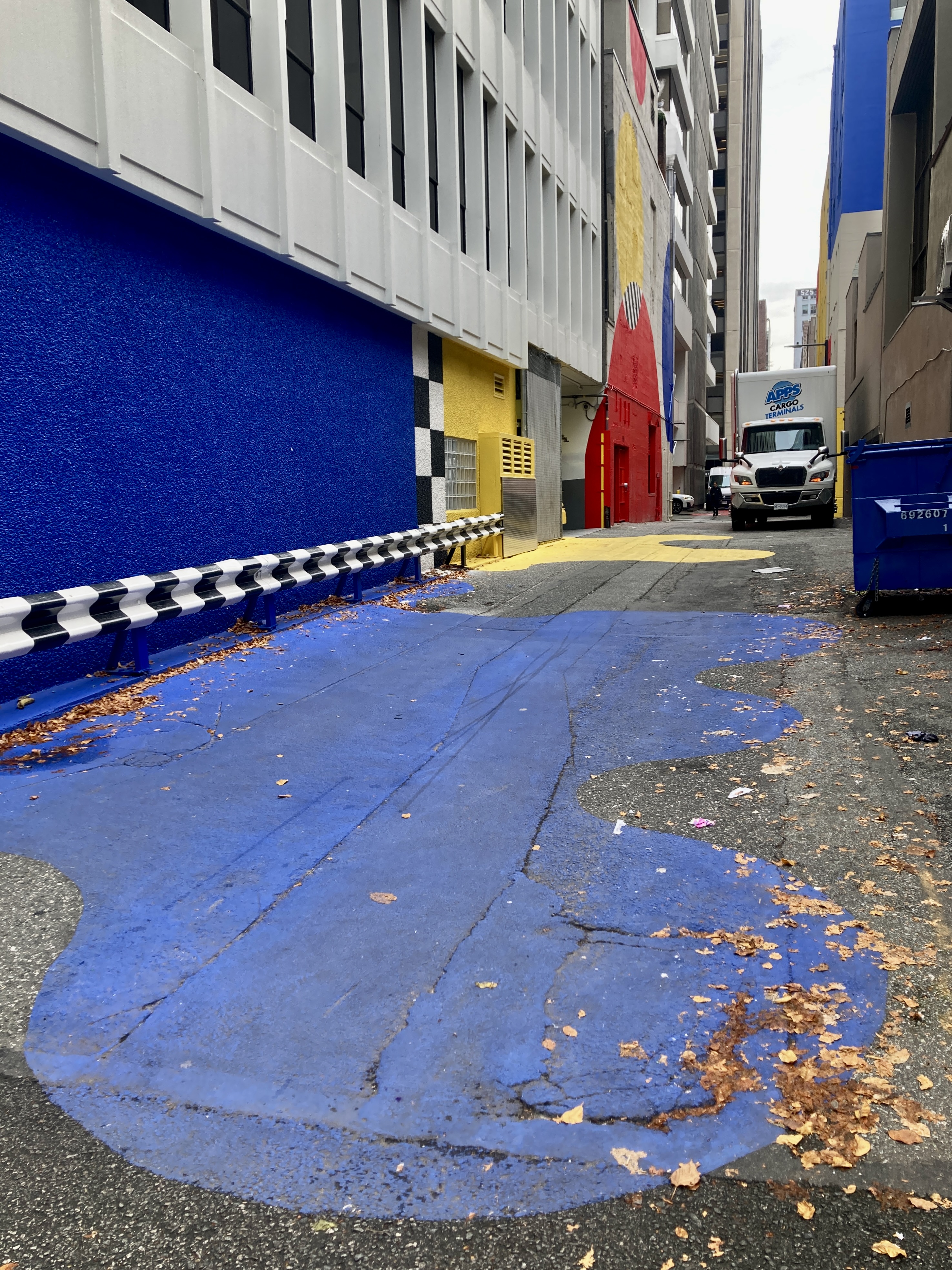
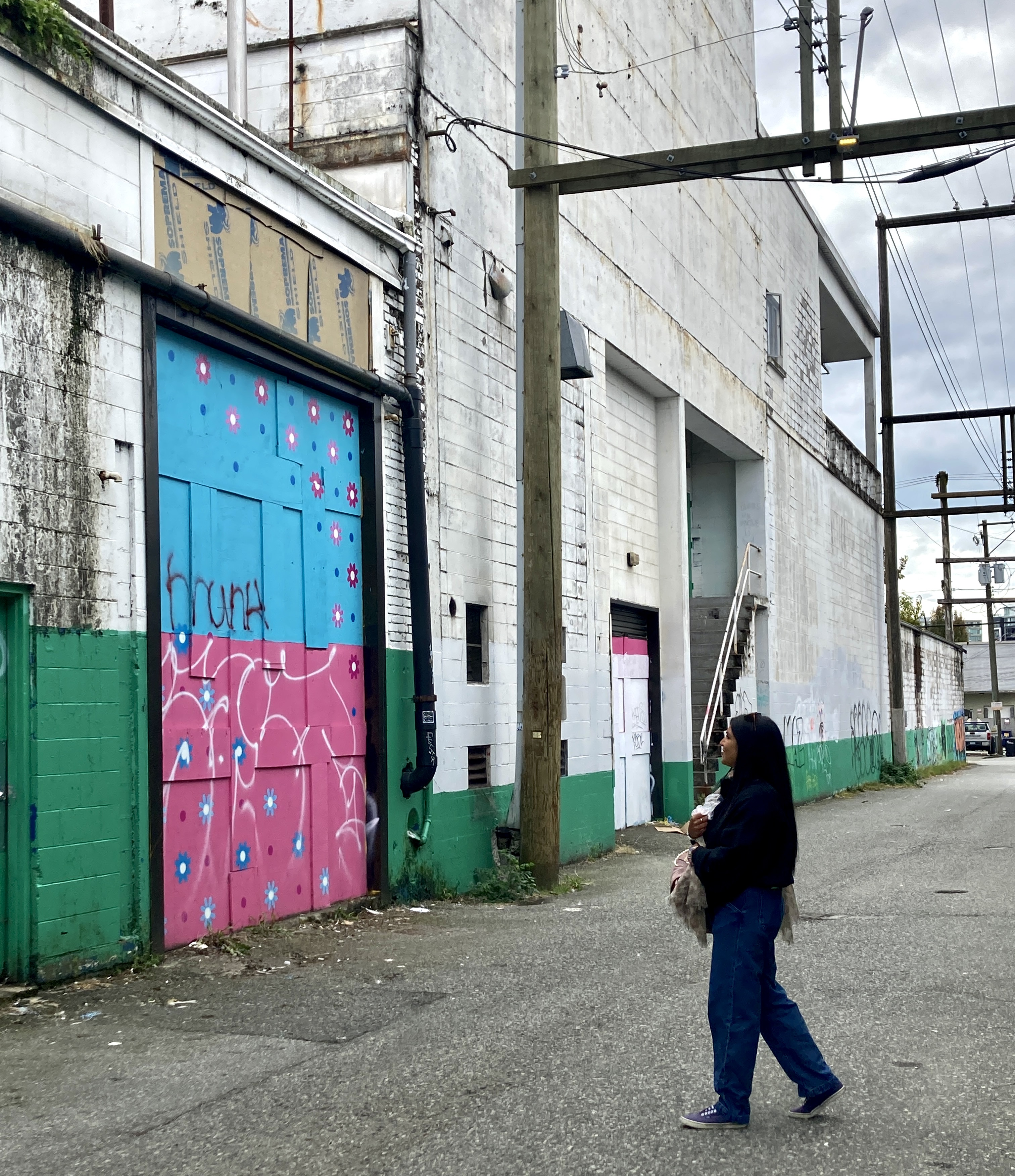
Where — eyes right — I see this alley, bouncing its colours in every direction.
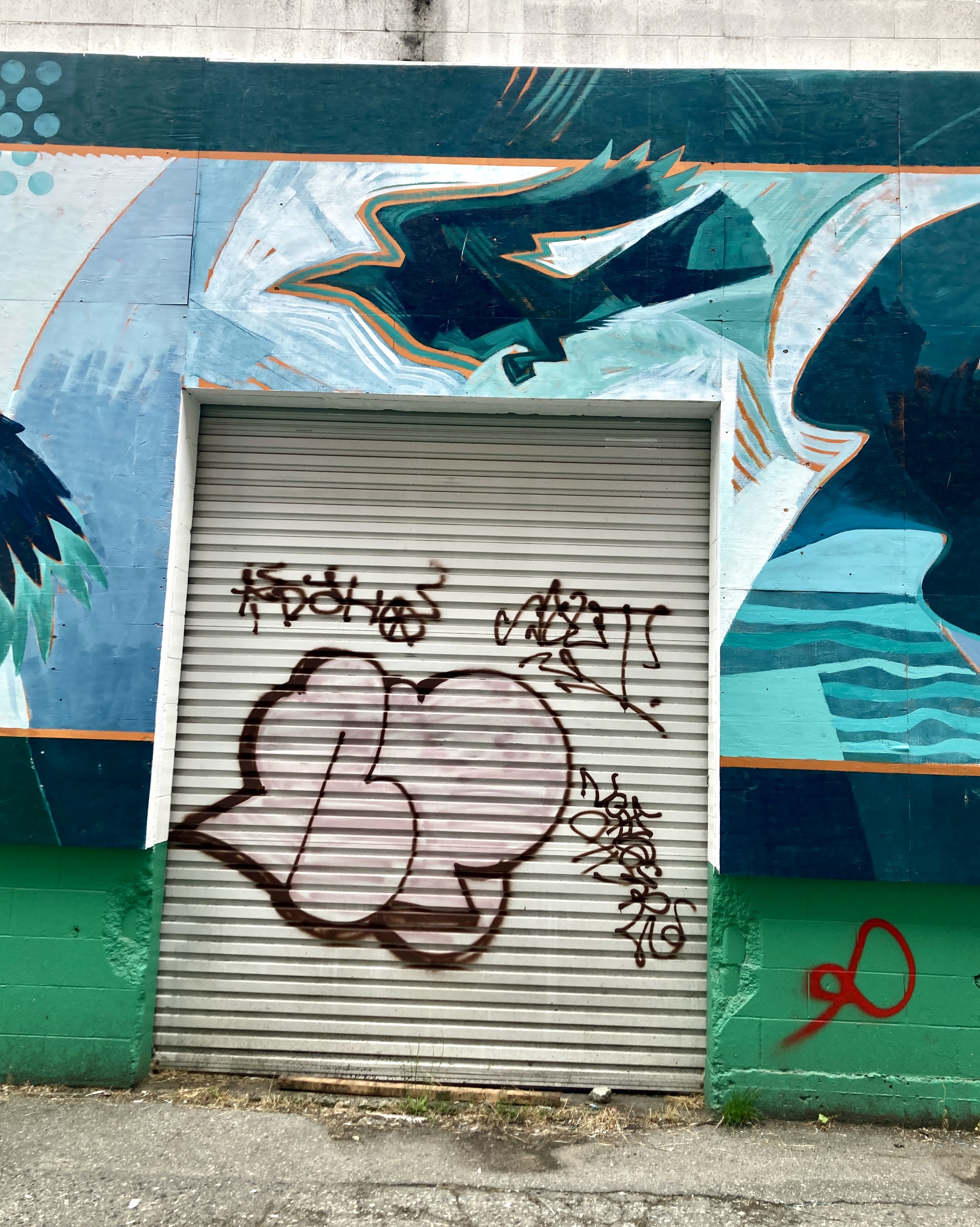
Look at all those rectangles! And the polka-dots! (Which splash their reflections all over the adjacent white van.)
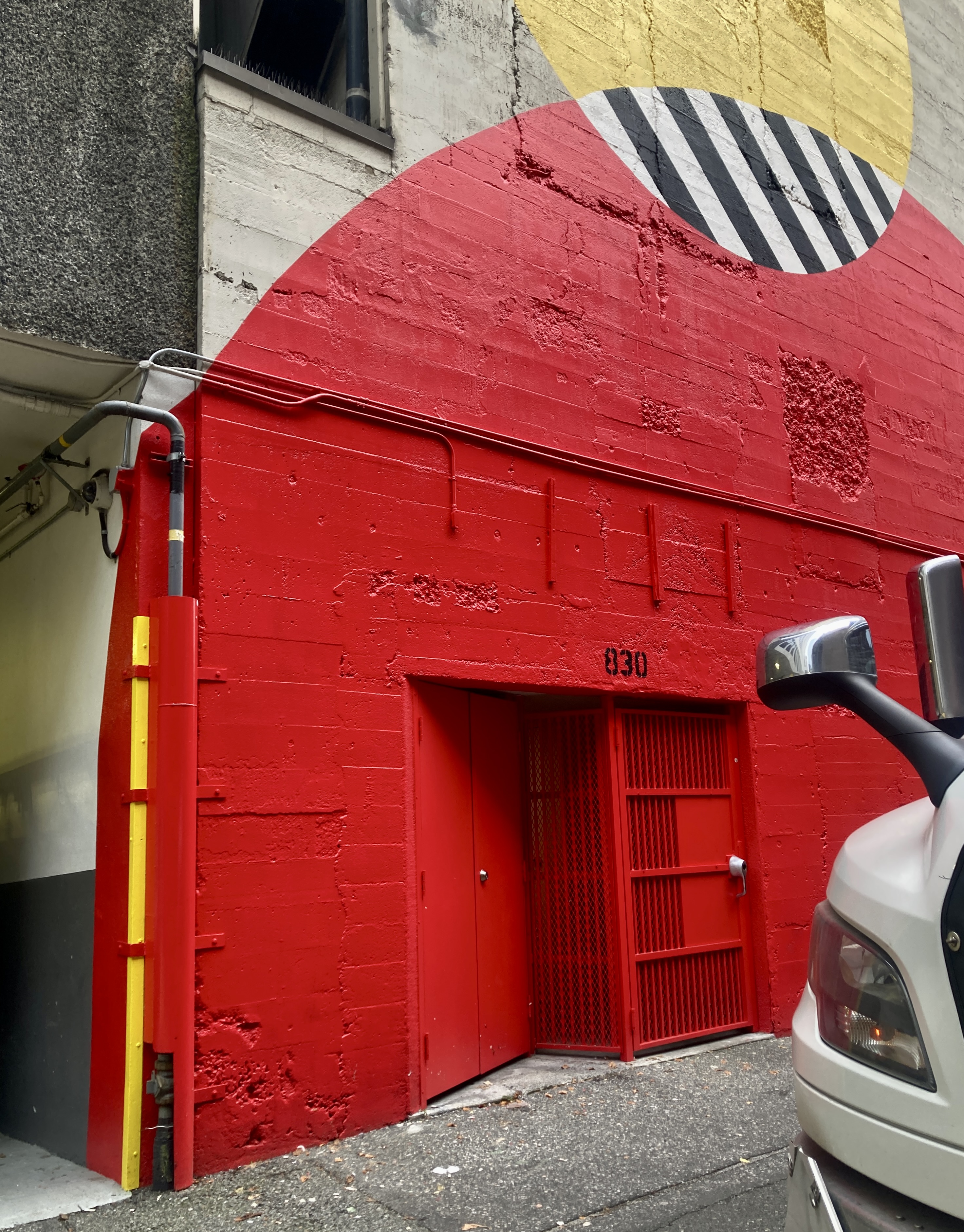
The alley pulls me in, how could it not? Happy rectangles to the south; happy circles to the north…
forming still-life tableaux with delivery trucks and doorway tubing.
Splatters on the pavement. Yellow…
and red…
and, here at the Hornby end of the block, bright blue. Further adorned with russet leaves.
I’m well-pleased with my wrong-bus start to the day. It fed me into this alley, handed me all this unexpected art while on my way to expected art.
There’s one more hit of the unexpected yet to come. I find it in the plaza just east of the VAG.
Lanterns.
All the forms in these lanterns, says the signage for Lux Memoriae (Tidal Reflections) by Ari Lazer, come from the tidal contours of the Fraser River.
This theme ties perfectly, and I am sure deliberately, with the VAG exhibition I have come to see: We who have known tides . Drawn from the VAG’s permanent collection of art by indigenous artists, all of the works in some way reference life interwoven with ocean and tide.
A spill of abalone shells (I am turning towards tides, winds, clouds, rainfall, by Tanya Lukin Linklater), for example, burnished and positioned on a tarp…
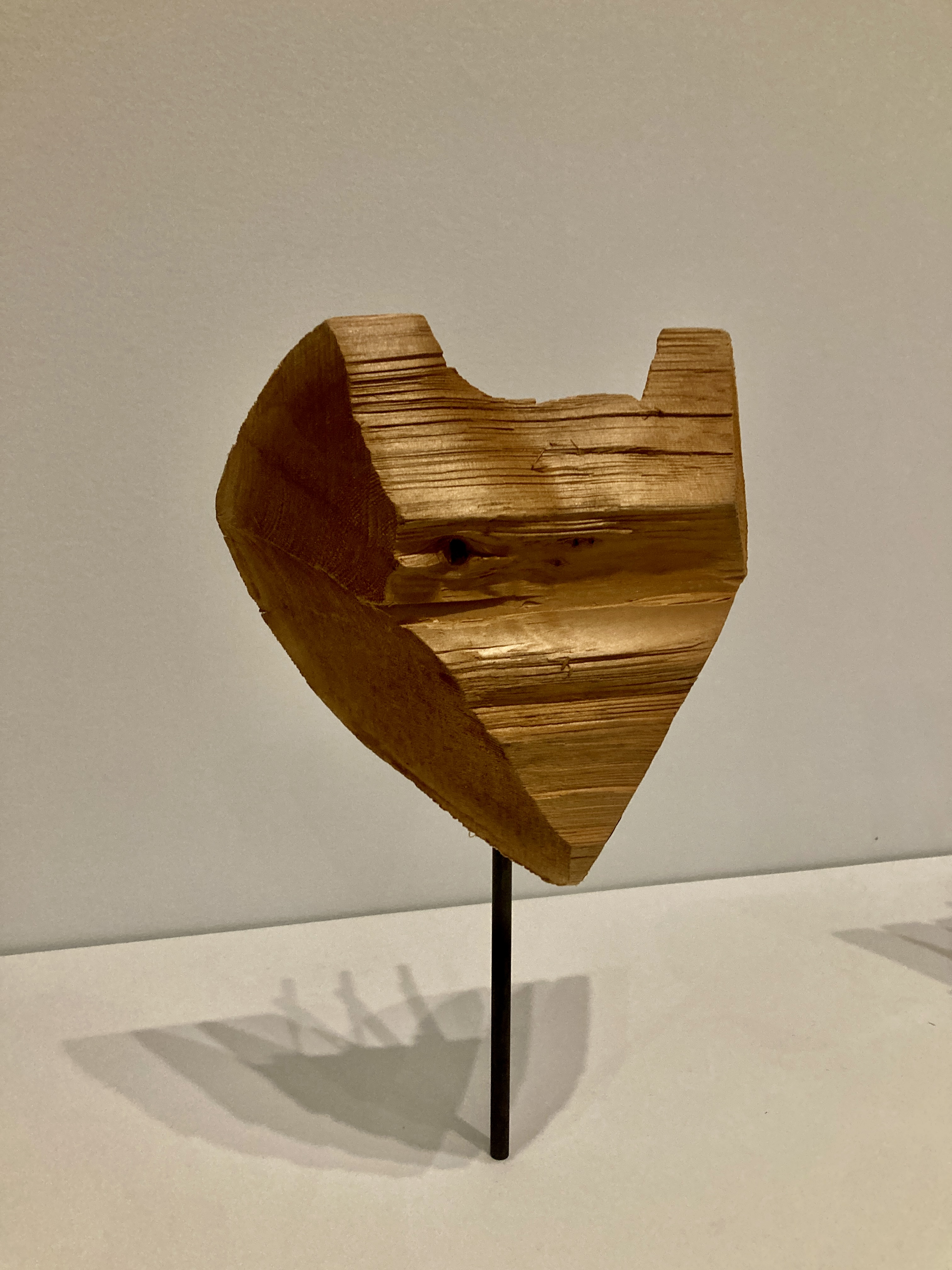
and, on the far wall, four pieces of found cedar (Longing, by Sonny Assu)…
all end cuts, and each selected for its resemblance to a mask.
I do not visit other floors, other exhibitions. I take myself a little farther south on Howe, for the Our French Connection show at Outsiders and Others.
This is a different art world entirely, in a gallery focused on contemporary work by self-taught and non-traditional artists. There is great diversity of styles, materials and objects — but every piece pulses with the outsider energy of the person who created it. I’m always engaged, when I visit this gallery, a-buzz with what surrounds me.
And, almost always, before I get to the art I have a bit of a chin-wag with Yuri Arajs, the gallery’s Artistic Director and Curator. Today I pull out my phone, show him the alley I discovered en route.
He plucks the phone from my hand, walks over to the wall, and holds this image I took of the alley in Vancouver…
next to this pen-on-paper Star Car, drawn by Dominique Lemoine in France.
We shake heads at each other and laugh. Art is all over the place! Inside, outside, in galleries, in alleys, bursting 360° through human demographics & world geography, discovered by intention or just by climbing on the wrong bus.
Pleased with that thought, I reclaim my phone and turn my attention to the show.
(Which I urge you to do as well, should you be in Vancouver this month.)
14 September – And then, from morning to afternoon, I leave Toronto and land in Vancouver. Here I am, looking through slight drizzle to the mountains, with one last love-letter I want to offer “T.O.” (Tee-Oh, Toronto.)
My T.O., that is, nobody else’s — my own mix of memory and re-discovery, blind to what others would notice, alert to all my own triggers.
Glimpses from streetcars, for example.
A rampart mural by Shalak Attack, which I remember watching her paint, many years ago…
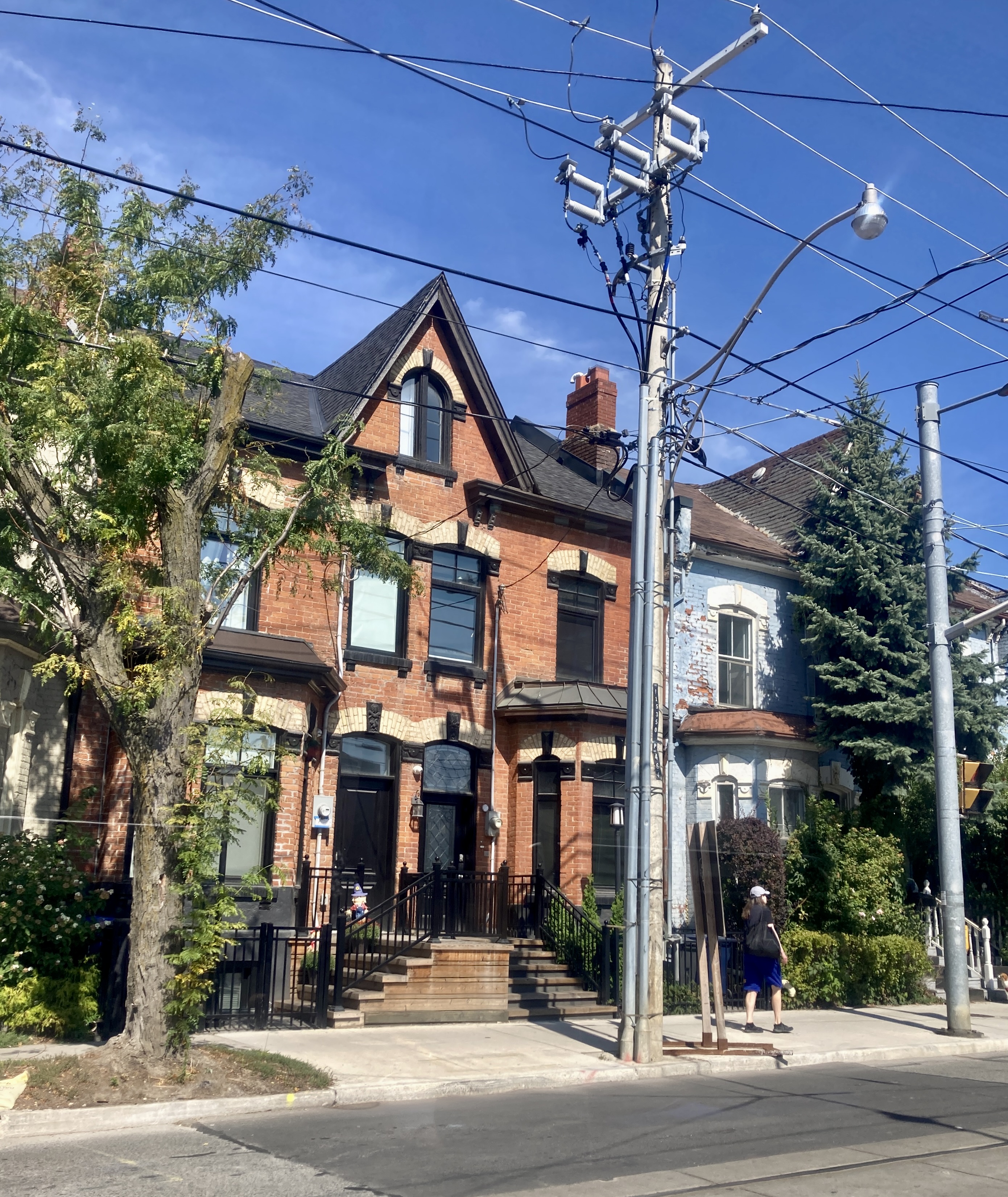
the distinctive two-tone brick and architecture I associate with my own decades in the Cabbagetown neighbourhood, but common to the city in that era…
and Streetcar Dog. Not unique to Toronto, but part of my own memory bank of riding the TTC.
Then there are my re-discoveries on foot, all around the Grange neighbourhood and the Art Gallery of Ontario, where I was for years a volunteer and therefore an area where I came and went, a very great deal.
Bronze turtle watching martial-arts in Butterfield Park, the new-since-my-time refurbishment of the land just east of Grange Park and south of OCAD (Ontario College of Art + Design) University…
Henry Moore’s Large Two Forms, looking very at home in its new home in the reinvented Grange Park, with the brilliant blue rear wall and distinctive Frank Gehry staircase as backdrop…
and, once inside, the soaring glulam arches of the AGO’s front-façade Galeria Italia.
Unchanged, these arches. Ditto, the way the Galeria invites you to look out across Dundas Street. Native son Gehry made sure his design honoured and welcomed the neighbourhood of his childhood as its own visual final wall.
I am in the AGO as much to walk old ground as to see current exhibitions, but in the end I do both.
The Joyce Wieland retrospective, Heart On, speaks not only to my memories of her bursting on the scene, but also to how current she now is, once again.
Wieland was a fierce ’60s-70s feminist and, despite (or perhaps because of) long years in New York, a fierce Canadian patriot as well. She often used the soft “feminine” skills of embroidery or quilting to express strong political convictions.
For example, with her 1970 work, I Love Canada – J’aime Canada.
Awwww. (Twist finger in cheek.) So sweet.
Now read the signage.
And read the embroidered fine print.
Wieland’s narrow definition of Canadian identity is now out-dated — but the rest of her analysis is Elbows-Up contemporary.
Some hours later, I leave the building. I still have more circling and prowling to do.
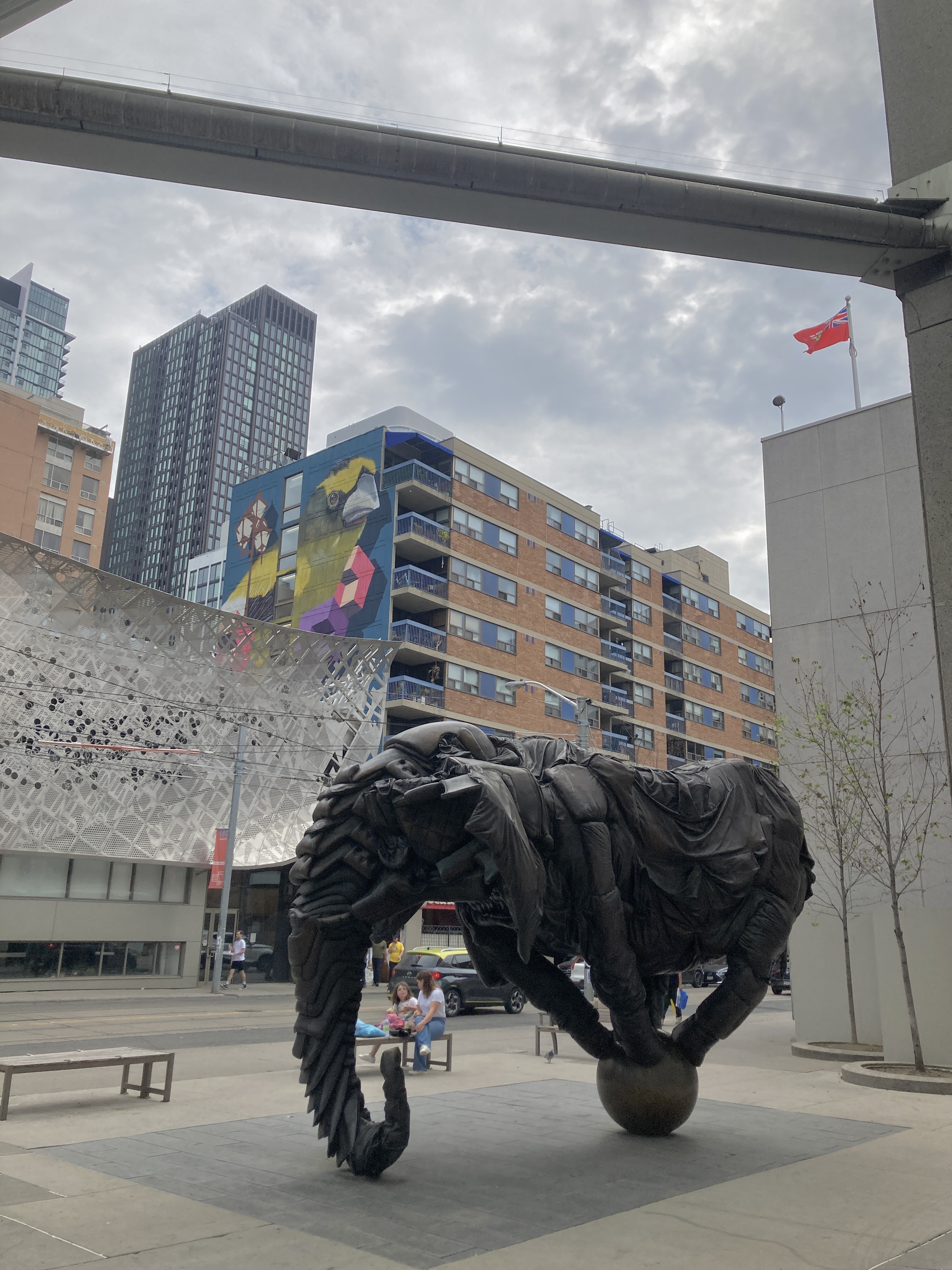
I check out the S/W corner of Dundas West & McCaul. It is also the N/E corner of the AGO footprint and, in my day, was still home to Moore’s Large Two Forms. For the first time, I see what now sits on that corner — Brian Jungen’s commissioned work, Couch Monster. (Read more, here, in a fine post by our WordPress colleague, Canadian Art Junkie.)
I circle the work, and also take in the larger view, including the top of an old mural by veteran Toronto artist Birdo, now obscured by newer construction and backed by even-newer construction.
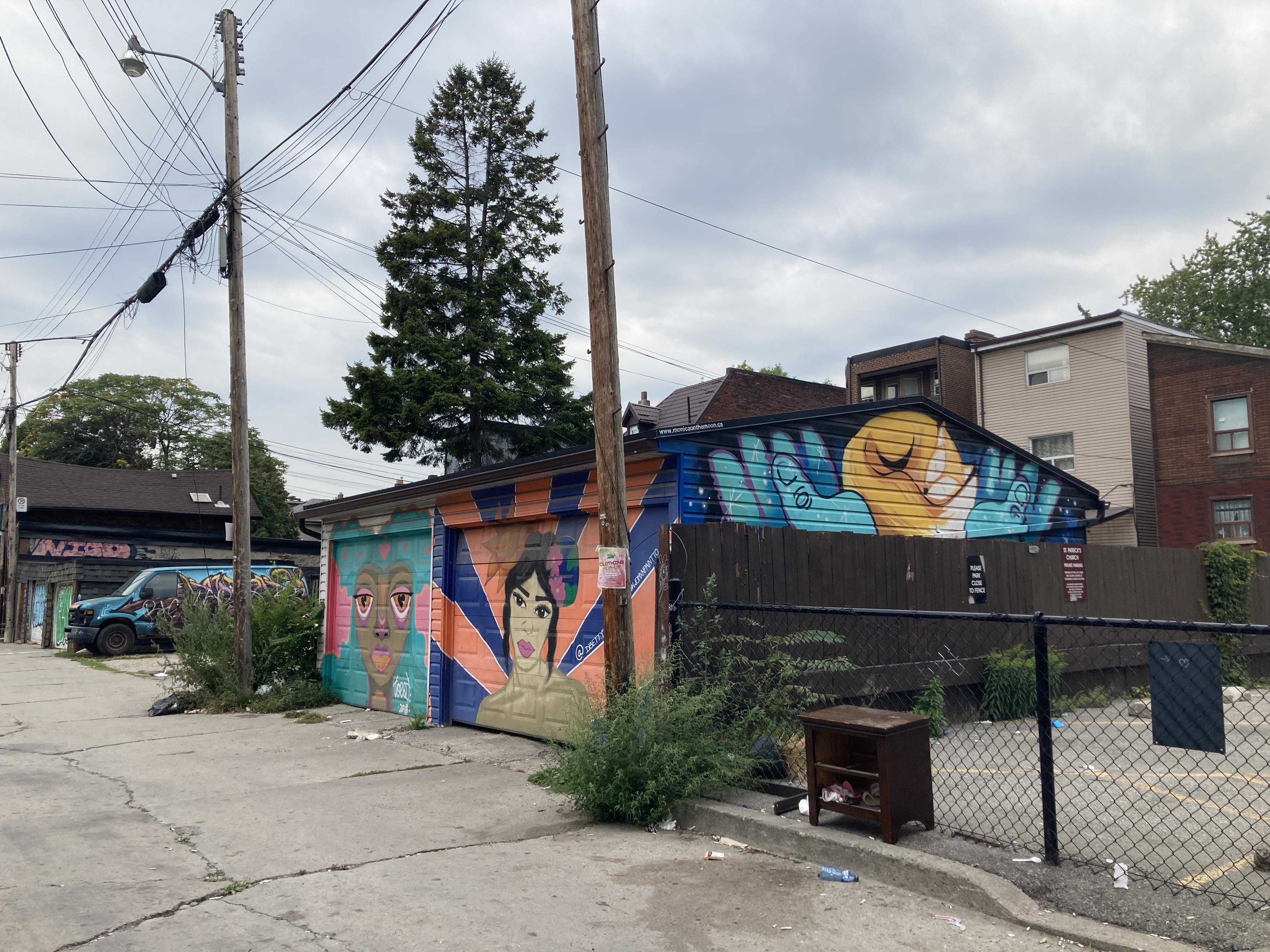
Finally, and not with terrifically high hopes, I take myself across Dundas West and into the alley between Dundas and Darcy Street to the north. I am eager but also dreading to see what it’s like, these days. My memory is of an alley bursting with street art, full of the “garage-door art” that I associate with my memories of Toronto.
And…
there it still is. On and on, to the west, beyond the frame of this image. Not exactly as it was, of course not, but alive and current and so-very-T.O.
I turn right on a second, N/S, alley, passing delicate tendrils and other art as I go…
and emerge on Darcy Street.
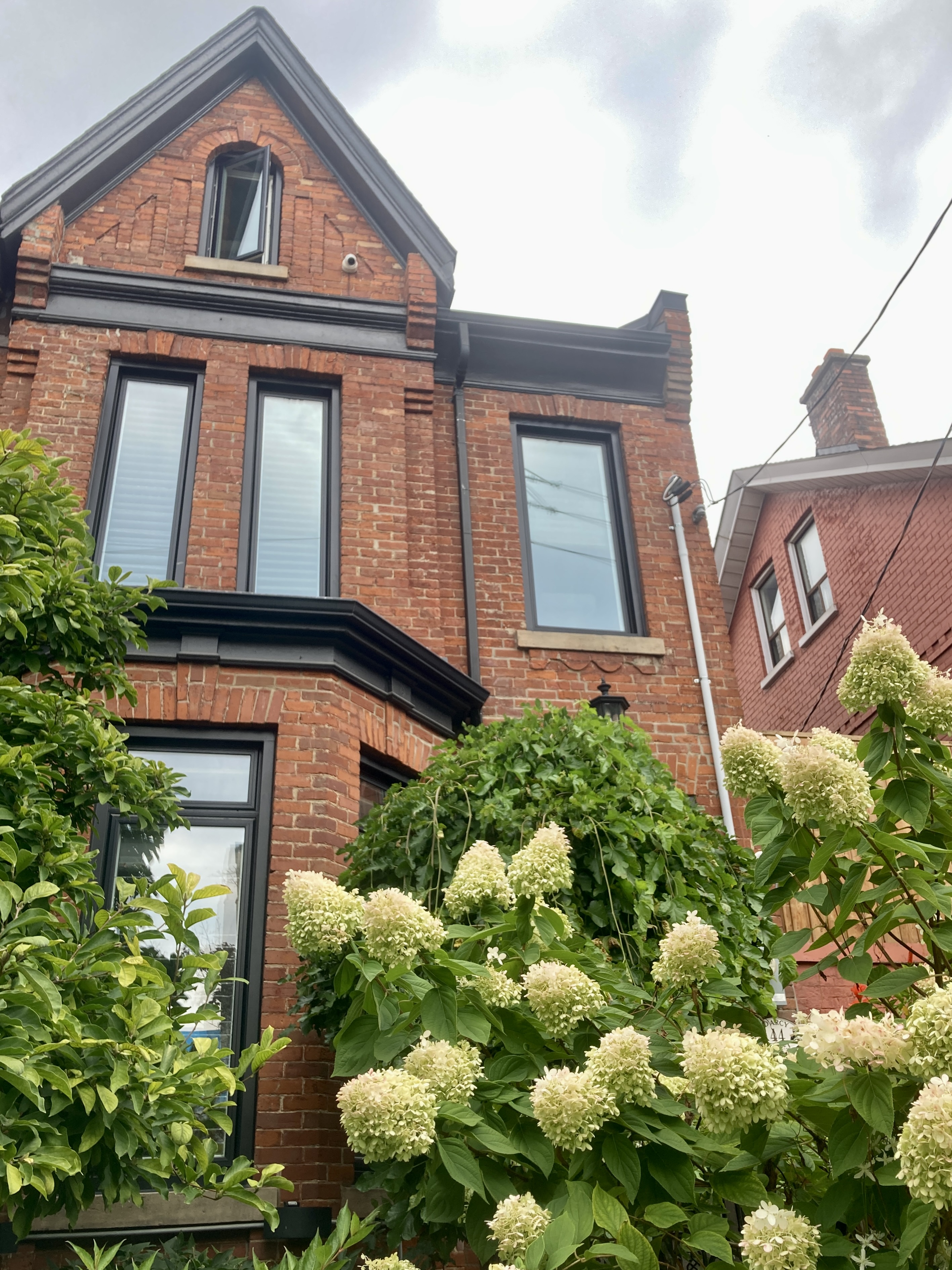
Where I drink in an enclave of old downtown residential architecture, oh look, some still survives…
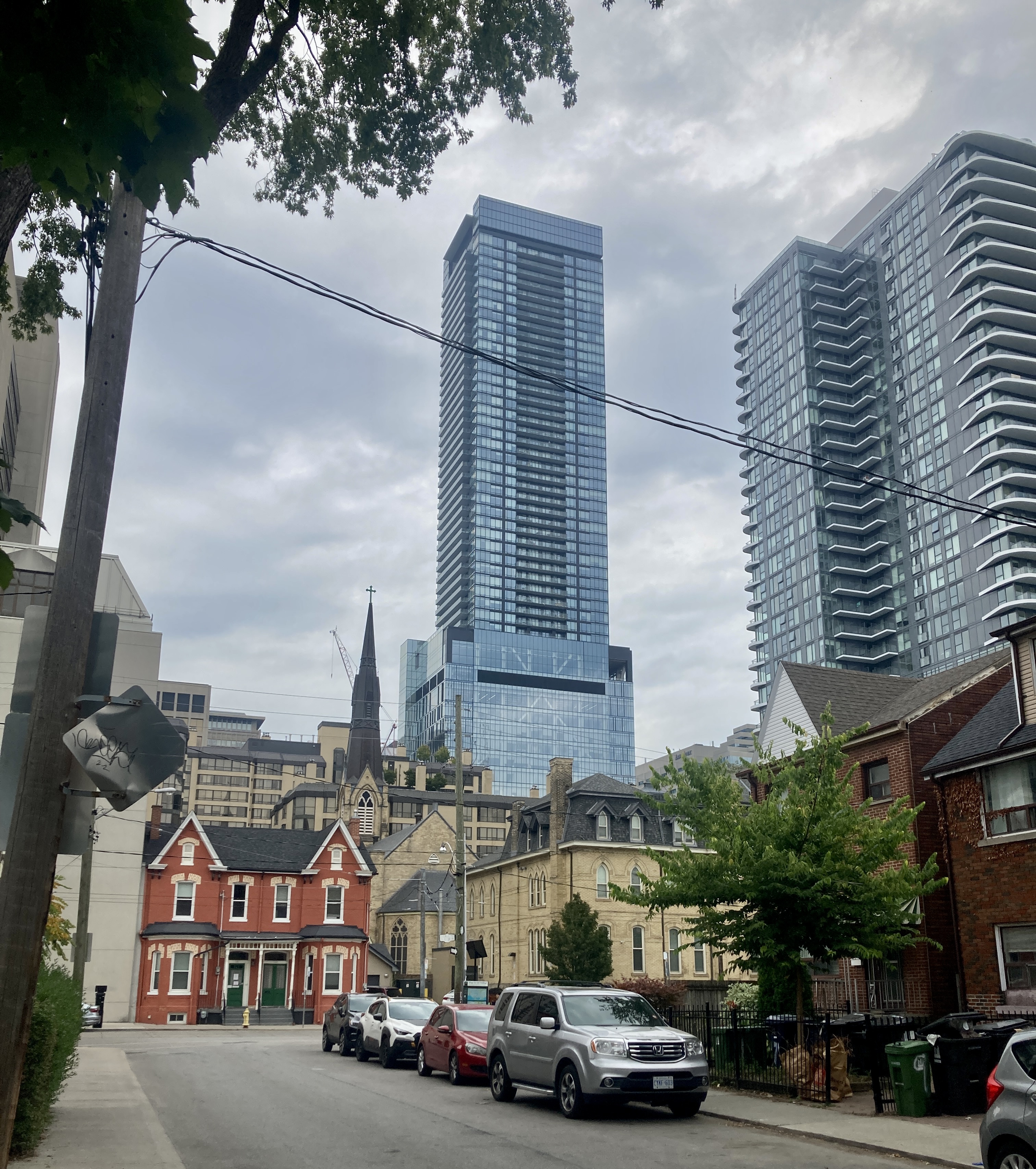
and then pivot on my heel to look east down the block. Out to McCaul Street.
Still some old brick homes, and still the spire of St. Patrick’s Church (the 5th-oldest Roman Catholic parish in Toronto) as well — plus the immediate examples of all the new towers now exploding skyward.
There it all is.
The whole jarring/exhilarating, cacophonous/euphonious, forever-evolving symphony of the city.
5 September – Now I’m doubling back across the same terrain, this time south, Churchill to Winnipeg. It will surprise none of you that even though we’re travelling the same tracks, passing/stopping in the same places, the trip is entirely different. There’s the same train culture around me, but with different people. Perhaps because I’m slightly less obsessed with the landscape this time, I’m more aware of the people — who, because we’re still between tourist seasons, are again individuals rather than job-lot packages on tour. Such a range!
the trio who trained as nurses in Winnipeg long ago and as a result have been friends, and attending reunions and sharing other adventures, for more than 65 years
the young Parks Canada IT/AI specialist, who works summers based in Churchill and winters back in Winnipeg
the Australian couple (she originally from Ireland) who are this side of the world to attend a wedding in the Caribbean but decided, having come this far, to explore Canada while they’re at it
the deep-south American who “hates heat” and therefore does advance reconnaissance each year for the following summer’s travels in Canada with his wife (so far, Newfoundland is his hands-down favourite)
and… Origami Man. Oh, I’ll save him ’til later.
I think the other reason the reverse trip is different is precisely because it is in reverse. You approach from a different angle, you come at a different time and probably in different weather, and you yourself, even if only slightly, are already a different person. So, you notice differently.
For example, I notice the young man dis-embarking in Thompson, sporting the cap his wife found for him on the internet…
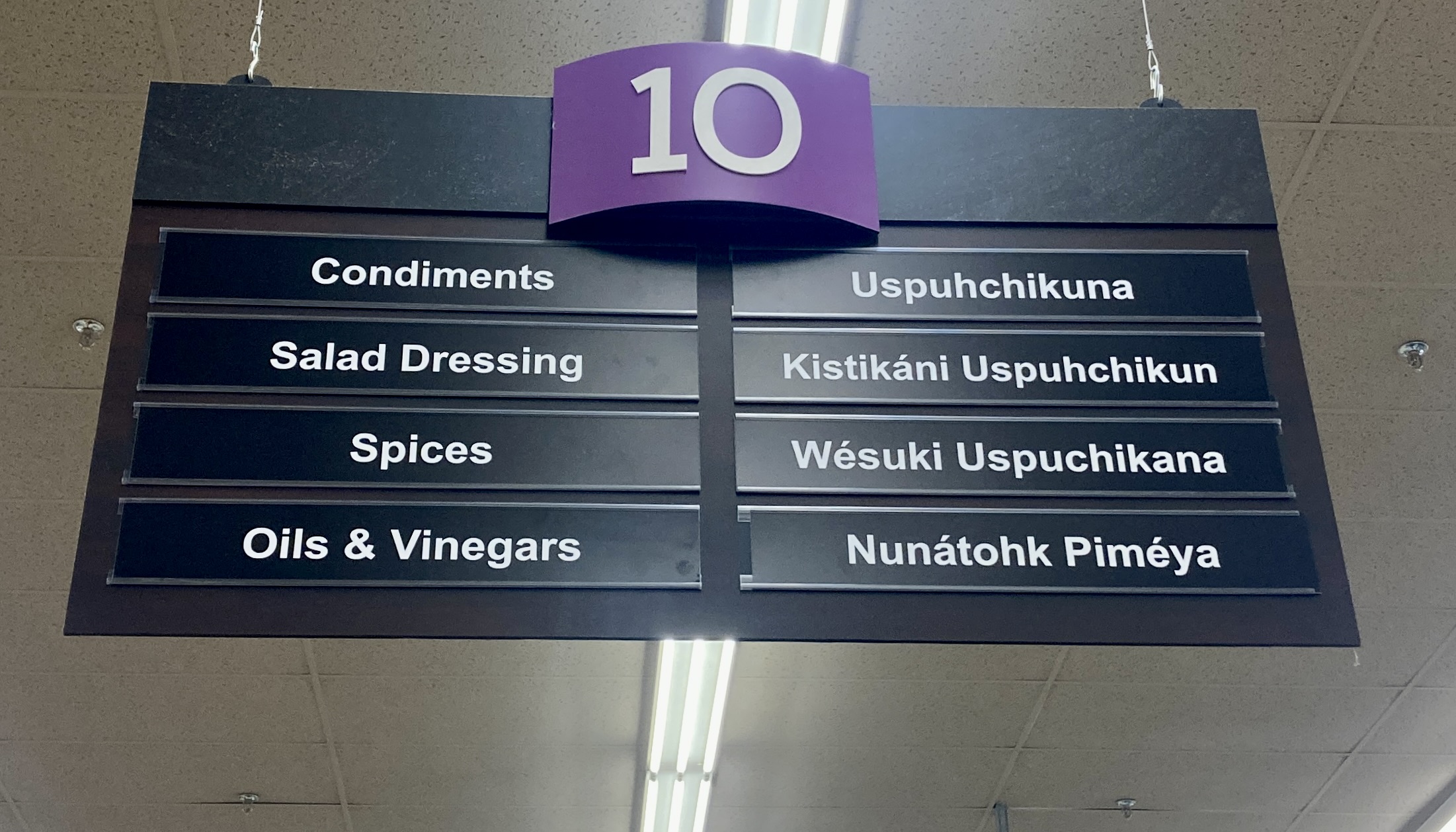
and the bilingual aisle signs in a Thompson grocery store.
Soon after Thompson, ’round about Mystery Lake, I come through the dining car and see Origami Man teaching the basics to two VIA staff with a rare moment free of obligations.
It’s another day before I learn he and his wife (she knits, while he folds) are from Detroit, and have their own deep Canadian memories, including ferry travel some 17 years ago down the north shore of the St. Lawrence River east of Quebec City.
We roll into The Pas at 10:30 pm. This time, I’m awake. I raise my blind a smidge…
take in the sliver of train station, and decide our steward is right. The location means there’s nowhere interesting to walk, especially this time of night. I pull down my blind once again.
6 September – I meet Calgary Alex going into the dining car, also with breakfast on his mind. He tells me he saw a deer, when he looked out his window shortly after dawn. I saw no deer — but now, in the dining car, we both see cranes.
Origami Man strikes again!
Talking with him later, I learn that, maybe predictably, his career was in the spatially precise world of engineering, and that this skill has become his passe-partout worldwide. “I start folding paper wherever I am. People gather. I spent a whole afternoon with kids in Mongolia.”
I’m startled when, at about 7:30 am, our cabin attendant announces we’ll soon roll into Kenora for a 10-minute stop. I smack the side of my head. Kenora? We’re in Ontario? She smiles, sorts me out: “Cee-ay-nora. Canora. Not Kay-ee.”
At the station, the display caboose and its signage complete the story.
No, a comment from fellow passenger Sue completes the story.
She is from the other one, from Kenora, and she explains that its name is also an acronym. In their case, for local communities & history: KE – Keewatin; NO – Norman; RA – Rat Portage. I tell her I want to visit Rat Portage; she says it’s now Kenora. Kenora was called Rat Portage until Maple Leaf Milling Company said they wouldn’t build a mill there if it meant putting the word “rat” on their flour.
Back to Canora-with-a-C. The town has an historic main street…
and a this-minute communications tower.
Approaching Dauphin, early afternoon, I don’t have to gawp at the 1912 train station — I’ve done that already. I’m free to notice brightly-graffiti’d box cars…
and the RR-themed parkette, with its plaque-bearing benches.
The arrival of the first train in 1896, says the plaque, “sparked the binding of over 550 communities across Canada, and forever changed the landscape of immigration, settlement, agriculture and commerce.”
{While all this 2025 train travel is going on, Origami Man is teaching Parks Canada AI Man some serious skills. The young man bends his head to the task. There is much laughter and an accumulation of geometric, and beyond-geometry, shapes.}
And then, pouf!, we’re in Winnipeg.
By 5:30 pm, I’m physically out on the street….
but mentally/emotionally…
I’m still back there with the birch and the black spruce.
Somewhere north of Gillam, the sun not yet visible, but the horizon glowing…
and, an hour and a half later, the first glimpse of Churchill, its massive port structure.
We arrive. We scatter, each to our own priorities.
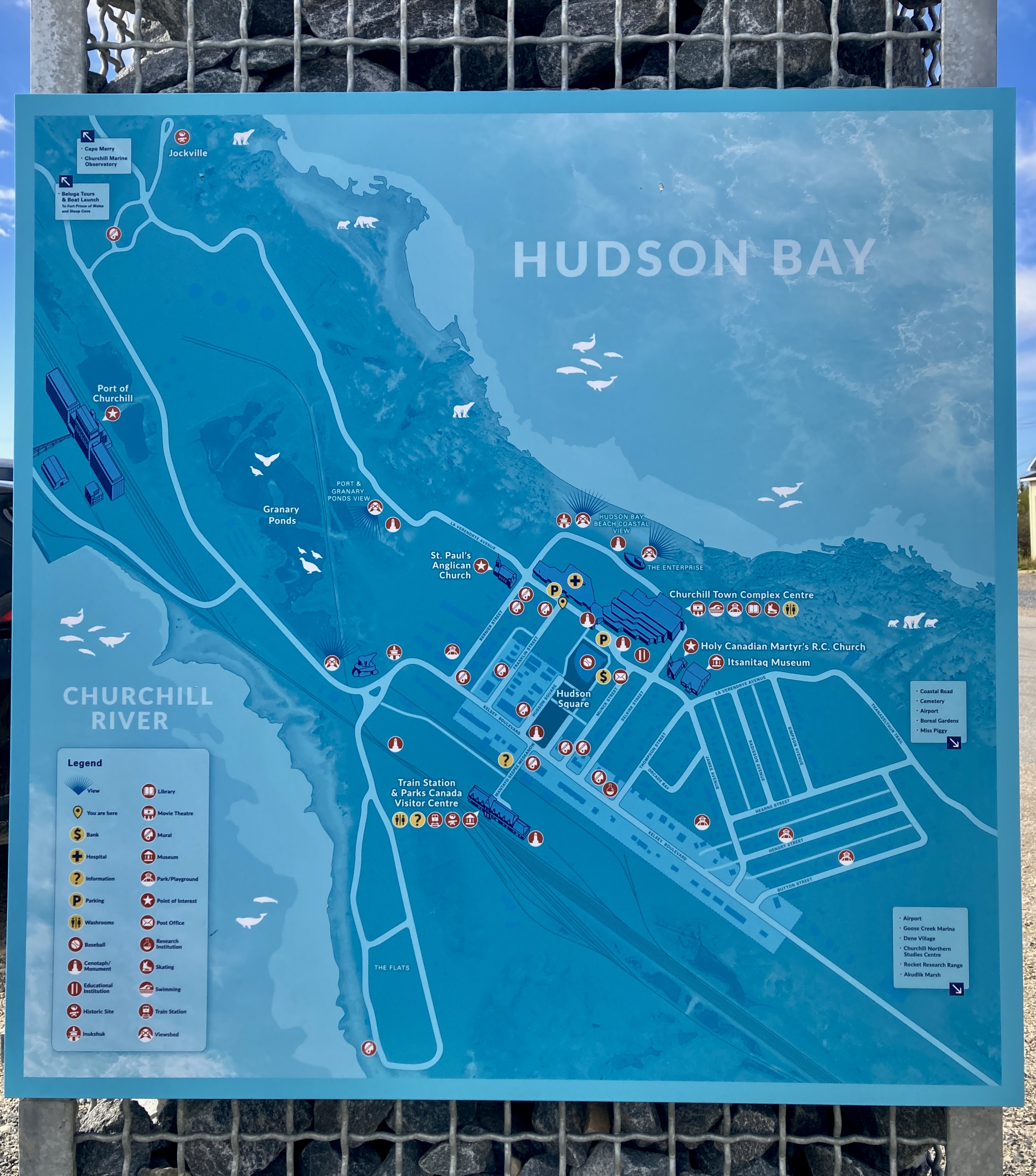
Mine will take me pretty directly from the train station (the dark oblong near the top of that bottom blue loop) straight through town to Hudson Bay.
Not quite directly. First a stop to refuel in the Seaport Hotel’s coffee shop.
It is clean and cheerful, unpretentious, and near the station. A convenient pivot-point. (I have no idea of the dramatic role it will play in my life, later that day.)
Fortified, I take my own boots past a boots mural…
straight-lining it to the water.
And there it is.
There, too, is one of the warning signs I’ve been told about. The polar bear “season” has not yet quite started. But this is the polar bears’ world, and they live by their own instincts, not the schedule of glossy tourist brochures. Every visitor is told to obey all the signs. Yes, I am told, go to the beach area, but no, don’t go to water’s edge, because bears can rise right up out of the sea, and don’t go near the rocks, because that’s where they like to hang out. As the tourism rep in the train station explains to the person in front of me: “You wouldn’t want to step on one.”
Lots of “don’ts.” I take them seriously. You have to respect nature.
So I do something very safe. I climb this convenient, if unorthodox, observation tower…
right to the top level.
Where, first, I view the forbidden rocks to the east …
and then, second, I focus on the beach right in front of me.
I focus, specifically, on the man way down there at water’s edge, walking happily along — man plus small dog, equally happy and unleashed.
This dog.
Not eaten by a polar bear, as you can see. The dog’s owner is a quite elderly Inuk, so I decide if anyone can give me reliable advice, he’s the one. I greet him. I say I watched him enjoying his shoreline walk, and I’d like to do that myself.
He explains he goes there because he likes to pick up stones. “Me too!” I cry. We beam at each other, dig in our respective pockets, and hold out our handfuls of stones for mutual inspection. Much murmured enthusiasm and poking at treasures ensues. After all that, I ask about safety. He says, “You have to watch. I don’t see any bears around right now.” He adds that if I position myself behind the sand bar, I should be fine, since I won’t be next to deep water.
With further compliments about our respective good taste in beach stones, we part company. He toward town, and I straight to the rivulet behind that sand bar.
Where (bottom left)…
I keep the promise I made my toes, that day on the Point Grey beach.
The day is cool — about 9-10C — but sunny and not yet windy. I continue walking the beach, completely happy. I see beluga whales cresting the water surface — just arcs of white, rising and falling, nothing dramatic, but clear enough for me to know they are indeed whales and not waves.
Finally, I walk west toward another line of forbidden rocks…
obediently stop short, and turn inland.
These bright, helpful signposts are all over town. This one is just uphill from the beach, and persuades me to visit the Granary Ponds…
with an initial stop in St. Paul’s Anglican Church, there on the left.
I look at various artefacts, including this 1930s Cree plaque quoting scripture from the Gospel of St. Matthew…
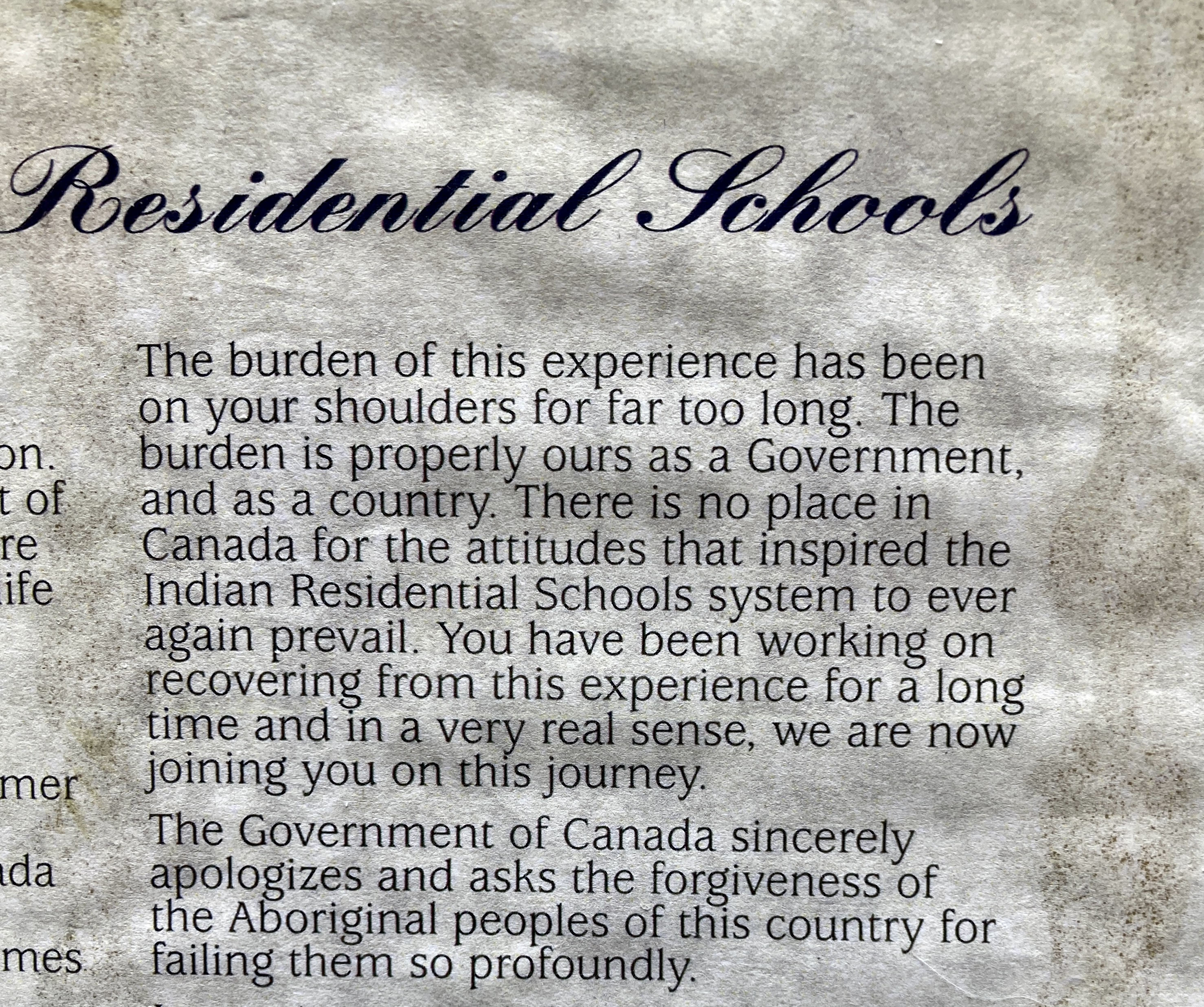
and I read the 2008 Federal Government’s Statement of Apology, signed by then-Prime Minister Stephen Harper, to all those who suffered under the residential school system. Here’s an excerpt:
The road out to the Granary Ponds leads me past riots of wildflowers, still vibrant so late in the season…
and then a closer view of the Port of Churchill…
which, if political promises are kept, will benefit from major expansion in the near future. (An initiative announced by Prime Minister Carney during a European trip — one more move in building stronger and more diversified relations with other parts of the world.)
I backtrack into town. My one goal is to walk. A lot. Though I’ve had only one prior visit to Churchill, in the early 1980s, I spent a lot of that decade going in and out of the Arctic hamlets. I haven’t the foolishness, the arrogance, to think I am any kind of insider, but I do still resonate with all of this. Young self did lots of jumping around. Old self seeks only to put feet on the land, to see and smell and hear the land, and be in this place. So I walk.
And, oh yes, I see very northern sights.
This truck decal, for instance…
and this komatik (sled), waiting for winter…
and this polite request in the doorway of Itsanitaq Museum.
But I also see streetscapes that could be anywhere in Canada.
There are community gardens all over Canada, as well…
though this one takes proper northern measures to protect the crops.
Right next to it, a happy pod of beluga whales, swimming a very different ocean.
And then… and then, no more pictures.
Because then, getting on for 5 pm, my gut announces that it is not pleased with the tasty falafel bowl I had for lunch in a highly recommended local bistro. My gut makes clear that it plans soon to start Throwing Out the Garbage.
This will be merely unpleasant, not dangerous, but also highly inconvenient. The train station is not yet open and I am not registered in any hotel. I’m again near the Seaport Hotel, so I walk in. What else can I do? They look after me. I am safe and sheltered. My gut can briskly go about its housekeeping detail in privacy. When I finally totter off to the train station, a fellow passenger, the station staff and VIA Rail staff are all equally practical and kind. Soon I am whooshed aboard the train, tucked up in my own sleeper-cabin. After a few more rounds of garbage-removal, I sleep. When I wake again, I am completely well. It’s all over.
So is the day in Churchill. Our train is now in motion.
I lie there, think about all that helpful kindness — and decide that my little bout of food poisoning was in fact the final heart-warming event in a thoroughly wonderful day.
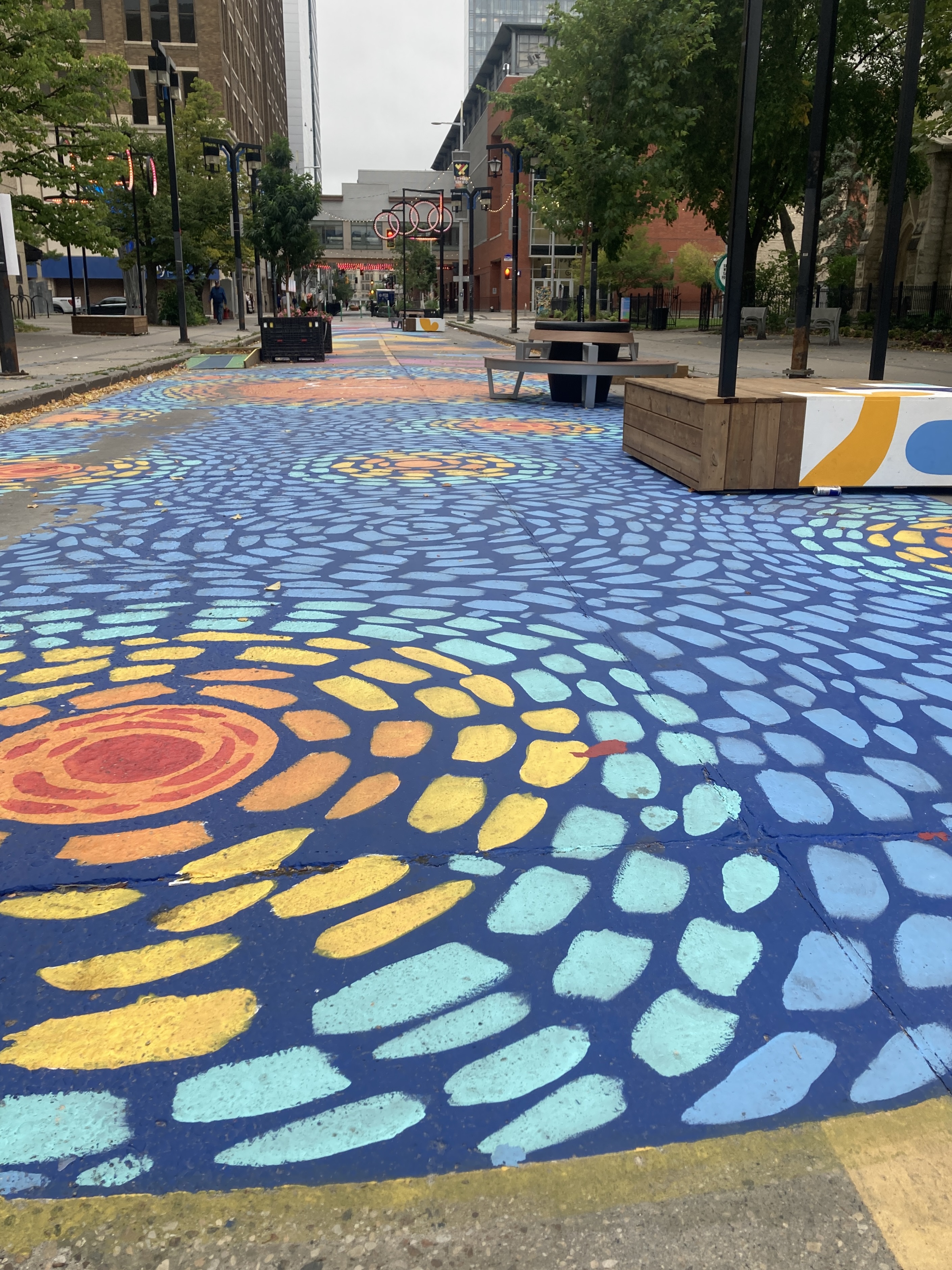
2 September – The train doesn’t depart until 12:05 pm, so I have time for a morning walk on Winnipeg’s “Cool Streets”…
before obediently turning up at Union Station by 11 am.
I just see people. I don’t yet know, for example, that the Calgary couple in the cluster on the left are delighted to see some distant relatives will also be on our train, albeit only part way. Or that the young people over there on the right belong to two separate post-grad teams, one from France and one Québécois (Université Laval), travelling north to research climate change on ice structure and on permafrost, respectively. (Even later, I learn the French project was originally planned for Siberia, but world politics got in the way, and they had to find themselves a new home.)
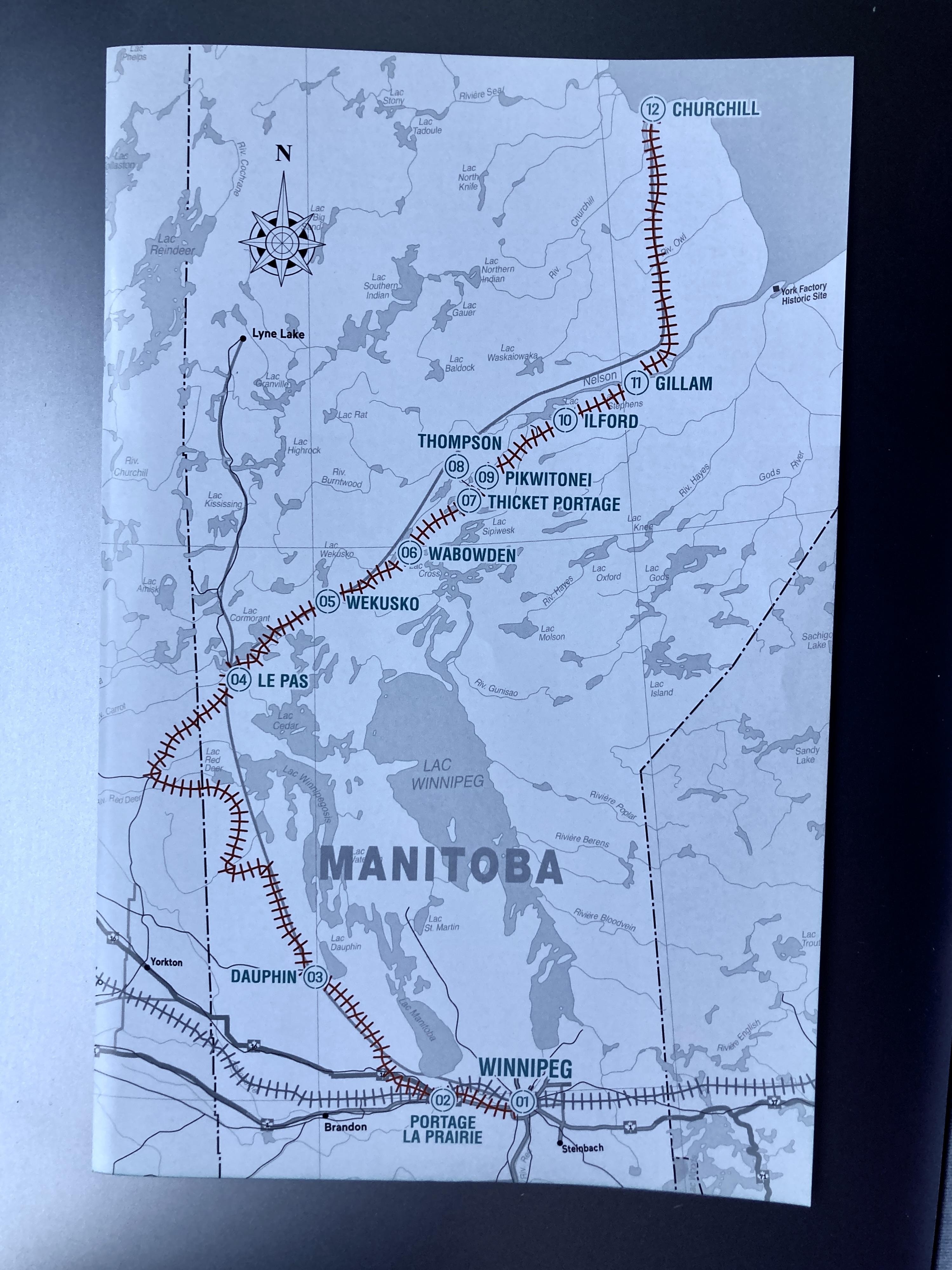
Into my cabin, and a quick study of our trip map.
I am excited. Once, so many decades ago, I returned to Winnipeg from Churchill by train, but I’ve lost almost all memory of the trip. Here I am, about to do it again. Both ways! We’ve been told there’ll be quite frequent stops, in many very small communities as well as the larger ones. This train run is still an important communications link — and, indeed, beyond Thompson, the only land route to Churchill.
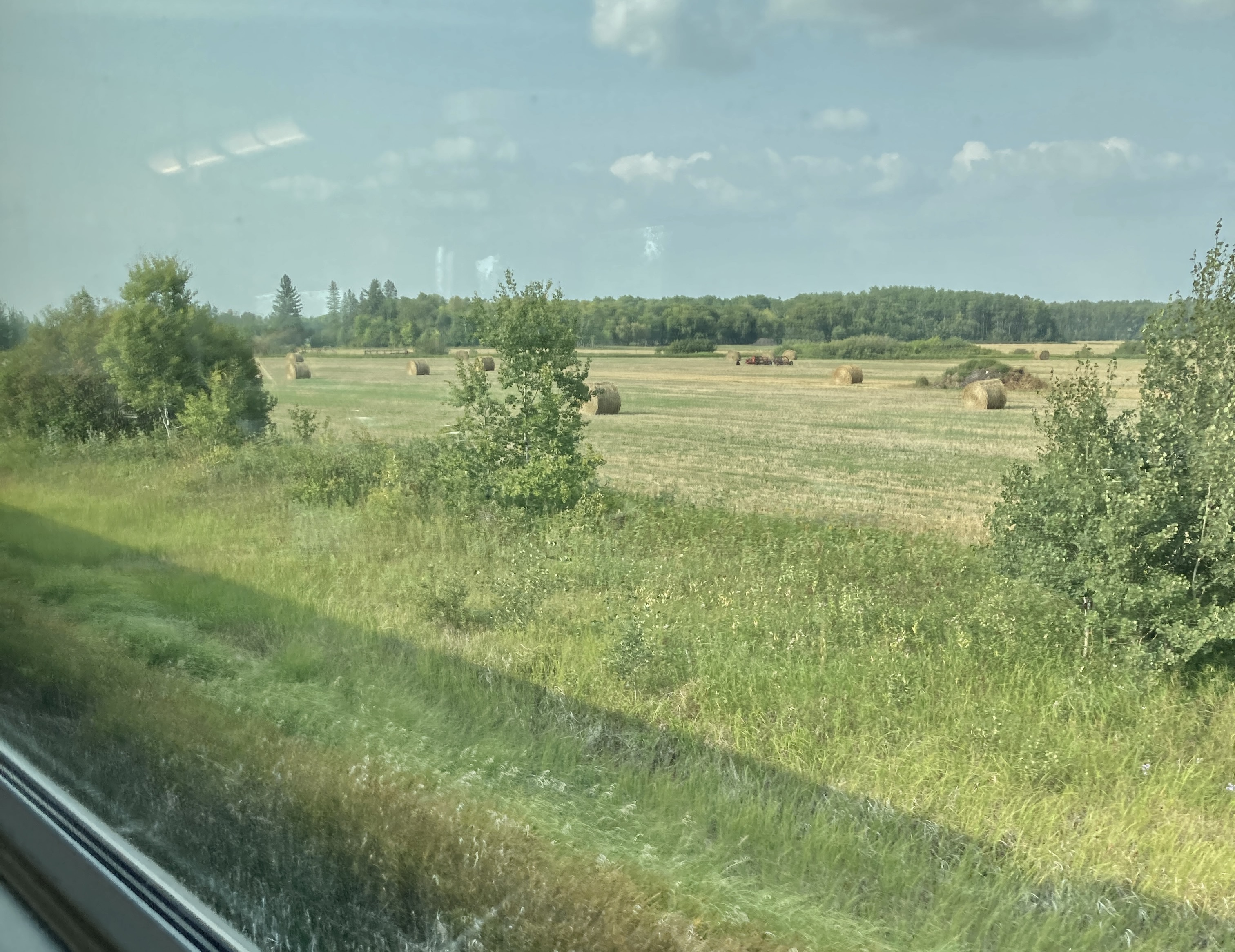
Farms, harvested fields…
as we roll past Portage la Prairie, the land still looks a lot like Saskatchewan. Still very southern.
How could I have forgotten the imposing train station in Dauphin?
A CN station, built in 1912, when train travel was a very big deal indeed.
The next stop will be The Pas, but I’m long asleep by then. I don’t even notice our brief swing across the Saskatchewan border and back again.
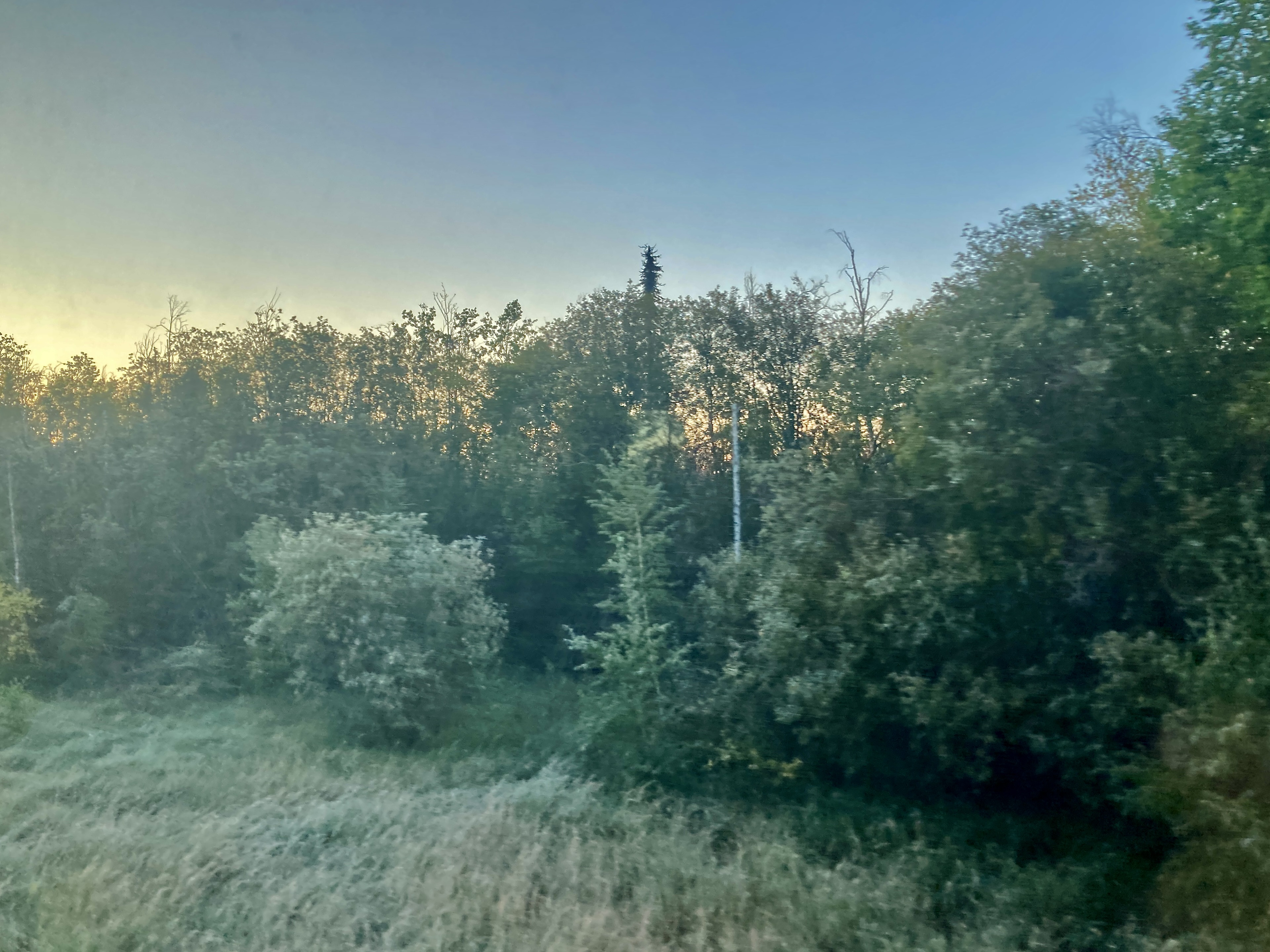
3 September – Sunrise somewhere near Wekusko, and it’s a different world.
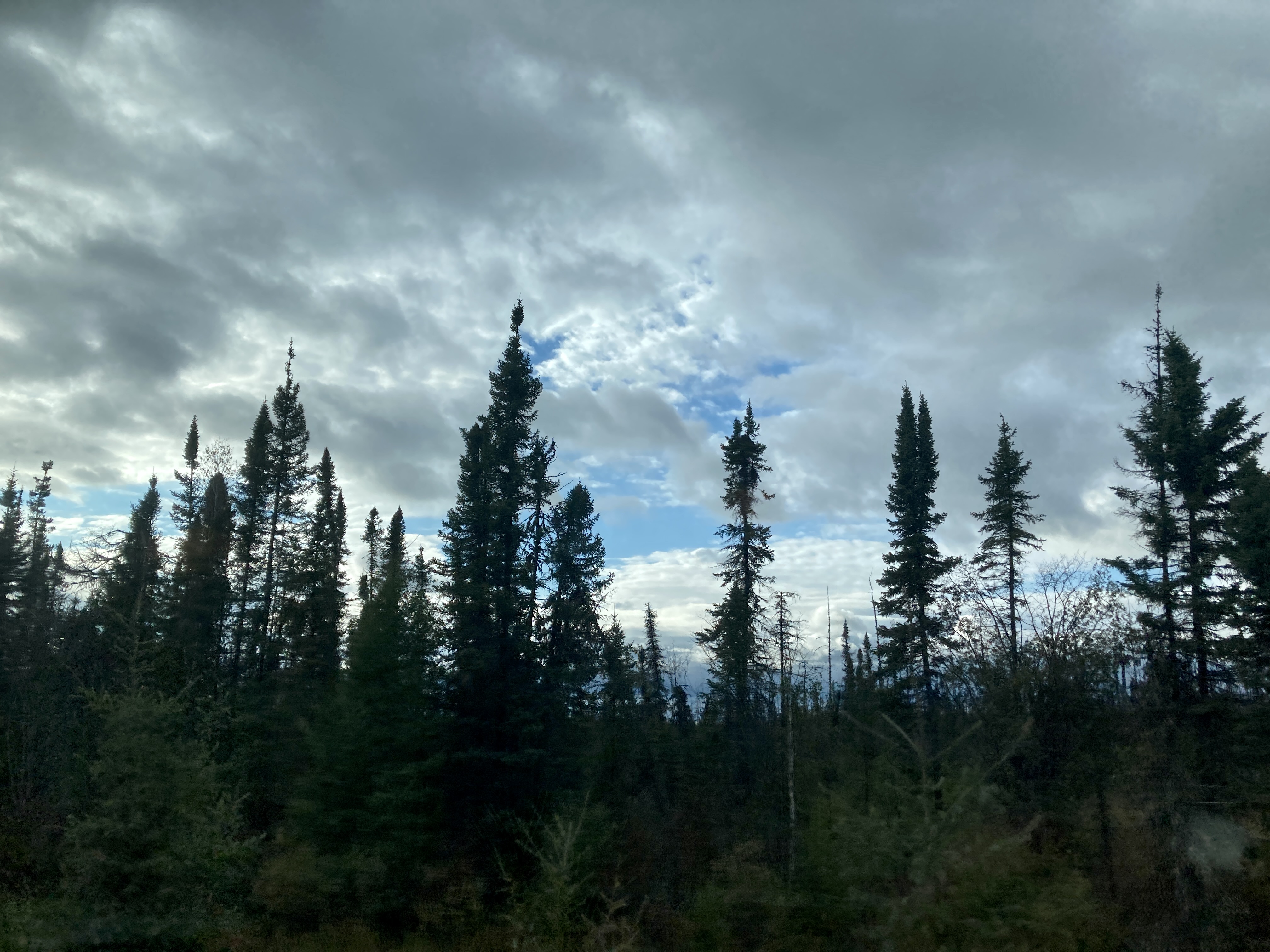
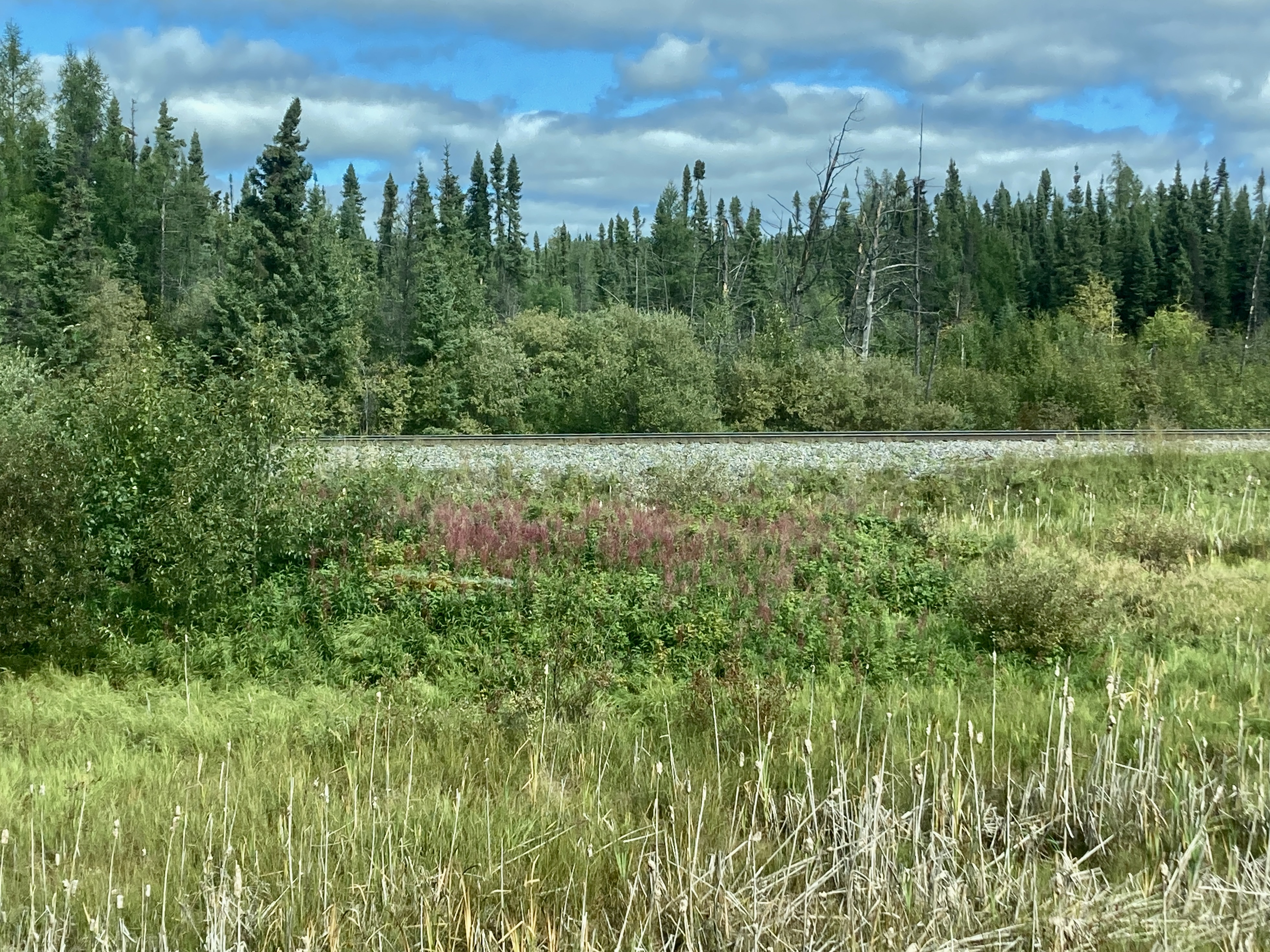
Becoming boreal, it really is. I think some of those lacy silhouettes are tamarack, also some white spruce? I’m not an expert, don’t quote me, but at least I can tell we’re moving into a different world.
Colder, too. Hoar frost rims every leaf, needle and blade…
and here I can name a few things with reasonable certainty. That tall skinny guy in the back row is black spruce, there’s at least one white birch (later I see whole groves of them) and the deciduous trees there on the right look like trembling aspen — all these species part of the boreal mixture.
As the sun rises, mist also rises…
from ponds, lakes and this pretty creek.
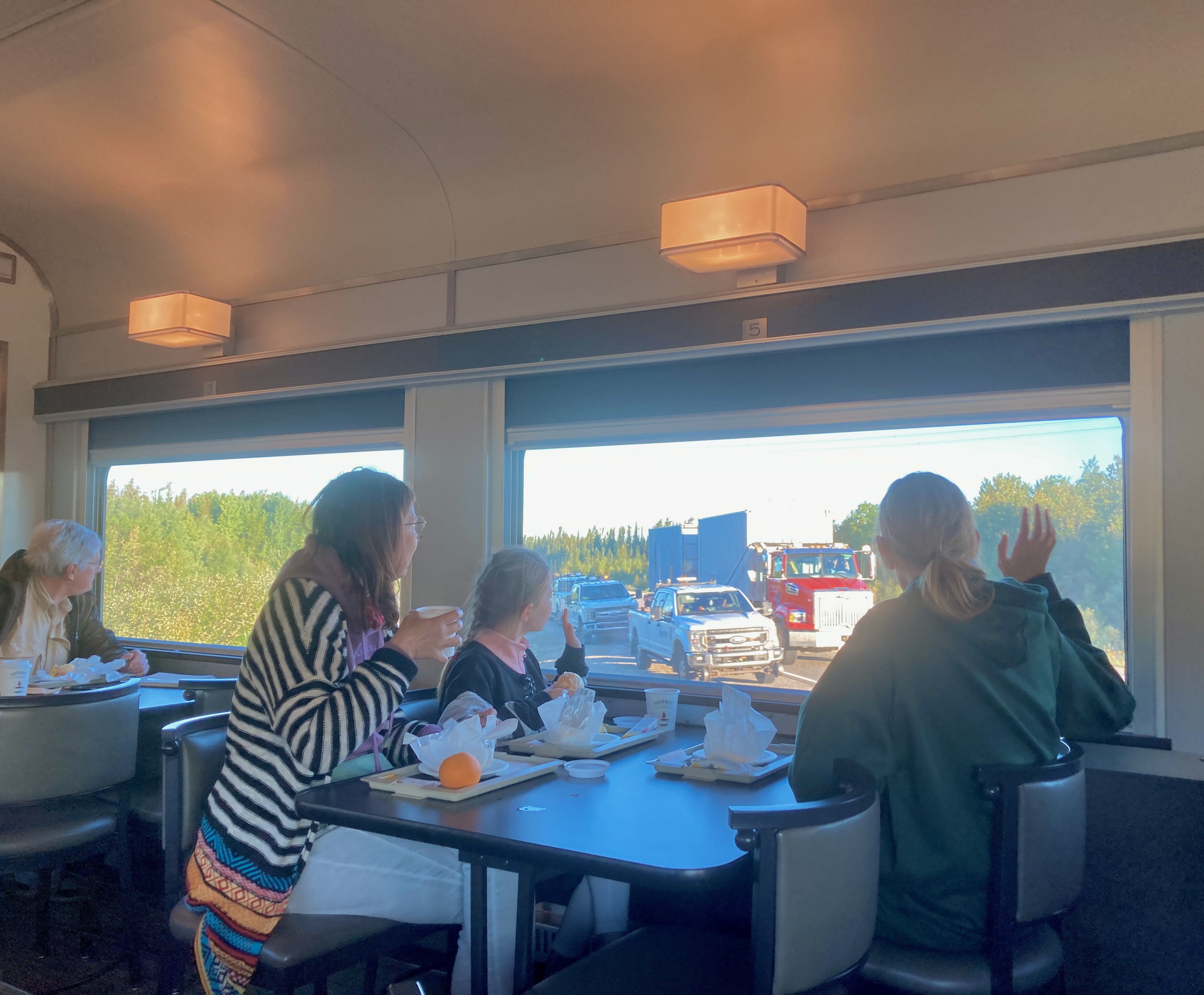
Usually this run has a dome car, but what should have been our dome car is in the repair shop, so the dining car is our everything car. It becomes our hangout, for much more than food.
Families wave to cars at the road crossings…
the students bend over the data on their laptops, prepping for their projects…
and I have my own little spread of resources, quite frivolous by comparison.
Notepad, map, coffee, grapes (I swapped one of my Gemini apples for some of the attendant’s grapes), and — and how appropriate is this? — Agatha Christie’s 1930s The Mystery of the Blue Train. (My copy is in French — snapped up from the Take/Donate bin on my previous train.)
We make brief stops in small communities. Fresh air and a look at daily life for us; vital on- and off-loading for them. Wabowden, for example…
and Thicket Portage, where the Quebec students are chatting next to that ubiquitous vehicle of the north, the fat-wheeled buggy.
Back on board, and in passing I meet Conductor Ted Thompson.
(So there, Paddington Bear! We have Ted.)
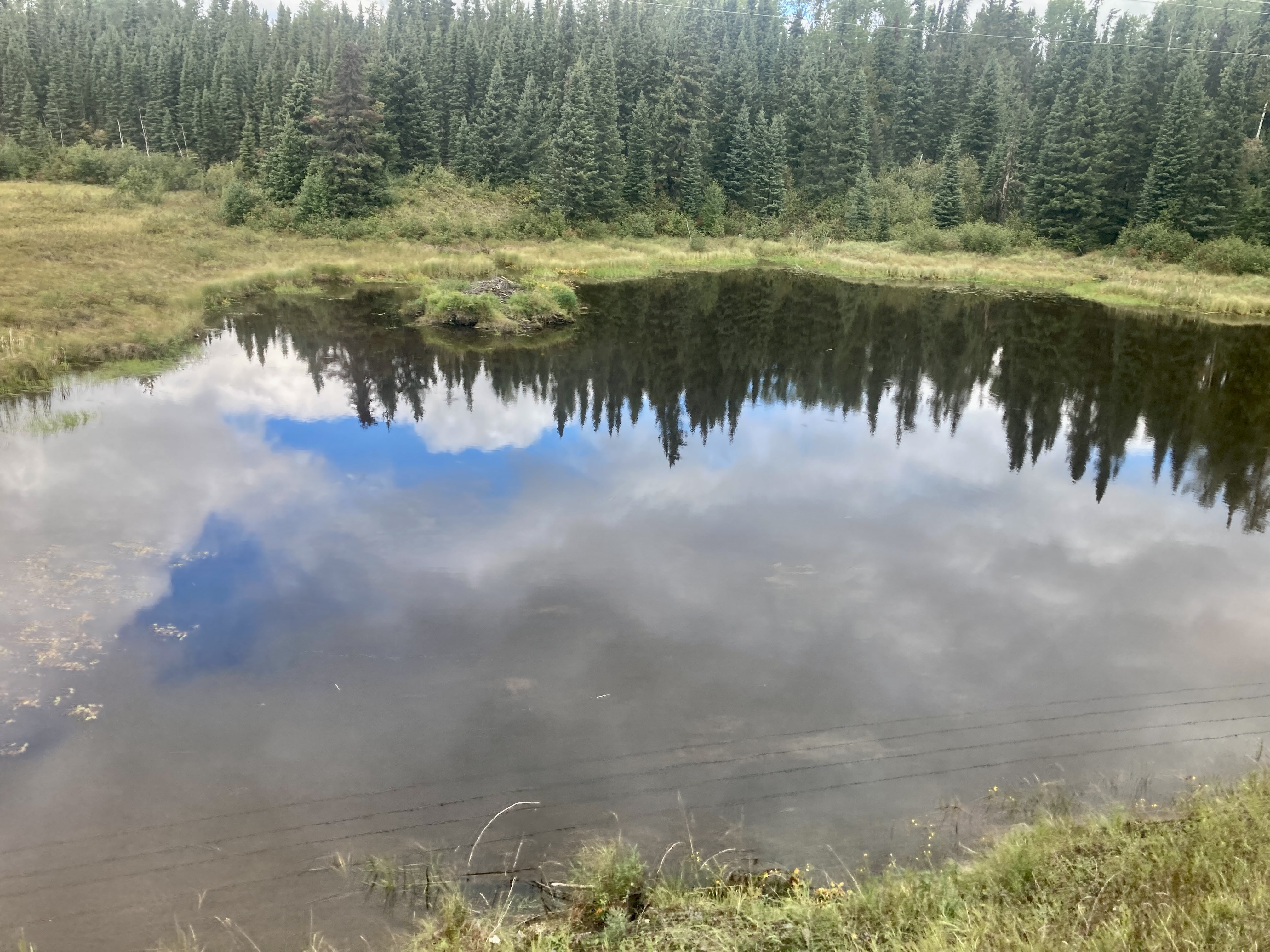
I see my first beaver lodge of the trip…
that knob at 11 o’clock in the pond, but I almost miss it, so many leaves cover the distinctive twiggy dome.
I watch the train curve with the tracks. Completely different from those craggy twists in the Alberta mountains! Here, a setting of scrub, aspen, birch and coniferous I don’t dare to try to identify.
There’s a rock cut that makes me think of driving though Ontario’s Muskoka region…
and piles of materials…
presumably for some project along this river.
A set-piece scene:
wildflowers, train tracks, aspen, birch and conifers.
Just before 3 pm, we do the back-and-forthing required to shift us from the main track to the spur line into Thompson. Thompson: created by INCO, a planned city and a mining town. While now more diversified, you still see that mining architecture from anywhere in town.
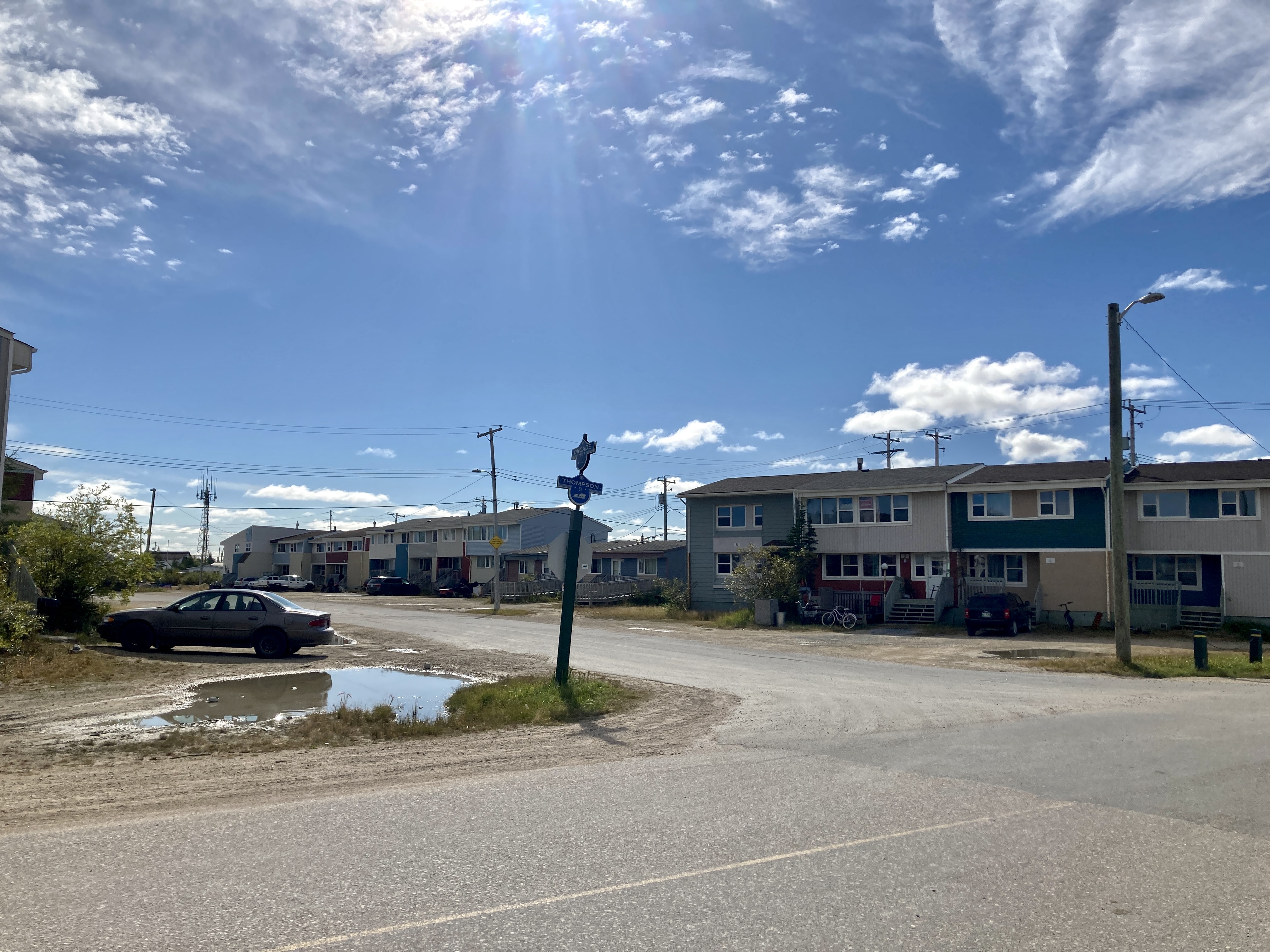
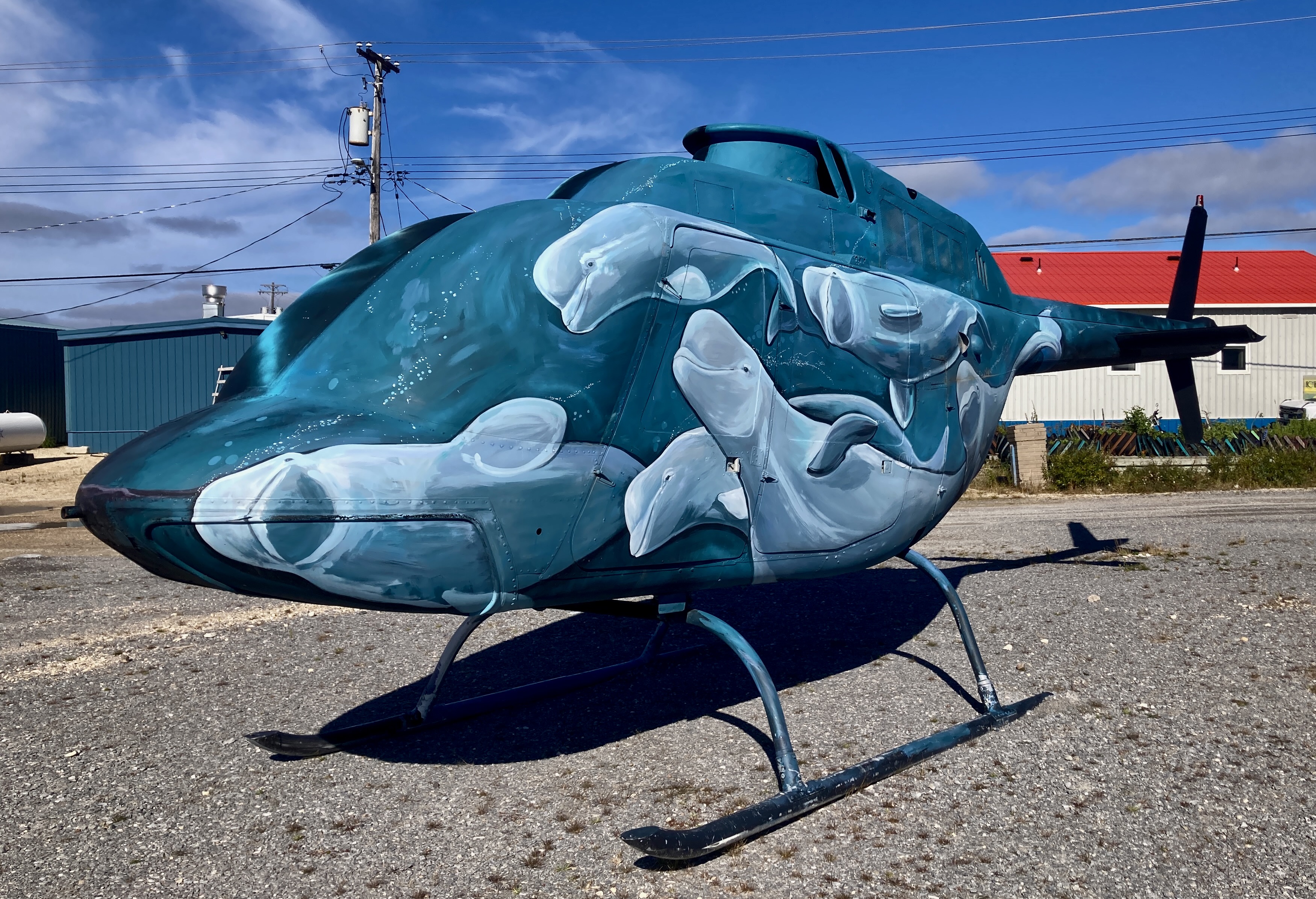
The part we got to walk is very big-box. Anybody who knows the outskirts of Barrie ON will know what I mean. Still, everyone I spoke with was friendly and helpful, and I did get to see my first — of what surely will be many — polar bear mural.
(Though I must add, I prefer the battered float plane mural on the left.)
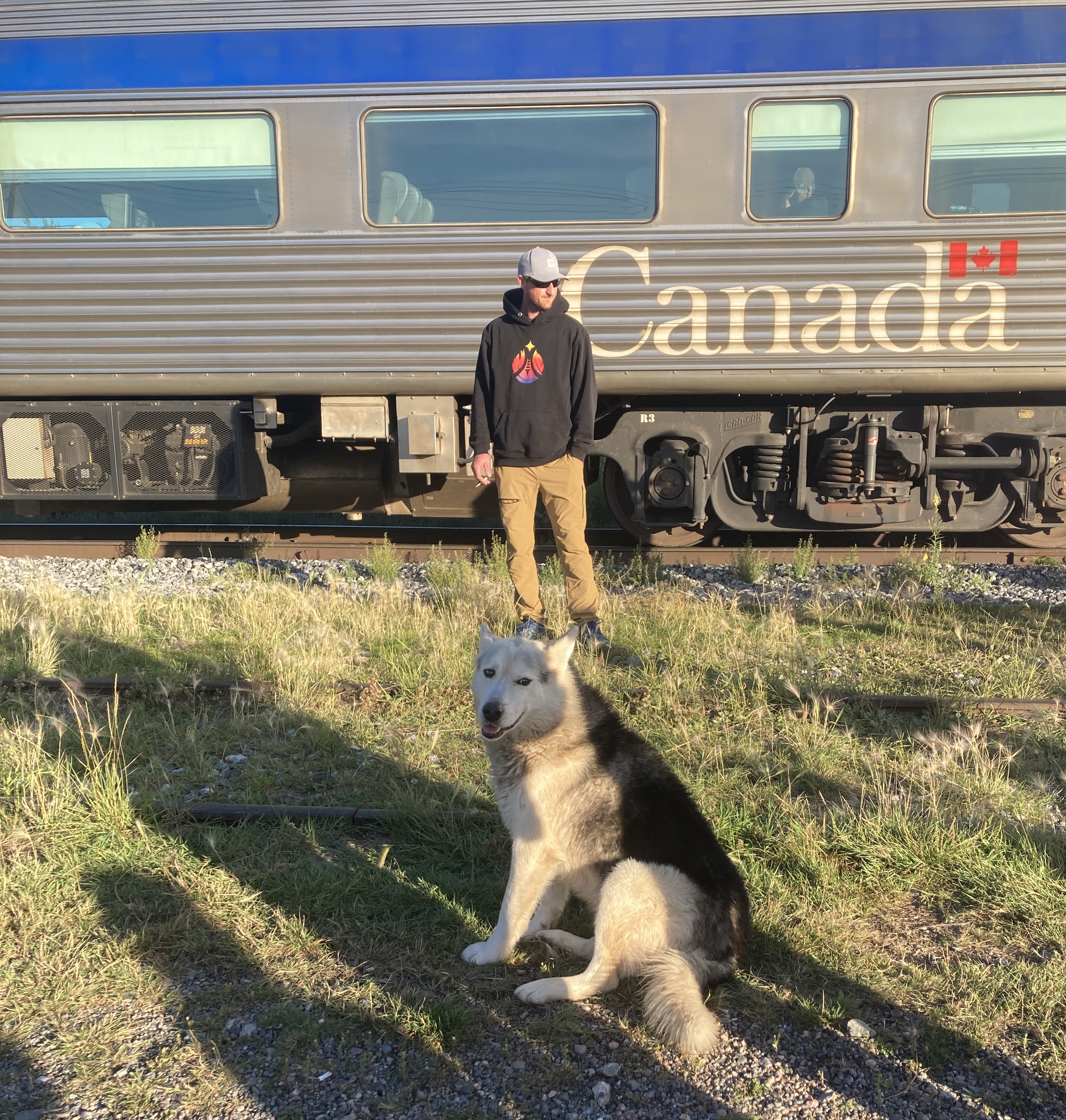
Out of Thompson, back on the main line, and on to Pikwitonei. Population less than 100, says our travel guide, but don’t curl your lip. It also has its very own Greeter Dog.
Greeter Dog meets every train, and while I scratch under his ears and he leans happily on my leg, a Cree gentleman teaches me how to pronounce the town name. It is “Pick-whi-tonNAY.” with the emphasis very firmly on the last syllable. (Like NewfoundLAND. Understand?)
Round about 8:20 or so, somewhere north of Pikwitonei but still south of Ilford, I watch the moon rise…
18 August 2025 – I’m just off a False Creek ferry and walking uphill toward home, still full of Flat White and café chatter with a good friend, when I stop to admire another good friend. (Albeit in a different category of friendship: painted, not human.)
There she is, high a-top her alley home, her quizzical smile floating out across the neighbourhood.
Is she our Mona Lisa, 21st-c. alley-girl version?
No. Given the pace of local redevelopment, and the building that is her home, she is our Cheshire Cat. Soon she will be gone, with only her smile lingering behind, and only in memory.
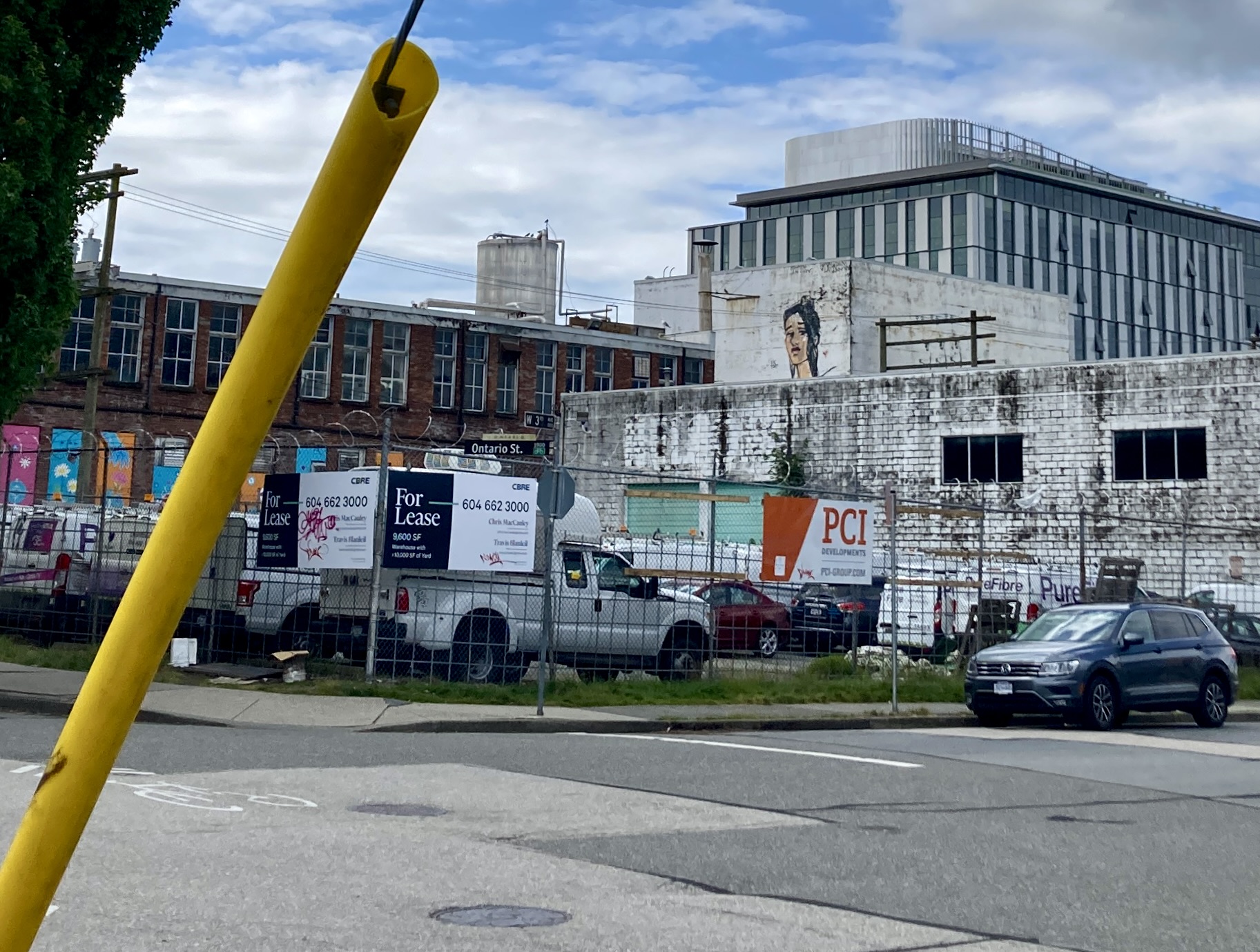
I”m standing at 3rd Avenue & Ontario Street, the intersection at the north-east corner of that L-shaped site, outlined in red. This is the huge redevelopment site purchased by the PCI Group in 2021, whose redevelopment proposal finally received City approval in May of this year. Cheshire Cat Smile is mid-way down lot 5, on the south side of the alley.
I head down the alley. Not for the first time, but it’s different every time, isn’t it? (No need to repeat the Heraclitus discussion…)
Crow in a convex mirror! I’ve never noticed him before, so already the alley is different.
The actual crow, opposite…
which causes me, for the first time, to pay attention to the mural as a whole — signed R. Tetrault and, as I later learn, called Flight Path.
Murals both side of an alley and a whole line-up of hydro H-frame poles in between! Sigh. Life is perfect.
I tip my head, pay homage to the Cheshire Cat Smile…
knowing it’s tagged Lil Top but also knowing I’ve never been able to find any info about that tag. So Cheshire Cat she has become.
The woman I’d noticed under the nearest H-frame, as I photographed Flight Path, is now standing next to me, also enjoying the art.
“It’s people expressing themselves,” she says. “And we get to look at it for free! It makes us happy.”
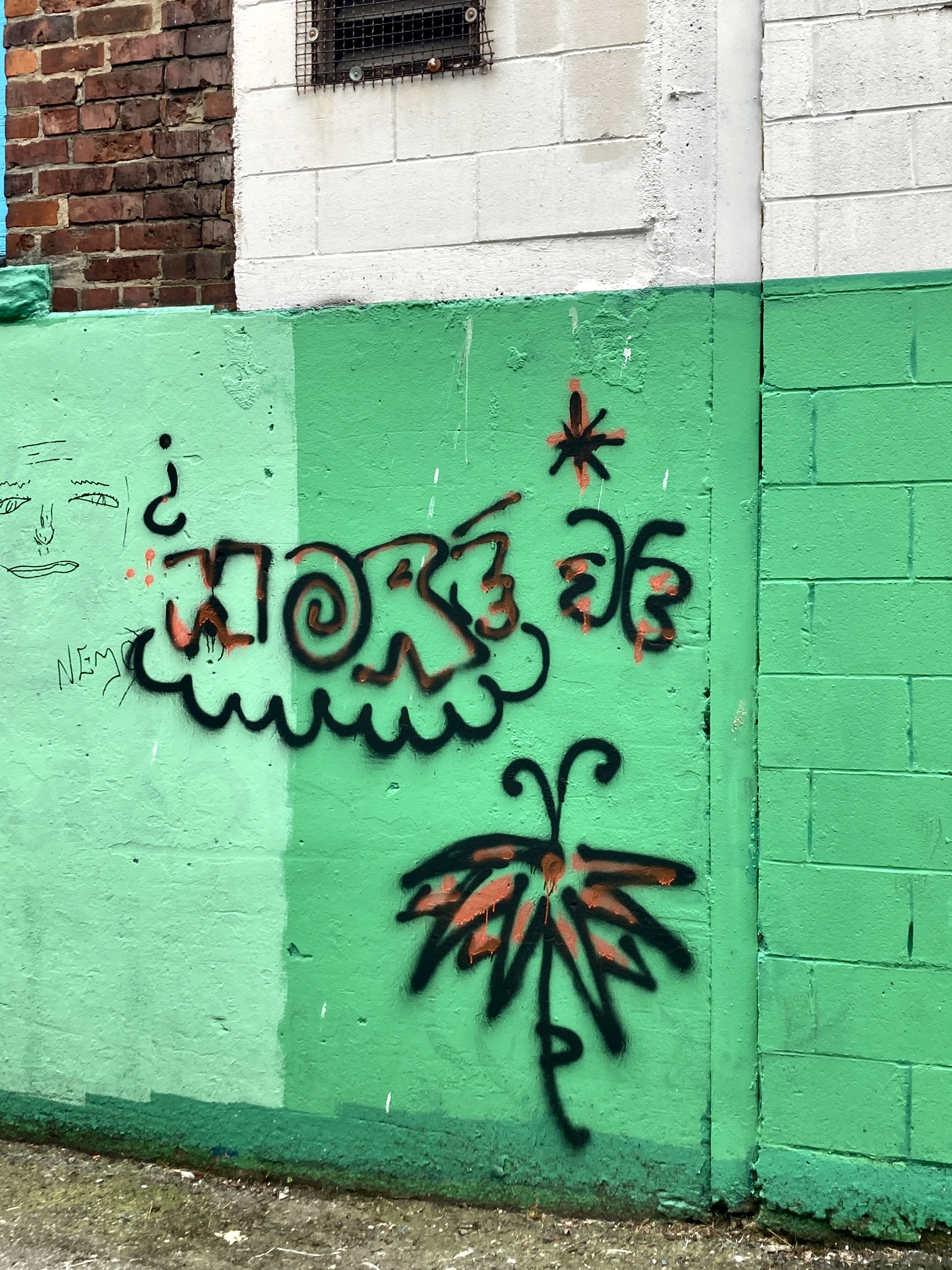
She points: “Like that flower, that butterfly.”
I point to the message next to it, which sets us both laughing.
And then we go our separate ways, each dawdling where we each prefer to dawdle, walking the line of Ciele Beau murals opposite Flight Path.
I pause at a doorway, its notice as outdated as the reminder to “call your mum.”
Nobody, employee or otherwise, will be entering by this door ever again, I tell myself. Or by any other door, on this doomed brick building.
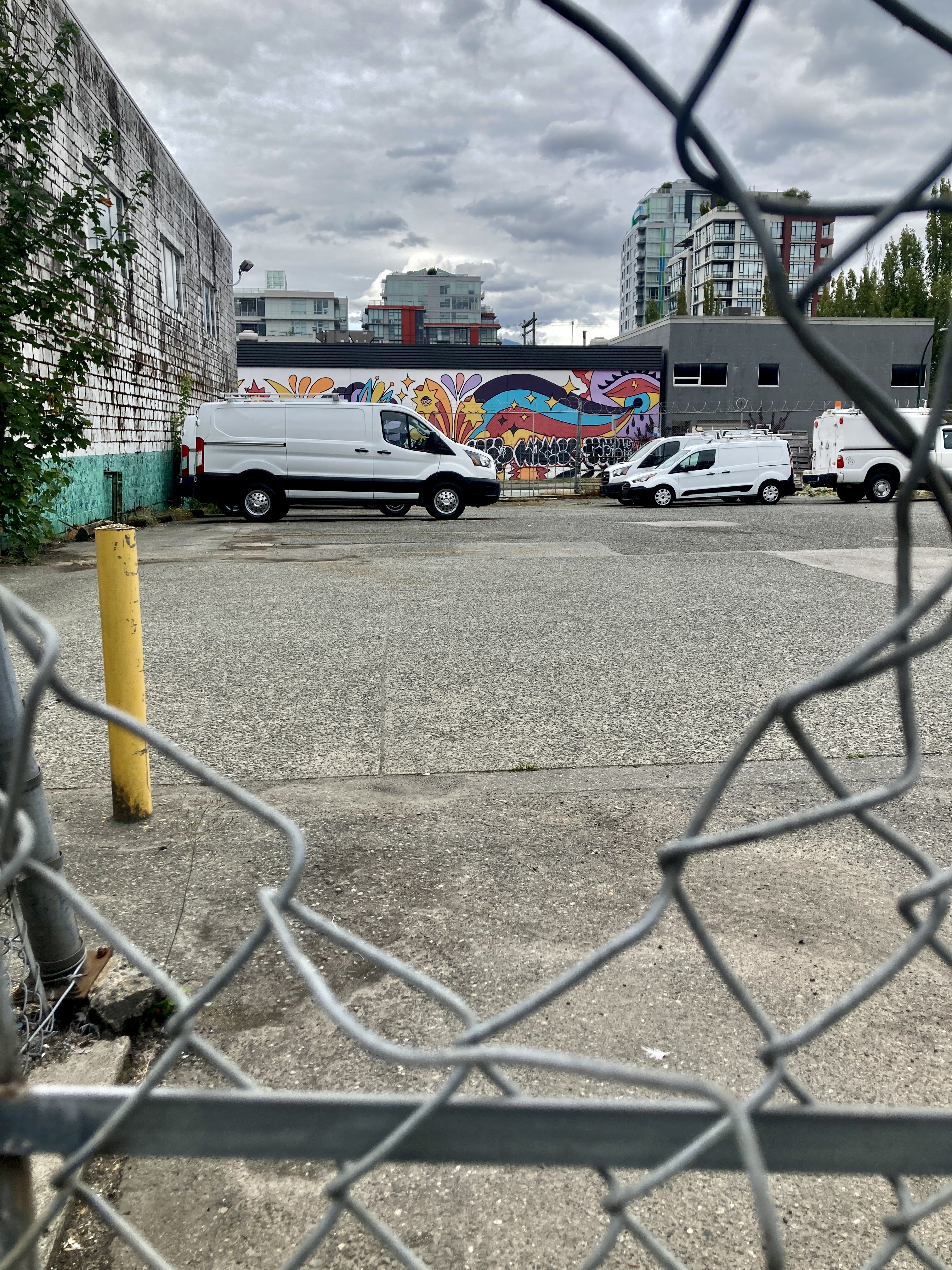
Ghosts of Eras Past to the north of me as well — torn fencing frames the Cosmic Breezemural on 3rd Avenue, painted by Olivia di Liberto for the 2019 Vancouver Mural Festival. RIP, VMF.
I leave the alley, turn the corner onto W 4th. I’m now looking at the block-long southern length of the site, Ontario to Manitoba. All boarded up, waiting for What Happens Next.
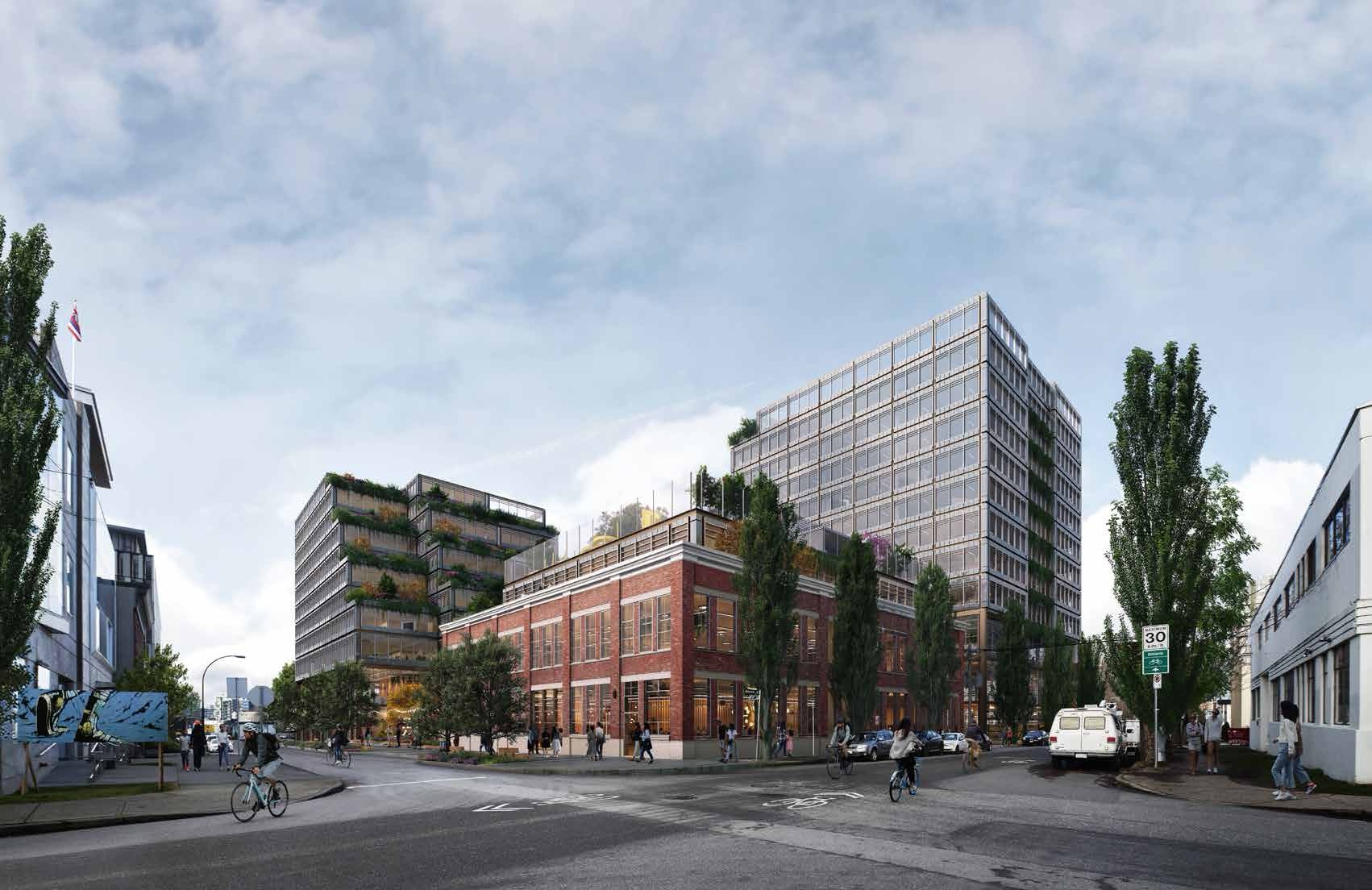
This artist’s rendering shows What Will Happen Next.
“Innovative industrial and commercial uses,” says the corporate website, “heritage retention and refurbishment, office, daycare and ground-floor food and beverage… centred around a new public plaza.”
Now that I’m home, and learning all this… I have to do a little rethinking, don’t I? And so do you.
Employees will once again go in and out of doors in the corner brick building, which is not doomed after all. And Flight Path may fly again. On his website, Tetrault explains he painted it “on plywood for removal and reinstallation on a new commercial development.”
"Traveller, there is no path. Paths are made by walking" -- Antonio Machado (1875-1939)
"The voyage of discovery is not in seeking new landscapes, but in having new eyes" -- Marcel Proust (1871-1922)
"A city is a language, a repository of possibilities, and walking is the act of speaking that language, of selecting from those possibilities" -- Rebecca Solnit, "Wanderlust: A History of Walking"















































 WALKING WOMAN