31 August 2024 – Post-COVID yay! we can travel again. But, whoa, what’s going on? World-wide, attitudes to tourists have changed. Some locations are now actively hostile and others are imposing stiff restrictions.
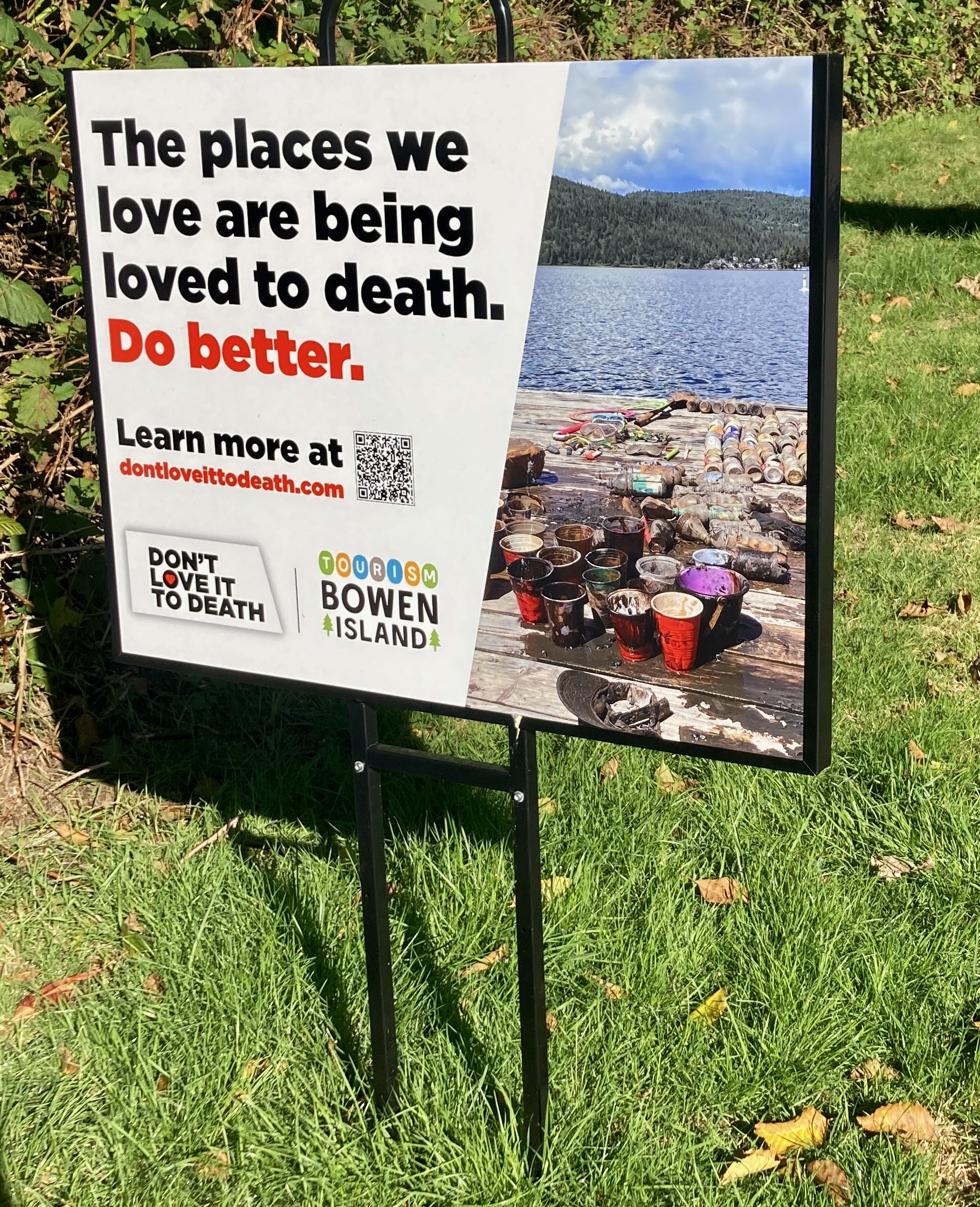
British Columbia still puts out the welcome mat. However, as signage next to the Information kiosk on Bowen Island demonstrates…
the province now expects more from its visitors than money.
Want to be a better lover? Click for info about impacts and solutions that are relevant well beyond BC boundaries.
28 July 2024 – I’ve always loved working boats, starting with the sturdy little Dorval Island ferry of my young childhood. The MV Aurora Explorer is a recent addition to the list, for all the reasons given in my previous post, At Work & Play.
But, I must confess, she is not my very most favourite of all.
That honour goes to another boat working the Discovery Islands area — more specifically, to one tied up by the Bear Bay logging camp in Bute Inlet.
This boat.
I hung over our own meticulously cared-for railing, and fell in love with every rusty, battered, grubby, dented, faded — and still functioning! — square millimetre of her.
And I had no idea what I was looking at. I asked my boating friends for help.
She is a boom boat — used to sort logs and push them around. “Super fun to drive,” fondly recalls Commodore C., as relayed by Commodress (sic) F., “and super effective and efficient. They go sideways, forwards, backwards. There are even boom-boat rodeos!”
This relic is still in service because she still serves, not because the company couldn’t replace her. The most basic internet search turns up sleek new models, boasting for e.g. a “fully enclosed wheelhouse” and promising “special focus on safe navigation and low noise levels.”
26 June 2024 – My previous post ended with a tease: having visited the Port Moody Art Shuffle, I announced I was preparing a “shuffle” of my own.
Not soft-shoe! (Though thank you, Jo, for the quip.) Nope, my shuffle is all about water, even though it begins in the air.
A 40-minute Beechcraft flip…
positions me in Campbell River, on Vancouver Island, for a five-day exploration of the Discovery Islands Archipelago…
aboard a steel landing craft…
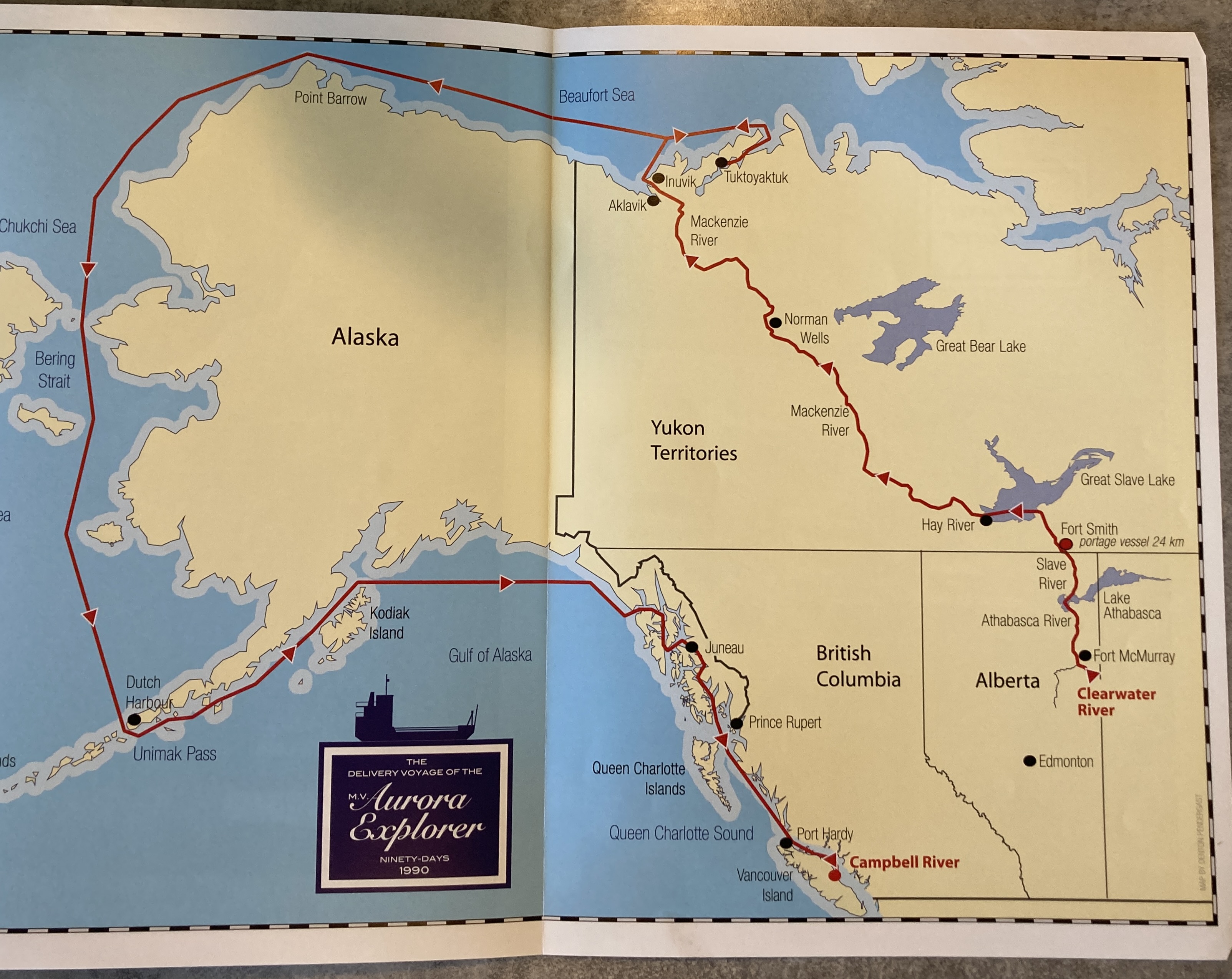
that had worked two decades in the Arctic, before being rescued from dryland storage in Fort McMurray and sent on her own 90-day delivery trip up a chain of rivers into the Beaufort Sea, through the Bering Strait, around Alaska, and down the Inside Passage to Campbell River…
where she was enlarged and rebuilt for her new life as the cargo/passenger vessel she is today: 135′ long, 34′ wide, capable of carrying 200 tons of cargo plus 12 passengers in six compact but well-equipped staterooms.
This June 18-23, I was one of them.
Boating friends had told me about the MV Aurora Explorer, flagship of Marine Link Transportation (whose fleet also includes tugs and barges), and I jumped at the idea.
It brought back memories of travelling around Newfoundland’s remote communities aboard a passenger/supply vessel in the 1970s, and it reminded me how much I enjoy discovering the nitty-gritty behind the pretty-pretty — the hidden hard work that makes happy outcomes possible.
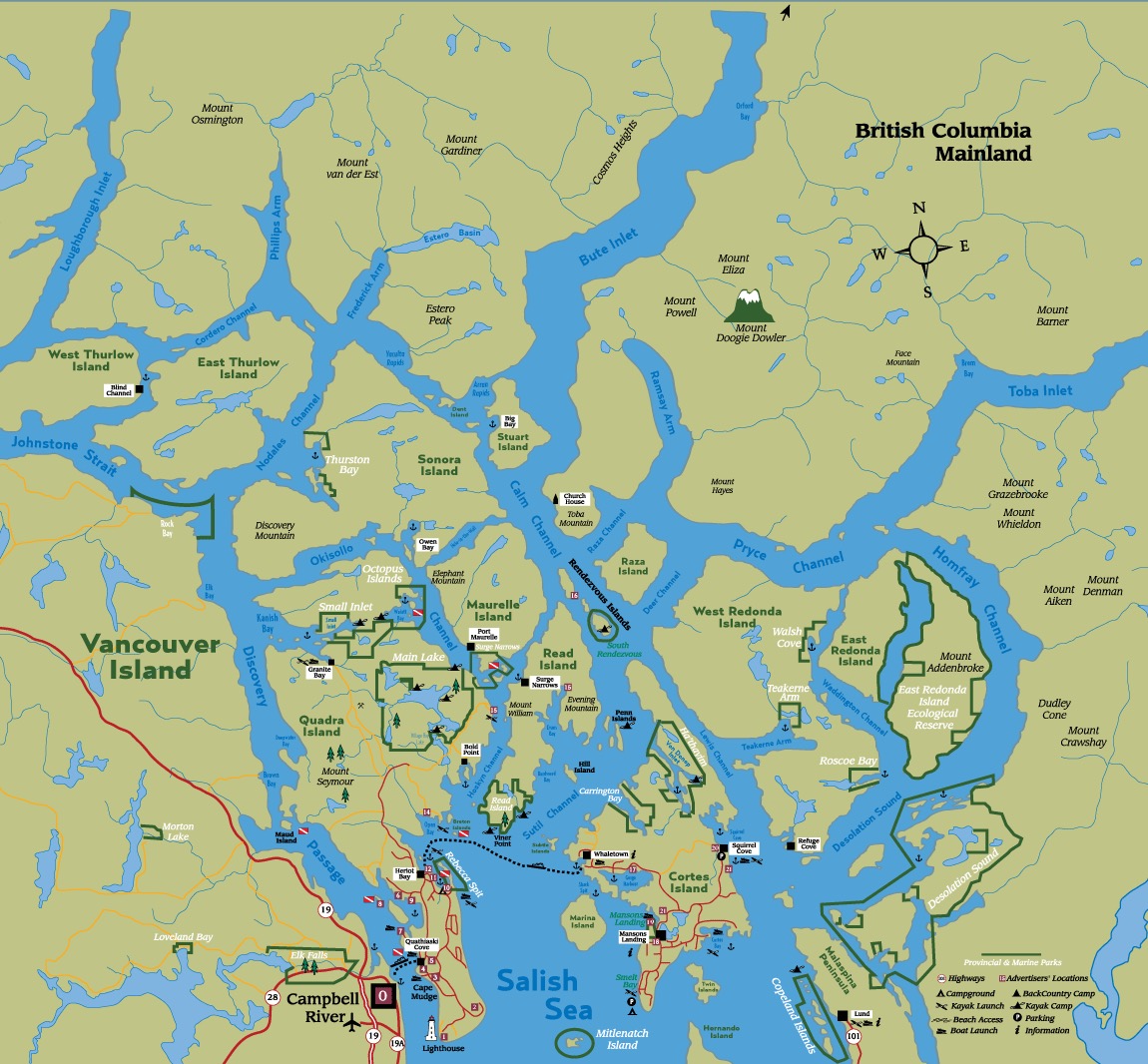
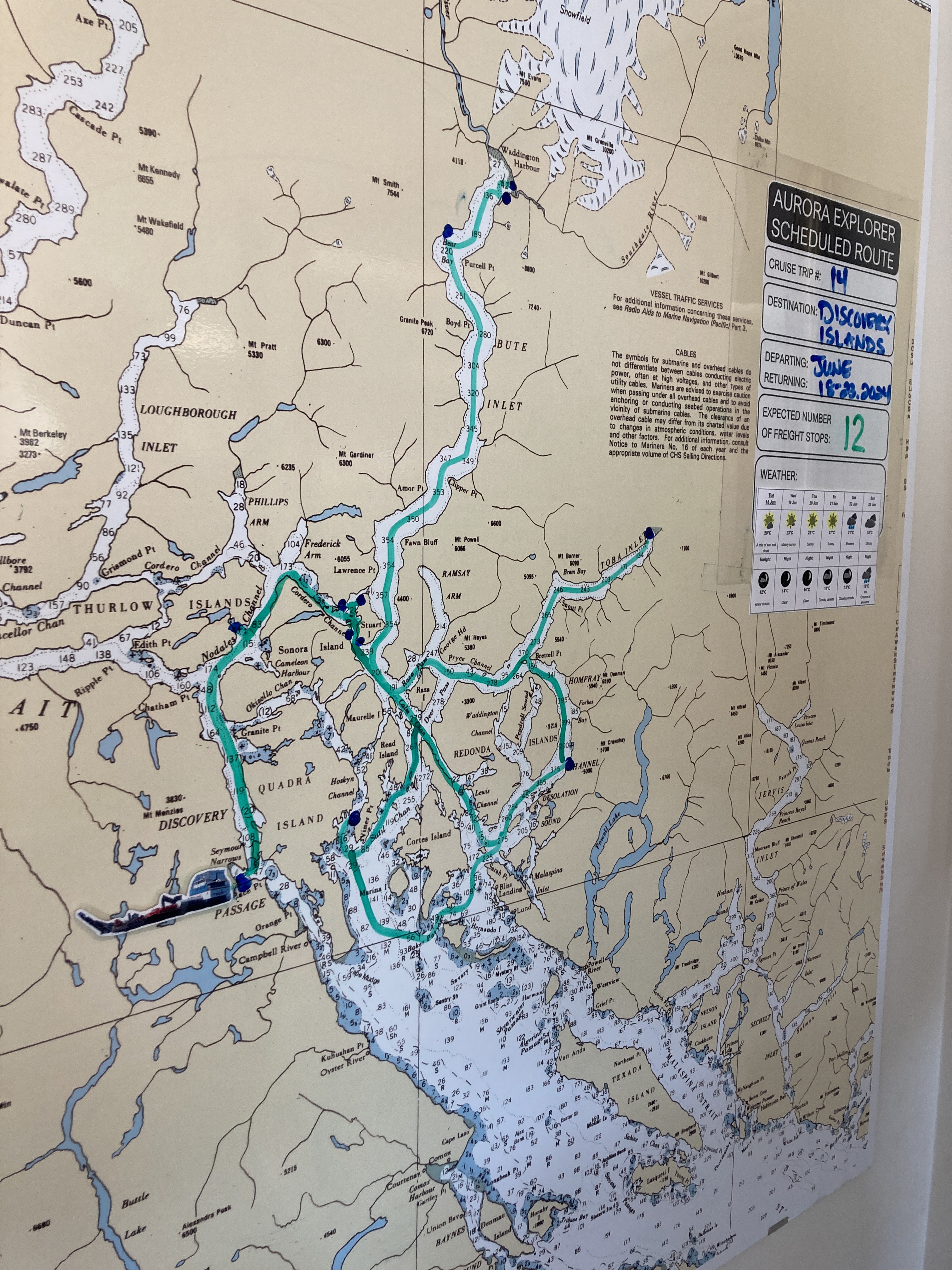
We passengers assemble at the terminal north of Campbell River, and see our projected route marked on a map on the wall.
We will weave among various of the islands that cluster between Campbell River and the mainland to the east, and also travel to the head of two long mainland inlets, Toba and Bute. We will learn first-hand the truth behind the claim on MLT‘s “working” website (distinct from its tours website). This company provides “full marine freight delivery service,” handling everything from “logging equipment and camp barge site relocations to small pallets of champagne flutes,” offering charter and helicopter options as well, in order to service “remote coastal needs.”
We will also learn the endless calculations and adjustments needed to handle — among other things — tides, currents, cargo rebalancing after each delivery, and the varying states of the access points on shore.
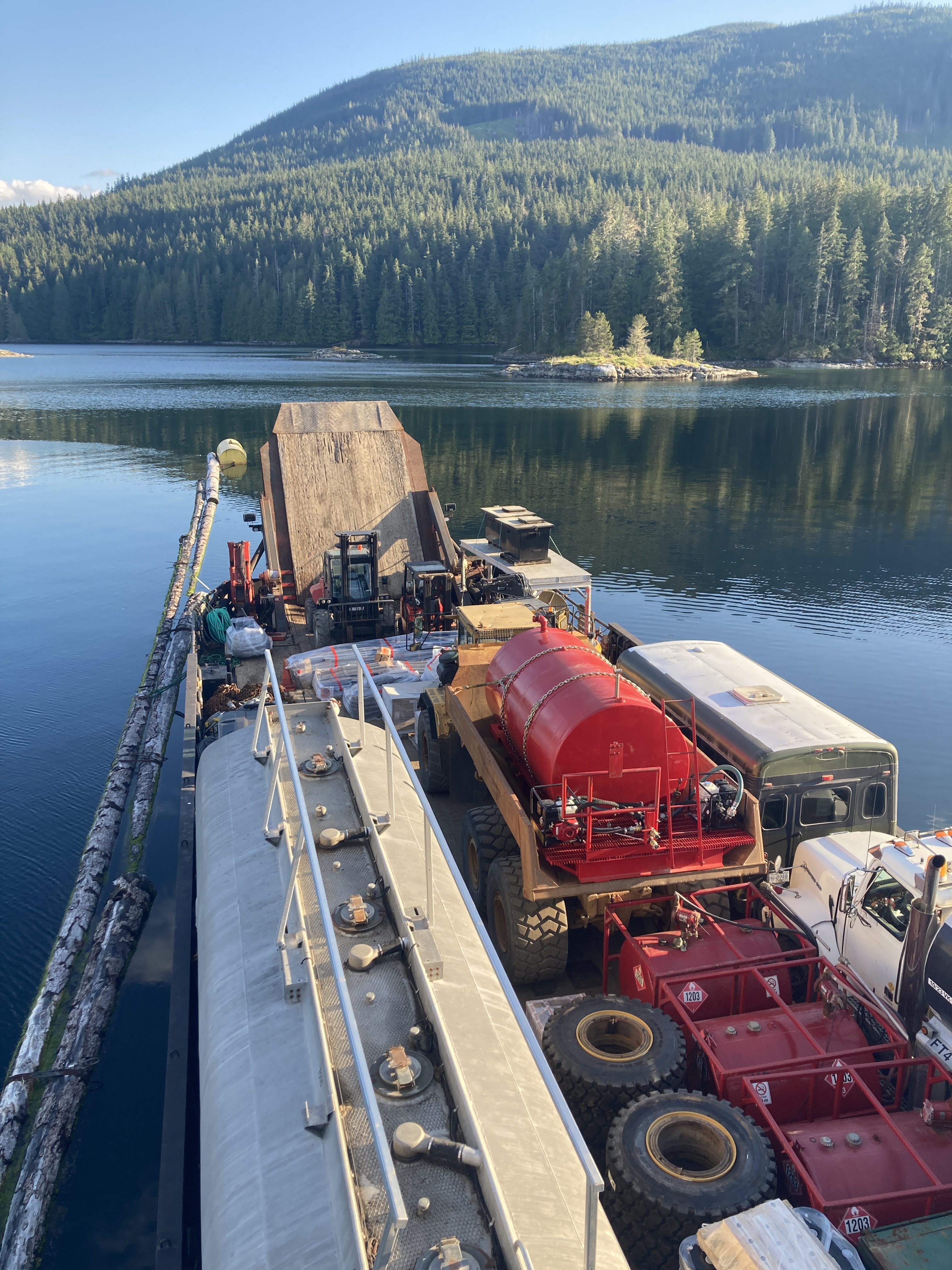
The Aurora sets out fully loaded…
carrying vehicles, tires, fuel and other supplies to deliver to (among others) logging camps, a road-building project, a luxury wilderness resort and an equally luxurious private get-away.
She also carries her own fuel tanker, forklifts and other equipment…
to ensure delivery can and will be made.
We passengers sleep comfortably, eat very well, and hang out up top, sometimes in deckchairs but just as often lined up at the railing, stunned by the scenery around us and by the careful choreography of each delivery.
We immediately appreciate the skills of the chef and the steward; we quickly learn to appreciate the rest of the crew — captain, mate, engineer, deckhand — and, especially, appreciate what all six of them embody. Most of them have BC coastal life in their DNA, along with experience working in remote locations (Alberta’s Oil Sands, for e.g., and an Arctic mining camp), and all have the ability to multi-task.
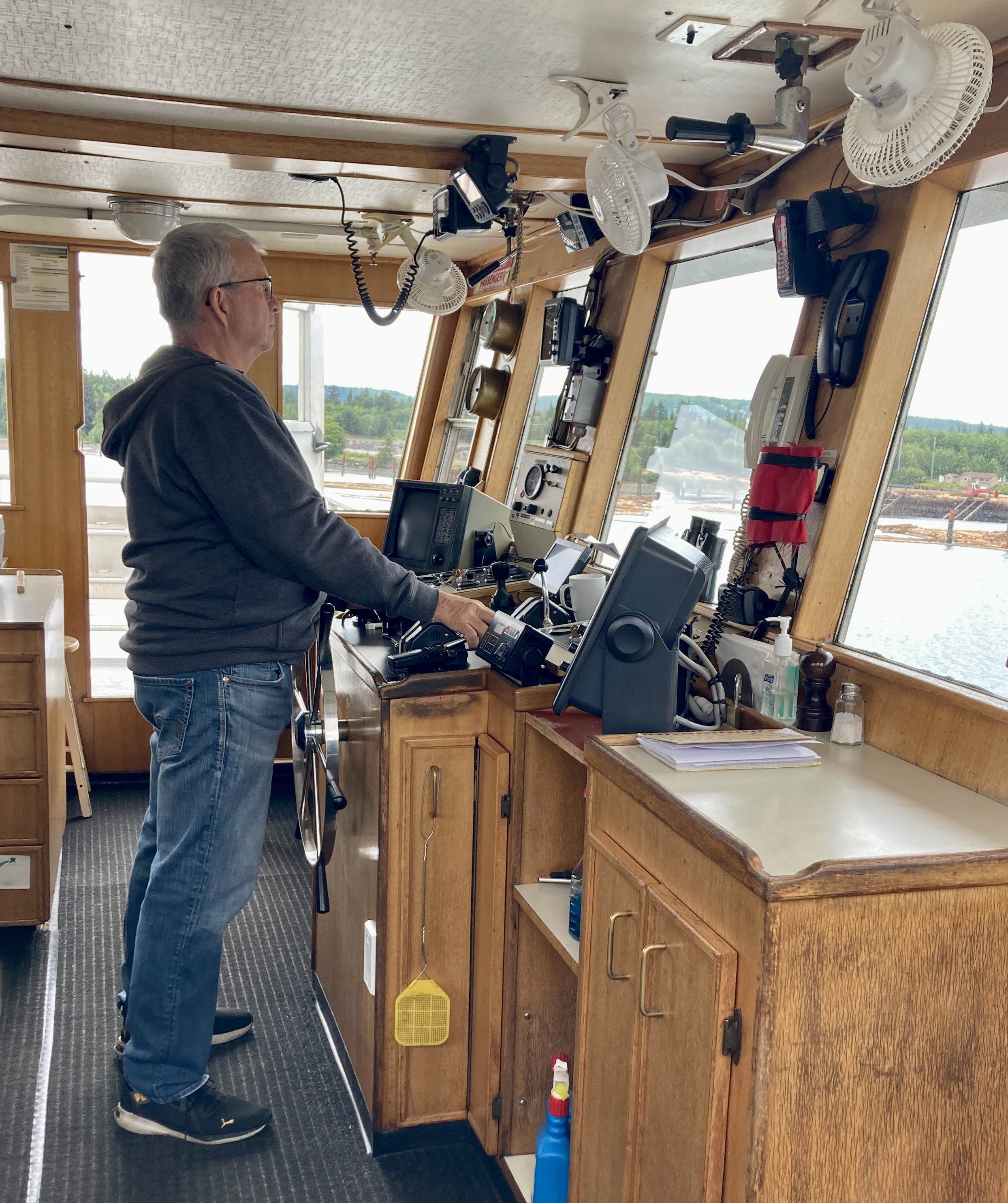
The captain is usually in the wheelhouse…
but we also see him run a forklift, when that’s what’s needed. Typically, though, it’s the mate, engineer and deckhand who jockey the deliveries. Each site has its requirements.
At one site, the engineer guides the mate as he prepares to off-load a vehicle…
at another, all three work to patch an unstable access road with boulders, so it can bear the weight of the van and trailer they need to bring on-board for delivery to a companion site…
and somewhere else, they deliver fuel from the on-board tanker to on-shore tanks, with one person positioning the nozzle, another controlling hose performance and the third about to wield the dipstick.
Even at a luxury wilderness resort, where everything is perfection — including the access road — there is risk. A combination of factors means there are only 20 minutes between the first safe moment to arrive and the last safe moment to depart. Exceed that window, and you wait for the next tide. The resort knows that if they want that vehicle to be loaded on board, it has to be right there, ready and waiting.
It is right there…
and it is securely in place on deck within the magic 20 minutes. Off we go.
But the Aurora is not only about work, here on the remote BC coast!
There is play time as well.
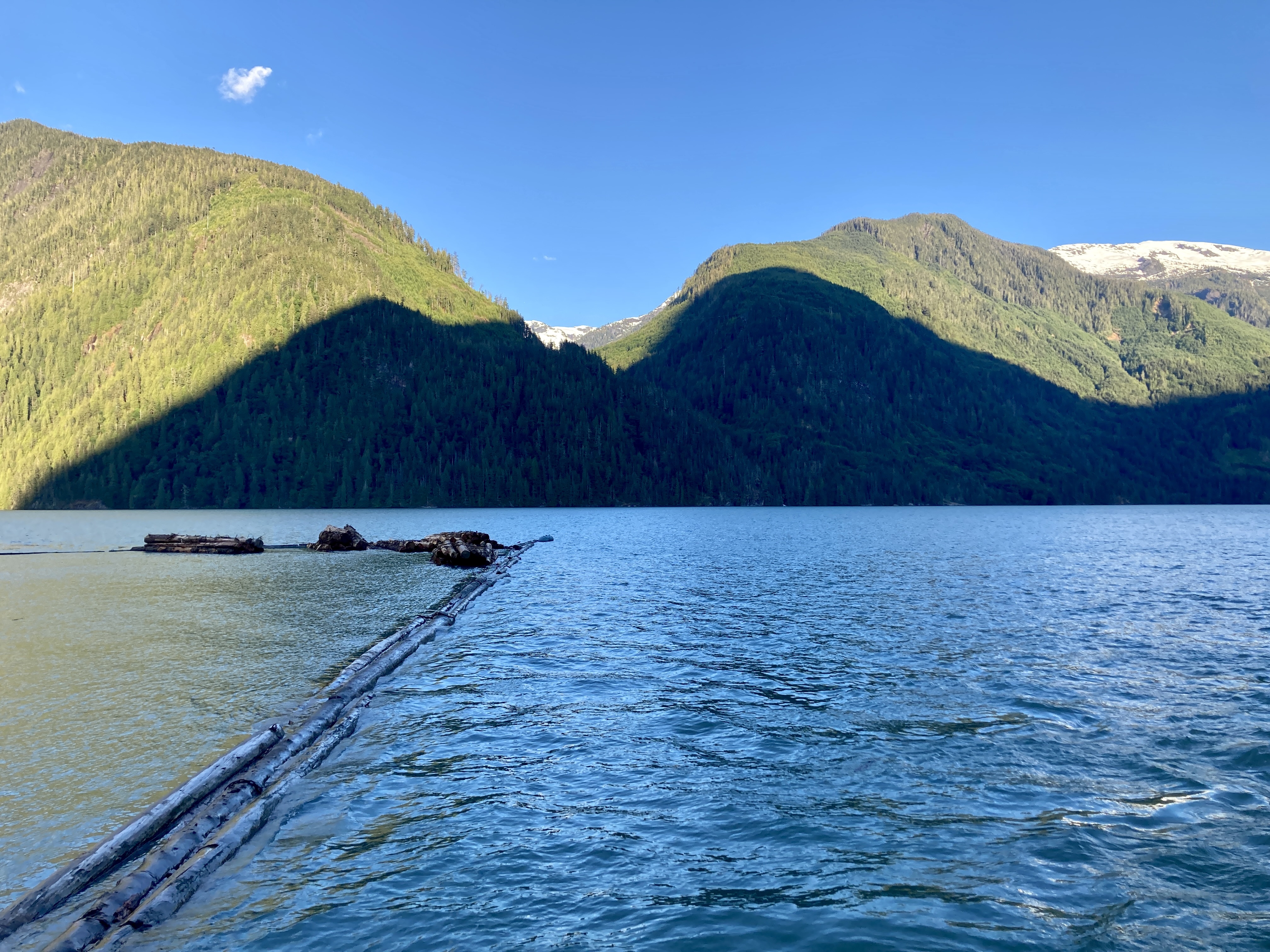
Always available: the endless beauty that surrounds us. Big vistas as we travel, here for e.g. high up Toba Inlet…
and more beauty when we tie up each night alongside some boom logs. We spend a night in Toba Inlet, where the setting sun throws dramatic mountain shadows onto the mountains opposite.
We have time ashore. One day ATVs carry us up the steep rough track to the top of Hall Point, Sonora Island, where the view pretty well ticks the checklist:
ripening salmonberries in the bushes; a tug and neat rectangular log boom in the water; and mountains beyond, rolling away to infinity. All that’s missing — and thank goodness — is a bear or two. We are happy to make do with bear scat along the track.
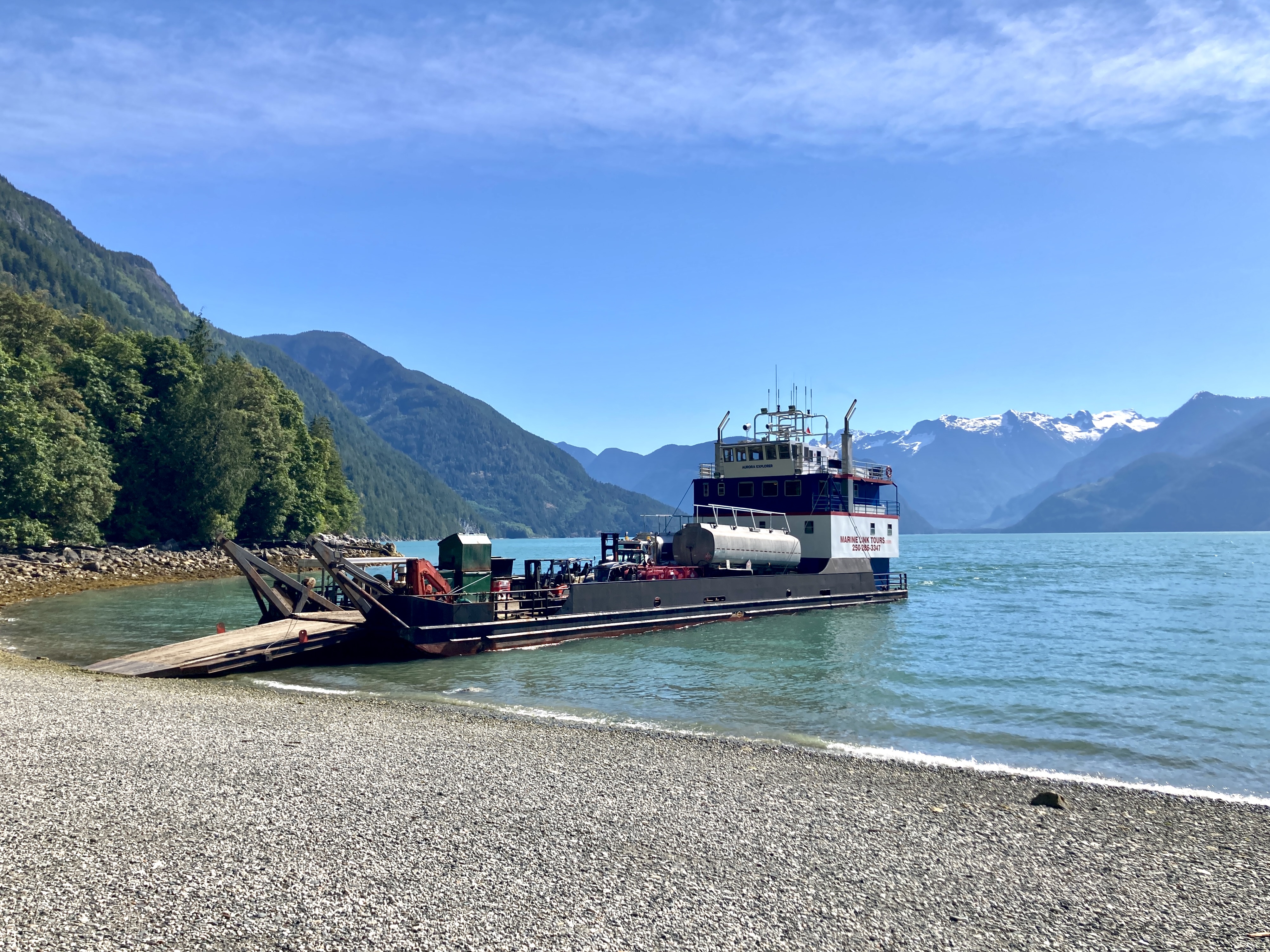
Then there are the days when the Aurora lowers her ramp…
not to deliver a bear-watching van or sets of huge tires or tanker-loads of fuel or even furniture for a rich man’s private residence. But, instead, to deliver… us.
Pebbles (above) at Amor Beach, Bute Inlet; sand and rocks at Brem Bay Beach, Toba Inlet…
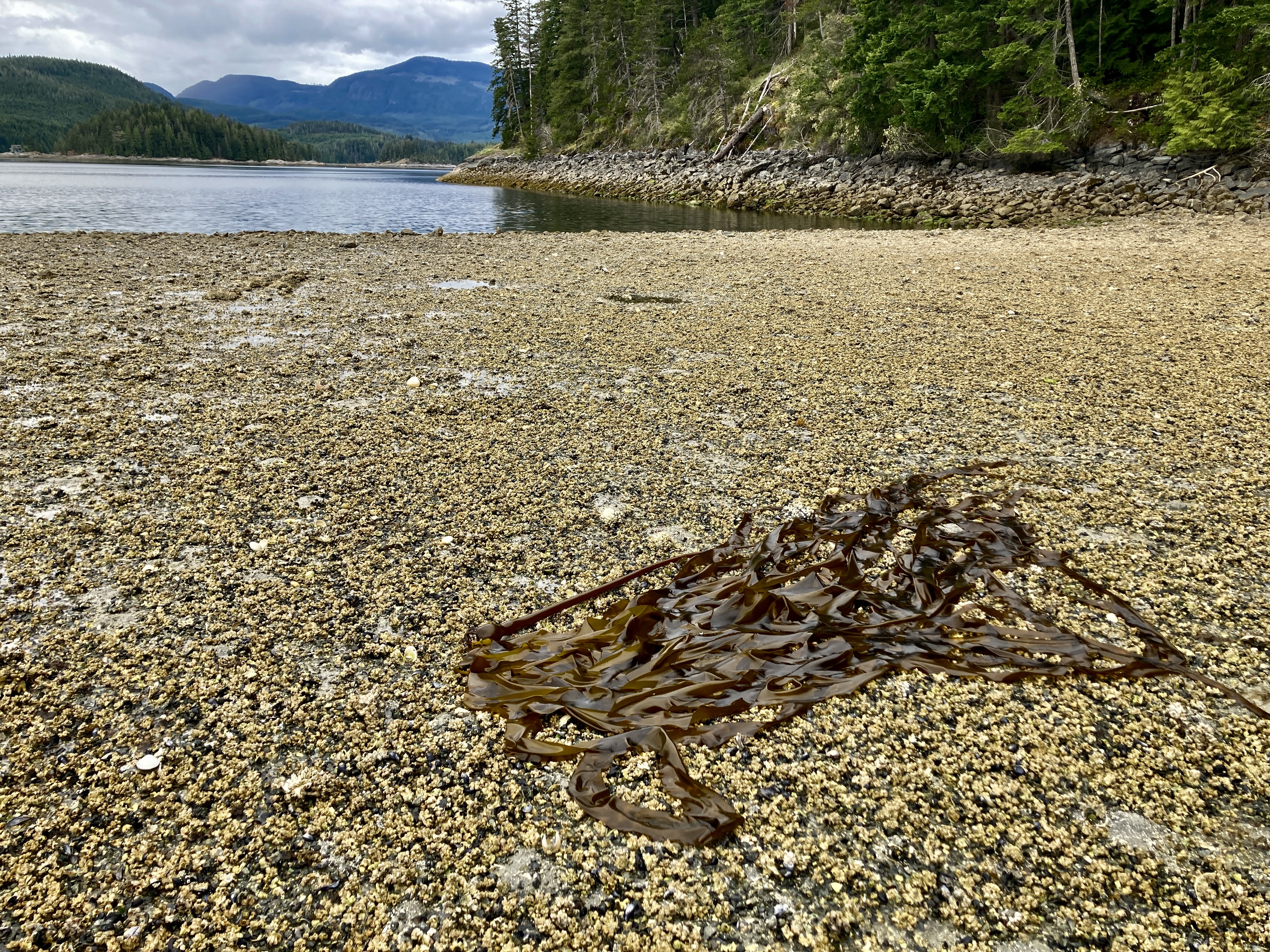
and crunchy barnacles underfoot at Orchard Bay on Quadra Island…
with huge ribbons of kelp and tiny scurrying baby crabs to complete the scene.
The Aurora lingers at several dramatic waterfalls to allow us a good view. Here at her namesake, the Aurora Falls in Bute Inlet, we are first allowed on the cargo deck to feel the spray in our faces…
and then we are shooed back upstairs. The captain, you see, has a plan. He angles the landing ramp slightly in under the falls, so that Aurora (Falls) power-washes Aurora (Explorer).
Water soon cascades down that ramp to flood the entire deck and scour it clean.
We have the pleasure of life all around us: a pod of Orca whales south of Read Island (too low in the water for any successful photography from our respectful distance); eagles in the air and in the trees; more than a dozen curious seals supervising that 20-minute loading feat at the resort; and the disappearing bum of a bear, who obediently scampers when the captain sounds some warning blasts, to make the landing site safe for the crew.
Human life as well, aboard fishing boats and, my favourite…
in tugs hauling booms of logs, as they have done for so very long.
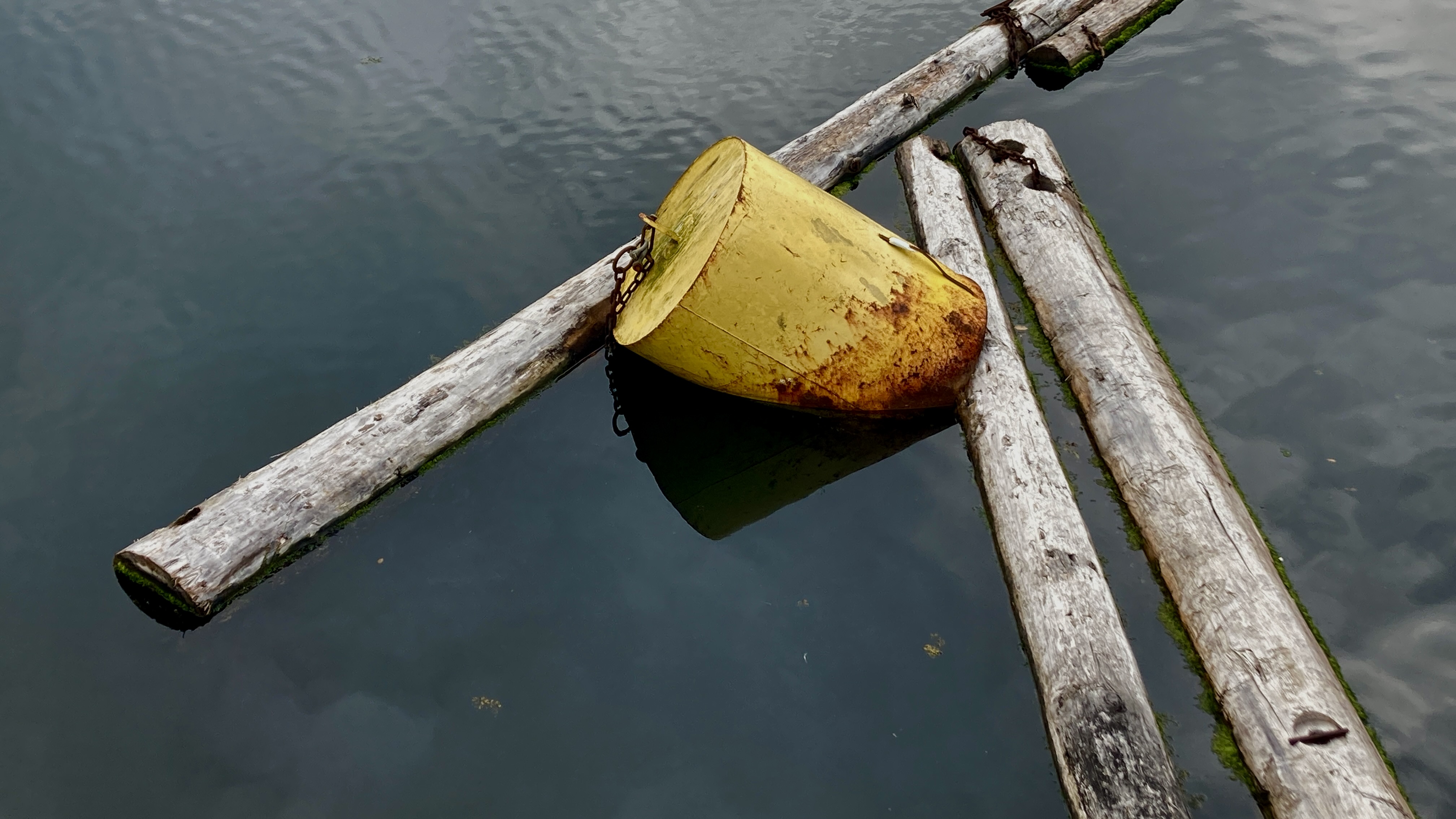
I even hang over the railing just before we leave our tie-up early one morning, fascinated by the neat angles of the logs, and the punch of that single yellow buoy.
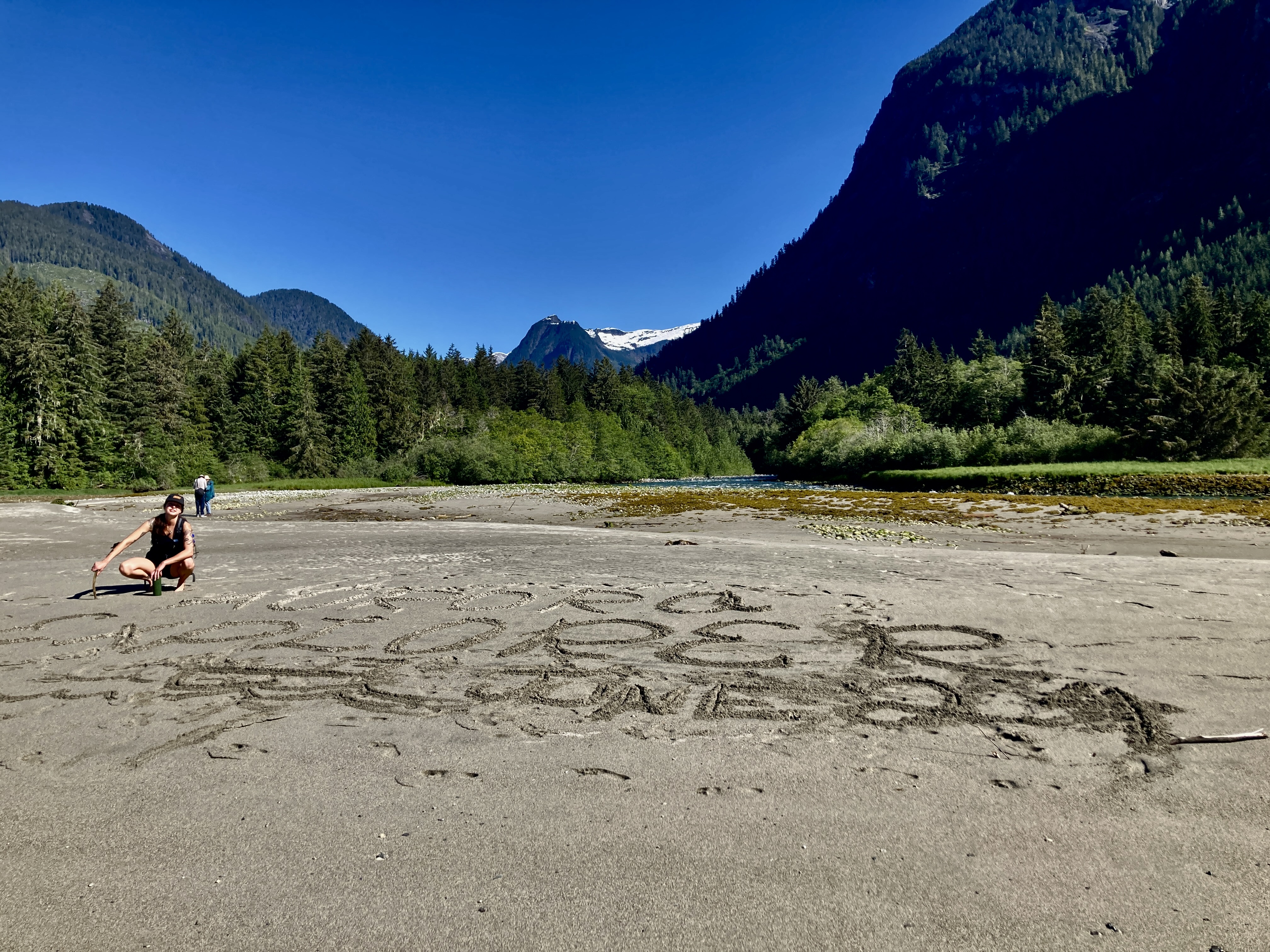
What else? Oh yes, the message in the sand. What is a walk on a sandy beach if nobody writes a message in the sand?
While we walk along Brem Bay Beach, and the mate runs into the water for a swim, our deckhand proves that she pours as much cheerful energy into play as into her work with a forklift, dipstick or boulders to repair roads.
I name her and show her with her permission. So: may I introduce you to Paige Boroski? I can’t think of a better final image for this voyage than her message in the sand: the words “Aurora Explorer” plus a drawing of a boat plus the date.
Unfortunately, not even I can read it, photographed from this angle! And the tide has long since washed it away.
But who cares? This image, like the whole trip, is in my heart.
31 August — Just back from a six-day escape to Vancouver and the Lower Mainland of British Columbia, visiting much-loved family and friends in an area that always uplifts me.
I say “much-loved” for many reasons, but after all these decades recognize that one of them is the resonance added by sheer passage of time. Part of the worth is in the while — a concept I borrow from John Fowles, who first deconstructed “worthwhile” this way in his 1964 book of personal philosophy, The Aristos.
Count back on your fingers and, yes, I posted “King, Queen and Moose” not from Toronto, but from the home of my friends Sally and Owen in North Vancouver. I sat there at Sal’s laptop, looking out over their back yard to the fence dividing it from the trees and shrubs of Mount Seymour Provincial Park immediately beyond.
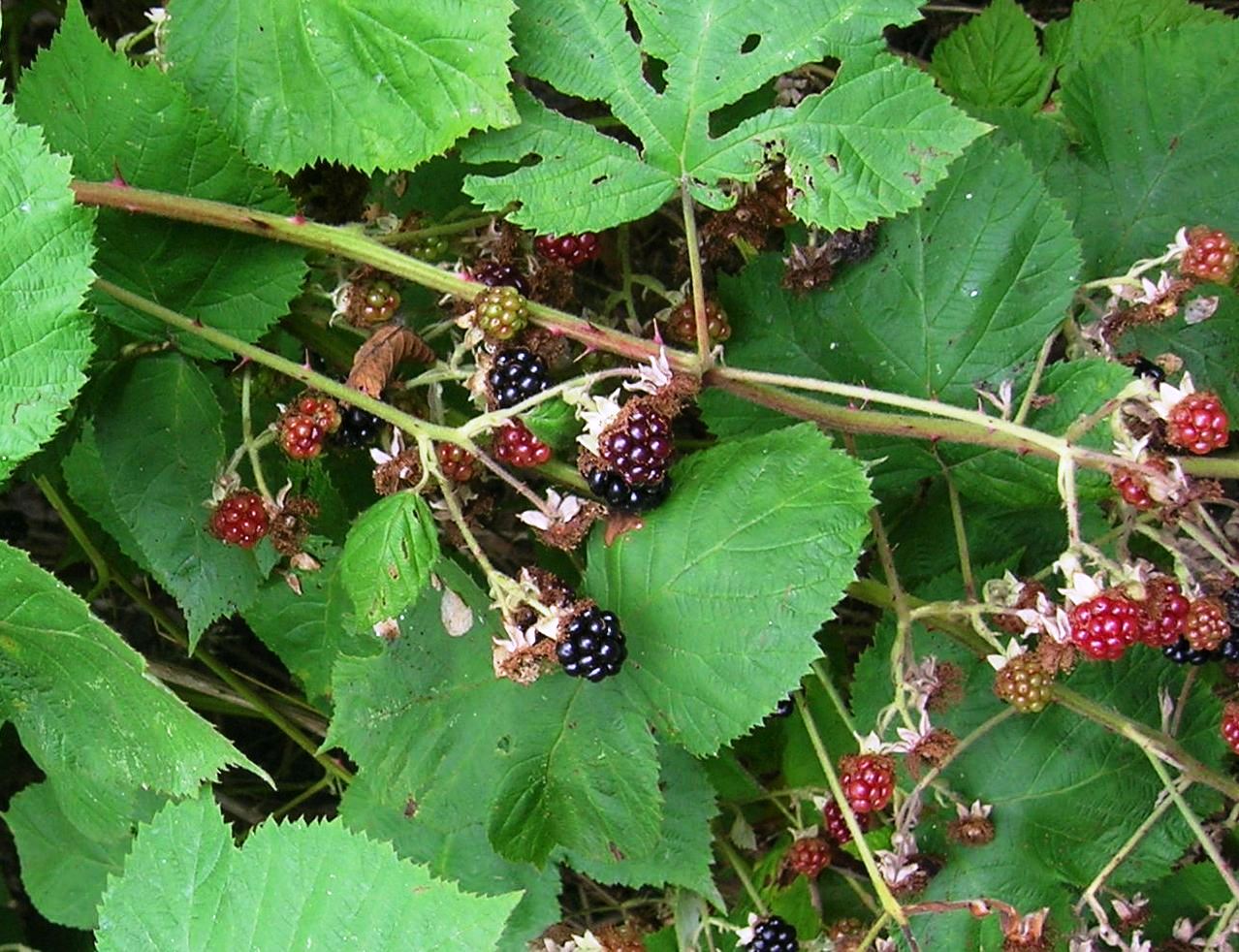
The shrubs include blackberry bushes, up against the fence. Which means ripening blackberries are more than a sign of changing seasons, they signal potential danger. Black bears love blackberries, and literally turn gate-crasher on occasion, once they’re that close to residential properties with other potential sources of food.
(Sally once emailed me the photo of a black bear foraging in their yard. All I could send in return was a raccoon sleeping in my birdbath.)
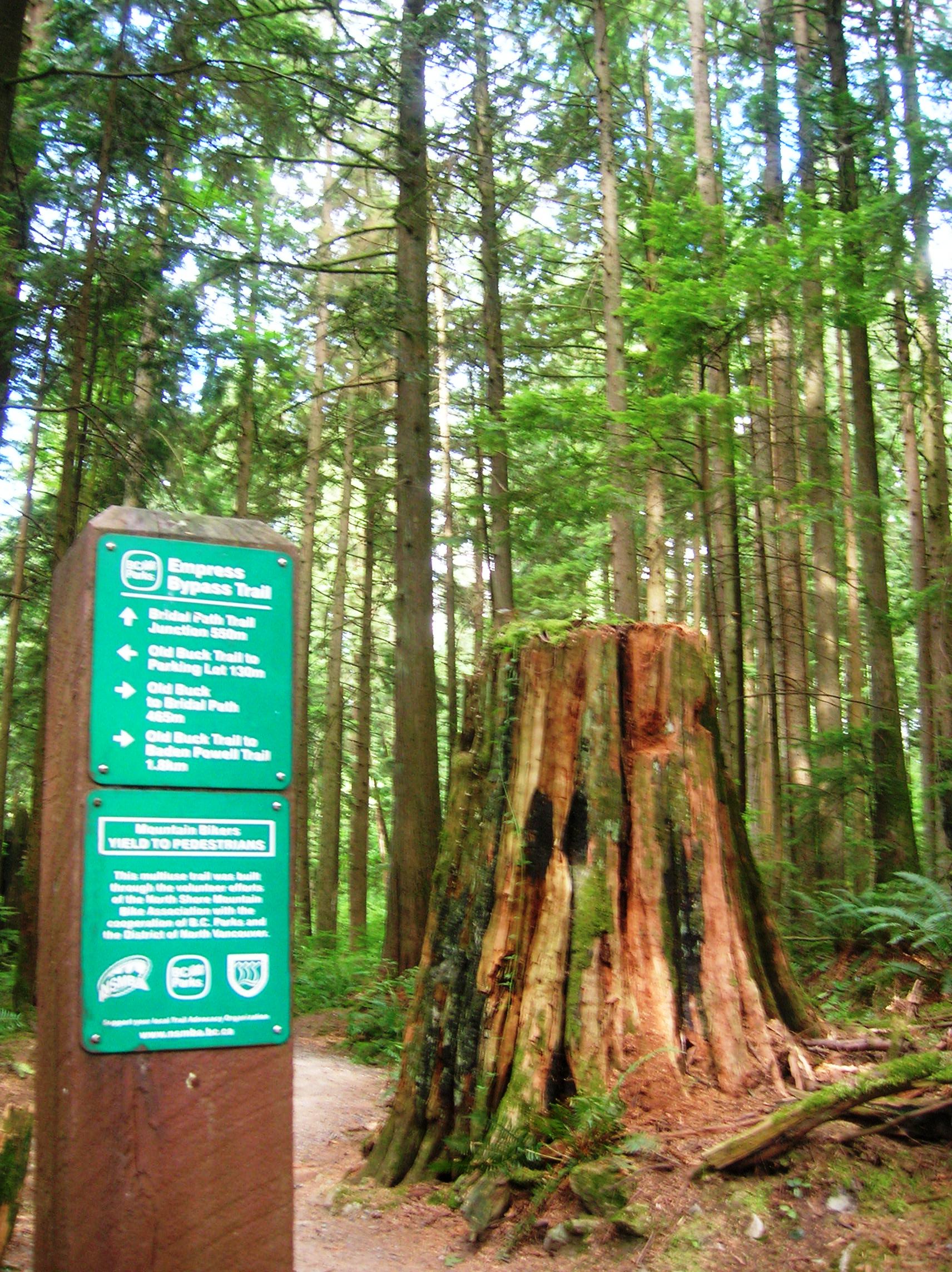
Of course the visit included some hiking about! You can’t be in British Columbia, halfway up a mountain, and not go walking. First target, Old Buck Trail, which sets off halfway up Mount Seymour Road. Various other trails split off, such as this Empress Bypass option, but I stuck with the main trail.
I hadn’t brought my pedometer, and settled for a 90-minute outing instead right on Old Buck itself. First I went up (and in these mountain ranges, up is up), awe-struck by the huge stumps of long-ago trees. Yes, I’ve seen them before, but they never fail to move me.
Somewhere beyond here, short of the Baden Powell junction but not by much, I turned about.
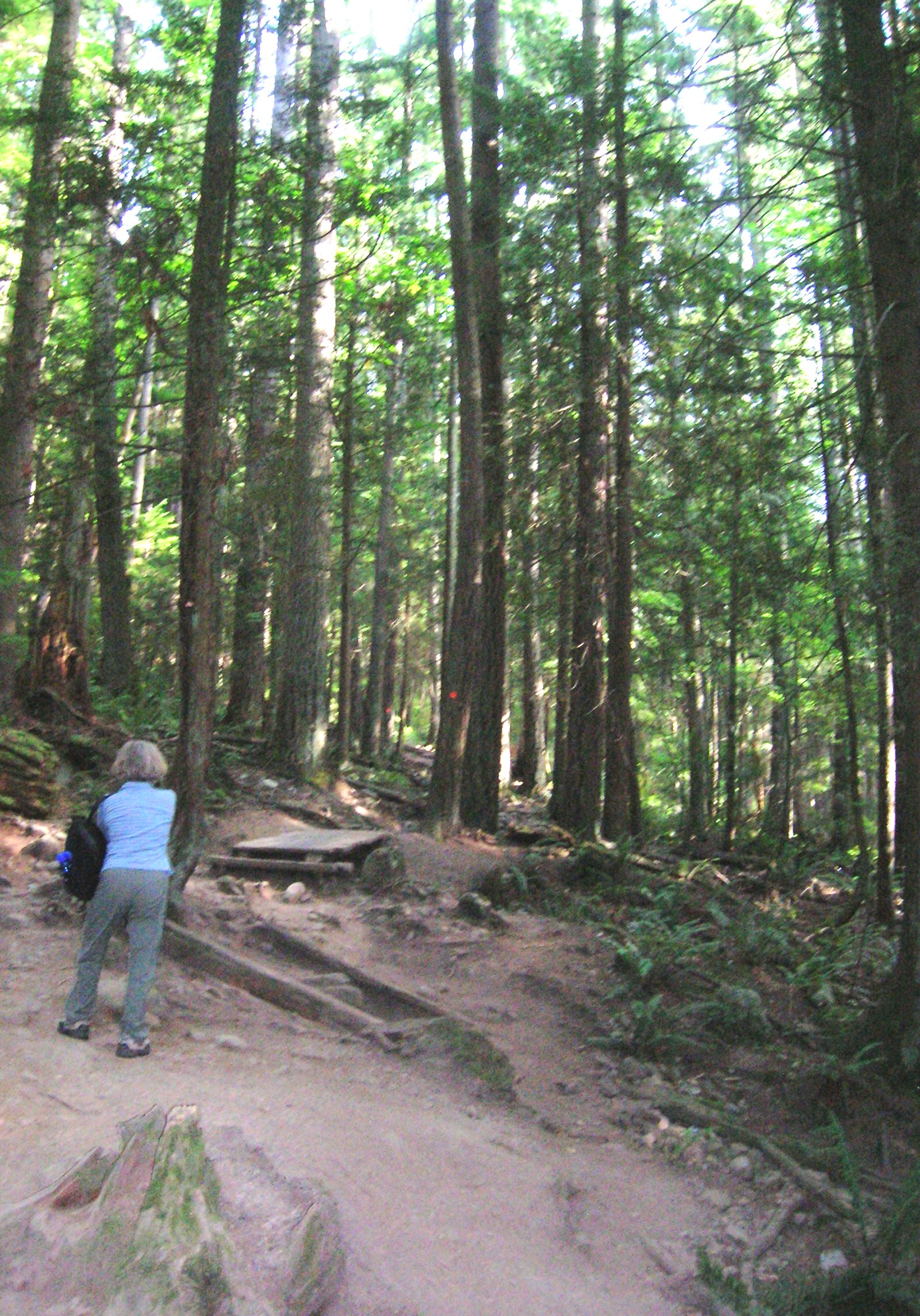
At least as high as I went, the trail was much like this — a smooth, clear dirt path.
Just as the ancient stumps move me, so do the great columns of contemporary tall trees. The path moves gently among them, and I think a bit about paths, and making one’s path (thank you, Antonio Machado), physically and otherwise.
I remember, too, that tai chi is sometimes described as “walking meditation.” I don’t specifically meditate when I walk, but I do usually feel myself expanding out into my surroundings, somehow.
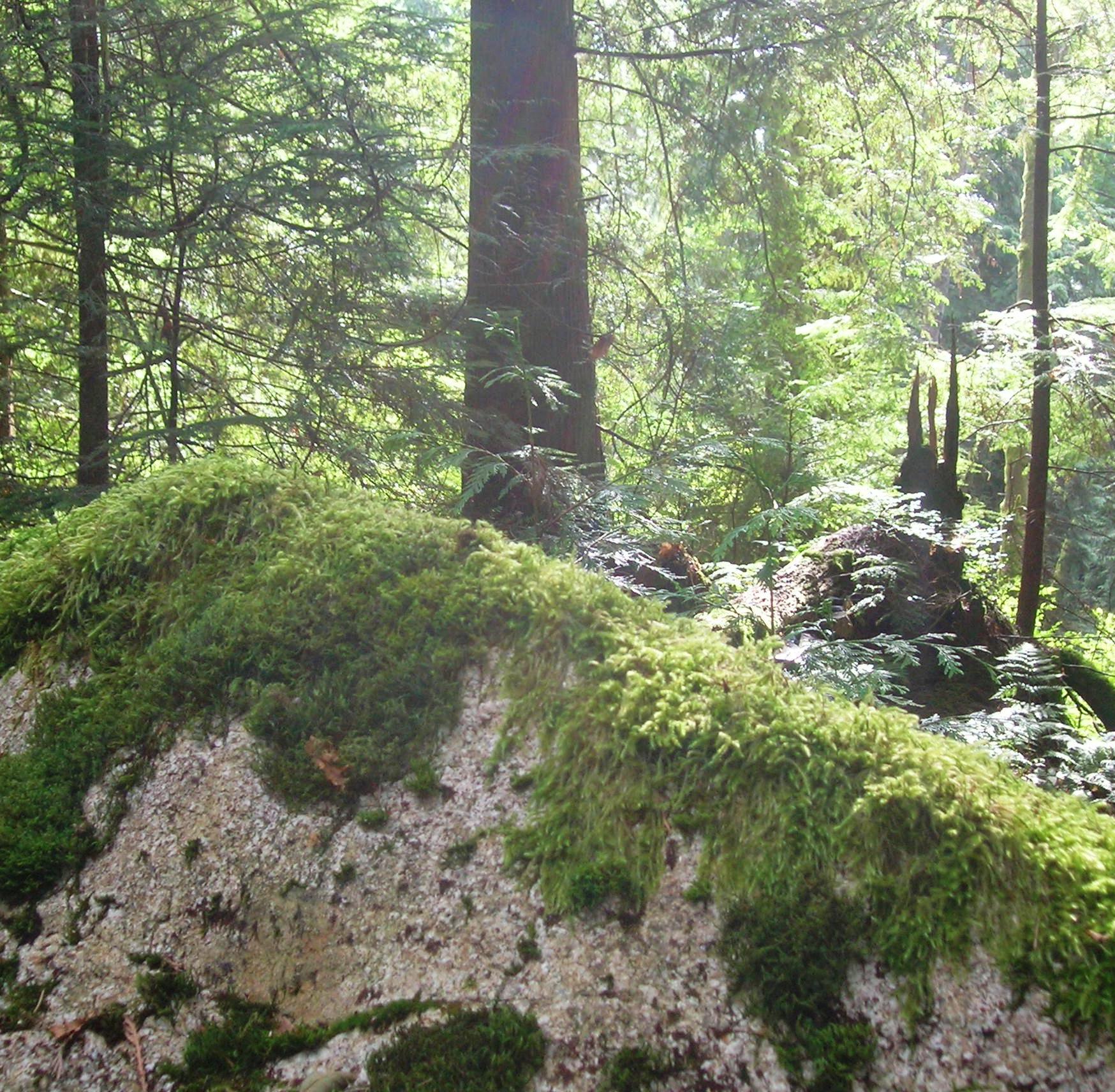
Then, sometimes, the elegant columns of trees give way to great bursts of nature’s very own mixed media: rock and moss and other layered vegetation and spikey remnants of old logs and forest, forest, forest.
But no, I don’t spend the whole six days in the woods.
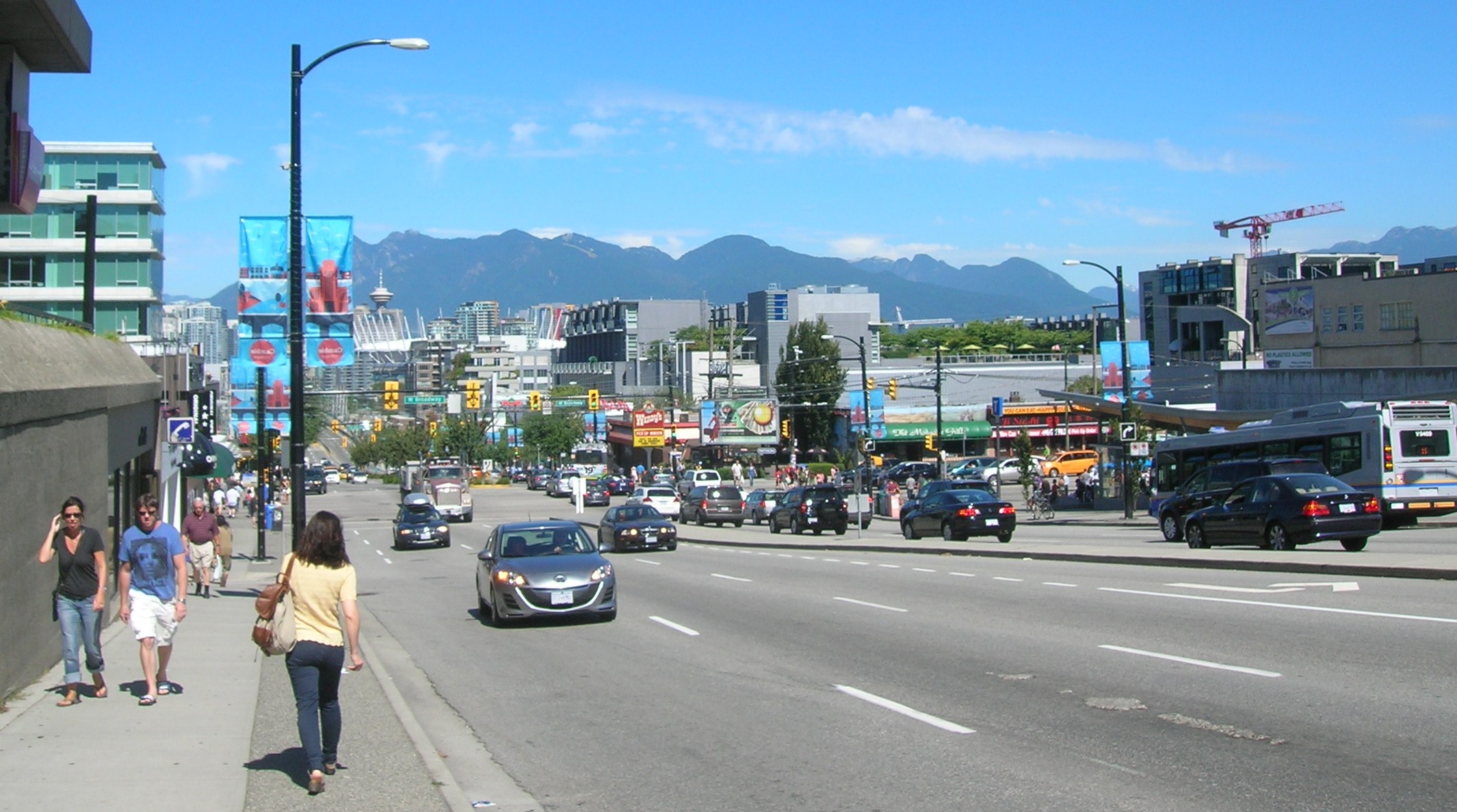
Soon I’m deserting this far corner of North Van for a visit to Vancouver proper — across Burrard Inlet by Seabus, then south on the Canada Line (built for the 2010 Vancouver Winter Olympics), and out onto Cambie St. at Broadway. Where I grabbed this shot northward up Cambie, sightlines back to North Vancouver and the framing mountains beyond.
Mountains and ocean, Vancouver is the Rio of the north.
But even here, walking with my friends Louise and Rolf through residential streets over to Main Street and then south… even in this dense bit of cityscape, there’s still great exuberant nature. (When I lived in Calgary, a semi-desert climate, and came visiting, the sheer humid profligacy of Vancouver’s nature always smacked me in the eye and up the nose.)
My friends waited cheerfully while I eyed the detail of growth on city trees. Like this one.
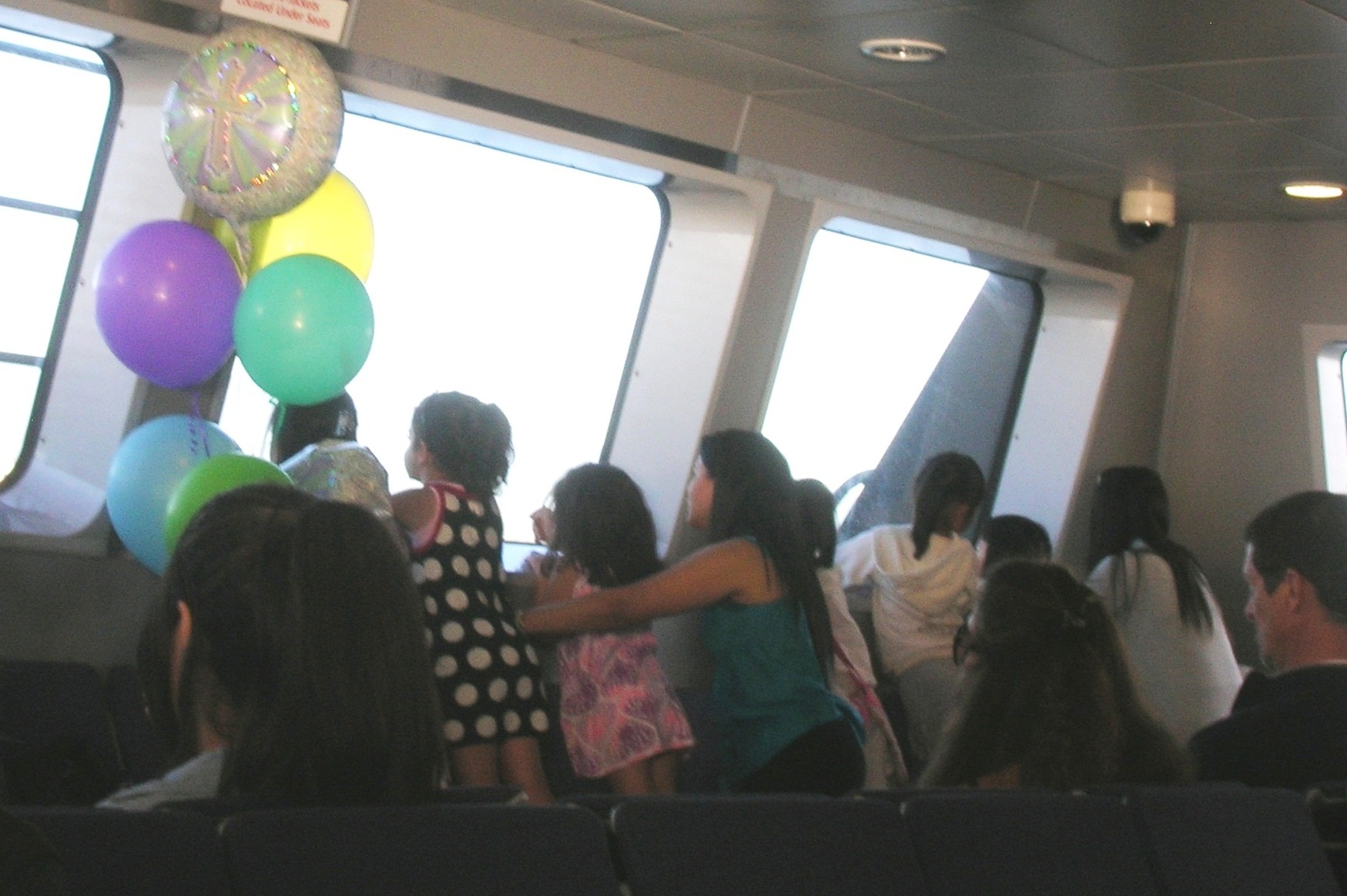
We had lunch one place, lattes somewhere else, prowled shops with strong design sense… and finally good-bye and back north I went, retracing my way via the Canada Line to the Seabus again. Where I was charmed by these little girls, their noses pressed against the ferry’s front window, party balloons to one side.
Another walk, still in North Van and on Mount Seymour, but setting out from the little community of Deep Cove.
That’s Sally’s back, in an early stretch of our chosen hike, up the Baden Powell Trail to the Deep Cove Lookout. The lookout is aka Quarry Rock — indeed a succession of big old rocks, but no sign anywhere of past let alone present quarrying. So, go figure.
Sal characterized this as an up-and-down trail, probably an hour each way. The footing was at times smooth and the path gently curving, but in other places the path twisted narrowly among trees and boulders, intensely scored with tree roots and rocks.
It was also much less solitary than my Old Buck outing! Then again, a weekend morning vs weekday. More people than we really wanted — oh, the cherished illusion of being alone in nature — but at least everybody observed pretty good trail etiquette.
Even the dogs behaved themselves. Including a snowy white little pooch who clearly had been having a wonderful time in mucky streams. Her owner observed her four black legs, and quipped, “Her name is Emma, but we may have to call her Boots.”
Finally there we were on Quarry Rock, looking over the Indian Arm inlet of the ocean, with the village of Deep Cove itself hidden away to the right.
Going back down, I lost track for a moment. So many ups and downs enroute… where we really descending? Yes, we were. Sometimes on the twisty paths I described above, sometimes on stairways pressed against rock faces, like this.
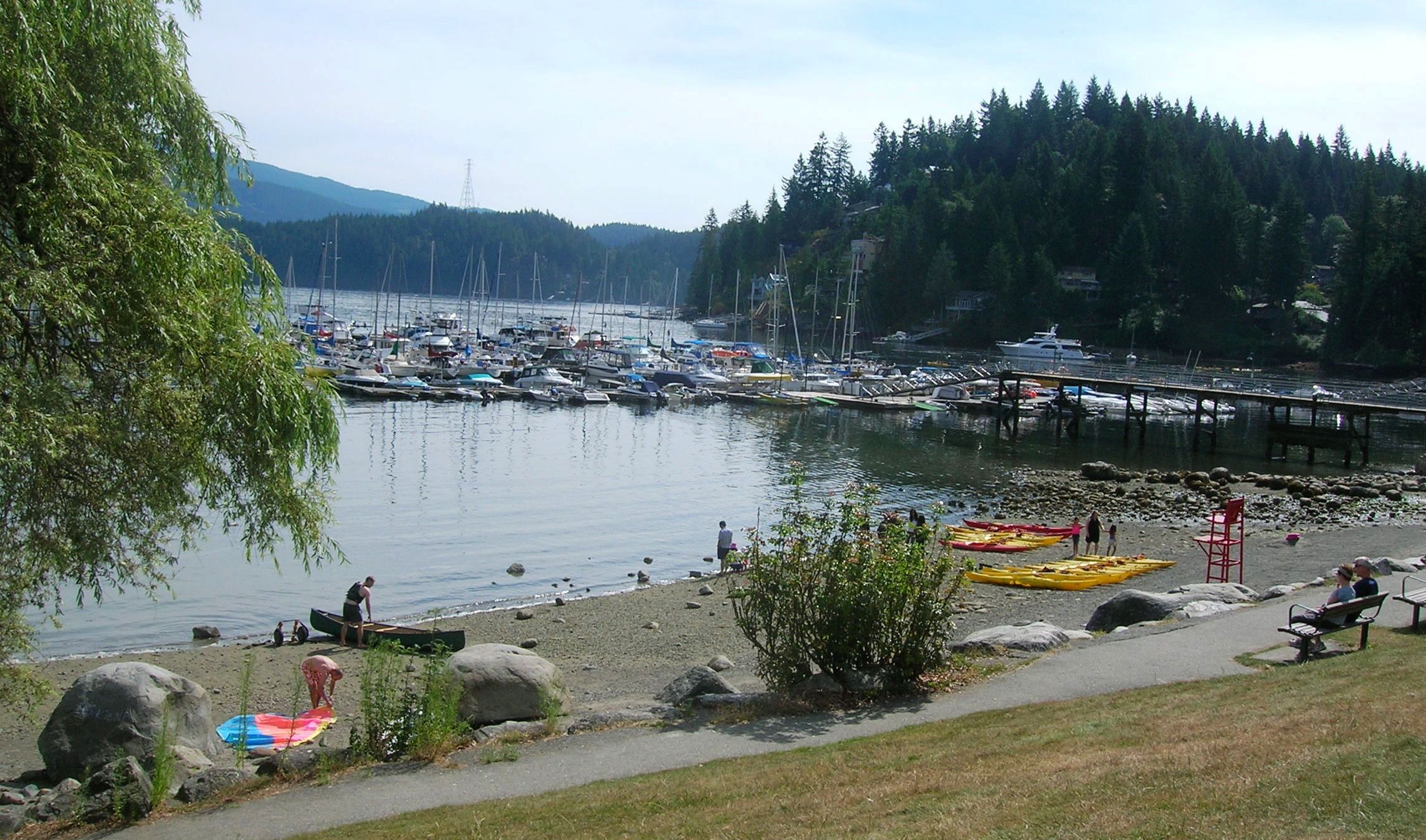
Yah, finally, indeed down and walking along the Deep Cove beach, with all the boats bobbing in the water and great red and yellow blocks of kayaks set out, waiting their turn for some action.
We consider hanging around for Deep Cove Daze [sic], but resist.
It’s going to be all the usual late-summer, small-community mix of booths and games and noise and T-shirts and organizations with their tables… and it is tempting… but we have other plans.
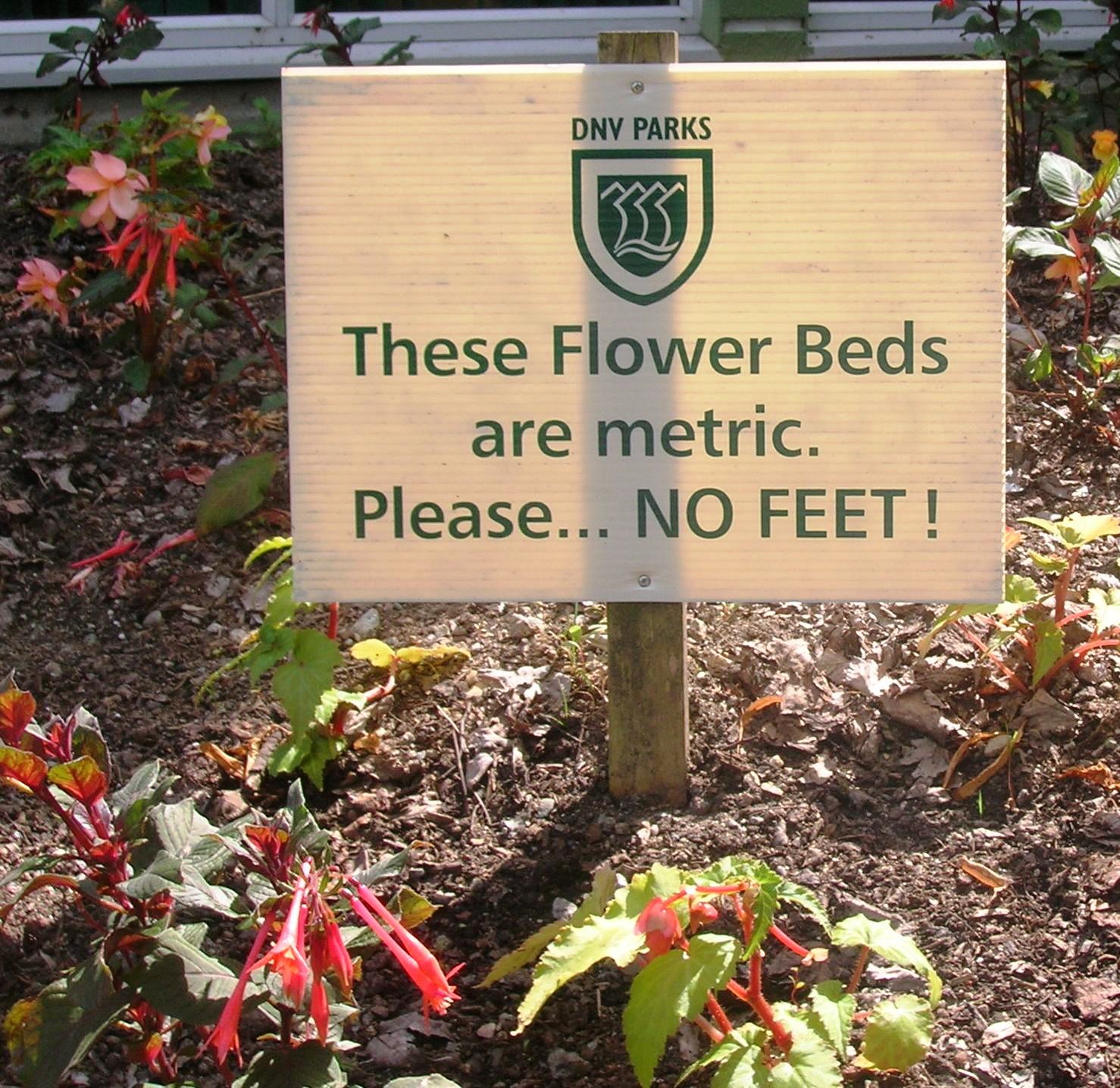
Which involve lunch on a patio elsewhere, so it’s easy to leave. But not before paying tribute to this metric flower bed!
One last walk, days later and down in the Lower Mainland where I’ve joined family for the final few days of my trip. Karen and I head out to Watershed Park in Surrey, one that she and husband Tim know well, both on foot and on their bikes.
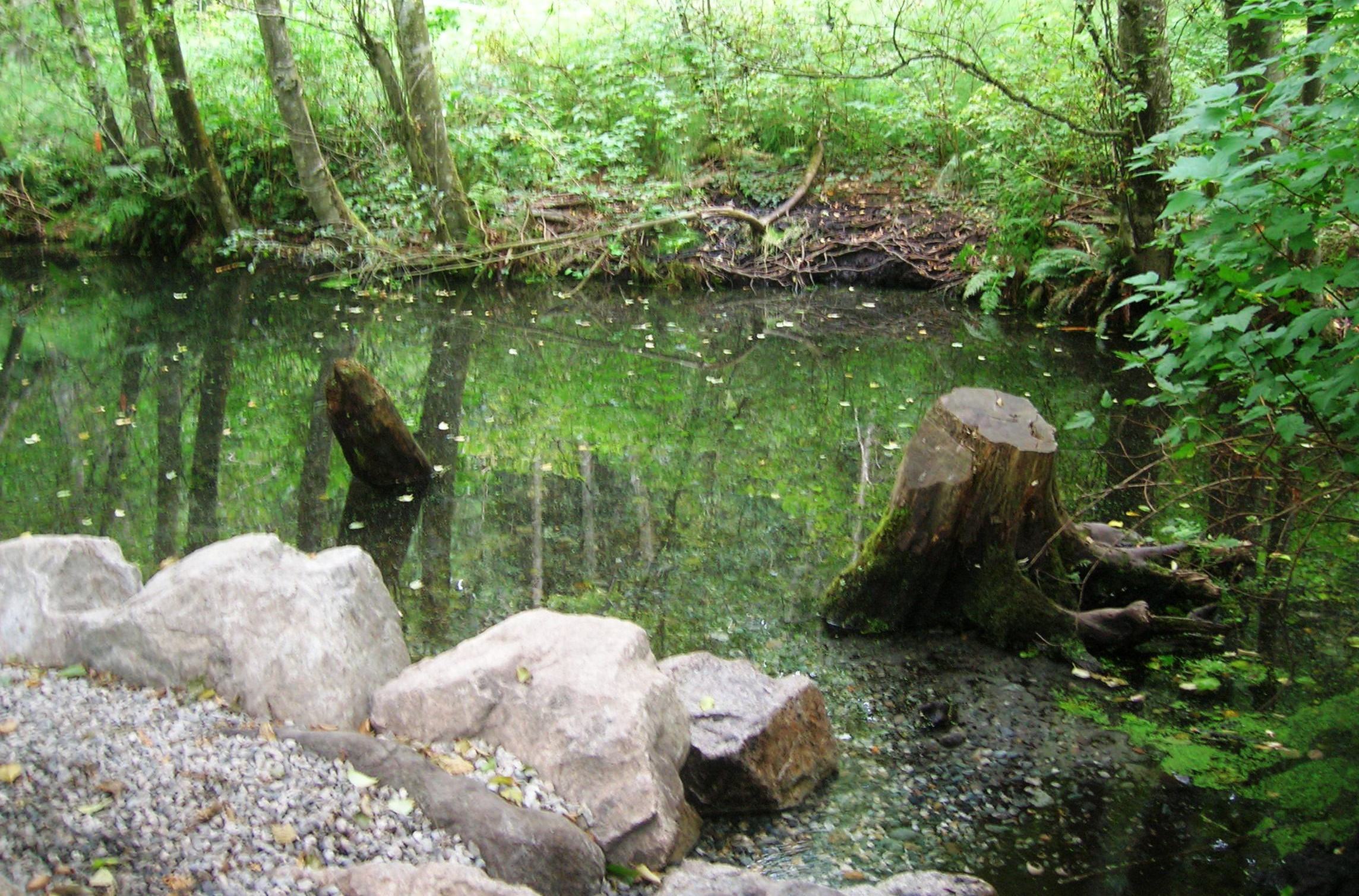
I’m luxuriating all over again in the sights and smells and texture underfoot of these west-coast trails. Some of the scenes are the sort of thing I anticipate…
But some are not!
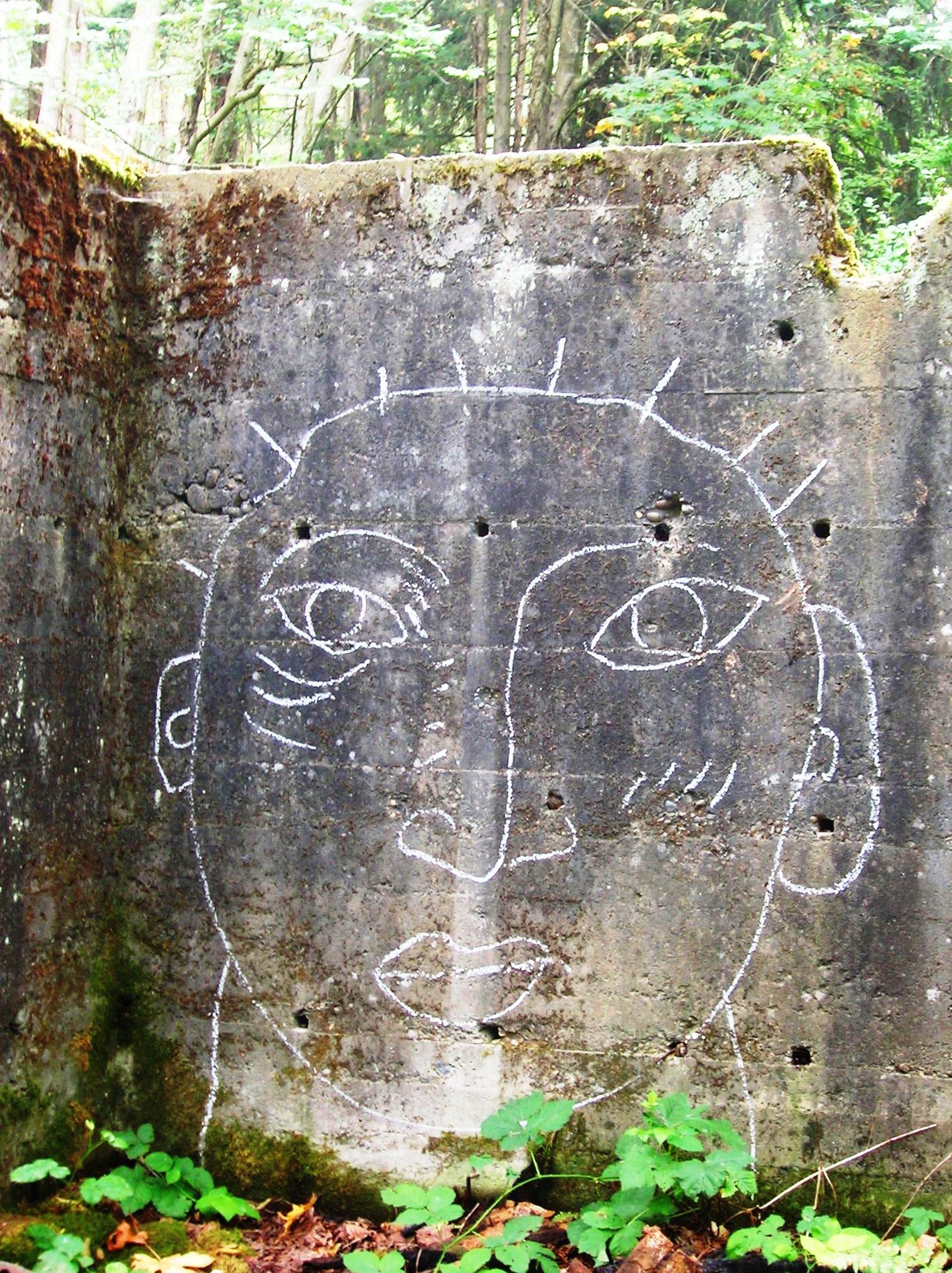
At first I tut-tutted, a graffito in such a setting. Then I realized I rather liked the face — just a bit Picasso-esque, don’t you think? And also realized it is if anything an improvement on the concrete ruin it adorns.
This last photo takes us back to West Coast Classic, and is a bit of a cheat. Well, only in time, not in place.
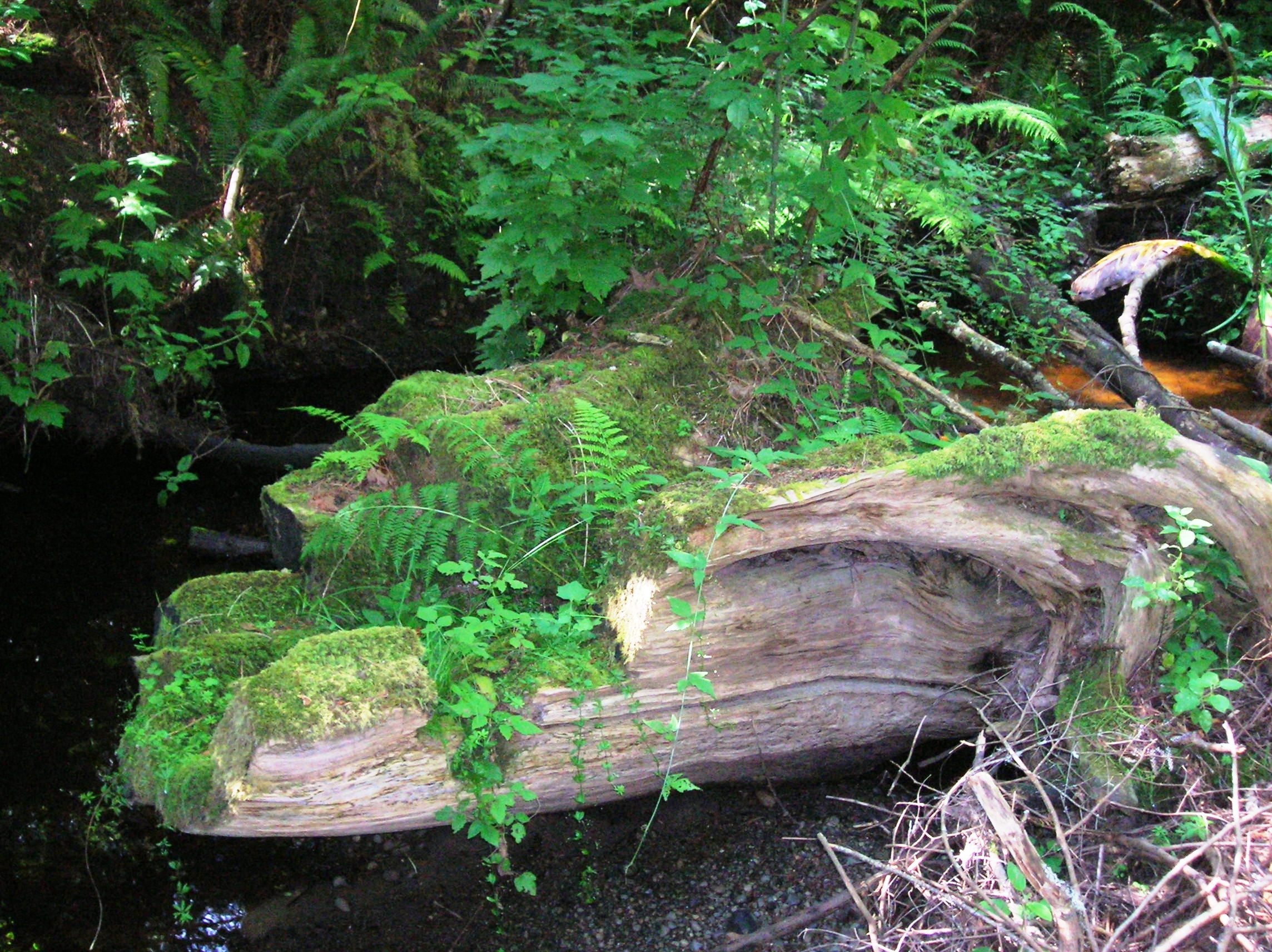
I took this photo of a “nurse log” right here in Watershed Park, but some years ago. Karen had explained the phenomenon to me, that of an old rotting log nurturing new life, and I remember being so happy to find such a good example of it.
And now I’m home. Posting this from Toronto, and planning my next walk right here…
"Traveller, there is no path. Paths are made by walking" -- Antonio Machado (1875-1939)
"The voyage of discovery is not in seeking new landscapes, but in having new eyes" -- Marcel Proust (1871-1922)
"A city is a language, a repository of possibilities, and walking is the act of speaking that language, of selecting from those possibilities" -- Rebecca Solnit, "Wanderlust: A History of Walking"














 WALKING WOMAN