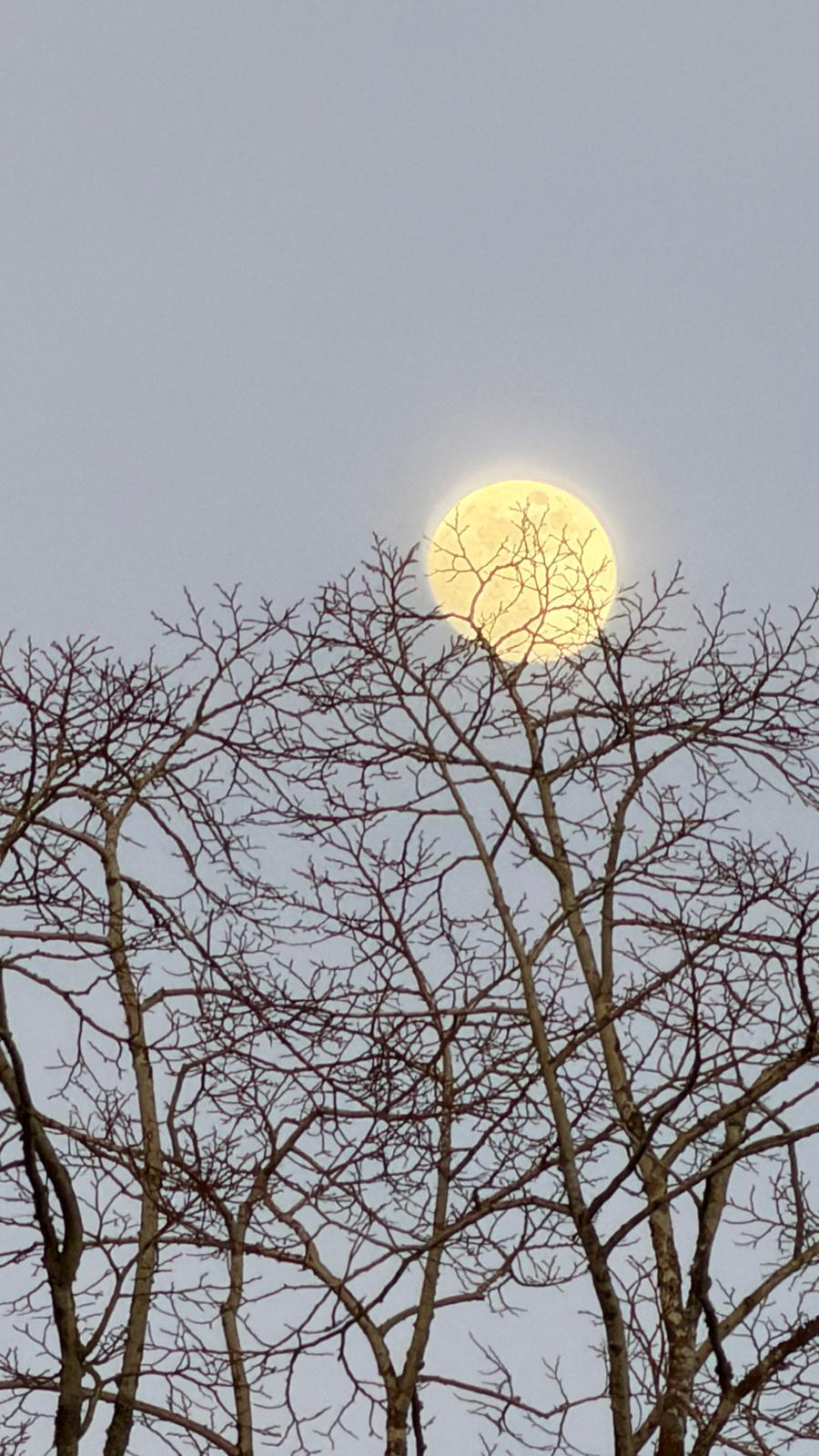
1 March 2026 — Sub-categories of landscape. Skyscape and streetscape and alleyscape and (why not) trailscape. Plus a final skyscape flourish, courtesy of a friend and moon-focused, to round it off.
A completely arbitrary grouping! Just how I happened to cluster what I’ve noticed, over the past few days.
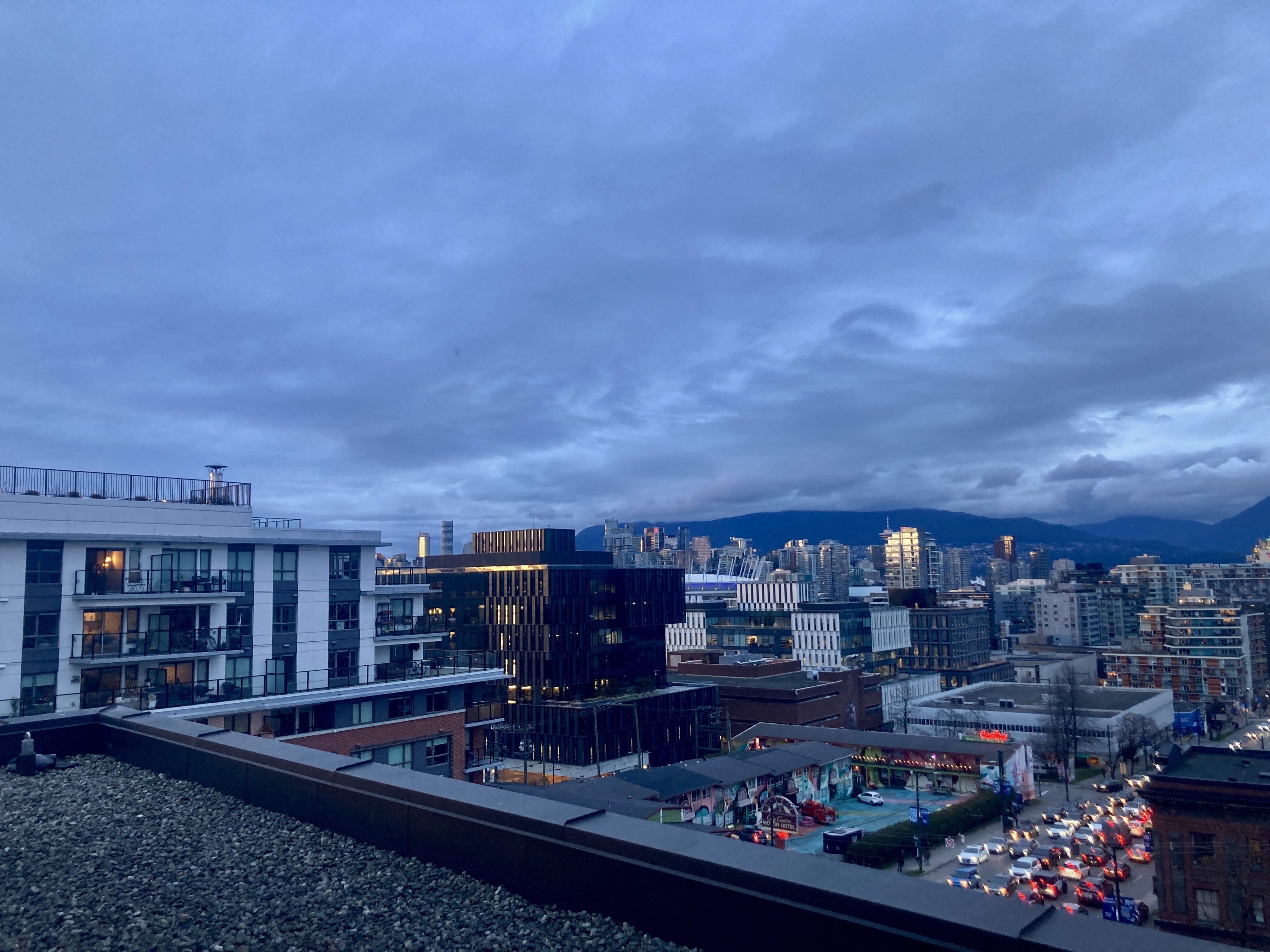
This brooding late-afternoon sky, (precisely 5:24:43 PST, said my camera), with reflected last slivers of sunlight in a few windows and early neon glowing on the streets.
The next morning, walking to Gallery Jones on East 1st Ave, I’m hit first by a smellscape of warm cinnamon bun…
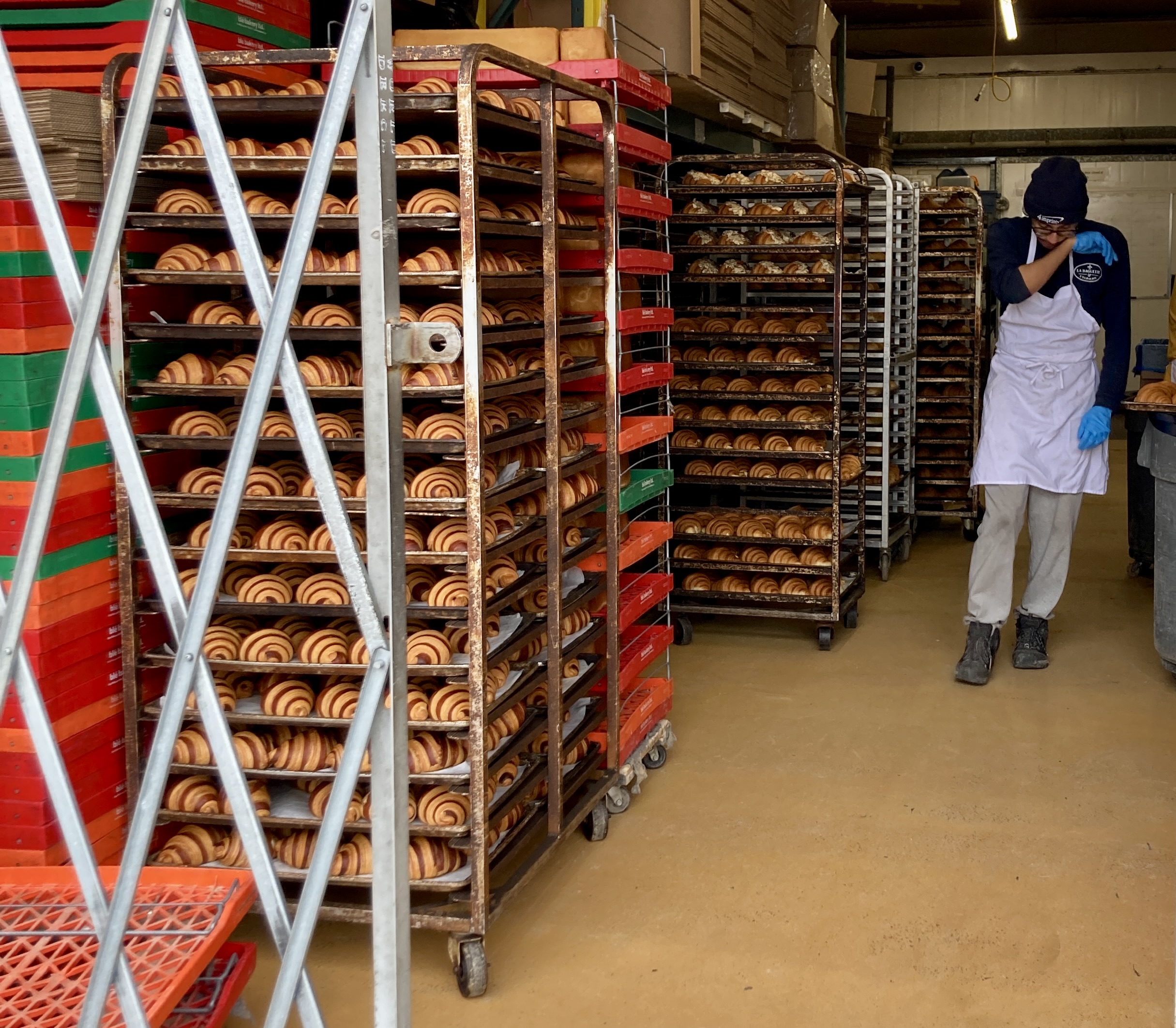
and then, peering through the open door, see the cause of the aroma: stacks of newly-baked buns in this wholesale bakery, with a worker wiping his cheek as he advances on yet another tray.
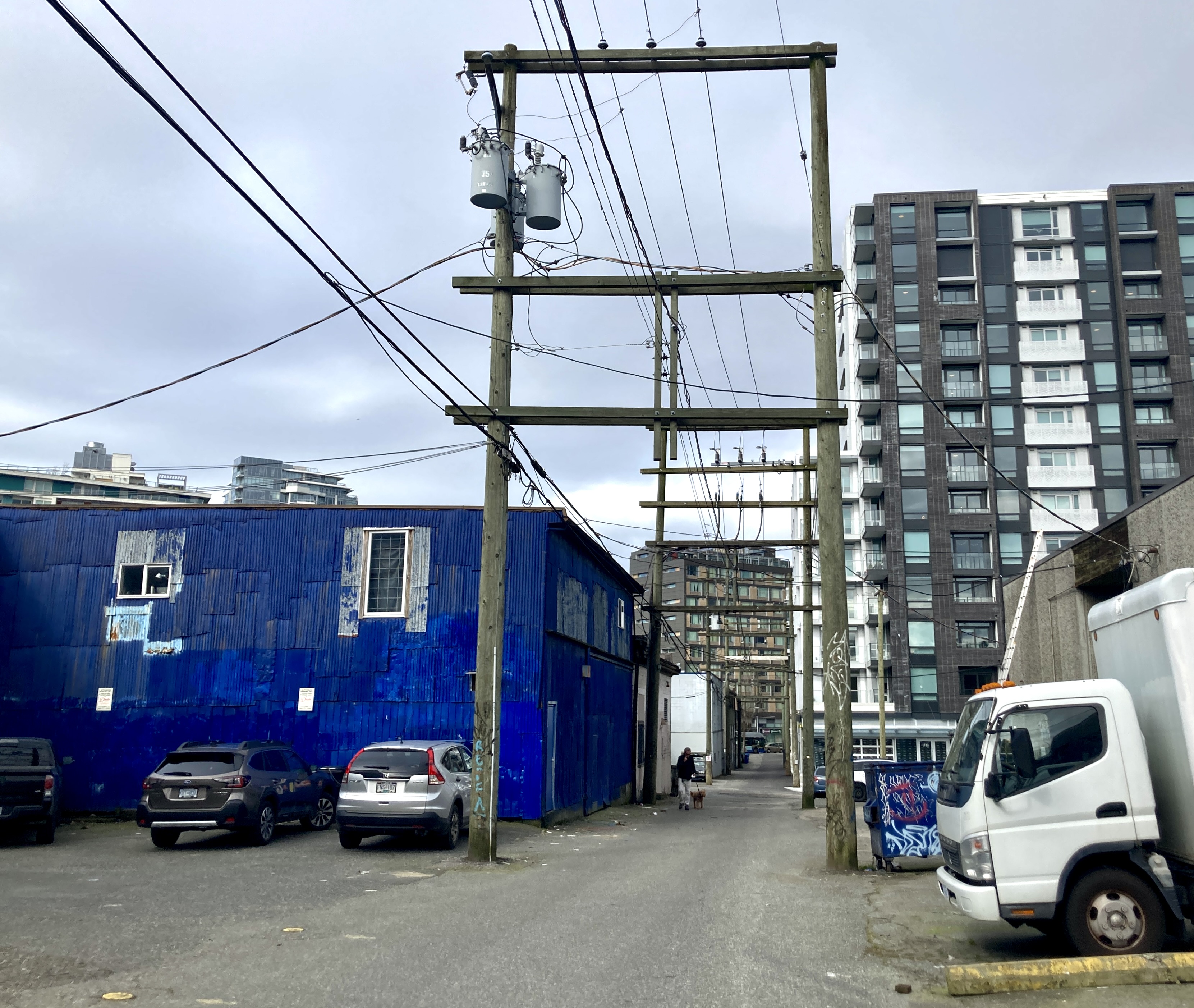
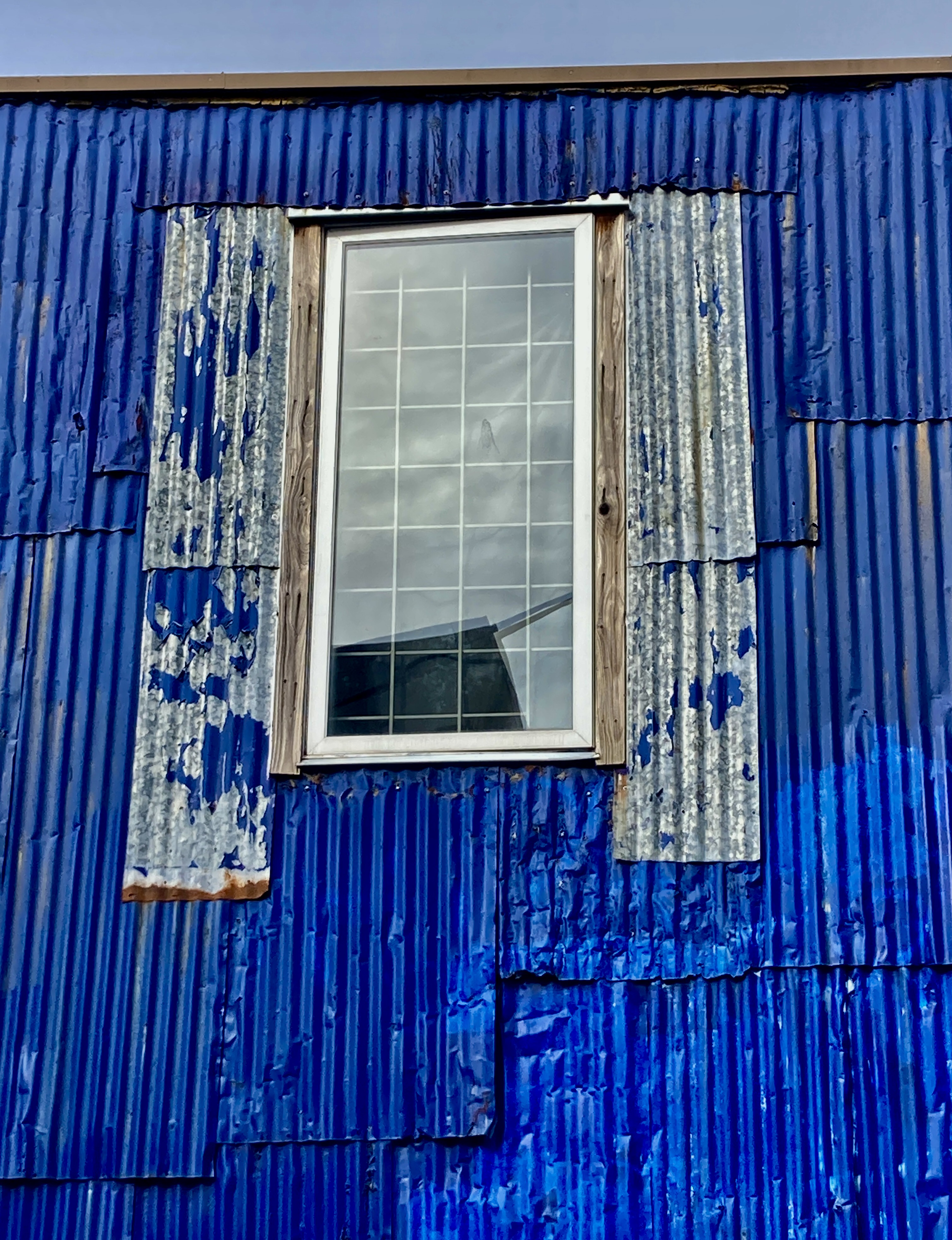
From streetscape to alleyscape, somewhere to explore until the gallery opens its doors. Never mind, who needs curated art on walls when the alley offers a Blue Period worthy of Picasso?
All the textures, all the varieties of blue in that wall of corrugated metal. Whether long shot, as above, or up close to the window (which in turn frames reflected skyscape).
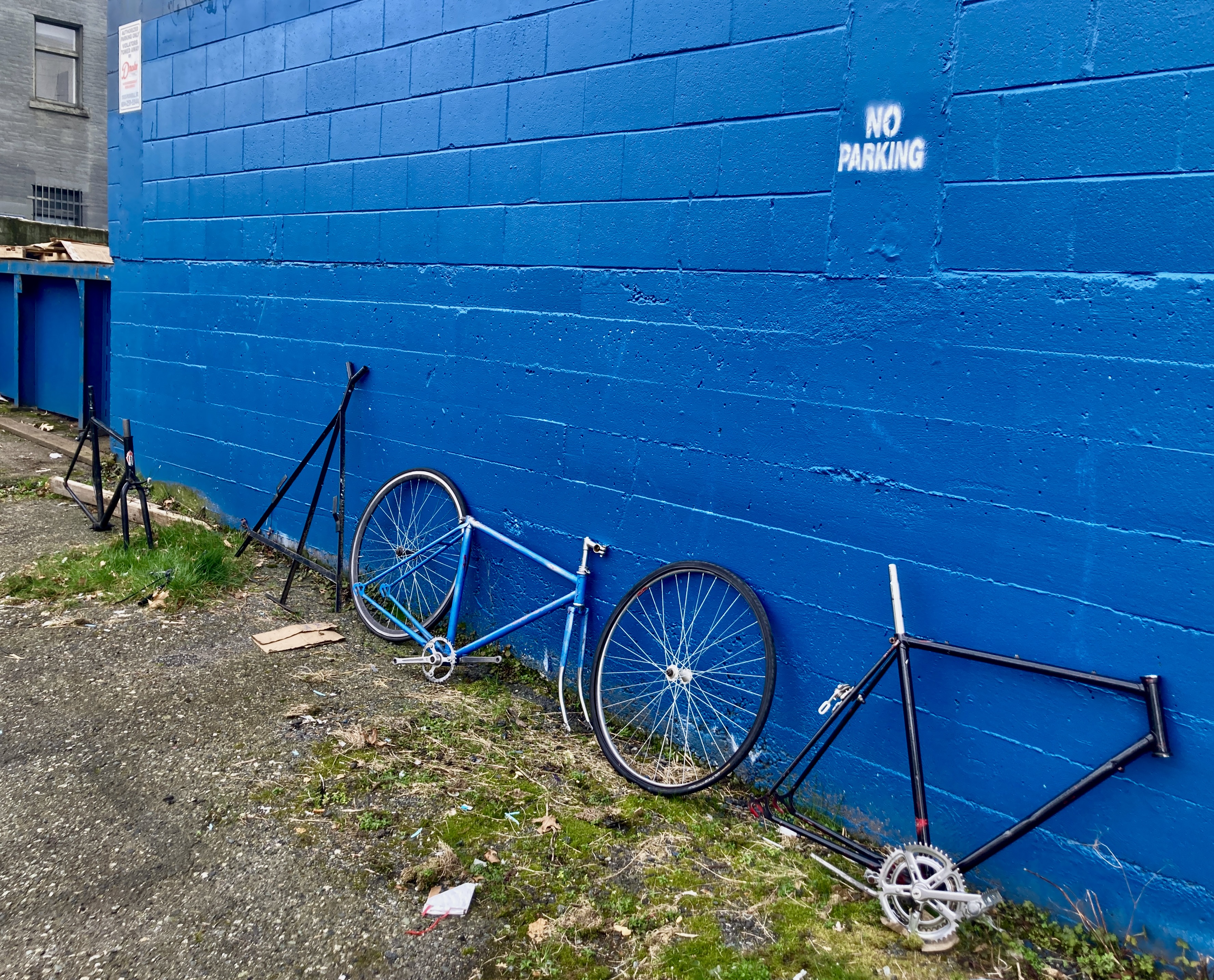
The same blue on the adjacent wall, providing a sleek, smooth No Parking backdrop…
for bicycle parts that are definitely & definitively parked.
Another cultural excursion the following day — this one for Maximilien Brisson’s glorious creation, Scorrete lagrime mie, at St. Anselm’s Church on the UBC grounds.
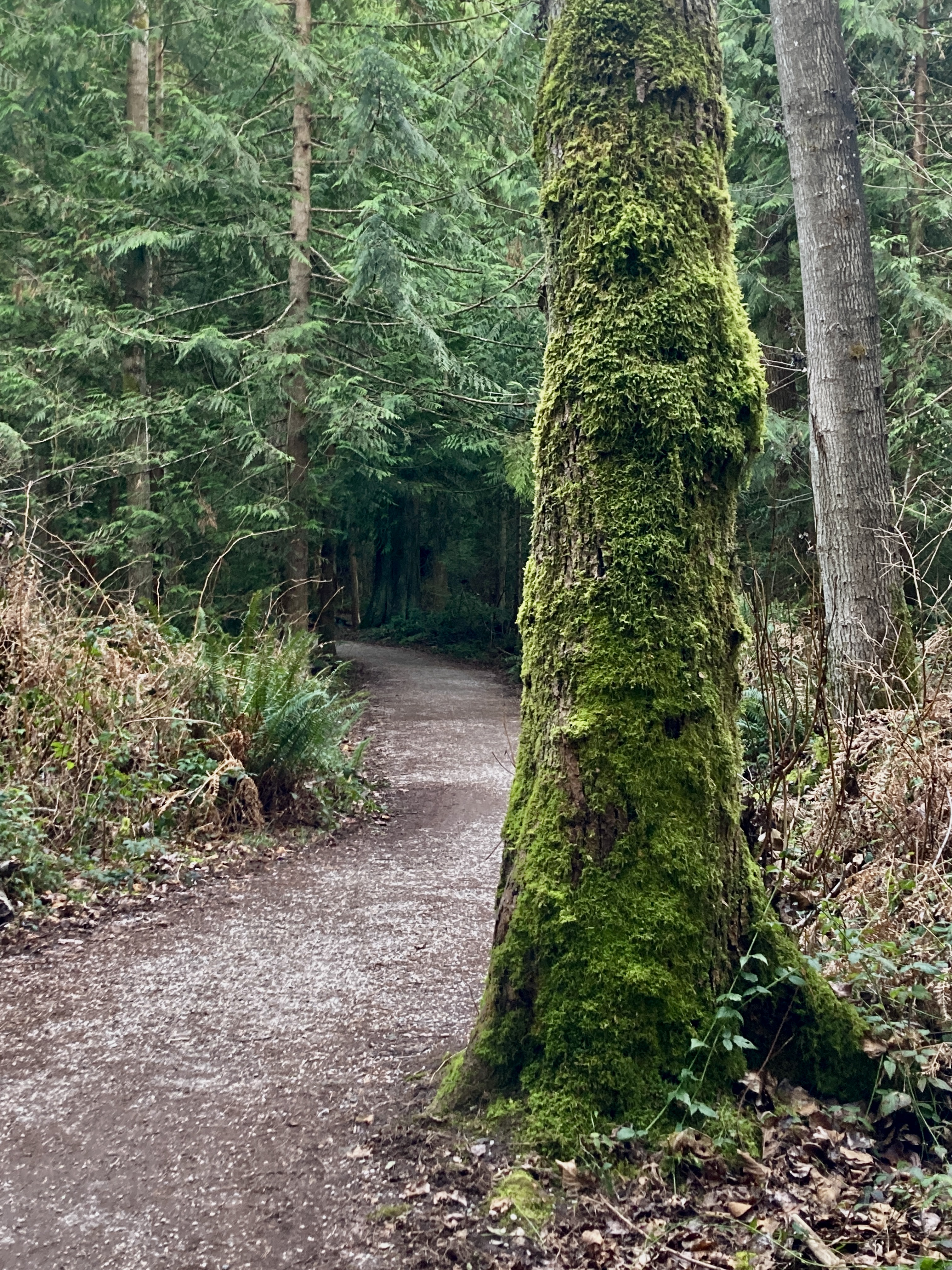
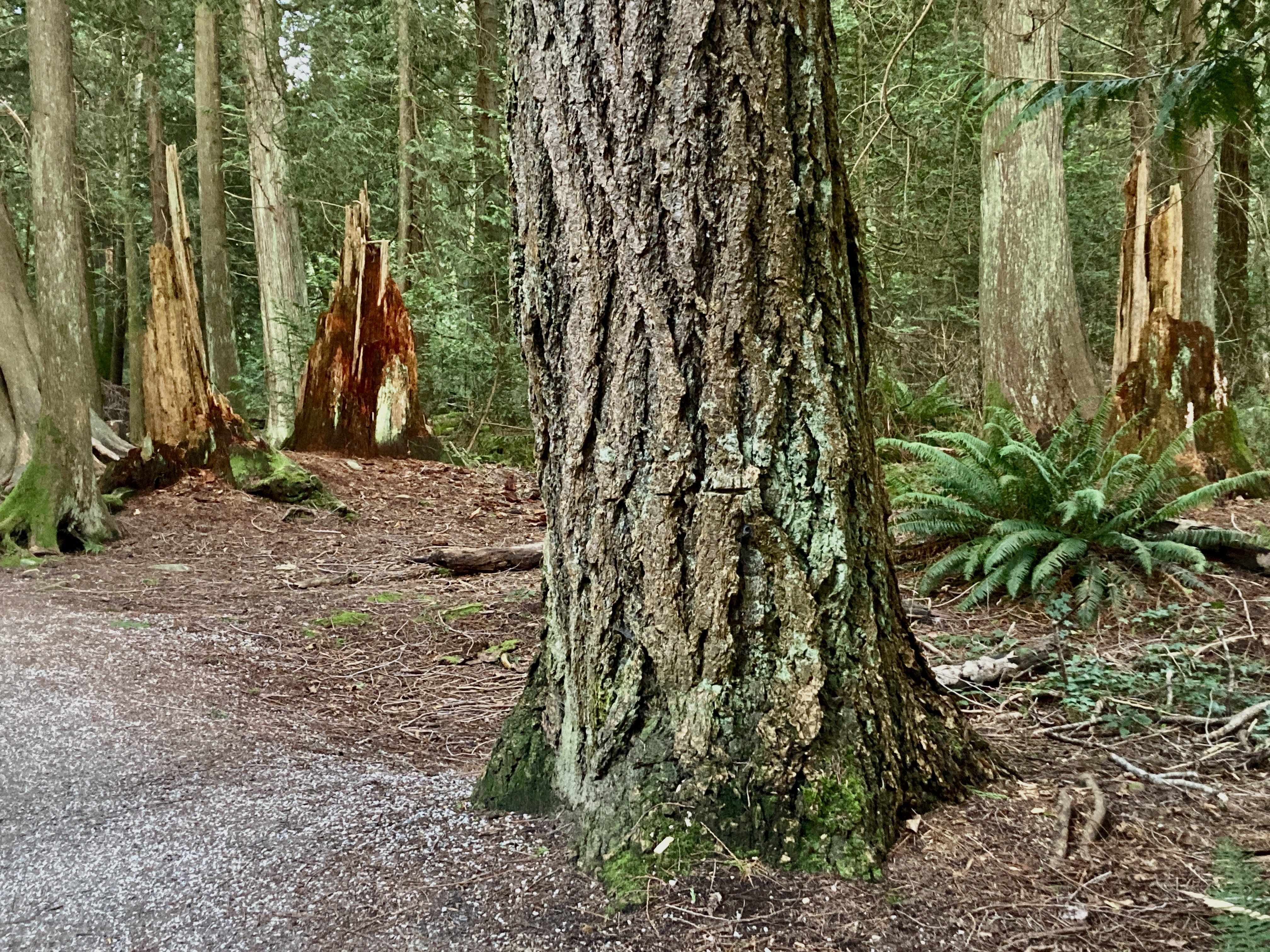
The church sits right next to various trails into Pacific Spirit Regional Park and, post-concert, I am pulled onto the Salish Trail…
by this sentinel tree, this doorman tree, imposing in his winter greatcoat of emerald velvet.
The trailscape unfolds around me.
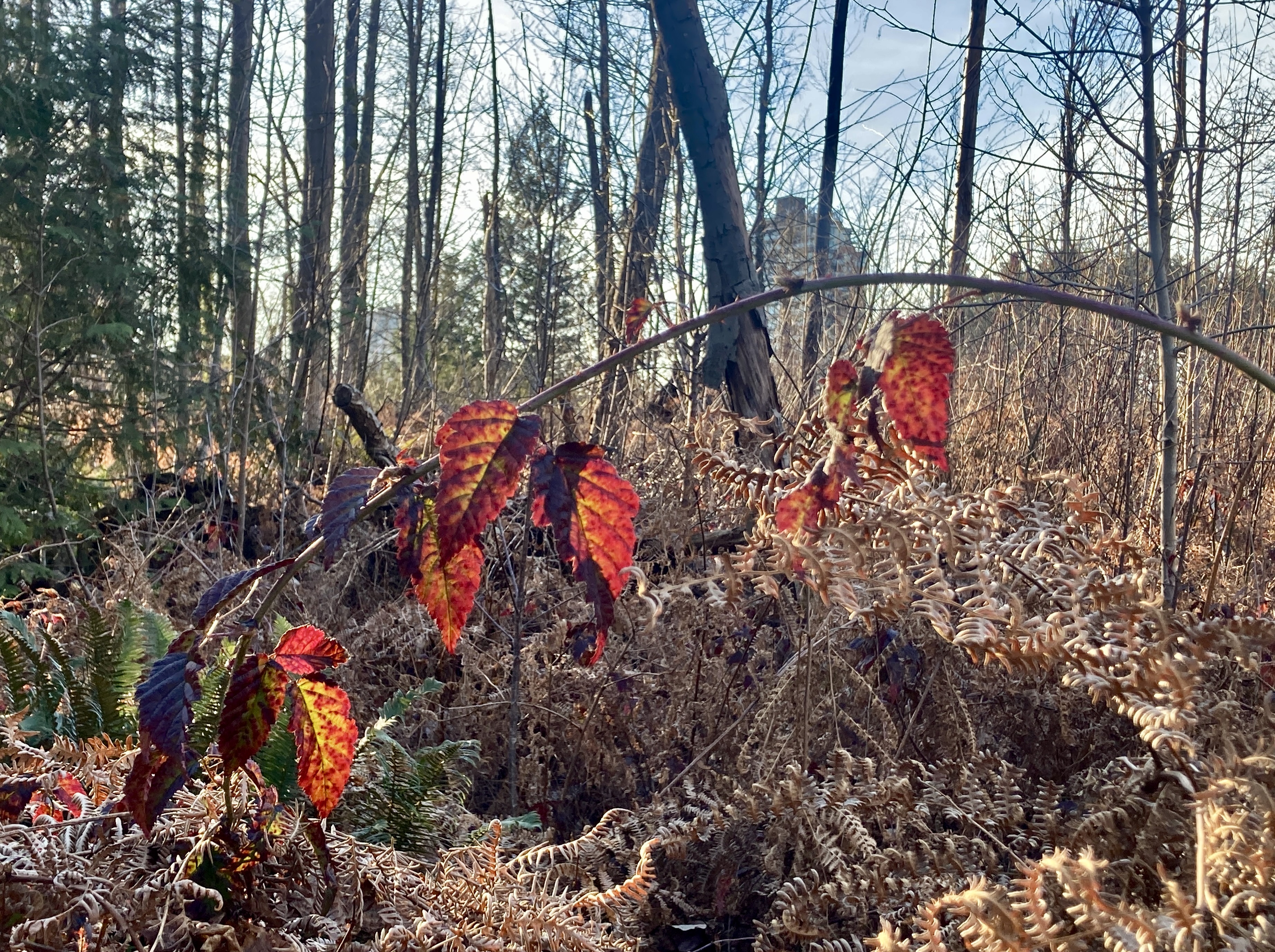
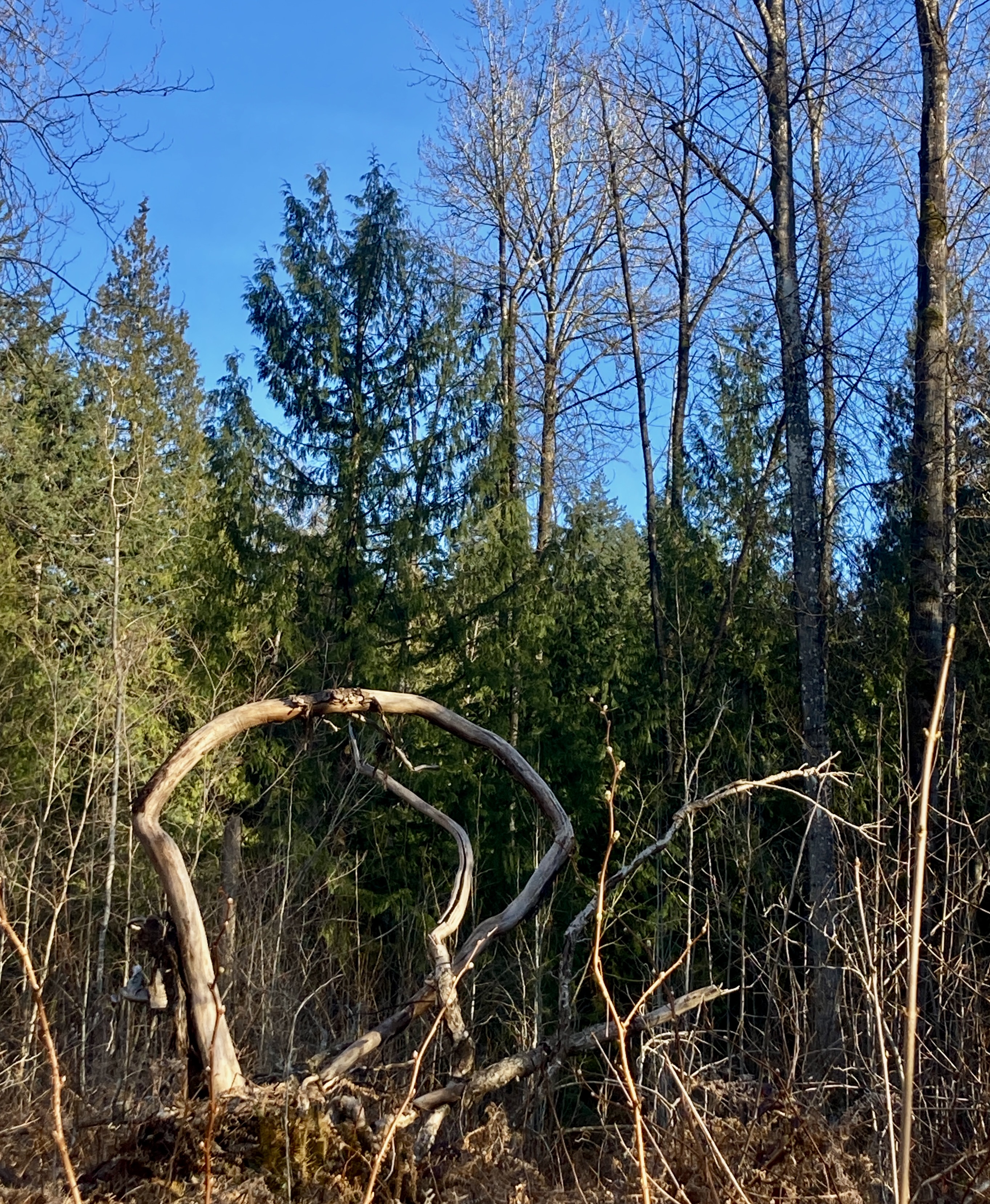
Next up, an arched branch…
proving that left-over tassels of autumn red are just as striking as winter moss green.
To my left, farther away, another arched branch…
proving that (nyah nyah) you can have just as much impact, stark naked.
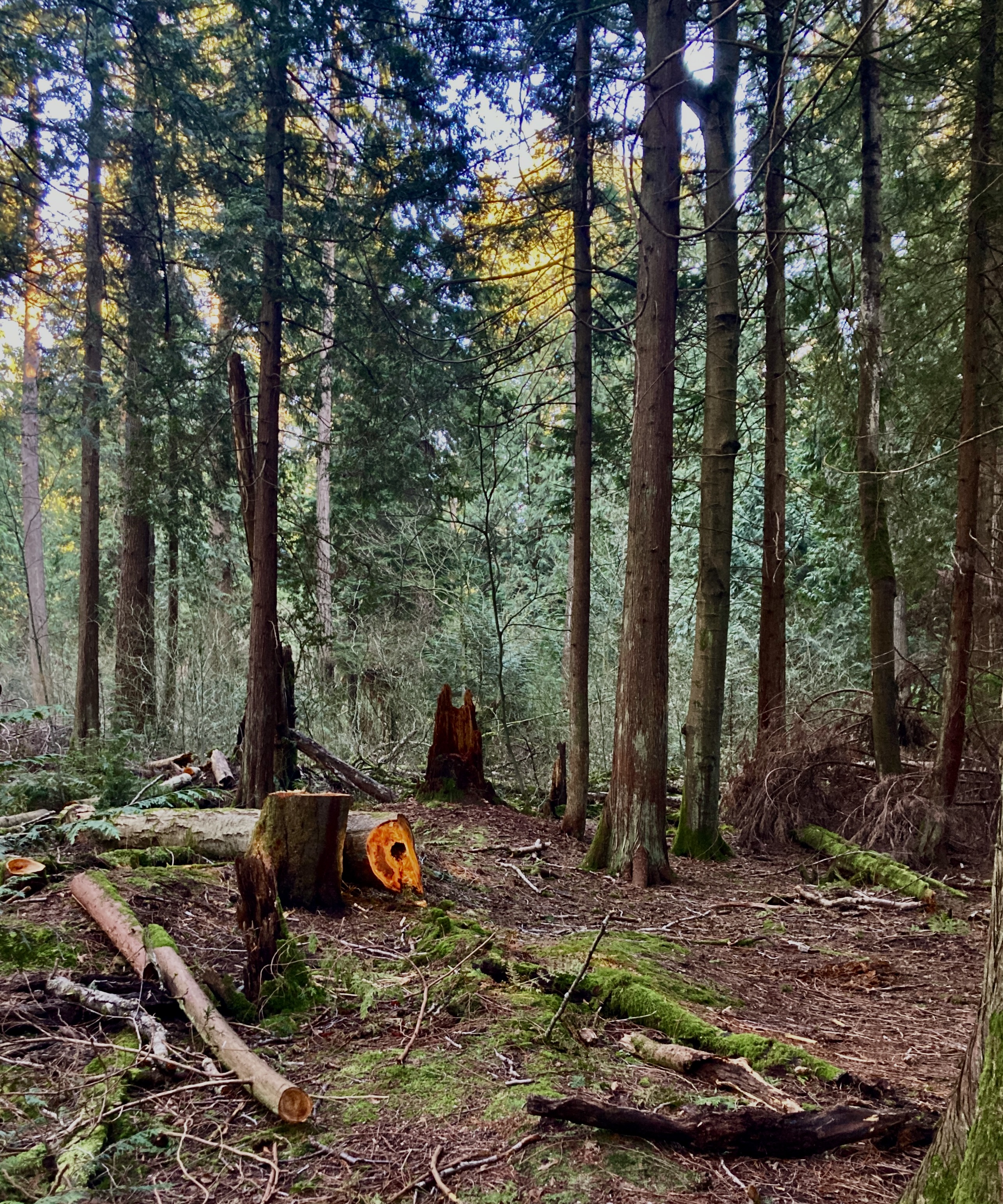
Round another bend in the trail, where first a ragged spire of ancient tree trunk…
and then a fresh-cut end of tree trunk…
prove that, in the bravura sweepstakes, red cedar always wins.
Back home, delighted with memories of both the concert and the trail, I open a text from a friend for yet another delight. It’s a skyscape photo to round off my collection…
her (7:55:07 PST) moon tribute to, as she points out, “the 12th day of the lunar new year.”
28 January 2026 – Or, maybe: “Colour.” Or, for the old-school among us: Colour [sic].
Meaning, I have found myself playing with the concept of colour these last few days. It is all thanks to a comment by J. Walters on my previous post — her pleasure in the “gorgeous colours” in Vancouver, viewed from her farther-east landscape of “variegated white.”
(By the way, if you don’t already know her Canadian Art Junkie blog, give it a visit.)
So I walk around, and I amuse myself by seeing colour differently. Seeing it in relation to other attributes.
Colour: Brilliant
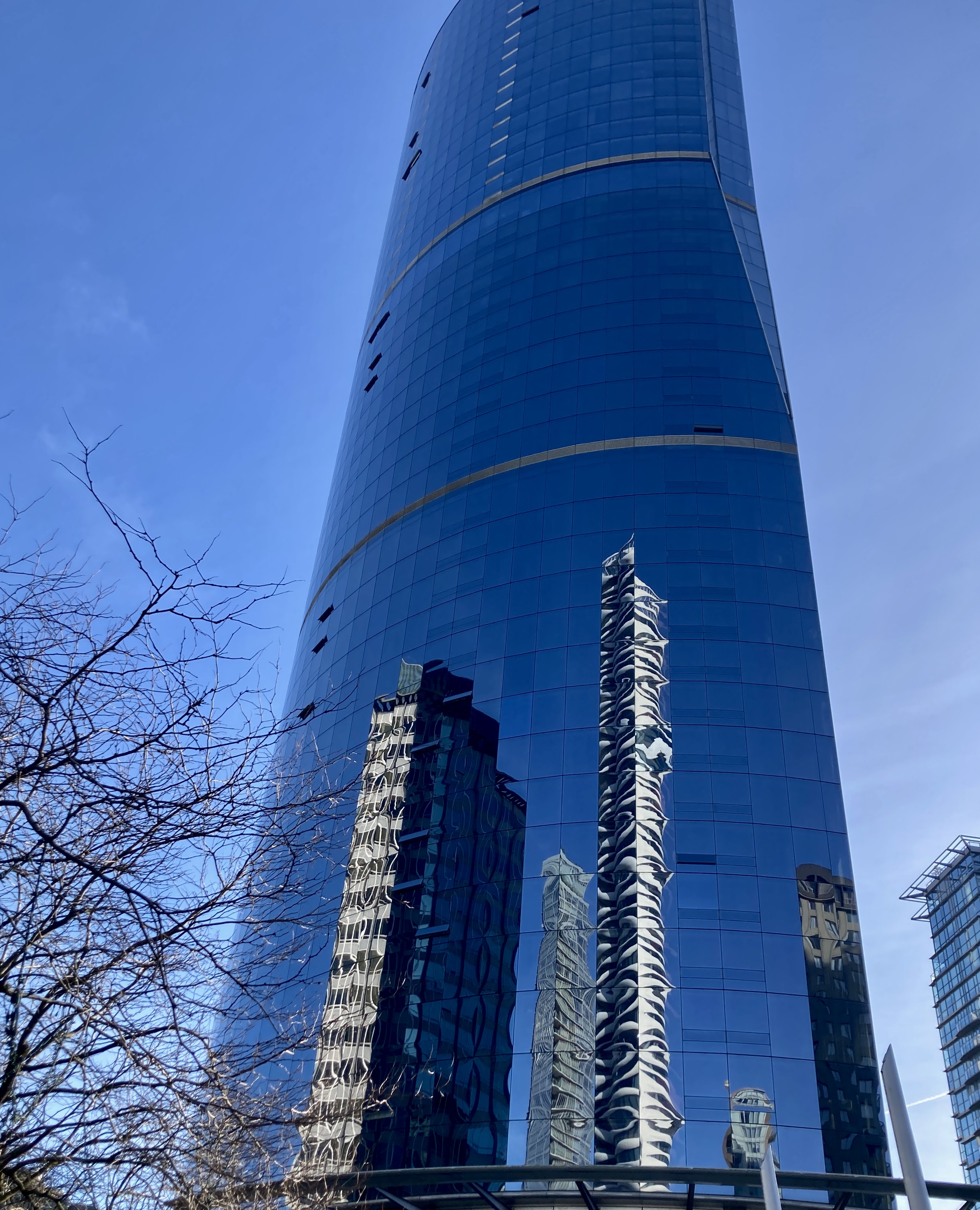
What’s more brilliant than reflected colour, bouncing off the plate glass of a downtown tower, under a blazing sky?
Colour: Muted
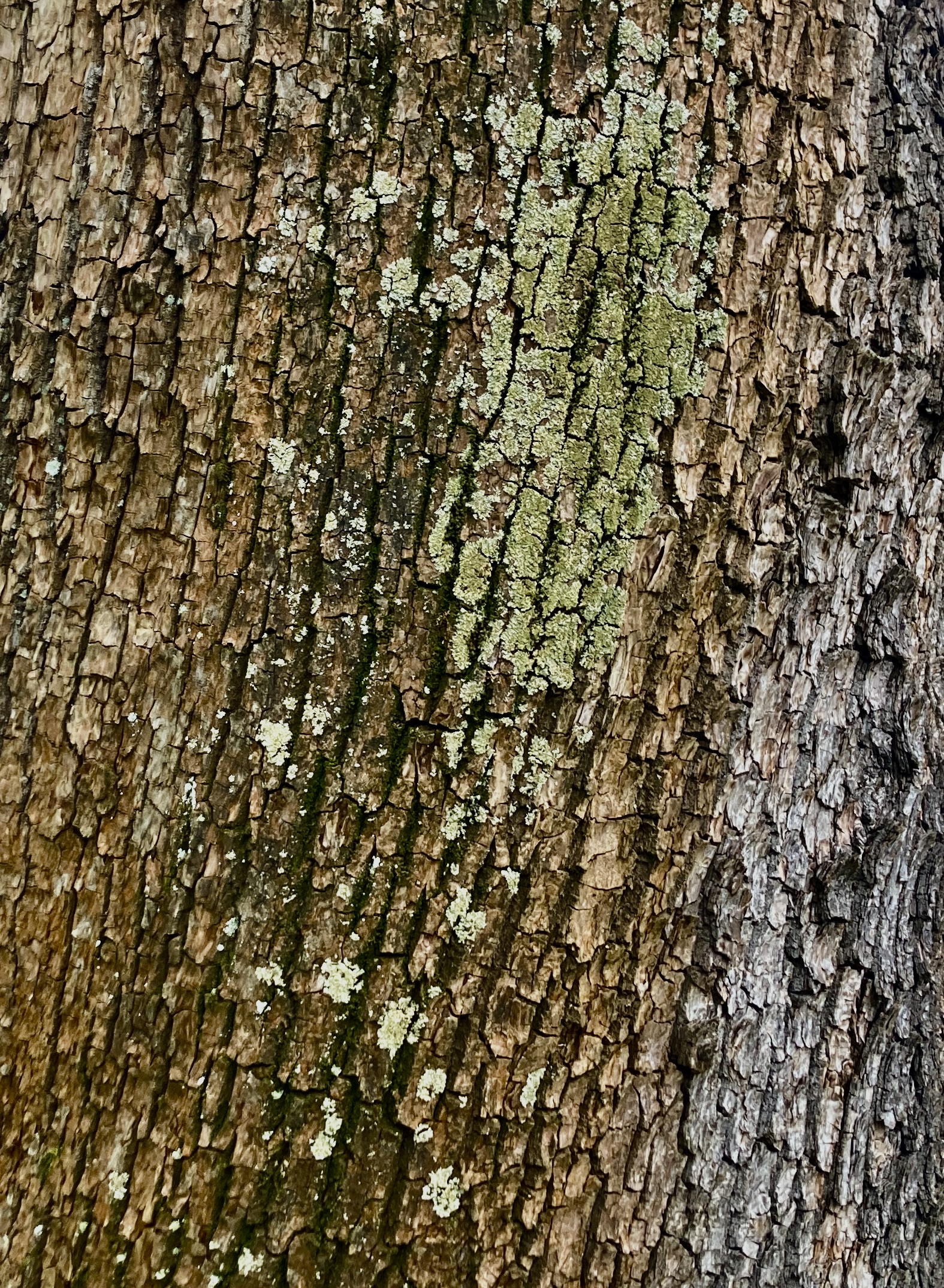
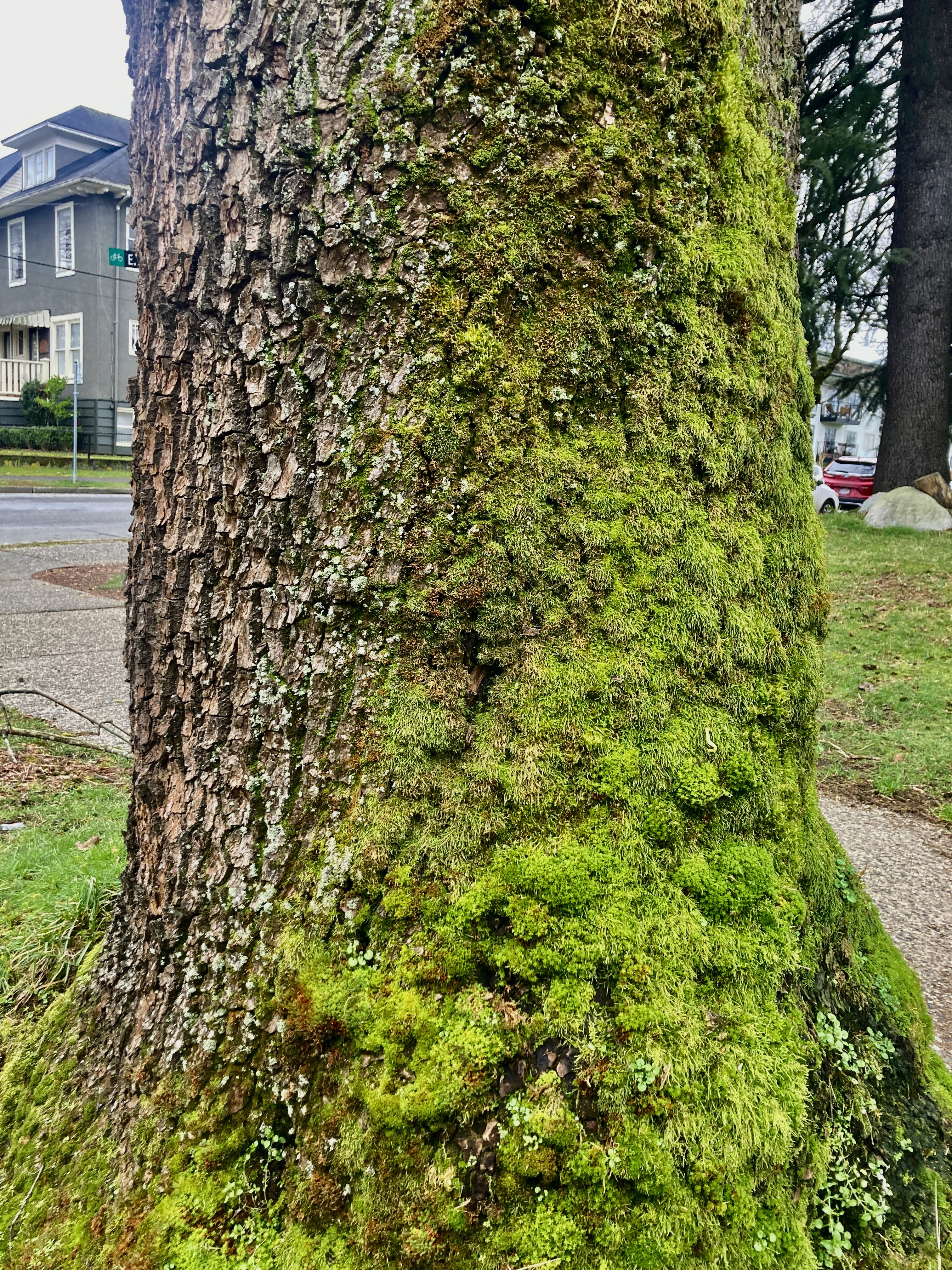
A murmur of colours, quietly living and breathing within the textures of their host, a tree trunk.
Colour: Juxtaposed
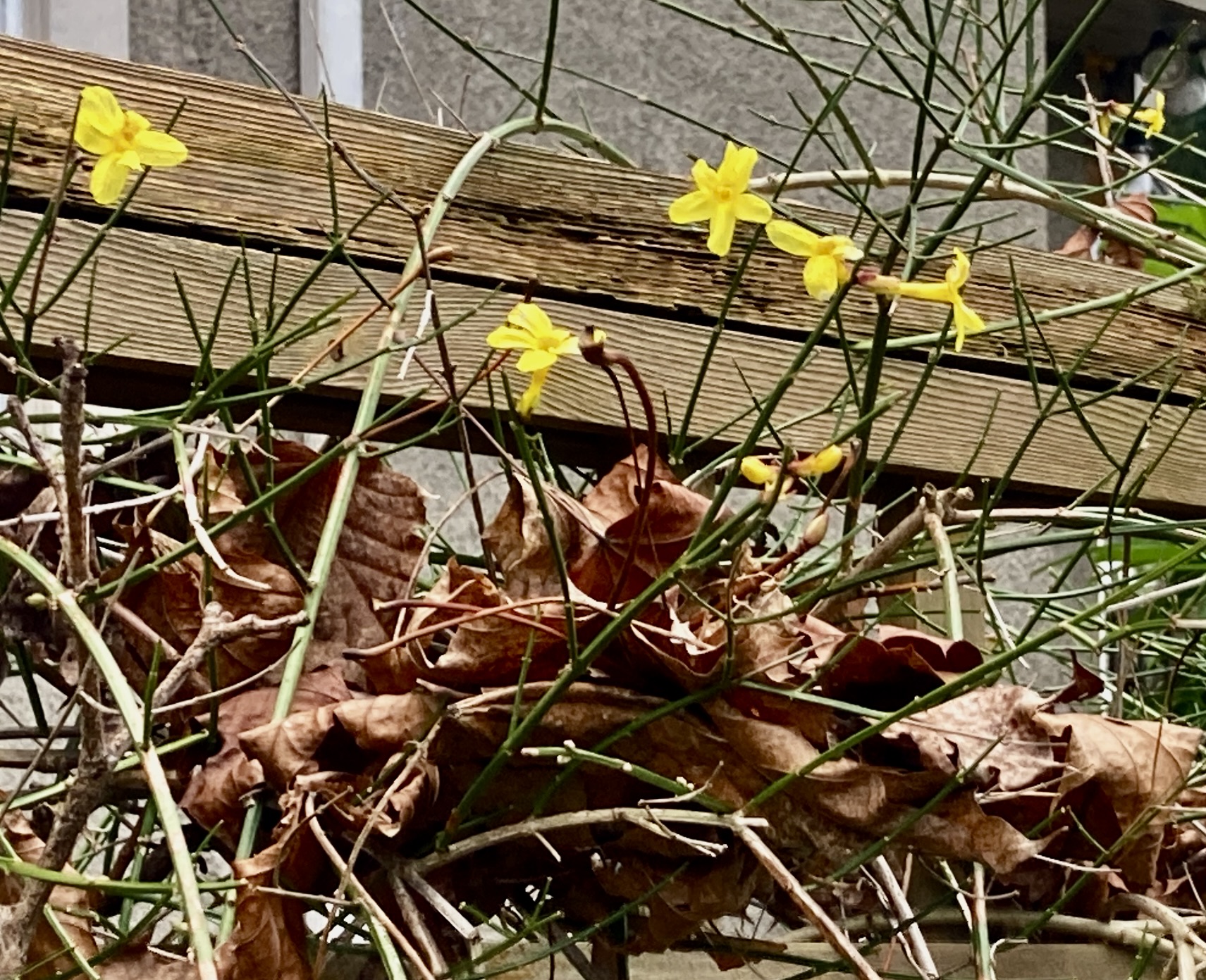
I’d not have bothered with either, on its own. Dead leaves. Pretty but unexceptional tiny blossoms. Yawn. The appeal is the contrasts of their juxtaposition. Deep rust vs sunshine yellow; battered vs fresh; last-season vs right-now.
Colour: Unexpected
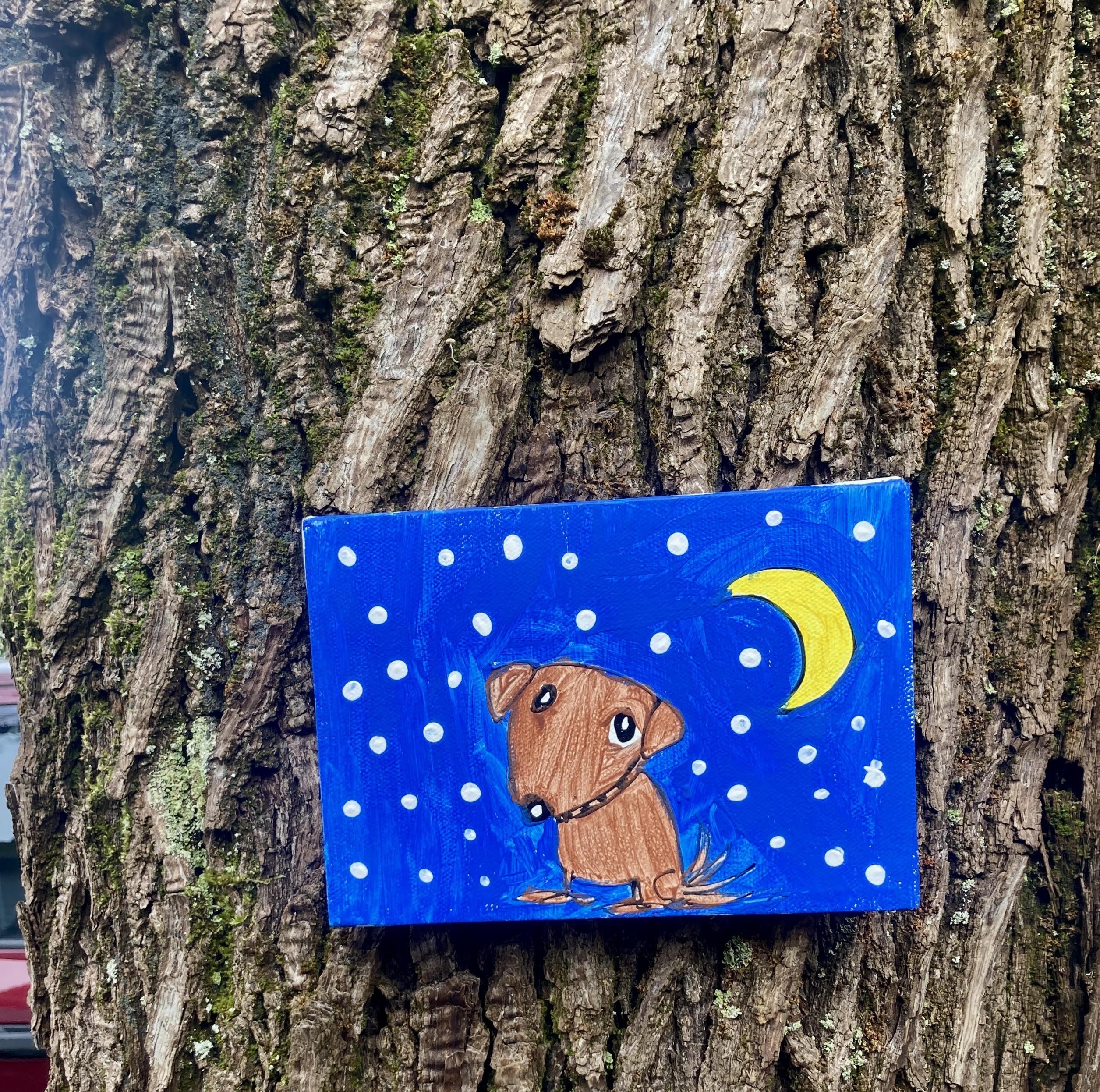
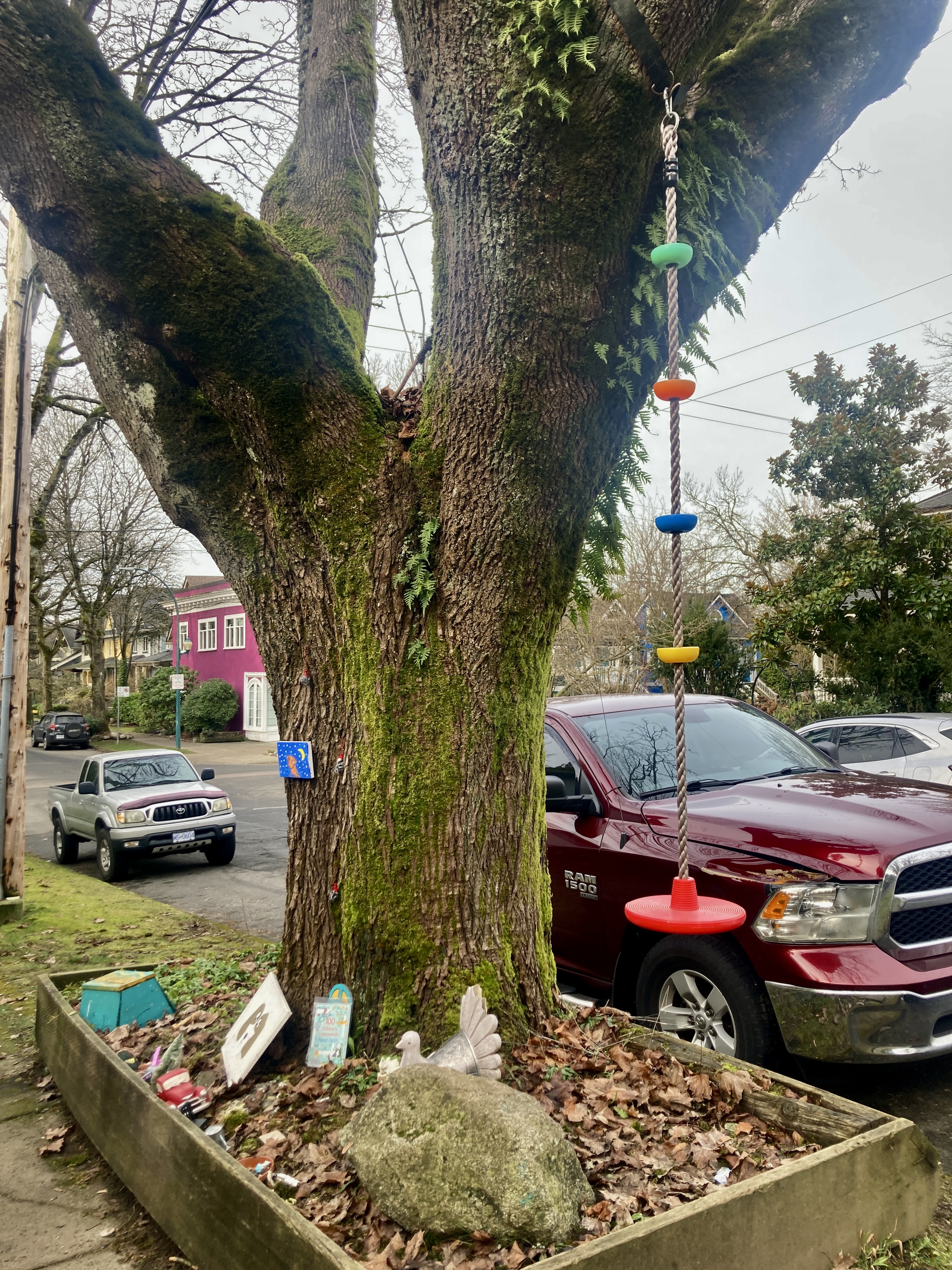
One of the Monty Python skits had a character intone: “Nobody expects the Spanish Inquisition.” Well, nobody expects a Very Colourful Dog on a tree trunk, either.
Colour: Obsessed
Namely, the colours I discover while indulging my obsessions. Two examples.
1 – My obsession with neighbourhood street-side “fairy trees,” decorated by civic-minded residents, sometimes with a swing for extra delight. Plus, in this specific example, our “Unexpected Dog.”
2 – My obsession with winter moss. In this case, right at the base of my “Colour: Muted” example above.
It’s all colour, if you want it to be. Hurray for colour.
17 January 2026 – It seems rude to mention sunshine, let alone mild temperatures (9C), when most of Canada is socked with snow, sleet, ice and windstorms. But… here it is. A bright, friendly day.
So we seize it.
We’re off to Burnaby Lake Regional Park. The park surrounds a large glacial lake to the east of Vancouver, and lies within its own dense municipality. Yet it is also home to wildlife (especially birds) and rich with trails for human visitors (walk, cycle, ride a horse, as you wish).
We have no particular plan beyond entering the park at the east end, off Cariboo Rd., and following the Brunette River upstream to the lake. After that? We’ll find out.
It is all magic, right from the get-go.
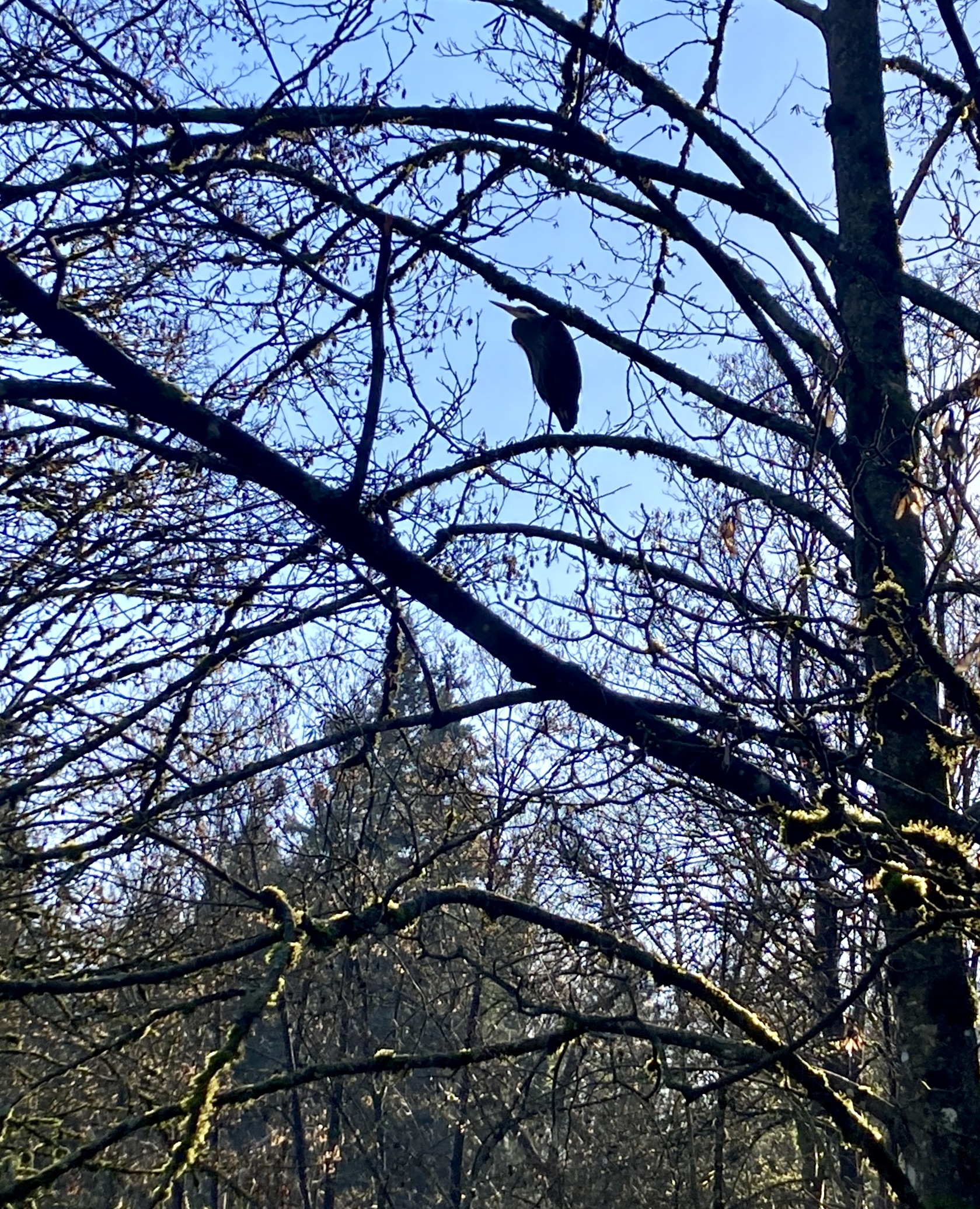
A great blue heron sits tall, still and stately in his tree beside the river…
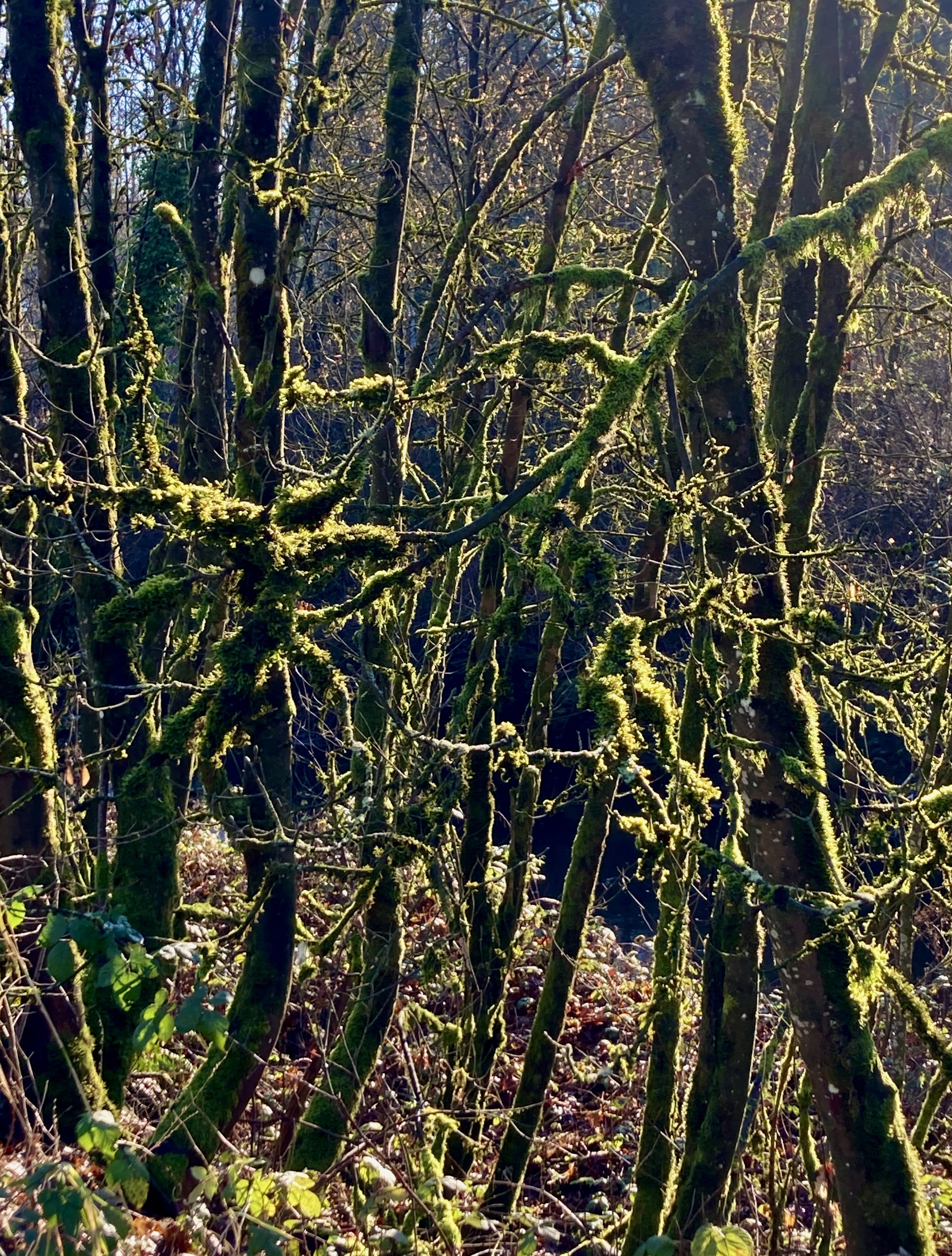
winter moss glows incandescent on trees lining the river…
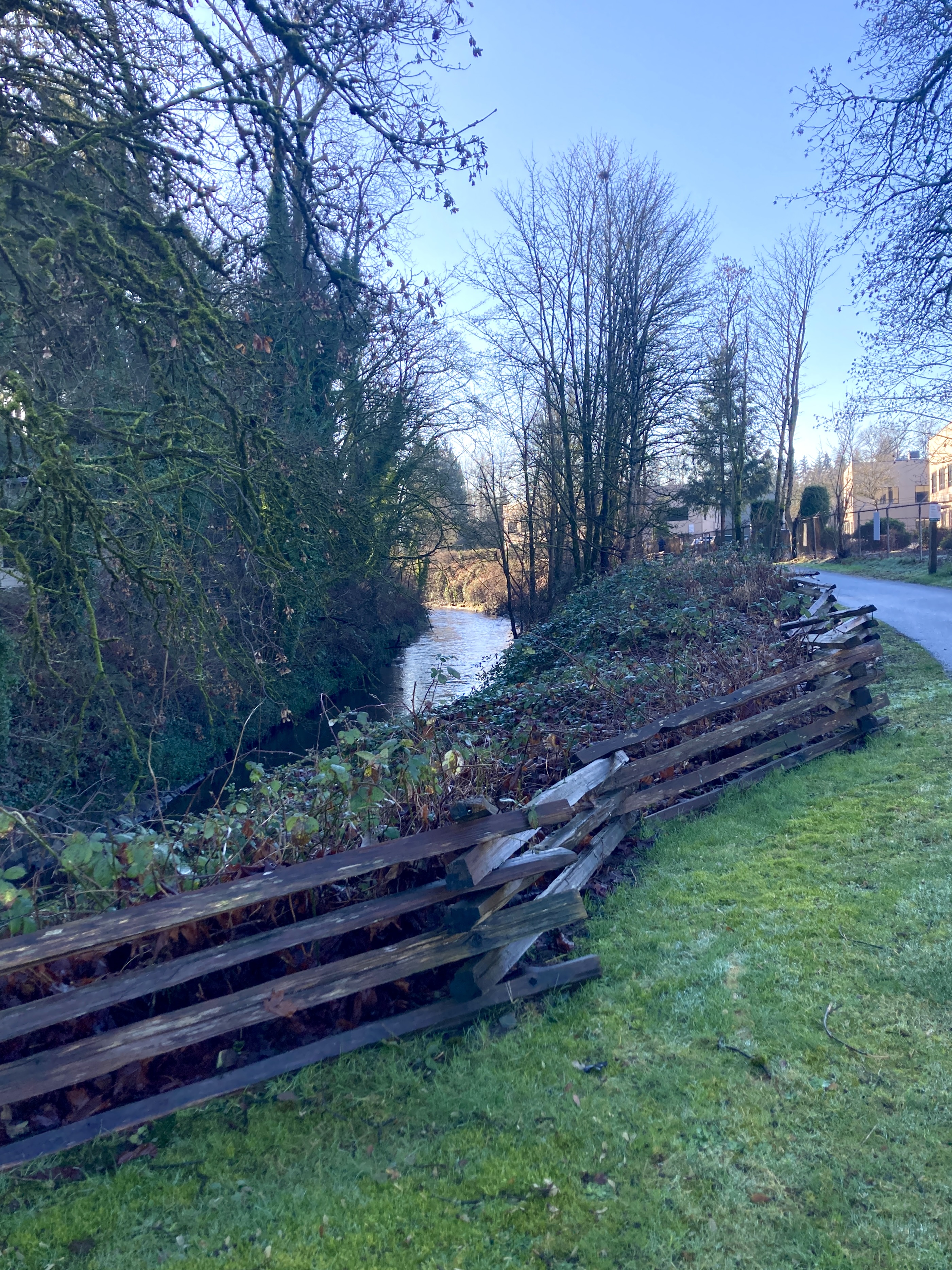
and a snake fence leads us on upstream…
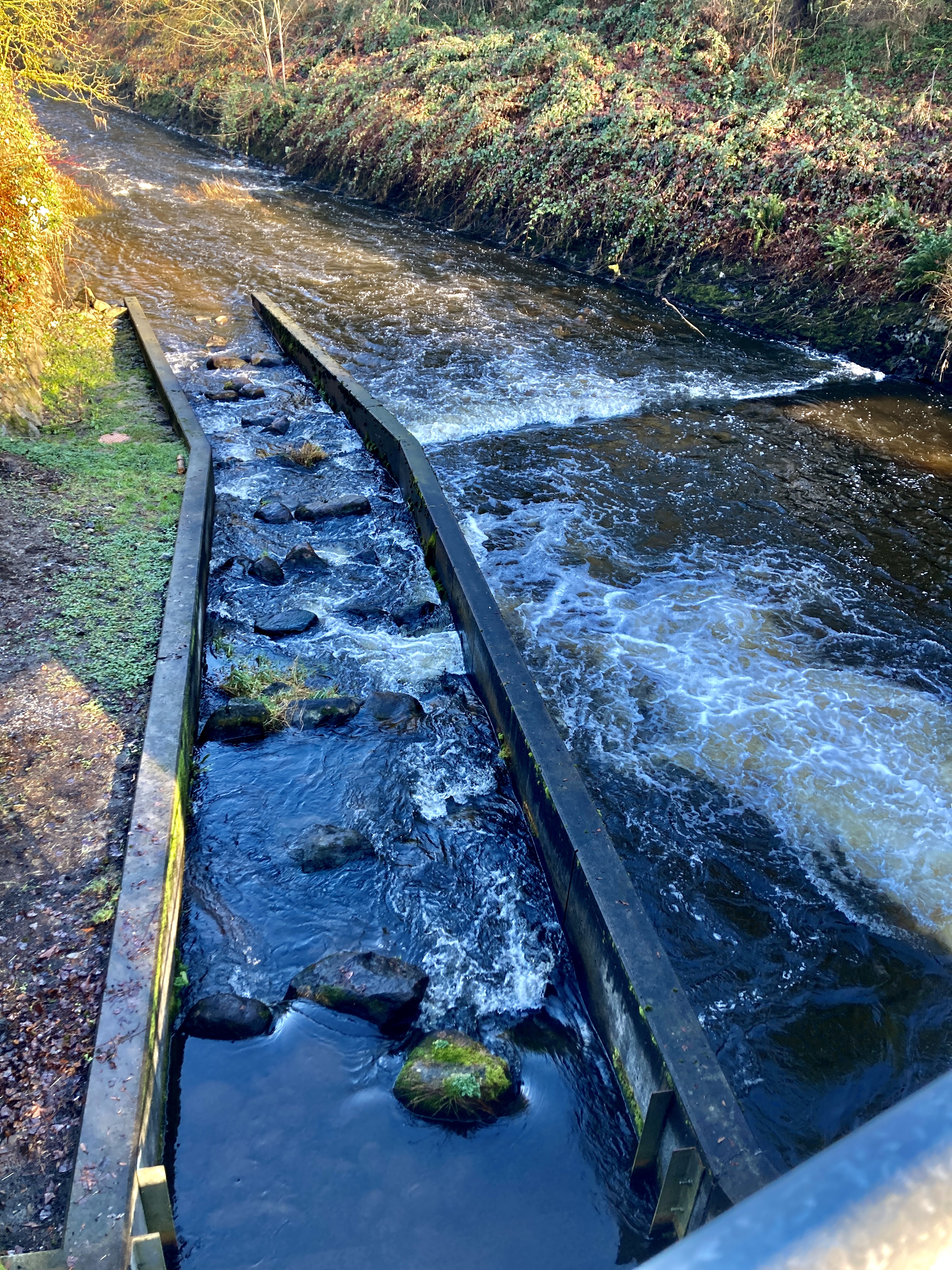
to the Cariboo Dam. Several creeks and a lake feed into Burnaby Lake, which in turn empties into the Brunette River and ultimately into the Fraser. This dam controls the outflow.
An era of sawmills on the lake caused the inevitable toxicity and devastation of salmon and other populations. We stand on the path atop the dam, and see some results of rehab efforts since then.
To the east, the Cariboo Dam Fishway provides upstream access for resurgent fish populations …
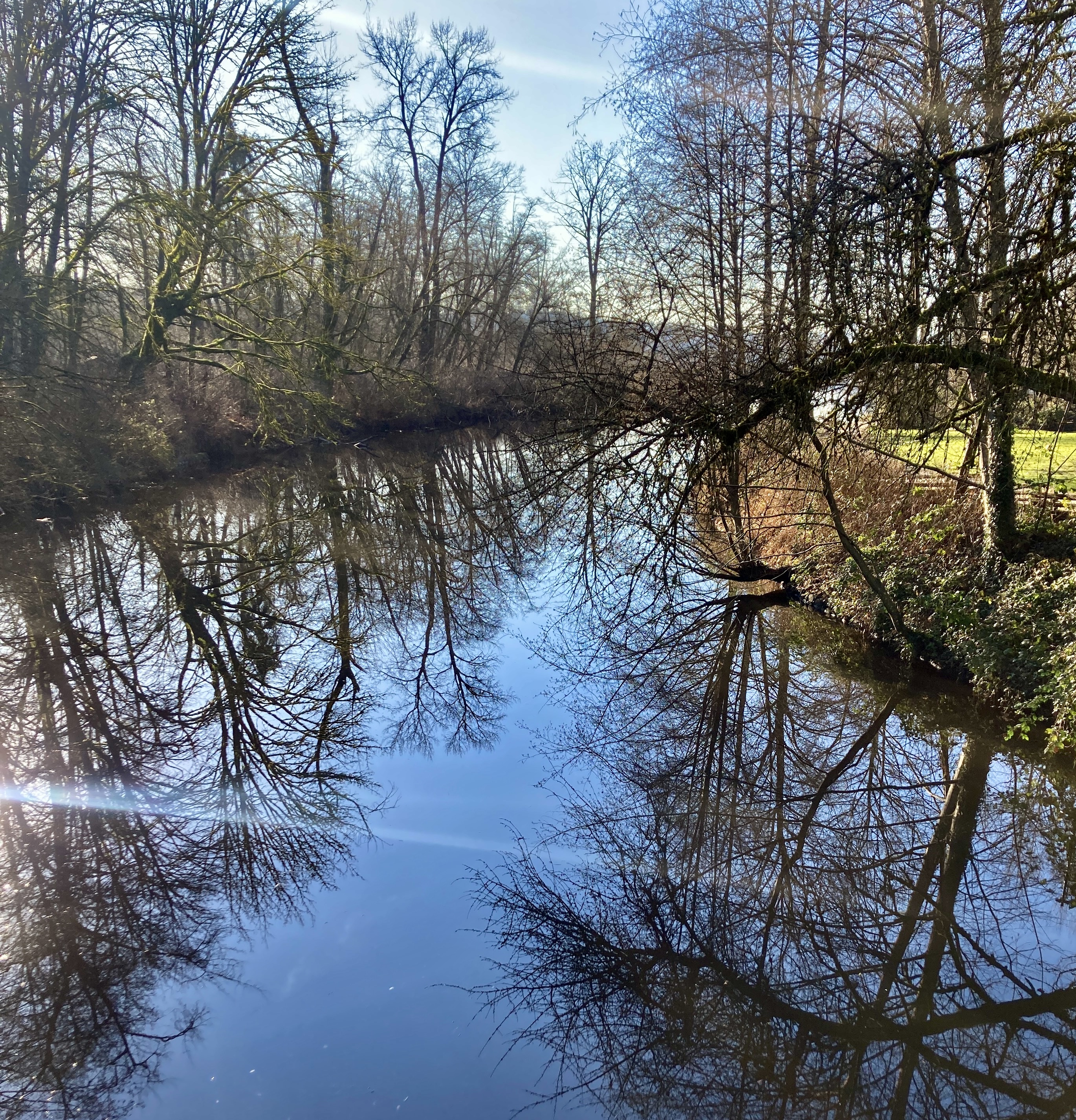
and to the west, winter trees cast their delicate embroidery on the system’s much-improved waters.
Trails circle and loop off-shoots all around the lake, but are not always in sight of water. We’re on the Brunette Headwaters Trail, entranced by nature’s response to the minimal human pruning that keeps trails safe and accessible.
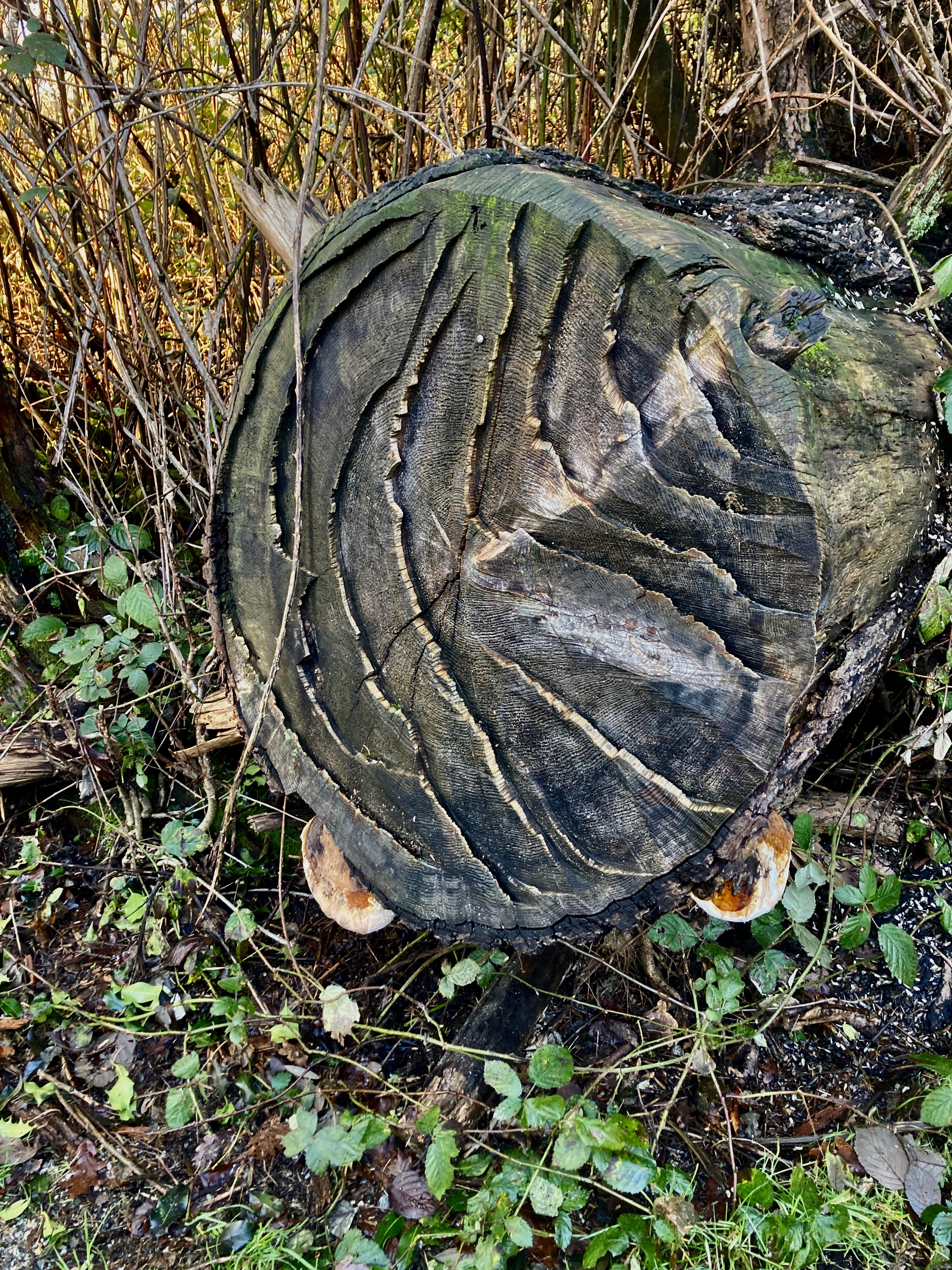
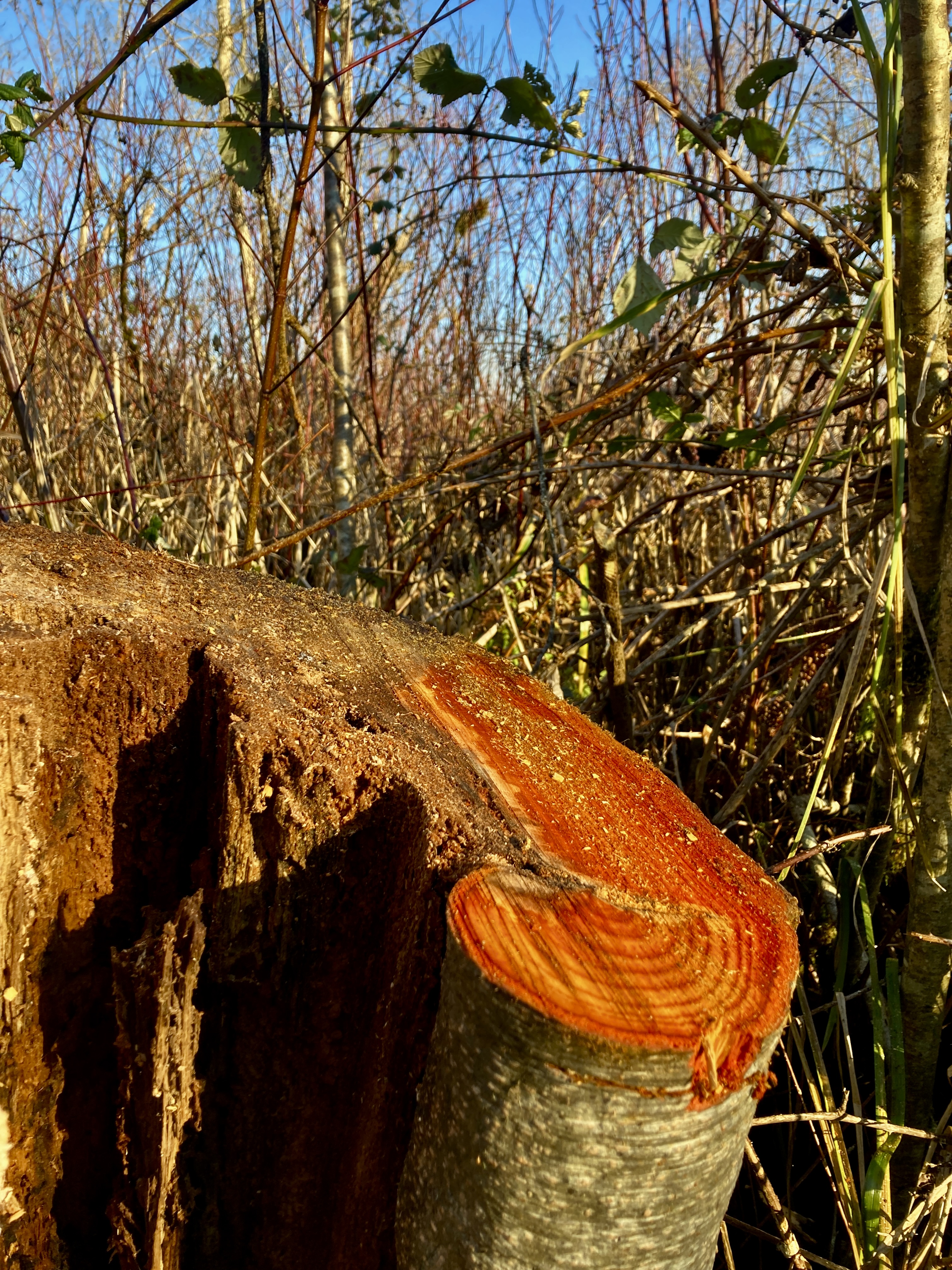
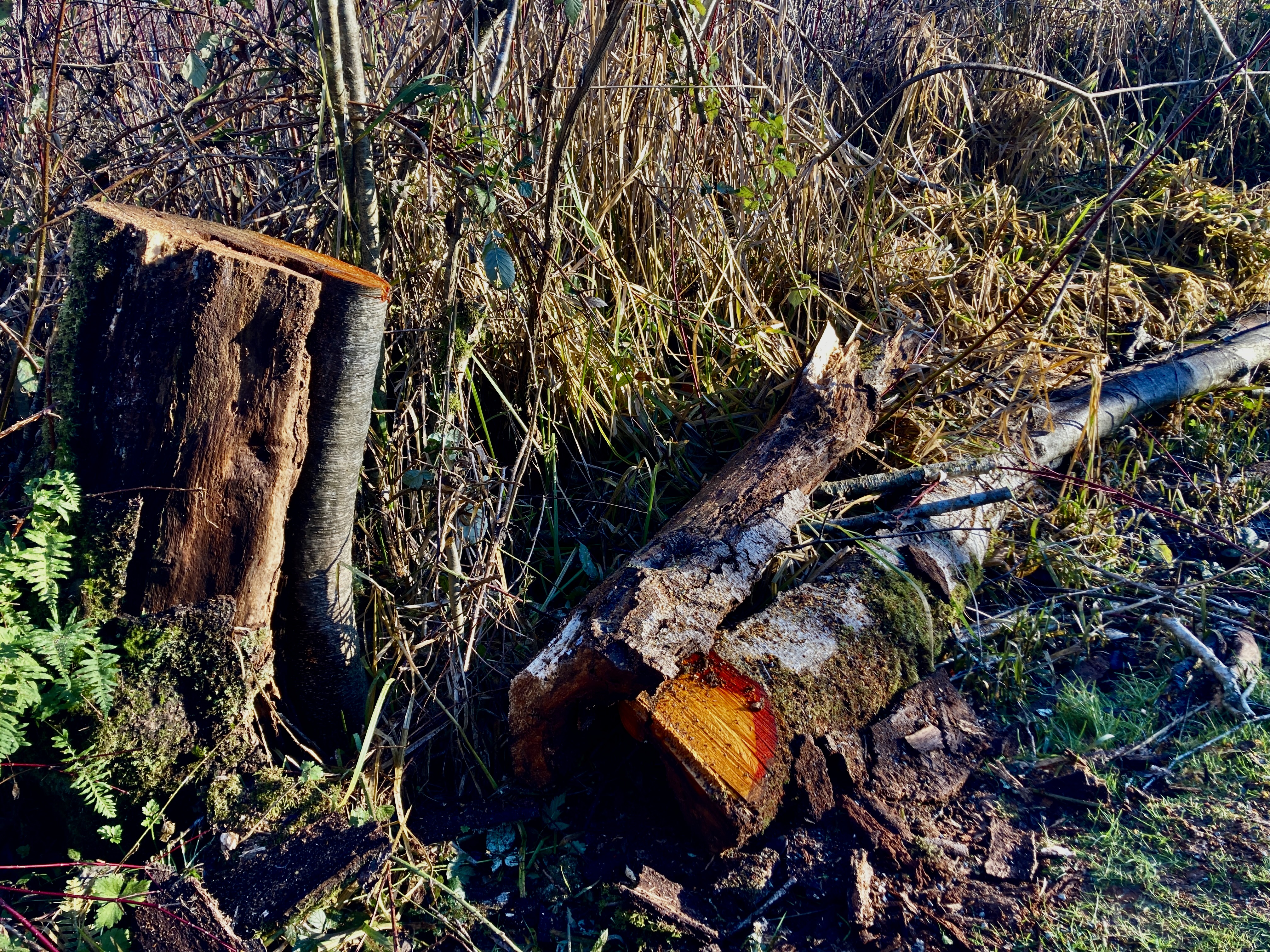
Humans cut; nature pretties up the resulting stumps and fallen logs.
Sometimes with cream/black/ochre fungi…
and sometimes with a smacking great burst of red and orange in the wood itself.
(Really! No enhancements.)
And then, as if that weren’t enough, right there in the grasses between stump and tree trunk…
I spy a vivid little slice of off-cut. Which, to my friend’s amusement, I tuck into my knapsack.
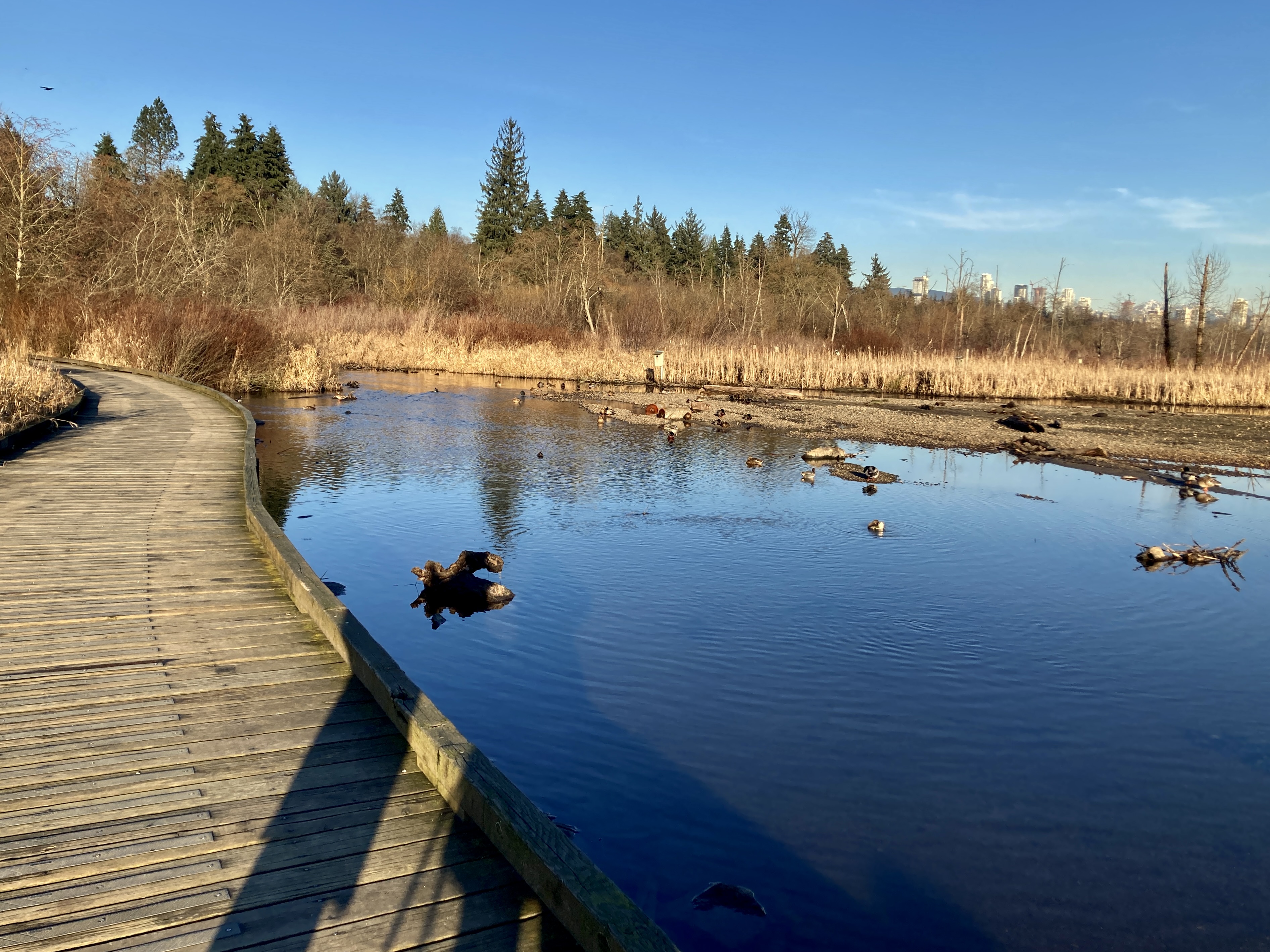
On west we go, and turn onto the path that will take us to the viewpoint at the end of Piper Spit.
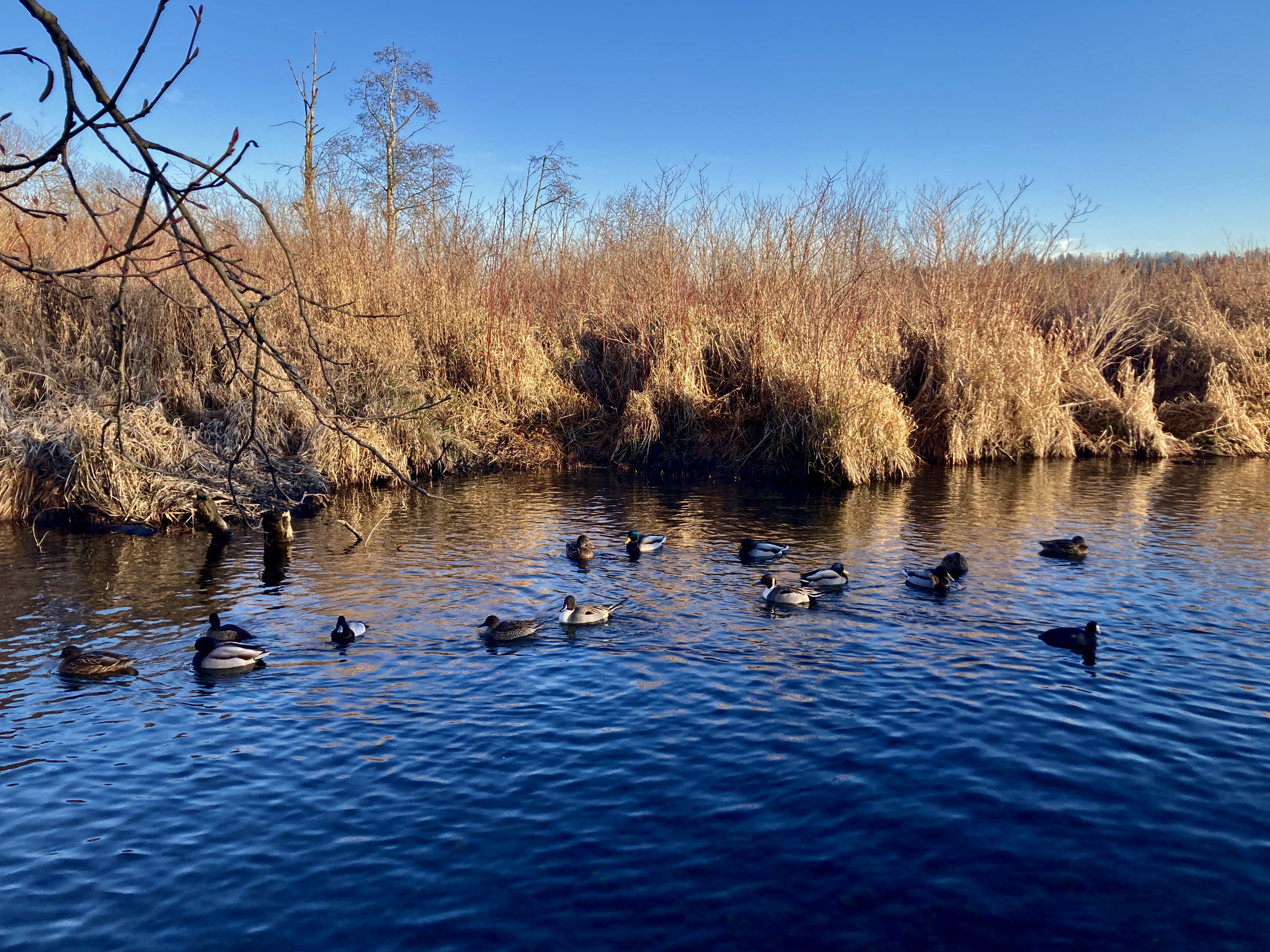
The waters along this path teem with happy ducks. Even my uneducated eye can pick out mallards, pintails, golden-eye and coots, as they mill about.
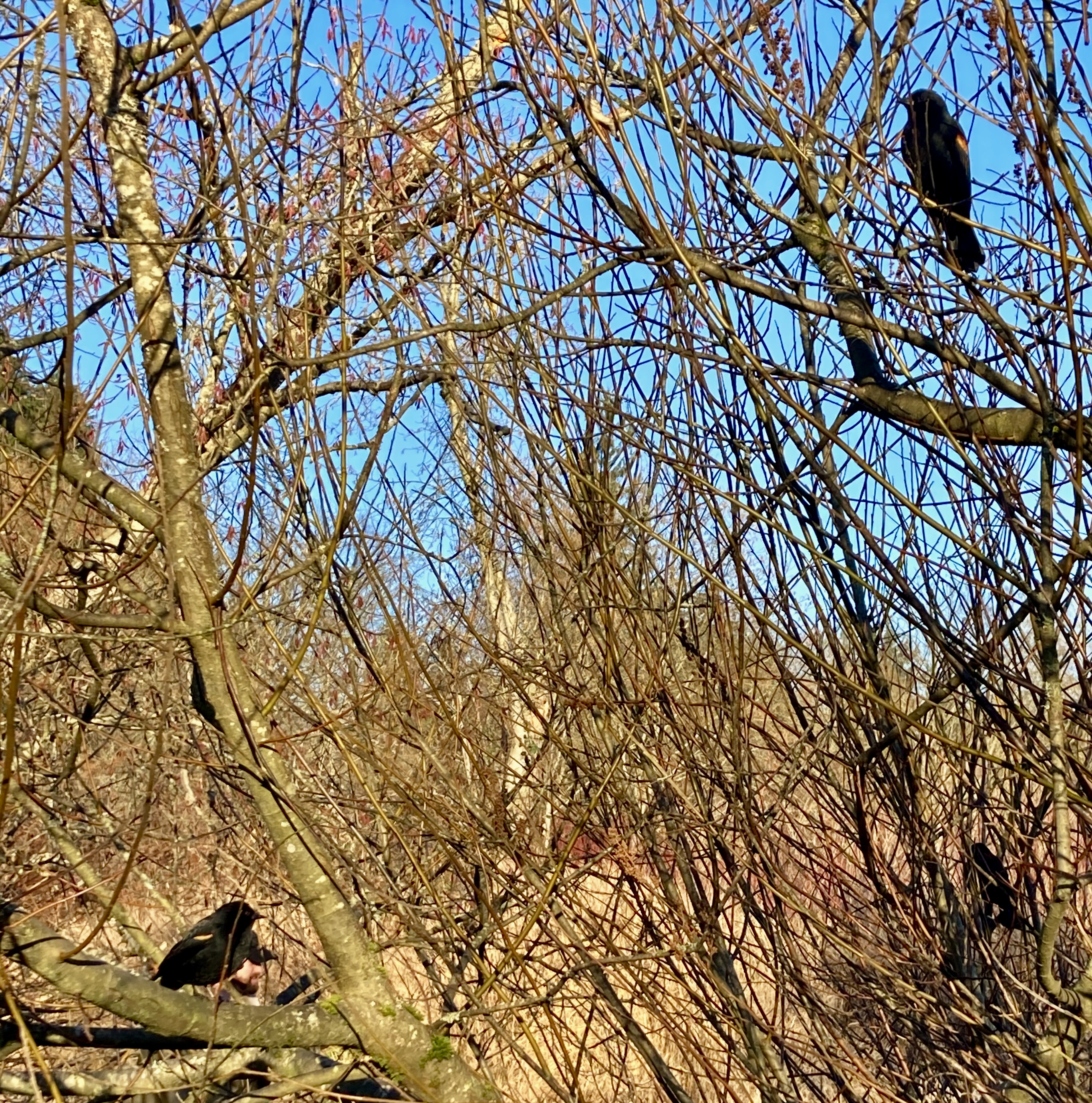
In the trees, chickadees and red-wing blackbirds.
I confess: I deny these guys are red-wingers until they flash those chevrons. “Well, they don’t sound like red-wing blackbirds,” I grumble. Then I have to consider that this lot is a long way from the lot that my ear knows best, back in Ontario, and they probably have their own distinctive accent. (Am I right? Am I silly? Somebody please tell me.)
Tip of Piper Spit, we look east at yet more ducks (and gulls, and bird boxes along the shore)…
then west across mud flats toward the shoreline viewing tower.
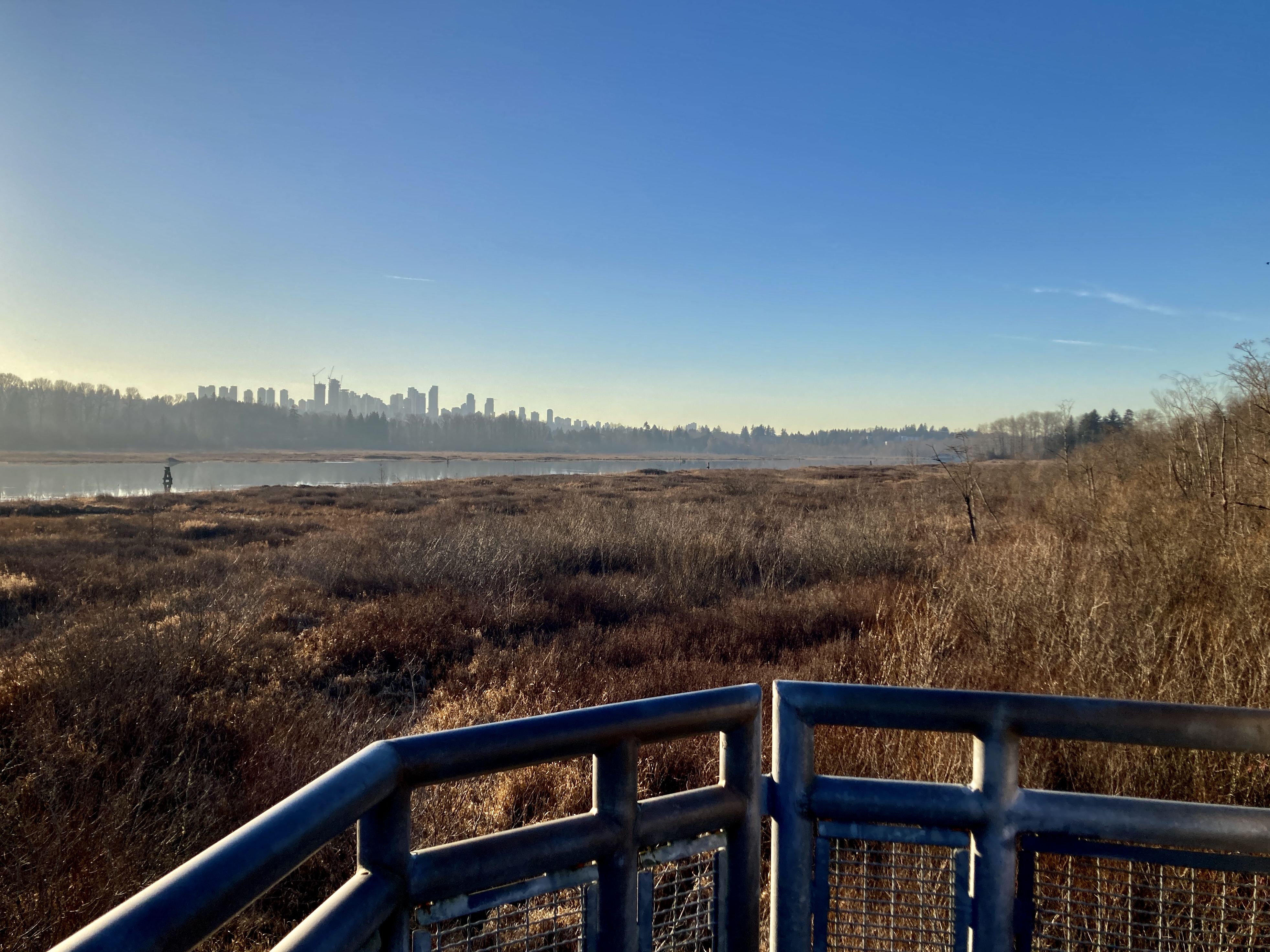
Back to the main trail, and up the tower…
for a long view across grasses, lake and woods beyond, right to the towers of downtown Burnaby.
Beyond those towers, the Vancouver towers.
Where, once home…
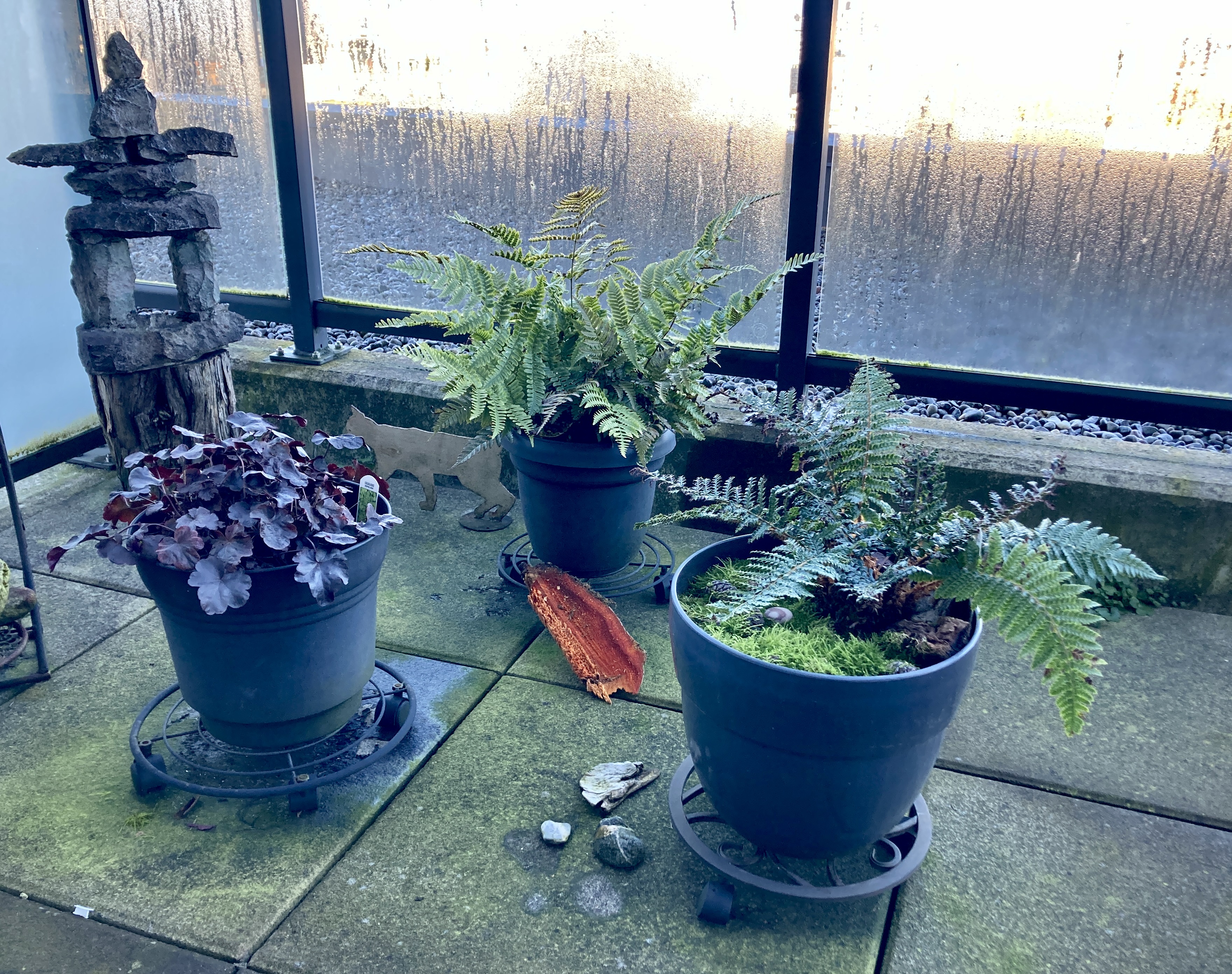
I settle my vivid little off-cut among its new companions.
23 October 2025 – I had a much longer title in mind. To wit: “Above/Below/In Front/Behind/Then/Now/Here/There… and All the In-betweens.” Aren’t you glad I restrained myself?
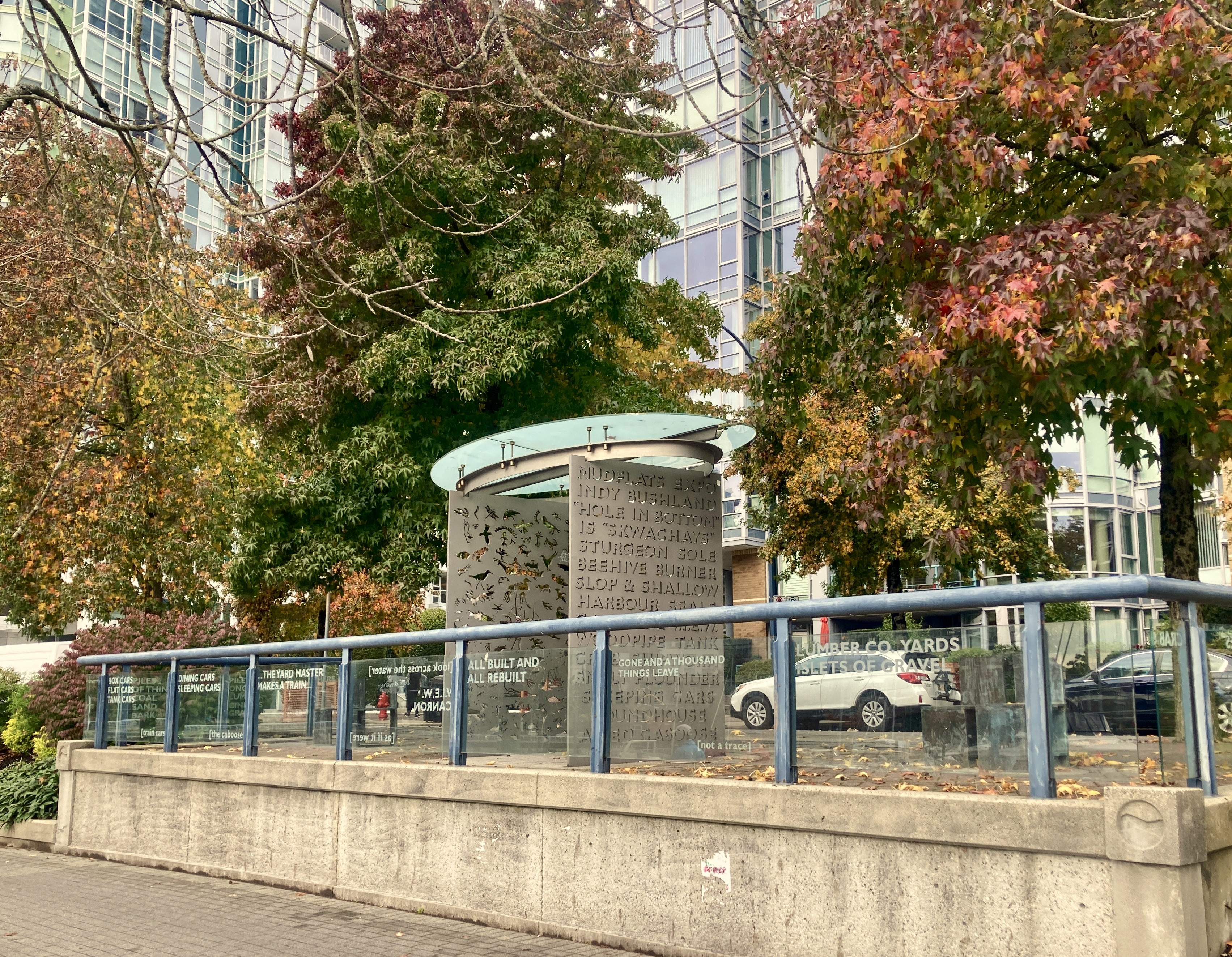
That verbal onslaught is prompted by yet another walk along the north shore of False Creek, from foot of Davie east to Main. More specifically, prompted by this:
I only now, after all these years, bother to learn that this artsy structure has a name. It is one of the two shelters + glass panels that comprise Lookout (Dikeakos + Best, 1999), which traces the natural & industrial history of the area and is an early contribution to the public art we enjoy on both sides of the water.
You can spread the image, read the keywords panel by panel — or just read this paragraph! L to R: “box cars, flat cars, tank cars” / “dining cars, sleeping cars” / “… the yard master makes a train…” / [then a panel written to be read from the other side] / “all built and all rebuilt” / “gone and a thousand things leave, not a trace” / “lumber co yards, islets of gravel.”
I climb up to the street, take a closer look at the inscribed and silhouette steel uprights, also part of the story.
Natural + industrial history indeed, from “mudflats” upper left to “red caboose” lower right.
Then I check the panel meant to be read from this, the street, side:
This one you can read for yourselves. And, given all these prompts, you can also take a stab at imagining “as if it were” all still present as it used to be.
What you will have trouble reading, even if you spread the image, is the black-lettered graffito neatly inked in just below “across the waters.” It says: “build a washroom.”
I think this is perfect. An interjection of a “now” reality in a tribute to “then.”
It is also a further prompt to do what I do every time I pass this installation, with its invitation to remember the past, superimpose it on the present, build it into my understanding of how much more is still Here-And-Now than is Right-Now visible. Every time, my mind flips back, vaguely but insistently, to Italo Calvino’s 1972 book, Invisible Cities. As one astute reviewer observed, the novel is “a travelogue to places that do not exist.” It also invites us to think more richly about how we define “exist.” (Side nod to the wise fox, who taught The Little Prince, “What is essential is invisible to the eye.”)
I am primed, in other words, to read above, below and ‘way inside the everyday sights that greet me as I walk.
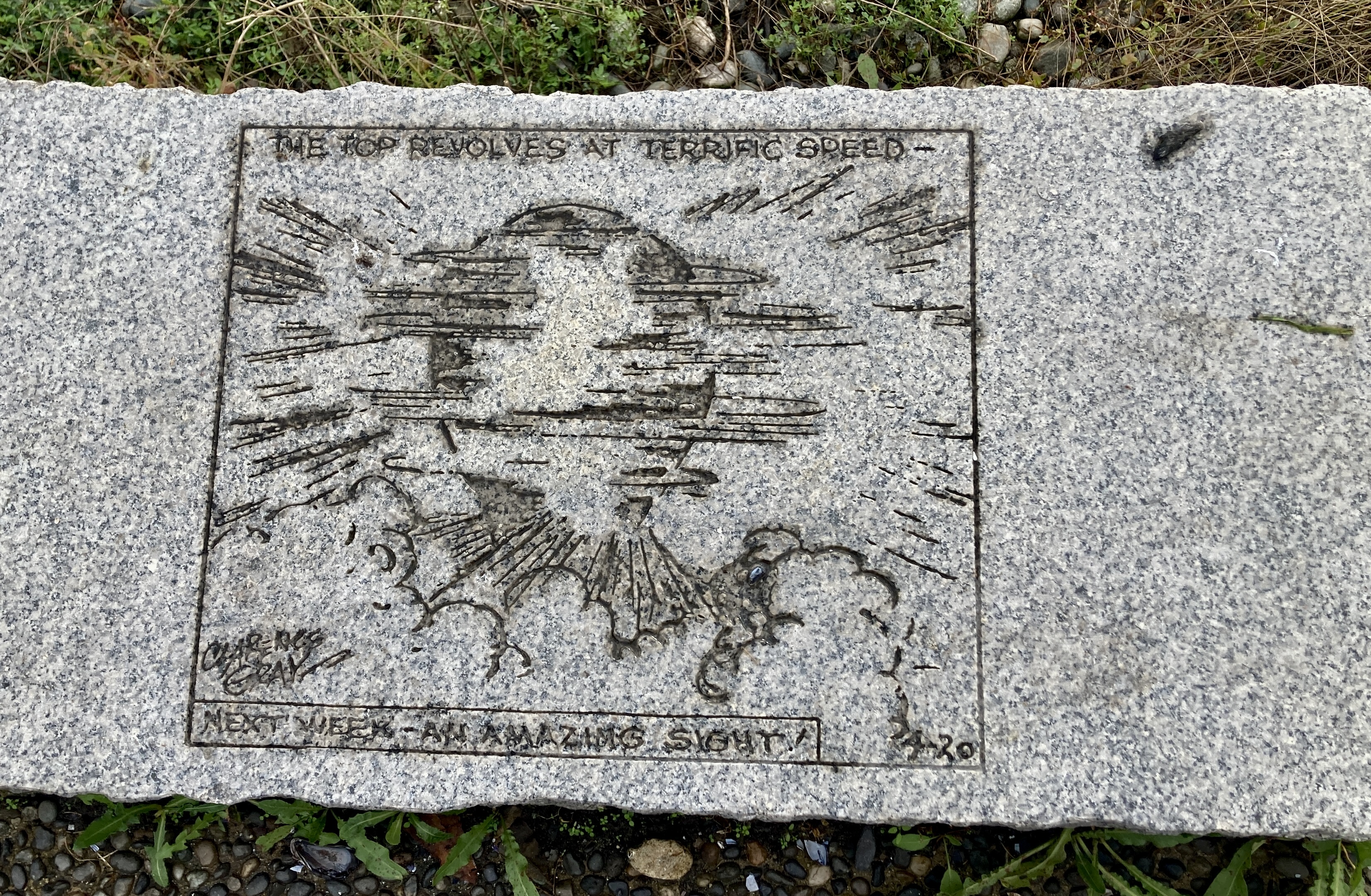
Jerry Pethick’s Time Top sculpture, for example, that invites us to imagine a time top spinning across the galaxy…
to crash-land on the shores of the Pacific Ocean, right here…
or the blue bands of A False Creek (Rhonda Weppler, Trevor Mahovsky), that invite us to imagine what all this will look like if climate change indeed causes ocean levels to rise 4-6 metres…
and, right next to it, another interjection of a “now” reality, again in the form of a polite and neatly lettered graffito. This one, beneath the No Dogs Allowed notice there on the right, yanks our attention back to the present. “Clean The Water,” it snaps.
I stop my fancy metaphysics for a moment, offer myself a simple contrast between sky-high…
and shoreline…
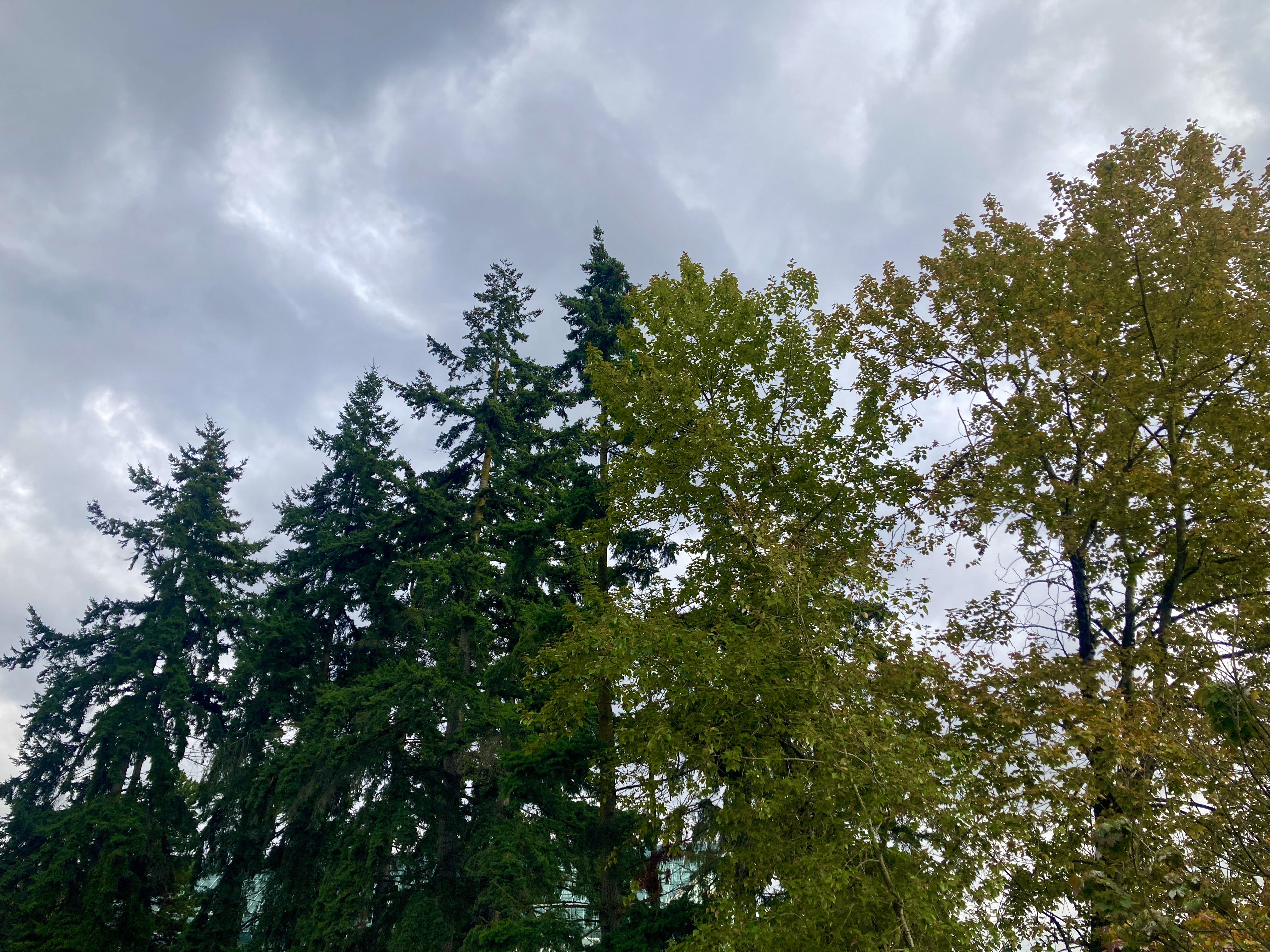
then, sideways, a panorama of nature, reminding us that it invented fall colours long before built structures began to emulate them…
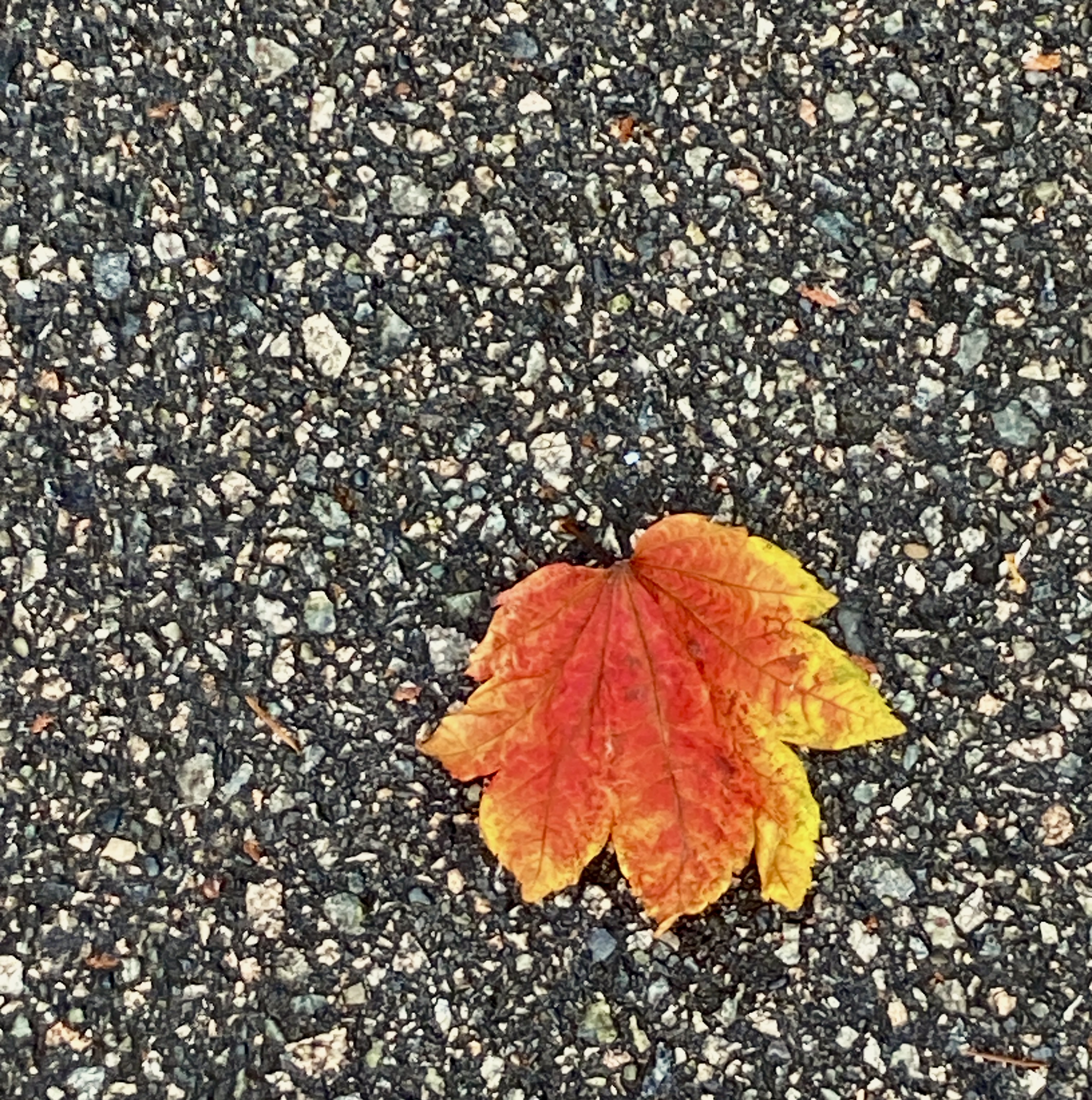
followed by, at my feet, the tight focus of a single fallen leaf…
reminding us that diversity, whether in or out of political favour, is the building-block reality of life.
However pure green this leaf long appeared to be, all these other colours were woven into it right from the start and are equally part of it. As are (side nod to Thich Nhat Hanh and the concept of interbeing) sunlight, water and soil, plus all the nutrients of those three elements as well, all of which made the existence of this leaf possible.
Quite literally, the universe in a single leaf.
Enough. I think I’m done. But, no.
There is one more juxtaposition. One more interweaving. One more dance to vibrate my own little world, as I walk on by.
Upper right: nature’s wasp nest. Lower left: street-guy’s sneakers. Both at home in the tree. A tree shedding its leaves, itself at home with the cycles of the universe.
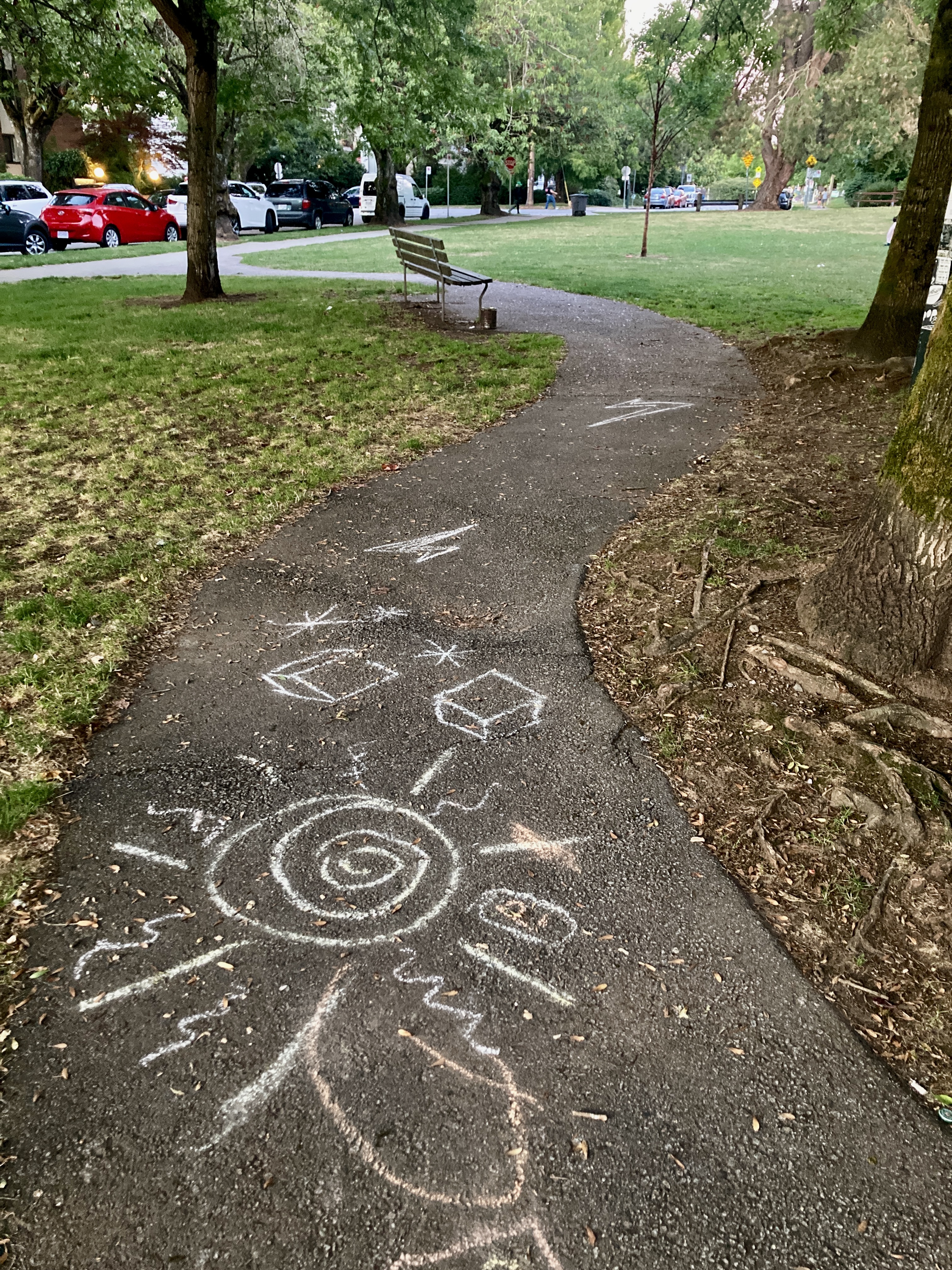
22 August 2025 – I mean to walk right through Dude Chilling Park, en route farther east. Instead, I stop to admire a brand-new hopscotch chalked into the park’s northern pathway.
Squares a bit on the mingy side, true, but lots of them. And so carefully executed. With European cross-strokes for the 1s and 7s. And the flourish of two colours, not one.
Instead of walking on, I settle myself on the bench just beyond…
curious to see if anyone yields to the temptation, and starts to hop.
First up, a very young toddler and her mum. The child is clearly new to the act of walking, let alone leaping around. She does not attempt to hop. She stops, frowns slightly at this unknown design, and then, intuitively, gets the idea.
Very slowly, very carefully, she obeys the visual clues: just one foot here, but both feet there. And then one, and then two… Until she loses patience, that is, and a laughing mother carries her off.
Next up, by complete contrast, a geezer. (Being one myself, I can say that.) He also stops, contemplates. Then, with a grin, he tucks his cane under one arm and starts to hop.
Hippity-hop! And again!
Until… whoops. A wobble corrected, a tumble averted, and his cane is prudently back in use.
He grins at me, amused. “Maybe I’m a little old for this.”
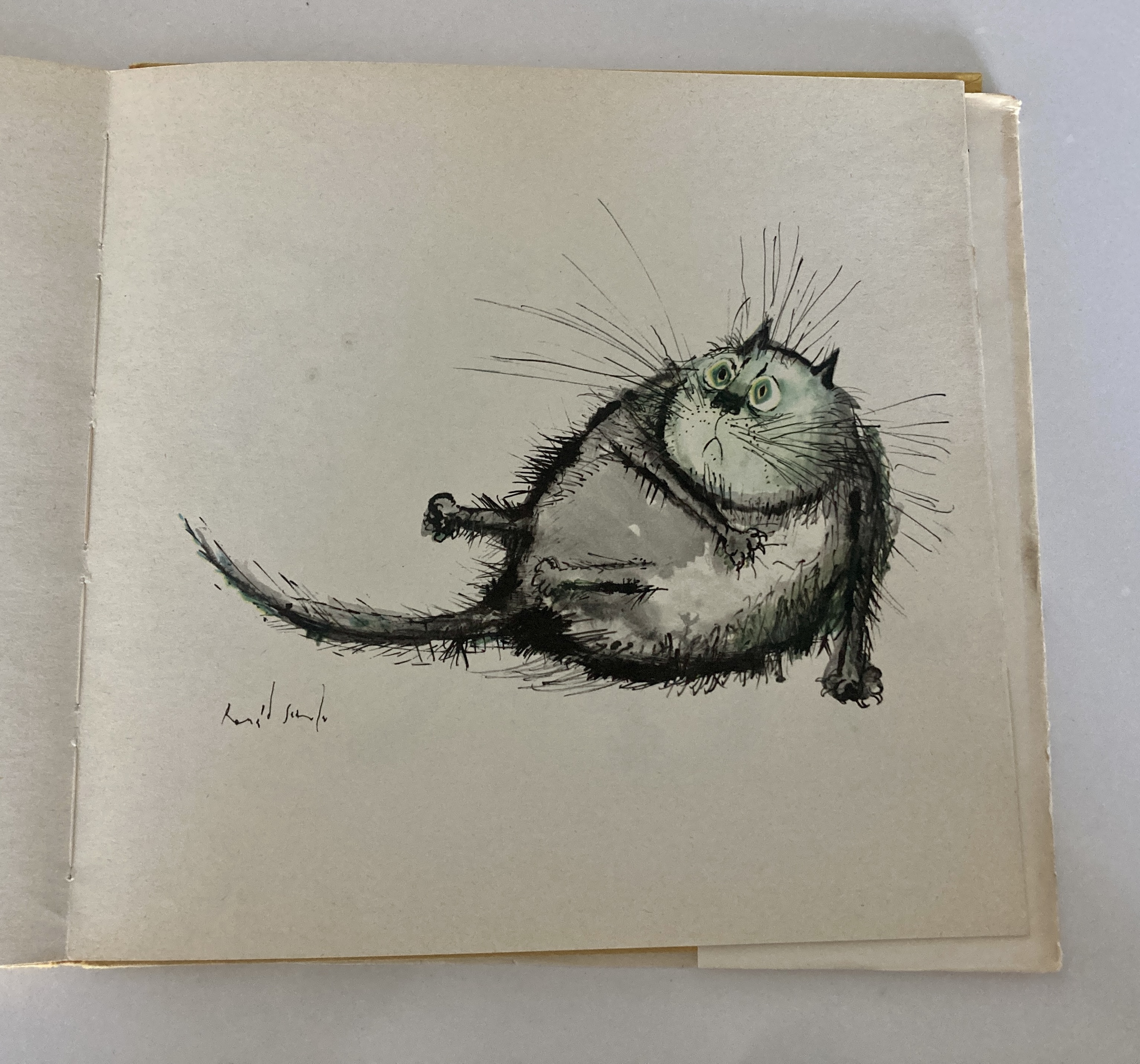
My mind flashes to a particular cartoon in Searle’s Cats (Ronald Searle, Dobson Books Ltd., 1967)…
and its caption: “Acrobatic cat discovering quite unexpectedly that it is too old for the game.”
I grin right back at him.
We are complicit, he and I — fellow adventurers in this demanding but rewarding late stage of life.
19 June 2025 – Forget the dragon. That is so 10 centuries ago! These days, St. George — or, anyway, our St. George — is all about urban/eco sustainability and livability.
I’m first bounced onto this theme by a graffito on a waste bin. One that I initially think disrespectful of the human origins of the slogan…
but then reconsider, as I look smack across the street.
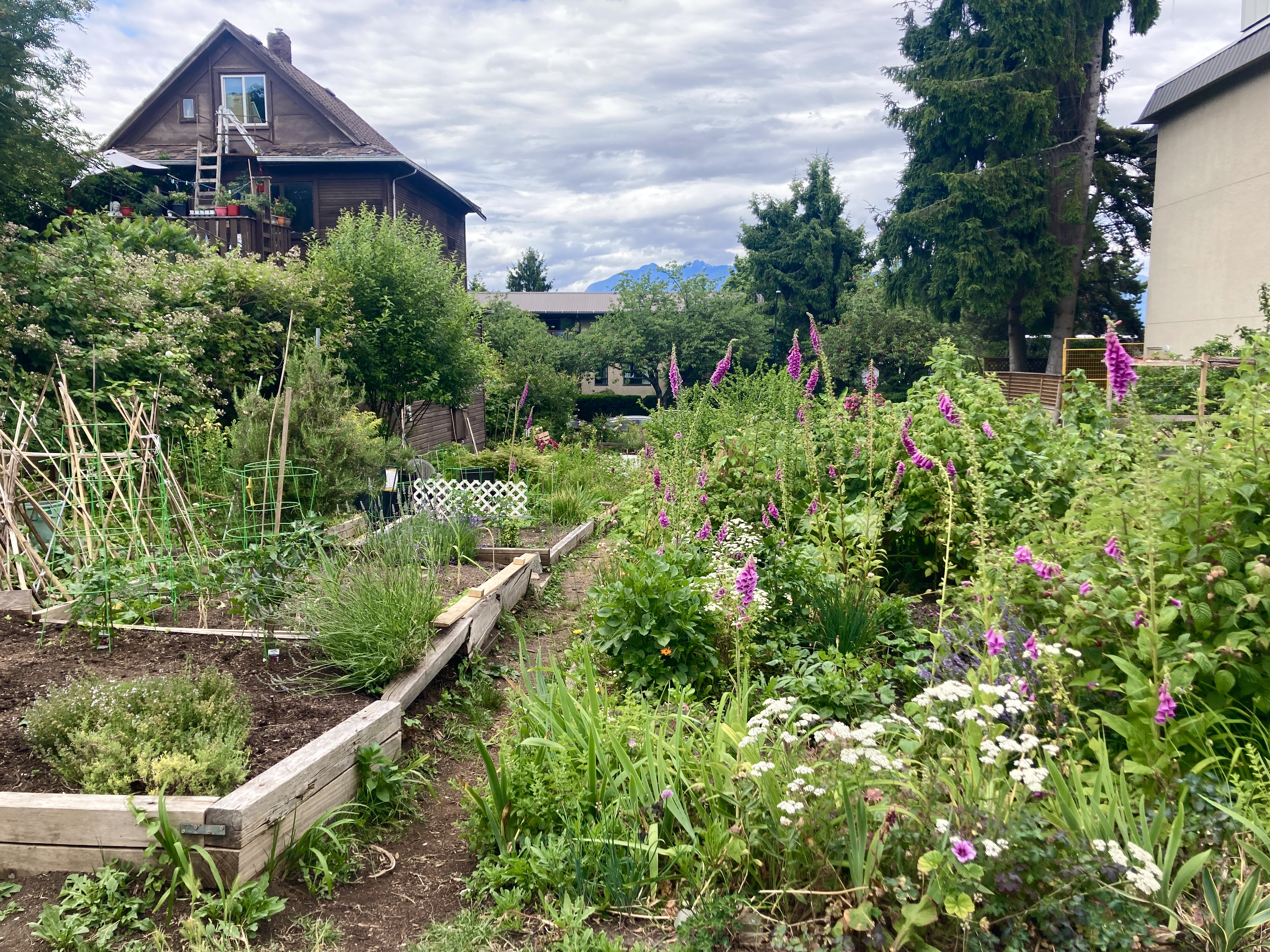
I’m on East 7th, heading farther east, and I’m staring into the busy abundance of this community garden stretching on north to East 6th. All lives matter, yes? We humans and plants are woven into the same eco-system.
This little local garden is very much of this neighbourhood, with its neighbourly values. A place with low-rise homes, many of them vintage wooden structures; a place where a kicked-off toddler’s shoe…
is carefully displayed at sidewalk’s edge by some later passer-by, in the hopes it may yet be retrieved.
I drop down to East 6th, look north as I cross Guelph, think how much I like this human scale — but have no illusions it will last much longer. Let your eye travel down the row of modest bright-painted houses…
to that equally bright-painted construction crane down below. That’s the future, and increasingly the present.
But!
St. George is at work.
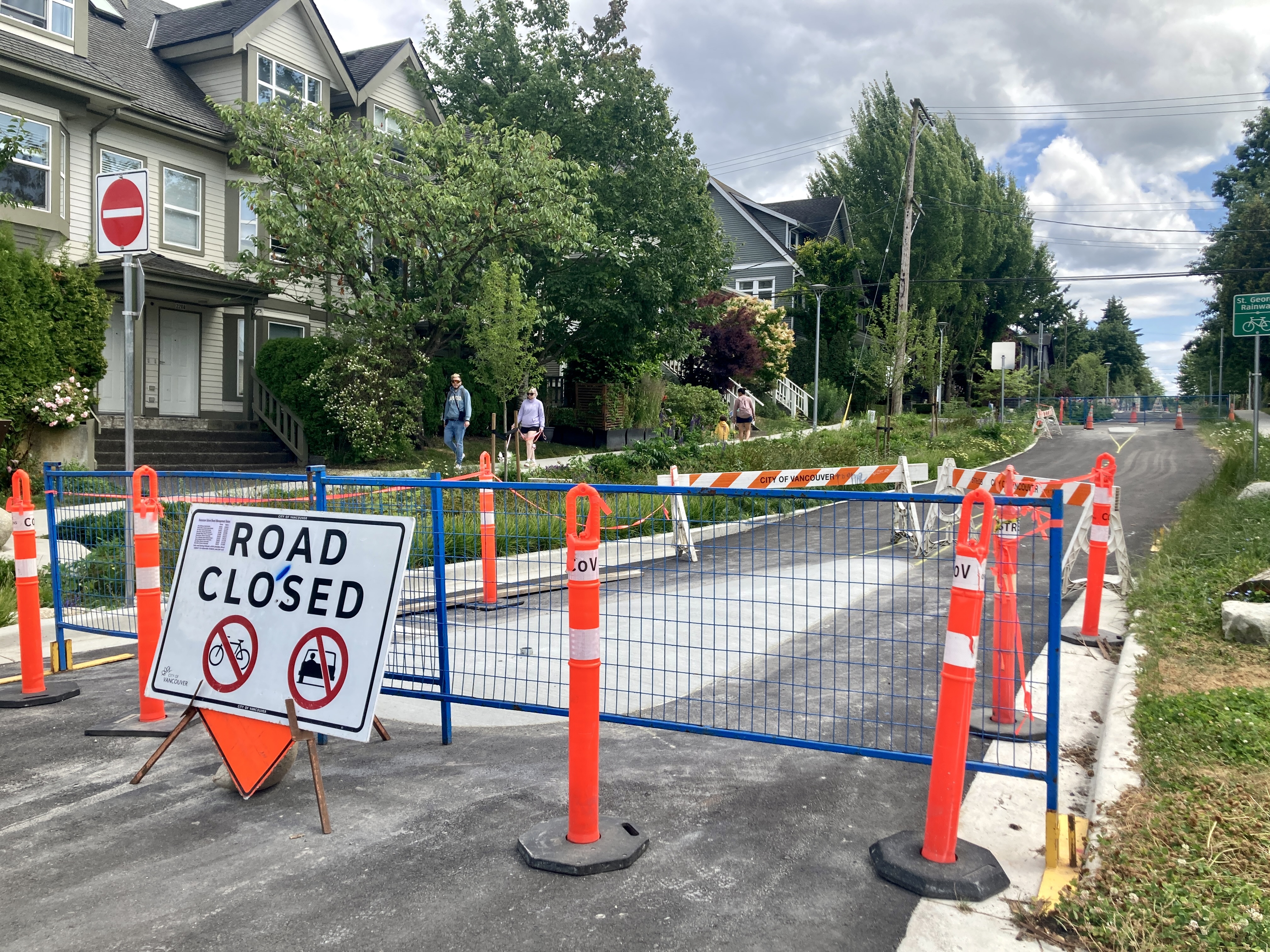
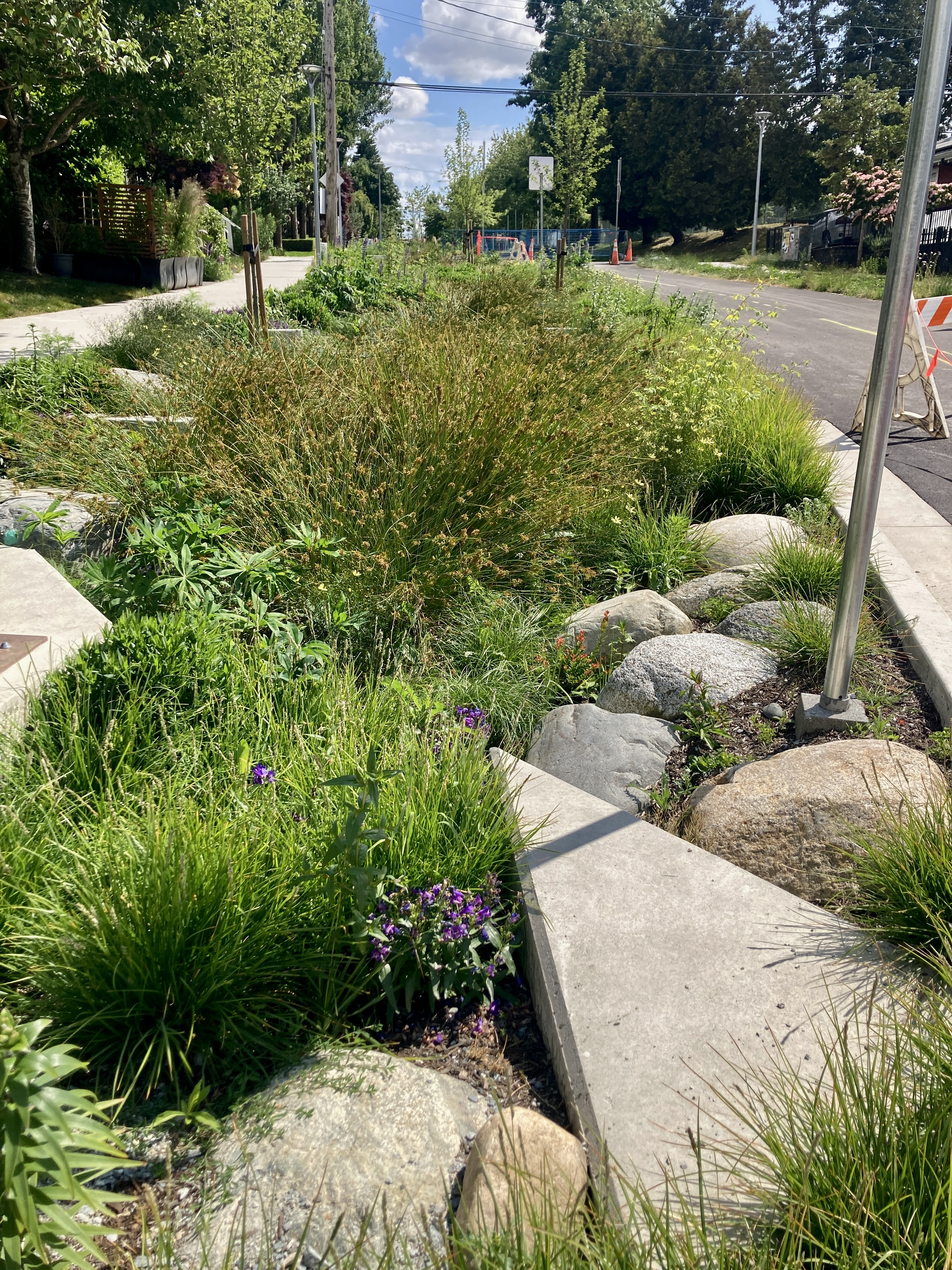
Well, the St. George Rainway. It’s been a long time coming, but now here it is, nearing completion — with its (and I quote} “green rainwater infrastructure features like rain gardens that incorporate plants, trees and soil to manage rainwater…”
I step up to the mini-plaza with its rock, its signage mounted on a plinth…
adorned with a Wood Sorrel cut-out…
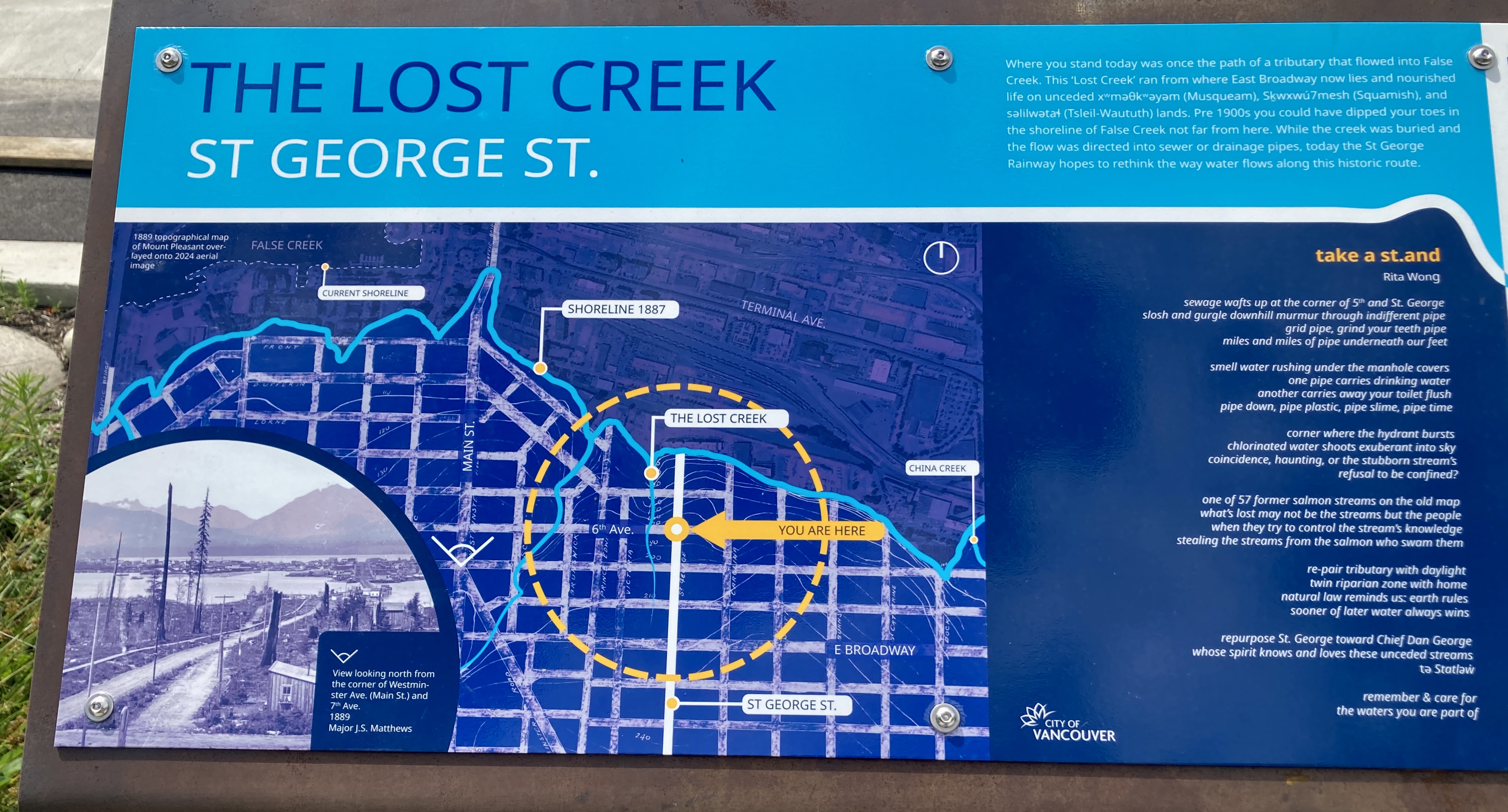
and lots of information.
Go ahead — spread the image, track its elements; I’ll wait.
Together, we learn that the Rainway along St. George celebrates a Lost Creek, a tributary to False Creek that has long since been buried underground. (For that matter, this final eastern end of False Creek, into which the lost creek ran, no longer exists either.)
While you’re exploring that handy map, please note not just the Lost Creek, left-above “You are here,” but also China Creek on the far right, and E. Broadway (East Broadway), three streets to the south.
I admire the rain garden that parallels the sidewalk immediately to the south …
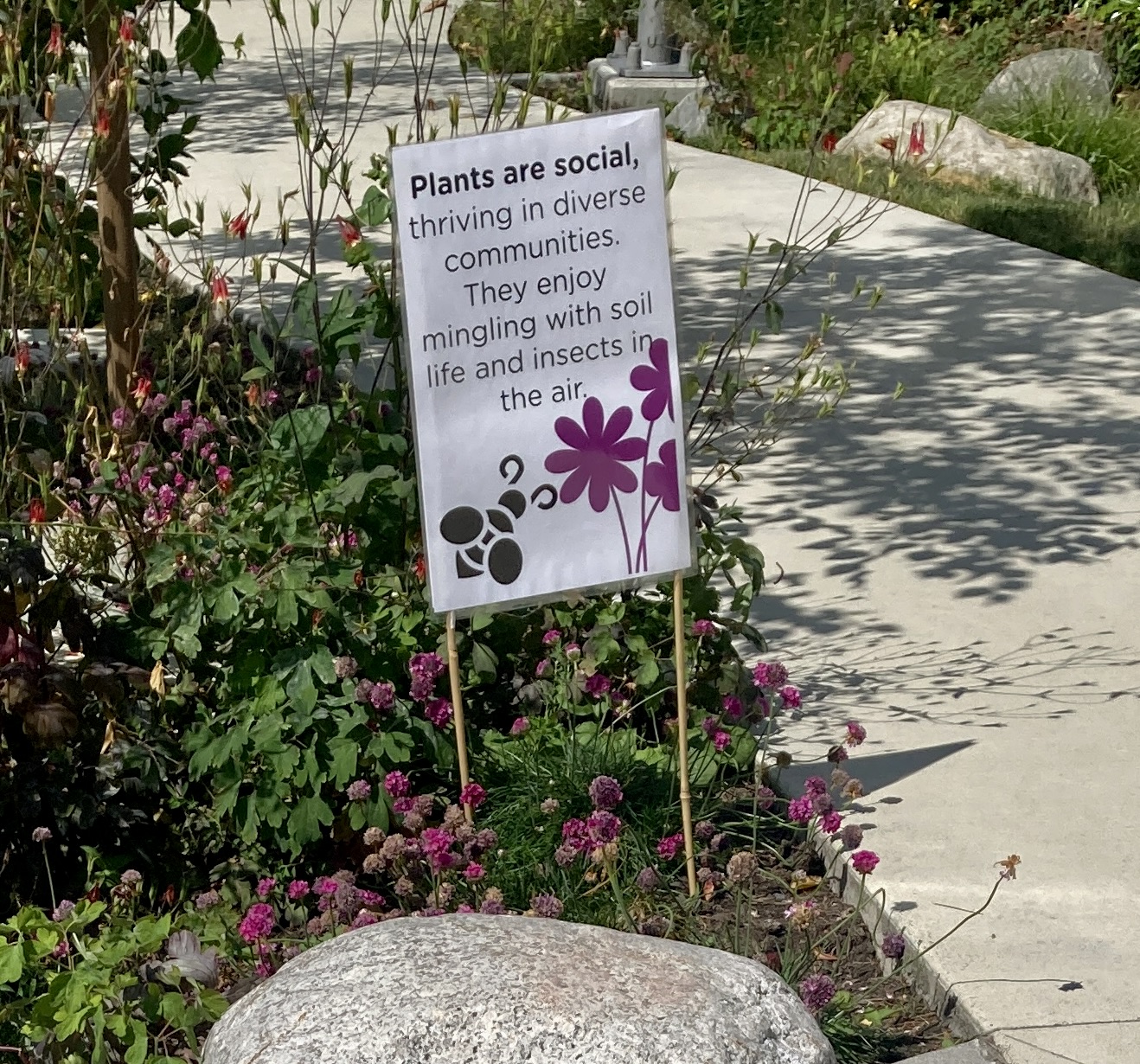
then cross East 6th to admire this sign in the rain garden running on north…
and feel more vindicated than ever in making my peace with the “Plant lives matter” graffito. “Thriving in diverse communities” sounds like the prescription for healthy life, period, whatever form of life we happen to be.
You’ll understand why, with that thought fresh in mind, I fall over laughing at the dumpster graffito I see immediately afterwards.
On I go, on to China Creek North Park. (See? That’s why I wanted you to locate it on the map.)
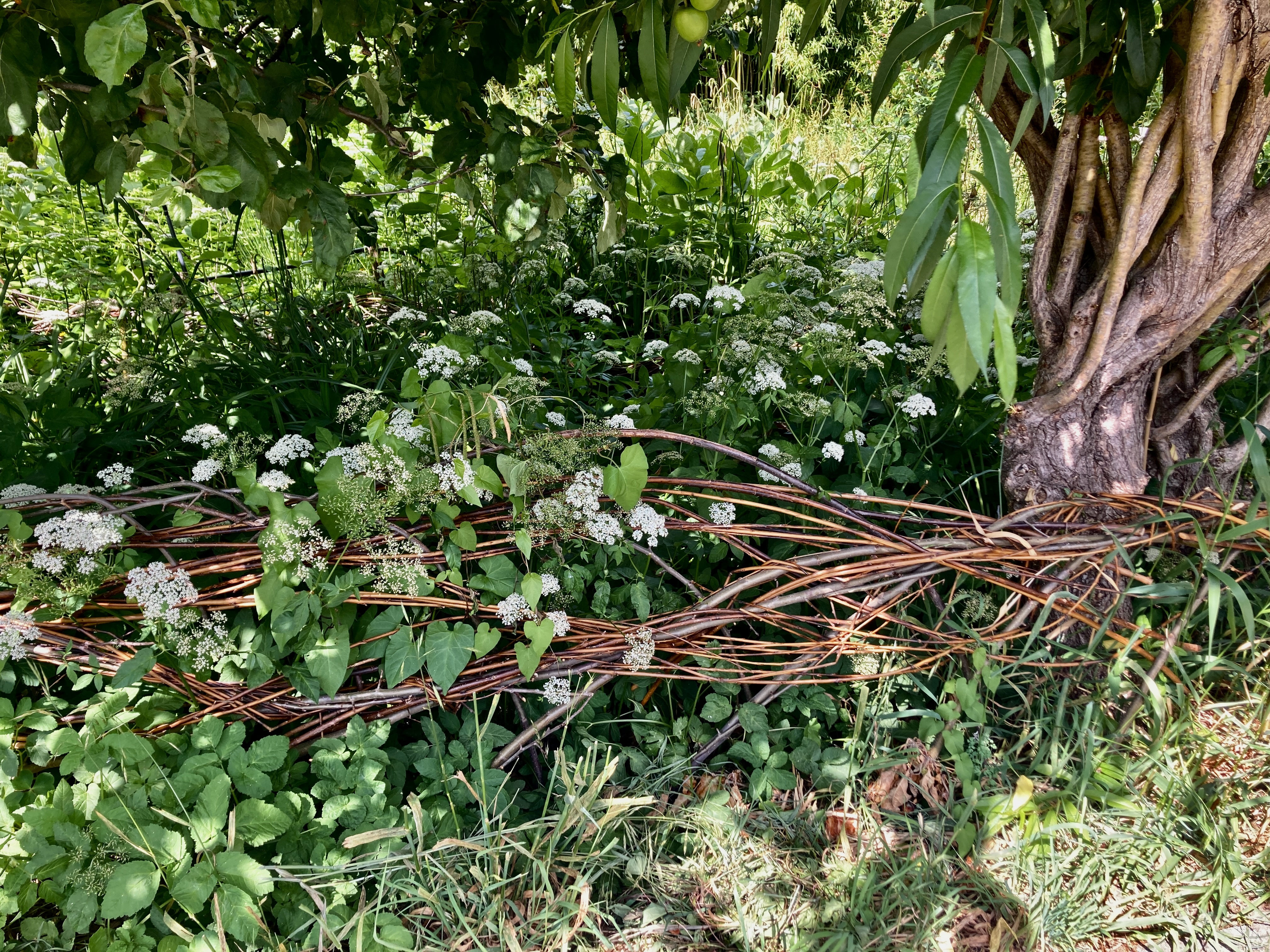
I am heartened, as I approach the edge of this large park, to see fresh new vine fencing woven into the woodlands periphery. (It had become very scruffy.)
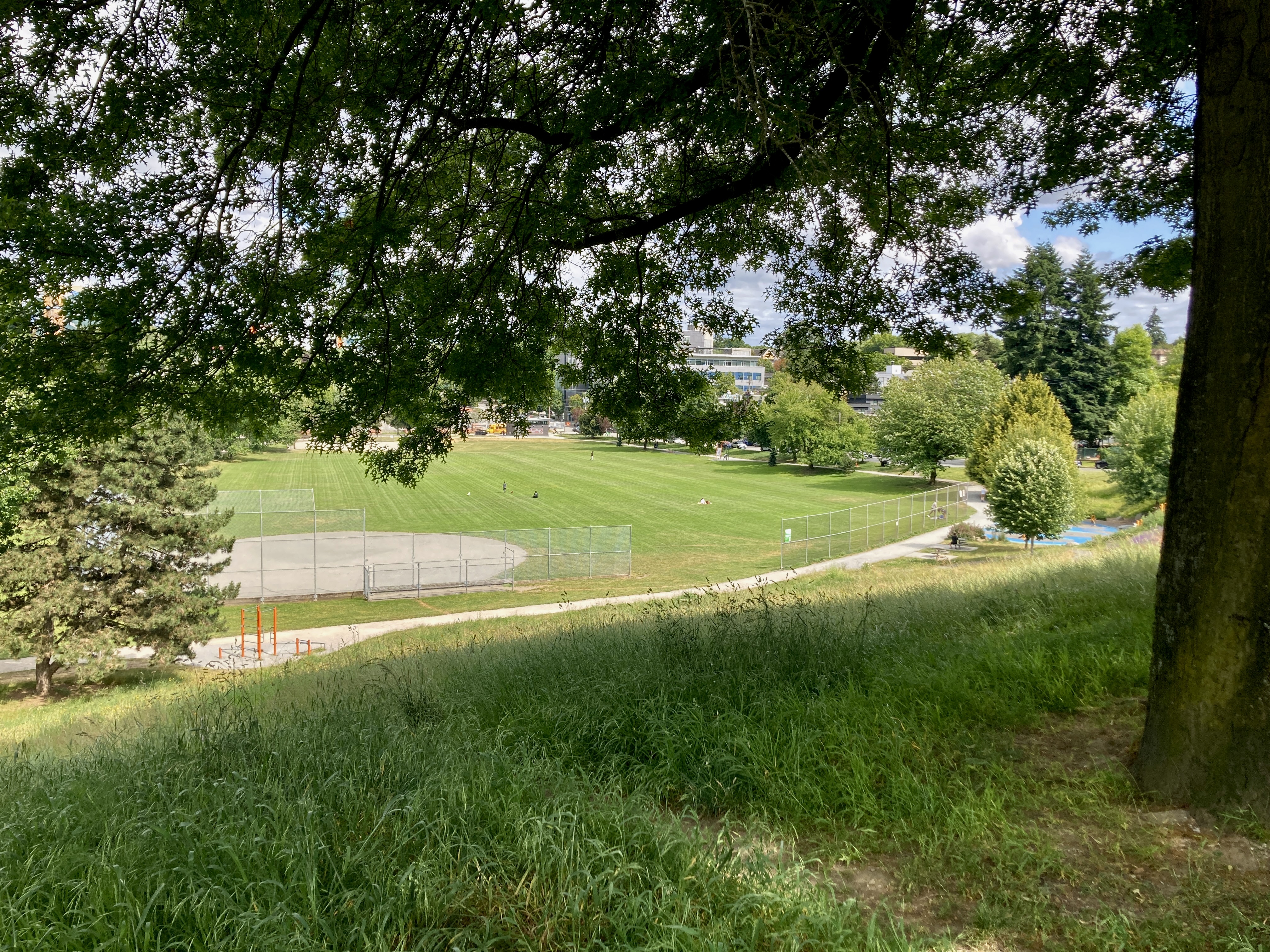
At first, looking down the slope, the basin of the park appears generic and banal. Old fashioned, even.
All that mown grass. And baseball diamonds.
But then, as always, I reconsider. The top of the slope is lined with benches, and they are well used, in diverse ways. At the moment, for example, the bench on the left hosts Headset Guy, who in fact is reading a real, physical book…
while the bench on the right hosts Music Man, who strums his acoustic guitar so softly it is almost subliminal. A woman just out of frame is hunkered down, motionless & meditative, and the woman you can see walking past the benches is about to start down the winding path that snakes its way to the playground at the lower level.
And I am about to join her.
This park is another “Lost Creek” — or, more precisely, a Lost Watershed. Before this last bit of False Creek was filled in, a whole network of creeks tumbled through here to feed its waters. Once filled in, the area at one point became a garbage dump, but was subsequently rescued and turned into parkland.
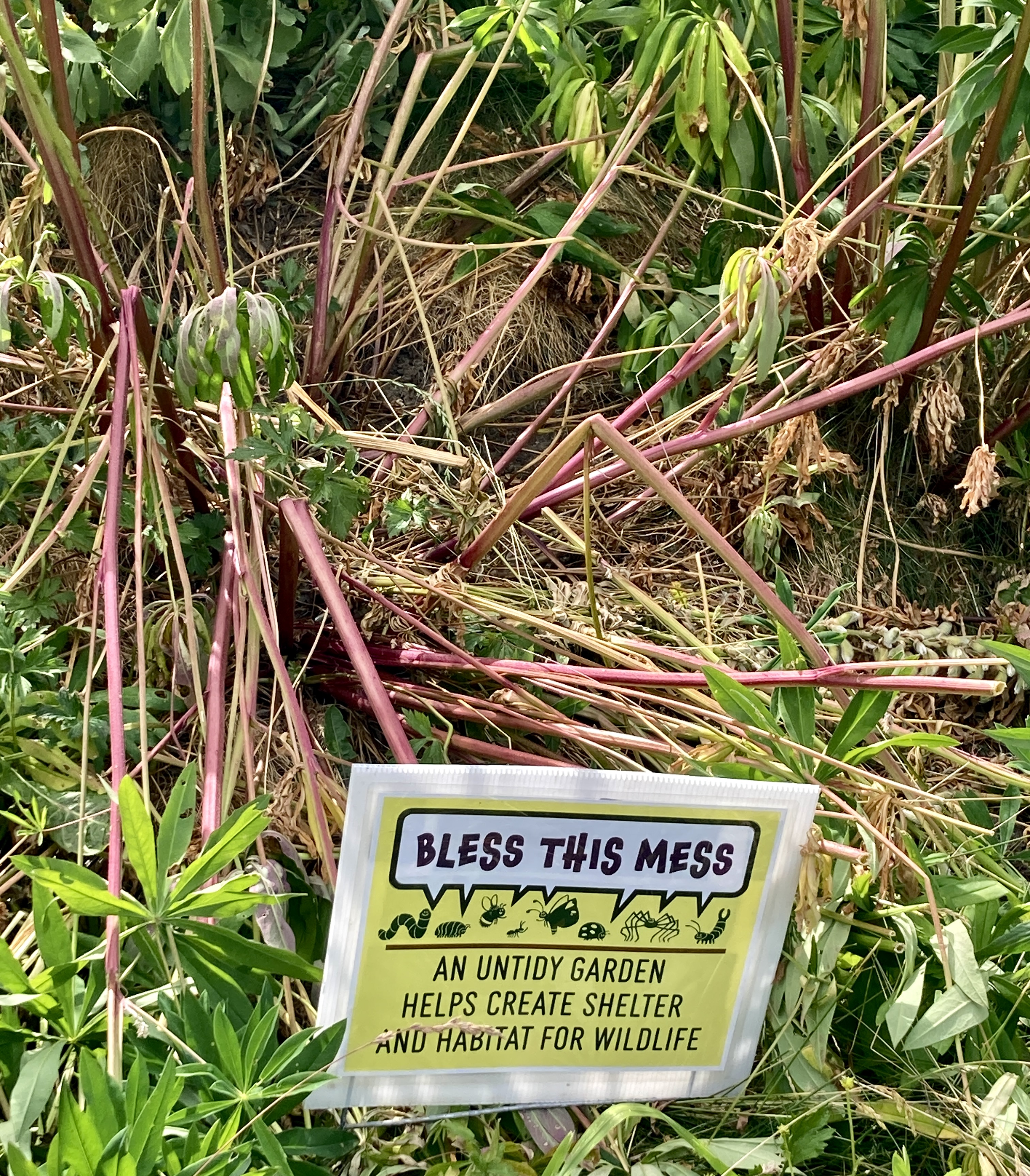
The slope is now naturalized, and it is wonderfully, exuberantly, messy.
With signage to justify the mess.
At the bottom of the path, I peer down the final bit of slope, the bit with a slide and (here) a mesh climbing ladder…
and, down there at the very bottom-bottom, swings and a pirate’s ship and other kiddy delights.
All this diversity! Social plants, social humans, thriving in diversity.
Walking homeward, more happy plant/human interaction…
in this volunteer-managed street corner garden, part of the City’s Green Streets Program.
And then… a reminder that not everything is happy-happy.
That some current trends are jarring and disruptive, and will damage both humans and nature.
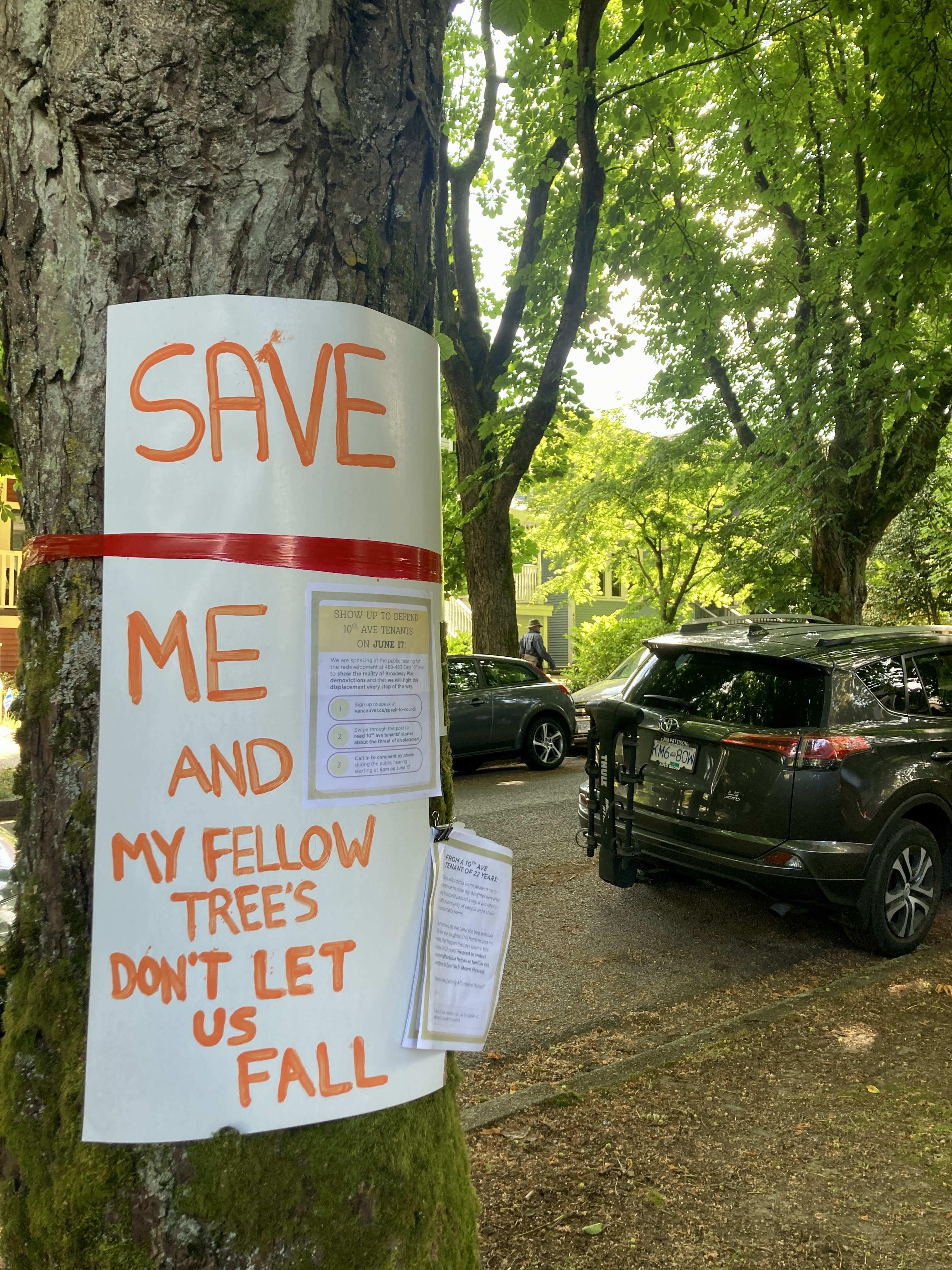
Taped to a tree on quiet, residential East 10th just west of St. George — with its fellow trees all around — a warning about the effects of the redevelopment now being pursued under the City’s Broadway Plan.
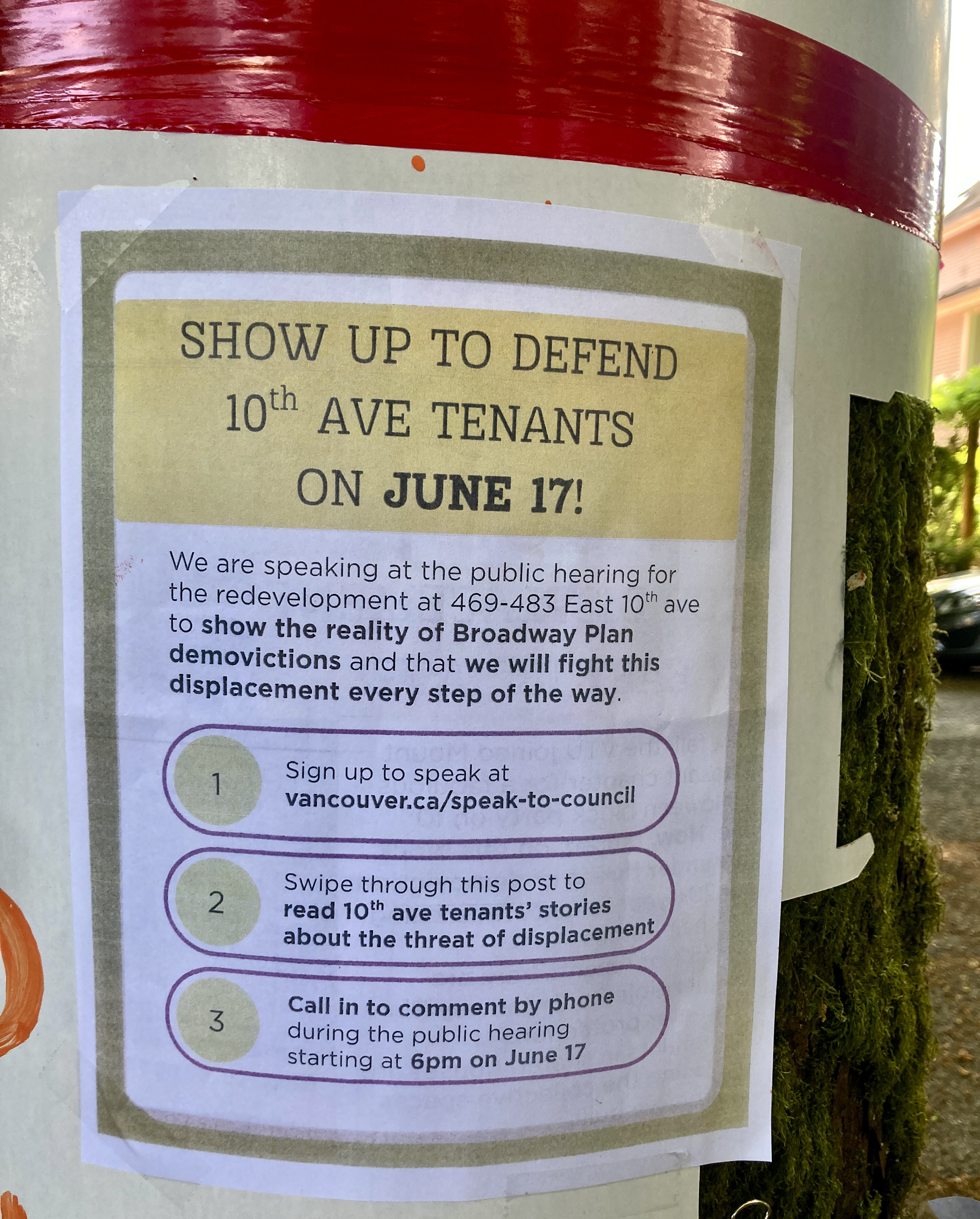
I may know more about the correct use of apostrophes (i.e., not to form noun plurals) than the author of this plea, but these tenants, in the adjoining notice…
teach me a new word. “Demoviction.” As in, the eviction of tenants from a building, so that it may be demolished, usually for redevelopment. A phenomenon integral to the Broadway Plan. And gaining pace.
I read a testimonial, also taped to the tree, the words of a woman who has been a tenant here for 22 years: “This affordable home allowed me to continue to raise my daughter here after my husband passed away. It provided a safe community and a stable, comfortable home.”
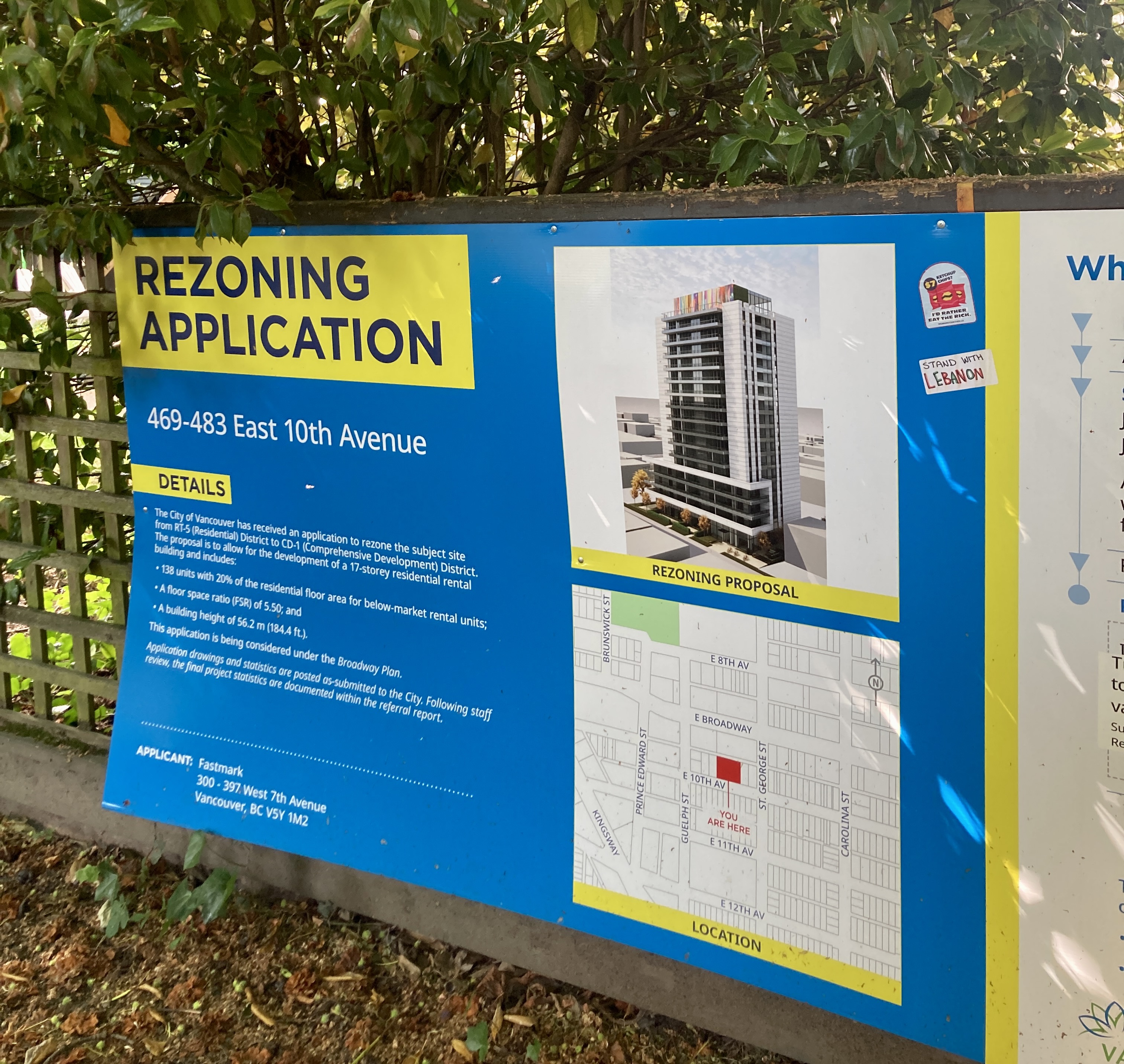
Right next door, the specific redevelopment being proposed: Rezone from Residential to Comprehensive Development category, and, on this street of two-storey homes, put up a 17-storey tower.
Hmm. Used to be, dragons breathed fire and wore scales. Now they may instead breathe rezoning, and clad themselves in 17 storeys.
21 April 2025 – Otherwise occupied Friday-Saturday-Sunday, so today is my last chance to vote in the four days of advance polls for our up-coming (28 April) Federal Election.
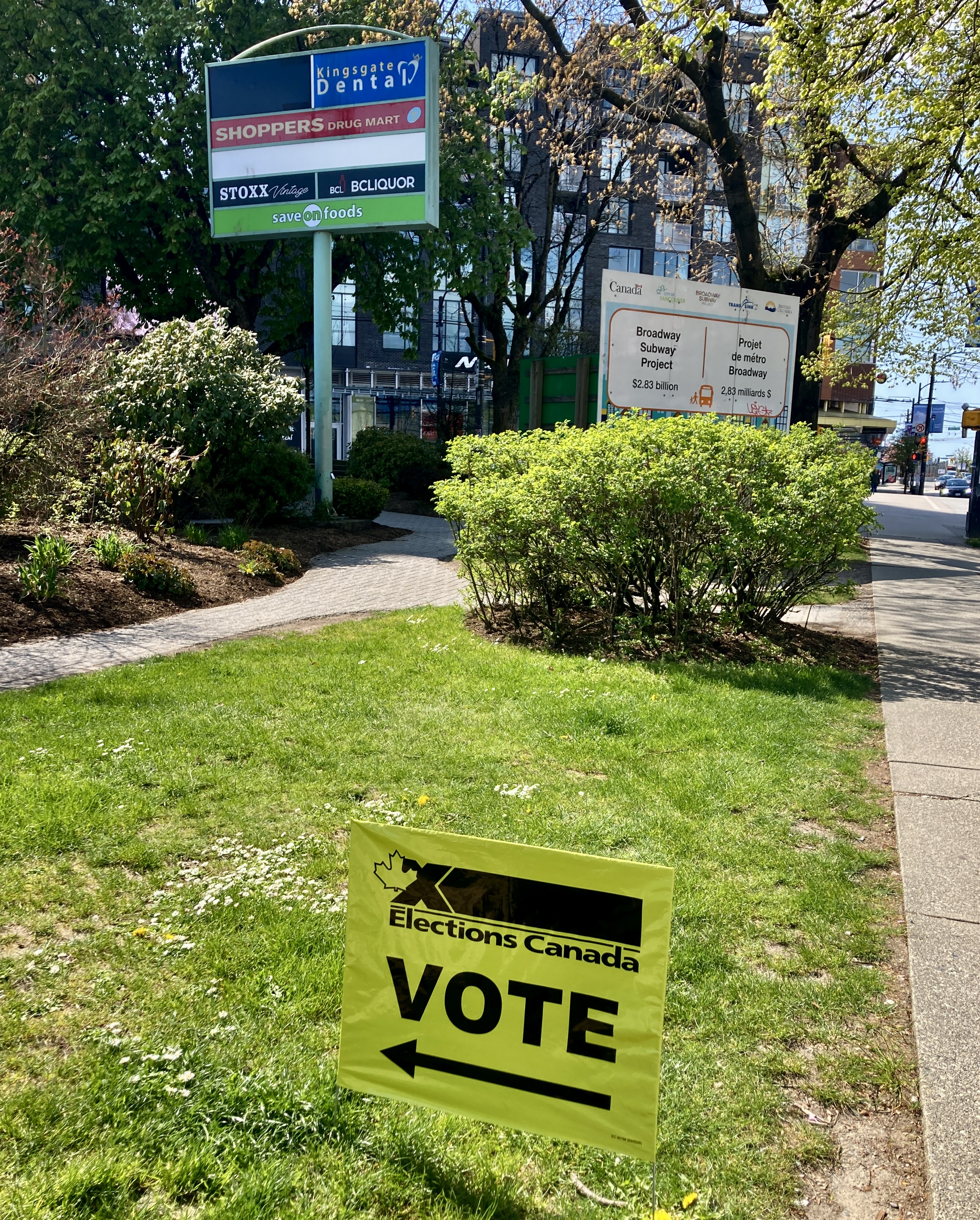
I walk the two blocks to my designated advance polling station, a local shopping mall.
I’m a good 15 minutes ahead of the 9 am opening, but I expect a line-up even so.
Friday set a new record for advance-poll turnout (2 million), and though numbers are not yet released for subsequent days, I’d heard enough anecdotal evidence to suggest participation has remained strong.
I enter the mall. Oh yes, there is a line-up.
This is just one bit of it, snaking its way past shops and café also in the process of opening up.
Later, as I walk away, my eyes suddenly sting with tears of gratitude for what I have just seen, felt, and done. This is the ritual of democracy. So precious, so fragile — and so easily taken for granted.
But not this time.
There we all were. Despite the wait; despite the fact that — with five parties running candidates in my riding — we had among us an invisible range of political views along with our visible range of demographics; despite all that, the mood was relaxed, friendly and excited.
That’s the word! Excited. There was a kind of happy excitement humming in the air. People were bright-eyed. I’m doing something that matters!
I remember the heavily tatttoo’ed young man (with an impressively patient toddler by the hand) who explained his attitude to the guy next to him: “Yeah, well, y’know? You got to vote. You don’t vote, you got no right to bitch.”
Later, as the day warms and brightens, I walk along the False Creek Seawall.
Where, once again, all those human demographics are present. And, once again, the mood is friendly.
23 March 2025 – Not that T-word! I mean the other T-word, the one that — thanks to the first T-word — currently preoccupies Canada, and much of the world.
Trade war.
I apologize yet again for a political post in a non-political blog. But here’s the reality: every blogger writes in the context of their own daily life. The daily life for Canadians now is that the most powerful country in the world plans to destroy us. Unlike Ukraine, we do not have bombs physically flattening our land; like Ukraine, we are the settled target of a powerful, authoritarian, expansionist regime that does not believe we have the right to exist.
In David/Goliath terms, Canada is David. This trade-war analysis — from BMO Nesbitt Burns (the investment firm wholly owned by Bank of Montreal) — uses the analogy, and gives David reasons to cheer up.
I received it by email from a friend; I’m reprinting it in its entirety. In the sea of lies currently swirling on this topic, here is a clear, credible, point-form primer on tariffs and the trade war.
Your bonus is the Hamilton Spectator cartoon at the end.
*****
This message is sent to you by BMO Nesbitt Burns Inc. BMO Nesbitt Burns is made up of Nesbitt Burns Inc., Nesbitt Burns Securities Ltd., and Estate Insurance Advisory Services Inc.
David vs. Goliath: The U.S. Trade War on Canada And Who’s Really Winning
For years, Canada and the U.S. had a sibling rivalry. Sure, we had our disputes, but at the end of the day, we worked together.
But now? It’s less “friendly competition” and more “Goliath throwing a tantrum because David won’t just roll over.”
The U.S. is picking fights, throwing tariff punches, and blaming literally everyone but itself for its problems. And Canada? We’re just standing here, taking the hits, shrugging, and quietly preparing to win the long game. Even while threats are made daily to our own sovereignty.
For anyone who forgot: David won.
Goliath’s Temper Tantrum: The U.S. Trade War on Canada
Here’s how it’s playing out:
🔴 The U.S. economy is in shambles. $36 trillion in debt, corporate greed at an all-time high, the middle class getting squeezed out of existence. 🔴 Rather than fix its own problems, the U.S. starts blaming its allies. Suddenly, Canada is a trade villain. 🔴 Tariffs get thrown around like confetti. First, it’s dairy. Then it’s aluminum. Then it’s oil. Next, it’s probably going to be maple syrup because why not? 🔴 Canada says, “Uh, we actually don’t need most of what you sell us.” We start buying local, strengthening our economy, and cancelling travel to the U.S. Oh but now the US is stopping Canadians from entering, requiring visas from Canadians and UNLAWFULLY detaining Canadian citizens. 🔴 The U.S. starts feeling the financial pain. American businesses that depend on Canadian consumers start screaming, but the government gaslights them into thinking it’s “for their own good.”
But What’s the Reality About Tariffs?
Let’s actually break it down since the people pushing this nonsense seem to have selective amnesia or a wilful lack of awareness of facts.
1️⃣ Trump Negotiated the “Best Trade Deal Ever” So Why The Complaints Now?
First off, the trade agreement we’re operating under isn’t some “ancient” bad deal screwing over the U.S. This is Trump’s own handiwork: the USMCA agreement that was negotiated under his administration.
🔴 Trump called it the “biggest, best trade deal ever” and said it would “fix” NAFTA. 🔴 His team designed it, signed it, and sold it as a win for America. 🔴 Now, suddenly, it’s a bad deal and needs to be scrapped?
So, what is it? Was Trump lying then, or are people lying now? Pick one.
2️⃣ Dairy Tariffs: A Non-Issue That Gets Brought Up Anyway Ah yes, the “big scary dairy tariffs” that people love to scream about.
Yes, Canada has dairy tariffs. But here’s what they never tell you:
✅ The U.S. was given a quota under USMCA. American dairy producers already have a guaranteed amount they can sell to Canada without tariffs. ✅ The U.S. never maxes out its quota. The tariffs have never even been applied because American producers don’t fill the agreed-upon volume. ✅ Canadians don’t want American dairy. It’s pumped full of growth hormones, and heavily subsidized, so the supply is artificially inflated.
So no, this isn’t some great injustice. The U.S. has access to the Canadian dairy market, it just doesn’t use it.
David’s Strength: What Canada Actually Brings to the Table
Despite all the noise, Canada isn’t just some small fry in this fight. We’re integral to America’s economy:
📌 Canada is the #1 foreign supplier of oil to the U.S. (And we sell it at a discount.) 📌 Aluminum? The U.S. military relies on Canadian resources to keep producing weapons. 📌 Raw materials? The U.S. imports a massive amount of lumber, minerals, and essential components from Canada.
Without these? The U.S. economy grinds to a halt.
Meanwhile, what do we import from the U.S.?
📌 Cheap processed foods. (We can live without them.) 📌 Unnecessary consumer goods. (We’ll buy local instead.) 📌 U.S. cars (which we’re forced to buy in trade agreements and we’d actually prefer other options.)
So let’s get real: if the trade war escalates, who suffers?
The “Self-Reliant America” Fantasy vs. Reality
I keep hearing people say, “America should be self-sufficient! We don’t need Canada!”
Okay. Let’s play that out.
🚨 The problem? U.S. oil refineries CAN’T handle domestic shale oil. They are built for heavier crude which is why they rely on Canadian oil sands crude to function properly. 🚨 Switching over to refine U.S. shale would take years and hundreds of billions of dollars. 🚨 In the meantime, energy prices would skyrocket, and the U.S. would need to import even more oil from the Middle East.
So yeah, America can become “self-sufficient,” but at what cost? Unless people are willing to pay double for gas, this argument is just empty rhetoric.
Oh, and let’s not forget:
💡 If you remove oil from Canada’s exports to the U.S., the U.S. actually has a trade surplus with Canada.
Meaning? The U.S. sells us way more “stuff” than we actually need.
And the rest of the world? They’re already rejecting “Made in the USA.”
📌 Buy European, Buy Local movements are exploding. 📌 China is reducing reliance on U.S. exports. 📌 Even American allies are diversifying trade to avoid getting caught in the crossfire of bad U.S. policy.
When your own allies start treating you like an unpredictable liability, it’s time to ask who the real problem is.
Then There’s The The “America Pays for Canada’s Defense” Nonsense
Oh, this one’s my favorite.
🚨 The only country Canada has EVER had to defend itself from… is the U.S.
📌 In 1813, the U.S. burned down York (now Toronto). 📌 In 1814, we retaliated and burned down the White House.
Canada hasn’t been at risk from invasion since. Meanwhile, we’ve been dragged into every U.S. war for over a century, not because we needed defense, but because the U.S. needed allies to prop up its war machine.
And let’s not forget:
📌 U.S. military contracts depend on Canadian resources. 📌 Canada buys overpriced U.S. defense tech to “balance” trade. 📌 The U.S. defense industry benefits from these arrangements far more than Canada ever has.
So spare me the “we protect Canada” routine. The only thing we’ve been protected from is making our own foreign policy decisions without U.S. interference.
Canada Owns a Chunk of U.S. Debt – You’re Welcome.
America’s excuse for slapping tariffs on allies is that it has to fix its debt problem.
🚨 Reality check: Canada is the 6th largest foreign holder of U.S. debt.
Yeah, you read that right.
While Americans are being told that Canada is some kind of economic enemy, Canada is literally one of the reasons America hasn’t defaulted on its loans yet.
So next time someone complains that “America is getting ripped off by Canada,” maybe ask why the U.S. keeps borrowing money from us.
The Solution: 10-Point Action Plan to Actually Fix This Instead of pointing fingers, here’s what would actually work:
1️⃣ Stop the blame game. Blaming Canada, China, Mexico, or the EU doesn’t fix the U.S. economy. Accountability does.
2️⃣ Break up corporate monopolies. The real reason Americans are struggling? Billion-dollar companies run everything, control pricing, and pay workers nothing. Break them up.
3️⃣ Tax ultra-wealthy billionaires properly & stop corporate welfare. America is not broke. It’s just that the ultra-rich don’t pay their fair share and corporations are given bundles of cash like they are non-profits. Fix that, and the money is there.
4️⃣ Invest in infrastructure and energy independence – the right way. Want to stop relying on Canadian oil? Great. But it’ll take years and hundreds of billions of dollars to switch refinery capacity. Until then, be realistic.
5️⃣ Strengthen local manufacturing. Instead of tariffing allies, invest in domestic factories and fair labor to bring jobs home without price-gouging consumers.
6️⃣ Stop artificially inflating bad industries. The U.S. subsidizes failing industries (like dairy) while ignoring tech, green energy, and innovation. Prioritize the future, not the past.
7️⃣ Invest in education and skills training. A strong workforce doesn’t come from blaming immigrants or trade deals. It comes from giving people the skills they need to compete globally.
8️⃣ Get real about debt. Instead of trying to tariff its way out of debt, the U.S. should cut wasteful spending (military excess, corporate handouts) and increase revenue where it actually makes sense. Cutting out National Park funding when it’s PROFITABLE makes no sense.
9️⃣ Respect allies instead of pushing them away. If the U.S. keeps picking fights with allies, don’t be shocked when we take our business elsewhere.
🔟 Make America a place people want to support. People aren’t boycotting America because they hate it. They’re doing it because the U.S. is making it impossible to be an ally.
The Bottom Line? David Always Wins.
Goliath lost the fight not because he was weak but because he underestimated the strength of his opponent.
Right now, the U.S. is flailing. It’s punching allies, throwing tantrums, and refusing to deal with its own mess.
Meanwhile, Canada is adapting.
🔹 We’re building up local businesses. 🔹 We’re cutting our reliance on U.S. imports. 🔹 We’re doubling down on relationships with Europe and Asia.
And when the dust settles, guess who’s going to come out stronger?
It’s not the guy swinging wildly and blaming everyone else.
It’s the one who stayed focused, made smart moves, and kept their eye on the real prize.
"Traveller, there is no path. Paths are made by walking" -- Antonio Machado (1875-1939)
"The voyage of discovery is not in seeking new landscapes, but in having new eyes" -- Marcel Proust (1871-1922)
"A city is a language, a repository of possibilities, and walking is the act of speaking that language, of selecting from those possibilities" -- Rebecca Solnit, "Wanderlust: A History of Walking"


























 WALKING WOMAN