6 March 2025 – I never meant a political blog, still would rather not. But when some other country plans to take you over, it kind of gets your attention.
It got Jeff Douglas’s attention, for example — the star of the Molson’s beer-ad rant “We are Canadian” created 25 years ago and still cherished in some aging memories.
Yeah well, Jeff is back, because Jeff, like the rest of us, is annoyed.
1 March 2025 – Clutter? “Juxtapositions” is more accurate, also better PR, but I suspect there’s some kind of rule against using five-syllable words in a title.
So Urban Clutter it is. There’s a lot to be said for it, by whichever name — so many possibilities, all piled atop each other! The pile-up tells stories, and it both sparks and rewards curiosity.
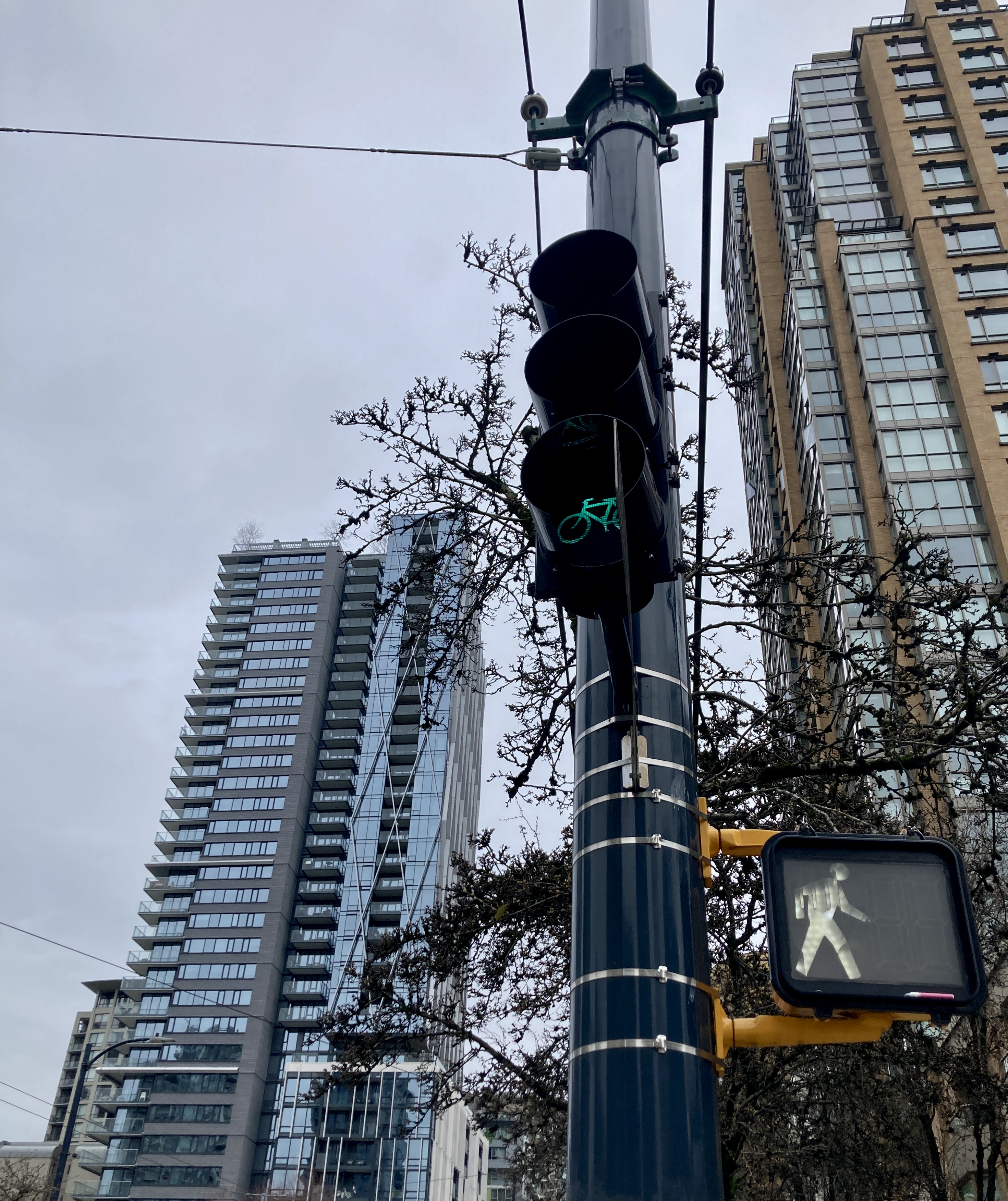
At least, that’s the effect on me, as I stand at Davie & Richards, en route an Urban Treat — a noon-time performance at the Scotiabank Dance Centre. While my feet wait for the light to change, my eyes say, “Look at that!”
So I do.
It’s nothing special, it’s just… it’s just very urban. Tram lines overhead; traffic signals to one side; and, framed by both, the residential towers that lie behind Emery Barnes Park and before Helmcken Street.
The Shiamak dance performance is wonderful. Afterwards I adapt their “Have Feet Will Dance” slogan to my own “Have Feet Will Walk,” and start north on Seymour. (North-ish, downtown streets are on a slant, but I’ll spare you the precisions.) The day is balmy, I’m happy, and I decide to walk right to West Pender, where I’ll catch a bus back home.
But then I get distracted, and my simple plan goes all fractal. Blame it on urban clutter.
Before I even reach Nelson, I’m laughing at this literal sign of our politico-cultural times.
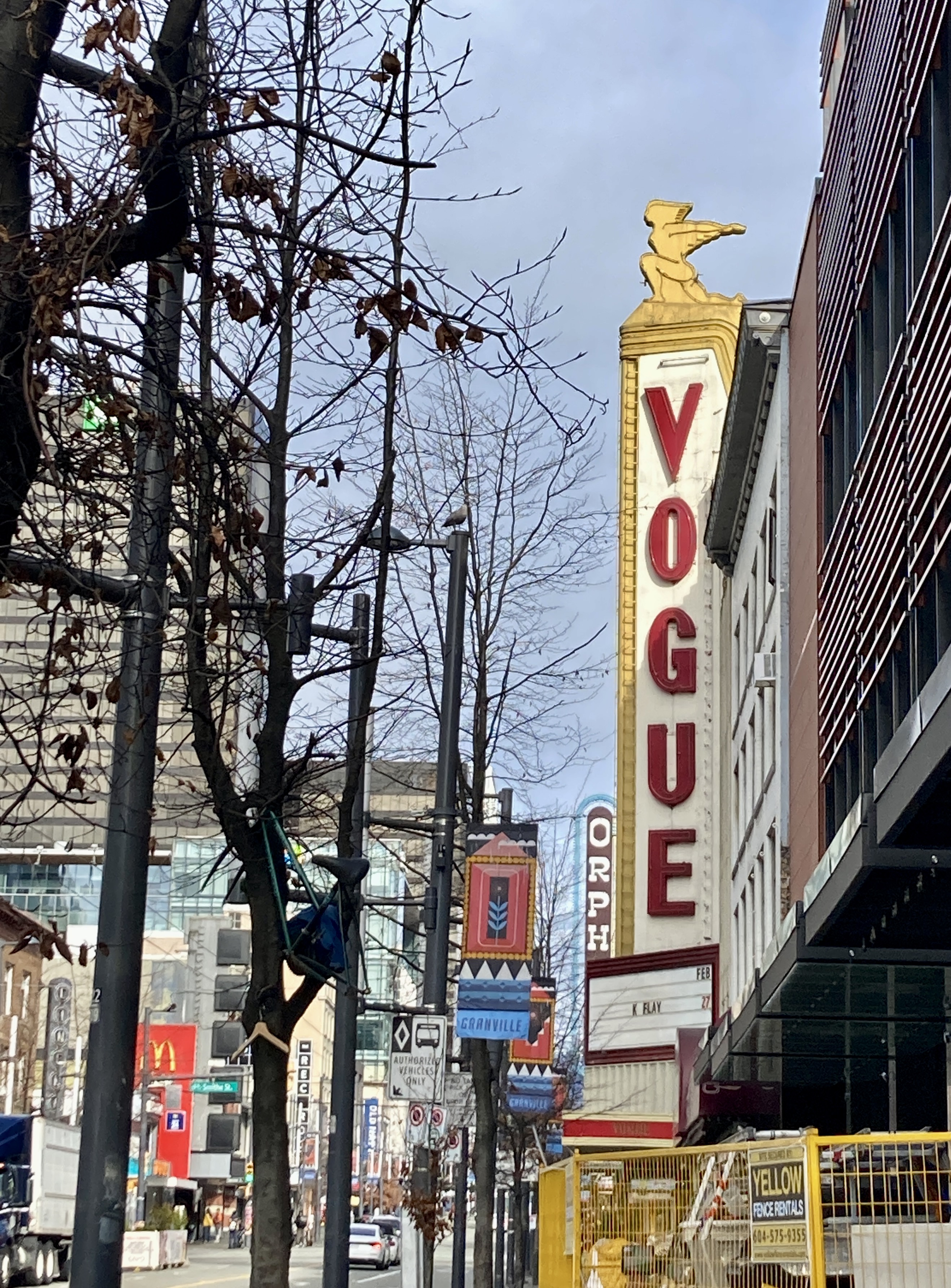
Left on Nelson, right on Granville, and I’m up against the busy construction work beneath one of the street’s stubborn theatrical survivors: the Vogue. It’s a 1941 movie theatre (now event venue), built in Art Deco/Art Moderne style. As you can see.
I veer onto Smithe just past the Vogue Theatre. No particular reason for the change of direction — but suddenly here I am, just before Seymour, at the entrance to Ackery’s Alley.
The alley backs the Orpheum Theatre on Seymour, and celebrates the venue’s long (and continuing) history of live performances. It was painted and generally spiffed up in 2018, the idea being to welcome pedestrian as well as the existing delivery-truck traffic. I had recently arrived in town, walked it then, and yes, it sparkled.
It hasn’t had much maintenance since, and it’s a lot grubbier.
But it’s still in pedestrian use and, with its strong lines and commercial functionality, it is very Downtown Right Now.
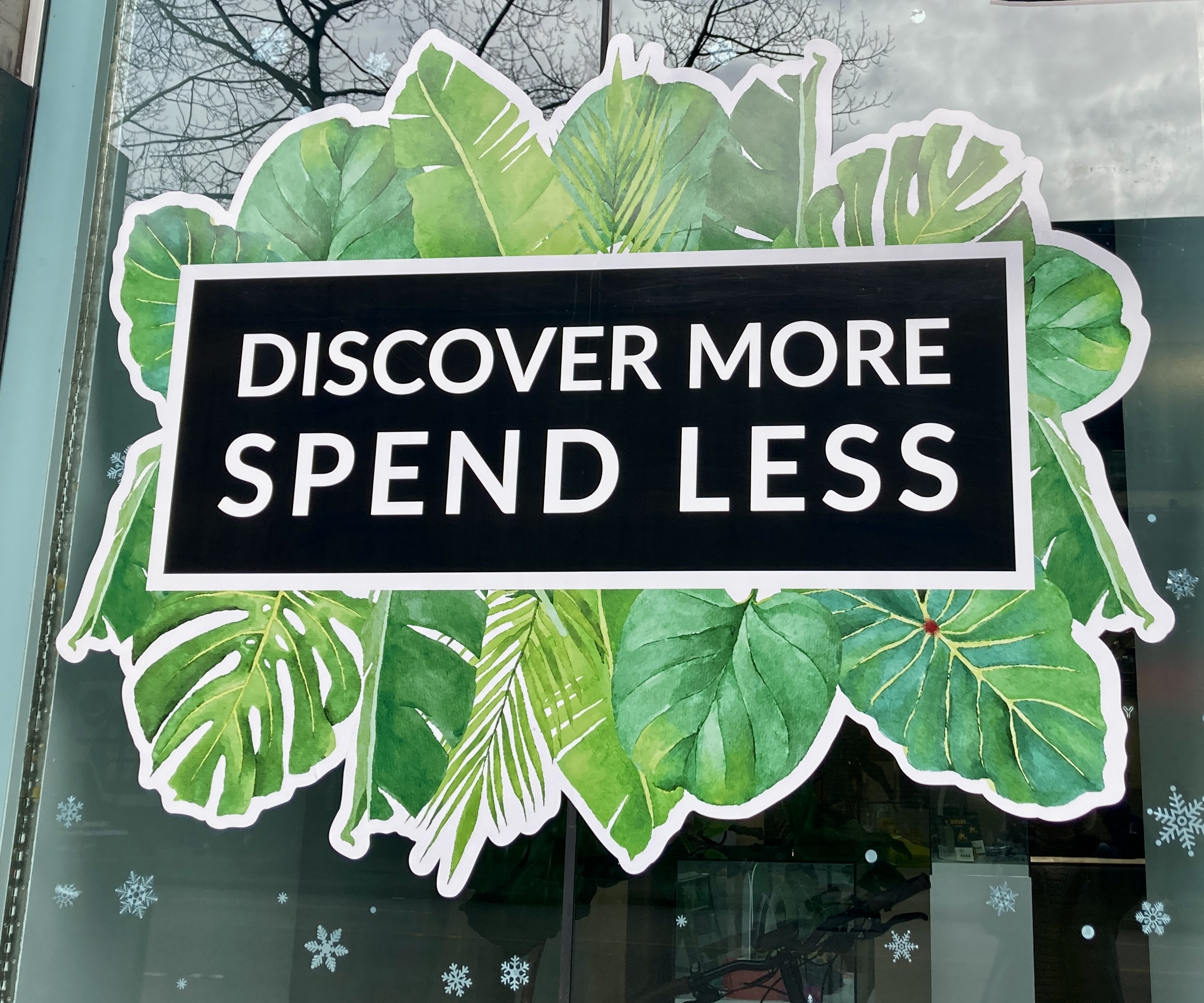
Out the other end at Robson, where a window sign apparently invites me to dial down my consumerism.
Well… not exactly. This is the window of a cannabis shop, which prides itself on bargain prices. So: keep spending money, just spend it with us! (And discover the wonders of our products.)
Since I still plan a quick ride home, I take to Granville again, heading for the bus stop at West Pender. But then, when I reach Pender, I look farther down Granville and I am again distracted — beguiled! lured! tickled! — by urban clutter.
It’s the dome. I start wondering about the dome.
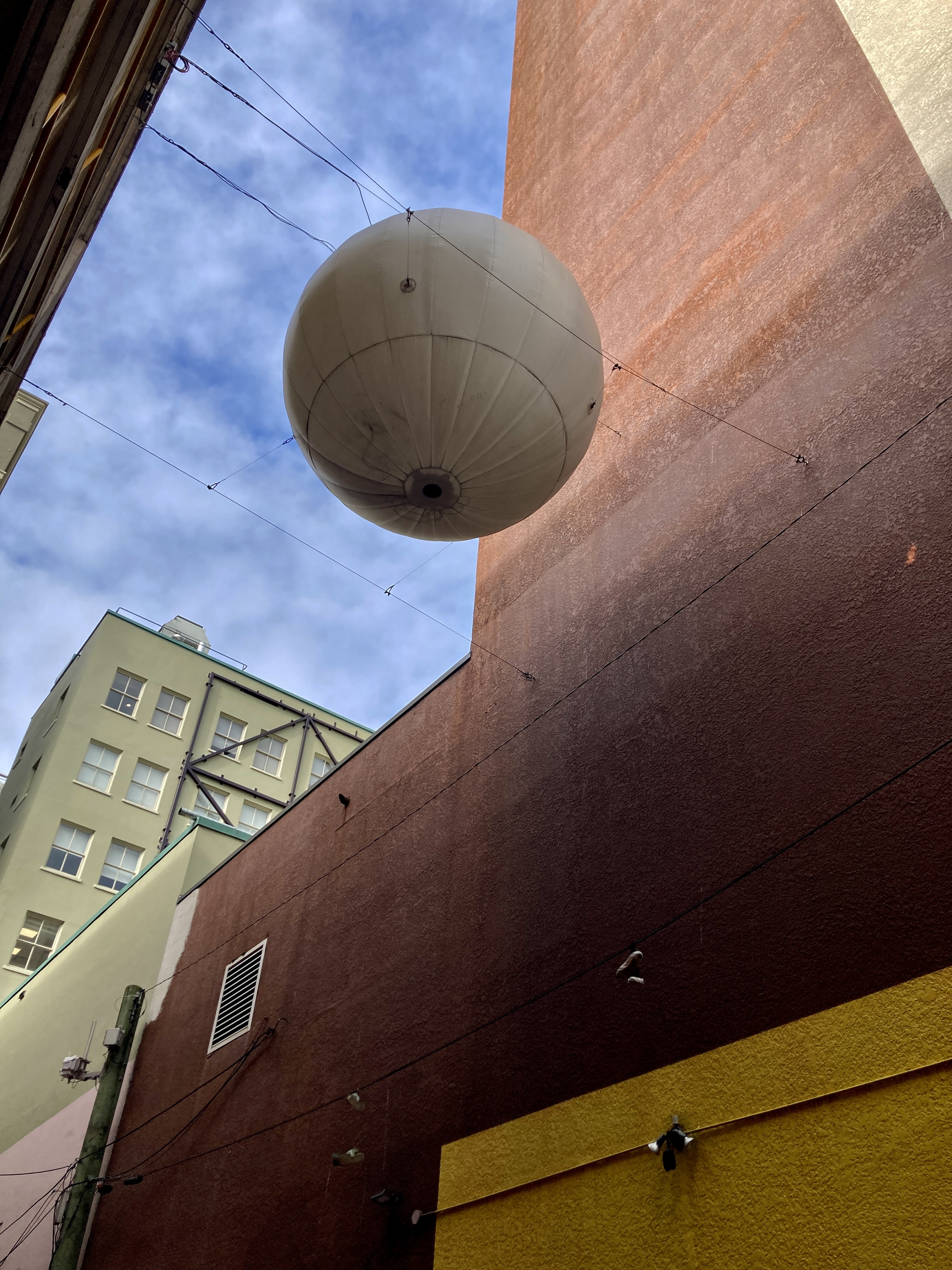
I could always walk one more block and check it out — but what fun is that? Especially when, just before I reach that next corner, I can instead dive into Alley Oop, the first of the downtown alleys to be spiffed up, back in 2016.
Also grubby by now, but it does have that hanging sphere at the far end.
Which rewards my head-tilt very nicely. Geometry at work.
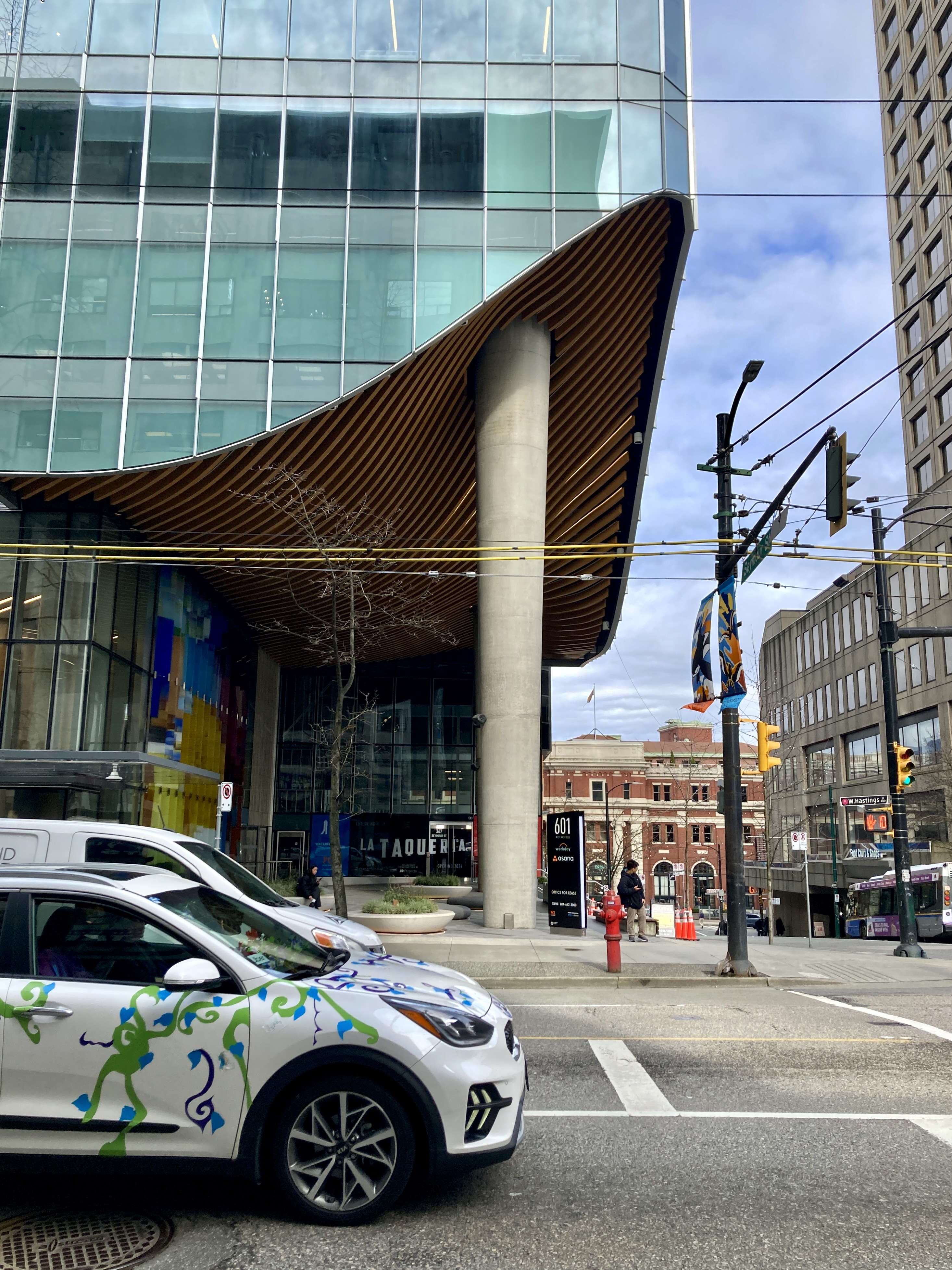
This brings me to Seymour and West Hastings, with Waterfront Station in the distance and this building opposite, whose upturned lip always makes me think of whale baleen. (That frog-splattered white car, even closer, is a gift from the Traffic Light Gods.)
By now I’m well off-track for the mystery dome. I correct course and walk west on Hastings. This time the urban clutter offers me a distant view of the Marine Building at Burrard, framed against glass towers, and a close-up of elaborate lanterns and trim on another heritage building right next to me.
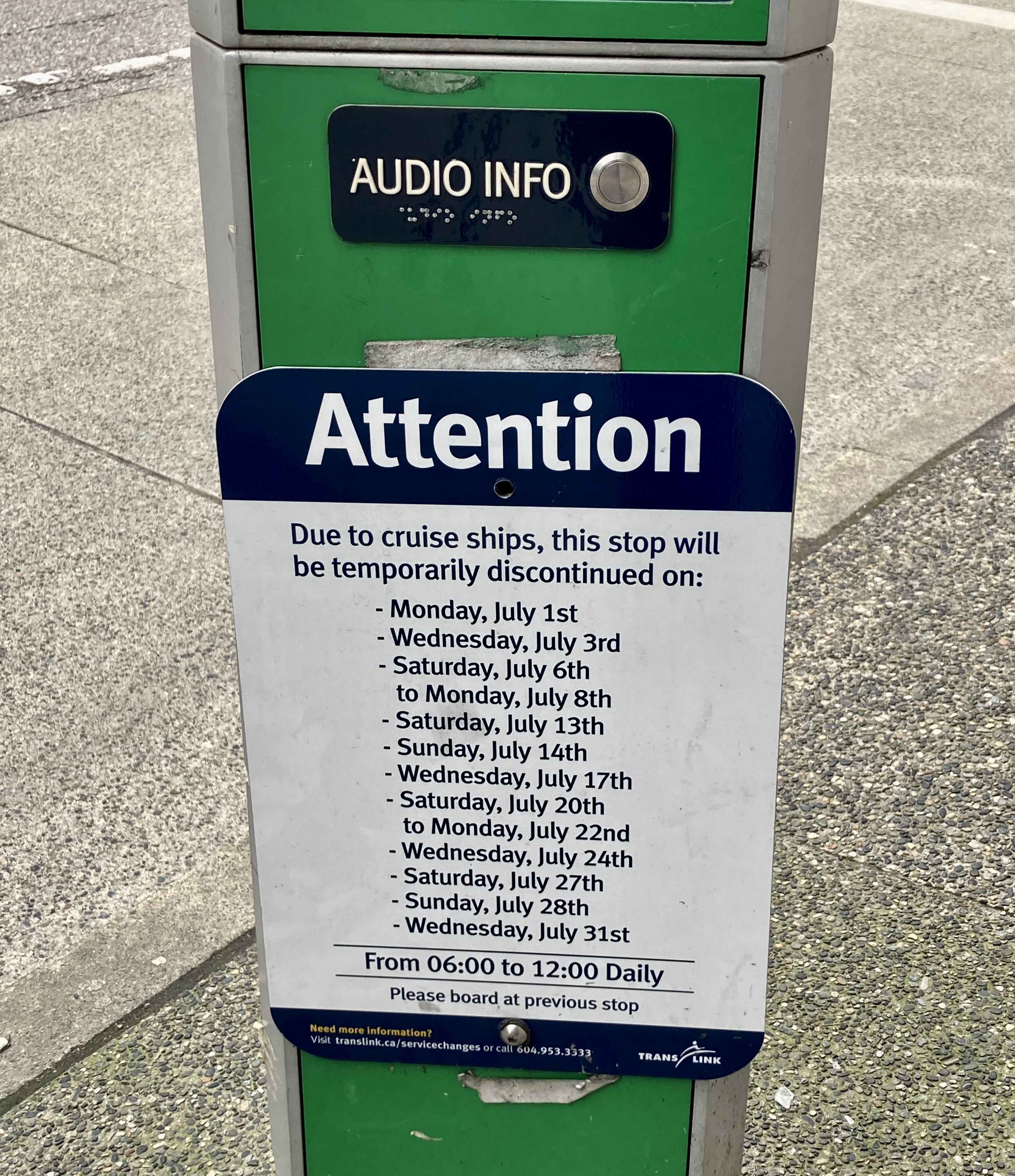
The bus stop at Granville is a reminder that the cruise ship terminal is nearby and, in season, its passenger loads wreak havoc with local traffic.
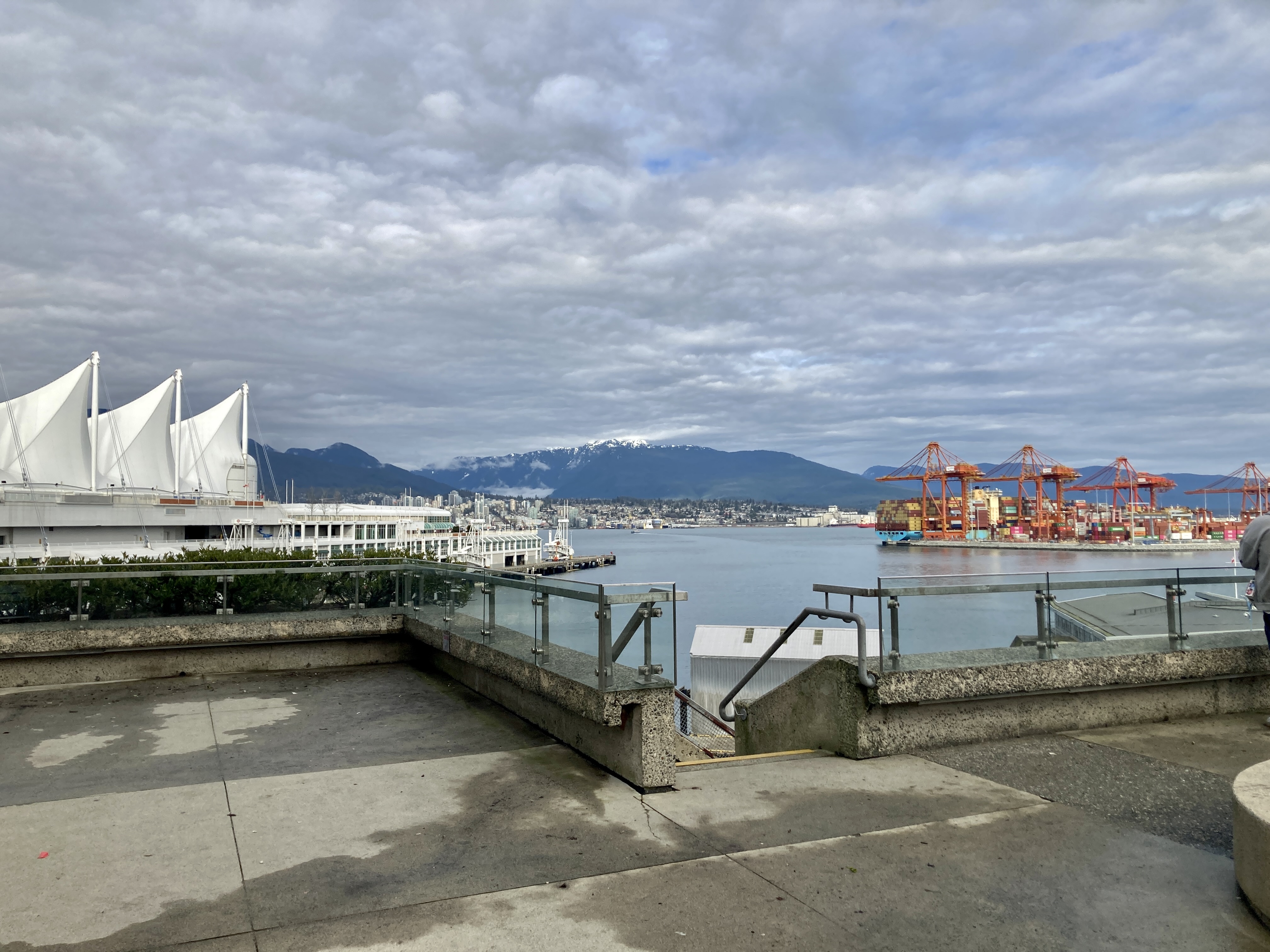
Perversely enough, I now head away from the mystery dome. Instead, I follow the raised Granville sidewalk all the way north to the lookout at Burrard Inlet.
Small but satisfying, this little plaza lies between the East Convention Centre (with its “sails”) and the cruise ship terminal on one side, and, on the other…
harbour cranes, Waterfront Station, the SeaBus terminal, train tracks and a helicopter landing pad.
About face!
Back up the raised sidewalk I go, now aware that this entire four-building foot print — including the mystery dome — comprises the Sinclair Centre. I knew this, I really did. It just took a while to reconcile my memories of this once-busy office/service/retail complex, with the boarded-up reality of right now.
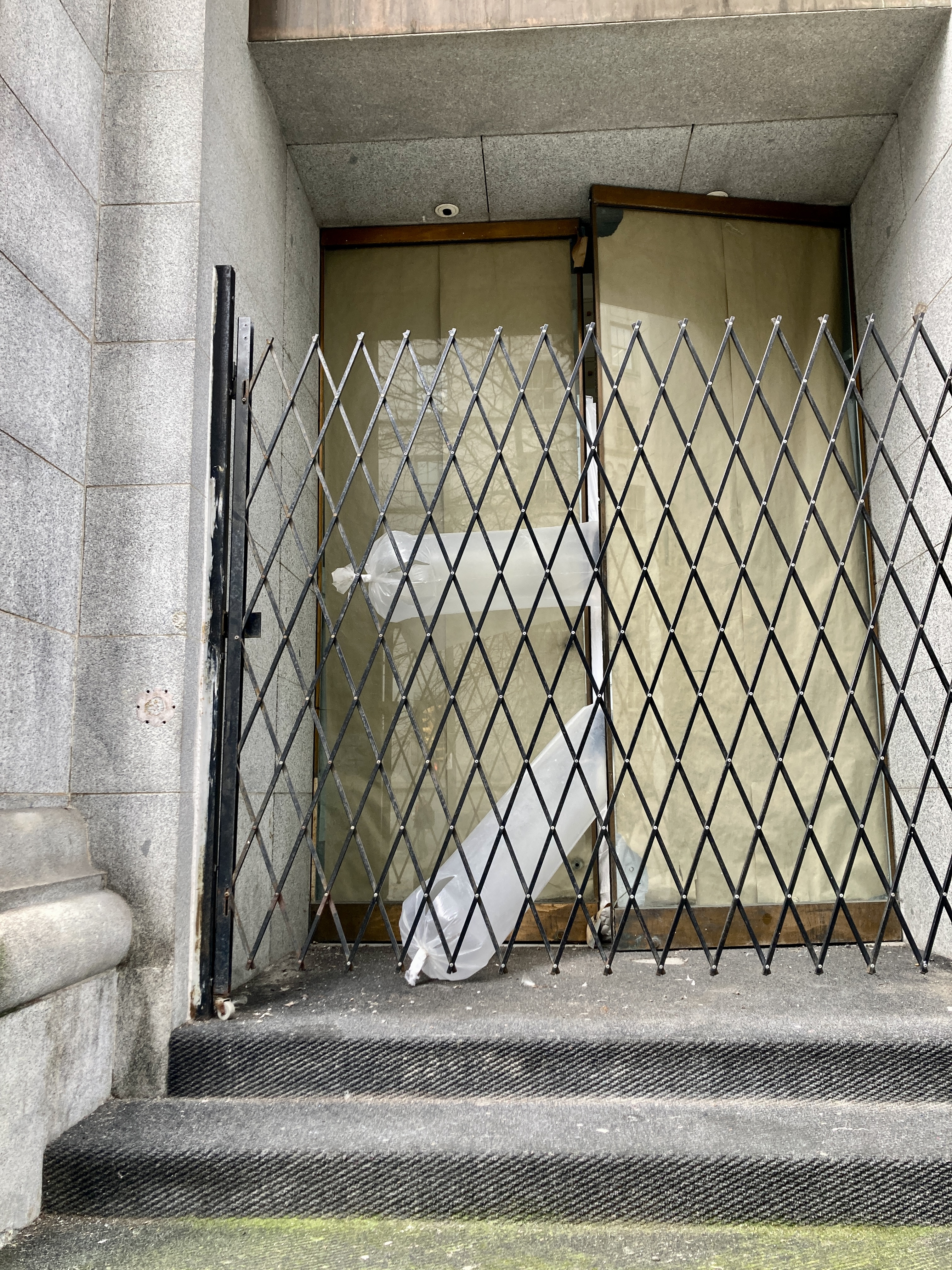
??? They look like giant condoms, ready for action. What is going on in there?
I don’t know, is the answer to my own question. The complex seems mostly closed, and I later read online that a massive redevelopment proposal has been under review. Is work now underway, or becalmed? I can’t tell.
Whichever, it is a sad sight.
Walking the West Hastings side of the complex toward Howe, I pass a medallion face looking suitably distressed. As it should. The wooden door is in good condition, but the plaque beneath the medallion has been hacked away.
Corner of Howe, I take one last look at the dome that started my long, happy loop-about through all that urban clutter.
Then, satisfied, I finally board my bus for home.
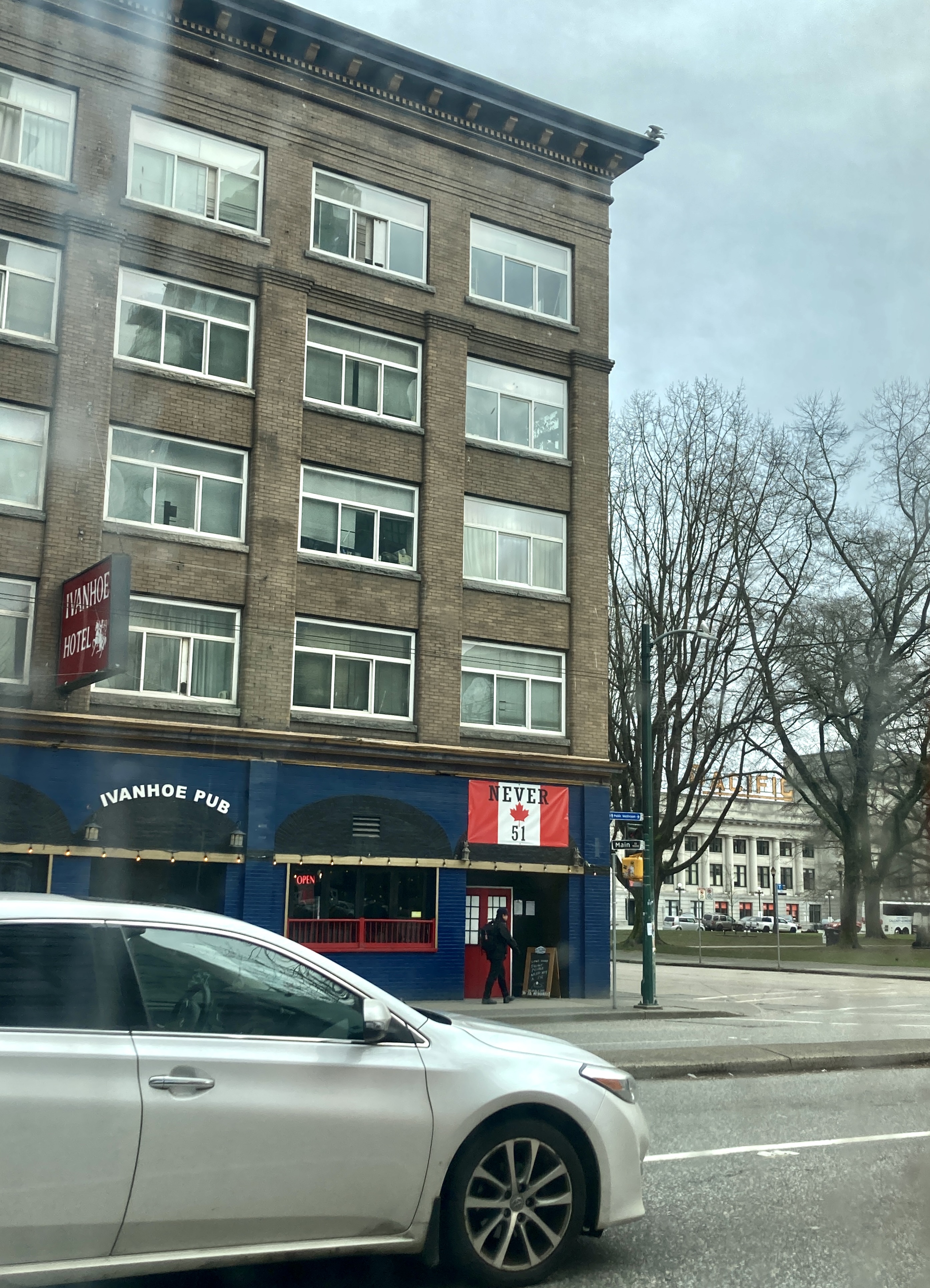
There’s one last delight, as we roll south on Main Street, and I manage to grab a shot through the bus window.
The Pacific Central train station is in the background, but who cares. I’m focused on the red & white “flag” now installed above the pub entrance, right at the cross-street. It is yet another literal sign of our politico/cultural times.
The final, perfect detail? The name of that cross-street is… National Street.
14 February 2025 – Not viciously frozen-frozen — not like most of the rest of Canada, right now — just the benign Vancouver version of frozen.
Just cold enough, and cold enough long enough, that snow still covers the ground, and…
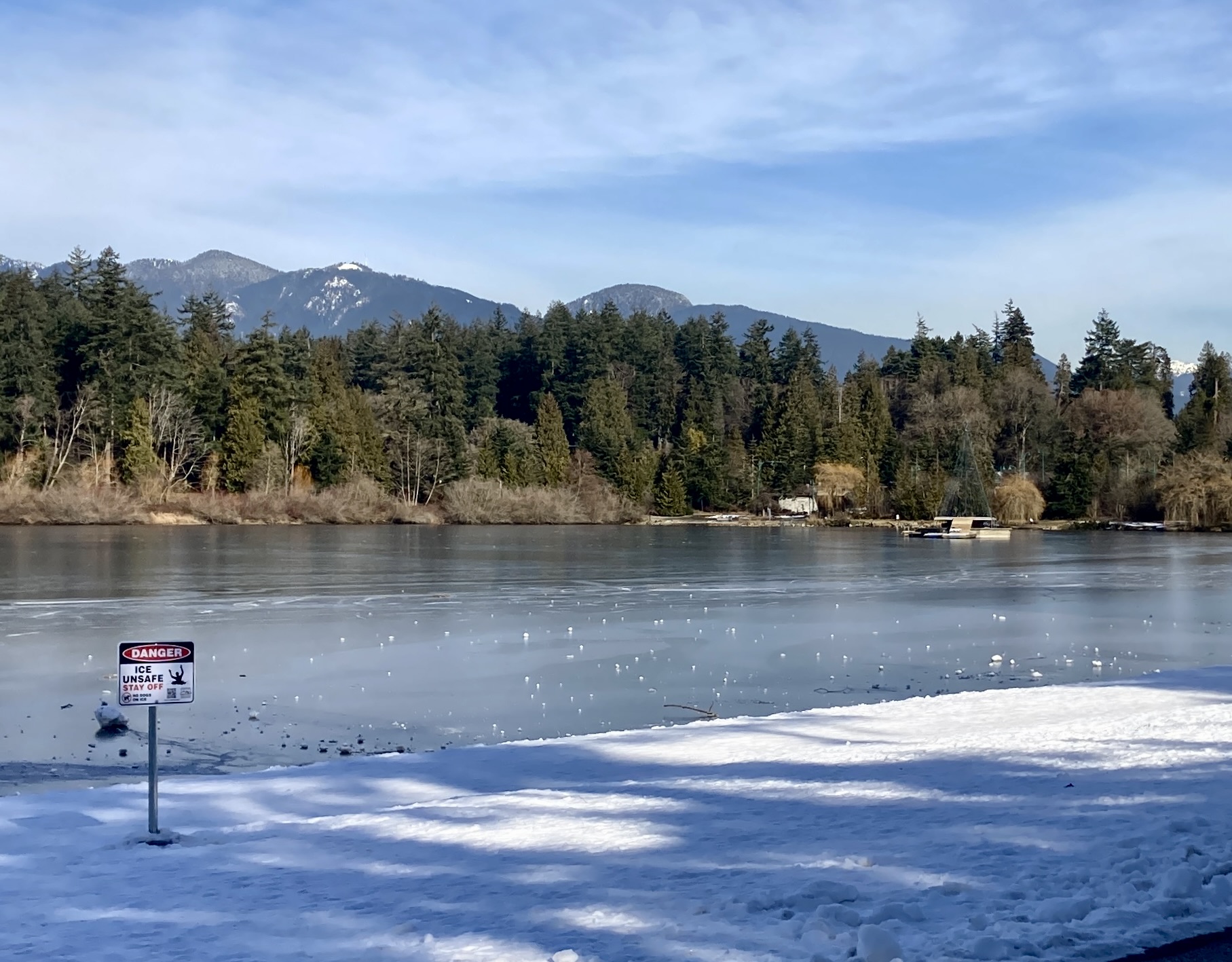
even Lost Lagoon in Stanley Park lies still and silent beneath a layer of ice.
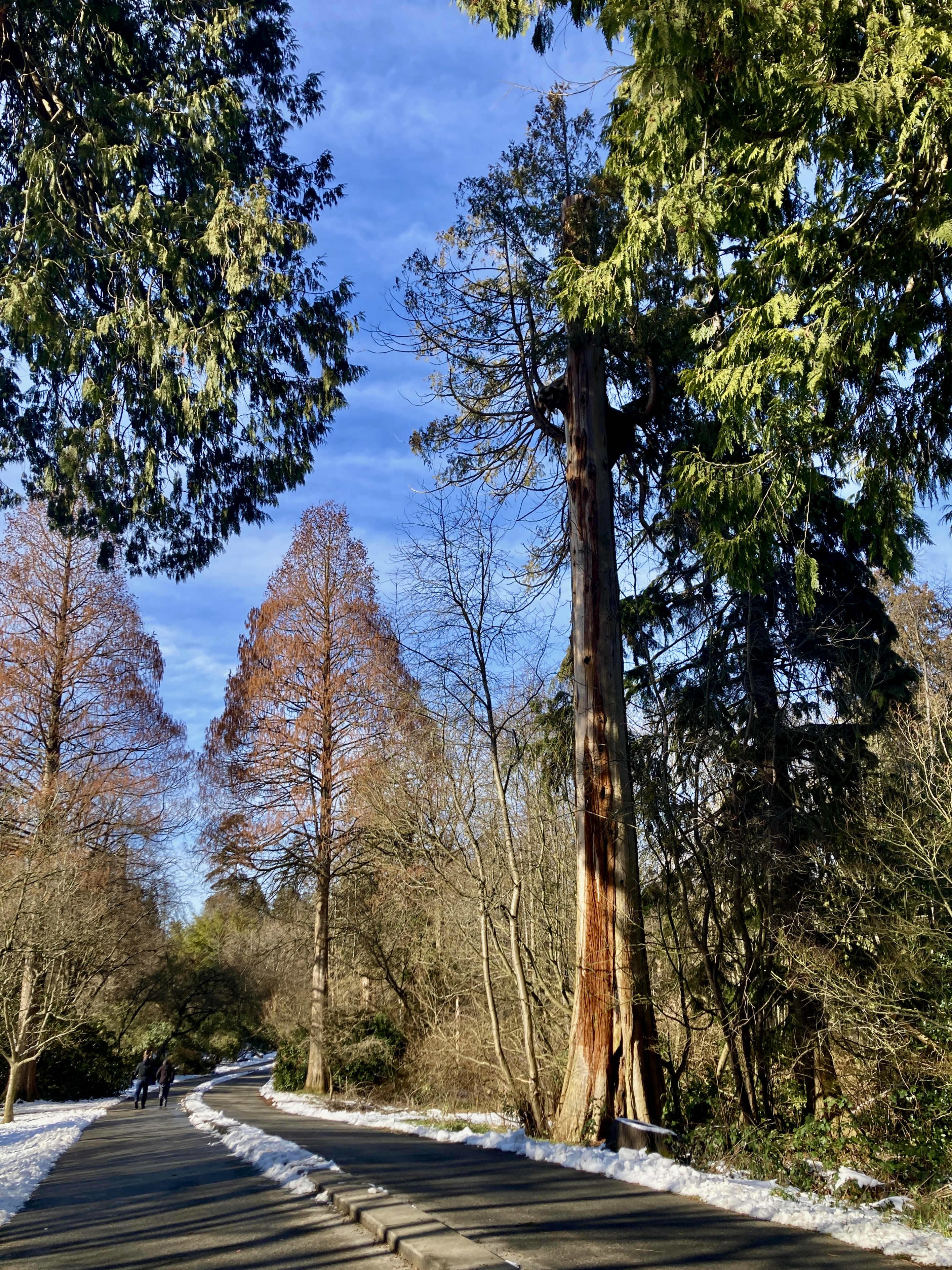
It’s that stillness, that hold-the-breath absolute stillness, that I remember from the colder winters I knew in eastern Canada. It is as much a mood as a physical sensation, and it is with me again as I walk the Lost Lagoon trail, heading from the Burrard Inlet side over to English Bay.
Snow on the ground, long shadows high-contrast black against the snow, snow-shards sitting atop the Lagoon instead of melting into it…
and even an “Ice Unsafe” notice pounded into the ground, this being one of the very rare occasions it needs to be pulled out of storage and put to use.
My trail leads me away from the shoreline, into the woods, shows me yet again how much bright beauty is to be had, when winter sun blazes in the sky.
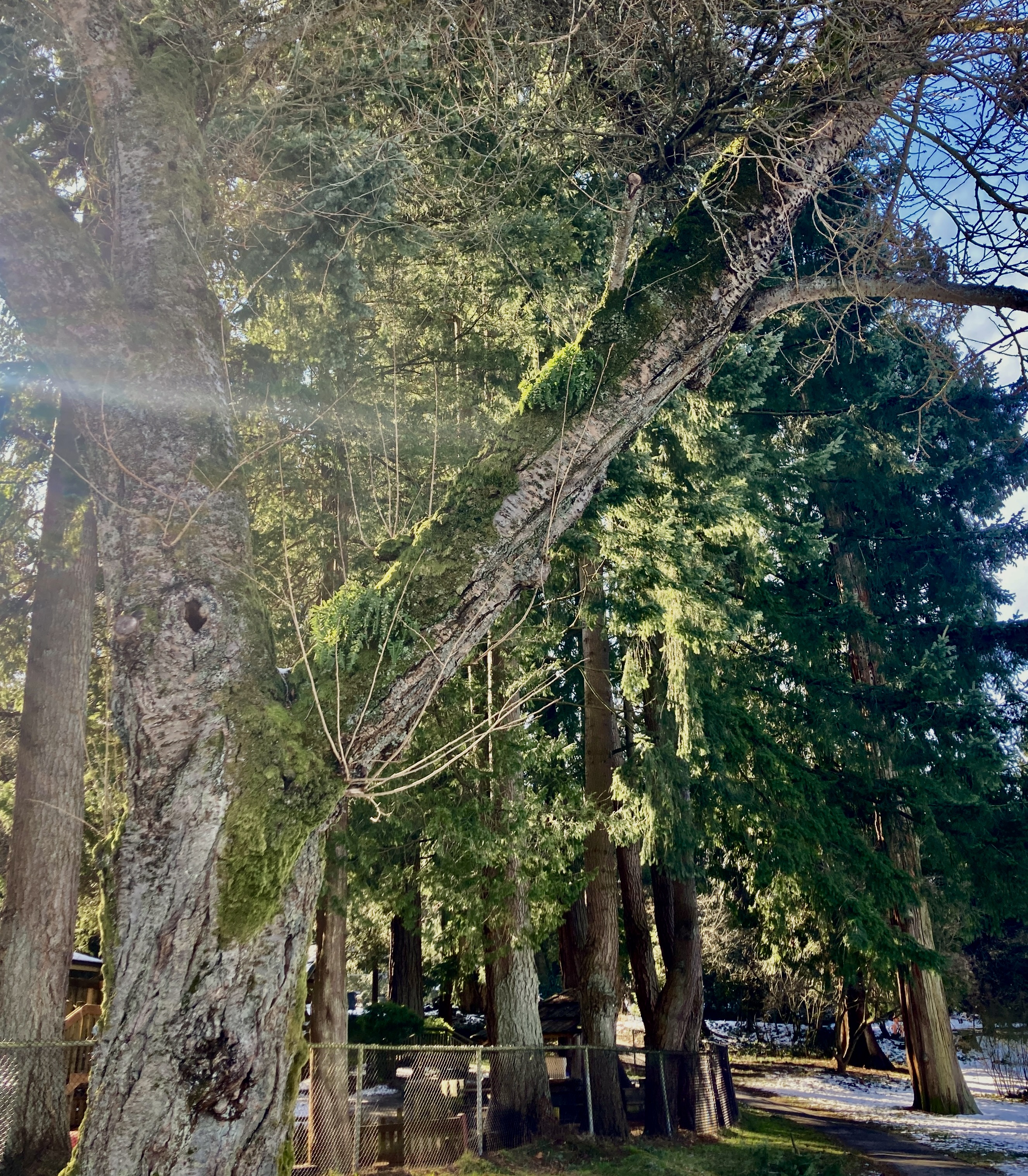
It sparks against moss on a tree branch…
against this tree trunk…
and it spotlights an impromptu snowman, shining in the field beyond a wayside bench. The bench is currently irrelevant; the snowman is, literally, in his element.
Signage tells me I’m walking through the Ted and Mary Greig Rhododendron Garden. Sure enough, next to this magnificent old tree stump (bearing what may be the cut of a long-ago lumberjack)…
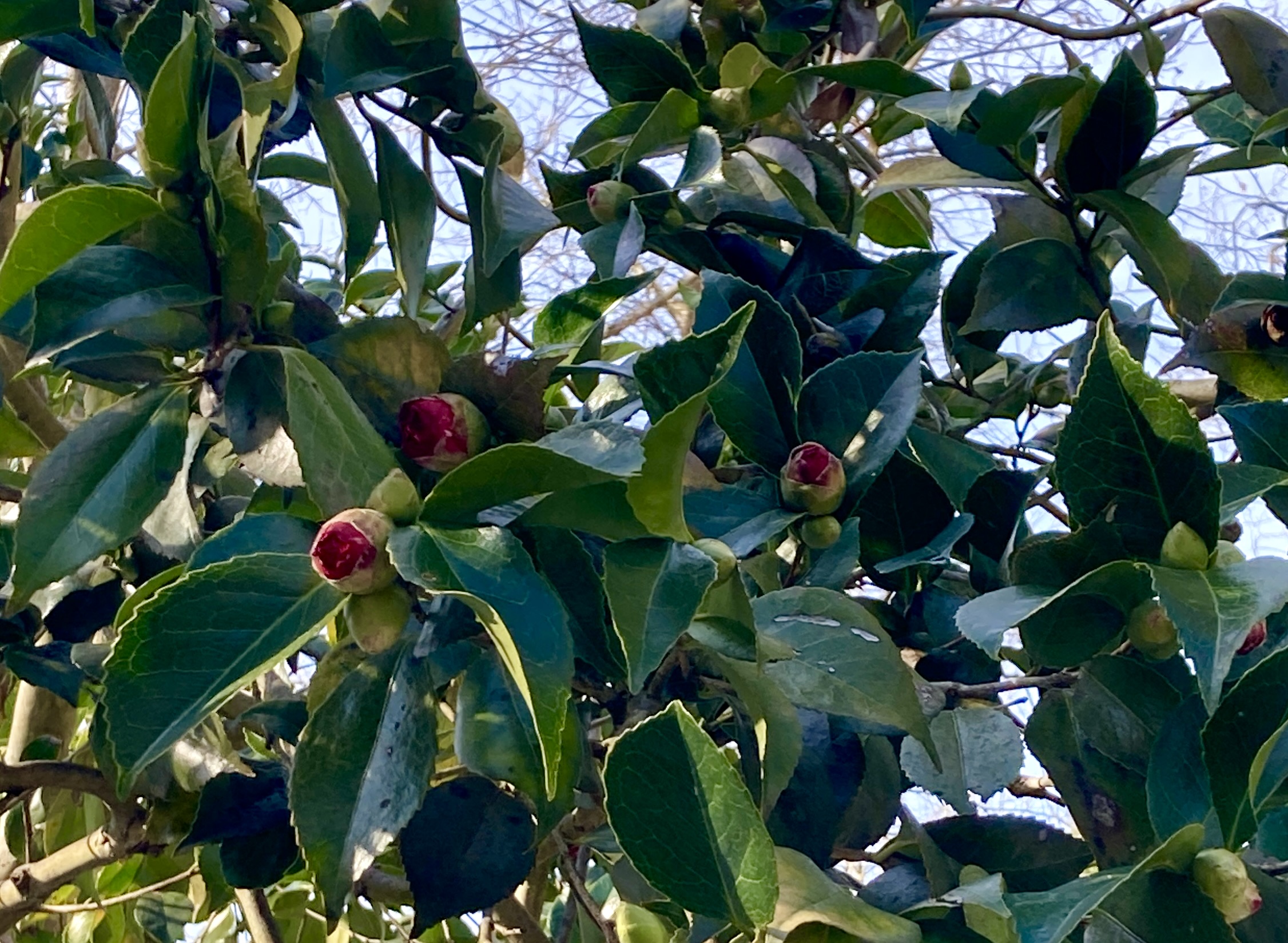
I see valiant little rhodo buds, already peeking out at the world. It seems madness to me, but I’m not about to argue with Mother Nature.
Ice, snow, stillness… and then… and then I’m out the other end of the trail.
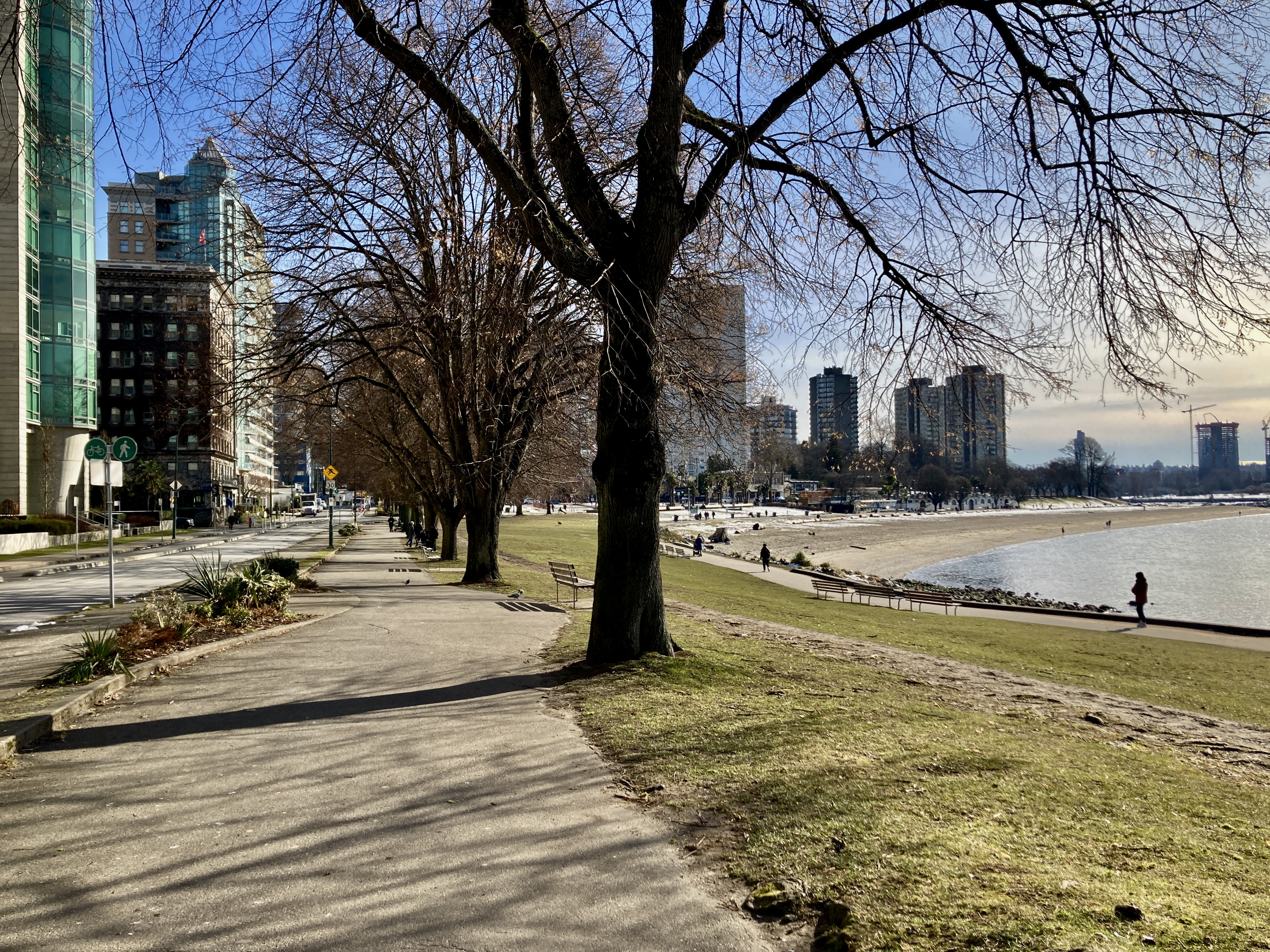
Usually I drop down to the Seawall. Today I stay here, on higher ground, taking in a broader perspective. I walk my way back into the city, still with water to one side, but with towers and urban life to the other.
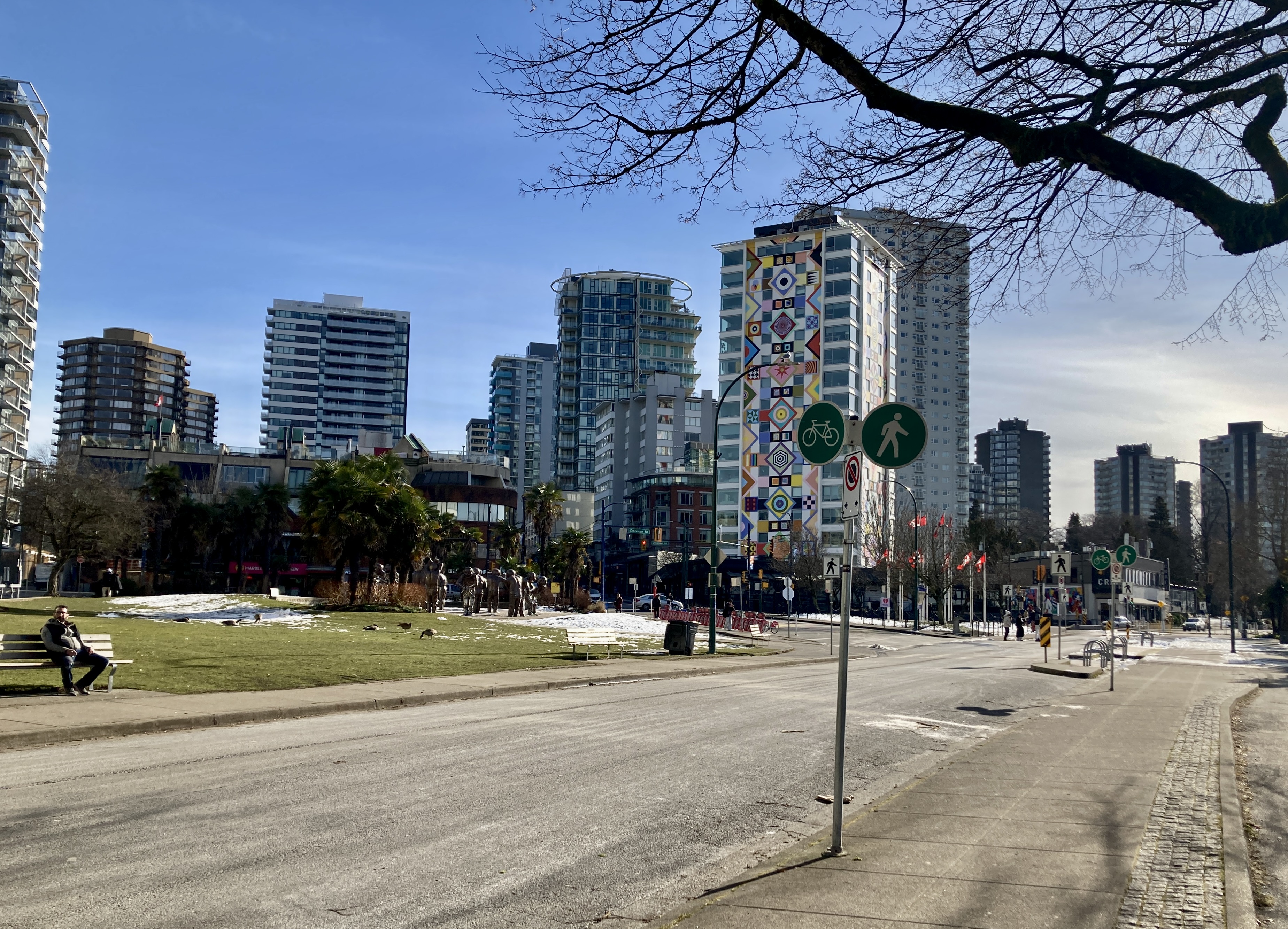
On down Beach Avenue, and the long view opens up before me: Morton Park with its A-Maze-ing Laughter bronze sculptures, its palm trees, its geese, its flags, and, as backdrop, Doug Coupland’s Sunset Beach Love Letter, the mural embracing that refurbished apartment building toward the right.
I cut across a corner of Morton Park. It rewards me with a closer look at the geese, the laughing bronze figures beyond the palms, the flags snapping in the breeze…
and the colours and textures of a sleeping Canada Goose.
A utility box at Denman and Pendrell — all splashy with an Andrew Briggs’ mural — tells me I’m seriously back in the city.
I have plans for Denman Street! Somewhere along here there’s an Aussie pastry-pie place, and I want to find it again. I pass a whole globe’s-worth of culinary invitations along the way, but I keep walking, and I am rewarded.
Because here it is: a café-cum-hole-in-the-wall named Peaked Pies.
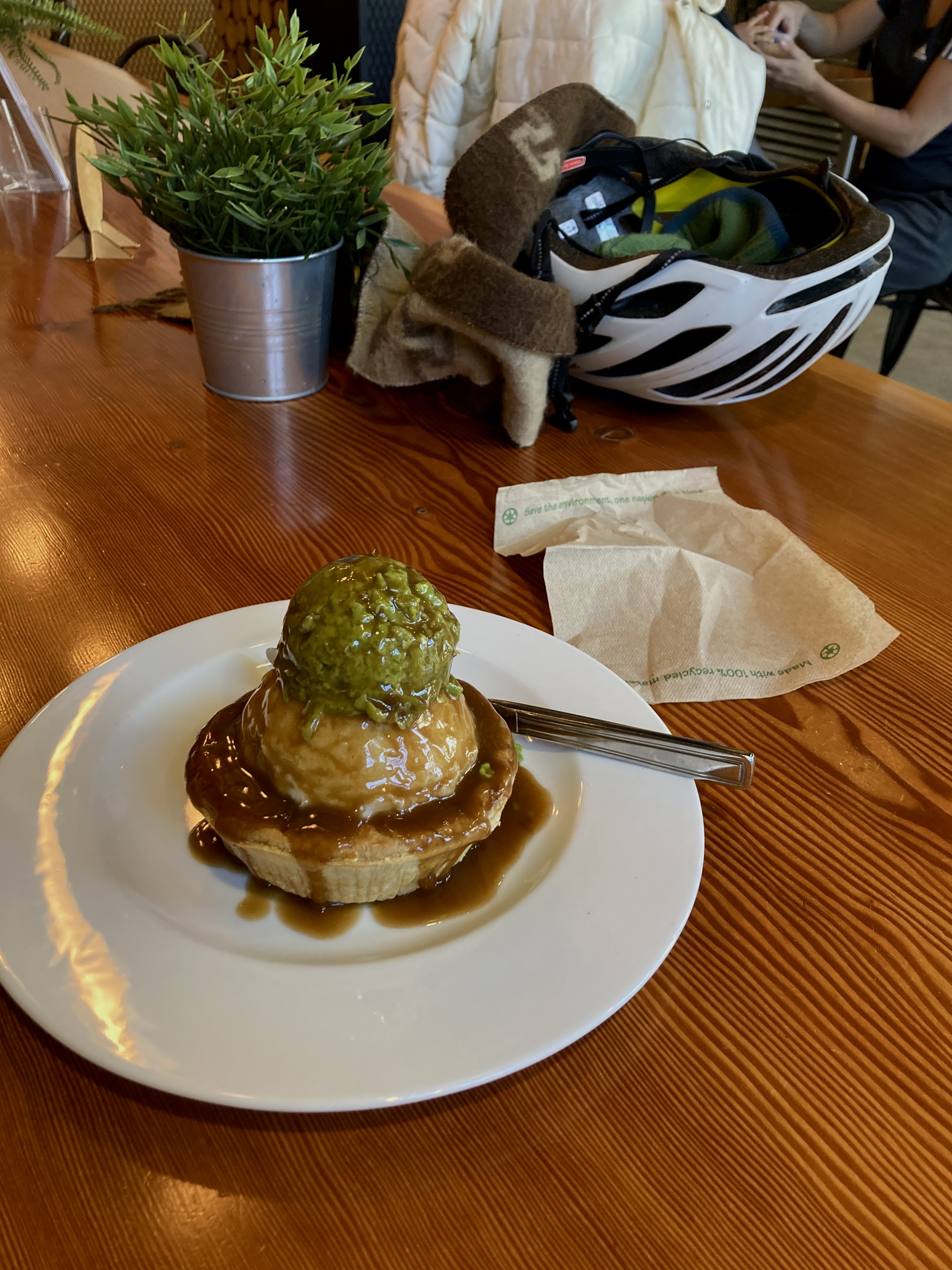
The menu offers a range of Savoury Pies (from kangaroo meat to vegan) which, should you choose to pay the premium, can be transformed into Peaked Pies. The term is descriptive. The “peak” is what results when you take the pie as base, and then pile on mashed potatoes + mushy peas + torrents of gravy.
Like this:
I almost can’t believe I agreed to all that — but I did, didn’t I?
Later, back home, I could have cropped this image to just the PP, but I want you to see the rest. It shows how neighbourly this little café was, when I happened to drop in, and I suspect that’s typical.
The elbow in the background belongs to a young mother, murmuring loving silliness at her baby in between mouthfuls of her own PP; baby is gurgling approval back at her. The helmet belongs to the Aging Geezer sitting farther down this communal bench from me, who is deep in conversation with the Younger Tablemate chance-seated next to him. Each, from their very different age-point, is encouraging the other to follow their dreams as they navigate their respective next stage of life. When they part, it is with reciprocal thanks for the conversation.
My peaked pie is good, true comfort food on a nippy day. And the mood in that café is a comfort as well.
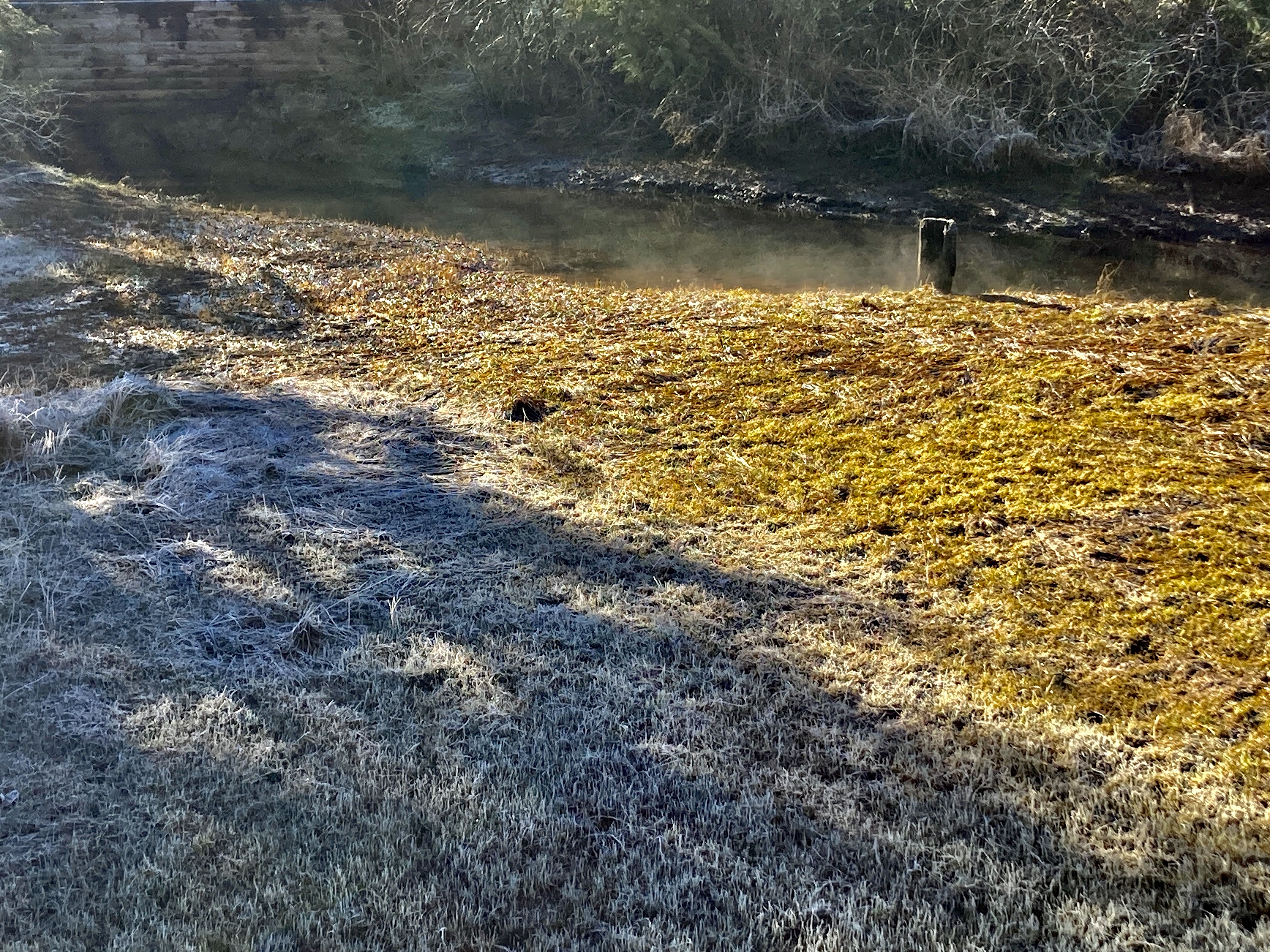
20 January 2025 – We’re in a cold snap. Nothing like the extremes back East, just temperatures hovering below/above zero from night to day — low enough to set the hoar frost blooming early each morning.
Including along the Shoreline Trail, the pretty little trail in Port Moody that runs between Rocky Point Park and Old Orchard Park, cupping the eastern end of Burrard Inlet as it goes.
As I wait for my companion outside the SkyTrain station, I realize the oak leaf on the artwork at my feet and my own fingertips are in agreement: there’s a bite in the air.
But it dances through a blazing bright sky, and it is magical.
Hoar frost sparkles on the boardwalk across a marshy inlet…
encircles an ice-rimmed pond…
and sweeps across the entire marshland, right to the creek whose waters steam gently in the sun.
We cross mudflats on this rebuilt boardwalk, and agree it is much safer and more accessible than its wonky predecessor and is therefore A Very Good Thing — but also agree we miss the charm of that predecessor.
Then we quite rightly stop being such ingrates, and settle down to enjoy ourselves.
A waterfront blind farther along offers a chance to watch wildlife unobserved…
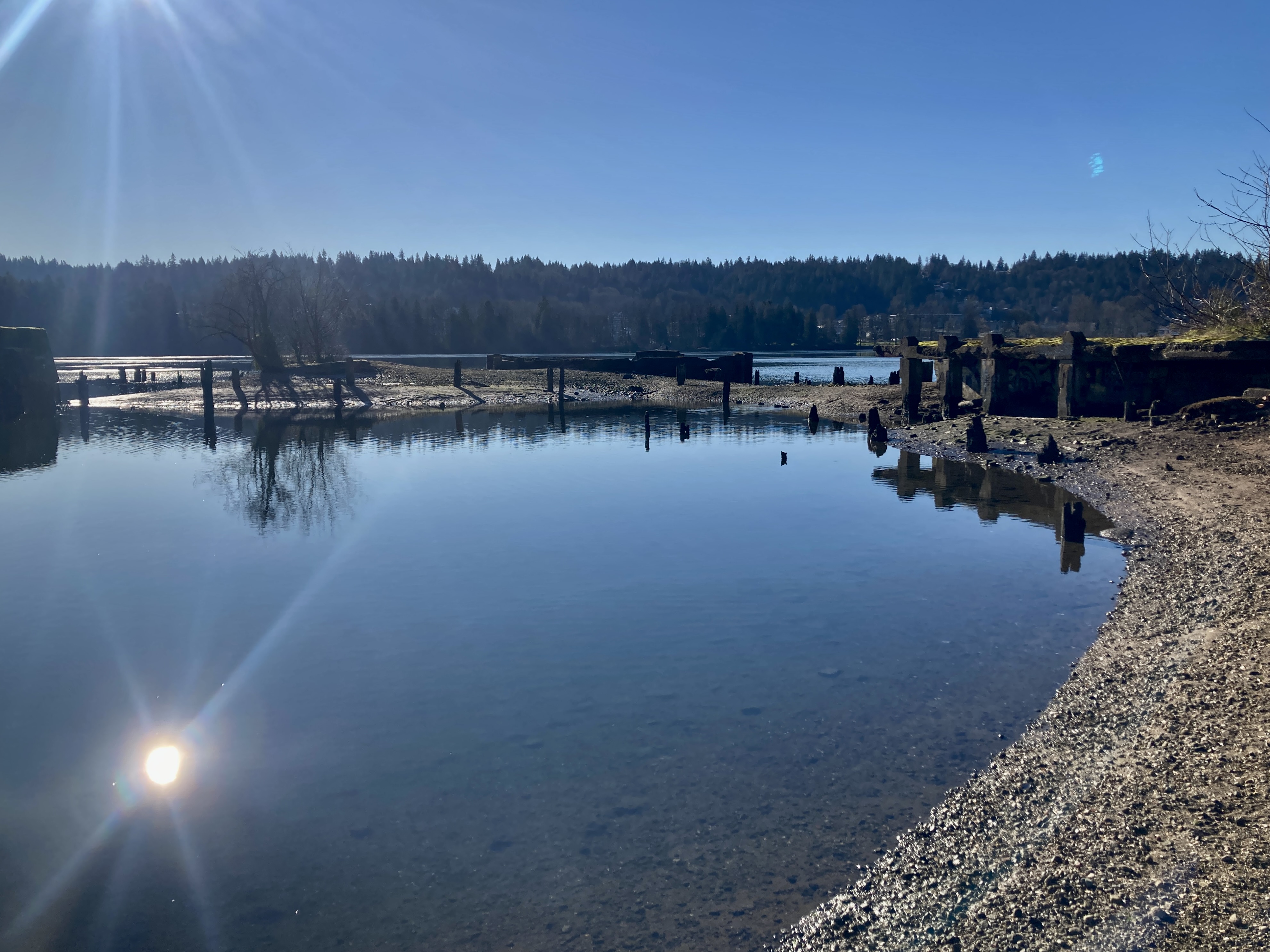
though at the moment we see only the stumps of old pilings, remnants of the McNair Cedar Mill that once operated here.
I’ve visited the mill site on previous Trail walks; tide is low enough to allow us to explore it today as well.
Only later online do I both learn the name of the mill and also see this 1925 photograph of the mill in operation. (Thank you Tessa Trethewey, for posting this photo on the I Love Port Moody blog on April 25 last year.)
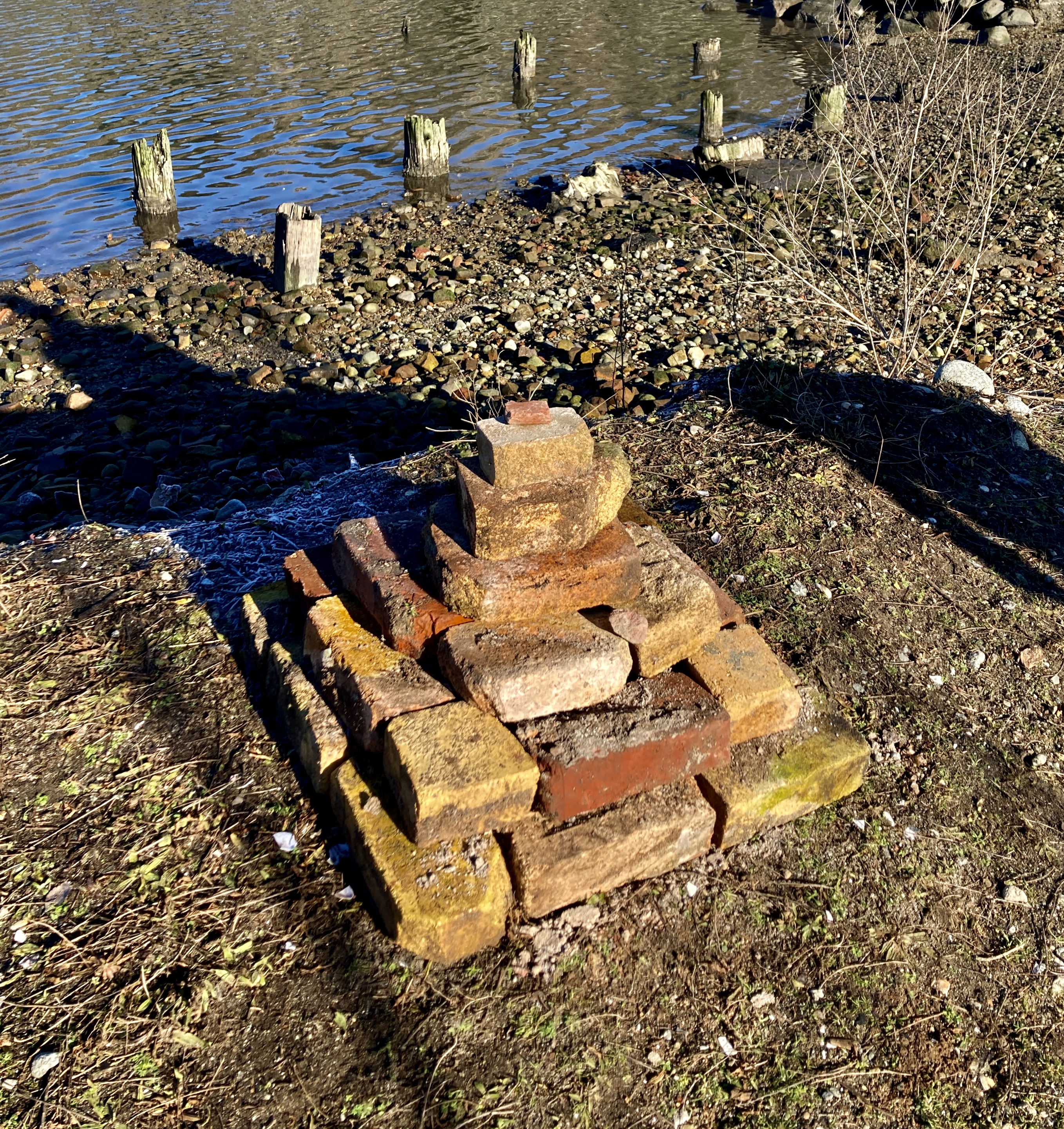
Before we rejoin the Trail, I stop to admire this ziggurat, meticulously constructed from old mill bricks still lying around on-site. (I think for a moment, by ricochet, of the ephemeral clean-fill sculptures created out on Toronto’s Leslie Spit, by visitors who celebrate what lies to hand.)
Back on the Trail, what we have to hand is a collection of nature’s own tree-sculptures.
Companion burls high up one trunk…
and a whole lot of winter moss. An old scar, cushioned in moss, for example…
great rounded folds of bark rising from a mossy base…
and a moss-splattered tree that stands politely to one side as we look across reeds and marshes, across Burrard Inlet itself, to the mountains and distant snow peaks.
Warmed by the growing strength of the sun and also our own exertions, we decide we have more than earned lunch.
We retrace our steps, greeting hikers and patting dogs as we go, and settle into generous servings of Mexican comfort food. Our cheerful waitress, a rose tattoo peeping out from under her left cuff, says it is the perfect day to walk the Shoreline Trail.
9 January 2025 — Current events flip my mind back 130 years, to an 1895 Punch cartoon, by Sir John Tenniel.
Master Johnny Bull asks, “Monroe Doctrine? What is the Monroe Doctrine?”
Master Jonathan (aka James Monroe) answers: “Wa-al — Guess it’s that everything everywhere belongs to us.”
In his December 2, 1823 address to Congress, President James Monroe articulated what was to be United States policy concerning the rest of the Americas.
“By the mid-1800s” — says the Office of the Historian, in its series Milestones in the History of U.S. Foreign Relations — “Monroe’s declaration, combined with the ideas of Manifest Destiny, provided precedent and support for U.S. expansion on the American continent…”
18 November 2024 – This weekend — for the 28th year — was the annual Eastside Culture Crawl. I take advantage of Sunday’s better weather (merely iffy, as opposed to torrential) to join in.
I’ll visit studios like this one…
but mostly, as seems to be my personal Crawl tradition, I’ll just go for a big old walk. And visit some studios along the way.
When I cross 2nd Avenue, northbound on Scotia Street…
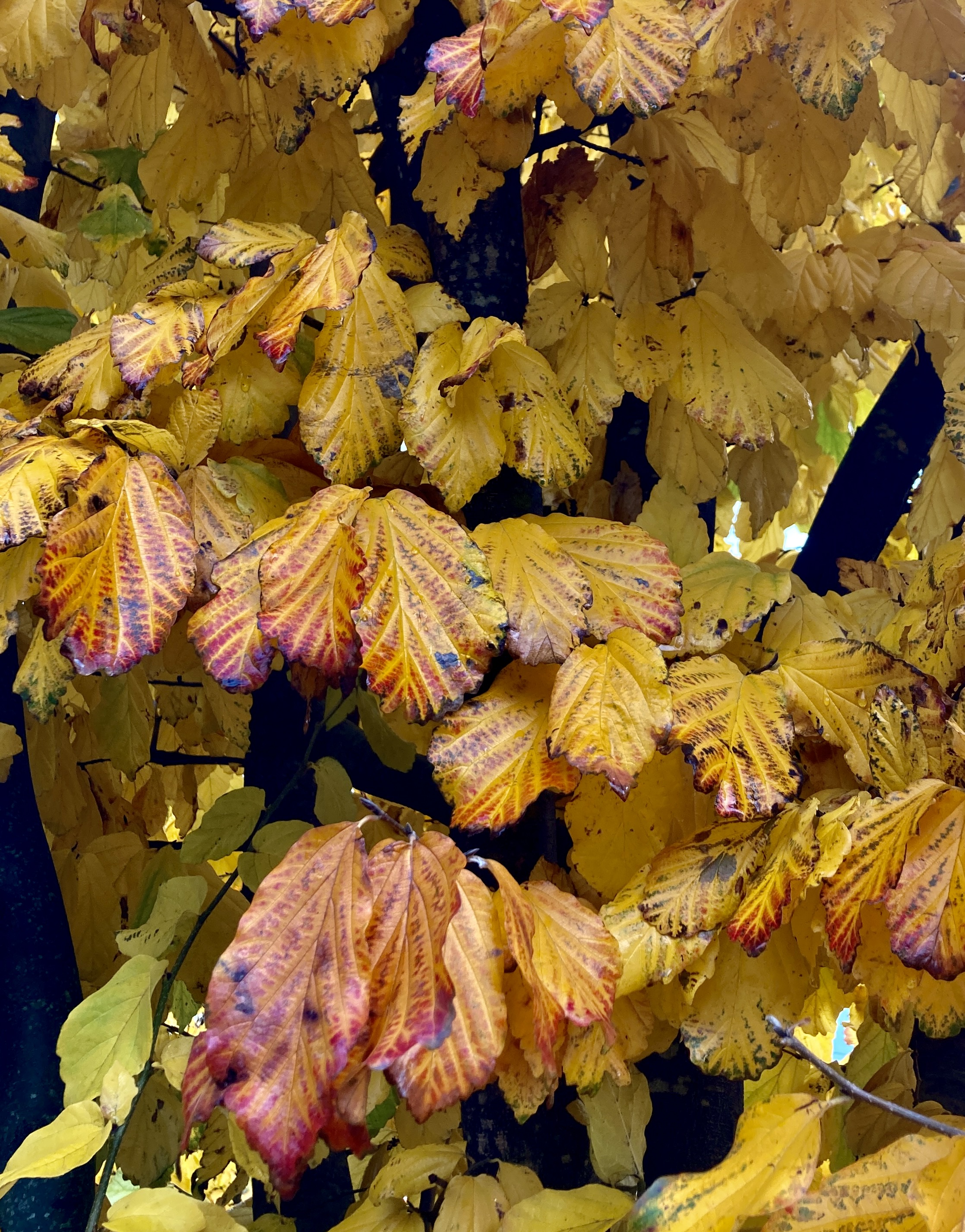
flaming beech trees welcome me to official Crawl territory: it runs from the waterfront farther north to right here, 2nd Avenue. (And, east-west, from Victoria Drive to Columbia Street.)
Also part of my personal tradition: my first visit is always to the bustling Arts Factory on Industrial Avenue, but before that — just to get in the mood — I loop my way through the False Creek Flats, taking in their evolving mix of new facilities and old warehouses as I go.
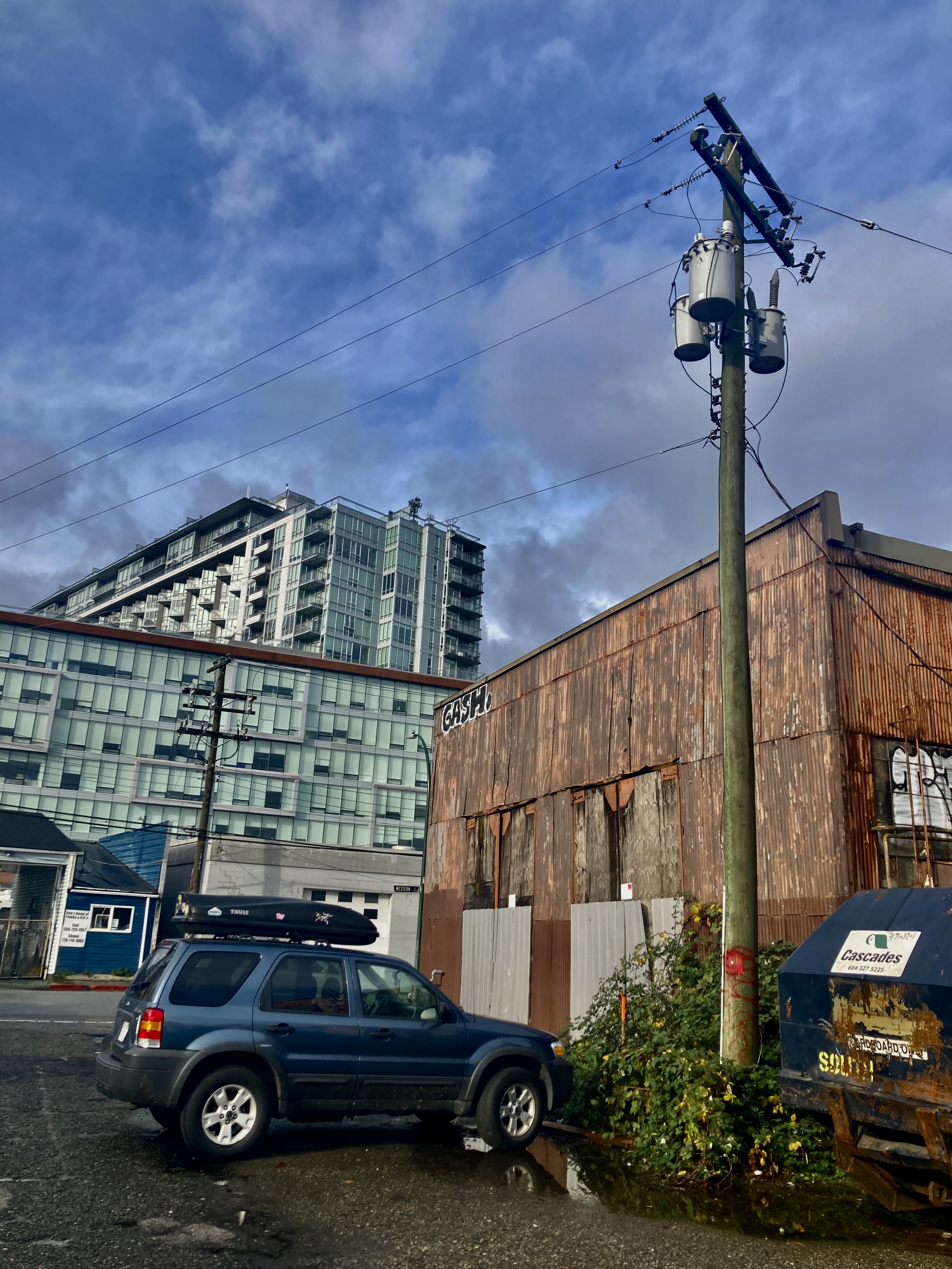
Streets in here have helpful names. Western Street runs up/down the Flats’ western boundary; Station Street to the east runs to the train station; and they are connected, you’ve guessed it, by Southern, Central and Northern streets, in the appropriate geographic order. North of Northern lies Terminal, and beyond that, Industrial.
I pass one of my all-time favourite rusty warehouses at the corner of Southern and Western, now with a gleaming new high-ish rise in the background…
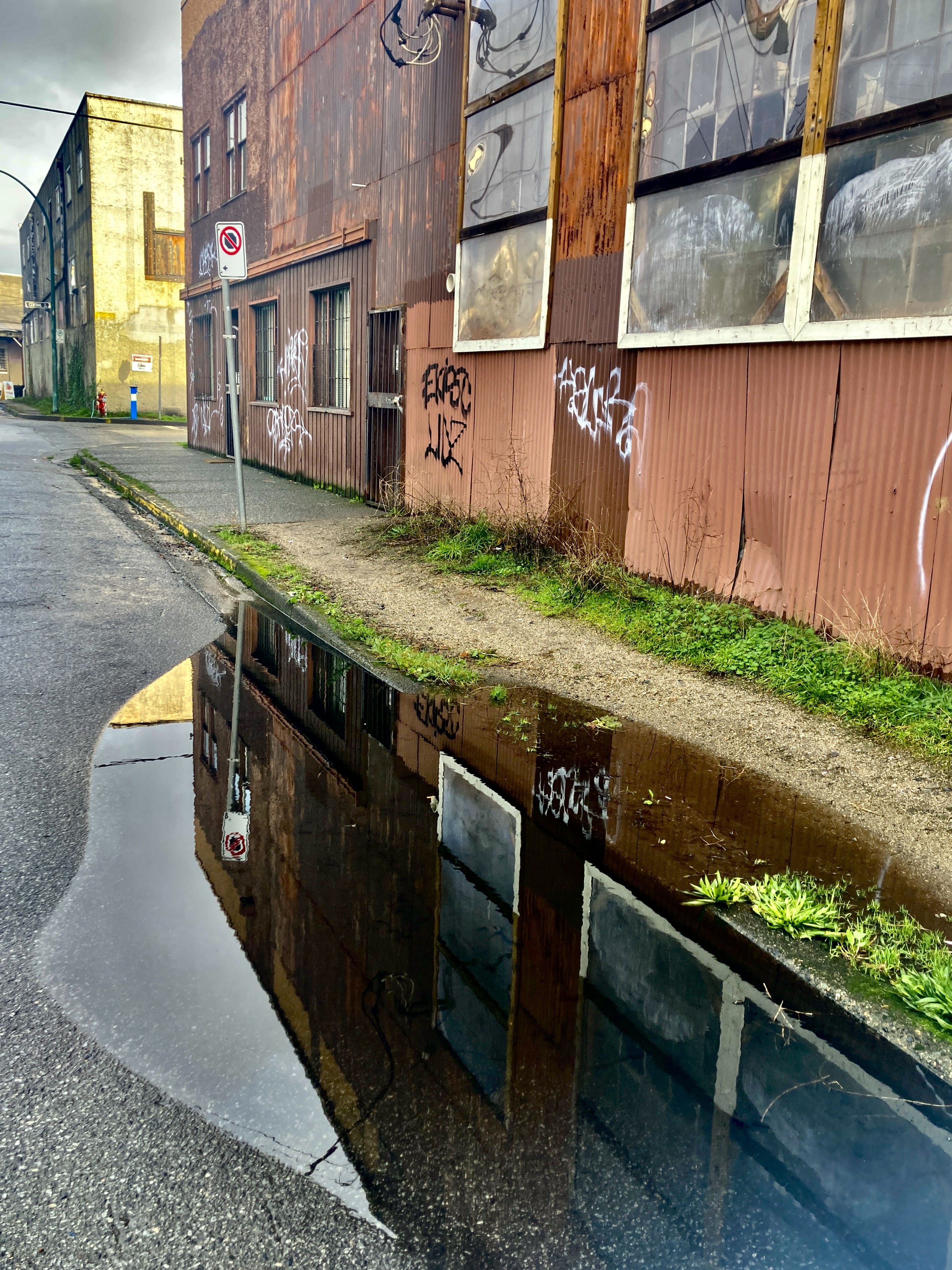
but I’m even more taken by this tear-drop puddle reflecting the warehouse back at me, as I round the corner to head north on Western.
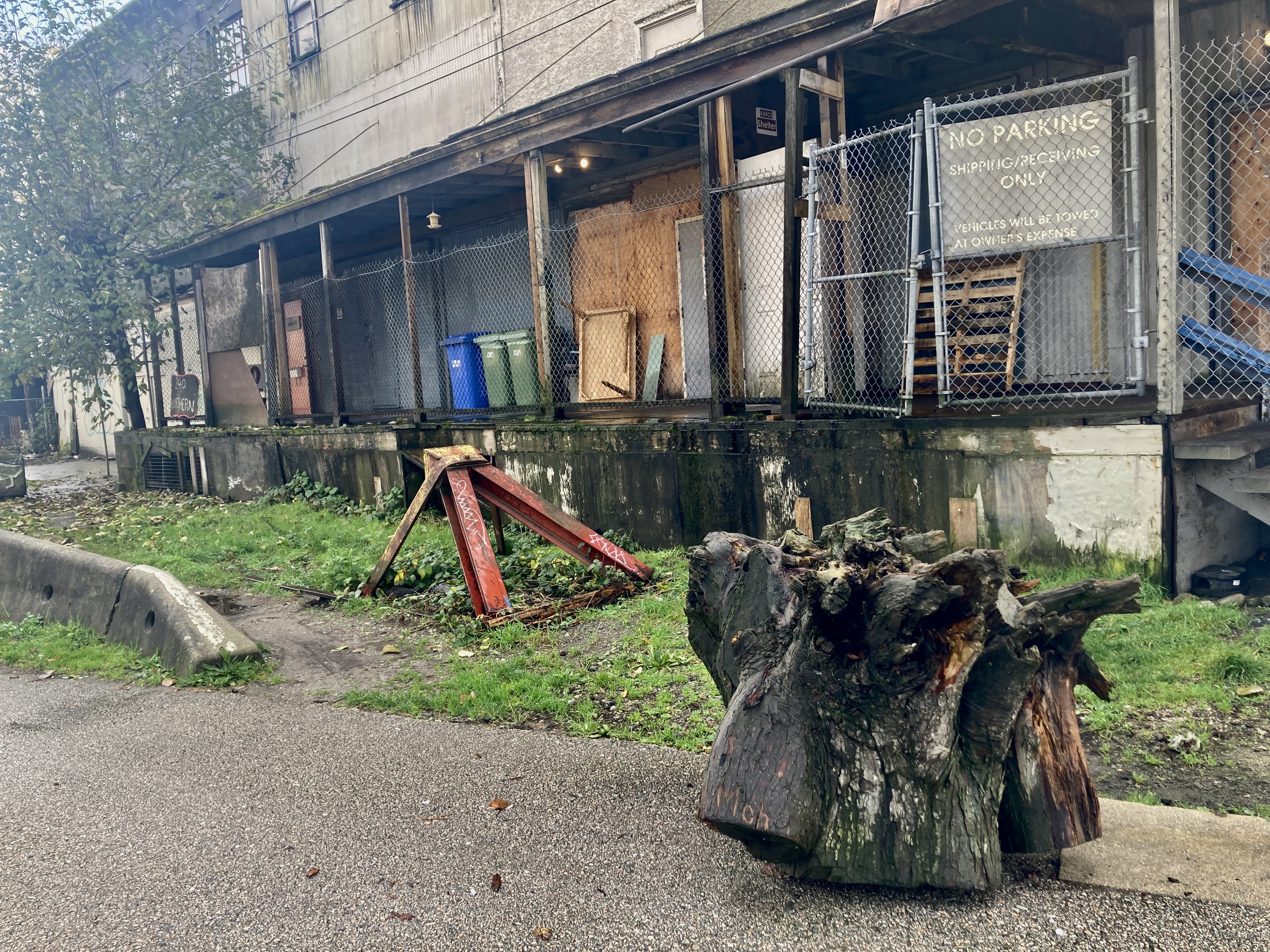
A huge stump marks the corner of Western and Northern. The building looks more derelict every year, yet it is still in operation, as its grumpy shipping-receiving notice makes clear.
After my visit to the Arts Factory, I double back west to Main Street. This makes no logistical sense at all!
It’s the most perversely roundabout way possible to get to Gore Avenue, which houses the three studios I’ve decided to visit this year — but, hey, I’m out for a walk, right? The rounder-about it gets, the better.
And I’m glad for my few blocks on Main. They take me past something that may look bleak, but deserves respect.
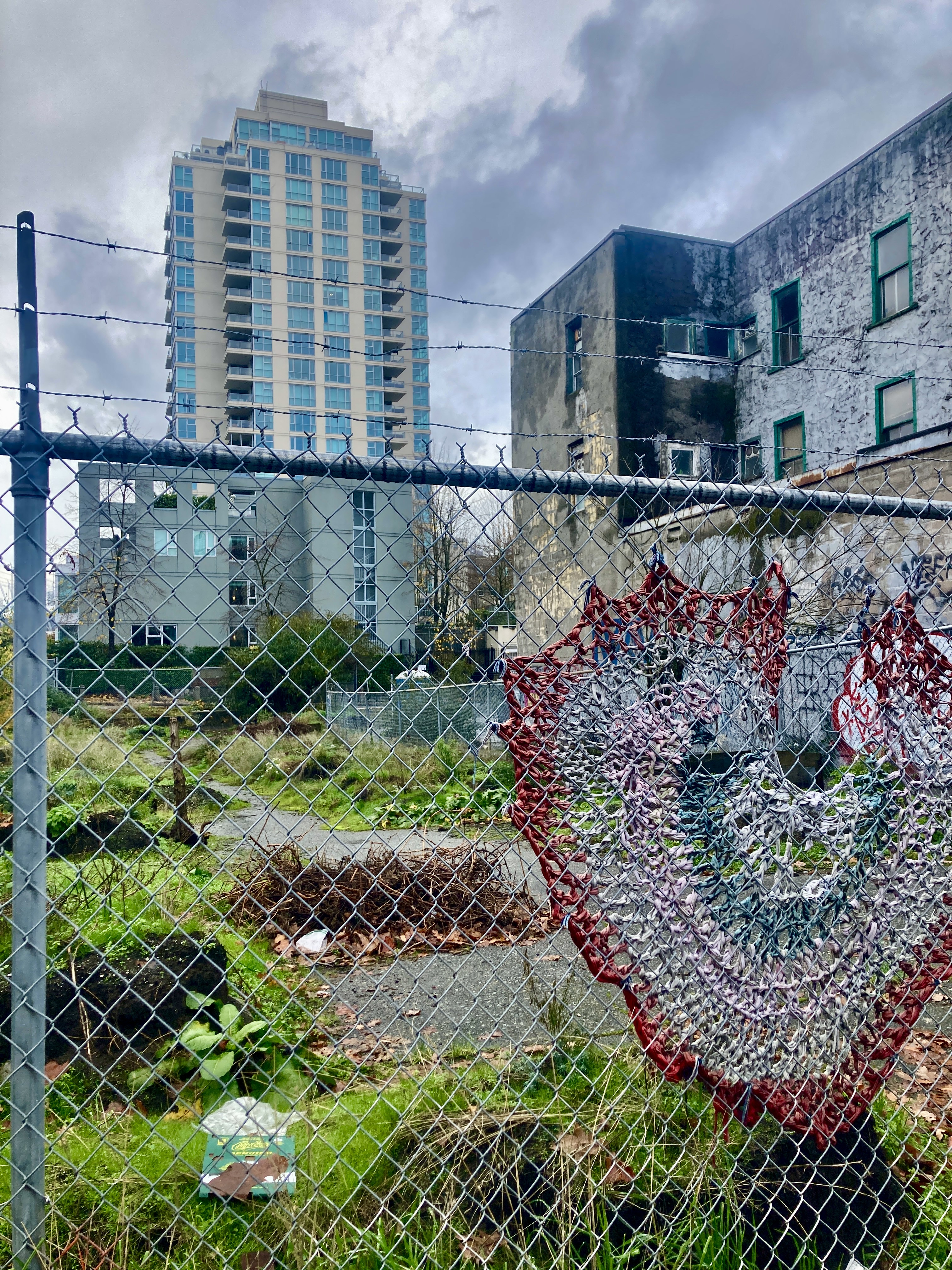
Yes, it’s behind chain-link fence and yes, it is November-dreary. But it is also a seasonal community garden, here at the corner of Milross, and it bears our local Yarn Bomber’s tribute of a crochet heart — recognition of the resilience of people doing what they can, in a tough context.
Back east along Prior, heading for the end of the block where I will turn north on Gore. I plan to scoot right along, but I’m stopped by this Mexican cervecería, just past Hogan’s Alley.
A moment for a giggle, and then eastward-ho to the corner of Gore Avenue, with the venerable Hunnybee Bruncheonette [sic] on the left and equally venerable Strathcona homes on the right.
I’ve walked along Gore on other occasions, but it’s always been the ground-level shops that caught my attention — I’ve never thought who might be doing what, higher up in these old buildings. Today, I start to find out.
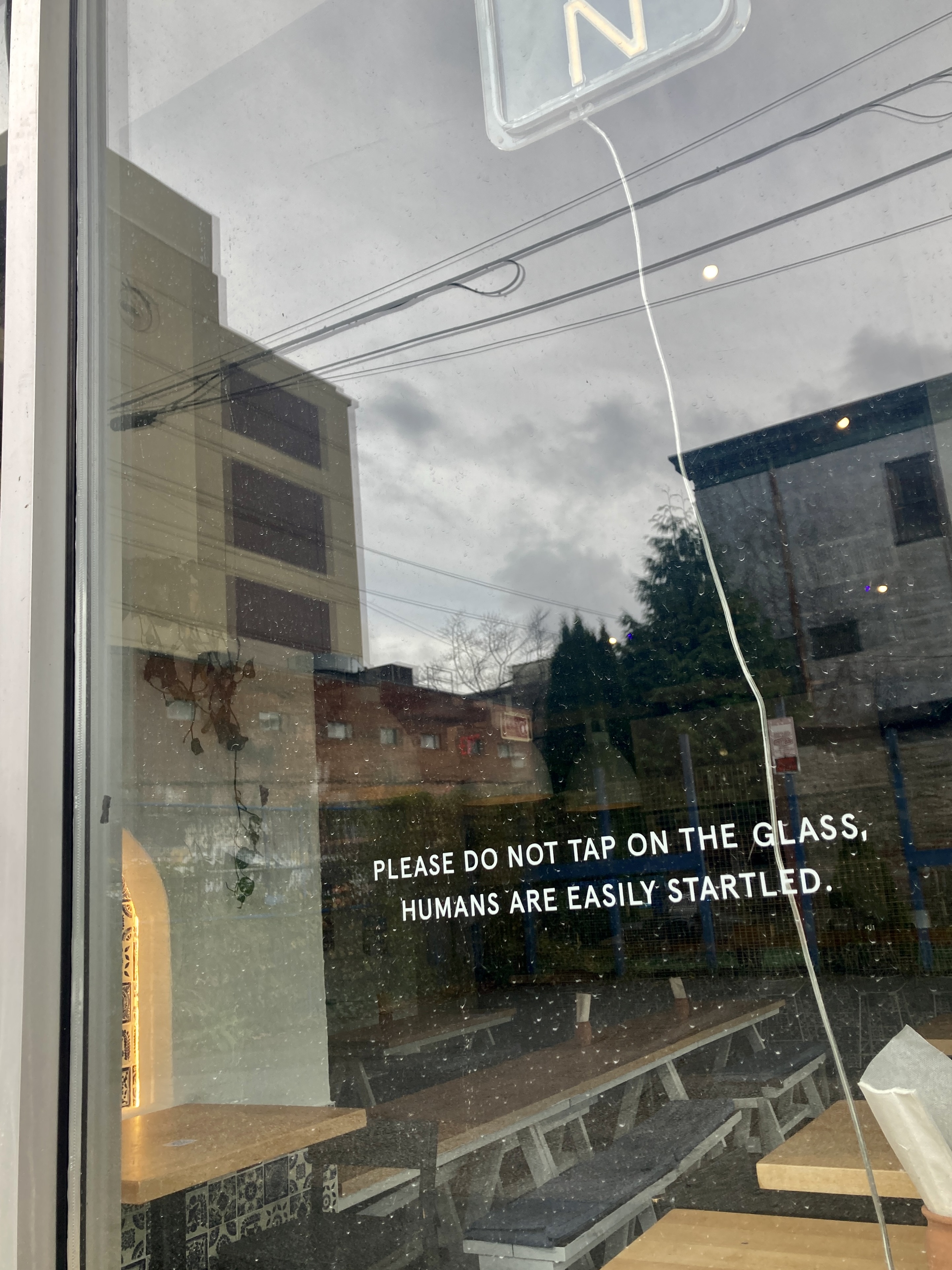
First target: Godzilla Studios, where one workshop — Street & Saddle — will be open to visitors. Once inside, once upstairs, I’m distracted en route by the instructions I see through an open washroom door over the waste paper bin.
Politeness seems to work! The bin is full to the brim, but the floor is clean.
On down the hall to Street & Saddle, a warm, welcoming and very impressive workshop of cheerful people and good clothing. Good business practices, too, as I learn from this sign on a counter top:
Isn’t that the best? Each year, their little shop keeps a whole pony’s-weight of fabric out of landfill.
Back down the stairs, out the door, on up the street to the Pot Spot Studio.
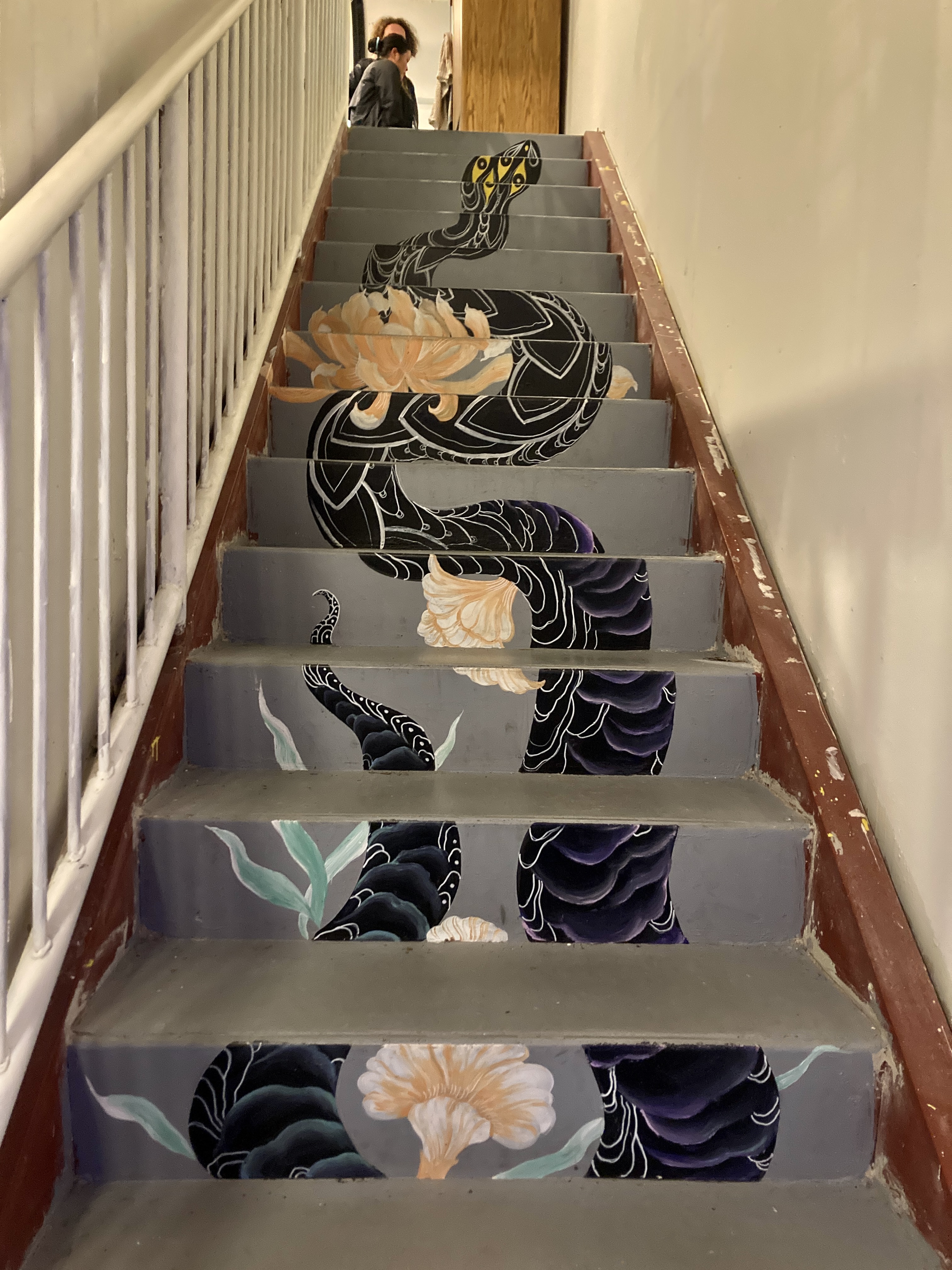
A word about stairs. Stairs literally come with art-crawl territory, since studios are usually located in the higher reaches of their respective buildings. Savvy artists, like these Pot Spot folk, make sure you know which stairs to climb…
and then give you a bonus.
Turn the corner to climb those red-arrowed stairs…
and a serpent leads the way.
As the potter at this top level studio wraps some purchases for other visitors, I hear a bit of his backstory: from his Russian homeland, to art school in Jerusalem, to — one year ago — Vancouver. I think of the losses, the struggles, the terrible choices that must be locked up in that chronology, and tell him I wish him well in his new life. His eyes soften, he nods acknowledgment.
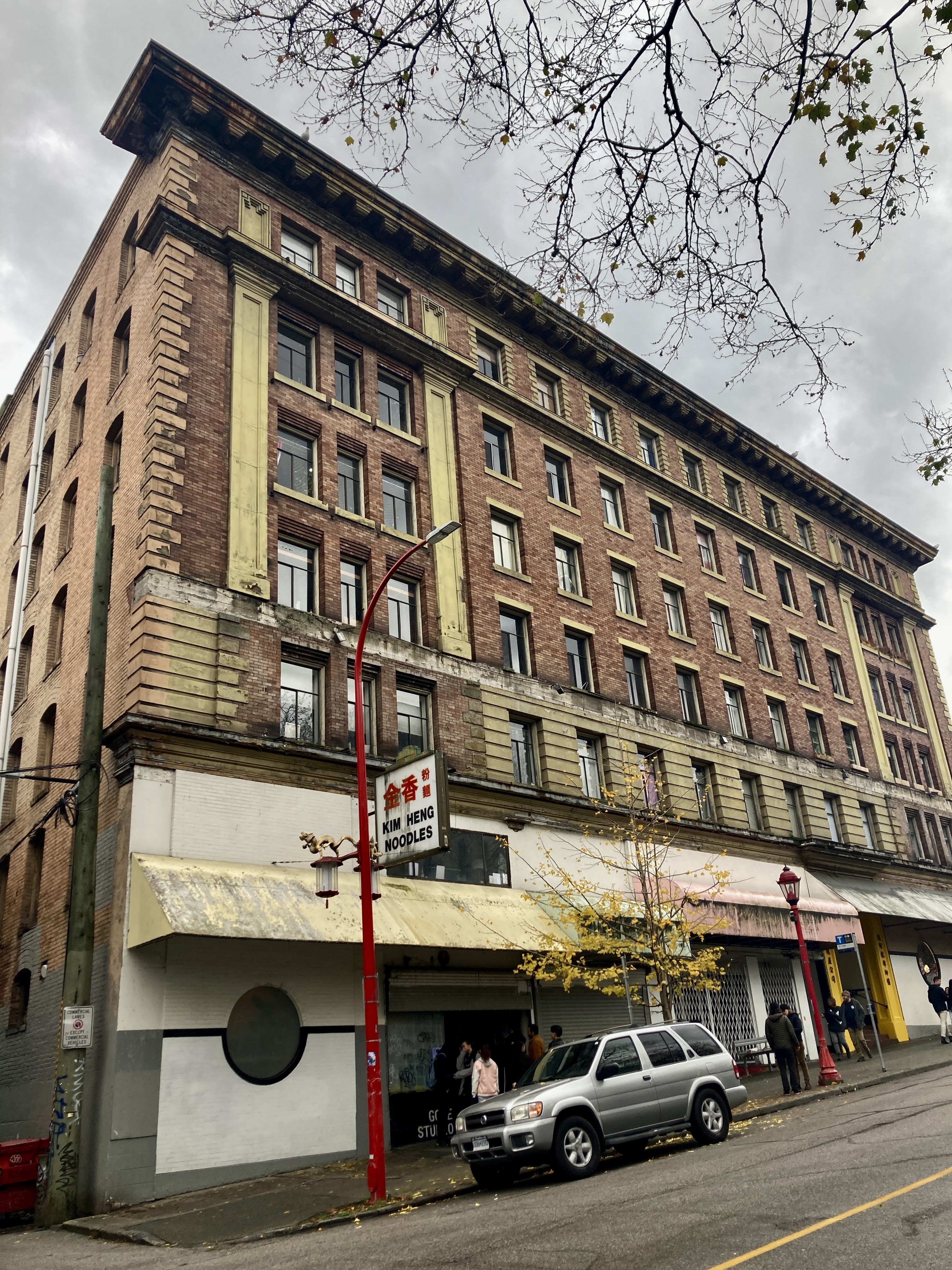
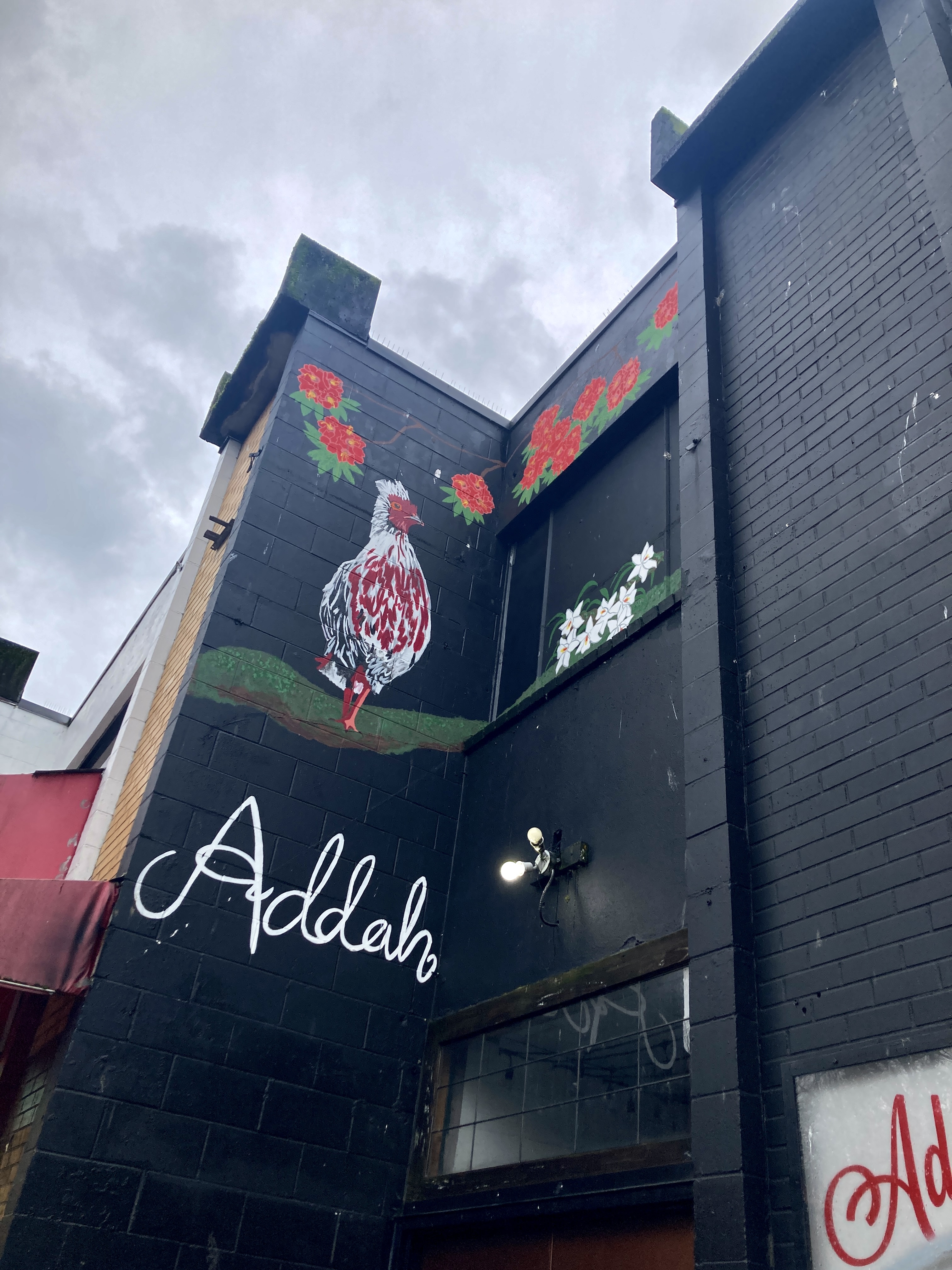
North again on Gore, on to the eponymous Gore Studio, can’t miss it, just follow the sign for Kim Hung Noodles. (It’s the doorway I teased you with, at the start of this post.)
In, and up.
Again up.
And the invitation to go on up yet again. Again.
I’m not sure what that is! A multi-coloured toilet roll? An aerosol paint can? Doesn’t matter; It’s of a piece with the fantasy-land all around.
I find myself taking photos for some enchanted visitors who are struggling with their selfie technique, then do my own tour of the wonders, and then leave. Back down all those stairs, back out onto Gore Avenue.
With a last glance at that impressive building, noodle ghosts and all…
I walk past the Himalayan restaurant next door…
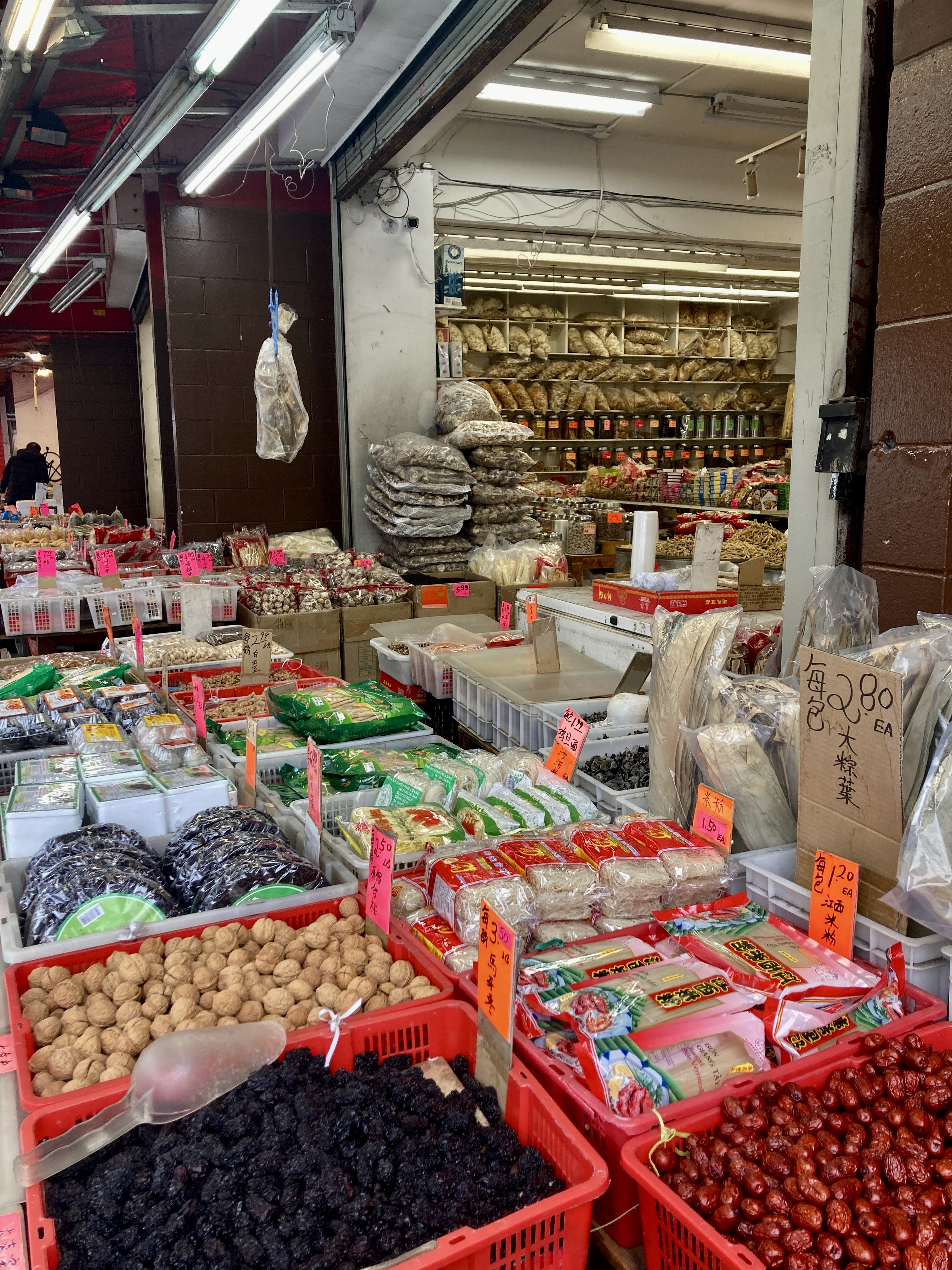
past the gloriously pungent Chinese market spilling out over the sidewalk…
and finally take myself back out to Main Street, and a bus ride home.
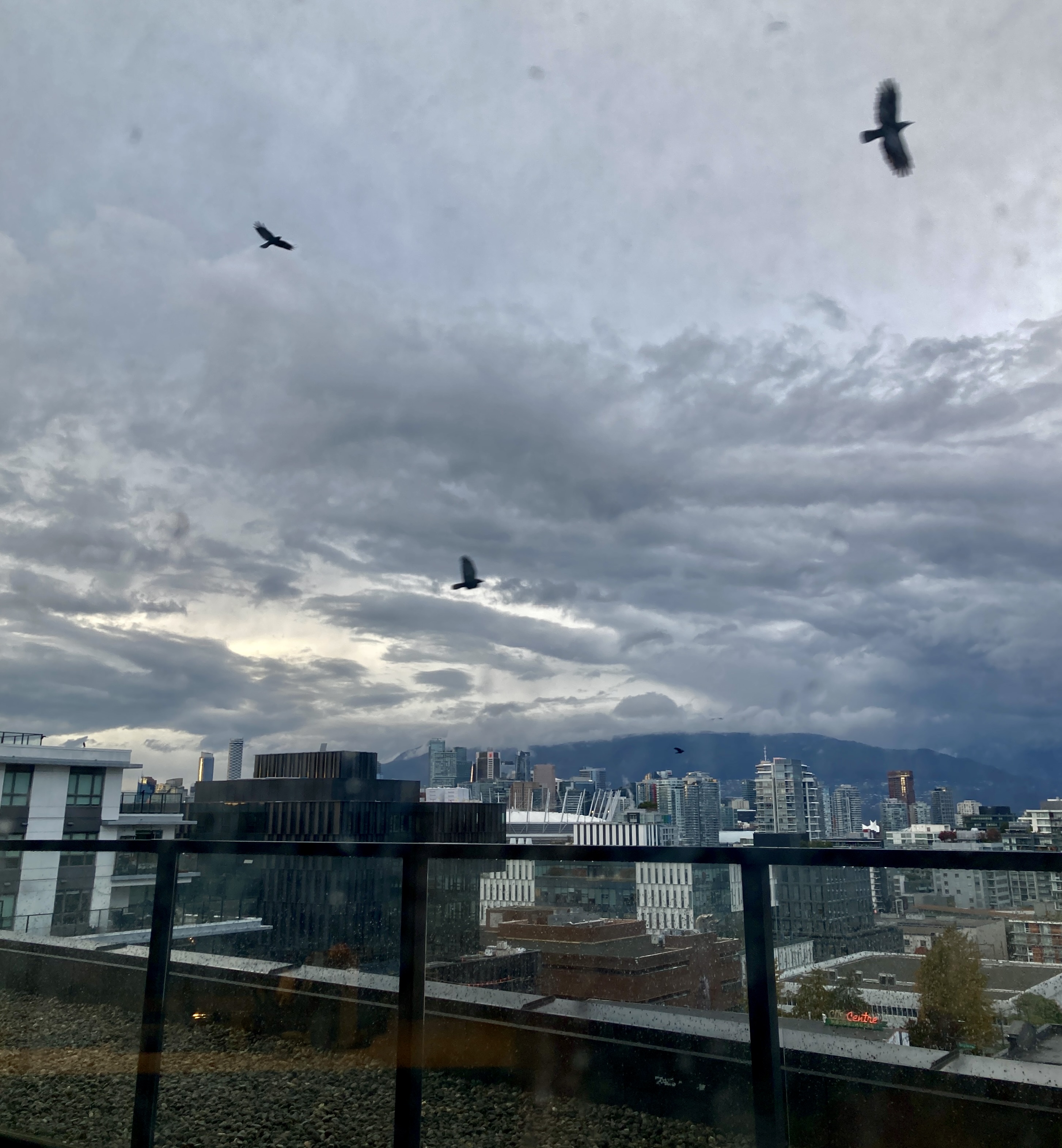
16 October 2024 – There’s “boring old Clock Time,” as I observed in my post of 13 July, and then there’s Crow Time — an infinitely more enjoyable way to measure the changing length of day. This means I can determine dawn-to-dusk by looking up the stats, or by simply looking out my window.
Crows leave their Burnaby roost for Vancouver roughly at dawn, and return from Vancouver to their roost roughly at dusk.
When I wrote about all this in mid-July, the afternoon commute passed my window at around 9:30 pm.
30 September 2024 – I expect lots of water, given my general plan for the day, but I do not expect a torrent of words. Yet, late in my walk, there it is: “a slow wet meander…” of words, albeit one closely allied with yet more water.
You’ll see.
It all starts when I hop off the westbound #19 bus, right there at the Georgia St. entrance to Stanley Park, with the waters of Coal Harbour visible on my right, and my immediate target, Lost Lagoon, not yet visible at all.
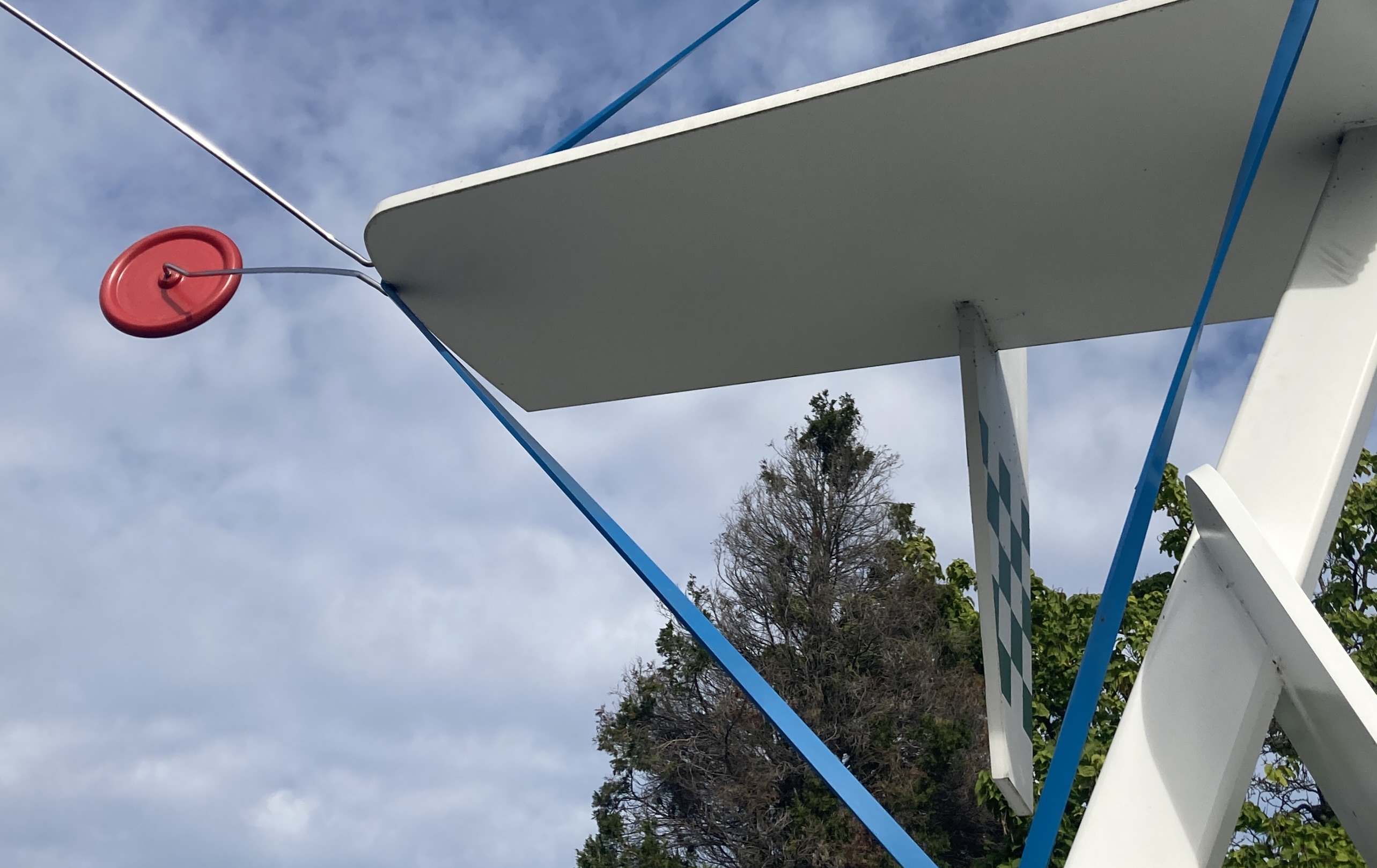
What is visible, is the 2010 sculpture by Rodney Graham, Aerodynamic Forms in Space, that marks this park boundary. Truth is, I like disaggregated bits of it better than the sculpture as a whole. This bit, for example.
I salute it, and then slide on by, down the steps, under the underpass, and onto the city-side path around the Lagoon. The path soon winds close to the water…
and offers Park and distant mountain views northward across the Lagoon…
close-ups of exotic ducks (un-exotically named Wood Duck)…
some Lost Rivulets, off-set from the Lagoon…
and a definitely Lost Footbridge…
which is even more drowned and inaccessible on the far side than it is right there.
Pretty soon I am exactly where the “You are here” bubble says I am…
namely, just steps from the Seawall at Second Beach.
The tide is wonderfully low.
Like many others, I leave the Seawall and walk right out to water’s edge. In places it is rock-strewn…
and, elsewhere, it offers long stretches of firm, wet sand.
Out there, orange-hulled freighters awaiting their turn to carry on down to the Port; here on shore, orange-shirted girls running into the waves.
The scene is happy, and there is an important message of hope and optimism in these shirts, but they commemorate something dreadful and dark: the abuses of the Indian [sic] Residential School System. These abuses battered the children physically and emotionally and, in more than 4,000 documented cases (2021 stats), caused their death. In 2015 the non-profit Orange Shirt Society was formed in Williams Lake, B.C., and began marketing tees that proclaim “the enduring truth that EVERY CHILD MATTERS, every day and everywhere.”
The inclusivity of the slogan invited, and has won, widespread acceptance. You now see the shirts on people of every ethnicity, of every age, and as every-day apparel. Today the shirts are especially appropriate. Today, 30 September, is Canada’s National Day for Truth and Reconciliation, a day to honour “the children who never returned home and survivors of residential schools, as well as their families and communities.”
All of that is now part of all of us, as it should be. I take it with me as I continue my walk.
On toward English Bay, past more sand and rocks and squealing children and tail-wagging dogs and, up there on separate Seawall tracks, cyclists and pedestrians. Finally, I head for the Seawall myself. I am ready for a city component to this walk and, I realize, more than ready for something to eat.
Out to Beach Avenue, with the A-Maze-ing Laughter sculptures in Morton Park in the middle distance, and Doug Coupland’s soaring mural on a refurbished vintage apartment tower just beyond to the right, and, closer than all that and of more immediate interest to me…
the red & white striped awnings of a hot dog stand.
Hot dog or Bavarian Smokie, it’s all 100% Alberta beef, says the hand-lettered signage, and the Calgary Girl in me nods approval. I eat my Smokie on the beach, and then…
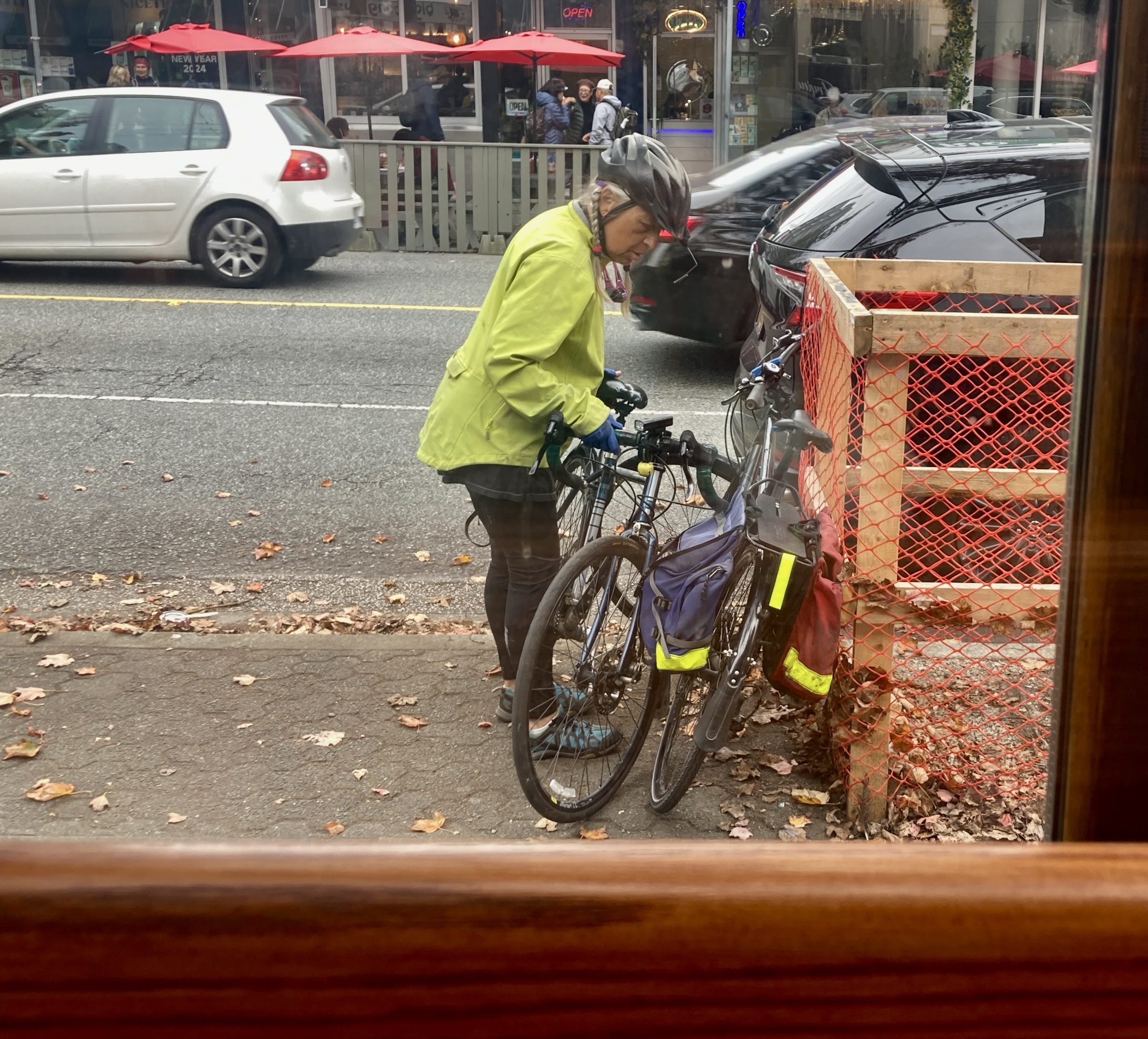
turn down Denman St. for a latte in Delaney’s Coffee House. My front-window seat gives me the inspiring view of this pigtailed cyclist, surely damn near my own age, who is not even breathing hard as she locks up her bicycle.
Next comes a zig-zag through West End Vancouver: I’ve had water & nature, now for pavement & city. A few blocks on Denman, then right turn onto Comox and I stomp right along — until I get to Broughton.
I’ve walked Comox before, I’ve passed this building before and I’ve noticed the thumping great sculpture at the street corner before: Triumph of the Technocrat (Reece Terris). What I’ve never noticed is the curling channel of water along Comox that connects with the sculpture…
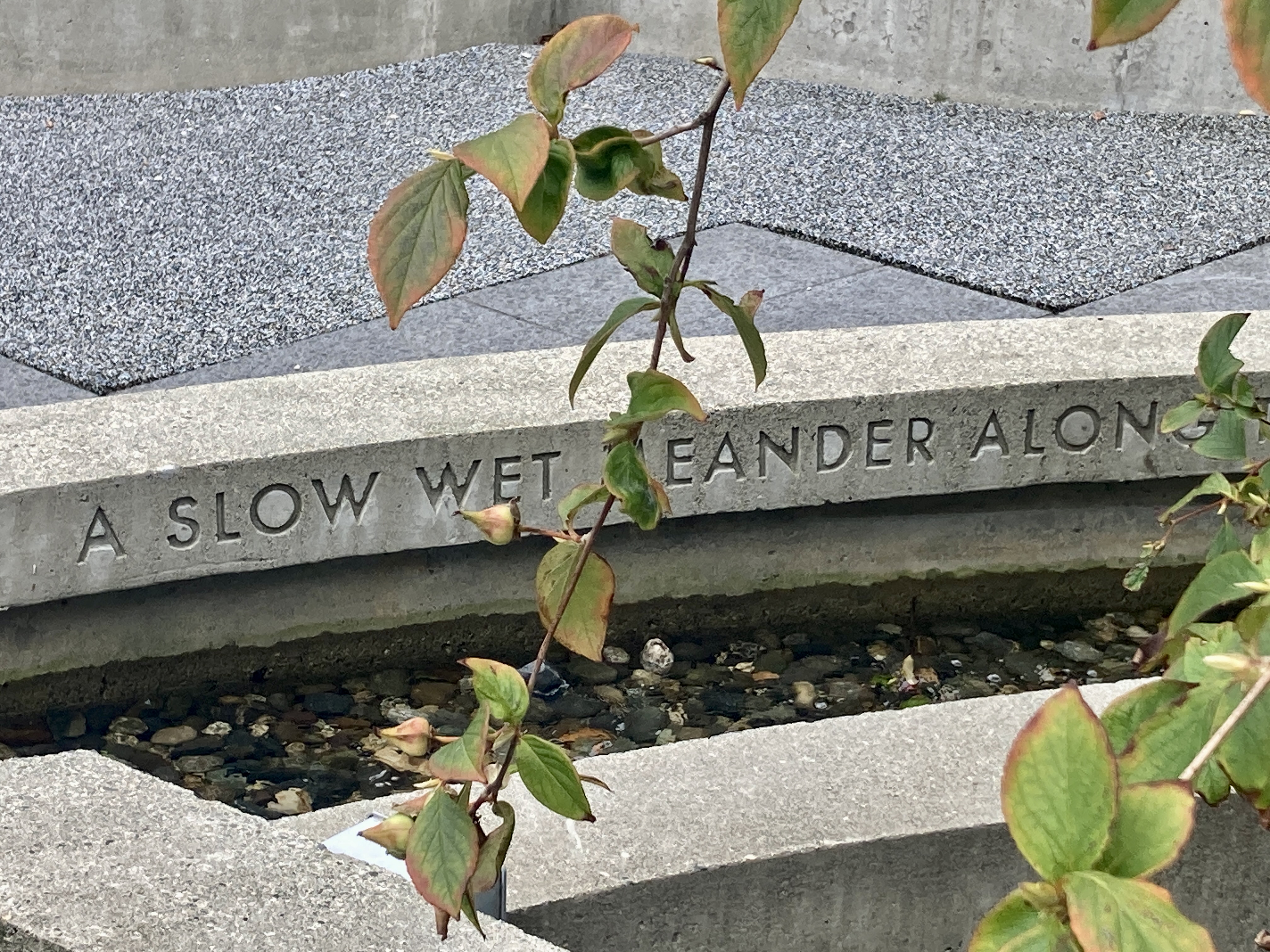
and, especially, the words incised into the channel wall.
Thanks to an article and overhead photo in The Source (issue 27 Jan – 10 Feb 2015), I can not only show you the entire channel with its pool at one end and Terris sculpture at the other…
I can also tell you the channel is the work of Vancouver landscape architects Durante Kreuk, and the text is by Vancouver artist Greg Snider.
Snider’s creation is a whole bravura torrent of words, and I want it! So I inch my way along the channel, taking pictures as I go, just in case the text is not available online.
And it is not. Or, not that I can find. So here we go, I am about to put it online — all but the bits I couldn’t catch because they are obscured by particularly vigorous lavender bushes. You’re not word-crazy? Skip the next paragraph. You are word-crazy? Settle in for the ride.
“A slow wet meander along stoned plaza of frenetic urban structure toward the demiurge of public art, the fiscal trace of exacting development moving with pythagorean acuity the eart [lavender bush…] objects of our collective culture through the bureau of civic demand, the spirit of heavenly smoke spirals from the burnt wood of transcendent aspiration over the long marsh of pantheistic decor as the seemly secular rises around us and art sluices down a crafty pipe — sleepy second [more lavender bush…] arch, techtonic upscaled for perpetuity’s long view (fifty years max) in a device for reflection called triumph of the technocrat.”
My own slow, not-wet meander now complete, I walk on. I pause one last moment on Comox, just before I turn onto Bute, for a cheerful and timely bit of sidewalk art.
Buoyed by that, I carry on — north & east, east & north — to Burrard & West Pender, where I catch a # 19 bus, and ride on home.
22 September 2024 – Time & place. Time & places. Places, through time.
Two recent days, that have me noticing the play of time across place.
Friday, I’m walking back along north-shore False Creek after a downtown lunch with a friend. I stop to read one of the railings that mark a stretch of informational glass & metal way-stations near Coopers Park.
“Look across the water,” it says, so I do. Eastward across the smooth, bright water alive with pleasure boats, ferry boats and a couple paddling their kayak.
This is 2024 False Creek, much transformed over the millennia.
Coast Salish people once fished here, in clean waters…
but the 19th c. brought sawmills, small port operations and, after the 1887 arrival of the Canadian Pacific Railway, a booming demand for railway-related services and support. The shoreline and waters were very busy…
with piles of materials and with hand labour…
but the waters were no longer so clean.
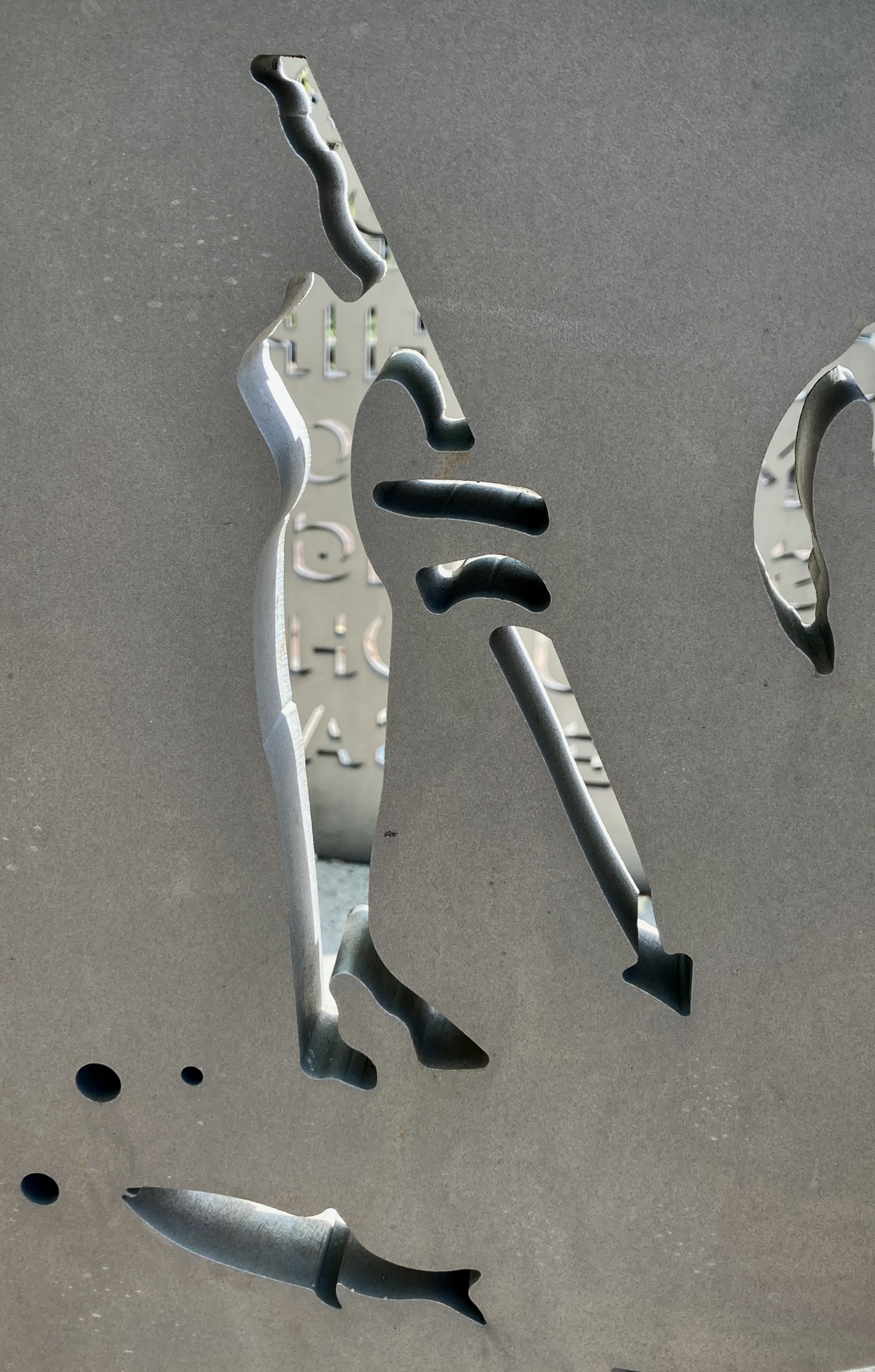
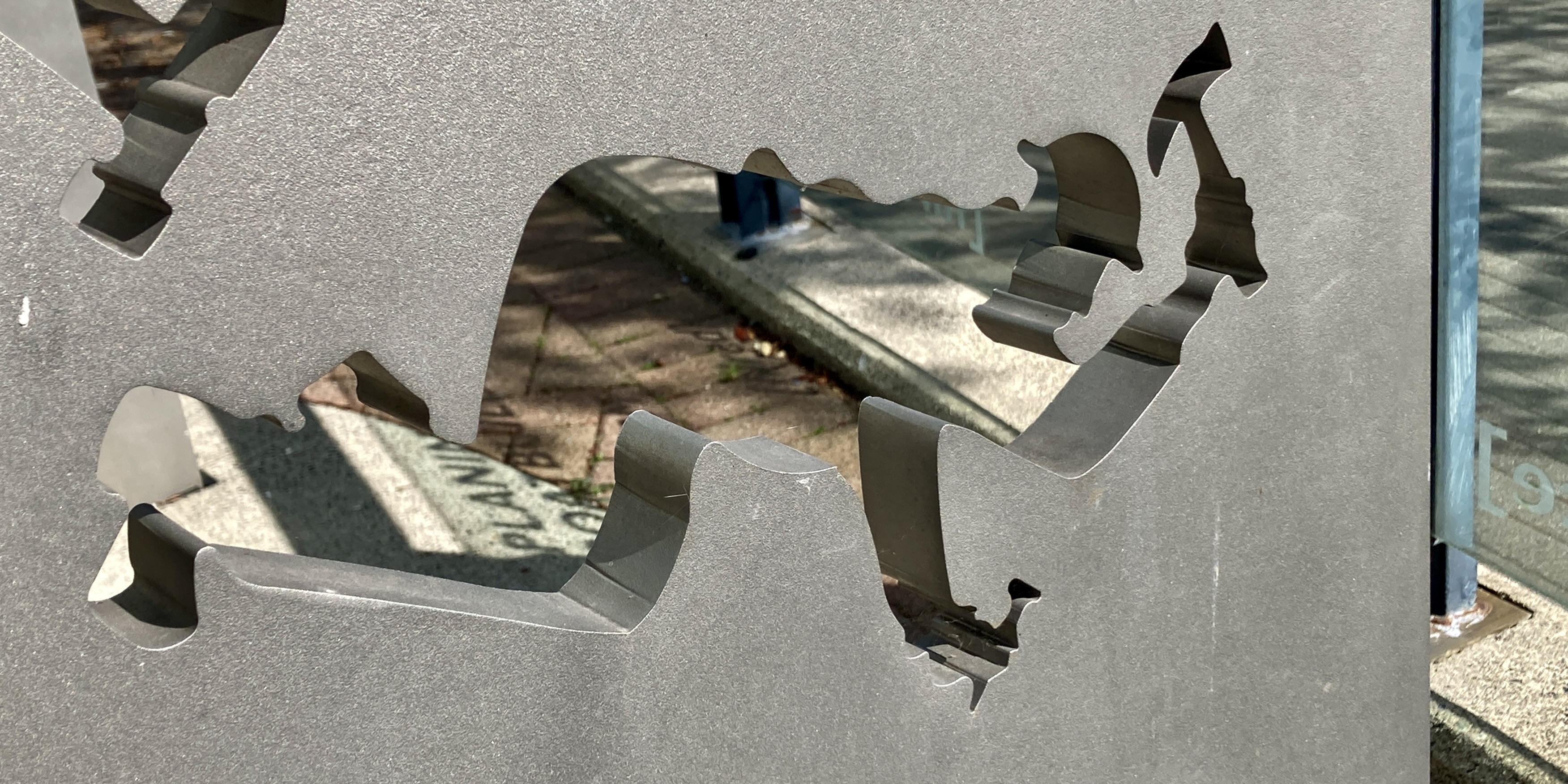
Incised words on metal panels remind us of the range of activities, of purposes, of people, across all that time.
Next big transformation: the mid-20th c. shift in industrial patterns and the post-Expo ’86 drive to restore and repurpose False Creek. Today it is recreational, and residential, and the waters are a whole lot healthier than they used to be.
I learn more about all this the very next day. Saturday morning, I am once again on the north shore of False Creek, freshly delivered to the Yaletown Dock by ferry, to join a downtown walking tour run by the AFBC (Architecture Foundation of British Columbia).
We pass the now-repurposed CPR roundhouse and walk through adjacent Yaletown, named for the small BC community where the CPR first had its construction equipment & repair shops, before relocating work to the more convenient Vancouver location.
Spare, functional Victorian industrial architecture still lines several Mainland Street blocks. The buildings now host restaurants, condos, artisan boutiques, and design and other creative small firms — but their Victorian bones still show.
Some of these structures are rightly celebrated by their current owners/tenants — for example, by Engels & Volker, whose website honours the history of this elegant former factory and warehouse at 1152 Mainland, built in 1912.
We walk on, our group weaving its way past other examples of old made new, and also of ghosts-of-old replaced by new. Layers of time, laid upon place.
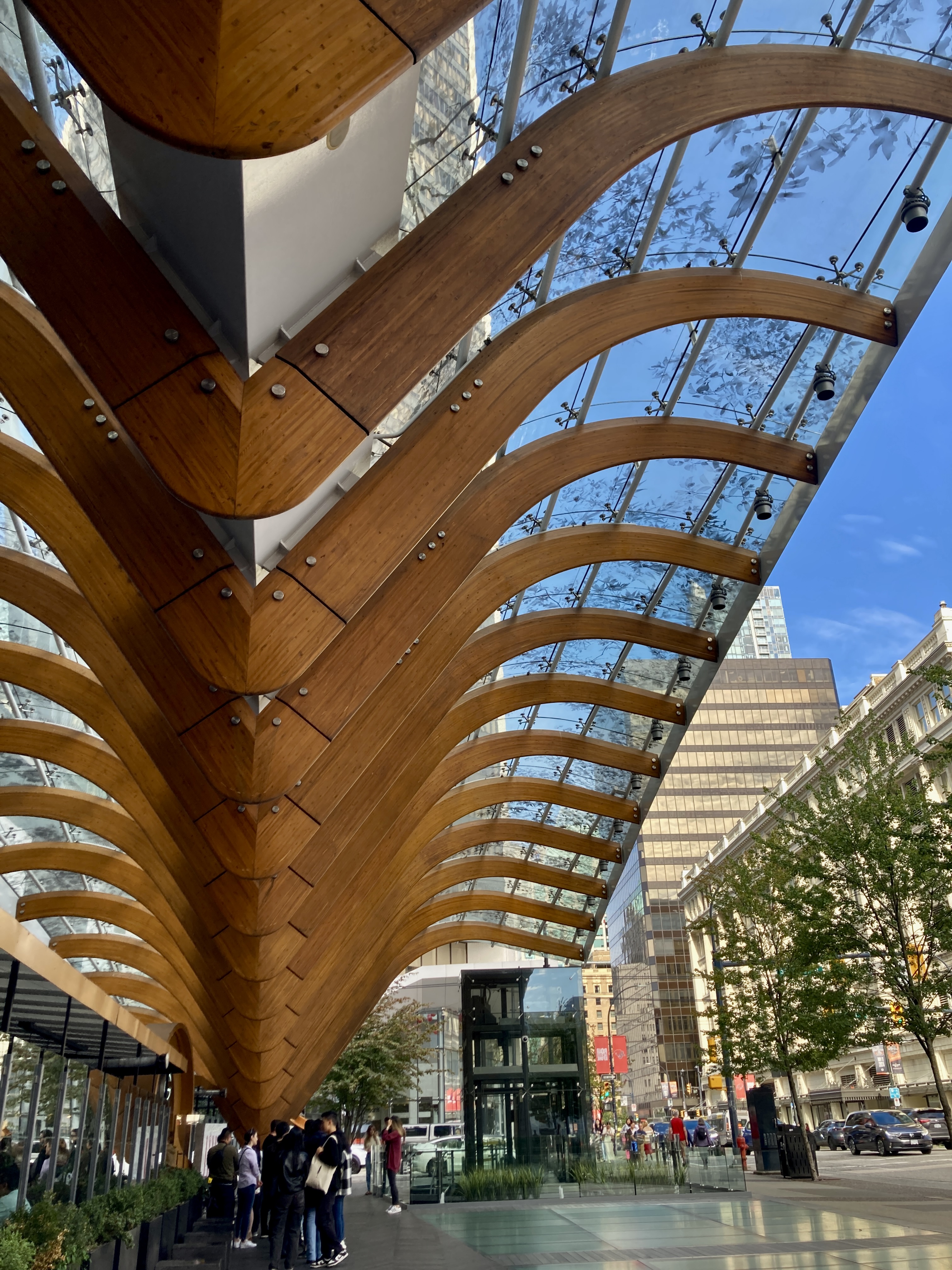
Late in the tour, we stand under the canopy of Telus Garden which, when it opened in 2015, had brought a whole downtown block into the mixed-use trend then gathering civic strength.
It was a project born of love as well as commerce: both men native Torontonians, and both grateful to the AGO because, modest as it was at the time, it introduced each of them to art and helped shape both their lives.
The AGO did a lot for me as well. As a volunteer I spent many hours in its rooms, soaking up the art and learning about things. Like glulam.
(You wondered where I was going with this, didn’t you!)
The soaring Galleria Italia, stretching 450 feet along Dundas Street, is a vaulted dance of glued laminated Douglas fir and glass.
I always loved doing a shift out on the Galleria Italia, seeing — and hearing — visitors’ reactions when they first stepped into the space. Adults politely gasped. Schoolchildren on tour, especially when coached by their guide, agreed it looked like an overturned canoe. (Though one little girl was having none of that. “It’s an armadillo,” she announced firmly.)
My favourite reaction? The little boy who barrelled through the doors well ahead of his mother. He screeched to a halt, swivelled his head in stunned amazement and then, just as his mother caught up with him, leapt in the air, arms flung high. “WOW!” he yelled, his fists punching the air.
"Traveller, there is no path. Paths are made by walking" -- Antonio Machado (1875-1939)
"The voyage of discovery is not in seeking new landscapes, but in having new eyes" -- Marcel Proust (1871-1922)
"A city is a language, a repository of possibilities, and walking is the act of speaking that language, of selecting from those possibilities" -- Rebecca Solnit, "Wanderlust: A History of Walking"







































 WALKING WOMAN