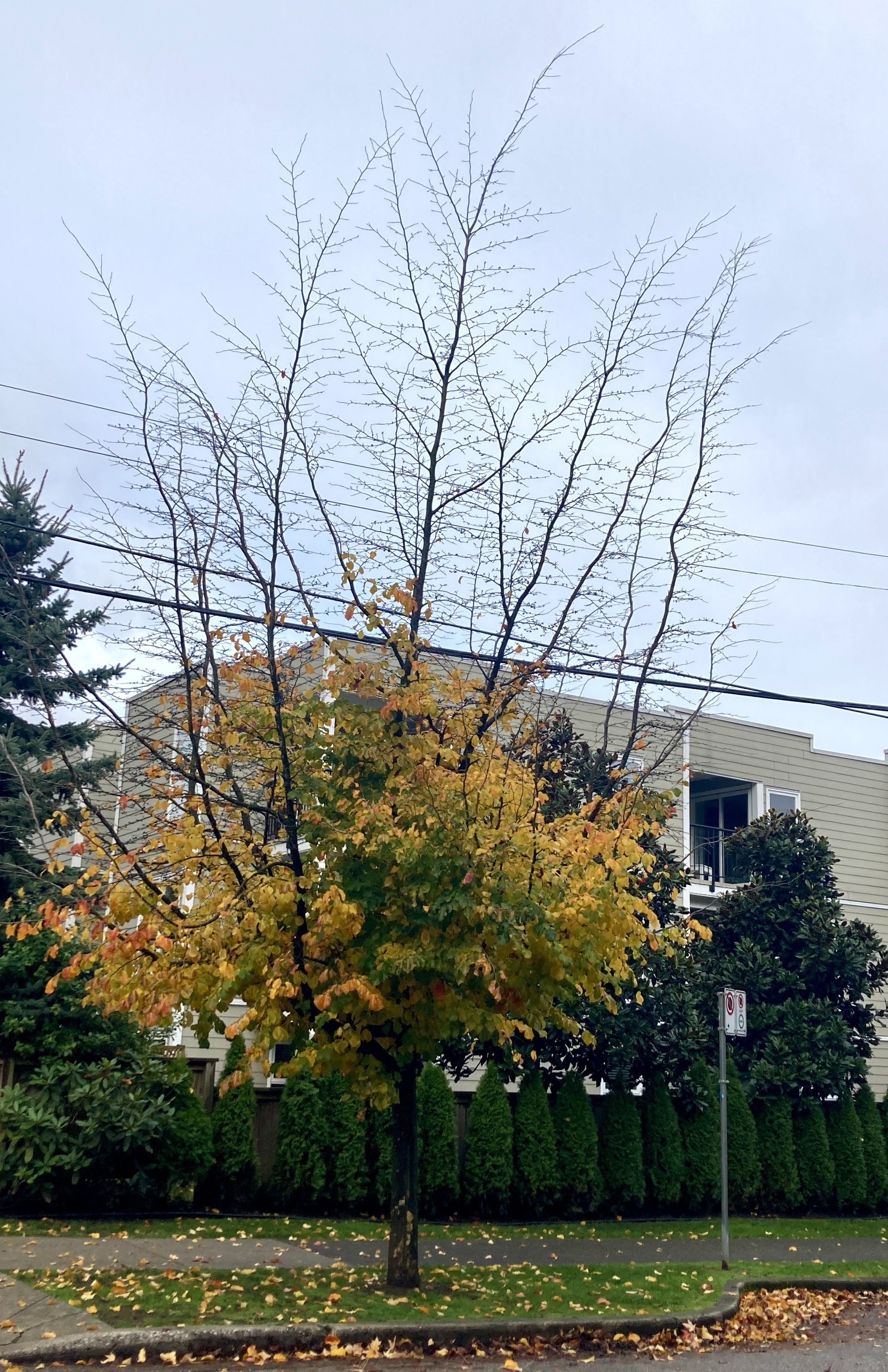
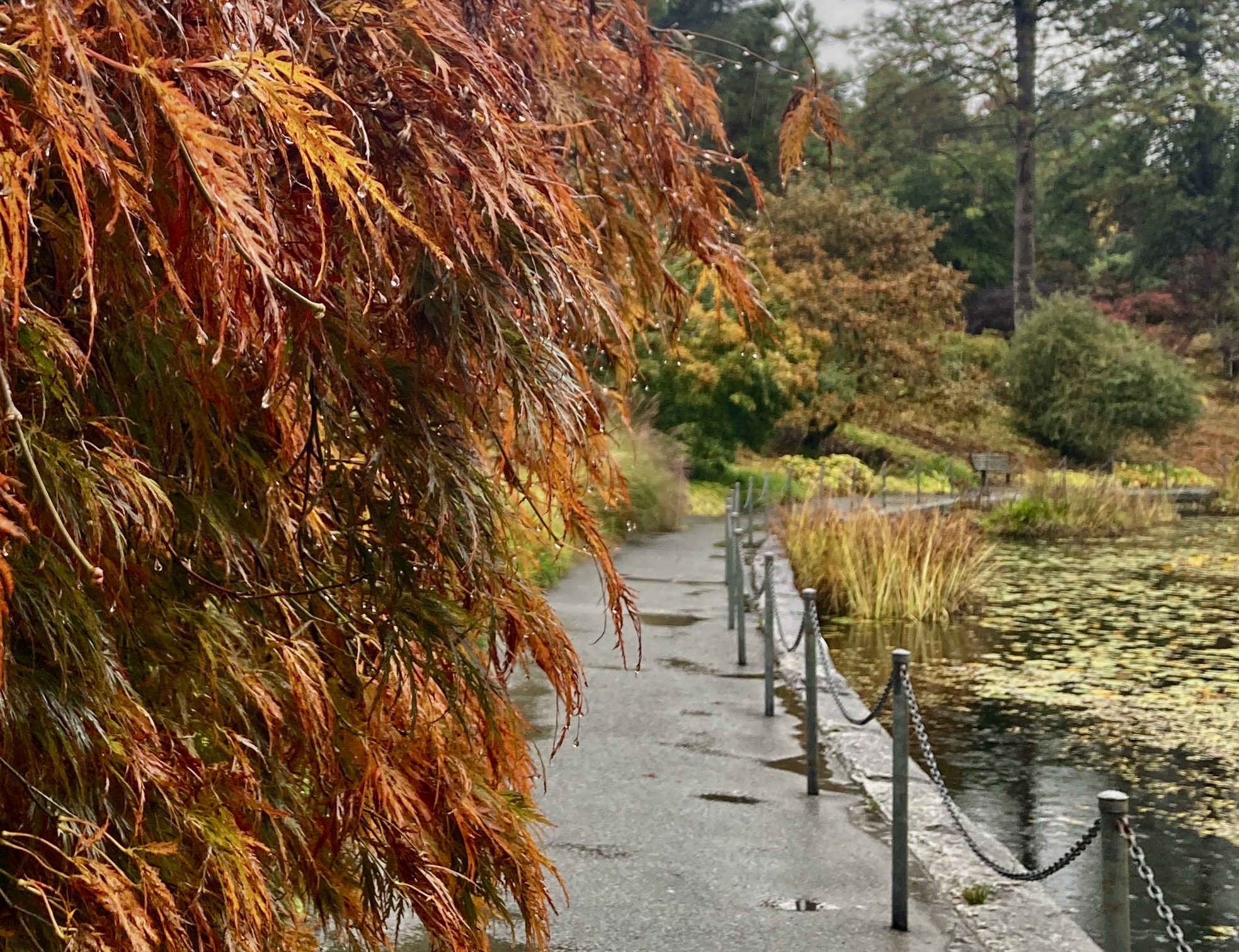
7 November 2024 – I walk along, getting some early-morning daylight into my system. I see that, even this late in the season, some leaves are still putting on a bravura show.
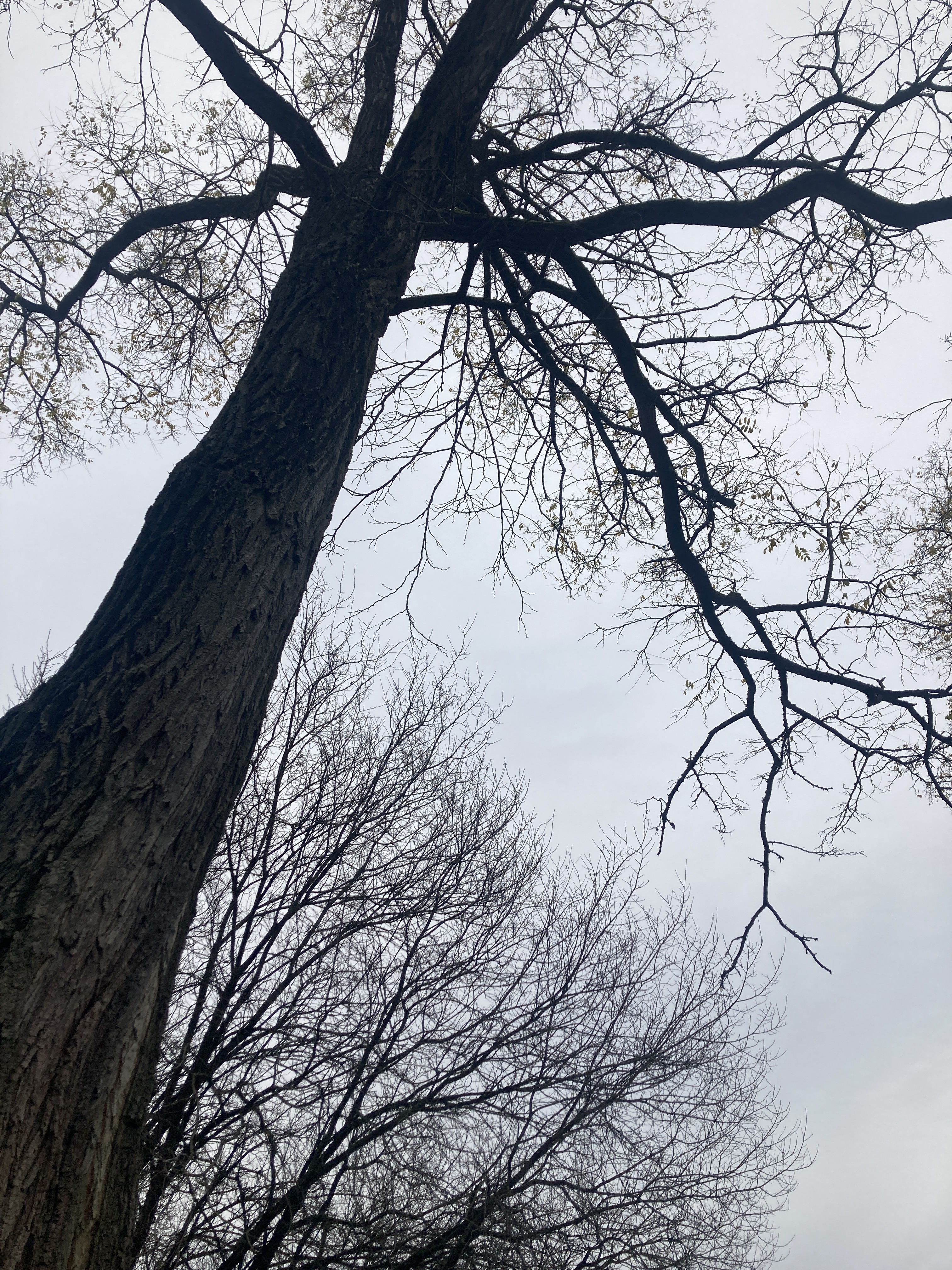
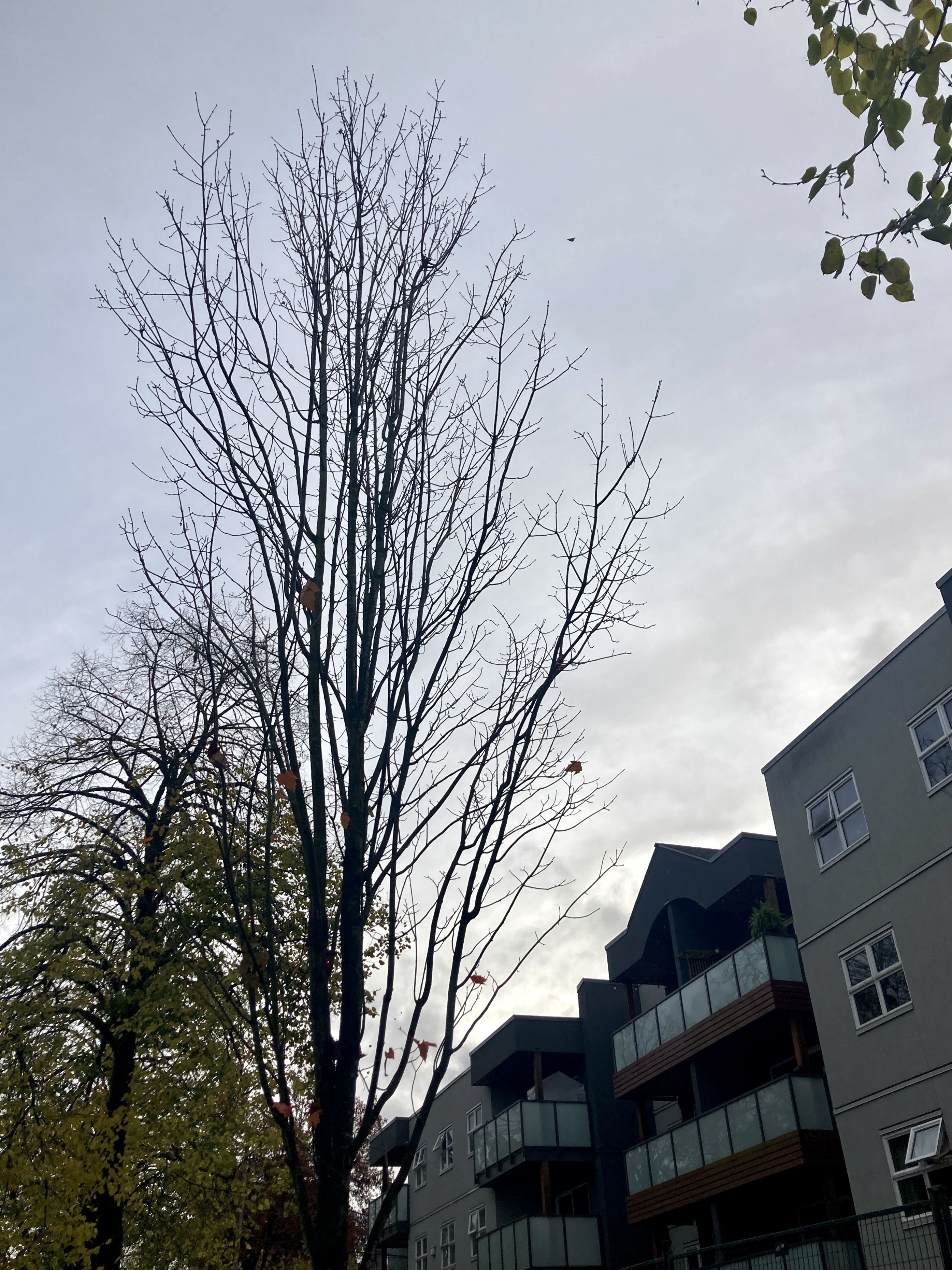
Then I look up. Up a bare tree trunk, all the way up, up & out over the street.
I see what no-leaves can do.
I stare at it in absolute delight. I narrow my eyes. Do an imaginary zoom for tighter focus.
It’s the dance of the fractals, isn’t it? Right there above my tip-tilted head. Some time does pass, before I lower my gaze.
Only to see a little girl, staring at me with the same intensity I have just given to those tree branches. It is a child’s stare — curious, open, honest, without malice. But still a little unnerving.
“Hello,” I say, “I like the monster on your coat.” (A happy monster in minimalist design, all bright eyes and friendly fangs, if you can picture it.) She giggles. “I like him too.” Her waiting mum leans back against the car, reassured about the way this bit of sidewalk interaction is progressing.
“My coat has pockets,” says the child, patting one for emphasis.
“Mine too!” I cry, patting mine as well. “I like pockets. You can put stuff in them.”
She nods. “And,” she adds — clearly a parting comment, mum is opening the car door — “and, when it’s cold, you can put your hands in your pockets too!”
With that, we go our separate ways, she to day-care and I to Dude Chilling Park, Sahalli Park and points all around.
(Please note: my coat pockets now contain gloves.)
3 November 2024 – This side of the equator, in this latitude range, deciduous trees are well into their annual sylvan strip tease.
They shed their leaves…
and shimmy through the winter in their bare branches.
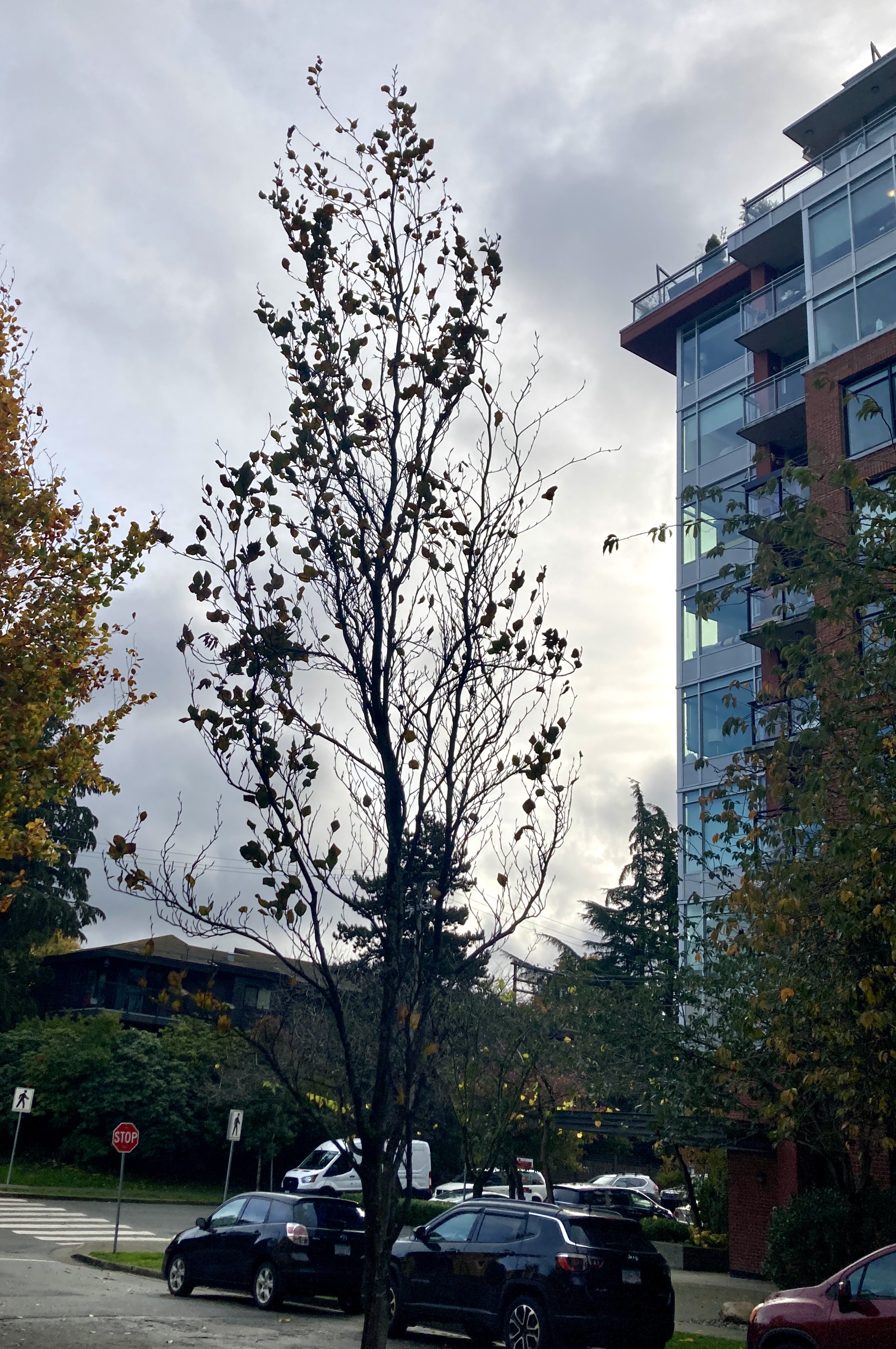
Some trees strip from the top down, clinging to their knickers…
some strip from the bottom up, clutching their camisoles….
and some fling off their leaves any old which-way.
Some, like these front-door guardians, hang on defiantly, still full-dressed and glowing bright…
while others are already full-naked, brown/black against the sky.
The evergreens are wonderful and rich, I love their year-round colour, their generous textures and dimensions…
but… oh… just look at the stark, bold power of this naked silhouette. (Not to mention its effortless demonstration of fractals. Why beat your brain with formulae, when you could just go look at a tree?)
I am mostly tree-struck, on this walk, but as I weave my way back from Sahalli Park I notice some other things as well.
A few left-over Hallowe’en pumpkins (so three days ago!)…
the punchiest little free library ever, tucked into its embracing greenery…
(where to my amazement I am able to pick up a copy, in its original French, of the 1948 landmark political/ cultural/artistic Québec manifesto, Refus global)…
and, framed by bare branches (L) and evergreens (R) and a crimson vintage Mount Pleasant home, ‘way over there across Burrard Inlet and high on Grouse Mountain…
the season’s first snow.
Snow!!
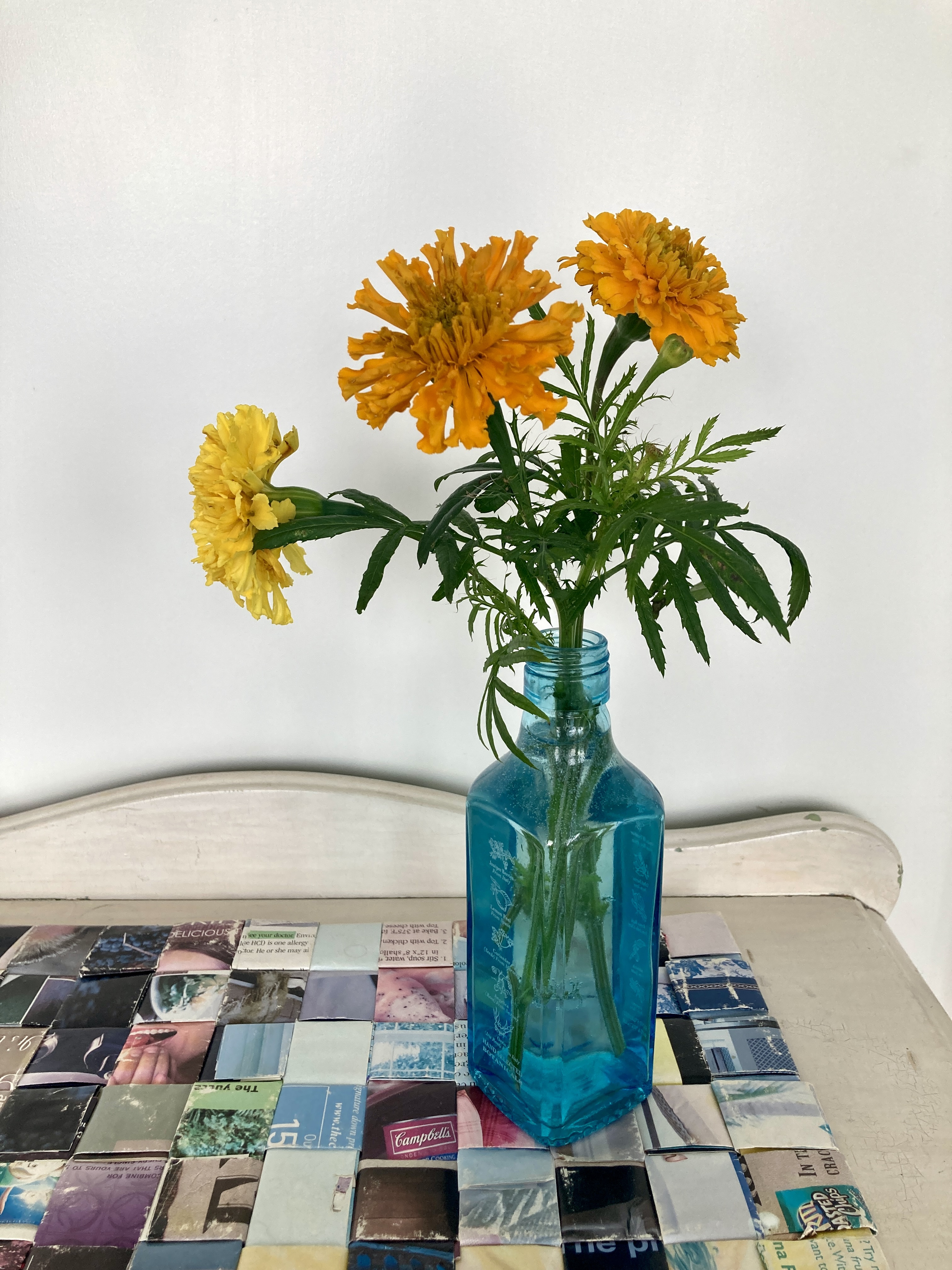
I head home, chilled fingers suggesting it really is time to dig out some gloves, and stop at the door long enough to pick a few of the last surviving marigolds in our street-front display.
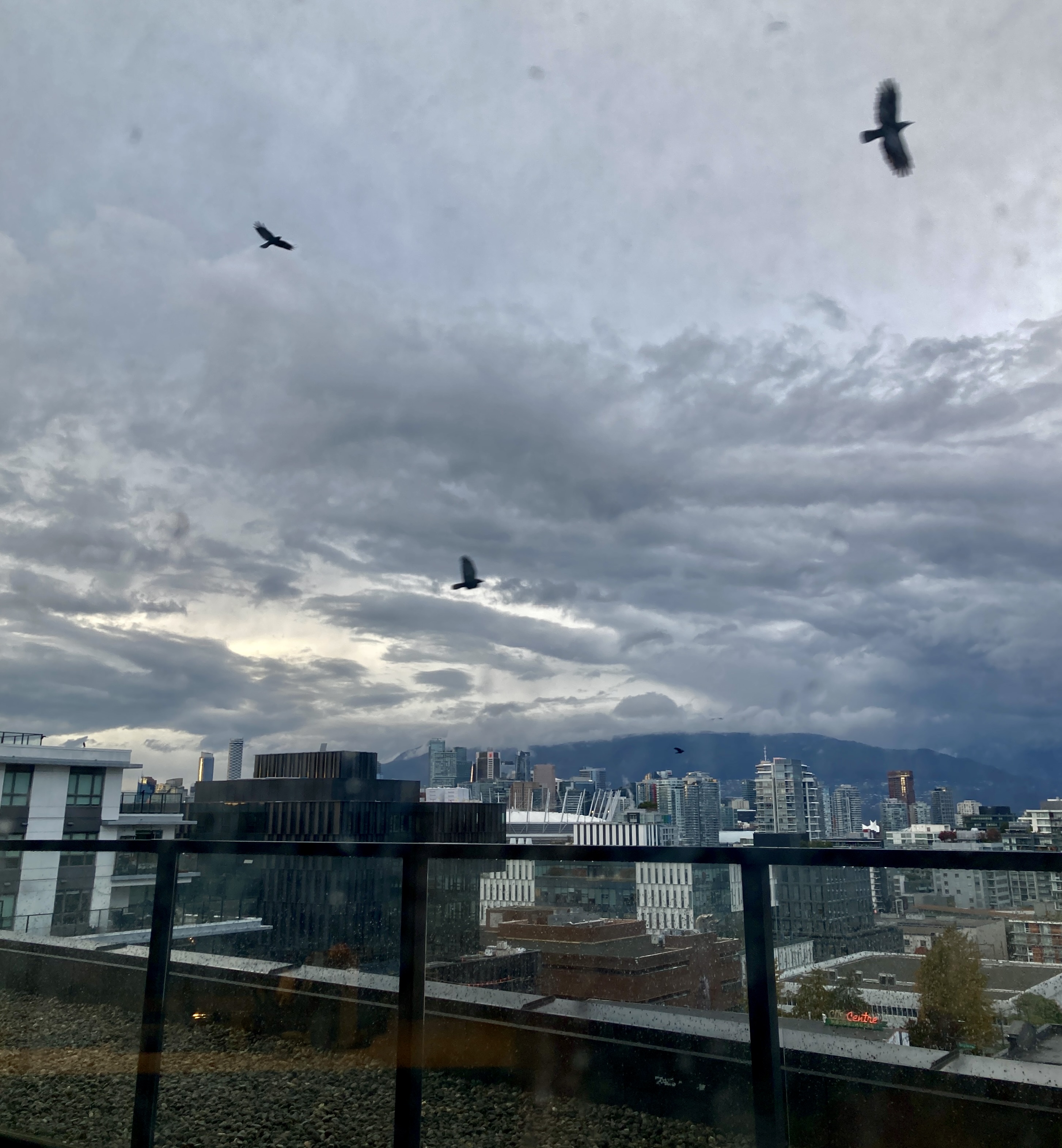
31 October 2024 – This little theme launches itself early yesterday evening, as I look out my window at a determined crow, en route his Burnaby roost in the driving rain.
It continues today, happily not in rain, as I walk homeward along False Creek. from the foot of Davie Street.
Where I see:
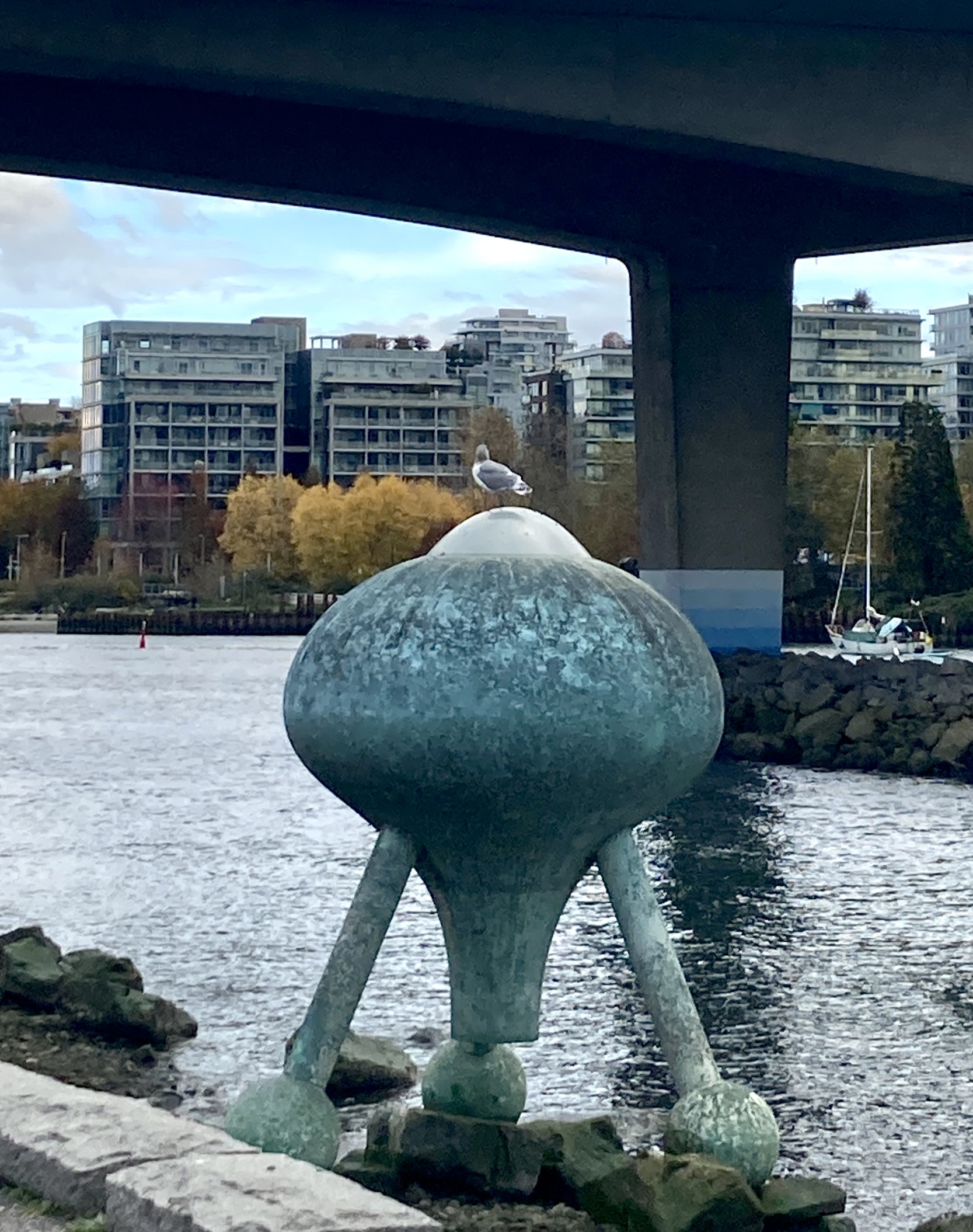
a seagull briefly resting on Jerry Pethick’s Time Top, en route (as wing direction soon suggests) Yaletown or thereabouts…
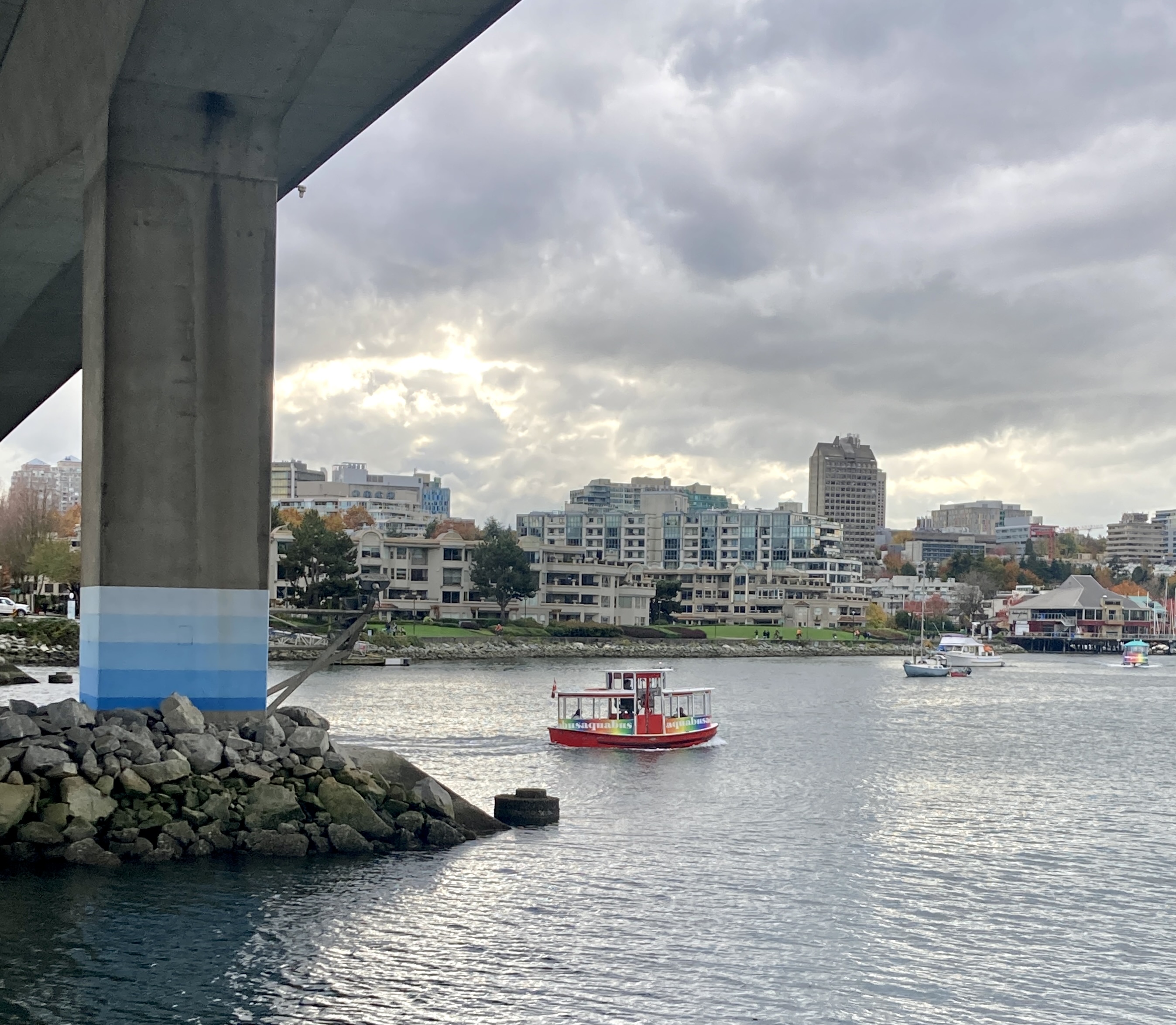
an Aquabus ferry en route the David Lam dock…
an impatient dog en route the Coopers’ Park off-leash dog park (once his owner stops fiddling with the gates)…
a flurry of leaves next to Coopers’ Park en route nowhere at all, but having themselves a brief moment of airborne excitement…
a young woman en route an even more limber body, at the Seawall in front of Coopers’ Park…
a Zipply courier en route his client, providing said client (per the website) with “a zero-emissions delivery solution,” all this in front of Cirque du Soleil’s production of Echo, en route (but not until February 2025) Houston, Texas…
and finally…
bus-riders, motorists, cyclists & pedestrians, collectively en route…
to everywhere they want their Compass cards, fuel tanks, legs & lungs to take them.
16 October 2024 – There’s “boring old Clock Time,” as I observed in my post of 13 July, and then there’s Crow Time — an infinitely more enjoyable way to measure the changing length of day. This means I can determine dawn-to-dusk by looking up the stats, or by simply looking out my window.
Crows leave their Burnaby roost for Vancouver roughly at dawn, and return from Vancouver to their roost roughly at dusk.
When I wrote about all this in mid-July, the afternoon commute passed my window at around 9:30 pm.
14 October 2024 – The second Monday in October and here we are: it is Thanksgiving.
Indigenous peoples have long honoured nature’s bounty; in 1578 Sir Martin Frobisher and crew celebrated their safe arrival in eastern Arctic waters (now Nunavut) with salt beef, biscuits & mushy peas; in 1606 Samuel de Champlain founded the Ordre de Bon Temps (Order of Good Cheer) to encourage settlers in New France (feasting and musketry volleys); in the 1750s what we now view as the traditional fare — turkey, squash, pumpkin — became common in Nova Scotia. Our Thanksgiving celebrations have gone on from there — finally, officially, settling on the second Monday in October by a 1957 Act of Parliament.
Back to 2024. Yesterday was the last Farmers’ Market of the season in Dude Chilling Park. By the time I arrive, late in the day, a lot of the produce has been snapped up. My own purchases are non-trad: a bag of pierogis and a jar of Malvani simmering sauce, both made by descendants of immigrants who brought these recipes with them. Traditional fare is still available as well, albeit in depleted quantities.
Tomatoes, for example…
squash…
and even squash that needs an explanation.
This Thanksgiving morning I visit our wonderful rooftop garden. I’m eager to see how much the pumpkins have grown since I photographed one of them during our Garden Party up there on 9 September.
Here’s what I saw then.
Here’s what I see this morning.
What did I expect?
Of course everything has been harvested, clipped, tidied away!
5 October 2024 – A theme that has unexpectedly imposed itself, and yes in places it’s a bit of a stretch, but you’ll work with me on this, won’t you?
First up, a photo from a few days ago, taken not with any tribute in mind, but simply as a cityscape moment: the dome of a heritage building against a lowering sky, framed by tram wires and traffic lights.
But I can pull it into the tribute theme. It is a tribute (A) to the Carnegie Foundation capital grants that sparked the creation of public libraries all over the world, including, in 1903, this one at Main & East Hastings in Vancouver; and, (B) to the City of Vancouver that restored and revived the building and reopened it in 1980 as the Carnegie Community Centre, a new name and new breadth of services for the same core purpose — respect, support and more opportunities for people who need them.
Today’s outing had no theme in mind. Well, none beyond visiting two parks on the eastern edge of the city — one for the first time — and then walking residential streets back home.
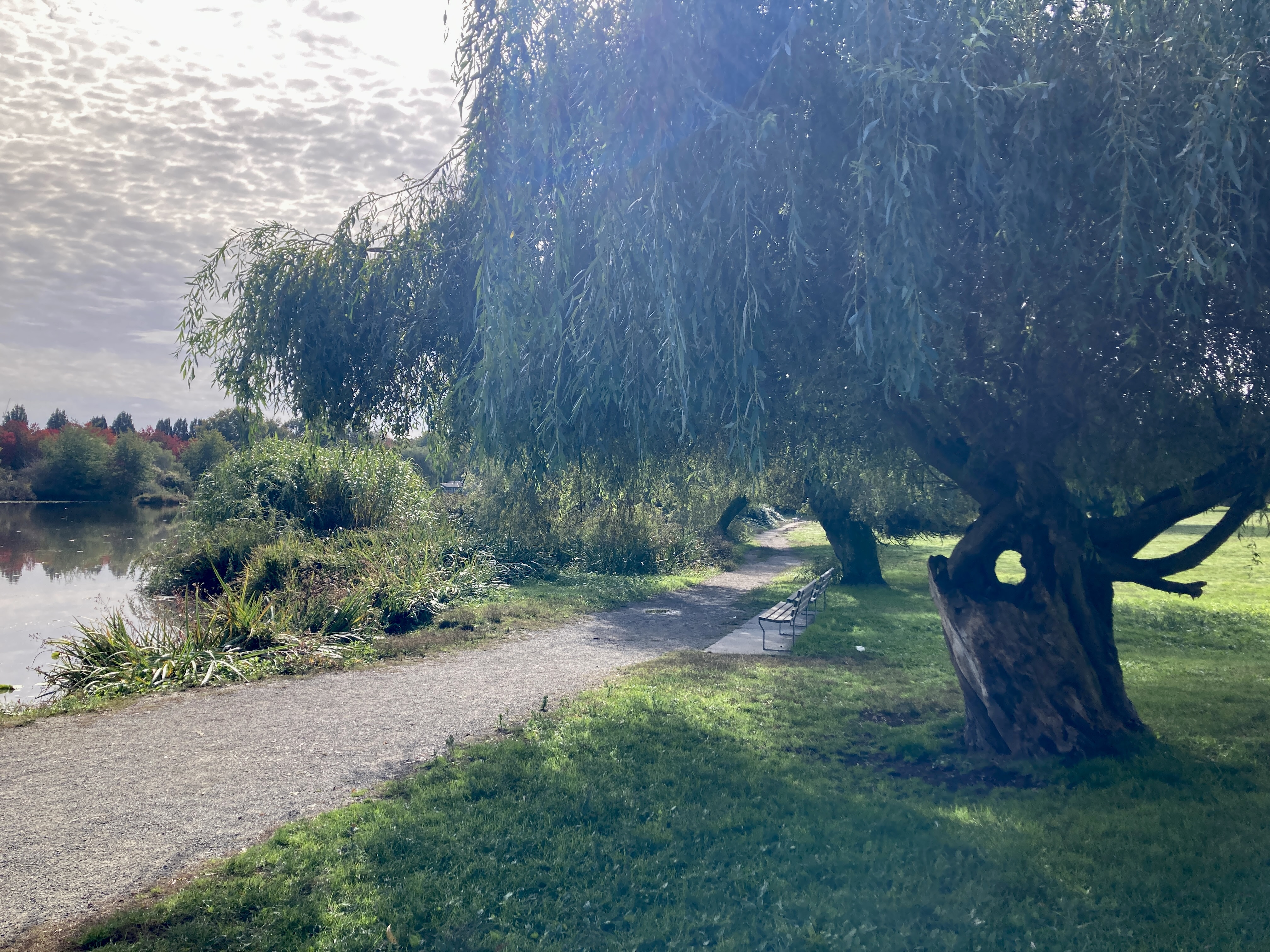
And if I must, I’ll defend this bucolic shot of Trout Lake in John Hendry Park…
by saying, “Yah, well, it’s my tribute to a weeping willow doing what weeping willows do best, plus look at the fancy trick it plays with its trunk!”
(You are, however, allowed to roll your eyes.)
It’s en route the next park — Clark Park (second-oldest in the city and, official blurbs point out, “the only one that rhymes”) — that, still unbeknownst to me, the tribute theme starts to gain traction.
I’m on East 14th, moving right along because I’m eager to cross Commercial Drive and set foot in the Park-That-Rhymes for the very first time.
And I stop.
This is odd. Where some previous tree trunks have twee little “fairy houses” as adornments, this one has two mugs.
Deliberately there, pushed into place.
I lean in.
I don’t know if this is a tribute from Mike & Ella, or to Mike & Ella, but tribute it surely is. I am ridiculously pleased that, on July 23, 2022, such a good time was had by all.
Next tribute, the other side of the Park-That-Rhymes, and the other side of its other street boundary at that, on East 15th.
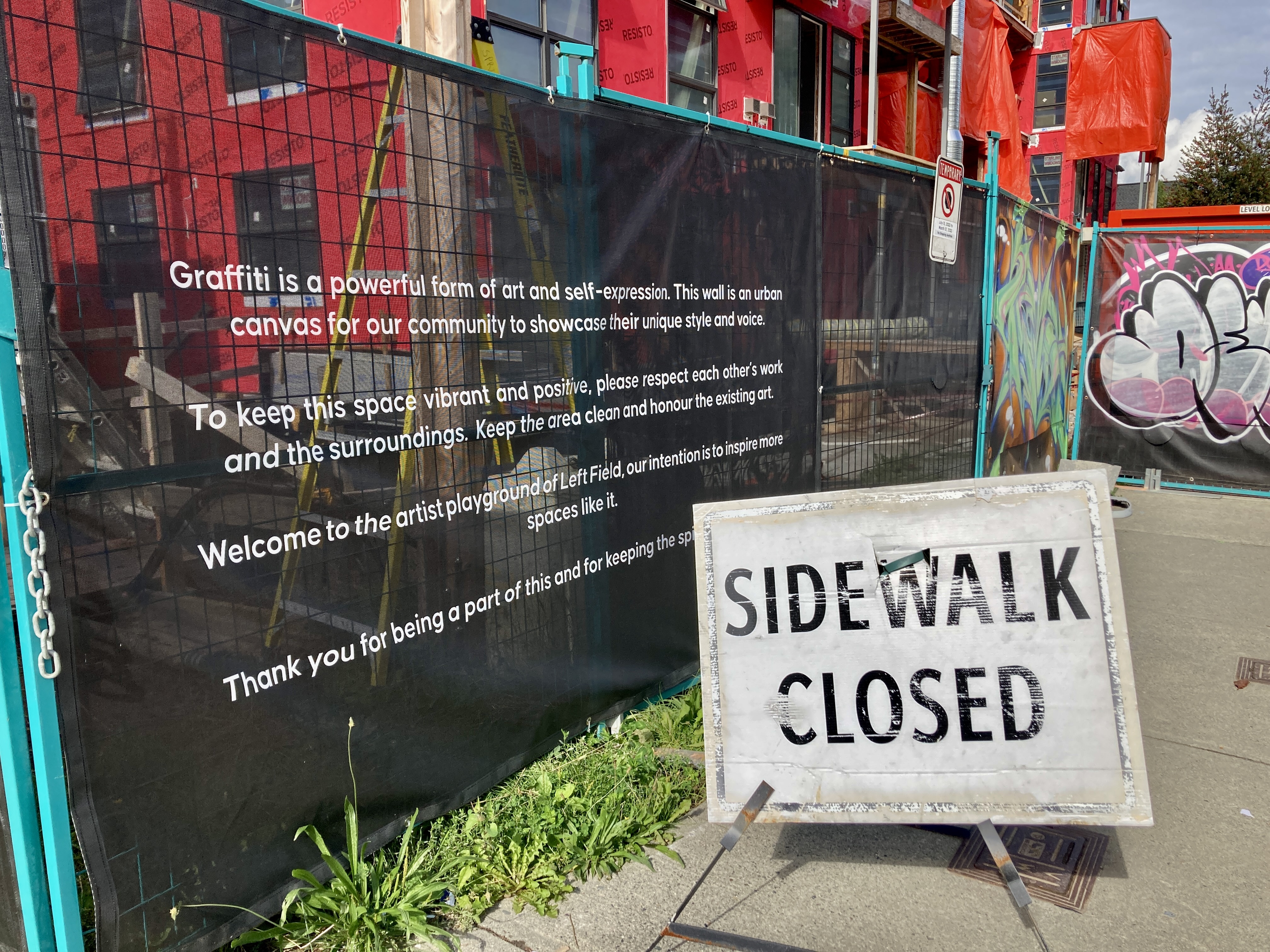
It is a tribute to graffiti. By a developer. Really.
Conceptually, I am totally in favour. Aesthetically, I wish the resulting murals were more interesting.
And then I run into busy Knight St., and it’s horrible and crowded and there’s no near-by traffic light to get me to the other side and suddenly trying to continue west seems like a bad idea. So I stomp north on Knight for a bit, and catch a bus to take me even farther north, where I’ll jump off and go walk through Strathcona for a while.
Off a bus at Clark & William, and I wander north-westish for a while and suddenly know where I am.
I’m on the edge of freight train tracks and if I follow them, I’ll slide in behind Parker Street Studios, a wonderfully delapidated collection of buildings that manage to stay upright and house lots of creative studios.
Yes, look! A mannequin at the door, and train tracks beyond.
These buildings and everything in/on/around them — all a tribute to creativity. (And survival.)
Lots of art up and down the outside walls, as I walk along the tracks-side of Parker Street Studios, but this free-standing tripod creation is my favourite:
Finally across the tracks and a bit farther north & west, and I’m in Strathcona. I zig and I zag and I stop for some lunch and much-needed glasses of water at the Wilder Snail café, and then I straight-line it across Keefer Street, heading for Main and a bus uphill to home.
I’m deep into Chinatown, practically at Main, when my eye is snagged by one more mural, in the alley just before the intersection.
Yucho Chow, yes.
I remember watching a documentary about his life and work, the city’s first professional Chinese photographer who, from 1906 to 1949, documented not just the lives of Chinese immigrants but of many other ethnicities as well — people who weren’t comfortable going to white photographers, given the power structures of the day. This link takes you to a portal page about Yucho Chow, because the page includes lots of video options as well as text websites, and shows his importance to our records of life in this city.
I keep reading the alley wall, and realize that one tribute leads to another.
Bottom left corner of the photo above, you’ll see the words “Time for changes” and a name, the name of the artist who painted this mural. The name is in black, hard to read: Smokey D.
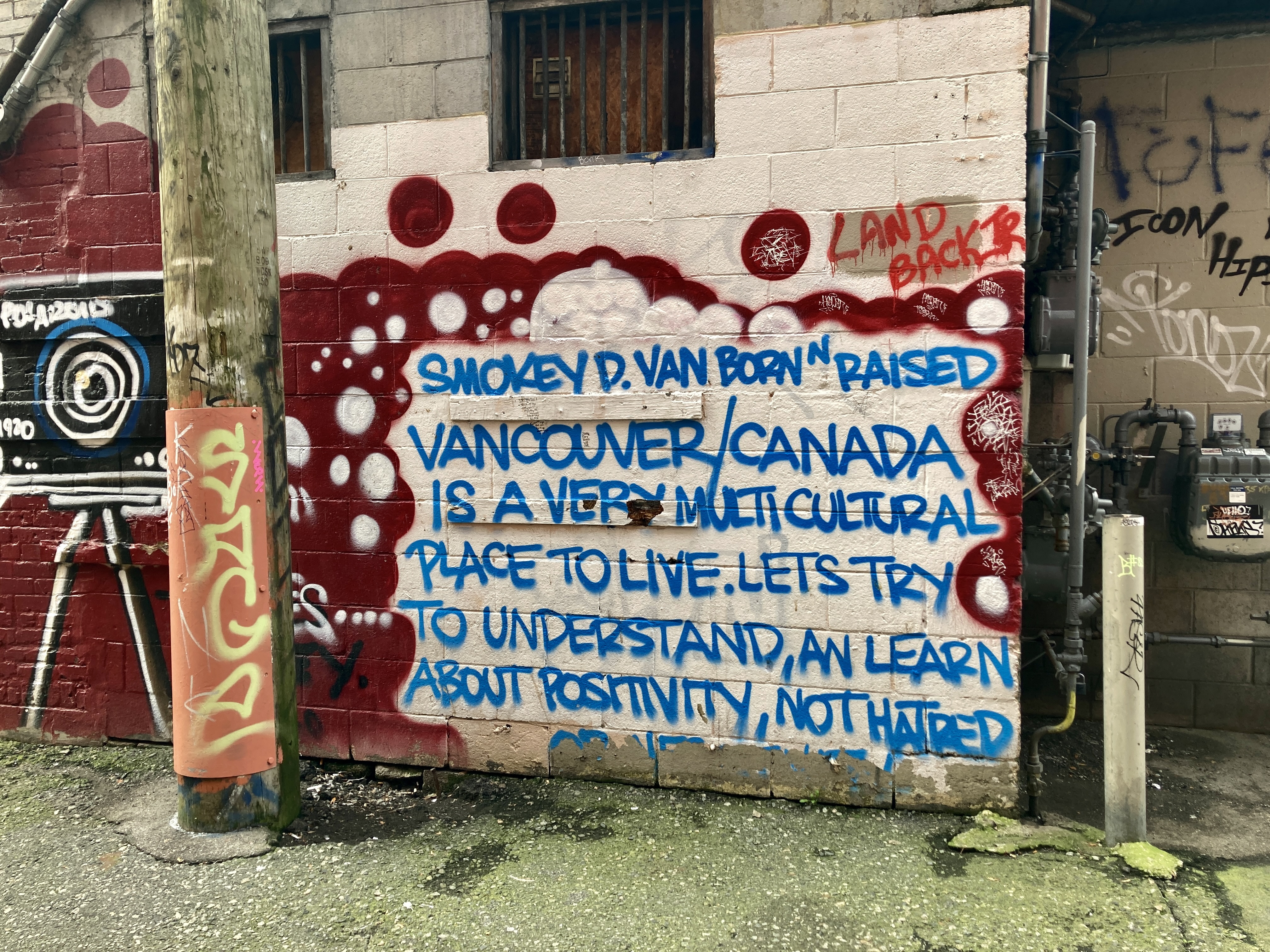
I take a few steps farther into the alley, just past that wooden utility pole, and find the next tribute.
By Smokey D. to the city. (I later learn online that the City, in return, paid tribute to him by proclaiming March 11, 2023, his birthday, as Smokey D Day, honouring his artistry and activism on behalf of the Downtown East Side community.)
There’s one final tribute in all this, don’t you think?
30 September 2024 – I expect lots of water, given my general plan for the day, but I do not expect a torrent of words. Yet, late in my walk, there it is: “a slow wet meander…” of words, albeit one closely allied with yet more water.
You’ll see.
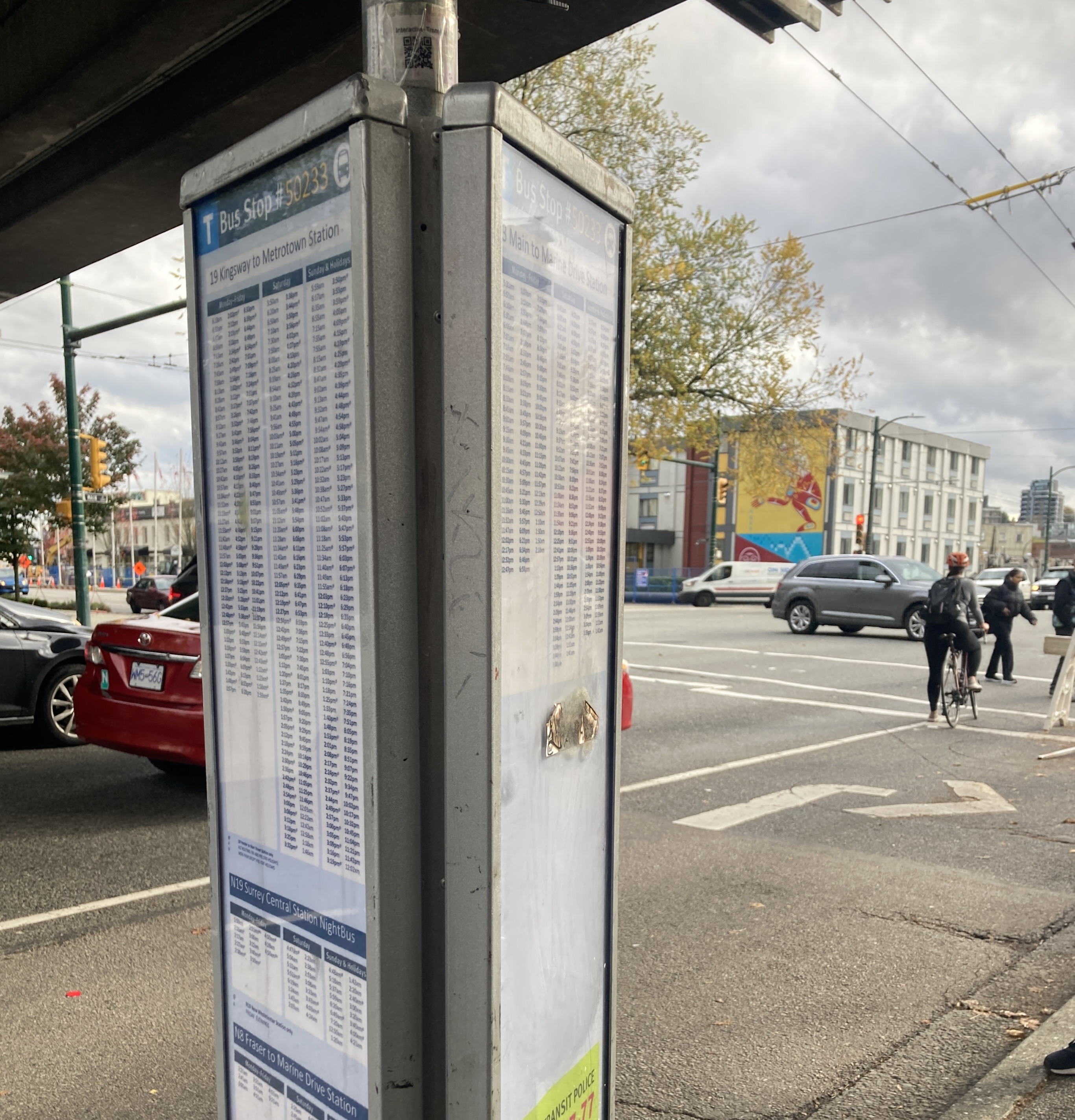
It all starts when I hop off the westbound #19 bus, right there at the Georgia St. entrance to Stanley Park, with the waters of Coal Harbour visible on my right, and my immediate target, Lost Lagoon, not yet visible at all.
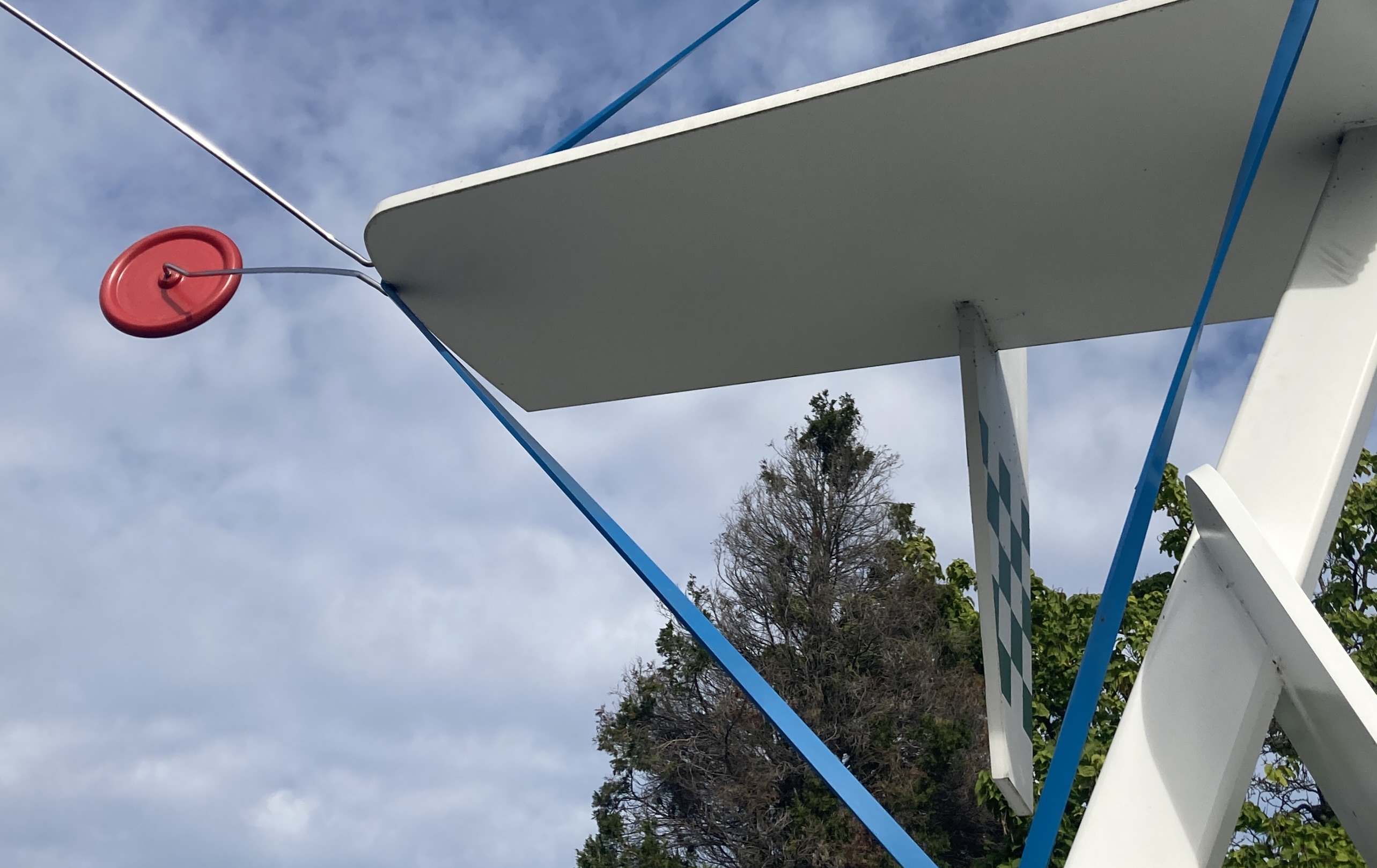
What is visible, is the 2010 sculpture by Rodney Graham, Aerodynamic Forms in Space, that marks this park boundary. Truth is, I like disaggregated bits of it better than the sculpture as a whole. This bit, for example.
I salute it, and then slide on by, down the steps, under the underpass, and onto the city-side path around the Lagoon. The path soon winds close to the water…
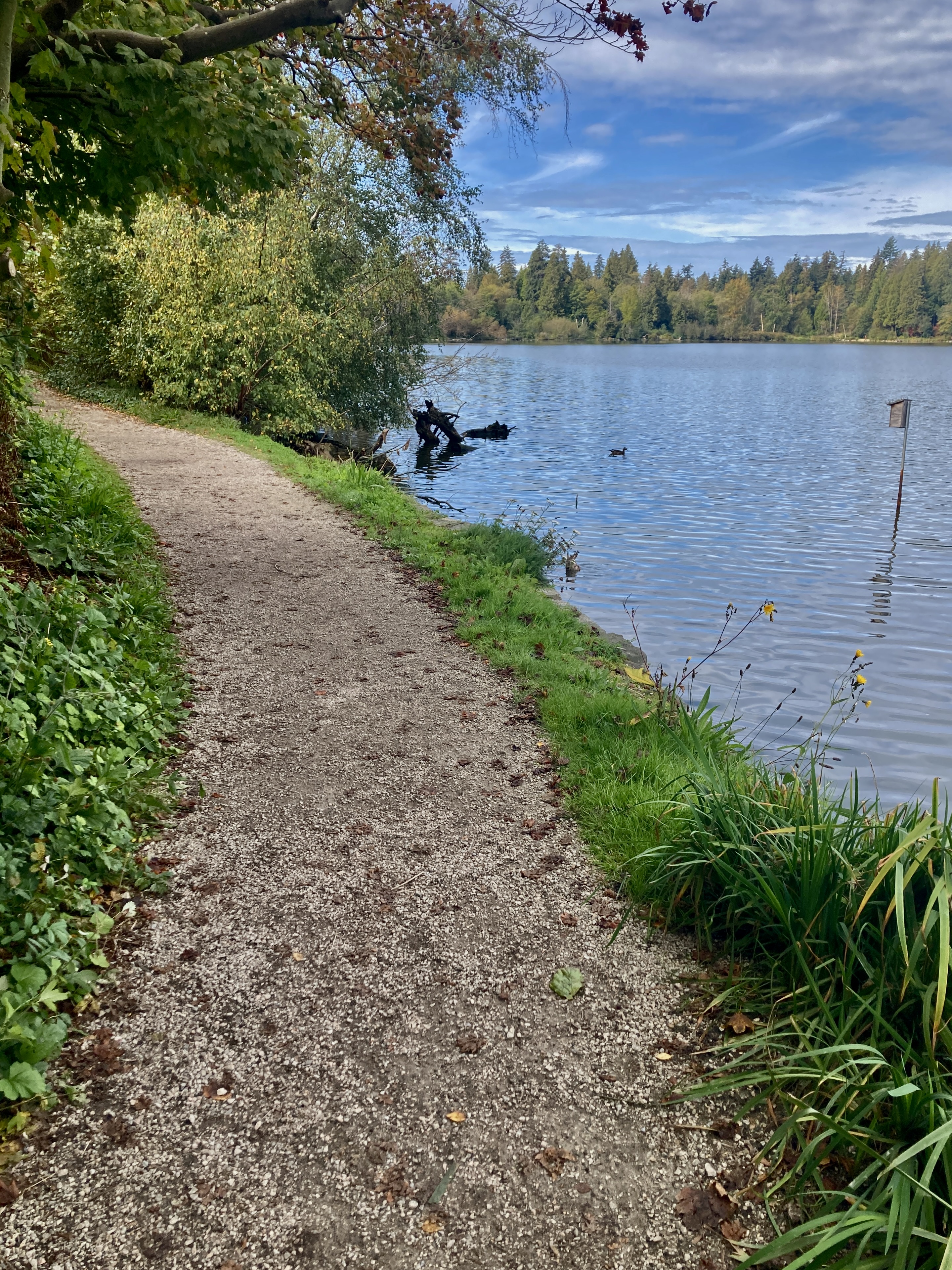
and offers Park and distant mountain views northward across the Lagoon…
close-ups of exotic ducks (un-exotically named Wood Duck)…
some Lost Rivulets, off-set from the Lagoon…
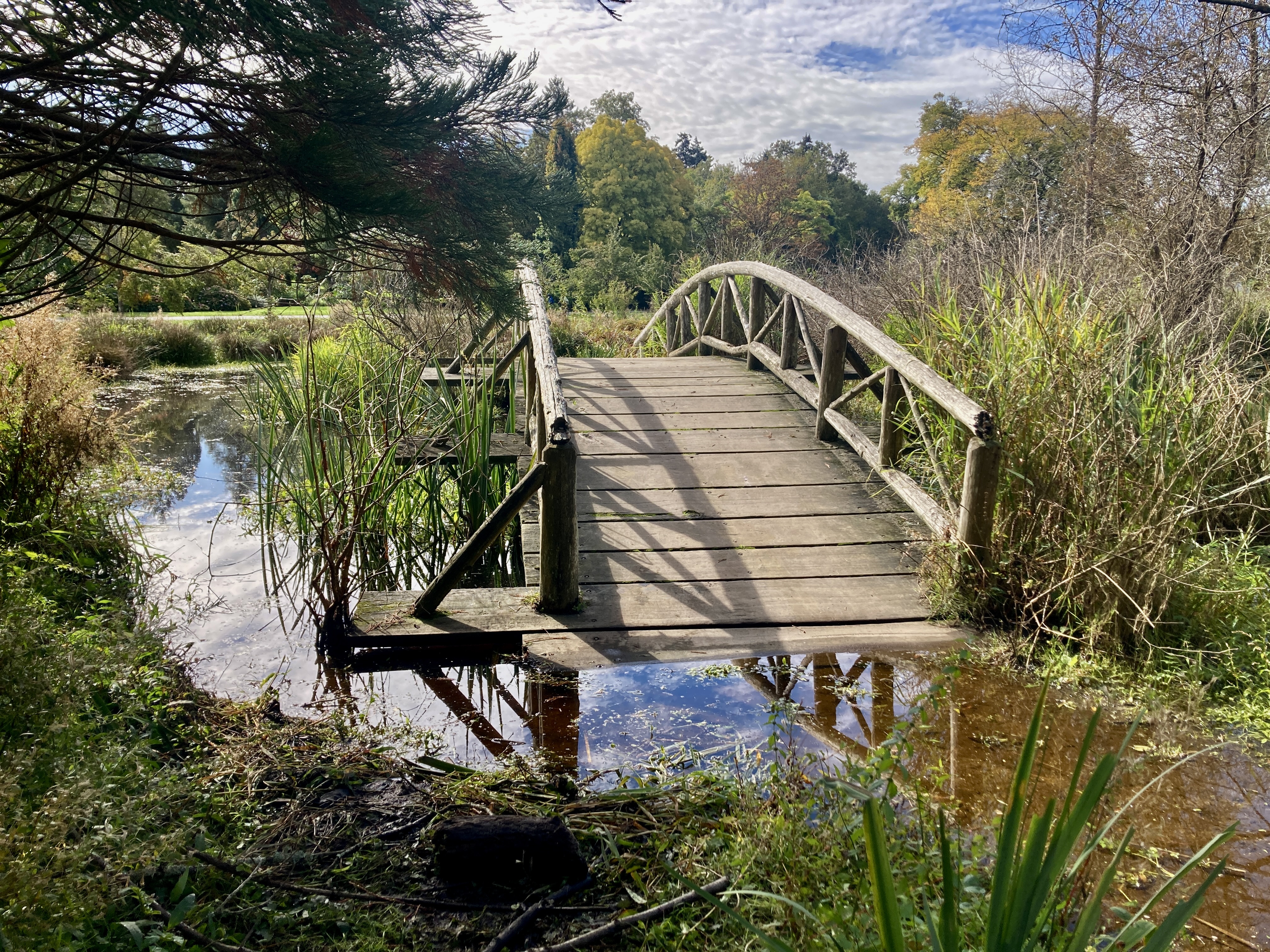
and a definitely Lost Footbridge…
which is even more drowned and inaccessible on the far side than it is right there.
Pretty soon I am exactly where the “You are here” bubble says I am…
namely, just steps from the Seawall at Second Beach.
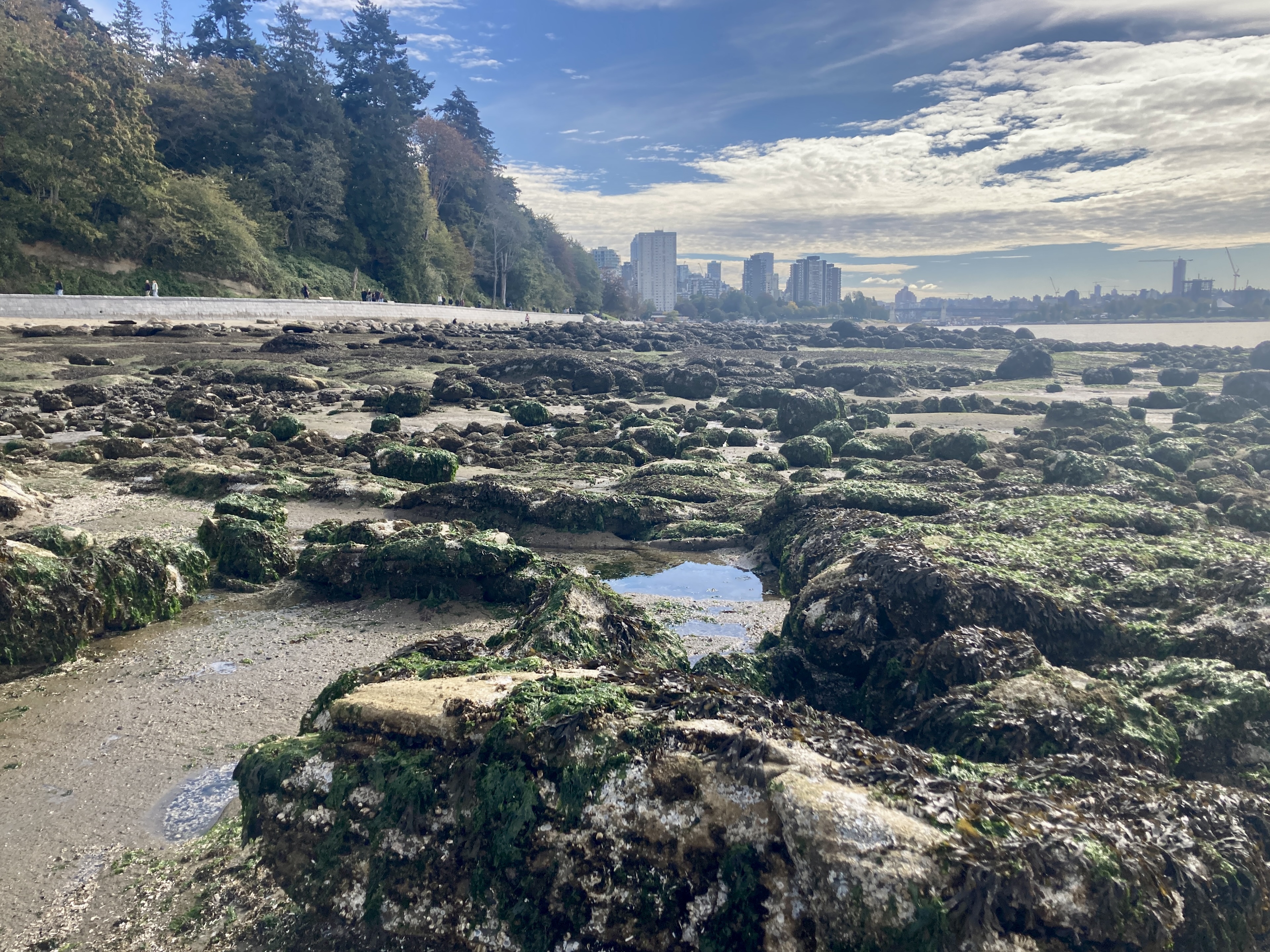
The tide is wonderfully low.
Like many others, I leave the Seawall and walk right out to water’s edge. In places it is rock-strewn…
and, elsewhere, it offers long stretches of firm, wet sand.
Out there, orange-hulled freighters awaiting their turn to carry on down to the Port; here on shore, orange-shirted girls running into the waves.
The scene is happy, and there is an important message of hope and optimism in these shirts, but they commemorate something dreadful and dark: the abuses of the Indian [sic] Residential School System. These abuses battered the children physically and emotionally and, in more than 4,000 documented cases (2021 stats), caused their death. In 2015 the non-profit Orange Shirt Society was formed in Williams Lake, B.C., and began marketing tees that proclaim “the enduring truth that EVERY CHILD MATTERS, every day and everywhere.”
The inclusivity of the slogan invited, and has won, widespread acceptance. You now see the shirts on people of every ethnicity, of every age, and as every-day apparel. Today the shirts are especially appropriate. Today, 30 September, is Canada’s National Day for Truth and Reconciliation, a day to honour “the children who never returned home and survivors of residential schools, as well as their families and communities.”
All of that is now part of all of us, as it should be. I take it with me as I continue my walk.
On toward English Bay, past more sand and rocks and squealing children and tail-wagging dogs and, up there on separate Seawall tracks, cyclists and pedestrians. Finally, I head for the Seawall myself. I am ready for a city component to this walk and, I realize, more than ready for something to eat.
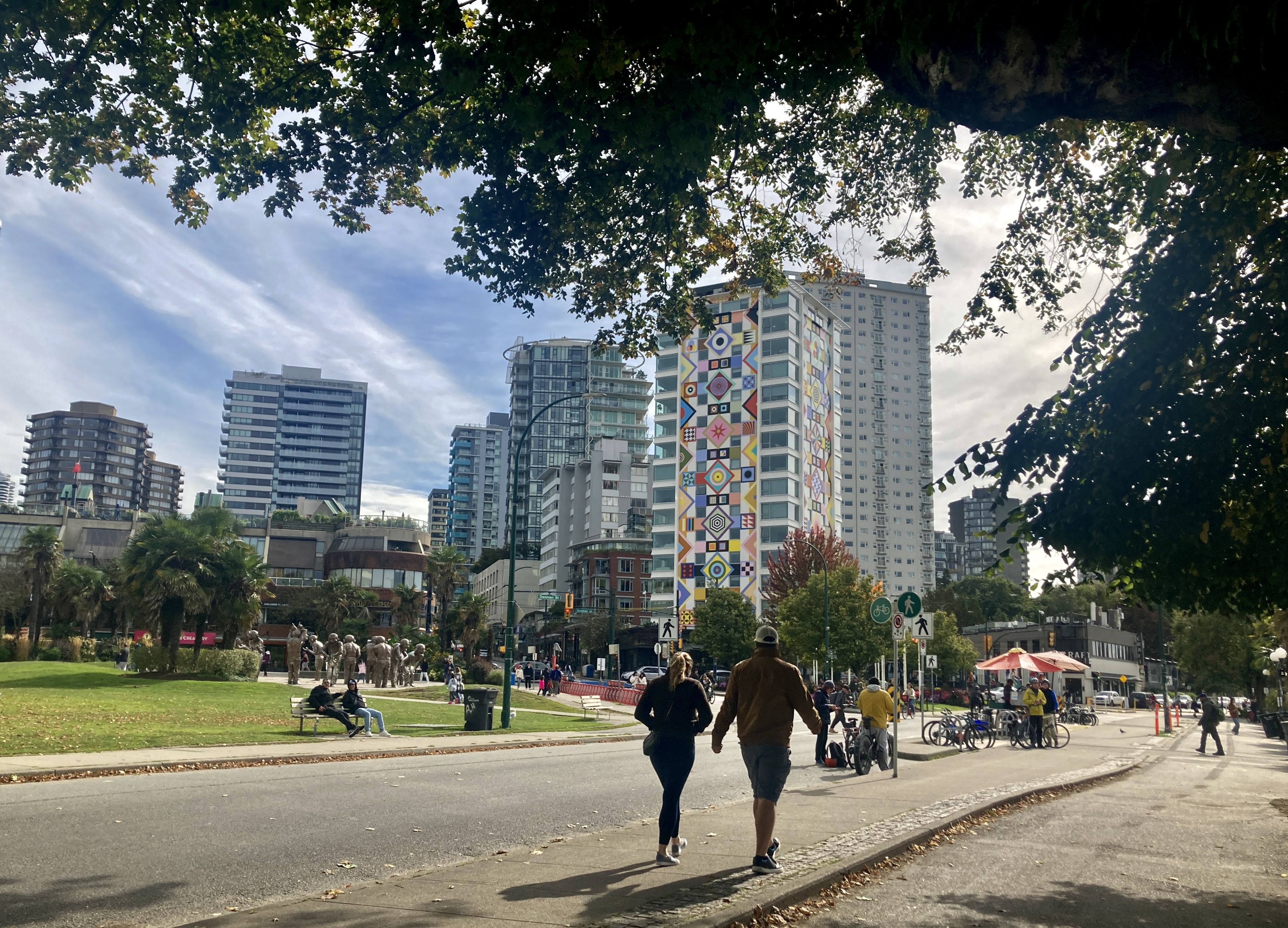
Out to Beach Avenue, with the A-Maze-ing Laughter sculptures in Morton Park in the middle distance, and Doug Coupland’s soaring mural on a refurbished vintage apartment tower just beyond to the right, and, closer than all that and of more immediate interest to me…
the red & white striped awnings of a hot dog stand.
Hot dog or Bavarian Smokie, it’s all 100% Alberta beef, says the hand-lettered signage, and the Calgary Girl in me nods approval. I eat my Smokie on the beach, and then…
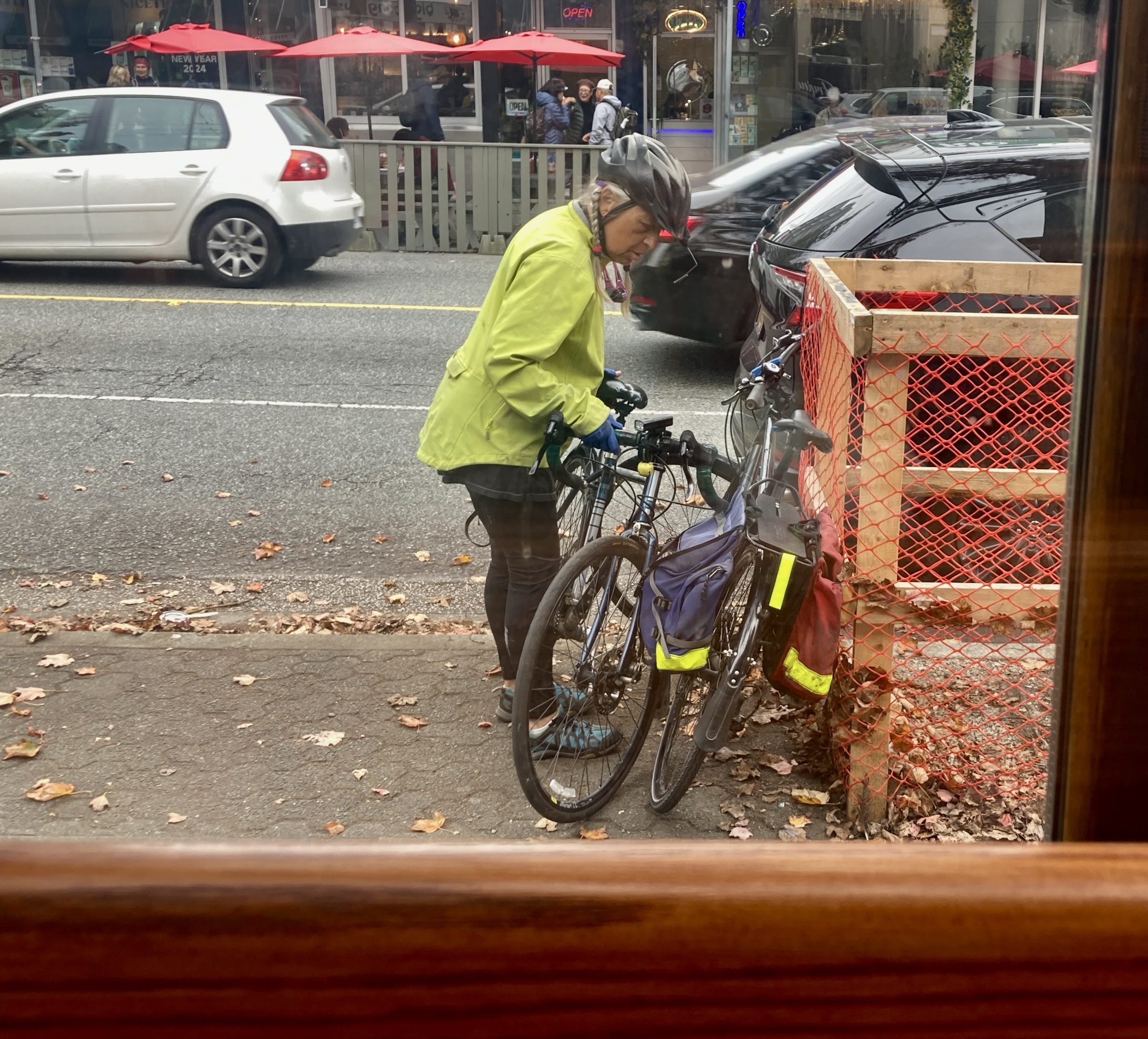
turn down Denman St. for a latte in Delaney’s Coffee House. My front-window seat gives me the inspiring view of this pigtailed cyclist, surely damn near my own age, who is not even breathing hard as she locks up her bicycle.
Next comes a zig-zag through West End Vancouver: I’ve had water & nature, now for pavement & city. A few blocks on Denman, then right turn onto Comox and I stomp right along — until I get to Broughton.
I’ve walked Comox before, I’ve passed this building before and I’ve noticed the thumping great sculpture at the street corner before: Triumph of the Technocrat (Reece Terris). What I’ve never noticed is the curling channel of water along Comox that connects with the sculpture…
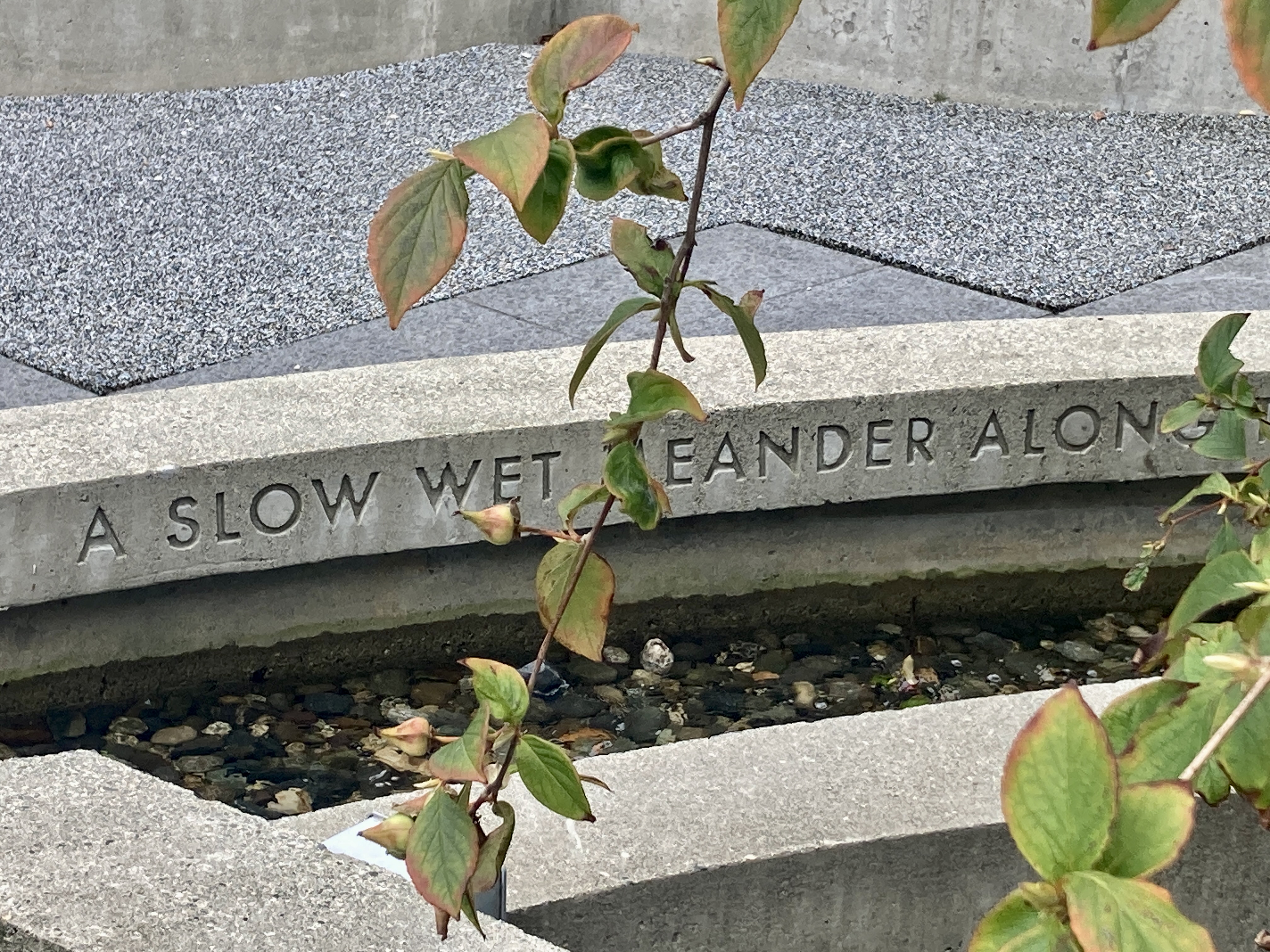
and, especially, the words incised into the channel wall.
Thanks to an article and overhead photo in The Source (issue 27 Jan – 10 Feb 2015), I can not only show you the entire channel with its pool at one end and Terris sculpture at the other…
I can also tell you the channel is the work of Vancouver landscape architects Durante Kreuk, and the text is by Vancouver artist Greg Snider.
Snider’s creation is a whole bravura torrent of words, and I want it! So I inch my way along the channel, taking pictures as I go, just in case the text is not available online.
And it is not. Or, not that I can find. So here we go, I am about to put it online — all but the bits I couldn’t catch because they are obscured by particularly vigorous lavender bushes. You’re not word-crazy? Skip the next paragraph. You are word-crazy? Settle in for the ride.
“A slow wet meander along stoned plaza of frenetic urban structure toward the demiurge of public art, the fiscal trace of exacting development moving with pythagorean acuity the eart [lavender bush…] objects of our collective culture through the bureau of civic demand, the spirit of heavenly smoke spirals from the burnt wood of transcendent aspiration over the long marsh of pantheistic decor as the seemly secular rises around us and art sluices down a crafty pipe — sleepy second [more lavender bush…] arch, techtonic upscaled for perpetuity’s long view (fifty years max) in a device for reflection called triumph of the technocrat.”
My own slow, not-wet meander now complete, I walk on. I pause one last moment on Comox, just before I turn onto Bute, for a cheerful and timely bit of sidewalk art.
Buoyed by that, I carry on — north & east, east & north — to Burrard & West Pender, where I catch a # 19 bus, and ride on home.
22 September 2024 – Time & place. Time & places. Places, through time.
Two recent days, that have me noticing the play of time across place.
Friday, I’m walking back along north-shore False Creek after a downtown lunch with a friend. I stop to read one of the railings that mark a stretch of informational glass & metal way-stations near Coopers Park.
“Look across the water,” it says, so I do. Eastward across the smooth, bright water alive with pleasure boats, ferry boats and a couple paddling their kayak.
This is 2024 False Creek, much transformed over the millennia.
Coast Salish people once fished here, in clean waters…
but the 19th c. brought sawmills, small port operations and, after the 1887 arrival of the Canadian Pacific Railway, a booming demand for railway-related services and support. The shoreline and waters were very busy…
with piles of materials and with hand labour…
but the waters were no longer so clean.
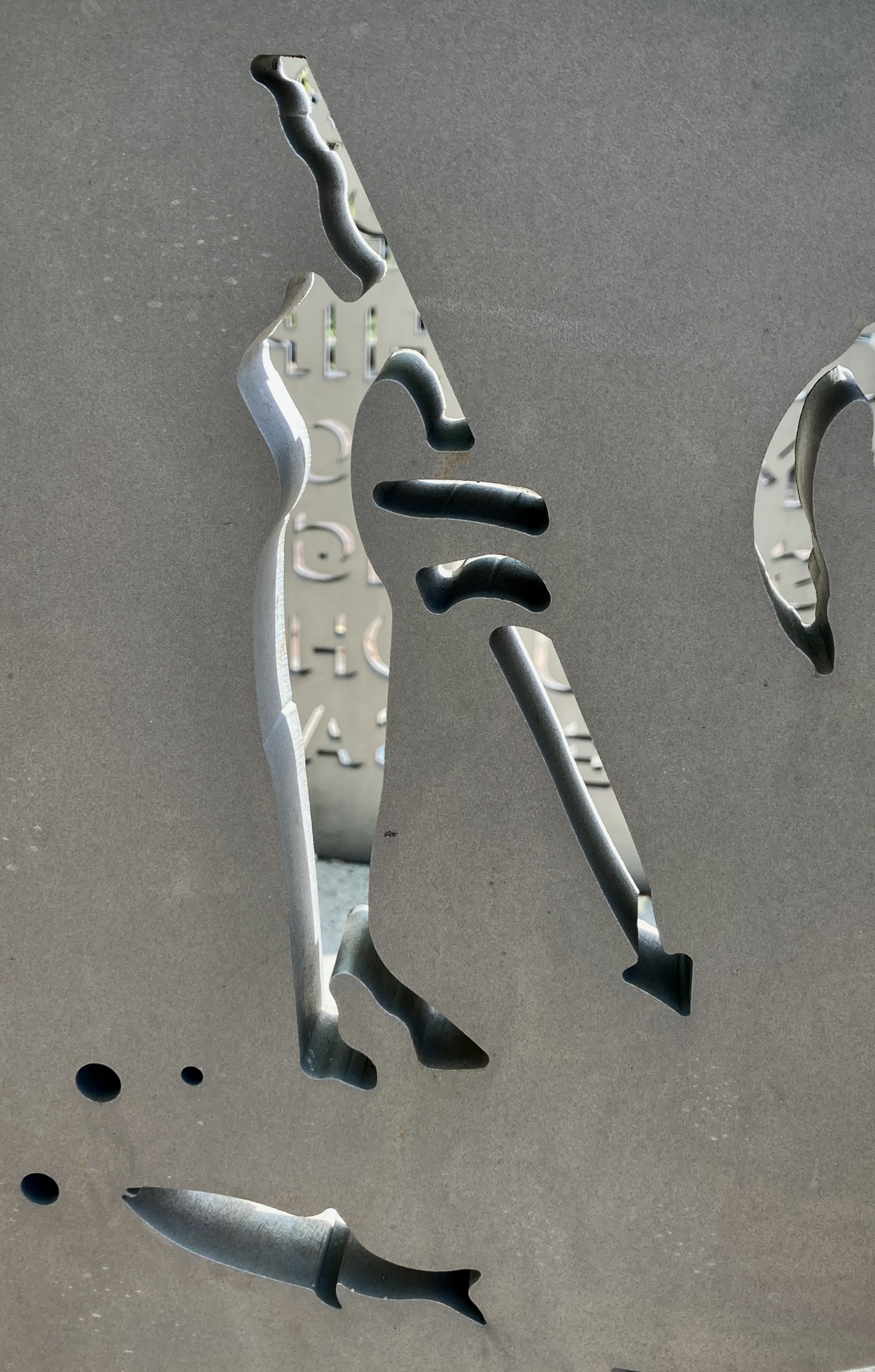
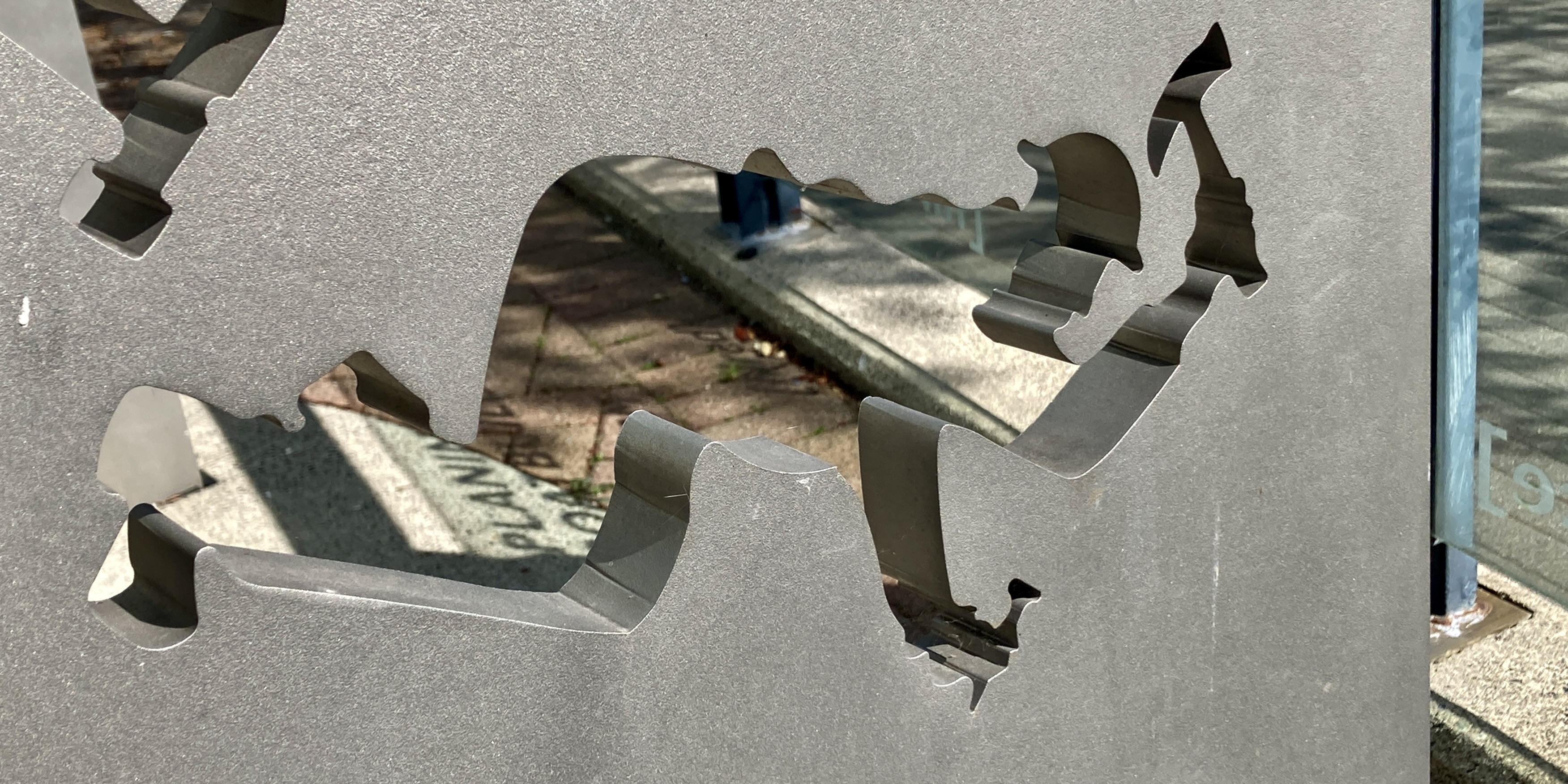
Incised words on metal panels remind us of the range of activities, of purposes, of people, across all that time.
Next big transformation: the mid-20th c. shift in industrial patterns and the post-Expo ’86 drive to restore and repurpose False Creek. Today it is recreational, and residential, and the waters are a whole lot healthier than they used to be.
I learn more about all this the very next day. Saturday morning, I am once again on the north shore of False Creek, freshly delivered to the Yaletown Dock by ferry, to join a downtown walking tour run by the AFBC (Architecture Foundation of British Columbia).
We pass the now-repurposed CPR roundhouse and walk through adjacent Yaletown, named for the small BC community where the CPR first had its construction equipment & repair shops, before relocating work to the more convenient Vancouver location.
Spare, functional Victorian industrial architecture still lines several Mainland Street blocks. The buildings now host restaurants, condos, artisan boutiques, and design and other creative small firms — but their Victorian bones still show.
Some of these structures are rightly celebrated by their current owners/tenants — for example, by Engels & Volker, whose website honours the history of this elegant former factory and warehouse at 1152 Mainland, built in 1912.
We walk on, our group weaving its way past other examples of old made new, and also of ghosts-of-old replaced by new. Layers of time, laid upon place.
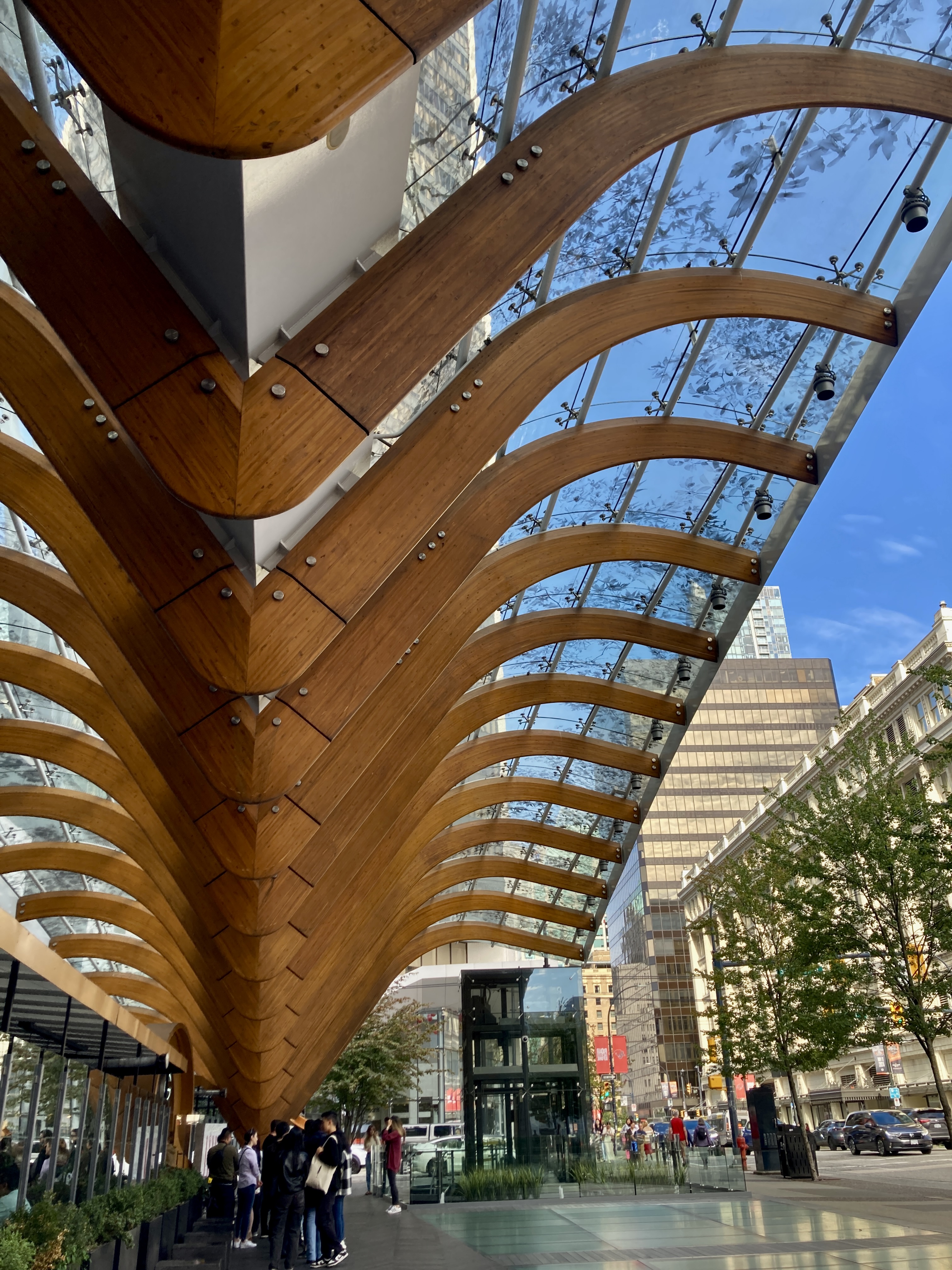
Late in the tour, we stand under the canopy of Telus Garden which, when it opened in 2015, had brought a whole downtown block into the mixed-use trend then gathering civic strength.
It was a project born of love as well as commerce: both men native Torontonians, and both grateful to the AGO because, modest as it was at the time, it introduced each of them to art and helped shape both their lives.
The AGO did a lot for me as well. As a volunteer I spent many hours in its rooms, soaking up the art and learning about things. Like glulam.
(You wondered where I was going with this, didn’t you!)
The soaring Galleria Italia, stretching 450 feet along Dundas Street, is a vaulted dance of glued laminated Douglas fir and glass.
I always loved doing a shift out on the Galleria Italia, seeing — and hearing — visitors’ reactions when they first stepped into the space. Adults politely gasped. Schoolchildren on tour, especially when coached by their guide, agreed it looked like an overturned canoe. (Though one little girl was having none of that. “It’s an armadillo,” she announced firmly.)
My favourite reaction? The little boy who barrelled through the doors well ahead of his mother. He screeched to a halt, swivelled his head in stunned amazement and then, just as his mother caught up with him, leapt in the air, arms flung high. “WOW!” he yelled, his fists punching the air.
"Traveller, there is no path. Paths are made by walking" -- Antonio Machado (1875-1939)
"The voyage of discovery is not in seeking new landscapes, but in having new eyes" -- Marcel Proust (1871-1922)
"A city is a language, a repository of possibilities, and walking is the act of speaking that language, of selecting from those possibilities" -- Rebecca Solnit, "Wanderlust: A History of Walking"





























 WALKING WOMAN