Riprap! (and other discoveries)

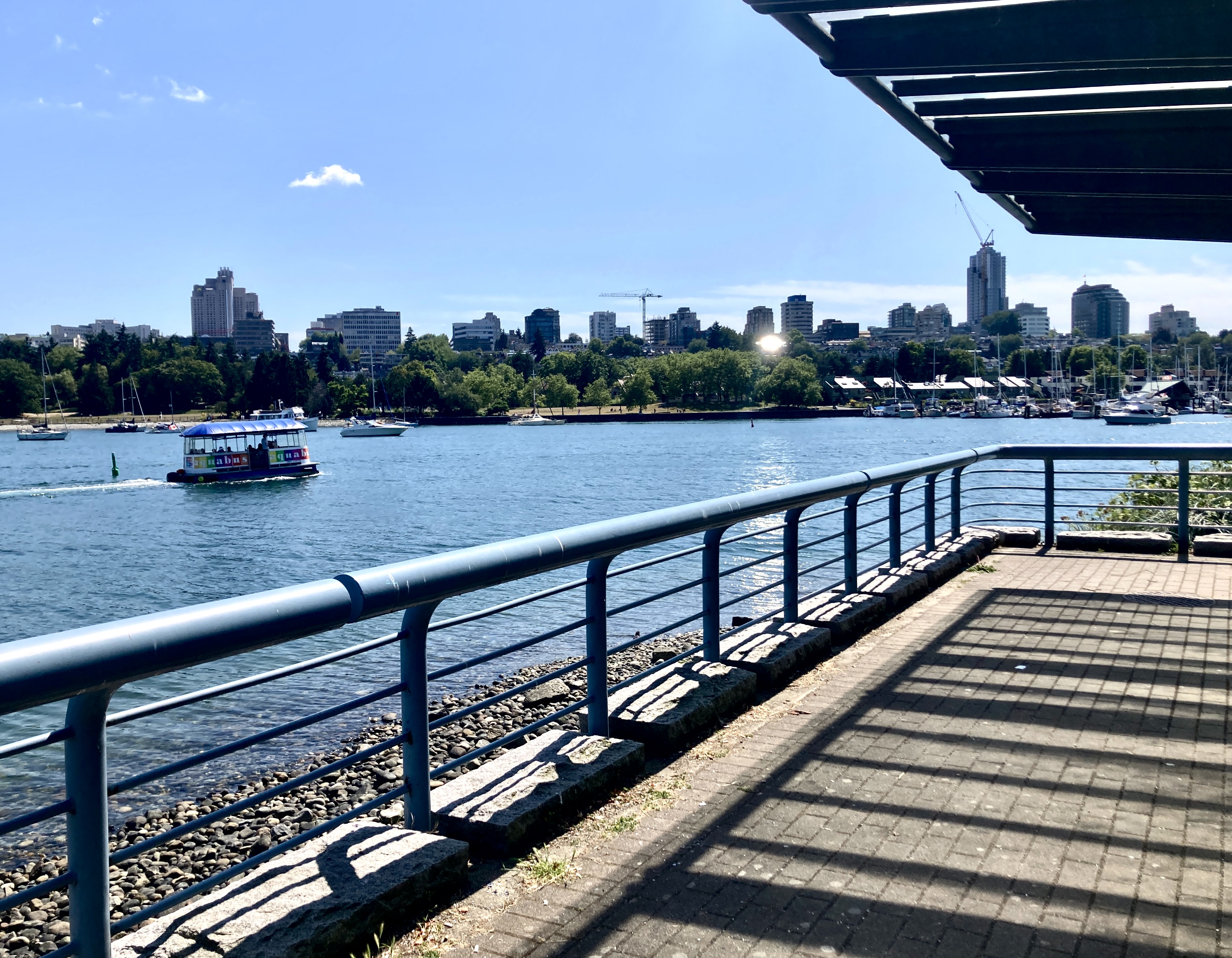
7 June 2025 – Having walked down Heather Street, right to the False Creek Seawall, I am — not surprisingly — at the Heather Civic Marina. Which — also not surprisingly — is full of gently rocking boats.

I am not interested in the boats. I look left, where my feet will next take me…

and my mind bounces off most of what I see. Bounces off the low tide, the prow of a boat, the Seawall pathway, the bench in the bend of that pathway, and the collection of blue café umbrellas in Leg in Boot Square just ahead. My mind lands squarely on all that rock.

That sloping expanse of rock.

Riprap!

I grin at the rocks, mouthing the word.

I am surely influenced by Ana’s recent posts in her Anvica’s Gallery blog, in which she pays tribute to Wonderful Words. Most recently, to “ababol” — local slang, in her part of Spain, for “poppy.” She knows the correct Spanish for “poppy” is “amapola,” but she prefers “ababol.” Why? “It’s more fun.”

That’s my attitude to “riprap.” The fun you can have, with those two short syllables! Roll the r’s (Rrrrip-rrrap). Or pop the p’s (Rippp! Rappp)!

For me, though, it’s more than the fun of word games. It’s time travel.

Like Colonel Aurelio Buendía, remembering the day his father took him to discover ice, so I stand here on the Seawall, remembering the day I learned the word “riprap.” I was typing up some handwritten notes for a friend, and dissolved in giggles at a word I couldn’t read but deciphered as something like… “riprap.” Well, it couldn’t be that, could it, that’s not a word. So I said rude things about his horrible handwriting. And he patiently explained the word and its application — loose rock placed so to prevent erosion and preserve structural integrity.

For example… along the maritime edge of the False Creek Seawall.

Though Aurelio Buendía got to discover ice, the memory only surfaced as he faced a firing squad. Now, in much happier circumstances, my memory & I set out to discover riprap as I continue my walk toward Granville Island.

Vegetation has already discovered the riprap. All those crevices, just waiting to host whatever might be blowing in the wind.

From tiny, tenacious growth I can’t identify…

to shrubs and tall spikes of aconite, escapees from planted gardens.

A crow forages, for whatever he might find…

and I, initially taking in yet another sweep of vegetation, suddenly notice a tiny turquoise medallion, set in the Seawall ledge.

Which leads me to other discoveries, this bright breezy day.

It is one more marker in the provincial Control Survey system, a database of coordinates, elevations & related information archived for public access & use. The word “survey” flips me into more time travel. Almost 100 years ago, my dad spent two university summers as part of a survey team paddling the rivers & lakes of northern Saskatchewan.

The Seawall itself invites time travel. At the appropriate spot, signage shows us the unobstructed 2017 view across the water and through the city, right up to The Lions (two iconic mountain peaks, now more often called The Twin Sisters). It is, the signage announces, a protected view.

And yes, today in 2025, there it still is.

Right at the eastern edge of Charleson Park, more signage. This one a warning.

I am bemused. Warning? Are the elderly armed & dangerous? As I play with this very entertaining possibility, I hear the sound of approaching cyclists and a happy voice cries, “Well! That looks good!” The voice belongs to the man pedalling a trishaw, with two elderly passengers on the seat in front of him. A second trishaw follows. Laughter all ’round.

No wonder they approve of the sign — Cycling Without Age is a Canadian charity whose volunteers take local seniors (and their families and friends) out for a spin.

From elderly to young, from sturdy trishaw to tiny bicycle: Polkadot Helmet Missy & I pause halfway through Charleson Park…

to watch a City maintenance man wait for his colleagues before attempting to yoick that heavy fence section out of the way.

More walking, more discoveries. Including the Charleson Park sign that reminds us the pretty pond behind it is a seasonal pond, and it is meant to dry up in summer, and that’s okay. (Got it?)

And then I’m right under the Granville Street bridge, looking yet again at boats bobbing in the water, and yet again I am not focused on the boats.

I’m looking beyond, at that bright blue horizontal line of signage that placards the False Creek Fishermen’s Wharf, with its moorings and facilities for independent commercial fishers, and a wharf where the public can buy their catch.

More precisely, I’m focused on the pale blue rectangle, there on the left, just off all that bright blue.

That’s the old shipping container that now houses Go Fish — the fish purchased right there on the wharf, served up with chips and other delights, both trad & less so. They take no reservations, offer no indoors seating, and there is always a line-up.

Later, with my grilled wild salmon & salad, I plonk myself in one of those green bucket chairs, and enjoy my fish. And the view. And a bit of a rest.

And then… I walk back east.

The high route, this time, not the Seawall. It climbs me into the upper elevations of Charleson Park, all forest and dappled bark-chip trails…

and nary a chunk of riprap in sight.

That’s fine. I’ve had my moment.

Of Moss, Muzzles & Monsters

2 June 2025 – Only moss is on the agenda. Muzzles & monsters turn up on their own.

Moss is on the agenda because it’s about to go into its seasonal decline. Moss thrives in cool damp, suffers in dry heat. I want one last fix, and the Camosun Bog is the place to pay tribute.

As boardwalk signage points out…

the bog is, literally, built on moss.

Fortunately, despite the glossy new salal leaves and the bright growing trips of the evergreens that encircle the bog and speak of this new season…

the mossy carpet is still green, not yet bleached to its mid-summer pallor.

The moss is not just on the ground, either. Look at these trees!

So, as I leave the bog and start meandering north-east through the neighbourhood of West Point Grey, I am still moss-optimistic. And, despite distractions like this spiral of Buddhist prayer flags on a street-corner shrub…

and this bear-moose duo, endlessly paddling their way across somebody’s front yard…

I do see more moss.

Just look at these sidewalk sentinels, still wearing their winter finery, as they march their way down West 19th Avenue!

After all this, my attitude is: agenda met. No more expectations. I’ll just keep walking for a while — get in those steps — and then catch a bus.

Next thing I know, down by Alma & West Broadway, I’m being muzzled.

This is such good news.

There’s a mural by this artist in my own neighbourhood, one that both pleases & frustrates me. I like it for its own sake, but the style very loosely reminds me of Toronto street artist BirdO

and I really, really would like to know the Vancouver artist’s name. Can’t get close enough to the mural near my home to look for any ID — but here, there’s a whole wall-full of his images, in an open alley.

Multiple images, and a tribute to Jean-Michel Basquiat (the crown, upper right)… and a plaque identifying the artist. I learn, and it is my pleasure to inform you, that this mural is the work of Tokyo-born, Vancouver-based contemporary artist Taka Suda.

I am happy indeed, as I drop down the last few blocks to West Broadway.

An eye-flick left, into another alley, where the little window in this tired old shed…

suggests it must have started life as a stable. Surely that was the hay loft, above?

After that, my eyes flick straight ahead, on down busy Alma Street.

Another high rise going up, ho-hum. But then eye-flick becomes eye-focus, as I notice the monster riding high at the angle of that top corner.

See it? Shades of Hunchback of Notre Dame

A passing pedestrian notices my fixed gaze, and nods her head. “Like gargoyles, aren’t they?” she says, her smile showing she quite likes the idea.

“Gargoyles”? Plural? I walk closer, on down Alma. (I feel like I’m stalking the building.)

And yessirree, gargoyles-plural. There are three, one defining the top corner of each ledge.

The closer I get, the clearer they become, and I need to refine my language.

Not monsters. Not gargoyles.

Ravens. (Later online research tells me this building — a luxury residential rental building — is named The Raven.)
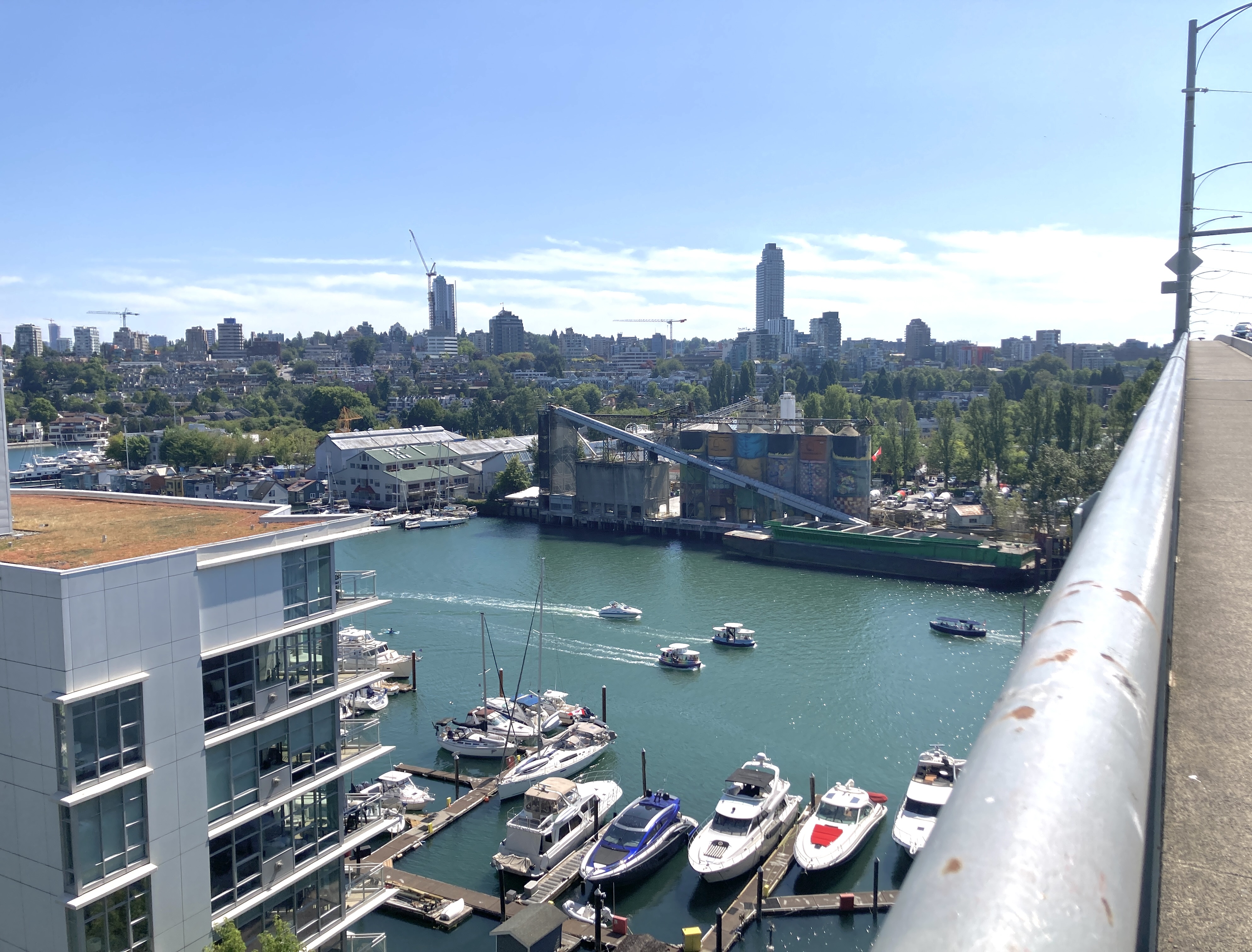
I spin around for an angle that shows them in triumphant profile…

and then, finally!, I catch my bus back home.
Seven Signs of Summer

27 May 2025 — Or, for extra sibilance, seven street-side signs of summer.

Because there they all were, as I walked a modest loop near home: one sign after another that we Canadians know what season this is, even if the solstice hasn’t yet rolled around. The May Two-Four weekend is behind us, and summer has begun.

Sign # 1: sidewalk tree, boasting a brand-new swing.

Sign # 2: lawn cat, luxuriating in the new warmth of the earth.

Sign # 3: fencepost cat, rocking his brand-new sunglasses.

Sign # 4: a pair of geese (faux), nesting in the gravel (real).

Sign # 5: a solo goose (real), nibbling new blades of grass (also real).

Sign # 6: garage-top veggies, tilting their faces to the sun.

And finally…

Sign # 7: victims of spring cleaning, hoping to find a new home.

Would you like a bonus sign of summer? I found myself walking on the shady side of the street.

I can almost see you nodding in recognition. All winter long, we walk on the sunny side. And then, suddenly, one day, oup-là!, it’s the great switch-over. Now we seek the shade.

Wind & the Great Two-Four

19 May 2025 – There is a big difference, I realize — as I anchor my hat — between a calm 15C and a 15C with gusts that smack you in the face.

I’m just off the bus at the edge of Stanley Park, planning a walk through the park to celebrate this holiday long weekend. (Held the Monday before 24 May, and, both officially and unofficially, a single holiday with many names.)

My plan, before the hat-anchoring, was to walk across Lost Lagoon, out to Second Beach, and then whatever. Hat now anchored, I see the virtues of a trail walk among sheltering trees instead.

So I say good-bye to Lost Lagoon, despite the attraction of this mama duck and her babies (just off the point of those rocks)…

and this Pacific Great Blue Heron, posing right next to the path…

and, instead, I pivot my footsteps onto Tatlow Walk.

I don’t usually take any of the forest trails, and how silly is that? Here’s a whole 400 Ha of western rainforest, and I stick to the Seawall. Not today!

Tatlow offers me a whole different experience. See? (Ignore “You are here” — we are in fact in the upper-right curve of Lost Lagoon, about to slice diagonally through the forest on Tatlow Walk, and emerge at Third Beach.)

Why don’t I do this more often? Thank you, wind, for blowing me inland.

There is greenery — new growth climbing all over the old…

and woodpecker activity — scavenging insects from old trees…

and colour — the rich red of the cedar itself and the lichens on the bark…

and even sound effects — the angled tree squeaks as high-level wind rubs it against the trees that support it.

In the glade where Tatlow crosses Bridle Path (scroll back to that handy map, I’ll wait…), I meet a ghost.

One of seven ghosts, the stumps of the Seven Sisters, the soaring mix of Douglas Fir and Western Red Cedar that once stood here and were so popular with 19th-c visitors that they had their own dedicated trail.

Alas, by 1953…

they had to be honoured in a different way.

But the glade, like the rest of the forest, still has plenty of soaring verticals.

Side trails beguile…

but I look at the mud, and the bike ruts, and choose to stick with Tatlow.

At Stanley Park Drive, I wait for waves of holiday traffic to pass, cars as usual, but also motorcycle clusters and cyclists…

and then cross over. Within moments, here I am, about to emerge at Third Beach.

Where wind has free access, and white caps prove it.

Rocks, freighters (waiting their turn to enter the Port of Vancouver), and white caps. That’s the signature of my walk back down the Seawall.

Plus the occasional float plane silhouetted high against the clouds, snarling its way to, or from, the Flight Centre at Coal Harbour…

and crows swooping low across the beach…

and cyclists dismounting to navigate intersections with high-traffic walkways.

I take advantage of low tide, and walk the last stretch below the Seawall, down on the beach itself.

Just past park boundaries, I climb back up to Beach Avenue, Morton Park and…

a pop-up street fair. But of course. It’s a holiday weekend, isn’t it?

Quick browse in the fair, satisfying lunch on Denman Street (Indian, this time around), and a walk north on Denman, where the soaring verticals are quite different from those to be found in the park…

and, finally, a bus back home.

City, Grey & Green

16 May 2025 – It’s a chores + pleasure walk that will loop me west for a while and then back home. Practically just out my door, I’m standing transfixed by this — let’s face it — unexceptional street corner.

It’s exceptional only in that it is so very… city.

Street & sidewalk & sleek black new-build & fake Tudor old-build (to be incorporated into yet another new-build) & street murals & hydro wires & parked cars. Also trees bursting with spring blossoms & a blue sky over all.

All the entangled grey & green of a city. Grey, the hardscape of human construction; green, persistent nature; also “green,” human intervention meant to enhance nature, and co-exist rather than simply dominate.

Hardly an original thought, but it sticks in mind, and shapes how I see what I see, for the rest of my walk.

Oh, all right! It does not shape how I see what I see right here, chalked on a south-side rampart for the Cambie Bridge.

I throw this in, just because it is irresistible. Doubly cheeky, as well.

First, it suggests that We absorb Them, not vice-versa. Second, it demotes Them to the less-autonomous status of territory, not province. (Provinces exercise constitutional power in their own right; the three territories — Yukon, Northwest Territories and Nunavut — exercise delegated powers under the authority of the Parliament of Canada.)

Highly amused, I leave patriotic red & white behind me, and return to urban grey & green.

Lots of grey, as I start north across the bridge.

A bit of green, in those tall trees on the far right edge — and an impressive display of “green,” though it is literally coloured grey. Just left of the green trees, you’ll find what looks like the five fingers of an upraised hand, complete with fingernails. Those are the exhaust stacks of the Southeast False Creek Neighbourhood Energy Utility down below. The NEU transfers waste heat from area sewers to insulated underground pipes, which in turn distribute the energy (via hot water) to the neighbourhood.

Panoramic views of grey & green as I near the north end of the bridge, with parkland and trails either side of False Creek, framed by city buildings beyond.

Some tucked-away green, a “green” initiative of the City, below the north-end ramparts…

where some local residents sponsor a garden, under the City’s Green Streets program.

I cross Cooperage Way, heading back toward the water, and skirt the side of a kiddy playground. It’s an important amenity, amid grey Creek-side condo towers — “green” in itself, and with the hidden “green” of recycled car tires underfoot instead of concrete.

Plus! all that fresh-mown very green grass. And the intoxicating smell of fresh-mown grass.

More fresh-mown grass, and indeed the mower mowing, as I come alongside Concord Community Park.

Grey & green & “green.” And a question mark. Three acres of park, with basketball and volleyball and table tennis and Muskoka chairs and landscaping, and it’s all swell. It is also, maybe, temporary. Concord = Concord Pacific, “landlord” (as the City itself puts it) of great swathes of this land, and busy building buildings, because that’s what they do. I can’t find any clear statement of whether, or how long, this park will remain green before transforming to the grey of another condo tower.

I do find this City of Vancouver page about Northeast False Creek park design, all about revitalization plans for various City parks in this area. Which is good. The partners, however, are the City, the Vancouver Park Board (which the current City council wants the Province to eliminate) and Concord Pacific (aka the “landlord”).

I’d say the future balance of grey & green is still unknown.

Another unknown, as I round the end of False Creek and pass a bike ramp in Creekside Park.

Not a mystery to rival “who is Banksy?”, but a mystery nonetheless. I’ve seen several other of these whimsical little creations in other parks, signed OXIDE. No clue as to their artist’s identity, not even online — except for various people fretfully asking “Who is OXIDE?” and getting no answer.

The bike path, this bit behind Science World, is always busy. Grey, green and “green.”

I’m particularly taken by the living fences, the way living shoots are bent to edge the landscaping, growing more lush as the season progresses.

Bike accommodation across Quebec Street, on the pavement surround for the Main Street / Science World SkyTrain station.

Lots of grey, and, with those bike racks, some “green.” Literal green in some of the mosaics as well, especially this one in the foreground, titled Environment.

I lean in, to read the sticker somebody has slapped at the centre of each mosaic.

Well now.

If “green” is about preserving the planet, about co-existence and sustainability… then I hereby declare this sticker to be Honorary Green.

The Many Worlds of One Mid-Day

9 May 2025 – The #19 bus, as always, vibrates with worlds other than my immediate own. The route heads north through Chinatown, East Vancouver & Yaletown, and then slices west across the downtown core before its terminal stop in Stanley Park.

It therefore serves residents of all those communities, plus everyone who is just passing through — office workers, sporty types equipped for Stanley Park trails, urban culture-vultures with the art gallery or public library in mind, and assorted tourists puzzling their maps.

I find a seat in the crowded front section, and discover I’ve landed in a discussion — a dissertation — about “lifers” in the prison system. More specifically, about the reality check surely now being administered to a newbie in that system. He is someone known to Rhinestone Girl on my side of the aisle (applying extra mascara as she listens) and to Bare Knee Guy on the other side (his jeans simply worn out, not designer-chic).

Bare Knee Guy is explaining these facts of life to Rhinestone Girl, based on his own time inside. Their voices are loud, the vignettes are grisly, and the F-word once again proves its astounding versatility.

And yet! Their sentences are also grammatical & articulate, and the conversational tone is calm & engaged. Didactic, even.

I begin to feel I’ve fallen into a surreal one-on-one tutorial, as BK Guy describes how the “25-to-life” system works, here in Canada, and R Girl asks intelligent follow-up questions, never losing focus even as she switches from mascara to lip gloss and starts work on her lower lip.

The session grows even more learned when Shuffle Man inches painfully onto the bus, is offered the seat next to Bare Knee Guy, hears the topic of conversation, and joins in. “They changed it,” he wheezes. “Changed life sentences.” BK Guy agrees: “F**k yah! After Hell’s Angels blew up that bus in Montreal, killed that kid. Used-t’a be, kill one guy, kill a bunch, don’t matter, same sentence, but now they’re not consecutive, they’re back to back.” Rhinestone Girl breathes, “Holy f**k.” She understands the implication.

The tutorial breaks up ’round the corner on Pender Street, when Rhinestone Girl puts away her makeup, gathers her shopping, and asks Bare Knee Guy to help her get her stuff off the bus. He jumps up, lifts her two hanging plants (cheerful petunias, staples of summer balconies nation-wide), deposits them on the sidewalk, and gets back on the bus.

It’s cheerful, it’s helpful, it’s kind. I’m becoming quite respectful of BK Guy. Even more so, a few stops on, when a young indigenous couple get on, and he calls out, “Hey man! Ya dropped some money!” And they had–a $20 bill. BK Guy could have scooped it for himself, but he didn’t. The couple thank him, he bobs his head in acknowledgment. Somewhere along the way, Shuffle Man has disappeared. Eventually BK Guy and I get off at the same stop. Behind me, I hear him say exactly what I’ve just said, to the driver: “Thanks!”

We go our separate ways, me walking up Hamilton Street, my destination being a dance/literary event at the main branch of the Vancouver Public Library. My route takes me past this dingy building.

It’s the Del Mar, which opened as the reasonably upscale Cadillac Hotel in 1912 but which, despite its heritage status as the one hold-out original building on this block…

and despite the rah-rah wording of this plaque, is now one of the City’s SROs, a single room occupancy hotel. After my bus ride with Rhinestone Girl et al., after that moment with their worlds, I look at the Del Mar with different eyes.

And then I’m past the Del Mar, I’m up at West Georgia, and I’m breathing in the ozone of this fountain that chatter-sparkles one corner of the 1950s Canada Post building, now restored and expanded into The Post, a full city block of offices and glossy shops.

Across the street, in Library Square, I enter my own next world. I slide into the VPL’s spiral embrace…

meaning to head straight for the elevator to the 8th floor and my destination event. But of course I get sidetracked, here in the soaring atrium, by the discards bin (between the bottom two pillars, on the left).

Which pulls me into Charles Darwin’s world.

Well, no. Into Darwin’s Orchestra, an almanac that promises readers “a daily dose of cultural history.”

I look up today, May 9, and discover it takes me to the world of Gulliver’s Travels, 1711. I notice that May 10, were I to jump ahead, would take me to Kenneth Grahame’s 1907 world of Wind in the Willows.

A full 365 days of natural- and cultural-history discoveries, for just $3!

I vow to come pick it up after my 8th-floor event.

The event, “Translating Rosario Castellanos,” celebrates the centennial of this Mexican author with Spanish & English commentary (about the author, translating her letters, the impact of her work) and then…

with a tribute dance up & down & around the staircase stage, created and performed by this trio of local Latino artists.

At the end we applaud them, they applaud us, and I’m back in my own world, with my own immediate focus.

Go buy that book!

Only to discover, after combing the bin very, very carefully, that somebody else has beat me to it.

Well… “Holy f**k,” as Rhinestone Girl might say.

I, however, being the WASP Old Lady that I am, instead laugh and draw the appropriate rueful lesson: Next time, don’t wait.

I’m still caught between amusement & chagrin as I leave the building. I promptly fall into a temporal/cultural/architectural whirlpool of worlds, sparked by the building opposite.

This building.

Those bouncy cubes comprise the Deloitte Summit, a 24-storey office tower that opened in fall 2022 and has always struck me with its visual contrast to the rounded, spiralling forms of the library it faces — the 1995 work of Israeli-Canadian-American architect Moshe Safdie, a building lauded by Travel + Leisure magazine as one of the world’s “Beautiful Libraries.” (Up there with the Bodleian, in Oxford; the Library of Trinity College, in Dublin; the Stuttgart City Library, in Stuttgart; and the Bibliothèque Interuniversitaire de la Sorbonne, in Paris.)

Vancouver’s Merrick Architecture, Executive Architect for the Deloitte Summit, calls the tower’s design “a playful aggregation of reflective yet transparent stacked boxes.” Westbank, the project development company, says the cubes were inspired by this lamp, the work of 20th-c. Japanese artist Isamu Noguchi.

The urban architecture website Skyrise Vancouver says the design gives the tower “a sense of rotating motion that references the Colosseum-like Vancouver Public Library across the street.”

Me? I drop back to my native-Montrealer, 1960s world, and I say: oh yes, it references Safdie — but unintentionally, and not his Library Square project.

When my physical eye looks at the Vancouver building, my mind’s eye sees Habitat ’67, the Montreal housing complex that launched Safdie’s career and gave added punch to the exciting new design aesthetic of Expo ’67 as a whole.

See what I mean?

And then, full of all those worlds, I walk back down to Pender Street and catch a #19 for home.

It delivers no tutorials. I am left to my own thoughts, my own world, for the entire ride.

Upon Reflection

6 May 2025 – Today our Prime Minister met with the President of that giant neighbour to the south, an event that gives us Canadians much material for reflection.

For example, we reflect upon the fact that our Prime Minister had to — yet again — explain that Canada is an independent and sovereign country.

Sigh.

Fortunately, this bright sunny day gives me other, happier, and less surreal, objects for reflection. In fact, the sunshine causes the reflection to be done for me. I don’t even have to think. All I have to do is look.

I am in an alley just west of Main Street, between 7th and 6th avenues, where the brightly painted west wall, a remnant of the 2017 Mural Festival…

with the help of adjacent buildings and some H-frame hydro poles, throws bright reflections into every glass surface opposite.

For example, wall plus next-door building…

wall plus neighbour plus an H-frame…

blocks of mini-reflections above a parkade entrance, with equally strong light reflections on the laneway below…

even the parkade door itself! and…

and even the corner of a decidedly uninspired building, having itself a dance with that bit of H-frame.

Cheered and amused, I walk on down to False Creek and a lunch date with friends.

Right here, in this one downtown alley in one city in one province in our independent, sovereign country.

🇨🇦🦫🇨🇦

May Day, May Dusk

1 May 2025 – May first. Early spring has matured into full-tilt spring.

Days are longer, weather gentler.

The election is over…

and 343 candidates have been transformed into duly elected Members of the House of Commons.

Our cherry trees are also, quite suddenly, transformed.

Leaves take over; spent blossoms now pink-carpet the sidewalks…

and adorn the burls of their once-host trees.

Dude Chilling Park hums with early-evening activity.

As frisbee enthusiasts practise skills in the park itself, Canada geese pace the crosswalk to the north…

and skateboarders mentor each other on the school boundary lane to the east.

By 8:48, the sky over Main Street is still light, but bleached of colour.

The giant crane for the Broadway Subway project is is a severe black silhouette…

while Ray Saunders’ Mount Pleasant clock, a block farther north, is already a-dazzle with its evening lights…

and the block of sidewalk tribute banners, so quiet by day…

applaud the clock with their night-time turquoise glow.

Fun Times

27 April 2025 – A little time travel, my friends. Back to the first image in my previous (23 April) post, with its long view up the Quebec Street bioswale to Science World

and my cryptic reference to the “mystery interview” I did there before setting off on the walk that became that post.

Here it is, the focus of my 23 April curiosity and topic for the interview: the tall, free-standing Tower of Bauble.

It encloses a whole world of action — a world that had been dismantled for a while; whose return I briefly celebrated with you in my 12 November 2024 post (Under the Threat of Rain), which moved me, in my 21 December 2024 post (The Tilt) to promise you I’d learn more, and report back.

Herewith my report.

The Tower is a 24-ft-tall audio-kinetic sculpture, designed by American painter, sculpture & origami master George Rhoads.

This tall!

A variety of balls (pool, bocce, snooker) are carried up in a variety of ways, for e.g. via this central column…

or for e.g. via this majestically slow-turning blue auger, over there in the back right.

Once up, the balls come tumbling down again in a variety of pathways, like these for e.g….

and land in a variety of receptacles, sometimes (cf. that blurred white ball, below) shooting off a path into a bare metal disc…

or maybe bouncing from one red disc to another.

All of which causes lots and lots of sound.

Balls go thunkkk, or smaaaack; they hit hanging tubes and other obstacles so that clangers claaanng, chimers chime and clappers clap.

Like this yellow clapper (on the left) about to strike that red hanging tube.

That’s all there is to it.

Balls go up, balls come down, noise ensues.

And we can’t get enough of it.

Which nicely demonstrates the importance of having the right object in the right place for the right reason. Because, back in its early life, this sculpture met so much resistance it had to be mothballed.

In 1985, a US shopping mall magnate bought 30 of Rhoads’ sculptures and placed them in 30 of his malls — including this sculpture, in the food court of his Kamloops BC property. Where the incessant sound effects threatened the sanity of food court staff. (Fine for passing patrons, but in your ear all day every day?) The Tower was put away.

In 1995, Vancouverite Derek Lee and his partner acquired the property, discovered the sculpture among its effects and soon afterwards donated it to Science World. (Lee’s parents were long-time patrons of Science World, and he grew up with that tradition.) Whether in its initial position by the main entrance, or its current position next to bike paths, it has always been outdoors — where the audience would be present by choice.

I sit for a while, prior to my interview appointment. I watch how repeatedly people choose to be part of that audience. I want to know more. Why makes the Tower right for Science World, and why it is so appealing?

I ask the right person: Brian Anderson. On staff since 1991, he brought with him a background in computer science, math/physics and theatre, and he is now the organization’s Director of Performance and Fun Times.

Most of those fun times are indoor events and activities, but Brian loves the Tower as well.

“It ignites wonder,” he says, “and that’s an important part of our core mission. My favourite thing is watching people look at it for a while, and see them start figuring out how they could build something like that for themselves, back at home.”

Creator George Rhoads said the sculpture illustrated “the art of music and rhythm.” Brian points out the serious scientific principles behind all that music and rhythm: gravity, Newtonian physics (“balance, momentum, kinetic and potential energy”), probability and combinatorics (“calculating how many paths and how often balls take each path”).

Still and all, the Tower is a playful demonstration of serious science, and its various components have suitably playful names. “This,” says Brian, pointing to a red ledge overhead…

is the Clumper-Upper.” Of course it is. It clumps up six balls with perfect balance — and then a seventh comes along to send things flying, the six balls one way and itself another. Key to their travels are two Flip-Floppers, which direct balls down assorted further pathways.

Theatre buff (and parttime actor) Brian loves the cheeky titles and sheer busy fun of the sculpture; math/science Brian later sends me his chart, illustrating what goes where. (My abbreviations: L & R = left & right; FF = Flipper-Flopper; Sp. Path = Spinner Path)

Path% of Balls
Sp. path 112.50%
Sp. path 212.50%
Sp. path 312.50%
Sp. path 412.50%
R at 1st FFL at 2nd FF6-ball clumperSp. path 15.36%
Sp. path 25.36%
Sp. path 35.36%
Sp. path 45.36%
1-ball clumperTrampoline3.57%
R at 2nd FFSp. path 16.25%
Sp. path 26.25%
Sp. path 36.25%
Sp. path 46.25%
Total100.00%

You see? It is all beautifully calculated.

Ahhh, but there are also what Brian calls “moments of chaos.”

Partly because this sculpture was designed to be indoors, not outside where heat/cold would cause metal to expand/contract and play merry hell with the calculations. Partly because time passes and things wear down. Both these facts led to the 2023 renovations, supported by the Rob Macdonald and Lee Families and led by Vancouver kinetic artist David Dumbrell, which included further fine-tuning of formulae and calculations.

“But, acknowledges Brian, “it’s on-going.” As in, Stuff Happens.

Balls come flying off their tracks, land thunkkk on the floor. Brian twice interrupts our conversation to rescue a ball, the second time…

folding himself into the depths of moving parts, a momentary human addition to all those wonders.

For they are wonders, we agree, and they both illustrate and provoke wonder.

Not in spite of the imperfections, but — at least in part — because of them. I tell Brian the title of the documentary about the life and work of renowned Canadian architect Raymond Moriyama: Magical Imperfection. Brian nods.

One last look at all that magic in action, an entire school class forsaking their phones to, instead, cluster around the Tower…

one last look at the Tower itself, over my shoulder and across Science World’s outdoor garden…

and away I go.

To have my feet ignore my mind and send me on quite a different walk than I had planned.

As I explained in my previous post.

  • WALKING… & SEEING

    "Traveller, there is no path. Paths are made by walking" -- Antonio Machado (1875-1939)

    "The voyage of discovery is not in seeking new landscapes, but in having new eyes" -- Marcel Proust (1871-1922)

    "A city is a language, a repository of possibilities, and walking is the act of speaking that language, of selecting from those possibilities" -- Rebecca Solnit, "Wanderlust: A History of Walking"

  • Recent Posts

  • Walk, Talk, Rock… B.C.-style

  • Post Categories

  • Archives

  • Blog Stats

    • 129,170 hits
  • Since 14 August 2014

    Flag Counter
  • Enter your email address to follow this blog and receive notifications of new posts by email.

    Join 2,045 other subscribers