Listening to Moss

3 February 2026 – Determined to put at least a bit of knowledge behind my obsession with moss, I have begun to read Gathering Moss (Robin Wall Kimmerer). as recommended by a wise and dear friend. It is a splendid recommendation: Kimmerer draws on both her academic status (botanist, university professor) and her heritage (enrolled member of the Citizen Potawatomi Nation) to present the scientific data of bryology in the larger human context.

3 February 2026 – Determined finally to put a bit of knowledge behind my obsession with moss, I have begun to read Gathering Moss (Robin Wall Kimmerer), recommended to me by a wise and dear friend.

It is a splendid recommendation. Kimmerer draws on both her academic status (botanist, professor) and her cultural heritage (enrolled member of the Citizen Potawatomi Nation) to present scientific data about bryology in the larger human context.

Just two chapters into the book, I bring myself to the Camosun Bog, on a suitably rain-tinged day, with new eyes.

Signage welcomes me at the Camosun Street entrance, down there at the bottom right of the map…
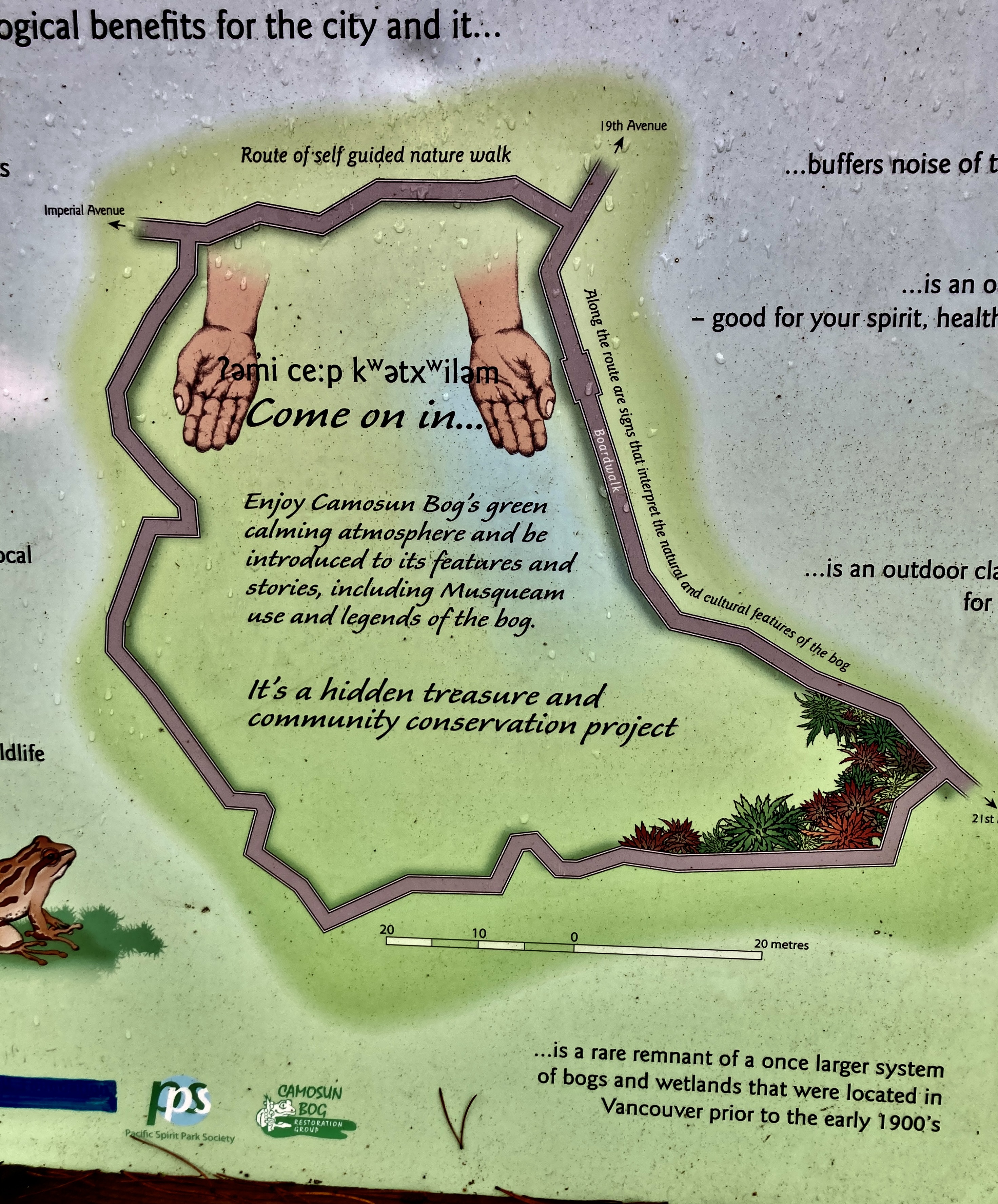
and Kimmerer’s words shimmer in my brain.

“With sophisticated technology we strive to see what is beyond us, but are often blind to the myriad sparkling facets that lie so close to hand. … Mosses and other small beings issue an invitation to dwell for a time right at the limits of ordinary perception.”

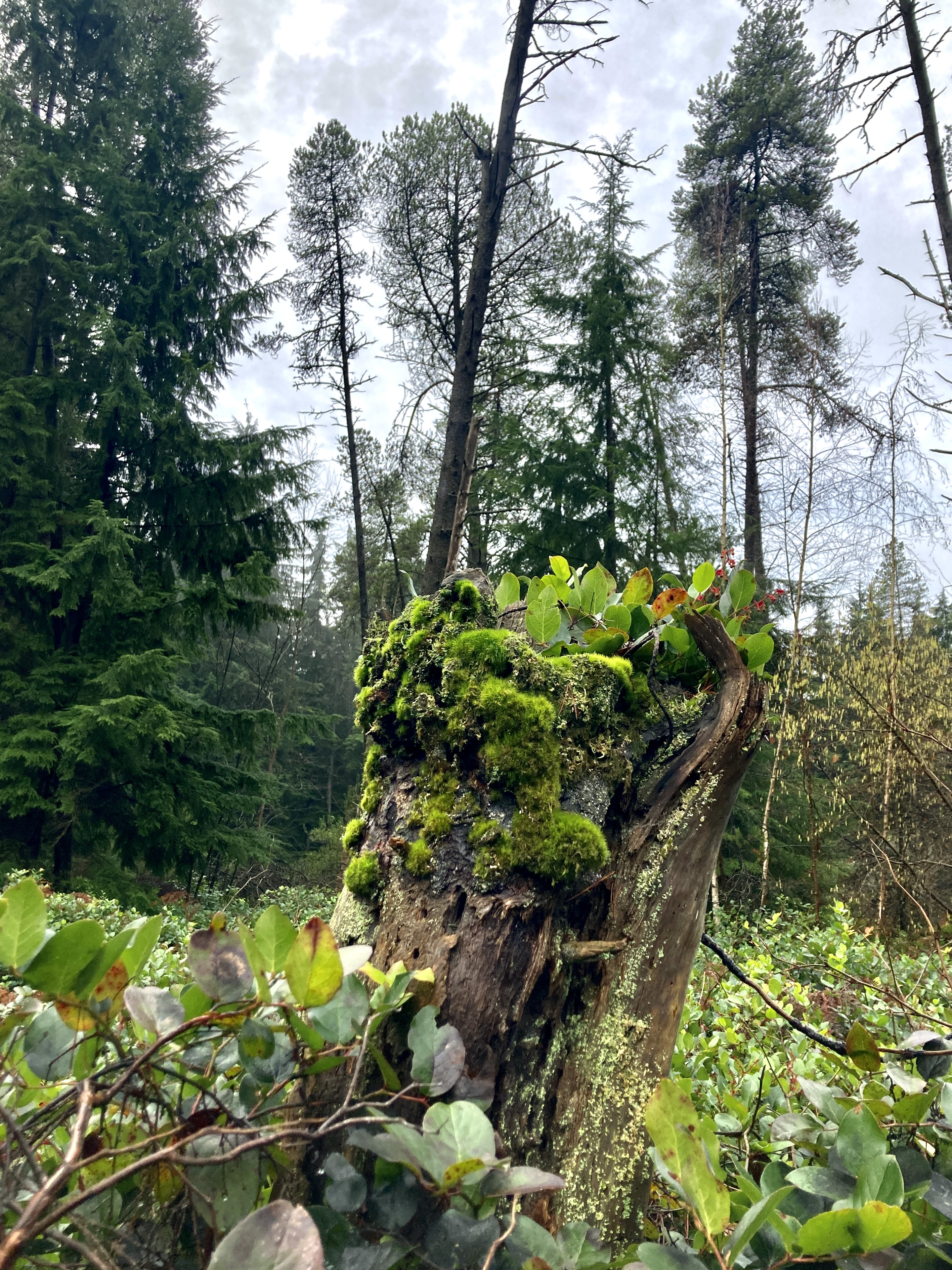
I greet what I think of as my Sentinel Log on the way in. I am still ignorant of all the mosses it bears, but more appreciative of them than ever.
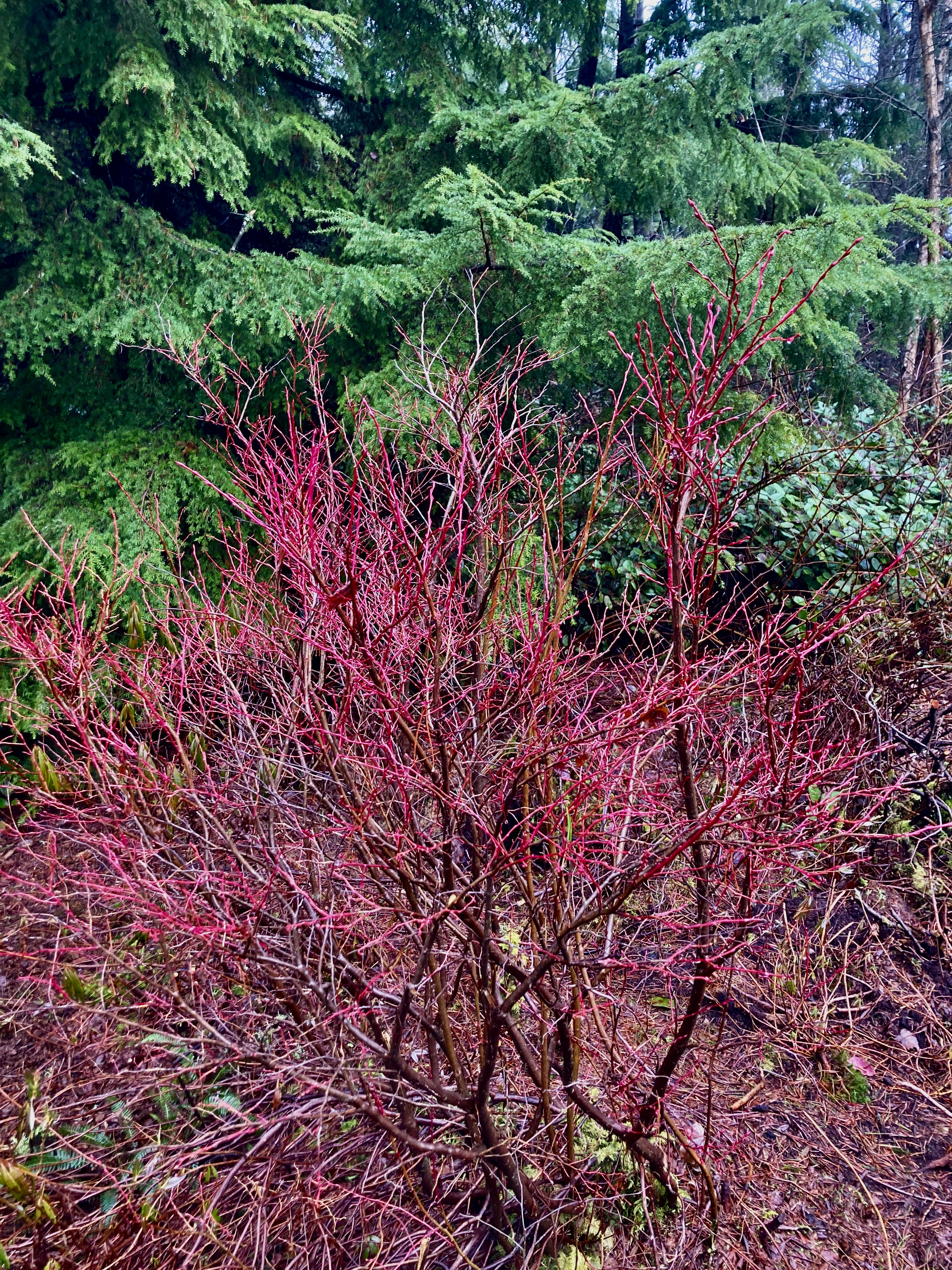
I am almost impatient with this blaze of Red osier dogwood — it’s not why I’m here!
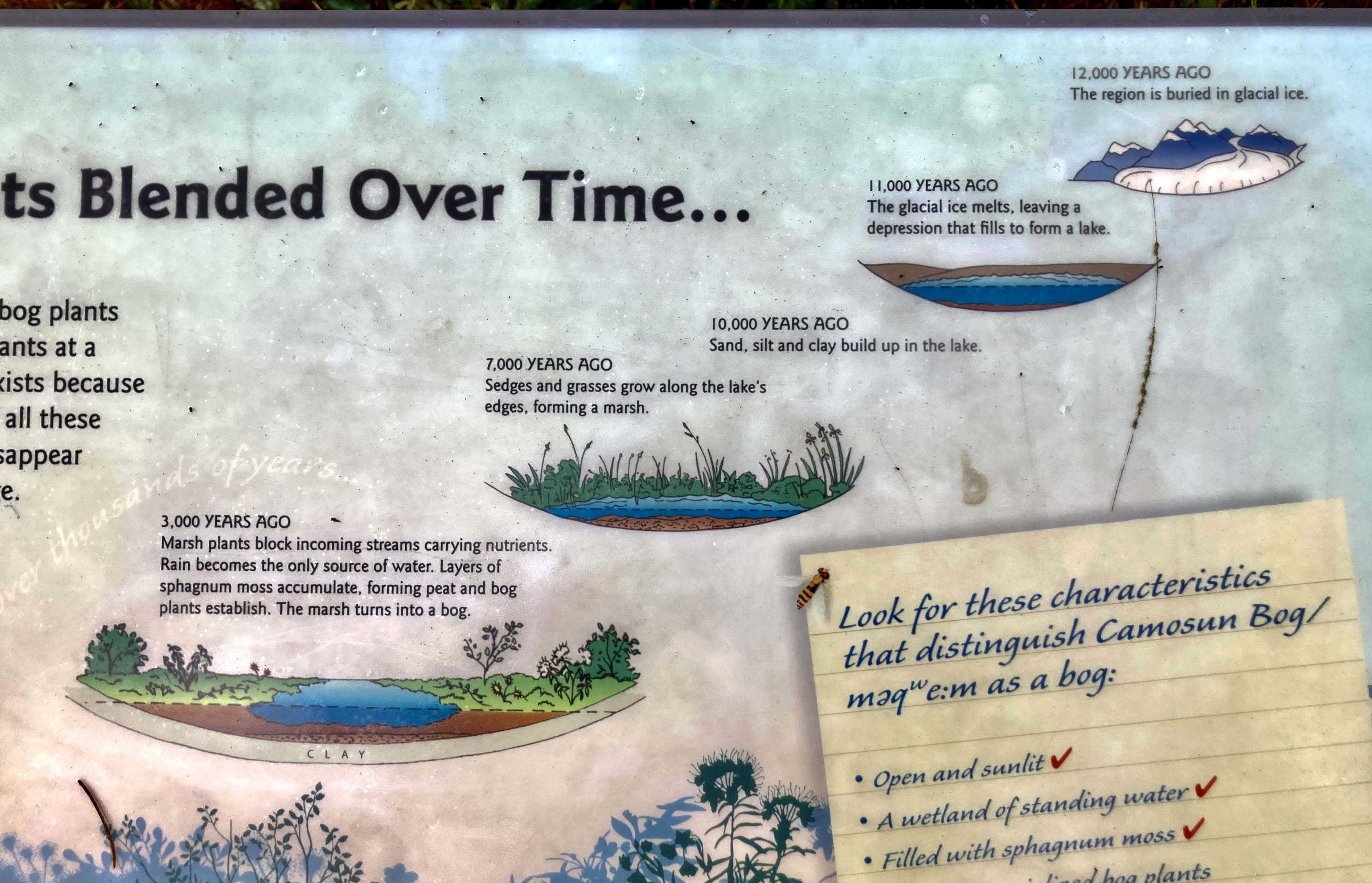
I am here for what first appeared some 3,000 years ago, the transformation from marsh to bog.
I stand at the heart of the bog, admire its waters at their full winter strength, surrounded by bog plants and mosses and, beyond that, the forest of Pacific Spirit Regional Park.
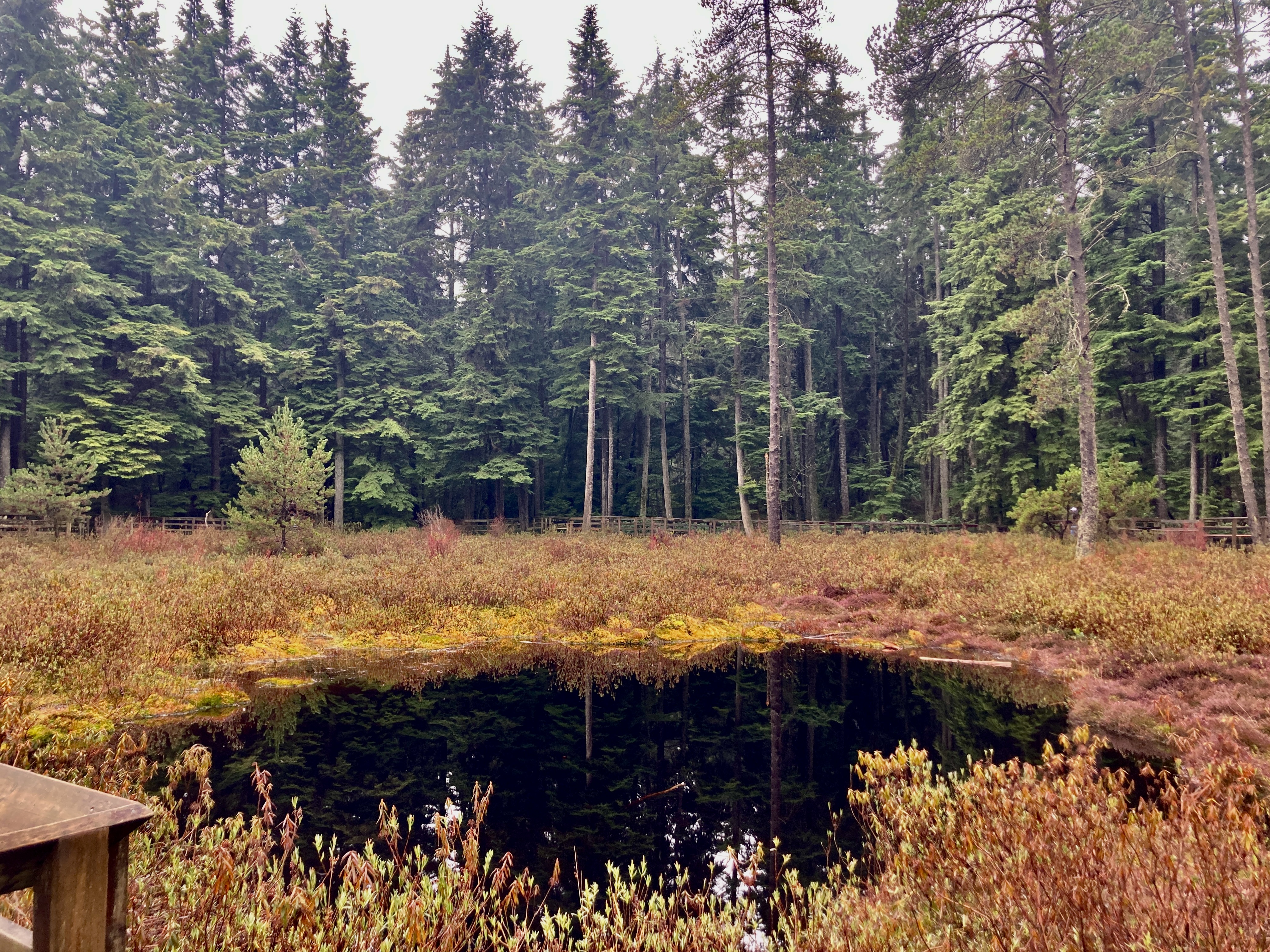
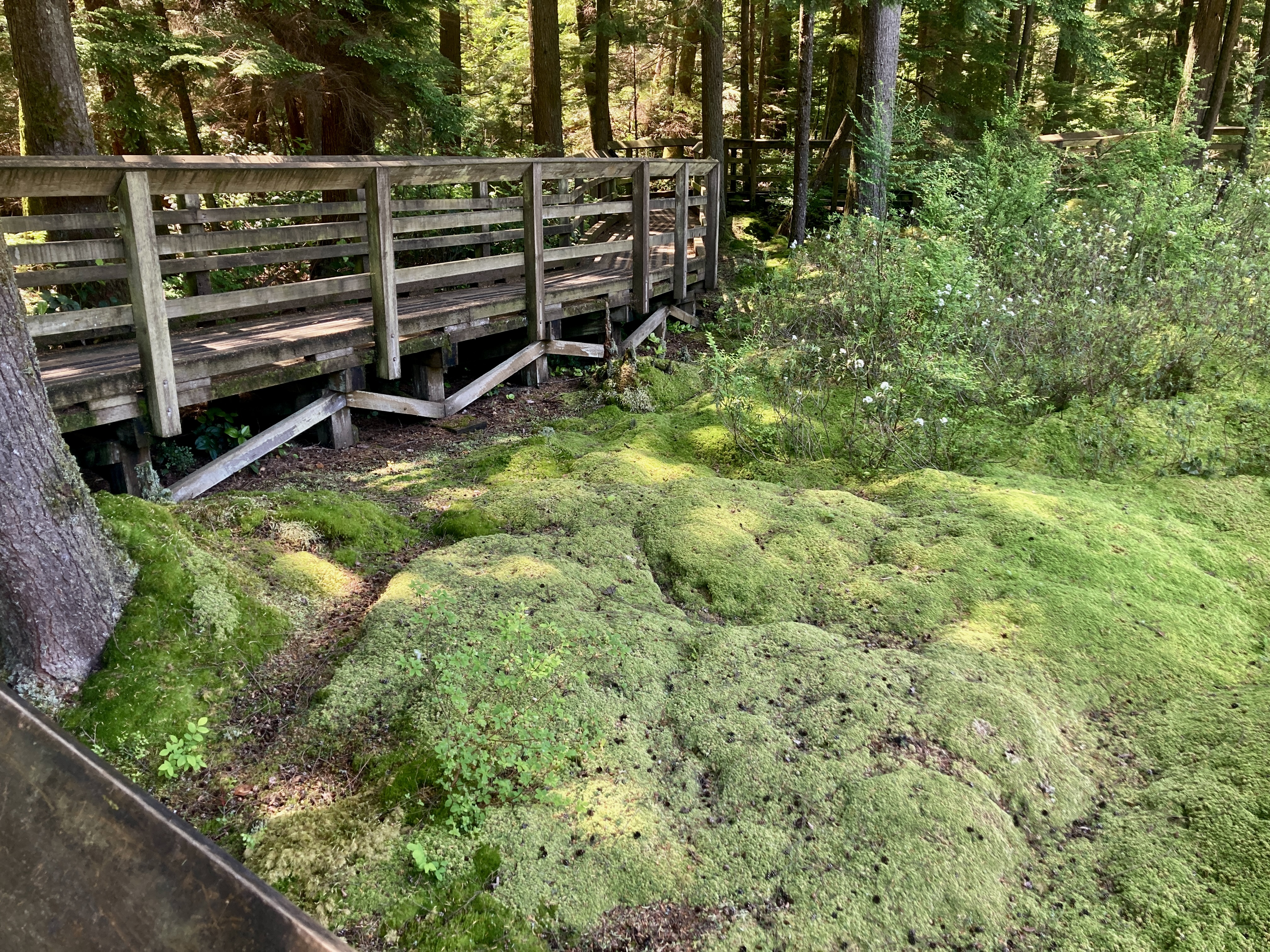
All those other plants first tug the eye, but, look, mosses on hummocks in the bog waters and all along its edges.
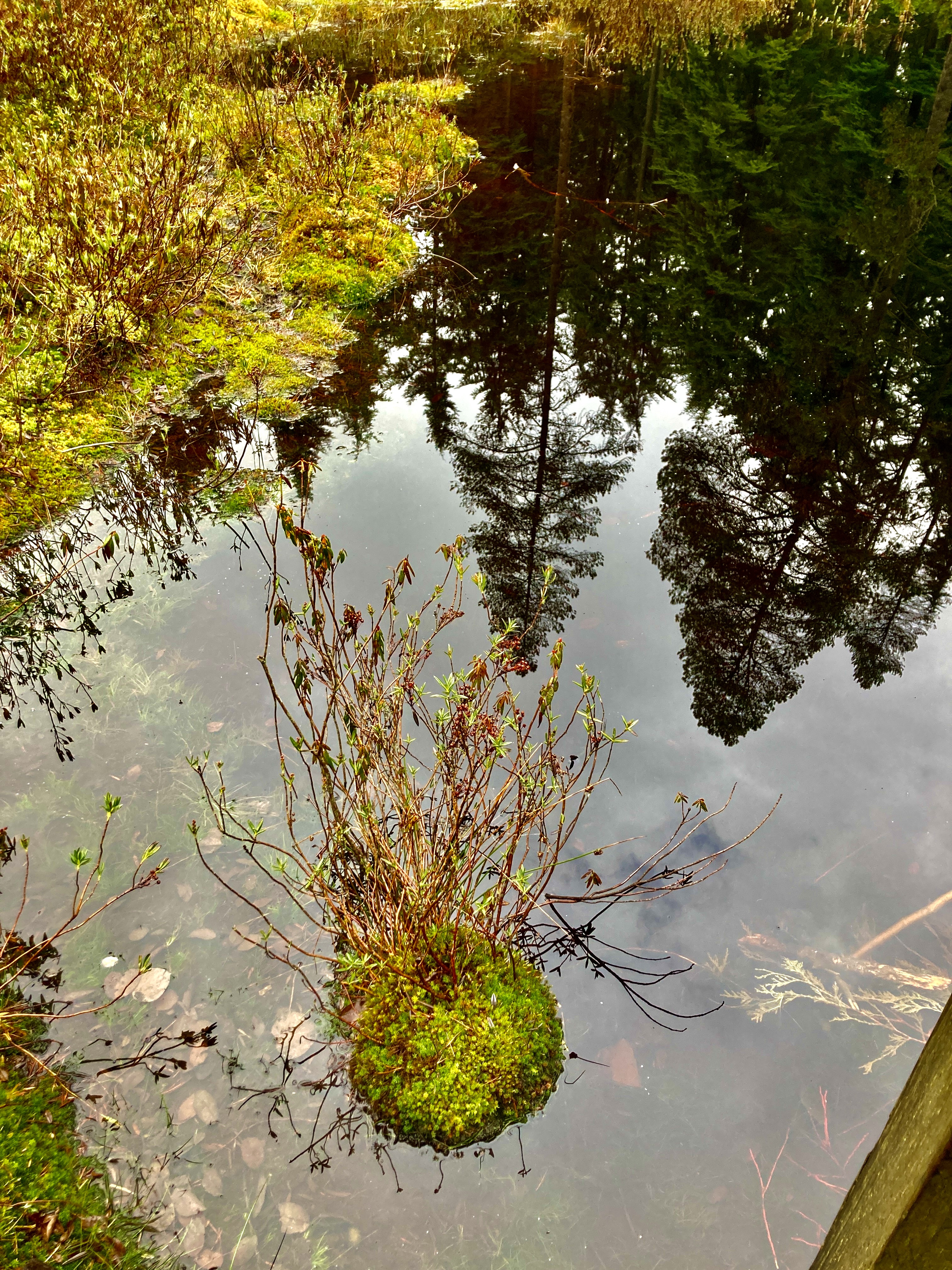
“Learning to see mosses is more like listening than looking,” says Kimmerer. “Mosses are not elevator music, they are the intertwined threads of a Beethoven quartet.”
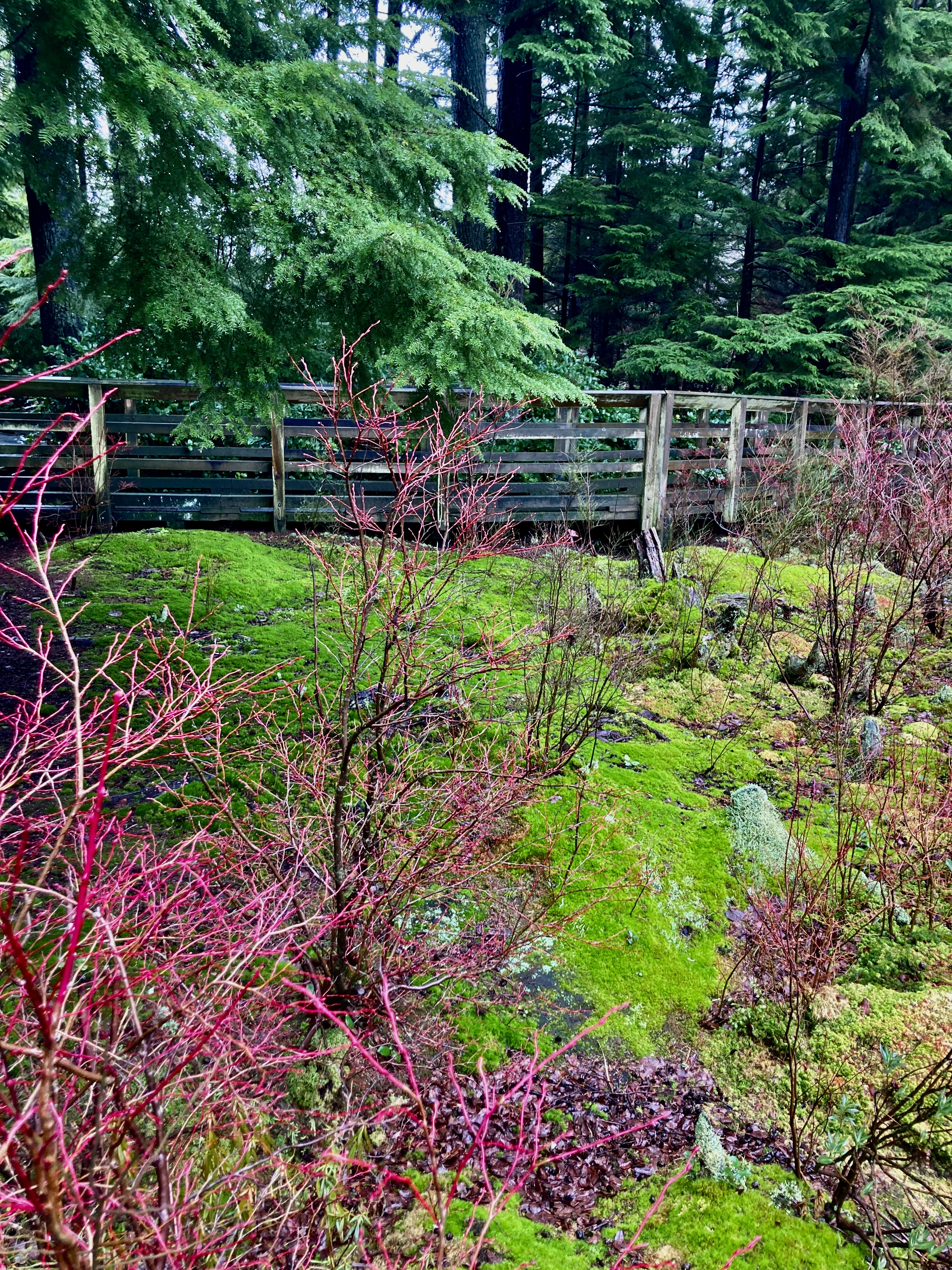
I dutifully read about the Bog Laurel…
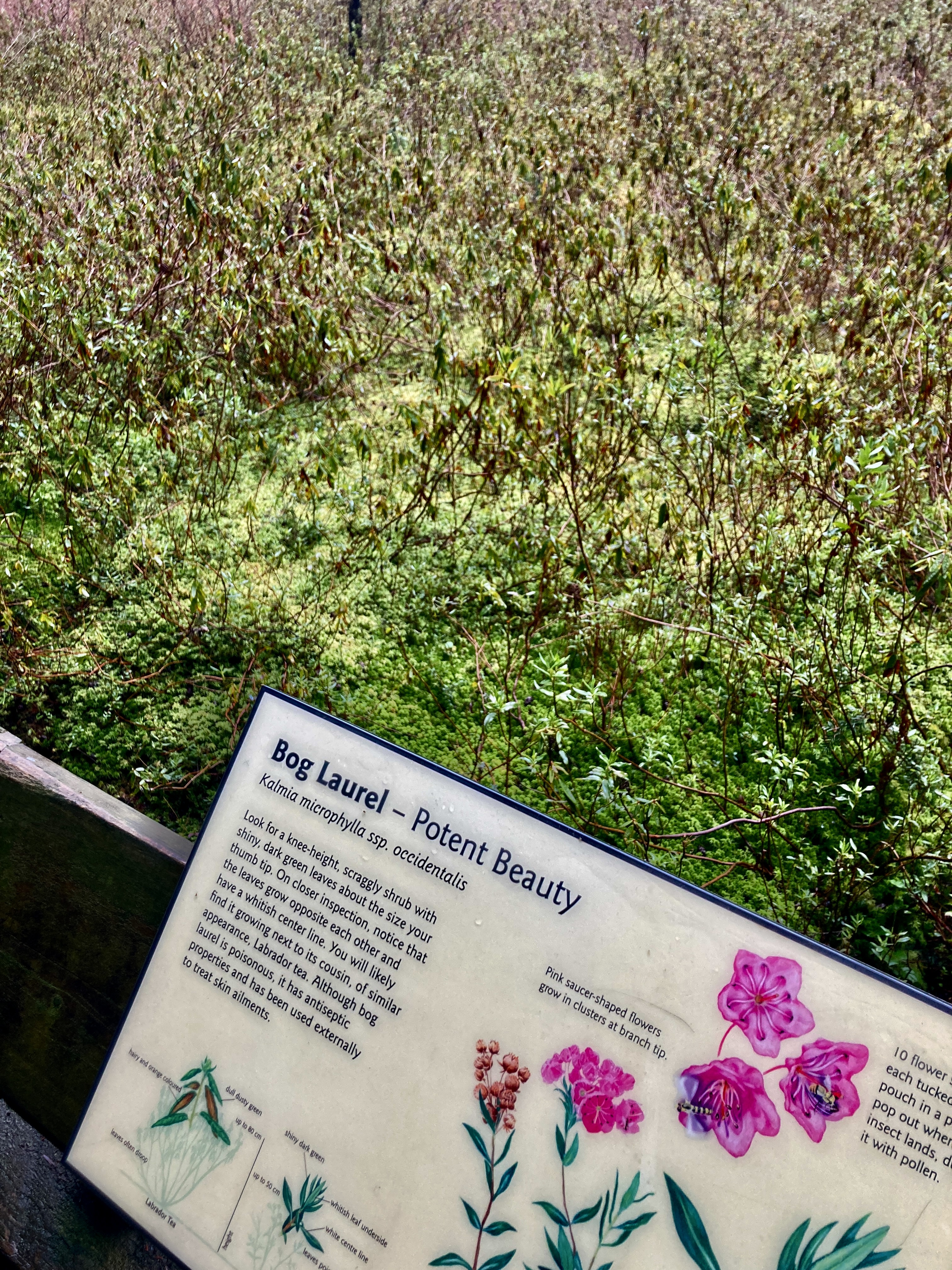
but I am looking beneath the Laurel, beneath the Labrador Tea, beneath the Bog Cranberry…
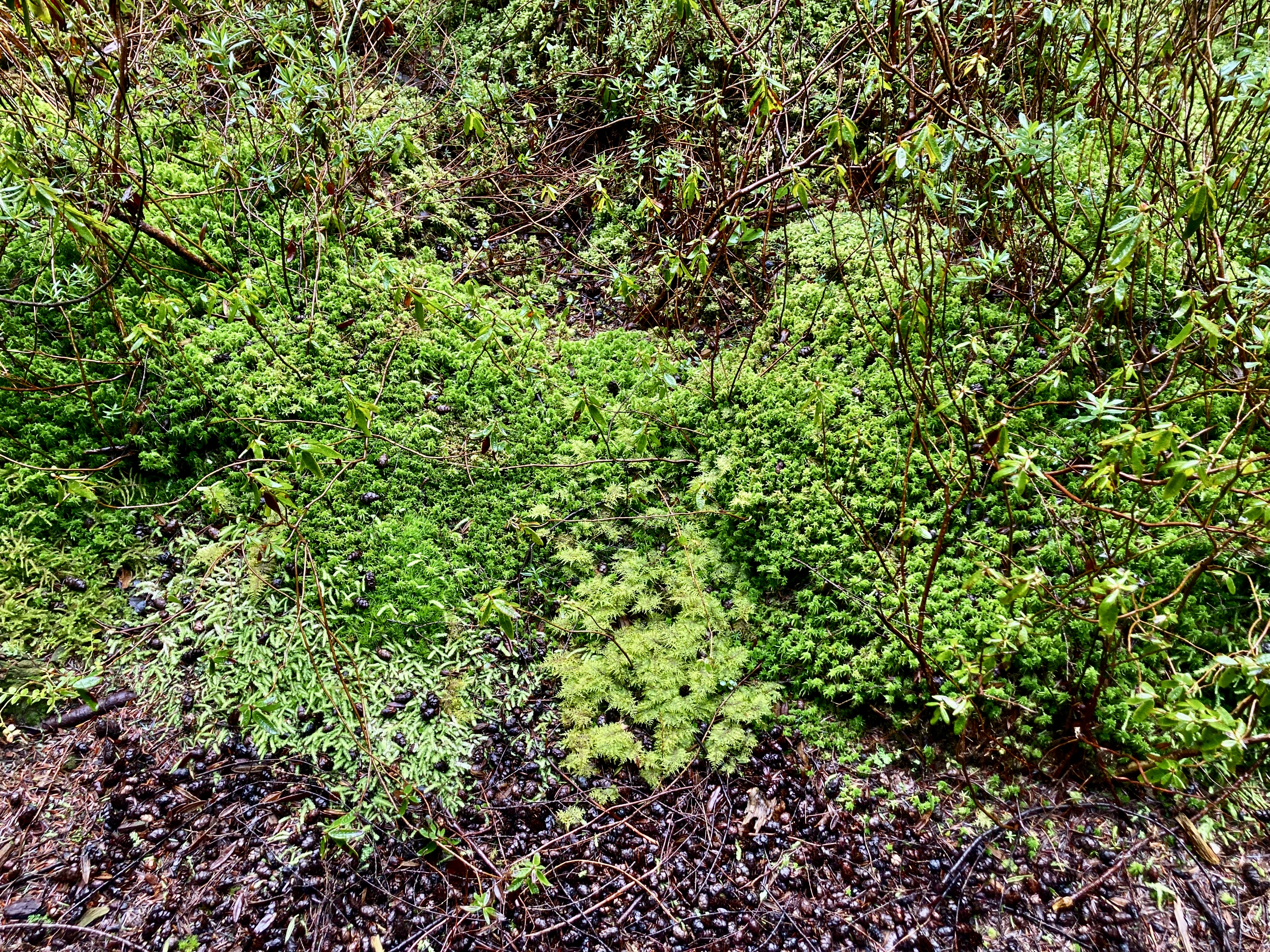
to the moss. The mosses. The bryophytes.

“A true moss or bryophyte is the most primitive of land plants,” explains Kimmerer. They lack flowers, fruits, seeds and roots; they have no vascular system. “They are the most simple of plants and in their simplicity, elegant. With just a few rudimentary components of stem and leaf, evolution has produced some 22,000 species of moss worldwide.”
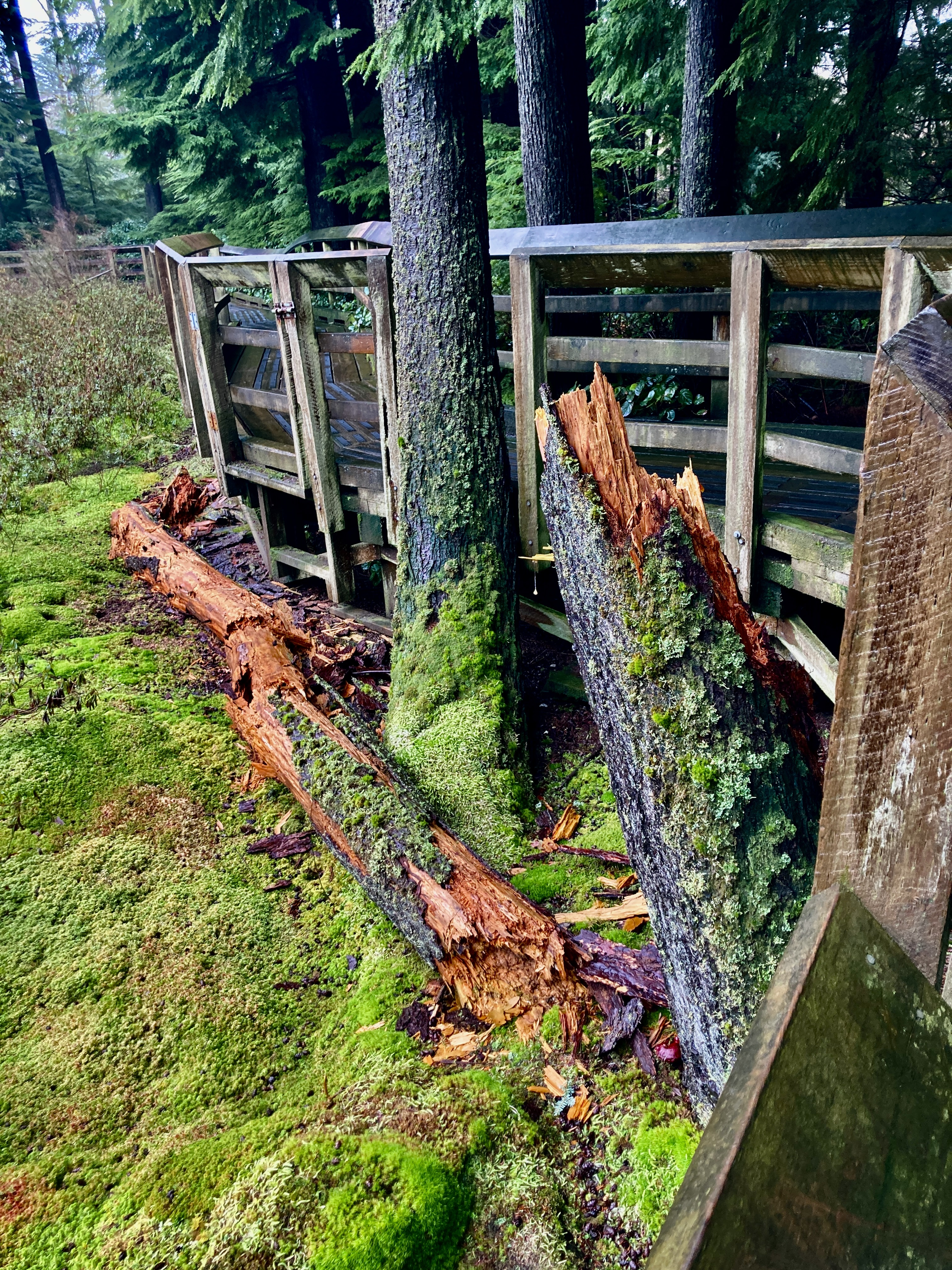
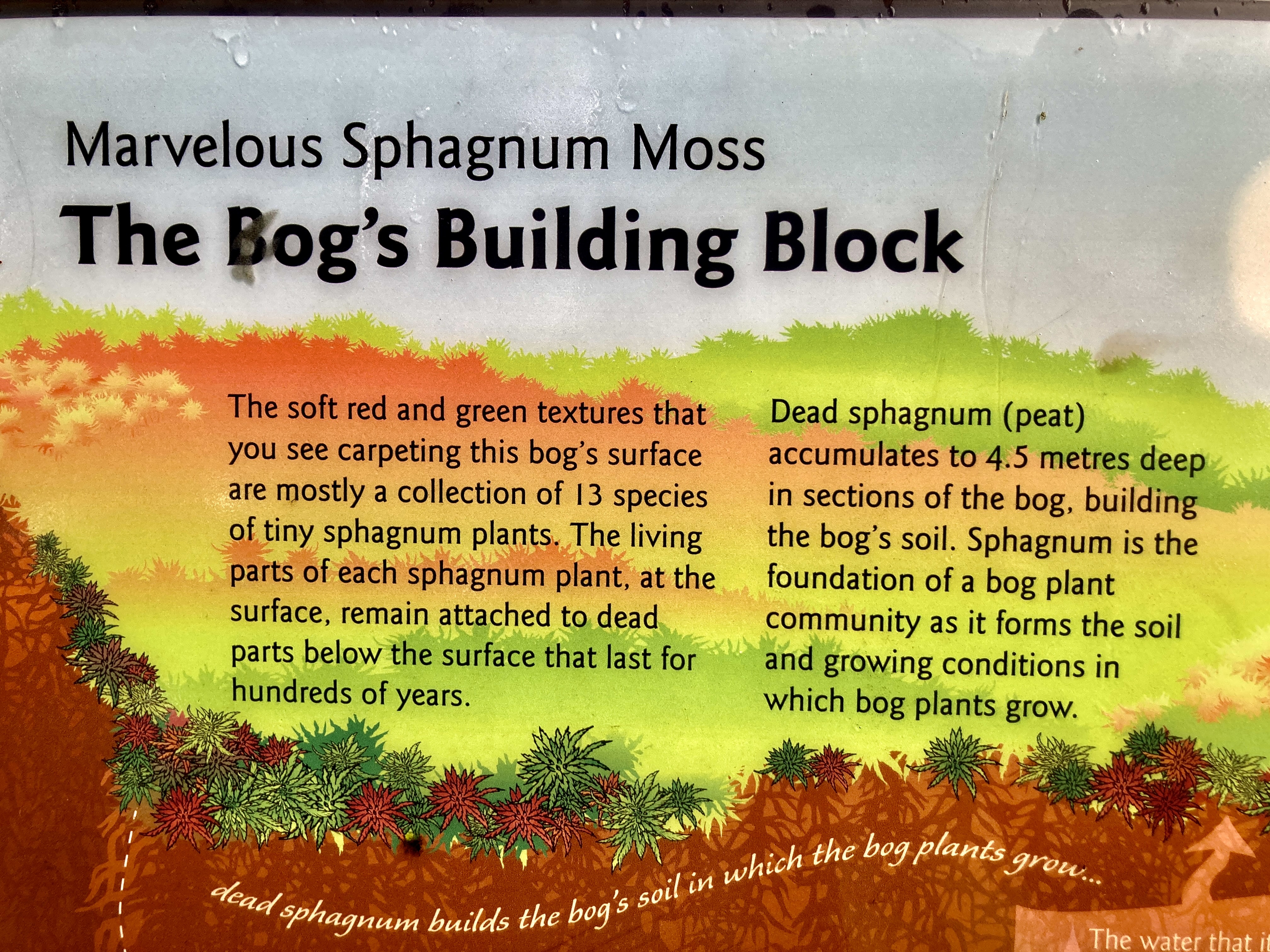
I pause for another sign. (I always read signs.) Thirteen species of sphagnum moss, here in the bog.
I walk on. I marvel.
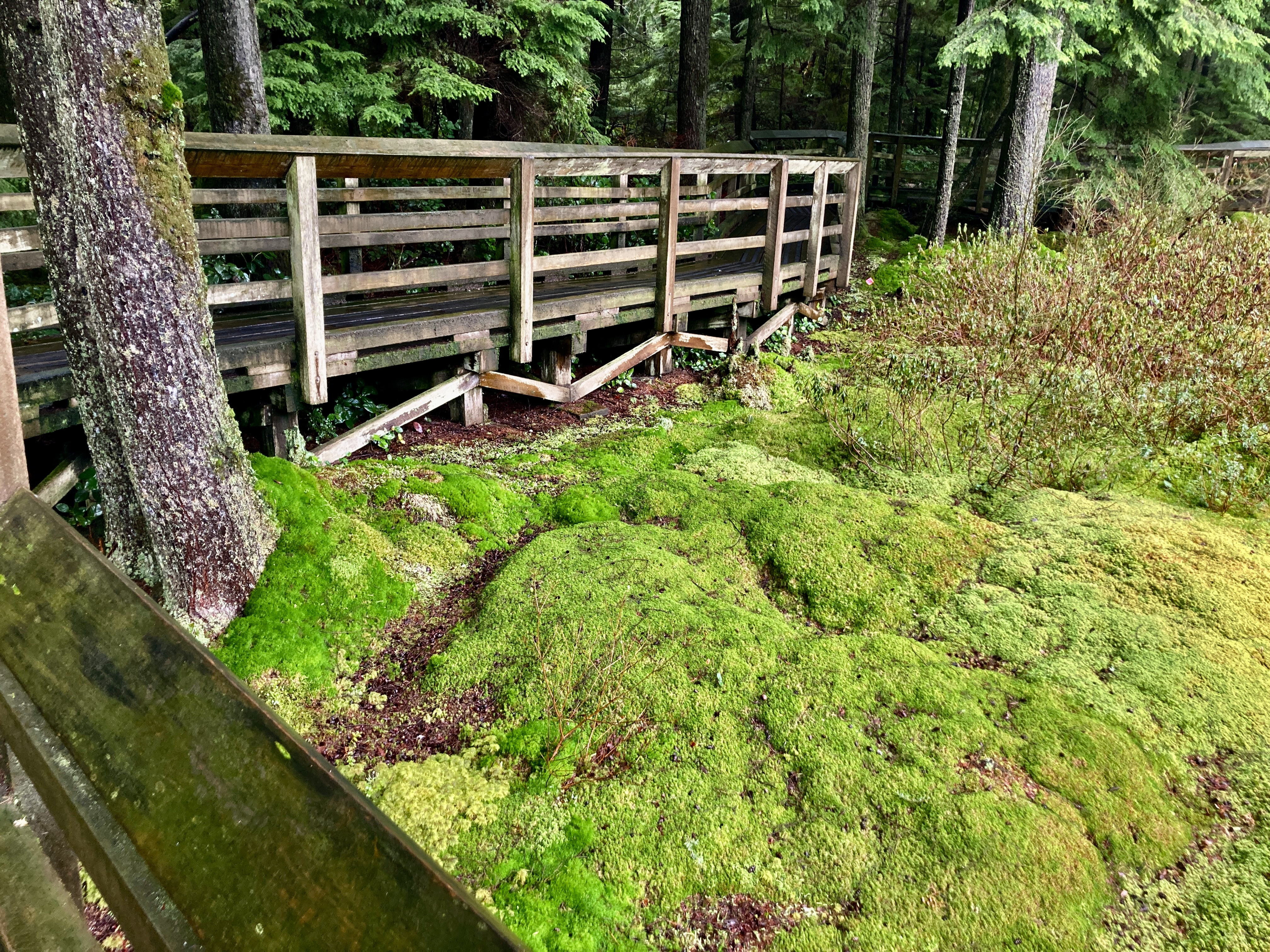
And I marvel some more.
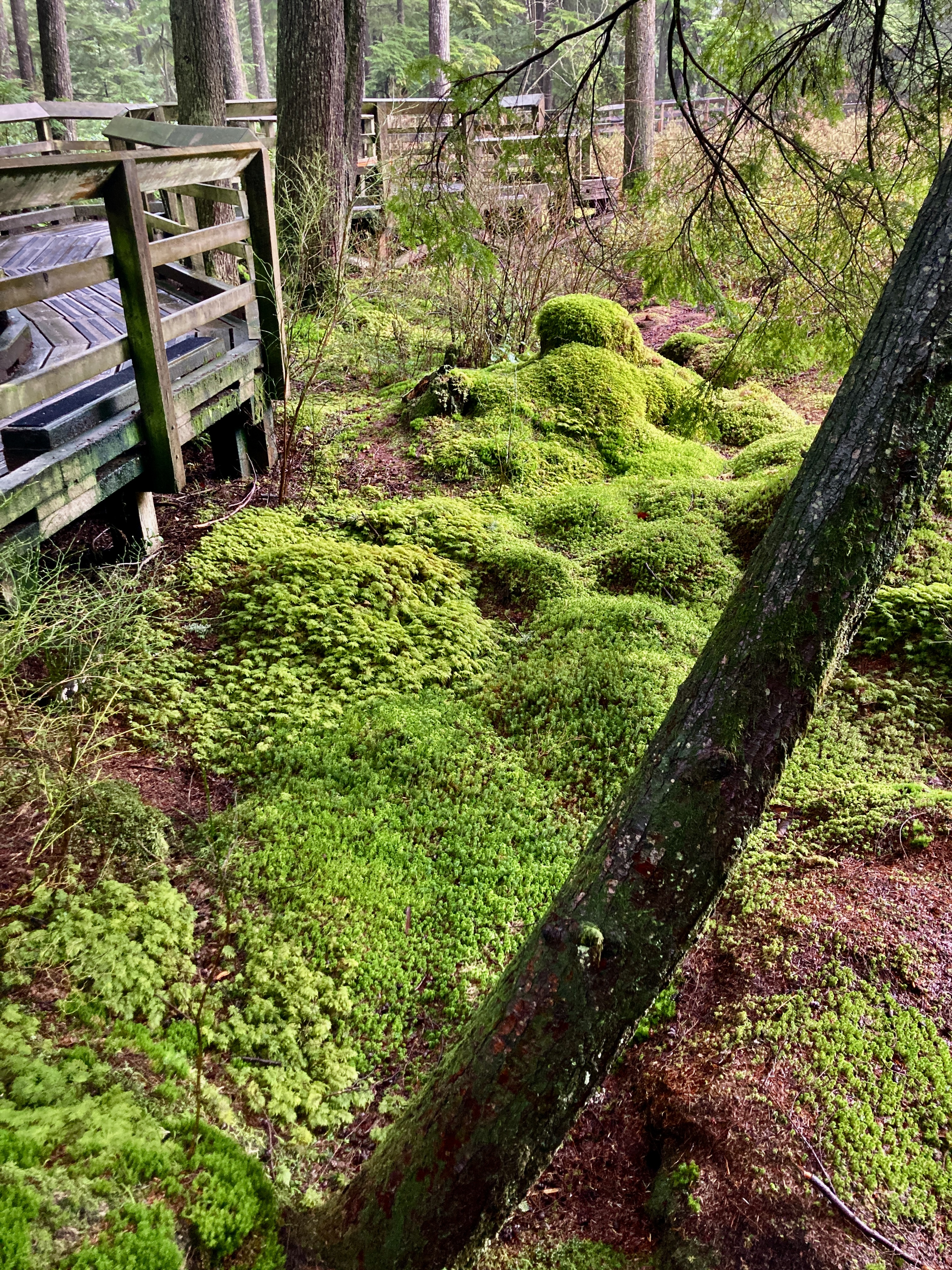
Among all the glowing greens, some of the soft reds the sphagnum moss sign has just invited us to notice.
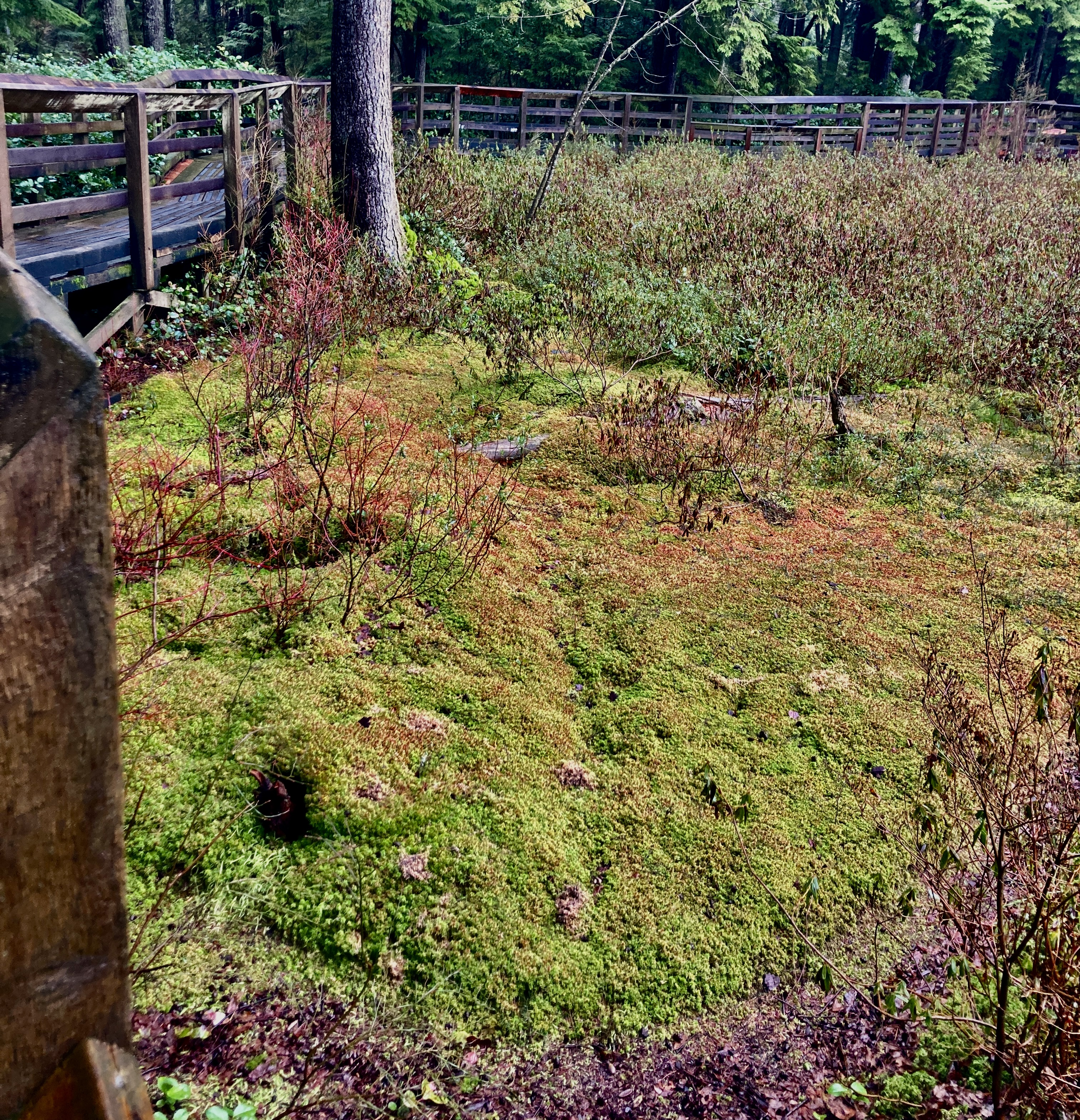
I take a spur path away from the loop encircling the bog, off into the surrounding forest.
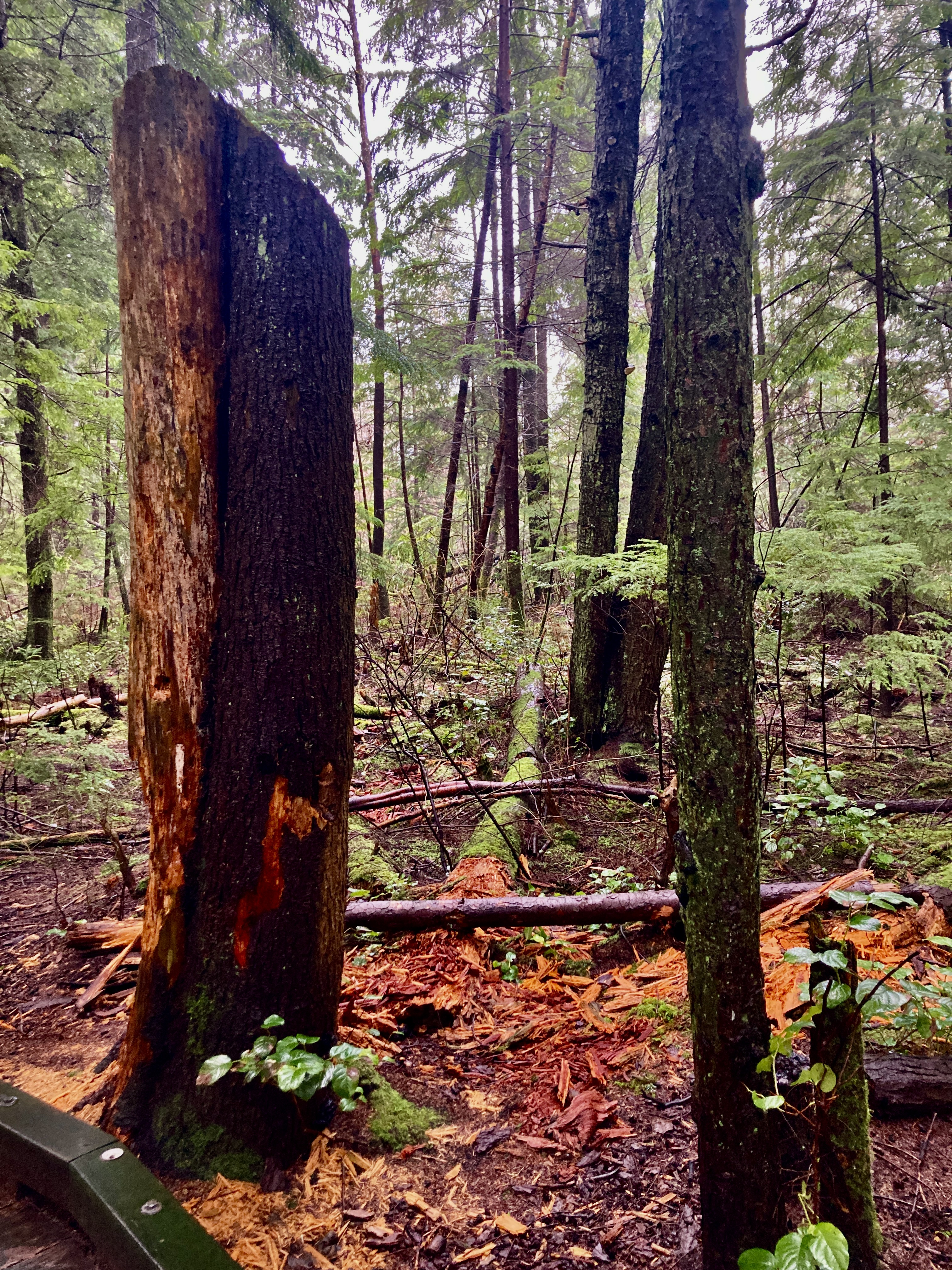
Kimmerer murmurs in my ear: “Looking at mosses adds a depth and intimacy to knowing the forest,”

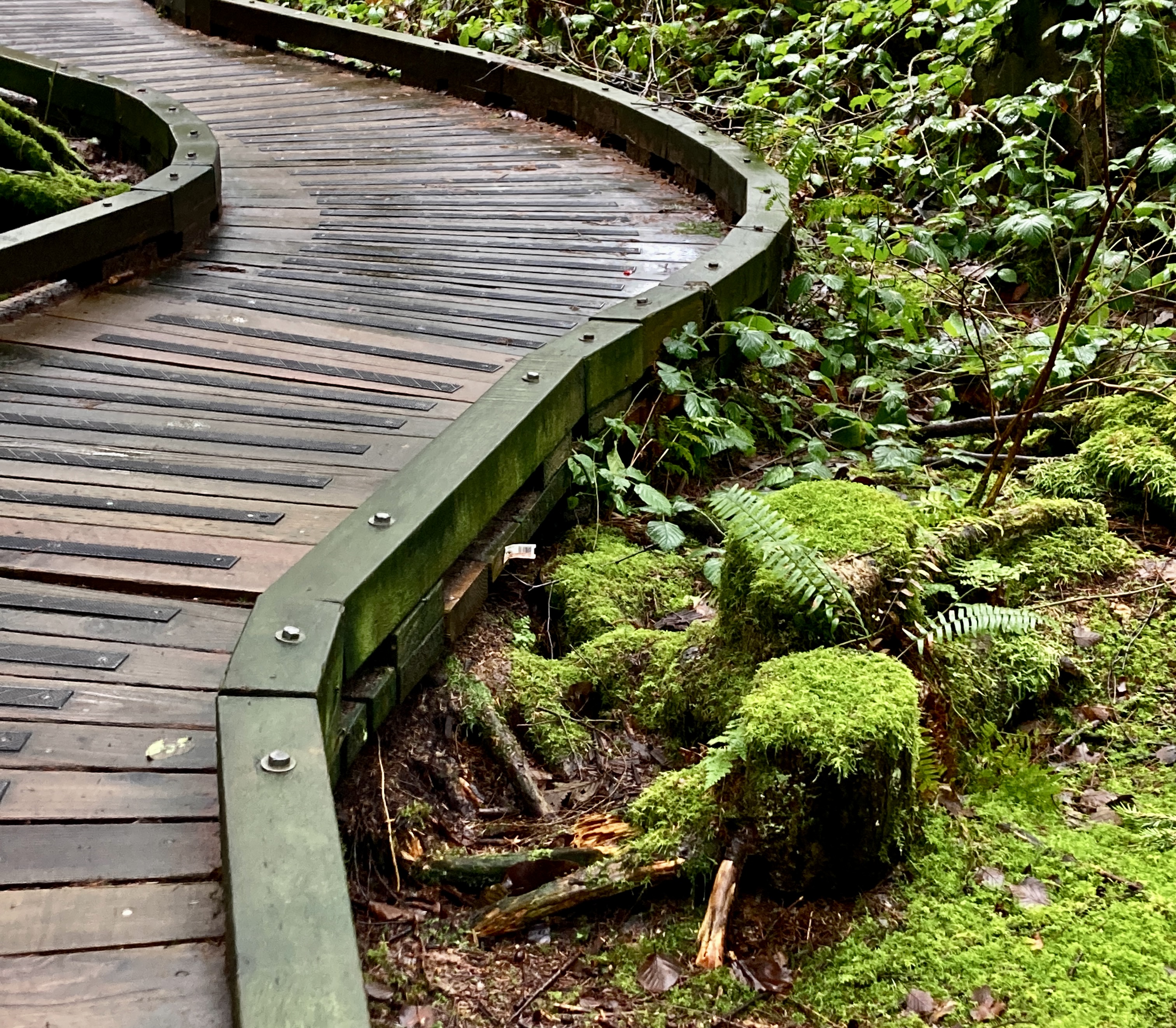
Here at a curve in the path, a knot of ferns and moss. I nod at them, smile, think of the ferns and mosses on my own balcony.
Another Sentinel Log, this one guarding the 19th Avenue entry to the bog…
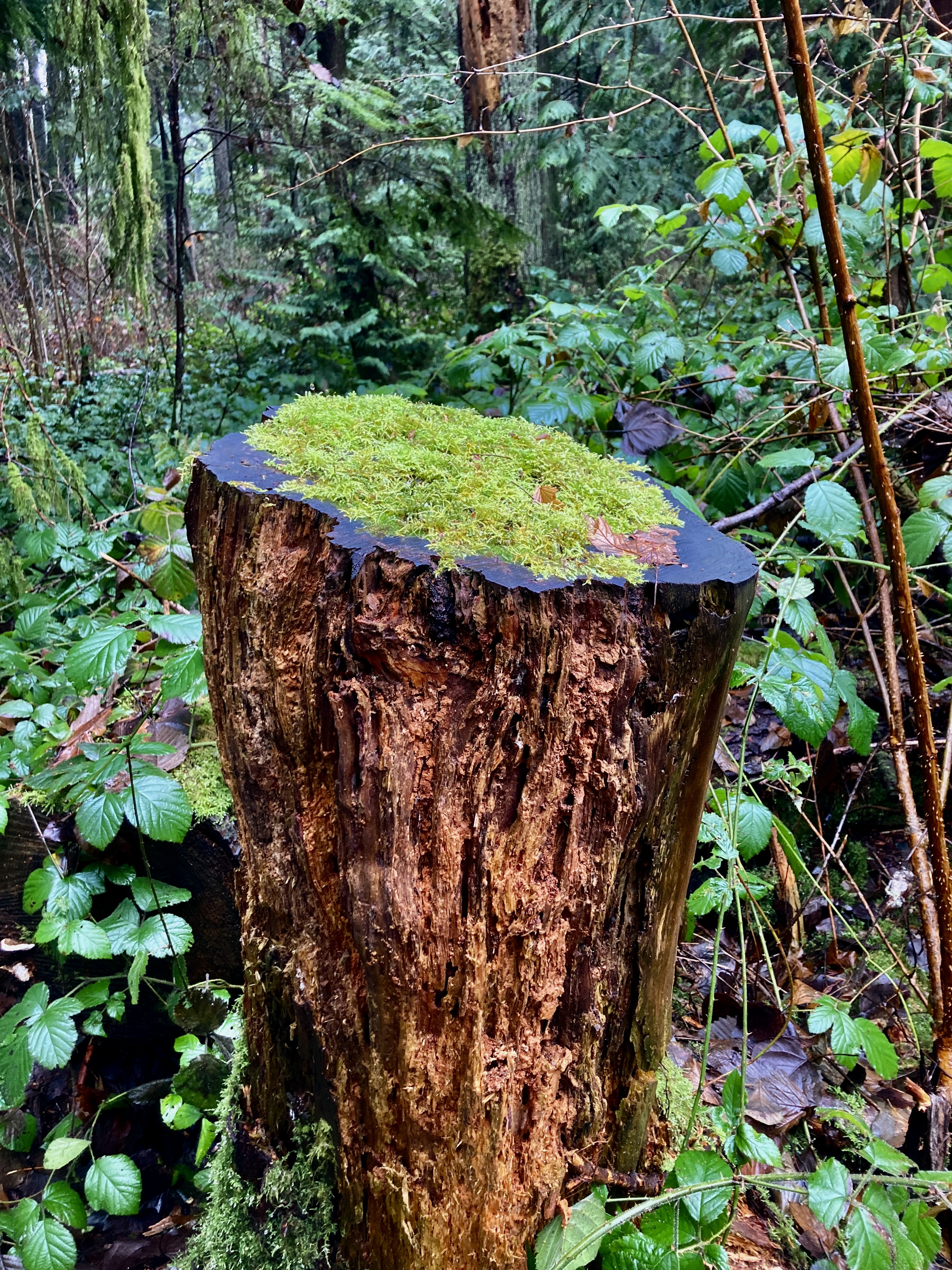
and finally, I turn back.

I nod farewell to this log’s Camosun Street colleague on the way out…
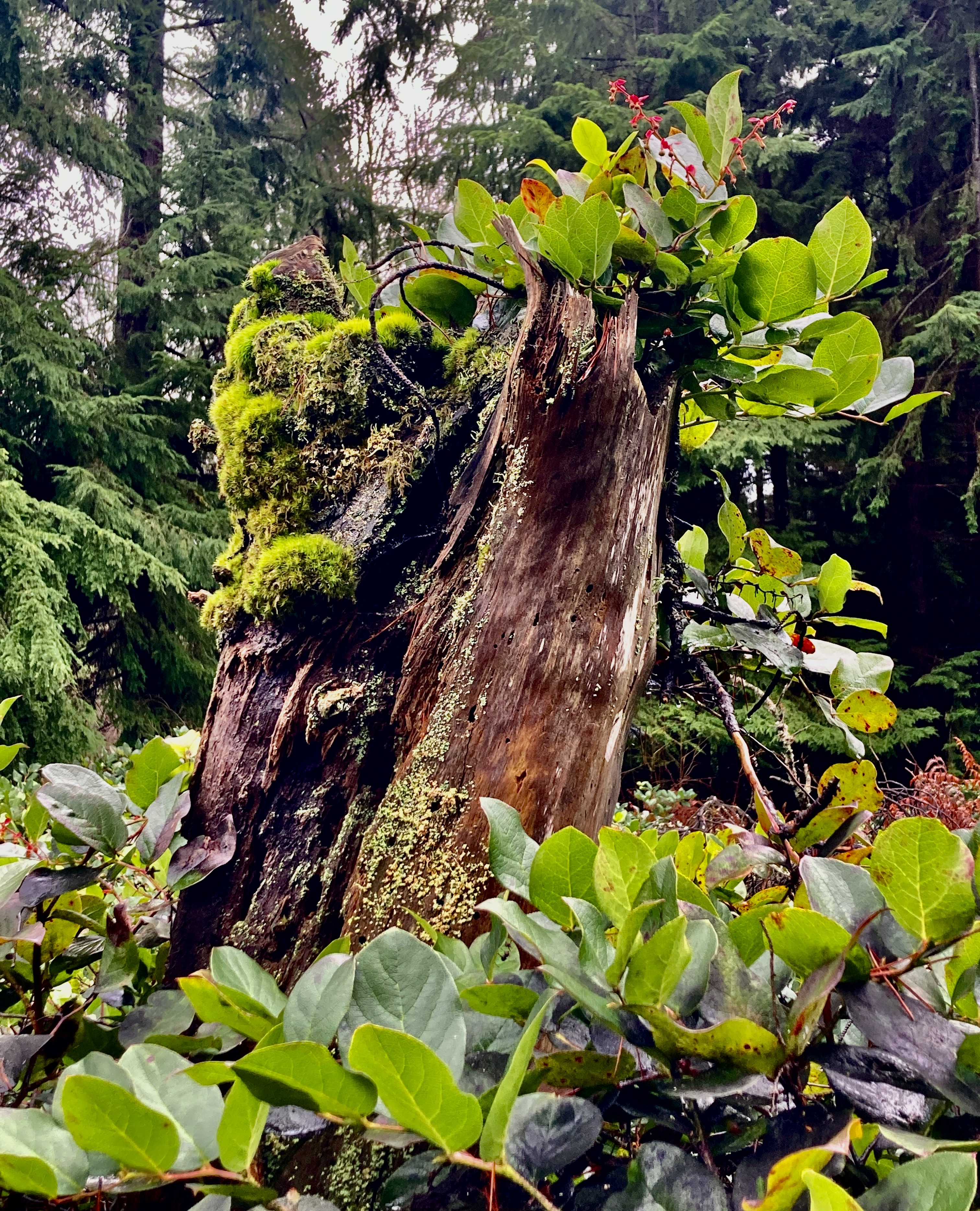
and then — of course — keep right on noticing moss, with every step.

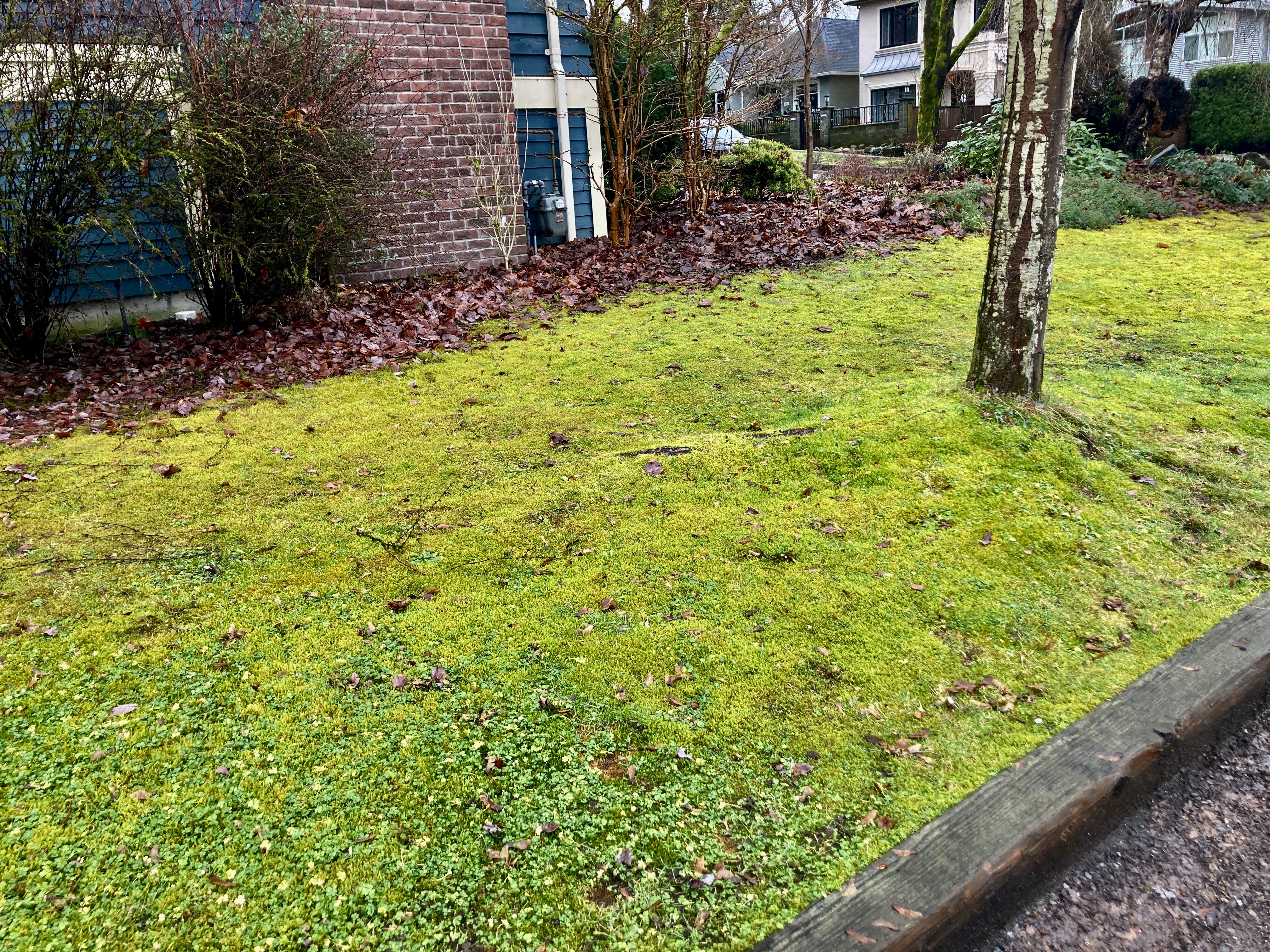
Here, a side lawn bordering Camosun Street…
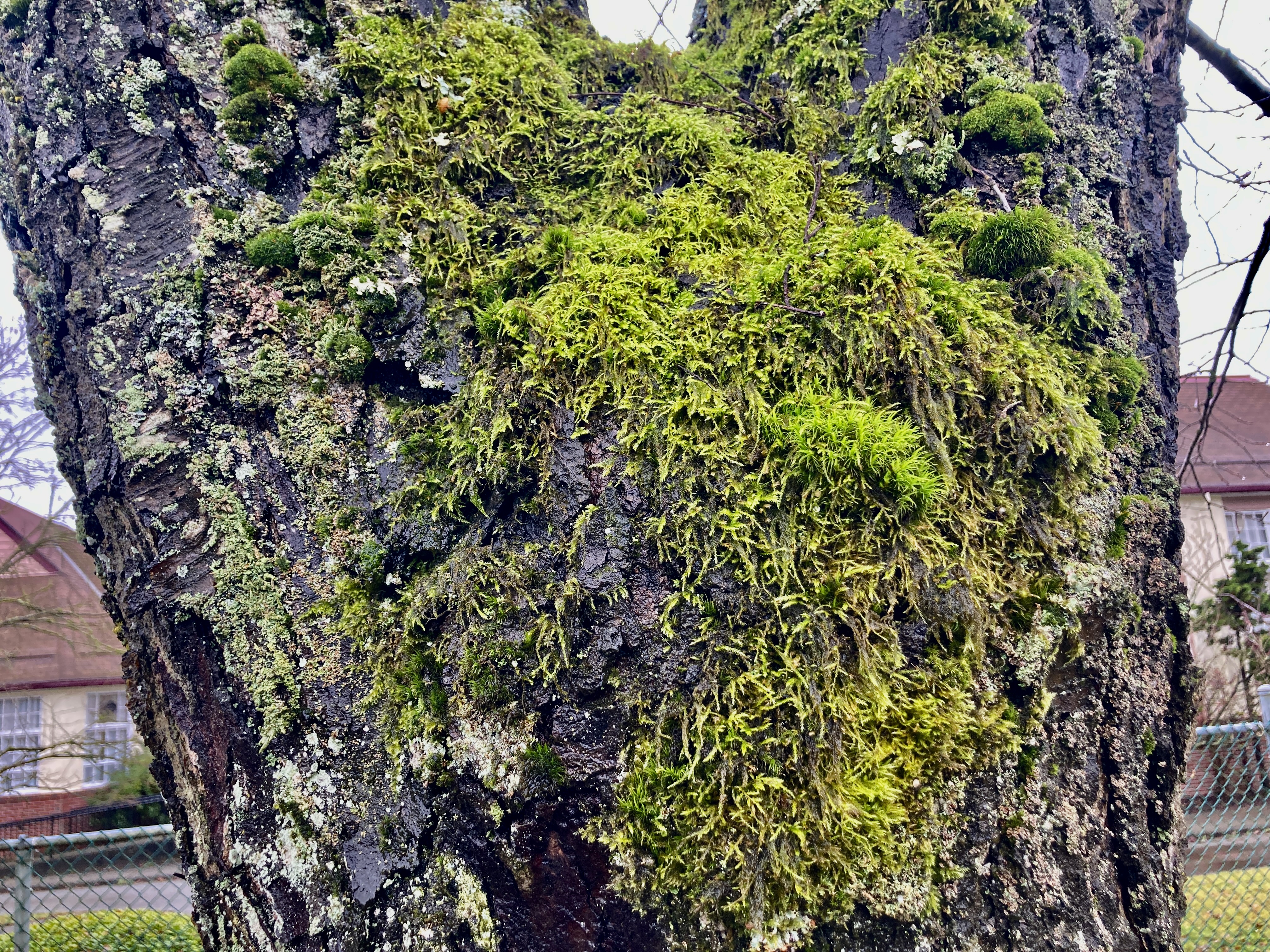
here, the crotch of the tree at the bus stop…
and finally here…
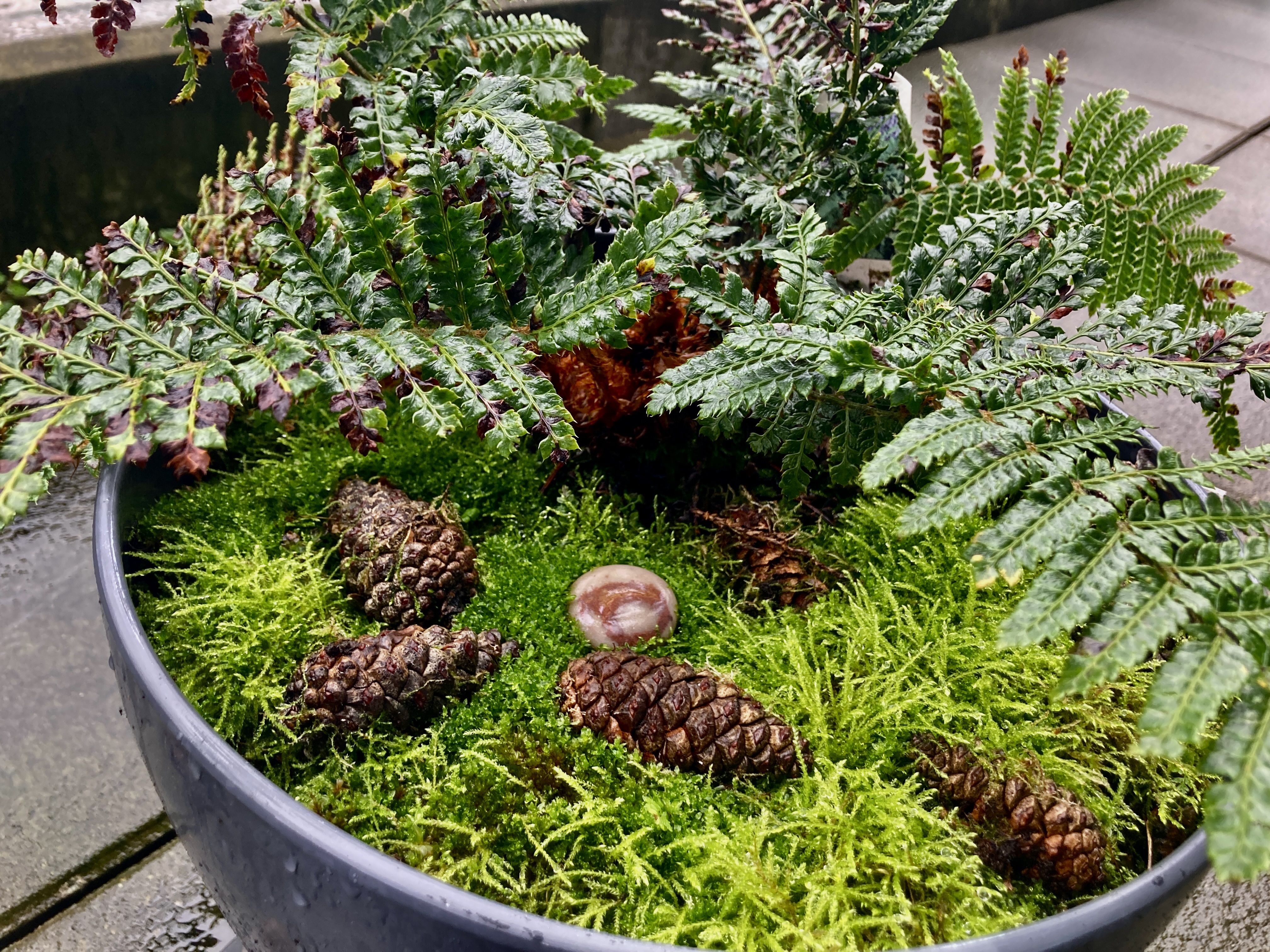
right here, on my own balcony at home.

Of Moss, Muzzles & Monsters

2 June 2025 – Only moss is on the agenda. Muzzles & monsters turn up on their own.

Moss is on the agenda because it’s about to go into its seasonal decline. Moss thrives in cool damp, suffers in dry heat. I want one last fix, and the Camosun Bog is the place to pay tribute.

As boardwalk signage points out…

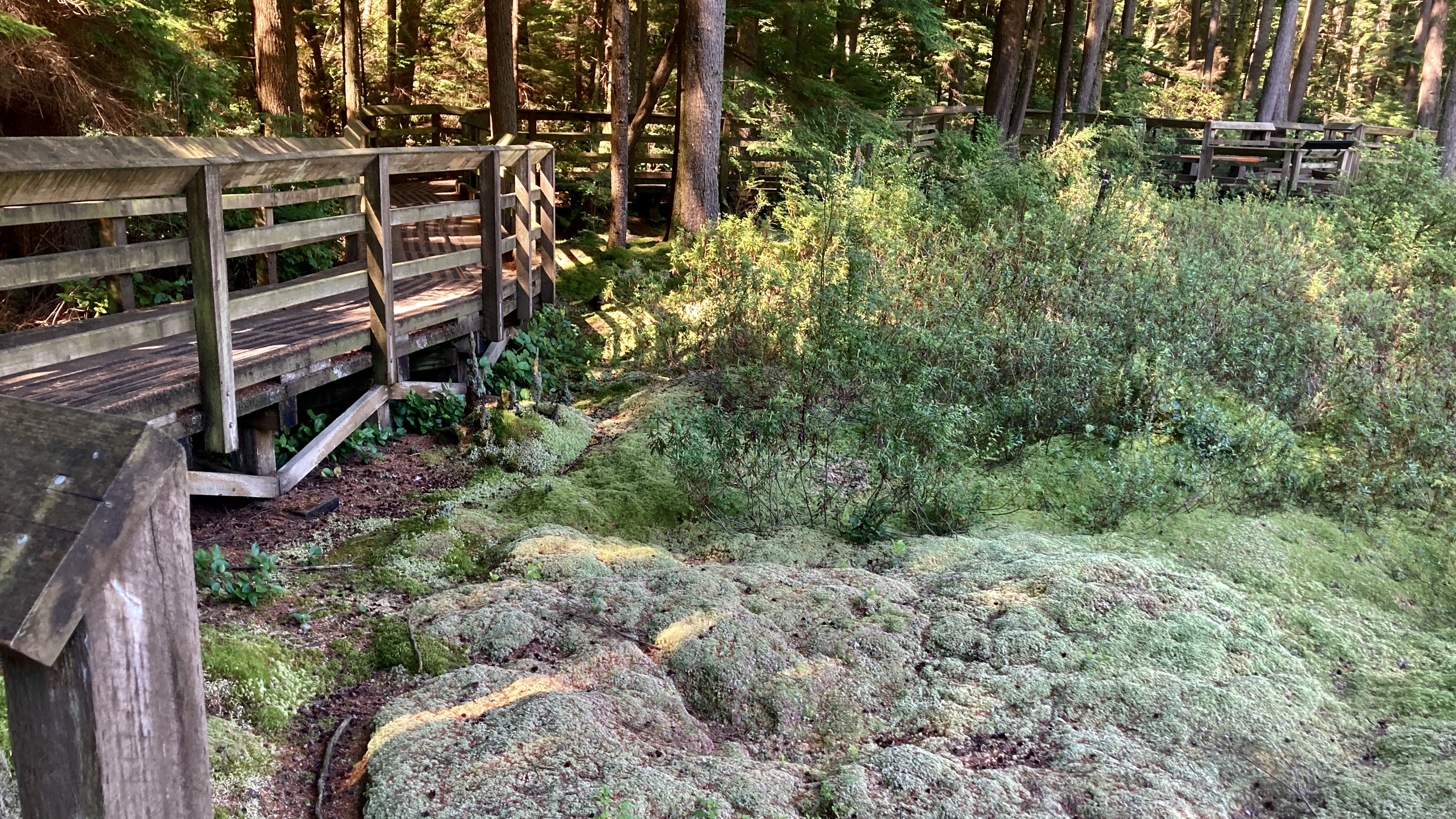
the bog is, literally, built on moss.

Fortunately, despite the glossy new salal leaves and the bright growing trips of the evergreens that encircle the bog and speak of this new season…

the mossy carpet is still green, not yet bleached to its mid-summer pallor.

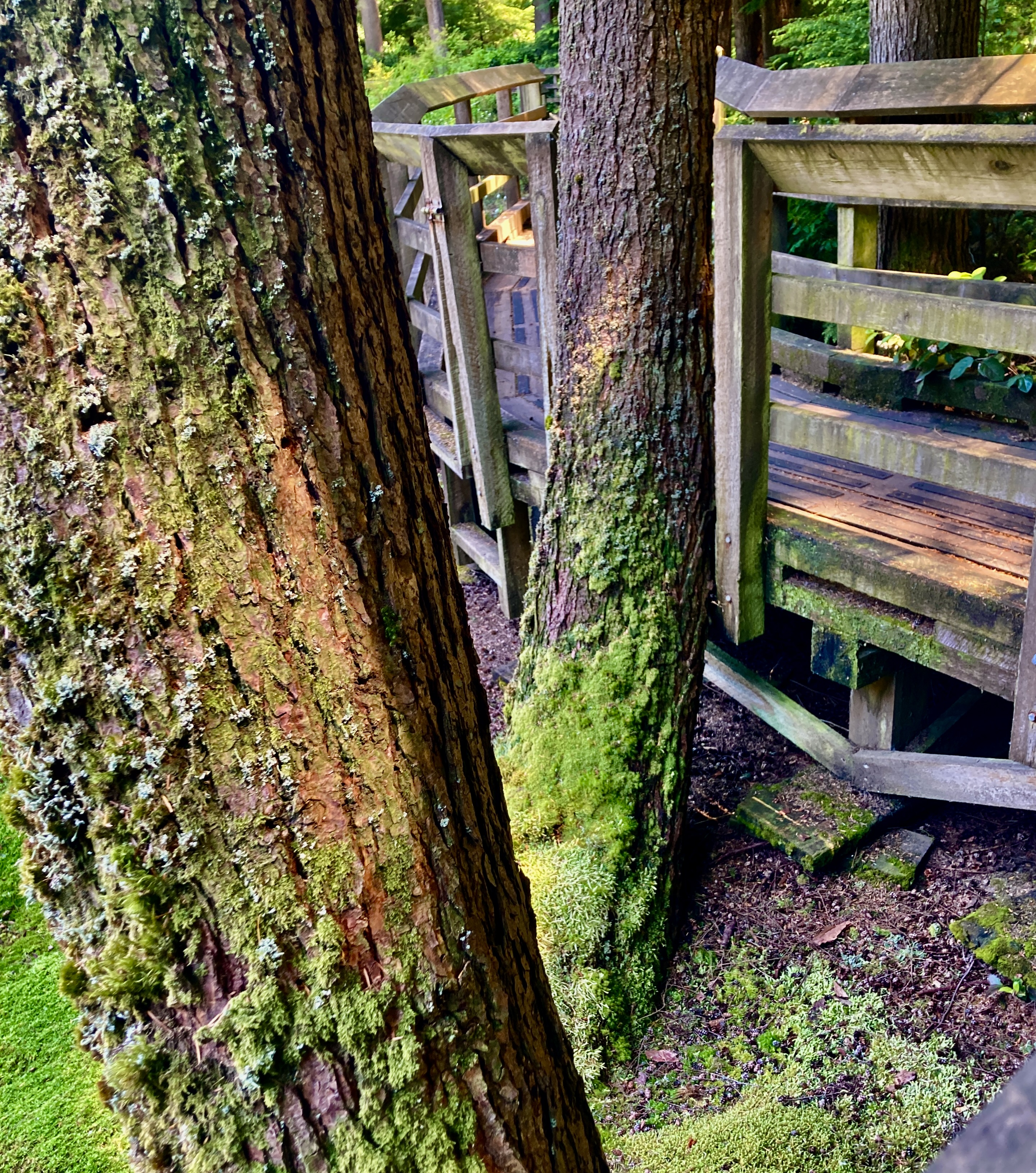
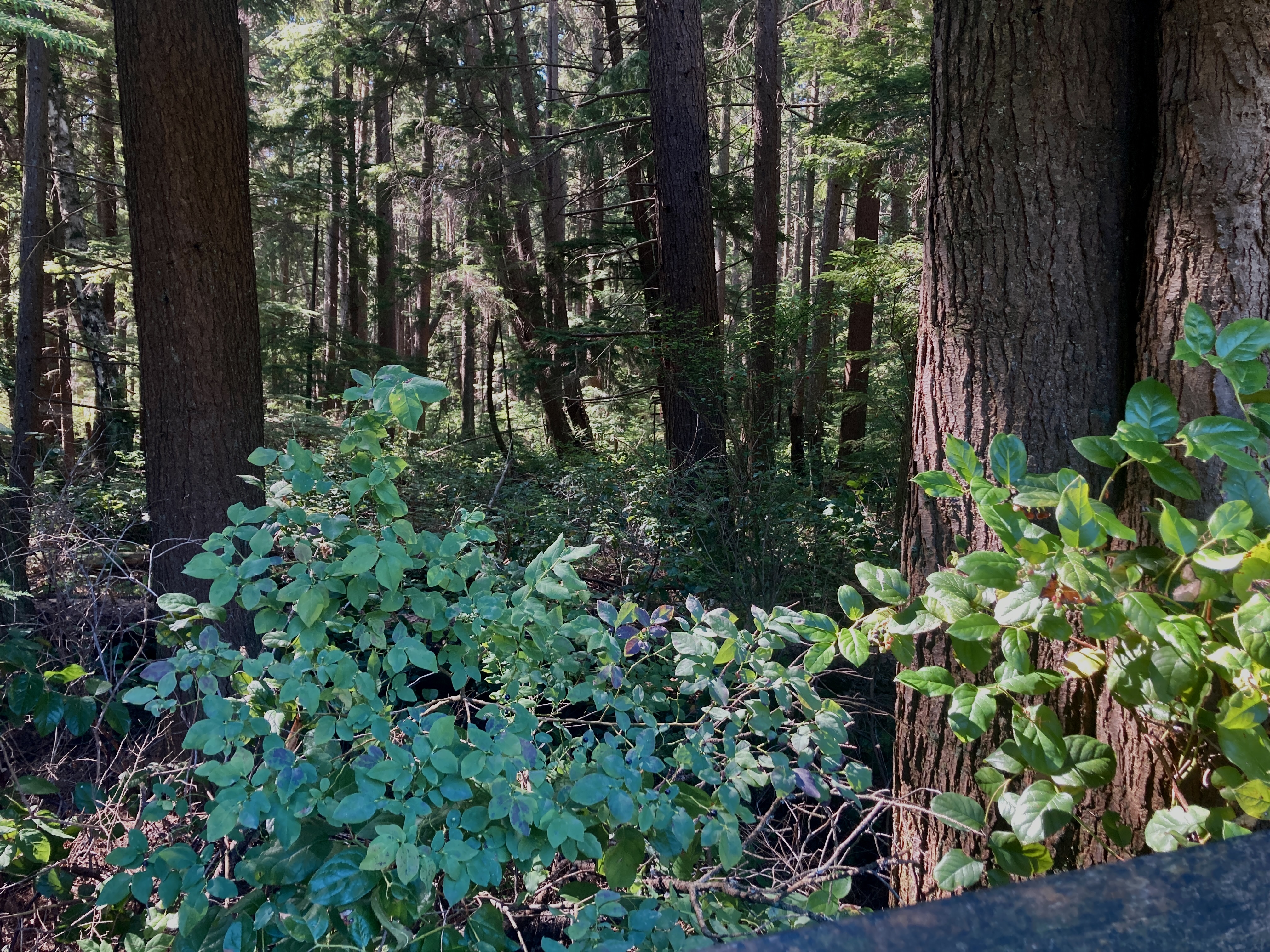
The moss is not just on the ground, either. Look at these trees!

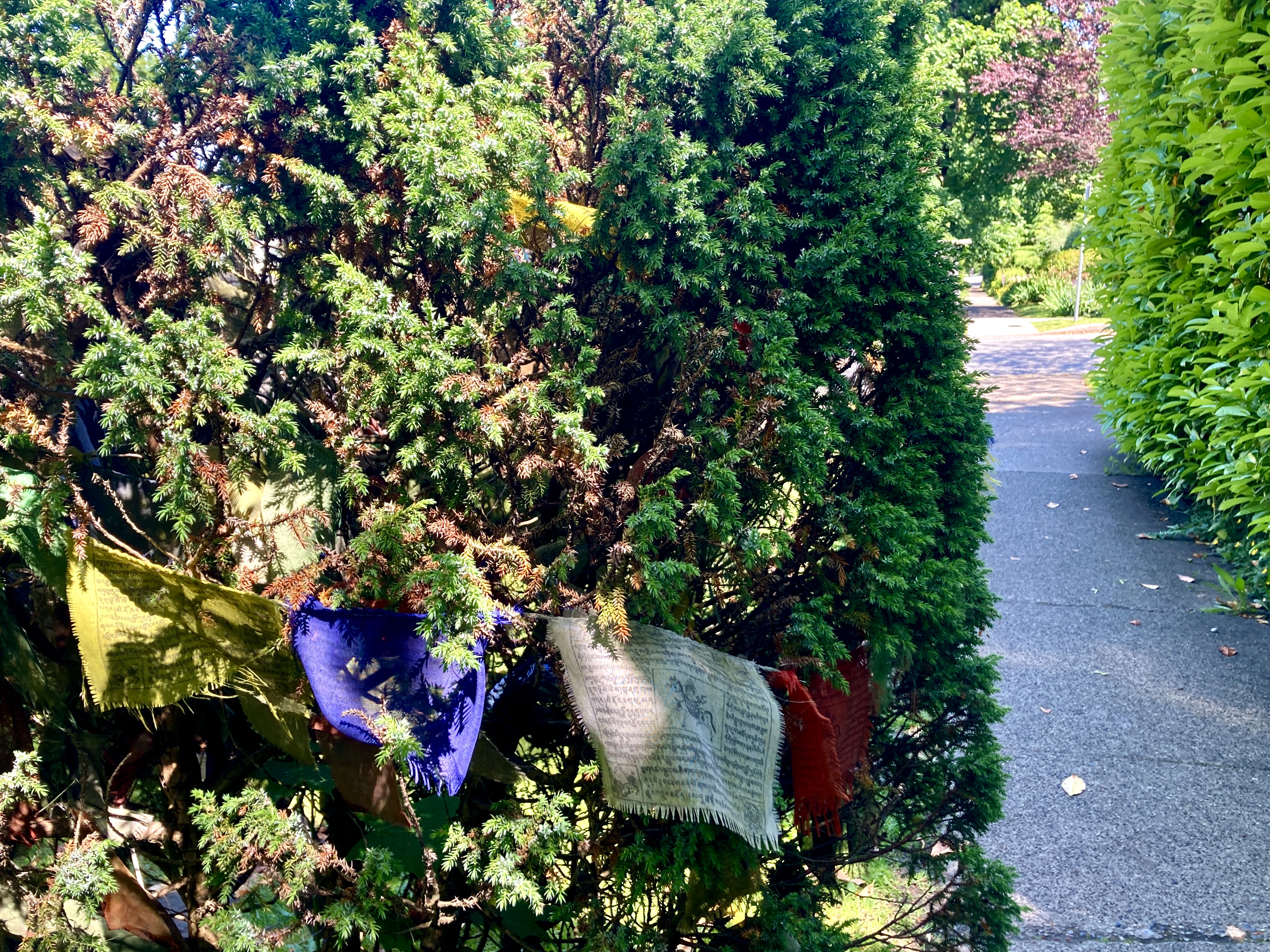
So, as I leave the bog and start meandering north-east through the neighbourhood of West Point Grey, I am still moss-optimistic. And, despite distractions like this spiral of Buddhist prayer flags on a street-corner shrub…

and this bear-moose duo, endlessly paddling their way across somebody’s front yard…

I do see more moss.

Just look at these sidewalk sentinels, still wearing their winter finery, as they march their way down West 19th Avenue!

After all this, my attitude is: agenda met. No more expectations. I’ll just keep walking for a while — get in those steps — and then catch a bus.

Next thing I know, down by Alma & West Broadway, I’m being muzzled.

This is such good news.

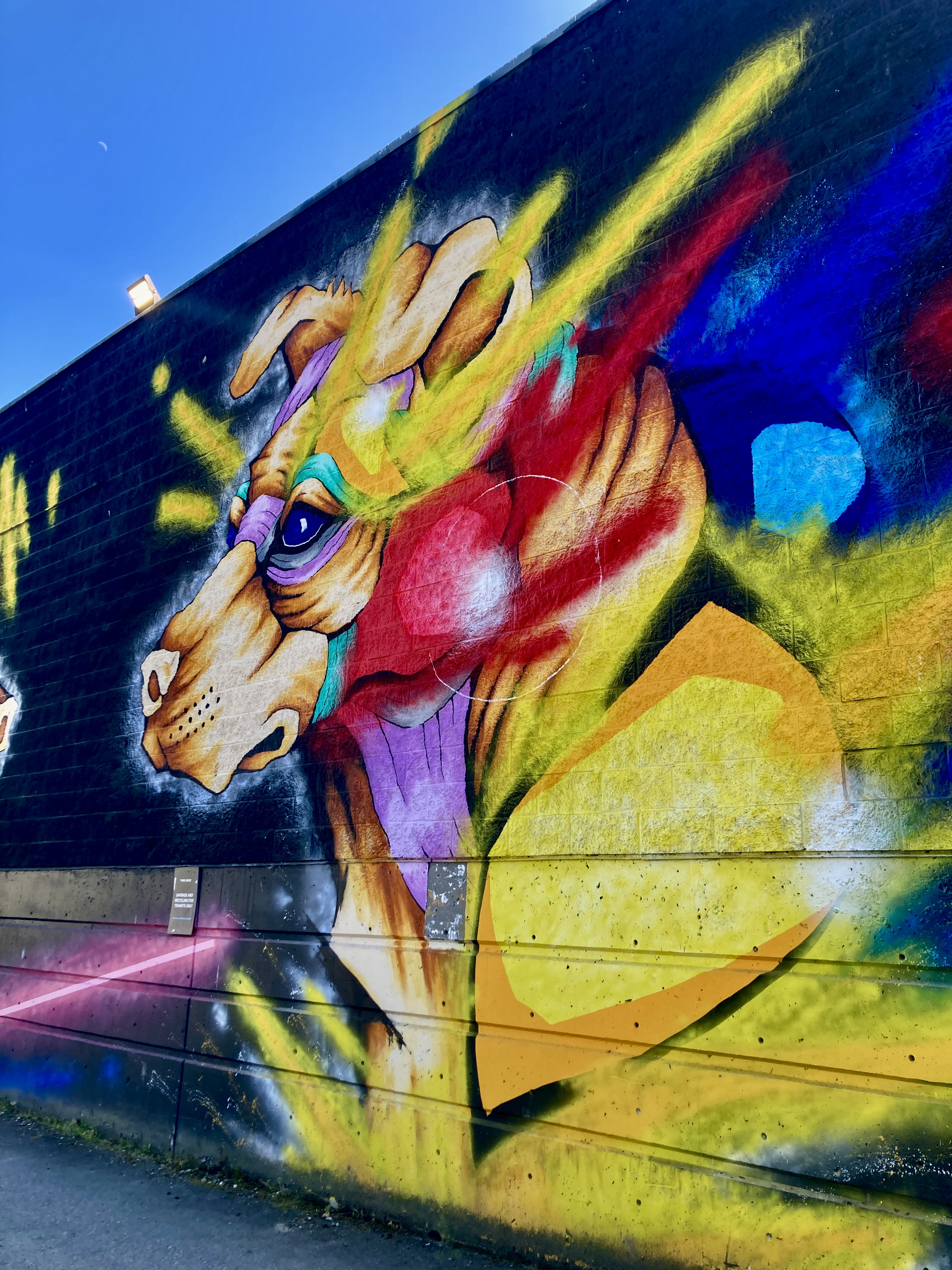
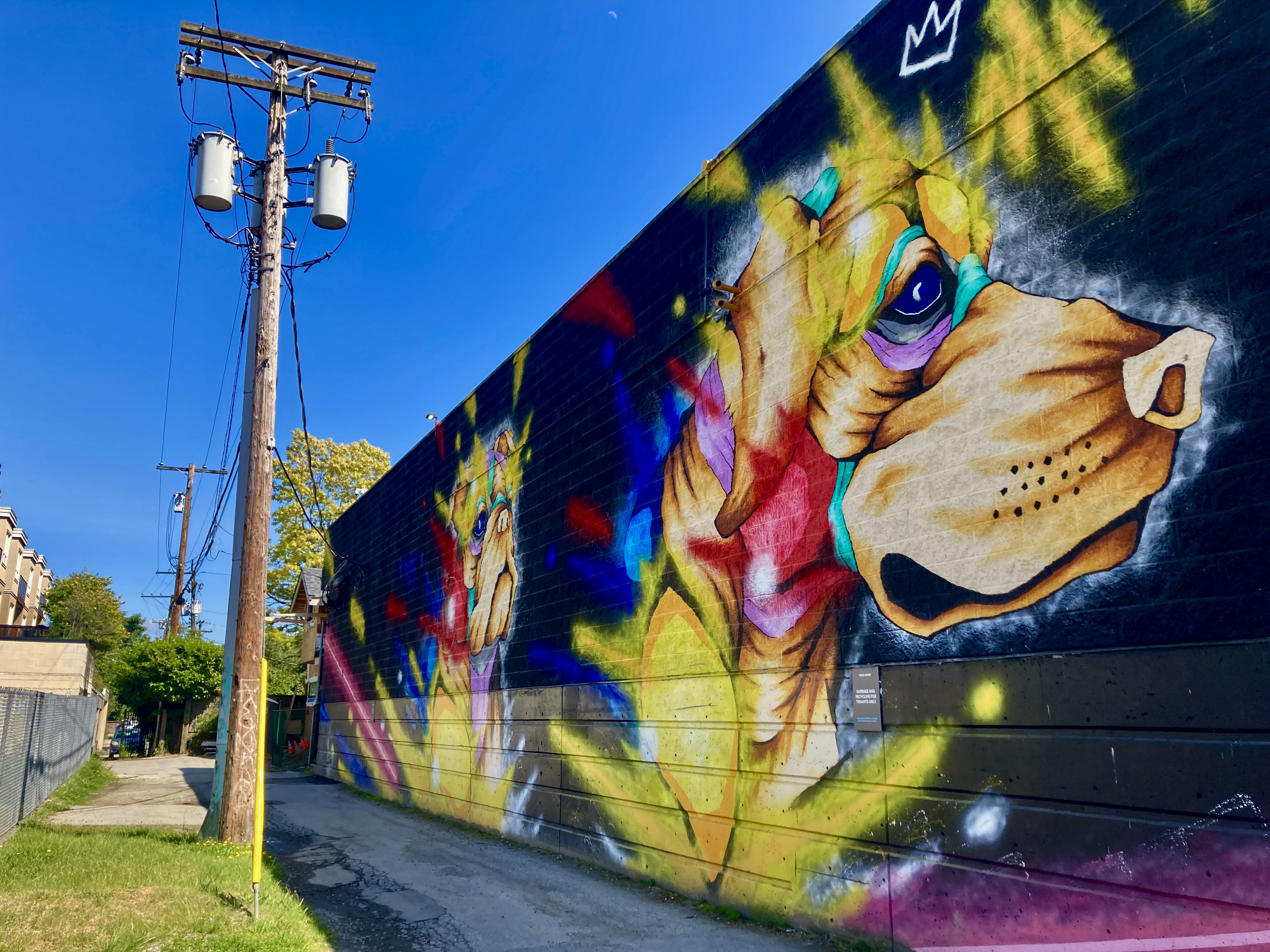
There’s a mural by this artist in my own neighbourhood, one that both pleases & frustrates me. I like it for its own sake, but the style very loosely reminds me of Toronto street artist BirdO

and I really, really would like to know the Vancouver artist’s name. Can’t get close enough to the mural near my home to look for any ID — but here, there’s a whole wall-full of his images, in an open alley.

Multiple images, and a tribute to Jean-Michel Basquiat (the crown, upper right)… and a plaque identifying the artist. I learn, and it is my pleasure to inform you, that this mural is the work of Tokyo-born, Vancouver-based contemporary artist Taka Suda.

I am happy indeed, as I drop down the last few blocks to West Broadway.

An eye-flick left, into another alley, where the little window in this tired old shed…

suggests it must have started life as a stable. Surely that was the hay loft, above?

After that, my eyes flick straight ahead, on down busy Alma Street.

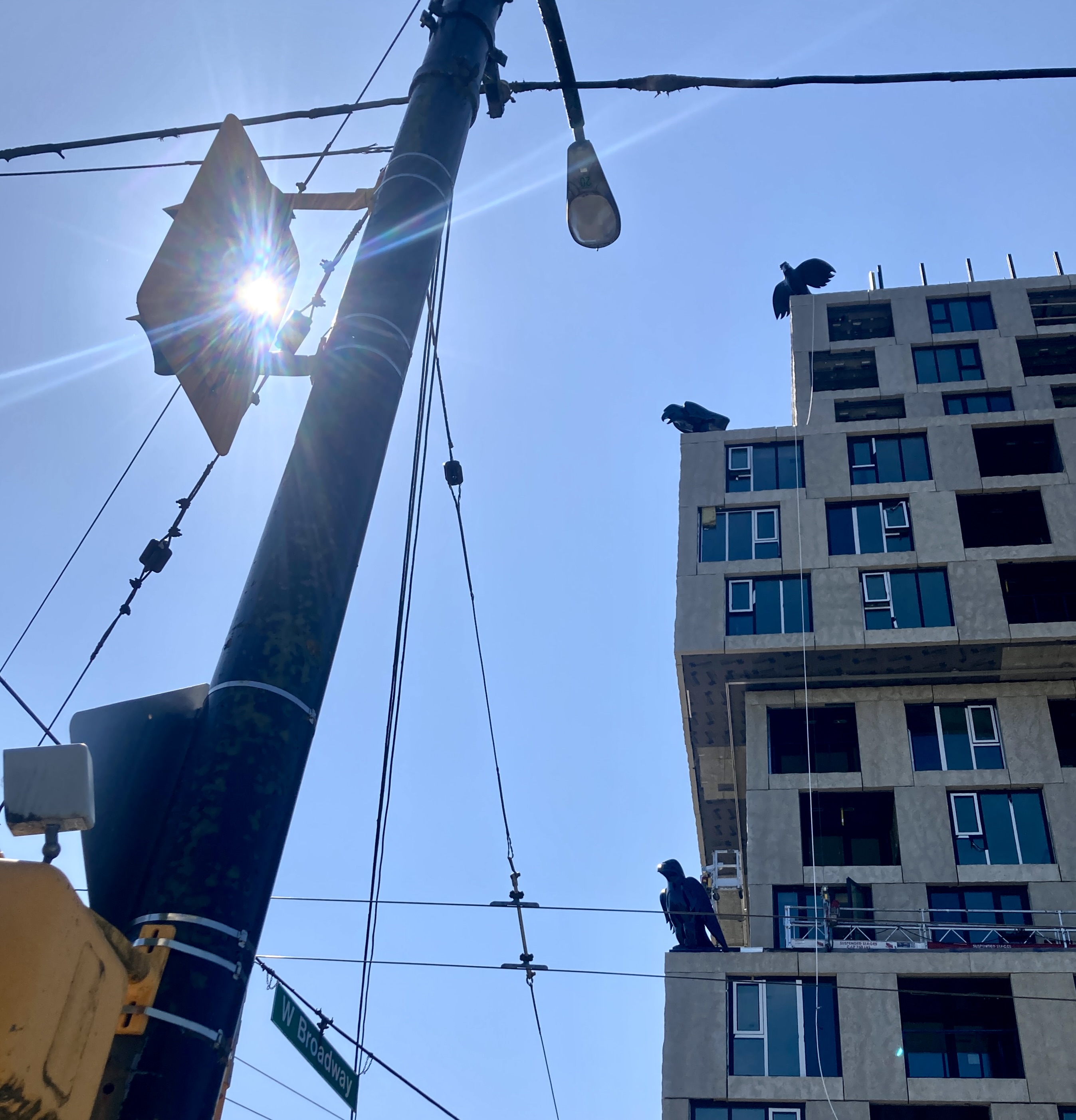
Another high rise going up, ho-hum. But then eye-flick becomes eye-focus, as I notice the monster riding high at the angle of that top corner.

See it? Shades of Hunchback of Notre Dame

A passing pedestrian notices my fixed gaze, and nods her head. “Like gargoyles, aren’t they?” she says, her smile showing she quite likes the idea.

“Gargoyles”? Plural? I walk closer, on down Alma. (I feel like I’m stalking the building.)

And yessirree, gargoyles-plural. There are three, one defining the top corner of each ledge.

The closer I get, the clearer they become, and I need to refine my language.

Not monsters. Not gargoyles.

Ravens. (Later online research tells me this building — a luxury residential rental building — is named The Raven.)

I spin around for an angle that shows them in triumphant profile…

and then, finally!, I catch my bus back home.

Crisp to Calm

6 August 2024 — One day all crisp shadows down a local alley…

and the next, off to the “green calming atmosphere” promised in this sign welcoming visitors to Camosun Bog.

The bog is a tiny, boardwalked ecosystem at one north-east knob of sprawling Pacific Spirit Regional Park. I always choose the same entry point: south from West 16th Ave., down one final residential block of Camosun Street.

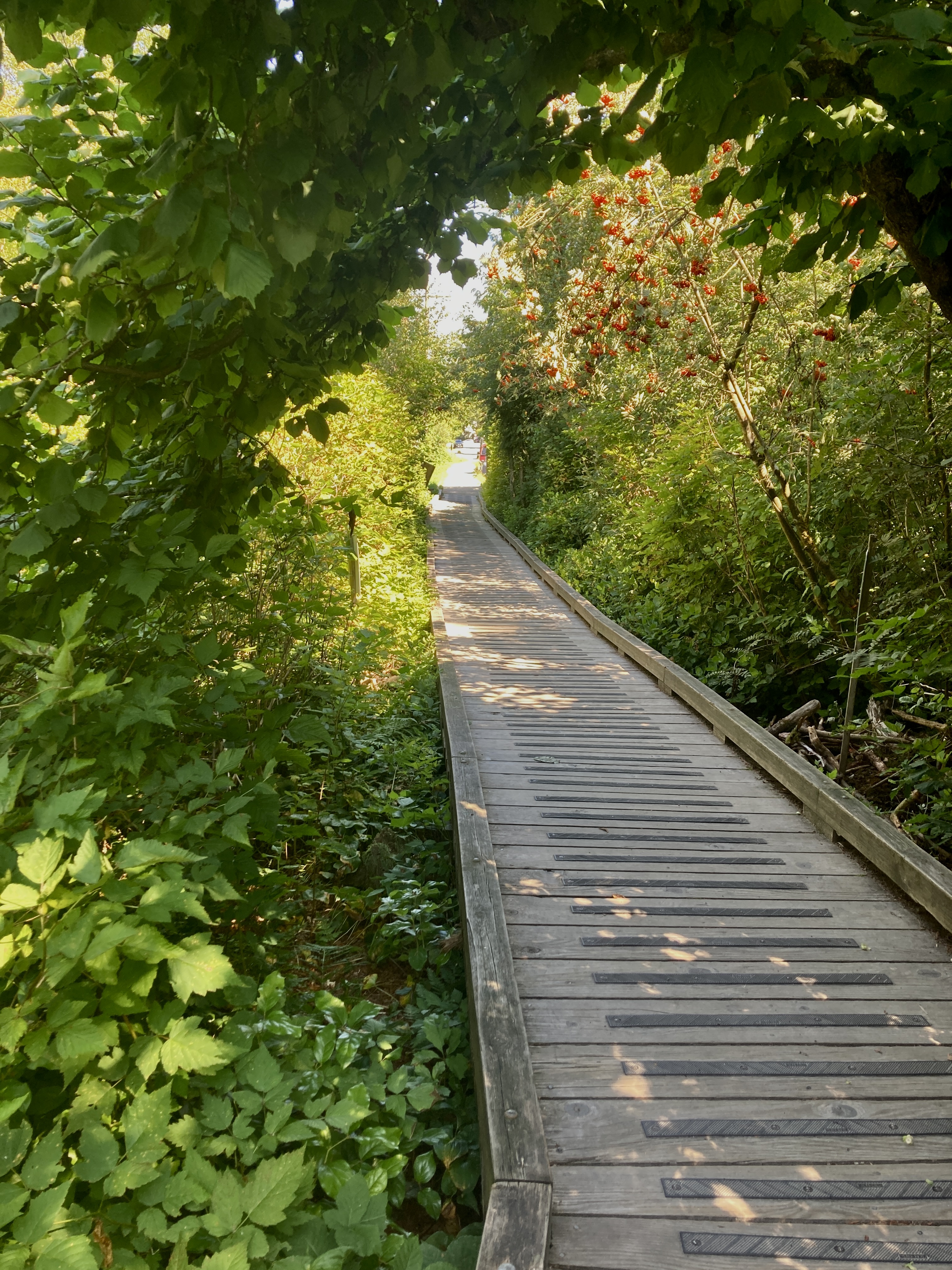
And here I am. I set foot on that entry stretch of boardwalk, and I am already calm.

Slower of pace, quieter of thought, I duck under an arch of Mountain Ash and walk around the bend beyond…

to pause at what I think of as “The Sentry” — a nurse stump adorned each season with whatever that season and its weather have to offer.

I next pause at the bog itself, now diminishing in the heat of mid-summer from its abundance of early spring.

Then, I follow the boardwalk.

The sphagnum mosses are beginning to bleach, responding to the same heat that shrinks the bog, but there are still bursts of vivid greenery.

Sometimes I need to peer over the inner railing of the boardwalk perimeter…

but any old time, I can just look over the outer railing at the forest beyond.

Loop complete, side trips complete, I retrace my steps to walk back under the arch of Mountain Ash. This time toward sidewalks, pavement, cars and traffic. Lots of grey awaits me. Lots of noise.

I’m not yet ready for West 16th! I walk eastward on quiet residential streets instead.

And I find myself at another tiny enclave of calm.

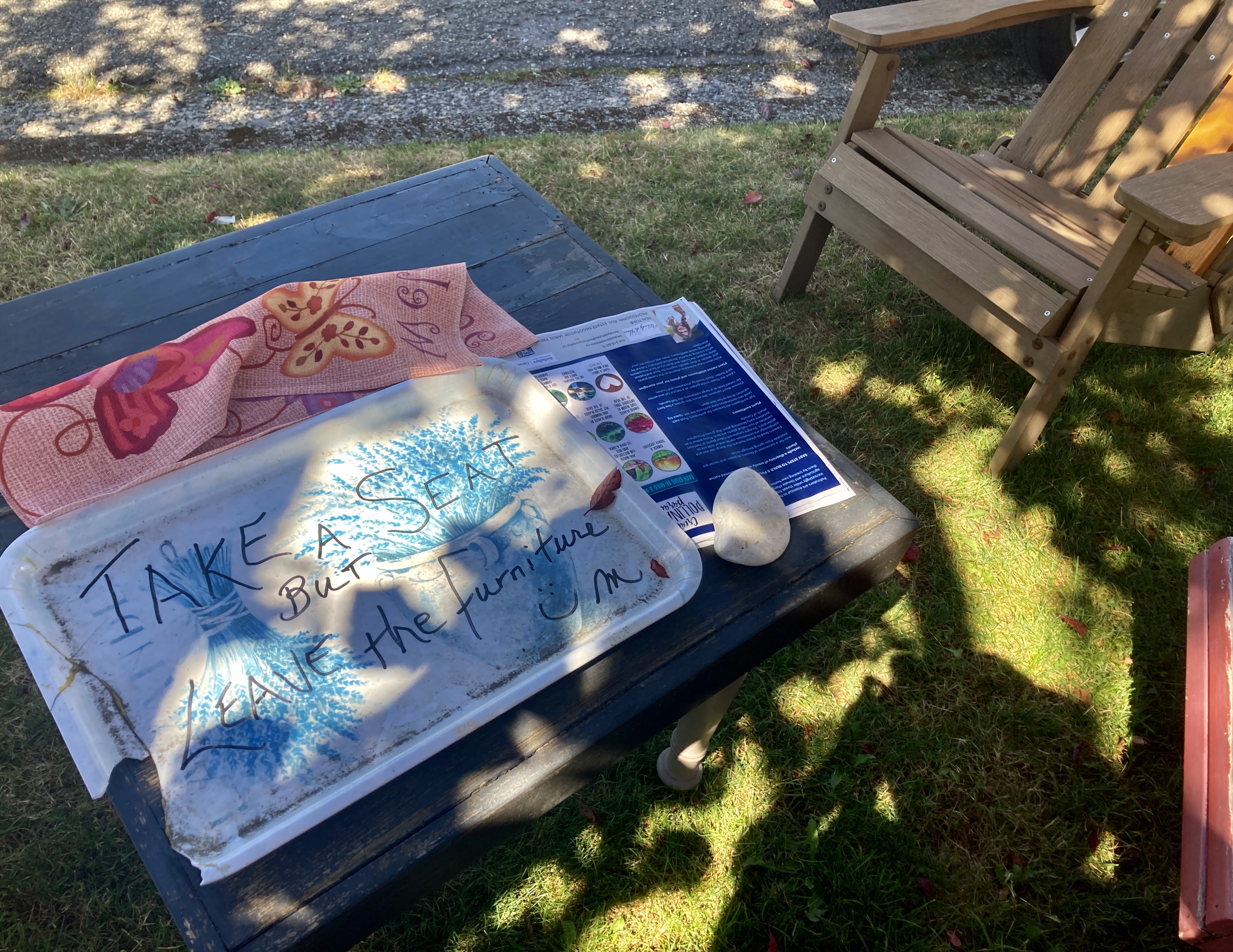
Right there, across that intersection, under those street-side trees: some Muskoka chairs grouped companionably around a little table.

I cross. I check it out. I discover that, just like the entry sign for Camosun Bog, the table welcomes visitors.

Though with an admonition.

I obey.

I take a seat. And when I depart, I leave the furniture where I found it.

  • WALKING… & SEEING

    "Traveller, there is no path. Paths are made by walking" -- Antonio Machado (1875-1939)

    "The voyage of discovery is not in seeking new landscapes, but in having new eyes" -- Marcel Proust (1871-1922)

    "A city is a language, a repository of possibilities, and walking is the act of speaking that language, of selecting from those possibilities" -- Rebecca Solnit, "Wanderlust: A History of Walking"

  • Recent Posts

  • Walk, Talk, Rock… B.C.-style

  • Post Categories

  • Archives

  • Blog Stats

    • 130,587 hits
  • Since 14 August 2014

    Flag Counter
  • Enter your email address to follow this blog and receive notifications of new posts by email.

    Join 2,048 other subscribers