18 August 2025 – I’m just off a False Creek ferry and walking uphill toward home, still full of Flat White and café chatter with a good friend, when I stop to admire another good friend. (Albeit in a different category of friendship: painted, not human.)
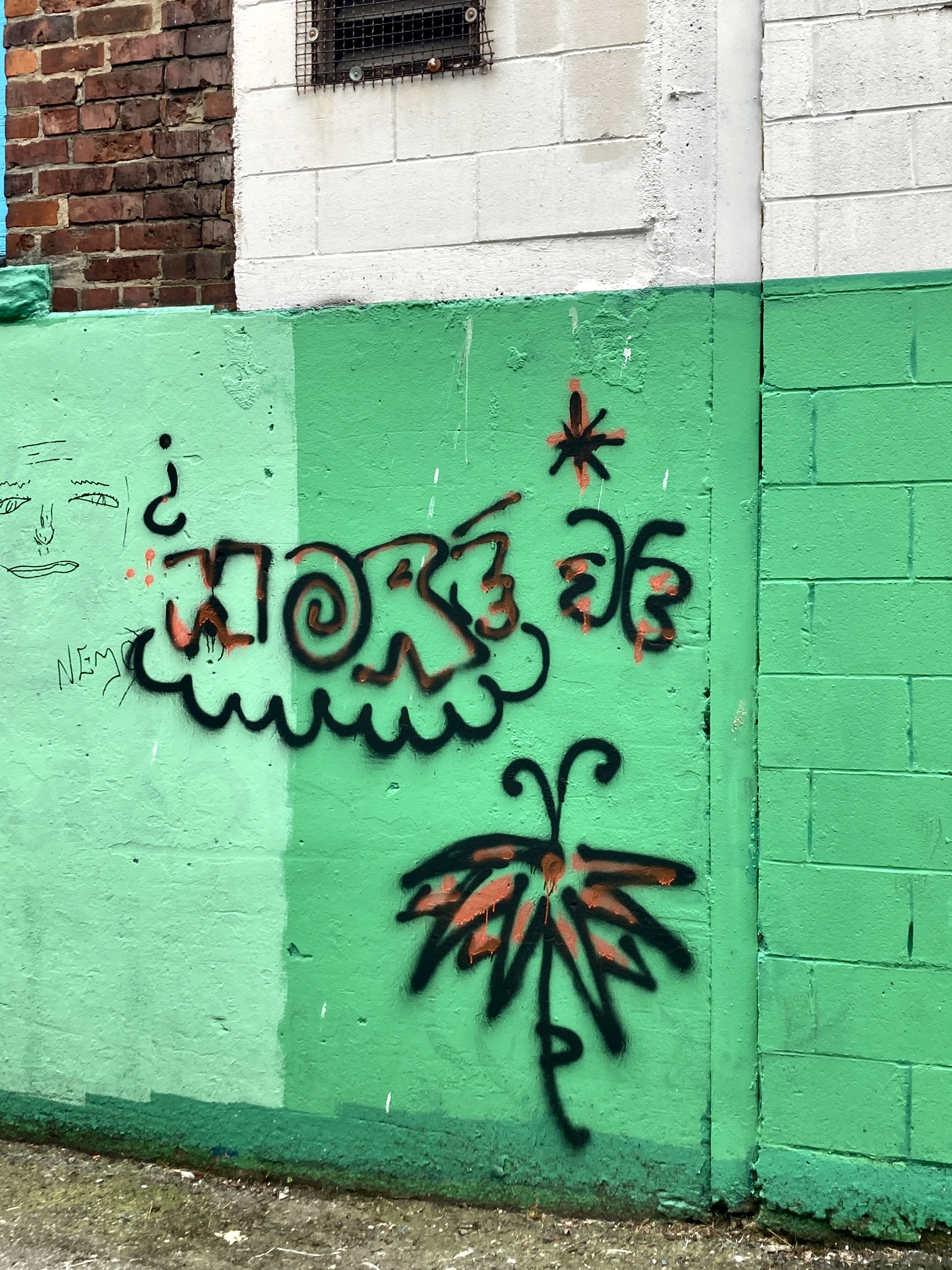
There she is, high a-top her alley home, her quizzical smile floating out across the neighbourhood.
Is she our Mona Lisa, 21st-c. alley-girl version?
No. Given the pace of local redevelopment, and the building that is her home, she is our Cheshire Cat. Soon she will be gone, with only her smile lingering behind, and only in memory.
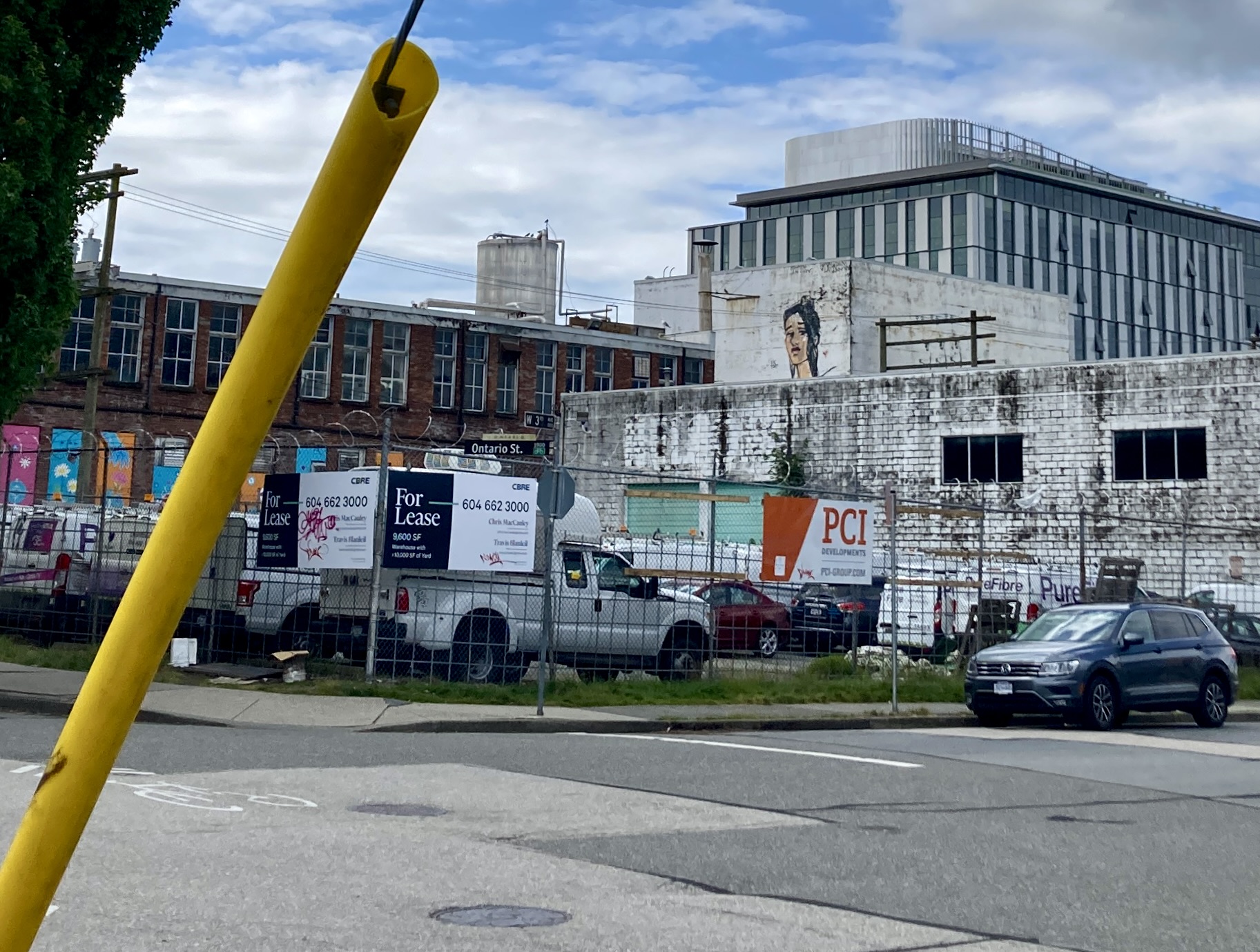
I”m standing at 3rd Avenue & Ontario Street, the intersection at the north-east corner of that L-shaped site, outlined in red. This is the huge redevelopment site purchased by the PCI Group in 2021, whose redevelopment proposal finally received City approval in May of this year. Cheshire Cat Smile is mid-way down lot 5, on the south side of the alley.
I head down the alley. Not for the first time, but it’s different every time, isn’t it? (No need to repeat the Heraclitus discussion…)
Crow in a convex mirror! I’ve never noticed him before, so already the alley is different.
The actual crow, opposite…
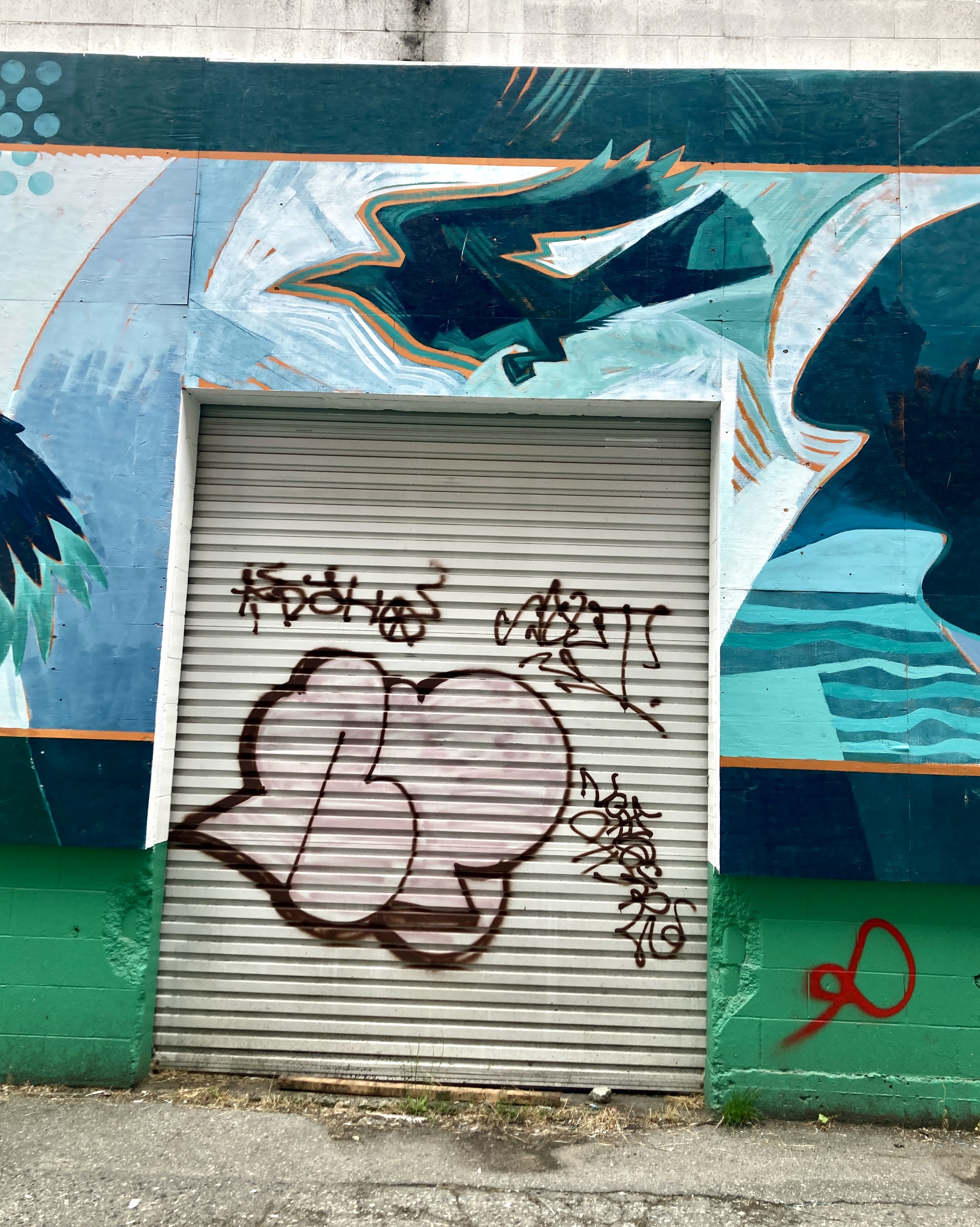
which causes me, for the first time, to pay attention to the mural as a whole — signed R. Tetrault and, as I later learn, called Flight Path.
Murals both side of an alley and a whole line-up of hydro H-frame poles in between! Sigh. Life is perfect.
I tip my head, pay homage to the Cheshire Cat Smile…
knowing it’s tagged Lil Top but also knowing I’ve never been able to find any info about that tag. So Cheshire Cat she has become.
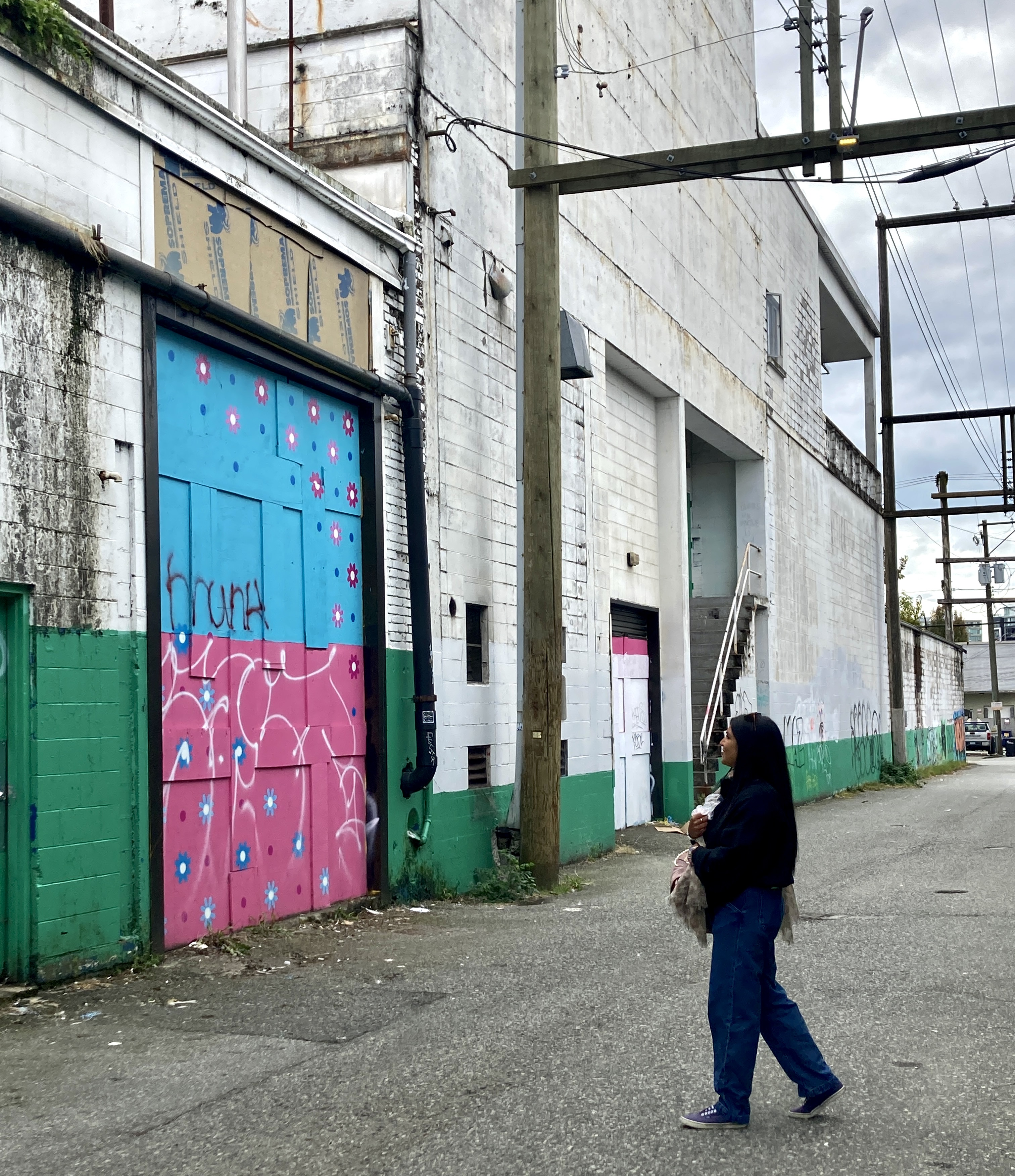
The woman I’d noticed under the nearest H-frame, as I photographed Flight Path, is now standing next to me, also enjoying the art.
“It’s people expressing themselves,” she says. “And we get to look at it for free! It makes us happy.”
She points: “Like that flower, that butterfly.”
I point to the message next to it, which sets us both laughing.
And then we go our separate ways, each dawdling where we each prefer to dawdle, walking the line of Ciele Beau murals opposite Flight Path.
I pause at a doorway, its notice as outdated as the reminder to “call your mum.”
Nobody, employee or otherwise, will be entering by this door ever again, I tell myself. Or by any other door, on this doomed brick building.
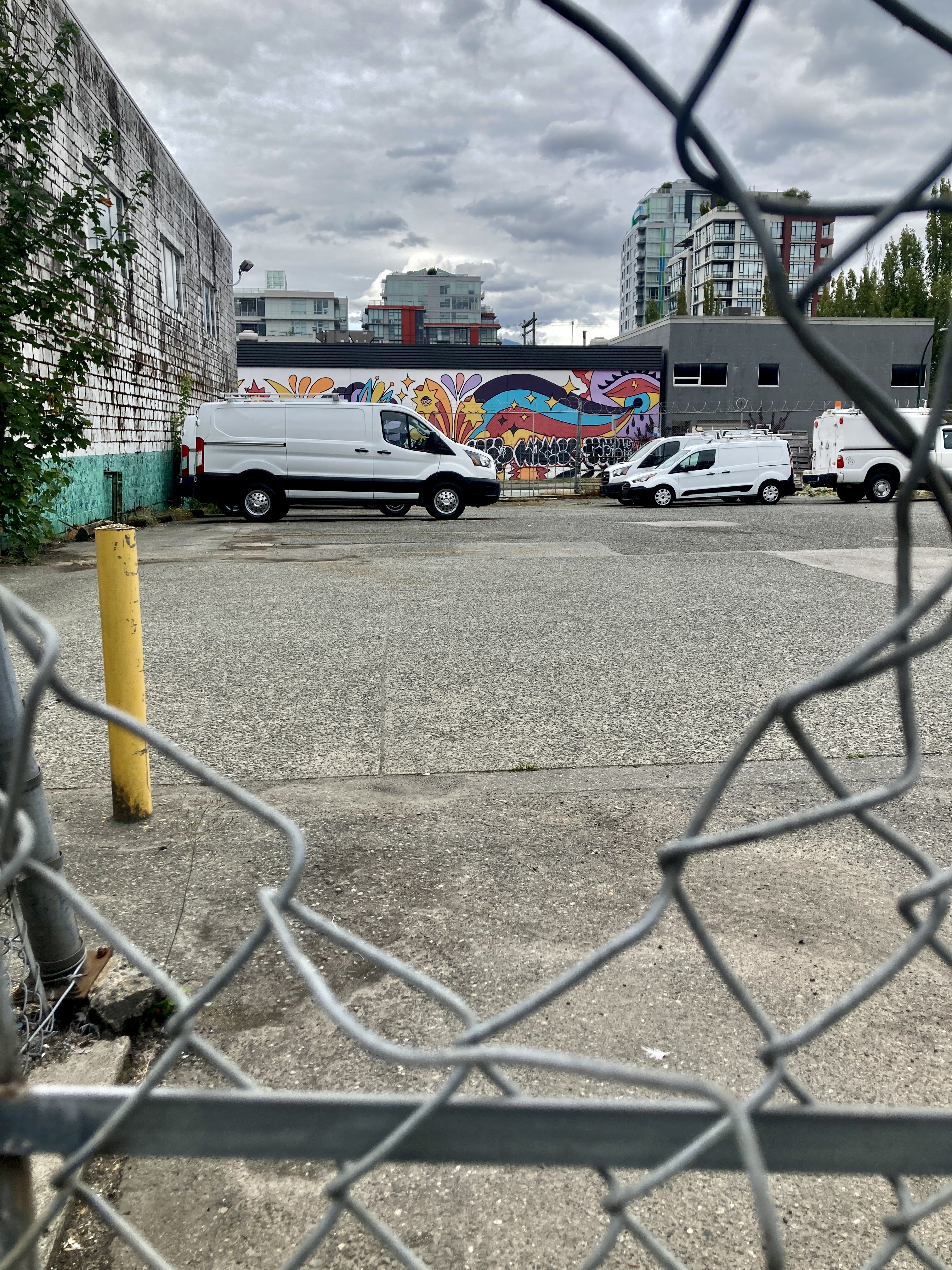
Ghosts of Eras Past to the north of me as well — torn fencing frames the Cosmic Breezemural on 3rd Avenue, painted by Olivia di Liberto for the 2019 Vancouver Mural Festival. RIP, VMF.
I leave the alley, turn the corner onto W 4th. I’m now looking at the block-long southern length of the site, Ontario to Manitoba. All boarded up, waiting for What Happens Next.
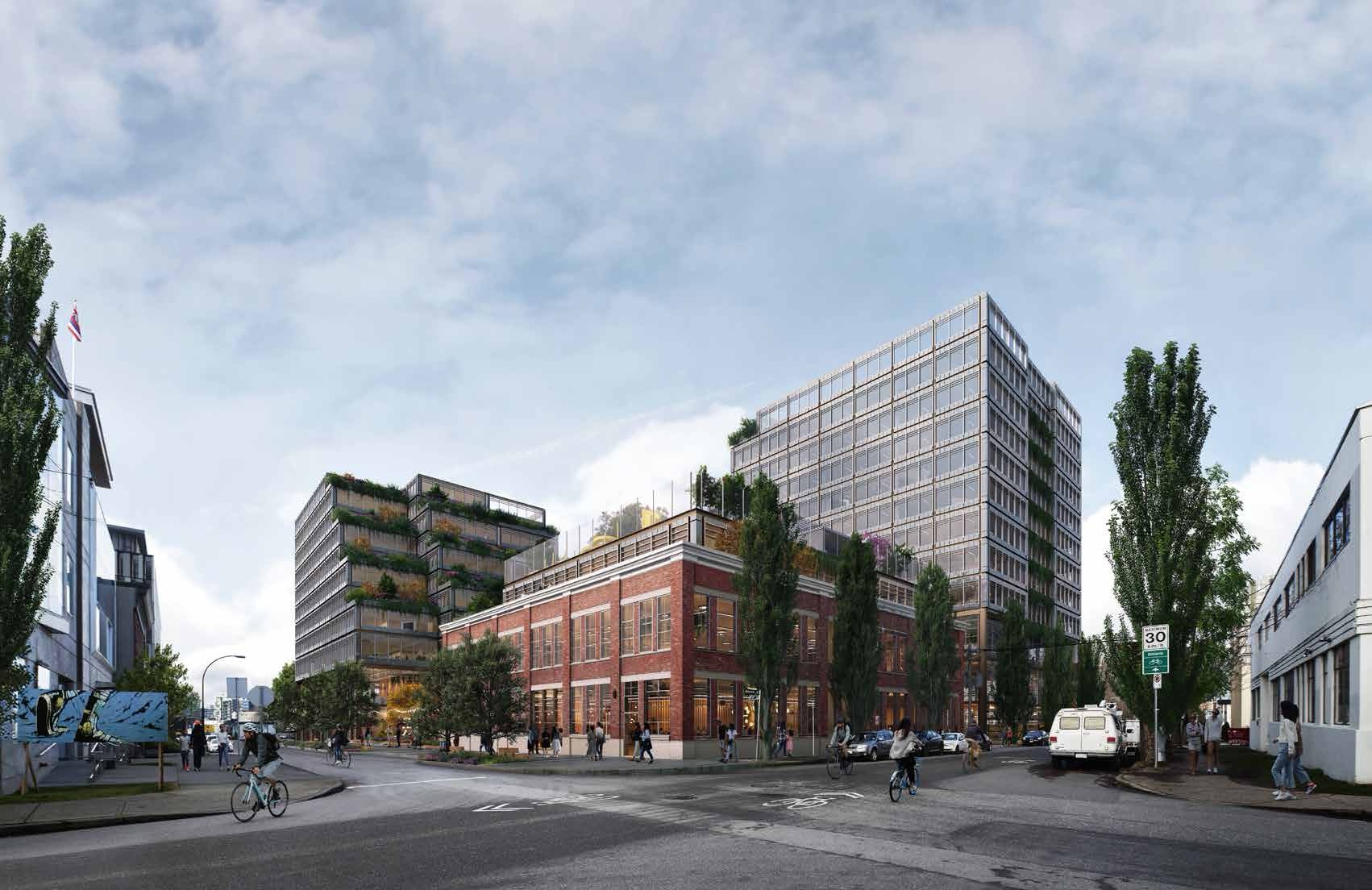
This artist’s rendering shows What Will Happen Next.
“Innovative industrial and commercial uses,” says the corporate website, “heritage retention and refurbishment, office, daycare and ground-floor food and beverage… centred around a new public plaza.”
Now that I’m home, and learning all this… I have to do a little rethinking, don’t I? And so do you.
Employees will once again go in and out of doors in the corner brick building, which is not doomed after all. And Flight Path may fly again. On his website, Tetrault explains he painted it “on plywood for removal and reinstallation on a new commercial development.”
19 June 2025 – Forget the dragon. That is so 10 centuries ago! These days, St. George — or, anyway, our St. George — is all about urban/eco sustainability and livability.
I’m first bounced onto this theme by a graffito on a waste bin. One that I initially think disrespectful of the human origins of the slogan…
but then reconsider, as I look smack across the street.
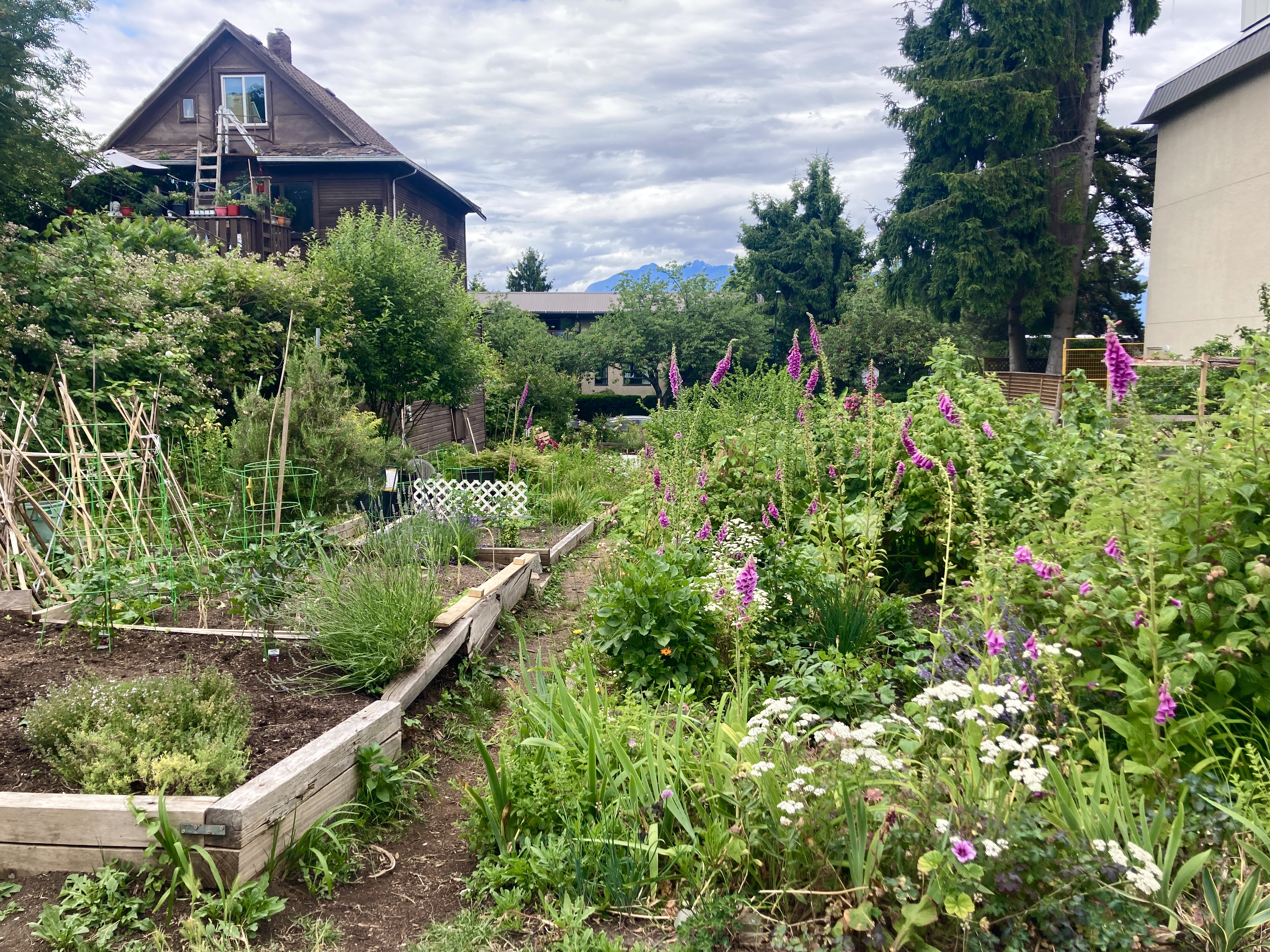
I’m on East 7th, heading farther east, and I’m staring into the busy abundance of this community garden stretching on north to East 6th. All lives matter, yes? We humans and plants are woven into the same eco-system.
This little local garden is very much of this neighbourhood, with its neighbourly values. A place with low-rise homes, many of them vintage wooden structures; a place where a kicked-off toddler’s shoe…
is carefully displayed at sidewalk’s edge by some later passer-by, in the hopes it may yet be retrieved.
I drop down to East 6th, look north as I cross Guelph, think how much I like this human scale — but have no illusions it will last much longer. Let your eye travel down the row of modest bright-painted houses…
to that equally bright-painted construction crane down below. That’s the future, and increasingly the present.
But!
St. George is at work.
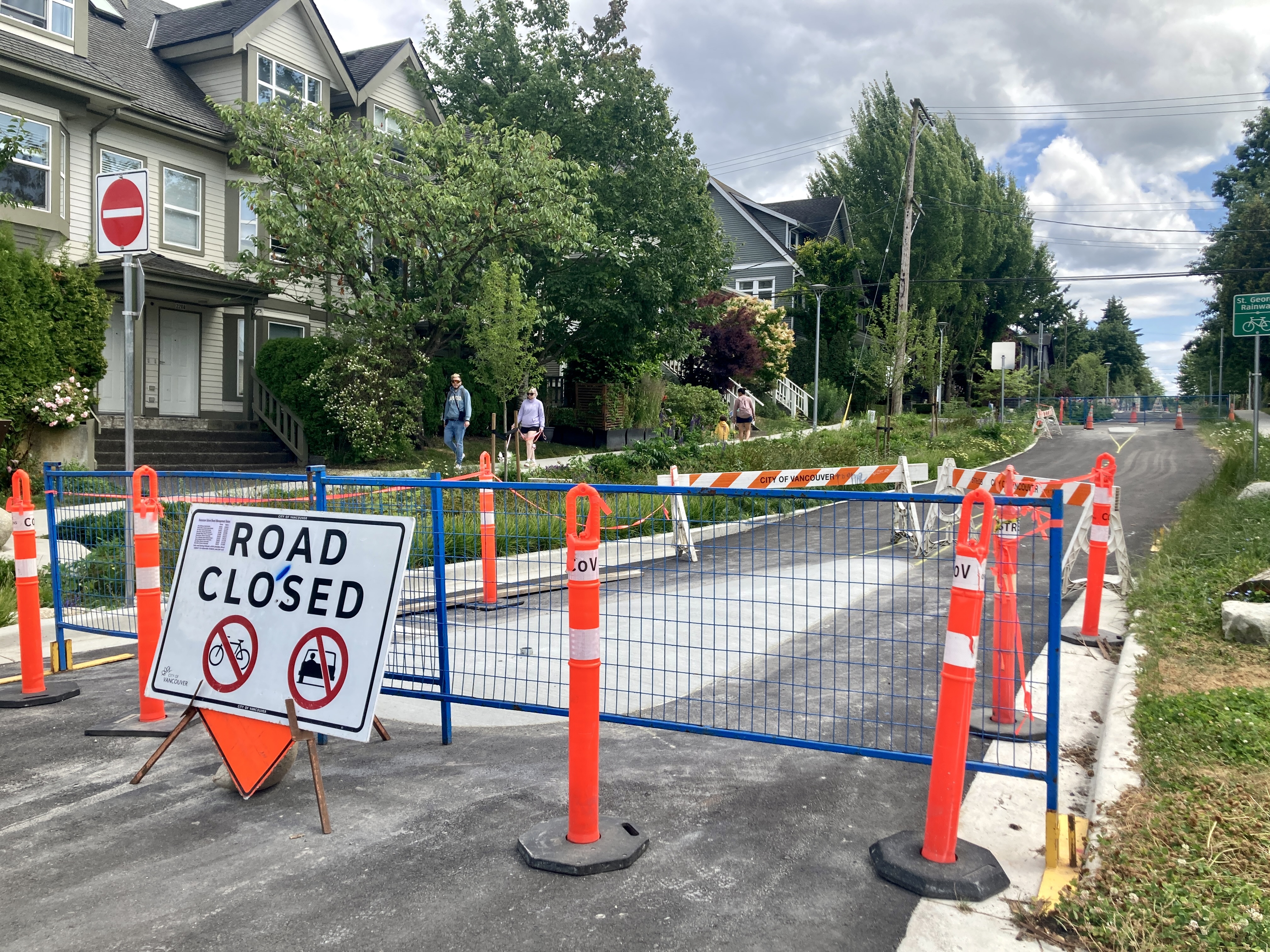
Well, the St. George Rainway. It’s been a long time coming, but now here it is, nearing completion — with its (and I quote} “green rainwater infrastructure features like rain gardens that incorporate plants, trees and soil to manage rainwater…”
I step up to the mini-plaza with its rock, its signage mounted on a plinth…
adorned with a Wood Sorrel cut-out…
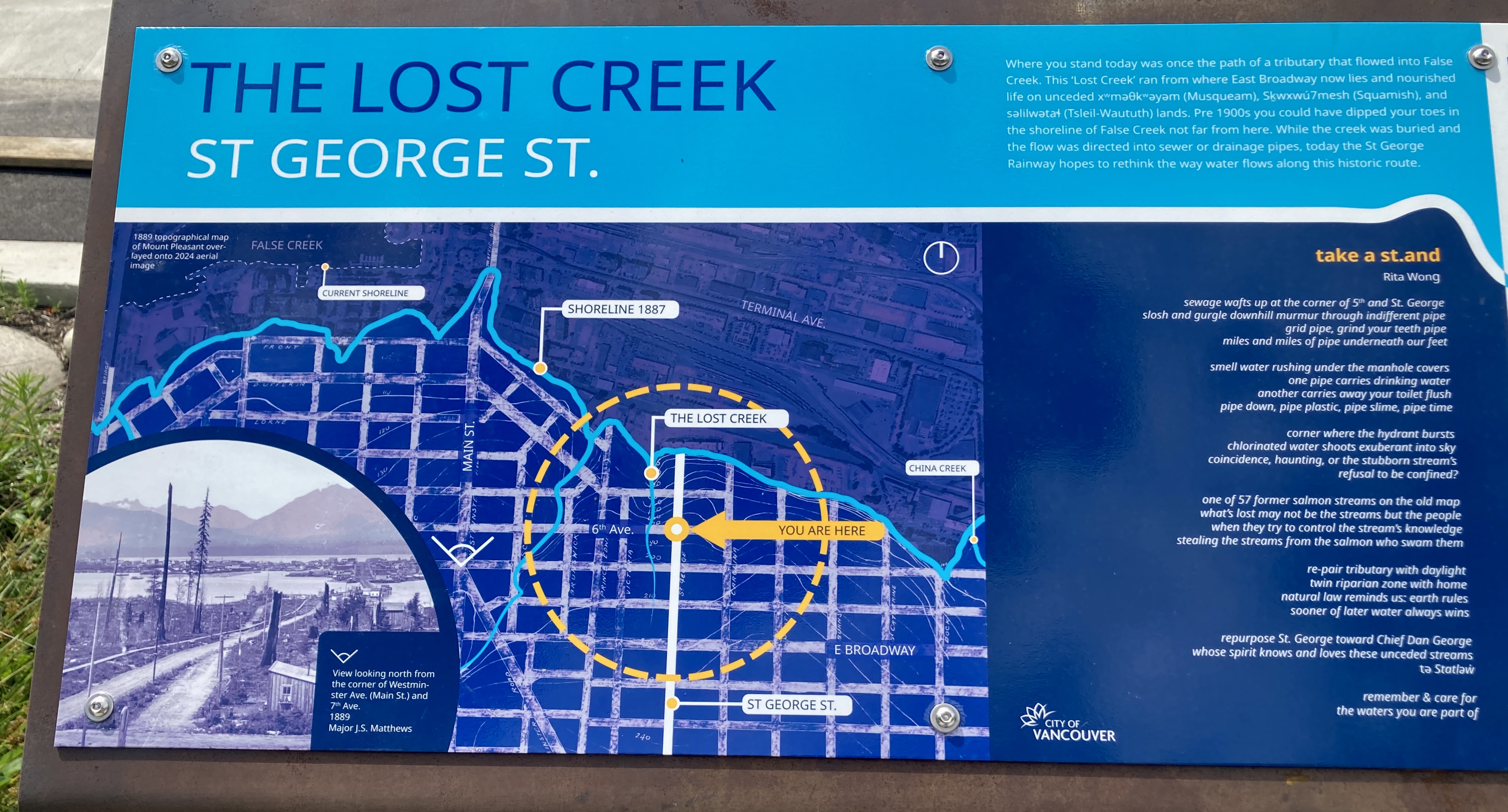
and lots of information.
Go ahead — spread the image, track its elements; I’ll wait.
Together, we learn that the Rainway along St. George celebrates a Lost Creek, a tributary to False Creek that has long since been buried underground. (For that matter, this final eastern end of False Creek, into which the lost creek ran, no longer exists either.)
While you’re exploring that handy map, please note not just the Lost Creek, left-above “You are here,” but also China Creek on the far right, and E. Broadway (East Broadway), three streets to the south.
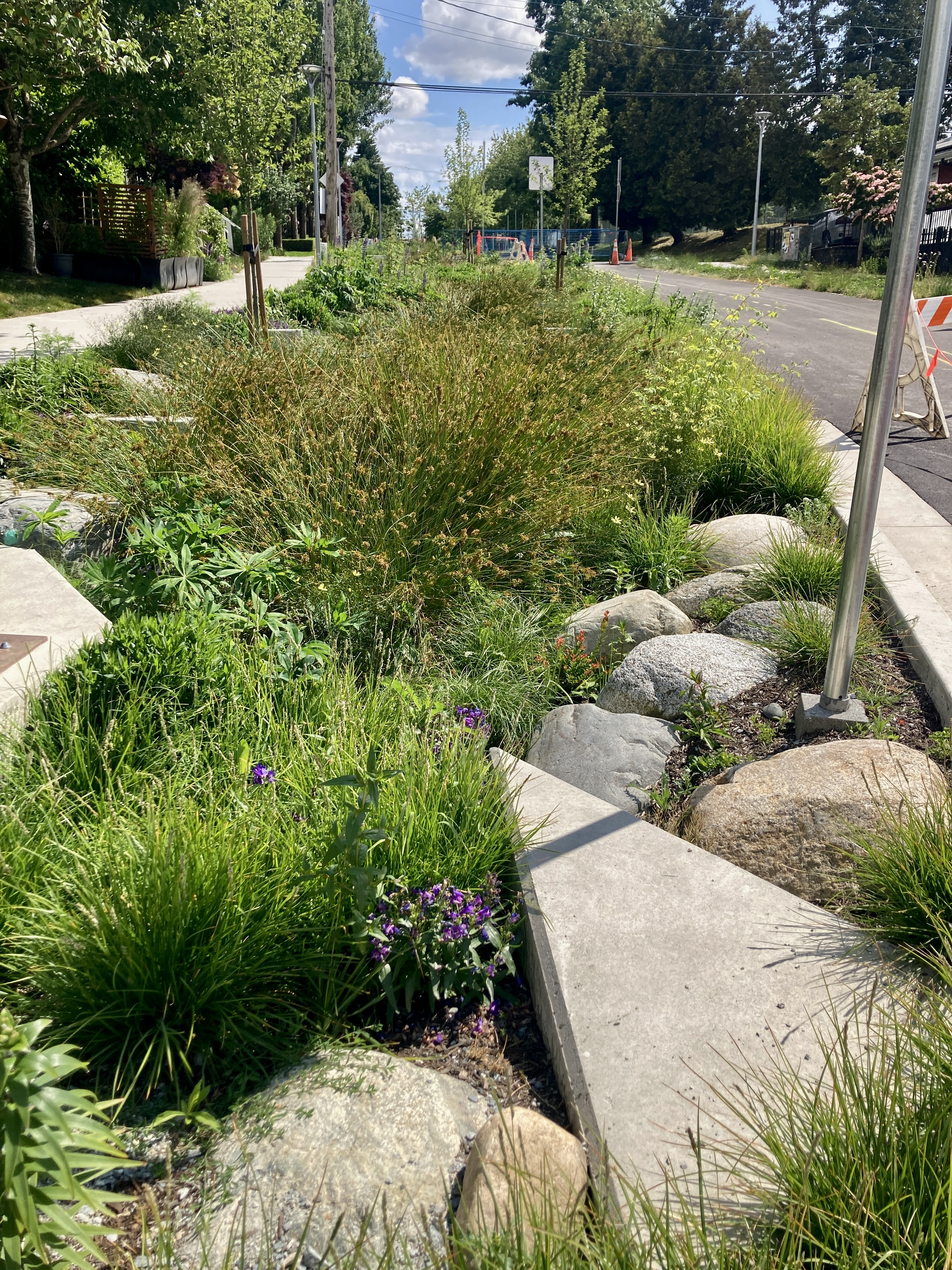
I admire the rain garden that parallels the sidewalk immediately to the south …
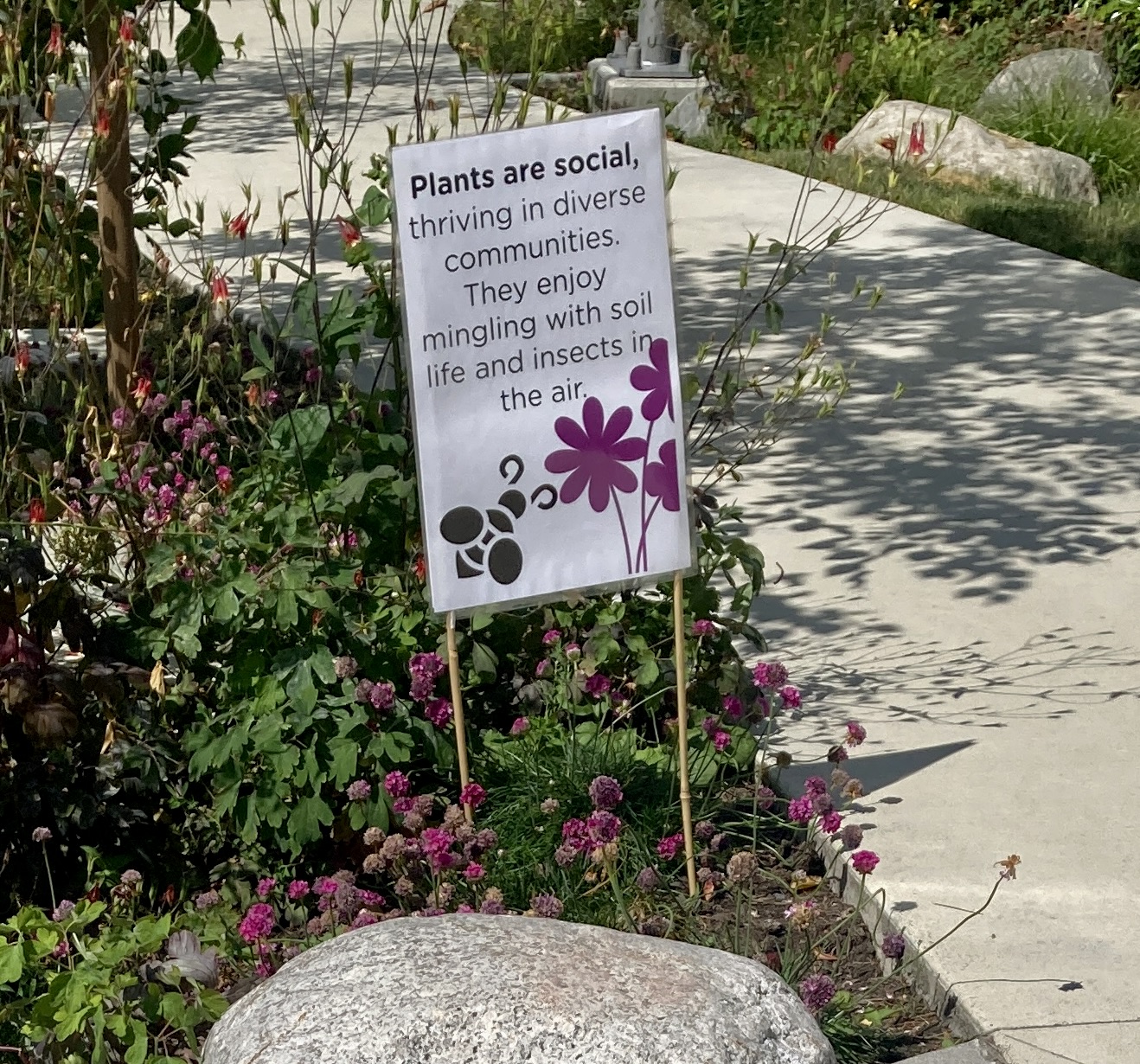
then cross East 6th to admire this sign in the rain garden running on north…
and feel more vindicated than ever in making my peace with the “Plant lives matter” graffito. “Thriving in diverse communities” sounds like the prescription for healthy life, period, whatever form of life we happen to be.
You’ll understand why, with that thought fresh in mind, I fall over laughing at the dumpster graffito I see immediately afterwards.
On I go, on to China Creek North Park. (See? That’s why I wanted you to locate it on the map.)
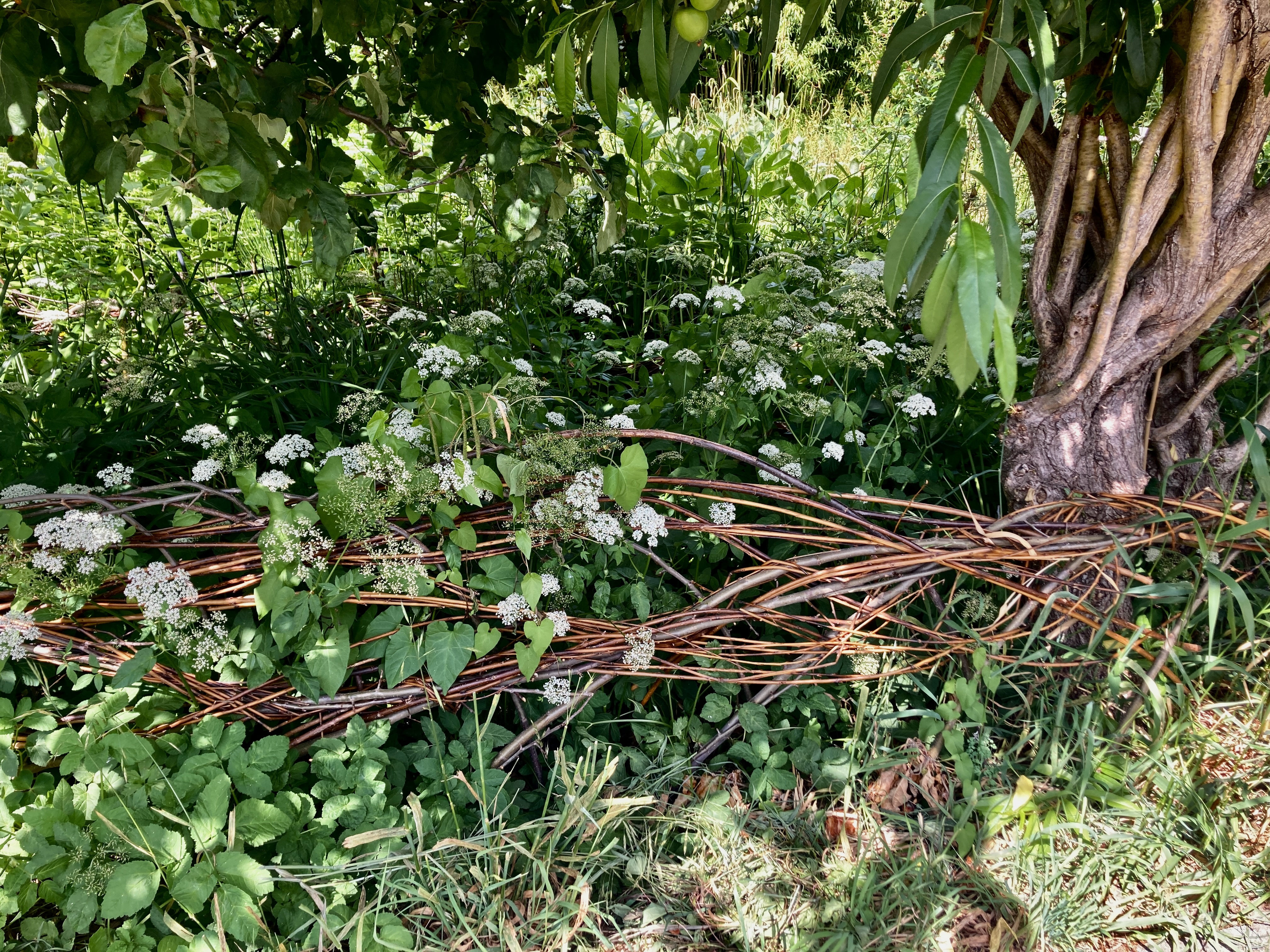
I am heartened, as I approach the edge of this large park, to see fresh new vine fencing woven into the woodlands periphery. (It had become very scruffy.)
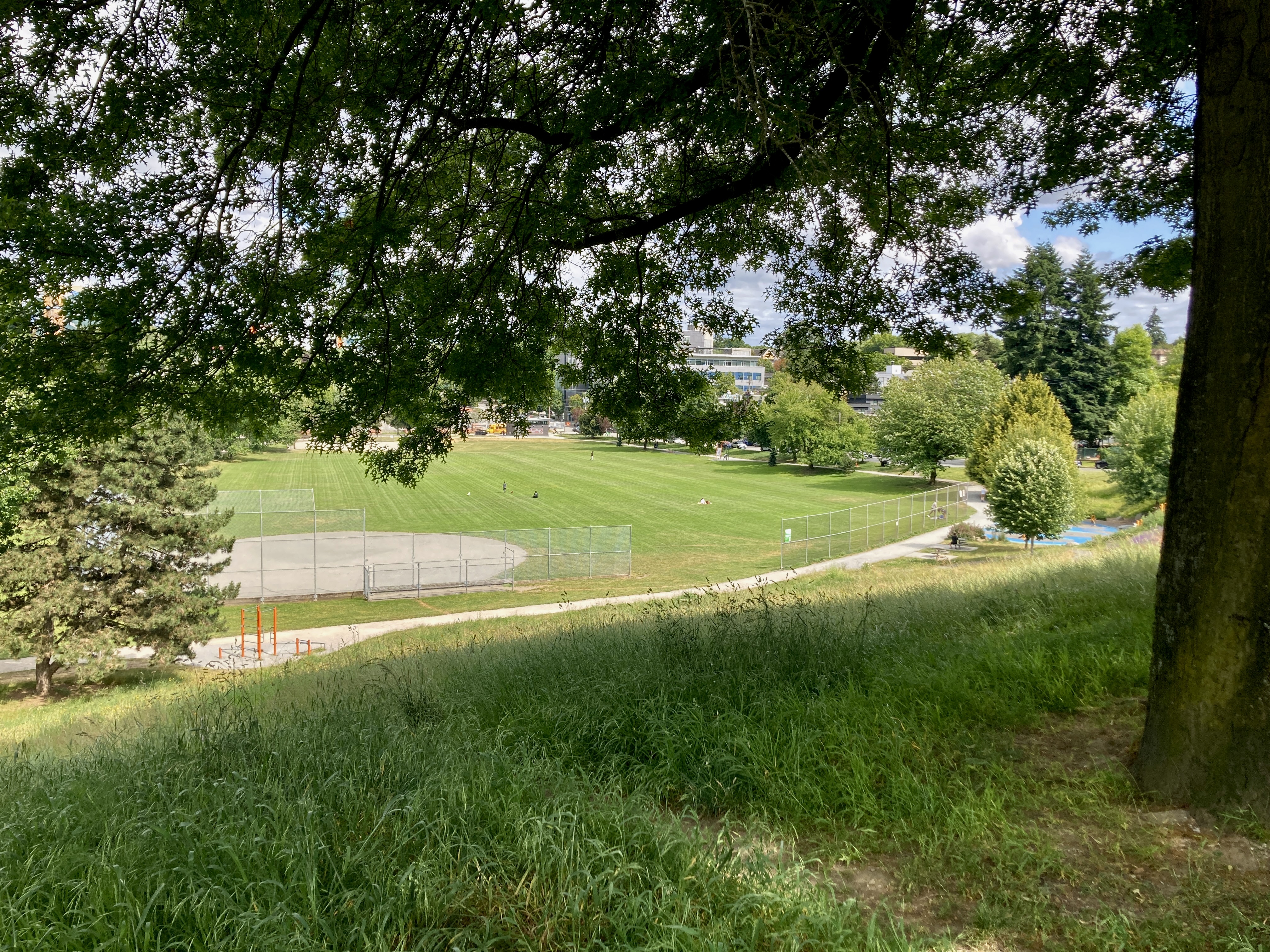
At first, looking down the slope, the basin of the park appears generic and banal. Old fashioned, even.
All that mown grass. And baseball diamonds.
But then, as always, I reconsider. The top of the slope is lined with benches, and they are well used, in diverse ways. At the moment, for example, the bench on the left hosts Headset Guy, who in fact is reading a real, physical book…
while the bench on the right hosts Music Man, who strums his acoustic guitar so softly it is almost subliminal. A woman just out of frame is hunkered down, motionless & meditative, and the woman you can see walking past the benches is about to start down the winding path that snakes its way to the playground at the lower level.
And I am about to join her.
This park is another “Lost Creek” — or, more precisely, a Lost Watershed. Before this last bit of False Creek was filled in, a whole network of creeks tumbled through here to feed its waters. Once filled in, the area at one point became a garbage dump, but was subsequently rescued and turned into parkland.
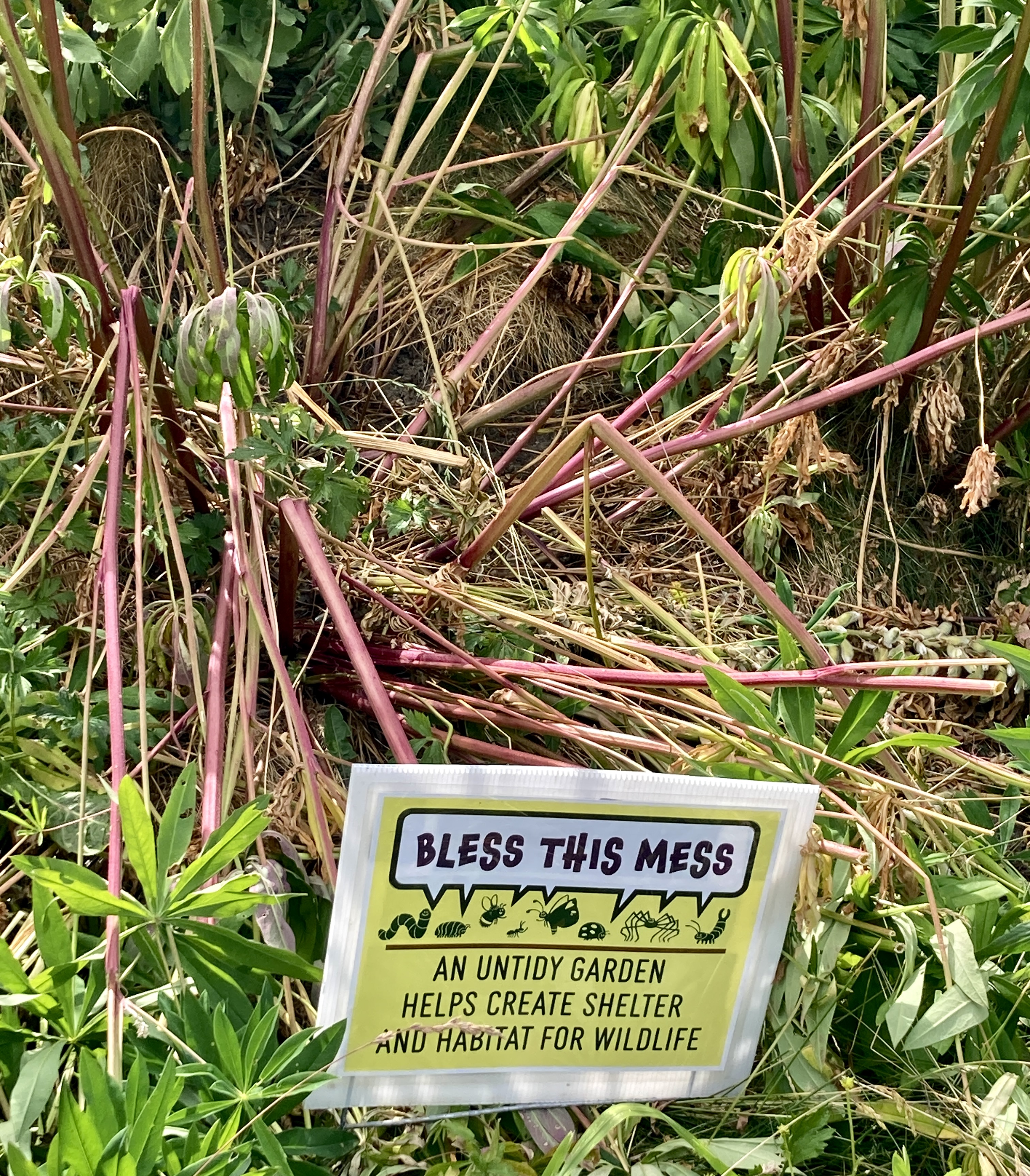
The slope is now naturalized, and it is wonderfully, exuberantly, messy.
With signage to justify the mess.
At the bottom of the path, I peer down the final bit of slope, the bit with a slide and (here) a mesh climbing ladder…
and, down there at the very bottom-bottom, swings and a pirate’s ship and other kiddy delights.
All this diversity! Social plants, social humans, thriving in diversity.
Walking homeward, more happy plant/human interaction…
in this volunteer-managed street corner garden, part of the City’s Green Streets Program.
And then… a reminder that not everything is happy-happy.
That some current trends are jarring and disruptive, and will damage both humans and nature.
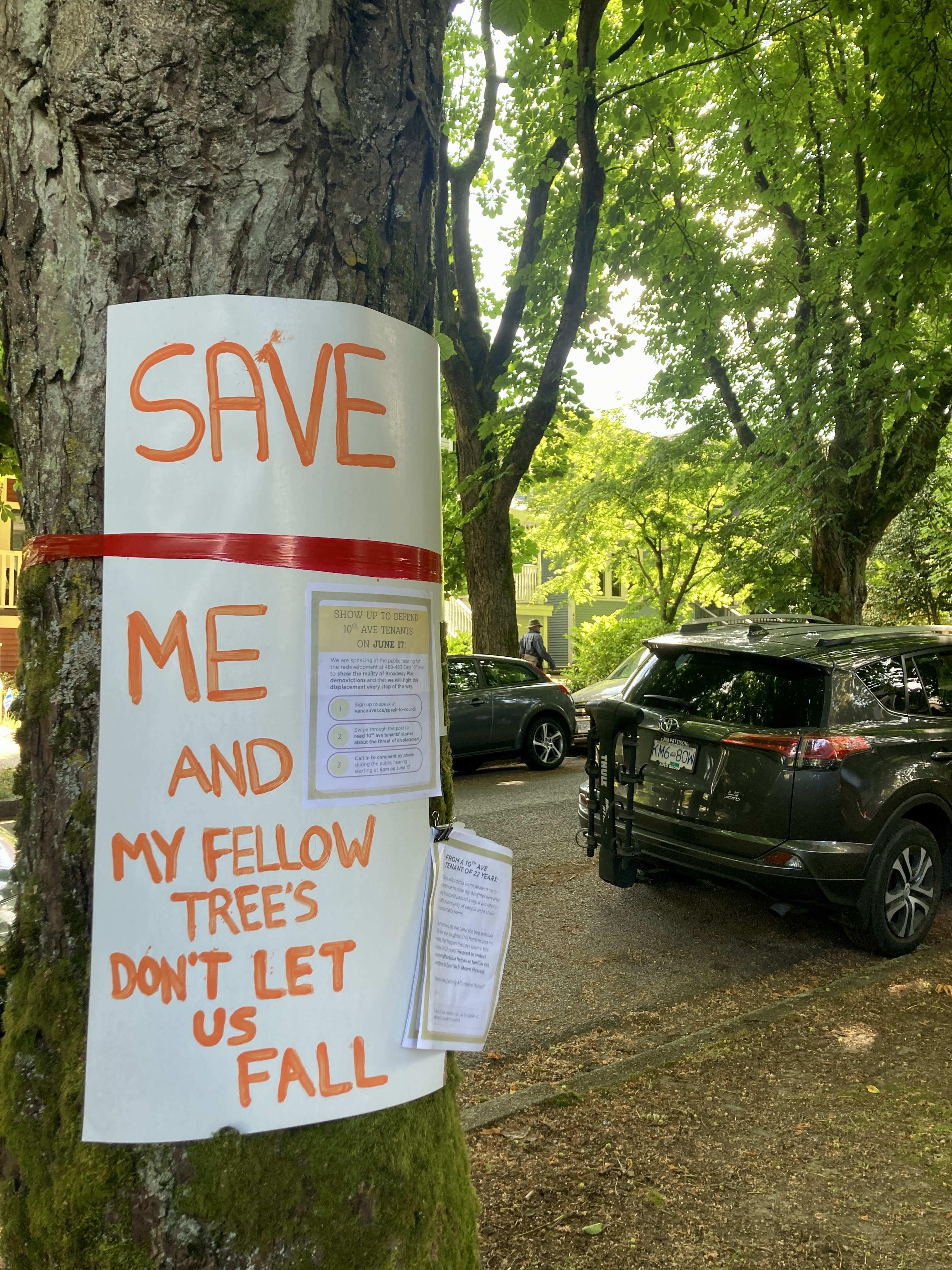
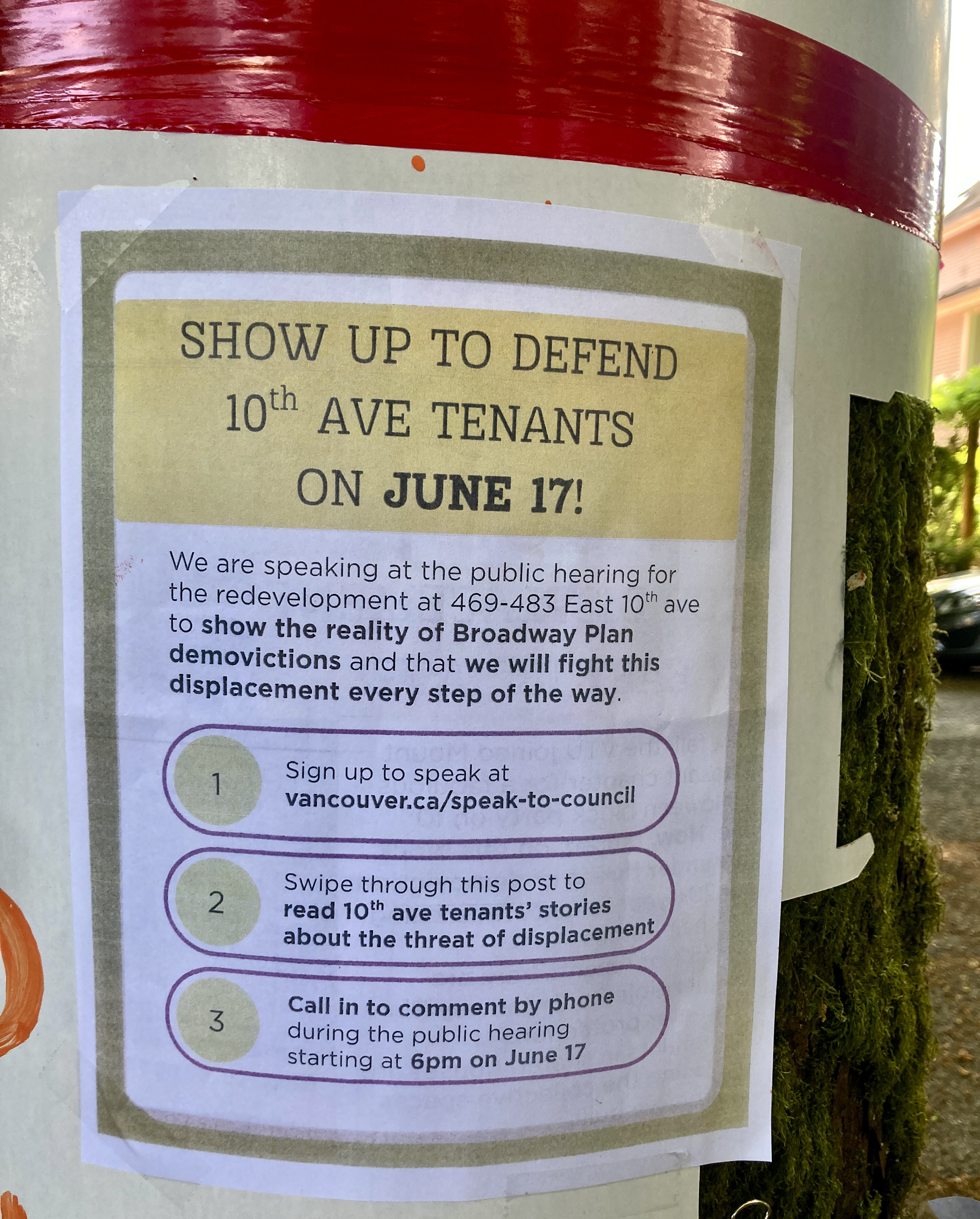
Taped to a tree on quiet, residential East 10th just west of St. George — with its fellow trees all around — a warning about the effects of the redevelopment now being pursued under the City’s Broadway Plan.
I may know more about the correct use of apostrophes (i.e., not to form noun plurals) than the author of this plea, but these tenants, in the adjoining notice…
teach me a new word. “Demoviction.” As in, the eviction of tenants from a building, so that it may be demolished, usually for redevelopment. A phenomenon integral to the Broadway Plan. And gaining pace.
I read a testimonial, also taped to the tree, the words of a woman who has been a tenant here for 22 years: “This affordable home allowed me to continue to raise my daughter here after my husband passed away. It provided a safe community and a stable, comfortable home.”
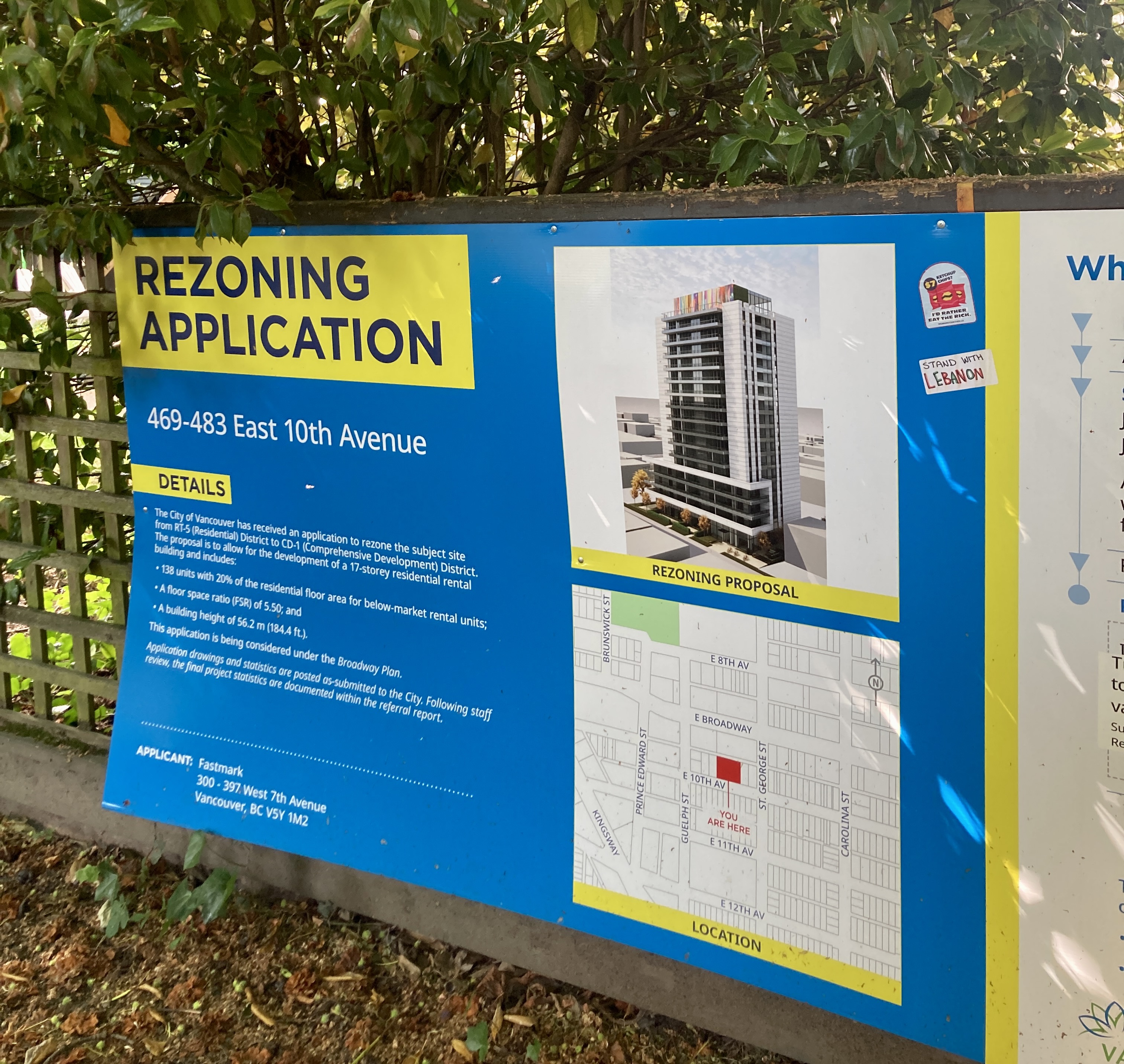
Right next door, the specific redevelopment being proposed: Rezone from Residential to Comprehensive Development category, and, on this street of two-storey homes, put up a 17-storey tower.
Hmm. Used to be, dragons breathed fire and wore scales. Now they may instead breathe rezoning, and clad themselves in 17 storeys.
1 March 2025 – Clutter? “Juxtapositions” is more accurate, also better PR, but I suspect there’s some kind of rule against using five-syllable words in a title.
So Urban Clutter it is. There’s a lot to be said for it, by whichever name — so many possibilities, all piled atop each other! The pile-up tells stories, and it both sparks and rewards curiosity.
At least, that’s the effect on me, as I stand at Davie & Richards, en route an Urban Treat — a noon-time performance at the Scotiabank Dance Centre. While my feet wait for the light to change, my eyes say, “Look at that!”
So I do.
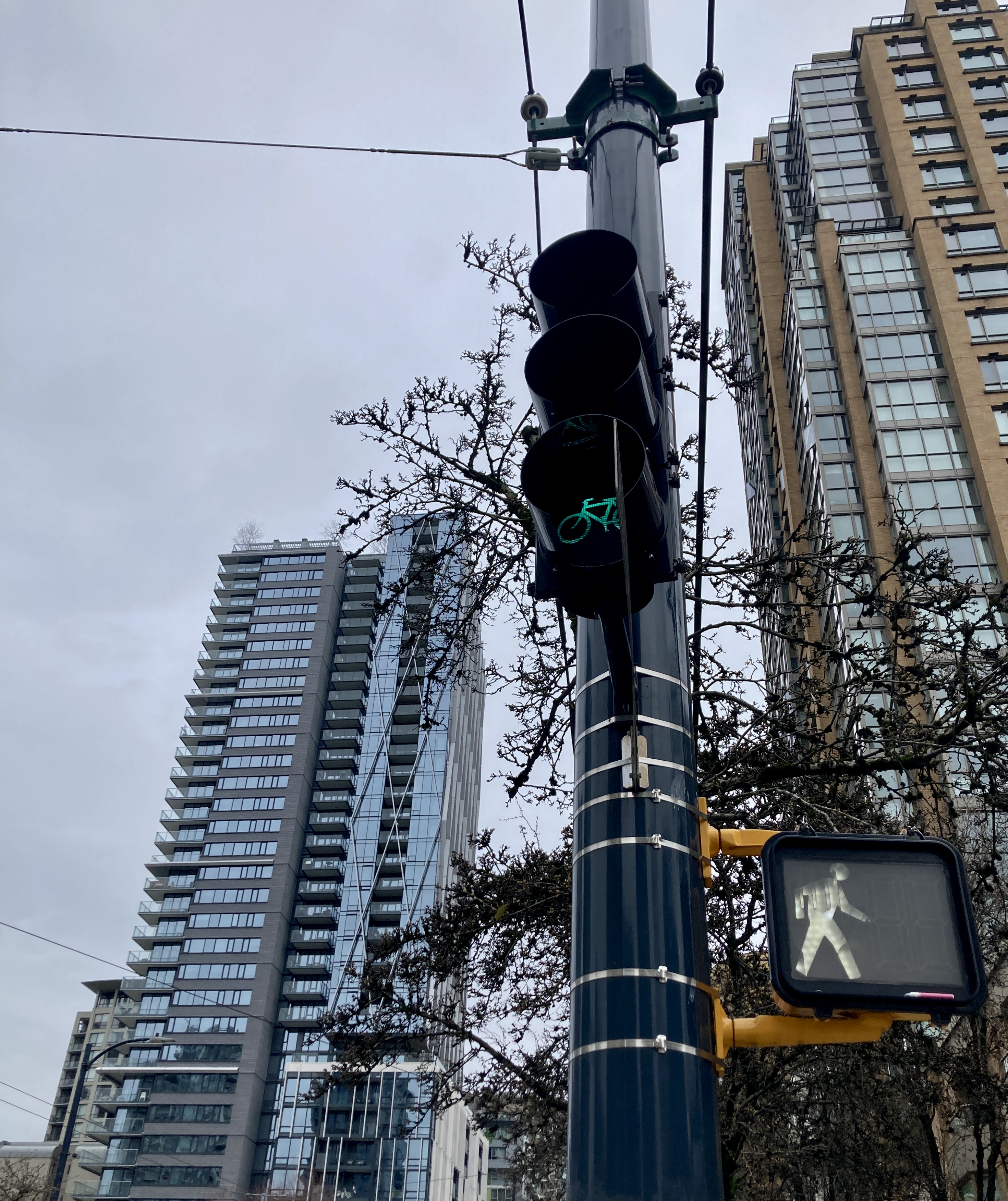
It’s nothing special, it’s just… it’s just very urban. Tram lines overhead; traffic signals to one side; and, framed by both, the residential towers that lie behind Emery Barnes Park and before Helmcken Street.
The Shiamak dance performance is wonderful. Afterwards I adapt their “Have Feet Will Dance” slogan to my own “Have Feet Will Walk,” and start north on Seymour. (North-ish, downtown streets are on a slant, but I’ll spare you the precisions.) The day is balmy, I’m happy, and I decide to walk right to West Pender, where I’ll catch a bus back home.
But then I get distracted, and my simple plan goes all fractal. Blame it on urban clutter.
Before I even reach Nelson, I’m laughing at this literal sign of our politico-cultural times.
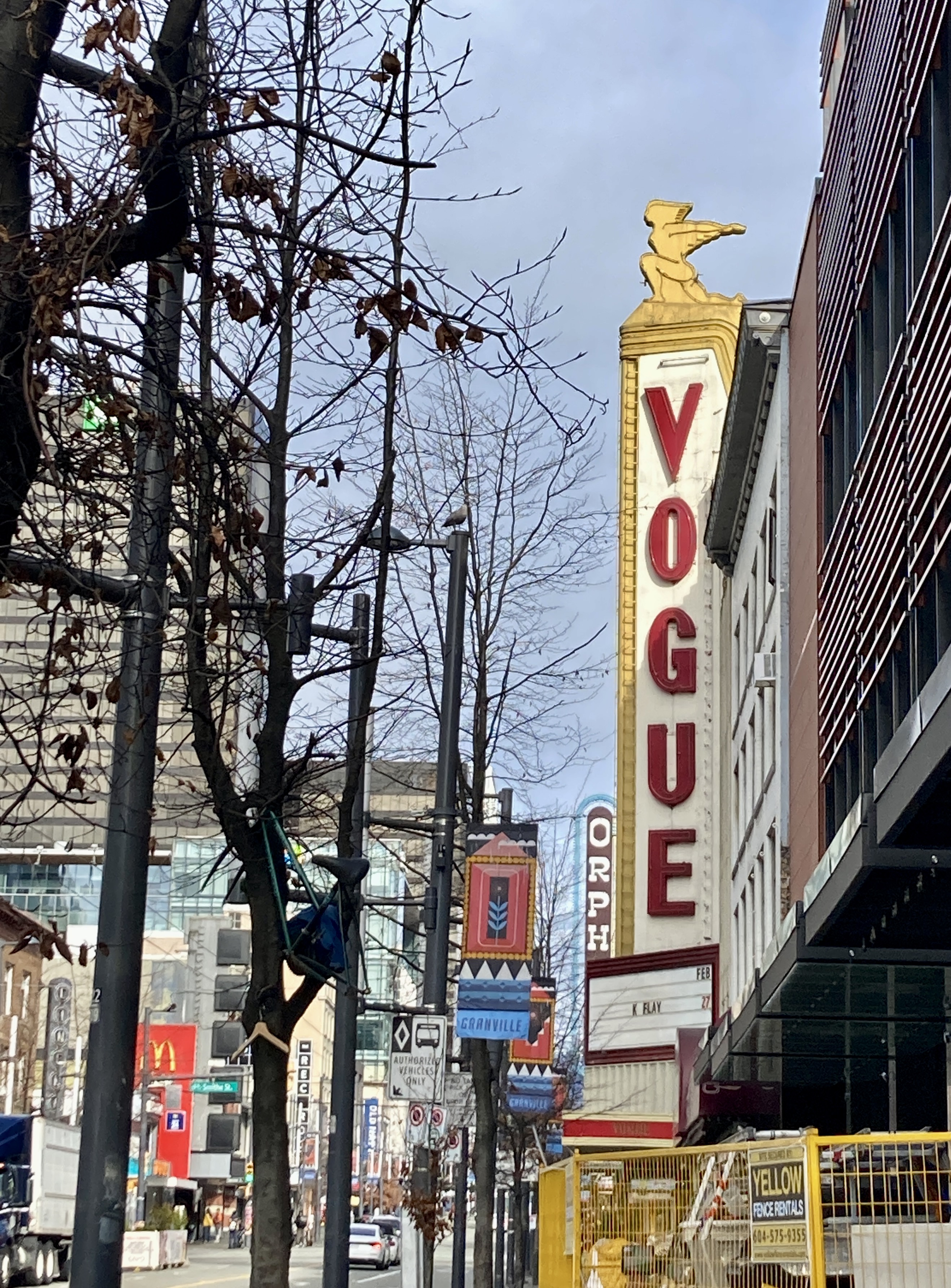
Left on Nelson, right on Granville, and I’m up against the busy construction work beneath one of the street’s stubborn theatrical survivors: the Vogue. It’s a 1941 movie theatre (now event venue), built in Art Deco/Art Moderne style. As you can see.
I veer onto Smithe just past the Vogue Theatre. No particular reason for the change of direction — but suddenly here I am, just before Seymour, at the entrance to Ackery’s Alley.
The alley backs the Orpheum Theatre on Seymour, and celebrates the venue’s long (and continuing) history of live performances. It was painted and generally spiffed up in 2018, the idea being to welcome pedestrian as well as the existing delivery-truck traffic. I had recently arrived in town, walked it then, and yes, it sparkled.
It hasn’t had much maintenance since, and it’s a lot grubbier.
But it’s still in pedestrian use and, with its strong lines and commercial functionality, it is very Downtown Right Now.
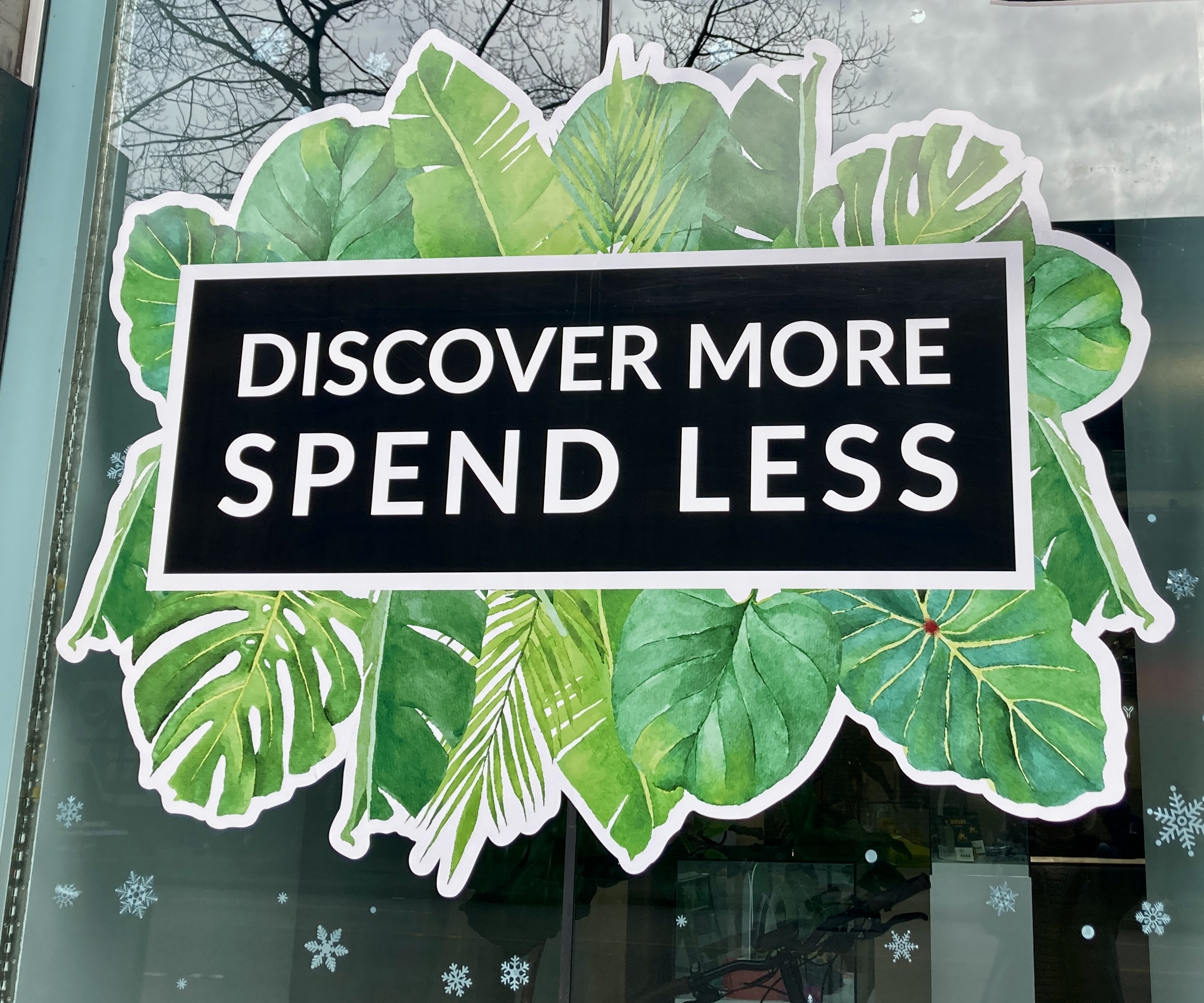
Out the other end at Robson, where a window sign apparently invites me to dial down my consumerism.
Well… not exactly. This is the window of a cannabis shop, which prides itself on bargain prices. So: keep spending money, just spend it with us! (And discover the wonders of our products.)
Since I still plan a quick ride home, I take to Granville again, heading for the bus stop at West Pender. But then, when I reach Pender, I look farther down Granville and I am again distracted — beguiled! lured! tickled! — by urban clutter.
It’s the dome. I start wondering about the dome.
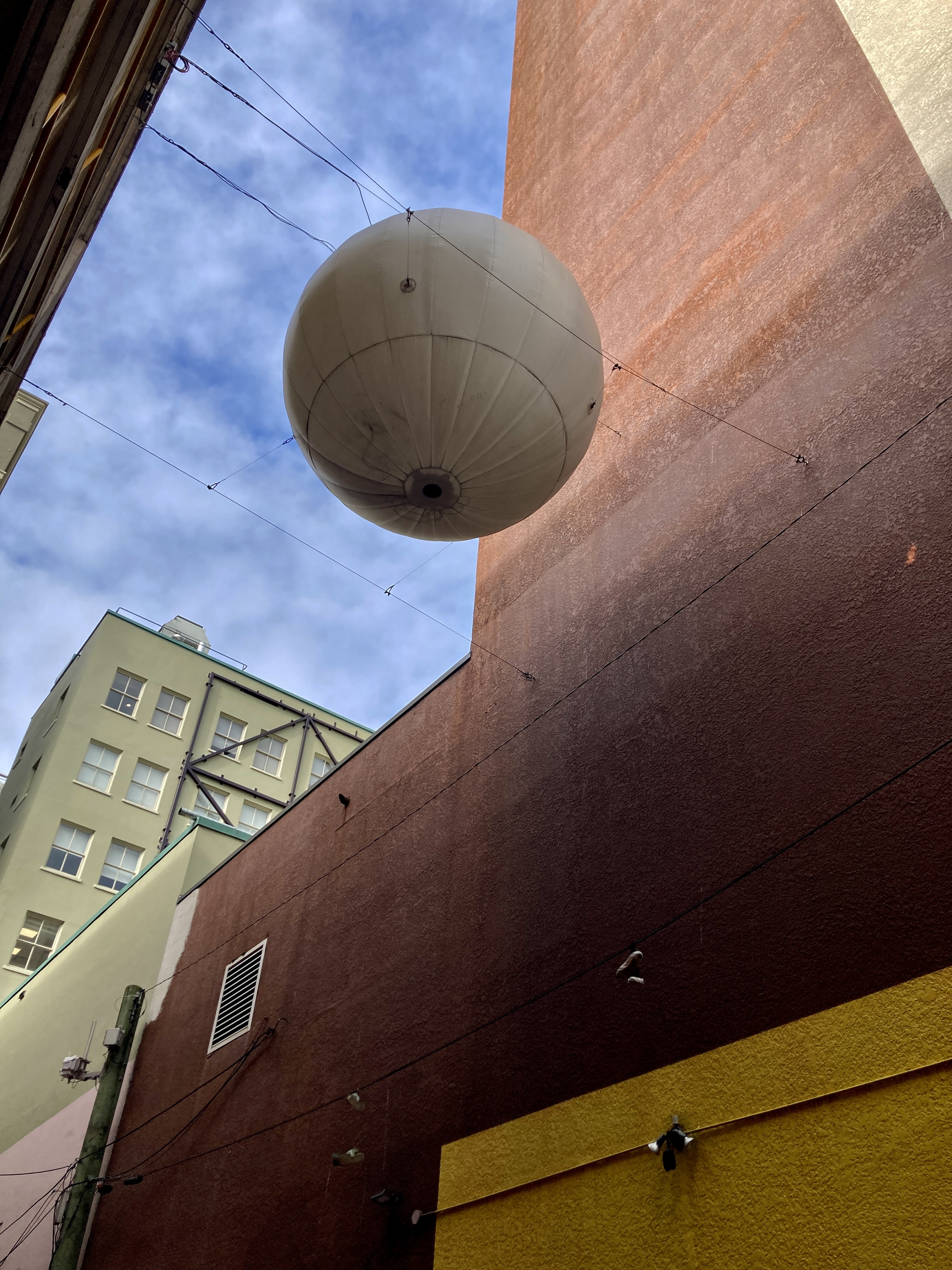
I could always walk one more block and check it out — but what fun is that? Especially when, just before I reach that next corner, I can instead dive into Alley Oop, the first of the downtown alleys to be spiffed up, back in 2016.
Also grubby by now, but it does have that hanging sphere at the far end.
Which rewards my head-tilt very nicely. Geometry at work.
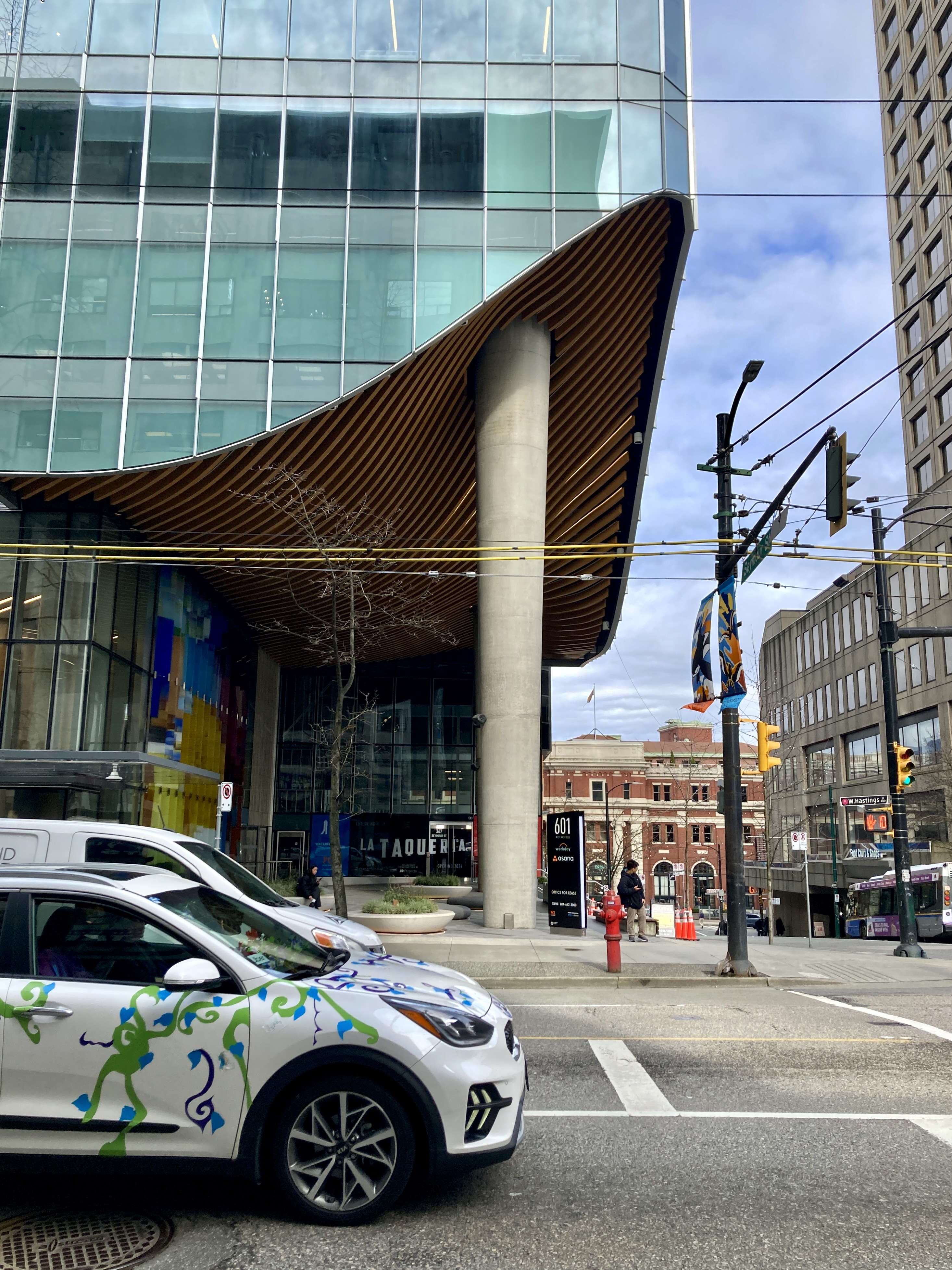
This brings me to Seymour and West Hastings, with Waterfront Station in the distance and this building opposite, whose upturned lip always makes me think of whale baleen. (That frog-splattered white car, even closer, is a gift from the Traffic Light Gods.)
By now I’m well off-track for the mystery dome. I correct course and walk west on Hastings. This time the urban clutter offers me a distant view of the Marine Building at Burrard, framed against glass towers, and a close-up of elaborate lanterns and trim on another heritage building right next to me.
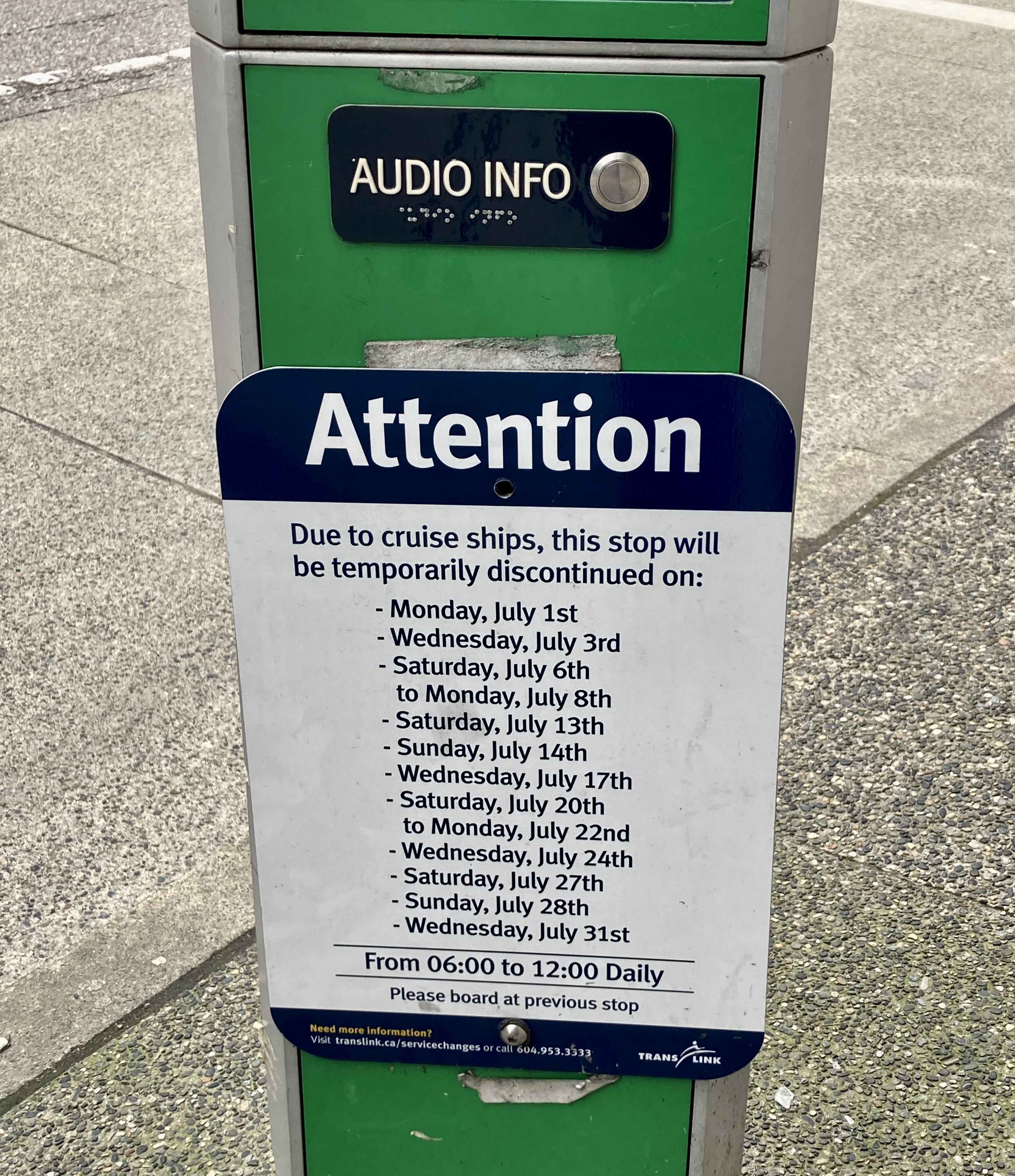
The bus stop at Granville is a reminder that the cruise ship terminal is nearby and, in season, its passenger loads wreak havoc with local traffic.
Perversely enough, I now head away from the mystery dome. Instead, I follow the raised Granville sidewalk all the way north to the lookout at Burrard Inlet.
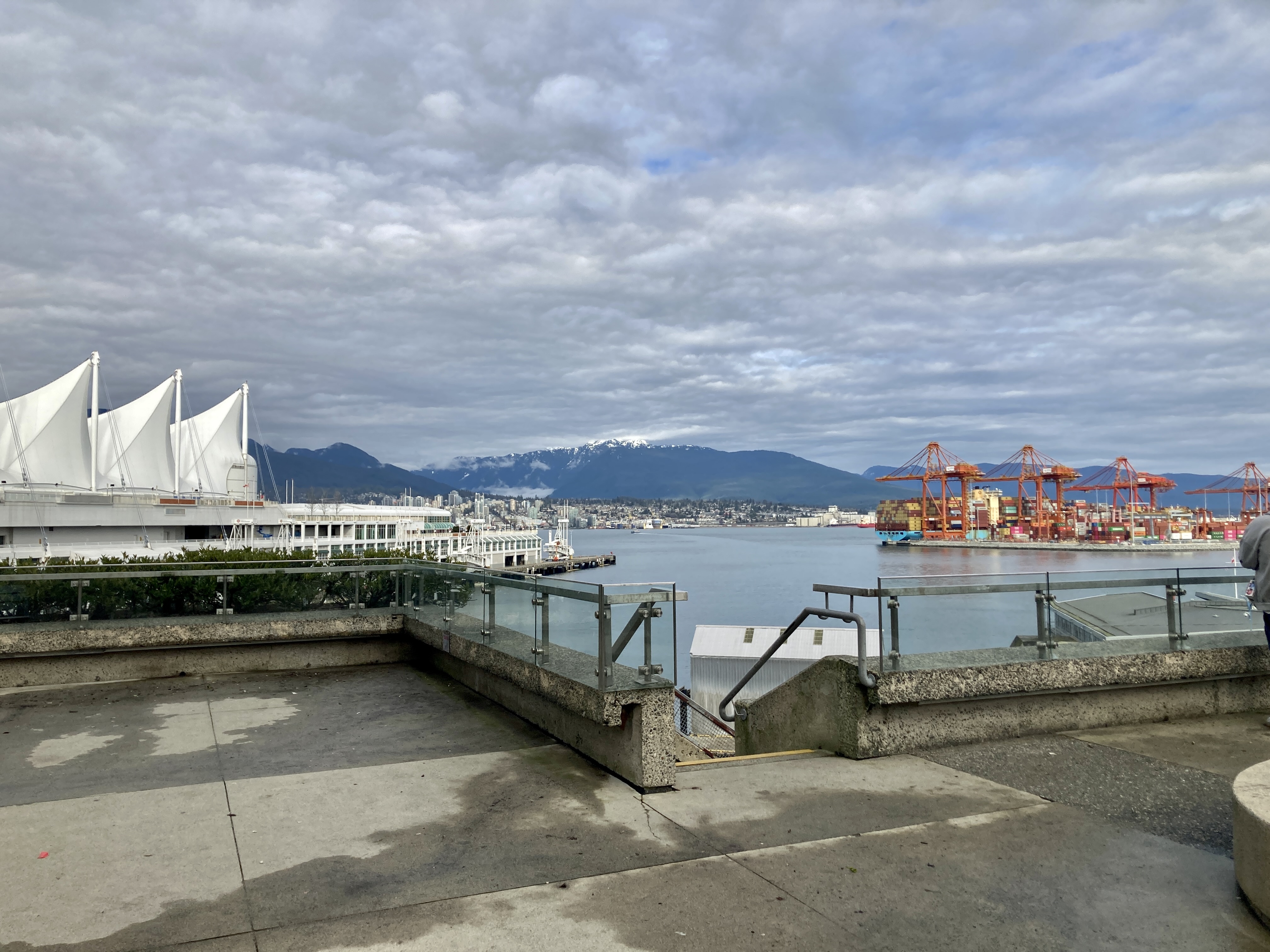
Small but satisfying, this little plaza lies between the East Convention Centre (with its “sails”) and the cruise ship terminal on one side, and, on the other…
harbour cranes, Waterfront Station, the SeaBus terminal, train tracks and a helicopter landing pad.
About face!
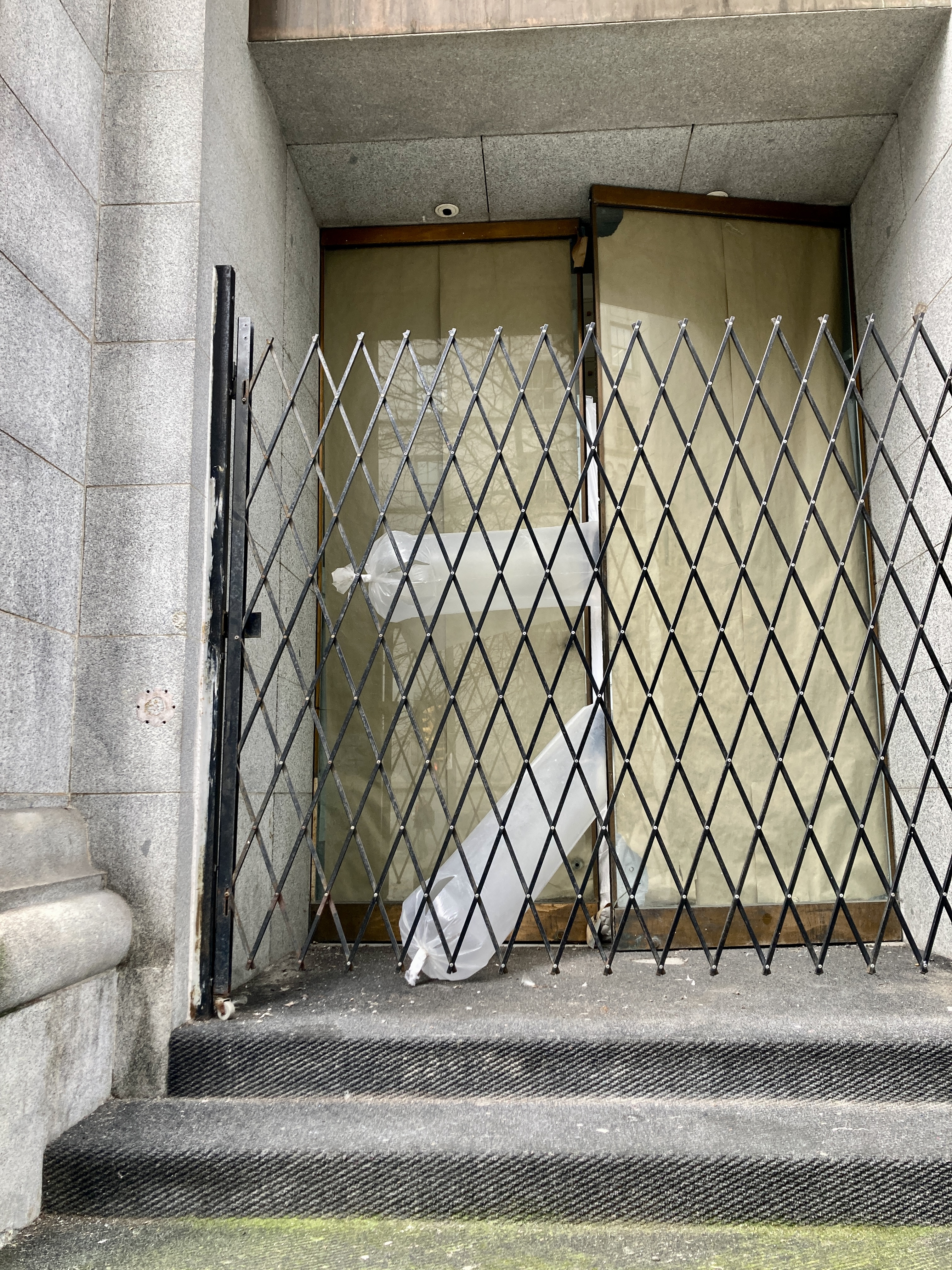
Back up the raised sidewalk I go, now aware that this entire four-building foot print — including the mystery dome — comprises the Sinclair Centre. I knew this, I really did. It just took a while to reconcile my memories of this once-busy office/service/retail complex, with the boarded-up reality of right now.
??? They look like giant condoms, ready for action. What is going on in there?
I don’t know, is the answer to my own question. The complex seems mostly closed, and I later read online that a massive redevelopment proposal has been under review. Is work now underway, or becalmed? I can’t tell.
Whichever, it is a sad sight.
Walking the West Hastings side of the complex toward Howe, I pass a medallion face looking suitably distressed. As it should. The wooden door is in good condition, but the plaque beneath the medallion has been hacked away.
Corner of Howe, I take one last look at the dome that started my long, happy loop-about through all that urban clutter.
Then, satisfied, I finally board my bus for home.
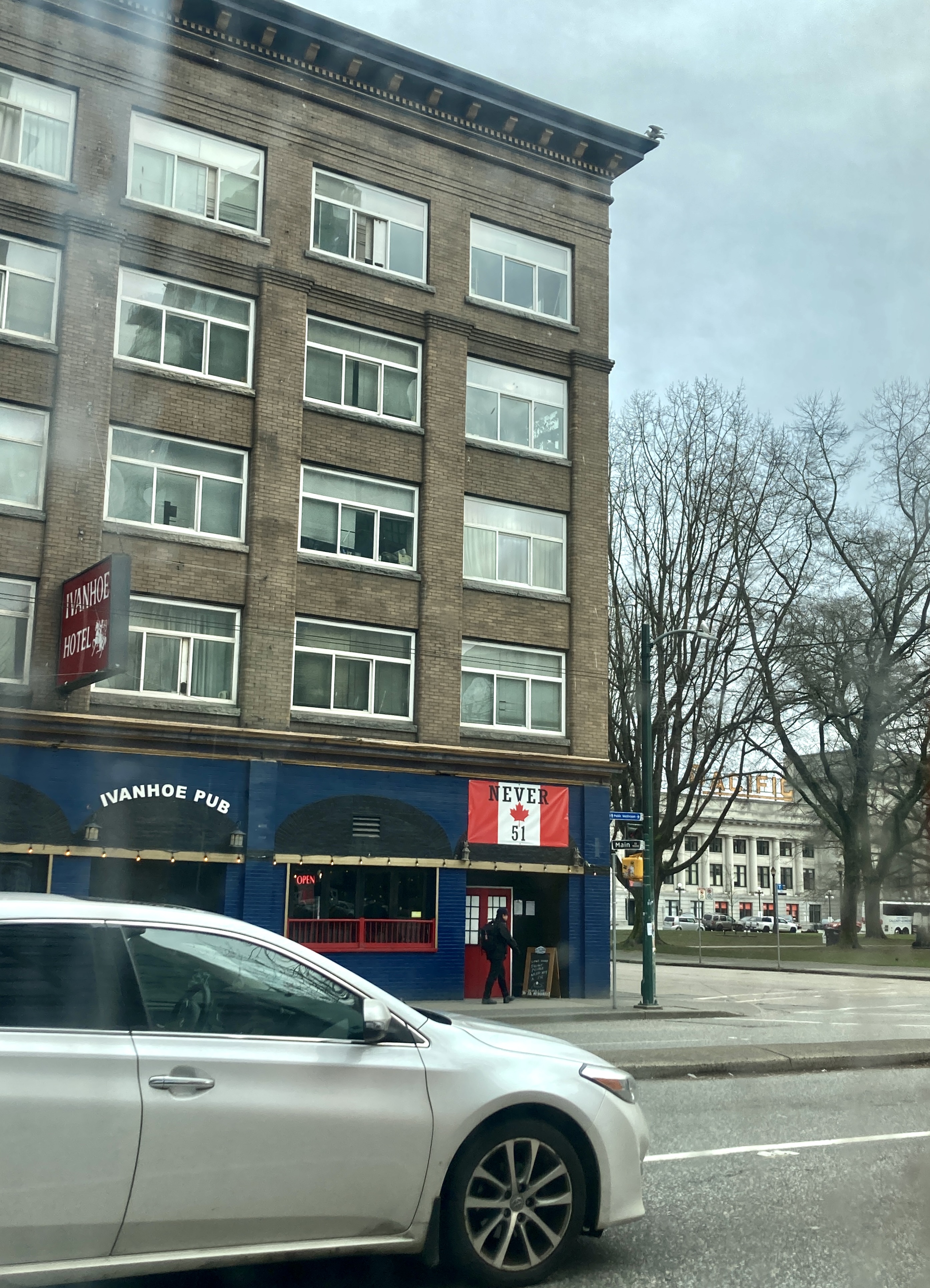
There’s one last delight, as we roll south on Main Street, and I manage to grab a shot through the bus window.
The Pacific Central train station is in the background, but who cares. I’m focused on the red & white “flag” now installed above the pub entrance, right at the cross-street. It is yet another literal sign of our politico/cultural times.
The final, perfect detail? The name of that cross-street is… National Street.
12 January 2025 – First, “D” for the Everything, Everywhere Doctrine, which has set its targets for 2025: Greenland, Canada, Panama.
It is beyond alarming & insulting, it is surreal to hear the duly-elected incoming leader of a supposedly principled (and supposedly freedom-loving) country announce his intention to subjugate his neighbours — my country included.
Greenland he plans simply to buy, though upon questioning he explicitly does not rule out the use of military force. Canada he believes he can crush “by economic force.” Panama… well, the U.S. has a history of intervention in its southern neighbours, so there must be a long list of strategies already in the arsenal.
It is stirring, but not comforting, to read David Suzuki’s account (Toronto Star) of why he chose to return to Canada from the U.S. and why he hopes all Canadians “will fight to preserve our differences from [that other] great nation.” It is no comfort that some Americans (cf. this comment on my previous post by a Seattle-based reader) think that members of the incoming administration are “evil, twisted… and some are very stupid.” And it is no comfort to read that the subjugation plans are bound to fail (cf. Stephen Marche analysis, Maclean’s Magazine) since “at this point in history, America has come off 70 years of failed imperialist adventures.”
Even when the target nations are united and patriotic, even when the leaders of the aggressor nations are stupid and bungle their projects — even then — those projects still inflict great damage and suffering on the way through.
…
Shall we move on to a happier pair of D’s?
Doorways and Details
Fresh off a visit to a stunning exhibition in Equinox Gallery, I prowl my way back down this southern extension of Commercial Drive.
It is still home to vintage architecture and to small, independent shops and activities. Doorways are individual, and expressive.
This café with its door wide open…
and a collection of vintage bottles overhead.
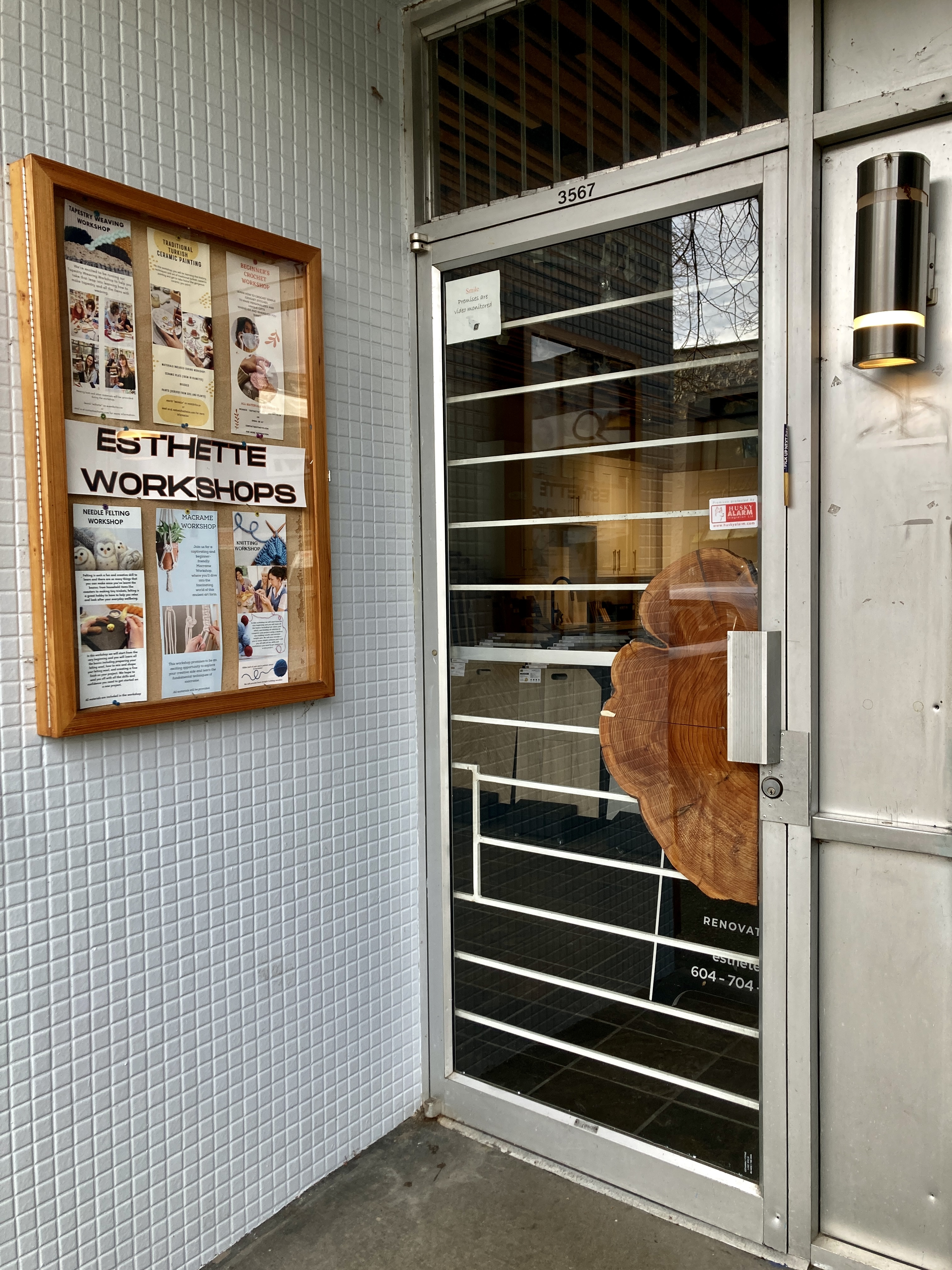
This crafts workshop…
with its glorious live-edge door pull.
This café one block farther north, where the door may be physically closed but the signage welcomes you…
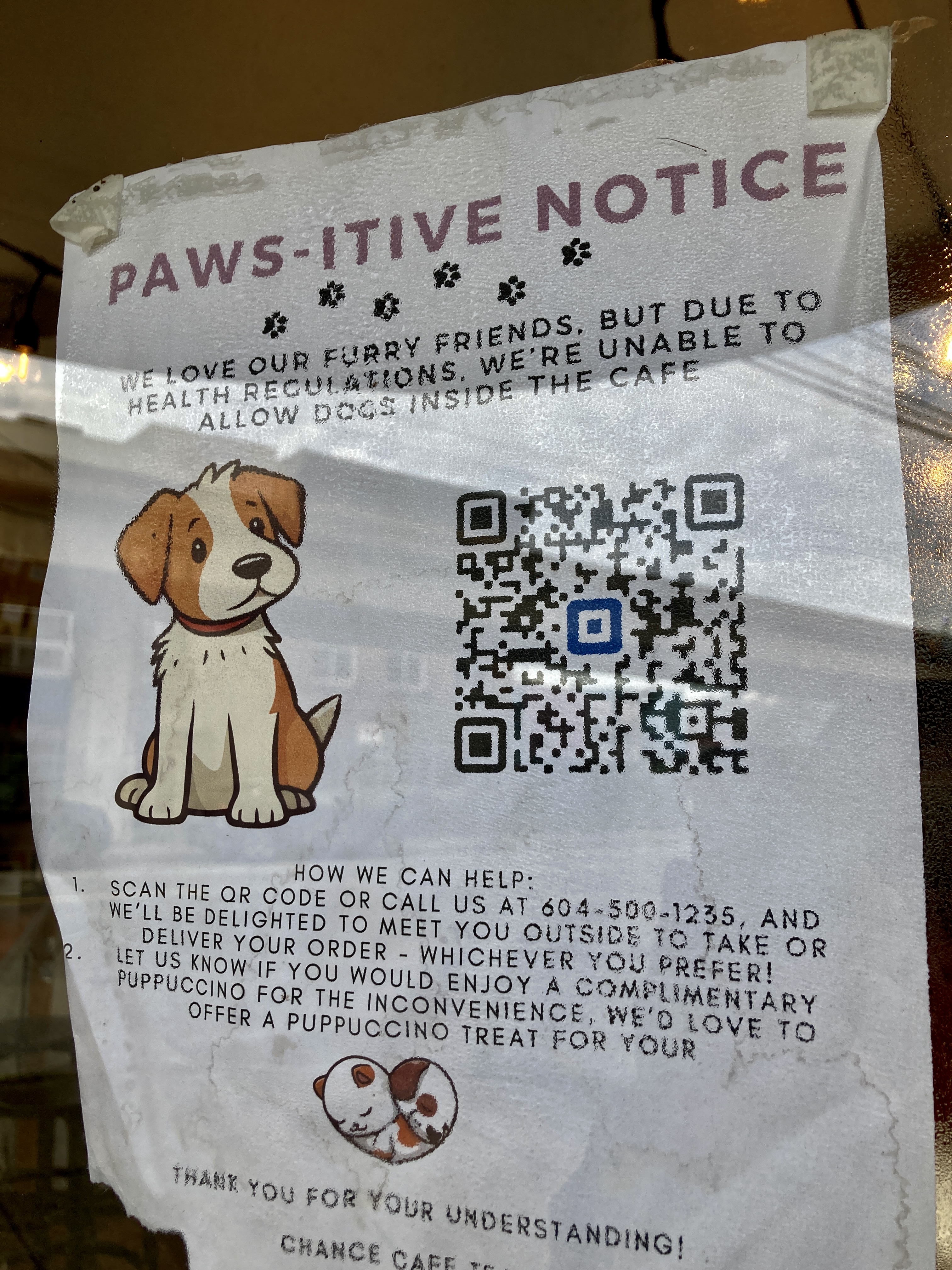
and a small notice apologizes for the need to bar pets…
and offers a free “puppiccino” in compensation.
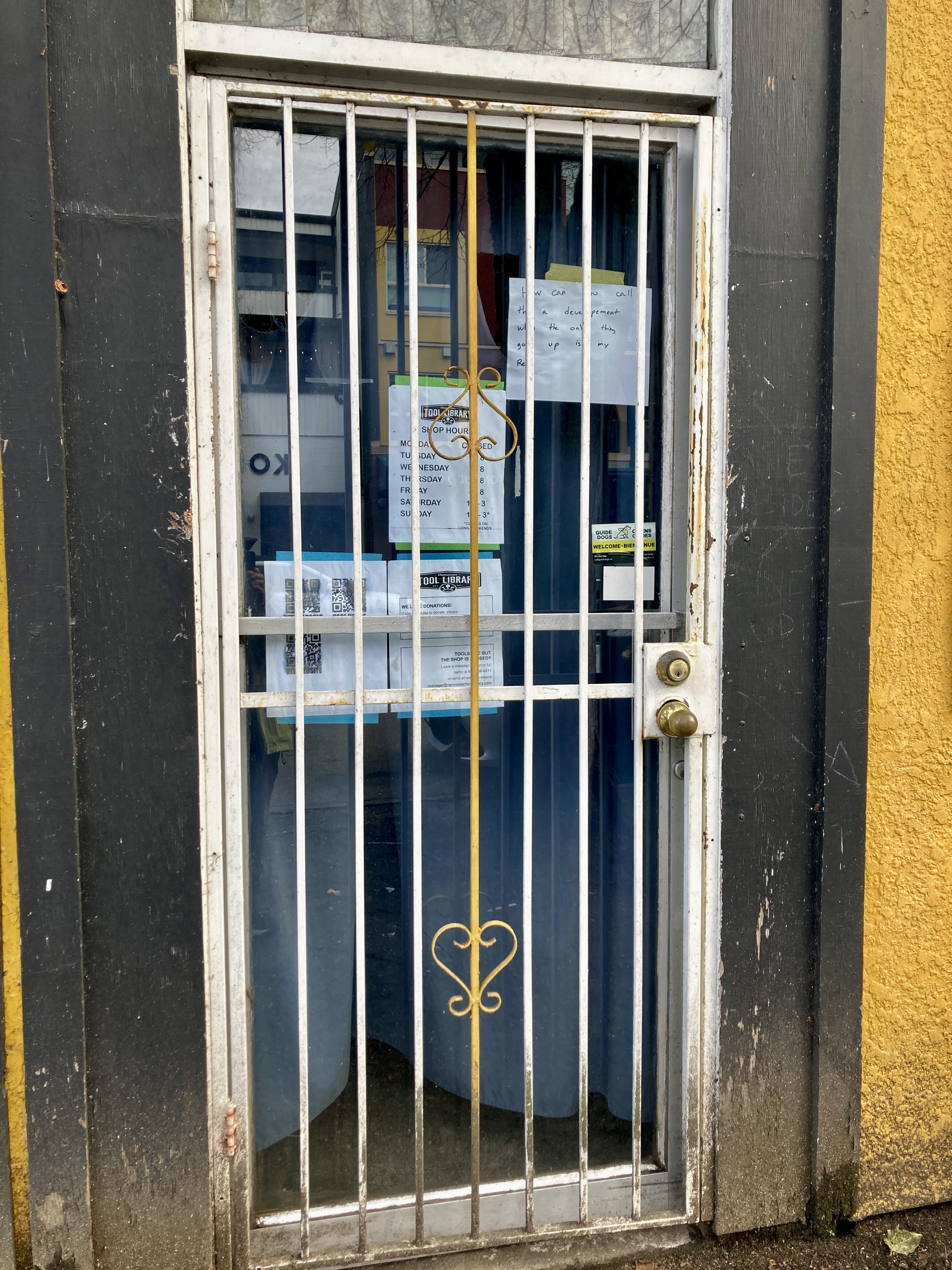
An adjacent door, barred and locked, appears unfriendly, but is deceptive.
It guards something very friendly indeed, a tool-lending library — “an affordable community-based alternative to personal tool ownership or tool rental.”
Sadly, its window detail, hard to read through bars and glare, suggests neighbourly puppiccinos may become a thing of the past.
“How can you call this a development when the only thing going up is my rent.” Later I see land-acquisition notices in front of other vintage properties, citing CD-1 zoning, i.e. Comprehensive Development.
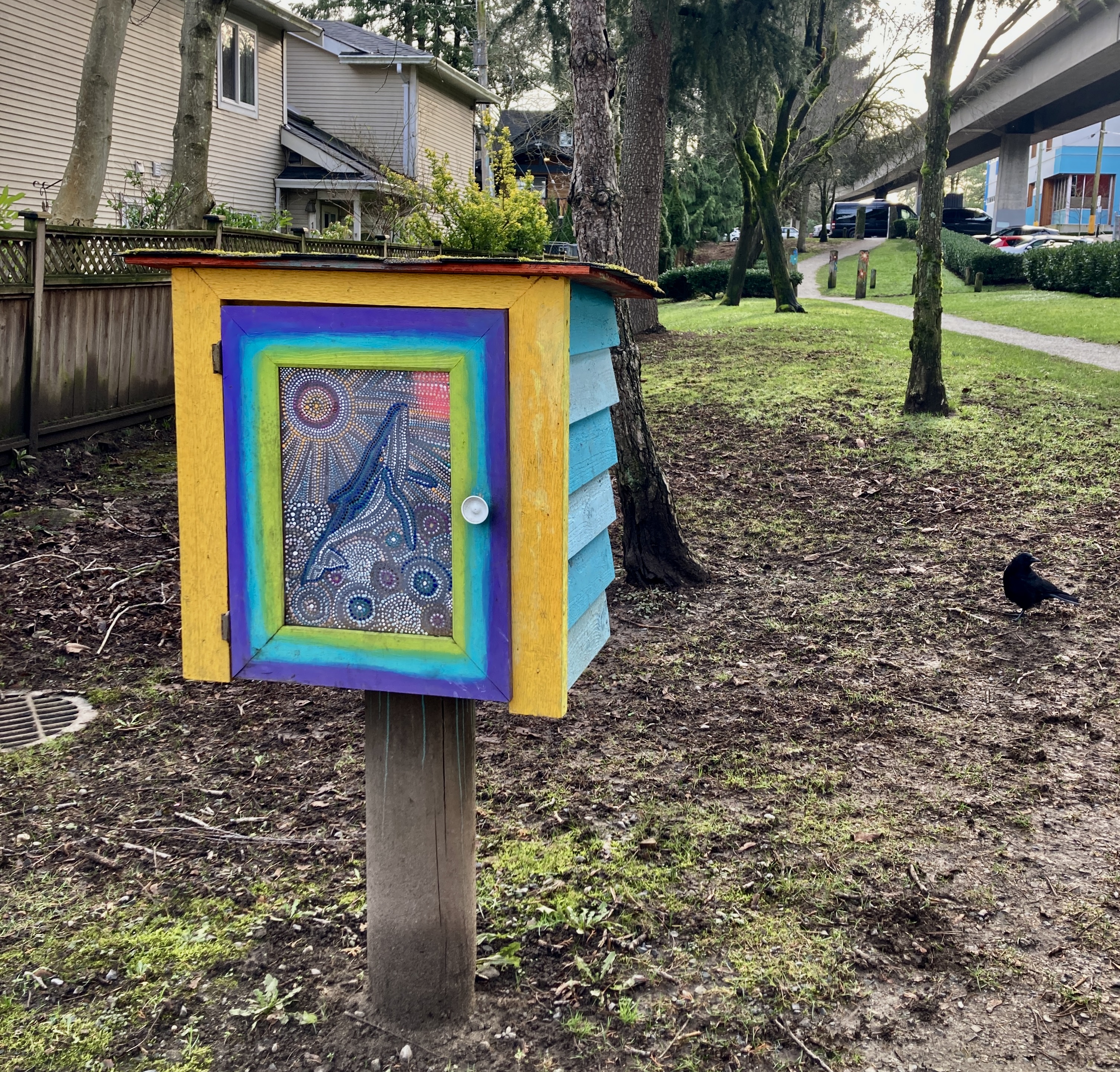
Another, much smaller doorway, this time near the north end of a narrow linear park threading its way parallel to Commercial Drive, on down to East Broadway.
One Little Free Library door, with two heart-warming details. First, the pointillist celebration of whales on the door…
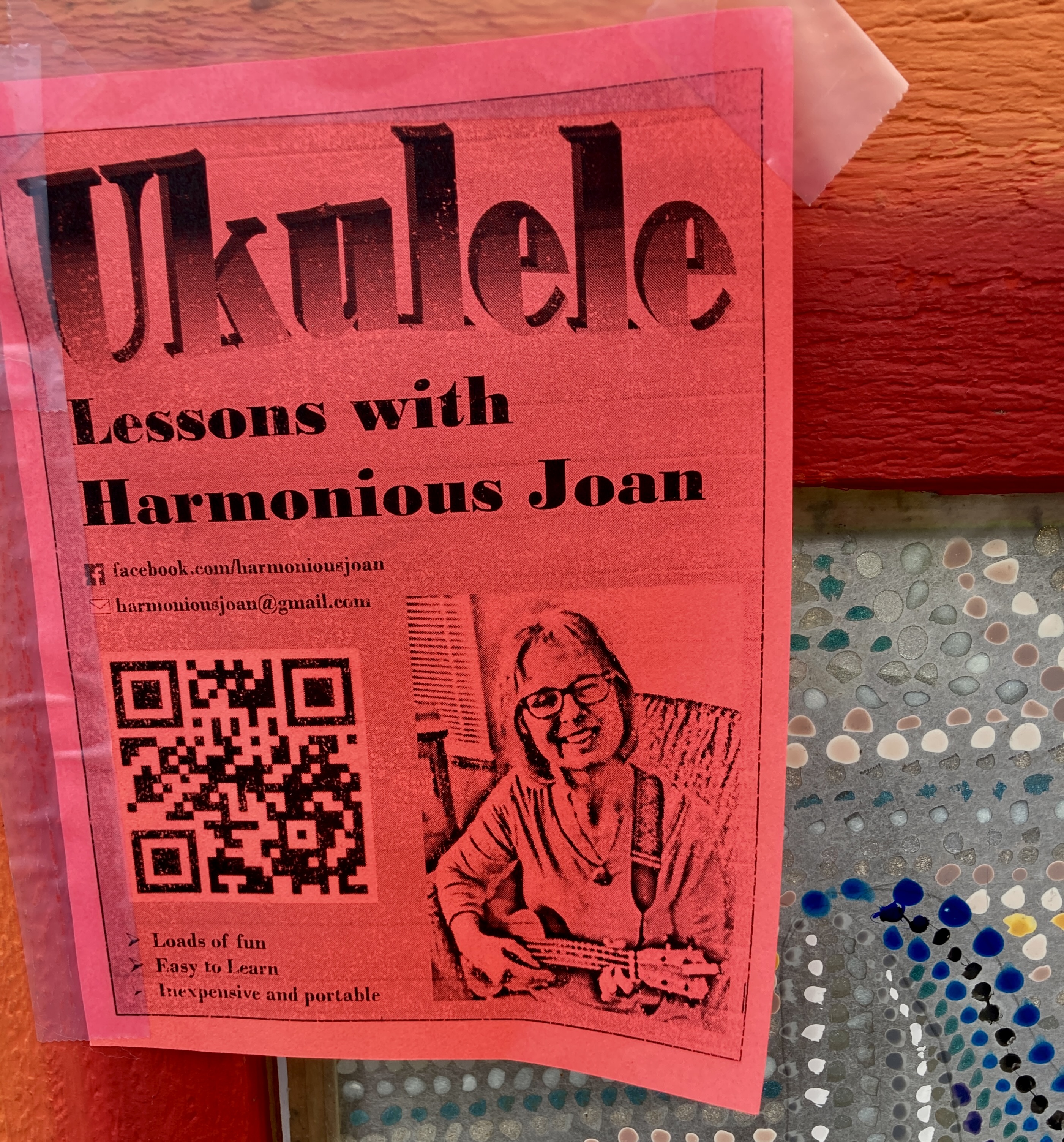
and, second, the introduction to Harmonious Joan taped to the frame inside. (You don’t need to be a ukulele player, to be glad that people like HJ exist.)
One final “doorway” for you, and note those punctuation marks of uncertainty.
I debate its inclusion, and then decide that, yessiree! it qualifies. True, it is an intersection…
but are not intersections the doorway to a pair of streets?
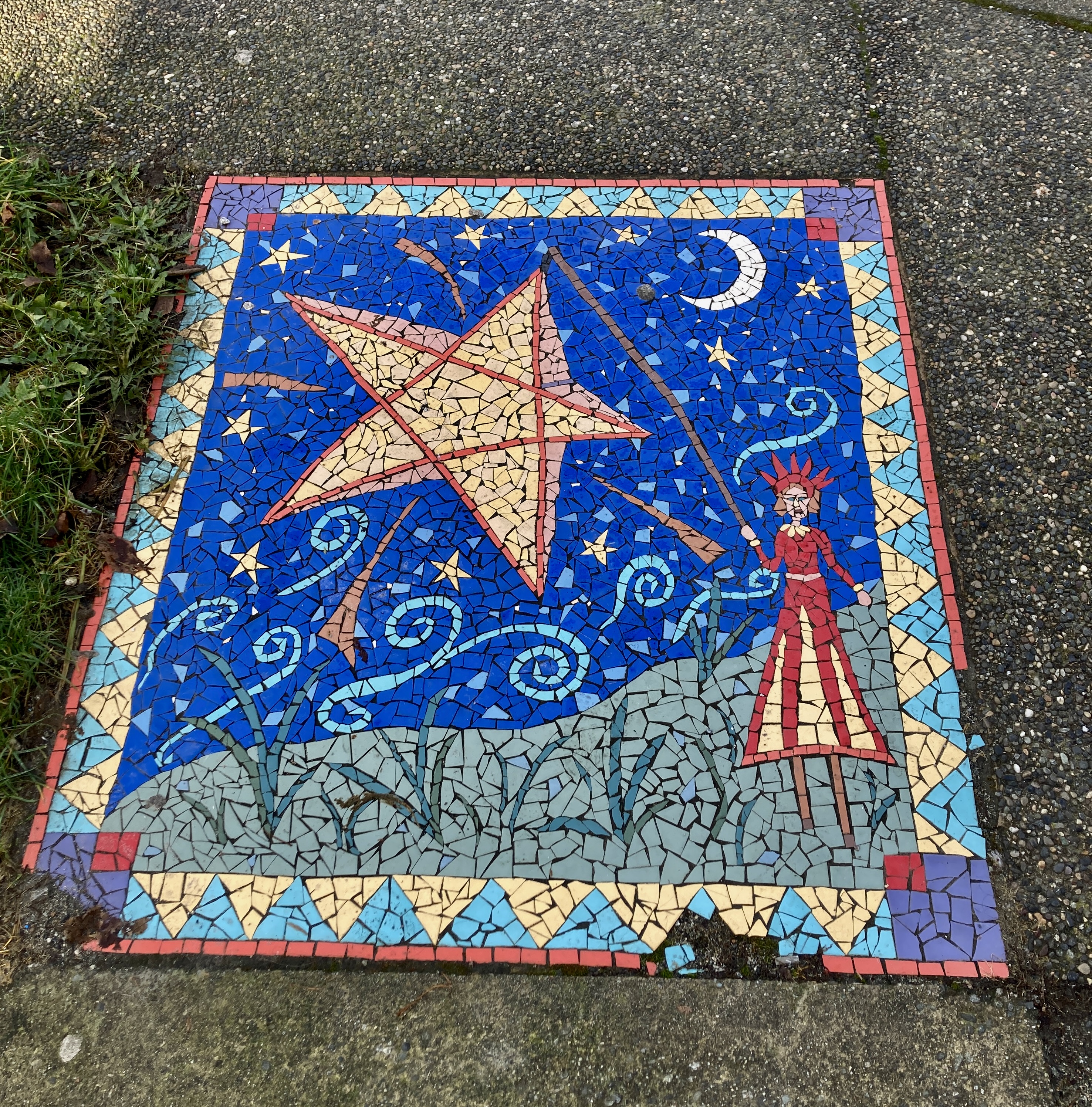
Anyway the detail, another of the city’s sidewalk mosaics, deserves attention…
even if I cannot find a reference to it anywhere and so cannot identify it for you.
All these small things — ordinary, everyday, and worth defending.
26 November 2024 – I’ll get to “Great Northern.” Let’s start with “bimble.”
I learned this splendid word just three days ago, reading Snow! — James Elkington’s latest post to his blog Mountains, Myths and Moorlands. The post began, “We woke to a lot of snow, I managed to get onto the moors for a bimble.” Subsequent e-chat with this Yorkshireman taught me that the word is both noun and verb, and means “to walk about without purpose.”
(I am not going to rename my blog “Bimble Broad”! Though the idea does have me giggling…)
Yes well, on to Great Northern Way.
I decide to have myself a bimble the length of GNW, so-named in tribute to its earlier life as a stretch of the Great Northern Railway route from Seattle to Vancouver.
Easy access for me, from my home just a bit uphill: down Main, turn right-east on East 6th instead of left-west, then left on Brunswick… and there it is, the Great Northern Way, just a few blocks farther down.
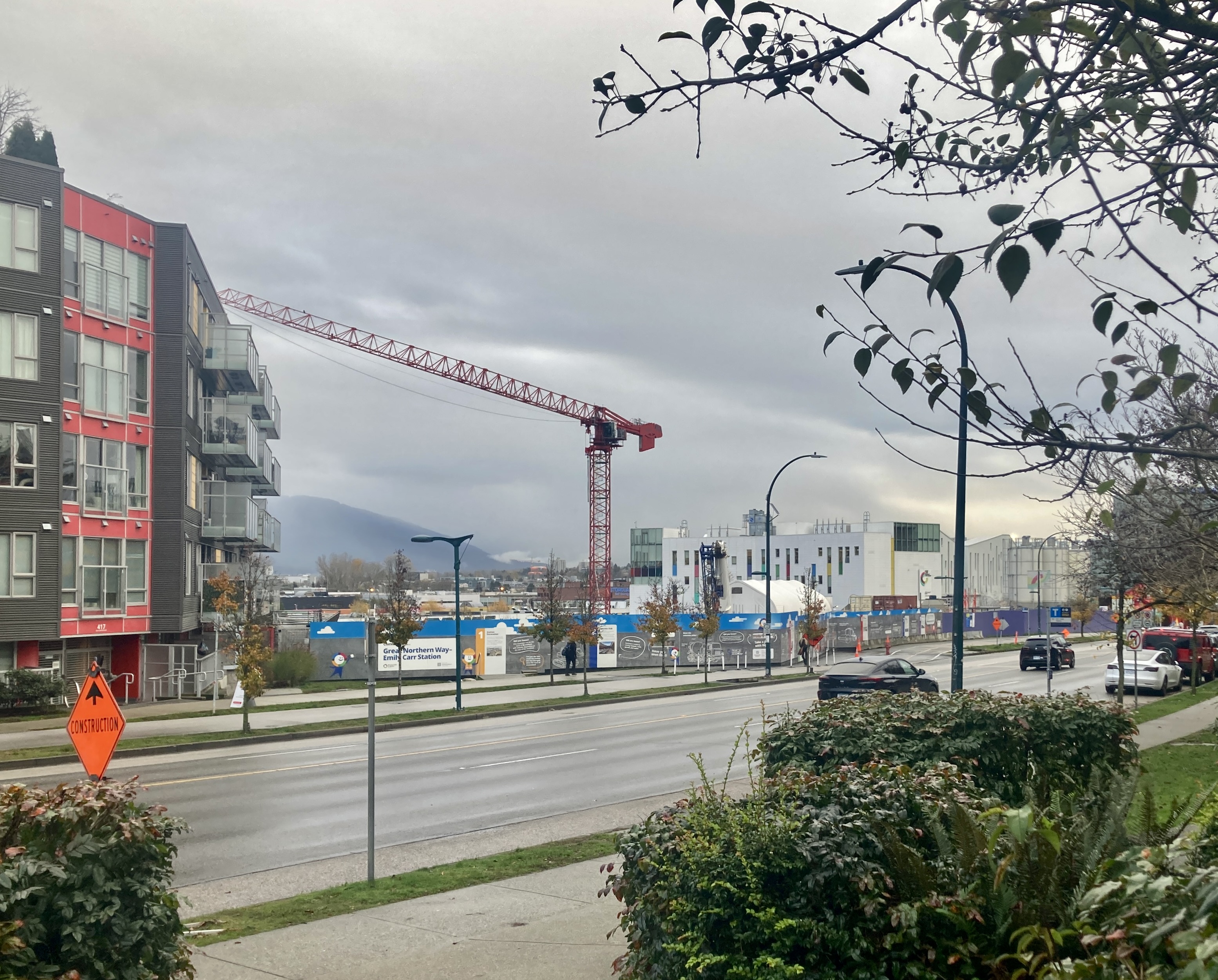
Down by the construction crane, which will be there for a good while yet.
There’s all the activity for the Broadway Subway Project — the westward extension of the Millennium Line — and then there’s the whole South Flats neighbourhood thing as well. I already know about the former (and live with it, in my own neighbourhood); I become aware of the latter in the course of this bimble.
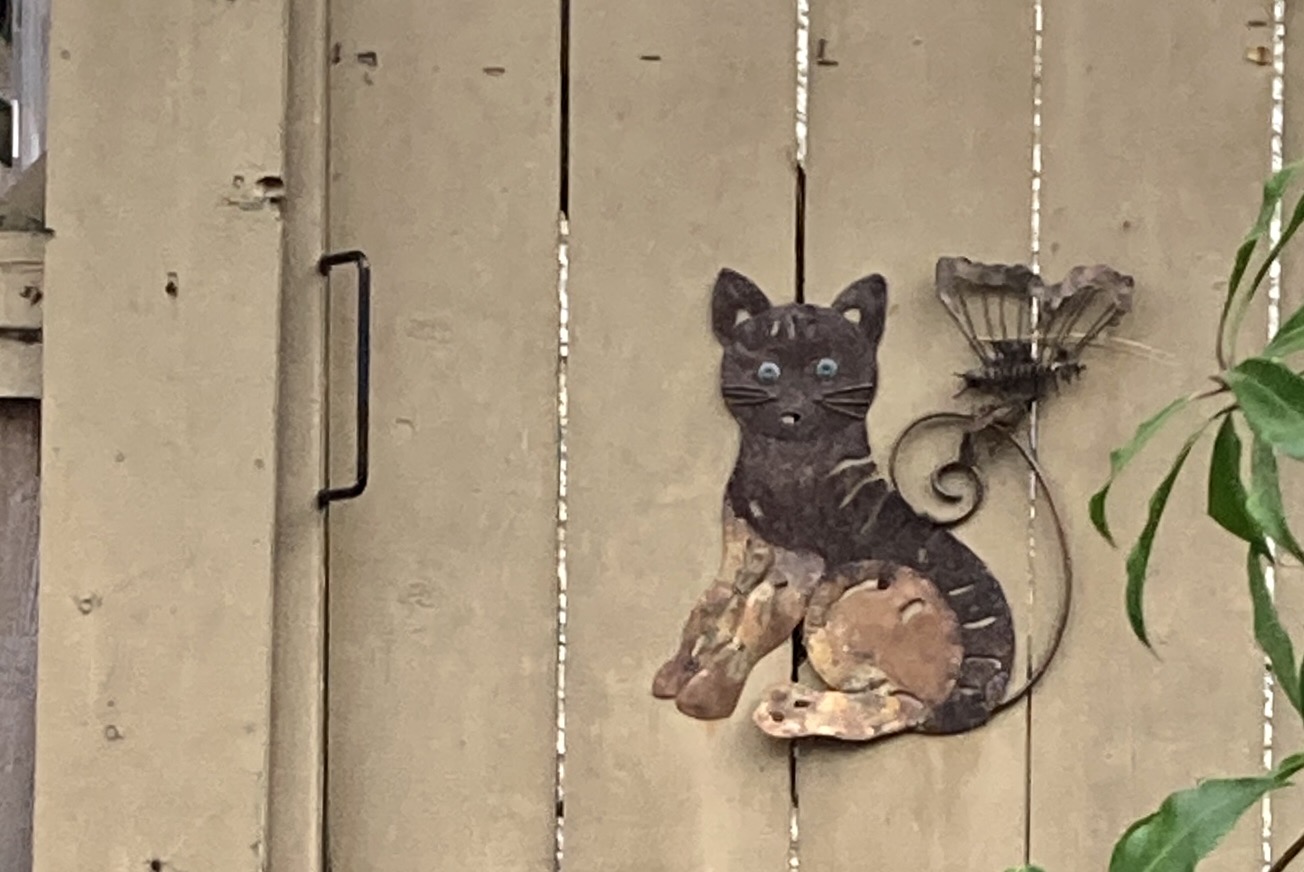
Down/down, north/north, past a curious cat on a gate post at East 2nd…
and here I am, at GNW itself. Already so transformed from its railway/industrial/service area, let alone from its earlier, natural life as the final stretch of False Creek before the needs of expanding commerce decided to fill it in.
To the right of the construction crane, the white, blocky complex of Emily Carr University of Art + Design, whose arrival triggered this latest academic/creative/high-tech/digital era. Far right, the Centre for Digital Media (UBC, Simon Fraser U, Emily Carr, BC Institute of Technology). Far left, the corrugated metal and bright red of Canvas, one of the area’s new-builds catering to the Emily Carr vibe by offering its condo owners such amenities as flexible artist gallery space and collective workshop space, along with the more usual fitness centre and children’s playground.
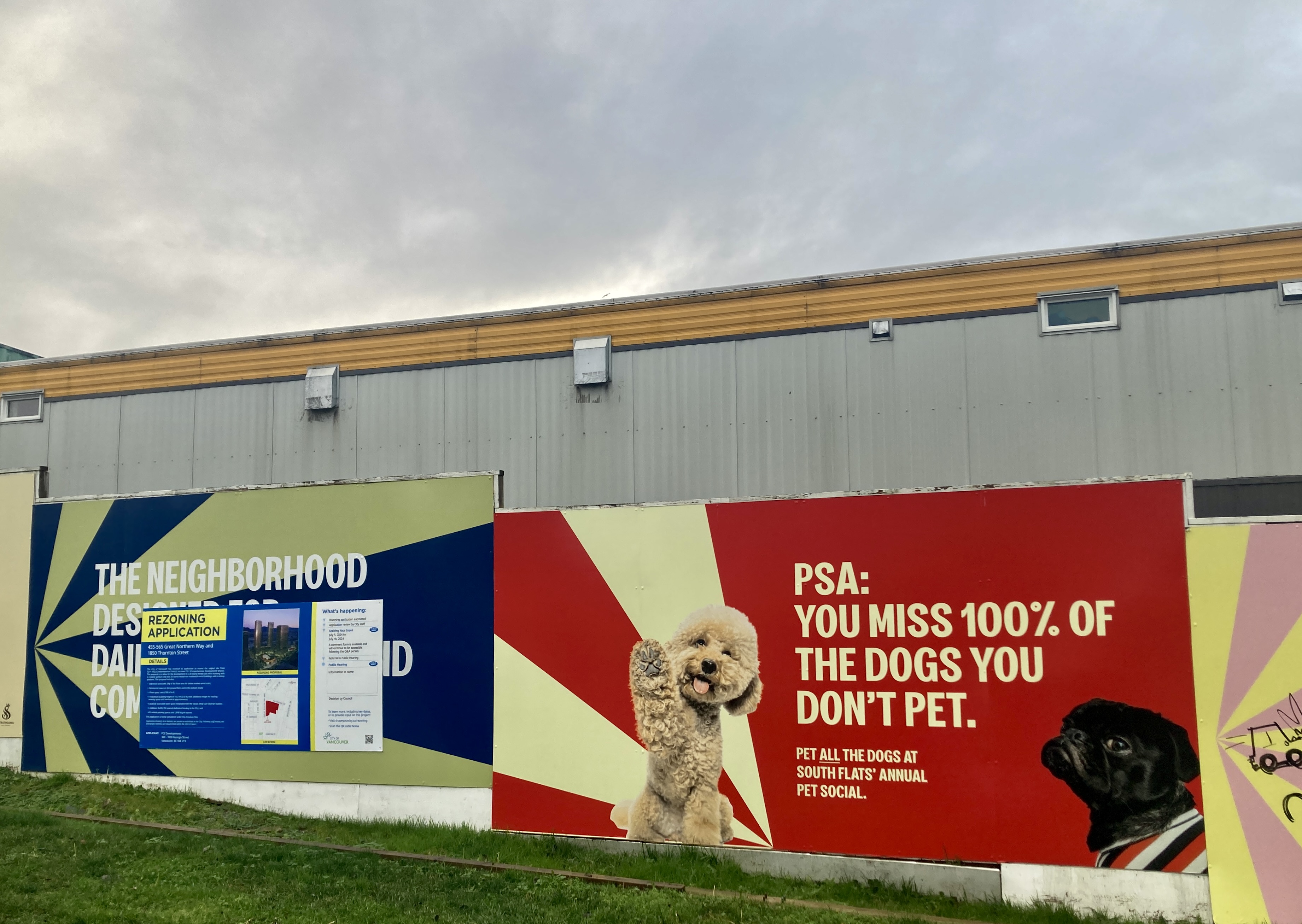
And, in between, the work-in-progress GNW Emily Carr transit station, with its hoardings and bouncy signage to explain what’s happening, along with viewing slots so you can see for yourself.
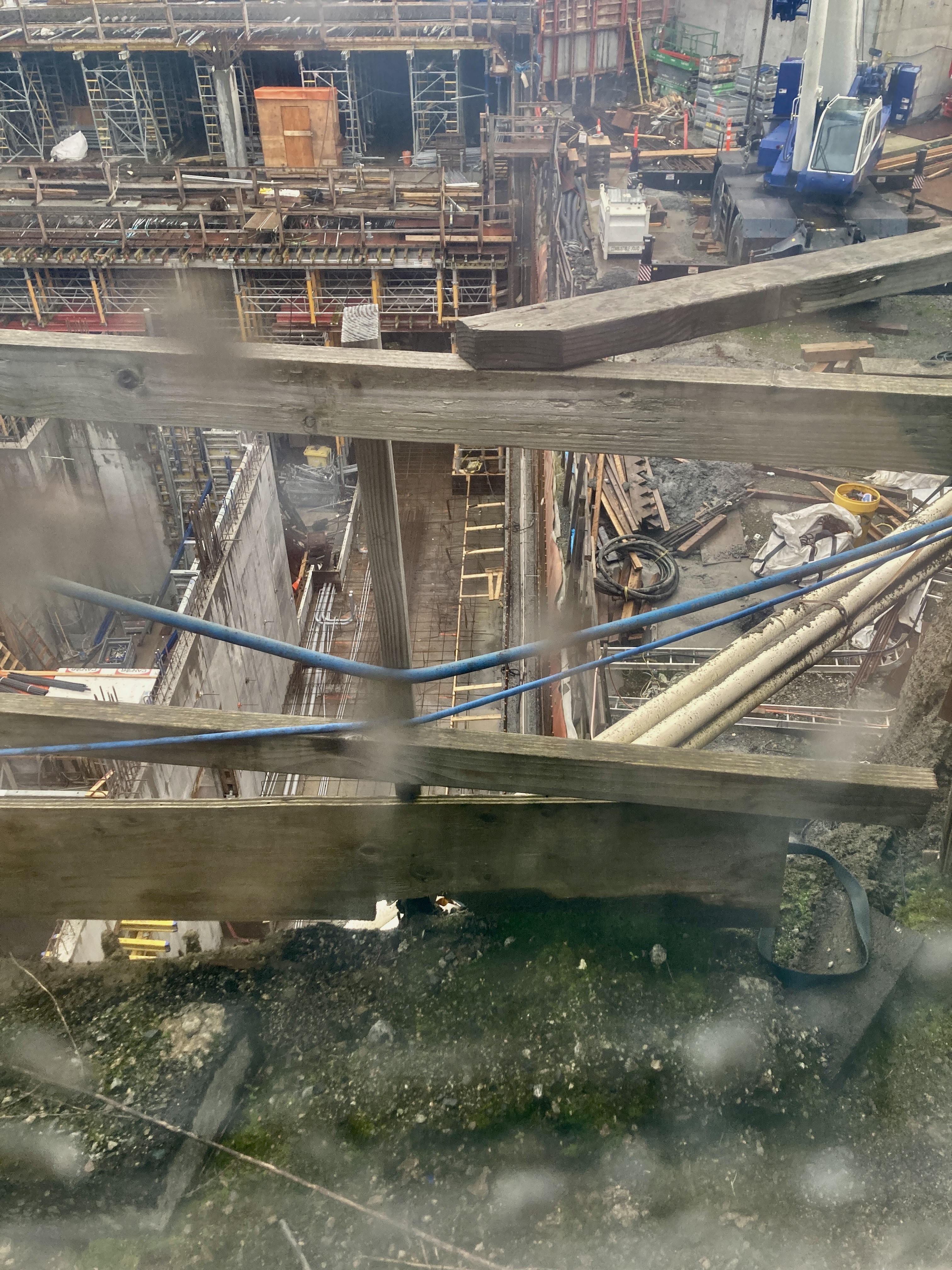
I read signage, I peer downward through a viewing slot.
I read more signage.
I learn how to move three elephants, should the need occur…
and, around the corner, I learn why to pat every dog I see.
Still hoardings, still signage, but now with a whole other focus.
South Flats.
With an “s.” Please notice that. Not “z.”
Until recently, this trending area, to prove how very artistic/creative/trending it was, branded itself Flatz. Not like the grimy, grubby old industrial False Creek Flats spelled with a humble “s.”
Nosiree. With a “z”!
And now the anonymous They have decided that “z” is passé.
This whole area, the whole length of Great Northern, is now branded Flats-with-an-s. (I remember a New Zealand academic, at a Learned Society conference I once covered for the CBC, observing that every reputation goes through three stages: “Bunk, Debunk, Rebunk.” Z has been debunked; S has been rebunked.)
My bimble is showing me that South Flats is A Thing. A Very Big Thing. Forgive me this moment of flackery, but I have to offer you the development’s website, its explanation of this emerging “tech and arts hub.” Rapid transit is just part of what’s going on, in behind those hoardings.
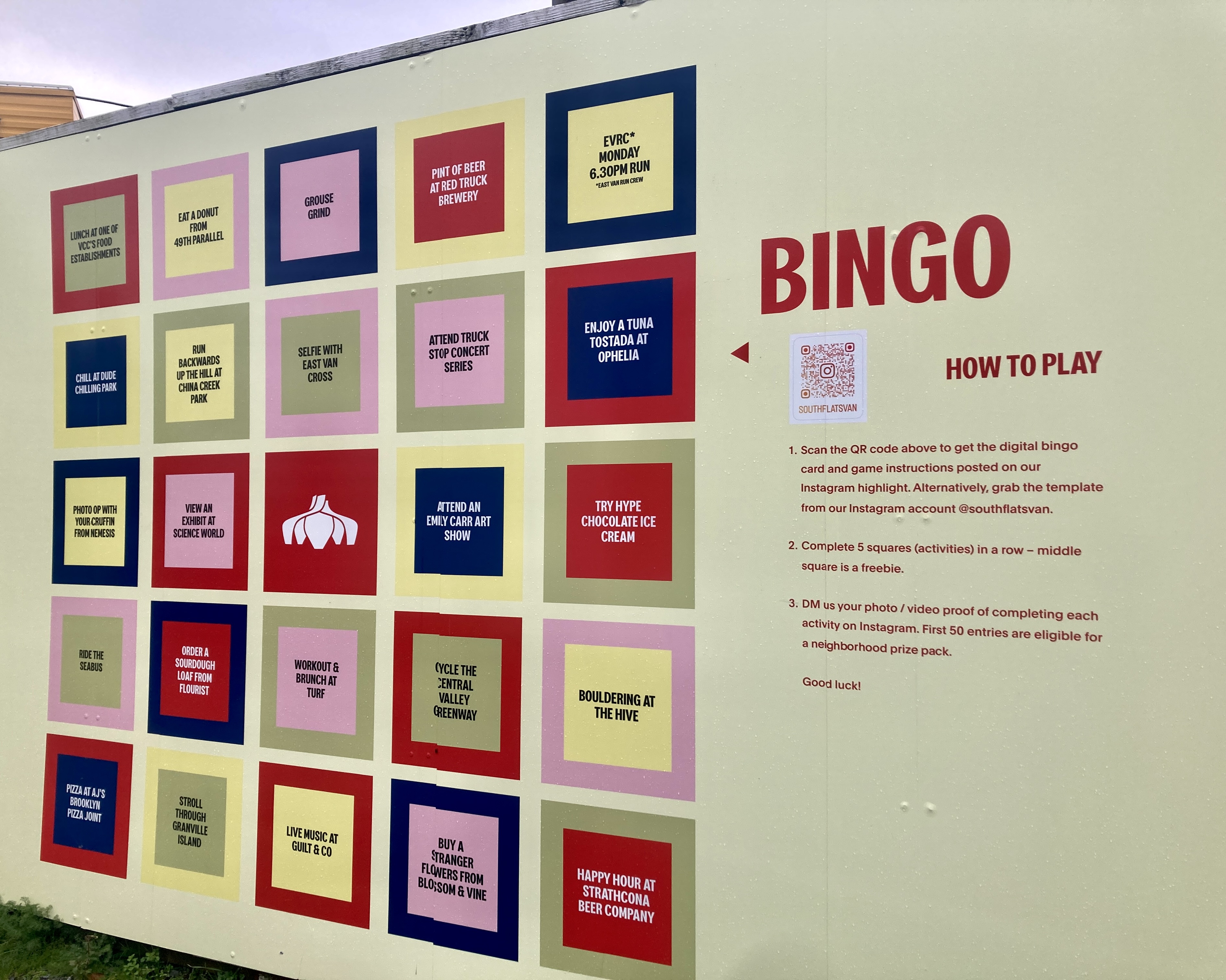
A lot of that is still to come. While waiting, you can play South Flats bingo…
or just visit Nemesis Coffee, whose striking petal shape is also (see above) the central icon in the bingo game.
Far side of Nemesis, the eastern entrance to Emily Carr…
and facing it, the Centre for Digital Media. Except I’ve stopped gawking at all that high-design high-tech.
I am now gawking at winter moss.
The season has begun. I remember, my first winter here, becoming totally enraptured by the vibrant green of winter moss. I am still enraptured.
On east along Great Northern Way, lots of chain link fence, with Things Happening in behind.
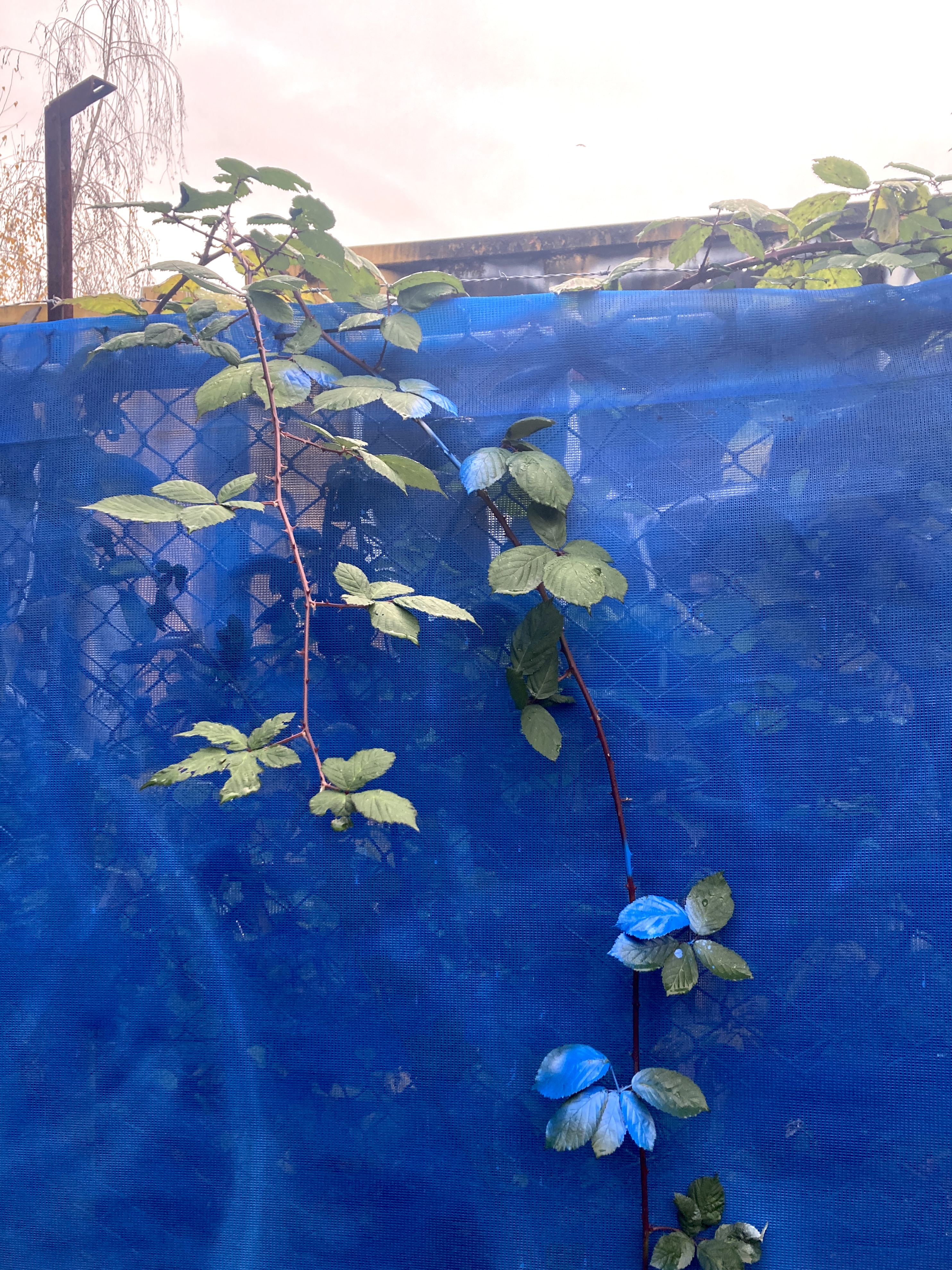
Nature likes chain link fence, vines especially, they climb all over it. Even when the fence is mostly draped in bright blue tarpaulin. Vine still finds a way.
I am fascinated to see that somebody has deliberately, carefully, spray-painted some of those leaves blue, to match.
I am now, almost, at the end of GNW. The thoroughfare itself won’t end, it will just — yet again — change name. (West 4th to West 6th to West 2nd to East 2nd to GNW to East 6th.) Never mind! Here opposite China Creek North Park, it is still Great Northern Way. As I look back, I can read the purpose behind its broad, straight lines, and see again the railway track it was designed to carry.
And then, just like that, I find I have left Great Northern Way. I have passed Glen Drive, I am almost at Clark Drive, and I am now on East 6th Avenue.
I am also passing one of the City’s icons: the East Van Cross.
Currently behind chain link and tarps, because that’s the here-and-now of things, the artwork has its own decade-plus of history, and speaks to a much longer history than that.
Asked by the City to commemorate Vancouver’s role as host of the 2010 Winter Olympics, artist Ken Lum created this sculpture. It is not a symbol of Christian piety. He drew his inspiration from a graffito image of the day, frequently seen in East Vancouver alleys, the intersection of “East” with “Van” in a spare, elegant shape dictated, Scrabble-like, by the interplay of letters. “Over the years, the symbol had been adopted as an emblem for East Vancouver as a whole,” said Lum, “but its appearance has generally been tentative rather than overt.” Lum brought it out of the alleys, made it overt.
As I turn north onto Clark, my bimble ends. I am now walking with purpose. I shall briskly take myself on down to East Hastings, and start the bus trip home.
The Coast Range Mountains are before me. The light is failing, the sky is snowy, and the mountain peaks — look at those Grouse Mountain ski runs — are white with snow.
Snow! It’s perfect. James Elkington’s post about snow taught me to bimble, and my bimble ends with snow.
16 November 2024 – I enjoy walking this ‘hood, this part of Fairview. It’s a quiet stretch of older wooden homes, all very human scale and welcoming, with their front porches and front gardens.
But this street, indeed this whole area, is adjacent to the Broadway traffic artery and lies within the ambit of the comprehensive Broadway Plan — which, for all its consultations and talk of public space, is focused on intensification.
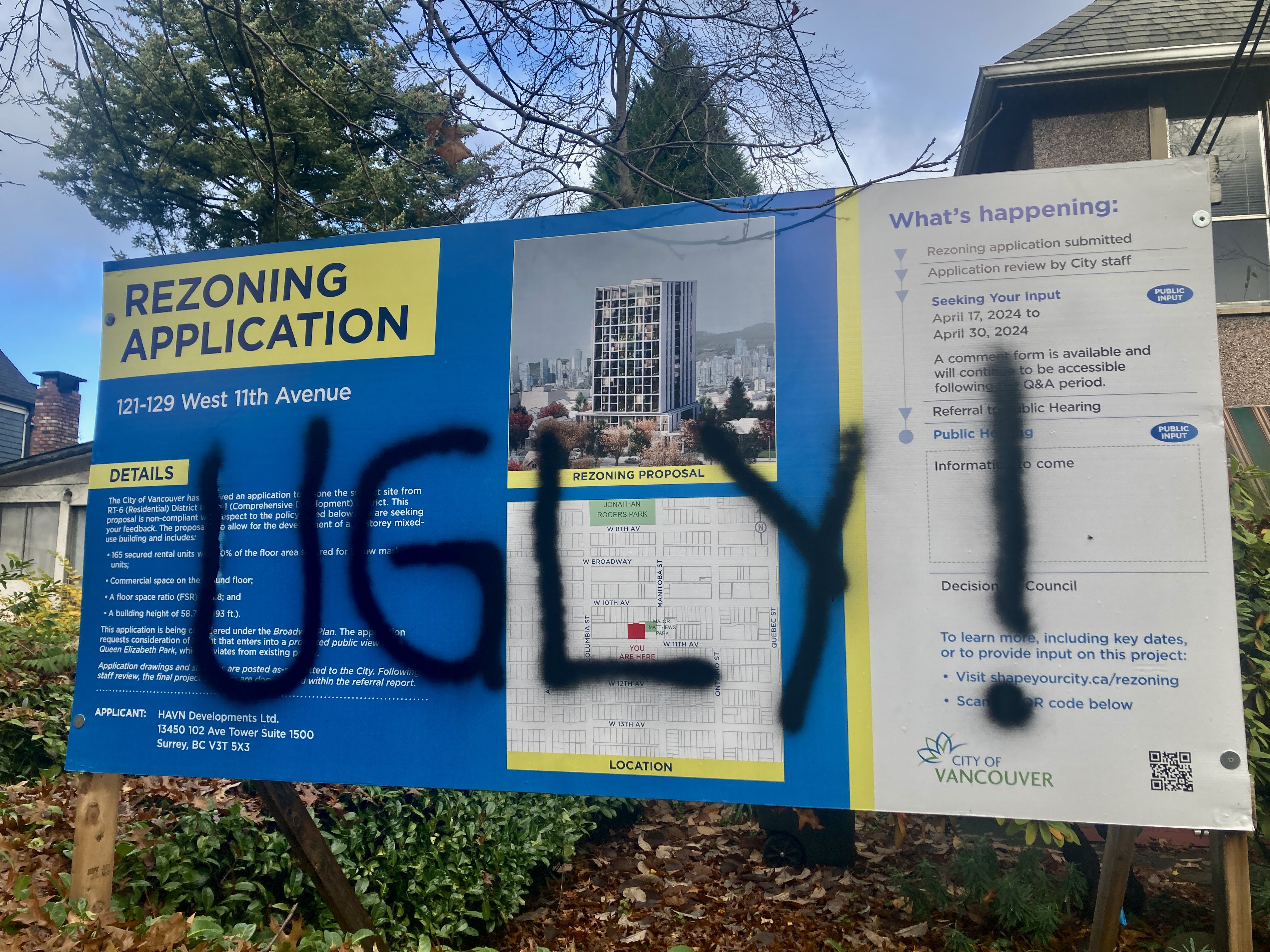
Land Assembly billboards have become commonplace.
The future is on its way.
I’m with Graffito Guy. It’s gonna be ugly.
On a happier note!
The Very Large Waterfowl I showed you in the previous post has been identified.
In her comment on the post, Lynette d’Arty-Cross was cautious enough only to say she was “reasonably certain,” but that’s good enough for me. We’re looking at a juvenile trumpeter swan.
Thank you, Lynette.
Do the rest of you know her blog (In the Net! – Pictures and Stories of Life)? If not, click here. You’ll be glad you did.
26 July 2024 – It’s a bright, breezy day and my target direction is Strathcona. I’ve just skimmed a newsletter reference to a week-long Eastside Arts Festival in Strathcona Park, and that’s motivation enough. Whatever the festival does or doesn’t deliver, this old residential neighbourhood is always worth another visit.
I set myself the mild challenge of getting there without walking north on Main Street. Main is a diverting parade of small shops farther south, but from here north it becomes a noisy downtown artery. My plan calls for a clever N/E zigzag — but that’s the beauty of feet! They sure can zigzag.
So down Scotia I go, with the now-sewered creek beneath my feet that once fed the now-infilled last stretch of False Creek. Left turn onto East 1st Avenue, with its contribution to new-build grit, part of the neighbourhood transformation…
and a right-turn onto Industrial Avenue.
Confession: this requires a quick ricochet off Main Street, where 1st and Industrial almost meet, but surely I can be forgiven that hairpin turn?
More grit, as I head north among the terminals and warehouses of False Creek Flats. There’s new-build activity here at well, with high-tech moving in, but that’s mostly farther east. This part, close to Main Street, is still yer actual old-fashioned rust & rolling wheels kind of grit.
But I like it, just as it is, and today it delivers me nicely from any more connection with Main Street. All I have to do is backtrack east to Station Street, then north to Terminal and across Terminal to the building that explains why Station and Terminal streets bear these names:
Pacific Central train station.
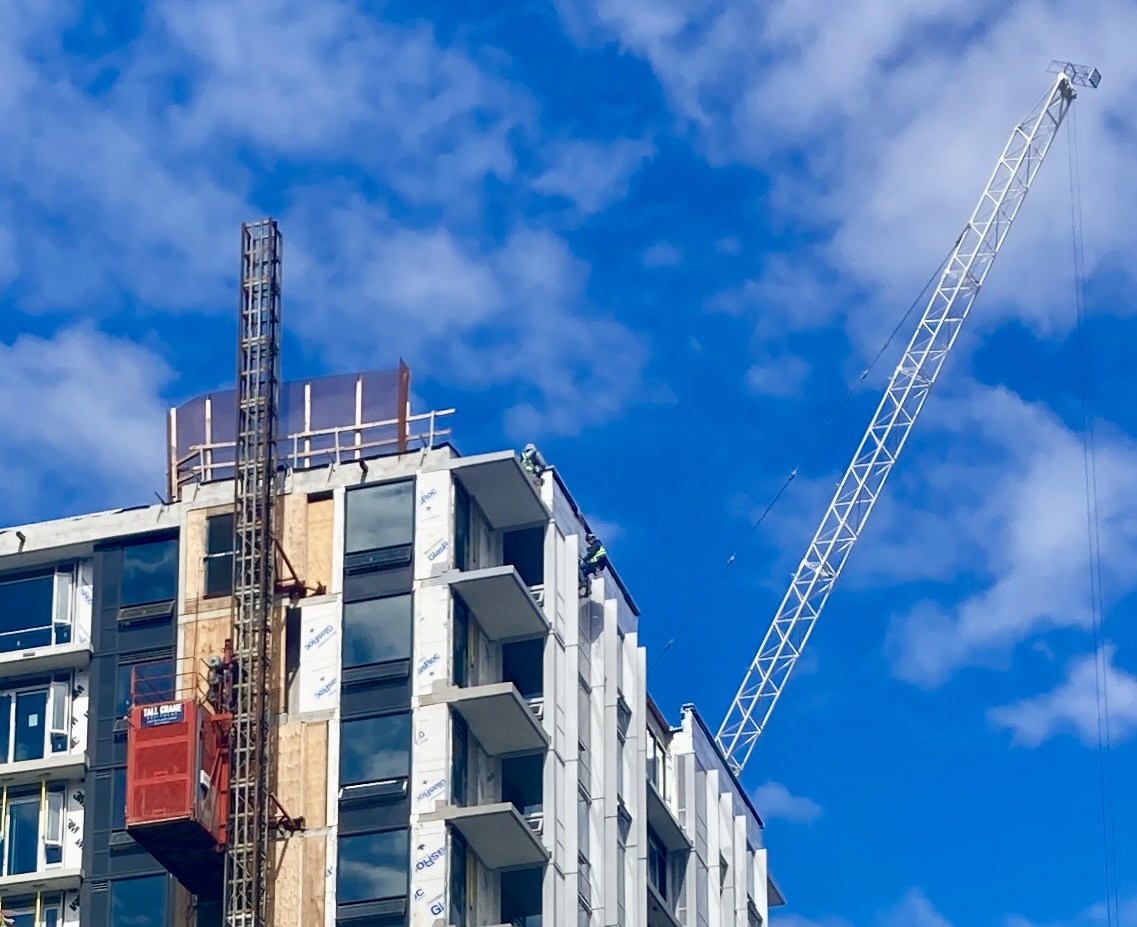
It’s more than 100 years old and still in use, with today’s power-washing just part of the regular TLC. This highly functional Old Build will soon be joined by that New Build lurking in the background — the new St. Paul’s Hospital complex, now under construction and due to open in 2027.
My avoid-Main-Street route takes me east on National Avenue, currently reduced to a narrow footpath bordering the hospital construction site. I gawk as I walk.
The area swarms with workers…
a reminder that, for all the machinery and high-tech of our age, every work site still depends on human effort and skill.
I have escaped Main Street!
I am now safely east, just in behind the construction site, where I can cut north through Trillium Park and enjoy my first fix of major greenery. There indeed is St. Paul’s, rising in the background, but here in the foreground…
we have green fields. Green fields both sides of this pathway, with kiddies on each side, busy learning the fundamentals of soccer.
This is all fine, but I keep walking because just to the north lies Prior Street, and that will take me into Strathcona neighbourhood. And then Strathcona Park! And then the arts festival!
A vintage wooden Strathcona house sits right smack on the corner at Prior and Jackson. It is much the worse for wear.
That’s also part of the story of this area — home to Coast Salish First Nations for millennia, and then, with the 1865 opening of the Hasting Lumber Mill, increasingly home to waves of working-class immigrants. The whole area prospered, declined, and is now in that tenuous urban mix of restoration, renewal, rebirth and inevitably destruction as well.
I walk east on Prior. Strathcona Park will be just ahead of me, but before I can quite fix on its location, I am diverted by the sight of an elderly couple with an exuberant grandchild emerging from a path in the woods to my right. I exchange grave nods with the couple, finger-wiggles with the child, and step onto the path they have just left.
Well. Look at this.
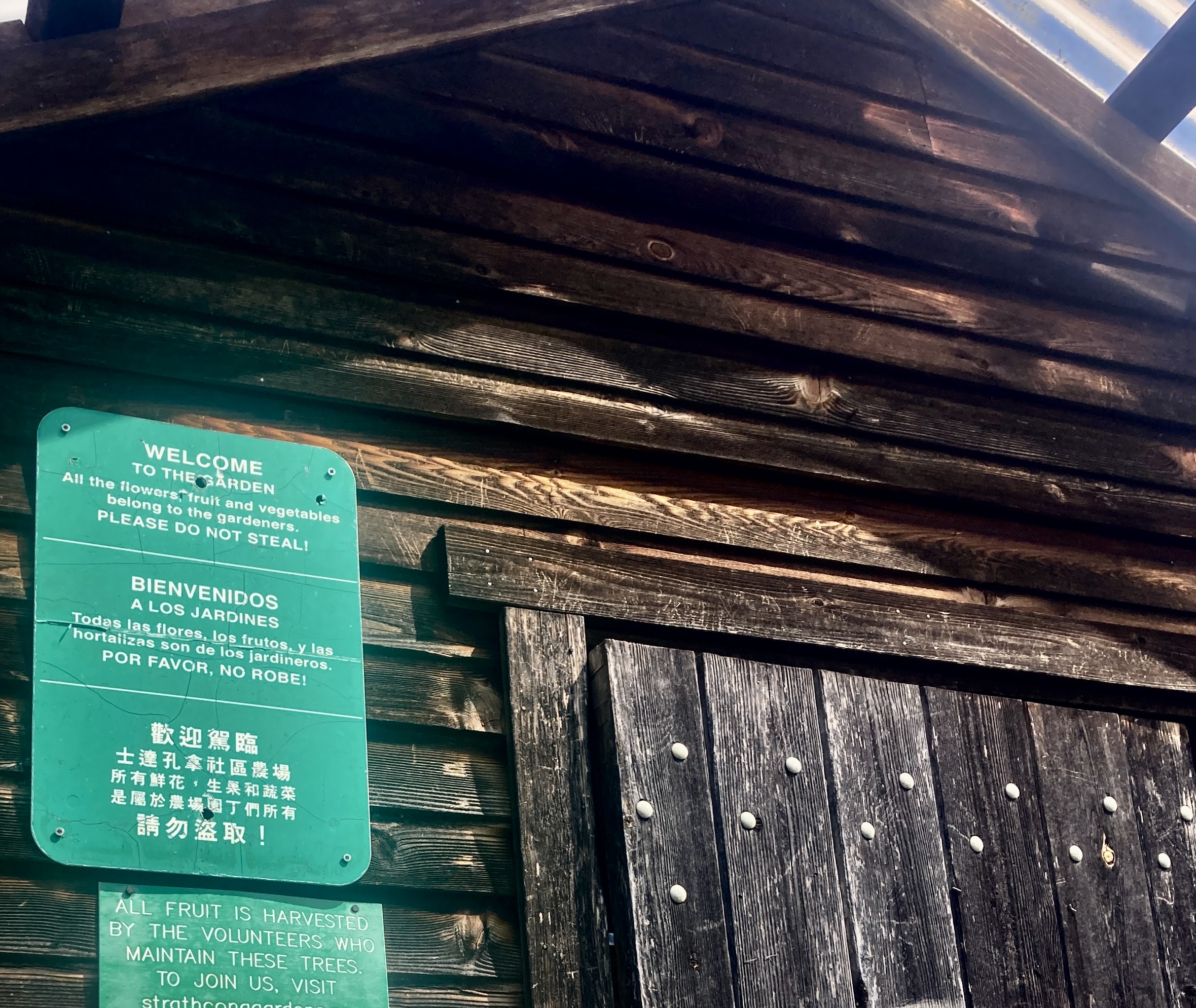
It’s just one tiny corner of a community garden, bursting with mid-summer proof of its gardeners’ devotion. I weave between beds, find the Garden’s tool shed and step close to read its signage. I’m admiring the trilingualism of it all…
when the door opens and I get to meet one of those gardeners. She has been a Strathcona Community Garden volunteer for ages, she says, and she’s not going to let a little thing like knee replacement surgery (points to the scar) keep her away.
Do I know about the Cottonwood Community Garden? she asks. No, I do not. Most people don’t, she says, because it’s so tucked away, but it’s amazing and you should go look at it. Where is it? I ask.
She leads me back to the edge of the Strathcona Garden and points the way: turn right here, then left there, along that line of trees, then keep looking to the right.
So I do.
As I walk, I realize I am now in one corner of Strathcona Park. Damned if I can see any sign of an arts festival. And damned if I care, because finding Cottonwood seems so much more interesting.
Right; then left; then keep looking right, into the trees. Oh yes. Signs of gardening in there.
And a sign very politely telling me to keep out. It explains this particular section is home to sacred medicinal plants, and asks anybody not involved in their care and rituals please to remain outside the fence.
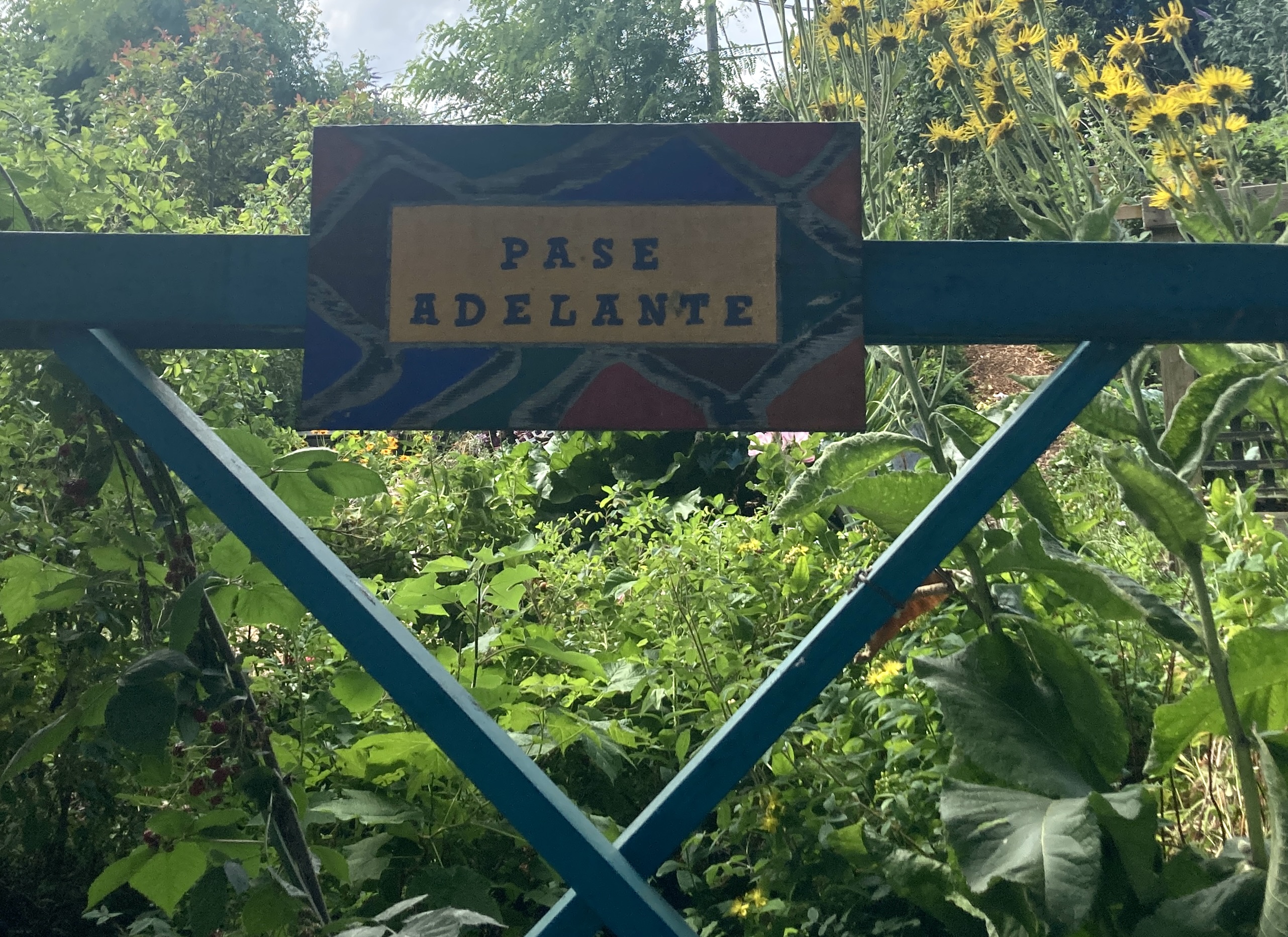
An adjacent sign welcomes me in.
Even though invited to come on in, I feel shy about intruding. I stick to the external foot paths, and peer over fences as I go.
This string of garden plots lies in quite a narrow ribbon of land between Strathcona Park to the north and Malkin Avenue to the south. Looking south, I can see the tops of buildings, one of them marked Discovery Organics and, right here in front of me, the top of a mural marked Produce Row.
Framed by a gaudy arbutus tree on the right and a discreet birch tree on the left, my pathway disappears back into the woods…
and then, soon after, leads me out onto more open ground. Here the garden beds lie right next to the Strathcona Park playing fields.
I meet another gardener — this one a relative newbie, someone who comes from West Vancouver for the pleasure of digging in her very own patch of soil. She offers me a bag of lettuce. I explain I have so much fresh produce right now it would probably spoil. “Me too,” she sighs.
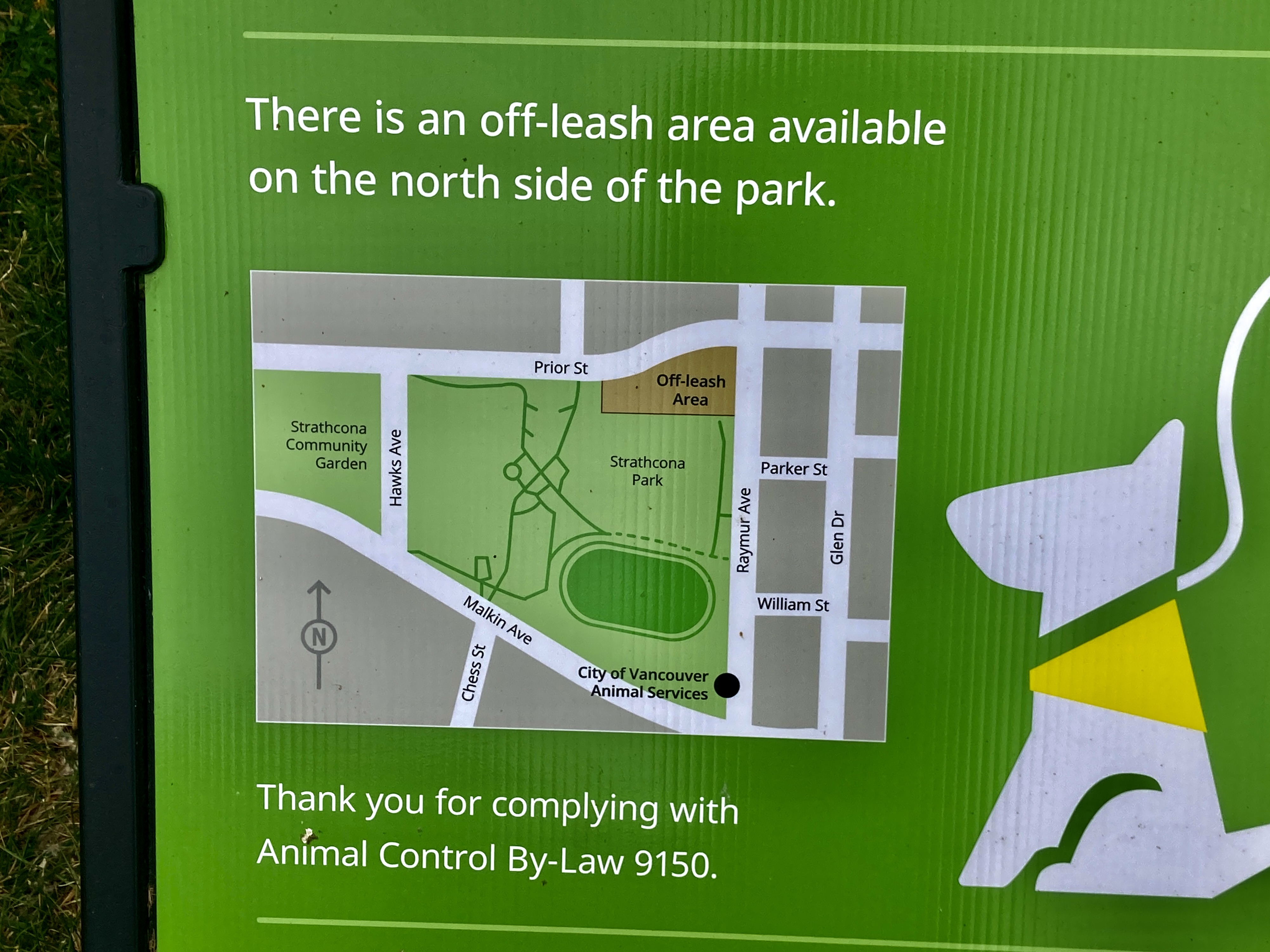
I wave good-bye and then stop at a park map, to get my bearings. Since I am dog-free as well as lettuce-free, the map’s primary purpose is irrelevant, but its coordinates interest me a lot.
Later online research tells me even more, makes these two gardens even more impressive — and suggests thy are under threat.
According to the Strathcona Community Gardens Society, which manages them, both Strathcona and Cottonwood gardens began through local activism: Strathcona on an unofficial dump site in 1985, winning a 25-year lease from the Park Department in 2005; and Cottonwood on an industrial waste site in 1991, still apparently without any legal status. Depending on what happens next to Malkin Avenue — perhaps expansion, to compensate for planned viaduct demolition — both Produce Row (the string of fresh food wholesalers on Malkin) and the adjacent garden might be bulldozed. (I can’t find dated, documented, recent data on this, hence my careful language.)
I don’t yet know all this, as I again walk north.
I am still kinda-sorta wondering about the arts festival, but I am easily distracted — and more distraction is soon on offer.
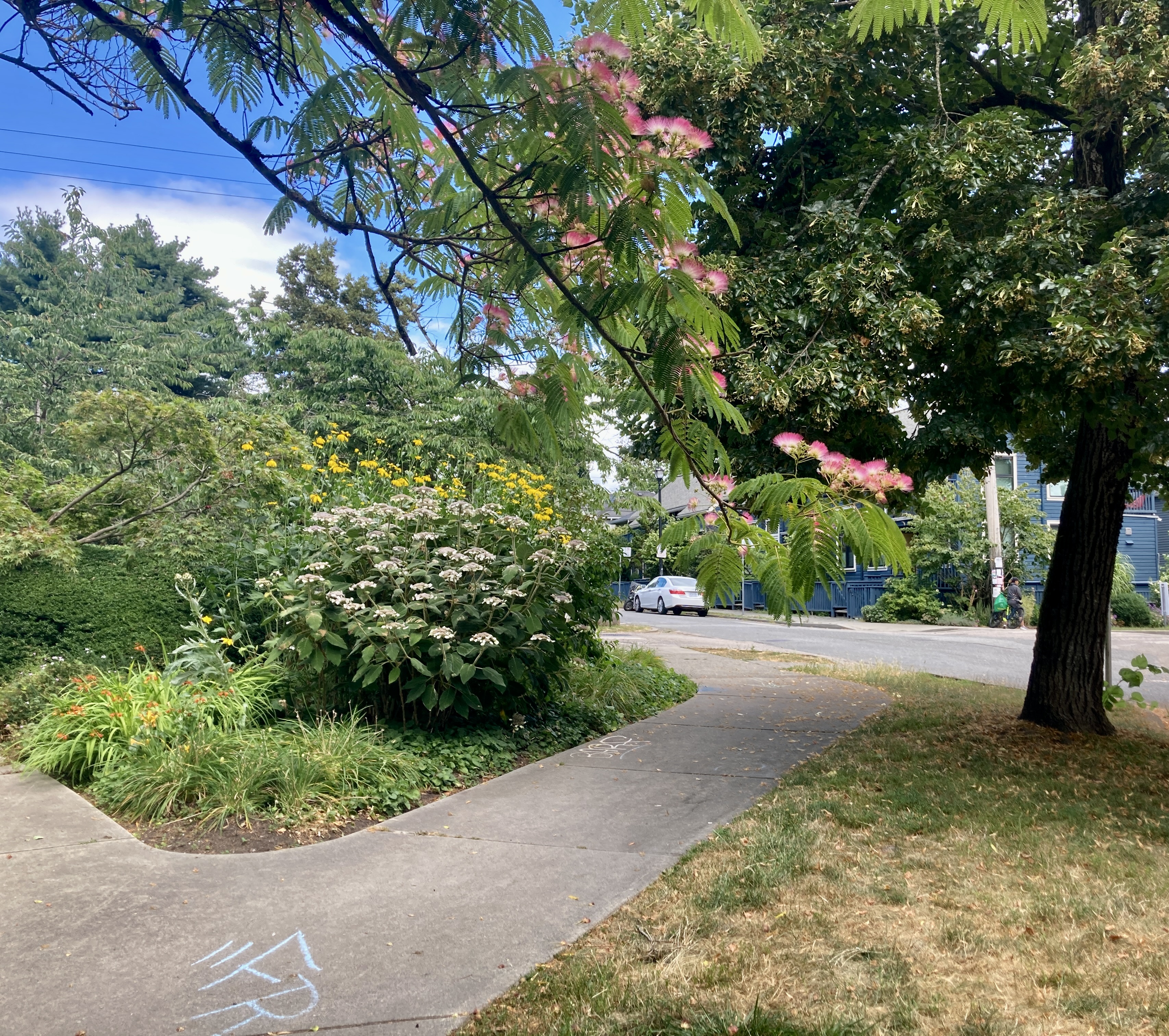
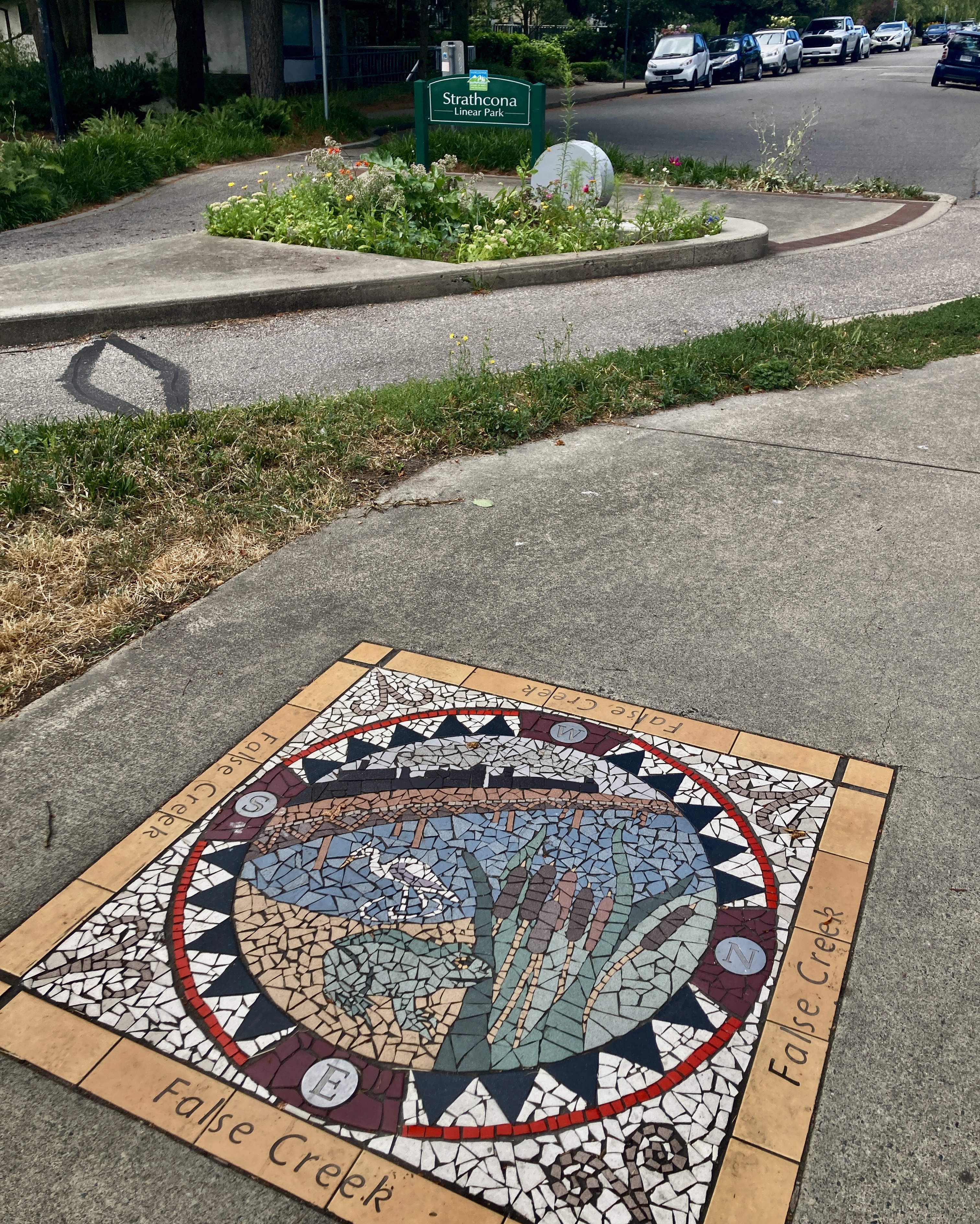
Who could resist Strathcona Linear Park? It leads me alongside Hawks Avenue, and splashes mid-summer foliage all over me, including this magnificent Mimosa grandiflora (thank you Pooker, for the ID).
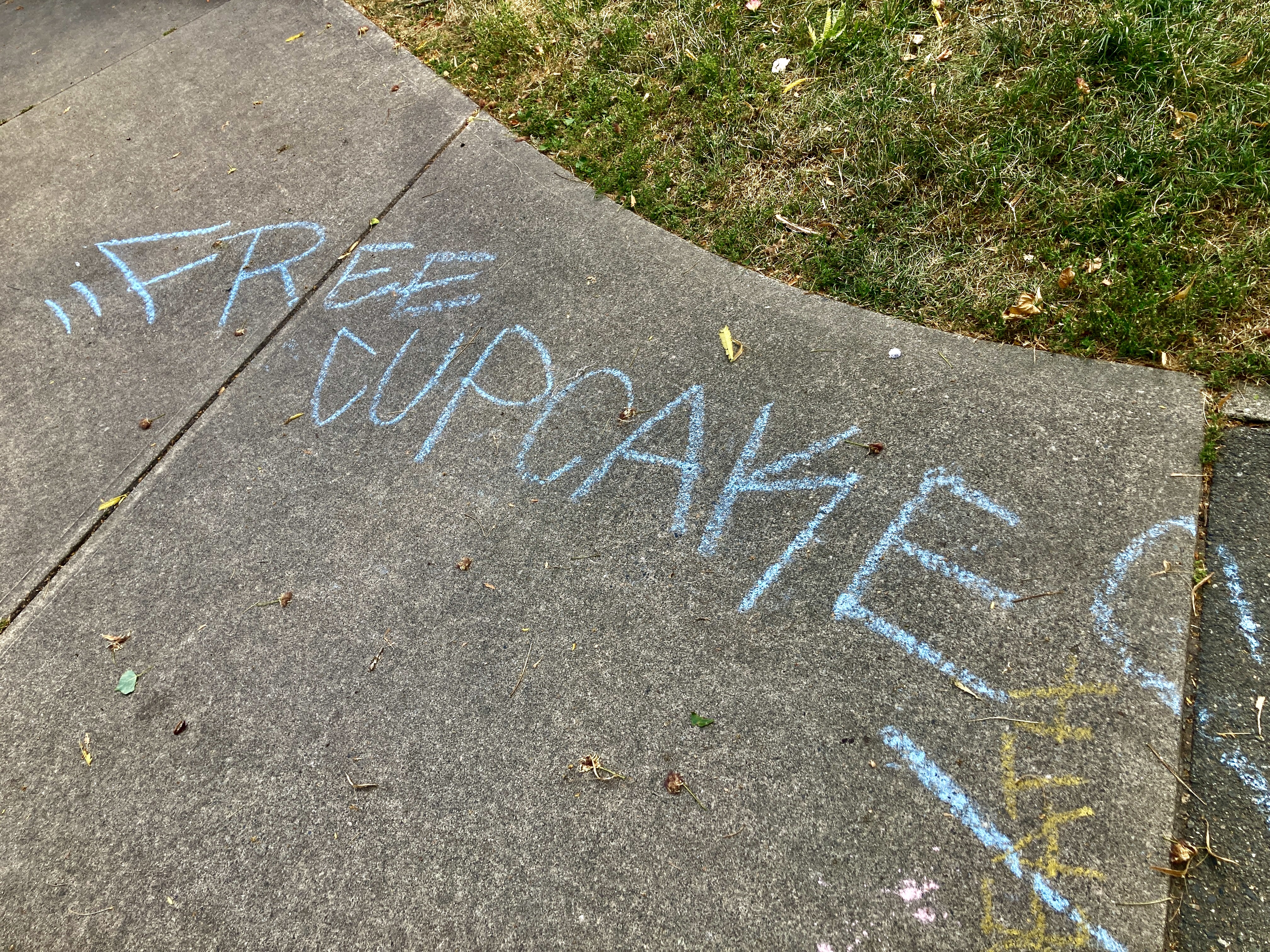
Right under that pink splendour, some turquoise chalk on the sidewalk. “Free…” it begins, and I wonder which political cause is about to claim my attention.
Ahhh! I look around hopefully.
No cupcakes in sight. And still no arts festival, either. By now I totally don’t care.
I stick with the Linear Park, admire the False Creek mosaic as we cross the bike path at Union Street…
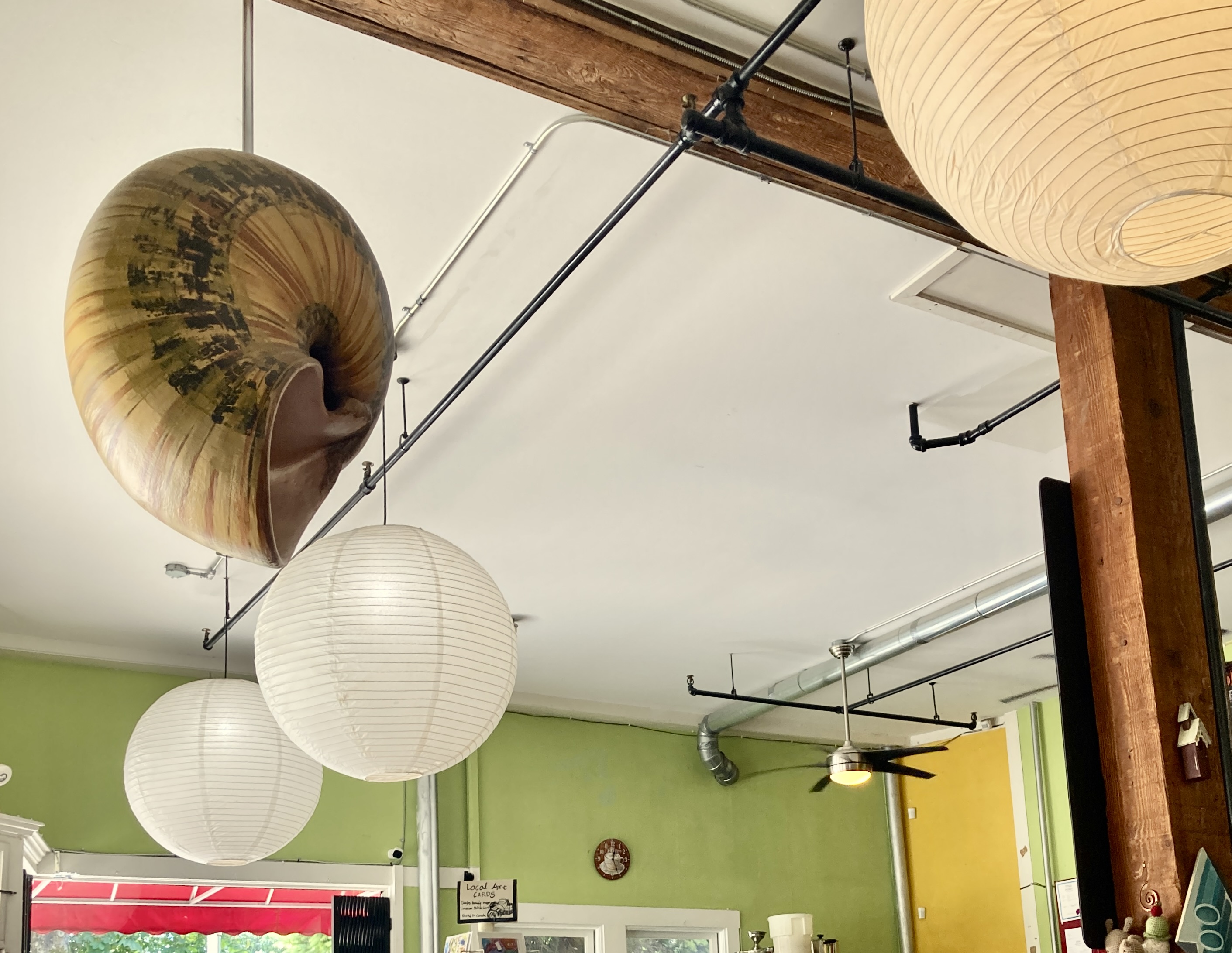
and walk one more block that now borders MacLean Park. It takes me right to where I next want to be: on the N/W corner of Keefer and Hawks, tucked up with some lunch…
in the Wilder Snail café, with its giant snail as a ceiling ornament.
It is finally time to head west, to start looping toward home.
Past the MacLean Park notice board at Keefer & Heatley, promoting everything from World Hepatitis Day (“free testing”) to evenings at the Dream Punk Piano Lounge, and then a quick detour across the street.
To view an entire residential community, right there on a single massive tree stump.
(Well, what would you call it?)
On west along Keefer to Princess, where I pause for another of the City’s sidewalk mosaics.
Nobody could accuse this mural of being happy-face PR! Look at that power shovel, knocking the end home to smithereens.
Happily, as I carry on west, I pass still-standing vintage homes. Including this one near Princess Avenue…
protected by its hedge of giant guardian Gunnera.
Once i cross Gore Street, I have changed worlds. I have passed from Strathcona into Chinatown.
I walk with that world for a while, then hop onto a Main Street bus, and go home.
Where, finally, I read the Eastside Arts Festival promotion more carefully.
And discover that (a) it consists of pop-up events at scattered times in scattered locations and, (b), this particular day, the only event is an evening urban-drawing workshop being hosted in a local brewery.
6 May 2024 – I’m as far W on Davie Street as you can be, sharing a joke with the A-Maze-ing Laughter sculptures in Morton Park. English Bay can be glimpsed between the statues, and the glory of Stanley Park lies beyond.
I turn my back on all that.
I am heading E, not farther W — east the full length of Davie Street, right from “You are here” in this handy signpost map…
to False Creek, where the street is once again stopped by water.
Just as those waters transform as they go — from the breadth of Strait of Georgia, into English Bay and then into False Creek — so too does Davie Street reflect city transformations.
This 4-km-or-so route is a crosstown slice of Vancouver’s past & evolving future. It leads us from still-vintage West End, through Davie Village (once simply “Gay” & now a more complex family of inclusions), into Downtown with its Entertainment District, and on to Yaletown, western terminus of the railway and the repurposed former hub of railway equipment construction and repair.
Barely underway, I detour onto Bidwell long enough to admire the volunteer garden at the corner of Pantages Lane, with a vintage building opposite.
Well…
I later learn that the vintage building is just a vintage façade. It is, a realtor’s website informs me, “a beautifully restored heritage entrance” to a spiffy new residential tower, “that returns the street frontage to its original character.”
Back out to Davie, where I head eastward on up the street. I do mean “up” — both climbing away from the English Bay basin, and also tilting my head at the towers that increasingly line the street.
A past-&-future moment, here at Davie & Cardero: the district’s future already visible there on the left, and a big blue “rezoning application” notice on the fence of the modest old apartment building on the right.
I see a lot more of these notices as I go, including ones on an apartment building also marked with a “sale by court order” sign.
But there is still lots to enjoy, lots of human activity and human-scale engagement.
Also canine.
He has appropriated this bench outside a barber shop / tattoo parlour, and his confidence is likely well-placed. A bearded man has just walked through that still-open door, his leashed French bulldog by his side. Inside, they are greeted by the statue of a bulldog.
At Broughton, a wonderfully ornate vintage apartment building, its paintwork perhaps a bit scruffy but no sign of any redevelopment activity.
The shops & services around here are not glossy and latest-thing. I like them very much.
Just before Bute, I see this slivered opening between buildings, complete with mural…
and I follow it to the laneway beyond.
Where I turn left, and then left again back to Davie Street, through the Event Zone of Jim Deva Plaza.
The plaza honours the man’s lifelong courage and advocacy. Deva, one of the co-founders of Little Sisters Book and Art Emporium, challenged Canada’s censorship laws in the Supreme Court, and also — with greater success — worked with Civic authorities to promote safety and quality in Vancouver’s parks and public spaces.
I don’t know all this about him at the time. While in the plaza itself, I notice more trivial things. Such as…
Corner of Davie & Bute, and we’re well into Davie Village by now. Here, for example, with a mural tribute to jazz greats behind the intersection rainbows.
I cross, check the mural, and decide I’m personally more taken with the four-legged acrobat and the skate-boarding raccoons on the utility box.
But to each their own!
I pass a nude unimpressed by Happy Hour offerings…
and a greengrocer laying out yet more spring plants on his sidewalk shelving…
and then stop at the hot-pink bus shelter at Davie & Burrard.
The colour echoes the Village, as does the long-established Davie Village Community Garden visible through the mesh.
By now I’m used to rezoning/redevelopment notices, but I am sad to see them posted on this mesh fence as well. I’d love this Garden to continue, but…
what I see right across the street may be its future as well.
At Granville Street, I’m into the city’s Entertainment District (per its tourism maps), where I once again nod happy recognition at the neon signage for Two Parrots Bar & Grill.
Scotiabank Dance Centre is a restoration/new-build complex on the far corner, and other towers abound. So far, the Two Parrots still perch on their accustomed corner, no redevelopment notice anywhere in sight.
The lane immediately behind the building pays tribute to their longevity.
Well, sort of! (Upper left.)
More visual tribute at Seymour Street, where Jill Anholt’s 2005 sculpture, Moving Pictures, honours Vancity Theatre (home of VIFF), which stretches on down the block.
Downhill toward False Creek.
I cross Seymour, pause to again enjoy the long slice of water tumbling through Emery Barnes Park…
and here I am at Hamilton Street, in Yaletown. Once home to railway equipment construction and repair workshops, the district is now repurposed into food, drink, entertainment, & residential delights.
I sidetrack myself along Hamilton for a bit, enjoy reminders of a mid-pandemic “I ❤️ Yaletown” mural festival…
then return to Davie and cross Pacific Blvd.
Roundhouse Community Centre is right here, an architectural link to the past — and nowhere more powerfully than in its CPR Engine 374 Pavilion.
Where, after long service, that steam-era pioneer is on display.
Engine 371 beat her from eastern Canada to Port Moody but, on May 23, 1887, Engine 374 pulled the first transcontinental train into the City of Vancouver. She continued to do just that, until 1945. Restored and gleaming, she now rests and accepts our homage. (Squealing kiddies all around me, especially the ones taking turns in the driver’s seat.) A volunteer urges me to return for the May 19 Anniversary Celebration, when she’ll make her yearly trip outside and be the centre of attention on the Roundhouse Turntable.
Now for the last few steps on Davie, on to the bit of track and sculpture in the traffic circle, with Yaletown Dock to mark water’s edge and my arrival at False Creek
I loop along the waterfront for a bit, then turn left into and through Steamboat Mews…
back to Pacific Blvd., where I hop a bus for home.
8 March 2024 – As I walk back east along False Creek, I do not have a single Life Philosophy thought in my mind. Not a single abstract noun. I am just picking my feet up and putting them down again, enjoying the sunshine.
Then I see this neon glow in the water, just off a curve of seawall between Stamp’s Landing Dock and Spyglass Place Dock farther east.
Still no Important Thoughts in mind, just curiosity.
It’s not until I’m up close, and can identify the shape as a boat, that I think about vulnerability. There that little boat used to be, afloat and riding the currents — and there it now is, submerged and inert.
Vulnerability, consequences, responses. The dynamic is now lodged in my mind, and I see it all over the place as I walk on home.
In environmental and political vulnerabilities, for example, here at Spyglass Place Dock, where blue bands circle Cambie Bridge pilings and a quiet black tribute pillar stands at water’s edge.
The top blue tier in this 2012 art installation, A False Creek, is 5 metres above current sea levels — which is mid-way between the 4 to 6 metre rise that, it is predicted, could be triggered by climate change. The pillar honours Husain Rahim (1865-1937). He was an activist at the time of the 1914 SS Komagata Maru incident that barred a boatload of South Asian passengers from disembarking, and one of the first South Asians to challenge the disenfranchisement then taking place. While the ferry dock is still Spyglass Place, I learn that this space is now called Husain Rahim Plaza.
I’m about to walk on — and discover that I can’t.
Due to “the deteriorating condition of the structure supporting the seawall,” the path has been closed between the Cambie Bridge, right here, and Hinge Park to the east. Detour along West 1st, we are told, while authorities address this weakness.
Heading for 1st Avenue, I walk under the bridge, where I stop long enough to read this extraordinary beer-themed love letter chalked onto one of the pillars.
The message is fresh and wonderful, but street art by definition is ephemeral. Vulnerable. Just look above the top line for proof — the “Simply Jay” message has been effaced.
Eastward on West 1st Avenue now, and more vulnerability call-and-response.
The building in the foreground is one of the City’s Temporary Modular Housing facilities, created in response to what the City itself calls a crisis situation: “over 2,000 people are experiencing homelessness.” The rusty building farther along is an old, disused workshop from the area’s industrial past. It will surely fall down, or be knocked down, sometime soon.
Lying between those two buildings, and in behind the housing as well: an urban farm.
Sole Food Street Farms, founded in 2009, is now one of North America’s largest urban farms. This location trains & employs people from the Vancouver Downtown East Side, who grow the produce that is then sold & given away.
At Hinge Park, I can drop back to the waterfront. The railway tracks and buffers here at the south edge honour the past; the park itself is part of the pre-2010 Winter Olympics response to what had become a derelict and polluted wasteland.
Even my classy latte in an Olympic Village Square café reminds me of vulnerability! I have left it to sit just a little too long, and, look, the frothy design is beginning to deflate. (The taste, I promise you, is unaffected.)
Back outside, I admire TheBirds (Myfanwy MacLeod, 2010), gleaming in the sunshine.
The gleam is thanks to their fairly recent repatination; the repatination was the response to the vulnerability of their surface to all those climbing feet. Signage now politely reminds people that these sculptures are art, not a climbing wall, and asks us to keep our feet on the ground.
Heading south on Ontario Street, I detour half a block west into an alley, for a closer look at a face.
This face.
L’il Top is the signature, and if this bit of street art is vulnerable to time and the elements, so are those H-frame hydro poles. I, and countless Vancouver artists, love the look of them, but they are seriously outmoded, and systematically being replaced.
Back onto Ontario, farther south to West 6th, and my vulnerability theme now presents itself in a real-estate trio. The first thing I notice is that wavy reflection in the windows of the blocky new-build on the corner.
Then I play with the story, the trio of stories, the development dynamic of this bit of Mount Pleasant neighbourhood. Behind the new-build, a century-plus brick veteran, its status secure; in these windows, the reflection of the scruffy building across the street, wrapped in chain-link fencing, its status unclear.
Once the Teachers Centre for the Vancouver School Board (1972-1990s), it sits within the footprint of the T3 Mount Pleasant site now under construction — “T3” as in timber/transit/technology, with a planned 190,000 square feet of mass timber construction to attract environmentally responsible companies and workers. If the developer’s web page is any guide, at least part of this old building will be restored and repurposed as a heritage element in the mix.
Response to environmental threat is the theme of this part of Mount Pleasant. Along with the T3 building, it is also home to the emerging Main Alley Campus, which promises to provide “Canada’s first completely net-zero work environment for the creative economy.”
These two projects won’t save the planet, but it is heartening to see major development corporations put their weight behind new, more environmentally responsible, approaches.
I swing onto East 7th, and salute a building that has long known how to respond to changing threats — and here it still is, 112 years later.
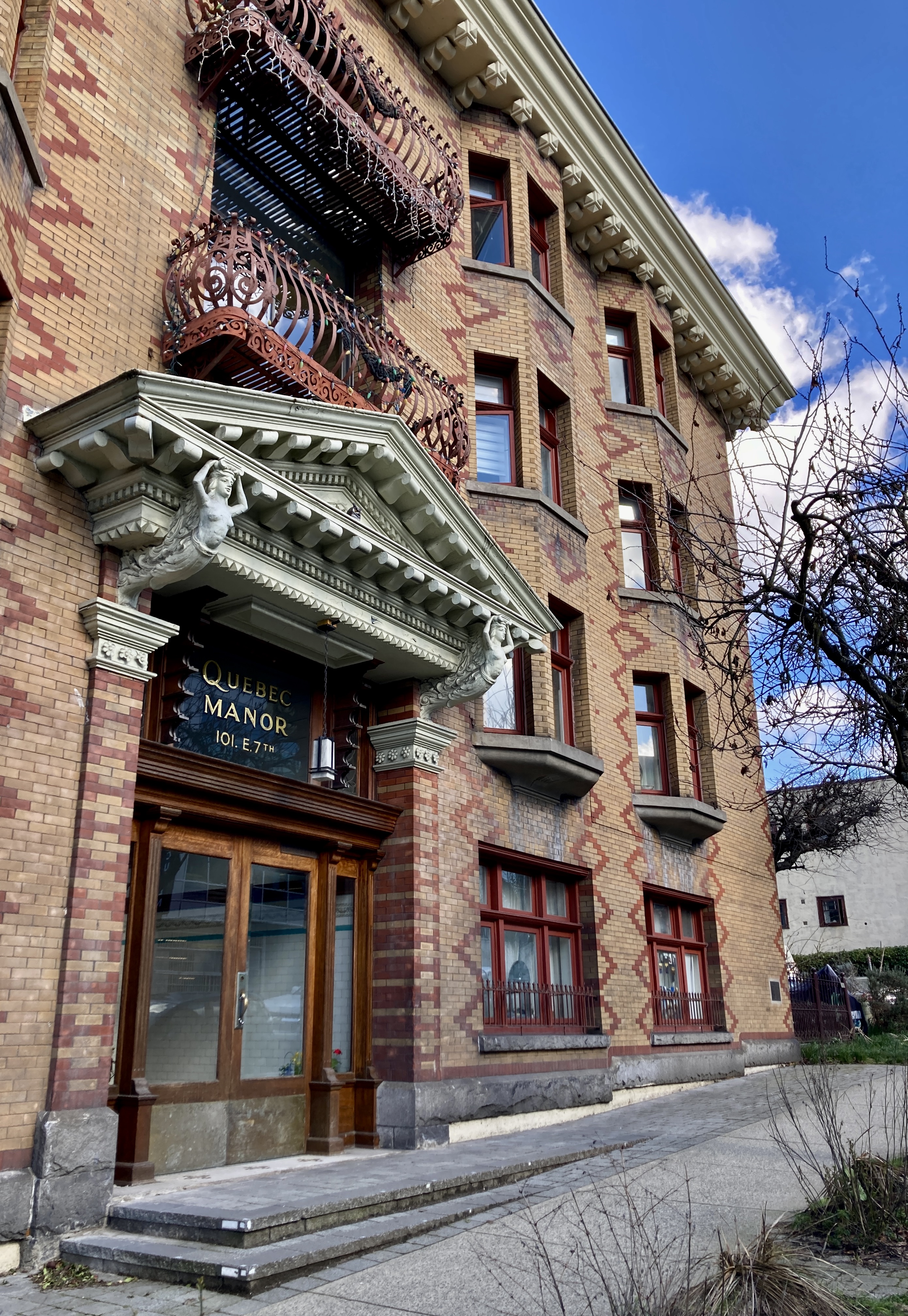
Behold Quebec Manor, in all its diamond-patterned, bi-coloured brick glory. (Complete with metal balconies and nude maidens to welcome you home…) Built in 1912 as a luxury apartment hotel, probably for train passengers at the near-by terminals, it became rental units in the 1920s, and in the 1980s achieved new, secure status when its tenants bought the building and turned it into a housing co-op.
So that’s my walk, and how discouraging it could have been, with such a theme. But it wasn’t. So many vulnerabilities, yes — and so many responses, as well.
"Traveller, there is no path. Paths are made by walking" -- Antonio Machado (1875-1939)
"The voyage of discovery is not in seeking new landscapes, but in having new eyes" -- Marcel Proust (1871-1922)
"A city is a language, a repository of possibilities, and walking is the act of speaking that language, of selecting from those possibilities" -- Rebecca Solnit, "Wanderlust: A History of Walking"




















































 WALKING WOMAN