8 March 2024 – As I walk back east along False Creek, I do not have a single Life Philosophy thought in my mind. Not a single abstract noun. I am just picking my feet up and putting them down again, enjoying the sunshine.
Then I see this neon glow in the water, just off a curve of seawall between Stamp’s Landing Dock and Spyglass Place Dock farther east.

Still no Important Thoughts in mind, just curiosity.
It’s not until I’m up close, and can identify the shape as a boat, that I think about vulnerability. There that little boat used to be, afloat and riding the currents — and there it now is, submerged and inert.
Vulnerability, consequences, responses. The dynamic is now lodged in my mind, and I see it all over the place as I walk on home.
In environmental and political vulnerabilities, for example, here at Spyglass Place Dock, where blue bands circle Cambie Bridge pilings and a quiet black tribute pillar stands at water’s edge.

The top blue tier in this 2012 art installation, A False Creek, is 5 metres above current sea levels — which is mid-way between the 4 to 6 metre rise that, it is predicted, could be triggered by climate change. The pillar honours Husain Rahim (1865-1937). He was an activist at the time of the 1914 SS Komagata Maru incident that barred a boatload of South Asian passengers from disembarking, and one of the first South Asians to challenge the disenfranchisement then taking place. While the ferry dock is still Spyglass Place, I learn that this space is now called Husain Rahim Plaza.
I’m about to walk on — and discover that I can’t.

Due to “the deteriorating condition of the structure supporting the seawall,” the path has been closed between the Cambie Bridge, right here, and Hinge Park to the east. Detour along West 1st, we are told, while authorities address this weakness.
Heading for 1st Avenue, I walk under the bridge, where I stop long enough to read this extraordinary beer-themed love letter chalked onto one of the pillars.

The message is fresh and wonderful, but street art by definition is ephemeral. Vulnerable. Just look above the top line for proof — the “Simply Jay” message has been effaced.
Eastward on West 1st Avenue now, and more vulnerability call-and-response.

The building in the foreground is one of the City’s Temporary Modular Housing facilities, created in response to what the City itself calls a crisis situation: “over 2,000 people are experiencing homelessness.” The rusty building farther along is an old, disused workshop from the area’s industrial past. It will surely fall down, or be knocked down, sometime soon.
Lying between those two buildings, and in behind the housing as well: an urban farm.

Sole Food Street Farms, founded in 2009, is now one of North America’s largest urban farms. This location trains & employs people from the Vancouver Downtown East Side, who grow the produce that is then sold & given away.
At Hinge Park, I can drop back to the waterfront. The railway tracks and buffers here at the south edge honour the past; the park itself is part of the pre-2010 Winter Olympics response to what had become a derelict and polluted wasteland.

Even my classy latte in an Olympic Village Square café reminds me of vulnerability! I have left it to sit just a little too long, and, look, the frothy design is beginning to deflate. (The taste, I promise you, is unaffected.)

Back outside, I admire The Birds (Myfanwy MacLeod, 2010), gleaming in the sunshine.

The gleam is thanks to their fairly recent repatination; the repatination was the response to the vulnerability of their surface to all those climbing feet. Signage now politely reminds people that these sculptures are art, not a climbing wall, and asks us to keep our feet on the ground.
Heading south on Ontario Street, I detour half a block west into an alley, for a closer look at a face.
This face.

L’il Top is the signature, and if this bit of street art is vulnerable to time and the elements, so are those H-frame hydro poles. I, and countless Vancouver artists, love the look of them, but they are seriously outmoded, and systematically being replaced.
Back onto Ontario, farther south to West 6th, and my vulnerability theme now presents itself in a real-estate trio. The first thing I notice is that wavy reflection in the windows of the blocky new-build on the corner.

Then I play with the story, the trio of stories, the development dynamic of this bit of Mount Pleasant neighbourhood. Behind the new-build, a century-plus brick veteran, its status secure; in these windows, the reflection of the scruffy building across the street, wrapped in chain-link fencing, its status unclear.

Once the Teachers Centre for the Vancouver School Board (1972-1990s), it sits within the footprint of the T3 Mount Pleasant site now under construction — “T3” as in timber/transit/technology, with a planned 190,000 square feet of mass timber construction to attract environmentally responsible companies and workers. If the developer’s web page is any guide, at least part of this old building will be restored and repurposed as a heritage element in the mix.
Response to environmental threat is the theme of this part of Mount Pleasant. Along with the T3 building, it is also home to the emerging Main Alley Campus, which promises to provide “Canada’s first completely net-zero work environment for the creative economy.”
These two projects won’t save the planet, but it is heartening to see major development corporations put their weight behind new, more environmentally responsible, approaches.
I swing onto East 7th, and salute a building that has long known how to respond to changing threats — and here it still is, 112 years later.
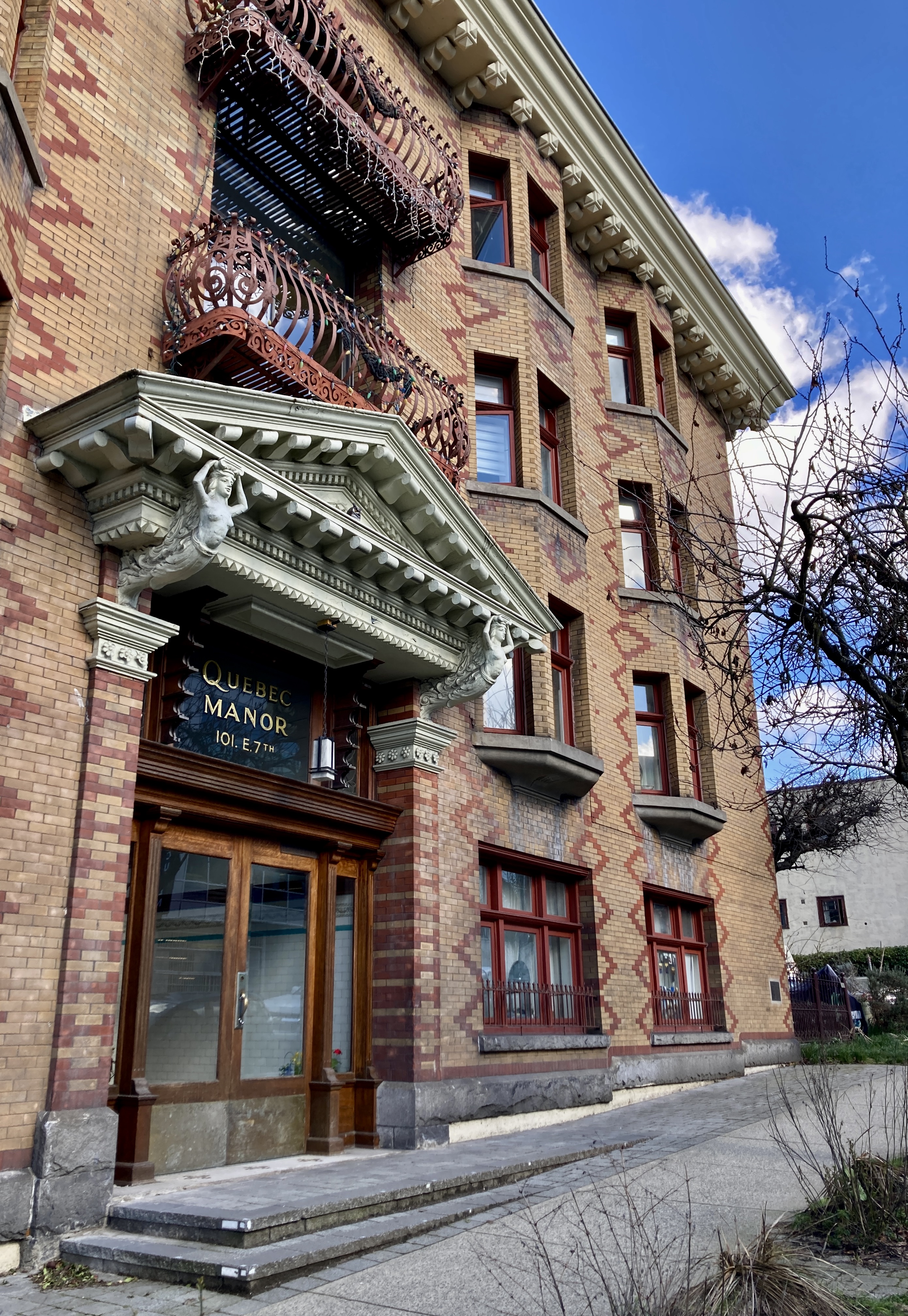
Behold Quebec Manor, in all its diamond-patterned, bi-coloured brick glory. (Complete with metal balconies and nude maidens to welcome you home…) Built in 1912 as a luxury apartment hotel, probably for train passengers at the near-by terminals, it became rental units in the 1920s, and in the 1980s achieved new, secure status when its tenants bought the building and turned it into a housing co-op.
So that’s my walk, and how discouraging it could have been, with such a theme. But it wasn’t. So many vulnerabilities, yes — and so many responses, as well.

 WALKING WOMAN
Angie K Walker
/ 8 March 2024Great tour with an interesting angle.
restlessjo
/ 9 March 2024Nothing is forever? But with the knowledge we have, we can surely alleviate some of the vulnerabilities.
icelandpenny
/ 15 March 2024yes, exactly
Lynette d'Arty-Cross
/ 9 March 2024There are many vulnerabilities, yes, but agreed, many responses, too.
icelandpenny
/ 15 March 2024yes, it’s the responses that give us heart and renew our energy…
Blane Hogue
/ 9 March 2024I have to say Penny, how I am continually amazed at how you see things on your walks that the rest of us probably don’t. I guess it’s the difference between seeing and observing.
bluebrightly
/ 11 March 2024I admire the way you began with no thing but putting one foot in front of the other and then slowly developed a train of thoughts from what you saw. And wow, that latte is incredible! 😉
icelandpenny
/ 15 March 2024thank you! and yes, even with deflated bubbles, that was a very impressive latte design!
Mary C
/ 17 March 2024That was a long walk! Life’s narrative is a fascinating thing, isn’t it?
icelandpenny
/ 18 March 2024yes it is — and I enjoy still being part of your narratives…