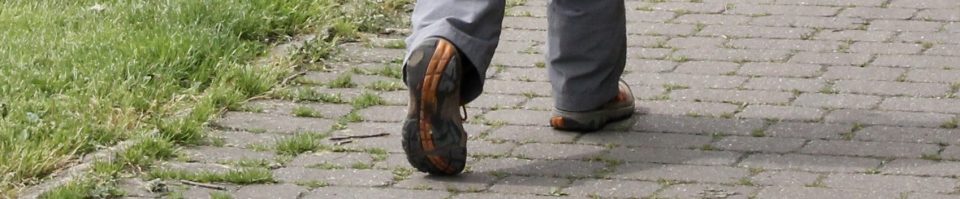
Land Cruise: 5-6 September

5 September – Now I’m doubling back across the same terrain, this time south, Churchill to Winnipeg. It will surprise none of you that even though we’re travelling the same tracks, passing/stopping in the same places, the trip is entirely different. There’s the same train culture around me, but with different people. Perhaps because I’m slightly less obsessed with the landscape this time, I’m more aware of the people — who, because we’re still between tourist seasons, are again individuals rather than job-lot packages on tour. Such a range!

  • the trio who trained as nurses in Winnipeg long ago and as a result have been friends, and attending reunions and sharing other adventures, for more than 65 years
  • the young Parks Canada IT/AI specialist, who works summers based in Churchill and winters back in Winnipeg
  • the Australian couple (she originally from Ireland) who are this side of the world to attend a wedding in the Caribbean but decided, having come this far, to explore Canada while they’re at it
  • the deep-south American who “hates heat” and therefore does advance reconnaissance each year for the following summer’s travels in Canada with his wife (so far, Newfoundland is his hands-down favourite)
  • and… Origami Man. Oh, I’ll save him ’til later.

I think the other reason the reverse trip is different is precisely because it is in reverse. You approach from a different angle, you come at a different time and probably in different weather, and you yourself, even if only slightly, are already a different person. So, you notice differently.

For example, I notice the young man dis-embarking in Thompson, sporting the cap his wife found for him on the internet…

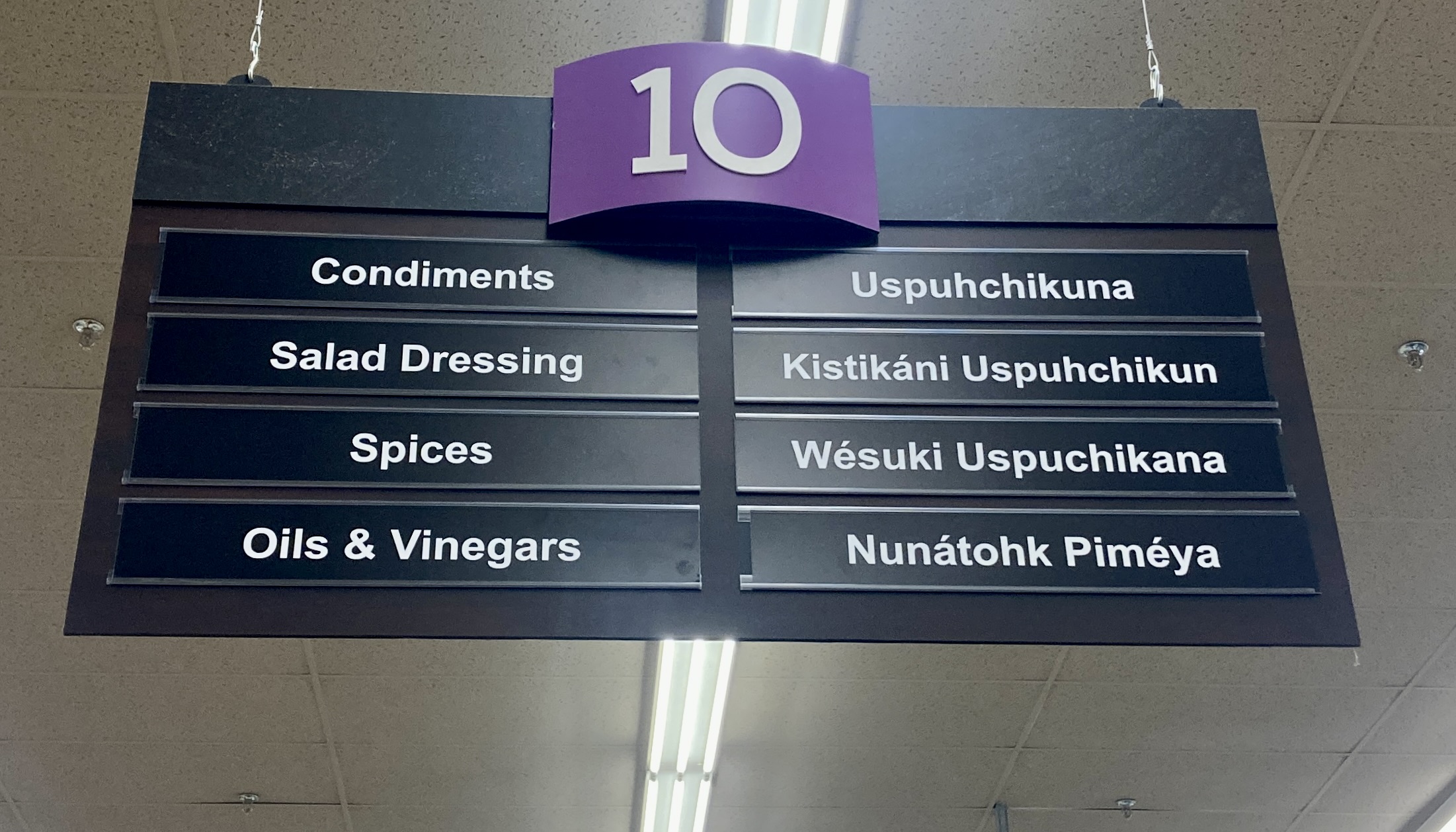
and the bilingual aisle signs in a Thompson grocery store.

Soon after Thompson, ’round about Mystery Lake, I come through the dining car and see Origami Man teaching the basics to two VIA staff with a rare moment free of obligations.

It’s another day before I learn he and his wife (she knits, while he folds) are from Detroit, and have their own deep Canadian memories, including ferry travel some 17 years ago down the north shore of the St. Lawrence River east of Quebec City.
We roll into The Pas at 10:30 pm. This time, I’m awake. I raise my blind a smidge…

take in the sliver of train station, and decide our steward is right. The location means there’s nowhere interesting to walk, especially this time of night. I pull down my blind once again.

6 September – I meet Calgary Alex going into the dining car, also with breakfast on his mind. He tells me he saw a deer, when he looked out his window shortly after dawn. I saw no deer — but now, in the dining car, we both see cranes.

Origami Man strikes again!

Talking with him later, I learn that, maybe predictably, his career was in the spatially precise world of engineering, and that this skill has become his passe-partout worldwide. “I start folding paper wherever I am. People gather. I spent a whole afternoon with kids in Mongolia.”

I’m startled when, at about 7:30 am, our cabin attendant announces we’ll soon roll into Kenora for a 10-minute stop. I smack the side of my head. Kenora? We’re in Ontario? She smiles, sorts me out: “Cee-ay-nora. Canora. Not Kay-ee.”

At the station, the display caboose and its signage complete the story.

No, a comment from fellow passenger Sue completes the story.

She is from the other one, from Kenora, and she explains that its name is also an acronym. In their case, for local communities & history: KE – Keewatin; NO – Norman; RA – Rat Portage. I tell her I want to visit Rat Portage; she says it’s now Kenora. Kenora was called Rat Portage until Maple Leaf Milling Company said they wouldn’t build a mill there if it meant putting the word “rat” on their flour.

Back to Canora-with-a-C. The town has an historic main street…

and a this-minute communications tower.

Approaching Dauphin, early afternoon, I don’t have to gawp at the 1912 train station — I’ve done that already. I’m free to notice brightly-graffiti’d box cars…

and the RR-themed parkette, with its plaque-bearing benches.

The arrival of the first train in 1896, says the plaque, “sparked the binding of over 550 communities across Canada, and forever changed the landscape of immigration, settlement, agriculture and commerce.”

{While all this 2025 train travel is going on, Origami Man is teaching Parks Canada AI Man some serious skills. The young man bends his head to the task. There is much laughter and an accumulation of geometric, and beyond-geometry, shapes.}

And then, pouf!, we’re in Winnipeg.

By 5:30 pm, I’m physically out on the street….

but mentally/emotionally…

I’m still back there with the birch and the black spruce.


Land Cruise: 4 September

Somewhere north of Gillam, the sun not yet visible, but the horizon glowing…

and, an hour and a half later, the first glimpse of Churchill, its massive port structure.

We arrive. We scatter, each to our own priorities.

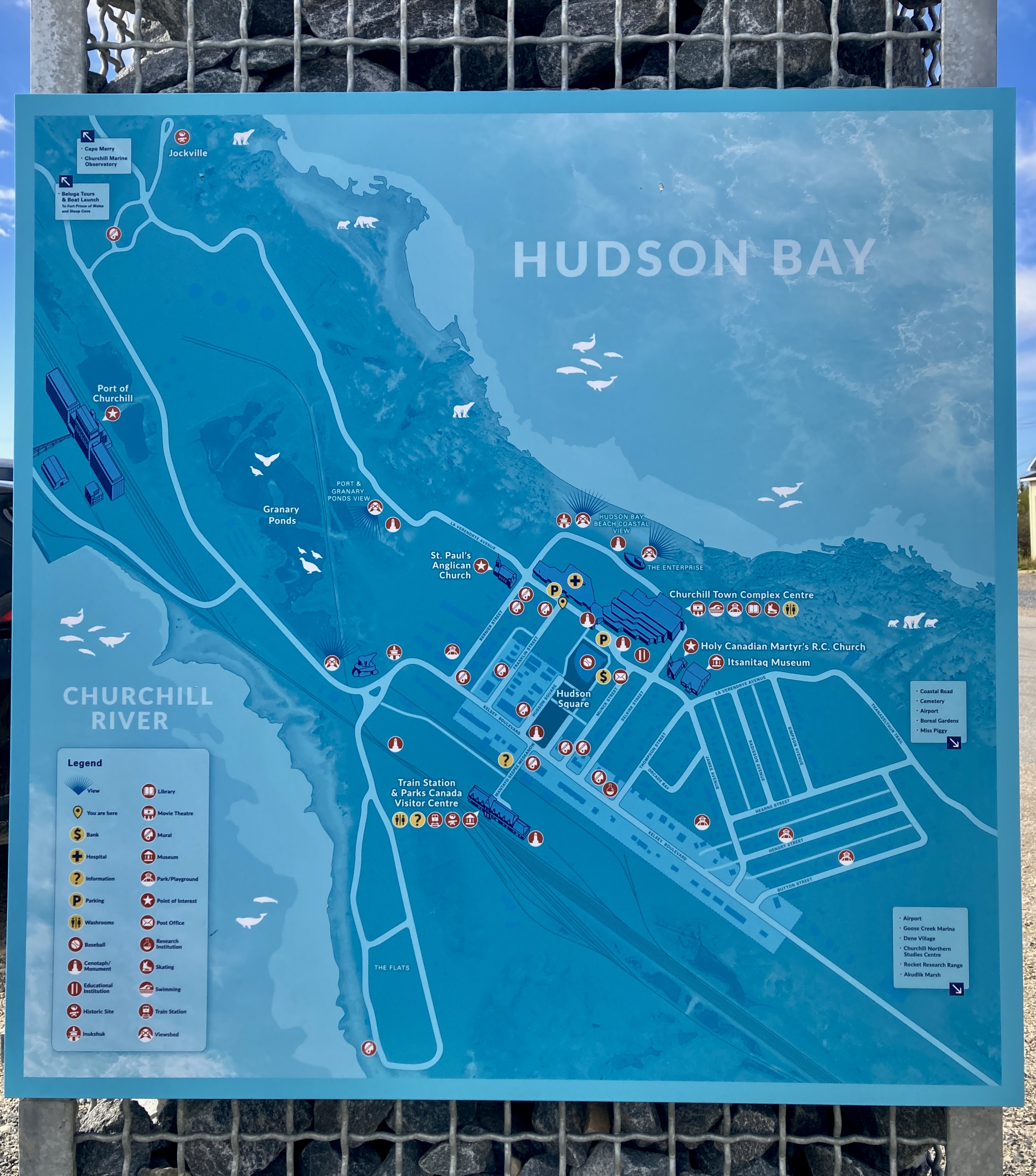
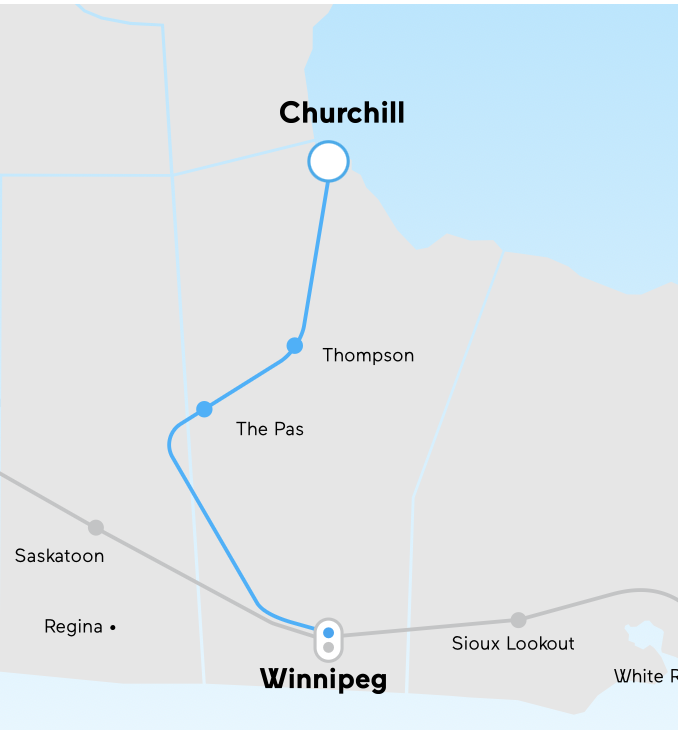
Mine will take me pretty directly from the train station (the dark oblong near the top of that bottom blue loop) straight through town to Hudson Bay.

Not quite directly. First a stop to refuel in the Seaport Hotel’s coffee shop.

It is clean and cheerful, unpretentious, and near the station. A convenient pivot-point. (I have no idea of the dramatic role it will play in my life, later that day.)

Fortified, I take my own boots past a boots mural…

straight-lining it to the water.

And there it is.

There, too, is one of the warning signs I’ve been told about. The polar bear “season” has not yet quite started. But this is the polar bears’ world, and they live by their own instincts, not the schedule of glossy tourist brochures. Every visitor is told to obey all the signs. Yes, I am told, go to the beach area, but no, don’t go to water’s edge, because bears can rise right up out of the sea, and don’t go near the rocks, because that’s where they like to hang out. As the tourism rep in the train station explains to the person in front of me: “You wouldn’t want to step on one.”

Lots of “don’ts.” I take them seriously. You have to respect nature.

So I do something very safe. I climb this convenient, if unorthodox, observation tower…

right to the top level.

Where, first, I view the forbidden rocks to the east …

and then, second, I focus on the beach right in front of me.

I focus, specifically, on the man way down there at water’s edge, walking happily along — man plus small dog, equally happy and unleashed.

This dog.

Not eaten by a polar bear, as you can see. The dog’s owner is a quite elderly Inuk, so I decide if anyone can give me reliable advice, he’s the one. I greet him. I say I watched him enjoying his shoreline walk, and I’d like to do that myself.

He explains he goes there because he likes to pick up stones. “Me too!” I cry. We beam at each other, dig in our respective pockets, and hold out our handfuls of stones for mutual inspection. Much murmured enthusiasm and poking at treasures ensues. After all that, I ask about safety. He says, “You have to watch. I don’t see any bears around right now.” He adds that if I position myself behind the sand bar, I should be fine, since I won’t be next to deep water.

With further compliments about our respective good taste in beach stones, we part company. He toward town, and I straight to the rivulet behind that sand bar.

Where (bottom left)…

I keep the promise I made my toes, that day on the Point Grey beach.

The day is cool — about 9-10C — but sunny and not yet windy. I continue walking the beach, completely happy. I see beluga whales cresting the water surface — just arcs of white, rising and falling, nothing dramatic, but clear enough for me to know they are indeed whales and not waves.

Finally, I walk west toward another line of forbidden rocks…

obediently stop short, and turn inland.

These bright, helpful signposts are all over town. This one is just uphill from the beach, and persuades me to visit the Granary Ponds…

with an initial stop in St. Paul’s Anglican Church, there on the left.

I look at various artefacts, including this 1930s Cree plaque quoting scripture from the Gospel of St. Matthew…

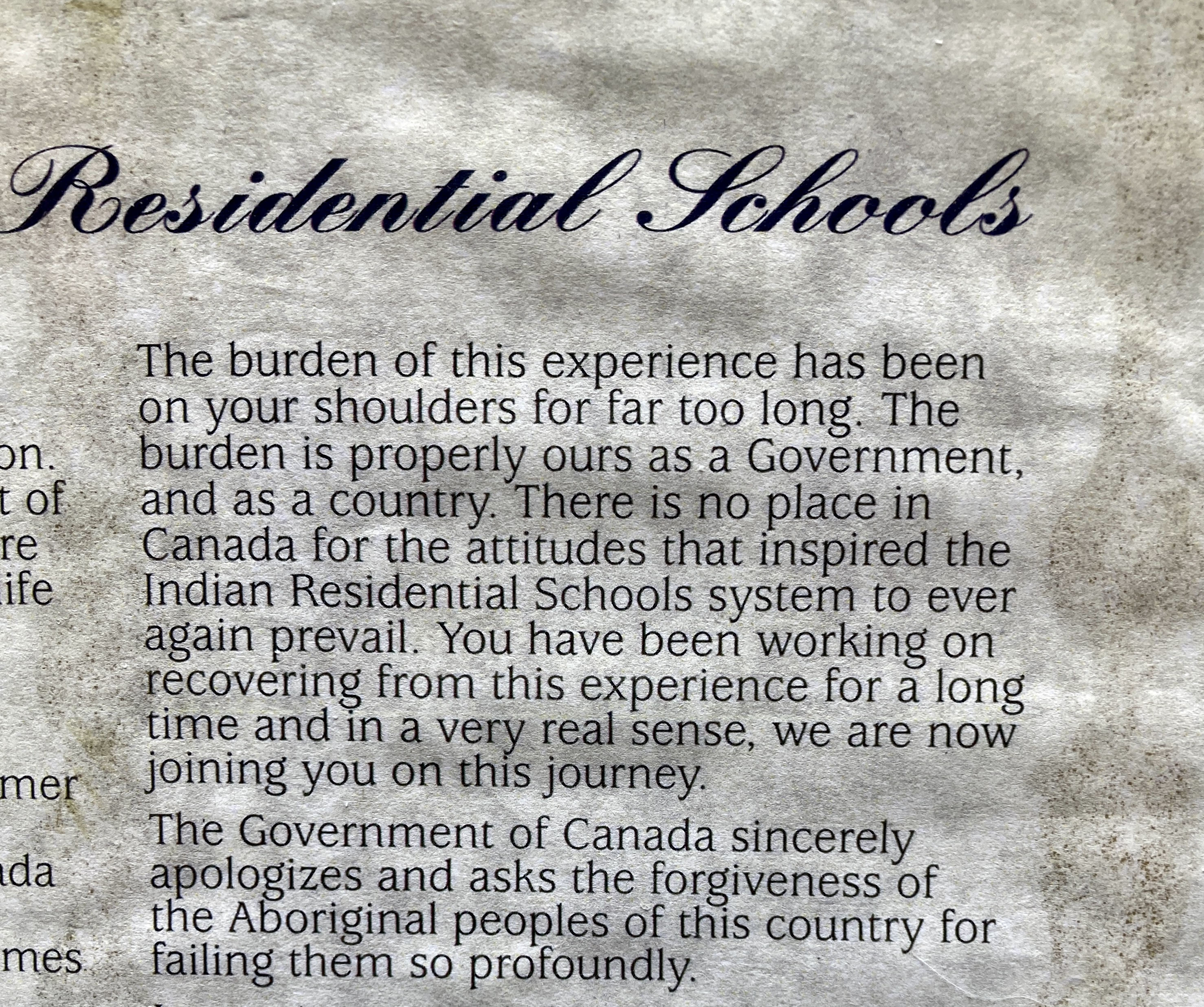
and I read the 2008 Federal Government’s Statement of Apology, signed by then-Prime Minister Stephen Harper, to all those who suffered under the residential school system. Here’s an excerpt:

The road out to the Granary Ponds leads me past riots of wildflowers, still vibrant so late in the season…

and then a closer view of the Port of Churchill…

which, if political promises are kept, will benefit from major expansion in the near future. (An initiative announced by Prime Minister Carney during a European trip — one more move in building stronger and more diversified relations with other parts of the world.)

I backtrack into town. My one goal is to walk. A lot. Though I’ve had only one prior visit to Churchill, in the early 1980s, I spent a lot of that decade going in and out of the Arctic hamlets. I haven’t the foolishness, the arrogance, to think I am any kind of insider, but I do still resonate with all of this. Young self did lots of jumping around. Old self seeks only to put feet on the land, to see and smell and hear the land, and be in this place. So I walk.

And, oh yes, I see very northern sights.

This truck decal, for instance…

and this komatik (sled), waiting for winter…

and this polite request in the doorway of Itsanitaq Museum.

But I also see streetscapes that could be anywhere in Canada.

There are community gardens all over Canada, as well…

though this one takes proper northern measures to protect the crops.

Right next to it, a happy pod of beluga whales, swimming a very different ocean.

And then… and then, no more pictures.

Because then, getting on for 5 pm, my gut announces that it is not pleased with the tasty falafel bowl I had for lunch in a highly recommended local bistro. My gut makes clear that it plans soon to start Throwing Out the Garbage.

This will be merely unpleasant, not dangerous, but also highly inconvenient. The train station is not yet open and I am not registered in any hotel. I’m again near the Seaport Hotel, so I walk in. What else can I do? They look after me. I am safe and sheltered. My gut can briskly go about its housekeeping detail in privacy. When I finally totter off to the train station, a fellow passenger, the station staff and VIA Rail staff are all equally practical and kind. Soon I am whooshed aboard the train, tucked up in my own sleeper-cabin. After a few more rounds of garbage-removal, I sleep. When I wake again, I am completely well. It’s all over.

So is the day in Churchill. Our train is now in motion.

I lie there, think about all that helpful kindness — and decide that my little bout of food poisoning was in fact the final heart-warming event in a thoroughly wonderful day.

Land Cruise: 2-3 September

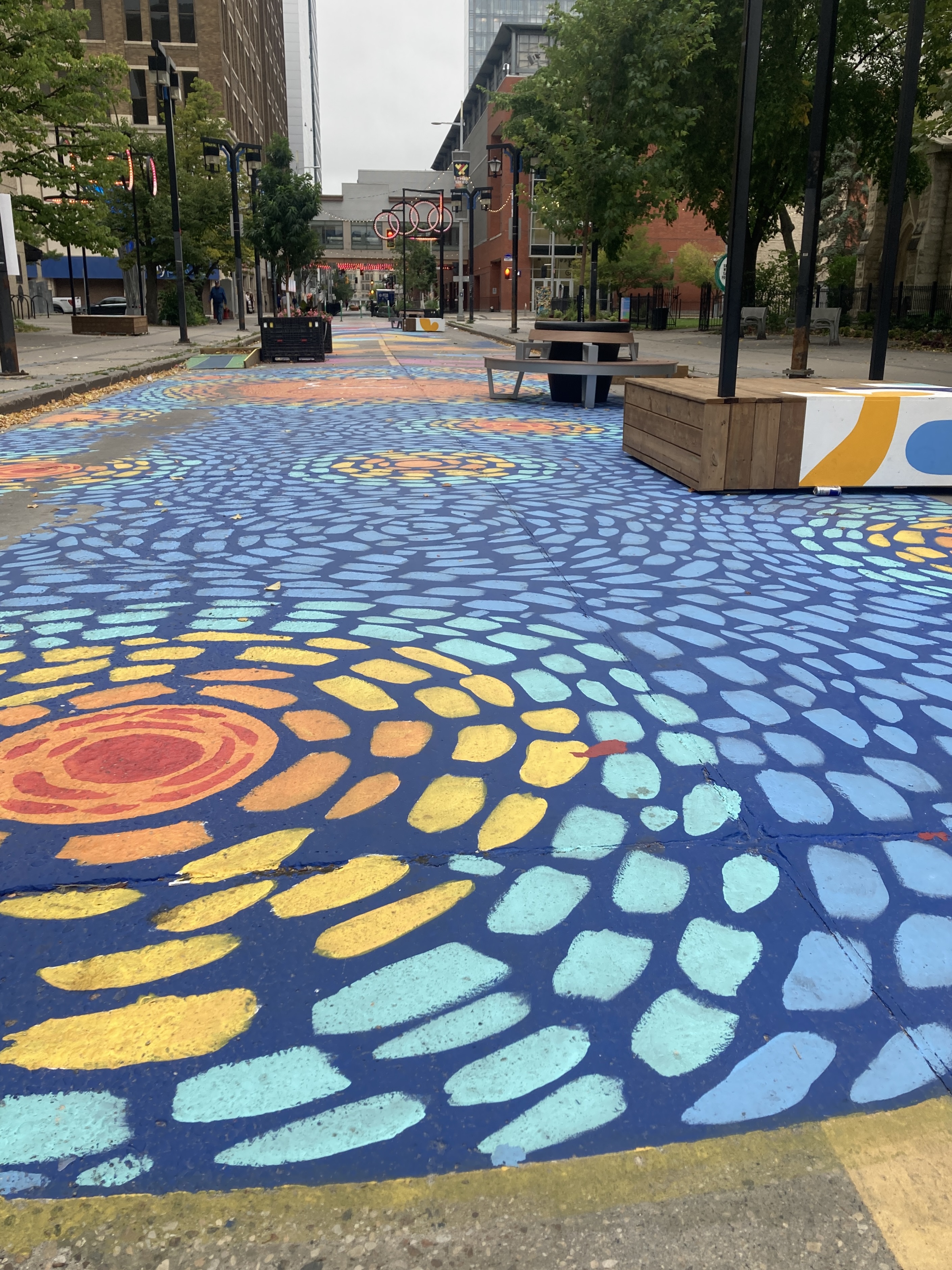
2 September – The train doesn’t depart until 12:05 pm, so I have time for a morning walk on Winnipeg’s “Cool Streets”…

before obediently turning up at Union Station by 11 am.

I just see people. I don’t yet know, for example, that the Calgary couple in the cluster on the left are delighted to see some distant relatives will also be on our train, albeit only part way. Or that the young people over there on the right belong to two separate post-grad teams, one from France and one Québécois (Université Laval), travelling north to research climate change on ice structure and on permafrost, respectively. (Even later, I learn the French project was originally planned for Siberia, but world politics got in the way, and they had to find themselves a new home.)

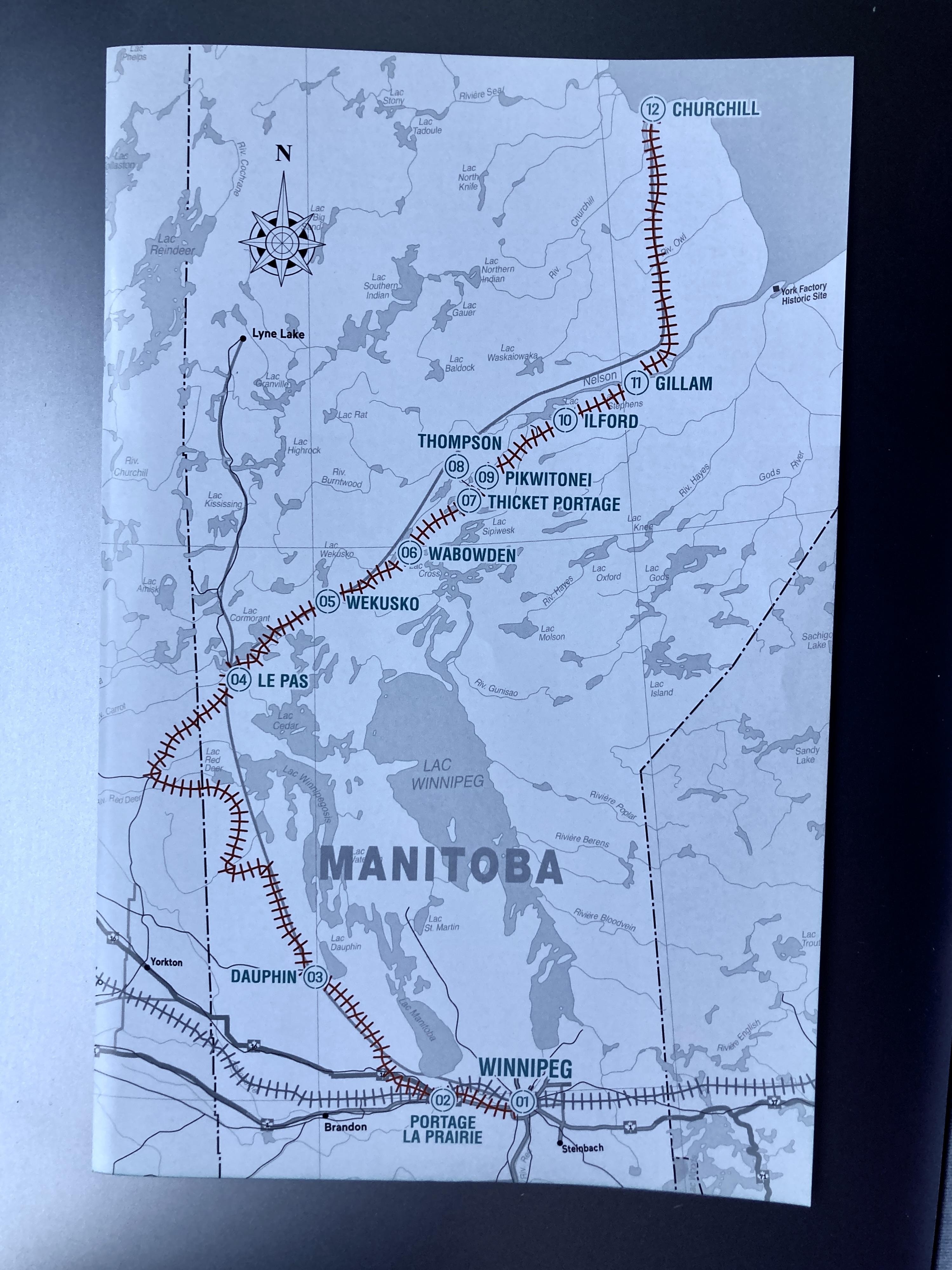
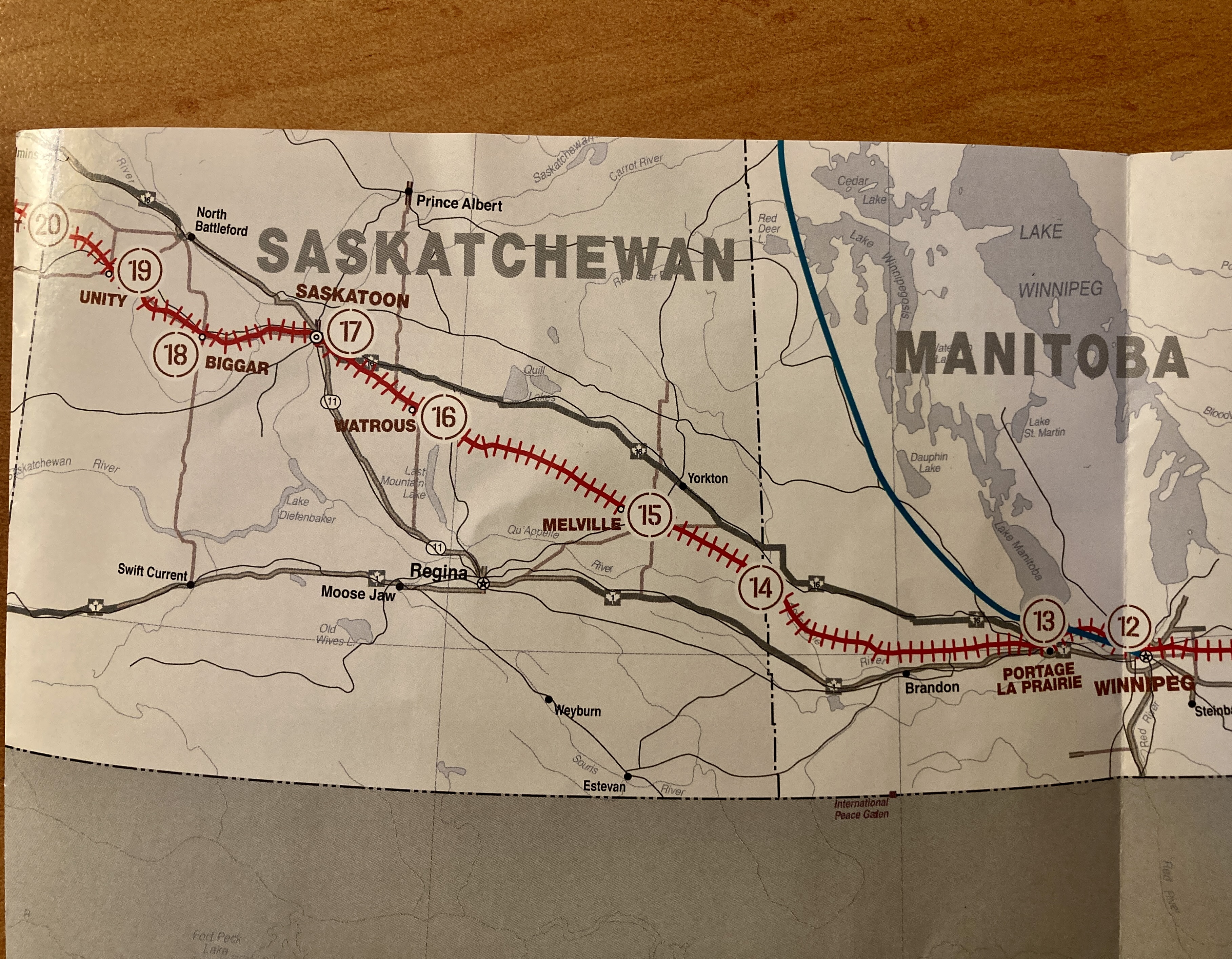
Into my cabin, and a quick study of our trip map.

I am excited. Once, so many decades ago, I returned to Winnipeg from Churchill by train, but I’ve lost almost all memory of the trip. Here I am, about to do it again. Both ways! We’ve been told there’ll be quite frequent stops, in many very small communities as well as the larger ones. This train run is still an important communications link — and, indeed, beyond Thompson, the only land route to Churchill.

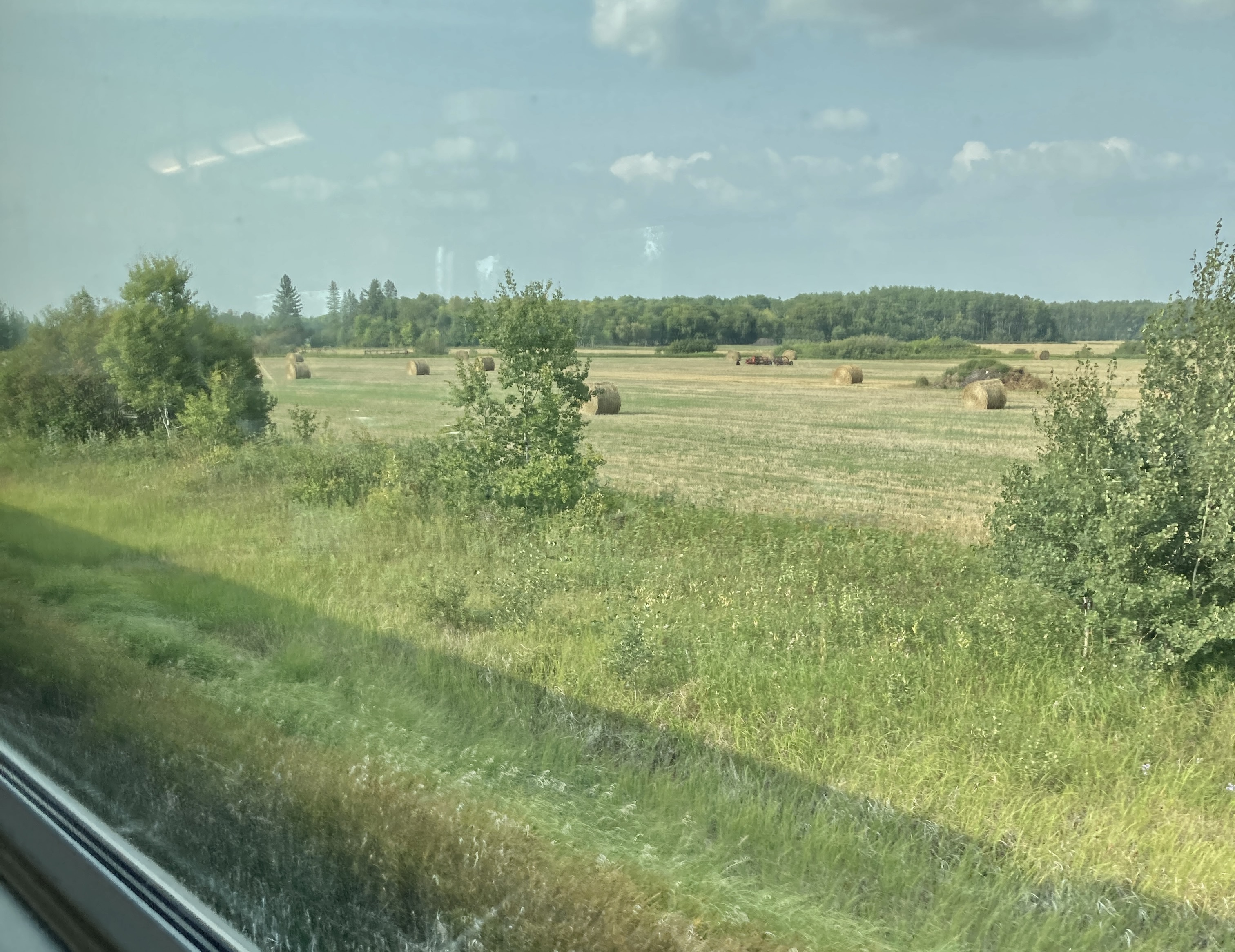
Farms, harvested fields…

as we roll past Portage la Prairie, the land still looks a lot like Saskatchewan. Still very southern.

How could I have forgotten the imposing train station in Dauphin?

A CN station, built in 1912, when train travel was a very big deal indeed.

The next stop will be The Pas, but I’m long asleep by then. I don’t even notice our brief swing across the Saskatchewan border and back again.

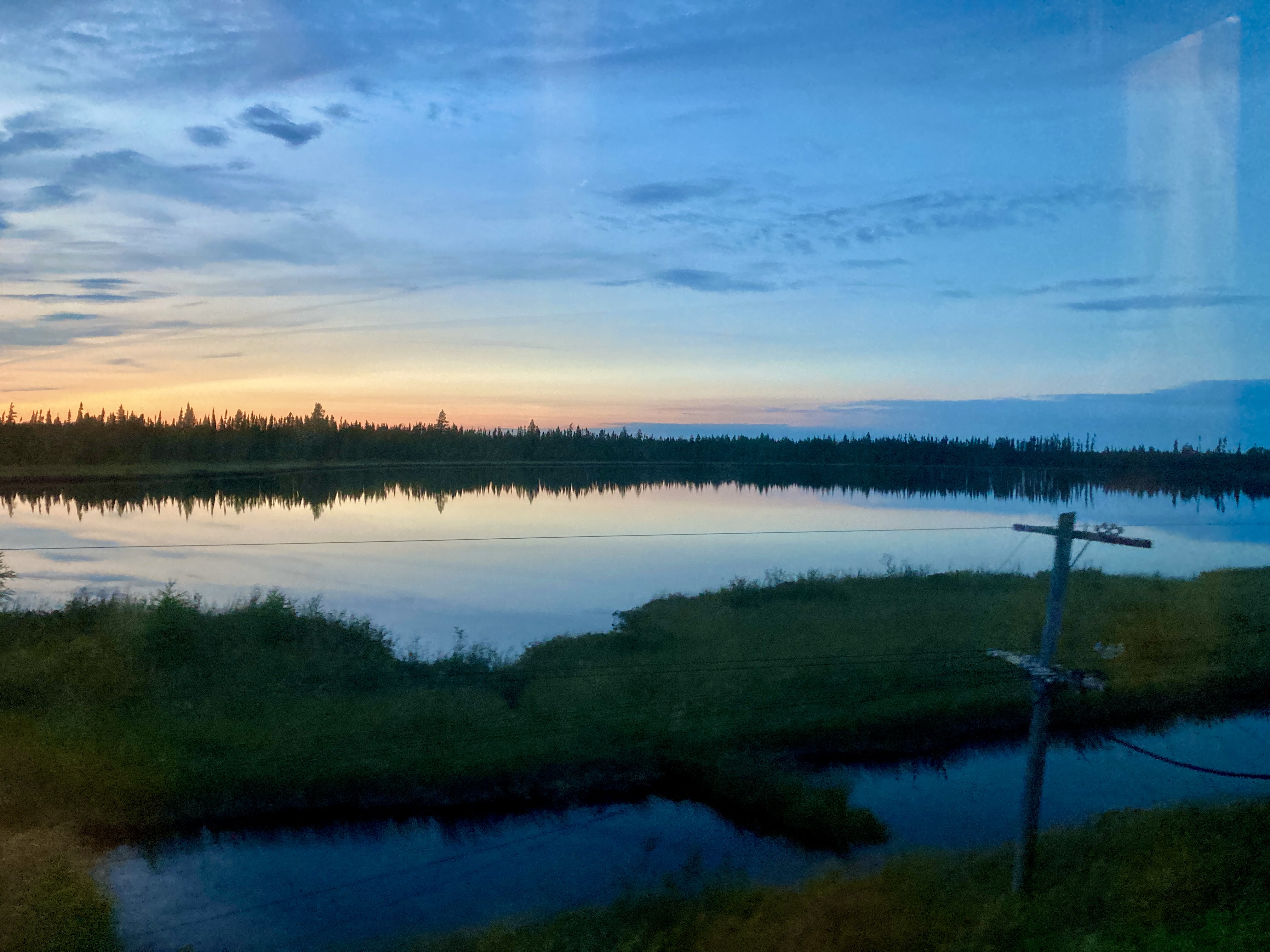
3 September – Sunrise somewhere near Wekusko, and it’s a different world.

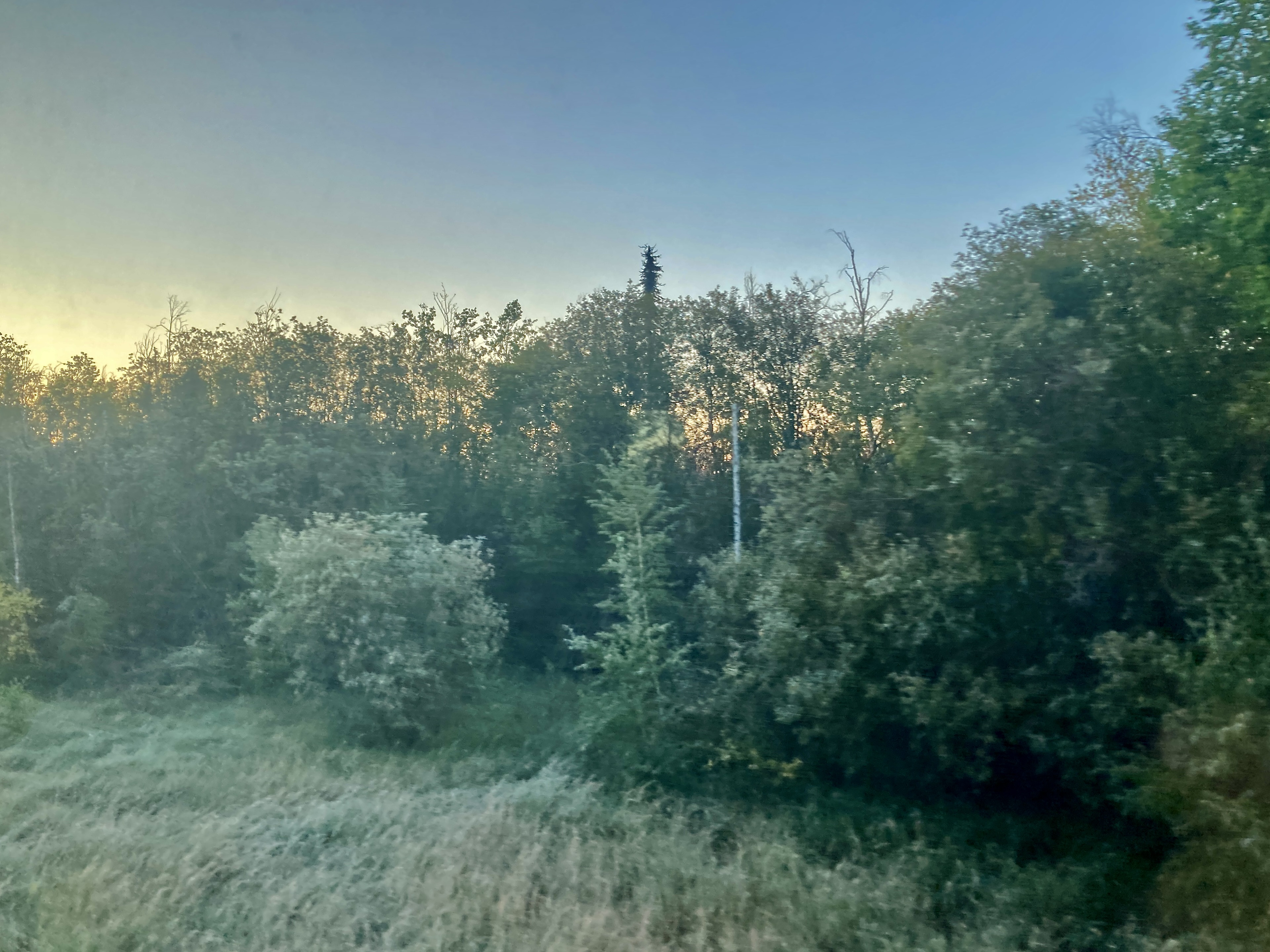
Becoming boreal, it really is. I think some of those lacy silhouettes are tamarack, also some white spruce? I’m not an expert, don’t quote me, but at least I can tell we’re moving into a different world.

Colder, too. Hoar frost rims every leaf, needle and blade…

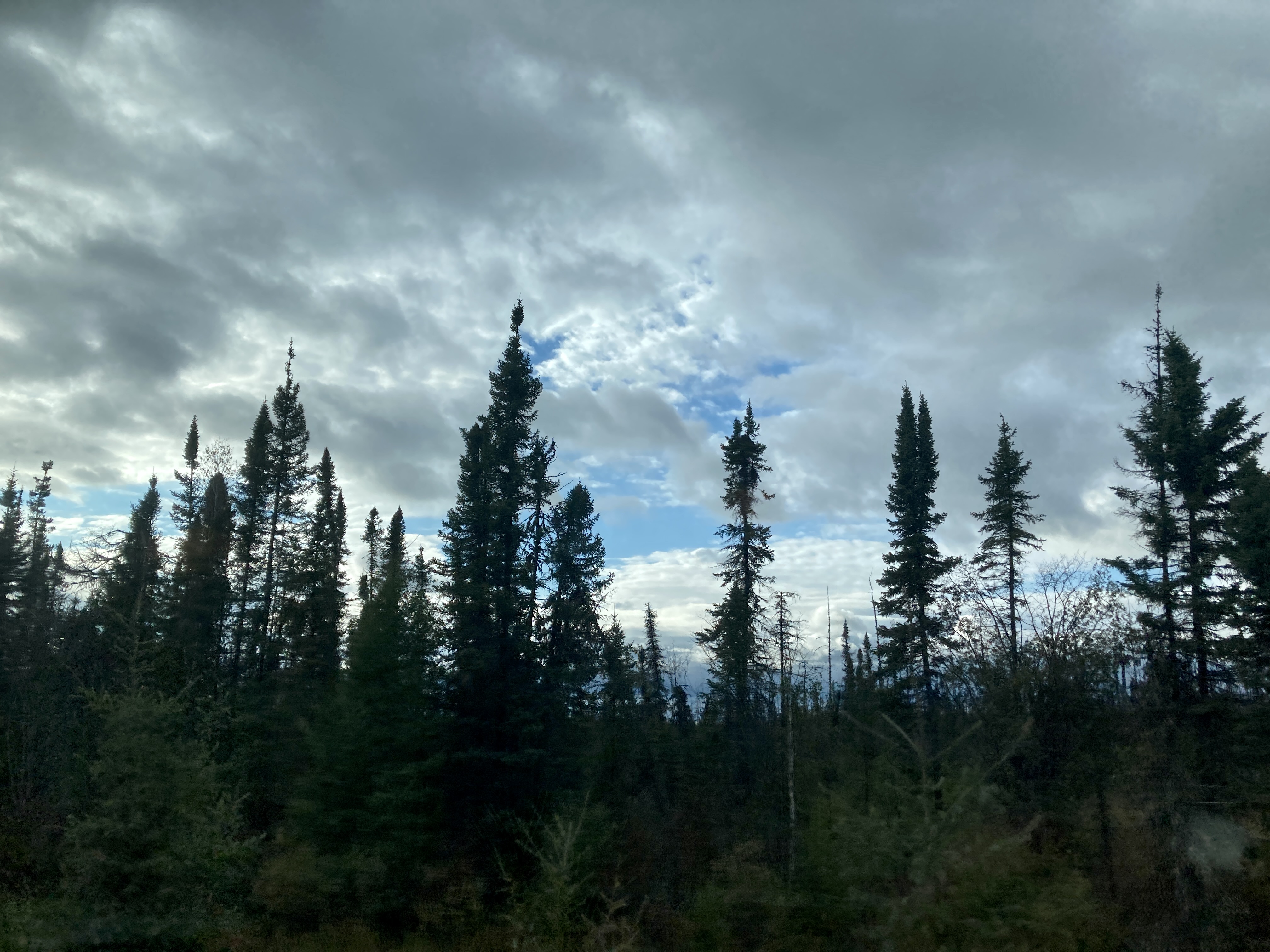
and here I can name a few things with reasonable certainty. That tall skinny guy in the back row is black spruce, there’s at least one white birch (later I see whole groves of them) and the deciduous trees there on the right look like trembling aspen — all these species part of the boreal mixture.

As the sun rises, mist also rises…

from ponds, lakes and this pretty creek.

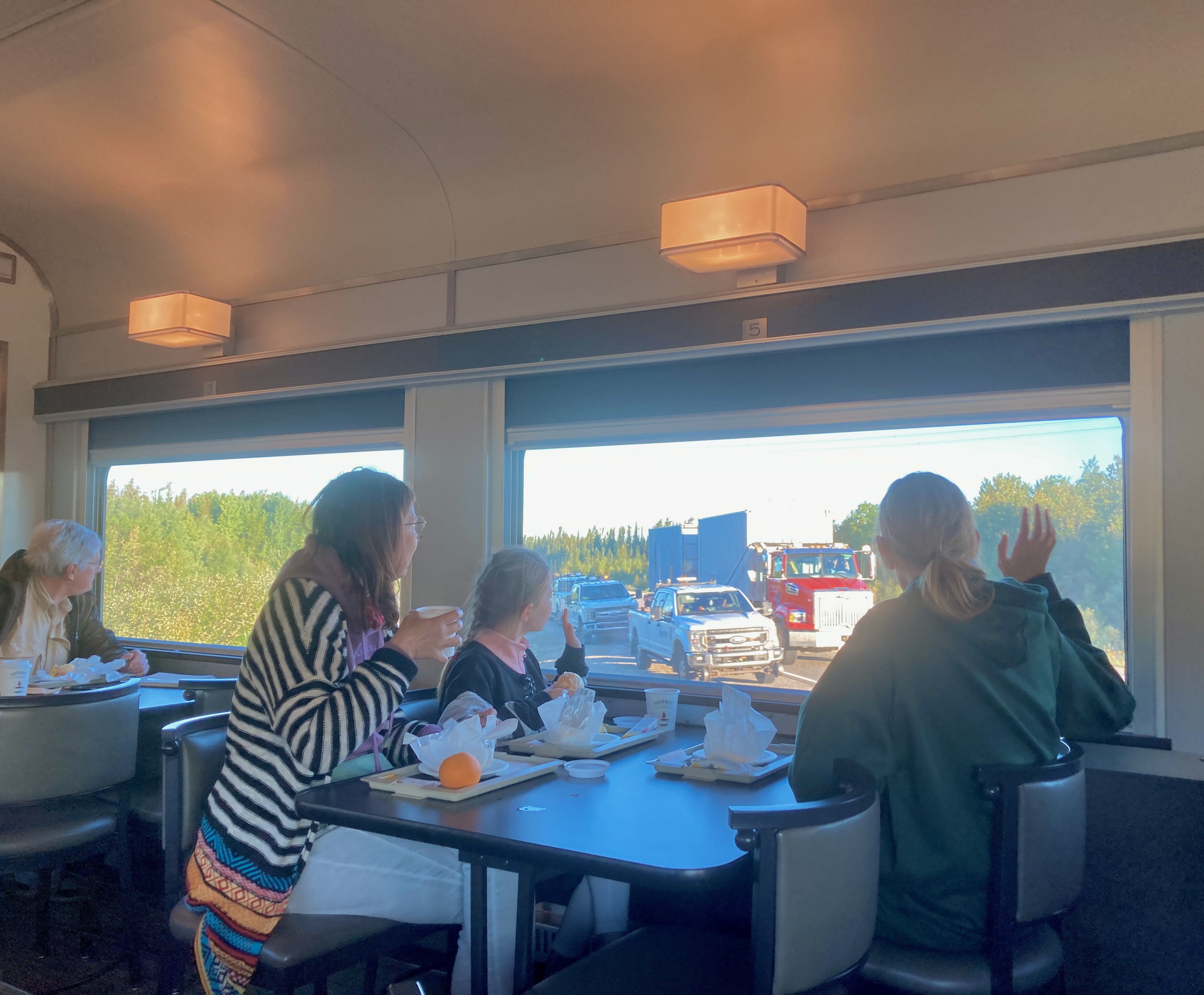
Usually this run has a dome car, but what should have been our dome car is in the repair shop, so the dining car is our everything car. It becomes our hangout, for much more than food.

Families wave to cars at the road crossings…

the students bend over the data on their laptops, prepping for their projects…

and I have my own little spread of resources, quite frivolous by comparison.

Notepad, map, coffee, grapes (I swapped one of my Gemini apples for some of the attendant’s grapes), and — and how appropriate is this? — Agatha Christie’s 1930s The Mystery of the Blue Train. (My copy is in French — snapped up from the Take/Donate bin on my previous train.)

We make brief stops in small communities. Fresh air and a look at daily life for us; vital on- and off-loading for them. Wabowden, for example…

and Thicket Portage, where the Quebec students are chatting next to that ubiquitous vehicle of the north, the fat-wheeled buggy.

Back on board, and in passing I meet Conductor Ted Thompson.

(So there, Paddington Bear! We have Ted.)

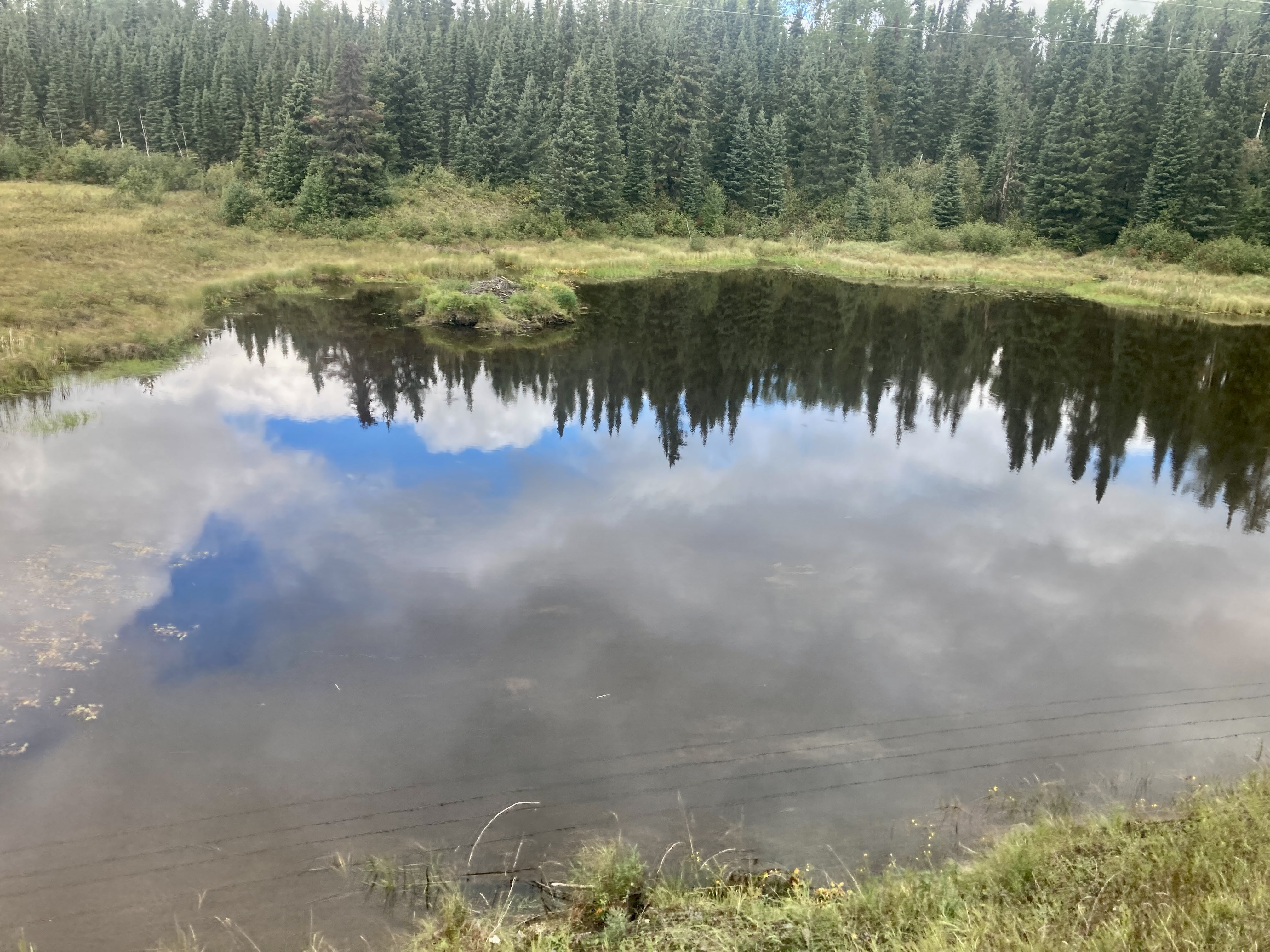
I see my first beaver lodge of the trip…

that knob at 11 o’clock in the pond, but I almost miss it, so many leaves cover the distinctive twiggy dome.

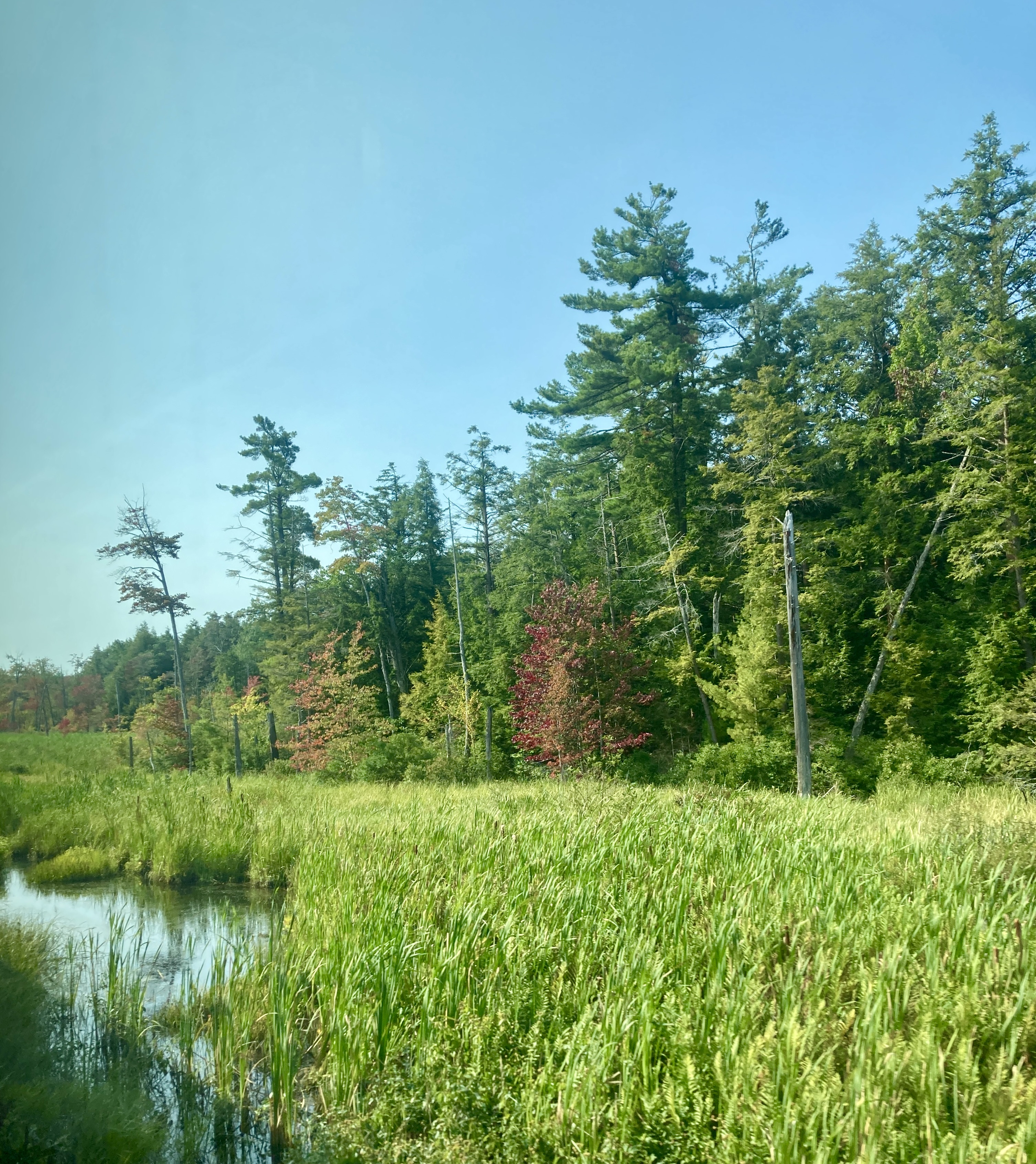
I watch the train curve with the tracks. Completely different from those craggy twists in the Alberta mountains! Here, a setting of scrub, aspen, birch and coniferous I don’t dare to try to identify.

There’s a rock cut that makes me think of driving though Ontario’s Muskoka region…

and piles of materials…

presumably for some project along this river.

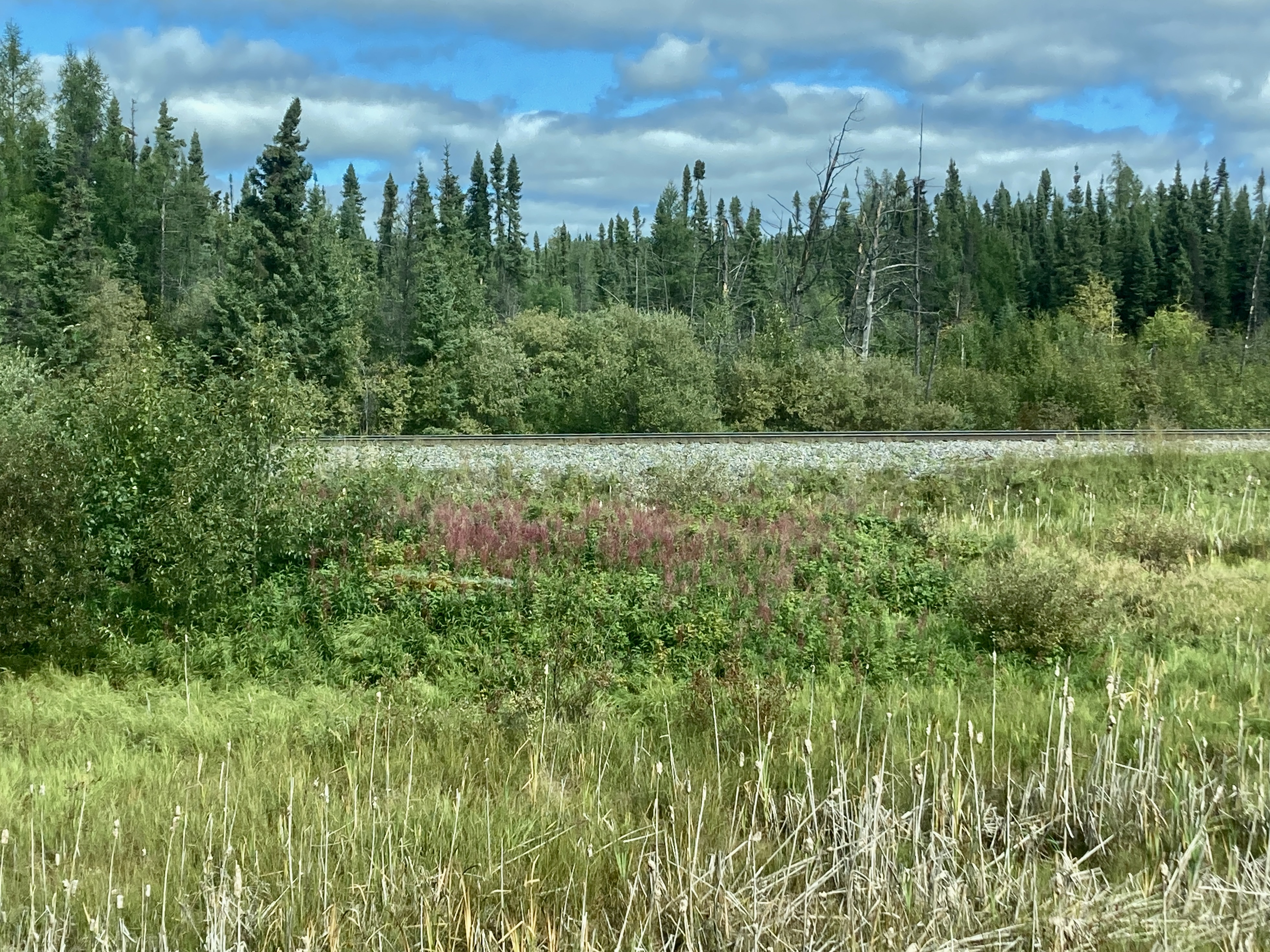
A set-piece scene:

wildflowers, train tracks, aspen, birch and conifers.

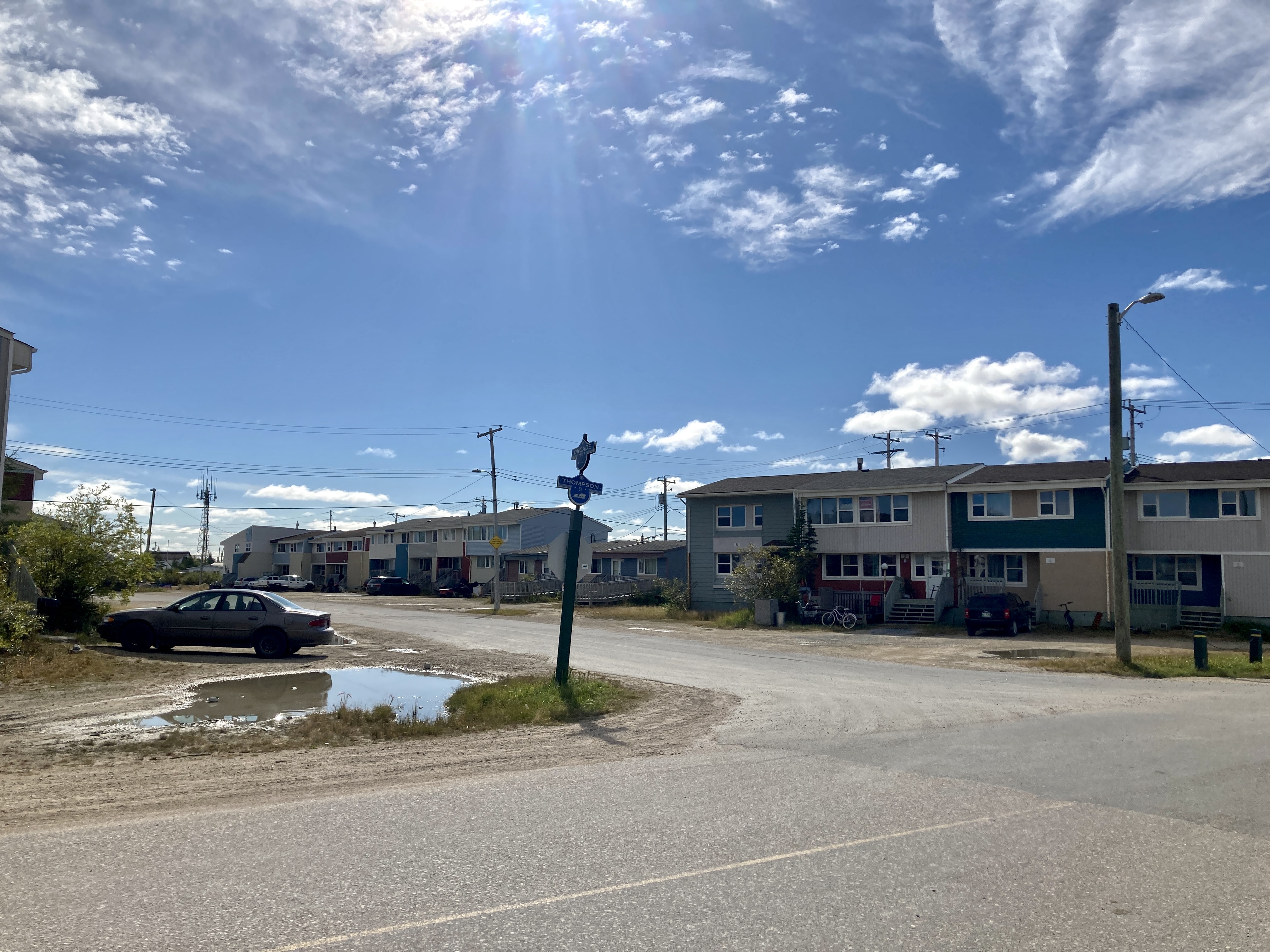
Just before 3 pm, we do the back-and-forthing required to shift us from the main track to the spur line into Thompson. Thompson: created by INCO, a planned city and a mining town. While now more diversified, you still see that mining architecture from anywhere in town.

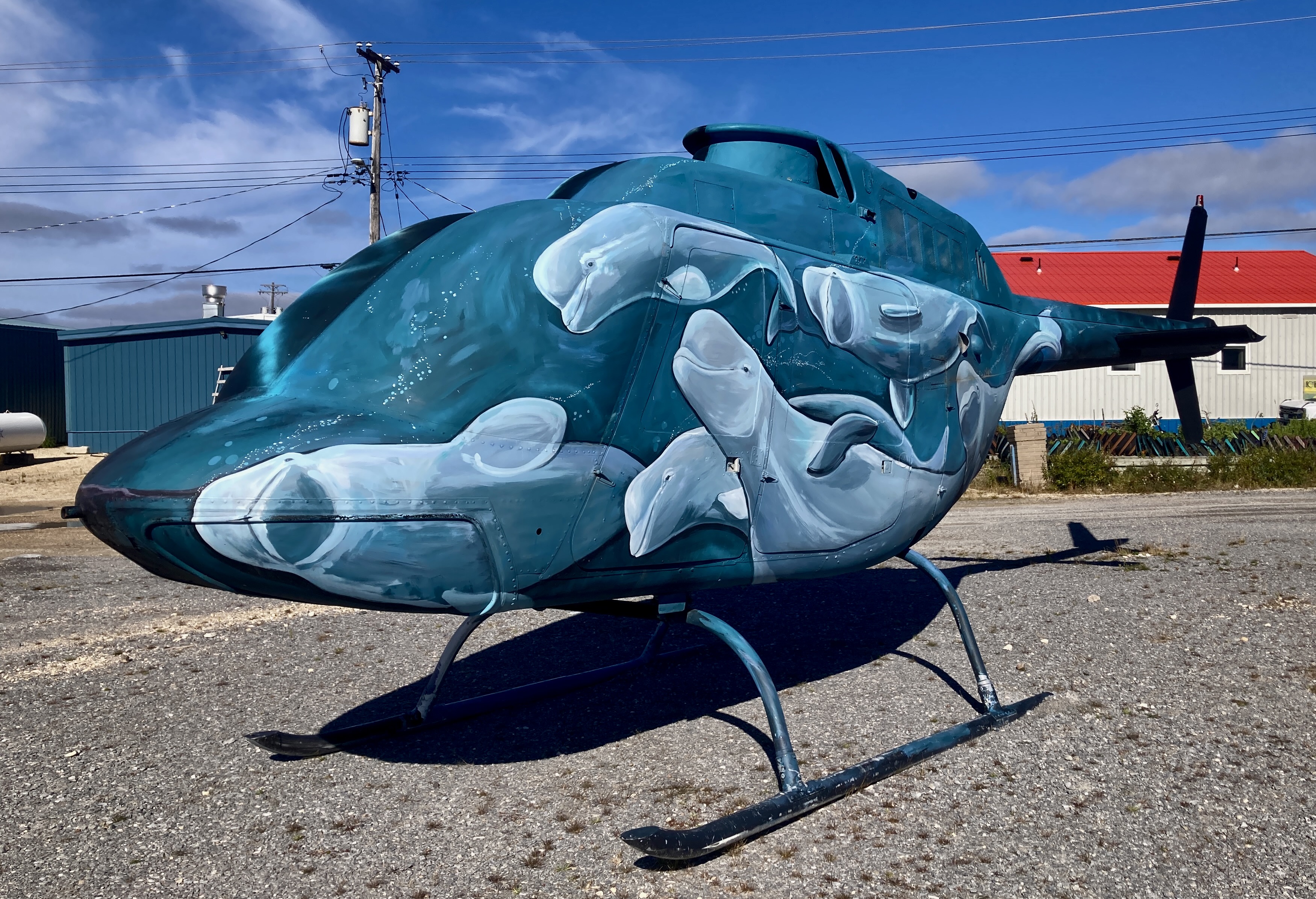
The part we got to walk is very big-box. Anybody who knows the outskirts of Barrie ON will know what I mean. Still, everyone I spoke with was friendly and helpful, and I did get to see my first — of what surely will be many — polar bear mural.

(Though I must add, I prefer the battered float plane mural on the left.)

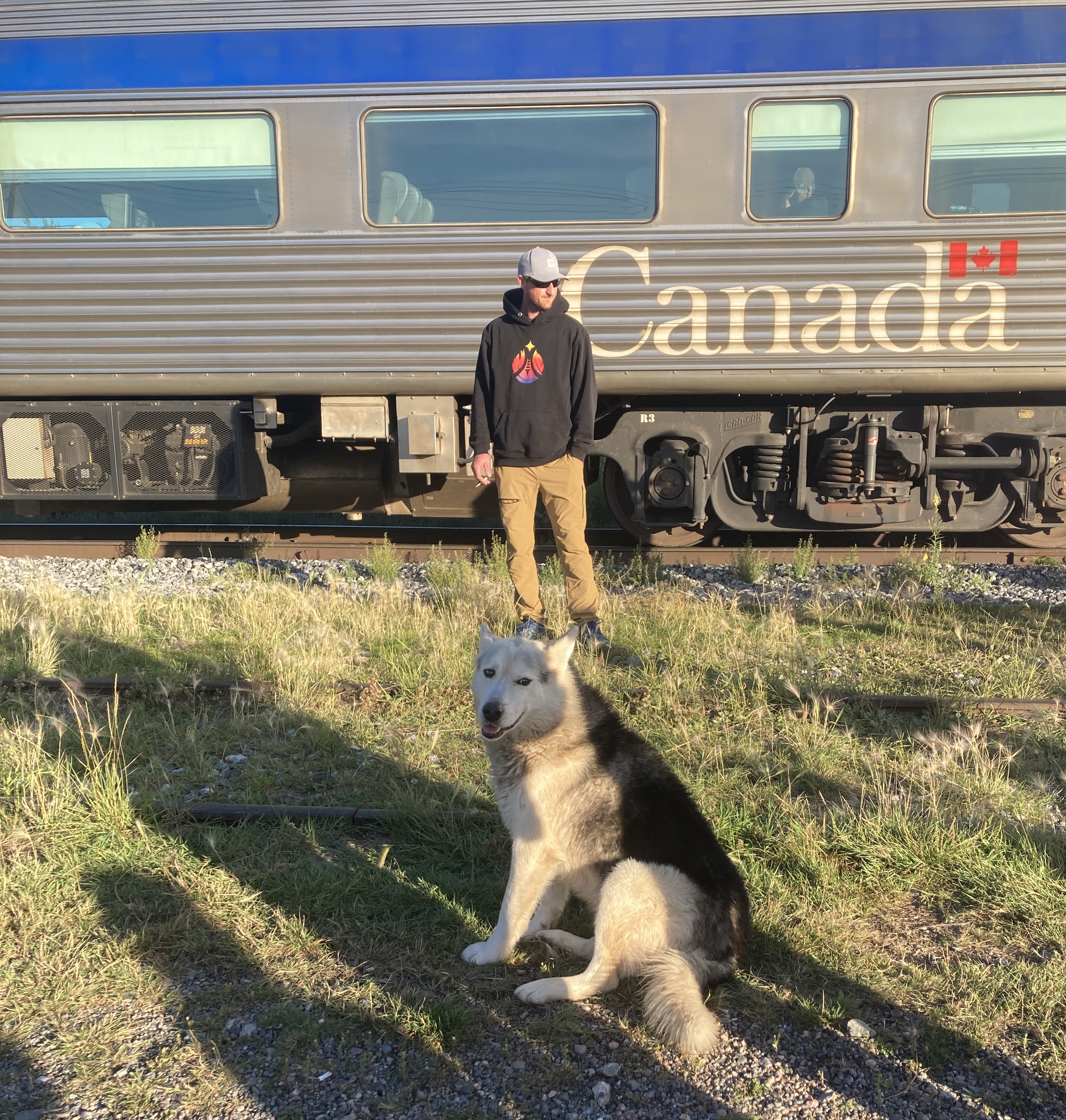
Out of Thompson, back on the main line, and on to Pikwitonei. Population less than 100, says our travel guide, but don’t curl your lip. It also has its very own Greeter Dog.

Greeter Dog meets every train, and while I scratch under his ears and he leans happily on my leg, a Cree gentleman teaches me how to pronounce the town name. It is “Pick-whi-tonNAY.” with the emphasis very firmly on the last syllable. (Like NewfoundLAND. Understand?)

Round about 8:20 or so, somewhere north of Pikwitonei but still south of Ilford, I watch the moon rise…

and then I fall asleep.

Tomorrow: Churchill. Tomorrow: Hudson Bay.

My boots expect me to keep my promise.

Land Cruise: 1 September

1 September – I’ll be one day and a bit, in Winnipeg. On the land, and on the water too.

The theme of land and rivers, the two great pathways of our country, keeps gaining strength. Not because I intellectually seek it out. Because it is imposing itself on me.

A tear-off map at my hotel inspires my walk: down to the Red River, there behind the Canadian Museum for Human Rights, and then along the walking trails up into Stephen Juba Park, back down and around the curve of The Forks (where the Assiniboine River joins the Red), onto the water in a 30-minute tour, and more river-side walking, both rivers.

The Red River. The cereal of my childhood, even my very own Red River coat, as a child.

The river, of course, is more important for reasons other than cereal and coats.

My path along the Red up into Stephen Juba Park leads me past old pilings, last remnants of the glory days of this port (before the Panama Canal opened, and offered shipping an easier, quicker route through the Americas).

This is also when I first tap my boots in the water.

Literal next step in a whimsical project I hope I can complete: having tapped toes in the Pacific (Burrard Inlet, cf. my post of 25 August), I want now to tap them in the Red River, Hudson Bay and Lake Ontario.

Did you notice the trestle bridge, in the distance of that last photo? Used for military purposes, I’m told, and now the train bridge. I’m drawn to it. I admire the utility of these bridges, their visible geometry and, once I draw near, the majesty (albeit scruffy) of the near end of this particular example.

After I turn, after I follow the riverwalk bend around the point of land, I am now beside the Assiniboine River. I tap toes in its waters as well — a bonus not part of the original plan — and, as I do so, I notice a yellow Waterways tour boat mid-stream.

There is a dock, there is a boat about to depart, I climb aboard.

Only one fellow passenger, this early in the day: a Montreal film-maker, in town to work on a production here. Our guide has an impeccably Spanish name and an impeccably Canadian accent: his family moved here when he was two years old.

Kayak going one way, we’re going the other. Miguel is powering ahead, having now explained those three lines on the bridge pillar. Each is a water level: blue for normal spring levels, yellow for the danger of rising waters, red for floods. (I think of my brother’s years in Winnipeg, and the spring he helped sandbag against that year’s inundation.)

Back on land, toes duly tapped in not one but two mighty rivers, I head for the markets within The Forks complex. While you can buy food aboard the Winnipeg-Churchill run, it’s the like of microwaved subs, I’ve been told — the same person then suggesting I lay in some supplies.

So I do. Bison Snack Sticks (Canadian), Thunderbird “real food” bars (American), oat cakes (Isle of Mull) and Gemini apples (very very very local). Tomorrow morning, I’ll snag myself a few hard-boiled eggs from the hotel’s breakfast bar as well.

Feeling sufficiently prepared, I leave The Forks. But not before I admire Caboose 76602, a permanent installation on the grounds.

Built in Montreal in the 1930s, retired from service in Winnipeg in 1988, it is now “dedicated to the thousands of CN train crews who travelled through Winnipeg and the ‘East Yard’ that is now The Forks.”

Tomorrow, 12:05 pm Central time, I’ll be back on board one of today’s trains.

The one that will take me to Churchill.

Land Cruise: 29-31 August

29-31 August 2025 – You’ve had the tease, and my friend Larry correctly guessed: I was about to start an epic VIA Rail adventure. Another friend Blane plaintively asked, “Why not farther east?” and the answer is: I would’ve if I could’ve.

  • Plan A (back in the dreaming stage, in January): coast to coast! Vcr-Tor; visit friends; then back on VIA for Tor-Montreal and on again Montreal-Halifax.
  • Plan B (after time with a patient VIA rep in Pacific Central Station, still January): coast to coast to coast!!! Hop off in Winnipeg for the side-jaunt Wpg-Churchill-return, which would put me on the shores of Hudson Bay; then carry on, as in Plan A.
  • Plan C (after searching train availability with that patient rep across three months): the reality plan. Not possible to book sleeper-cabin on all legs of any one trip. Time to choose — Arctic or Atlantic? Arctic wins.

These first days get me to Winnipeg: 2 days + 5 hours of travel, over 2,485 km.

Just look at it. This trip, as my friends & family already know, is not about visiting cities. It is about seeing again friends farther east, and — given the mode of transport — it is hugely about once again travelling through great chunks of this astounding land. The literal land. By train, which has so shaped this country, and which has featured in many of my own earlier travels in this country, various segments at various times.

I am hungry to see it again, to cherish my own memories, and honour the land. And to be reminded of its complexity, its variety — so easily forgotten or not known, as we live each in our own local world.

But! All of this belongs to all of us. Is part of all of us.

29 August – we pull out at 3 pm Pacific time; I’ll be asleep before we arrive in Kamloops, late at night.

Last bustle on the Pac Central platform…

a train’s eye view of the bridge across the Fraser River at New Westminster…

and then, as that first map shows you, we follow the Fraser north-east.

Into the mountains where, past Yale and close to Spuzzum, I notice not just the craggy heights, but the power lines that top them.

I think about that, too — the trinity of river/railroad/power lines, our historic and present pathways through the country, the ways we connect our small settlements of people across such vast sweeps of land.

Farther along again, fading light, well into the Fraser Canyon and a deceptively calm-looking stretch of the river far below.

Deceptive, because we are just short of Hell’s Gate, where an abrupt narrowing of the river creates churning white water.

And then… and then it’s dark, and I chat a bit with others…

and then I’m asleep. Somewhere in there, passengers come and go in Kamloops, and the train carries on.

30 August – I’m up by 7 am, in the dome car by 7:30. Mountains tower above us and all around.

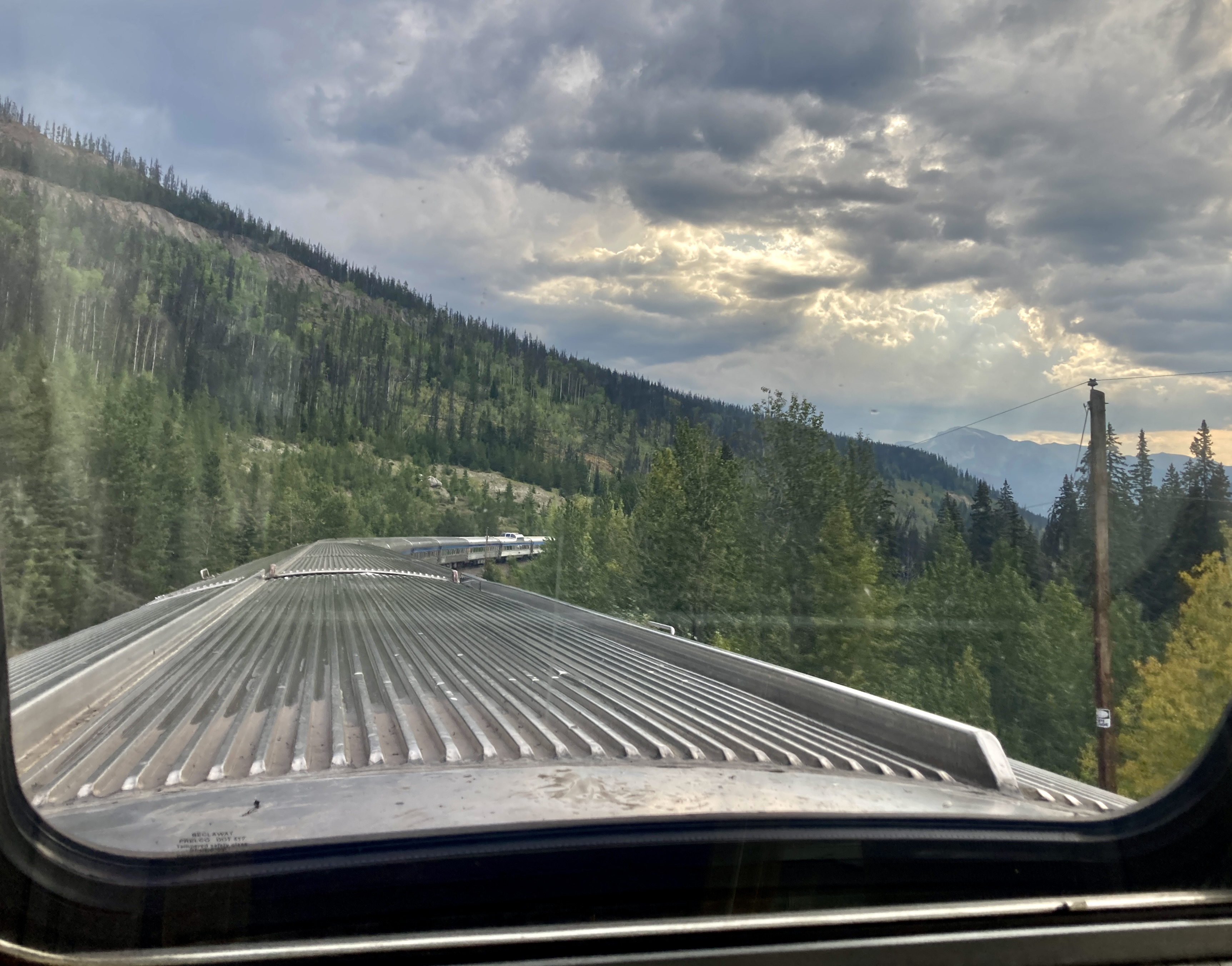
We clatter along, on through Jasper National Park, the train lines clinging to the cliffs, power lines ditto, with tunnels where necessary.

None of this stunning feat of engineering deletes (or even dilutes) the human cost involved — lives lost not only through the honest limitations of 19th-c safety measures, but also through sheer disdain for some of the people living those lives. (Chinese workers, for e.g., were primarily the explosive crews.) We must acknowledge all that. We can also acknowledge the achievement as well. Life is both/and, not either/or. (In other words, cancel nothing, Acknowledge it all.)

This is a long train — still the full 21 cars of high season.

Two engines, baggage car, crew car, some other utility car whose title I forget, and car after car of all of us passengers: mostly older, but not all; predominantly Canadian and (despite everything) American, but not all, and with a major presence of Aussies; train nerds among us; cruise-goers ditto, ticking their lists of Been There, Done That; and a whole range of people with other motives, from family reunions to curiosity to hikers giving their legs a break to Europeans with some Canadian connection offering themselves a nostalgic return.

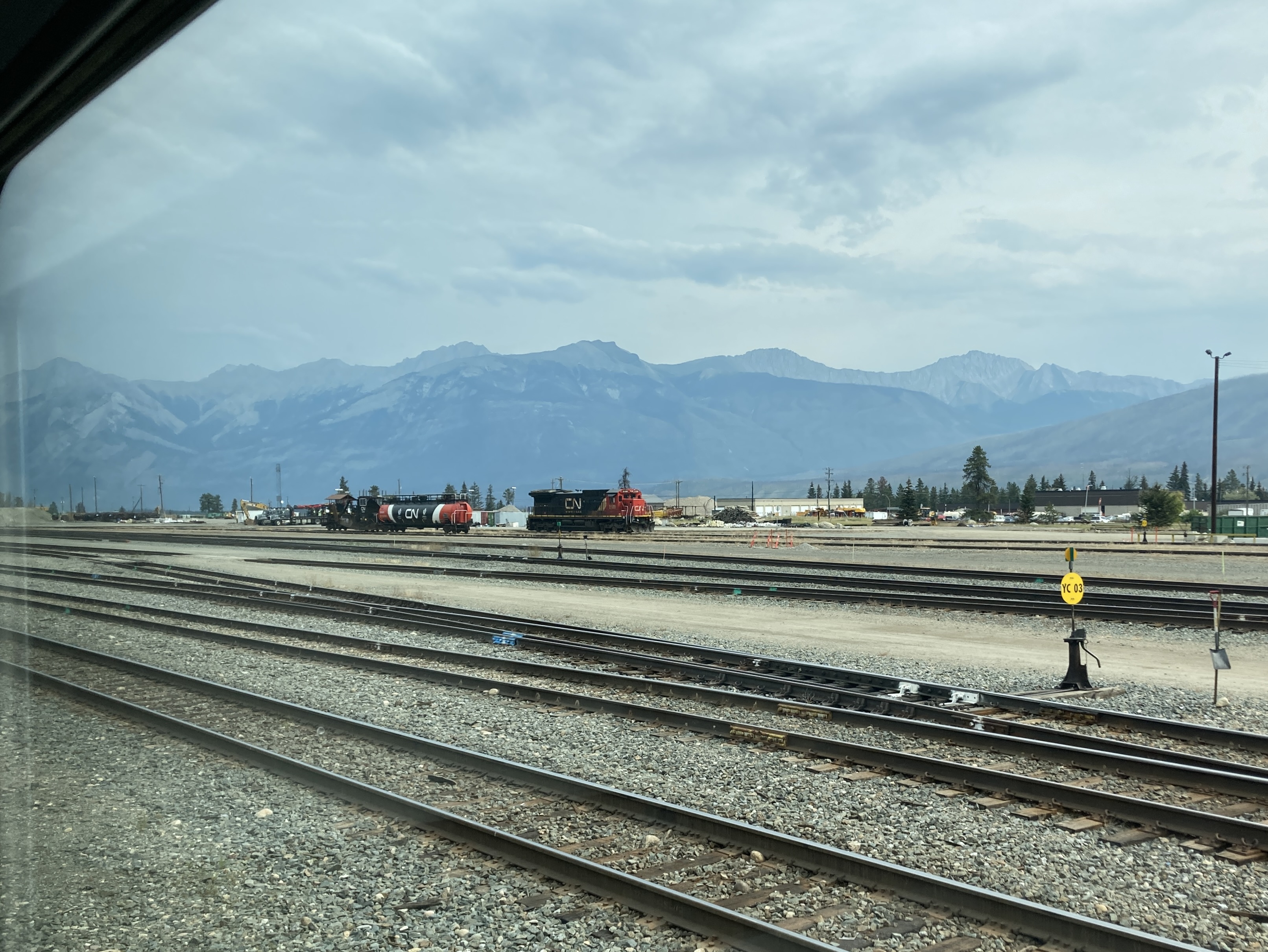
We pull into Jasper…

and how telling it is that I’m showing you the rail yard, not a picture-postcard view of the town! (Maybe I’m becoming a train nerd myself…)

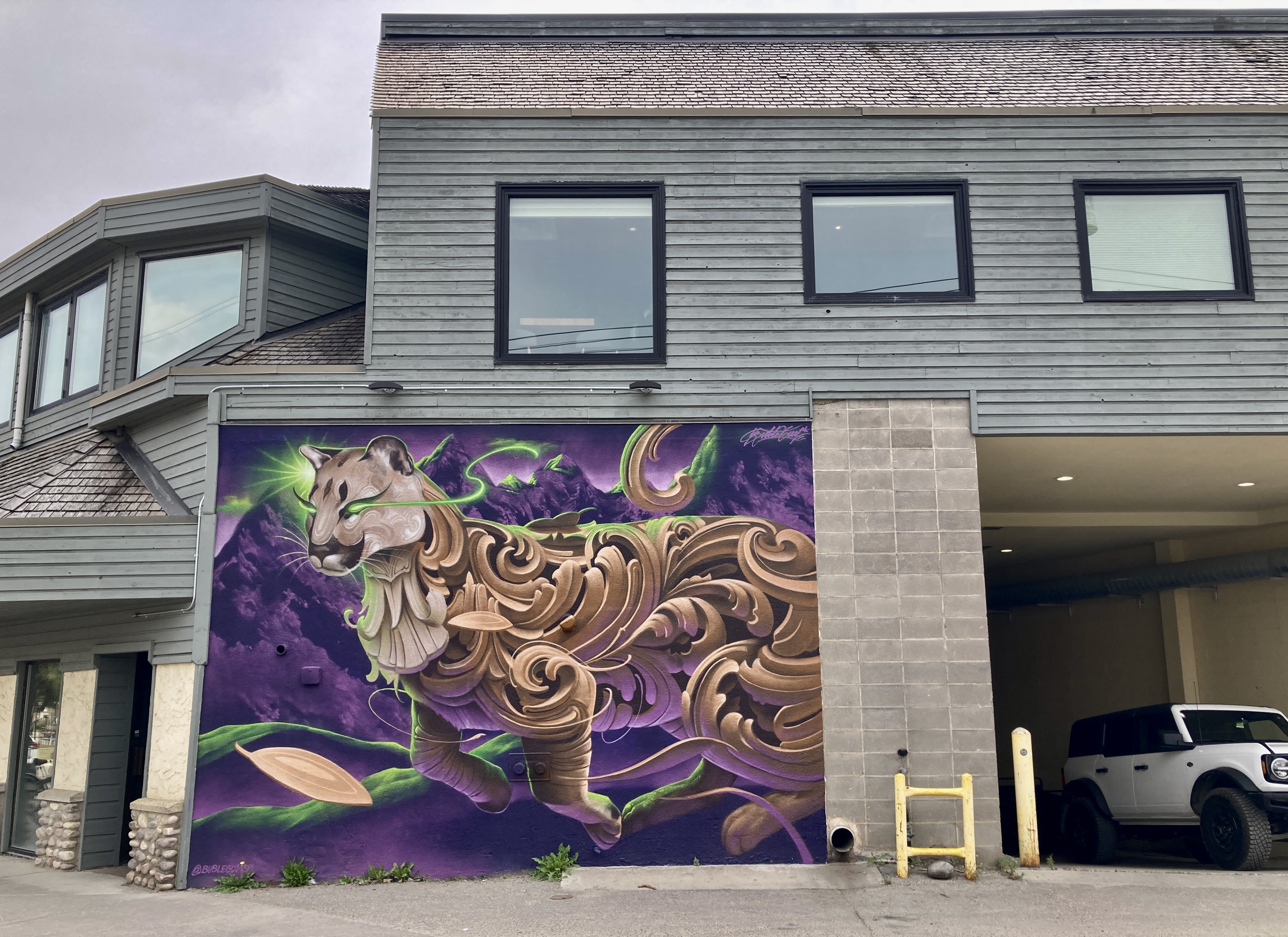
With 45 minutes free time in town, we scatter. I get away from the tourist-trap main streets as quickly as I can, walk a loop in-behind, stop to admire a cougar (or something) never seen in the wild…

and climb back on board.

And then, and then, after a while, we’re in Alberta. The land changes, and the uses of the land we can see from our train track also change.

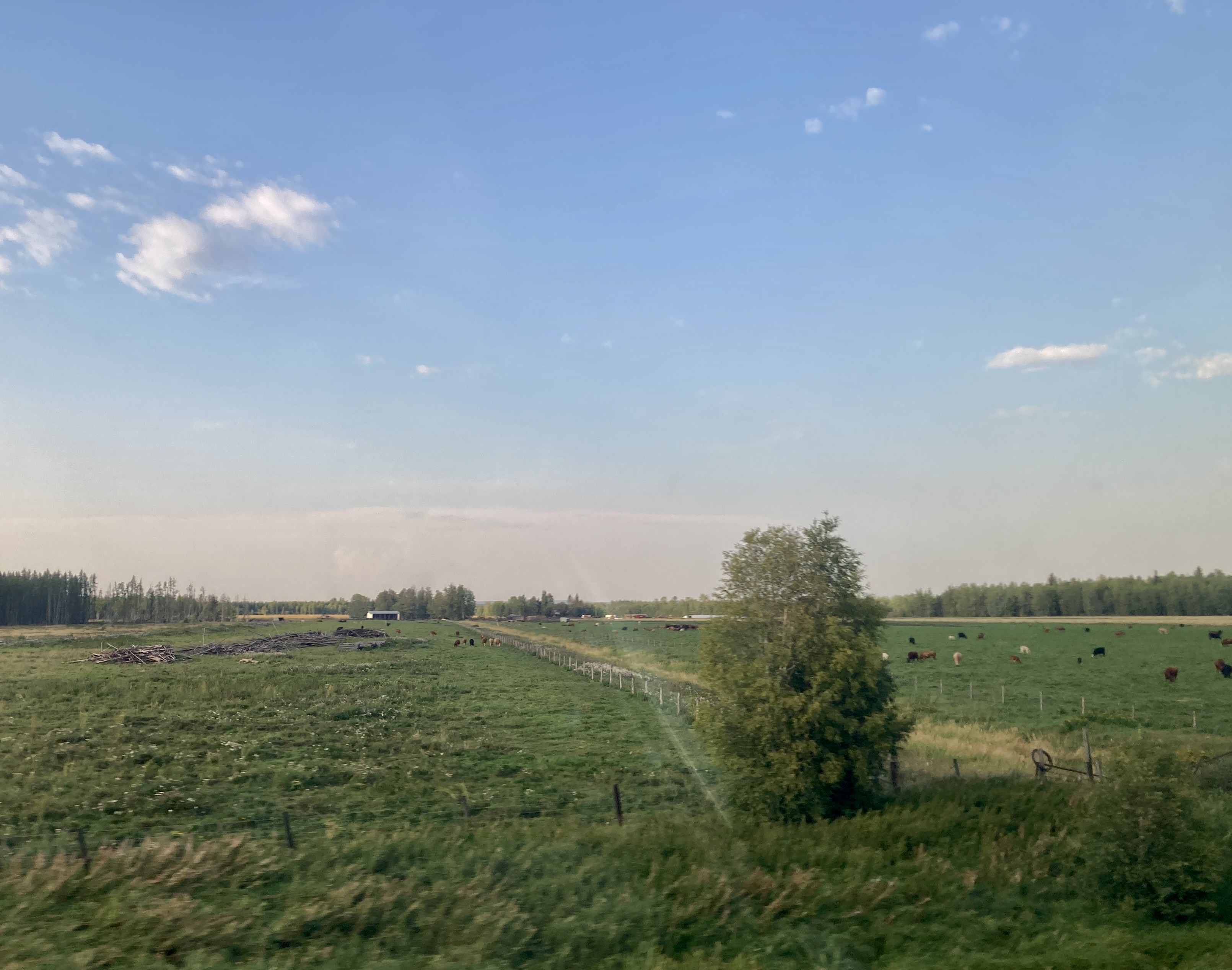
Cattle!

And wheat! And nodding donkeys!

That is, the pump jacks that bring crude oil to the surface, whose rhythmic up-and-down inspired the nickname. You see them tucked into all kinds of locations. (I remember, when new to the west, being stunned to see some within the grounds of the Calgary airport — well away from runways, you understand.)

Sunset from the dome car, nearing Stony Plain…

and deep night by the time we pull into Edmonton.

Which is all I know about 30 August.

31 August – When I awake, we’re just leaving Saskatoon. (On to that second map, ‘way up above.)

Again, the changing land.

And, oh, the big sky.

Alberta carries on about being big-sky country but, old Alberta girl that I am, I have to confess that for me that sky is at its most glorious across the prairies. (The prairie landscape, period, is glorious. I had forgotten its beauty.)

Right. Back to the sky.

Straight up through the dome…

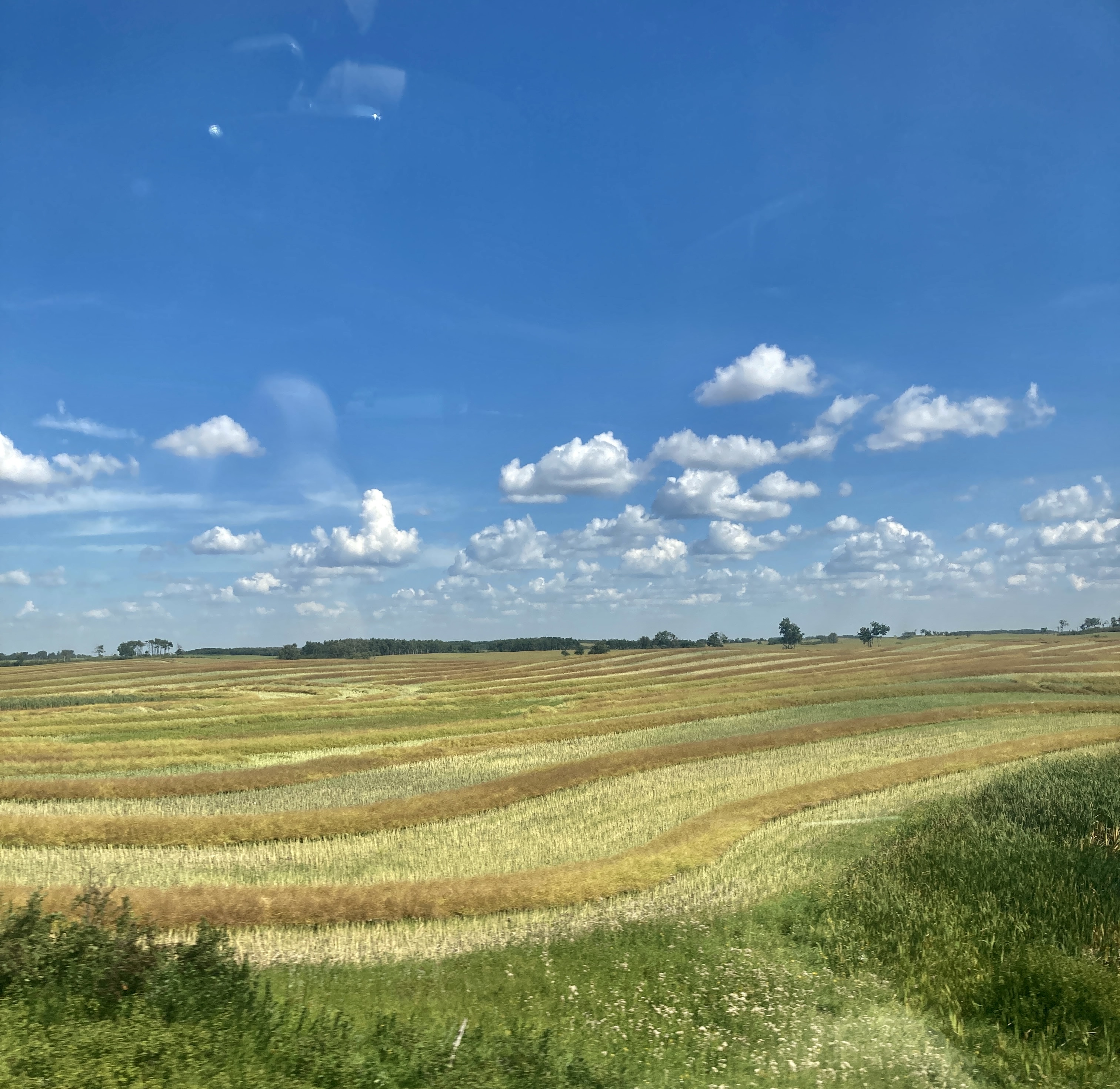
over harvested fields, near Kelliher…

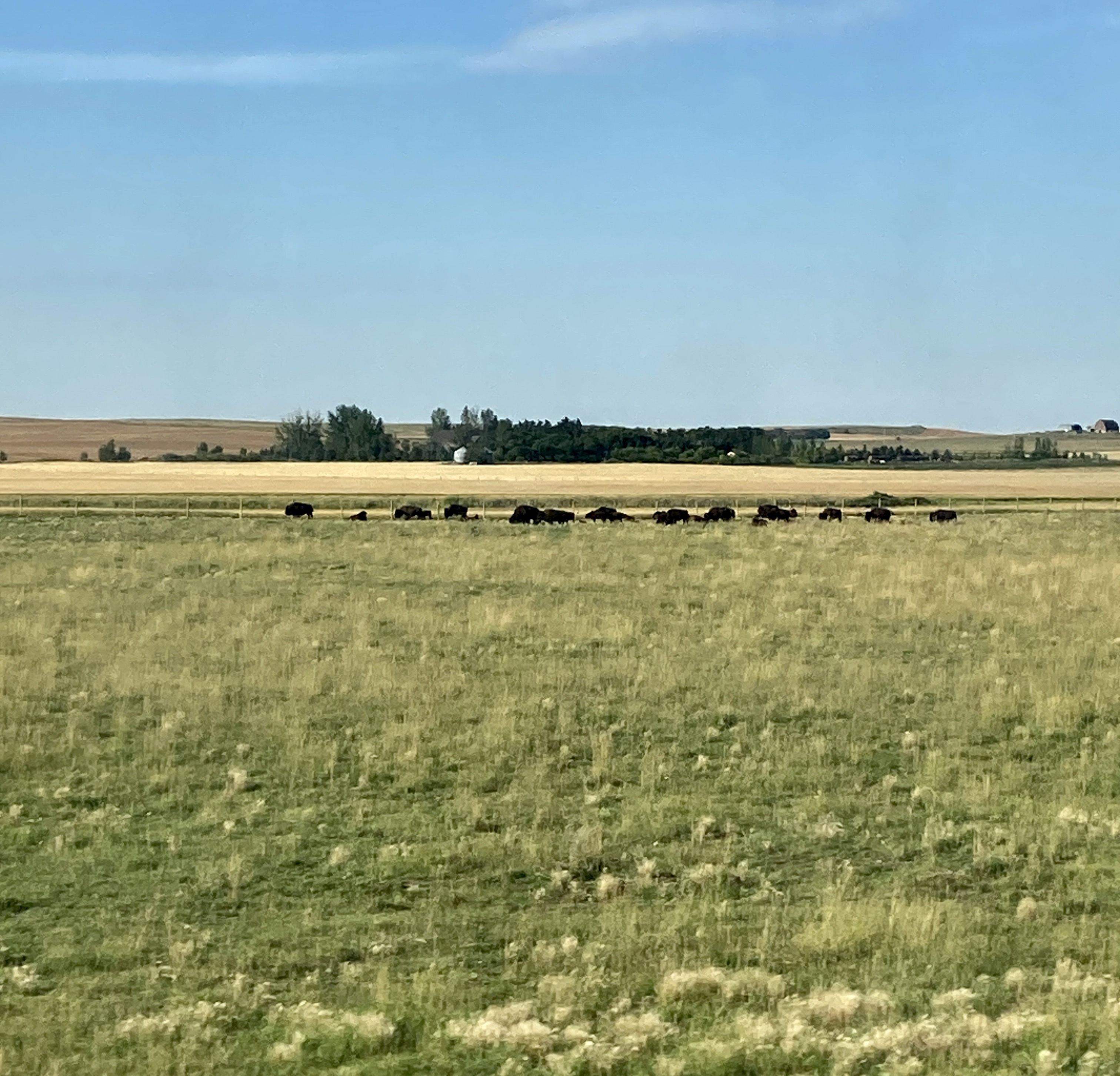
over a bison ranch, near St-Denis…

over the Young (near Watrous) grain elevator (possibly superseded by now, but its architecture iconic and worth our attention)…

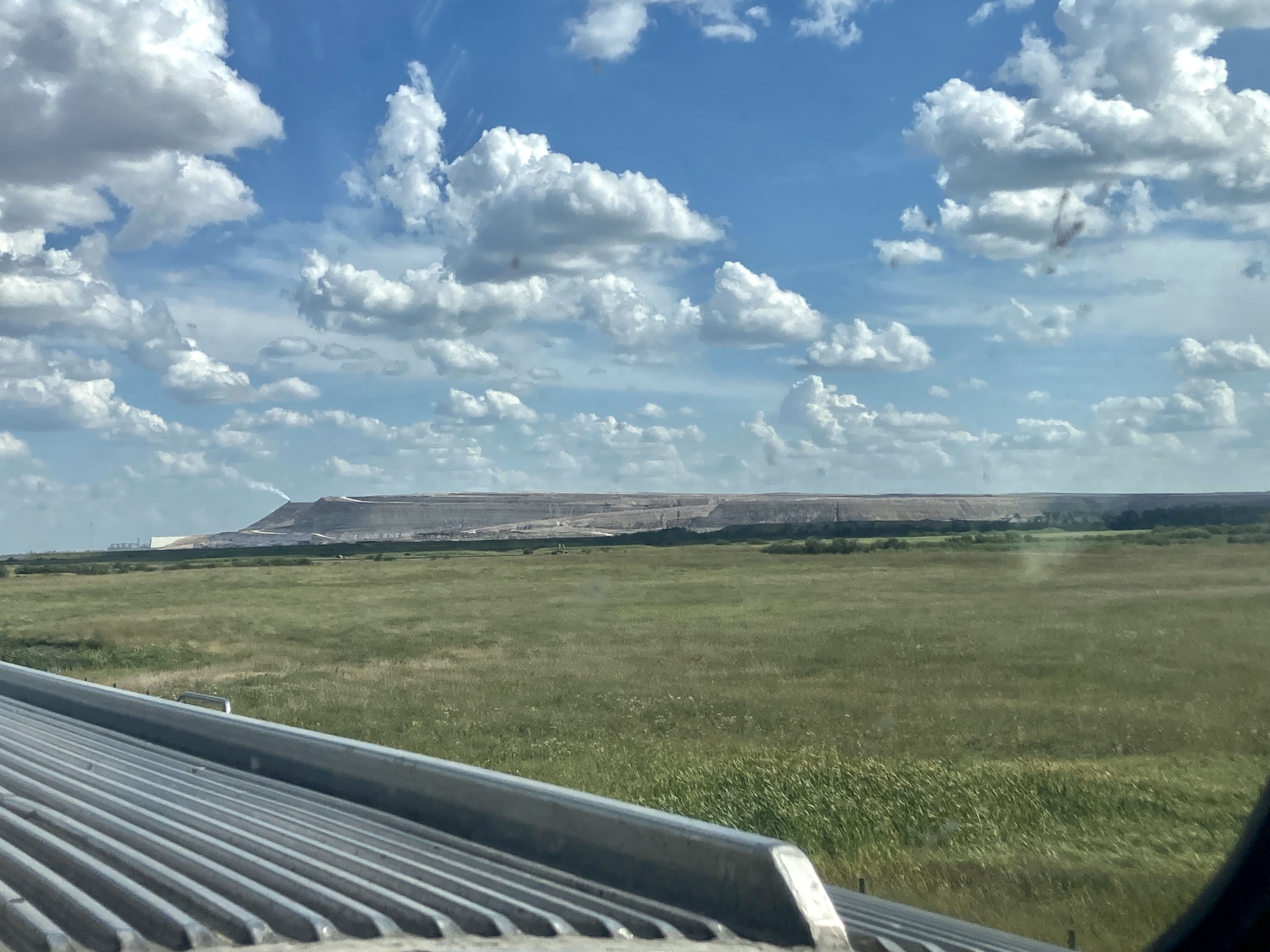
even over a potash mine (this one near Yarbo).

Herewith a nerdy aside about potash. Canada is the world’s largest producer and exporter of potash (some 33% of total world production), and all 11 of our active mines are in Saskatchewan. Yes, there is a lot more to this province than wheat.

And that’s all I can show you for 31 August.

I feel mildly, but only mildly, apologetic. I also spend time talking to people, and eating (very well), and just looking, endlessly looking, out across the land. In fact, maybe I should own up to reverse pride in the fact that, for long stretches of time, I put down the damn camera and just fall into the land.

There is one more fact of note: somewhat after 9 pm Central Time, we pull into Winnipeg, and I get off the train.

For a changing-gears day and a half in Winnipeg. Before the next leg of the train trip.

Land Cruise

29 August 2025 – Here’s the tease:

Oh yes, all of that. In stages, with add-ons.

You’ll see!

(But not immediately.)

Toes to the Waves

26 August 2025 – I’m not usually right smack at water’s edge. But today, I am offered easy access to wild shoreline — just one of the Tatlow/Volunteer Parks enhancements, along with “daylighting” a long-buried creek. Who could resist?

First I walk down these steps…

where, second, I draw inspiration from that lone woman in white, ‘way out in front of me.

I give thanks for my hiking poles and waterproof boots, and follow her example.

Now. Statement of principle. I firmly believe that each place has its own beauty. You just have to be willing to stop making comparisons, open your eyes and mind to what is right in front of you, and rejoice in it. BC is no more beautiful than anywhere else.

But today I happen to be here, not anywhere else. I am in the Vancouver neighbourhood of Point Grey, on the south shore of Burrard Inlet, looking north across English Bay (with its usual complement of freighters) to the slopes of West Vancouver over there on the North Shore.

And it is just terrific! Bright, fresh, with enough breeze to ease the heat and send wave upon wave rolling in to tap my toes.

I look west…

and then blink, and look more closely, tracking my gaze past that final arrow of gravel to a black squiggle in the water beyond. (Spread the image; follow my example.) See? A Great Blue Heron. For once, life is easy. He just opens his beak in each breaking wave, and swallows what it offers him.

I look east…

and this time my gaze takes in the green sweep of Stanley Park, the final knob of the City of Vancouver this side of the North Shore, and, to its right, the towers of the City’s downtown cluster. I’ll be walking east, from here to Kitsilano Beach Park.

So many shades, so many textures…

and the swooping arc of an eagle, passing by.

I break my water’s-edge fixation long enough to veer inland for a bit, drawn by the red fence, its signage thanking us for our patience, and the weathered-jeans-and-T-shirt guy on the inside of the fence, who meets my smiling curiosity with a smile of his own.

He looks like a navvy, he’s inside the fence, I ask if he’s working on the project. He replies, with no particular inflection, that it’s his project, he’s the homeowner — and points upwards, to the house atop the cliff. Being vaguely aware of real estate prices around here, I realize that these workman’s jeans and hands are attached to serious money.

I ask the basic “What are you doing?” and, seeing I’m genuinely interested, he explains. It’s all about the instability of these Point Grey cliffs, their unconsolidated Quadra Sands laid down during the Fraser Glaciation (29,000 to 11,500 years ago) and eroding ever since.

This bit of surface remediation is just the current example of his on-going battle — financed by him, but every step City-approved and with City authorities — to protect the environment and in the process protect his home. An early step was to excavate on the land side of his property behind the cliff face, and stabilize the cliff, invisibly, with I-forget-how-many-zillion tons of concrete. More recently, again with City approval and monitoring, he paid to have several mounds of large local rock arranged in natural patterns on this section of the beach, their job being to break up wave action and mitigate impact on the cliffs. “Last week,” he says, his eyes crinkling with delight, “a Fisheries inspector told me that two different species of mussel are now colonizing the rocks!”

I express my admiration with a tease: “You could’ve taken your great gobs of money and lived large in all the casinos of Europe. Instead… what do you do? You bury your money, literally, in the ground.” He grins, then shrugs a kind of “Yeah-but” shrug. “You have to do what you can. To help. This is what I can do.”

I walk back down to the water impressed, a happy day made even happier.

Bands of colour, look at them: all the greys of the gravel at my feet, green seaweed just beyond, butterscotch sand beyond that, then blue water, white curls of wave, red among those distant freighters…

and, closer to shore here on the right, red also in the Kitsilano Yacht Club dinghies (or whatever they are) — a whole line of them, each full of kiddies being taught boating skills, whose excited voices carry on the wind.

A mysterious imprint in a rock, surely that can’t be natural?

and a blaze of colours, certainly not natural but also not mysterious, on the stones that line the entrance to a path up from the beach.

The stone wall is official; the colours, anonymous and unauthorized. I sidestep both the path and the bronzing bodies beneath it, and return to water’s edge.

But eventually, though water’s edge continues, there’s no longer any way to follow it.

I’ve reached the Kitsilano Yacht Club, just this side of Kitsilano Beach Park. My choice now is to swim around, or scramble up.

Blue Shorts Guy is about to scramble up his section of rock mound; I then scramble up mine. (Less elegantly than BSG, who does it all upright. My scramble involves hands and knees. But it works!)

Suddenly, I’m back in the urban world.

With its fences and notices and CCTV. It is discombobulating.

So much so that, as I walk south on Arbutus Street, this notice tacked to an old wooden pole seems no stranger than anything else.

I too am waiting for coffee — but, unlike Z, the remedy is in my own hands.

Just as soon as the bus drops me back home.

Discoveries

22 August 2025 – I mean to walk right through Dude Chilling Park, en route farther east. Instead, I stop to admire a brand-new hopscotch chalked into the park’s northern pathway.

Squares a bit on the mingy side, true, but lots of them. And so carefully executed. With European cross-strokes for the 1s and 7s. And the flourish of two colours, not one.

Instead of walking on, I settle myself on the bench just beyond…

curious to see if anyone yields to the temptation, and starts to hop.

First up, a very young toddler and her mum. The child is clearly new to the act of walking, let alone leaping around. She does not attempt to hop. She stops, frowns slightly at this unknown design, and then, intuitively, gets the idea.

Very slowly, very carefully, she obeys the visual clues: just one foot here, but both feet there. And then one, and then two… Until she loses patience, that is, and a laughing mother carries her off.

Next up, by complete contrast, a geezer. (Being one myself, I can say that.) He also stops, contemplates. Then, with a grin, he tucks his cane under one arm and starts to hop.

Hippity-hop! And again!

Until… whoops. A wobble corrected, a tumble averted, and his cane is prudently back in use.

He grins at me, amused. “Maybe I’m a little old for this.”

My mind flashes to a particular cartoon in Searle’s Cats (Ronald Searle, Dobson Books Ltd., 1967)…

and its caption: “Acrobatic cat discovering quite unexpectedly that it is too old for the game.”

I grin right back at him.

We are complicit, he and I — fellow adventurers in this demanding but rewarding late stage of life.

That Smile

18 August 2025 – I’m just off a False Creek ferry and walking uphill toward home, still full of Flat White and café chatter with a good friend, when I stop to admire another good friend. (Albeit in a different category of friendship: painted, not human.)

There she is, high a-top her alley home, her quizzical smile floating out across the neighbourhood.

Is she our Mona Lisa, 21st-c. alley-girl version?

No. Given the pace of local redevelopment, and the building that is her home, she is our Cheshire Cat. Soon she will be gone, with only her smile lingering behind, and only in memory.

I”m standing at 3rd Avenue & Ontario Street, the intersection at the north-east corner of that L-shaped site, outlined in red. This is the huge redevelopment site purchased by the PCI Group in 2021, whose redevelopment proposal finally received City approval in May of this year. Cheshire Cat Smile is mid-way down lot 5, on the south side of the alley.

I head down the alley. Not for the first time, but it’s different every time, isn’t it? (No need to repeat the Heraclitus discussion…)

Crow in a convex mirror! I’ve never noticed him before, so already the alley is different.

The actual crow, opposite…

which causes me, for the first time, to pay attention to the mural as a whole — signed R. Tetrault and, as I later learn, called Flight Path.

Murals both side of an alley and a whole line-up of hydro H-frame poles in between! Sigh. Life is perfect.

I tip my head, pay homage to the Cheshire Cat Smile…

knowing it’s tagged Lil Top but also knowing I’ve never been able to find any info about that tag. So Cheshire Cat she has become.

The woman I’d noticed under the nearest H-frame, as I photographed Flight Path, is now standing next to me, also enjoying the art.

“It’s people expressing themselves,” she says. “And we get to look at it for free! It makes us happy.”

She points: “Like that flower, that butterfly.”

I point to the message next to it, which sets us both laughing.

And then we go our separate ways, each dawdling where we each prefer to dawdle, walking the line of Ciele Beau murals opposite Flight Path.

I pause at a doorway, its notice as outdated as the reminder to “call your mum.”

Nobody, employee or otherwise, will be entering by this door ever again, I tell myself. Or by any other door, on this doomed brick building.

Ghosts of Eras Past to the north of me as well — torn fencing frames the Cosmic Breeze mural on 3rd Avenue, painted by Olivia di Liberto for the 2019 Vancouver Mural Festival. RIP, VMF.

I leave the alley, turn the corner onto W 4th. I’m now looking at the block-long southern length of the site, Ontario to Manitoba. All boarded up, waiting for What Happens Next.

This artist’s rendering shows What Will Happen Next.

“Innovative industrial and commercial uses,” says the corporate website, “heritage retention and refurbishment, office, daycare and ground-floor food and beverage… centred around a new public plaza.”

Now that I’m home, and learning all this… I have to do a little rethinking, don’t I? And so do you.

Employees will once again go in and out of doors in the corner brick building, which is not doomed after all. And Flight Path may fly again. On his website, Tetrault explains he painted it “on plywood for removal and reinstallation on a new commercial development.”

But, ohhhh… Cheshire Cat will be gone.

Her Smile will have to float in our memories.

Atmospheric River

15 August 2025 – Here we sit, In mid-River.

There’s the Very Big Picture, literally picture, of the River streaming across western North America…

and the Local Big Picture, with its Rainfall Warning & stats…

and its 6-day forecast.

But there’s also the Local Small Picture.

It consists of the literal pictures right here on your balcony, the ones that translate stats & science into nature’s own response, in your personal here-and now.

The horizontal/vertical interplay between your gleaming balcony deck and the appearance of that deck though your rain-splattered glass door…

and the vertical-beyond-vertical of the mist-shrouded city block immediately north of your balcony, further blurred by your glass balcony wall.

There is also — as you step into the rain, to explore — the Balcony Small Picture.

Literally at your feet.

Your Autumn Fern, side view, each frond hung with droplets…

that same Autumn Fern, top view, every shade now moisture-rich…

and the neighbouring Heuchera, always its showy best when droplets glitter on those big fat leaves.

There’s even the Red-winged blackbird and the Dragonfly.

Eastern transplants like yourself, they are forever resident on the vintage garden screen that first looked out across the Bay of Quinte to Prince Edward County in south-eastern Ontario, and now stands guard over East Vancouver, looking north across Burrard Inlet to the mountains.

Fronds arch; droplets gleam; clouds explore the shifting dimensions of grey.

And bird/dragonfly/bullrushes — though made of metal — oh yes, they also dance the rhythms of this great River.

  • WALKING… & SEEING

    "Traveller, there is no path. Paths are made by walking" -- Antonio Machado (1875-1939)

    "The voyage of discovery is not in seeking new landscapes, but in having new eyes" -- Marcel Proust (1871-1922)

    "A city is a language, a repository of possibilities, and walking is the act of speaking that language, of selecting from those possibilities" -- Rebecca Solnit, "Wanderlust: A History of Walking"

  • Recent Posts

  • Walk, Talk, Rock… B.C.-style

  • Post Categories

  • Archives

  • Blog Stats

    • 131,167 hits
  • Since 14 August 2014

    Flag Counter
  • Enter your email address to follow this blog and receive notifications of new posts by email.

    Join 2,051 other subscribers