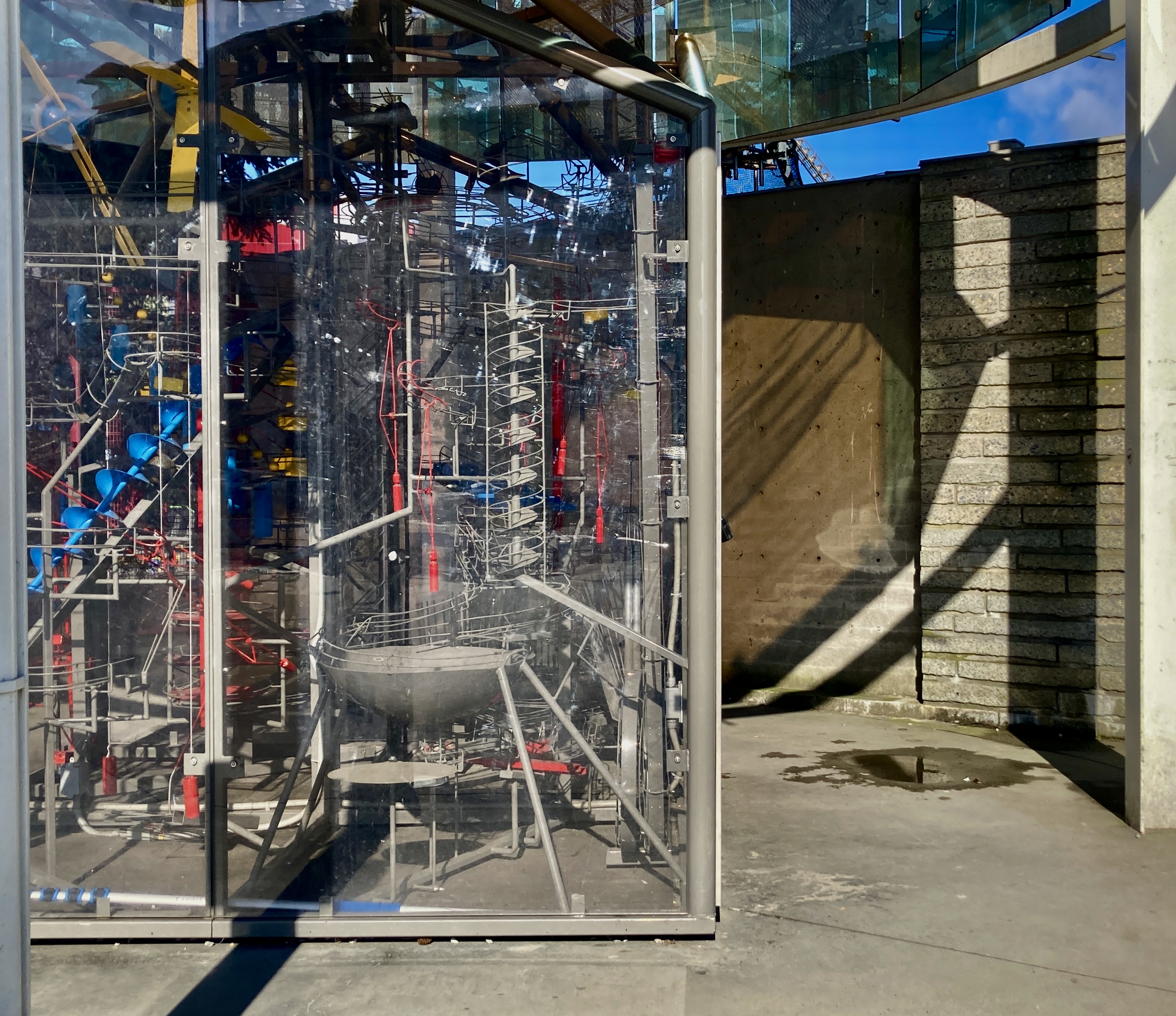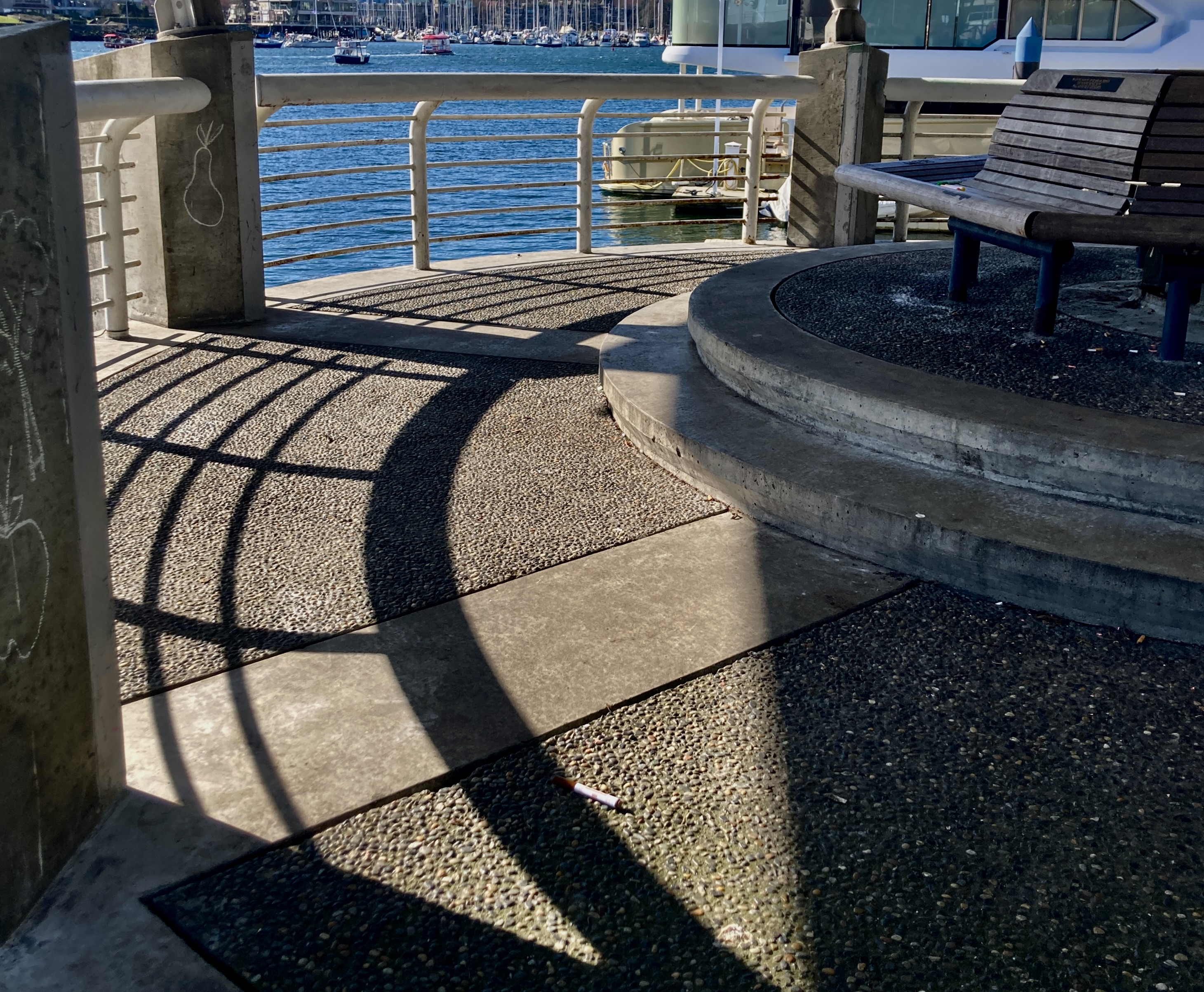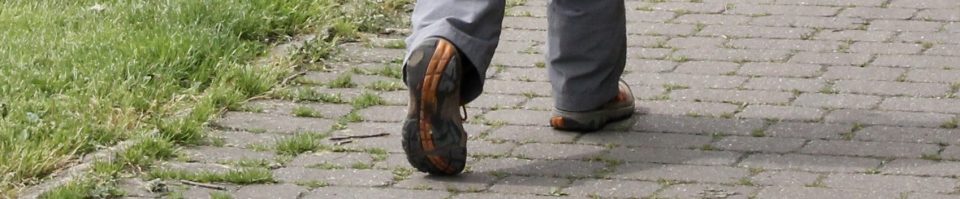
Forward! In Reverse

1 January 2026 – Well, it is forward, isn’t it, when the reverse of your usual choice offers a new way to look at things. It’s hardly a major life breakthrough, but it does qualify as a pleasing little experiment, and worthy of the first day of a new year.

My “little experiment” is to walk the Burrard Inlet Seawall east-to-west between Waterfront Station and Stanley Park, instead of west-to-east. I know: small stuff indeed. But the fog is burning off, and it isn’t raining, and the temperature is comfortably above zero. Good reasons to drop off a bus at Waterfront Station, and get myself down to the water by Canada Place.

Tourists and locals stroll; the sights present themselves for admiration:

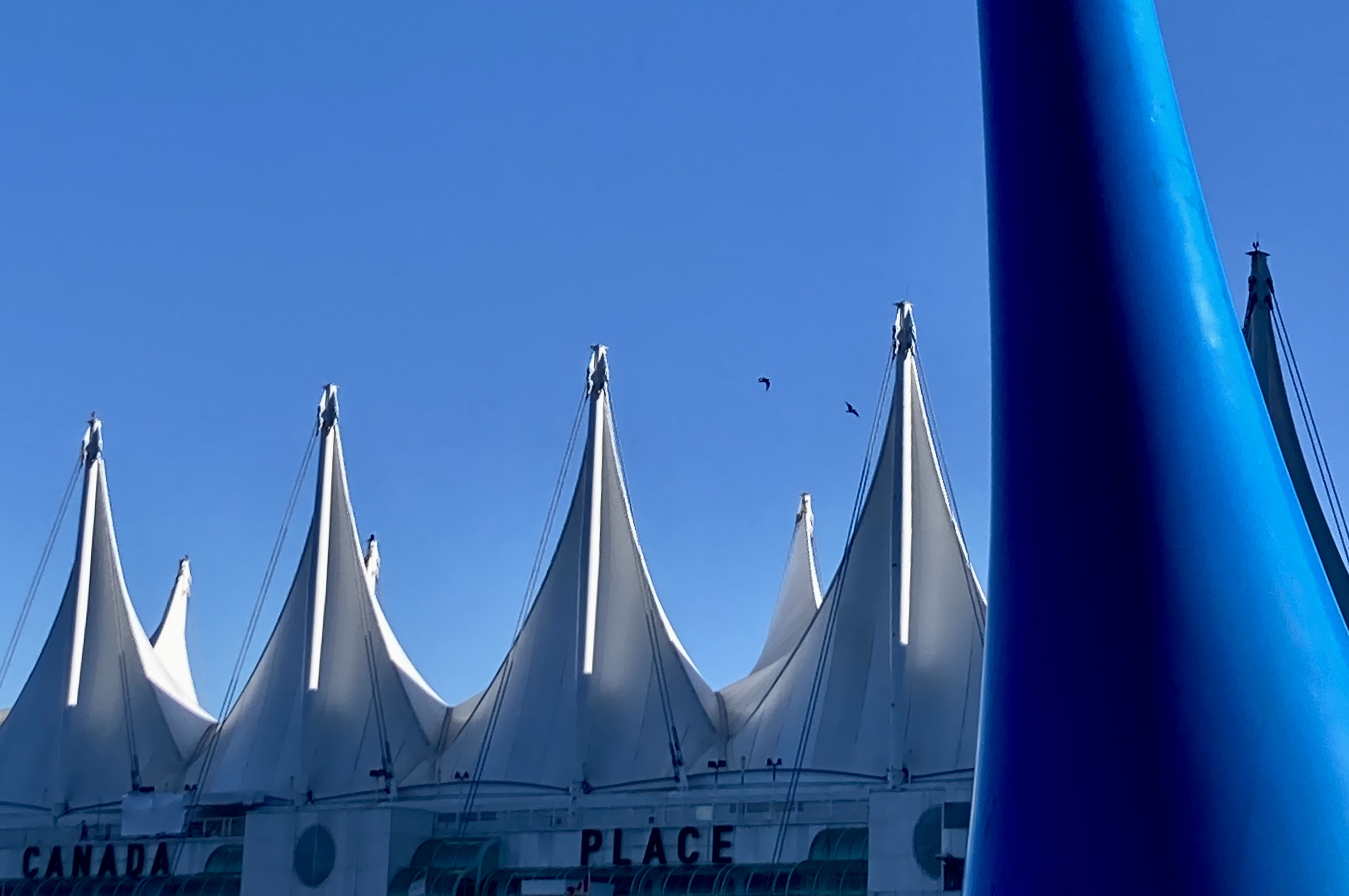
the fabric roof “sails” of Canada Place, the rental bicycles, a SeaBus completing its run from North Vancouver, a laden freighter and, of course, the orange cranes that tend to the freighters.

After that, my eye seems to focus more on slivers of scenes, not the whole panorama.

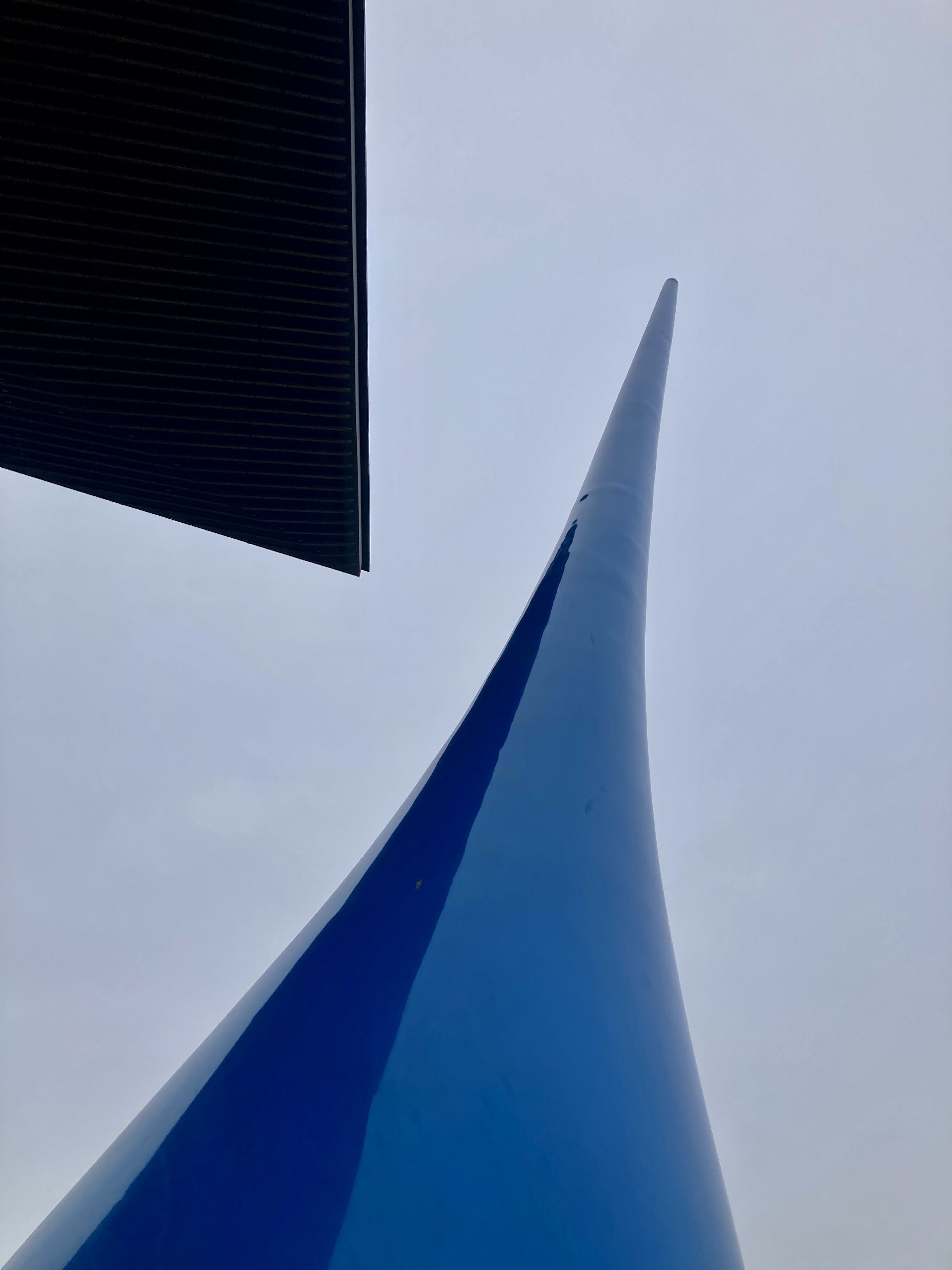
The tip of The Drop, the 2008 sculpture in Bon Voyage Plaza by the German four-artist collective Inges Idee that honours our temperate rainforest status with one elegant raindrop…

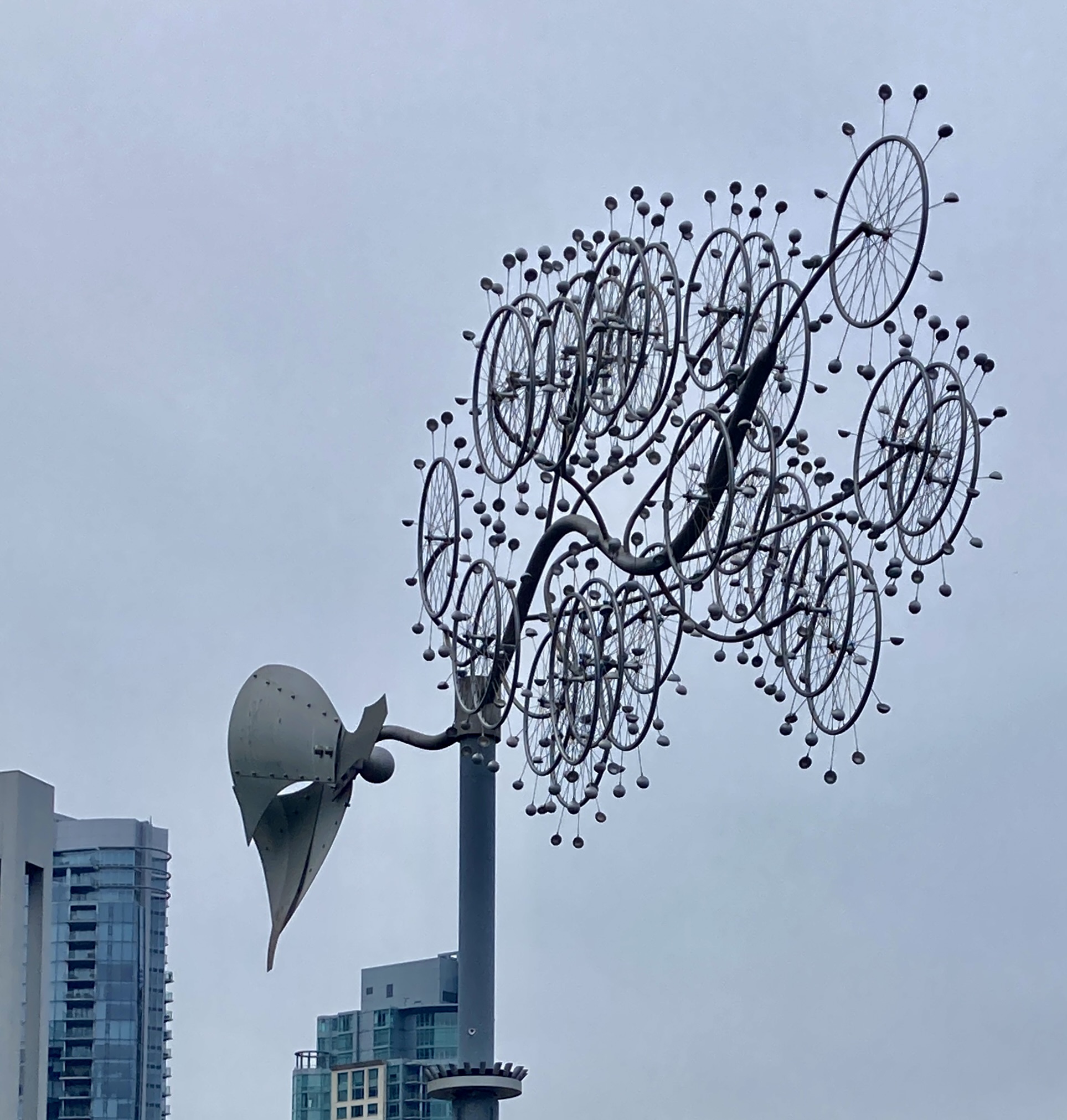
Doug Taylor’s kinetic weathervane Wind Wheel Mobile just west of the Convention Centre, which, from this angle, resembles a bobbing duck more than a weathervane…

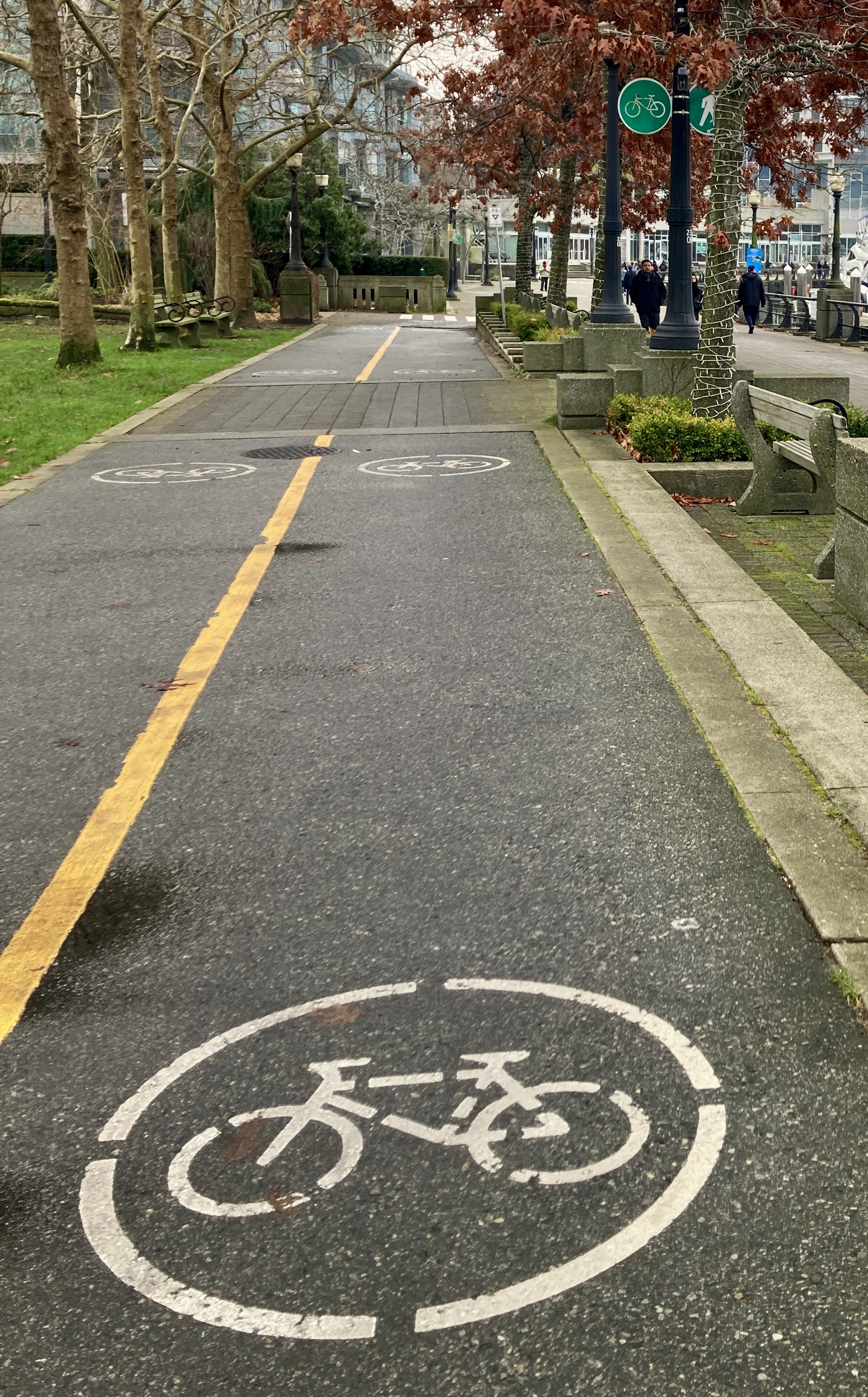
Seawall bike lanes bordering the west side of Harbour Green Park, under a russet canopy of (I think!) winter beech leaves…

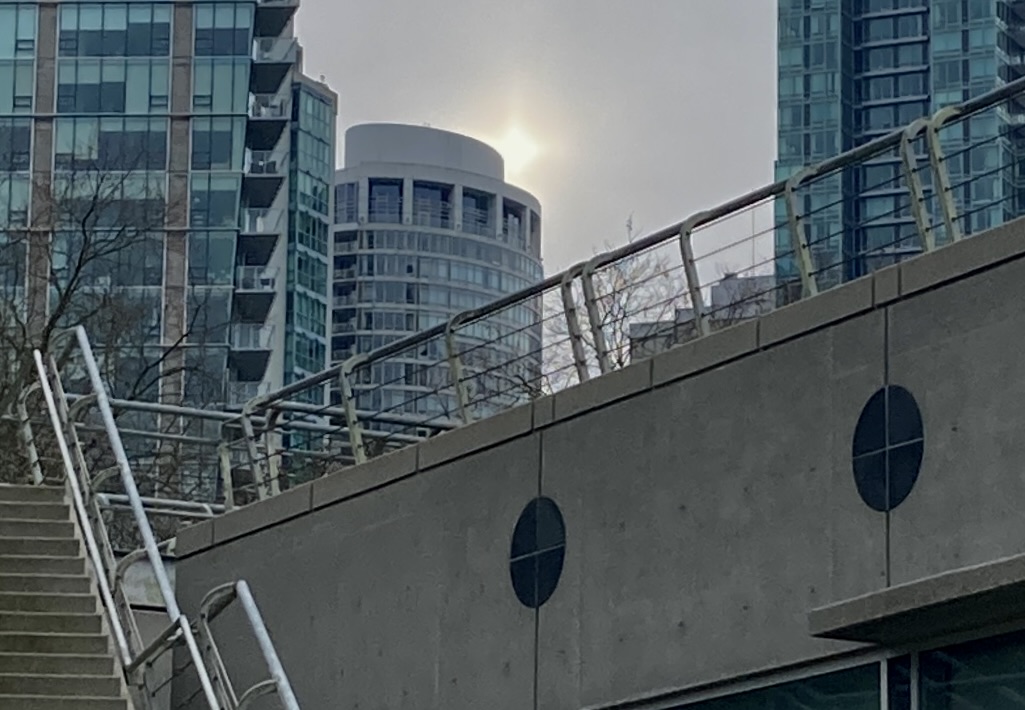
and the merest ghost of the sun, glimmering through the fog between buildings at the top of a Coal Harbour Park staircase.

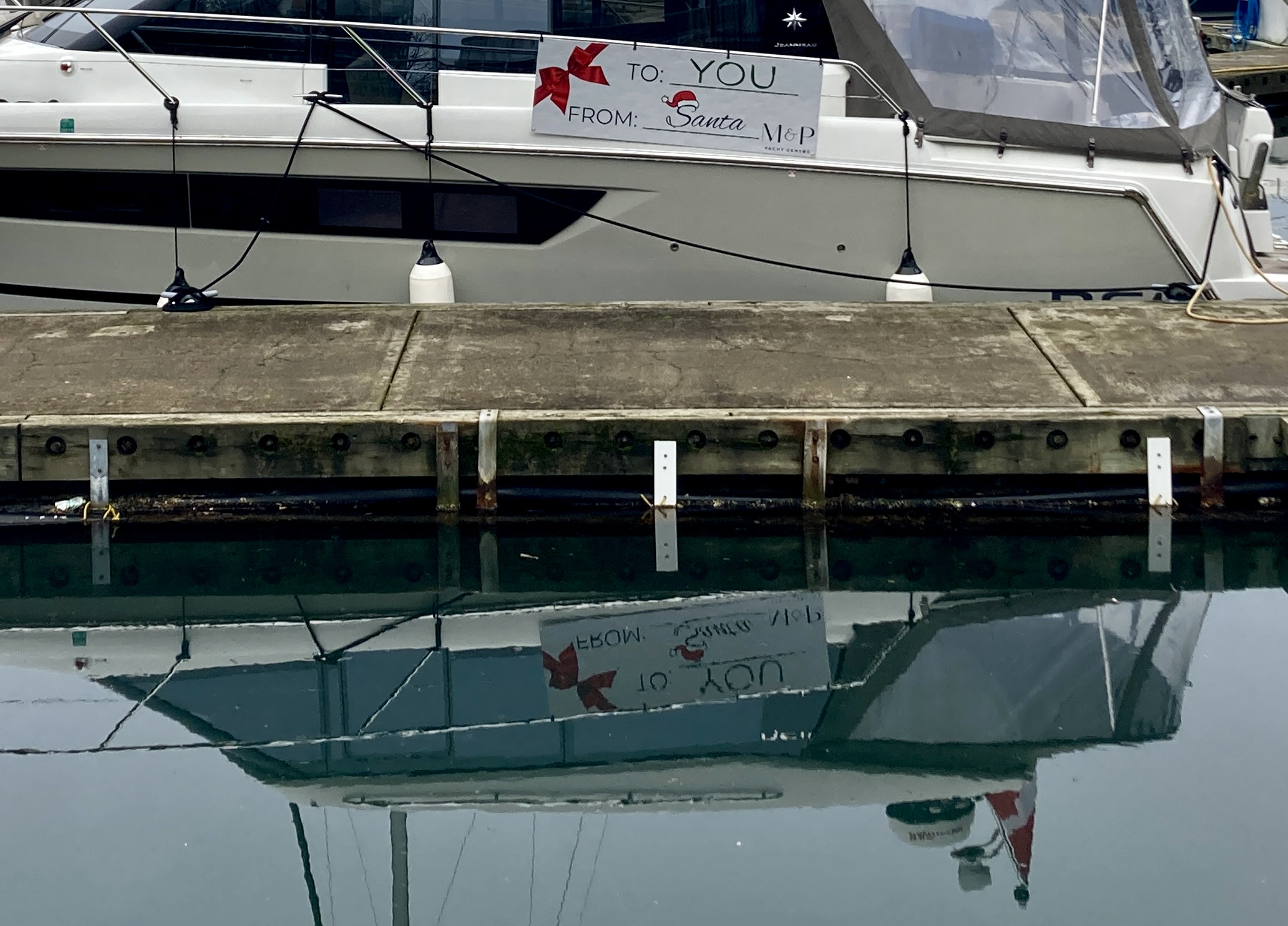
I spend a moment with Santa’s floating gift “To YOU” in the Coal Harbour marinas.

Really a lavish Christmas present? Or, wait a minute, a clever-boots For Sale sign? The suspiciously generic label bears the M&P Yacht Centre logo, after all.

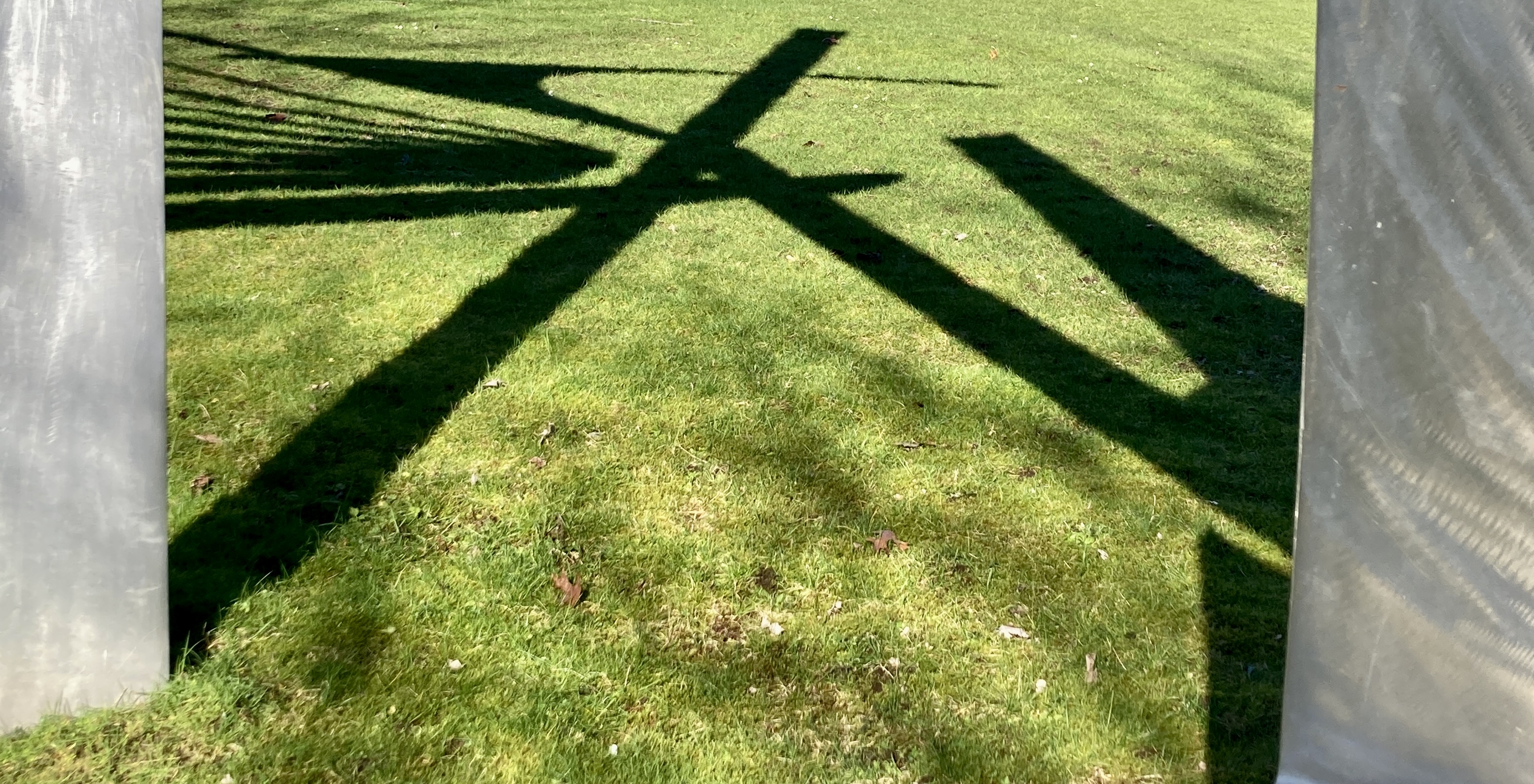
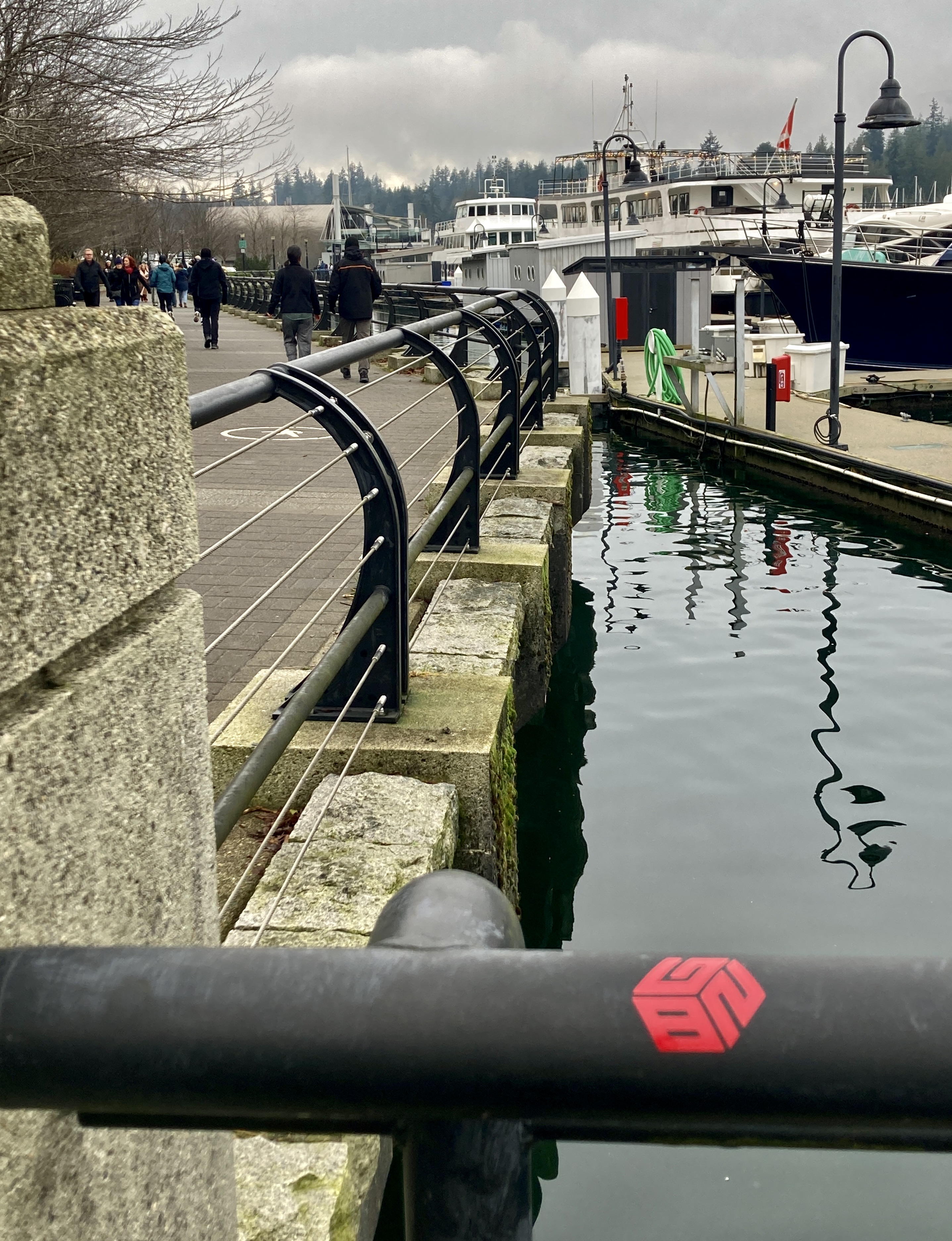
Far (west) end of the marinas, and I pause again, this time for something I feel no need to interpret.

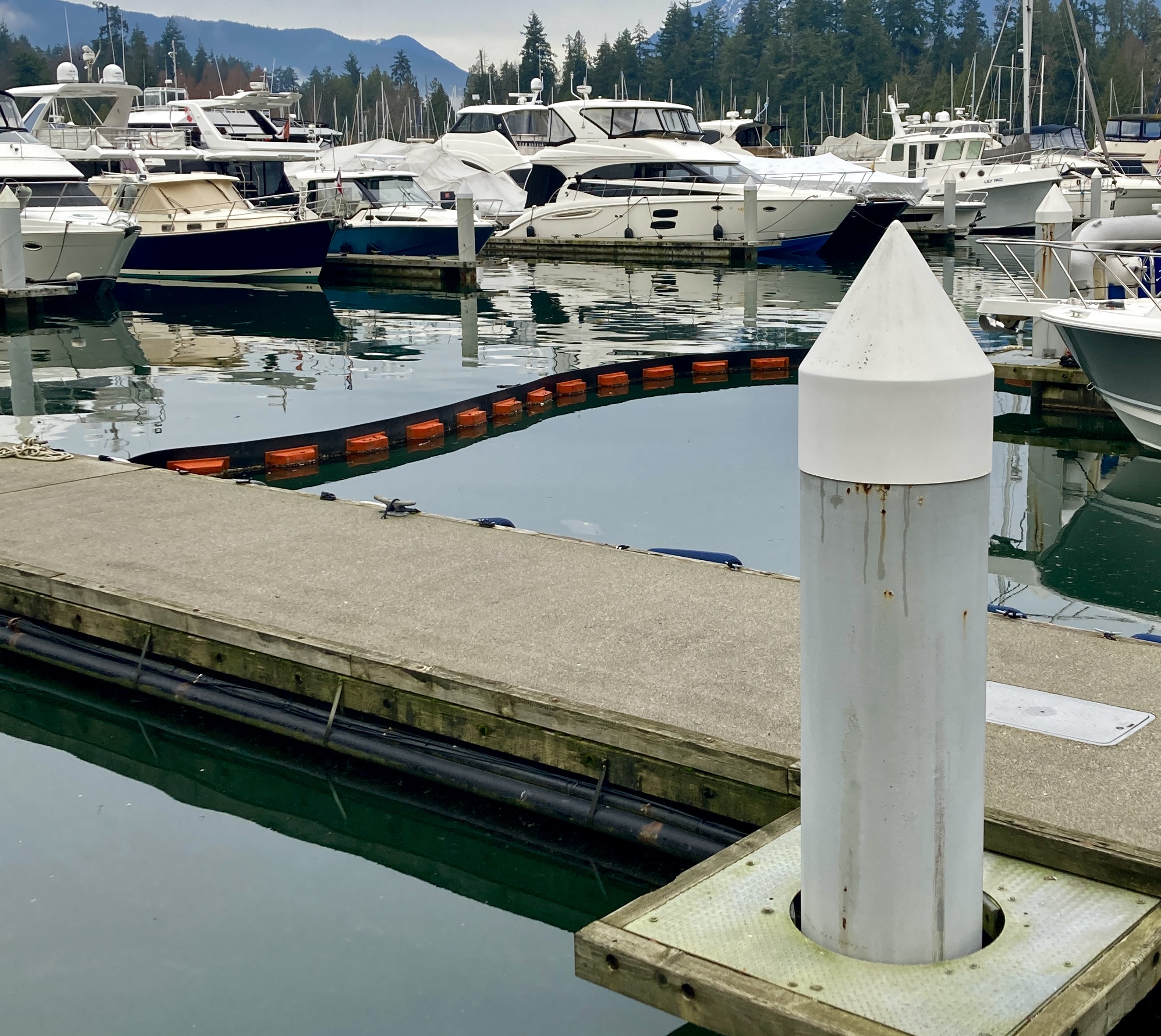
A red cube sticker + a vee of water. I just like it.

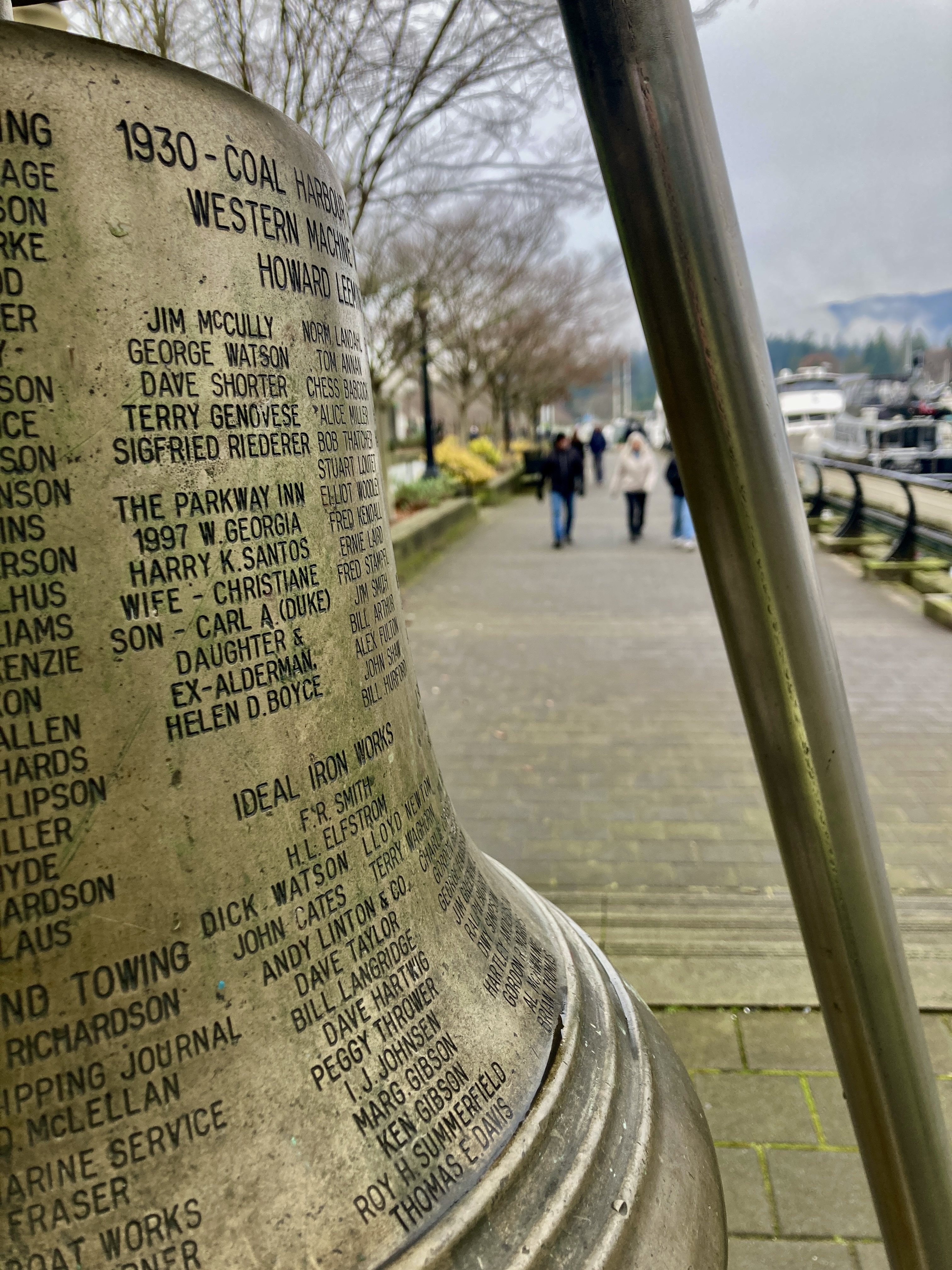
Then the brass curve of the Coal Harbour Fellowship Bell (commemorating the companies and people of the “self-contained industrial marine community” that, 1891-1979, populated this area)…

and then more red, and another curve. This time red bobbing in the water, not fixed above it, and in a sinuous horizontal arc, not vertical.

A bit more hoofing along, and, finally, I am here.

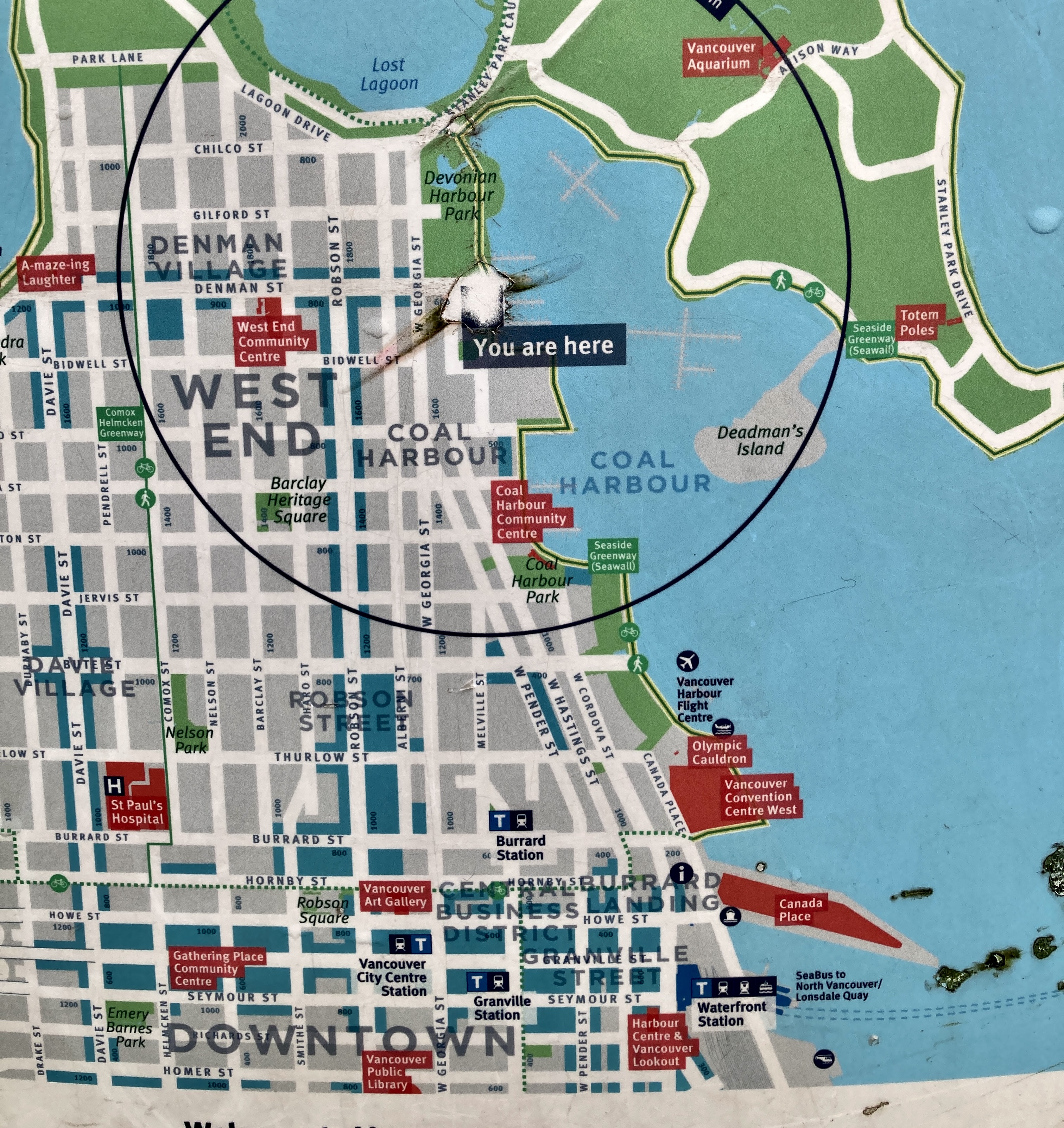
I am exactly where the map says I am: on the Seawall at the east end of Devonian Harbour Park, in turn a gateway to Stanley Park, and also the end of my route from Waterfront Station, down there in blue/white signage at the bottom of the map.

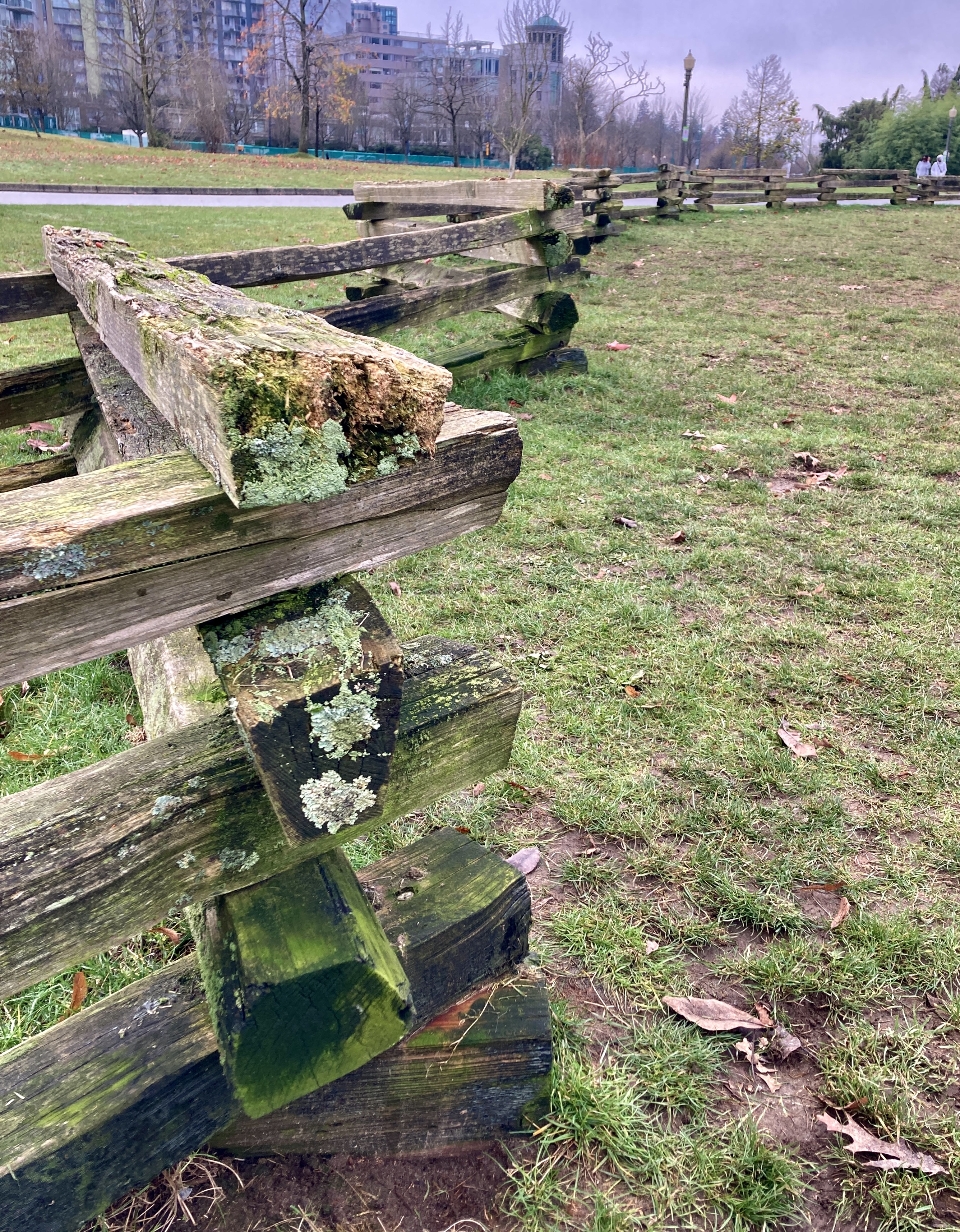
Time for me to follow the snake fence through the park…

pause to take group pictures for some happy tourists, then….

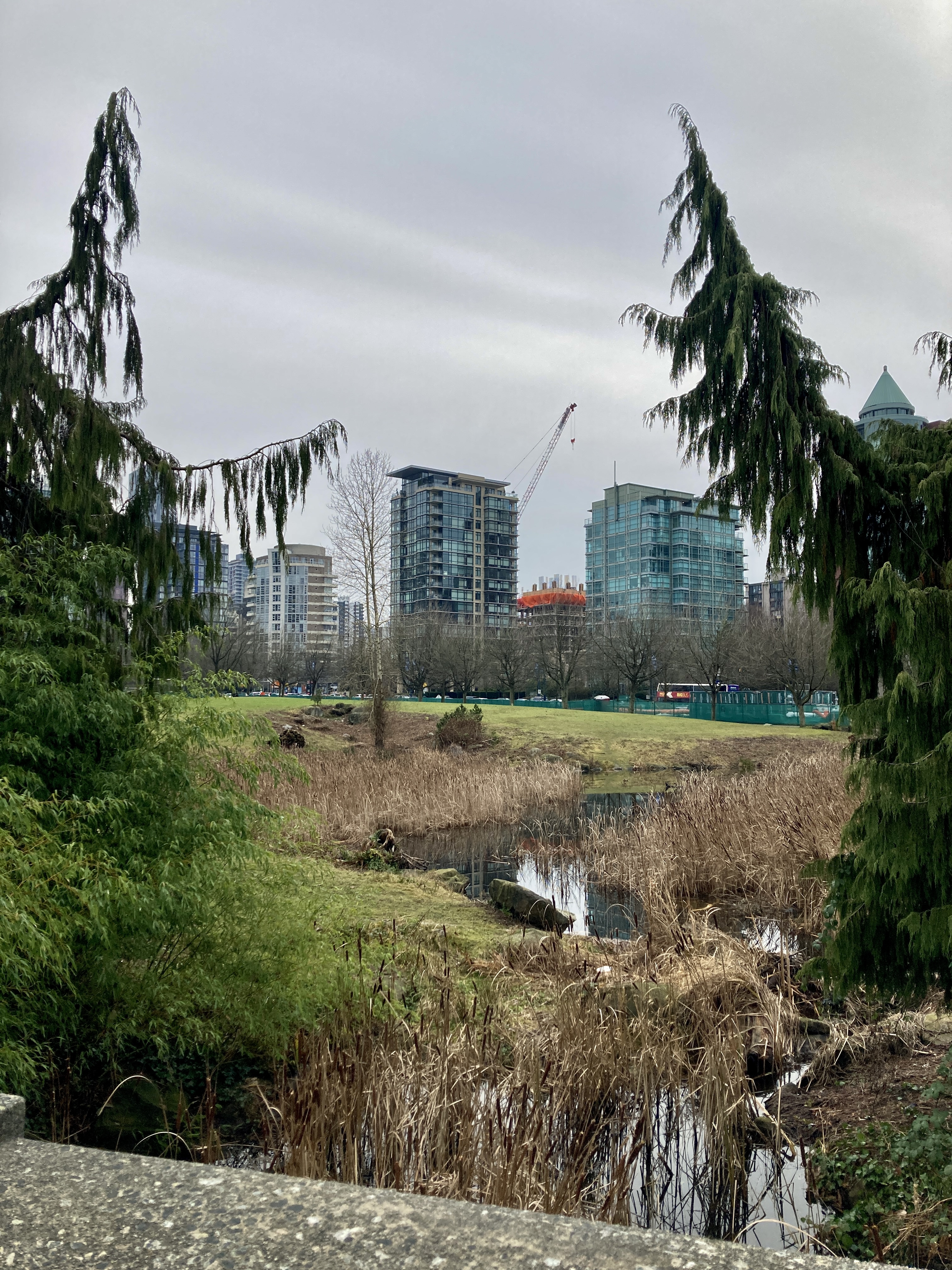
cross this little bridge, and angle up along the creek to those cranes and new-builds on West Georgia.

Where I hop on a trusty #19, and ride my way home.

(Happy New Year, everyone! I so appreciate your interest and generous good humour.)

Light Travel and Time Travel (and the Flick of a Cat Tail)

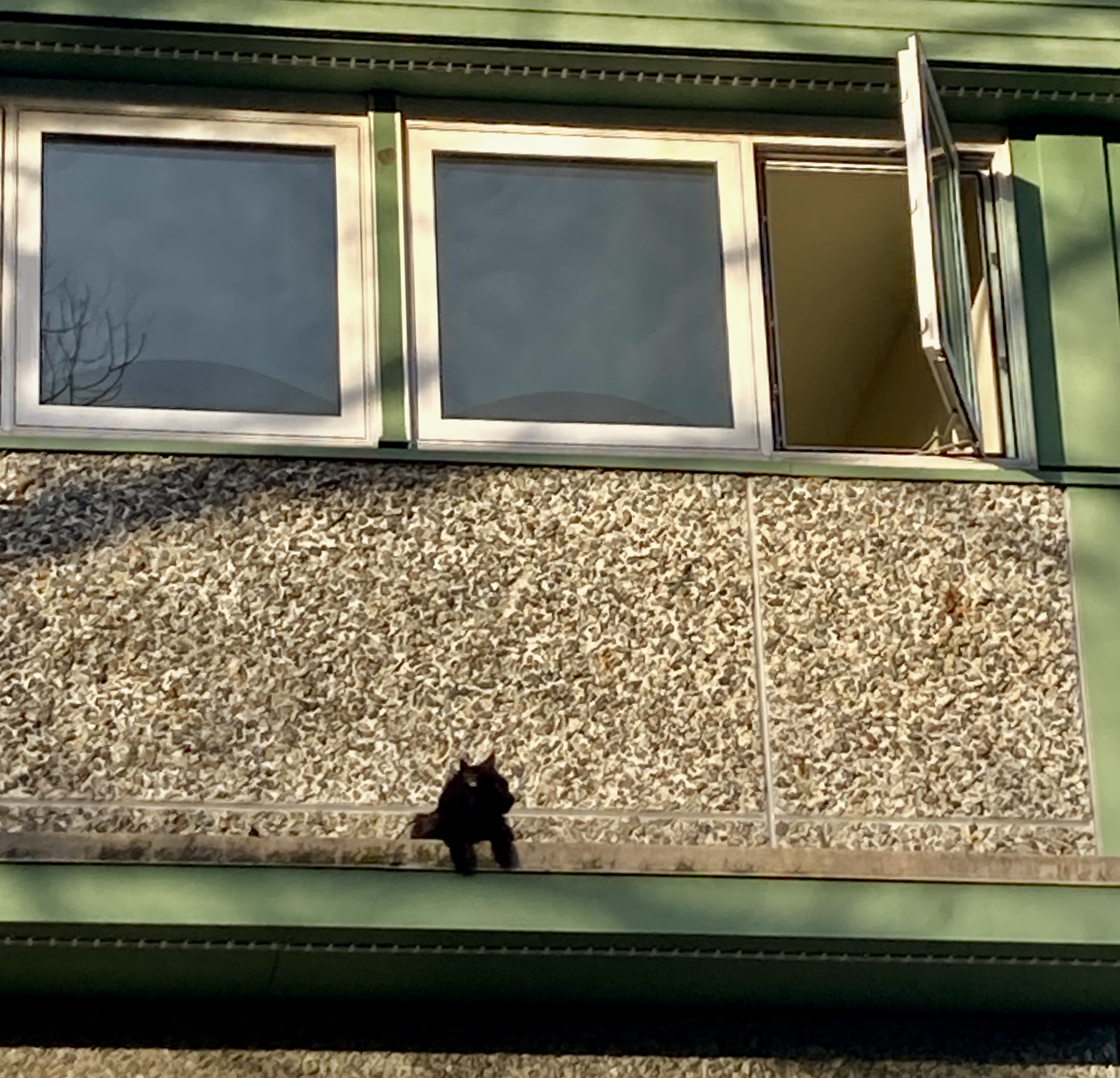
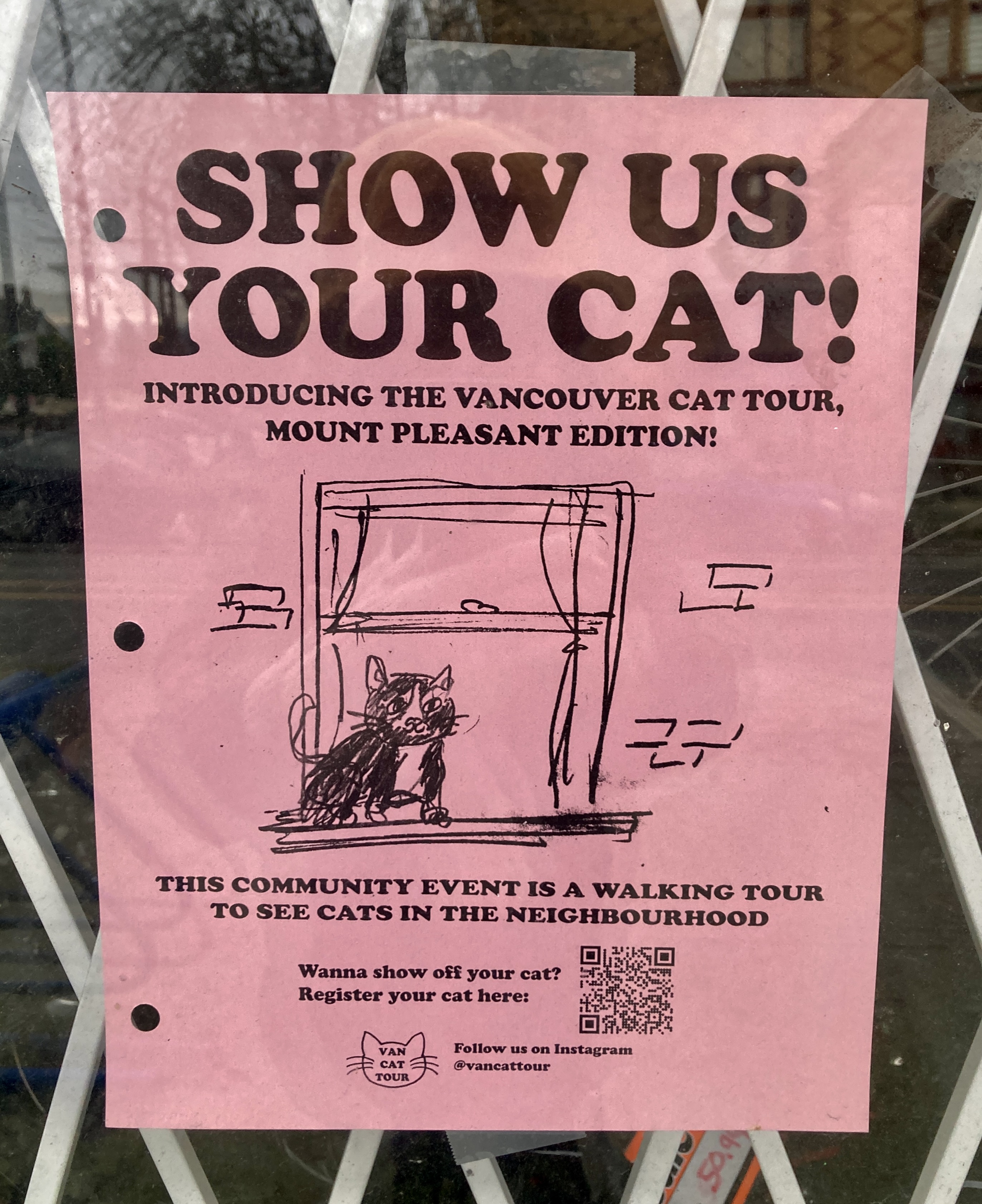
29 December 2025 – It starts with a cat, not that the feline has any connection with our reasons for being on East 6th and poised to head north on Quebec.

But who could resist? I promise myself I’ll pursue that code once I’m home.

Meanwhile, on we go. On down Quebec St. to the water. We are en route the Village dock, about to make a two-ferry trip all the way west to the Maritime Museum dock.

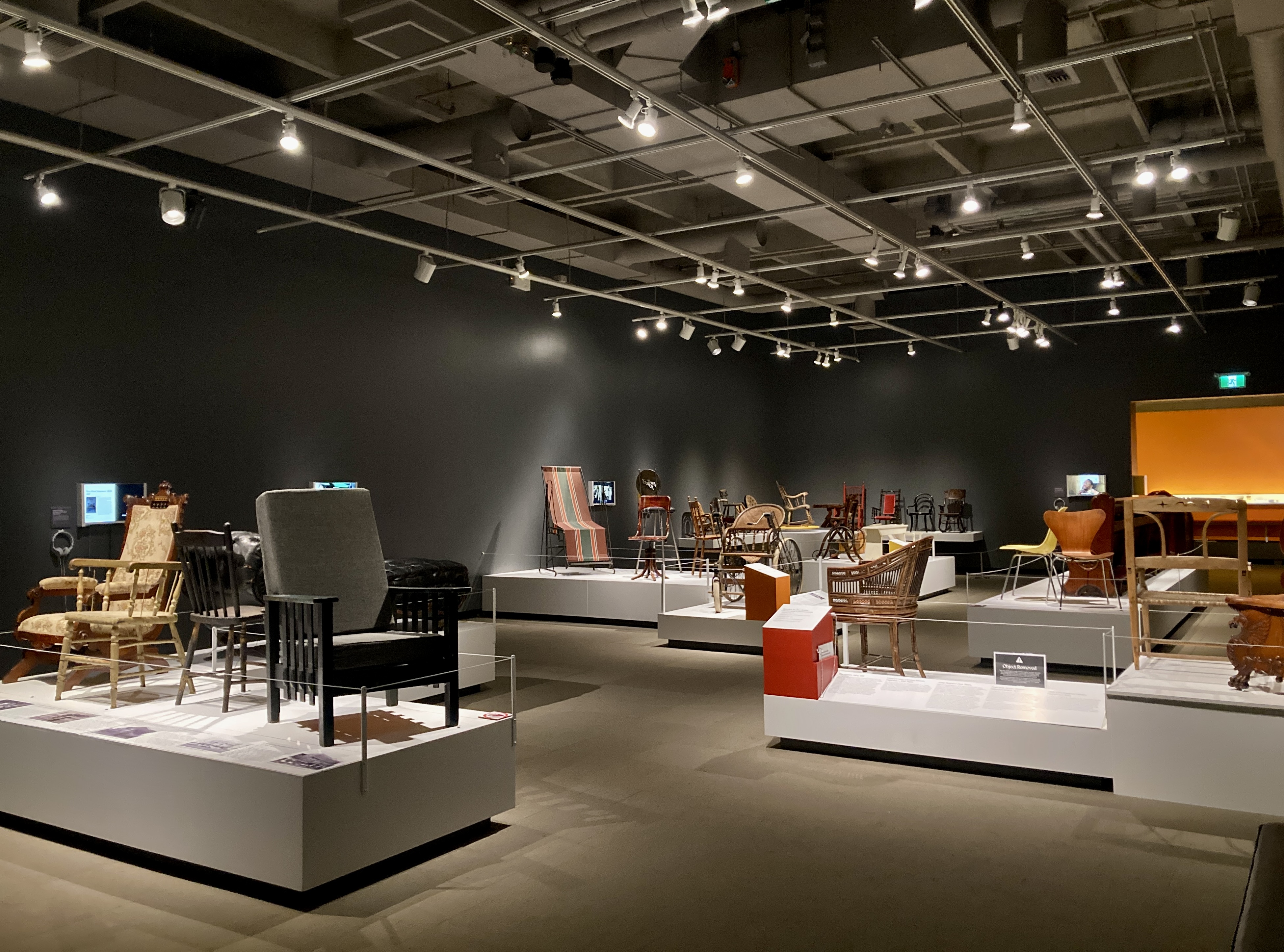
Our goal isn’t even the Maritime Museum. Ferries are just the most delightful way to get ourselves to the Museum of Vancouver, out there in Vanier Park, for their twin exhibitions about chairs: Deep-Seated Histories (old chairs in their collection) and Future Makers (new chairs by Kwantlen Polytech students).

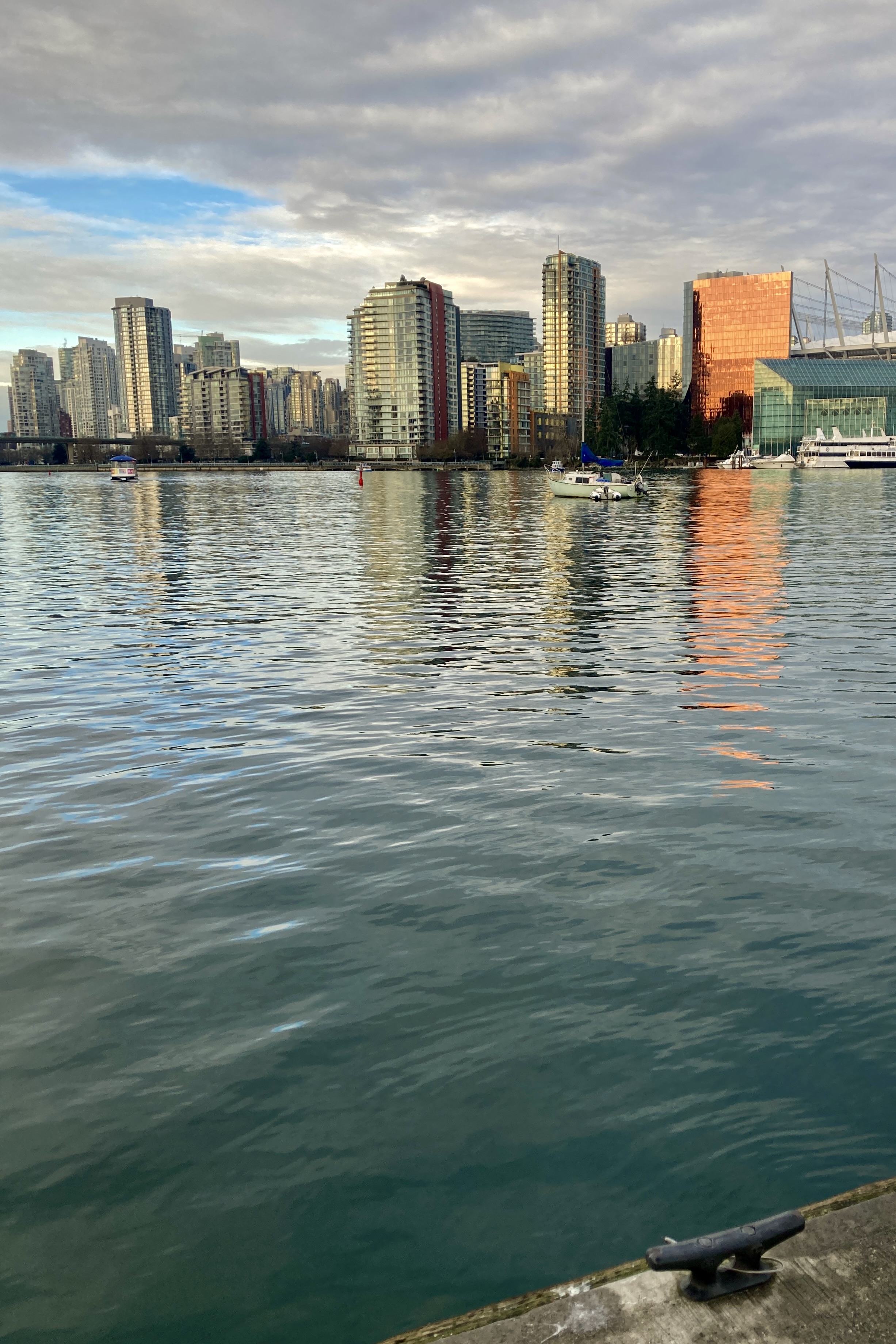
Light travel — reflections across the water — captures us before we even leave our home dock. Copper light, rippling its way south across the water.

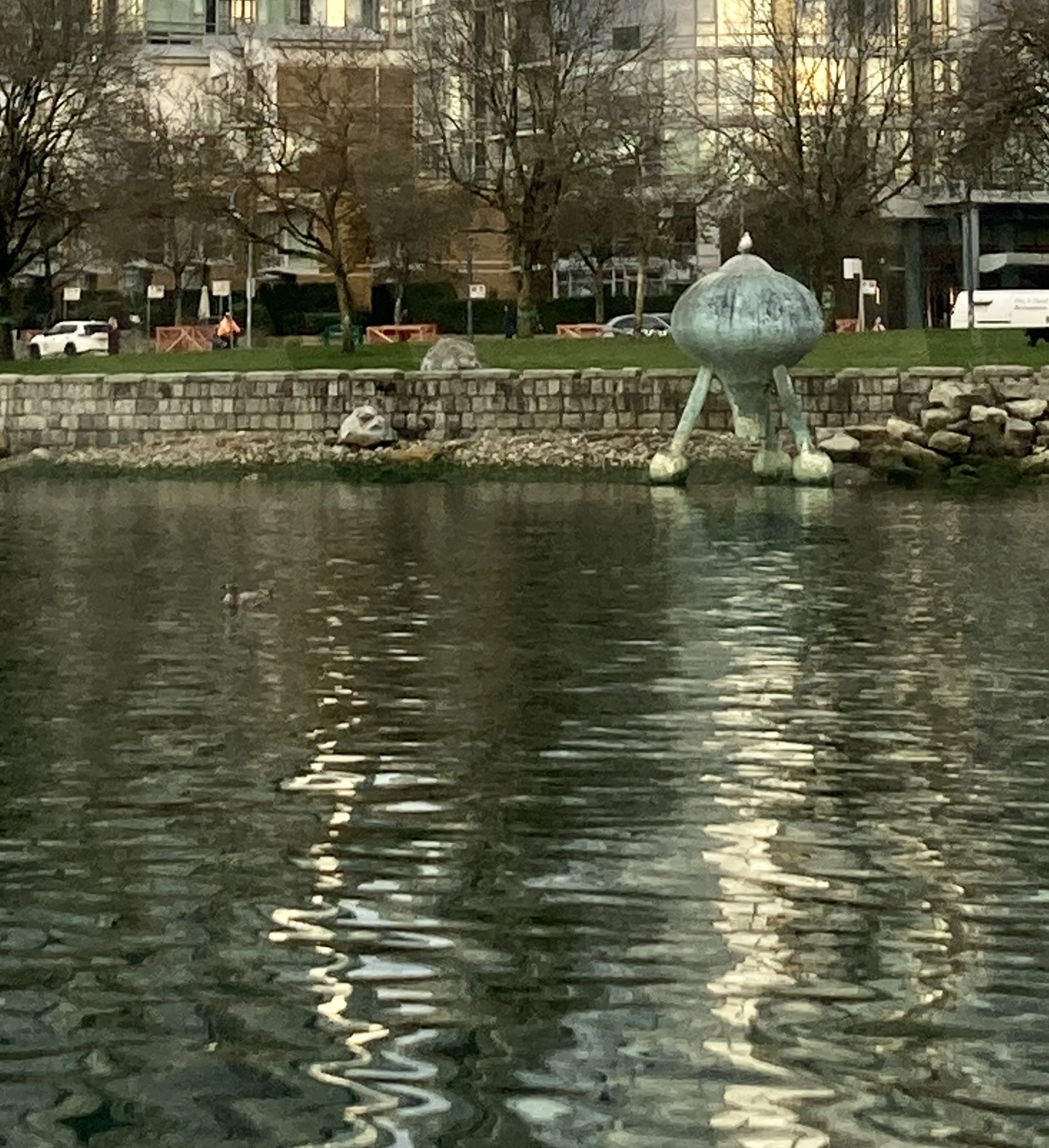
Light travel + time travel: Jerry Pethick’s Time Top sculpture sends its own ripples southward as we pass the Cambie Bridge.

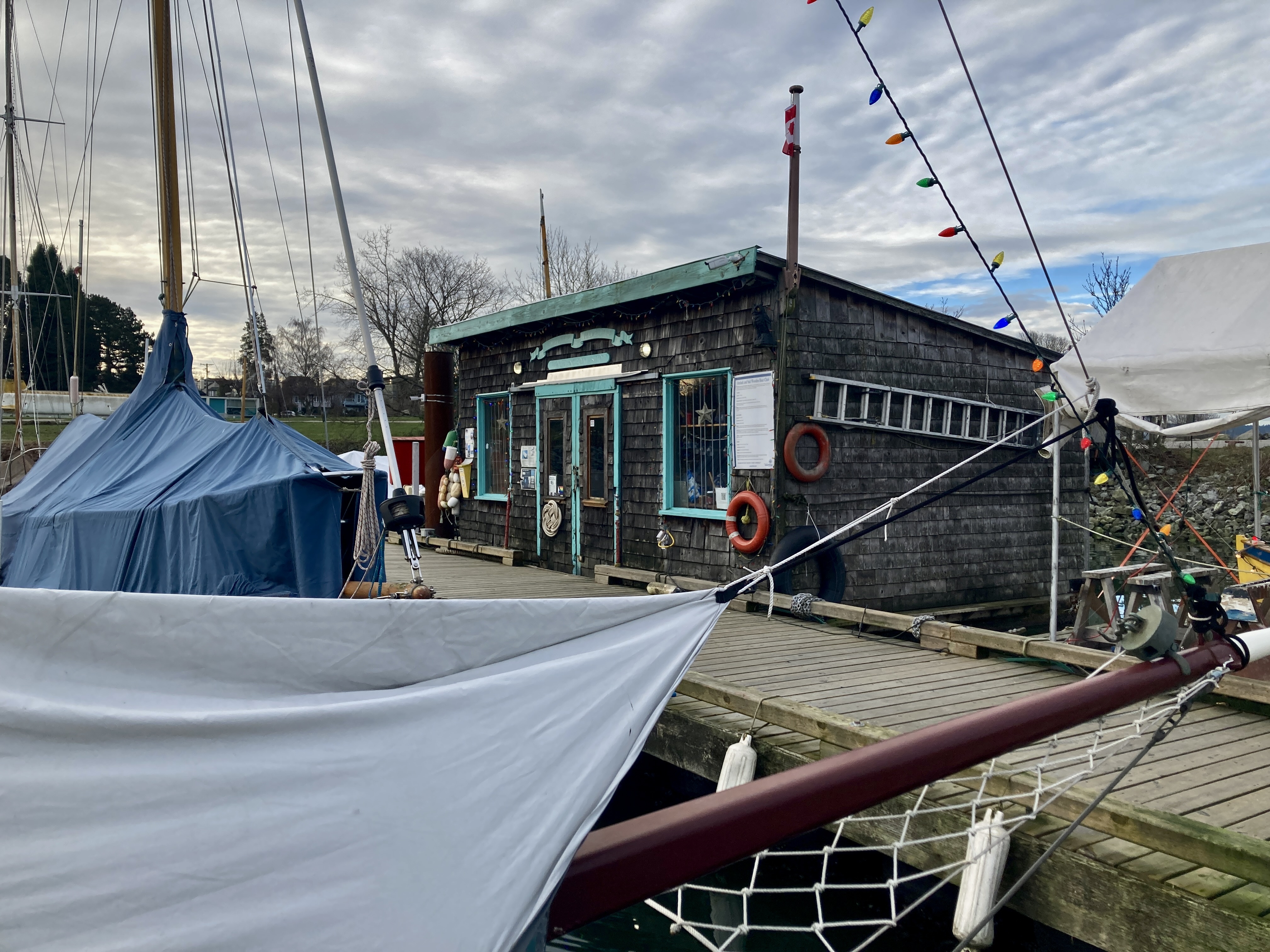
From one ferry to another at Granville Market, and soon we dock at the Maritime Museum — a free outdoor exhibit of vintage wooden vessels. And, not incidentally, home to the non-profit Oarlock & Sail Wooden Boat Club, housed in the floating Wooden Boat Shop.

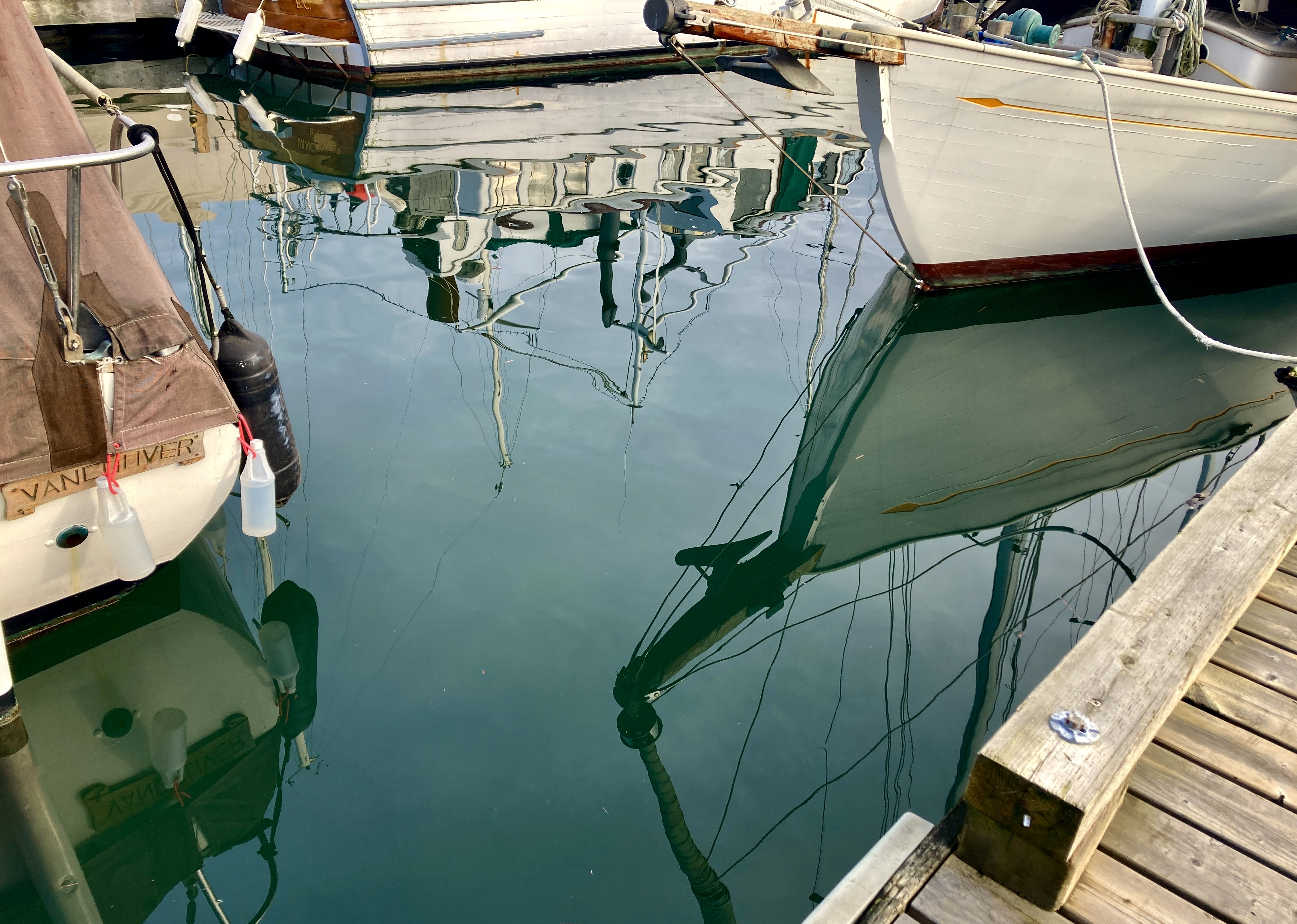
More light travel, shimmering among the aged vessels (many wrapped against winter, but alas therefore incognito as well).

From light travel, back to time travel.

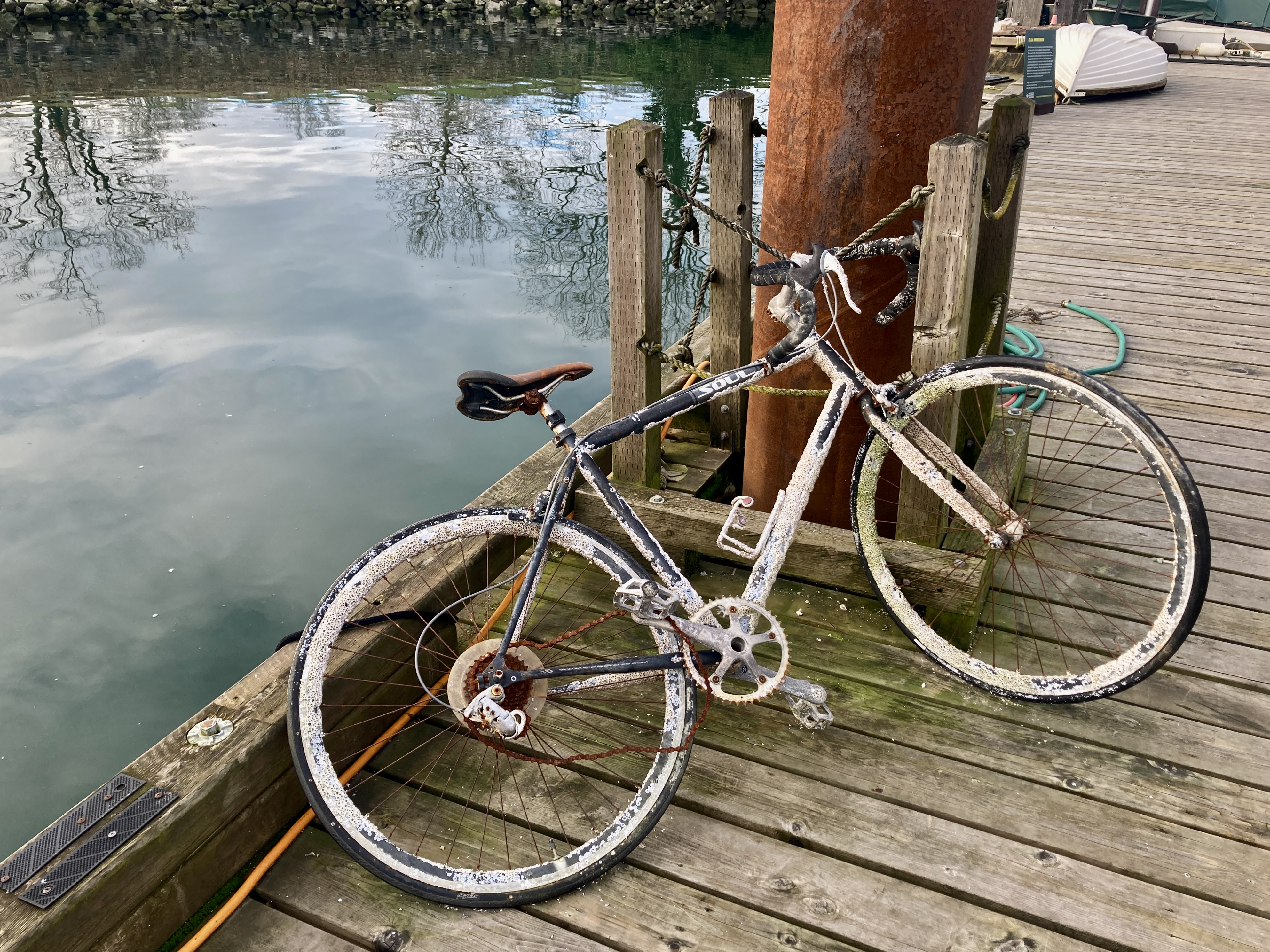
Barni-cycle!

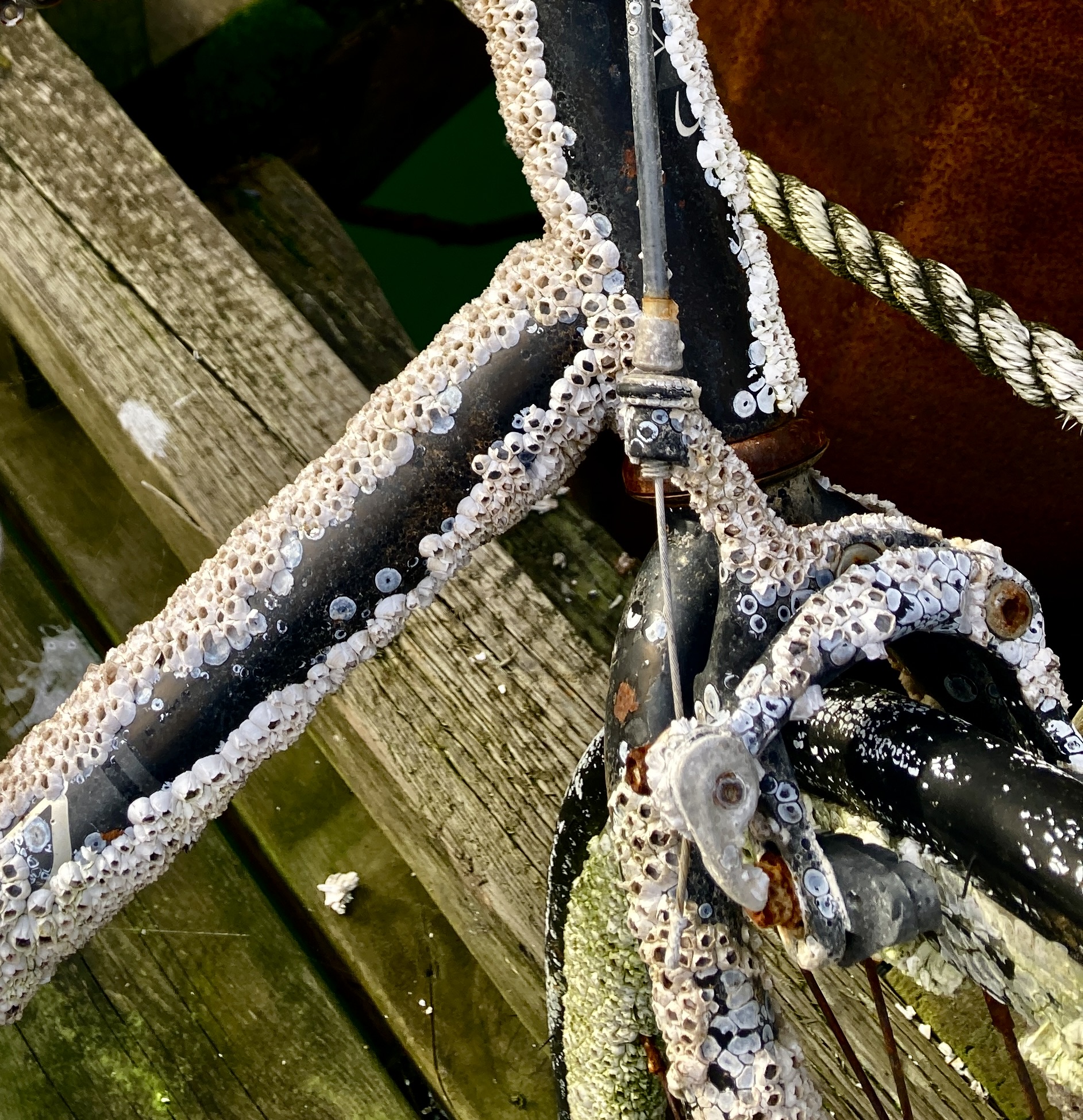
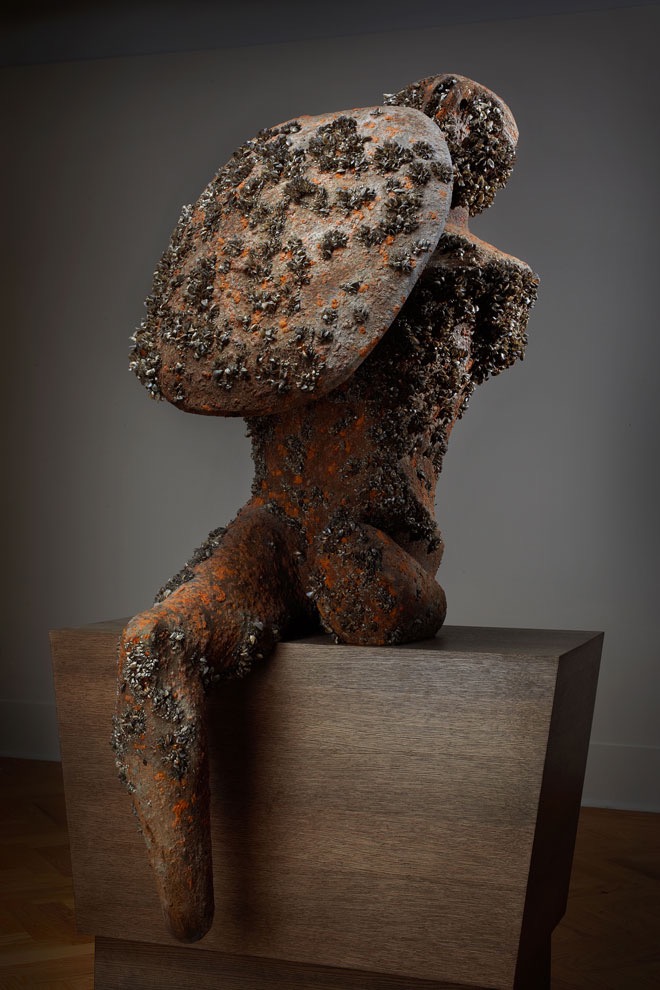
It didn’t collect all those barnacles in just a day or two.

I add an extra layer of time travel + distance travel.

I bounce myself back years and back east to the Art Gallery of Ontario’s display of Simon Starling’s Infestation Piece (Musselled Moore). It shows what happens when first you make a faithful copy of Henry Moore’s Warrior With Shield, then you place it in Lake Ontario as an offering to zebra mussels for a few years, and finally haul it up again for display.

I shake that image out of my head, rejoin present time & place, and follow my friend to the MOV, where we meet another friend and all three of us go look at chairs.

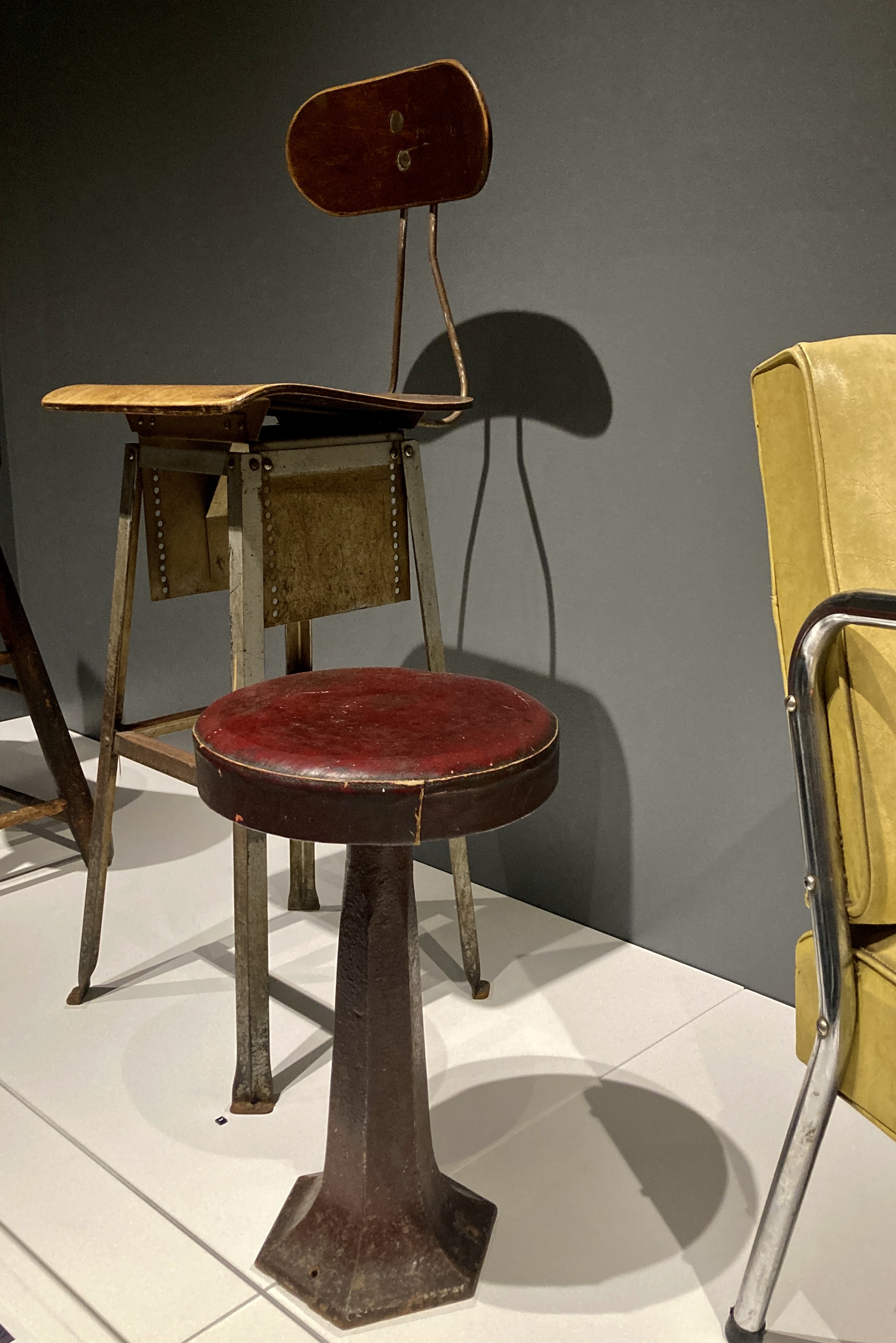
They are twinned exhibits. First, as seen above, Deep-Seated Histories of vintage chairs with local connections. But even here I’m back to light travel. No longer light crossing water to create reflections; instead, light crossing air to create shadows.

(Above) Edward’s Razor Repair Shop Metal Chair, 1930; and (below) Peter’s ice Cream Parlour Stool, c. 1930.

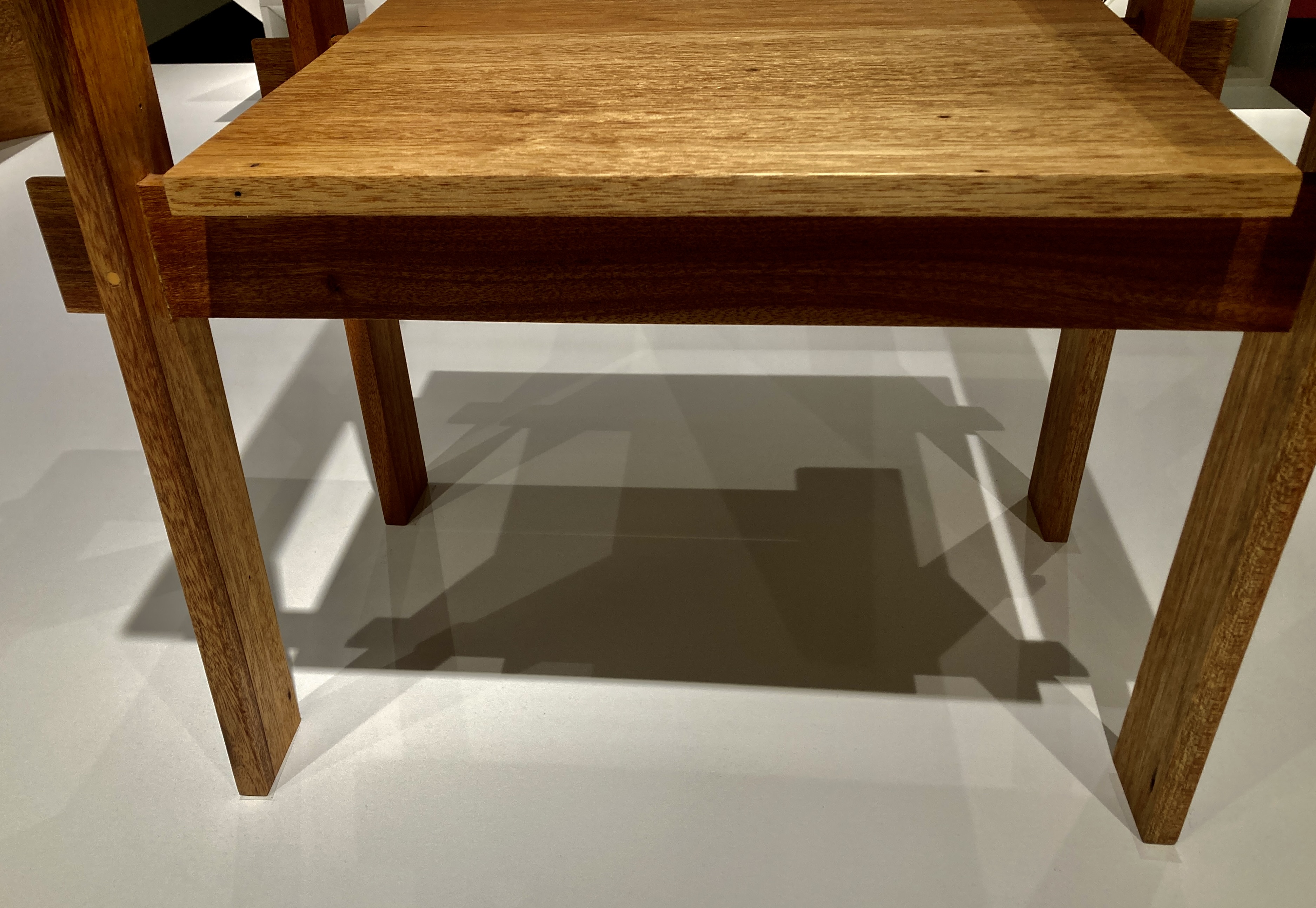
Later, in the Future Makers exhibit, more light travel, more shadows.

This time, beneath the Kuma Chair, in homage to Japanese architect Kengo Kuma and the outside lobby of his Alberni building here in Vancouver. The chair, its signage tells us, explores negative space. I see shadows.

And then more walk-abouts, and then lunch at the splendid Melo Pâtisserie, and then home.

Where I look up the code for that cat show. And discover it took place on 25 August 2025.
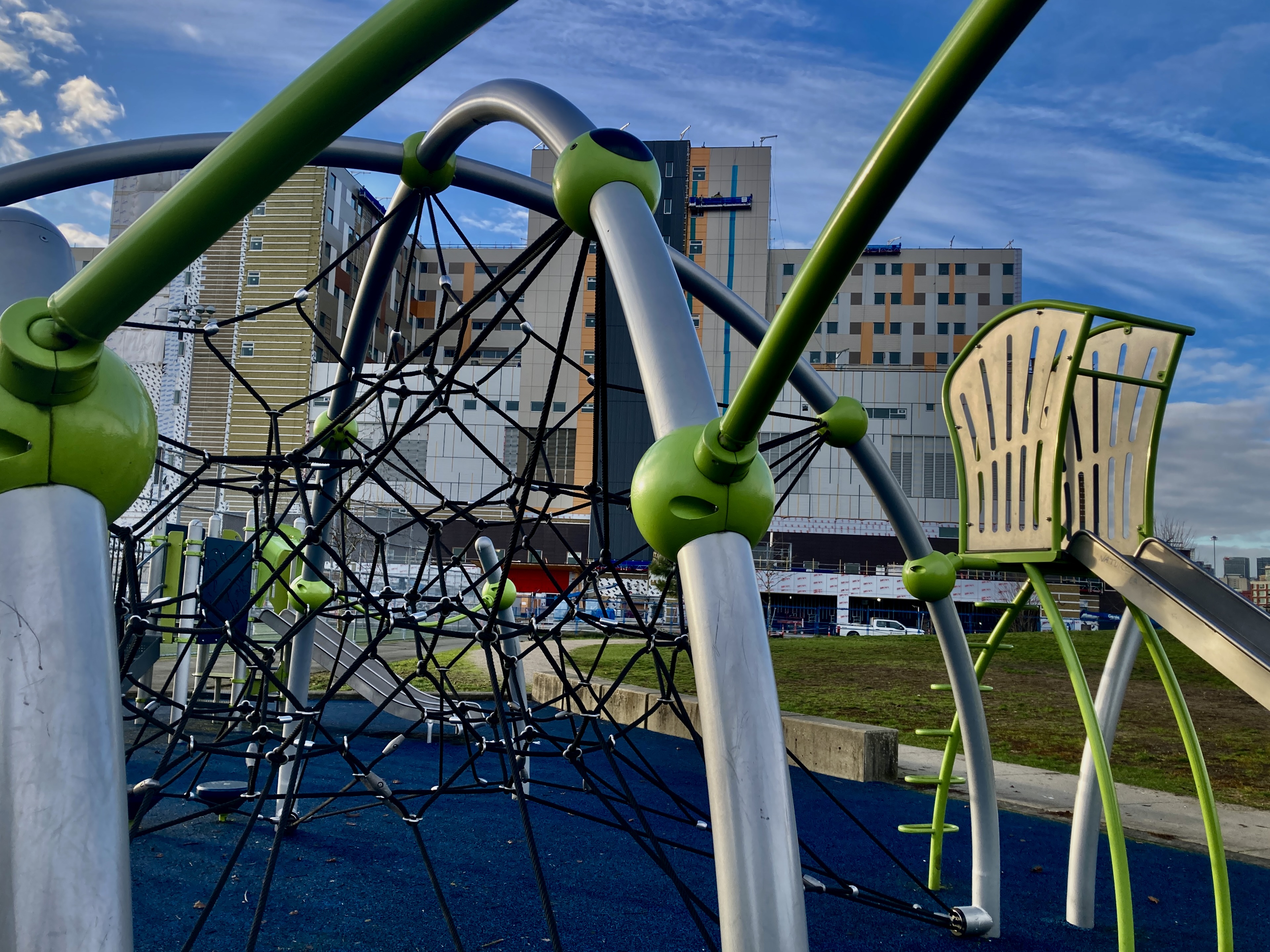
More time travel!

North Shore (To & From)

13 December 2025 – Poised for a trip on SeaBus, I am…

across Burrard Inlet from Vancouver’s Waterfront Station to Lonsdale Quay in North Vancouver.

The draw is the engrossing show currently on view (to 1 February) at the Polygon Gallery — American photographer Lee Miller, whose body of work encompassed both high society and high fashion…

and the stark realities…

she documented as a wartime photographer.

As usual, the ferry ride to the North Shore is an uneventful 15 minutes or so.

Also as usual, we are met by a welcoming committee of cormorants at the Lonsdale dock.

The man standing next to me is waxing lyrical about their inherent grace, their ease with being exactly what they are (unlike fretful striving humans). I am less lyrical. Every time I see these birds, I hear again the cry of my outraged friend, that day in the Bruce Peninsula, who thought we were looking at loons, and discovered they were only — and I quote — “F**king cormorants!” FC’s they became, and FC’s they remain.

I leave that nice man being lyrical, and carry on, looping my way toward the Polygon via the Lonsdale Quay waterfront, with its long views back south.

Another black bird, this time a solitary crow, soars over helipad and private pier.

His backdrop is one stretch of the south shore of this busy port: a line-up of monster freighter cranes, like so many orange giraffes, with a monster freighter (COSCO Shipping, says its lettering) before their high-stretched necks and downtown buildings at their backs.

From one solitary crow, to a veritable panorama of Eternal Love.

Lock upon lock upon lock. (Upon lock.)

Different foreground, same Port of Vancouver background. L to R: the cranes; the COSCO freighter plus another, equally massive but unidentified; the white fabric “sails” that comprise the roof of Canada Place; a SeaBus placidly bustling back to the south shore. Behind all that, the city skyline. (North Shore shows us mountains; South Shore shows us towers.)

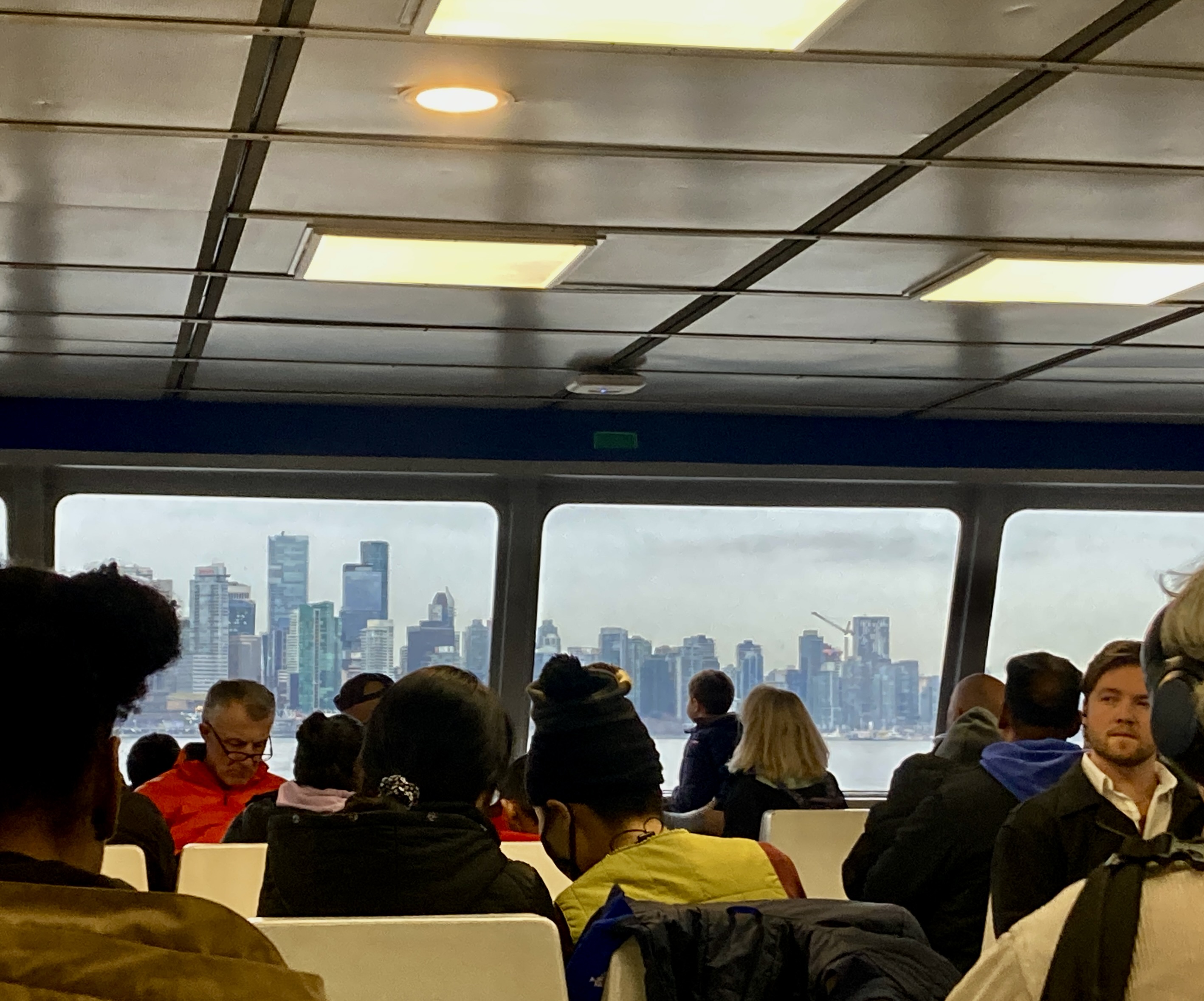
Return trip, those towers grow larger in the ferry windows…

and, approaching the terminal, we glide past a heavily laden freighter…

being nuzzled by an attentive crane.

But were you greeted by a welcoming committee of FC’s? you want to know.
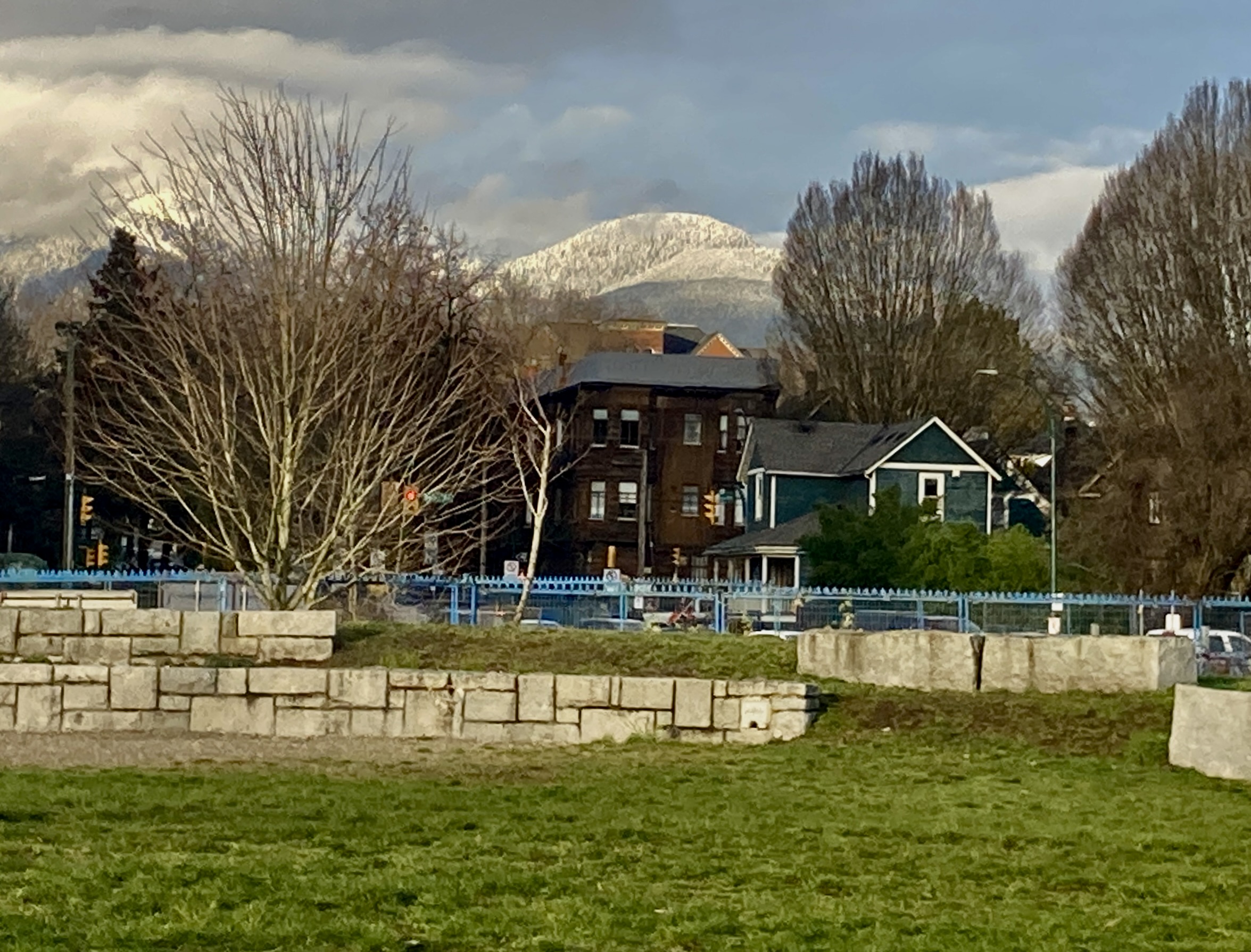
I have to confess: I did not notice.
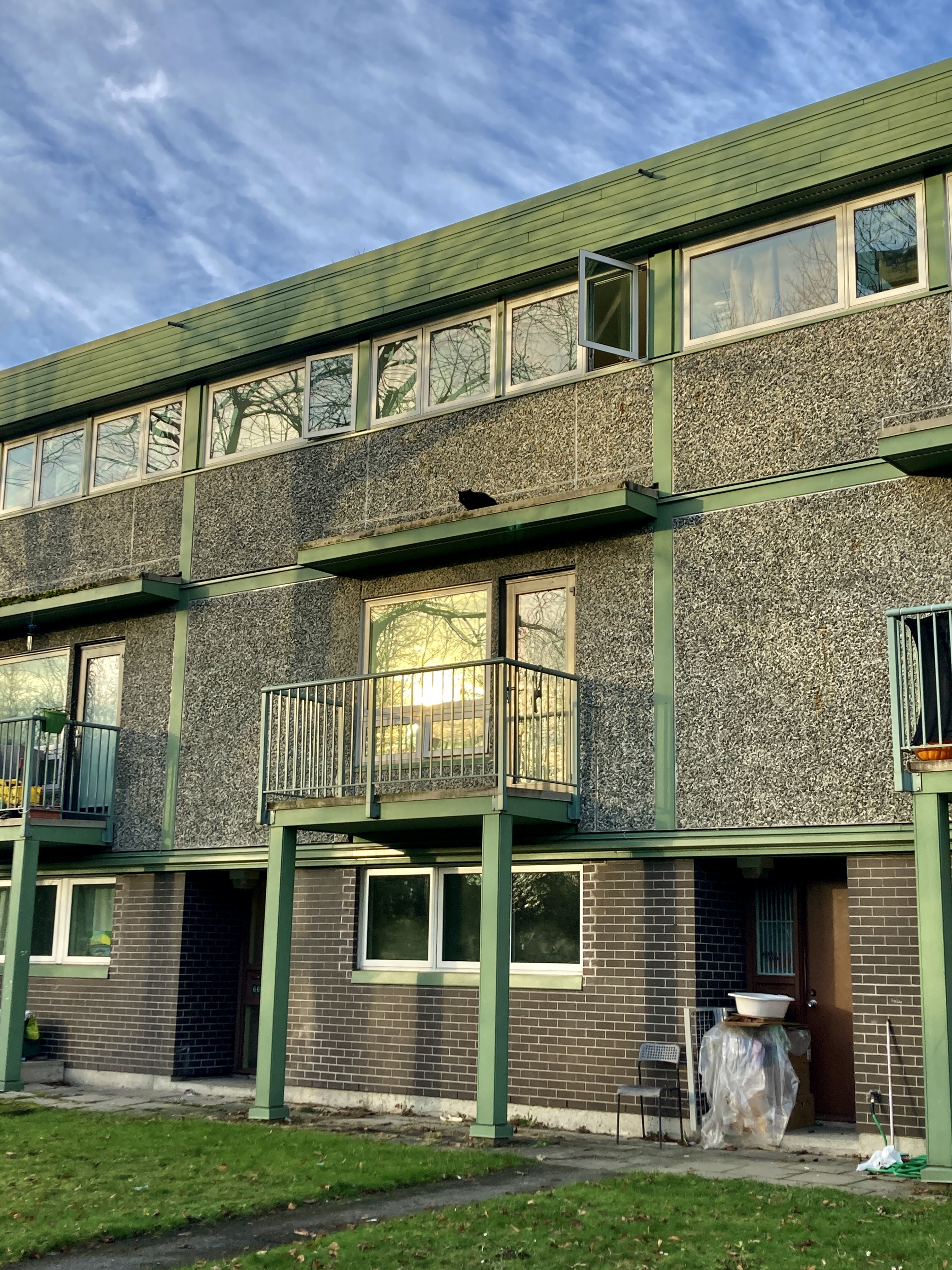
“Merde! il pleut”

4 December 2025 – Years ago, standing in line on a soggy day, I read this lament on the umbrella in front of me.

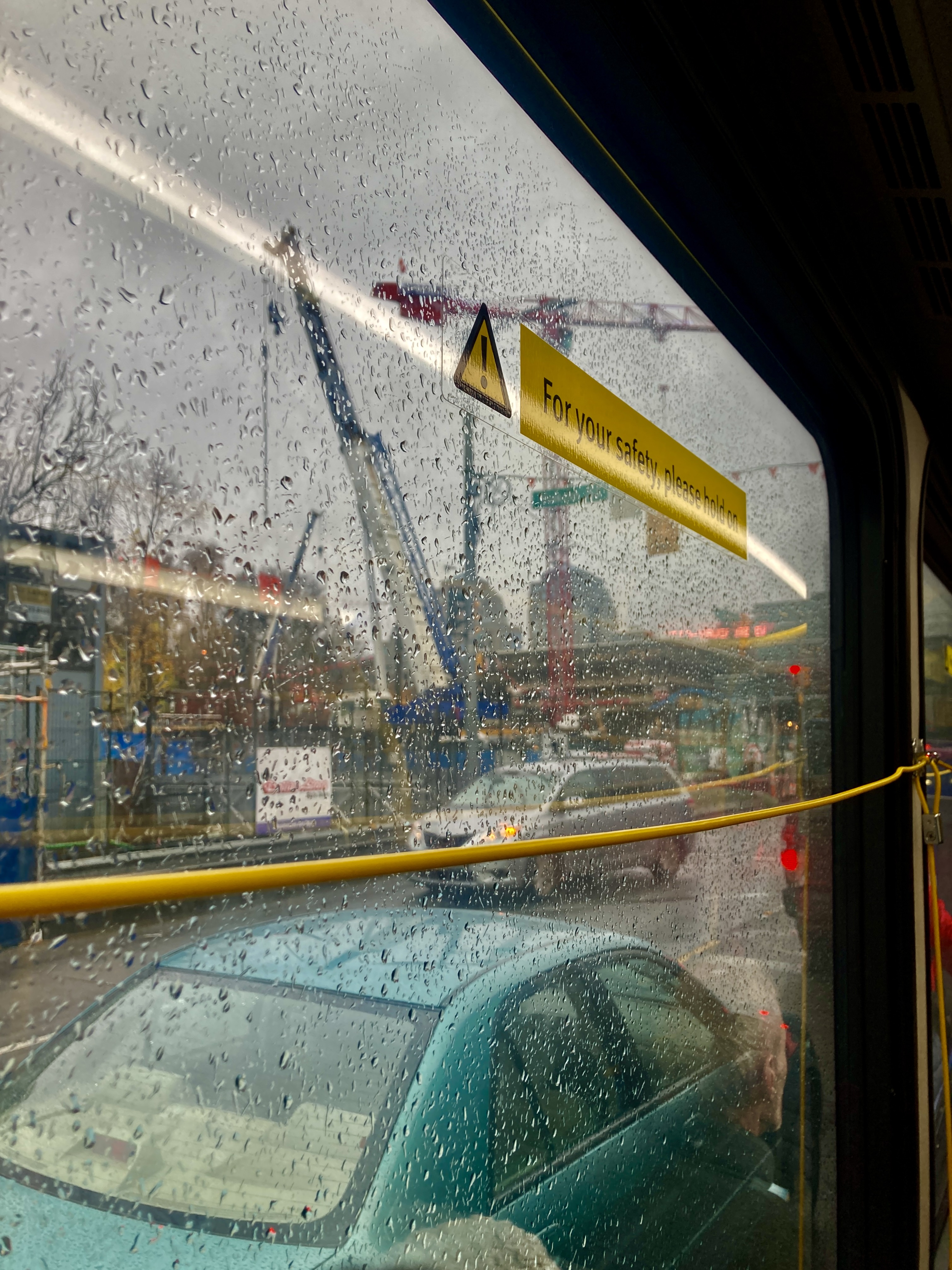
Today, staring out my traffic-stalled bus window on an equally soggy day…

the words return to mind.

Echoes in the Alley

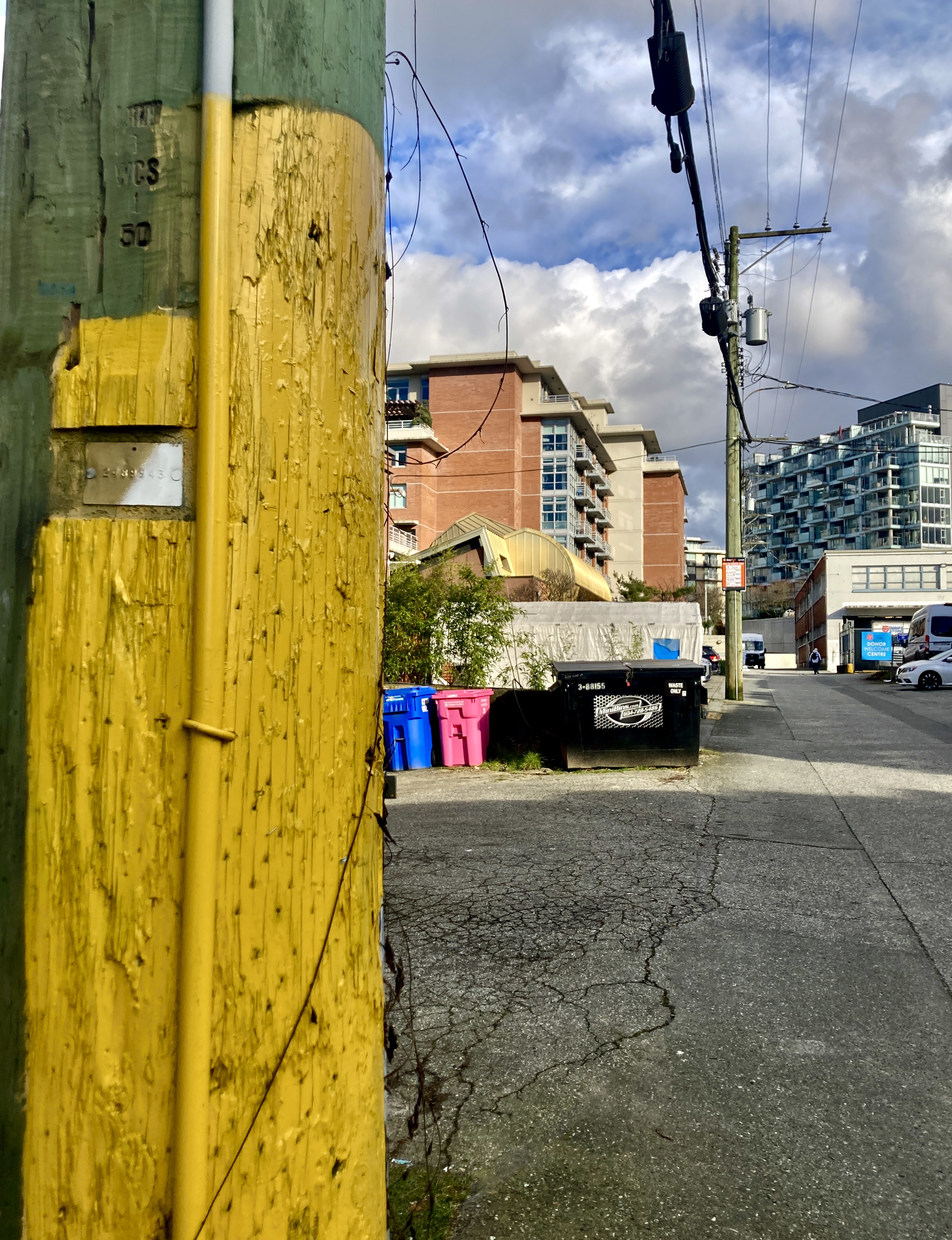
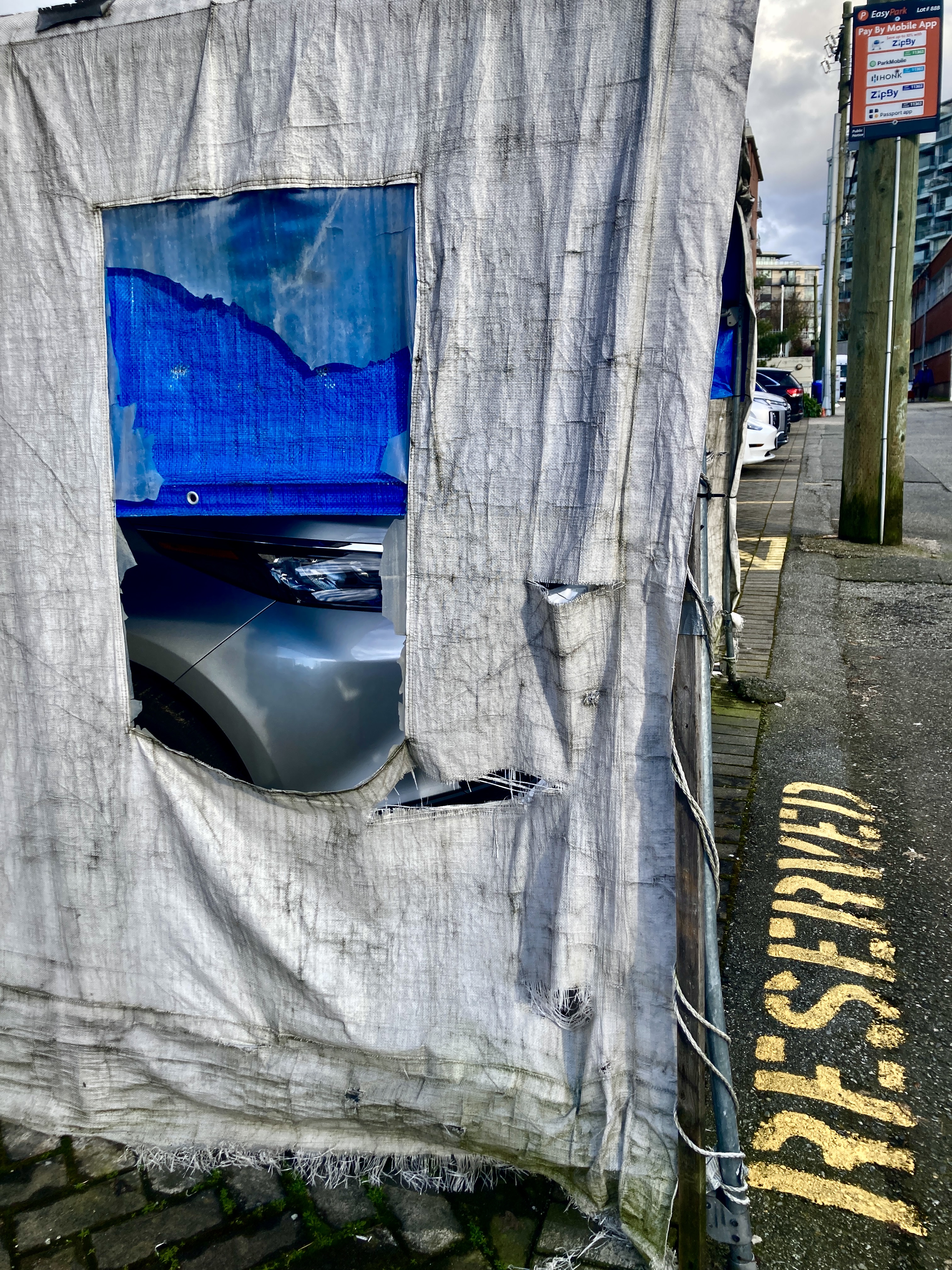
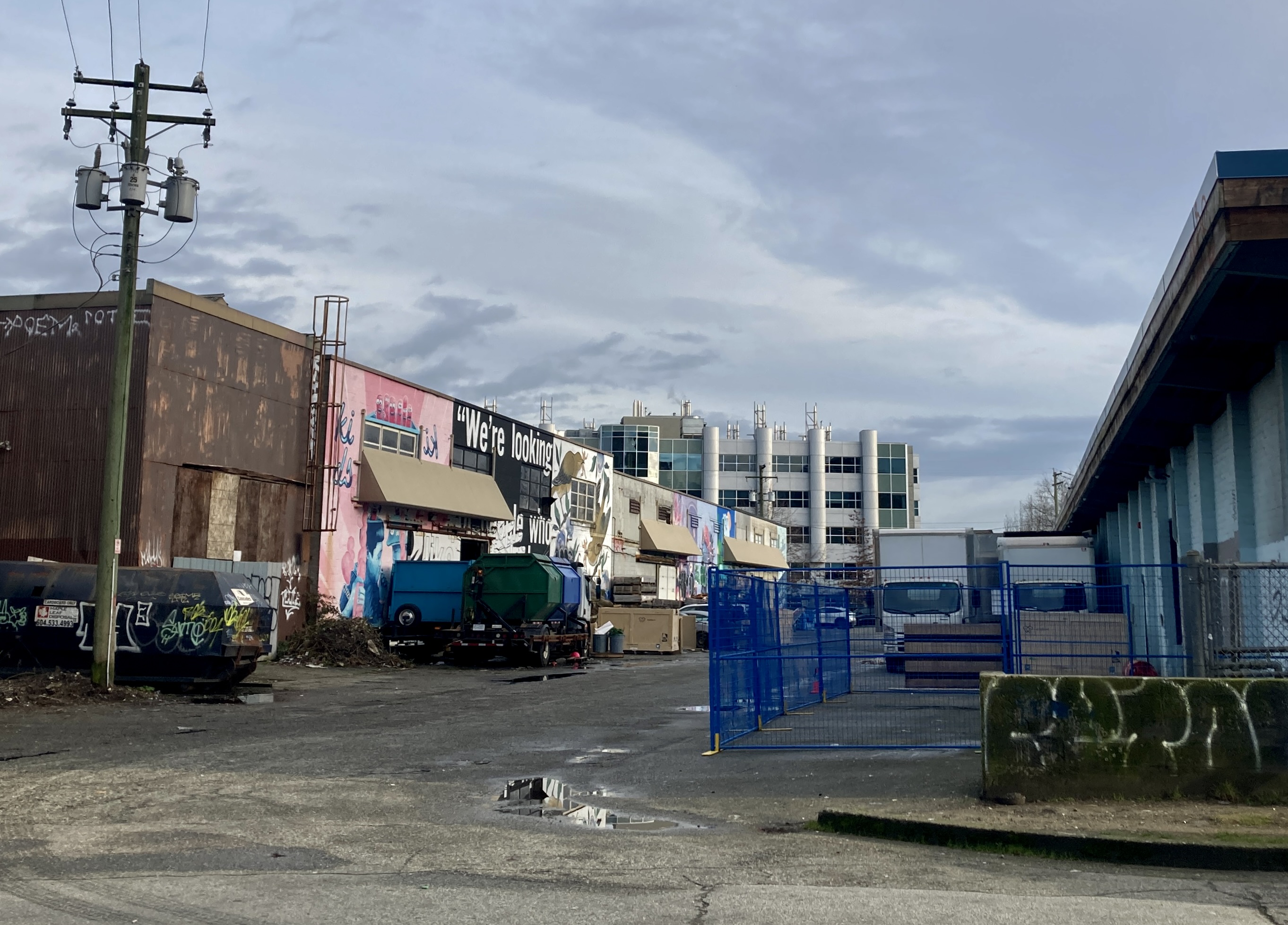
9 November 2025 – Another downtown alley, another grimy shed in a downtown alley, the usual casual scrawls and scars.

Amidst all that, I suddenly realize, eleven neatly lettered words.

Echoes of old strife, rage, pain and loss.

Echoes, also, of love and enduring hope for another chance.

… And All the In-betweens

23 October 2025 – I had a much longer title in mind. To wit: “Above/Below/In Front/Behind/Then/Now/Here/There… and All the In-betweens.” Aren’t you glad I restrained myself?

That verbal onslaught is prompted by yet another walk along the north shore of False Creek, from foot of Davie east to Main. More specifically, prompted by this:

I only now, after all these years, bother to learn that this artsy structure has a name. It is one of the two shelters + glass panels that comprise Lookout (Dikeakos + Best, 1999), which traces the natural & industrial history of the area and is an early contribution to the public art we enjoy on both sides of the water.

You can spread the image, read the keywords panel by panel — or just read this paragraph! L to R: “box cars, flat cars, tank cars” / “dining cars, sleeping cars” / “… the yard master makes a train…” / [then a panel written to be read from the other side] / “all built and all rebuilt” / “gone and a thousand things leave, not a trace” / “lumber co yards, islets of gravel.”

I climb up to the street, take a closer look at the inscribed and silhouette steel uprights, also part of the story.

Natural + industrial history indeed, from “mudflats” upper left to “red caboose” lower right.

Then I check the panel meant to be read from this, the street, side:

This one you can read for yourselves. And, given all these prompts, you can also take a stab at imagining “as if it were” all still present as it used to be.

What you will have trouble reading, even if you spread the image, is the black-lettered graffito neatly inked in just below “across the waters.” It says: “build a washroom.”

I think this is perfect. An interjection of a “now” reality in a tribute to “then.”

It is also a further prompt to do what I do every time I pass this installation, with its invitation to remember the past, superimpose it on the present, build it into my understanding of how much more is still Here-And-Now than is Right-Now visible. Every time, my mind flips back, vaguely but insistently, to Italo Calvino’s 1972 book, Invisible Cities. As one astute reviewer observed, the novel is “a travelogue to places that do not exist.” It also invites us to think more richly about how we define “exist.” (Side nod to the wise fox, who taught The Little Prince, “What is essential is invisible to the eye.”)

I am primed, in other words, to read above, below and ‘way inside the everyday sights that greet me as I walk.

Jerry Pethick’s Time Top sculpture, for example, that invites us to imagine a time top spinning across the galaxy…

to crash-land on the shores of the Pacific Ocean, right here…

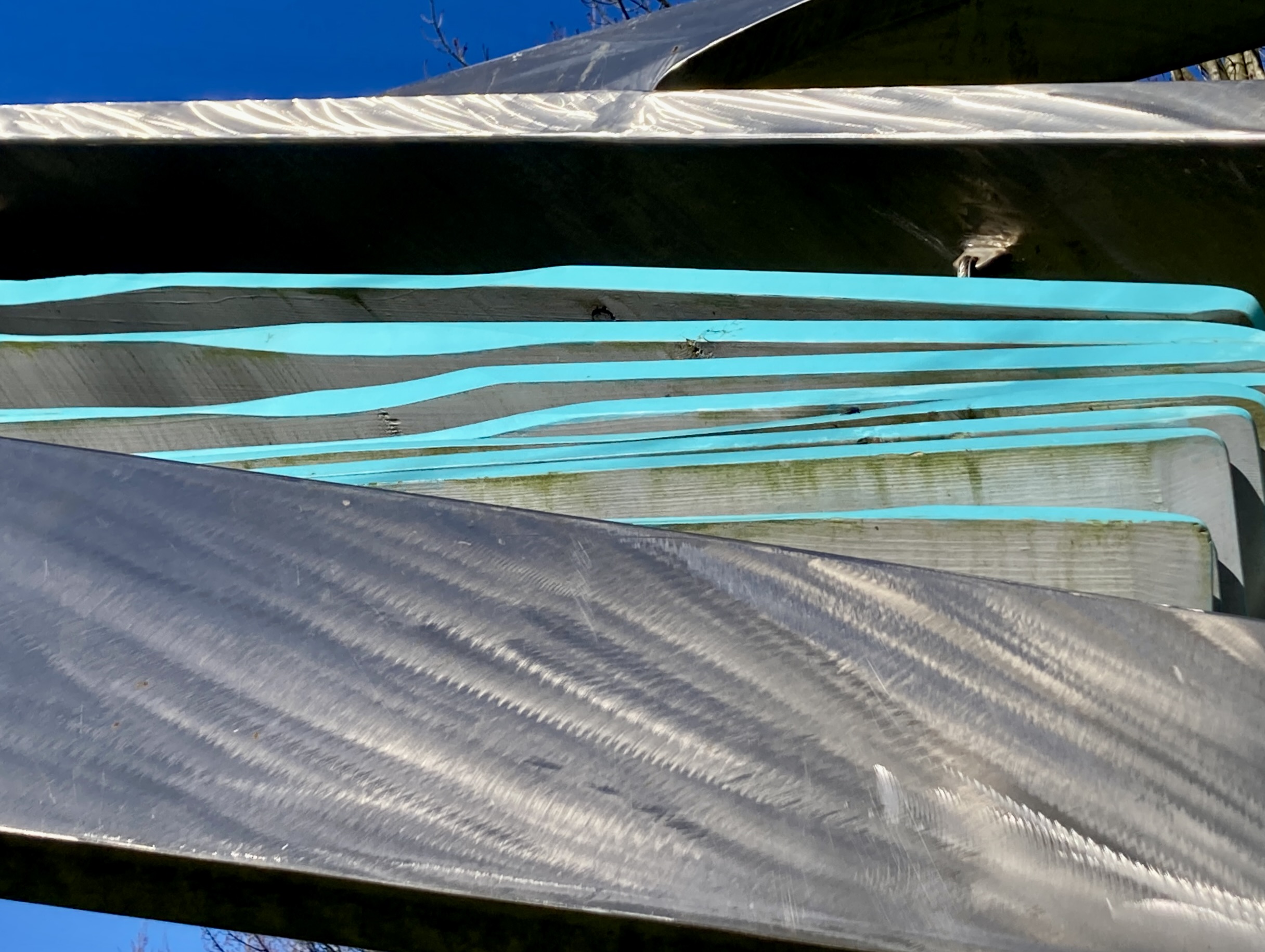
or the blue bands of A False Creek (Rhonda Weppler, Trevor Mahovsky), that invite us to imagine what all this will look like if climate change indeed causes ocean levels to rise 4-6 metres…

and, right next to it, another interjection of a “now” reality, again in the form of a polite and neatly lettered graffito. This one, beneath the No Dogs Allowed notice there on the right, yanks our attention back to the present. “Clean The Water,” it snaps.

I stop my fancy metaphysics for a moment, offer myself a simple contrast between sky-high…

and shoreline…

then, sideways, a panorama of nature, reminding us that it invented fall colours long before built structures began to emulate them…

followed by, at my feet, the tight focus of a single fallen leaf…

reminding us that diversity, whether in or out of political favour, is the building-block reality of life.

However pure green this leaf long appeared to be, all these other colours were woven into it right from the start and are equally part of it. As are (side nod to Thich Nhat Hanh and the concept of interbeing) sunlight, water and soil, plus all the nutrients of those three elements as well, all of which made the existence of this leaf possible.

Quite literally, the universe in a single leaf.

Enough. I think I’m done. But, no.

There is one more juxtaposition. One more interweaving. One more dance to vibrate my own little world, as I walk on by.

Upper right: nature’s wasp nest. Lower left: street-guy’s sneakers. Both at home in the tree. A tree shedding its leaves, itself at home with the cycles of the universe.

I laugh, shed my pomposity, and take myself home.

Drizzle, No Grizzle

18 October 2025 – A wonderful bit of British slang: the verb “to grizzle.” It describes the act of complaining or whining, at a low decibel level, but continuing on and on and forever-bloody-on. Which makes it such a lovely companion, in more than rhyme scheme, for the verb “to drizzle.” It describes the act of rain that falls at a low intensity level, but also continues on and on and forever-bloody-on.

This afternoon, for example.

I am equipped for the latter, and reject the former. — like most Vancouverites, I hasten to add. We know where we live.

Scotia Street seems an appropriate start for a drizzle-walk.

It overlaps with the final stretch of Brewery Creek, which, in the days when it had not yet been sewered, ran into the east end of False Creek, which had not yet been filled in.

Grey sky & low visibility along Scotia, but colours pop, both autumnal foliage and seasonal umbrellas.

Ditto the red truck marking the Red Truck Beer Company, down there where Scotia ends (or starts) at East 1st Avenue. Beyond the brewery yard, I can see dim outlines of the lowest level of the mountains to the north, but nothing higher up, only the drizzling sky.

The mountain peaks may be hiding, but not us Vancouverites. As I turn onto 1st Avenue, a stream of people erupts from the Crossfit BC doorway opposite, and starts pelting on down the street ahead of me.

By the time I’ve walked another block, I start meeting them on their return trip. Apparently this is just the warm-up for an indoor class.

I veer through False Creek Flats, filled in originally to provide land for railway-oriented industry and warehouses. The area is morphing into a new post-industrial life centred around digital media, clean technologies, medical research & the like, but the transformation is not complete. Sodden skies suit the still-gritty streets that lie beneath them.

Farther west, I twine my way first around the pollinator meadows lining the Ontario Street bioswale, where logs and their tiny fungi gleam brown and gold…

and then among the condos just off Quebec Street, where the gleam is metallic but equally appropriate. When could suit a fountain sculpture (Eyes On The Street, Marie Khouri & Charlotte Well) better, than a drizzling sky?

By the time I am walking along West 2nd Avenue…

I am prepared to concede that the sky is no longer drizzling. It is raining. Same visual impact — just look how that orange traffic light spills on down the street, bouncing from one puddle to the next — but damn, there’s nothing “low-level” about this.

(A passing woman & I grin at each other in mutual approval: we are each snug in waterproof clothing, and therefore spurn umbrellas.)

In Olympic Village Plaza, one of Myfanwy MacLeod’s The Birds sculptures tilts his stainless steel head to the elements…

Canada Geese bend their feathered heads to rich pickings in the grass (the mountains have now totally disappeared)…

and the cast-iron cycle of eggs/tadpoles/frogs on the storm sewer cover (Musqueam artists Susan Point and daughter Kelly Connell)…

is completely and perfectly at home in the dancing rain.

Meanwhile, the human beings at the street corner…

look distinctly less comfortable.

I am quite sufficiently comfortable, thank you, since only my outer layer is wet.

But, even so… I call it a day.

I may not grizzle, but I do know when I’ve had enough drizzle.

Then & Now

2 October 2025 – I’m over at St. George & East 6th, hunkered down for the view south along this stretch of the St. George Rainway.

Then I pay serious attention to the map — to the lost small-c creek and to the lost big-c False Creek as well, lost when (1915 onward) they filled in the final stretch to create industrial & railway land. I trace my finger along that bright turquoise line, showing us the shoreline that used to be.

I study the 1889 photo…

and then I go study the 2025 reality, from that same Main & 7th intersection.

Well… the mountains are the same!

So T.O.

14 September – And then, from morning to afternoon, I leave Toronto and land in Vancouver. Here I am, looking through slight drizzle to the mountains, with one last love-letter I want to offer “T.O.” (Tee-Oh, Toronto.)

My T.O., that is, nobody else’s — my own mix of memory and re-discovery, blind to what others would notice, alert to all my own triggers.

Glimpses from streetcars, for example.

A rampart mural by Shalak Attack, which I remember watching her paint, many years ago…

the distinctive two-tone brick and architecture I associate with my own decades in the Cabbagetown neighbourhood, but common to the city in that era…

and Streetcar Dog. Not unique to Toronto, but part of my own memory bank of riding the TTC.

Then there are my re-discoveries on foot, all around the Grange neighbourhood and the Art Gallery of Ontario, where I was for years a volunteer and therefore an area where I came and went, a very great deal.

Bronze turtle watching martial-arts in Butterfield Park, the new-since-my-time refurbishment of the land just east of Grange Park and south of OCAD (Ontario College of Art + Design) University…

Henry Moore’s Large Two Forms, looking very at home in its new home in the reinvented Grange Park, with the brilliant blue rear wall and distinctive Frank Gehry staircase as backdrop…

and, once inside, the soaring glulam arches of the AGO’s front-façade Galeria Italia.

Unchanged, these arches. Ditto, the way the Galeria invites you to look out across Dundas Street. Native son Gehry made sure his design honoured and welcomed the neighbourhood of his childhood as its own visual final wall.

I am in the AGO as much to walk old ground as to see current exhibitions, but in the end I do both.

The Joyce Wieland retrospective, Heart On, speaks not only to my memories of her bursting on the scene, but also to how current she now is, once again.

Wieland was a fierce ’60s-70s feminist and, despite (or perhaps because of) long years in New York, a fierce Canadian patriot as well. She often used the soft “feminine” skills of embroidery or quilting to express strong political convictions.

For example, with her 1970 work, I Love Canada – J’aime Canada.

Awwww. (Twist finger in cheek.) So sweet.

Now read the signage.

And read the embroidered fine print.

Wieland’s narrow definition of Canadian identity is now out-dated — but the rest of her analysis is Elbows-Up contemporary.

Some hours later, I leave the building. I still have more circling and prowling to do.

I check out the S/W corner of Dundas West & McCaul. It is also the N/E corner of the AGO footprint and, in my day, was still home to Moore’s Large Two Forms. For the first time, I see what now sits on that corner — Brian Jungen’s commissioned work, Couch Monster. (Read more, here, in a fine post by our WordPress colleague, Canadian Art Junkie.)

I circle the work, and also take in the larger view, including the top of an old mural by veteran Toronto artist Birdo, now obscured by newer construction and backed by even-newer construction.

Finally, and not with terrifically high hopes, I take myself across Dundas West and into the alley between Dundas and Darcy Street to the north. I am eager but also dreading to see what it’s like, these days. My memory is of an alley bursting with street art, full of the “garage-door art” that I associate with my memories of Toronto.

And…

there it still is. On and on, to the west, beyond the frame of this image. Not exactly as it was, of course not, but alive and current and so-very-T.O.

I turn right on a second, N/S, alley, passing delicate tendrils and other art as I go…

and emerge on Darcy Street.

Where I drink in an enclave of old downtown residential architecture, oh look, some still survives…

and then pivot on my heel to look east down the block. Out to McCaul Street.

Still some old brick homes, and still the spire of St. Patrick’s Church (the 5th-oldest Roman Catholic parish in Toronto) as well — plus the immediate examples of all the new towers now exploding skyward.

There it all is.

The whole jarring/exhilarating, cacophonous/euphonious, forever-evolving symphony of the city.

So T.O.

Snowy Owl + Mailbox Spider

12 September 2025 – More old + new, here in Toronto. The joy of time with old friends and familiar places, but also the joy of discovery.

For example, Biidaasige Park — some 40 hectares once complete, down at the mouth of the Don River and part of an even larger overall program to re-gentle, re-green and detoxify the sprawling Port Lands for what we now understand to be wiser, more multi-purpose and more inclusive use. Read more about Biidaasige (“Bee-daw-SEE-geh” with a hard “g”) on the City‘s website, on an analytical design website, and in her 6 September “As I walk Toronto” post by our WordPress colleague, Mary C.

The park is very much a work in progress, but some elements are already in place. They include several imaginative children’s playgrounds, one of which has as its guardian spirit, Snowy Owl.

Not only is his open tummy a stage for all kinds of child-friendly events, the interior of his body is open to visitors as well. You can walk inside…

and start climbing. Stairs, then ladders, and up you go.

Bang-thwack-ouch! Smack your head a few times and you finally realize the structure is child-scale. You learn to bend and duck accordingly.

Your reward? You get to look out through the Owl’s eyes, across the undulating playground, across Commissioner St. and westward toward downtown.

I scramble back down. We take ourselves off to explore trails down in the marshy areas around the various channels.

I am awestruck. This grubby, much-abused waterfront is being transformed. We lean on the railing of this pedestrian bridge and admire the grace of the new vehicular bridges, the abundant wild greenery along the banks, the habitat all this must offer for so many species. (Plus the knowledge of habitat yet to come, in plans for housing and further human community and settlement as well.)

And then… we move on.

The day is hot, and sunny, and, thanks to on-going park construction, noisy. We want still to be close to nature, but somewhere that offers soothing shade and a lack of noise.

All of which leads us to discover…

Mailbox Spider.

He is only some 4-5 km. away, slightly south-west of Biidaasige Park…

but in a very different world. The world of the Toronto islands.

More specifically and of importance to me, we are on one small island within that larger cluster: Algonquin Island, which is reached by a pedestrian bridge close to the Ward’s Island ferry dock.

Trace your finger over that pedestrian bridge and tap the intersection just off the bridge: Omaha and Ojibway avenues. Got it? Right there on that corner lot, almost invisible within its own mini-forest of trees and shrubbery, there is a white cottage. The white cottage where, 60 years ago, I used to live.

So it’s heavy-duty nostalgia time for me, and my friend is generously indulgent.

We stop, immediately off the bridge, to explore the community take/leave stand. It was active decades ago and, to my delight, is still active now.

A couple of Algonquin residents are near-by, people about my age. We chat, I explain I used to live here, I name a few names and they smile. We three didn’t know each other, but we each knew these other people.

Then, my friend and I, we just weave slowly up and down the narrow, car-free streets. (It is on Ojibway that we meet Mailbox Spider, with his blue cottage tucked away in the rear.)

The atmosphere is leafy, and peaceful. It is now a world of pretty smooth relations between residents and City — the welcome resolution of the long fight by residents and supporters to protect any residential community at all, in the face of the City’s desire to remove everybody and make the entire islands cluster into one big park. Now most of the land mass is park, but residential communities are recognized and stable on both Ward’s and Algonquin.

We reach the foot of Ojibway Avenue, down at Seneca, which runs along the island’s harbour-side waterfront, and offers panoramic views back across the water to the city core.

Including that CN Tower. I gave you only a distant and slivered view in my previous post; here it is, front and centre.

Still on Seneca, a good example of visitor/resident co-existence:

a bench for tourists and residents alike; one of the island’s many art boxes, again for the pleasure of tourists and residents alike — and a hammock in a resident’s front yard. For that family only, thank you!

Finally, my nostalgia satisfied and our minds and bodies refreshed by the peaceful environment…

we board a ferry, and head back to the city.

  • WALKING… & SEEING

    "Traveller, there is no path. Paths are made by walking" -- Antonio Machado (1875-1939)

    "The voyage of discovery is not in seeking new landscapes, but in having new eyes" -- Marcel Proust (1871-1922)

    "A city is a language, a repository of possibilities, and walking is the act of speaking that language, of selecting from those possibilities" -- Rebecca Solnit, "Wanderlust: A History of Walking"

  • Recent Posts

  • Walk, Talk, Rock… B.C.-style

  • Post Categories

  • Archives

  • Blog Stats

    • 129,113 hits
  • Since 14 August 2014

    Flag Counter
  • Enter your email address to follow this blog and receive notifications of new posts by email.

    Join 2,045 other subscribers