23 October 2025 – I had a much longer title in mind. To wit: “Above/Below/In Front/Behind/Then/Now/Here/There… and All the In-betweens.” Aren’t you glad I restrained myself?
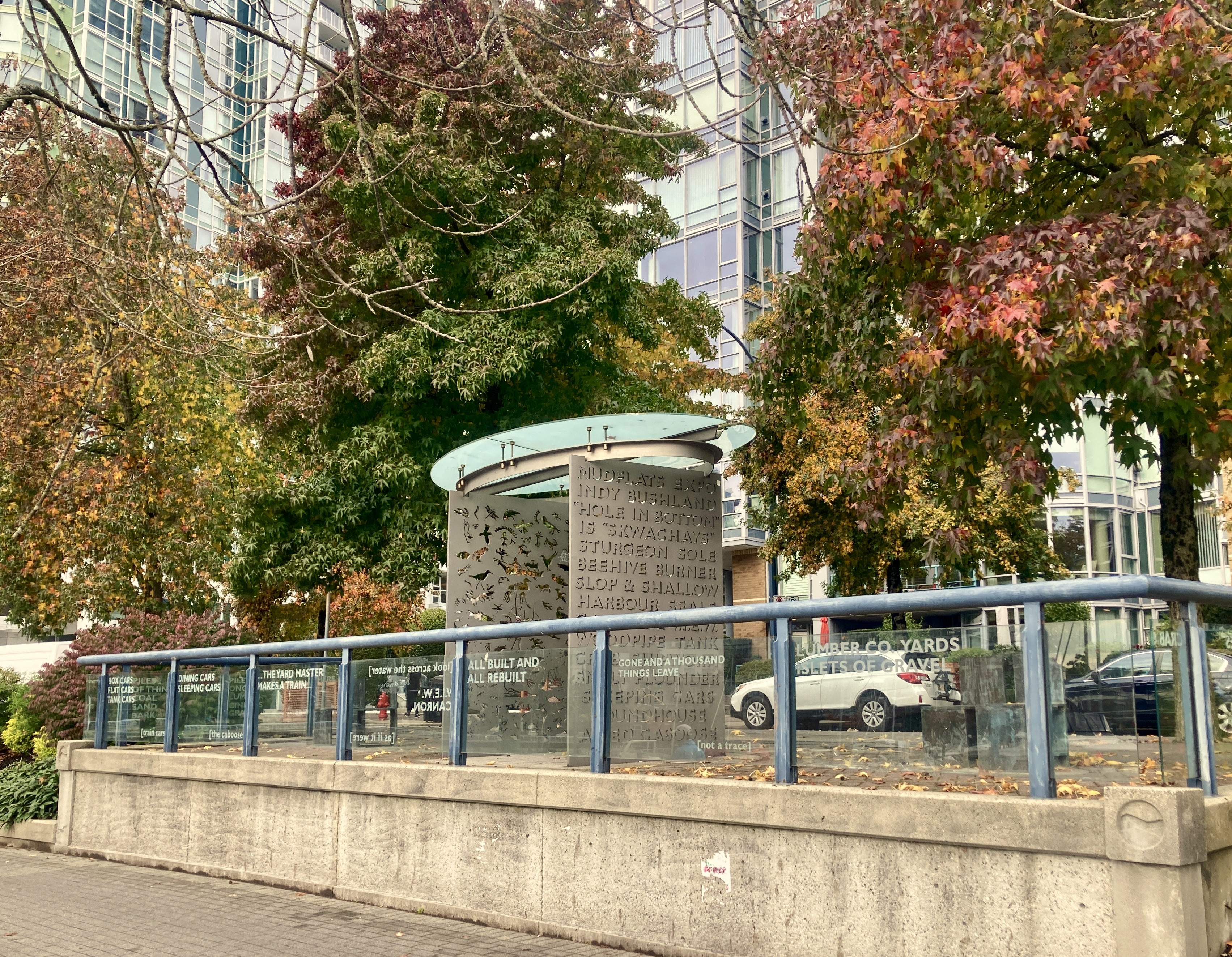
That verbal onslaught is prompted by yet another walk along the north shore of False Creek, from foot of Davie east to Main. More specifically, prompted by this:
I only now, after all these years, bother to learn that this artsy structure has a name. It is one of the two shelters + glass panels that comprise Lookout (Dikeakos + Best, 1999), which traces the natural & industrial history of the area and is an early contribution to the public art we enjoy on both sides of the water.
You can spread the image, read the keywords panel by panel — or just read this paragraph! L to R: “box cars, flat cars, tank cars” / “dining cars, sleeping cars” / “… the yard master makes a train…” / [then a panel written to be read from the other side] / “all built and all rebuilt” / “gone and a thousand things leave, not a trace” / “lumber co yards, islets of gravel.”
I climb up to the street, take a closer look at the inscribed and silhouette steel uprights, also part of the story.
Natural + industrial history indeed, from “mudflats” upper left to “red caboose” lower right.
Then I check the panel meant to be read from this, the street, side:
This one you can read for yourselves. And, given all these prompts, you can also take a stab at imagining “as if it were” all still present as it used to be.
What you will have trouble reading, even if you spread the image, is the black-lettered graffito neatly inked in just below “across the waters.” It says: “build a washroom.”
I think this is perfect. An interjection of a “now” reality in a tribute to “then.”
It is also a further prompt to do what I do every time I pass this installation, with its invitation to remember the past, superimpose it on the present, build it into my understanding of how much more is still Here-And-Now than is Right-Now visible. Every time, my mind flips back, vaguely but insistently, to Italo Calvino’s 1972 book, Invisible Cities. As one astute reviewer observed, the novel is “a travelogue to places that do not exist.” It also invites us to think more richly about how we define “exist.” (Side nod to the wise fox, who taught The Little Prince, “What is essential is invisible to the eye.”)
I am primed, in other words, to read above, below and ‘way inside the everyday sights that greet me as I walk.
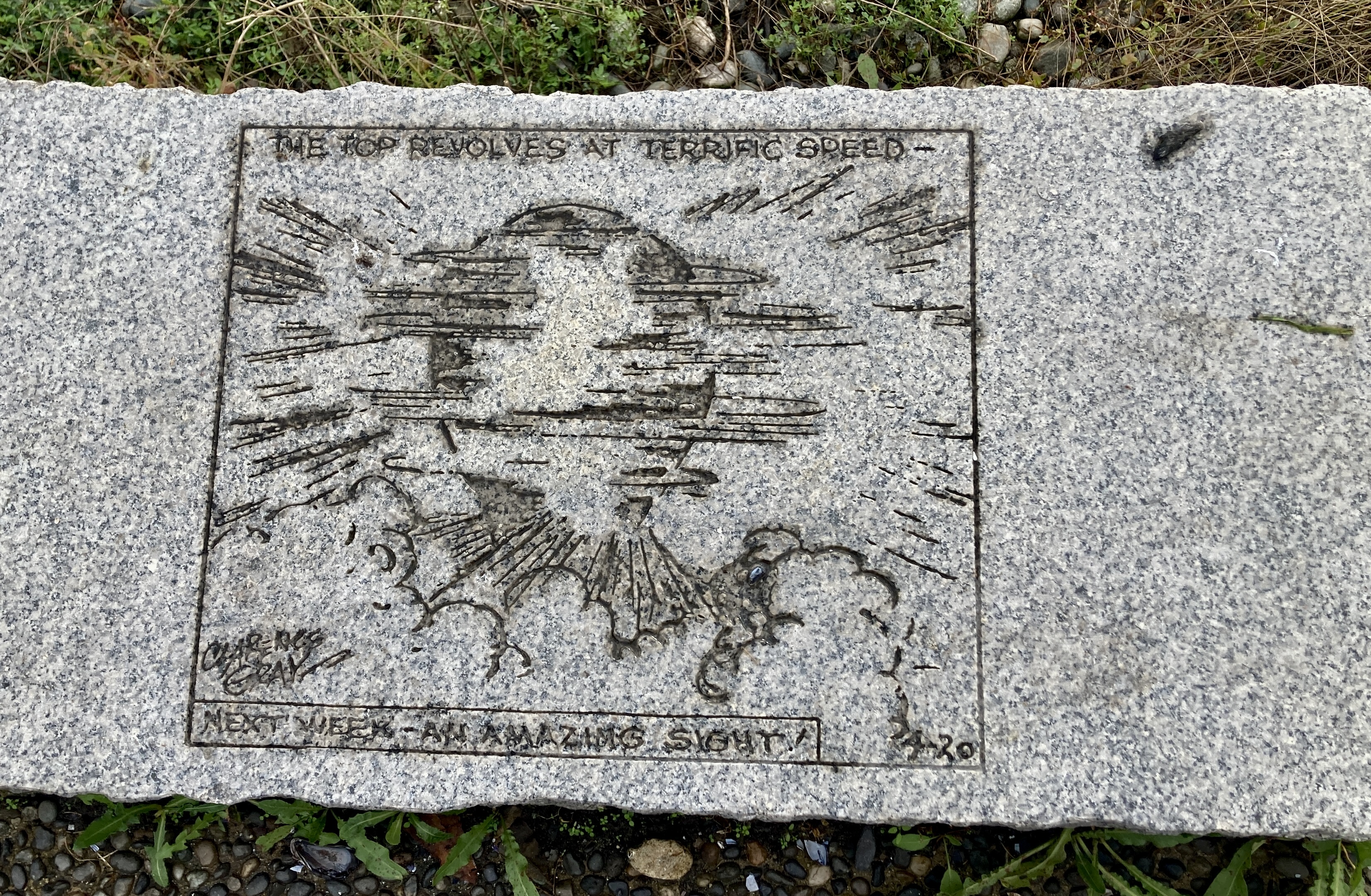
Jerry Pethick’s Time Top sculpture, for example, that invites us to imagine a time top spinning across the galaxy…
to crash-land on the shores of the Pacific Ocean, right here…
or the blue bands of A False Creek (Rhonda Weppler, Trevor Mahovsky), that invite us to imagine what all this will look like if climate change indeed causes ocean levels to rise 4-6 metres…
and, right next to it, another interjection of a “now” reality, again in the form of a polite and neatly lettered graffito. This one, beneath the No Dogs Allowed notice there on the right, yanks our attention back to the present. “Clean The Water,” it snaps.
I stop my fancy metaphysics for a moment, offer myself a simple contrast between sky-high…
and shoreline…
then, sideways, a panorama of nature, reminding us that it invented fall colours long before built structures began to emulate them…
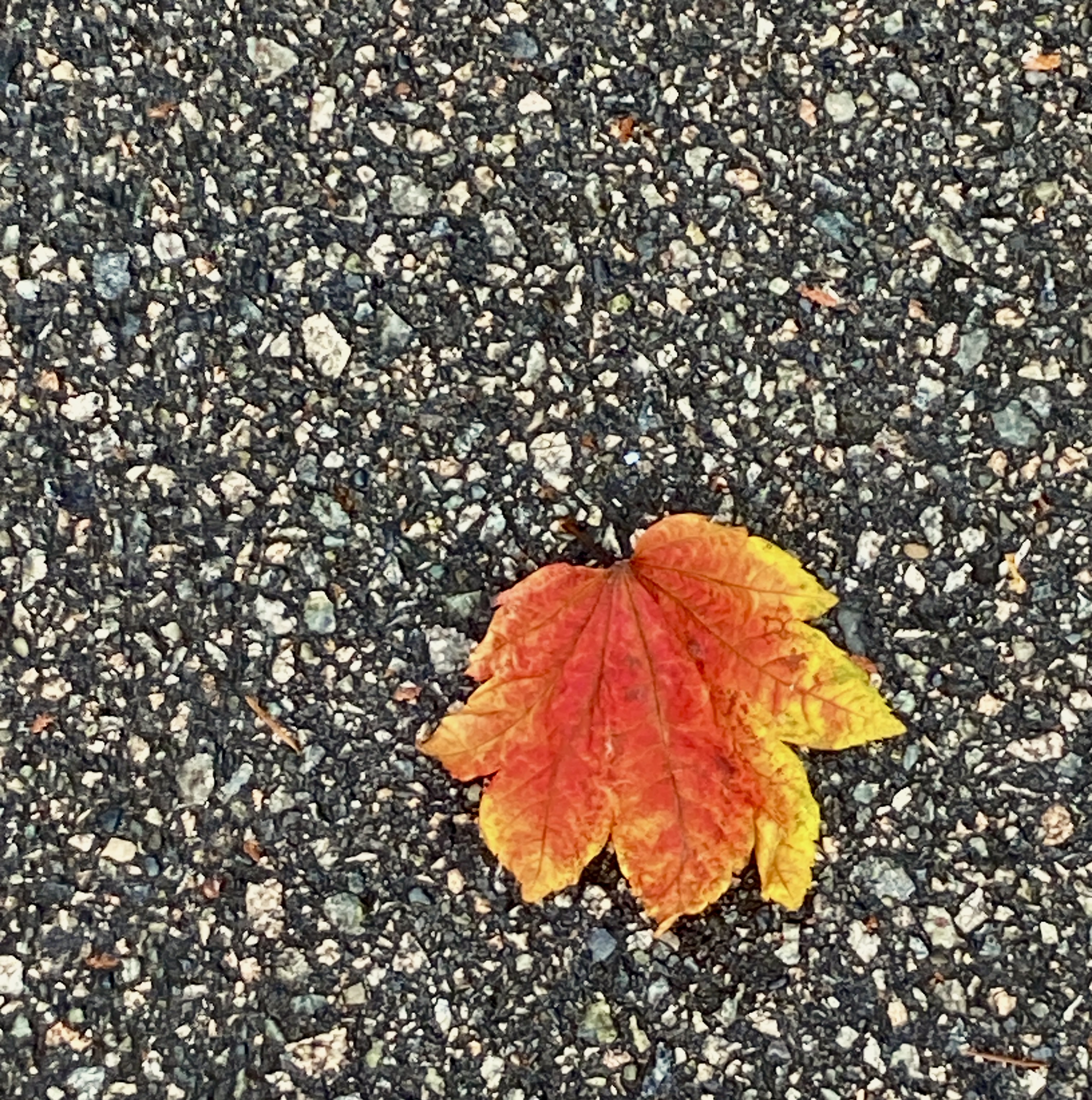
followed by, at my feet, the tight focus of a single fallen leaf…
reminding us that diversity, whether in or out of political favour, is the building-block reality of life.
However pure green this leaf long appeared to be, all these other colours were woven into it right from the start and are equally part of it. As are (side nod to Thich Nhat Hanh and the concept of interbeing) sunlight, water and soil, plus all the nutrients of those three elements as well, all of which made the existence of this leaf possible.
Quite literally, the universe in a single leaf.
Enough. I think I’m done. But, no.
There is one more juxtaposition. One more interweaving. One more dance to vibrate my own little world, as I walk on by.
Upper right: nature’s wasp nest. Lower left: street-guy’s sneakers. Both at home in the tree. A tree shedding its leaves, itself at home with the cycles of the universe.
18 October 2025 – A wonderful bit of British slang: the verb “to grizzle.” It describes the act of complaining or whining, at a low decibel level, but continuing on and on and forever-bloody-on. Which makes it such a lovely companion, in more than rhyme scheme, for the verb “to drizzle.” It describes the act of rain that falls at a low intensity level, but also continues on and on and forever-bloody-on.
This afternoon, for example.
I am equipped for the latter, and reject the former. — like most Vancouverites, I hasten to add. We know where we live.
Scotia Street seems an appropriate start for a drizzle-walk.
It overlaps with the final stretch of Brewery Creek, which, in the days when it had not yet been sewered, ran into the east end of False Creek, which had not yet been filled in.
Grey sky & low visibility along Scotia, but colours pop, both autumnal foliage and seasonal umbrellas.
Ditto the red truck marking the Red Truck Beer Company, down there where Scotia ends (or starts) at East 1st Avenue. Beyond the brewery yard, I can see dim outlines of the lowest level of the mountains to the north, but nothing higher up, only the drizzling sky.
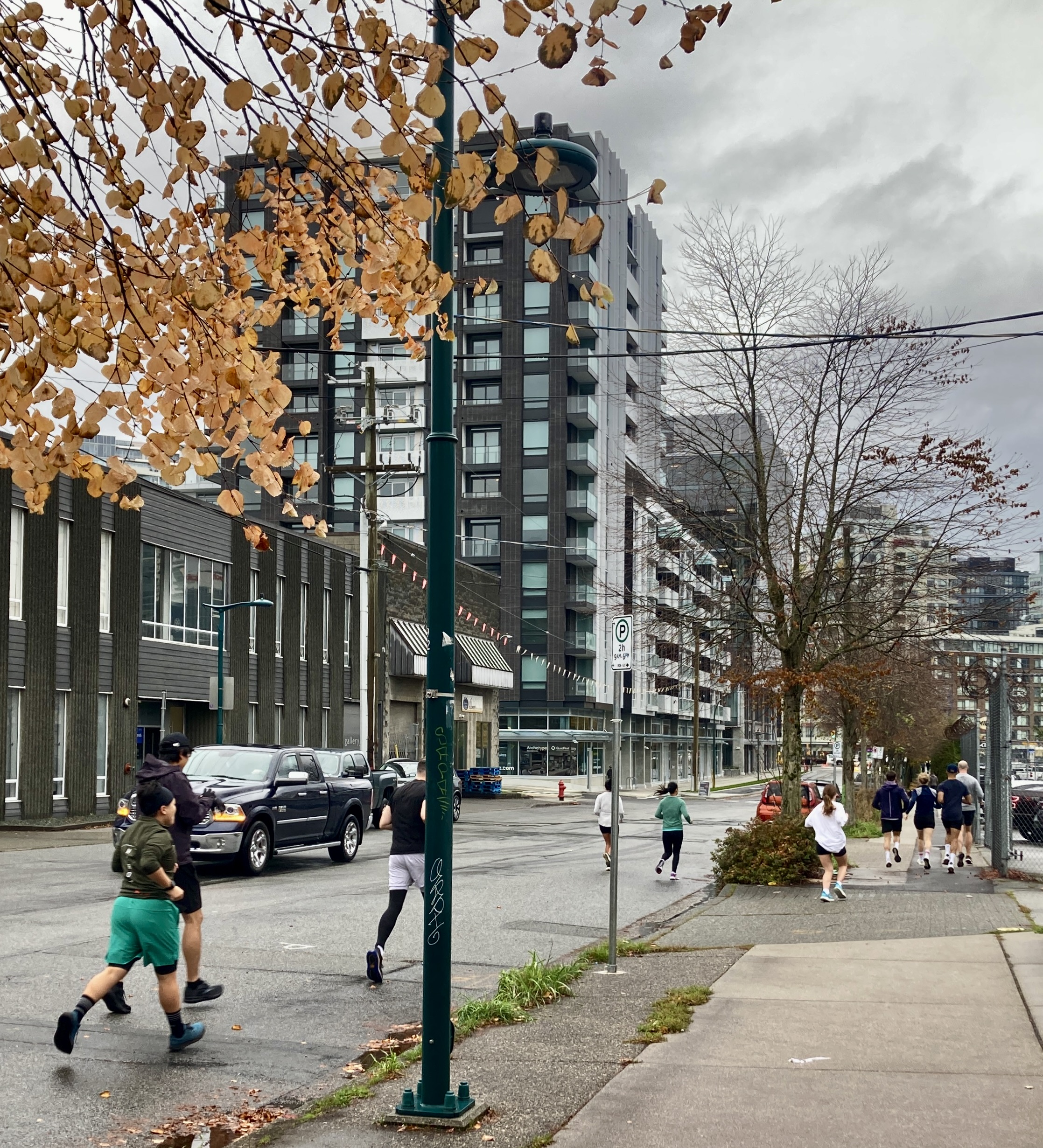
The mountain peaks may be hiding, but not us Vancouverites. As I turn onto 1st Avenue, a stream of people erupts from the Crossfit BC doorway opposite, and starts pelting on down the street ahead of me.
By the time I’ve walked another block, I start meeting them on their return trip. Apparently this is just the warm-up for an indoor class.
I veer through False Creek Flats, filled in originally to provide land for railway-oriented industry and warehouses. The area is morphing into a new post-industrial life centred around digital media, clean technologies, medical research & the like, but the transformation is not complete. Sodden skies suit the still-gritty streets that lie beneath them.
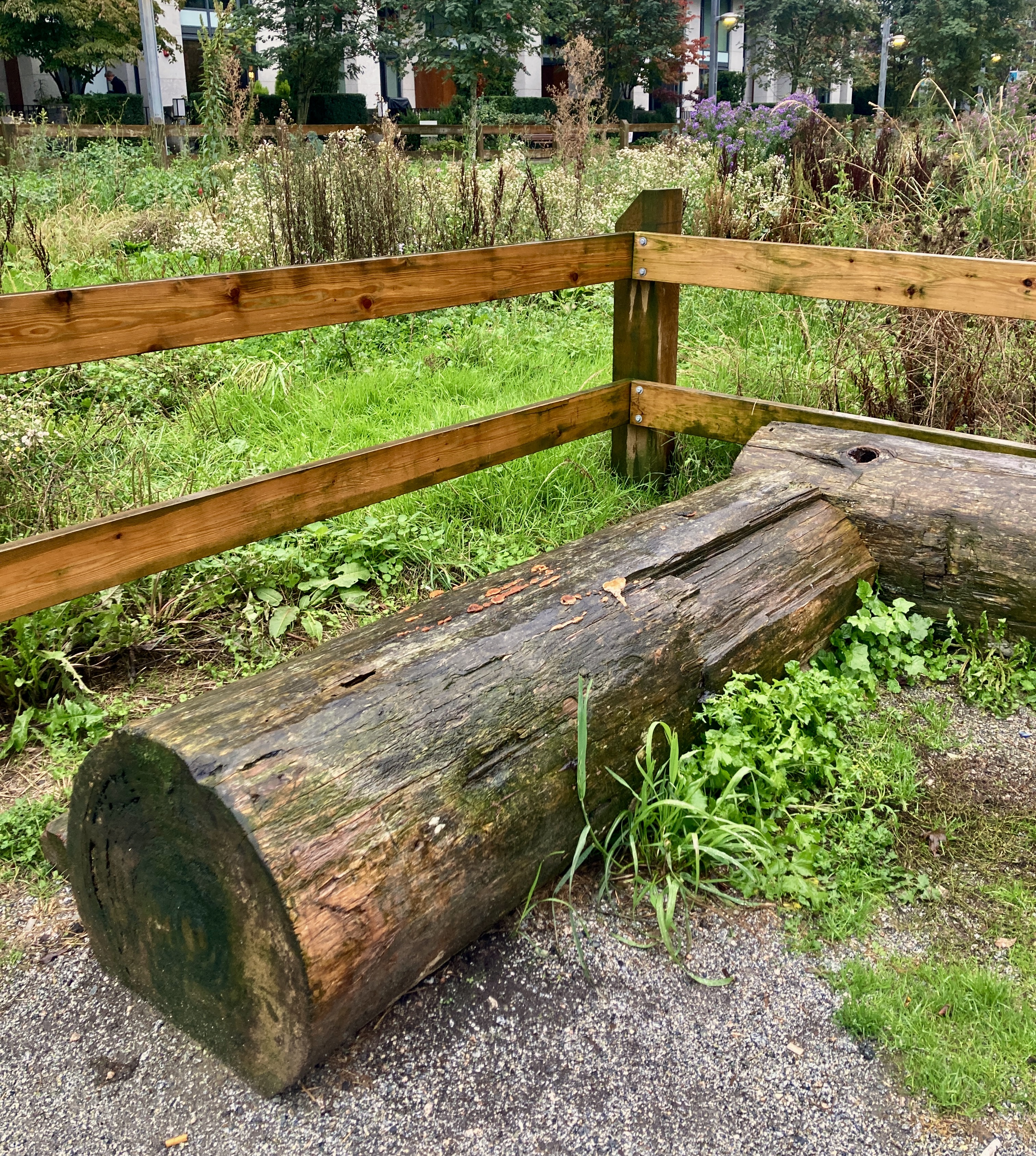
Farther west, I twine my way first around the pollinator meadows lining the Ontario Street bioswale, where logs and their tiny fungi gleam brown and gold…
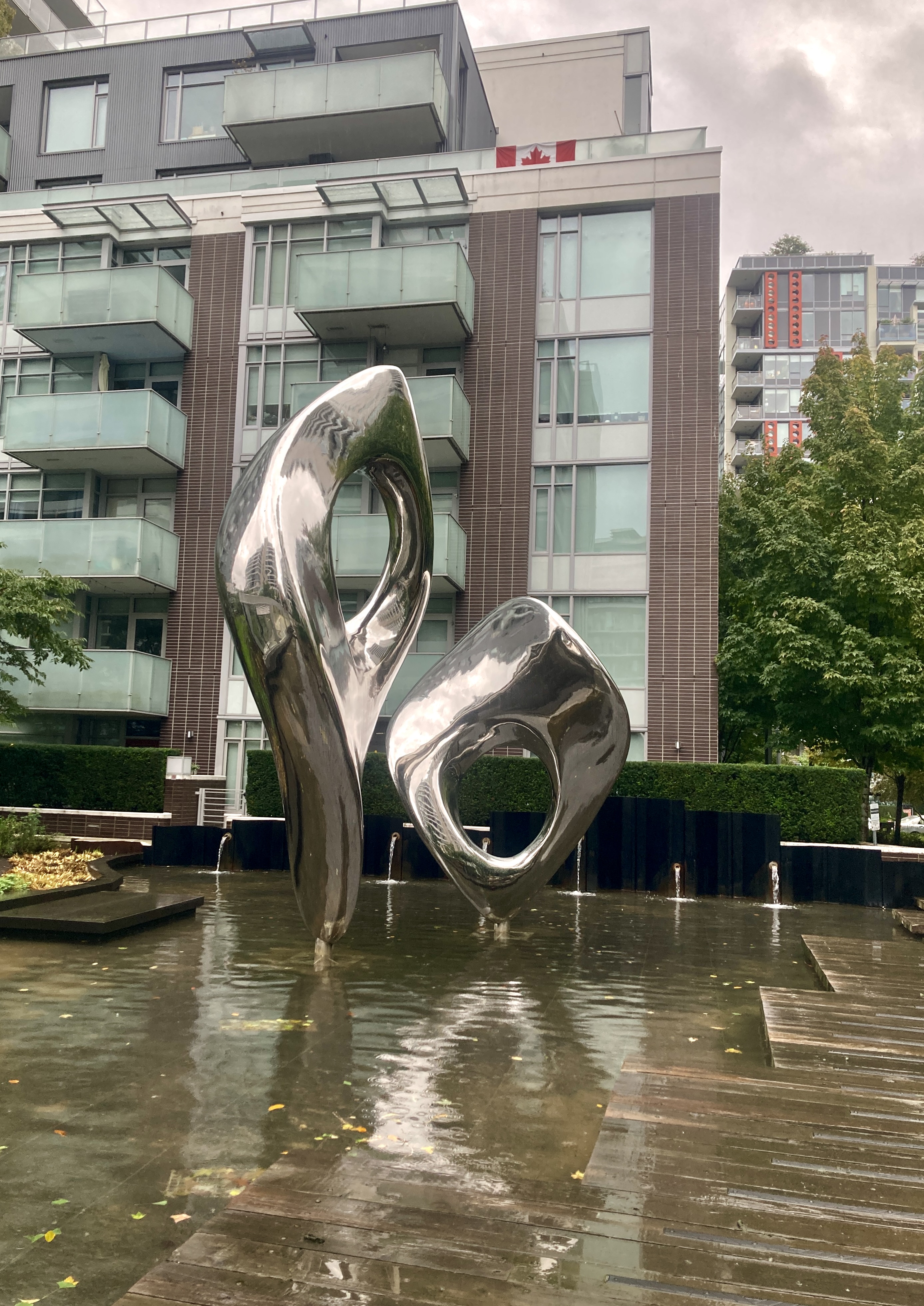
and then among the condos just off Quebec Street, where the gleam is metallic but equally appropriate. When could suit a fountain sculpture (Eyes On The Street, Marie Khouri & Charlotte Well) better, than a drizzling sky?
By the time I am walking along West 2nd Avenue…
I am prepared to concede that the sky is no longer drizzling. It is raining. Same visual impact — just look how that orange traffic light spills on down the street, bouncing from one puddle to the next — but damn, there’s nothing “low-level” about this.
(A passing woman & I grin at each other in mutual approval: we are each snug in waterproof clothing, and therefore spurn umbrellas.)
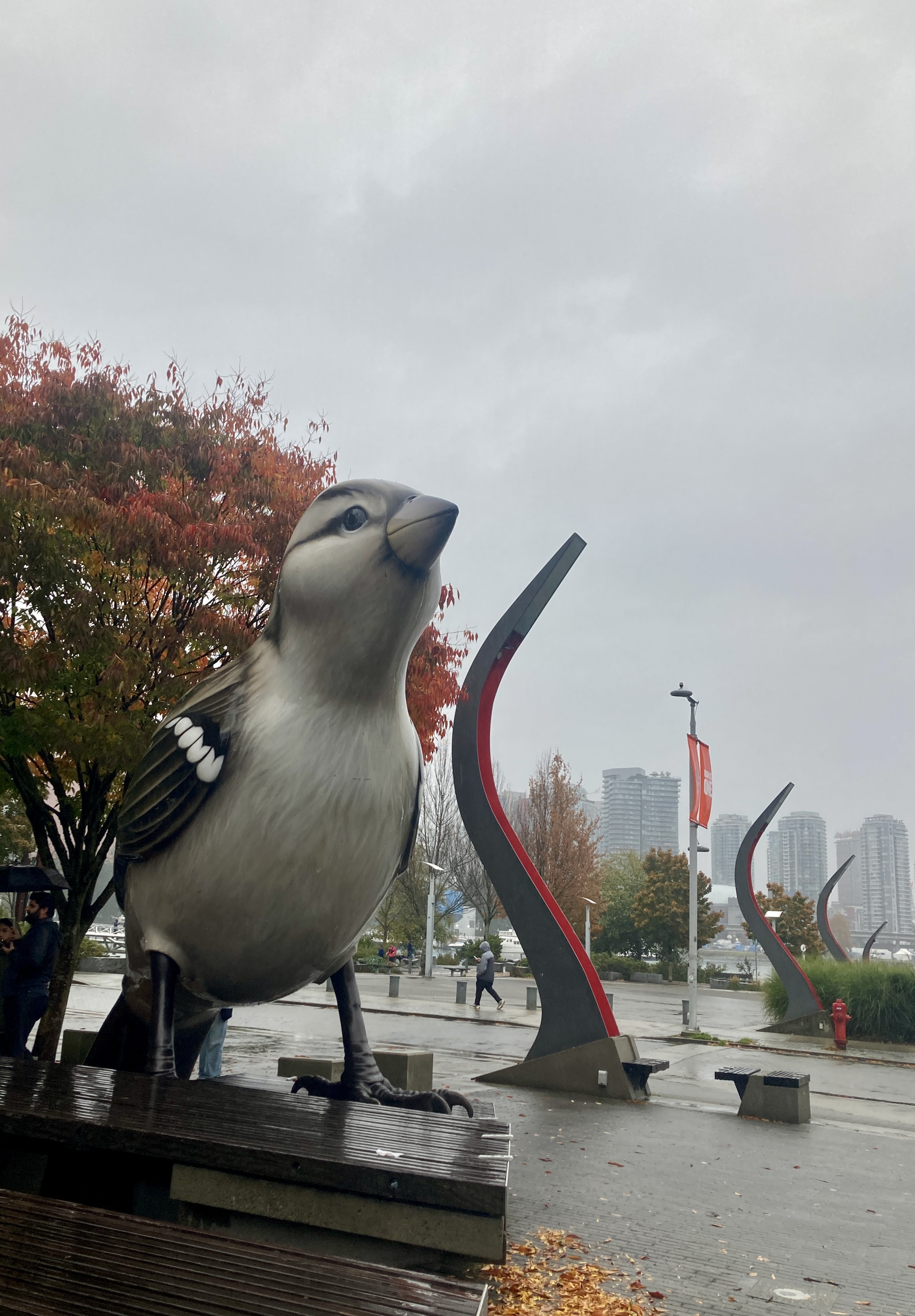
In Olympic Village Plaza, one of Myfanwy MacLeod’s The Birdssculptures tilts his stainless steel head to the elements…
Canada Geese bend their feathered heads to rich pickings in the grass (the mountains have now totally disappeared)…
and the cast-iron cycle of eggs/tadpoles/frogs on the storm sewer cover (Musqueam artists Susan Point and daughter Kelly Connell)…
is completely and perfectly at home in the dancing rain.
Meanwhile, the human beings at the street corner…
look distinctly less comfortable.
I am quite sufficiently comfortable, thank you, since only my outer layer is wet.
But, even so… I call it a day.
I may not grizzle, but I do know when I’ve had enough drizzle.
2 October 2025 – I’m over at St. George & East 6th, hunkered down for the view south along this stretch of the St. George Rainway.
Then I pay serious attention to the map — to the lost small-c creek and to the lost big-c False Creek as well, lost when (1915 onward) they filled in the final stretch to create industrial & railway land. I trace my finger along that bright turquoise line, showing us the shoreline that used to be.
I study the 1889 photo…
and then I go study the 2025 reality, from that same Main & 7th intersection.
14 September – And then, from morning to afternoon, I leave Toronto and land in Vancouver. Here I am, looking through slight drizzle to the mountains, with one last love-letter I want to offer “T.O.” (Tee-Oh, Toronto.)
My T.O., that is, nobody else’s — my own mix of memory and re-discovery, blind to what others would notice, alert to all my own triggers.
Glimpses from streetcars, for example.
A rampart mural by Shalak Attack, which I remember watching her paint, many years ago…
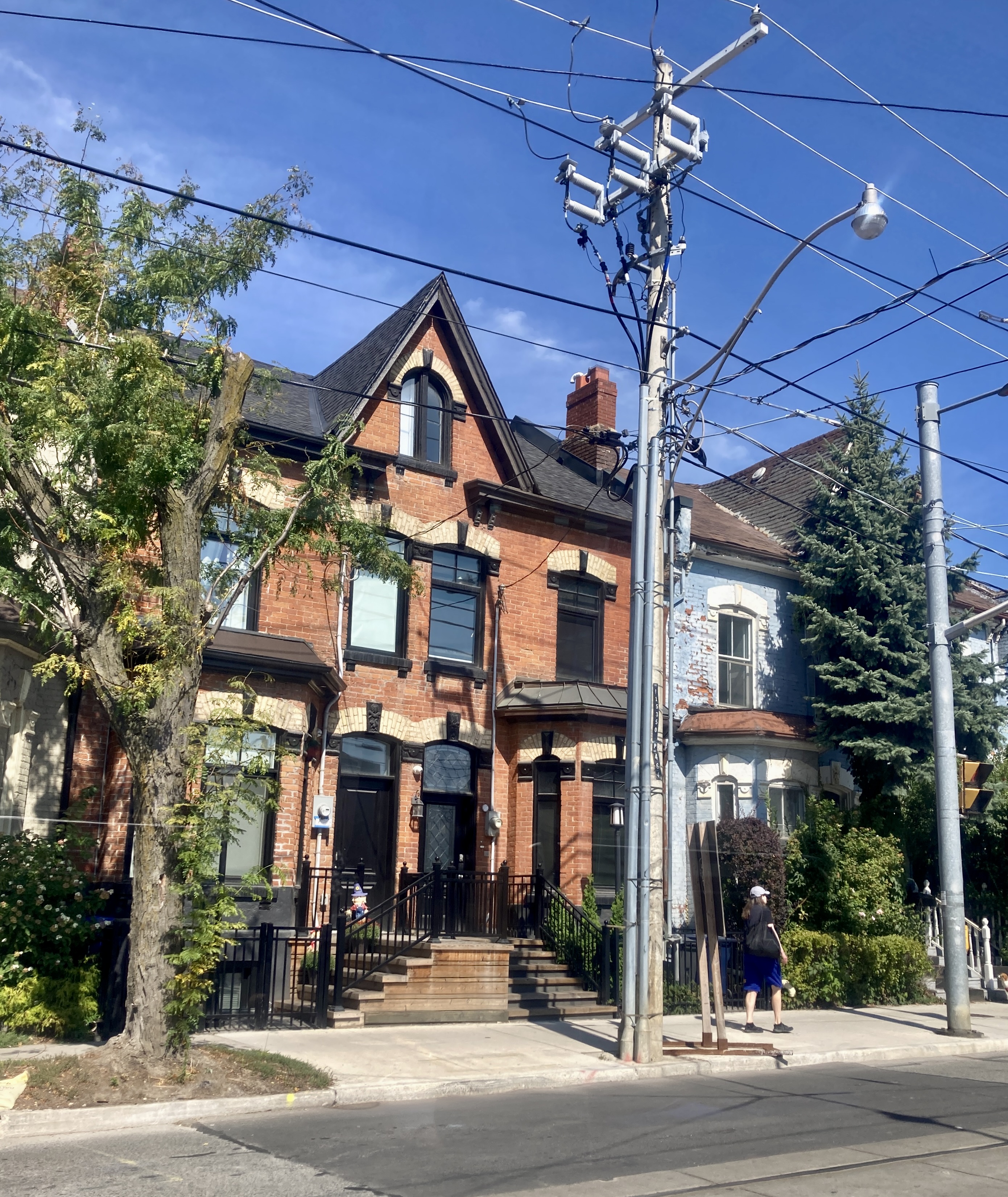
the distinctive two-tone brick and architecture I associate with my own decades in the Cabbagetown neighbourhood, but common to the city in that era…
and Streetcar Dog. Not unique to Toronto, but part of my own memory bank of riding the TTC.
Then there are my re-discoveries on foot, all around the Grange neighbourhood and the Art Gallery of Ontario, where I was for years a volunteer and therefore an area where I came and went, a very great deal.
Bronze turtle watching martial-arts in Butterfield Park, the new-since-my-time refurbishment of the land just east of Grange Park and south of OCAD (Ontario College of Art + Design) University…
Henry Moore’s Large Two Forms, looking very at home in its new home in the reinvented Grange Park, with the brilliant blue rear wall and distinctive Frank Gehry staircase as backdrop…
and, once inside, the soaring glulam arches of the AGO’s front-façade Galeria Italia.
Unchanged, these arches. Ditto, the way the Galeria invites you to look out across Dundas Street. Native son Gehry made sure his design honoured and welcomed the neighbourhood of his childhood as its own visual final wall.
I am in the AGO as much to walk old ground as to see current exhibitions, but in the end I do both.
The Joyce Wieland retrospective, Heart On, speaks not only to my memories of her bursting on the scene, but also to how current she now is, once again.
Wieland was a fierce ’60s-70s feminist and, despite (or perhaps because of) long years in New York, a fierce Canadian patriot as well. She often used the soft “feminine” skills of embroidery or quilting to express strong political convictions.
For example, with her 1970 work, I Love Canada – J’aime Canada.
Awwww. (Twist finger in cheek.) So sweet.
Now read the signage.
And read the embroidered fine print.
Wieland’s narrow definition of Canadian identity is now out-dated — but the rest of her analysis is Elbows-Up contemporary.
Some hours later, I leave the building. I still have more circling and prowling to do.
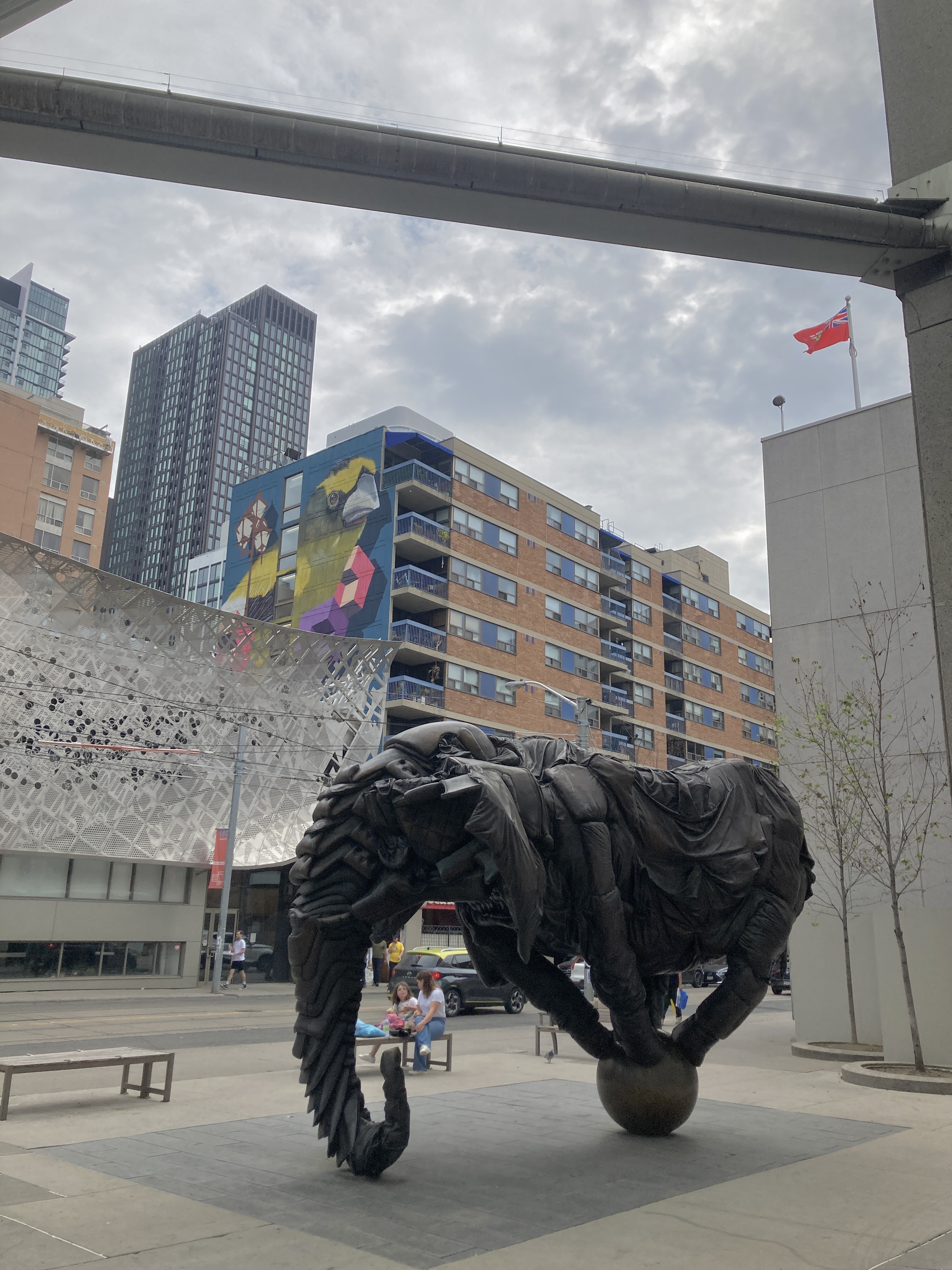
I check out the S/W corner of Dundas West & McCaul. It is also the N/E corner of the AGO footprint and, in my day, was still home to Moore’s Large Two Forms. For the first time, I see what now sits on that corner — Brian Jungen’s commissioned work, Couch Monster. (Read more, here, in a fine post by our WordPress colleague, Canadian Art Junkie.)
I circle the work, and also take in the larger view, including the top of an old mural by veteran Toronto artist Birdo, now obscured by newer construction and backed by even-newer construction.
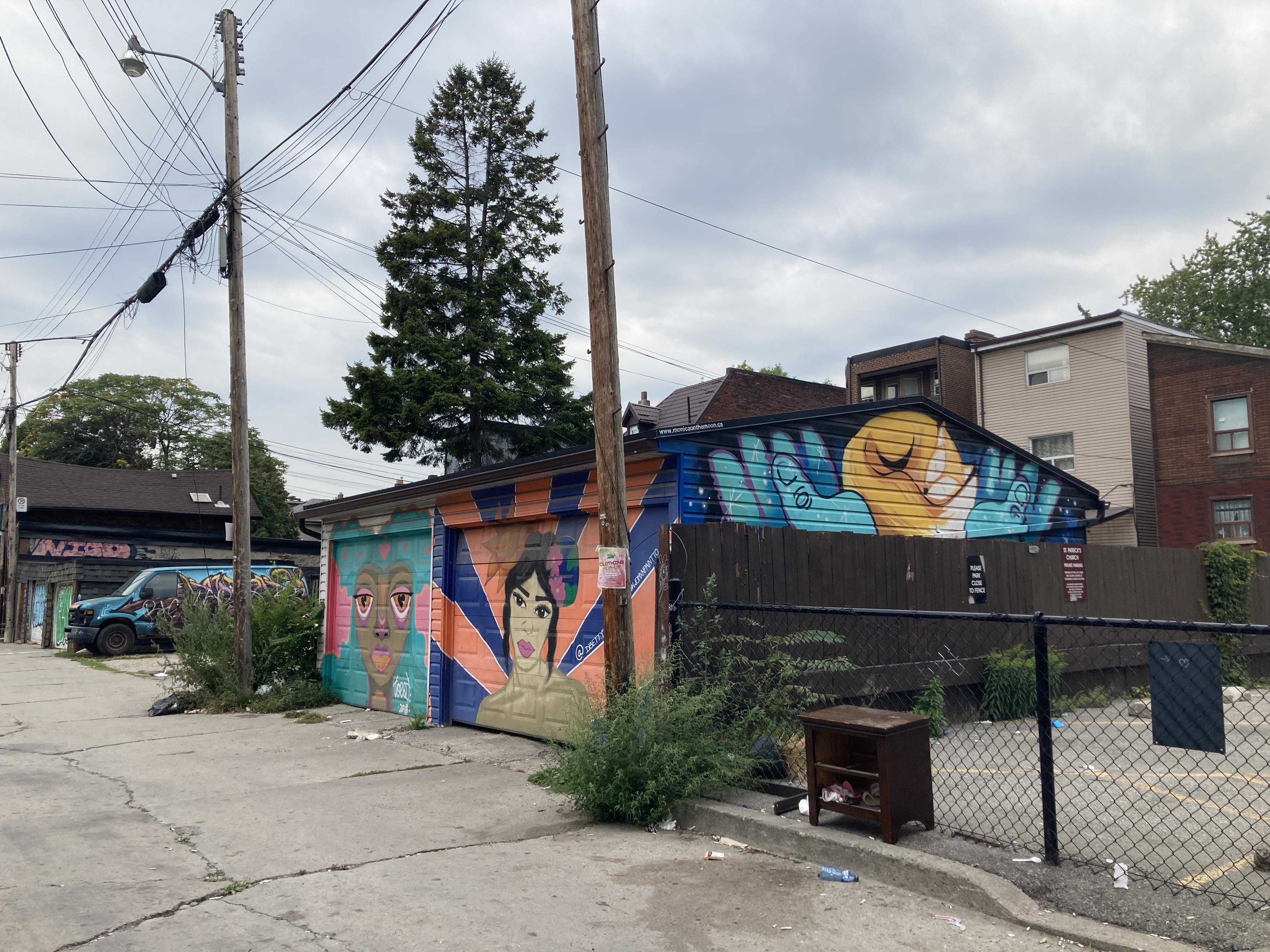
Finally, and not with terrifically high hopes, I take myself across Dundas West and into the alley between Dundas and Darcy Street to the north. I am eager but also dreading to see what it’s like, these days. My memory is of an alley bursting with street art, full of the “garage-door art” that I associate with my memories of Toronto.
And…
there it still is. On and on, to the west, beyond the frame of this image. Not exactly as it was, of course not, but alive and current and so-very-T.O.
I turn right on a second, N/S, alley, passing delicate tendrils and other art as I go…
and emerge on Darcy Street.
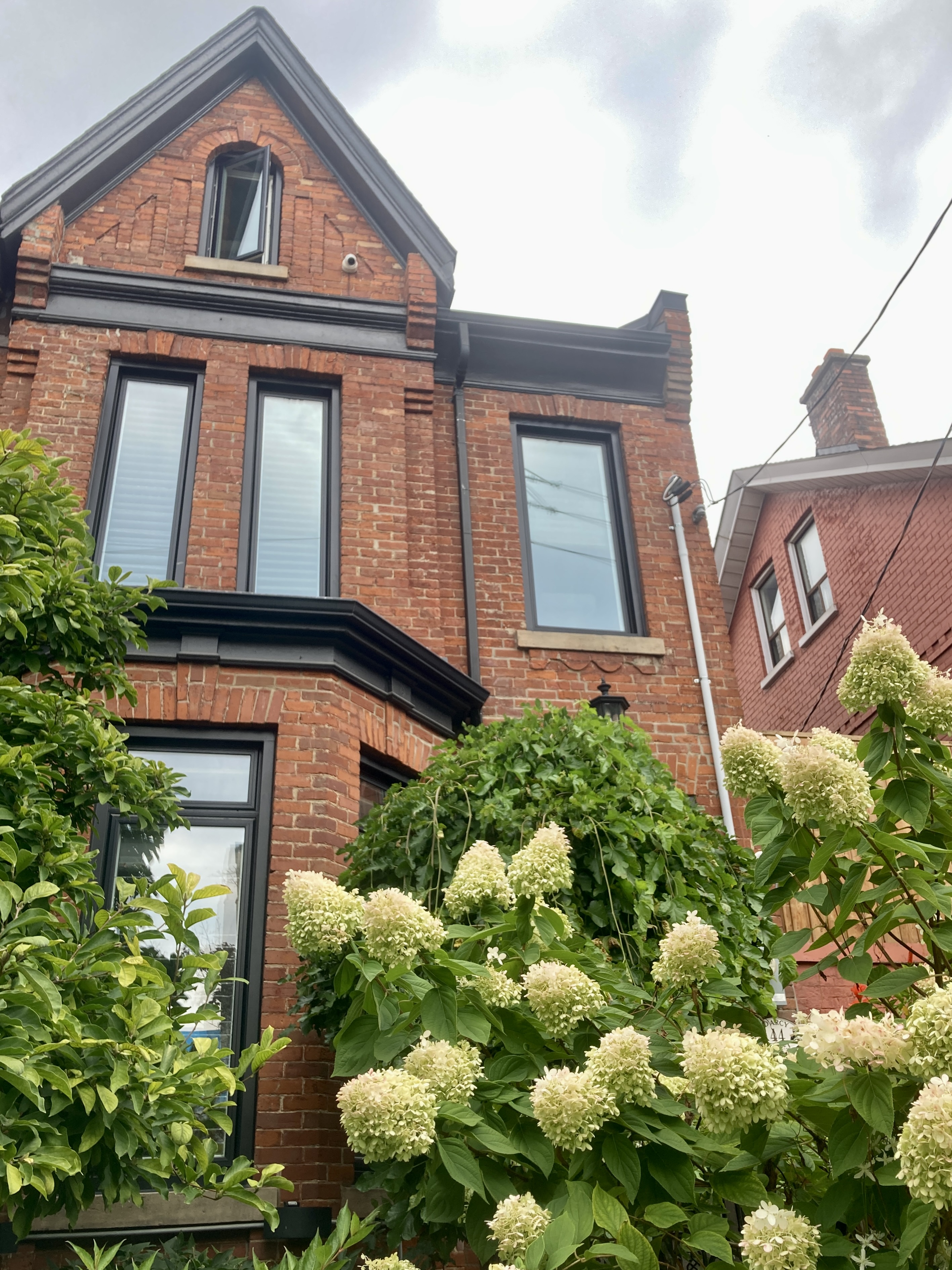
Where I drink in an enclave of old downtown residential architecture, oh look, some still survives…
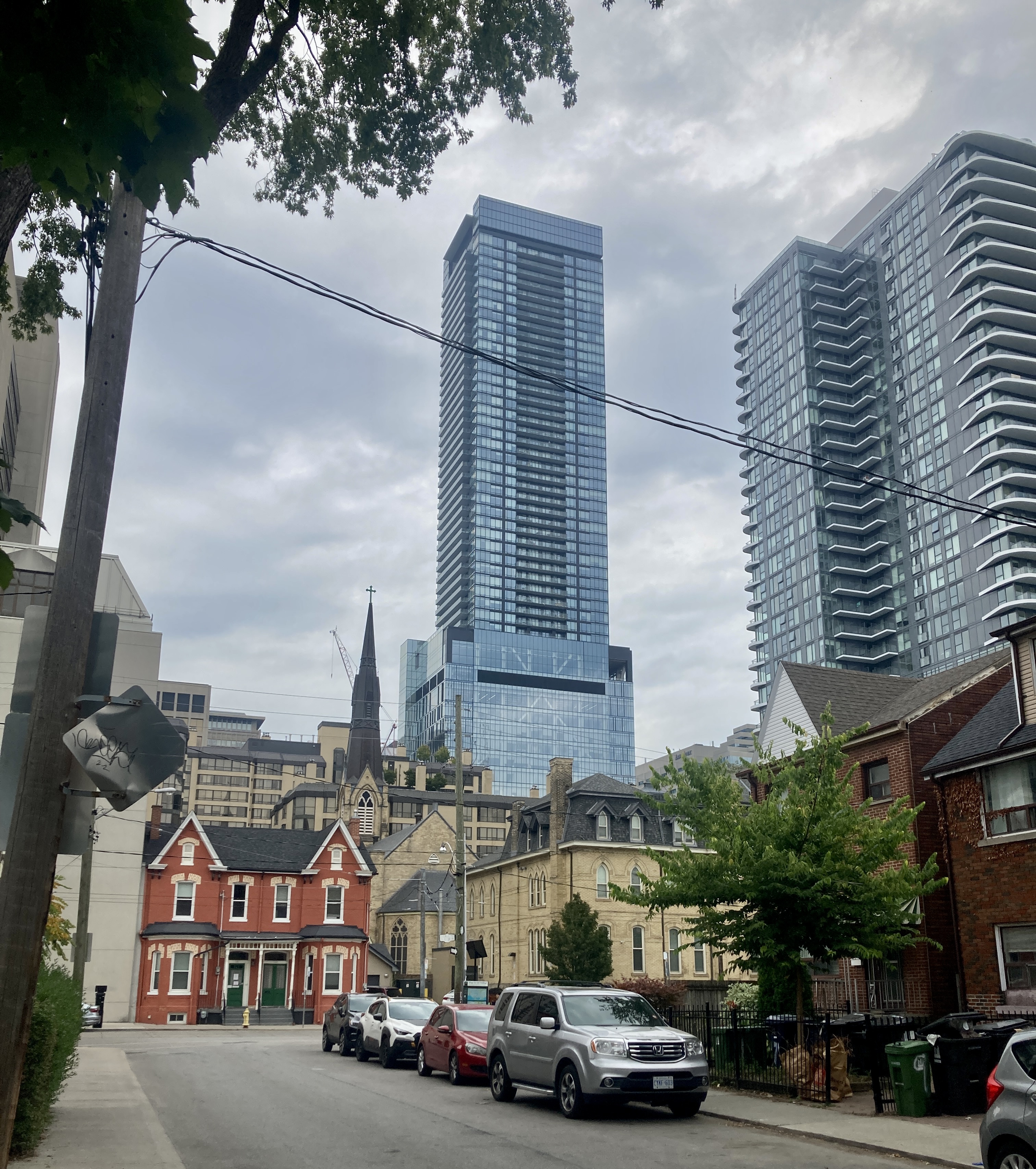
and then pivot on my heel to look east down the block. Out to McCaul Street.
Still some old brick homes, and still the spire of St. Patrick’s Church (the 5th-oldest Roman Catholic parish in Toronto) as well — plus the immediate examples of all the new towers now exploding skyward.
There it all is.
The whole jarring/exhilarating, cacophonous/euphonious, forever-evolving symphony of the city.
12 September 2025 – More old + new, here in Toronto. The joy of time with old friends and familiar places, but also the joy of discovery.
For example, Biidaasige Park — some 40 hectares once complete, down at the mouth of the Don River and part of an even larger overall program to re-gentle, re-green and detoxify the sprawling Port Lands for what we now understand to be wiser, more multi-purpose and more inclusive use. Read more about Biidaasige (“Bee-daw-SEE-geh” with a hard “g”) on the City‘s website, on an analytical design website, and in her 6 September “As I walk Toronto” post by our WordPress colleague, Mary C.
The park is very much a work in progress, but some elements are already in place. They include several imaginative children’s playgrounds, one of which has as its guardian spirit, Snowy Owl.
Not only is his open tummy a stage for all kinds of child-friendly events, the interior of his body is open to visitors as well. You can walk inside…
and start climbing. Stairs, then ladders, and up you go.
Bang-thwack-ouch! Smack your head a few times and you finally realize the structure is child-scale. You learn to bend and duck accordingly.
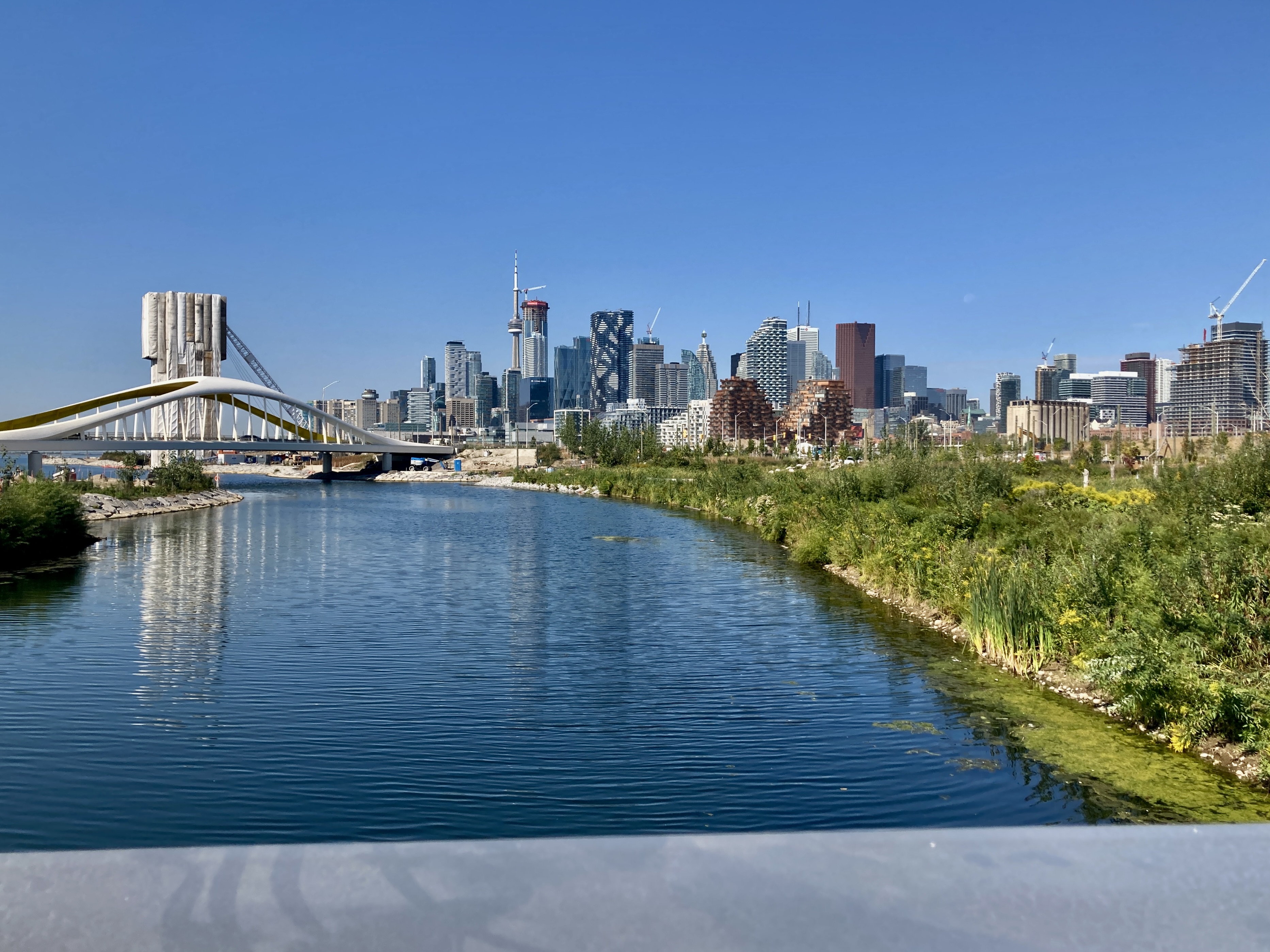
Your reward? You get to look out through the Owl’s eyes, across the undulating playground, across Commissioner St. and westward toward downtown.
I scramble back down. We take ourselves off to explore trails down in the marshy areas around the various channels.
I am awestruck. This grubby, much-abused waterfront is being transformed. We lean on the railing of this pedestrian bridge and admire the grace of the new vehicular bridges, the abundant wild greenery along the banks, the habitat all this must offer for so many species. (Plus the knowledge of habitat yet to come, in plans for housing and further human community and settlement as well.)
And then… we move on.
The day is hot, and sunny, and, thanks to on-going park construction, noisy. We want still to be close to nature, but somewhere that offers soothing shade and a lack of noise.
All of which leads us to discover…
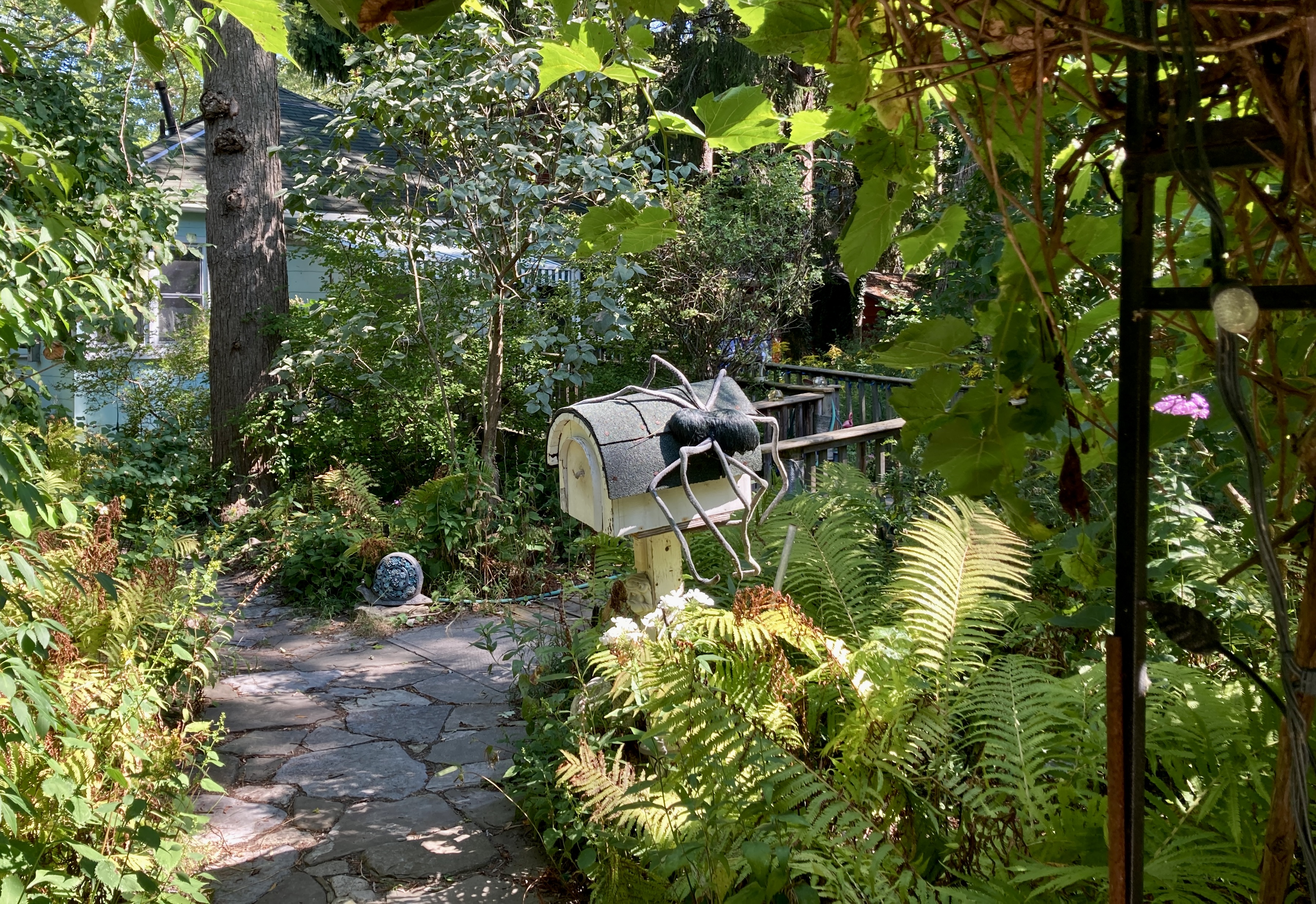
Mailbox Spider.
He is only some 4-5 km. away, slightly south-west of Biidaasige Park…
but in a very different world. The world of the Toronto islands.
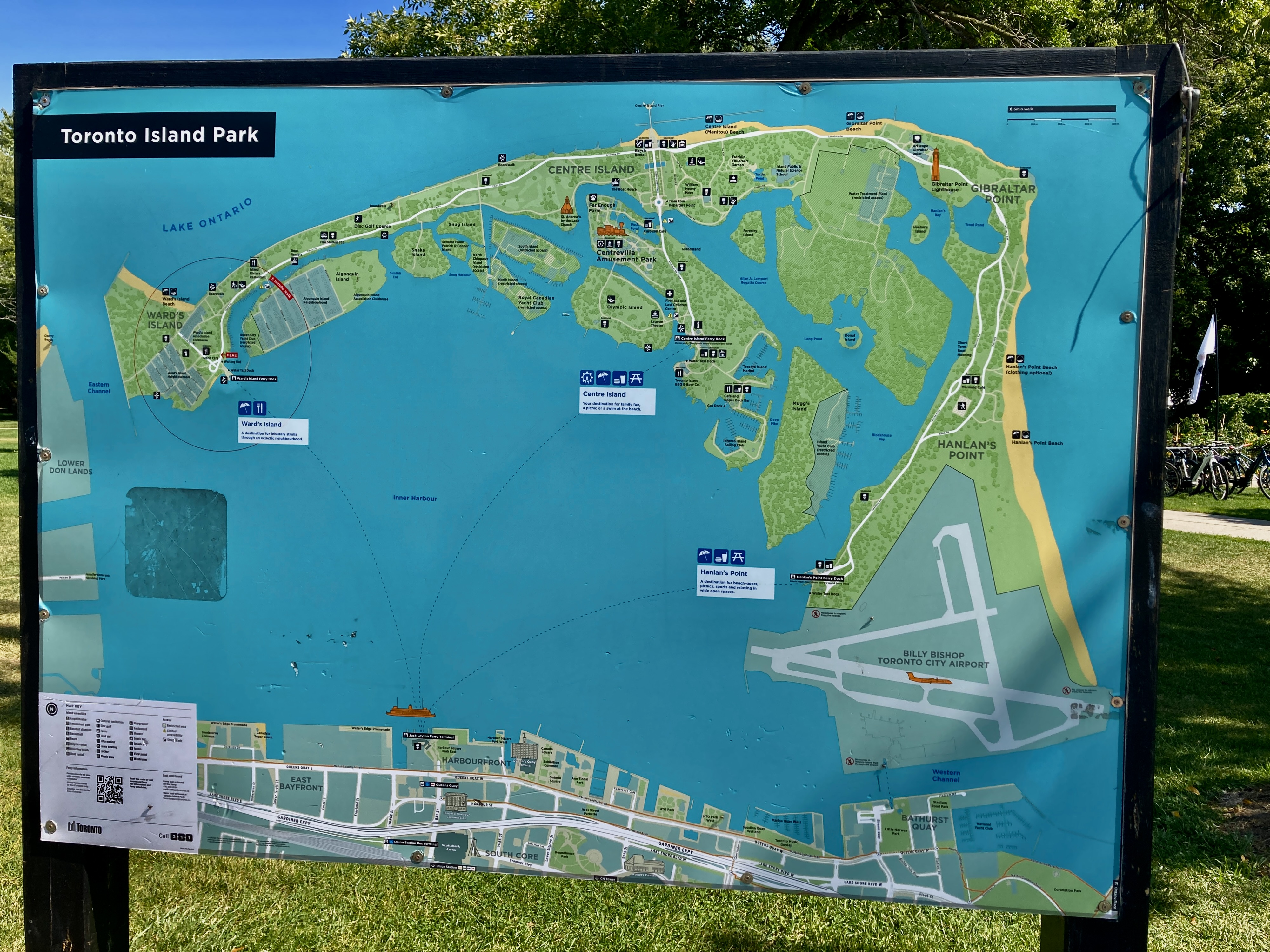
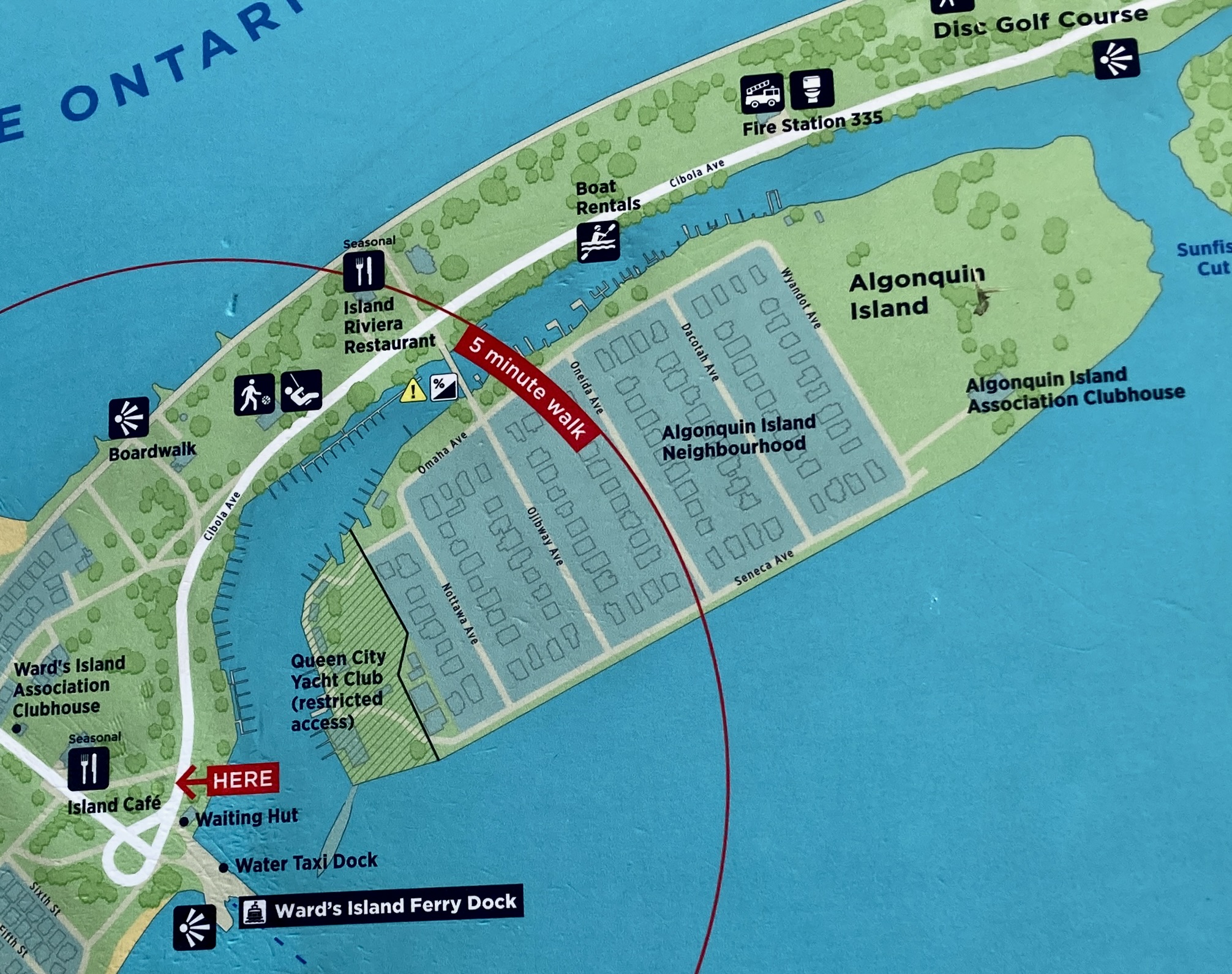
More specifically and of importance to me, we are on one small island within that larger cluster: Algonquin Island, which is reached by a pedestrian bridge close to the Ward’s Island ferry dock.
Trace your finger over that pedestrian bridge and tap the intersection just off the bridge: Omaha and Ojibway avenues. Got it? Right there on that corner lot, almost invisible within its own mini-forest of trees and shrubbery, there is a white cottage. The white cottage where, 60 years ago, I used to live.
So it’s heavy-duty nostalgia time for me, and my friend is generously indulgent.
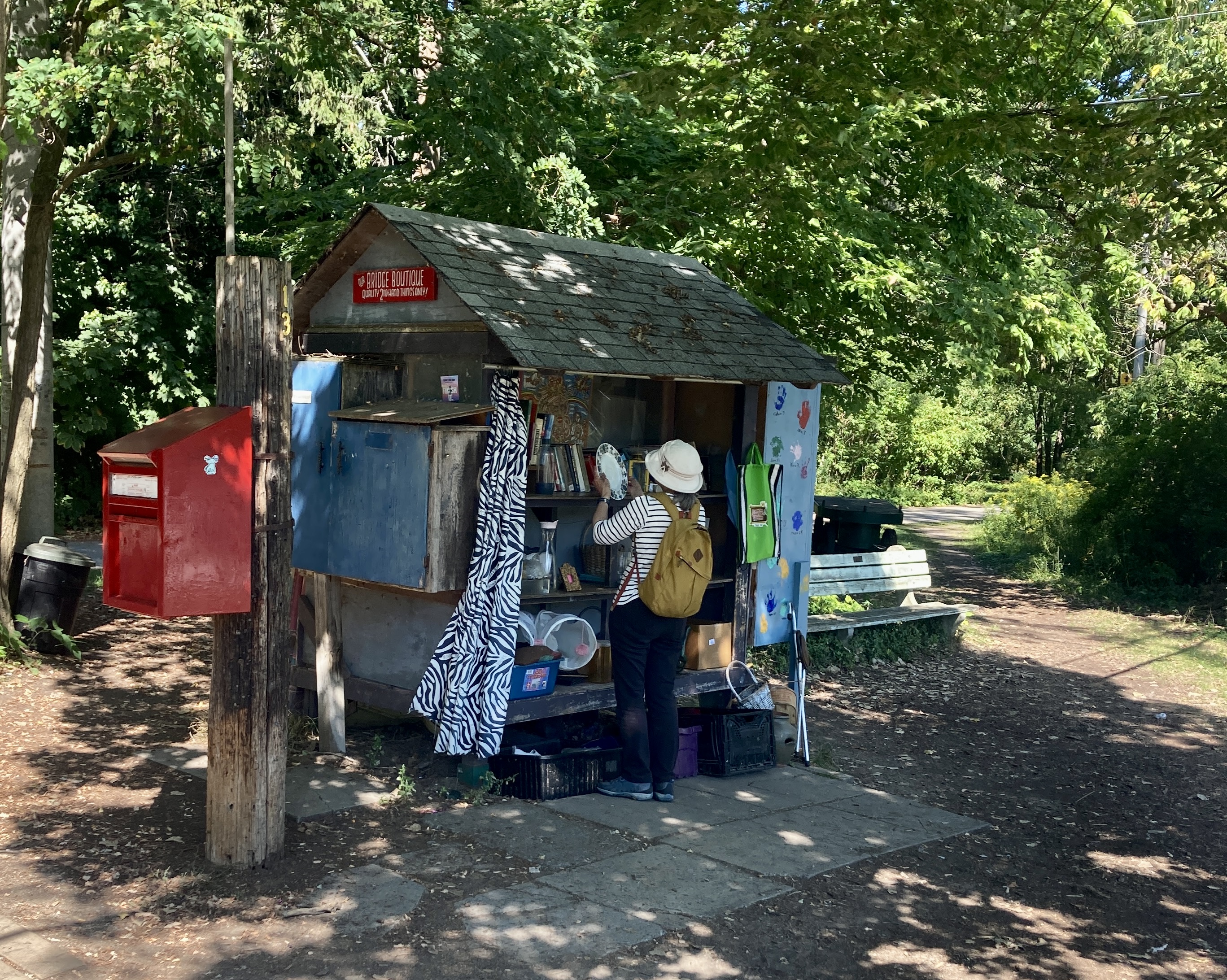
We stop, immediately off the bridge, to explore the community take/leave stand. It was active decades ago and, to my delight, is still active now.
A couple of Algonquin residents are near-by, people about my age. We chat, I explain I used to live here, I name a few names and they smile. We three didn’t know each other, but we each knew these other people.
Then, my friend and I, we just weave slowly up and down the narrow, car-free streets. (It is on Ojibway that we meet Mailbox Spider, with his blue cottage tucked away in the rear.)
The atmosphere is leafy, and peaceful. It is now a world of pretty smooth relations between residents and City — the welcome resolution of the long fight by residents and supporters to protect any residential community at all, in the face of the City’s desire to remove everybody and make the entire islands cluster into one big park. Now most of the land mass is park, but residential communities are recognized and stable on both Ward’s and Algonquin.
We reach the foot of Ojibway Avenue, down at Seneca, which runs along the island’s harbour-side waterfront, and offers panoramic views back across the water to the city core.
Including that CN Tower. I gave you only a distant and slivered view in my previous post; here it is, front and centre.
Still on Seneca, a good example of visitor/resident co-existence:
a bench for tourists and residents alike; one of the island’s many art boxes, again for the pleasure of tourists and residents alike — and a hammock in a resident’s front yard. For that family only, thank you!
Finally, my nostalgia satisfied and our minds and bodies refreshed by the peaceful environment…
7 September – Continuing my new, but very happy, Winnipeg tradition, I go walkabouts on departure morning. Once again, art comes my way as a result.
I cross the Red River to neighbouring St-Boniface and, just as I’m completing a loop through the neighbourhood, I find myself pulled into a parkette.
By this.
It is Joe Fafard‘s 2011 sculpture, Entre chien et loup — a tribute to the French saying, to this francophone quartier, and to the mystery and energy of transition zones.
By 10:30 pm I’m in the train station, ready to board, eager for our 11:30 departure and all the new sights that will come our way.
Except we don’t promptly board, and we don’t leave at 11:30 pm. Instead, we board at 3:30 am.
By then we are the walking dead. (Including the staff change coming on board with us — just as tired as we are but, unlike us, required to be up and active and even happy-faced just a few hours later.)
I don’t know when we finally leave Winnipeg. I’m asleep.
8 September – When I awake, we are somewhere just over the Ontario border. It’s about 7:30 am, and Groggy Self doesn’t understand why she is awake.
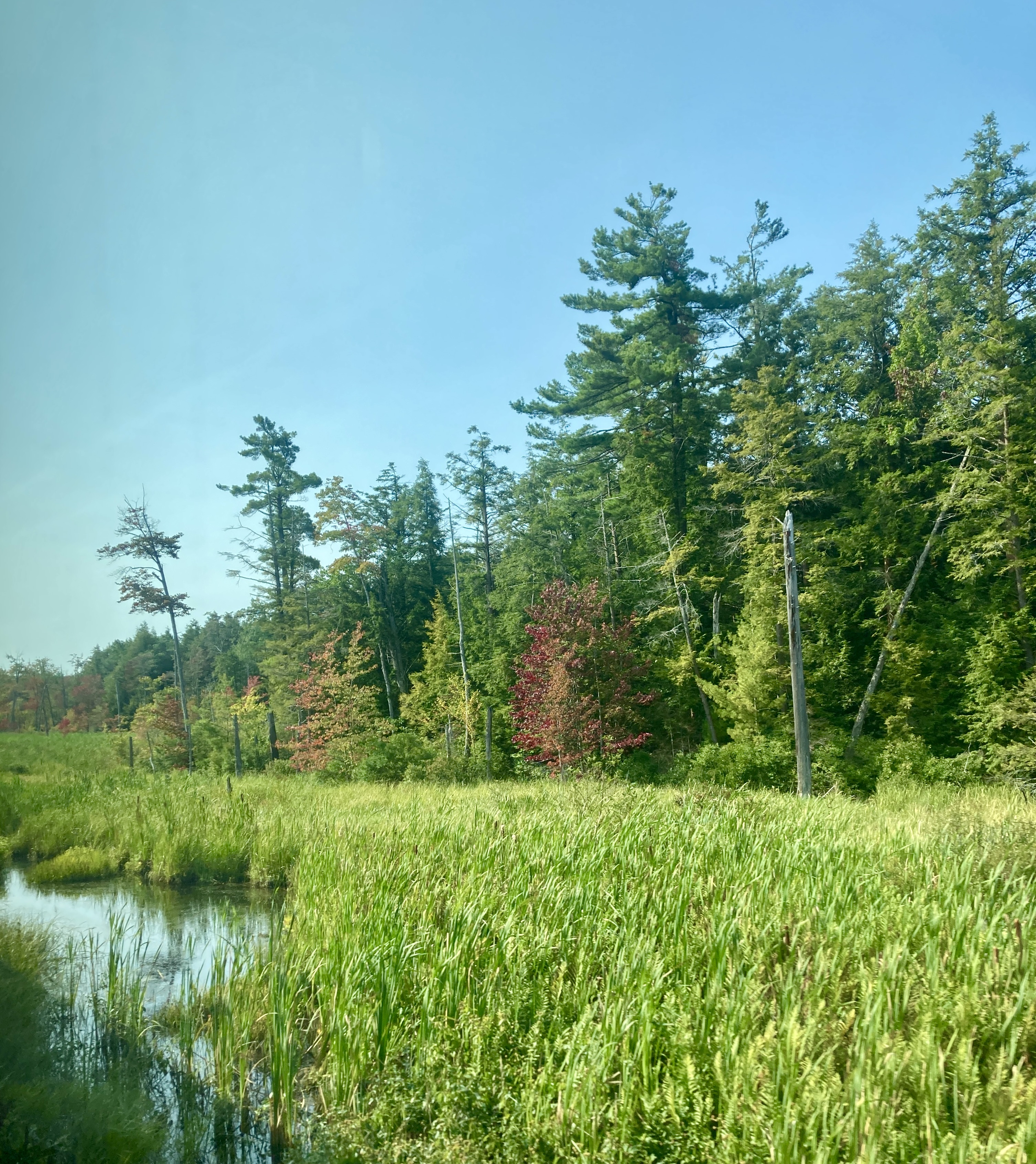
But it’s very pretty, isn’t it? And still very northern-looking.
I could show you lots more photos of boreal forest and lakes. But I won’t! By now you know what they look like. So, instead, imagine you’re with me as I enjoy those stunning views, all day long.
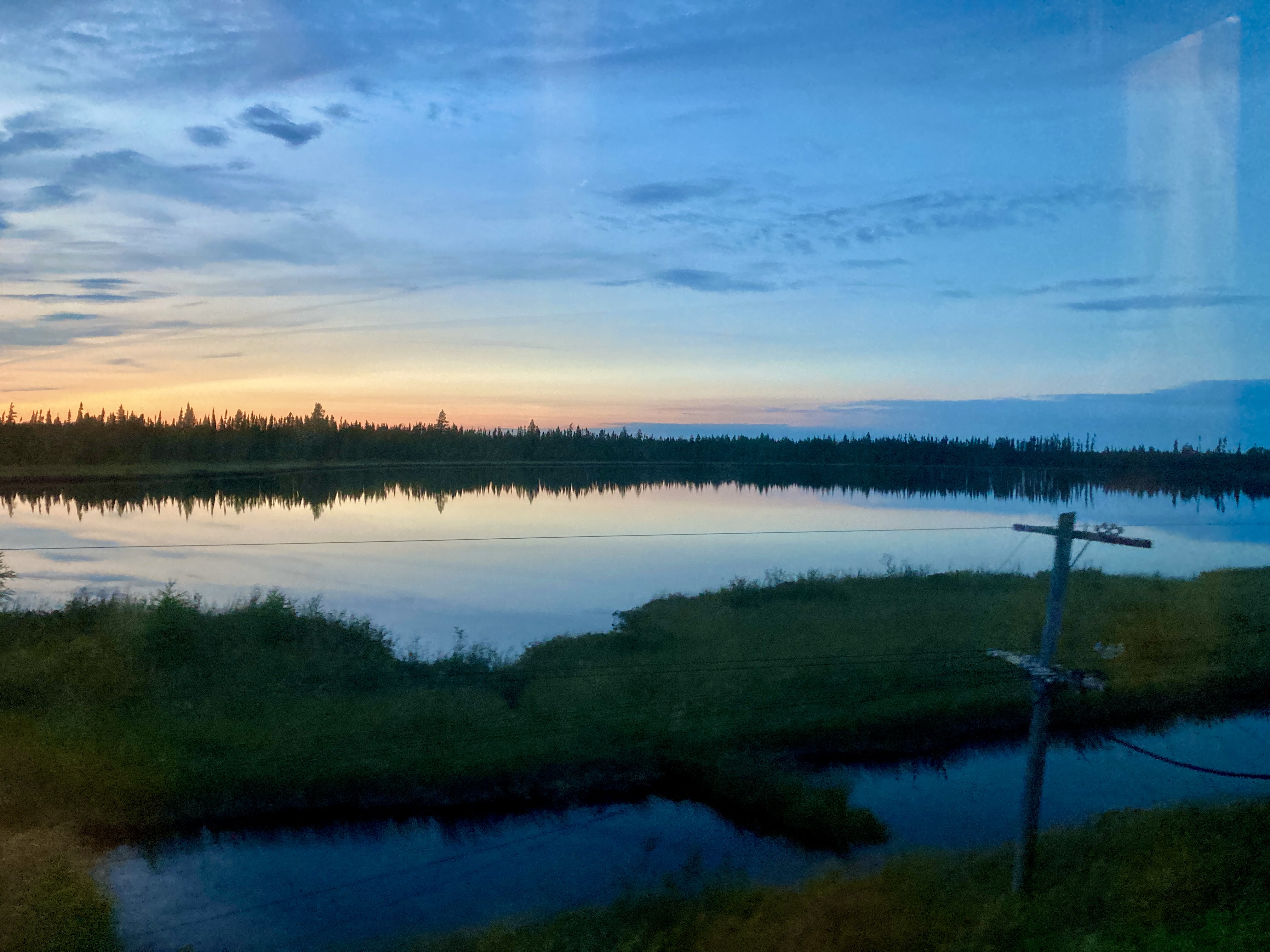
And sunset, near Hornpayne.
9 September – We’re just leaving Washago as I slide up my blind around 7 am, passing a CN work station and a cluster of workers. I’m happy to offer them this tribute: maintaining, scheduling, running trains is hard work. Thank you.
A rusty-but-sturdy little bridge, as we pass Sudbury…
first flashes of fall colour among the trees, here near MacTier…
and also near MacTier, one example of the rocky islands that stud glacial lakes throughout the region. Complete with cottages. (You can see a white one peeking out on the left-hand side of the middle island.)
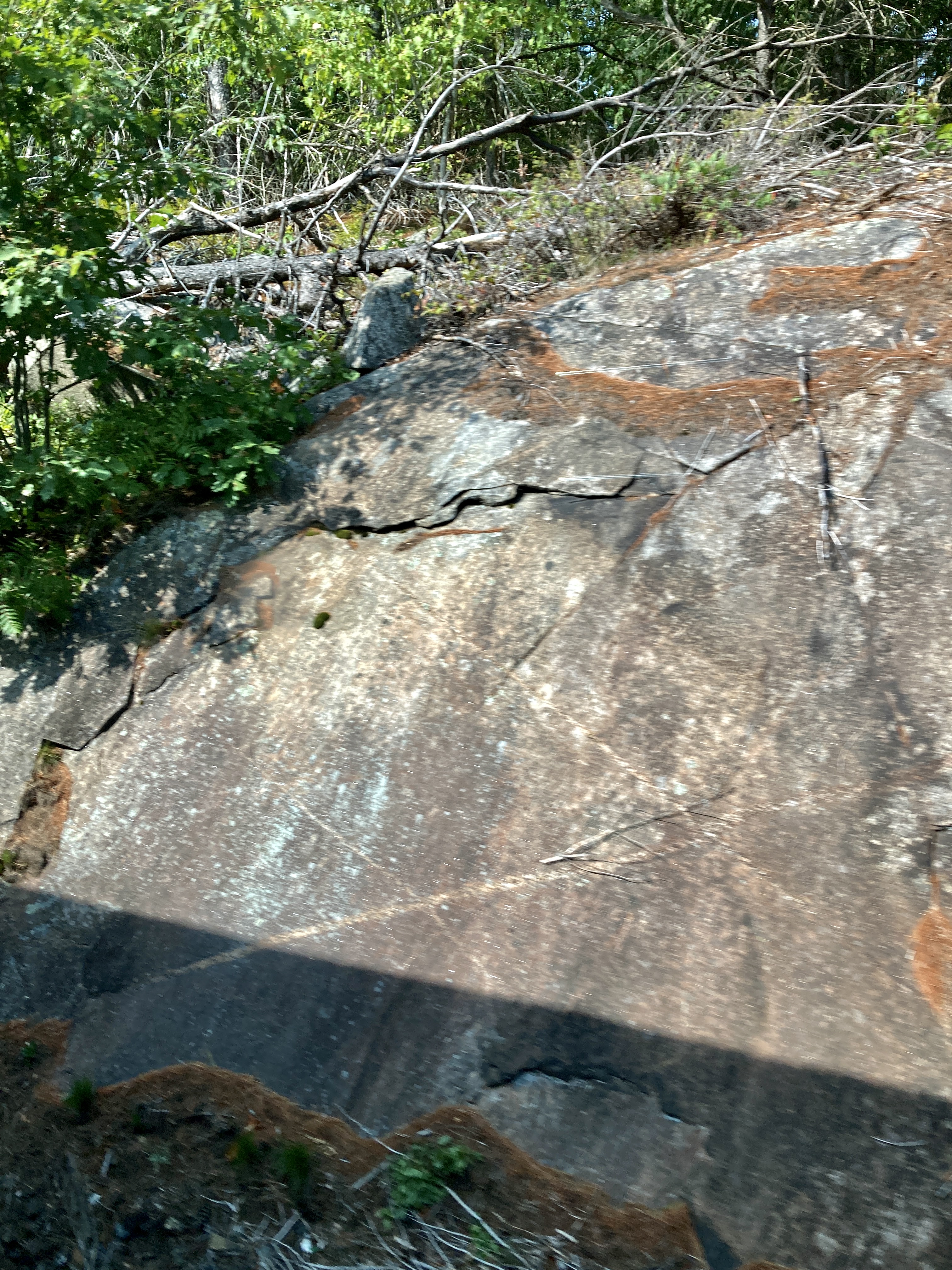
We’re on the Shield! The glorious, hard-rock Canadian Shield — more than 1 billion years old, and covering a good 50% of Canada’s land mass. Oh, I love this rock. This particular example near Torrance.
We’re now well into the transition from boreal forest to more southern, more deciduous, forest mixtures. Also in transition to gentler, but still water-rich, vistas — creeks, rivulets, rivers, marshy or rock-bordered, and flanked by forest. This particular example, near Severn Bridge.
Solar panels near Washago (northern tip of Lake Couchiching)…
and farmland. We’re back to farmland. This barn, near Brechin (east of Lake Simcoe).
I’ve loved this segment of the trip, dropping us down through Muskoka, one of Ontario’s “cottage country” regions and one where I have many happy memories.
We continue south, and as we enter Toronto, I’m into another rich cache of happy memories.
The tracks here run alongside the east branch of the Don River (just south of Eglinton Avenue East). I clap my hands like a child, in delight. I’ve walked these trails, walked that foot-bridge, stepped across these train tracks. Ohhhh, just look.
The scenery goes on being familiar, and then, as we round into Union Station, I hit old + new.
New construction, new towers — but back there, its silhouette slivered in between the two left-hand buildings, back there is the CN Tower. No longer new, but still iconic: it opened in 1976 and, at 553 metres, reigned as the world’s tallest free-standing structure until 2007.
It’s still handsome. And it still says Toronto.
Here I am.
In Toronto. Land cruise ended, magic beyond belief.
Thank you, all of you, who have crossed the country with me. I’ve enjoyed your company.
Epilogue – I want you to know: by the time we reach Toronto, we have made up all that late-time in Winnipeg. These few passenger trains have so little control over their running time! They share over-burdened train tracks with a great many freight trains — all of which claim priority. When push has to come to shove, as it often does, it’s the passenger train that sits on the siding. This explains why passenger train departure times are meant to be honoured, but arrival times are fiction. “Fiction” in the sense they are not the straight running time; they always have padding built in. Siding-waits are as much part of the trip as every station along the way.
26 August 2025 – I’m not usually right smack at water’s edge. But today, I am offered easy access to wild shoreline — just one of the Tatlow/Volunteer Parks enhancements, along with “daylighting” a long-buried creek. Who could resist?
First I walk down these steps…
where, second, I draw inspiration from that lone woman in white, ‘way out in front of me.
I give thanks for my hiking poles and waterproof boots, and follow her example.
Now. Statement of principle. I firmly believe that each place has its own beauty. You just have to be willing to stop making comparisons, open your eyes and mind to what is right in front of you, and rejoice in it. BC is no more beautiful than anywhere else.
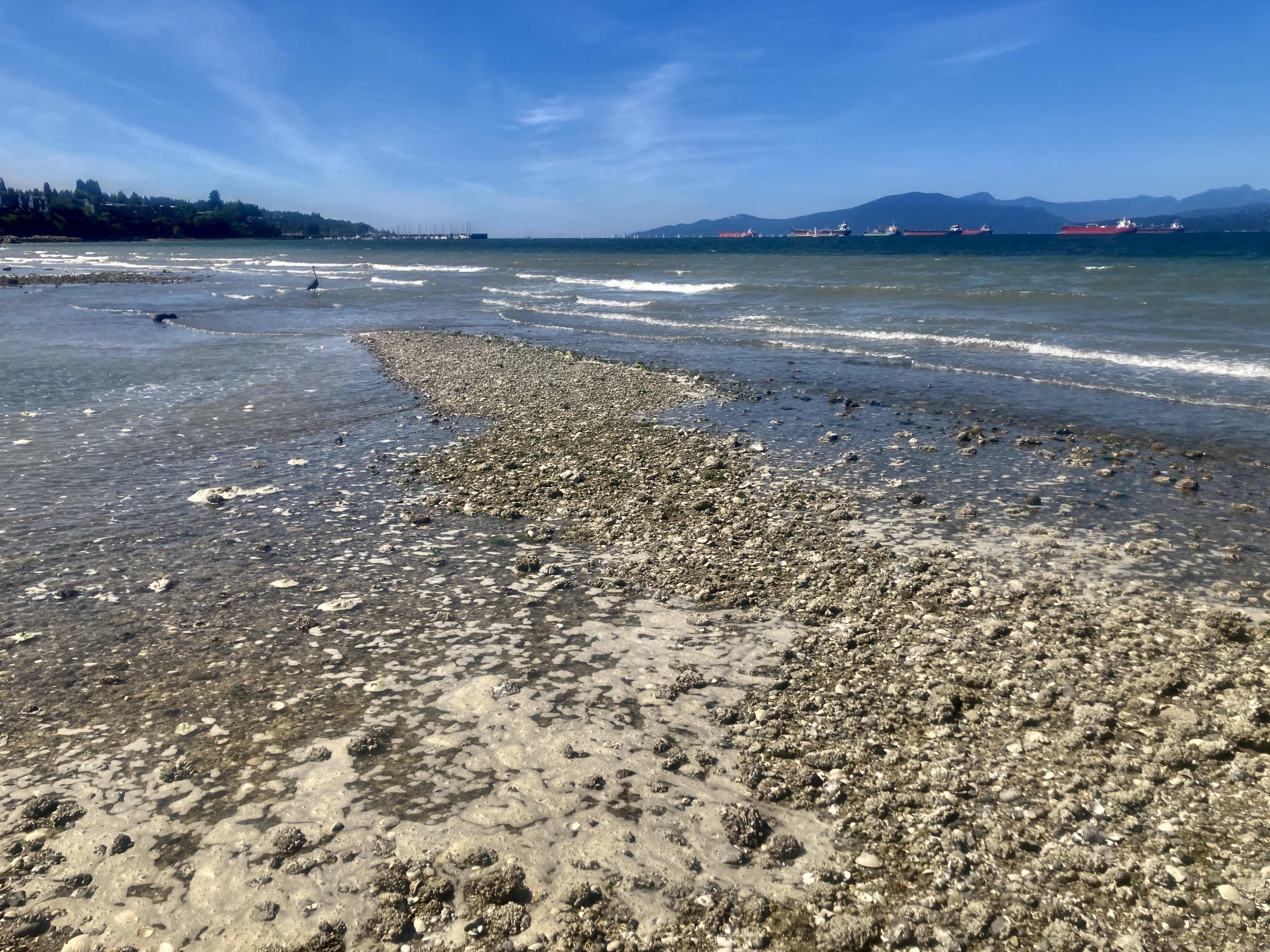
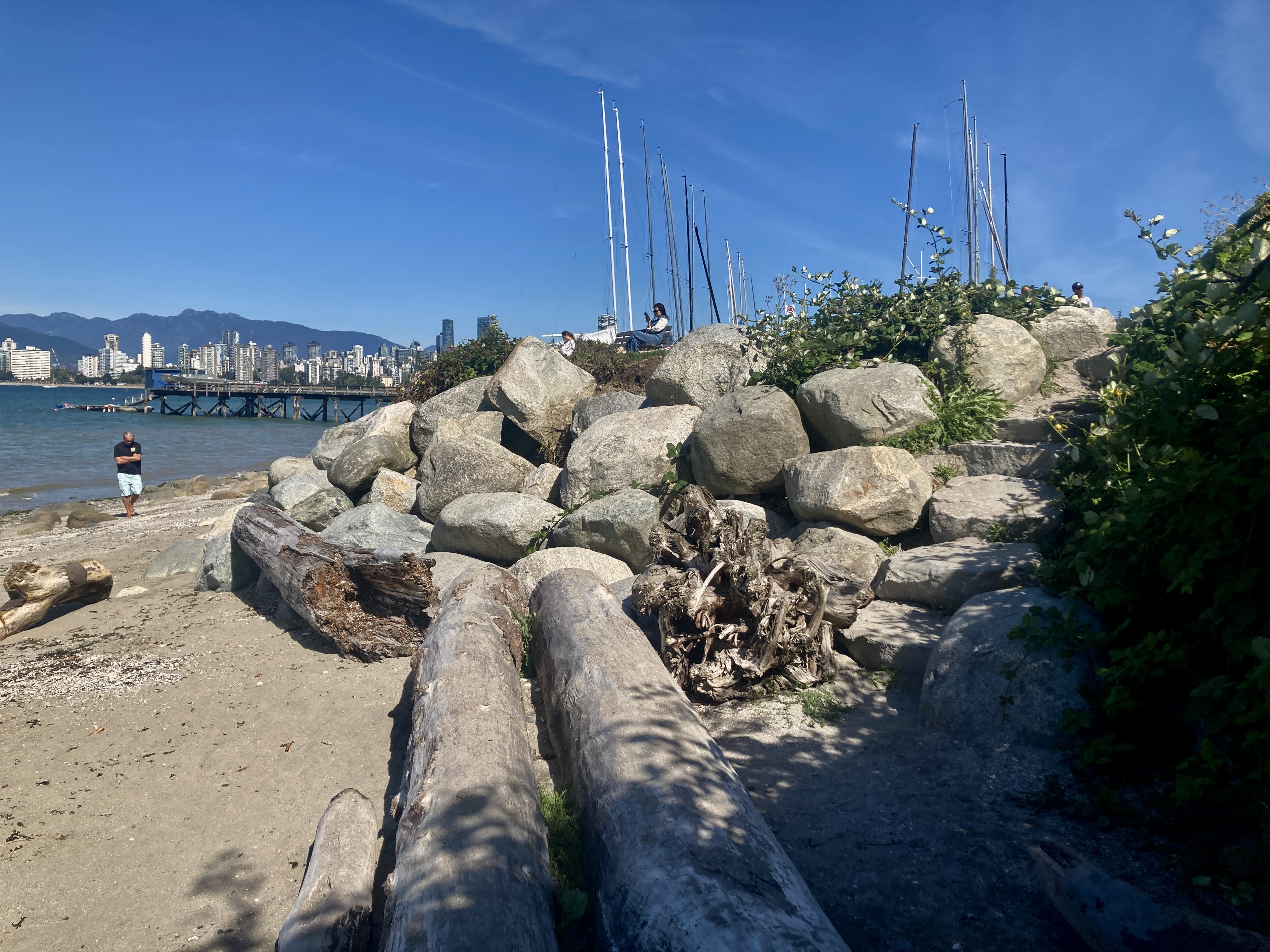
But today I happen to be here, not anywhere else. I am in the Vancouver neighbourhood of Point Grey, on the south shore of Burrard Inlet, looking north across English Bay (with its usual complement of freighters) to the slopes of West Vancouver over there on the North Shore.
And it is just terrific! Bright, fresh, with enough breeze to ease the heat and send wave upon wave rolling in to tap my toes.
I look west…
and then blink, and look more closely, tracking my gaze past that final arrow of gravel to a black squiggle in the water beyond. (Spread the image; follow my example.) See? A Great Blue Heron. For once, life is easy. He just opens his beak in each breaking wave, and swallows what it offers him.
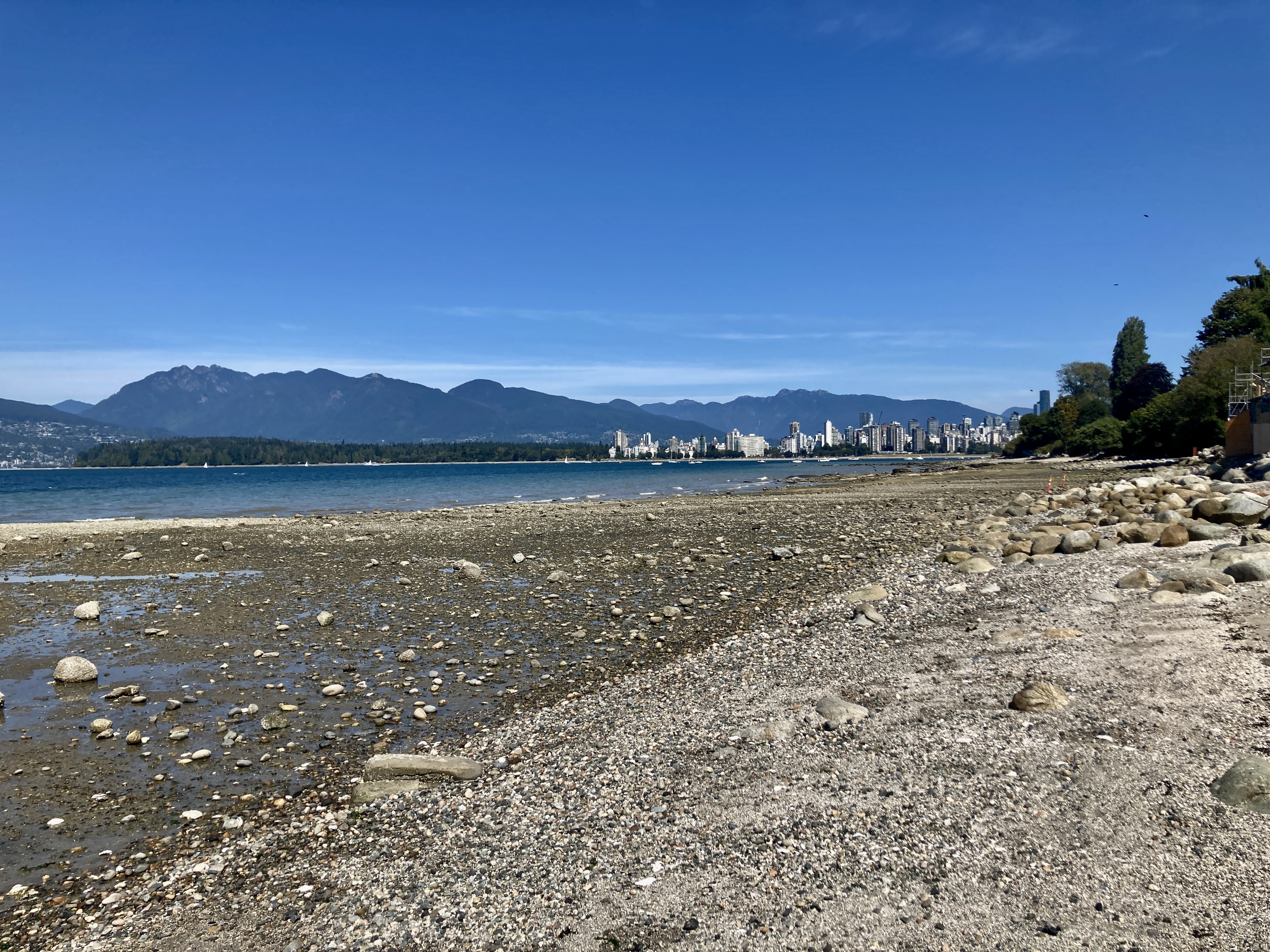
I look east…
and this time my gaze takes in the green sweep of Stanley Park, the final knob of the City of Vancouver this side of the North Shore, and, to its right, the towers of the City’s downtown cluster. I’ll be walking east, from here to Kitsilano Beach Park.
So many shades, so many textures…
and the swooping arc of an eagle, passing by.
I break my water’s-edge fixation long enough to veer inland for a bit, drawn by the red fence, its signage thanking us for our patience, and the weathered-jeans-and-T-shirt guy on the inside of the fence, who meets my smiling curiosity with a smile of his own.
He looks like a navvy, he’s inside the fence, I ask if he’s working on the project. He replies, with no particular inflection, that it’s his project, he’s the homeowner — and points upwards, to the house atop the cliff. Being vaguely aware of real estate prices around here, I realize that these workman’s jeans and hands are attached to serious money.
I ask the basic “What are you doing?” and, seeing I’m genuinely interested, he explains. It’s all about the instability of these Point Grey cliffs, their unconsolidated Quadra Sands laid down during the Fraser Glaciation (29,000 to 11,500 years ago) and eroding ever since.
This bit of surface remediation is just the current example of his on-going battle — financed by him, but every step City-approved and with City authorities — to protect the environment and in the process protect his home. An early step was to excavate on the land side of his property behind the cliff face, and stabilize the cliff, invisibly, with I-forget-how-many-zillion tons of concrete. More recently, again with City approval and monitoring, he paid to have several mounds of large local rock arranged in natural patterns on this section of the beach, their job being to break up wave action and mitigate impact on the cliffs. “Last week,” he says, his eyes crinkling with delight, “a Fisheries inspector told me that two different species of mussel are now colonizing the rocks!”
I express my admiration with a tease: “You could’ve taken your great gobs of money and lived large in all the casinos of Europe. Instead… what do you do? You bury your money, literally, in the ground.” He grins, then shrugs a kind of “Yeah-but” shrug. “You have to do what you can. To help. This is what I can do.”
I walk back down to the water impressed, a happy day made even happier.
Bands of colour, look at them: all the greys of the gravel at my feet, green seaweed just beyond, butterscotch sand beyond that, then blue water, white curls of wave, red among those distant freighters…
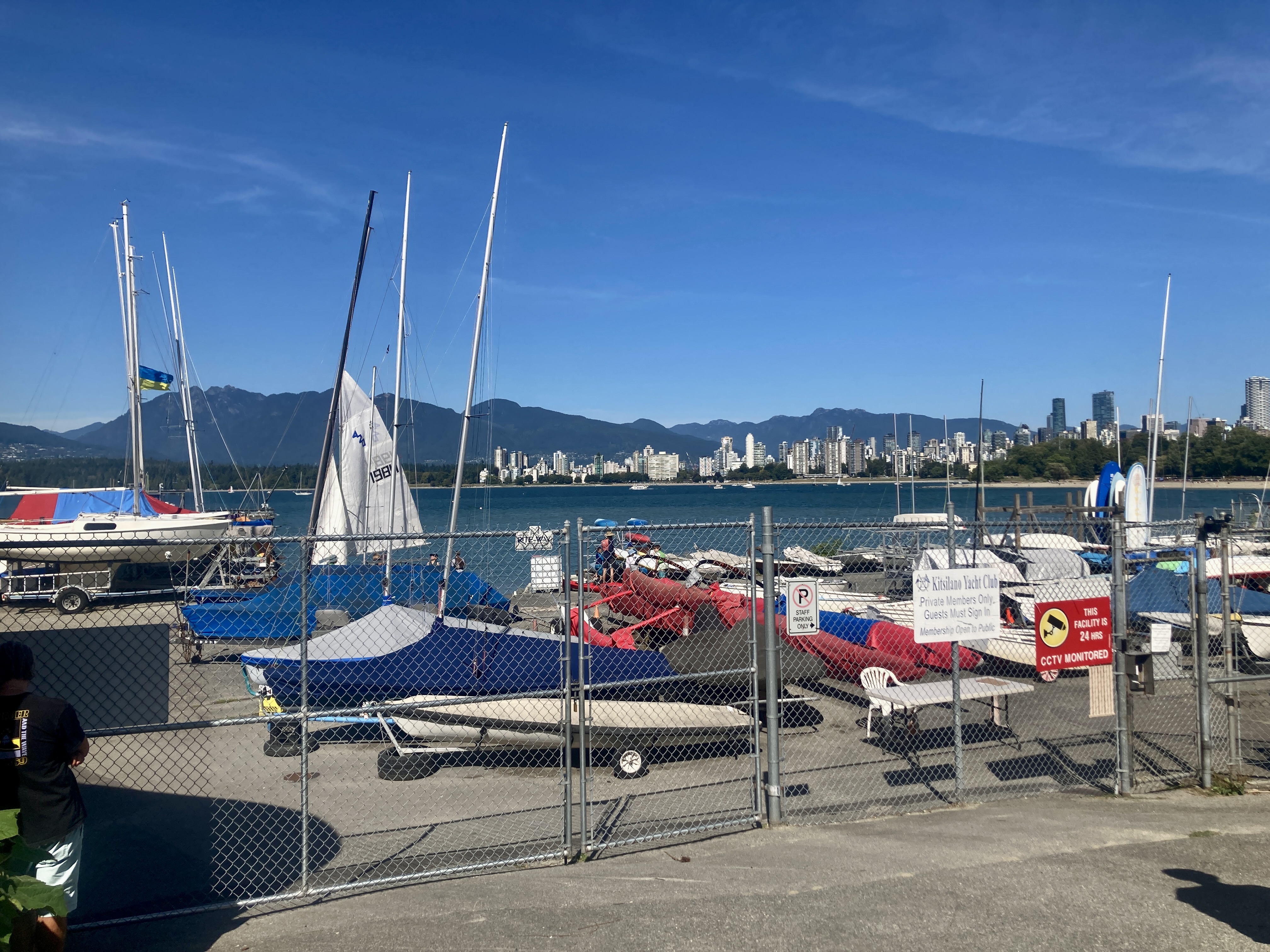
and, closer to shore here on the right, red also in the Kitsilano Yacht Club dinghies (or whatever they are) — a whole line of them, each full of kiddies being taught boating skills, whose excited voices carry on the wind.
A mysterious imprint in a rock, surely that can’t be natural?
and a blaze of colours, certainly not natural but also not mysterious, on the stones that line the entrance to a path up from the beach.
The stone wall is official; the colours, anonymous and unauthorized. I sidestep both the path and the bronzing bodies beneath it, and return to water’s edge.
But eventually, though water’s edge continues, there’s no longer any way to follow it.
I’ve reached the Kitsilano Yacht Club, just this side of Kitsilano Beach Park. My choice now is to swim around, or scramble up.
Blue Shorts Guy is about to scramble up his section of rock mound; I then scramble up mine. (Less elegantly than BSG, who does it all upright. My scramble involves hands and knees. But it works!)
Suddenly, I’m back in the urban world.
With its fences and notices and CCTV. It is discombobulating.
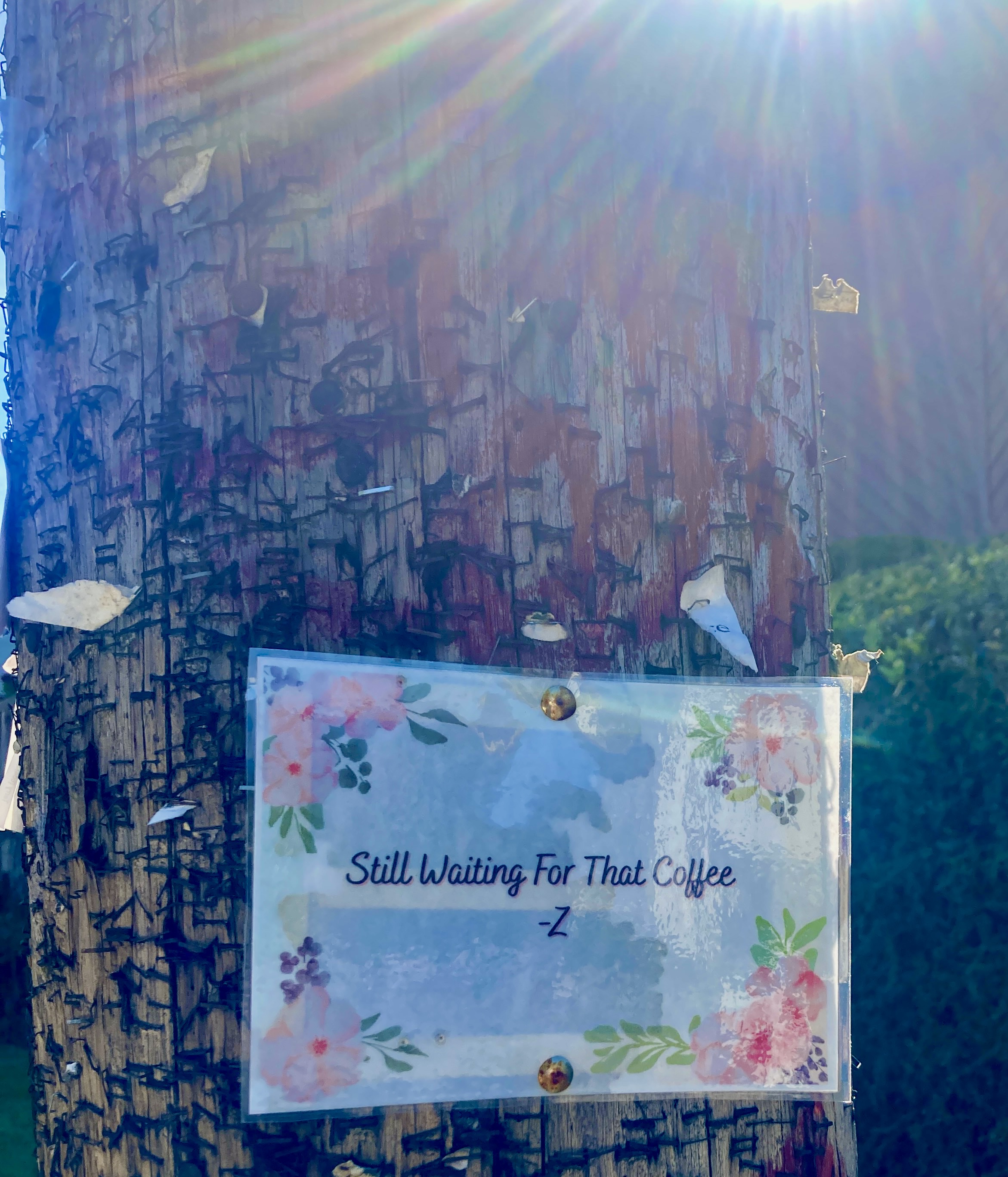
So much so that, as I walk south on Arbutus Street, this notice tacked to an old wooden pole seems no stranger than anything else.
I too am waiting for coffee — but, unlike Z, the remedy is in my own hands.
18 August 2025 – I’m just off a False Creek ferry and walking uphill toward home, still full of Flat White and café chatter with a good friend, when I stop to admire another good friend. (Albeit in a different category of friendship: painted, not human.)
There she is, high a-top her alley home, her quizzical smile floating out across the neighbourhood.
Is she our Mona Lisa, 21st-c. alley-girl version?
No. Given the pace of local redevelopment, and the building that is her home, she is our Cheshire Cat. Soon she will be gone, with only her smile lingering behind, and only in memory.
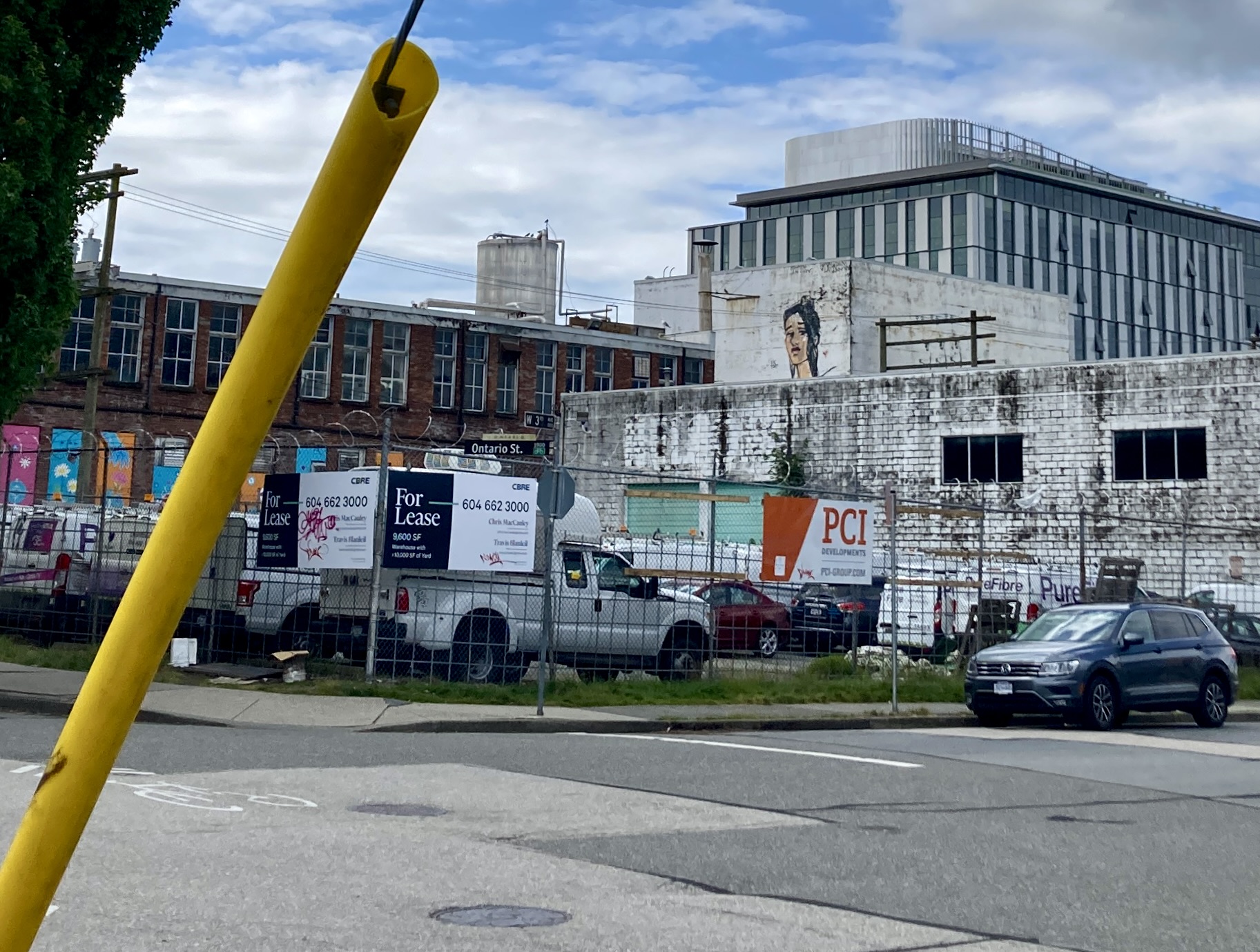
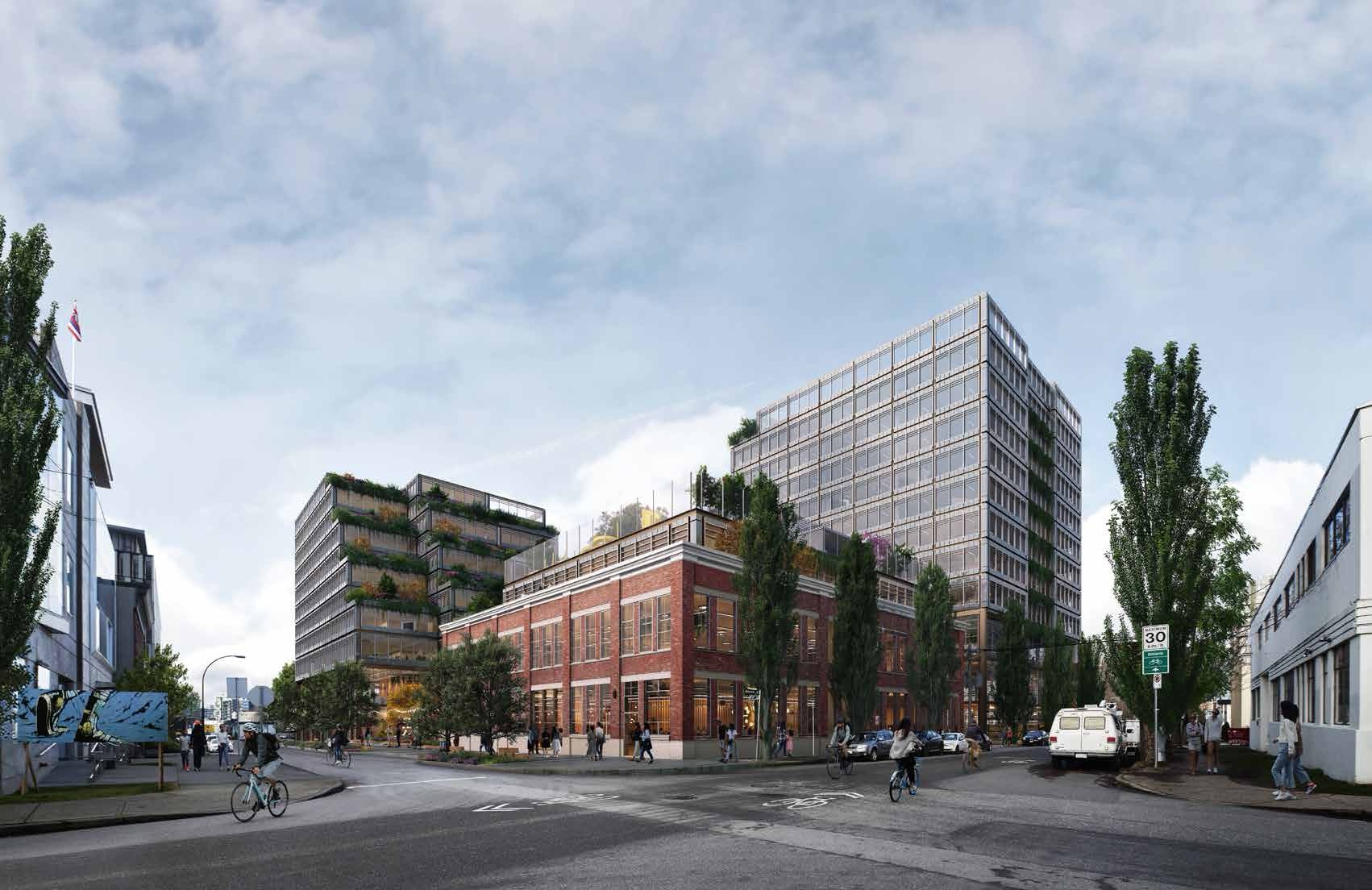
I”m standing at 3rd Avenue & Ontario Street, the intersection at the north-east corner of that L-shaped site, outlined in red. This is the huge redevelopment site purchased by the PCI Group in 2021, whose redevelopment proposal finally received City approval in May of this year. Cheshire Cat Smile is mid-way down lot 5, on the south side of the alley.
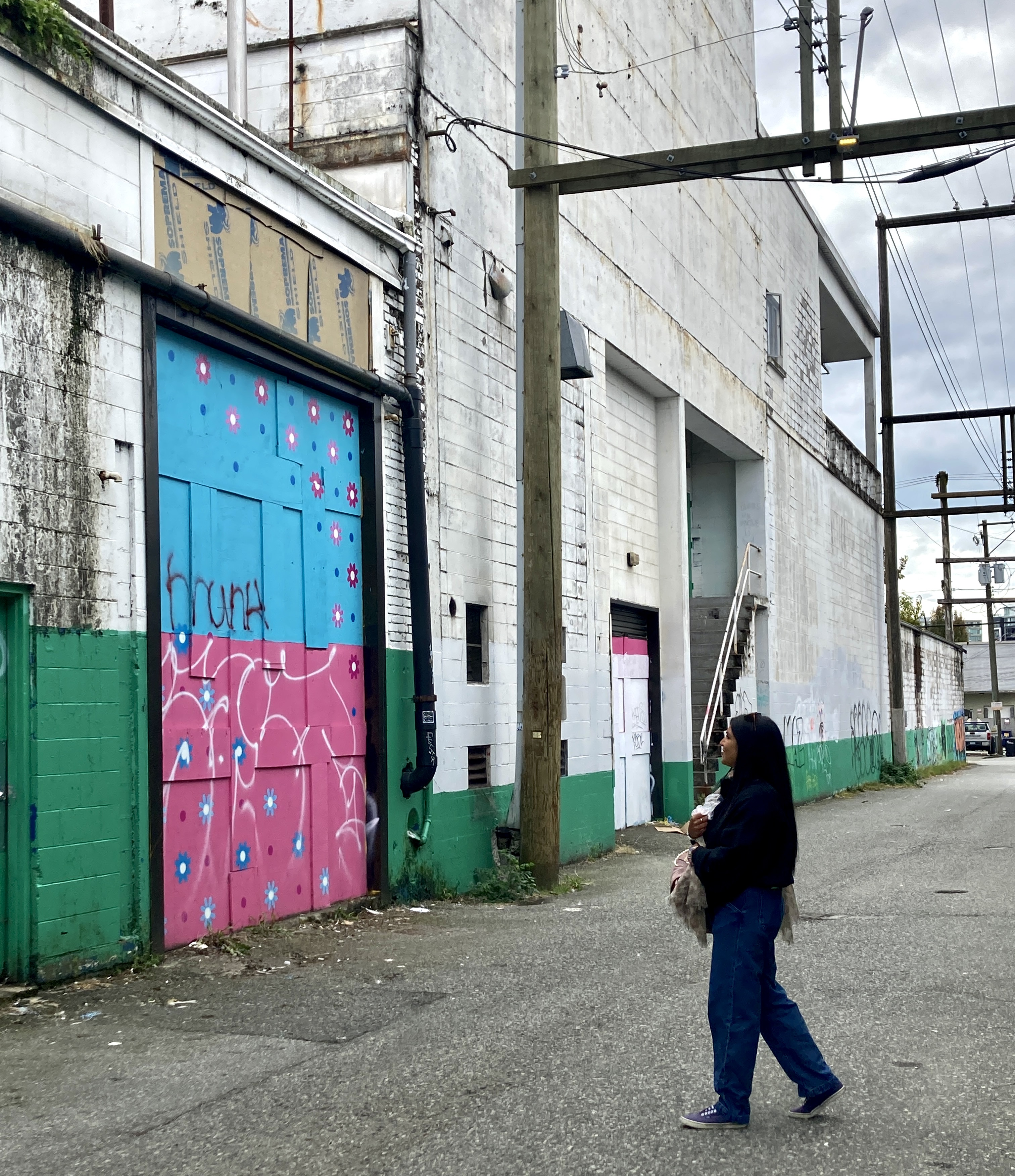
I head down the alley. Not for the first time, but it’s different every time, isn’t it? (No need to repeat the Heraclitus discussion…)
Crow in a convex mirror! I’ve never noticed him before, so already the alley is different.
The actual crow, opposite…
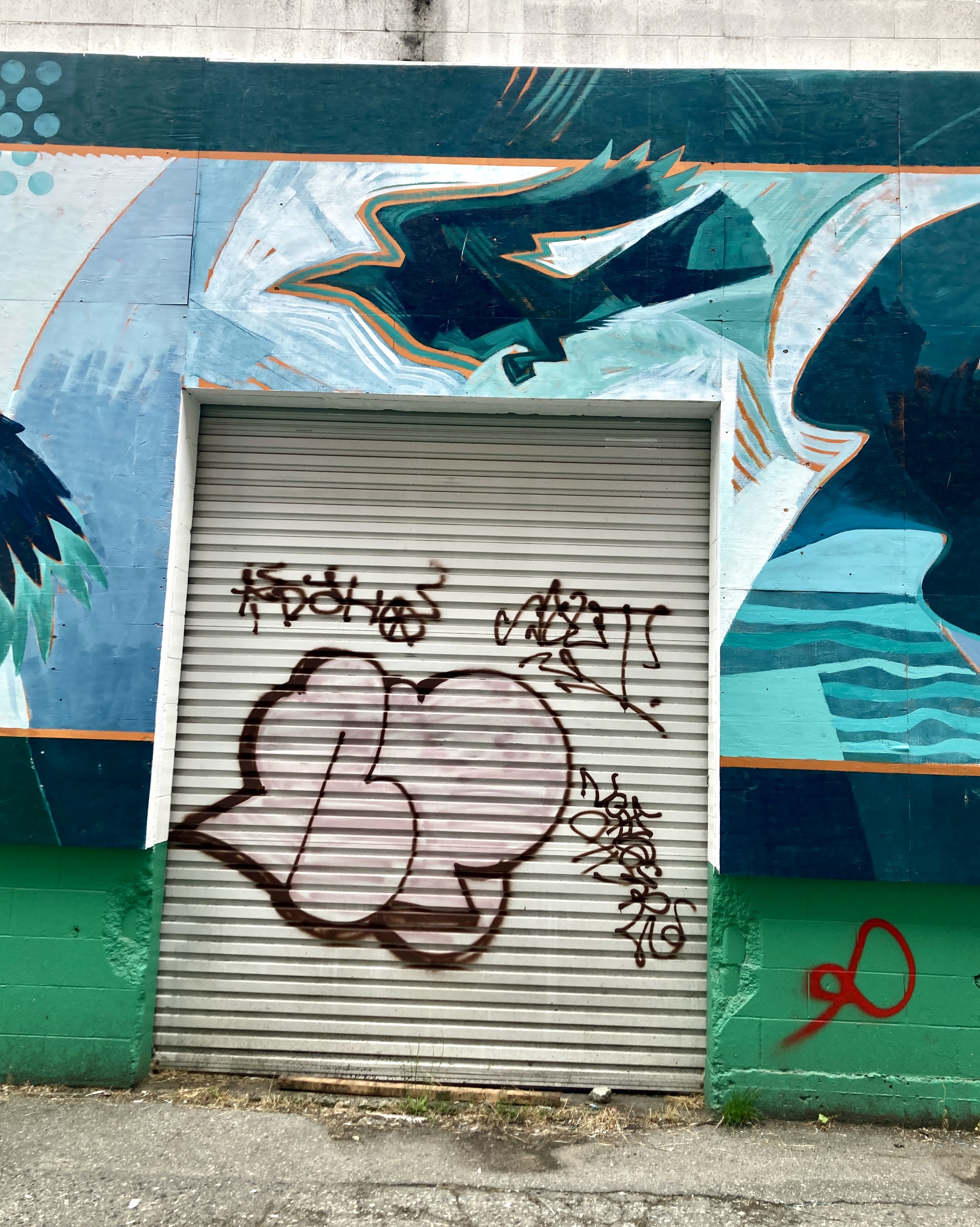
which causes me, for the first time, to pay attention to the mural as a whole — signed R. Tetrault and, as I later learn, called Flight Path.
Murals both side of an alley and a whole line-up of hydro H-frame poles in between! Sigh. Life is perfect.
I tip my head, pay homage to the Cheshire Cat Smile…
knowing it’s tagged Lil Top but also knowing I’ve never been able to find any info about that tag. So Cheshire Cat she has become.
The woman I’d noticed under the nearest H-frame, as I photographed Flight Path, is now standing next to me, also enjoying the art.
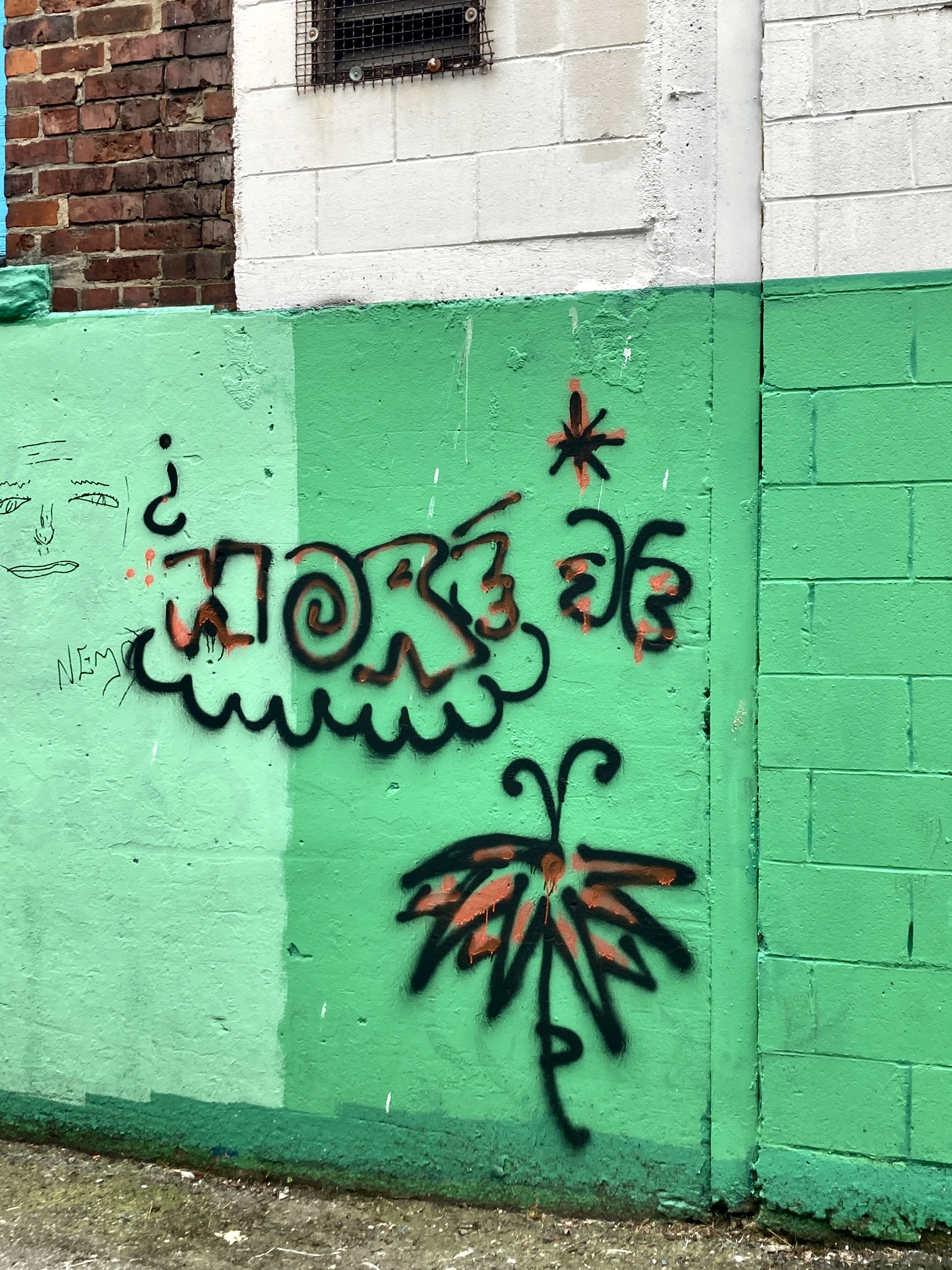
“It’s people expressing themselves,” she says. “And we get to look at it for free! It makes us happy.”
She points: “Like that flower, that butterfly.”
I point to the message next to it, which sets us both laughing.
And then we go our separate ways, each dawdling where we each prefer to dawdle, walking the line of Ciele Beau murals opposite Flight Path.
I pause at a doorway, its notice as outdated as the reminder to “call your mum.”
Nobody, employee or otherwise, will be entering by this door ever again, I tell myself. Or by any other door, on this doomed brick building.
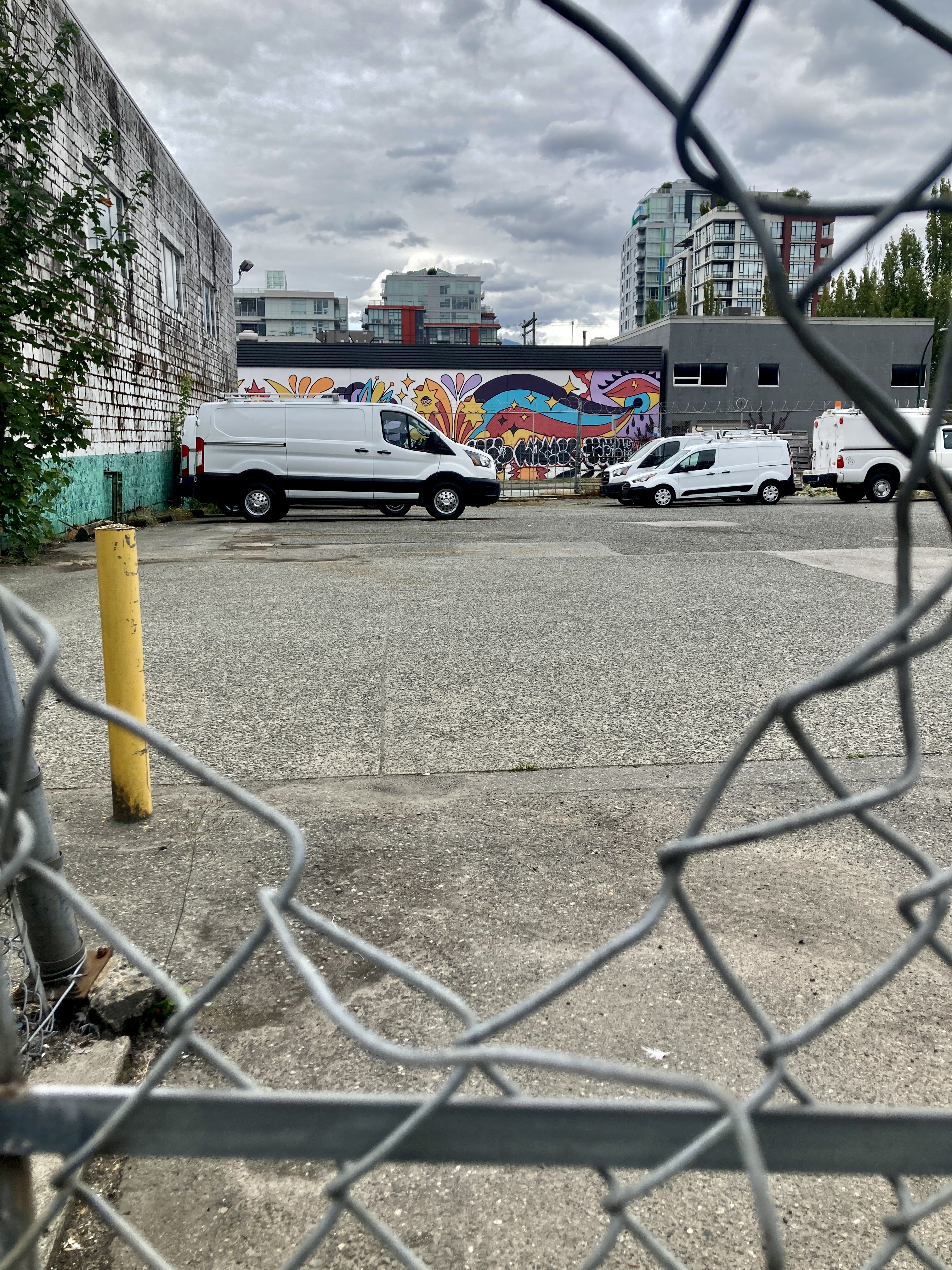
Ghosts of Eras Past to the north of me as well — torn fencing frames the Cosmic Breezemural on 3rd Avenue, painted by Olivia di Liberto for the 2019 Vancouver Mural Festival. RIP, VMF.
I leave the alley, turn the corner onto W 4th. I’m now looking at the block-long southern length of the site, Ontario to Manitoba. All boarded up, waiting for What Happens Next.
This artist’s rendering shows What Will Happen Next.
“Innovative industrial and commercial uses,” says the corporate website, “heritage retention and refurbishment, office, daycare and ground-floor food and beverage… centred around a new public plaza.”
Now that I’m home, and learning all this… I have to do a little rethinking, don’t I? And so do you.
Employees will once again go in and out of doors in the corner brick building, which is not doomed after all. And Flight Path may fly again. On his website, Tetrault explains he painted it “on plywood for removal and reinstallation on a new commercial development.”
31 July 2025 – I’m on the N/E corner of Quebec St. and East 2nd Ave., and I read the little plaque at my feet.
Really??? I say — but very quietly, to myself. (No point startling others.)
Look up & I’ll see a rail yard? Or an elk? or a forest? or a convoy of Canada geese?
Pfft!!! (My genteel raspberry is also very quietly expressed, to myself.)
Rail yard is historic fact right here at False Creek, not current reality. The first CPR railway station opened in Vancouver in 1887, but the railway-related industrial era boomed after the World War I project to fill in the tidal flats of False Creek, from Main St. on east to Clark Drive, to provide a site for two new railway terminals and associated rail yards. Various changes along False Creek since then, most recently the transformation to parkland, Seawall and residential/knowledge industry occupation, triggered first by Expo 86 and then the 2010 Winter Olympics.
So, no, I am not going to see a rail yard from this street corner, no matter where I look. But I don’t care! I am all for looking, while I walk, not for stomping along in a trance. I am perfectly happy to be reminded to swivel my head and pay attention.
I start swivelling.
Look Up, East: the MEC building, a 2020 arrival in this historic neighbourhood…
and once again (spring 2025) back in Canadian ownership, though no longer a cooperative.
Look Up, West: an even newer new-build.
Look Sideways, East: the eco-conscious alley behind MEC, with watercourse and plantings to attract insects and bees.
Look Sideways, West: the alley behind that new-build, with an historic reference right there at the corner.
Namely, one of the City’s remaining H-frame hydro poles.
Look Down-Along, North: this block’s stretch of bioswale…
which “collects and cleans the rainwater that fall on Quebec Street.”
Look Straight-Across, West: tail end of a straggly crocodile of kiddies (yellow T-shirts) plus their volunteer monitors (green T-shirts)…
crossing Quebec and hurrying to catch up with the croc’s main body, all those children already walking on north along Quebec’s west side.
I have to wait for the next light. After that I’m following in their somewhat distant footsteps, not sure where they’re headed but with my own Best Guess in mind. (Science World, I think to myself.)
Sure enough!
Like them, I turn west on Switchmen St. — a necessary detour while the end bit of Seawall is under repairs — and, from my vantage point at Pullman Porter, watch all those yellow & green T’s double ’round the parking lot & veer back east toward the geodesic dome of Science World. (An aside to you: you have noted these further railway tributes? Of course you have.)
I am charmed by the sight — by my knowledge of how much fun the children will have, and by my respect for all the organizations and all the volunteer support that collectively make these vacation-time excursions both possible and safe. (Flashback memory: the impish YMCA volunteer in Toronto, who explained that when they took 10 kids out, they were expected to bring 10 kids back. “Preferably,” she solemnly added, “the same ten.”)
I head on west. Bye-bye, kiddies.
I am still sufficiently Paying Attention to my surroundings, to notice the fresh-fruit stand near Olympic Village Plaza. I buy strawberries, my fingers guided by the young attendant to the boxes just trucked in this very morning from a farm in the Abbotsford area.
The day is warming up.
I find a shady bench in Hinge Park, and allow myself one strawberry. Just one.
It was…
really, really good! I hustle back home with the rest.
"Traveller, there is no path. Paths are made by walking" -- Antonio Machado (1875-1939)
"The voyage of discovery is not in seeking new landscapes, but in having new eyes" -- Marcel Proust (1871-1922)
"A city is a language, a repository of possibilities, and walking is the act of speaking that language, of selecting from those possibilities" -- Rebecca Solnit, "Wanderlust: A History of Walking"






































 WALKING WOMAN