15 March 2024 – It all begins at Kingsway & East Broadway, waiting for the lights to change. I look up.
Guide wires…
glide the # 8 trolley bus around the corner below, and adorn the sky above while they’re at it.
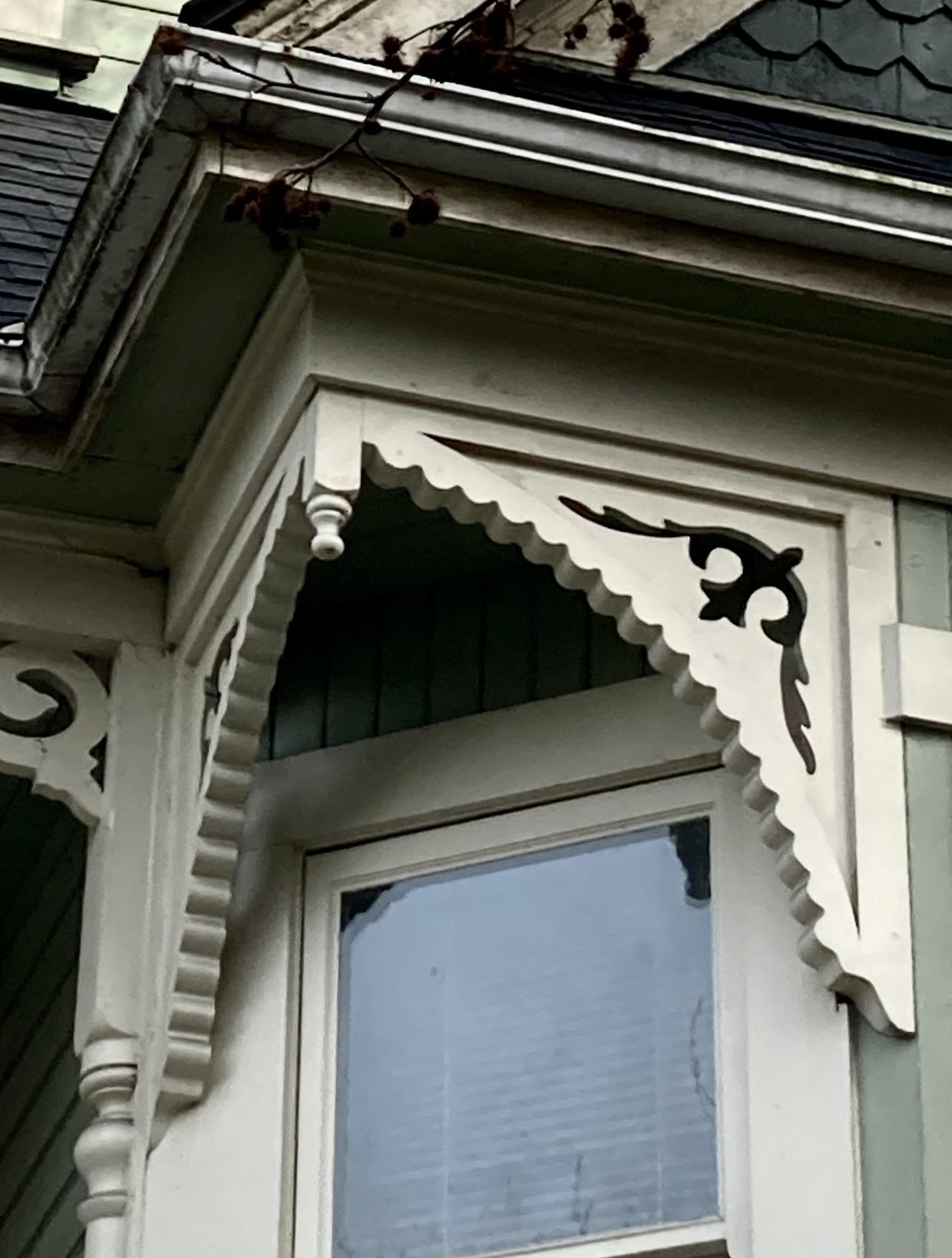
Next day, one neighbourhood to the west, gingerbread…
protects this vintage bay window, and adorns it as well.
Across the street in Major Matthews Park, rampant ferns…
will surely over time help destroy this pergola roof, but meanwhile adorn it very prettily.
Finally, this morning, an intentional rather than accidental green roof — the one atop the Visitor Centre at the VanDusen Botanical Garden. This solar chimney…
serves the planet, adorns the ceiling that it also pierces — and helps illustrate why the Centre won the 2014 World Architecture Most Sustainable Building Award.
8 March 2024 – As I walk back east along False Creek, I do not have a single Life Philosophy thought in my mind. Not a single abstract noun. I am just picking my feet up and putting them down again, enjoying the sunshine.
Then I see this neon glow in the water, just off a curve of seawall between Stamp’s Landing Dock and Spyglass Place Dock farther east.
Still no Important Thoughts in mind, just curiosity.
It’s not until I’m up close, and can identify the shape as a boat, that I think about vulnerability. There that little boat used to be, afloat and riding the currents — and there it now is, submerged and inert.
Vulnerability, consequences, responses. The dynamic is now lodged in my mind, and I see it all over the place as I walk on home.
In environmental and political vulnerabilities, for example, here at Spyglass Place Dock, where blue bands circle Cambie Bridge pilings and a quiet black tribute pillar stands at water’s edge.
The top blue tier in this 2012 art installation, A False Creek, is 5 metres above current sea levels — which is mid-way between the 4 to 6 metre rise that, it is predicted, could be triggered by climate change. The pillar honours Husain Rahim (1865-1937). He was an activist at the time of the 1914 SS Komagata Maru incident that barred a boatload of South Asian passengers from disembarking, and one of the first South Asians to challenge the disenfranchisement then taking place. While the ferry dock is still Spyglass Place, I learn that this space is now called Husain Rahim Plaza.
I’m about to walk on — and discover that I can’t.
Due to “the deteriorating condition of the structure supporting the seawall,” the path has been closed between the Cambie Bridge, right here, and Hinge Park to the east. Detour along West 1st, we are told, while authorities address this weakness.
Heading for 1st Avenue, I walk under the bridge, where I stop long enough to read this extraordinary beer-themed love letter chalked onto one of the pillars.
The message is fresh and wonderful, but street art by definition is ephemeral. Vulnerable. Just look above the top line for proof — the “Simply Jay” message has been effaced.
Eastward on West 1st Avenue now, and more vulnerability call-and-response.
The building in the foreground is one of the City’s Temporary Modular Housing facilities, created in response to what the City itself calls a crisis situation: “over 2,000 people are experiencing homelessness.” The rusty building farther along is an old, disused workshop from the area’s industrial past. It will surely fall down, or be knocked down, sometime soon.
Lying between those two buildings, and in behind the housing as well: an urban farm.
Sole Food Street Farms, founded in 2009, is now one of North America’s largest urban farms. This location trains & employs people from the Vancouver Downtown East Side, who grow the produce that is then sold & given away.
At Hinge Park, I can drop back to the waterfront. The railway tracks and buffers here at the south edge honour the past; the park itself is part of the pre-2010 Winter Olympics response to what had become a derelict and polluted wasteland.
Even my classy latte in an Olympic Village Square café reminds me of vulnerability! I have left it to sit just a little too long, and, look, the frothy design is beginning to deflate. (The taste, I promise you, is unaffected.)
Back outside, I admire TheBirds (Myfanwy MacLeod, 2010), gleaming in the sunshine.
The gleam is thanks to their fairly recent repatination; the repatination was the response to the vulnerability of their surface to all those climbing feet. Signage now politely reminds people that these sculptures are art, not a climbing wall, and asks us to keep our feet on the ground.
Heading south on Ontario Street, I detour half a block west into an alley, for a closer look at a face.
This face.
L’il Top is the signature, and if this bit of street art is vulnerable to time and the elements, so are those H-frame hydro poles. I, and countless Vancouver artists, love the look of them, but they are seriously outmoded, and systematically being replaced.
Back onto Ontario, farther south to West 6th, and my vulnerability theme now presents itself in a real-estate trio. The first thing I notice is that wavy reflection in the windows of the blocky new-build on the corner.
Then I play with the story, the trio of stories, the development dynamic of this bit of Mount Pleasant neighbourhood. Behind the new-build, a century-plus brick veteran, its status secure; in these windows, the reflection of the scruffy building across the street, wrapped in chain-link fencing, its status unclear.
Once the Teachers Centre for the Vancouver School Board (1972-1990s), it sits within the footprint of the T3 Mount Pleasant site now under construction — “T3” as in timber/transit/technology, with a planned 190,000 square feet of mass timber construction to attract environmentally responsible companies and workers. If the developer’s web page is any guide, at least part of this old building will be restored and repurposed as a heritage element in the mix.
Response to environmental threat is the theme of this part of Mount Pleasant. Along with the T3 building, it is also home to the emerging Main Alley Campus, which promises to provide “Canada’s first completely net-zero work environment for the creative economy.”
These two projects won’t save the planet, but it is heartening to see major development corporations put their weight behind new, more environmentally responsible, approaches.
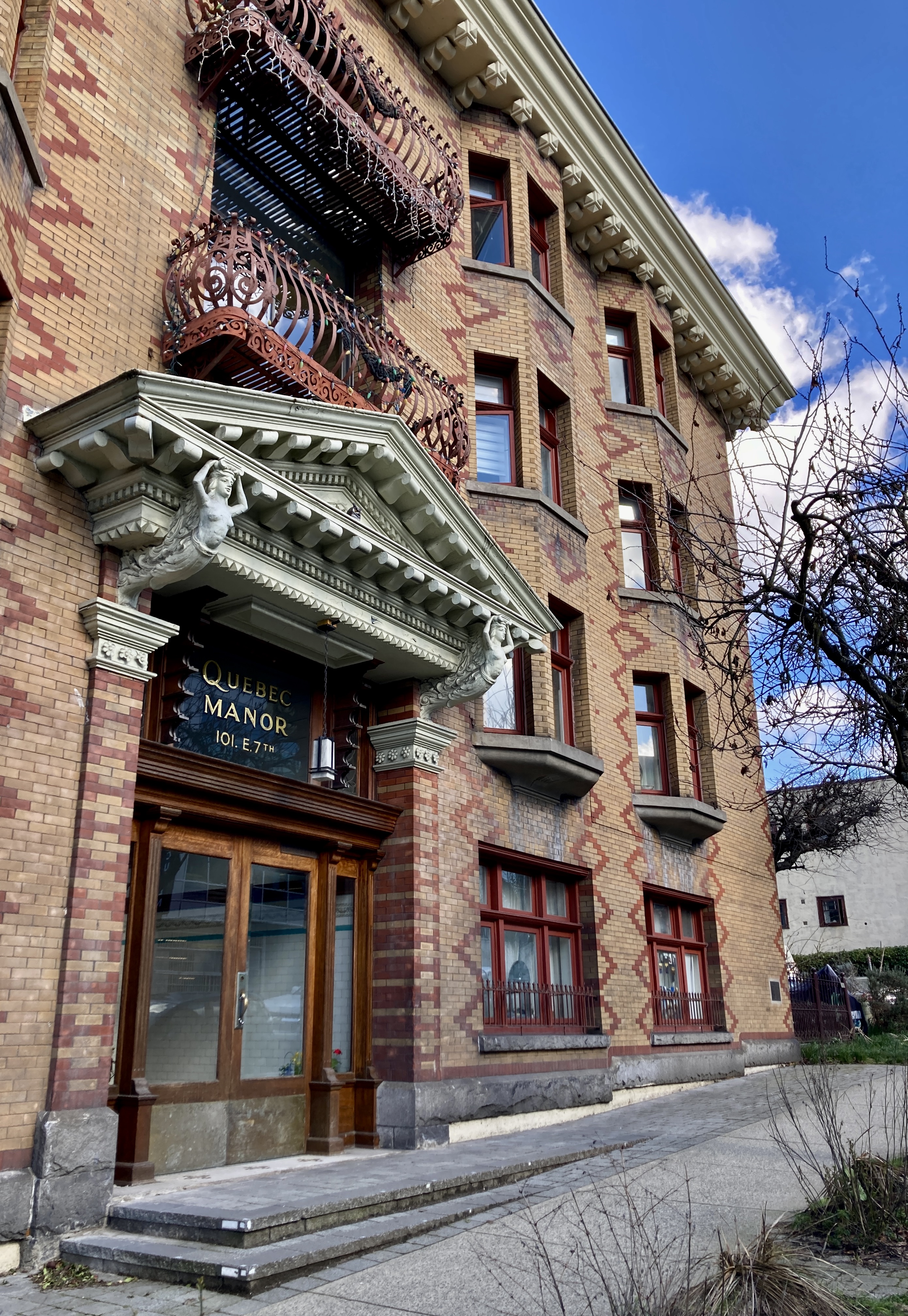
I swing onto East 7th, and salute a building that has long known how to respond to changing threats — and here it still is, 112 years later.
Behold Quebec Manor, in all its diamond-patterned, bi-coloured brick glory. (Complete with metal balconies and nude maidens to welcome you home…) Built in 1912 as a luxury apartment hotel, probably for train passengers at the near-by terminals, it became rental units in the 1920s, and in the 1980s achieved new, secure status when its tenants bought the building and turned it into a housing co-op.
So that’s my walk, and how discouraging it could have been, with such a theme. But it wasn’t. So many vulnerabilities, yes — and so many responses, as well.
21 February 2024 – Move over, Pussy-Cat. The owl has a new companion.
I’m at the corner of West 10th & Columbia, heading east, and I am stopped in my tracks by an owl.
A real owl would seriously stop me in my tracks; this one is not real, but still unexpected and worth some attention. He is dangling from a traffic sign that promises you death & dismemberment if you even think about parking here.
It’s only after I move closer to contemplate the macramé shades-of-the-70s owl, that I really take in the heritage house in the background.
Which certainly deserves my attention.
The Owl and the Painted Lady! I murmur to myself.
And, with that, I forget Edward Lear and think about Painted Ladies. Painted Ladies in heritage neighbourhoods.
The best-known reference, especially outside Canada, would be to San Francisco and its line of brightly painted Victorian homes along the eastern side of Alamo Square Park. Former Torontonian that I am, I think instead of the Painted Ladies of Cabbagetown.
Of one in particular. Rather, the story of one in particular, told to me by the friend who lived next door and whose teenage daughter played (literally) a starring role. Picture the scene. We are in a Victorian home, among others of that vintage, on this street, in this comfortable neighbourhood.
The daughter is practising Bach on the piano in the bay window alcove, with the windows wide open in the summer heat. Next door, a painter is climbing up and down the ladder as he works on that home’s wooden fish-scale façade. The girl pays him no mind, not until she looks up to find him standing right outside her window. She is surprised at the sight; even more surprised when he — politely but firmly — describes very specific ways for her to improve her technique. Who the hell does he think he is? is her first sulky teenage thought. She stifles it. Because, damn it, he does sound like he knows a lot about music.
Turns out, he does. The woman next door tells her mum that the painter, in his previous career, had been a member of the original Orford String Quartet (1965-1991, reborn in 2009 as the New Orford String Quartet with different members). In his new career, he is now creating visual rather than aural music, shimmering cascades of colour rather than sound.
I sink into this memory for a bit, think about my friend’s home, and my admiration for the eventual beauty of that house next door. Then I snap myself back to the here-and-now. I am about to walk on, when I notice a sign on the street-corner lamp post. Always a sucker for signage, I trot across the street to read it.
The Vancouver Park Board seems only to have run the contest those two years — main criterion “community spirit… as demonstrated through block beautification” — and this block of West 10th won both times.
I’m afraid I short-change you for the rest of the block; I take no more photos. But back in 2009, somebody walked the block with delight, and posted the results to his public Flickr stream.
So enjoy the photos, chase up some Orford (original and New) performances online, and then rejoice in all the ways we humans can create beauty.
14 February 2024 – Two parks, both small, and so very different in the story they each tell.
One, a park I only discovered recently, thanks to falling across the Vancouver Park Guide blog, in which Justin McElroy takes on the task of visiting every park in the city. The other… well, it’s my local, innit? Some people have a pub, I have a local park.
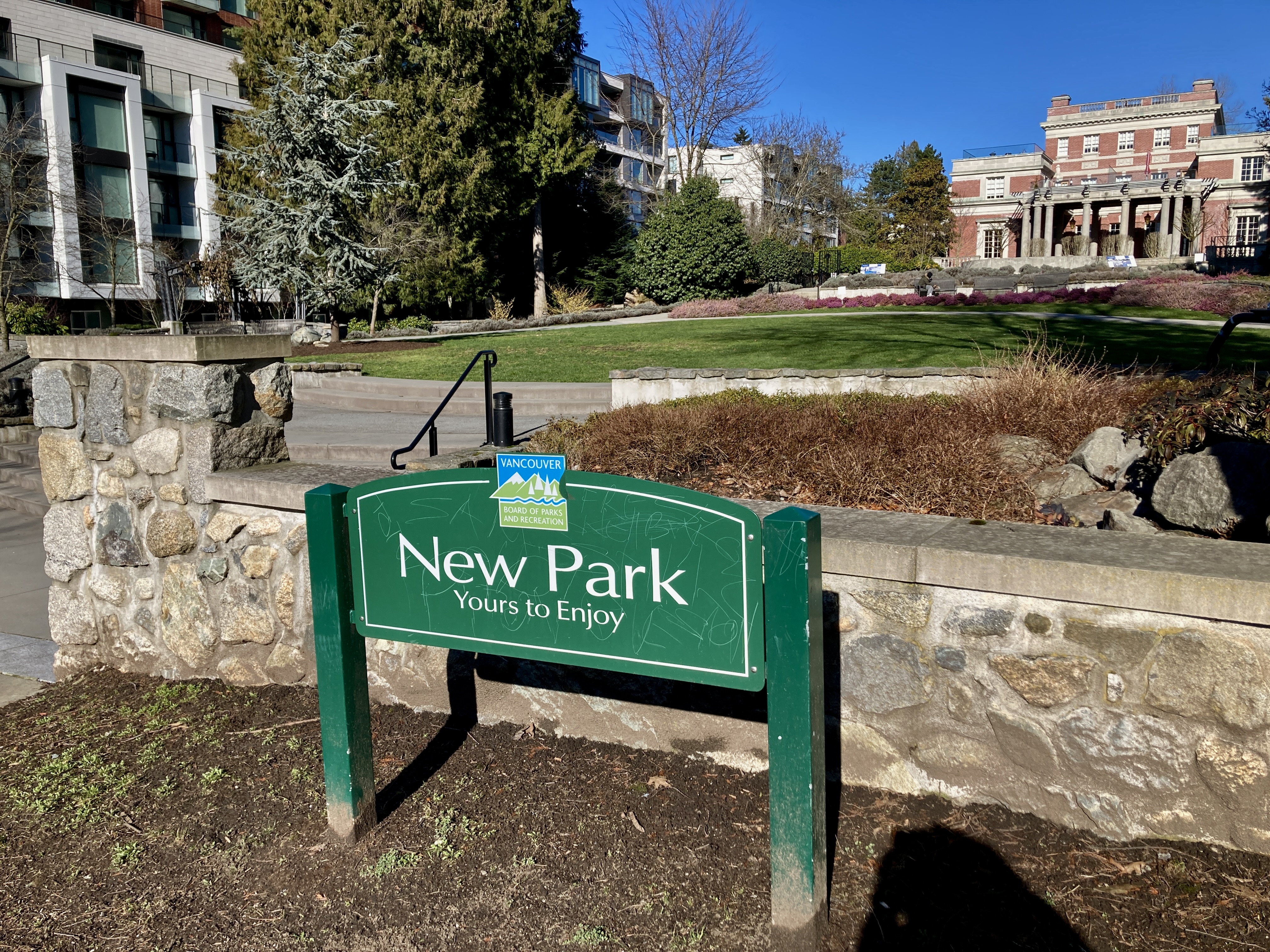
Yours To Enjoy (within limits)
Thanks to McElroy, I’ve headed south on Granville Street into Kerrisdale, to walk through what he (& the City’s own website) calls Shannon Mews Park, but which the signage identifies otherwise.
A modest little name, by definition quickly outdated, but on the edge of a property with considerable architectural and historic significance. To the rear right, the Beaux-Arts mansion commissioned early in the 20th century by B .T. Rogers (founder, British Columbia Sugar); to the rear left, some of the mid-20th century apartments designed by renowned BC architect Arthur Erickson and, in the 21st-century, “revitalized” by the 10-acre site’s subsequent owners, developer Peter Wall and the Wall Financial Corporation.
There is also a street-side map showing “accessible” walking routes, with the usual icon of a figure in a wheelchair. However, thanks to McElroy, I have been warned. Though there is indeed some public space in front of this complex, it offers minimal accessibility to non-residents, whether in a wheelchair or on their own two feet. And, he added darkly (in a post that is now just over a year old), there is some on-going history of attempts to limit the pesky public even more.
I put my pesky-public feet on one of the designated pathways and walk on in.
Even mid-winter, with the Italianate gardens severely shorn, it’s an attractive walk. There is a small children’s playground to the east, and a few benches to the west and north. It’s fine.
But then, boom…
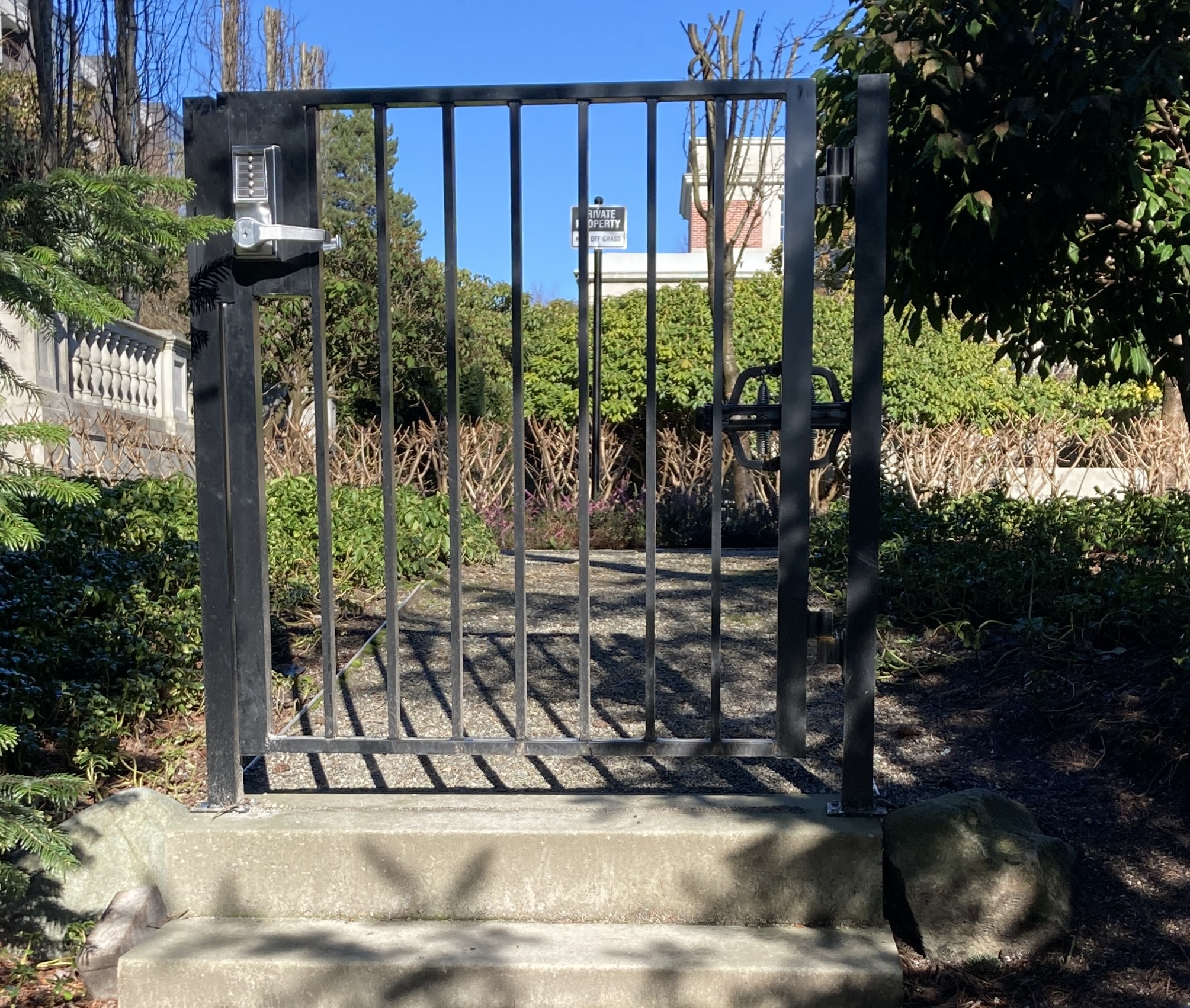
I’m up against it. A locked gate, barring access. Go away, pesky-public-person, says the gate. I try another path, and soon find myself in front of another lockable gate — which, at the moment, is ajar.
I walk on through. i want a closer look at the mansion.
Well, good luck with that.
As long as I keep my pesky-public feet on the path, I am allowed to look across the lawn and the water feature to the mansion beyond. But I am now on PRIVATE PROPERTY, and everywhere I now turn, there is another big red sign to remind me of my interloper status.
So I leave.
Before I do, i squint my eyes at the gargoyle midway on the wall just beyond the water feature. Spread the photo, you can see him as well. He is either grimacing in solidarity with me, or laughing at me. I choose the former interpretation, and go on my way, head held high.
A public park, yes, but cold. It does not welcome us. We are on sufferance.
In contrast to…
The Warmth of the Chill
I am back in my “local,” Guelph Park. Known to us all as Dude Chilling Park, in honour of the Michael Dennis bronze sculpture that is the park’s only claim to aesthetic merit — officially Reclining Figure, but the nickname is the name we use.
It’s a small and simple park, with a few amenities: benches at the periphery, a bit of a playground, two tennis courts. But this park is ferociously loved and much used. And also much-adorned, by all the people who think of it as their own.
Our area Yarn Bomber, for example, has hung her work on the mesh fence and wrapped each of the poles that dot the park.
Beyond this pole, you see people gathered around one of the benches. The park has its regular visitors, each group with its regular bench or set of chairs — just like any local pub.
A tree near the south end of the park is typically covered in changing ornaments, each one a testimonial to someone, to something. (One day a young man detached himself from his cluster of friends to tell me about one of the people he associates with that tree, and the memories it sparks for him.)
Today, the tree base is freshly circled with these bright hearts and flowers, and a new selection of stones. That grey stone reads: “But until then, I’ll see you in my dreams”
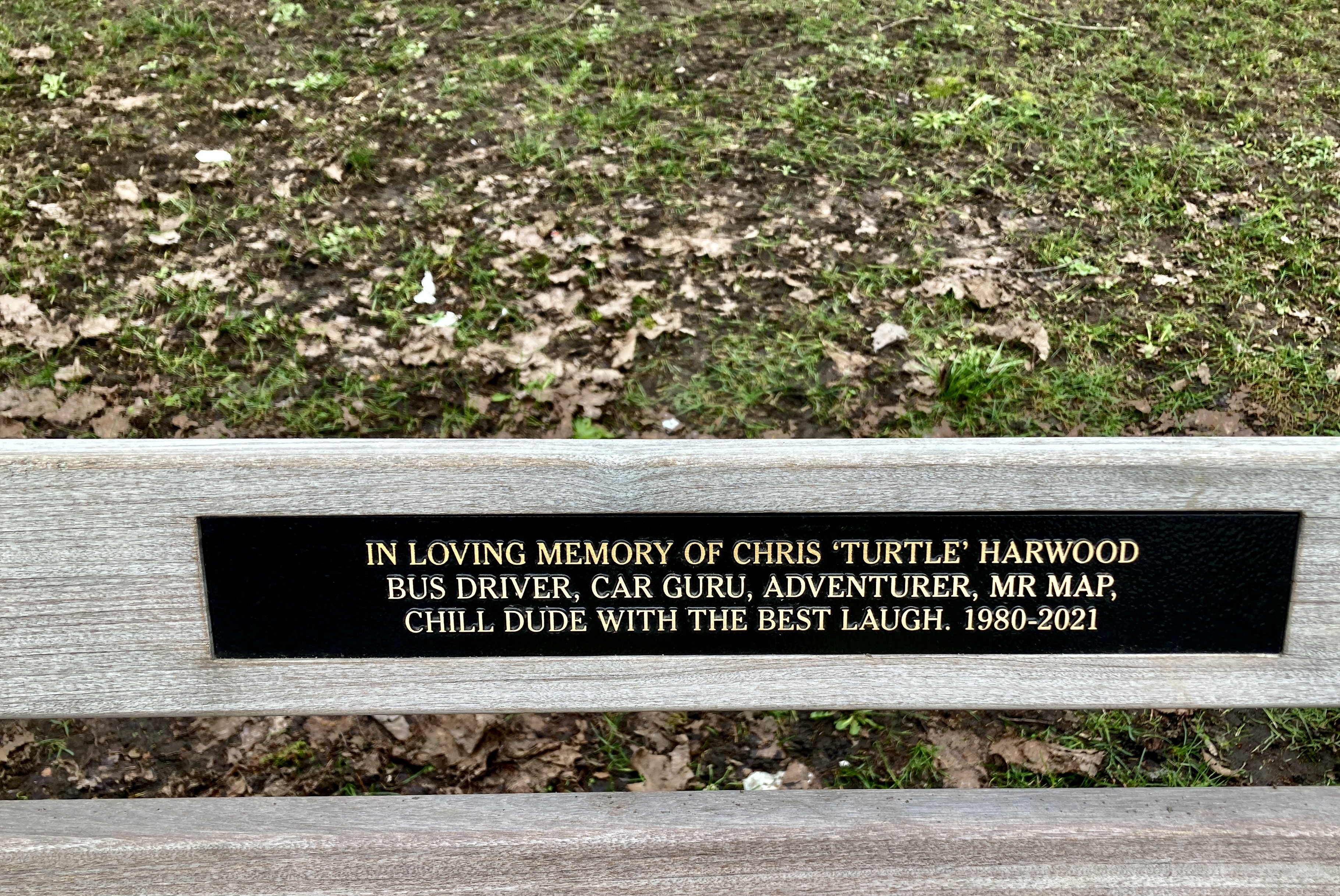
For the first time, I notice the plaque on one of the benches along the western edge of the park.
This is a park that, despite the chill in its nickname, is very warm indeed. It welcomes us all — and it even gives us a role model. Who would not want to be known as a “Chill dude with the best laugh”?
2 February 2024 – The predicted torrents of rain didn’t take place, but it has been very drizzly. And very, very grey. Not the luminous grey that I so often celebrate, but a flat-matte grey that sucks contrast and depth from the scene.
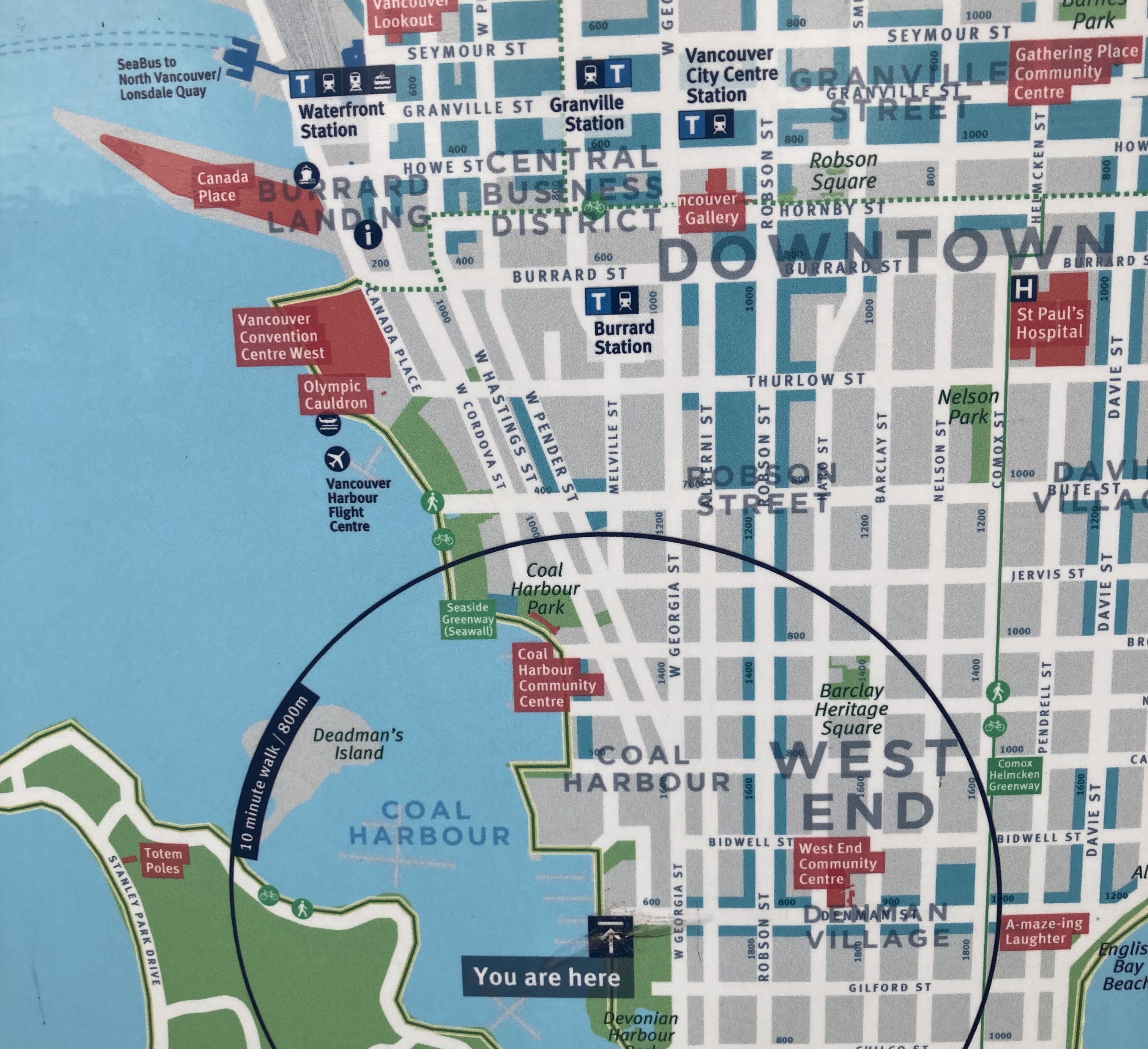
Since it is double-digit mild as well as merely-moist-not-wet, I opt for a walk all along the Seawall from Devonian Harbour Park, at the edge of Stanley Park, to Canada Place downtown.
I am indeed “here,” right where it says I am, there at the lower left, and I set off.
But… how shall I put this… it is not very uplifting. Just a whole world of flat grey, merge-purging itself in blurry confusion out to the horizon. Our grand panoramic views are not at all grand, at the moment.
Well, sod the panoramic views. I shall instead look for details. Small, very bright details. In the red family, by preference.
And so I notice a bright orange bumper ring tucked around this boat in Bayshore West Marina…
a pair of red & mustard houseboats, punching through the polite blue & white of the Coal Harbour Marina…
a brazen life ring, admiring itself in the waters off Coal Harbour Quay…
a red & white seaplane, growling itself to life for its next run from the Vancouver Harbour Flight Centre out to the Gulf Islands…
a long view from the Convention Centre, on east past Canada Place to orange cranes in the Port beyond, poised over a cargo freighter…
and Douglas Coupland’s Digital Orca, right here at the edge of Jack Poole Plaza, dancing the pixillated dance that has been its signature since 2009.
29 January 2024 – 7:35:15 a.m.; right here at 49.2827° N 123.1207° W; this very morning.
The calm before the anticipated next series of storms: “Heavy rain will persist into the first half of the week as a stubborn atmospheric river lingers over British Columbia.”
17 January 2024 – Both at the Vancouver Art Gallery, fortunately not in the same exhibit.
Even so, each affected us in much the same way. We emerged stimulated, better informed, and hopeful about the kind of future trends that each show seems to suggest. What a happy way to spend a cold afternoon early in the new year!
— First up, the fibres —
Rooted Here: Woven From the Land
As the VAG website description explains, “This exhibition makes clear the vital integration of weaving throughout traditional and contemporary Salish cultures…” It features the work of four renowned Coast Salish artists (Angela George, Chief Janice George, Willard (Buddy) Joseph and Debra Sparrow) and includes both hangings…
with explanations…
and an installation of videos and draped mannequins.
Beautiful work, enriched by trends — trends that are now carrying the “integration” cited by that VAG intro beyond the Coast Salish peoples and bringing it into the larger context shared by us all.
In 2018, Debra Sparrow, Angela George and Willard (Buddy) George began collaborating with the Vancouver Mural Festival in a continuing project called Blanketing the City. , — a project through which they are bringing these design motifs into the city’s found architecture.
Now all four artists have moved beyond existing street structures to bespoke design for a $400-million new build. In collaboration with Swiss architects Herzog & de Meuron, they have designed the copper cladding…
for the future home of the Vancouver Art Gallery.
Some project material is included in the exhibit; I came home and promptly looked for more, especially in the detailed presentation on the architects’ own project design pages.
— And now for the fraud —
J.E.H. MacDonald? A Tangled Garden
Do please pay attention to that question mark.
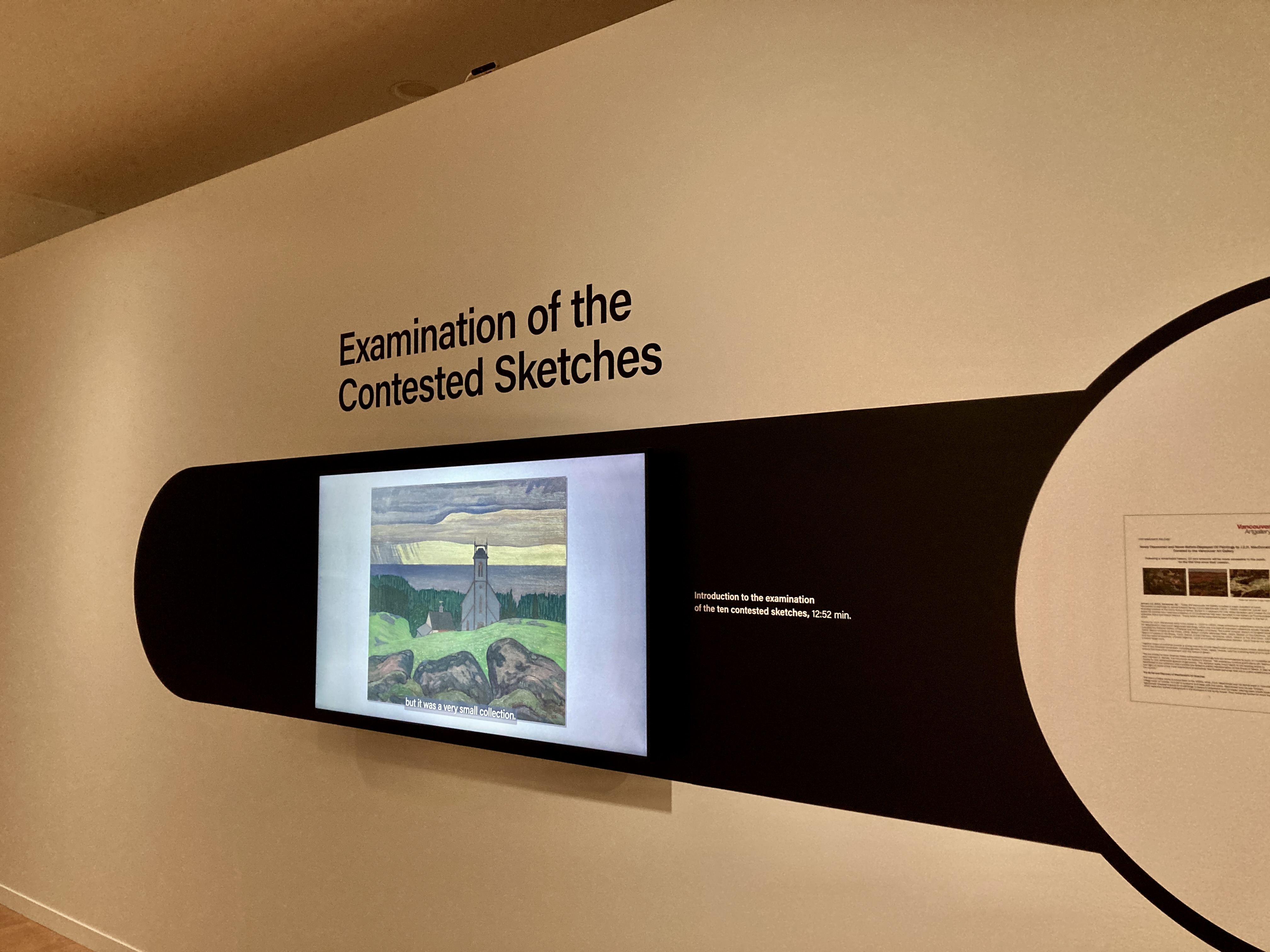
We have here an entire exhibition, a detailed exhibition, devoted to ten sketches that were received with triumph in 2015 and are now acknowledged to be forgeries. That is to say:
Not ten sketches, by Group of Seven co-founder J.E.H. MacDonald, for a subsequent oil painting in each case.
Instead, ten sketches by Anonymous, after an authenticated oil painting in each case.
As with the exhibition’s question mark, so with its careful use of prepositions.
What an extraordinary show! A whole show built around a major institution saying, “We got that wrong. What looked right, was wrong.” And then documenting the almost nine years of investigation that produced the final verdict.
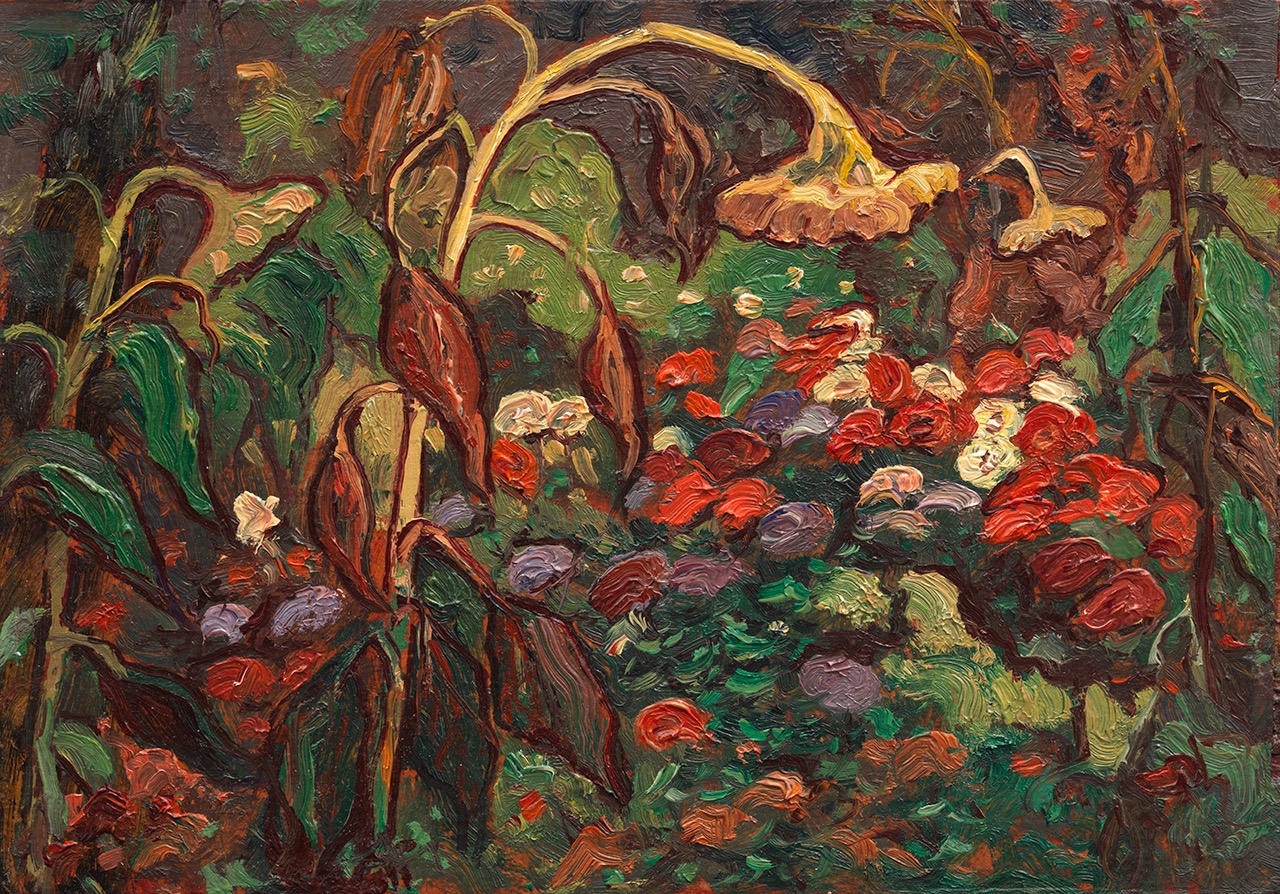
Appropriately, the lead image for this entangled story is the sketch after (not for!) MacDonald’s painting, The Tangled Garden.
What they’re still not telling us is whether the Toronto dealer and the Toronto art collectors who offered these works were themselves duped or part of the duplicity. What we do know is that very soon after the VAG trumpeted its exciting acquisition, the larger art community began to ask questions.
As best I understand it, the VAG initially responded in the well-established global tradition for handling such moments. It stone-walled.
But then, with a new CEO and the courageous example of Ian Thom (the then-Senior Curator who had brought in the acquisition), the VAG decided instead to conduct a thorough investigation, and share what they learned. Art historians, art experts at other institutions (e.g. National Gallery of Canada) and forensic scientists (e.g. the Canadian Conservation Institute of the federal Dept. of Canadian Heritage) all took part. As Ian Thom said, in the excellent video documenting all this work, “I thought this one of the great experiences of my life. Then it just got worse and worse.”
But for us out here, it just got better and better. A major institution, willing to acknowledge it had been conned? Willing to do the investigation, and then not quietly shelve it, and deep-six the works, but build an entire exhibition around those discoveries? Willing to acknowledge that fraud is as much part of the art scene as art itself? Willing to reveal its own stories, and educate the rest of us?
How wonderful it would be, if this trend caught on.
Come see the show, if you can manage to be in Vancouver any time before May 12. It includes some of the well-authenticated Group of Seven works in the VAG collection, but hits stride once it zeroes in on the investigation: the people, the skills, the tenacity, that led to the final results.
And if you can’t make it to town, dive into this story of art + forensics in various sources online: everybody from Stir to The Art Newspaper, to Galleries West, to the VAG itself. And more.
2 January 2024 – The challenge is: how many icons can I jam into my first post of the new year? Icons that say, “Vancouver in winter,” but also speak to my own obsessions.
Off I go.
Start with: alley + street art + H-frame hydro poles + distant mountains fading into the misty drizzle.
Add: False Creek + Science World dome + Aquabus ferry + orange Port of Vancouver “giraffes” + (audio only, take my word for it) the 12-noon Gastown Steam Clock rendition of O Canada.
Add: a dance of lines & spaces.
Add: a surprise. If your eyes are open, there is always a surprise. (Though not always as dramatic, or unfortunate, as this one east of the Cambie bridge.)
Add: the gleam of rust in the rain. (Here, the sewer-pipe “train engine” over a Hinge Park creek.)
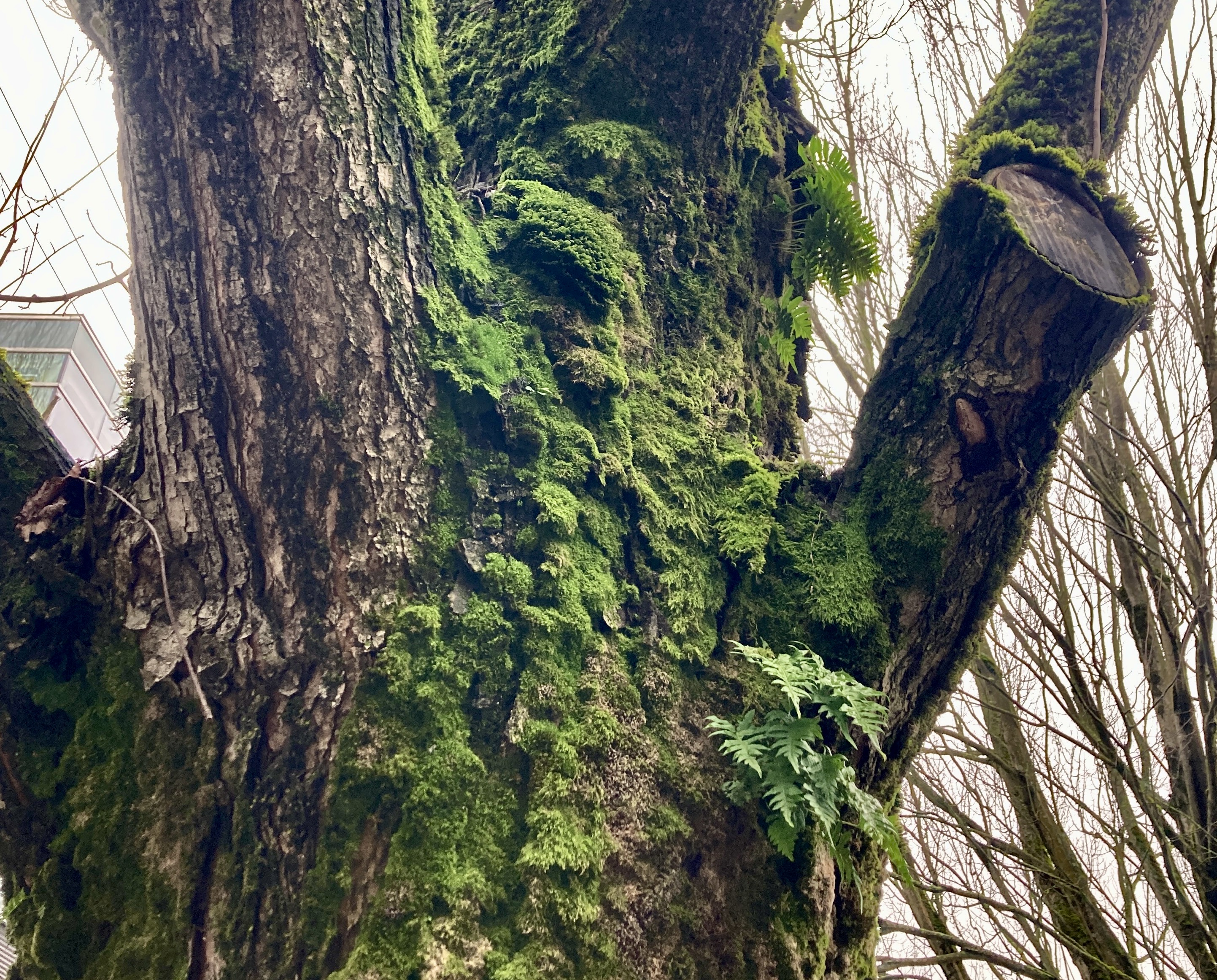
Add: winter tree trunk moss, garnished with fernlets.
As I walk back south on Ontario Street, I think: It lacks only a crow.
And then, just north of East 5th, there he is!
Yes, yes, I know. He is white, and painted, and riding a skateboard. But I say he is a crow, and it’s my blog.
"Traveller, there is no path. Paths are made by walking" -- Antonio Machado (1875-1939)
"The voyage of discovery is not in seeking new landscapes, but in having new eyes" -- Marcel Proust (1871-1922)
"A city is a language, a repository of possibilities, and walking is the act of speaking that language, of selecting from those possibilities" -- Rebecca Solnit, "Wanderlust: A History of Walking"














 WALKING WOMAN