21 February 2026 – Still, poised, suspended on its plumb line.
Waiting.
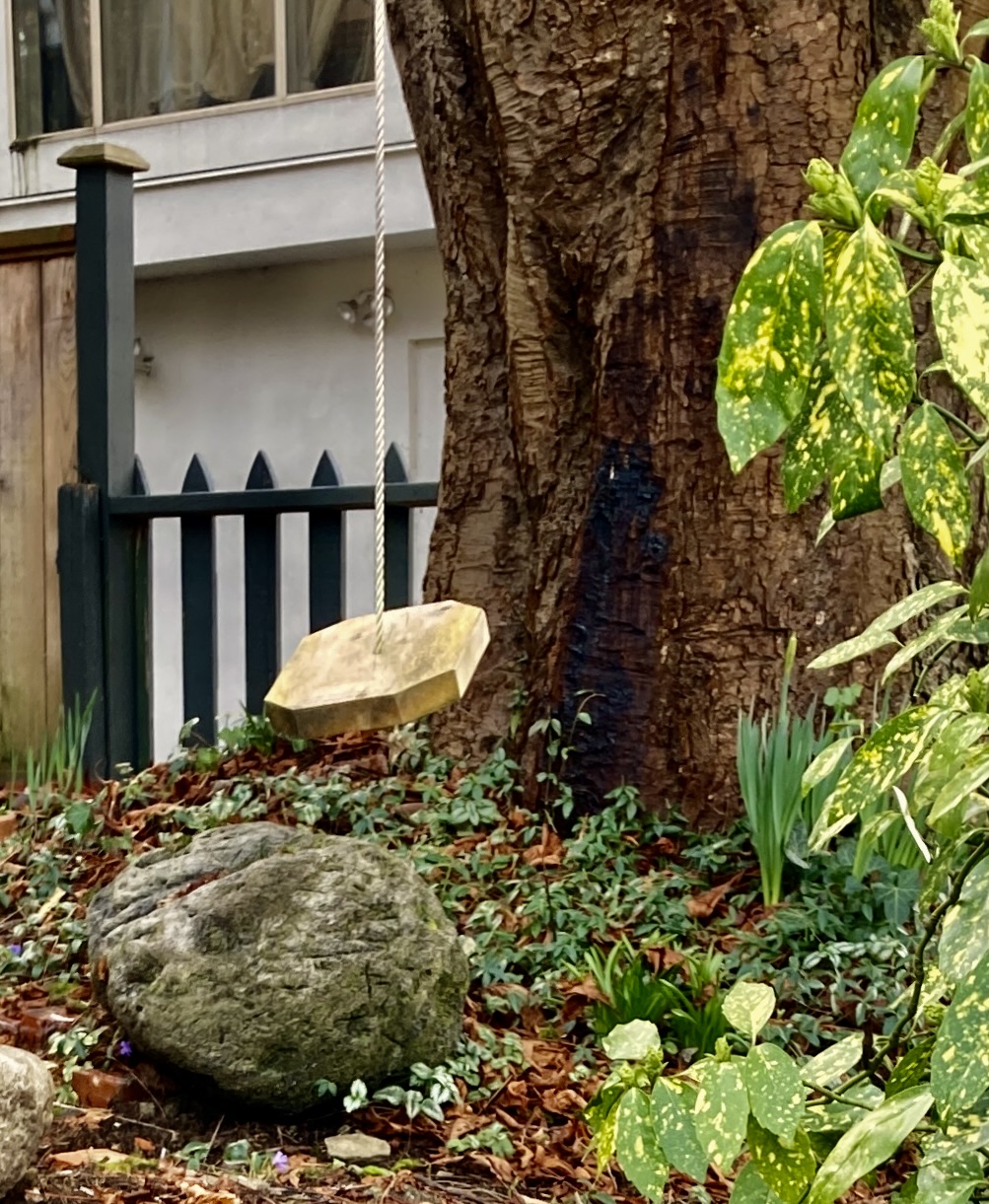
Waiting for spring.
a described route & walk in an urban environment
21 February 2026 – Still, poised, suspended on its plumb line.
Waiting.
Waiting for spring.
Posted by icelandpenny on 21 February 2026
https://icelandpenny.com/2026/02/21/waiting/
14 February 2026 – Yes, we amble. We are ambling. Were we in West Yorkshire, mind you, we’d be bimbling. But we are not there. We are here in West Vancouver — in Ambleside, in fact — and we are definitely ambling.
(If you’d like to get all lexicological about these delightful words, I suggest you click on the post bimble or amble? in the Walking the Wolds blog. It will equip you to win any pub quiz on the topic, any time, anywhere.)
However my mind is not, at the moment, deep in these words. It is, like my eyes, focused on this building.
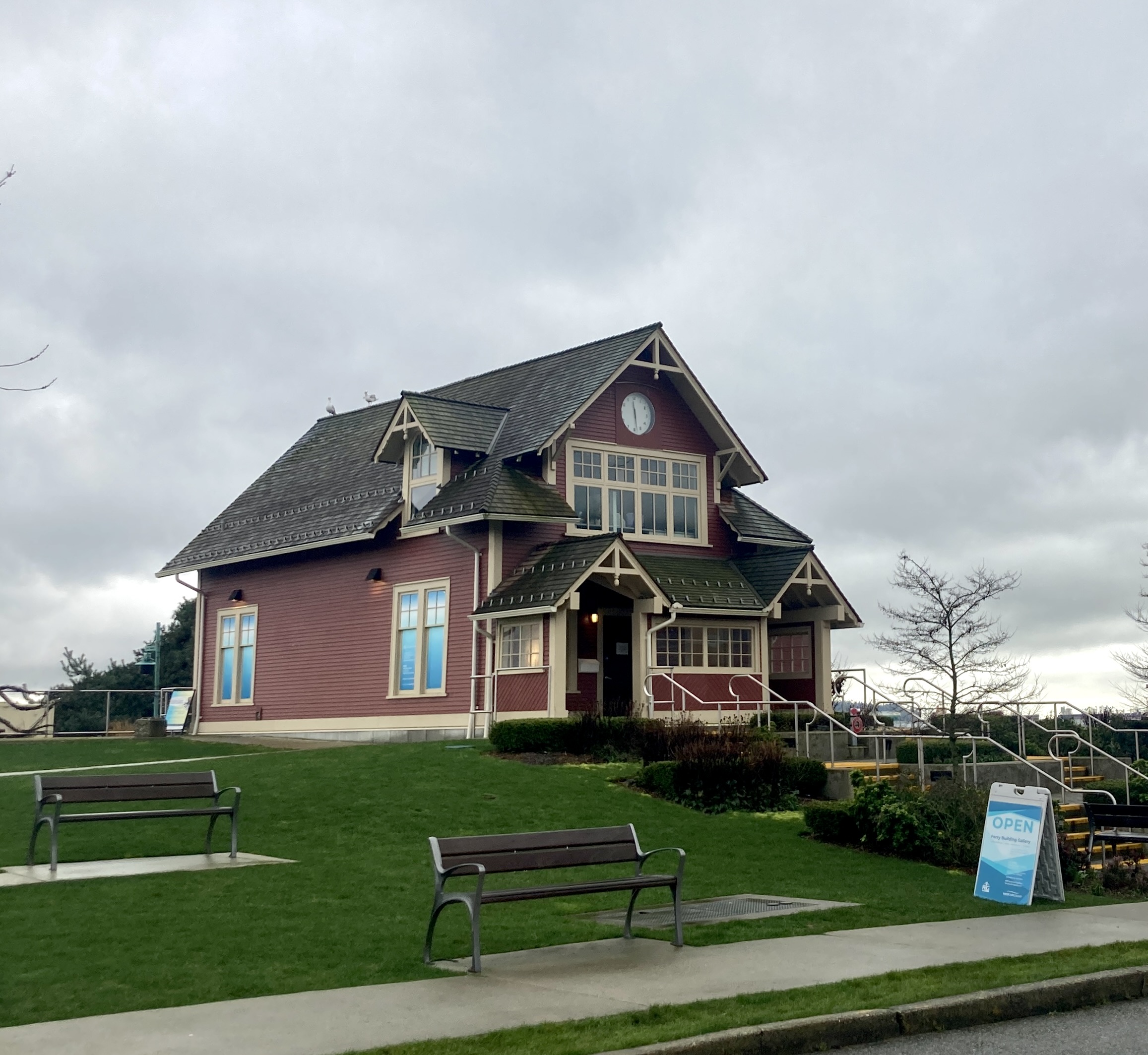
We are closing in on the Ferry Building Gallery, which indeed began life more than 100 years ago as a ferry terminal but is now a community arts hub.
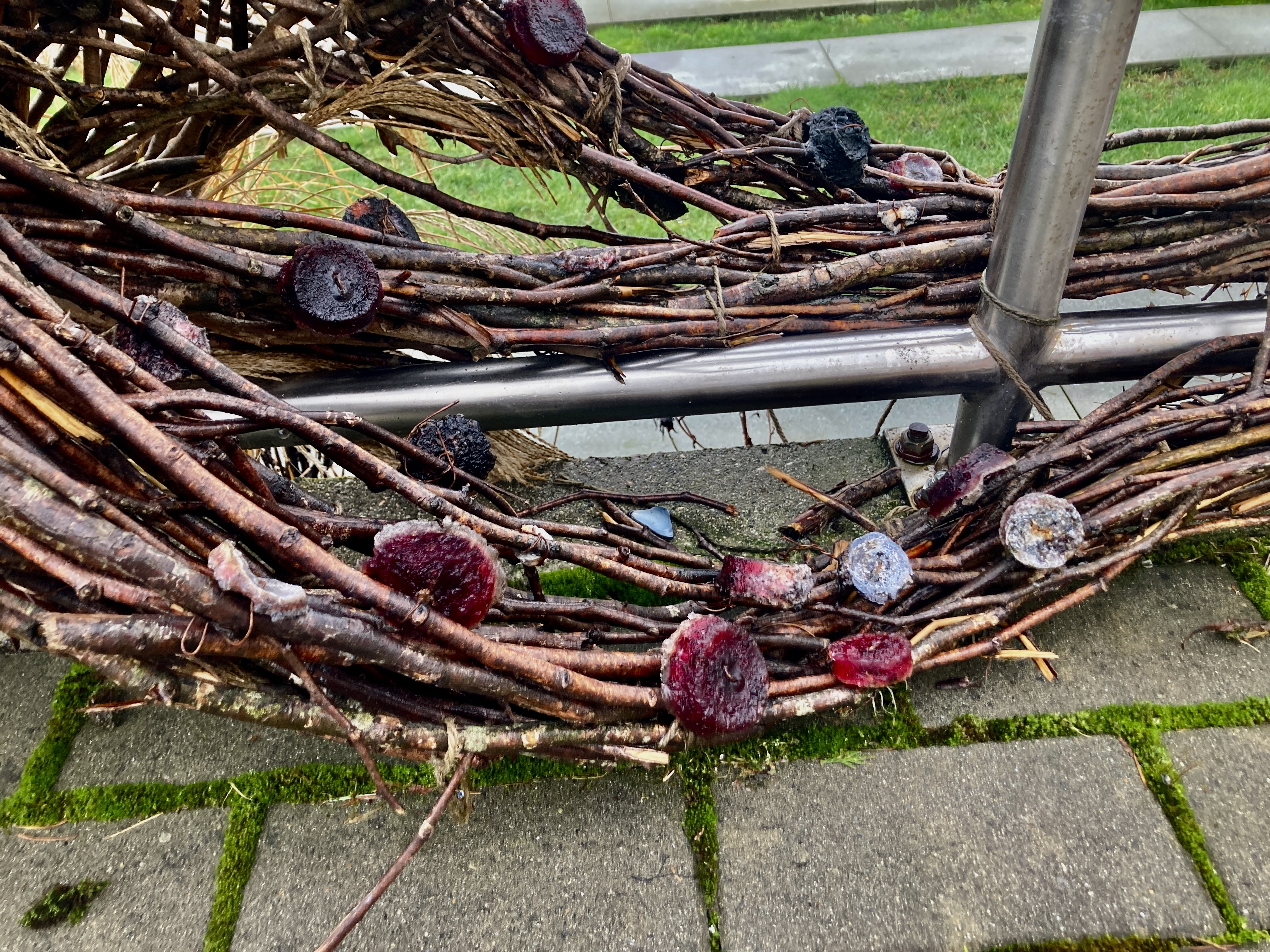
The art begins outside, with a giant Pacific squid…
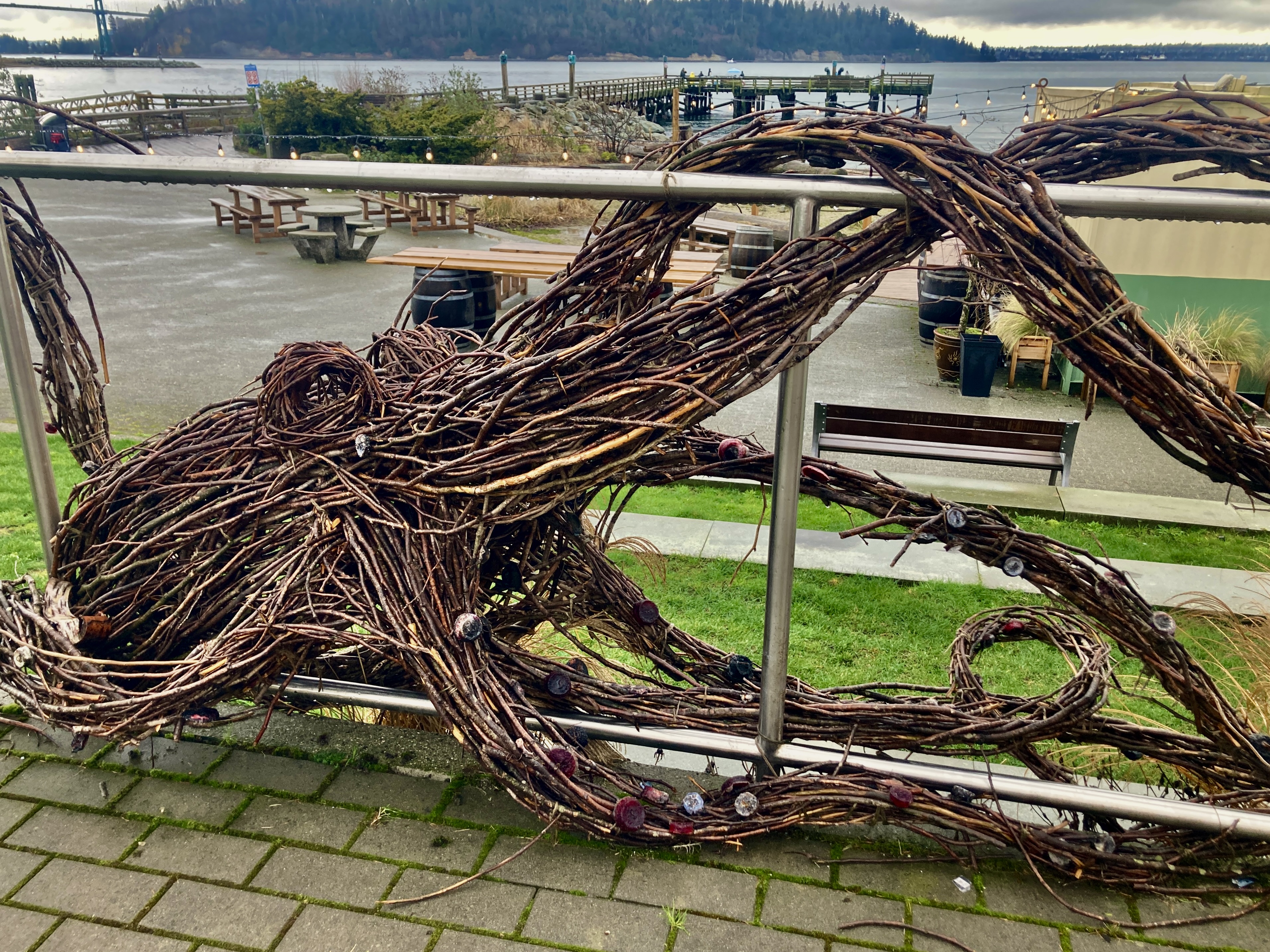
which was constructed last August by eco-artist Nickie Lewis from all-natural materials, and will remain on display until those natural materials begin to decompose.
No sign of that yet, the fibres and their ornaments are still full-on dramatic & vigorous.
Close to the door, a Witch Hazel shrub bears its own ornaments, a spray of bright new blossoms.
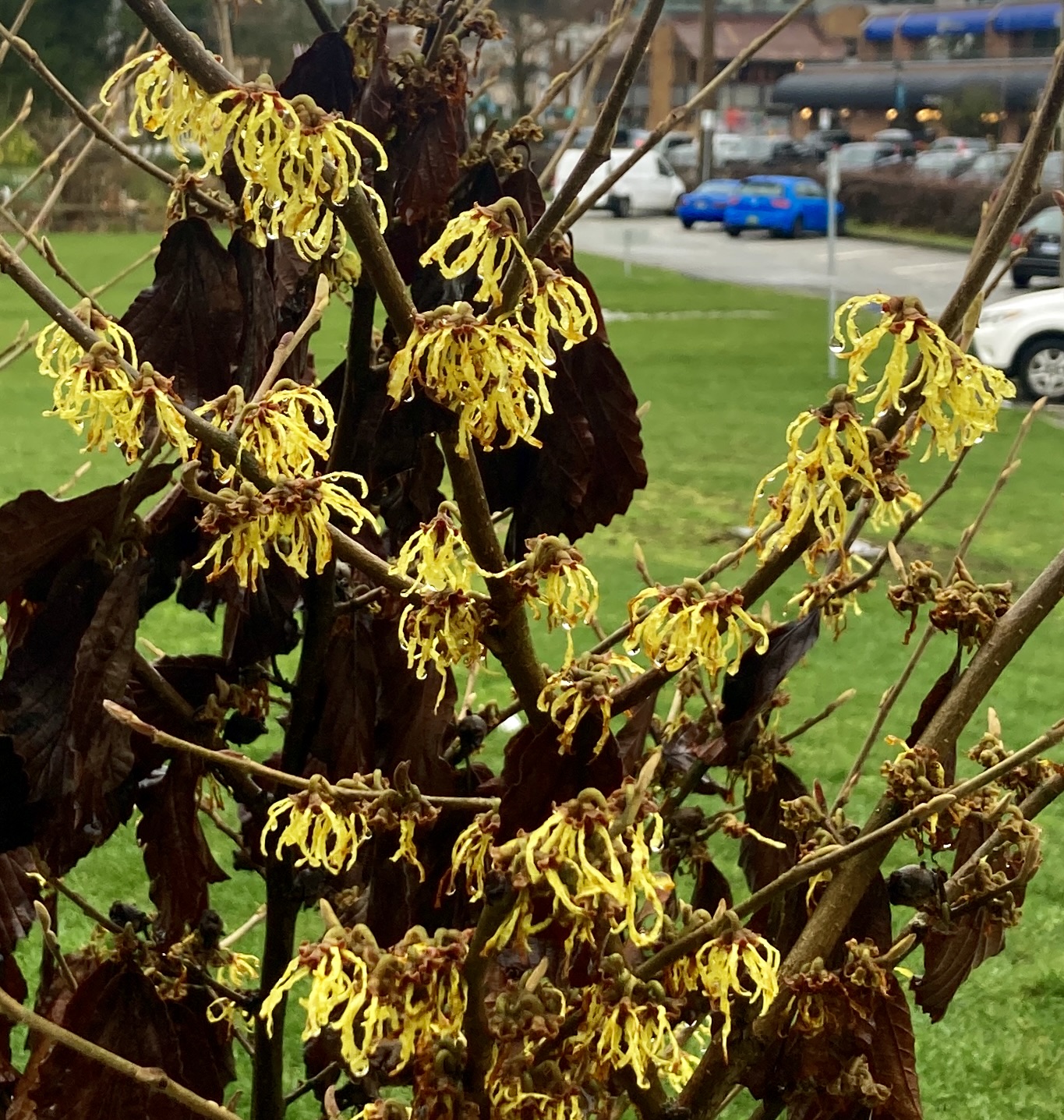
Not why we’re here!
We’re here for this:
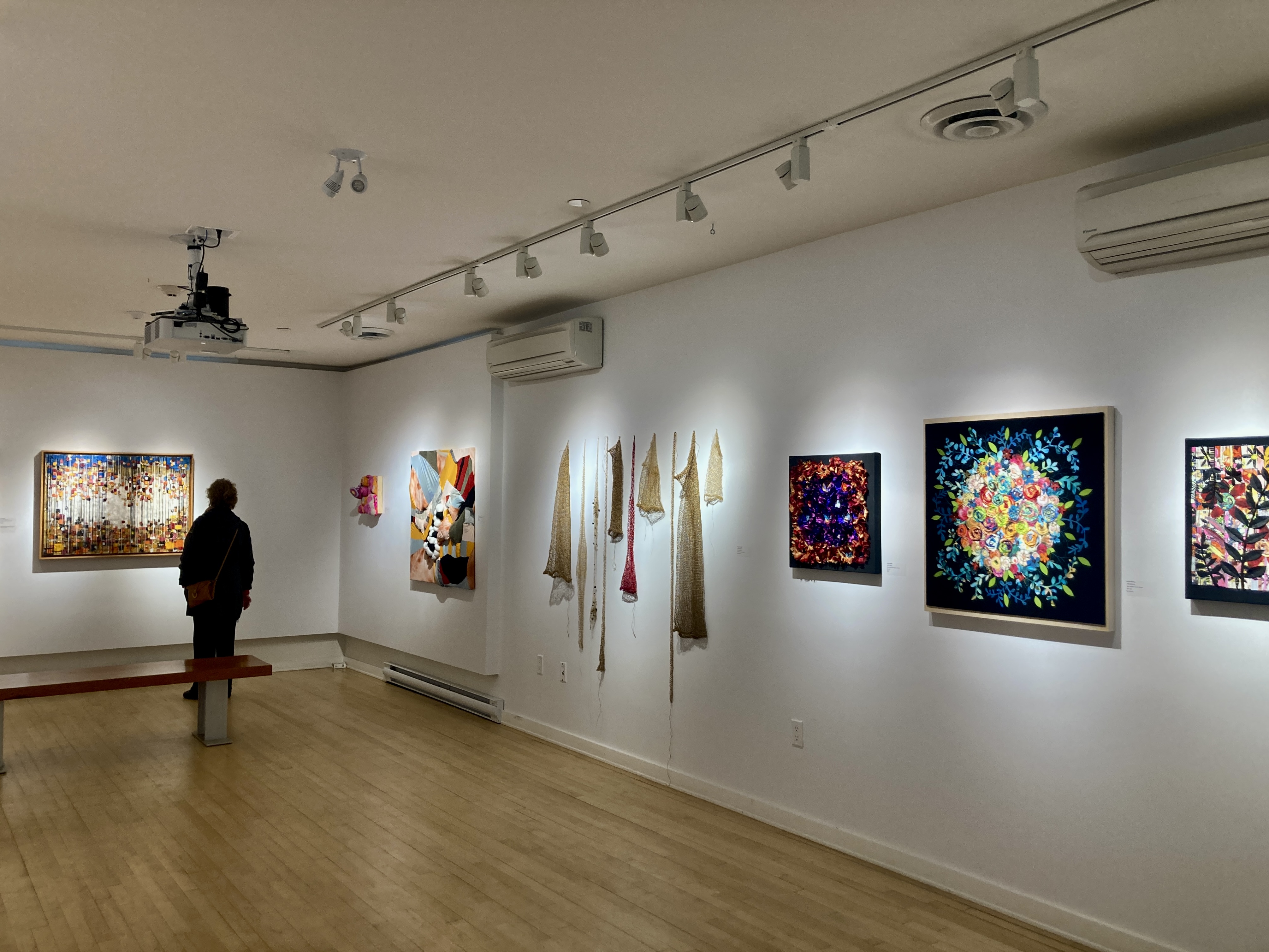
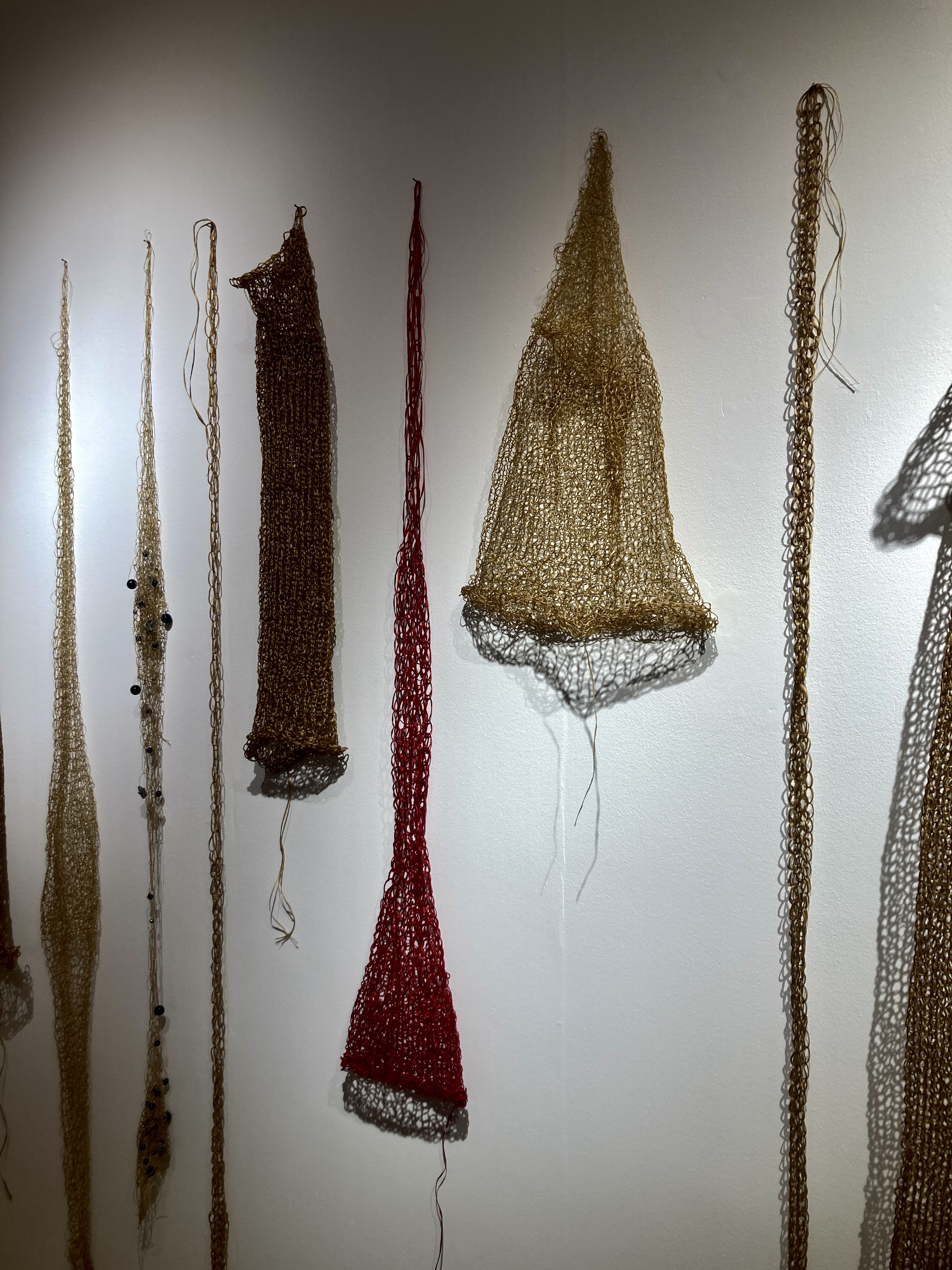
the Gallery’s Interlace exhibition, whose seven artists have in common their primary materials of fabric, thread and wool.
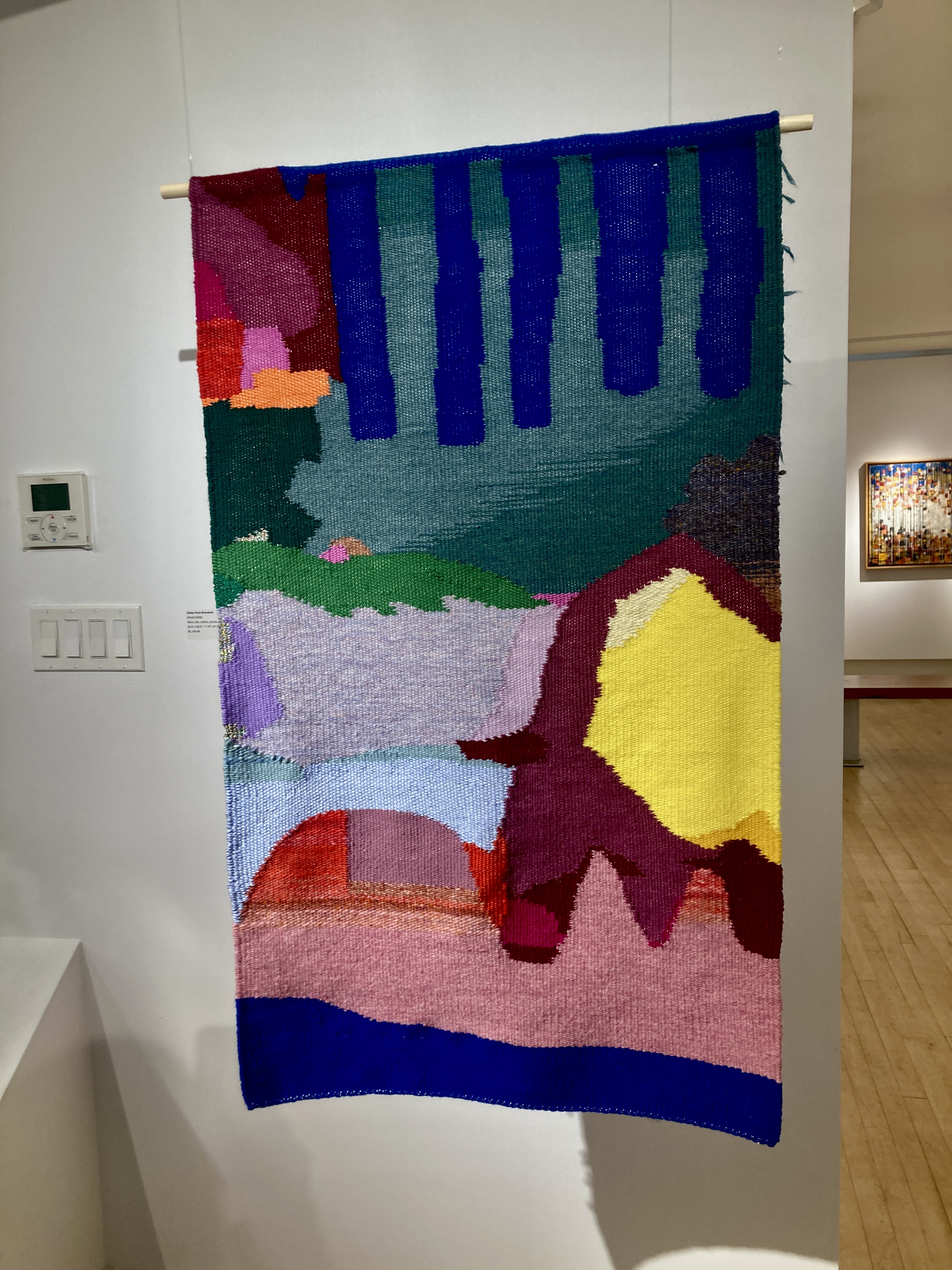
Woven hangings (Shield, Haley Hunt-Brondwin)…
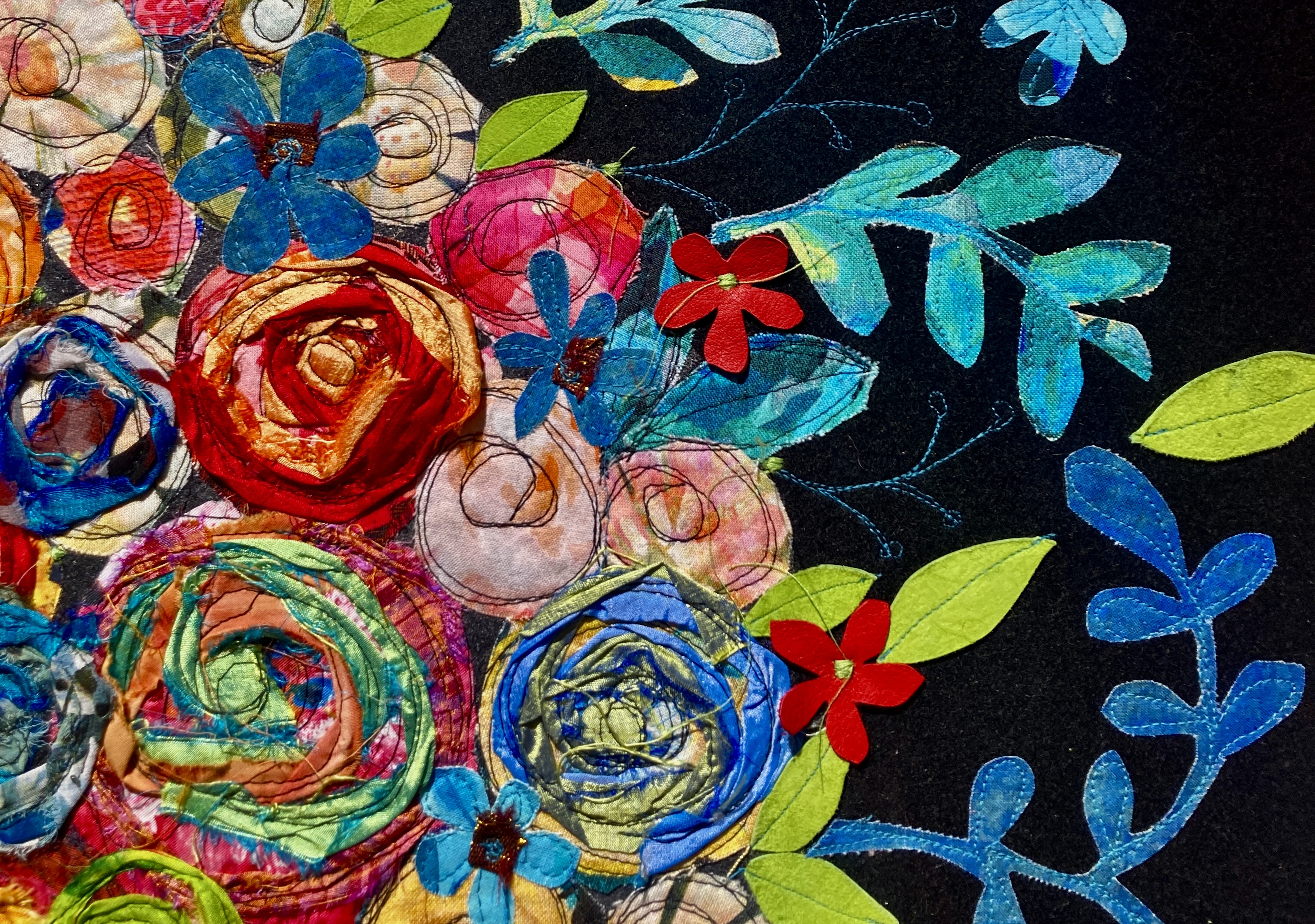
explosions of silk, leather, wool and thread (Home, Lorna Moffat)…
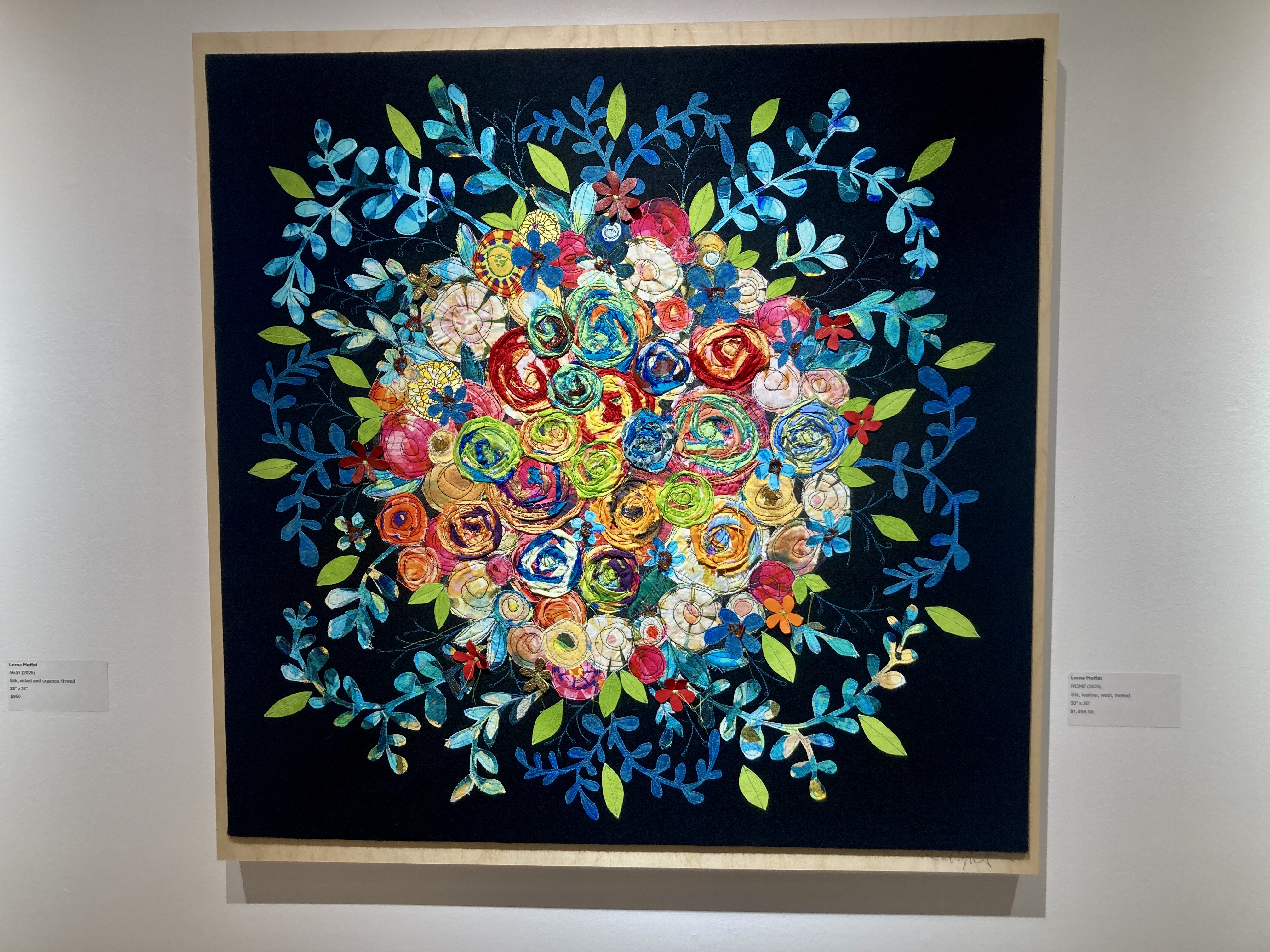
intricately looped & stitched…
artificial sinews (Untitled, Reggie Harold), looking very natural…
and then what, from a distance, could pass for an impressionistic painting of a stroll (an amble, a bimble) in the forest.
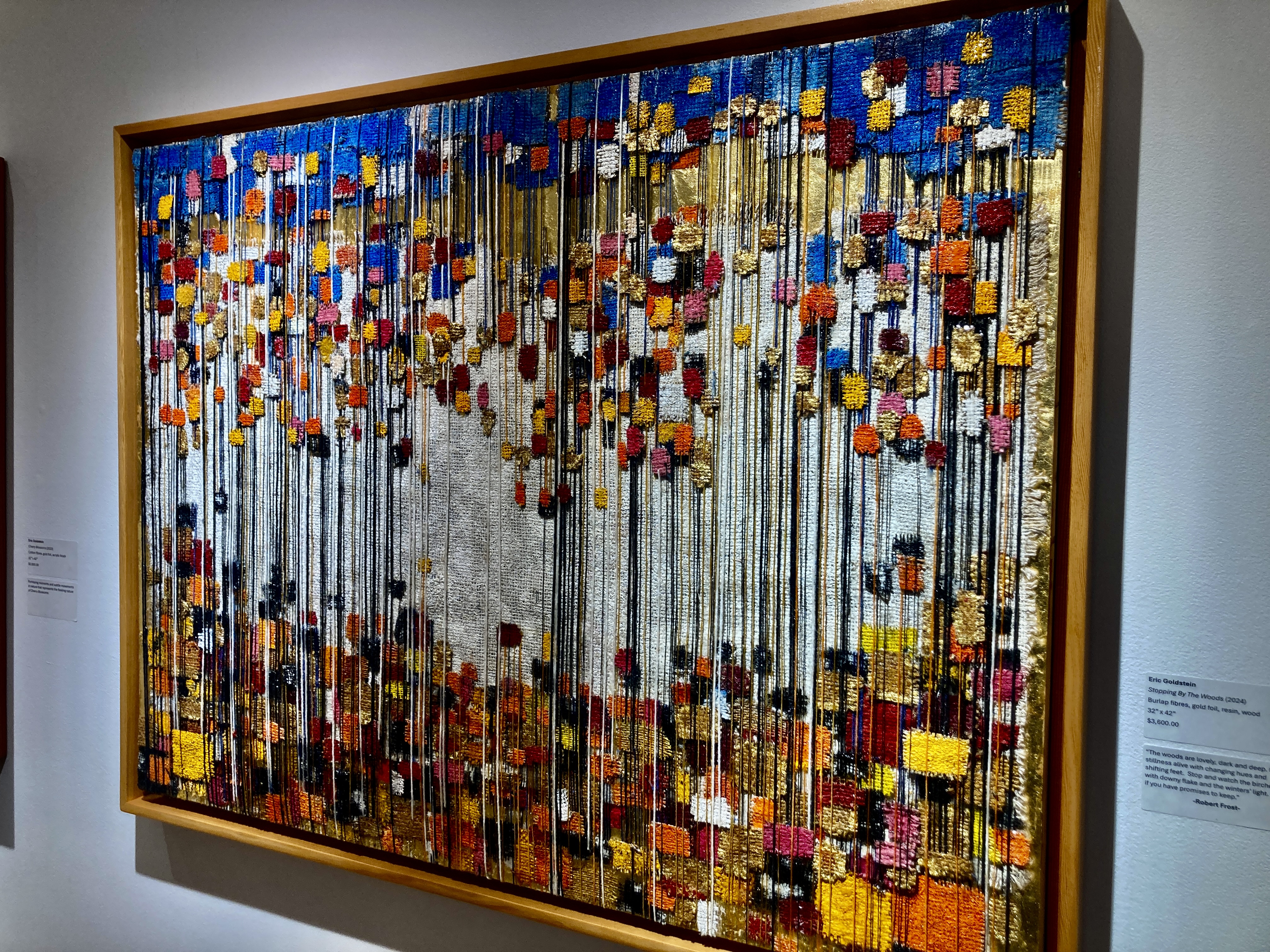
It is indeed forest, Stopping by the Woods (Eric Goldstein), but step closer and you see…
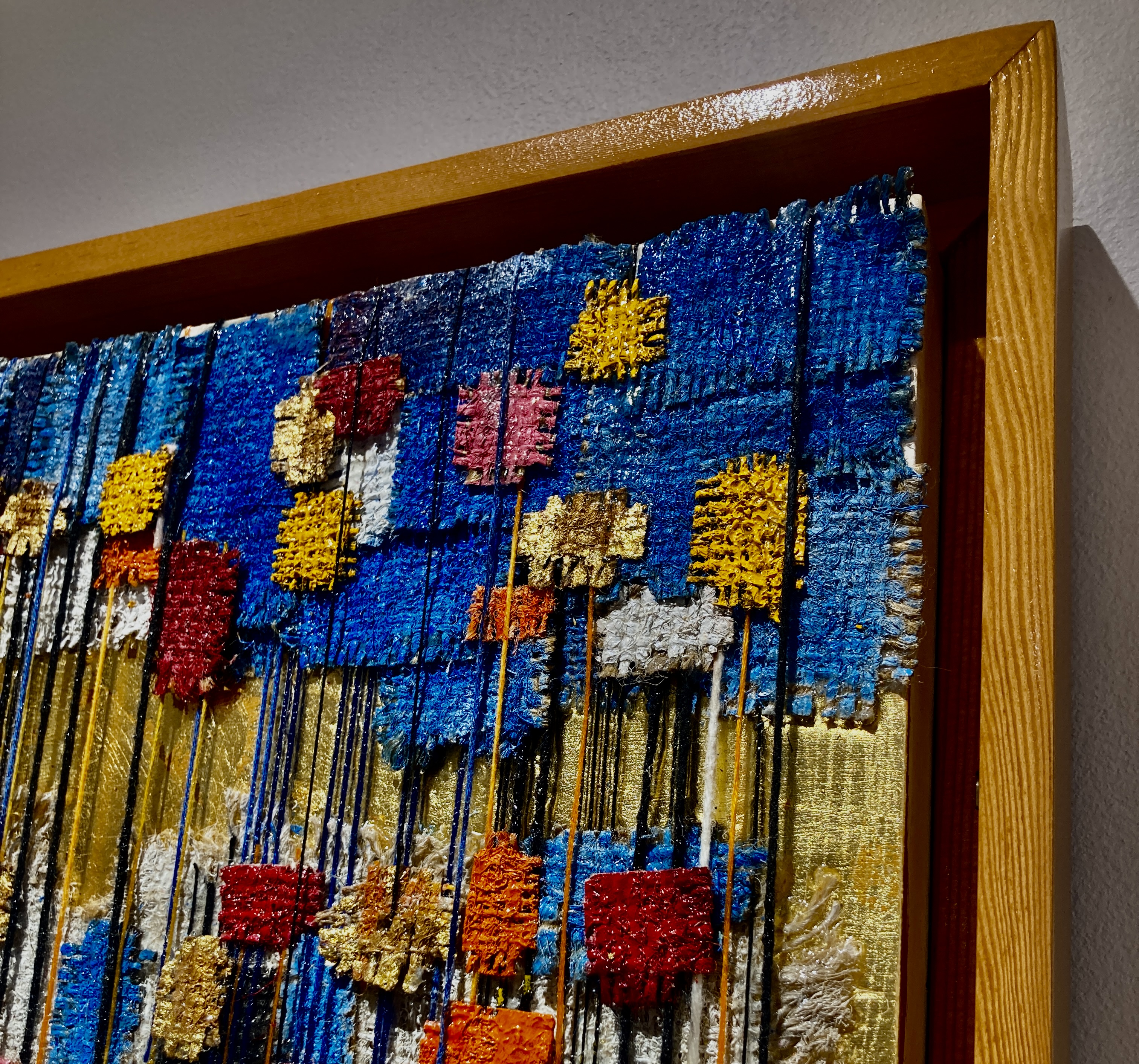
the play of burlap fibres, gold foil, resin and wood.
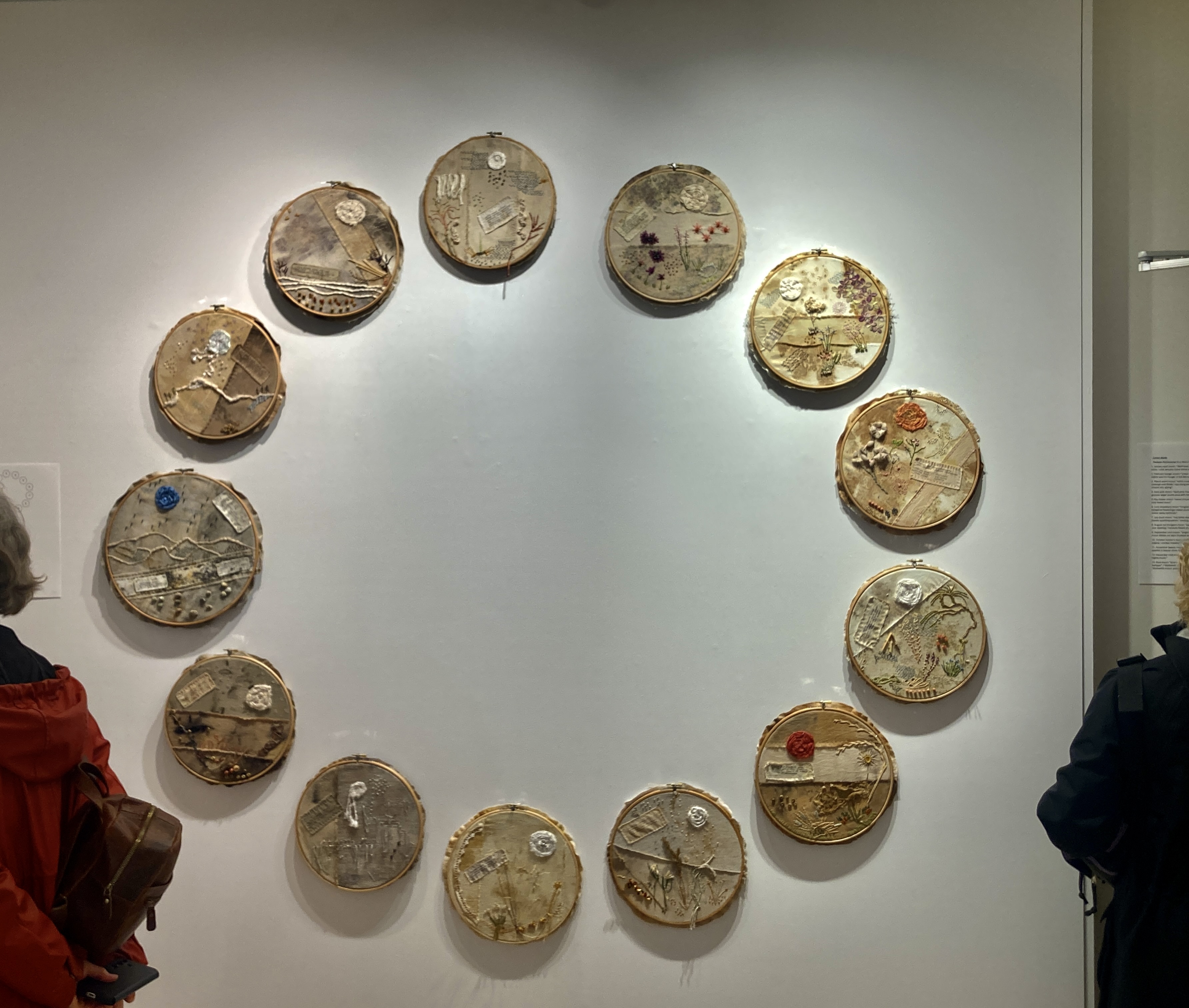
In the Gallery alcove, 13 circles making a circle. Moon Circles (Madwyn McConachy) is the artist’s tribute to the 12 monthly moons plus the “mystery moon,” the blue moon (on the left, with bright blue wool).
Over on the right and a little lower down, the Red Sturgeon Moon of August…
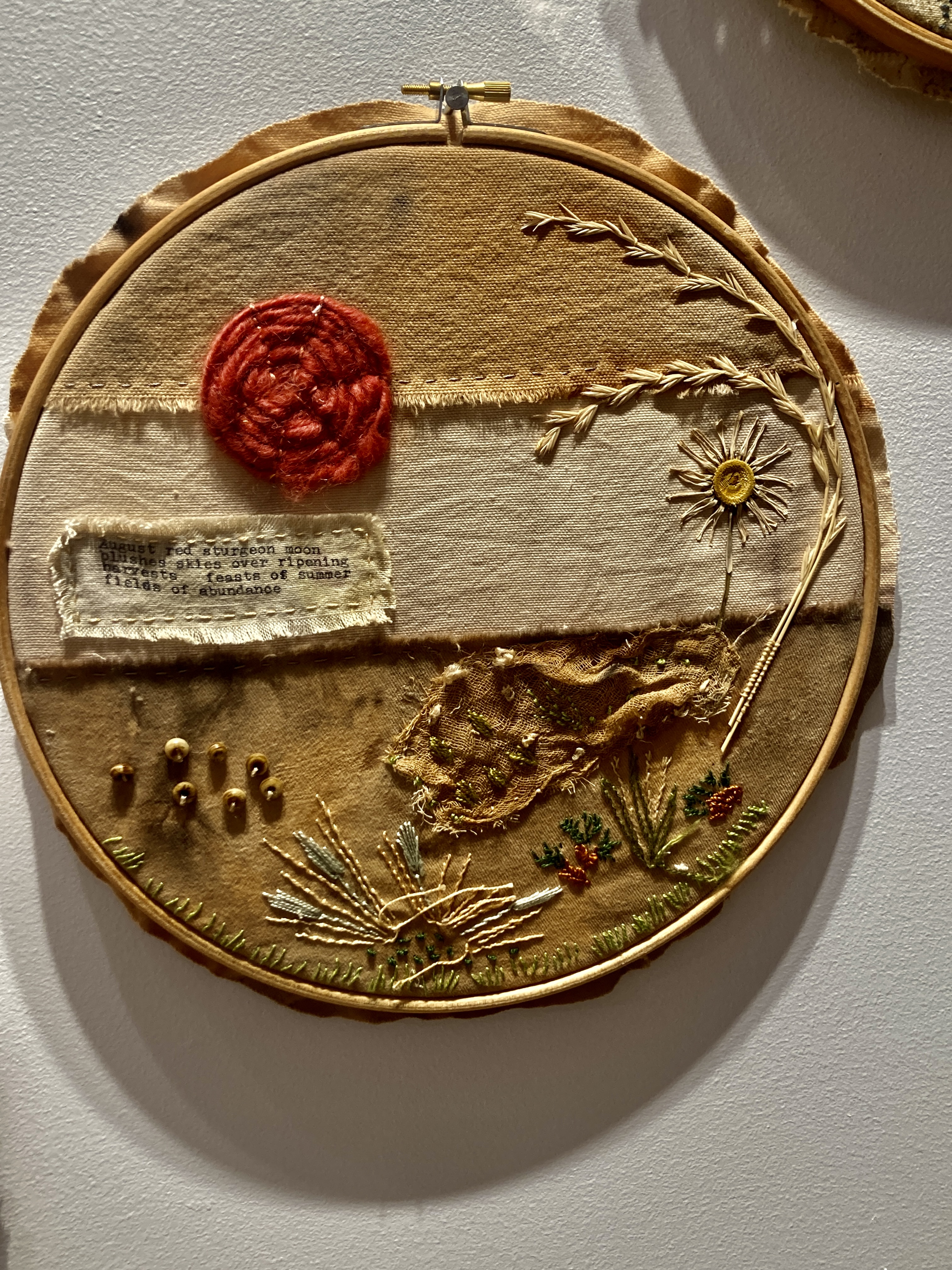
a “stitched medication on season, subtle change and belonging, within the natural world.”
Finally, we take ourselves back into that natural world.
We look south & east across Burrard Inlet toward Stanley Park, where a freighter is about to make its way under the Lions Gate Bridge and on to its assigned anchorage in the Port of Vancouver.
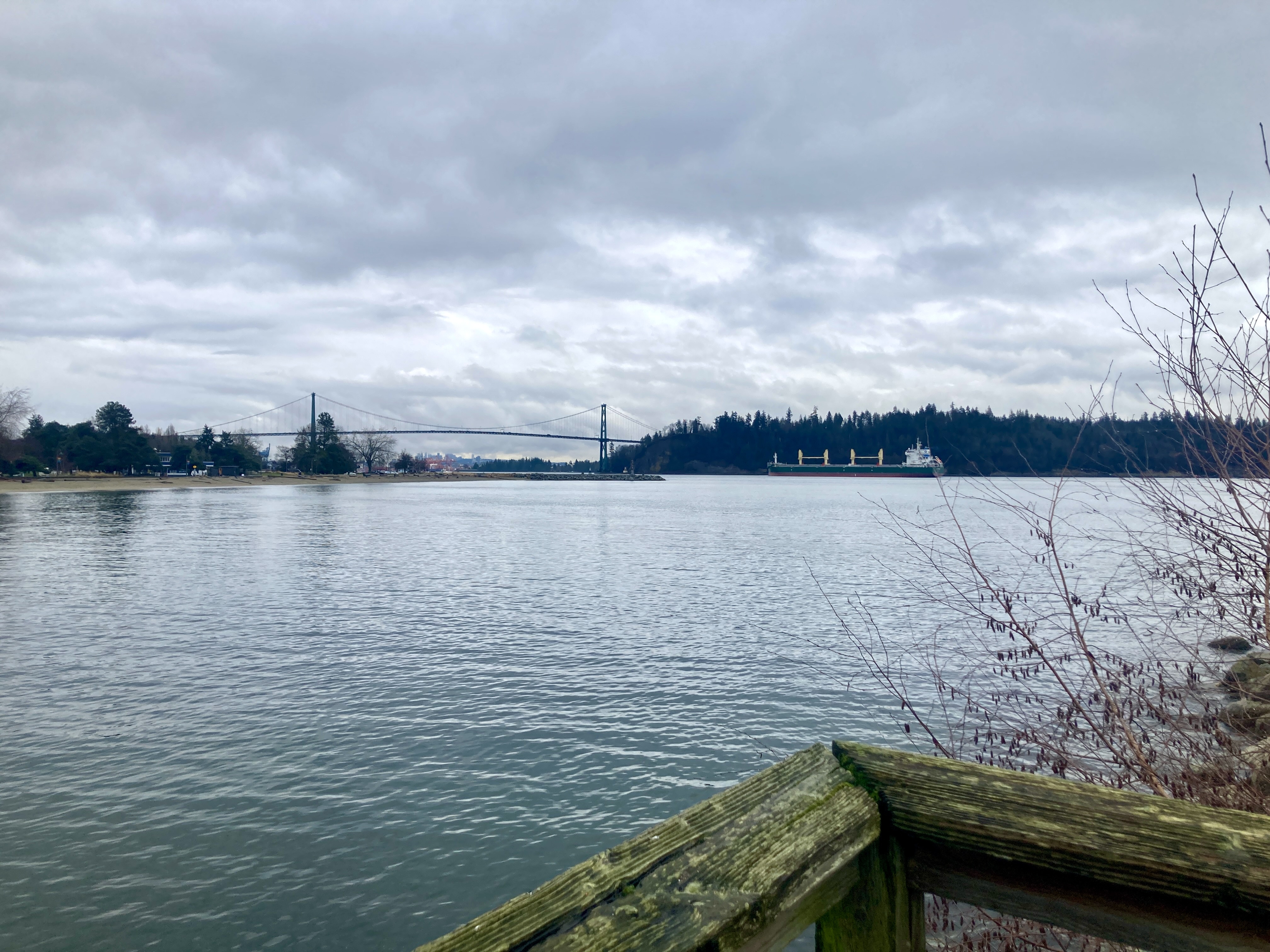
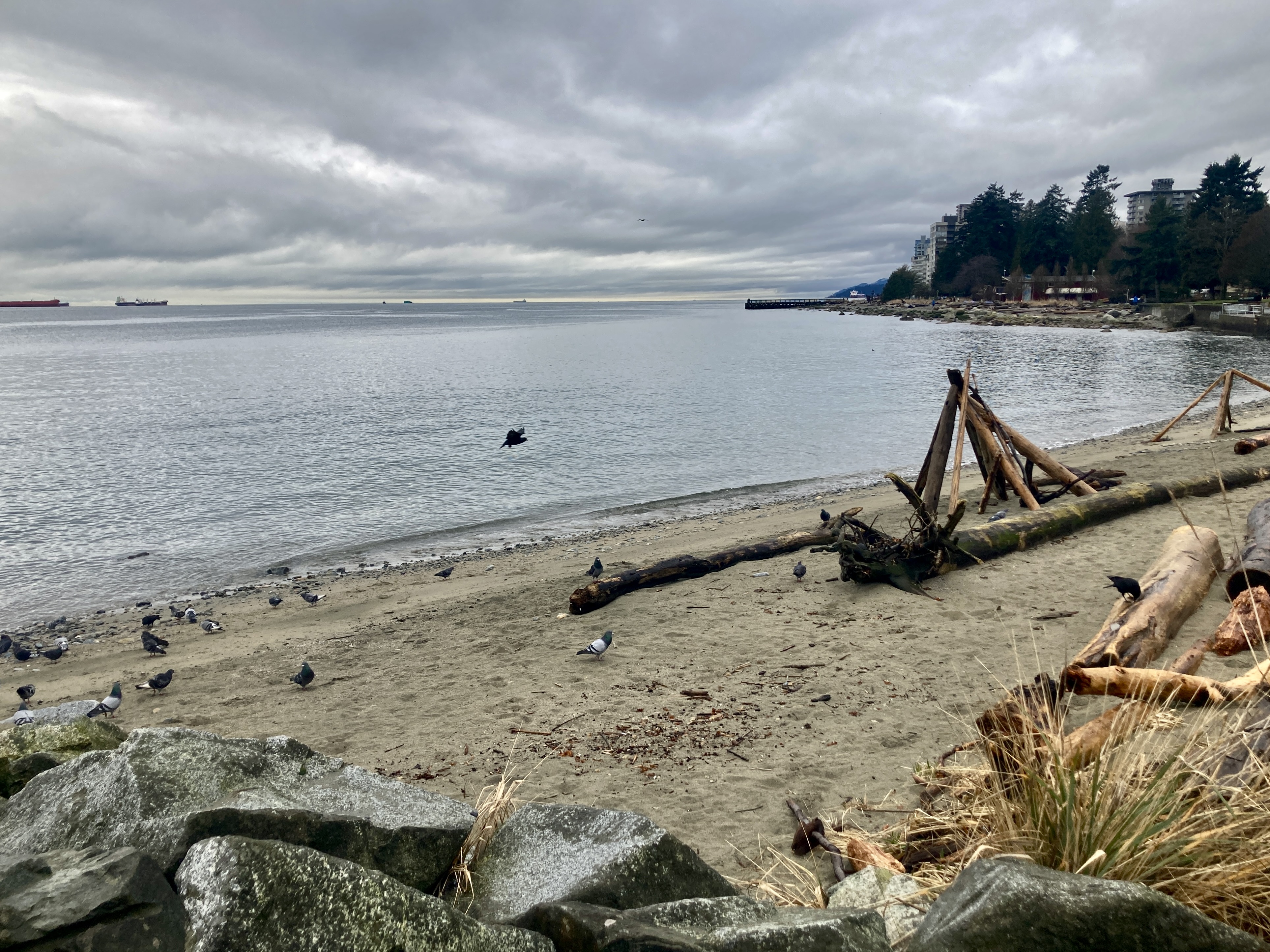
We head the other way, west along the Seawall toward Dundarave. The rain is holding off, and gulls & crows are busy exploring the sands, with one more crow swooping in to join them. (Yes. That is a crow flying over the water, not a Coot in the water.)
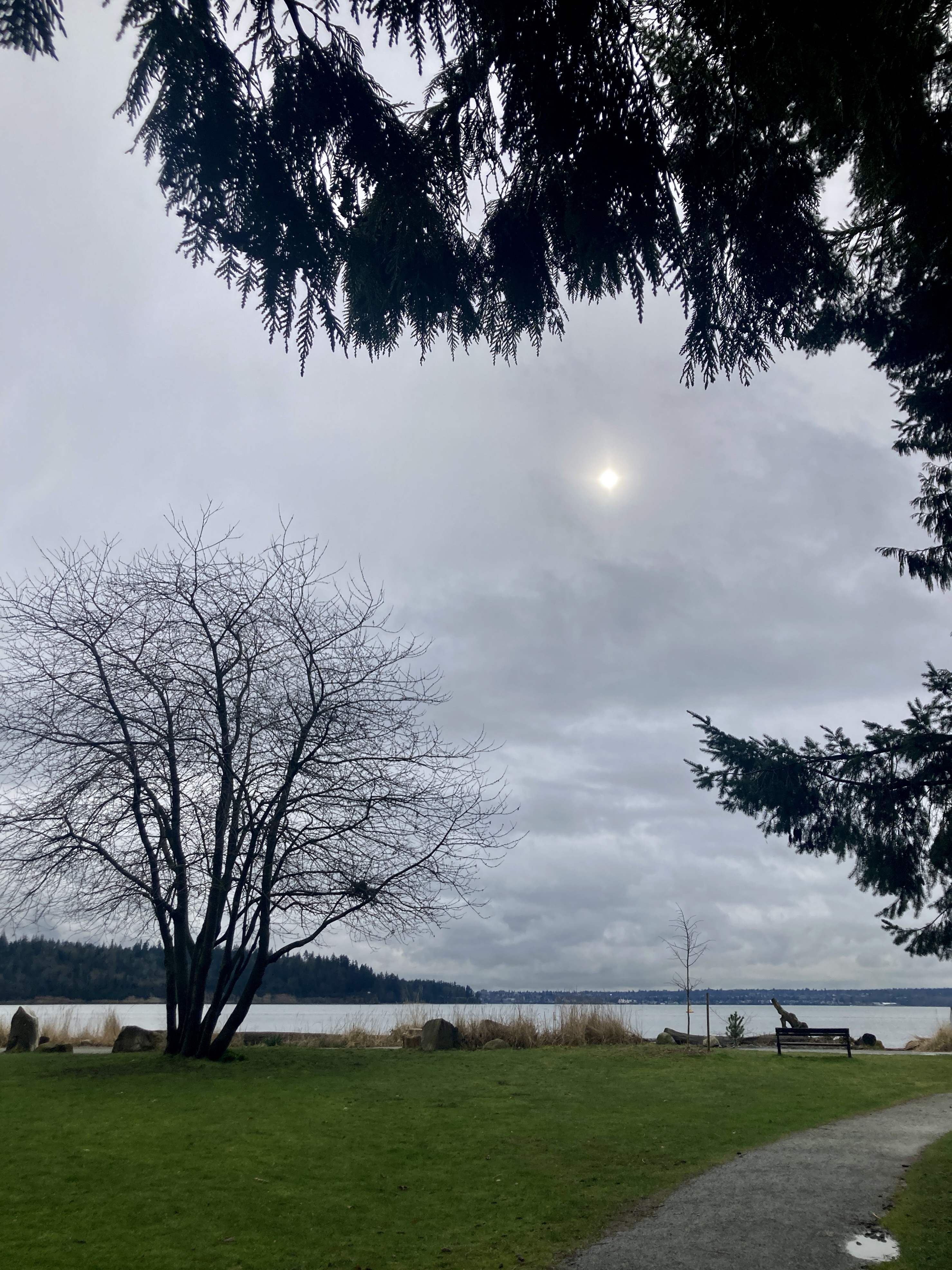
Down through Lawson Park, with a naked deciduous tree to our left, a clothed evergreen to our right, and, poised high between them, a ghostly sun wrapped in cloud.
More gulls in the kiddy playground, this time perched high on a shipwreck mast.
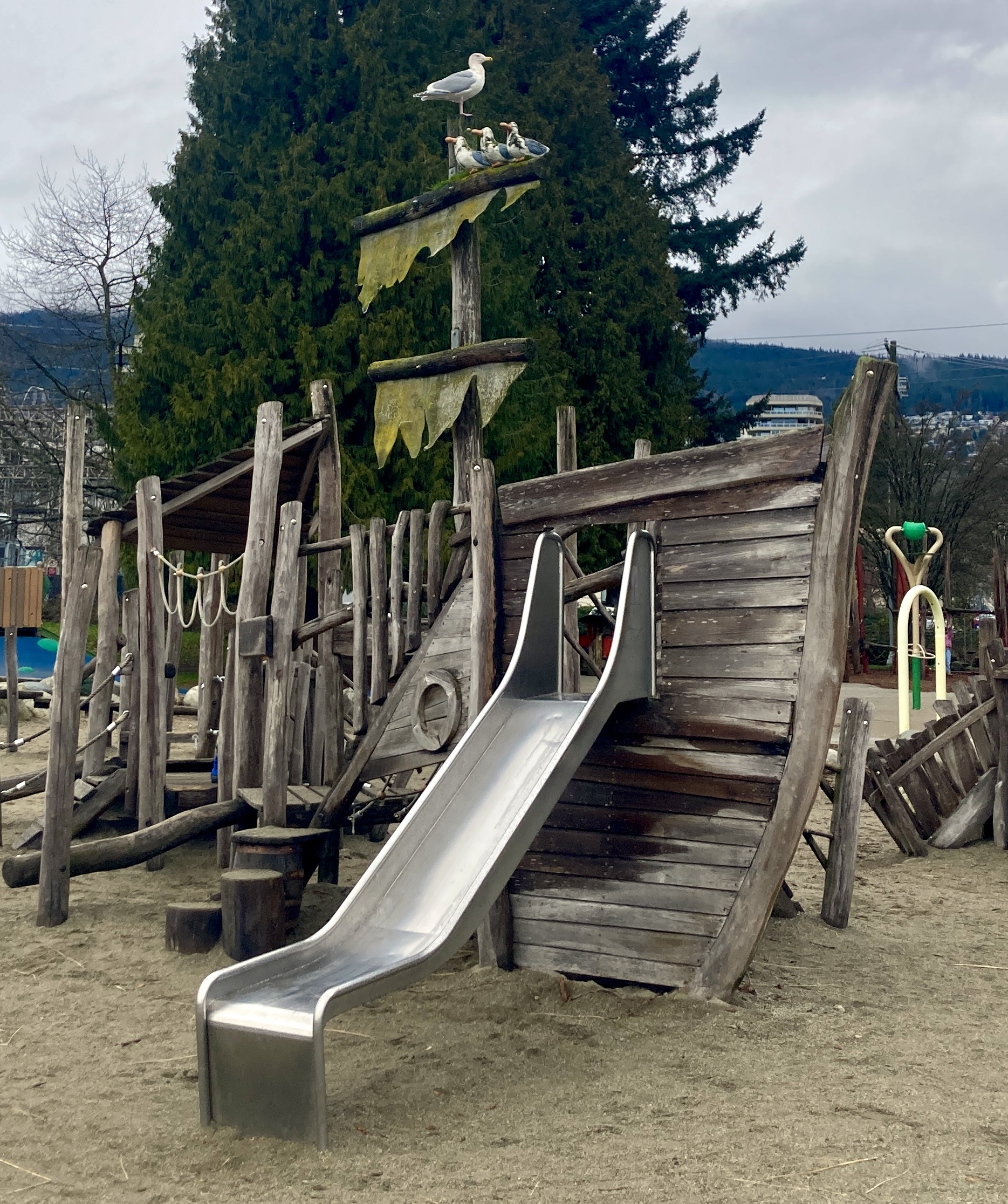
(One, but only one, of them is real.)
Across one of the rivulets feeding into Burrard Inlet, a long view back toward the bridge…
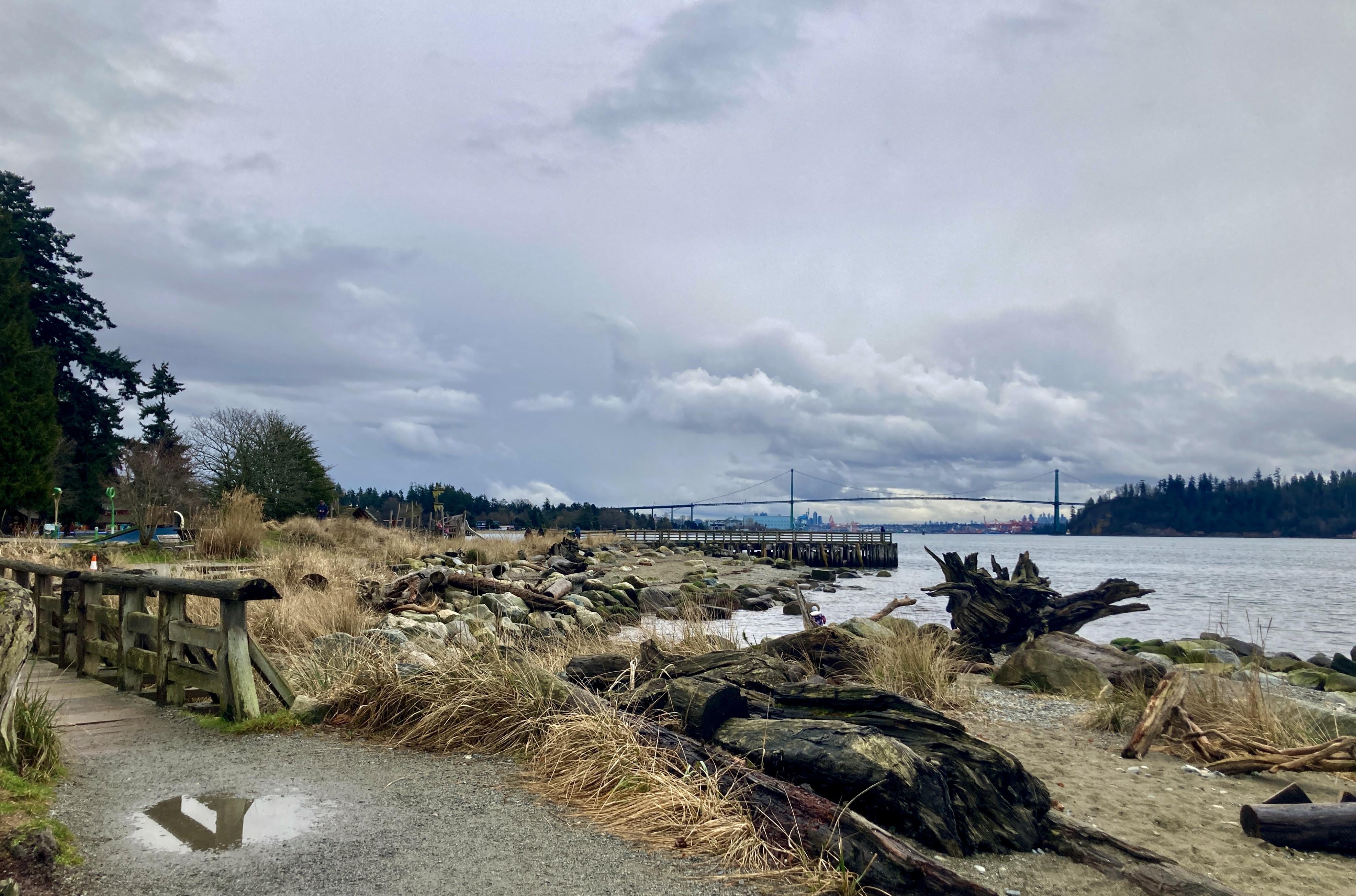
and then the next rivulet, with its point of rocky foreshore and a patient mum who holds her toddler by the hand. She is watching her slightly older son do what children always do, faced with water and rocks…
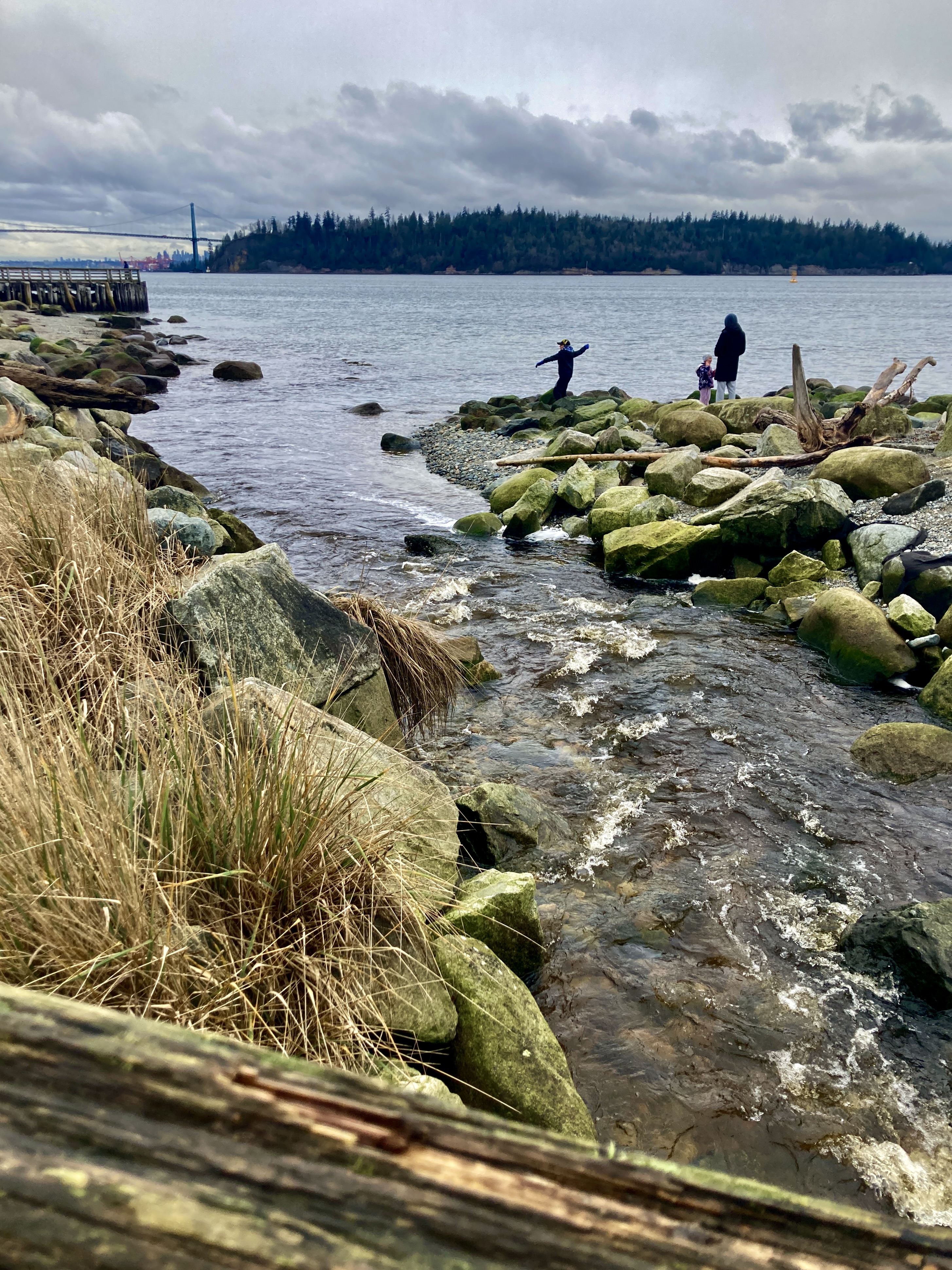
namely, hurl the one into the other.
We also watch, but only for a moment.
Then we do what adults do, at mid-day after a gallery exhibition and a pleasant amble along the Seawall.
We lunch.
We walk purposefully (not amble!) up to Marine Drive & into the Vietnamese restaurant Wooden Fish, where we give ourselves over to the pleasure of heaping bowls of Bun Cha.
Posted by icelandpenny on 14 February 2026
https://icelandpenny.com/2026/02/14/we-amble/
8 February 2026 – I thought line & light were already magic. Then came the surprise.
The first “line” is, literally, a line-up.
I’m walking north on Quebec, and I see what is surely the year’s first sidewalk line-up for a cone from Earnest Ice Cream.
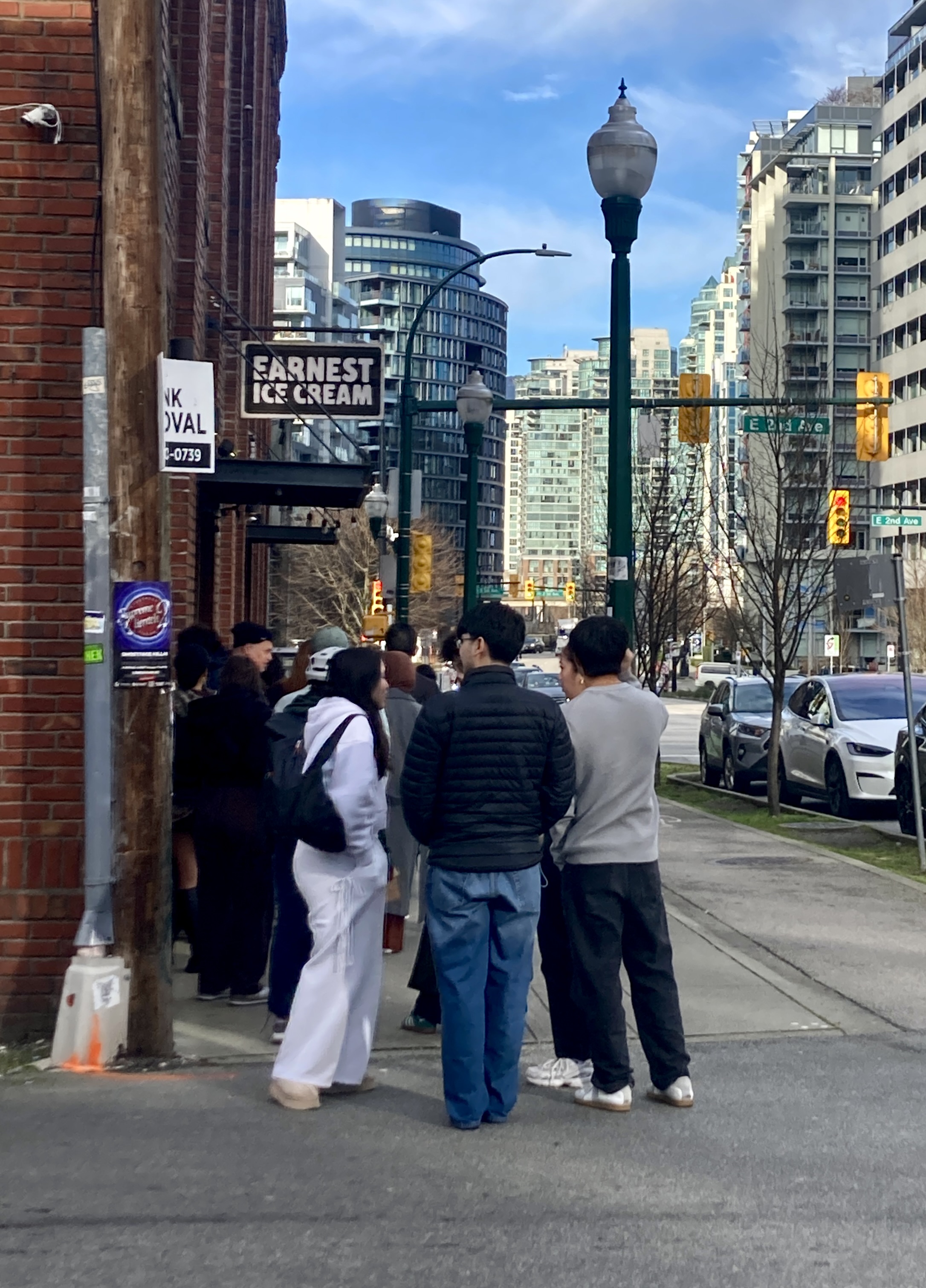
I almost join the line; don’t; almost turn back to join the line when I see this fellow ahead of me enjoying his cone so very much.
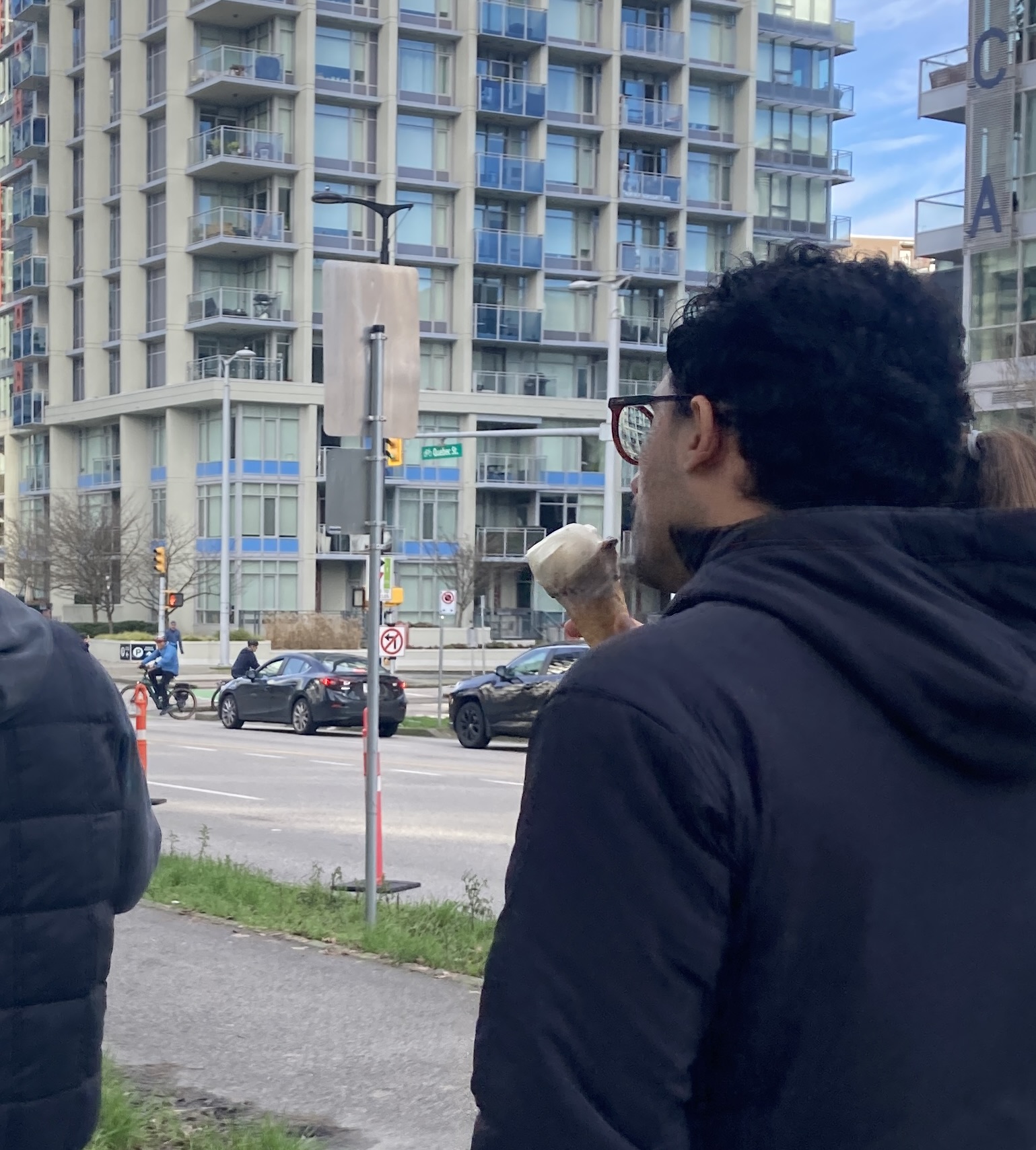
But I don’t. I walk on down to False Creek.
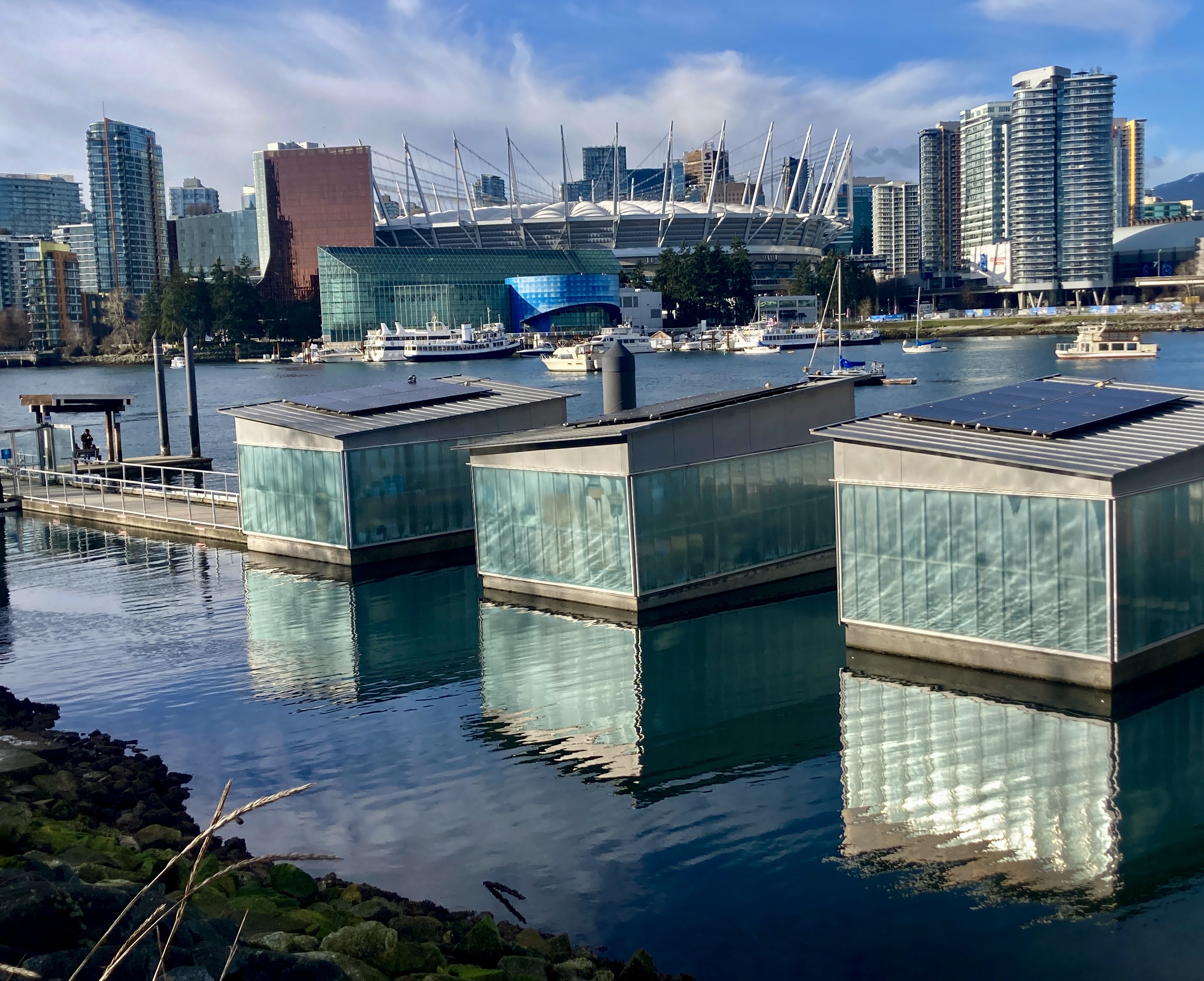
Where quite different lines greet me — racing shell pods just this side of the Olympic Dock, their vertical above/below lines bisected by the horizontal line of the water. And, bouncing all around, scattershot rays of sunlight.
Anchoring the east end of False Creek, more lines — all those triangles that slot together to make Science World’s big round geodesic dome. Plus sunlight, playing favourites with a few of the facets.
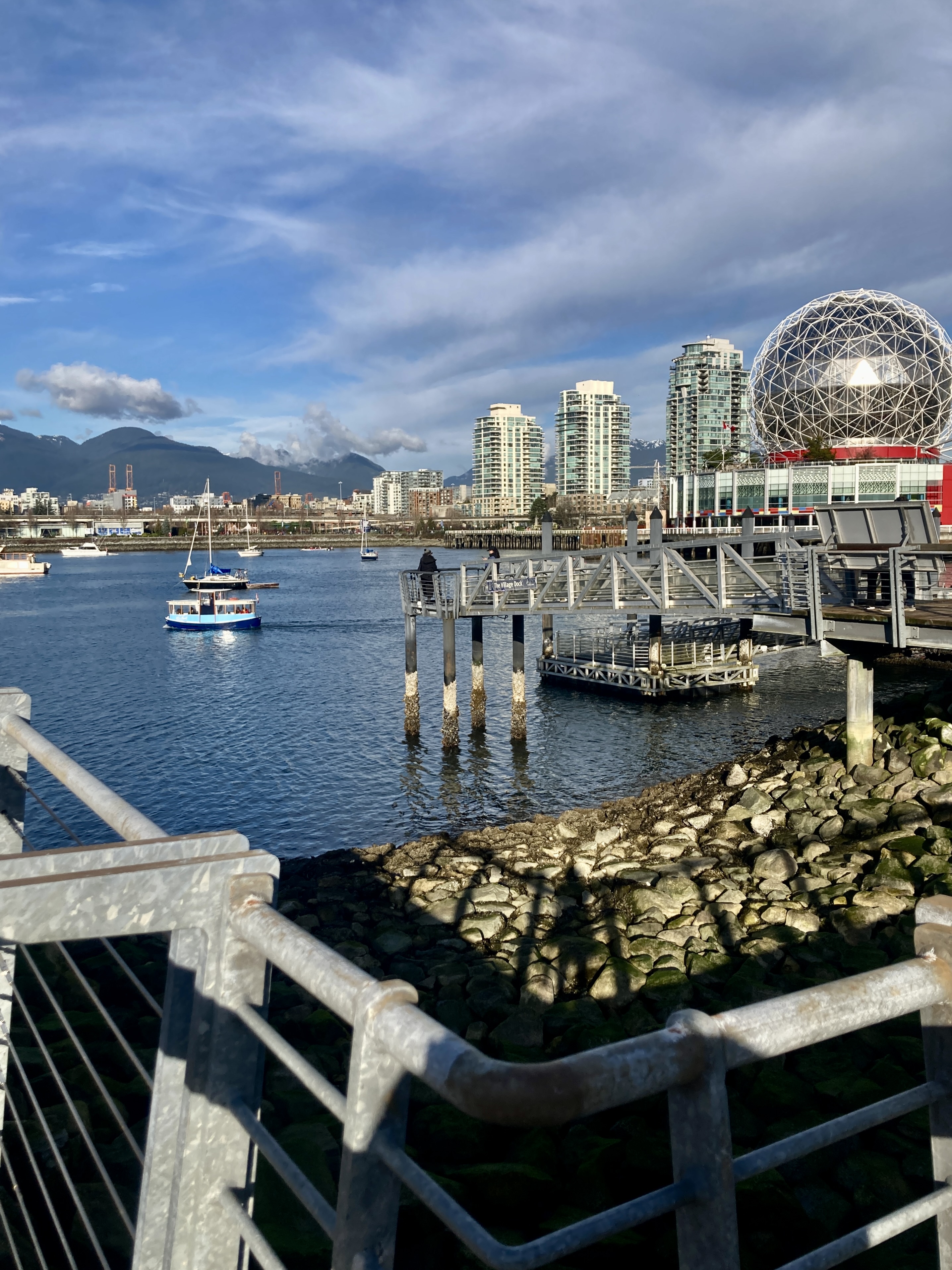
My eye is in for the rectilinear. Then I get distracted by this evergreen.
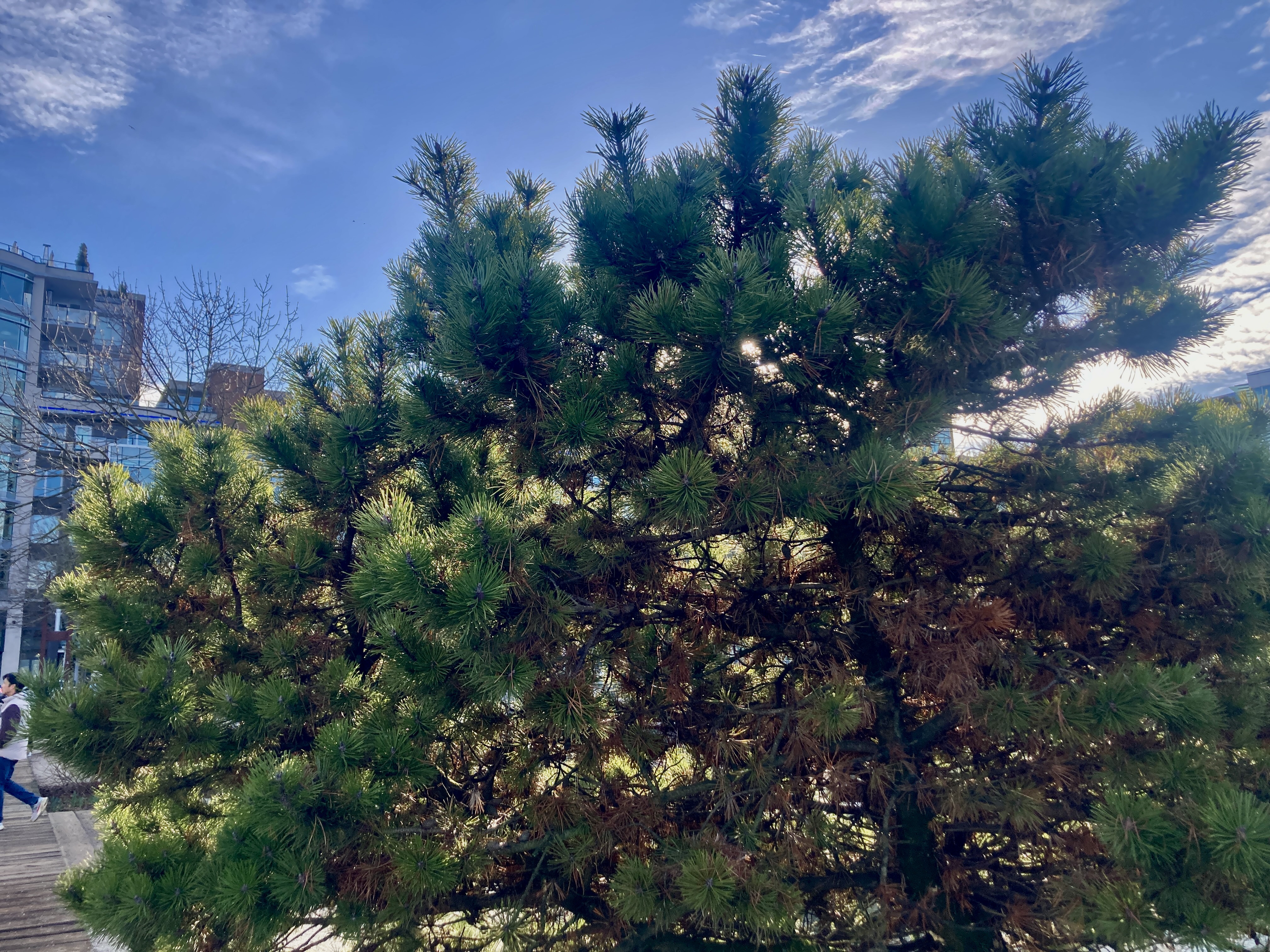
Nature doesn’t do rectilinear! But, lines are lines. Just… different lines. And still the bounce of light, above, behind, and filtering through.
Back to the rectilinear…
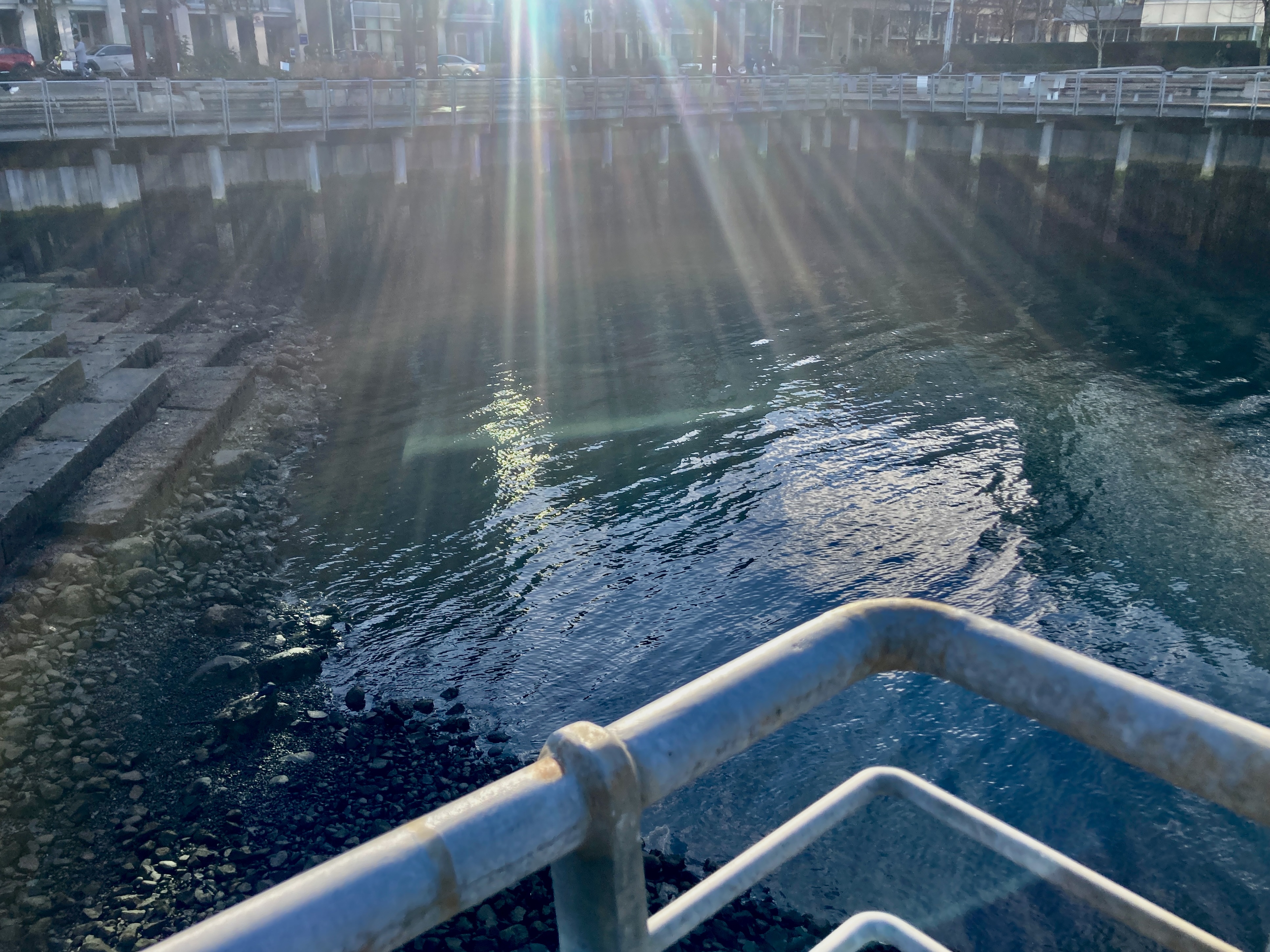
and back to nature.
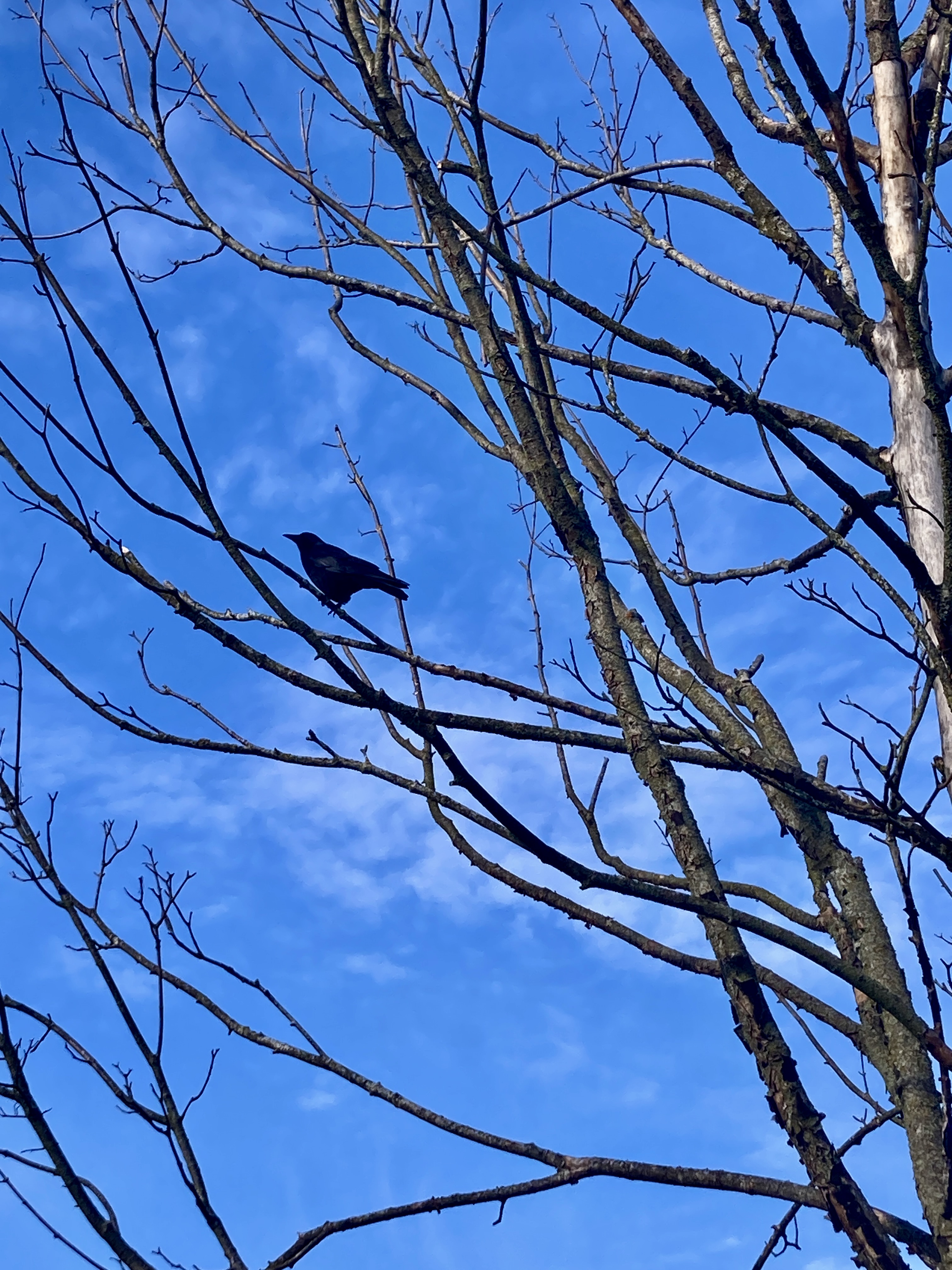
The silhouette of the crow, the curve of the branches; everything drenched in light.
I turn south along the little creek that flows through Hinge Park. There has been some reed-clearing here, I think, creating a more defined line through the water. I learn on the railing, watch ducks paddle their rounded lines through all those verticals, real and reflected.
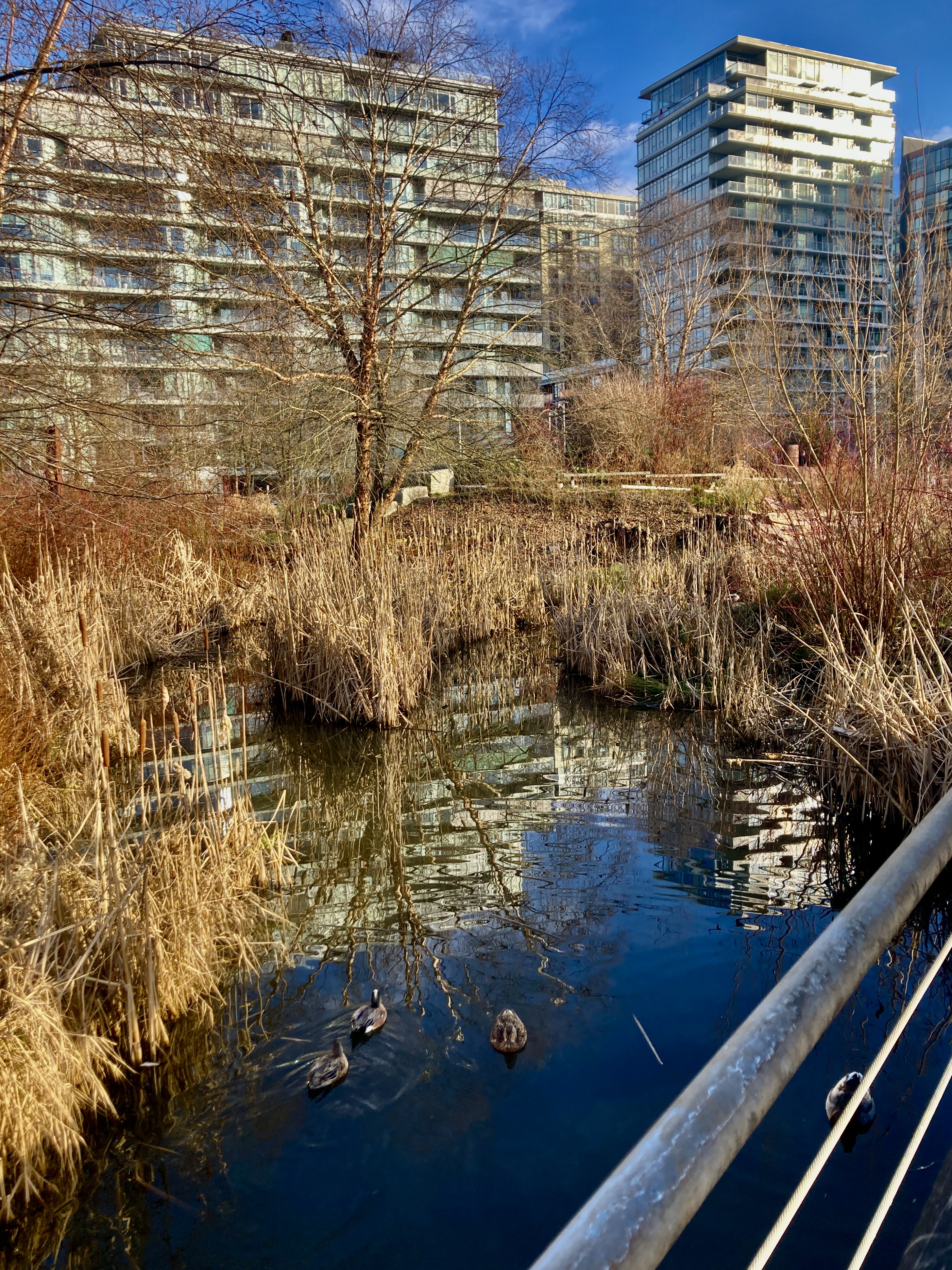
And then… and then I realize I’ve just cocked my head, probably pulled a quizzical face.
What is that sound? Faint tappings, rhythmic, and, even fainter, the crooning of an almost subliminal voice.
I follow my ears on down the creek-side path. Then I see it. A bit farther south, spanning the creek. The industrial pipe cum “railway engine” cum pedestrian bridge…
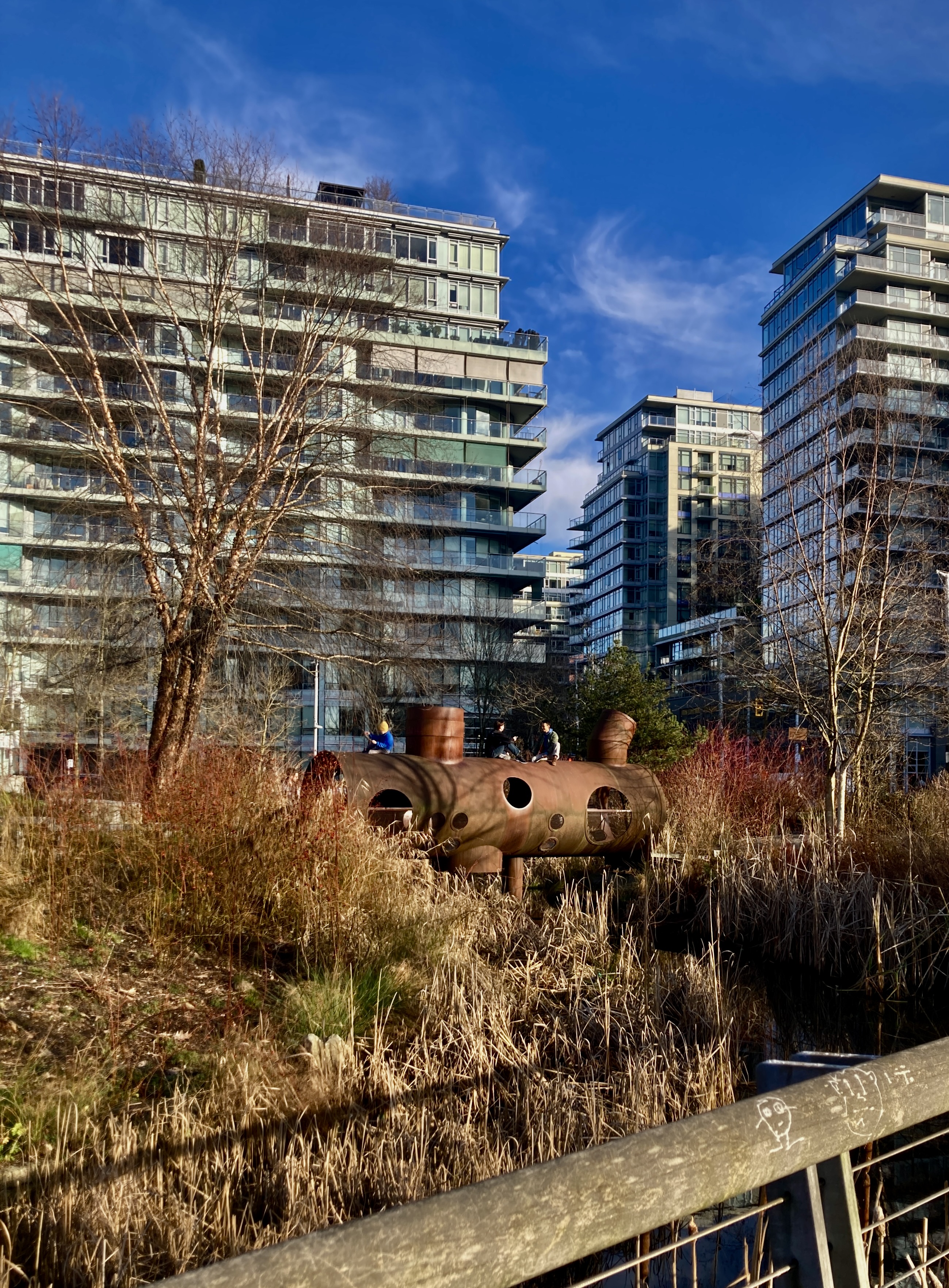
cum percussive instrument.
Thanks to the three people sitting on top.
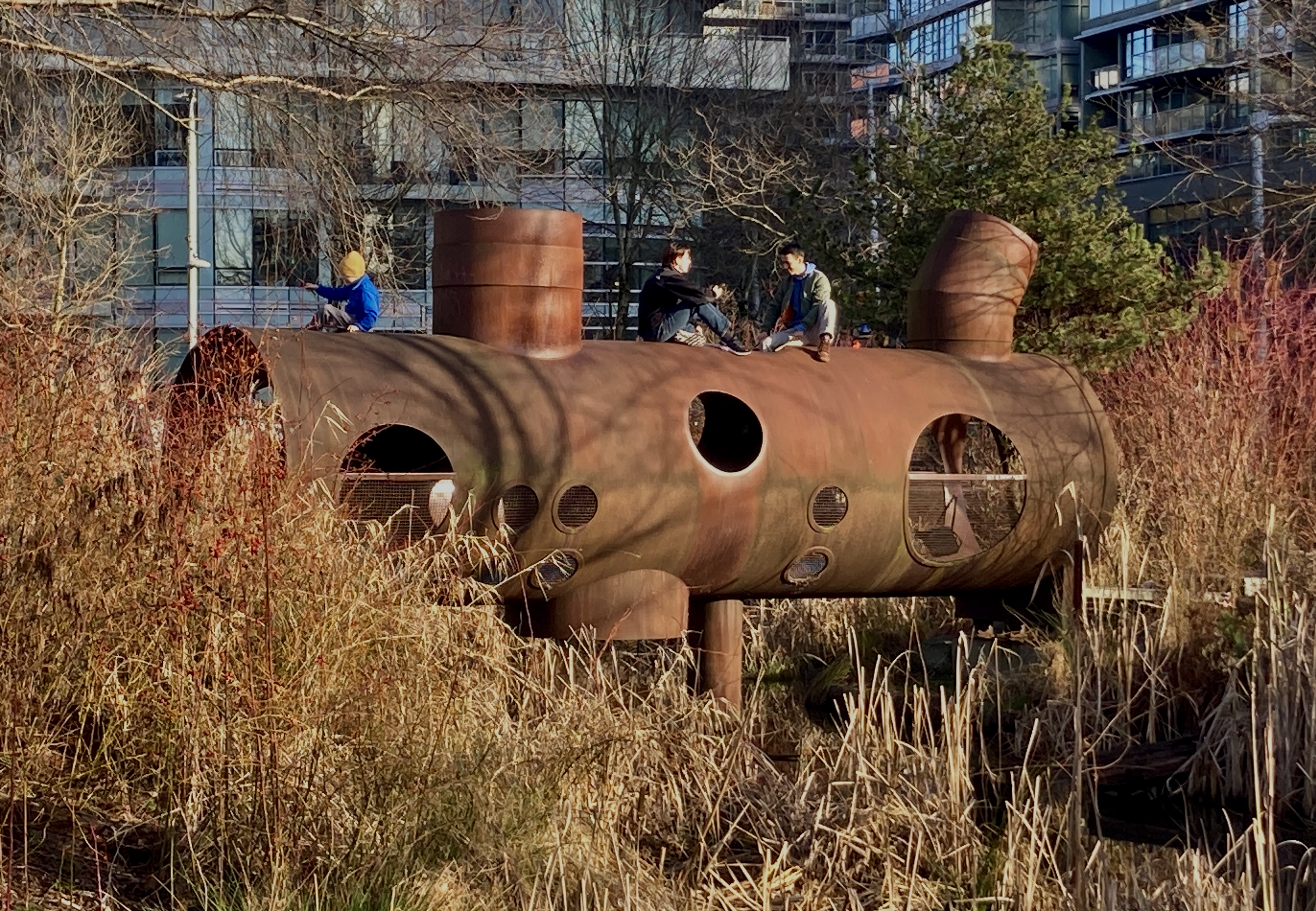
I am enchanted. Look! A boy at one end, a couple of 20-somethings at the other; all three tapping sticks against the metal, woven into each other and into the recorded soprano vocal line that inspires them.
The young men remain seated. The boy moves around, explores other surfaces.
He braces against the “smoke stack”…
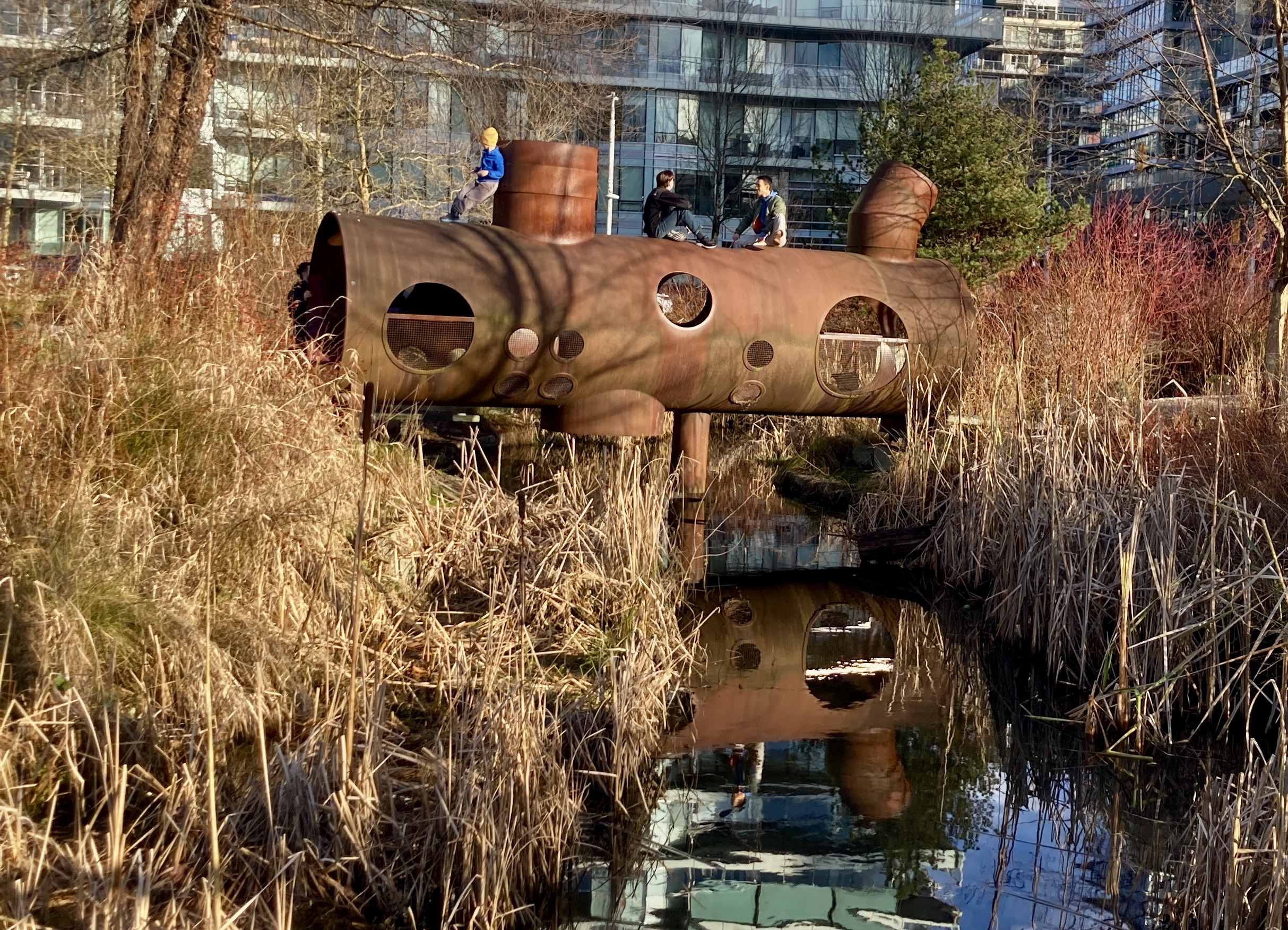
and then, sure-footed, turns to make it his own next musical instrument.
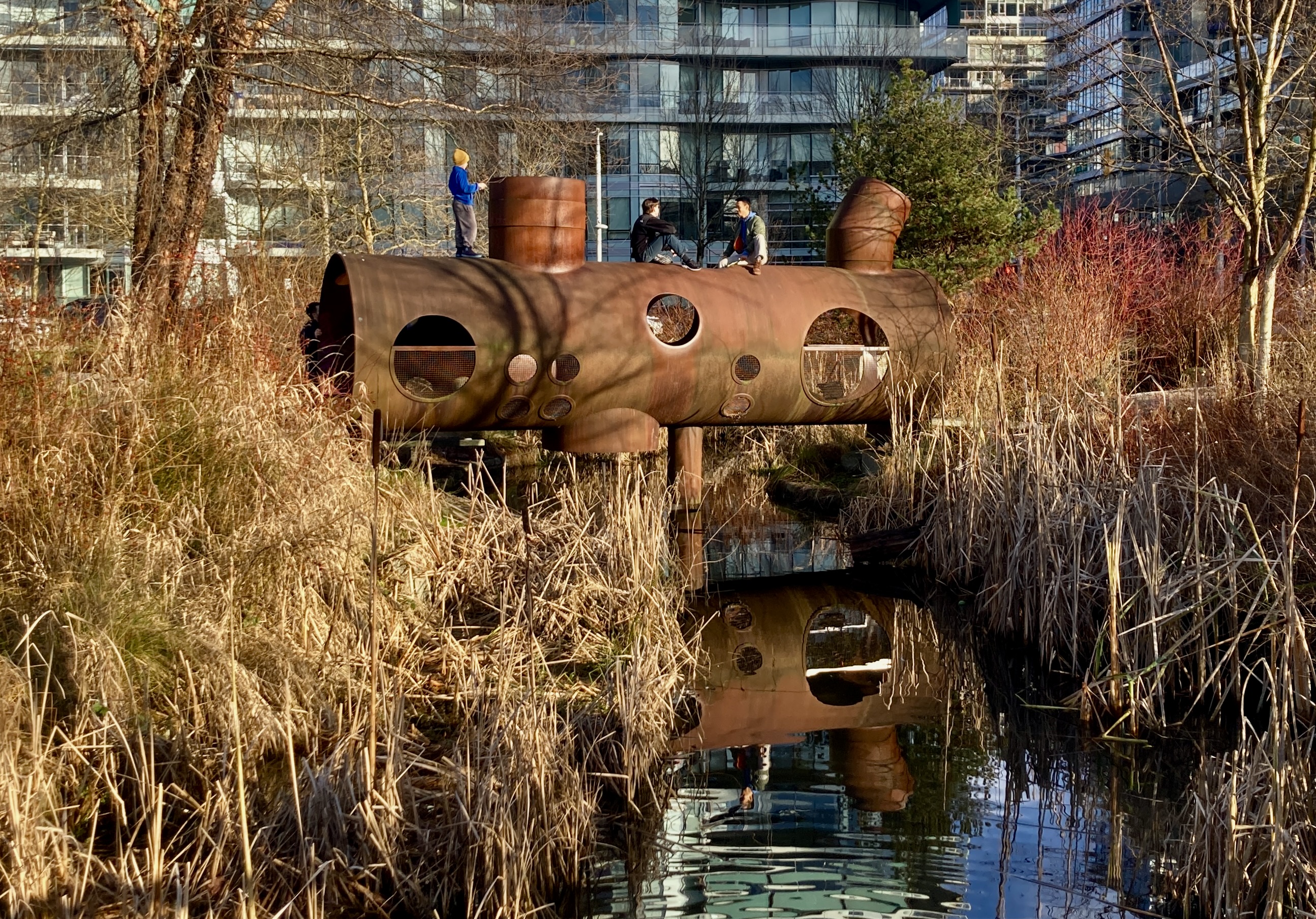
I lean there until the music ends. The boy disappears down thriough one off the cut-outs, obedient to his mother’s call. The young men notice me, and wave. I applaud, then tap my heart. They tap their hearts, and throw their arms wide in my direction. I throw my arms wide, right back at them. We beam at each other.
Magic.
Posted by icelandpenny on 8 February 2026
https://icelandpenny.com/2026/02/08/line-light-magic/
3 February 2026 – Determined to put at least a bit of knowledge behind my obsession with moss, I have begun to read Gathering Moss (Robin Wall Kimmerer). as recommended by a wise and dear friend. It is a splendid recommendation: Kimmerer draws on both her academic status (botanist, university professor) and her heritage (enrolled member of the Citizen Potawatomi Nation) to present the scientific data of bryology in the larger human context.
3 February 2026 – Determined finally to put a bit of knowledge behind my obsession with moss, I have begun to read Gathering Moss (Robin Wall Kimmerer), recommended to me by a wise and dear friend.
It is a splendid recommendation. Kimmerer draws on both her academic status (botanist, professor) and her cultural heritage (enrolled member of the Citizen Potawatomi Nation) to present scientific data about bryology in the larger human context.
Just two chapters into the book, I bring myself to the Camosun Bog, on a suitably rain-tinged day, with new eyes.
Signage welcomes me at the Camosun Street entrance, down there at the bottom right of the map…
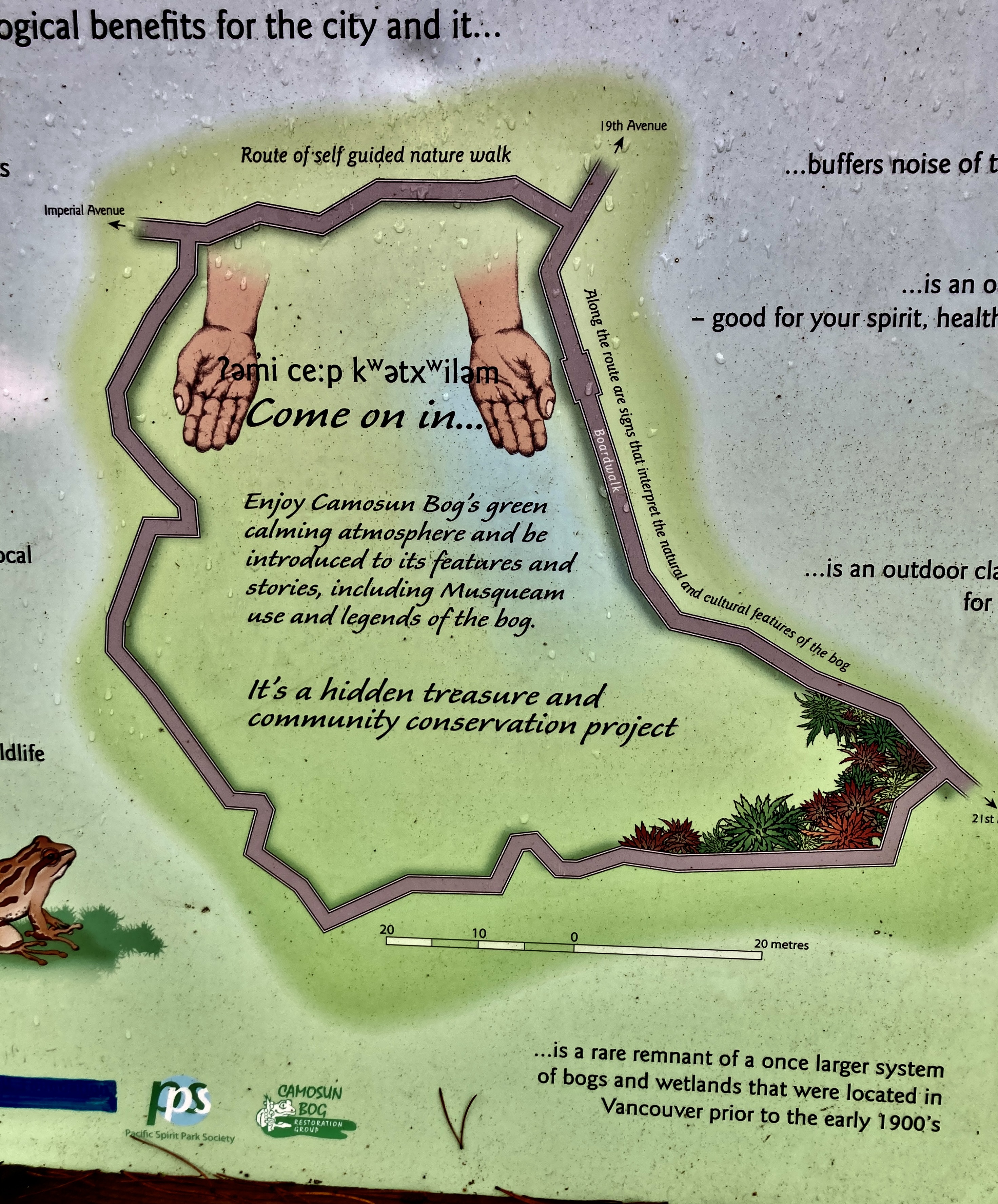
and Kimmerer’s words shimmer in my brain.
“With sophisticated technology we strive to see what is beyond us, but are often blind to the myriad sparkling facets that lie so close to hand. … Mosses and other small beings issue an invitation to dwell for a time right at the limits of ordinary perception.”
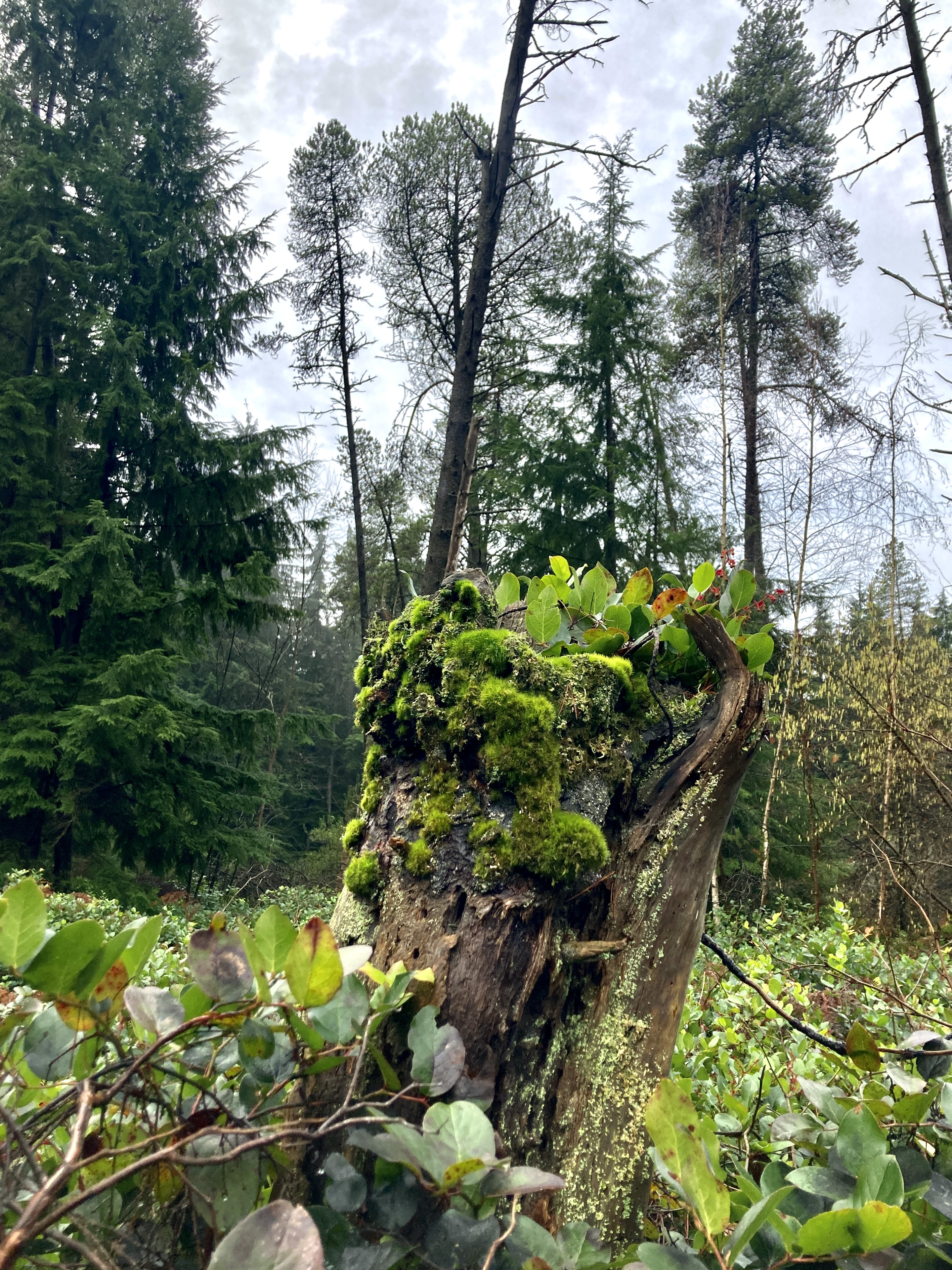
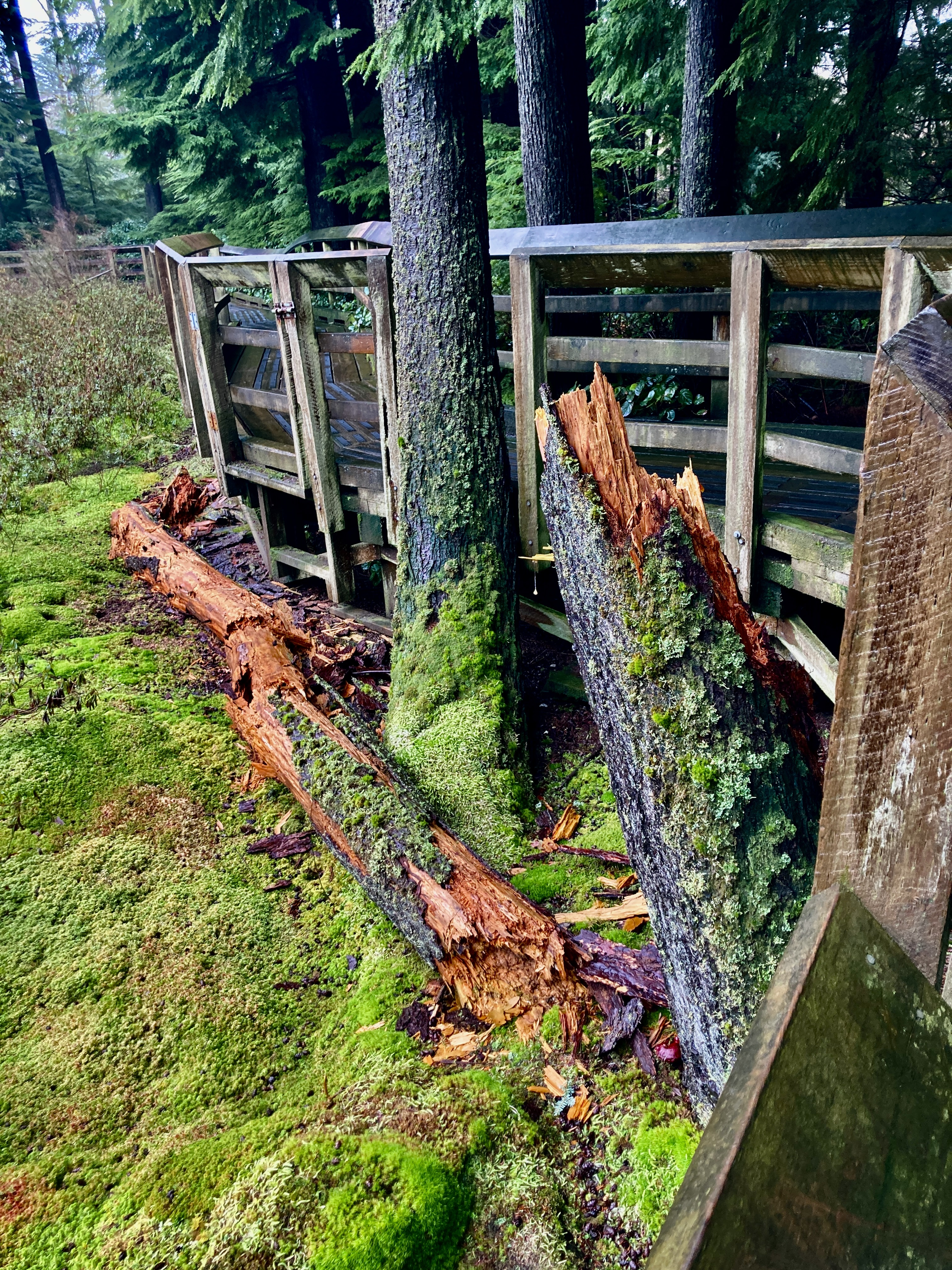
I greet what I think of as my Sentinel Log on the way in. I am still ignorant of all the mosses it bears, but more appreciative of them than ever.
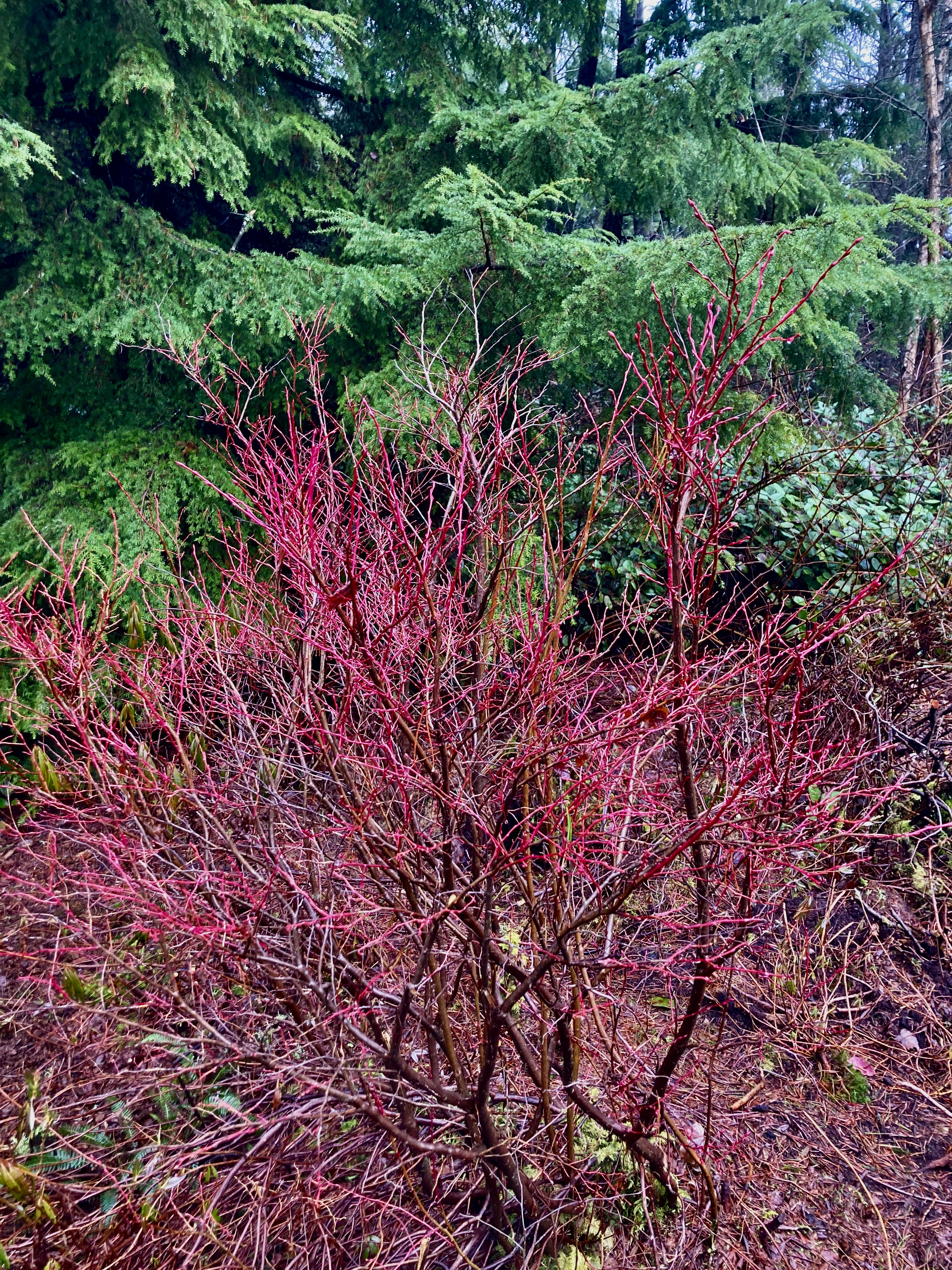
I am almost impatient with this blaze of Red osier dogwood — it’s not why I’m here!
I am here for what first appeared some 3,000 years ago, the transformation from marsh to bog.
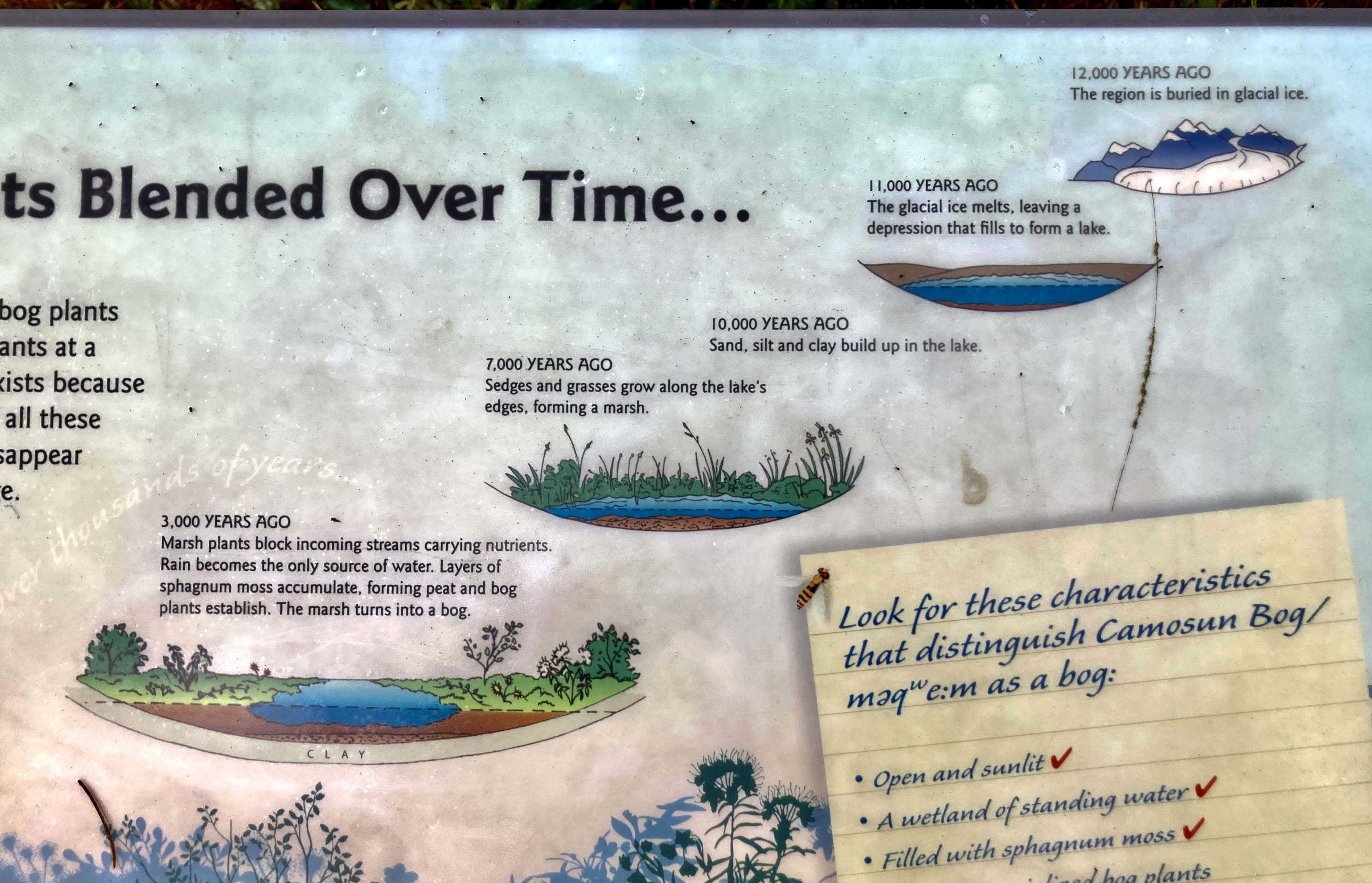
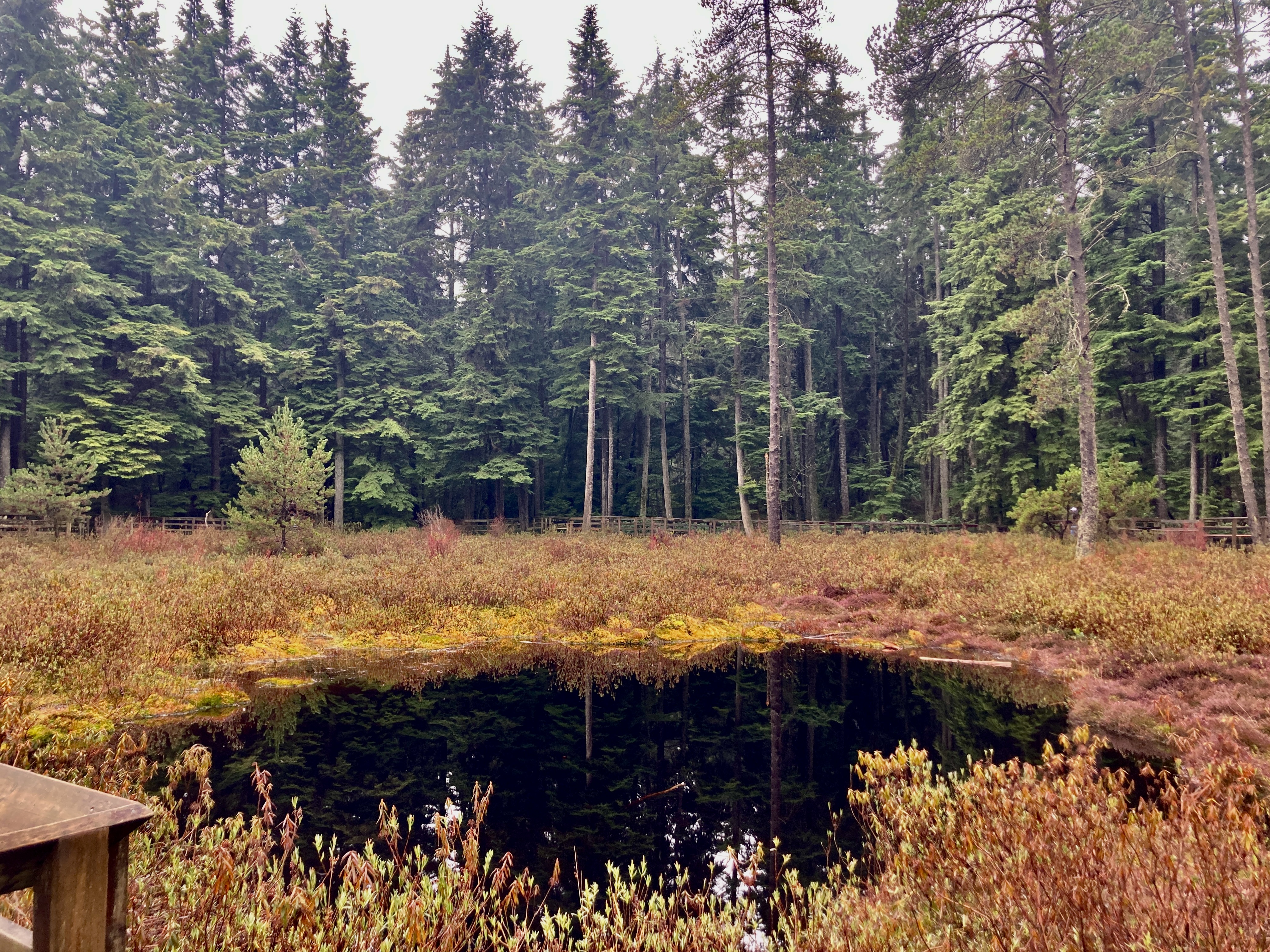
I stand at the heart of the bog, admire its waters at their full winter strength, surrounded by bog plants and mosses and, beyond that, the forest of Pacific Spirit Regional Park.
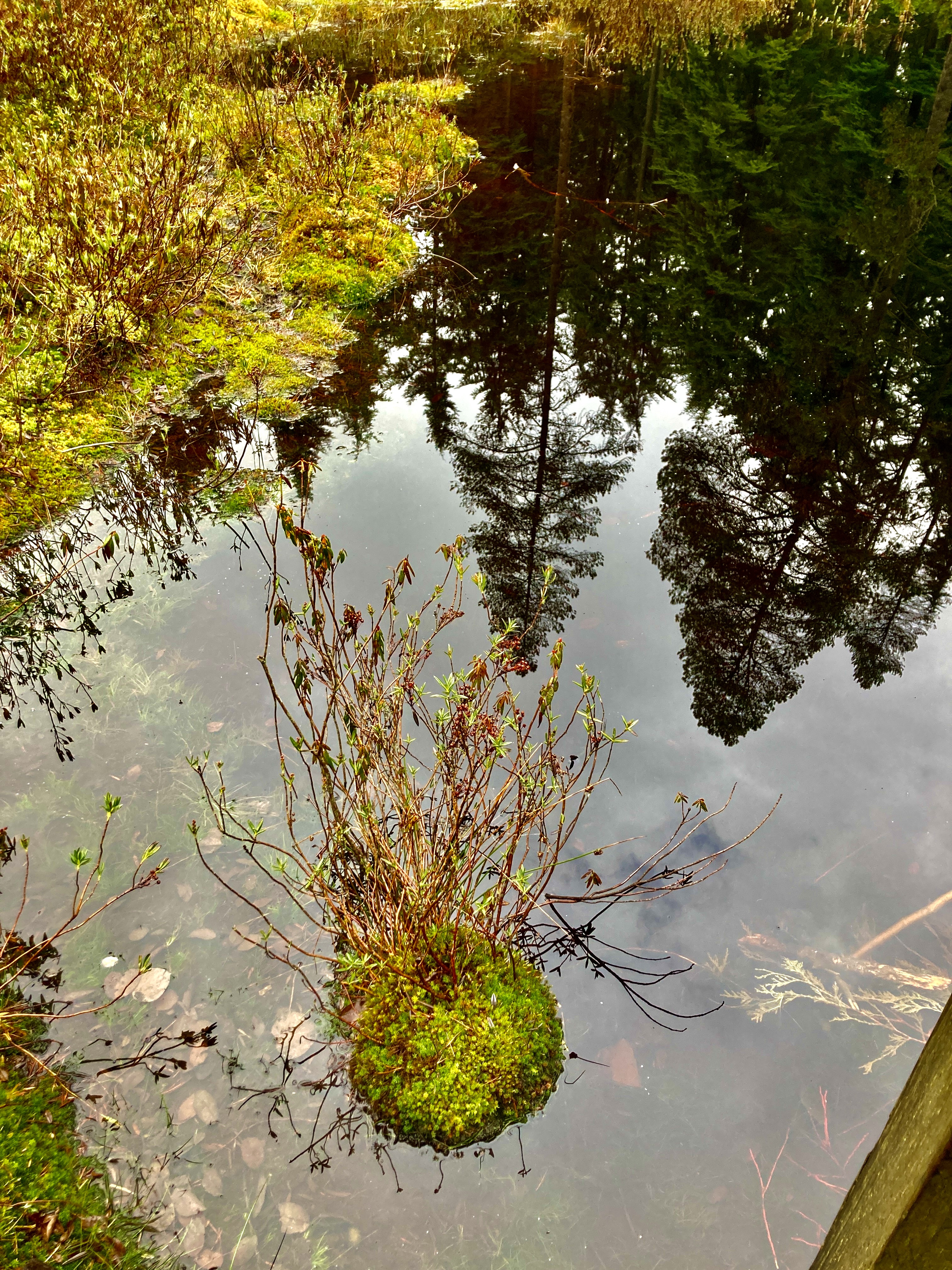
All those other plants first tug the eye, but, look, mosses on hummocks in the bog waters and all along its edges.
“Learning to see mosses is more like listening than looking,” says Kimmerer. “Mosses are not elevator music, they are the intertwined threads of a Beethoven quartet.”
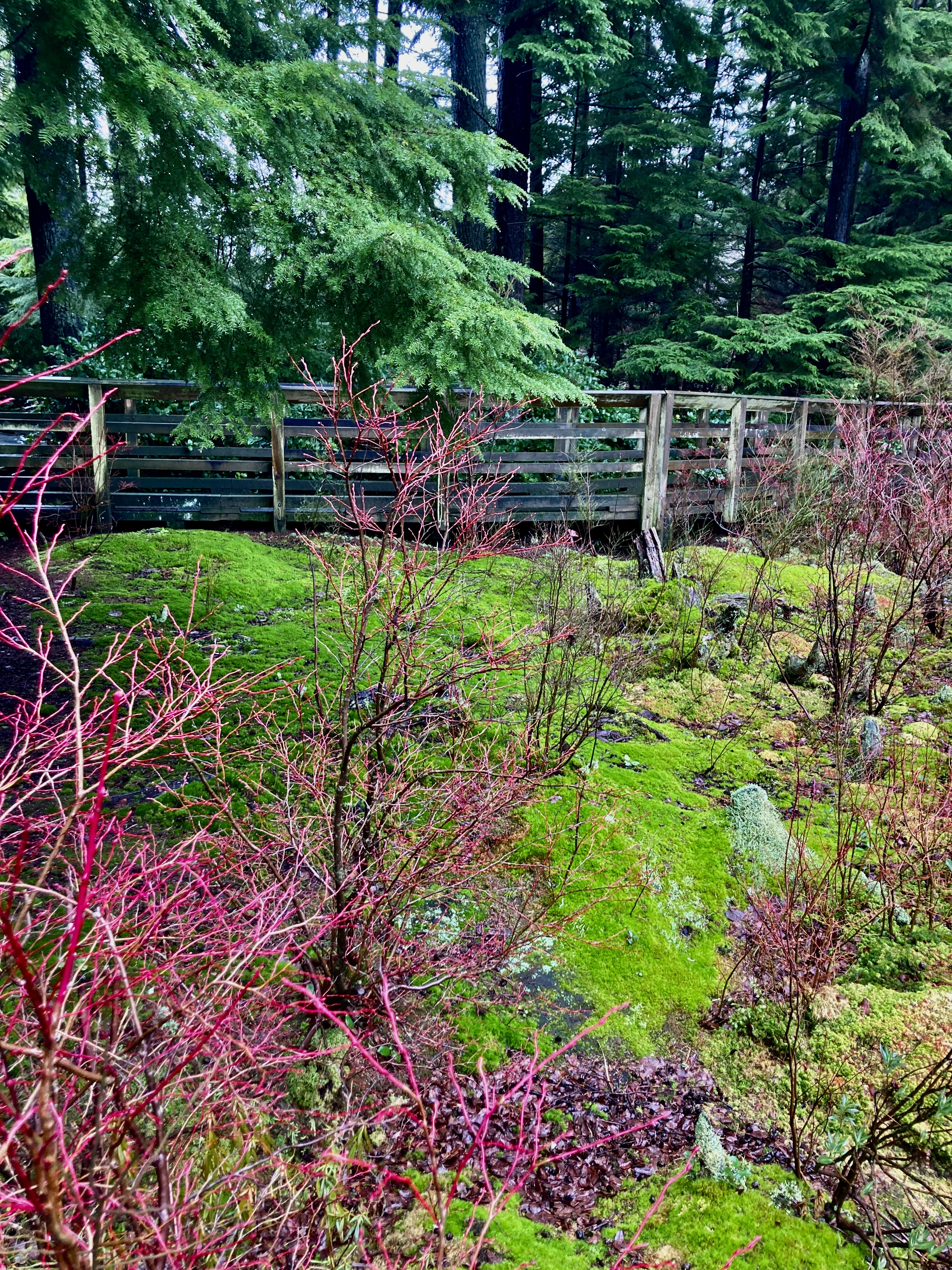
I dutifully read about the Bog Laurel…
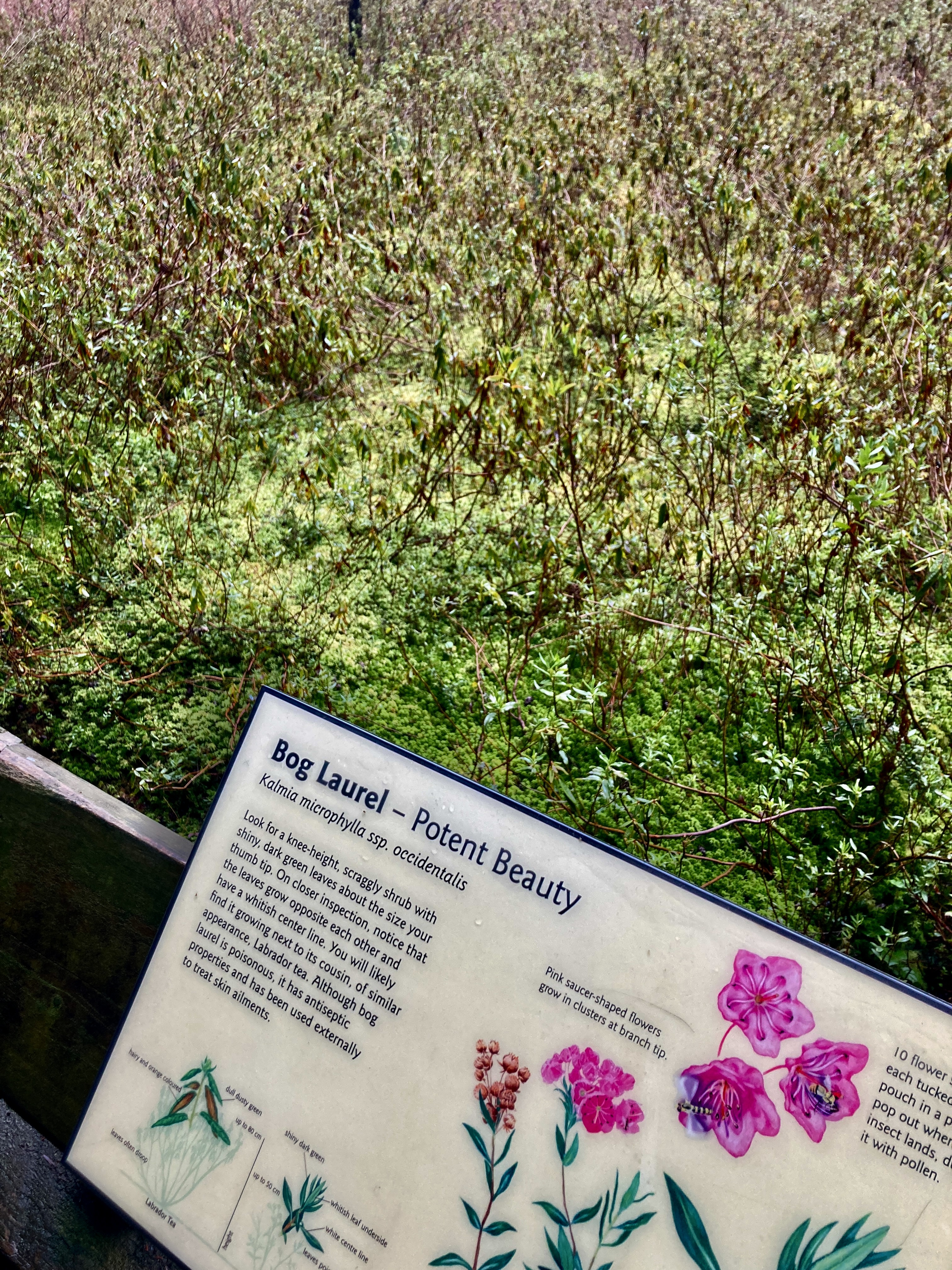
but I am looking beneath the Laurel, beneath the Labrador Tea, beneath the Bog Cranberry…
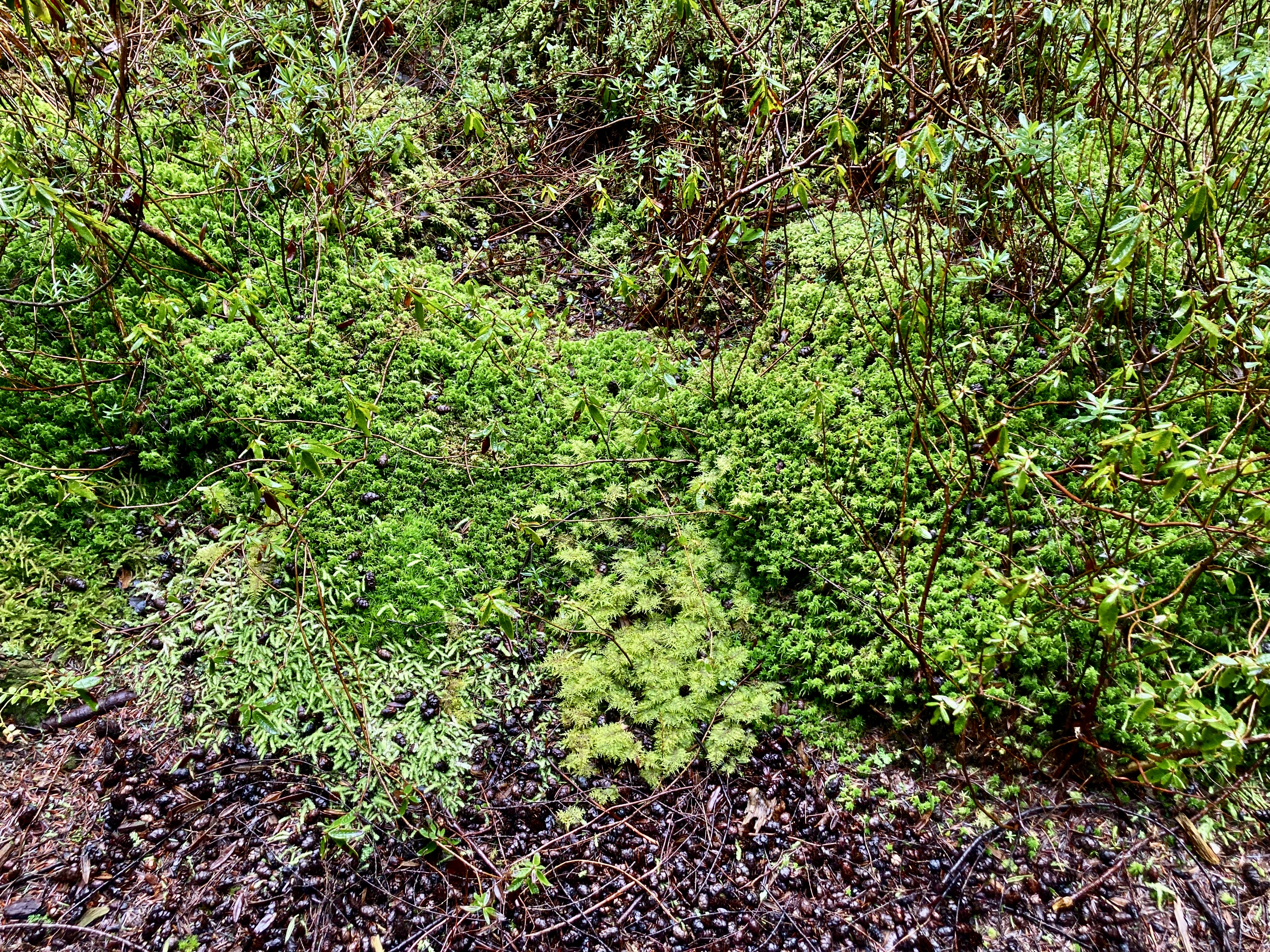
to the moss. The mosses. The bryophytes.
“A true moss or bryophyte is the most primitive of land plants,” explains Kimmerer. They lack flowers, fruits, seeds and roots; they have no vascular system. “They are the most simple of plants and in their simplicity, elegant. With just a few rudimentary components of stem and leaf, evolution has produced some 22,000 species of moss worldwide.”
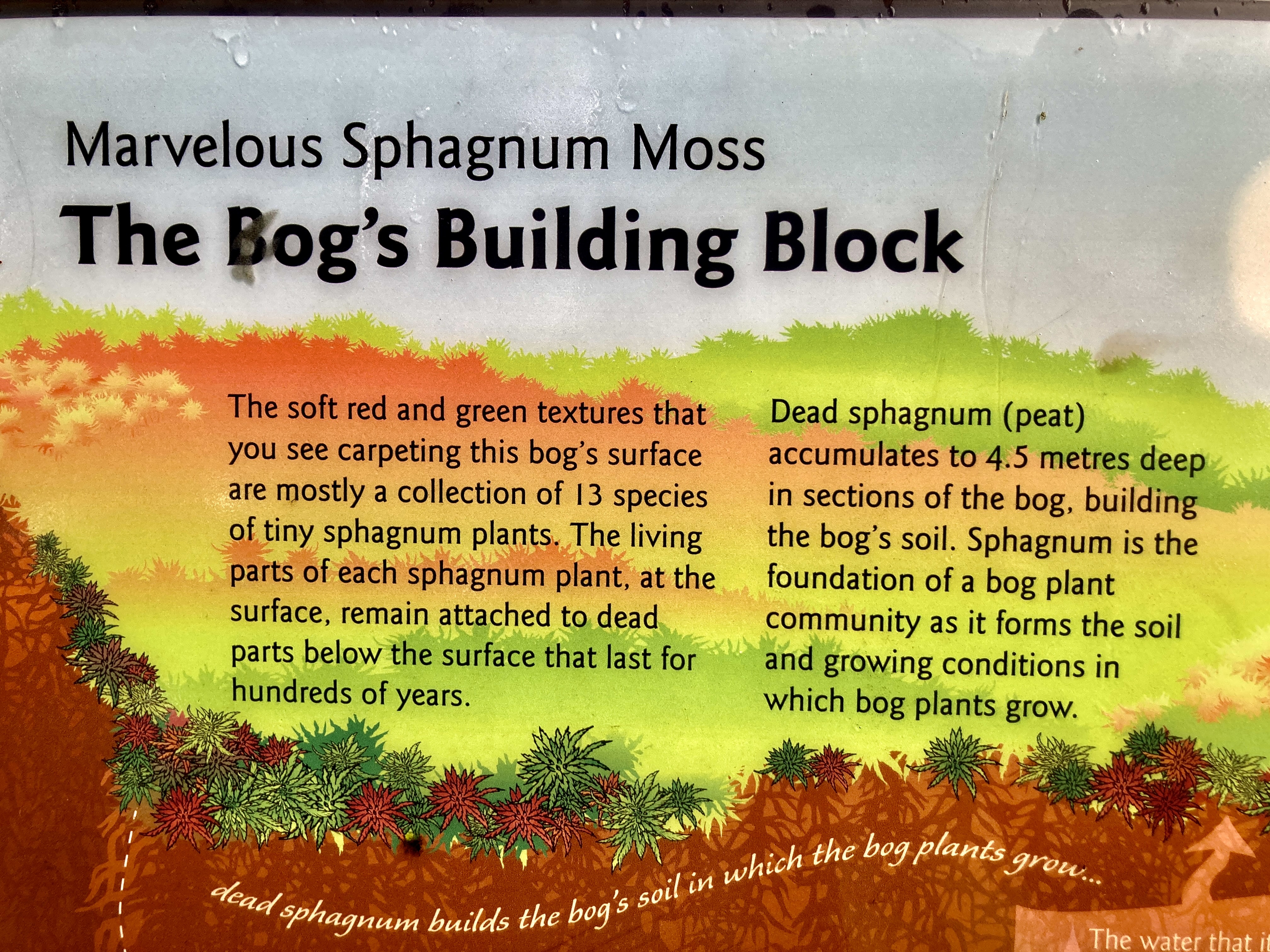
I pause for another sign. (I always read signs.) Thirteen species of sphagnum moss, here in the bog.
I walk on. I marvel.
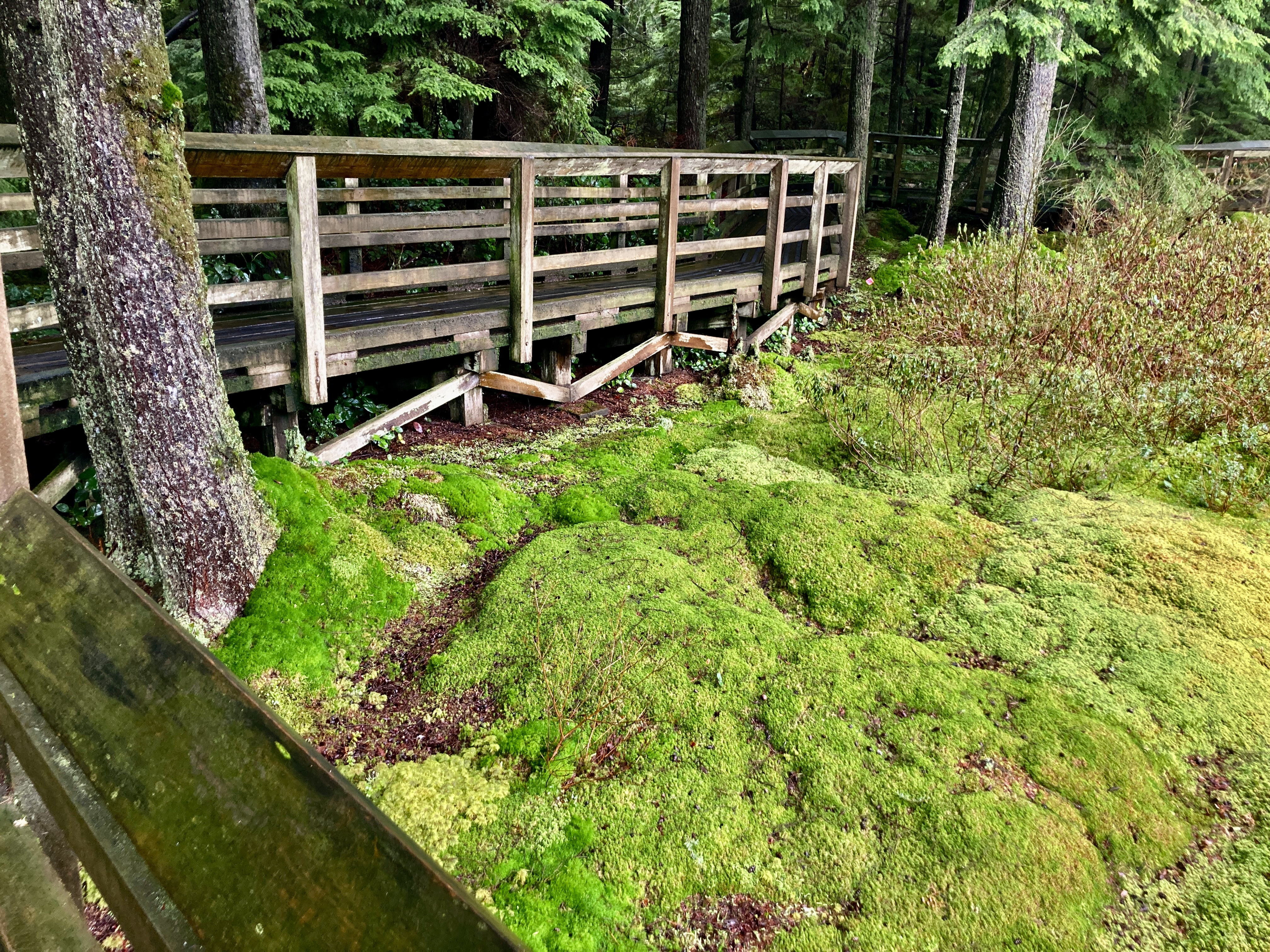
And I marvel some more.
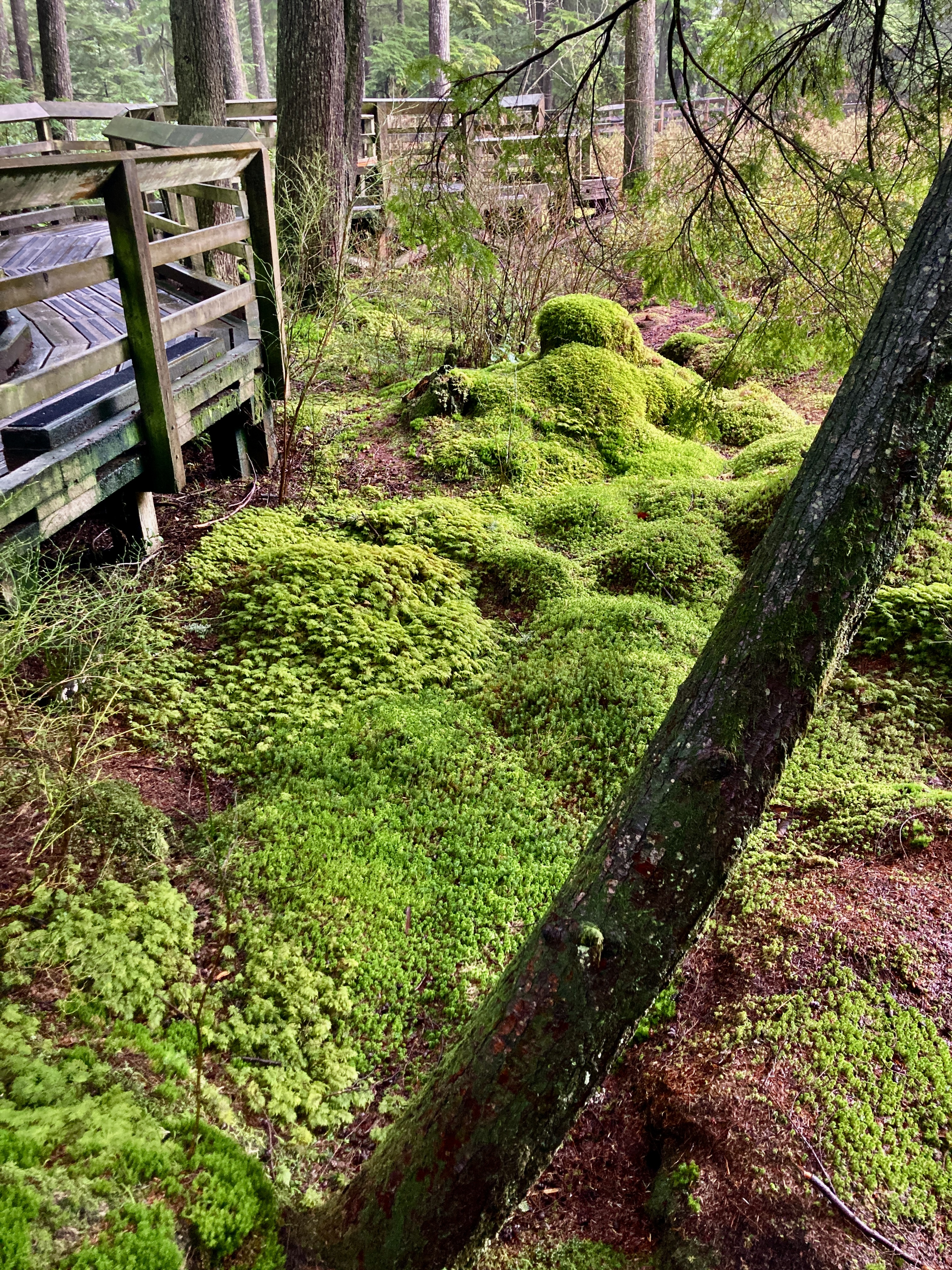
Among all the glowing greens, some of the soft reds the sphagnum moss sign has just invited us to notice.
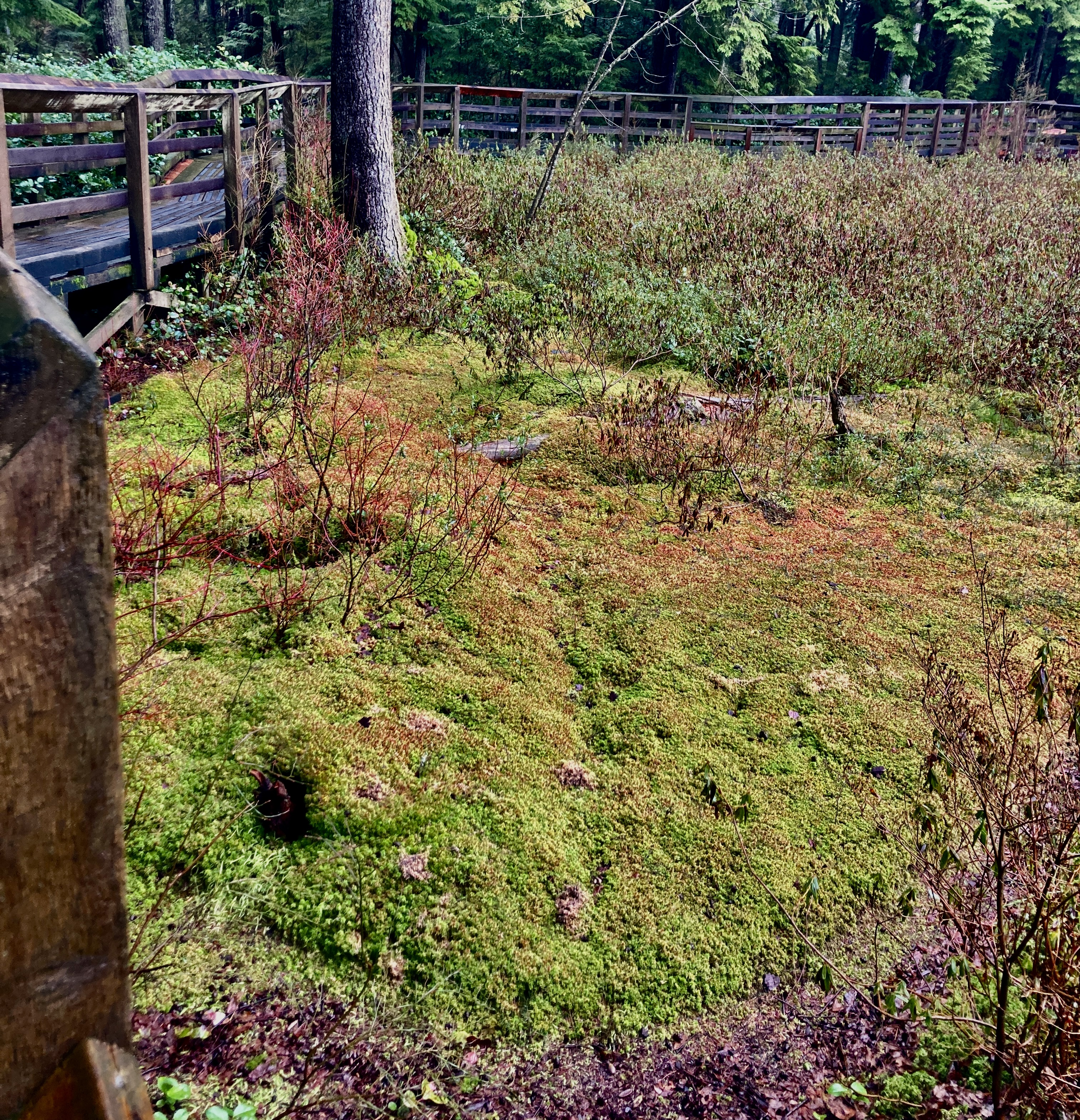
I take a spur path away from the loop encircling the bog, off into the surrounding forest.
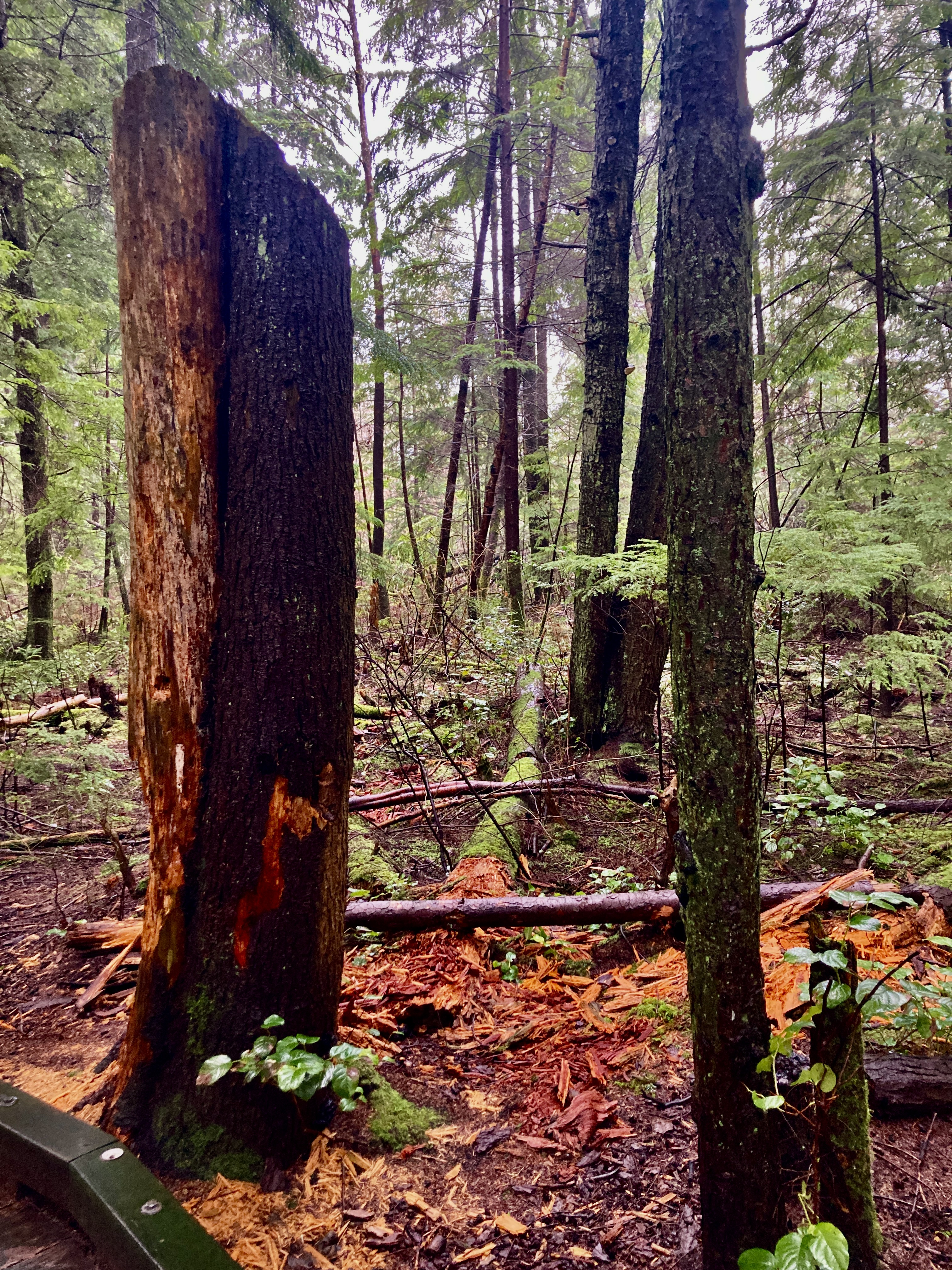
Kimmerer murmurs in my ear: “Looking at mosses adds a depth and intimacy to knowing the forest,”
Here at a curve in the path, a knot of ferns and moss. I nod at them, smile, think of the ferns and mosses on my own balcony.
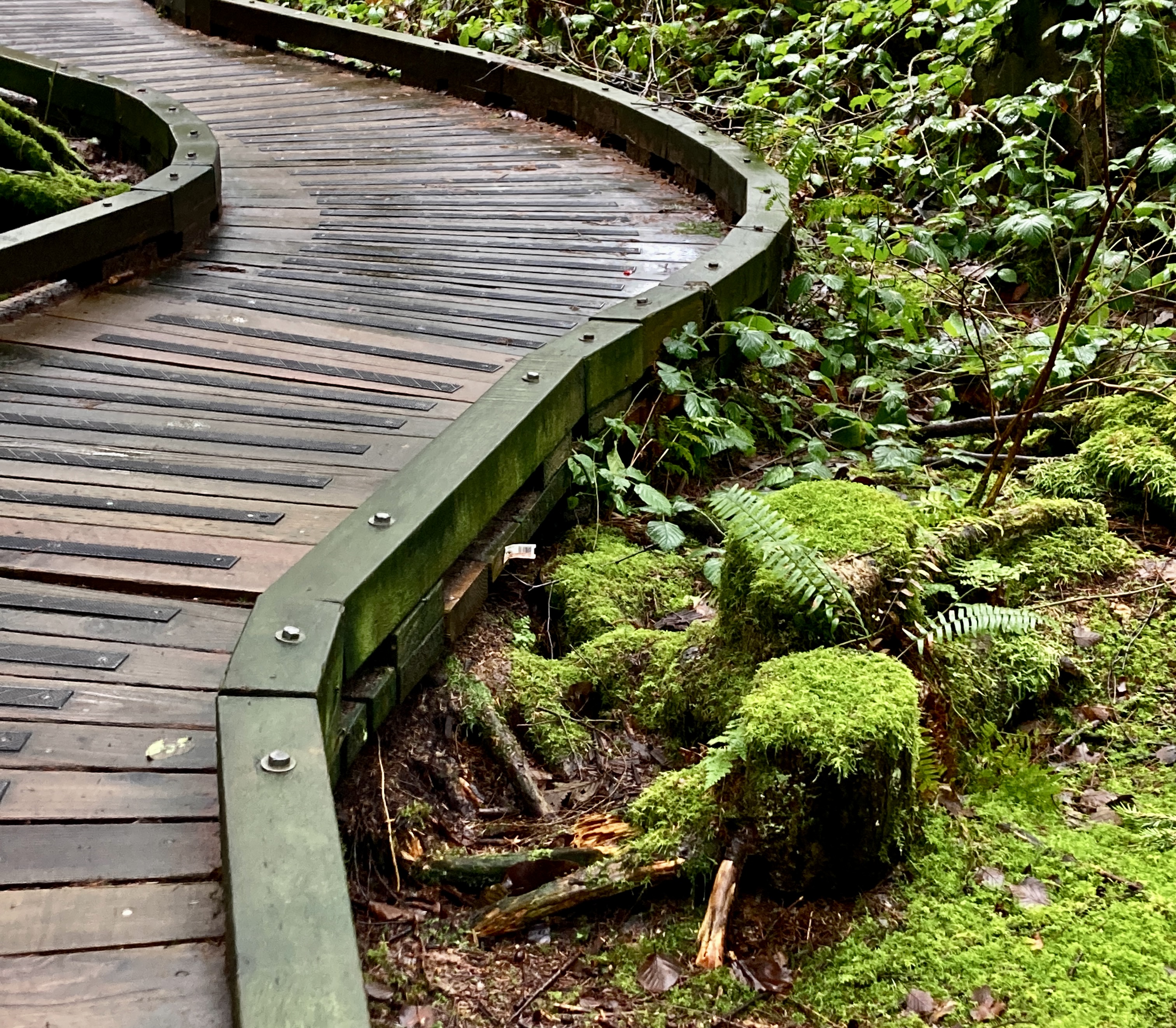
Another Sentinel Log, this one guarding the 19th Avenue entry to the bog…
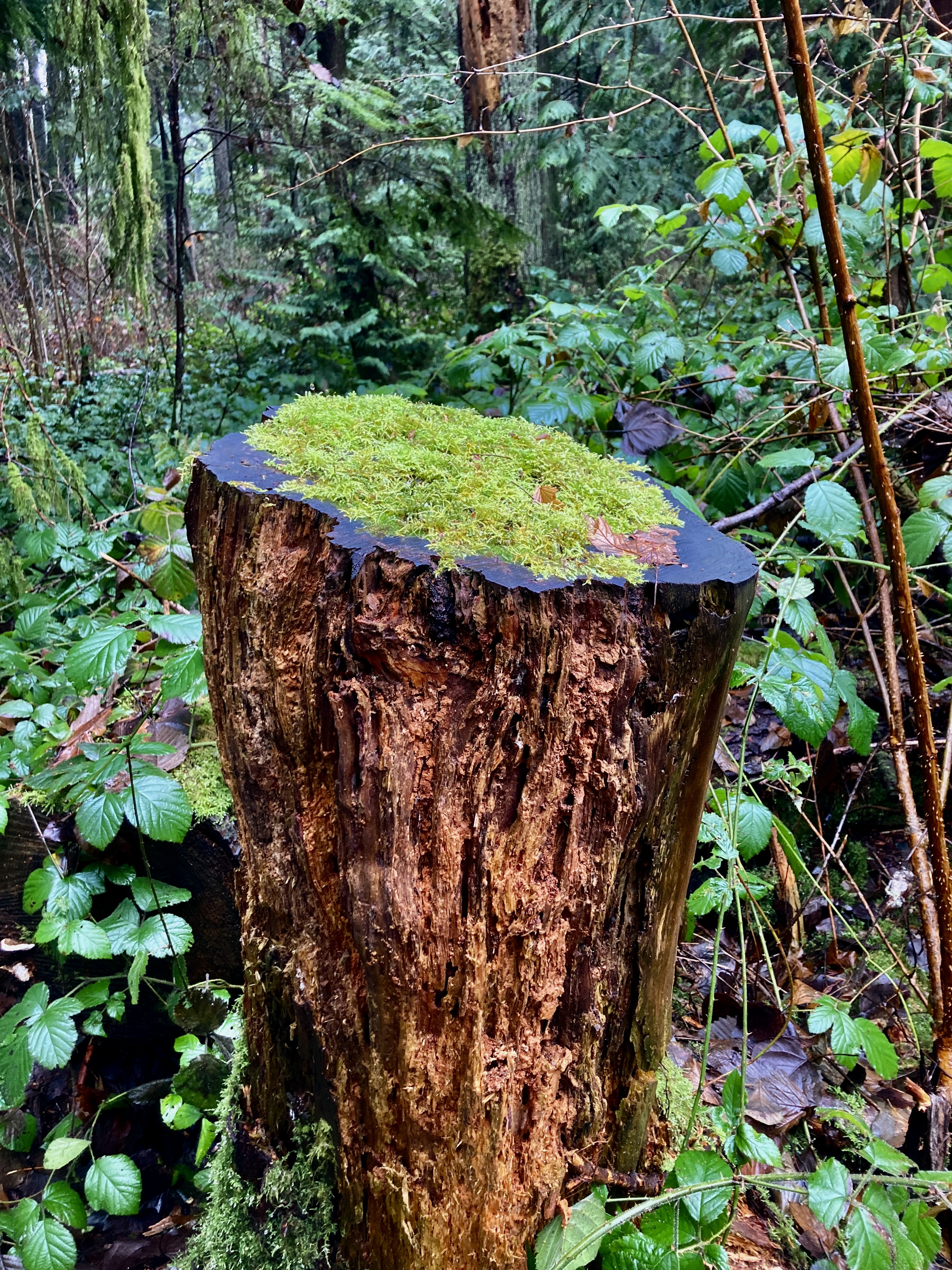
and finally, I turn back.
I nod farewell to this log’s Camosun Street colleague on the way out…
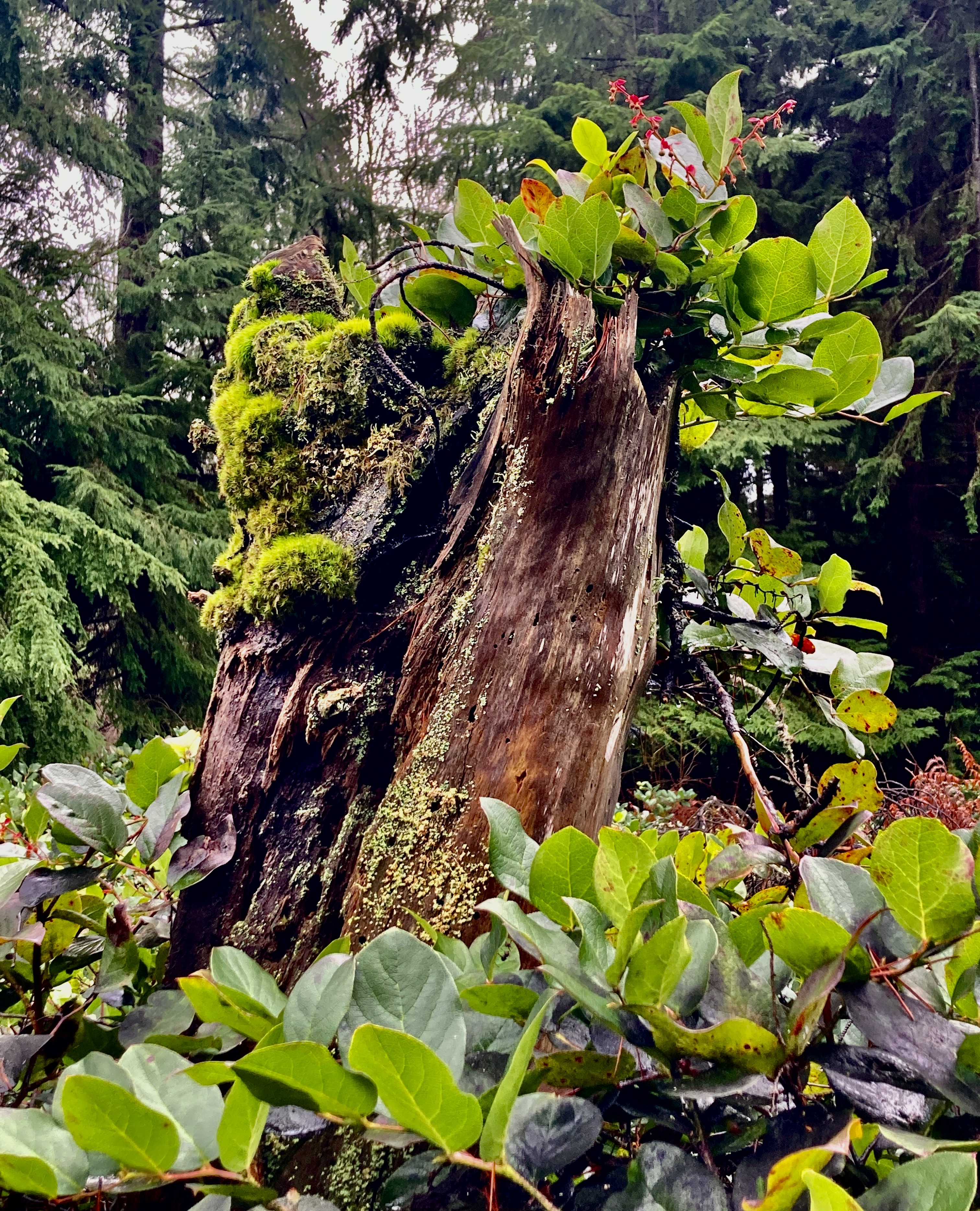
and then — of course — keep right on noticing moss, with every step.
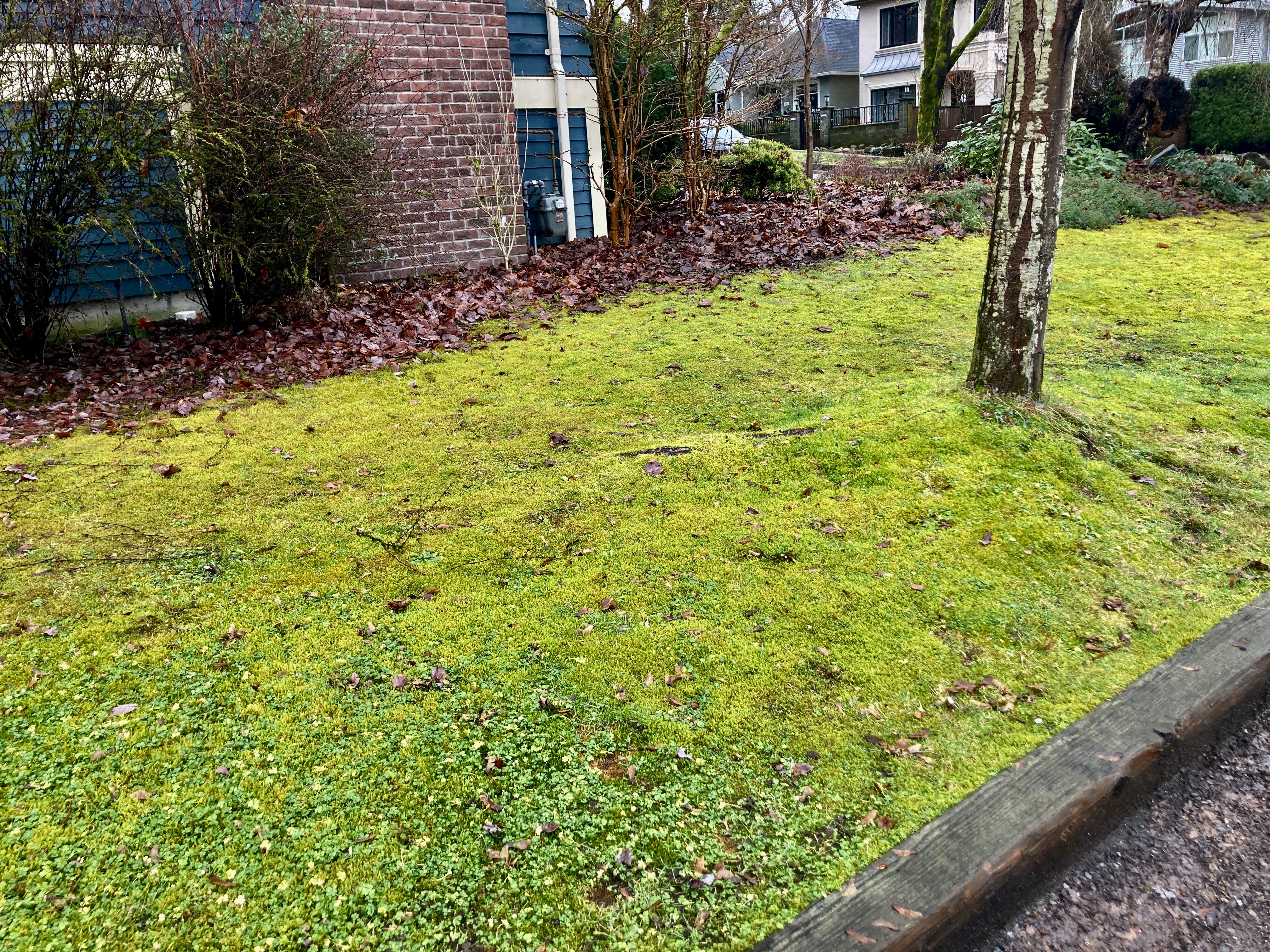
Here, a side lawn bordering Camosun Street…
here, the crotch of the tree at the bus stop…
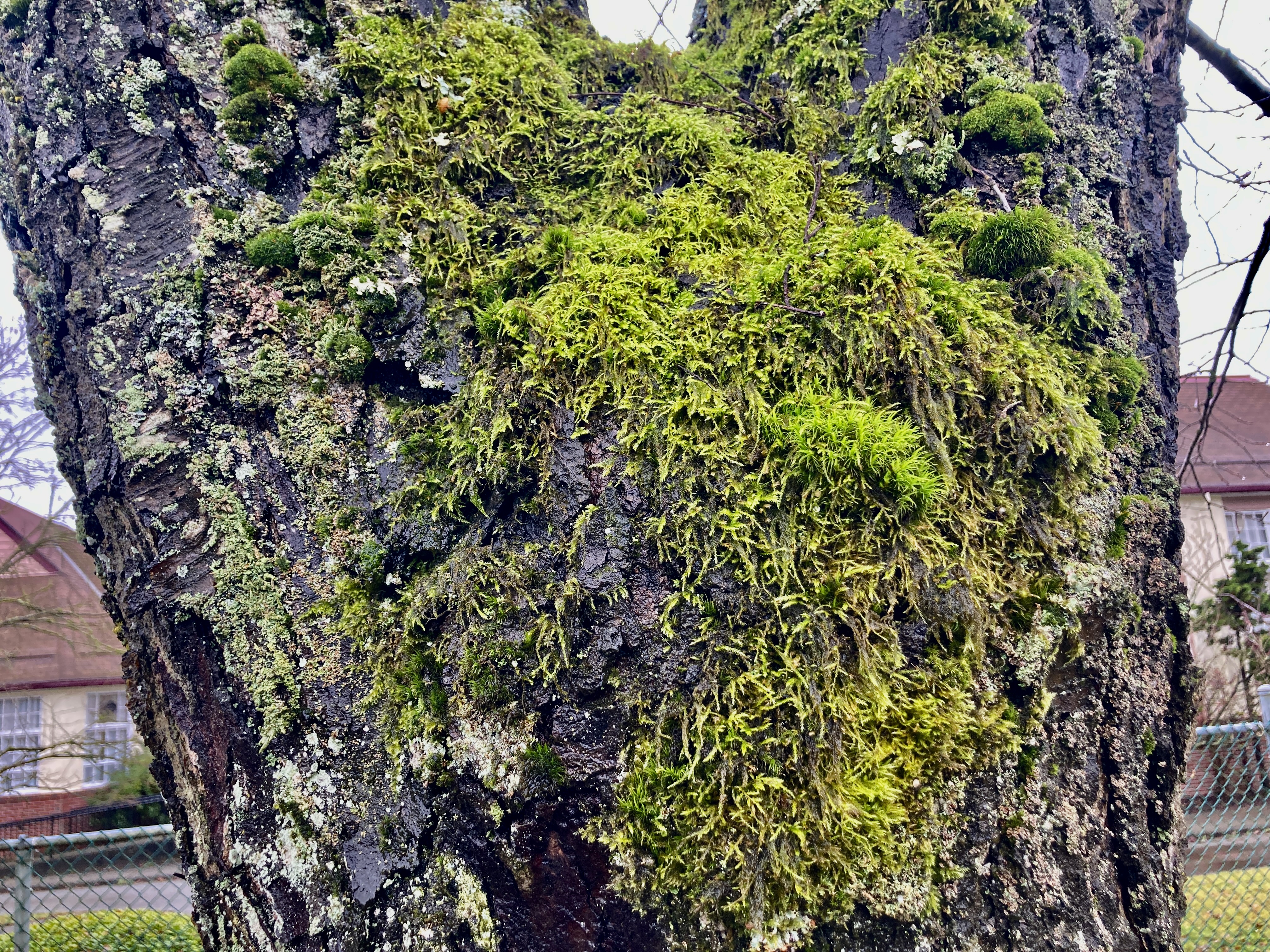
and finally here…
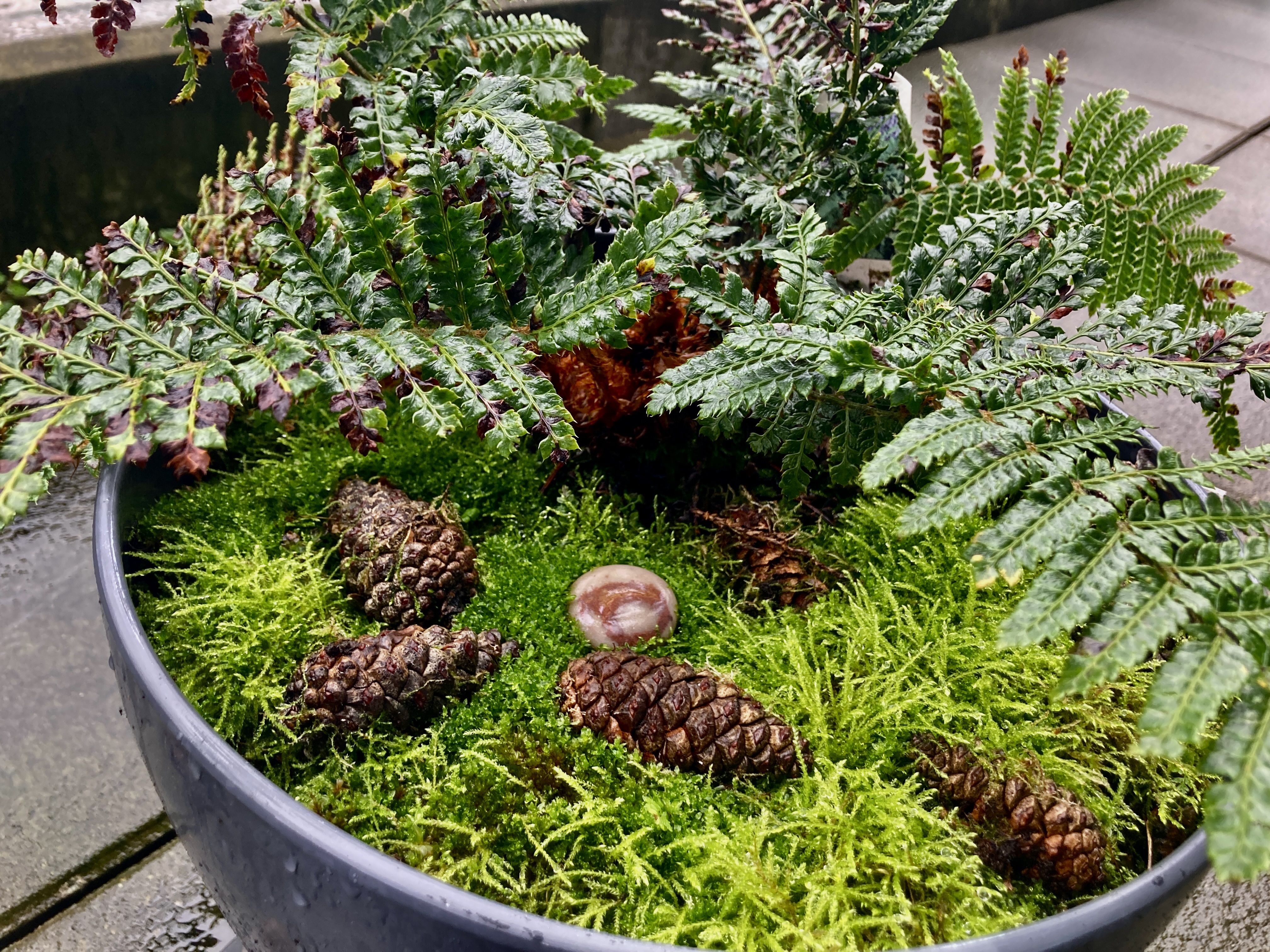
right here, on my own balcony at home.
Posted by icelandpenny on 3 February 2026
https://icelandpenny.com/2026/02/03/listening-to-moss/
31 January 2026 – And then…
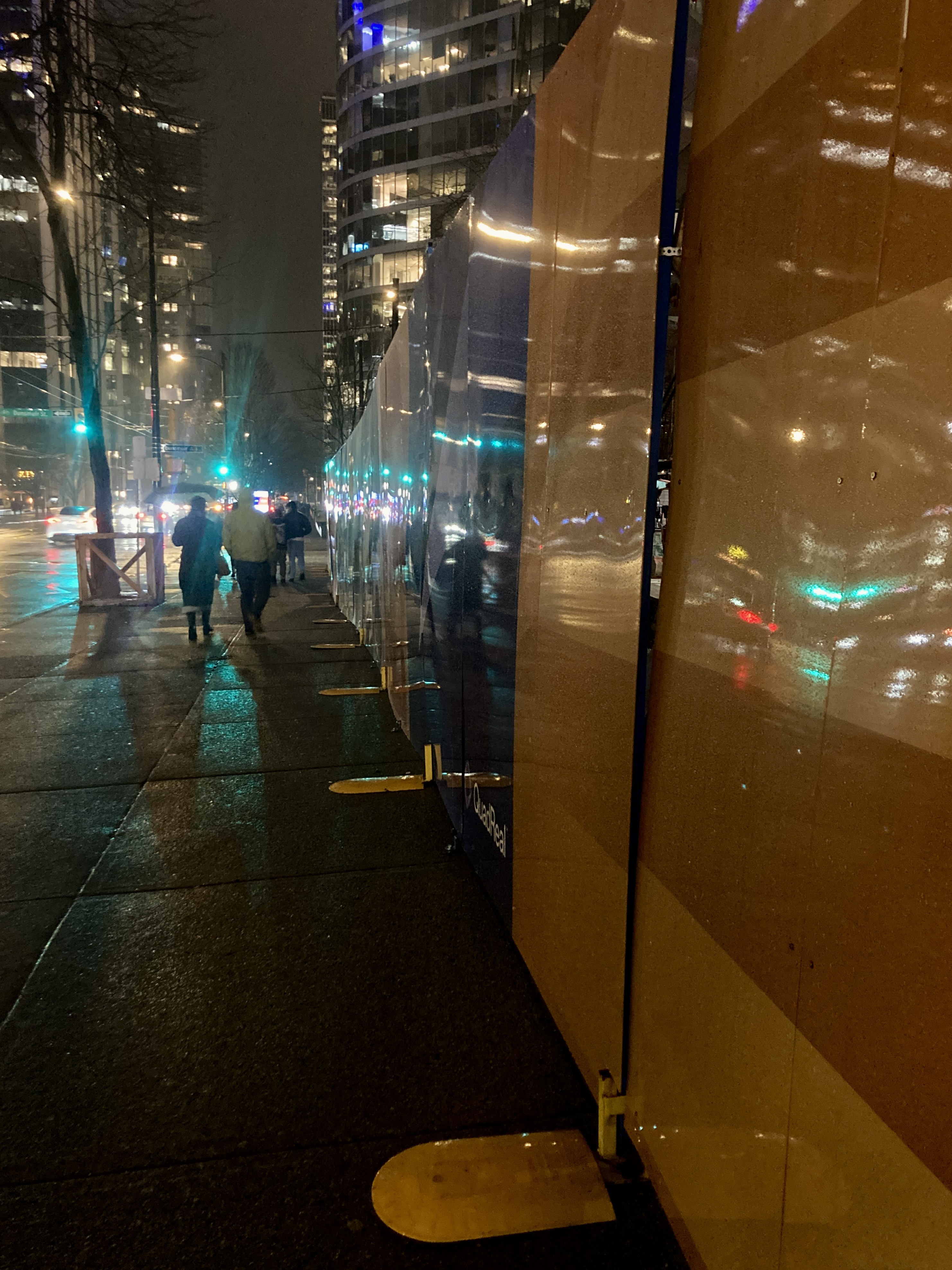
the rain came back.
Posted by icelandpenny on 31 January 2026
https://icelandpenny.com/2026/01/31/and-then/
28 January 2026 – Or, maybe: “Colour.” Or, for the old-school among us: Colour [sic].
Meaning, I have found myself playing with the concept of colour these last few days. It is all thanks to a comment by J. Walters on my previous post — her pleasure in the “gorgeous colours” in Vancouver, viewed from her farther-east landscape of “variegated white.”
(By the way, if you don’t already know her Canadian Art Junkie blog, give it a visit.)
So I walk around, and I amuse myself by seeing colour differently. Seeing it in relation to other attributes.
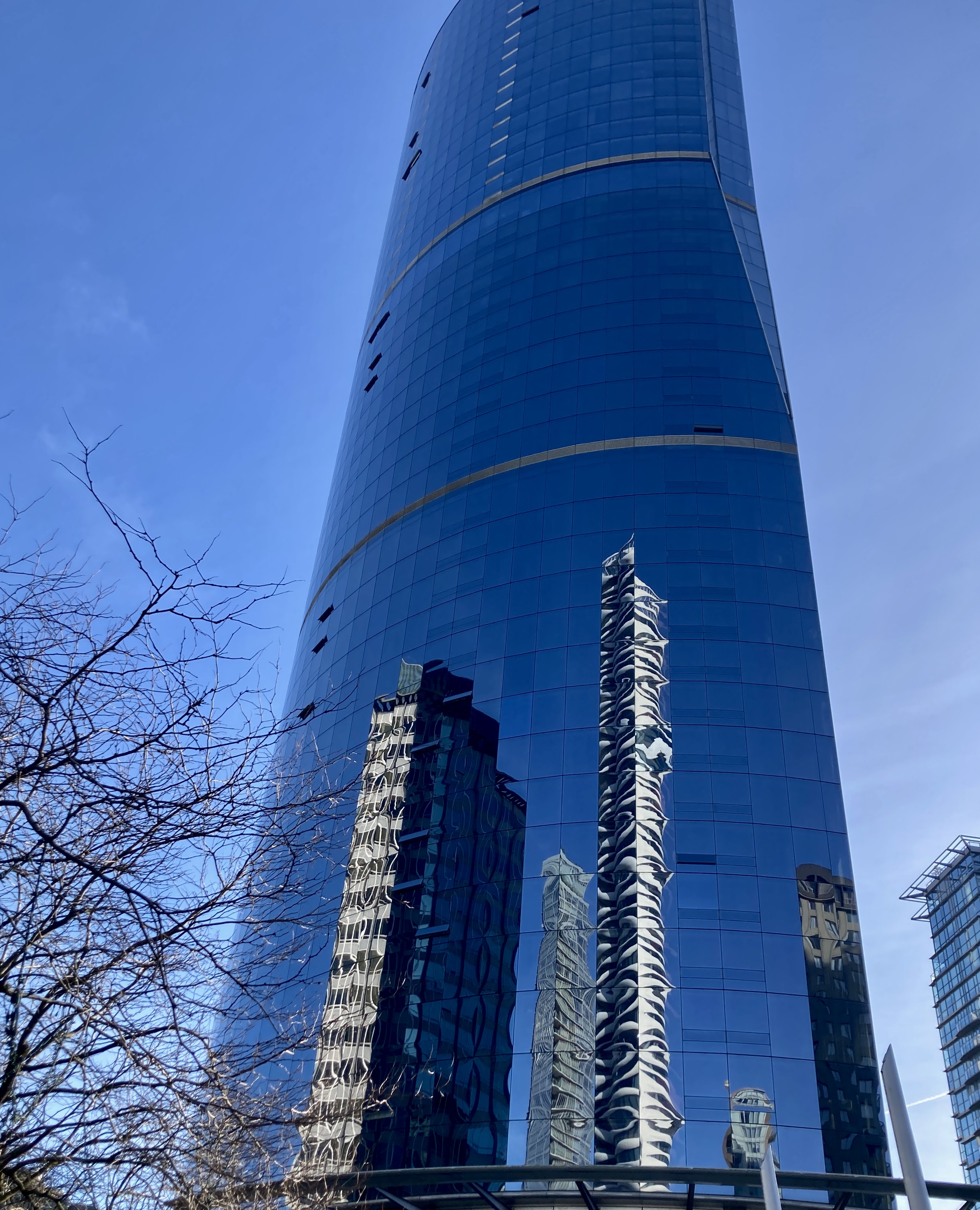
Colour: Brilliant
What’s more brilliant than reflected colour, bouncing off the plate glass of a downtown tower, under a blazing sky?
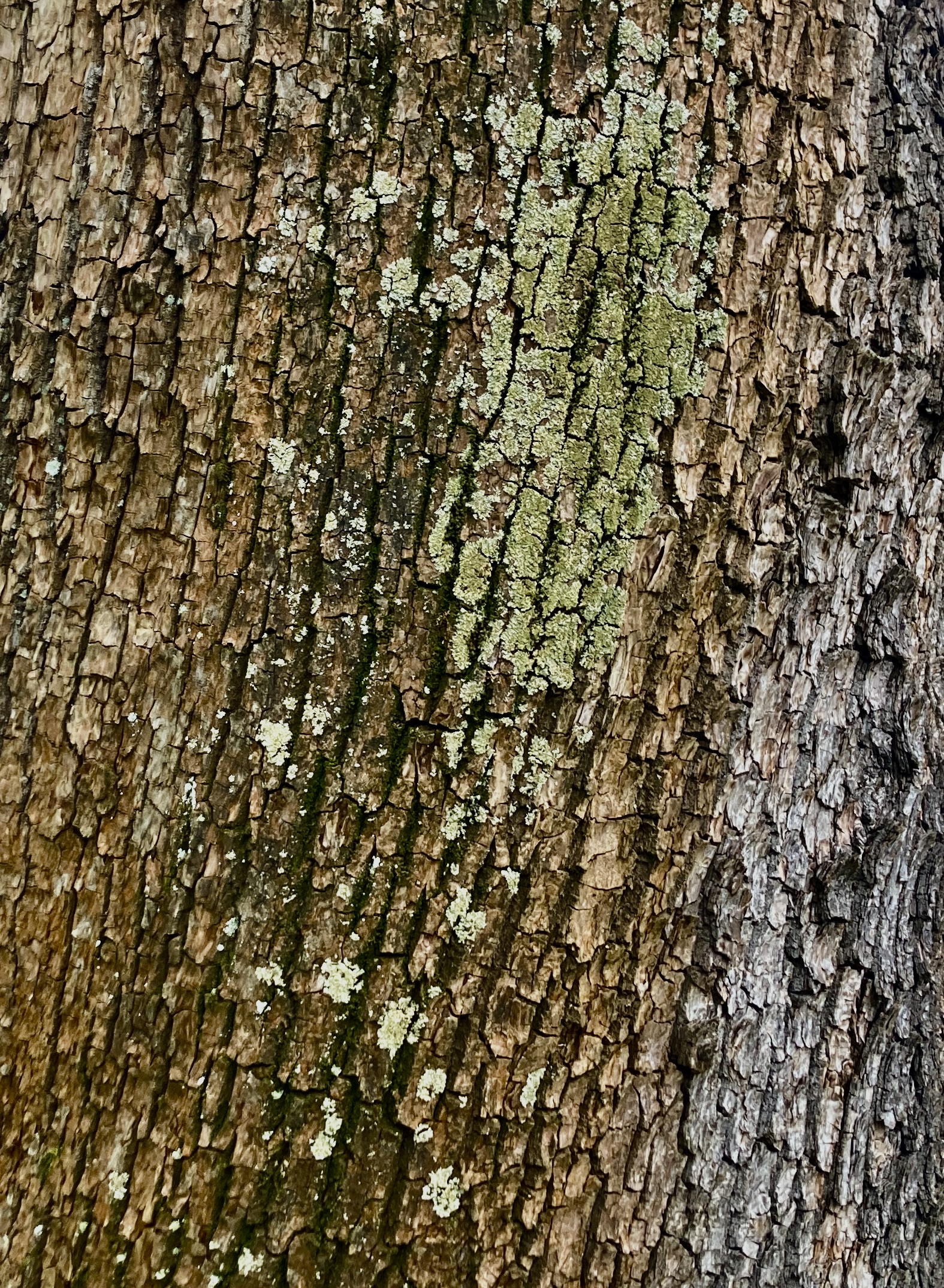
Colour: Muted
A murmur of colours, quietly living and breathing within the textures of their host, a tree trunk.
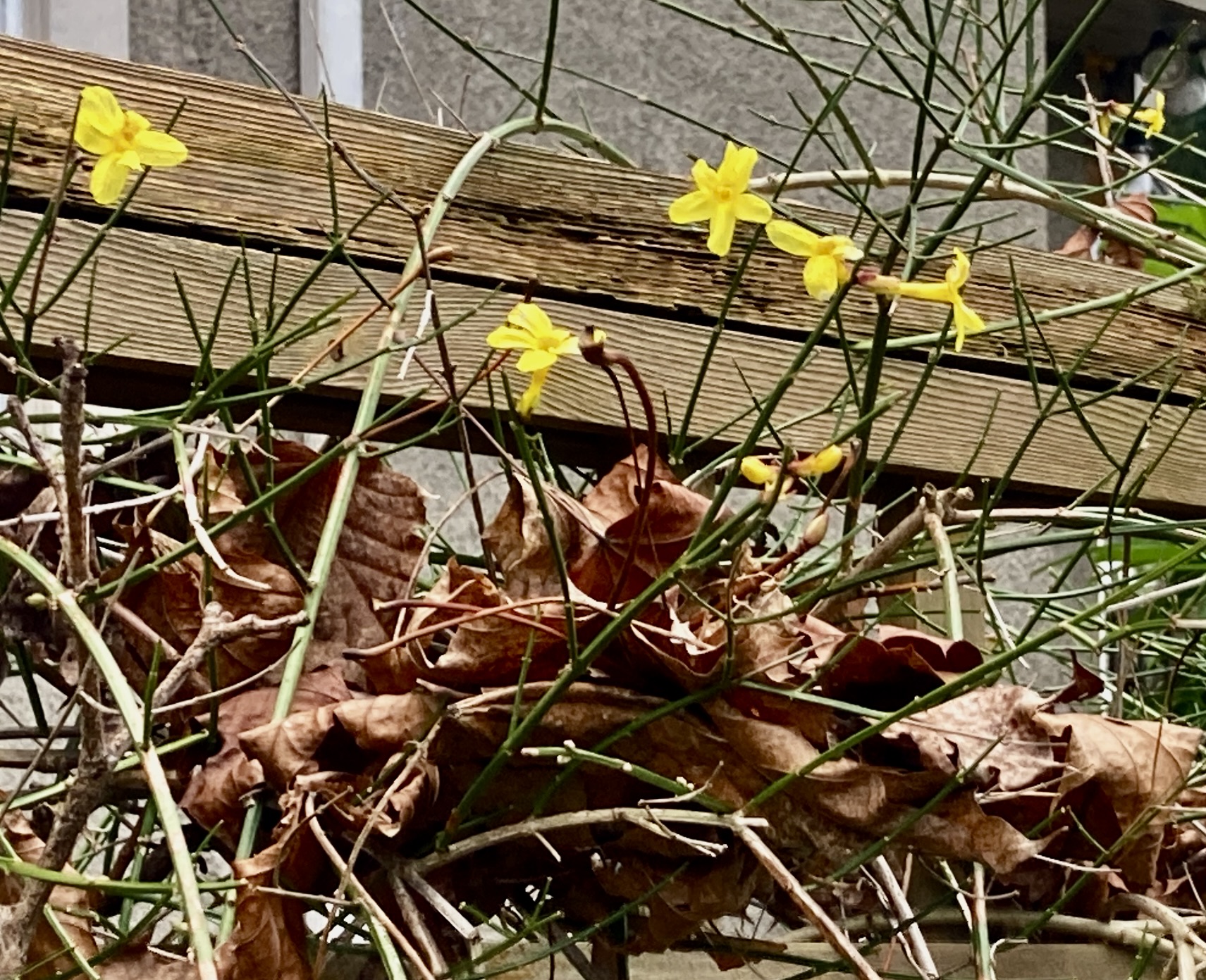
Colour: Juxtaposed
I’d not have bothered with either, on its own. Dead leaves. Pretty but unexceptional tiny blossoms. Yawn. The appeal is the contrasts of their juxtaposition. Deep rust vs sunshine yellow; battered vs fresh; last-season vs right-now.
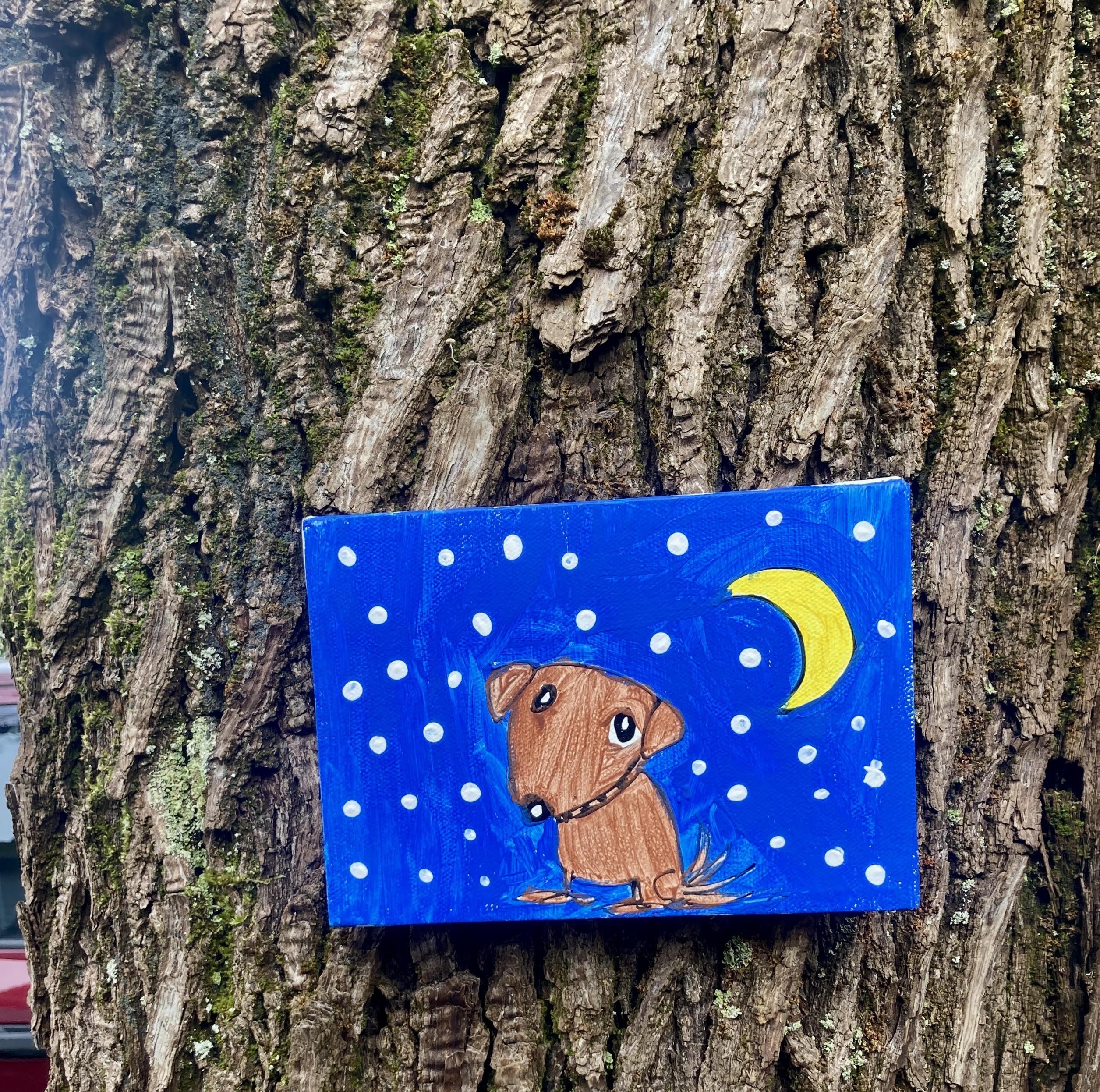
Colour: Unexpected
One of the Monty Python skits had a character intone: “Nobody expects the Spanish Inquisition.” Well, nobody expects a Very Colourful Dog on a tree trunk, either.
Colour: Obsessed
Namely, the colours I discover while indulging my obsessions. Two examples.
1 – My obsession with neighbourhood street-side “fairy trees,” decorated by civic-minded residents, sometimes with a swing for extra delight. Plus, in this specific example, our “Unexpected Dog.”
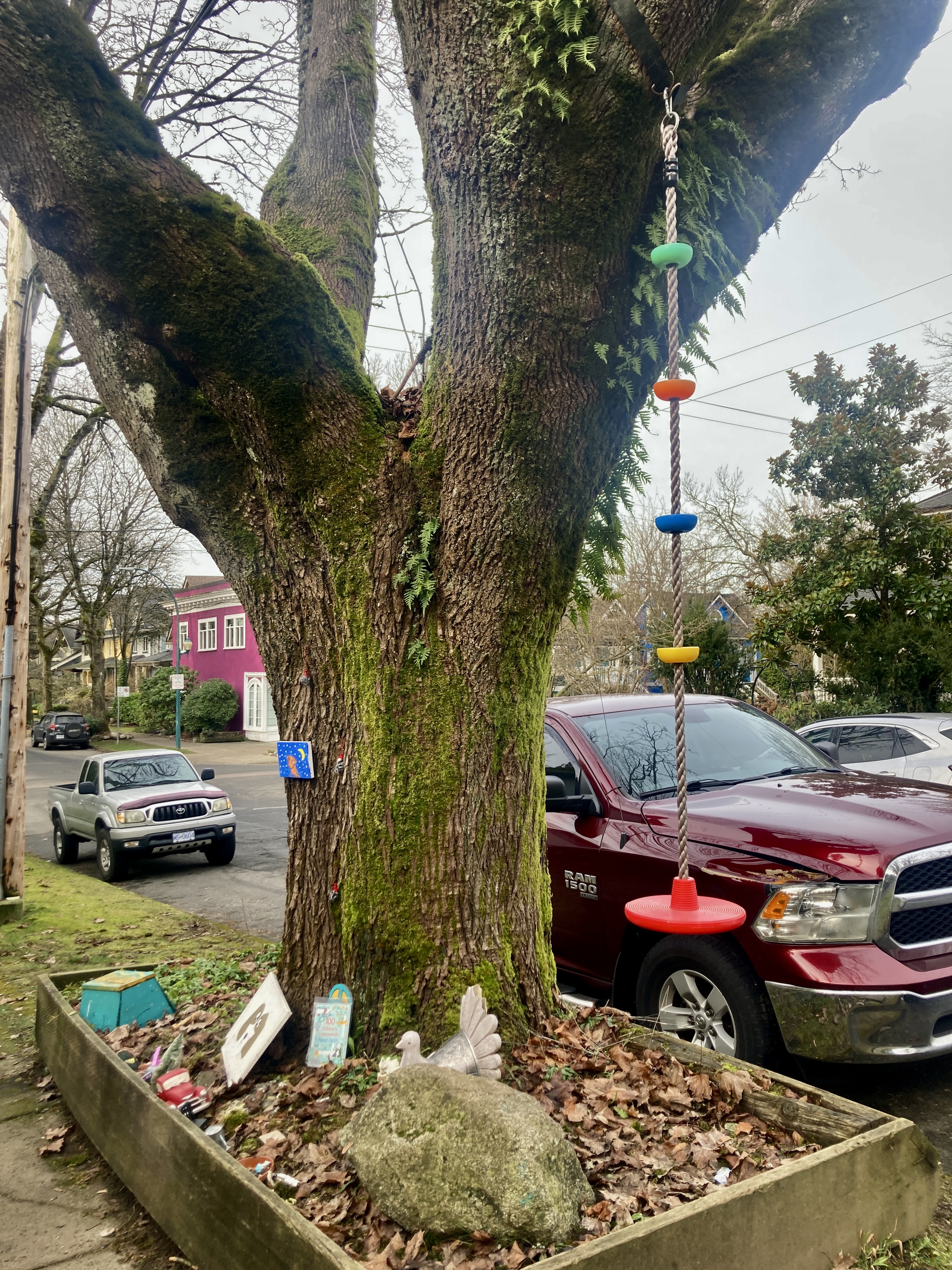
2 – My obsession with winter moss. In this case, right at the base of my “Colour: Muted” example above.
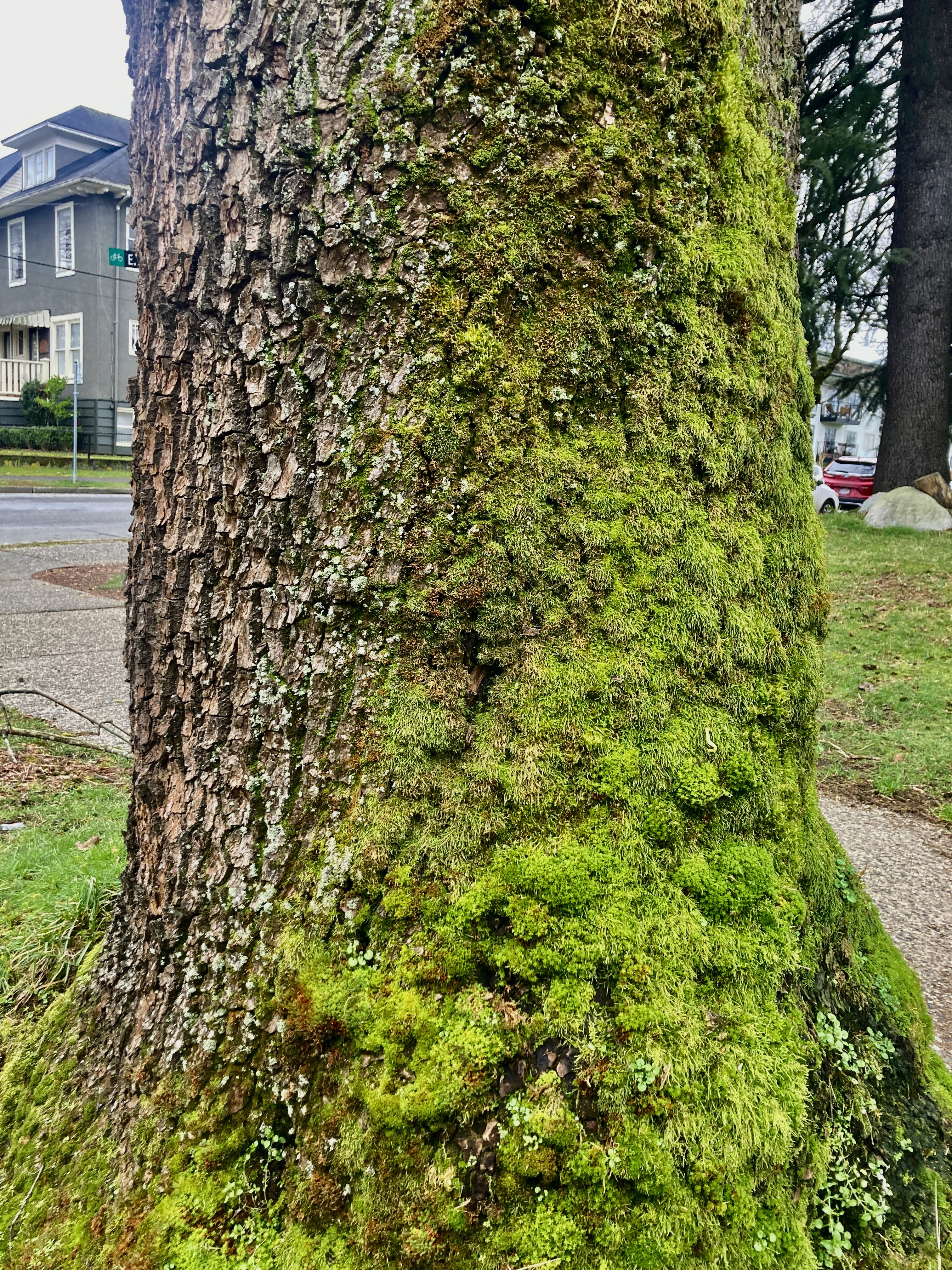
It’s all colour, if you want it to be. Hurray for colour.
Posted by icelandpenny on 28 January 2026
https://icelandpenny.com/2026/01/28/colour/
24 January 2026 – Let us first define our terms.
Winter, not as most of the country is currently experiencing it, but winter as we experience it here at sea level on the Canadian west coast. More precisely, because the quip fits: winter as we experience it here on the wet coast.
While much of the rest of Canada contends with brutal temperatures and heavy snowfall…
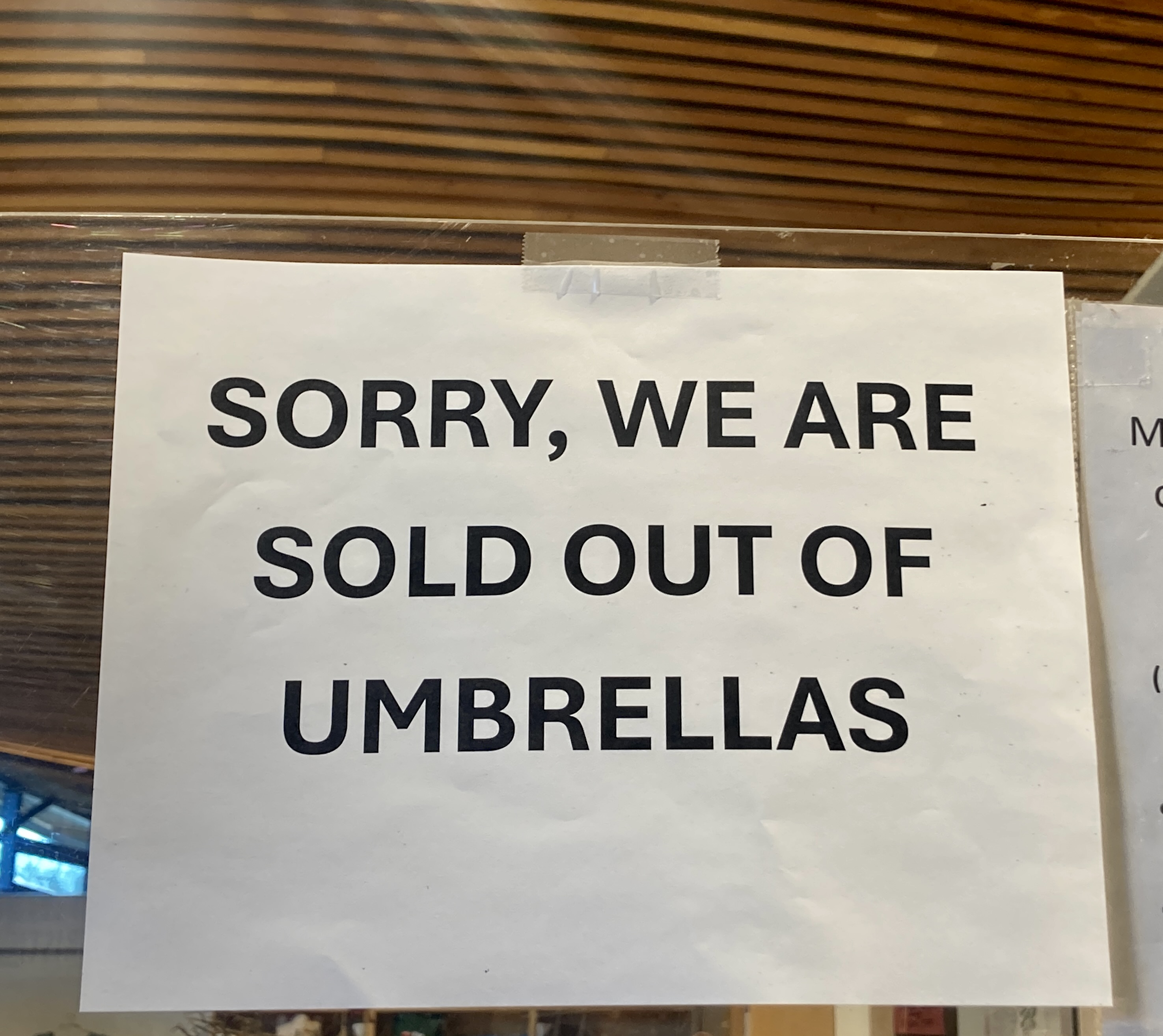
our shops run out of umbrellas.
I see this sign in the VanDusen Botanical Garden gift shop, where I loiter awaiting my partner for our planned winter walk in the Garden.
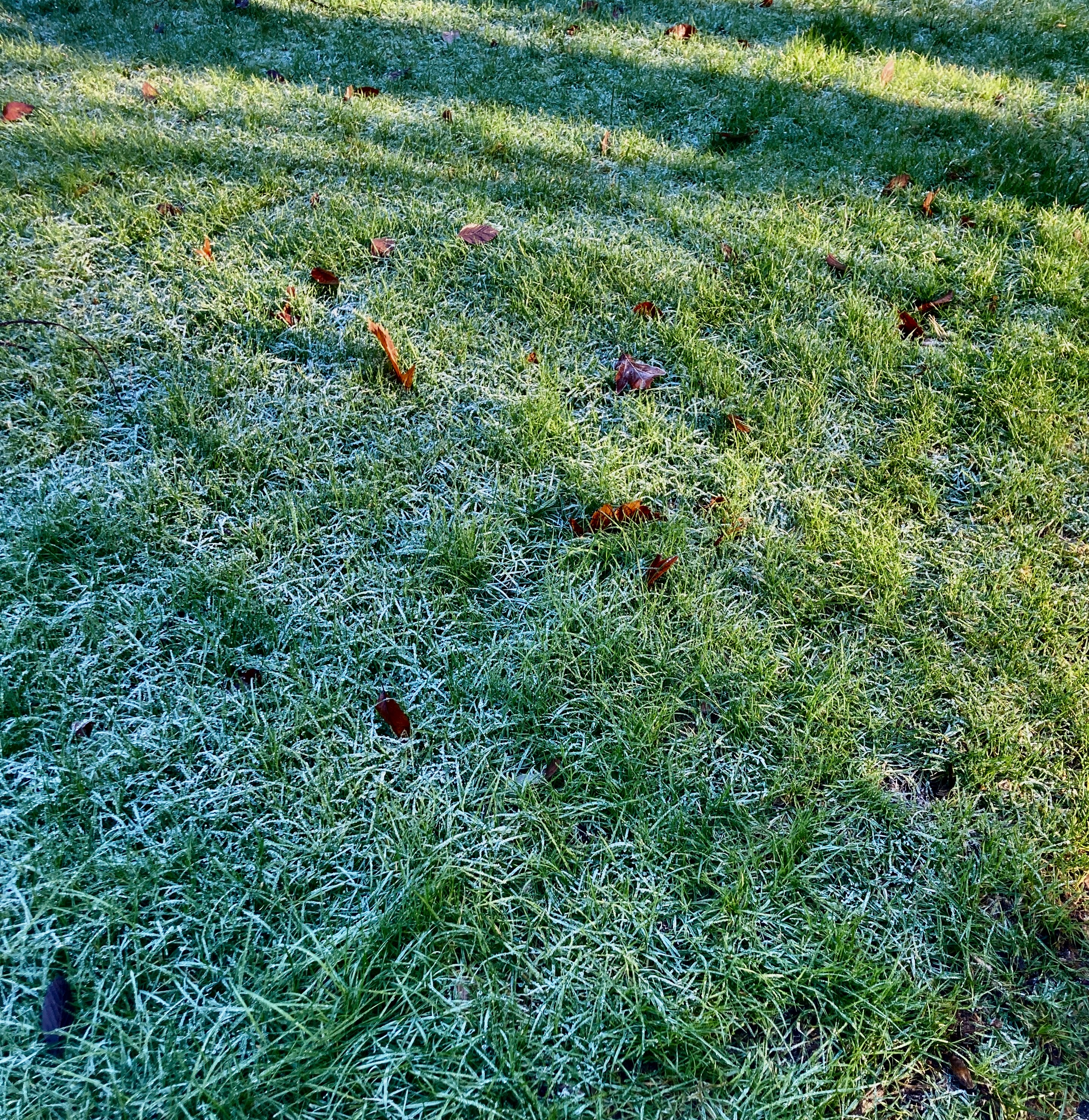
Sun overhead, and hoar frost sparkles on the grass.
Tree trunks and branches flourish their winter coats of moss.
Sometimes in great goofy patches…
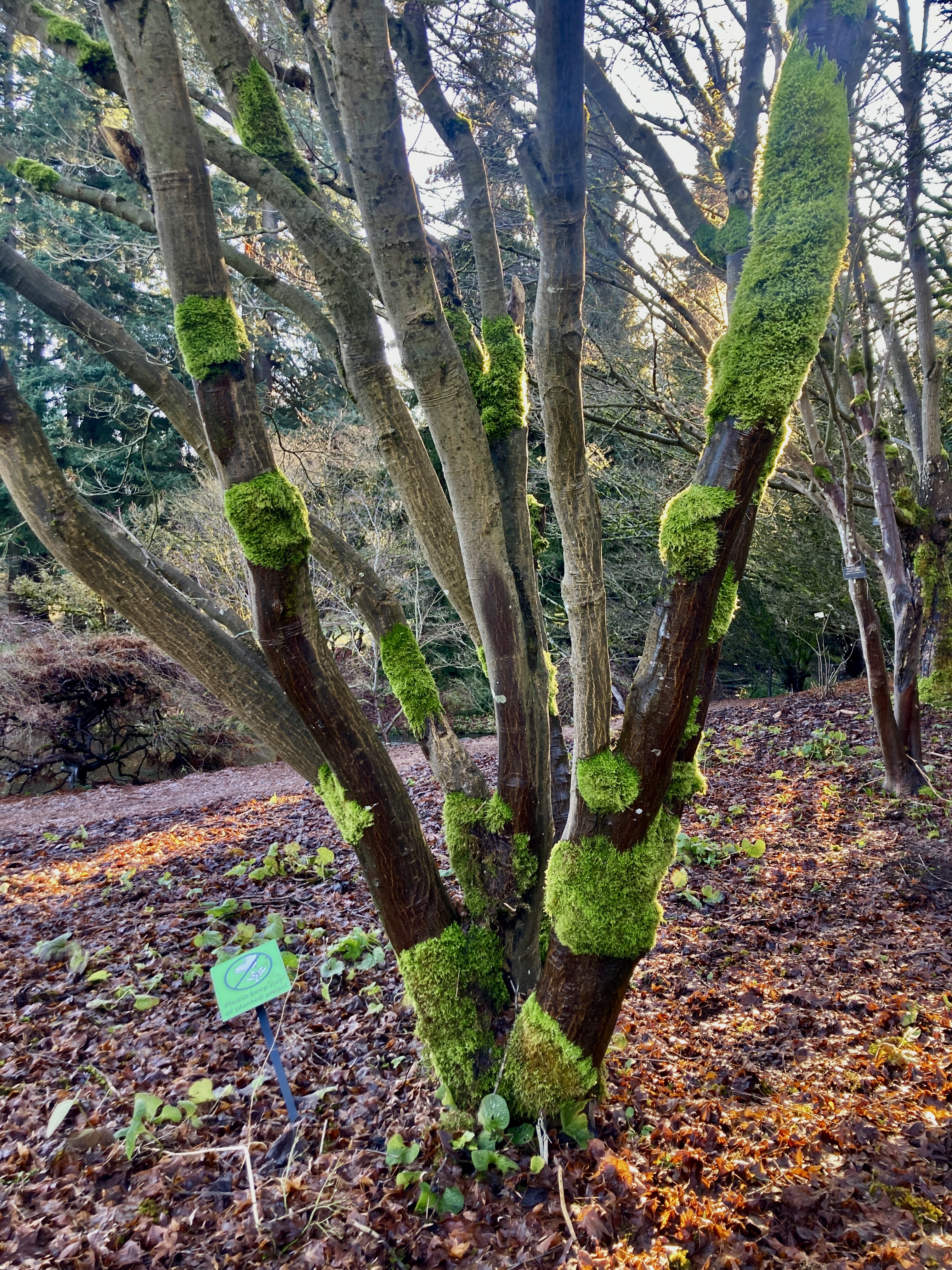
sometimes as a shimmering outline, viewed from the shadow side of a tree trunk facing the sun…
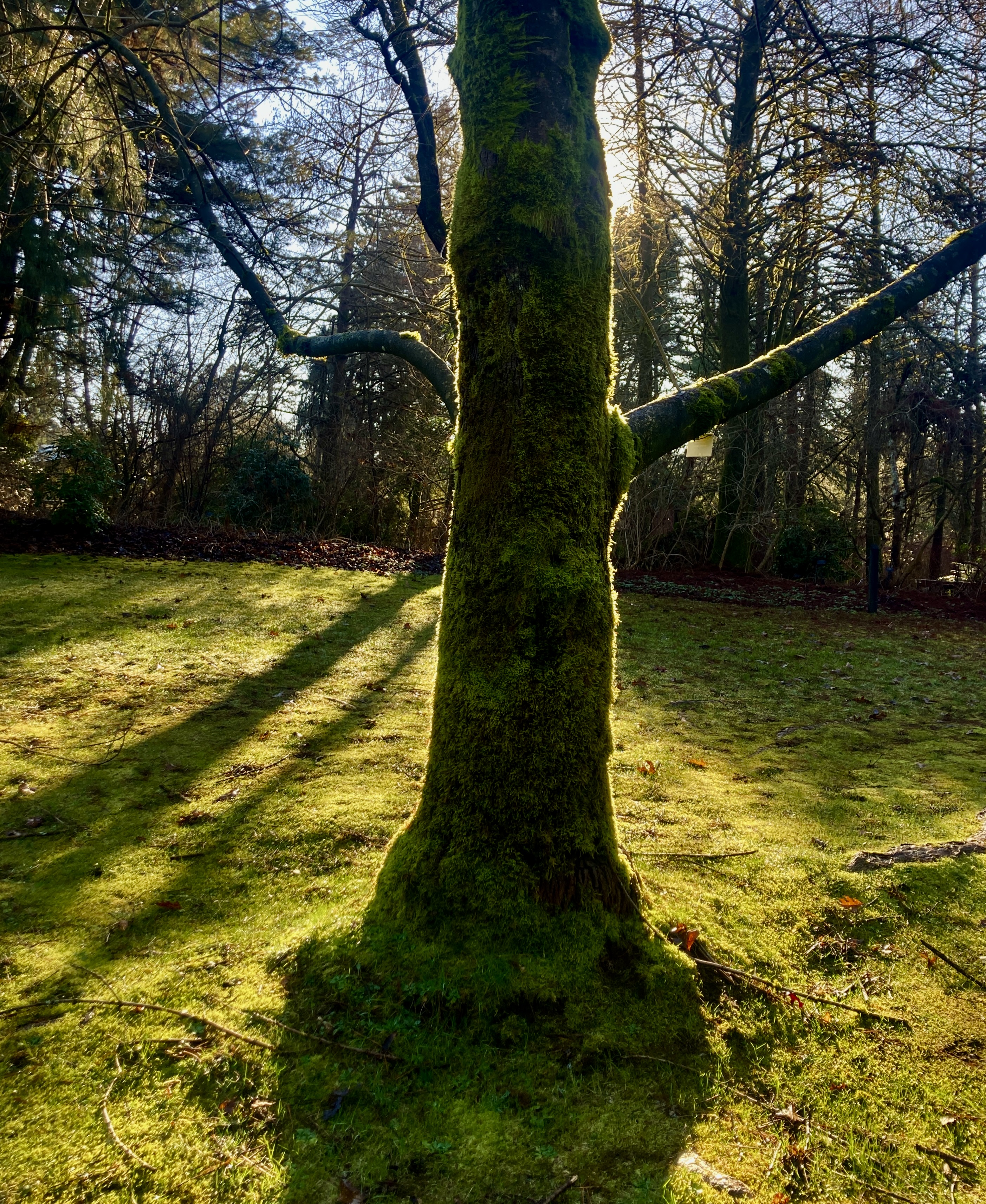
and sometimes draped along the branches of sibling Japanese maples, touching fingers above Heron Lake, itself adorned with a rare skin of ice.
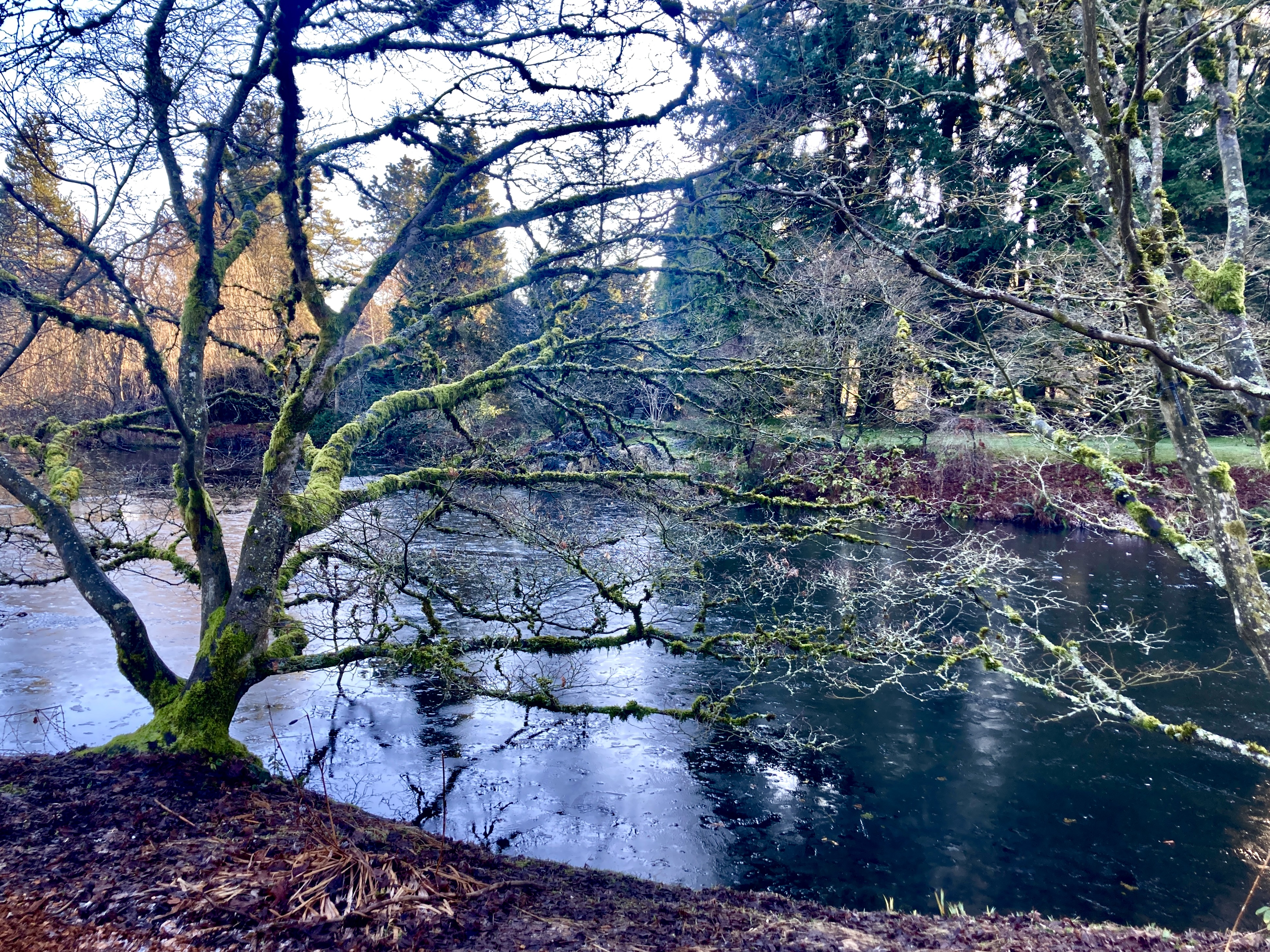
That ice, however, is only in the upper reaches of the lake.
Farther along…
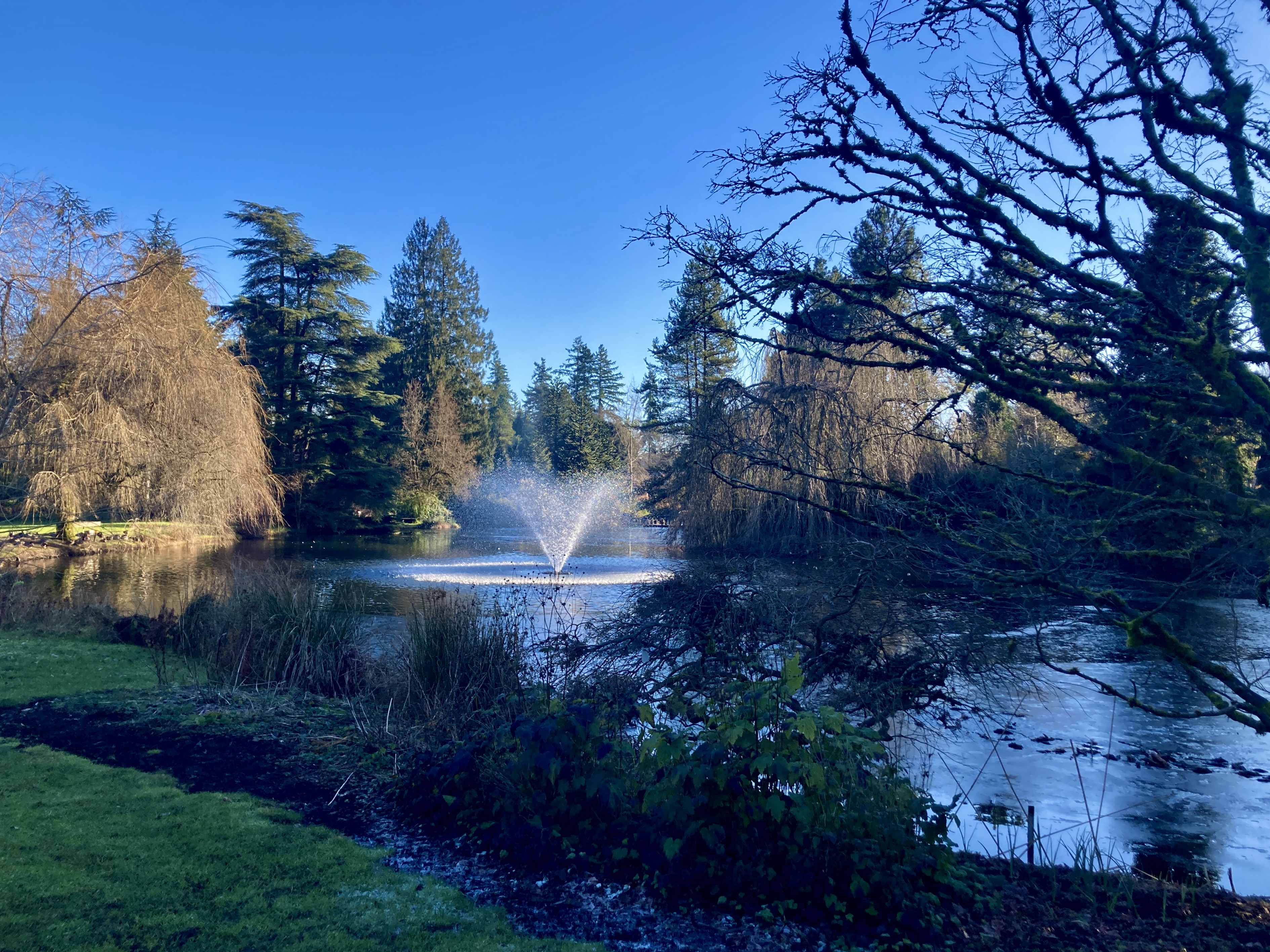
the fountain guarantees open water — to the delight of paddling ducks.
We first walk a path known officially as the Winter Walk, because of its plantings, and as we go we tick the list of its star attractions: witch hazel, heavenly bamboo, Japanese laurel, and wintersweet.
Then we veer off, take other pathways across the Garden, and notice their mid-winter palette as well.
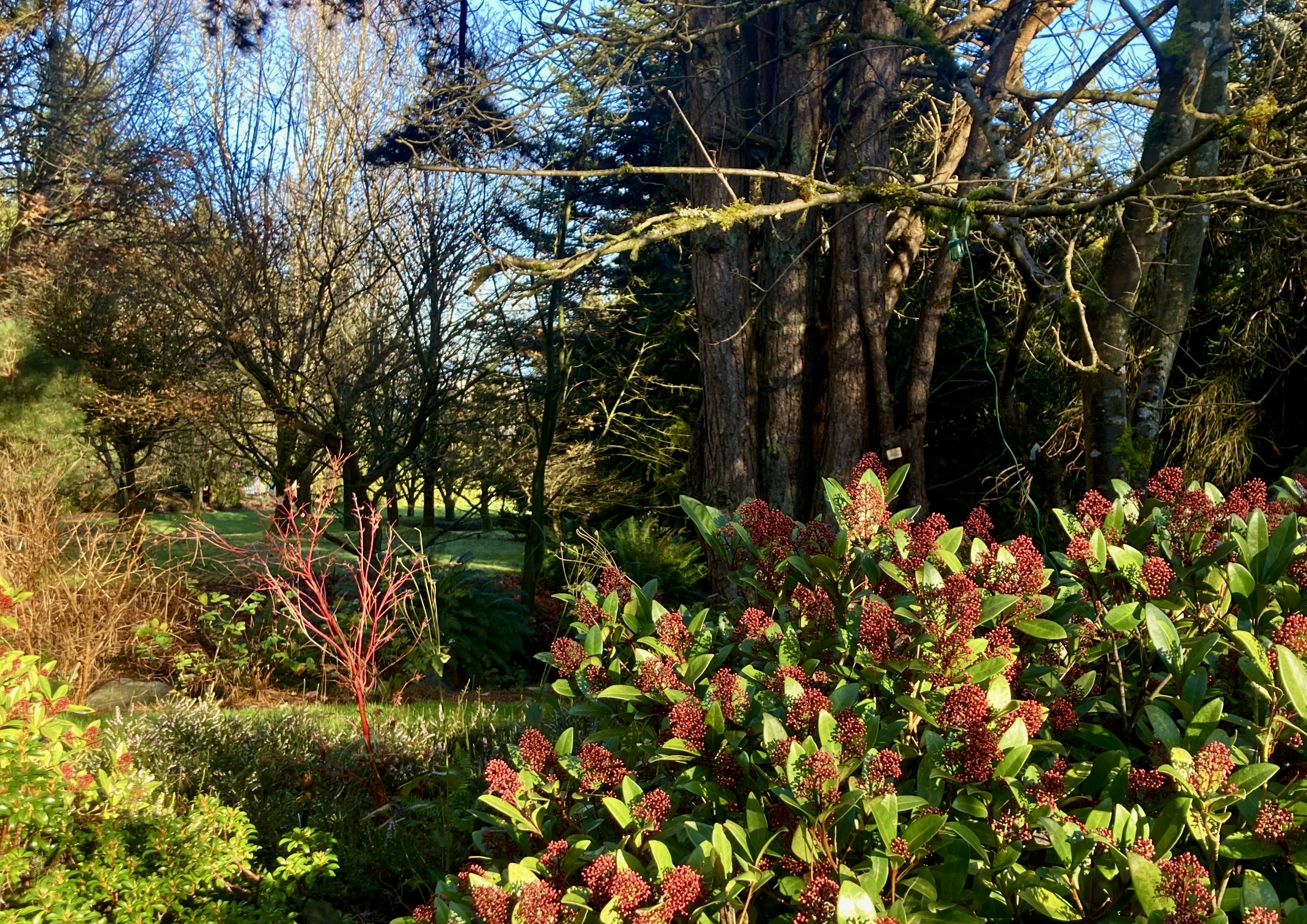
A fiery Red osier dogwood, for example, there in the middle distance, with bright Japanese skimmia right here at our finger tips.
Grasses in the perennial beds are neatly bundled up…
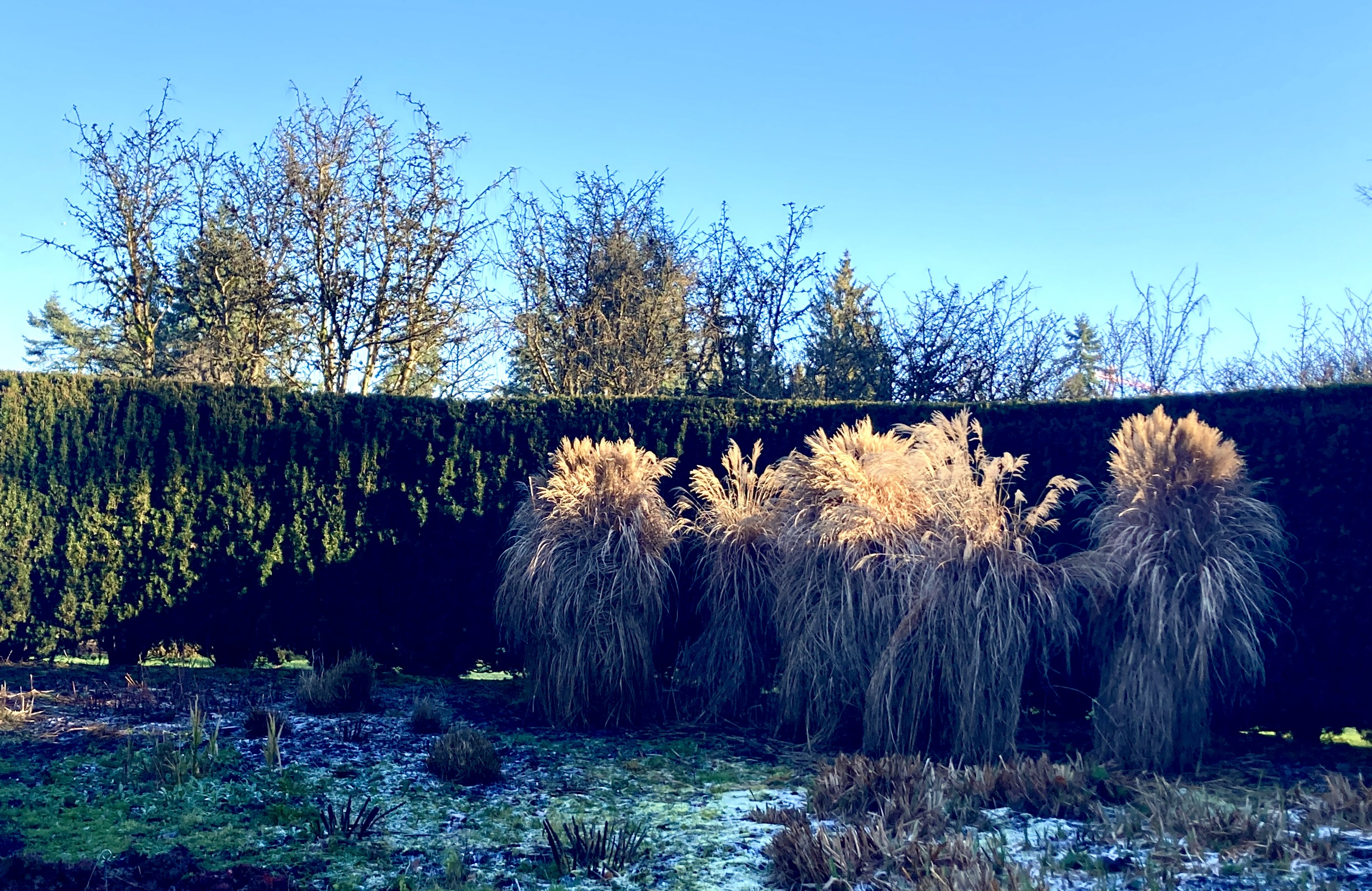
dancing their feathery tips over plant stalks in the flower beds. These plants are pruned for winter and currently anonymous, but their time will come.
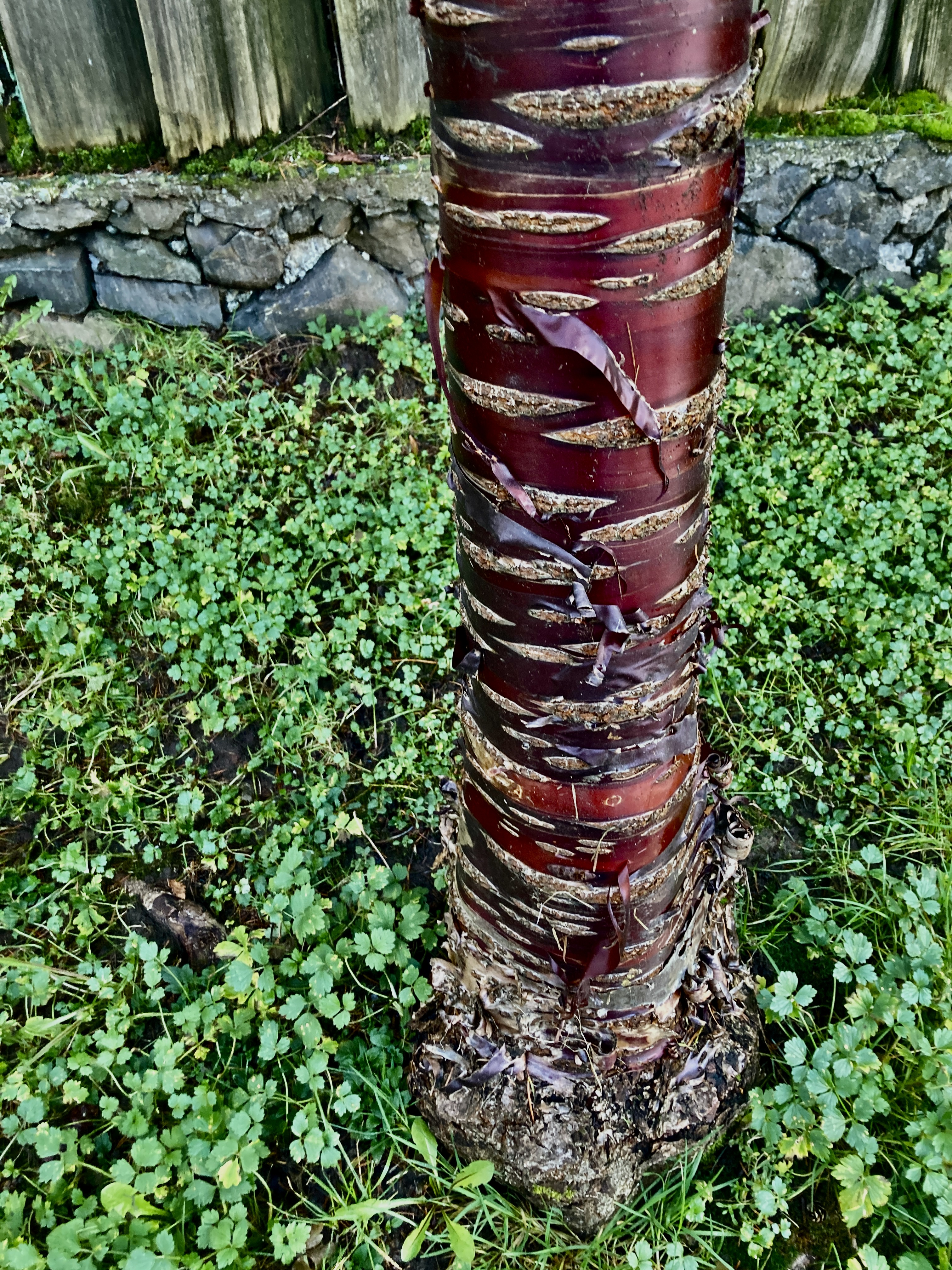
Tree trunks!
We are drop-jawed at the jewel tones of this Snow Goose flowering cherry…
and then find ourselves equally impressed by the austere tones of this Sichuan birch.
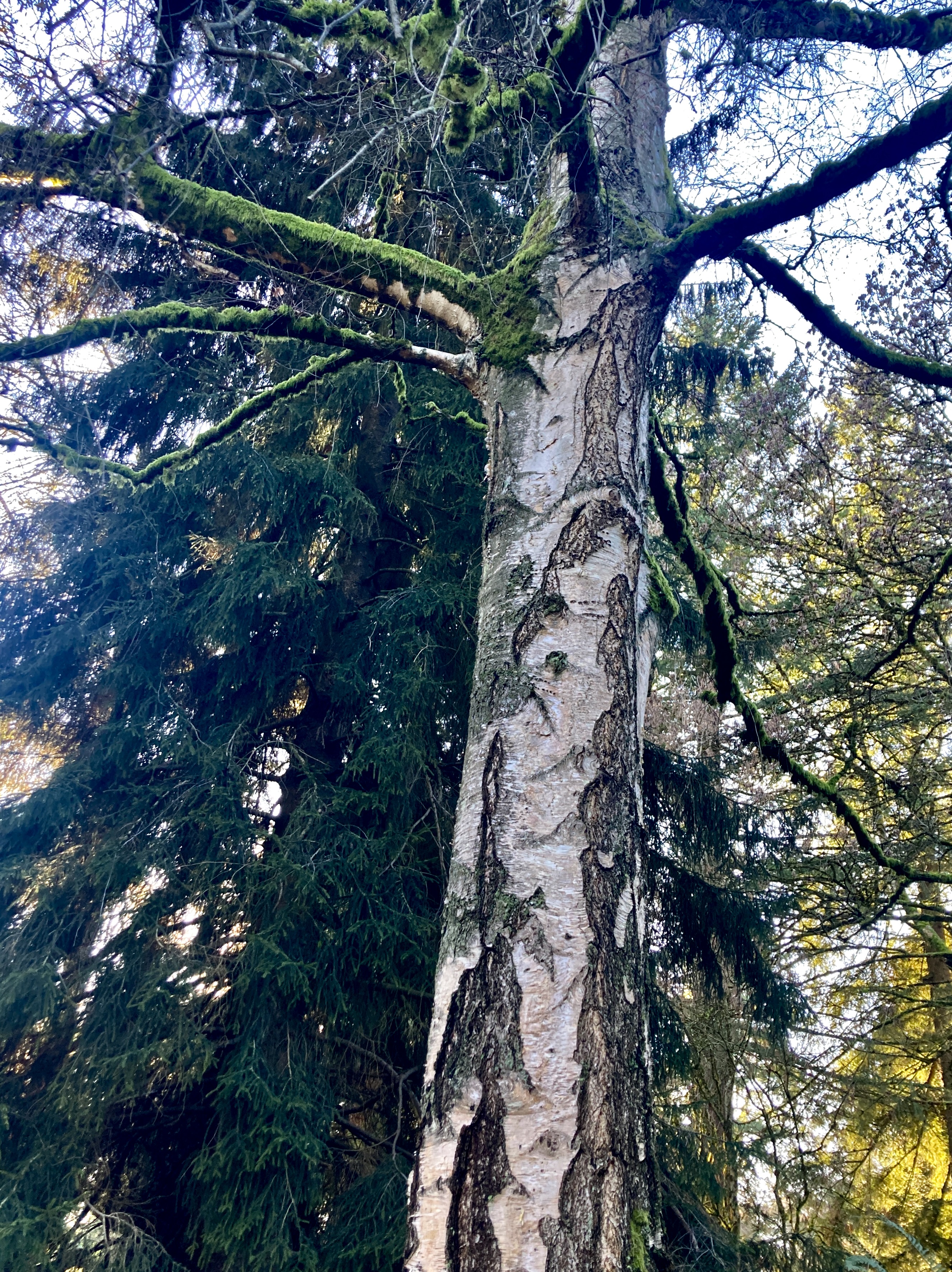
(Enlivened, I feel compelled to add, by a kick of moss in its upper branches.)
Then we’re off, out past the Garden’s rammed earth sirewall, handsome in any season…
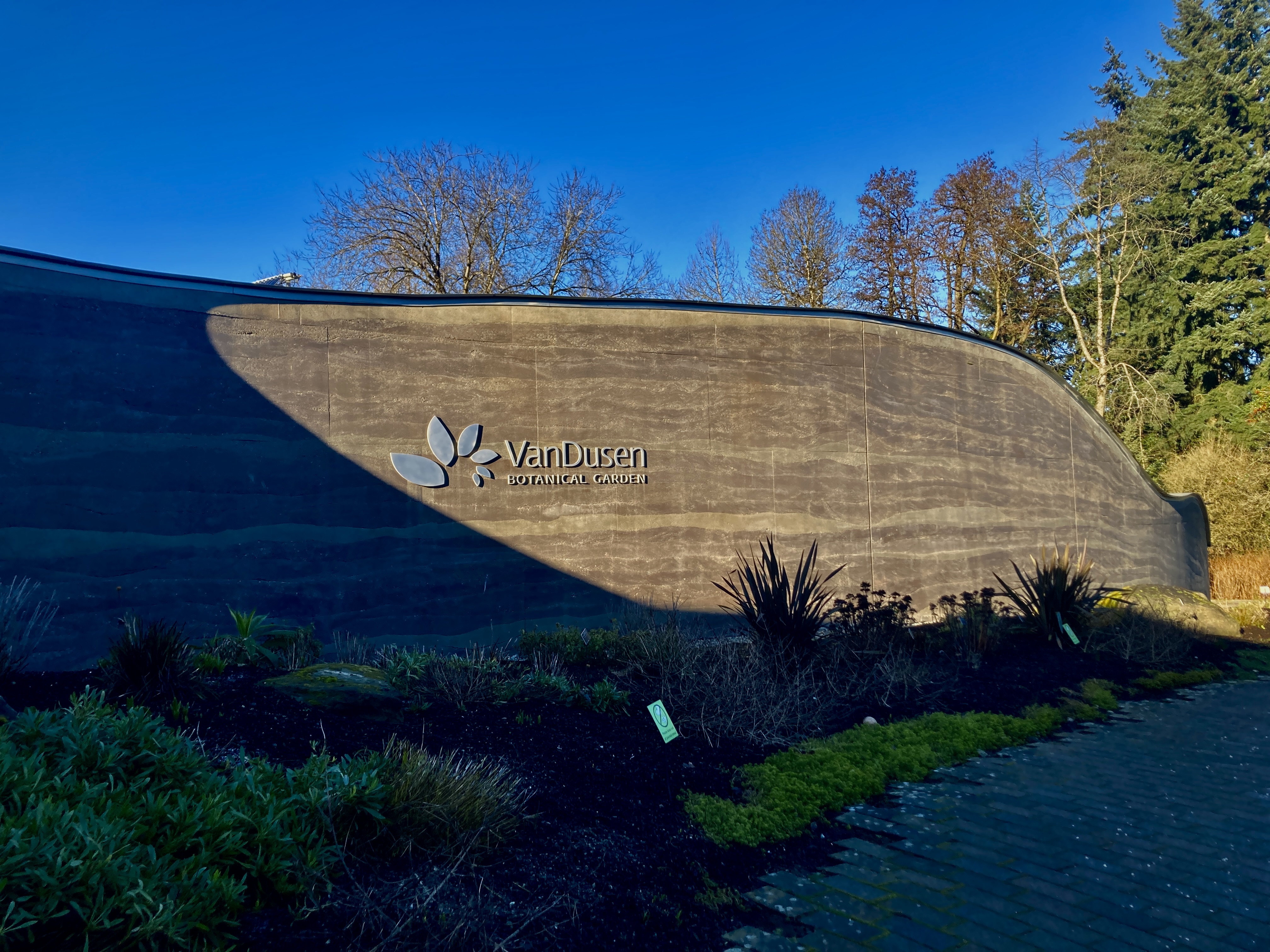
and on down Oak Street for a while, prolonging the walk.
Posted by icelandpenny on 24 January 2026
https://icelandpenny.com/2026/01/24/winter-walk/
17 January 2026 – It seems rude to mention sunshine, let alone mild temperatures (9C), when most of Canada is socked with snow, sleet, ice and windstorms. But… here it is. A bright, friendly day.
So we seize it.
We’re off to Burnaby Lake Regional Park. The park surrounds a large glacial lake to the east of Vancouver, and lies within its own dense municipality. Yet it is also home to wildlife (especially birds) and rich with trails for human visitors (walk, cycle, ride a horse, as you wish).
We have no particular plan beyond entering the park at the east end, off Cariboo Rd., and following the Brunette River upstream to the lake. After that? We’ll find out.
It is all magic, right from the get-go.
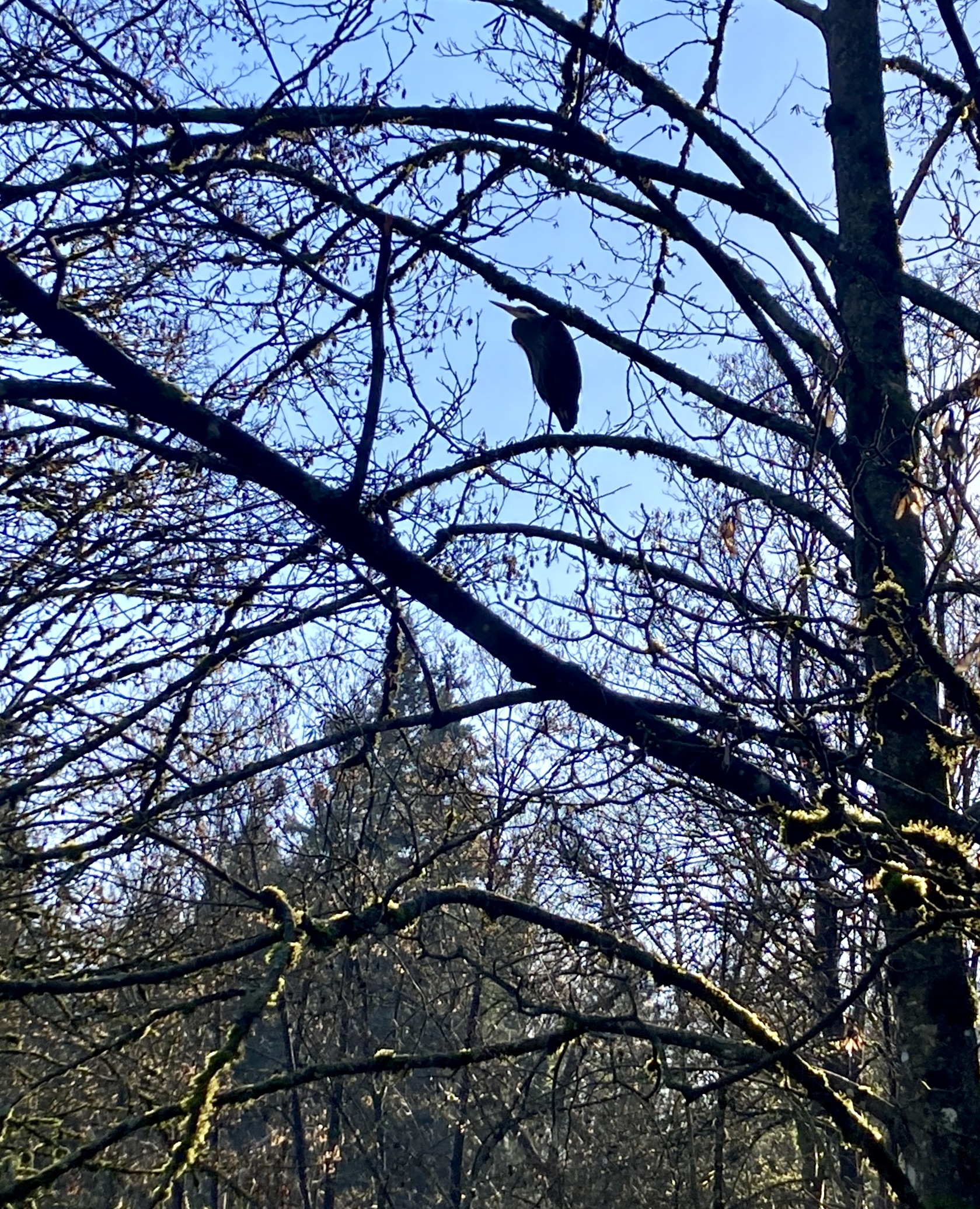
A great blue heron sits tall, still and stately in his tree beside the river…
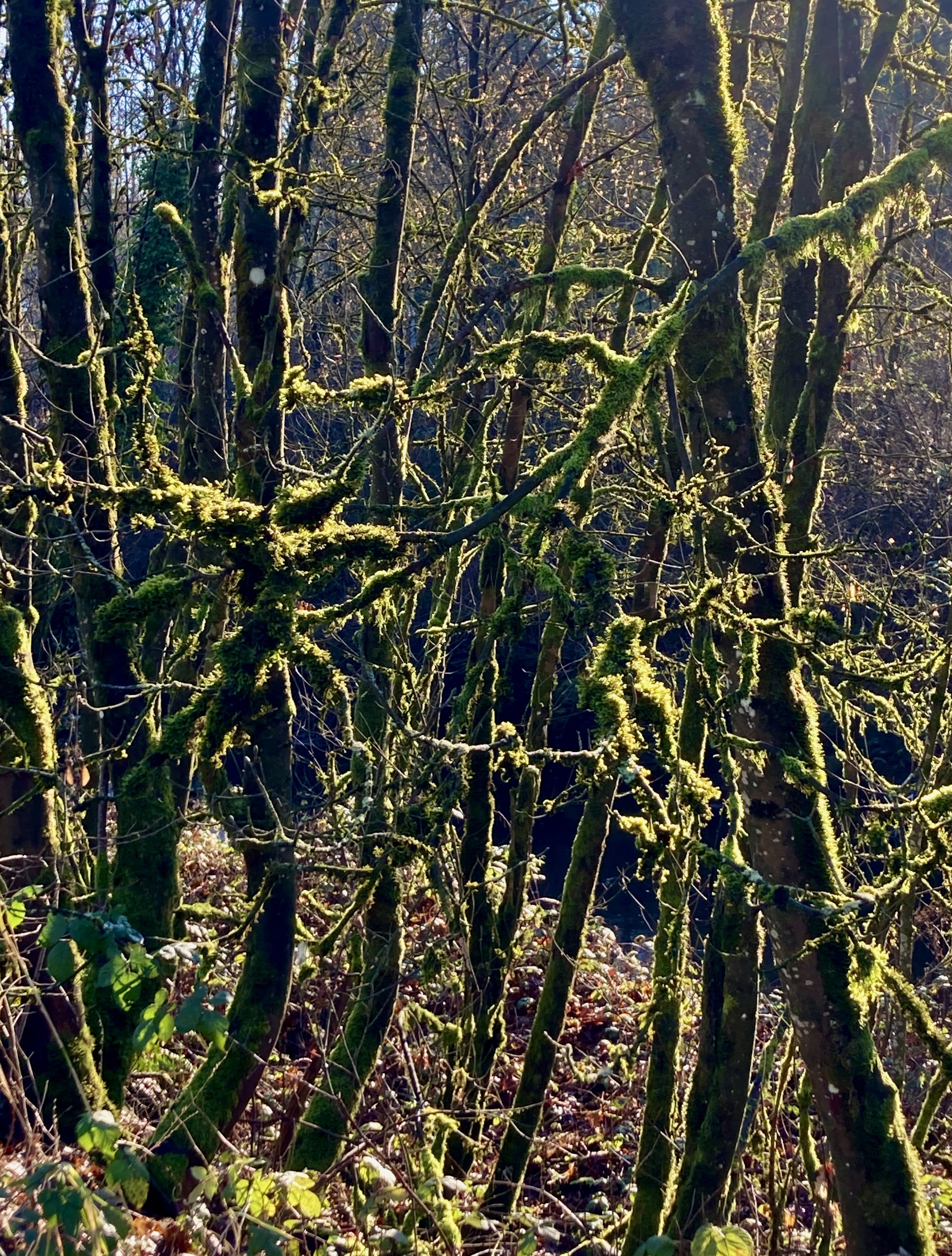
winter moss glows incandescent on trees lining the river…
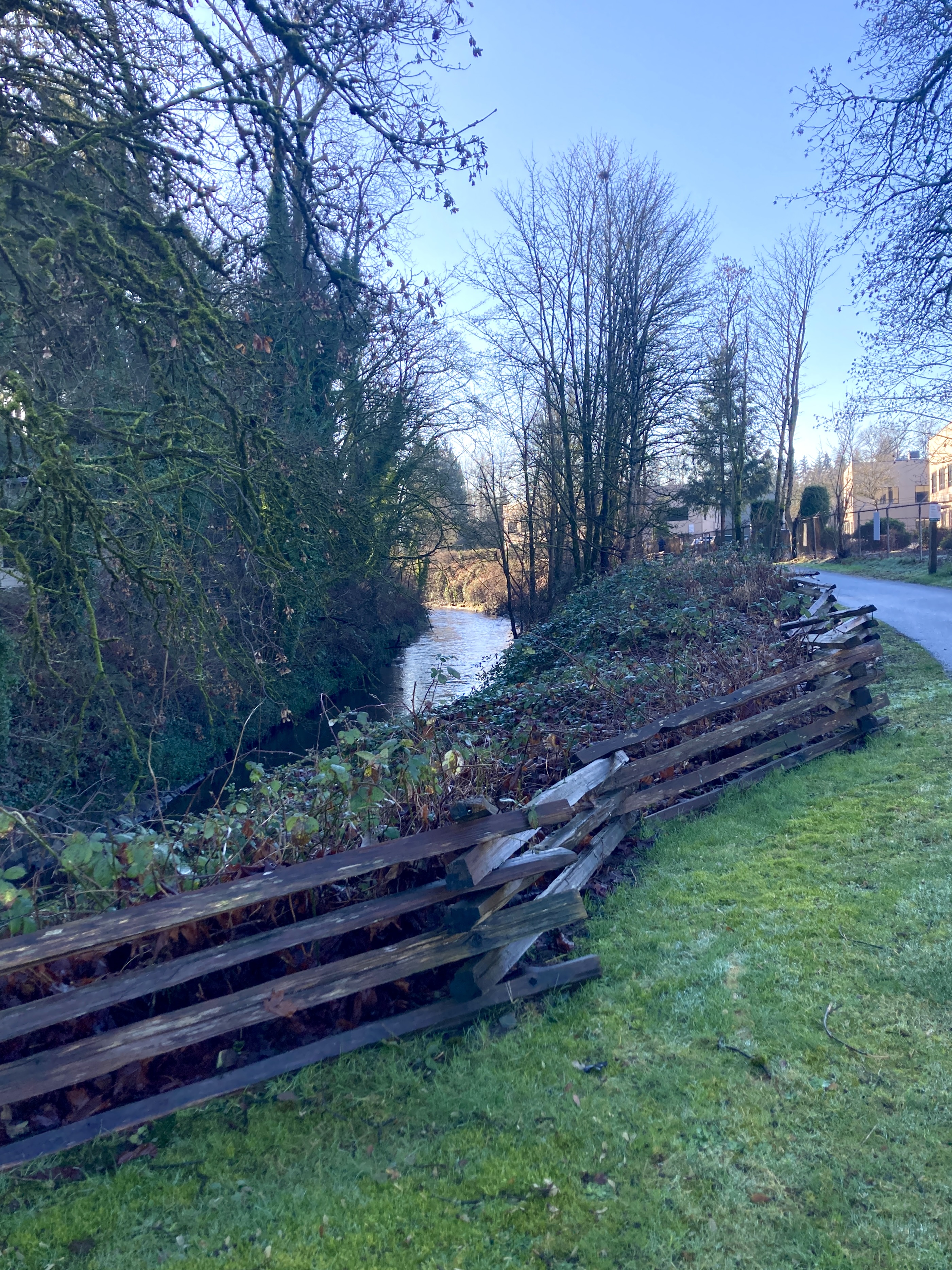
and a snake fence leads us on upstream…
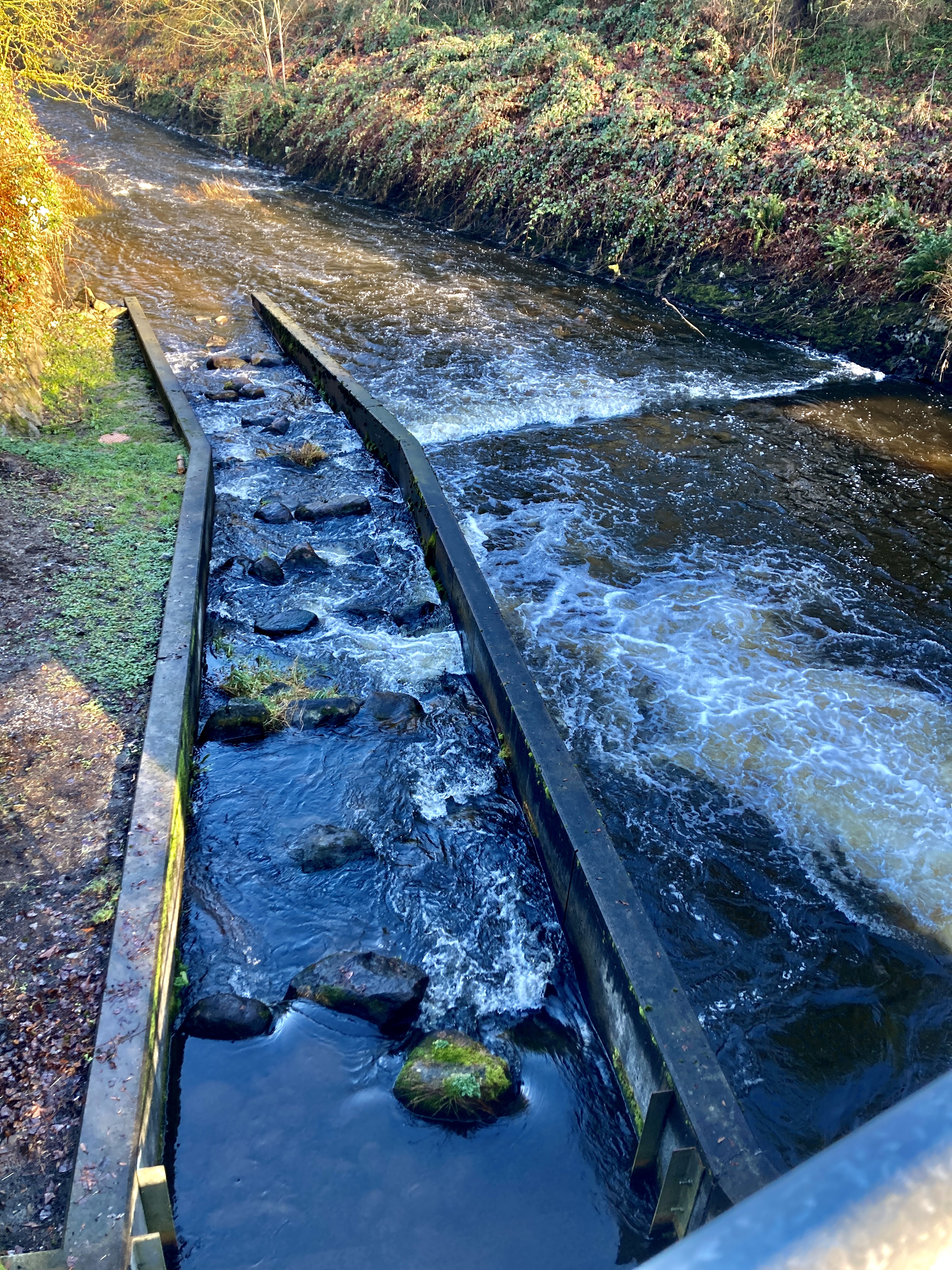
to the Cariboo Dam. Several creeks and a lake feed into Burnaby Lake, which in turn empties into the Brunette River and ultimately into the Fraser. This dam controls the outflow.
An era of sawmills on the lake caused the inevitable toxicity and devastation of salmon and other populations. We stand on the path atop the dam, and see some results of rehab efforts since then.
To the east, the Cariboo Dam Fishway provides upstream access for resurgent fish populations …
and to the west, winter trees cast their delicate embroidery on the system’s much-improved waters.
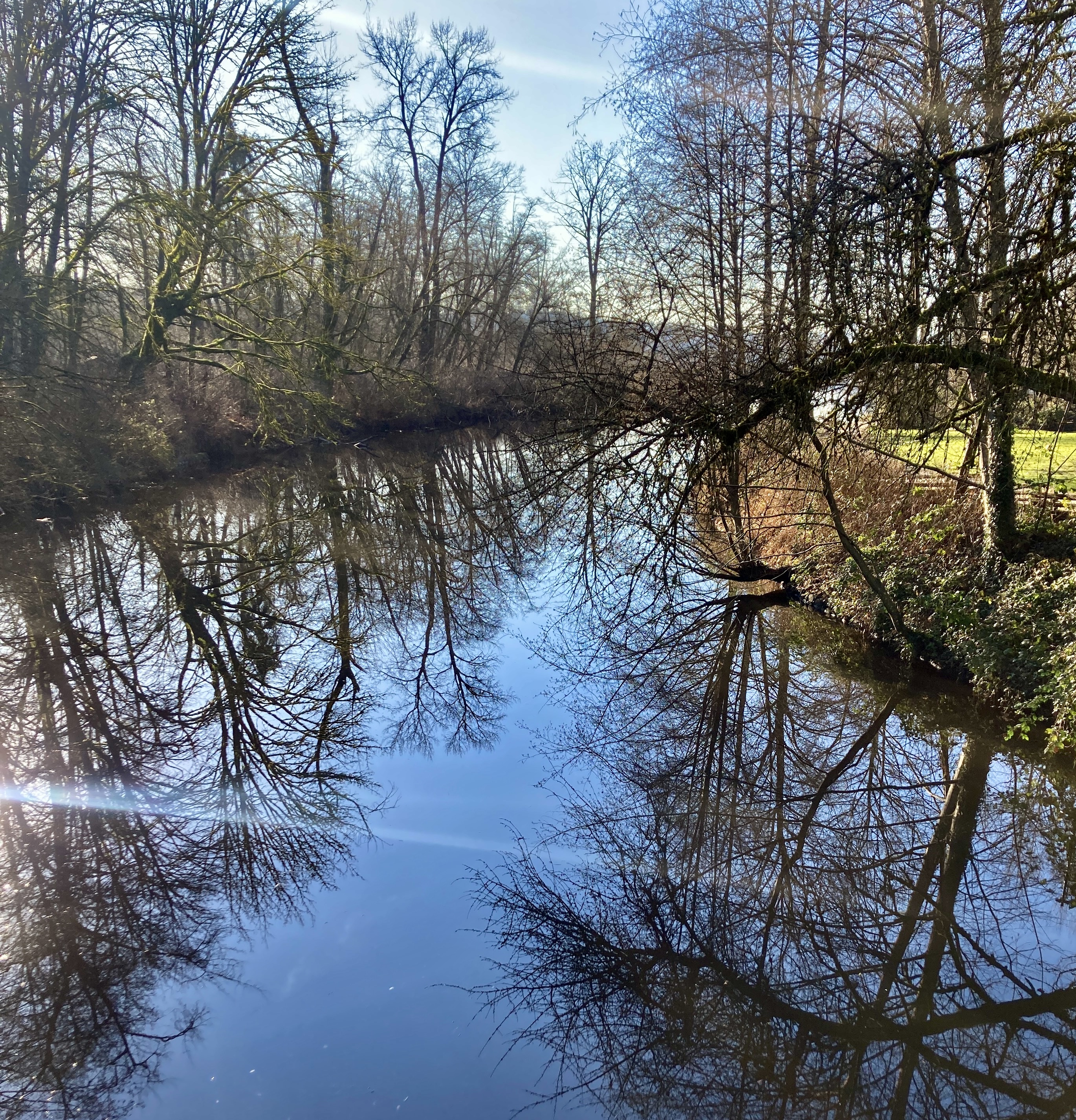
Trails circle and loop off-shoots all around the lake, but are not always in sight of water. We’re on the Brunette Headwaters Trail, entranced by nature’s response to the minimal human pruning that keeps trails safe and accessible.
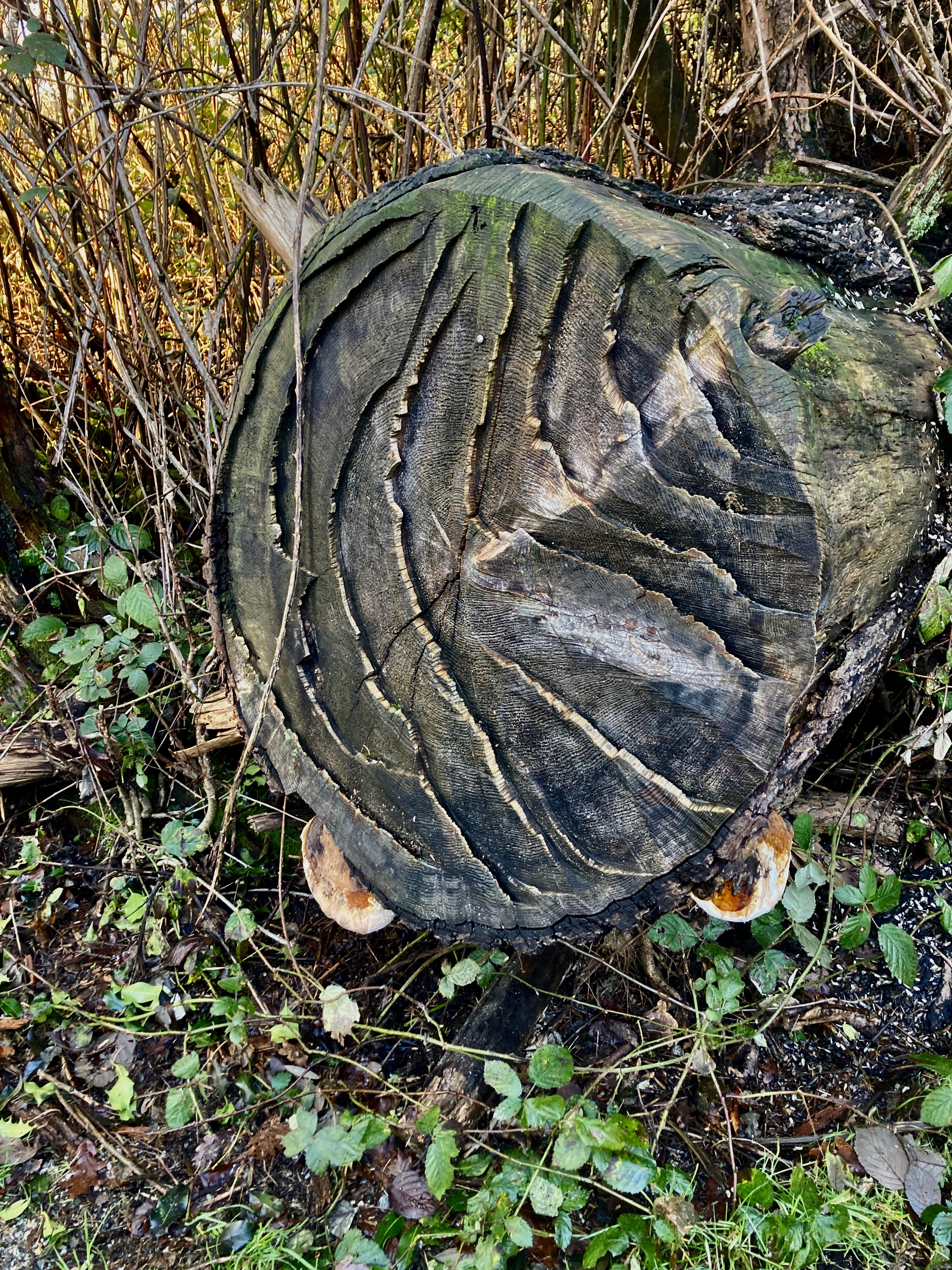
Humans cut; nature pretties up the resulting stumps and fallen logs.
Sometimes with cream/black/ochre fungi…
and sometimes with a smacking great burst of red and orange in the wood itself.
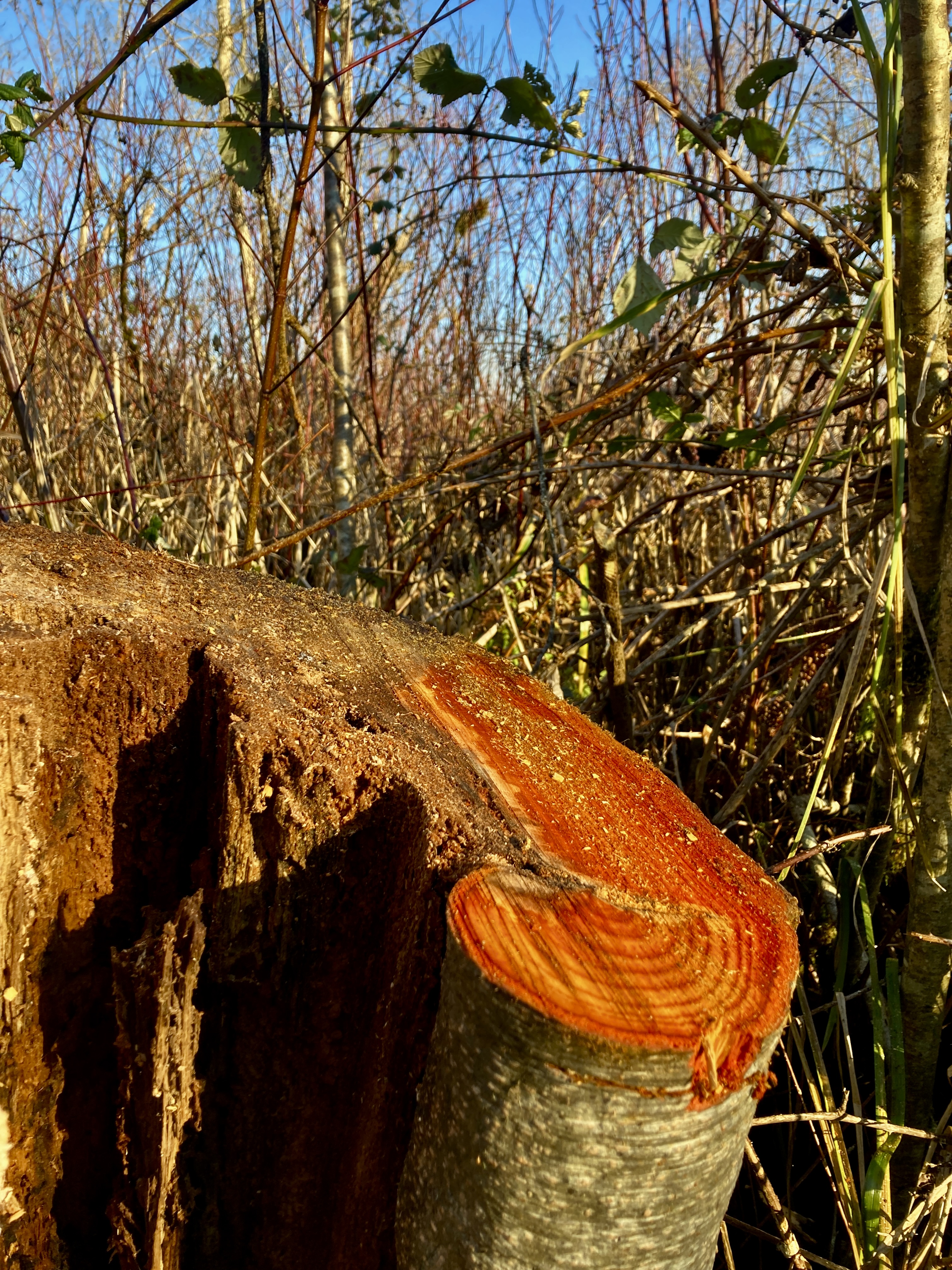
(Really! No enhancements.)
And then, as if that weren’t enough, right there in the grasses between stump and tree trunk…
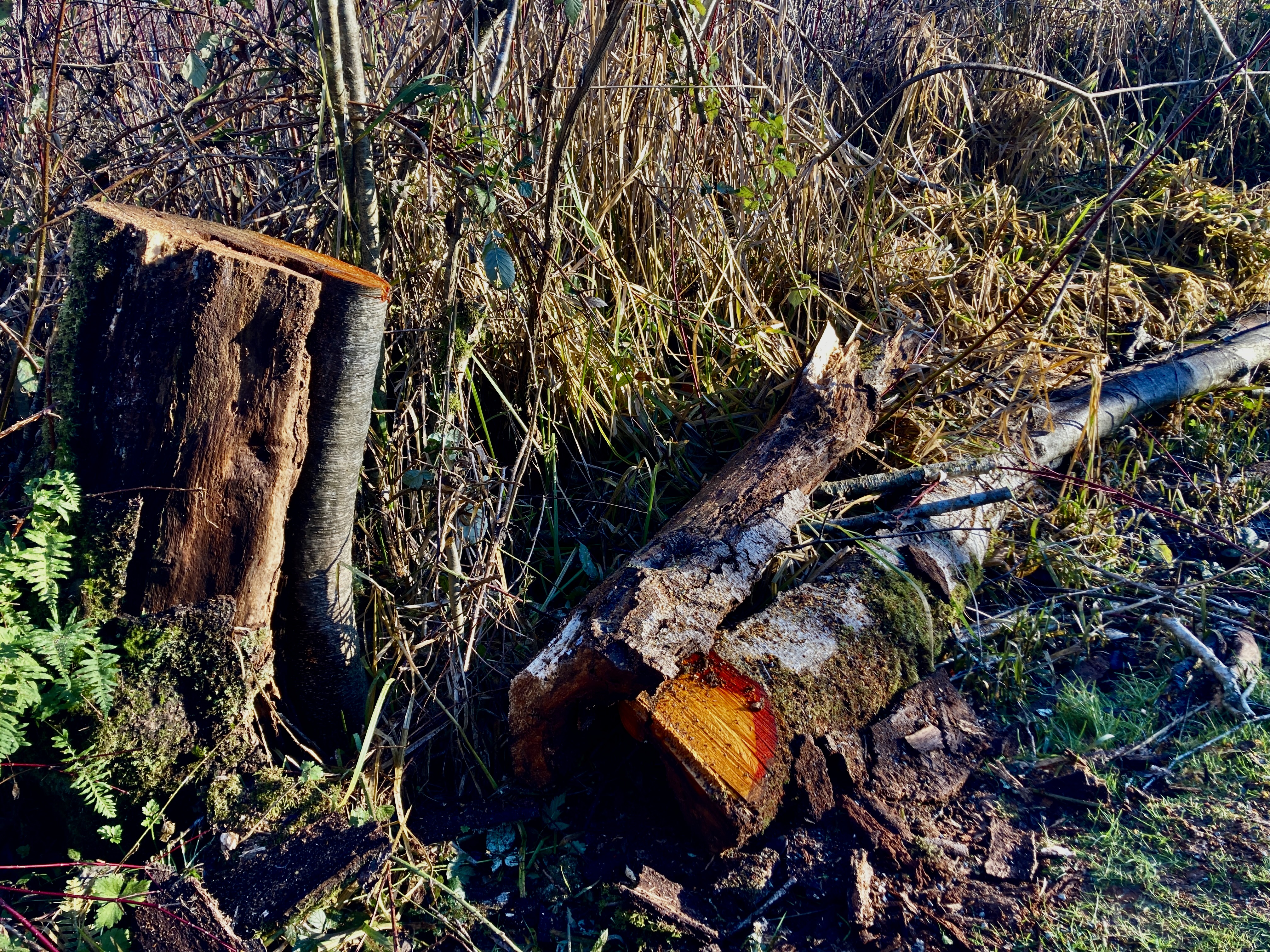
I spy a vivid little slice of off-cut. Which, to my friend’s amusement, I tuck into my knapsack.
On west we go, and turn onto the path that will take us to the viewpoint at the end of Piper Spit.
The waters along this path teem with happy ducks. Even my uneducated eye can pick out mallards, pintails, golden-eye and coots, as they mill about.
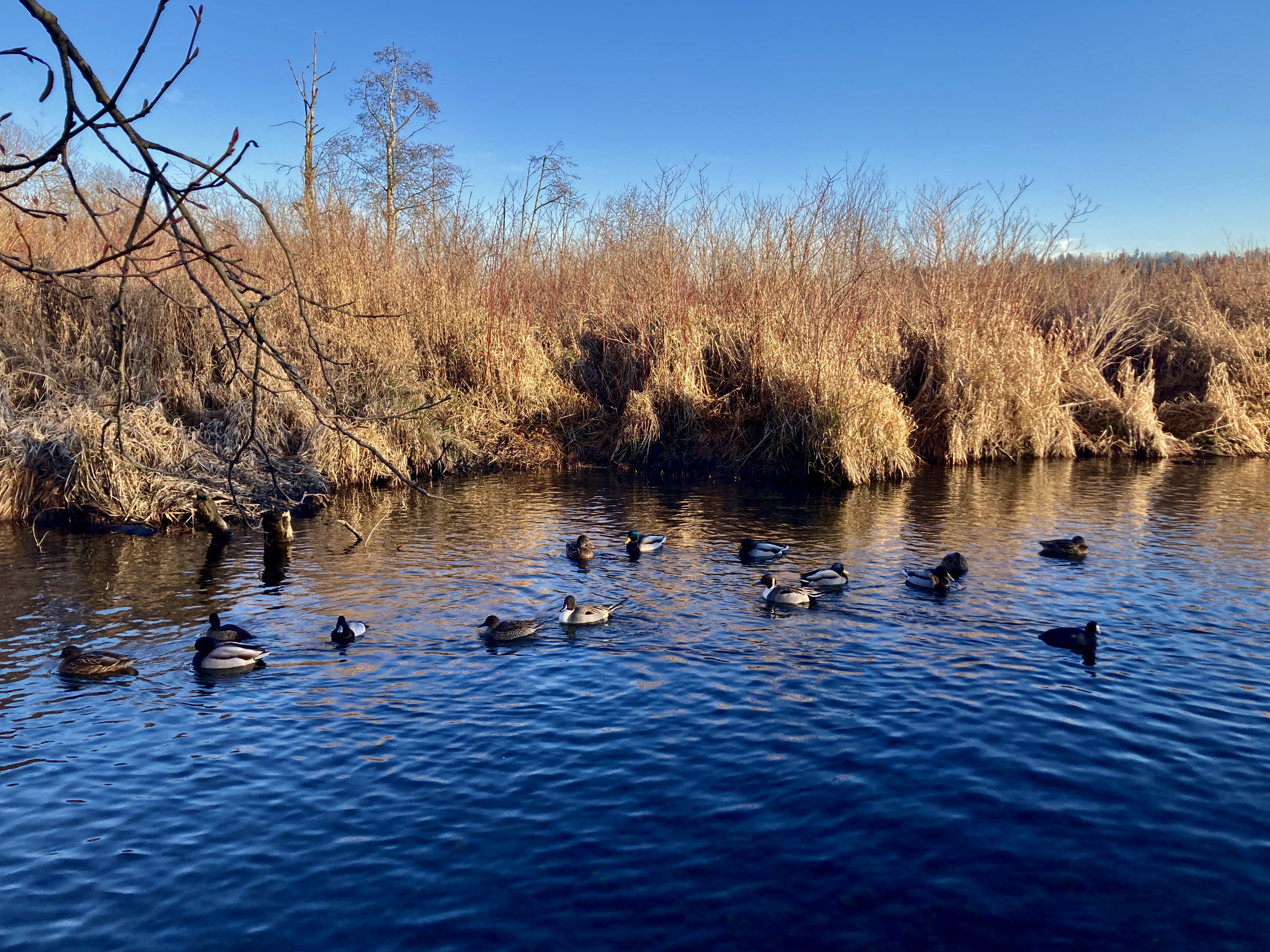
In the trees, chickadees and red-wing blackbirds.
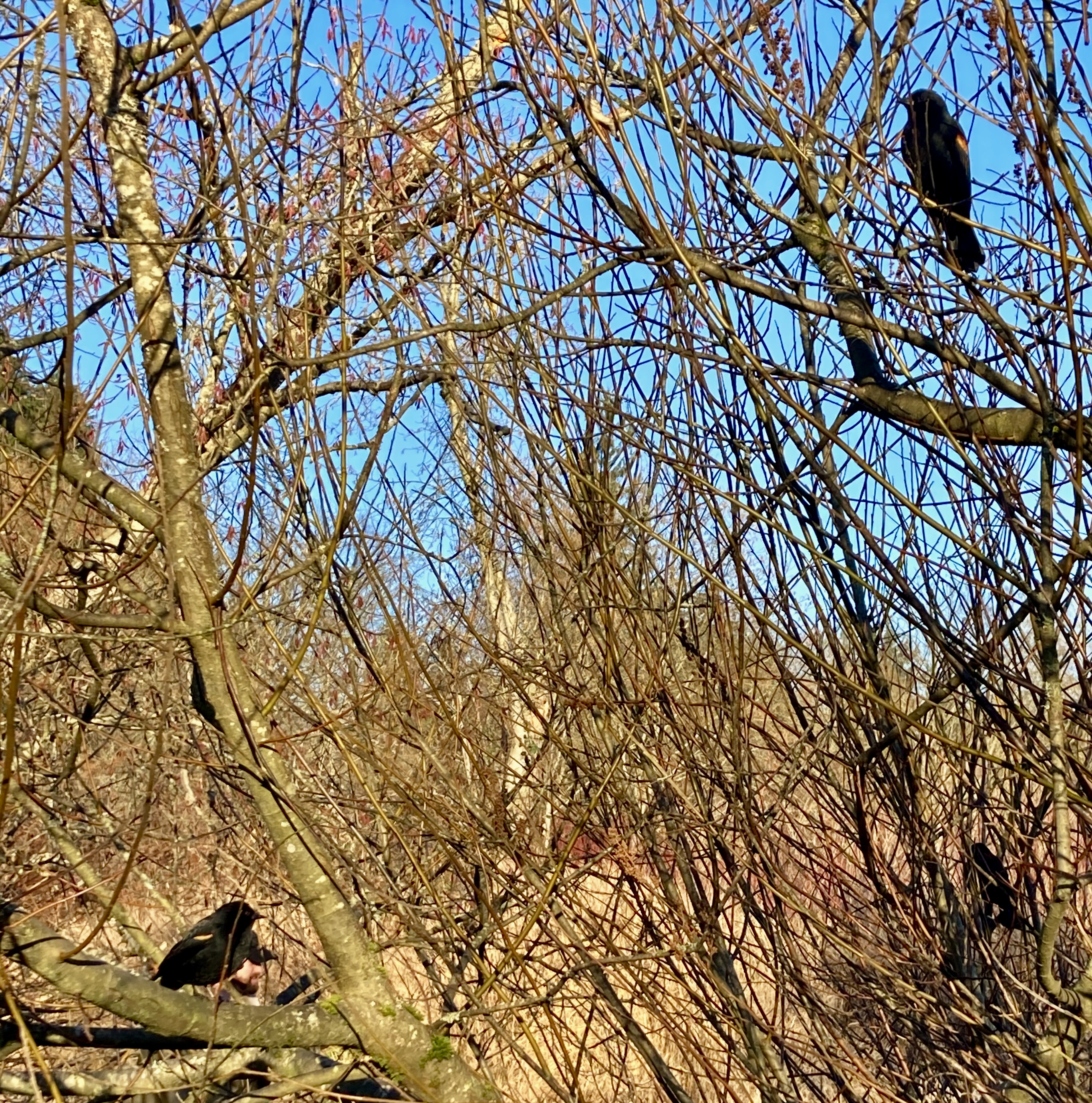
I confess: I deny these guys are red-wingers until they flash those chevrons. “Well, they don’t sound like red-wing blackbirds,” I grumble. Then I have to consider that this lot is a long way from the lot that my ear knows best, back in Ontario, and they probably have their own distinctive accent. (Am I right? Am I silly? Somebody please tell me.)
Tip of Piper Spit, we look east at yet more ducks (and gulls, and bird boxes along the shore)…
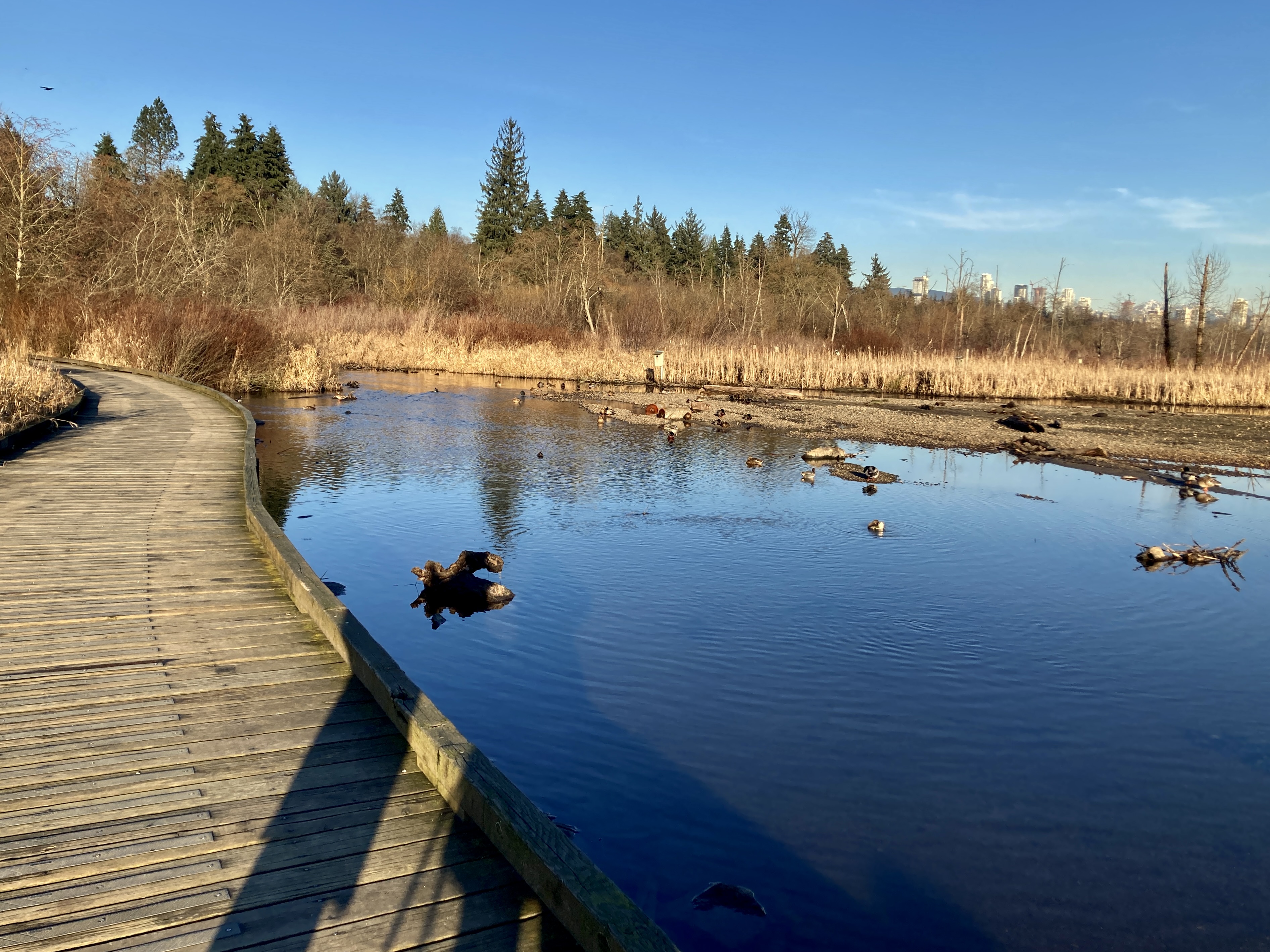
then west across mud flats toward the shoreline viewing tower.

Back to the main trail, and up the tower…
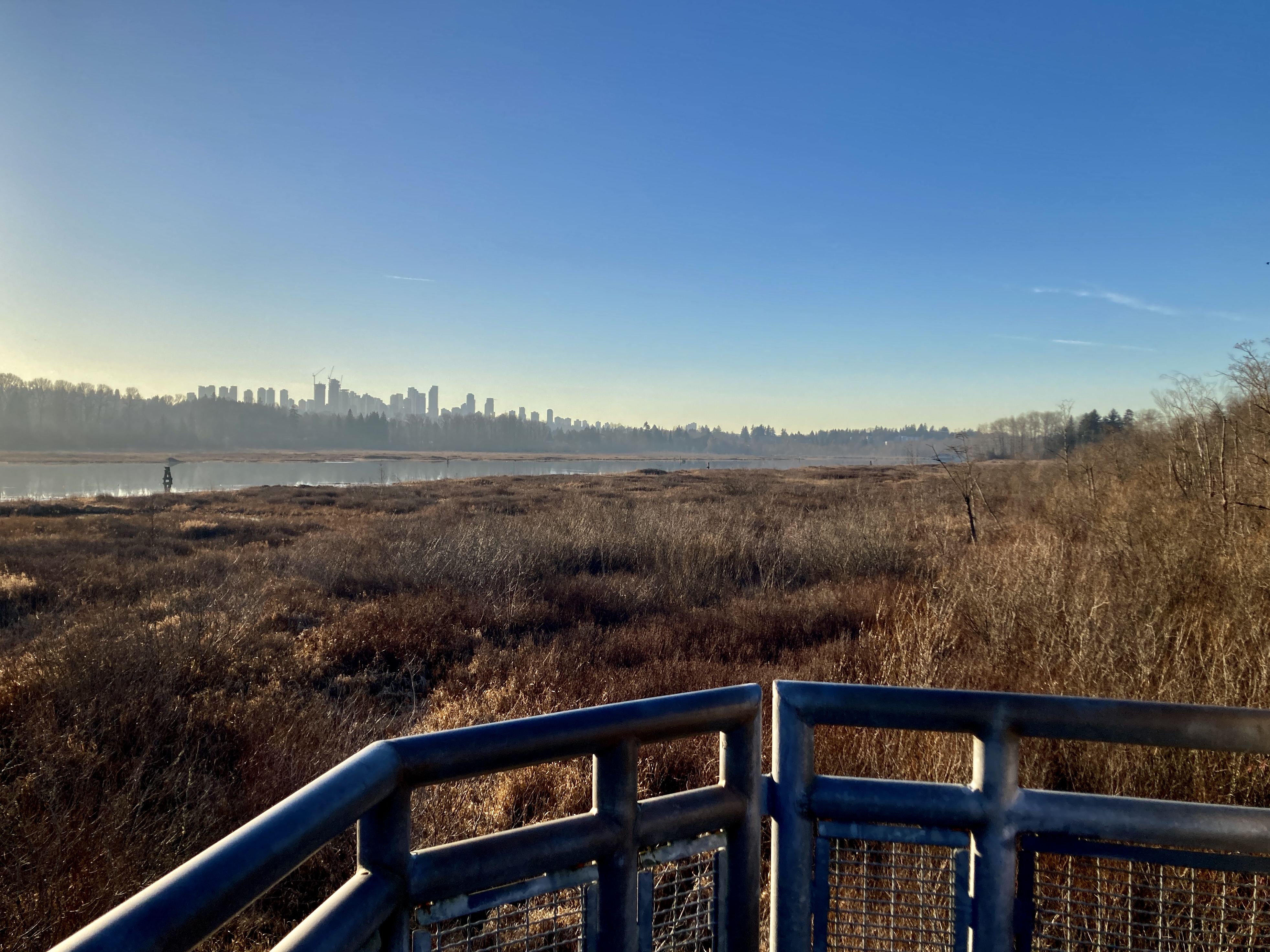
for a long view across grasses, lake and woods beyond, right to the towers of downtown Burnaby.
Beyond those towers, the Vancouver towers.
Where, once home…
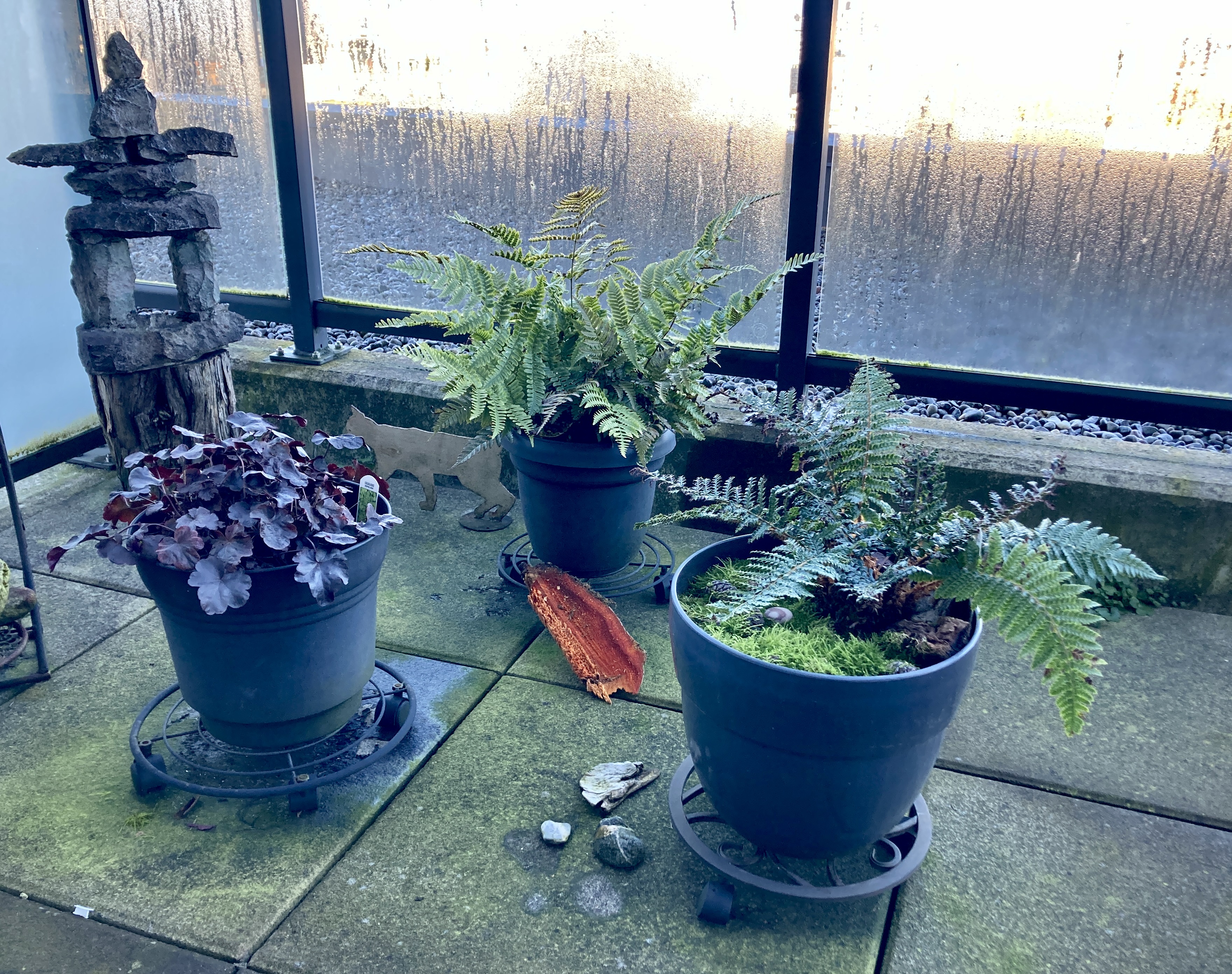
I settle my vivid little off-cut among its new companions.
Posted by icelandpenny on 17 January 2026
https://icelandpenny.com/2026/01/17/suddenly-sunshine/
10 January 2026 – I have an errand, down by Pacific Central Station, and the skies are not heaving anything at anybody. I am happy indeed as I walk north on Scotia Street.
Even happier when, near East 2nd, I get to moon over yet another growth of fresh winter moss on a curb-side tree.

Oh, I know. This is a perfectly ordinary photo of a perfectly ordinary patch of moss, and either you share my obsession and moon along with me, or you shake your head and move on.
As I also do.
Errand accomplished, weather still surprisingly agreeable, I keep walking north. Cutting through False Creek Flats, I see that this stretch of battered old warehouses is, apparently, finally being demolished.
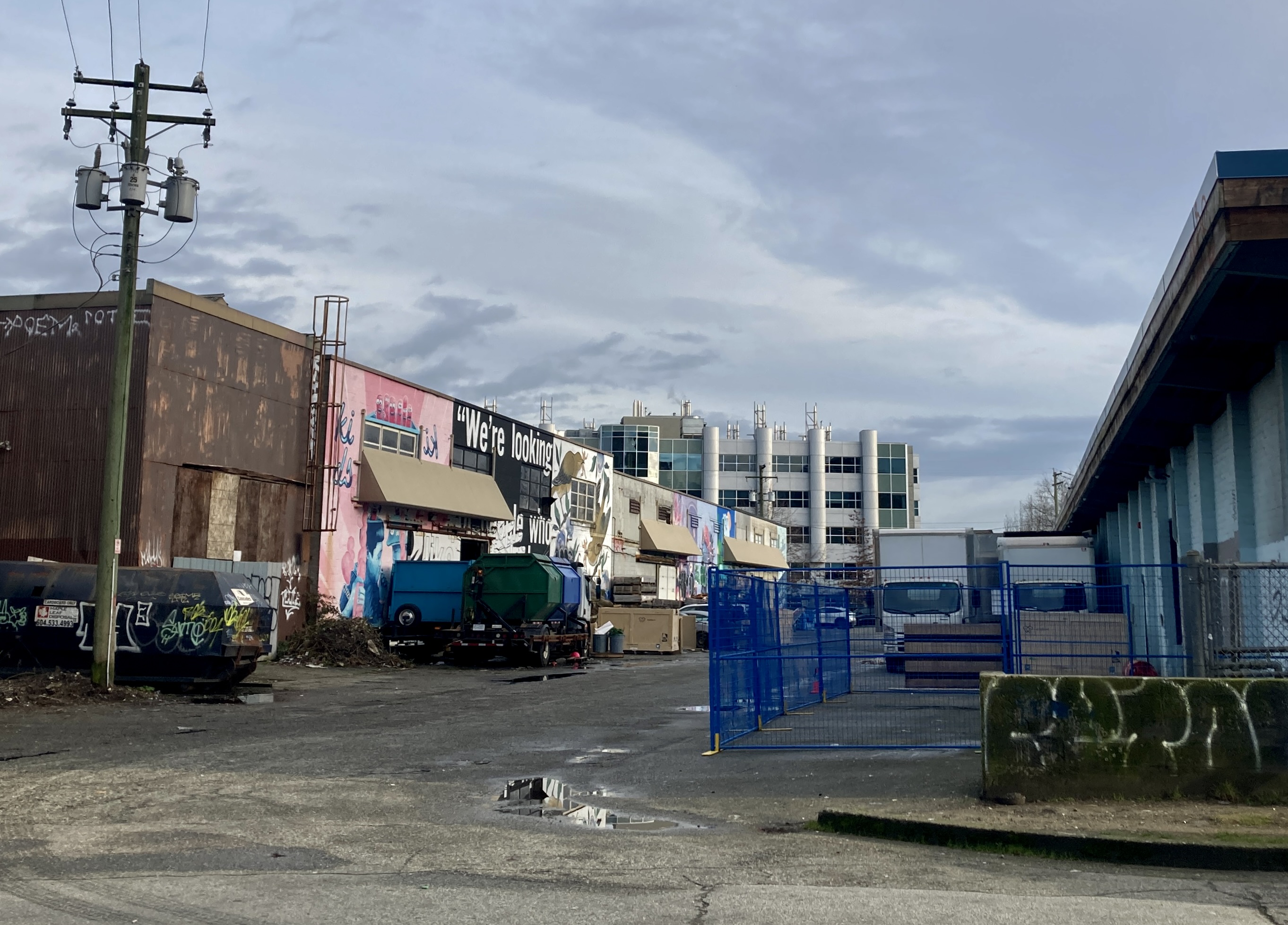
All the signs suggest this conclusion: windows boarded up, dumpsters out front, bright blue mesh fencing. Down there at the far end, the kind of new-build we can likely expect — structures to welcome more “knowledge industry” activities.
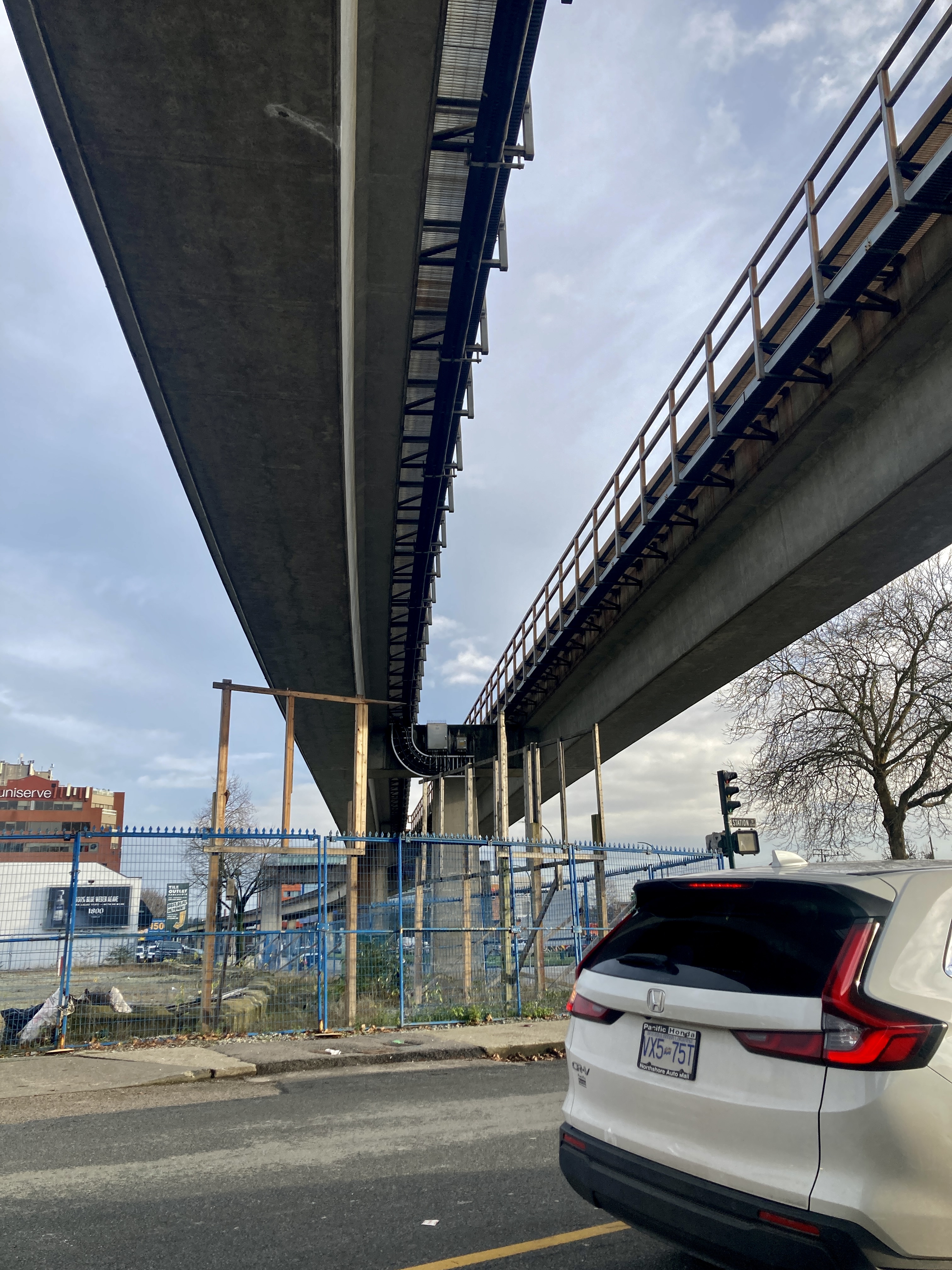
Across Terminal Ave., heading indeed toward the terminal (Pacific Central Station), I look up while waiting for a light to change. It gives me time to admire the vee of SkyTrain tracks overhead.
I also have time to look left, skimming my gaze along the front façade of Pac Central to rest on the cranes beyond…
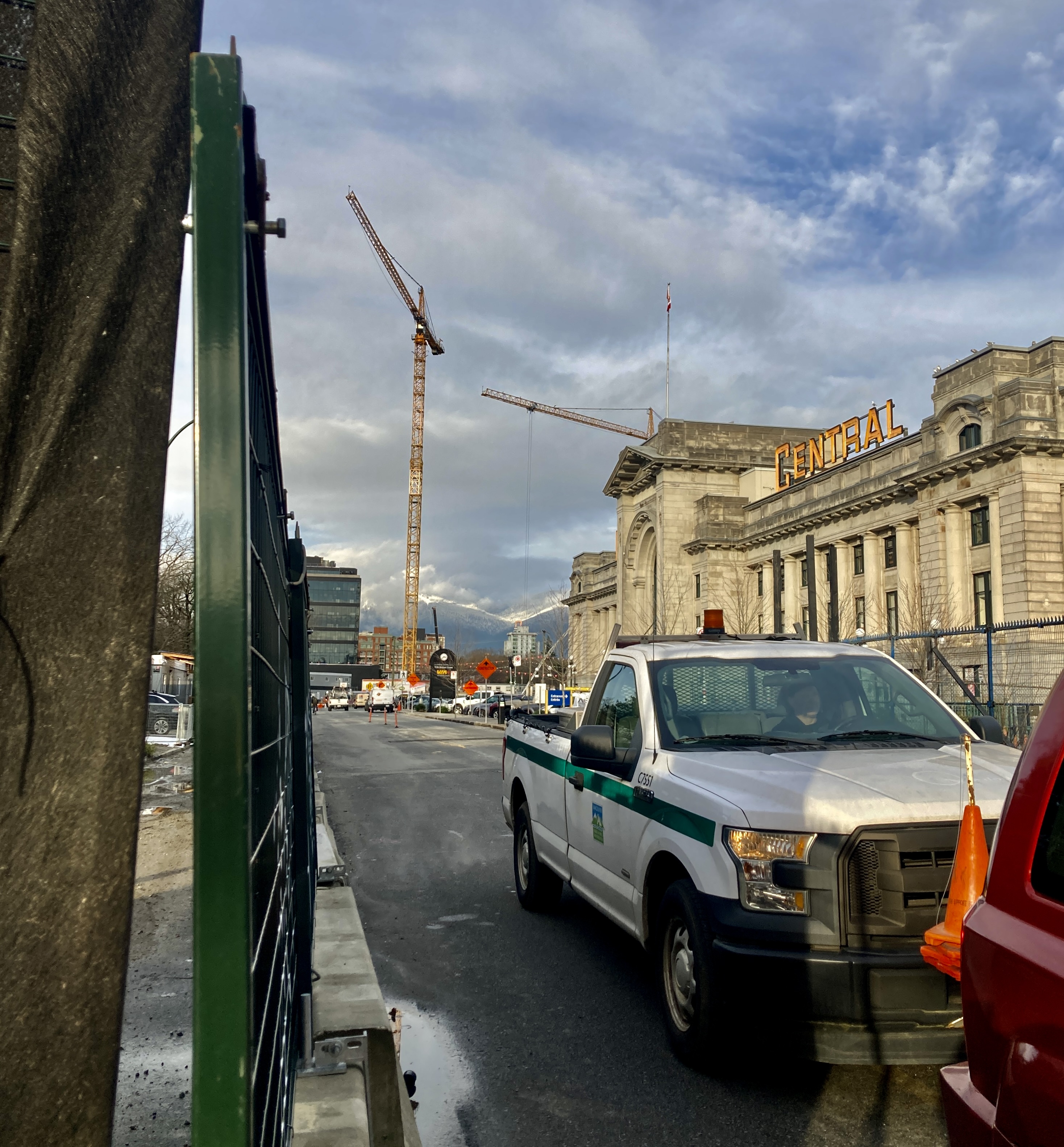
which mark a New Build worthy of those capital letters: the new St.Paul’s Hospital complex.
Lights change. I cross, I walk, and I pivot around this elegant lamp post shadow at the far train station corner…
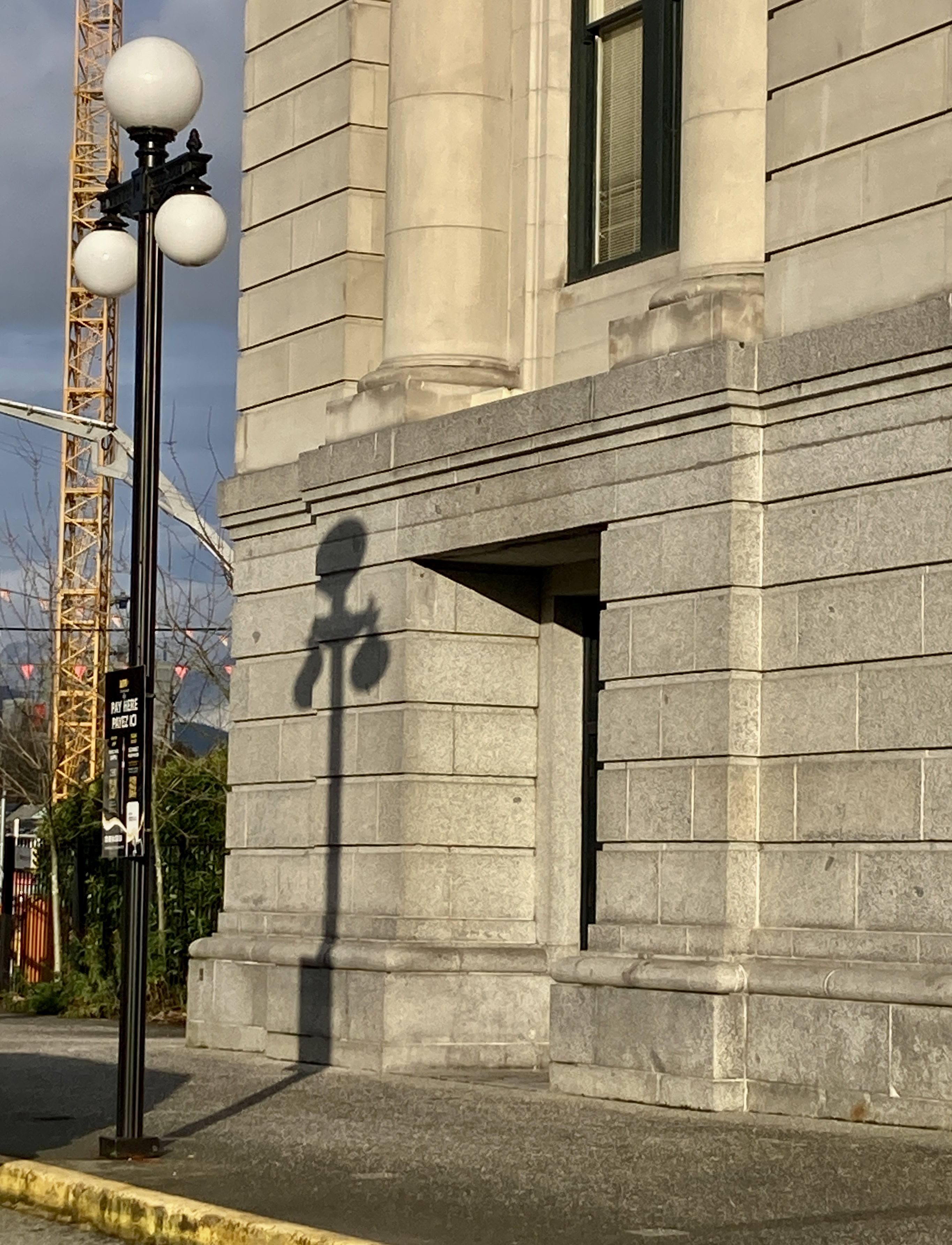
to see…
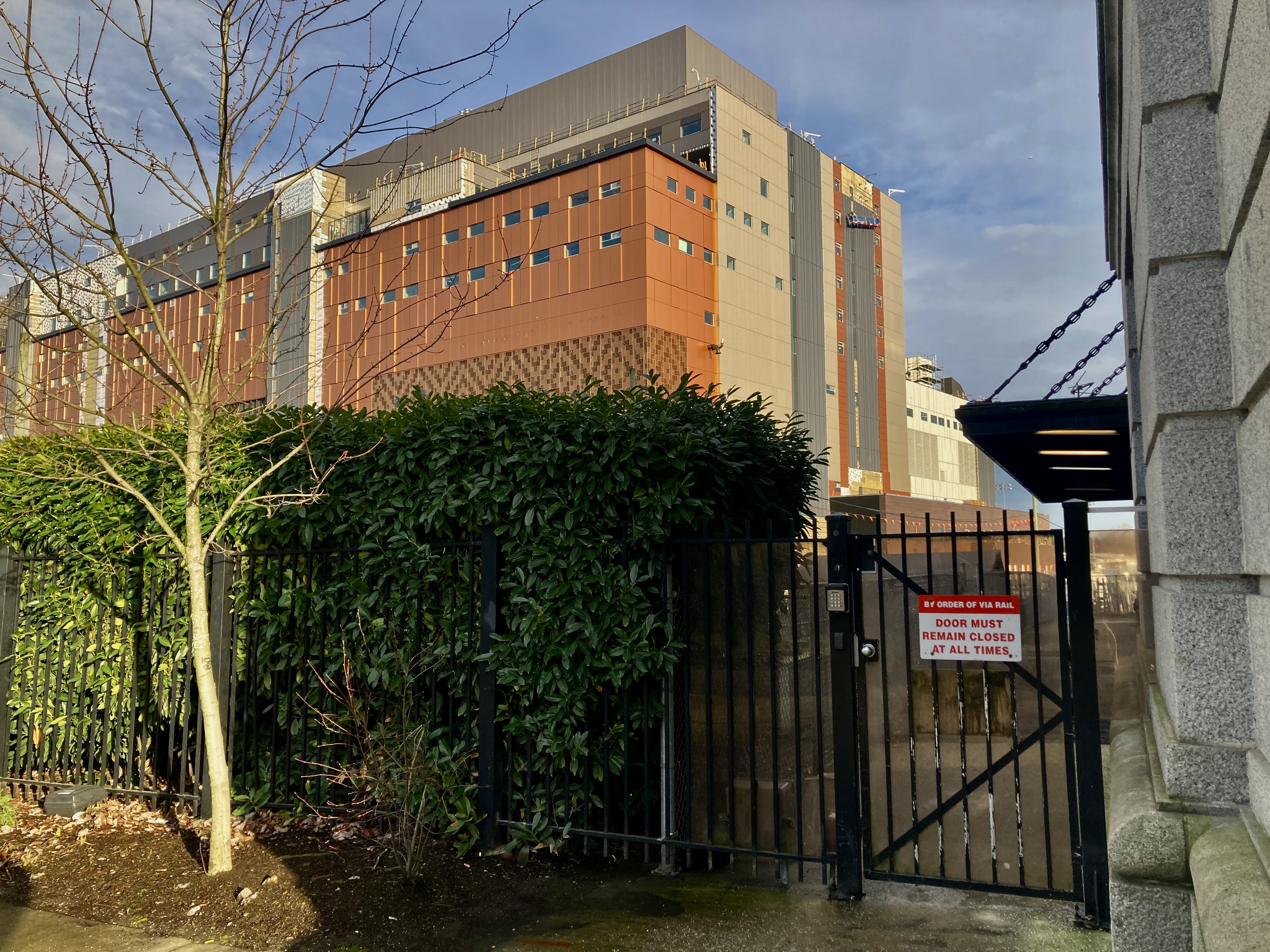
the bulk of the new hospital, now showing us its full dimensions and scale.
One peek at an explanatory billboard, visible through a gap in the fencing…
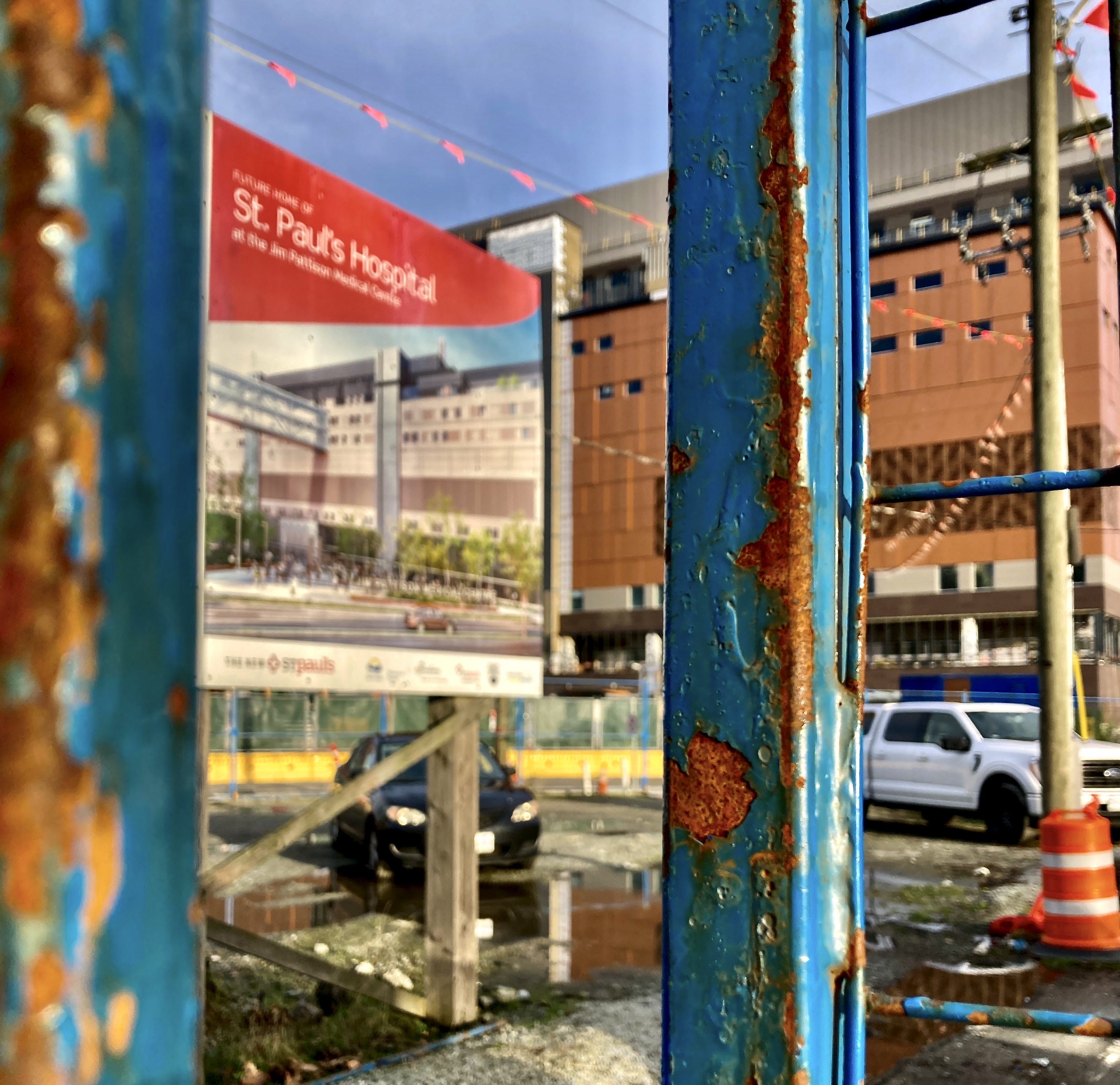
and I right-turn to follow a pathway to Gate 4, which runs along the far side of the complex.
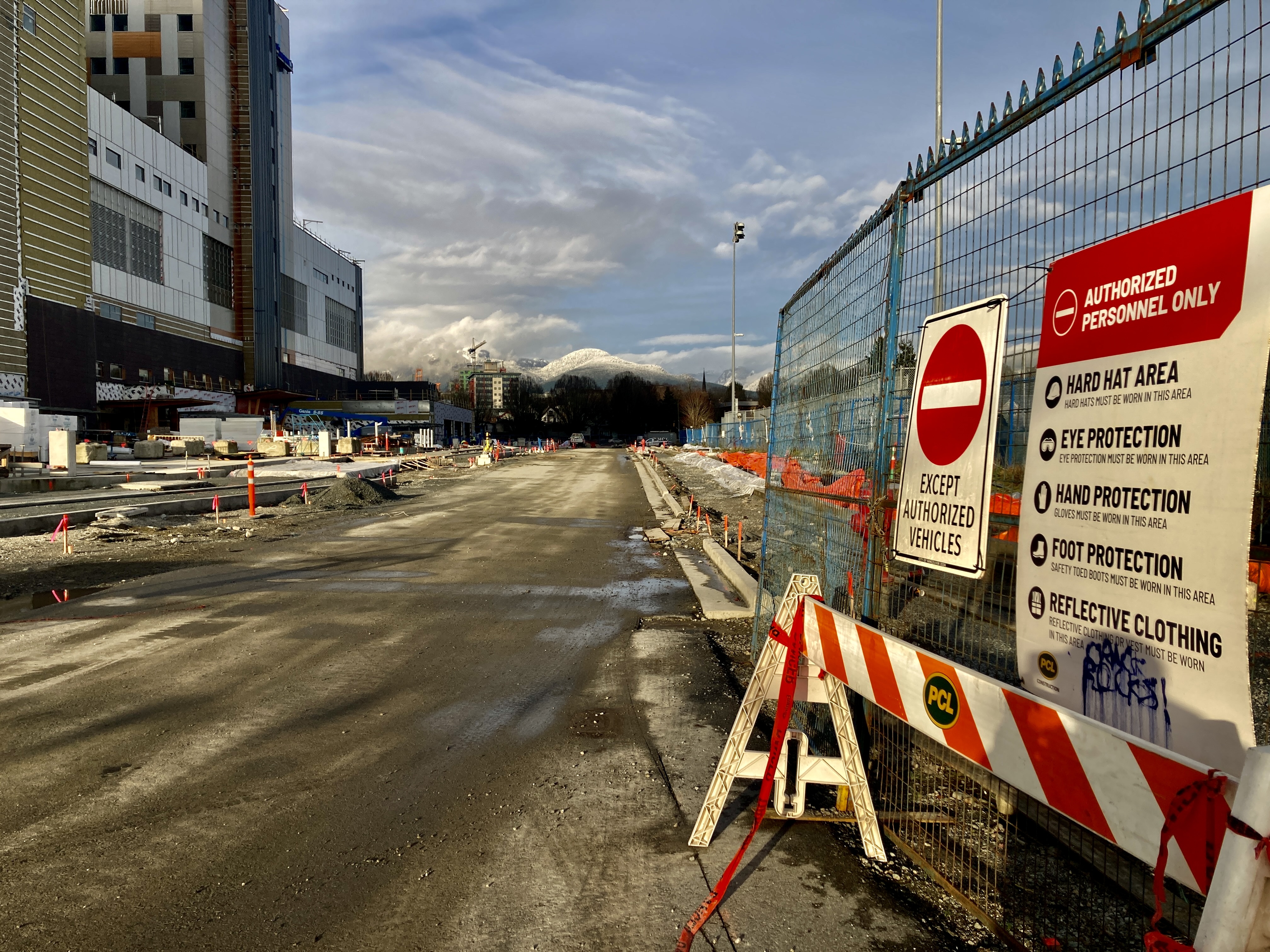
East side of the building to my left, Trillium Park to my right, and straight ahead — over there in North Van, the far side of Burrard Inlet — snow on the mountain peaks. Plus, you bet, warmly dressed skiers.
Down here at sea level, the Trillium Park soccer players are lightly dressed…
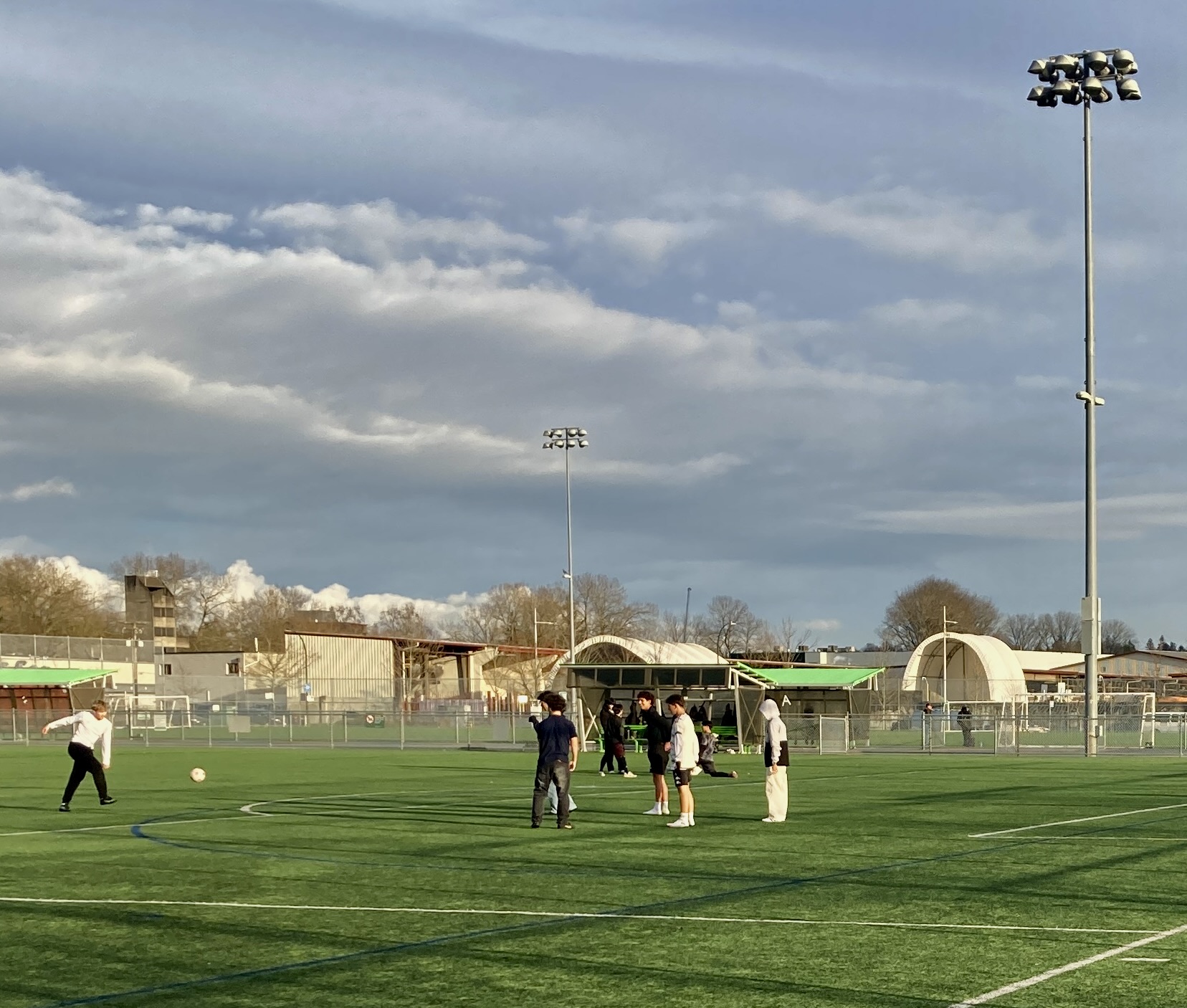
and even I have bare hands and an open jacket.
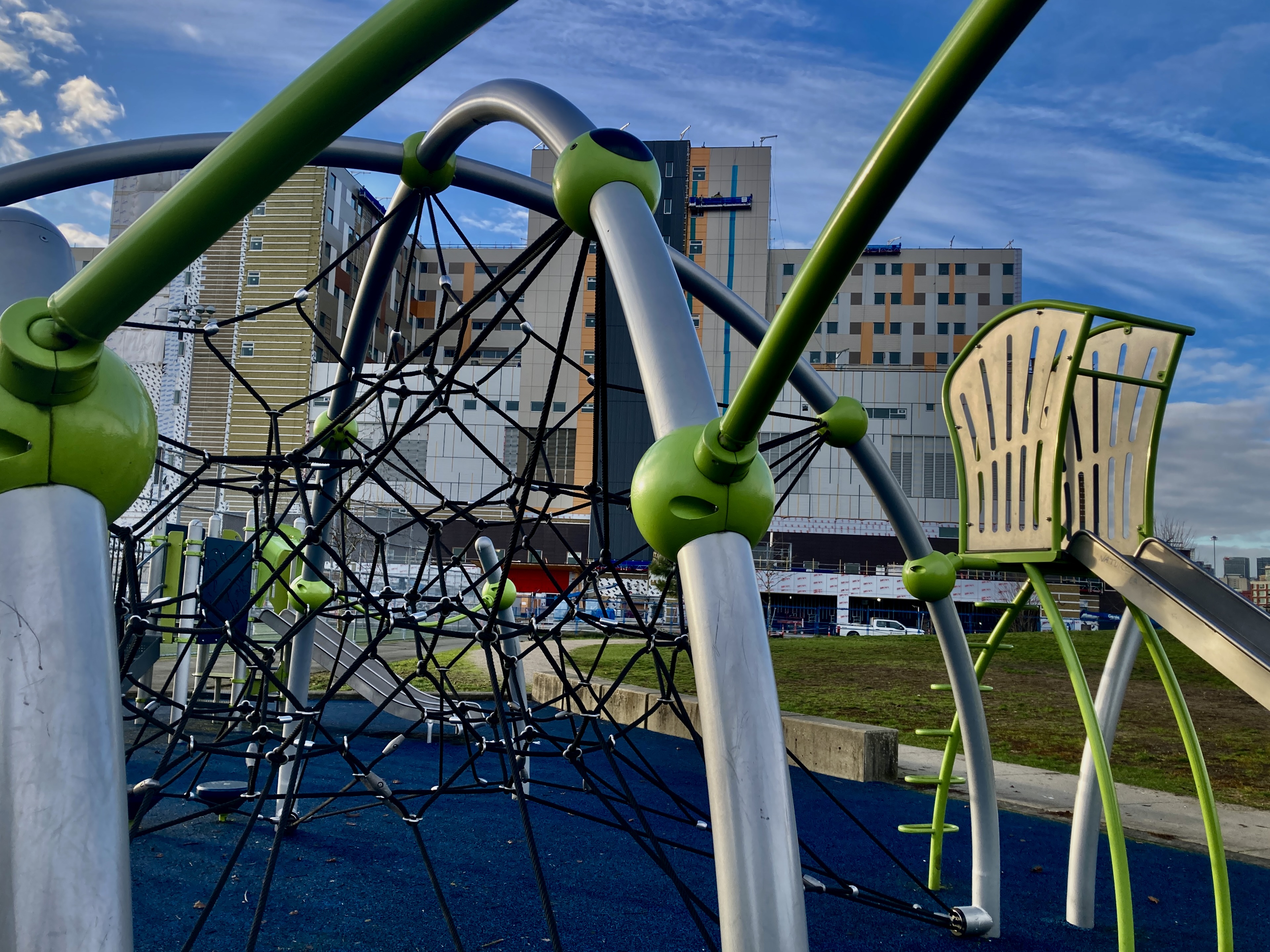
One last glance at the hospital complex through playground equipment in spiffed-up Trillium Park…
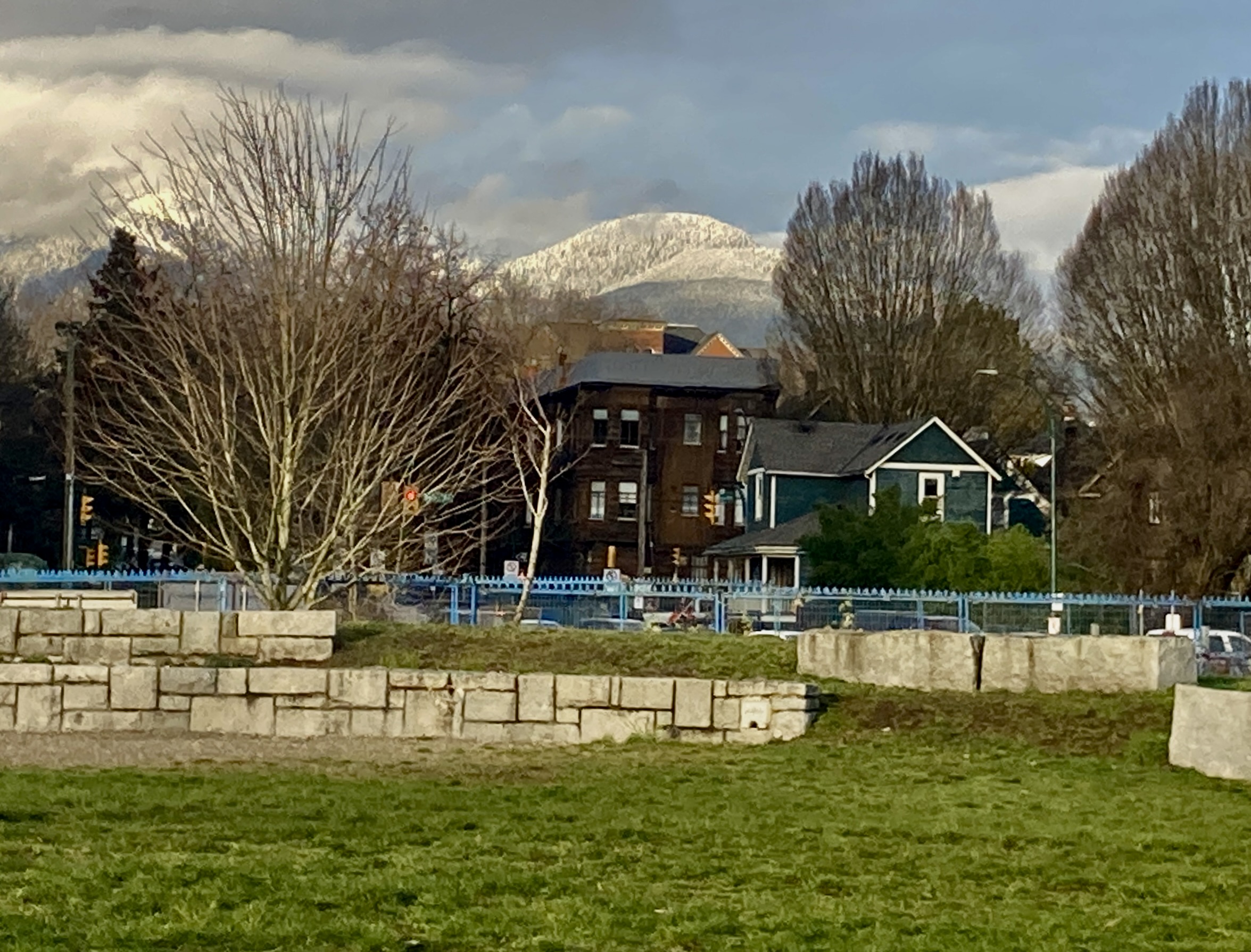
one last salute to all that high-altitude sparkling snow…
and I carry on north & west into Strathcona, heading for Main Street the other side of Chinatown.
My zigzag takes me between two very modest apartment complexes. I’m thinking they’re a bit on the grim side, then slap myself for snobbery. Whatever their aesthetics, they are clean & tidy & details like paint and windows look well-maintained.
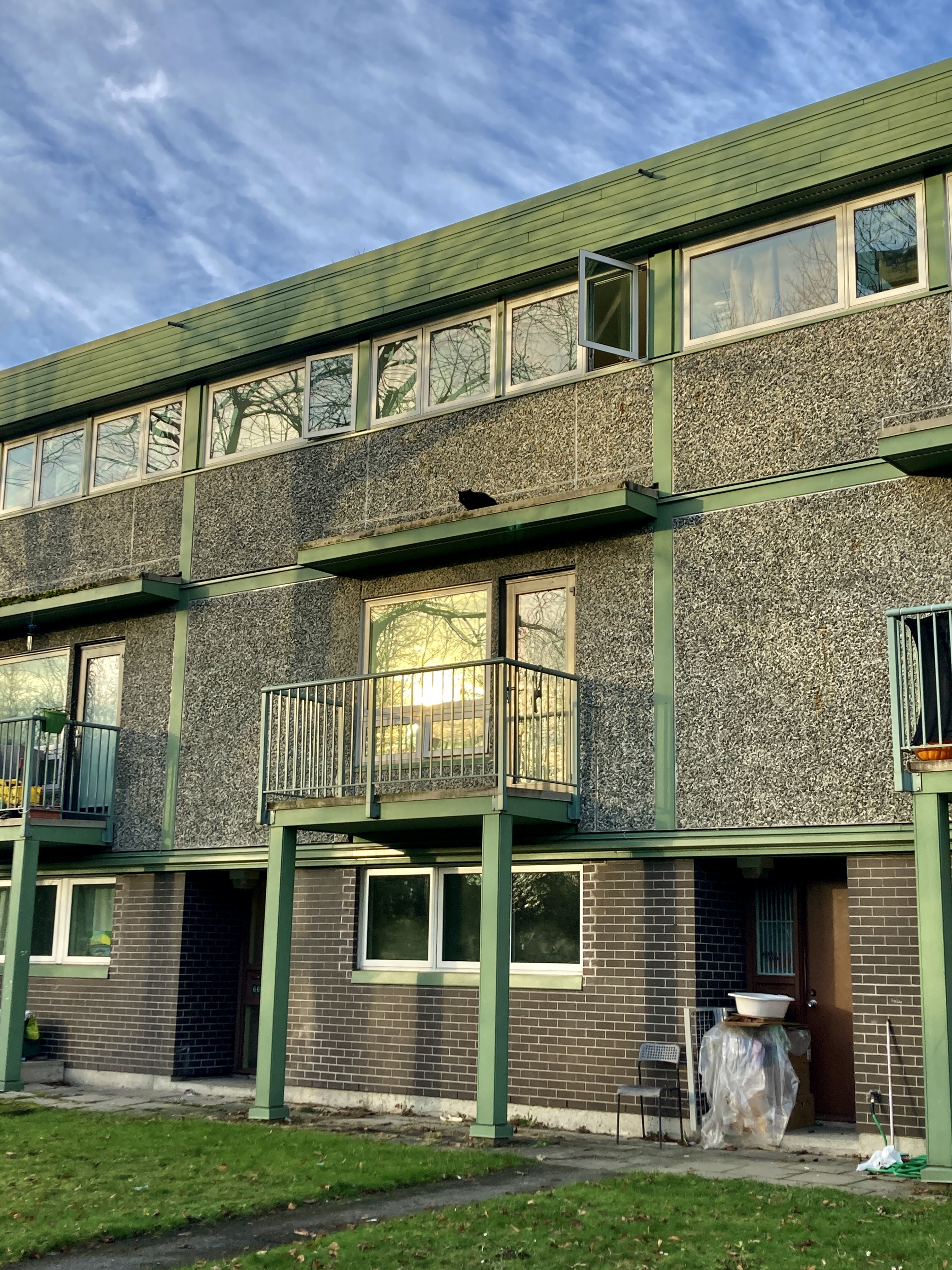
But that’s not why I’m showing you this photo. After you pass (or don’t pass) your own judgment on the aesthetics, please note the black blob on the ledge between the centre balcony and the open window.
See it?
It is not a blob.
It is a cat.
Out of the corner of my eye, I caught sight — or so I thought — of a cat tumbling out that open window, surely to his death. He does not die. He lands on the ledge. I stand there, waiting for him to start wailing for help. He does not wail. He settles down, toes curled over the front of the ledge, and does what he clearly does on a regular basis. He fills his lungs with fresh outdoors air, and watches the world go by.
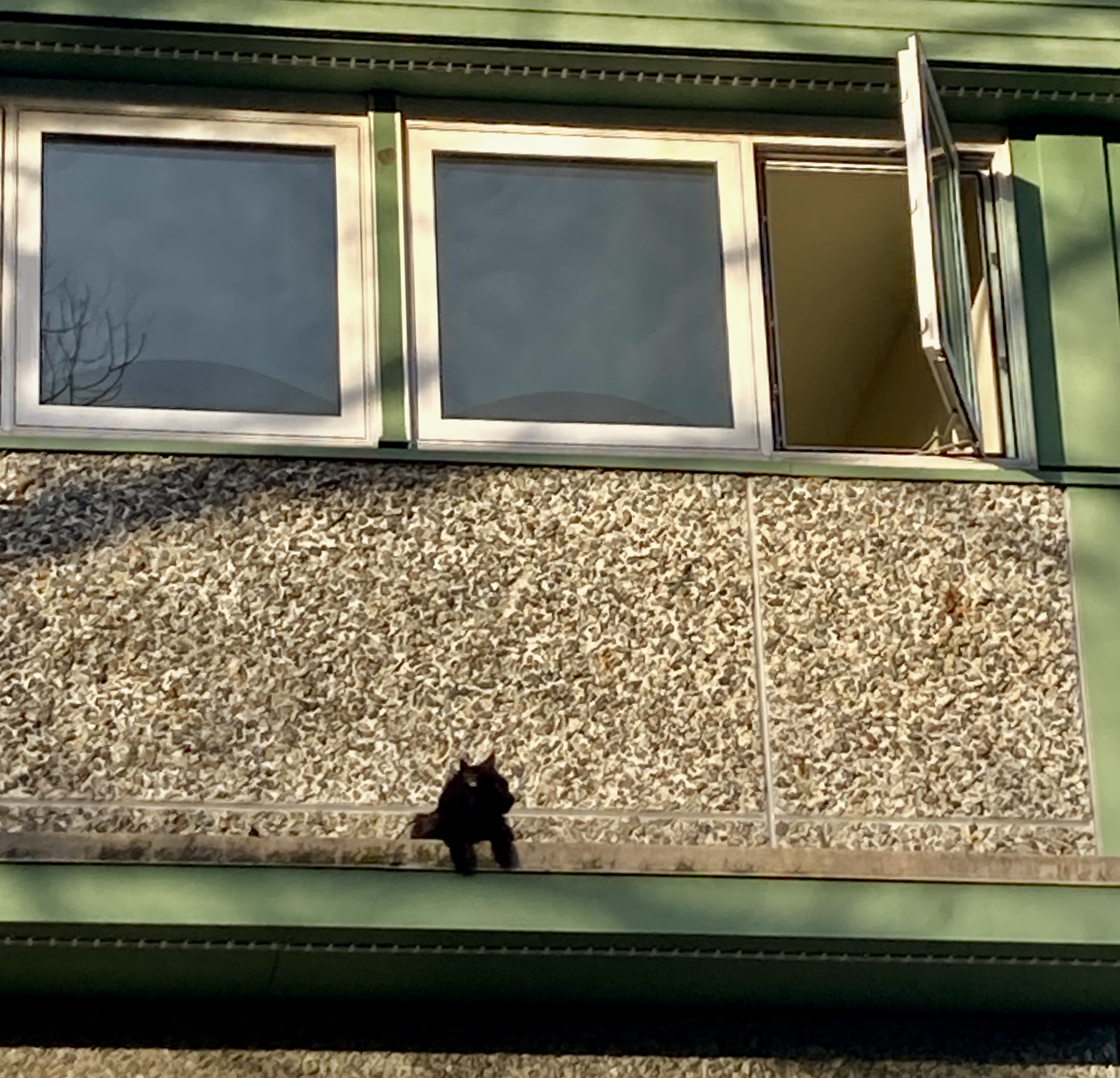
I salute him with great respect. He ignores me.
I walk on.
Posted by icelandpenny on 10 January 2026
https://icelandpenny.com/2026/01/10/new-moss-new-builds-new-snow-a-very-calm-cat/
1 January 2026 – Well, it is forward, isn’t it, when the reverse of your usual choice offers a new way to look at things. It’s hardly a major life breakthrough, but it does qualify as a pleasing little experiment, and worthy of the first day of a new year.
My “little experiment” is to walk the Burrard Inlet Seawall east-to-west between Waterfront Station and Stanley Park, instead of west-to-east. I know: small stuff indeed. But the fog is burning off, and it isn’t raining, and the temperature is comfortably above zero. Good reasons to drop off a bus at Waterfront Station, and get myself down to the water by Canada Place.
Tourists and locals stroll; the sights present themselves for admiration:

the fabric roof “sails” of Canada Place, the rental bicycles, a SeaBus completing its run from North Vancouver, a laden freighter and, of course, the orange cranes that tend to the freighters.
After that, my eye seems to focus more on slivers of scenes, not the whole panorama.
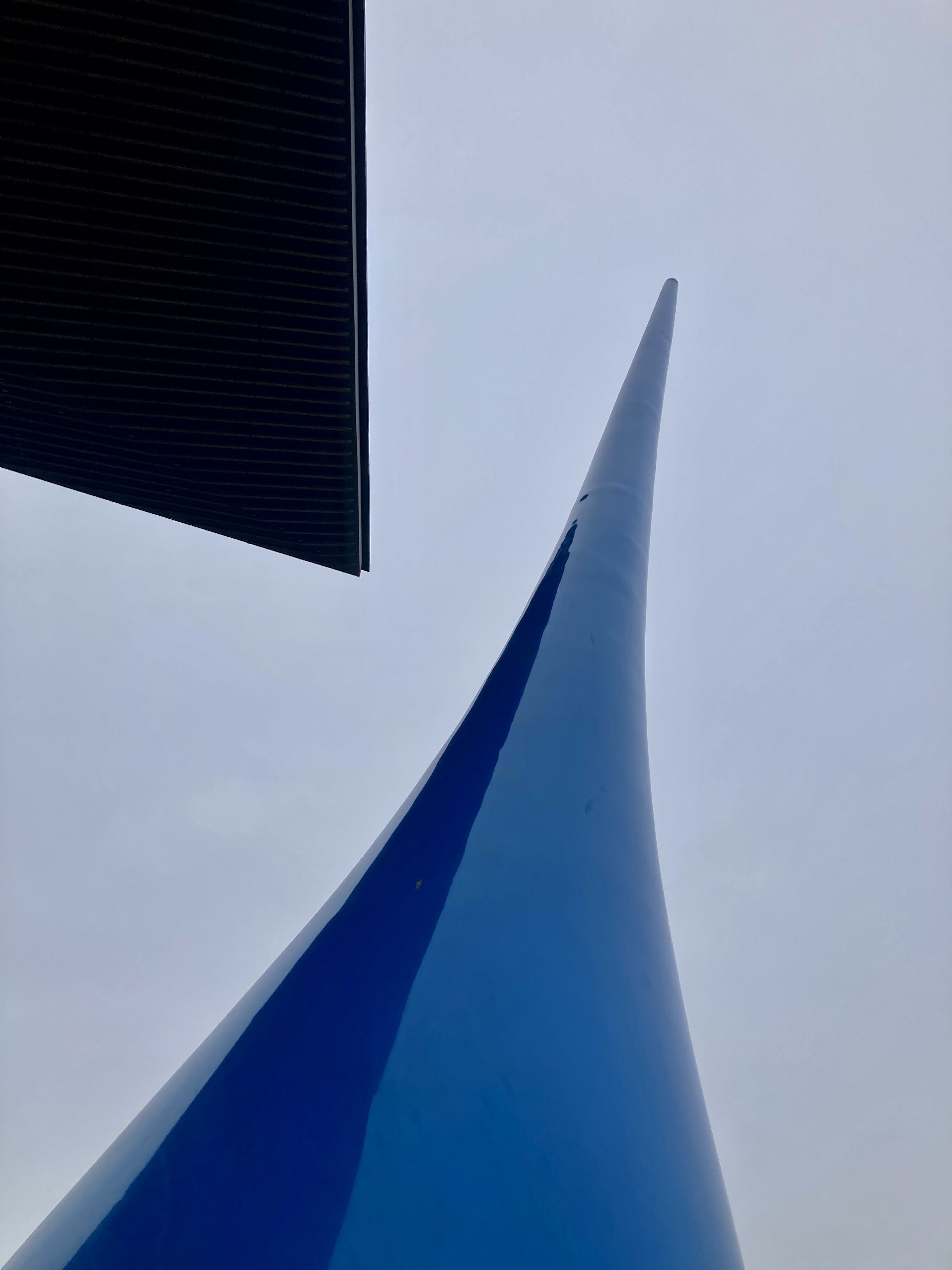
The tip of The Drop, the 2008 sculpture in Bon Voyage Plaza by the German four-artist collective Inges Idee that honours our temperate rainforest status with one elegant raindrop…
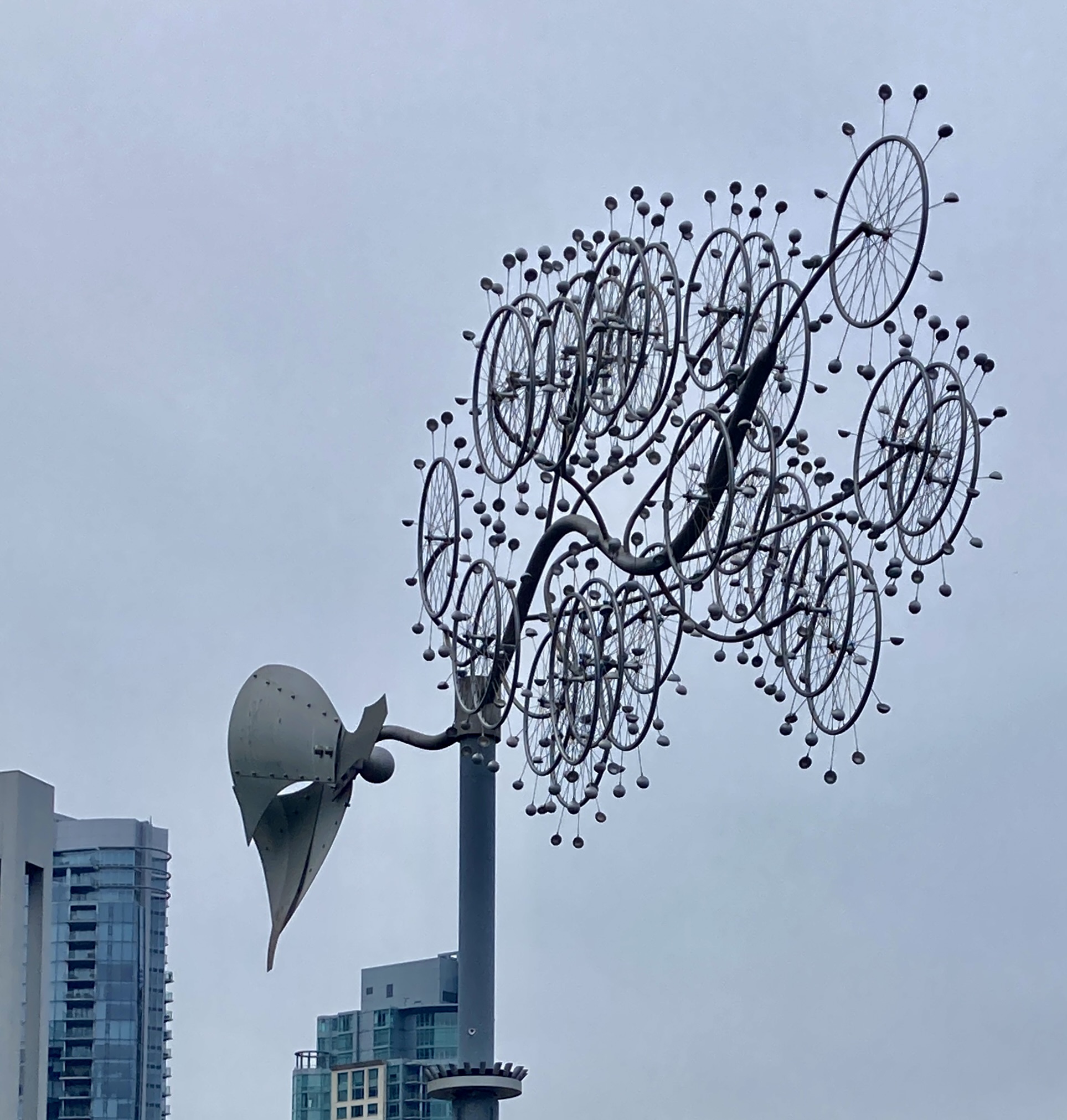
Doug Taylor’s kinetic weathervane Wind Wheel Mobile just west of the Convention Centre, which, from this angle, resembles a bobbing duck more than a weathervane…
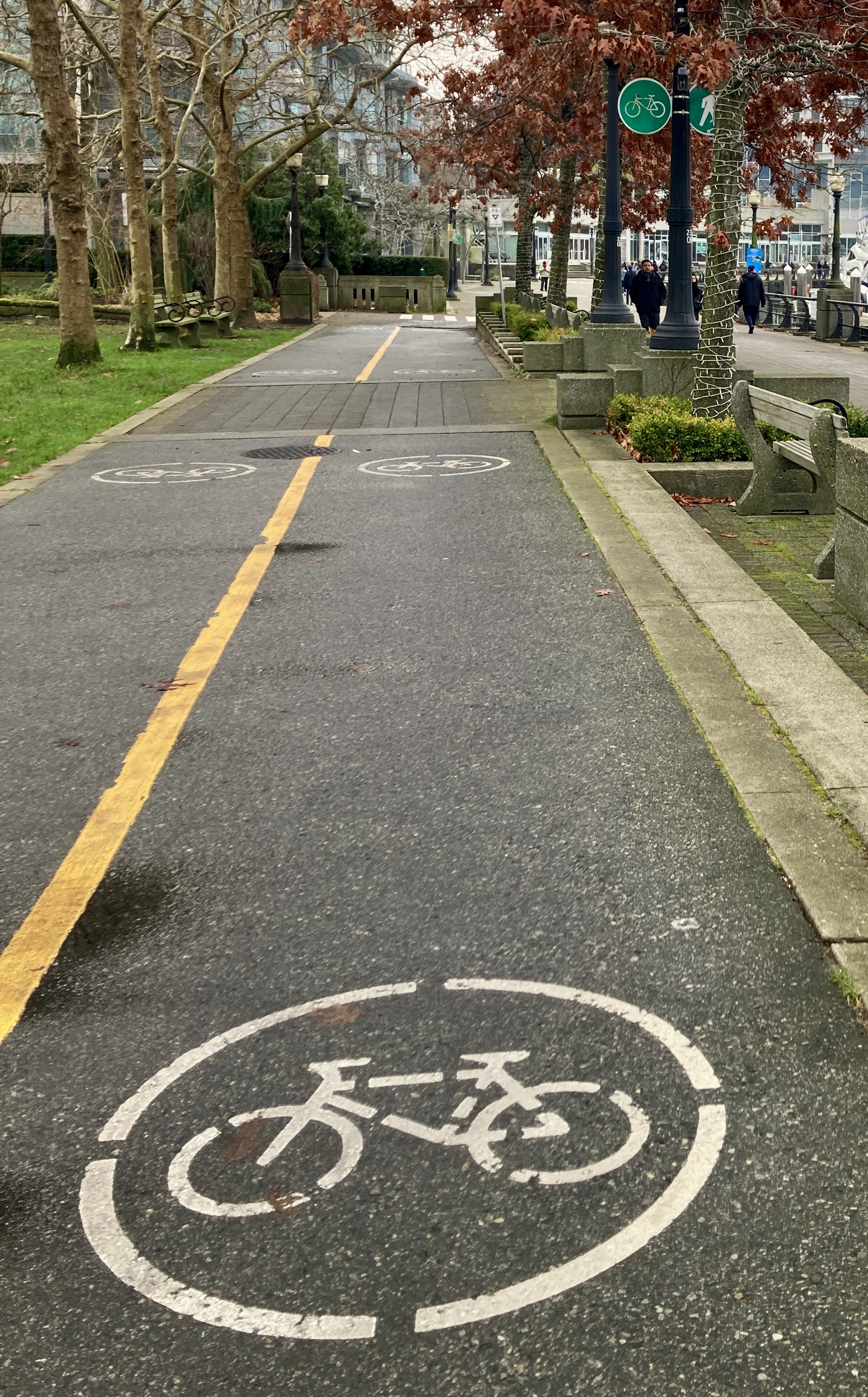
Seawall bike lanes bordering the west side of Harbour Green Park, under a russet canopy of (I think!) winter beech leaves…
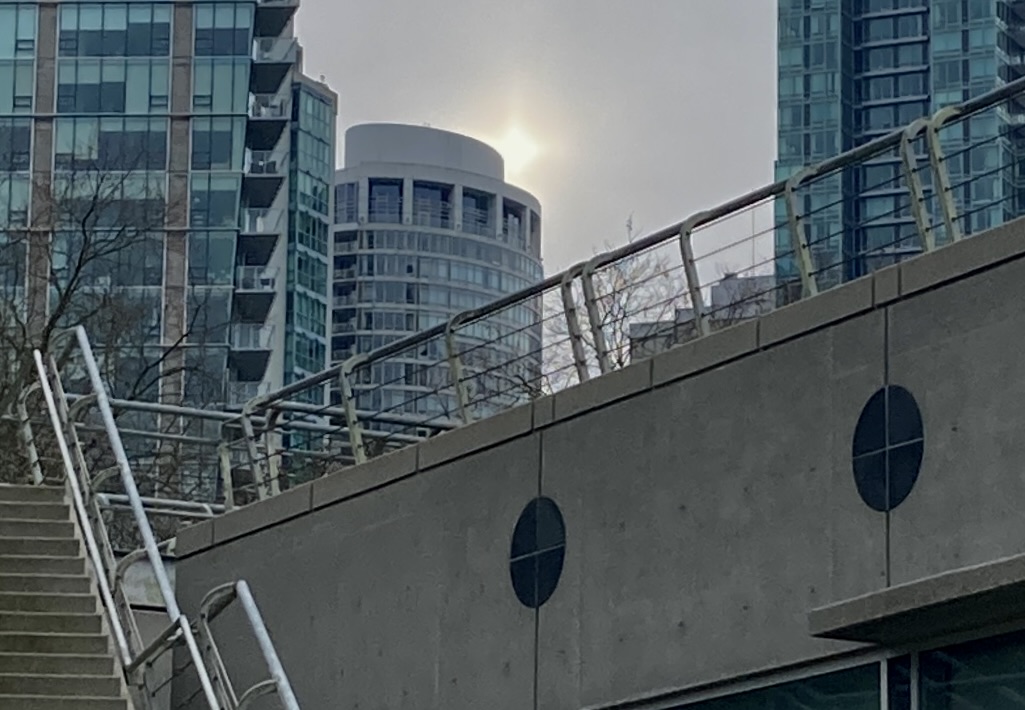
and the merest ghost of the sun, glimmering through the fog between buildings at the top of a Coal Harbour Park staircase.
I spend a moment with Santa’s floating gift “To YOU” in the Coal Harbour marinas.
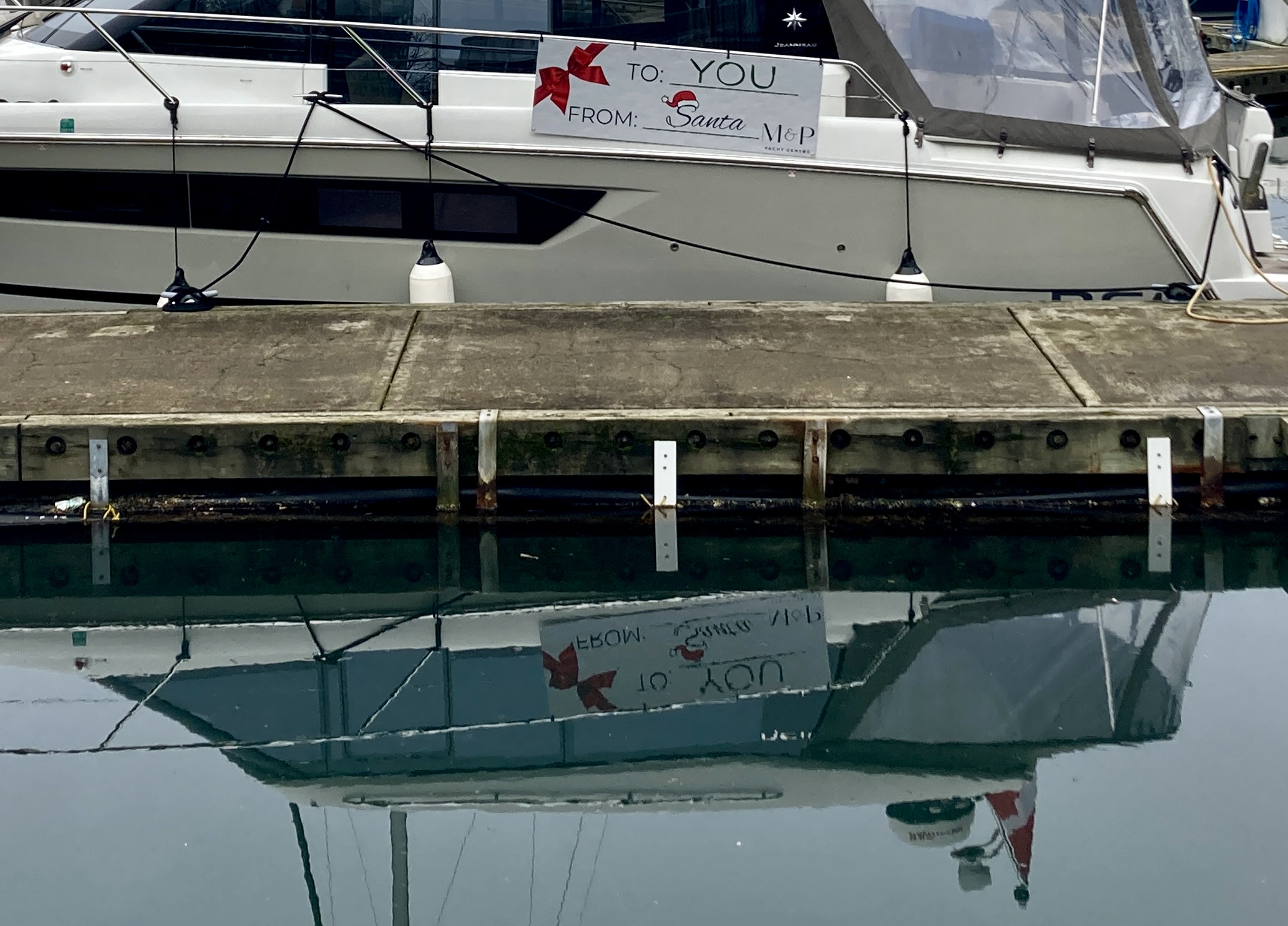
Really a lavish Christmas present? Or, wait a minute, a clever-boots For Sale sign? The suspiciously generic label bears the M&P Yacht Centre logo, after all.
Far (west) end of the marinas, and I pause again, this time for something I feel no need to interpret.
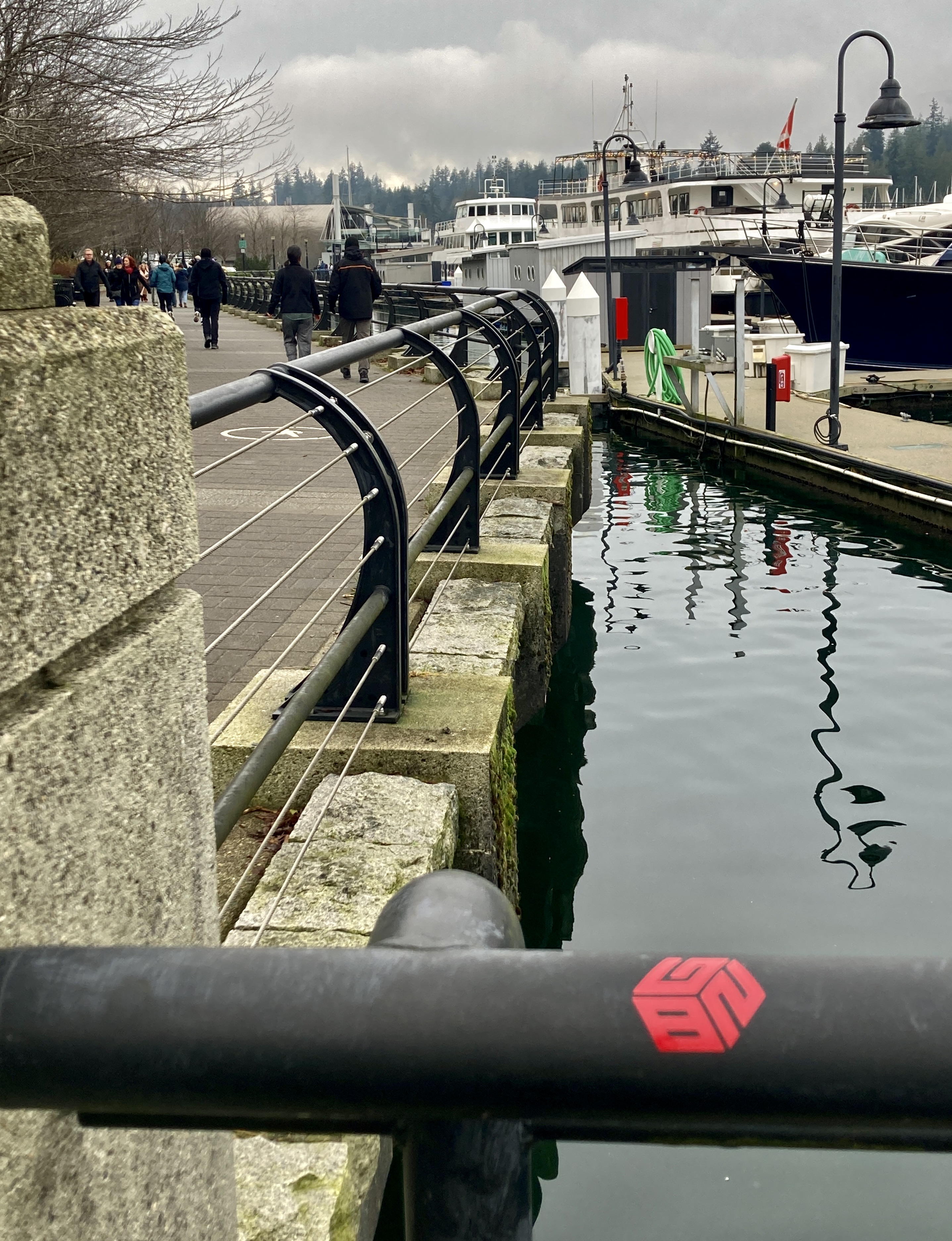
A red cube sticker + a vee of water. I just like it.
Then the brass curve of the Coal Harbour Fellowship Bell (commemorating the companies and people of the “self-contained industrial marine community” that, 1891-1979, populated this area)…
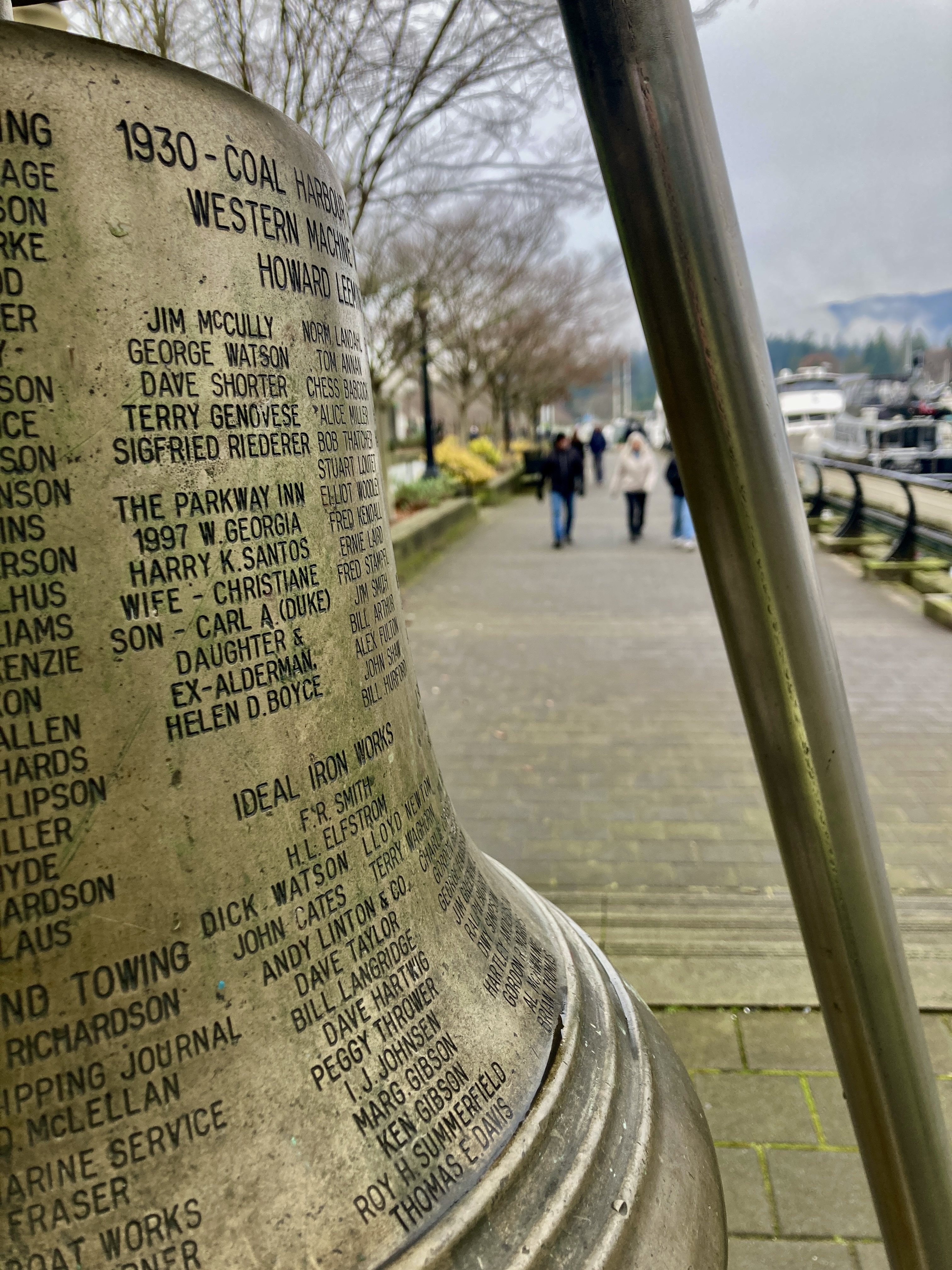
and then more red, and another curve. This time red bobbing in the water, not fixed above it, and in a sinuous horizontal arc, not vertical.
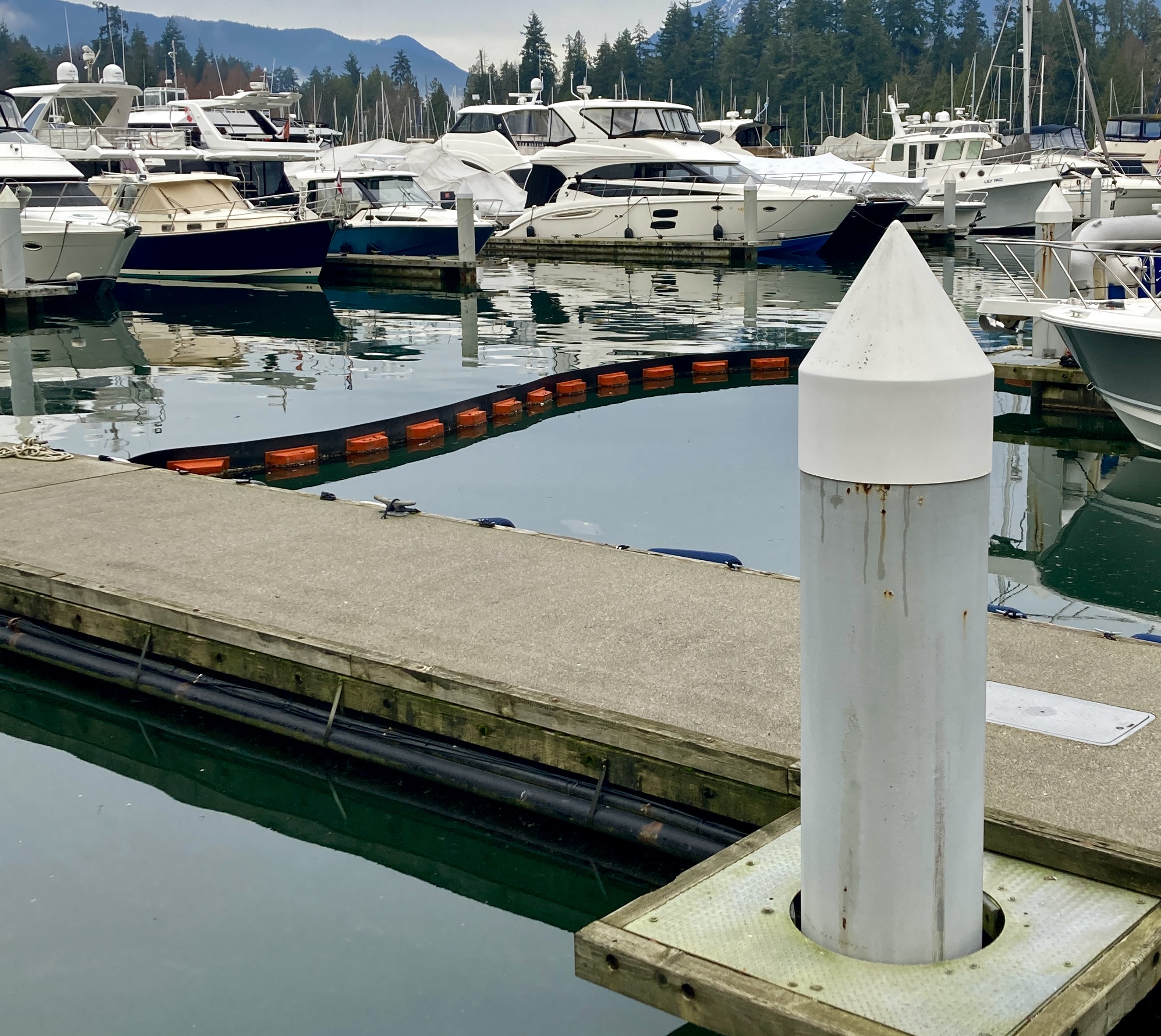
A bit more hoofing along, and, finally, I am here.
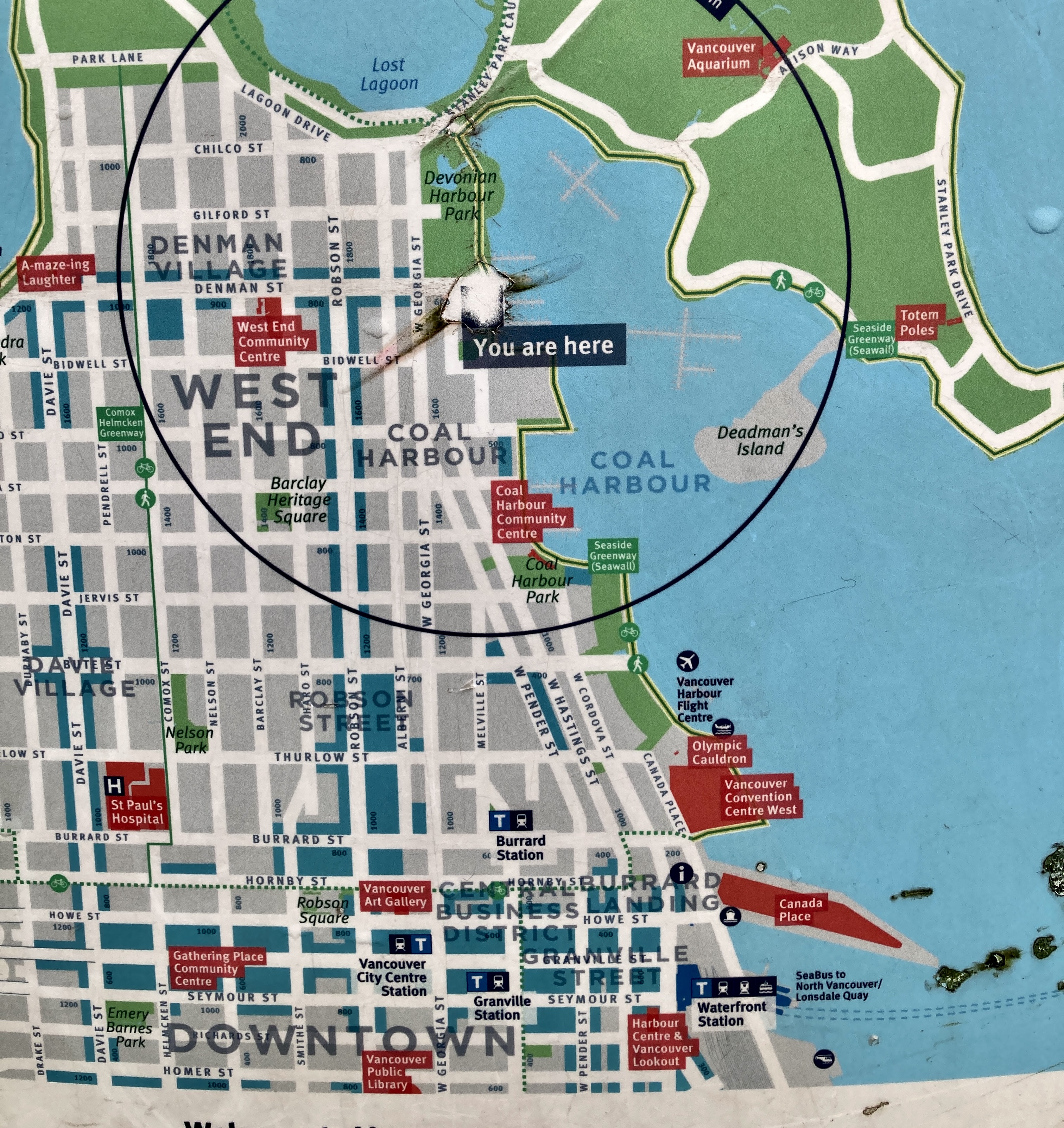
I am exactly where the map says I am: on the Seawall at the east end of Devonian Harbour Park, in turn a gateway to Stanley Park, and also the end of my route from Waterfront Station, down there in blue/white signage at the bottom of the map.
Time for me to follow the snake fence through the park…
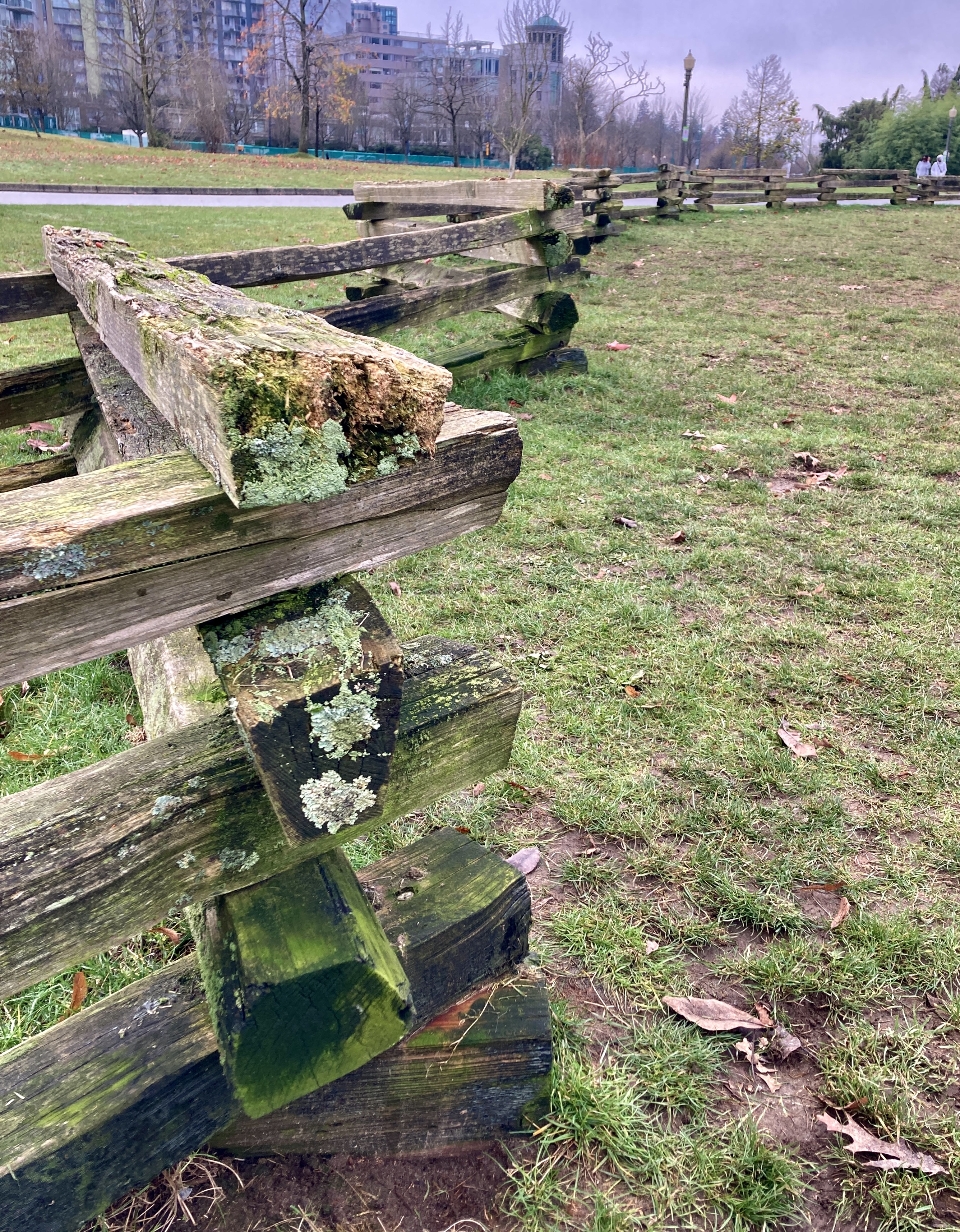
pause to take group pictures for some happy tourists, then….
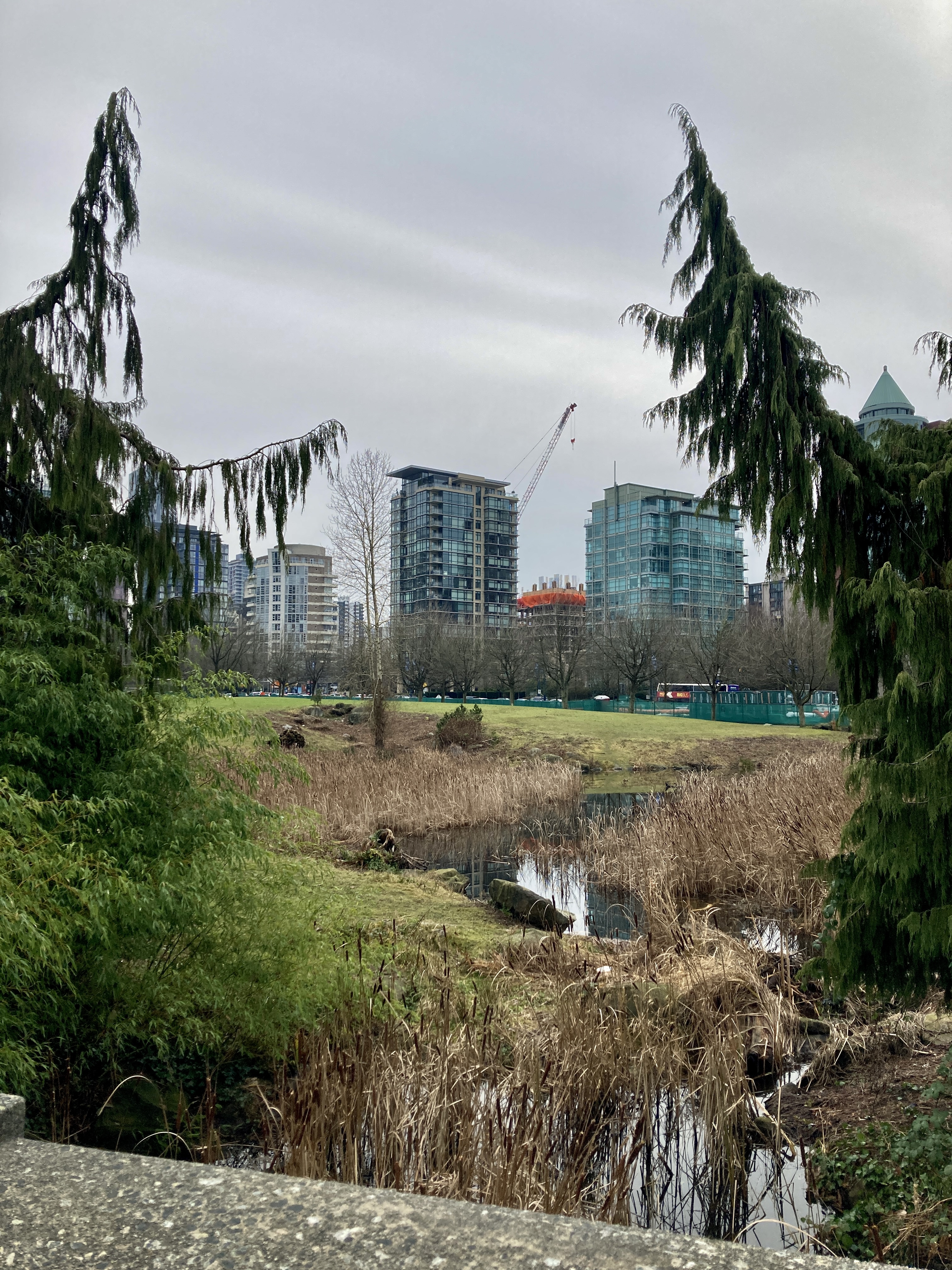
cross this little bridge, and angle up along the creek to those cranes and new-builds on West Georgia.
Where I hop on a trusty #19, and ride my way home.
(Happy New Year, everyone! I so appreciate your interest and generous good humour.)
Posted by icelandpenny on 1 January 2026
https://icelandpenny.com/2026/01/01/forward-in-reverse/

 WALKING WOMAN