Snagged

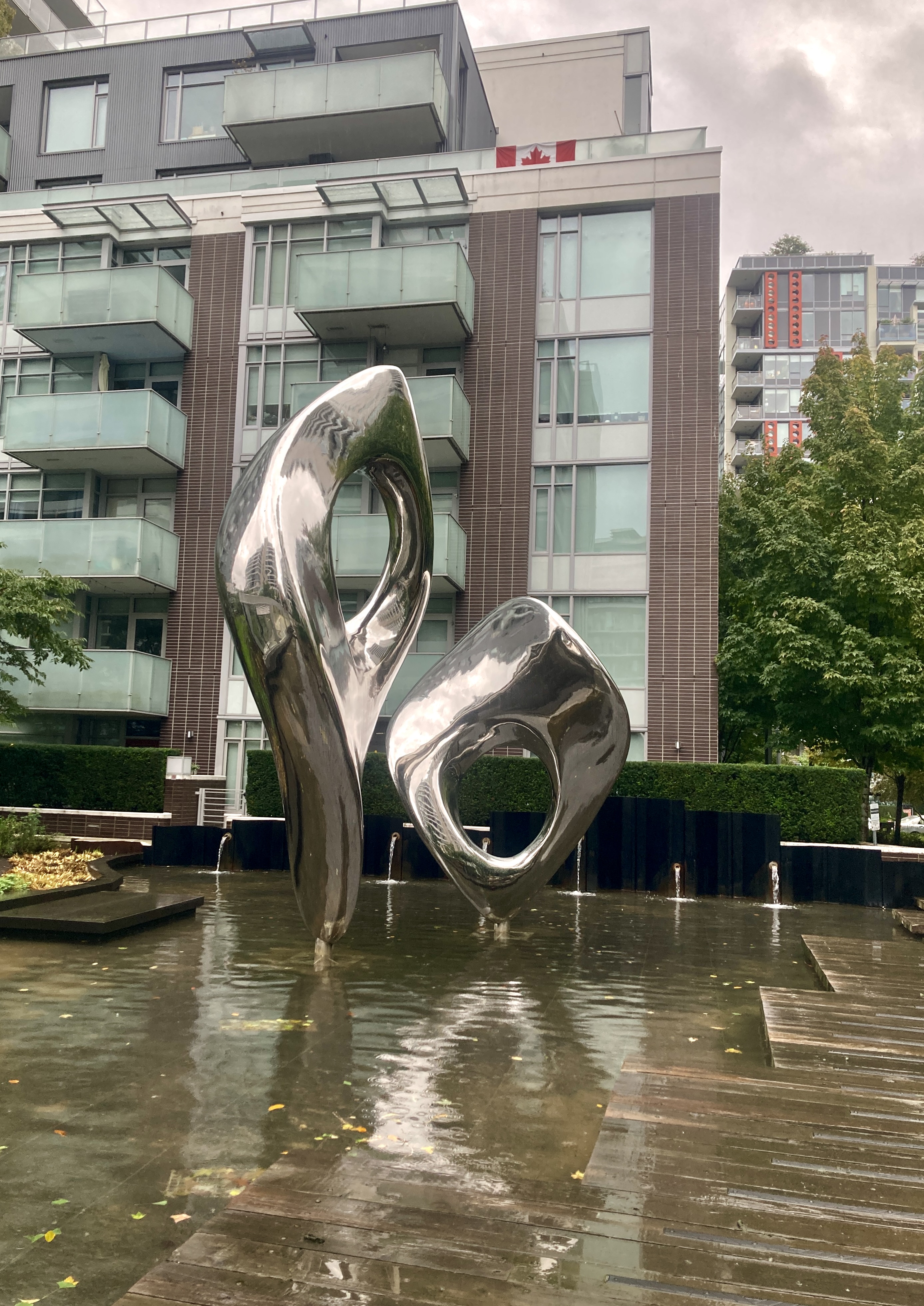
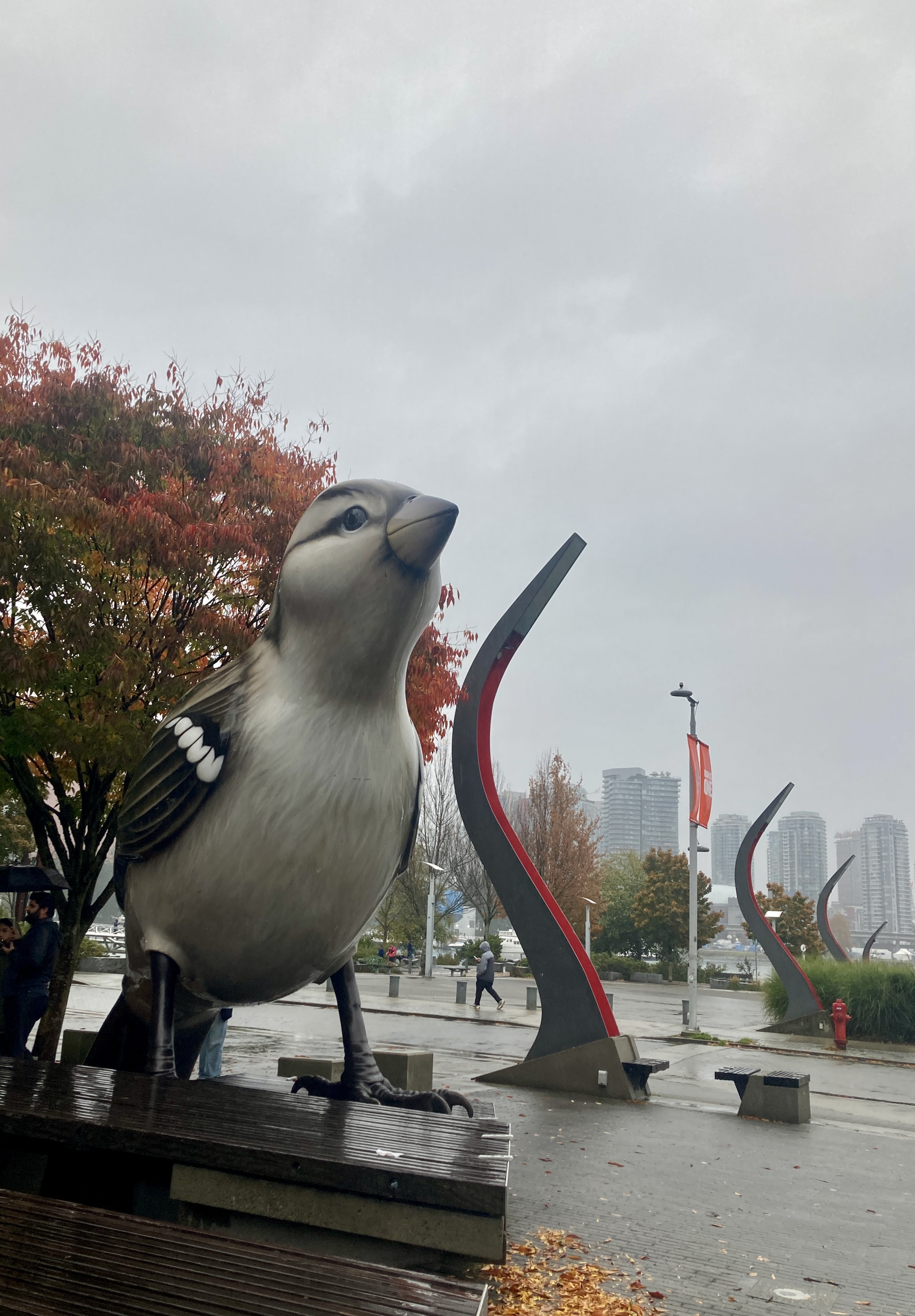
10 August 2025 – Seven moments, over the past few days, that snagged my attention. If these images snag you as well, I’m glad, and thank you. But here’s the rabbit hole: what now snags my attention is the phenomenon of attention-snagging. Of engagement. And the fact that your reason for lingering with any one of these images will be different from my own, and equally valid.

For the image is just the starting point, isn’t it? Each of us makes our own journey, after that. (And never the same journey twice.)

Saying this already has me on a journey.

  • Memory of Harold Town, at a reception for a 1960s display of his art in the Glendon College Junior Common Room, being asked the meaning of one of his paintings. “I just paint it,” he shrugged. “The meaning is up to you.”
  • Memory of Will Gompertz’ observation, in his 2013 book about 150 years of modern art (What Are You Looking At?), that one of the many factors comprising “art” is the engagement between the object and the viewer.
  • Memories of my own frequent observation, back in the day, when addressing a J-school class or mentoring a neophyte writer, that topic and focus are two separate things. (“Banff National Park,” for example, is a topic; “wildlife corridors” is one possible focus within that topic.)

Enough! On with the images. And on with our journeys, mine and yours.

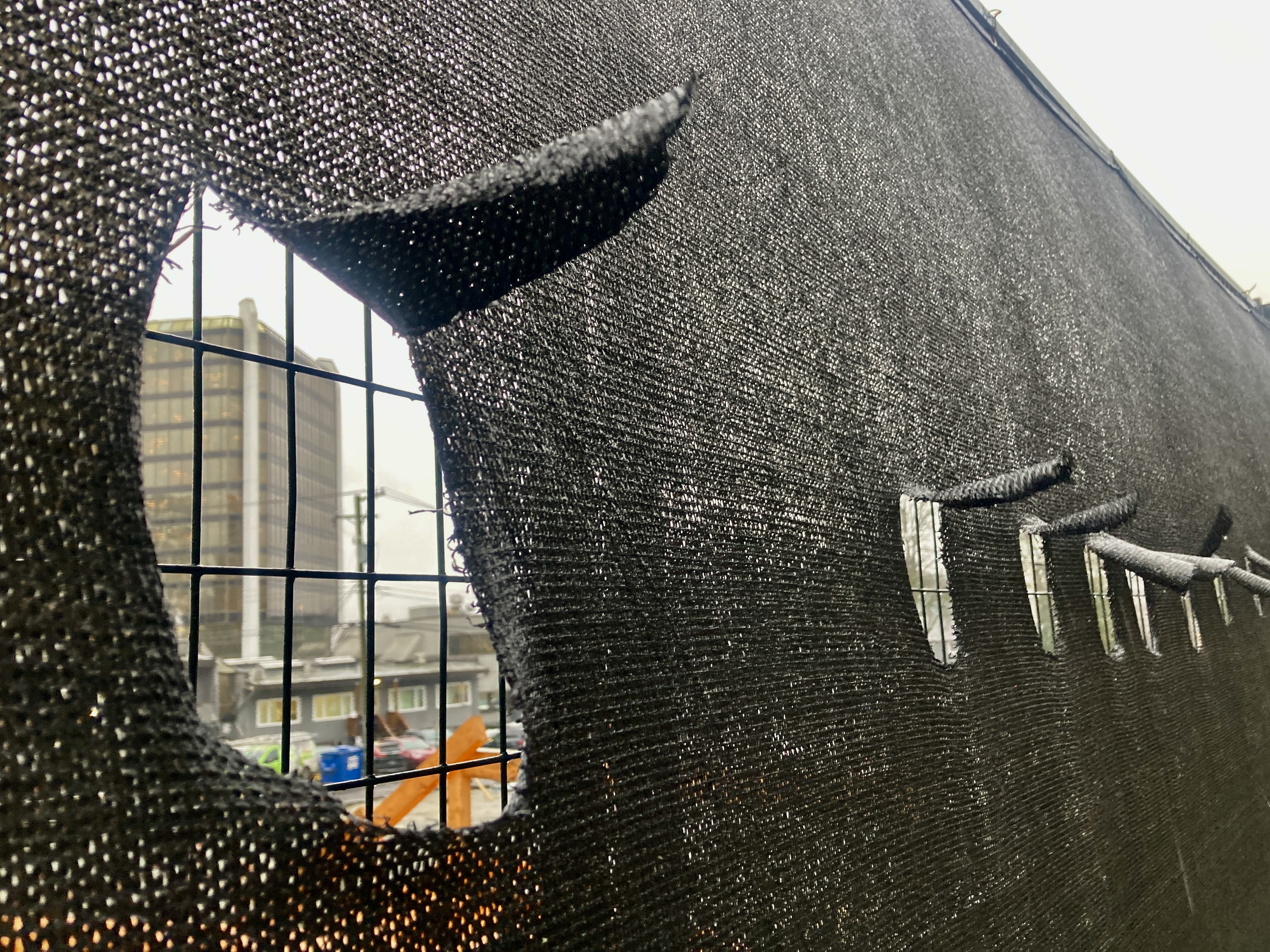
Downtown construction (Main & East Broadway)

I’m snagged by one detail: the muddy power shovel. I remember my dad, during a family 1950s drive holiday in Cape Breton, stopping the car to photograph a steam shovel (as they still were) being used to widen and stabilize the road. His company made that shovel! I was a very little girl, properly in awe both of her daddy and of that huge piece of machinery.

Urban playground (Emery Barnes Park)

When I was a kid, we had concrete underfoot. Now little feet (and my own) bounce gently on a more forgiving surface. Finally! A use for all those discarded car tires.

Evening reflections (Burrard St. south of West Pender)

The snag is less visual than aural — the echo of baroque music. Christ Church Cathedral is just up the hill, a regular venue for Early Music Vancouver concerts. My post-concert walk is back down the hill, with this sparkling visual one more sensory delight, along with everything else I have just experienced.

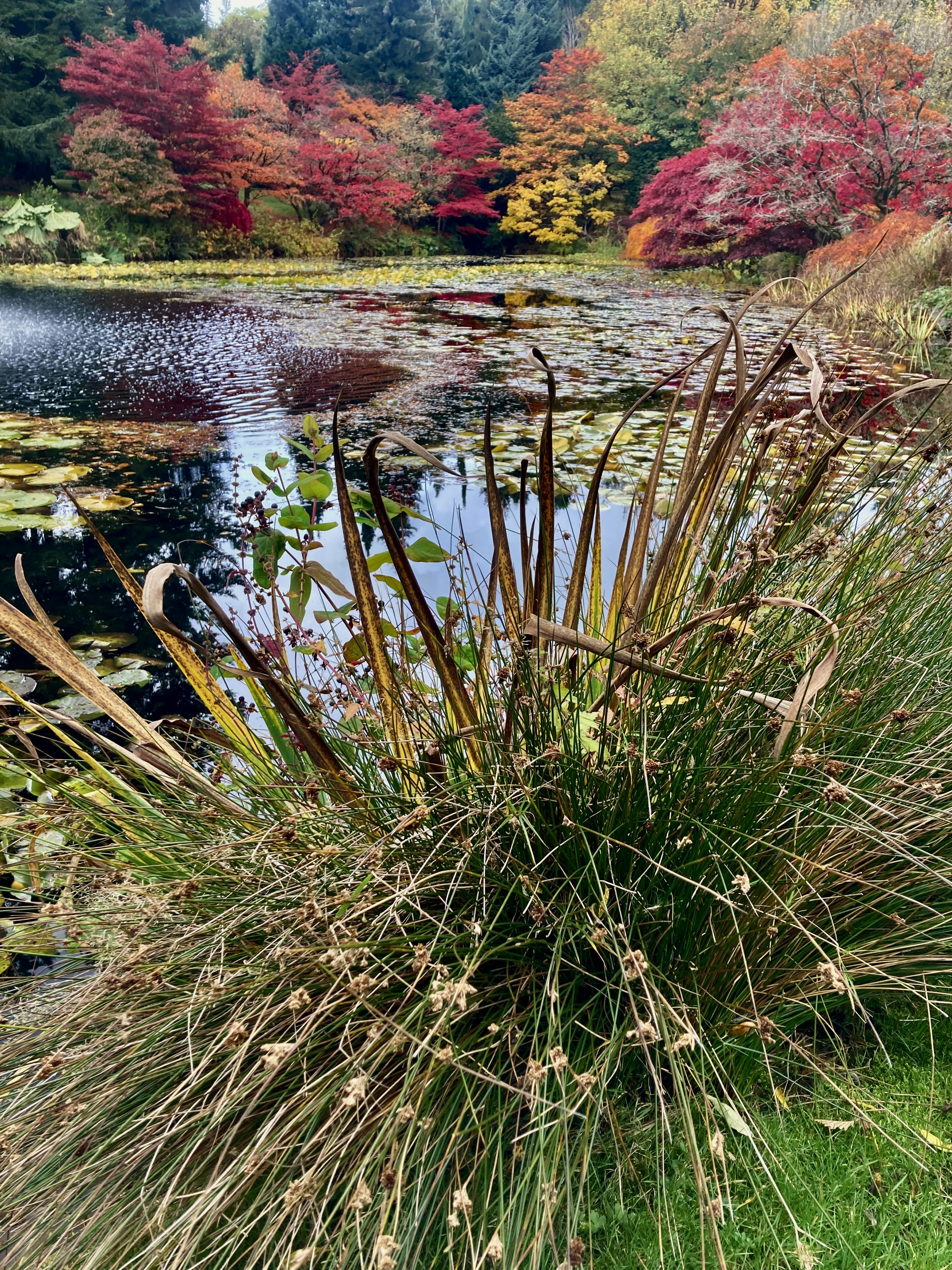
Urban park contrasts (a Stanley Park pond, looking out to West Georgia)

The bull rushes flip me back to Grenadier Pond in Toronto’s High Park; the larger dance of nature and city reminds me of ravine walks in that city, with nature Down Here and urban life visible Up Above.

Waterfront (Devonian Harbour Park)

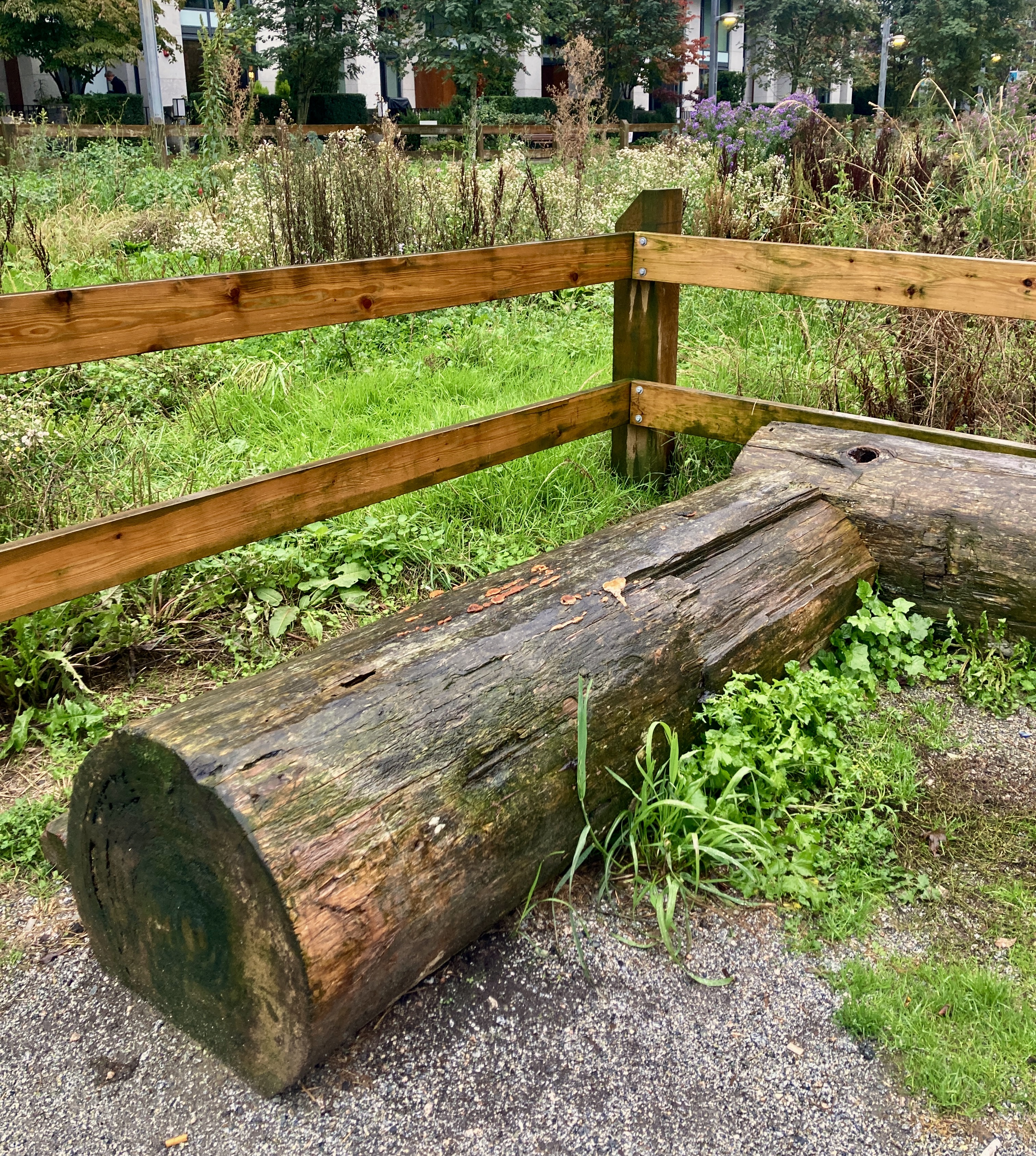
I could see heat-parched grass, or bobbing boats, or mountains beyond, or even (admittedly just out of frame) the helpful tourist-info kiosk. Instead, I fixate on the split-rail fence — “snake fence,” we called it, an everyday staple of rural Ontario-Quebec landscapes in my childhood, not the conscious design choice that it has now become.

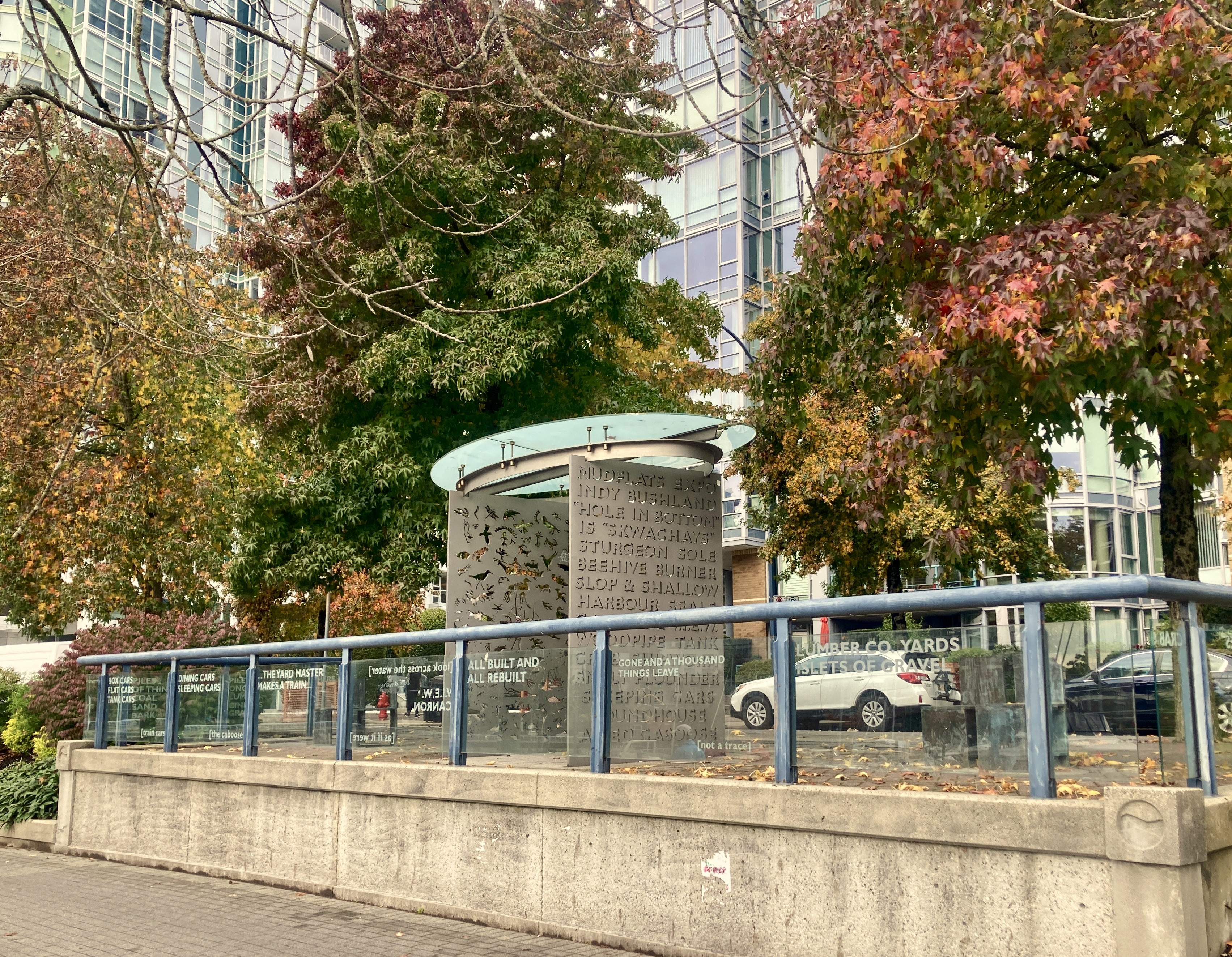
Memorial name-walls (Komagata Maru memorial, Harbour Green Park)

The wall honours the 376 British citizens aboard this Japanese vessel, which was denied entry in a 1914 stand-off that lasted two months (the people being fed solely by private initiative) before the ship, under duress, returned to its Kolkata (“Calcutta”) starting point. The problem, you understand, was not that the people were British citizens; the problem was that they were also South Asian.

I honour the memorial, but my own engagement is elsewhere. I remember the 1982 unveiling of the Vietnam War Memorial in Washington, which arguably established the tradition of naming names as the most powerful way to acknowledge the importance of every individual. My memories include AIDS walls, Toronto & Vancouver; Ireland Park, waterfront Toronto, with its few known names of the 38,000 famine refugees who arrived during the summer of 1847 (when the city’s population was only 20,000); and the 2013 presentation at the AGO of Ai Wei Wei’s powerful memorial to the victims of the Sichuan earthquake, with members of Toronto’s Chinese community reading aloud, in groups of ten, every single name.

All those memories come later. As I stand at the Komagata Maru wall, I flash to the wall in Humber Bay Park East in Toronto. It honours the 329 people who, in 1985, boarded Air India flight 182 in Toronto but never reached Delhi. Over Ireland, a terrorist bomb hidden in the luggage blew the plane apart.

I remember standing there, some time in the early 2010s, aware of the intensity of the man standing next to me. His finger hovered mid-air as his eyes scanned the lines of names. Then his finger landed on the name that his eyes had sought. He patted the name, sighed. He turned to me. He just had to say it aloud, to someone. “We worked together. Such a great guy. He didn’t really want to go, but it was a big family wedding, you know? His wife and daughters, they were so excited…”

Windsock (Vancouver Harbour Flight Centre, Coal Harbour)

Oh my, all those years. From CUSO volunteer in the Peruvian high jungle through Oxfam & other NGO travels and then time among our own northern hamlets. All those sturdy little aircraft, all those airstrips, all that varied terrain. All those people. All that they taught me.

I tap my heart, and walk on.

Rail Yard. And Other Invisibles. (And Visibles.)

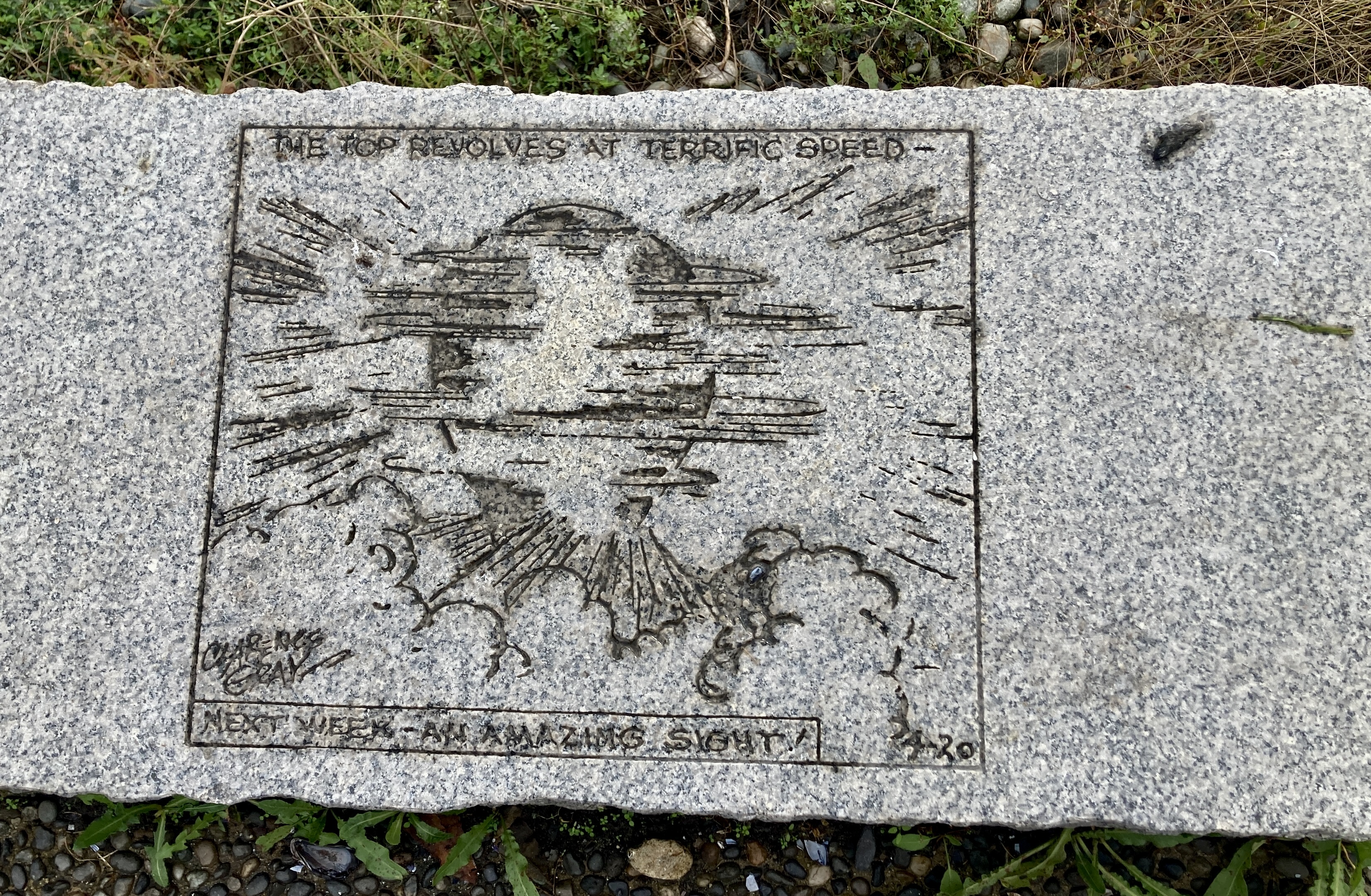
31 July 2025 – I’m on the N/E corner of Quebec St. and East 2nd Ave., and I read the little plaque at my feet.

Really??? I say — but very quietly, to myself. (No point startling others.)

Look up & I’ll see a rail yard? Or an elk? or a forest? or a convoy of Canada geese?

Pfft!!! (My genteel raspberry is also very quietly expressed, to myself.)

Rail yard is historic fact right here at False Creek, not current reality. The first CPR railway station opened in Vancouver in 1887, but the railway-related industrial era boomed after the World War I project to fill in the tidal flats of False Creek, from Main St. on east to Clark Drive, to provide a site for two new railway terminals and associated rail yards. Various changes along False Creek since then, most recently the transformation to parkland, Seawall and residential/knowledge industry occupation, triggered first by Expo 86 and then the 2010 Winter Olympics.

So, no, I am not going to see a rail yard from this street corner, no matter where I look. But I don’t care! I am all for looking, while I walk, not for stomping along in a trance. I am perfectly happy to be reminded to swivel my head and pay attention.

I start swivelling.

Look Up, East: the MEC building, a 2020 arrival in this historic neighbourhood…

and once again (spring 2025) back in Canadian ownership, though no longer a cooperative.

Look Up, West: an even newer new-build.

Look Sideways, East: the eco-conscious alley behind MEC, with watercourse and plantings to attract insects and bees.

Look Sideways, West: the alley behind that new-build, with an historic reference right there at the corner.

Namely, one of the City’s remaining H-frame hydro poles.

Look Down-Along, North: this block’s stretch of bioswale

which “collects and cleans the rainwater that fall on Quebec Street.”

Look Straight-Across, West: tail end of a straggly crocodile of kiddies (yellow T-shirts) plus their volunteer monitors (green T-shirts)…

crossing Quebec and hurrying to catch up with the croc’s main body, all those children already walking on north along Quebec’s west side.

I have to wait for the next light. After that I’m following in their somewhat distant footsteps, not sure where they’re headed but with my own Best Guess in mind. (Science World, I think to myself.)

Sure enough!

Like them, I turn west on Switchmen St. — a necessary detour while the end bit of Seawall is under repairs — and, from my vantage point at Pullman Porter, watch all those yellow & green T’s double ’round the parking lot & veer back east toward the geodesic dome of Science World. (An aside to you: you have noted these further railway tributes? Of course you have.)

I am charmed by the sight — by my knowledge of how much fun the children will have, and by my respect for all the organizations and all the volunteer support that collectively make these vacation-time excursions both possible and safe. (Flashback memory: the impish YMCA volunteer in Toronto, who explained that when they took 10 kids out, they were expected to bring 10 kids back. “Preferably,” she solemnly added, “the same ten.”)

I head on west. Bye-bye, kiddies.

I am still sufficiently Paying Attention to my surroundings, to notice the fresh-fruit stand near Olympic Village Plaza. I buy strawberries, my fingers guided by the young attendant to the boxes just trucked in this very morning from a farm in the Abbotsford area.

The day is warming up.

I find a shady bench in Hinge Park, and allow myself one strawberry. Just one.

It was…

really, really good! I hustle back home with the rest.

Now You See It…

26 July 2025 – Now you see it.

A giddy moment of creative anarchy,

in front of a well-regulated condo complex.

And now — hours later — you don’t!

Peace, order, and good behaviour have been re-established.

That Nice Mr. H

21 July 2025 – Busy morning, the day is clipping along, but surely there’s time for a short afternoon walk? I think False Creek (yet again), and then try to freshen the idea with a new combination of component parts.

Cranky Self objects: “I’ve already done all that!” Philosophic Self saves the day, quotes that nice Mr. Heraclitus: “You cannot step in the same river twice.”

Albeit by attribution, and much translated and much paraphrased, but the idea is clear. Everything (you included) is always all new, so go get it.

I haul out my much-creased False Creek map, and make a sort-of plan.

Walk down to The Village ferry dock (south-east end of False Creek, by Olympic Village Square); ferry to David Lam Park dock; walk on west along this portion of Vancouver’s Seawall, on past George Wainborn Park; then up-over the Granville Street bridge; down-around Granville Loop Park… and whatever.

The day is so mid-summer!

Music festival in the City Centre Artist Lodge forecourt as I walk past; patio umbrellas shading crowds on down Quebec & Ontario streets; and here in Olympic Village Square as well…

keeping all these customers cool, as well as one lop-eared dog (front & centre).

Onto an Aquabus, which is surprisingly empty until we stop at Yaletown Dock and pick up an extended family of Brazilian tourists. As we pull away, the driver, for fee-setting purposes, turns his head to quiz them on destination and demographics.

“Round-trip to Granville Island, six adults, two seniors and one child,” says the matriarch. She’s prompt with the data, but loses the credit-card quick-draw contest with one of her sons. She plays to her audience with a “What-can-I-do?” gesture, and is rewarded with amused laughter.

I hop off at David Lam; they carry on to the tourist (& resident) attraction that we call an “island,” even though it isn’t, not quite.

I’m always amazed at the diversity of traffic on and in the water — everything from whopping private vessels in the marinas to ferries to kayaks/dragon boats/paddle-boards to wildlife — and nobody seems to hit anybody else.

Even when they’re a couple moving very slowly on an isolated little paddle-board.

I turn my attention landward.

Thistles old & new, backed by ripening blackberries…

which cause a passing teen to tell her boyfriend about the berry patch behind her house, when she was growing up. “They’re awfully bitter until they’re really ripe,” she warns him.

The Seawall, like False Creek, has a mixed-use culture. Pedestrians here; cyclists there. In between David Lam & George Wainborn parks, I also get a good look at the Granville Street bridge, up ahead.

Closer still, almost opposite Granville Island, a good look at Giants — the six concrete silos painted for the 2014-16 Vancouver Biennale by the Brazilian twins known as OSGEMEOS, and now a lasting icon in the Biennale’s Open Air Museum.

This north-facing façade in shadows, mid-afternoon, but compelling even so.

Once I’m almost beneath the bridge, my next challenge is to find my way onto it.

Please, you’re thinking, how hard can that be? Not impossible, I grant you, but it does involve discovering that the west-side pedestrian path is closed for repairs, and orienteering my way up-along Weedland…

aka Waiting-For-Development-Land, to find the east-side path.

Which I do.

So here I am, heading toward centre bridge. With an overhead view of Creek traffic and a different angle on Giant.

Almost directly overhead, a reminder that this is a working concrete facility, not just a mural backdrop.

Starting down the bridge’s southern slope, I look back. Now I can enjoy the Giant‘s sunny faces and the long eastern view of False Creek behind them.

Over land now, over the Granville Island Kids Market and playground, backing onto Alder Bay.

More orienteering required, to get myself off this bridge!

I place my faith in this zebra crossing over these lanes, then this path and down these steps, and yes! it works.

I’m in Granville Loop Park, with a waterfall sculpture that reminds us yet again that, all those centuries ago, Heraclitus got it right. An ever-constant “V” of water, created by ever-changing water molecules, in ever-flowing cascades from the two upper corners.

Across the kiddy play area, with the yellow Coyotes in Area sign to my right and tennis players straight ahead…

and down and around and out to the West 2nd bus stop…

where, from a shady bench, I look up at the bridge I have just crossed.

In the Details

18 July 2025 – God or devil? This aphorism, it turns out, has various protagonists, and even more attributed sources, in multiple languages.

“God is in the details,” for example, is attributed to architect Mies van der Rohe in English — but, in German or French, and earlier, to philosopher/poet Aby Warburg and Gustave Flaubert respectively. If you prefer the Devil as protagonist, Nietzche gets the nod (in German), with endless English and other adapters thereafter.

Standing yet again mesmerized in an alley, I decide my own version is: Fascination is in the details.

Last time around, you’ll recall, I was fascinated by a tree. This time? I doubt Joyce Kilmer would approve.

First, a squadron of yellow poles, one of whom…

clearly celebrated too long & too well last night.

Then, a trim green car, clean & shiny & standing firmly upright on all four tires. Just one more car, parked in the alley line-up.

But, aha… details!

Three yellow duckies hold the left tail light in place…

two red discs, their black cord tightly wound, secure the edge of the left front bumper to the hood…

and red V’s add extra panache to the snappy white tire rims. (As in, We may be down & somewhat out, but by golly, we’re doing it in style.)

(The smudge on the back bumper, alas, probably does not deserve our fascination. Looks like a side-wipe from something grubby, not a deliberate detail. In fact, and you can check this for yourselves, there seems to be similar black smudging in the duckie-supported tail light just above.)

Then I come home, look up “God/devil is in the details,” and find myself fascinated all over again by the number of rabbit holes I could pursue. Talk about detail!
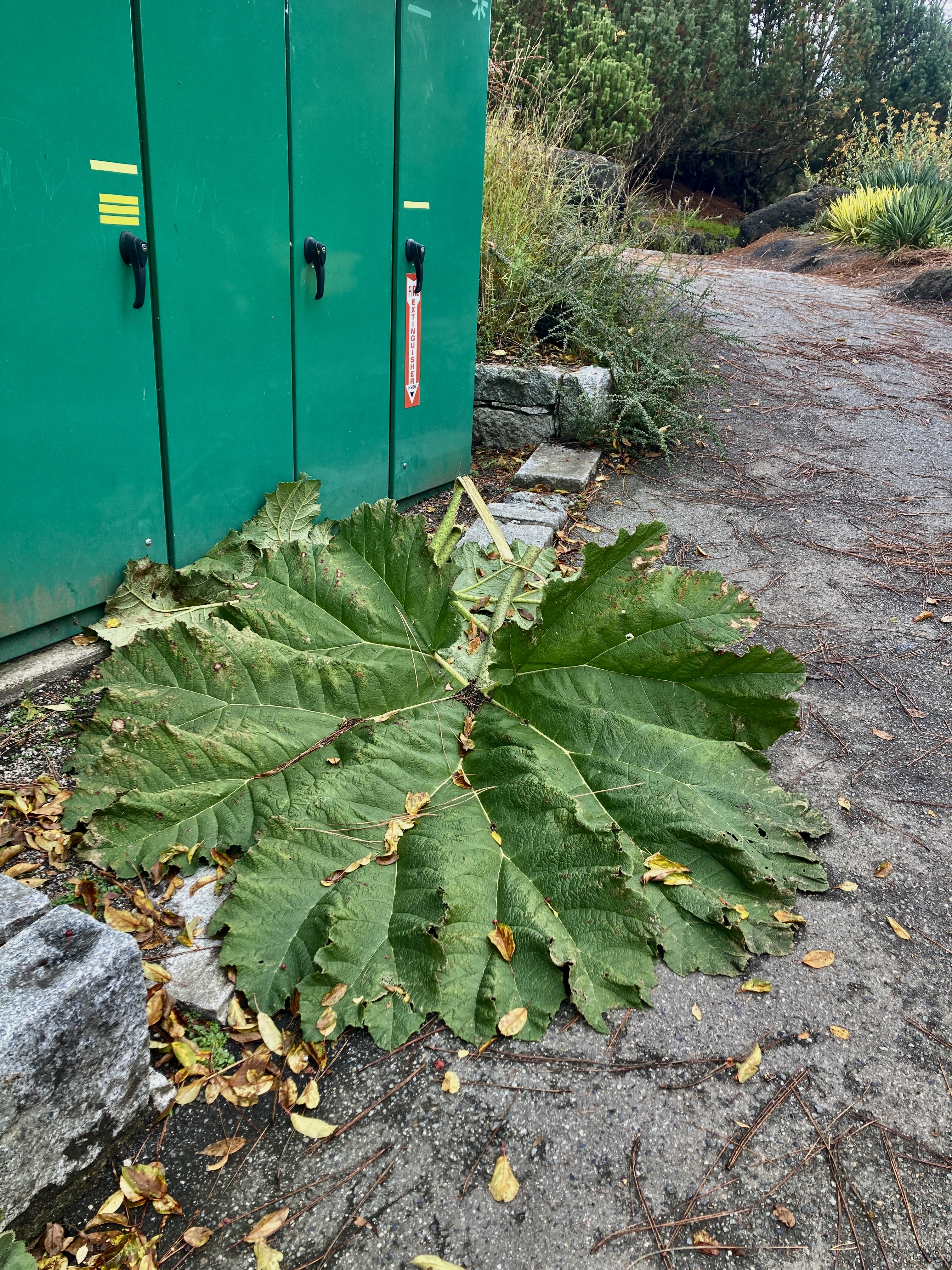
Including the meaning of it all in Hindi. If any of you have the linguistic ability to pursue that one, please tell me what you learn.

A Tree

13 July 2025 – I stand there on the sidewalk, having myself a Joyce Kilmer moment.

If you now find yourself chanting “I think that I shall never see / A poem lovely as a tree,” then you may be of my generation — someone who also grew up somewhere in North America and learned that poem in elementary school.

The 1913 language may now strike us as a bit over-heated. We’re more likely to respond to the approach taken by UBC Professor of Forest Ecology, Dr. Suzanne Simard. Her 2021 seminal work, Finding the Mother Tree: Discovering the Wisdom of the Forest (now published in 21 languages), has propelled us right to the frontier of work being done in the field of plant communication and intelligence.

Kilmer or Simard, it’s about respect for trees, each pursuing that respect with their own language and skills.

My respect today is visual — for the sheer beauty & majesty of this tree. The textures of the bark, the play of colours.

Wonderful details, up close.

Tiny golden leaves, caught in bark crevasses at the base of the trunk…

a sprig of new leaves, erupting mid-trunk…

spider webs! …
and the bark itself, needing no adornment.

Yet, there is one final adornment.

Of nature, but added by human hands.

“Thank You”

9 July 2025 – You already know I’m a great fan of Vancouver’s Green Streets Program, the pilot project with 15 volunteers that now numbers hundreds of volunteers city-wide, tending traffic-circle and street-corner gardens.

So I always notice them, as I pass — including, earlier today, the one in the traffic circle at St. George and East 10th.

But even I, doting as I may be, have to acknowledge that this one is pretty scruffy.

It’s definitely a work in progress. “Shaggy” is the kindest word I can offer for the state of the foliage.

On the other hand! There’s a metal table and two chairs, and flagstone pathways that invite pedestrians to step out of the city and enjoy a quiet moment in the garden.

The furniture is graceful, a pretty ceramic mug rests on the chequered table-top, and, look, flowers bloom in a ceramic plant pot hanging on the back of that directional sign.

Even so, I would not bother to show you any of this…

but for the words written on the back of the opposite directional sign.

“To the people who have been taking care of my traffic circle, Thank You. I’ve been too busy so far this year. Love your work!!! Hope to meet you”

Pretty terrific, eh?

In/Inter + Active

5 July 2025 – Not a theme even remotely in mind yesterday, when all this began. But then came today.

Yesterday I am increasingly grumpy as I stomp down some farther-south blocks of Quebec Street. It is all very boring. My end of Quebec is good fun; this southern stretch is bland good taste.

Until!

Inactive

I don’t assign the category, not then, but it fits. This driveway object is definitely inactive.

Finally something to look at! I am actively grateful, though I bet the neighbours are not. With an admiring glance at the one bit of this ancient Ford not under tarps…

I walk on, good humour restored.

Interactive

Today it’s once more to False Creek, and right there in Olympic Village Plaza — which years ago briefly hosted a chalk-art labyrinth — I discover a very precise maze. (Labyrinth = in, to the centre, out the same entrance/exit; maze = separate entrance & exit.)

That man is patiently walking the maze, with much back-tracking but no cheating. He succeeds, too — I can testify to this, since I watch him with admiration as I try my own skills at the challenge.

I do considerable back-tracking and brain-scratching as I go. As do these two women, following soon after me.

The exit rightly admonishes me. I did cheat, but only once, and I am unrepentant. I reward myself with Okanagan yellow cherries from the farmer’s tent just off the exit…

and dip into the bag as I double back to read the other words, back there at the entrance.

“Interactive Art by Gregory Smith,” it says. (Sorry, I can’t solve the Gregory Smith mystery.)

“Interactive Art.” I like this concept. And, as mysterious Gregory Smith surely intended, it here applies to physical interaction, feet on maze, and not to the cerebral/emotional interaction we have with any work of art.

I find myself applying the concept more broadly. Human physical interaction with inanimate objects.

For example, “Interactive Books.”

All those community take-one-leave-one bookstands, each one brimming with books left by the active choice of individual local donors and taken away again by someone else.

Yesterday, at Main & East 41st, this trilingual welter of options in a kiosk run by someone in the adjacent apartment building:

Look at the range — Hemingway to Lévi Strauss; bios of both David Bowie & St. Paul; the cruelty of depression but also the mystery of wholeness; and French and Spanish, photographic art for the former (perhaps the Drummondville museum) and US political analysis for the latter.

Farther north on Main, a table inside Sweet Thea Bakery:

Merely (!) bilingual this time, but again, what a range: Peter Carey, Amor Towles, John Irving, Jane Smiley… And Jean-Jacques Rousseau’s 1762 treatise on education. And a bathroom reader.

Earlier in today’s False Creek walk, yet another example, run by the Creekside Community Garden people…

with impressive (& trilingual) variety in its limited selection.

Vegetarian cookbook; an Italian journalist’s challenge to the accepted view of Italian resistance during WWII; the francophone guide to this year’s Canadian Pride celebrations, complete with a “tartlette au buerre” reference on the cover; even a talking words factory for the kiddies.

(Later, in retrospect, I decide the interactive maze of course led me to interactive books. Winnipeg author Carol Shields followed her 1995 Pulitzer Prize winning The Stone Diaries with her 1997 tribute to maze-building, Larry’s Party.)

Still dipping into those yellow cherries, I head for the little footbridge at the west end of Olympic Village Plaza. And that’s where I discover…

“Interactive Rocks.”

People celebrating summer warmth, each other — and low tide! — on the stepped stones to the south of the bridge…

and hanging out on convenient boulders here on the north.

I’m warm, but not too warm, and nicely cherry-fuelled. I keep walking, past the Spyglass Place dock, past Stamp’s Landing, all the way to Leg in Boot Square.

Where I discover…

“Interactive Music.”

Today, unexpectedly & exceptionally, there’s a live trio of Celtic fiddlers in the square.

We are transported to Cape Breton. We are all, young and old, jigging away in our chairs.

The cherries are now in my backpack. I remind myself not to lean back. Turning cherries into cherry purée is not an interaction I care to discover.

Vanity

30 June 2025 – So here’s my fantasy. (Any why not, a fantasy or two, as you walk downtown streets.)

I imagine that older buildings are thrilled to bits by the mirrored towers rising up in their midst.

Why? Because then they can admire themselves in the reflection, all day long.

A trio pile in together, like squealing teenagers in the same selfie…

a patient friend (L) listens while the diva (R) goes on and on about her split personality…

a dowager admires what the tinted glass does for her ageing complexion…

and a couple of stick figures pretend, for just one giddy moment, that those bodacious curves are real.

And then — sigh — I smack myself upside the head, and walk on.

St. George & the ‘Hood

19 June 2025 – Forget the dragon. That is so 10 centuries ago! These days, St. George — or, anyway, our St. George — is all about urban/eco sustainability and livability.

I’m first bounced onto this theme by a graffito on a waste bin. One that I initially think disrespectful of the human origins of the slogan…

but then reconsider, as I look smack across the street.

I’m on East 7th, heading farther east, and I’m staring into the busy abundance of this community garden stretching on north to East 6th. All lives matter, yes? We humans and plants are woven into the same eco-system.

This little local garden is very much of this neighbourhood, with its neighbourly values. A place with low-rise homes, many of them vintage wooden structures; a place where a kicked-off toddler’s shoe…

is carefully displayed at sidewalk’s edge by some later passer-by, in the hopes it may yet be retrieved.

I drop down to East 6th, look north as I cross Guelph, think how much I like this human scale — but have no illusions it will last much longer. Let your eye travel down the row of modest bright-painted houses…

to that equally bright-painted construction crane down below. That’s the future, and increasingly the present.

But!

St. George is at work.

Well, the St. George Rainway. It’s been a long time coming, but now here it is, nearing completion — with its (and I quote} “green rainwater infrastructure features like rain gardens that incorporate plants, trees and soil to manage rainwater…”

I step up to the mini-plaza with its rock, its signage mounted on a plinth…

adorned with a Wood Sorrel cut-out…

and lots of information.

Go ahead — spread the image, track its elements; I’ll wait.

Together, we learn that the Rainway along St. George celebrates a Lost Creek, a tributary to False Creek that has long since been buried underground. (For that matter, this final eastern end of False Creek, into which the lost creek ran, no longer exists either.)

While you’re exploring that handy map, please note not just the Lost Creek, left-above “You are here,” but also China Creek on the far right, and E. Broadway (East Broadway), three streets to the south.

I admire the rain garden that parallels the sidewalk immediately to the south …

then cross East 6th to admire this sign in the rain garden running on north…

and feel more vindicated than ever in making my peace with the “Plant lives matter” graffito. “Thriving in diverse communities” sounds like the prescription for healthy life, period, whatever form of life we happen to be.

You’ll understand why, with that thought fresh in mind, I fall over laughing at the dumpster graffito I see immediately afterwards.

On I go, on to China Creek North Park. (See? That’s why I wanted you to locate it on the map.)

I am heartened, as I approach the edge of this large park, to see fresh new vine fencing woven into the woodlands periphery. (It had become very scruffy.)

At first, looking down the slope, the basin of the park appears generic and banal. Old fashioned, even.

All that mown grass. And baseball diamonds.

But then, as always, I reconsider. The top of the slope is lined with benches, and they are well used, in diverse ways. At the moment, for example, the bench on the left hosts Headset Guy, who in fact is reading a real, physical book…

while the bench on the right hosts Music Man, who strums his acoustic guitar so softly it is almost subliminal. A woman just out of frame is hunkered down, motionless & meditative, and the woman you can see walking past the benches is about to start down the winding path that snakes its way to the playground at the lower level.

And I am about to join her.

This park is another “Lost Creek” — or, more precisely, a Lost Watershed. Before this last bit of False Creek was filled in, a whole network of creeks tumbled through here to feed its waters. Once filled in, the area at one point became a garbage dump, but was subsequently rescued and turned into parkland.

The slope is now naturalized, and it is wonderfully, exuberantly, messy.

With signage to justify the mess.

At the bottom of the path, I peer down the final bit of slope, the bit with a slide and (here) a mesh climbing ladder…

and, down there at the very bottom-bottom, swings and a pirate’s ship and other kiddy delights.

All this diversity! Social plants, social humans, thriving in diversity.

Walking homeward, more happy plant/human interaction…

in this volunteer-managed street corner garden, part of the City’s Green Streets Program.

And then… a reminder that not everything is happy-happy.

That some current trends are jarring and disruptive, and will damage both humans and nature.

Taped to a tree on quiet, residential East 10th just west of St. George — with its fellow trees all around — a warning about the effects of the redevelopment now being pursued under the City’s Broadway Plan.

I may know more about the correct use of apostrophes (i.e., not to form noun plurals) than the author of this plea, but these tenants, in the adjoining notice…

teach me a new word. “Demoviction.” As in, the eviction of tenants from a building, so that it may be demolished, usually for redevelopment. A phenomenon integral to the Broadway Plan. And gaining pace.

I read a testimonial, also taped to the tree, the words of a woman who has been a tenant here for 22 years: “This affordable home allowed me to continue to raise my daughter here after my husband passed away. It provided a safe community and a stable, comfortable home.”

Right next door, the specific redevelopment being proposed: Rezone from Residential to Comprehensive Development category, and, on this street of two-storey homes, put up a 17-storey tower.

Hmm. Used to be, dragons breathed fire and wore scales. Now they may instead breathe rezoning, and clad themselves in 17 storeys.

  • WALKING… & SEEING

    "Traveller, there is no path. Paths are made by walking" -- Antonio Machado (1875-1939)

    "The voyage of discovery is not in seeking new landscapes, but in having new eyes" -- Marcel Proust (1871-1922)

    "A city is a language, a repository of possibilities, and walking is the act of speaking that language, of selecting from those possibilities" -- Rebecca Solnit, "Wanderlust: A History of Walking"

  • Recent Posts

  • Walk, Talk, Rock… B.C.-style

  • Post Categories

  • Archives

  • Blog Stats

    • 128,834 hits
  • Since 14 August 2014

    Flag Counter
  • Enter your email address to follow this blog and receive notifications of new posts by email.

    Join 2,047 other subscribers