1 May 2024 – You can protect your yard in a variety of ways.
Build a high fence, for example…
post security cameras…
keep a guard dog…
or, instead…
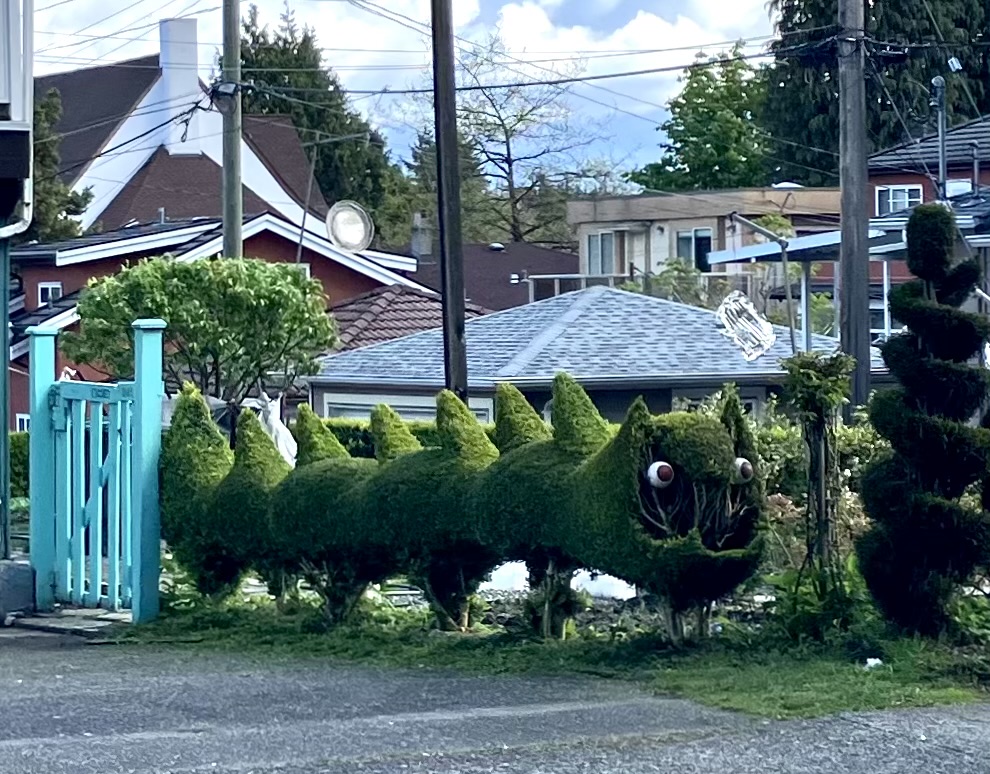
plant yourself a dragon.
(With impressed & amused thanks to He-Knows-Who-He-Is.)
1 May 2024 – You can protect your yard in a variety of ways.
Build a high fence, for example…
post security cameras…
keep a guard dog…
or, instead…
plant yourself a dragon.
(With impressed & amused thanks to He-Knows-Who-He-Is.)
Posted by icelandpenny on 1 May 2024
https://icelandpenny.com/2024/05/01/protection/
25 April 2024 – I asked, and someone very dear to me answered. All the way from Oz (aka Australia).
My previous post ended with this 2013 Toronto mural detail…

plus my request for help in identifying the artist, after all this time.
I assumed any answer would come from a Torontonian, but how silly of me! In this digital age, help is not geography-based. You just give that nice Mr. Google a descriptive phrase, and — hey presto — you are on-site with award-winning contemporary artist EGRart.
The link, as sent to me and here repeated for you, is for her Murals page.
Scroll down, scroll down, and there it is …

a larger view of the dandelion mural (including the male head done by collaborator Elicser).
The photo pitches me back a decade-plus in time. I am again walking west on that street, pausing at that alley, enjoying that mural and all its elements.
And then, back here in 2024 Vancouver, I continue to scroll the Murals page. Down-down-down.
Suddenly… whump! I see this.

Oh, I do remember that garage door. Except when I saw and photographed it, it looked like this:

EGR has transported me back to the laneway behind Ossington Ave., just north of Queen St., on a very snowy day in 2014. Urban myth had it — perhaps correctly — local residents decided that, since their laneway garages were going to be graffiti’d anyway, they might as well invite good artists to come in and do it well.
So they did.
And artists like UBER…

and SPUD…

were among those who responded.
The whole laneway became an open-air art gallery.

A very cold art gallery, that particular day, and I soon skedaddled.
Enough 2014!
Here’s a right-now update, thanks to EGR’s News page. This very Saturday, April 27, she will join co-panelists in an Artist Talk at the Centre for Social Innovation on Spadina Ave. Topic: Women in Mural Art – Building Careers.
How pleasing, to dance through time & space and end, not with nostalgia, but with news of forward momentum.
Posted by icelandpenny on 25 April 2024
https://icelandpenny.com/2024/04/25/oz-2024-to-ossington-2014/
22 April 2024 – But before we dive into Latin taxonomy — not that I knew I was headed there, at the time — before all that, a moment at the corner of Scotia St. & East 7th.
Where I am charmed by Buggingham Palace.

The bee’s knees, you might even call it, though the holes in those colourful pillars are meant to accommodate the entire insect.
The volunteer tending this particular Green Streets corner garden has helpfully labelled all her plantings. I not only admire floppy reddish blossoms on a coarse-leaved shrub, for example, I know I’m admiring a Flowering Red Currant.
Then I look at an adjacent lamp standard, and learn even more.

The building on the opposite corner, the one I’ve always thought of as the Candy Factory, started life in 1904 (or thereabouts) as the Brewery Creek Building, one of many brewery operations in the area. It later became Fell’s Candy Factory, then the Purity Dairy, later on a grease works and later still had other grubby-sounding lives until, in 1993…
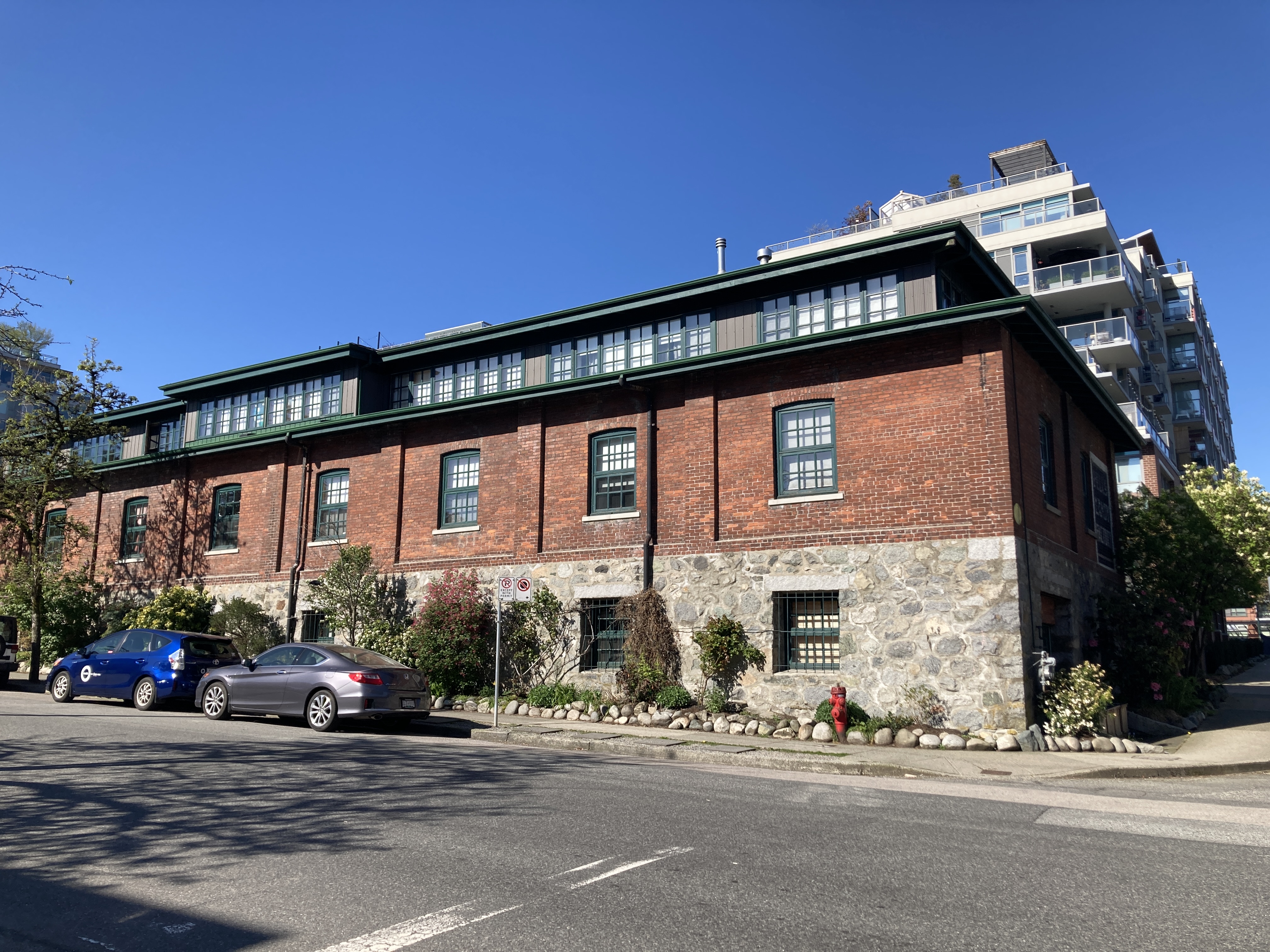
it was refurbished and converted to these handsome artist live-work spaces.
Pleased with all this new knowledge, I go on my way. “My way” being straight on east to China Creek North Park — no particular objective, just offering myself a not-very-demanding stroll on a very pretty day.
It’s a large, open, multi-purpose park dropped into a bowl — the bowl being what’s left when you drive underground what had been Vancouver’s largest drainage basin, whose creeks all fed into False Creek. (Until you filled in that final bit of False Creek as well.)

There are steep steps down-down-down on my left at the northern edge, but over there to my right, at the south-west corner, there is the start of a lovely ox-bow path …

that winds its friendly, undemanding way from high to low.
I take the path.
Almost at the bottom — down where I can watch young men grunting through crunches on the level grass while toddlers squeal in the playground — I turn and look back uphill. The slope is dotted with solitary bodies, perhaps meditating, more likely texting, but anyway all with knees angled outward to support their admirably straight torsos.
One person is upright, afoot, moving across the terrain. One human, but six legs.

Human plus fluffy white cat on a leash. See the cat?
Now please stop looking at the cat and notice all that yellow.
Lots and lots of yellow. All over the place.

Taraxacum officinale!
The dandelion.
I have to look up the Latin later on. Standing there, I’m sufficiently occupied just thinking about the word “dandelion.” I know it’s from the French “dent-de-lion,” for the serrated lion’s-tooth edge to the leaf. I also know that the word may be French, but it’s not the word the French themselves use, when they’re getting all familiar with T. officinale. They call it “pissenlit.”
Piss-in-the-bed. Apparently — and this I also have to look up later on — because of the diuretic properties of the plant.
(A sidebar on the delights of common names for plants, in different languages. I know Chlorophytum comosum as Spider Plant. I thought this the perfect evocation of its multitude of leggy offshoots, until a Cuban friend told me its nickname in Spanish. “Mala madre,” she said. Well, of course! The plant must be a bad mother — look at all those babies, running away from home.)
Back to T. officinale. Lawn-proud gardeners hate it, the very word “dandelion” an epithet in their mouths.
Ah, but the word is sweet, in other contexts.
In literature: Ray Bradbury’s 1957 novel, Dandelion Wine.
In wine-making: choose your favourite home-brewer as the example. My uncle put up batches every spring and my aunt heartily approved. I never did ask his secret, so I’ll offer this recipe instead. (No idea how good it is, or isn’t — but who could resist a blog called Practical Self Reliance?)
And, finally, dandelions in the visual arts.
Because, whether in flower or gone to seed, they are beautiful.

This 2013 Toronto street artist caught that beauty, the beauty of the plant itself and its ephemerality.
Like that dandelion head, this alley mural will surely be long gone by now. Unfortunately, I can’t tell you the artist’s name. When I took this picture — for my very first Blurb book! — I didn’t bother with attribution. Drat.
Maybe someone among you can right this old wrong? The style is distinctive, and the artist’s work was often seen in Toronto at the time. (Mary C, author of the splendid As I Walk Toronto blog, I’m thinking especially of you! You know the city’s streets, and street art, so well.)
Posted by icelandpenny on 22 April 2024
https://icelandpenny.com/2024/04/22/t-officinale-friends/
18 March 2024 – I’m in Stanley Park, along with half of all Vancouver it seems, ready to enjoy this weekend burst of double-digit sunshine.
More precisely, I’m off the bus, through the underpass, and poised at the south-west curve of Lost Lagoon…

about to walk counter-clockwise and follow the trail east along the lagoon’s north shore.
Everything trembles on the edge of spring, unfurling new growth. Trees overhead, trees weeping downward to the water.
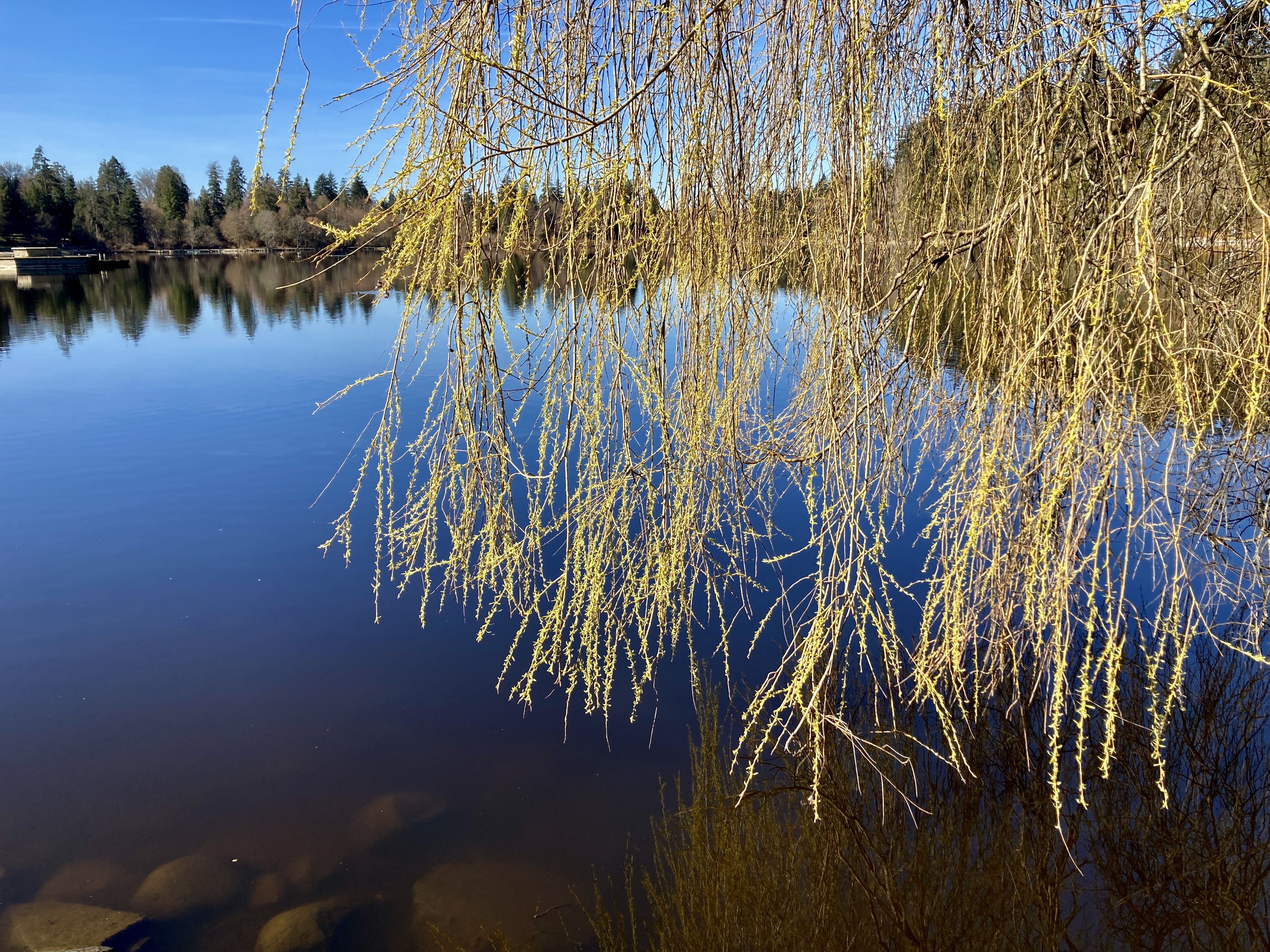
And, down there in the water, in the rich muck of the wetland, most wonderfully of all…
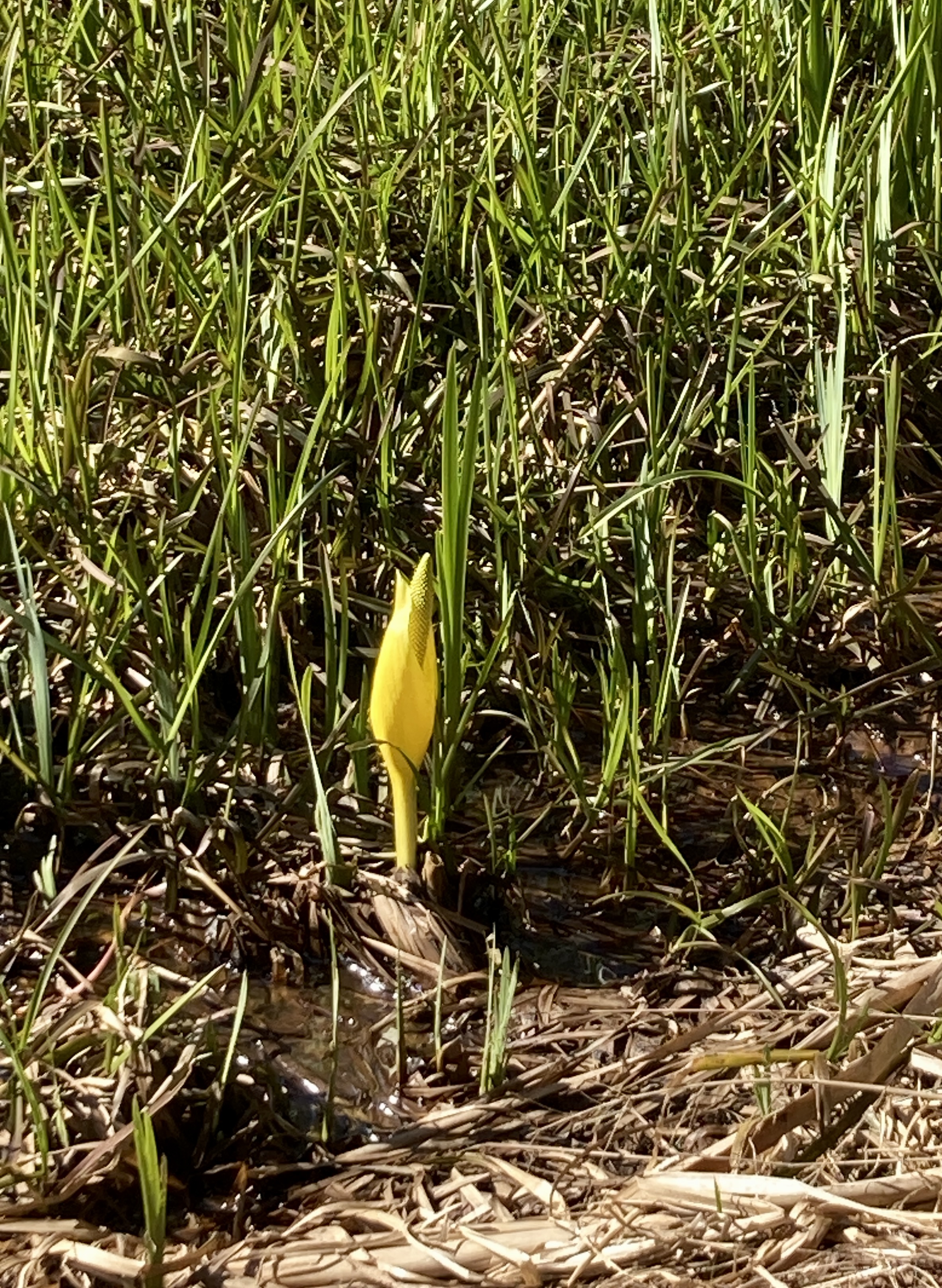
the fluorescent glow of the Western Skunk Cabbage. My first of the season. Now I know it’s spring!
The eastern variety is a more modest creature, it seems, so I forgive myself for being entirely ignorant of this plant until I moved west and was smacked in the eye by all that gold. (And also educated by You-Know-Who-You-Are.) Now I look for it each year, and give a little wriggle of joy at the first sighting.
On across Lost Lagoon, and on and on and then, though still in Stanley Park, I’m in entirely another world. I’m in all the noisy facilities-rich hoop-la of Second Beach.
Right where this red button says I am:
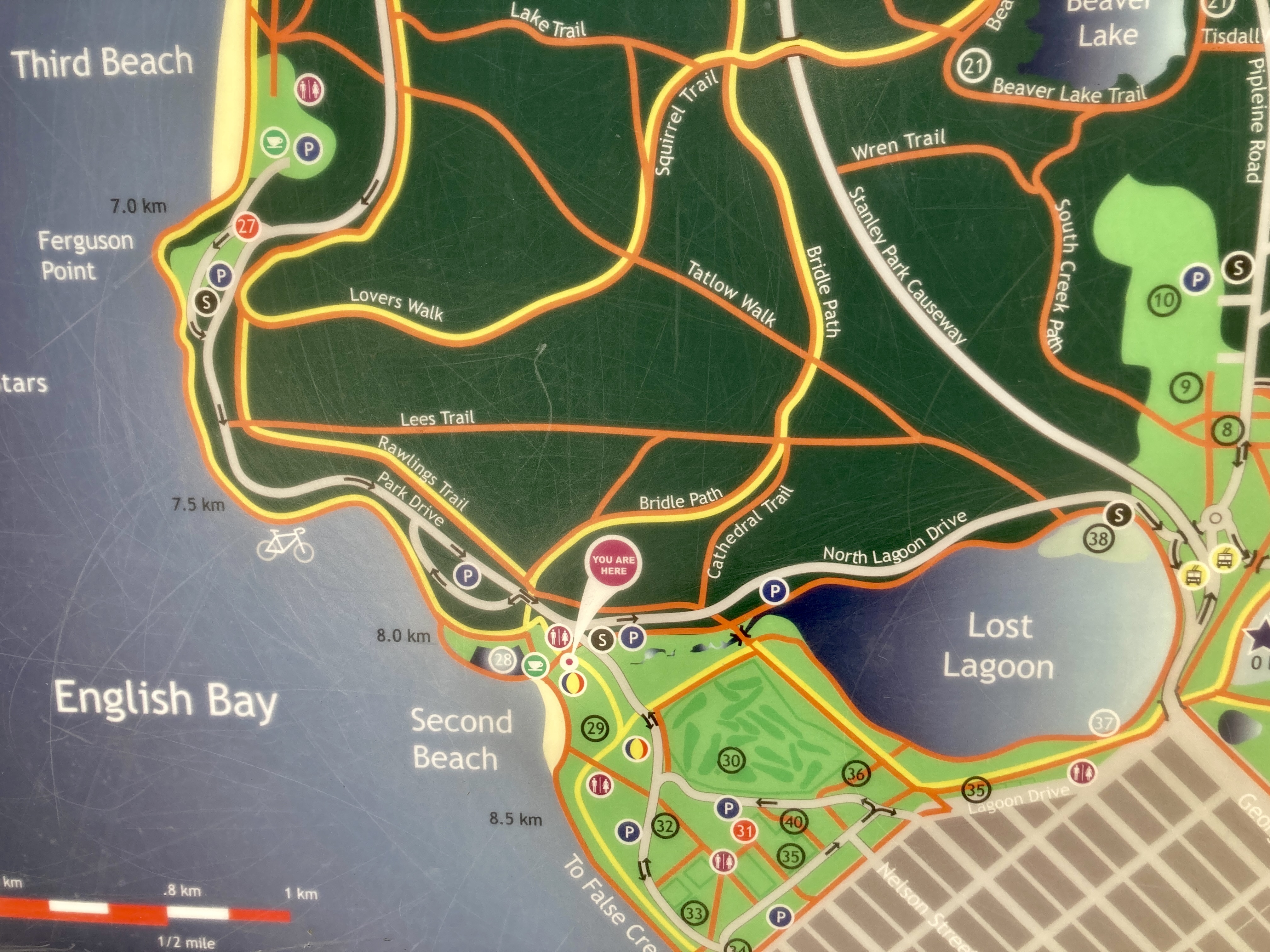
I turn right, head up the Seawall toward Third Beach. (Thank you, I murmur to the universe. I am so lucky, to be right here, right now, in all this.)
Here we all are, in all this.
Runners…
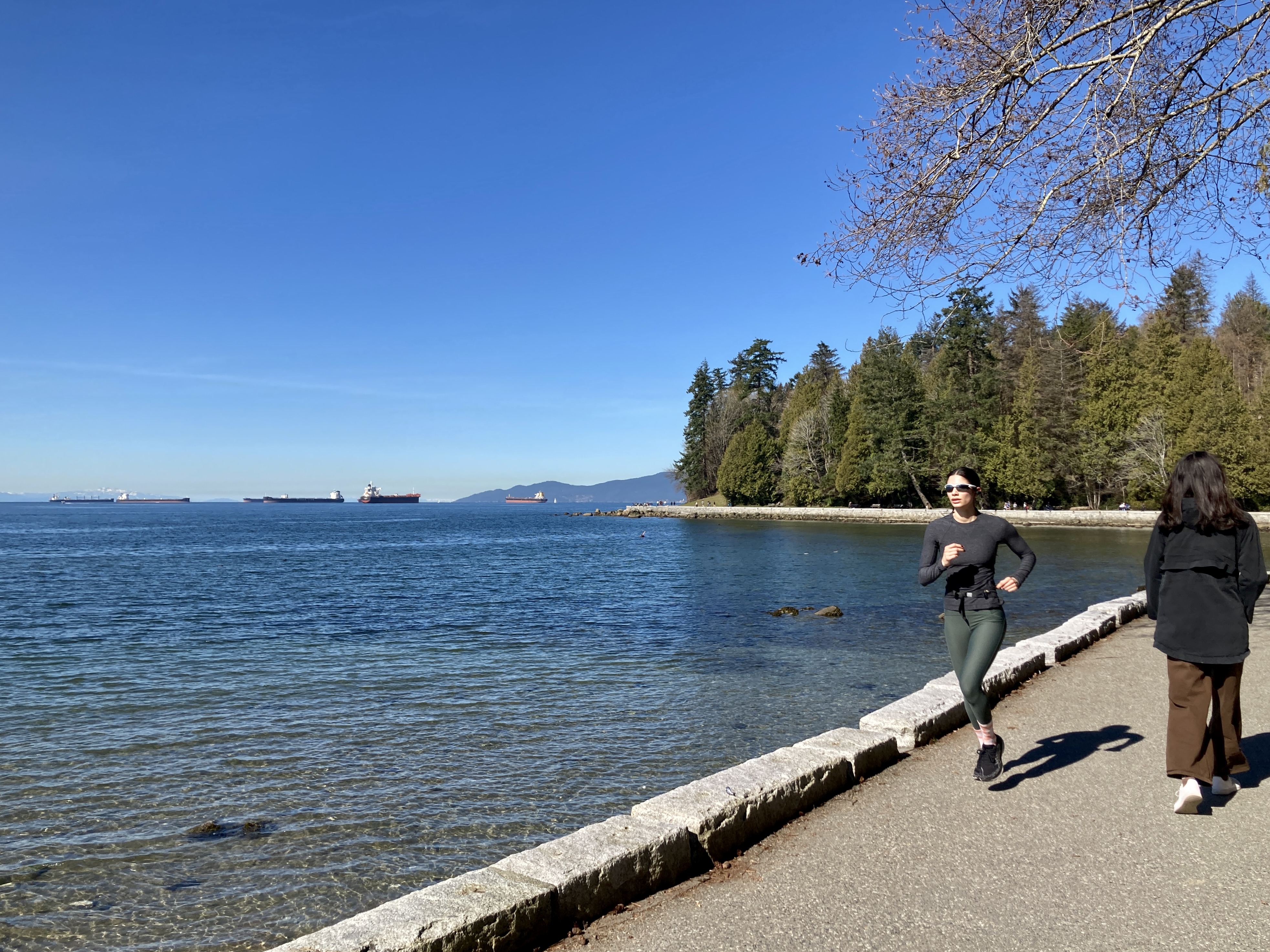
and cyclists/loungers/kiddies/adults/impromptu tents/storm-thrown stumps on Third Beach…

and rocks and freighters just off Ferguson Point…

and a tree with a heart…

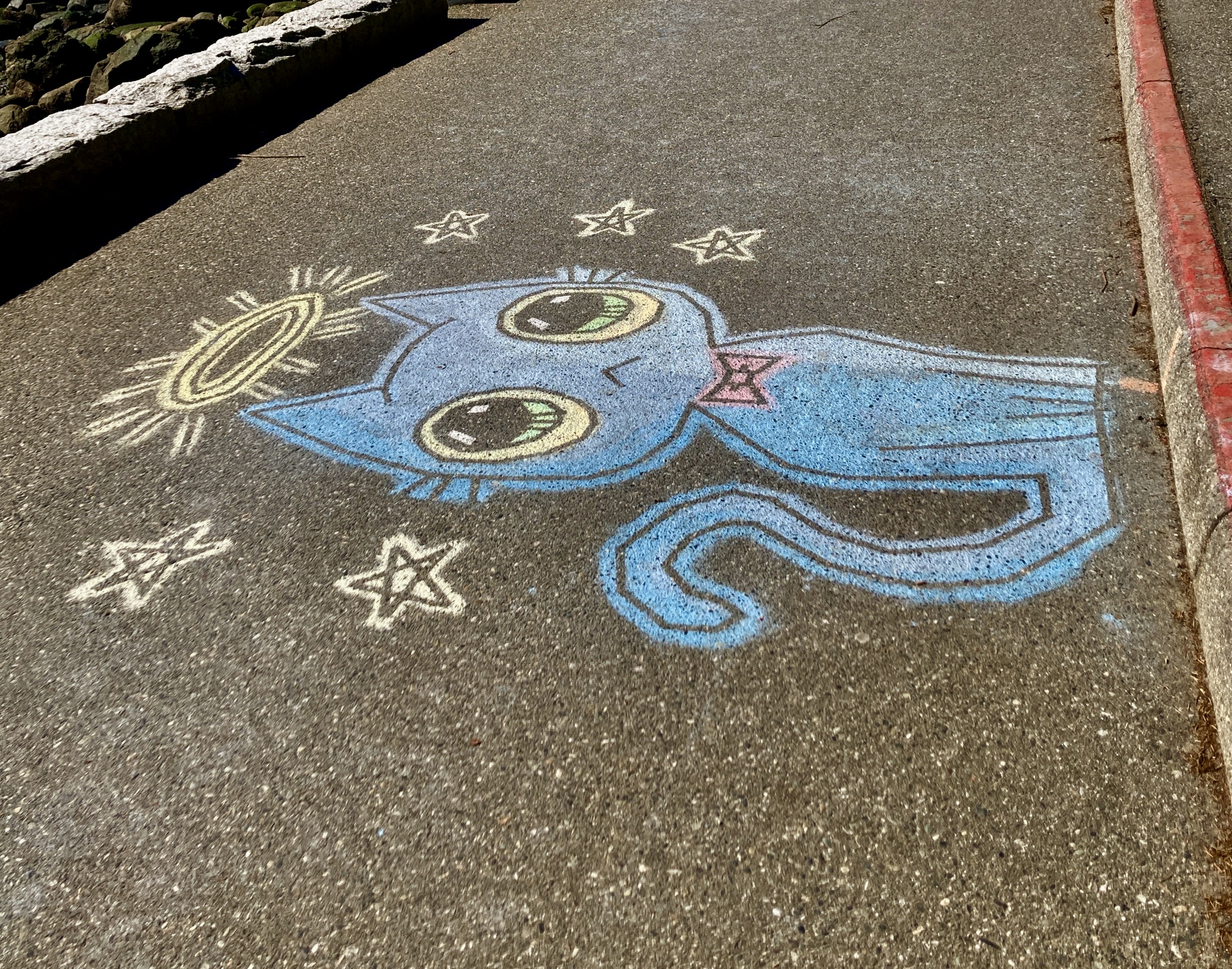
and a patch of Seawall with its very own Cat-Angel…
and — after I’ve walked myself back south out of Stanley Park and into Morton Park — four Vancouver icons. All on view without turning my head.
Background, the renovated Berkeley Tower with its Douglas Coupland mosaics; mid-ground, Yue Minjun’s Ah-Mazeing-Laughter sculpture installation; right mid-ground, a cluster of Windmill Palms; and, tucked in their foreground shadow, some Canada Geese.
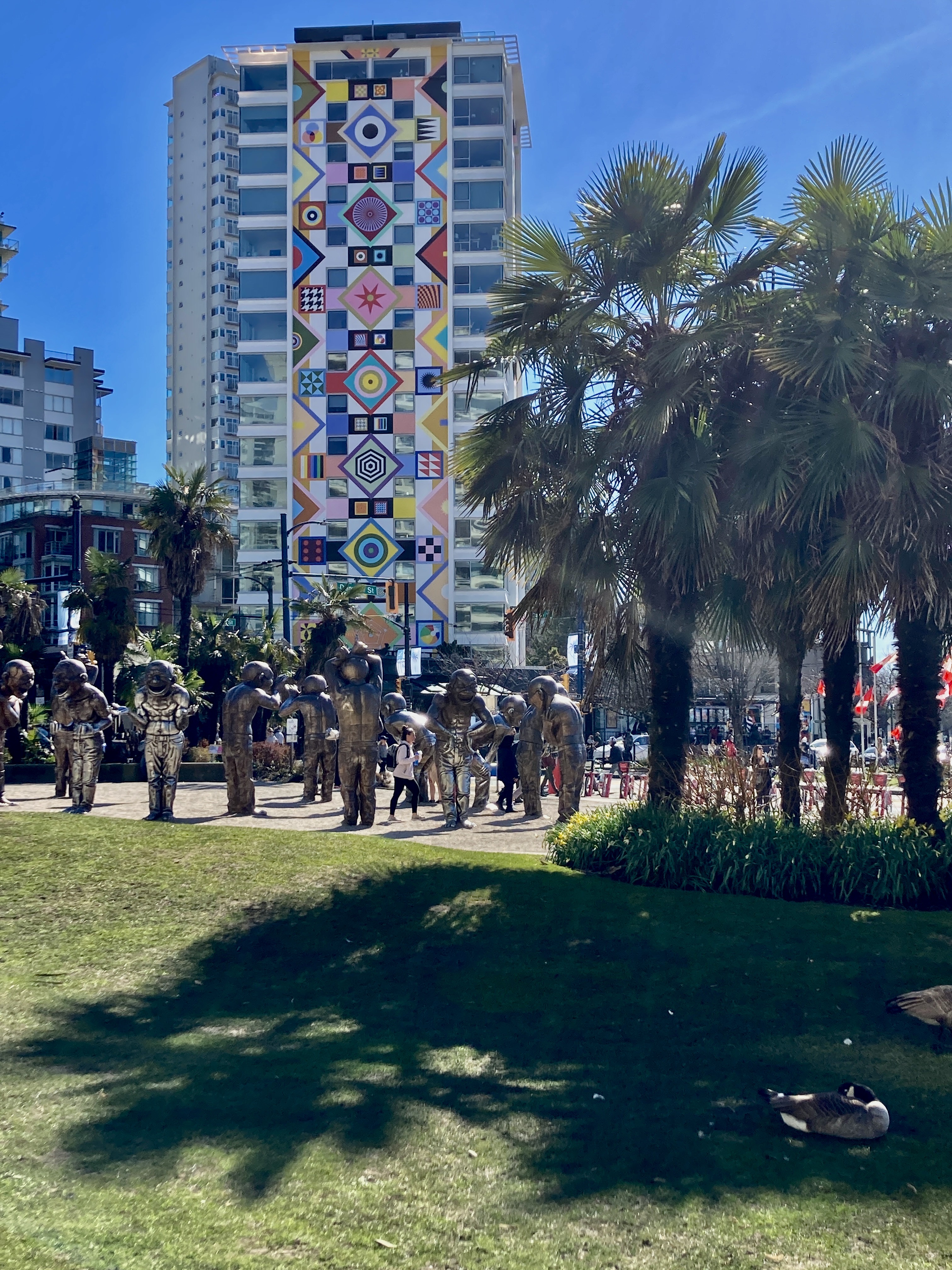
The day has me in sensory overload.
Yet, with all that wealth of input, one image keeps coming back to mind.
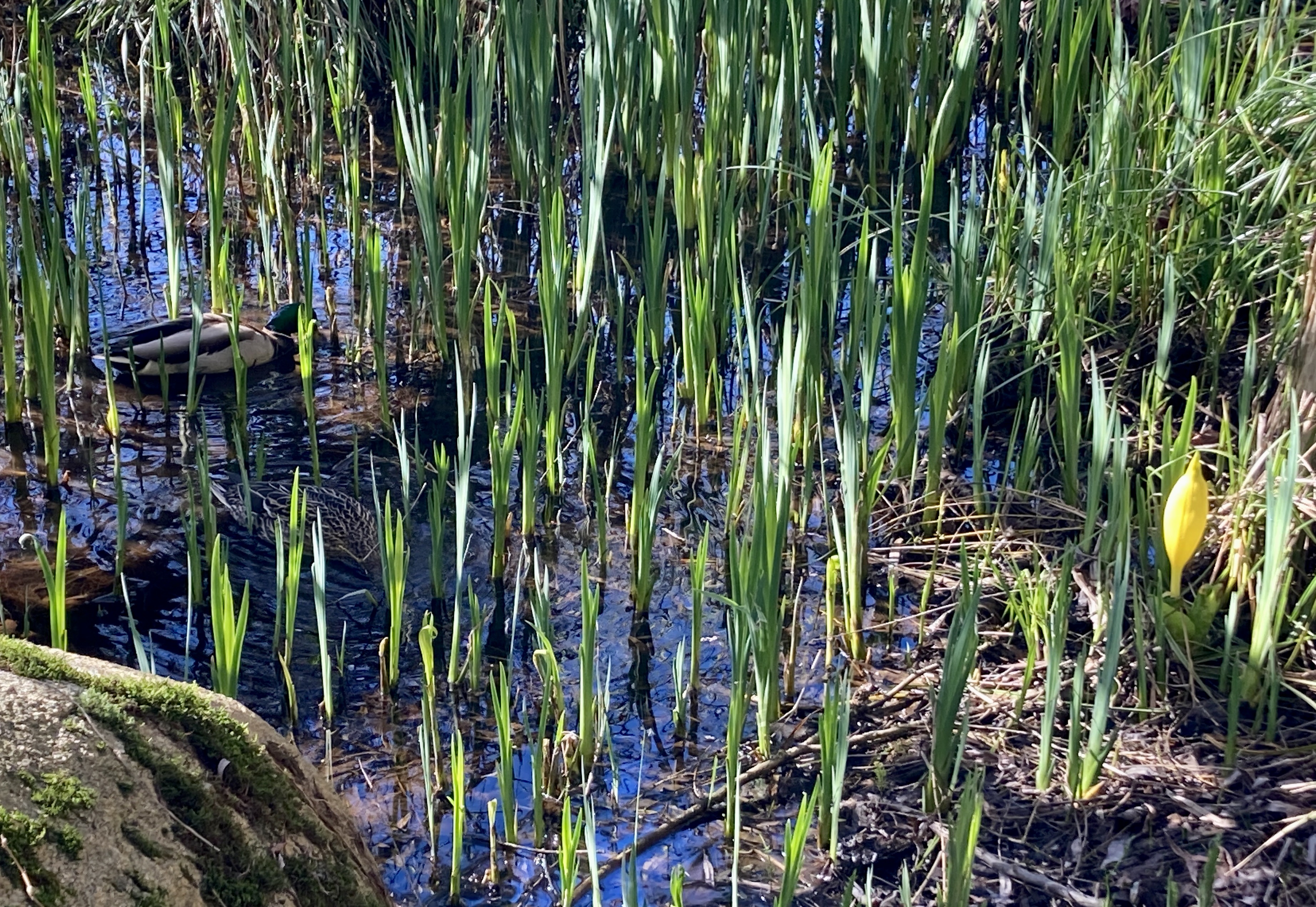
The north shore wetland of Lost Lagoon, the dabbling duck above the mossy rock on the left, the Skunk Cabbage on the right, and all that tender new greenery shooting up everywhere in-between.
Spring.
Posted by icelandpenny on 18 March 2024
https://icelandpenny.com/2024/03/18/the-skunks-of-spring/
8 March 2024 – As I walk back east along False Creek, I do not have a single Life Philosophy thought in my mind. Not a single abstract noun. I am just picking my feet up and putting them down again, enjoying the sunshine.
Then I see this neon glow in the water, just off a curve of seawall between Stamp’s Landing Dock and Spyglass Place Dock farther east.

Still no Important Thoughts in mind, just curiosity.
It’s not until I’m up close, and can identify the shape as a boat, that I think about vulnerability. There that little boat used to be, afloat and riding the currents — and there it now is, submerged and inert.
Vulnerability, consequences, responses. The dynamic is now lodged in my mind, and I see it all over the place as I walk on home.
In environmental and political vulnerabilities, for example, here at Spyglass Place Dock, where blue bands circle Cambie Bridge pilings and a quiet black tribute pillar stands at water’s edge.

The top blue tier in this 2012 art installation, A False Creek, is 5 metres above current sea levels — which is mid-way between the 4 to 6 metre rise that, it is predicted, could be triggered by climate change. The pillar honours Husain Rahim (1865-1937). He was an activist at the time of the 1914 SS Komagata Maru incident that barred a boatload of South Asian passengers from disembarking, and one of the first South Asians to challenge the disenfranchisement then taking place. While the ferry dock is still Spyglass Place, I learn that this space is now called Husain Rahim Plaza.
I’m about to walk on — and discover that I can’t.

Due to “the deteriorating condition of the structure supporting the seawall,” the path has been closed between the Cambie Bridge, right here, and Hinge Park to the east. Detour along West 1st, we are told, while authorities address this weakness.
Heading for 1st Avenue, I walk under the bridge, where I stop long enough to read this extraordinary beer-themed love letter chalked onto one of the pillars.

The message is fresh and wonderful, but street art by definition is ephemeral. Vulnerable. Just look above the top line for proof — the “Simply Jay” message has been effaced.
Eastward on West 1st Avenue now, and more vulnerability call-and-response.

The building in the foreground is one of the City’s Temporary Modular Housing facilities, created in response to what the City itself calls a crisis situation: “over 2,000 people are experiencing homelessness.” The rusty building farther along is an old, disused workshop from the area’s industrial past. It will surely fall down, or be knocked down, sometime soon.
Lying between those two buildings, and in behind the housing as well: an urban farm.

Sole Food Street Farms, founded in 2009, is now one of North America’s largest urban farms. This location trains & employs people from the Vancouver Downtown East Side, who grow the produce that is then sold & given away.
At Hinge Park, I can drop back to the waterfront. The railway tracks and buffers here at the south edge honour the past; the park itself is part of the pre-2010 Winter Olympics response to what had become a derelict and polluted wasteland.

Even my classy latte in an Olympic Village Square café reminds me of vulnerability! I have left it to sit just a little too long, and, look, the frothy design is beginning to deflate. (The taste, I promise you, is unaffected.)

Back outside, I admire The Birds (Myfanwy MacLeod, 2010), gleaming in the sunshine.

The gleam is thanks to their fairly recent repatination; the repatination was the response to the vulnerability of their surface to all those climbing feet. Signage now politely reminds people that these sculptures are art, not a climbing wall, and asks us to keep our feet on the ground.
Heading south on Ontario Street, I detour half a block west into an alley, for a closer look at a face.
This face.

L’il Top is the signature, and if this bit of street art is vulnerable to time and the elements, so are those H-frame hydro poles. I, and countless Vancouver artists, love the look of them, but they are seriously outmoded, and systematically being replaced.
Back onto Ontario, farther south to West 6th, and my vulnerability theme now presents itself in a real-estate trio. The first thing I notice is that wavy reflection in the windows of the blocky new-build on the corner.

Then I play with the story, the trio of stories, the development dynamic of this bit of Mount Pleasant neighbourhood. Behind the new-build, a century-plus brick veteran, its status secure; in these windows, the reflection of the scruffy building across the street, wrapped in chain-link fencing, its status unclear.

Once the Teachers Centre for the Vancouver School Board (1972-1990s), it sits within the footprint of the T3 Mount Pleasant site now under construction — “T3” as in timber/transit/technology, with a planned 190,000 square feet of mass timber construction to attract environmentally responsible companies and workers. If the developer’s web page is any guide, at least part of this old building will be restored and repurposed as a heritage element in the mix.
Response to environmental threat is the theme of this part of Mount Pleasant. Along with the T3 building, it is also home to the emerging Main Alley Campus, which promises to provide “Canada’s first completely net-zero work environment for the creative economy.”
These two projects won’t save the planet, but it is heartening to see major development corporations put their weight behind new, more environmentally responsible, approaches.
I swing onto East 7th, and salute a building that has long known how to respond to changing threats — and here it still is, 112 years later.
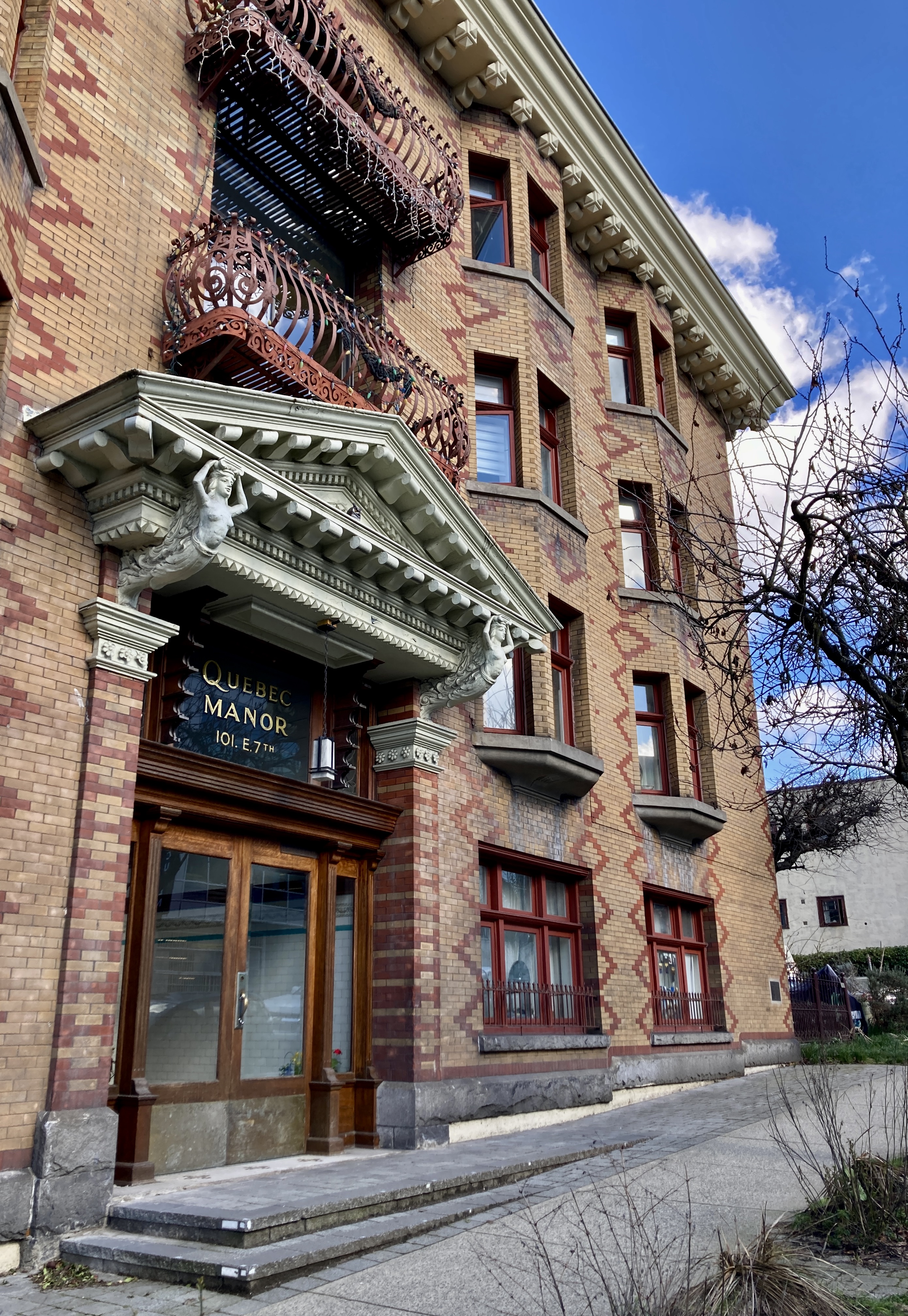
Behold Quebec Manor, in all its diamond-patterned, bi-coloured brick glory. (Complete with metal balconies and nude maidens to welcome you home…) Built in 1912 as a luxury apartment hotel, probably for train passengers at the near-by terminals, it became rental units in the 1920s, and in the 1980s achieved new, secure status when its tenants bought the building and turned it into a housing co-op.
So that’s my walk, and how discouraging it could have been, with such a theme. But it wasn’t. So many vulnerabilities, yes — and so many responses, as well.
Posted by icelandpenny on 8 March 2024
https://icelandpenny.com/2024/03/08/vulnerable/
6 February 2024 – Having puttered my way along Commercial Drive, I am now zigzagging my way north-west through various neighbourhoods, making my way to Main Street and a bus on home.
No particular plan, so it’s sheer serendipity and pleasure to find myself on Charles Street looking north along McLean — the site of Mosaic Creek Park.

Hundreds of mosaic tiles form the “creek” running through this tiny park. It is the late-90s creation of a determined local coalition, the Britannia Neighbours Community Group, with the help of mosaic artists Glen Anderson and Marina Szijarto, who ran workshops and facilitated tile-making by any community member who wanted to take part.

The Park Board insisted the tiles be frost-proof, but set no artistic criteria. People were free to create whatever they wanted to create.
Agile fish, for example…
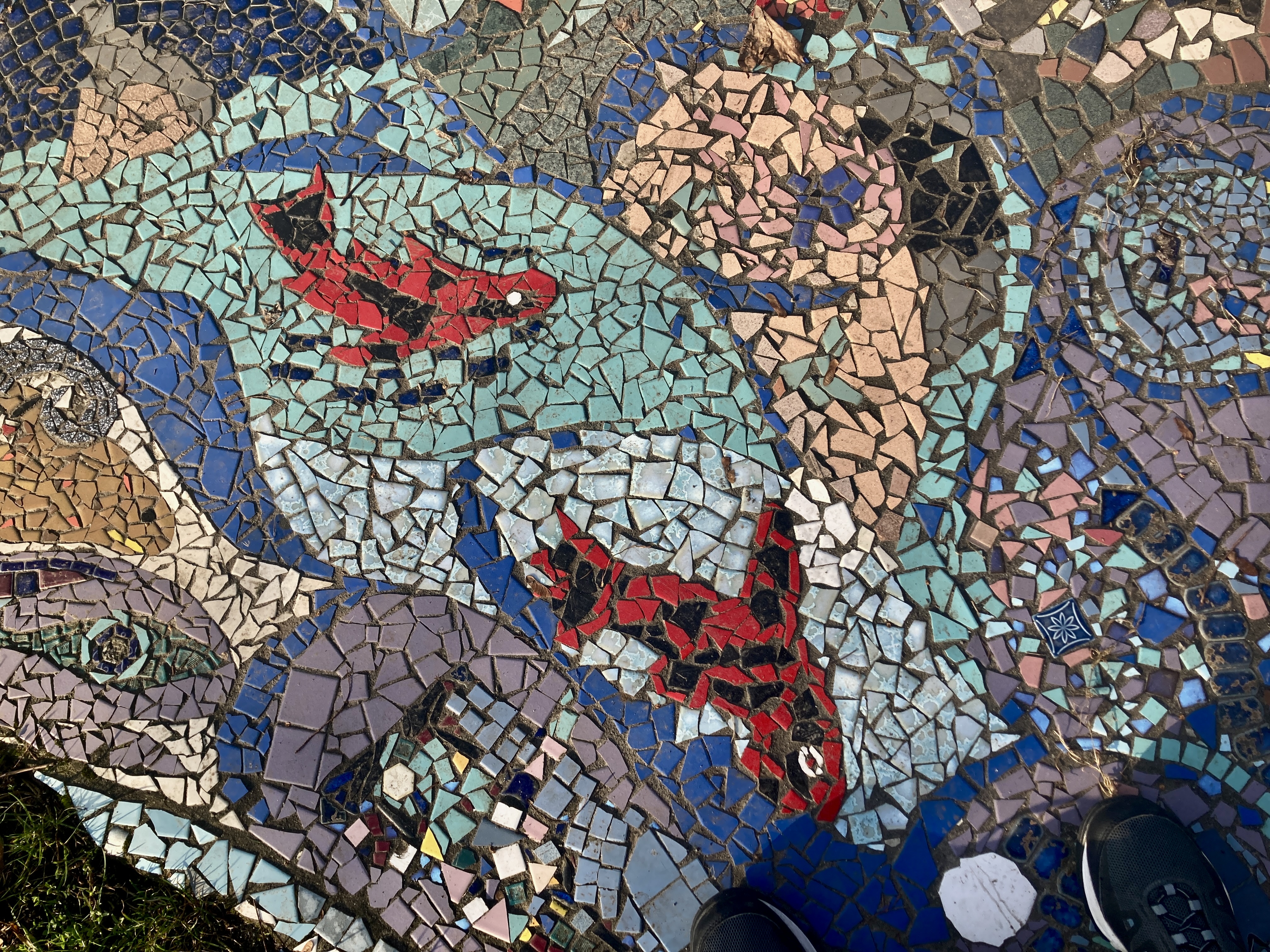
or a sleepy cat…

or wind-blown leaves…
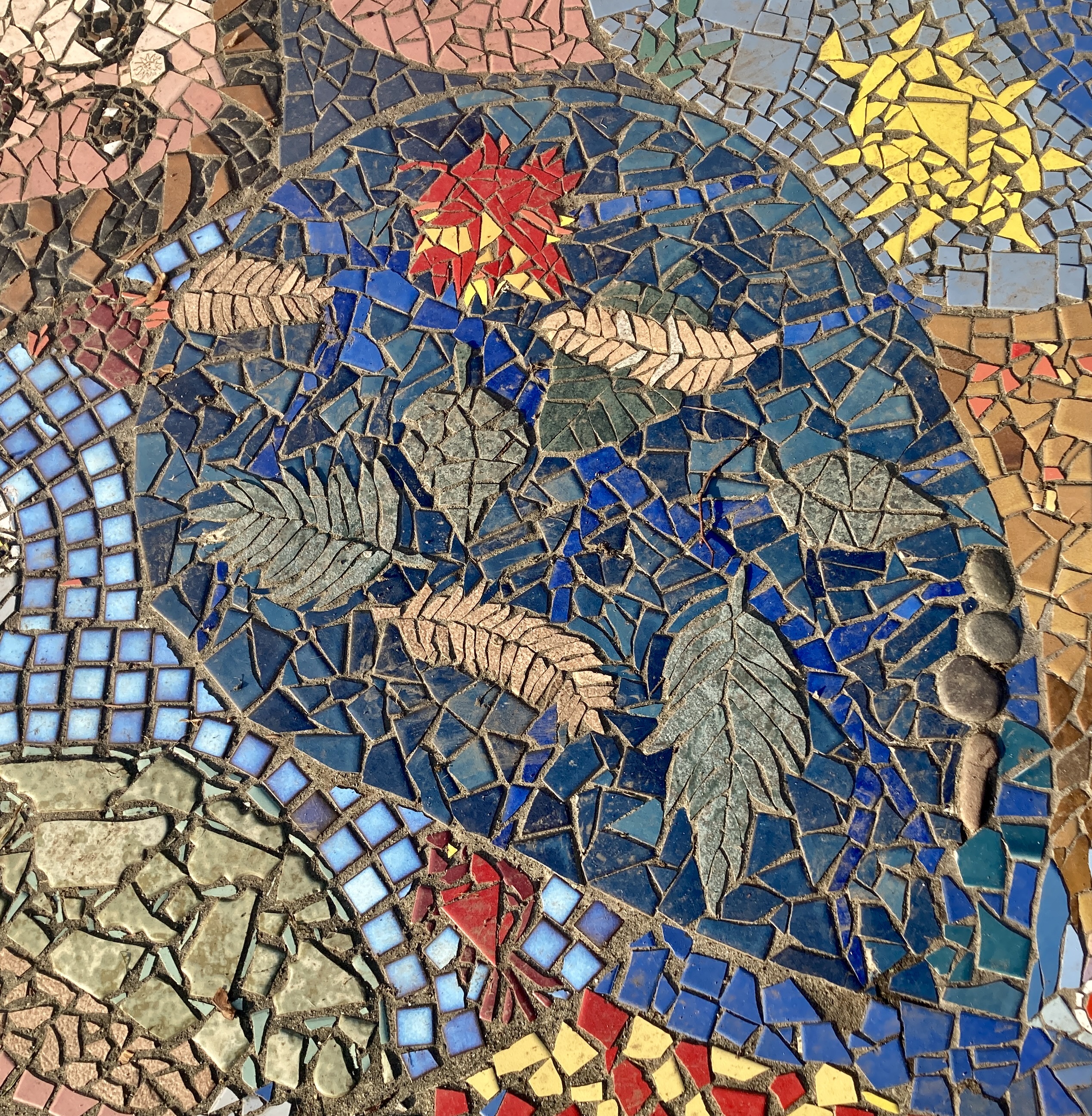
or (why not) a dancing, prancing human being.
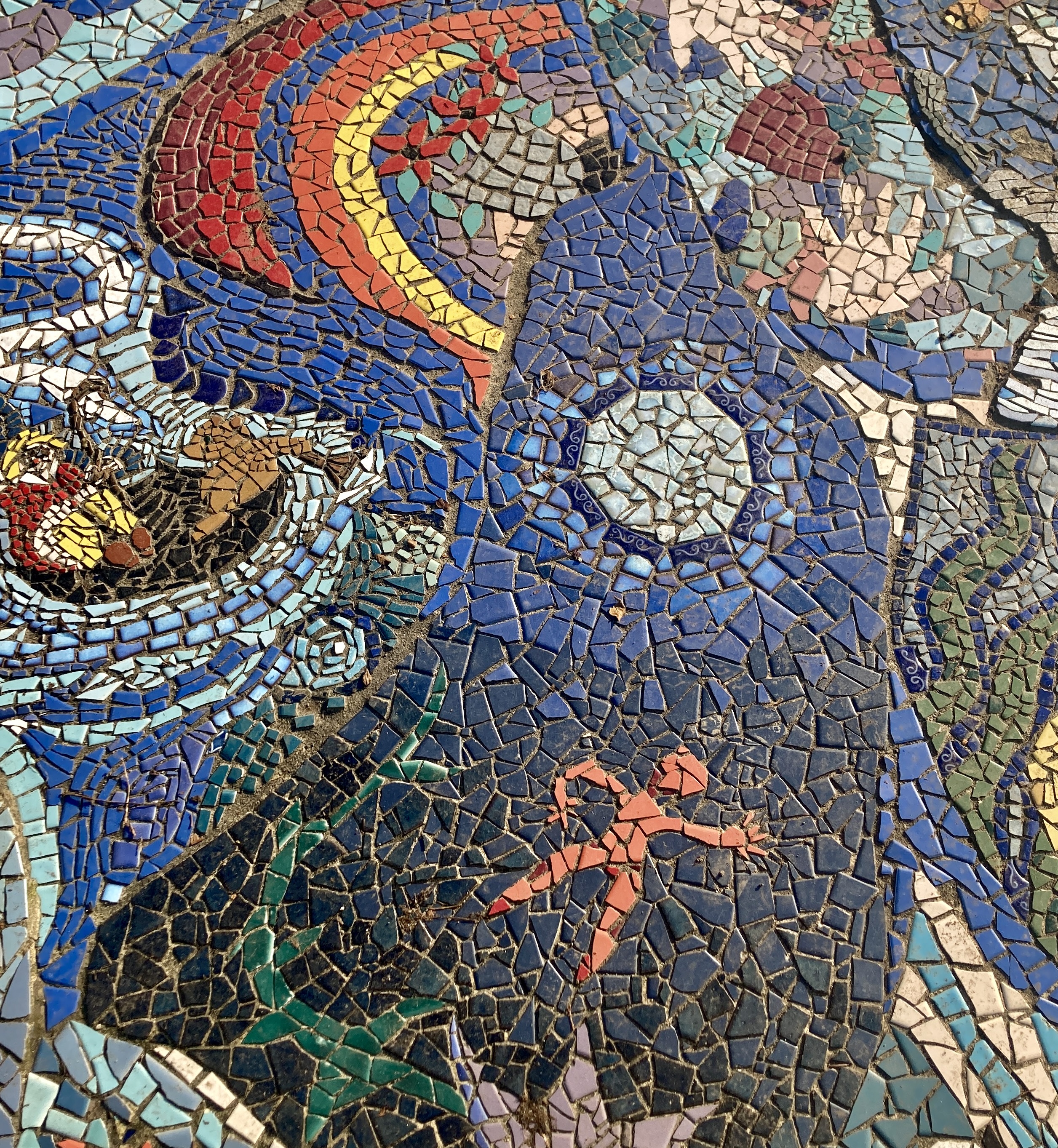
The two people on that corner bench, though relaxed and companionable, are not dancing. In raspy voices, they discuss strategies for getting your s**t together in rehab.
Farther down McLean, two dapper young businessmen stand side by side, eyeing a corner lot. In quick, clipped voices, they discuss marketing strategies for new builds.
Posted by icelandpenny on 6 February 2024
https://icelandpenny.com/2024/02/06/strategies/
17 January 2024 – Both at the Vancouver Art Gallery, fortunately not in the same exhibit.
Even so, each affected us in much the same way. We emerged stimulated, better informed, and hopeful about the kind of future trends that each show seems to suggest. What a happy way to spend a cold afternoon early in the new year!
— First up, the fibres —
Rooted Here: Woven From the Land
As the VAG website description explains, “This exhibition makes clear the vital integration of weaving throughout traditional and contemporary Salish cultures…” It features the work of four renowned Coast Salish artists (Angela George, Chief Janice George, Willard (Buddy) Joseph and Debra Sparrow) and includes both hangings…

with explanations…

and an installation of videos and draped mannequins.

Beautiful work, enriched by trends — trends that are now carrying the “integration” cited by that VAG intro beyond the Coast Salish peoples and bringing it into the larger context shared by us all.
In 2018, Debra Sparrow, Angela George and Willard (Buddy) George began collaborating with the Vancouver Mural Festival in a continuing project called Blanketing the City. , — a project through which they are bringing these design motifs into the city’s found architecture.
Now all four artists have moved beyond existing street structures to bespoke design for a $400-million new build. In collaboration with Swiss architects Herzog & de Meuron, they have designed the copper cladding…

for the future home of the Vancouver Art Gallery.
Some project material is included in the exhibit; I came home and promptly looked for more, especially in the detailed presentation on the architects’ own project design pages.
— And now for the fraud —
J.E.H. MacDonald? A Tangled Garden
Do please pay attention to that question mark.
We have here an entire exhibition, a detailed exhibition, devoted to ten sketches that were received with triumph in 2015 and are now acknowledged to be forgeries. That is to say:
As with the exhibition’s question mark, so with its careful use of prepositions.
What an extraordinary show! A whole show built around a major institution saying, “We got that wrong. What looked right, was wrong.” And then documenting the almost nine years of investigation that produced the final verdict.
Appropriately, the lead image for this entangled story is the sketch after (not for!) MacDonald’s painting, The Tangled Garden.
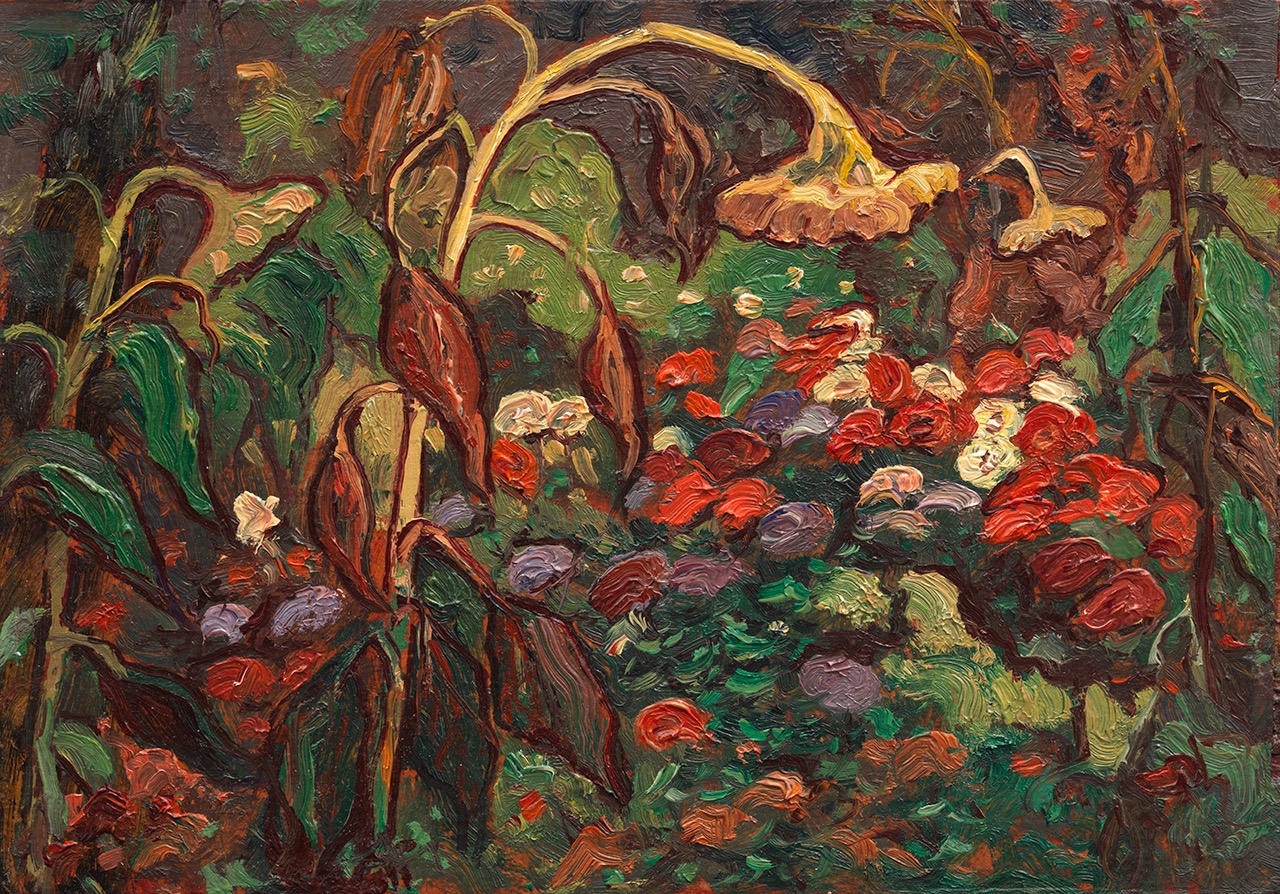
What they’re still not telling us is whether the Toronto dealer and the Toronto art collectors who offered these works were themselves duped or part of the duplicity. What we do know is that very soon after the VAG trumpeted its exciting acquisition, the larger art community began to ask questions.
As best I understand it, the VAG initially responded in the well-established global tradition for handling such moments. It stone-walled.
But then, with a new CEO and the courageous example of Ian Thom (the then-Senior Curator who had brought in the acquisition), the VAG decided instead to conduct a thorough investigation, and share what they learned. Art historians, art experts at other institutions (e.g. National Gallery of Canada) and forensic scientists (e.g. the Canadian Conservation Institute of the federal Dept. of Canadian Heritage) all took part. As Ian Thom said, in the excellent video documenting all this work, “I thought this one of the great experiences of my life. Then it just got worse and worse.”
But for us out here, it just got better and better. A major institution, willing to acknowledge it had been conned? Willing to do the investigation, and then not quietly shelve it, and deep-six the works, but build an entire exhibition around those discoveries? Willing to acknowledge that fraud is as much part of the art scene as art itself? Willing to reveal its own stories, and educate the rest of us?
How wonderful it would be, if this trend caught on.
Come see the show, if you can manage to be in Vancouver any time before May 12. It includes some of the well-authenticated Group of Seven works in the VAG collection, but hits stride once it zeroes in on the investigation: the people, the skills, the tenacity, that led to the final results.
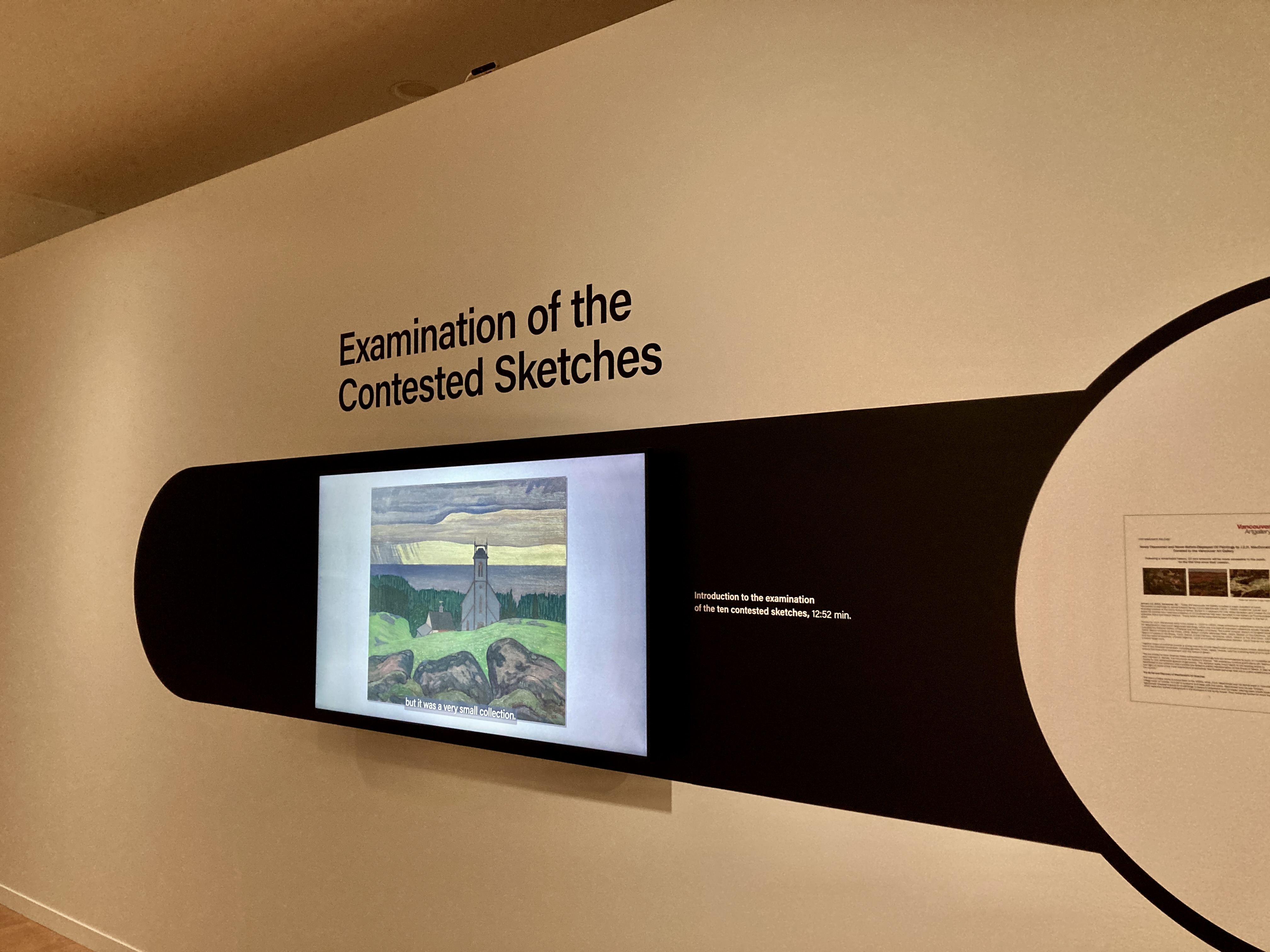
And if you can’t make it to town, dive into this story of art + forensics in various sources online: everybody from Stir to The Art Newspaper, to Galleries West, to the VAG itself. And more.
Posted by icelandpenny on 17 January 2024
https://icelandpenny.com/2024/01/17/fibres-fraud/
12 January 2024 – But first, an acknowledgment. It is merely -11C as I write this, not (for e.g.) the -33C of Calgary nor the NWT temps that Lynette is recalling in her Baby It’s Cold post.
But still, for Vancouver, -11C is nippy. Yesterday, as Polar Vortex warnings hit our media and temperatures dropped to -3 or so, I decided I had to prove to myself that six years of Vancouver life had not rendered me incapable of going for a sub-zero walk.
Down to False Creek.
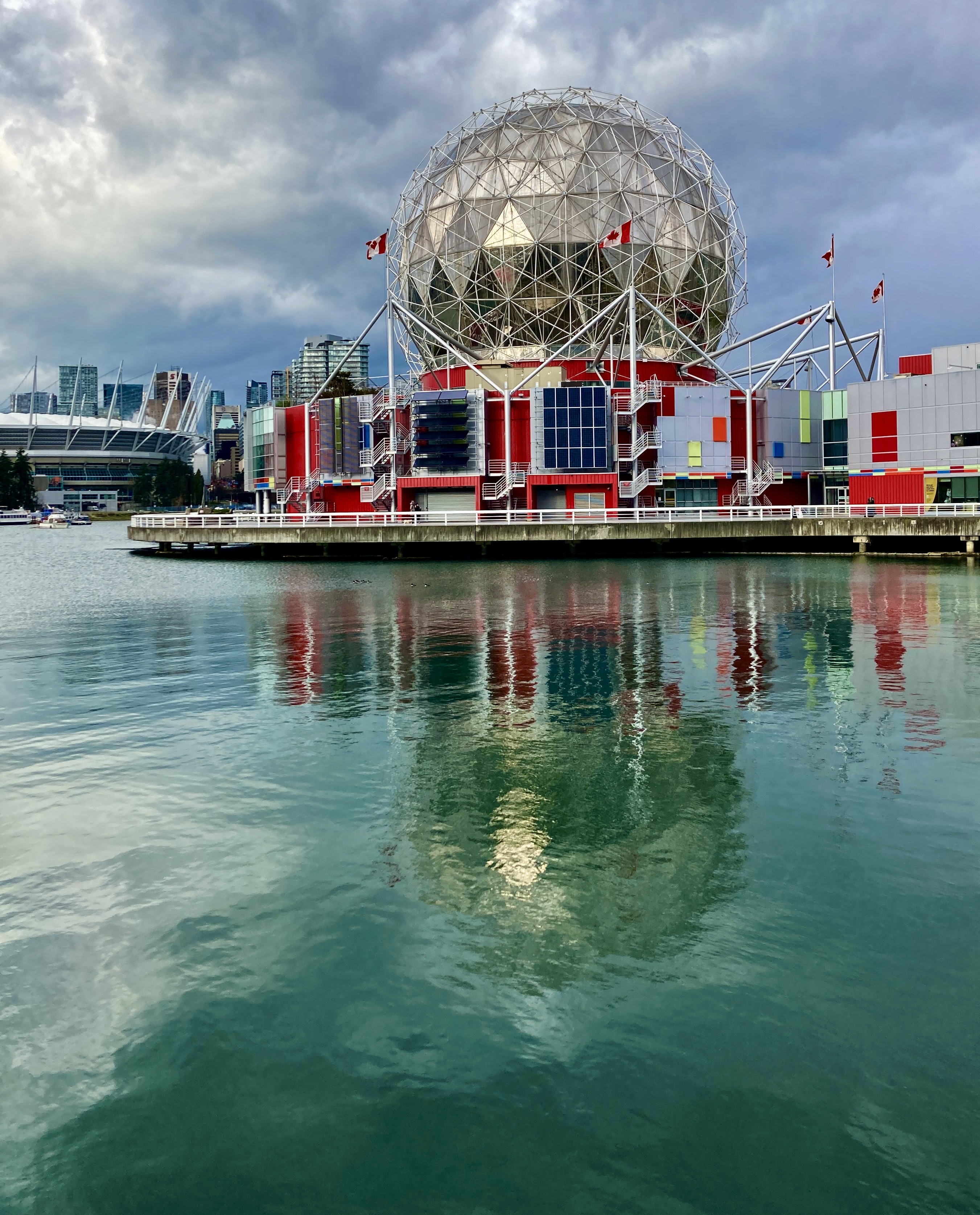
Snow-promising skies beginning to build, up there behind the World of Science dome…
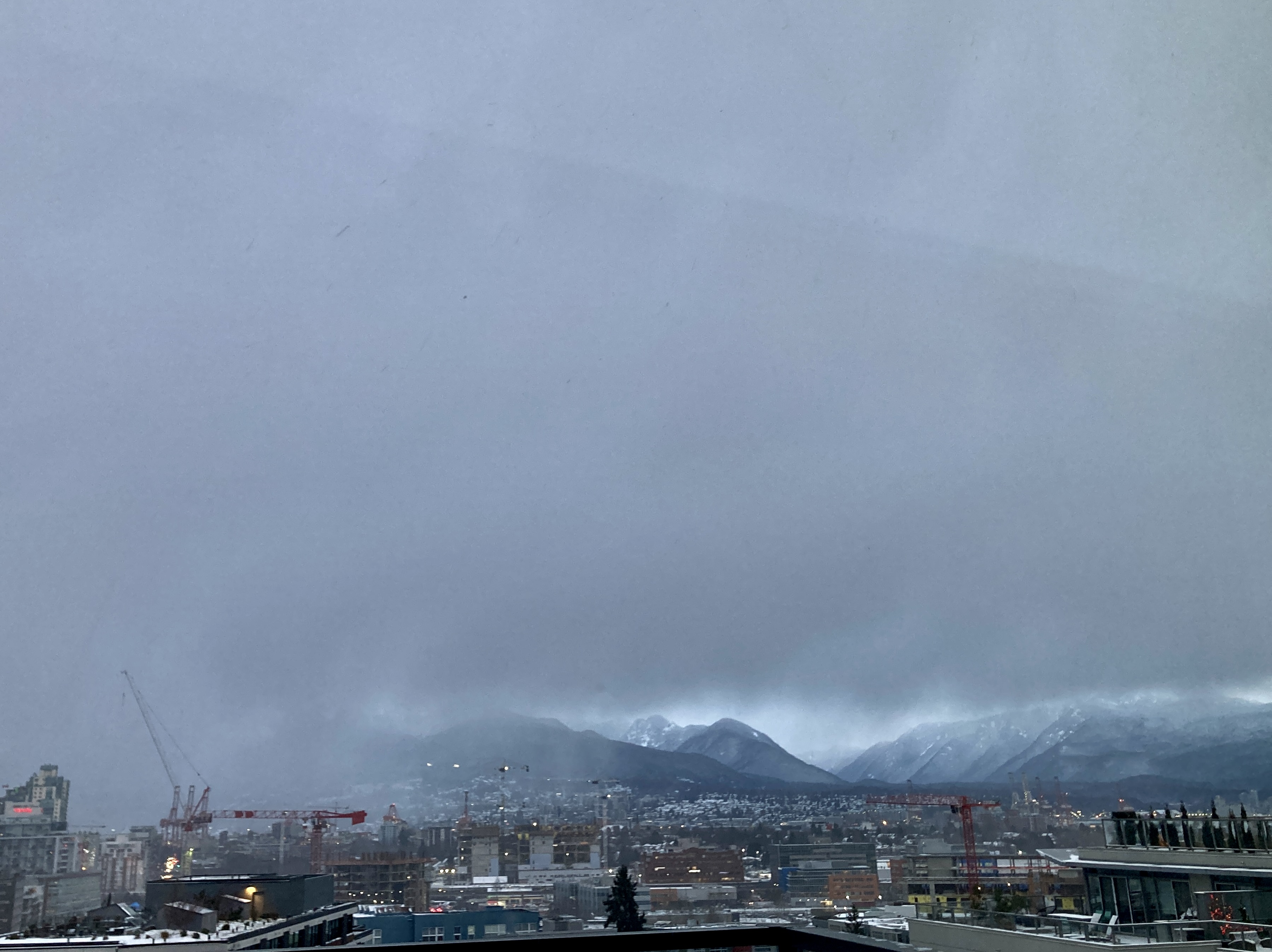
and, by mid-afternoon, snow clouds massed even more dramatically all along the Coast Range Mountains.
It did snow.
Just a skiffle, nothing deep, but — given the temperatures — it has stayed on the ground.
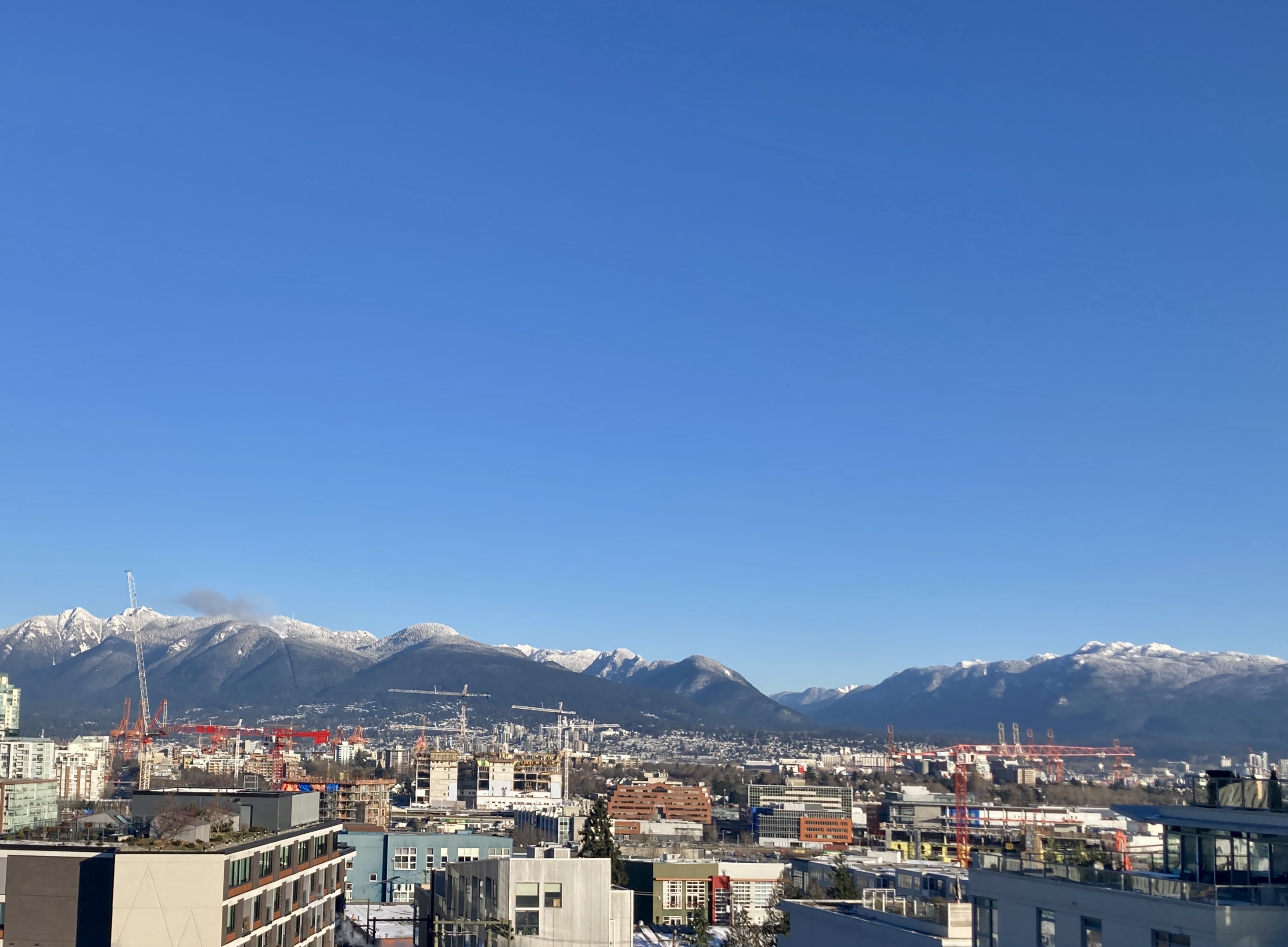
Today, over those same Coast Range Mountains, the sunshine that comes with greater cold.
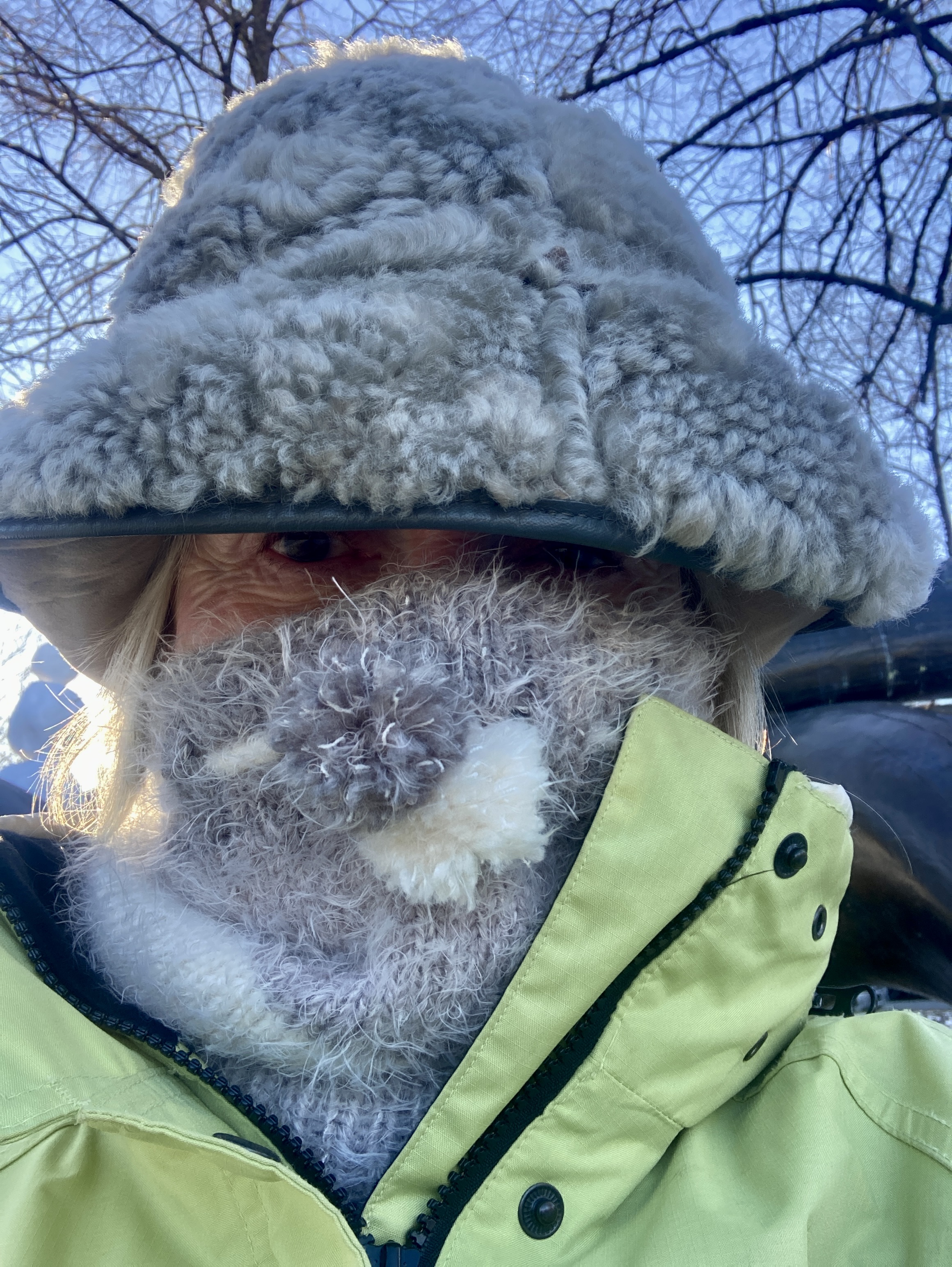
I bundle up once again. I am still not a wimp!
I decide I don’t need to go far: I can satisfy honour with a quick loop around Dude Chilling Park, and a respectful salute to The Dude himself en passant.
Other bundled-up people along the way (and some bundled-up dogs).
I reach the park. There’s The Dude.
With … what… something white… in the crook of his shoulder. Please don’t let it be litter, I murmur to myself. I’ve enjoyed, taken confidence from, the respect people show The Dude. Please let that continue.
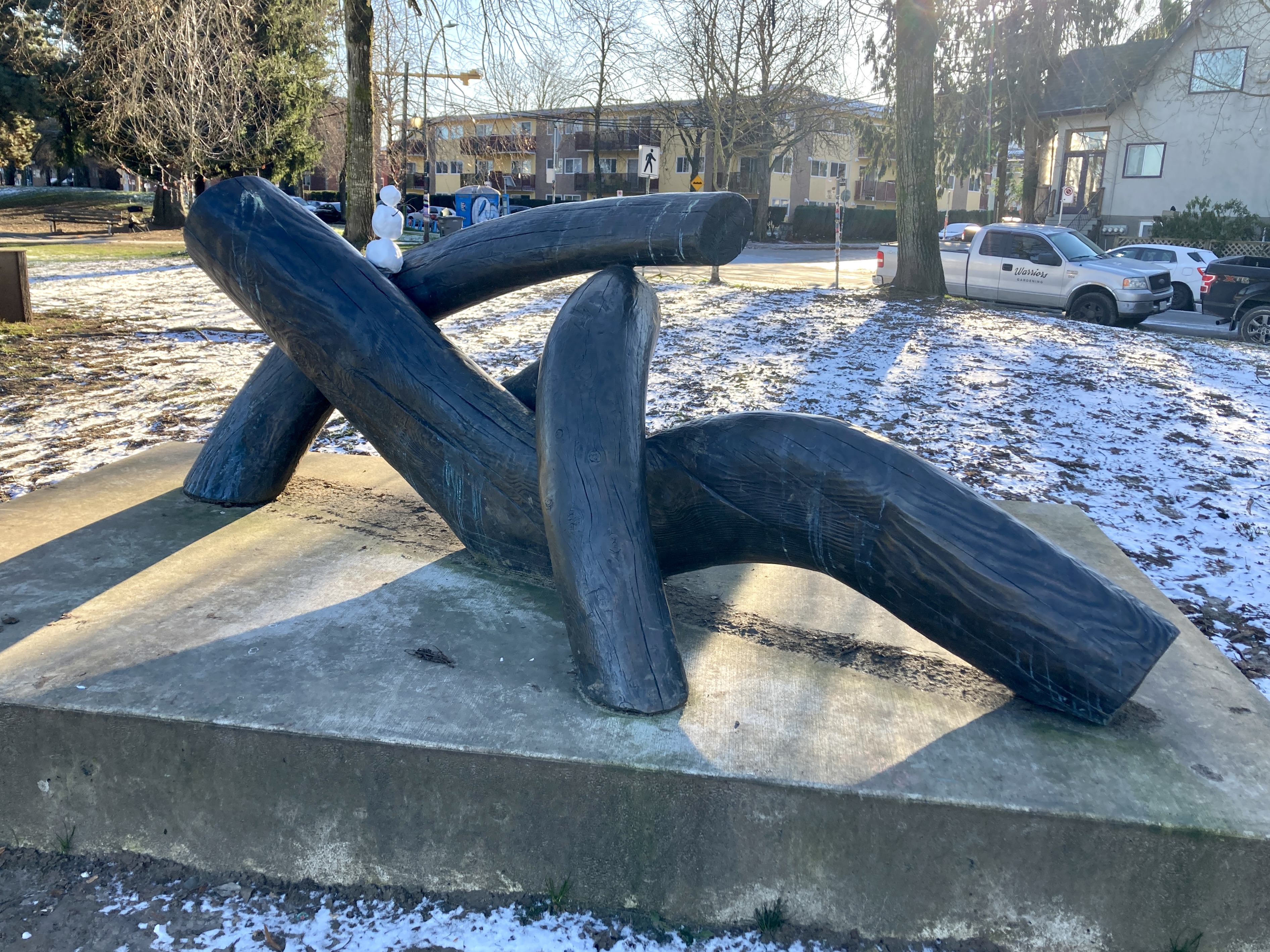
Well of course it’s not litter.
It is the world’s smallest snowman, lovingly shaped and lovingly placed, cuddled up with The Dude.

Behind my face-scarf, I am all scrunched up with delight.
And then I take my tingling fingers back home, and wrap them around some hot chocolate.
Posted by icelandpenny on 12 January 2024
https://icelandpenny.com/2024/01/12/to-the-dude-back/
2 January 2024 – The challenge is: how many icons can I jam into my first post of the new year? Icons that say, “Vancouver in winter,” but also speak to my own obsessions.
Off I go.
Start with: alley + street art + H-frame hydro poles + distant mountains fading into the misty drizzle.

Add: False Creek + Science World dome + Aquabus ferry + orange Port of Vancouver “giraffes” + (audio only, take my word for it) the 12-noon Gastown Steam Clock rendition of O Canada.

Add: a dance of lines & spaces.

Add: a surprise. If your eyes are open, there is always a surprise. (Though not always as dramatic, or unfortunate, as this one east of the Cambie bridge.)

Add: the gleam of rust in the rain. (Here, the sewer-pipe “train engine” over a Hinge Park creek.)

Add: winter tree trunk moss, garnished with fernlets.
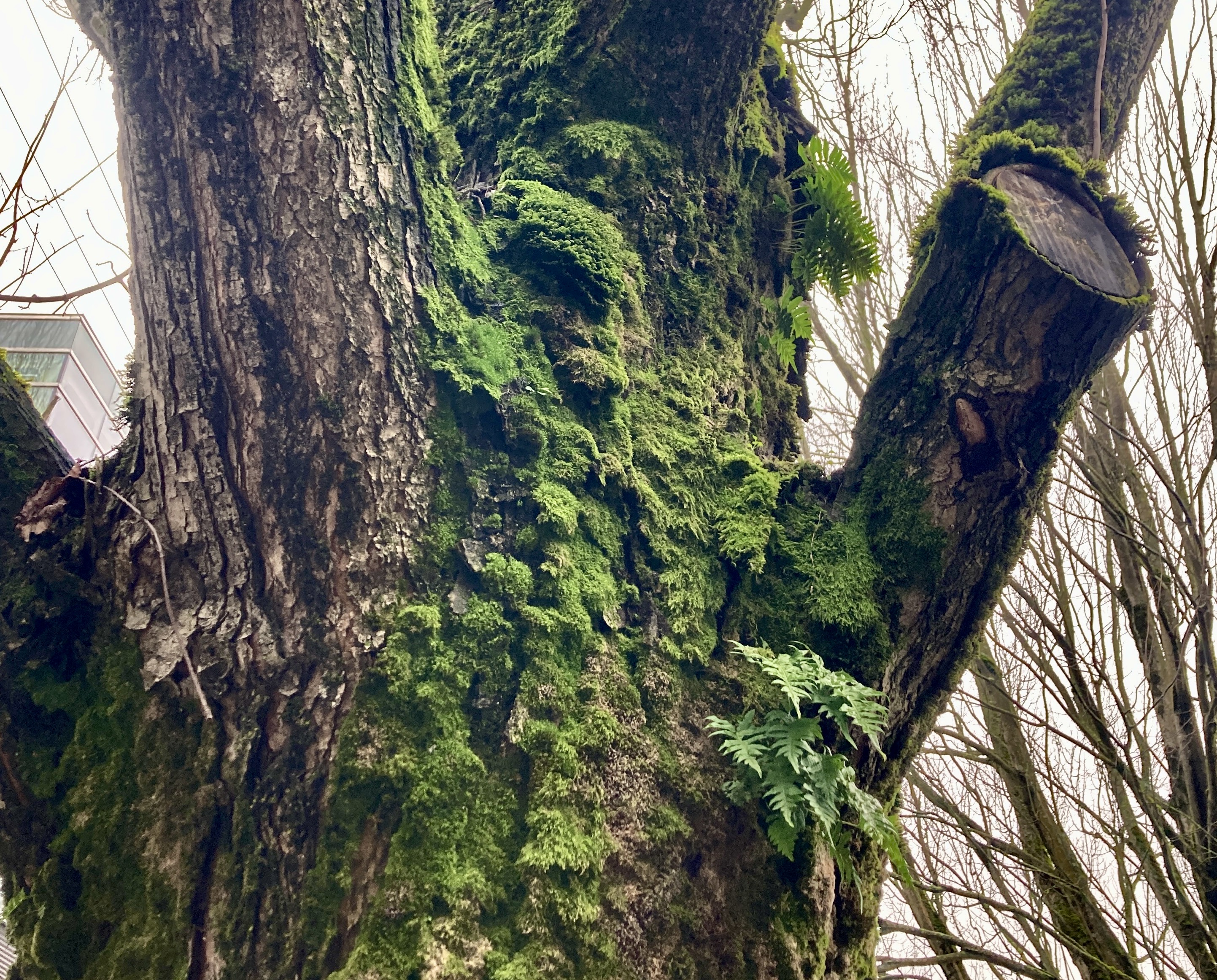
As I walk back south on Ontario Street, I think: It lacks only a crow.
And then, just north of East 5th, there he is!

Yes, yes, I know. He is white, and painted, and riding a skateboard. But I say he is a crow, and it’s my blog.
My year has begun.
Posted by icelandpenny on 2 January 2024
https://icelandpenny.com/2024/01/02/project-icon/
31 August — Just back from a six-day escape to Vancouver and the Lower Mainland of British Columbia, visiting much-loved family and friends in an area that always uplifts me.
I say “much-loved” for many reasons, but after all these decades recognize that one of them is the resonance added by sheer passage of time. Part of the worth is in the while — a concept I borrow from John Fowles, who first deconstructed “worthwhile” this way in his 1964 book of personal philosophy, The Aristos.
 Count back on your fingers and, yes, I posted “King, Queen and Moose” not from Toronto, but from the home of my friends Sally and Owen in North Vancouver. I sat there at Sal’s laptop, looking out over their back yard to the fence dividing it from the trees and shrubs of Mount Seymour Provincial Park immediately beyond.
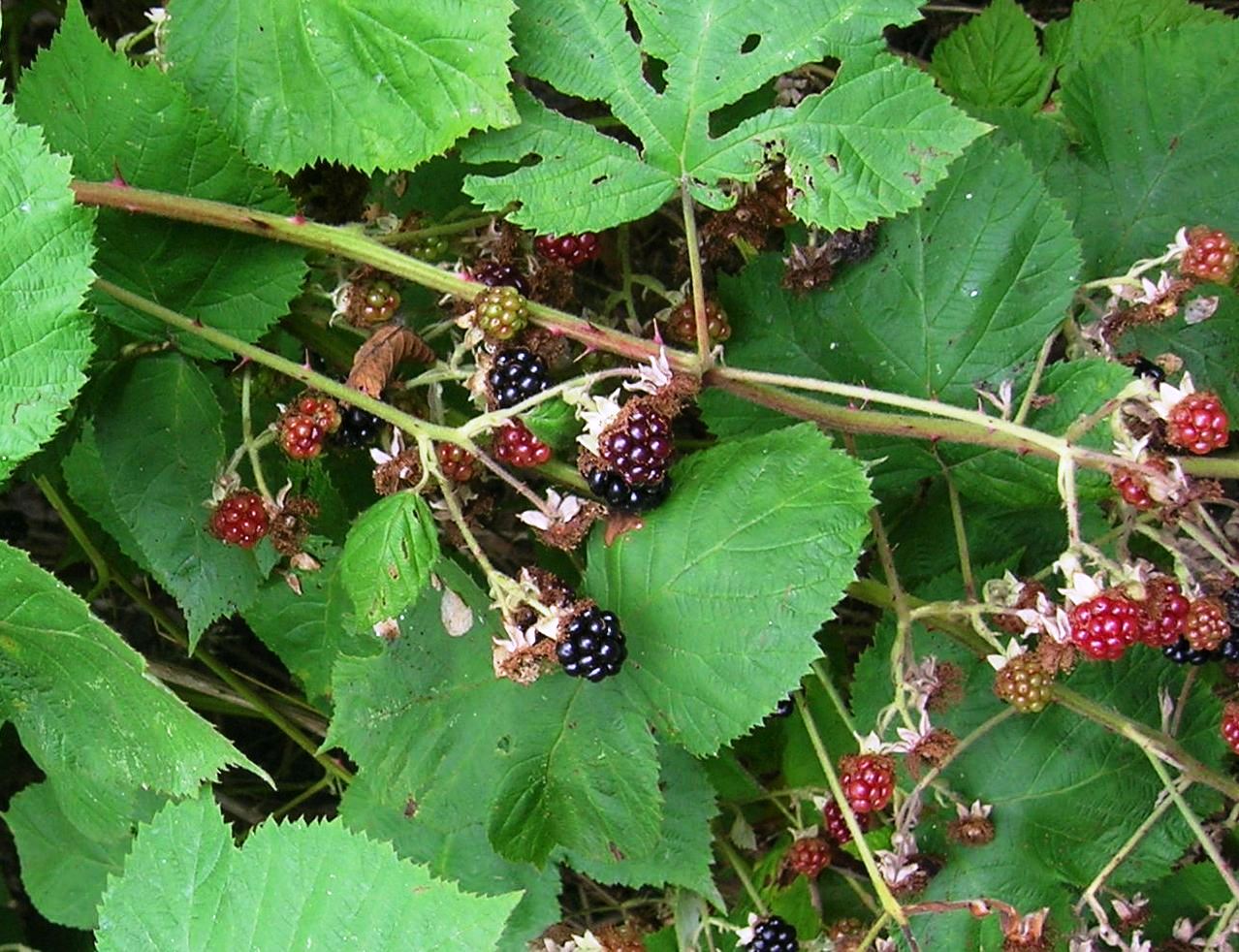
The shrubs include blackberry bushes, up against the fence. Which means ripening blackberries are more than a sign of changing seasons, they signal potential danger. Black bears love blackberries, and literally turn gate-crasher on occasion, once they’re that close to residential properties with other potential sources of food.
(Sally once emailed me the photo of a black bear foraging in their yard. All I could send in return was a raccoon sleeping in my birdbath.)
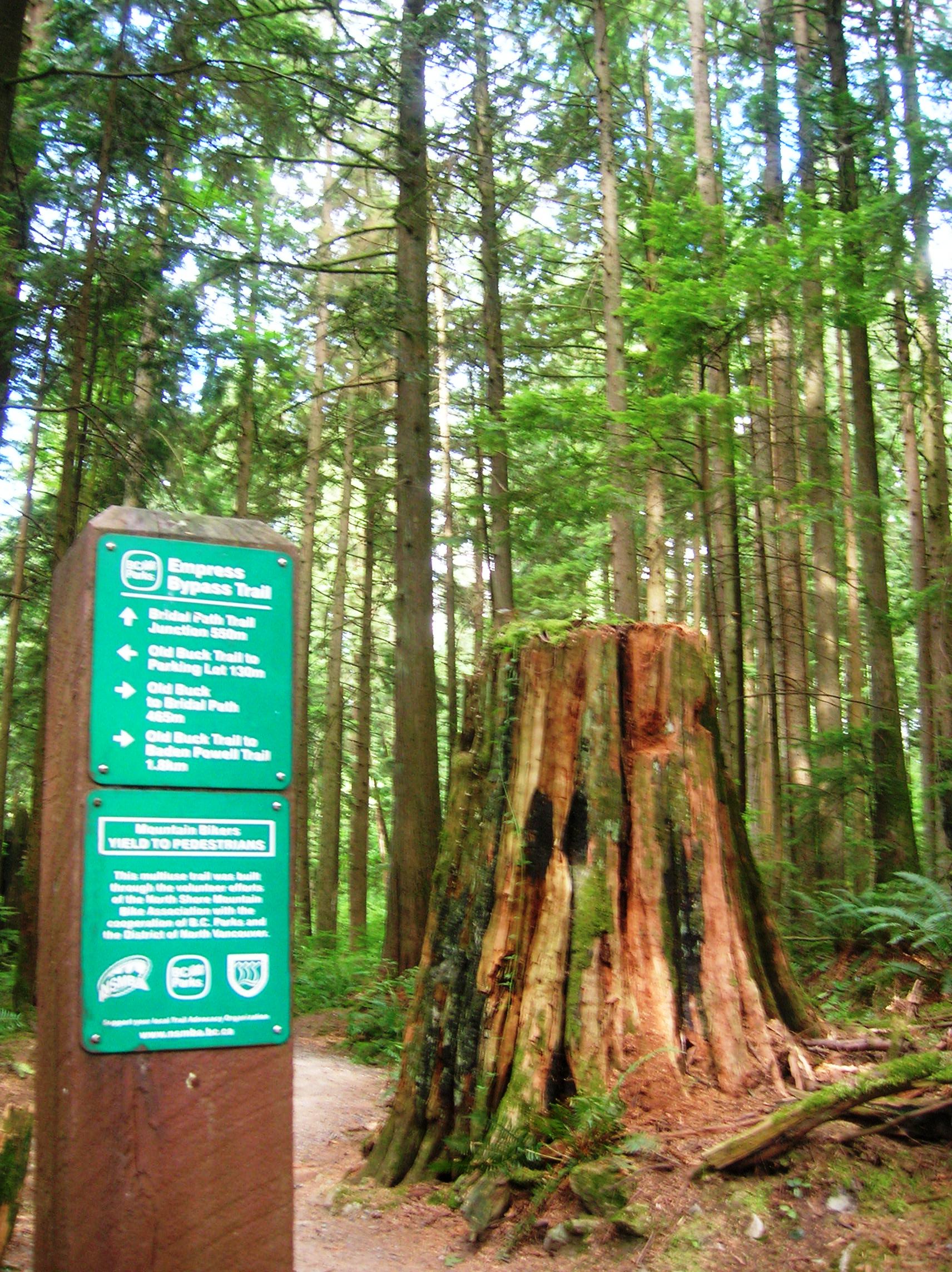 Of course the visit included some hiking about! You can’t be in British Columbia, halfway up a mountain, and not go walking. First target, Old Buck Trail, which sets off halfway up Mount Seymour Road. Various other trails split off, such as this Empress Bypass option, but I stuck with the main trail.
I hadn’t brought my pedometer, and settled for a 90-minute outing instead right on Old Buck itself. First I went up (and in these mountain ranges, up is up), awe-struck by the huge stumps of long-ago trees. Yes, I’ve seen them before, but they never fail to move me.
Somewhere beyond here, short of the Baden Powell junction but not by much, I turned about.
At least as high as I went, the trail was much like this — a smooth, clear dirt path. 
Just as the ancient stumps move me, so do the great columns of contemporary tall trees. The path moves gently among them, and I think a bit about paths, and making one’s path (thank you, Antonio Machado), physically and otherwise.
I remember, too, that tai chi is sometimes described as “walking meditation.” I don’t specifically meditate when I walk, but I do usually feel myself expanding out into my surroundings, somehow.
Then, sometimes, the elegant columns of trees give way to great bursts of nature’s very own mixed media: rock and moss and other layered vegetation and spikey remnants of old logs and forest, forest, forest.
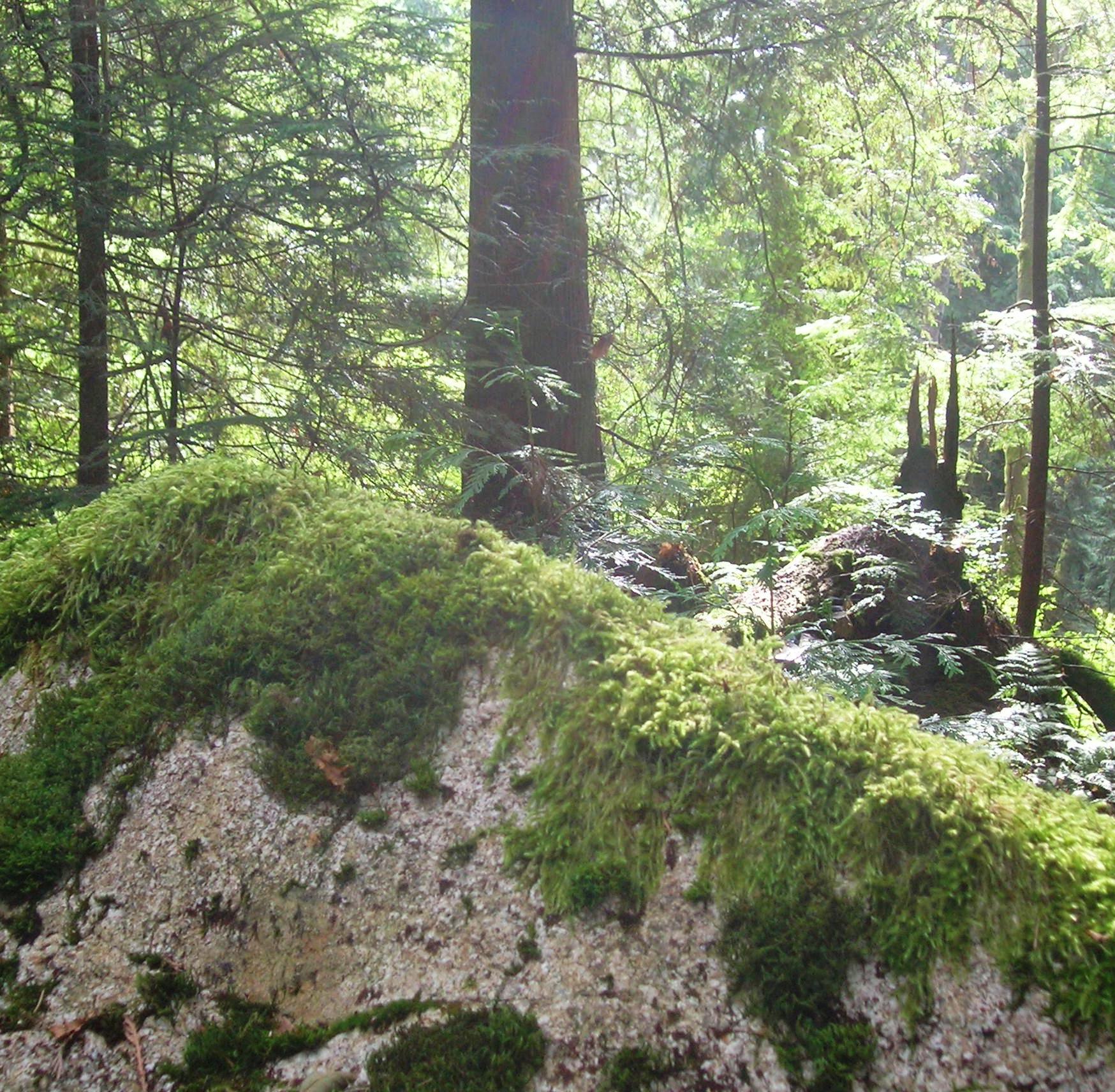
But no, I don’t spend the whole six days in the woods.
Soon I’m deserting this far corner of North Van for a visit to Vancouver proper — across Burrard Inlet by Seabus, then south on the Canada Line (built for the 2010 Vancouver Winter Olympics), and out onto Cambie St. at Broadway. Where I grabbed this shot northward up Cambie, sightlines back to North Vancouver and the framing mountains beyond.
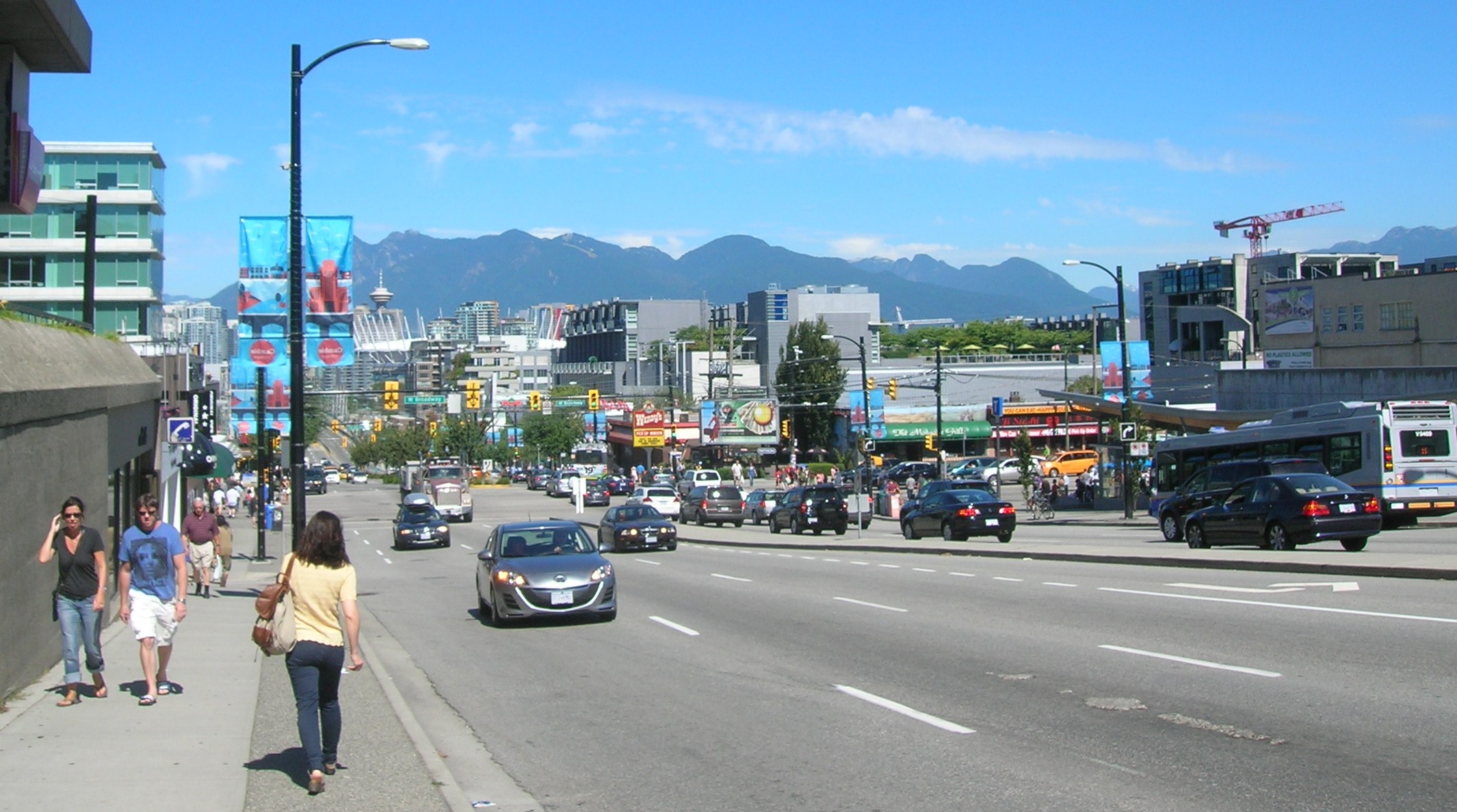
Mountains and ocean, Vancouver is the Rio of the north.
But even here, walking with my friends Louise and Rolf through residential streets over to Main Street and then south… even in this dense bit of cityscape, there’s still great exuberant nature. (When I lived in Calgary, a semi-desert climate, and came visiting, the sheer humid profligacy of Vancouver’s nature always smacked me in the eye and up the nose.)
My friends waited cheerfully while I eyed the detail of growth on city trees. Like this one.

We had lunch one place, lattes somewhere else, prowled shops with strong design sense… and finally good-bye and back north I went, retracing my way via the Canada Line to the Seabus again. Where I was charmed by these little girls, their noses pressed against the ferry’s front window, party balloons to one side.

Another walk, still in North Van and on Mount Seymour, but setting out from the little community of Deep Cove.
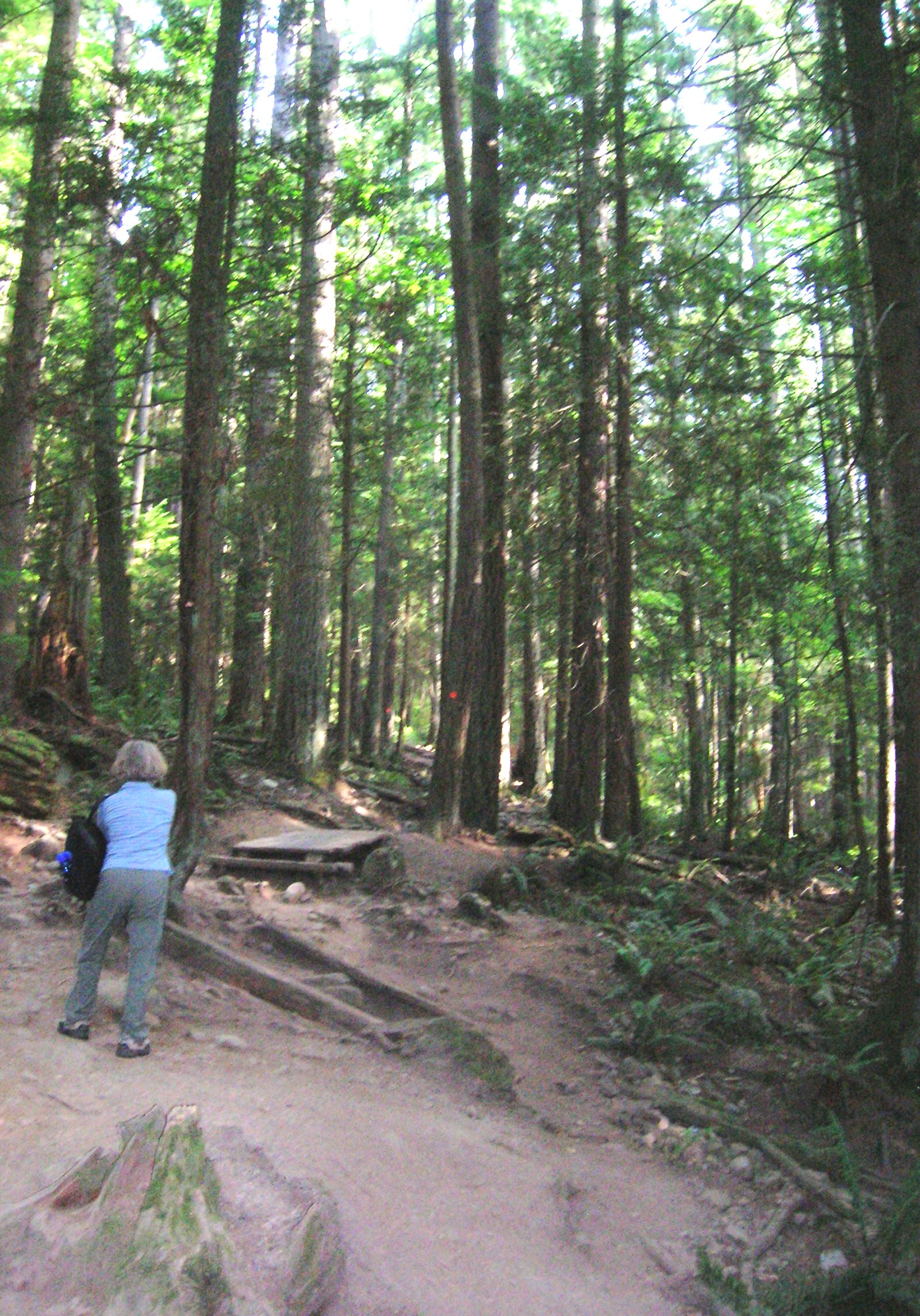 That’s Sally’s back, in an early stretch of our chosen hike, up the Baden Powell Trail to the Deep Cove Lookout. The lookout is aka Quarry Rock — indeed a succession of big old rocks, but no sign anywhere of past let alone present quarrying. So, go figure.
Sal characterized this as an up-and-down trail, probably an hour each way. The footing was at times smooth and the path gently curving, but in other places the path twisted narrowly among trees and boulders, intensely scored with tree roots and rocks.
It was also much less solitary than my Old Buck outing! Then again, a weekend morning vs weekday. More people than we really wanted — oh, the cherished illusion of being alone in nature — but at least everybody observed pretty good trail etiquette.
Even the dogs behaved themselves. Including a snowy white little pooch who clearly had been having a wonderful time in mucky streams. Her owner observed her four black legs, and quipped, “Her name is Emma, but we may have to call her Boots.”
Finally there we were on Quarry Rock, looking over the Indian Arm inlet of the ocean, with the village of Deep Cove itself hidden away to the right.

Going back down, I lost track for a moment. So many ups and downs enroute… where we really descending? Yes, we were. Sometimes on the twisty paths I described above, sometimes on stairways pressed against rock faces, like this.

Yah, finally, indeed down and walking along the Deep Cove beach, with all the boats bobbing in the water and great red and yellow blocks of kayaks set out, waiting their turn for some action.
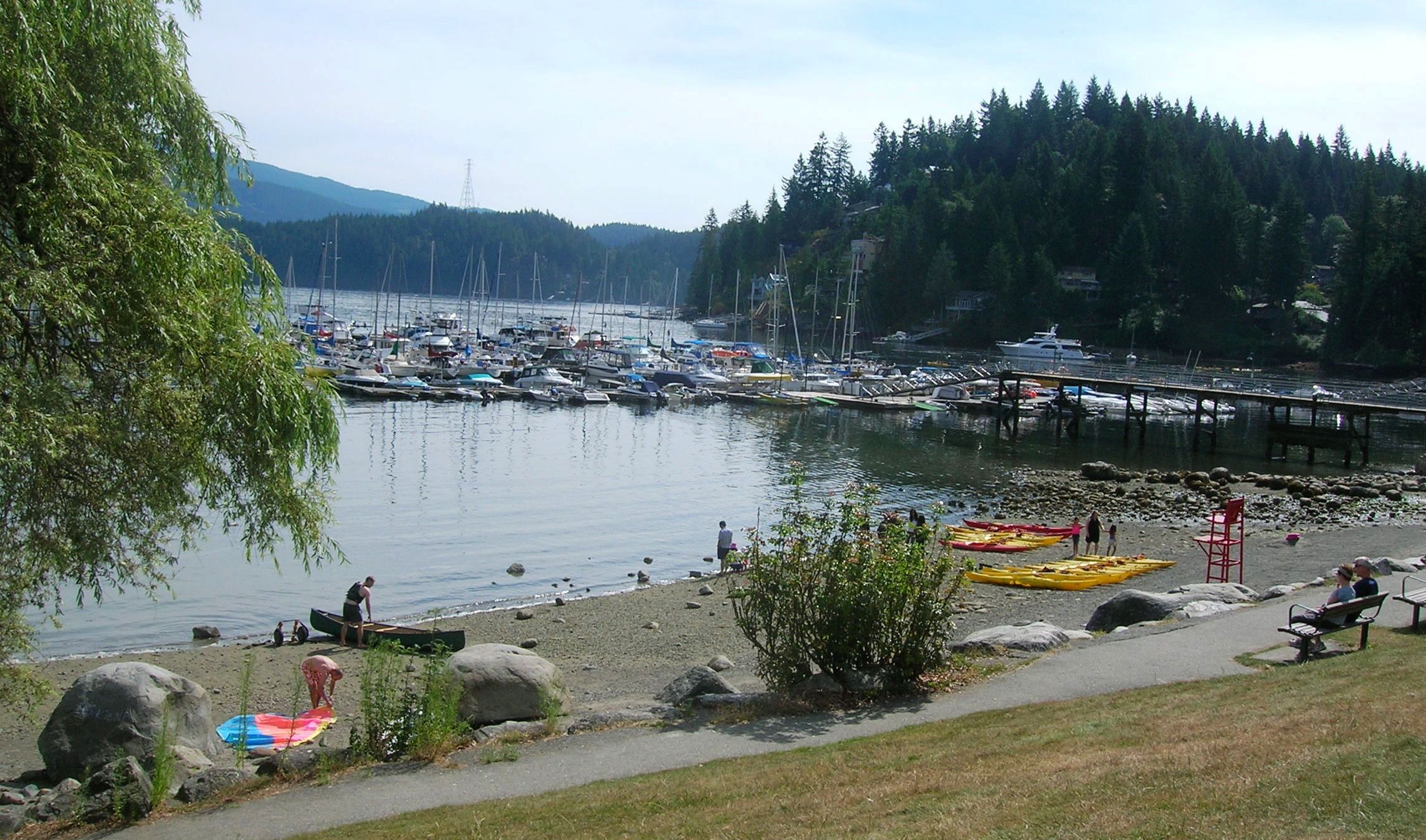
We consider hanging around for Deep Cove Daze [sic], but resist.
It’s going to be all the usual late-summer, small-community mix of booths and games and noise and T-shirts and organizations with their 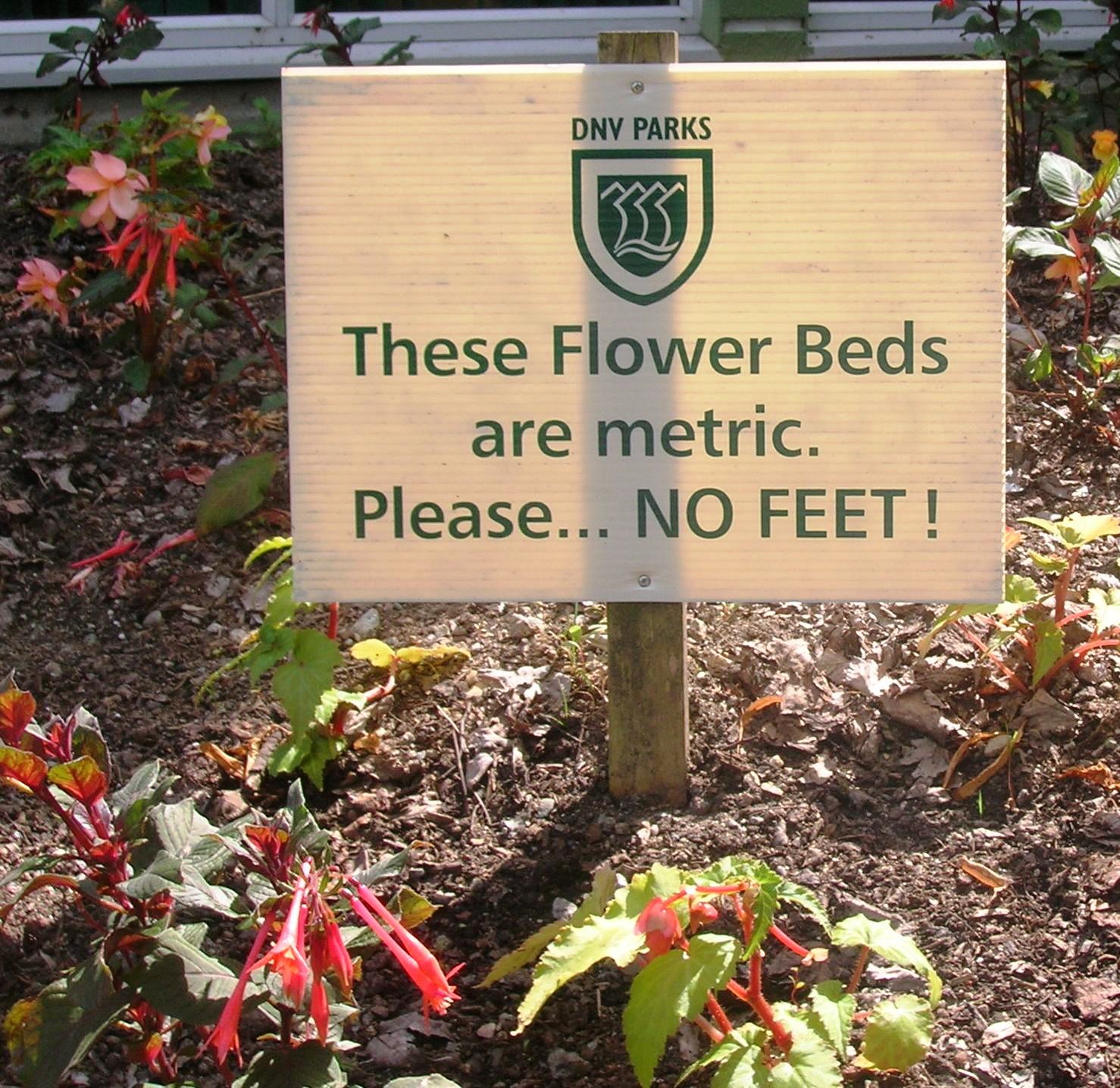 tables… and it is tempting… but we have other plans.
Which involve lunch on a patio elsewhere, so it’s easy to leave. But not before paying tribute to this metric flower bed!
One last walk, days later and down in the Lower Mainland where I’ve joined family for the final few days of my trip. Karen and I head out to Watershed Park in Surrey, one that she and husband Tim know well, both on foot and on their bikes.
I’m luxuriating all over again in the sights and smells and texture underfoot of these west-coast trails. Some of the scenes are the sort of thing I anticipate…
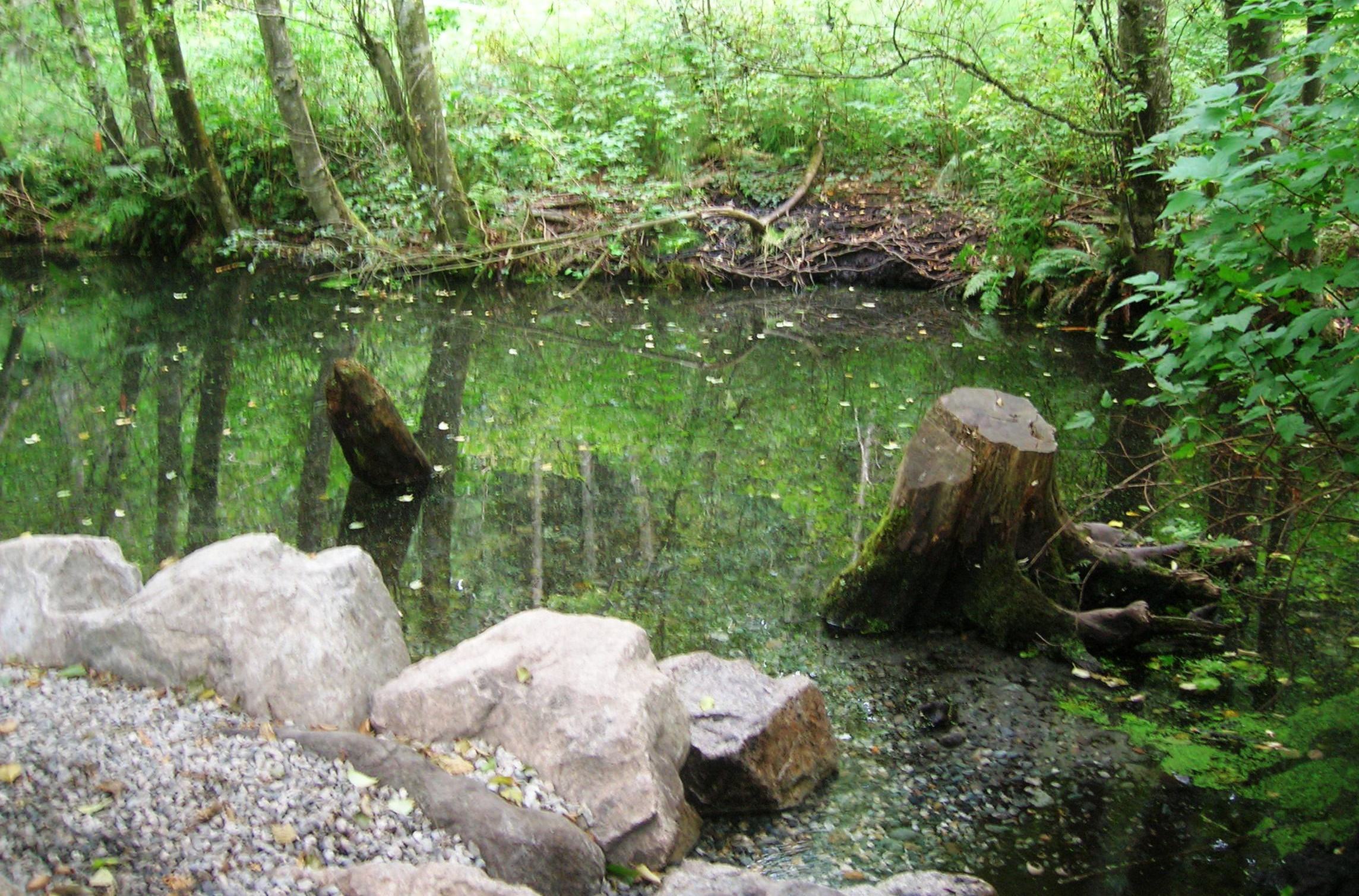
But some are not!
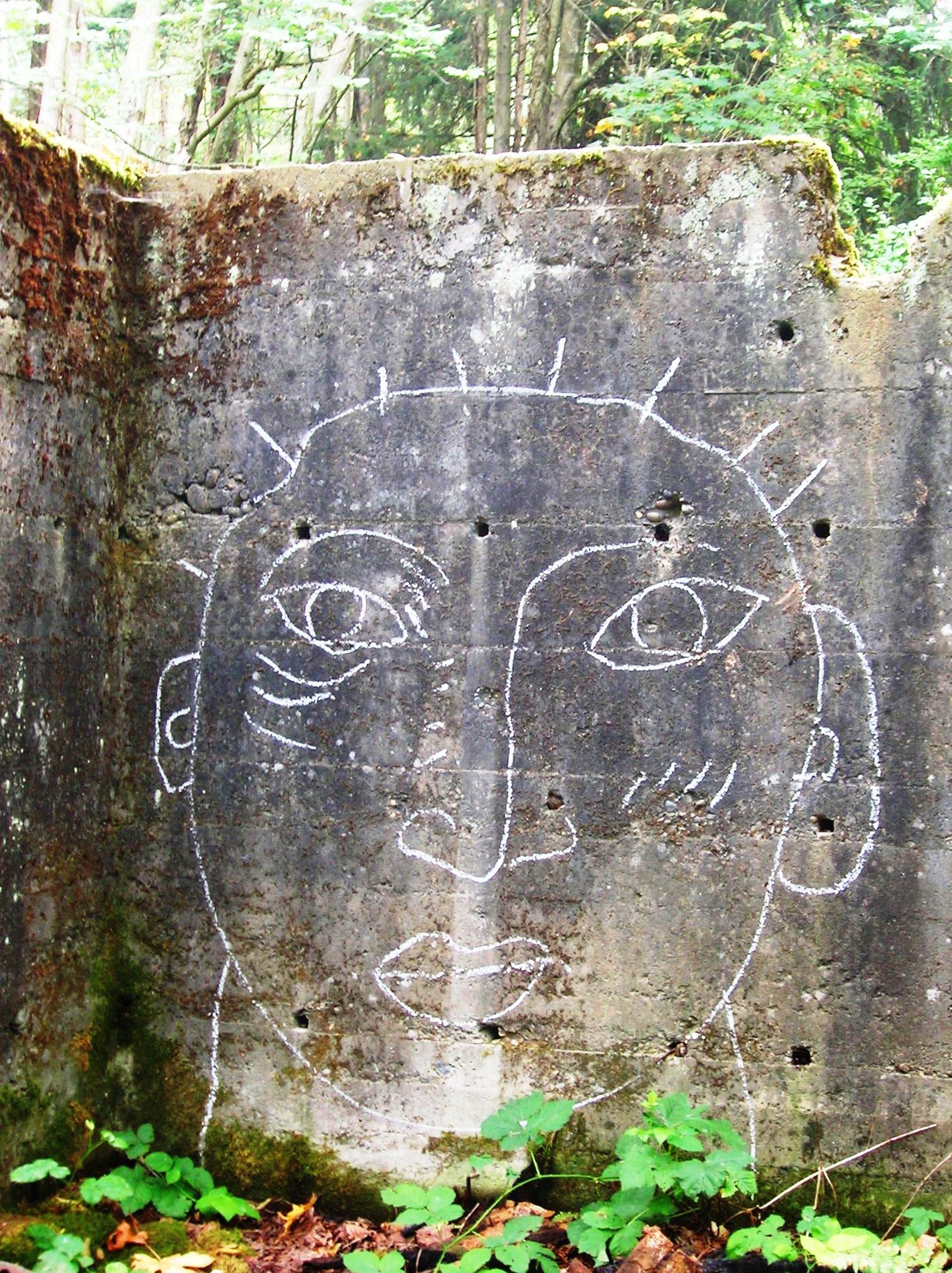
At first I tut-tutted, a graffito in such a setting. Then I realized I rather liked the face — just a bit Picasso-esque, don’t you think? And also realized it is if anything an improvement on the concrete ruin it adorns.
This last photo takes us back to West Coast Classic, and is a bit of a cheat. Well, only in time, not in place.
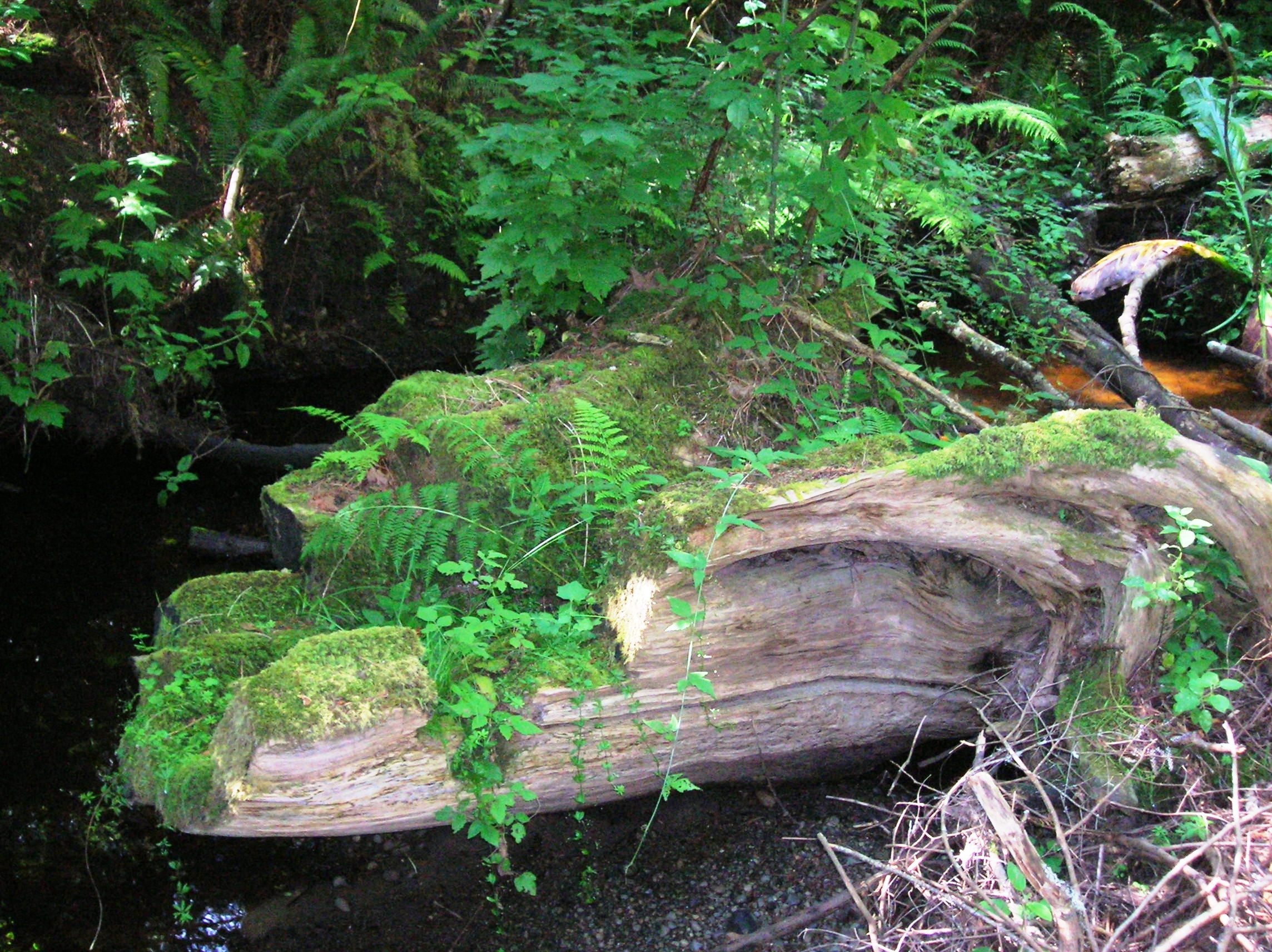
I took this photo of a “nurse log” right here in Watershed Park, but some years ago. Karen had explained the phenomenon to me, that of an old rotting log nurturing new life, and I remember being so happy to find such a good example of it.
And now I’m home. Posting this from Toronto, and planning my next walk right here…
Posted by icelandpenny on 31 August 2012
https://icelandpenny.com/2012/08/31/walk-talk-rock-b-c-style/

 WALKING WOMAN