“Heritage”… and Heritage

17 August 2024 – Nothing as grand as the slippery nature of abstract nouns is on my mind. Not even the nature of heritage, within that slippery world.

I’ve simply decided to go look at the very specific, very tangible, very proper-noun Barclay Heritage Square that I’ve just noticed to the right of the caption WEST END on my Downtown Vancouver Walking Map. My route develops from there. I continue down Nicola to English Bay and along the Seawall to (bottom-centre of map) the David Lam Dock on False Creek.

It’s only after all that, that I have my moment of linguistic/philosophical fuss about the meaning of words.

Back to the beginning.

I’m at Broughton & Haro, north-east corner of Barclay Heritage Square, an enclave designated under the National Trust for Canada that preserves 12 Edwardian-era homes and woods in combination with an adjacent City park.

The houses are lived in…

and the woodland now contains a children’s playground, used by residents…

as well as families from the modern condo towers you can see in the background — the kind of towers now increasingly dominant in the West End environment.

For no particular reason, I make Nicola my route on south to the water. It rewards me immediately. I’m already a fan of Little Free Library kiosks & their unofficial equivalents, so I gurgle happily at the sight of this Pet Food Pantry, just past Barclay.
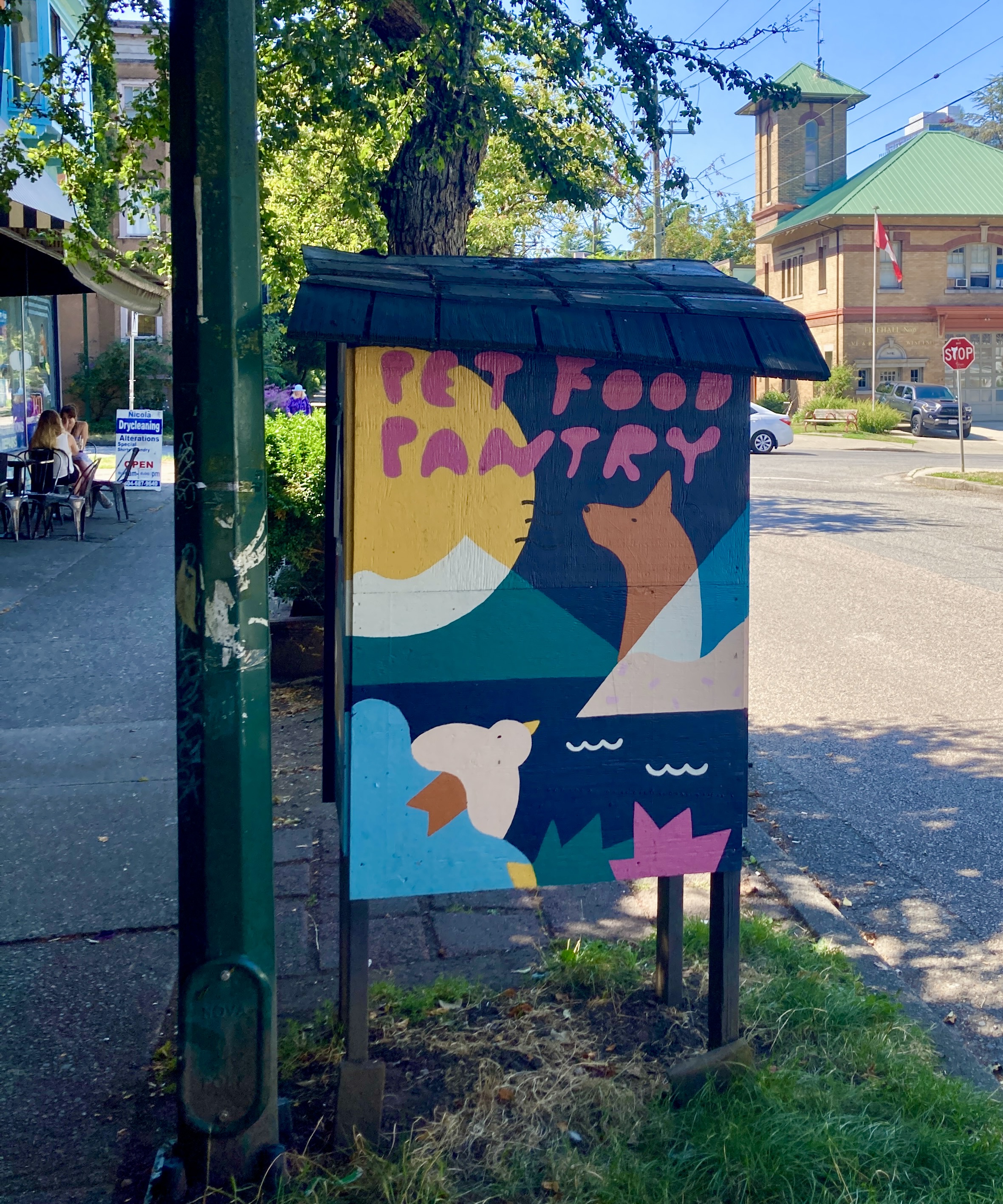
Wet & tinned dog & cat food are welcome donations, ditto dog & cat toys and accessories, but please nothing large and nothing for other small animals: “We don’t have the space.”

One more block, and here’s the Vancouver Mural Festival 2020 tribute (by Annie Chen & Carson Ting) to Joe Fortes, the City’s first official lifeguard.
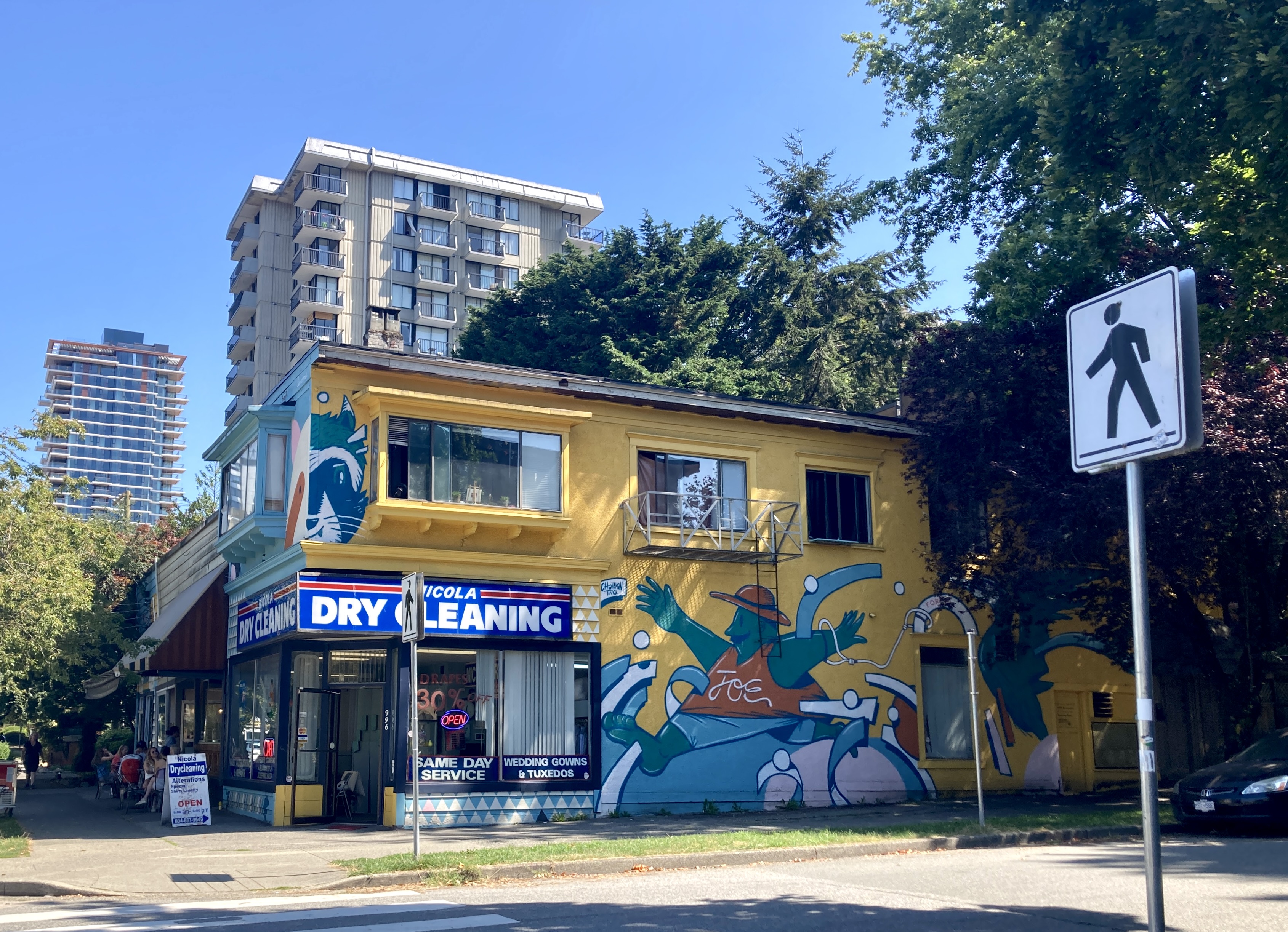
In 1986 he was also named Vancouver’s Citizen of the Century by the Vancouver Historical Society, and for good cause — a Trinidadian immigrant, Fortes spent years unofficially guarding the beach and rescuing people before receiving the official appointment.

The Nelson-to-Comox block down Nicola is friendly underfoot…

and bright with flowers on vintage apartment balconies overhead.

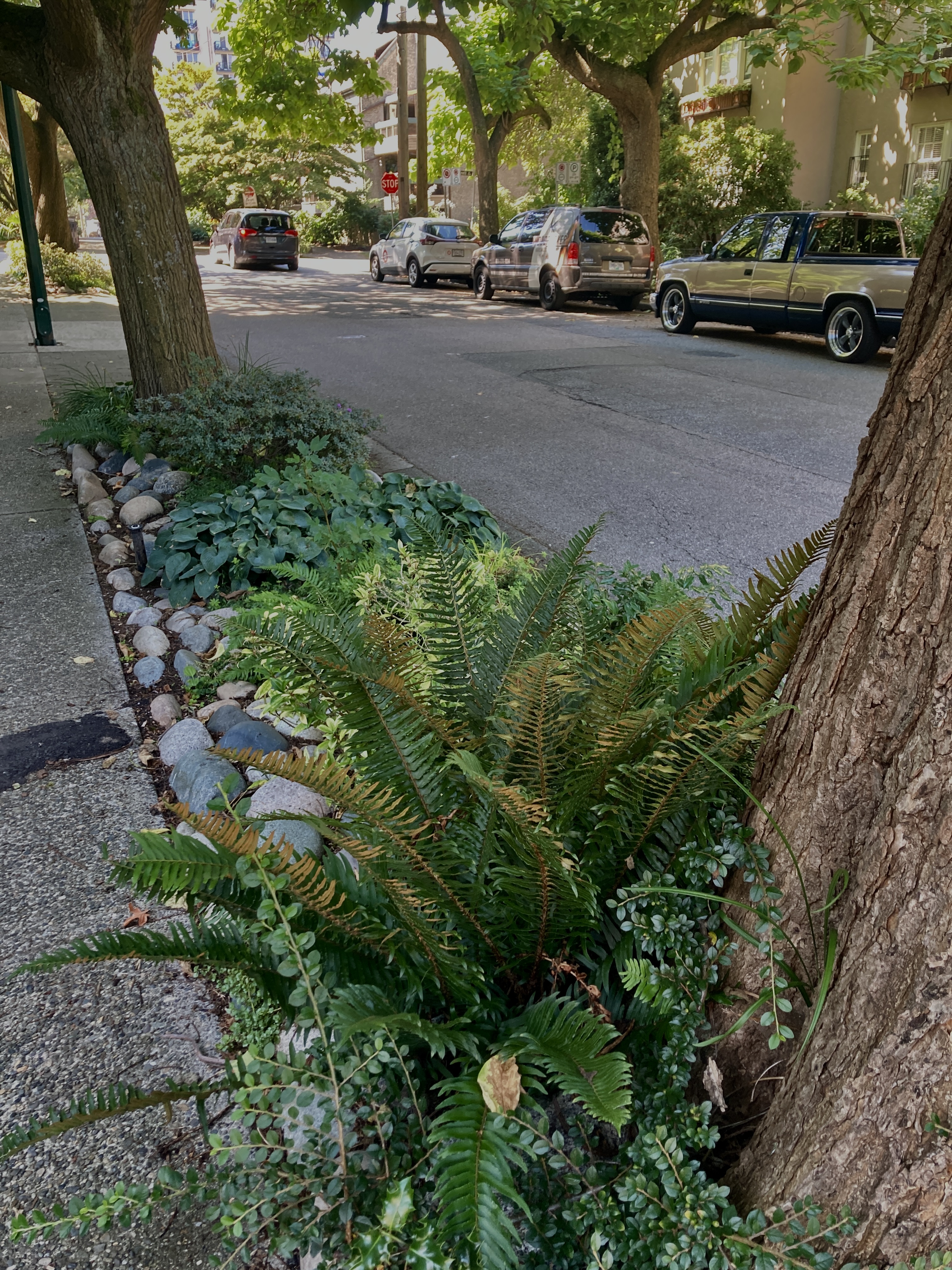
The day grows steadily warmer. I am ever more appreciative of the shade offered by street-side trees, sometimes combined with lush ferns, as in this display near Pendrell…
and sometimes high over bare earth, as in this half-block interruption of Nicola’s vehicular status between Pendrell and See-em-ia Lane.
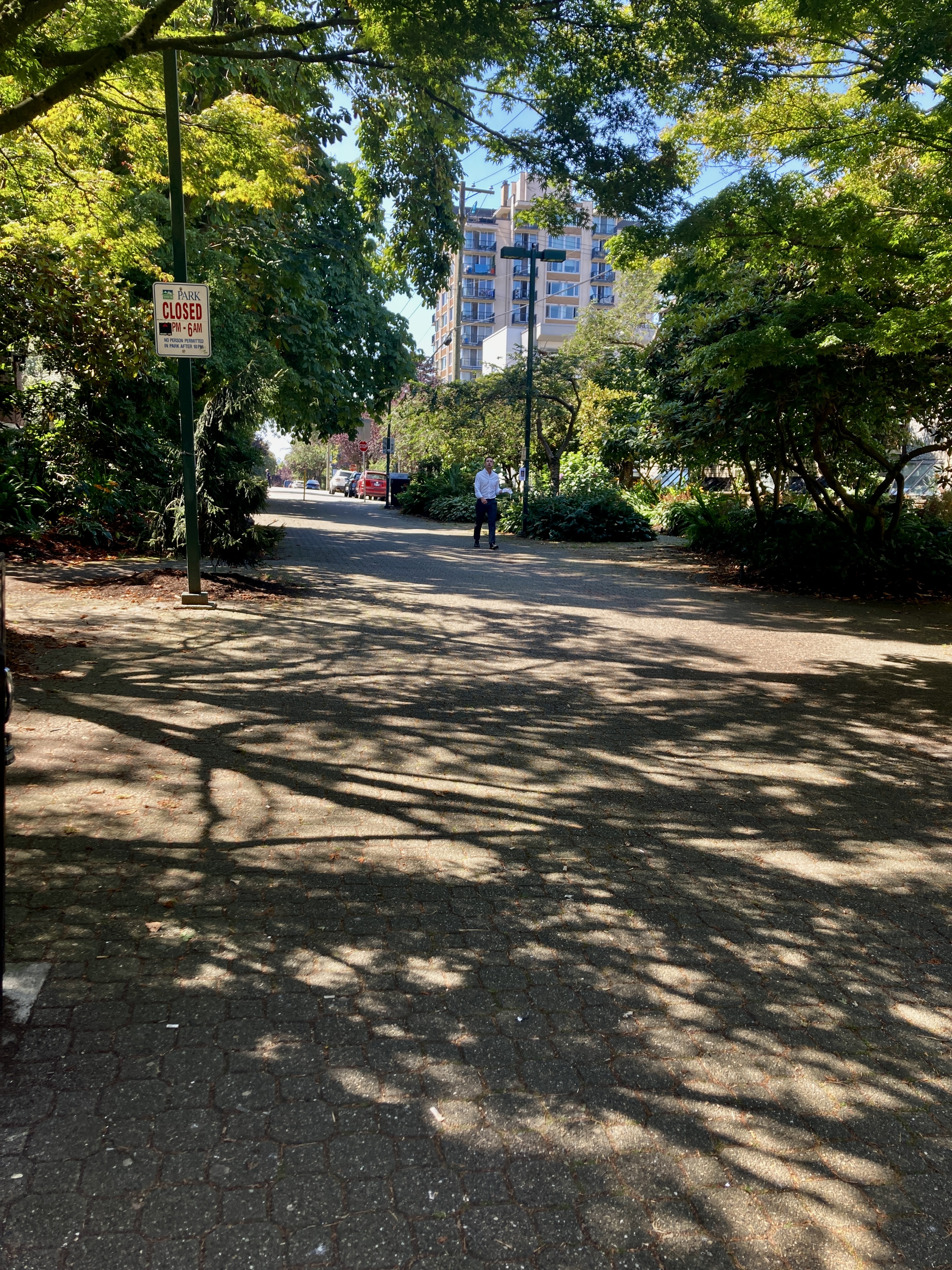
Yet even barren like this, it is a welcome space, a little spot just for people, very neighbourhood. The lane title is part of the charm: like other area lanes, it honours area history, in this case Mary See-em-ia, granddaughter of Chief Joe Capilano and a Squamish Nation matriarch.

A reminder as I cross Davie Street of real-estate trends…

and later a reminder, down at Harwood, of developer/cultural handshakes, here in the form of this Beyond the Mountains mural commissioned by the builder from Heiltsuk artist KC Hall.

On downhill to the water. I’m now at the foot of Nicola, about to emerge onto Beach Avenue, bordering Second Beach.

Apartments of various eras face the water, dozing in the afternoon sun…

and “open-air museum” installations, courtesy of the Vancouver Biennale, are as much part of the beach scenery as flowers, palm trees and sand.

I first pass Dennis Oppenheim’s Engagement

and then, as I walk east along the Seawall…

I come to my all-time favourite, Bernar Venet’s 217.5 Arc X 13.

Not much shade, here on the Seawall.

I pause under handy palm trees to cool off, agree with a bemused pair of Austrian tourists that outdoor palms are somehow not what we expect to see in Canada…

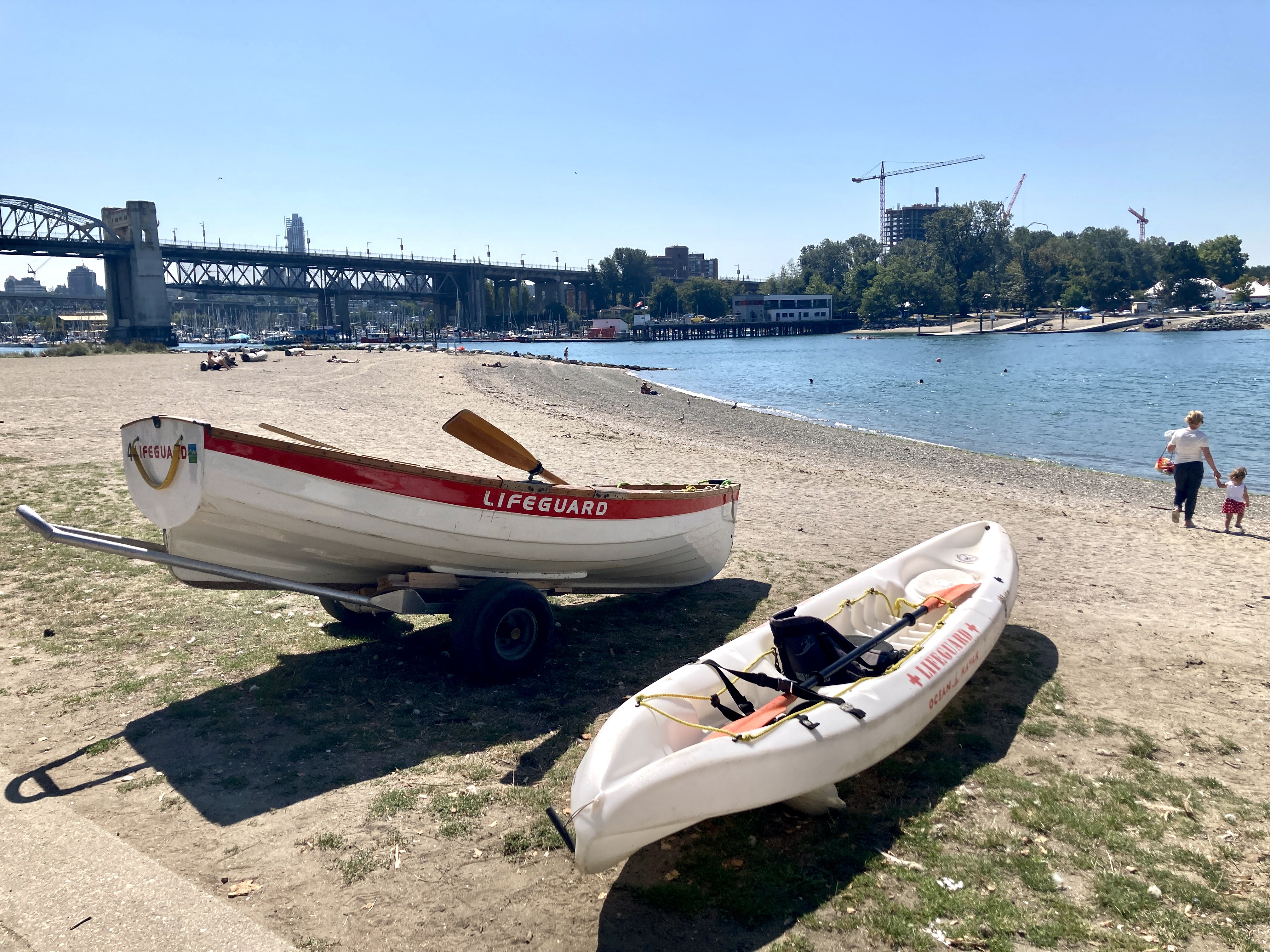
loiter under the next cluster of friendly palms to watch a mother finally tear her toddler away from these lifeboats and lead the child on down to the water…
and then buy myself a rum & raisin waffle cone at the Sunset Beach concession stand…

and find yet more shade in which to enjoy it.

I even manage to eat it all without dribbling any down my arm. (Live long enough, and you acquire a few Life Skills.)

Enough blazing sunshine. I forsake the Seawall to climb uphill to Beach Ave. and the shade offered by its trees. It gives me a distant view of Squamish artist Chrystal Sparrow’s mural on the Sunset Beach sport court, currently being repainted…

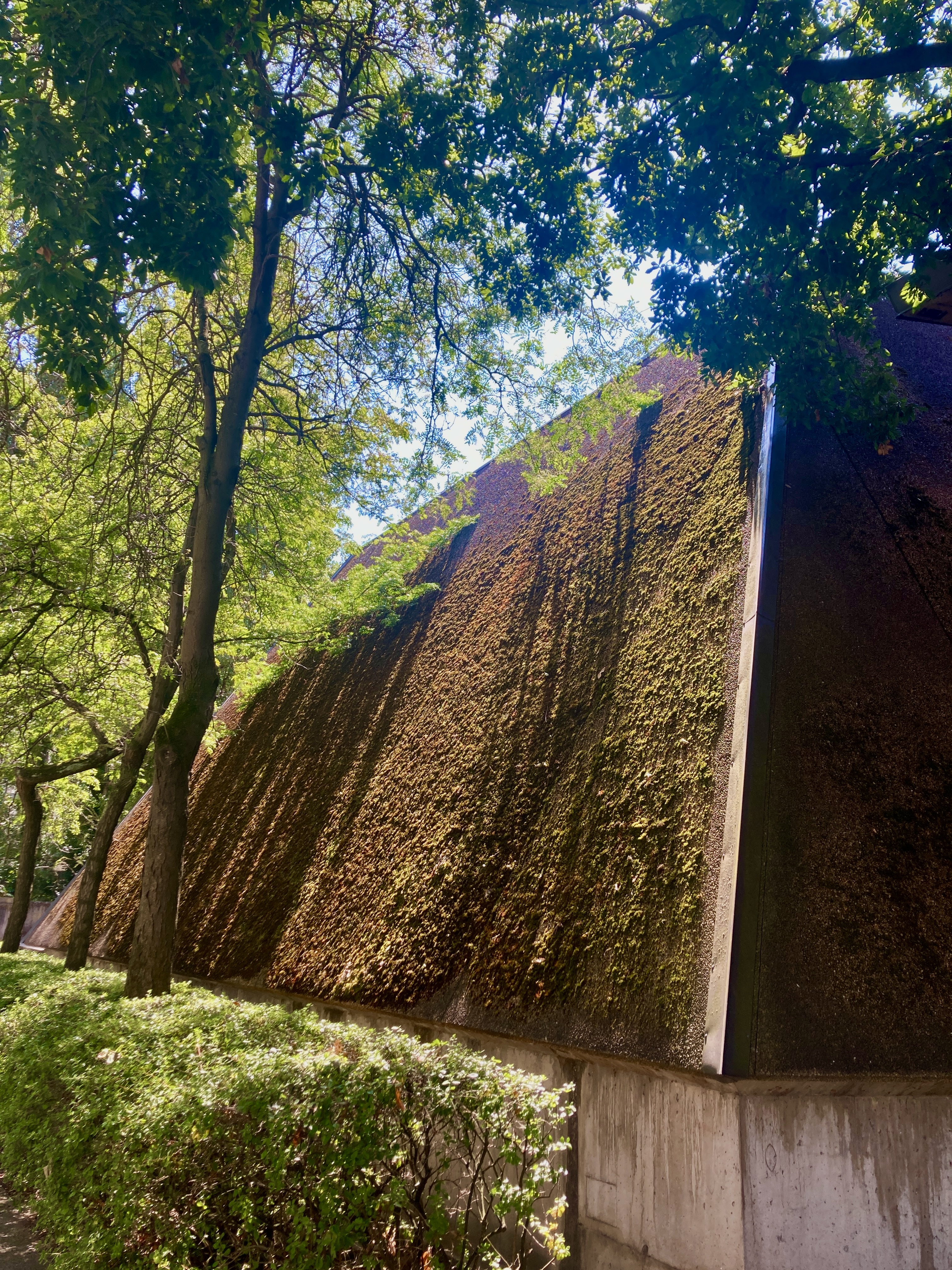
and a close-up of the mossy walls of the Vancouver Aquatic Centre as I carry on east.
But then, somewhere between George Wainborn Park and David Lam Park — bottom-centre of that first Walking Map image, if you care to scroll back up — I return to the Seawall and False Creek.

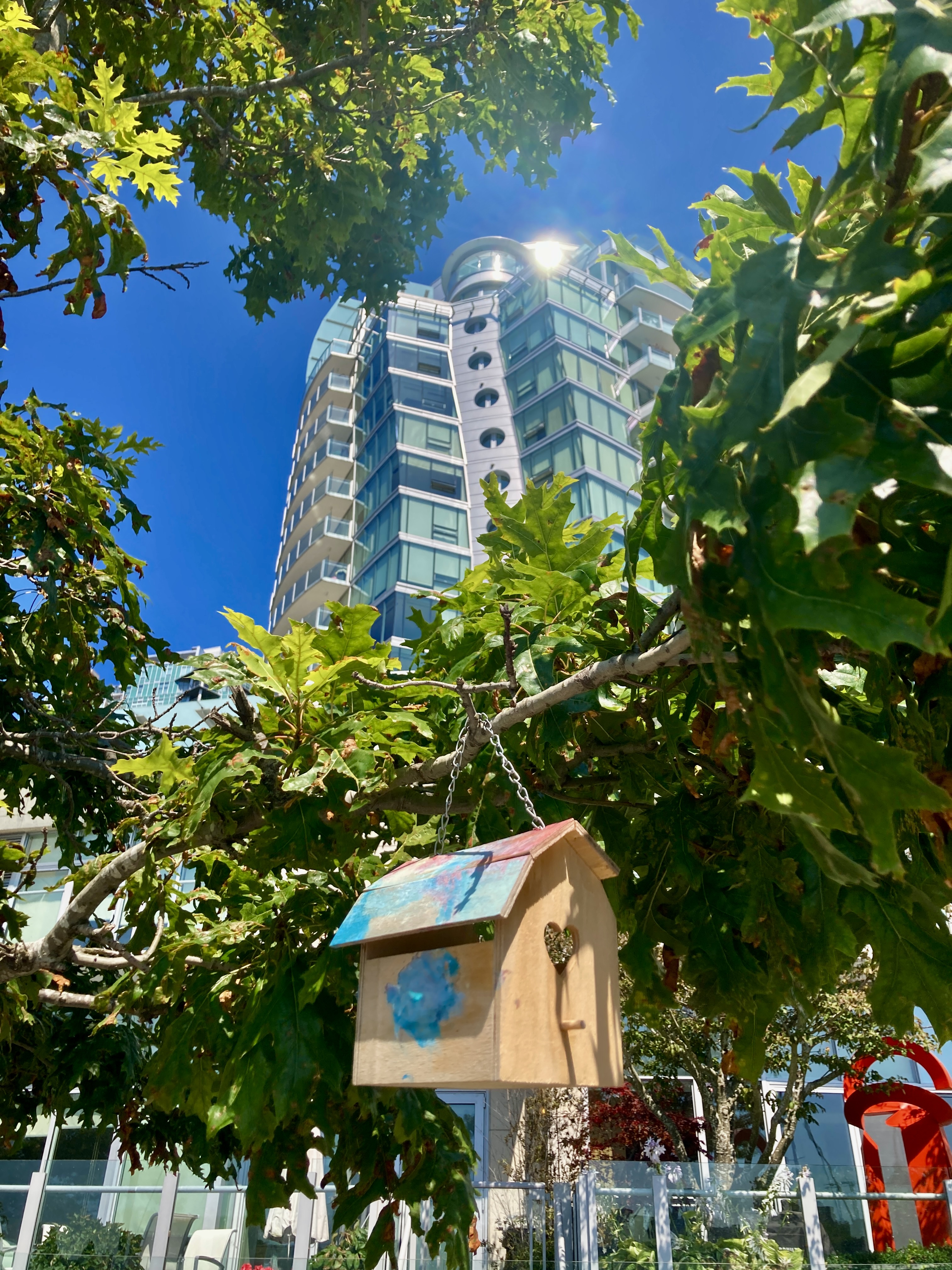
Where I am first amused by this tiny, very unofficial, birdhouse hanging from an official Seawall tree…
and soon afterwards hopeful of a ferry ride home from the David Lam Dock.

Look at this: two ferries converging on the dock (left & right, the rival Aquabus and False Creek lines respectively), eager to pick me up.

But, no, we are at cross-purposes. I want east; they are both headed west to Granville Island.

They assure me an east-bound boat will come by soon. One does. It then steers a slow zigzag route, meeting rider needs — which gives me time to think about “heritage.”

What counts, what doesn’t? In today’s walk, did only the very official and historically designated Barclay Heritage Square count? Or all of it?

The online Cambridge Dictionary gives me the answer I realize I want: heritage consists of “features belonging to the culture of a particular society.”

Yes. With that kind of latitude, it all counts.

From the designated Edwardian homes to the Fortes mural to “hi” on a sidewalk and a Pet Food Pantry; from ice cream and real-estate trends and Biennale art to lifeboats and palm trees and a silly little birdhouse and rival ferry lines.

All of it.

One Pole, Two Pole

15 August 2024 – Only later do I realize I have been offered a Dr. Seussian experience, right here at the corner of East 7th & Main.

It will have me chanting my rewrite of the tag line from his 1968 Foot Book: “One foot, two foot, red foot, blue foot.”

But not yet.

At the moment, as I approach Main on East 7th, all I notice is the message tacked to an aged wooden telephone pole. It catches my eye because, one, it is the only message, and, two, it looks polite & quiet & official & totally unlike everything else that bombards us from utility poles.

So I take a closer look.

I am charmed! This is surely the most polite “Post no bills” warning in the entire universe. Not just polite, but whimsical… and successful. This weary telephone pole is being allowed to rest in peace.

I am sufficiently intrigued to read the small print, and resolve to look up City of Vancouver Ordnance [sic] #17-B-9883 once I reach home. What are the official rules for postering, I wonder.

As Mr. Google points out, this very polite notice is marked by a typo, as well as by whimsy. “Ordnance” = guns, artillery & the like. Accept the suggested revised spelling, and all is well. “Ordinance” = a piece of legislation enacted by a municipal government.

Even then, missing “i” firmly in place, I still can’t find #17-B-9883 online.

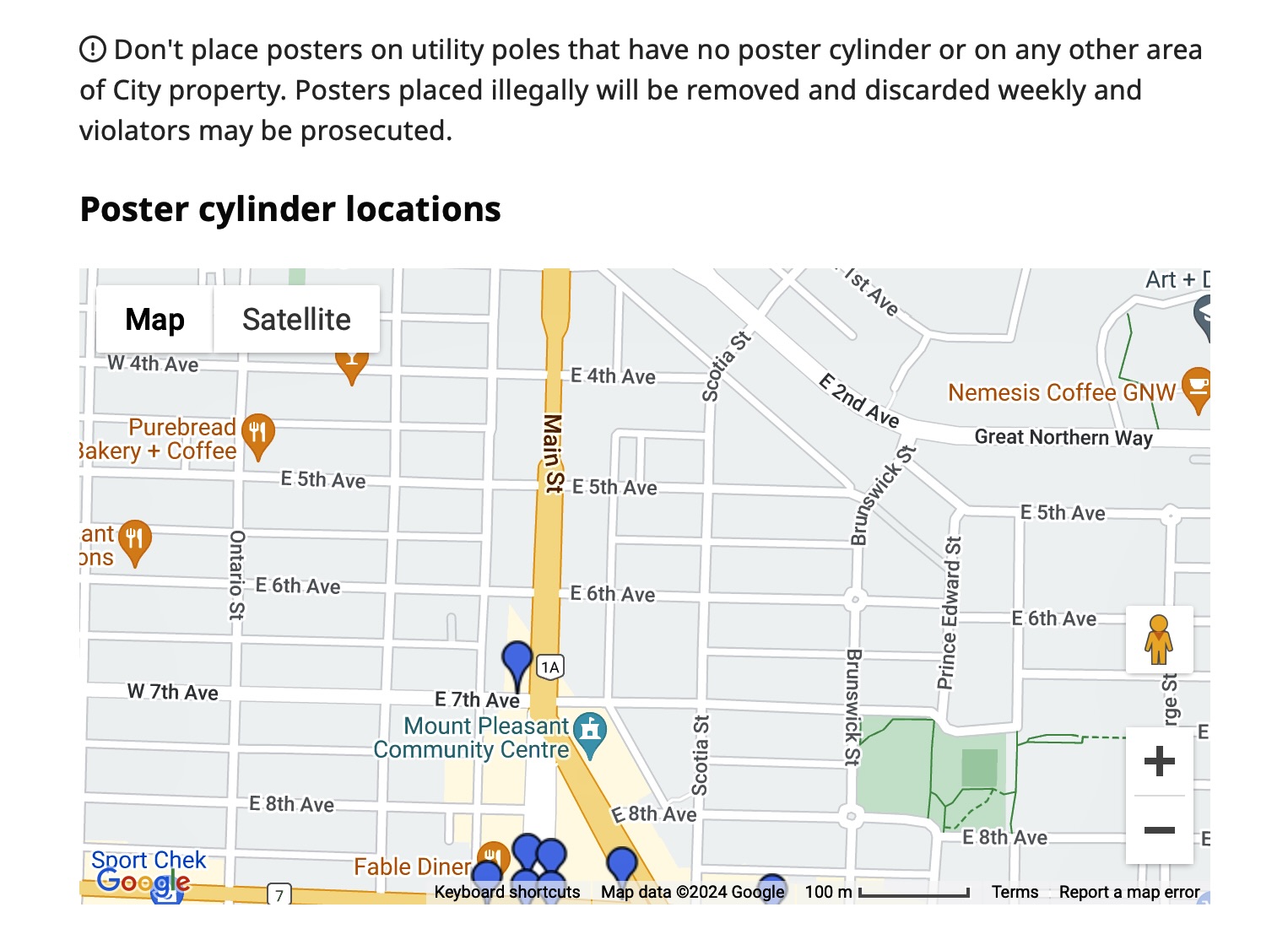
But I do find a cheerful discussion of the City’s poster cylinder locations, complete with a handy map. No need to abuse wooden poles any longer! Tape your announcements to a purpose-built metal cylinder instead, with the City’s blessing.

I navigate the map, and discover there is an official poster-pole right next to the wooden pole at E7th & Main.

Screenshot

I zip back out in the fading light to have a look.

And there it is. The approved, yes-you-can, post-all-you-want pole, covered in notices.

“One pole, two pole,” I chant. “Don’t pole, do pole!”

I bet Dr. Seuss would approve.

White Bunnies

11 August 2024 – I’m in behind City Centre Artist Lodge, once again epicentre for the Vancouver Mural Festival, now in its final day.

Much to my surprise, I’m not much engaged with VMF official activities this year, but the hoop-la does have me noticing things with a sharper eye — colours, shapes, energy, juxtapositions — as i weave through the adjacent alleys.

I don’t yet know it, but I am curating my very own collection of white bunnies.

Starting with reflections + fence + signage + curb stones in the north/south alley right behind the Artist Lodge…

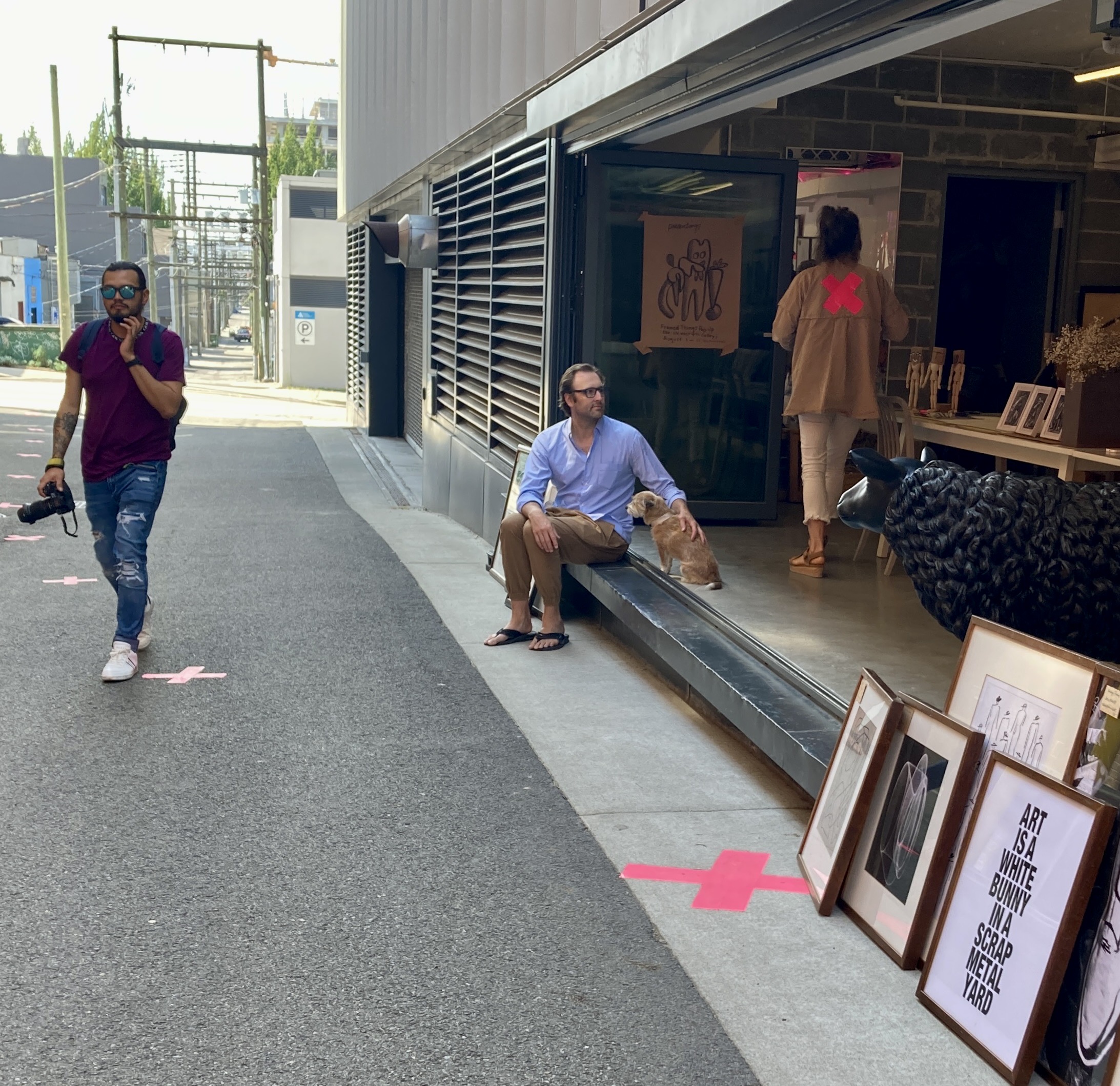
followed by resting man + dog + red-X motif + pop-up art display in the east/west alley between Main/Quebec/5th/4th…

which brings the white-bunny concept into my life.

It’s the framed quote, bottom-right in the line-up: “Art is a white bunny in a scrap metal yard.”

I like this! Deliberate bunnies, and “found” bunnies as well — whatever adds scamper & bounce to the streetscape.

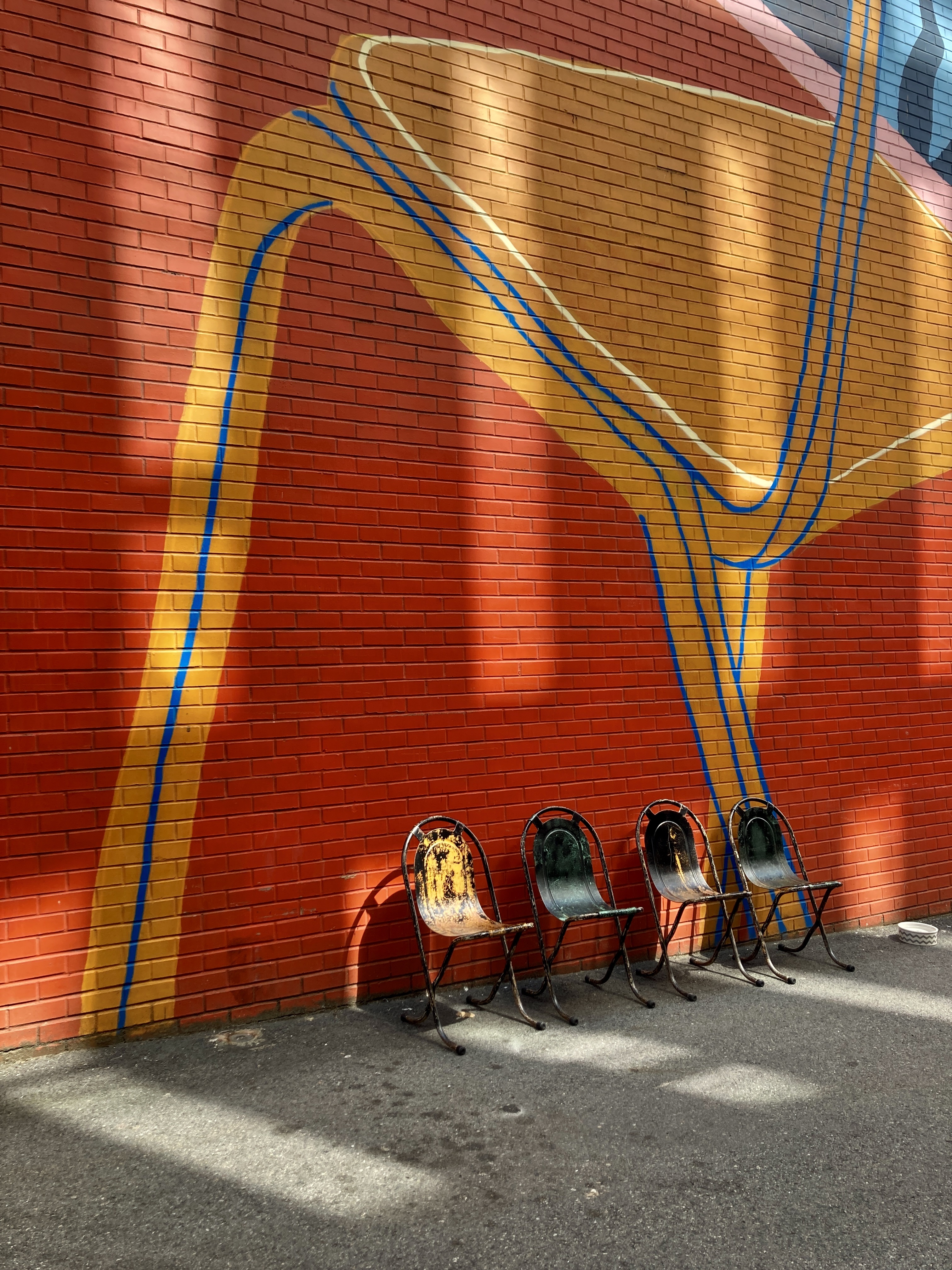
Right opposite, same alley: four chairs lined up in a deliberate and carefully positioned tribute to the looming chair in the gigantic wall mural behind them…

one detail in Andy Dixon’s 2017 VMF mural Red Studio (After Matisse), his 90-foot-high portrayal of his own Vancouver studio.

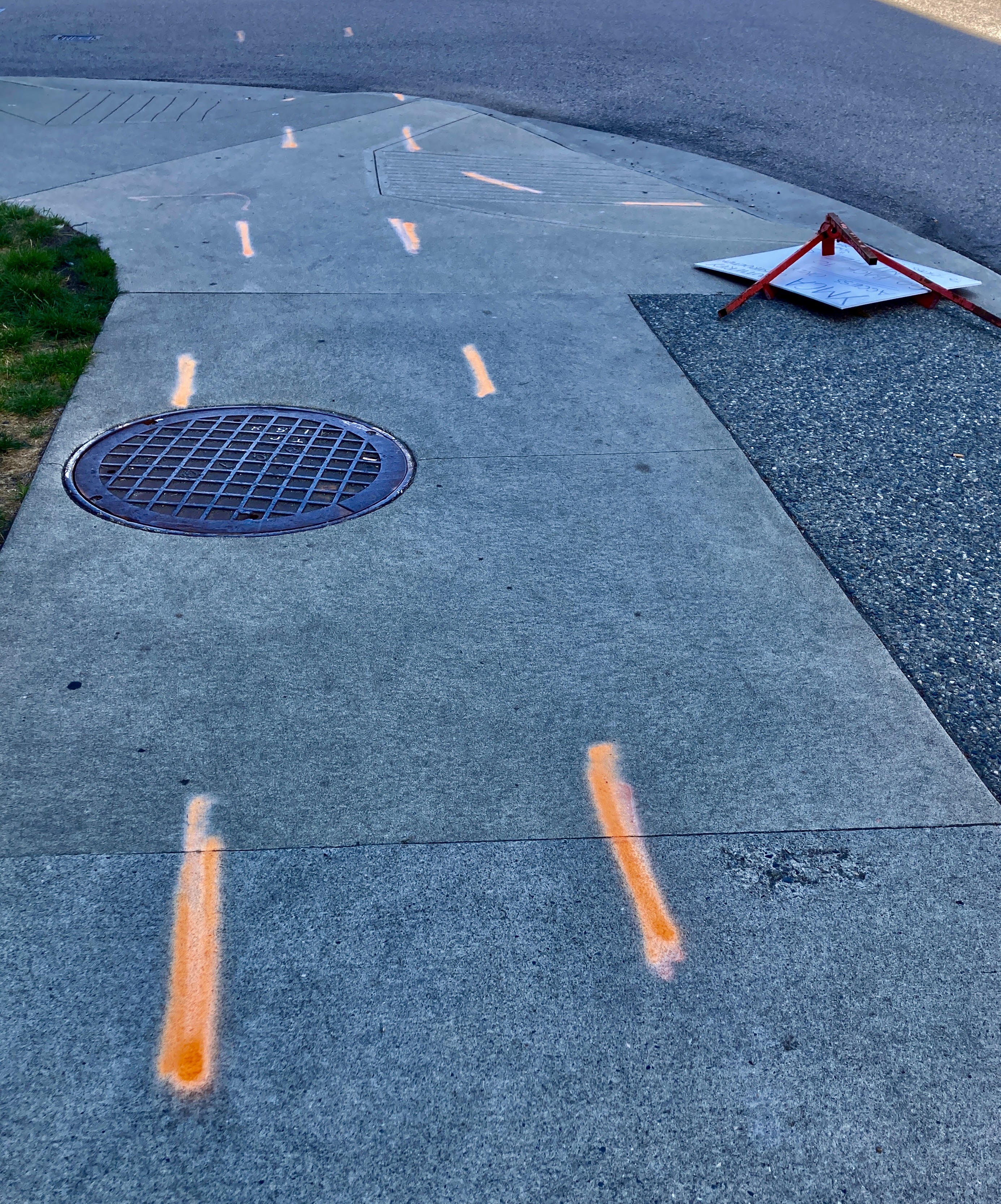
After that, my white bunnies are whatever & wherever delights me, whether day-glo construction guidelines on the sidewalk before me at Quebec & East 4th…

or white communications discs high on a roof beyond me, punctuating the tower to their left…

or an eye-level fluorescent X just south of Quebec & East 2nd. (Only later, at home, do I notice the red-X motif in the alley with the pop-up gallery, and realize there must be a connection.)

One final white bunny, down by False Creek.

A multi-coloured white bunny, mind you — art is inclusive! — painted by Nature, and proclaiming a message that seems hard to believe, this hot mid-August day.


Fall is on its way.

Davie, W to E

6 May 2024 – I’m as far W on Davie Street as you can be, sharing a joke with the A-Maze-ing Laughter sculptures in Morton Park. English Bay can be glimpsed between the statues, and the glory of Stanley Park lies beyond.

I turn my back on all that.

I am heading E, not farther W — east the full length of Davie Street, right from “You are here” in this handy signpost map…

to False Creek, where the street is once again stopped by water.

Just as those waters transform as they go — from the breadth of Strait of Georgia, into English Bay and then into False Creek — so too does Davie Street reflect city transformations.

This 4-km-or-so route is a crosstown slice of Vancouver’s past & evolving future. It leads us from still-vintage West End, through Davie Village (once simply “Gay” & now a more complex family of inclusions), into Downtown with its Entertainment District, and on to Yaletown, western terminus of the railway and the repurposed former hub of railway equipment construction and repair.

Barely underway, I detour onto Bidwell long enough to admire the volunteer garden at the corner of Pantages Lane, with a vintage building opposite.

Well…

I later learn that the vintage building is just a vintage façade. It is, a realtor’s website informs me, “a beautifully restored heritage entrance” to a spiffy new residential tower, “that returns the street frontage to its original character.”

Back out to Davie, where I head eastward on up the street. I do mean “up” — both climbing away from the English Bay basin, and also tilting my head at the towers that increasingly line the street.

A past-&-future moment, here at Davie & Cardero: the district’s future already visible there on the left, and a big blue “rezoning application” notice on the fence of the modest old apartment building on the right.

I see a lot more of these notices as I go, including ones on an apartment building also marked with a “sale by court order” sign.

But there is still lots to enjoy, lots of human activity and human-scale engagement.

Also canine.

He has appropriated this bench outside a barber shop / tattoo parlour, and his confidence is likely well-placed. A bearded man has just walked through that still-open door, his leashed French bulldog by his side. Inside, they are greeted by the statue of a bulldog.

At Broughton, a wonderfully ornate vintage apartment building, its paintwork perhaps a bit scruffy but no sign of any redevelopment activity.

The shops & services around here are not glossy and latest-thing. I like them very much.

Just before Bute, I see this slivered opening between buildings, complete with mural…

and I follow it to the laneway beyond.

Where I turn left, and then left again back to Davie Street, through the Event Zone of Jim Deva Plaza.

The plaza honours the man’s lifelong courage and advocacy. Deva, one of the co-founders of Little Sisters Book and Art Emporium, challenged Canada’s censorship laws in the Supreme Court, and also — with greater success — worked with Civic authorities to promote safety and quality in Vancouver’s parks and public spaces.

I don’t know all this about him at the time. While in the plaza itself, I notice more trivial things. Such as…

Corner of Davie & Bute, and we’re well into Davie Village by now. Here, for example, with a mural tribute to jazz greats behind the intersection rainbows.

I cross, check the mural, and decide I’m personally more taken with the four-legged acrobat and the skate-boarding raccoons on the utility box.

But to each their own!

I pass a nude unimpressed by Happy Hour offerings…

and a greengrocer laying out yet more spring plants on his sidewalk shelving…

and then stop at the hot-pink bus shelter at Davie & Burrard.

The colour echoes the Village, as does the long-established Davie Village Community Garden visible through the mesh.

By now I’m used to rezoning/redevelopment notices, but I am sad to see them posted on this mesh fence as well. I’d love this Garden to continue, but…

what I see right across the street may be its future as well.

At Granville Street, I’m into the city’s Entertainment District (per its tourism maps), where I once again nod happy recognition at the neon signage for Two Parrots Bar & Grill.

Scotiabank Dance Centre is a restoration/new-build complex on the far corner, and other towers abound. So far, the Two Parrots still perch on their accustomed corner, no redevelopment notice anywhere in sight.

The lane immediately behind the building pays tribute to their longevity.

Well, sort of! (Upper left.)

More visual tribute at Seymour Street, where Jill Anholt’s 2005 sculpture, Moving Pictures, honours Vancity Theatre (home of VIFF), which stretches on down the block.

Downhill toward False Creek.

I cross Seymour, pause to again enjoy the long slice of water tumbling through Emery Barnes Park…

and here I am at Hamilton Street, in Yaletown. Once home to railway equipment construction and repair workshops, the district is now repurposed into food, drink, entertainment, & residential delights.

I sidetrack myself along Hamilton for a bit, enjoy reminders of a mid-pandemic “I ❤️ Yaletown” mural festival…

then return to Davie and cross Pacific Blvd.

Roundhouse Community Centre is right here, an architectural link to the past — and nowhere more powerfully than in its CPR Engine 374 Pavilion.

Where, after long service, that steam-era pioneer is on display.

Engine 371 beat her from eastern Canada to Port Moody but, on May 23, 1887, Engine 374 pulled the first transcontinental train into the City of Vancouver. She continued to do just that, until 1945. Restored and gleaming, she now rests and accepts our homage. (Squealing kiddies all around me, especially the ones taking turns in the driver’s seat.) A volunteer urges me to return for the May 19 Anniversary Celebration, when she’ll make her yearly trip outside and be the centre of attention on the Roundhouse Turntable.

Now for the last few steps on Davie, on to the bit of track and sculpture in the traffic circle, with Yaletown Dock to mark water’s edge and my arrival at False Creek

I loop along the waterfront for a bit, then turn left into and through Steamboat Mews…

back to Pacific Blvd., where I hop a bus for home.

Protection

1 May 2024 – You can protect your yard in a variety of ways.

Build a high fence, for example…

post security cameras…

keep a guard dog…

or, instead…

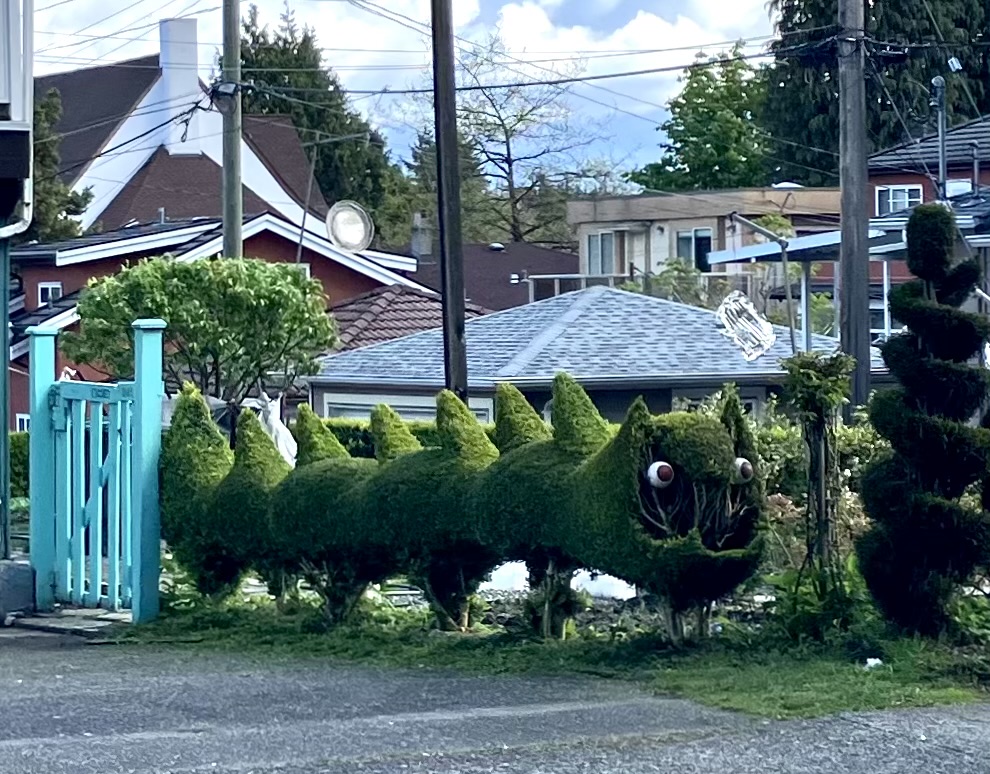
plant yourself a dragon.

(With impressed & amused thanks to He-Knows-Who-He-Is.)

Oz (2024) to Ossington (2014)

25 April 2024 – I asked, and someone very dear to me answered. All the way from Oz (aka Australia).

My previous post ended with this 2013 Toronto mural detail…

plus my request for help in identifying the artist, after all this time.

I assumed any answer would come from a Torontonian, but how silly of me! In this digital age, help is not geography-based. You just give that nice Mr. Google a descriptive phrase, and — hey presto — you are on-site with award-winning contemporary artist EGRart.

The link, as sent to me and here repeated for you, is for her Murals page.

Scroll down, scroll down, and there it is …

a larger view of the dandelion mural (including the male head done by collaborator Elicser).

The photo pitches me back a decade-plus in time. I am again walking west on that street, pausing at that alley, enjoying that mural and all its elements.

And then, back here in 2024 Vancouver, I continue to scroll the Murals page. Down-down-down.

Suddenly… whump! I see this.

Oh, I do remember that garage door. Except when I saw and photographed it, it looked like this:

EGR has transported me back to the laneway behind Ossington Ave., just north of Queen St., on a very snowy day in 2014. Urban myth had it — perhaps correctly — local residents decided that, since their laneway garages were going to be graffiti’d anyway, they might as well invite good artists to come in and do it well.

So they did.

And artists like UBER…

and SPUD…

were among those who responded.

The whole laneway became an open-air art gallery.

A very cold art gallery, that particular day, and I soon skedaddled.

Enough 2014!

Here’s a right-now update, thanks to EGR’s News page. This very Saturday, April 27, she will join co-panelists in an Artist Talk at the Centre for Social Innovation on Spadina Ave. Topic: Women in Mural Art – Building Careers.

How pleasing, to dance through time & space and end, not with nostalgia, but with news of forward momentum.

T. officinale (& friends)

22 April 2024 – But before we dive into Latin taxonomy — not that I knew I was headed there, at the time — before all that, a moment at the corner of Scotia St. & East 7th.

Where I am charmed by Buggingham Palace.

The bee’s knees, you might even call it, though the holes in those colourful pillars are meant to accommodate the entire insect.

The volunteer tending this particular Green Streets corner garden has helpfully labelled all her plantings. I not only admire floppy reddish blossoms on a coarse-leaved shrub, for example, I know I’m admiring a Flowering Red Currant.

Then I look at an adjacent lamp standard, and learn even more.

The building on the opposite corner, the one I’ve always thought of as the Candy Factory, started life in 1904 (or thereabouts) as the Brewery Creek Building, one of many brewery operations in the area. It later became Fell’s Candy Factory, then the Purity Dairy, later on a grease works and later still had other grubby-sounding lives until, in 1993…

it was refurbished and converted to these handsome artist live-work spaces.

Pleased with all this new knowledge, I go on my way. “My way” being straight on east to China Creek North Park — no particular objective, just offering myself a not-very-demanding stroll on a very pretty day.

It’s a large, open, multi-purpose park dropped into a bowl — the bowl being what’s left when you drive underground what had been Vancouver’s largest drainage basin, whose creeks all fed into False Creek. (Until you filled in that final bit of False Creek as well.)

There are steep steps down-down-down on my left at the northern edge, but over there to my right, at the south-west corner, there is the start of a lovely ox-bow path …

that winds its friendly, undemanding way from high to low.

I take the path.

Almost at the bottom — down where I can watch young men grunting through crunches on the level grass while toddlers squeal in the playground — I turn and look back uphill. The slope is dotted with solitary bodies, perhaps meditating, more likely texting, but anyway all with knees angled outward to support their admirably straight torsos.

One person is upright, afoot, moving across the terrain. One human, but six legs.

Human plus fluffy white cat on a leash. See the cat?

Now please stop looking at the cat and notice all that yellow.

Lots and lots of yellow. All over the place.

Taraxacum officinale!

The dandelion.

I have to look up the Latin later on. Standing there, I’m sufficiently occupied just thinking about the word “dandelion.” I know it’s from the French “dent-de-lion,” for the serrated lion’s-tooth edge to the leaf. I also know that the word may be French, but it’s not the word the French themselves use, when they’re getting all familiar with T. officinale. They call it “pissenlit.”

Piss-in-the-bed. Apparently — and this I also have to look up later on — because of the diuretic properties of the plant.

(A sidebar on the delights of common names for plants, in different languages. I know Chlorophytum comosum as Spider Plant. I thought this the perfect evocation of its multitude of leggy offshoots, until a Cuban friend told me its nickname in Spanish. “Mala madre,” she said. Well, of course! The plant must be a bad mother — look at all those babies, running away from home.)

Back to T. officinale. Lawn-proud gardeners hate it, the very word “dandelion” an epithet in their mouths.

Ah, but the word is sweet, in other contexts.

In literature: Ray Bradbury’s 1957 novel, Dandelion Wine.

In wine-making: choose your favourite home-brewer as the example. My uncle put up batches every spring and my aunt heartily approved. I never did ask his secret, so I’ll offer this recipe instead. (No idea how good it is, or isn’t — but who could resist a blog called Practical Self Reliance?)

And, finally, dandelions in the visual arts.

Because, whether in flower or gone to seed, they are beautiful.

This 2013 Toronto street artist caught that beauty, the beauty of the plant itself and its ephemerality.

Like that dandelion head, this alley mural will surely be long gone by now. Unfortunately, I can’t tell you the artist’s name. When I took this picture — for my very first Blurb book! — I didn’t bother with attribution. Drat.

Maybe someone among you can right this old wrong? The style is distinctive, and the artist’s work was often seen in Toronto at the time. (Mary C, author of the splendid As I Walk Toronto blog, I’m thinking especially of you! You know the city’s streets, and street art, so well.)

The Skunks of Spring

18 March 2024 – I’m in Stanley Park, along with half of all Vancouver it seems, ready to enjoy this weekend burst of double-digit sunshine.

More precisely, I’m off the bus, through the underpass, and poised at the south-west curve of Lost Lagoon…

about to walk counter-clockwise and follow the trail east along the lagoon’s north shore.

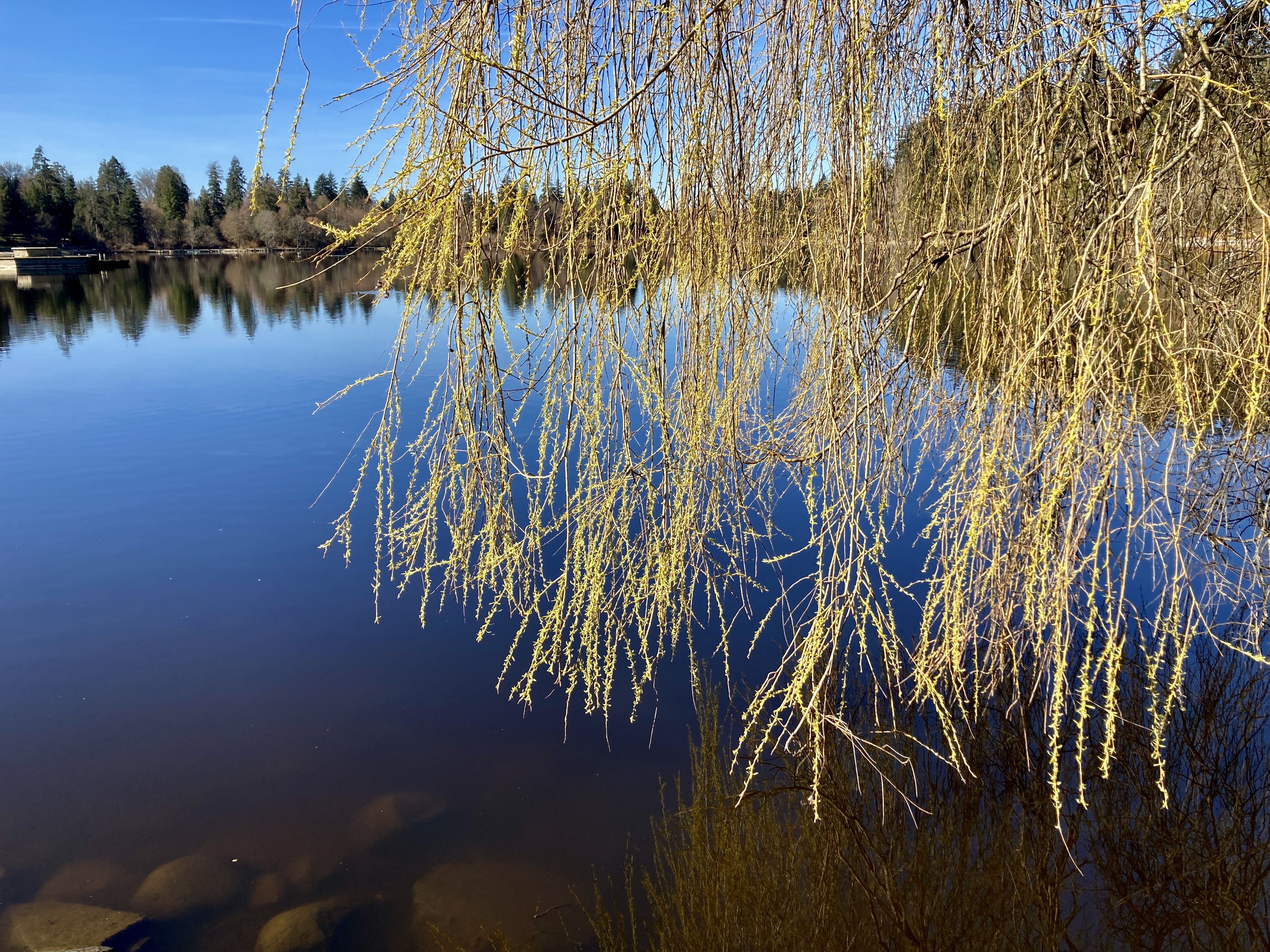
Everything trembles on the edge of spring, unfurling new growth. Trees overhead, trees weeping downward to the water.

And, down there in the water, in the rich muck of the wetland, most wonderfully of all…

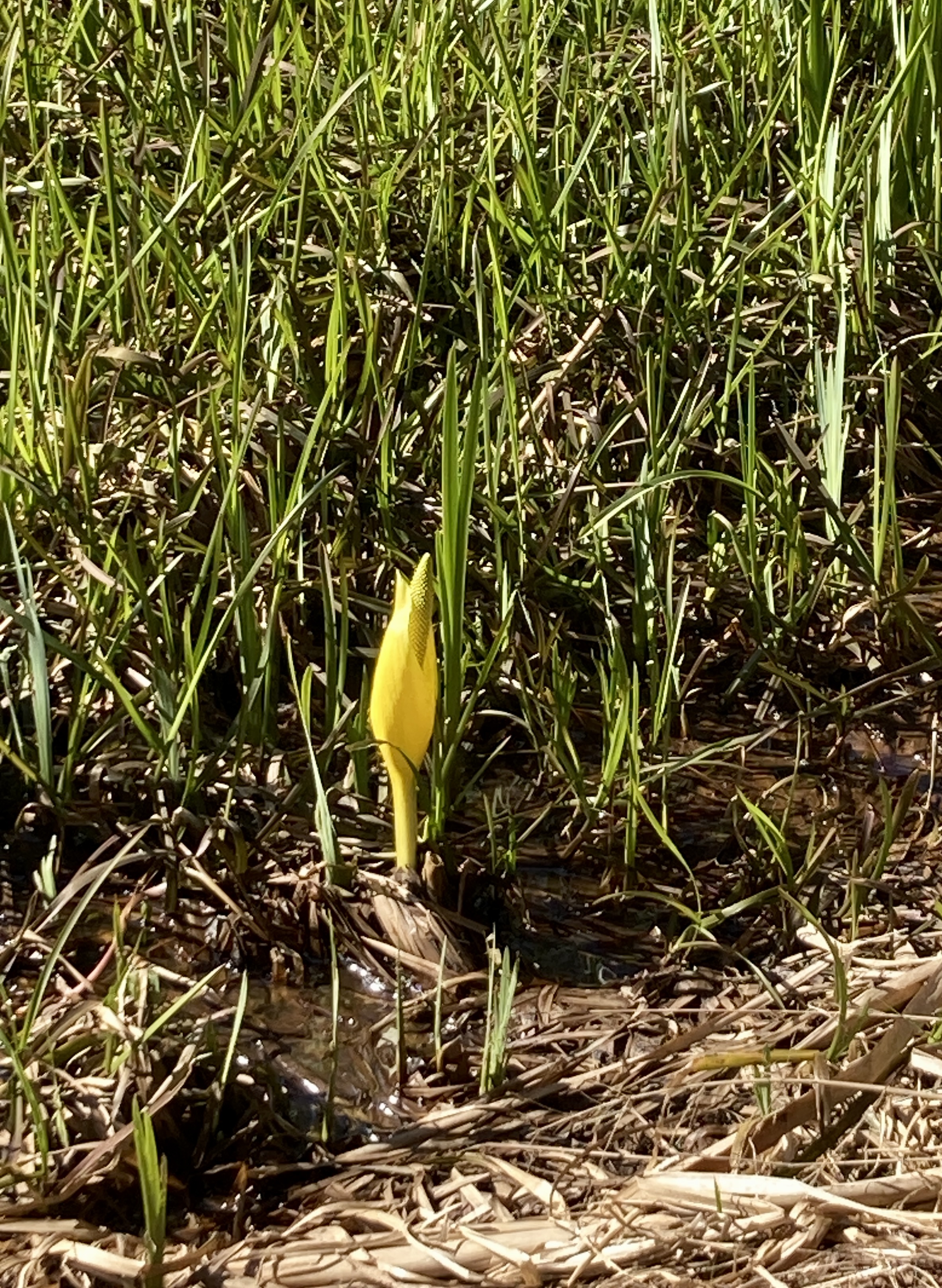
the fluorescent glow of the Western Skunk Cabbage. My first of the season. Now I know it’s spring!

The eastern variety is a more modest creature, it seems, so I forgive myself for being entirely ignorant of this plant until I moved west and was smacked in the eye by all that gold. (And also educated by You-Know-Who-You-Are.) Now I look for it each year, and give a little wriggle of joy at the first sighting.

On across Lost Lagoon, and on and on and then, though still in Stanley Park, I’m in entirely another world. I’m in all the noisy facilities-rich hoop-la of Second Beach.

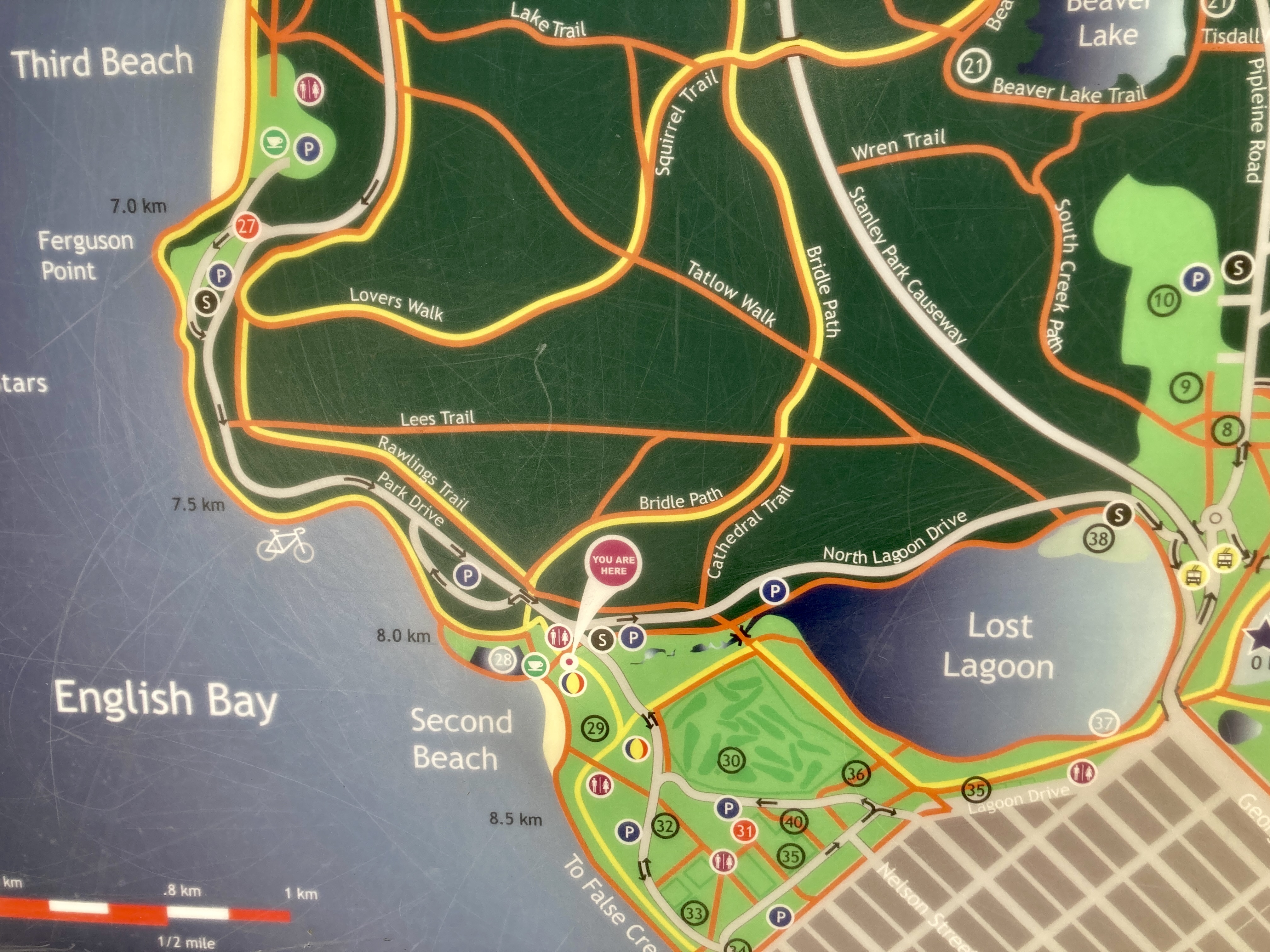
Right where this red button says I am:

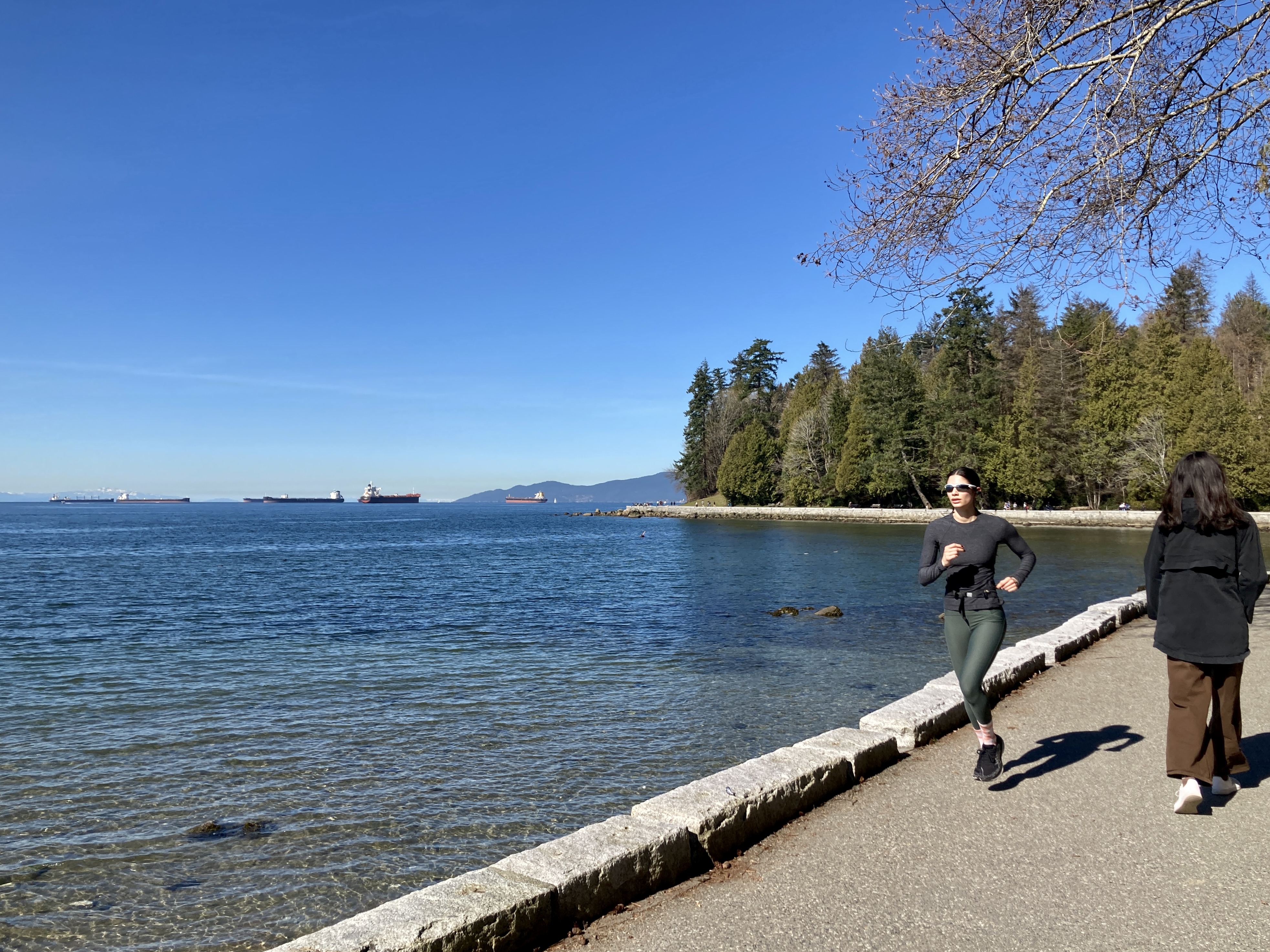
I turn right, head up the Seawall toward Third Beach. (Thank you, I murmur to the universe. I am so lucky, to be right here, right now, in all this.)

Here we all are, in all this.

Runners…

and cyclists/loungers/kiddies/adults/impromptu tents/storm-thrown stumps on Third Beach…

and rocks and freighters just off Ferguson Point…

and a tree with a heart…

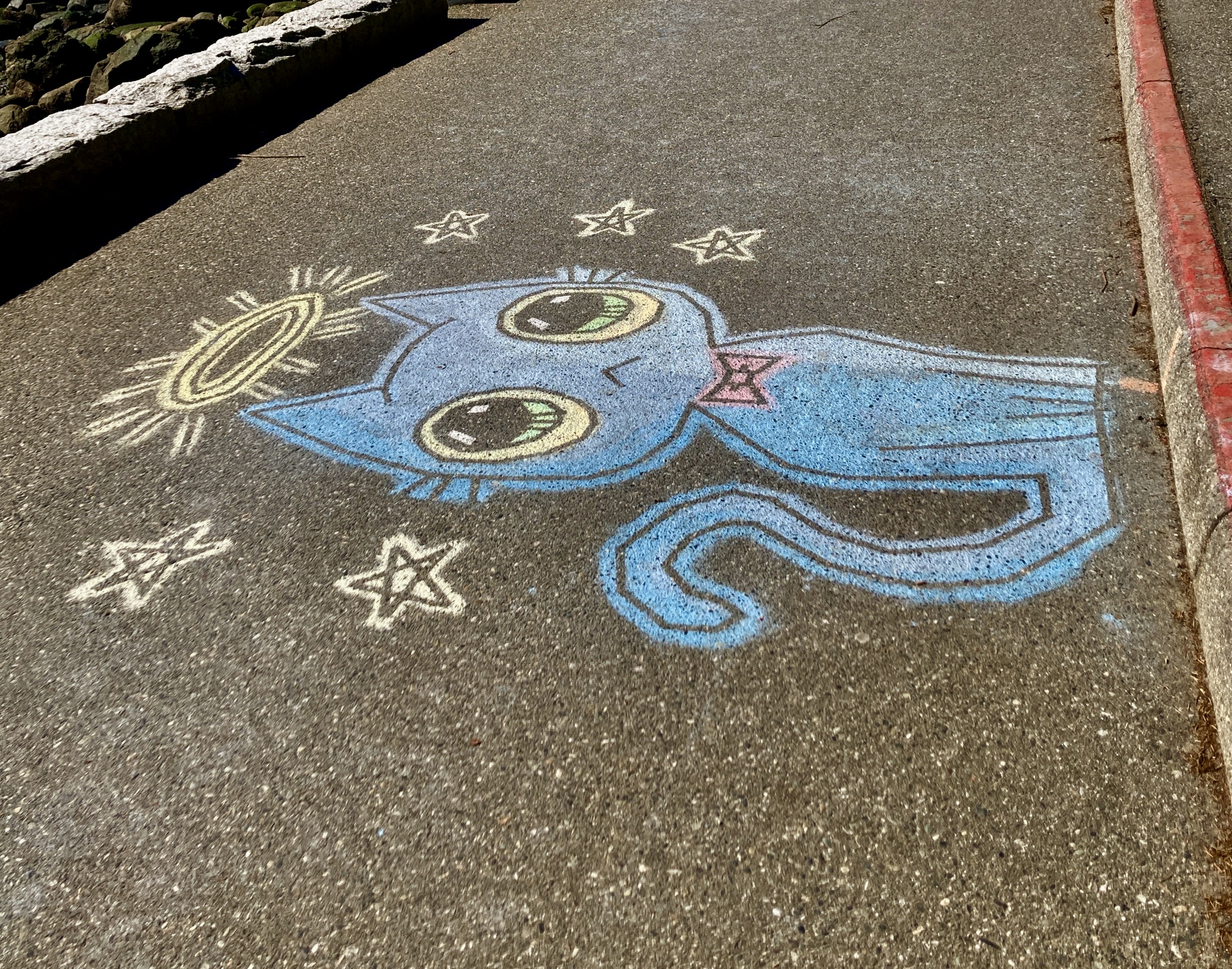
and a patch of Seawall with its very own Cat-Angel…

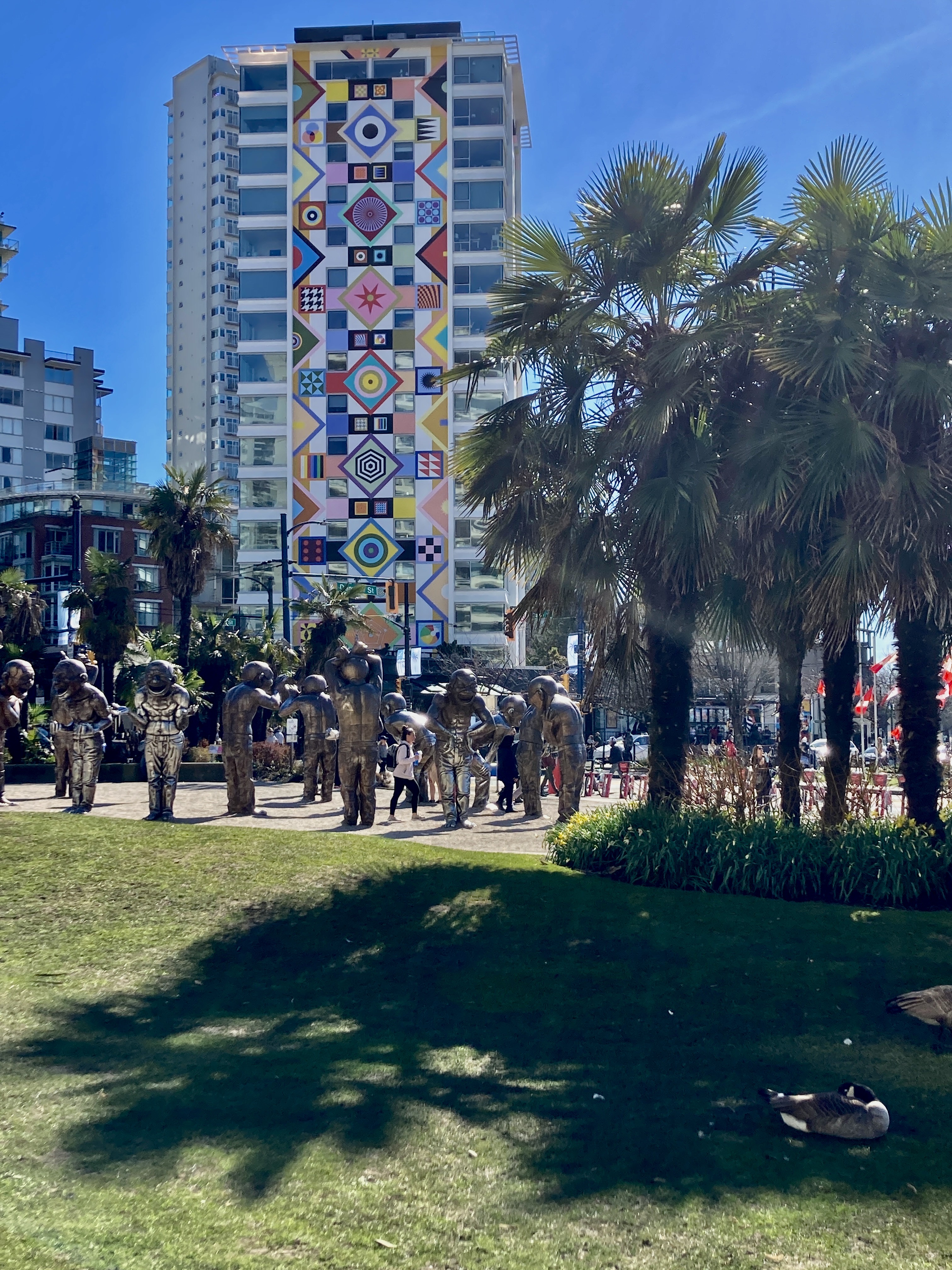
and — after I’ve walked myself back south out of Stanley Park and into Morton Park — four Vancouver icons. All on view without turning my head.

Background, the renovated Berkeley Tower with its Douglas Coupland mosaics; mid-ground, Yue Minjun’s Ah-Mazeing-Laughter sculpture installation; right mid-ground, a cluster of Windmill Palms; and, tucked in their foreground shadow, some Canada Geese.

The day has me in sensory overload.

Yet, with all that wealth of input, one image keeps coming back to mind.

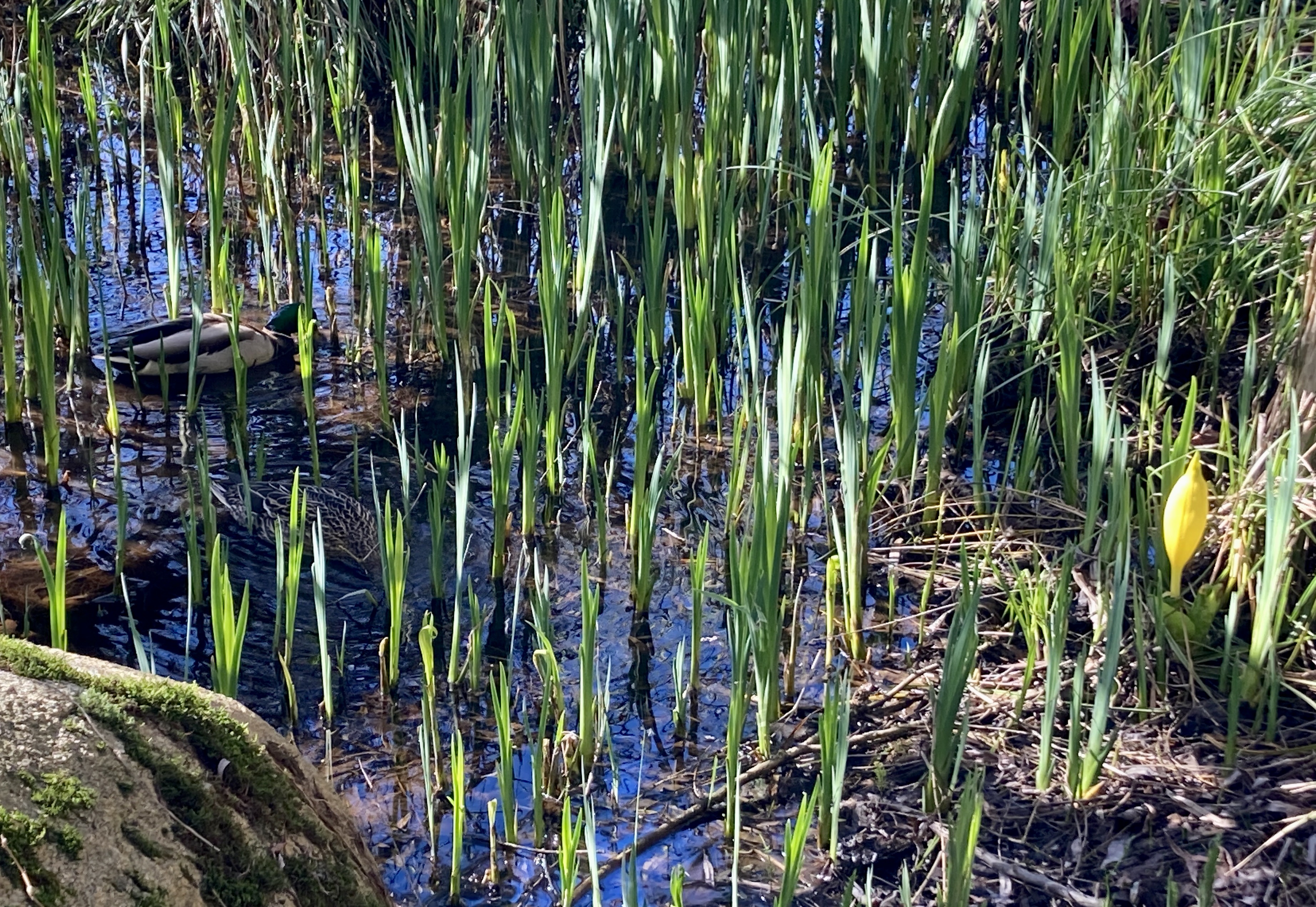
The north shore wetland of Lost Lagoon, the dabbling duck above the mossy rock on the left, the Skunk Cabbage on the right, and all that tender new greenery shooting up everywhere in-between.

Spring.

Vulnerable

8 March 2024 – As I walk back east along False Creek, I do not have a single Life Philosophy thought in my mind. Not a single abstract noun. I am just picking my feet up and putting them down again, enjoying the sunshine.

Then I see this neon glow in the water, just off a curve of seawall between Stamp’s Landing Dock and Spyglass Place Dock farther east.

Still no Important Thoughts in mind, just curiosity.

It’s not until I’m up close, and can identify the shape as a boat, that I think about vulnerability. There that little boat used to be, afloat and riding the currents — and there it now is, submerged and inert.

Vulnerability, consequences, responses. The dynamic is now lodged in my mind, and I see it all over the place as I walk on home.

In environmental and political vulnerabilities, for example, here at Spyglass Place Dock, where blue bands circle Cambie Bridge pilings and a quiet black tribute pillar stands at water’s edge.

The top blue tier in this 2012 art installation, A False Creek, is 5 metres above current sea levels — which is mid-way between the 4 to 6 metre rise that, it is predicted, could be triggered by climate change. The pillar honours Husain Rahim (1865-1937). He was an activist at the time of the 1914 SS Komagata Maru incident that barred a boatload of South Asian passengers from disembarking, and one of the first South Asians to challenge the disenfranchisement then taking place. While the ferry dock is still Spyglass Place, I learn that this space is now called Husain Rahim Plaza.

I’m about to walk on — and discover that I can’t.

Due to “the deteriorating condition of the structure supporting the seawall,” the path has been closed between the Cambie Bridge, right here, and Hinge Park to the east. Detour along West 1st, we are told, while authorities address this weakness.

Heading for 1st Avenue, I walk under the bridge, where I stop long enough to read this extraordinary beer-themed love letter chalked onto one of the pillars.

The message is fresh and wonderful, but street art by definition is ephemeral. Vulnerable. Just look above the top line for proof — the “Simply Jay” message has been effaced.

Eastward on West 1st Avenue now, and more vulnerability call-and-response.

The building in the foreground is one of the City’s Temporary Modular Housing facilities, created in response to what the City itself calls a crisis situation: “over 2,000 people are experiencing homelessness.” The rusty building farther along is an old, disused workshop from the area’s industrial past. It will surely fall down, or be knocked down, sometime soon.

Lying between those two buildings, and in behind the housing as well: an urban farm.

Sole Food Street Farms, founded in 2009, is now one of North America’s largest urban farms. This location trains & employs people from the Vancouver Downtown East Side, who grow the produce that is then sold & given away.

At Hinge Park, I can drop back to the waterfront. The railway tracks and buffers here at the south edge honour the past; the park itself is part of the pre-2010 Winter Olympics response to what had become a derelict and polluted wasteland.

Even my classy latte in an Olympic Village Square café reminds me of vulnerability! I have left it to sit just a little too long, and, look, the frothy design is beginning to deflate. (The taste, I promise you, is unaffected.)

Back outside, I admire The Birds (Myfanwy MacLeod, 2010), gleaming in the sunshine.

The gleam is thanks to their fairly recent repatination; the repatination was the response to the vulnerability of their surface to all those climbing feet. Signage now politely reminds people that these sculptures are art, not a climbing wall, and asks us to keep our feet on the ground.

Heading south on Ontario Street, I detour half a block west into an alley, for a closer look at a face.

This face.

L’il Top is the signature, and if this bit of street art is vulnerable to time and the elements, so are those H-frame hydro poles. I, and countless Vancouver artists, love the look of them, but they are seriously outmoded, and systematically being replaced.

Back onto Ontario, farther south to West 6th, and my vulnerability theme now presents itself in a real-estate trio. The first thing I notice is that wavy reflection in the windows of the blocky new-build on the corner.

Then I play with the story, the trio of stories, the development dynamic of this bit of Mount Pleasant neighbourhood. Behind the new-build, a century-plus brick veteran, its status secure; in these windows, the reflection of the scruffy building across the street, wrapped in chain-link fencing, its status unclear.

Once the Teachers Centre for the Vancouver School Board (1972-1990s), it sits within the footprint of the T3 Mount Pleasant site now under construction — “T3” as in timber/transit/technology, with a planned 190,000 square feet of mass timber construction to attract environmentally responsible companies and workers. If the developer’s web page is any guide, at least part of this old building will be restored and repurposed as a heritage element in the mix.

Response to environmental threat is the theme of this part of Mount Pleasant. Along with the T3 building, it is also home to the emerging Main Alley Campus, which promises to provide “Canada’s first completely net-zero work environment for the creative economy.”

These two projects won’t save the planet, but it is heartening to see major development corporations put their weight behind new, more environmentally responsible, approaches.

I swing onto East 7th, and salute a building that has long known how to respond to changing threats — and here it still is, 112 years later.

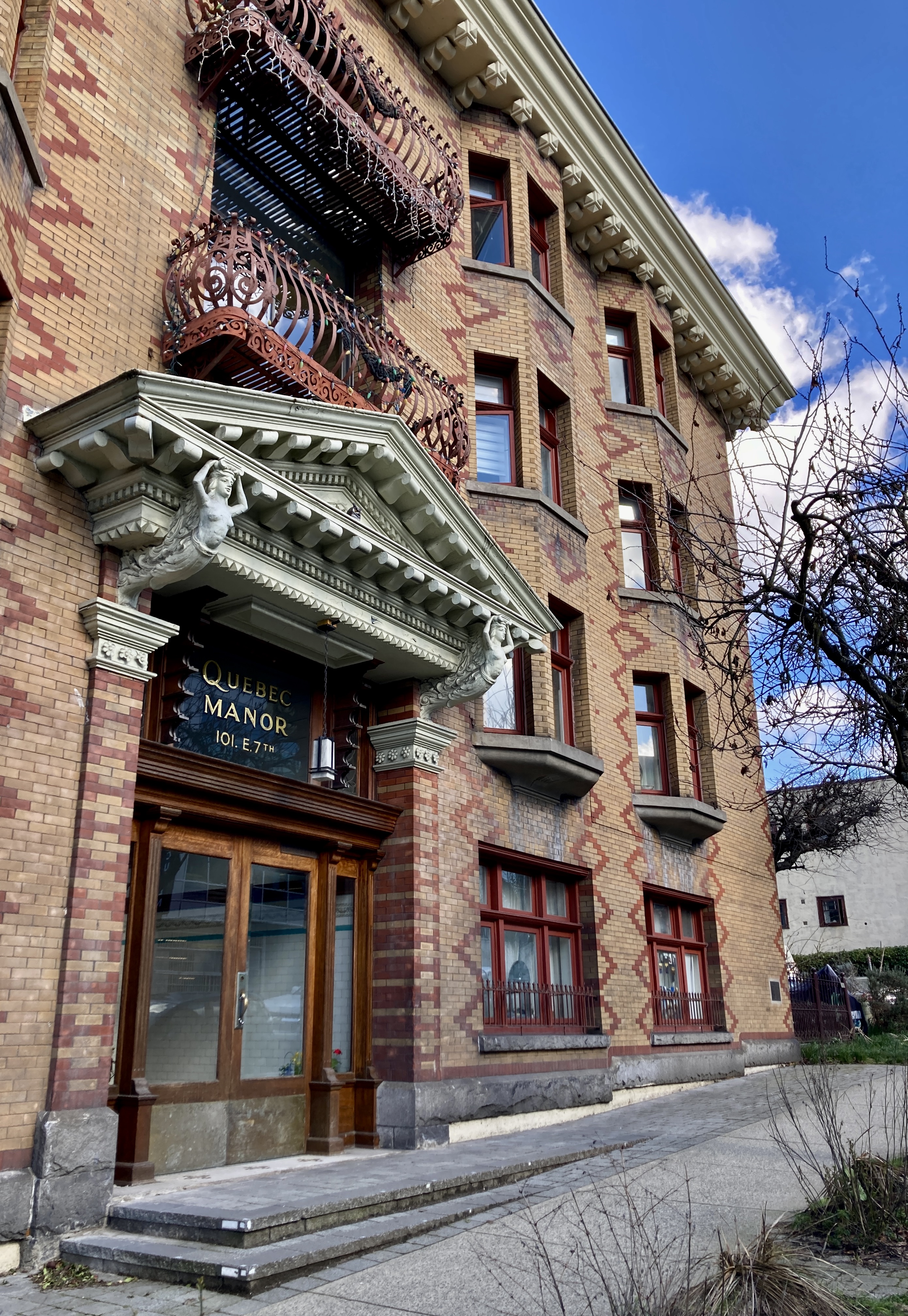
Behold Quebec Manor, in all its diamond-patterned, bi-coloured brick glory. (Complete with metal balconies and nude maidens to welcome you home…) Built in 1912 as a luxury apartment hotel, probably for train passengers at the near-by terminals, it became rental units in the 1920s, and in the 1980s achieved new, secure status when its tenants bought the building and turned it into a housing co-op.

So that’s my walk, and how discouraging it could have been, with such a theme. But it wasn’t. So many vulnerabilities, yes — and so many responses, as well.

Strategies

6 February 2024 – Having puttered my way along Commercial Drive, I am now zigzagging my way north-west through various neighbourhoods, making my way to Main Street and a bus on home.

No particular plan, so it’s sheer serendipity and pleasure to find myself on Charles Street looking north along McLean — the site of Mosaic Creek Park.

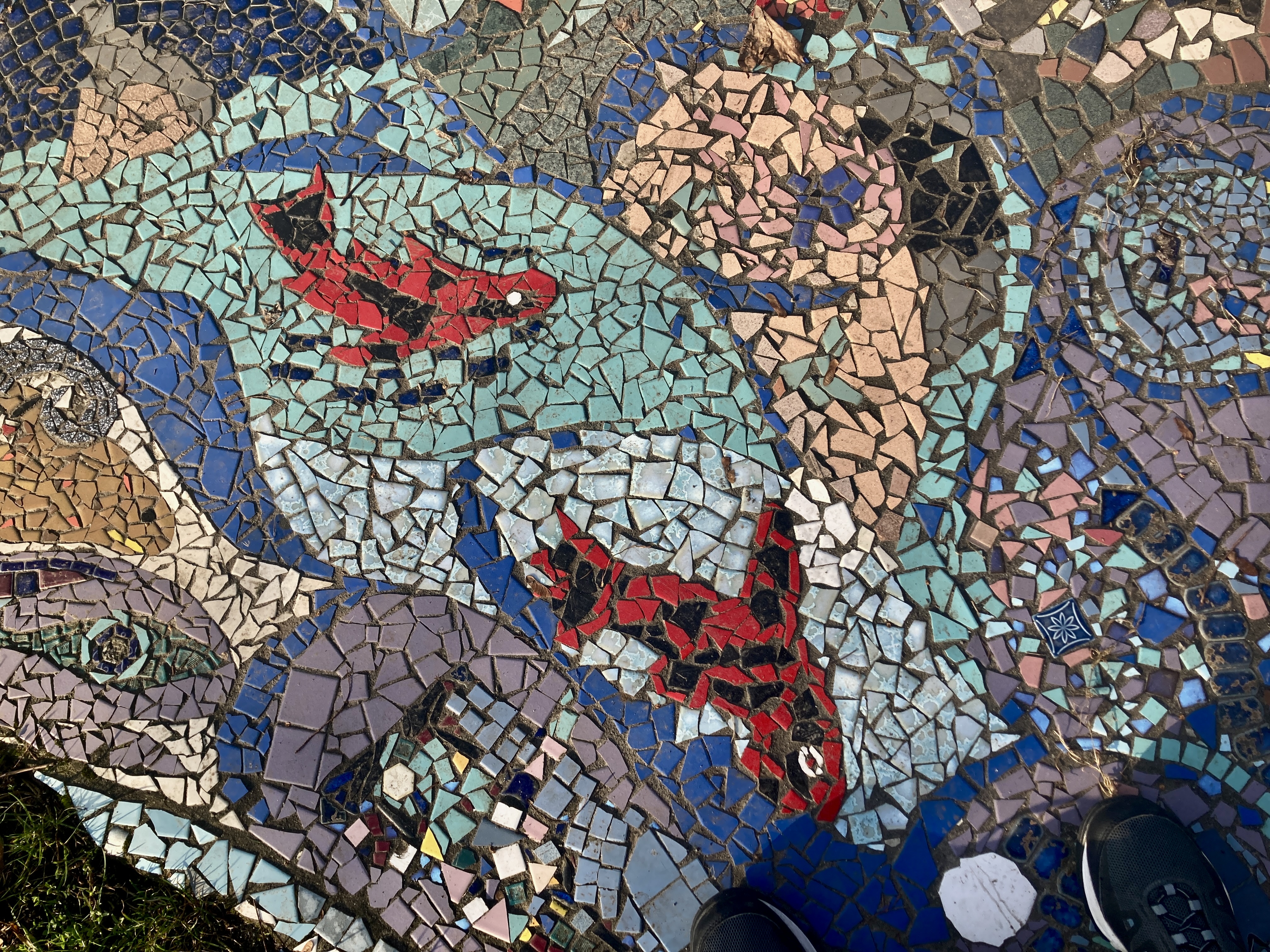
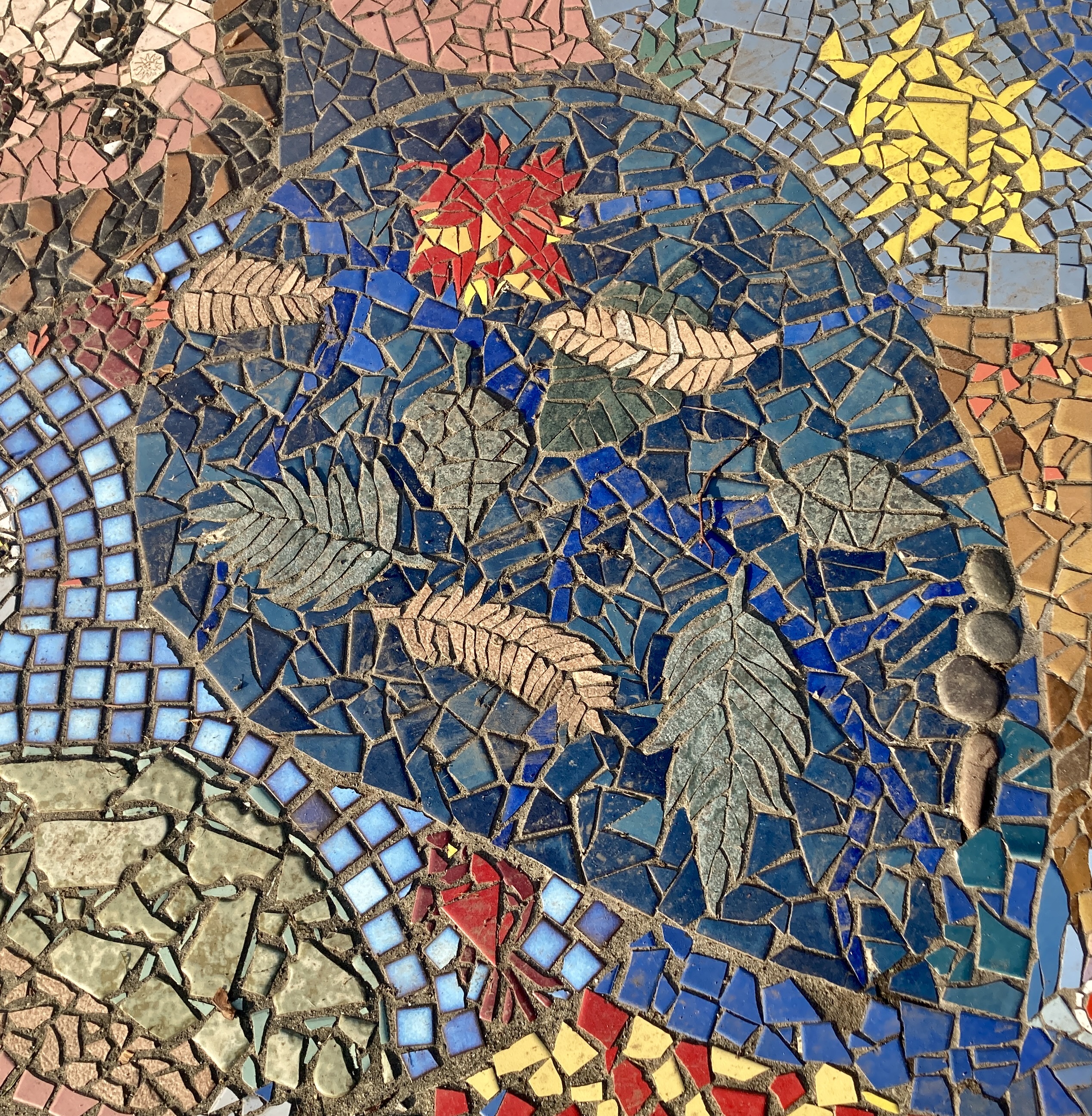
Hundreds of mosaic tiles form the “creek” running through this tiny park. It is the late-90s creation of a determined local coalition, the Britannia Neighbours Community Group, with the help of mosaic artists Glen Anderson and Marina Szijarto, who ran workshops and facilitated tile-making by any community member who wanted to take part.

The Park Board insisted the tiles be frost-proof, but set no artistic criteria. People were free to create whatever they wanted to create.

Agile fish, for example…

or a sleepy cat…

or wind-blown leaves…

or (why not) a dancing, prancing human being.

The two people on that corner bench, though relaxed and companionable, are not dancing. In raspy voices, they discuss strategies for getting your s**t together in rehab.

Farther down McLean, two dapper young businessmen stand side by side, eyeing a corner lot. In quick, clipped voices, they discuss marketing strategies for new builds.

  • WALKING… & SEEING

    "Traveller, there is no path. Paths are made by walking" -- Antonio Machado (1875-1939)

    "The voyage of discovery is not in seeking new landscapes, but in having new eyes" -- Marcel Proust (1871-1922)

    "A city is a language, a repository of possibilities, and walking is the act of speaking that language, of selecting from those possibilities" -- Rebecca Solnit, "Wanderlust: A History of Walking"

  • Recent Posts

  • Walk, Talk, Rock… B.C.-style

  • Post Categories

  • Archives

  • Blog Stats

    • 136,208 hits
  • Since 14 August 2014

    Flag Counter
  • Enter your email address to follow this blog and receive notifications of new posts by email.

    Join 2,090 other subscribers