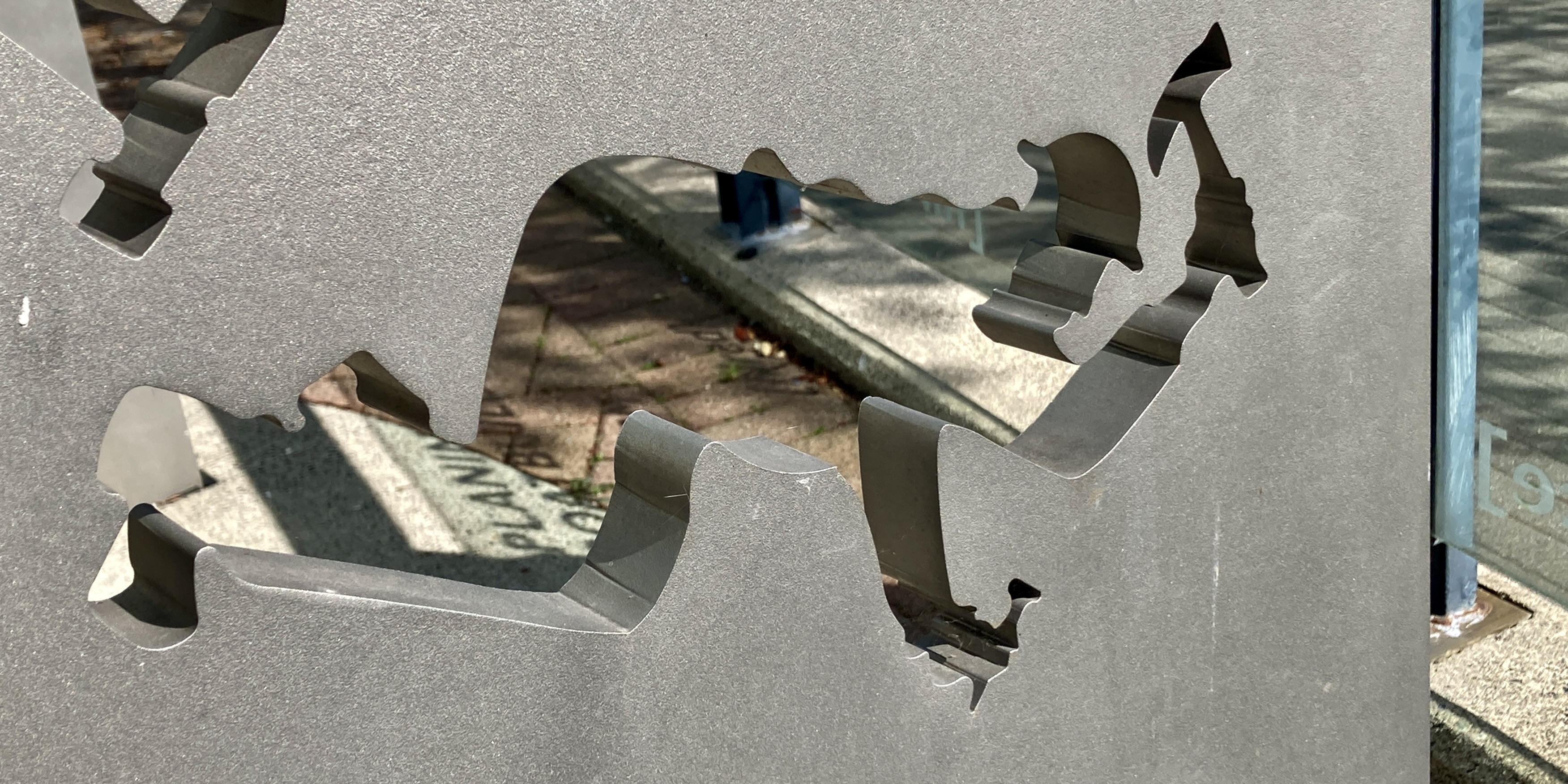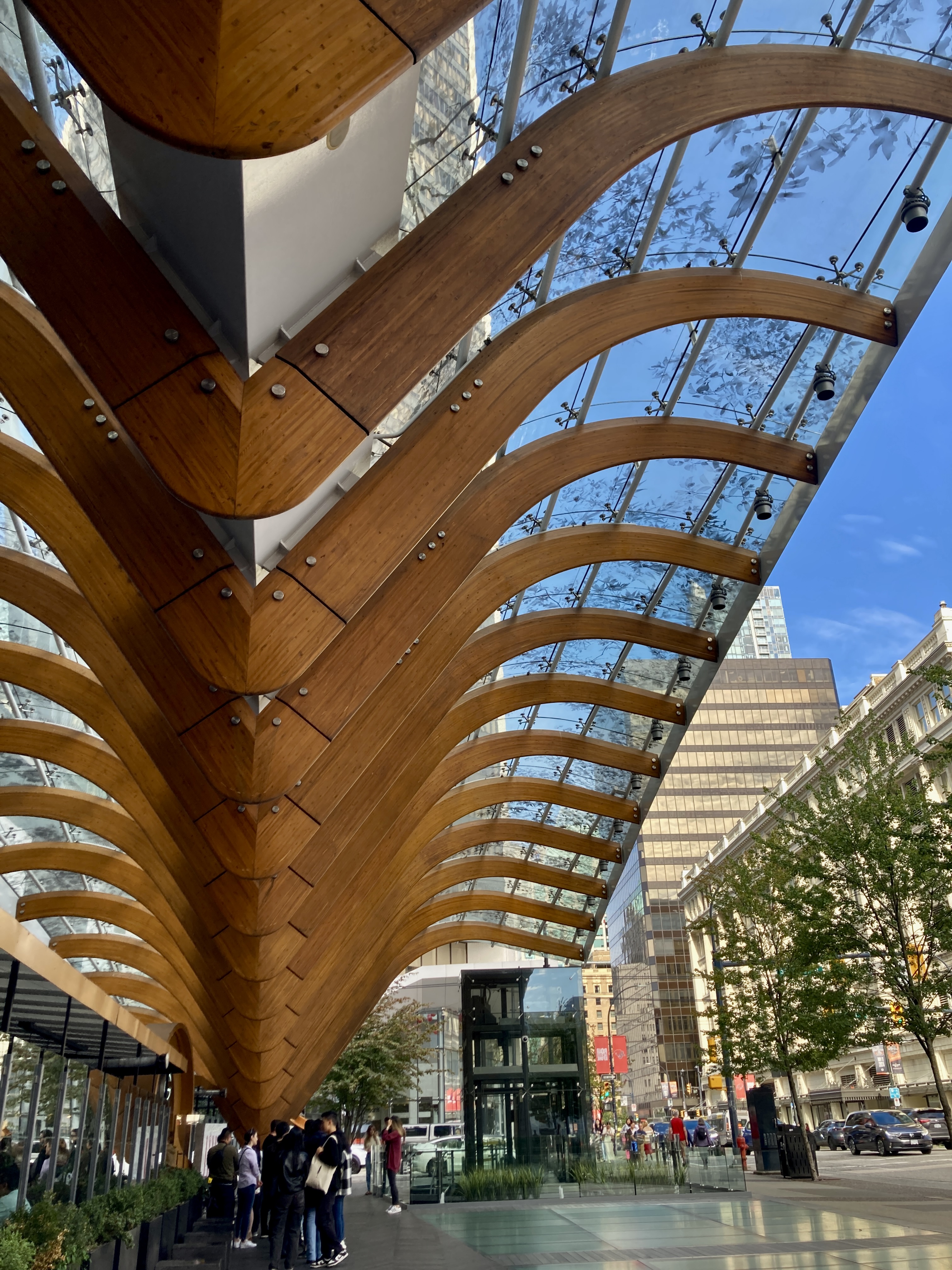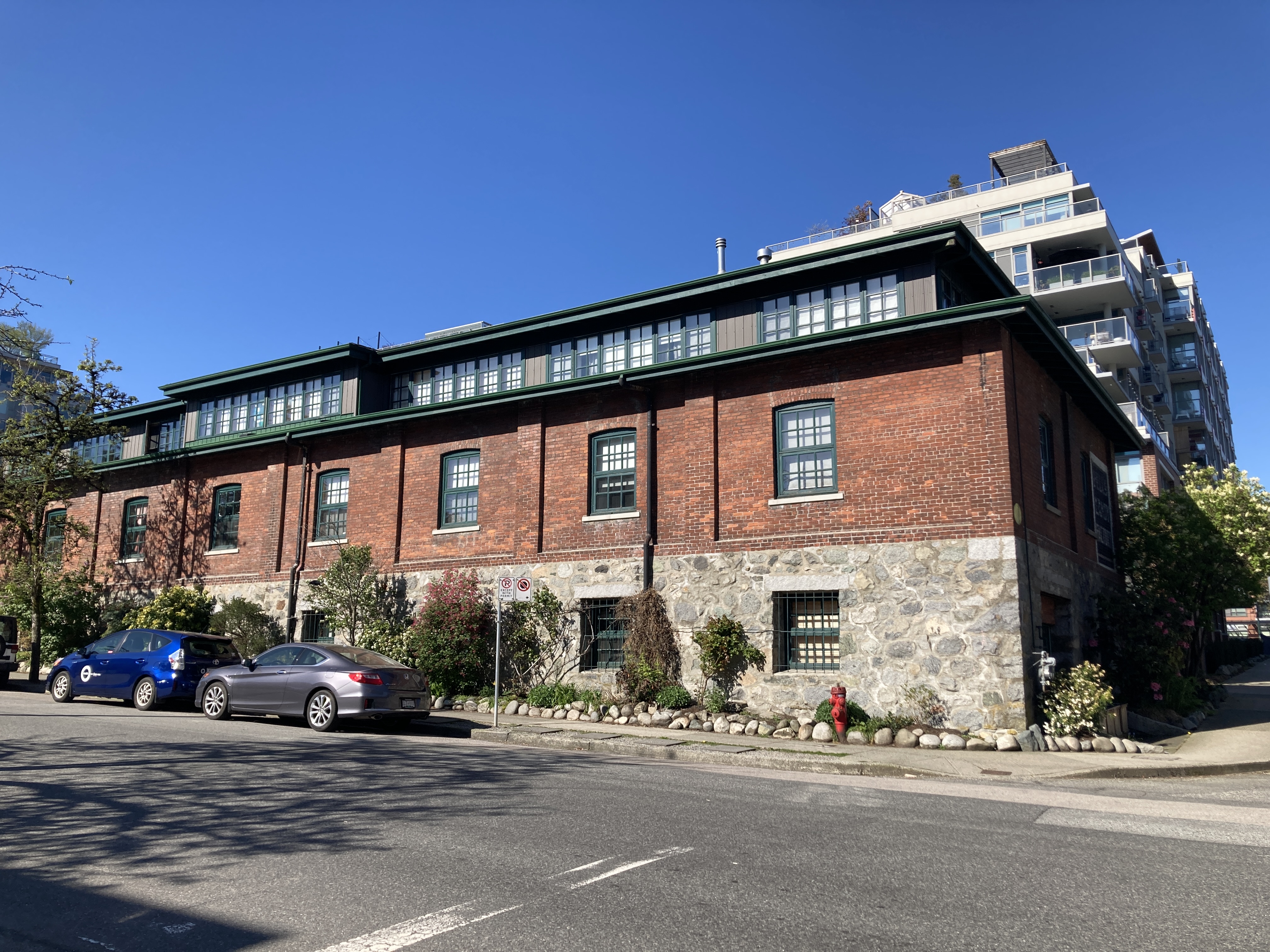
So T.O.

14 September – And then, from morning to afternoon, I leave Toronto and land in Vancouver. Here I am, looking through slight drizzle to the mountains, with one last love-letter I want to offer “T.O.” (Tee-Oh, Toronto.)

My T.O., that is, nobody else’s — my own mix of memory and re-discovery, blind to what others would notice, alert to all my own triggers.

Glimpses from streetcars, for example.

A rampart mural by Shalak Attack, which I remember watching her paint, many years ago…

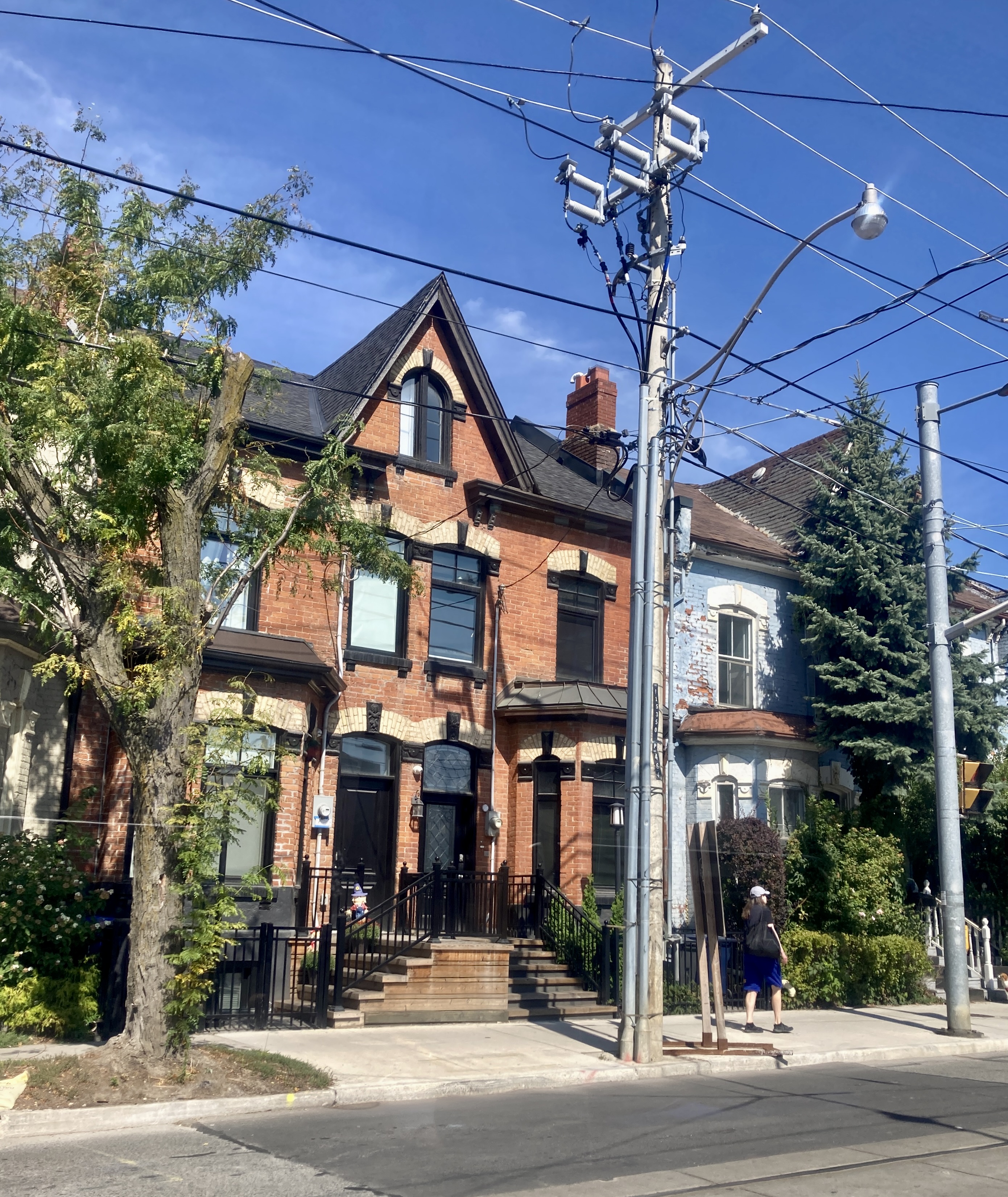
the distinctive two-tone brick and architecture I associate with my own decades in the Cabbagetown neighbourhood, but common to the city in that era…
and Streetcar Dog. Not unique to Toronto, but part of my own memory bank of riding the TTC.

Then there are my re-discoveries on foot, all around the Grange neighbourhood and the Art Gallery of Ontario, where I was for years a volunteer and therefore an area where I came and went, a very great deal.

Bronze turtle watching martial-arts in Butterfield Park, the new-since-my-time refurbishment of the land just east of Grange Park and south of OCAD (Ontario College of Art + Design) University…

Henry Moore’s Large Two Forms, looking very at home in its new home in the reinvented Grange Park, with the brilliant blue rear wall and distinctive Frank Gehry staircase as backdrop…

and, once inside, the soaring glulam arches of the AGO’s front-façade Galeria Italia.

Unchanged, these arches. Ditto, the way the Galeria invites you to look out across Dundas Street. Native son Gehry made sure his design honoured and welcomed the neighbourhood of his childhood as its own visual final wall.

I am in the AGO as much to walk old ground as to see current exhibitions, but in the end I do both.

The Joyce Wieland retrospective, Heart On, speaks not only to my memories of her bursting on the scene, but also to how current she now is, once again.

Wieland was a fierce ’60s-70s feminist and, despite (or perhaps because of) long years in New York, a fierce Canadian patriot as well. She often used the soft “feminine” skills of embroidery or quilting to express strong political convictions.

For example, with her 1970 work, I Love Canada – J’aime Canada.

Awwww. (Twist finger in cheek.) So sweet.

Now read the signage.

And read the embroidered fine print.

Wieland’s narrow definition of Canadian identity is now out-dated — but the rest of her analysis is Elbows-Up contemporary.

Some hours later, I leave the building. I still have more circling and prowling to do.

I check out the S/W corner of Dundas West & McCaul. It is also the N/E corner of the AGO footprint and, in my day, was still home to Moore’s Large Two Forms. For the first time, I see what now sits on that corner — Brian Jungen’s commissioned work, Couch Monster. (Read more, here, in a fine post by our WordPress colleague, Canadian Art Junkie.)
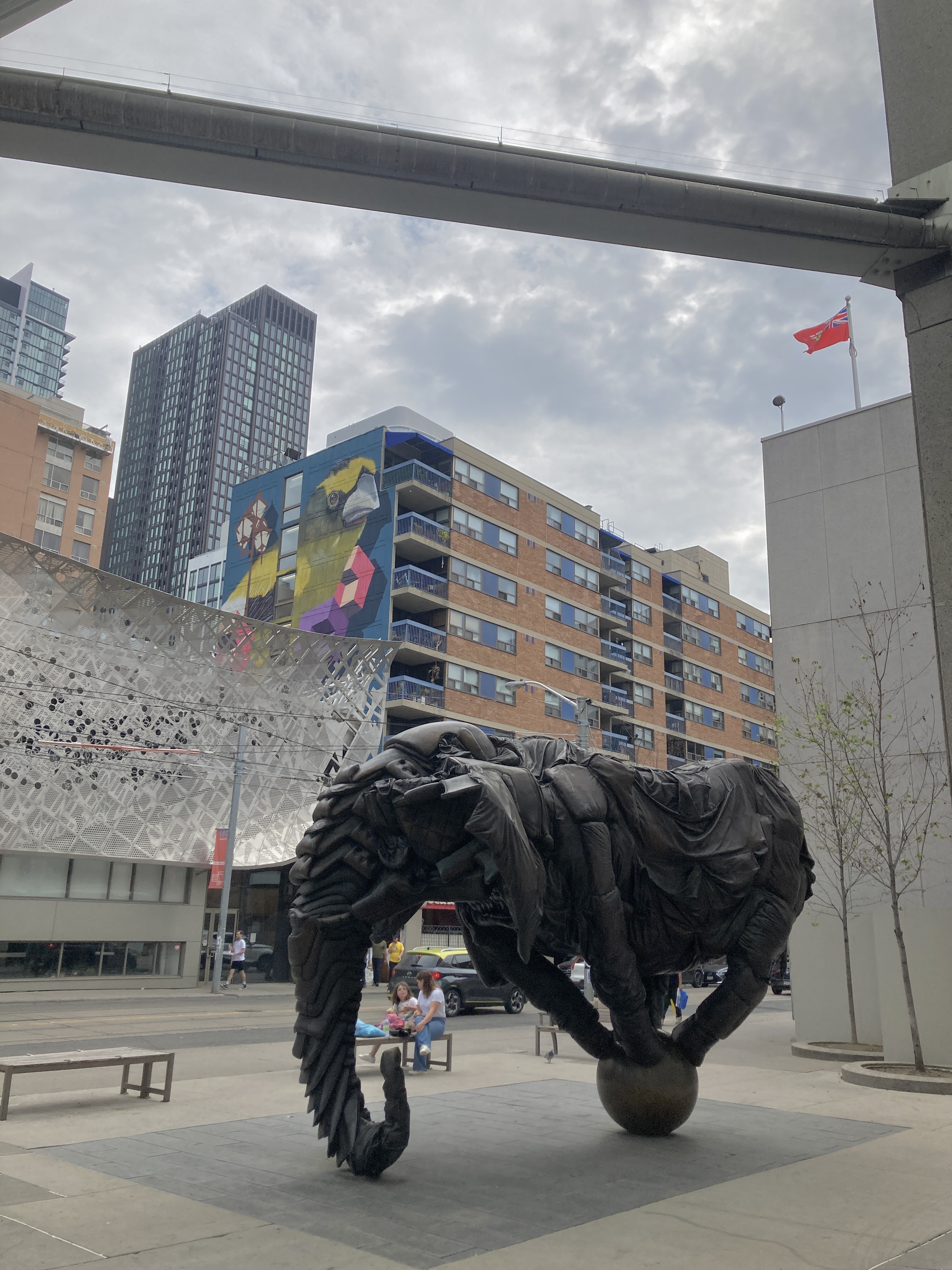
I circle the work, and also take in the larger view, including the top of an old mural by veteran Toronto artist Birdo, now obscured by newer construction and backed by even-newer construction.

Finally, and not with terrifically high hopes, I take myself across Dundas West and into the alley between Dundas and Darcy Street to the north. I am eager but also dreading to see what it’s like, these days. My memory is of an alley bursting with street art, full of the “garage-door art” that I associate with my memories of Toronto.

And…
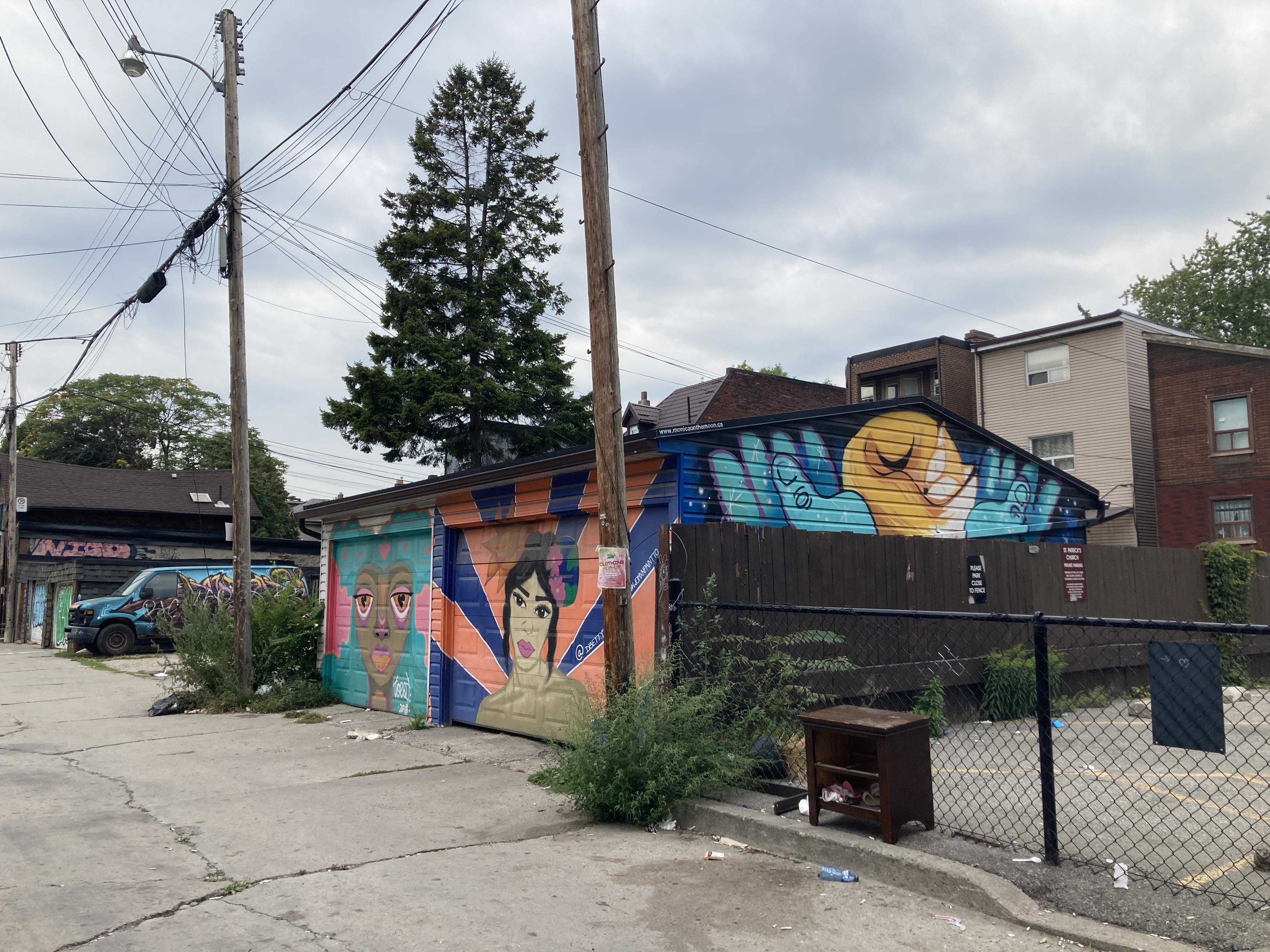
there it still is. On and on, to the west, beyond the frame of this image. Not exactly as it was, of course not, but alive and current and so-very-T.O.

I turn right on a second, N/S, alley, passing delicate tendrils and other art as I go…

and emerge on Darcy Street.

Where I drink in an enclave of old downtown residential architecture, oh look, some still survives…
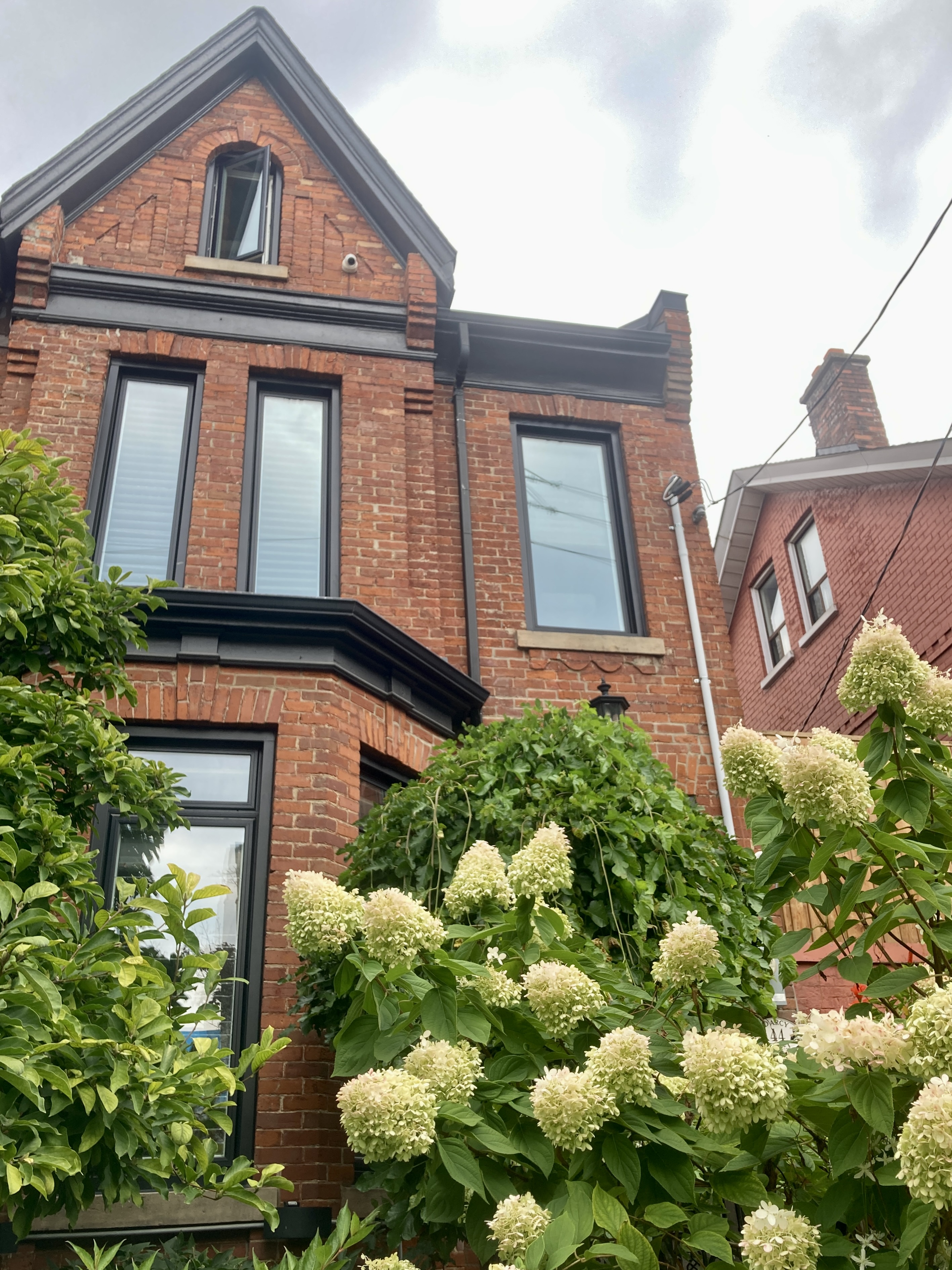
and then pivot on my heel to look east down the block. Out to McCaul Street.
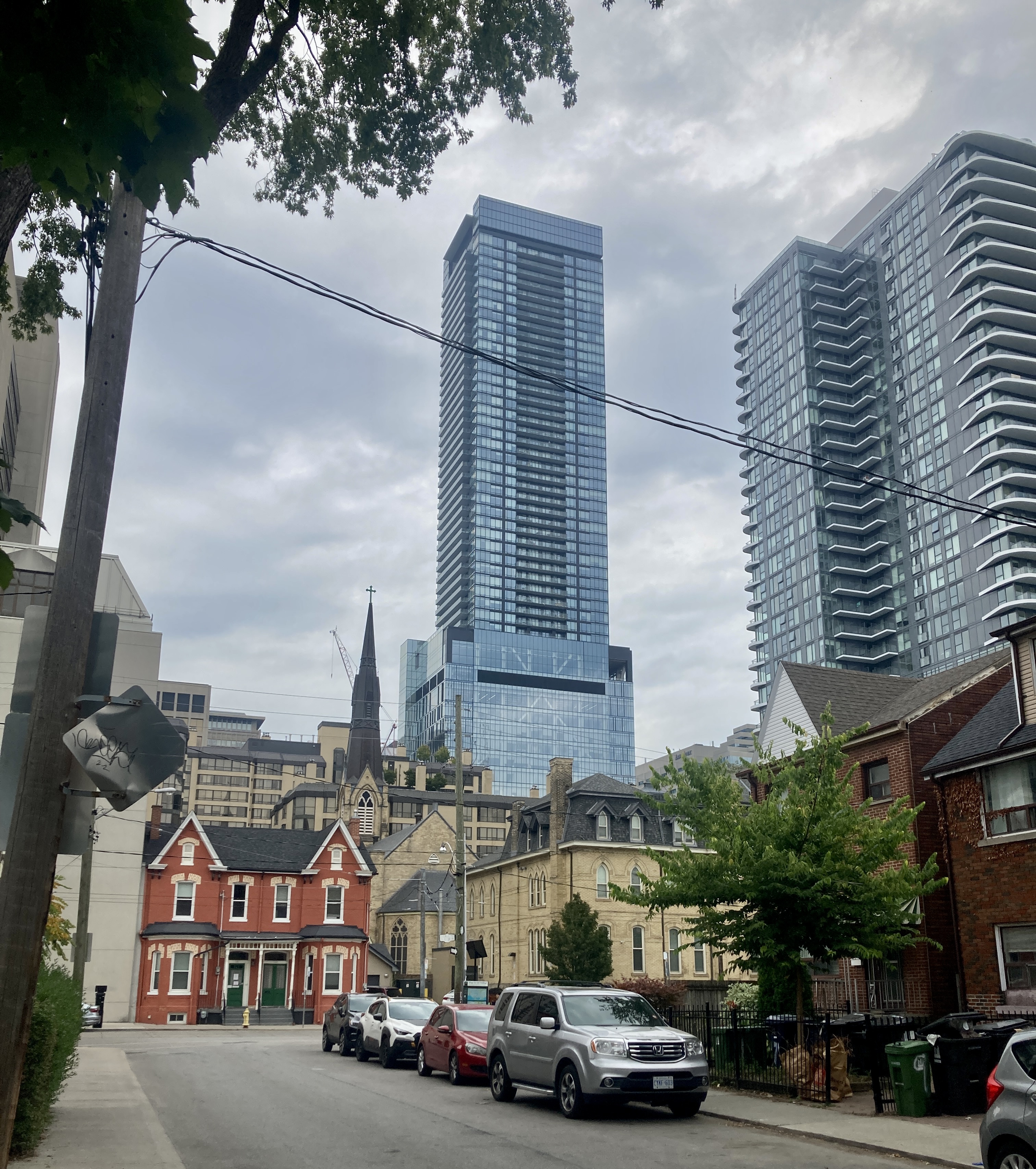
Still some old brick homes, and still the spire of St. Patrick’s Church (the 5th-oldest Roman Catholic parish in Toronto) as well — plus the immediate examples of all the new towers now exploding skyward.

There it all is.

The whole jarring/exhilarating, cacophonous/euphonious, forever-evolving symphony of the city.

So T.O.

Snowy Owl + Mailbox Spider

12 September 2025 – More old + new, here in Toronto. The joy of time with old friends and familiar places, but also the joy of discovery.

For example, Biidaasige Park — some 40 hectares once complete, down at the mouth of the Don River and part of an even larger overall program to re-gentle, re-green and detoxify the sprawling Port Lands for what we now understand to be wiser, more multi-purpose and more inclusive use. Read more about Biidaasige (“Bee-daw-SEE-geh” with a hard “g”) on the City‘s website, on an analytical design website, and in her 6 September “As I walk Toronto” post by our WordPress colleague, Mary C.

The park is very much a work in progress, but some elements are already in place. They include several imaginative children’s playgrounds, one of which has as its guardian spirit, Snowy Owl.

Not only is his open tummy a stage for all kinds of child-friendly events, the interior of his body is open to visitors as well. You can walk inside…

and start climbing. Stairs, then ladders, and up you go.

Bang-thwack-ouch! Smack your head a few times and you finally realize the structure is child-scale. You learn to bend and duck accordingly.

Your reward? You get to look out through the Owl’s eyes, across the undulating playground, across Commissioner St. and westward toward downtown.

I scramble back down. We take ourselves off to explore trails down in the marshy areas around the various channels.

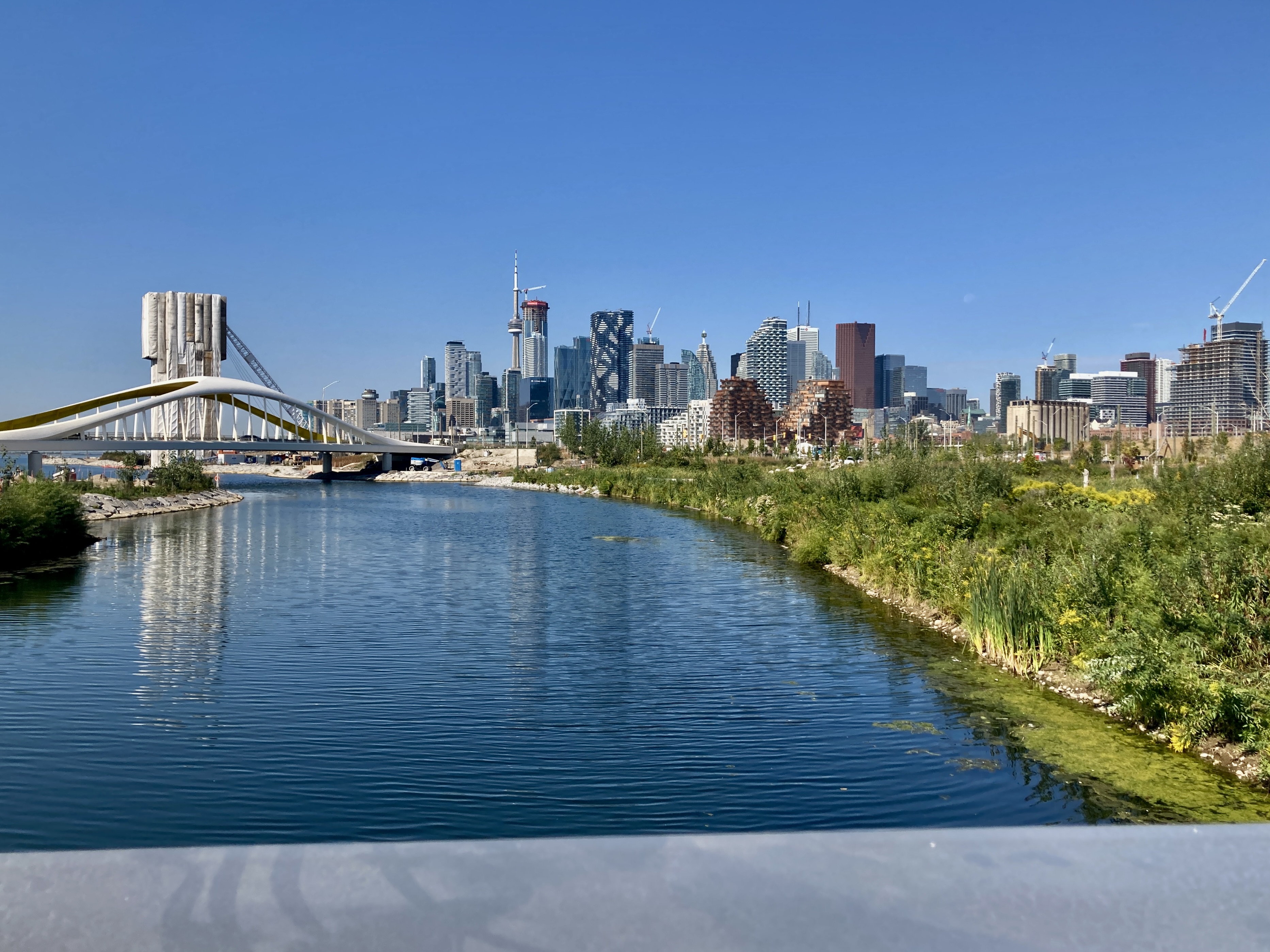
I am awestruck. This grubby, much-abused waterfront is being transformed. We lean on the railing of this pedestrian bridge and admire the grace of the new vehicular bridges, the abundant wild greenery along the banks, the habitat all this must offer for so many species. (Plus the knowledge of habitat yet to come, in plans for housing and further human community and settlement as well.)

And then… we move on.

The day is hot, and sunny, and, thanks to on-going park construction, noisy. We want still to be close to nature, but somewhere that offers soothing shade and a lack of noise.

All of which leads us to discover…

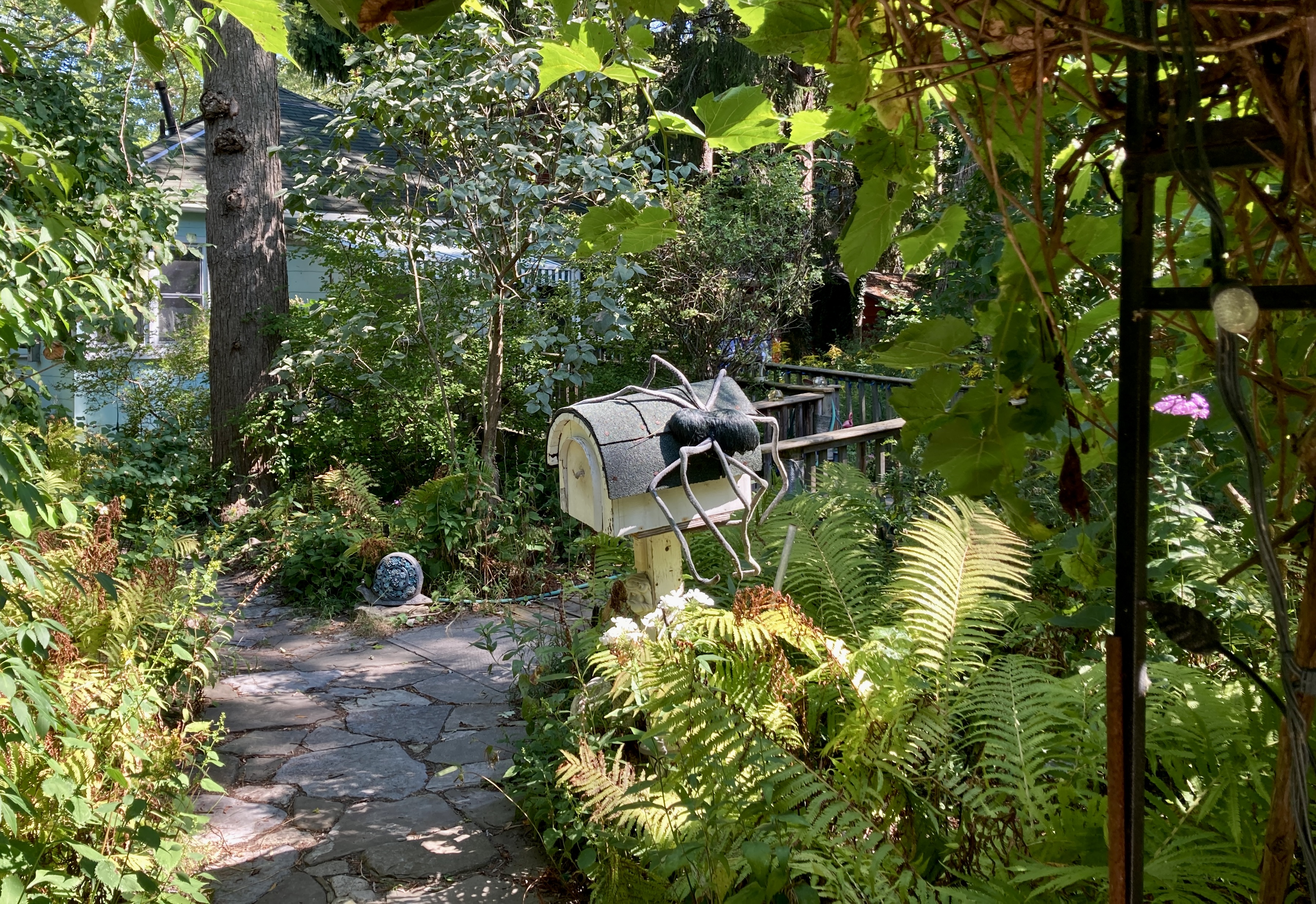
Mailbox Spider.

He is only some 4-5 km. away, slightly south-west of Biidaasige Park…

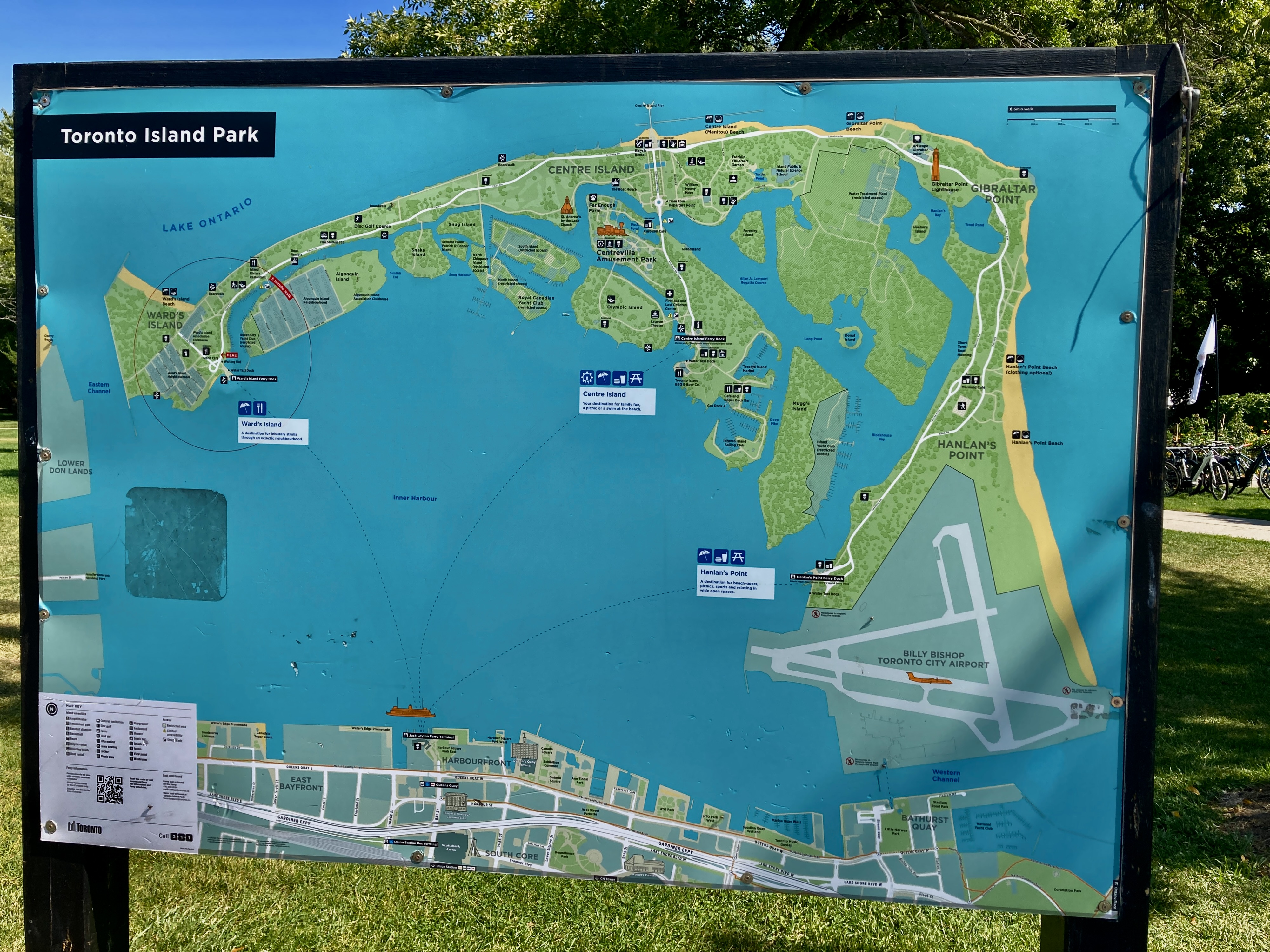
but in a very different world. The world of the Toronto islands.

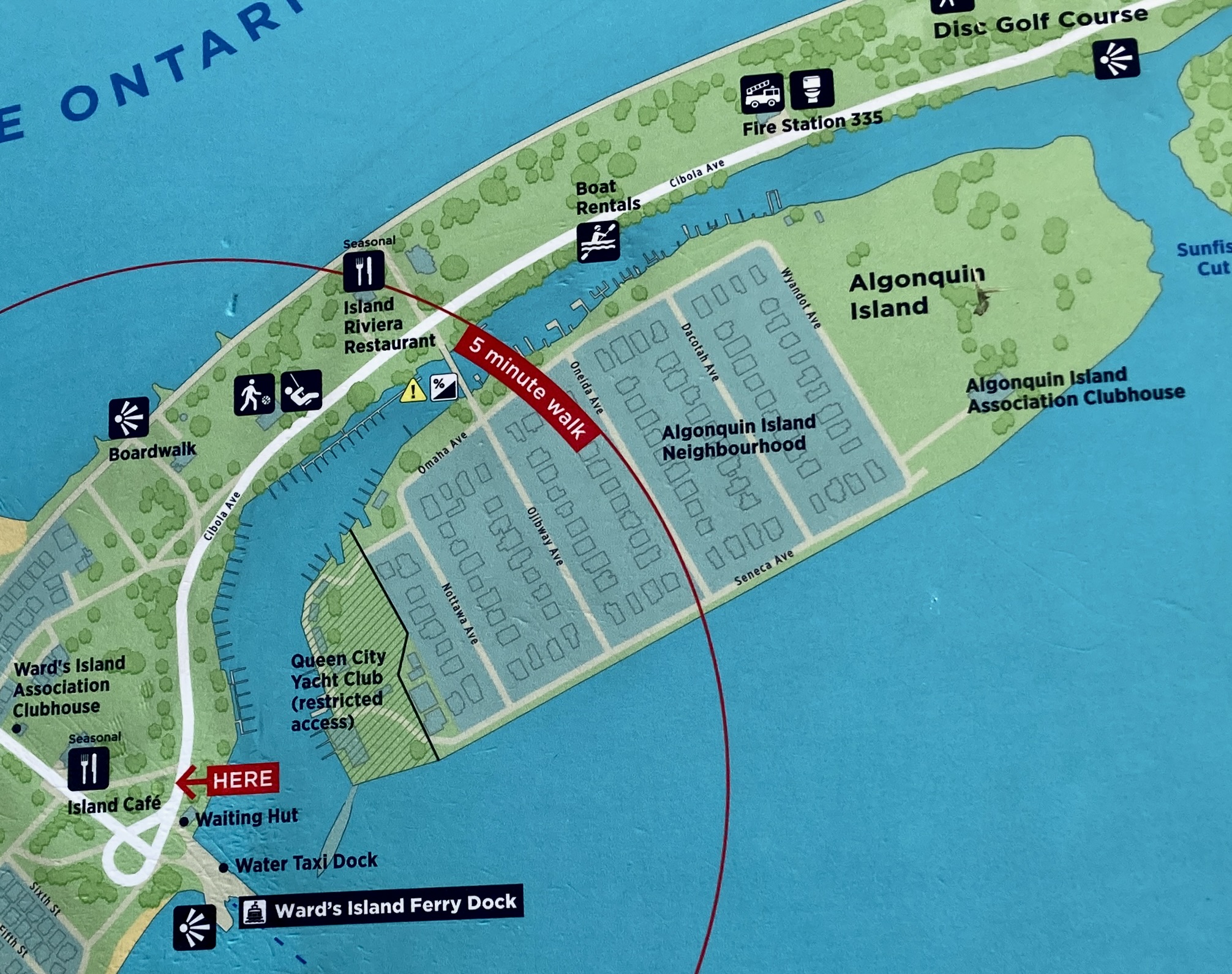
More specifically and of importance to me, we are on one small island within that larger cluster: Algonquin Island, which is reached by a pedestrian bridge close to the Ward’s Island ferry dock.

Trace your finger over that pedestrian bridge and tap the intersection just off the bridge: Omaha and Ojibway avenues. Got it? Right there on that corner lot, almost invisible within its own mini-forest of trees and shrubbery, there is a white cottage. The white cottage where, 60 years ago, I used to live.

So it’s heavy-duty nostalgia time for me, and my friend is generously indulgent.

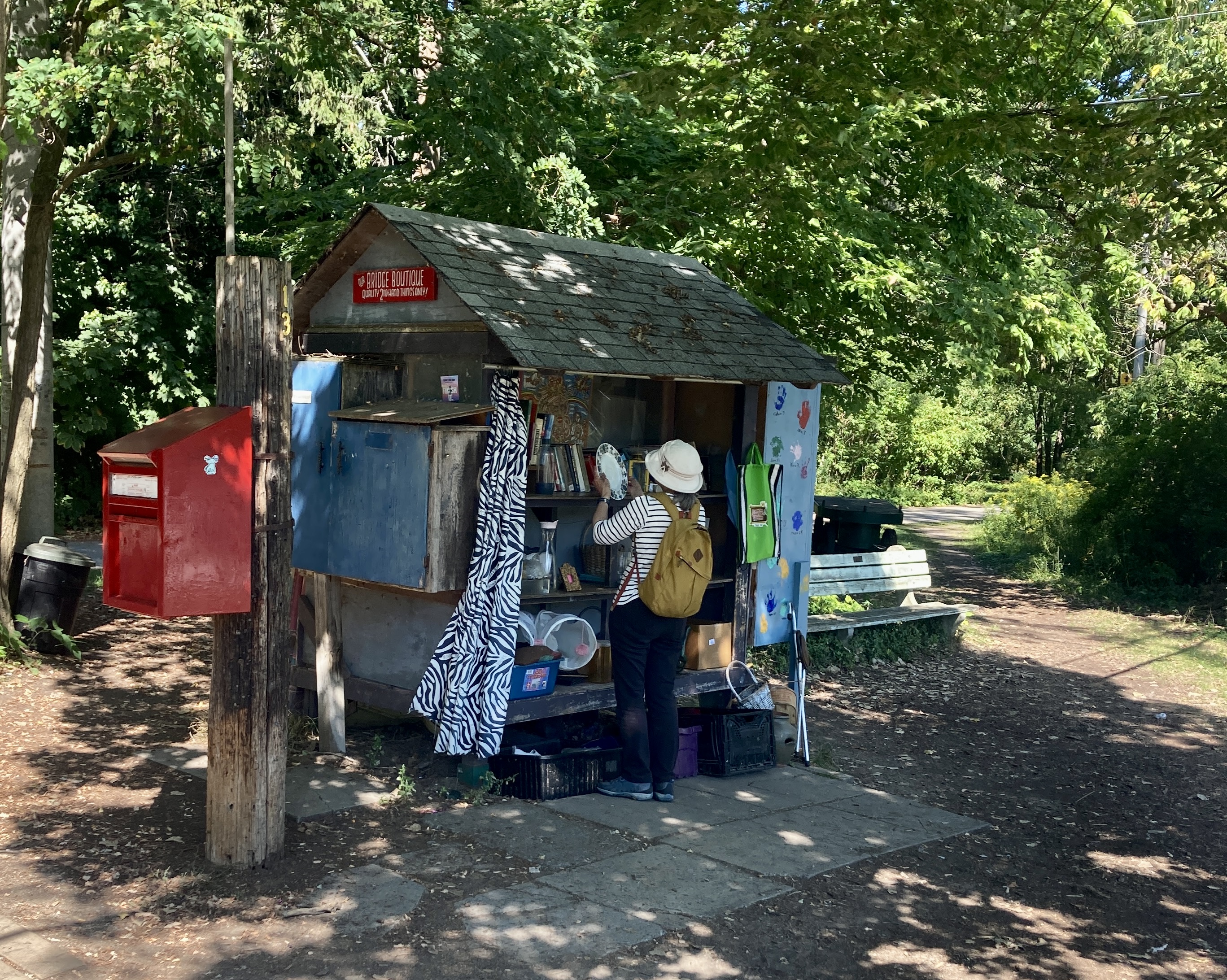
We stop, immediately off the bridge, to explore the community take/leave stand. It was active decades ago and, to my delight, is still active now.

A couple of Algonquin residents are near-by, people about my age. We chat, I explain I used to live here, I name a few names and they smile. We three didn’t know each other, but we each knew these other people.

Then, my friend and I, we just weave slowly up and down the narrow, car-free streets. (It is on Ojibway that we meet Mailbox Spider, with his blue cottage tucked away in the rear.)

The atmosphere is leafy, and peaceful. It is now a world of pretty smooth relations between residents and City — the welcome resolution of the long fight by residents and supporters to protect any residential community at all, in the face of the City’s desire to remove everybody and make the entire islands cluster into one big park. Now most of the land mass is park, but residential communities are recognized and stable on both Ward’s and Algonquin.

We reach the foot of Ojibway Avenue, down at Seneca, which runs along the island’s harbour-side waterfront, and offers panoramic views back across the water to the city core.

Including that CN Tower. I gave you only a distant and slivered view in my previous post; here it is, front and centre.

Still on Seneca, a good example of visitor/resident co-existence:

a bench for tourists and residents alike; one of the island’s many art boxes, again for the pleasure of tourists and residents alike — and a hammock in a resident’s front yard. For that family only, thank you!

Finally, my nostalgia satisfied and our minds and bodies refreshed by the peaceful environment…

we board a ferry, and head back to the city.

Land Cruise: 7-9 September

7 September – Continuing my new, but very happy, Winnipeg tradition, I go walkabouts on departure morning. Once again, art comes my way as a result.

I cross the Red River to neighbouring St-Boniface and, just as I’m completing a loop through the neighbourhood, I find myself pulled into a parkette.

By this.

It is Joe Fafard‘s 2011 sculpture, Entre chien et loup — a tribute to the French saying, to this francophone quartier, and to the mystery and energy of transition zones.

By 10:30 pm I’m in the train station, ready to board, eager for our 11:30 departure and all the new sights that will come our way.

Except we don’t promptly board, and we don’t leave at 11:30 pm. Instead, we board at 3:30 am.

By then we are the walking dead. (Including the staff change coming on board with us — just as tired as we are but, unlike us, required to be up and active and even happy-faced just a few hours later.)

I don’t know when we finally leave Winnipeg. I’m asleep.

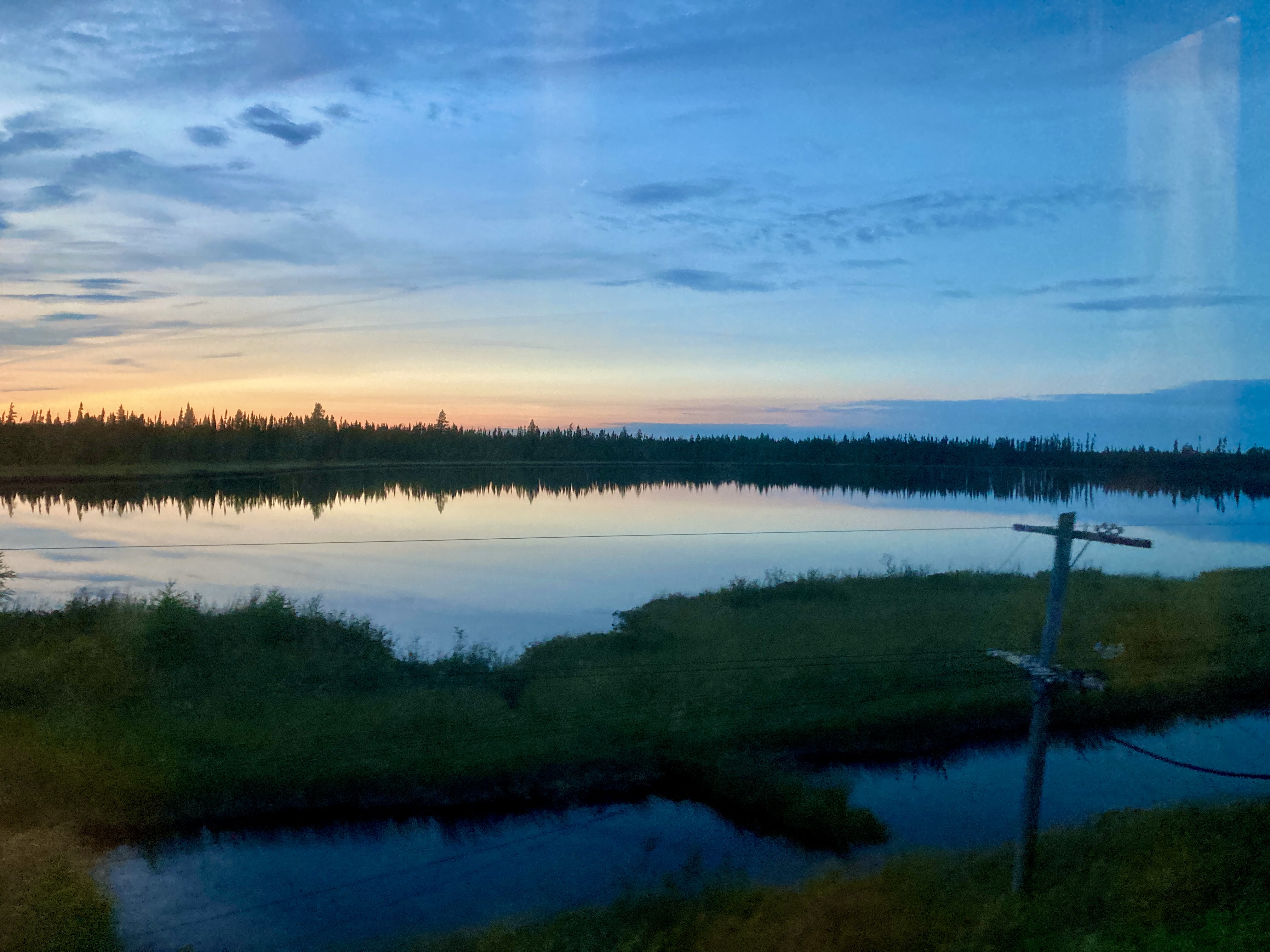
8 September – When I awake, we are somewhere just over the Ontario border. It’s about 7:30 am, and Groggy Self doesn’t understand why she is awake.

But it’s very pretty, isn’t it? And still very northern-looking.

I could show you lots more photos of boreal forest and lakes. But I won’t! By now you know what they look like. So, instead, imagine you’re with me as I enjoy those stunning views, all day long.

And sunset, near Hornpayne.

9 September – We’re just leaving Washago as I slide up my blind around 7 am, passing a CN work station and a cluster of workers. I’m happy to offer them this tribute: maintaining, scheduling, running trains is hard work. Thank you.

A rusty-but-sturdy little bridge, as we pass Sudbury…

first flashes of fall colour among the trees, here near MacTier…

and also near MacTier, one example of the rocky islands that stud glacial lakes throughout the region. Complete with cottages. (You can see a white one peeking out on the left-hand side of the middle island.)

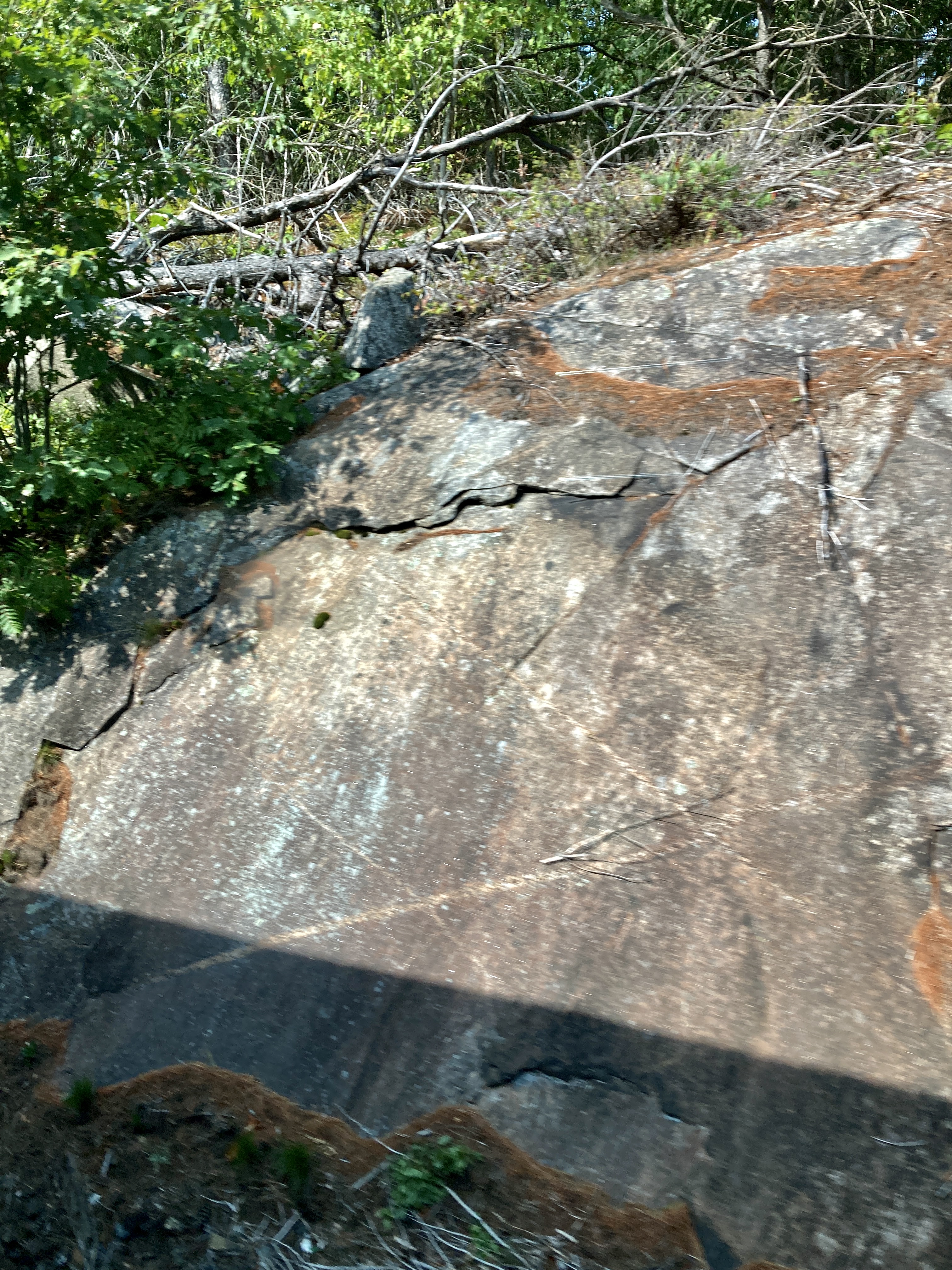
We’re on the Shield! The glorious, hard-rock Canadian Shield — more than 1 billion years old, and covering a good 50% of Canada’s land mass. Oh, I love this rock. This particular example near Torrance.

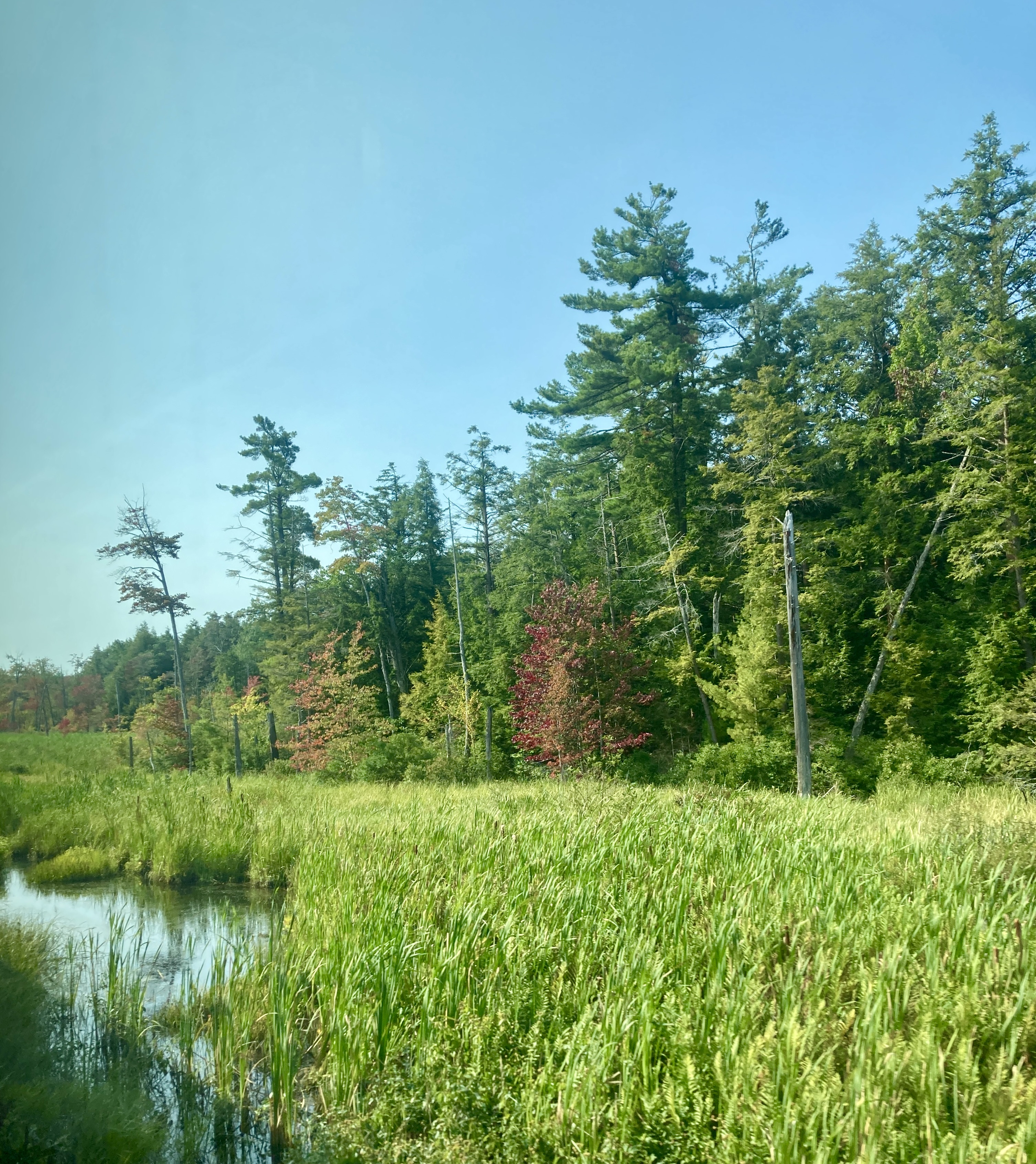
We’re now well into the transition from boreal forest to more southern, more deciduous, forest mixtures. Also in transition to gentler, but still water-rich, vistas — creeks, rivulets, rivers, marshy or rock-bordered, and flanked by forest. This particular example, near Severn Bridge.

Solar panels near Washago (northern tip of Lake Couchiching)…

and farmland. We’re back to farmland. This barn, near Brechin (east of Lake Simcoe).

I’ve loved this segment of the trip, dropping us down through Muskoka, one of Ontario’s “cottage country” regions and one where I have many happy memories.

We continue south, and as we enter Toronto, I’m into another rich cache of happy memories.

The tracks here run alongside the east branch of the Don River (just south of Eglinton Avenue East). I clap my hands like a child, in delight. I’ve walked these trails, walked that foot-bridge, stepped across these train tracks. Ohhhh, just look.

The scenery goes on being familiar, and then, as we round into Union Station, I hit old + new.

New construction, new towers — but back there, its silhouette slivered in between the two left-hand buildings, back there is the CN Tower. No longer new, but still iconic: it opened in 1976 and, at 553 metres, reigned as the world’s tallest free-standing structure until 2007.

It’s still handsome. And it still says Toronto.

Here I am.

In Toronto. Land cruise ended, magic beyond belief.

Thank you, all of you, who have crossed the country with me. I’ve enjoyed your company.

Epilogue – I want you to know: by the time we reach Toronto, we have made up all that late-time in Winnipeg. These few passenger trains have so little control over their running time! They share over-burdened train tracks with a great many freight trains — all of which claim priority. When push has to come to shove, as it often does, it’s the passenger train that sits on the siding. This explains why passenger train departure times are meant to be honoured, but arrival times are fiction. “Fiction” in the sense they are not the straight running time; they always have padding built in. Siding-waits are as much part of the trip as every station along the way.

Land Cruise

29 August 2025 – Here’s the tease:

Oh yes, all of that. In stages, with add-ons.

You’ll see!

(But not immediately.)

Snagged

10 August 2025 – Seven moments, over the past few days, that snagged my attention. If these images snag you as well, I’m glad, and thank you. But here’s the rabbit hole: what now snags my attention is the phenomenon of attention-snagging. Of engagement. And the fact that your reason for lingering with any one of these images will be different from my own, and equally valid.

For the image is just the starting point, isn’t it? Each of us makes our own journey, after that. (And never the same journey twice.)

Saying this already has me on a journey.

  • Memory of Harold Town, at a reception for a 1960s display of his art in the Glendon College Junior Common Room, being asked the meaning of one of his paintings. “I just paint it,” he shrugged. “The meaning is up to you.”
  • Memory of Will Gompertz’ observation, in his 2013 book about 150 years of modern art (What Are You Looking At?), that one of the many factors comprising “art” is the engagement between the object and the viewer.
  • Memories of my own frequent observation, back in the day, when addressing a J-school class or mentoring a neophyte writer, that topic and focus are two separate things. (“Banff National Park,” for example, is a topic; “wildlife corridors” is one possible focus within that topic.)

Enough! On with the images. And on with our journeys, mine and yours.

Downtown construction (Main & East Broadway)

I’m snagged by one detail: the muddy power shovel. I remember my dad, during a family 1950s drive holiday in Cape Breton, stopping the car to photograph a steam shovel (as they still were) being used to widen and stabilize the road. His company made that shovel! I was a very little girl, properly in awe both of her daddy and of that huge piece of machinery.

Urban playground (Emery Barnes Park)

When I was a kid, we had concrete underfoot. Now little feet (and my own) bounce gently on a more forgiving surface. Finally! A use for all those discarded car tires.

Evening reflections (Burrard St. south of West Pender)

The snag is less visual than aural — the echo of baroque music. Christ Church Cathedral is just up the hill, a regular venue for Early Music Vancouver concerts. My post-concert walk is back down the hill, with this sparkling visual one more sensory delight, along with everything else I have just experienced.

Urban park contrasts (a Stanley Park pond, looking out to West Georgia)

The bull rushes flip me back to Grenadier Pond in Toronto’s High Park; the larger dance of nature and city reminds me of ravine walks in that city, with nature Down Here and urban life visible Up Above.

Waterfront (Devonian Harbour Park)

I could see heat-parched grass, or bobbing boats, or mountains beyond, or even (admittedly just out of frame) the helpful tourist-info kiosk. Instead, I fixate on the split-rail fence — “snake fence,” we called it, an everyday staple of rural Ontario-Quebec landscapes in my childhood, not the conscious design choice that it has now become.

Memorial name-walls (Komagata Maru memorial, Harbour Green Park)

The wall honours the 376 British citizens aboard this Japanese vessel, which was denied entry in a 1914 stand-off that lasted two months (the people being fed solely by private initiative) before the ship, under duress, returned to its Kolkata (“Calcutta”) starting point. The problem, you understand, was not that the people were British citizens; the problem was that they were also South Asian.

I honour the memorial, but my own engagement is elsewhere. I remember the 1982 unveiling of the Vietnam War Memorial in Washington, which arguably established the tradition of naming names as the most powerful way to acknowledge the importance of every individual. My memories include AIDS walls, Toronto & Vancouver; Ireland Park, waterfront Toronto, with its few known names of the 38,000 famine refugees who arrived during the summer of 1847 (when the city’s population was only 20,000); and the 2013 presentation at the AGO of Ai Wei Wei’s powerful memorial to the victims of the Sichuan earthquake, with members of Toronto’s Chinese community reading aloud, in groups of ten, every single name.

All those memories come later. As I stand at the Komagata Maru wall, I flash to the wall in Humber Bay Park East in Toronto. It honours the 329 people who, in 1985, boarded Air India flight 182 in Toronto but never reached Delhi. Over Ireland, a terrorist bomb hidden in the luggage blew the plane apart.

I remember standing there, some time in the early 2010s, aware of the intensity of the man standing next to me. His finger hovered mid-air as his eyes scanned the lines of names. Then his finger landed on the name that his eyes had sought. He patted the name, sighed. He turned to me. He just had to say it aloud, to someone. “We worked together. Such a great guy. He didn’t really want to go, but it was a big family wedding, you know? His wife and daughters, they were so excited…”

Windsock (Vancouver Harbour Flight Centre, Coal Harbour)

Oh my, all those years. From CUSO volunteer in the Peruvian high jungle through Oxfam & other NGO travels and then time among our own northern hamlets. All those sturdy little aircraft, all those airstrips, all that varied terrain. All those people. All that they taught me.

I tap my heart, and walk on.

Frost on the Shoreline

20 January 2025 – We’re in a cold snap. Nothing like the extremes back East, just temperatures hovering below/above zero from night to day — low enough to set the hoar frost blooming early each morning.

Including along the Shoreline Trail, the pretty little trail in Port Moody that runs between Rocky Point Park and Old Orchard Park, cupping the eastern end of Burrard Inlet as it goes.

As I wait for my companion outside the SkyTrain station, I realize the oak leaf on the artwork at my feet and my own fingertips are in agreement: there’s a bite in the air.

But it dances through a blazing bright sky, and it is magical.

Hoar frost sparkles on the boardwalk across a marshy inlet…

encircles an ice-rimmed pond…

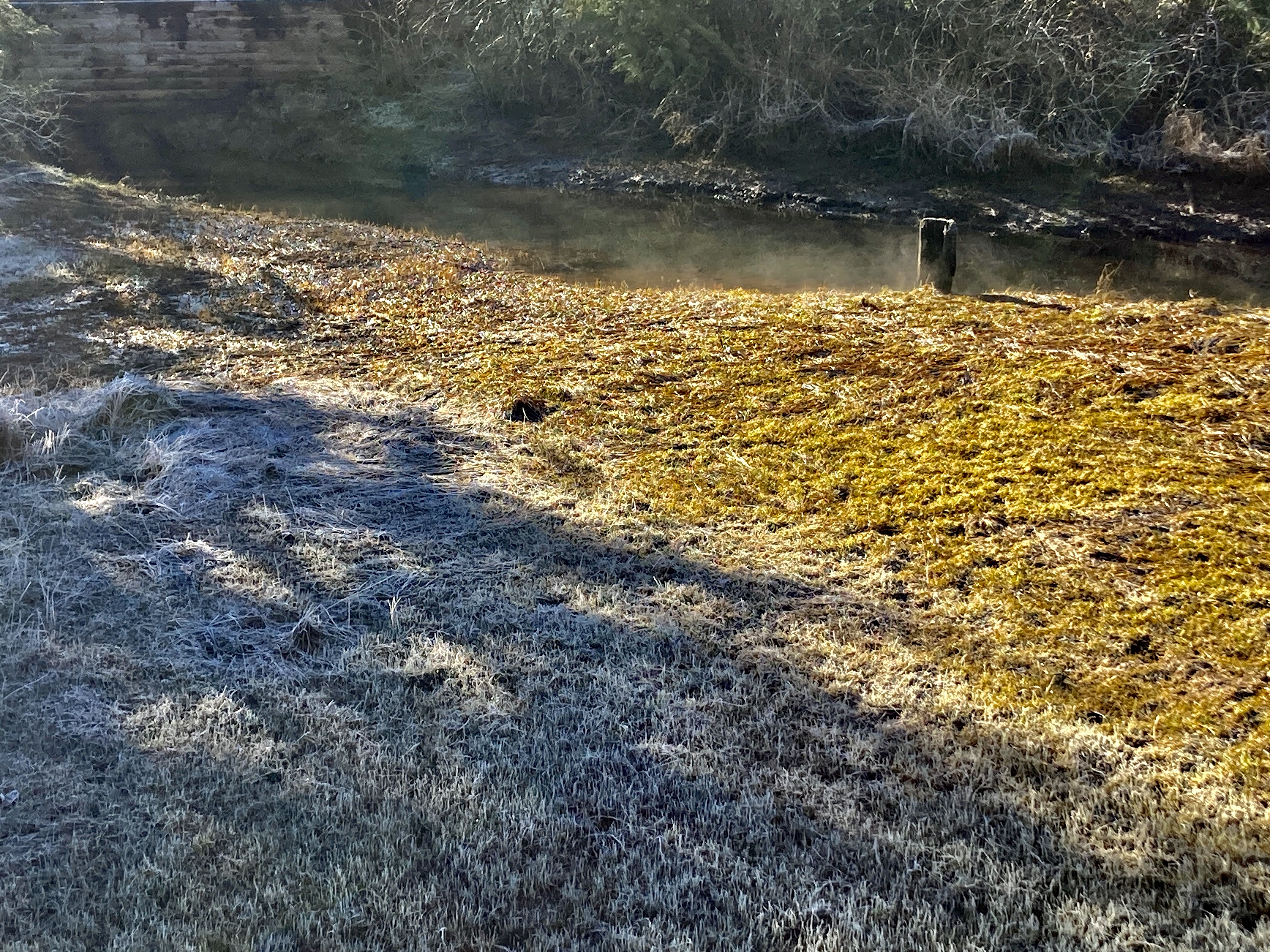
and sweeps across the entire marshland, right to the creek whose waters steam gently in the sun.

We cross mudflats on this rebuilt boardwalk, and agree it is much safer and more accessible than its wonky predecessor and is therefore A Very Good Thing — but also agree we miss the charm of that predecessor.

Then we quite rightly stop being such ingrates, and settle down to enjoy ourselves.

A waterfront blind farther along offers a chance to watch wildlife unobserved…

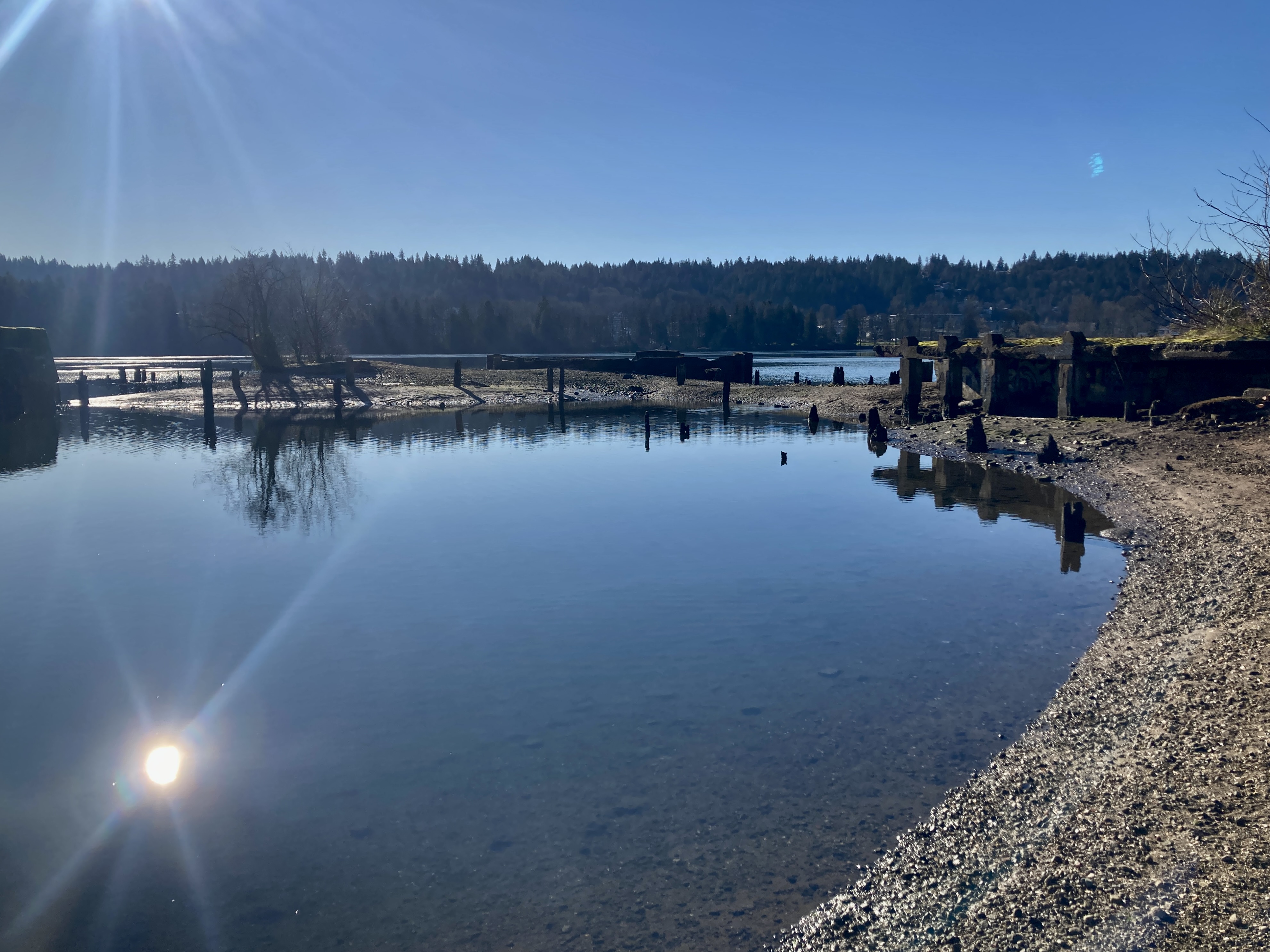
though at the moment we see only the stumps of old pilings, remnants of the McNair Cedar Mill that once operated here.

I’ve visited the mill site on previous Trail walks; tide is low enough to allow us to explore it today as well.

Only later online do I both learn the name of the mill and also see this 1925 photograph of the mill in operation. (Thank you Tessa Trethewey, for posting this photo on the I Love Port Moody blog on April 25 last year.)

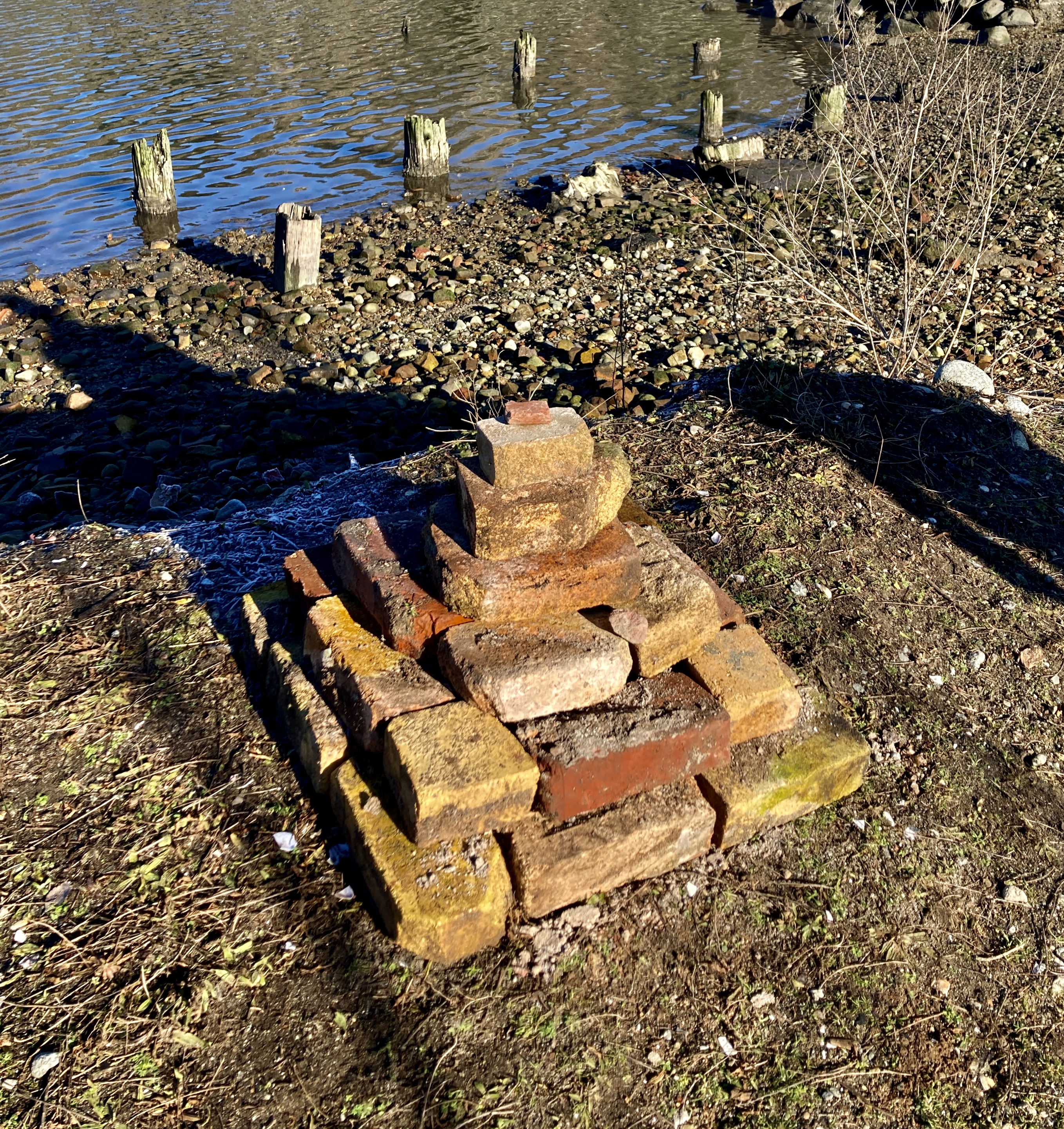
Before we rejoin the Trail, I stop to admire this ziggurat, meticulously constructed from old mill bricks still lying around on-site. (I think for a moment, by ricochet, of the ephemeral clean-fill sculptures created out on Toronto’s Leslie Spit, by visitors who celebrate what lies to hand.)

Back on the Trail, what we have to hand is a collection of nature’s own tree-sculptures.

Companion burls high up one trunk…

and a whole lot of winter moss. An old scar, cushioned in moss, for example…

great rounded folds of bark rising from a mossy base…

and a moss-splattered tree that stands politely to one side as we look across reeds and marshes, across Burrard Inlet itself, to the mountains and distant snow peaks.

Warmed by the growing strength of the sun and also our own exertions, we decide we have more than earned lunch.

We retrace our steps, greeting hikers and patting dogs as we go, and settle into generous servings of Mexican comfort food. Our cheerful waitress, a rose tattoo peeping out from under her left cuff, says it is the perfect day to walk the Shoreline Trail.

We agree with her.

Time & Place

22 September 2024 – Time & place. Time & places. Places, through time.

Two recent days, that have me noticing the play of time across place.

Friday, I’m walking back along north-shore False Creek after a downtown lunch with a friend. I stop to read one of the railings that mark a stretch of informational glass & metal way-stations near Coopers Park.

“Look across the water,” it says, so I do. Eastward across the smooth, bright water alive with pleasure boats, ferry boats and a couple paddling their kayak.

This is 2024 False Creek, much transformed over the millennia.

Coast Salish people once fished here, in clean waters…

but the 19th c. brought sawmills, small port operations and, after the 1887 arrival of the Canadian Pacific Railway, a booming demand for railway-related services and support. The shoreline and waters were very busy…

with piles of materials and with hand labour…

but the waters were no longer so clean.

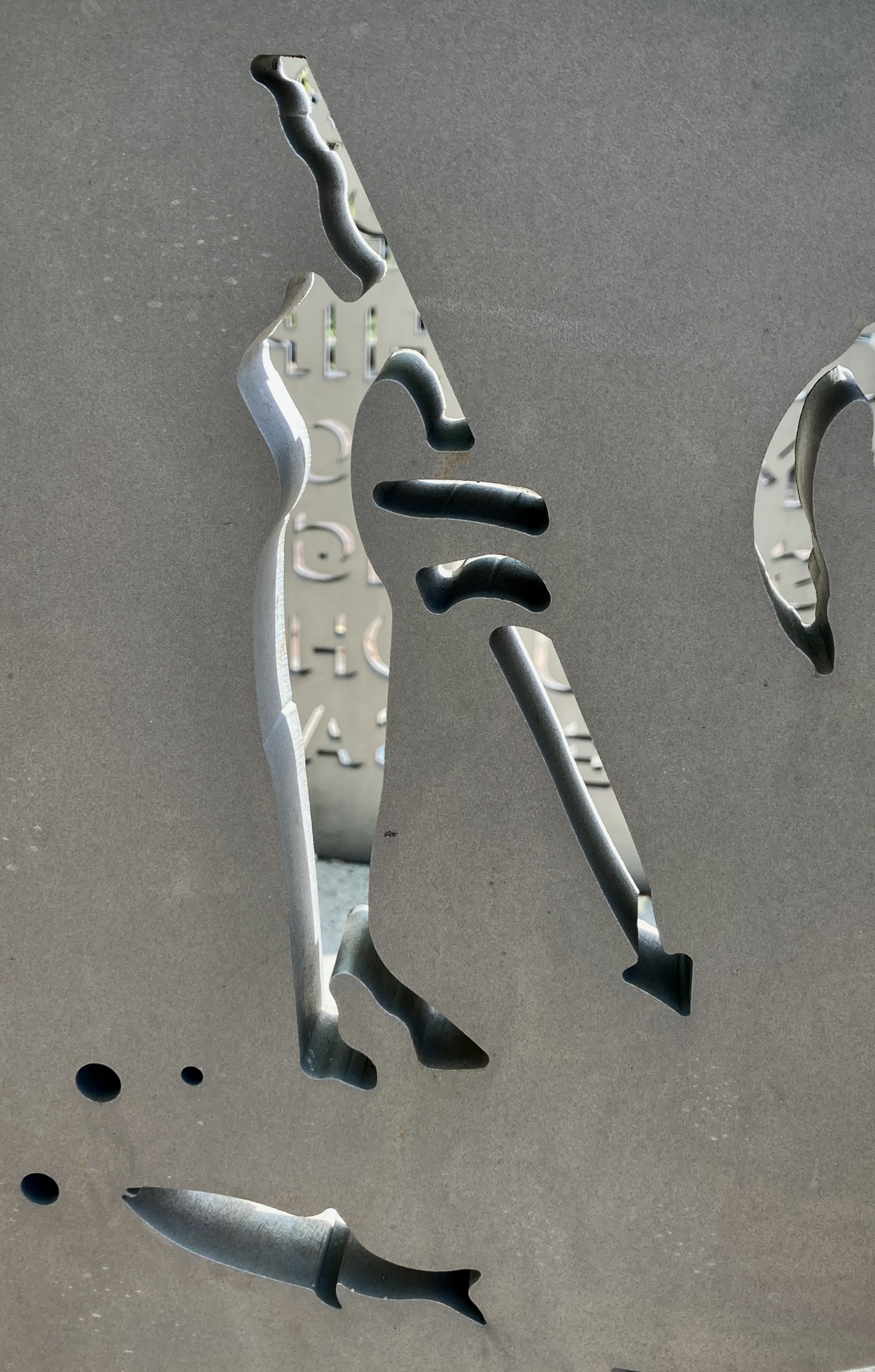
Incised words on metal panels remind us of the range of activities, of purposes, of people, across all that time.

Next big transformation: the mid-20th c. shift in industrial patterns and the post-Expo ’86 drive to restore and repurpose False Creek. Today it is recreational, and residential, and the waters are a whole lot healthier than they used to be.

I learn more about all this the very next day. Saturday morning, I am once again on the north shore of False Creek, freshly delivered to the Yaletown Dock by ferry, to join a downtown walking tour run by the AFBC (Architecture Foundation of British Columbia).

We pass the now-repurposed CPR roundhouse and walk through adjacent Yaletown, named for the small BC community where the CPR first had its construction equipment & repair shops, before relocating work to the more convenient Vancouver location.

Spare, functional Victorian industrial architecture still lines several Mainland Street blocks. The buildings now host restaurants, condos, artisan boutiques, and design and other creative small firms — but their Victorian bones still show.

Some of these structures are rightly celebrated by their current owners/tenants — for example, by Engels & Volker, whose website honours the history of this elegant former factory and warehouse at 1152 Mainland, built in 1912.

We walk on, our group weaving its way past other examples of old made new, and also of ghosts-of-old replaced by new. Layers of time, laid upon place.

Late in the tour, we stand under the canopy of Telus Garden which, when it opened in 2015, had brought a whole downtown block into the mixed-use trend then gathering civic strength.

I look up at the glulam curves overhead…

and I’m thrown to another time and place.

To Toronto, and the 2008 transformation of the Art Gallery of Ontario by architect Frank Gehry and media magnate (and art collector) Ken Thomson.

It was a project born of love as well as commerce: both men native Torontonians, and both grateful to the AGO because, modest as it was at the time, it introduced each of them to art and helped shape both their lives.

The AGO did a lot for me as well. As a volunteer I spent many hours in its rooms, soaking up the art and learning about things. Like glulam.

(You wondered where I was going with this, didn’t you!)

The soaring Galleria Italia, stretching 450 feet along Dundas Street, is a vaulted dance of glued laminated Douglas fir and glass.

I always loved doing a shift out on the Galleria Italia, seeing — and hearing — visitors’ reactions when they first stepped into the space. Adults politely gasped. Schoolchildren on tour, especially when coached by their guide, agreed it looked like an overturned canoe. (Though one little girl was having none of that. “It’s an armadillo,” she announced firmly.)

My favourite reaction? The little boy who barrelled through the doors well ahead of his mother. He screeched to a halt, swivelled his head in stunned amazement and then, just as his mother caught up with him, leapt in the air, arms flung high. “WOW!” he yelled, his fists punching the air.

Time & place. Places in time. Memory.

Oz (2024) to Ossington (2014)

25 April 2024 – I asked, and someone very dear to me answered. All the way from Oz (aka Australia).

My previous post ended with this 2013 Toronto mural detail…

plus my request for help in identifying the artist, after all this time.

I assumed any answer would come from a Torontonian, but how silly of me! In this digital age, help is not geography-based. You just give that nice Mr. Google a descriptive phrase, and — hey presto — you are on-site with award-winning contemporary artist EGRart.

The link, as sent to me and here repeated for you, is for her Murals page.

Scroll down, scroll down, and there it is …

a larger view of the dandelion mural (including the male head done by collaborator Elicser).

The photo pitches me back a decade-plus in time. I am again walking west on that street, pausing at that alley, enjoying that mural and all its elements.

And then, back here in 2024 Vancouver, I continue to scroll the Murals page. Down-down-down.

Suddenly… whump! I see this.

Oh, I do remember that garage door. Except when I saw and photographed it, it looked like this:

EGR has transported me back to the laneway behind Ossington Ave., just north of Queen St., on a very snowy day in 2014. Urban myth had it — perhaps correctly — local residents decided that, since their laneway garages were going to be graffiti’d anyway, they might as well invite good artists to come in and do it well.

So they did.

And artists like UBER…

and SPUD…

were among those who responded.

The whole laneway became an open-air art gallery.

A very cold art gallery, that particular day, and I soon skedaddled.

Enough 2014!

Here’s a right-now update, thanks to EGR’s News page. This very Saturday, April 27, she will join co-panelists in an Artist Talk at the Centre for Social Innovation on Spadina Ave. Topic: Women in Mural Art – Building Careers.

How pleasing, to dance through time & space and end, not with nostalgia, but with news of forward momentum.

T. officinale (& friends)

22 April 2024 – But before we dive into Latin taxonomy — not that I knew I was headed there, at the time — before all that, a moment at the corner of Scotia St. & East 7th.

Where I am charmed by Buggingham Palace.

The bee’s knees, you might even call it, though the holes in those colourful pillars are meant to accommodate the entire insect.

The volunteer tending this particular Green Streets corner garden has helpfully labelled all her plantings. I not only admire floppy reddish blossoms on a coarse-leaved shrub, for example, I know I’m admiring a Flowering Red Currant.

Then I look at an adjacent lamp standard, and learn even more.

The building on the opposite corner, the one I’ve always thought of as the Candy Factory, started life in 1904 (or thereabouts) as the Brewery Creek Building, one of many brewery operations in the area. It later became Fell’s Candy Factory, then the Purity Dairy, later on a grease works and later still had other grubby-sounding lives until, in 1993…

it was refurbished and converted to these handsome artist live-work spaces.

Pleased with all this new knowledge, I go on my way. “My way” being straight on east to China Creek North Park — no particular objective, just offering myself a not-very-demanding stroll on a very pretty day.

It’s a large, open, multi-purpose park dropped into a bowl — the bowl being what’s left when you drive underground what had been Vancouver’s largest drainage basin, whose creeks all fed into False Creek. (Until you filled in that final bit of False Creek as well.)

There are steep steps down-down-down on my left at the northern edge, but over there to my right, at the south-west corner, there is the start of a lovely ox-bow path …

that winds its friendly, undemanding way from high to low.

I take the path.

Almost at the bottom — down where I can watch young men grunting through crunches on the level grass while toddlers squeal in the playground — I turn and look back uphill. The slope is dotted with solitary bodies, perhaps meditating, more likely texting, but anyway all with knees angled outward to support their admirably straight torsos.

One person is upright, afoot, moving across the terrain. One human, but six legs.

Human plus fluffy white cat on a leash. See the cat?

Now please stop looking at the cat and notice all that yellow.

Lots and lots of yellow. All over the place.

Taraxacum officinale!

The dandelion.

I have to look up the Latin later on. Standing there, I’m sufficiently occupied just thinking about the word “dandelion.” I know it’s from the French “dent-de-lion,” for the serrated lion’s-tooth edge to the leaf. I also know that the word may be French, but it’s not the word the French themselves use, when they’re getting all familiar with T. officinale. They call it “pissenlit.”

Piss-in-the-bed. Apparently — and this I also have to look up later on — because of the diuretic properties of the plant.

(A sidebar on the delights of common names for plants, in different languages. I know Chlorophytum comosum as Spider Plant. I thought this the perfect evocation of its multitude of leggy offshoots, until a Cuban friend told me its nickname in Spanish. “Mala madre,” she said. Well, of course! The plant must be a bad mother — look at all those babies, running away from home.)

Back to T. officinale. Lawn-proud gardeners hate it, the very word “dandelion” an epithet in their mouths.

Ah, but the word is sweet, in other contexts.

In literature: Ray Bradbury’s 1957 novel, Dandelion Wine.

In wine-making: choose your favourite home-brewer as the example. My uncle put up batches every spring and my aunt heartily approved. I never did ask his secret, so I’ll offer this recipe instead. (No idea how good it is, or isn’t — but who could resist a blog called Practical Self Reliance?)

And, finally, dandelions in the visual arts.

Because, whether in flower or gone to seed, they are beautiful.

This 2013 Toronto street artist caught that beauty, the beauty of the plant itself and its ephemerality.

Like that dandelion head, this alley mural will surely be long gone by now. Unfortunately, I can’t tell you the artist’s name. When I took this picture — for my very first Blurb book! — I didn’t bother with attribution. Drat.

Maybe someone among you can right this old wrong? The style is distinctive, and the artist’s work was often seen in Toronto at the time. (Mary C, author of the splendid As I Walk Toronto blog, I’m thinking especially of you! You know the city’s streets, and street art, so well.)

The Owl and the Paint Pot

21 February 2024 – Move over, Pussy-Cat. The owl has a new companion.

I’m at the corner of West 10th & Columbia, heading east, and I am stopped in my tracks by an owl.

A real owl would seriously stop me in my tracks; this one is not real, but still unexpected and worth some attention. He is dangling from a traffic sign that promises you death & dismemberment if you even think about parking here.

It’s only after I move closer to contemplate the macramé shades-of-the-70s owl, that I really take in the heritage house in the background.

Which certainly deserves my attention.

The Owl and the Painted Lady! I murmur to myself.

And, with that, I forget Edward Lear and think about Painted Ladies. Painted Ladies in heritage neighbourhoods.

The best-known reference, especially outside Canada, would be to San Francisco and its line of brightly painted Victorian homes along the eastern side of Alamo Square Park. Former Torontonian that I am, I think instead of the Painted Ladies of Cabbagetown.

Of one in particular. Rather, the story of one in particular, told to me by the friend who lived next door and whose teenage daughter played (literally) a starring role. Picture the scene. We are in a Victorian home, among others of that vintage, on this street, in this comfortable neighbourhood.

The daughter is practising Bach on the piano in the bay window alcove, with the windows wide open in the summer heat. Next door, a painter is climbing up and down the ladder as he works on that home’s wooden fish-scale façade. The girl pays him no mind, not until she looks up to find him standing right outside her window. She is surprised at the sight; even more surprised when he — politely but firmly — describes very specific ways for her to improve her technique. Who the hell does he think he is? is her first sulky teenage thought. She stifles it. Because, damn it, he does sound like he knows a lot about music.

Turns out, he does. The woman next door tells her mum that the painter, in his previous career, had been a member of the original Orford String Quartet (1965-1991, reborn in 2009 as the New Orford String Quartet with different members). In his new career, he is now creating visual rather than aural music, shimmering cascades of colour rather than sound.

I sink into this memory for a bit, think about my friend’s home, and my admiration for the eventual beauty of that house next door. Then I snap myself back to the here-and-now. I am about to walk on, when I notice a sign on the street-corner lamp post. Always a sucker for signage, I trot across the street to read it.

The Vancouver Park Board seems only to have run the contest those two years — main criterion “community spirit… as demonstrated through block beautification” — and this block of West 10th won both times.

I’m afraid I short-change you for the rest of the block; I take no more photos. But back in 2009, somebody walked the block with delight, and posted the results to his public Flickr stream.

So enjoy the photos, chase up some Orford (original and New) performances online, and then rejoice in all the ways we humans can create beauty.

  • WALKING… & SEEING

    "Traveller, there is no path. Paths are made by walking" -- Antonio Machado (1875-1939)

    "The voyage of discovery is not in seeking new landscapes, but in having new eyes" -- Marcel Proust (1871-1922)

    "A city is a language, a repository of possibilities, and walking is the act of speaking that language, of selecting from those possibilities" -- Rebecca Solnit, "Wanderlust: A History of Walking"

  • Recent Posts

  • Walk, Talk, Rock… B.C.-style

  • Post Categories

  • Archives

  • Blog Stats

    • 128,831 hits
  • Since 14 August 2014

    Flag Counter
  • Enter your email address to follow this blog and receive notifications of new posts by email.

    Join 2,047 other subscribers