23 May 2024 – Not my personal afternoon, you understand: a borrowed afternoon I don’t yet know I am about to experience.
At the moment I am lost in wonder that the traffic roar of King-George-meets-88-Avenue is so effectively muted by the tall trees of Bear Creek Park. The park is not large, the intersection is just steps away, and yet…
I hear bird song in the trees above, and the gurgle of water below as the creek tumbles its way through all those rocks.
This moment in nature is a fitting preface to my visit to the Surrey Art Galley, for a retrospective of the works of Japanese-Canadian printmaker Takao Tanabe. Born in 1926, Tanabe was interned during WWII, and therefore had to overcome many obstacles before he managed to attend art school in Winnipeg post-war. He went on to build an impressive career, and he is still active today, from his Vancouver Island base, and still in demand.
I move fairly quickly past the hard edges and colours of his 1960s abstractions (works of their time!) and settle with awe into his later, quieter, more contemplative exploration of the natural world that surrounds him.
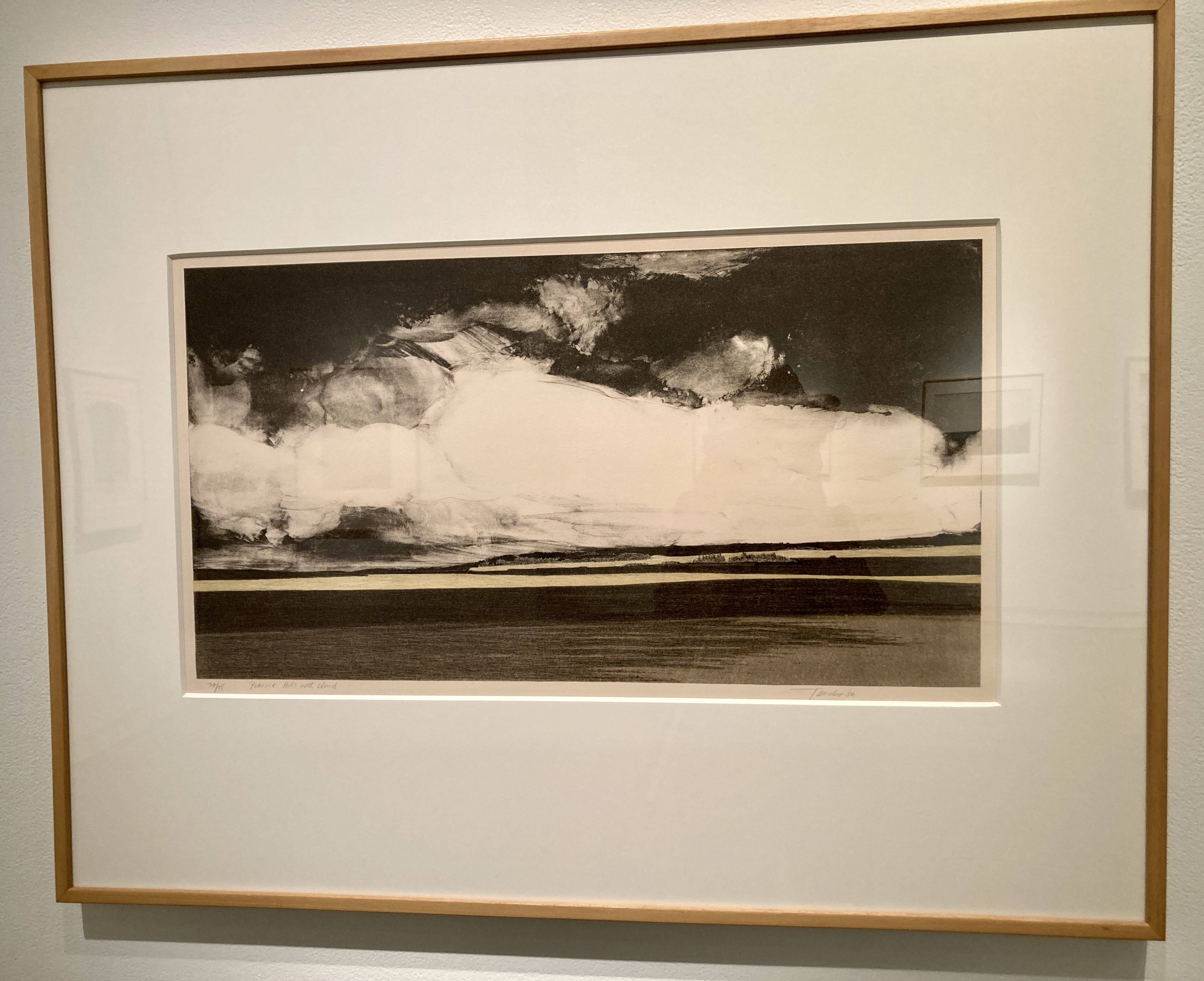
He captures the prairies (here, Prairie Hill and Cloud, 1980)…
and, with equal resonance, the waters and islands of our west coast (here, Queen Charlotte Islands, the obsolete name for Haida Gwaii reflecting the 1988 date of this work).
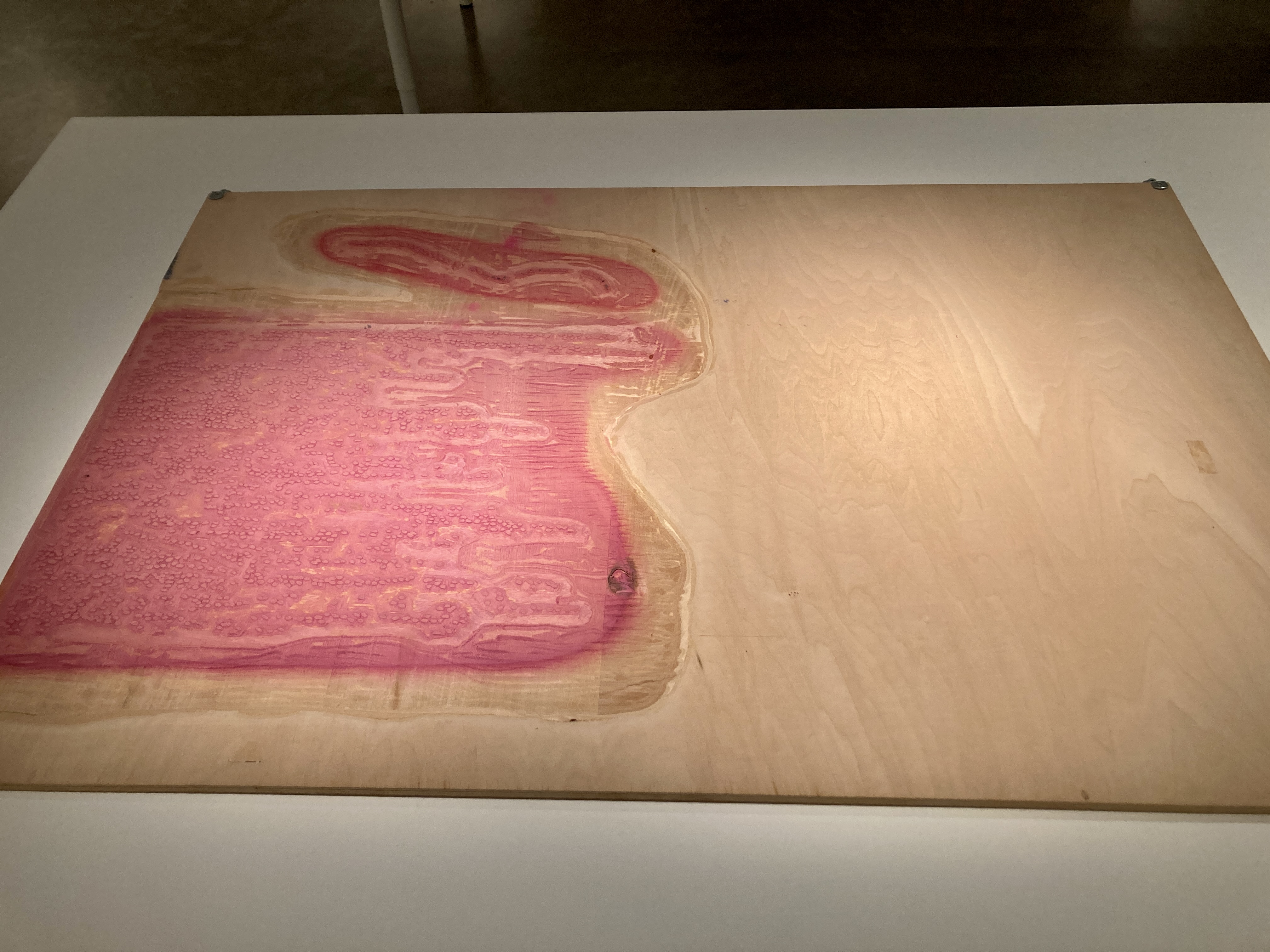
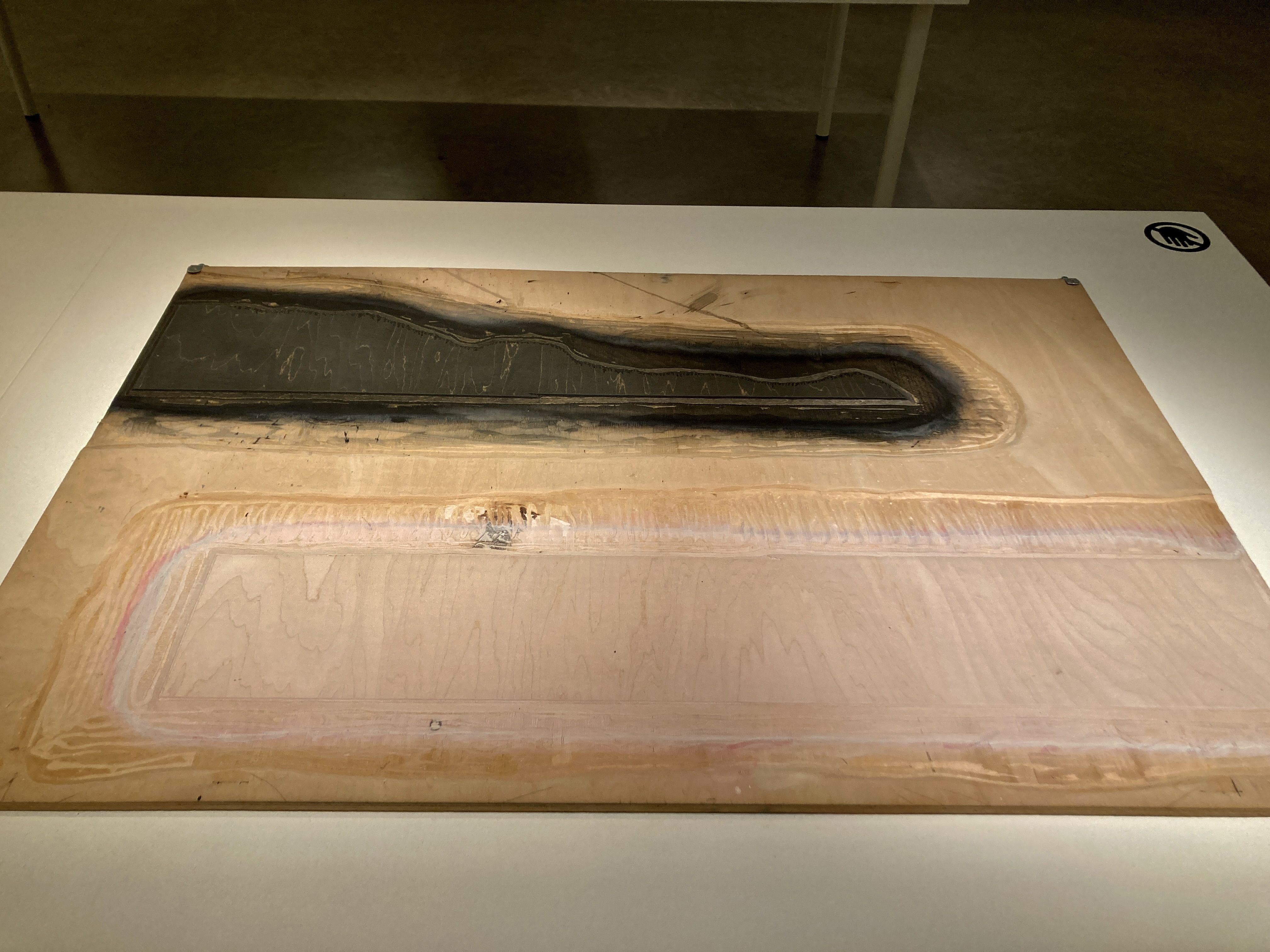
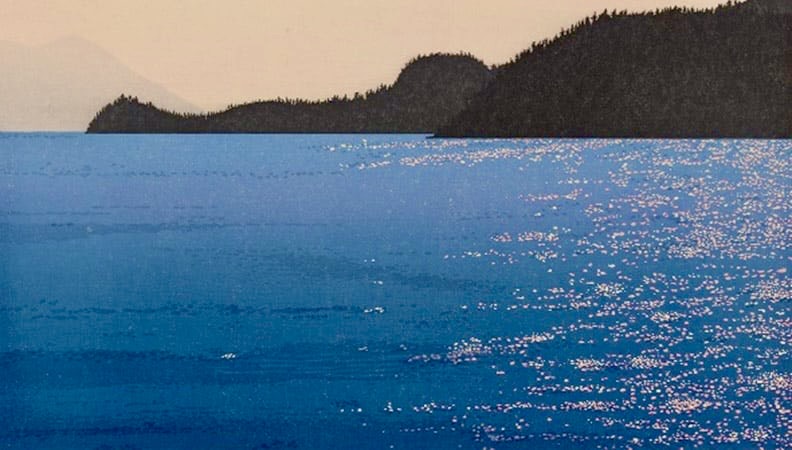
I’ve been lost in the works, not thinking about how they make their way from sketch pad to final print. Then I turn into a second room, dominated by three long tables, two of them visible here. Together, they tell the hidden story of that print visible on the end wall: Nootka Afternoon, 1993.
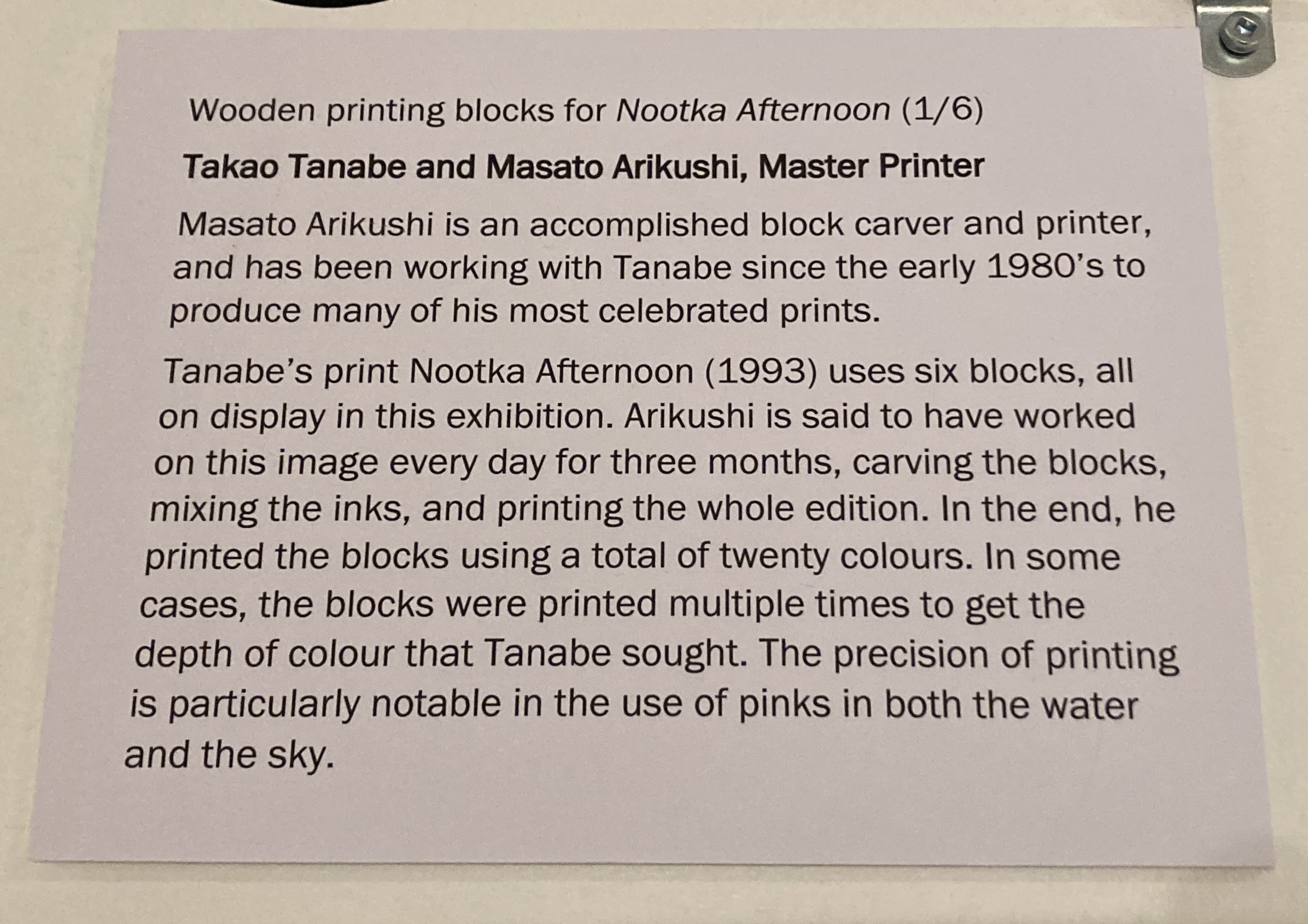
Confession: I am not always very patient with tables of background material! However, I do at least read the key signage. Which, obediently, I do for this grouping as well.
And I am fascinated. Fascinated by the long partnership of these two artists, and all the dimensions of respect embodied in that partnership. Respect for each other, for nature, for art, and for the materials and processes and patient time with which they translate nature into art.
So I do not walk past these three tables. I linger. I move, in my own act of respect, from table to table, block to block.
I also amuse myself with some silly time/space math: daily x 3 months = (1+1+1+1+1+1) = 6 wooden blocks + 20 colours = 1 Nootka afternoon.
Count it out.
One…
and one…
and one…
and one…
and one…
and one.
That’s six.
Together, with the depth of three months and 20 colours, they capture one Nootka Afternoon.
Please note this is not my photo. The combined limitations of my photography and gallery lighting threw annoying reflections into my every attempt. I downloaded this image from the Kelowna Art Gallery website — entirely appropriate, since the Kelowna gallery organized the current exhibition, which further benefited from Ian M. Thom as guest curator.
20 May 2024 – Three days of a holiday weekend; three outings; three images for each.
Friday, Sunset Beach, English Bay Seawall
We’re walking the Seawall along English Bay toward Stanley Park and stop — as always! — to admire Berard Venet’s Vancouver Biennale sculpture” 217.5 Arc X 13.
Thirteen arcs of unpainted corten steel, each curved, as the title explains, to 217.5 degrees. Entirely static, endlessly dynamic, always welcoming.
We watch this little girl explore the sculpture…
and then follow her lead, offering those 217.5° arcs our own 360° tribute.
By now the sculpture, acquired in 2007, fully illustrates artist Venet’s point re his choice of material:
unpainted, the steel “facilitates an interaction with the natural elements.”
At their centre, the arcs form an embrace. At their tips…
a continuing dance of call and response.
Sunday, outside Engine 374 Pavilion, Roundhouse Community Centre
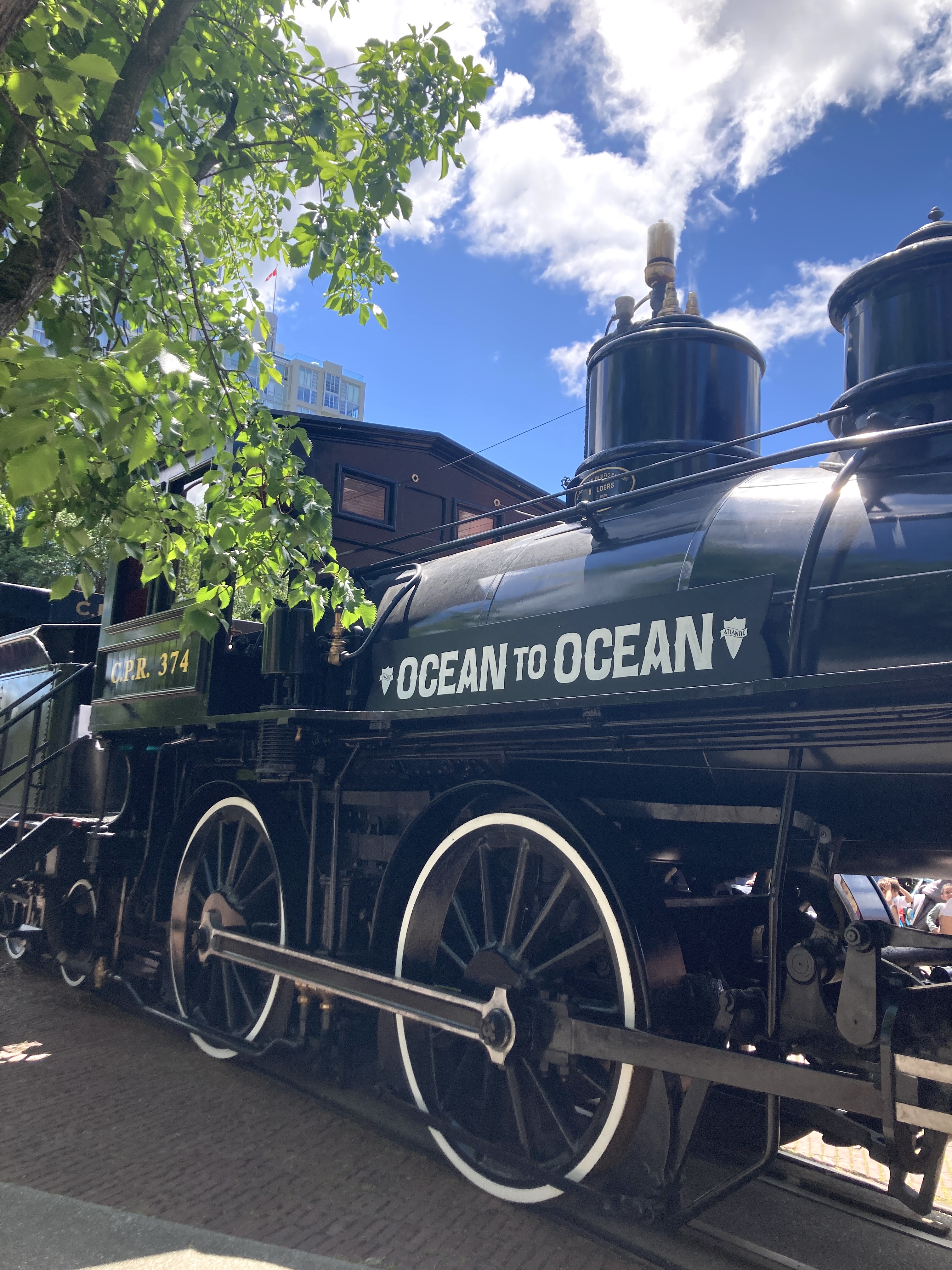
I learned about this event during my recent crosstown walk on Davie Street, and here I am, happy to join the anniversary celebrations. On 23 May, 1887, steam engine 374 pulled the first scheduled transcontinental train past Port Moody, following the new track extension all the way to Vancouver. “Ocean to ocean,” at last.
The rest of the year, CPR Engine 374 sits inside her protective pavilion. But! Once a year! Once a year, on the anniversary of that first arrival, she struts her stuff outdoors.
Oh, she gleams.
All black and white and powerful moving parts…
and shining brass and dates and tiny details…
and lots and lots and lots of live steam.
Monday, Waterfront Esplanade, New Westminster
A wonderful long walk along this stretch of the Fraser River, at very low tide.
The intricate world of mud flats, plus the occasional tree trunk…
and old pier stumps and scavenging crows…
and… and…
a reminder that trains are still part of this country’s lifeblood.
Leaving the Esplanade for downtown New West takes only a moment — only the moment needed to cross one street. But that moment becomes many, many moments when we all have to wait while a thumping great tri-continental freight train (from Mexico on up) claims its right of way.
14 May 2024 – Spring is busy admiring herself, everywhere you look.
Horse chestnut candles aflame in all those towering trees…
this lot white, but many red ones as well.
I’m enjoying the day, enjoying this walk in a favourite neighbourhood just south-east of my own — so like my old Hillhurst neighbourhood in Calgary, back in the 1970s. Wooden frame homes, generous front porches, neighbourly architecture creating a comfortable, engaging, neighbourly streetscape.
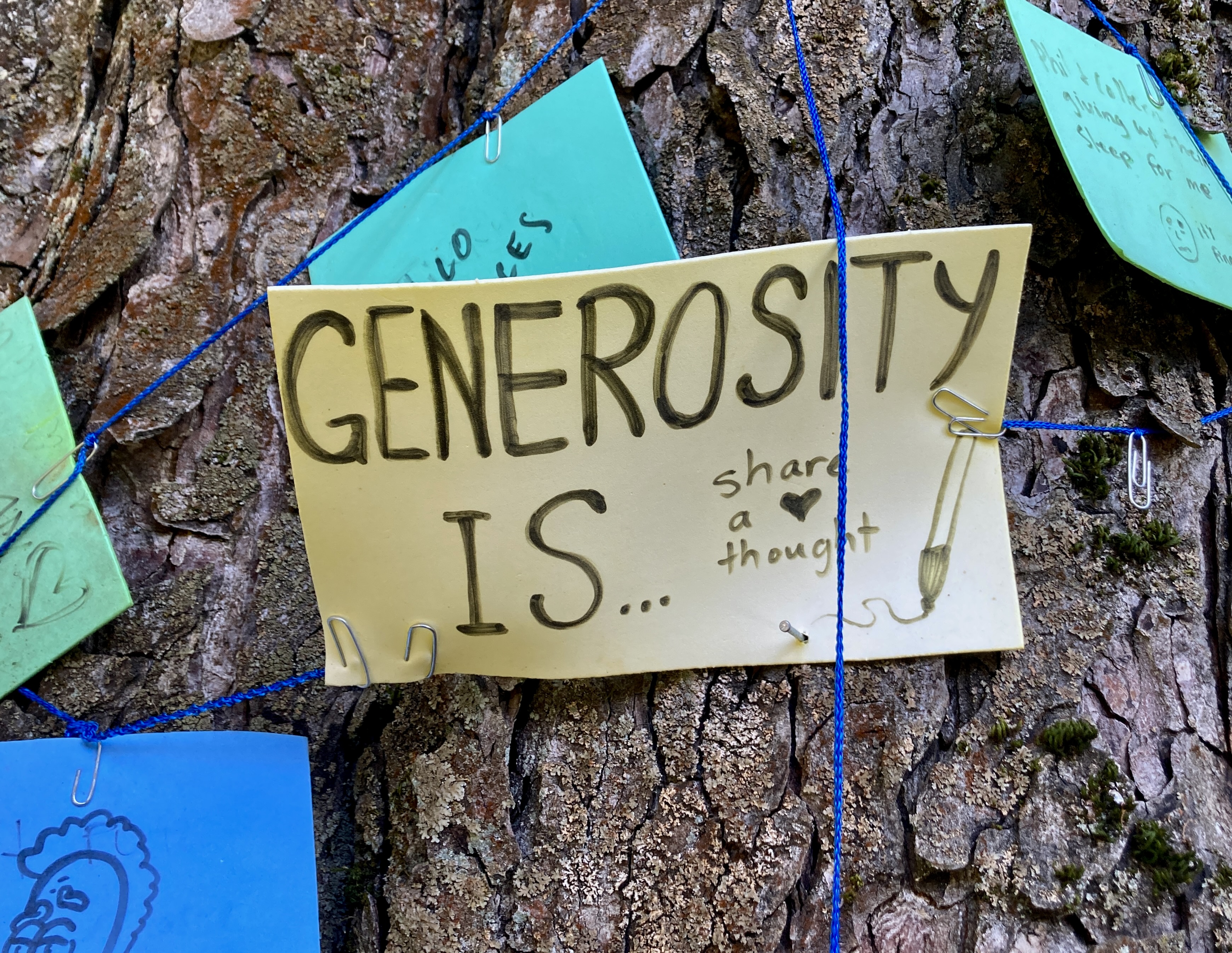
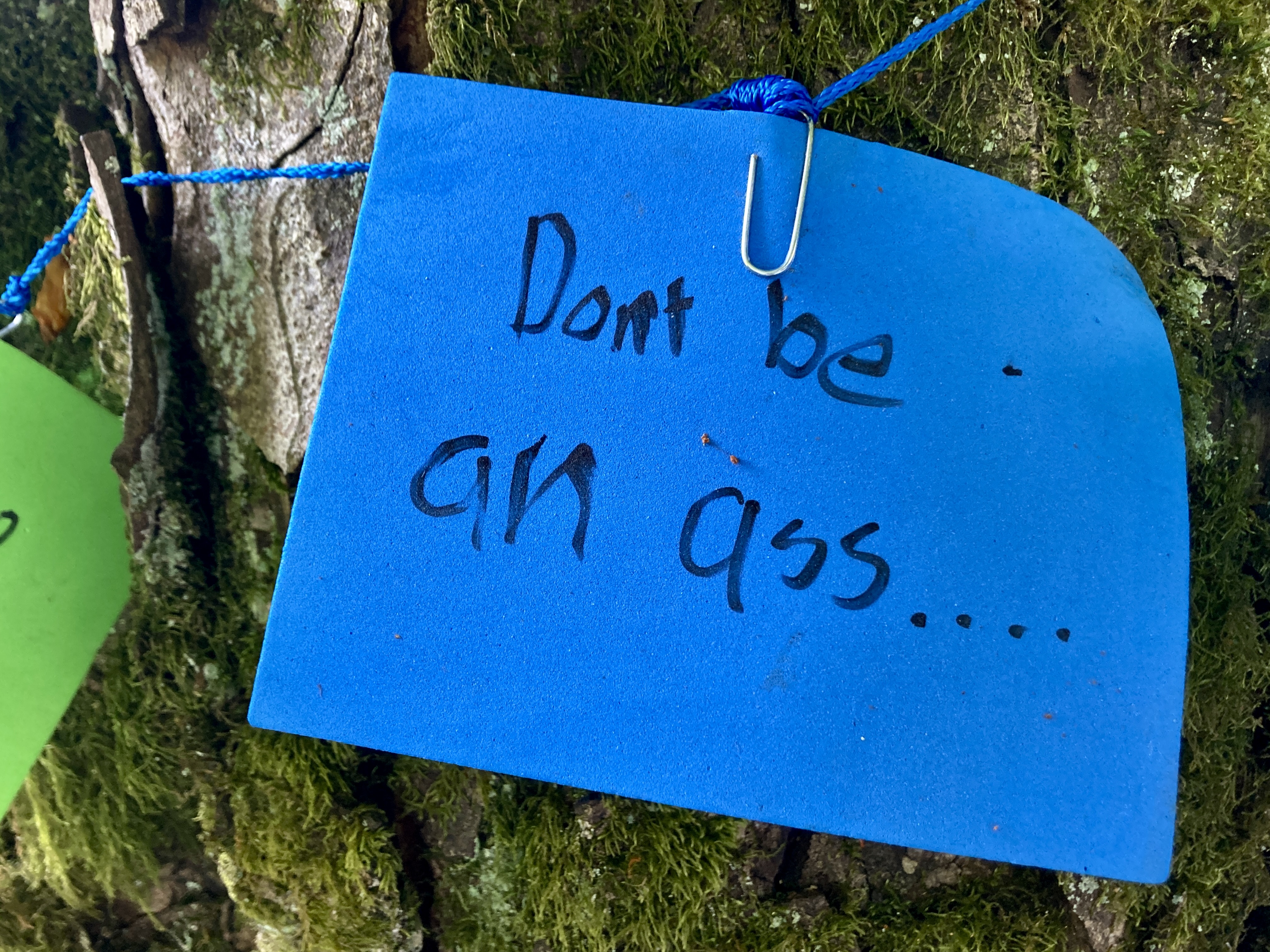
I am therefore delighted but not surprised to see a tree garlanded with messages.
And the theme…? I ask myself.
The tree tells me.
I circle the tree, reading some of the replies.
Among them, an earnest statement of a basic principle…
an example of that principle in action…
and a sweeping philosophic directive that, unpacked, could fuel much further thought.
It has captured my thought, in any event.
I find myself looking for examples of generous action, right here on the street. Just ordinary… everyday… components of the streetscape that, through this lens, translate as generosity in action.
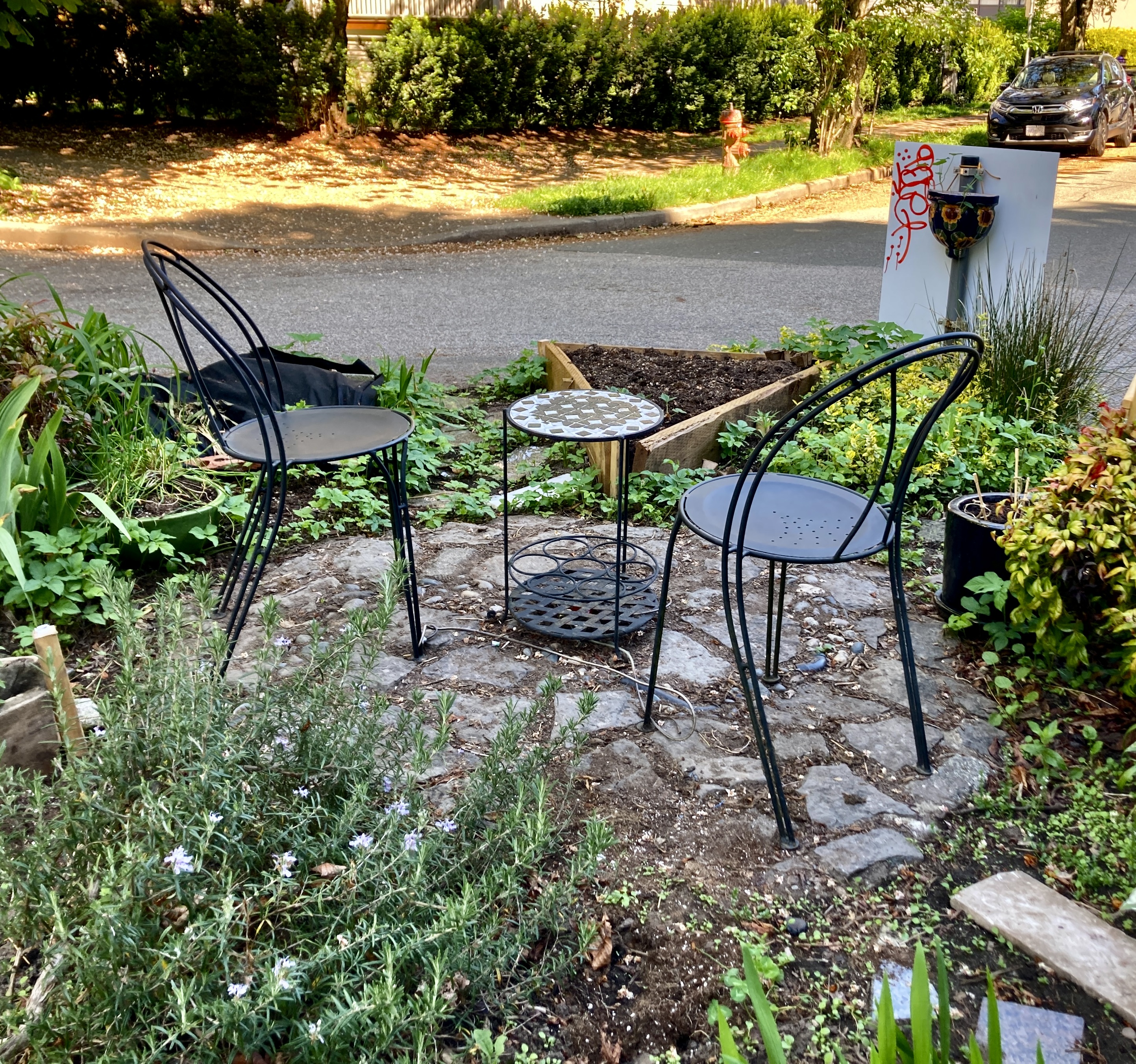
The table & chairs in this volunteer-tended Green Streets traffic circle, for example..
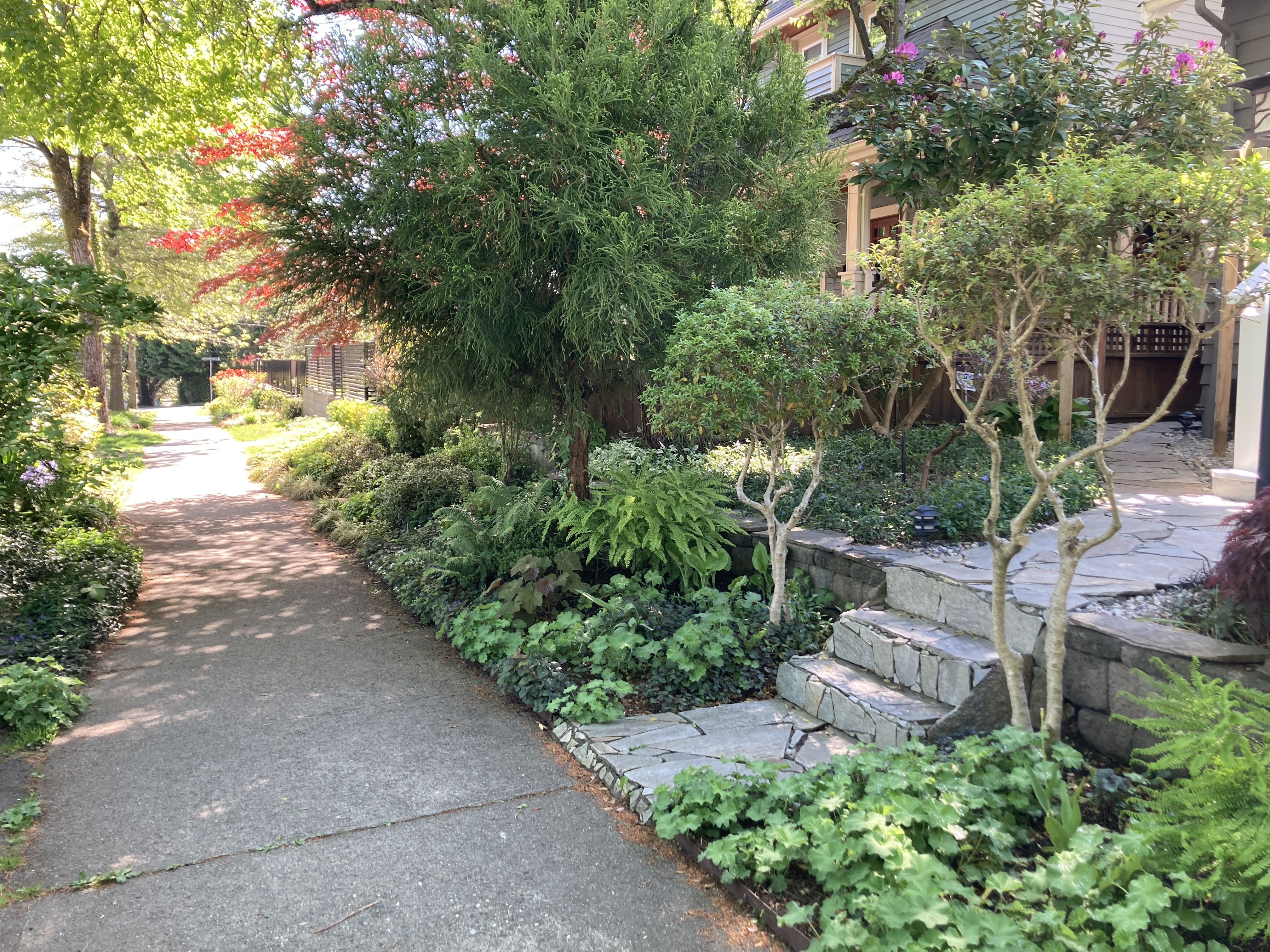
and the beauty of this long stretch of gardening activity, bordering the sidewalk.
Individual homeowners are doing all this, yet they’re not the ones who see it. We, the passers-by, we’re the ones to enjoy the results.
There’s a felt heart tied around a tree trunk — no reason, just because…
and yet another streetside take-one/leave-one library.
This one, says the little plaque, is Lizzie’s Library…
and I admire not just the neatly stacked books on offer, but the freshly planted marigolds as well.
Farther along, a bench (beside yet another streetside library) for anyone who might like a moment’s rest…
and then a swing, for anyone who’d rather kick up their heels.
Judging by the worn path beneath, there’s been a lot of heel-kicking!
I’m not obsessively “theme-hunting,” mind you, I’m enjoying the whole walk just as it comes.
Heading back north on Sophia, passing Tea Swamp Park (home to “awesome,” remember?), I pay proper attention to the other side of the street. To the new-build, on the corner.
Which would be hard to ignore.
And I wonder idly if design elements like this, the prevalence now of bold graphics on new-builds, is at least in part the result of eight years of Mural Festivals. Powerful visuals now part of our street vocabulary…
Then my mind moves on, the way mind do, and i start to laugh.
Because I’ve just remembered another of the answers to the “Generosity is…” challenge.
6 May 2024 – I’m as far W on Davie Street as you can be, sharing a joke with the A-Maze-ing Laughter sculptures in Morton Park. English Bay can be glimpsed between the statues, and the glory of Stanley Park lies beyond.
I turn my back on all that.
I am heading E, not farther W — east the full length of Davie Street, right from “You are here” in this handy signpost map…
to False Creek, where the street is once again stopped by water.
Just as those waters transform as they go — from the breadth of Strait of Georgia, into English Bay and then into False Creek — so too does Davie Street reflect city transformations.
This 4-km-or-so route is a crosstown slice of Vancouver’s past & evolving future. It leads us from still-vintage West End, through Davie Village (once simply “Gay” & now a more complex family of inclusions), into Downtown with its Entertainment District, and on to Yaletown, western terminus of the railway and the repurposed former hub of railway equipment construction and repair.
Barely underway, I detour onto Bidwell long enough to admire the volunteer garden at the corner of Pantages Lane, with a vintage building opposite.
Well…
I later learn that the vintage building is just a vintage façade. It is, a realtor’s website informs me, “a beautifully restored heritage entrance” to a spiffy new residential tower, “that returns the street frontage to its original character.”
Back out to Davie, where I head eastward on up the street. I do mean “up” — both climbing away from the English Bay basin, and also tilting my head at the towers that increasingly line the street.
A past-&-future moment, here at Davie & Cardero: the district’s future already visible there on the left, and a big blue “rezoning application” notice on the fence of the modest old apartment building on the right.
I see a lot more of these notices as I go, including ones on an apartment building also marked with a “sale by court order” sign.
But there is still lots to enjoy, lots of human activity and human-scale engagement.
Also canine.
He has appropriated this bench outside a barber shop / tattoo parlour, and his confidence is likely well-placed. A bearded man has just walked through that still-open door, his leashed French bulldog by his side. Inside, they are greeted by the statue of a bulldog.
At Broughton, a wonderfully ornate vintage apartment building, its paintwork perhaps a bit scruffy but no sign of any redevelopment activity.
The shops & services around here are not glossy and latest-thing. I like them very much.
Just before Bute, I see this slivered opening between buildings, complete with mural…
and I follow it to the laneway beyond.
Where I turn left, and then left again back to Davie Street, through the Event Zone of Jim Deva Plaza.
The plaza honours the man’s lifelong courage and advocacy. Deva, one of the co-founders of Little Sisters Book and Art Emporium, challenged Canada’s censorship laws in the Supreme Court, and also — with greater success — worked with Civic authorities to promote safety and quality in Vancouver’s parks and public spaces.
I don’t know all this about him at the time. While in the plaza itself, I notice more trivial things. Such as…
Corner of Davie & Bute, and we’re well into Davie Village by now. Here, for example, with a mural tribute to jazz greats behind the intersection rainbows.
I cross, check the mural, and decide I’m personally more taken with the four-legged acrobat and the skate-boarding raccoons on the utility box.
But to each their own!
I pass a nude unimpressed by Happy Hour offerings…
and a greengrocer laying out yet more spring plants on his sidewalk shelving…
and then stop at the hot-pink bus shelter at Davie & Burrard.
The colour echoes the Village, as does the long-established Davie Village Community Garden visible through the mesh.
By now I’m used to rezoning/redevelopment notices, but I am sad to see them posted on this mesh fence as well. I’d love this Garden to continue, but…
what I see right across the street may be its future as well.
At Granville Street, I’m into the city’s Entertainment District (per its tourism maps), where I once again nod happy recognition at the neon signage for Two Parrots Bar & Grill.
Scotiabank Dance Centre is a restoration/new-build complex on the far corner, and other towers abound. So far, the Two Parrots still perch on their accustomed corner, no redevelopment notice anywhere in sight.
The lane immediately behind the building pays tribute to their longevity.
Well, sort of! (Upper left.)
More visual tribute at Seymour Street, where Jill Anholt’s 2005 sculpture, Moving Pictures, honours Vancity Theatre (home of VIFF), which stretches on down the block.
Downhill toward False Creek.
I cross Seymour, pause to again enjoy the long slice of water tumbling through Emery Barnes Park…
and here I am at Hamilton Street, in Yaletown. Once home to railway equipment construction and repair workshops, the district is now repurposed into food, drink, entertainment, & residential delights.
I sidetrack myself along Hamilton for a bit, enjoy reminders of a mid-pandemic “I ❤️ Yaletown” mural festival…
then return to Davie and cross Pacific Blvd.
Roundhouse Community Centre is right here, an architectural link to the past — and nowhere more powerfully than in its CPR Engine 374 Pavilion.
Where, after long service, that steam-era pioneer is on display.
Engine 371 beat her from eastern Canada to Port Moody but, on May 23, 1887, Engine 374 pulled the first transcontinental train into the City of Vancouver. She continued to do just that, until 1945. Restored and gleaming, she now rests and accepts our homage. (Squealing kiddies all around me, especially the ones taking turns in the driver’s seat.) A volunteer urges me to return for the May 19 Anniversary Celebration, when she’ll make her yearly trip outside and be the centre of attention on the Roundhouse Turntable.
Now for the last few steps on Davie, on to the bit of track and sculpture in the traffic circle, with Yaletown Dock to mark water’s edge and my arrival at False Creek
I loop along the waterfront for a bit, then turn left into and through Steamboat Mews…
back to Pacific Blvd., where I hop a bus for home.
22 April 2024 – But before we dive into Latin taxonomy — not that I knew I was headed there, at the time — before all that, a moment at the corner of Scotia St. & East 7th.
Where I am charmed by Buggingham Palace.
The bee’s knees, you might even call it, though the holes in those colourful pillars are meant to accommodate the entire insect.
The volunteer tending this particular Green Streets corner garden has helpfully labelled all her plantings. I not only admire floppy reddish blossoms on a coarse-leaved shrub, for example, I know I’m admiring a Flowering Red Currant.
Then I look at an adjacent lamp standard, and learn even more.
The building on the opposite corner, the one I’ve always thought of as the Candy Factory, started life in 1904 (or thereabouts) as the Brewery Creek Building, one of many brewery operations in the area. It later became Fell’s Candy Factory, then the Purity Dairy, later on a grease works and later still had other grubby-sounding lives until, in 1993…
it was refurbished and converted to these handsome artist live-work spaces.
Pleased with all this new knowledge, I go on my way. “My way” being straight on east to China Creek North Park — no particular objective, just offering myself a not-very-demanding stroll on a very pretty day.
It’s a large, open, multi-purpose park dropped into a bowl — the bowl being what’s left when you drive underground what had been Vancouver’s largest drainage basin, whose creeks all fed into False Creek. (Until you filled in that final bit of False Creek as well.)
There are steep steps down-down-down on my left at the northern edge, but over there to my right, at the south-west corner, there is the start of a lovely ox-bow path …
that winds its friendly, undemanding way from high to low.
I take the path.
Almost at the bottom — down where I can watch young men grunting through crunches on the level grass while toddlers squeal in the playground — I turn and look back uphill. The slope is dotted with solitary bodies, perhaps meditating, more likely texting, but anyway all with knees angled outward to support their admirably straight torsos.
One person is upright, afoot, moving across the terrain. One human, but six legs.
Human plus fluffy white cat on a leash. See the cat?
Now please stop looking at the cat and notice all that yellow.
Lots and lots of yellow. All over the place.
Taraxacum officinale!
The dandelion.
I have to look up the Latin later on. Standing there, I’m sufficiently occupied just thinking about the word “dandelion.” I know it’s from the French “dent-de-lion,” for the serrated lion’s-tooth edge to the leaf. I also know that the word may be French, but it’s not the word the French themselves use, when they’re getting all familiar with T. officinale. They call it “pissenlit.”
Piss-in-the-bed. Apparently — and this I also have to look up later on — because of the diuretic properties of the plant.
(A sidebar on the delights of common names for plants, in different languages. I know Chlorophytum comosum as Spider Plant. I thought this the perfect evocation of its multitude of leggy offshoots, until a Cuban friend told me its nickname in Spanish. “Mala madre,” she said. Well, of course! The plant must be a bad mother — look at all those babies, running away from home.)
Back to T. officinale. Lawn-proud gardeners hate it, the very word “dandelion” an epithet in their mouths.
Ah, but the word is sweet, in other contexts.
In literature: Ray Bradbury’s 1957 novel, Dandelion Wine.
In wine-making: choose your favourite home-brewer as the example. My uncle put up batches every spring and my aunt heartily approved. I never did ask his secret, so I’ll offer this recipe instead. (No idea how good it is, or isn’t — but who could resist a blog called Practical Self Reliance?)
And, finally, dandelions in the visual arts.
Because, whether in flower or gone to seed, they are beautiful.
This 2013 Toronto street artist caught that beauty, the beauty of the plant itself and its ephemerality.
Like that dandelion head, this alley mural will surely be long gone by now. Unfortunately, I can’t tell you the artist’s name. When I took this picture — for my very first Blurb book! — I didn’t bother with attribution. Drat.
Maybe someone among you can right this old wrong? The style is distinctive, and the artist’s work was often seen in Toronto at the time. (Mary C, author of the splendid As I Walk Toronto blog, I’m thinking especially of you! You know the city’s streets, and street art, so well.)
18 April 2024 – A bright, gusty day and, I swear, you can practically see the sun’s rays bounce around in the breeze.
So I play that game, as I walk my Cambie Loop around the east end of False Creek. I watch the bounce of the sun, as it…
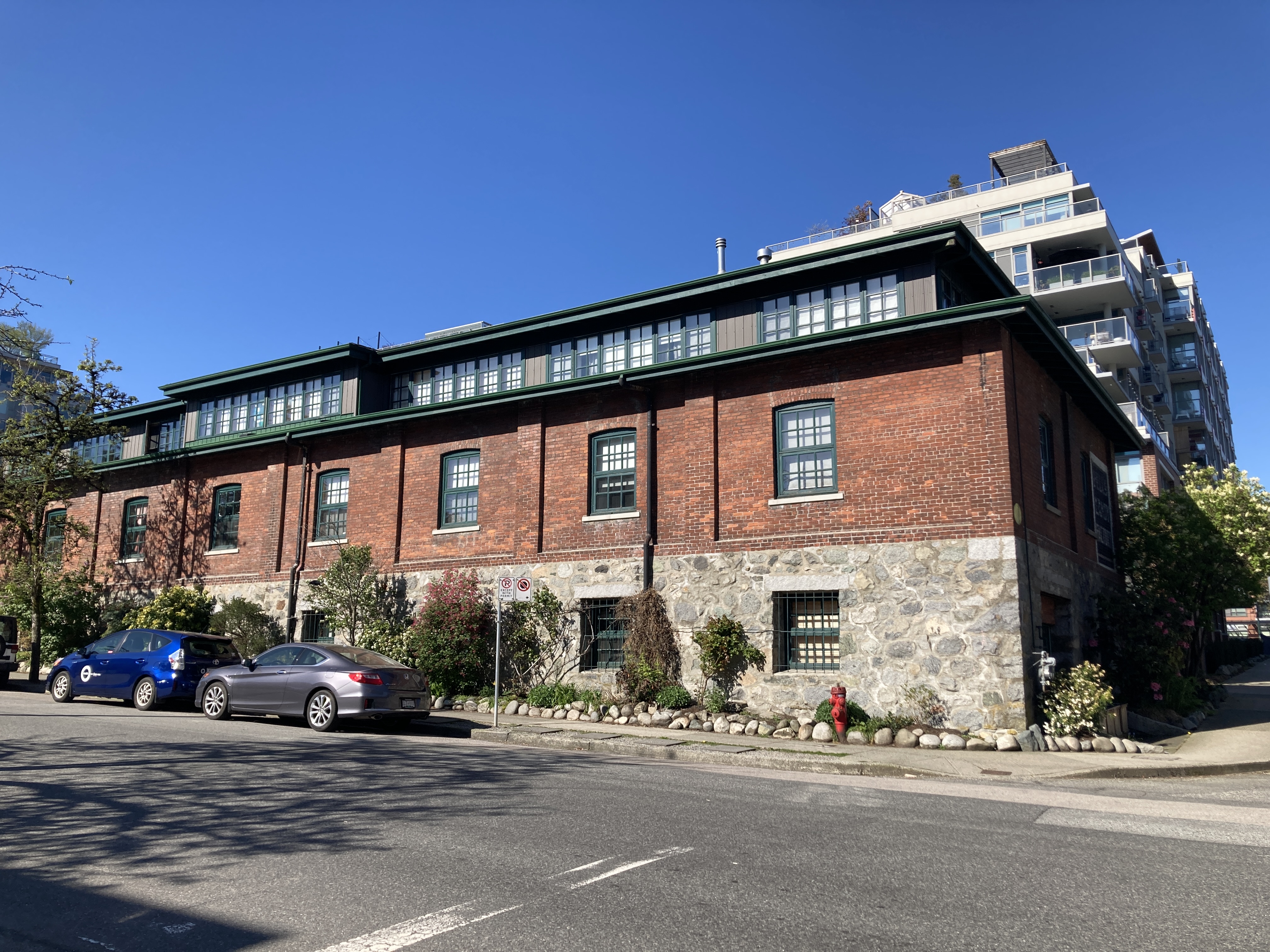
ripples across this disused West 1st Ave. workshop…
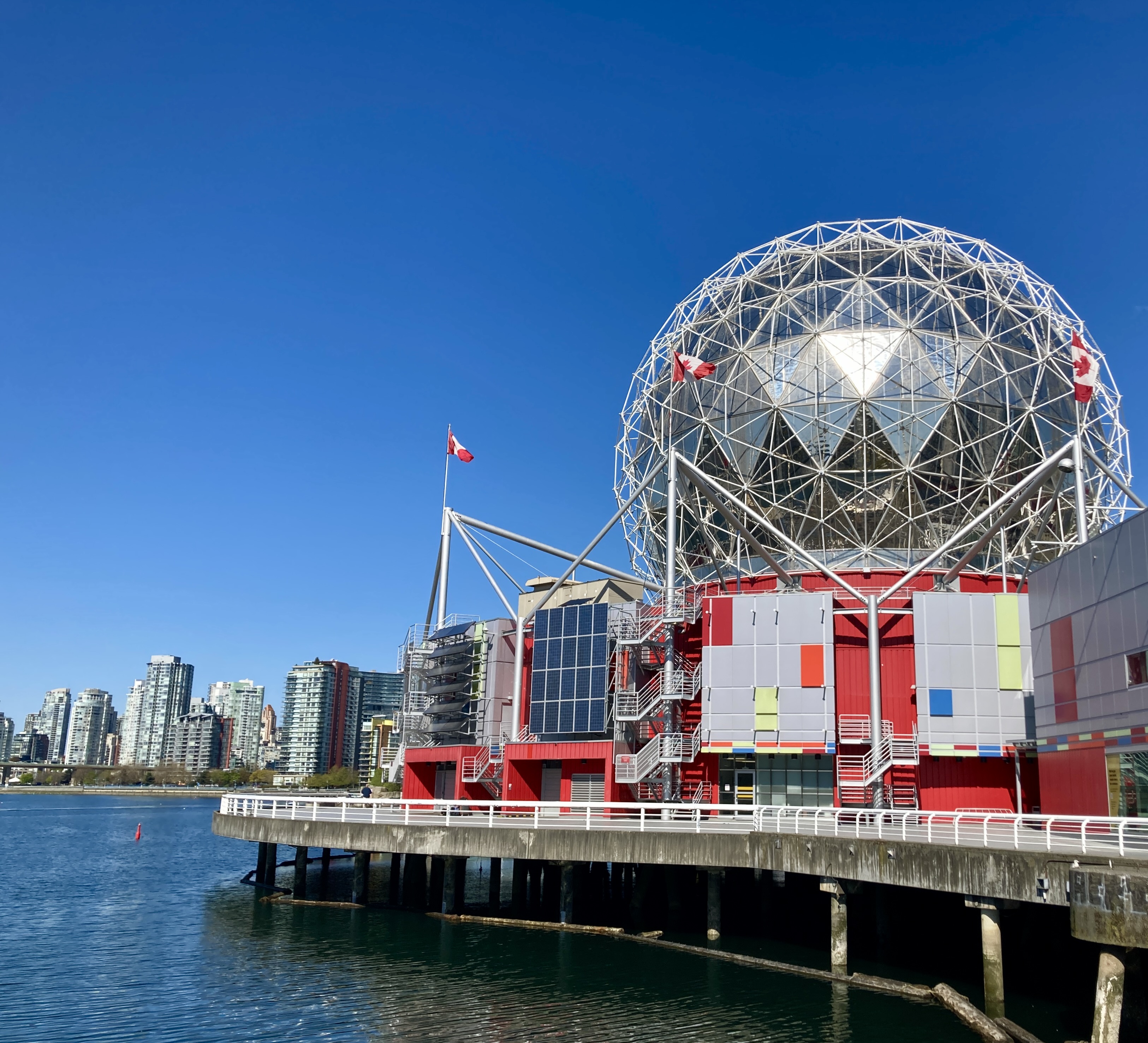
triangulates Science World’s geodesic dome…
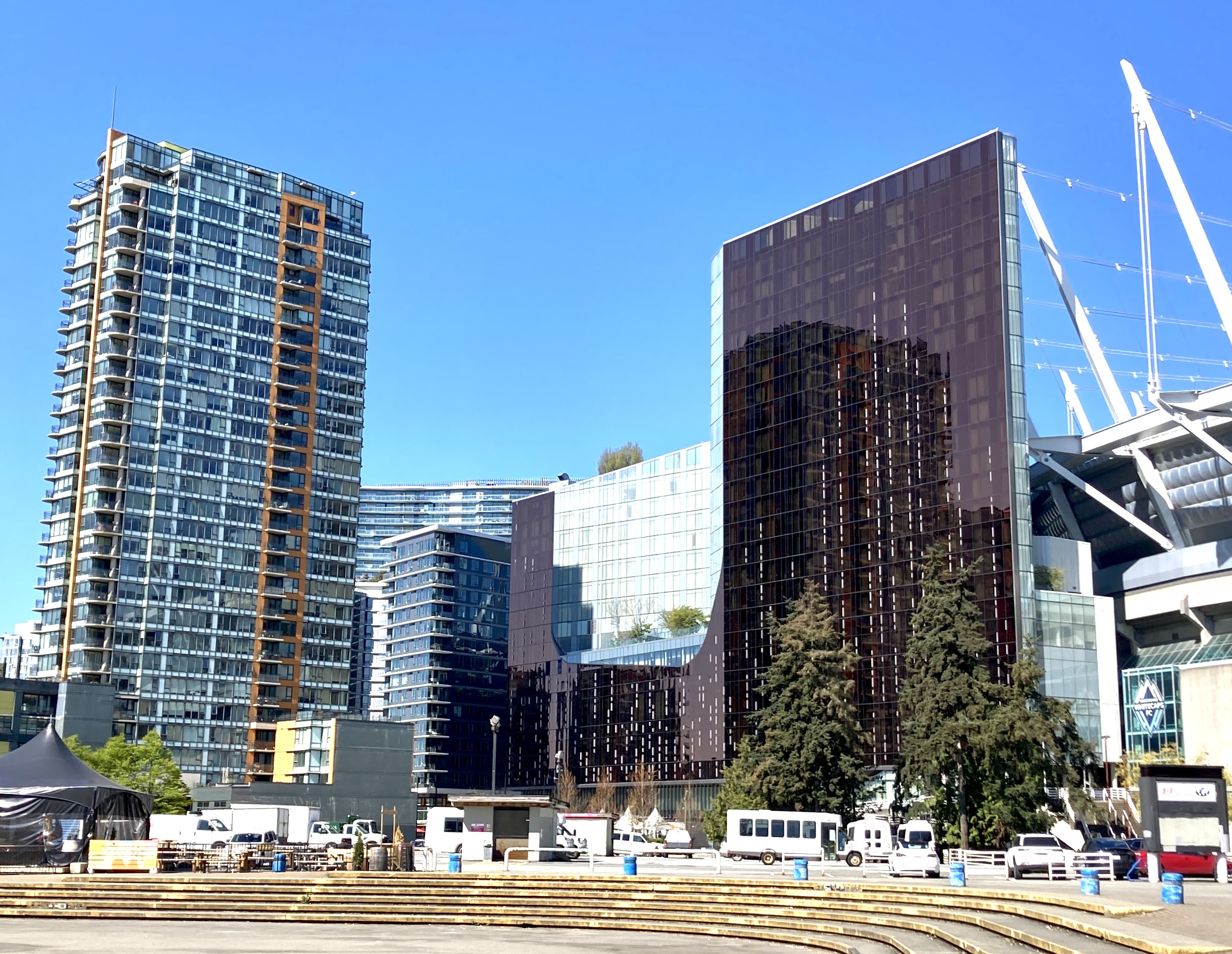
transforms a boring building (L) into a darkly magic reflection (R)…
warms the backs of a newbie dragon boat team, intent on their coach’s mid-stream lecture…
sparkles a V-trail of diverging wakes, ferry eastbound but another dragon boat now veering west toward Cambie Bridge…
rolls across the spring-tidied plots of John McBridge Community Garden, beside the bridge…
and shoots silver into the sky from the fingers atop the Neighbourhood Energy Utility, also beside the bridge (where waste heat from sewers is recycled into heat & hot water for local use).
I drop down from the bridge and nod to the Community Garden on my way by. It’s a nod of fellow-feeling: my next stop is a garden centre.
9 April 2024 – A post title borrowed from a specific sculpture (you’ll see), but broadly applicable to pretty well everything else (as you’ll also see).
First, and more precisely: Eyes on the chain link. Two days ago I’m looping south-east of home, my attention caught by the bold line of graphics visible through chain link fence on East Broadway near Fraser.
Curiosity pulls me around the corner, into the lane, and onto that big rectangle of gravel. Bright graphics all right, but otherwise? One park bench, one dog bowl, no dogs, and one crow, who promptly flies away. That’s it. Yet a neat sign on the gate has the gall to declare this the Broadway & Fraser Dog Garden.
Please! I curl my lip. Later, online, I visit the Dog Garden website, discover a group called Community Garden Builders “transform vacant properties into temporary dog parks” … and uncurl my lip. I invite you to do the same.
Tail end (!!! unintended pun, but I’m gonna leave it) of that walk, I’m passing the mesh fence that keeps Guelph Park tennis balls inside the City courts, where they belong. A player has just stooped to retrieve one, but that’s not what I notice.
See? Our local yarn bomber has branched out. Not just crochet hearts…
but tassel hearts as well.
And now, my friends, the magic of the Historical Present Tense swoops us past yesterday’s rain into today’s bright sunshine. More streets to be walked. More places for my feet to lead my eyes.
Starting in a near-by alley at East 5th, where a whole passel of City workers are clustered around that venerable H-frame hydro pole.
I am relieved to learn that (A) while it is terminally non-functioning, (B) it will be replaced by another H-frame, not by some sleek 21st-c. interloper.
I’m still gleeful with that bit of news as I turn down another alley en route False Creek, and try for a more interesting way to look at Alex Stewart’s 2023 VMF mural, Vibrance Overgrown.
It dominates the alley side of a snazzy new eco-conscious build on East 4th and, viewed straight on… ummm…. I find it boring. Well-executed and bright, but no better than decorative.
Then I stop being cranky, lean into the wall, and look straight up.
Well, that’s more fun, and I resolve to spend more time looking for odd angles.
Next opportunity arises quickly in yet another alley — more properly, in the developer-groomed pathway between condo complexes close to the south-east end of False Creek. We’re in the area’s old industrial/railway footprint, so visual/verbal references abound. For example, in the street name just before me: Pullman Porter Street.
Right here, next to the water feature signposted as private property, I once again enjoy Eyes on the Street. The plaque tells me that the two forms in this 2018 installation by Marie Khouri & Charlotte Wall “mirror themselves & their surroundings,” and inspire us to think of our neighbours, ourselves and our surroundings, and to “consider the beauty of their interconnectedness.”
I go close. The form before me does mirror its surroundings…
and I find that I do then spend a moment considering the interconnectedness of all things.
False Creek at last, where I hook around to the north side, and head west. On past my usual turning point at the Cambie Bridge. Water on my left and, up above me along Marinaside Crescent to my right, one of the three shelter + chairs installations that comprise Lookout.
Created by Christos Dikeakos & Noel Best in 1999, the works feature carved & frosted words to remind us of the Creek’s heritage. I’m not often here, but when I am, I always pause long enough to read some of the words.
Yet farther west, foot of Davie Street, with boats anchored in Quayside Marina on my left and, at water’s edge, the six bronze I-beams of Street Light, by Alex Tregebov & Noel Best. According to the City’s online public art brochure for Yaletown-False Creek, the perforated panels atop these pillars align historic events with actual dates in fancy visual ways. Alas, I’ve never been here at the right moment to see any of that wizardry.
So instead, and as usual, I simply tilt my head up to enjoy some of the superstructure…
tilt my head down to read a few words on the plinth about False Creek Shacks in 1934, and…
level my head to look out across this bit of False Creek, on this very day in 2024.
Focus your eyes a bit above the railing near the cobblestones, and you’ll spot the Canada Goose enjoying the moment right along with me.
By the time i’m passing David Lam Park, my avian companion is a cormorant, not a goose.
There he is, posing atop Buster Simpson’s 1998 work, Brush With Illumination.
I have a very-much-favourite art installation in this park and — with apologies to Simpson (and the cormorant) — Brush isn’t it.
This is it.
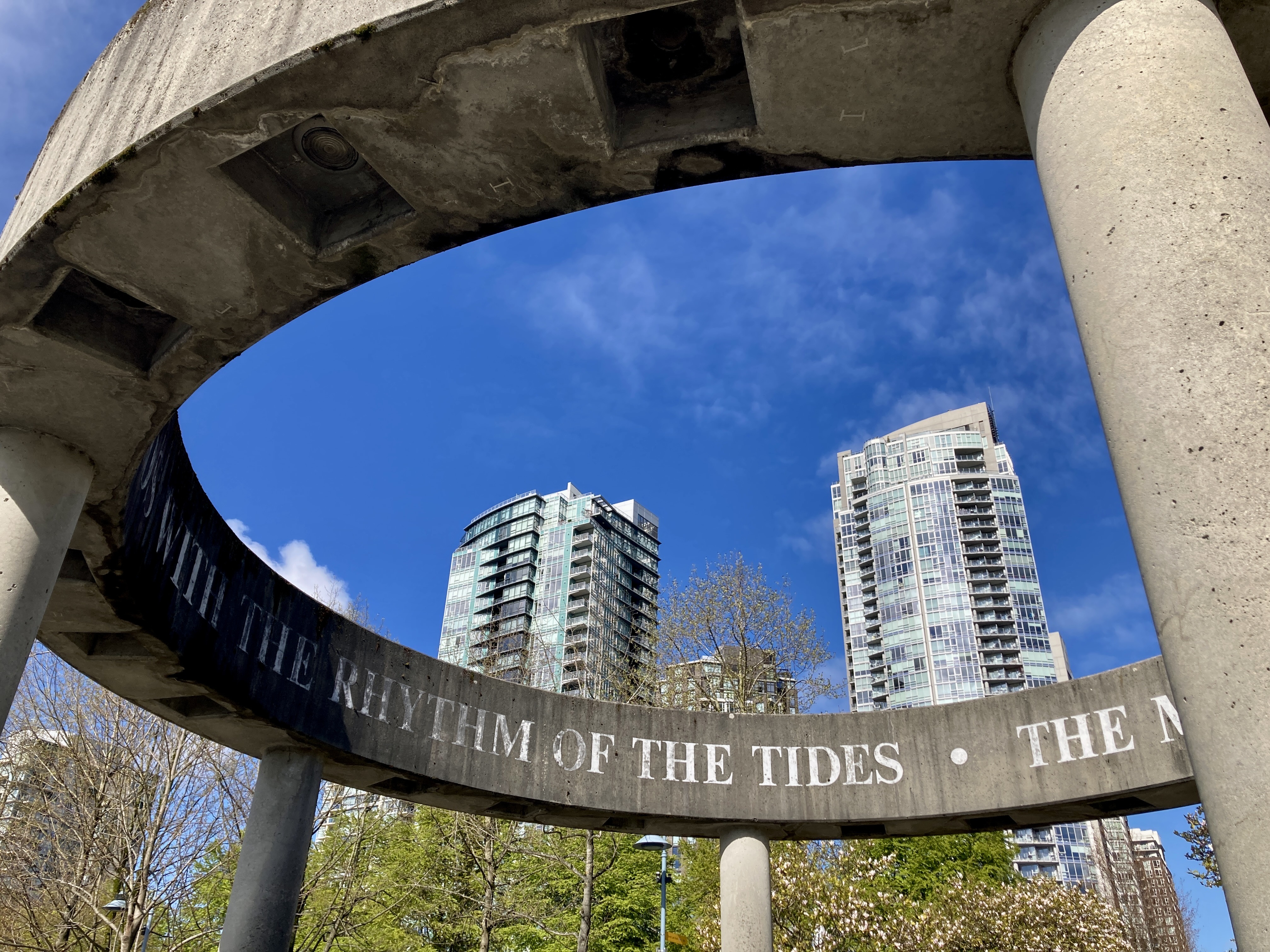
Marking High Tide, like its companion pavillion Waiting for Low Tide, is the 1996 creation of sculptor and retired landscape architect Don Vaughan. The latter work is a contemplative circle of large stones in the Creek bed; this one honours the tides with an overhead 360° tribute of words: “As the moon circles the earth the oceans respond with the rhythm of the tides.”
Finally, I leave the water and take myself up to Pacific Blvd where, all along the block stretching east from Homer Street, my eyes are literally on the street.
Well no, make that: literally on the sidewalk.
Which, in this block, is dotted with Gwen Boyle’s 1994 selection of words to reflect the area’s long history.
Once, just once, she offers more than a word or two.
The exception is a longer excerpt from the poem I first noted in my 28 March post “The Beating Sea.”
“… the manstruck forest ..”
I stand there, stunned by the power of his imagery.
So thank you yet again, Earle Birney. You live with us still, in your words and, through the artists you inspire, on our streets.
"Traveller, there is no path. Paths are made by walking" -- Antonio Machado (1875-1939)
"The voyage of discovery is not in seeking new landscapes, but in having new eyes" -- Marcel Proust (1871-1922)
"A city is a language, a repository of possibilities, and walking is the act of speaking that language, of selecting from those possibilities" -- Rebecca Solnit, "Wanderlust: A History of Walking"



























 WALKING WOMAN