Forward! In Reverse

1 January 2026 – Well, it is forward, isn’t it, when the reverse of your usual choice offers a new way to look at things. It’s hardly a major life breakthrough, but it does qualify as a pleasing little experiment, and worthy of the first day of a new year.

My “little experiment” is to walk the Burrard Inlet Seawall east-to-west between Waterfront Station and Stanley Park, instead of west-to-east. I know: small stuff indeed. But the fog is burning off, and it isn’t raining, and the temperature is comfortably above zero. Good reasons to drop off a bus at Waterfront Station, and get myself down to the water by Canada Place.

Tourists and locals stroll; the sights present themselves for admiration:

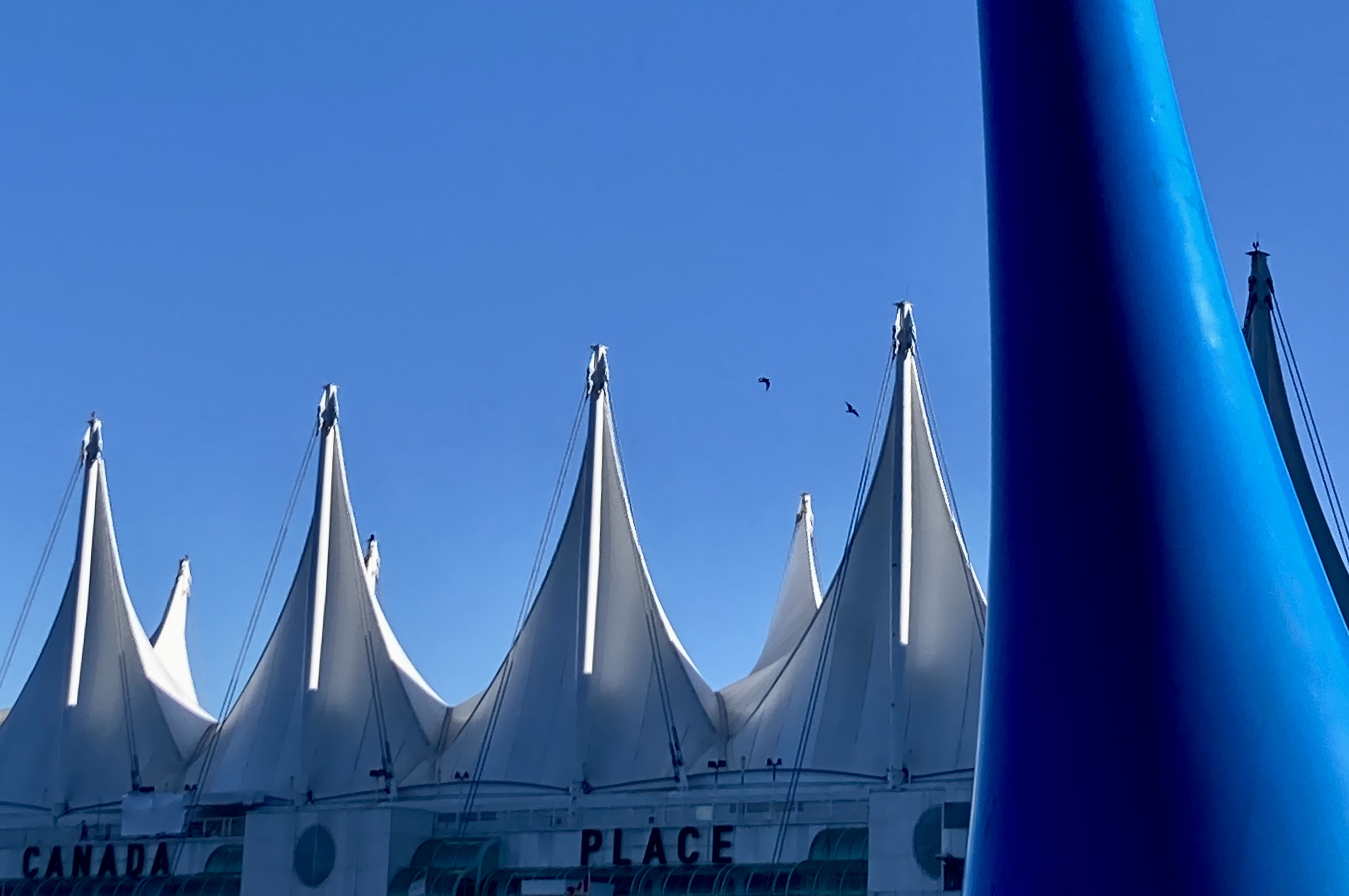
the fabric roof “sails” of Canada Place, the rental bicycles, a SeaBus completing its run from North Vancouver, a laden freighter and, of course, the orange cranes that tend to the freighters.

After that, my eye seems to focus more on slivers of scenes, not the whole panorama.

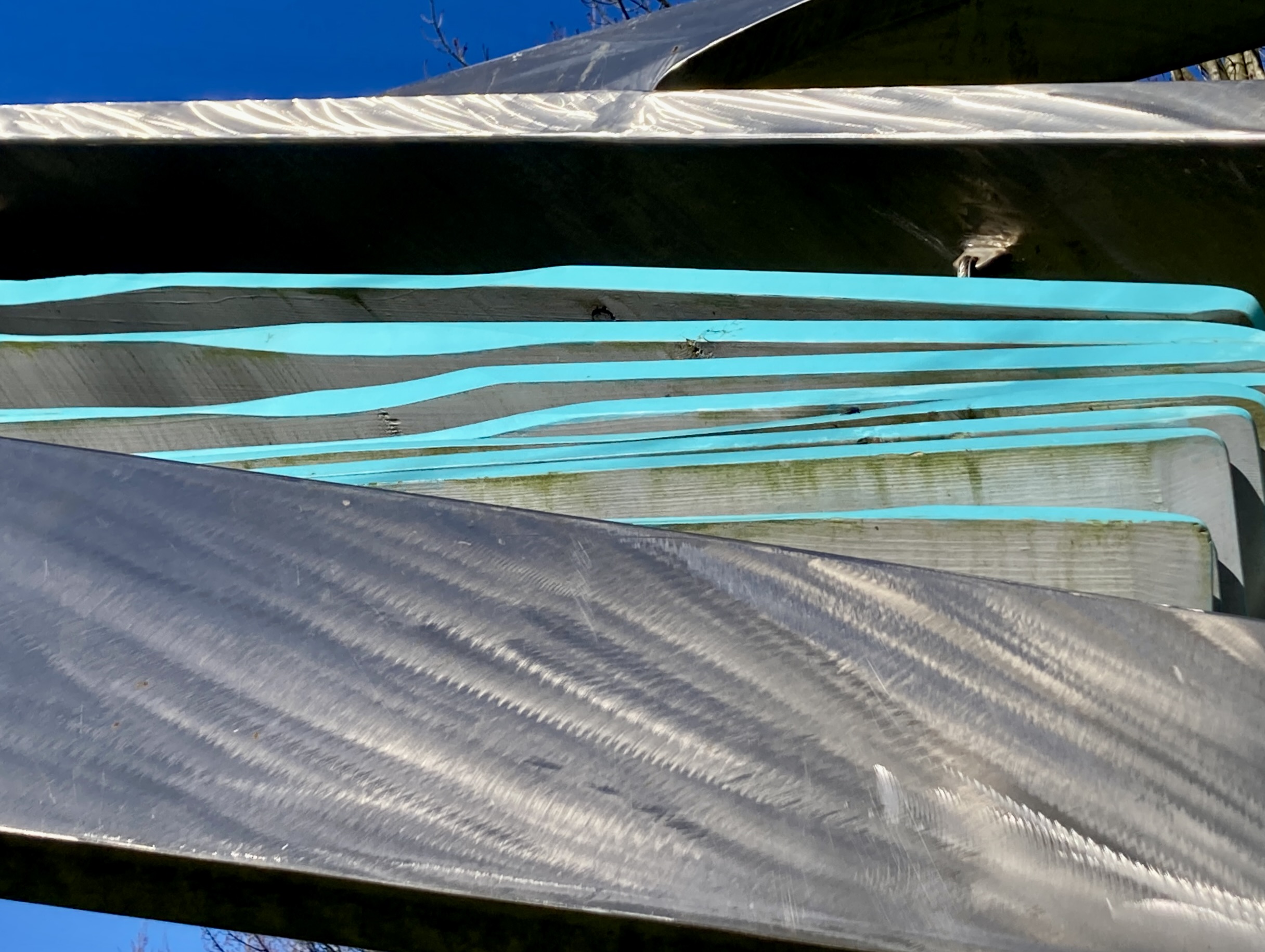
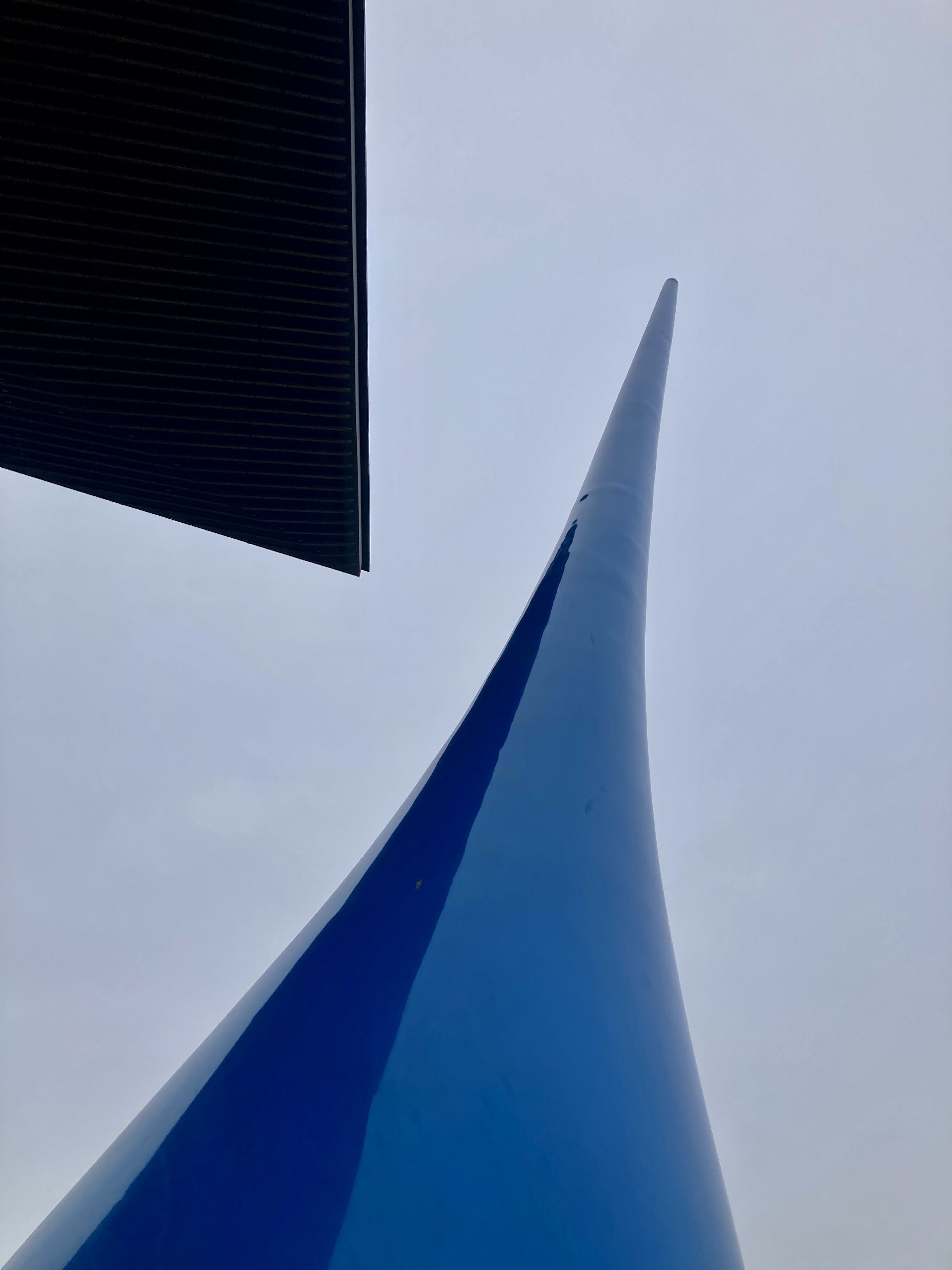
The tip of The Drop, the 2008 sculpture in Bon Voyage Plaza by the German four-artist collective Inges Idee that honours our temperate rainforest status with one elegant raindrop…

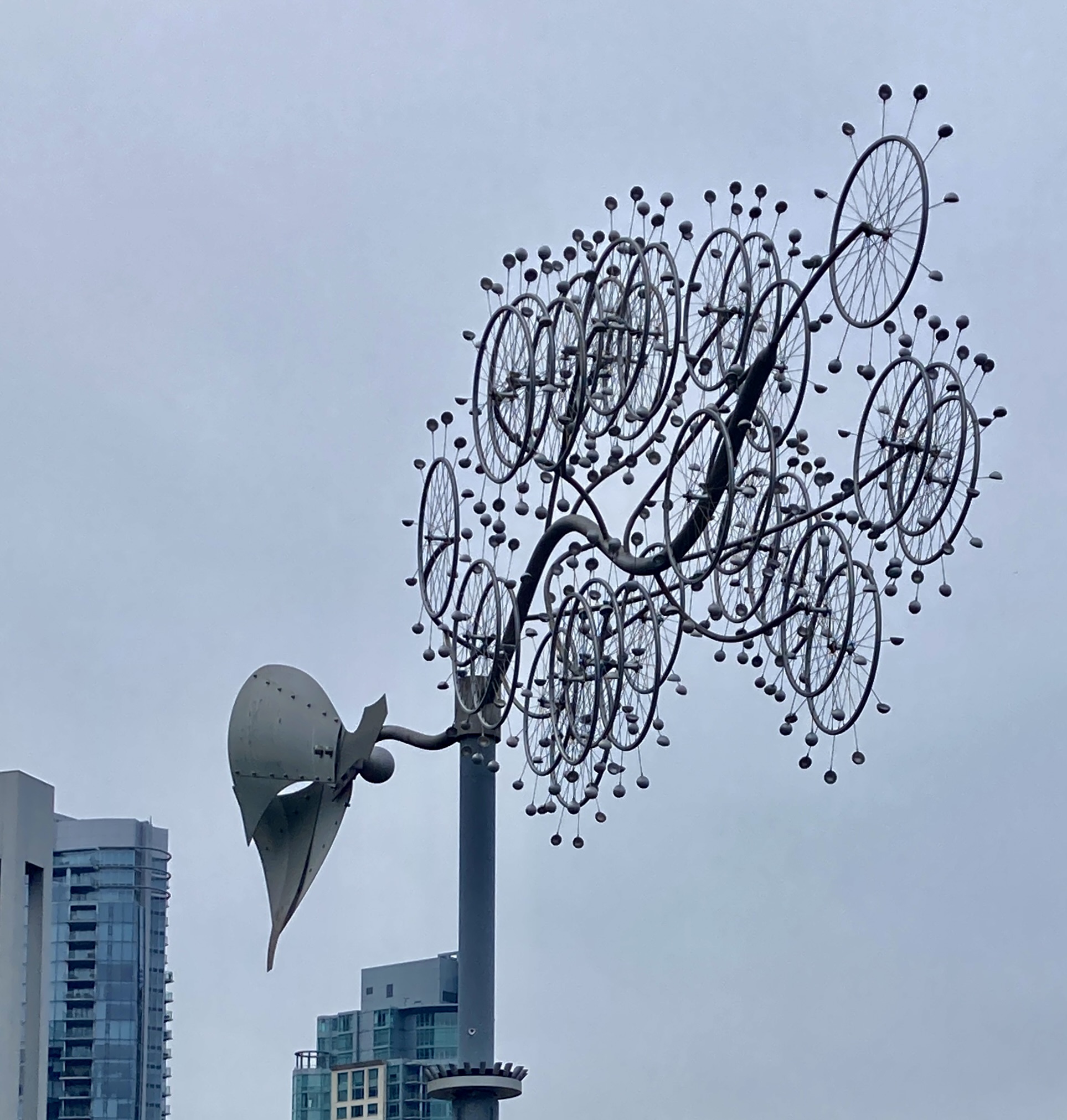
Doug Taylor’s kinetic weathervane Wind Wheel Mobile just west of the Convention Centre, which, from this angle, resembles a bobbing duck more than a weathervane…

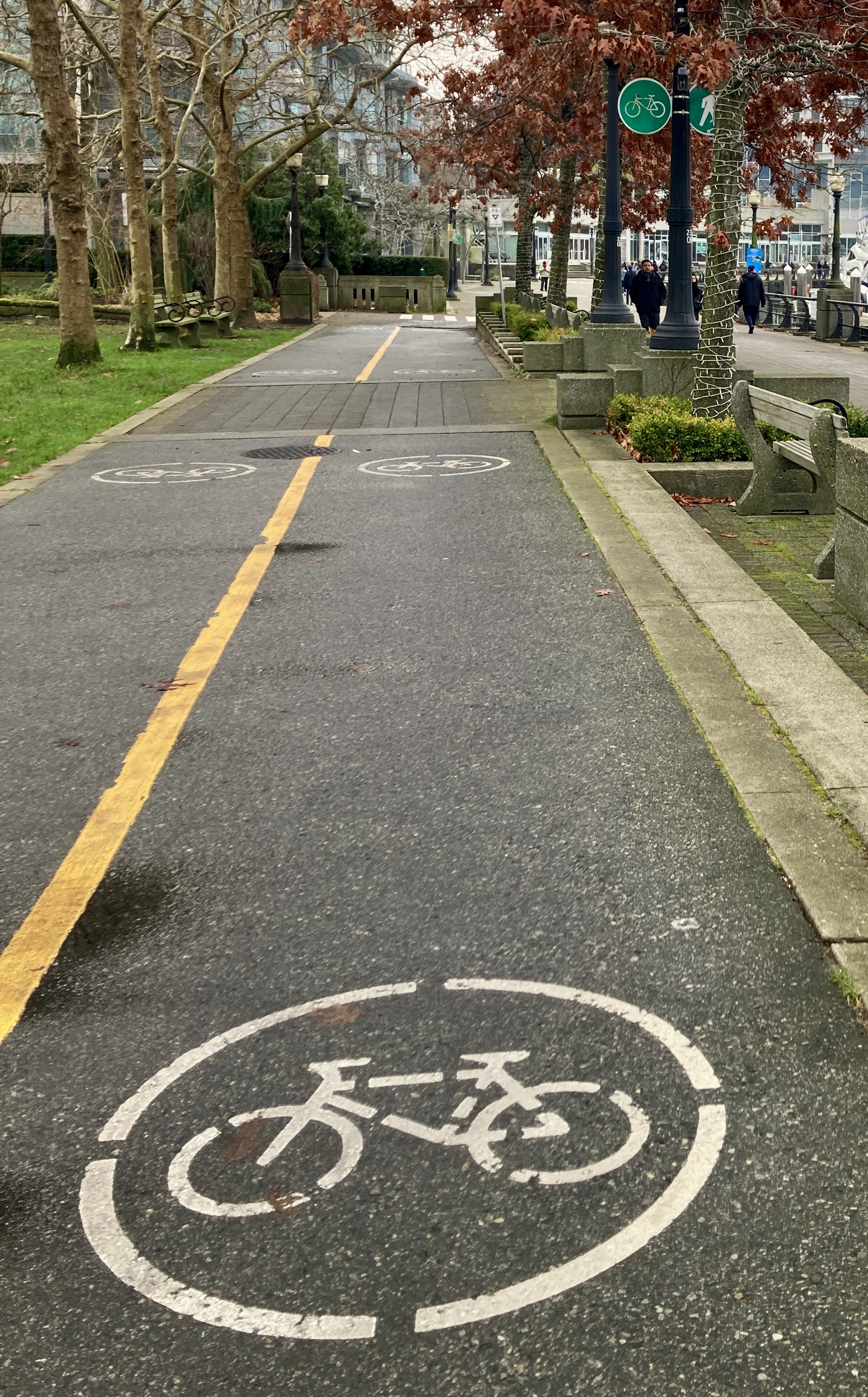
Seawall bike lanes bordering the west side of Harbour Green Park, under a russet canopy of (I think!) winter beech leaves…

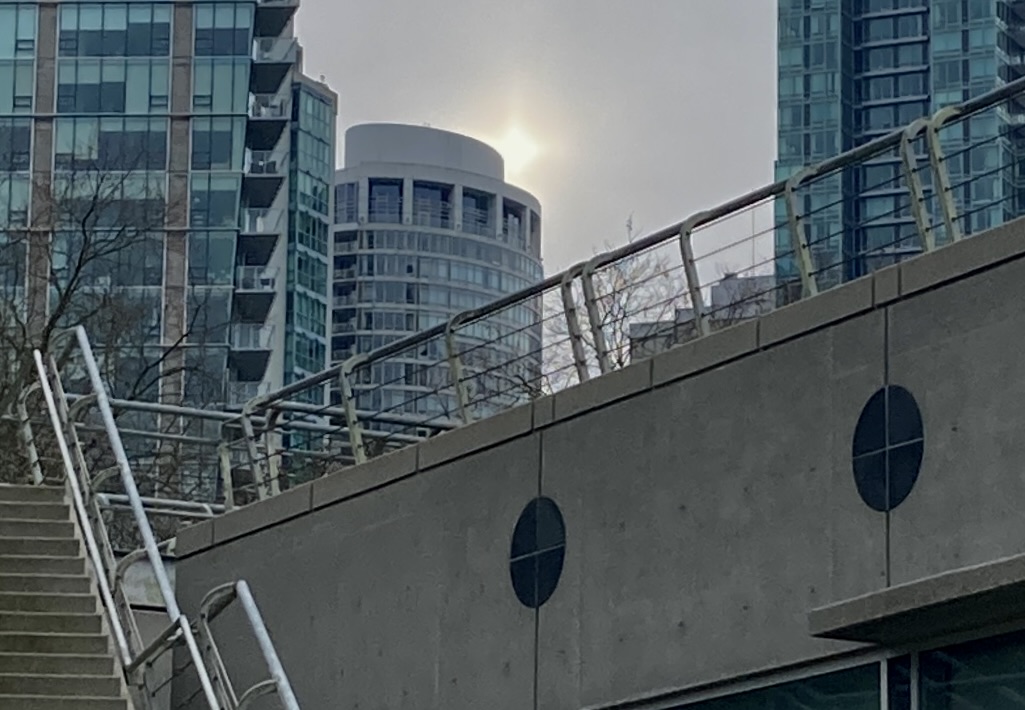
and the merest ghost of the sun, glimmering through the fog between buildings at the top of a Coal Harbour Park staircase.

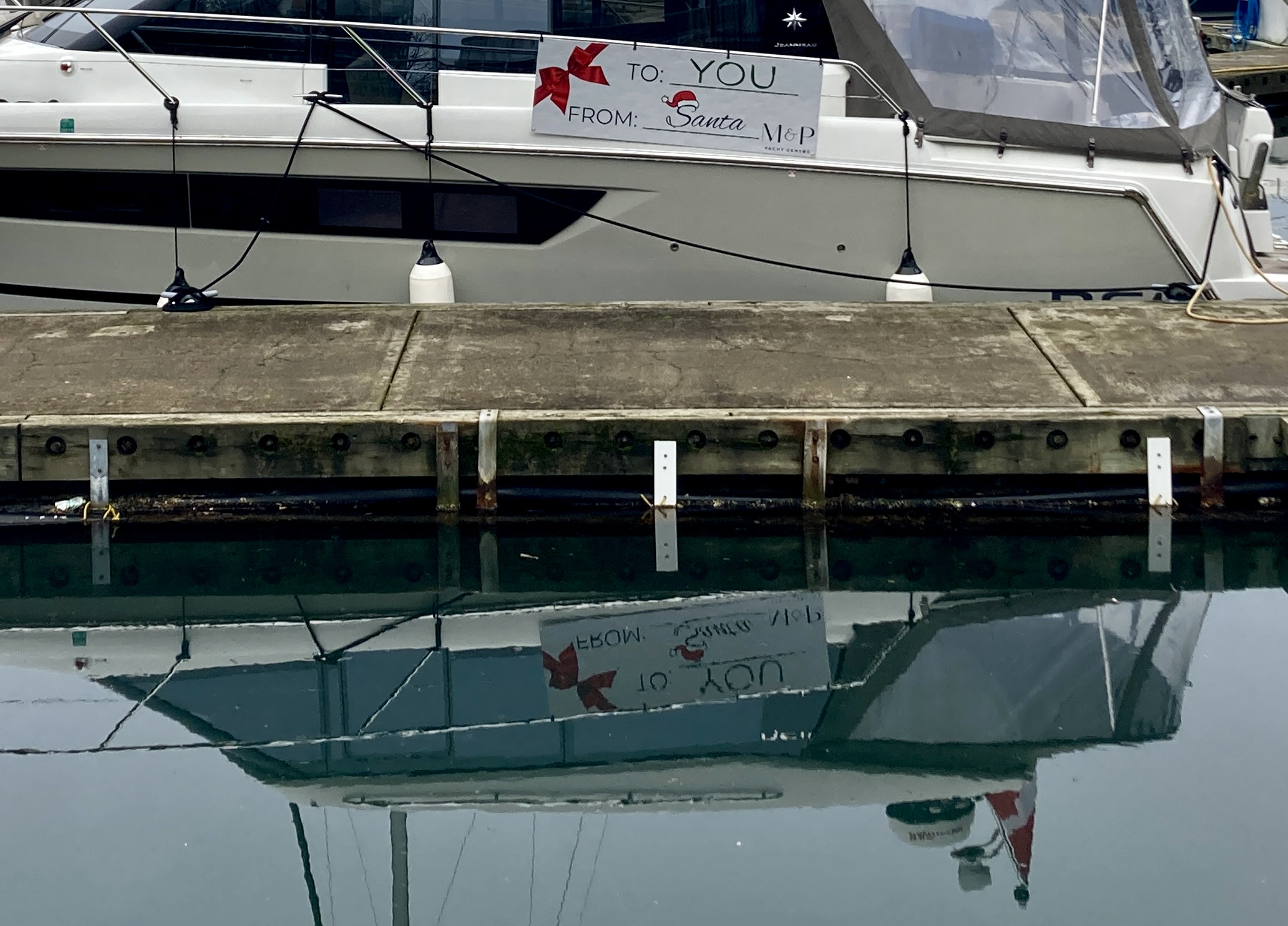
I spend a moment with Santa’s floating gift “To YOU” in the Coal Harbour marinas.

Really a lavish Christmas present? Or, wait a minute, a clever-boots For Sale sign? The suspiciously generic label bears the M&P Yacht Centre logo, after all.

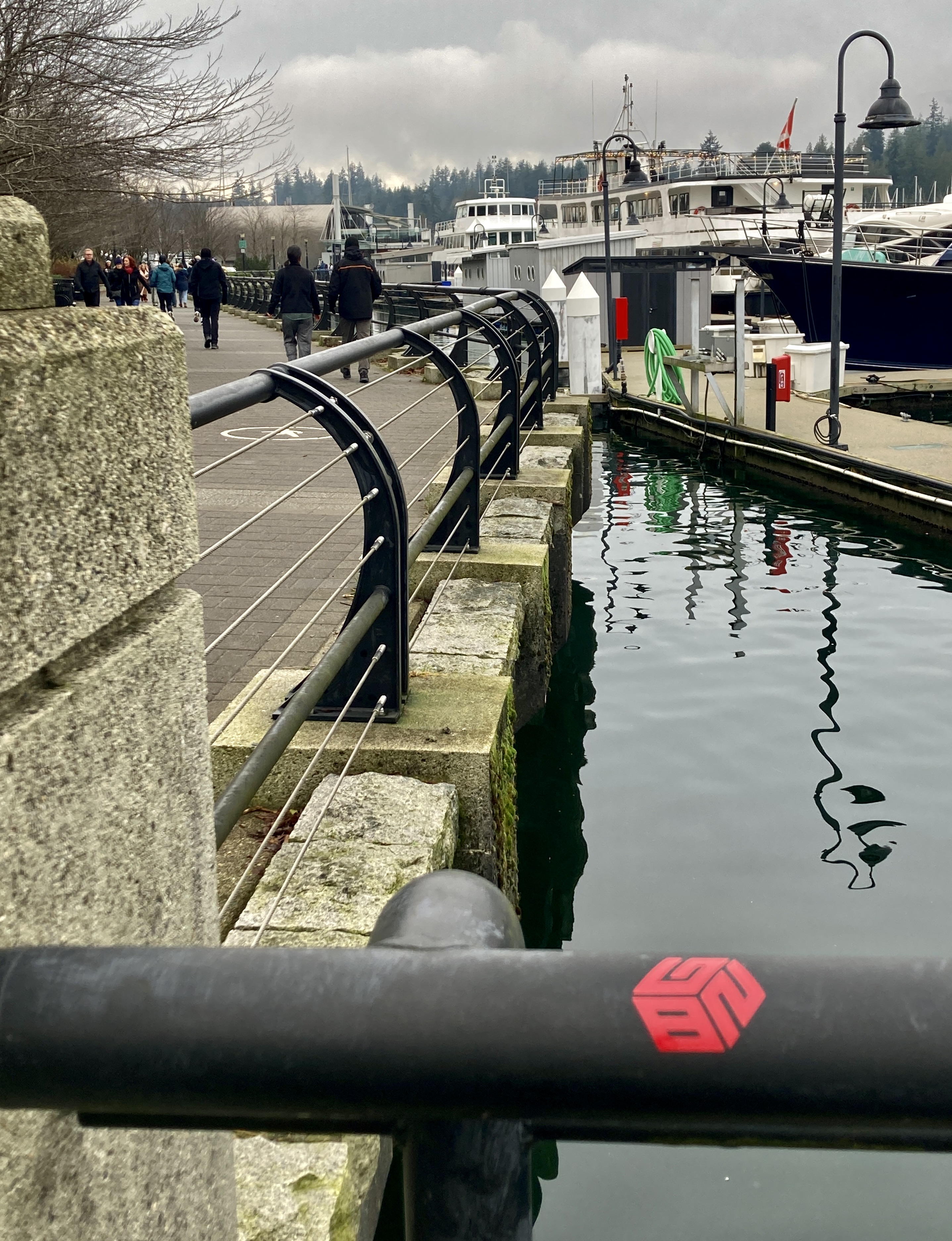
Far (west) end of the marinas, and I pause again, this time for something I feel no need to interpret.

A red cube sticker + a vee of water. I just like it.

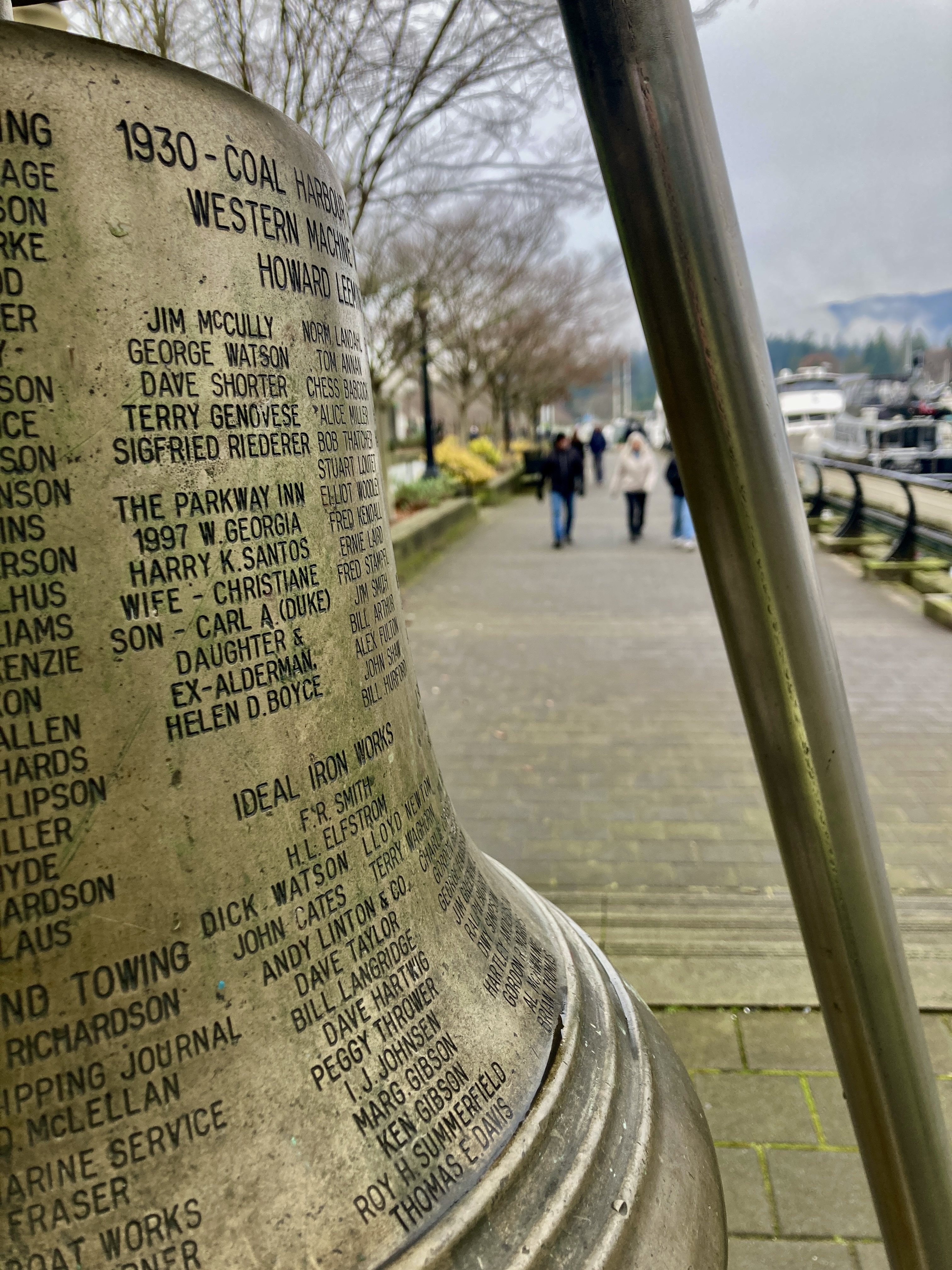
Then the brass curve of the Coal Harbour Fellowship Bell (commemorating the companies and people of the “self-contained industrial marine community” that, 1891-1979, populated this area)…

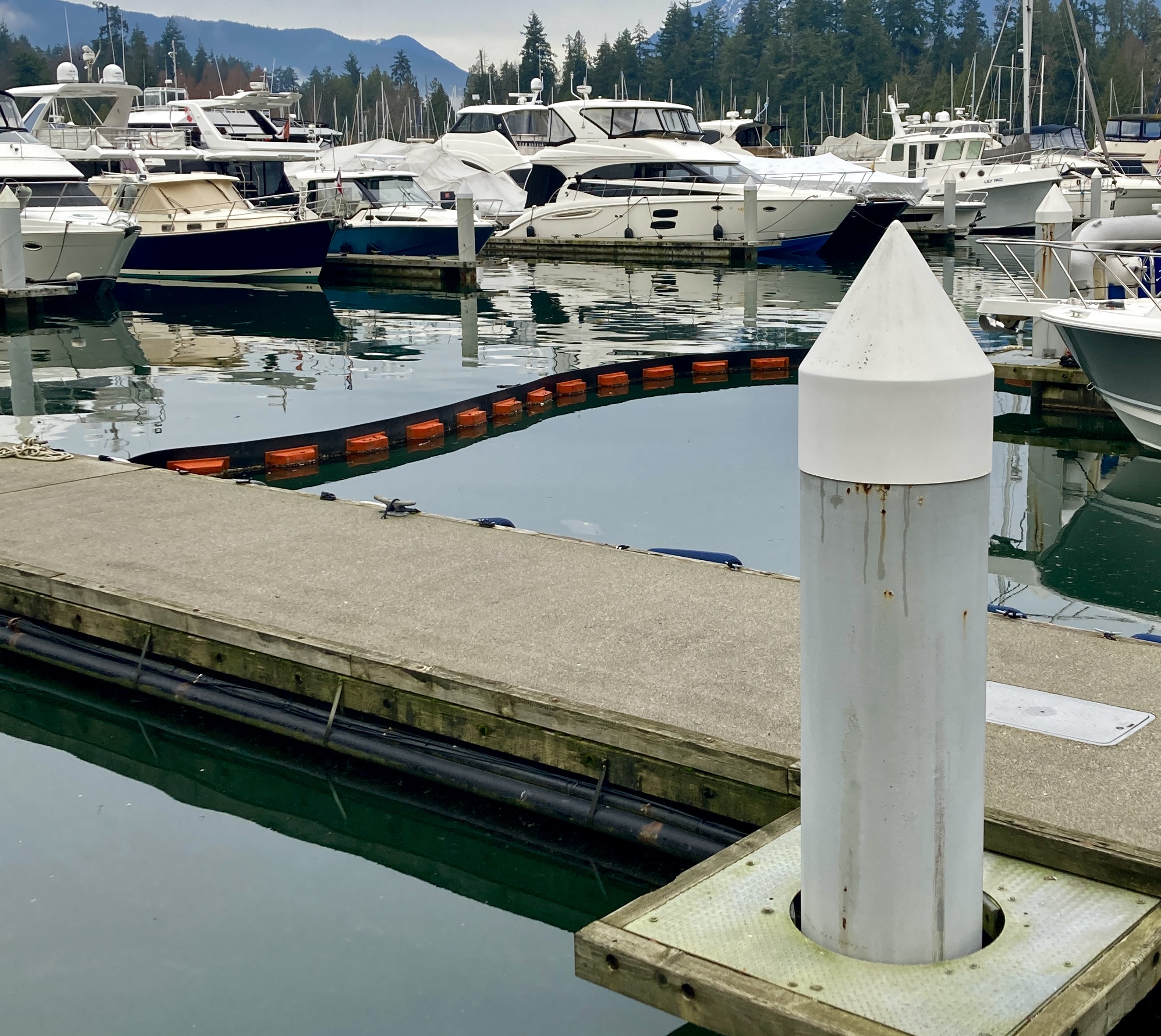
and then more red, and another curve. This time red bobbing in the water, not fixed above it, and in a sinuous horizontal arc, not vertical.

A bit more hoofing along, and, finally, I am here.

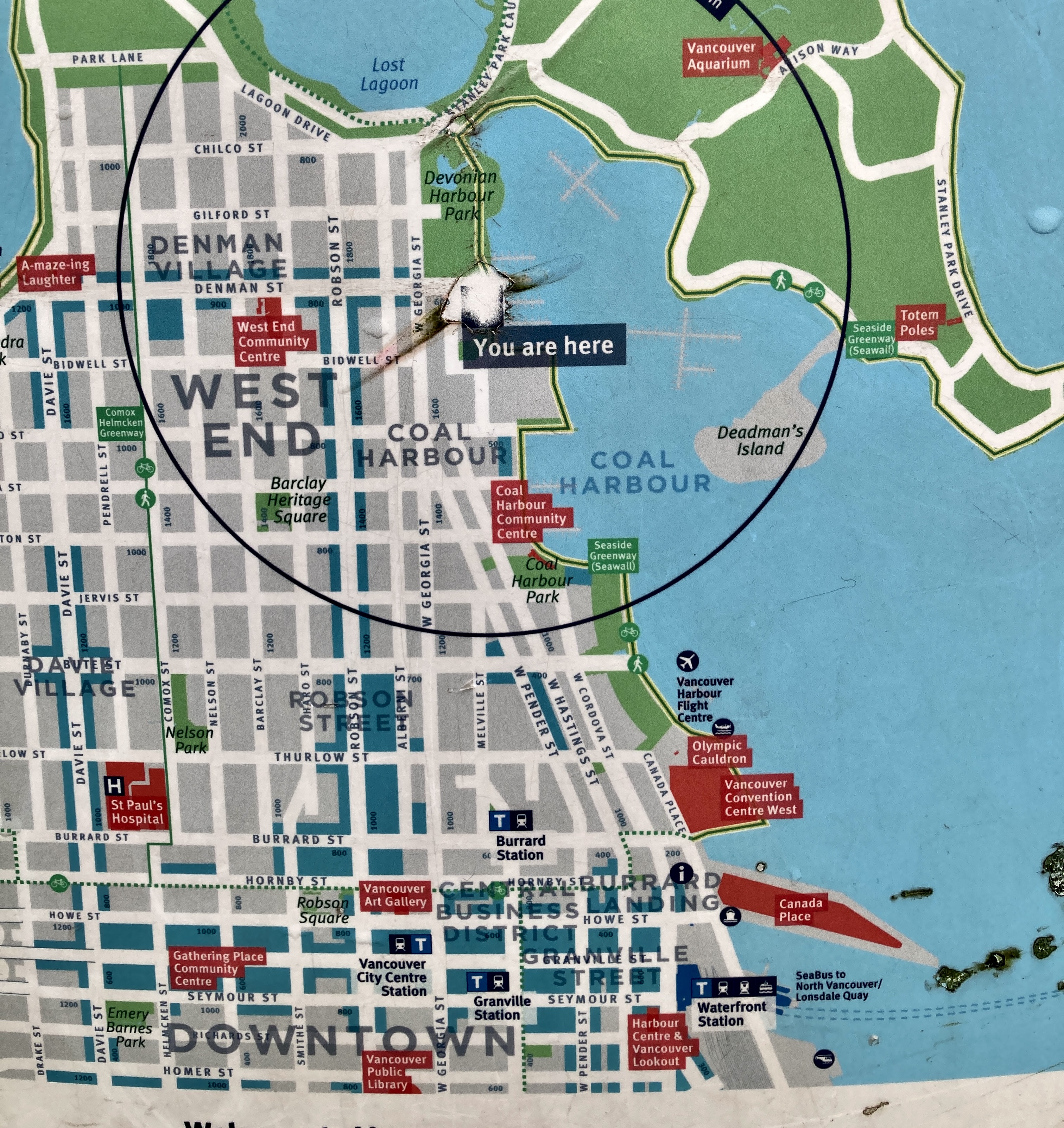
I am exactly where the map says I am: on the Seawall at the east end of Devonian Harbour Park, in turn a gateway to Stanley Park, and also the end of my route from Waterfront Station, down there in blue/white signage at the bottom of the map.

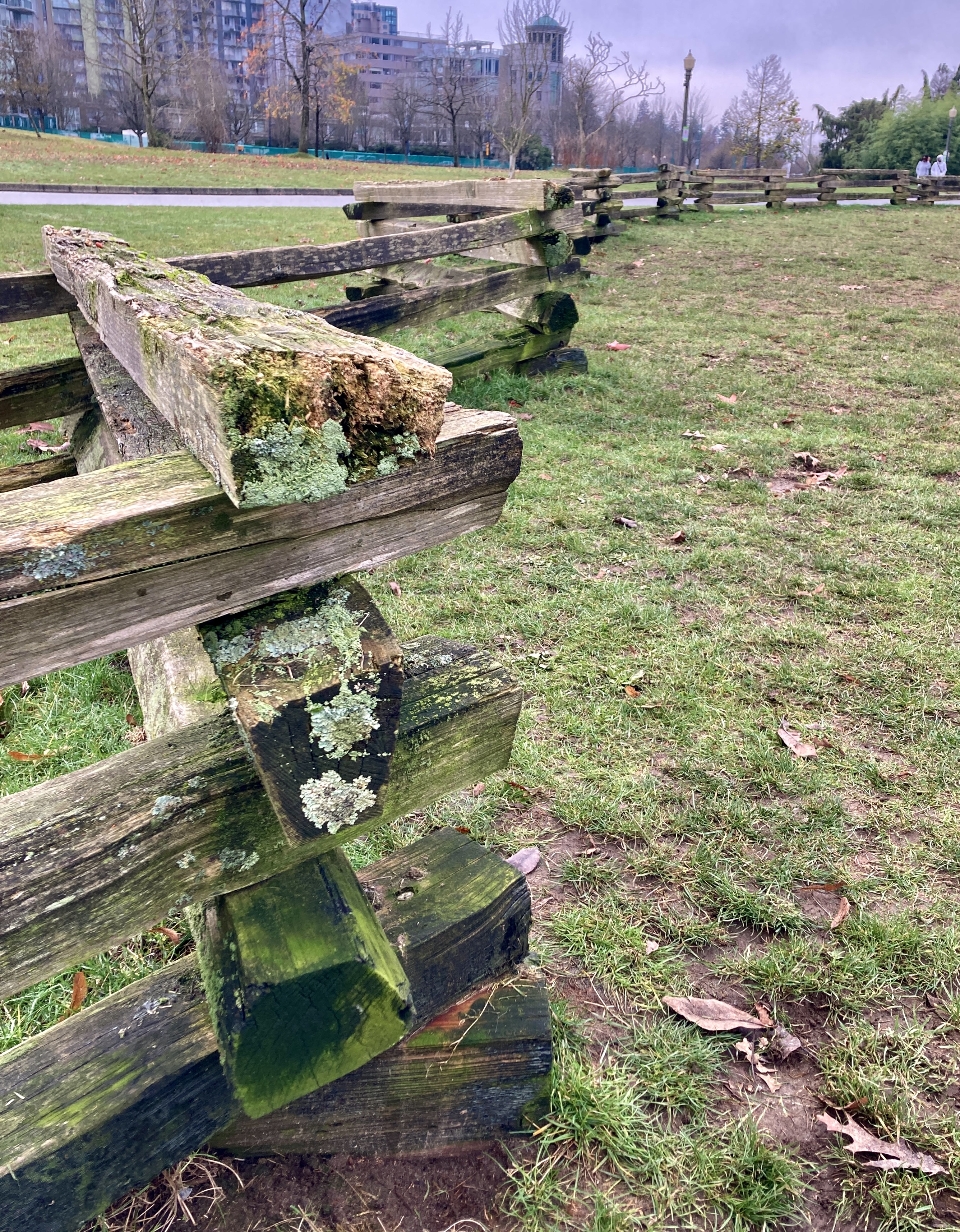
Time for me to follow the snake fence through the park…

pause to take group pictures for some happy tourists, then….

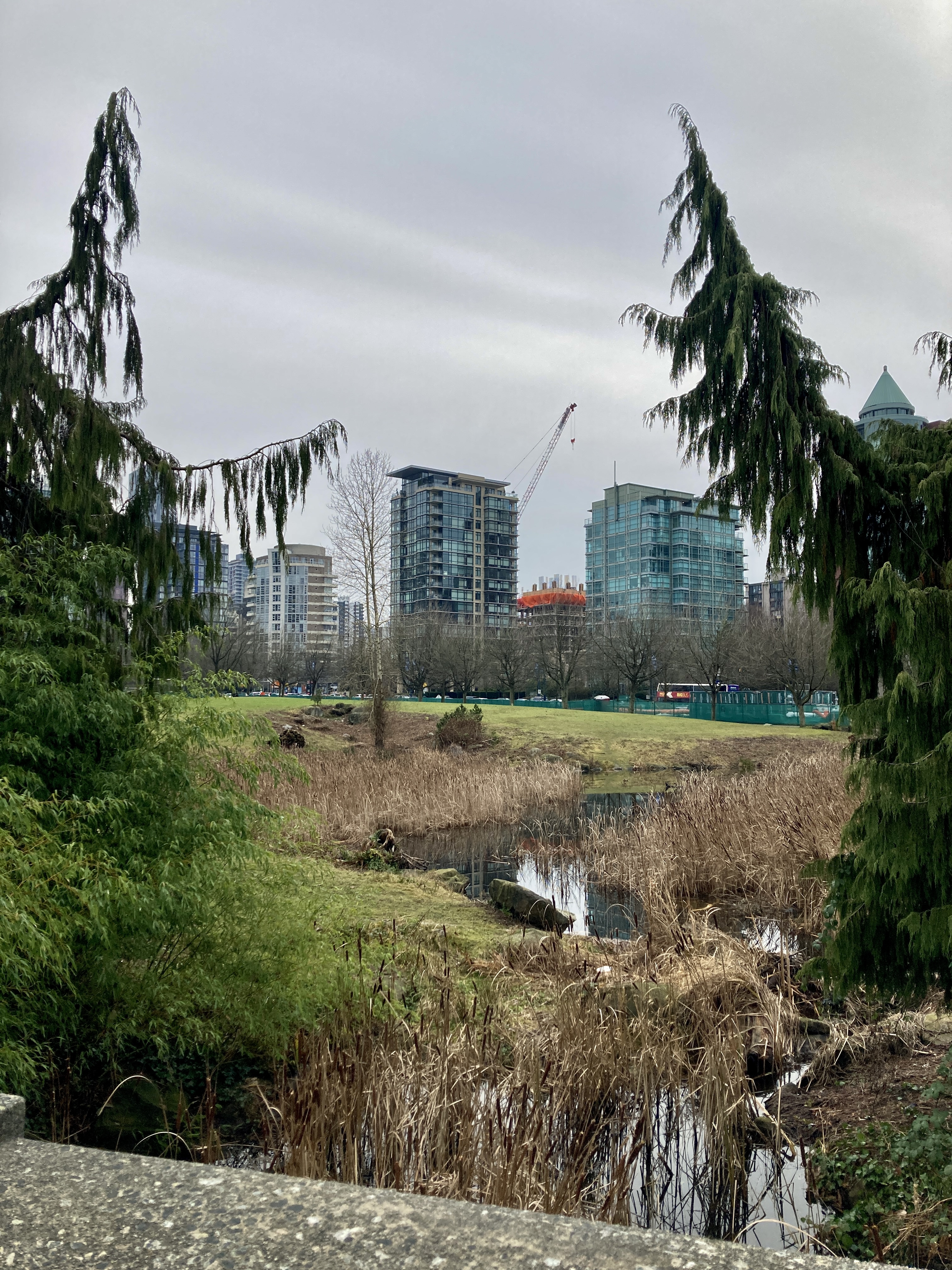
cross this little bridge, and angle up along the creek to those cranes and new-builds on West Georgia.

Where I hop on a trusty #19, and ride my way home.

(Happy New Year, everyone! I so appreciate your interest and generous good humour.)

Windy & Wet

18 December 2025 – Just a description, mind you, not a complaint. Compared to weather almost everywhere else in the country, including here in BC, Vancouver’s weather is a walk in the park.

But even so, it is still very windy and very wet!

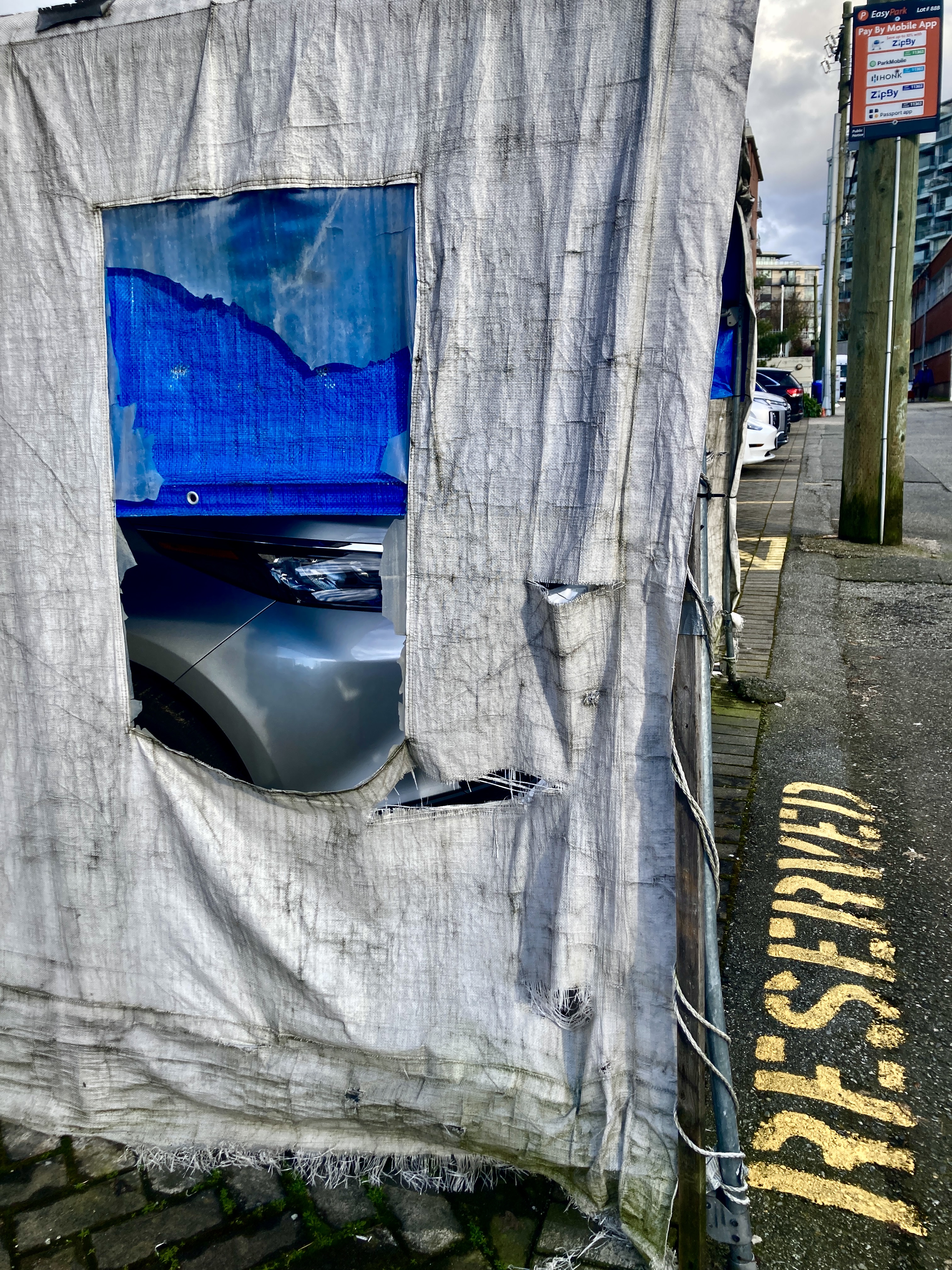
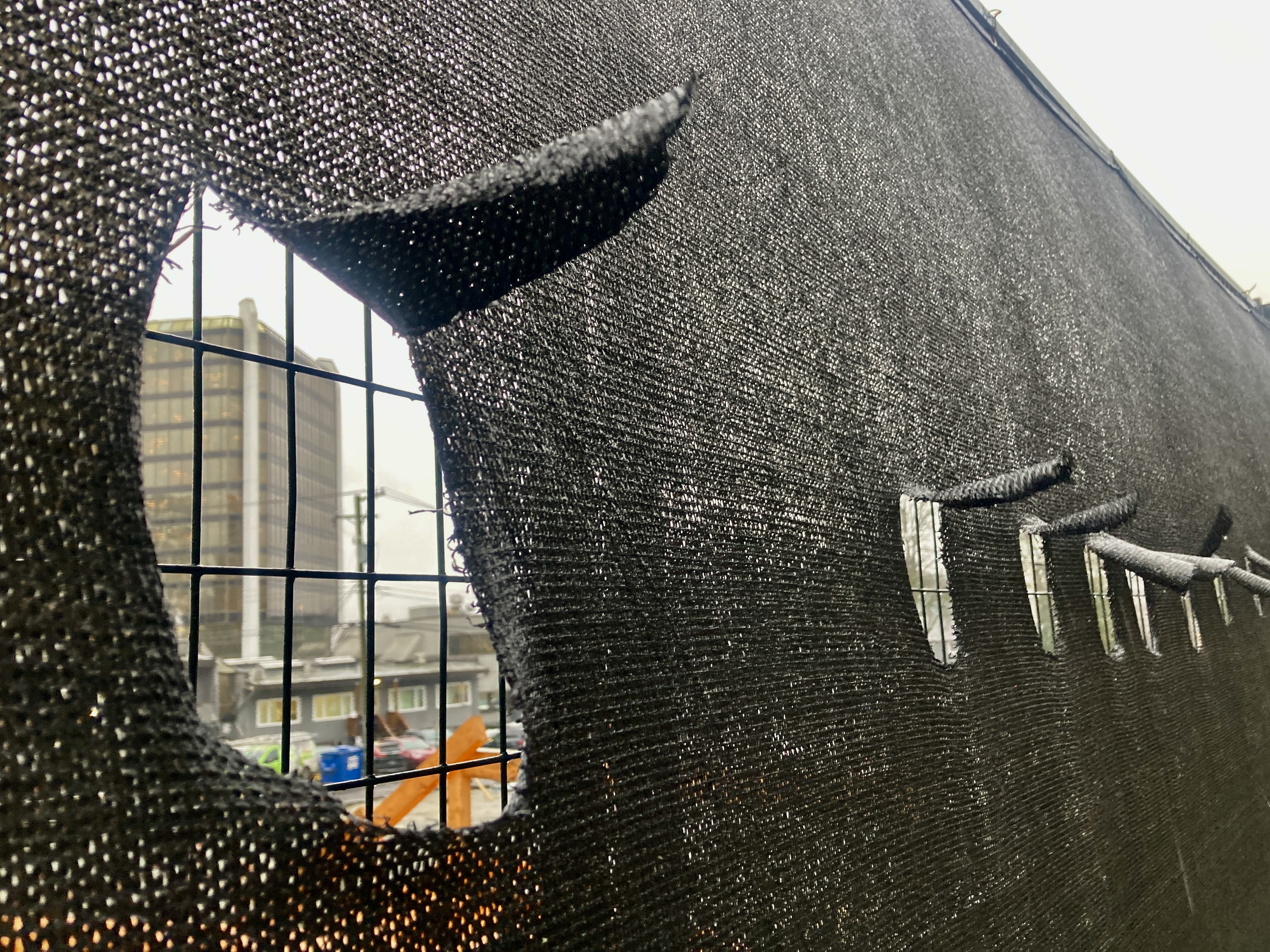
Just look at the air vents blown horizontal in the sodden construction fence fabric, as I splosh my way along West 10th this morning.

By the combined might of word + weather association, I start thinking about anapest metre.

Why? Because wet weather on 8 December caused me to rewrite a limerick to fit, and that in turn caused me to discover the anapest metre and its (quote-unquote) “galloping rhythm.”

So here I am, in yet more wet & windy weather. To distract myself, I compose a limerick. An ode to the anapest metre.

(More throat-clearing)

The anapest metre is now my best friend,

It offers me rhythm without any end,

I gallop and giggle,

I wobble and wiggle.

It distracts me from rain and that’s a great trend!

Once home… and dry… I look up “anapest metre” online. The Poetry Foundation explains it consists of two unaccented syllables followed by one accented syllable, and then helpfully gives two examples of words that — all by themselves! — are anapestic: “underfoot” and “overcome.”

Yah well, here’s the Canadian example: “Newfoundland.”

From now on, let’s all pronounce it correctly.

Finally! A new year’s resolution we can keep.

That Young Lady from Spain

8 December 2025 – Oh, the limerick!

*Five lines;

* AABBA rhyme scheme;

* a fondness for the galloping anapest meter;

* and (says a man who knows) “a propensity for the perverse.”

I am not thinking of the perverse. I am, however, thinking of a limerick that meets all the 5 lines-AABBA-anapest-meter requirements. I am thinking of the one that begins: “There was a young lady from Spain.”

Only when I look around online do I discover that this Young Lady goes on to have many different limerick adventures.

My particular Young Lady has her adventures on the train. To wit:

“There was a young lady from Spain / Who used to get sick on the train.”

I herewith offer you a timely Vancouver re-write of those first two (AA) lines. After that, it’s the same BBA outcome that the Young Lady knows well.

(Ahem. Throat-clearing.)

“I really do hate to complain,

“But this season we only have rain —

“Not once or twice,

“Which is decent and nice,

“But again and again and again.”

Change

10 October 2025 – Given this is a simple post about a simple walk on a route we have walked before, you and I, it does seem excessive to lead with a philosophic tussle about the nature of “change.” But tussle we shall. Precisely because , for me anyway, same-old and change are a package deal.

On the one hand, French critic/novelist Jean-Baptiste Alphonse Karr, who, in 1849, penned the epigram we quote to this day: “Plus ça change, plus c’est la même chose” (The more things change, the more they stay the same). On the other hand, Zen Buddhist monk Shunryu Suzuki, who, when asked after a California lecture in 1968 to express core Buddhist philosophy in a way ordinary people could understand, replied: “Everything changes.”

The “same,” in this post, is yet another walk along Lost Lagoon. You know the route! Bus ride to the edge of Stanley Park; Lost Lagoon trail out to Second Beach on English Bay; Seawall for a bit up toward Third Beach & down again; out through Morton Park; on down Denman Street; that same bus, reverse direction.

Ohhh… let’s just toss French philosophers & Zen Buddhist monks to one side. Let’s acknowledge what every walker of familiar pathways knows: the same is never the same.

Each time, you & your mood & the place & the weather & all the swirling molecules of the universe dance together in new patterns to create a new experience.

It is therefore my pleasure to offer you moments from this day’s totally different version of the same old Lost Lagoon walk.

This specific Canada Goose, pensive on his rock in Lost Lagoon…

specific people & pooches along the way, including Hamish the wag-tail dog and the Vivaldi fan listening (very quietly) to The Four Seasons while resting on a weathered Seawall bench…

and another bench, the bench itself and the plaque it bears both brand-new.

We carefully cross the bike path and move closer. Flowers, notes, CDs and plaque — a multi-dimensioned tribute by local fans to Hong Kong Mandopop artist Khalil Fong, who shot to fame with Soulboy in 2005 and died this year, just months after the release of The Dreamer.

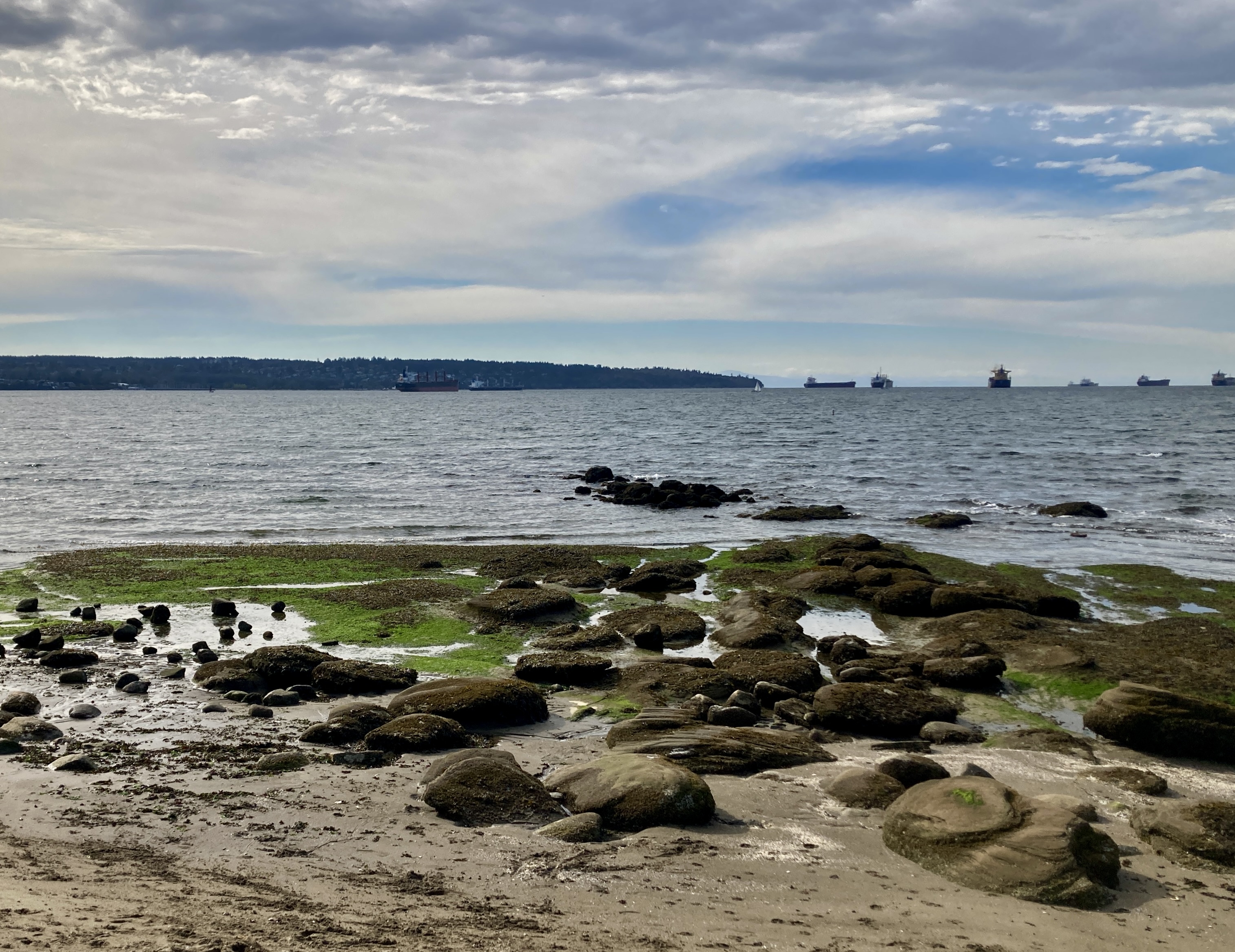
Out in English Bay, this specific moment’s arrangement of the same-old tableau: rocks & tide & freighters & Seawall pedestrians & trees & sky & clouds.

Up close: tidal flats silvered in this afternoon’s watery light.

Also up close: a burst of green & ochre.

And then, medium-distance, a moment’s drama, out there in the bay.

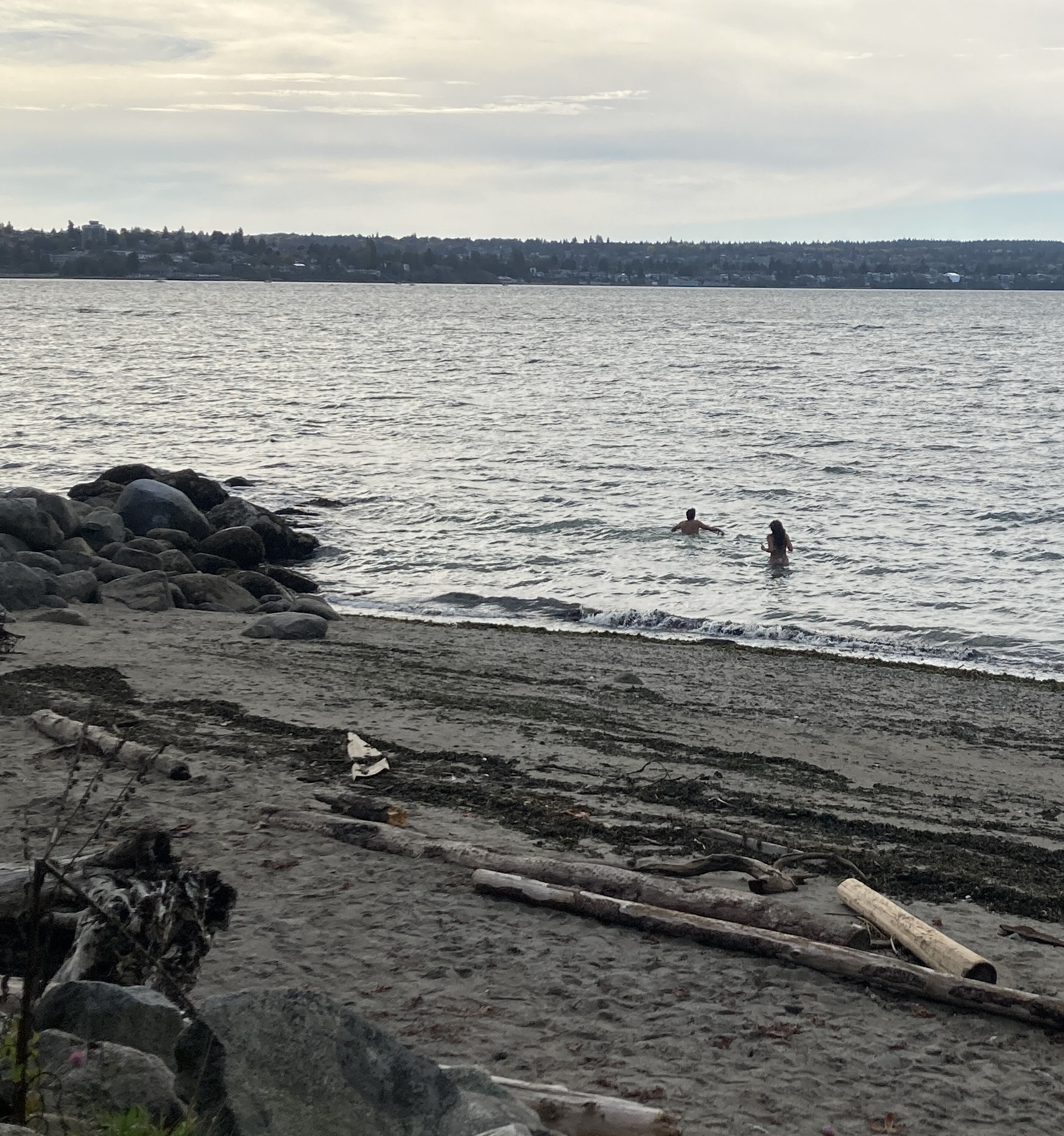
We have just watched this couple strip to bathing suits and stride into those chilly waters. Chest-high, no hesitation.

It is all about to change. He (L) is about to duck-dive and fully embrace the moment. She (R) is about to un-embrace the moment, and head smartly for shore.

We, snug in our fall clothing, head smartly for Denman Street, Delaney’s Coffee House, and a flat white & latte respectively. And then, warm inside & out, on down Denman to the bus.

See? It’s the same-old.

And every bit of it wonderfully different.

Seen? Not Seen?

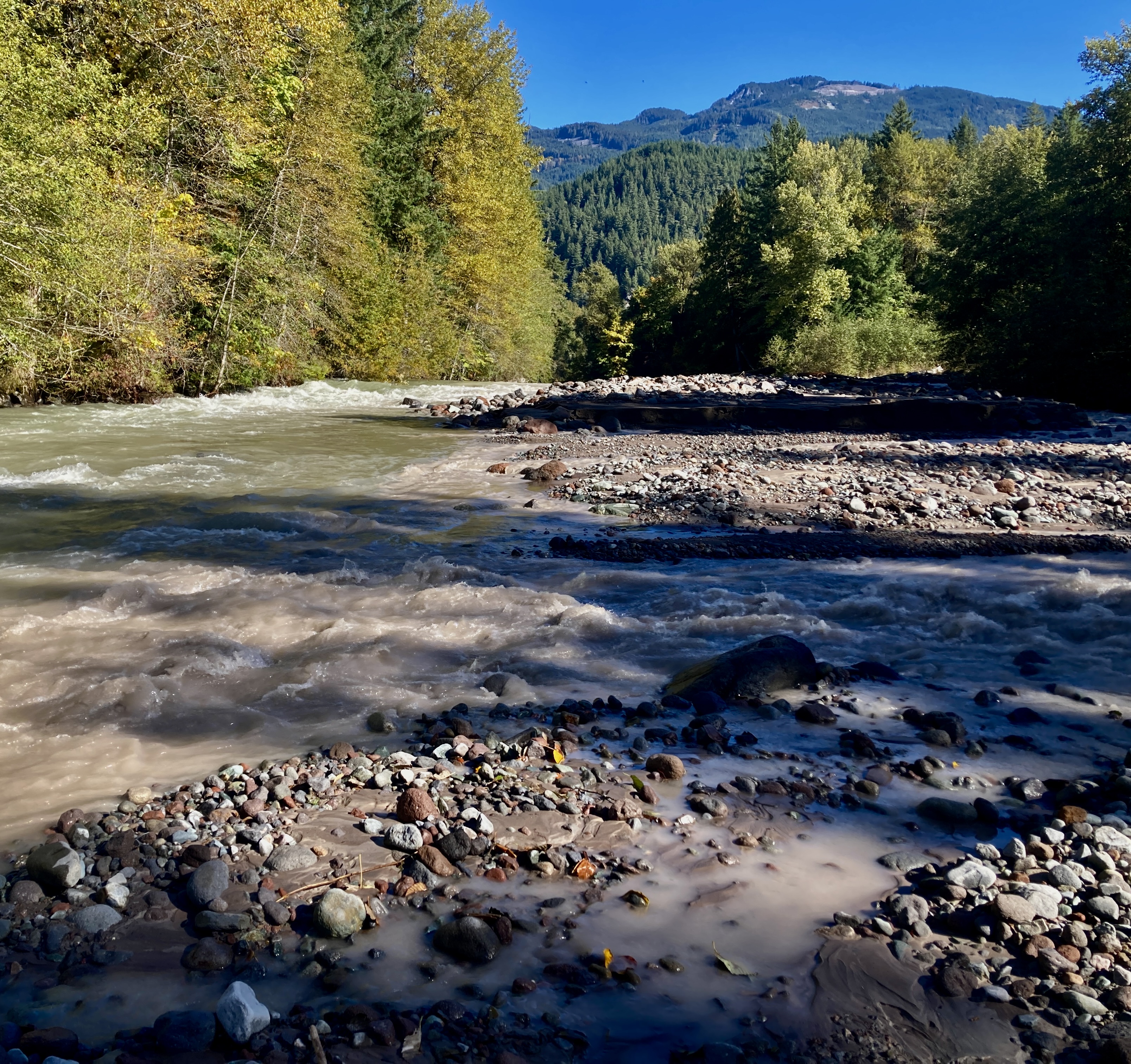
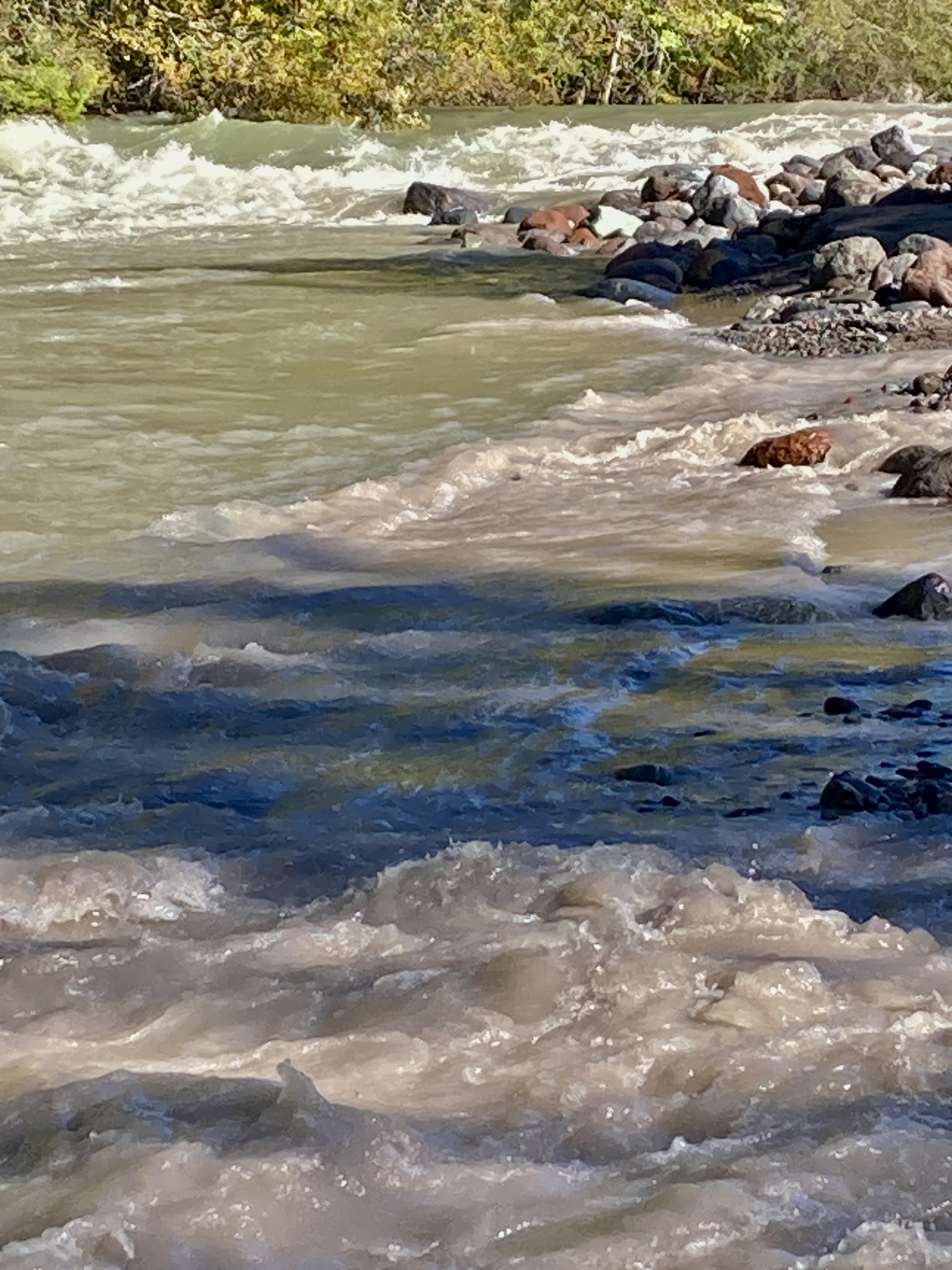
6 October 2025 – We are up & off the Sea to Sky Highway, just beyond Squamish, toes to rivulets of the Cheakamus River.

The salmon run season has begun and — if we’re lucky — we’ll see salmon battling their way back upstream in their natal creeks & rivers, to spawn.

We couldn’t ask for better conditions. The day is sunny & mild, and the view, whether downstream…

or upstream…

is glorious.

Our eyes are trained on the turbulent white water in that far upstream channel, over there high on the left.

We tell ourselves: Yes! A flash of fins! An arched back! Yes!

(Truth is, I’m not sure. Not really-truly.)

But, y’know…

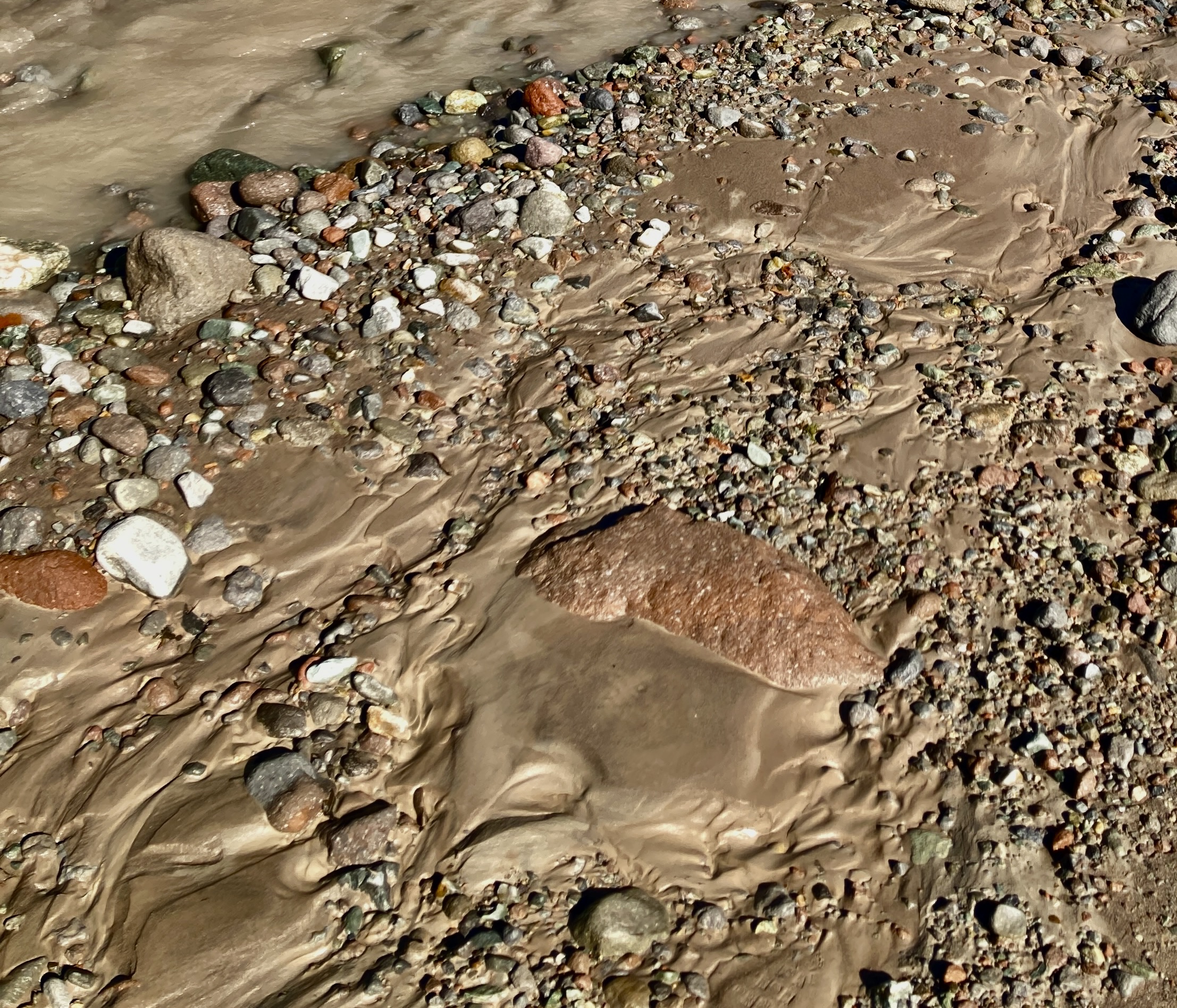
The mud flats gleam with swirling chocolate patterns…

the pebbles & rocks are varied & colourful…

the sun is warm on our backs…

and the music of tumbling water fills our ears.

So…. did I see any salmon? Don’t really know. 

Don’t much care!

Snowy Owl + Mailbox Spider

12 September 2025 – More old + new, here in Toronto. The joy of time with old friends and familiar places, but also the joy of discovery.

For example, Biidaasige Park — some 40 hectares once complete, down at the mouth of the Don River and part of an even larger overall program to re-gentle, re-green and detoxify the sprawling Port Lands for what we now understand to be wiser, more multi-purpose and more inclusive use. Read more about Biidaasige (“Bee-daw-SEE-geh” with a hard “g”) on the City‘s website, on an analytical design website, and in her 6 September “As I walk Toronto” post by our WordPress colleague, Mary C.

The park is very much a work in progress, but some elements are already in place. They include several imaginative children’s playgrounds, one of which has as its guardian spirit, Snowy Owl.

Not only is his open tummy a stage for all kinds of child-friendly events, the interior of his body is open to visitors as well. You can walk inside…

and start climbing. Stairs, then ladders, and up you go.

Bang-thwack-ouch! Smack your head a few times and you finally realize the structure is child-scale. You learn to bend and duck accordingly.

Your reward? You get to look out through the Owl’s eyes, across the undulating playground, across Commissioner St. and westward toward downtown.

I scramble back down. We take ourselves off to explore trails down in the marshy areas around the various channels.

I am awestruck. This grubby, much-abused waterfront is being transformed. We lean on the railing of this pedestrian bridge and admire the grace of the new vehicular bridges, the abundant wild greenery along the banks, the habitat all this must offer for so many species. (Plus the knowledge of habitat yet to come, in plans for housing and further human community and settlement as well.)

And then… we move on.

The day is hot, and sunny, and, thanks to on-going park construction, noisy. We want still to be close to nature, but somewhere that offers soothing shade and a lack of noise.

All of which leads us to discover…

Mailbox Spider.

He is only some 4-5 km. away, slightly south-west of Biidaasige Park…

but in a very different world. The world of the Toronto islands.

More specifically and of importance to me, we are on one small island within that larger cluster: Algonquin Island, which is reached by a pedestrian bridge close to the Ward’s Island ferry dock.

Trace your finger over that pedestrian bridge and tap the intersection just off the bridge: Omaha and Ojibway avenues. Got it? Right there on that corner lot, almost invisible within its own mini-forest of trees and shrubbery, there is a white cottage. The white cottage where, 60 years ago, I used to live.

So it’s heavy-duty nostalgia time for me, and my friend is generously indulgent.

We stop, immediately off the bridge, to explore the community take/leave stand. It was active decades ago and, to my delight, is still active now.

A couple of Algonquin residents are near-by, people about my age. We chat, I explain I used to live here, I name a few names and they smile. We three didn’t know each other, but we each knew these other people.

Then, my friend and I, we just weave slowly up and down the narrow, car-free streets. (It is on Ojibway that we meet Mailbox Spider, with his blue cottage tucked away in the rear.)

The atmosphere is leafy, and peaceful. It is now a world of pretty smooth relations between residents and City — the welcome resolution of the long fight by residents and supporters to protect any residential community at all, in the face of the City’s desire to remove everybody and make the entire islands cluster into one big park. Now most of the land mass is park, but residential communities are recognized and stable on both Ward’s and Algonquin.

We reach the foot of Ojibway Avenue, down at Seneca, which runs along the island’s harbour-side waterfront, and offers panoramic views back across the water to the city core.

Including that CN Tower. I gave you only a distant and slivered view in my previous post; here it is, front and centre.

Still on Seneca, a good example of visitor/resident co-existence:

a bench for tourists and residents alike; one of the island’s many art boxes, again for the pleasure of tourists and residents alike — and a hammock in a resident’s front yard. For that family only, thank you!

Finally, my nostalgia satisfied and our minds and bodies refreshed by the peaceful environment…

we board a ferry, and head back to the city.

Land Cruise: 4 September

Somewhere north of Gillam, the sun not yet visible, but the horizon glowing…

and, an hour and a half later, the first glimpse of Churchill, its massive port structure.

We arrive. We scatter, each to our own priorities.

Mine will take me pretty directly from the train station (the dark oblong near the top of that bottom blue loop) straight through town to Hudson Bay.

Not quite directly. First a stop to refuel in the Seaport Hotel’s coffee shop.

It is clean and cheerful, unpretentious, and near the station. A convenient pivot-point. (I have no idea of the dramatic role it will play in my life, later that day.)

Fortified, I take my own boots past a boots mural…

straight-lining it to the water.

And there it is.

There, too, is one of the warning signs I’ve been told about. The polar bear “season” has not yet quite started. But this is the polar bears’ world, and they live by their own instincts, not the schedule of glossy tourist brochures. Every visitor is told to obey all the signs. Yes, I am told, go to the beach area, but no, don’t go to water’s edge, because bears can rise right up out of the sea, and don’t go near the rocks, because that’s where they like to hang out. As the tourism rep in the train station explains to the person in front of me: “You wouldn’t want to step on one.”

Lots of “don’ts.” I take them seriously. You have to respect nature.

So I do something very safe. I climb this convenient, if unorthodox, observation tower…

right to the top level.

Where, first, I view the forbidden rocks to the east …

and then, second, I focus on the beach right in front of me.

I focus, specifically, on the man way down there at water’s edge, walking happily along — man plus small dog, equally happy and unleashed.

This dog.

Not eaten by a polar bear, as you can see. The dog’s owner is a quite elderly Inuk, so I decide if anyone can give me reliable advice, he’s the one. I greet him. I say I watched him enjoying his shoreline walk, and I’d like to do that myself.

He explains he goes there because he likes to pick up stones. “Me too!” I cry. We beam at each other, dig in our respective pockets, and hold out our handfuls of stones for mutual inspection. Much murmured enthusiasm and poking at treasures ensues. After all that, I ask about safety. He says, “You have to watch. I don’t see any bears around right now.” He adds that if I position myself behind the sand bar, I should be fine, since I won’t be next to deep water.

With further compliments about our respective good taste in beach stones, we part company. He toward town, and I straight to the rivulet behind that sand bar.

Where (bottom left)…

I keep the promise I made my toes, that day on the Point Grey beach.

The day is cool — about 9-10C — but sunny and not yet windy. I continue walking the beach, completely happy. I see beluga whales cresting the water surface — just arcs of white, rising and falling, nothing dramatic, but clear enough for me to know they are indeed whales and not waves.

Finally, I walk west toward another line of forbidden rocks…

obediently stop short, and turn inland.

These bright, helpful signposts are all over town. This one is just uphill from the beach, and persuades me to visit the Granary Ponds…

with an initial stop in St. Paul’s Anglican Church, there on the left.

I look at various artefacts, including this 1930s Cree plaque quoting scripture from the Gospel of St. Matthew…

and I read the 2008 Federal Government’s Statement of Apology, signed by then-Prime Minister Stephen Harper, to all those who suffered under the residential school system. Here’s an excerpt:

The road out to the Granary Ponds leads me past riots of wildflowers, still vibrant so late in the season…

and then a closer view of the Port of Churchill…

which, if political promises are kept, will benefit from major expansion in the near future. (An initiative announced by Prime Minister Carney during a European trip — one more move in building stronger and more diversified relations with other parts of the world.)

I backtrack into town. My one goal is to walk. A lot. Though I’ve had only one prior visit to Churchill, in the early 1980s, I spent a lot of that decade going in and out of the Arctic hamlets. I haven’t the foolishness, the arrogance, to think I am any kind of insider, but I do still resonate with all of this. Young self did lots of jumping around. Old self seeks only to put feet on the land, to see and smell and hear the land, and be in this place. So I walk.

And, oh yes, I see very northern sights.

This truck decal, for instance…

and this komatik (sled), waiting for winter…

and this polite request in the doorway of Itsanitaq Museum.

But I also see streetscapes that could be anywhere in Canada.

There are community gardens all over Canada, as well…

though this one takes proper northern measures to protect the crops.

Right next to it, a happy pod of beluga whales, swimming a very different ocean.

And then… and then, no more pictures.

Because then, getting on for 5 pm, my gut announces that it is not pleased with the tasty falafel bowl I had for lunch in a highly recommended local bistro. My gut makes clear that it plans soon to start Throwing Out the Garbage.

This will be merely unpleasant, not dangerous, but also highly inconvenient. The train station is not yet open and I am not registered in any hotel. I’m again near the Seaport Hotel, so I walk in. What else can I do? They look after me. I am safe and sheltered. My gut can briskly go about its housekeeping detail in privacy. When I finally totter off to the train station, a fellow passenger, the station staff and VIA Rail staff are all equally practical and kind. Soon I am whooshed aboard the train, tucked up in my own sleeper-cabin. After a few more rounds of garbage-removal, I sleep. When I wake again, I am completely well. It’s all over.

So is the day in Churchill. Our train is now in motion.

I lie there, think about all that helpful kindness — and decide that my little bout of food poisoning was in fact the final heart-warming event in a thoroughly wonderful day.

Land Cruise: 1 September

1 September – I’ll be one day and a bit, in Winnipeg. On the land, and on the water too.

The theme of land and rivers, the two great pathways of our country, keeps gaining strength. Not because I intellectually seek it out. Because it is imposing itself on me.

A tear-off map at my hotel inspires my walk: down to the Red River, there behind the Canadian Museum for Human Rights, and then along the walking trails up into Stephen Juba Park, back down and around the curve of The Forks (where the Assiniboine River joins the Red), onto the water in a 30-minute tour, and more river-side walking, both rivers.

The Red River. The cereal of my childhood, even my very own Red River coat, as a child.

The river, of course, is more important for reasons other than cereal and coats.

My path along the Red up into Stephen Juba Park leads me past old pilings, last remnants of the glory days of this port (before the Panama Canal opened, and offered shipping an easier, quicker route through the Americas).

This is also when I first tap my boots in the water.

Literal next step in a whimsical project I hope I can complete: having tapped toes in the Pacific (Burrard Inlet, cf. my post of 25 August), I want now to tap them in the Red River, Hudson Bay and Lake Ontario.

Did you notice the trestle bridge, in the distance of that last photo? Used for military purposes, I’m told, and now the train bridge. I’m drawn to it. I admire the utility of these bridges, their visible geometry and, once I draw near, the majesty (albeit scruffy) of the near end of this particular example.

After I turn, after I follow the riverwalk bend around the point of land, I am now beside the Assiniboine River. I tap toes in its waters as well — a bonus not part of the original plan — and, as I do so, I notice a yellow Waterways tour boat mid-stream.

There is a dock, there is a boat about to depart, I climb aboard.

Only one fellow passenger, this early in the day: a Montreal film-maker, in town to work on a production here. Our guide has an impeccably Spanish name and an impeccably Canadian accent: his family moved here when he was two years old.

Kayak going one way, we’re going the other. Miguel is powering ahead, having now explained those three lines on the bridge pillar. Each is a water level: blue for normal spring levels, yellow for the danger of rising waters, red for floods. (I think of my brother’s years in Winnipeg, and the spring he helped sandbag against that year’s inundation.)

Back on land, toes duly tapped in not one but two mighty rivers, I head for the markets within The Forks complex. While you can buy food aboard the Winnipeg-Churchill run, it’s the like of microwaved subs, I’ve been told — the same person then suggesting I lay in some supplies.

So I do. Bison Snack Sticks (Canadian), Thunderbird “real food” bars (American), oat cakes (Isle of Mull) and Gemini apples (very very very local). Tomorrow morning, I’ll snag myself a few hard-boiled eggs from the hotel’s breakfast bar as well.

Feeling sufficiently prepared, I leave The Forks. But not before I admire Caboose 76602, a permanent installation on the grounds.

Built in Montreal in the 1930s, retired from service in Winnipeg in 1988, it is now “dedicated to the thousands of CN train crews who travelled through Winnipeg and the ‘East Yard’ that is now The Forks.”

Tomorrow, 12:05 pm Central time, I’ll be back on board one of today’s trains.

The one that will take me to Churchill.

Toes to the Waves

26 August 2025 – I’m not usually right smack at water’s edge. But today, I am offered easy access to wild shoreline — just one of the Tatlow/Volunteer Parks enhancements, along with “daylighting” a long-buried creek. Who could resist?

First I walk down these steps…

where, second, I draw inspiration from that lone woman in white, ‘way out in front of me.

I give thanks for my hiking poles and waterproof boots, and follow her example.

Now. Statement of principle. I firmly believe that each place has its own beauty. You just have to be willing to stop making comparisons, open your eyes and mind to what is right in front of you, and rejoice in it. BC is no more beautiful than anywhere else.

But today I happen to be here, not anywhere else. I am in the Vancouver neighbourhood of Point Grey, on the south shore of Burrard Inlet, looking north across English Bay (with its usual complement of freighters) to the slopes of West Vancouver over there on the North Shore.

And it is just terrific! Bright, fresh, with enough breeze to ease the heat and send wave upon wave rolling in to tap my toes.

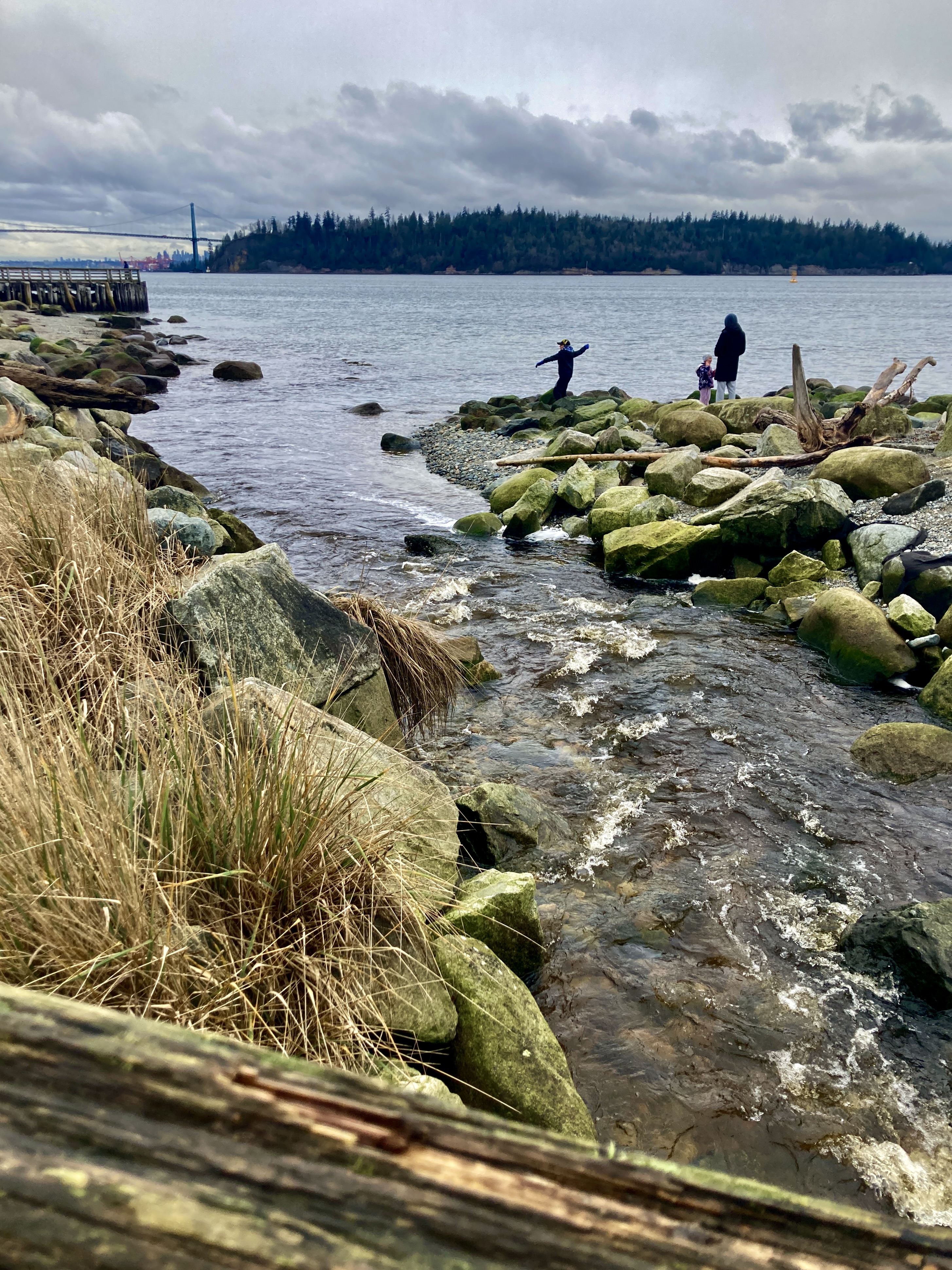
I look west…

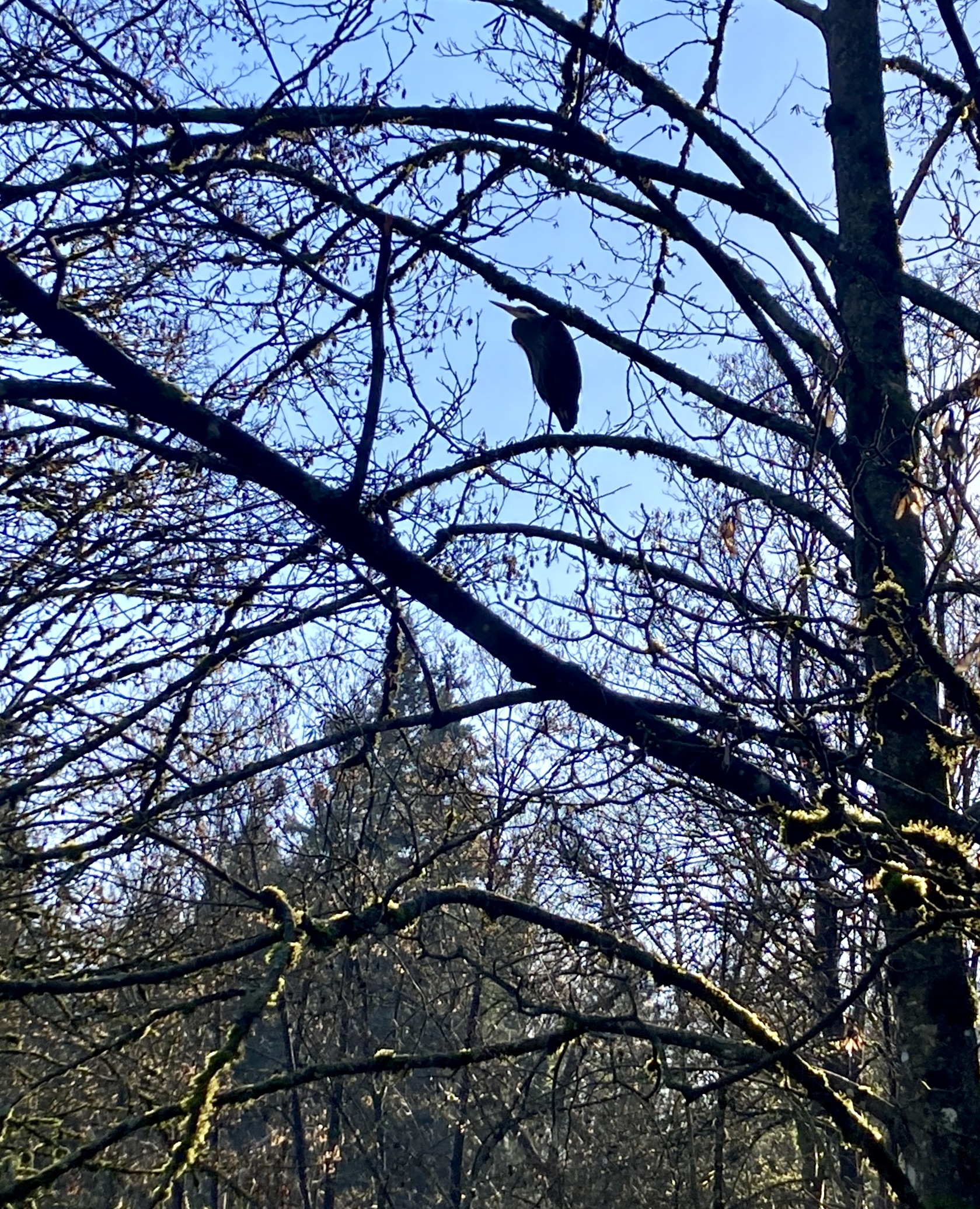
and then blink, and look more closely, tracking my gaze past that final arrow of gravel to a black squiggle in the water beyond. (Spread the image; follow my example.) See? A Great Blue Heron. For once, life is easy. He just opens his beak in each breaking wave, and swallows what it offers him.
I look east…

and this time my gaze takes in the green sweep of Stanley Park, the final knob of the City of Vancouver this side of the North Shore, and, to its right, the towers of the City’s downtown cluster. I’ll be walking east, from here to Kitsilano Beach Park.

So many shades, so many textures…

and the swooping arc of an eagle, passing by.

I break my water’s-edge fixation long enough to veer inland for a bit, drawn by the red fence, its signage thanking us for our patience, and the weathered-jeans-and-T-shirt guy on the inside of the fence, who meets my smiling curiosity with a smile of his own.

He looks like a navvy, he’s inside the fence, I ask if he’s working on the project. He replies, with no particular inflection, that it’s his project, he’s the homeowner — and points upwards, to the house atop the cliff. Being vaguely aware of real estate prices around here, I realize that these workman’s jeans and hands are attached to serious money.

I ask the basic “What are you doing?” and, seeing I’m genuinely interested, he explains. It’s all about the instability of these Point Grey cliffs, their unconsolidated Quadra Sands laid down during the Fraser Glaciation (29,000 to 11,500 years ago) and eroding ever since.

This bit of surface remediation is just the current example of his on-going battle — financed by him, but every step City-approved and with City authorities — to protect the environment and in the process protect his home. An early step was to excavate on the land side of his property behind the cliff face, and stabilize the cliff, invisibly, with I-forget-how-many-zillion tons of concrete. More recently, again with City approval and monitoring, he paid to have several mounds of large local rock arranged in natural patterns on this section of the beach, their job being to break up wave action and mitigate impact on the cliffs. “Last week,” he says, his eyes crinkling with delight, “a Fisheries inspector told me that two different species of mussel are now colonizing the rocks!”

I express my admiration with a tease: “You could’ve taken your great gobs of money and lived large in all the casinos of Europe. Instead… what do you do? You bury your money, literally, in the ground.” He grins, then shrugs a kind of “Yeah-but” shrug. “You have to do what you can. To help. This is what I can do.”

I walk back down to the water impressed, a happy day made even happier.

Bands of colour, look at them: all the greys of the gravel at my feet, green seaweed just beyond, butterscotch sand beyond that, then blue water, white curls of wave, red among those distant freighters…

and, closer to shore here on the right, red also in the Kitsilano Yacht Club dinghies (or whatever they are) — a whole line of them, each full of kiddies being taught boating skills, whose excited voices carry on the wind.

A mysterious imprint in a rock, surely that can’t be natural?

and a blaze of colours, certainly not natural but also not mysterious, on the stones that line the entrance to a path up from the beach.

The stone wall is official; the colours, anonymous and unauthorized. I sidestep both the path and the bronzing bodies beneath it, and return to water’s edge.

But eventually, though water’s edge continues, there’s no longer any way to follow it.

I’ve reached the Kitsilano Yacht Club, just this side of Kitsilano Beach Park. My choice now is to swim around, or scramble up.

Blue Shorts Guy is about to scramble up his section of rock mound; I then scramble up mine. (Less elegantly than BSG, who does it all upright. My scramble involves hands and knees. But it works!)

Suddenly, I’m back in the urban world.

With its fences and notices and CCTV. It is discombobulating.

So much so that, as I walk south on Arbutus Street, this notice tacked to an old wooden pole seems no stranger than anything else.

I too am waiting for coffee — but, unlike Z, the remedy is in my own hands.

Just as soon as the bus drops me back home.

That Smile

18 August 2025 – I’m just off a False Creek ferry and walking uphill toward home, still full of Flat White and café chatter with a good friend, when I stop to admire another good friend. (Albeit in a different category of friendship: painted, not human.)
There she is, high a-top her alley home, her quizzical smile floating out across the neighbourhood.

Is she our Mona Lisa, 21st-c. alley-girl version?

No. Given the pace of local redevelopment, and the building that is her home, she is our Cheshire Cat. Soon she will be gone, with only her smile lingering behind, and only in memory.

I”m standing at 3rd Avenue & Ontario Street, the intersection at the north-east corner of that L-shaped site, outlined in red. This is the huge redevelopment site purchased by the PCI Group in 2021, whose redevelopment proposal finally received City approval in May of this year. Cheshire Cat Smile is mid-way down lot 5, on the south side of the alley.

I head down the alley. Not for the first time, but it’s different every time, isn’t it? (No need to repeat the Heraclitus discussion…)
Crow in a convex mirror! I’ve never noticed him before, so already the alley is different.

The actual crow, opposite…

which causes me, for the first time, to pay attention to the mural as a whole — signed R. Tetrault and, as I later learn, called Flight Path.

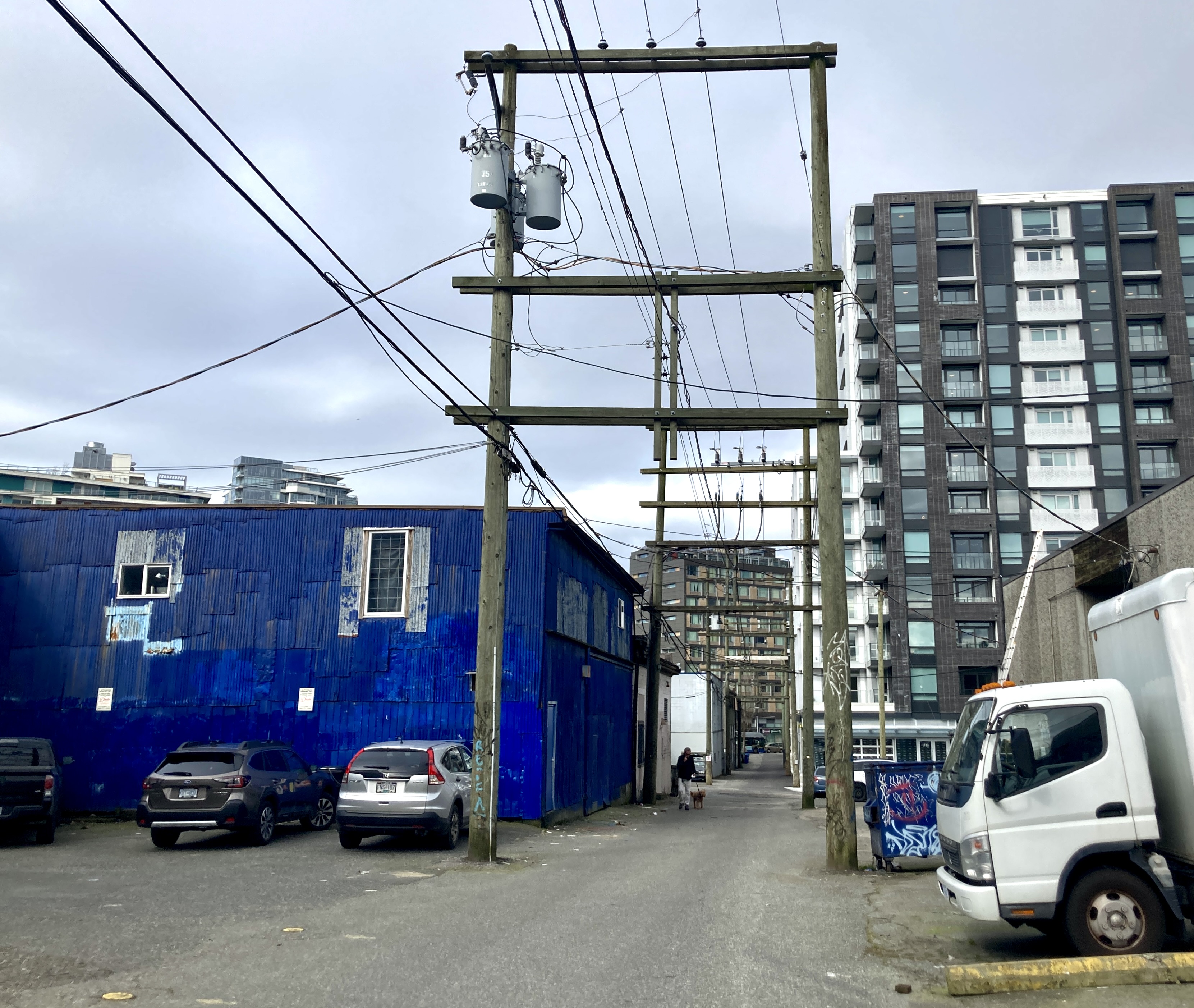
Murals both side of an alley and a whole line-up of hydro H-frame poles in between! Sigh. Life is perfect.

I tip my head, pay homage to the Cheshire Cat Smile…

knowing it’s tagged Lil Top but also knowing I’ve never been able to find any info about that tag. So Cheshire Cat she has become.

The woman I’d noticed under the nearest H-frame, as I photographed Flight Path, is now standing next to me, also enjoying the art.

“It’s people expressing themselves,” she says. “And we get to look at it for free! It makes us happy.”

She points: “Like that flower, that butterfly.”

I point to the message next to it, which sets us both laughing.

And then we go our separate ways, each dawdling where we each prefer to dawdle, walking the line of Ciele Beau murals opposite Flight Path.

I pause at a doorway, its notice as outdated as the reminder to “call your mum.”

Nobody, employee or otherwise, will be entering by this door ever again, I tell myself. Or by any other door, on this doomed brick building.

Ghosts of Eras Past to the north of me as well — torn fencing frames the Cosmic Breeze mural on 3rd Avenue, painted by Olivia di Liberto for the 2019 Vancouver Mural Festival. RIP, VMF.

I leave the alley, turn the corner onto W 4th. I’m now looking at the block-long southern length of the site, Ontario to Manitoba. All boarded up, waiting for What Happens Next.

This artist’s rendering shows What Will Happen Next.

“Innovative industrial and commercial uses,” says the corporate website, “heritage retention and refurbishment, office, daycare and ground-floor food and beverage… centred around a new public plaza.”

Now that I’m home, and learning all this… I have to do a little rethinking, don’t I? And so do you.

Employees will once again go in and out of doors in the corner brick building, which is not doomed after all. And Flight Path may fly again. On his website, Tetrault explains he painted it “on plywood for removal and reinstallation on a new commercial development.”

But, ohhhh… Cheshire Cat will be gone.

Her Smile will have to float in our memories.

  • WALKING… & SEEING

    "Traveller, there is no path. Paths are made by walking" -- Antonio Machado (1875-1939)

    "The voyage of discovery is not in seeking new landscapes, but in having new eyes" -- Marcel Proust (1871-1922)

    "A city is a language, a repository of possibilities, and walking is the act of speaking that language, of selecting from those possibilities" -- Rebecca Solnit, "Wanderlust: A History of Walking"

  • Recent Posts

  • Walk, Talk, Rock… B.C.-style

  • Post Categories

  • Archives

  • Blog Stats

    • 129,014 hits
  • Since 14 August 2014

    Flag Counter
  • Enter your email address to follow this blog and receive notifications of new posts by email.

    Join 2,045 other subscribers