23 November 2024 – A play on “bright & early,” of course, and a favourite winter-time quip of the host of the CBC early-morning radio show that I listened to for years.
He’d sign off, promising to greet us again the following morning, “Dark and early.”
What came to mind yesterday, as I walked an alley just off East Broadway & Brunswick…
is that, this time of year, “dark & early” describes both ends of the day.
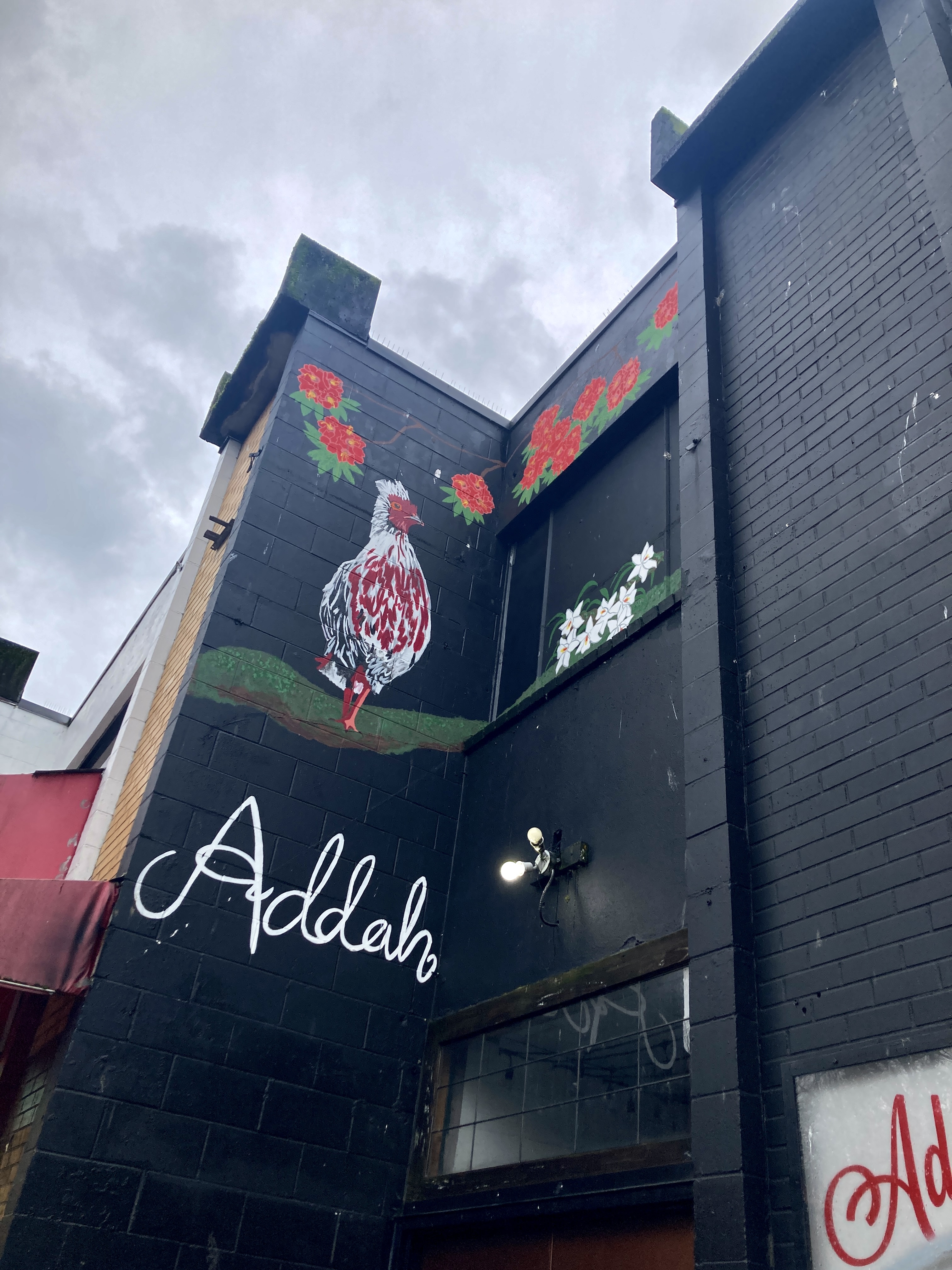
It is exactly 3:53:36 p.m. — not yet 4 p.m.! — and Nomi Chi’s VMF mural (2016, the Festival‘s inaugural year) broods with extra drama in the failing light.
(I know the change is increasingly dramatic, the farther north you go. I do know this. I spent time in Inuvik, one January, and learned that the Arctic is not only the Land of the Midnight Sun, it is also the Land of the Mid-day Moon. But… now I am here, and here I am now, and this is what I notice, in my here-and-now.)
18 November 2024 – This weekend — for the 28th year — was the annual Eastside Culture Crawl. I take advantage of Sunday’s better weather (merely iffy, as opposed to torrential) to join in.
I’ll visit studios like this one…
but mostly, as seems to be my personal Crawl tradition, I’ll just go for a big old walk. And visit some studios along the way.
When I cross 2nd Avenue, northbound on Scotia Street…
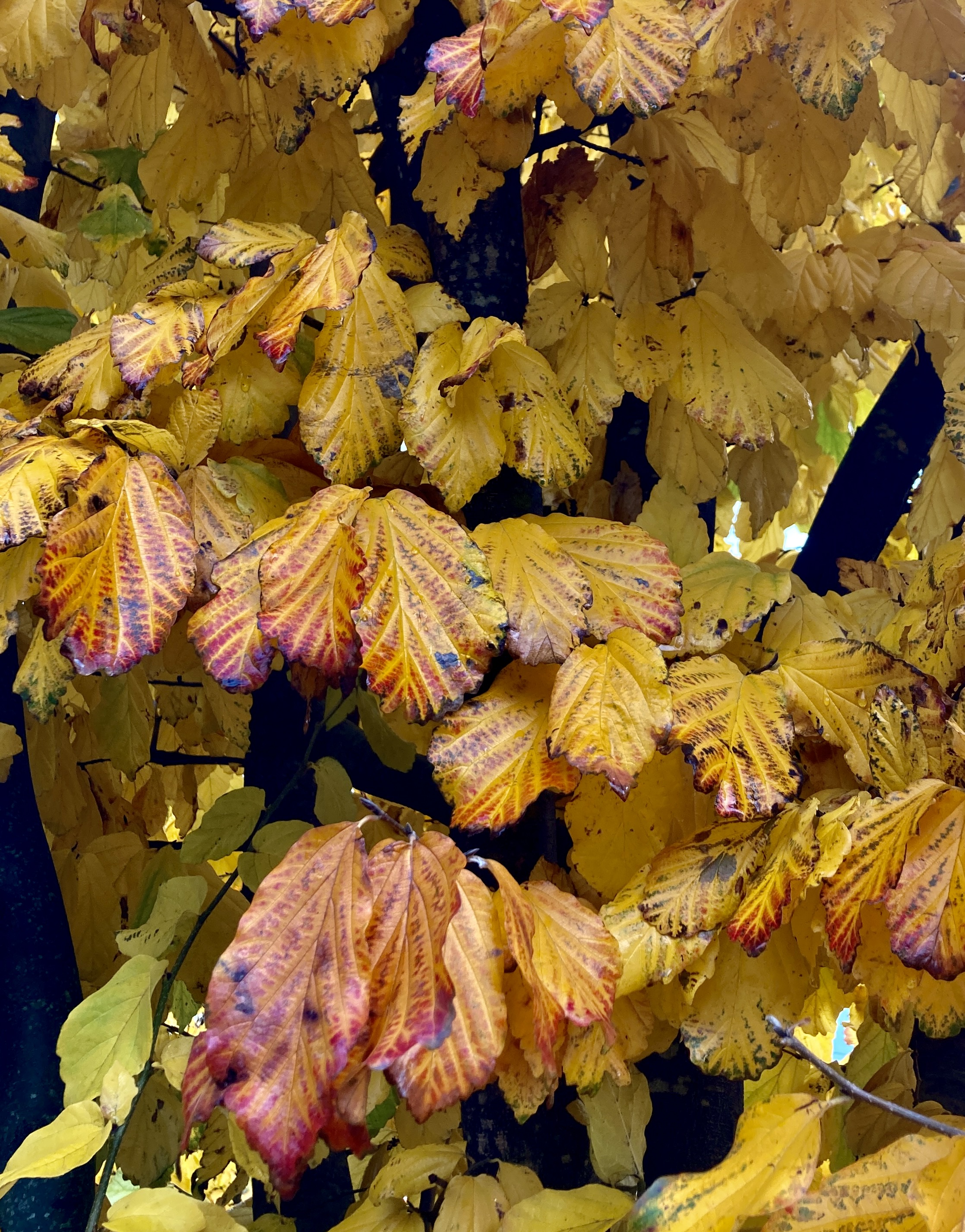
flaming beech trees welcome me to official Crawl territory: it runs from the waterfront farther north to right here, 2nd Avenue. (And, east-west, from Victoria Drive to Columbia Street.)
Also part of my personal tradition: my first visit is always to the bustling Arts Factory on Industrial Avenue, but before that — just to get in the mood — I loop my way through the False Creek Flats, taking in their evolving mix of new facilities and old warehouses as I go.
Streets in here have helpful names. Western Street runs up/down the Flats’ western boundary; Station Street to the east runs to the train station; and they are connected, you’ve guessed it, by Southern, Central and Northern streets, in the appropriate geographic order. North of Northern lies Terminal, and beyond that, Industrial.
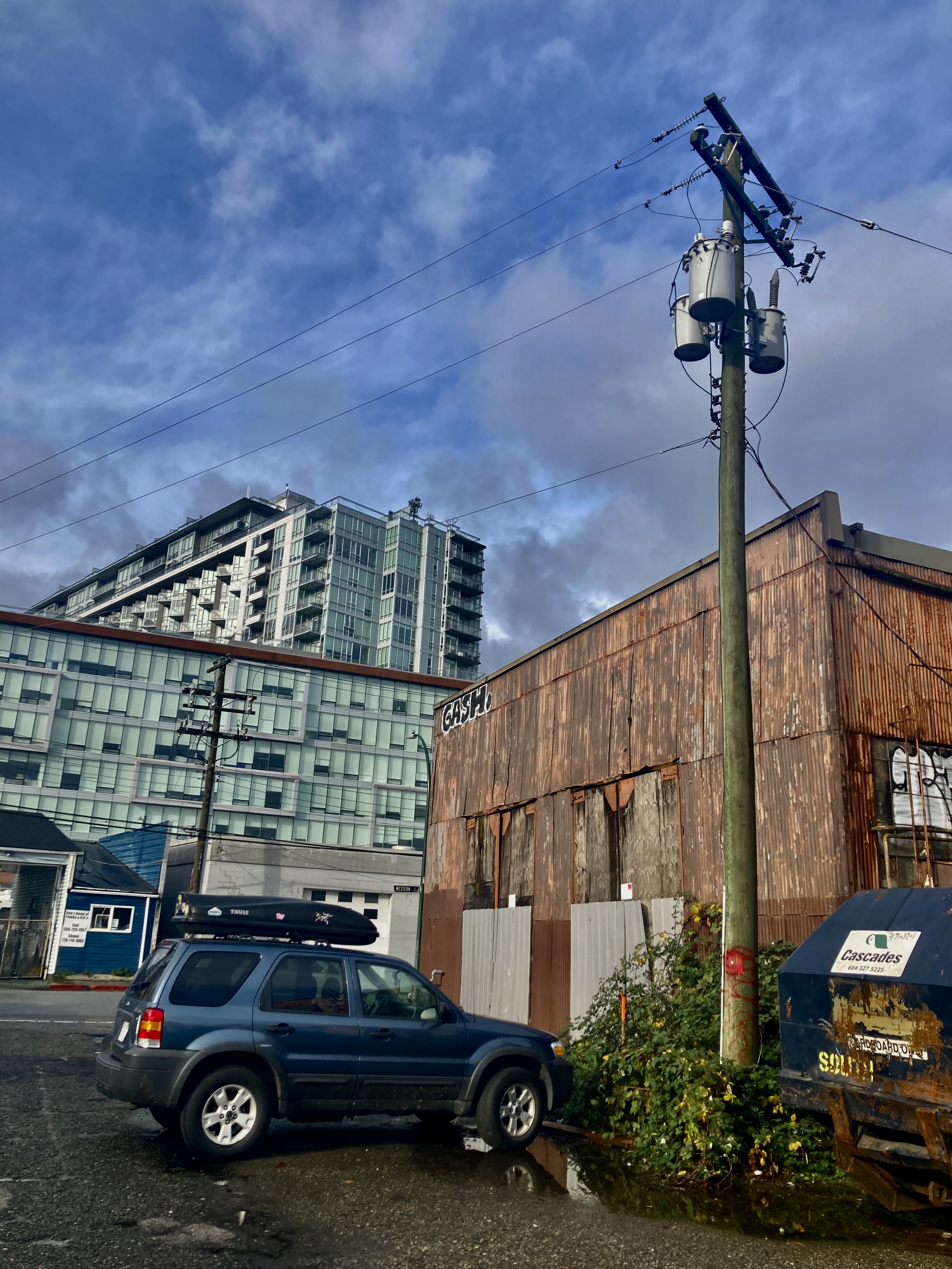
I pass one of my all-time favourite rusty warehouses at the corner of Southern and Western, now with a gleaming new high-ish rise in the background…
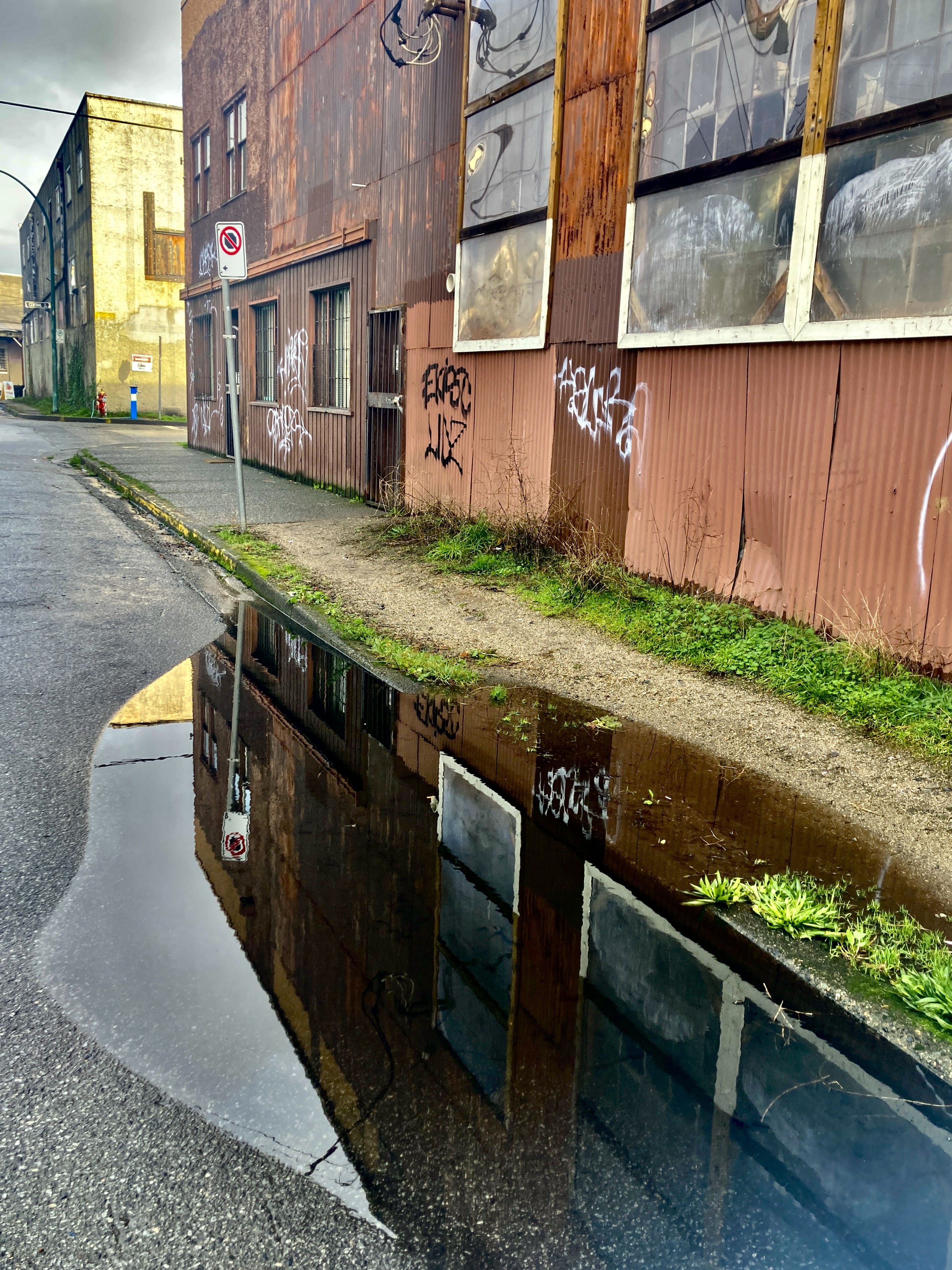
but I’m even more taken by this tear-drop puddle reflecting the warehouse back at me, as I round the corner to head north on Western.
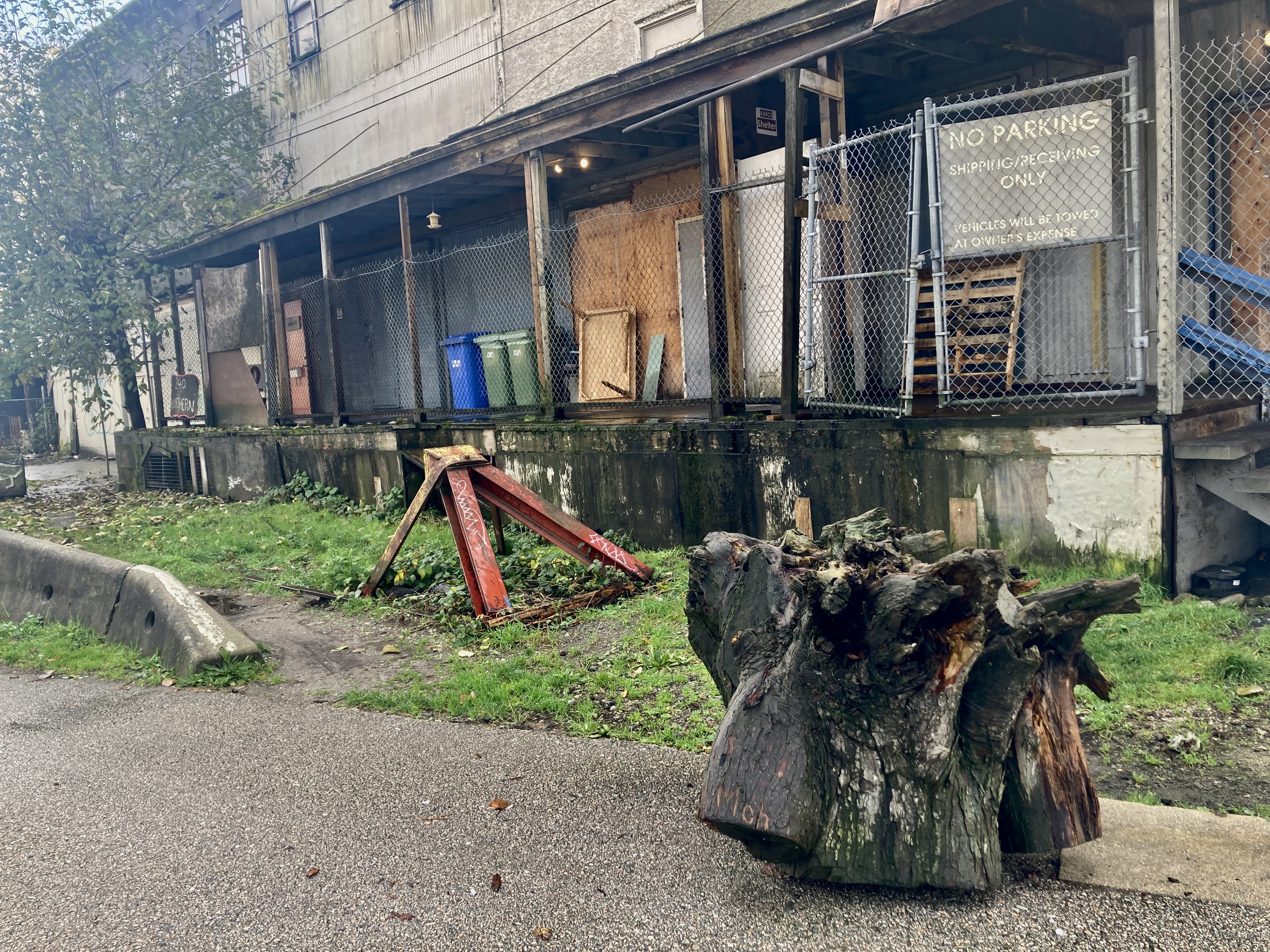
A huge stump marks the corner of Western and Northern. The building looks more derelict every year, yet it is still in operation, as its grumpy shipping-receiving notice makes clear.
After my visit to the Arts Factory, I double back west to Main Street. This makes no logistical sense at all!
It’s the most perversely roundabout way possible to get to Gore Avenue, which houses the three studios I’ve decided to visit this year — but, hey, I’m out for a walk, right? The rounder-about it gets, the better.
And I’m glad for my few blocks on Main. They take me past something that may look bleak, but deserves respect.
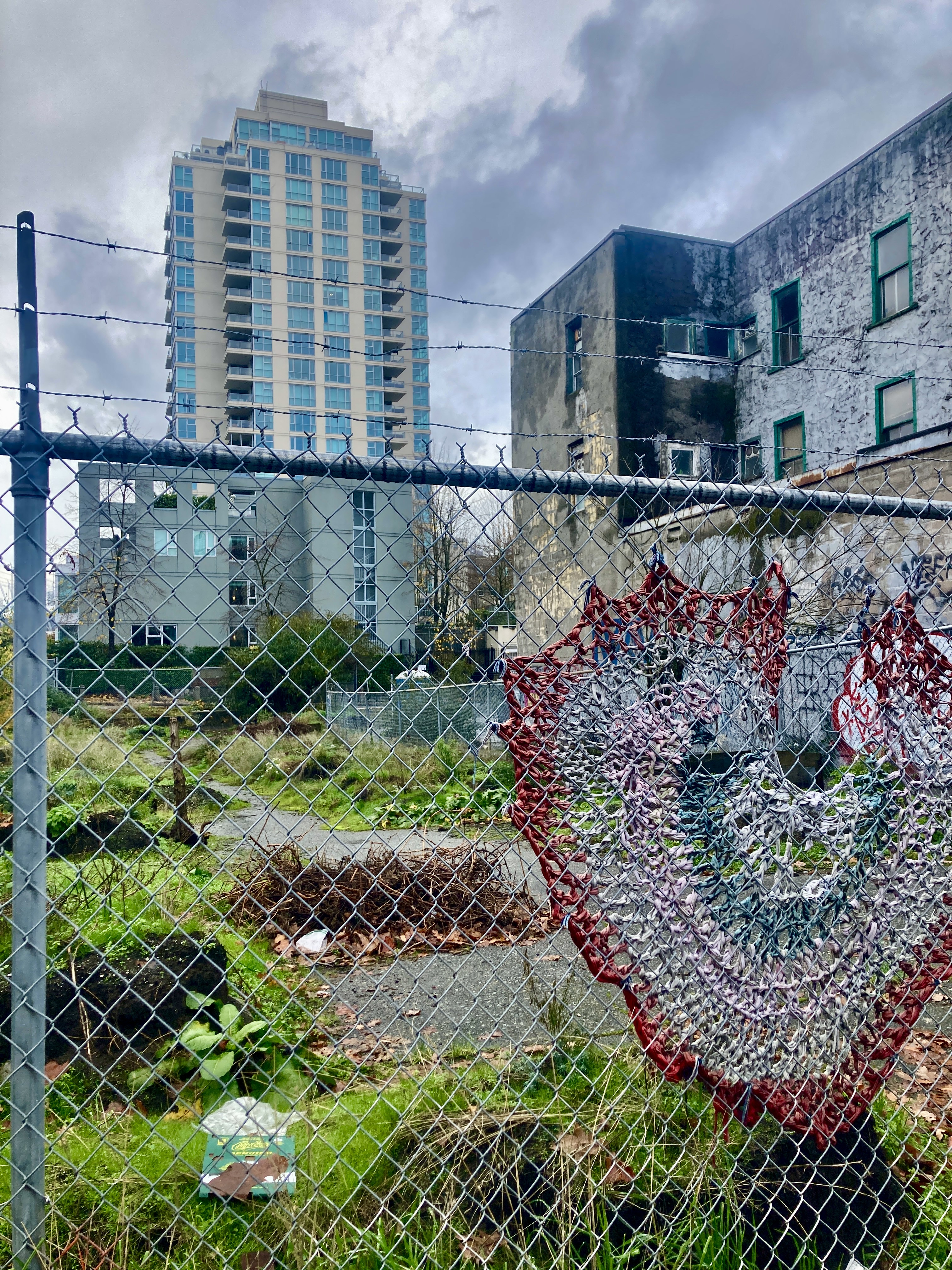
Yes, it’s behind chain-link fence and yes, it is November-dreary. But it is also a seasonal community garden, here at the corner of Milross, and it bears our local Yarn Bomber’s tribute of a crochet heart — recognition of the resilience of people doing what they can, in a tough context.
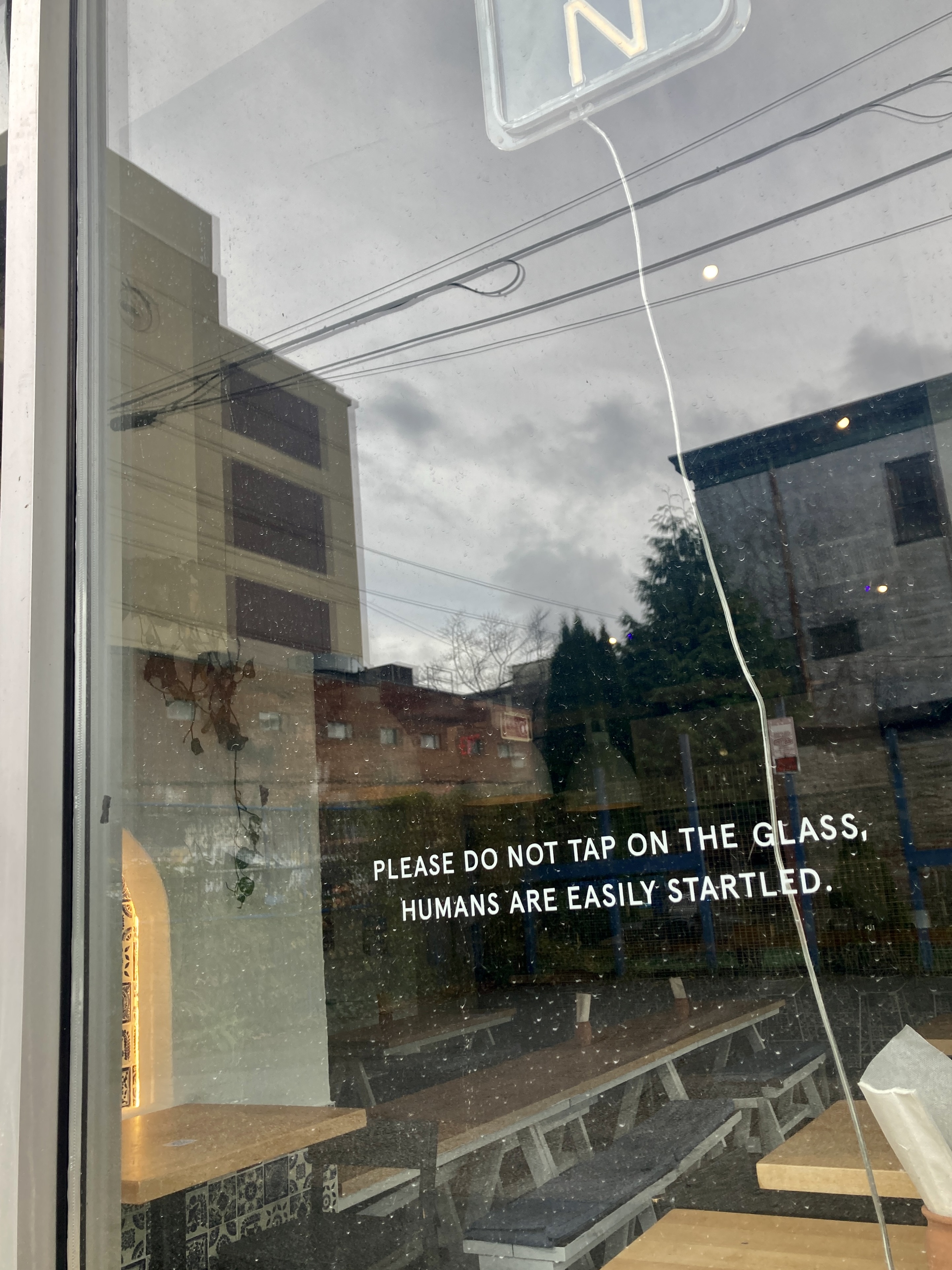
Back east along Prior, heading for the end of the block where I will turn north on Gore. I plan to scoot right along, but I’m stopped by this Mexican cervecería, just past Hogan’s Alley.
A moment for a giggle, and then eastward-ho to the corner of Gore Avenue, with the venerable Hunnybee Bruncheonette [sic] on the left and equally venerable Strathcona homes on the right.
I’ve walked along Gore on other occasions, but it’s always been the ground-level shops that caught my attention — I’ve never thought who might be doing what, higher up in these old buildings. Today, I start to find out.
First target: Godzilla Studios, where one workshop — Street & Saddle — will be open to visitors. Once inside, once upstairs, I’m distracted en route by the instructions I see through an open washroom door over the waste paper bin.
Politeness seems to work! The bin is full to the brim, but the floor is clean.
On down the hall to Street & Saddle, a warm, welcoming and very impressive workshop of cheerful people and good clothing. Good business practices, too, as I learn from this sign on a counter top:
Isn’t that the best? Each year, their little shop keeps a whole pony’s-weight of fabric out of landfill.
Back down the stairs, out the door, on up the street to the Pot Spot Studio.
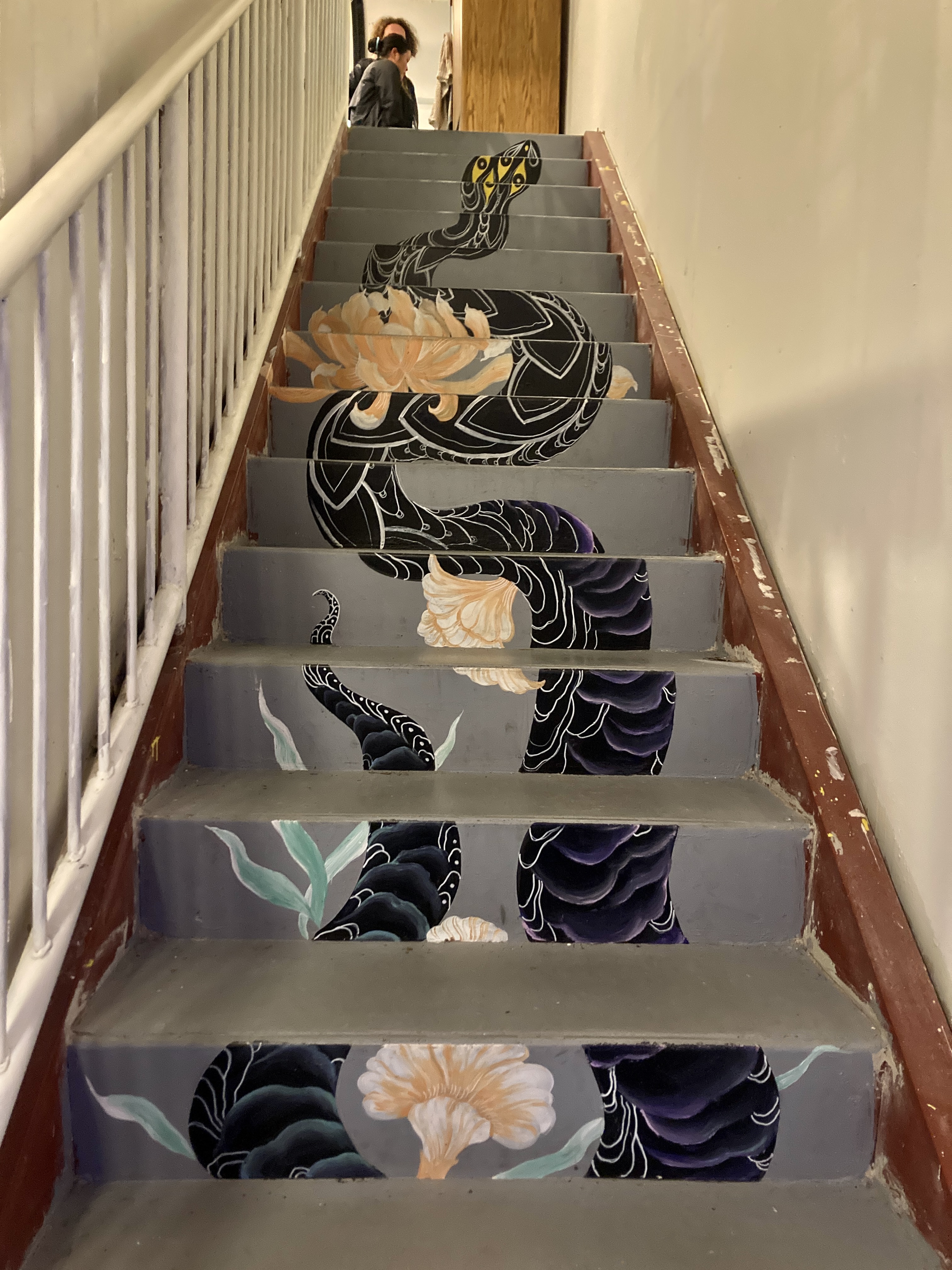
A word about stairs. Stairs literally come with art-crawl territory, since studios are usually located in the higher reaches of their respective buildings. Savvy artists, like these Pot Spot folk, make sure you know which stairs to climb…
and then give you a bonus.
Turn the corner to climb those red-arrowed stairs…
and a serpent leads the way.
As the potter at this top level studio wraps some purchases for other visitors, I hear a bit of his backstory: from his Russian homeland, to art school in Jerusalem, to — one year ago — Vancouver. I think of the losses, the struggles, the terrible choices that must be locked up in that chronology, and tell him I wish him well in his new life. His eyes soften, he nods acknowledgment.
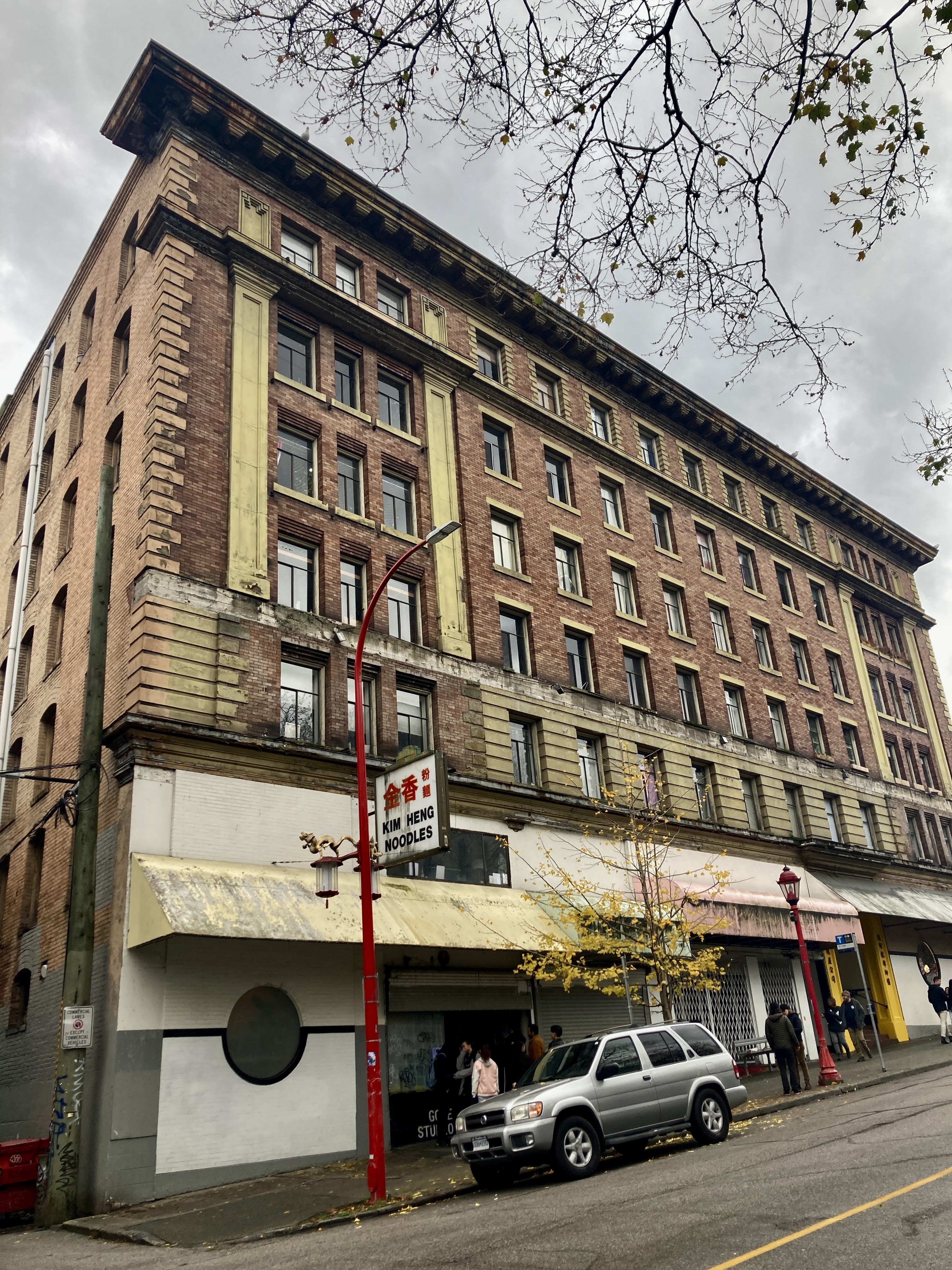
North again on Gore, on to the eponymous Gore Studio, can’t miss it, just follow the sign for Kim Hung Noodles. (It’s the doorway I teased you with, at the start of this post.)
In, and up.
Again up.
And the invitation to go on up yet again. Again.
I’m not sure what that is! A multi-coloured toilet roll? An aerosol paint can? Doesn’t matter; It’s of a piece with the fantasy-land all around.
I find myself taking photos for some enchanted visitors who are struggling with their selfie technique, then do my own tour of the wonders, and then leave. Back down all those stairs, back out onto Gore Avenue.
With a last glance at that impressive building, noodle ghosts and all…
I walk past the Himalayan restaurant next door…
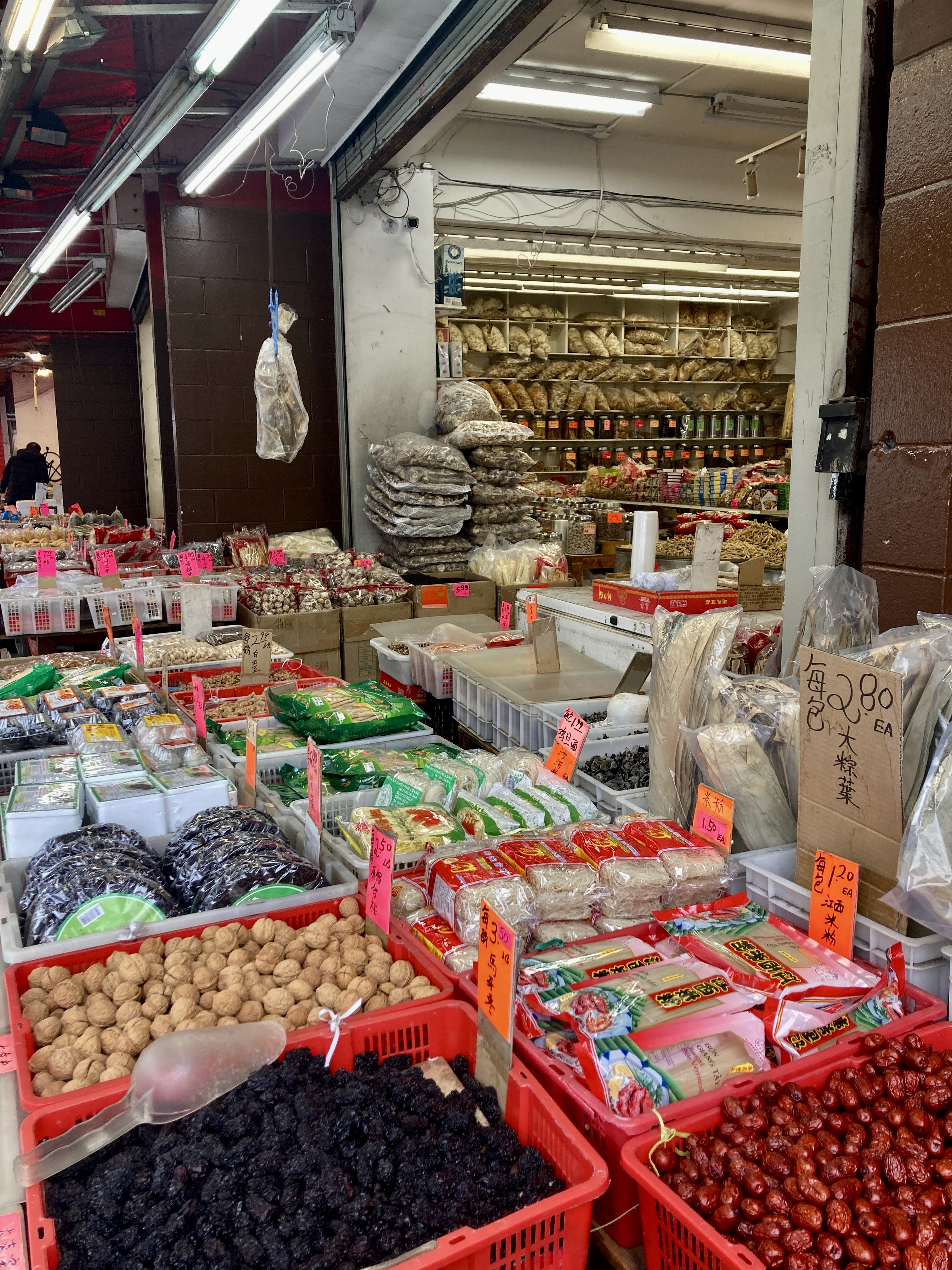
past the gloriously pungent Chinese market spilling out over the sidewalk…
and finally take myself back out to Main Street, and a bus ride home.
16 November 2024 – I enjoy walking this ‘hood, this part of Fairview. It’s a quiet stretch of older wooden homes, all very human scale and welcoming, with their front porches and front gardens.
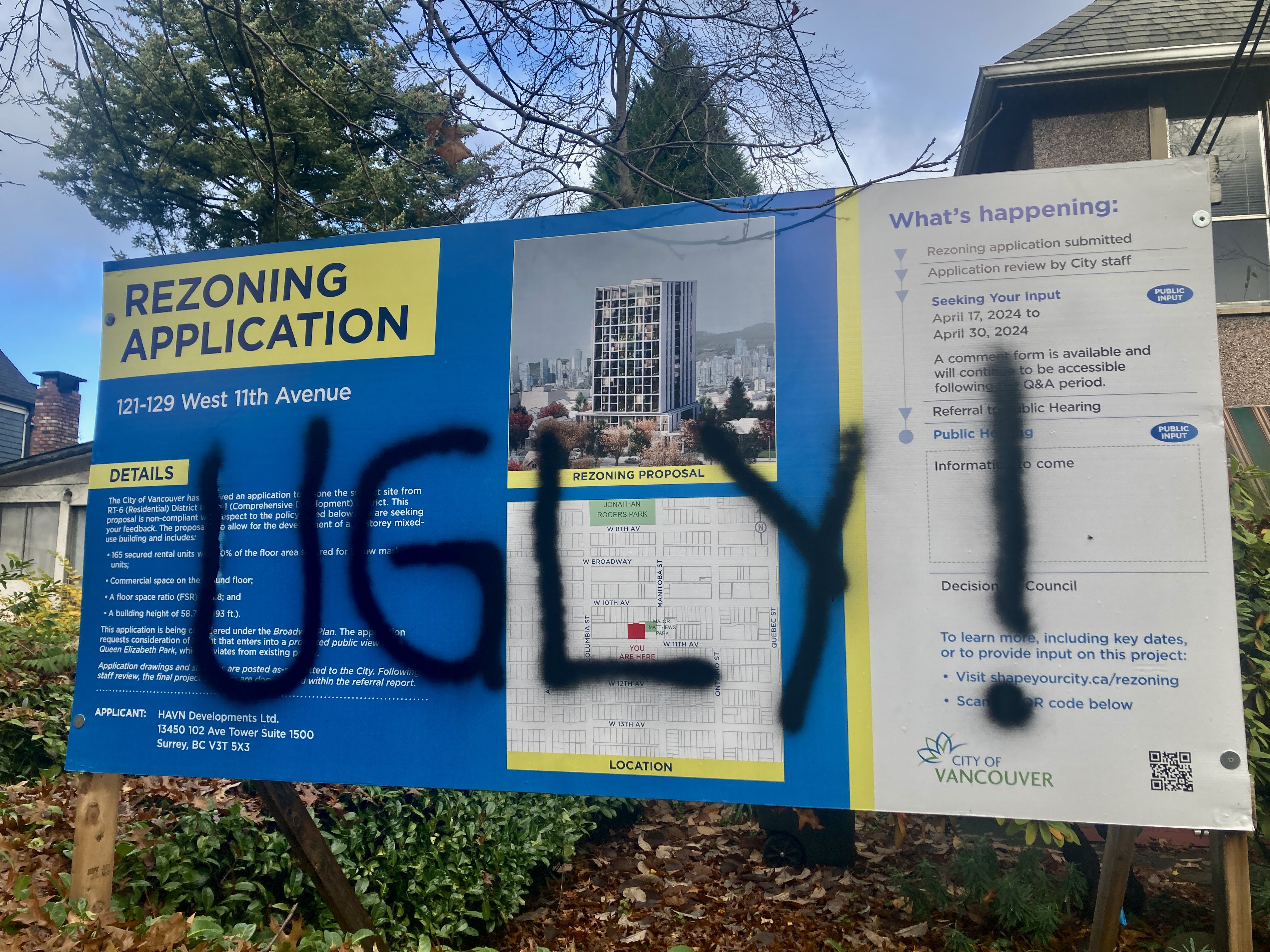
But this street, indeed this whole area, is adjacent to the Broadway traffic artery and lies within the ambit of the comprehensive Broadway Plan — which, for all its consultations and talk of public space, is focused on intensification.
Land Assembly billboards have become commonplace.
The future is on its way.
I’m with Graffito Guy. It’s gonna be ugly.
On a happier note!
The Very Large Waterfowl I showed you in the previous post has been identified.
In her comment on the post, Lynette d’Arty-Cross was cautious enough only to say she was “reasonably certain,” but that’s good enough for me. We’re looking at a juvenile trumpeter swan.
Thank you, Lynette.
Do the rest of you know her blog (In the Net! – Pictures and Stories of Life)? If not, click here. You’ll be glad you did.
12 November 2024 – It’s definitely a leaden sky up there, but down here there’s lots to look at. Plus there’s a rain jacket in my backpack. I am equipped.
Colours pop against all that grey.
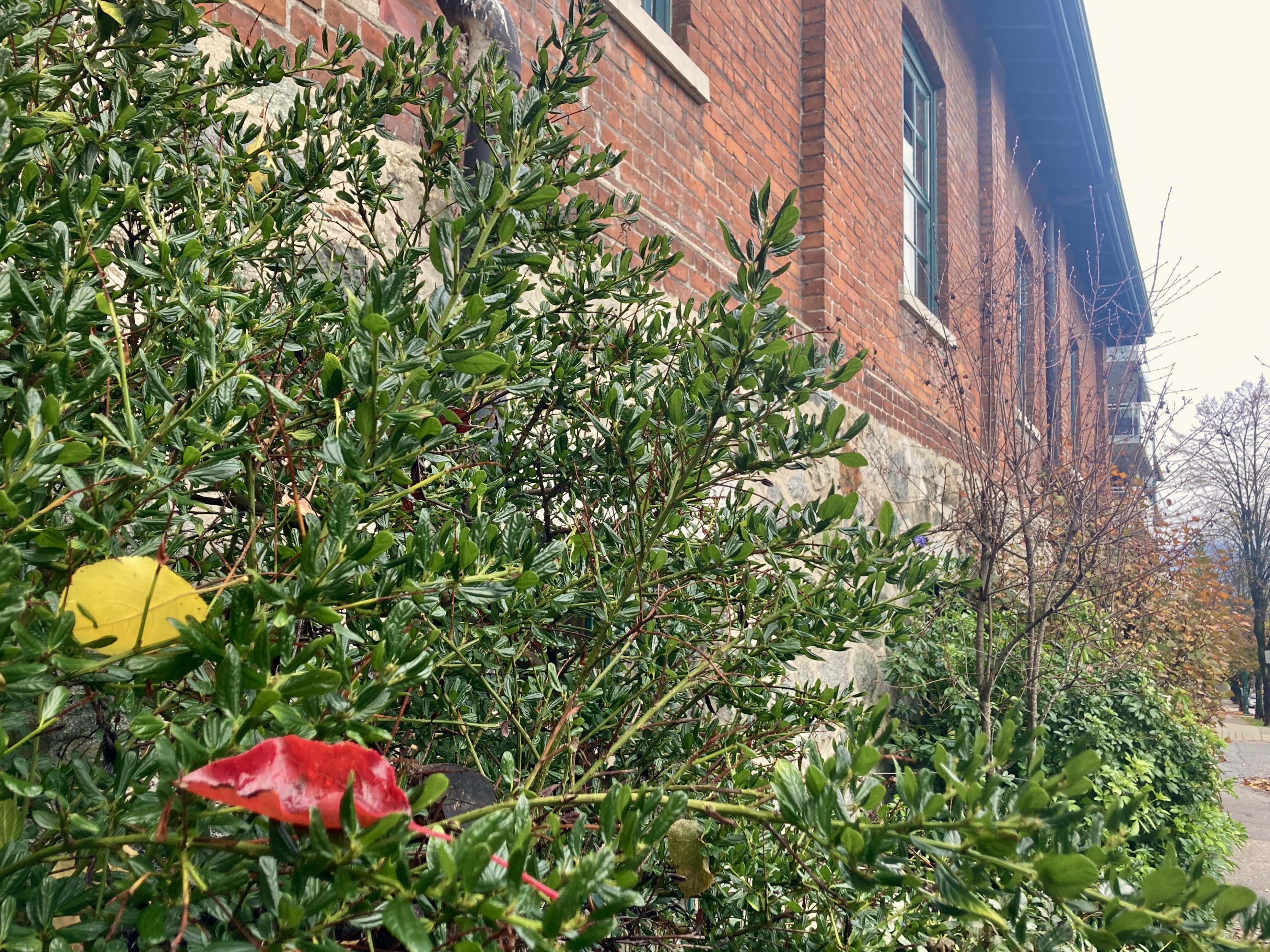
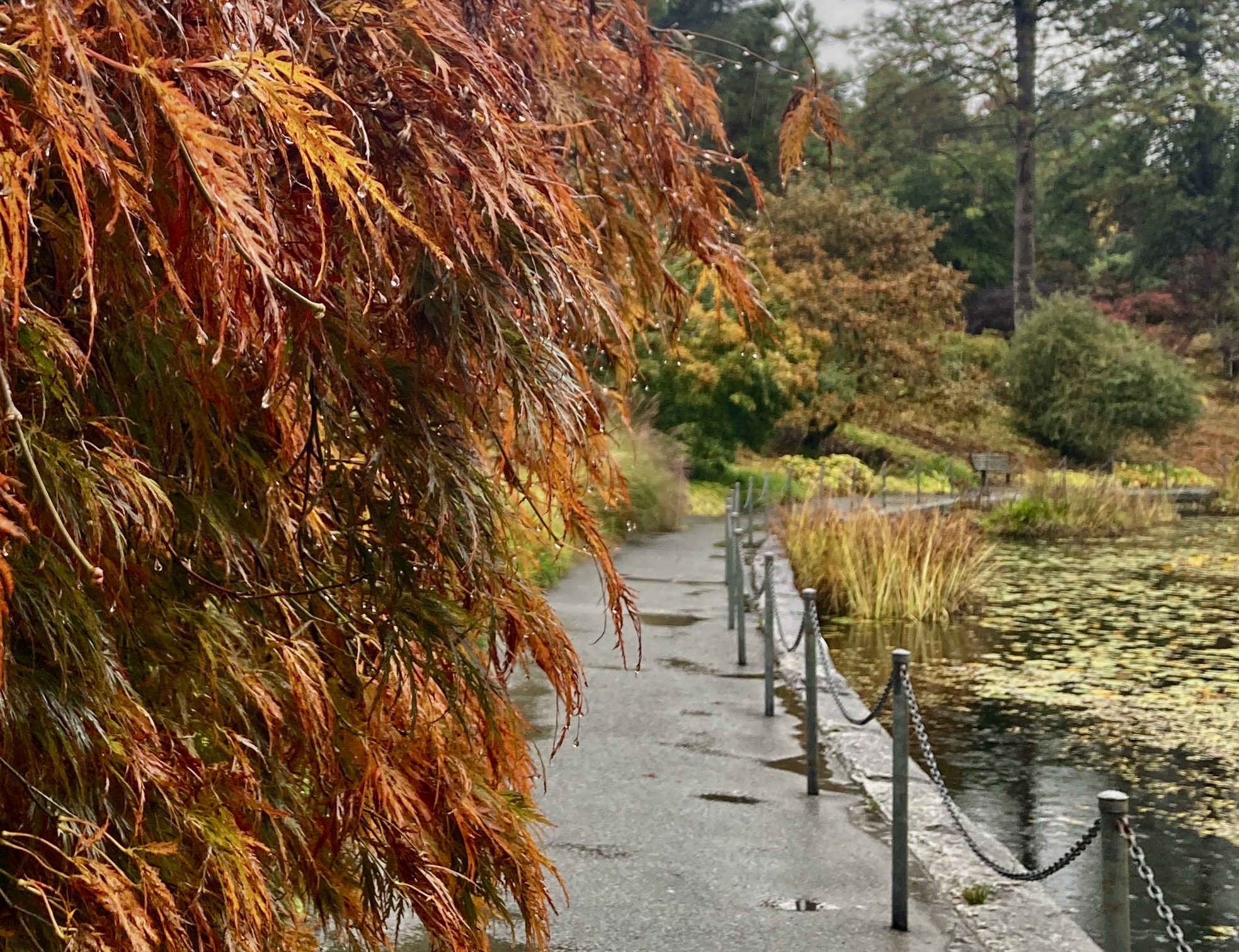
Bright autumn leaves snagged in a still glowing shrub…
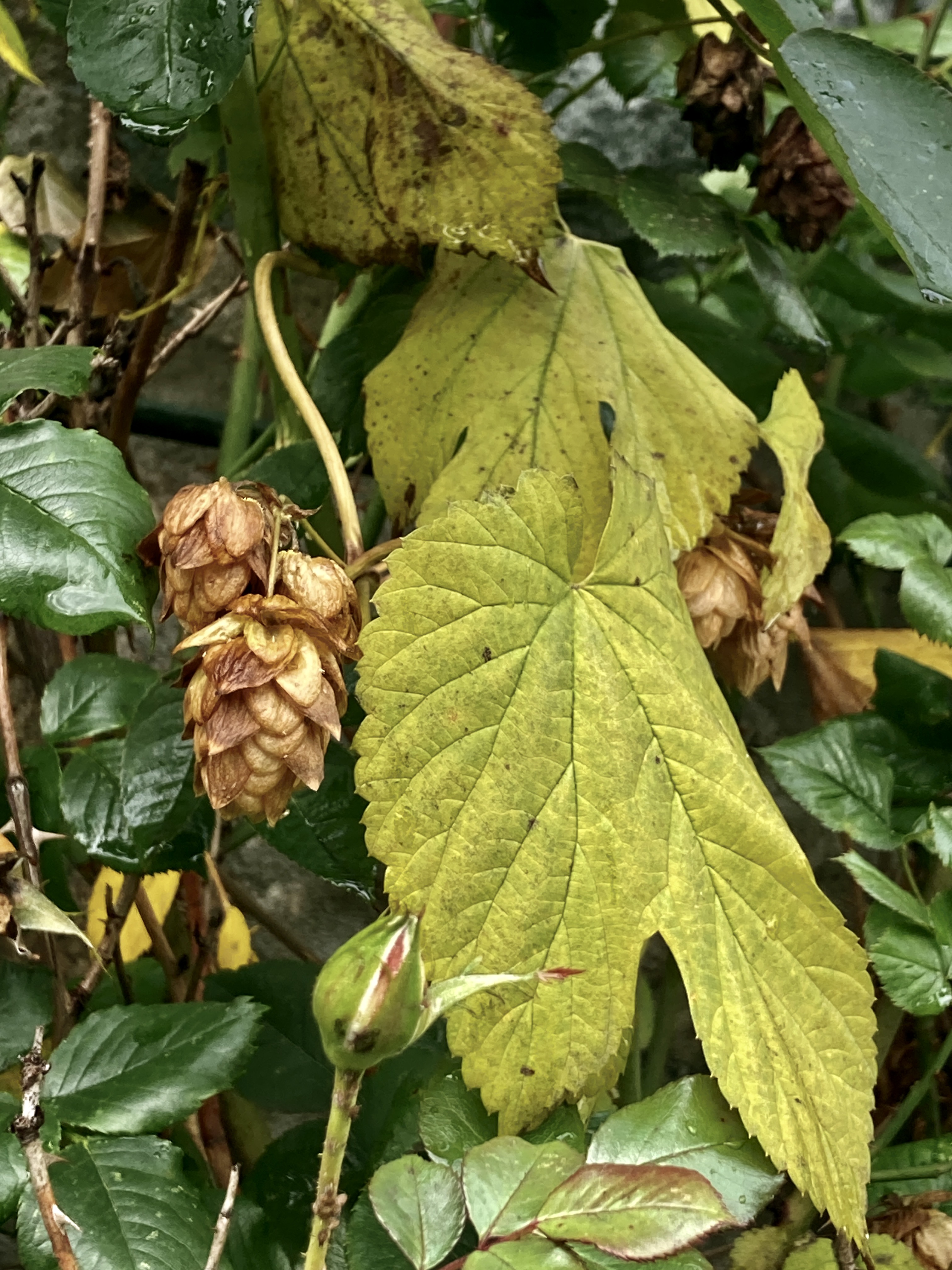
seed pods tawny against yellowing foliage…
seed pods cascading from their vines…
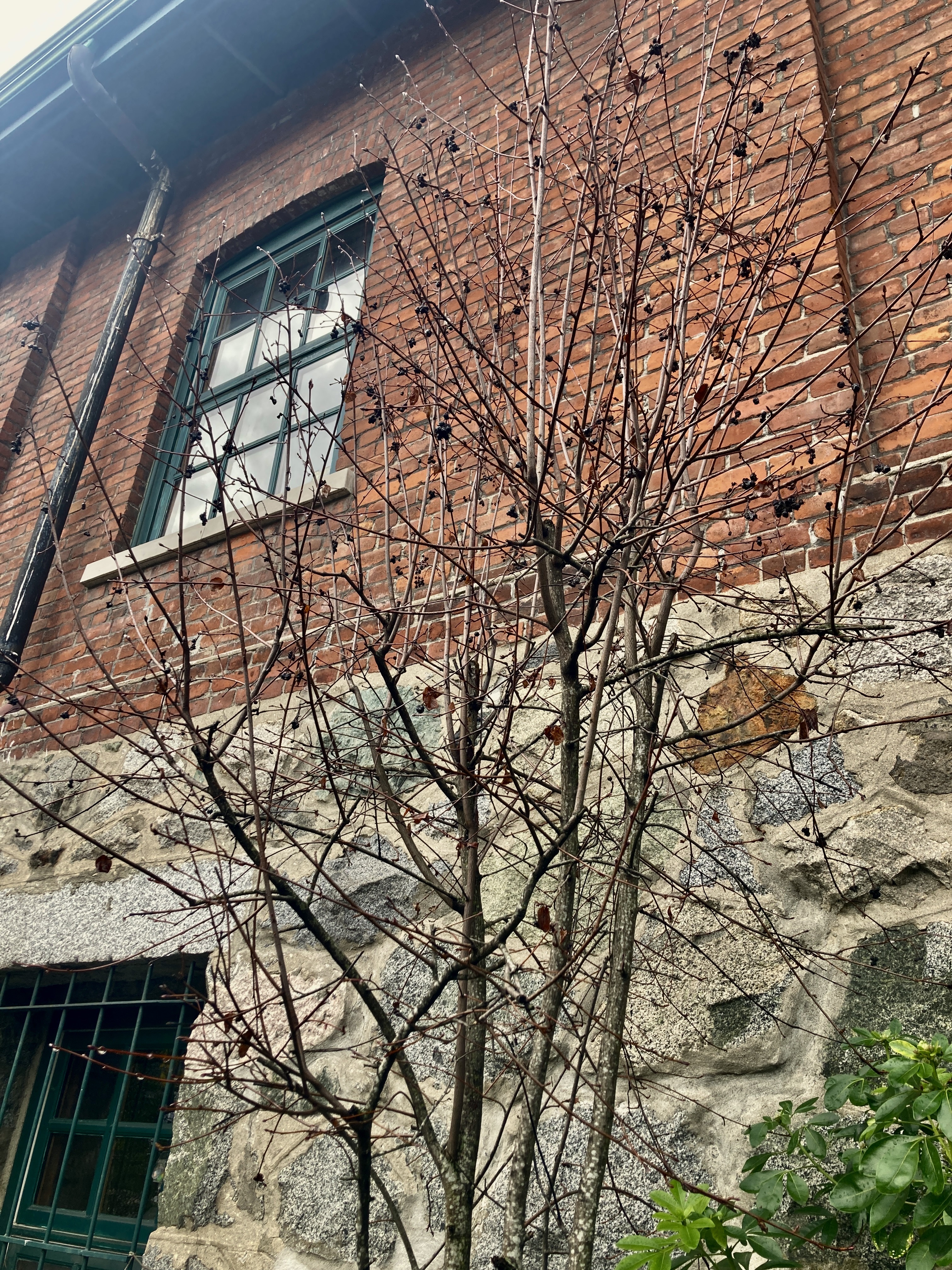
and a small tree, starkly elegant against its stone & brick backdrop…
all of them my companions, as I walk my way north down Scotia Street, flanking the east wall of…
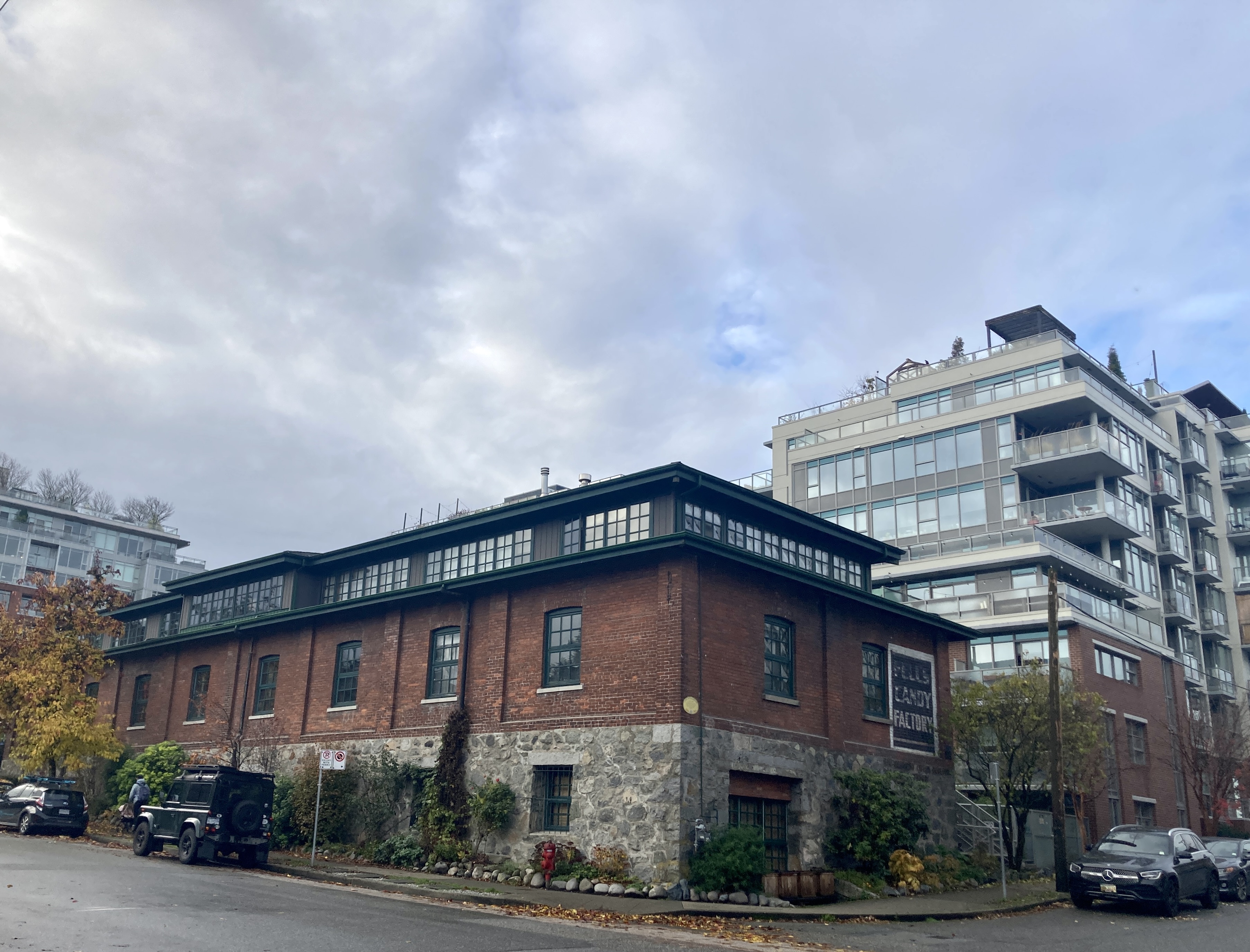
the Brewery Creek Building.
Not its original name! Even “Fell’s Candy Factory,” still visible above the brass lettering, is not the original name.
Built c. 1904 as a storage cellar for Vancouver Brewery Ltd., this building was later (among other things) a candy factory, a creamery, a grease works and a stucco manufacturing plant before the restoration and renovations that, in 1993…
transformed it into a collection of live/work condos in a Class A heritage building.
New-builds are now springing up all around. It more than holds its own.
Though I like some of the sassy newcomers.
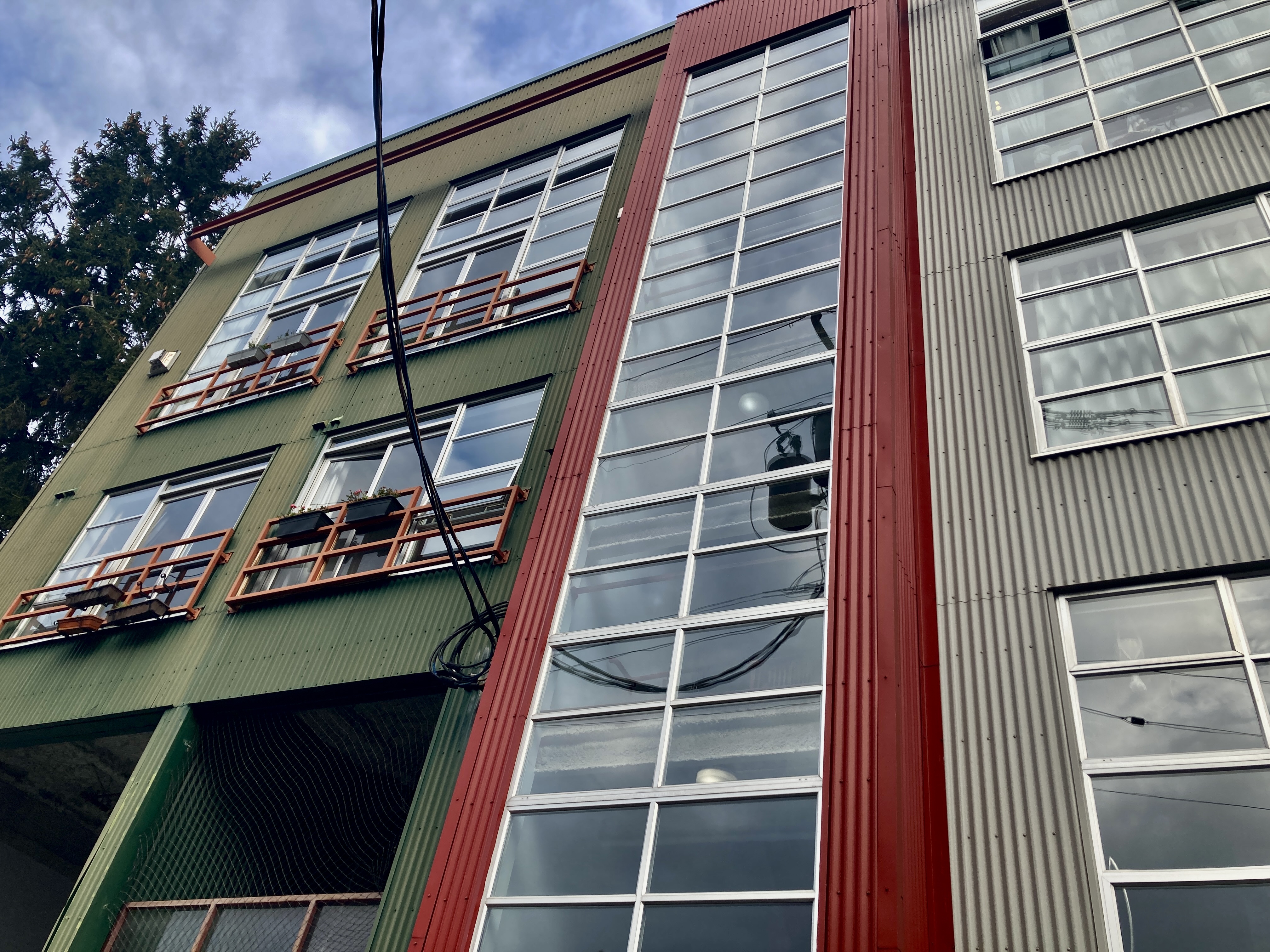
Especially ones that prove modest building materials can also hold their own — when deployed with bold colour and strong, clean lines.
And this is the back-alley view!
A bit farther north, I’m still caught up in the old/new mix that is Mount Pleasant these days. Low vintage buildings and early (2017 or so) Vancouver Mural Festival artworks mark East 3rd and the alley just off Main Street..
but behind them to the south rises one of the sleek new eco-conscious work facilities that are now reshaping the area, East 5th in particular.
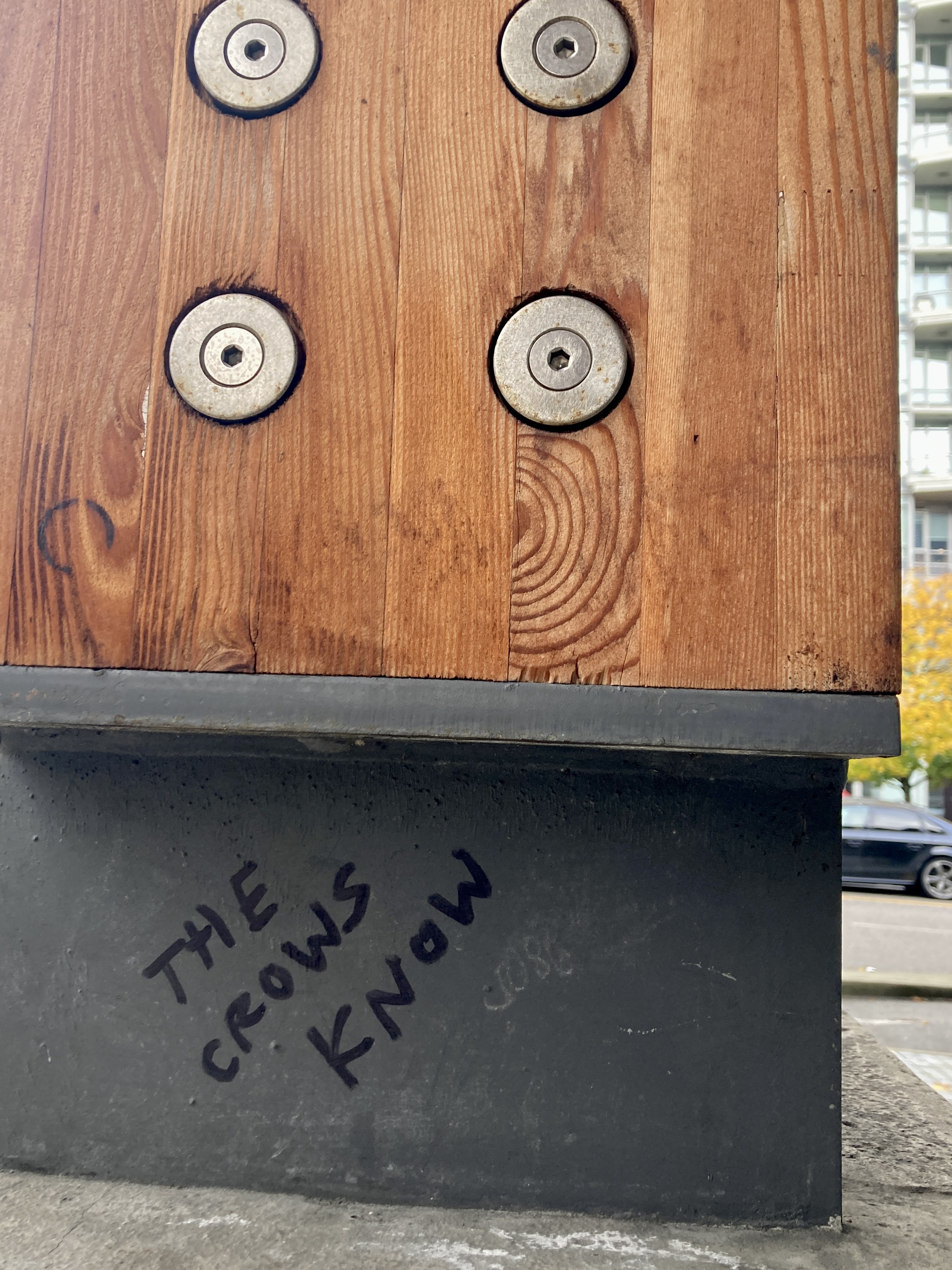
I’m headed in the opposite direction, north & west to the east end of False Creek. My route takes me past Mountain Equipment now-American-Company-not-Canadian-Coop. I consciously Don’t Go There; I instead enjoy the exterior of this mass timber building. Including the corvine slogan under one pillar’s footing…
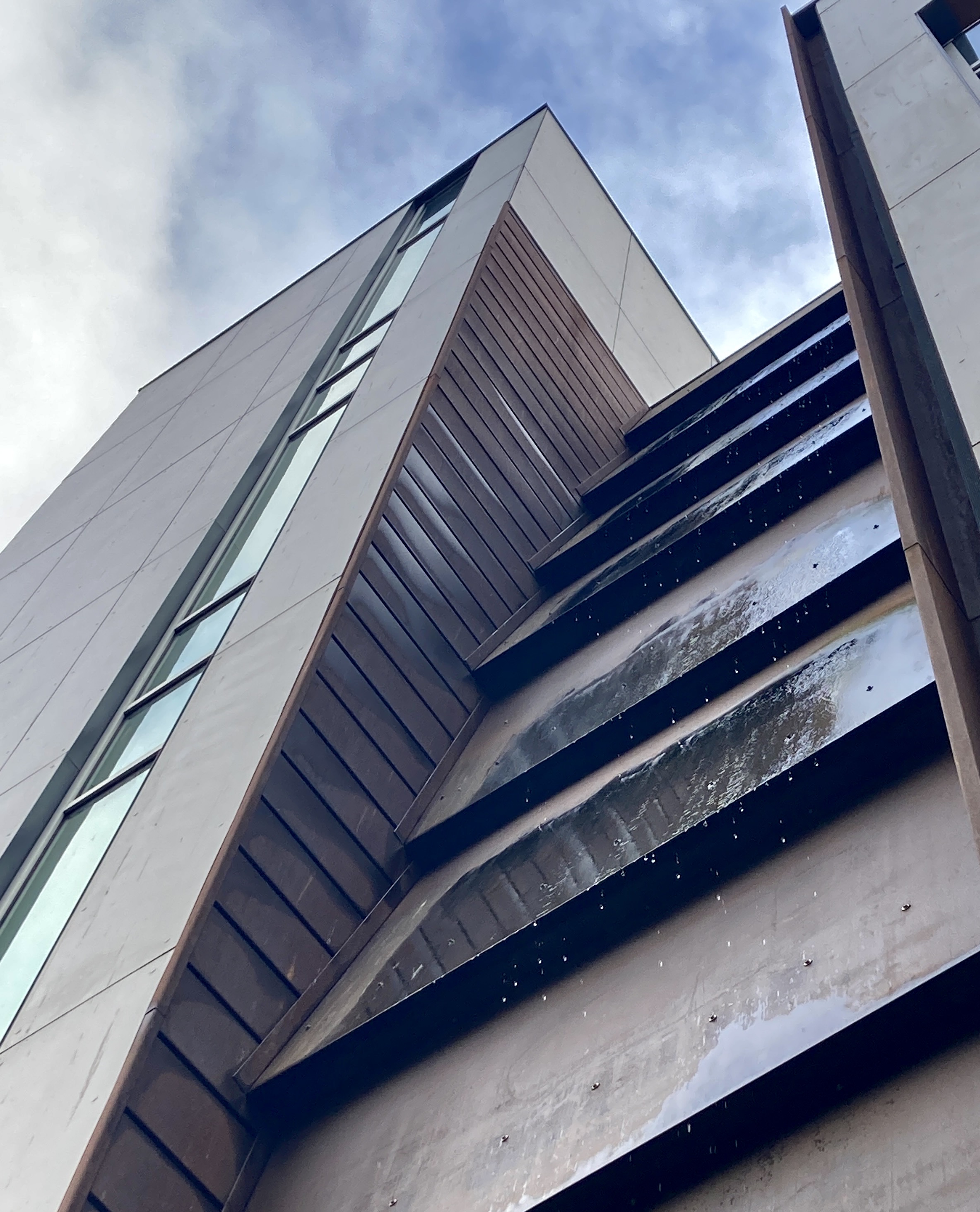
and droplets sliding down the water course built into the Quebec Street façade.
You see? It has rained, it will rain, but at the moment, it is not — not quite — raining.
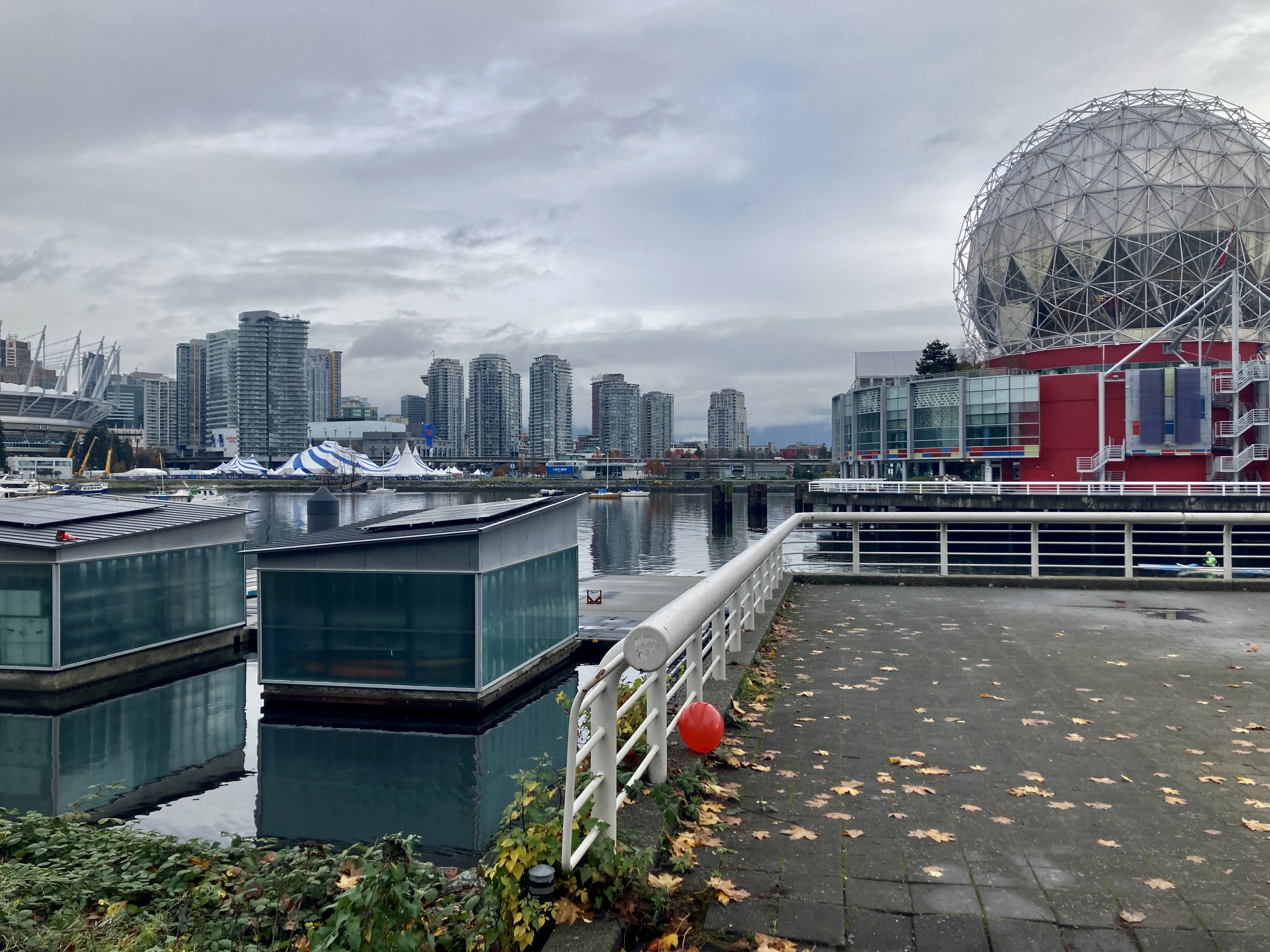
I’m closing in on False Creek…
but it’s not the geodesic dome of Science World that catches my eye. it’s the runaway red balloon down there against the railing.
And then I forget all about the red balloon.
I can hear chimes & gongs & cymbals & whistles, and I know how to interpret them. They tell me that the glass tower by the Science World entrance, sadly silent during a long restoration, is once again in glorious, ridiculous, delightful, full-tilt operation. It has no name that I can find, but if ever any 2024 contraption deserved the name Rube Goldberg Machine — this is it.
Things clank, whiz, fly around, spiral and drop, tip and tilt, climb and do it again. A woman grins at me over her children’s heads. “The kids are the excuse. I could stand here all day.” I nod.
But we eventually move on …
I, past the reclining question-mark outside Science World’s creek-facing west wall that invites us to consider our daily choices, all of which affect the environment.
Question-mark nicely suits what happens next. I find myself in an impromptu focus group of SeaWall pedestrians — diversified in our demographics, but united in our conclusion.
Despite much conjecture among us, we remain puzzled. Goose? Swan? We settle for Very Large Waterfowl. We also agree that he/she is gliding over a sunken boat (the hull gleams greenish-white, the mast protrudes). Pleased with ourselves and each other, we go our various ways.
By the time I reach my Cambie Bridge cross-over point, the threat-of-rain has become really-rain.
I stand under bridge ramparts, exchange forecasts with a guy also pawing his backpack for a jacket, and watch a young woman toss her red umbrella aside so she can kick up her heels on one of the playground swings.
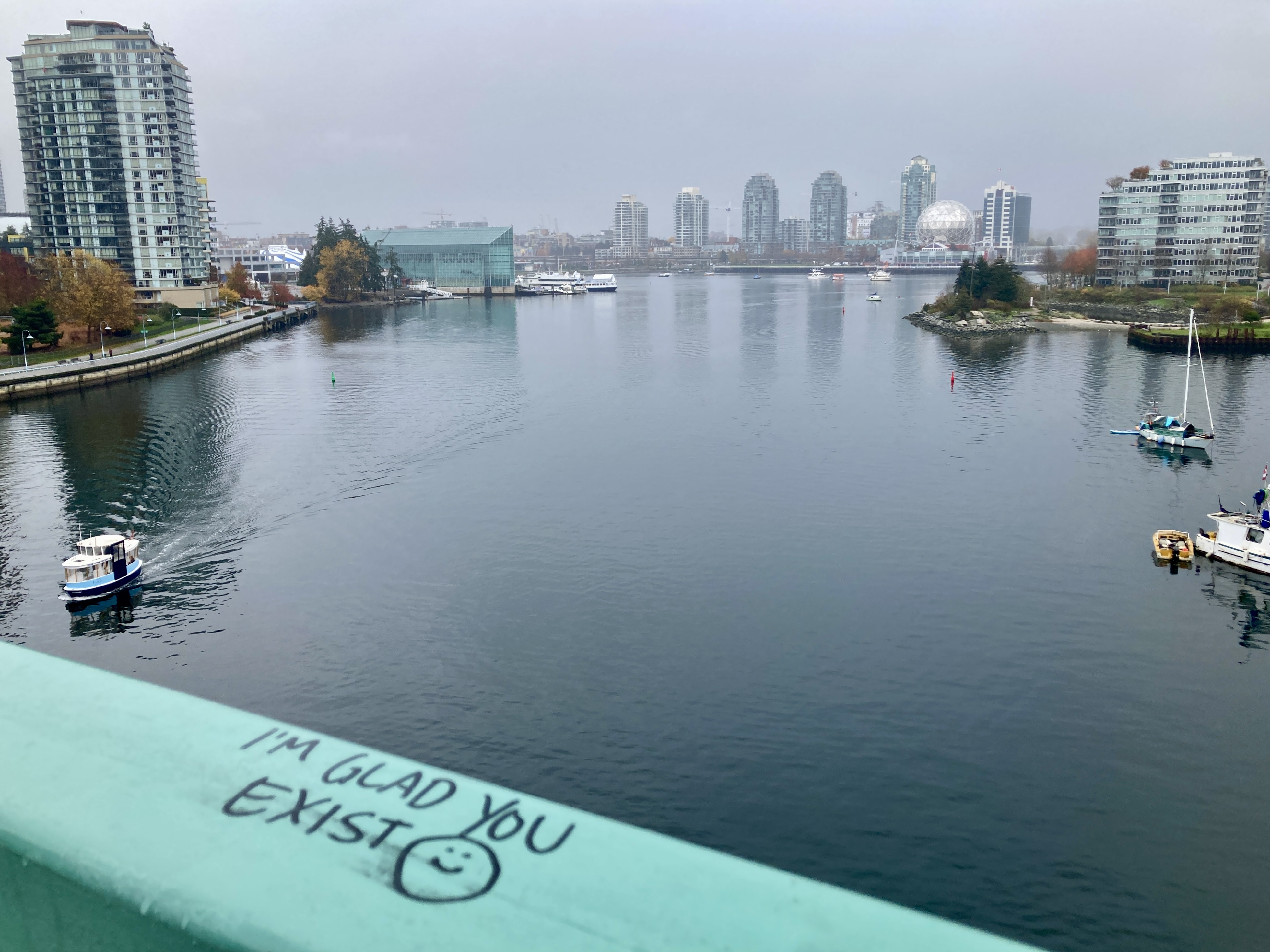
Jacketed & be-hatted, all zippered up, I climb my way up onto the bridge and head out over the water. I am so charmed by this graffito on the railing…
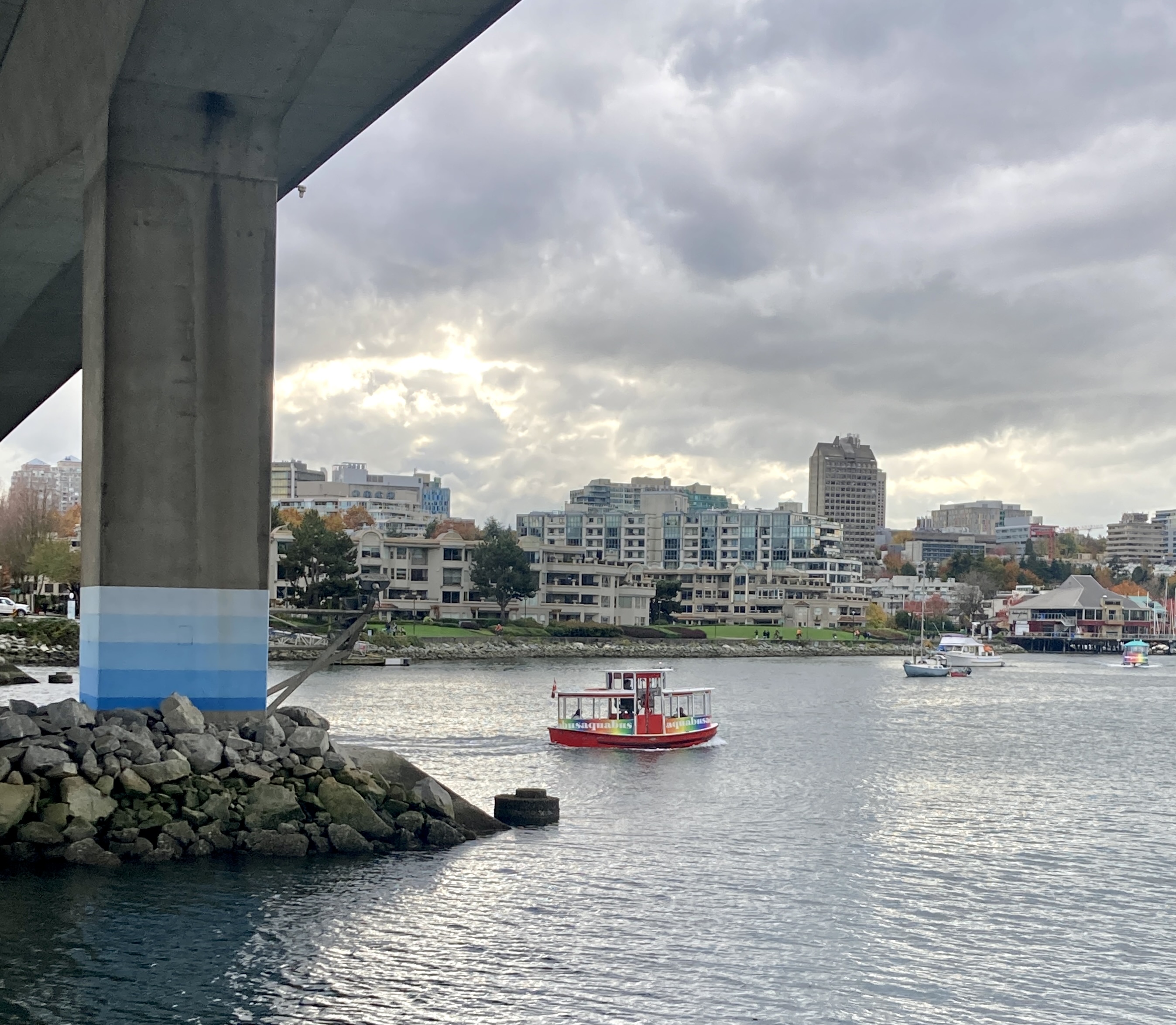
that I stand here until a ferry obligingly comes along, to include in the picture. (The wait gives me time to compile a Glad They Exist list, ferries being just one item. I find it a helpful exercise, very soothing, a counterbalance to all that I wish did not exist.)
And then I put the camera away, because, good grief, this is now serious rain.
And I then I take it out again, one last time.
Here at West 8th & Yukon, a living demonstration of the slogan back there under the MEC pillar.
Crows know! This crow knows he is very wet. And he is telling us all about it.
7 November 2024 – I walk along, getting some early-morning daylight into my system. I see that, even this late in the season, some leaves are still putting on a bravura show.
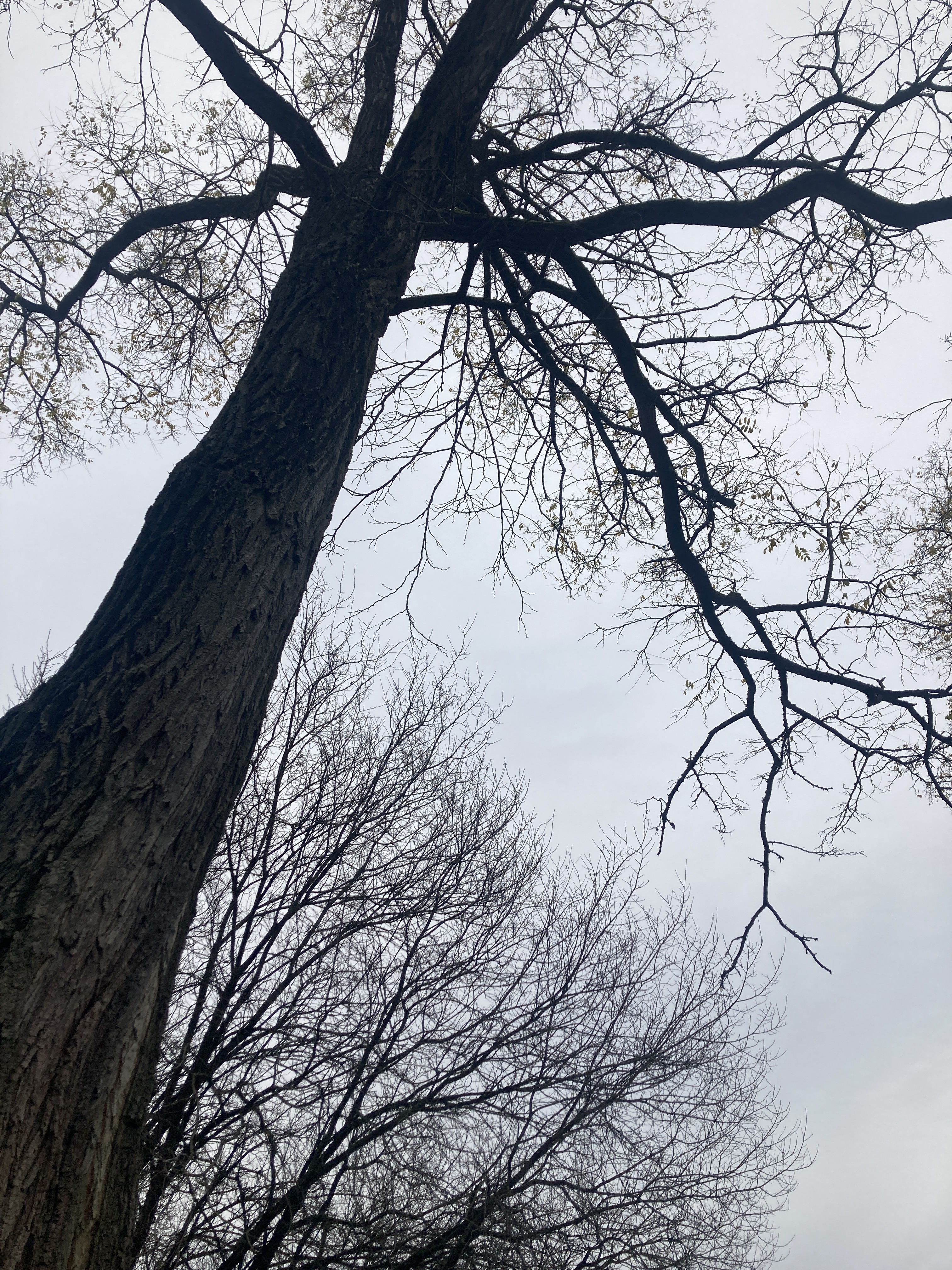
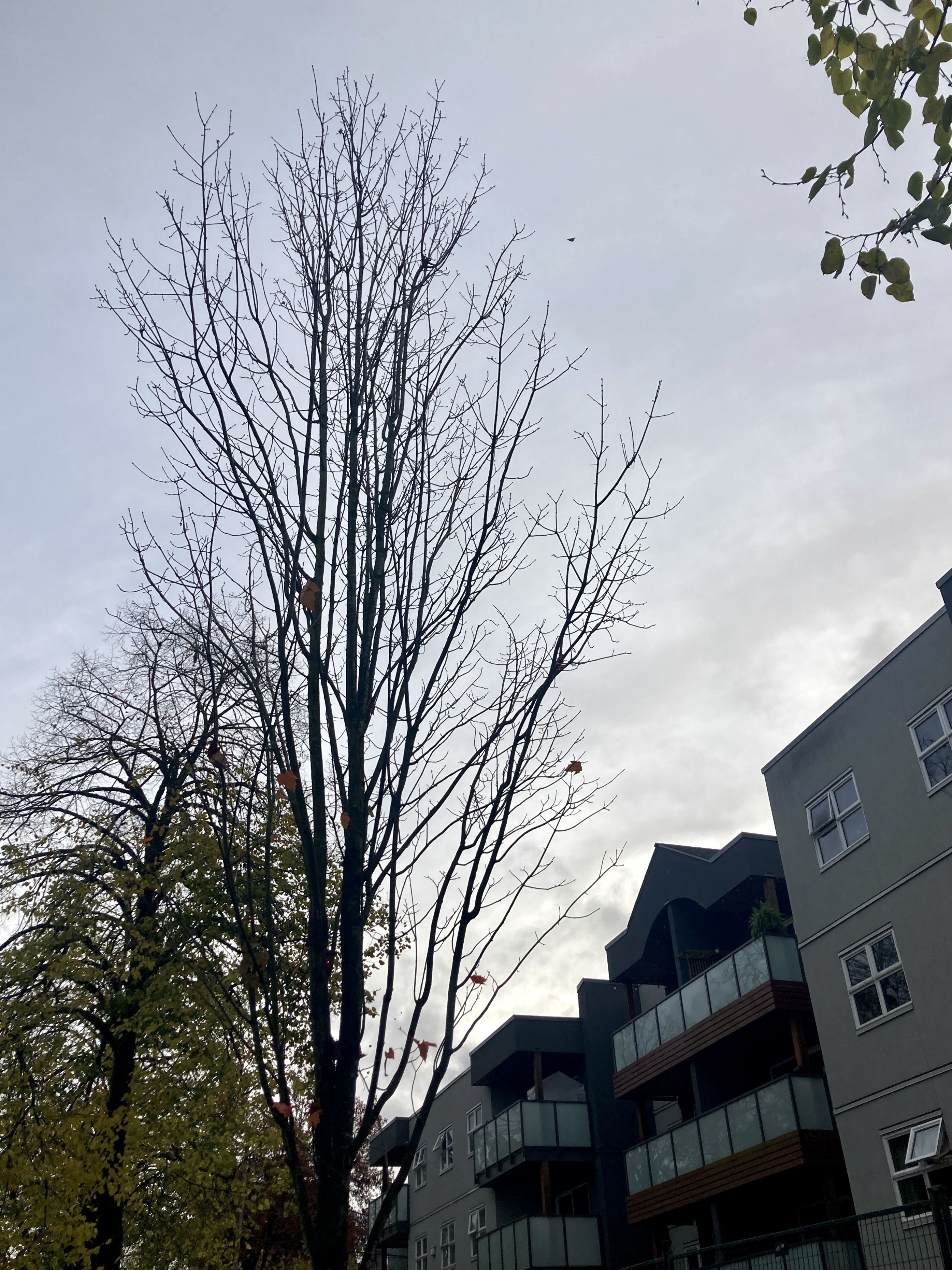
Then I look up. Up a bare tree trunk, all the way up, up & out over the street.
I see what no-leaves can do.
I stare at it in absolute delight. I narrow my eyes. Do an imaginary zoom for tighter focus.
It’s the dance of the fractals, isn’t it? Right there above my tip-tilted head. Some time does pass, before I lower my gaze.
Only to see a little girl, staring at me with the same intensity I have just given to those tree branches. It is a child’s stare — curious, open, honest, without malice. But still a little unnerving.
“Hello,” I say, “I like the monster on your coat.” (A happy monster in minimalist design, all bright eyes and friendly fangs, if you can picture it.) She giggles. “I like him too.” Her waiting mum leans back against the car, reassured about the way this bit of sidewalk interaction is progressing.
“My coat has pockets,” says the child, patting one for emphasis.
“Mine too!” I cry, patting mine as well. “I like pockets. You can put stuff in them.”
She nods. “And,” she adds — clearly a parting comment, mum is opening the car door — “and, when it’s cold, you can put your hands in your pockets too!”
With that, we go our separate ways, she to day-care and I to Dude Chilling Park, Sahalli Park and points all around.
(Please note: my coat pockets now contain gloves.)
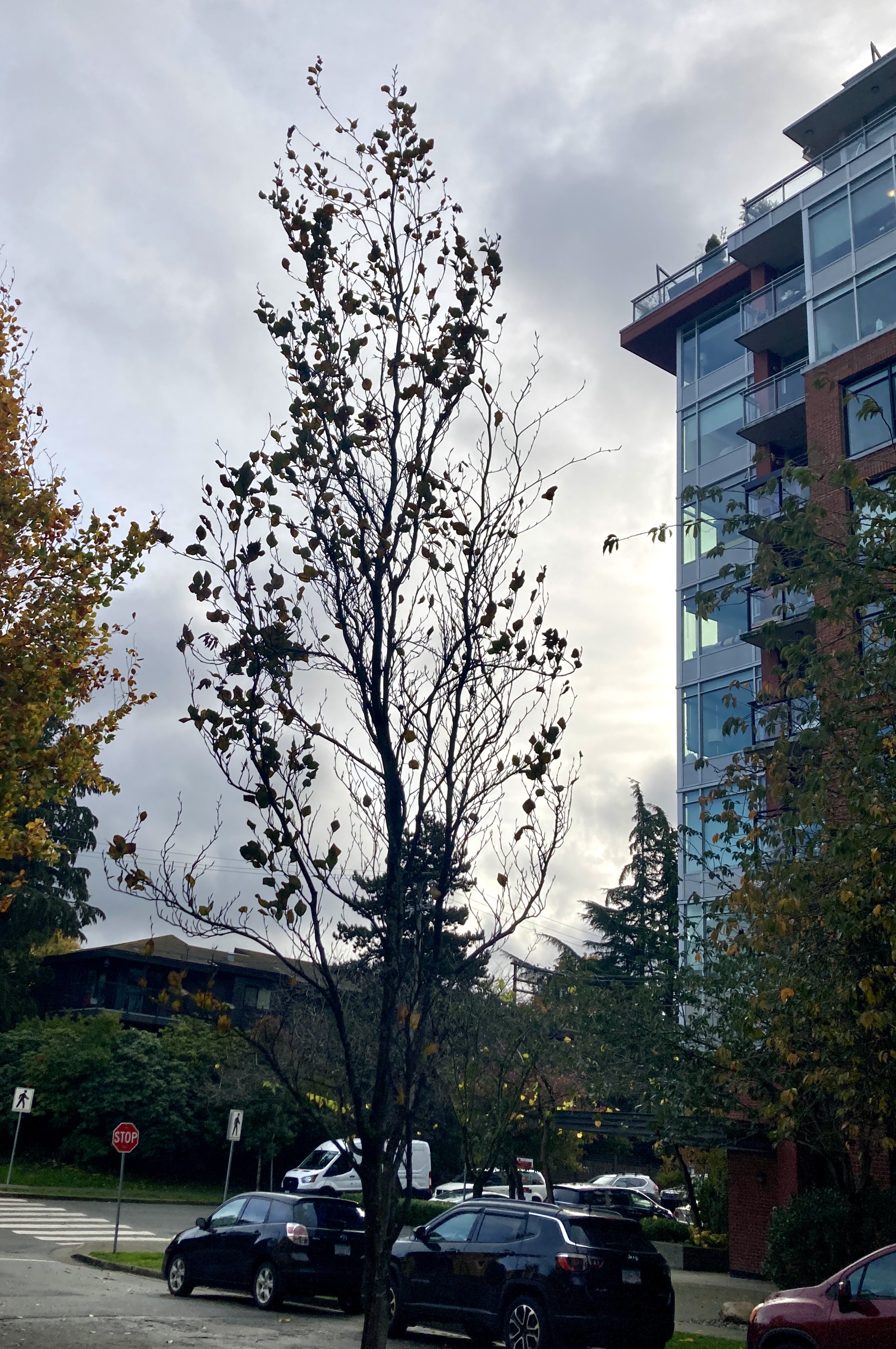
3 November 2024 – This side of the equator, in this latitude range, deciduous trees are well into their annual sylvan strip tease.
They shed their leaves…
and shimmy through the winter in their bare branches.
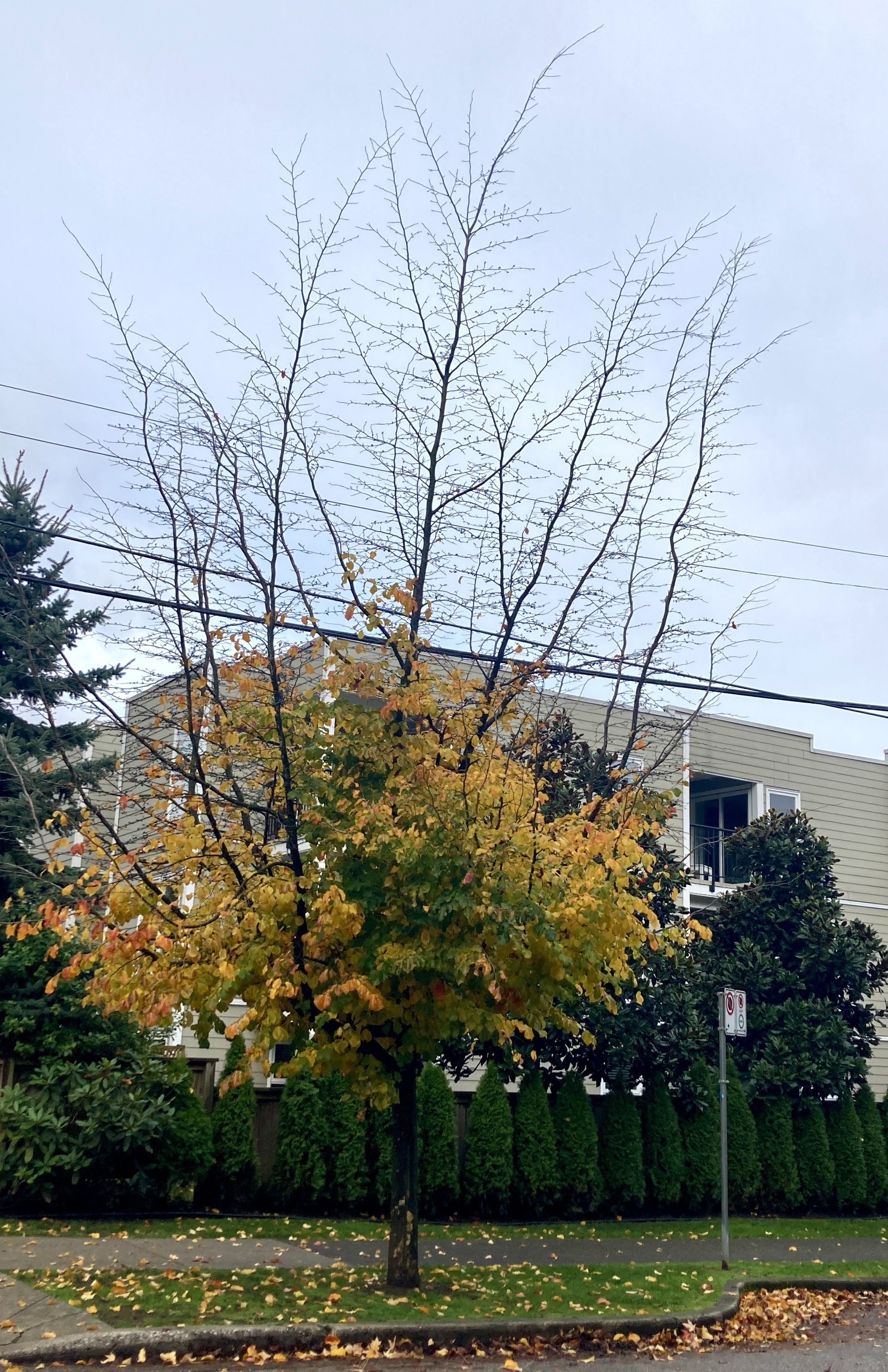
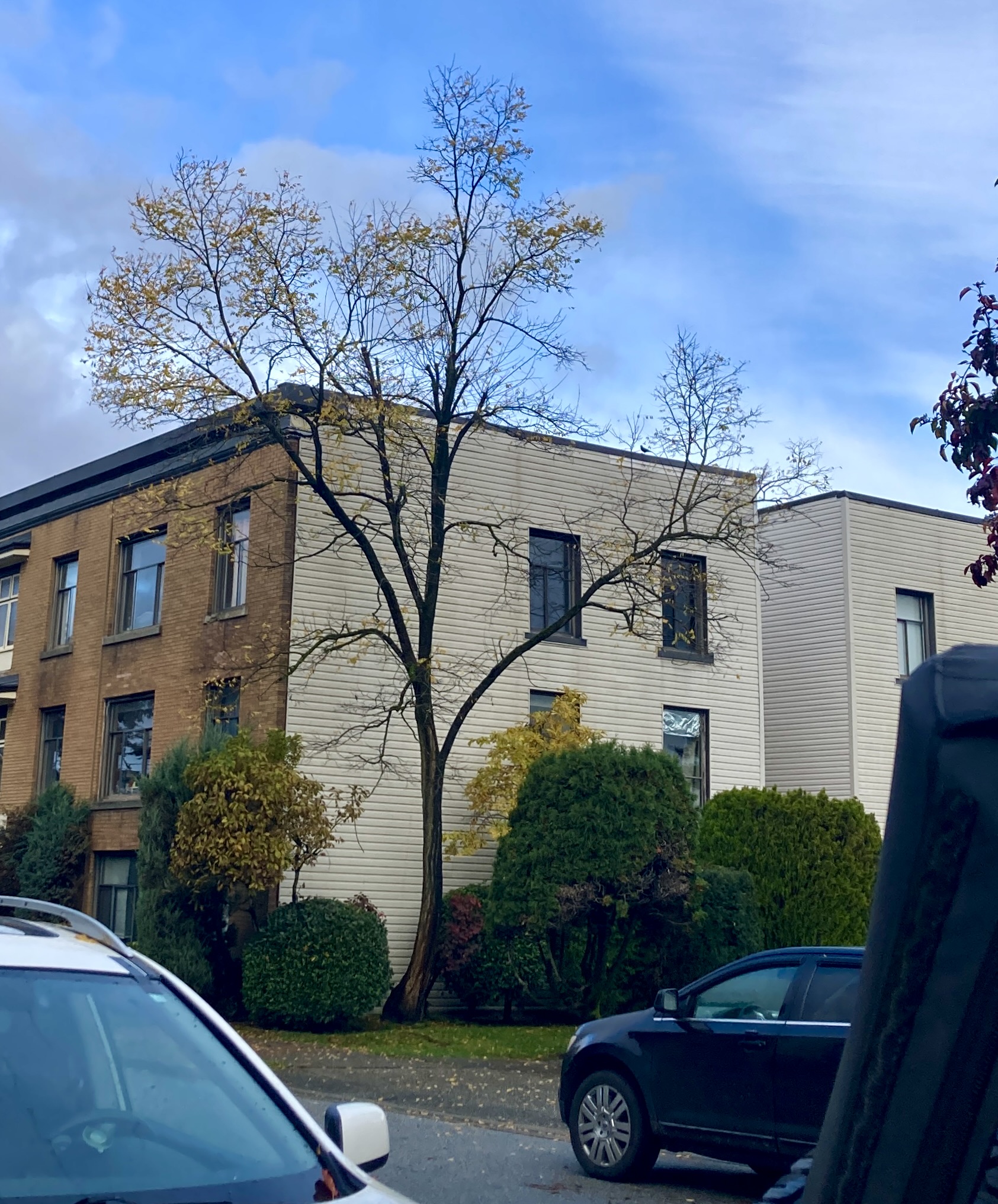
Some trees strip from the top down, clinging to their knickers…
some strip from the bottom up, clutching their camisoles….
and some fling off their leaves any old which-way.
Some, like these front-door guardians, hang on defiantly, still full-dressed and glowing bright…
while others are already full-naked, brown/black against the sky.
The evergreens are wonderful and rich, I love their year-round colour, their generous textures and dimensions…
but… oh… just look at the stark, bold power of this naked silhouette. (Not to mention its effortless demonstration of fractals. Why beat your brain with formulae, when you could just go look at a tree?)
I am mostly tree-struck, on this walk, but as I weave my way back from Sahalli Park I notice some other things as well.
A few left-over Hallowe’en pumpkins (so three days ago!)…
the punchiest little free library ever, tucked into its embracing greenery…
(where to my amazement I am able to pick up a copy, in its original French, of the 1948 landmark political/ cultural/artistic Québec manifesto, Refus global)…
and, framed by bare branches (L) and evergreens (R) and a crimson vintage Mount Pleasant home, ‘way over there across Burrard Inlet and high on Grouse Mountain…
the season’s first snow.
Snow!!
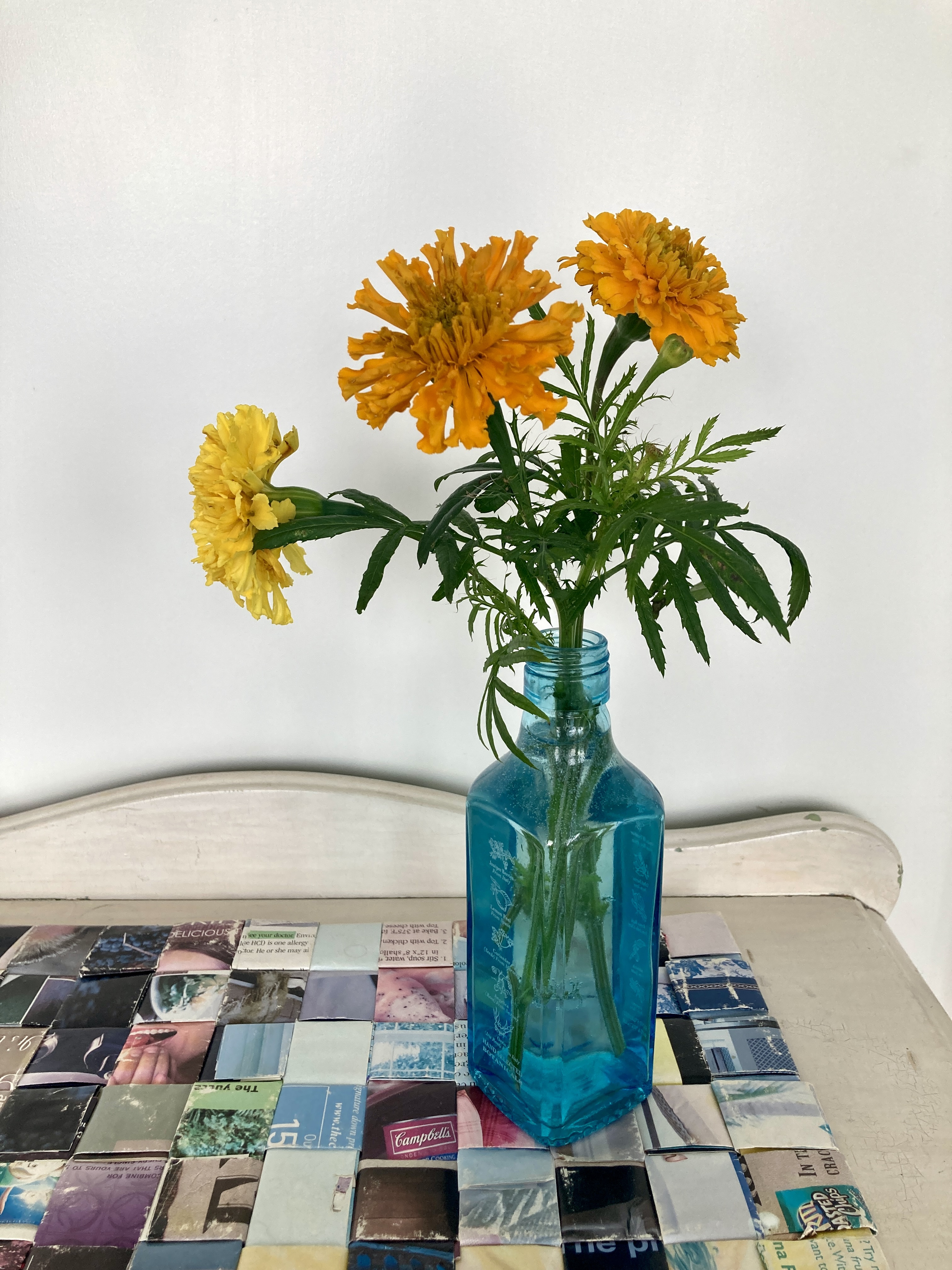
I head home, chilled fingers suggesting it really is time to dig out some gloves, and stop at the door long enough to pick a few of the last surviving marigolds in our street-front display.
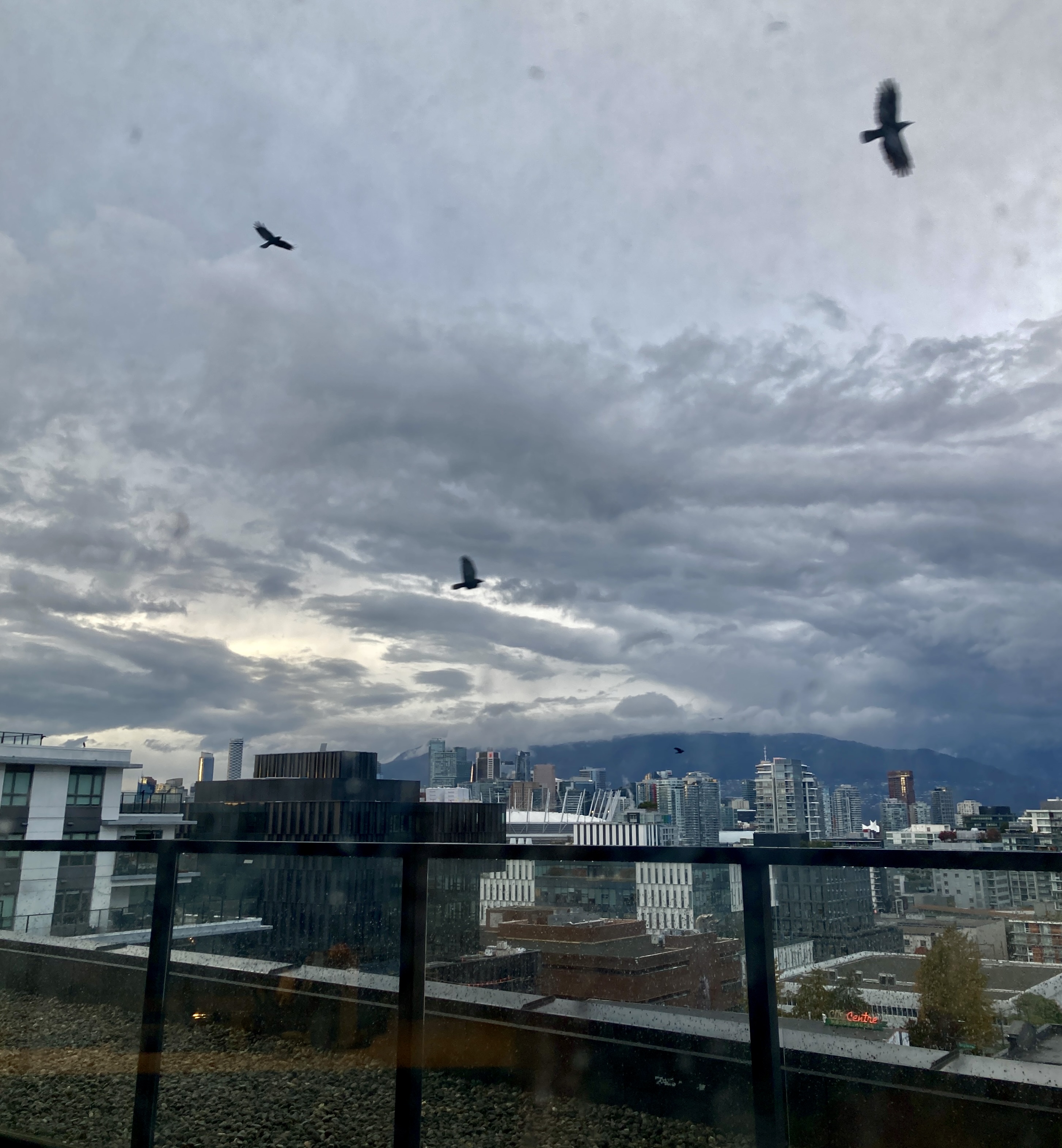
31 October 2024 – This little theme launches itself early yesterday evening, as I look out my window at a determined crow, en route his Burnaby roost in the driving rain.
It continues today, happily not in rain, as I walk homeward along False Creek. from the foot of Davie Street.
Where I see:
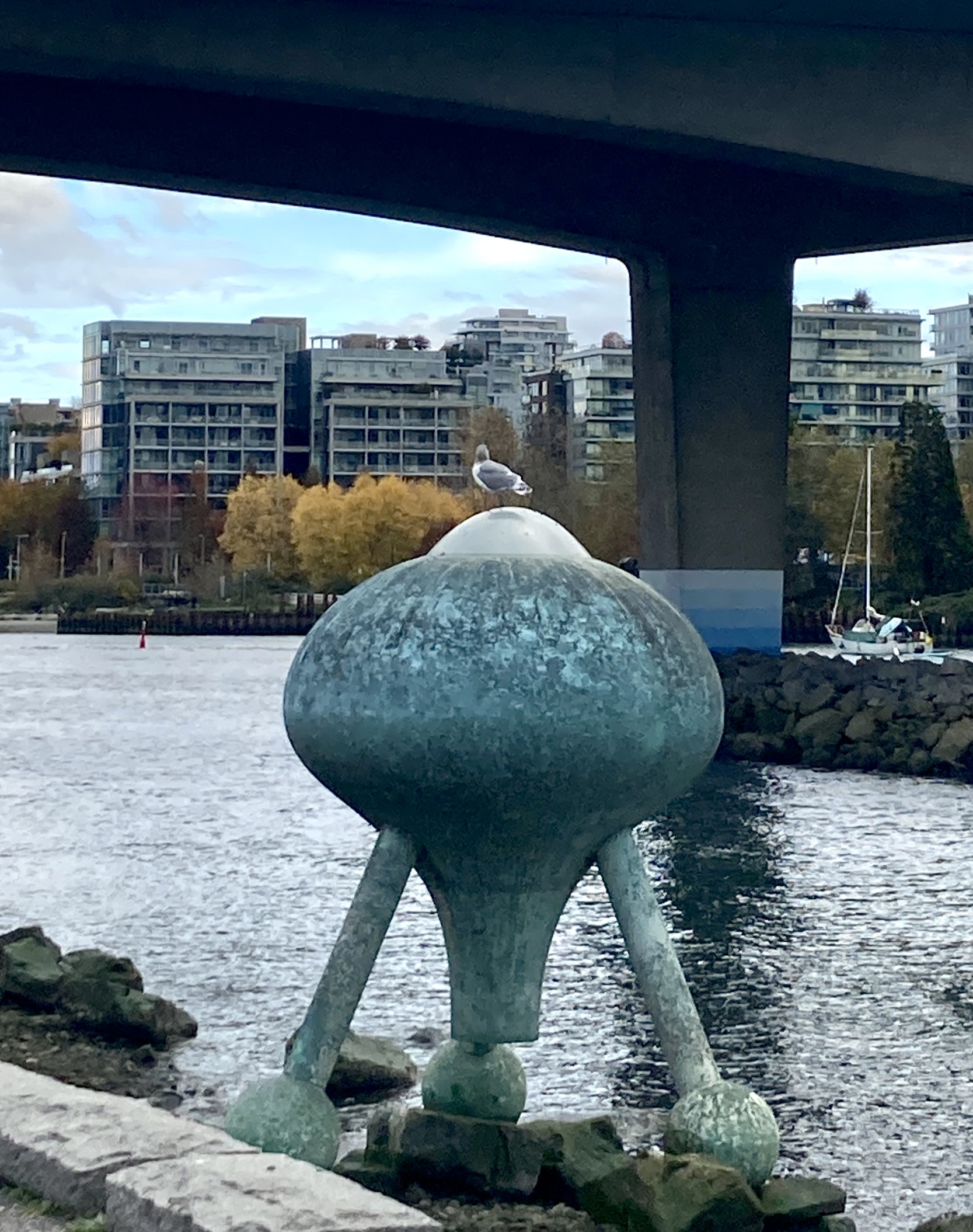
a seagull briefly resting on Jerry Pethick’s Time Top, en route (as wing direction soon suggests) Yaletown or thereabouts…
an Aquabus ferry en route the David Lam dock…
an impatient dog en route the Coopers’ Park off-leash dog park (once his owner stops fiddling with the gates)…
a flurry of leaves next to Coopers’ Park en route nowhere at all, but having themselves a brief moment of airborne excitement…
a young woman en route an even more limber body, at the Seawall in front of Coopers’ Park…
a Zipply courier en route his client, providing said client (per the website) with “a zero-emissions delivery solution,” all this in front of Cirque du Soleil’s production of Echo, en route (but not until February 2025) Houston, Texas…
and finally…
bus-riders, motorists, cyclists & pedestrians, collectively en route…
to everywhere they want their Compass cards, fuel tanks, legs & lungs to take them.
16 October 2024 – There’s “boring old Clock Time,” as I observed in my post of 13 July, and then there’s Crow Time — an infinitely more enjoyable way to measure the changing length of day. This means I can determine dawn-to-dusk by looking up the stats, or by simply looking out my window.
Crows leave their Burnaby roost for Vancouver roughly at dawn, and return from Vancouver to their roost roughly at dusk.
When I wrote about all this in mid-July, the afternoon commute passed my window at around 9:30 pm.
"Traveller, there is no path. Paths are made by walking" -- Antonio Machado (1875-1939)
"The voyage of discovery is not in seeking new landscapes, but in having new eyes" -- Marcel Proust (1871-1922)
"A city is a language, a repository of possibilities, and walking is the act of speaking that language, of selecting from those possibilities" -- Rebecca Solnit, "Wanderlust: A History of Walking"


























 WALKING WOMAN