21 August 2024 – I am metaphorically at my wit’s end, as I step down from Brentwood Town Centre onto a busy street…
and, it turns out, geographically at WITT’s end as well.
This Burnaby shopping mall is the south end of Willingdon Linear Park, which the website tells me runs 13 blocks along Willingdon north to Hastings Street. I only later learn it is also a WITT project — a Walking Infrastructure To Transit project, part of a civic program to improve pedestrian access to public transit.
I might have enjoyed the pun, had I known it at the time.
Nahhh. Much more likely, as I turned the corner onto Willingdon Ave., that I would have simply continued to feel at wit’s end (“confused, uncertain what to do next”).
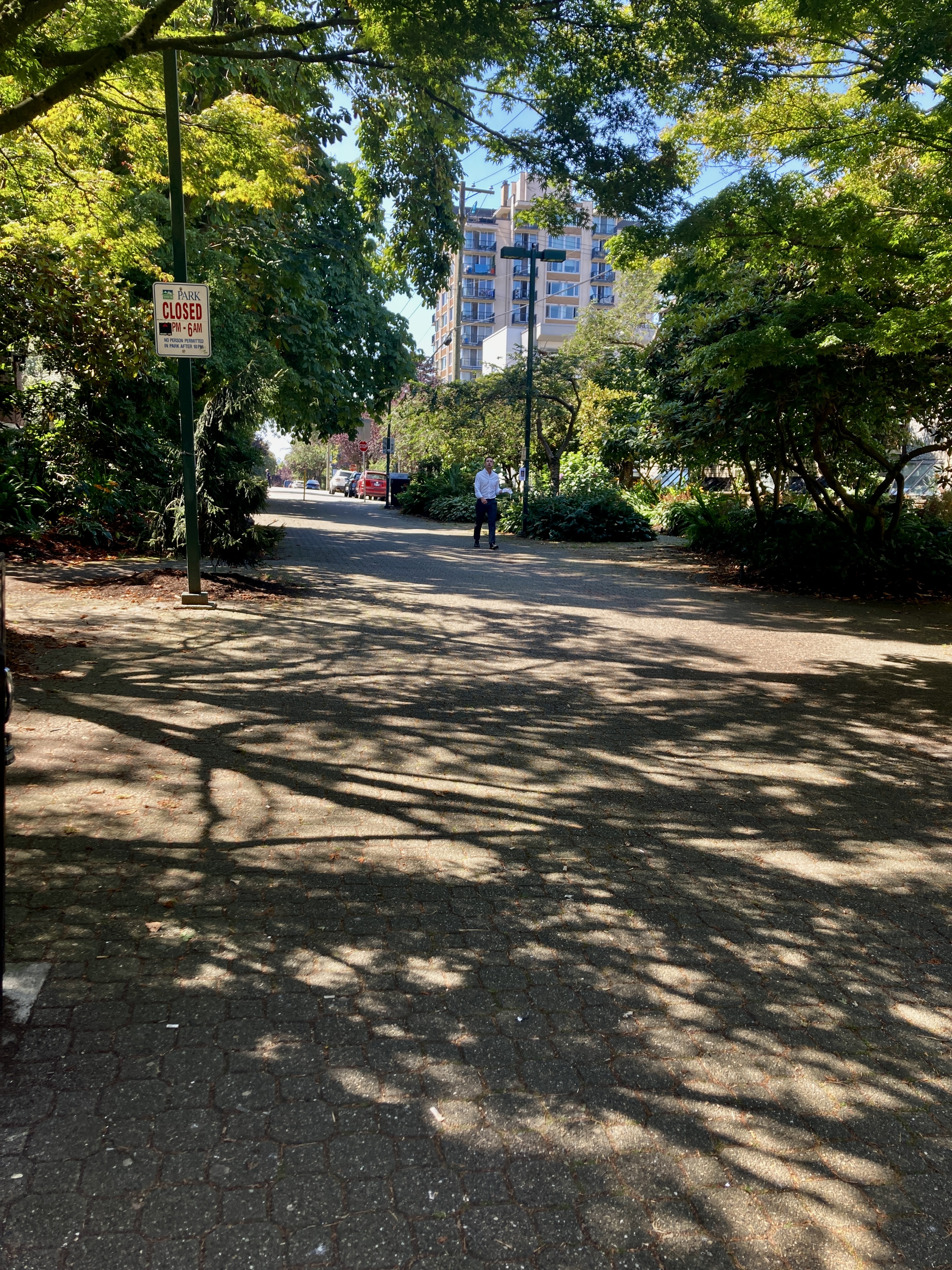
Does this look like any kind of park to you? No signage, just a double-wide sidewalk.
Well, okay. I head north.
And it begins to improve.
Some undulations, some landscaping, some diversions.
I begin to see bright side panels…
eco-sculptures…
and micro-parks, one with a fountain and generous seating…
The bus stops have marshland scenes etched into the glass…
and utility boxes are photo-wrapped with artwork.
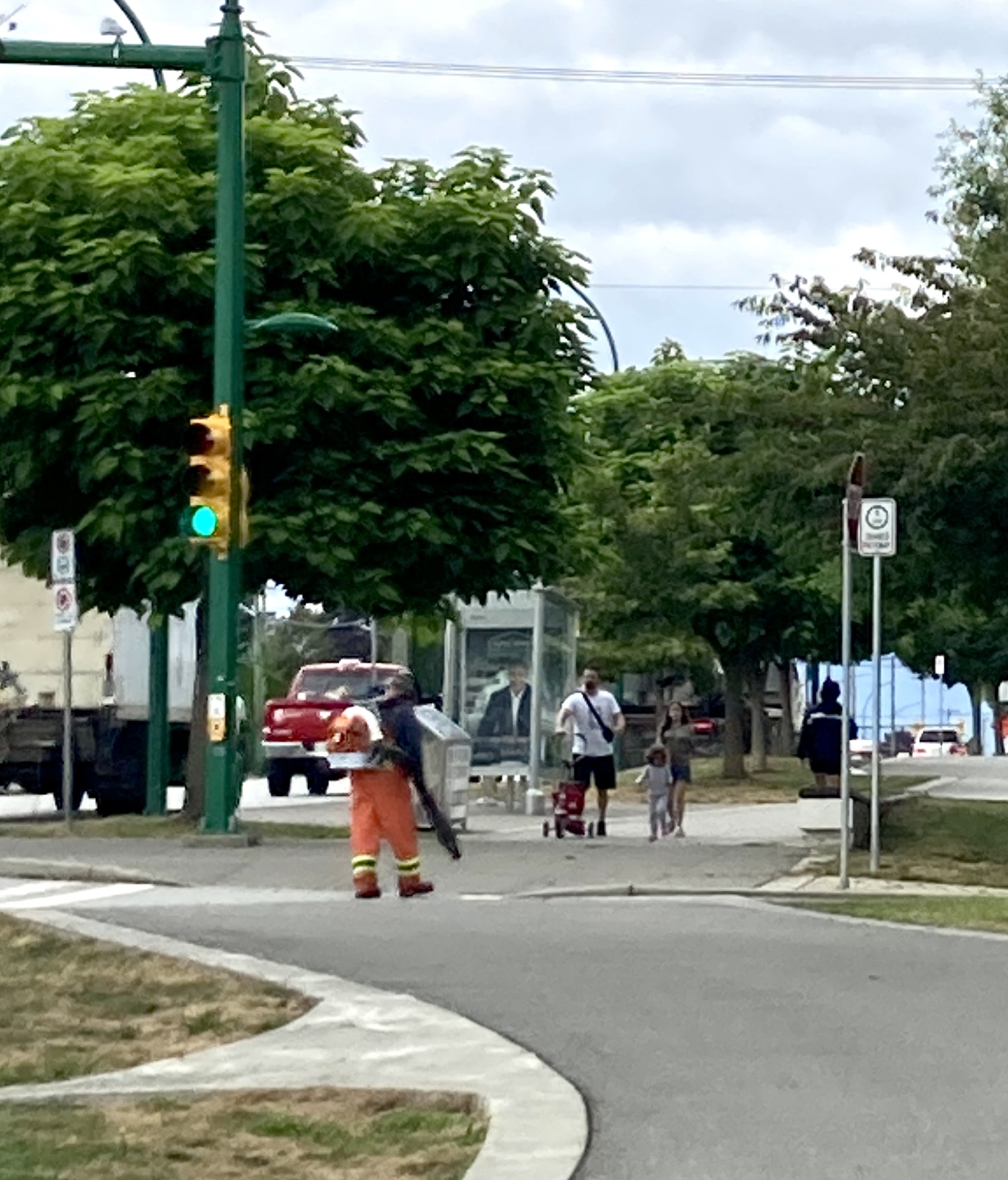
City workers are out in force…
though, while I applaud civic clean-up, I do wonder about the utility of simply blowing leaves from one place to another.
One last side panel, its blue curves echoing the curves of the Coast Range mountains beyond…
and I’m almost at Hastings, northern end of the park.
A final amusement.
I do like this! Mad puppy-dog biplane pilot careening through startled geese: thank you Emily Zimmerman. Created in 2010, her mural long predates the linear park. It’s also a lot more fun.
I think about it later, the lack of fun. And yes, maybe I am over-thinking. It’s just that… I find I am still at wit’s end about this experience. It was so lifeless! I bet you noticed that, in my photographs.
I did meet other pedestrians, people did walk and roller-blade the pathway, but nobody paid any attention to it, or its amenities. The fountain was turned off. No child bounced in the climbing sculpture. Nobody sat on a bench. It was emotionally inert. Chilly.
Mad puppy-dog biplane pilot was a relief, up there at Hastings: it warmed me up again.
17 August 2024 – Nothing as grand as the slippery nature of abstract nouns is on my mind. Not even the nature of heritage, within that slippery world.
I’ve simply decided to go look at the very specific, very tangible, very proper-noun Barclay Heritage Square that I’ve just noticed to the right of the caption WEST END on my Downtown Vancouver Walking Map. My route develops from there. I continue down Nicola to English Bay and along the Seawall to (bottom-centre of map) the David Lam Dock on False Creek.
It’s only after all that, that I have my moment of linguistic/philosophical fuss about the meaning of words.
Back to the beginning.
I’m at Broughton & Haro, north-east corner of Barclay Heritage Square, an enclave designated under the National Trust for Canada that preserves 12 Edwardian-era homes and woods in combination with an adjacent City park.
The houses are lived in…
and the woodland now contains a children’s playground, used by residents…
as well as families from the modern condo towers you can see in the background — the kind of towers now increasingly dominant in the West End environment.
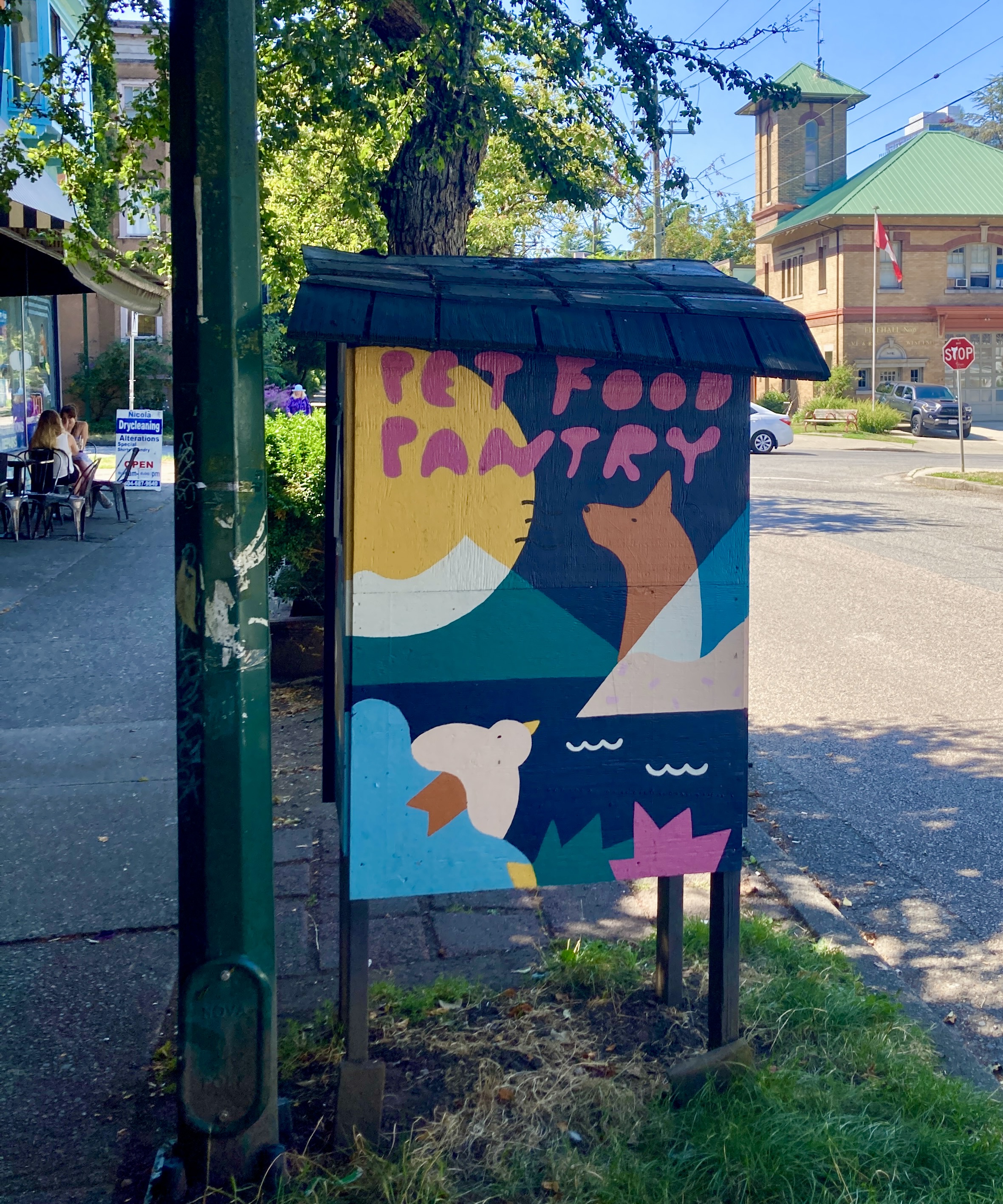
For no particular reason, I make Nicola my route on south to the water. It rewards me immediately. I’m already a fan of Little Free Library kiosks & their unofficial equivalents, so I gurgle happily at the sight of this Pet Food Pantry, just past Barclay.
Wet & tinned dog & cat food are welcome donations, ditto dog & cat toys and accessories, but please nothing large and nothing for other small animals: “We don’t have the space.”
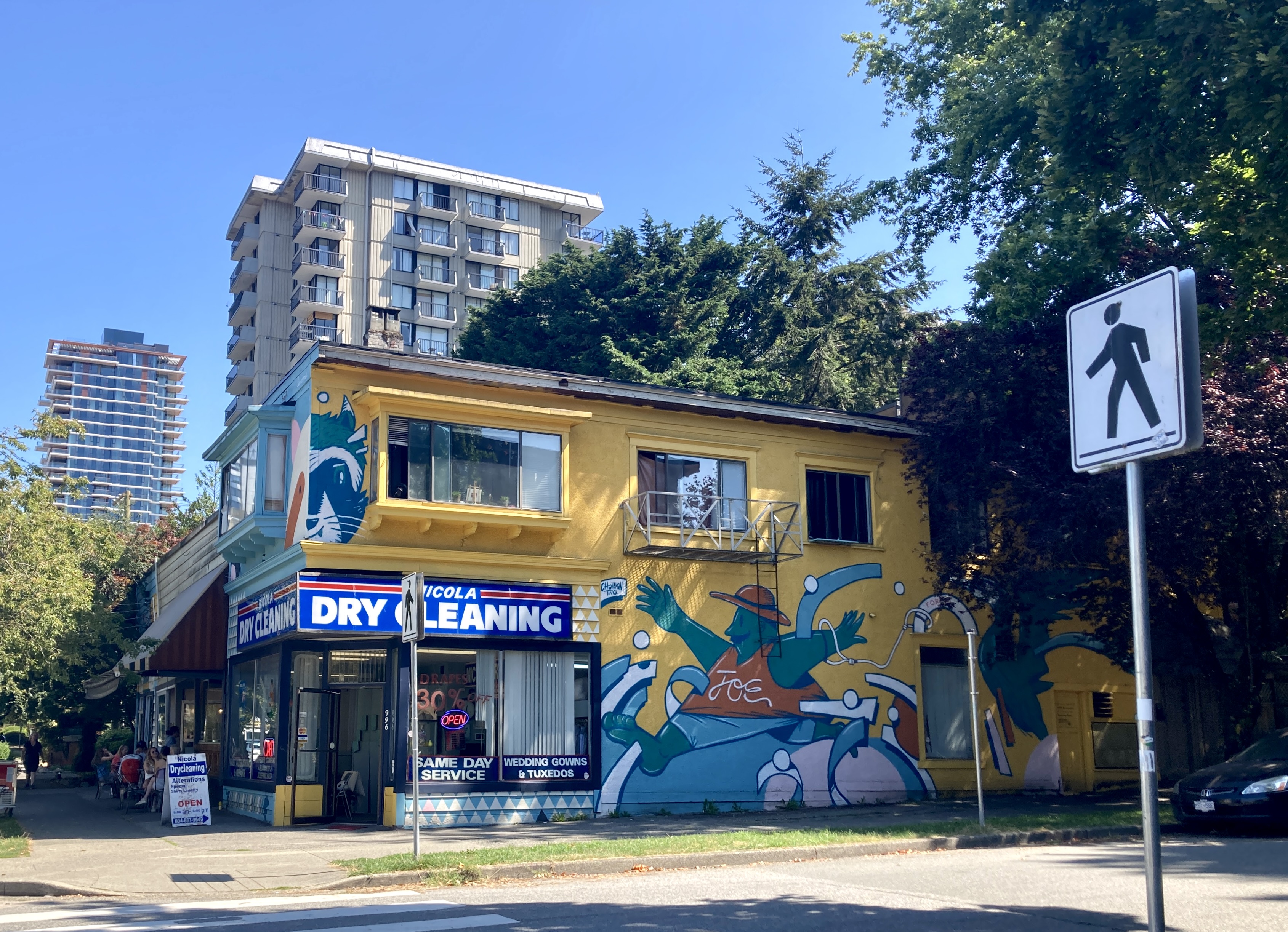
One more block, and here’s the Vancouver Mural Festival 2020 tribute (by Annie Chen & Carson Ting) to Joe Fortes, the City’s first official lifeguard.
In 1986 he was also named Vancouver’s Citizen of the Century by the Vancouver Historical Society, and for good cause — a Trinidadian immigrant, Fortes spent years unofficially guarding the beach and rescuing people before receiving the official appointment.
The Nelson-to-Comox block down Nicola is friendly underfoot…
and bright with flowers on vintage apartment balconies overhead.
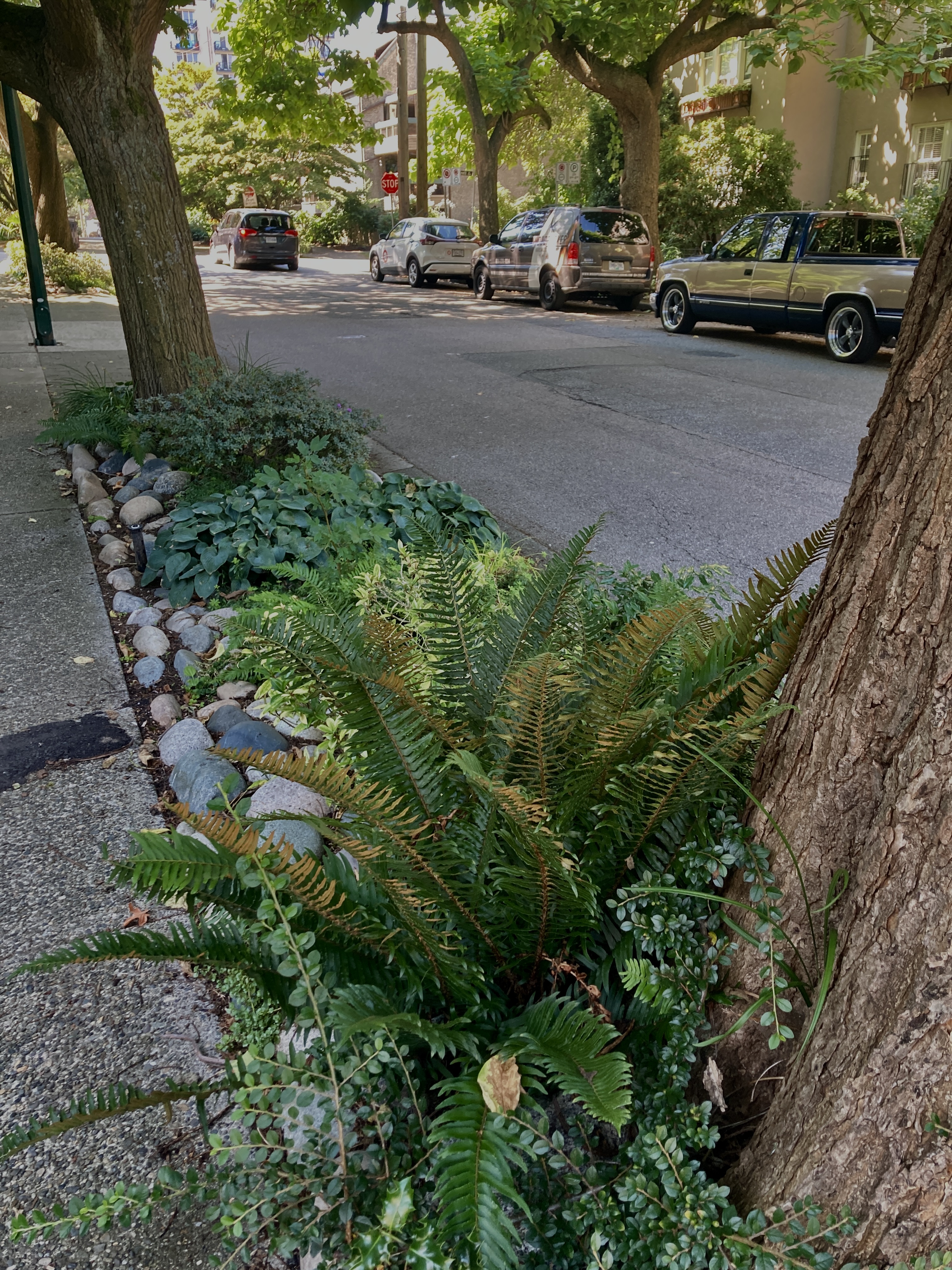
The day grows steadily warmer. I am ever more appreciative of the shade offered by street-side trees, sometimes combined with lush ferns, as in this display near Pendrell…
and sometimes high over bare earth, as in this half-block interruption of Nicola’s vehicular status between Pendrell and See-em-ia Lane.
Yet even barren like this, it is a welcome space, a little spot just for people, very neighbourhood. The lane title is part of the charm: like other area lanes, it honours area history, in this case Mary See-em-ia, granddaughter of Chief Joe Capilano and a Squamish Nation matriarch.
A reminder as I cross Davie Street of real-estate trends…
and later a reminder, down at Harwood, of developer/cultural handshakes, here in the form of this Beyond the Mountains mural commissioned by the builder from Heiltsuk artist KC Hall.
On downhill to the water. I’m now at the foot of Nicola, about to emerge onto Beach Avenue, bordering Second Beach.
Apartments of various eras face the water, dozing in the afternoon sun…
and “open-air museum” installations, courtesy of the Vancouver Biennale, are as much part of the beach scenery as flowers, palm trees and sand.
I first pass Dennis Oppenheim’s Engagement…
and then, as I walk east along the Seawall…
I come to my all-time favourite, Bernar Venet’s 217.5 Arc X 13.
Not much shade, here on the Seawall.
I pause under handy palm trees to cool off, agree with a bemused pair of Austrian tourists that outdoor palms are somehow not what we expect to see in Canada…
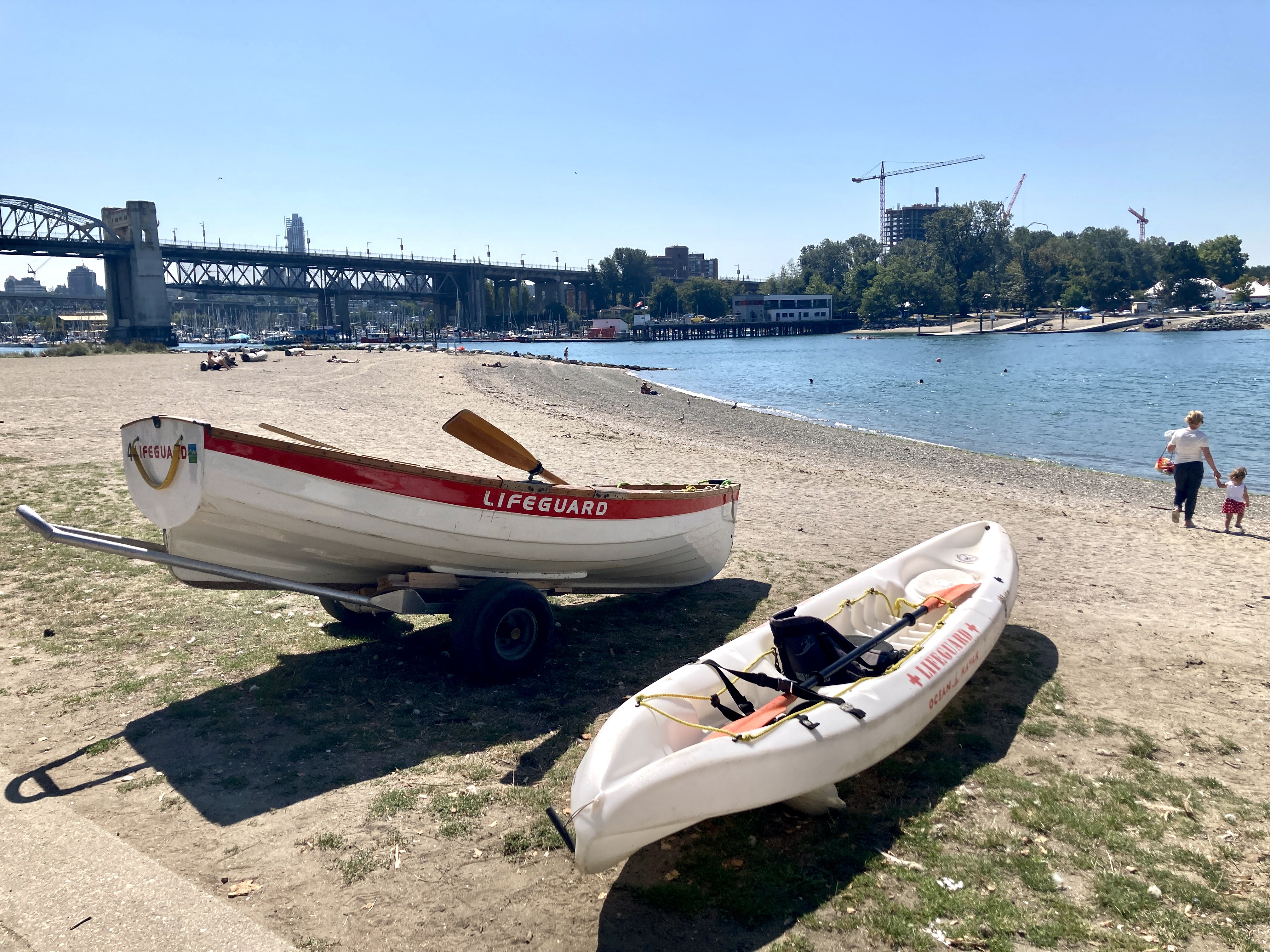
loiter under the next cluster of friendly palms to watch a mother finally tear her toddler away from these lifeboats and lead the child on down to the water…
and then buy myself a rum & raisin waffle cone at the Sunset Beach concession stand…
and find yet more shade in which to enjoy it.
I even manage to eat it all without dribbling any down my arm. (Live long enough, and you acquire a few Life Skills.)
Enough blazing sunshine. I forsake the Seawall to climb uphill to Beach Ave. and the shade offered by its trees. It gives me a distant view of Squamish artist Chrystal Sparrow’s mural on the Sunset Beach sport court, currently being repainted…
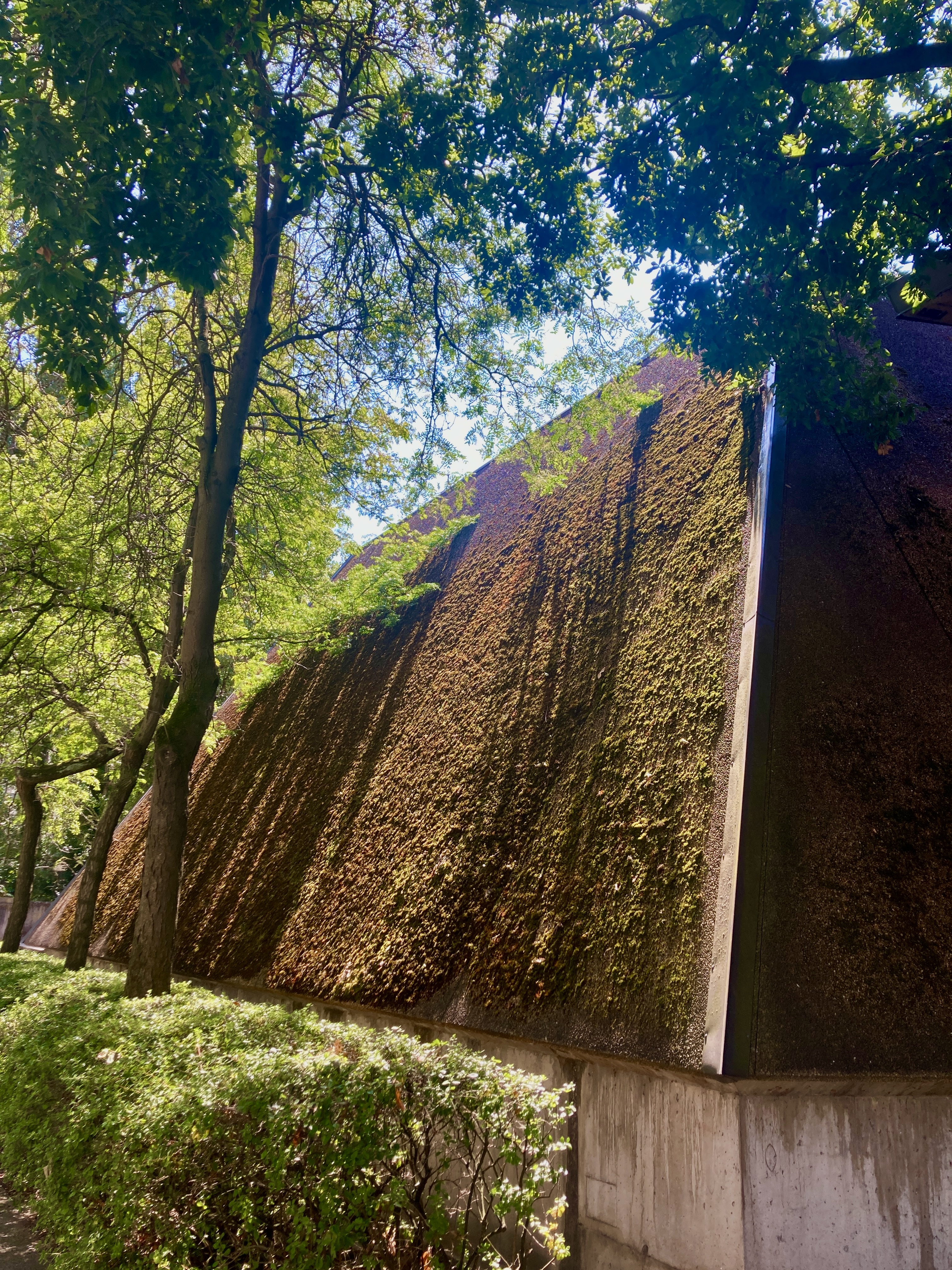
and a close-up of the mossy walls of the Vancouver Aquatic Centre as I carry on east.
But then, somewhere between George Wainborn Park and David Lam Park — bottom-centre of that first Walking Map image, if you care to scroll back up — I return to the Seawall and False Creek.
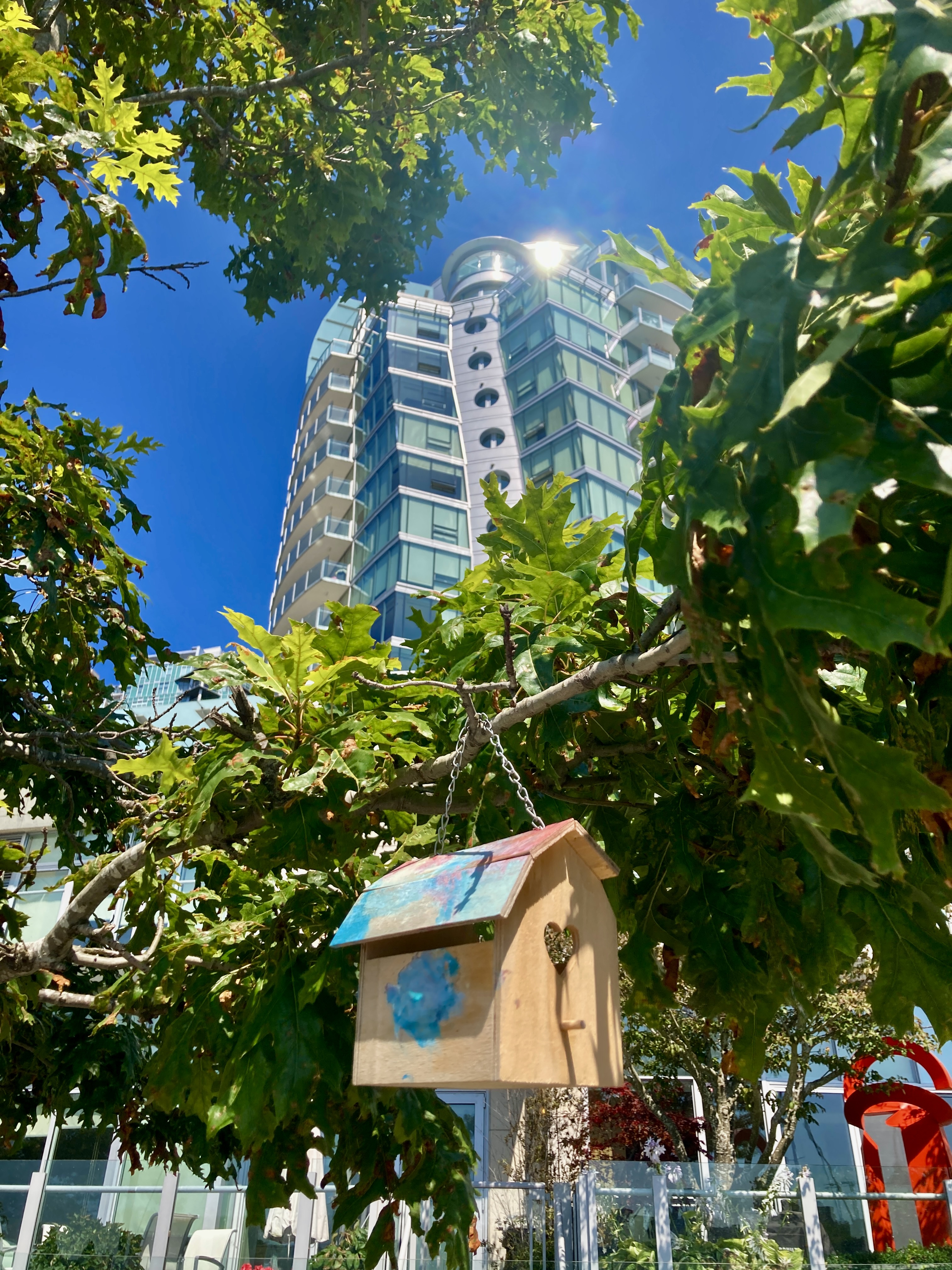
Where I am first amused by this tiny, very unofficial, birdhouse hanging from an official Seawall tree…
and soon afterwards hopeful of a ferry ride home from the David Lam Dock.
Look at this: two ferries converging on the dock (left & right, the rival Aquabus and False Creek lines respectively), eager to pick me up.
But, no, we are at cross-purposes. I want east; they are both headed west to Granville Island.
They assure me an east-bound boat will come by soon. One does. It then steers a slow zigzag route, meeting rider needs — which gives me time to think about “heritage.”
What counts, what doesn’t? In today’s walk, did only the very official and historically designated Barclay Heritage Square count? Or all of it?
The online Cambridge Dictionary gives me the answer I realize I want: heritage consists of “features belonging to the culture of a particular society.”
Yes. With that kind of latitude, it all counts.
From the designated Edwardian homes to the Fortes mural to “hi” on a sidewalk and a Pet Food Pantry; from ice cream and real-estate trends and Biennale art to lifeboats and palm trees and a silly little birdhouse and rival ferry lines.
15 August 2024 – Only later do I realize I have been offered a Dr. Seussian experience, right here at the corner of East 7th & Main.
It will have me chanting my rewrite of the tag line from his 1968 Foot Book: “One foot, two foot, red foot, blue foot.”
But not yet.
At the moment, as I approach Main on East 7th, all I notice is the message tacked to an aged wooden telephone pole. It catches my eye because, one, it is the only message, and, two, it looks polite & quiet & official & totally unlike everything else that bombards us from utility poles.
So I take a closer look.
I am charmed! This is surely the most polite “Post no bills” warning in the entire universe. Not just polite, but whimsical… and successful. This weary telephone pole is being allowed to rest in peace.
I am sufficiently intrigued to read the small print, and resolve to look up City of Vancouver Ordnance [sic] #17-B-9883 once I reach home. What are the official rules for postering, I wonder.
As Mr. Google points out, this very polite notice is marked by a typo, as well as by whimsy. “Ordnance” = guns, artillery & the like. Accept the suggested revised spelling, and all is well. “Ordinance” = a piece of legislation enacted by a municipal government.
Even then, missing “i” firmly in place, I still can’t find #17-B-9883 online.
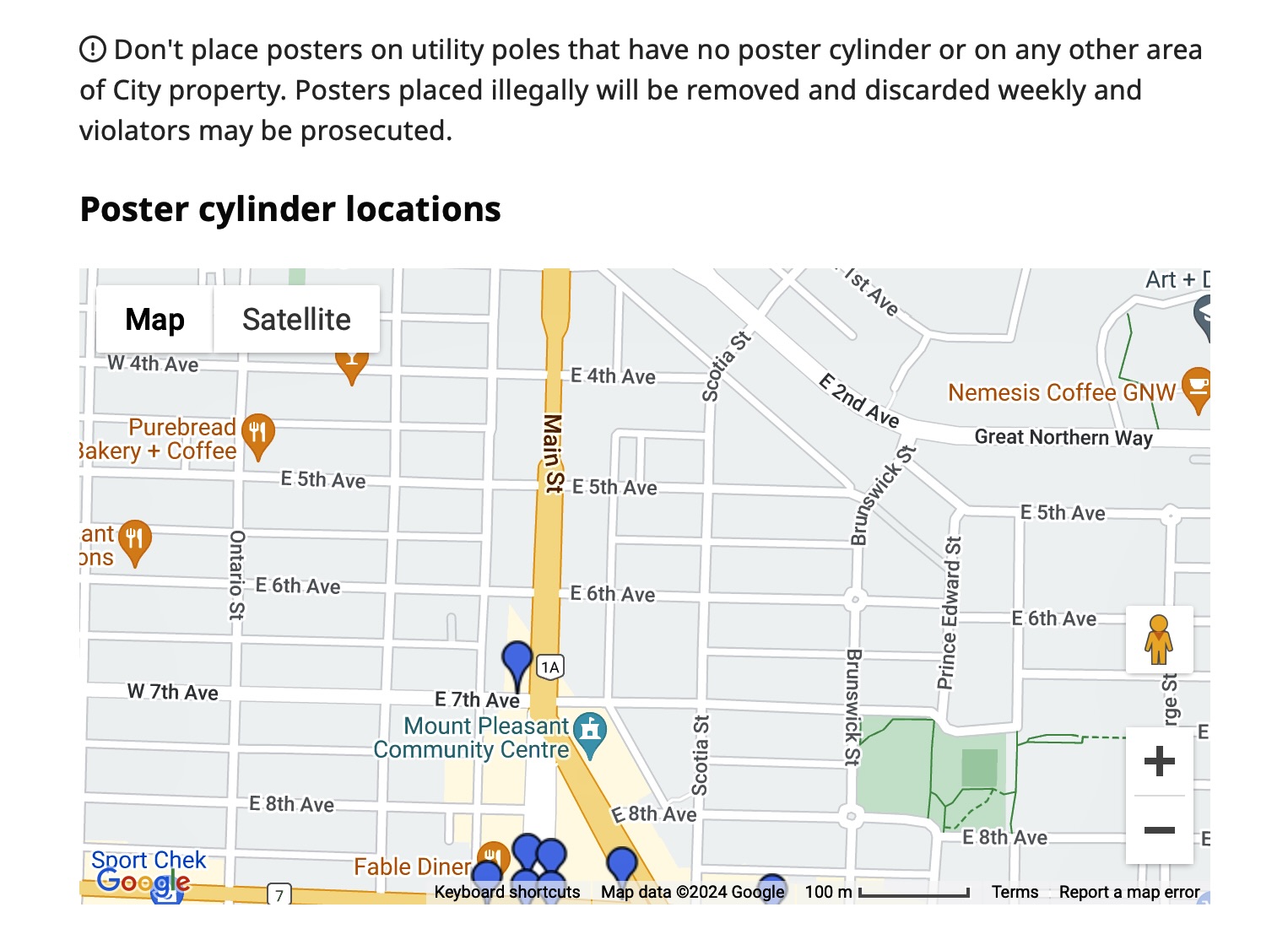
But I do find a cheerful discussion of the City’s poster cylinder locations, complete with a handy map. No need to abuse wooden poles any longer! Tape your announcements to a purpose-built metal cylinder instead, with the City’s blessing.
I navigate the map, and discover there is an official poster-pole right next to the wooden pole at E7th & Main.
Screenshot
I zip back out in the fading light to have a look.
And there it is. The approved, yes-you-can, post-all-you-want pole, covered in notices.
“One pole, two pole,” I chant. “Don’t pole, do pole!”
11 August 2024 – I’m in behind City Centre Artist Lodge, once again epicentre for the Vancouver Mural Festival, now in its final day.
Much to my surprise, I’m not much engaged with VMF official activities this year, but the hoop-la does have me noticing things with a sharper eye — colours, shapes, energy, juxtapositions — as i weave through the adjacent alleys.
I don’t yet know it, but I am curating my very own collection of white bunnies.
Starting with reflections + fence + signage + curb stones in the north/south alley right behind the Artist Lodge…
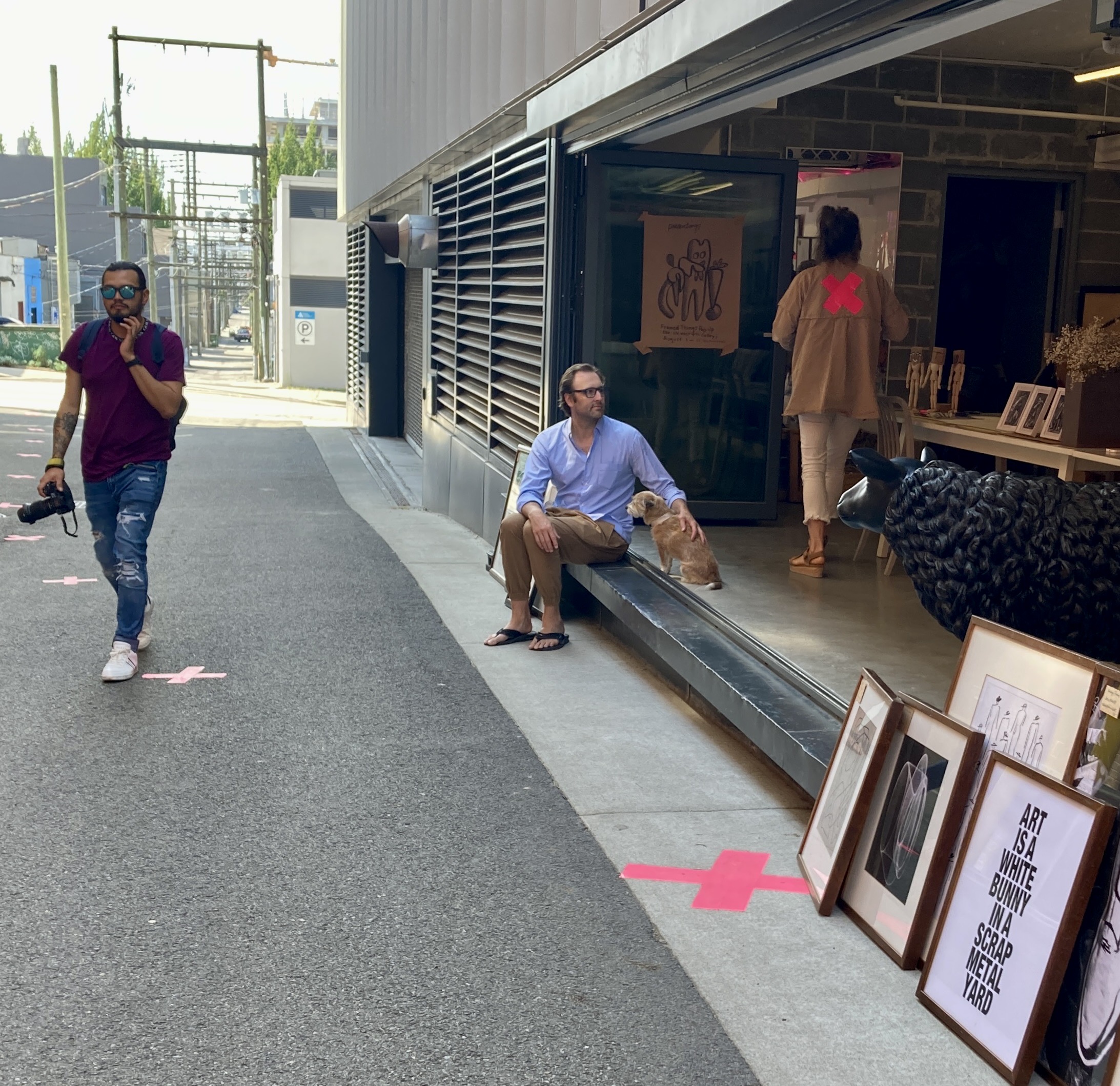
followed by resting man + dog + red-X motif + pop-up art display in the east/west alley between Main/Quebec/5th/4th…
which brings the white-bunny concept into my life.
It’s the framed quote, bottom-right in the line-up: “Art is a white bunny in a scrap metal yard.”
I like this! Deliberate bunnies, and “found” bunnies as well — whatever adds scamper & bounce to the streetscape.
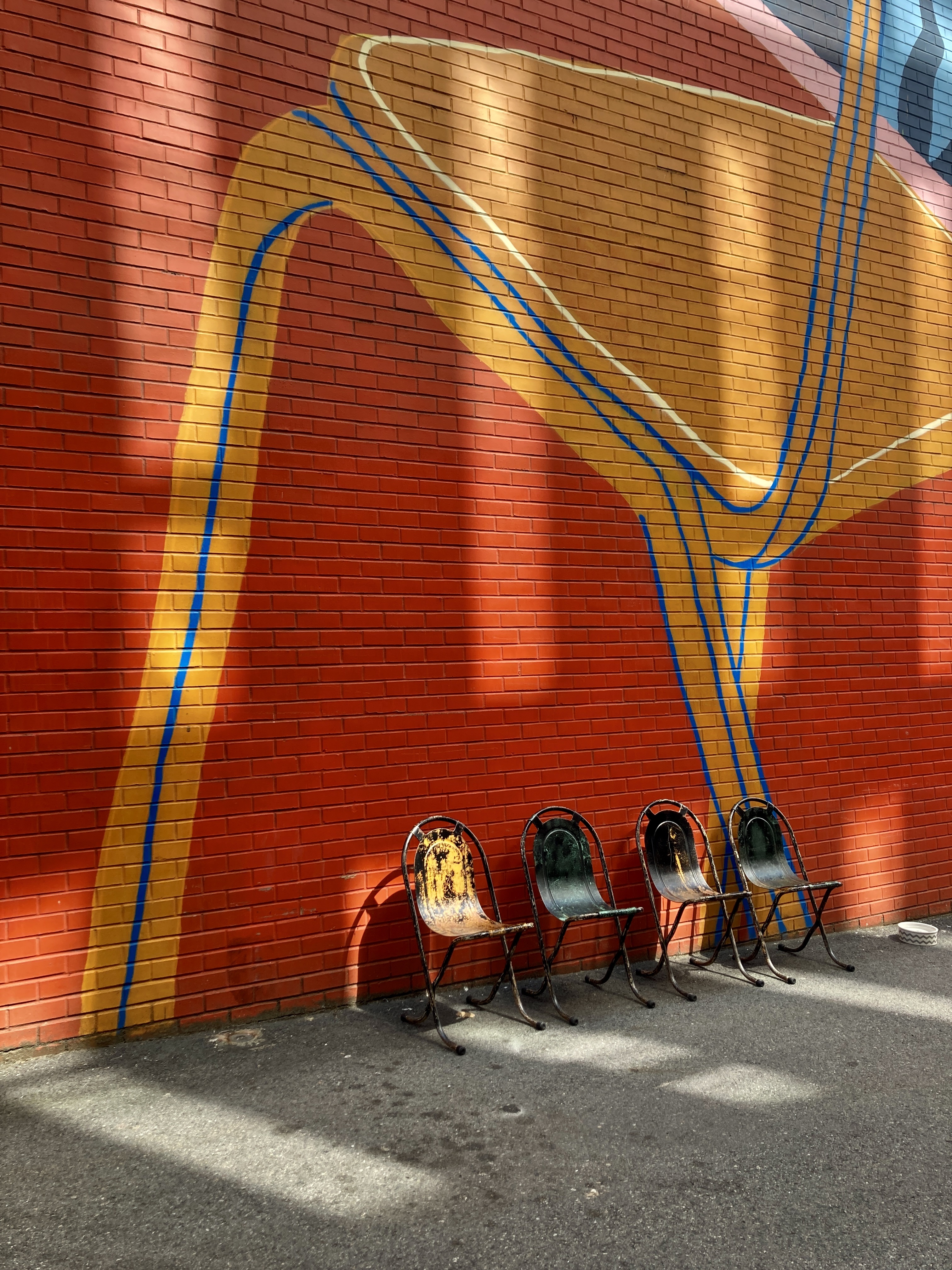
Right opposite, same alley: four chairs lined up in a deliberate and carefully positioned tribute to the looming chair in the gigantic wall mural behind them…
one detail in Andy Dixon’s 2017 VMF mural Red Studio (After Matisse), his 90-foot-high portrayal of his own Vancouver studio.
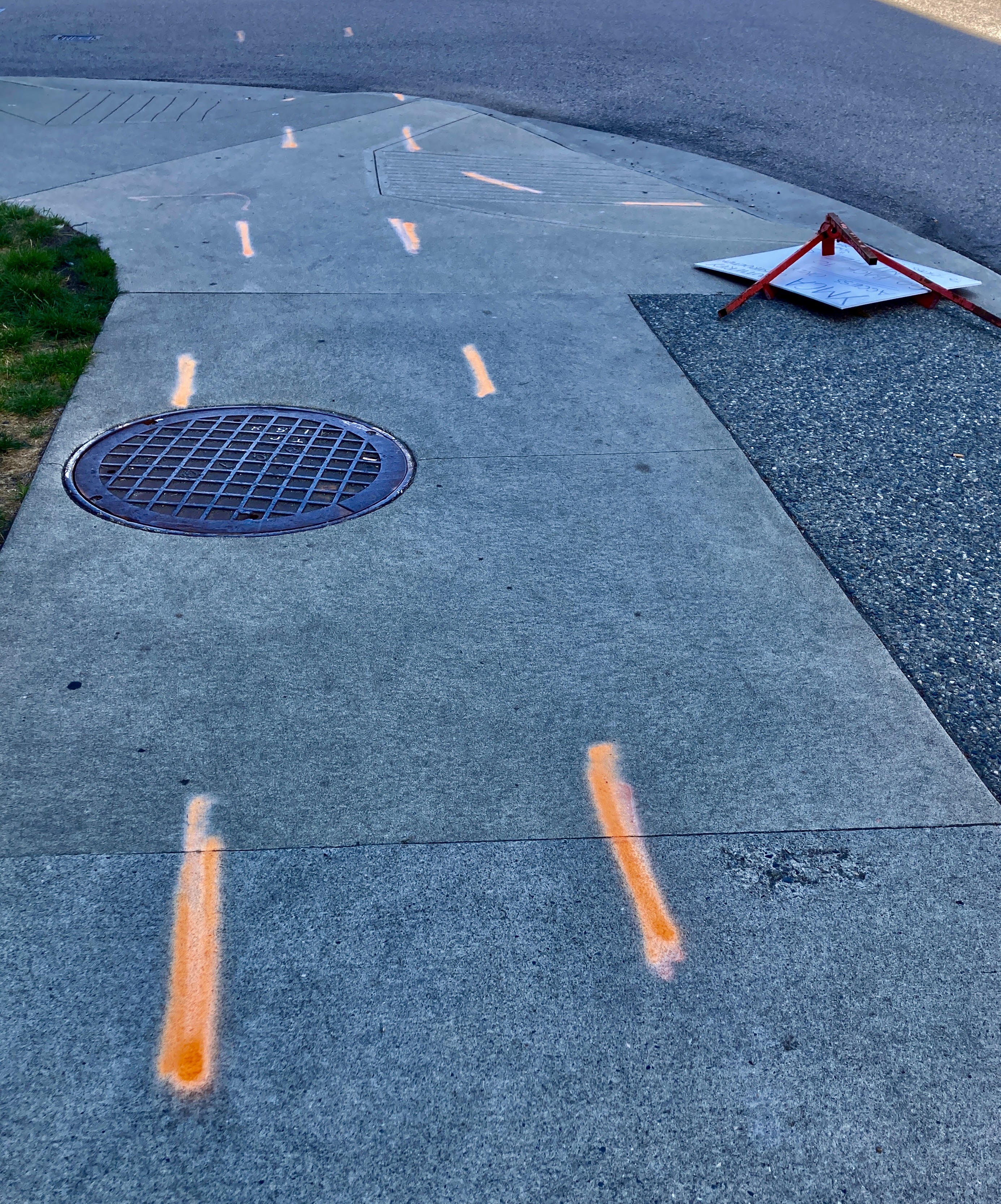
After that, my white bunnies are whatever & wherever delights me, whether day-glo construction guidelines on the sidewalk before me at Quebec & East 4th…
or white communications discs high on a roof beyond me, punctuating the tower to their left…
or an eye-level fluorescent X just south of Quebec & East 2nd. (Only later, at home, do I notice the red-X motif in the alley with the pop-up gallery, and realize there must be a connection.)
One final white bunny, down by False Creek.
A multi-coloured white bunny, mind you — art is inclusive! — painted by Nature, and proclaiming a message that seems hard to believe, this hot mid-August day.
6 August 2024 — One day all crisp shadows down a local alley…
and the next, off to the “green calming atmosphere” promised in this sign welcoming visitors to Camosun Bog.
The bog is a tiny, boardwalked ecosystem at one north-east knob of sprawling Pacific Spirit Regional Park. I always choose the same entry point: south from West 16th Ave., down one final residential block of Camosun Street.
And here I am. I set foot on that entry stretch of boardwalk, and I am already calm.
Slower of pace, quieter of thought, I duck under an arch of Mountain Ash and walk around the bend beyond…
to pause at what I think of as “The Sentry” — a nurse stump adorned each season with whatever that season and its weather have to offer.
I next pause at the bog itself, now diminishing in the heat of mid-summer from its abundance of early spring.
Then, I follow the boardwalk.
The sphagnum mosses are beginning to bleach, responding to the same heat that shrinks the bog, but there are still bursts of vivid greenery.
Sometimes I need to peer over the inner railing of the boardwalk perimeter…
but any old time, I can just look over the outer railing at the forest beyond.
Loop complete, side trips complete, I retrace my steps to walk back under the arch of Mountain Ash. This time toward sidewalks, pavement, cars and traffic. Lots of grey awaits me. Lots of noise.
I’m not yet ready for West 16th! I walk eastward on quiet residential streets instead.
And I find myself at another tiny enclave of calm.
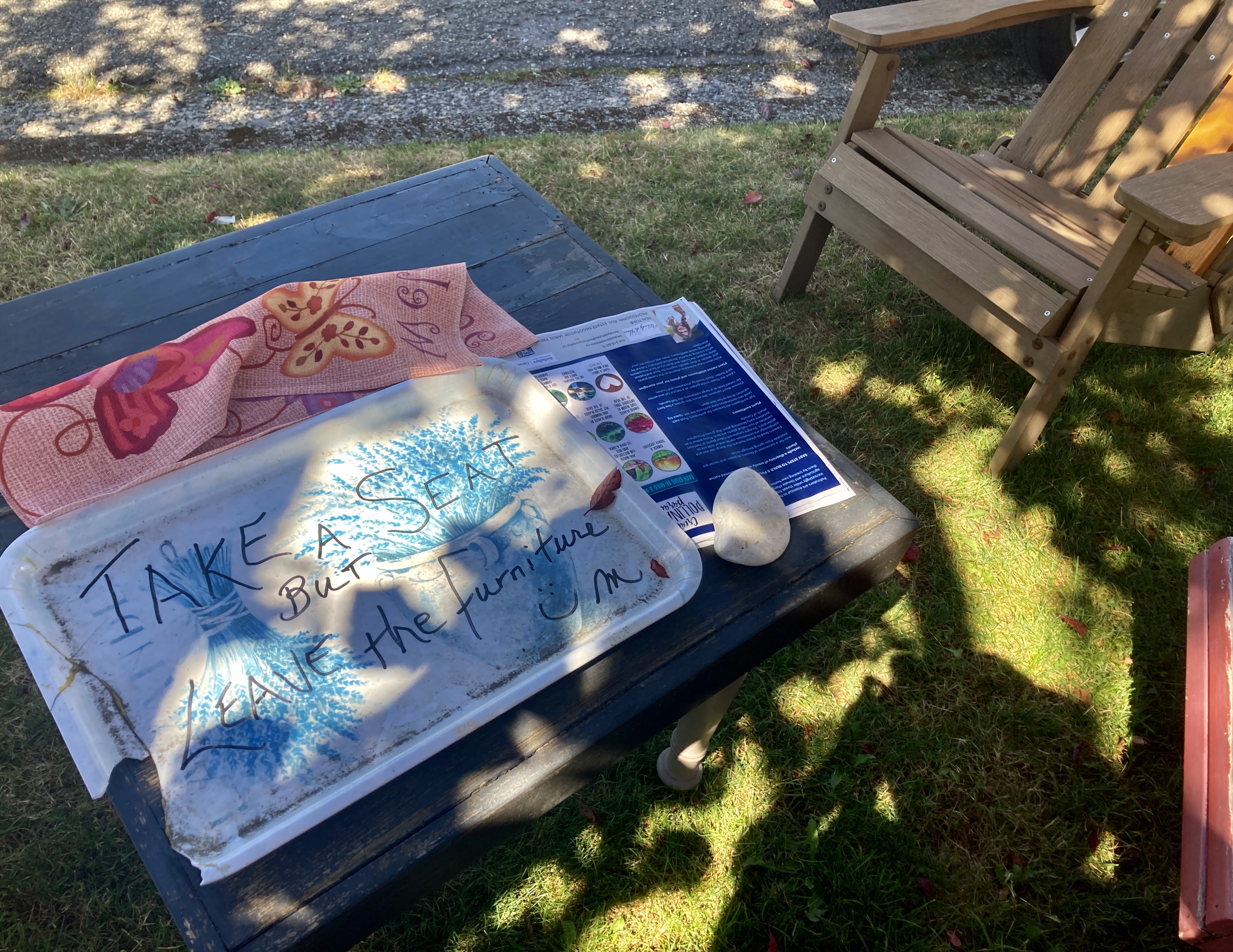
Right there, across that intersection, under those street-side trees: some Muskoka chairs grouped companionably around a little table.
I cross. I check it out. I discover that, just like the entry sign for Camosun Bog, the table welcomes visitors.
Though with an admonition.
I obey.
I take a seat. And when I depart, I leave the furniture where I found it.
26 July 2024 – It’s a bright, breezy day and my target direction is Strathcona. I’ve just skimmed a newsletter reference to a week-long Eastside Arts Festival in Strathcona Park, and that’s motivation enough. Whatever the festival does or doesn’t deliver, this old residential neighbourhood is always worth another visit.
I set myself the mild challenge of getting there without walking north on Main Street. Main is a diverting parade of small shops farther south, but from here north it becomes a noisy downtown artery. My plan calls for a clever N/E zigzag — but that’s the beauty of feet! They sure can zigzag.
So down Scotia I go, with the now-sewered creek beneath my feet that once fed the now-infilled last stretch of False Creek. Left turn onto East 1st Avenue, with its contribution to new-build grit, part of the neighbourhood transformation…
and a right-turn onto Industrial Avenue.
Confession: this requires a quick ricochet off Main Street, where 1st and Industrial almost meet, but surely I can be forgiven that hairpin turn?
More grit, as I head north among the terminals and warehouses of False Creek Flats. There’s new-build activity here at well, with high-tech moving in, but that’s mostly farther east. This part, close to Main Street, is still yer actual old-fashioned rust & rolling wheels kind of grit.
But I like it, just as it is, and today it delivers me nicely from any more connection with Main Street. All I have to do is backtrack east to Station Street, then north to Terminal and across Terminal to the building that explains why Station and Terminal streets bear these names:
Pacific Central train station.
It’s more than 100 years old and still in use, with today’s power-washing just part of the regular TLC. This highly functional Old Build will soon be joined by that New Build lurking in the background — the new St. Paul’s Hospital complex, now under construction and due to open in 2027.
My avoid-Main-Street route takes me east on National Avenue, currently reduced to a narrow footpath bordering the hospital construction site. I gawk as I walk.
The area swarms with workers…
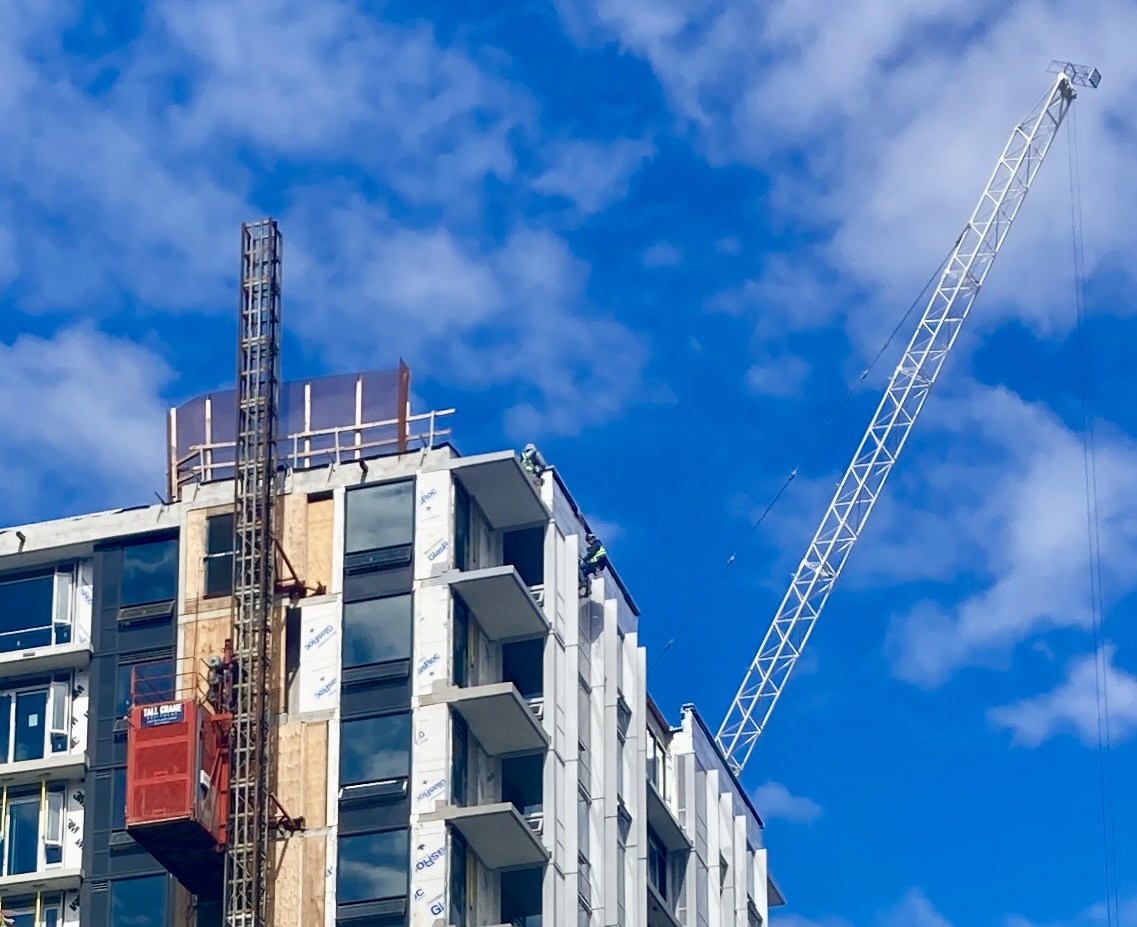
a reminder that, for all the machinery and high-tech of our age, every work site still depends on human effort and skill.
I have escaped Main Street!
I am now safely east, just in behind the construction site, where I can cut north through Trillium Park and enjoy my first fix of major greenery. There indeed is St. Paul’s, rising in the background, but here in the foreground…
we have green fields. Green fields both sides of this pathway, with kiddies on each side, busy learning the fundamentals of soccer.
This is all fine, but I keep walking because just to the north lies Prior Street, and that will take me into Strathcona neighbourhood. And then Strathcona Park! And then the arts festival!
A vintage wooden Strathcona house sits right smack on the corner at Prior and Jackson. It is much the worse for wear.
That’s also part of the story of this area — home to Coast Salish First Nations for millennia, and then, with the 1865 opening of the Hasting Lumber Mill, increasingly home to waves of working-class immigrants. The whole area prospered, declined, and is now in that tenuous urban mix of restoration, renewal, rebirth and inevitably destruction as well.
I walk east on Prior. Strathcona Park will be just ahead of me, but before I can quite fix on its location, I am diverted by the sight of an elderly couple with an exuberant grandchild emerging from a path in the woods to my right. I exchange grave nods with the couple, finger-wiggles with the child, and step onto the path they have just left.
Well. Look at this.
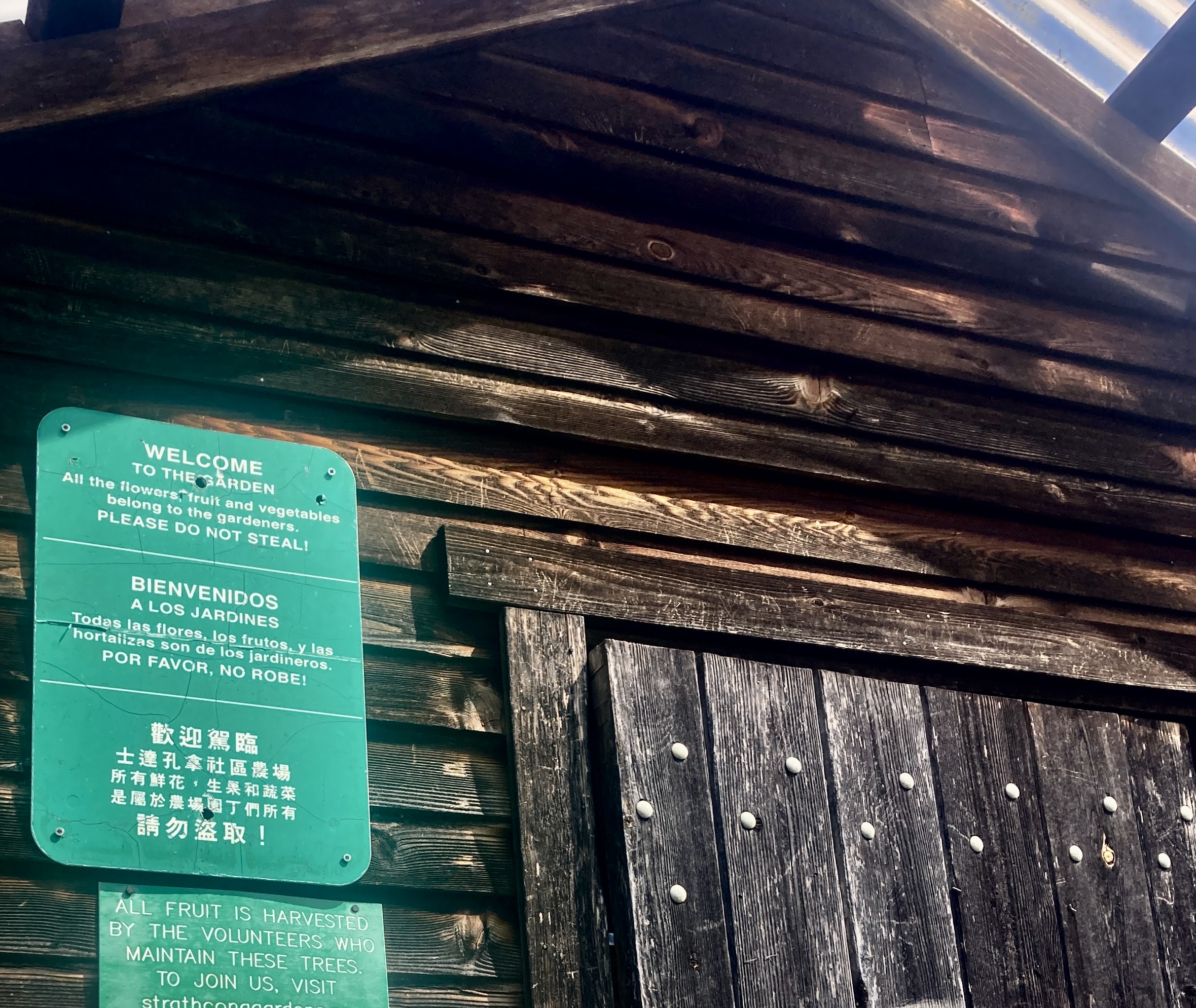
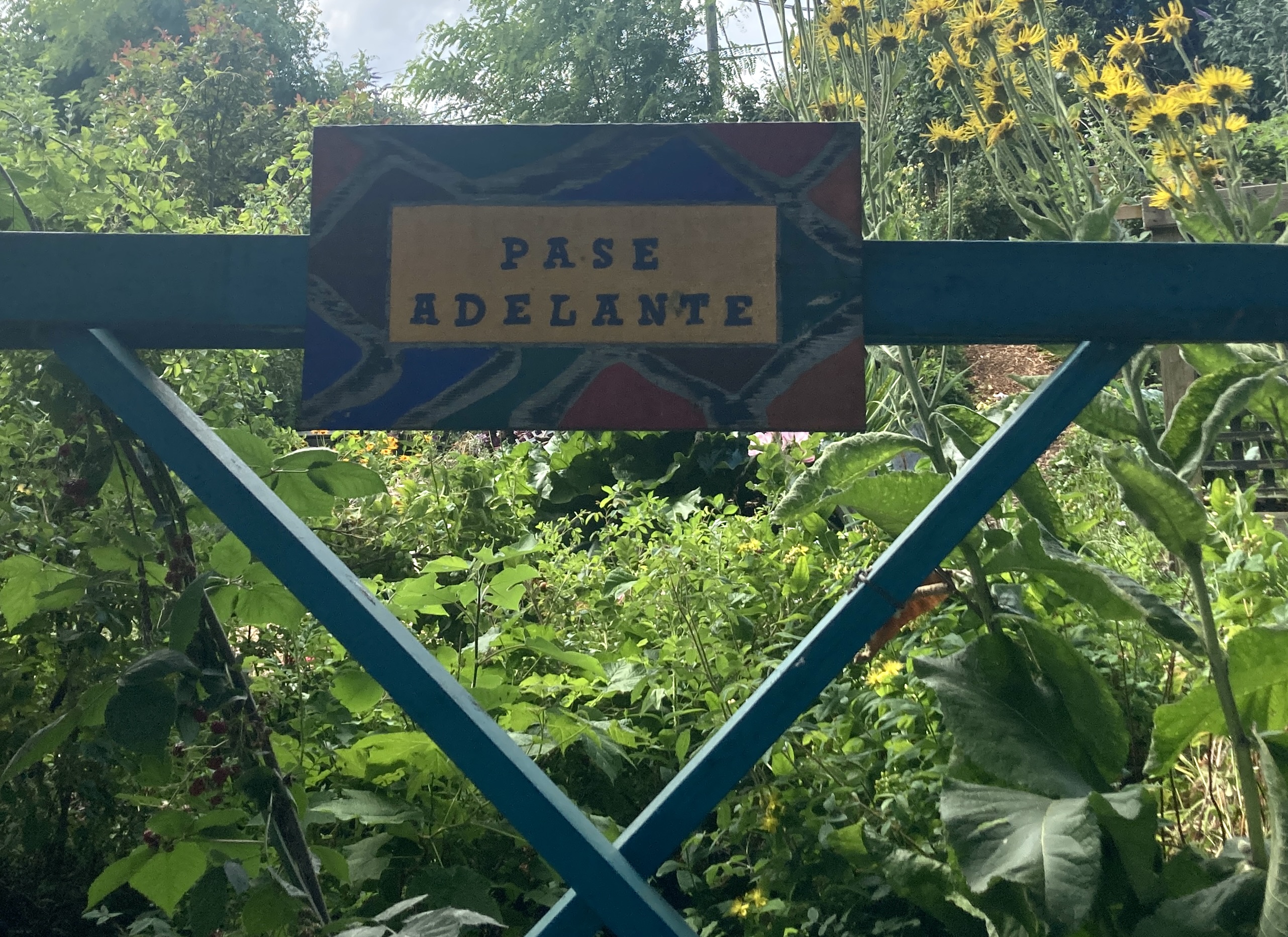
It’s just one tiny corner of a community garden, bursting with mid-summer proof of its gardeners’ devotion. I weave between beds, find the Garden’s tool shed and step close to read its signage. I’m admiring the trilingualism of it all…
when the door opens and I get to meet one of those gardeners. She has been a Strathcona Community Garden volunteer for ages, she says, and she’s not going to let a little thing like knee replacement surgery (points to the scar) keep her away.
Do I know about the Cottonwood Community Garden? she asks. No, I do not. Most people don’t, she says, because it’s so tucked away, but it’s amazing and you should go look at it. Where is it? I ask.
She leads me back to the edge of the Strathcona Garden and points the way: turn right here, then left there, along that line of trees, then keep looking to the right.
So I do.
As I walk, I realize I am now in one corner of Strathcona Park. Damned if I can see any sign of an arts festival. And damned if I care, because finding Cottonwood seems so much more interesting.
Right; then left; then keep looking right, into the trees. Oh yes. Signs of gardening in there.
And a sign very politely telling me to keep out. It explains this particular section is home to sacred medicinal plants, and asks anybody not involved in their care and rituals please to remain outside the fence.
An adjacent sign welcomes me in.
Even though invited to come on in, I feel shy about intruding. I stick to the external foot paths, and peer over fences as I go.
This string of garden plots lies in quite a narrow ribbon of land between Strathcona Park to the north and Malkin Avenue to the south. Looking south, I can see the tops of buildings, one of them marked Discovery Organics and, right here in front of me, the top of a mural marked Produce Row.
Framed by a gaudy arbutus tree on the right and a discreet birch tree on the left, my pathway disappears back into the woods…
and then, soon after, leads me out onto more open ground. Here the garden beds lie right next to the Strathcona Park playing fields.
I meet another gardener — this one a relative newbie, someone who comes from West Vancouver for the pleasure of digging in her very own patch of soil. She offers me a bag of lettuce. I explain I have so much fresh produce right now it would probably spoil. “Me too,” she sighs.
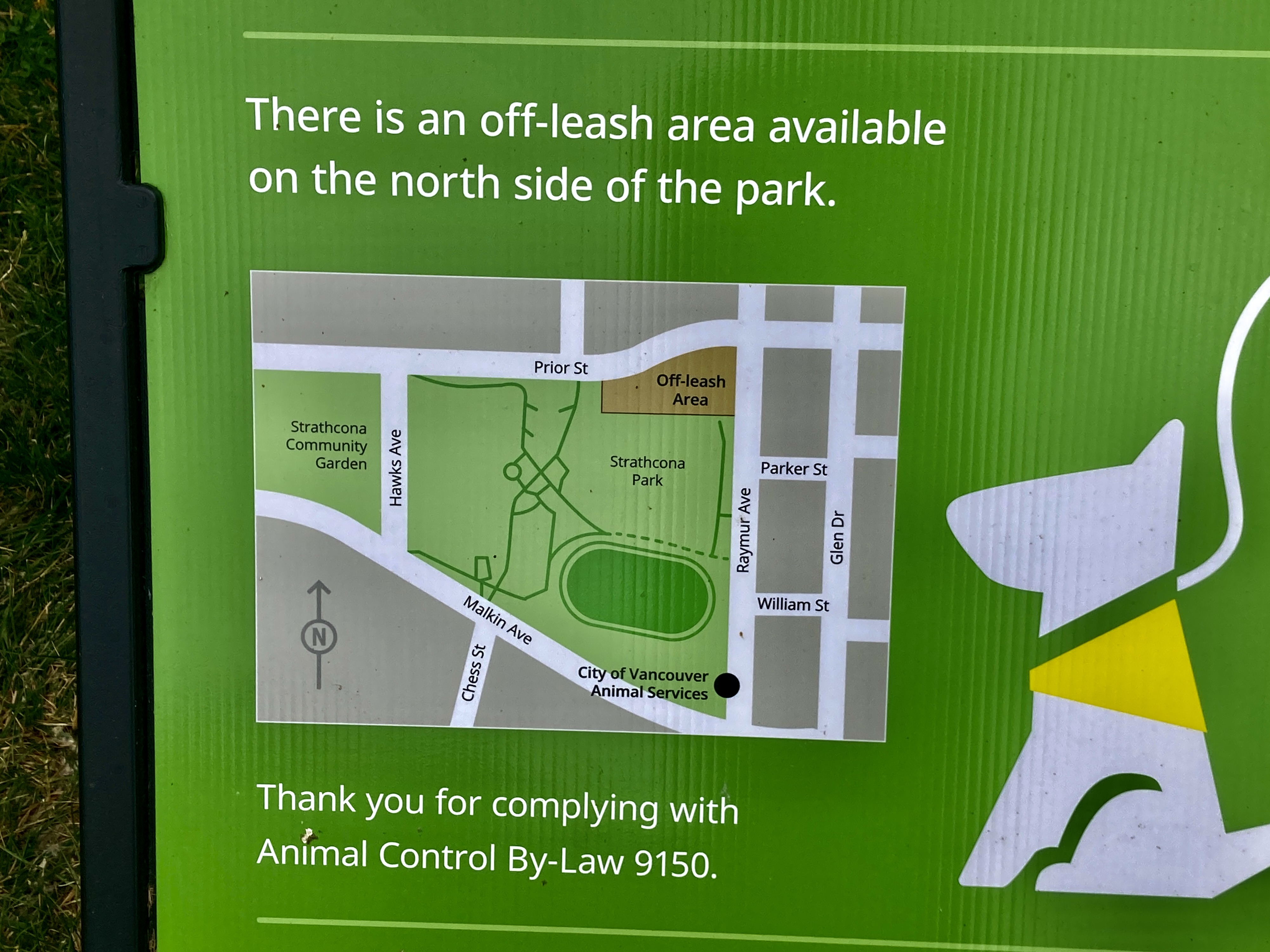
I wave good-bye and then stop at a park map, to get my bearings. Since I am dog-free as well as lettuce-free, the map’s primary purpose is irrelevant, but its coordinates interest me a lot.
Later online research tells me even more, makes these two gardens even more impressive — and suggests thy are under threat.
According to the Strathcona Community Gardens Society, which manages them, both Strathcona and Cottonwood gardens began through local activism: Strathcona on an unofficial dump site in 1985, winning a 25-year lease from the Park Department in 2005; and Cottonwood on an industrial waste site in 1991, still apparently without any legal status. Depending on what happens next to Malkin Avenue — perhaps expansion, to compensate for planned viaduct demolition — both Produce Row (the string of fresh food wholesalers on Malkin) and the adjacent garden might be bulldozed. (I can’t find dated, documented, recent data on this, hence my careful language.)
I don’t yet know all this, as I again walk north.
I am still kinda-sorta wondering about the arts festival, but I am easily distracted — and more distraction is soon on offer.
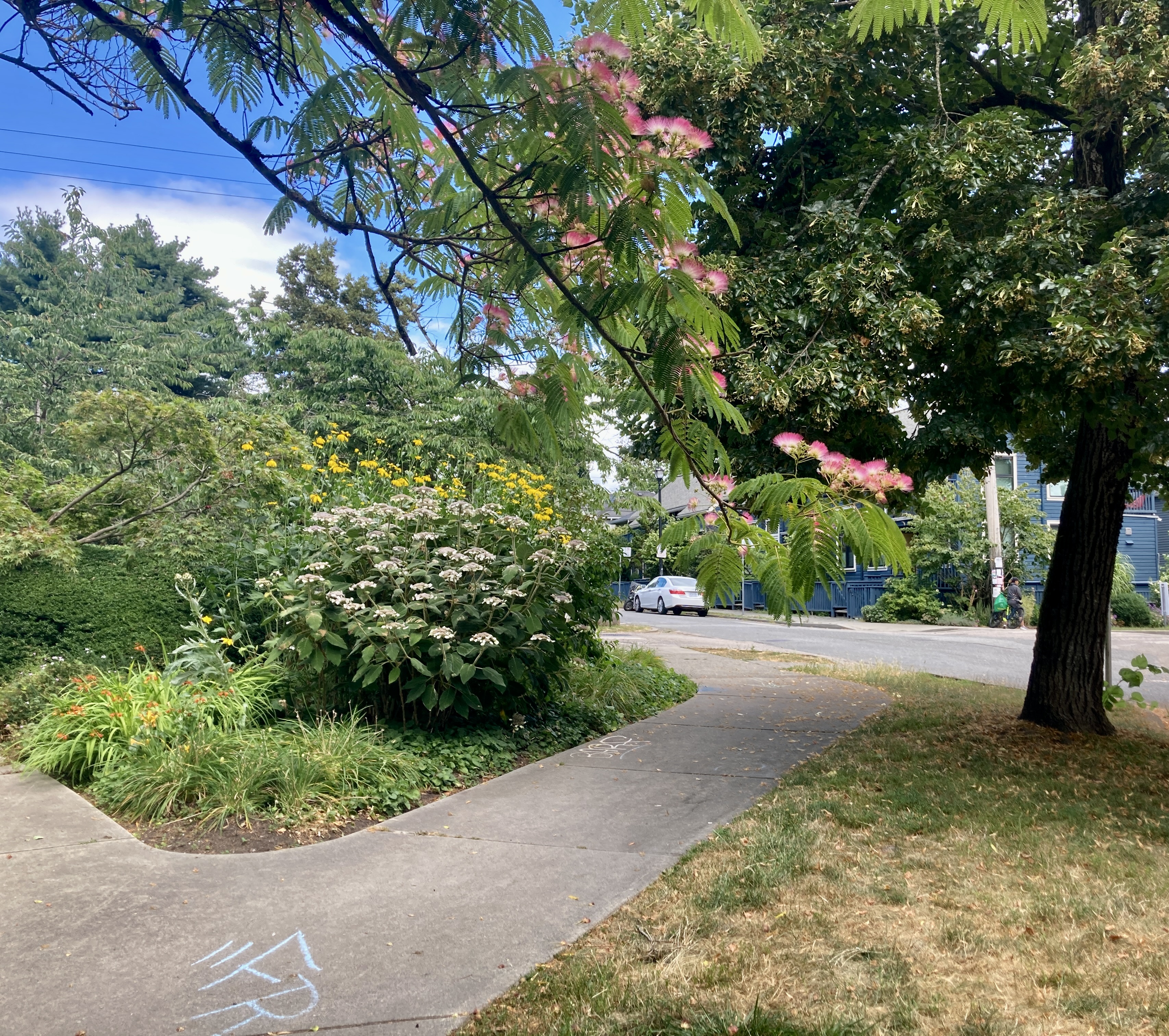
Who could resist Strathcona Linear Park? It leads me alongside Hawks Avenue, and splashes mid-summer foliage all over me, including this magnificent Mimosa grandiflora (thank you Pooker, for the ID).
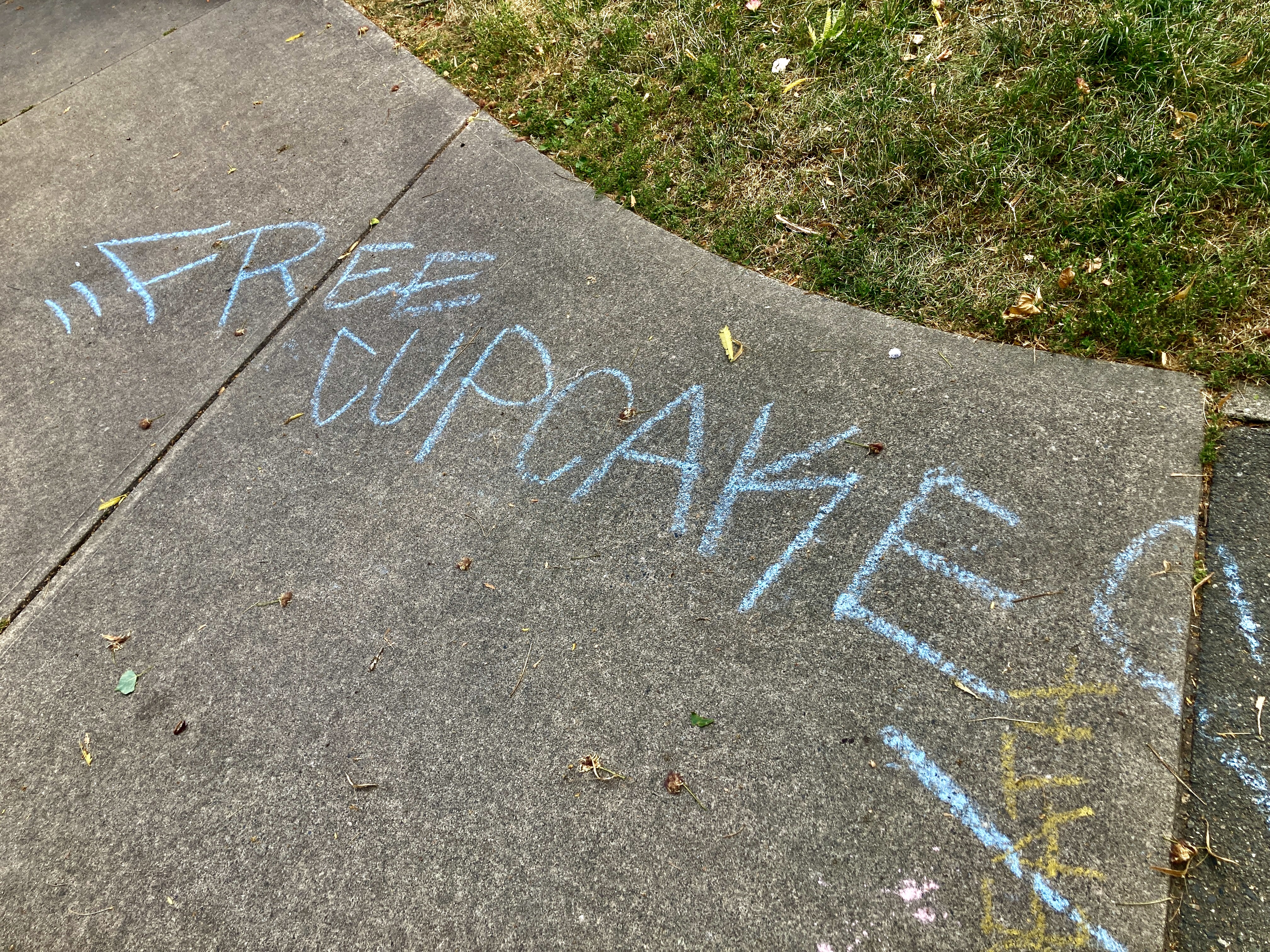
Right under that pink splendour, some turquoise chalk on the sidewalk. “Free…” it begins, and I wonder which political cause is about to claim my attention.
Ahhh! I look around hopefully.
No cupcakes in sight. And still no arts festival, either. By now I totally don’t care.
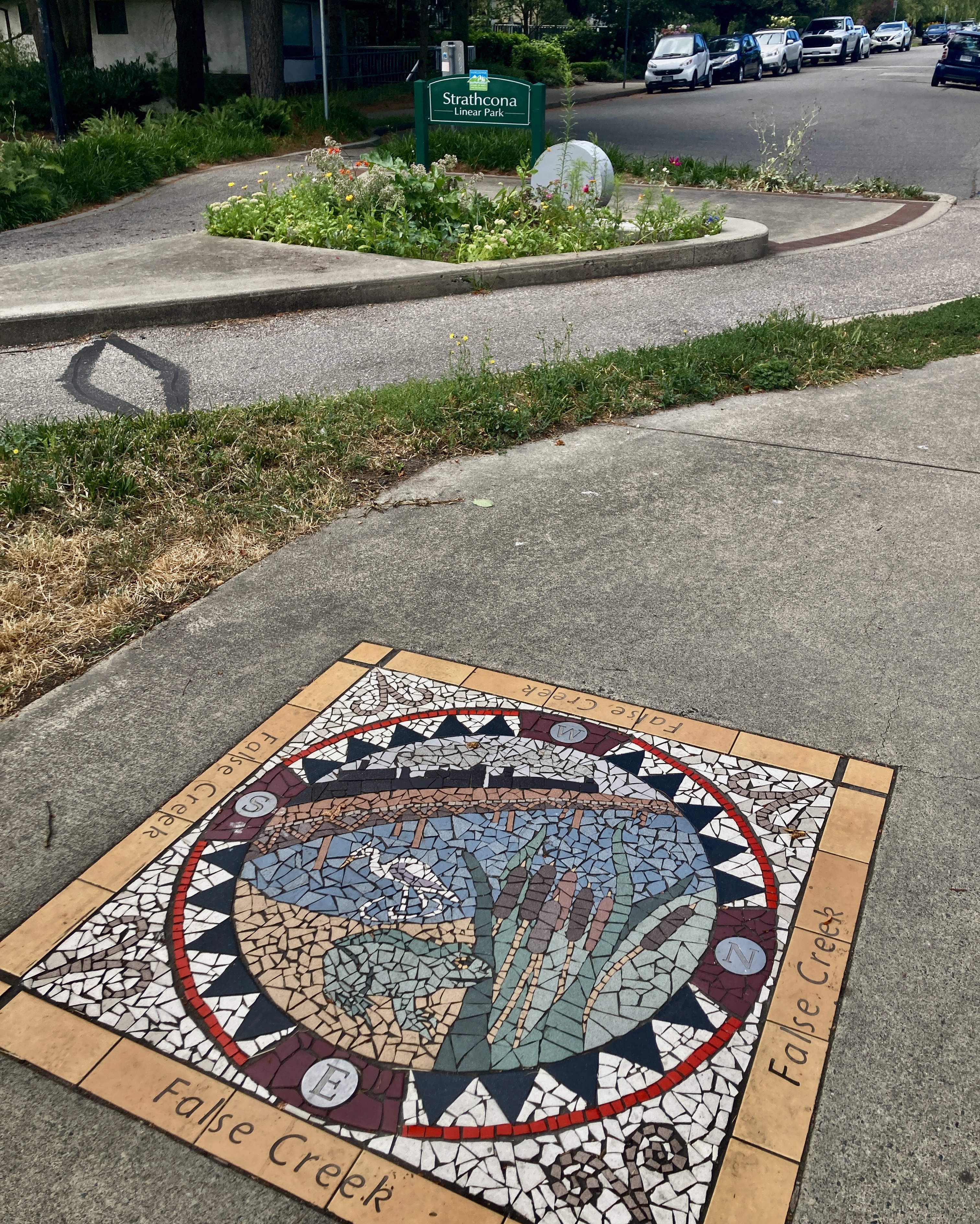
I stick with the Linear Park, admire the False Creek mosaic as we cross the bike path at Union Street…
and walk one more block that now borders MacLean Park. It takes me right to where I next want to be: on the N/W corner of Keefer and Hawks, tucked up with some lunch…
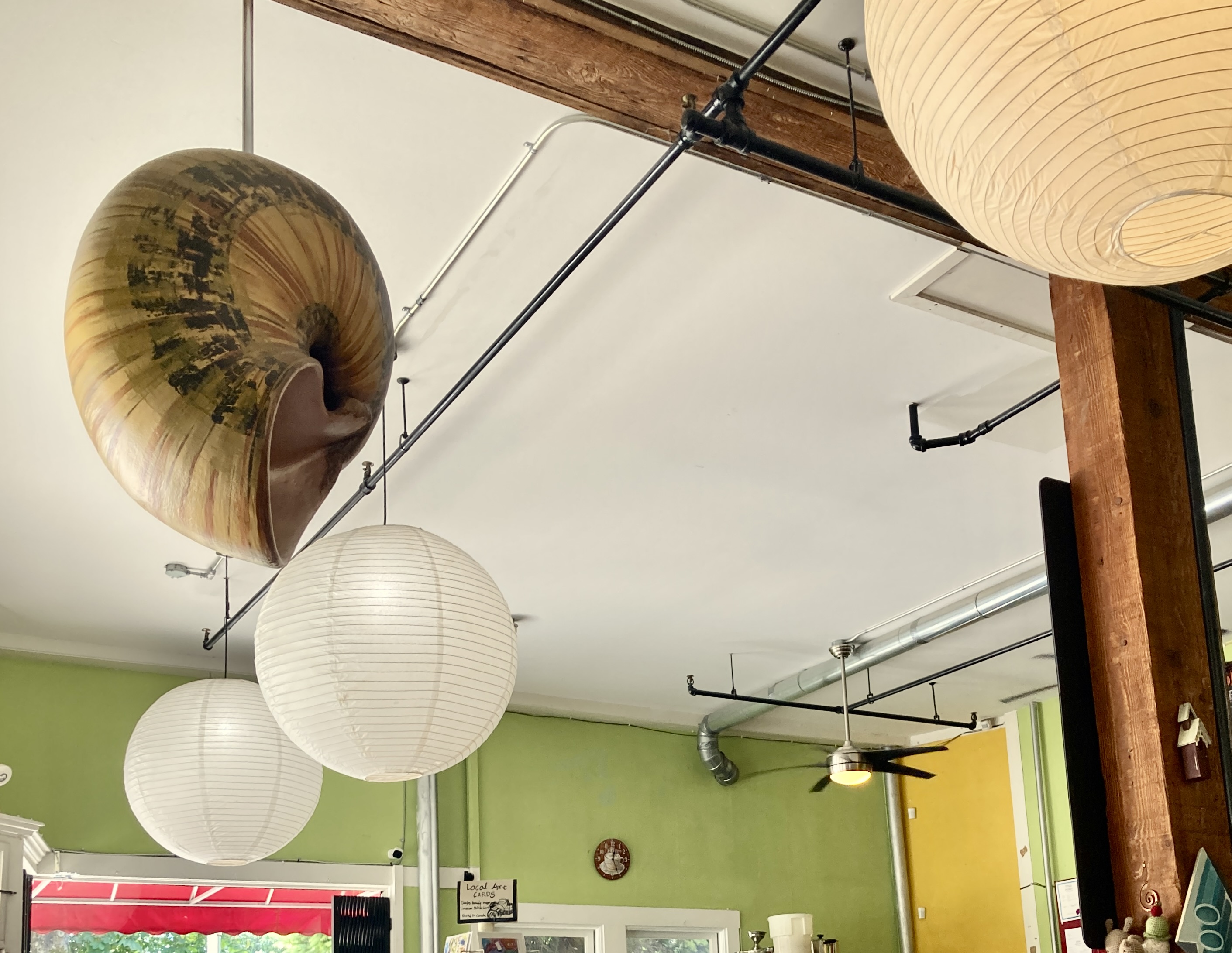
in the Wilder Snail café, with its giant snail as a ceiling ornament.
It is finally time to head west, to start looping toward home.
Past the MacLean Park notice board at Keefer & Heatley, promoting everything from World Hepatitis Day (“free testing”) to evenings at the Dream Punk Piano Lounge, and then a quick detour across the street.
To view an entire residential community, right there on a single massive tree stump.
(Well, what would you call it?)
On west along Keefer to Princess, where I pause for another of the City’s sidewalk mosaics.
Nobody could accuse this mural of being happy-face PR! Look at that power shovel, knocking the end home to smithereens.
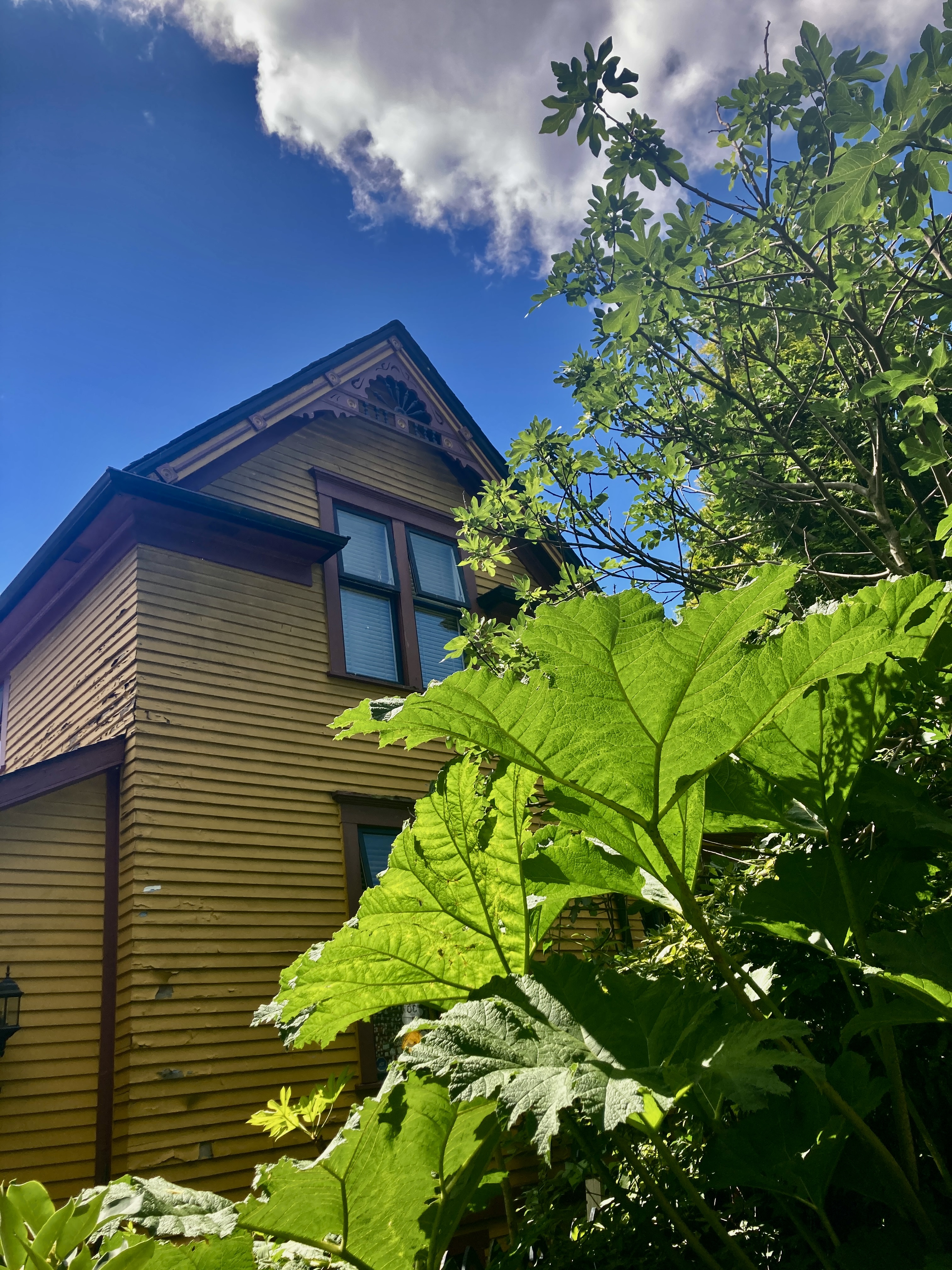
Happily, as I carry on west, I pass still-standing vintage homes. Including this one near Princess Avenue…
protected by its hedge of giant guardian Gunnera.
Once i cross Gore Street, I have changed worlds. I have passed from Strathcona into Chinatown.
I walk with that world for a while, then hop onto a Main Street bus, and go home.
Where, finally, I read the Eastside Arts Festival promotion more carefully.
And discover that (a) it consists of pop-up events at scattered times in scattered locations and, (b), this particular day, the only event is an evening urban-drawing workshop being hosted in a local brewery.
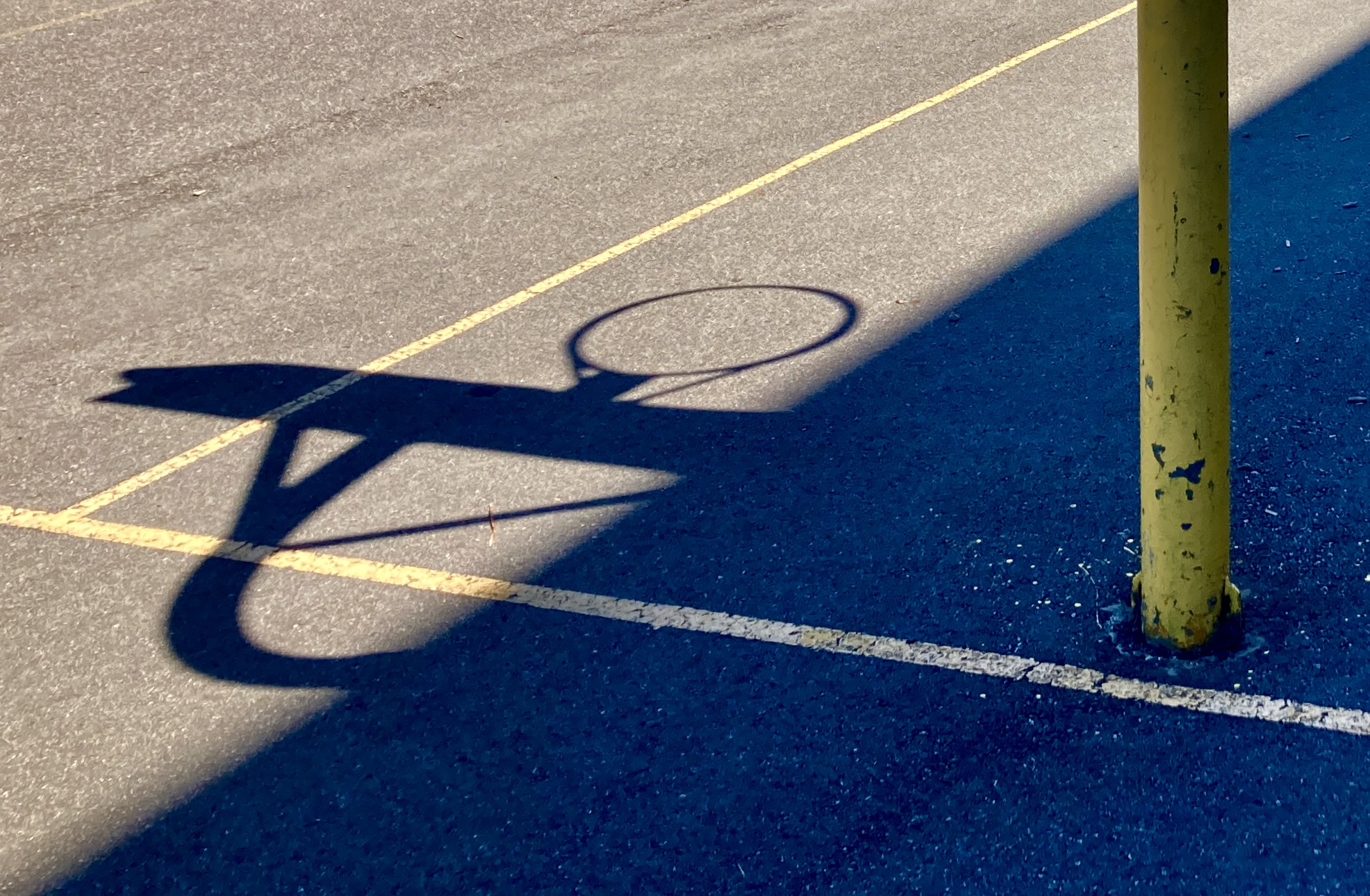
20 July 2024 – Not the elegant, intricate shadow play of the wayang kulit puppets that entranced me many decades ago on Lombok (Indonesia). No, instead, the very humble shadow play that entranced me yesterday, in the sun-baked heat of a deserted school yard.
Right here.
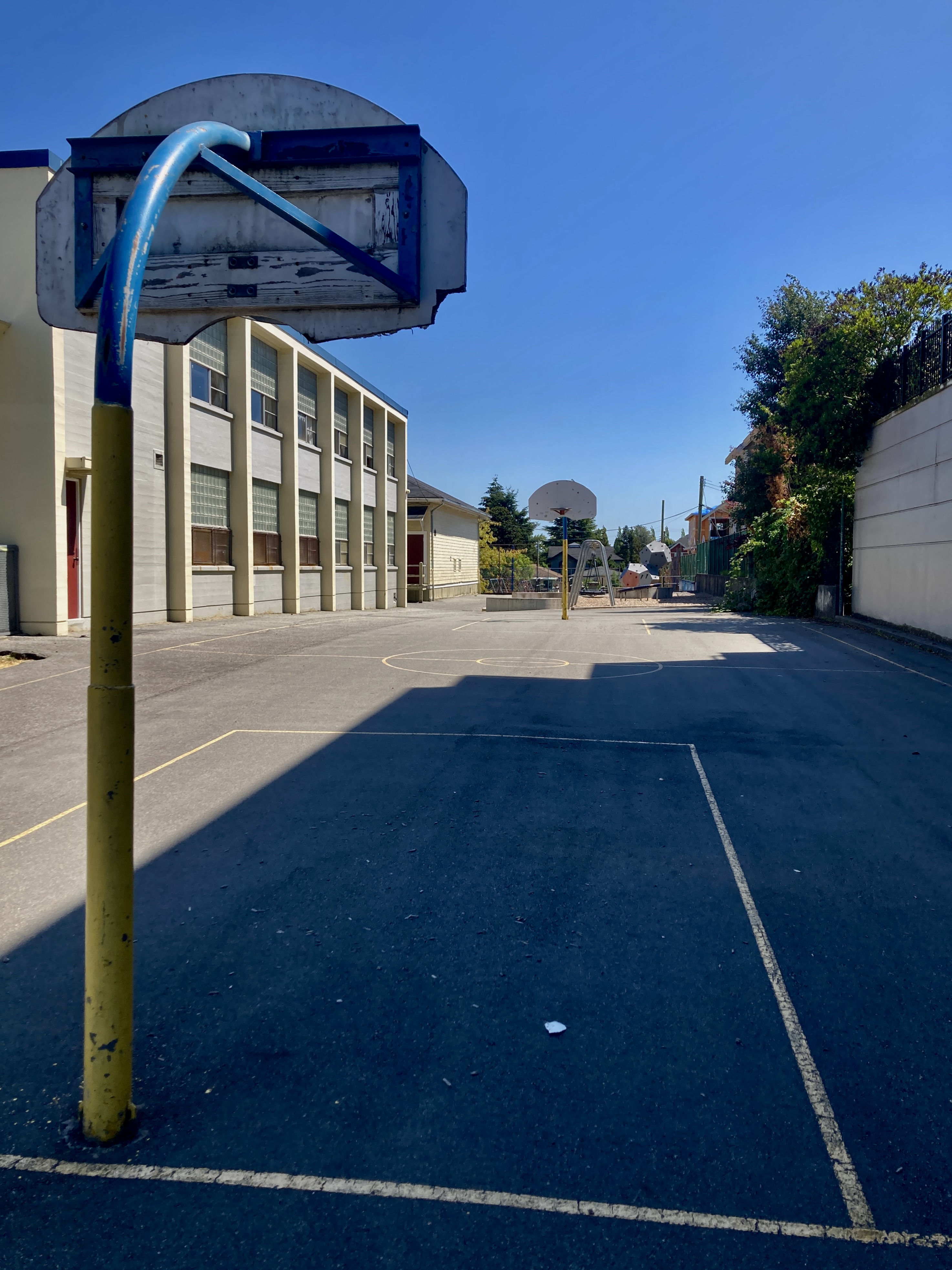
Looking east as I walk north on Main Street: strong schoolyard structures that, in the absence of any children, have only their own shadows to play with.
I veer in, I join the game.
To my left, the sprawling complex of General Brock Elementary School. It is named for Sir Isaac Brock, one of the British generals who, with British troops, Upper Canadian Militia and — crucially — Mohawk Nation chiefs & warriors, defeated American attempts to conquer British North America during the War of 1812. (Should you want to plunge down that historical rabbit-hole, you might start with this Canadian Encyclopedia entry.)
My thoughts are neither with Asian puppetry nor with General Brock. They are, as I step farther into the school grounds, entirely with the shadows.
The basketball hoop standard looms large over what seems a very timid shadow…
but I view it from another angle and up close. Then the shadow asserts its own sassy presence.
The lattice work on the prosaic fence to the right throws lacy relief onto the pavement…
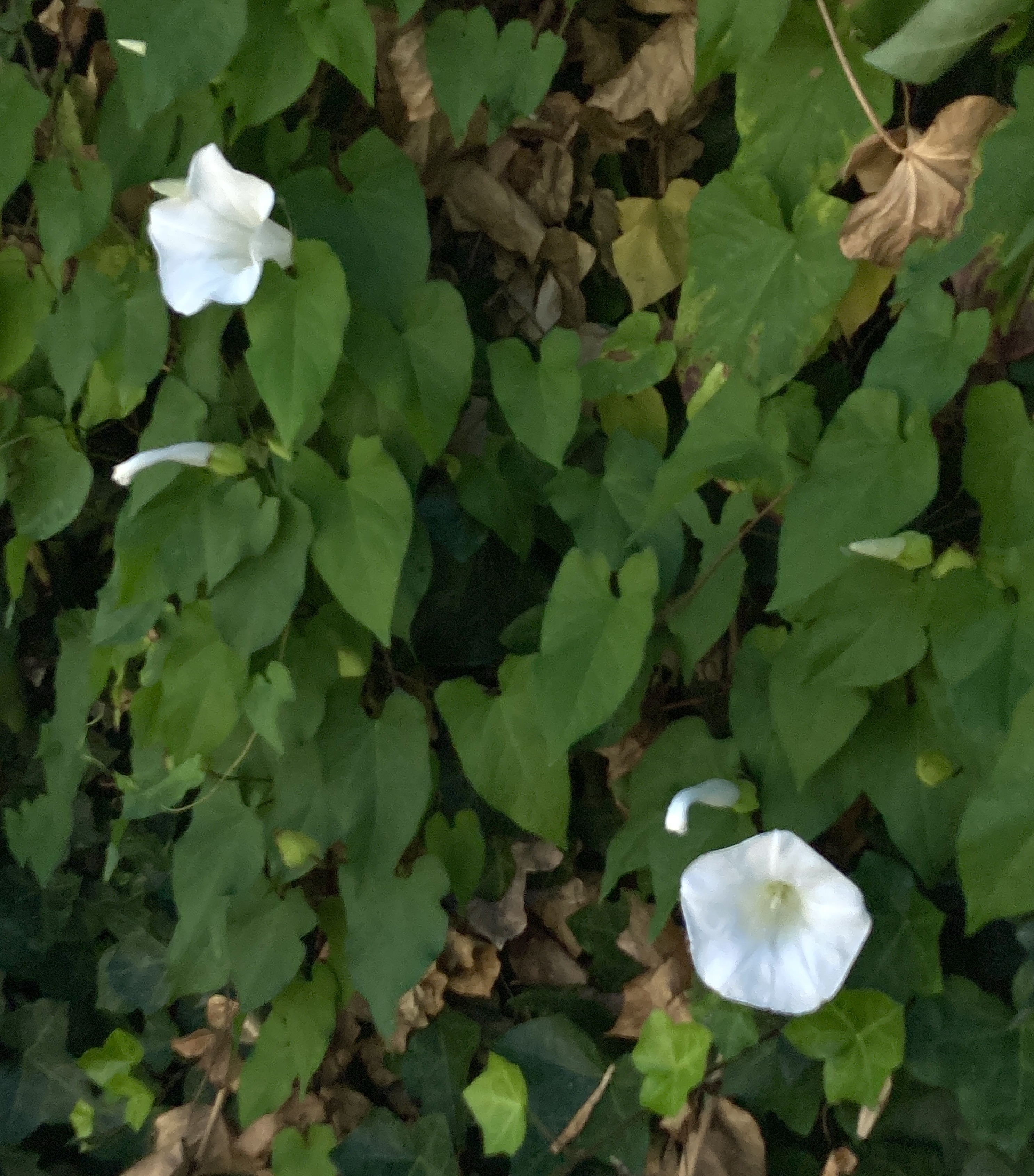
and the wild morning glory blossoms, rampaging on that fence, sulk because they have no shadows to play with.
Pretty indeed, but I don’t linger.
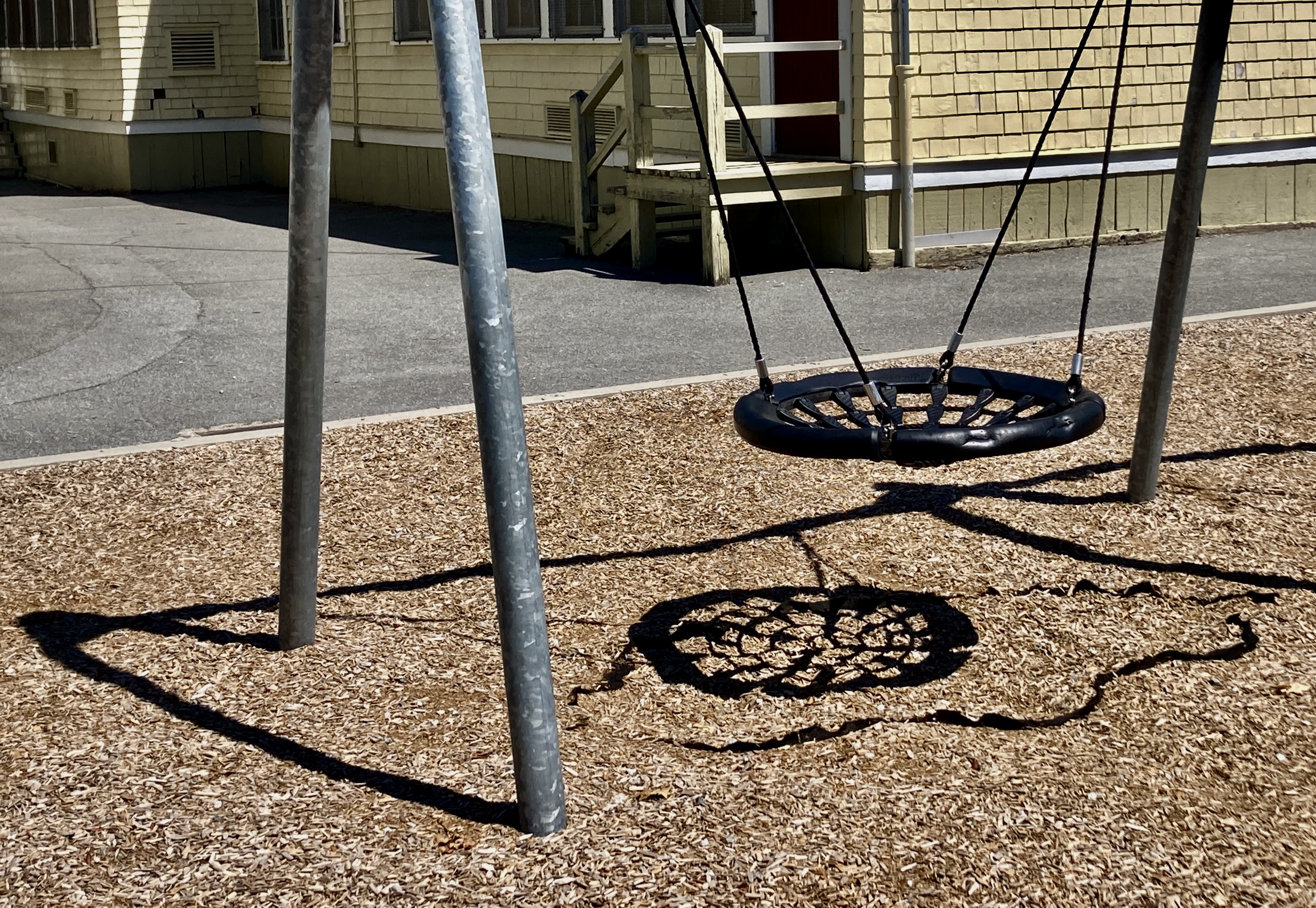
My eyes & mind are already back on the playground, where a disc-swing and its supports dance with the wood chips below.
A ring-seat goes all circular…
and blocky cubes go all angular…
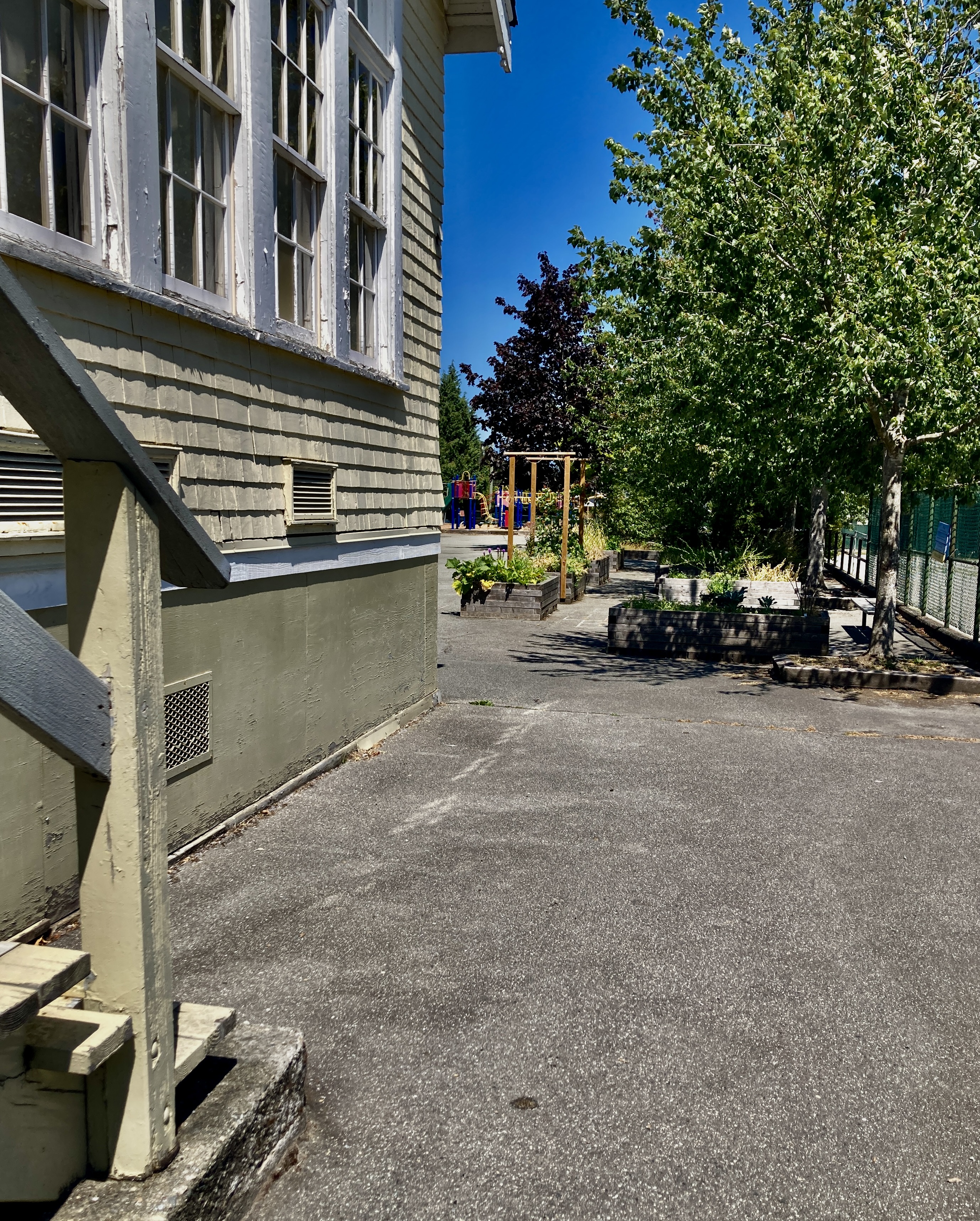
and by then I’m at a left-turn option. Pavement leads me around the back of the building…
toward the raised garden beds and more playground beyond.
The raised beds, signage tells me, comprise the General Brock School Food Garden — this school’s participation in the SPEC School Garden Program, which in turn is part of the larger SPEC mandate to promote urban sustainability.
Between those garden beds, now tidily put away for summer, run a couple of hopscotch grids. Smack-dab in the noon-day sun, they have no children to play with, and no available shadow, either.
13 July 2024 – Oh, there’s Standard Time & Daylight Saving Time, and there’s Pacific Time & Mountain Time & Central Time & Eastern Time & Atlantic Time (& Newfoundland Time). Plus the zones and adjustments that grid the rest of the world. All of them coded to numbers.
Clock Time.
Then there’s Crow Time.
No numbers, just quality of light. The shifting intensity of light that signals, each dawn, the right moment to leave the roost and, each dusk, the right moment to return. That timing also measures the changing length of day.
Vancouver crows (corvus caurinus) are ours by day only. Each night they roost in neighbouring Burnaby, and my building is beside a major flight path between the two locations. While (I must confess) I’ve never witnessed the morning influx, I have often watched the evening exodus spell-bound.
Sometimes a flurry passes close to my balcony…
but, more typically, air currents stream the birds a bit farther north, speckles against a more distant sky.
In between waves, it is an empty sky.
But only until the inevitable straggler comes into view.
Flapping his wings like crazy as he tries to catch up.
In Crow Time, Vancouver dusk these days occurs about 9:30 p.m. Mid-winter, it’s more like 4:30. Allow for the seasonal time-shift — that’s still a four-hour difference.
Sigh! I can hear you muttering, “Fine, but… total length of day? Because that’s only the dusk half of the equation.” True, and since I’ve never personally witnessed Vancouver dawn, Crow Time, I have to trust boring old Clock Time calculations found on the internet.
At summer solstice, some 16 hrs:15 min. of daylight; at winter solstice, just 8 hrs:11 min.
Come mid-winter, those crows get to do some serious sleeping in!
"Traveller, there is no path. Paths are made by walking" -- Antonio Machado (1875-1939)
"The voyage of discovery is not in seeking new landscapes, but in having new eyes" -- Marcel Proust (1871-1922)
"A city is a language, a repository of possibilities, and walking is the act of speaking that language, of selecting from those possibilities" -- Rebecca Solnit, "Wanderlust: A History of Walking"



































 WALKING WOMAN