Vulnerable

8 March 2024 – As I walk back east along False Creek, I do not have a single Life Philosophy thought in my mind. Not a single abstract noun. I am just picking my feet up and putting them down again, enjoying the sunshine.

Then I see this neon glow in the water, just off a curve of seawall between Stamp’s Landing Dock and Spyglass Place Dock farther east.

Still no Important Thoughts in mind, just curiosity.

It’s not until I’m up close, and can identify the shape as a boat, that I think about vulnerability. There that little boat used to be, afloat and riding the currents — and there it now is, submerged and inert.

Vulnerability, consequences, responses. The dynamic is now lodged in my mind, and I see it all over the place as I walk on home.

In environmental and political vulnerabilities, for example, here at Spyglass Place Dock, where blue bands circle Cambie Bridge pilings and a quiet black tribute pillar stands at water’s edge.

The top blue tier in this 2012 art installation, A False Creek, is 5 metres above current sea levels — which is mid-way between the 4 to 6 metre rise that, it is predicted, could be triggered by climate change. The pillar honours Husain Rahim (1865-1937). He was an activist at the time of the 1914 SS Komagata Maru incident that barred a boatload of South Asian passengers from disembarking, and one of the first South Asians to challenge the disenfranchisement then taking place. While the ferry dock is still Spyglass Place, I learn that this space is now called Husain Rahim Plaza.

I’m about to walk on — and discover that I can’t.

Due to “the deteriorating condition of the structure supporting the seawall,” the path has been closed between the Cambie Bridge, right here, and Hinge Park to the east. Detour along West 1st, we are told, while authorities address this weakness.

Heading for 1st Avenue, I walk under the bridge, where I stop long enough to read this extraordinary beer-themed love letter chalked onto one of the pillars.

The message is fresh and wonderful, but street art by definition is ephemeral. Vulnerable. Just look above the top line for proof — the “Simply Jay” message has been effaced.

Eastward on West 1st Avenue now, and more vulnerability call-and-response.

The building in the foreground is one of the City’s Temporary Modular Housing facilities, created in response to what the City itself calls a crisis situation: “over 2,000 people are experiencing homelessness.” The rusty building farther along is an old, disused workshop from the area’s industrial past. It will surely fall down, or be knocked down, sometime soon.

Lying between those two buildings, and in behind the housing as well: an urban farm.

Sole Food Street Farms, founded in 2009, is now one of North America’s largest urban farms. This location trains & employs people from the Vancouver Downtown East Side, who grow the produce that is then sold & given away.

At Hinge Park, I can drop back to the waterfront. The railway tracks and buffers here at the south edge honour the past; the park itself is part of the pre-2010 Winter Olympics response to what had become a derelict and polluted wasteland.

Even my classy latte in an Olympic Village Square café reminds me of vulnerability! I have left it to sit just a little too long, and, look, the frothy design is beginning to deflate. (The taste, I promise you, is unaffected.)

Back outside, I admire The Birds (Myfanwy MacLeod, 2010), gleaming in the sunshine.

The gleam is thanks to their fairly recent repatination; the repatination was the response to the vulnerability of their surface to all those climbing feet. Signage now politely reminds people that these sculptures are art, not a climbing wall, and asks us to keep our feet on the ground.

Heading south on Ontario Street, I detour half a block west into an alley, for a closer look at a face.

This face.

L’il Top is the signature, and if this bit of street art is vulnerable to time and the elements, so are those H-frame hydro poles. I, and countless Vancouver artists, love the look of them, but they are seriously outmoded, and systematically being replaced.

Back onto Ontario, farther south to West 6th, and my vulnerability theme now presents itself in a real-estate trio. The first thing I notice is that wavy reflection in the windows of the blocky new-build on the corner.

Then I play with the story, the trio of stories, the development dynamic of this bit of Mount Pleasant neighbourhood. Behind the new-build, a century-plus brick veteran, its status secure; in these windows, the reflection of the scruffy building across the street, wrapped in chain-link fencing, its status unclear.

Once the Teachers Centre for the Vancouver School Board (1972-1990s), it sits within the footprint of the T3 Mount Pleasant site now under construction — “T3” as in timber/transit/technology, with a planned 190,000 square feet of mass timber construction to attract environmentally responsible companies and workers. If the developer’s web page is any guide, at least part of this old building will be restored and repurposed as a heritage element in the mix.

Response to environmental threat is the theme of this part of Mount Pleasant. Along with the T3 building, it is also home to the emerging Main Alley Campus, which promises to provide “Canada’s first completely net-zero work environment for the creative economy.”

These two projects won’t save the planet, but it is heartening to see major development corporations put their weight behind new, more environmentally responsible, approaches.

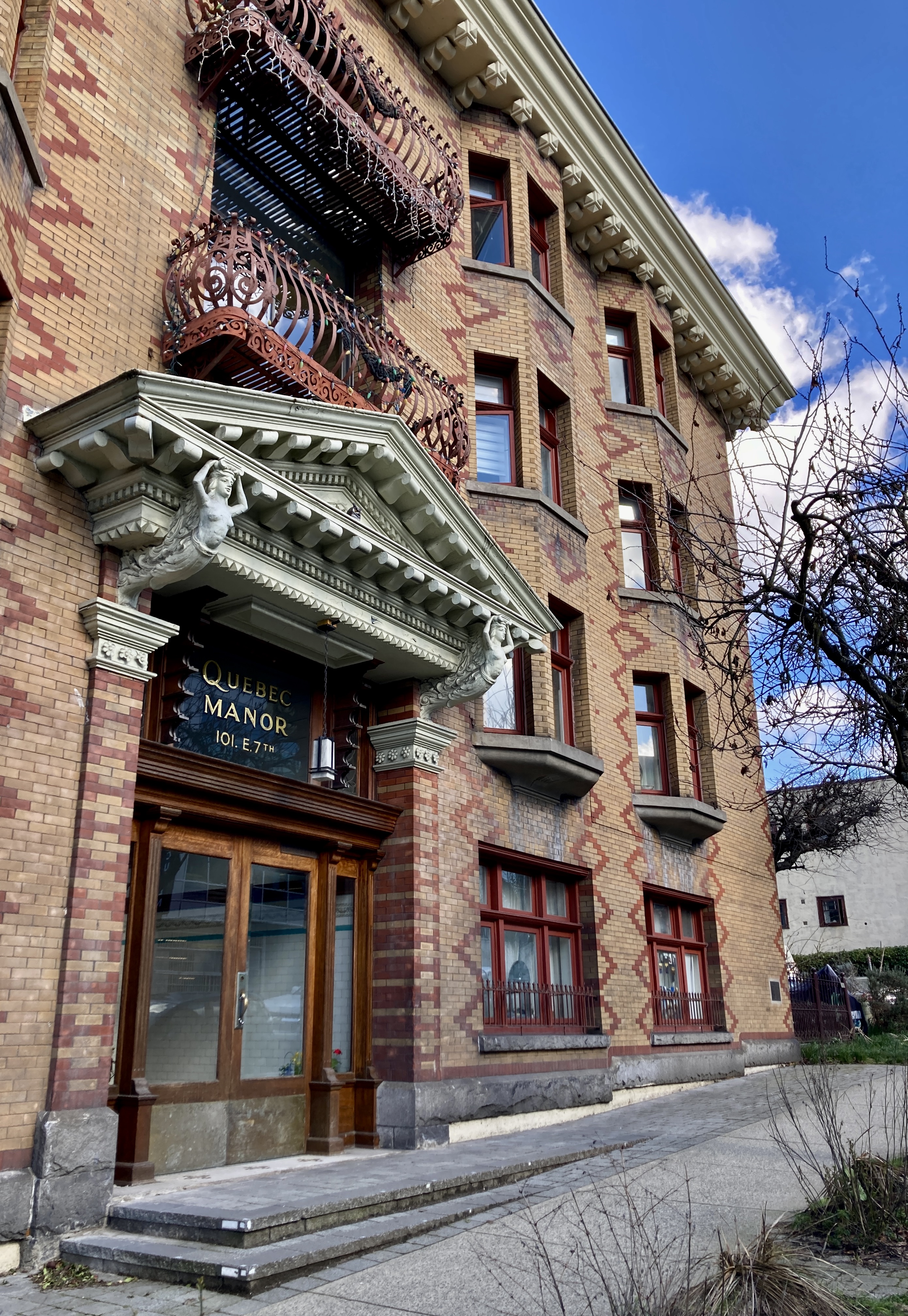
I swing onto East 7th, and salute a building that has long known how to respond to changing threats — and here it still is, 112 years later.

Behold Quebec Manor, in all its diamond-patterned, bi-coloured brick glory. (Complete with metal balconies and nude maidens to welcome you home…) Built in 1912 as a luxury apartment hotel, probably for train passengers at the near-by terminals, it became rental units in the 1920s, and in the 1980s achieved new, secure status when its tenants bought the building and turned it into a housing co-op.

So that’s my walk, and how discouraging it could have been, with such a theme. But it wasn’t. So many vulnerabilities, yes — and so many responses, as well.

Two Parks

14 February 2024 – Two parks, both small, and so very different in the story they each tell.

One, a park I only discovered recently, thanks to falling across the Vancouver Park Guide blog, in which Justin McElroy takes on the task of visiting every park in the city. The other… well, it’s my local, innit? Some people have a pub, I have a local park.

Yours To Enjoy (within limits)

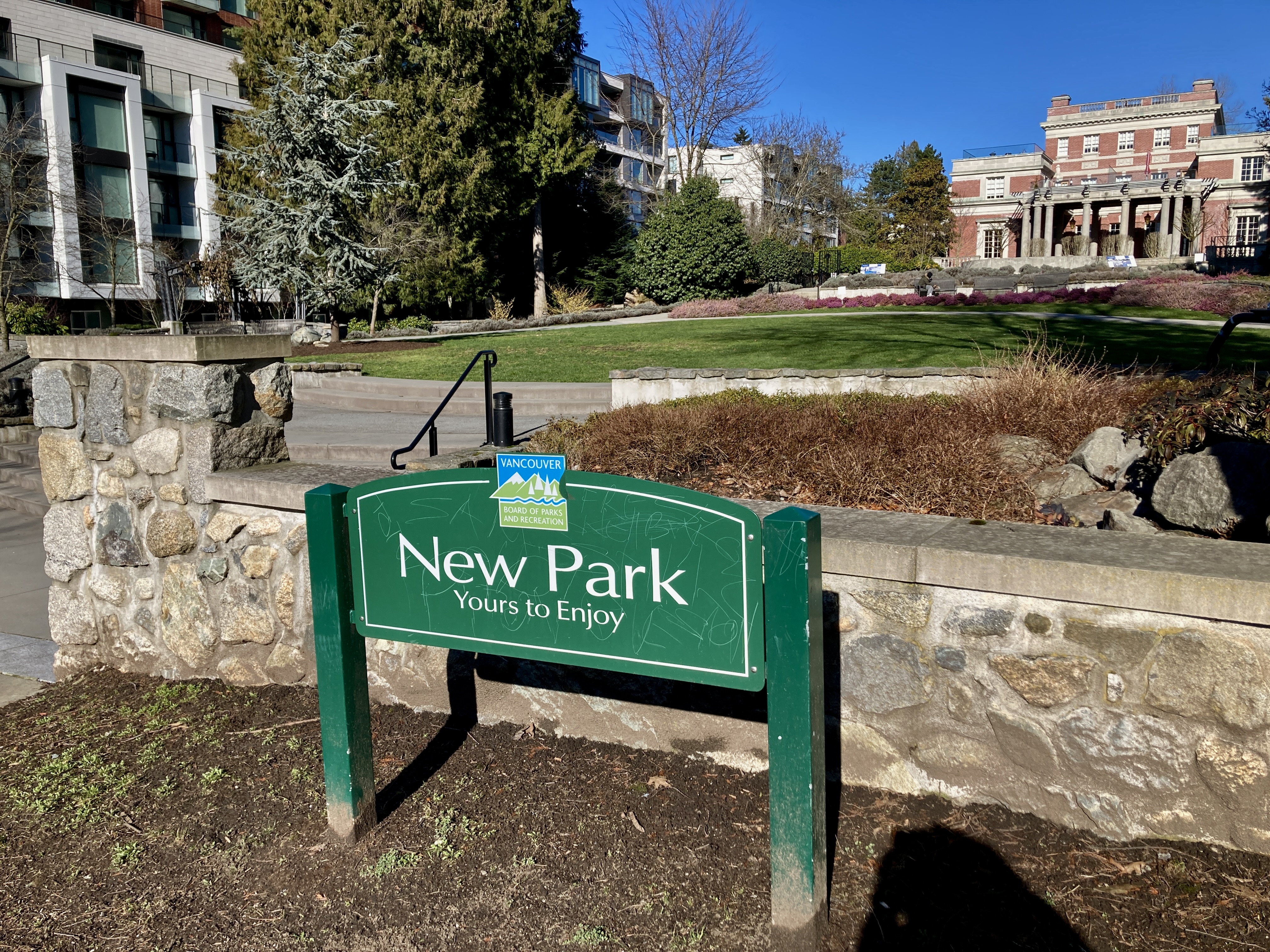
Thanks to McElroy, I’ve headed south on Granville Street into Kerrisdale, to walk through what he (& the City’s own website) calls Shannon Mews Park, but which the signage identifies otherwise.

A modest little name, by definition quickly outdated, but on the edge of a property with considerable architectural and historic significance. To the rear right, the Beaux-Arts mansion commissioned early in the 20th century by B .T. Rogers (founder, British Columbia Sugar); to the rear left, some of the mid-20th century apartments designed by renowned BC architect Arthur Erickson and, in the 21st-century, “revitalized” by the 10-acre site’s subsequent owners, developer Peter Wall and the Wall Financial Corporation.

There is also a street-side map showing “accessible” walking routes, with the usual icon of a figure in a wheelchair. However, thanks to McElroy, I have been warned. Though there is indeed some public space in front of this complex, it offers minimal accessibility to non-residents, whether in a wheelchair or on their own two feet. And, he added darkly (in a post that is now just over a year old), there is some on-going history of attempts to limit the pesky public even more.

I put my pesky-public feet on one of the designated pathways and walk on in.

Even mid-winter, with the Italianate gardens severely shorn, it’s an attractive walk. There is a small children’s playground to the east, and a few benches to the west and north. It’s fine.

But then, boom…

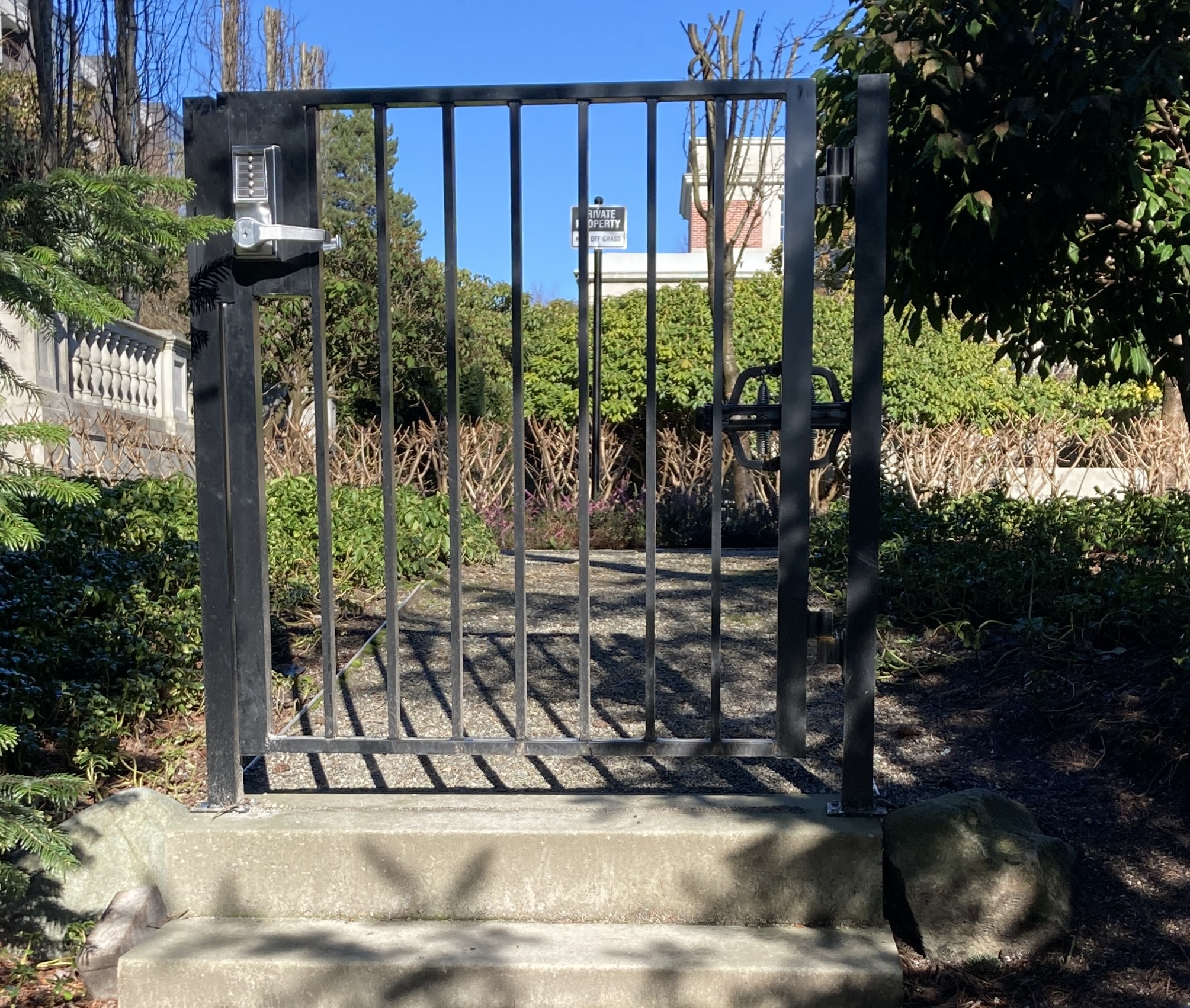
I’m up against it. A locked gate, barring access. Go away, pesky-public-person, says the gate. I try another path, and soon find myself in front of another lockable gate — which, at the moment, is ajar.

I walk on through. i want a closer look at the mansion.

Well, good luck with that.

As long as I keep my pesky-public feet on the path, I am allowed to look across the lawn and the water feature to the mansion beyond. But I am now on PRIVATE PROPERTY, and everywhere I now turn, there is another big red sign to remind me of my interloper status.

So I leave.

Before I do, i squint my eyes at the gargoyle midway on the wall just beyond the water feature. Spread the photo, you can see him as well. He is either grimacing in solidarity with me, or laughing at me. I choose the former interpretation, and go on my way, head held high.

A public park, yes, but cold. It does not welcome us. We are on sufferance.

In contrast to…

The Warmth of the Chill

I am back in my “local,” Guelph Park. Known to us all as Dude Chilling Park, in honour of the Michael Dennis bronze sculpture that is the park’s only claim to aesthetic merit — officially Reclining Figure, but the nickname is the name we use.

It’s a small and simple park, with a few amenities: benches at the periphery, a bit of a playground, two tennis courts. But this park is ferociously loved and much used. And also much-adorned, by all the people who think of it as their own.

Our area Yarn Bomber, for example, has hung her work on the mesh fence and wrapped each of the poles that dot the park.

Beyond this pole, you see people gathered around one of the benches. The park has its regular visitors, each group with its regular bench or set of chairs — just like any local pub.

A tree near the south end of the park is typically covered in changing ornaments, each one a testimonial to someone, to something. (One day a young man detached himself from his cluster of friends to tell me about one of the people he associates with that tree, and the memories it sparks for him.)

Today, the tree base is freshly circled with these bright hearts and flowers, and a new selection of stones. That grey stone reads: “But until then, I’ll see you in my dreams”

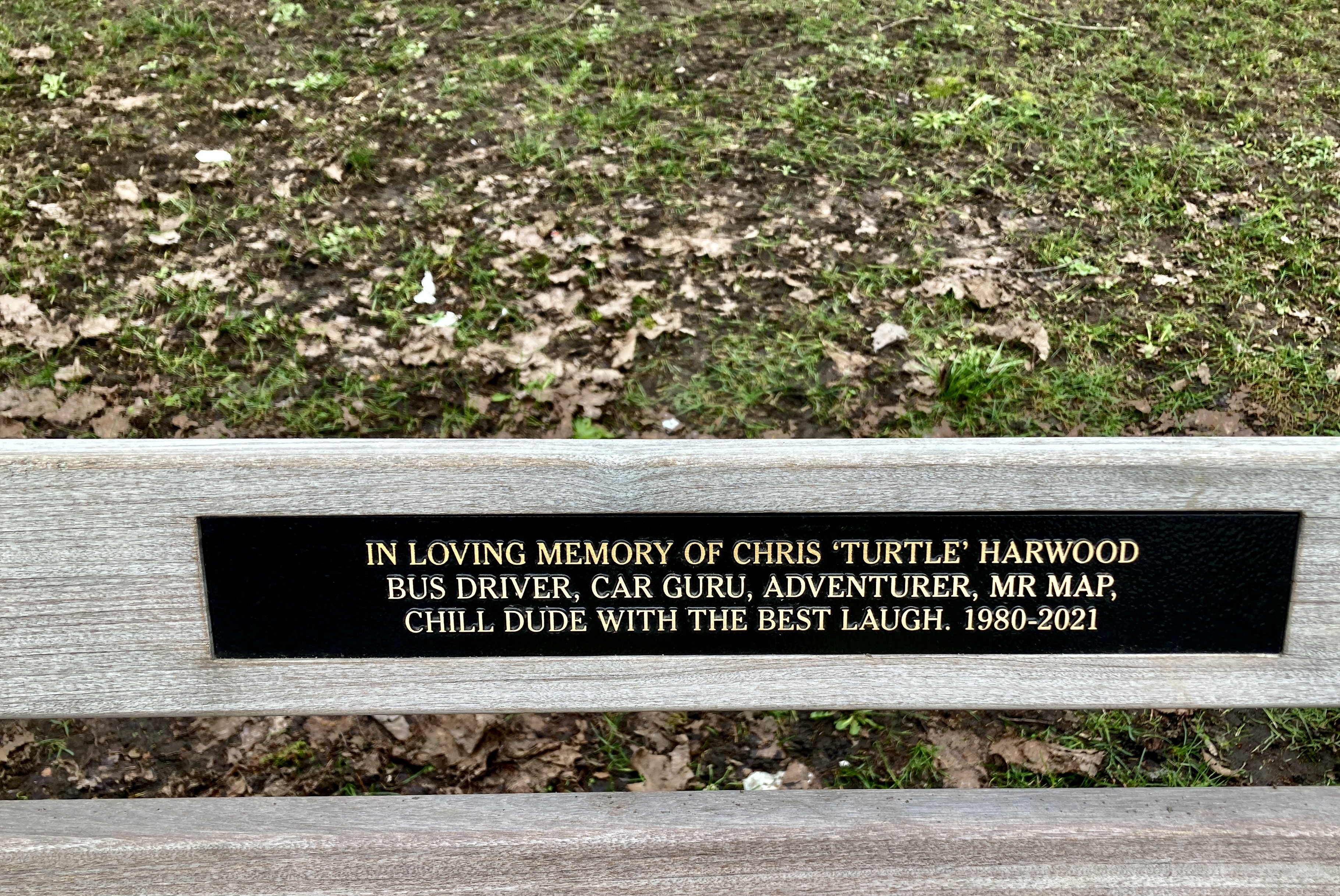
For the first time, I notice the plaque on one of the benches along the western edge of the park.

This is a park that, despite the chill in its nickname, is very warm indeed. It welcomes us all — and it even gives us a role model. Who would not want to be known as a “Chill dude with the best laugh”?

To The Dude & Back

12 January 2024 – But first, an acknowledgment. It is merely -11C as I write this, not (for e.g.) the -33C of Calgary nor the NWT temps that Lynette is recalling in her Baby It’s Cold post.

But still, for Vancouver, -11C is nippy. Yesterday, as Polar Vortex warnings hit our media and temperatures dropped to -3 or so, I decided I had to prove to myself that six years of Vancouver life had not rendered me incapable of going for a sub-zero walk.

Down to False Creek.

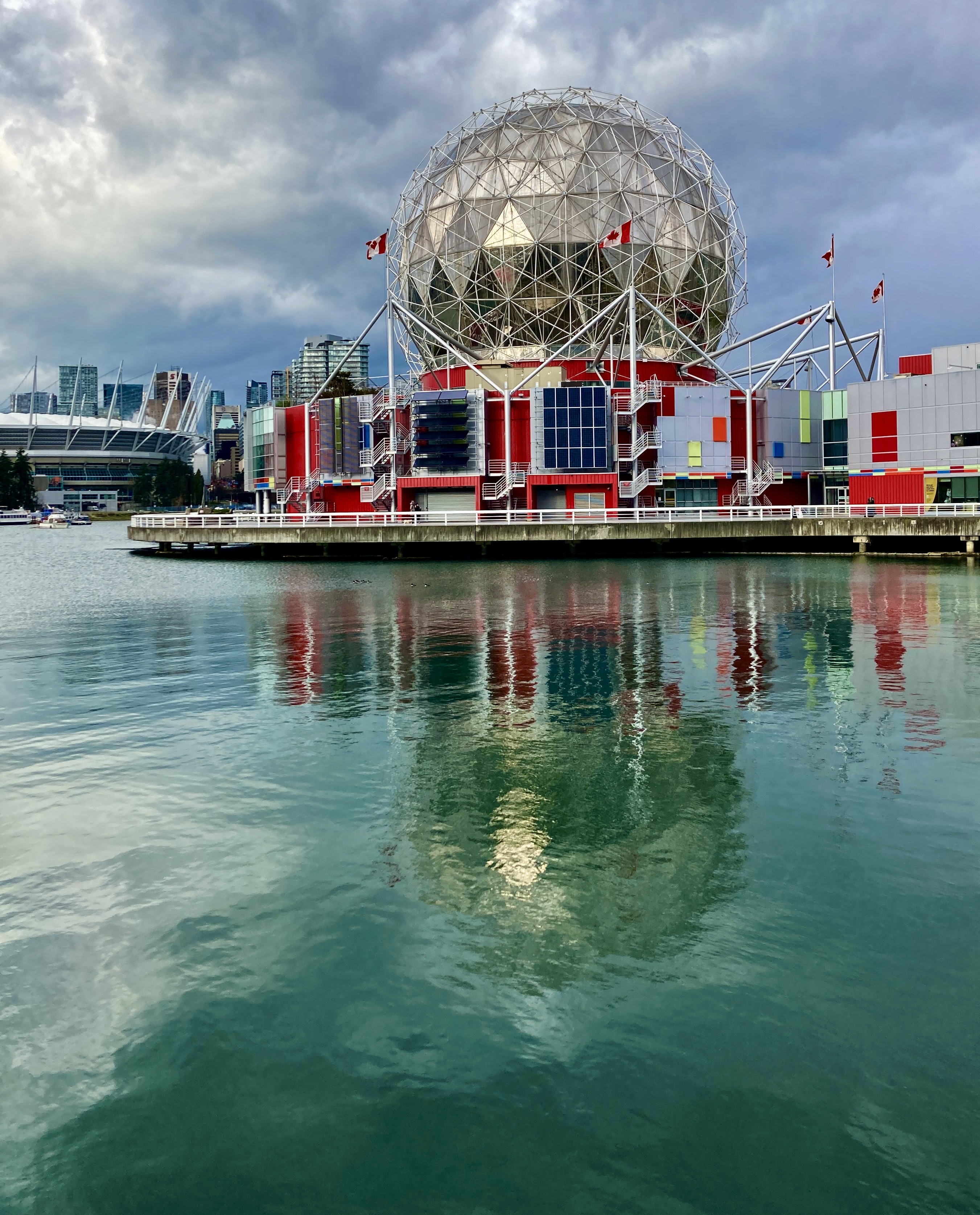
Snow-promising skies beginning to build, up there behind the World of Science dome…

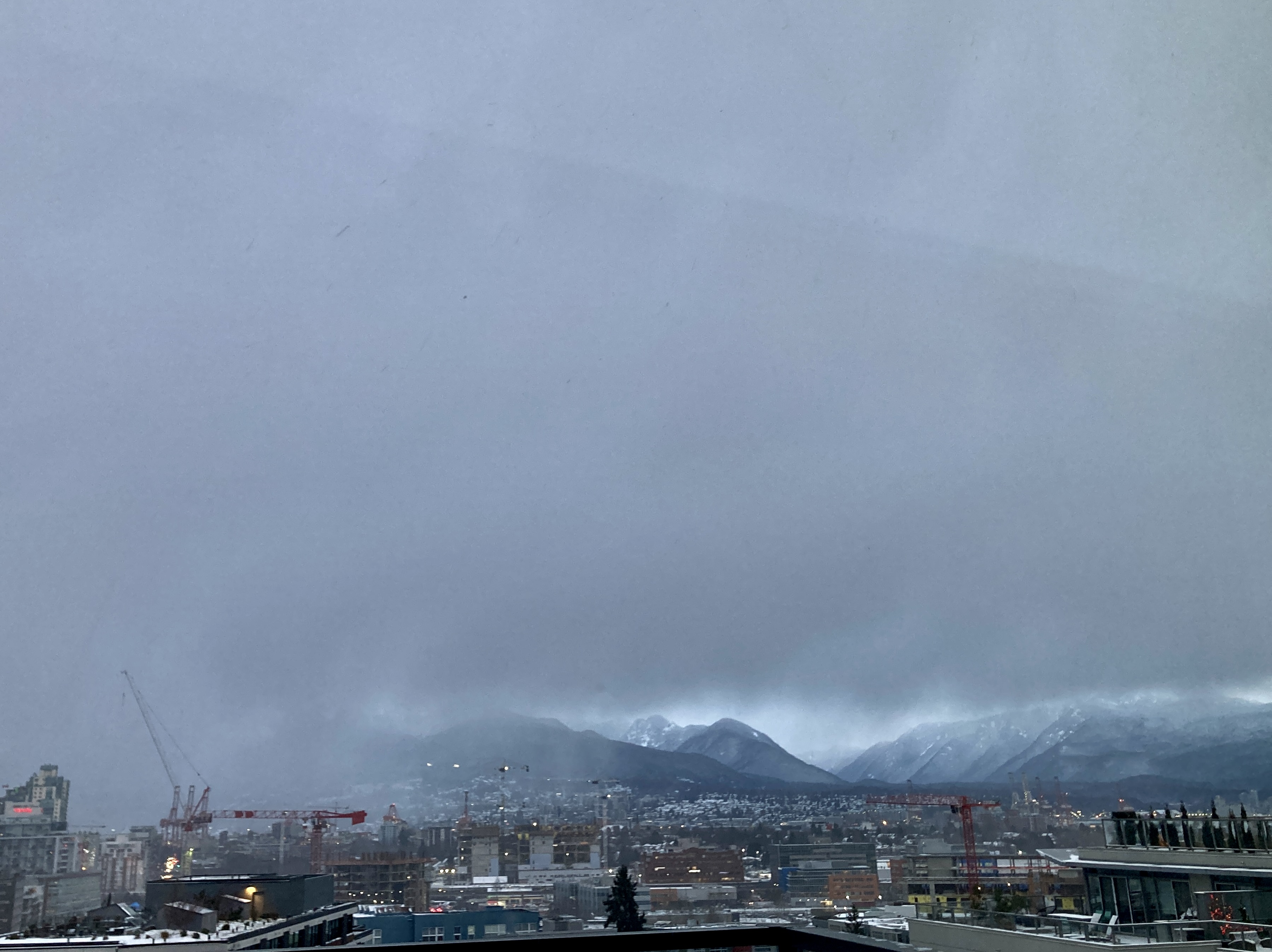
and, by mid-afternoon, snow clouds massed even more dramatically all along the Coast Range Mountains.

It did snow.

Just a skiffle, nothing deep, but — given the temperatures — it has stayed on the ground.

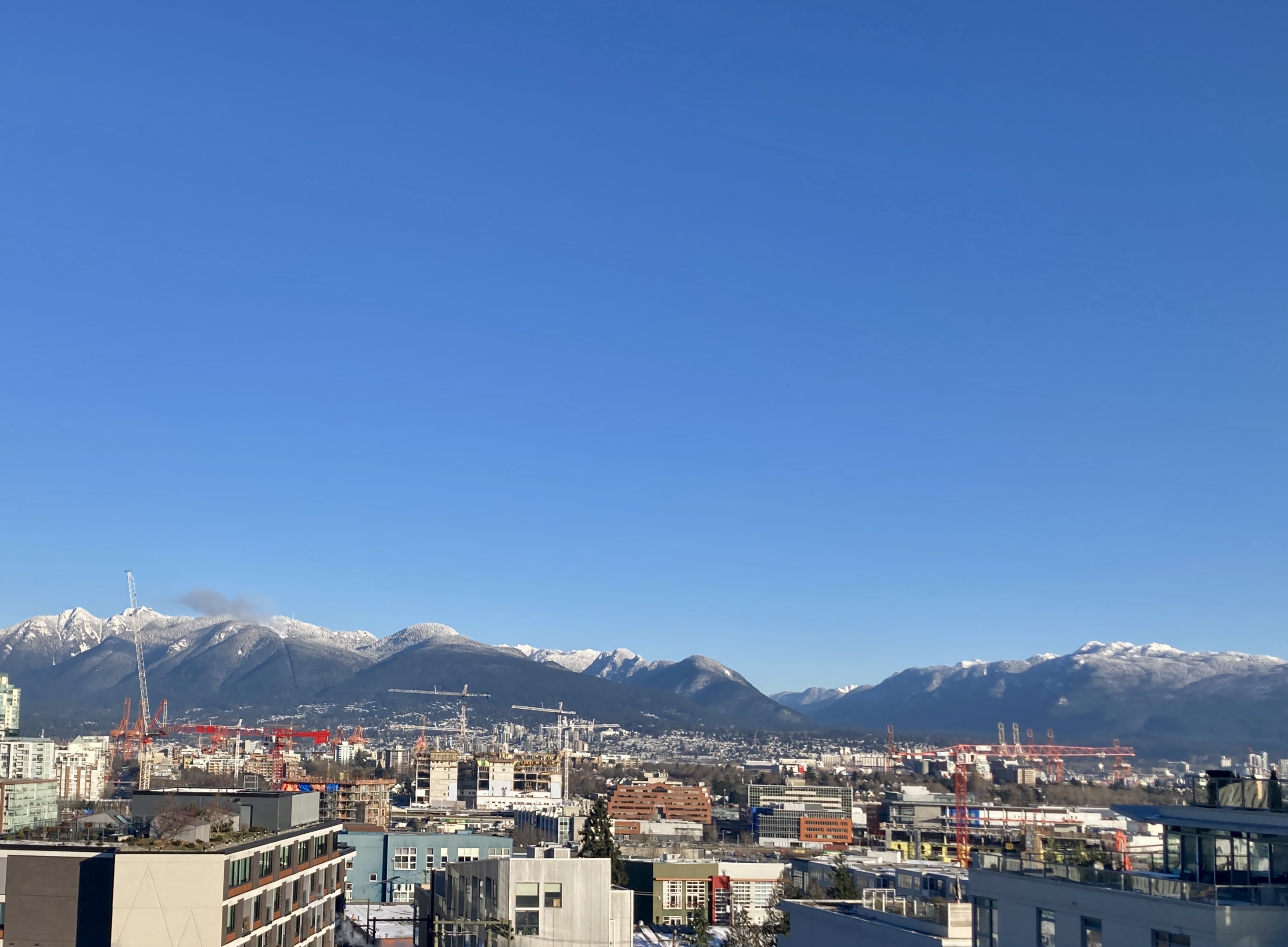
Today, over those same Coast Range Mountains, the sunshine that comes with greater cold.

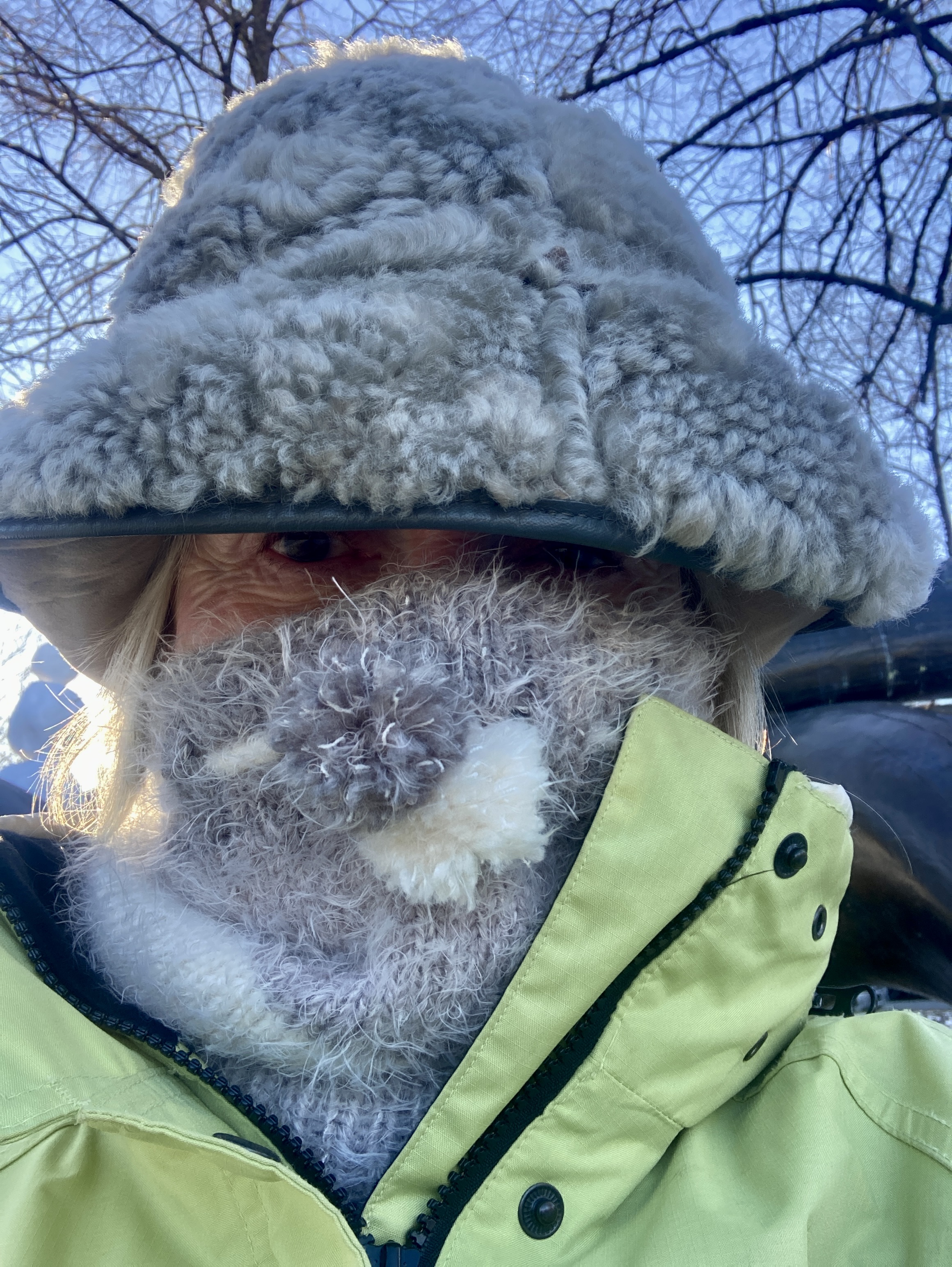
I bundle up once again. I am still not a wimp!

I decide I don’t need to go far: I can satisfy honour with a quick loop around Dude Chilling Park, and a respectful salute to The Dude himself en passant.

Other bundled-up people along the way (and some bundled-up dogs).

I reach the park. There’s The Dude.

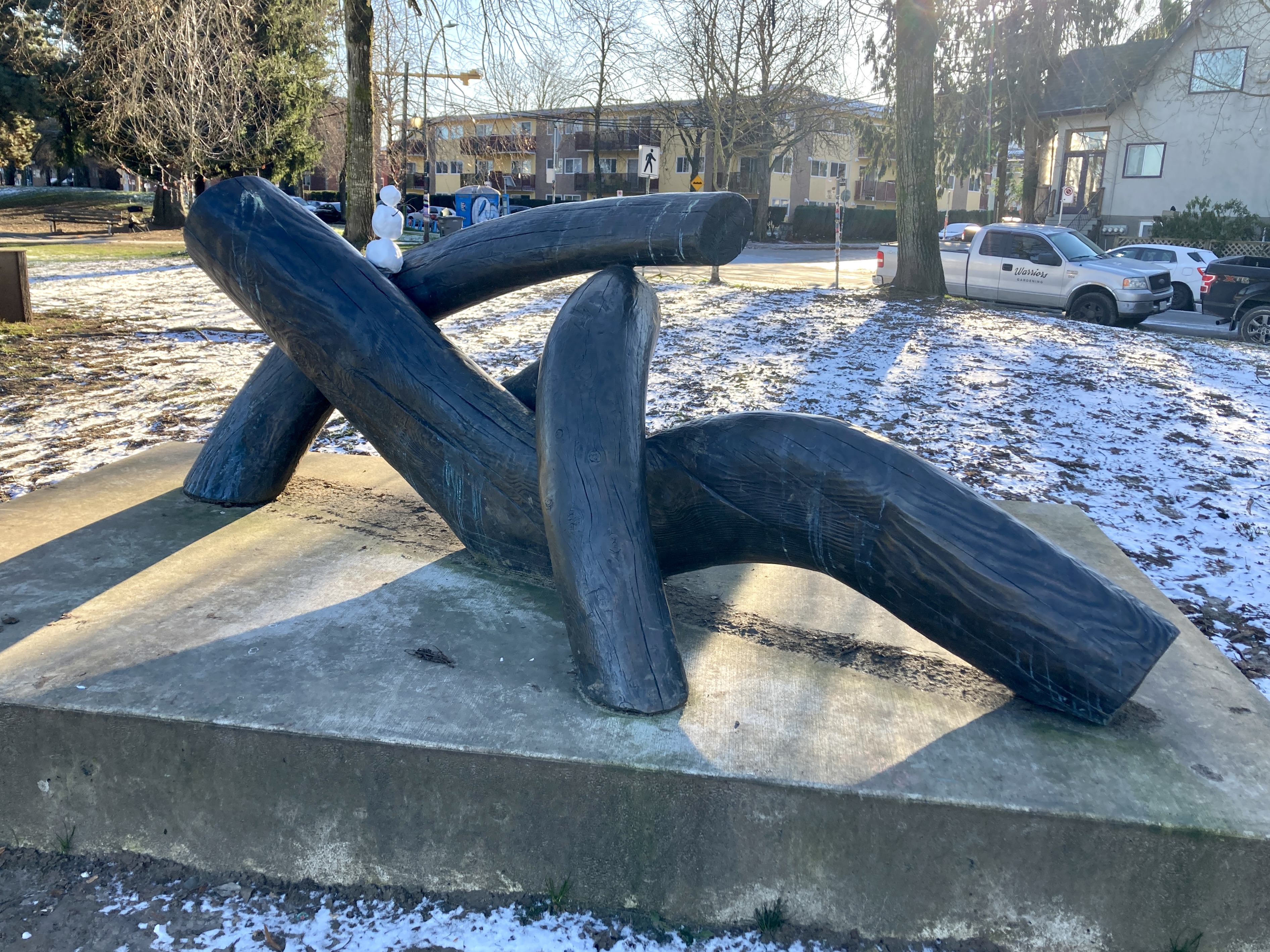
With … what… something white… in the crook of his shoulder. Please don’t let it be litter, I murmur to myself. I’ve enjoyed, taken confidence from, the respect people show The Dude. Please let that continue.

Well of course it’s not litter.

It is the world’s smallest snowman, lovingly shaped and lovingly placed, cuddled up with The Dude.

Behind my face-scarf, I am all scrunched up with delight.

And then I take my tingling fingers back home, and wrap them around some hot chocolate.

Walk, Talk, Rock… B.C.-style

31 August — Just back from a six-day escape to Vancouver and the Lower Mainland of British Columbia, visiting much-loved family and friends in an area that always uplifts me.

I say “much-loved” for many reasons, but after all these decades recognize that one of them is the resonance added by sheer passage of time. Part of the worth is in the while — a concept I borrow from John Fowles, who first deconstructed “worthwhile” this way in his 1964 book of personal philosophy, The Aristos.
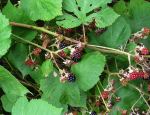
Count back on your fingers and, yes, I posted “King, Queen and Moose” not from Toronto, but from the home of my friends Sally and Owen in North Vancouver. I sat there at Sal’s laptop, looking out over their back yard to the fence dividing it from the trees and shrubs of Mount Seymour Provincial Park immediately beyond.

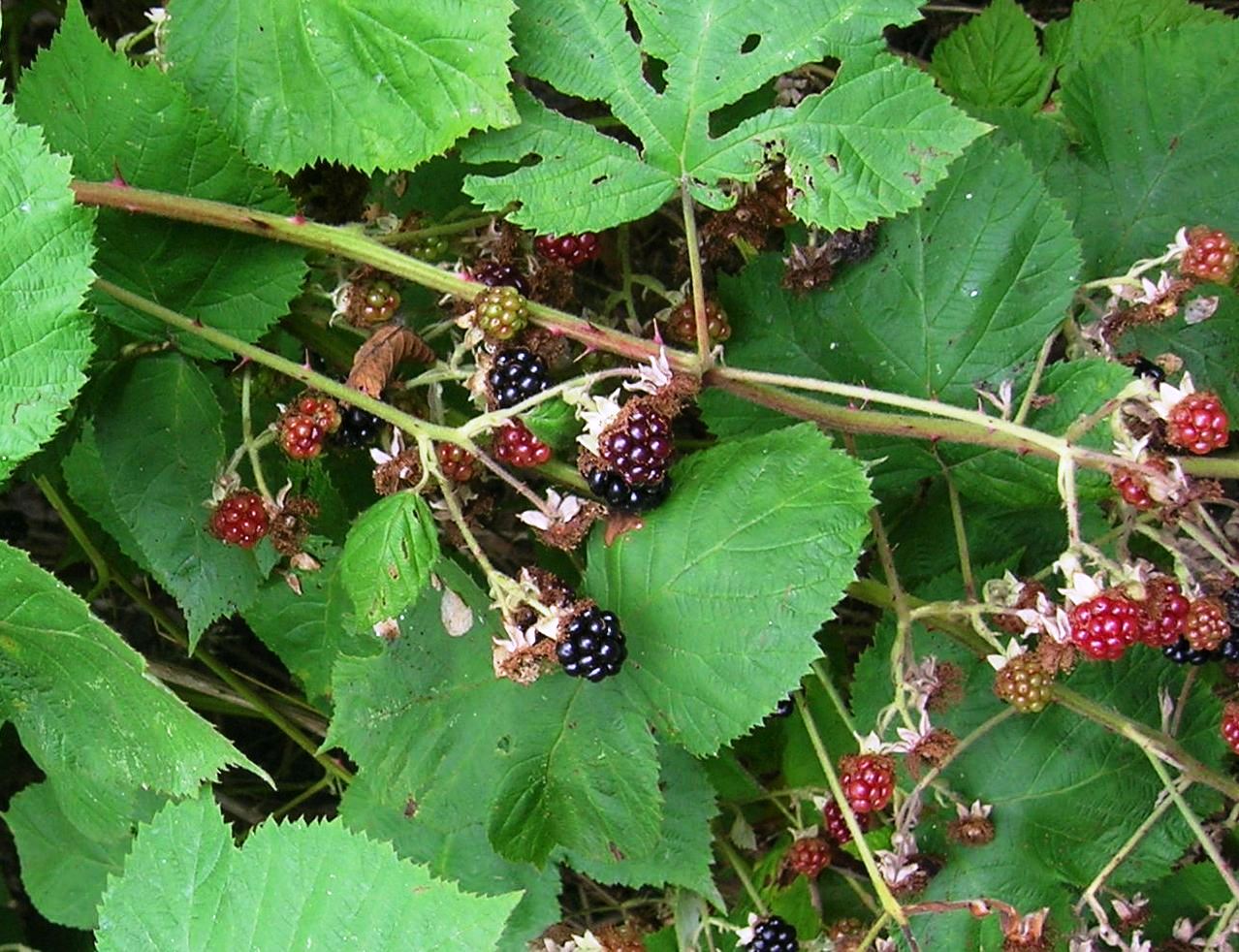
The shrubs include blackberry bushes, up against the fence. Which means ripening blackberries are more than a sign of changing seasons, they signal potential danger. Black bears love blackberries, and literally turn gate-crasher on occasion, once they’re that close to residential properties with other potential sources of food.

(Sally once emailed me the photo of a black bear foraging in their yard. All I could send in return was a raccoon sleeping in my birdbath.)
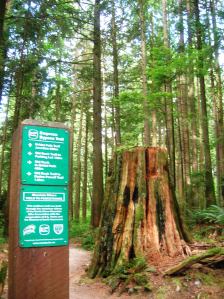
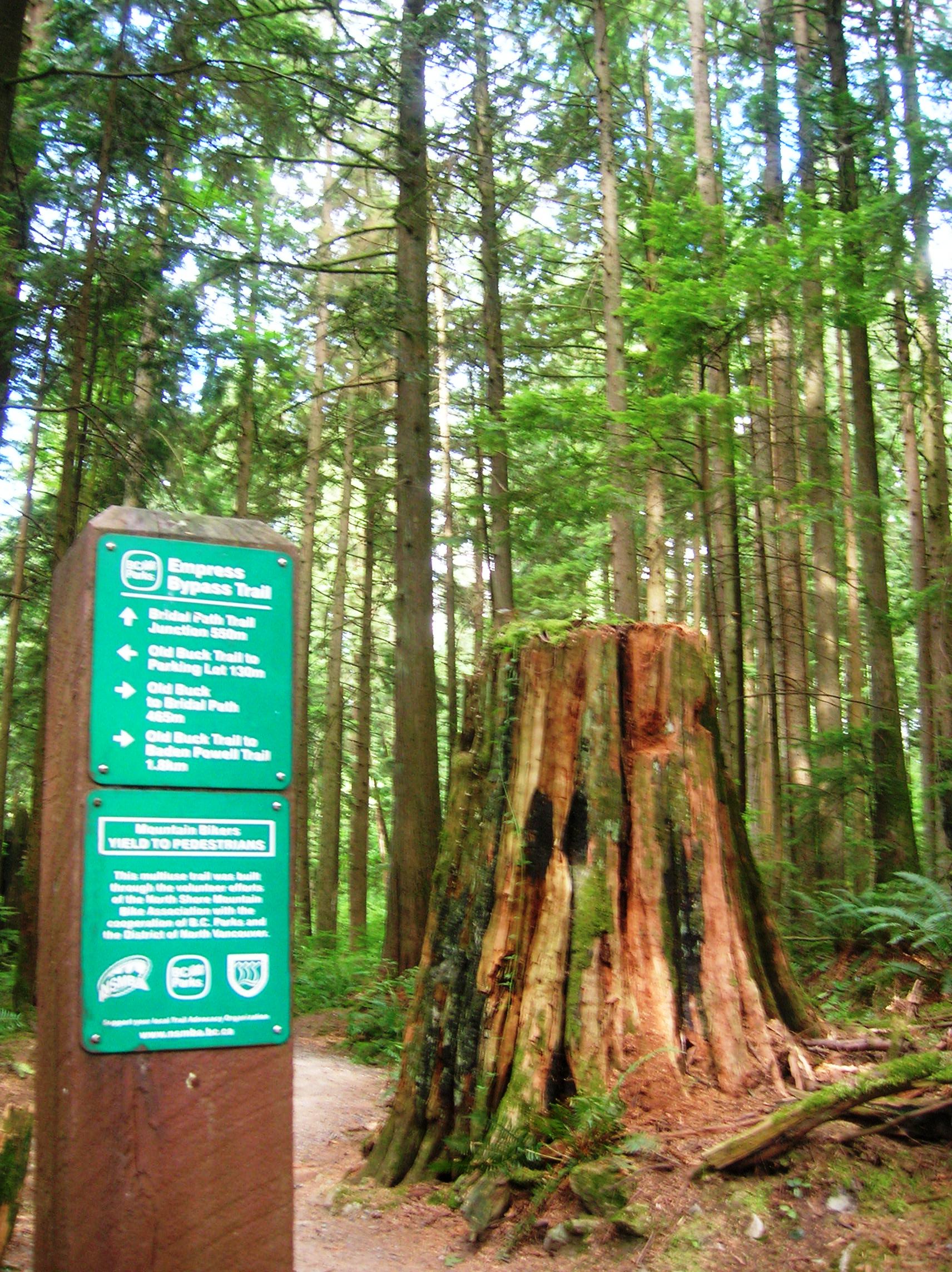
Of course the visit included some hiking about! You can’t be in British Columbia, halfway up a mountain, and not go walking. First target, Old Buck Trail, which sets off halfway up Mount Seymour Road. Various other trails split off, such as this Empress Bypass option, but I stuck with the main trail.

I hadn’t brought my pedometer, and settled for a 90-minute outing instead right on Old Buck itself. First I went up (and in these mountain ranges, up is up), awe-struck by the huge stumps of long-ago trees. Yes, I’ve seen them before, but they never fail to move me.

Somewhere beyond here, short of the Baden Powell junction but not by much, I turned about.

At least as high as I went, the trail was much like this — a smooth, clear dirt path.
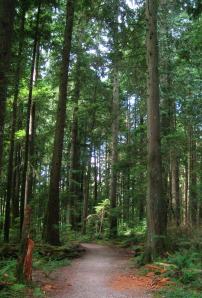
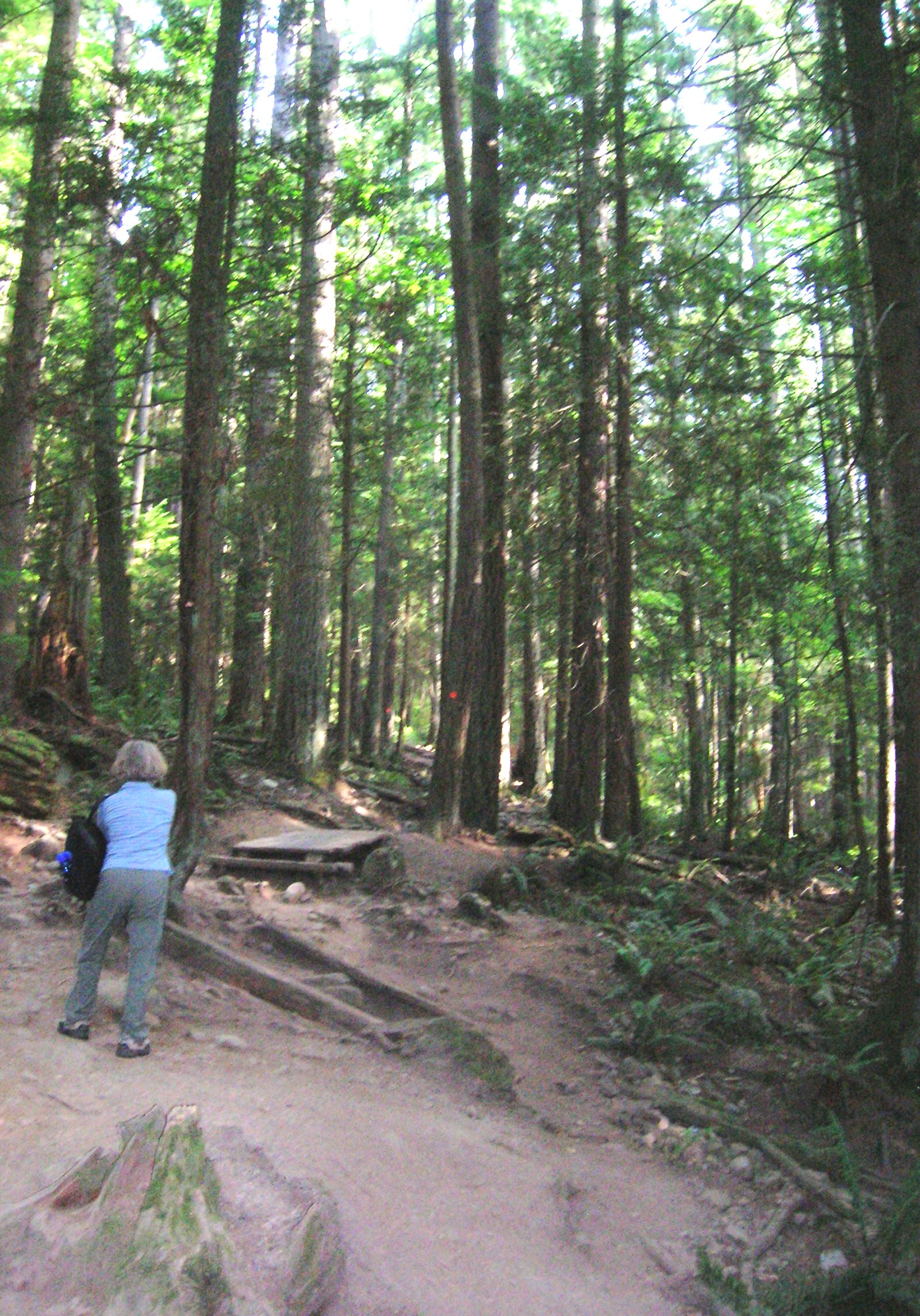
Just as the ancient stumps move me, so do the great columns of contemporary tall trees. The path moves gently among them, and I think a bit about paths, and making one’s path (thank you, Antonio Machado), physically and otherwise.

I remember, too, that tai chi is sometimes described as “walking meditation.” I don’t specifically meditate when I walk, but I do usually feel myself expanding out into my surroundings, somehow.

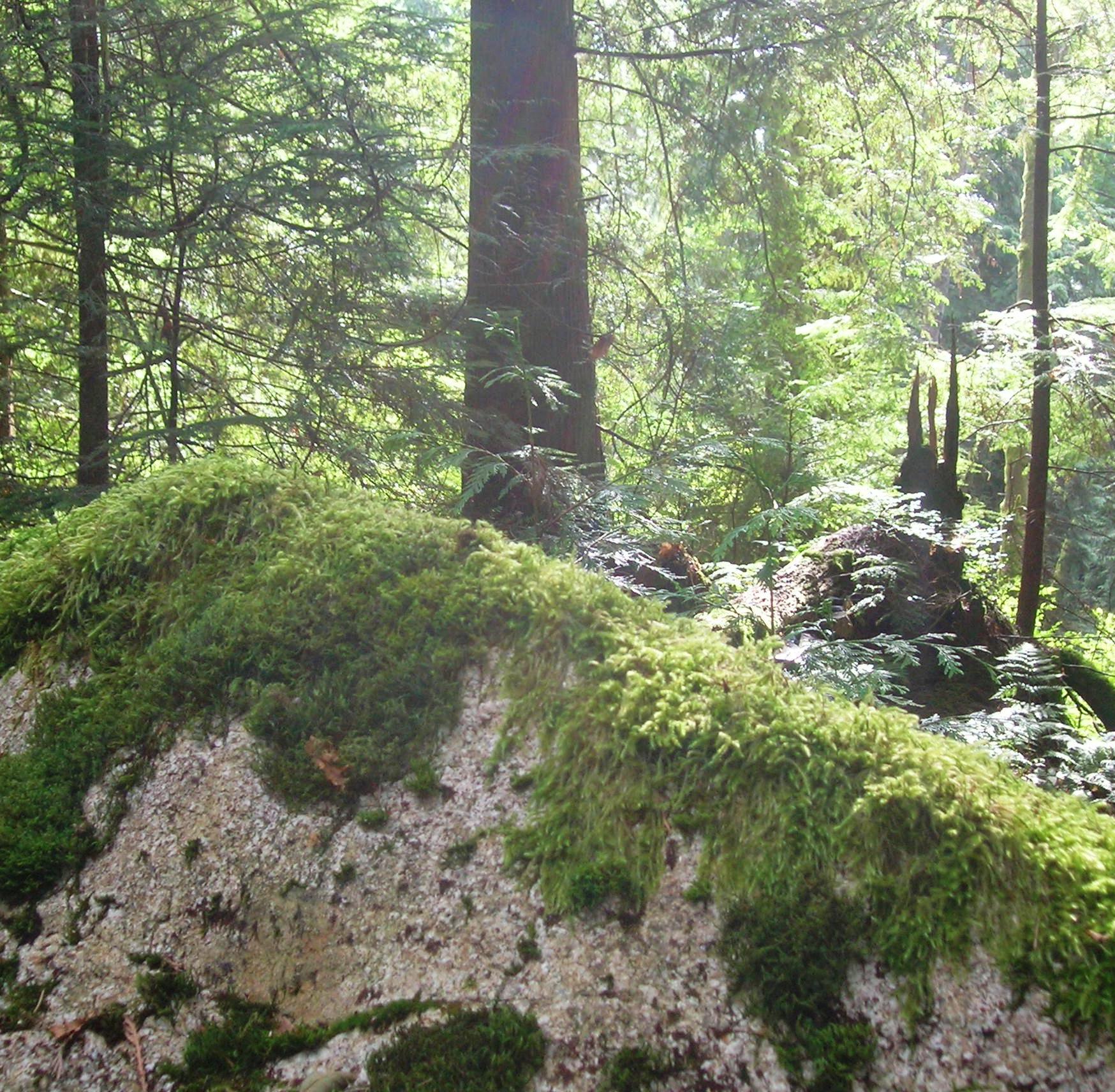
Then, sometimes, the elegant columns of trees give way to great bursts of nature’s very own mixed media: rock and moss and other layered vegetation and spikey remnants of old logs and forest, forest, forest.

But no, I don’t spend the whole six days in the woods.

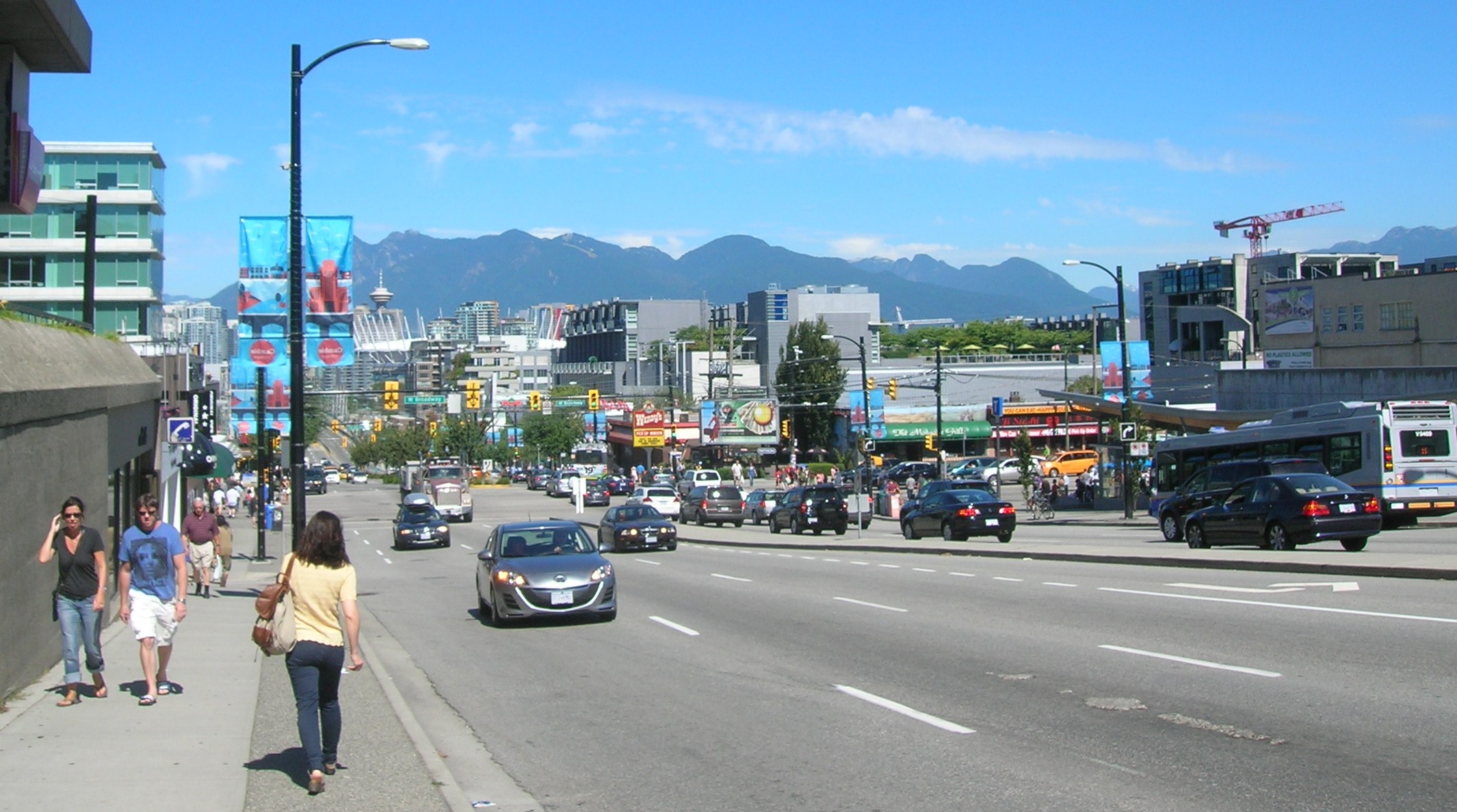
Soon I’m deserting this far corner of North Van for a visit to Vancouver proper — across Burrard Inlet by Seabus, then south on the Canada Line (built for the 2010 Vancouver Winter Olympics), and out onto Cambie St. at Broadway. Where I grabbed this shot northward up Cambie, sightlines back to North Vancouver and the framing mountains beyond.
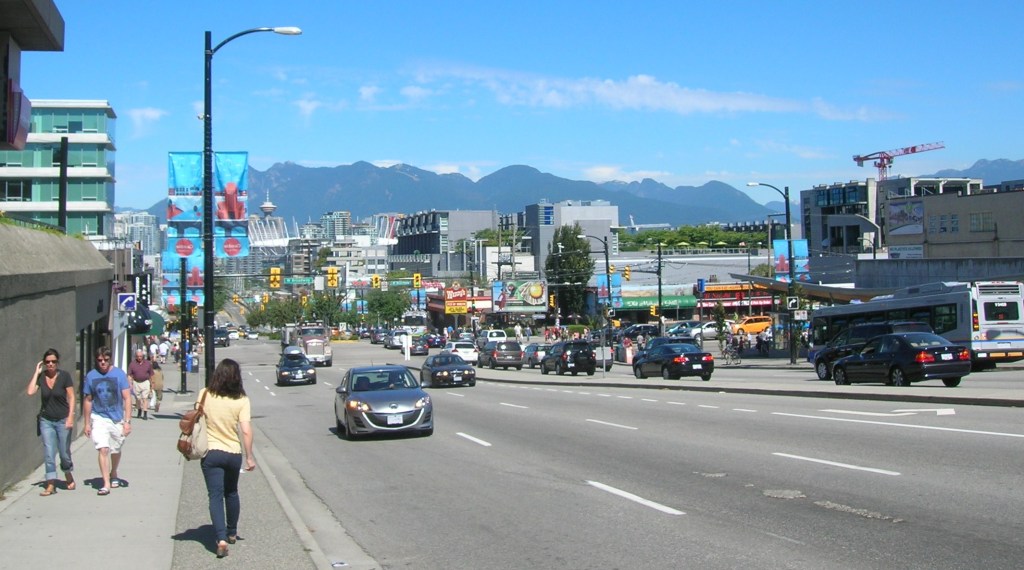
Mountains and ocean, Vancouver is the Rio of the north.

But even here, walking with my friends Louise and Rolf through residential streets over to Main Street and then south… even in this dense bit of cityscape, there’s still great exuberant nature. (When I lived in Calgary, a semi-desert climate, and came visiting, the sheer humid profligacy of Vancouver’s nature always smacked me in the eye and up the nose.)

My friends waited cheerfully while I eyed the detail of growth on city trees. Like this one.

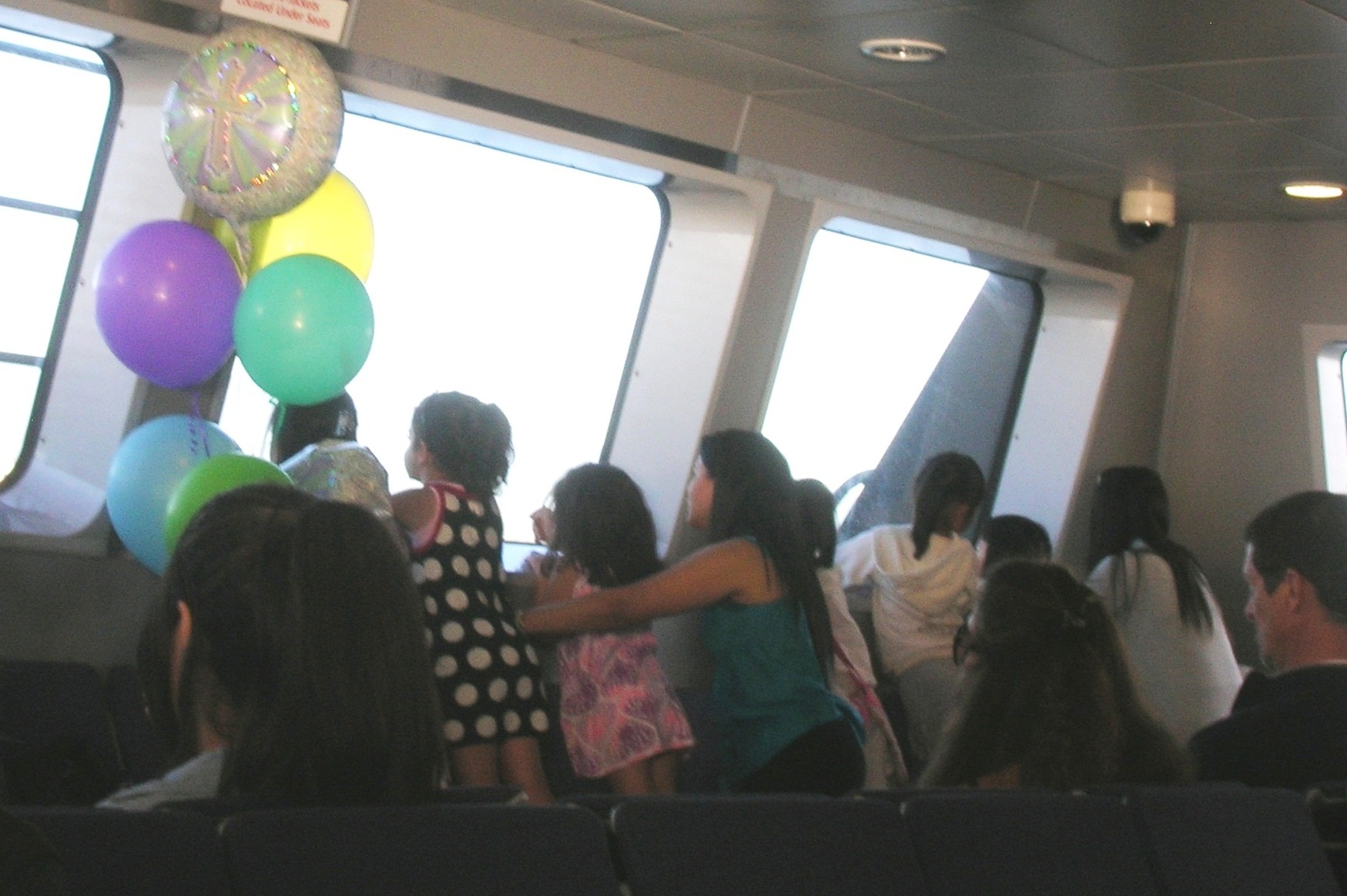
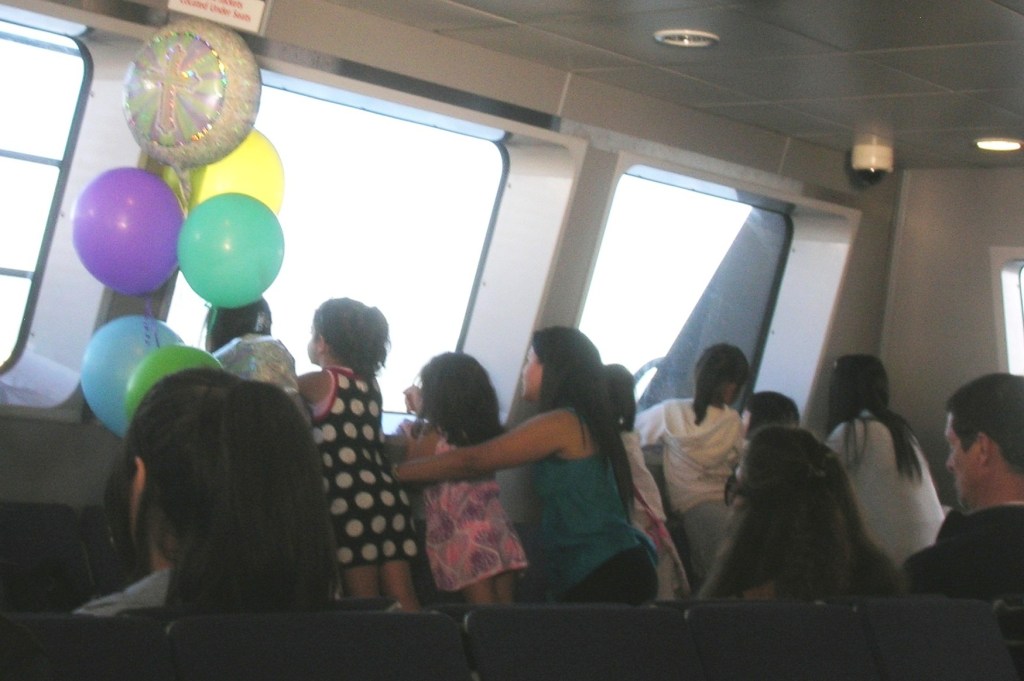
We had lunch one place, lattes somewhere else, prowled shops with strong design sense… and finally good-bye and back north I went, retracing my way via the Canada Line to the Seabus again. Where I was charmed by these little girls, their noses pressed against the ferry’s front window, party balloons to one side.
Another walk, still in North Van and on Mount Seymour, but setting out from the little community of Deep Cove.
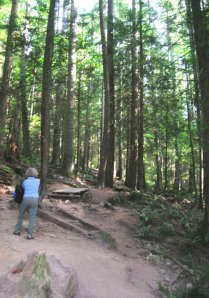
 That’s Sally’s back, in an early stretch of our chosen hike, up the Baden Powell Trail to the Deep Cove Lookout. The lookout is aka Quarry Rock — indeed a succession of big old rocks, but no sign anywhere of past let alone present quarrying. So, go figure.

Sal characterized this as an up-and-down trail, probably an hour each way. The footing was at times smooth and the path gently curving, but in other places the path twisted narrowly among trees and boulders, intensely scored with tree roots and rocks.

It was also much less solitary than my Old Buck outing! Then again, a weekend morning vs weekday. More people than we really wanted — oh, the cherished illusion of being alone in nature — but at least everybody observed pretty good trail etiquette.

Even the dogs behaved themselves. Including a snowy white little pooch who clearly had been having a wonderful time in mucky streams. Her owner observed her four black legs, and quipped, “Her name is Emma, but we may have to call her Boots.”

Finally there we were on Quarry Rock, looking over the Indian Arm inlet of the ocean, with the village of Deep Cove itself hidden away to the right.
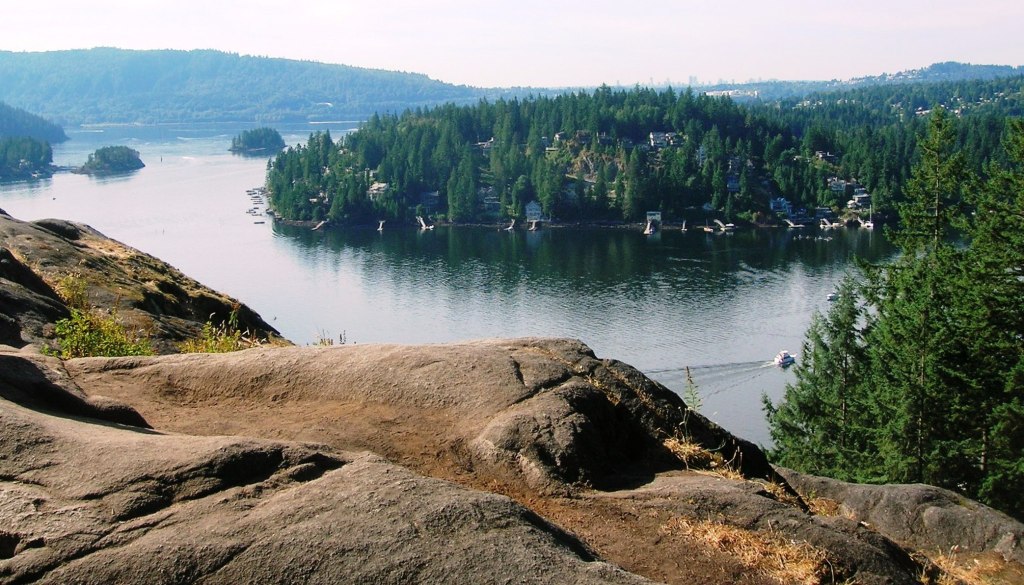
Going back down, I lost track for a moment. So many ups and downs enroute… where we really descending? Yes, we were. Sometimes on the twisty paths I described above, sometimes on stairways pressed against rock faces, like this.

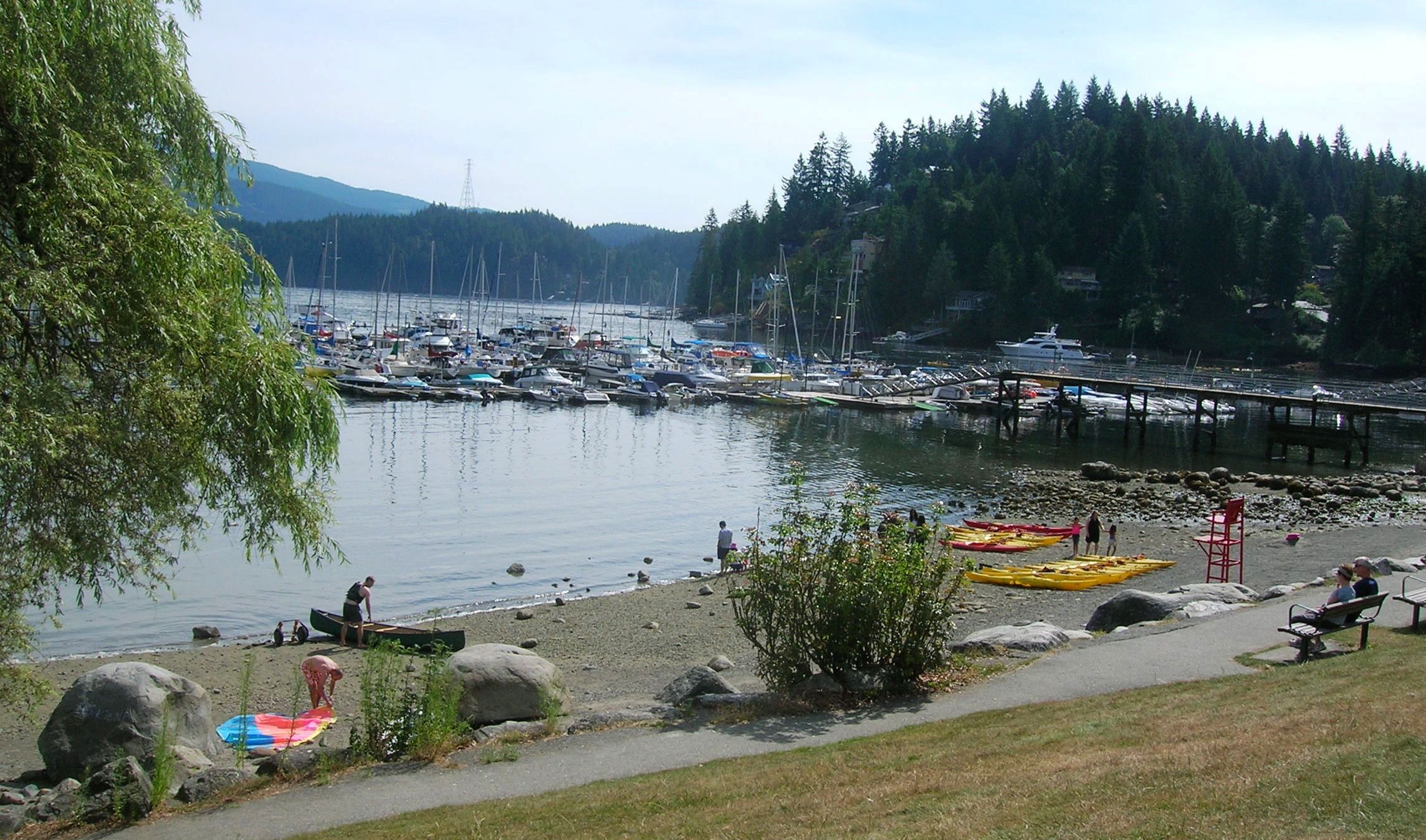
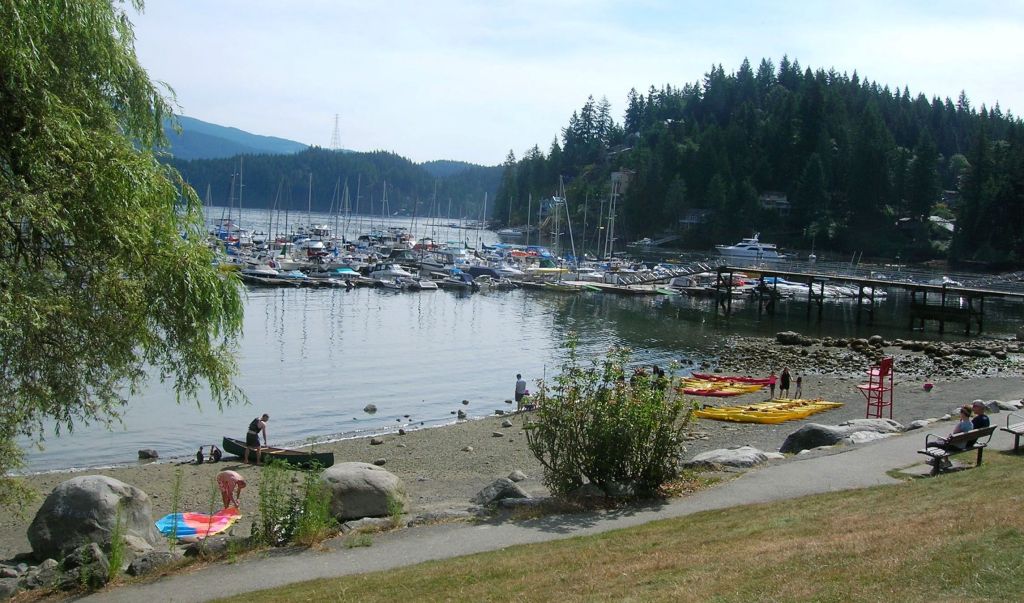
Yah, finally, indeed down and walking along the Deep Cove beach, with all the boats bobbing in the water and great red and yellow blocks of kayaks set out, waiting their turn for some action.
We consider hanging around for Deep Cove Daze [sic], but resist.

It’s going to be all the usual late-summer, small-community mix of booths and games and noise and T-shirts and organizations with their  tables… and it is tempting… but we have other plans.

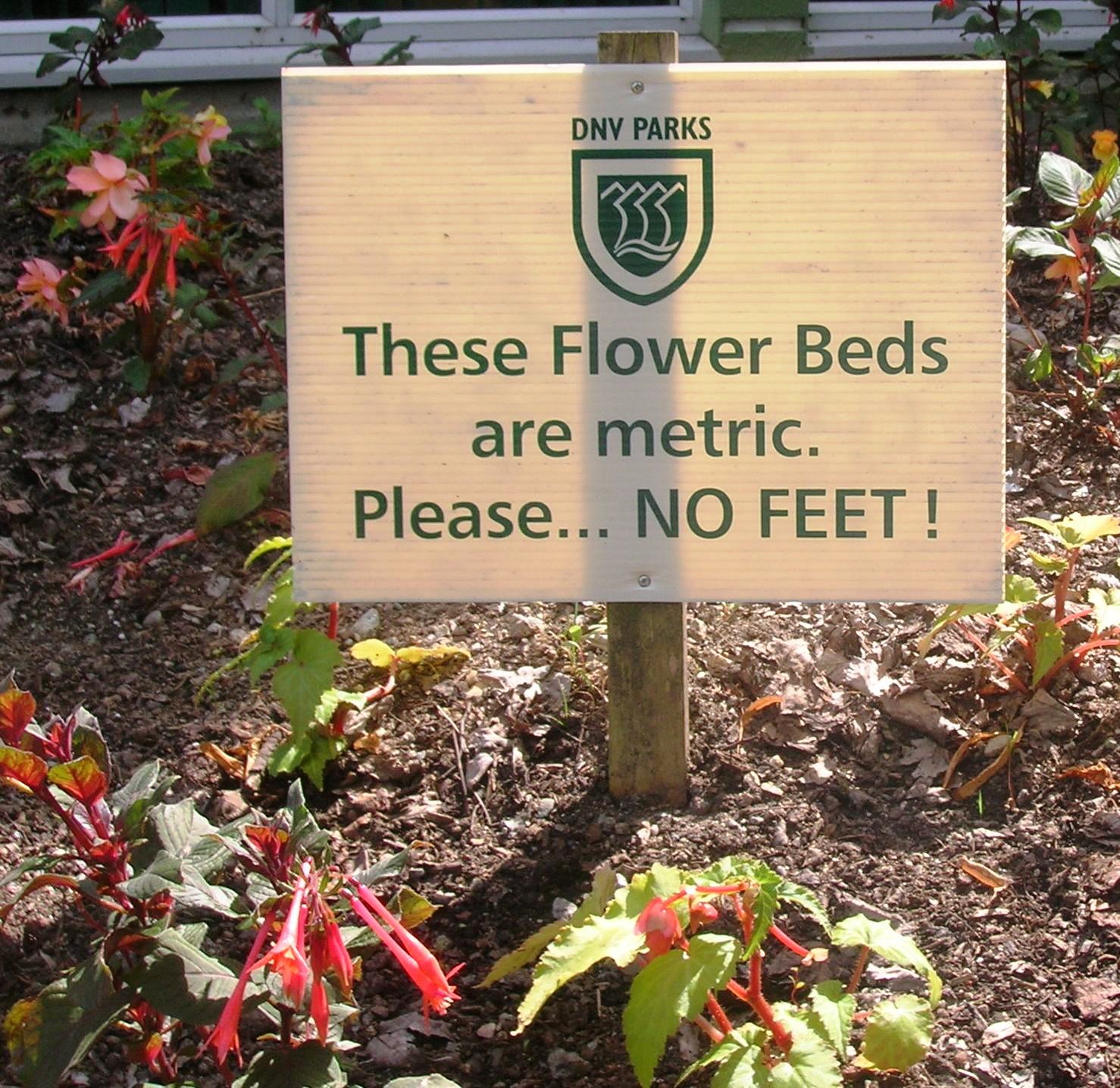
Which involve lunch on a patio elsewhere, so it’s easy to leave. But not before paying tribute to this metric flower bed!

One last walk, days later and down in the Lower Mainland where I’ve joined family for the final few days of my trip. Karen and I head out to Watershed Park in Surrey, one that she and husband Tim know well, both on foot and on their bikes.

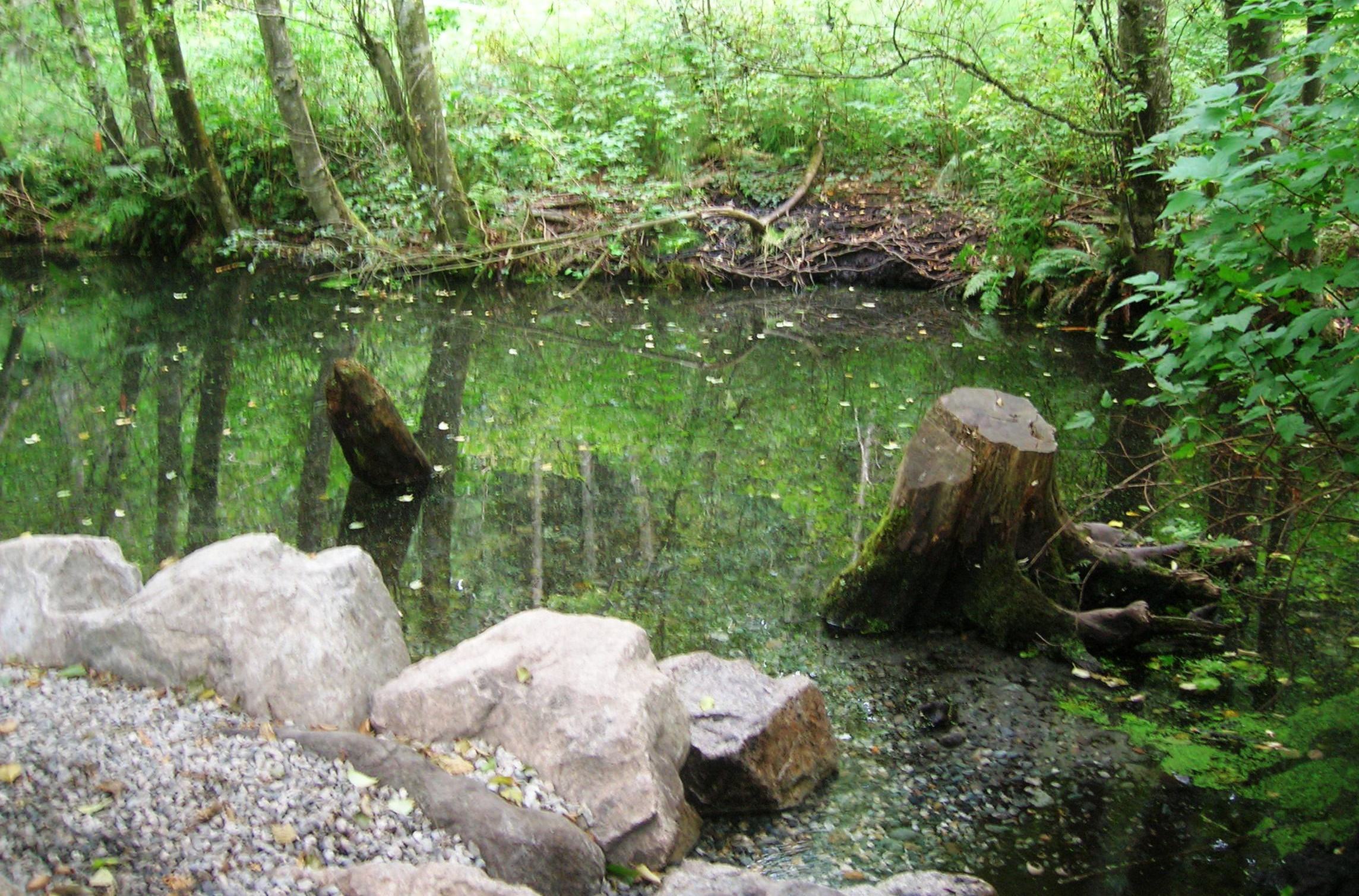
I’m luxuriating all over again in the sights and smells and texture underfoot of these west-coast trails. Some of the scenes are the sort of thing I anticipate…
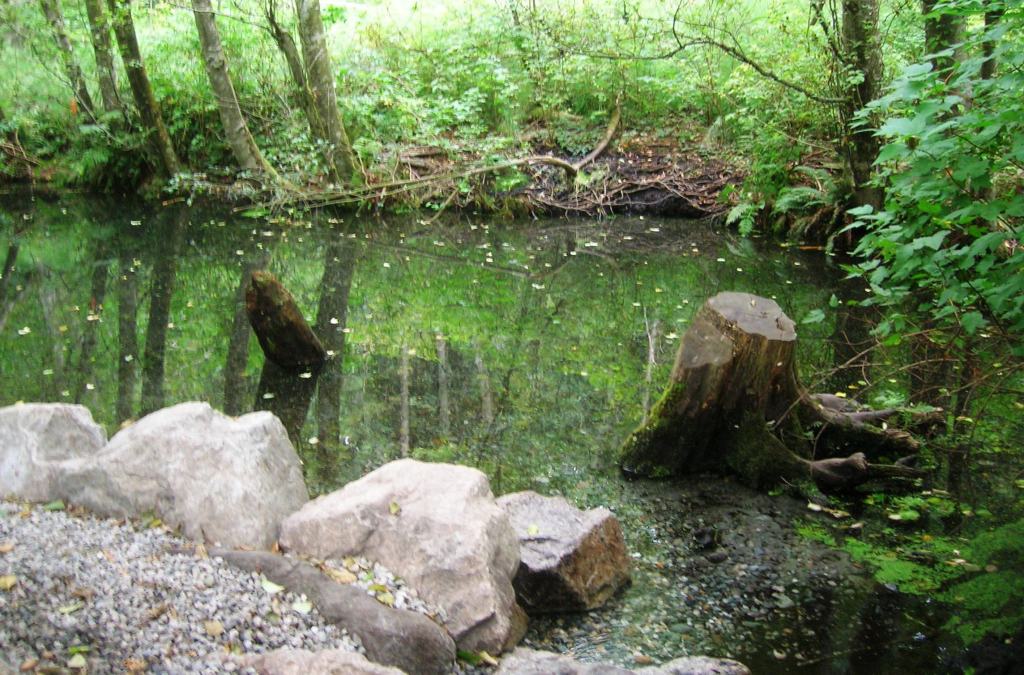
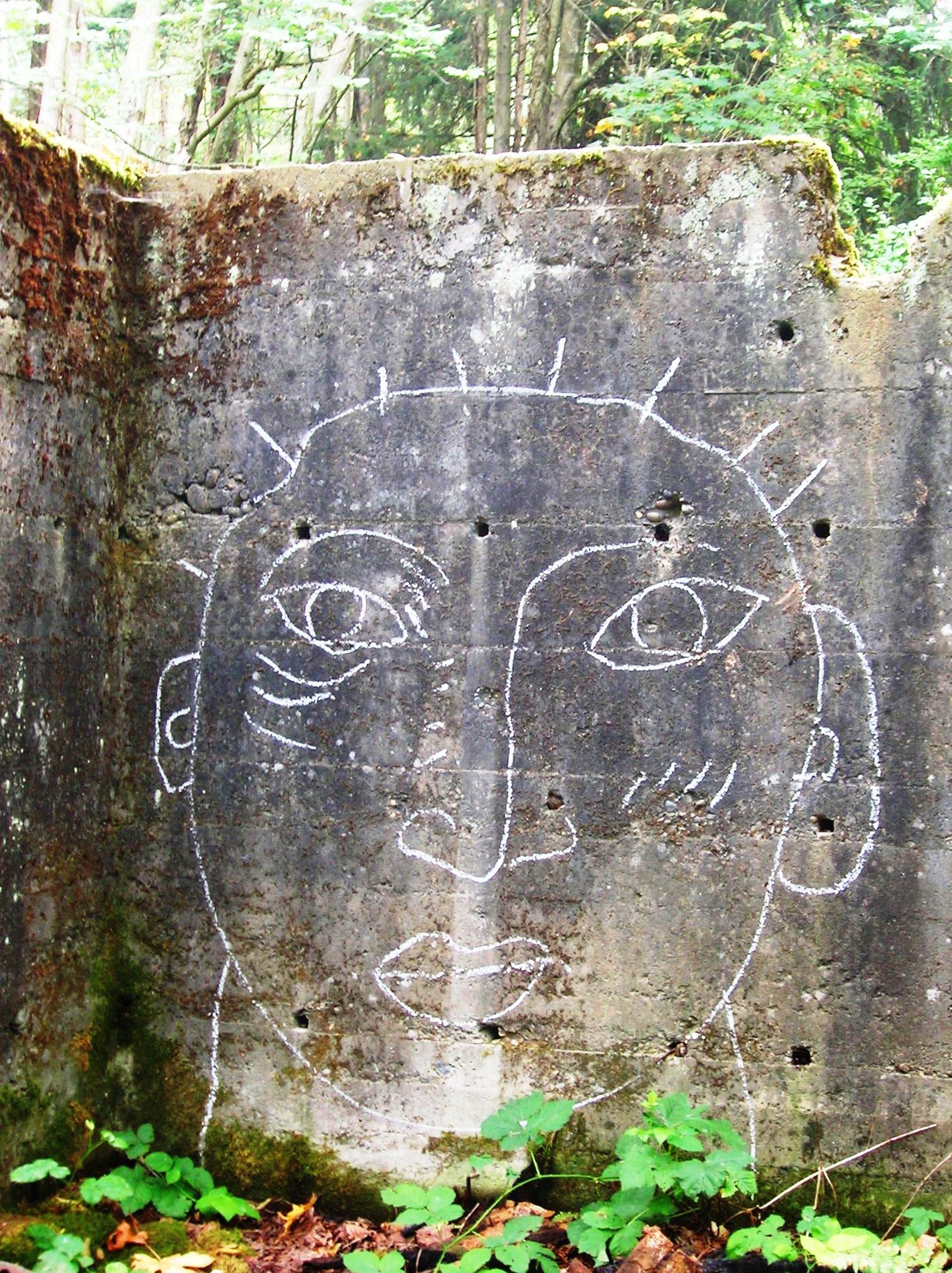
But some are not!

At first I tut-tutted, a graffito in such a setting. Then I realized I rather liked the face — just a bit Picasso-esque, don’t you think? And also realized it is if anything an improvement on the concrete ruin it adorns.

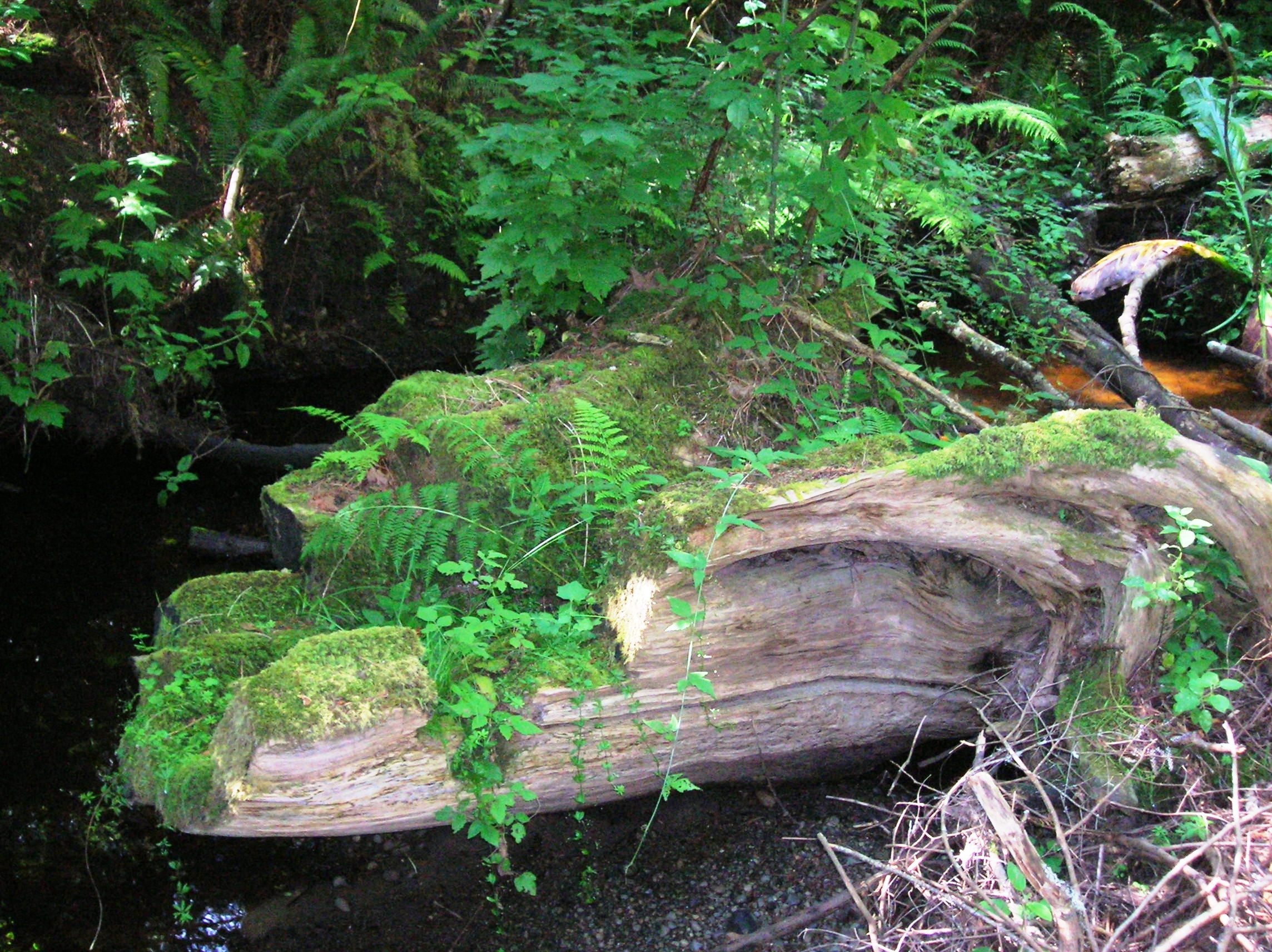
This last photo takes us back to West Coast Classic, and is a bit of a cheat. Well, only in time, not in place.
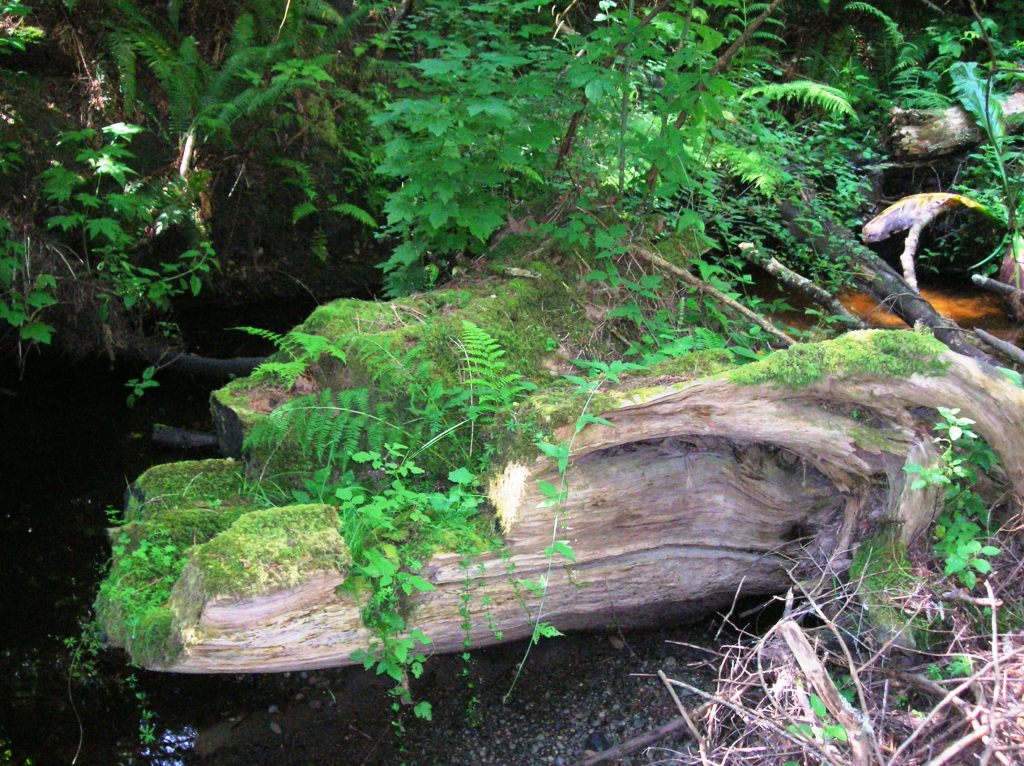
I took this photo of a “nurse log” right here in Watershed Park, but some years ago. Karen had explained the phenomenon to me, that of an old rotting log nurturing new life, and I remember being so happy to find such a good example of it.

And now I’m home. Posting this from Toronto, and planning my next walk right here…
Hello world!

12 January — And especially, hello to my supporters, the people who have put their money and their encouragement behind this big project of mine, and want me to stay in touch as I prepare for it. You’re why I’m blogging! (Another new experience…)

I’ll be writing about my adventures as I do my Central Y workouts 3 days/week, and walk city neighbourhoods and park systems another 3 days/week. When I think about my friend training for the Boston Marathon, or the one who hiked the Chilkoot Trail, I realize this Iceland trek (6 days, 12-17 km/day, 5 nights camping) isn’t that big a deal. But it’s my deal — and yours too, because you’re helping me.

So bear with me while I figure out this blogging thing. This site (like my body) will rapidly improve.

(If you fell on this blog by chance, and don’t know what I’m talking about, check out http://arthritis.akaraisin.com/onjim/icelandpenny.)

’til later!

  • WALKING… & SEEING
    "Traveller, there is no path. Paths are made by walking" -- Antonio Machado (1875-1939)

    "The voyage of discovery is not in seeking new landscapes, but in having new eyes" -- Marcel Proust (1871-1922)

    "A city is a language, a repository of possibilities, and walking is the act of speaking that language, of selecting from those possibilities" -- Rebecca Solnit, "Wanderlust: A History of Walking"

  • Recent Posts

  • Walk, Talk, Rock… B.C.-style

  • Post Categories

  • Archives

  • Blog Stats

    • 129,160 hits
  • Since 14 August 2014

    Flag Counter
  • Enter your email address to follow this blog and receive notifications of new posts by email.

    Join 2,045 other subscribers