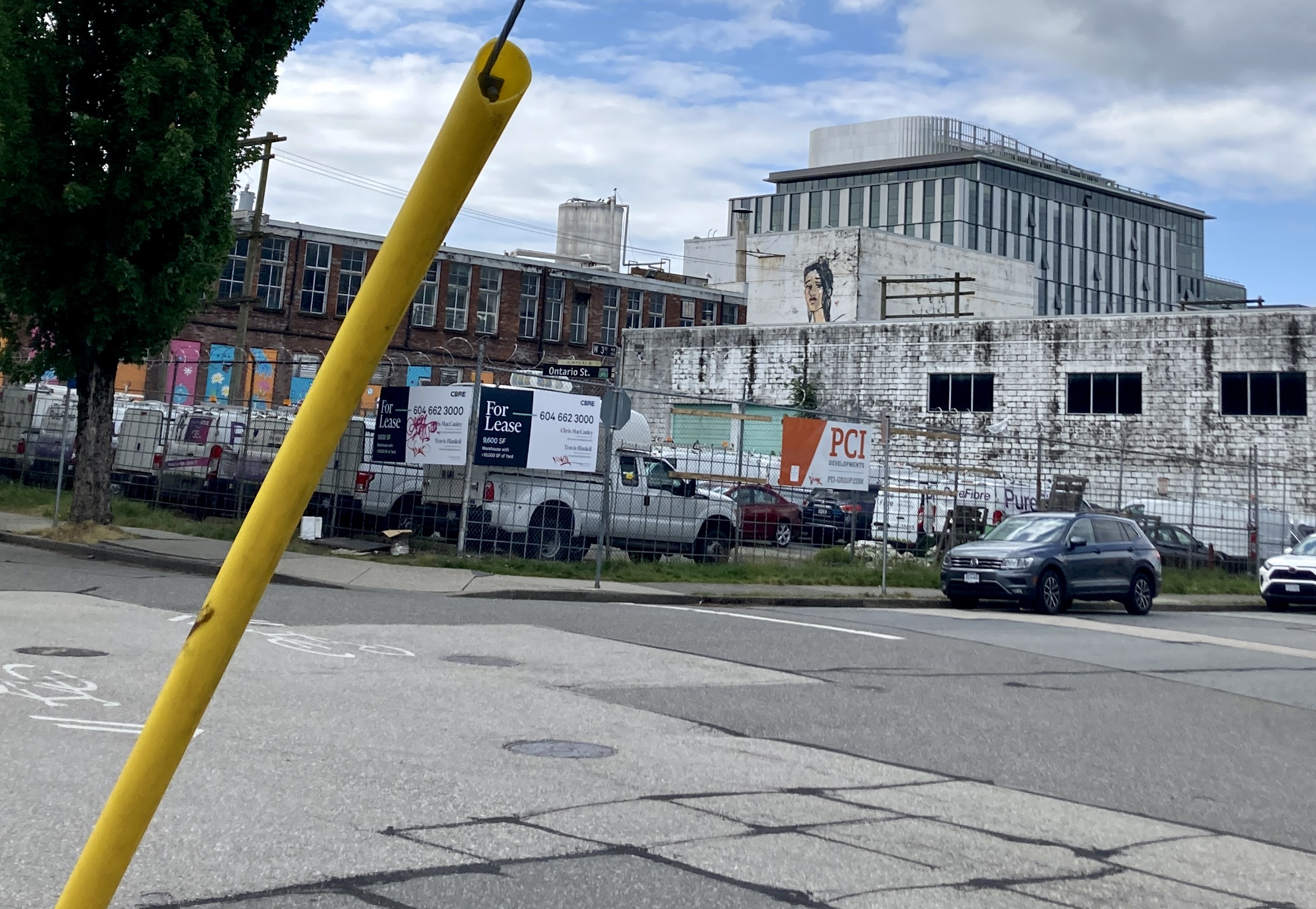
Rail Yard. And Other Invisibles. (And Visibles.)

31 July 2025 – I’m on the N/E corner of Quebec St. and East 2nd Ave., and I read the little plaque at my feet.

Really??? I say — but very quietly, to myself. (No point startling others.)

Look up & I’ll see a rail yard? Or an elk? or a forest? or a convoy of Canada geese?

Pfft!!! (My genteel raspberry is also very quietly expressed, to myself.)

Rail yard is historic fact right here at False Creek, not current reality. The first CPR railway station opened in Vancouver in 1887, but the railway-related industrial era boomed after the World War I project to fill in the tidal flats of False Creek, from Main St. on east to Clark Drive, to provide a site for two new railway terminals and associated rail yards. Various changes along False Creek since then, most recently the transformation to parkland, Seawall and residential/knowledge industry occupation, triggered first by Expo 86 and then the 2010 Winter Olympics.
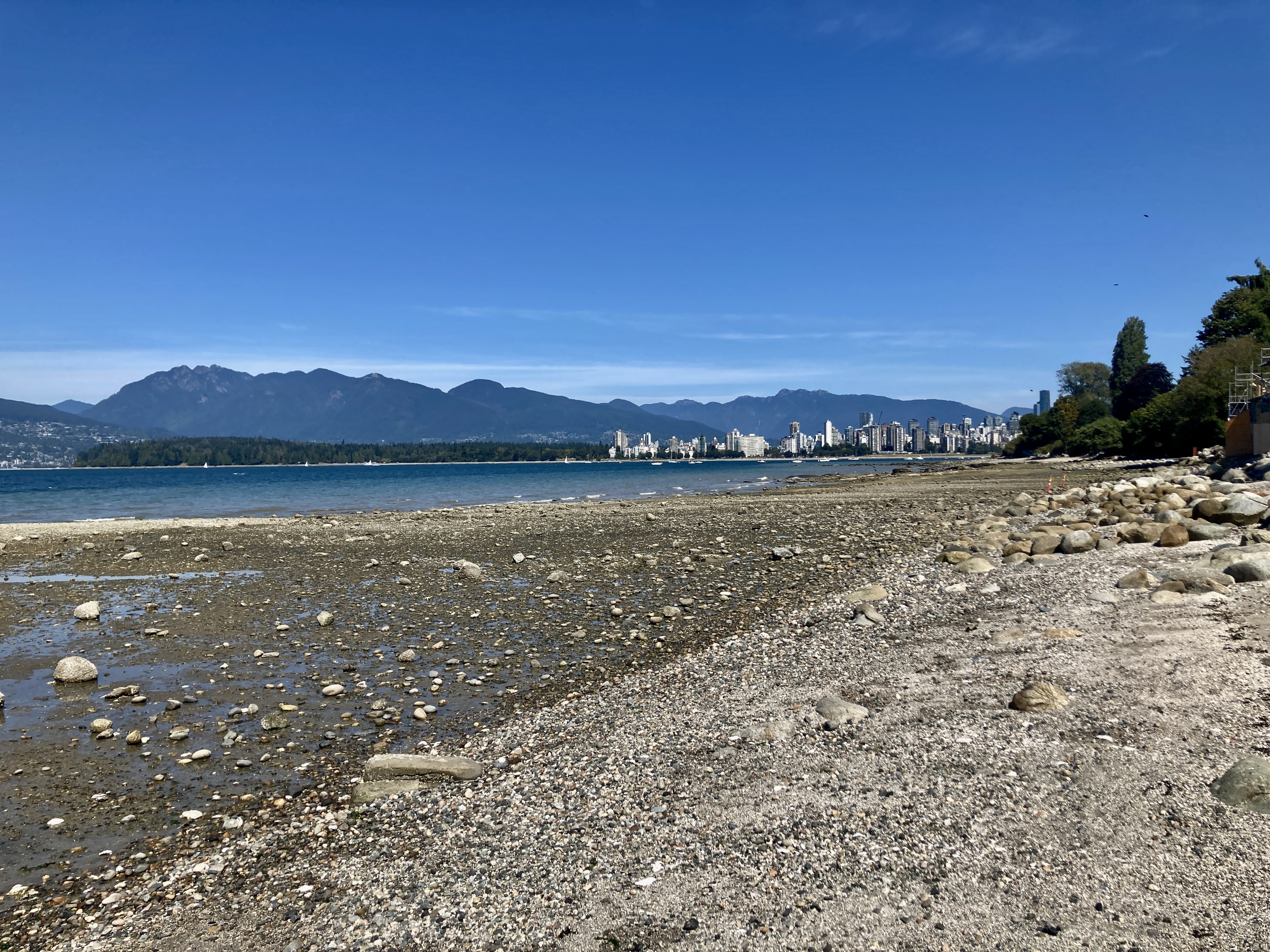
So, no, I am not going to see a rail yard from this street corner, no matter where I look. But I don’t care! I am all for looking, while I walk, not for stomping along in a trance. I am perfectly happy to be reminded to swivel my head and pay attention.

I start swivelling.

Look Up, East: the MEC building, a 2020 arrival in this historic neighbourhood…

and once again (spring 2025) back in Canadian ownership, though no longer a cooperative.

Look Up, West: an even newer new-build.

Look Sideways, East: the eco-conscious alley behind MEC, with watercourse and plantings to attract insects and bees.

Look Sideways, West: the alley behind that new-build, with an historic reference right there at the corner.

Namely, one of the City’s remaining H-frame hydro poles.

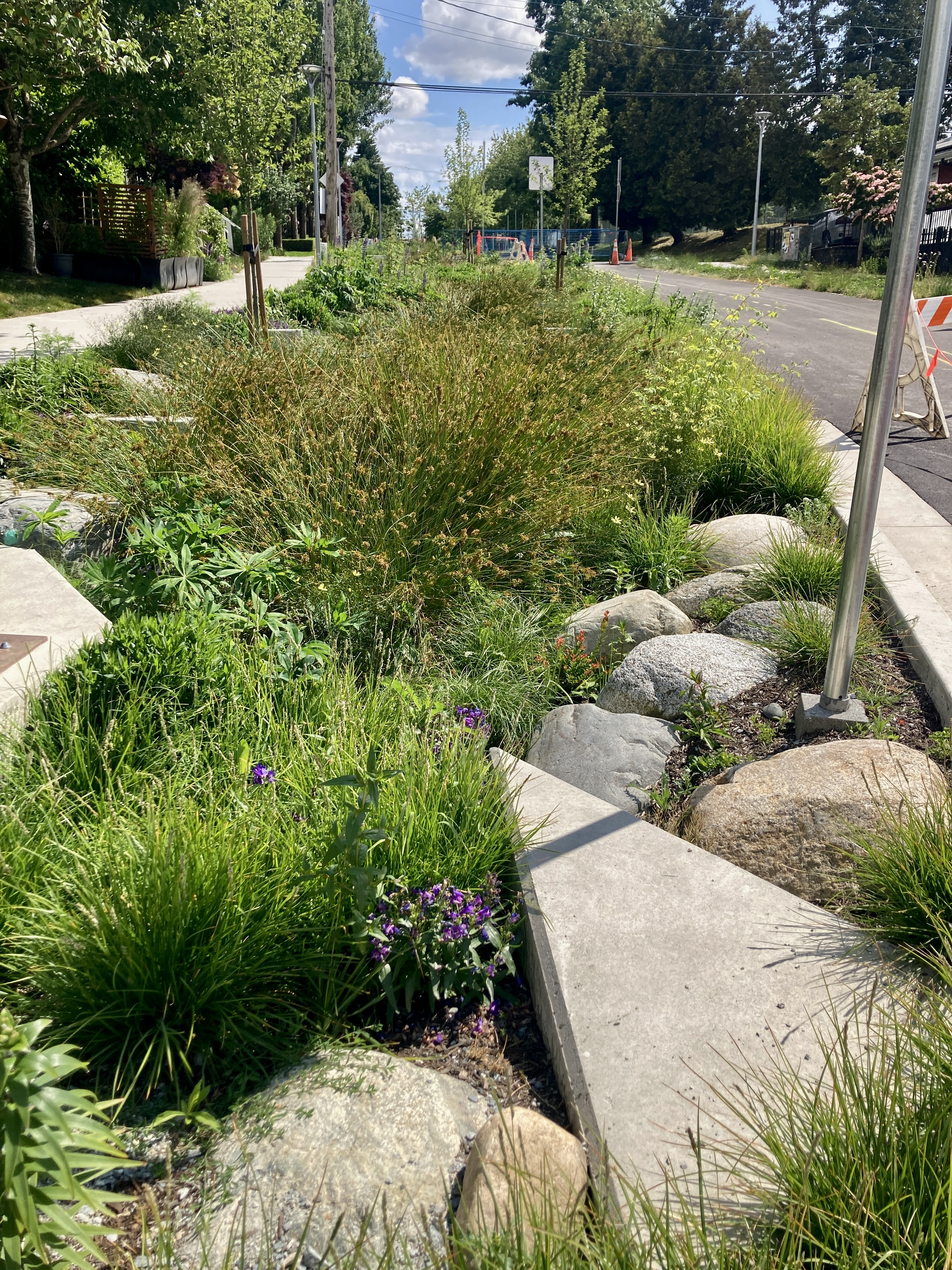
Look Down-Along, North: this block’s stretch of bioswale

which “collects and cleans the rainwater that fall on Quebec Street.”

Look Straight-Across, West: tail end of a straggly crocodile of kiddies (yellow T-shirts) plus their volunteer monitors (green T-shirts)…

crossing Quebec and hurrying to catch up with the croc’s main body, all those children already walking on north along Quebec’s west side.

I have to wait for the next light. After that I’m following in their somewhat distant footsteps, not sure where they’re headed but with my own Best Guess in mind. (Science World, I think to myself.)

Sure enough!

Like them, I turn west on Switchmen St. — a necessary detour while the end bit of Seawall is under repairs — and, from my vantage point at Pullman Porter, watch all those yellow & green T’s double ’round the parking lot & veer back east toward the geodesic dome of Science World. (An aside to you: you have noted these further railway tributes? Of course you have.)

I am charmed by the sight — by my knowledge of how much fun the children will have, and by my respect for all the organizations and all the volunteer support that collectively make these vacation-time excursions both possible and safe. (Flashback memory: the impish YMCA volunteer in Toronto, who explained that when they took 10 kids out, they were expected to bring 10 kids back. “Preferably,” she solemnly added, “the same ten.”)

I head on west. Bye-bye, kiddies.

I am still sufficiently Paying Attention to my surroundings, to notice the fresh-fruit stand near Olympic Village Plaza. I buy strawberries, my fingers guided by the young attendant to the boxes just trucked in this very morning from a farm in the Abbotsford area.

The day is warming up.

I find a shady bench in Hinge Park, and allow myself one strawberry. Just one.

It was…

really, really good! I hustle back home with the rest.

That Nice Mr. H

21 July 2025 – Busy morning, the day is clipping along, but surely there’s time for a short afternoon walk? I think False Creek (yet again), and then try to freshen the idea with a new combination of component parts.

Cranky Self objects: “I’ve already done all that!” Philosophic Self saves the day, quotes that nice Mr. Heraclitus: “You cannot step in the same river twice.”

Albeit by attribution, and much translated and much paraphrased, but the idea is clear. Everything (you included) is always all new, so go get it.

I haul out my much-creased False Creek map, and make a sort-of plan.

Walk down to The Village ferry dock (south-east end of False Creek, by Olympic Village Square); ferry to David Lam Park dock; walk on west along this portion of Vancouver’s Seawall, on past George Wainborn Park; then up-over the Granville Street bridge; down-around Granville Loop Park… and whatever.

The day is so mid-summer!

Music festival in the City Centre Artist Lodge forecourt as I walk past; patio umbrellas shading crowds on down Quebec & Ontario streets; and here in Olympic Village Square as well…

keeping all these customers cool, as well as one lop-eared dog (front & centre).

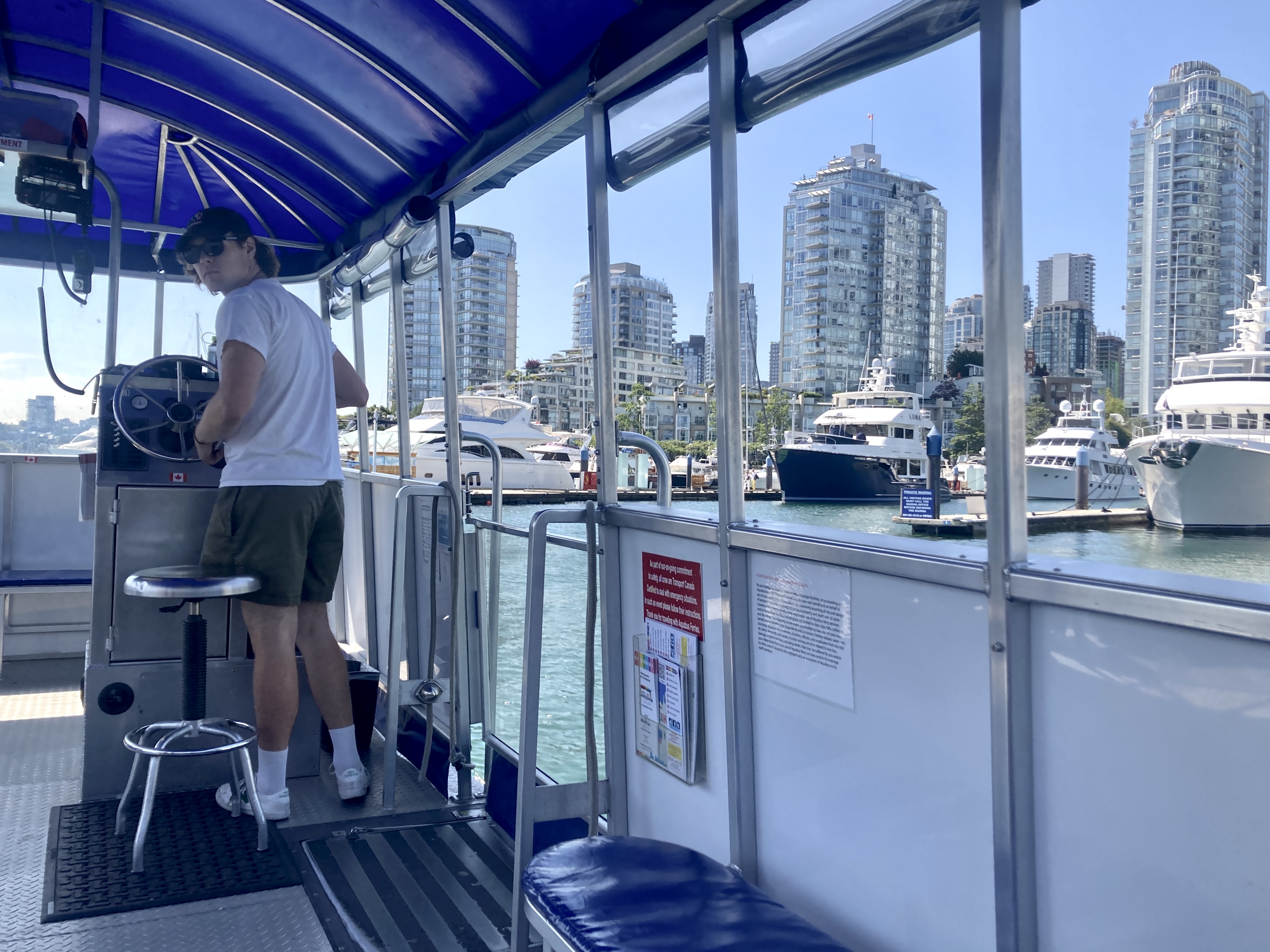
Onto an Aquabus, which is surprisingly empty until we stop at Yaletown Dock and pick up an extended family of Brazilian tourists. As we pull away, the driver, for fee-setting purposes, turns his head to quiz them on destination and demographics.

“Round-trip to Granville Island, six adults, two seniors and one child,” says the matriarch. She’s prompt with the data, but loses the credit-card quick-draw contest with one of her sons. She plays to her audience with a “What-can-I-do?” gesture, and is rewarded with amused laughter.

I hop off at David Lam; they carry on to the tourist (& resident) attraction that we call an “island,” even though it isn’t, not quite.

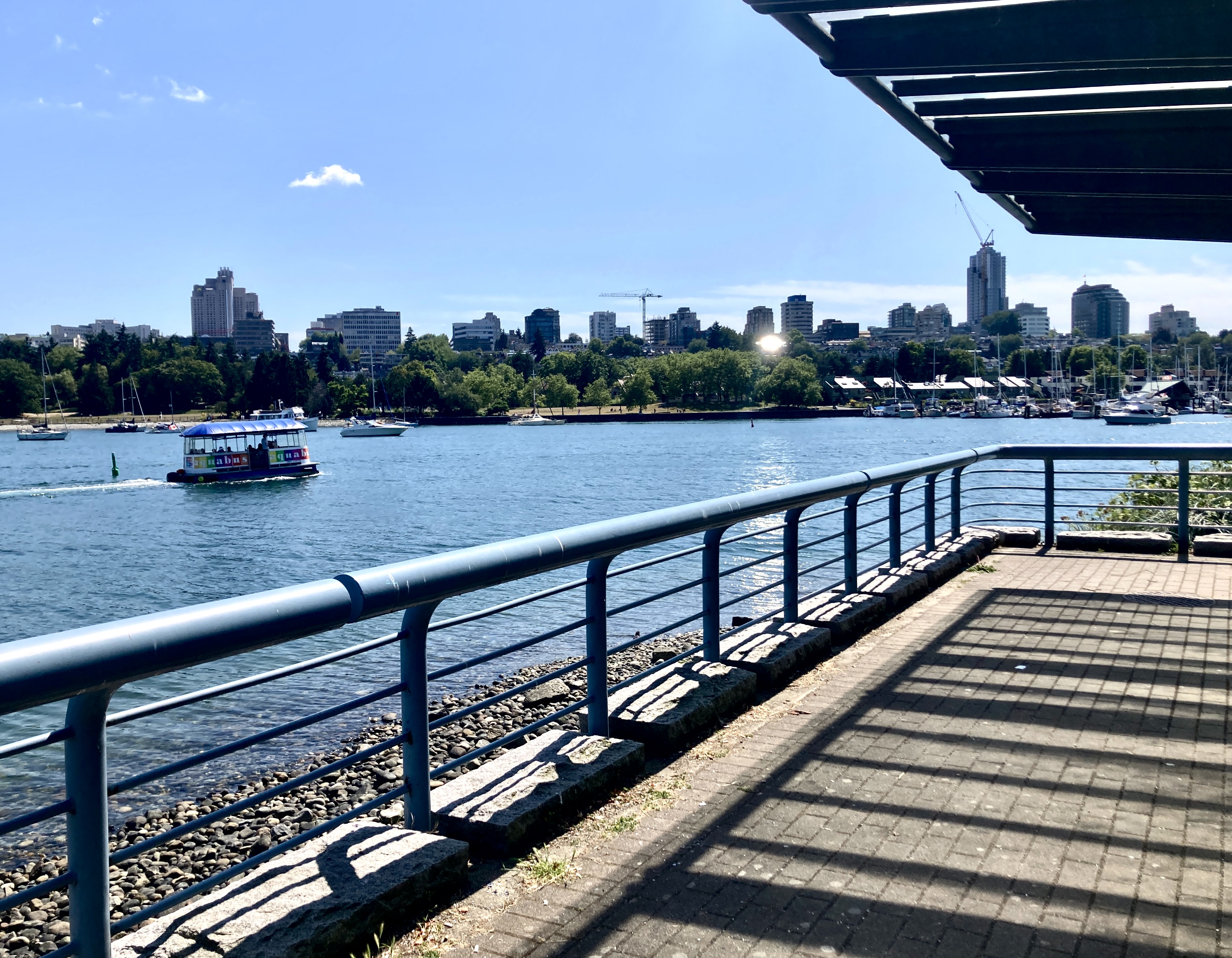
I’m always amazed at the diversity of traffic on and in the water — everything from whopping private vessels in the marinas to ferries to kayaks/dragon boats/paddle-boards to wildlife — and nobody seems to hit anybody else.

Even when they’re a couple moving very slowly on an isolated little paddle-board.

I turn my attention landward.

Thistles old & new, backed by ripening blackberries…

which cause a passing teen to tell her boyfriend about the berry patch behind her house, when she was growing up. “They’re awfully bitter until they’re really ripe,” she warns him.

The Seawall, like False Creek, has a mixed-use culture. Pedestrians here; cyclists there. In between David Lam & George Wainborn parks, I also get a good look at the Granville Street bridge, up ahead.

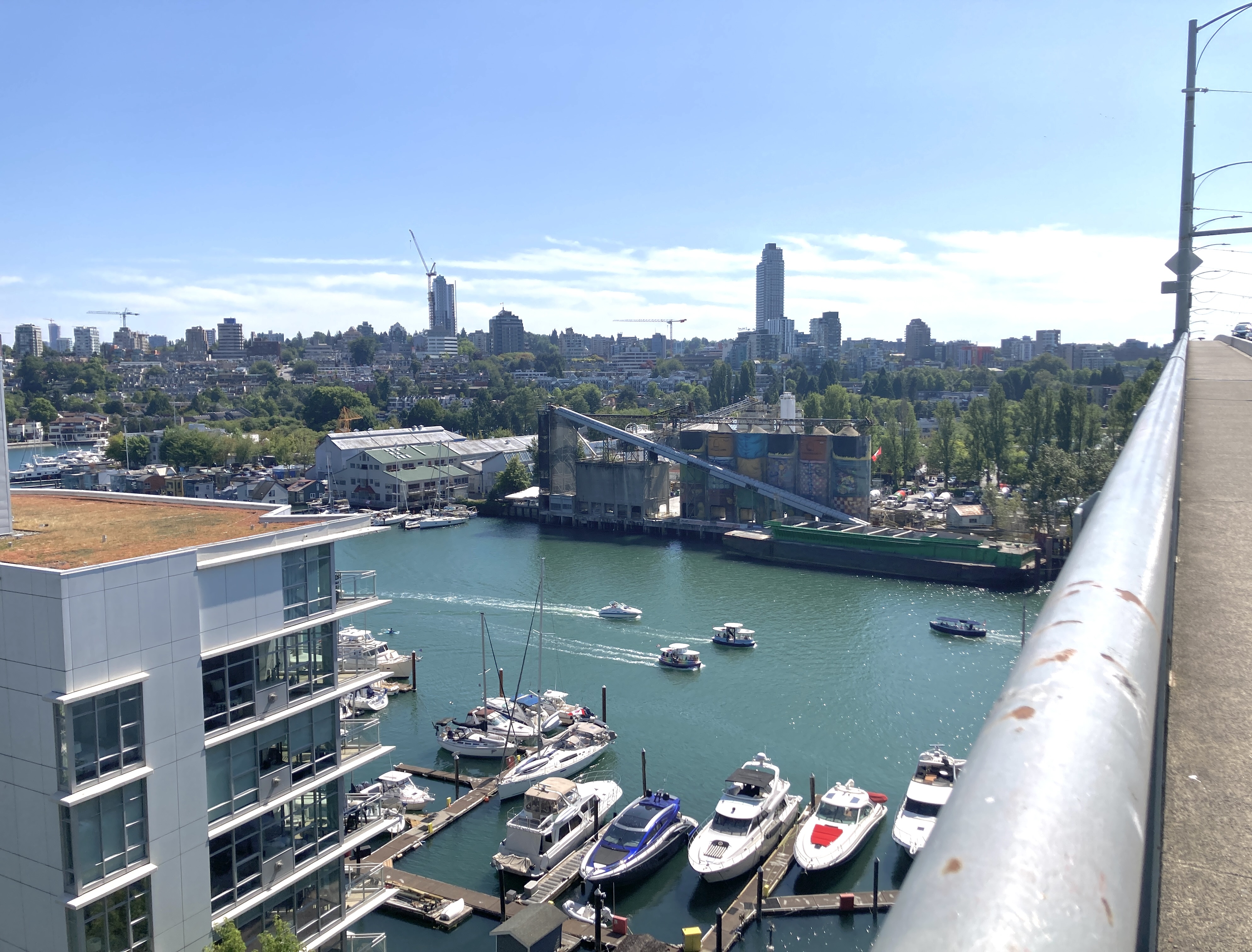
Closer still, almost opposite Granville Island, a good look at Giants — the six concrete silos painted for the 2014-16 Vancouver Biennale by the Brazilian twins known as OSGEMEOS, and now a lasting icon in the Biennale’s Open Air Museum.

This north-facing façade in shadows, mid-afternoon, but compelling even so.

Once I’m almost beneath the bridge, my next challenge is to find my way onto it.

Please, you’re thinking, how hard can that be? Not impossible, I grant you, but it does involve discovering that the west-side pedestrian path is closed for repairs, and orienteering my way up-along Weedland…

aka Waiting-For-Development-Land, to find the east-side path.

Which I do.

So here I am, heading toward centre bridge. With an overhead view of Creek traffic and a different angle on Giant.

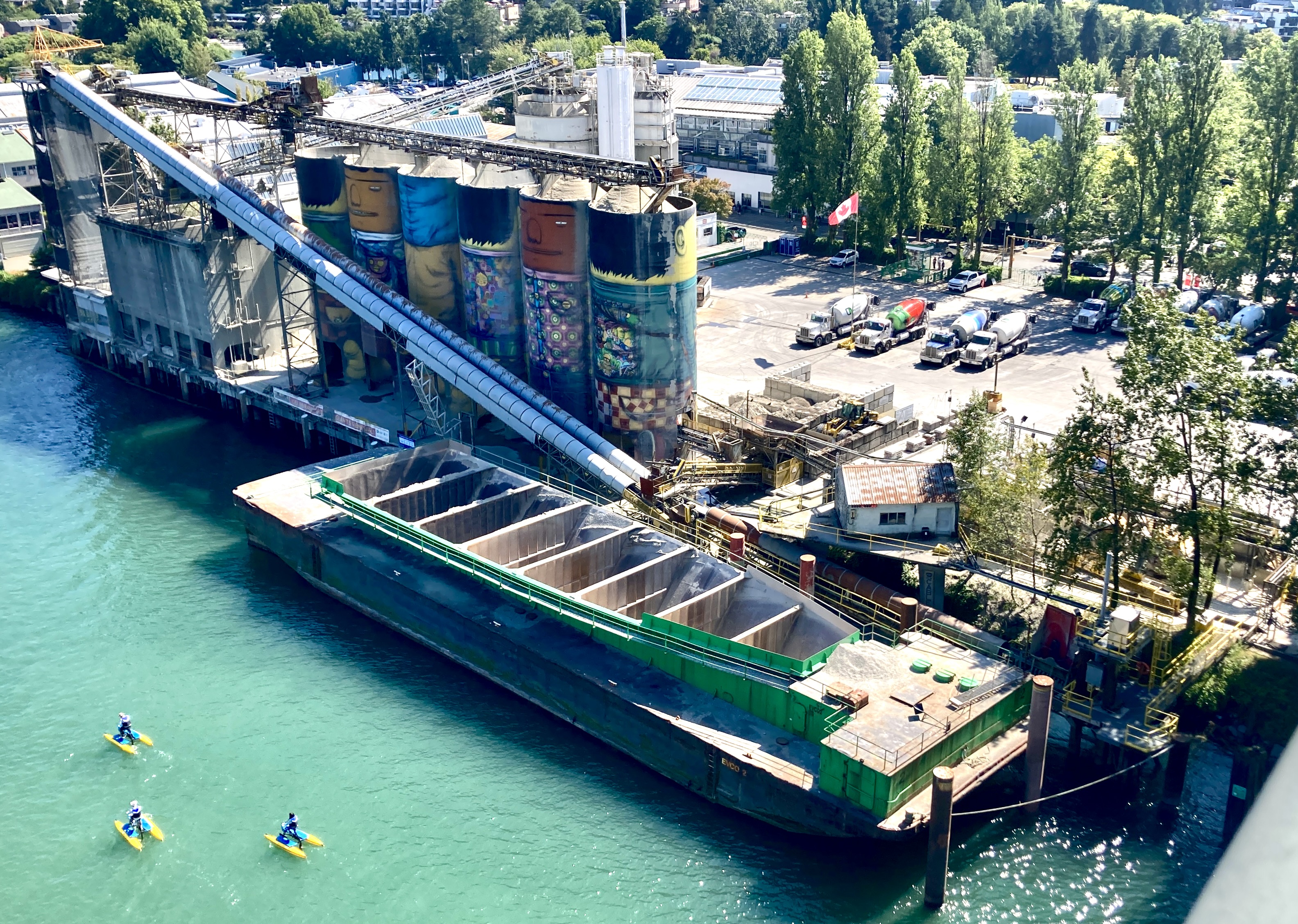
Almost directly overhead, a reminder that this is a working concrete facility, not just a mural backdrop.

Starting down the bridge’s southern slope, I look back. Now I can enjoy the Giant‘s sunny faces and the long eastern view of False Creek behind them.

Over land now, over the Granville Island Kids Market and playground, backing onto Alder Bay.

More orienteering required, to get myself off this bridge!

I place my faith in this zebra crossing over these lanes, then this path and down these steps, and yes! it works.

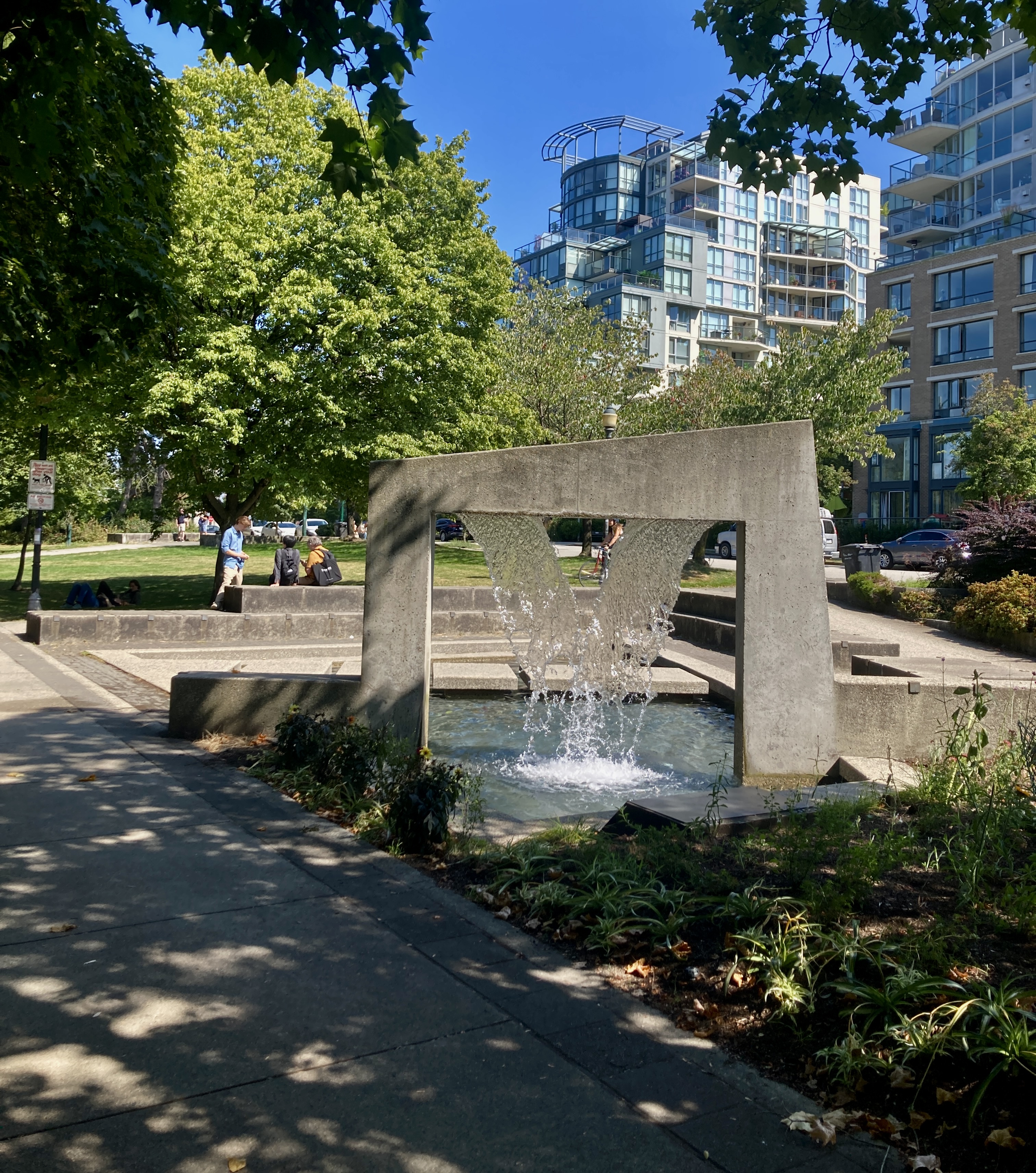
I’m in Granville Loop Park, with a waterfall sculpture that reminds us yet again that, all those centuries ago, Heraclitus got it right. An ever-constant “V” of water, created by ever-changing water molecules, in ever-flowing cascades from the two upper corners.

Across the kiddy play area, with the yellow Coyotes in Area sign to my right and tennis players straight ahead…

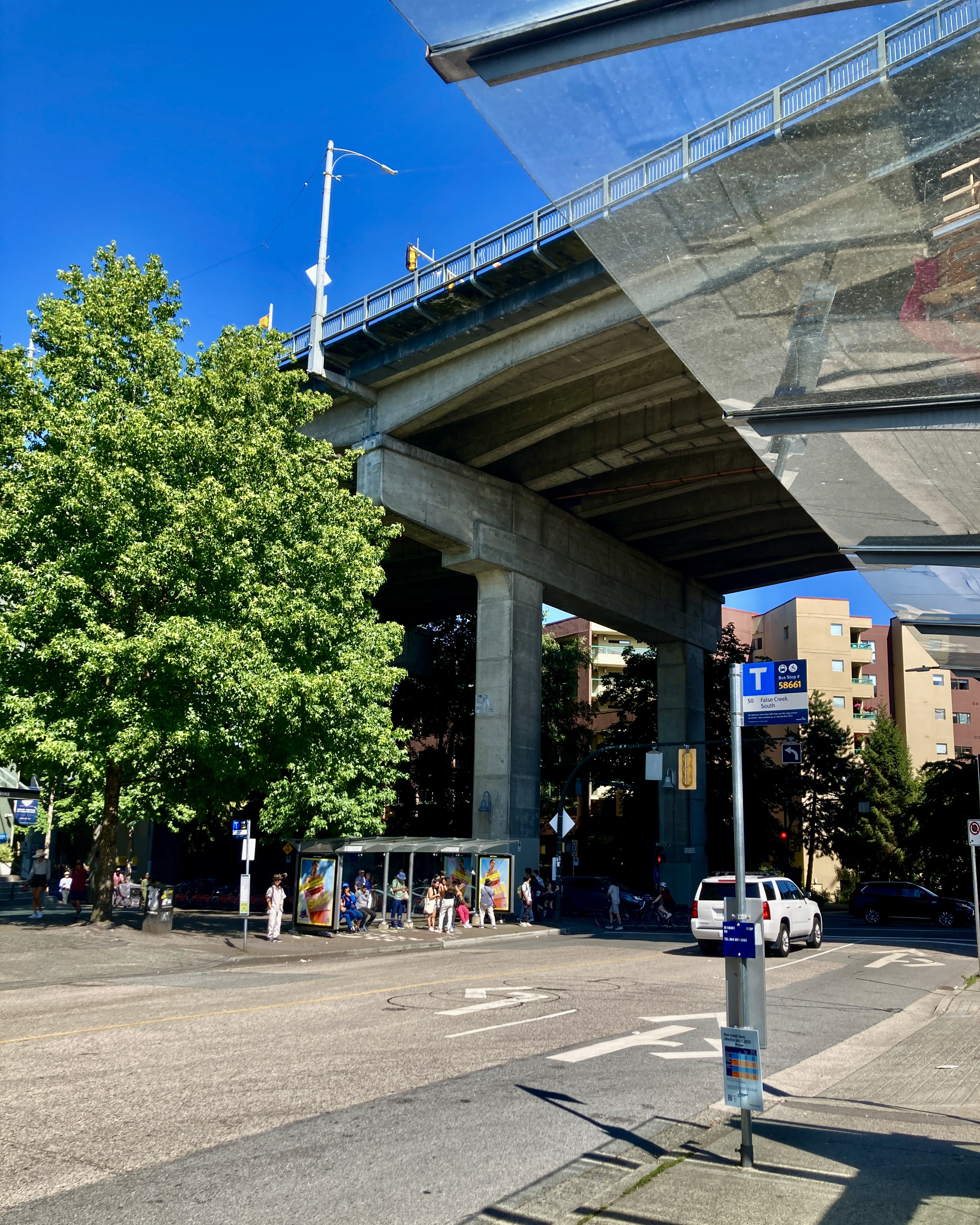
and down and around and out to the West 2nd bus stop…

where, from a shady bench, I look up at the bridge I have just crossed.

A Tree

13 July 2025 – I stand there on the sidewalk, having myself a Joyce Kilmer moment.

If you now find yourself chanting “I think that I shall never see / A poem lovely as a tree,” then you may be of my generation — someone who also grew up somewhere in North America and learned that poem in elementary school.

The 1913 language may now strike us as a bit over-heated. We’re more likely to respond to the approach taken by UBC Professor of Forest Ecology, Dr. Suzanne Simard. Her 2021 seminal work, Finding the Mother Tree: Discovering the Wisdom of the Forest (now published in 21 languages), has propelled us right to the frontier of work being done in the field of plant communication and intelligence.

Kilmer or Simard, it’s about respect for trees, each pursuing that respect with their own language and skills.

My respect today is visual — for the sheer beauty & majesty of this tree. The textures of the bark, the play of colours.

Wonderful details, up close.

Tiny golden leaves, caught in bark crevasses at the base of the trunk…

a sprig of new leaves, erupting mid-trunk…

spider webs! …

and the bark itself, needing no adornment.

Yet, there is one final adornment.

Of nature, but added by human hands.

St. George & the ‘Hood

19 June 2025 – Forget the dragon. That is so 10 centuries ago! These days, St. George — or, anyway, our St. George — is all about urban/eco sustainability and livability.

I’m first bounced onto this theme by a graffito on a waste bin. One that I initially think disrespectful of the human origins of the slogan…

but then reconsider, as I look smack across the street.

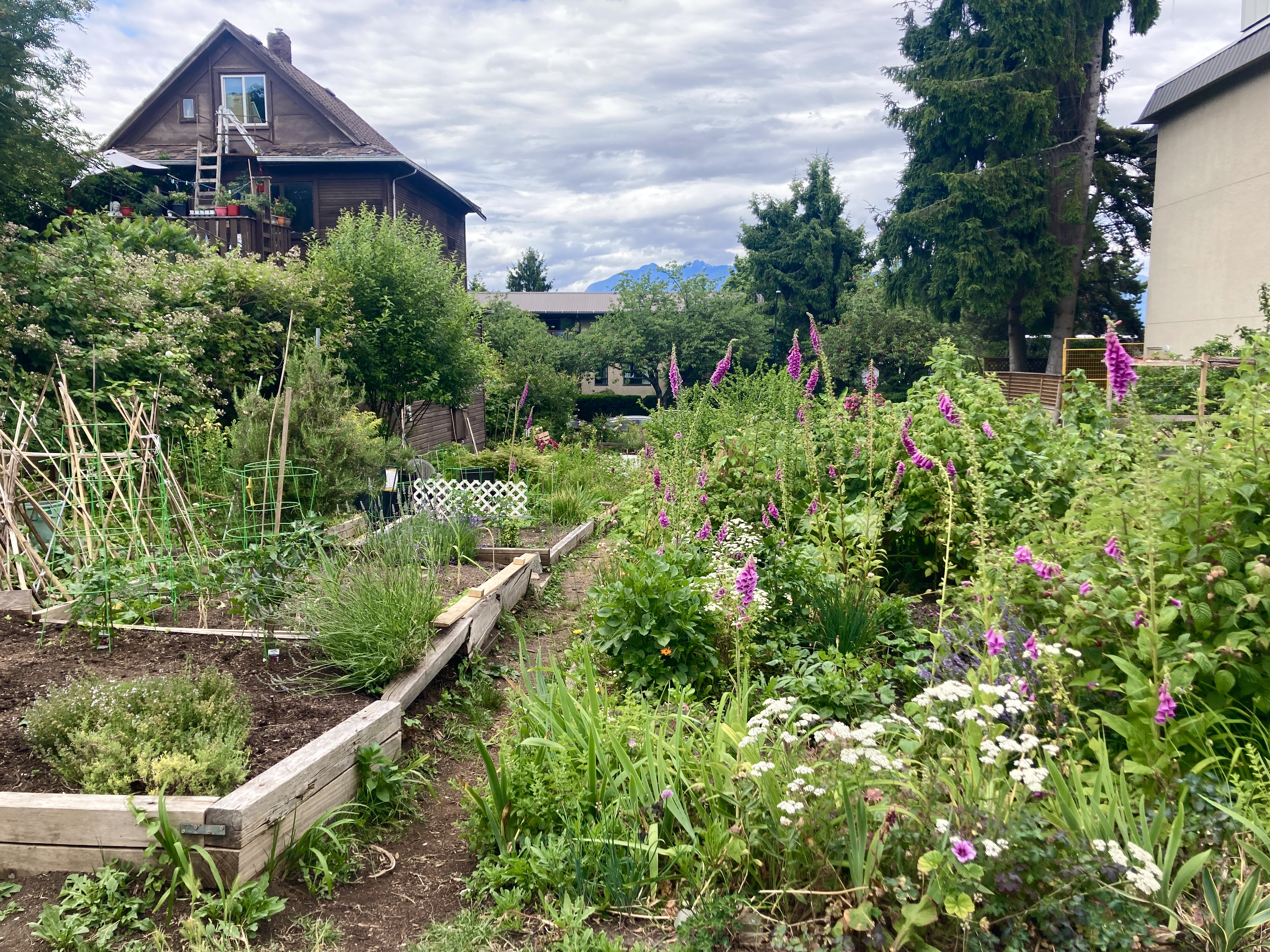
I’m on East 7th, heading farther east, and I’m staring into the busy abundance of this community garden stretching on north to East 6th. All lives matter, yes? We humans and plants are woven into the same eco-system.

This little local garden is very much of this neighbourhood, with its neighbourly values. A place with low-rise homes, many of them vintage wooden structures; a place where a kicked-off toddler’s shoe…

is carefully displayed at sidewalk’s edge by some later passer-by, in the hopes it may yet be retrieved.

I drop down to East 6th, look north as I cross Guelph, think how much I like this human scale — but have no illusions it will last much longer. Let your eye travel down the row of modest bright-painted houses…

to that equally bright-painted construction crane down below. That’s the future, and increasingly the present.

But!

St. George is at work.

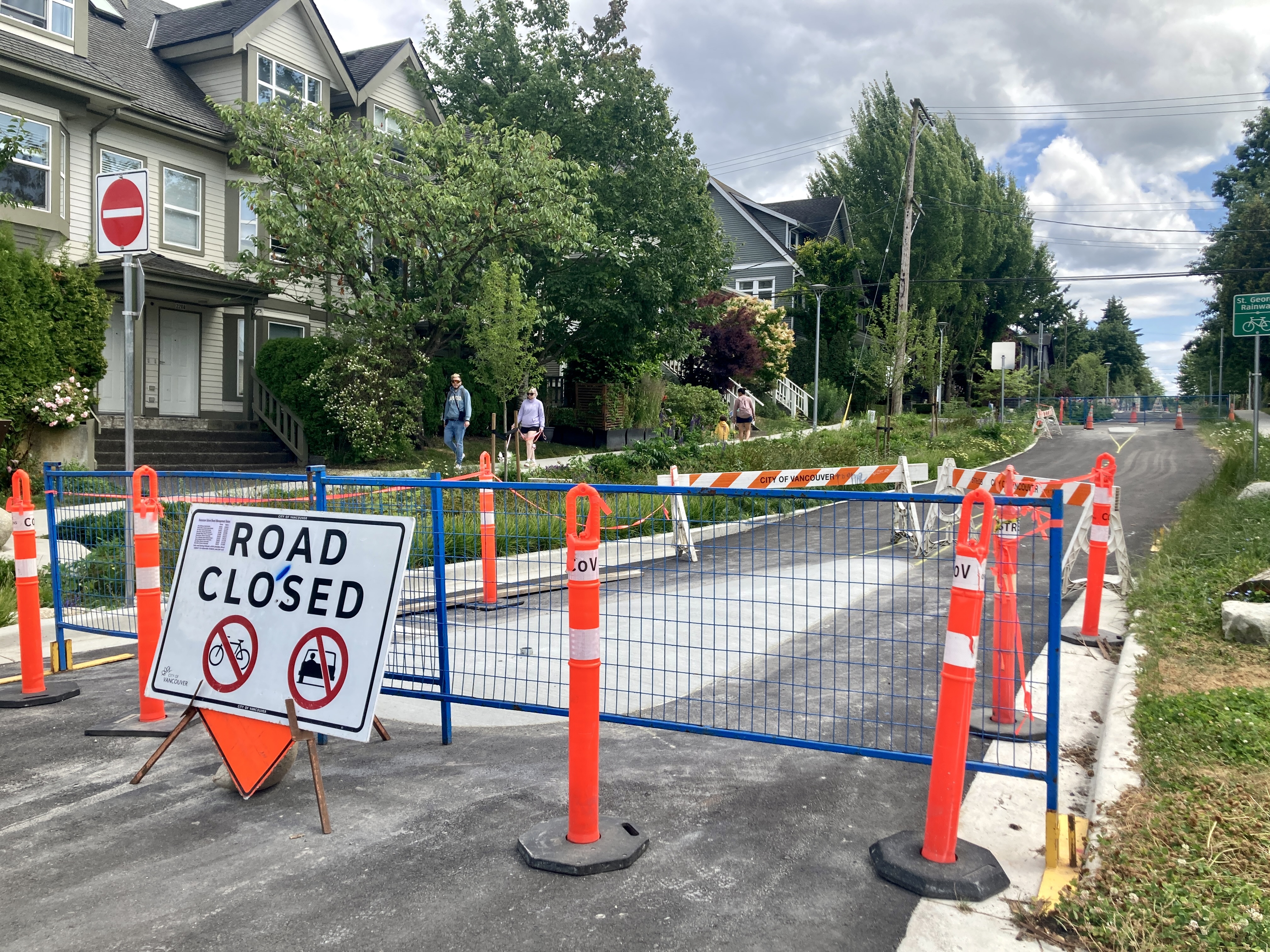
Well, the St. George Rainway. It’s been a long time coming, but now here it is, nearing completion — with its (and I quote} “green rainwater infrastructure features like rain gardens that incorporate plants, trees and soil to manage rainwater…”

I step up to the mini-plaza with its rock, its signage mounted on a plinth…

adorned with a Wood Sorrel cut-out…

and lots of information.

Go ahead — spread the image, track its elements; I’ll wait.

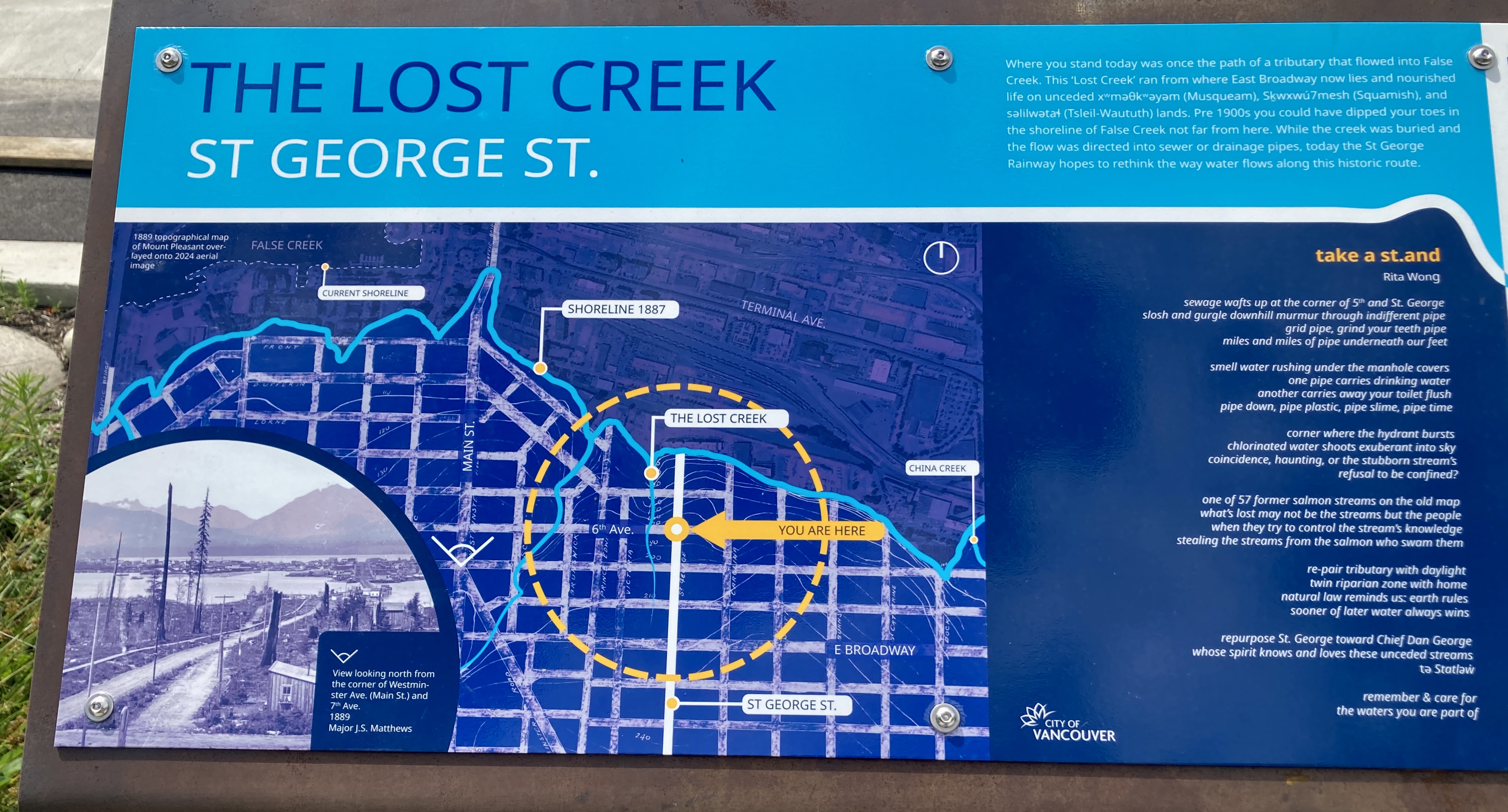
Together, we learn that the Rainway along St. George celebrates a Lost Creek, a tributary to False Creek that has long since been buried underground. (For that matter, this final eastern end of False Creek, into which the lost creek ran, no longer exists either.)

While you’re exploring that handy map, please note not just the Lost Creek, left-above “You are here,” but also China Creek on the far right, and E. Broadway (East Broadway), three streets to the south.

I admire the rain garden that parallels the sidewalk immediately to the south …

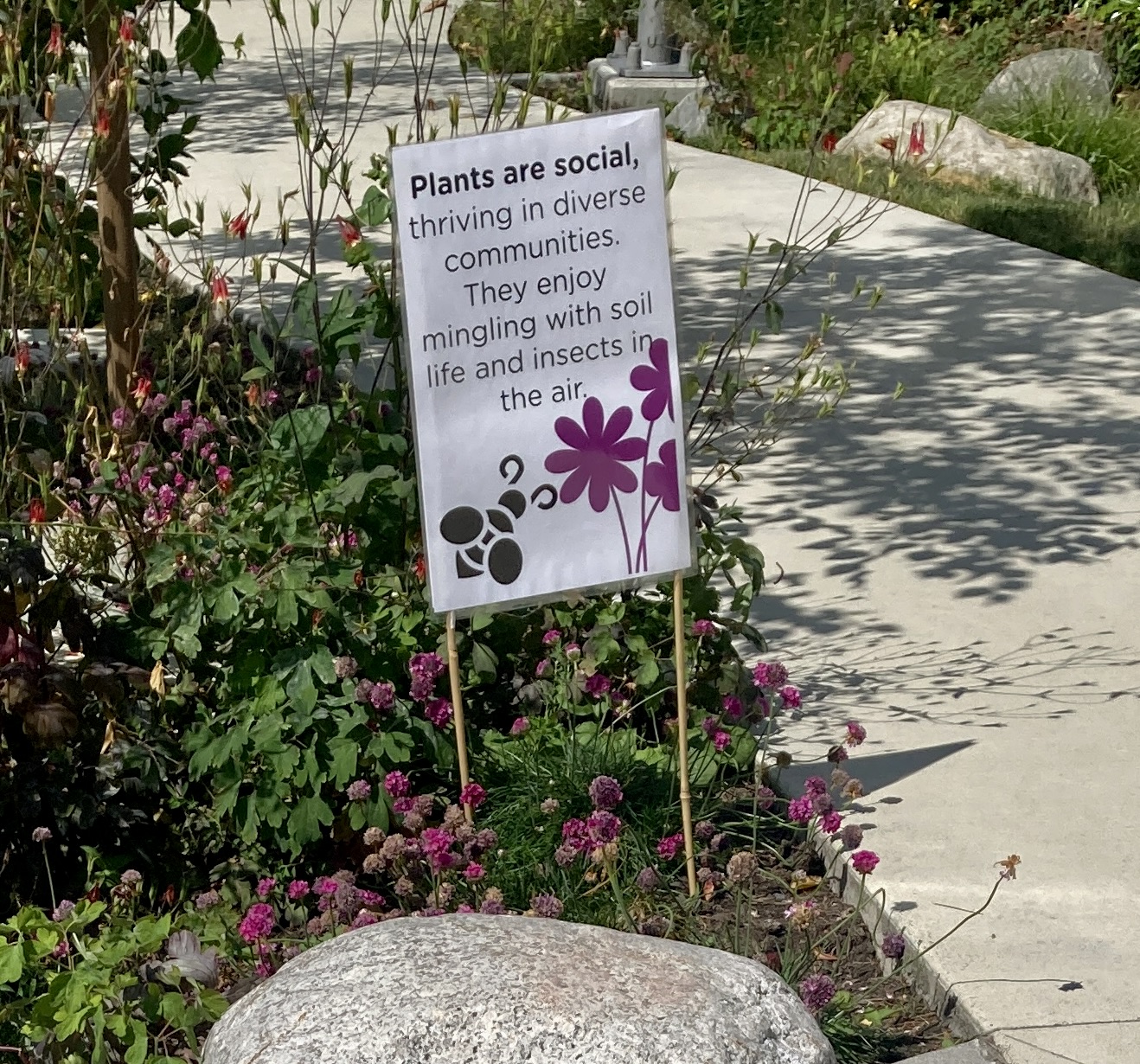
then cross East 6th to admire this sign in the rain garden running on north…

and feel more vindicated than ever in making my peace with the “Plant lives matter” graffito. “Thriving in diverse communities” sounds like the prescription for healthy life, period, whatever form of life we happen to be.

You’ll understand why, with that thought fresh in mind, I fall over laughing at the dumpster graffito I see immediately afterwards.

On I go, on to China Creek North Park. (See? That’s why I wanted you to locate it on the map.)

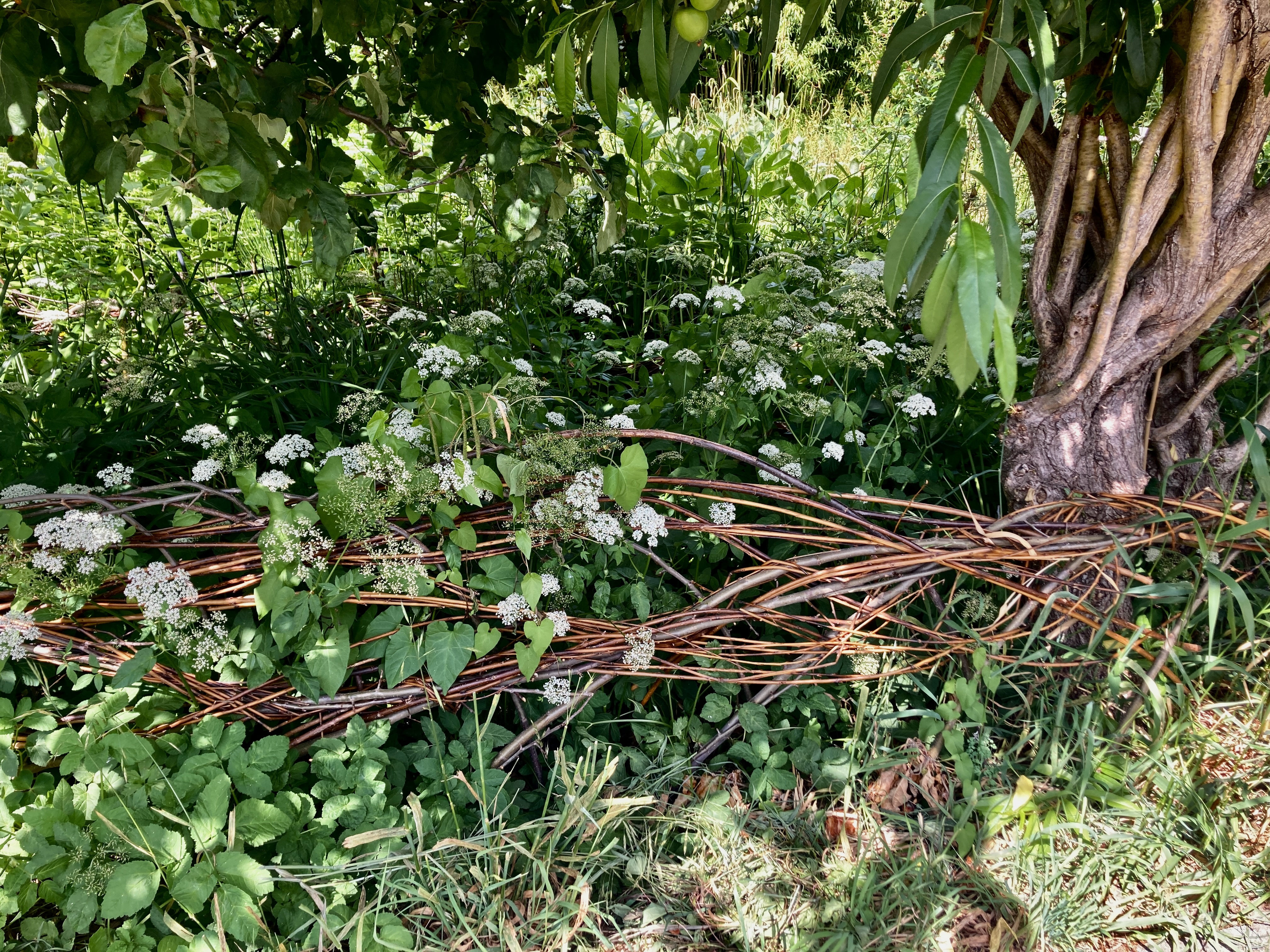
I am heartened, as I approach the edge of this large park, to see fresh new vine fencing woven into the woodlands periphery. (It had become very scruffy.)

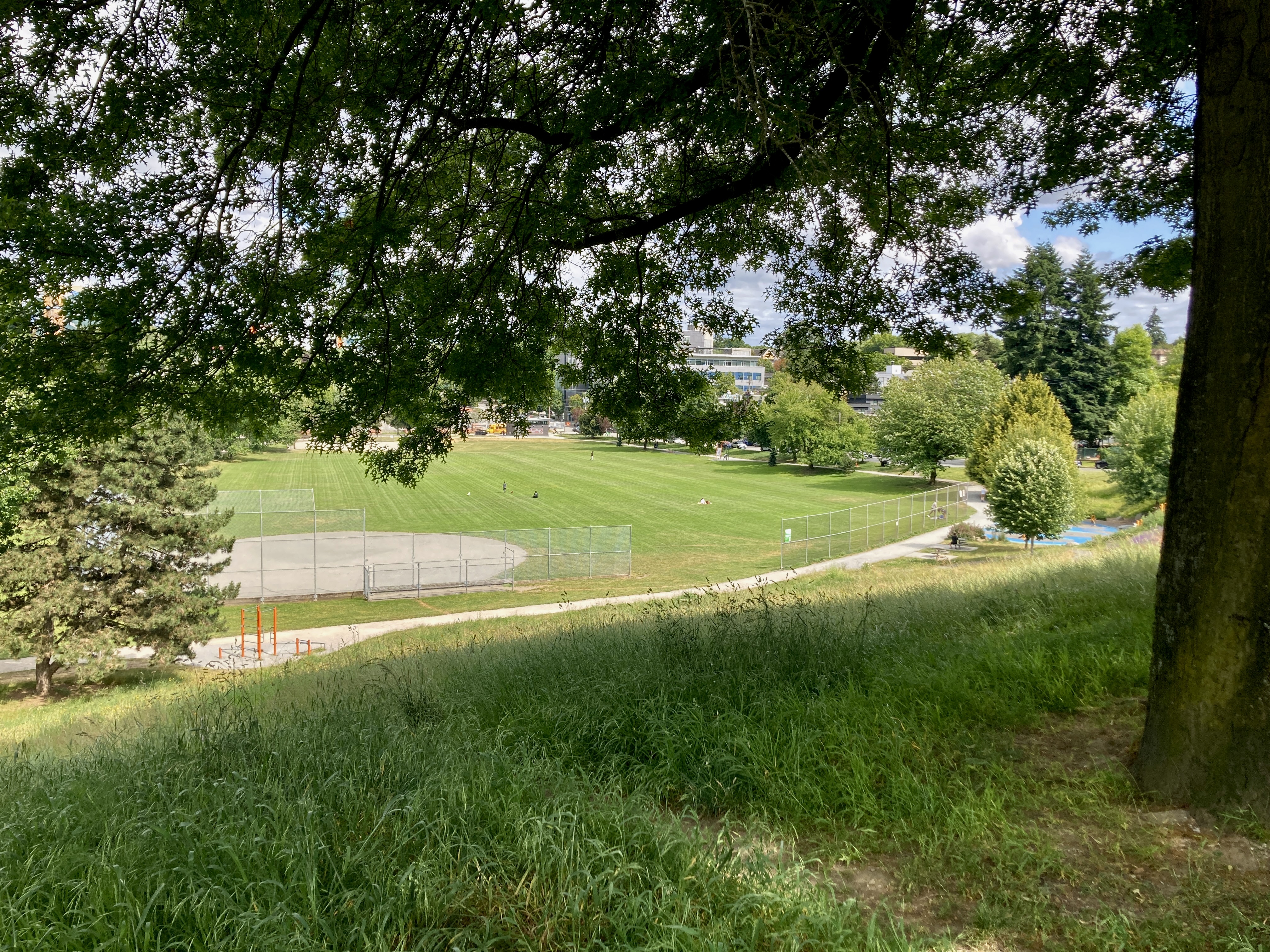
At first, looking down the slope, the basin of the park appears generic and banal. Old fashioned, even.

All that mown grass. And baseball diamonds.

But then, as always, I reconsider. The top of the slope is lined with benches, and they are well used, in diverse ways. At the moment, for example, the bench on the left hosts Headset Guy, who in fact is reading a real, physical book…

while the bench on the right hosts Music Man, who strums his acoustic guitar so softly it is almost subliminal. A woman just out of frame is hunkered down, motionless & meditative, and the woman you can see walking past the benches is about to start down the winding path that snakes its way to the playground at the lower level.

And I am about to join her.

This park is another “Lost Creek” — or, more precisely, a Lost Watershed. Before this last bit of False Creek was filled in, a whole network of creeks tumbled through here to feed its waters. Once filled in, the area at one point became a garbage dump, but was subsequently rescued and turned into parkland.

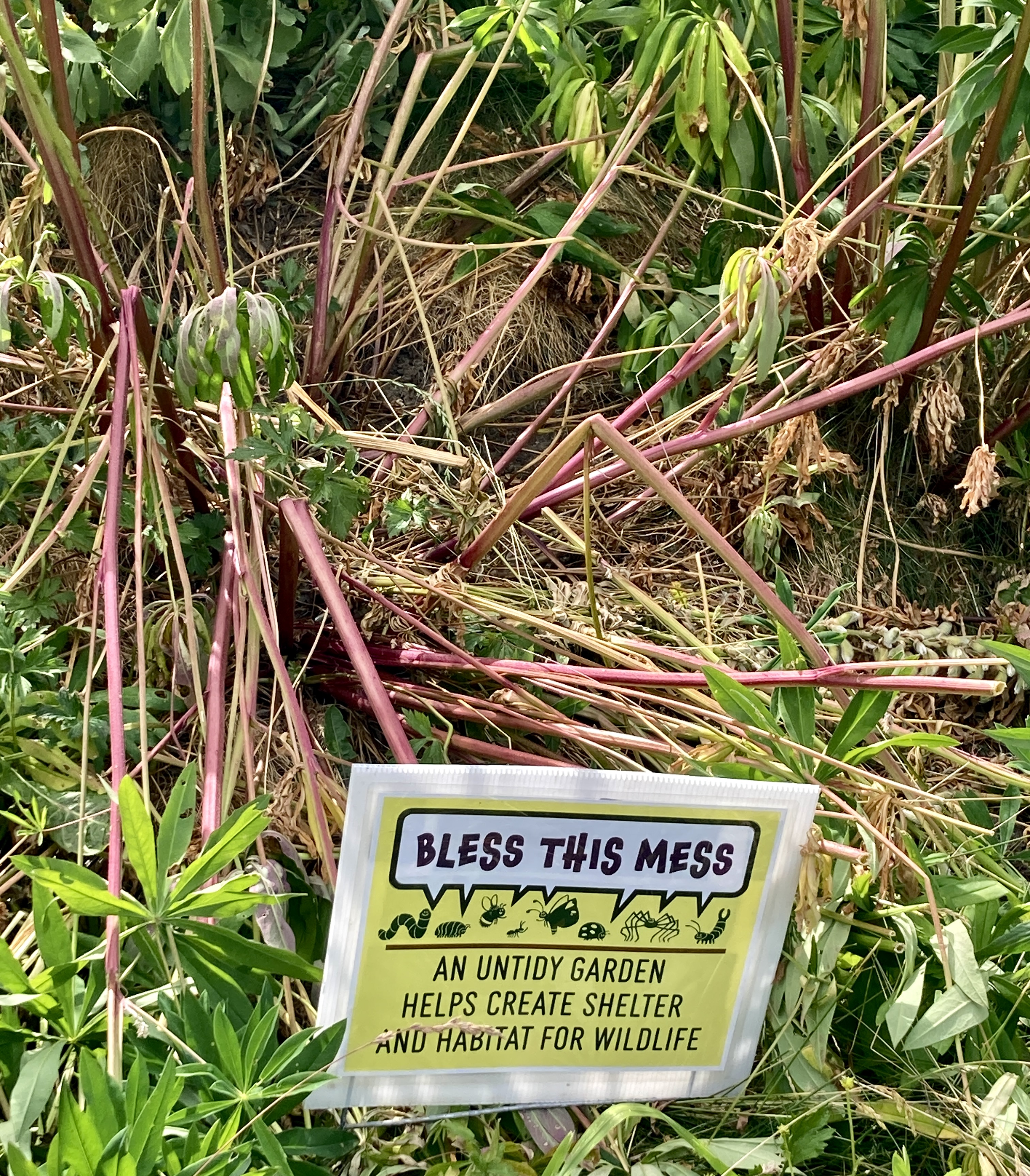
The slope is now naturalized, and it is wonderfully, exuberantly, messy.

With signage to justify the mess.

At the bottom of the path, I peer down the final bit of slope, the bit with a slide and (here) a mesh climbing ladder…

and, down there at the very bottom-bottom, swings and a pirate’s ship and other kiddy delights.

All this diversity! Social plants, social humans, thriving in diversity.

Walking homeward, more happy plant/human interaction…

in this volunteer-managed street corner garden, part of the City’s Green Streets Program.

And then… a reminder that not everything is happy-happy.

That some current trends are jarring and disruptive, and will damage both humans and nature.

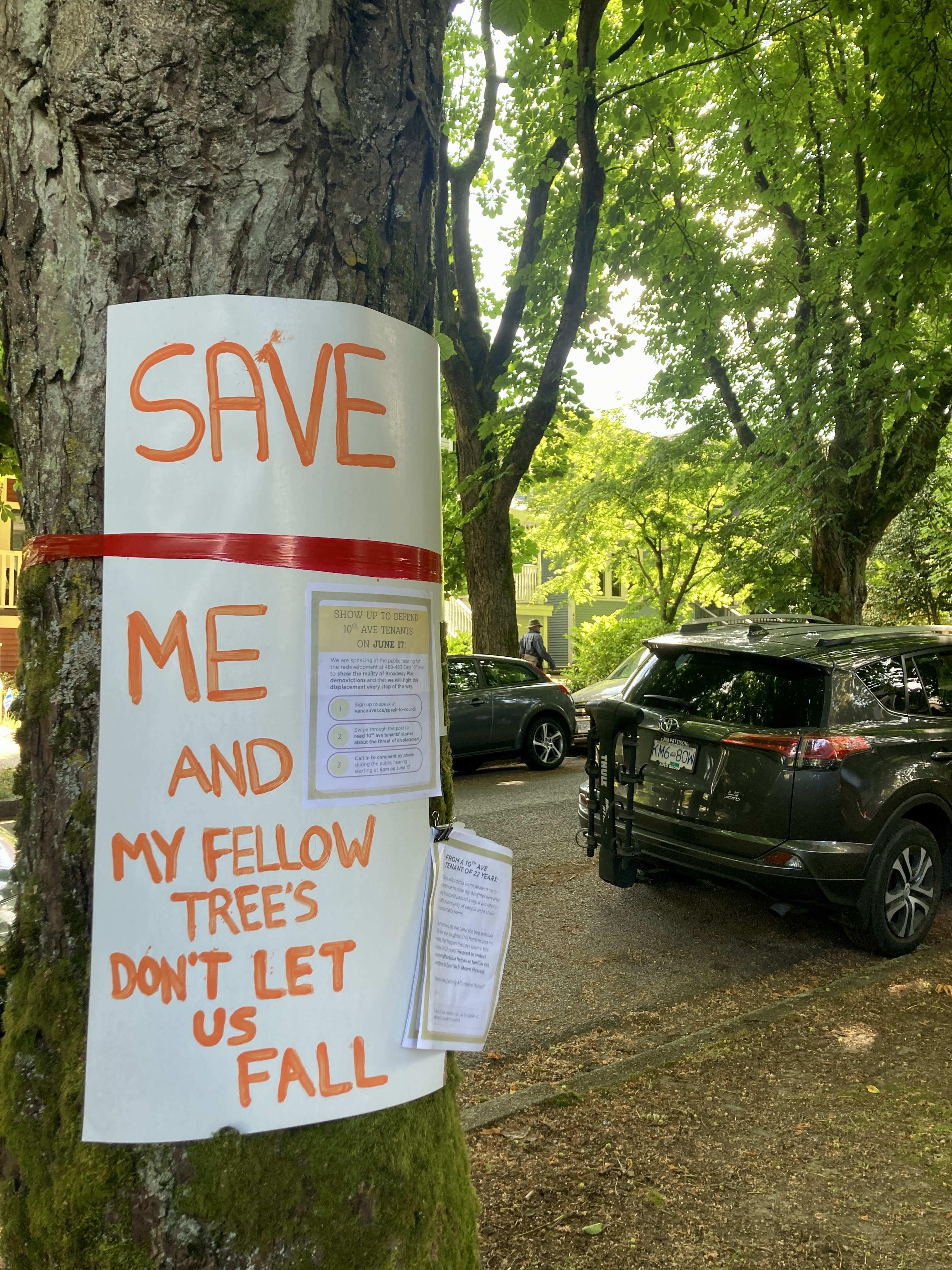
Taped to a tree on quiet, residential East 10th just west of St. George — with its fellow trees all around — a warning about the effects of the redevelopment now being pursued under the City’s Broadway Plan.

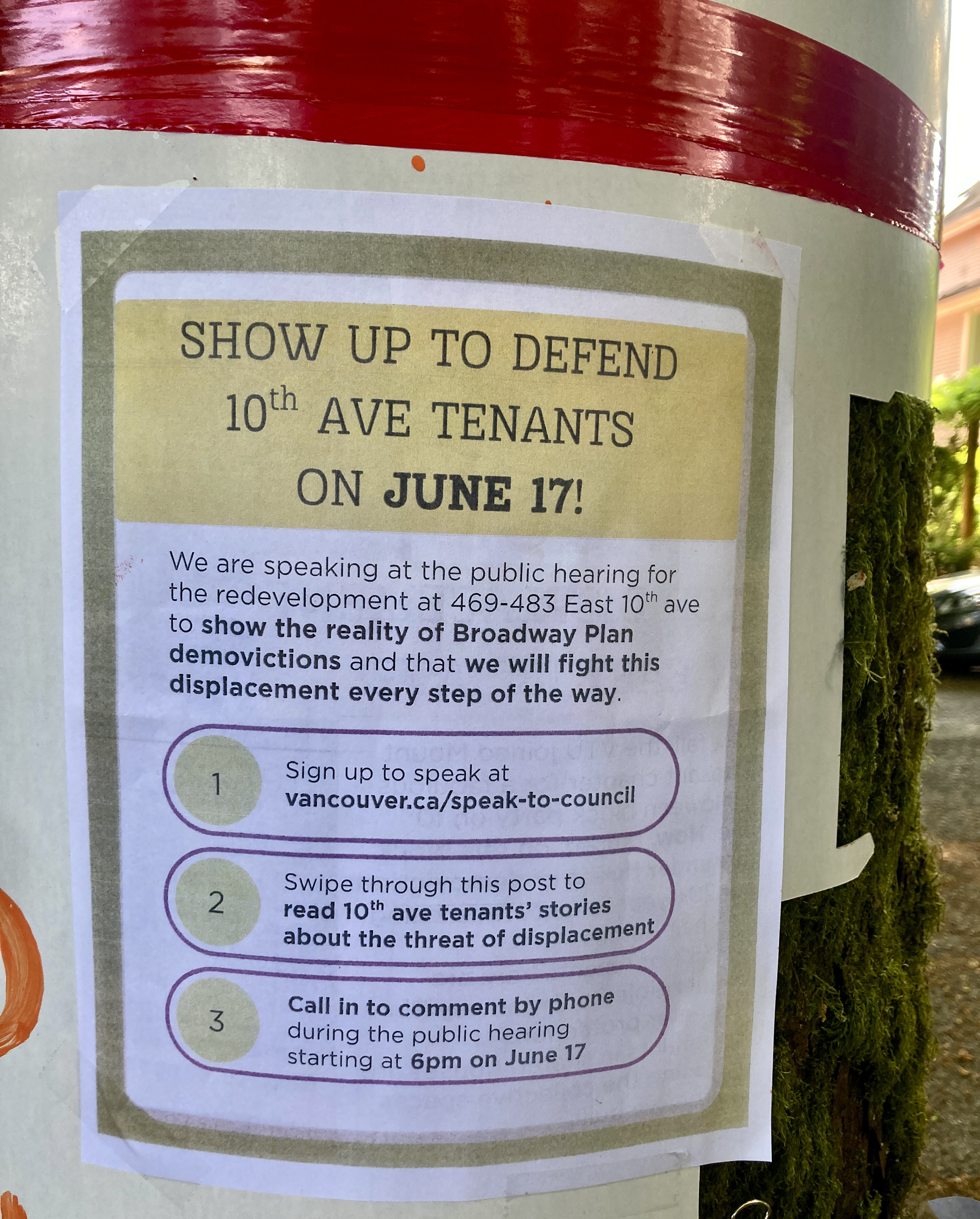
I may know more about the correct use of apostrophes (i.e., not to form noun plurals) than the author of this plea, but these tenants, in the adjoining notice…

teach me a new word. “Demoviction.” As in, the eviction of tenants from a building, so that it may be demolished, usually for redevelopment. A phenomenon integral to the Broadway Plan. And gaining pace.

I read a testimonial, also taped to the tree, the words of a woman who has been a tenant here for 22 years: “This affordable home allowed me to continue to raise my daughter here after my husband passed away. It provided a safe community and a stable, comfortable home.”

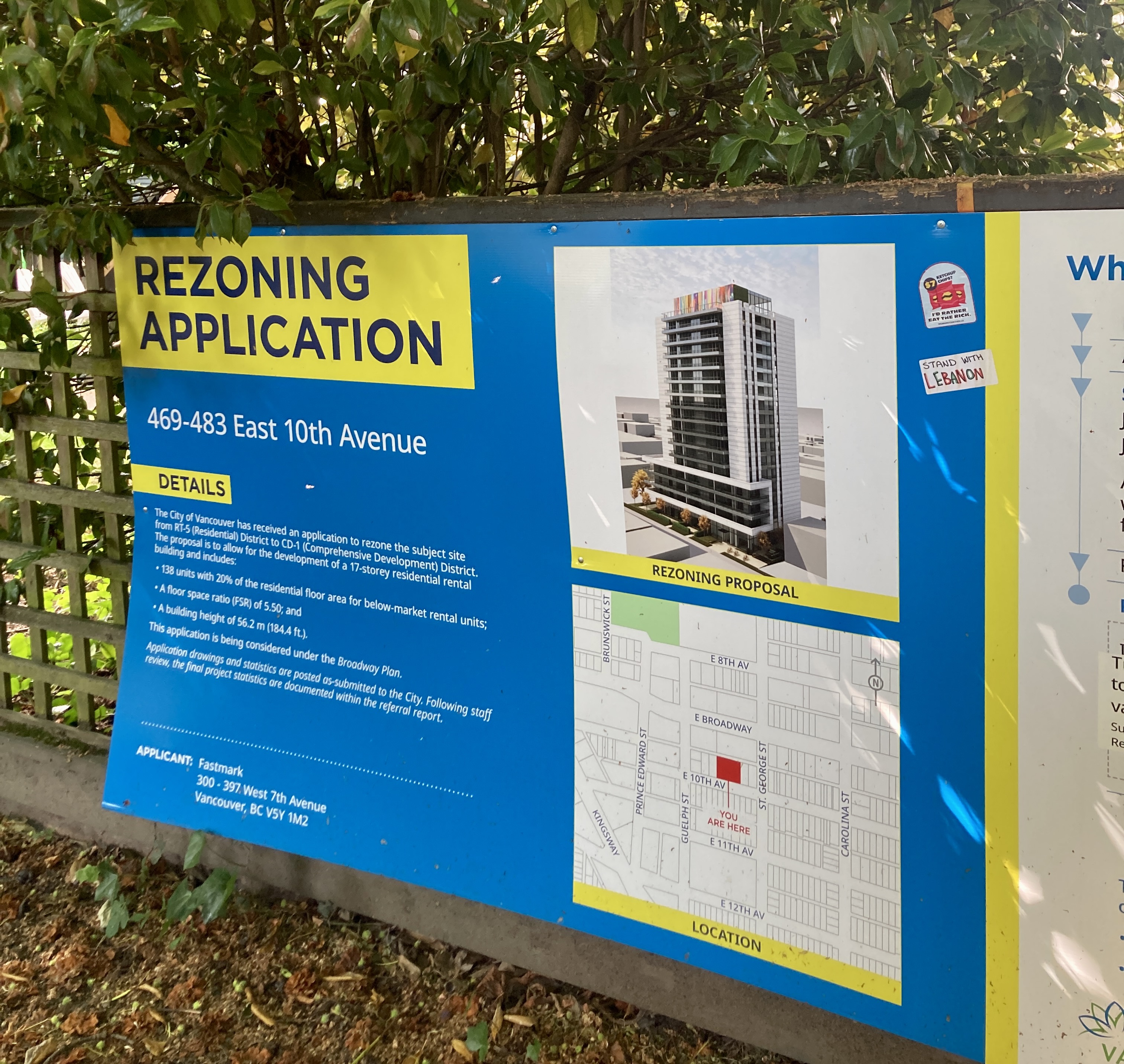
Right next door, the specific redevelopment being proposed: Rezone from Residential to Comprehensive Development category, and, on this street of two-storey homes, put up a 17-storey tower.

Hmm. Used to be, dragons breathed fire and wore scales. Now they may instead breathe rezoning, and clad themselves in 17 storeys.

13 for 13

13 June 2025 – It is all very tidy — you’ll see 13 photos, and this is June 13th — but it is not at all what I thought I was going to do. I had a theme, and then I had another theme, and then it all got away from me.

As tends to happen.

(Not that it matters.)

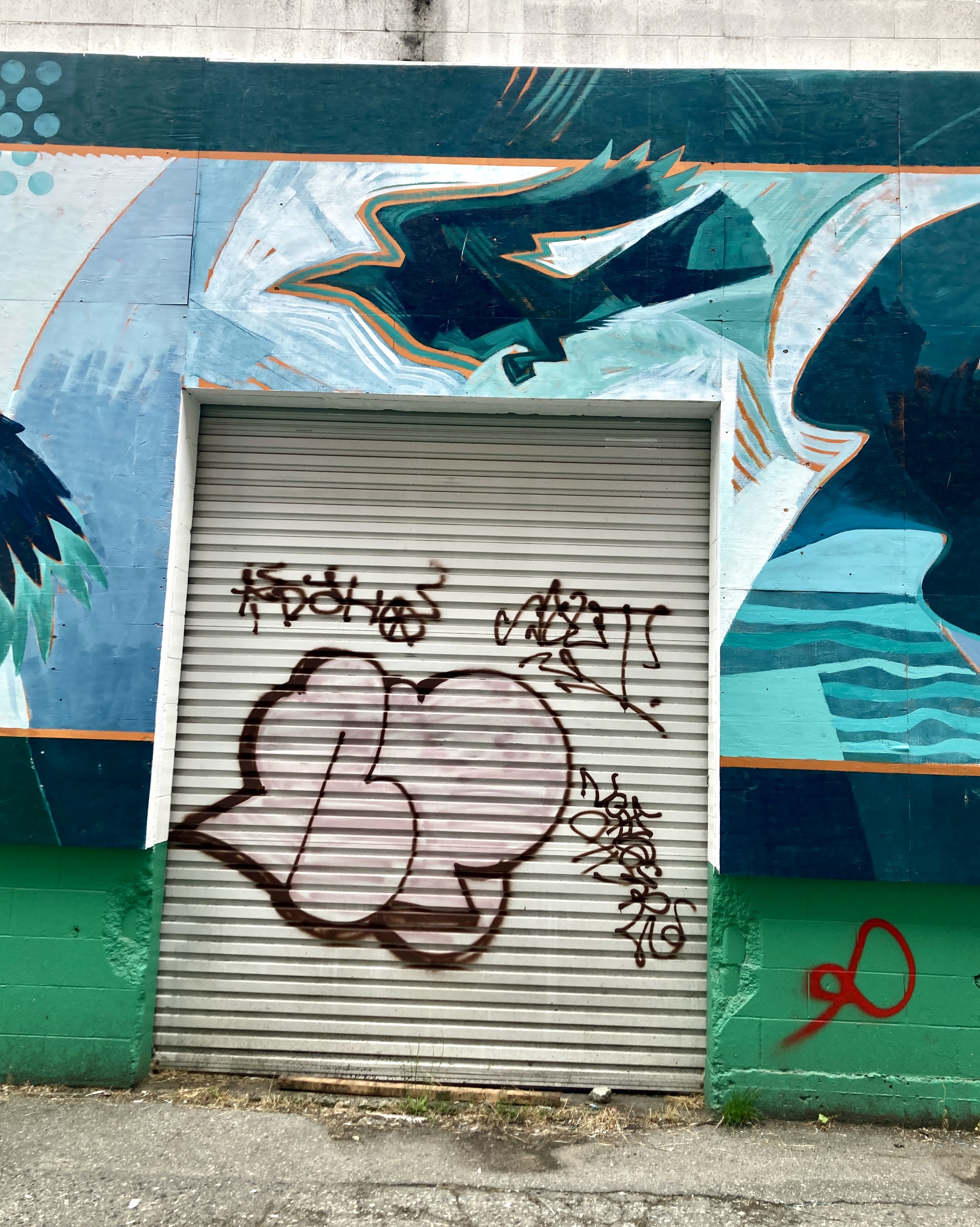
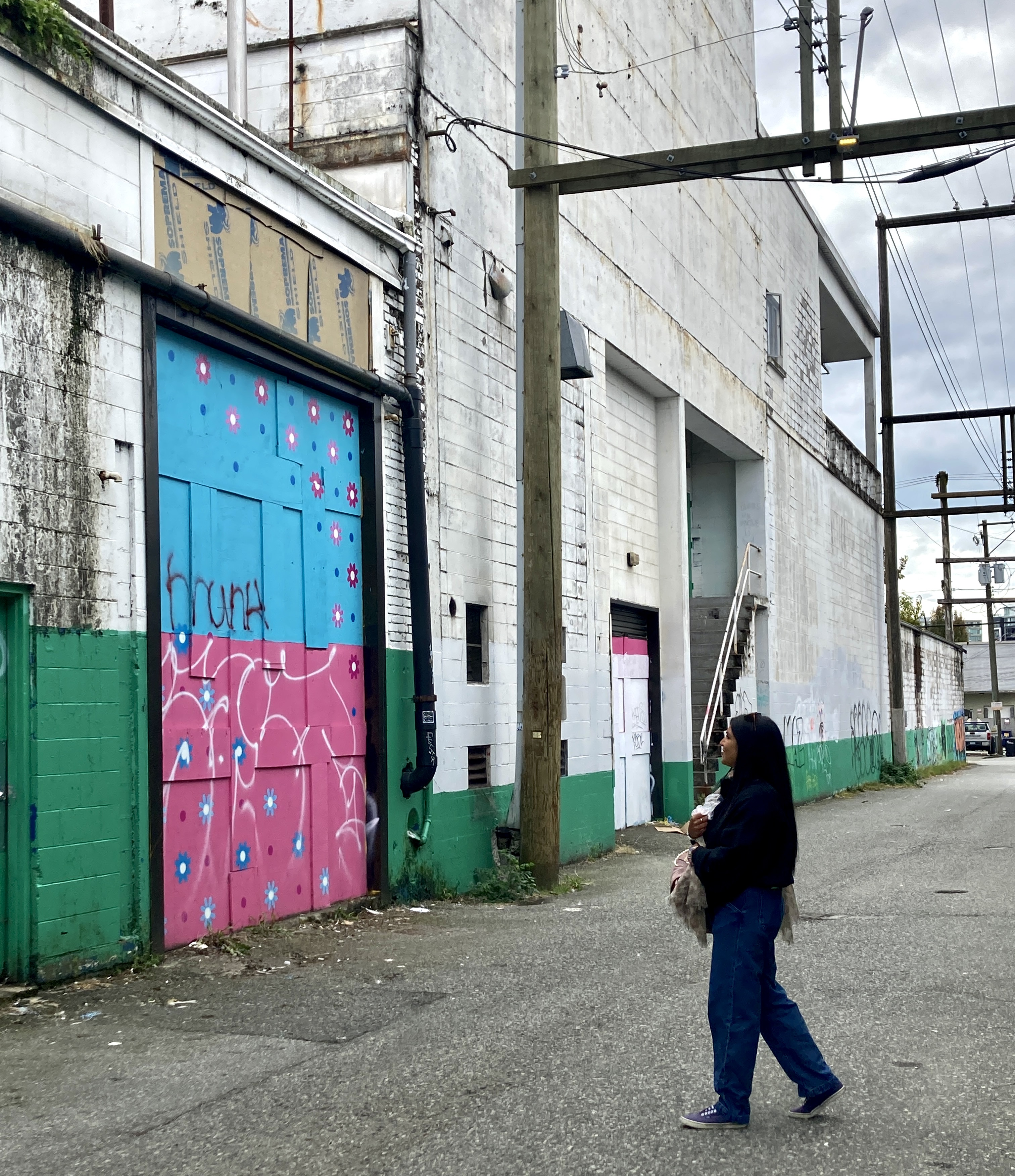
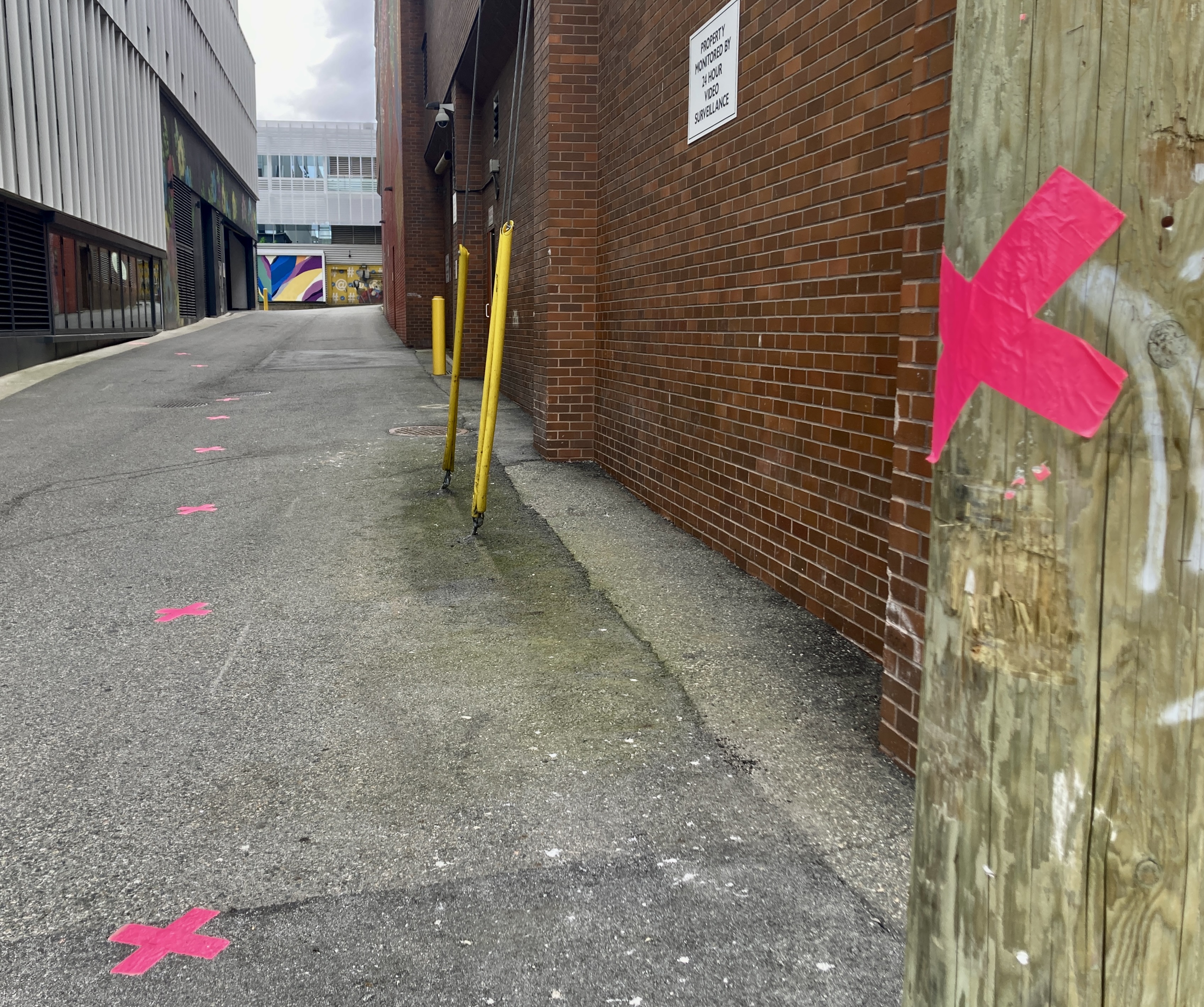
The first theme announces itself as I walk down Quebec St. toward False Creek, and look eastward into the alley.

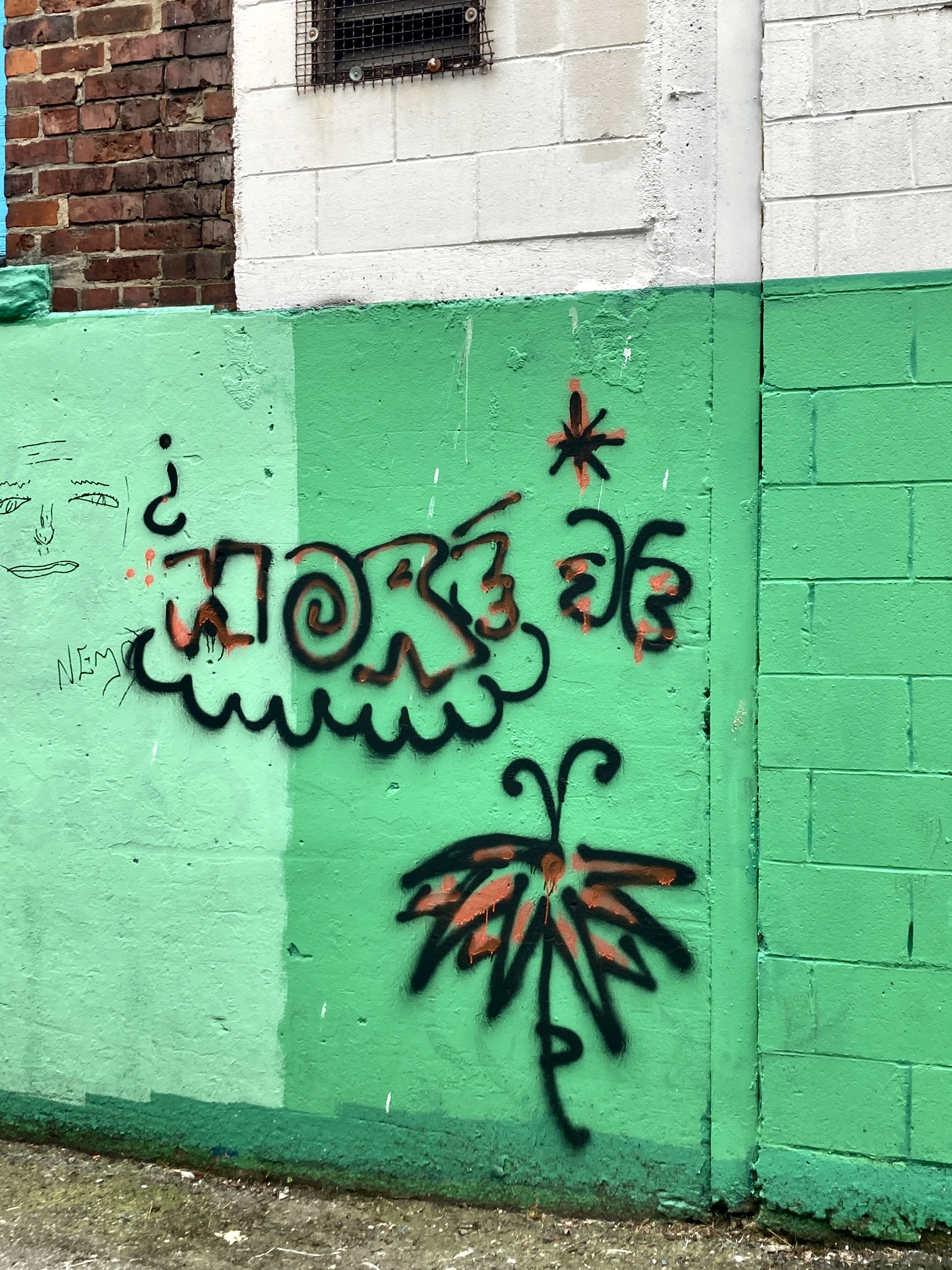
Perfect! One photo, a cutesy post title — something like “X’s and Oh!” perhaps? — and I’m done.

Then I see this.

OK! Two images, street theme, call the post “On the Street” — and I’m done.

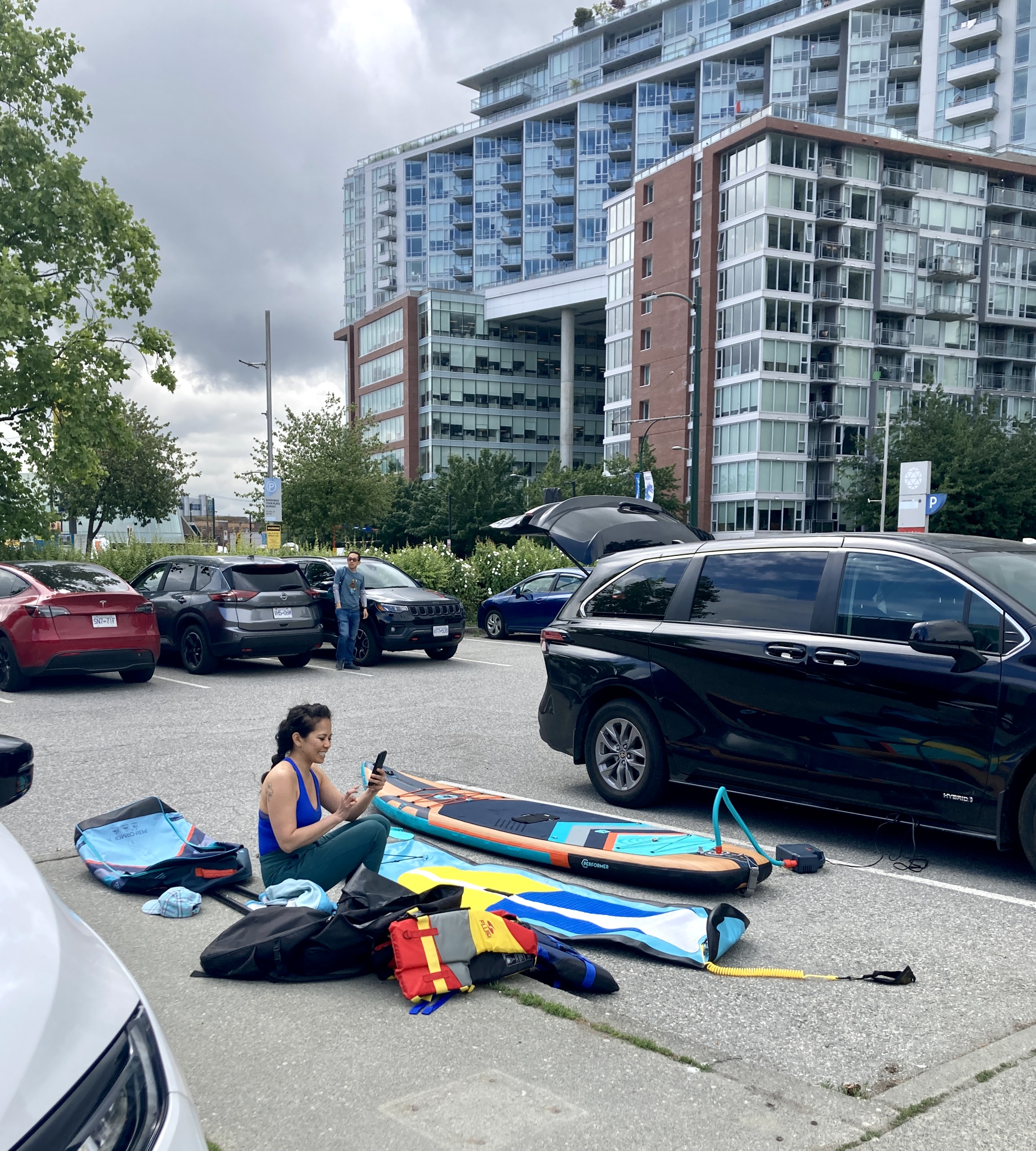
Then, crossing the Science World parking lot just off the end of False Creek, I see this tired but happy paddle-boarder telling a friend her adventure before packing up.

Three images. But still OK, the Street theme holds.

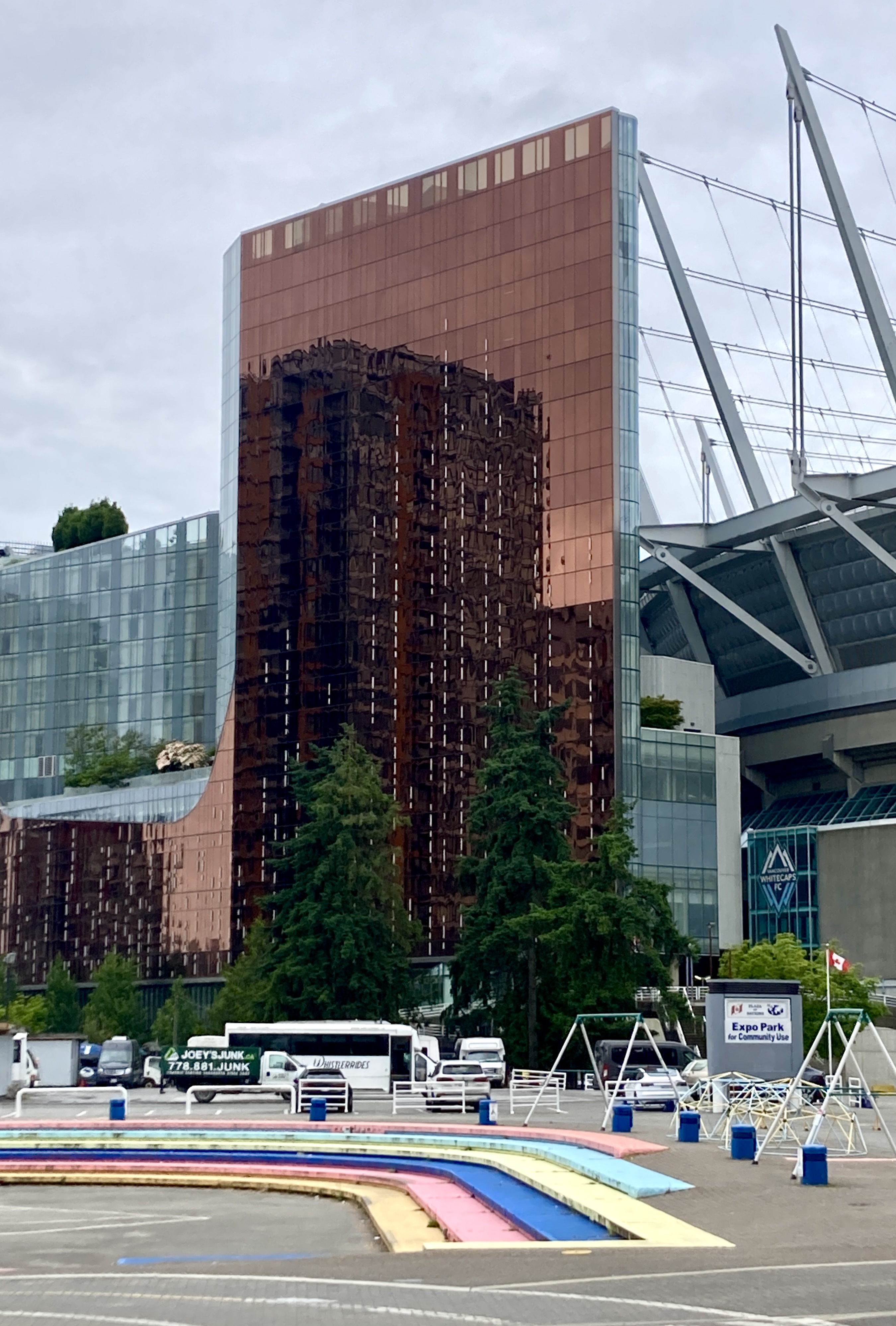
Ah, but next, heading west along False Creek, I am seduced (not for the first time) by the magic transformation of an ordinary apartment building when it bounces off the mirrored, textured surface of Parq Casino.

My theme promptly morphs from “street” to “surface.” Any thing or any living creature, I decide, on any surface, horizontal or vertical. Suddenly, everything that interest me… qualifies.

One dragon boat and two Aquabus ferries, out there on the surface of the water.

Mussel shells on the Seawall cobblestones, just past Cambie Bridge. (What’s left after a crow hurls a mussel from a great height onto a hard surface, then swoops down to eat the contents exposed to him when the shell splits upon impact.)

Up on Cambie Bridge, the fourth annual Missing and Murdered Indigenous Men, Boys and Two Spirit People Memorial March.

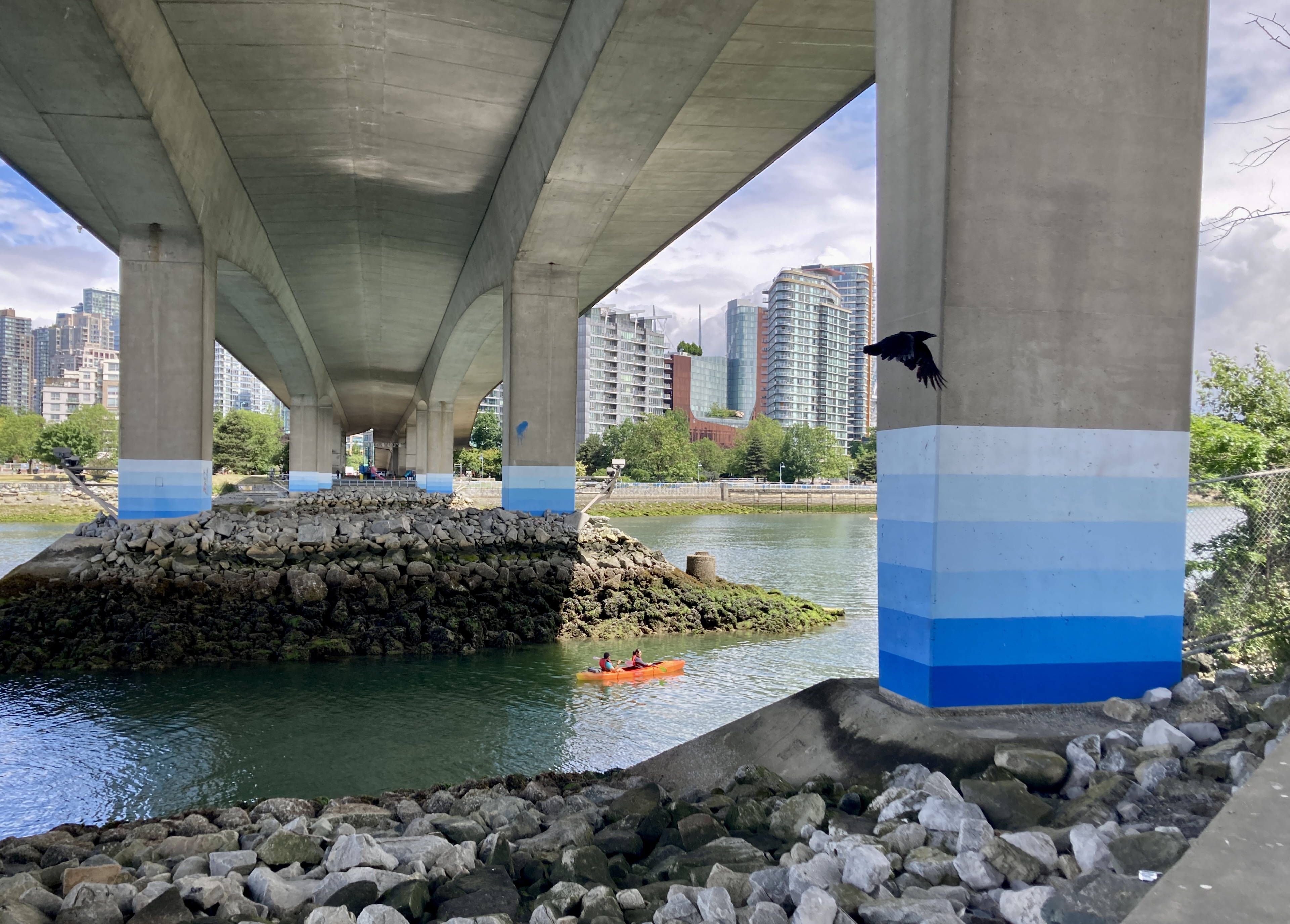
Back under Cambie Bridge, blue rings on the surface of bridge pillars, marking what a 5-metre rise in sea levels will look like, plus paddlers on the water. Plus a crow, swooping through on the surface of the air.

A generous message painted on the back surface of this bench facing Habitat Island: “I love the strange people I don’t know.”

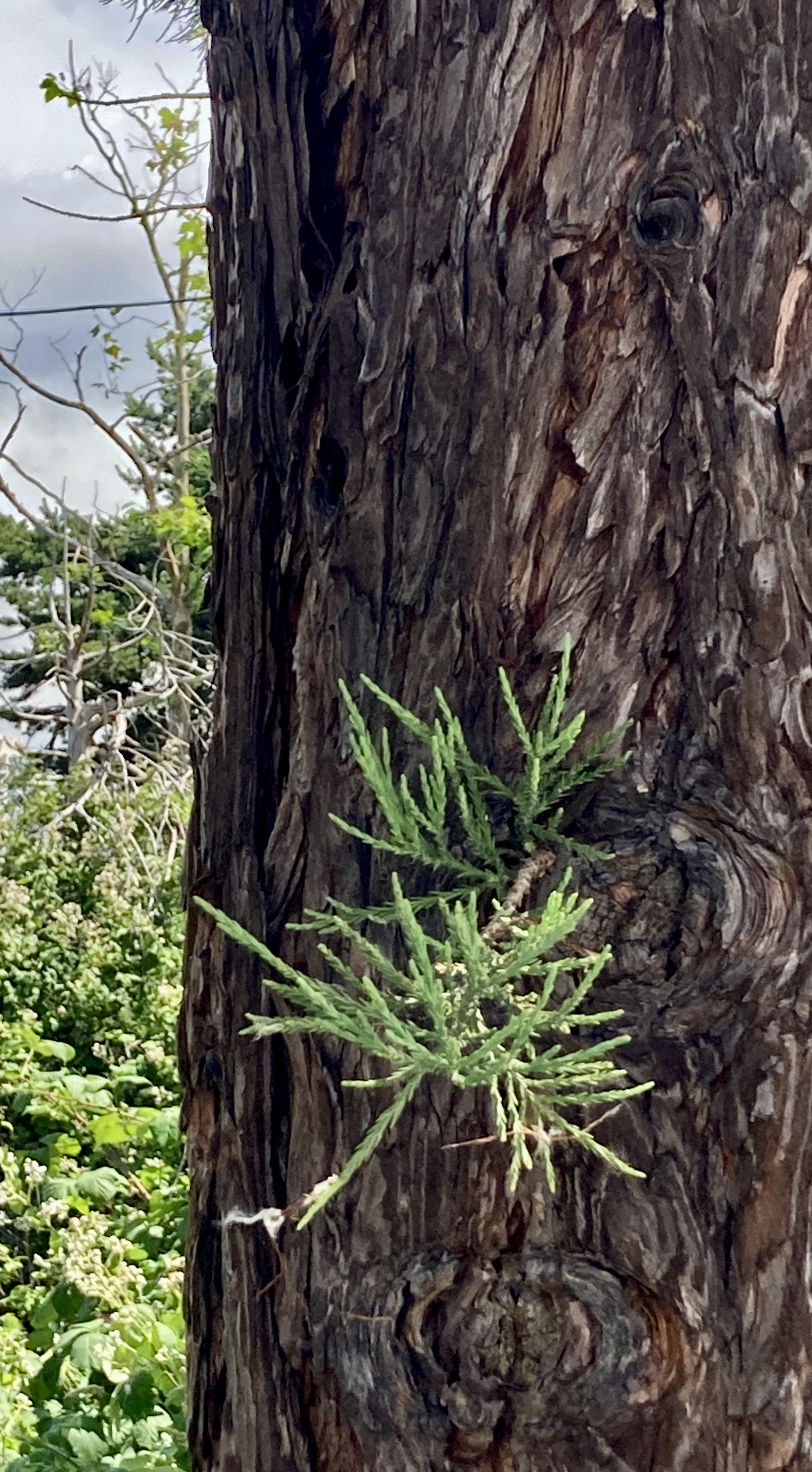
Vivid new growth, on the trunk of this conifer.

Two mutilated crow posters on an Ontario-Street utility box which, between them, almost add up to one complete crow.

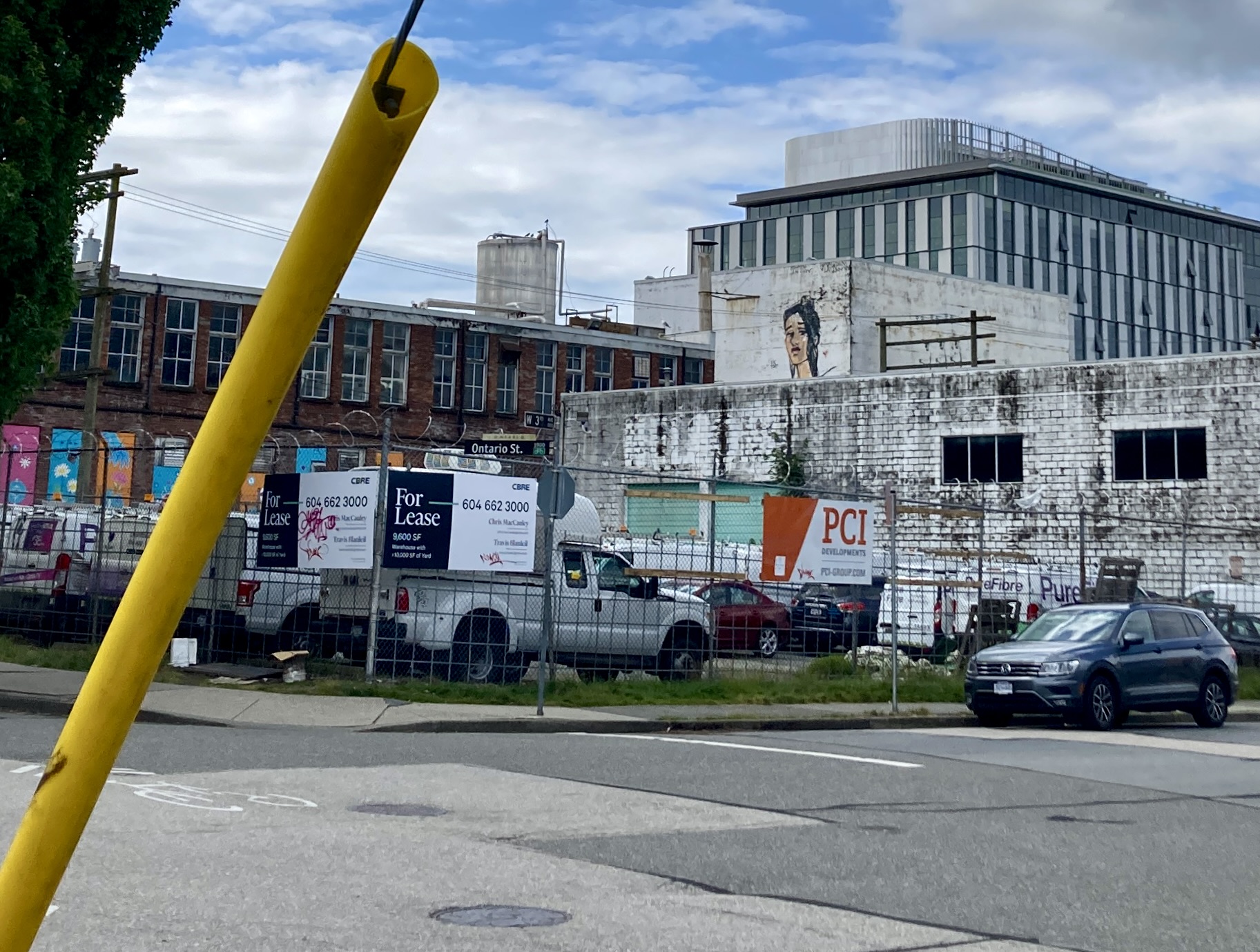
My favourite enigmatic Street-Art Girl, a little battered by now (and aren’t we all), but still visible on the wall of that building overlooking the parking lot just off Ontario and 3rd Avenue.

And finally… my favourite birds nest, perched on the surface of this alley fence post, again just off Ontario Street but by this time between East 6th & 7th, as I head for home.

I am still planning a post title to fit my “surface” theme.

Until I count how many photos I’ve chosen, and see they total thirteen. On the 13th of June.

I know an act of force majeure when I meet one. I obey.

Riprap! (and other discoveries)

7 June 2025 – Having walked down Heather Street, right to the False Creek Seawall, I am — not surprisingly — at the Heather Civic Marina. Which — also not surprisingly — is full of gently rocking boats.

I am not interested in the boats. I look left, where my feet will next take me…

and my mind bounces off most of what I see. Bounces off the low tide, the prow of a boat, the Seawall pathway, the bench in the bend of that pathway, and the collection of blue café umbrellas in Leg in Boot Square just ahead. My mind lands squarely on all that rock.

That sloping expanse of rock.

Riprap!

I grin at the rocks, mouthing the word.

I am surely influenced by Ana’s recent posts in her Anvica’s Gallery blog, in which she pays tribute to Wonderful Words. Most recently, to “ababol” — local slang, in her part of Spain, for “poppy.” She knows the correct Spanish for “poppy” is “amapola,” but she prefers “ababol.” Why? “It’s more fun.”

That’s my attitude to “riprap.” The fun you can have, with those two short syllables! Roll the r’s (Rrrrip-rrrap). Or pop the p’s (Rippp! Rappp)!

For me, though, it’s more than the fun of word games. It’s time travel.

Like Colonel Aurelio Buendía, remembering the day his father took him to discover ice, so I stand here on the Seawall, remembering the day I learned the word “riprap.” I was typing up some handwritten notes for a friend, and dissolved in giggles at a word I couldn’t read but deciphered as something like… “riprap.” Well, it couldn’t be that, could it, that’s not a word. So I said rude things about his horrible handwriting. And he patiently explained the word and its application — loose rock placed so to prevent erosion and preserve structural integrity.

For example… along the maritime edge of the False Creek Seawall.

Though Aurelio Buendía got to discover ice, the memory only surfaced as he faced a firing squad. Now, in much happier circumstances, my memory & I set out to discover riprap as I continue my walk toward Granville Island.

Vegetation has already discovered the riprap. All those crevices, just waiting to host whatever might be blowing in the wind.

From tiny, tenacious growth I can’t identify…

to shrubs and tall spikes of aconite, escapees from planted gardens.

A crow forages, for whatever he might find…

and I, initially taking in yet another sweep of vegetation, suddenly notice a tiny turquoise medallion, set in the Seawall ledge.

Which leads me to other discoveries, this bright breezy day.
It is one more marker in the provincial Control Survey system, a database of coordinates, elevations & related information archived for public access & use. The word “survey” flips me into more time travel. Almost 100 years ago, my dad spent two university summers as part of a survey team paddling the rivers & lakes of northern Saskatchewan.
The Seawall itself invites time travel. At the appropriate spot, signage shows us the unobstructed 2017 view across the water and through the city, right up to The Lions (two iconic mountain peaks, now more often called The Twin Sisters). It is, the signage announces, a protected view.

And yes, today in 2025, there it still is.

Right at the eastern edge of Charleson Park, more signage. This one a warning.

I am bemused. Warning? Are the elderly armed & dangerous? As I play with this very entertaining possibility, I hear the sound of approaching cyclists and a happy voice cries, “Well! That looks good!” The voice belongs to the man pedalling a trishaw, with two elderly passengers on the seat in front of him. A second trishaw follows. Laughter all ’round.

No wonder they approve of the sign — Cycling Without Age is a Canadian charity whose volunteers take local seniors (and their families and friends) out for a spin.

From elderly to young, from sturdy trishaw to tiny bicycle: Polkadot Helmet Missy & I pause halfway through Charleson Park…

to watch a City maintenance man wait for his colleagues before attempting to yoick that heavy fence section out of the way.

More walking, more discoveries. Including the Charleson Park sign that reminds us the pretty pond behind it is a seasonal pond, and it is meant to dry up in summer, and that’s okay. (Got it?)

And then I’m right under the Granville Street bridge, looking yet again at boats bobbing in the water, and yet again I am not focused on the boats.

I’m looking beyond, at that bright blue horizontal line of signage that placards the False Creek Fishermen’s Wharf, with its moorings and facilities for independent commercial fishers, and a wharf where the public can buy their catch.

More precisely, I’m focused on the pale blue rectangle, there on the left, just off all that bright blue.

That’s the old shipping container that now houses Go Fish — the fish purchased right there on the wharf, served up with chips and other delights, both trad & less so. They take no reservations, offer no indoors seating, and there is always a line-up.

Later, with my grilled wild salmon & salad, I plonk myself in one of those green bucket chairs, and enjoy my fish. And the view. And a bit of a rest.

And then… I walk back east.

The high route, this time, not the Seawall. It climbs me into the upper elevations of Charleson Park, all forest and dappled bark-chip trails…

and nary a chunk of riprap in sight.

That’s fine. I’ve had my moment.

Of Moss, Muzzles & Monsters

2 June 2025 – Only moss is on the agenda. Muzzles & monsters turn up on their own.

Moss is on the agenda because it’s about to go into its seasonal decline. Moss thrives in cool damp, suffers in dry heat. I want one last fix, and the Camosun Bog is the place to pay tribute.

As boardwalk signage points out…

the bog is, literally, built on moss.

Fortunately, despite the glossy new salal leaves and the bright growing trips of the evergreens that encircle the bog and speak of this new season…

the mossy carpet is still green, not yet bleached to its mid-summer pallor.

The moss is not just on the ground, either. Look at these trees!

So, as I leave the bog and start meandering north-east through the neighbourhood of West Point Grey, I am still moss-optimistic. And, despite distractions like this spiral of Buddhist prayer flags on a street-corner shrub…

and this bear-moose duo, endlessly paddling their way across somebody’s front yard…

I do see more moss.

Just look at these sidewalk sentinels, still wearing their winter finery, as they march their way down West 19th Avenue!

After all this, my attitude is: agenda met. No more expectations. I’ll just keep walking for a while — get in those steps — and then catch a bus.

Next thing I know, down by Alma & West Broadway, I’m being muzzled.

This is such good news.

There’s a mural by this artist in my own neighbourhood, one that both pleases & frustrates me. I like it for its own sake, but the style very loosely reminds me of Toronto street artist BirdO

and I really, really would like to know the Vancouver artist’s name. Can’t get close enough to the mural near my home to look for any ID — but here, there’s a whole wall-full of his images, in an open alley.

Multiple images, and a tribute to Jean-Michel Basquiat (the crown, upper right)… and a plaque identifying the artist. I learn, and it is my pleasure to inform you, that this mural is the work of Tokyo-born, Vancouver-based contemporary artist Taka Suda.

I am happy indeed, as I drop down the last few blocks to West Broadway.

An eye-flick left, into another alley, where the little window in this tired old shed…

suggests it must have started life as a stable. Surely that was the hay loft, above?

After that, my eyes flick straight ahead, on down busy Alma Street.

Another high rise going up, ho-hum. But then eye-flick becomes eye-focus, as I notice the monster riding high at the angle of that top corner.

See it? Shades of Hunchback of Notre Dame

A passing pedestrian notices my fixed gaze, and nods her head. “Like gargoyles, aren’t they?” she says, her smile showing she quite likes the idea.

“Gargoyles”? Plural? I walk closer, on down Alma. (I feel like I’m stalking the building.)

And yessirree, gargoyles-plural. There are three, one defining the top corner of each ledge.

The closer I get, the clearer they become, and I need to refine my language.

Not monsters. Not gargoyles.

Ravens. (Later online research tells me this building — a luxury residential rental building — is named The Raven.)

I spin around for an angle that shows them in triumphant profile…

and then, finally!, I catch my bus back home.

Wind & the Great Two-Four

19 May 2025 – There is a big difference, I realize — as I anchor my hat — between a calm 15C and a 15C with gusts that smack you in the face.

I’m just off the bus at the edge of Stanley Park, planning a walk through the park to celebrate this holiday long weekend. (Held the Monday before 24 May, and, both officially and unofficially, a single holiday with many names.)

My plan, before the hat-anchoring, was to walk across Lost Lagoon, out to Second Beach, and then whatever. Hat now anchored, I see the virtues of a trail walk among sheltering trees instead.

So I say good-bye to Lost Lagoon, despite the attraction of this mama duck and her babies (just off the point of those rocks)…

and this Pacific Great Blue Heron, posing right next to the path…

and, instead, I pivot my footsteps onto Tatlow Walk.

I don’t usually take any of the forest trails, and how silly is that? Here’s a whole 400 Ha of western rainforest, and I stick to the Seawall. Not today!

Tatlow offers me a whole different experience. See? (Ignore “You are here” — we are in fact in the upper-right curve of Lost Lagoon, about to slice diagonally through the forest on Tatlow Walk, and emerge at Third Beach.)

Why don’t I do this more often? Thank you, wind, for blowing me inland.

There is greenery — new growth climbing all over the old…

and woodpecker activity — scavenging insects from old trees…

and colour — the rich red of the cedar itself and the lichens on the bark…

and even sound effects — the angled tree squeaks as high-level wind rubs it against the trees that support it.

In the glade where Tatlow crosses Bridle Path (scroll back to that handy map, I’ll wait…), I meet a ghost.

One of seven ghosts, the stumps of the Seven Sisters, the soaring mix of Douglas Fir and Western Red Cedar that once stood here and were so popular with 19th-c visitors that they had their own dedicated trail.

Alas, by 1953…

they had to be honoured in a different way.

But the glade, like the rest of the forest, still has plenty of soaring verticals.

Side trails beguile…

but I look at the mud, and the bike ruts, and choose to stick with Tatlow.

At Stanley Park Drive, I wait for waves of holiday traffic to pass, cars as usual, but also motorcycle clusters and cyclists…

and then cross over. Within moments, here I am, about to emerge at Third Beach.

Where wind has free access, and white caps prove it.

Rocks, freighters (waiting their turn to enter the Port of Vancouver), and white caps. That’s the signature of my walk back down the Seawall.

Plus the occasional float plane silhouetted high against the clouds, snarling its way to, or from, the Flight Centre at Coal Harbour…

and crows swooping low across the beach…

and cyclists dismounting to navigate intersections with high-traffic walkways.

I take advantage of low tide, and walk the last stretch below the Seawall, down on the beach itself.

Just past park boundaries, I climb back up to Beach Avenue, Morton Park and…

a pop-up street fair. But of course. It’s a holiday weekend, isn’t it?

Quick browse in the fair, satisfying lunch on Denman Street (Indian, this time around), and a walk north on Denman, where the soaring verticals are quite different from those to be found in the park…

and, finally, a bus back home.

Mind Plans; Feet Don’t Care

23 April 2025 – My mind has created a very clear plan for the morning.

Follow the Quebec Street bioswale — not a ditch! a rainwater gathering/purifying system! — to Science World, down there at False Creek…

do the interview; walk my usual “Cambie Loop” to and over the bridge; and then zigzag eastward back home.

I do the interview. (The Mystery Interview. Be patient, a post will follow.) I start walking west along the False Creek Seawall.

All according to plan.

Suddenly, where Carrall St. butts into the Seawall, my feet execute a sharp right-turn. They don’t even inform my mind, let alone ask permission. They just take mind (and the rest of me) hostage, and execute their own plan.

Away we go. I find myself walking north on Carrall.

I decide not to argue: this could be interesting! The route offers a tidy cross-town slice past Andy Livingstone Park, through Chinatown, on into the Downtown East Side (DTES) and Gastown, all the way to Water Street with Burrard Inlet just beyond.

Poignant, powerful street art at West Pender, by the impressive street artist and DTES resident/advocate, Smokey D.

“It’s by Smokey D,” I hear two street kids say to each other, their voices full of respect. The City agrees. In tribute to his concern for others and use of his skills to inform and empower others, in 2023 Vancouver proclaimed March 11 — his birthday — to be Smokey D Day.

Another downtown symbol at Water and Cambie streets, this one much happier in mood: Raymond Saunders’ 1977 Steam Clock, still puffing steam and, in another 10 minutes, due to mark 12-noon with the opening bars of O Canada.

By now my mind fully supports what my feet set in motion: this is a promising route! I even manage to rediscover the Silvestre café and reacquaint myself with its Peruvian menu — another mug of Chicha Morada (purple corn drink) but this time, a Chicharron sandwich (pork belly) rather than an Alfajor dessert.

At Richards Street, my feet graciously allow my mind some say in what happens next. Continue west another block or two? Or turn south right here? Right here, says my mind, and my feet pivot accordingly.

Yet more patriotic fervour in the Macleod’s window at Richards & West Pender…

and appropriately vintage in style, as befits this rare, used and antiquarian bookstore.

I cross Dunsmuir, where signage informs me that this next stretch of Richards is part of the City’s “blue-green rainwater system.”

The last panel of the sign is an illustration of the pavers involved in the system. The caption asks, “Do they remind you of water flowing towards the tree?”

I step out into the street, check the pavers.

Yes, they do.

Another happy rediscovery, a place I can never find on purpose. I just have to, literally, walk into it…

the joyous, multi-level Rainbow Park at Richards & Smithe.

Getting closer to False Creek with every step!

On past Emery Barnes Park at Davie, and then across Pacific Blvd., right to the tumbling fountains of George Wainborn Park, which slopes down to the Creek.

Eastward along the False Creek Seawall, past a swimming dog (and ball-tossing owner)…

and then I’m beneath the towering girders at the David Lam ferry dock. Each girder base is incised with a different story of time & place.

This one commemorates the Great Fire of 1886…

when, on June 17, an authorized clearing fire on CPR property blazed out of control and destroyed the infant city, whose wooden structures were no match for the wind and flames. In the words of one survivor: “The city did not burn, it simply melted before the fiery blast.”

And then I walk some more, on past the Cambie Bridge, on along to Coopers Mews, with its symbolic barrels on high. At this point, mind, feet and the rest of me all agree on our course of action.

We follow the Mews to Pacific Blvd., and catch a bus for home.

Twists in Time

14 April 2025 – It’s spring time, full-tilt — but even so, twists of last fall and winter are still woven into the offering.

We’re once again at the VanDusen Botanical Garden. We’re eager for spring and, at first, that’s all we see.

Western skunk cabbages are once again a-glow in the boggy creek that feeds into Livingstone Lake…

and trilliums, Ontario’s provincial flower, are in their seasonal glory on a slope in the VanDusen’s Eastern North America garden.

Then we begin to notice the overlaps, the twists in time.

Glossy two-tone Southern Magnolia leaves are always with us…

but all around the R. Roy Forster Cypress Pond, those same two tones tell a more complex story. Here the green of new ferns begins to rise above the year-round ochre of cypress “knees.”

Just off the north end of the pond, the shadow fork of a still-bare deciduous tree frames the spring blossoms of this burst of Snake’s Head…

while over at the north end of Heron Lake, this Japanese Maple doesn’t yet obscure the long view down the lake. (But just wait another few weeks! Those leaves are about to unfurl.)

Face to face with the spring blossoms of this Sargent’s Magnolia, we’re also face to face with fall and winter. Petals already litter the ground — where they lie atop the desiccated leaves that fell last year. Visible also, there in the lower left quadrant of the photo, another reminder of last year: rusty skeletons of Mophead Hydrangea.

In the Fern Dell, the Tasmanian Tree Fern is — I think — putting out new spring fronds. (A hemispheric twist in time: from the Down-Under cycle of seasons, to our own, here in the Up-Over.)

There are things that don’t change, such as the deep-textured bark of a mighty Douglas Fir..

and things that do, such as the intricate spring coils of the Hedge Fern.

An old Emperor Oak leaf is caught in the glossy leaves of an Autumn Camellia (which saves its blooms, thank you very much, for fall)…

and this season’s cherry blossoms are already flying through the air like confetti…

as if they know that the Sakura Days Japanese Fair has now ended.

No, I take that back.

Yes, the Fair has ended, and yes, petals are flying — but these Daybreak Cherry trees are still laden with blossoms.

How fitting that the marble sculpture they shelter, titled Woman, is by Japanese artist Kiyoshi Takahashi.

  • WALKING… & SEEING

    "Traveller, there is no path. Paths are made by walking" -- Antonio Machado (1875-1939)

    "The voyage of discovery is not in seeking new landscapes, but in having new eyes" -- Marcel Proust (1871-1922)

    "A city is a language, a repository of possibilities, and walking is the act of speaking that language, of selecting from those possibilities" -- Rebecca Solnit, "Wanderlust: A History of Walking"

  • Recent Posts

  • Walk, Talk, Rock… B.C.-style

  • Post Categories

  • Archives

  • Blog Stats

    • 129,014 hits
  • Since 14 August 2014

    Flag Counter
  • Enter your email address to follow this blog and receive notifications of new posts by email.

    Join 2,045 other subscribers